Questions as text
Q1 · Answer the whole of this question on one sheet of graph paper 0580/41 Oct/Nov 2005
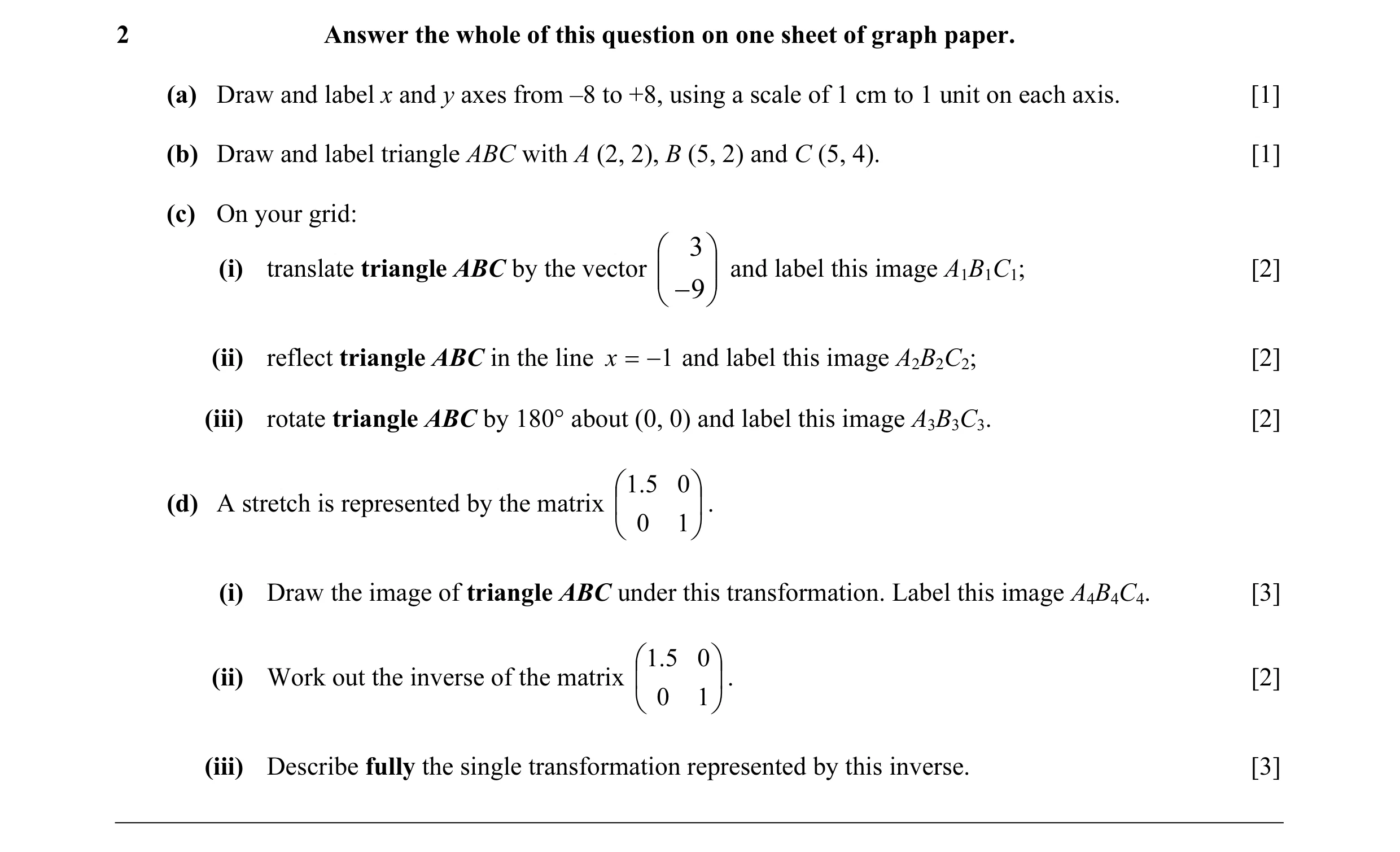
2 Answer the whole of this question on one sheet of graph paper. (a) Draw and label x and y axes from –8 to +8, using a scale of 1 cm to 1 unit on each axis. [1] (b) Draw and label triangle ABC with A (2, 2), B (5, 2) and C (5, 4). [1] (c) On your grid: 3 (i) translate triangle ABC by the vector and label this image A1B1C1; [2] −9 (ii) reflect triangle ABC in the line x = −1 and label this image A2B2C2; [2] (iii) rotate triangle ABC by 180° about (0, 0) and label this image A3B3C3. [2] 1.5 0 (d) A stretch is represented by the matrix . 0 1 (i) Draw the image of triangle ABC under this transformation. Label this image A4B4C4. [3] 1.5 0 (ii) Work out the inverse of the matrix . [2] 0 1 (iii) Describe fully the single transformation represented by this inverse. [3]
16 marks
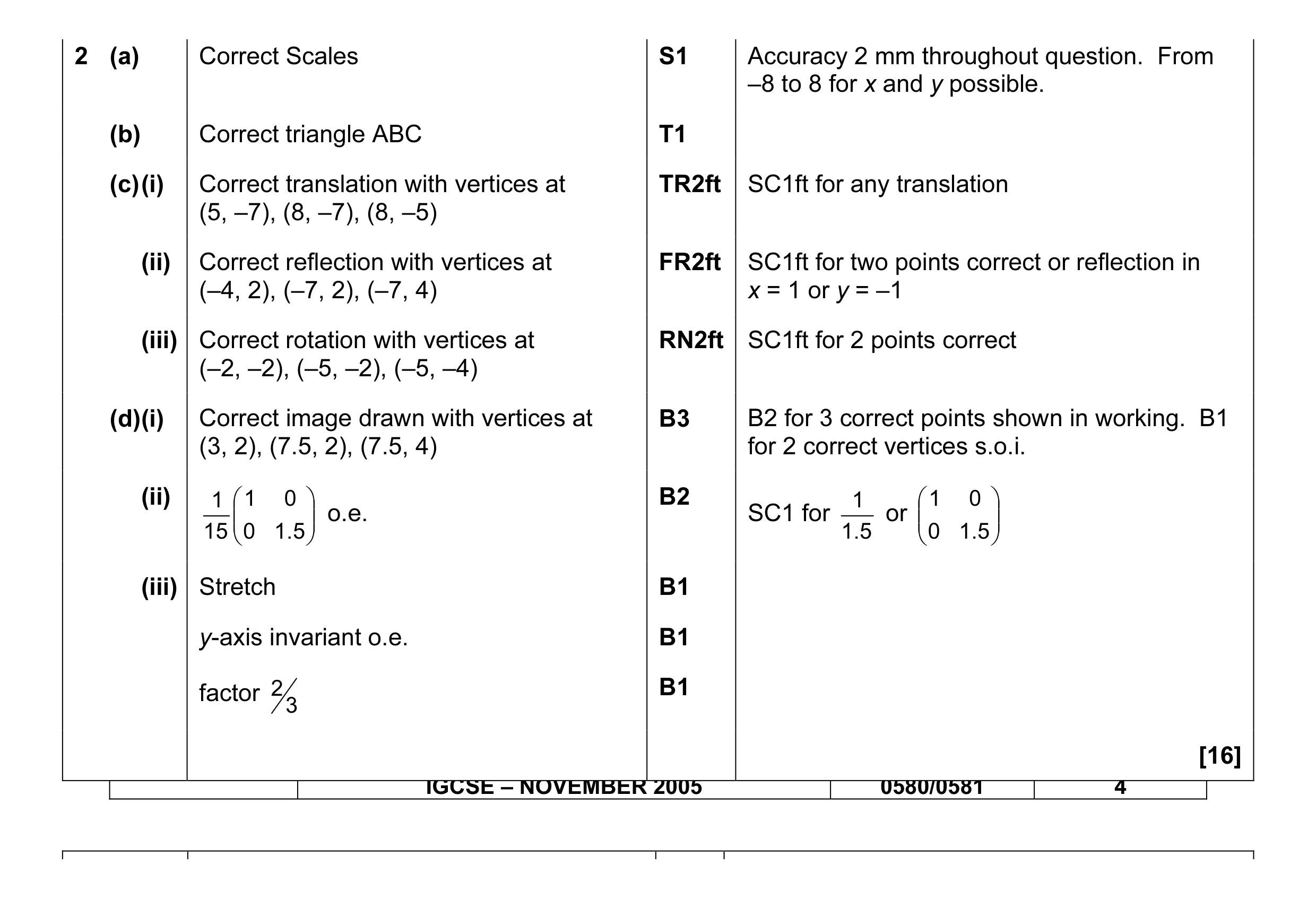
Mark scheme: 2 (a) Correct Scales S1 Accuracy 2 mm throughout question. From –8 to 8 for x and y possible. (b) Correct triangle ABC T1 (c) (i) Correct translation with vertices at TR2ft SC1ft for any translation (5, –7), (8, –7), (8, –5) (ii) Correct reflection with vertices at FR2ft SC1ft for two points correct or reflection in (–4, 2), (–7, 2), (–7, 4) x = 1 or y = –1 (iii) Correct rotation with vertices at RN2ft SC1ft for 2 points correct (–2, –2), (–5, –2), (–5, –4) (d) (i) Correct image drawn with vertices at B3 B2 for 3 correct points shown in working. B1 (3, 2), (7.5, 2), (7.5, 4) for 2 correct vertices s.o.i. B2 (ii) 1 1 0 1 1 0 o.e. SC1 for or 15 0 1 . 5 1 . 5 0 1 . 5 (iii) Stretch B1 y-axis invariant o.e. B1 B1 factor 2 3 [16] IGCSE – NOVEMBER 2005 0580/0581 4
This question in 0580/41 Oct/Nov 2005
Q2 · C North A B O NOT TO SCALE D The diagram shows a plan for a new city 0580/41 May/June 2006
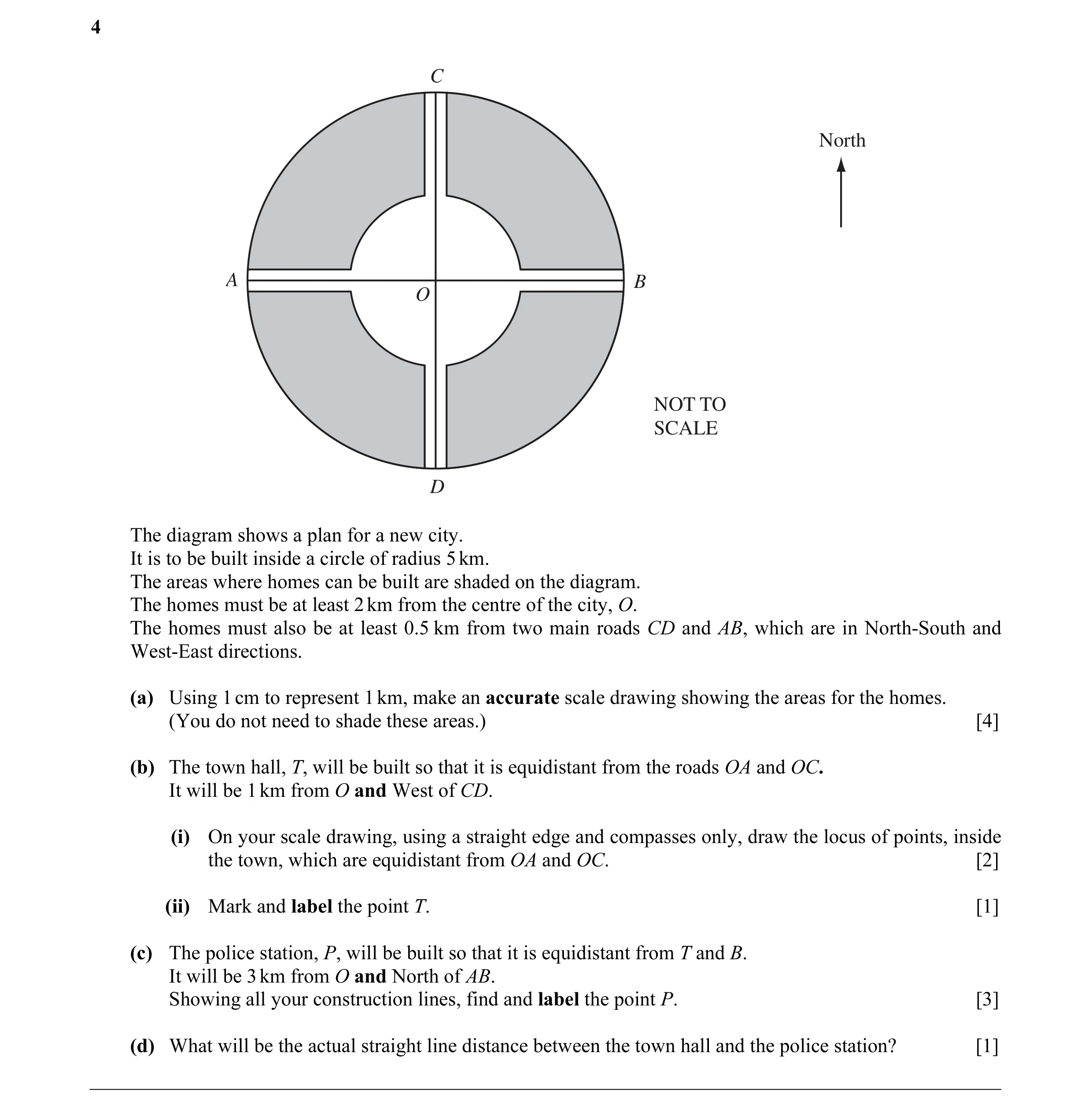
4 C North A B O NOT TO SCALE D The diagram shows a plan for a new city. It is to be built inside a circle of radius 5 km. The areas where homes can be built are shaded on the diagram. The homes must be at least 2 km from the centre of the city, O. The homes must also be at least 0.5 km from two main roads CD and AB, which are in North-South and West-East directions. (a) Using 1 cm to represent 1 km, make an accurate scale drawing showing the areas for the homes. (You do not need to shade these areas.) [4] (b) The town hall, T, will be built so that it is equidistant from the roads OA and OC. It will be 1 km from O and West of CD. (i) On your scale drawing, using a straight edge and compasses only, draw the locus of points, inside the town, which are equidistant from OA and OC. [2] (ii) Mark and label the point T. [1] (c) The police station, P, will be built so that it is equidistant from T and B. It will be 3 km from O and North of AB. Showing all your construction lines, find and label the point P. [3] (d) What will be the actual straight line distance between the town hall and the police station? [1]
11 marks
Mark scheme: 4 (a) Circle radius 5 cm (± 2 mm) B1 Circle radius 2 cm (± 2 mm) B1 AB is perpendicular to CD (± 1°) B1 Lines parallel to roads at 0.5 cm from B1 them (all 4 pairs) (Within 1 mm) (b) (i) Accurate (± 1°) angle bisector with arcs B2 (ii) T correct (± 1 mm) and labelled T1 (c) Accurate (± 1° and ± 1 mm) B2 Ft SC1 if ± 2° and ± 2 mm perpendicular bisector of TB (using their T) P correct (2.9 to 3.1 cm from 0) and B1 labelled (d) Their TP measured with km (±0.1 km) B1 11 IGCSE – May/June 2006 0580 and 0581 04
This question in 0580/41 May/June 2006
Q3 · Answer the whole of this question on a sheet of graph paper 0580/41 May/June 2007
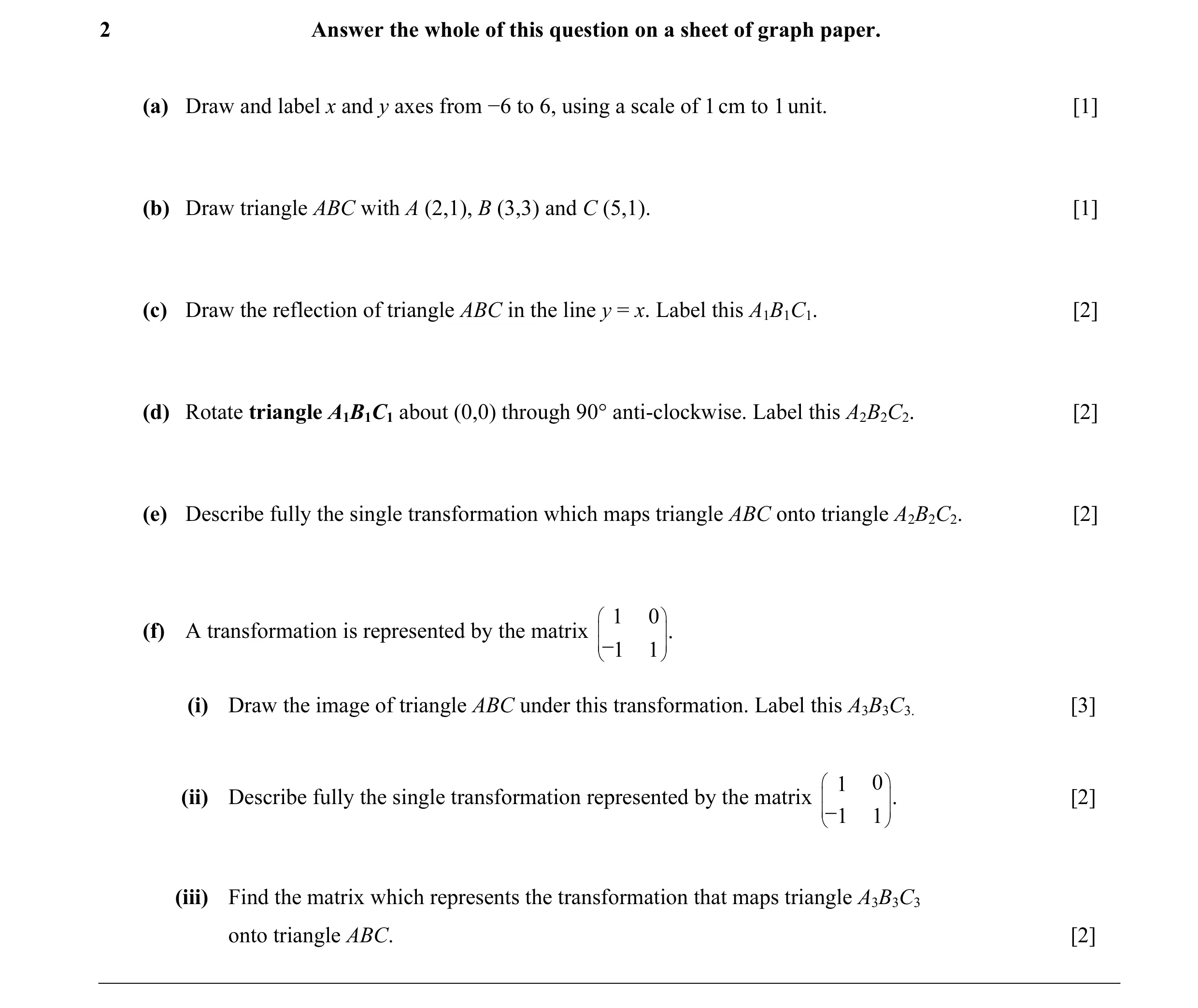
2 Answer the whole of this question on a sheet of graph paper. (a) Draw and label x and y axes from −6 to 6, using a scale of 1 cm to 1 unit. [1] (b) Draw triangle ABC with A (2,1), B (3,3) and C (5,1). [1] (c) Draw the reflection of triangle ABC in the line y = x. Label this A1B1C1. [2] (d) Rotate triangle A1B1C1 about (0,0) through 90° anti-clockwise. Label this A2B2C2. [2] (e) Describe fully the single transformation which maps triangle ABC onto triangle A2B2C2. [2] 1 0 (f) A transformation is represented by the matrix . −1 1 (i) Draw the image of triangle ABC under this transformation. Label this A3B3C3. [3] 1 0 (ii) Describe fully the single transformation represented by the matrix . [2] − 1 1 (iii) Find the matrix which represents the transformation that maps triangle A3B3C3 onto triangle ABC. [2]
15 marks
Mark scheme: 2 (a) Axes to correct scale S1 Accept 2mm accuracy throughout (b) Correct triangle A(2,1)B(3,3)C(5,1) B1 Condone absence of labels (c) A1(1,2), C1(1,5), B1(3,3) B2 B1 for 2 correct points ft their ABC Condone absence of labels and sides but not incorrect suffices (d) A2(–2,1), C2(–5,1), B2(–3,3) B2 B1 for 2 correct points ft their A1B1C1 Condone absence of labels and sides but not incorrect suffices SC1 for rotation of their A1B1C1 90° clockwise about the origin If triangle ABC is rotated correctly treat as mis-read (e) Reflection B1 Indep (Only possible answer) y-axis oe cso B1 (f) (i) A3(2, –1), C3(5, –4), B3(3,0) B3 B2 for 2 correct points plotted Condone absence of labels and sides If B0, M1 for any set up of matrix multiplication seen for at least one point and A1 for correct result (If correct triangle A2B2C2 used treat as MR, and the co-ords are (–2, 3), (–5, 6), (–3, 6)) (ii) Shear, y-axis invariant oe B1,B1 Allow factor of either +1 or –1 if invariant line omitted, but dependent on shear or stretch (iii) 1 0 B2 B1 for the left hand column 1 1 [15] IGCSE – May/June 2007 0580 and 0581 04
This question in 0580/41 May/June 2007
Q4 · Y A NOT TO SCALE B C x 0 The diagram shows a sketch of y = x2 + 1 and y = 4 – x 0580/41 Oct/Nov 2007
3 y A NOT TO SCALE B C x 0 The diagram shows a sketch of y = x2 + 1 and y = 4 – x. (a) Write down the co-ordinates of (i) the point C, [1] (ii) the points of intersection of y = 4 – x with each axis. [2] (b) Write down the gradient of the line y = 4 – x. [1] (c) Write down the range of values of x for which the gradient of the graph of y = x2 + 1 is negative. [1] (d) The two graphs intersect at A and B. Show that the x co-ordinates of A and B satisfy the equation x2 + x – 3 = 0. [1] (e) Solve the equation x2 + x – 3 = 0, giving your answers correct to 2 decimal places. [4] (f) Find the co-ordinates of the mid-point of the straight line AB. [2]
12 marks
Mark scheme: 3 (a) (i) (0, 1) B1 Accept w/out brackets/ commas, condone (ii) (4, 0) and (0, 4) B1B1 vectors, or states x = , y = (b) -1 cao B1 (c) (x) < 0 (allow ≤) B1 Any other variable < 0 B0 (d) x 2 + 1 = 4 − x o.e. B1 must be these 4 terms (e) M1 p +(-)√q where p = −1 and r = 2×1 r and q = 1² − 4(1)(-3) o.e. M1 q Allow second mark if in form p± r -2.30 , 1.30 cao www4 A1A1 If ww ans.correct but wrong acc - SC3 After A0, A0, SC1 for -2.3027756 and 1.3027756 rounded or truncated (f) (-0.5, 4.5 or 4.49) B1ft f.t (their –2.30 + their 1.30) ÷2 B1 ft ft (4 – their x co-ord dep on attempt at mid value of x from values in e) [12]
This question in 0580/41 Oct/Nov 2007
Q5 · Answer the whole of this question on a sheet of graph paper 0580/41 Oct/Nov 2007
7 Answer the whole of this question on a sheet of graph paper. (a) Draw x and y axes from 0 to 12 using a scale of 1 cm to 1 unit on each axis. [1] (b) Draw and label triangle T with vertices (8, 6), (6, 10) and (10, 12). [1] (c) Triangle T is reflected in the line y = x. (i) Draw the image of triangle T. Label this image P. [2] (ii) Write down the matrix which represents this reflection. [2] 1 0 (d) A transformation is represented by the matrix 2 1 0 2 (i) Draw the image of triangle T under this transformation. Label this image Q. [2] (ii) Describe fully this single transformation. [3] (e) Triangle T is stretched with the y-axis invariant and a stretch factor of 1 . 2 Draw the image of triangle T. Label this image R. [2]
13 marks
Mark scheme: 7 (a) Correct axes S1 must fit on paper 2mm acc throughout Ignore labels on triangles throughout (b) Correct triangle drawn (T) T1 vertices at (8, 6), (6, 10) and (10, 12) (c) (i) Correct reflection in y = x drawn (P) P2ft ft their T, P1 for two correct vertices drawn (6, 8), (10, 6), (12, 10) or line y = x correctly drawn (within 2mm of (12,12) if extended) (ii) B2 B1 for a correct column 0 1 1 0 (d) (i) Correct enlargement, scale factor 0.5, Q2ft (4, 3), (3, 5), (5, 6) centre (0,0) drawn (Q) Q1 for any enlargement s.f. ½ or 2 correct vertices drawn SC1 for 3 points within 5 mm if rays method used or for correct enlargement but of P (ii) Enlargement only B1 (scale factor) 0.5 B1 indep (centre) (0, 0) o.e. B1 indep (e) Correct stretch drawn (R) R2ft R1 for two correct vertices ft (4, 6), (3, 10), (5, 12) [13]
This question in 0580/41 Oct/Nov 2007
Q6 · For 3 7 (a) P is the point (2, 5) and = 0580/42 May/June 2012
For 3 7 (a) P is the point (2, 5) and = . Examiner's −2 Use Write down the co-ordinates of Q. Answer(a) ( , ) [1] (b) D C B NOT TO E SCALE c M O A 3a O is the origin and OABC is a parallelogram. M is the midpoint of AB. = c, = 3a and CE = 1 CB. 3 OED is a straight line with OE : ED = 2 : 1 . Find in terms of a and c, in their simplest forms (i) , Answer(b)(i) = [1] (ii) the position vector of M, Answer(b)(ii) [2] (iii) , Answer(b)(iii) = [1] (iv) . Answer(b)(iv) = [2] (c) Write down two facts about the lines CD and OB. Answer (c) [2]
9 marks
Mark scheme: 7 (a) (5, 3) 1 (b) (i) 3a + c 1 (ii) 3a + 12 c or 12 (6a + c ) 2 M1 for OM oe e.g OA+AM or correct unsimplified answer (iii) a + c 1 3 1 1 (iv) a + c or (3a + c) 2 M1 for – c + 3× their (iii) or a + 1× their (iii) or 2 2 2 2 2 correct unsimplified answer or any correct route e.g. CE + ED Part (c) dependent on simplified (i) and (iv) (c) (CD) parallel (to OB) oe cao 1dep Dep on (i) = k × (iv) 1 CD = OB oe cao 1dep Dep on (i) = 2 × (iv) must be scalars 2 IGCSE – May/June 2012 0580 42
This question in 0580/42 May/June 2012
Q7 · The scale drawing shows the positions of three towns A, B and C on a map 0580/41 Oct/Nov 2015
7 The scale drawing shows the positions of three towns A, B and C on a map. The scale of the map is 1 centimetre represents 10 kilometres. C North A North Scale: 1 cm to 10 km B (a) Find the actual distance AB. Answer(a) … km [1] (b) Measure the bearing of A from B. Answer(b) … [1] (c) Write the scale 1 cm to 10 km in the form 1 : n. Answer(c) 1 : … [1] (d) A national park lies inside the triangle ABC. The four boundaries of the national park are • equidistant from C and B • equidistant from AC and CB • 15 km from CB • along AB. On the scale drawing, shade the region which represents the national park. Leave in your construction arcs. [7] (e) On the scale drawing, a lake inside the national park has area 0.4 cm2. Calculate the actual area of the lake. Answer(e) … km2 [2] __________________________________________________________________________________________
12 marks
Mark scheme: 7 (a) 123 to 127 1 (b) 288 to 292 1 (c) [1:] 1 000 000 1
This question in 0580/41 Oct/Nov 2015
Q8 · A line AB joins the points A (3, 4) and B (5, 8) 0580/42 Oct/Nov 2015
8 A line AB joins the points A (3, 4) and B (5, 8). (a) Write down the co-ordinates of the midpoint of the line AB. Answer(a) ( … , … ) [2] (b) Calculate the distance AB. Answer(b) AB = … [3] (c) Find the equation of the line AB. Answer(c) … [3] (d) A line perpendicular to AB passes through the origin and through the point (6, r). Find the value of r. Answer(d) r = … [3]
11 marks
Mark scheme: 8 (a) ( 4 , 6 ) 1, 1 (b) 4.47 or 4.472 3 M2 for (8 − 4 )2 + (5 − 3 )2 or better or M1 for (8 − 4 )2 + (5 − 3)2 or better (c) y = 2 x − 2 oe 3 B2 for 2 x − 2 or y = 2 x + c oe 8 − 4 or M1 for [m =] oe soi by 2x 5 − 3 and M1 for (3, 4) or (5, 8) or their midpoint substituted into their y = mx + c with m numerical (d) − 3 3 M1 for use of gradient × their m = − 1 soi by 1 – 2 M1 for r = their gradient × 6 [+0]
This question in 0580/42 Oct/Nov 2015
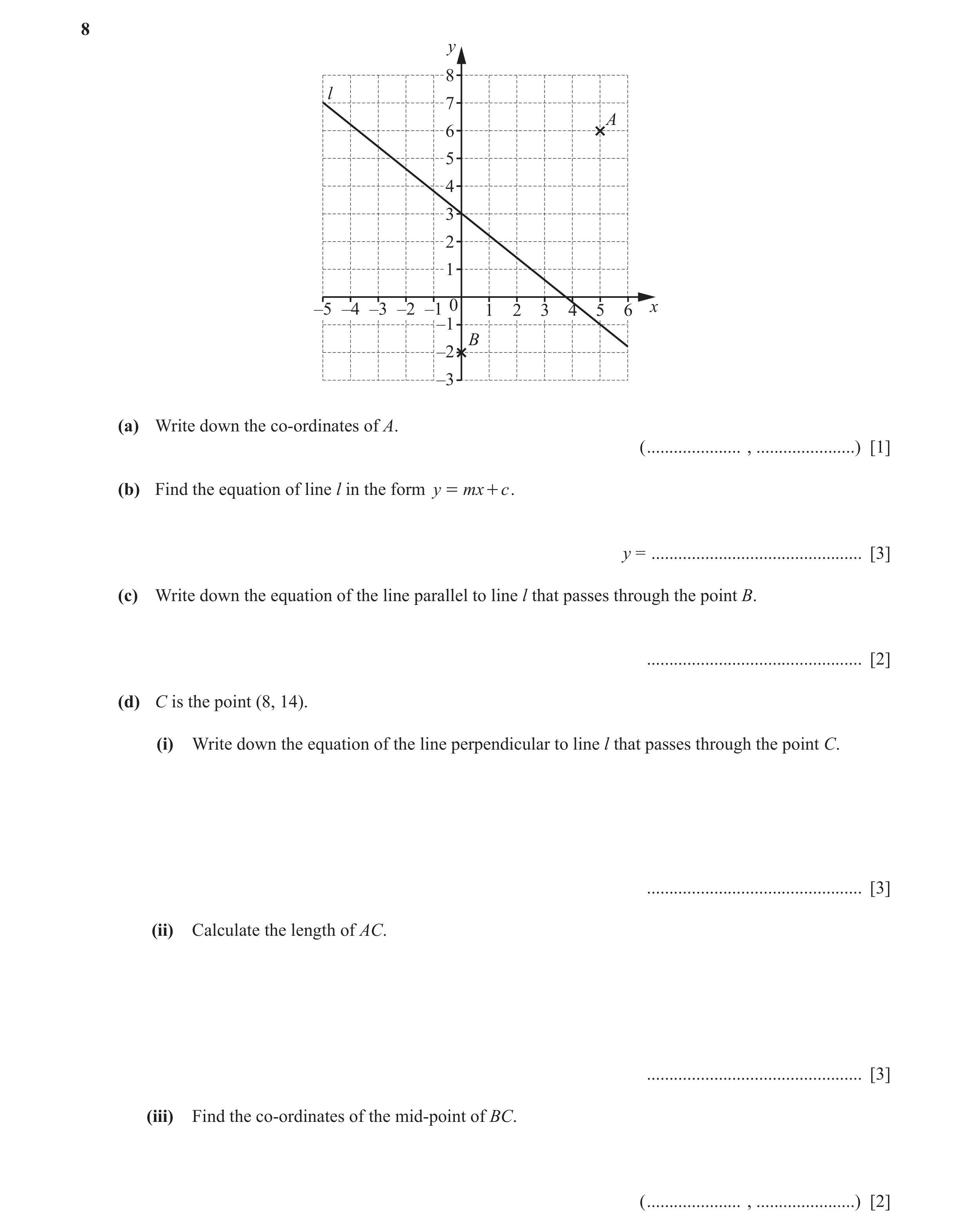
Q9 · Y 8 l 7 A 6 5 4 3 2 1 –5 –4 –3 –2 –1 0 1 2 3 4 5 6 x –1 B –2 –3 (a) Write down the… 0580/41 Oct/Nov 2018
8 y 8 l 7 A 6 5 4 3 2 1 –5 –4 –3 –2 –1 0 1 2 3 4 5 6 x –1 B –2 –3 (a) Write down the co-ordinates of A. ( … , … ) [1] (b) Find the equation of line l in the form y = mx + c . y = … [3] (c) Write down the equation of the line parallel to line l that passes through the point B. … [2] (d) C is the point (8, 14). (i) Write down the equation of the line perpendicular to line l that passes through the point C. … [3] (ii) Calculate the length of AC. … [3] (iii) Find the co-ordinates of the mid-point of BC. ( … , … ) [2]
14 marks
Mark scheme: 8(a) (5, 6) 1 8(b) 4 3 4 [ y = ] − x + 3 nfww B2 for [ y = ] − x + c nfww 5 5 rise or M1 for using any two of (–5, 7) run (0, 3) and (5, –1) and B1 for [ y = ]mx + 3 (m ≠ 0 ) 8(c) 4 2 FT their gradient from 8(b) y = − x − 2 oe 5 B1 for y = (their gradient)x + c (c not 0) or for y = mx − 2 (m ≠ 0 ) 4 or for − x − 2 alone 5 8(d)(i) 5 3 1 y = x + 4 oe M1 for −their gradient from 8(b) 4 M1 for (8, 14) substituted into y − 14 their y = mx + c or = m or better x − 8 8(d)(ii) 8.54 or 8.544... 3 M2 for (14 − their 6) 2 + (8 − their 5) 2 or better or M1 for 14 − their 6 and 8 − their 5 seen 8(d)(iii) (4, 6) 2 B1 for each
This question in 0580/41 Oct/Nov 2018
Q10 · In the square ABCD, A has coordinates ( - 2 , 1) and B has coordinates (1, 5) 0580/41 May/June 2023
6 (a) In the square ABCD, A has coordinates ( - 2 , 1) and B has coordinates (1, 5). C has coordinates (a, b), where a and b are both positive integers. Find the coordinates of C and the coordinates of D. You may use the grid to help you. y 6 5 4 3 2 1 – 3 – 2 – 1 0 1 2 3 4 5 6 x – 1 – 2 – 3 C ( … , … ) D ( … , … ) [4] (b) P has coordinates ( - 1, 3) and Q has coordinates (6, 4). (i) Find the coordinates of the midpoint of PQ. ( … , … ) [2] (ii) Find the length PQ. … [3] (iii) Find the gradient of PQ. … [2] (iv) Find the equation of the line parallel to PQ that crosses the x-axis at x = 2 . … [3]
14 marks
Mark scheme: 6(a) (5, 2) 4 B3 for 3 correct values or answers for C and D (2, − 2) reversed or correct coordinates given on diagram wrongly labelled or B2 for one correct coordinate pair correctly labelled or M2 for A,B,C and D correctly plotted or M1 for A and B correctly plotted If 0 or 1 scored instead award SC2 for answers (–3, 8) and (–6, 4) or answers (1.5,1.5) and (–2.5, 4.5) 6(b)(i) (2.5, 3.5) oe 2 B1 for each 6(b)(ii) 7.07 or 7.071... 3 2 2 M2 for 6 1 4 3 oe or M1 for 6 1 or 4 3 oe 6(b)(iii) 1 2 4 3 M1 for 7 6 oe1 6(b)(iv) 1 2 3 M1 for gradient = their (iii) y x or 7 y x 2 oe 7 7 M1dep for substituting (2, 0) in a linear final answer equation with their m allow if (2,0) satisfies y=(their(b)(iii) gradient)x+c
This question in 0580/41 May/June 2023
Q11 · P is the point (1, 7) 0580/41 May/June 2024
5 (a) P is the point (1, 7). Q is the point (5, –5). y P NOT TO SCALE O x Q (i) Find PQ . PQ = [2] f p (ii) Show that OP = OQ . [3] (iii) PQ is a chord of a circle with centre O. Calculate the circumference of this circle. … [2] (iv) PQ is the diameter of a different circle with centre R. Find the coordinates of R. ( … , … ) [2] (v) Find the equation of the perpendicular bisector of PQ. Give your answer in the form y = mx + c . y = … [4] (b) The position vector of A is a. The position vector of B is b. M is a point on AB such that AM : MB = 2 : 3. Find, in terms of a and b, the position vector of M. Give your answer in its simplest form. … [4]
17 marks
Mark scheme: 5(a)(i) 4 2 B1 for each 12 5(a)(ii) 12 + 72 M1 52 + ([–]5)2 M1 Both 50 oe A1 With no errors seen If M0M0A0 scored SC1 for 50 oe for each 5(a)(iii) 44.4 or 44.42[8…] to 44.435 2 FT their (a)(ii) correct to 3sf or better M1 for 2 × × their 50 oe 5(a)(iv) (3, 1) 2 B1 for each 5(a)(v) 1 4 [y =] x B3 for a correct equation in the wrong 3 form as final answer Or B2 for 1/3 stated or used as perpendicular gradient OR 7 5 M1 for [grad PQ] = oe 1 5 1 M1 for their grad PQ M1dep for substituting their(a)(iv) or (0,0) into y = their mx + c oe dep on the 2nd M1 or B2 5(b) 3 2 4 a + b final answer 5 5 B3 for an unsimplified correct answer 2 or B2 for AM b a soi 5 3 or B M a b soi 5 or B1 for AB = b – a or BA = a – b or for a correct route for OM or for correct diagram
This question in 0580/41 May/June 2024
 1 / 13
 2 / 13
 3 / 13
![Question 4: y A NOT TO SCALE B C x 0 The diagram shows a sketch of y = x2 + 1 and y = 4 – x. (a) Write down the co-ordinates of (i) the point C, [1] (i…](https://img.pastlit.com/crops/ac6e953d-dc96-46da-a2a4-3e493900bce6/q3.webp) 4 / 13
4 / 13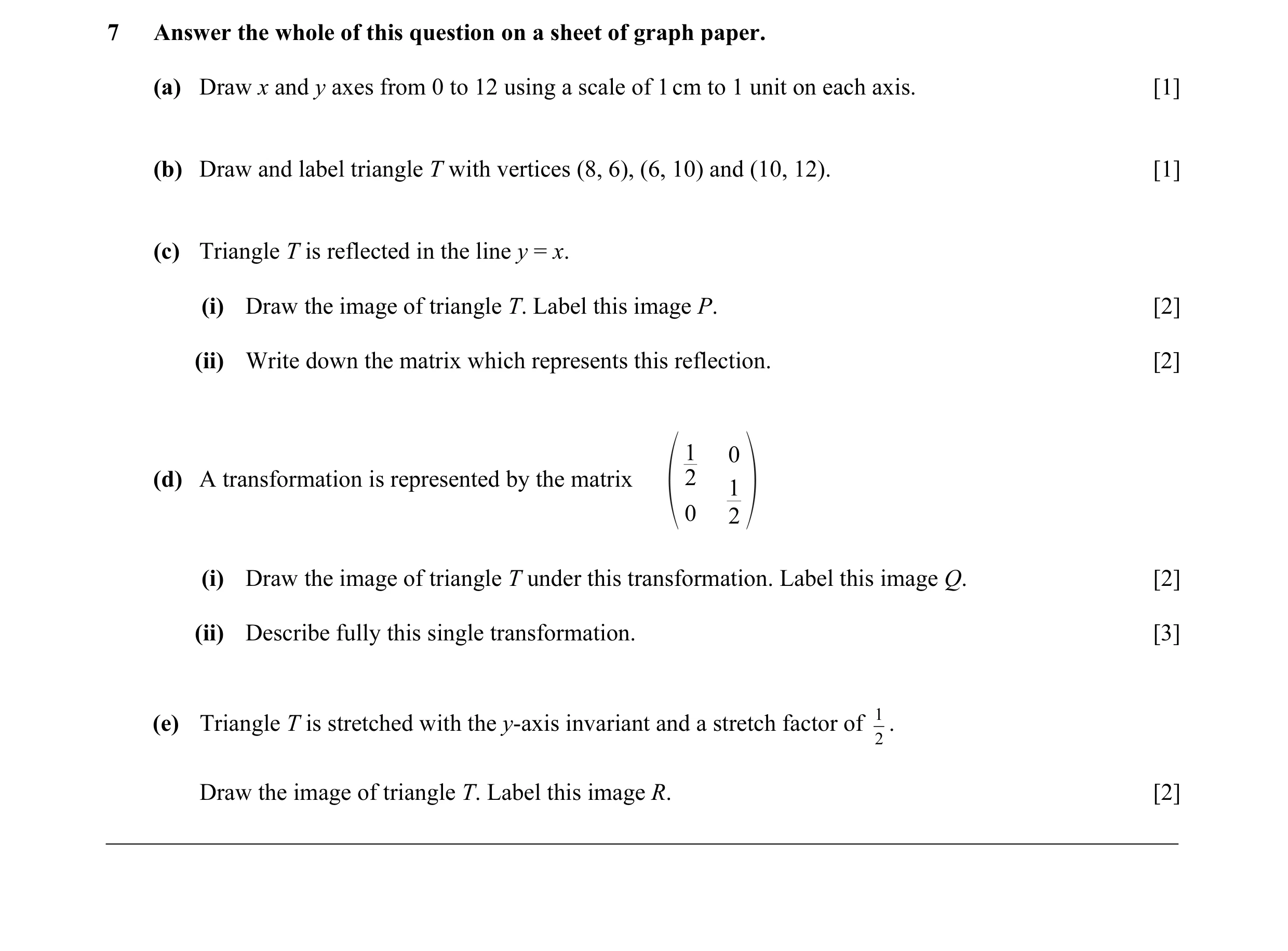 5 / 13
![Question 6: For 3 7 (a) P is the point (2, 5) and = . Examiner's −2 Use Write down the co-ordinates of Q. Answer(a) ( , ) [1] (b) D C B NOT …](https://img.pastlit.com/crops/68f856b8-673d-4d24-aa23-d049e30fc65a/q7.webp) 6 / 13
6 / 13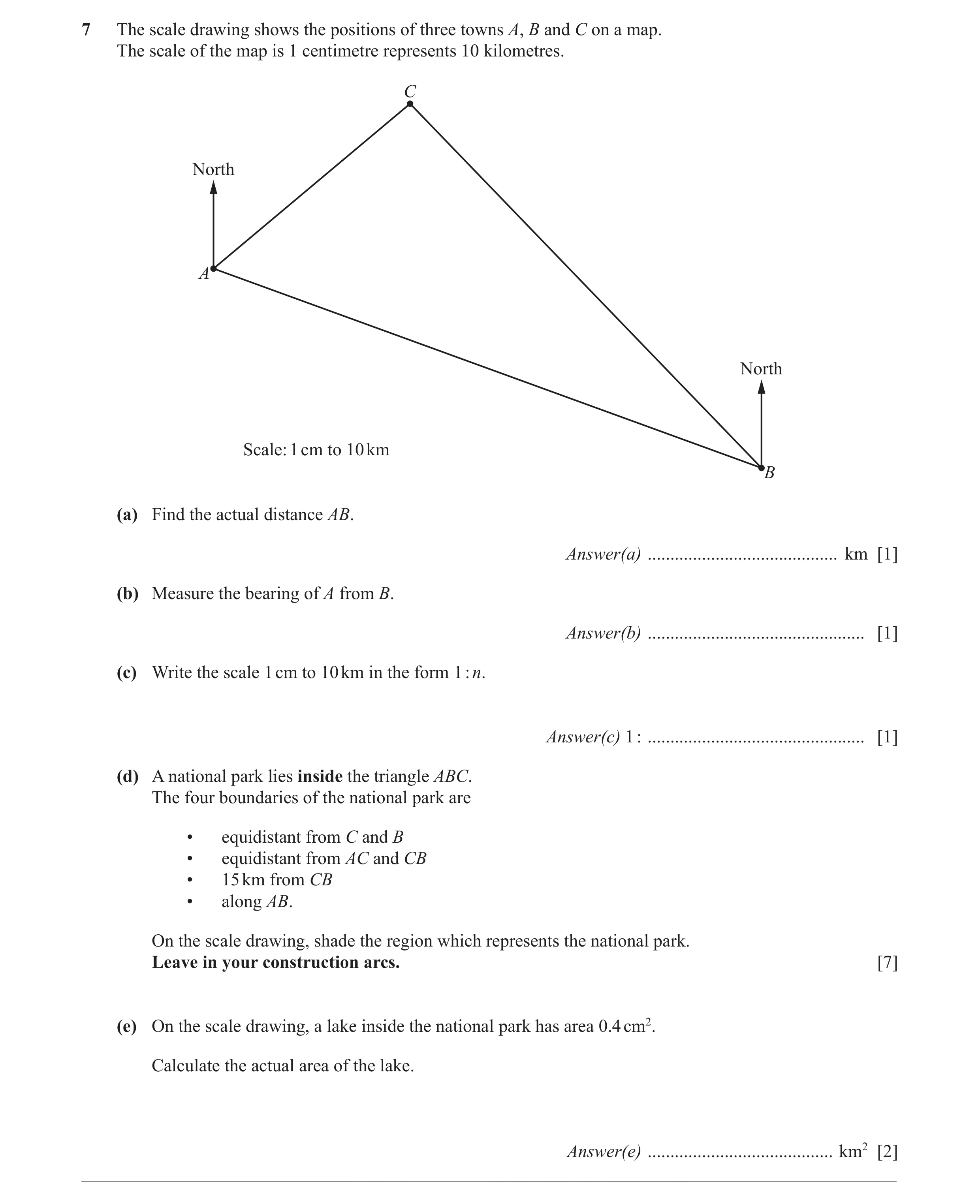 7 / 13
 8 / 13
 9 / 13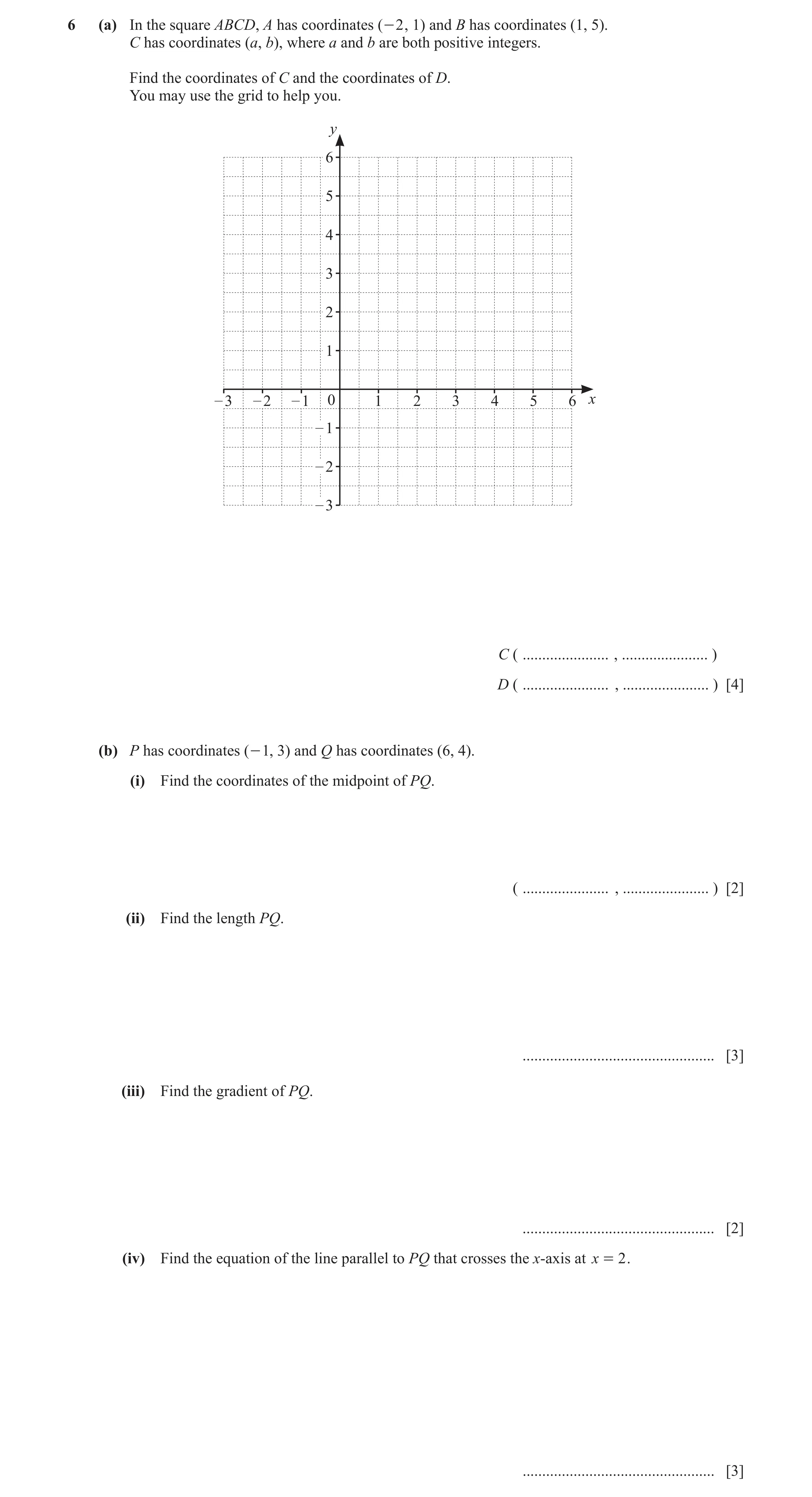
![Question 11: (a) P is the point (1, 7). Q is the point (5, –5). y P NOT TO SCALE O x Q (i) Find PQ . PQ = [2] f p (ii) Show that OP = OQ . [3] (iii) PQ …](https://img.pastlit.com/crops/e5ff309b-ed41-4d46-8528-b18db26bf32a/q5.webp)
 16
16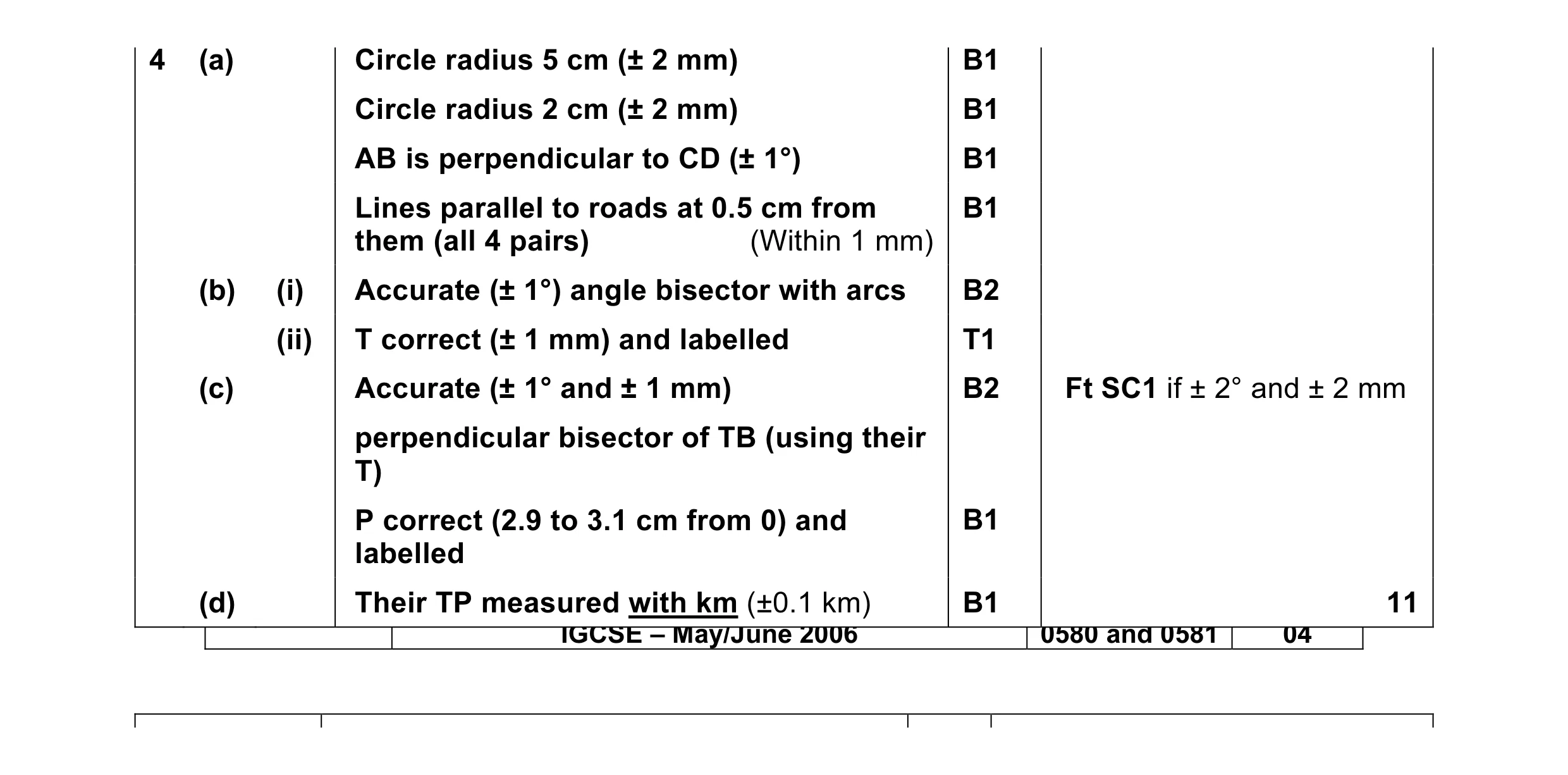 11
11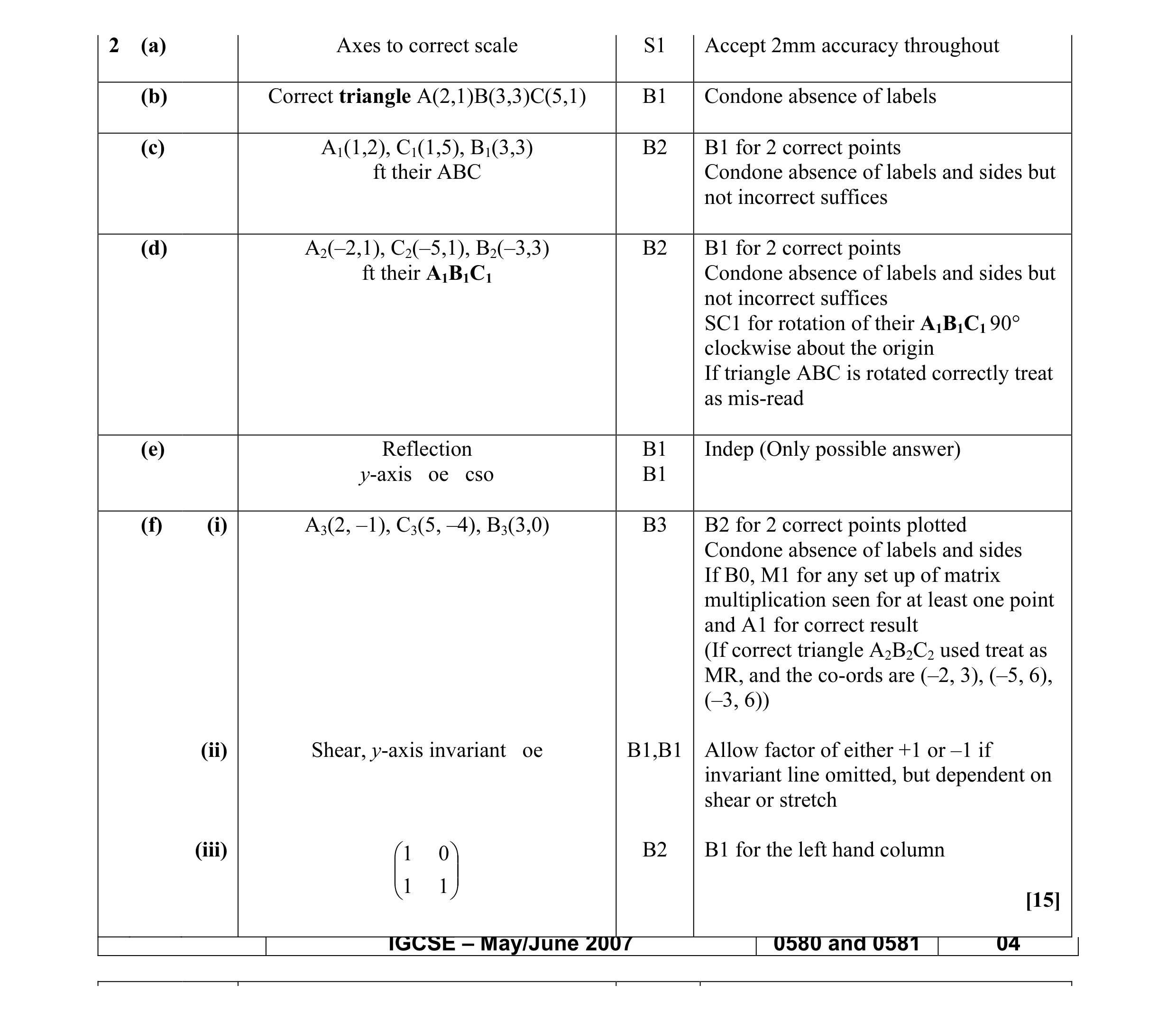 15
15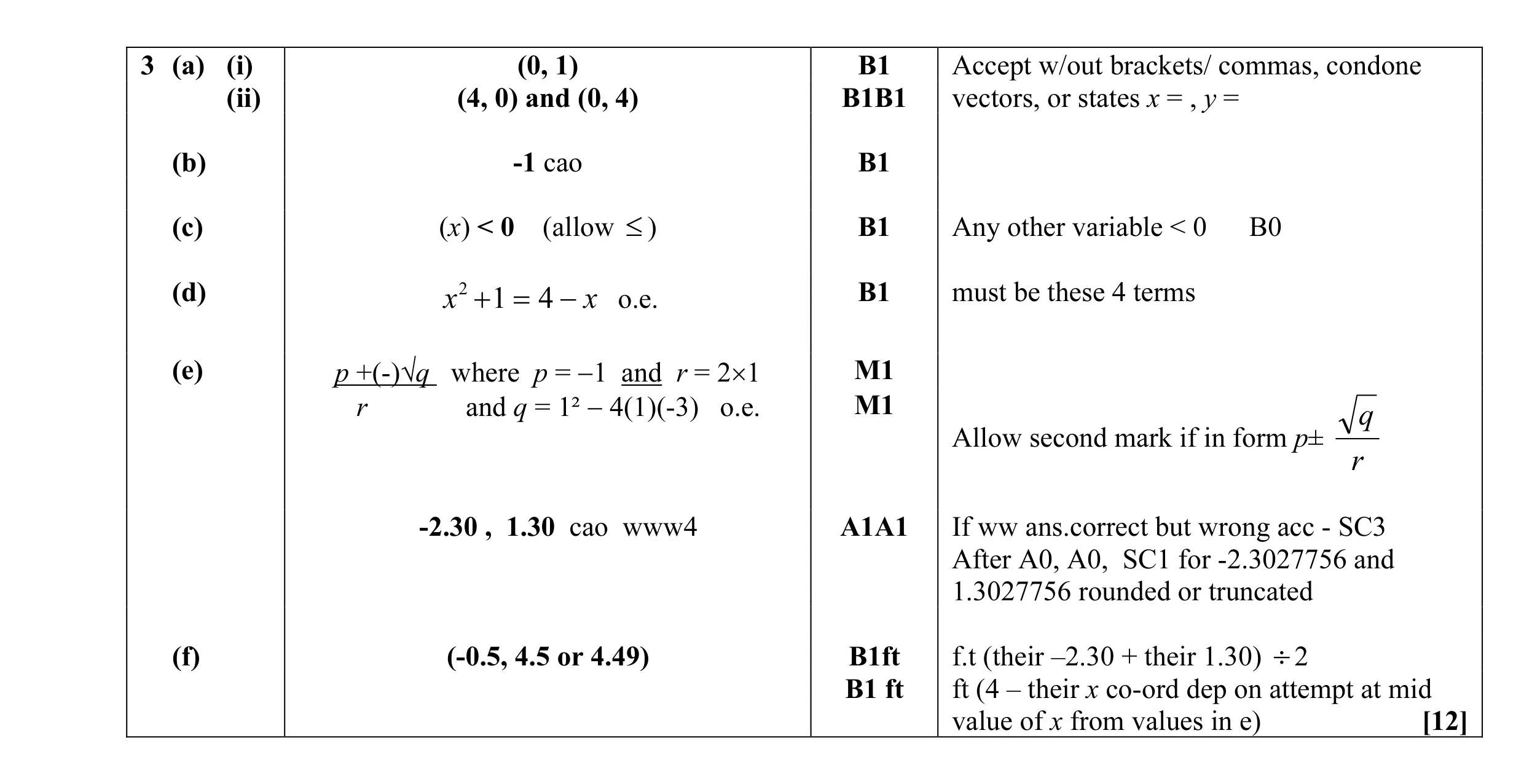 12
12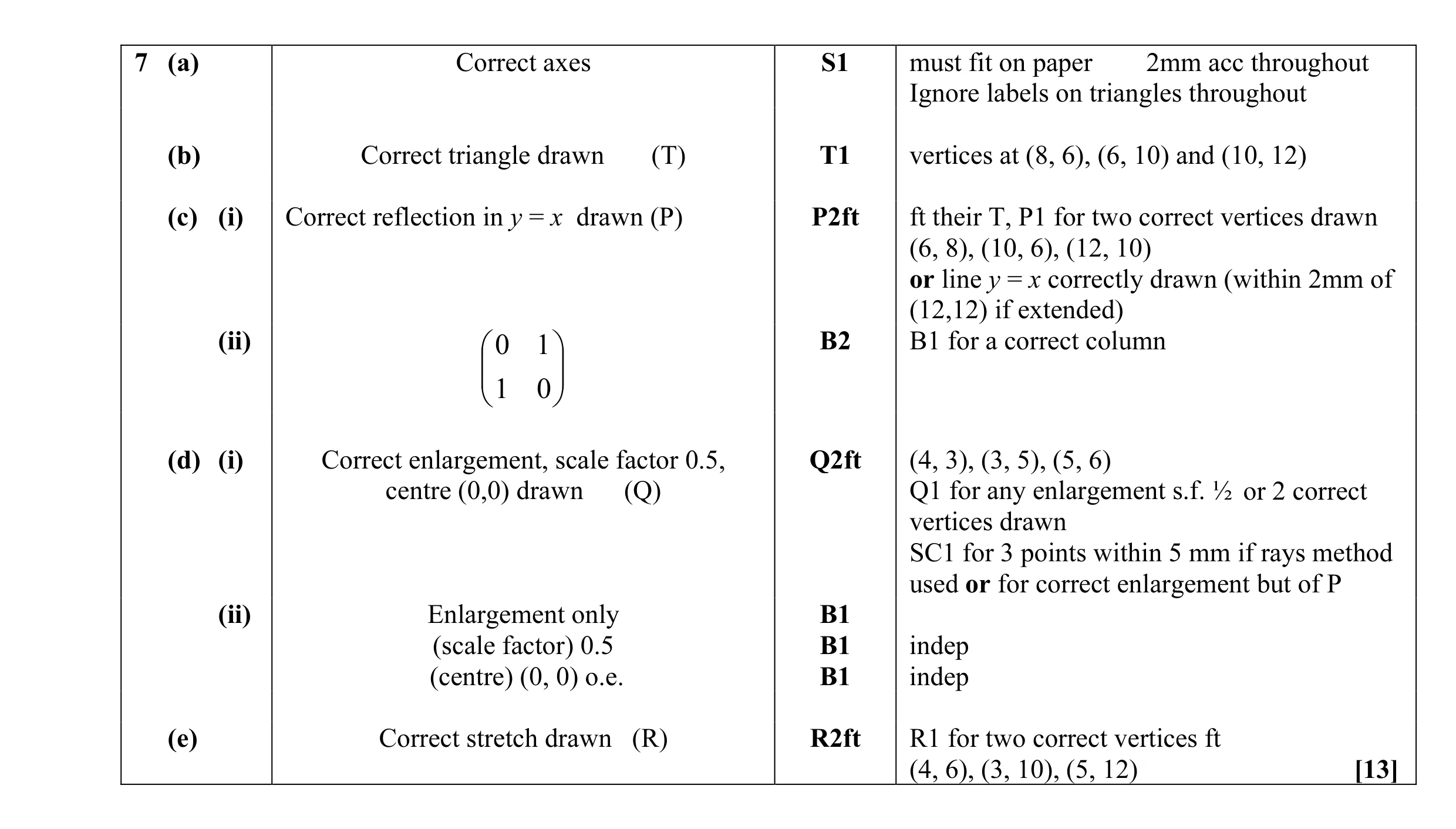 13
13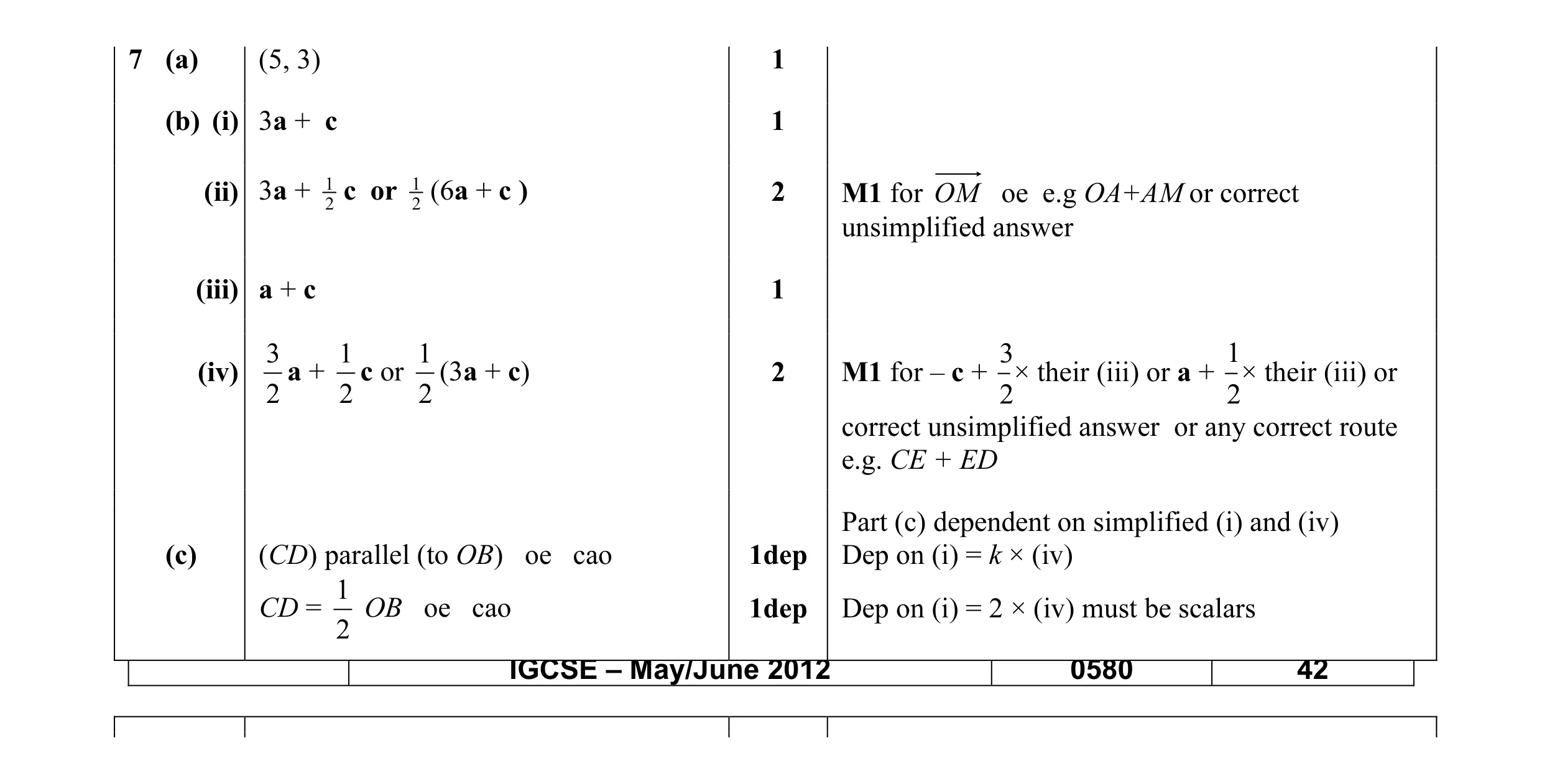 9
9 12
12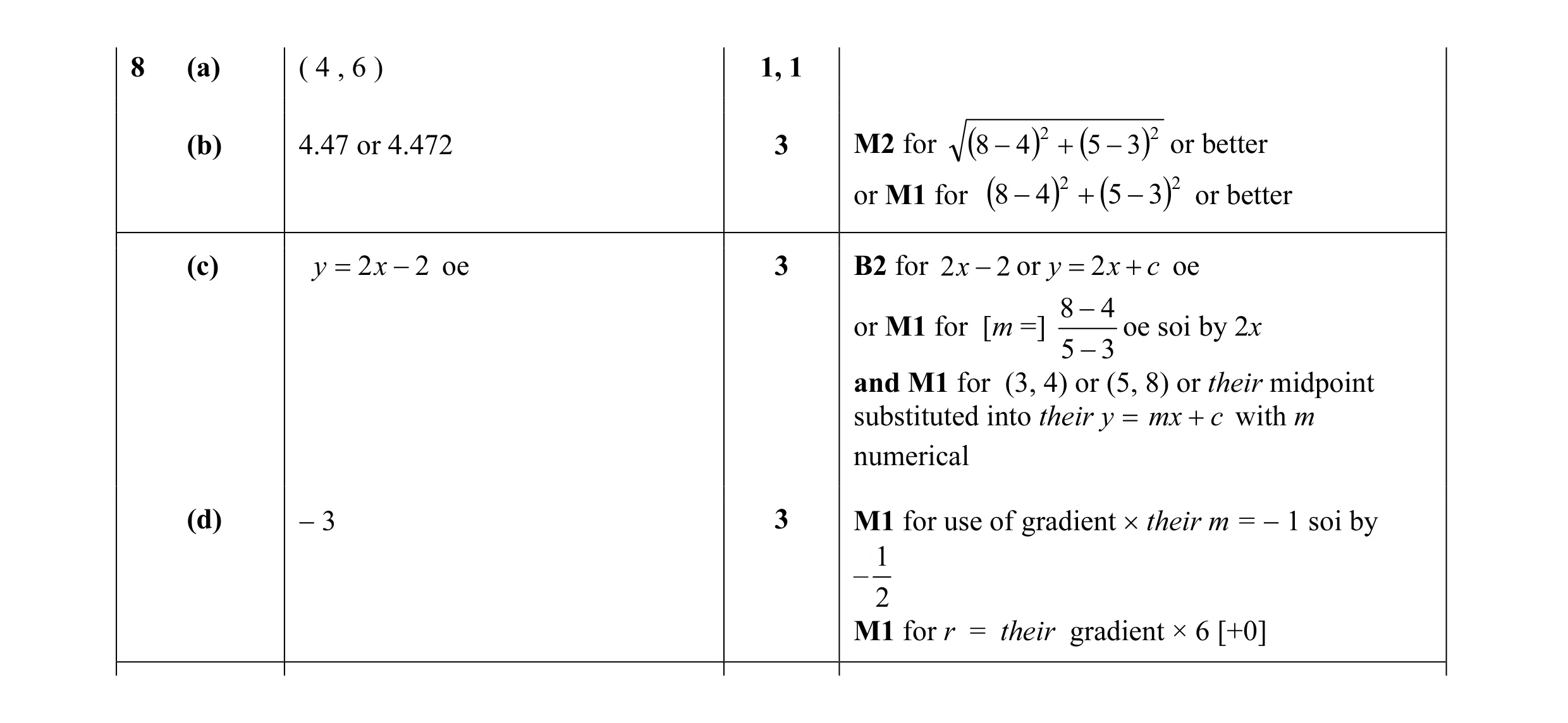 11
11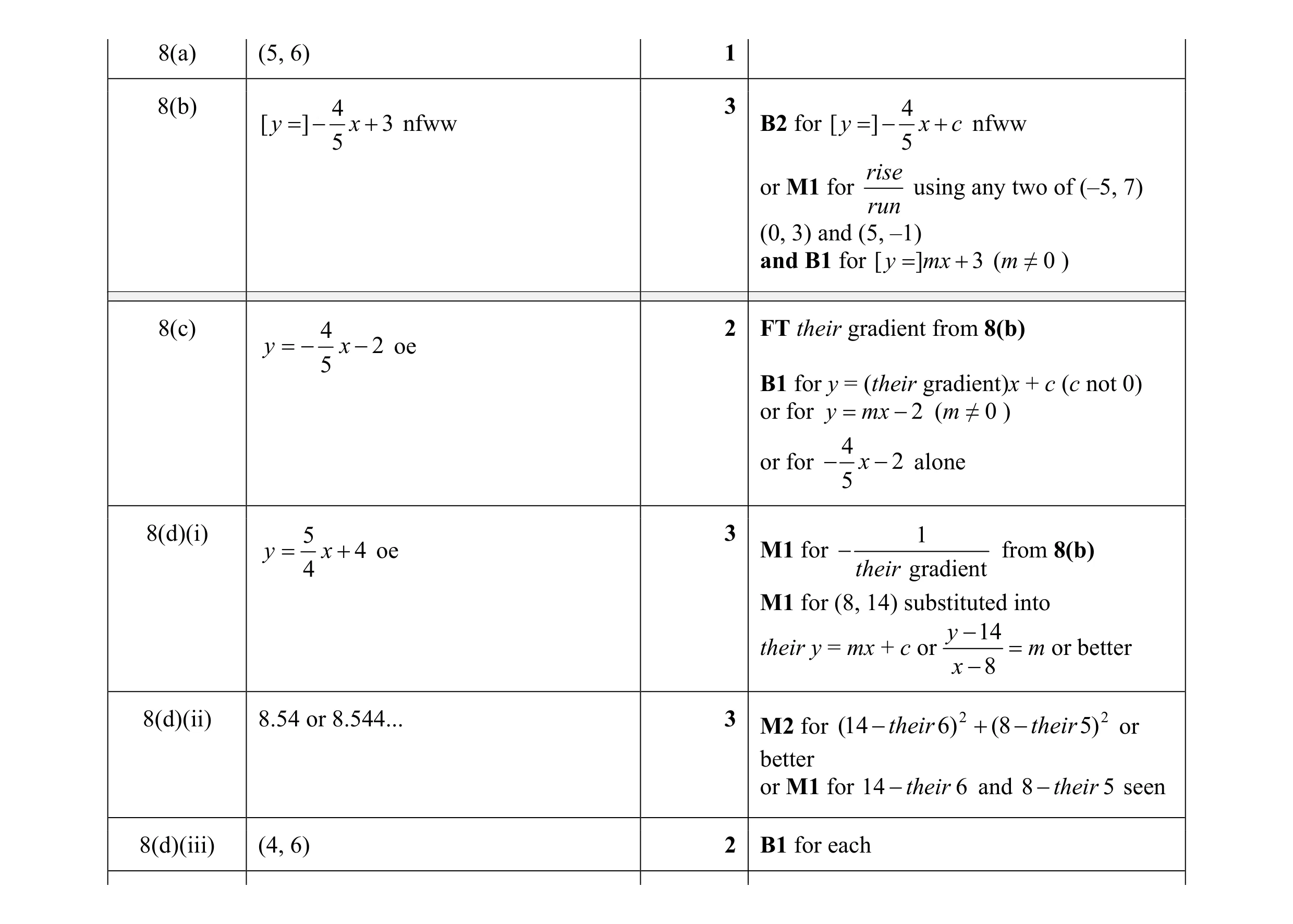 14
14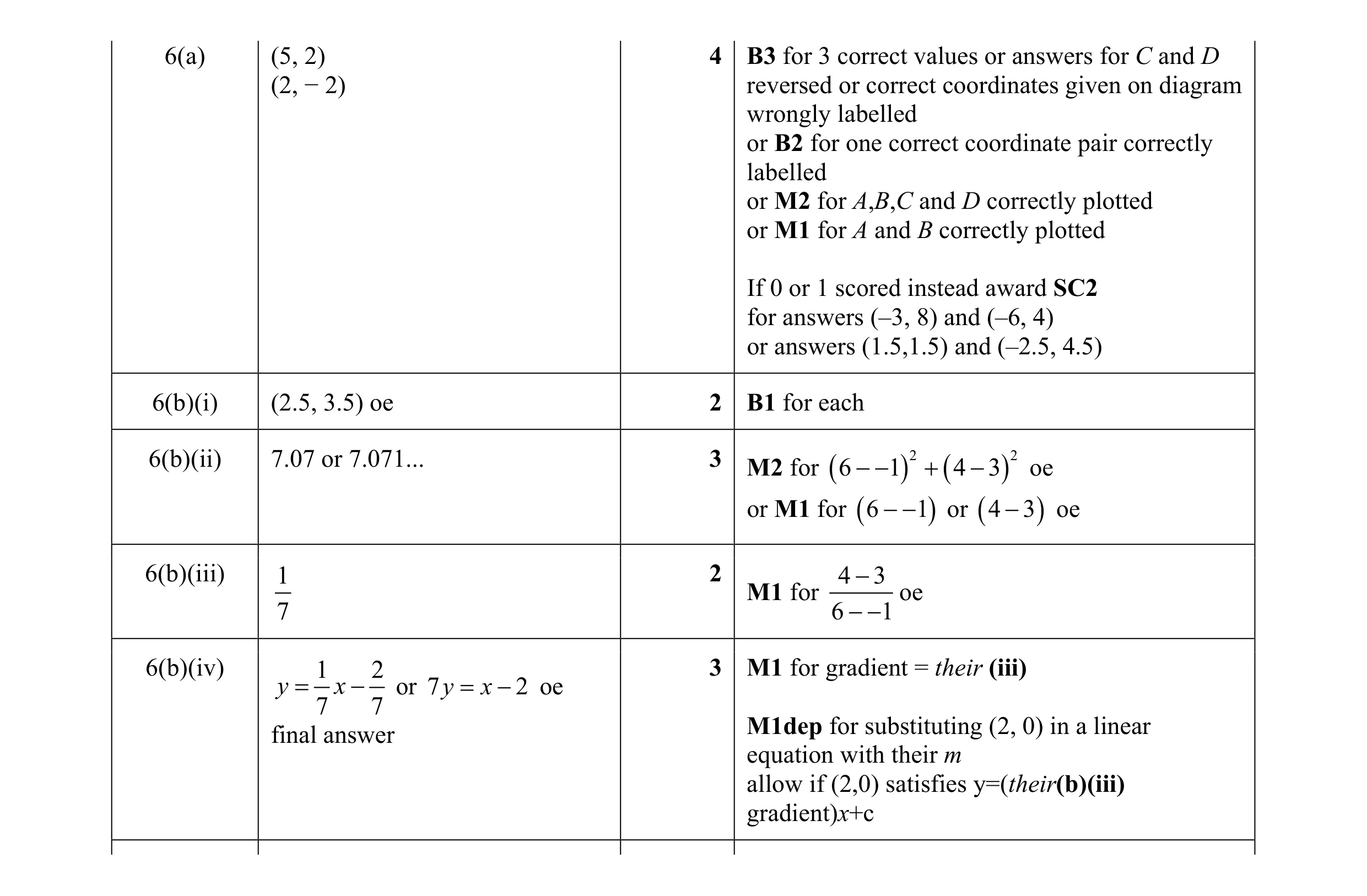 14
14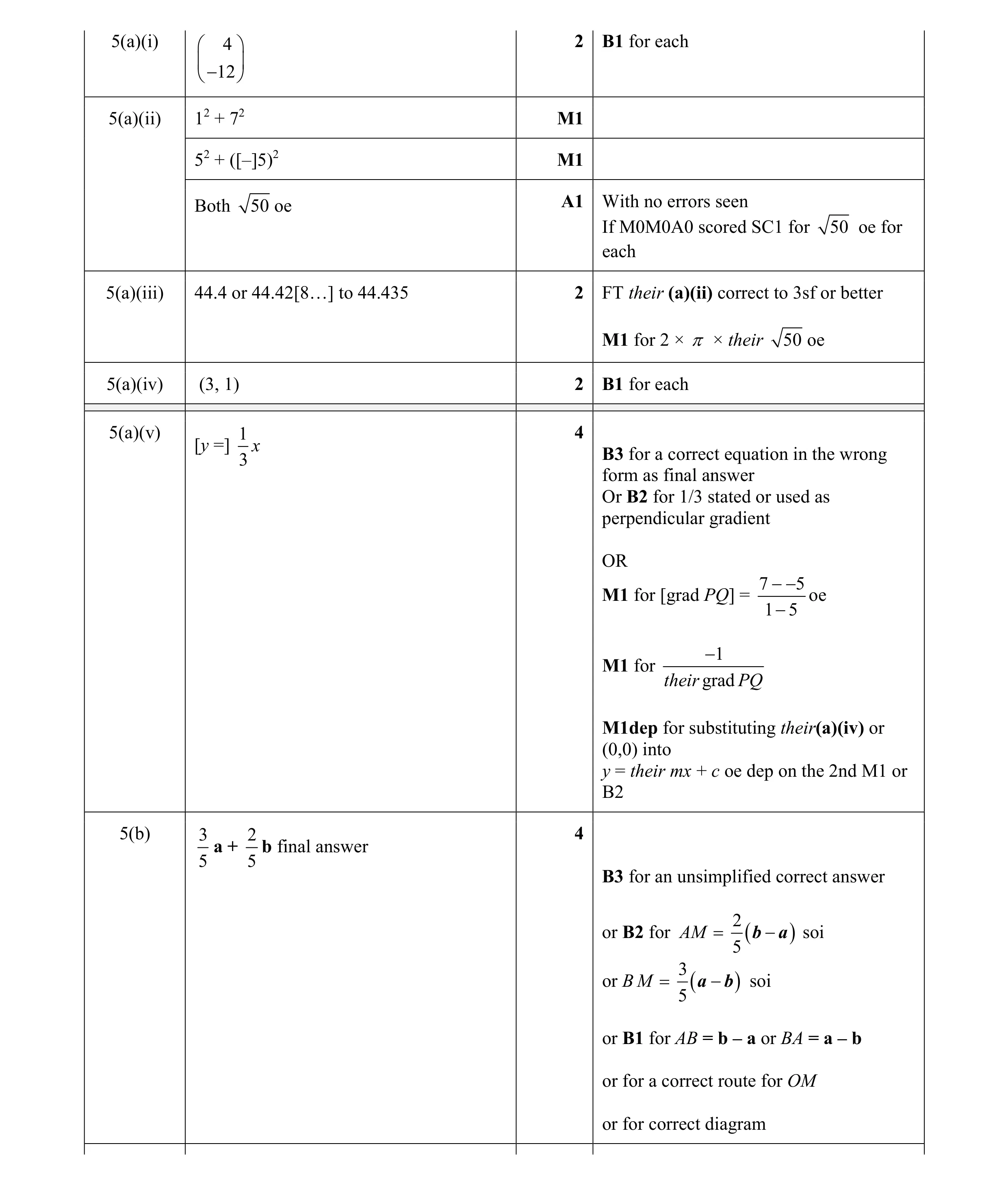 17
17