Cambridge IGCSE Mathematics 0580 — 2025 Oct/Nov Paper 2 · Variant 2
0580/22/O/N/25 · 24 questions · 100 marks · 120 min
The question paper and its mark scheme, free to read here and free to download. This is Cambridge’s own paper, exactly as it was sat.
Question paper16 pages
Mark scheme12 pages
Answers below. Sit the paper first if you are practising.
Questions as text
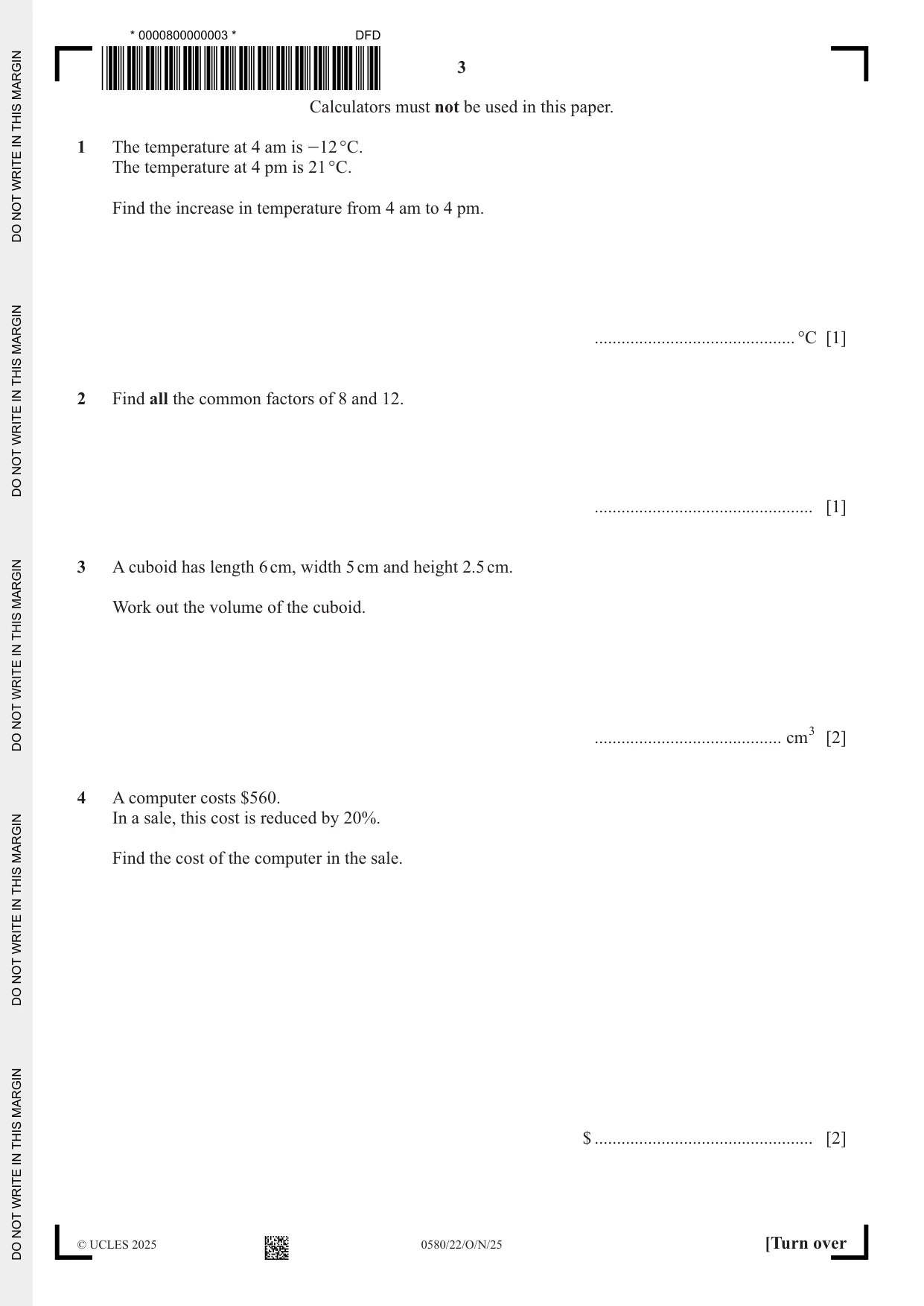
Q1 · The temperature at 4 am is -12 °C
1 The temperature at 4 am is -12 °C. The temperature at 4 pm is 21 °C. Find the increase in temperature from 4 am to 4 pm. ............................................. °C [1]
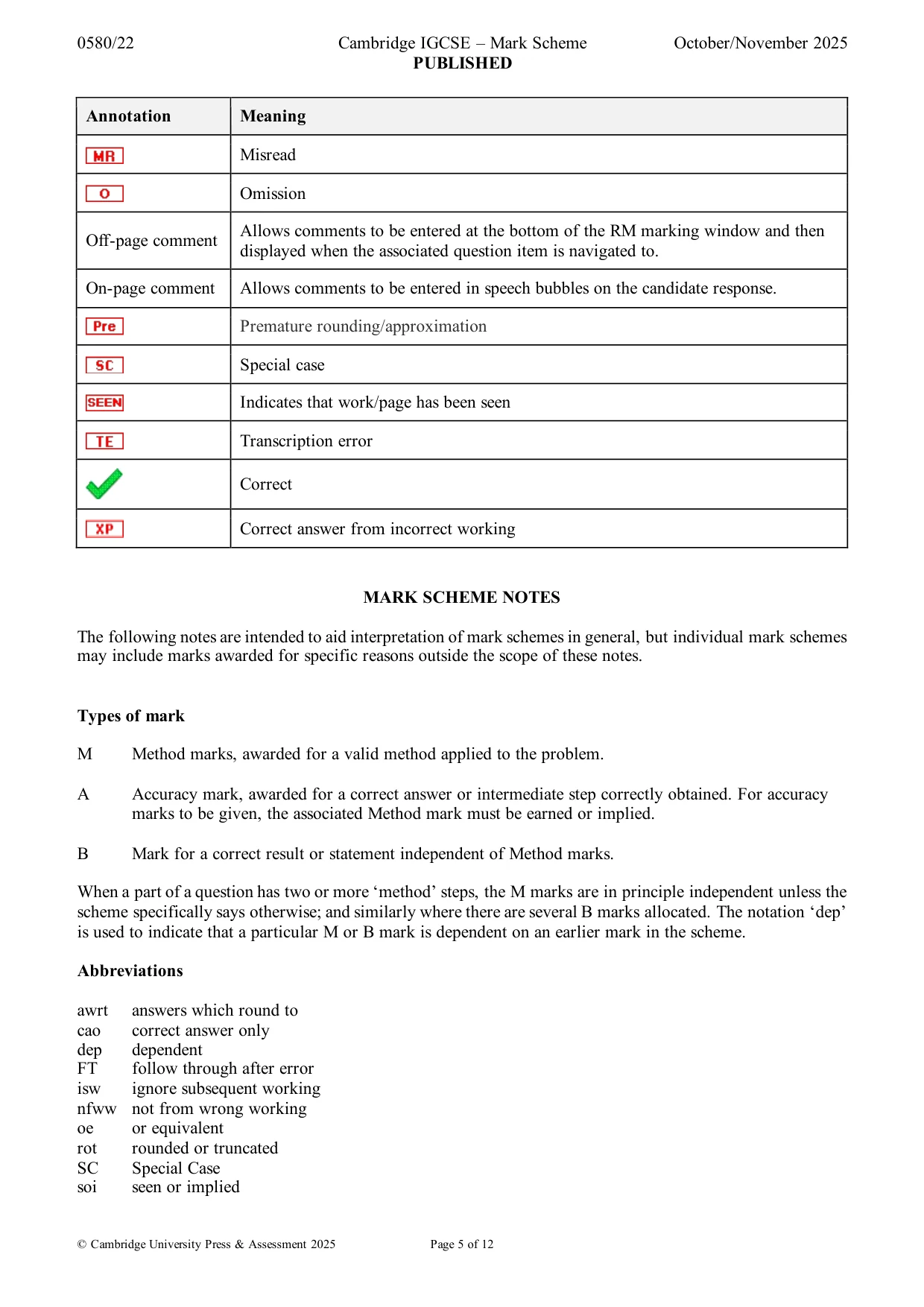
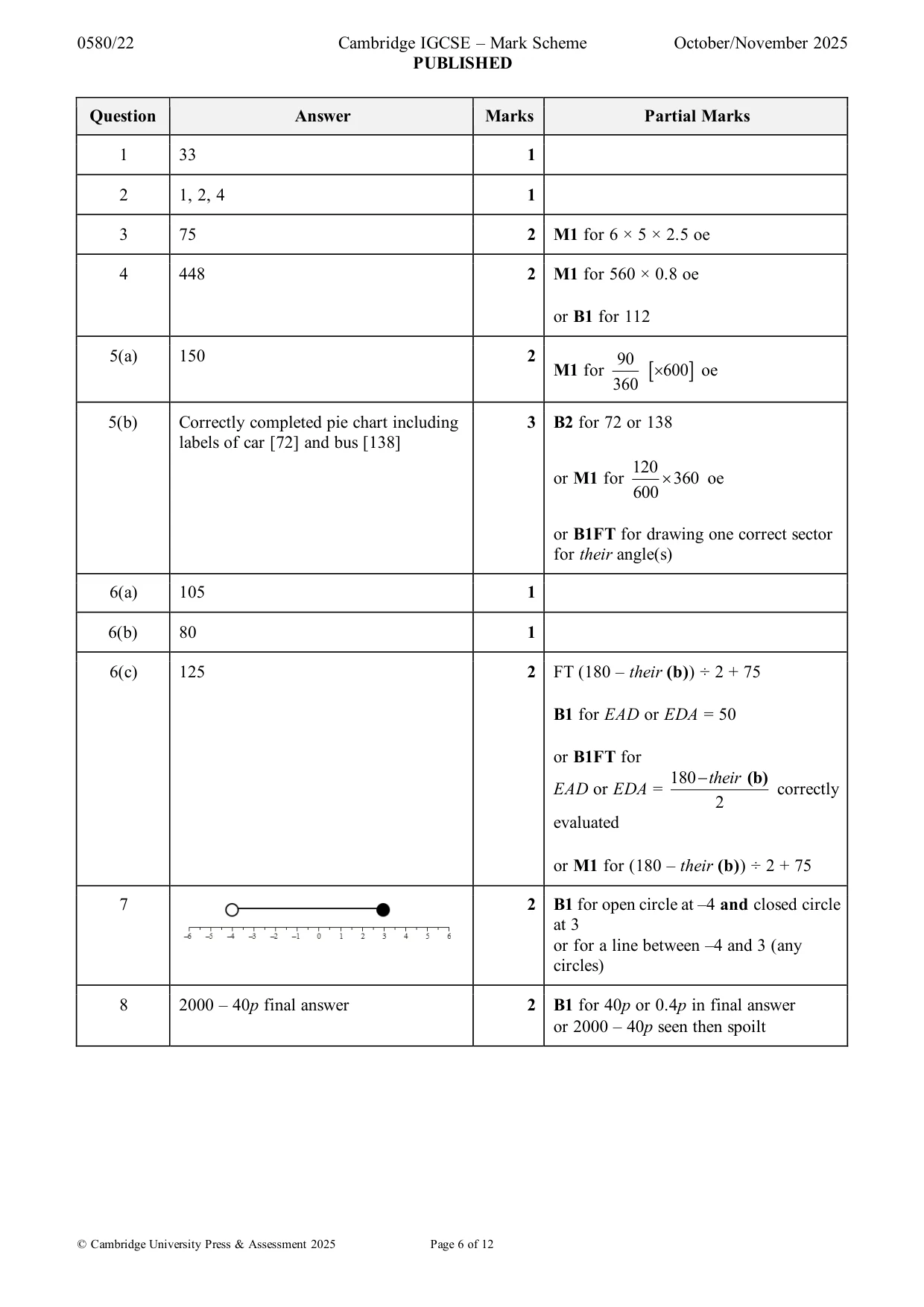
Mark scheme: Question Answer Marks Partial Marks 1 33 1
Q2 · Find all the common factors of 8 and 12
2 Find all the common factors of 8 and 12. ................................................. [1]
Mark scheme: 2 1, 2, 4 1
Q3 · A cuboid has length 6 cm, width 5 cm and height 2.5 cm
3 A cuboid has length 6 cm, width 5 cm and height 2.5 cm. Work out the volume of the cuboid. .......................................... cm3 [2]
Mark scheme: 3 75 2 M1 for 6 × 5 × 2.5 oe
Q4 · A computer costs $560
4 A computer costs $560. In a sale, this cost is reduced by 20%. Find the cost of the computer in the sale. $ ................................................. [2]
Mark scheme: 4 448 2 M1 for 560 × 0.8 oe or B1 for 112
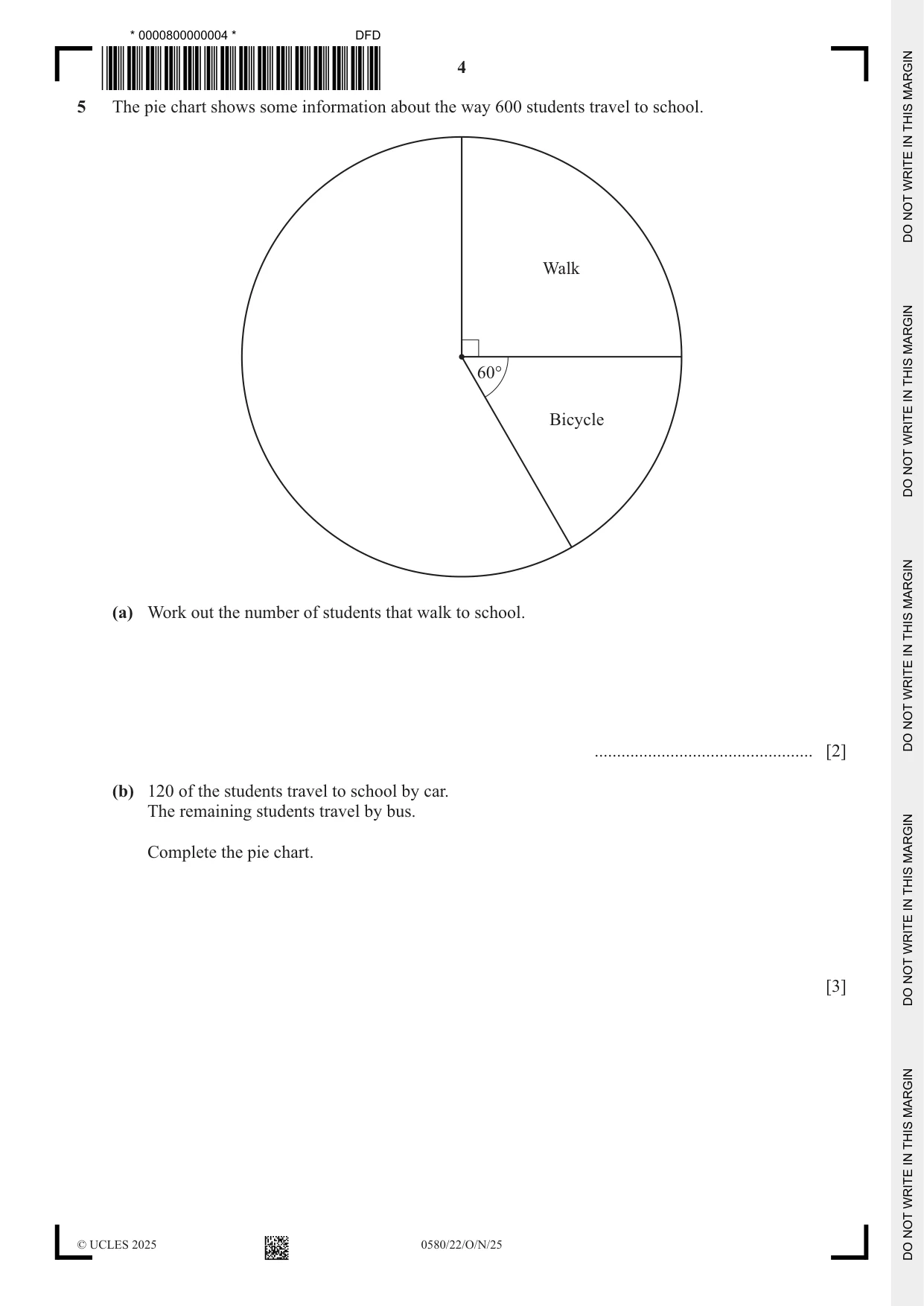
Q5 · The pie chart shows some information about the way 600 students travel to school
5 The pie chart shows some information about the way 600 students travel to school. Walk 60° Bicycle (a) Work out the number of students that walk to school. ................................................. [2] (b) 120 of the students travel to school by car. The remaining students travel by bus. Complete the pie chart. [3]
Mark scheme: 5(a) 150 2 90 M1 for 600 oe 360 5(b) Correctly completed pie chart including 3 B2 for 72 or 138 labels of car [72] and bus [138] 120 or M1 for 360 oe 600 or B1FT for drawing one correct sector for their angle(s)
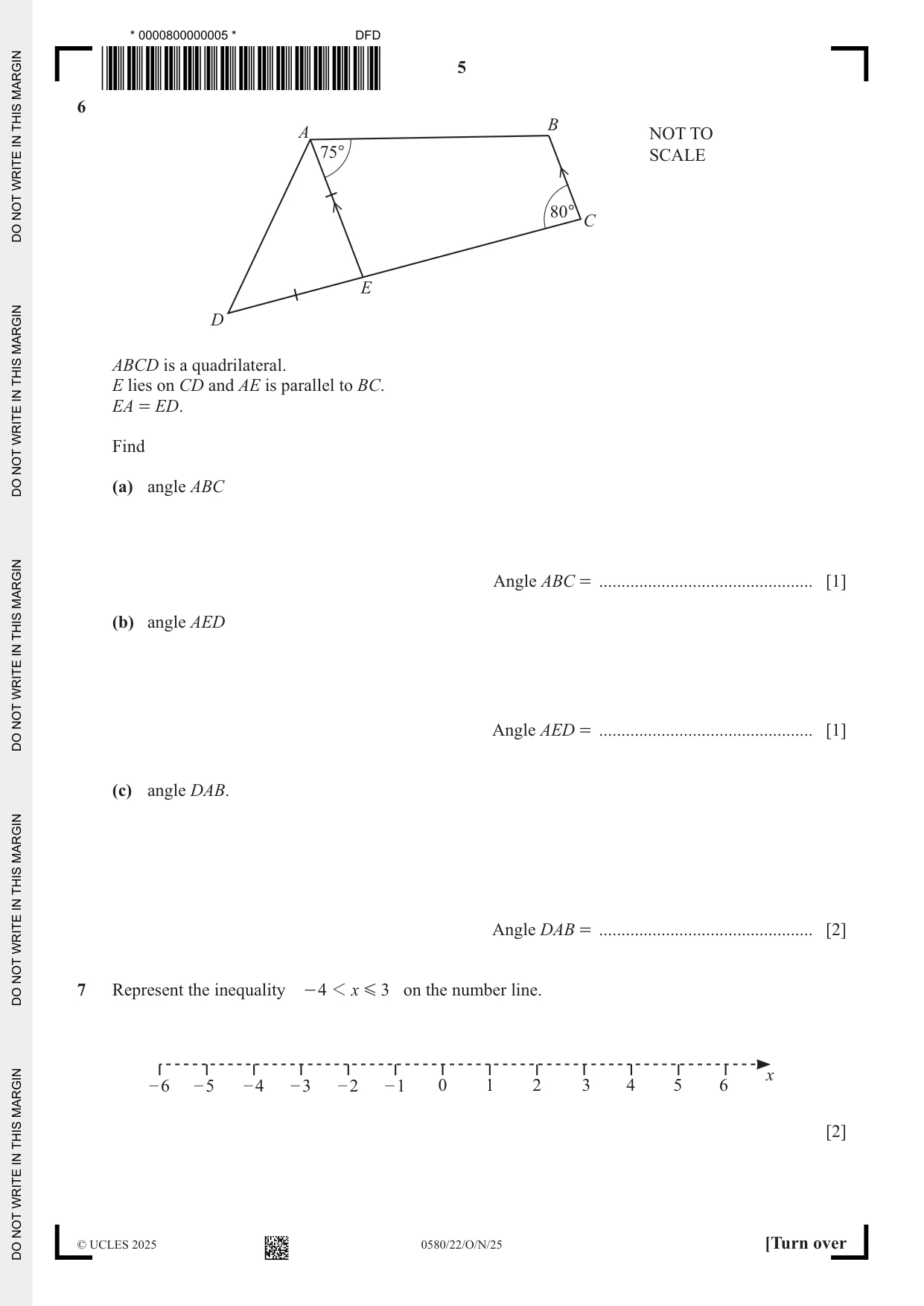
Q6 · B A NOT TO 75° SCALE 80° C E D ABCD is a quadrilateral
6 B A NOT TO 75° SCALE 80° C E D ABCD is a quadrilateral. E lies on CD and AE is parallel to BC. EA = ED. Find (a) angle ABC Angle ABC = ................................................ [1] (b) angle AED Angle AED = ................................................ [1] (c) angle DAB. Angle DAB = ................................................ [2]
Mark scheme: 6(a) 105 1 6(b) 80 1 6(c) 125 2 FT (180 – their (b)) ÷ 2 + 75 B1 for EAD or EDA = 50 or B1FT for 180 − their (b) EAD or EDA = correctly 2 evaluated or M1 for (180 – their (b)) ÷ 2 + 75
Q7 · Represent the inequality - 4 1 x G 3 on the number line
7 Represent the inequality - 4 1 x G 3 on the number line. x – 6 – 5 – 4 – 3 – 2 – 1 0 1 2 3 4 5 6 [2]
Mark scheme: 7 2 B1 for open circle at –4 and closed circle at 3 or for a line between –4 and 3 (any circles)
Q8 · Kemi buys p pens that each cost 40 cents
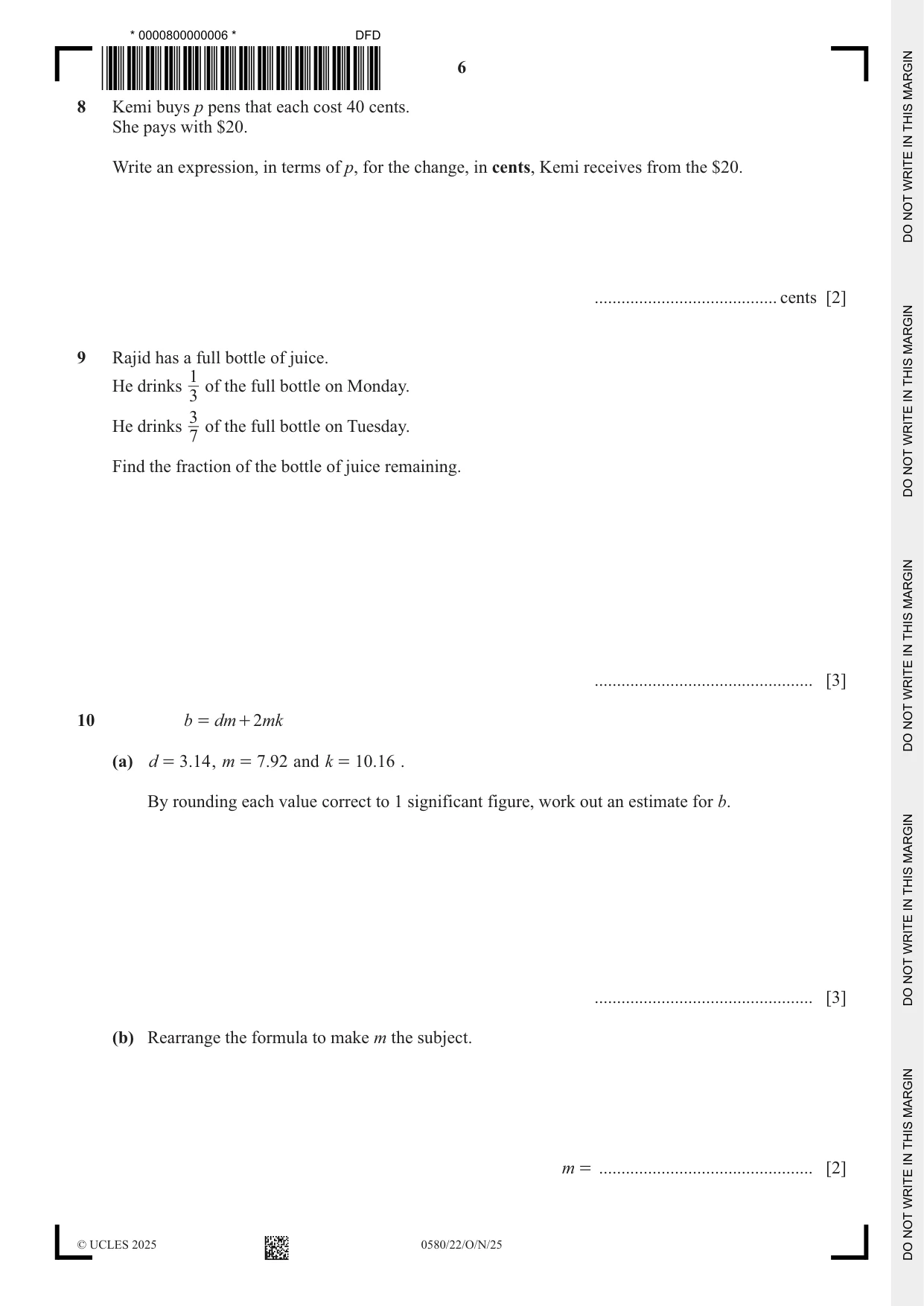
8 Kemi buys p pens that each cost 40 cents. She pays with $20. Write an expression, in terms of p, for the change, in cents, Kemi receives from the $20. ......................................... cents [2]
Mark scheme: 8 2000 – 40p final answer 2 B1 for 40p or 0.4p in final answer or 2000 – 40p seen then spoilt
Q9 · Rajid has a full bottle of juice
9 Rajid has a full bottle of juice. 1 He drinks of the full bottle on Monday. 3 3 He drinks of the full bottle on Tuesday. 7 Find the fraction of the bottle of juice remaining. ................................................. [3]
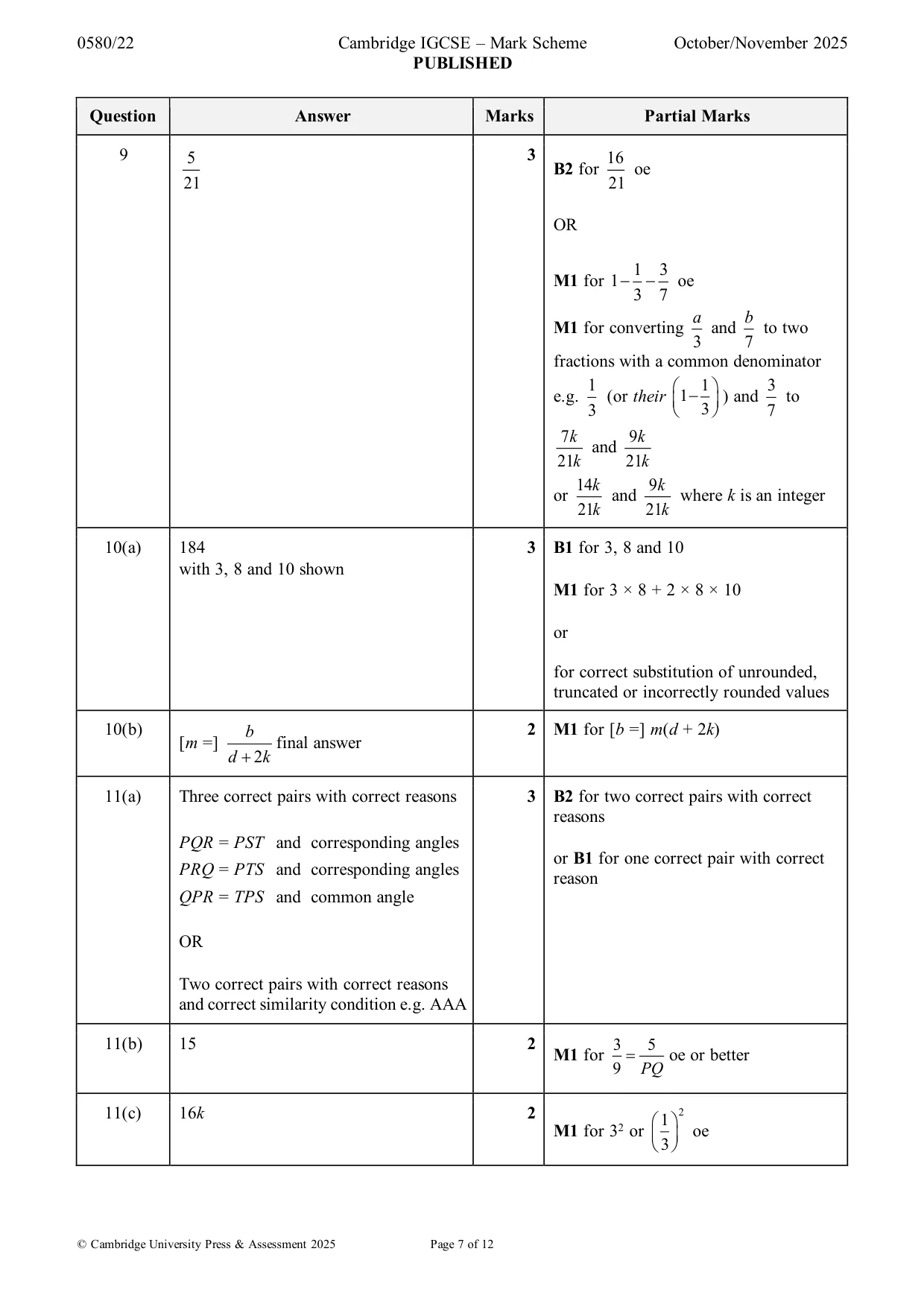
Mark scheme: 9 5 3 16 B2 for oe 21 21 OR 1 3 M1 for 1 − − oe 3 7 a b M1 for converting and to two 3 7 fractions with a common denominator 1 1 3 e.g. (or their 1 − ) and to 3 3 7 7 k 9 k and 21k 21k 14k 9 k or and where k is an integer 21k 21k
Q10 · B = dm + 2mk (a) d = 3.14 , m = 7.92 and k = 10.16
10 b = dm + 2mk (a) d = 3.14 , m = 7.92 and k = 10.16 . By rounding each value correct to 1 significant figure, work out an estimate for b. ................................................. [3] (b) Rearrange the formula to make m the subject. m = ................................................ [2]
Mark scheme: 10(a) 184 3 B1 for 3, 8 and 10 with 3, 8 and 10 shown M1 for 3 × 8 + 2 × 8 × 10 or for correct substitution of unrounded, truncated or incorrectly rounded values 10(b) b 2 M1 for [b =] m(d + 2k) [m =] final answer d + 2k
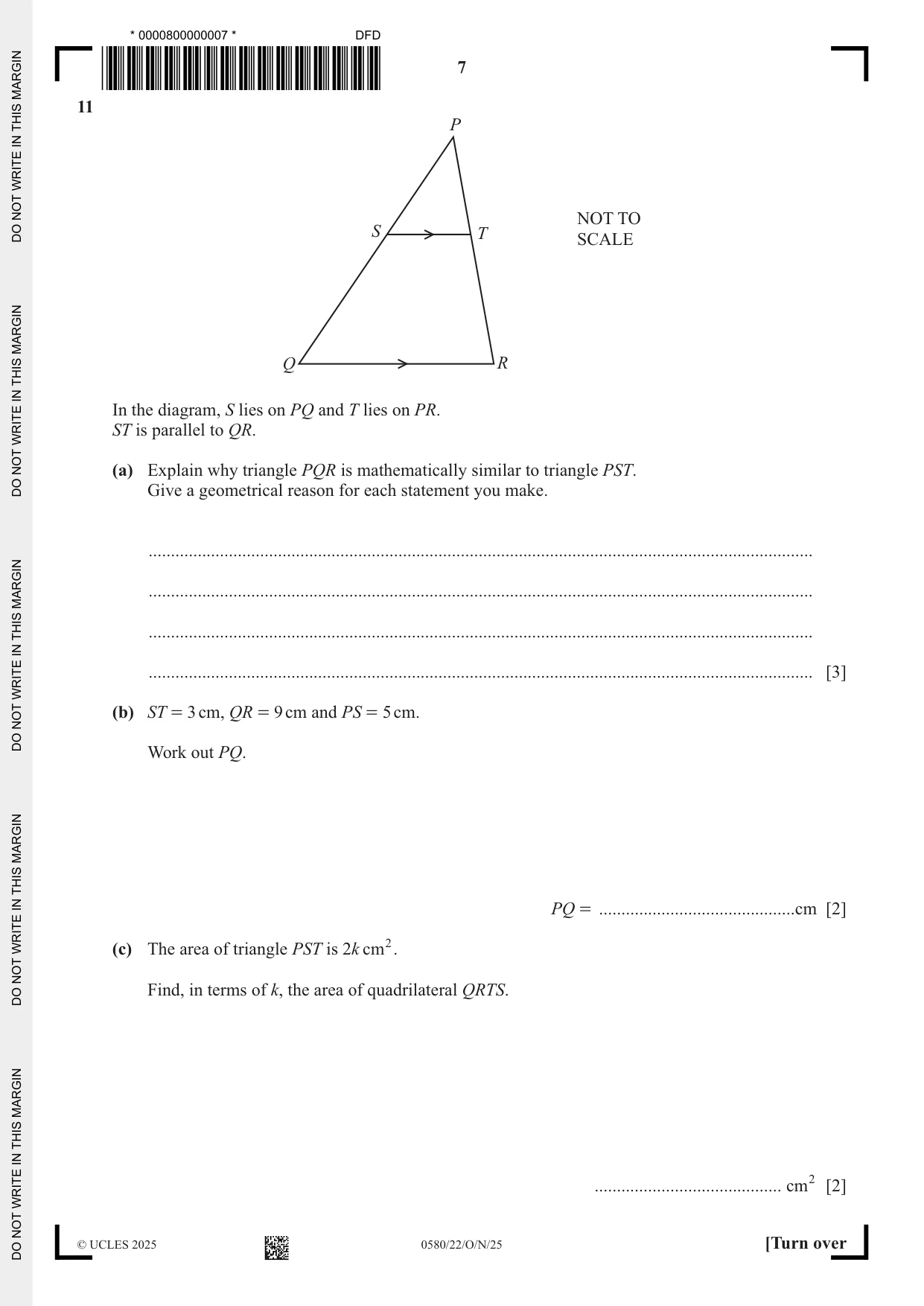
Q11 · P NOT TO S T SCALE Q R In the diagram, S lies on PQ and T lies on PR
11 P NOT TO S T SCALE Q R In the diagram, S lies on PQ and T lies on PR. ST is parallel to QR. (a) Explain why triangle PQR is mathematically similar to triangle PST. Give a geometrical reason for each statement you make. ..................................................................................................................................................... ..................................................................................................................................................... ..................................................................................................................................................... ..................................................................................................................................................... [3] (b) ST = 3 cm, QR = 9 cm and PS = 5 cm. Work out PQ. PQ = ............................................cm [2] (c) The area of triangle PST is 2k cm2. Find, in terms of k, the area of quadrilateral QRTS. .......................................... cm2 [2]
Mark scheme: 11(a) Three correct pairs with correct reasons 3 B2 for two correct pairs with correct reasons PQR = PST and corresponding angles or B1 for one correct pair with correct PRQ = PTS and corresponding angles reason QPR = TPS and common angle OR Two correct pairs with correct reasons and correct similarity condition e.g. AAA 11(b) 15 2 3 5 M1 for = oe or better 9 PQ 11(c) 16k 2 2 1 M1 for 32 or oe 3
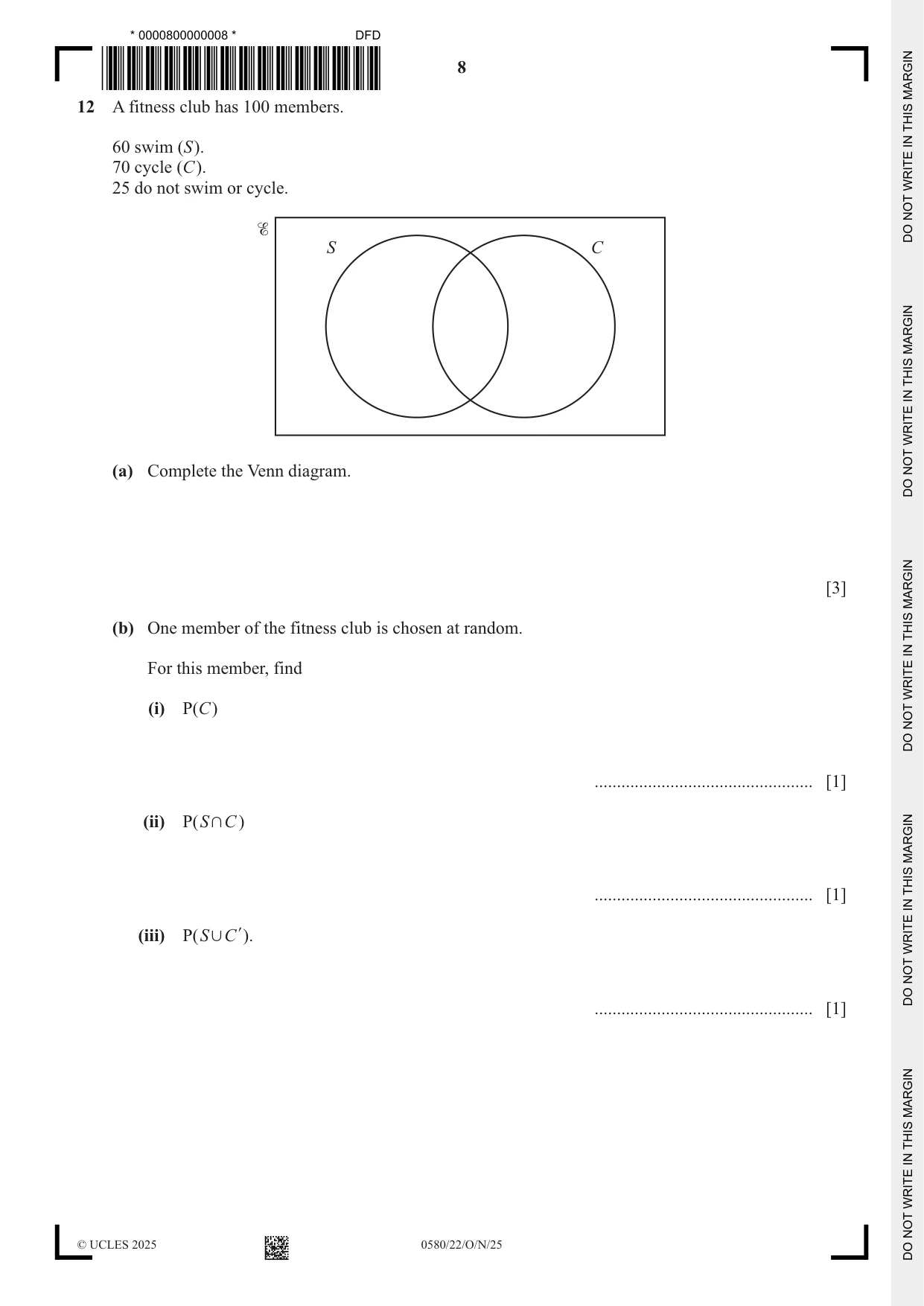
Q12 · A fitness club has 100 members
12 A fitness club has 100 members. 60 swim (S ). 70 cycle (C ). 25 do not swim or cycle. % S C (a) Complete the Venn diagram. [3] (b) One member of the fitness club is chosen at random. For this member, find (i) P(C ) ................................................. [1] (ii) P(S + C ) ................................................. [1] (iii) P(S , C l). ................................................. [1]
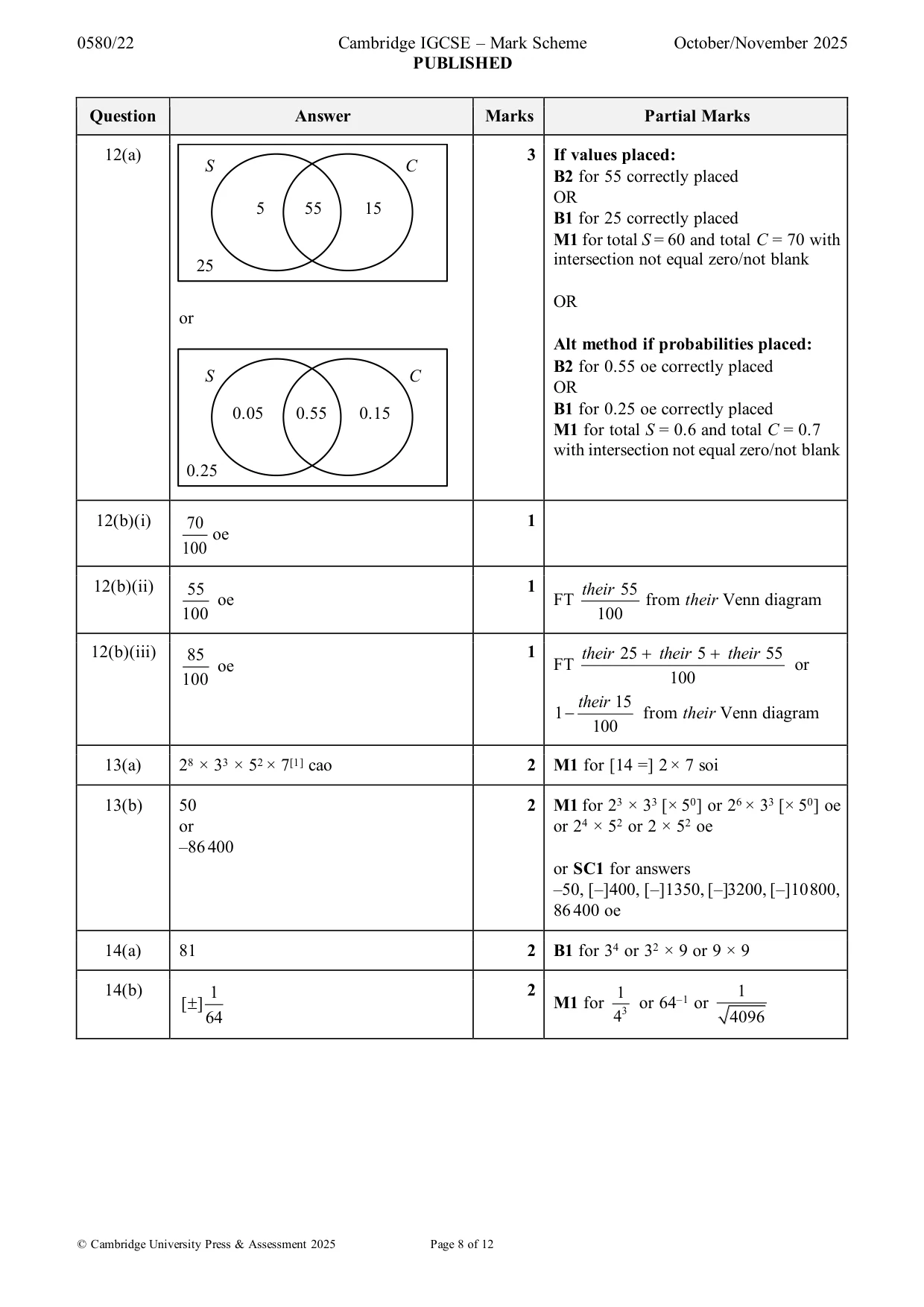
Mark scheme: 12(a) 3 If values placed: S C B2 for 55 correctly placed OR 5 55 15 B1 for 25 correctly placed M1 for total S = 60 and total C = 70 with intersection not equal zero/not blank 25 OR or Alt method if probabilities placed: B2 for 0.55 oe correctly placed S C OR B1 for 0.25 oe correctly placed 0.05 0.55 0.15 M1 for total S = 0.6 and total C = 0.7 with intersection not equal zero/not blank 0.25 12(b)(i) 70 1 oe 100 12(b)(ii) 55 1 their 55 oe FT from their Venn diagram 100 100 12(b)(iii) 85 1 their 25 + their 5 + their 55 oe FT or 100 100 their 15 1 − from their Venn diagram 100
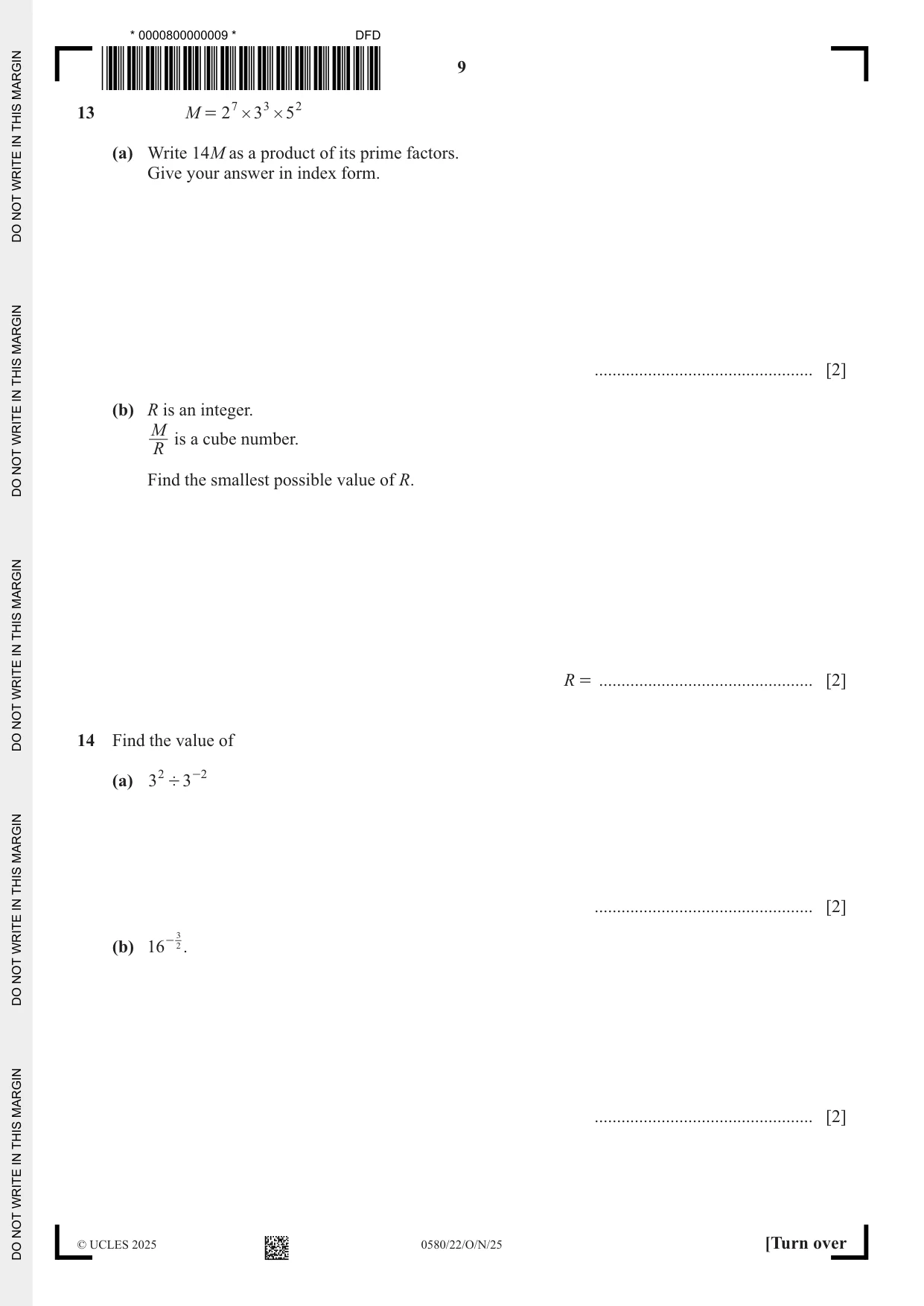
Q13 · M = 2 7 # 3 3 # 5 2 (a) Write 14M as a product of its prime factors
13 M = 2 7 # 3 3 # 5 2 (a) Write 14M as a product of its prime factors. Give your answer in index form. ................................................. [2] (b) R is an integer. M is a cube number. R Find the smallest possible value of R. R = ................................................ [2]
Mark scheme: 13(a) 28 × 33 × 52 × 7[1] cao 2 M1 for [14 =] 2 × 7 soi 13(b) 50 2 M1 for 23 × 33 [× 50] or 26 × 33 [× 50] oe or or 24 × 52 or 2 × 52 oe –86 400 or SC1 for answers –50, [–]400, [–]1350, [–]3200, [–]10 800, 86 400 oe
Q14 · Find the value of (a) 3 2 ' 3 -2 ................................................
14 Find the value of (a) 3 2 ' 3 -2 ................................................. [2] - 23 (b) 16 . ................................................. [2]
Mark scheme: 14(a) 81 2 B1 for 34 or 32 × 9 or 9 × 9 14(b) 1 2 1 1 [ ]64 M1 for 4 3 or 64–1 or 4096
Question 15
15 Factorise. (a) x 2 - 64 ................................................. [1] (b) 5 x ( x - 2y) + 6 ( x - 2y) 2 ................................................. [2]
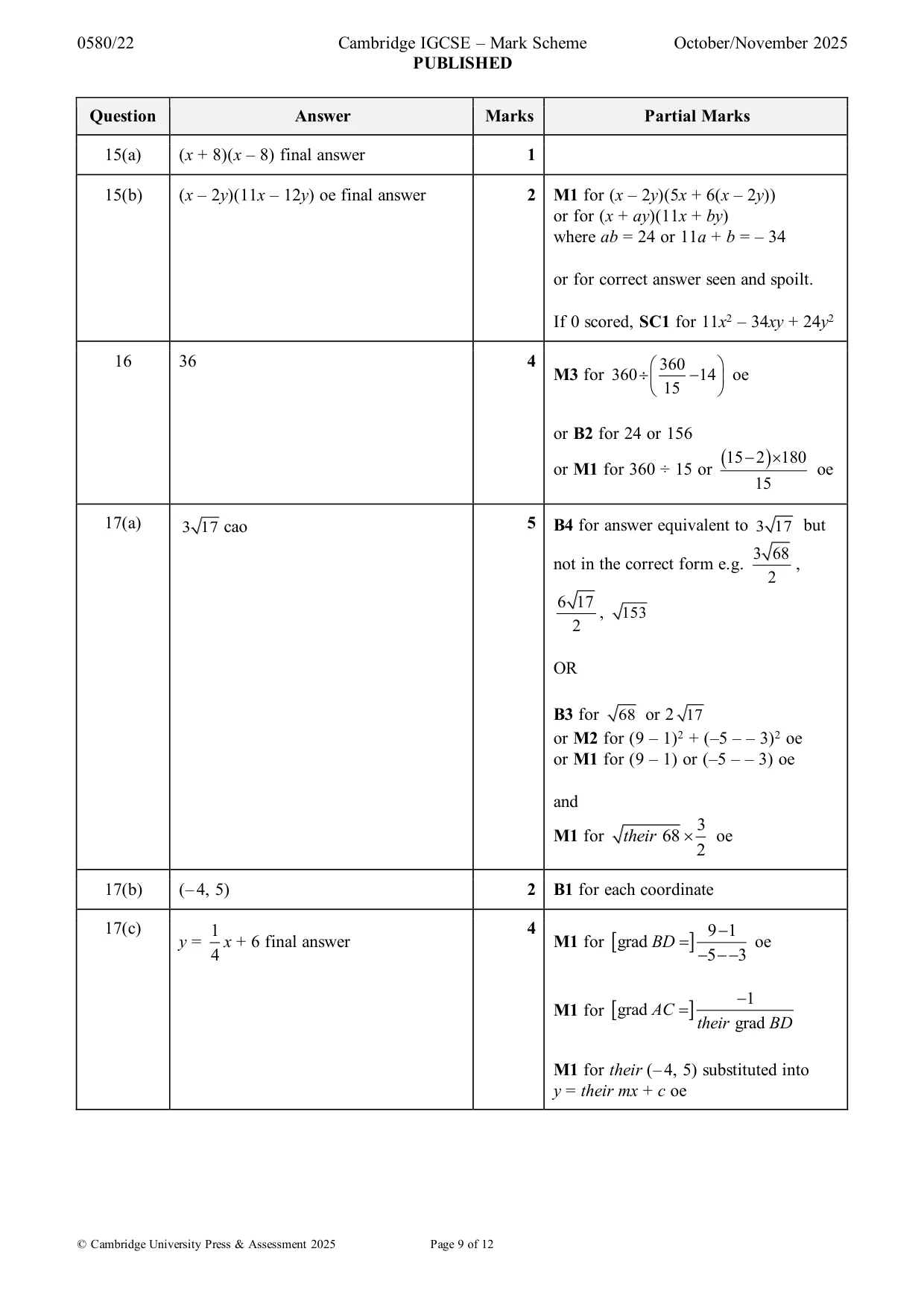
Mark scheme: 15(a) (x + 8)(x – 8) final answer 1 15(b) (x – 2y)(11x – 12y) oe final answer 2 M1 for (x – 2y)(5x + 6(x – 2y)) or for (x + ay)(11x + by) where ab = 24 or 11a + b = – 34 or for correct answer seen and spoilt. If 0 scored, SC1 for 11x2 – 34xy + 24y2
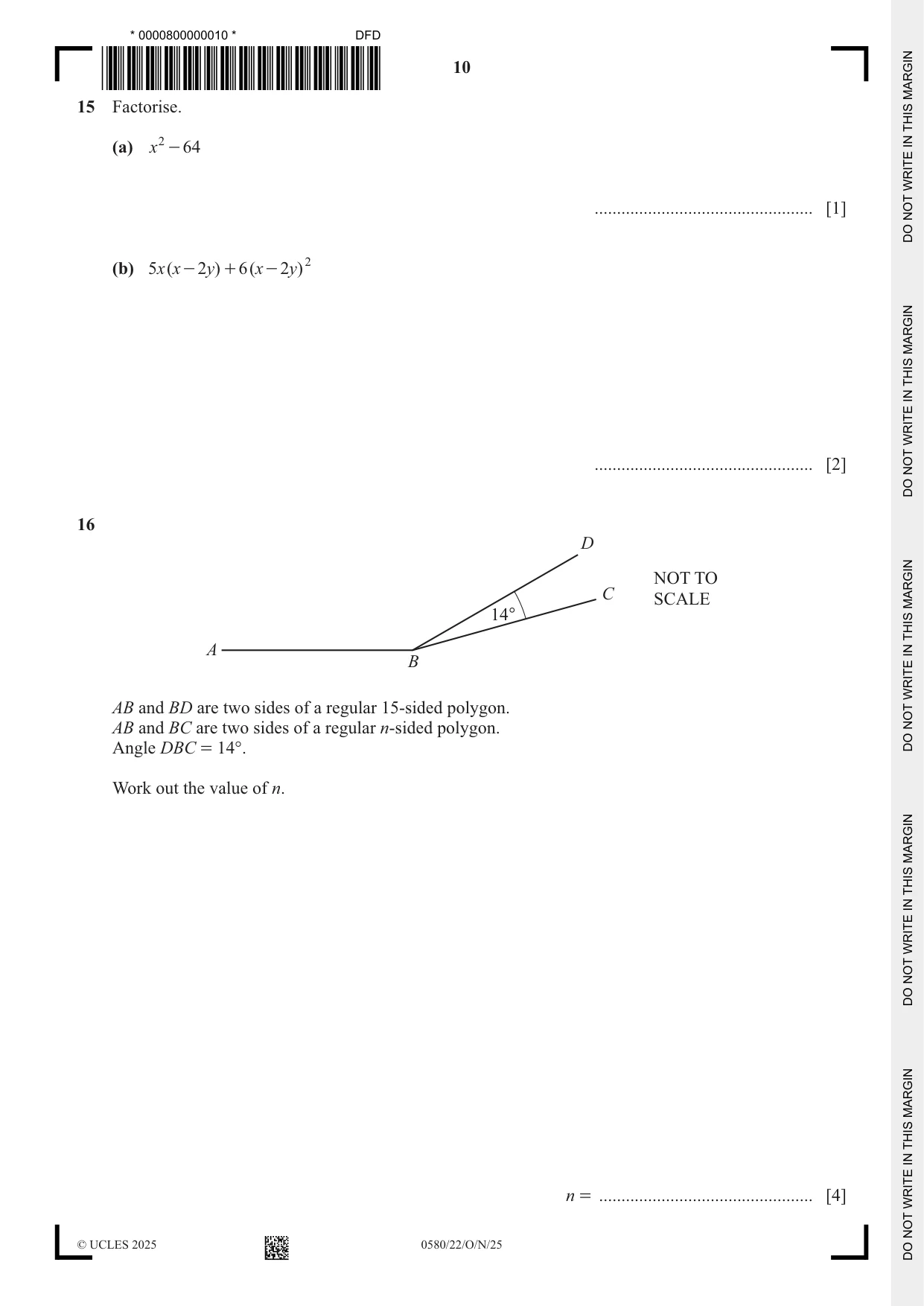
Q16 · D NOT TO C SCALE 14° A B AB and BD are two sides of a regular 15-sided polygon
16 D NOT TO C SCALE 14° A B AB and BD are two sides of a regular 15-sided polygon. AB and BC are two sides of a regular n-sided polygon. Angle DBC = 14°. Work out the value of n. n = ................................................ [4]
Mark scheme: 16 36 4 360 M3 for 360 − 14 oe 15 or B2 for 24 or 156 (15 − 2 ) 180 or M1 for 360 ÷ 15 or oe 15
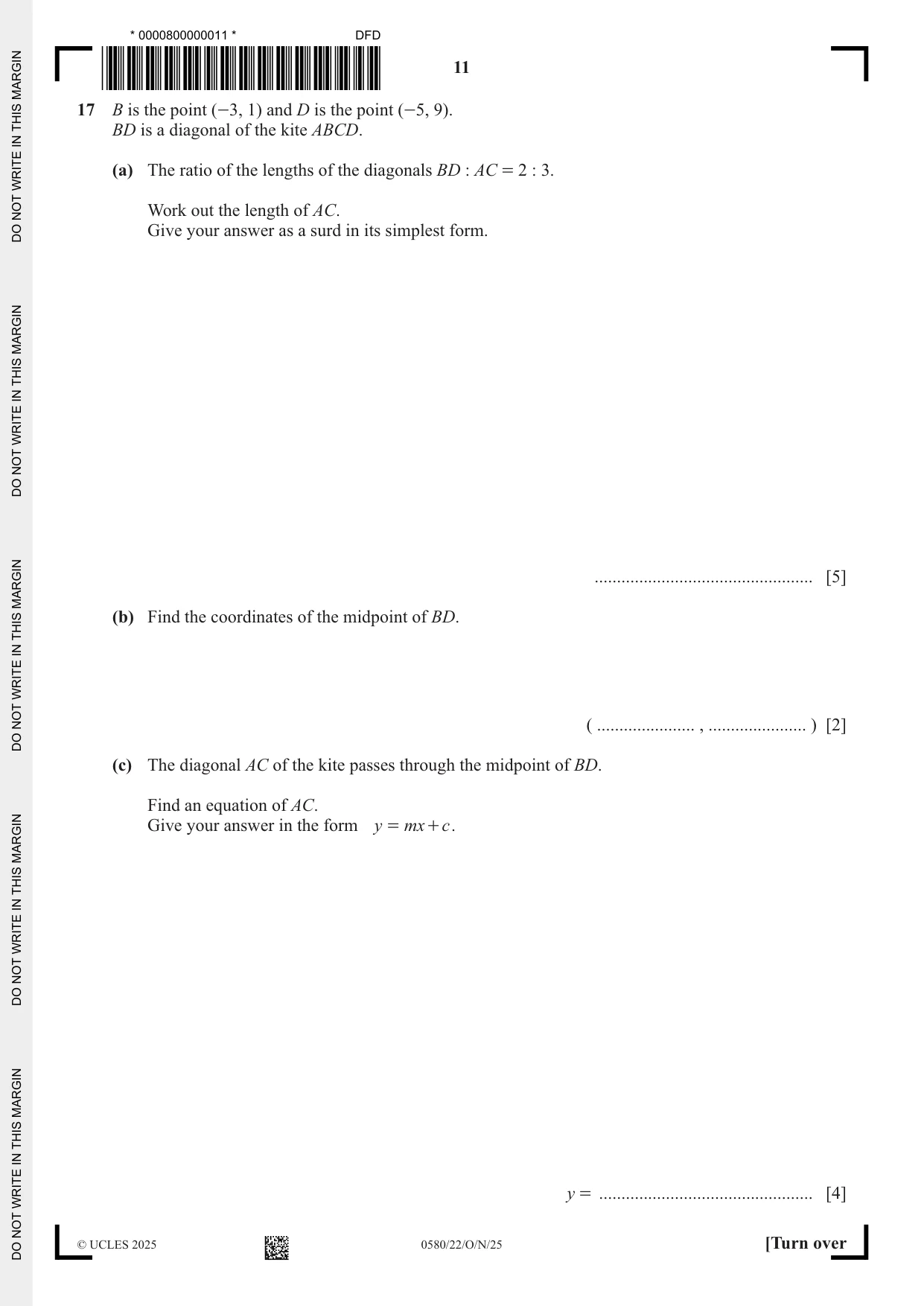
Q17 · B is the point (-3, 1) and D is the point (-5, 9)
17 B is the point (-3, 1) and D is the point (-5, 9). BD is a diagonal of the kite ABCD. (a) The ratio of the lengths of the diagonals BD : AC = 2 : 3. Work out the length of AC. Give your answer as a surd in its simplest form. ................................................. [5] (b) Find the coordinates of the midpoint of BD. ( ...................... , ...................... ) [2] (c) The diagonal AC of the kite passes through the midpoint of BD. Find an equation of AC. Give your answer in the form y = mx + c . y = ................................................ [4]
Mark scheme: 17(a) 3 17 cao 5 B4 for answer equivalent to 3 17 but 3 68 not in the correct form e.g. , 2 6 17 , 153 2 OR B3 for 68 or 2 17 or M2 for (9 – 1)2 + (–5 – – 3)2 oe or M1 for (9 – 1) or (–5 – – 3) oe and 3 M1 for their 68 oe 2 17(b) (– 4, 5) 2 B1 for each coordinate 17(c) 1 4 − 1 y = x + 6 final answer M1 for grad BD = 9 oe 4 −−−5 3 −1 M1 for grad AC = their grad BD M1 for their (– 4, 5) substituted into y = their mx + c oe
Q18 · Rationalise the denominator and simplify
18 Rationalise the denominator and simplify. 20 4 + 6 ................................................. [3]
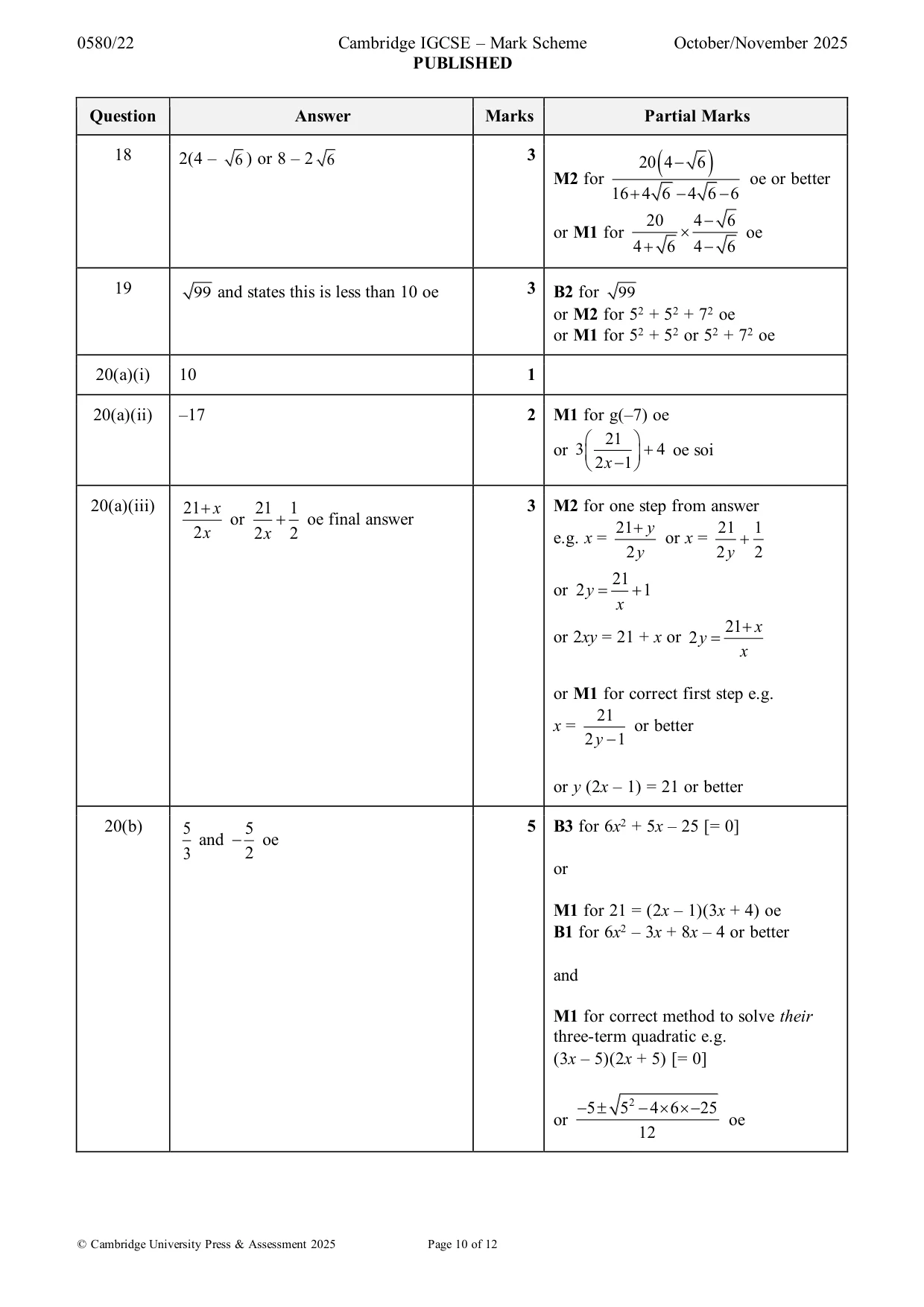
Mark scheme: 18 2(4 – 6 ) or 8 – 2 6 3 20 4 − 6 ( ) M2 for oe or better 16 + 4 6 − 4 6 − 6 20 4 − 6 or M1 for oe 4 + 6 4 − 6
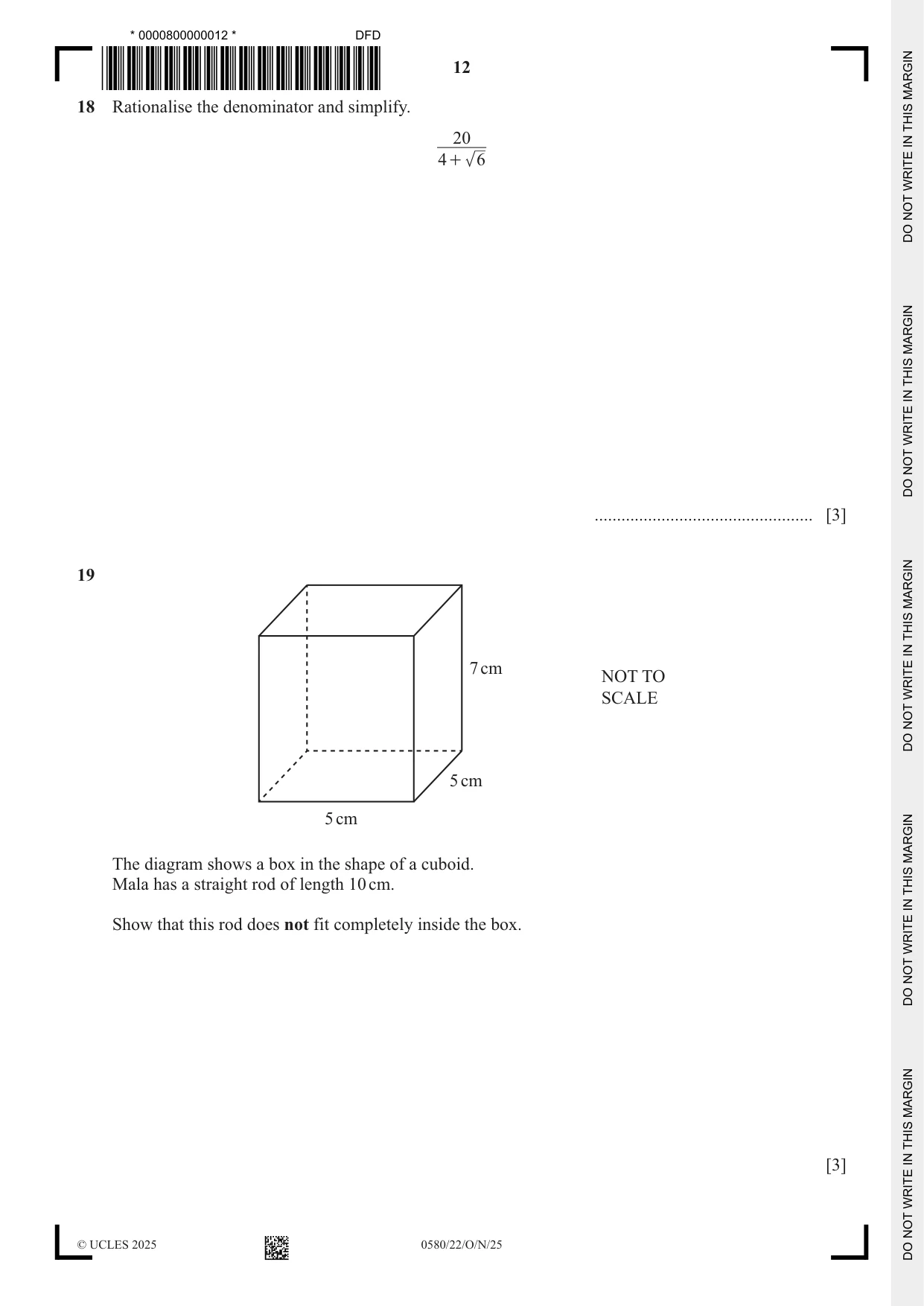
Q19 · 7 cm NOT TO SCALE 5 cm 5 cm The diagram shows a box in the shape of a cuboid
19 7 cm NOT TO SCALE 5 cm 5 cm The diagram shows a box in the shape of a cuboid. Mala has a straight rod of length 10 cm. Show that this rod does not fit completely inside the box. [3]
Mark scheme: 19 99 and states this is less than 10 oe 3 B2 for 99 or M2 for 52 + 52 + 72 oe or M1 for 52 + 52 or 52 + 72 oe
Q20 · 1 20 f ( )x = , x !
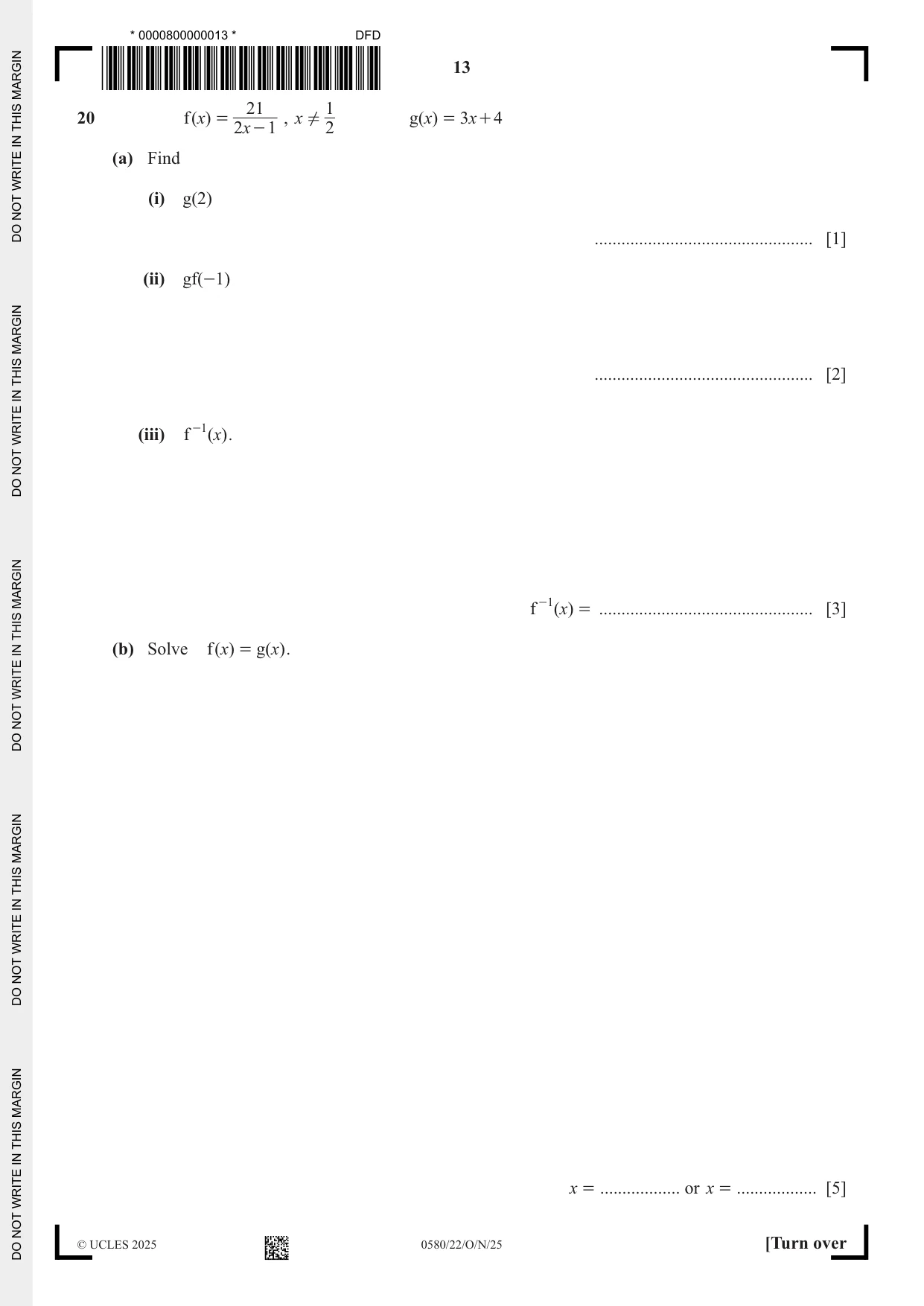
21 1 20 f ( )x = , x ! g ( )x = 3x + 4 2x - 1 2 (a) Find (i) g(2) ................................................. [1] (ii) gf(-1) ................................................. [2] (iii) f -1 ( )x . f -1 ( )x = ................................................ [3] (b) Solve f ( x) = g ( x) . x = .................. or x = .................. [5]
Mark scheme: 20(a)(i) 10 1 20(a)(ii) –17 2 M1 for g(–7) oe 21 or 3 + 4 oe soi 2 x − 1 20(a)(iii) 21 + x 21 1 3 M2 for one step from answer or + oe final answer 21 + y 21 1 2 x 2 x 2 e.g. x = or x = + 2 y 2 y 2 21 or 2 y = + 1 x 21 + x or 2xy = 21 + x or 2 y = x or M1 for correct first step e.g. 21 x = or better 2 y − 1 or y (2x – 1) = 21 or better 20(b) 5 5 5 B3 for 6x2 + 5x – 25 [= 0] and − oe 3 2 or M1 for 21 = (2x – 1)(3x + 4) oe B1 for 6x2 – 3x + 8x – 4 or better and M1 for correct method to solve their three-term quadratic e.g. (3x – 5)(2x + 5) [= 0] −5 5 2 −−4 6 25 or oe 12
Q21 · Y 1 O 180° 360° x – 1 On the diagram, sketch the graph of y = cos x for 0° G x G 360°
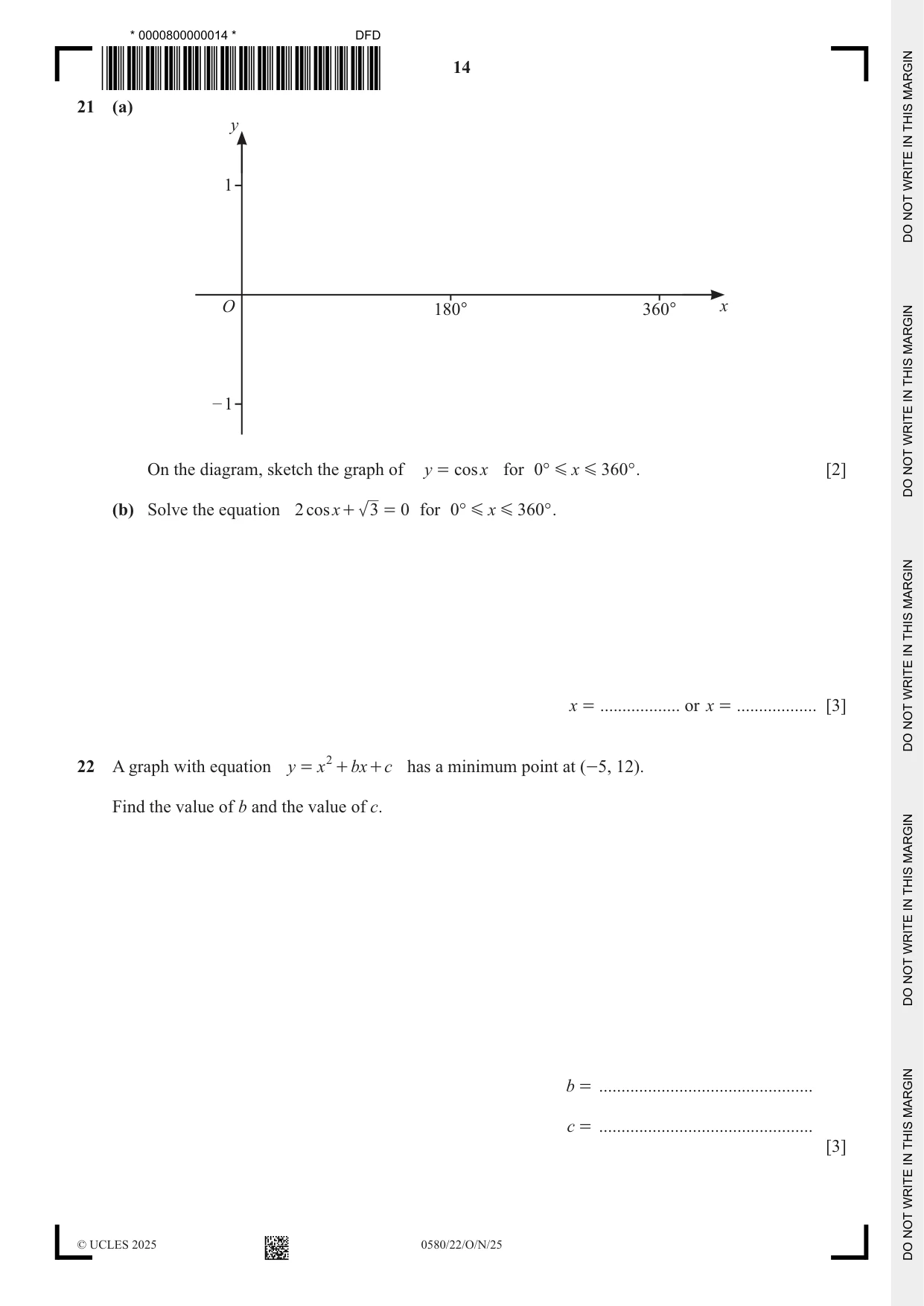
21 (a) y 1 O 180° 360° x – 1 On the diagram, sketch the graph of y = cos x for 0° G x G 360° . [2] (b) Solve the equation 2 cosx + 3 = 0 for 0° G x G 360° . x = .................. or x = .................. [3]
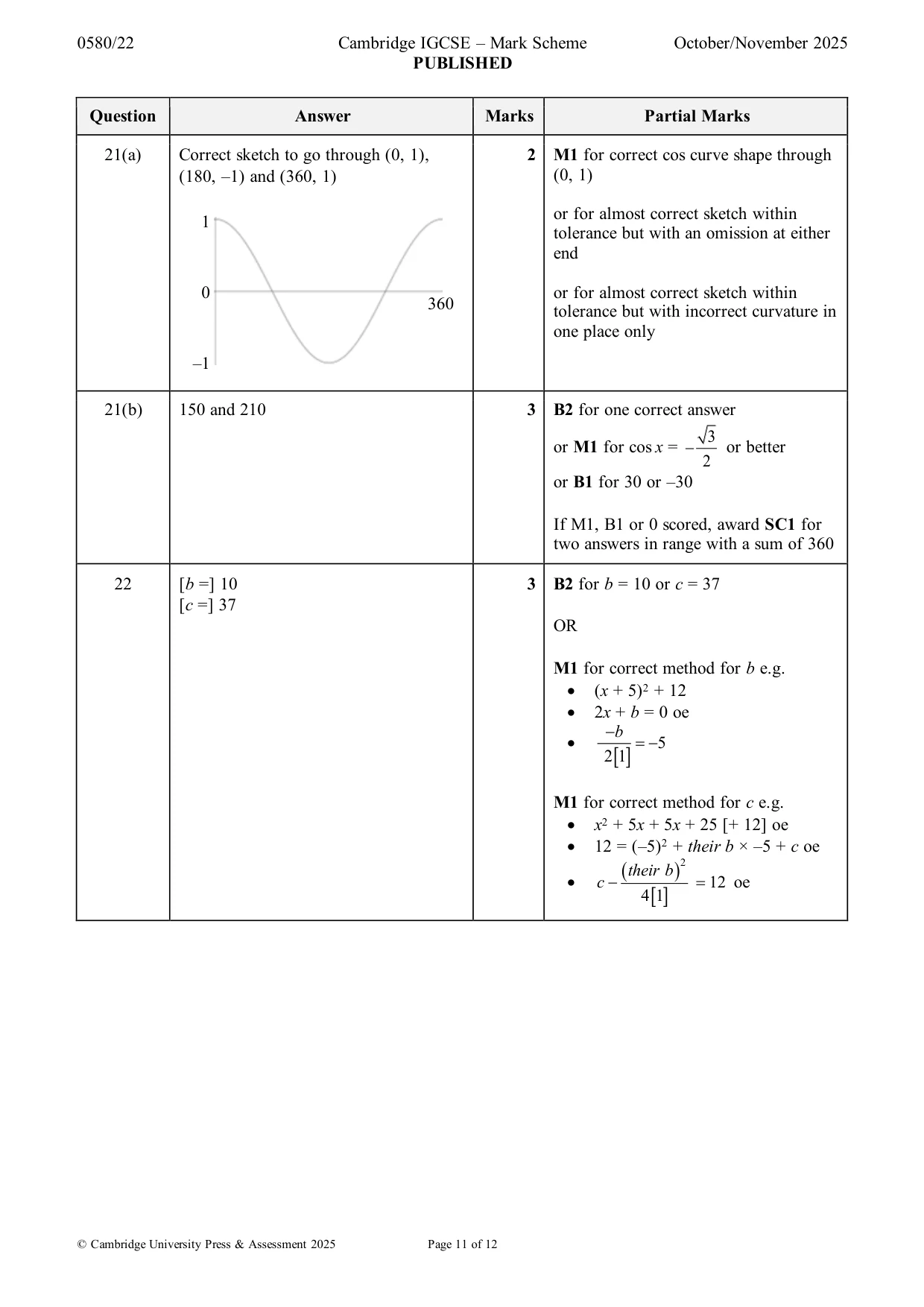
Mark scheme: 21(a) Correct sketch to go through (0, 1), 2 M1 for correct cos curve shape through (180, –1) and (360, 1) (0, 1) or for almost correct sketch within 1 tolerance but with an omission at either end 0 or for almost correct sketch within 360 tolerance but with incorrect curvature in one place only –1 21(b) 150 and 210 3 B2 for one correct answer 3 or M1 for cos x = − or better 2 or B1 for 30 or –30 If M1, B1 or 0 scored, award SC1 for two answers in range with a sum of 360
Q22 · A graph with equation y = x 2 + bx + c has a minimum point at (-5, 12)
22 A graph with equation y = x 2 + bx + c has a minimum point at (-5, 12). Find the value of b and the value of c. b = ................................................ c = ................................................ [3]
Mark scheme: 22 [b =] 10 3 B2 for b = 10 or c = 37 [c =] 37 OR M1 for correct method for b e.g. • (x + 5)2 + 12 • 2x + b = 0 oe −b • = −5 2 1 M1 for correct method for c e.g. • x2 + 5x + 5x + 25 [+ 12] oe • 12 = (–5)2 + their b × –5 + c oe ( their b ) 2 • c − = 12 oe 4 1
Q23 · A NOT TO SCALE O 12 cm B 240° The diagram shows a major sector, AOB, of a circle
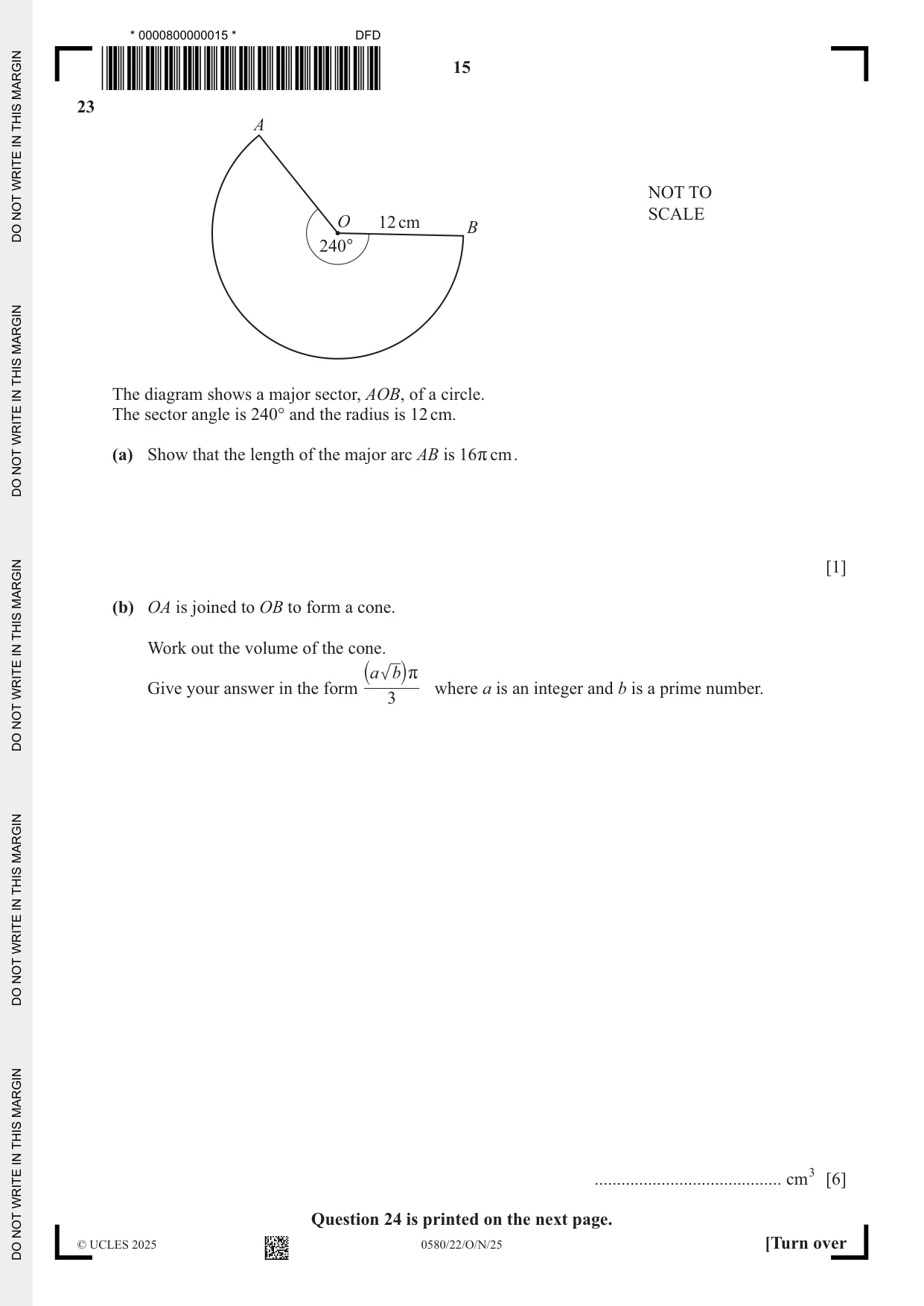
23 A NOT TO SCALE O 12 cm B 240° The diagram shows a major sector, AOB, of a circle. The sector angle is 240° and the radius is 12 cm. (a) Show that the length of the major arc AB is 16rcm . [1] (b) OA is joined to OB to form a cone. Work out the volume of the cone. `a bj r Give your answer in the form where a is an integer and b is a prime number. 3 .......................................... cm3 [6] Question 24 is printed on the next page.
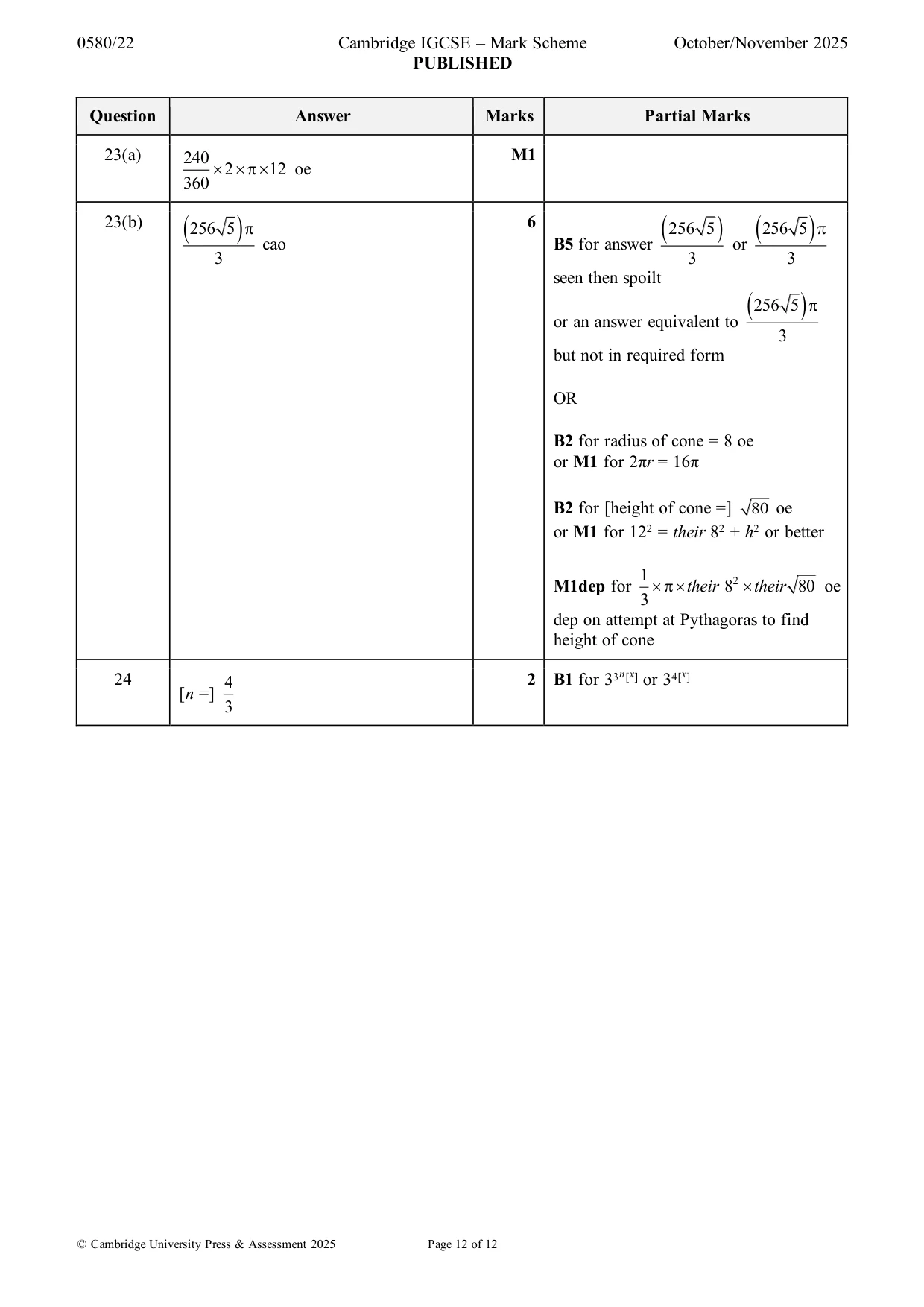
Mark scheme: 23(a) 240 M1 2 12 oe 360 23(b) 6 256 5 256 5 256 5 ( ) ( ) ( ) cao B5 for answer or 3 3 3 seen then spoilt 256 5 ( ) or an answer equivalent to 3 but not in required form OR B2 for radius of cone = 8 oe or M1 for 2πr = 16π B2 for [height of cone =] 80 oe or M1 for 122 = their 82 + h2 or better 1 2 M1dep for their 8 their 80 oe 3 dep on attempt at Pythagoras to find height of cone
Q24 · 27 nx = ( 9 x) 2 Find the value of n
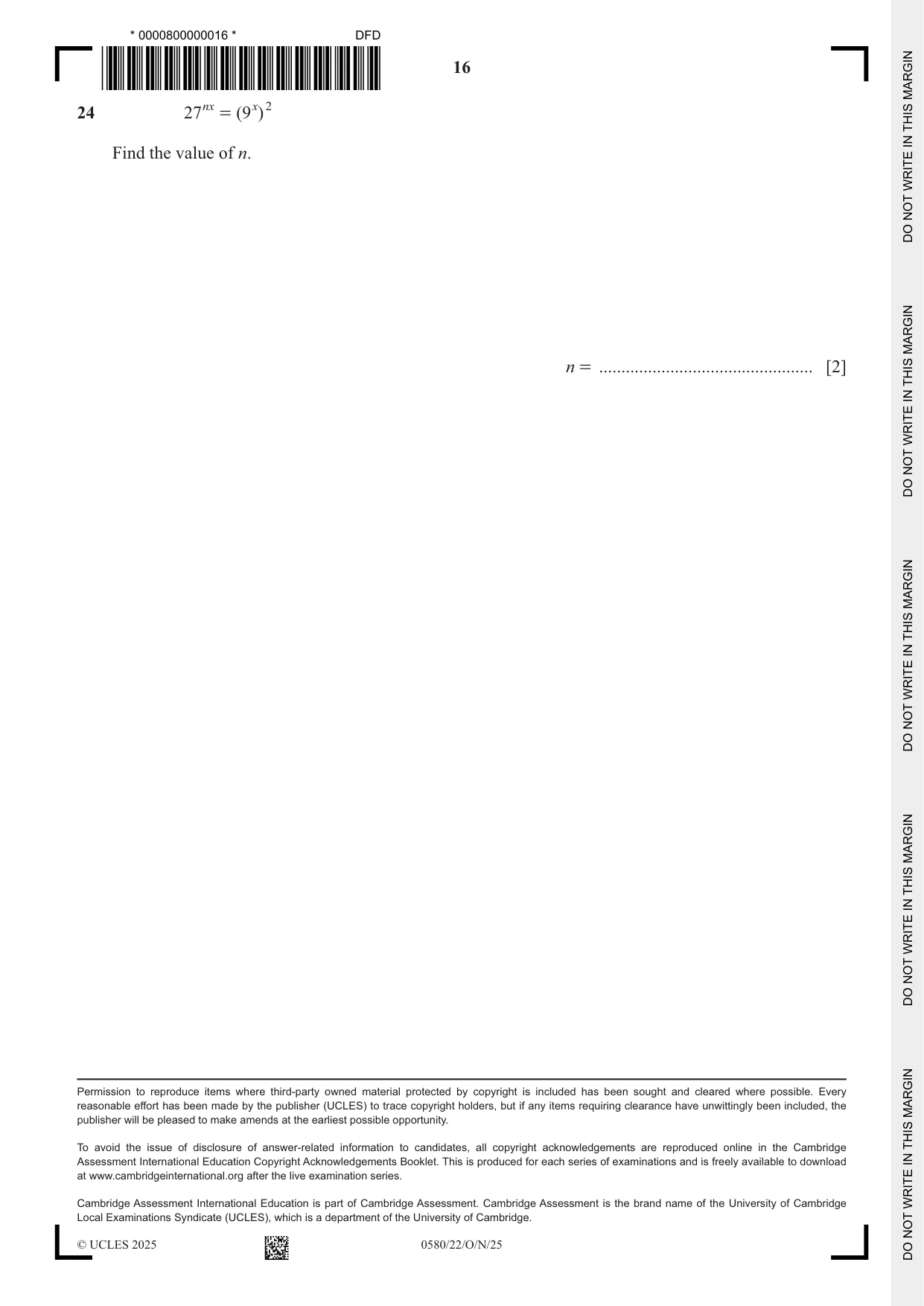
24 27 nx = ( 9 x) 2 Find the value of n. n = ................................................ [2]
Mark scheme: 24 4 2 B1 for 33n[x] or 34[x] [n =] 3
What was in this paper
The subtopics covered by these 24 questions, and how many questions each got. Open one in a new tab to see every Cambridge question on it.
3Angles2Pythagoras’ theorem2Surface area and volume2Algebraic manipulation1Estimation1Fractions, decimals and percentages1Functions1Graphs of functions1Inequalities1Introduction to probability1Money1Percentages1Similarity1Statistical charts and diagrams1Surds1The four operations1Trigonometric functions1Types of number1What you needed in this session
Cambridge’s own grade thresholds for 2025 Oct/Nov, Paper 2 · Variant 2. A higher threshold means an easier paper — the bar moves with how the cohort did.