Cambridge IGCSE Mathematics 0580 — 2025 Oct/Nov Paper 2 · Variant 1
0580/21/O/N/25 · 26 questions · 100 marks · 120 min
The question paper and its mark scheme, free to read here and free to download. This is Cambridge’s own paper, exactly as it was sat.
Question paper16 pages
Mark scheme10 pages
Answers below. Sit the paper first if you are practising.
Questions as text
Q1 · Divide $90 in the ratio 2 : 3
1 Divide $90 in the ratio 2 : 3. $ .................... , $ .................... [2]
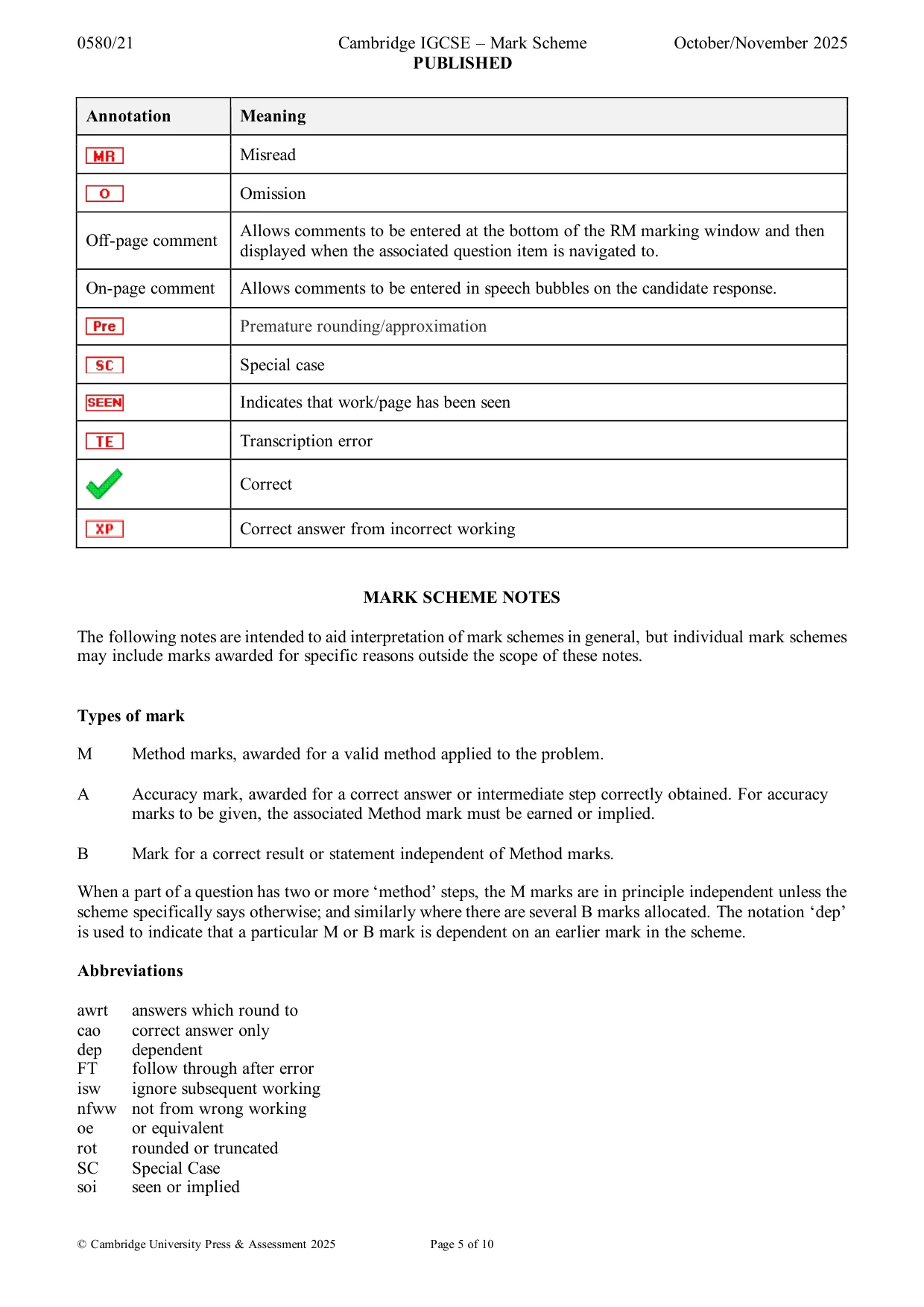
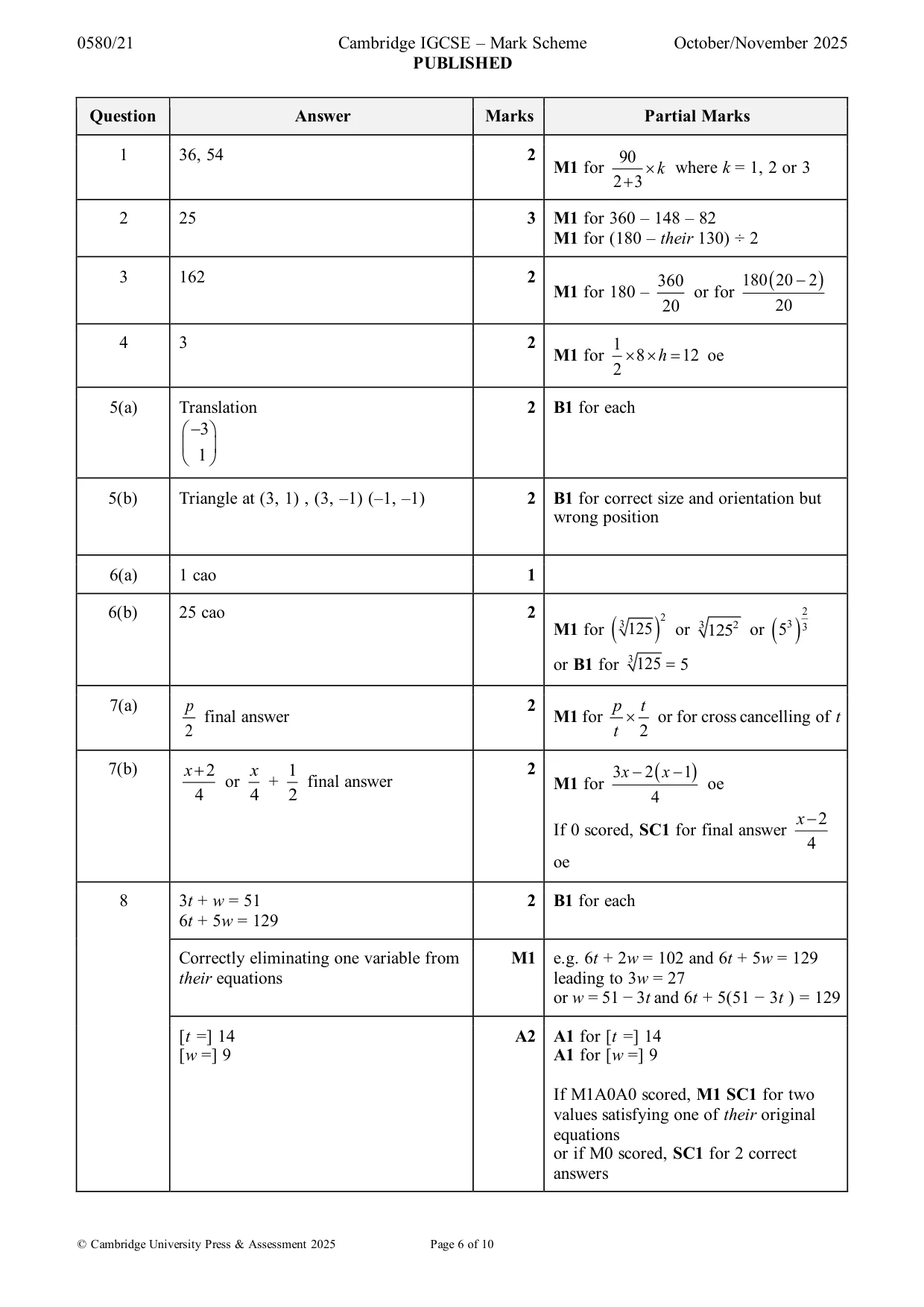
Mark scheme: Question Answer Marks Partial Marks 1 36, 54 2 90 M1 for k where k = 1, 2 or 3 2 + 3
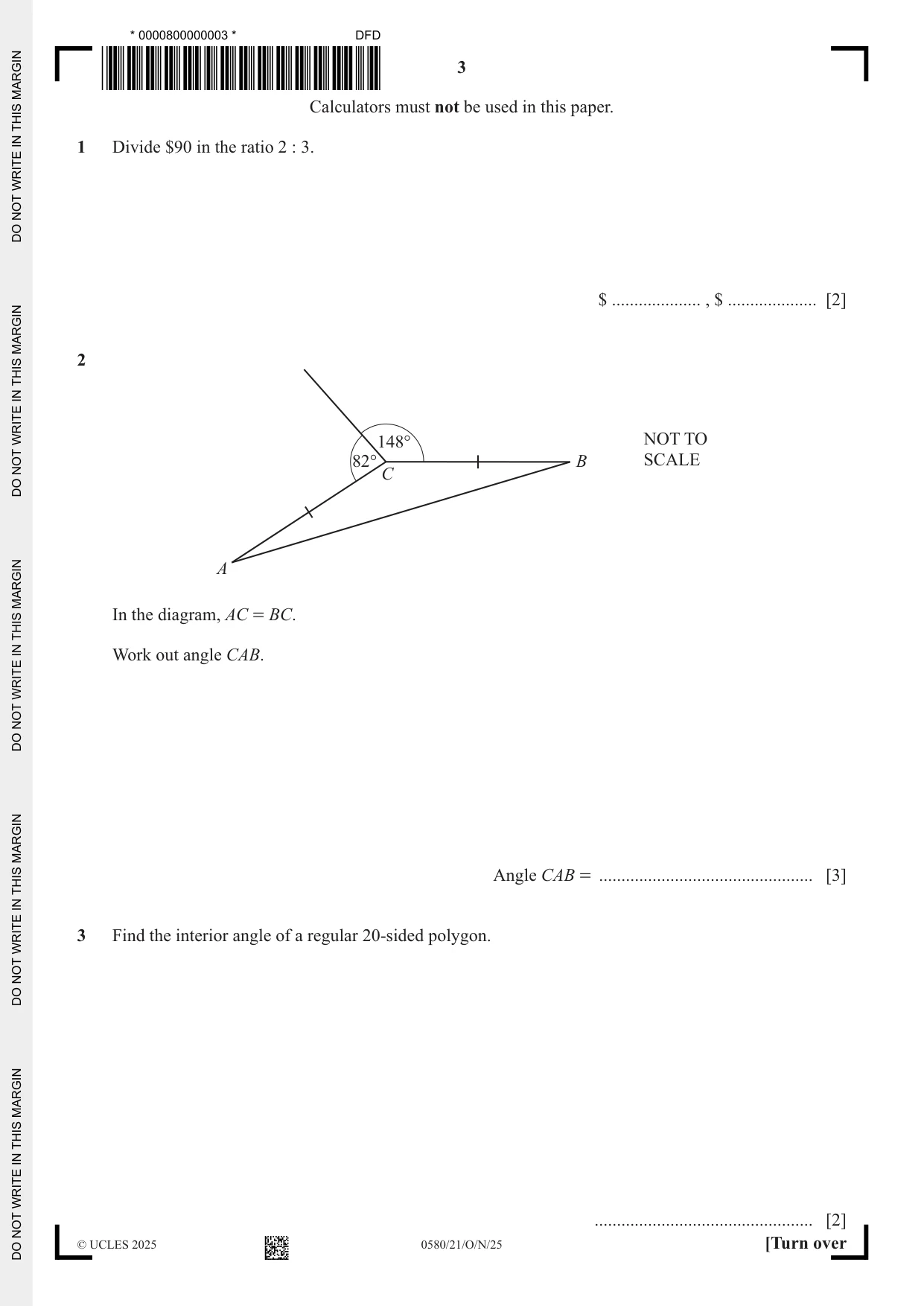
Q2 · 148° NOT TO 82° B SCALE C A In the diagram, AC = BC
2 148° NOT TO 82° B SCALE C A In the diagram, AC = BC. Work out angle CAB. Angle CAB = ................................................ [3]
Mark scheme: 2 25 3 M1 for 360 – 148 – 82 M1 for (180 – their 130) ÷ 2
Q3 · Find the interior angle of a regular 20-sided polygon
3 Find the interior angle of a regular 20-sided polygon. ................................................. [2]
Mark scheme: 3 162 2 360 180 ( 20 − 2 ) M1 for 180 – or for 20 20
Q4 · The area of a triangle is 12 cm 2
4 The area of a triangle is 12 cm 2. The length of the base of the triangle is 8 cm. Work out the height of the triangle. ............................................ cm [2]
Mark scheme: 4 3 2 1 M1 for 8 h = 12 oe 2
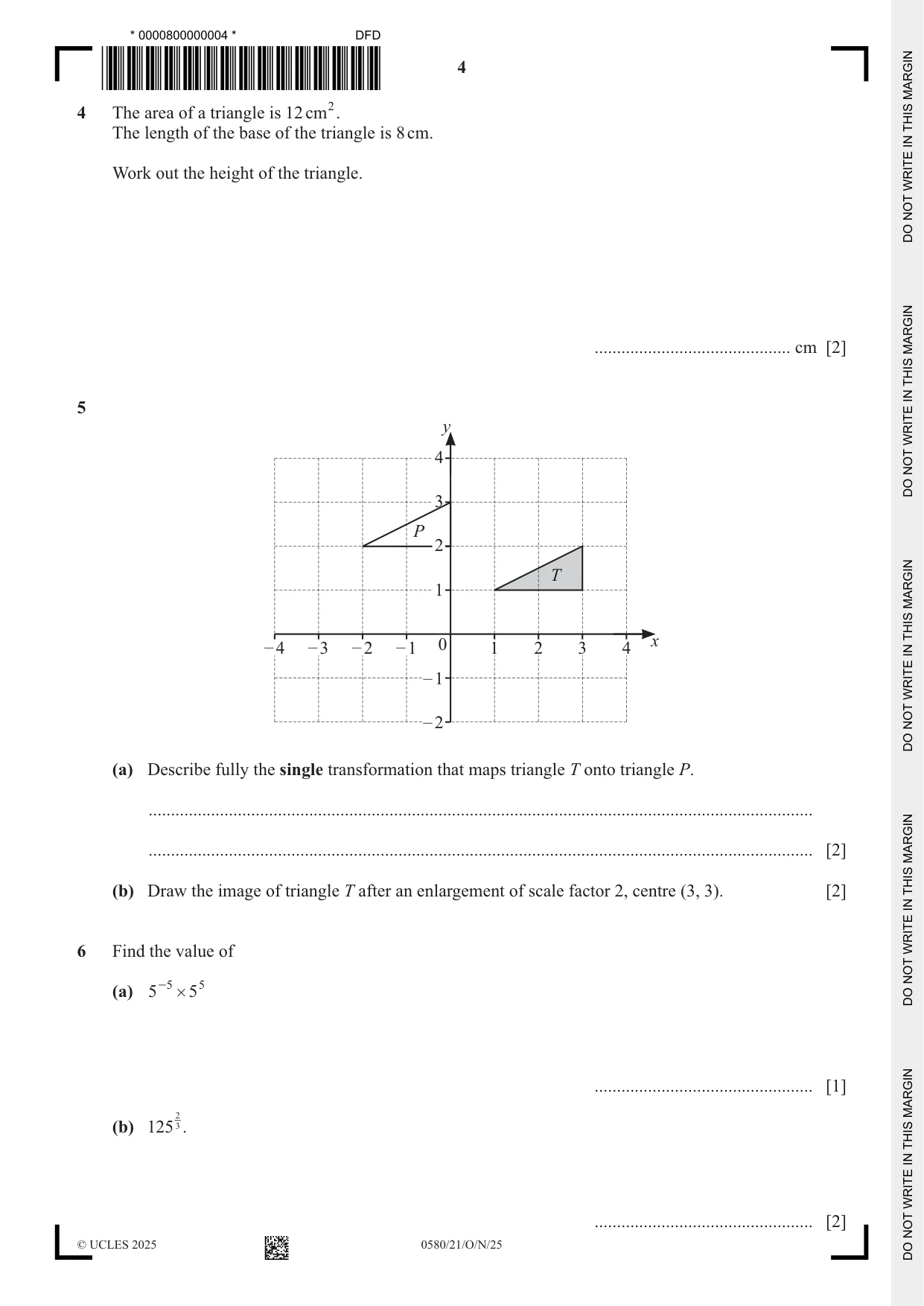
Q5 · Y 4 3 P 2 T 1 – 4 – 3 – 2 – 1 0 1 2 3 4 x – 1 – 2 (a) Describe fully the single…
5 y 4 3 P 2 T 1 – 4 – 3 – 2 – 1 0 1 2 3 4 x – 1 – 2 (a) Describe fully the single transformation that maps triangle T onto triangle P. ..................................................................................................................................................... ..................................................................................................................................................... [2] (b) Draw the image of triangle T after an enlargement of scale factor 2, centre (3, 3). [2]
Mark scheme: 5(a) Translation 2 B1 for each −3 1 5(b) Triangle at (3, 1) , (3, –1) (–1, –1) 2 B1 for correct size and orientation but wrong position
Q6 · Find the value of (a) 5 -5 # 5 5 ................................................
6 Find the value of (a) 5 -5 # 5 5 ................................................. [1] 3 (b) 125 2. ................................................. [2]
Mark scheme: 6(a) 1 cao 1 6(b) 25 cao 2 2 2 3 3 125 5 3 M1 for or 3 1252 or ( ) ( ) or B1 for 3 125 = 5
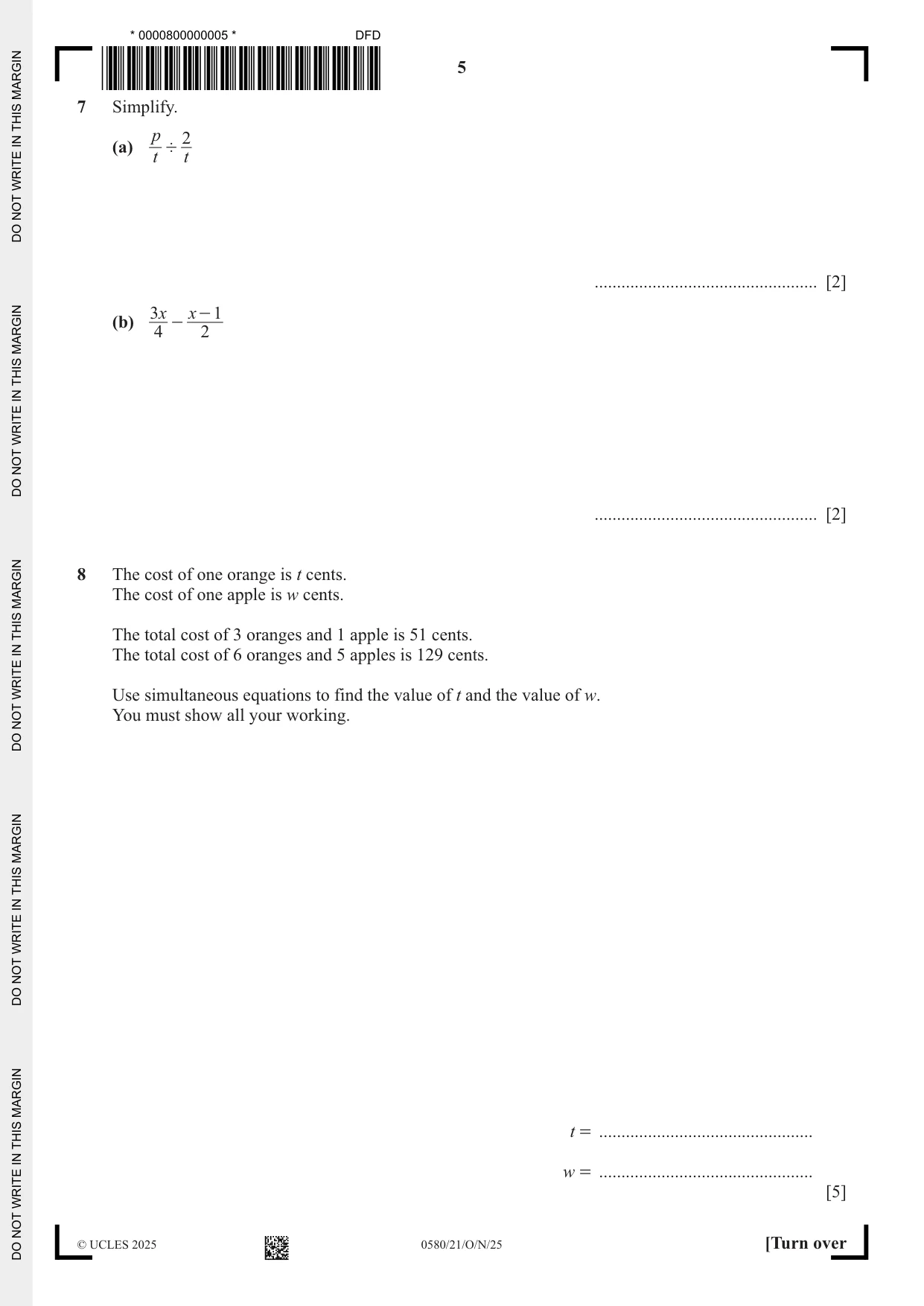
Question 7
7 Simplify. p 2 (a) ' t t .................................................. [2] 3x x - 1 (b) - 4 2 .................................................. [2]
Mark scheme: 7(a) p 2 p t final answer M1 for or for cross cancelling of t 2 t 2 7(b) x + 2 x 1 2 3 x − 2 ( x − 1) or + final answer M1 for oe 4 4 2 4 x − 2 If 0 scored, SC1 for final answer 4 oe
Q8 · The cost of one orange is t cents
8 The cost of one orange is t cents. The cost of one apple is w cents. The total cost of 3 oranges and 1 apple is 51 cents. The total cost of 6 oranges and 5 apples is 129 cents. Use simultaneous equations to find the value of t and the value of w. You must show all your working. t = ................................................ w = ................................................ [5]
Mark scheme: 8 3t + w = 51 2 B1 for each 6t + 5w = 129 Correctly eliminating one variable from M1 e.g. 6t + 2w = 102 and 6t + 5w = 129 their equations leading to 3w = 27 or w = 51 − 3t and 6t + 5(51 − 3t ) = 129 [t =] 14 A2 A1 for [t =] 14 [w =] 9 A1 for [w =] 9 If M1A0A0 scored, M1 SC1 for two values satisfying one of their original equations or if M0 scored, SC1 for 2 correct answers
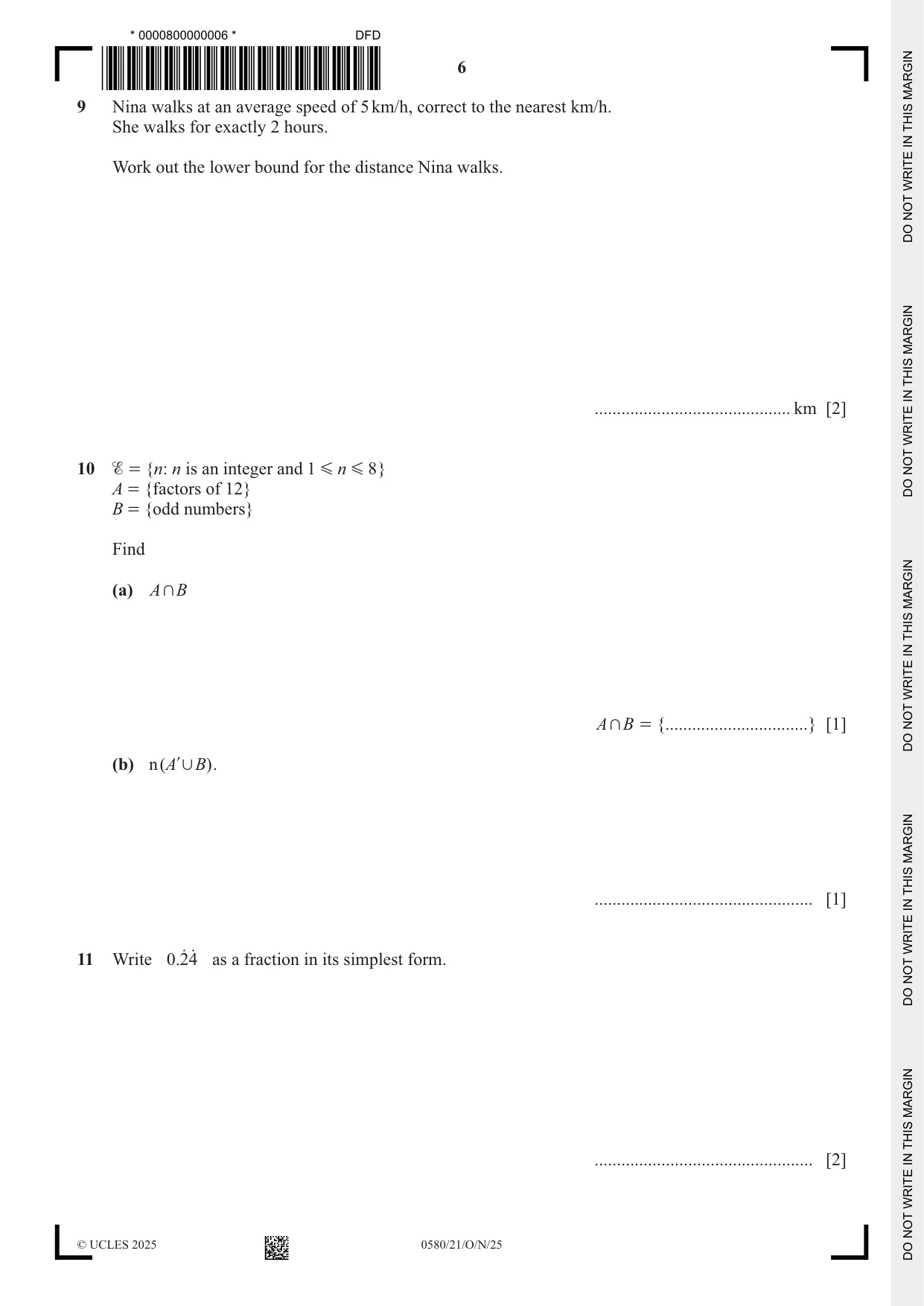
Q9 · Nina walks at an average speed of 5 km/h, correct to the nearest km/h
9 Nina walks at an average speed of 5 km/h, correct to the nearest km/h. She walks for exactly 2 hours. Work out the lower bound for the distance Nina walks. ............................................ km [2]
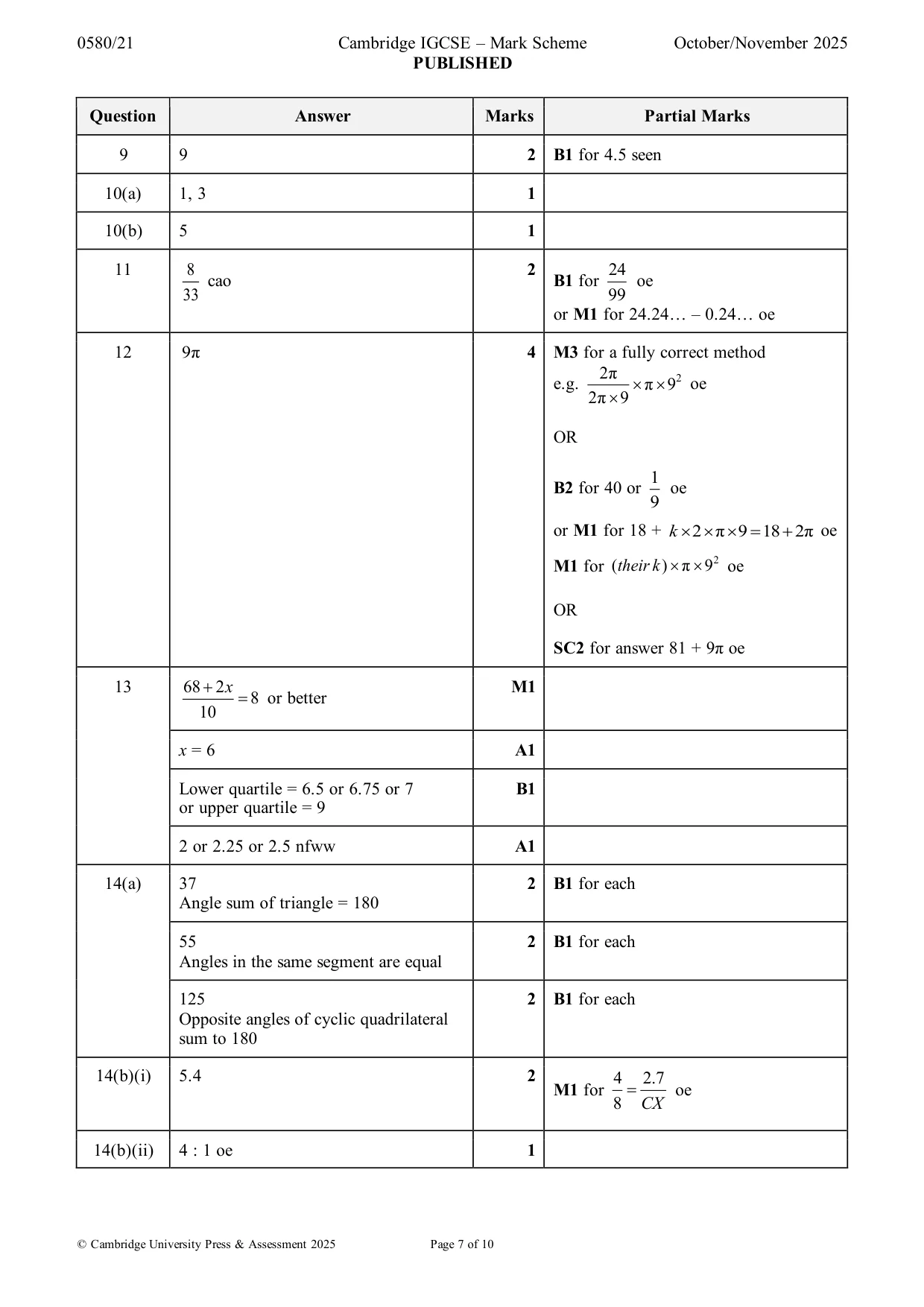
Mark scheme: 9 9 2 B1 for 4.5 seen
Q10 · % = {n: n is an integer and 1 G n G 8 } A = {factors of 12} B = {odd numbers} Find (a) A…
10 % = {n: n is an integer and 1 G n G 8 } A = {factors of 12} B = {odd numbers} Find (a) A + B A + B = {................................} [1] (b) n ( Al , B ) . ................................................. [1]
Mark scheme: 10(a) 1, 3 1 10(b) 5 1
Q11 · O o11 Write .024 as a fraction in its simplest form
o o11 Write .024 as a fraction in its simplest form. ................................................. [2]
Mark scheme: 11 8 2 24 cao B1 for oe 33 99 or M1 for 24.24… – 0.24… oe
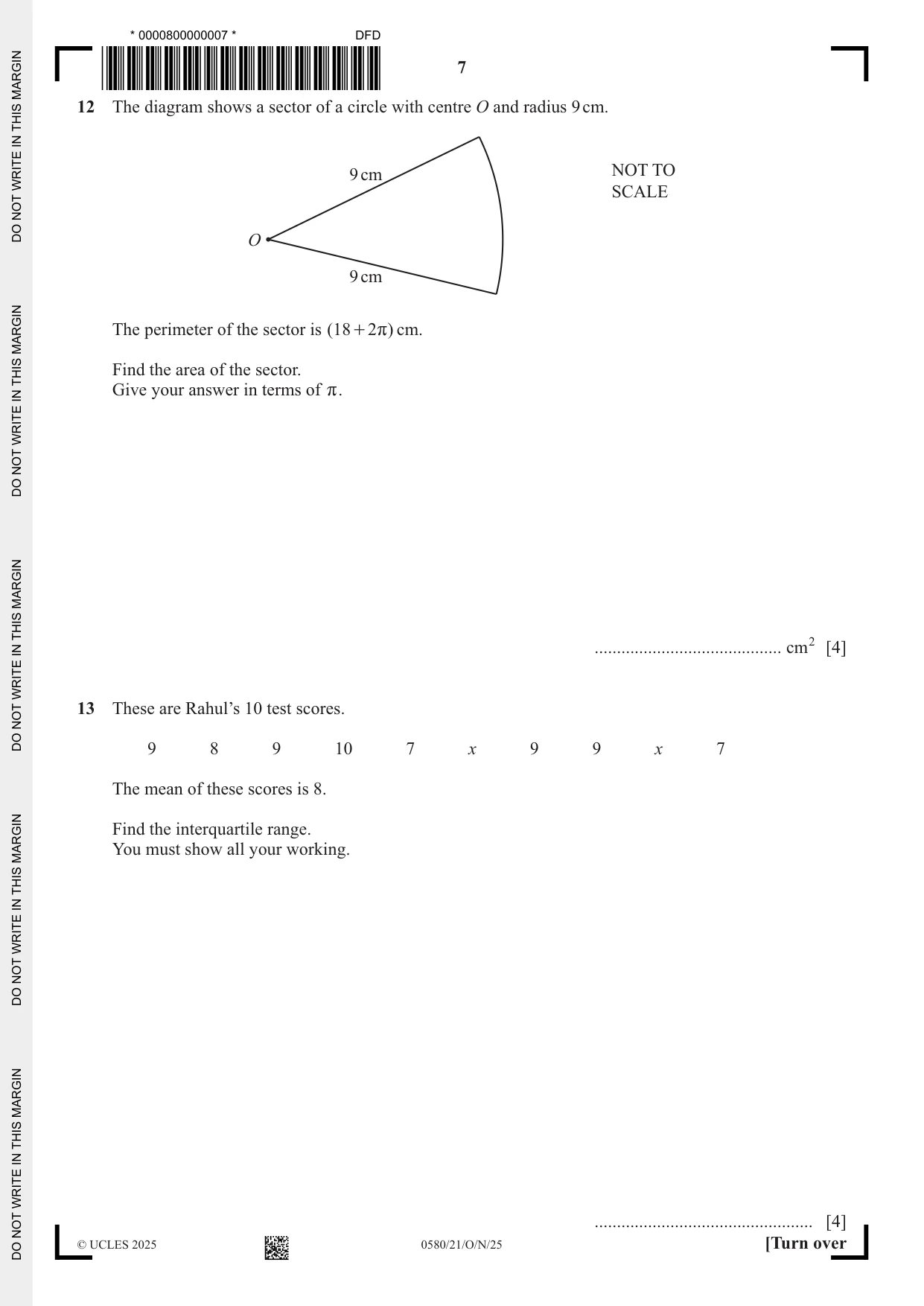
Q12 · The diagram shows a sector of a circle with centre O and radius 9 cm
12 The diagram shows a sector of a circle with centre O and radius 9 cm. 9 cm NOT TO SCALE O 9 cm The perimeter of the sector is ( 18 + 2 r ) cm. Find the area of the sector. Give your answer in terms of r. .......................................... cm2 [4]
Mark scheme: 12 9π 4 M3 for a fully correct method 2 π 2 e.g. π 9 oe 2 π 9 OR 1 B2 for 40 or oe 9 or M1 for 18 + k =2 π 9 18 + 2π oe M1 for ( their k ) π 9 2 oe OR SC2 for answer 81 + 9π oe
Q13 · These are Rahul’s 10 test scores
13 These are Rahul’s 10 test scores. 9 8 9 10 7 x 9 9 x 7 The mean of these scores is 8. Find the interquartile range. You must show all your working. ................................................. [4]
Mark scheme: 13 68 + 2 x M1 = 8 or better 10 x = 6 A1 Lower quartile = 6.5 or 6.75 or 7 B1 or upper quartile = 9 2 or 2.25 or 2.5 nfww A1
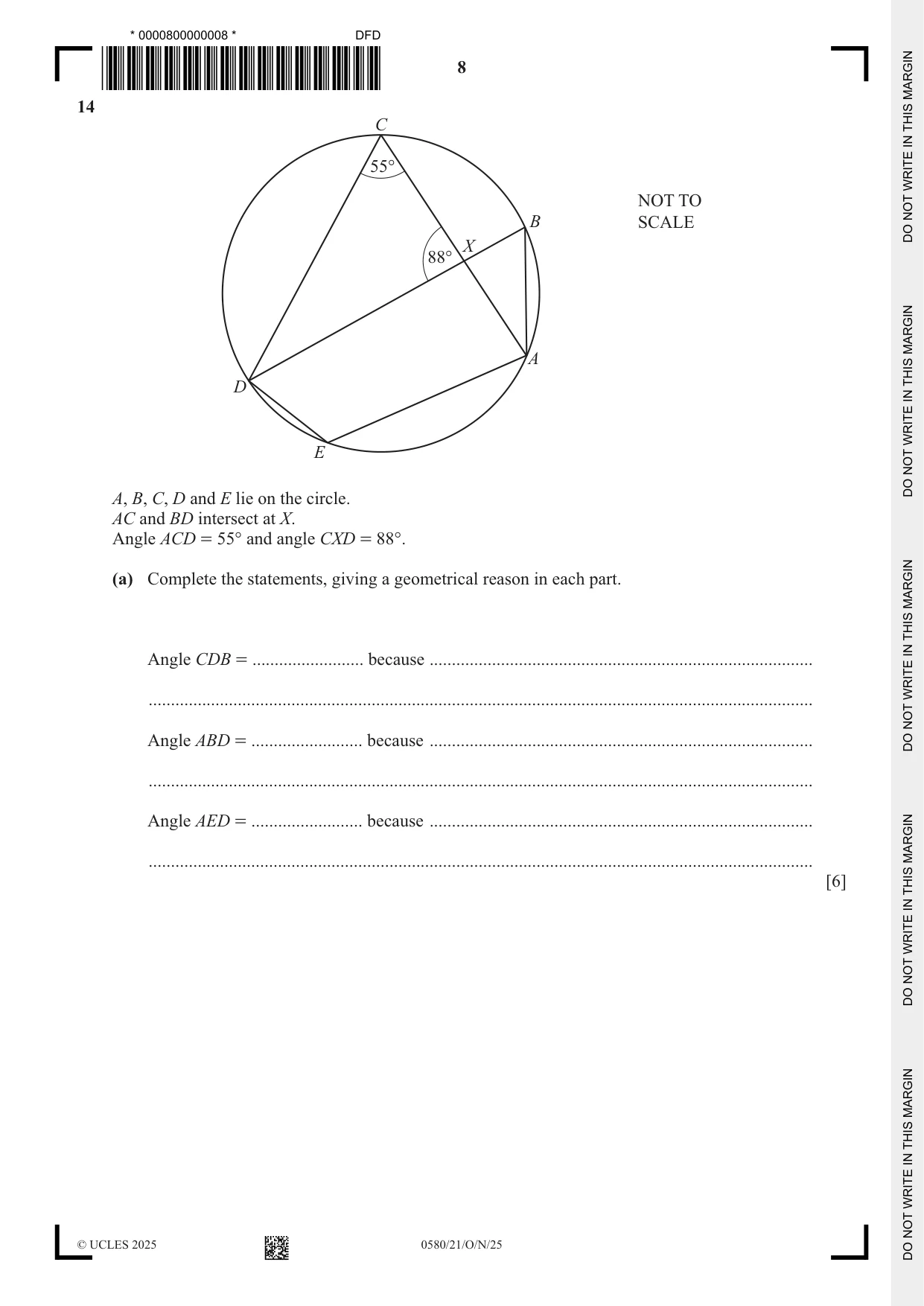
Q14 · C 55° NOT TO B SCALE X 88° A D E A, B, C, D and E lie on the circle
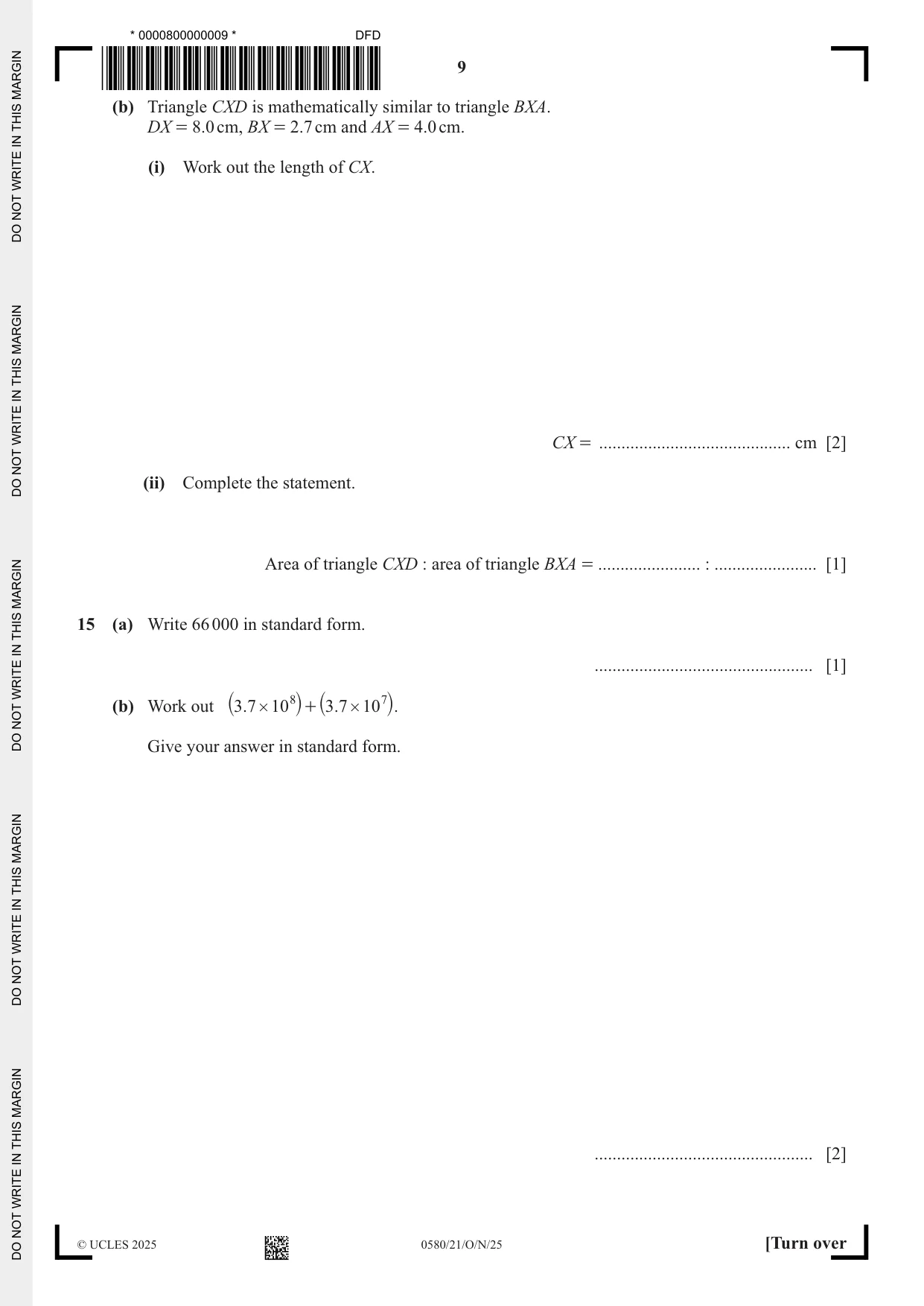
14 C 55° NOT TO B SCALE X 88° A D E A, B, C, D and E lie on the circle. AC and BD intersect at X. Angle ACD = 55° and angle CXD = 88°. (a) Complete the statements, giving a geometrical reason in each part. Angle CDB = ......................... because ...................................................................................... ..................................................................................................................................................... Angle ABD = ......................... because ...................................................................................... ..................................................................................................................................................... Angle AED = ......................... because ...................................................................................... ..................................................................................................................................................... [6] (b) Triangle CXD is mathematically similar to triangle BXA. DX = 8.0 cm, BX = 2.7 cm and AX = 4.0 cm. (i) Work out the length of CX. CX = ........................................... cm [2] (ii) Complete the statement. Area of triangle CXD : area of triangle BXA = ....................... : ....................... [1]
Mark scheme: 14(a) 37 2 B1 for each Angle sum of triangle = 180 55 2 B1 for each Angles in the same segment are equal 125 2 B1 for each Opposite angles of cyclic quadrilateral sum to 180 14(b)(i) 5.4 2 4 2.7 M1 for = oe 8 CX 14(b)(ii) 4 : 1 oe 1
Q15 · Write 66 000 in standard form
15 (a) Write 66 000 in standard form. ................................................. [1] (b) Work out `3.7 # 10 8j + `3. 7 # 10 7j. Give your answer in standard form. ................................................. [2]
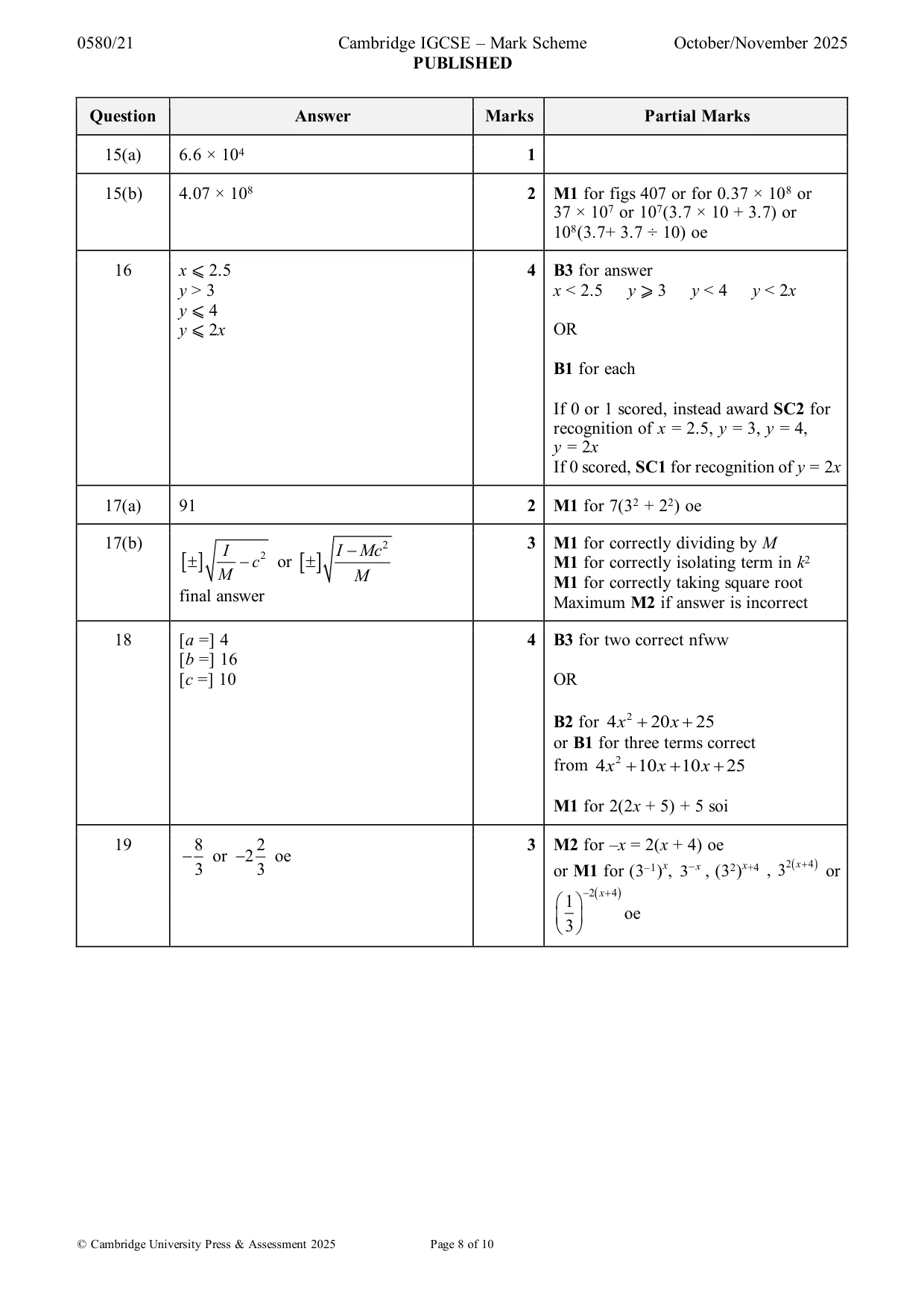
Mark scheme: 15(a) 6.6 × 10⁴ 1 15(b) 4.07 × 10⁸ 2 M1 for figs 407 or for 0.37 × 10⁸ or 37 × 107 or 107(3.7 × 10 + 3.7) or 108(3.7+ 3.7 ÷ 10) oe
Q16 · Y 6 5 4 R 3 2 1 0 1 2 3 4 x Write down all the inequalities that define the region R
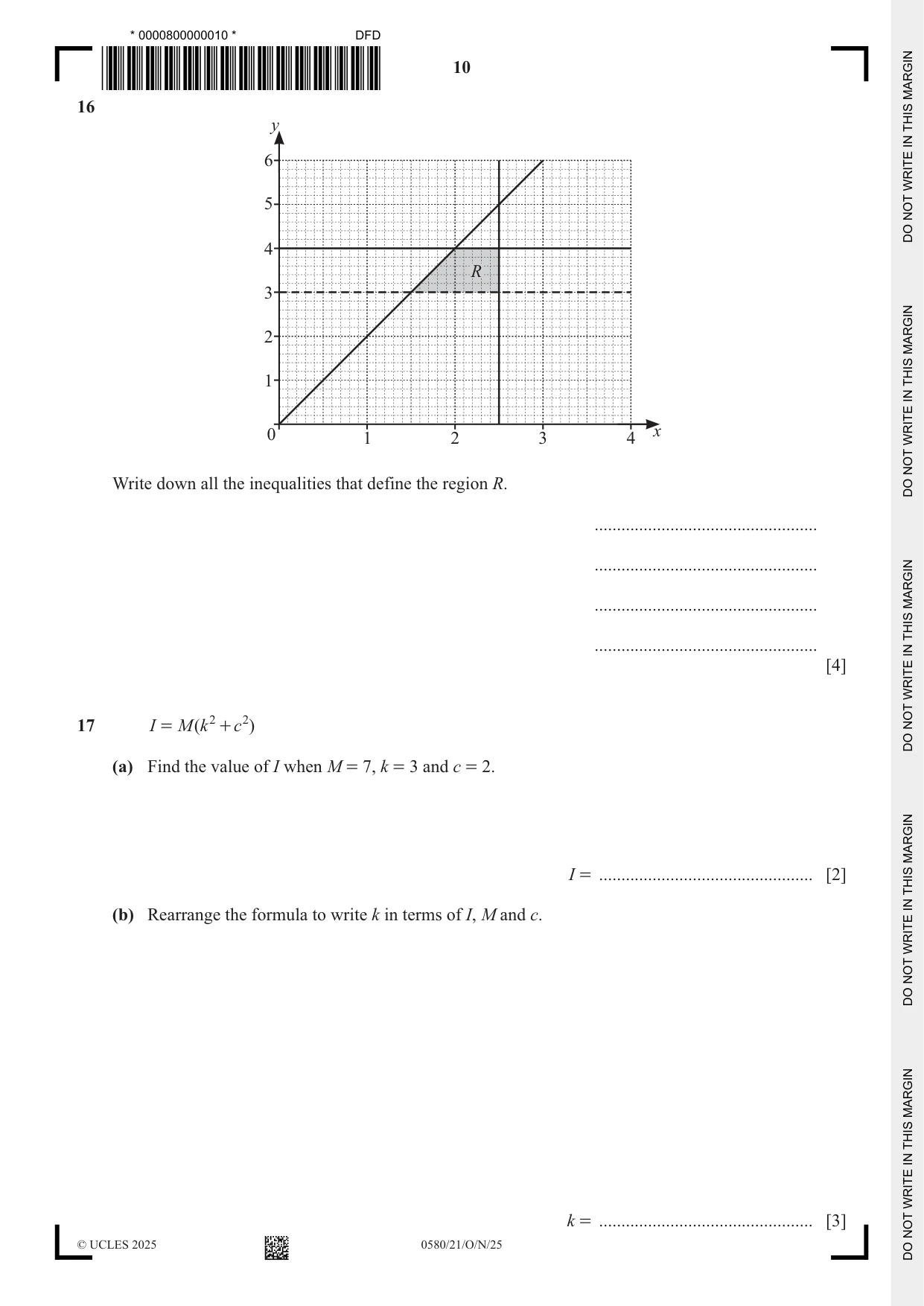
16 y 6 5 4 R 3 2 1 0 1 2 3 4 x Write down all the inequalities that define the region R. .................................................. .................................................. .................................................. .................................................. [4]
Mark scheme: 16 x ⩽ 2.5 4 B3 for answer y > 3 x < 2.5 y ⩾ 3 y < 4 y < 2x y ⩽ 4 y ⩽ 2x OR B1 for each If 0 or 1 scored, instead award SC2 for recognition of x = 2.5, y = 3, y = 4, y = 2x If 0 scored, SC1 for recognition of y = 2x
Q17 · I = M ( k2 + c 2 ) (a) Find the value of I when M = 7, k = 3 and c = 2
17 I = M ( k2 + c 2 ) (a) Find the value of I when M = 7, k = 3 and c = 2. I = ................................................ [2] (b) Rearrange the formula to write k in terms of I, M and c. k = ................................................ [3]
Mark scheme: 17(a) 91 2 M1 for 7(32 + 22) oe 17(b) 2 3 M1 for correctly dividing by M I 2 I − Mc − c or M1 for correctly isolating term in k2 M M M1 for correctly taking square root final answer Maximum M2 if answer is incorrect
Q18 · F ( )x = 2x + 5 f ( x) f ( x) - ff ( x) = ax 2 + bc + c Find the value of a, the value of…
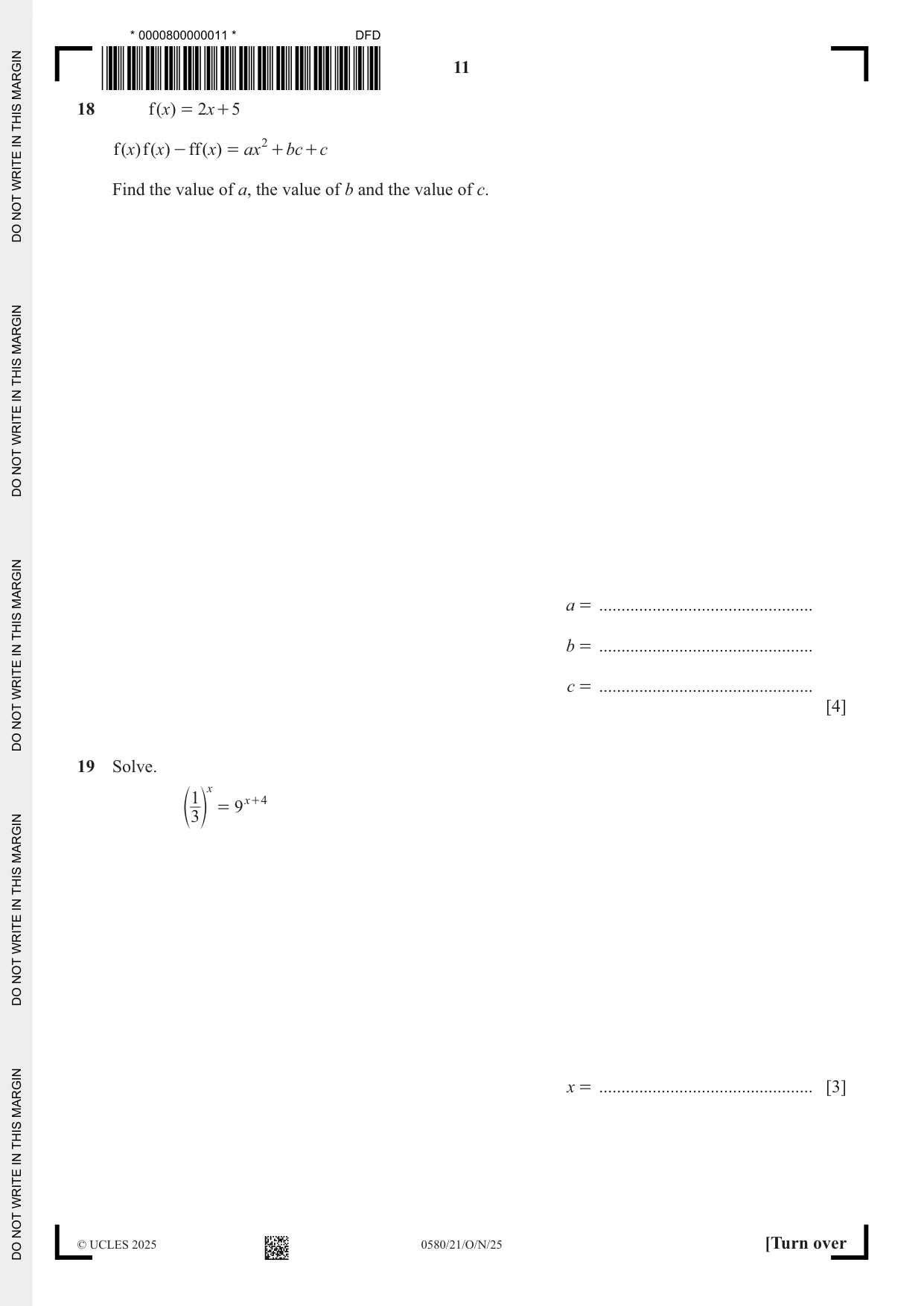
18 f ( )x = 2x + 5 f ( x) f ( x) - ff ( x) = ax 2 + bc + c Find the value of a, the value of b and the value of c. a = ................................................ b = ................................................ c = ................................................ [4]
Mark scheme: 18 [a =] 4 4 B3 for two correct nfww [b =] 16 [c =] 10 OR B2 for 4 x 2 + 20 x + 25 or B1 for three terms correct from 4 x 2 + 10 x + 10 x + 25 M1 for 2(2x + 5) + 5 soi
Question 19
19 Solve. x 1 x + 4 e o = 9 3 x = ................................................ [3]
Mark scheme: 19 8 2 3 M2 for –x = 2(x + 4) oe − or −2 oe 2 ( x + 4 ) 3 3 or M1 for (3–1)x, 3−x , (32)x+4 , 3 or −2( x + 4 ) 1 oe 3
Q20 · Bag A Bag B Bag A contains 5 white balls and 3 black balls
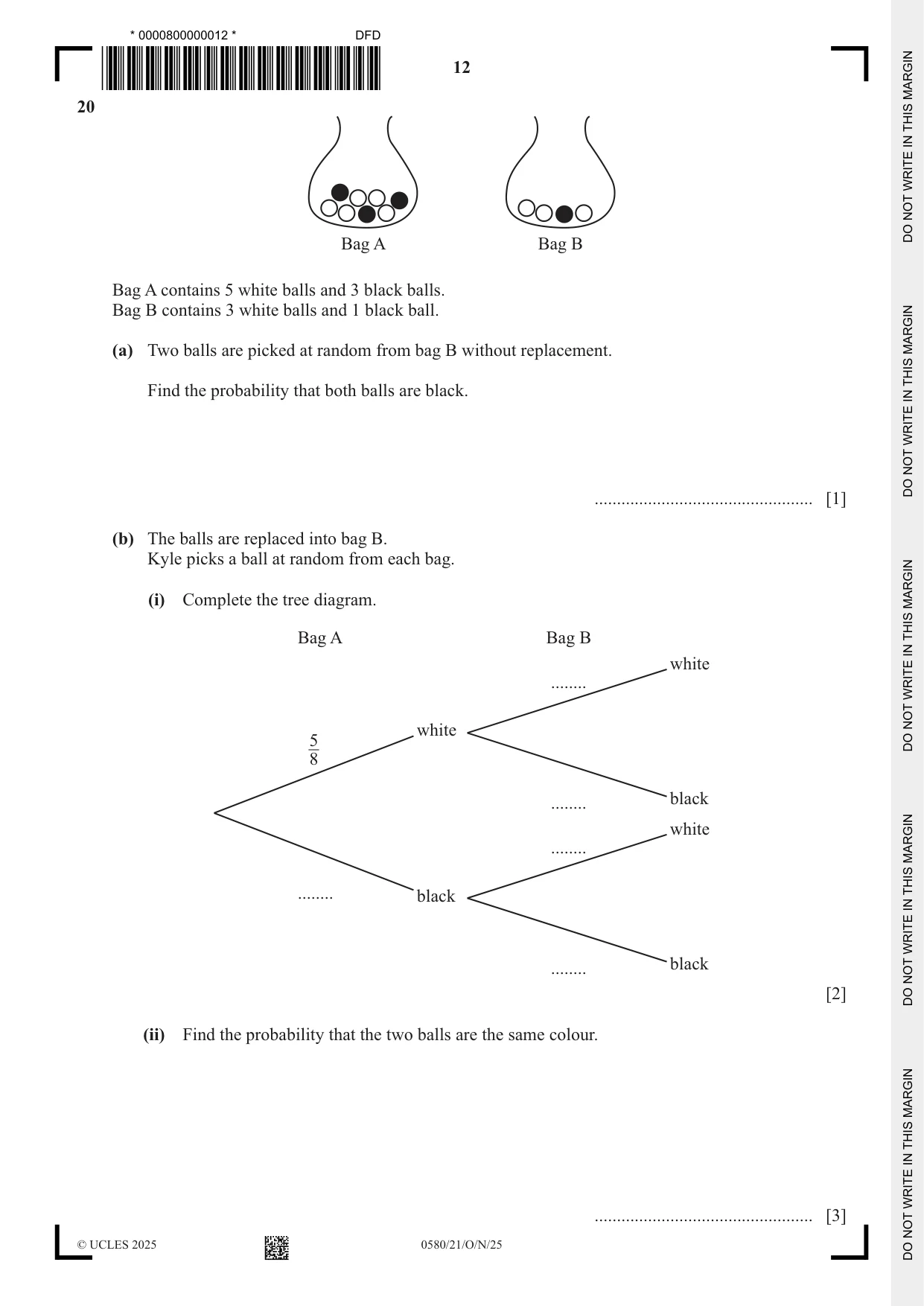
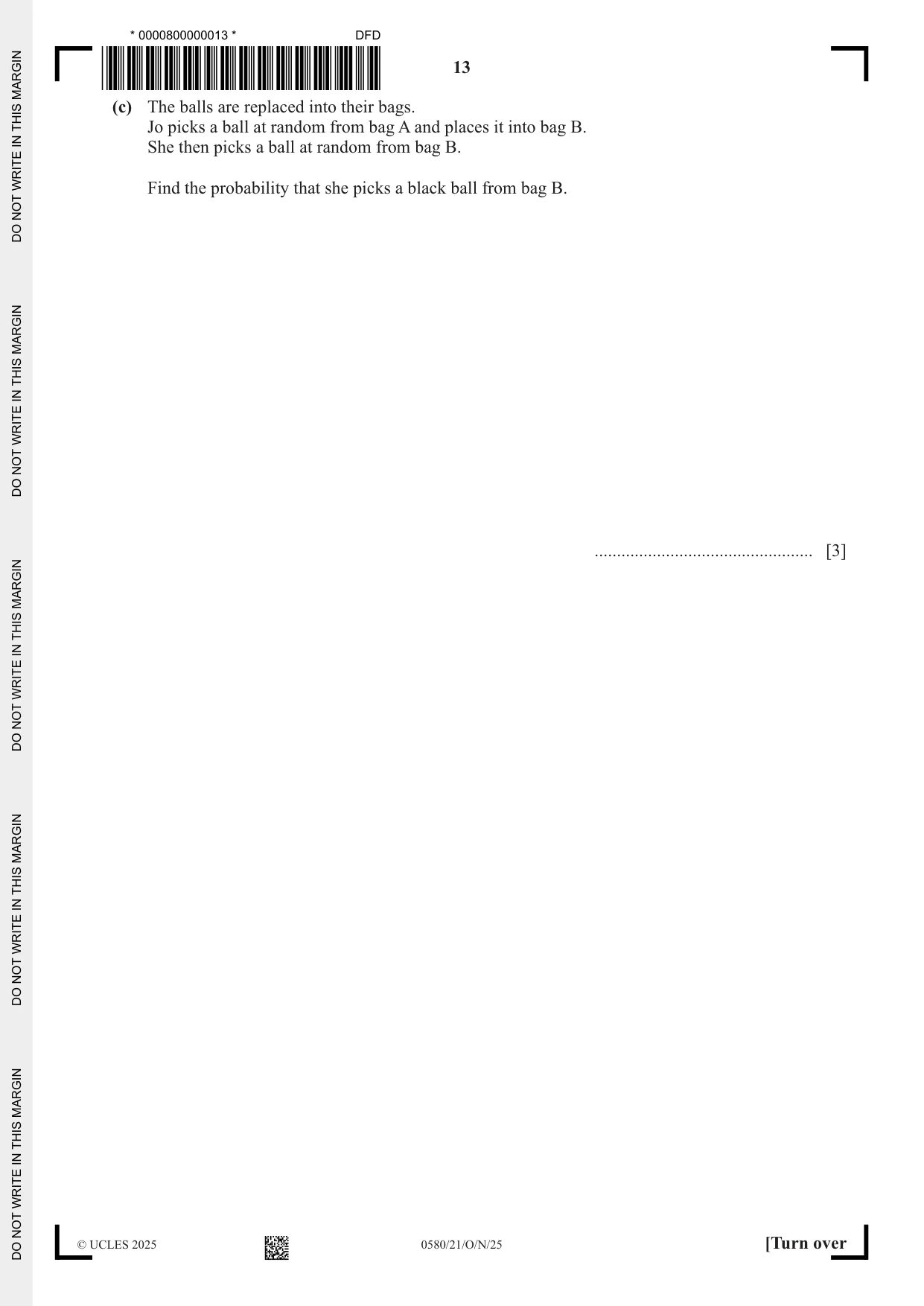
20 Bag A Bag B Bag A contains 5 white balls and 3 black balls. Bag B contains 3 white balls and 1 black ball. (a) Two balls are picked at random from bag B without replacement. Find the probability that both balls are black. ................................................. [1] (b) The balls are replaced into bag B. Kyle picks a ball at random from each bag. (i) Complete the tree diagram. Bag A Bag B white ........ white 5 8 black ........ white ........ ........ black black ........ [2] (ii) Find the probability that the two balls are the same colour. ................................................. [3] (c) The balls are replaced into their bags. Jo picks a ball at random from bag A and places it into bag B. She then picks a ball at random from bag B. Find the probability that she picks a black ball from bag B. ................................................. [3]
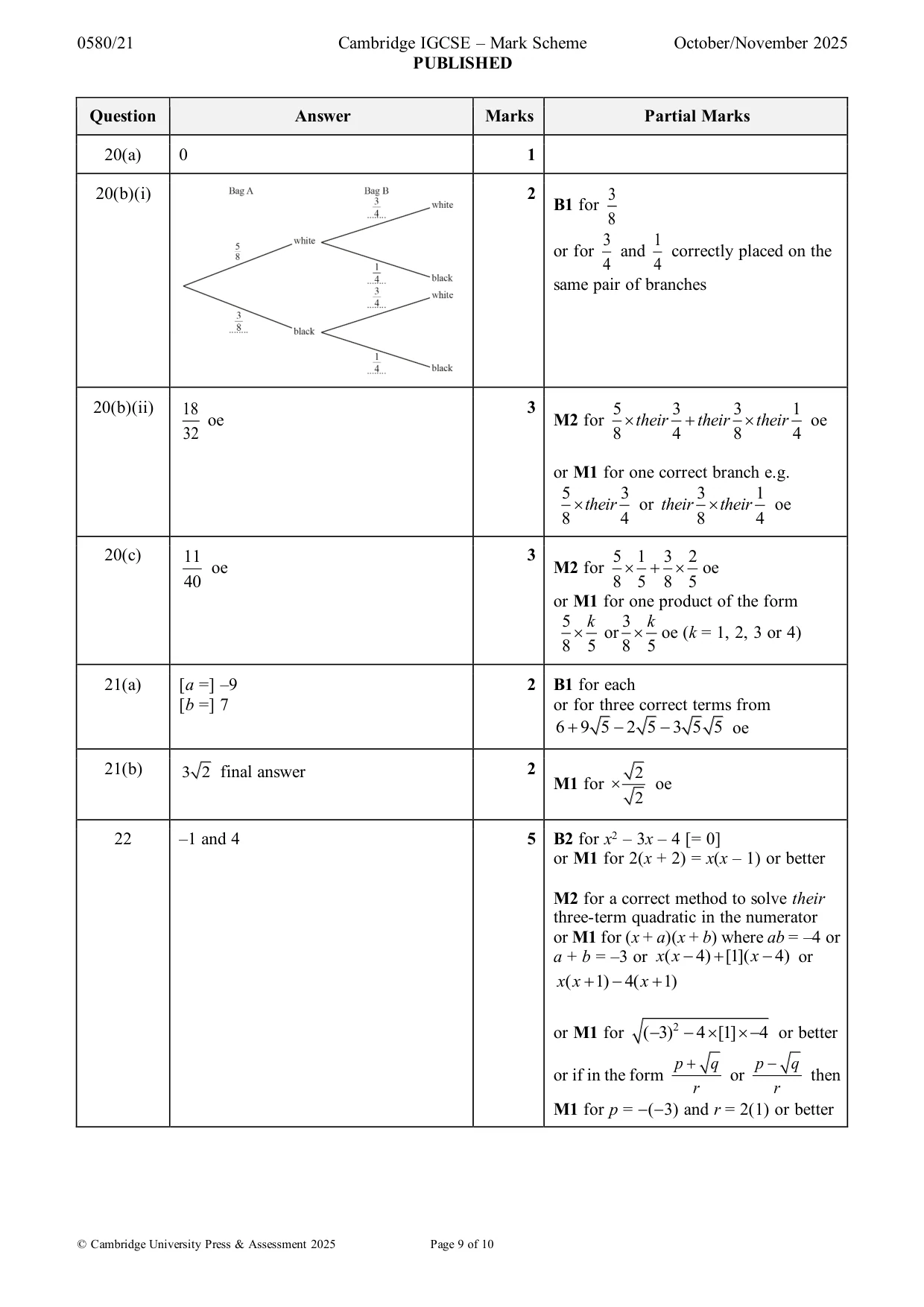
Mark scheme: 20(a) 0 1 20(b)(i) 2 3 B1 for 8 3 1 or for and correctly placed on the 4 4 same pair of branches 20(b)(ii) 18 3 5 3 3 1 oe M2 for their + their their oe 32 8 4 8 4 or M1 for one correct branch e.g. 5 3 3 1 their or their their oe 8 4 8 4 20(c) 11 3 5 1 3 2 oe M2 for + oe 40 8 5 8 5 or M1 for one product of the form 5 k 3 k or oe (k = 1, 2, 3 or 4) 8 5 8 5
Q21 · `3 - 5`j2 + 3 5j = a + b 5 Find the value of a and the value of b
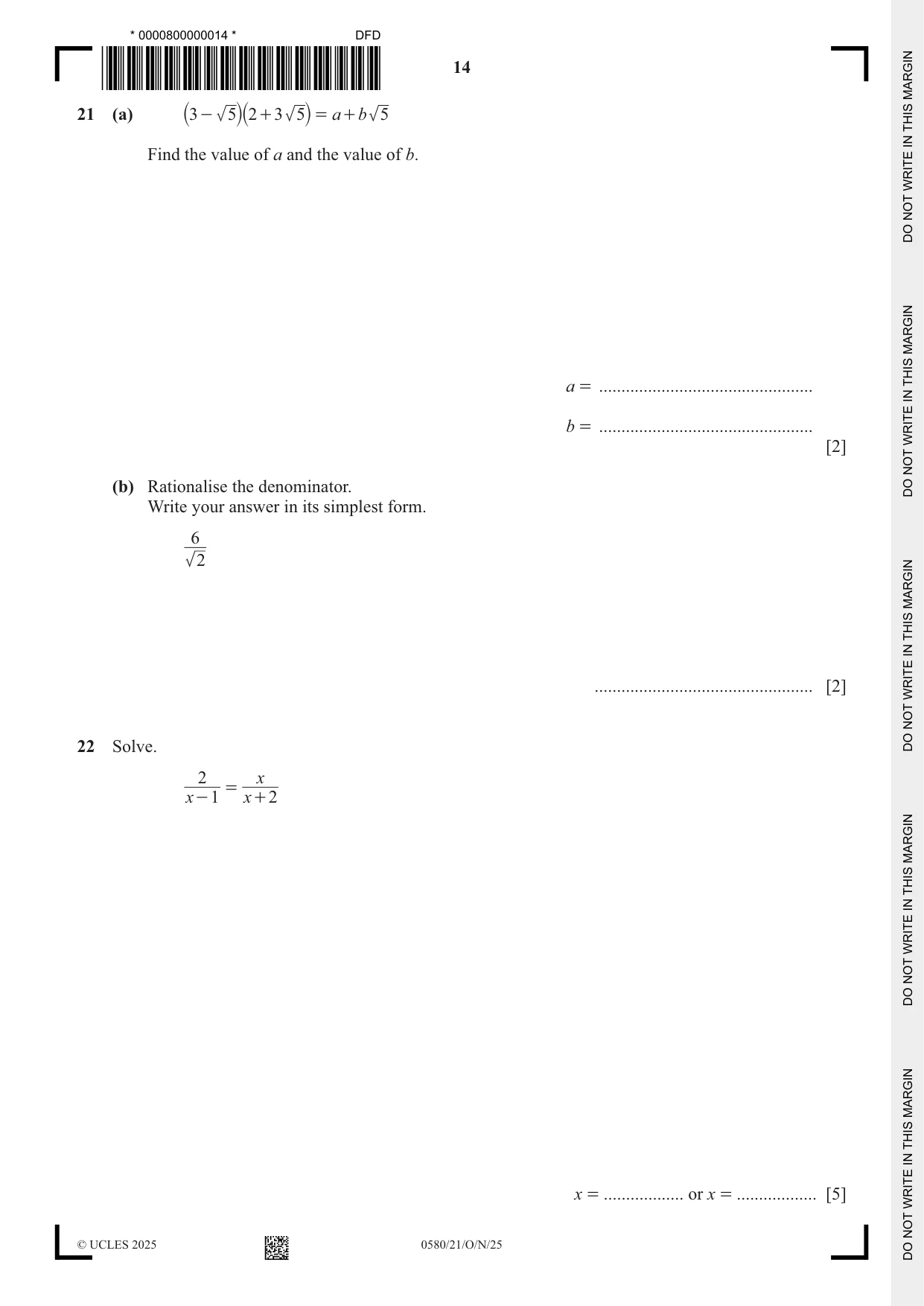
21 (a) `3 - 5`j2 + 3 5j = a + b 5 Find the value of a and the value of b. a = ................................................ b = ................................................ [2] (b) Rationalise the denominator. Write your answer in its simplest form. 6 2 ................................................. [2]
Mark scheme: 21(a) [a =] –9 2 B1 for each [b =] 7 or for three correct terms from 6 + 9 5 − 2 5 − 3 5 5 oe 21(b) 3 2 final answer 2 2 M1 for oe 2
Question 22
22 Solve. 2 x = x - 1 x + 2 x = .................. or x = .................. [5]
Mark scheme: 22 –1 and 4 5 B2 for x2 – 3x – 4 [= 0] or M1 for 2(x + 2) = x(x – 1) or better M2 for a correct method to solve their three-term quadratic in the numerator or M1 for (x + a)(x + b) where ab = –4 or a + b = –3 or x ( x − 4) + [1]( x − 4) or x ( x + 1) − 4( x + 1) or M1 for ( −3)2 −4 [1] −4 or better p + q p − q or if in the form or then r r M1 for p = −(−3) and r = 2(1) or better
Q23 · Find the coordinates of the turning point on the graph of y = 7 - 2x - x 2
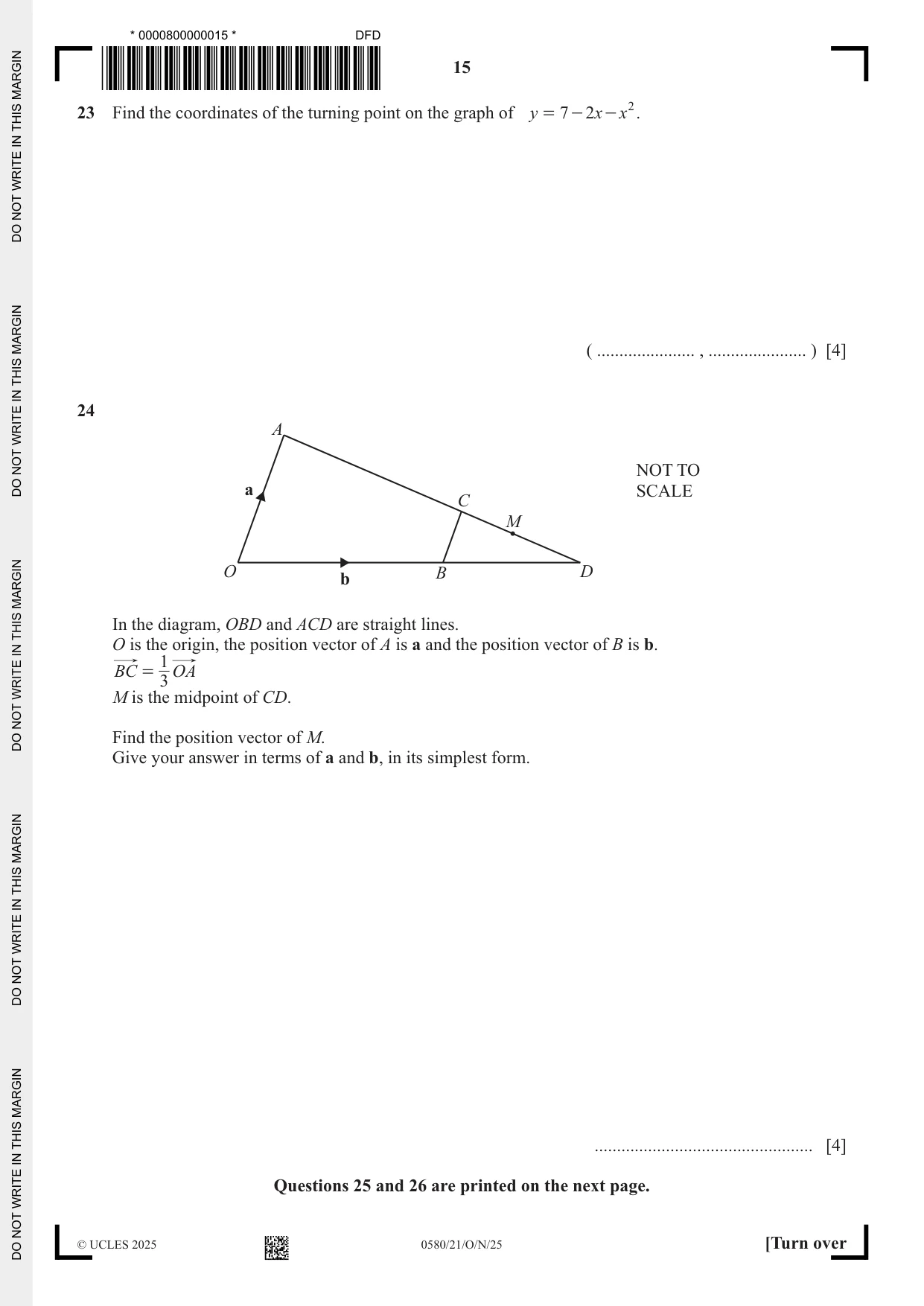
23 Find the coordinates of the turning point on the graph of y = 7 - 2x - x 2 . ( ...................... , ...................... ) [4]
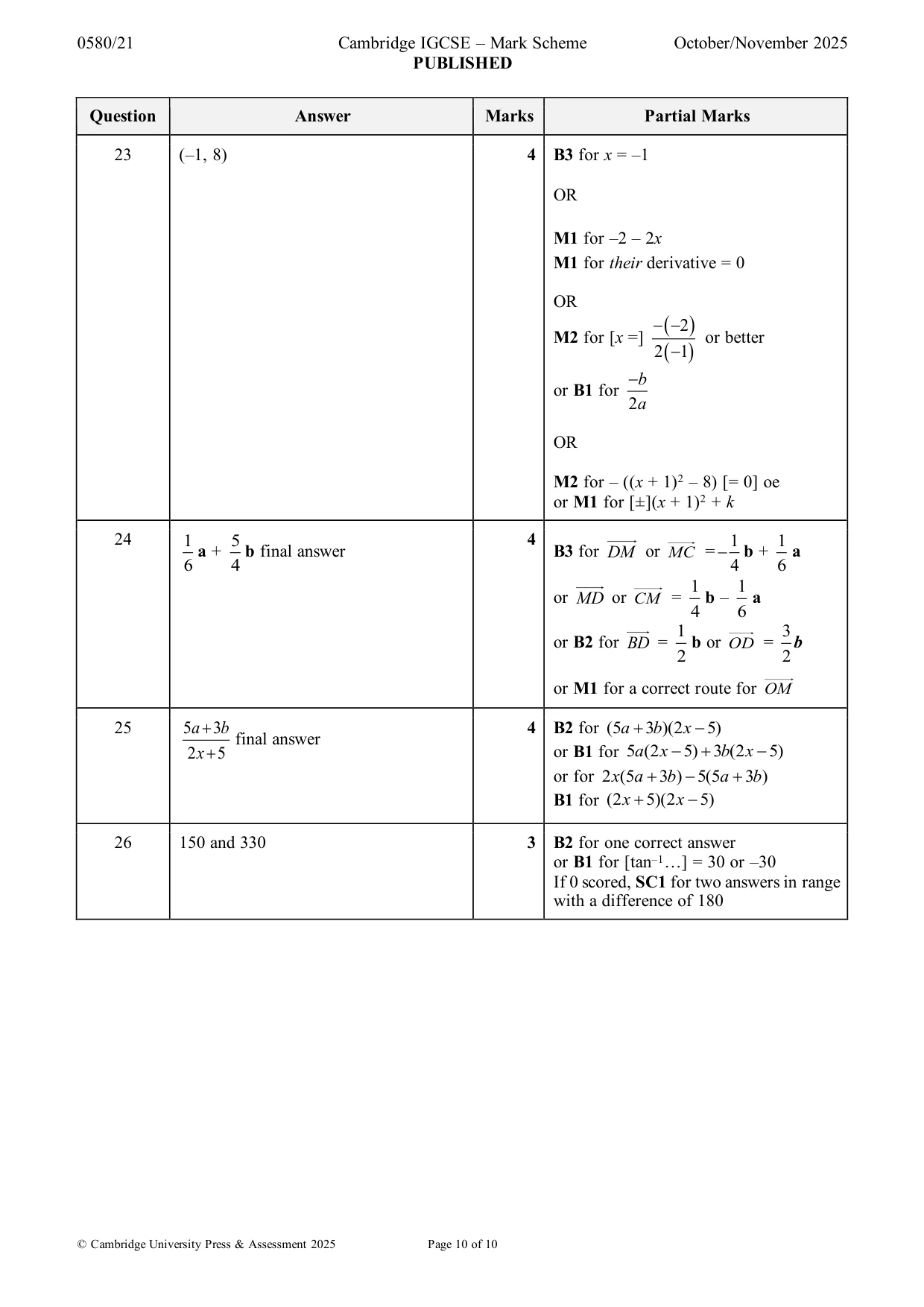
Mark scheme: 23 (–1, 8) 4 B3 for x = –1 OR M1 for –2 – 2x M1 for their derivative = 0 OR −−( 2 ) M2 for [x =] or better 2 ( −1) −b or B1 for 2 a OR M2 for – ((x + 1)2 – 8) [= 0] oe or M1 for [±](x + 1)2 + k
Q24 · A NOT TO a SCALE C M O B D b In the diagram, OBD and ACD are straight lines
24 A NOT TO a SCALE C M O B D b In the diagram, OBD and ACD are straight lines. O is the origin, the position vector of A is a and the position vector of B is b. 1 BC = OA 3 M is the midpoint of CD. Find the position vector of M. Give your answer in terms of a and b, in its simplest form. ................................................. [4] Questions 25 and 26 are printed on the next page.
Mark scheme: 24 1 5 4 1 1 a + b final answer B3 for DM or MC = − b + a 6 4 4 6 1 1 or MD or CM = b – a 4 6 1 3 or B2 for BD = b or OD = b 2 2 or M1 for a correct route for OM
Question 25
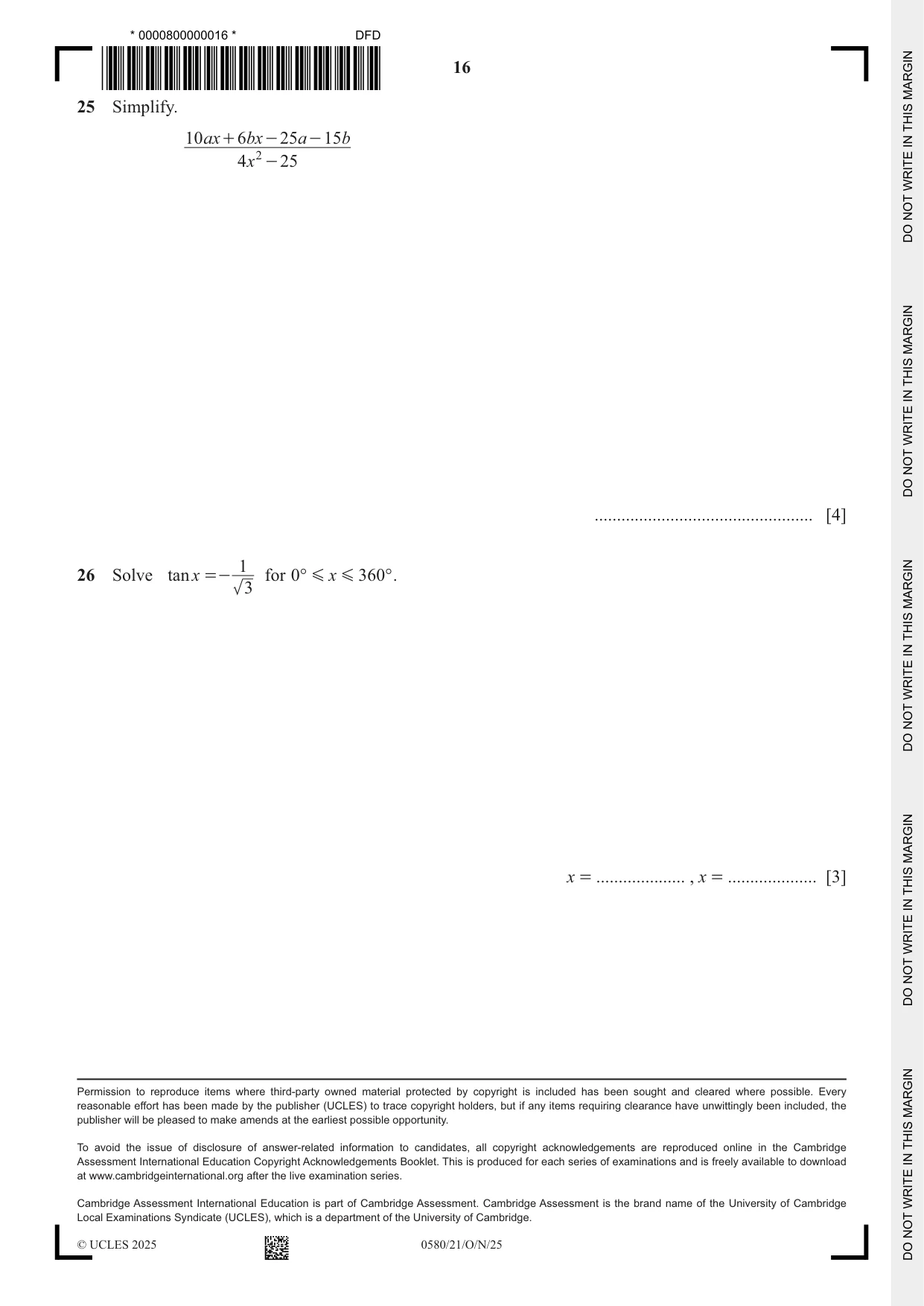
25 Simplify. 10 ax + 6bx - 25a - 15 b 4 x 2 - 25 ................................................. [4]
Mark scheme: 25 5a + 3b 4 B2 for (5a + 3b )(2 x − 5) final answer 2 x + 5 or B1 for 5a (2 x − 5) + 3b(2 x − 5) or for 2 x (5a + 3b ) − 5(5a + 3b ) B1 for (2 x + 5)(2 x − 5)
Q26 · 26 Solve tanx =- for 0° G x G 360°
1 26 Solve tanx =- for 0° G x G 360° . 3 x = .................... , x = .................... [3]
Mark scheme: 26 150 and 330 3 B2 for one correct answer or B1 for [tan–1…] = 30 or –30 If 0 scored, SC1 for two answers in range with a difference of 180
What was in this paper
The subtopics covered by these 26 questions, and how many questions each got. Open one in a new tab to see every Cambridge question on it.
3Angles3Equations3Area and perimeter1Averages and measures of spread1Circles, arcs and sectors1Fractions, decimals and percentages1Graphs of functions1Inequalities1Limits of accuracy1Powers and roots1Probability of combined events1Ratio and proportion1Sets1Standard form1Surds1The four operations1Transformations1Trigonometric functions1Vectors in two dimensions1What you needed in this session
Cambridge’s own grade thresholds for 2025 Oct/Nov, Paper 2 · Variant 1. A higher threshold means an easier paper — the bar moves with how the cohort did.