Cambridge IGCSE Mathematics 0580 — 2023 May/June Paper 3 · Variant 1
0580/31/M/J/23 · 9 questions · 104 marks · ≈117 min
The question paper and its mark scheme, free to read here and free to download. This is Cambridge’s own paper, exactly as it was sat.
Question paper20 pages
Mark scheme8 pages
Answers below. Sit the paper first if you are practising.
Questions as text
Q1 · Write the number forty thousand and thirty-three in figures
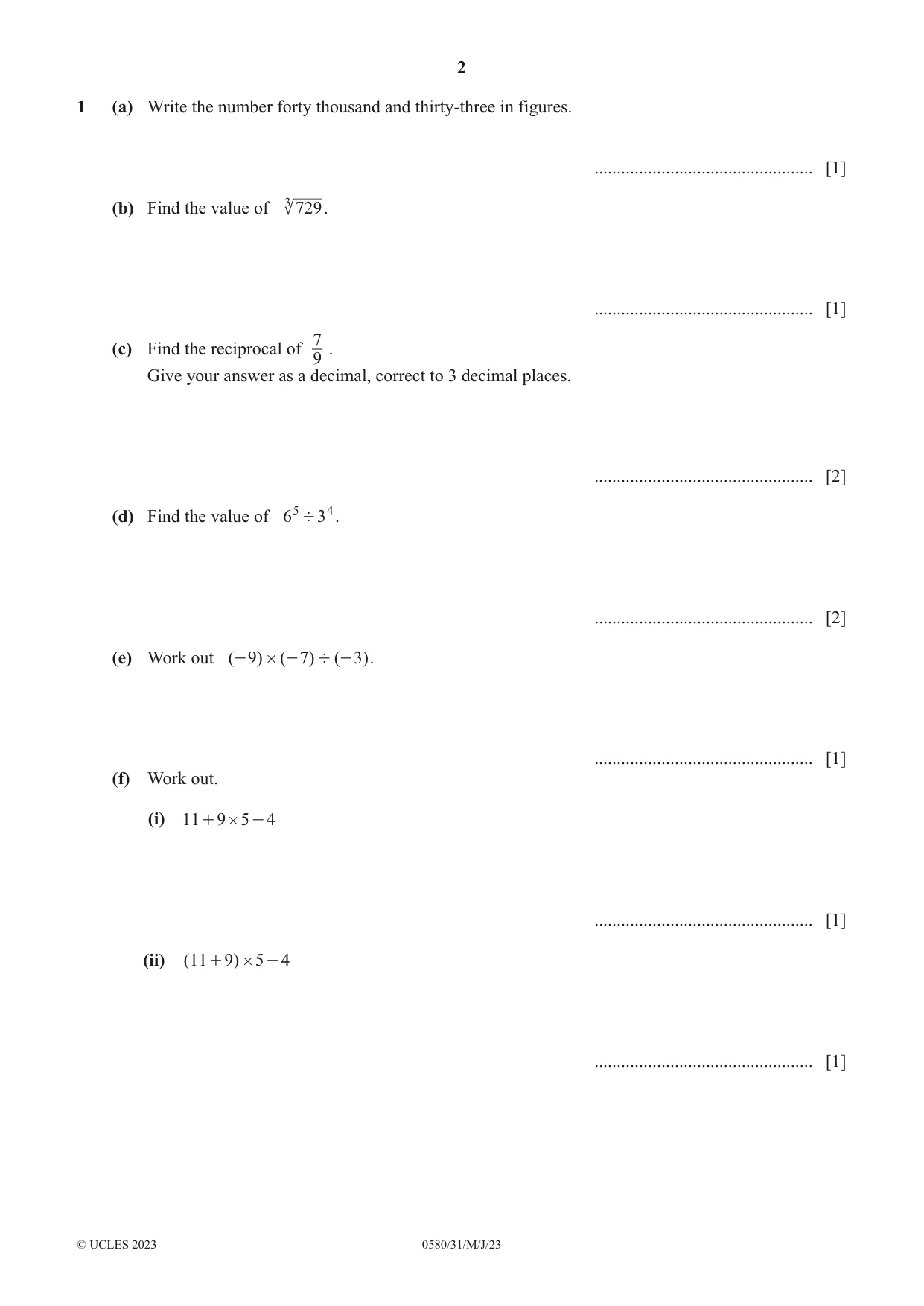
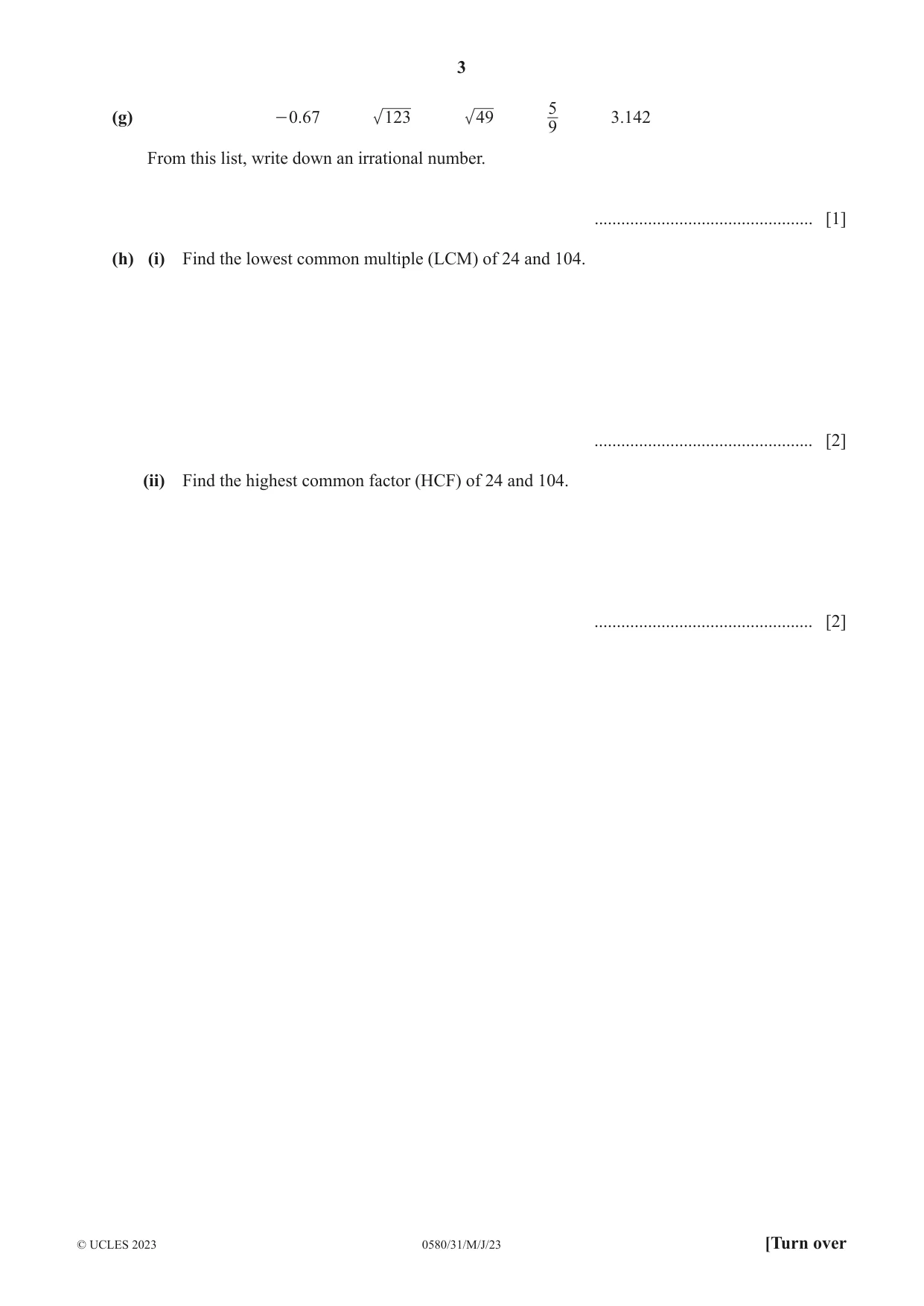
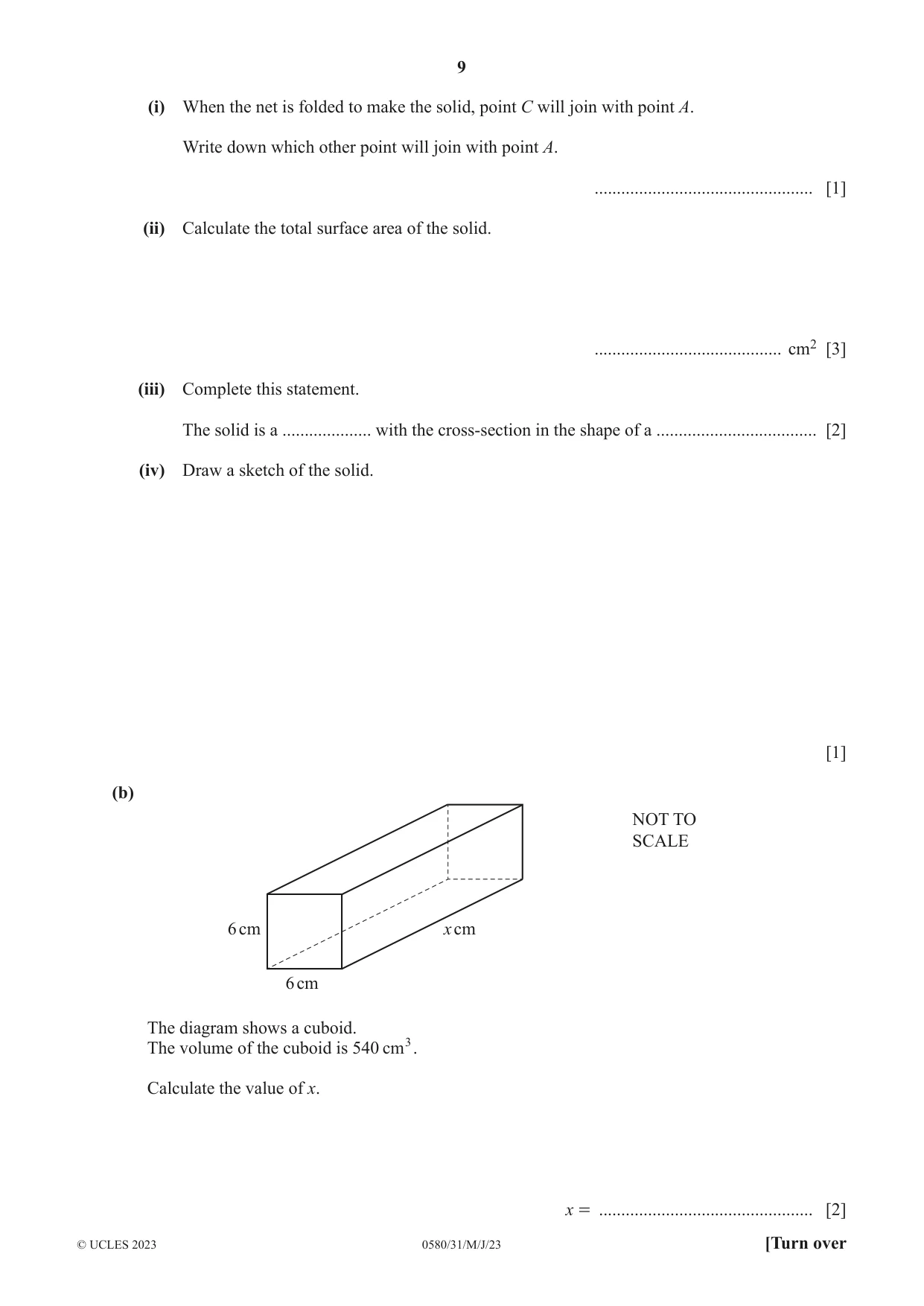
1 (a) Write the number forty thousand and thirty-three in figures. ................................................. [1] (b) Find the value of 3 729 . ................................................. [1] 7 (c) Find the reciprocal of . 9 Give your answer as a decimal, correct to 3 decimal places. ................................................. [2] (d) Find the value of 6 5 ' 3 4 . ................................................. [2] (e) Work out ( - 9 ) # ( - 7 ) ' ( - 3) . ................................................. [1] (f) Work out. (i) 11 + 9 # 5 - 4 ................................................. [1] (ii) ( 11 + 9) # 5 - 4 ................................................. [1] 5(g) - 0 .67 123 49 3 .142 9 From this list, write down an irrational number. ................................................. [1] (h) (i) Find the lowest common multiple (LCM) of 24 and 104. ................................................. [2] (ii) Find the highest common factor (HCF) of 24 and 104. ................................................. [2]
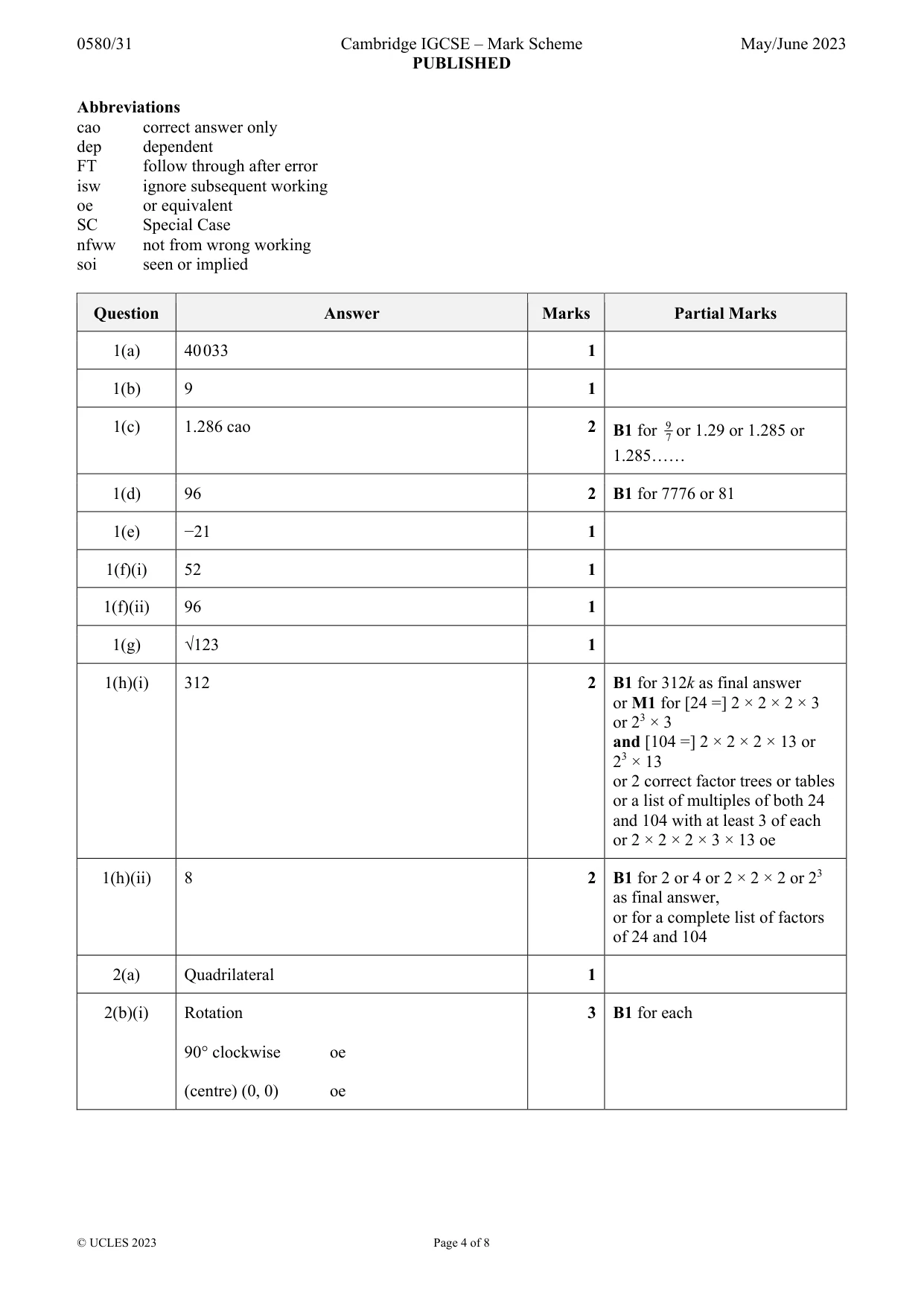
Mark scheme: Question Answer Marks Partial Marks 1(a) 40 033 1 1(b) 9 1 1(c) 1.286 cao 2 B1 for 97 or 1.29 or 1.285 or 1.285…… 1(d) 96 2 B1 for 7776 or 81 1(e) −21 1 1(f)(i) 52 1 1(f)(ii) 96 1 1(g) √123 1 1(h)(i) 312 2 B1 for 312k as final answer or M1 for [24 =] 2 × 2 × 2 × 3 or 23 × 3 and [104 =] 2 × 2 × 2 × 13 or 23 × 13 or 2 correct factor trees or tables or a list of multiples of both 24 and 104 with at least 3 of each or 2 × 2 × 2 × 3 × 13 oe 1(h)(ii) 8 2 B1 for 2 or 4 or 2 × 2 × 2 or 23 as final answer, or for a complete list of factors of 24 and 104
Question 2
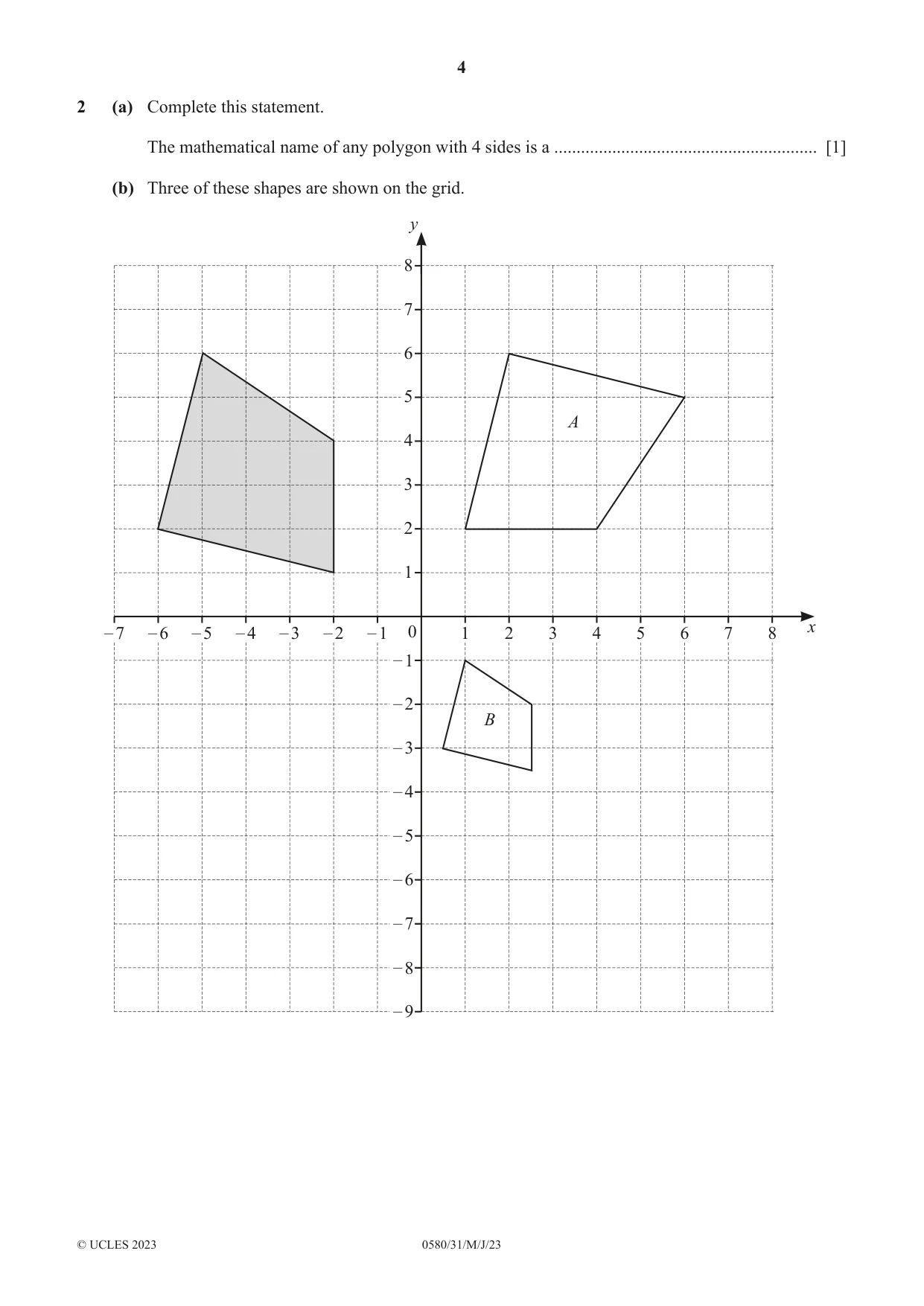
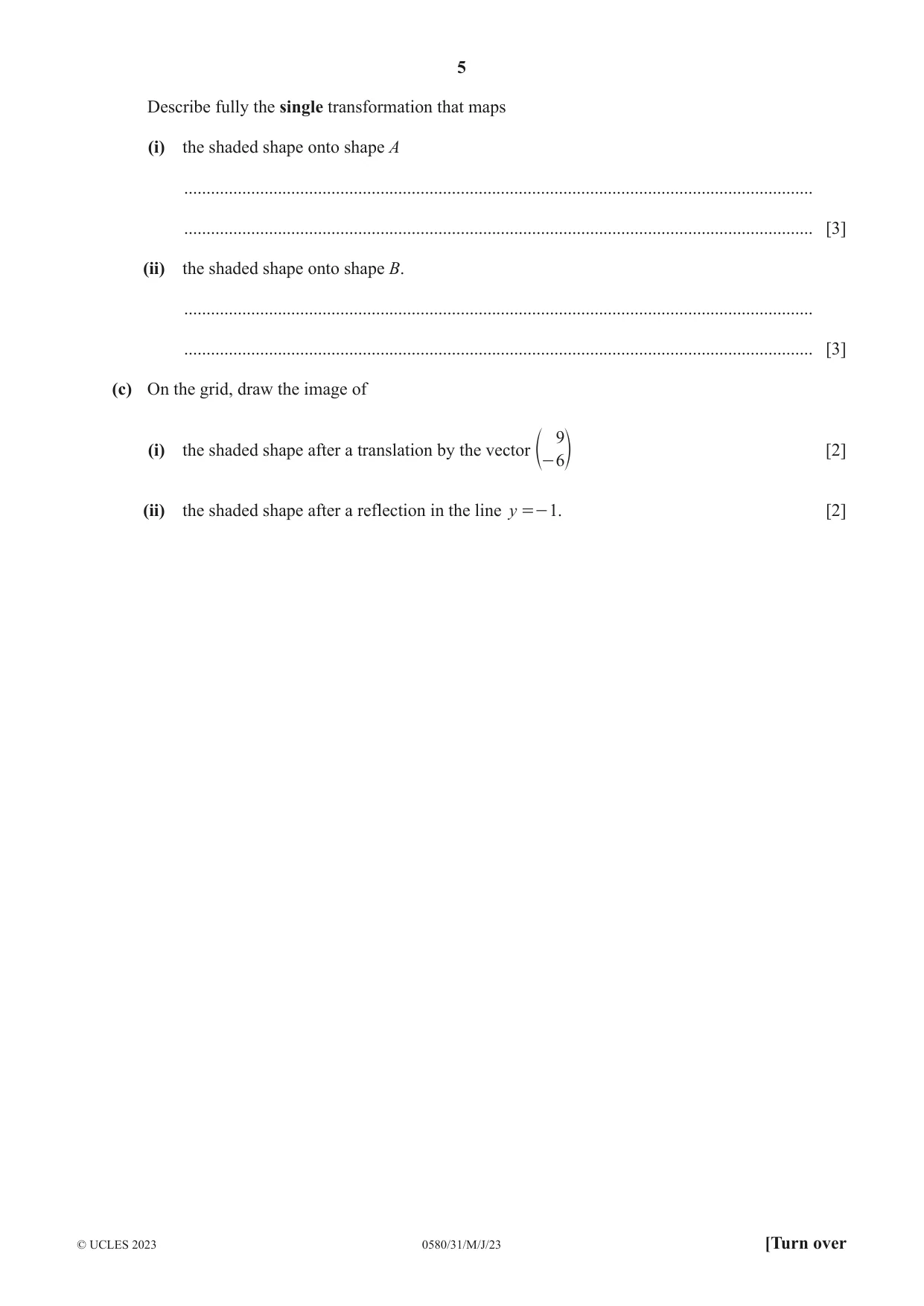
2 (a) Complete this statement. The mathematical name of any polygon with 4 sides is a ........................................................... [1] (b) Three of these shapes are shown on the grid. y 8 7 6 5 A 4 3 2 1 x – 7 – 6 – 5 – 4 – 3 – 2 – 1 0 1 2 3 4 5 6 7 8 – 1 – 2 B – 3 – 4 – 5 – 6 – 7 – 8 – 9 Describe fully the single transformation that maps (i) the shaded shape onto shape A ............................................................................................................................................. ............................................................................................................................................. [3] (ii) the shaded shape onto shape B. ............................................................................................................................................. ............................................................................................................................................. [3] (c) On the grid, draw the image of 9 (i) the shaded shape after a translation by the vector [2] e- 6o (ii) the shaded shape after a reflection in the line y =- 1. [2]
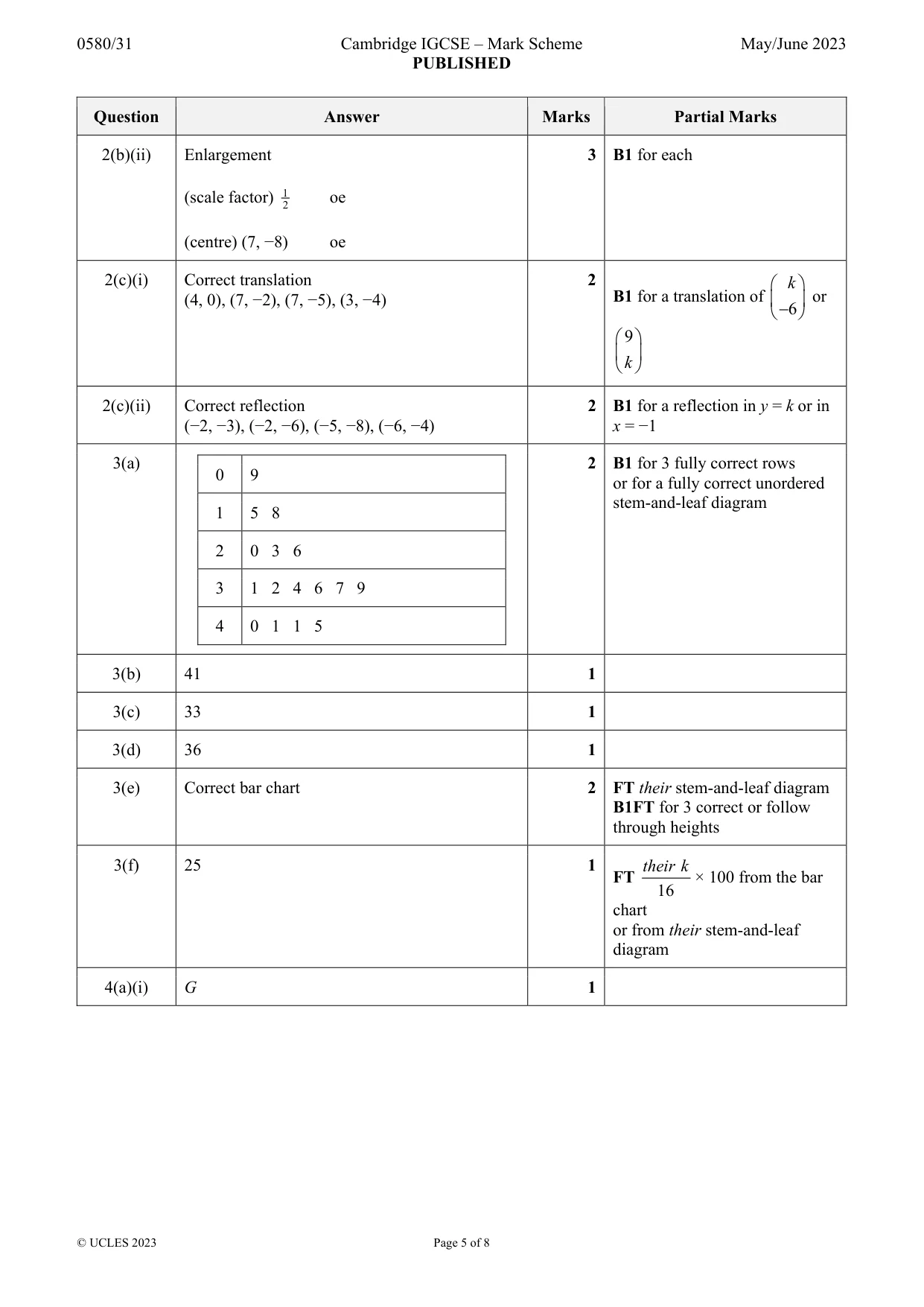
Mark scheme: 2(a) Quadrilateral 1 2(b)(i) Rotation 3 B1 for each 90° clockwise oe (centre) (0, 0) oe 2(b)(ii) Enlargement 3 B1 for each (scale factor) 12 oe (centre) (7, −8) oe 2(c)(i) Correct translation 2 k (4, 0), (7, −2), (7, −5), (3, −4) B1 for a translation of or 6 9 k 2(c)(ii) Correct reflection 2 B1 for a reflection in y = k or in (−2, −3), (−2, −6), (−5, −8), (−6, −4) x = −1
Q3 · These are the test scores of 16 students
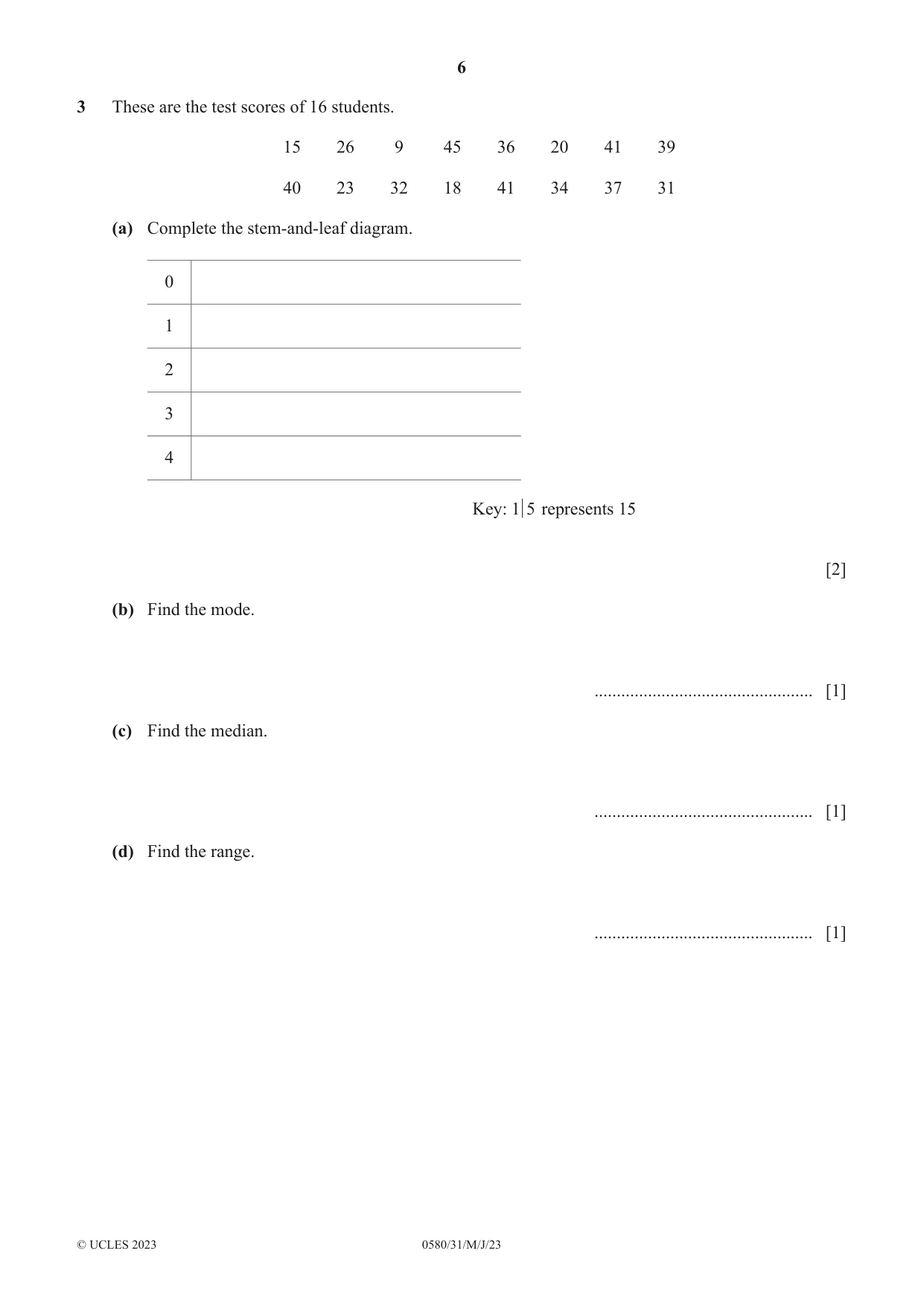
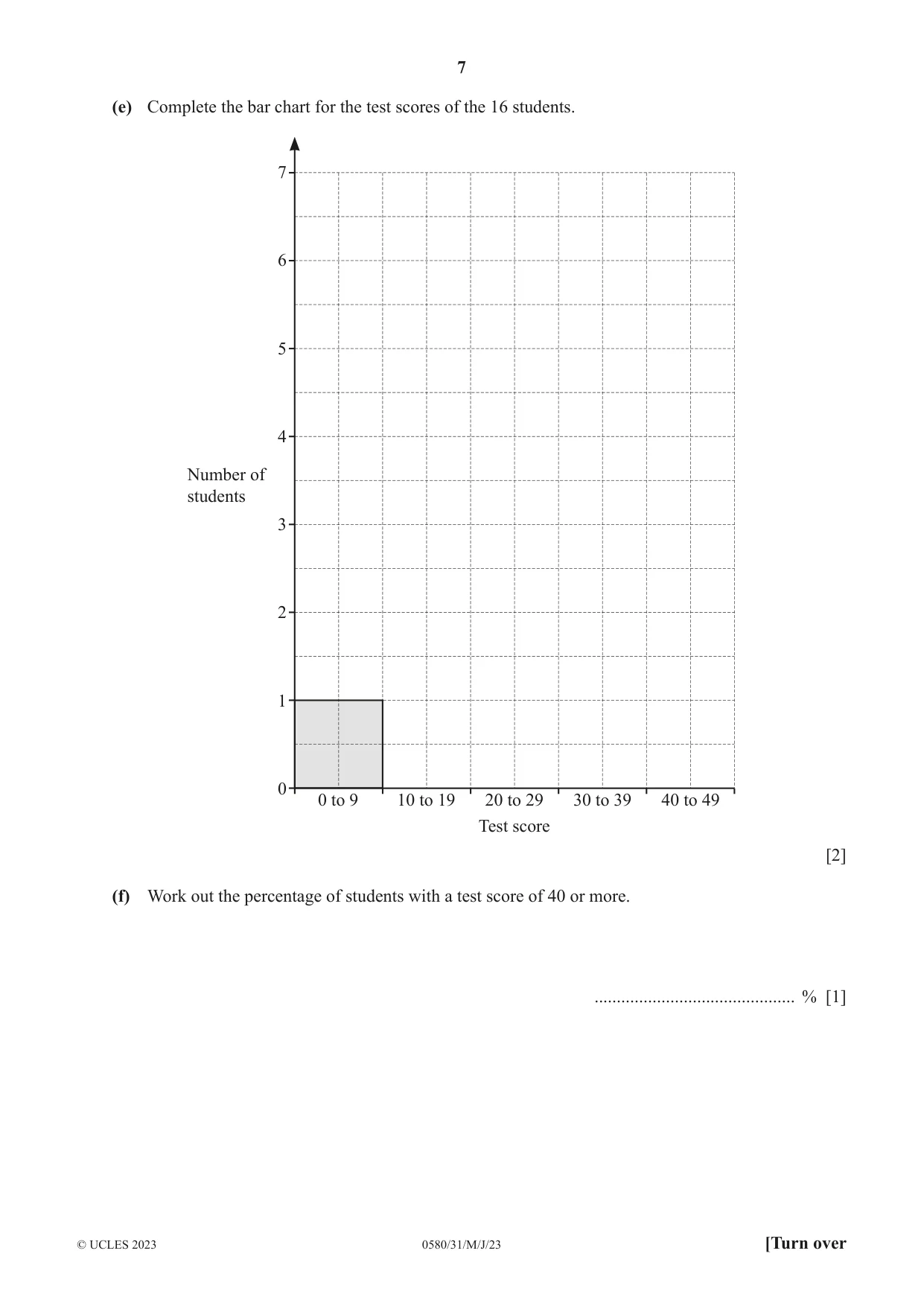
3 These are the test scores of 16 students. 15 26 9 45 36 20 41 39 40 23 32 18 41 34 37 31 (a) Complete the stem-and-leaf diagram. 0 1 2 3 4 Key: 1 5 represents 15 [2] (b) Find the mode. ................................................. [1] (c) Find the median. ................................................. [1] (d) Find the range. ................................................. [1] (e) Complete the bar chart for the test scores of the 16 students. 7 6 5 4 Number of students 3 2 1 0 0 to 9 10 to 19 20 to 29 30 to 39 40 to 49 Test score [2] (f) Work out the percentage of students with a test score of 40 or more. ............................................. % [1]
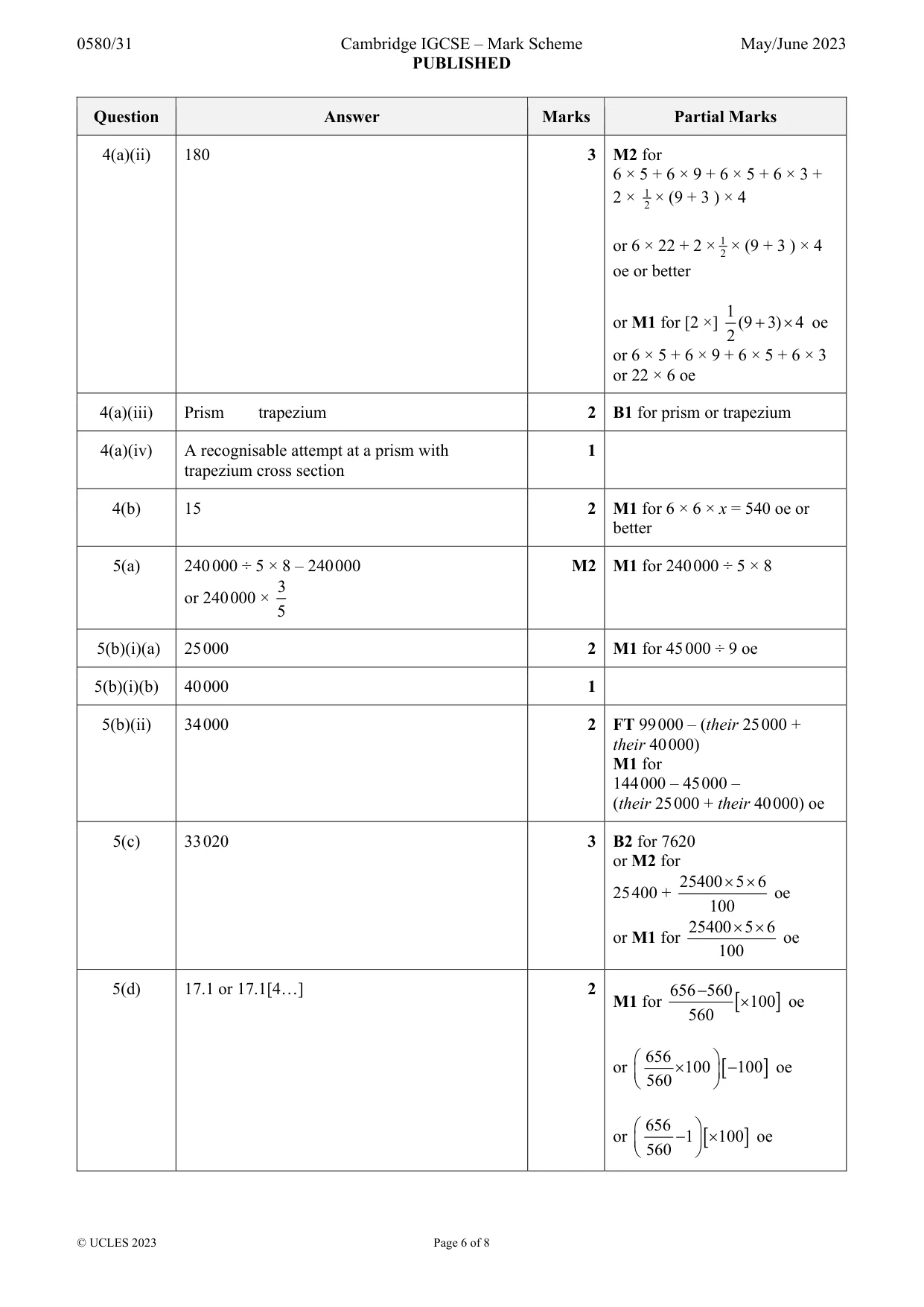
Mark scheme: 3(a) 2 B1 for 3 fully correct rows 0 9 or for a fully correct unordered stem-and-leaf diagram 1 5 8 2 0 3 6 3 1 2 4 6 7 9 4 0 1 1 5 3(b) 41 1 3(c) 33 1 3(d) 36 1 3(e) Correct bar chart 2 FT their stem-and-leaf diagram B1FT for 3 correct or follow through heights 3(f) 25 1 their k FT × 100 from the bar 16 chart or from their stem-and-leaf diagram
Q5 · Antonio buys a restaurant for $240 000
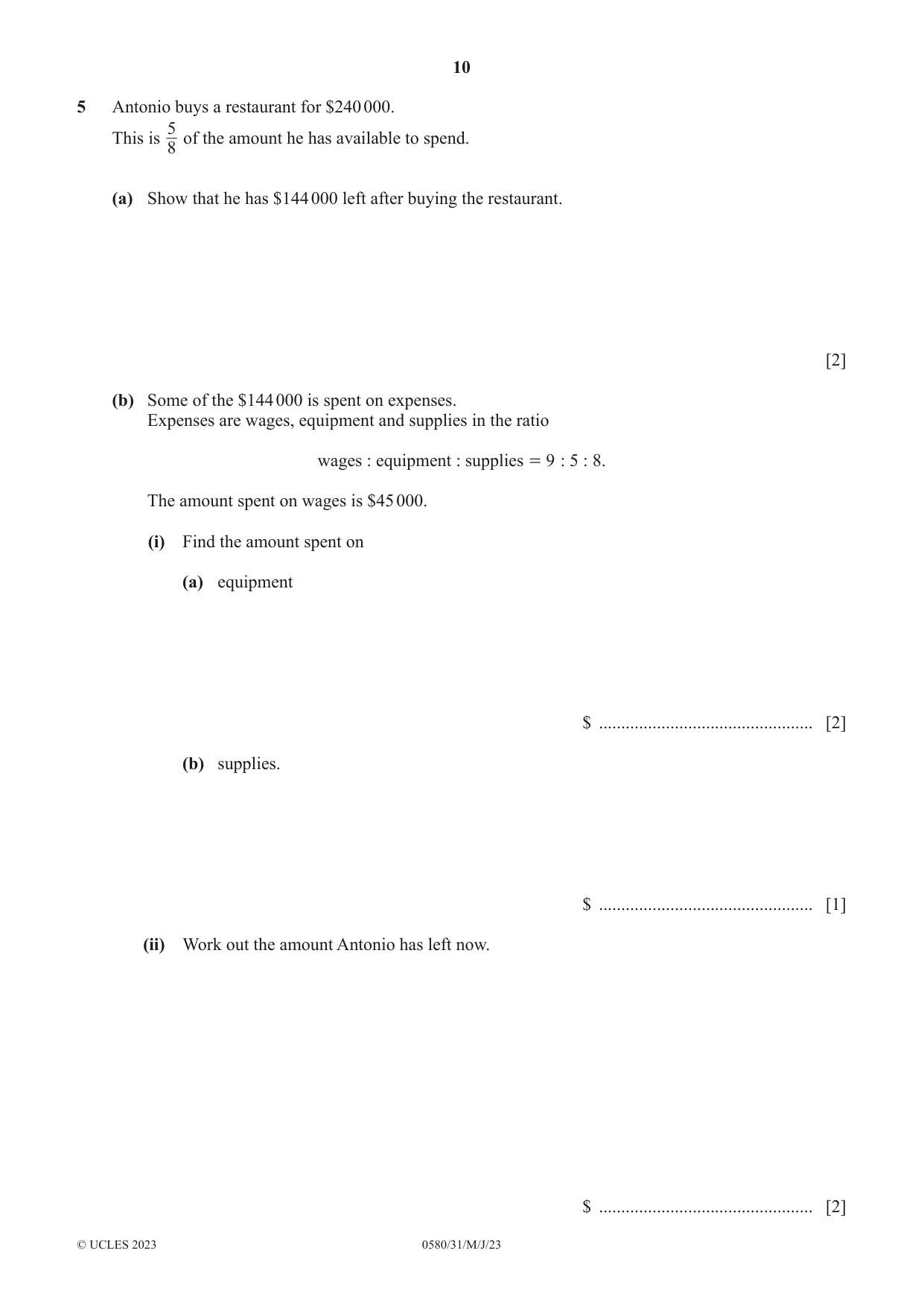
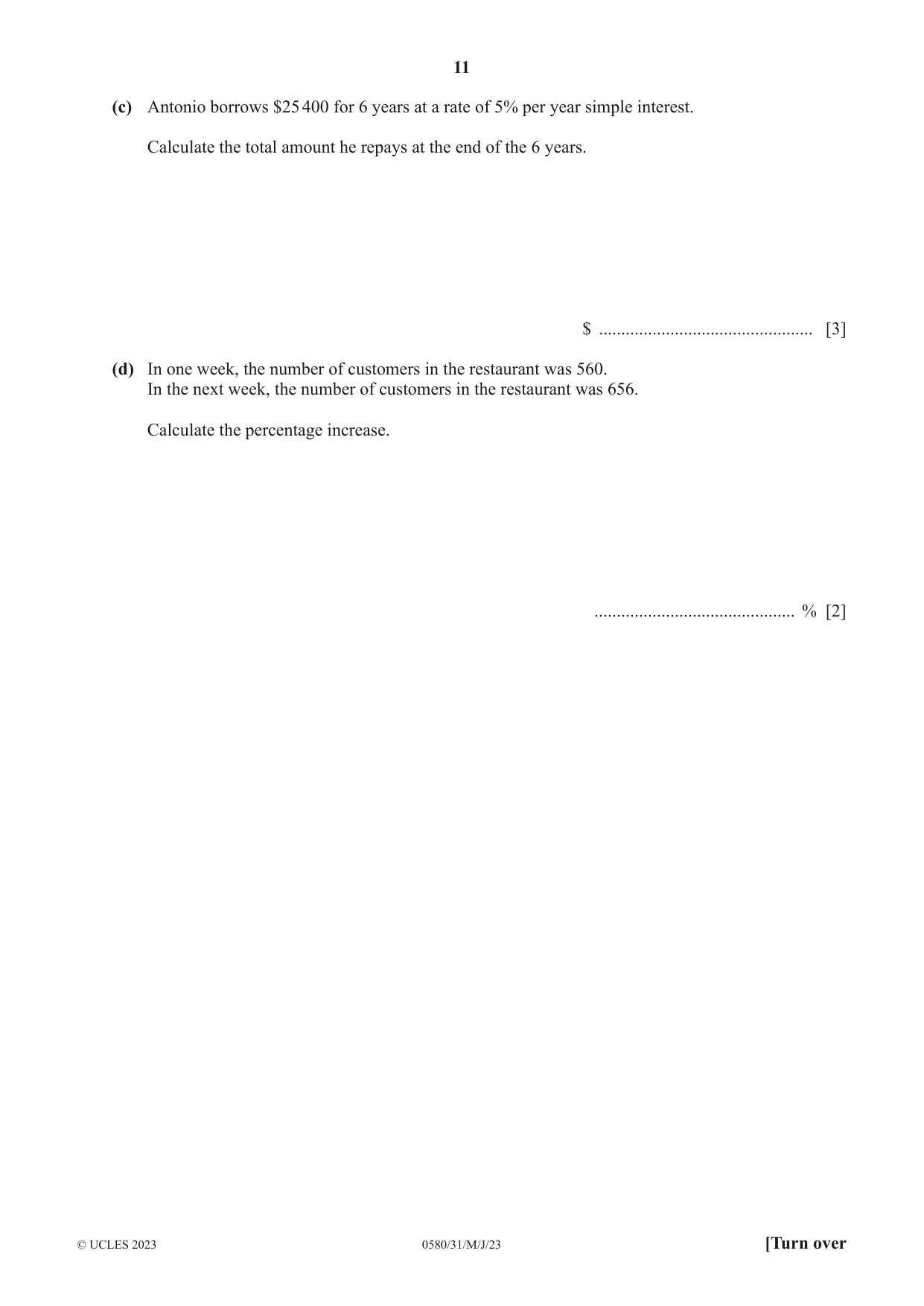
5 Antonio buys a restaurant for $240 000. 5 This is of the amount he has available to spend. 8 (a) Show that he has $144 000 left after buying the restaurant. [2] (b) Some of the $144 000 is spent on expenses. Expenses are wages, equipment and supplies in the ratio wages : equipment : supplies = 9 : 5 : 8. The amount spent on wages is $45 000. (i) Find the amount spent on (a) equipment $ ................................................ [2] (b) supplies. $ ................................................ [1] (ii) Work out the amount Antonio has left now. $ ................................................ [2] (c) Antonio borrows $25 400 for 6 years at a rate of 5% per year simple interest. Calculate the total amount he repays at the end of the 6 years. $ ................................................ [3] (d) In one week, the number of customers in the restaurant was 560. In the next week, the number of customers in the restaurant was 656. Calculate the percentage increase. ............................................. % [2]
Mark scheme: 5(a) 240 000 ÷ 5 × 8 – 240 000 M2 M1 for 240 000 ÷ 5 × 8 3 or 240 000 × 5 5(b)(i)(a) 25 000 2 M1 for 45 000 ÷ 9 oe 5(b)(i)(b) 40 000 1 5(b)(ii) 34 000 2 FT 99 000 – (their 25 000 + their 40 000) M1 for 144 000 – 45 000 – (their 25 000 + their 40 000) oe 5(c) 33 020 3 B2 for 7620 or M2 for 25400 5 6 25 400 + oe 100 25400 5 6 or M1 for oe 100 5(d) 17.1 or 17.1[4…] 2 656 560 M1 for 100 oe 560 656 100 oe or 100 560 656 100 oe or 1 560
Q6 · Complete the table of values for y = 5 + 3 x - x 2
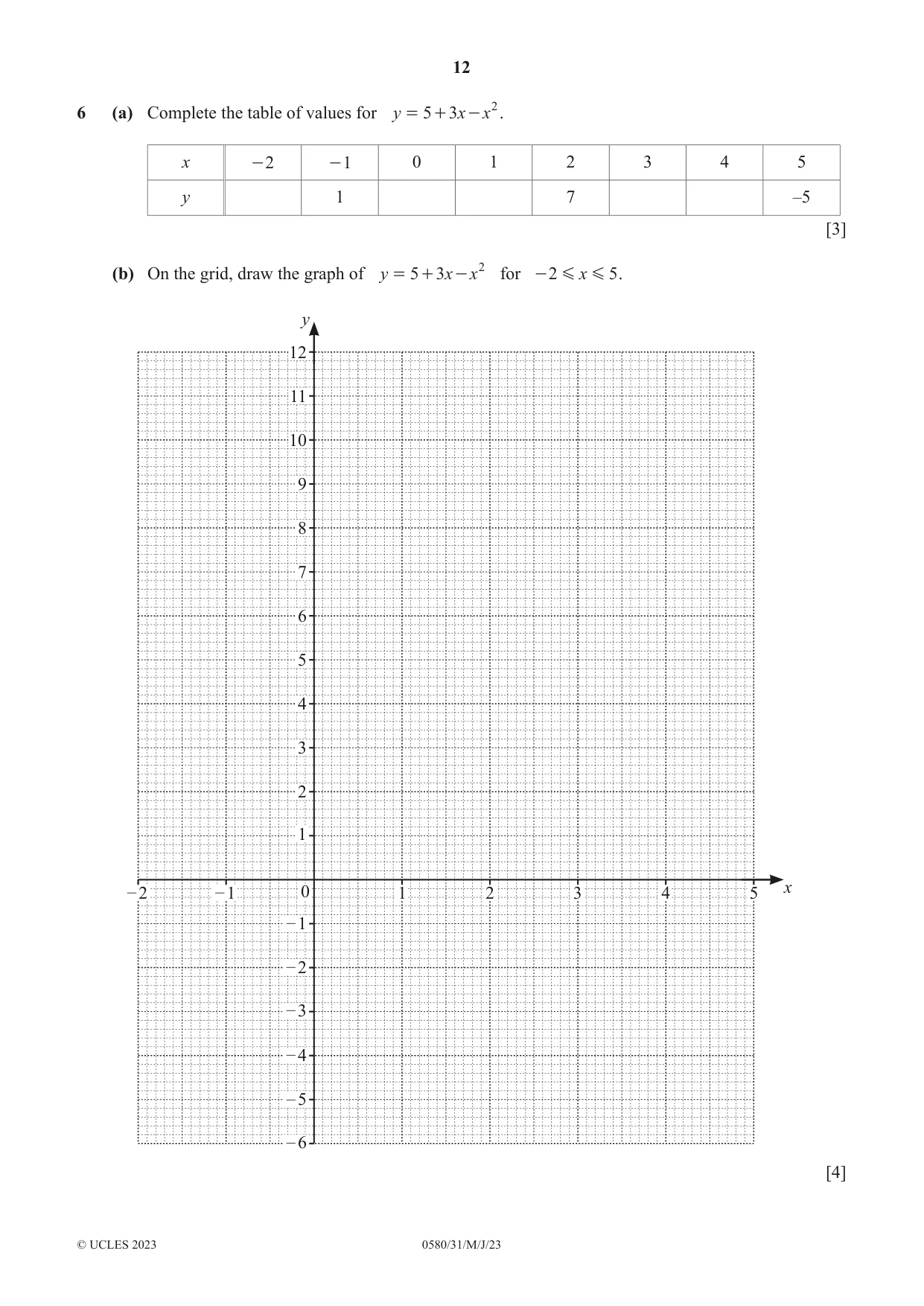
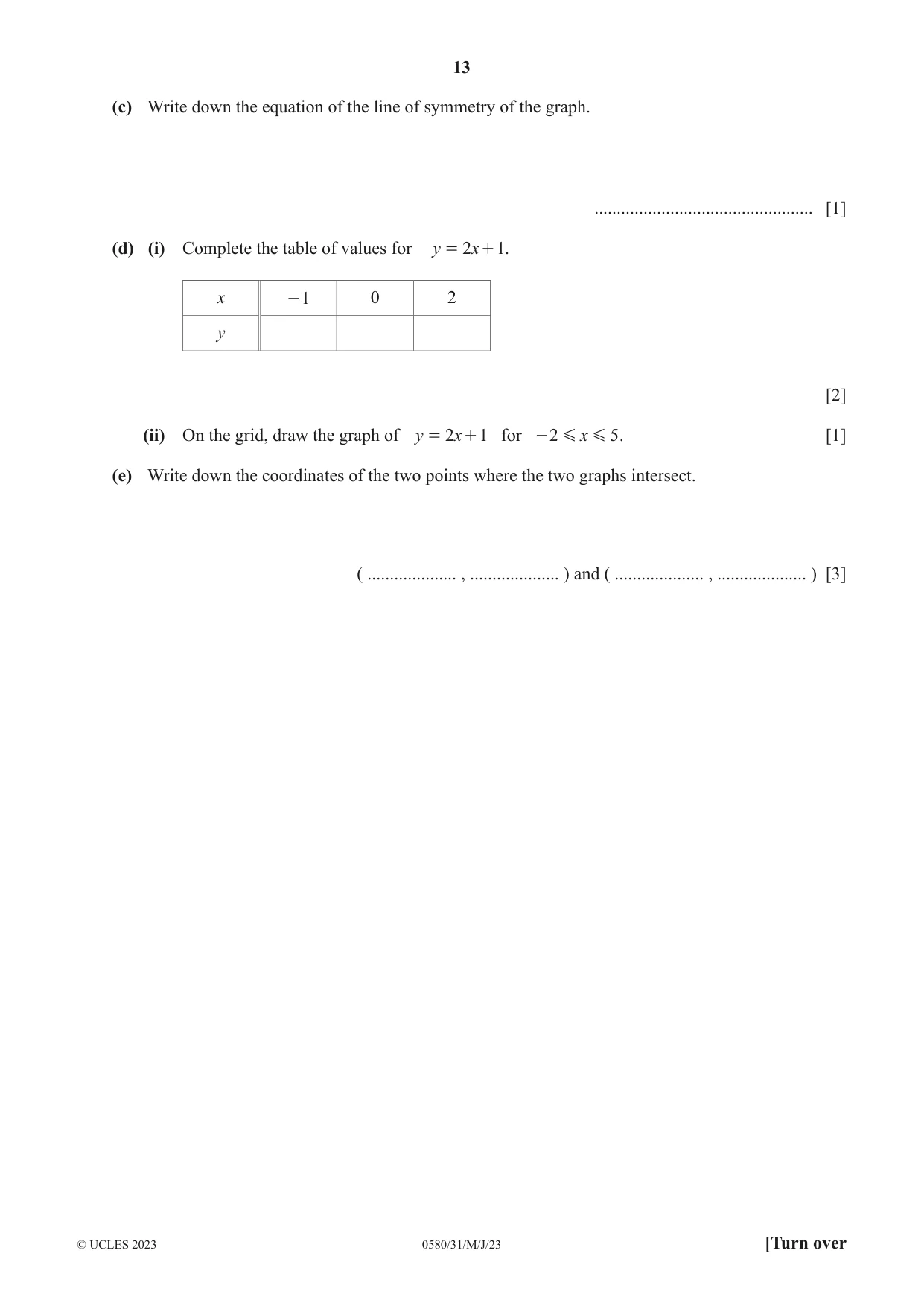
6 (a) Complete the table of values for y = 5 + 3 x - x 2 . x - 2 - 1 0 1 2 3 4 5 y 1 7 –5 [3] (b) On the grid, draw the graph of y = 5 + 3x - x 2 for - 2 G x G 5 . y 12 11 10 9 8 7 6 5 4 3 2 1 – 2 – 1 0 1 2 3 4 5 x – 1 – 2 – 3 – 4 – 5 – 6 [4] (c) Write down the equation of the line of symmetry of the graph. ................................................. [1] (d) (i) Complete the table of values for y = 2x + 1. x - 1 0 2 y [2] (ii) On the grid, draw the graph of y = 2x + 1 for - 2 G x G 5 . [1] (e) Write down the coordinates of the two points where the two graphs intersect. ( .................... , .................... ) and ( .................... , .................... ) [3]
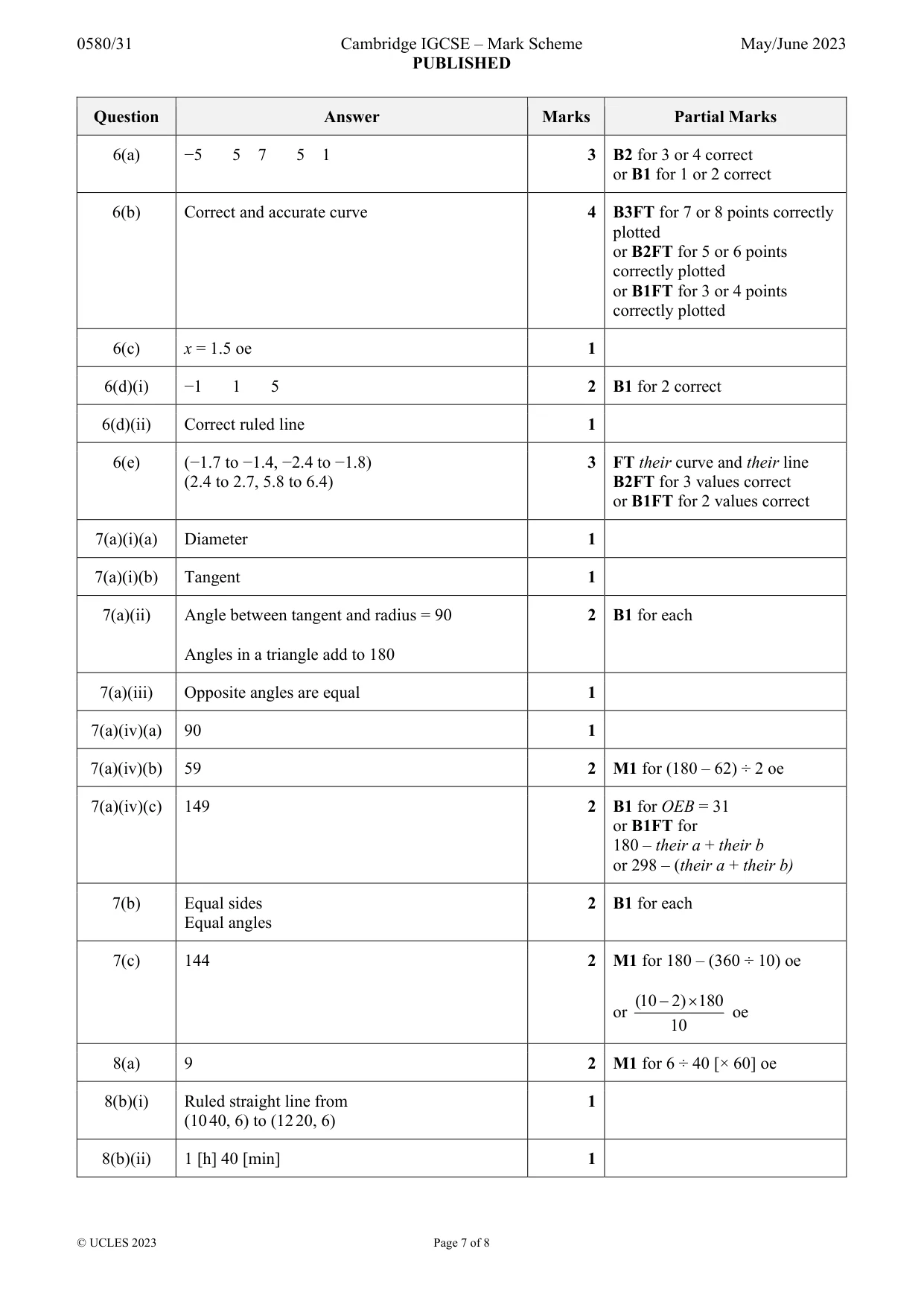
Mark scheme: 6(a) −5 5 7 5 1 3 B2 for 3 or 4 correct or B1 for 1 or 2 correct 6(b) Correct and accurate curve 4 B3FT for 7 or 8 points correctly plotted or B2FT for 5 or 6 points correctly plotted or B1FT for 3 or 4 points correctly plotted 6(c) x = 1.5 oe 1 6(d)(i) −1 1 5 2 B1 for 2 correct 6(d)(ii) Correct ruled line 1 6(e) (−1.7 to −1.4, −2.4 to −1.8) 3 FT their curve and their line (2.4 to 2.7, 5.8 to 6.4) B2FT for 3 values correct or B1FT for 2 values correct
Q7 · D F NOT TO SCALE E O C B 28° A The diagram shows a circle, centre O, with points B, D and…
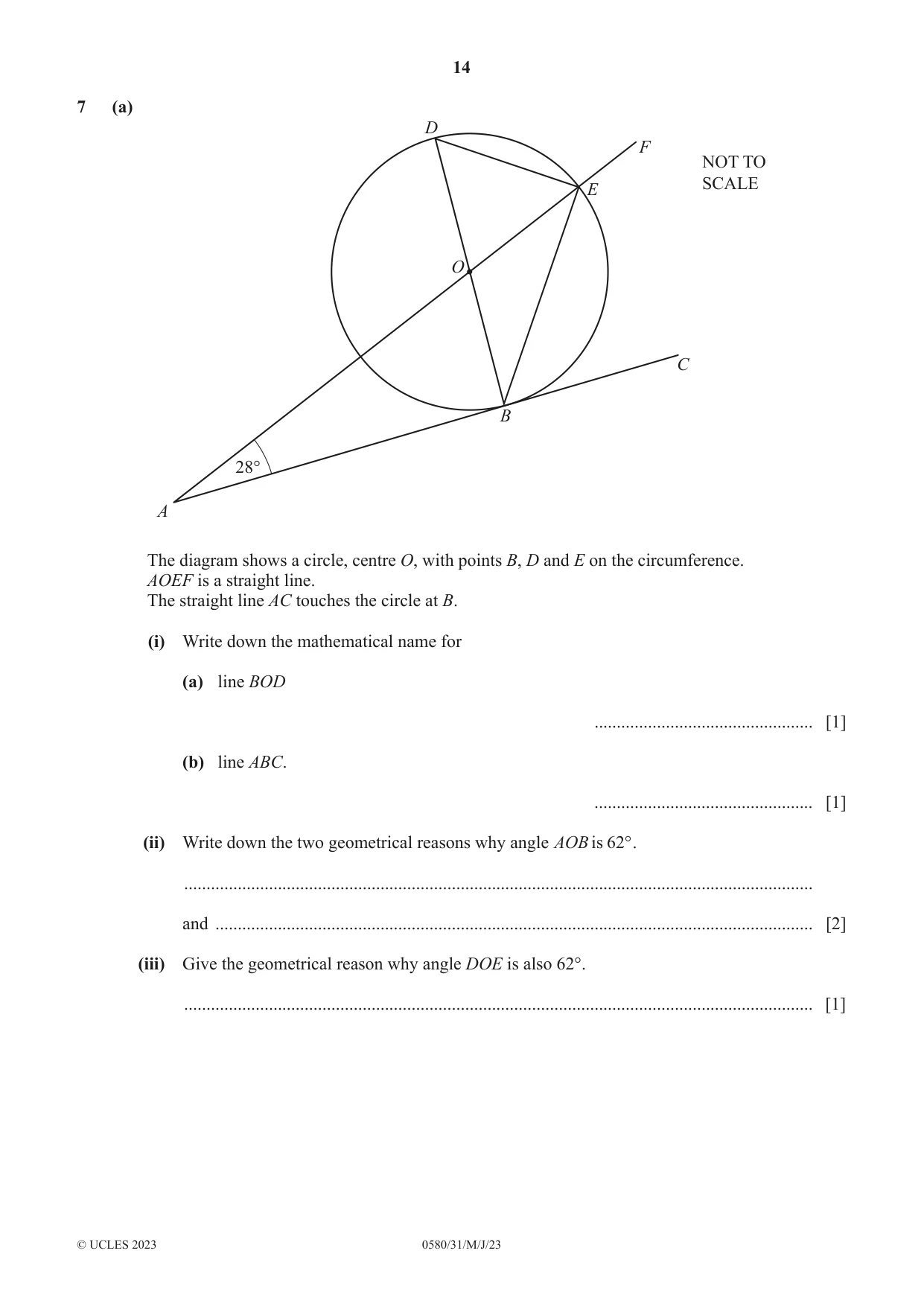
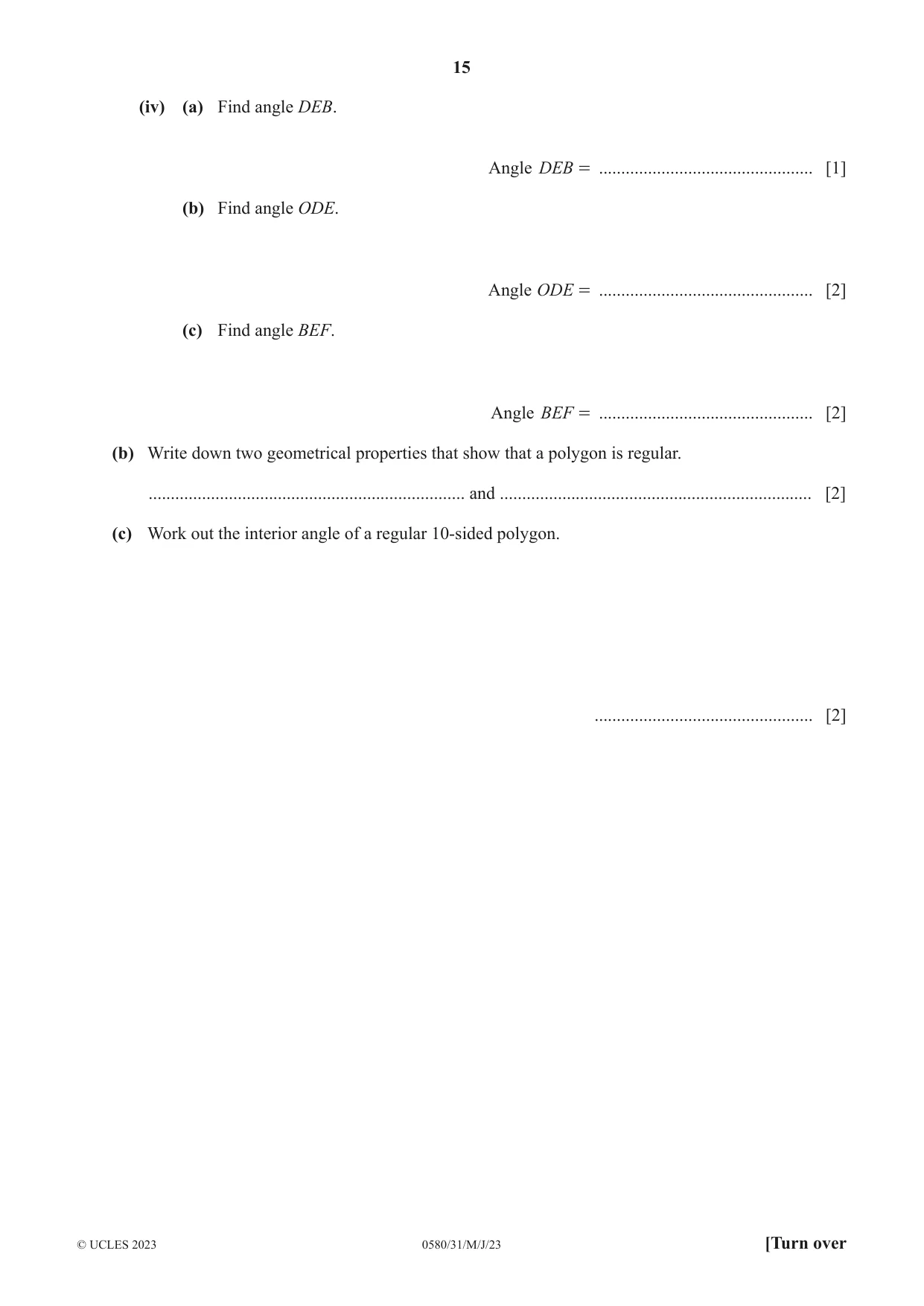
7 (a) D F NOT TO SCALE E O C B 28° A The diagram shows a circle, centre O, with points B, D and E on the circumference. AOEF is a straight line. The straight line AC touches the circle at B. (i) Write down the mathematical name for (a) line BOD ................................................. [1] (b) line ABC. ................................................. [1] (ii) Write down the two geometrical reasons why angle AOB is 62°. ............................................................................................................................................. and ...................................................................................................................................... [2] (iii) Give the geometrical reason why angle DOE is also 62°. ............................................................................................................................................. [1] (iv) (a) Find angle DEB. Angle DEB = ................................................ [1] (b) Find angle ODE. Angle ODE = ................................................ [2] (c) Find angle BEF. Angle BEF = ................................................ [2] (b) Write down two geometrical properties that show that a polygon is regular. ....................................................................... and ...................................................................... [2] (c) Work out the interior angle of a regular 10-sided polygon. ................................................. [2]
Mark scheme: 7(a)(i)(a) Diameter 1 7(a)(i)(b) Tangent 1 7(a)(ii) Angle between tangent and radius = 90 2 B1 for each Angles in a triangle add to 180 7(a)(iii) Opposite angles are equal 1 7(a)(iv)(a) 90 1 7(a)(iv)(b) 59 2 M1 for (180 – 62) ÷ 2 oe 7(a)(iv)(c) 149 2 B1 for OEB = 31 or B1FT for 180 – their a + their b or 298 – (their a + their b) 7(b) Equal sides 2 B1 for each Equal angles 7(c) 144 2 M1 for 180 – (360 ÷ 10) oe (10 2) 180 or oe 10
Q8 · Two friends, Diego and Javier, meet at a swimming pool
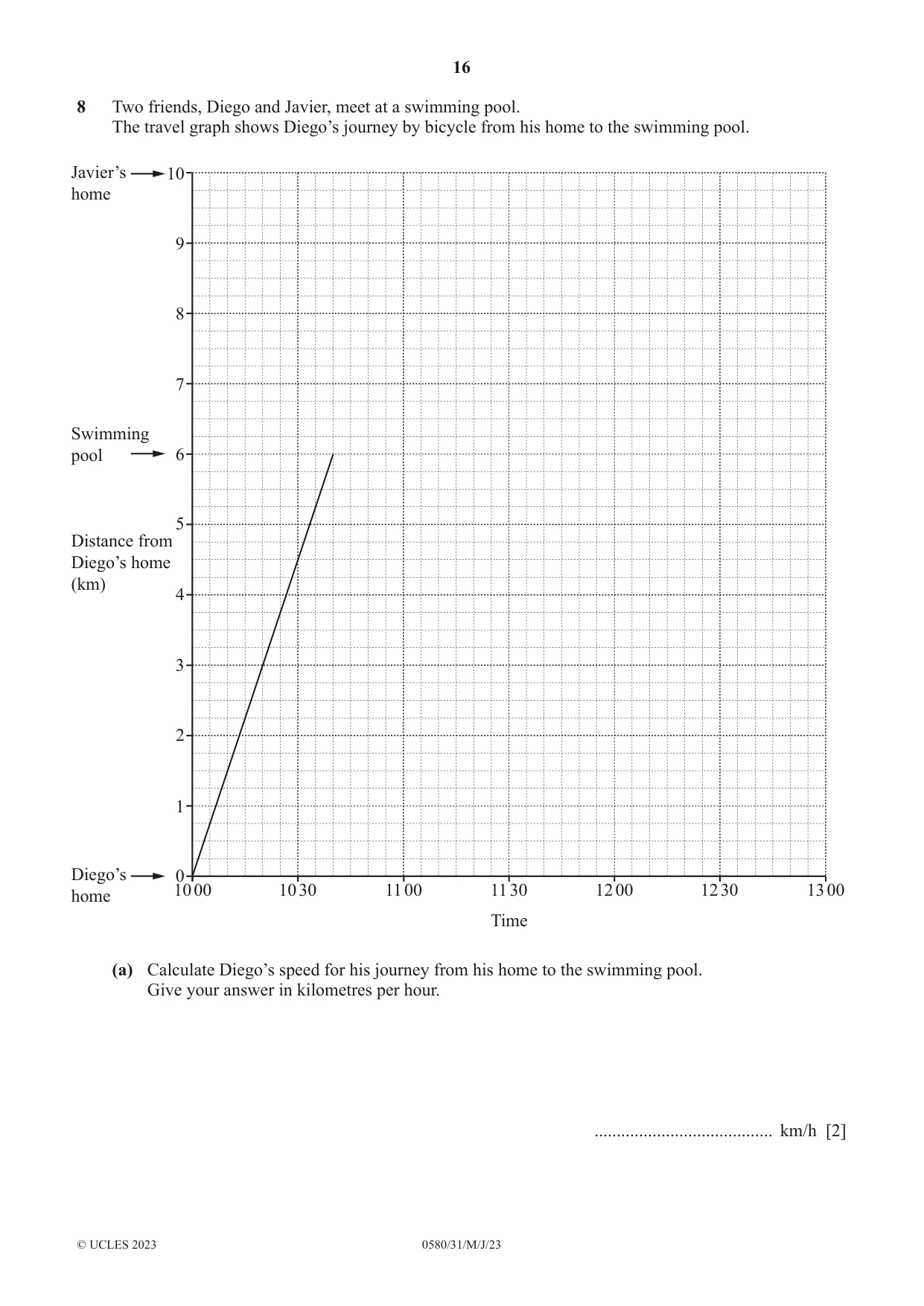
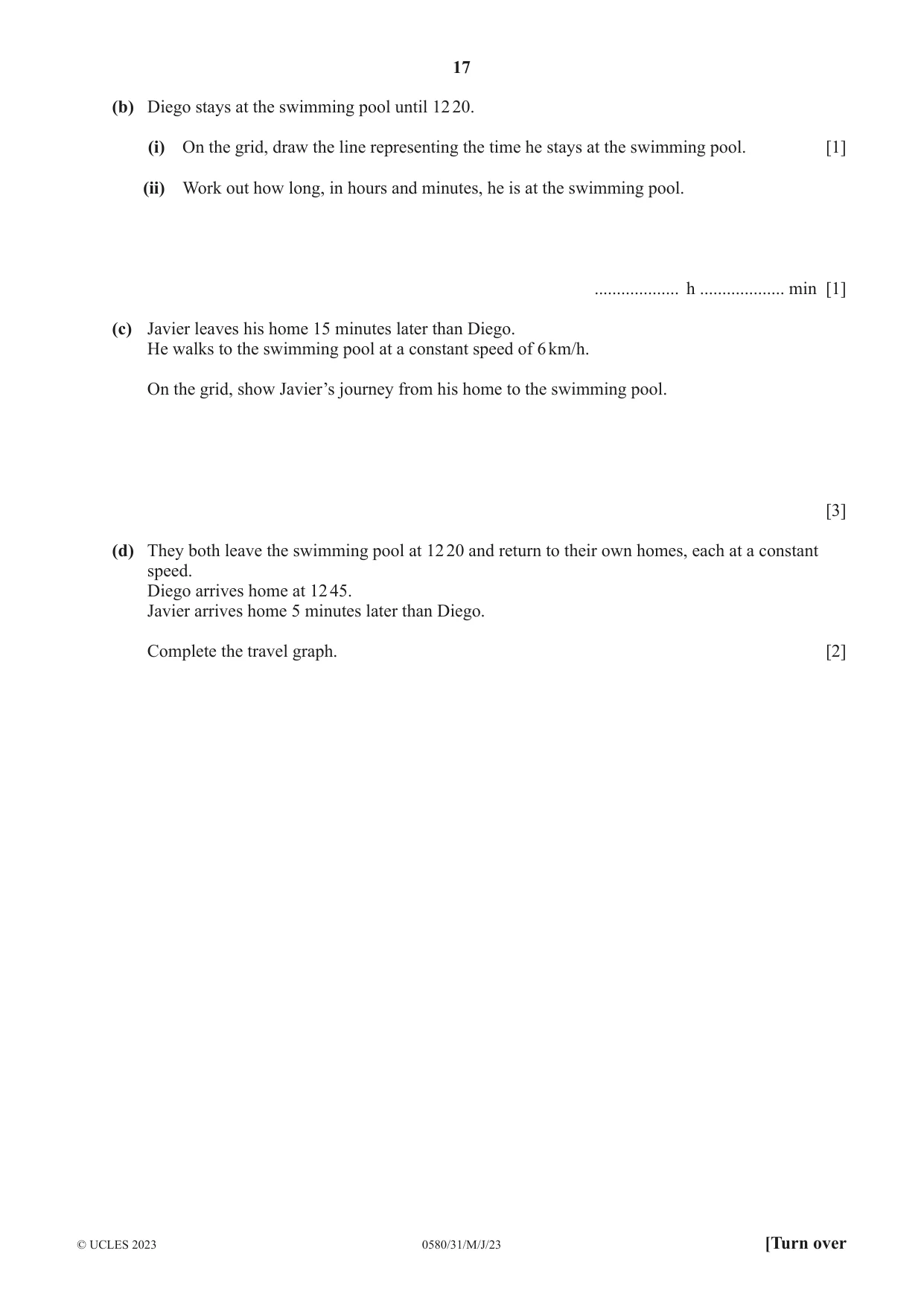
8 Two friends, Diego and Javier, meet at a swimming pool. The travel graph shows Diego’s journey by bicycle from his home to the swimming pool. Javier’s 10 home 9 8 7 Swimming pool 6 5 Distance from Diego’s home (km) 4 3 2 1 Diego’s 0 10 00 10 30 11 00 11 30 12 00 12 30 13 00home Time (a) Calculate Diego’s speed for his journey from his home to the swimming pool. Give your answer in kilometres per hour. ........................................ km/h [2] (b) Diego stays at the swimming pool until 12 20. (i) On the grid, draw the line representing the time he stays at the swimming pool. [1] (ii) Work out how long, in hours and minutes, he is at the swimming pool. ................... h ................... min [1] (c) Javier leaves his home 15 minutes later than Diego. He walks to the swimming pool at a constant speed of 6 km/h. On the grid, show Javier’s journey from his home to the swimming pool. [3] (d) They both leave the swimming pool at 12 20 and return to their own homes, each at a constant speed. Diego arrives home at 12 45. Javier arrives home 5 minutes later than Diego. Complete the travel graph. [2]
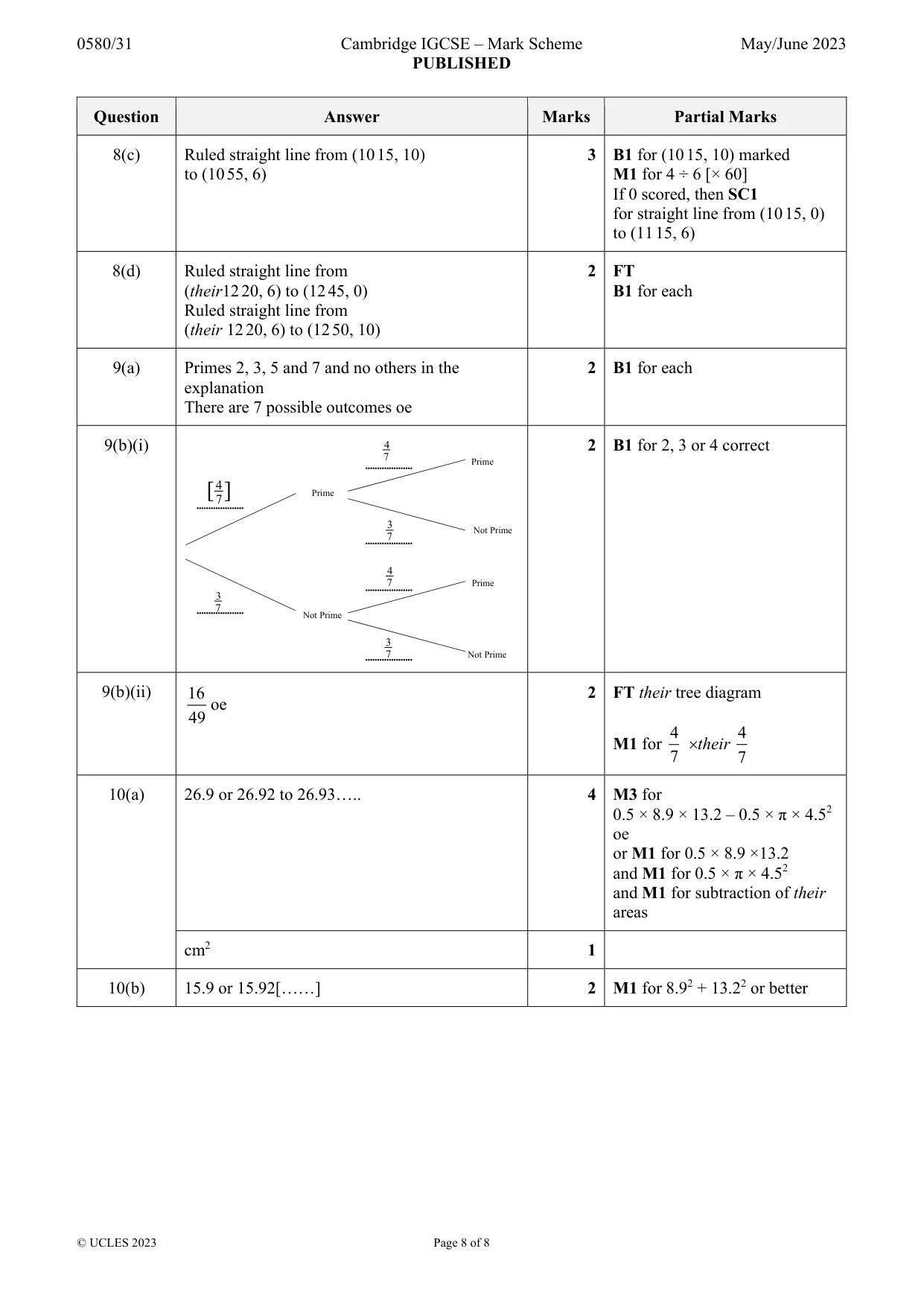
Mark scheme: 8(a) 9 2 M1 for 6 ÷ 40 [× 60] oe 8(b)(i) Ruled straight line from 1 (10 40, 6) to (12 20, 6) 8(b)(ii) 1 [h] 40 [min] 1 8(c) Ruled straight line from (10 15, 10) 3 B1 for (10 15, 10) marked to (10 55, 6) M1 for 4 ÷ 6 [× 60] If 0 scored, then SC1 for straight line from (10 15, 0) to (11 15, 6) 8(d) Ruled straight line from 2 FT (their12 20, 6) to (12 45, 0) B1 for each Ruled straight line from (their 12 20, 6) to (12 50, 10)
Q9 · Maria spins a fair 7-sided spinner numbered 1 to 7
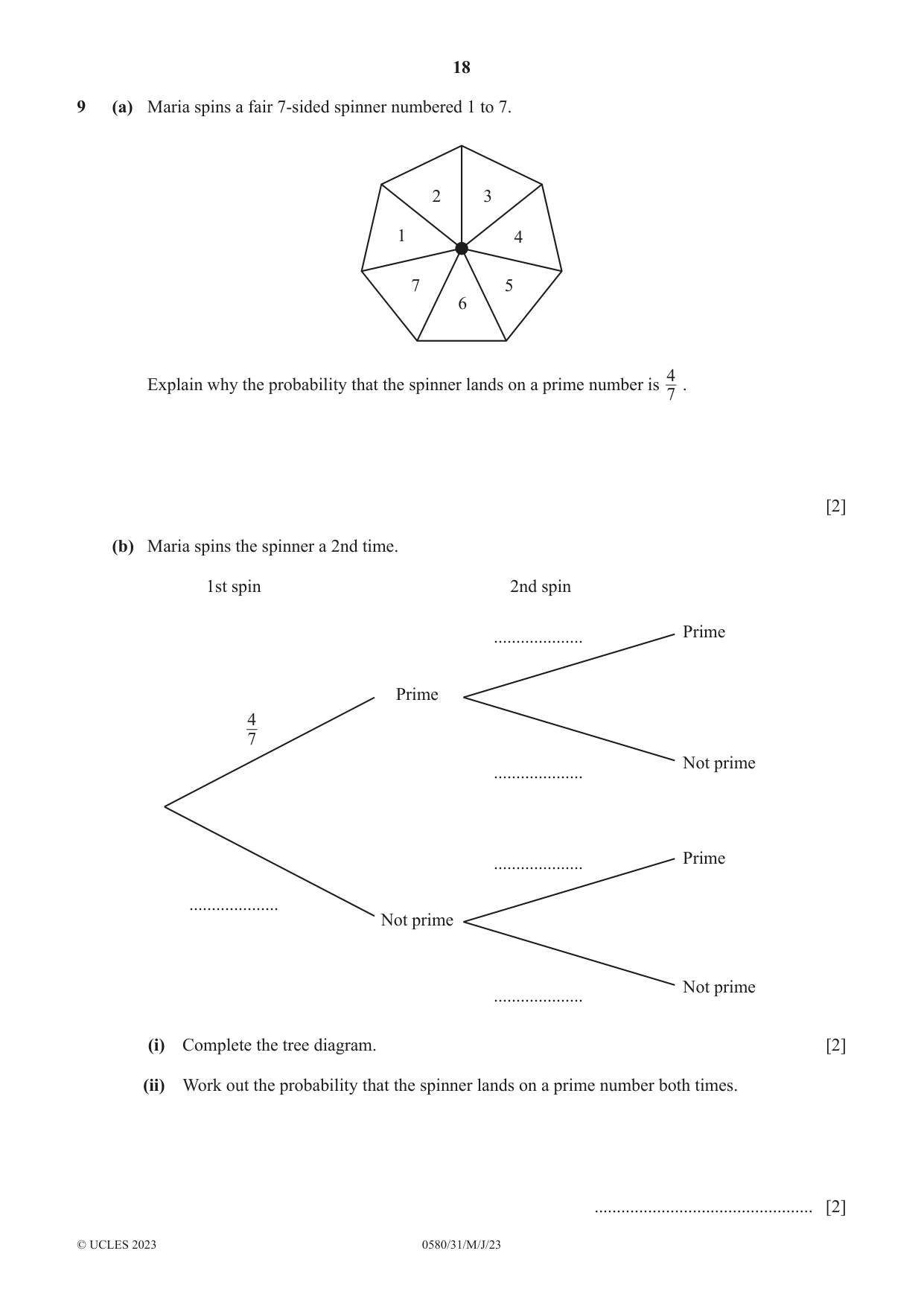
9 (a) Maria spins a fair 7-sided spinner numbered 1 to 7. 2 3 1 4 7 5 6 4 Explain why the probability that the spinner lands on a prime number is . 7 [2] (b) Maria spins the spinner a 2nd time. 1st spin 2nd spin Prime .................... Prime 4 7 Not prime .................... Prime .................... .................... Not prime Not prime .................... (i) Complete the tree diagram. [2] (ii) Work out the probability that the spinner lands on a prime number both times. ................................................. [2]
Mark scheme: 9(a) Primes 2, 3, 5 and 7 and no others in the 2 B1 for each explanation There are 7 possible outcomes oe 9(b)(i) 4 2 B1 for 2, 3 or 4 correct 7 Prime Prime [74 ] 3 Not Prime 7 4 7 Prime 3 7 Not Prime 3 7 Not Prime 9(b)(ii) 16 2 FT their tree diagram oe 49 4 4 M1 for their 7 7
Q10 · B NOT TO 13.2 cm SCALE 4.54.5 cmcm C 8.9 cm A The diagram shows a right-angled triangle…
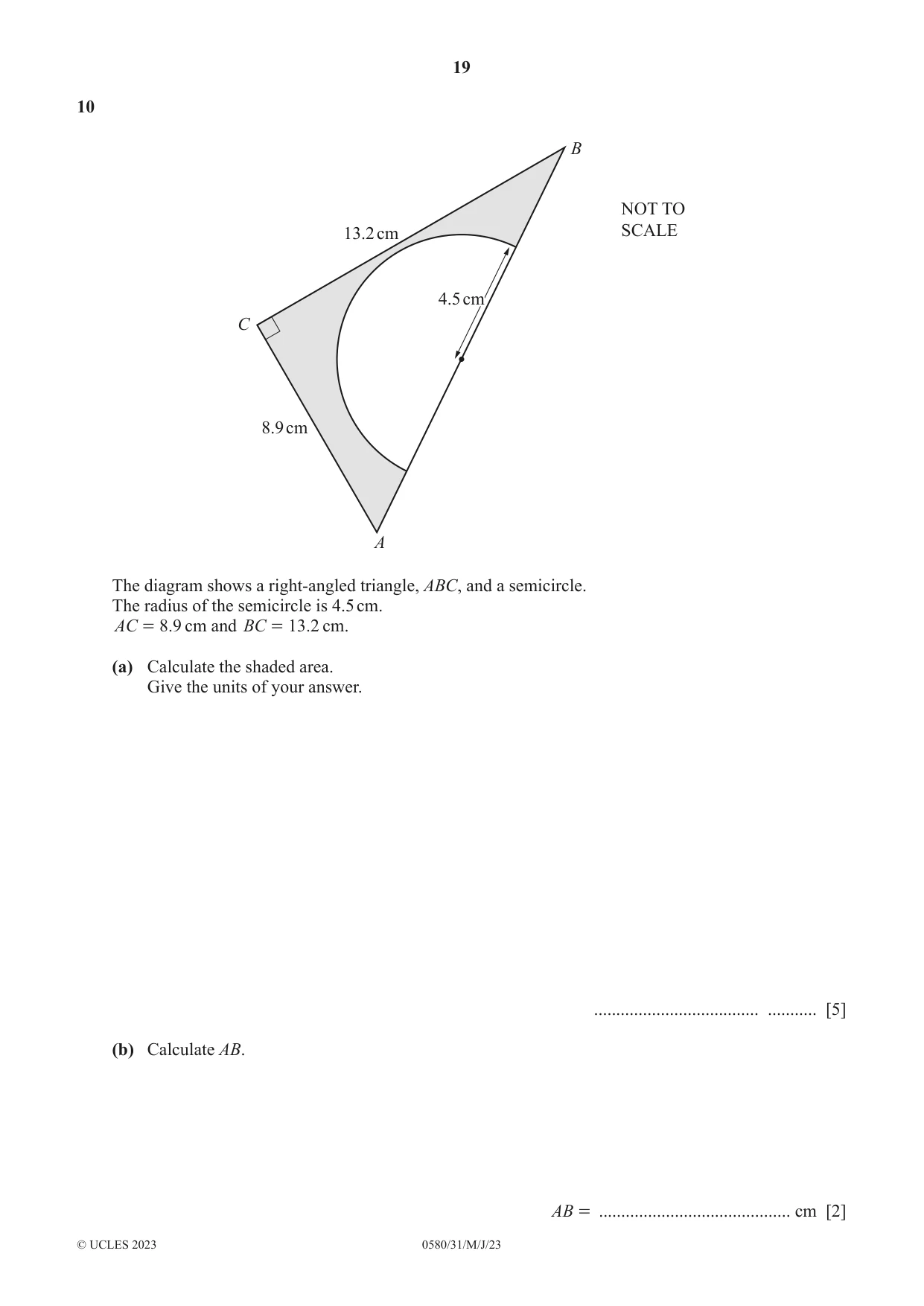
10 B NOT TO 13.2 cm SCALE 4.54.5 cmcm C 8.9 cm A The diagram shows a right-angled triangle, ABC, and a semicircle. The radius of the semicircle is 4.5 cm. AC = 8.9 cm and BC = 13.2 cm. (a) Calculate the shaded area. Give the units of your answer. ..................................... ........... [5] (b) Calculate AB. AB = ........................................... cm [2]
Mark scheme: 10(a) 26.9 or 26.92 to 26.93….. 4 M3 for 0.5 × 8.9 × 13.2 – 0.5 × π × 4.52 oe or M1 for 0.5 × 8.9 ×13.2 and M1 for 0.5 × π × 4.52 and M1 for subtraction of their areas cm2 1 10(b) 15.9 or 15.92[……] 2 M1 for 8.92 + 13.22 or better
What was in this paper
The subtopics covered by these 9 questions, and how many questions each got. Open one in a new tab to see every Cambridge question on it.
What you needed in this session
Cambridge’s own grade thresholds for 2023 May/June, Paper 3 · Variant 1. A higher threshold means an easier paper — the bar moves with how the cohort did.