Cambridge IGCSE Mathematics 0580 — 2023 Oct/Nov Paper 3 · Variant 1
0580/31/O/N/23 · 10 questions · 104 marks · ≈117 min
The question paper and its mark scheme, free to read here and free to download. This is Cambridge’s own paper, exactly as it was sat.
Question paper20 pages
Mark scheme8 pages
Answers below. Sit the paper first if you are practising.
Questions as text
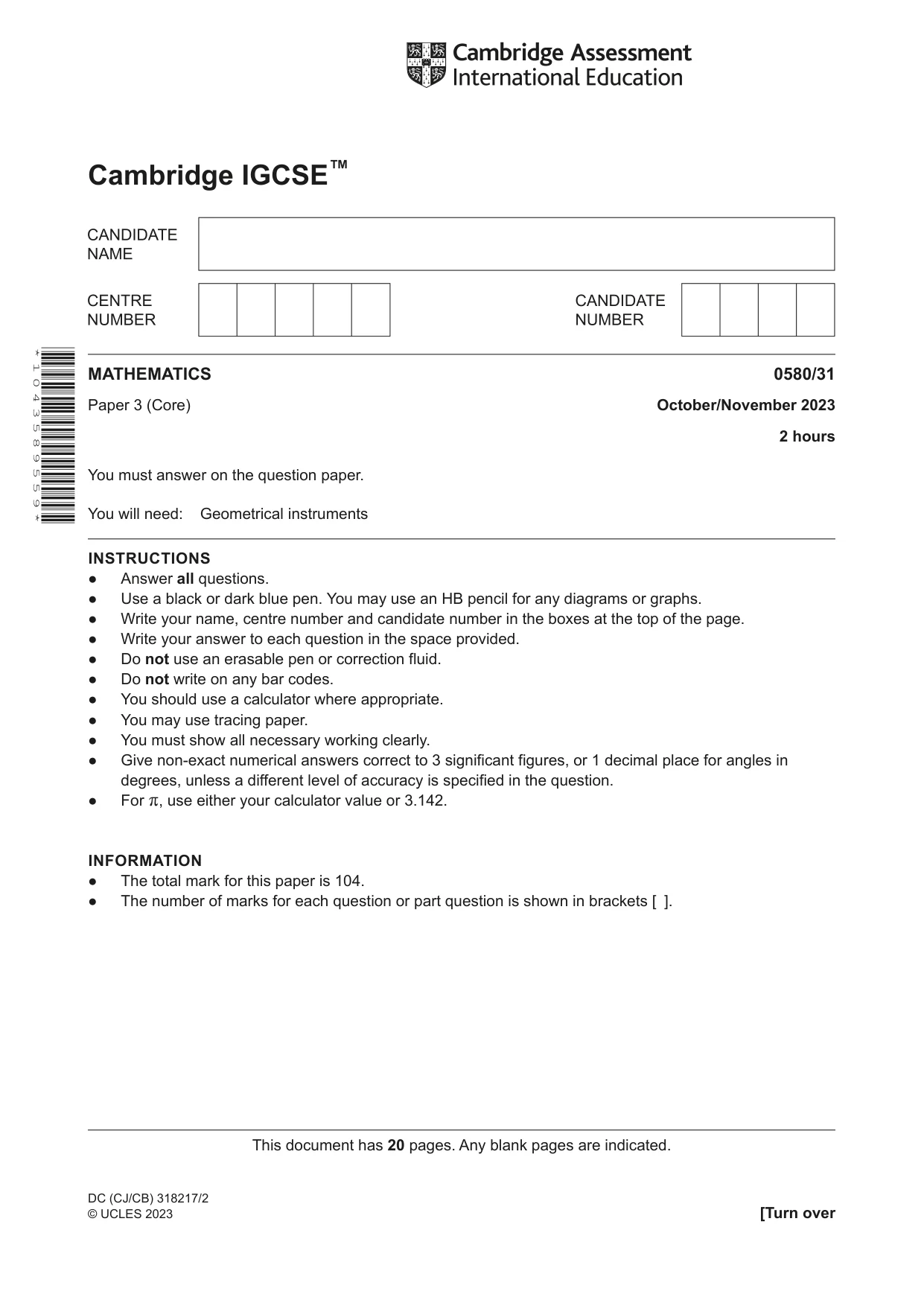
Q1 · Write the number six and a half million in figures
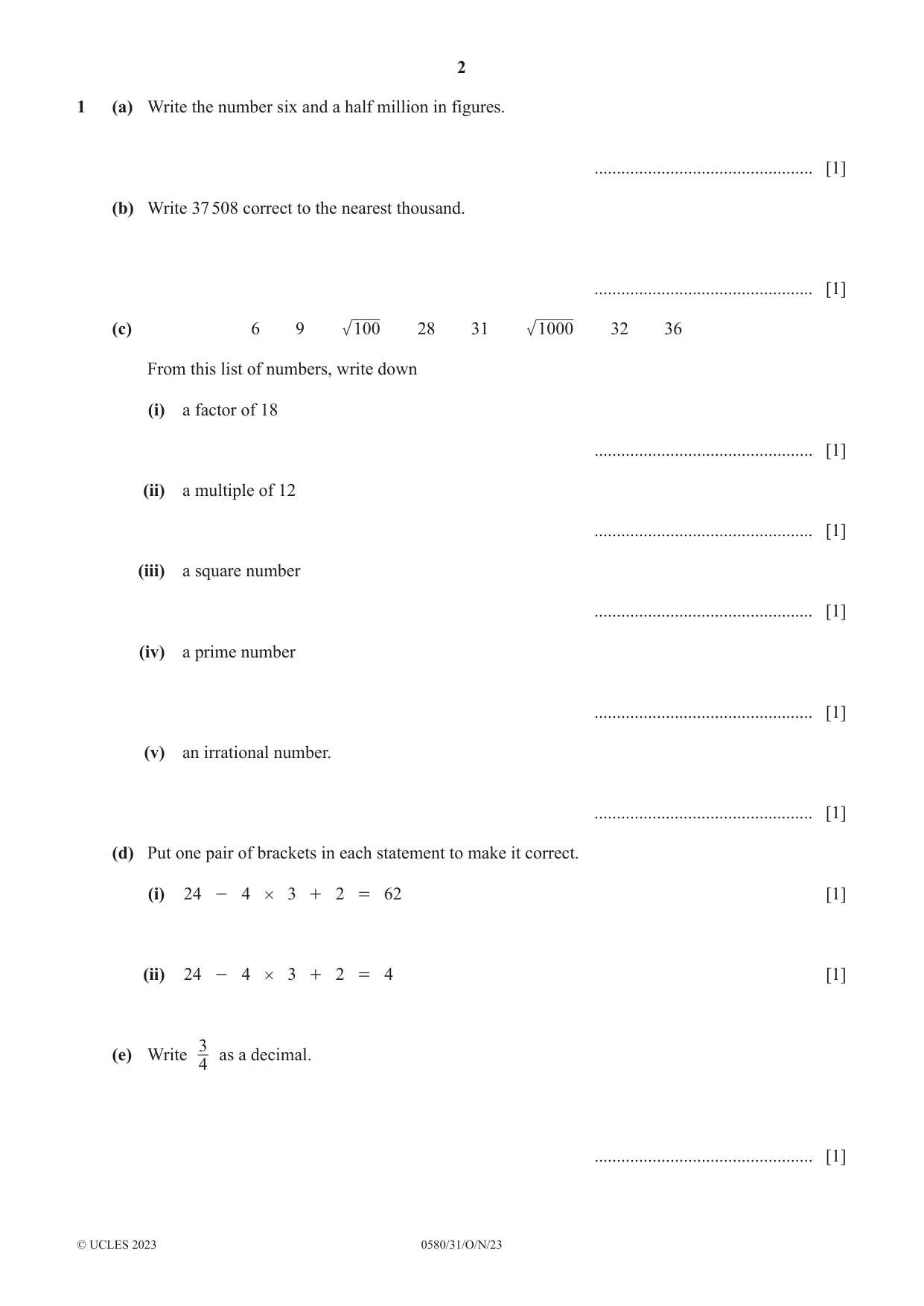
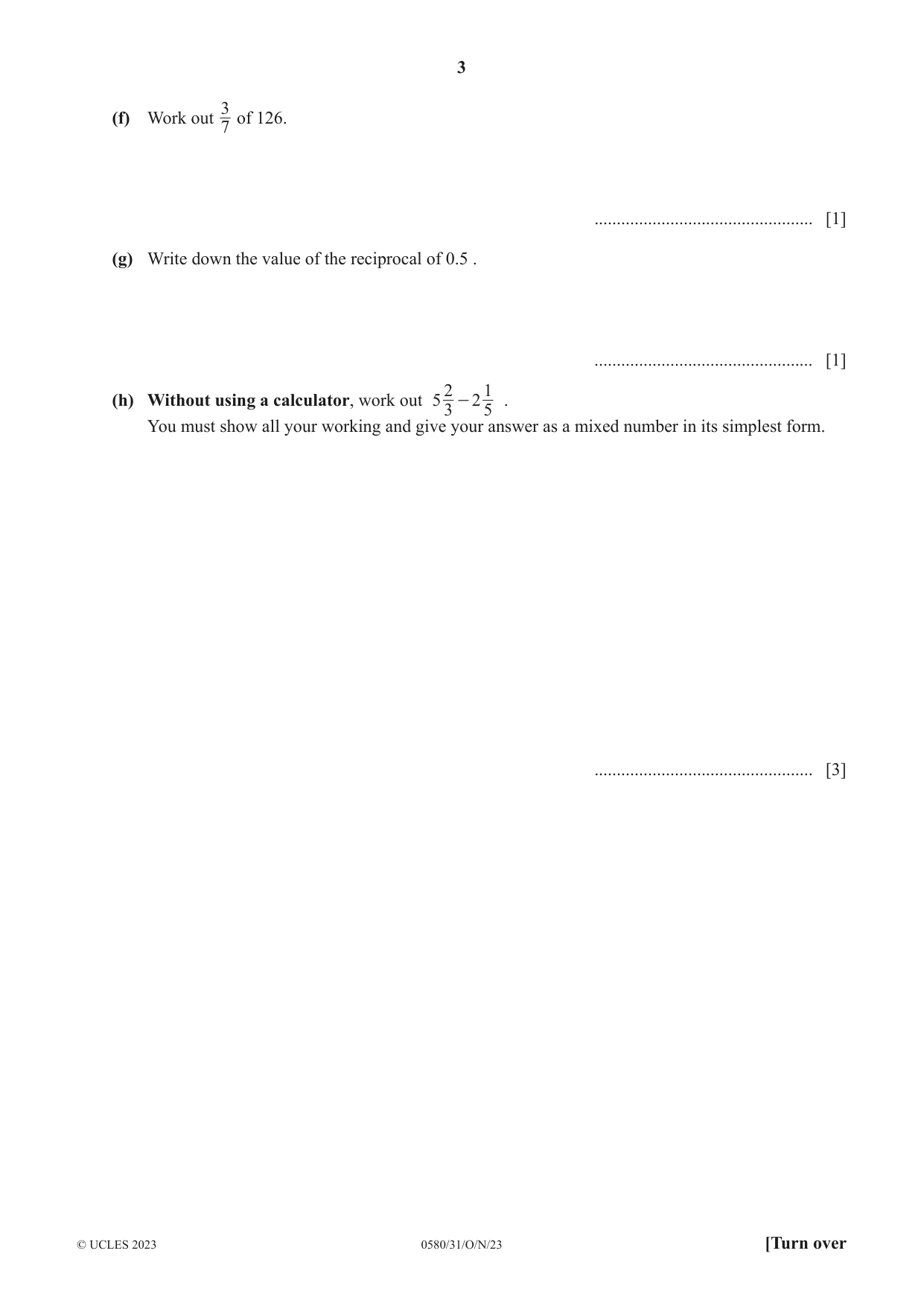
1 (a) Write the number six and a half million in figures. ................................................. [1] (b) Write 37 508 correct to the nearest thousand. ................................................. [1] (c) 6 9 100 28 31 1000 32 36 From this list of numbers, write down (i) a factor of 18 ................................................. [1] (ii) a multiple of 12 ................................................. [1] (iii) a square number ................................................. [1] (iv) a prime number ................................................. [1] (v) an irrational number. ................................................. [1] (d) Put one pair of brackets in each statement to make it correct. (i) 24 - 4 # 3 + 2 = 62 [1] (ii) 24 - 4 # 3 + 2 = 4 [1] 3 (e) Write as a decimal. 4 ................................................. [1] 3(f) Work out of 126. 7 ................................................. [1] (g) Write down the value of the reciprocal of 0.5 . ................................................. [1] 2 1(h) Without using a calculator, work out 5 - 2 . 3 5 You must show all your working and give your answer as a mixed number in its simplest form. ................................................. [3]
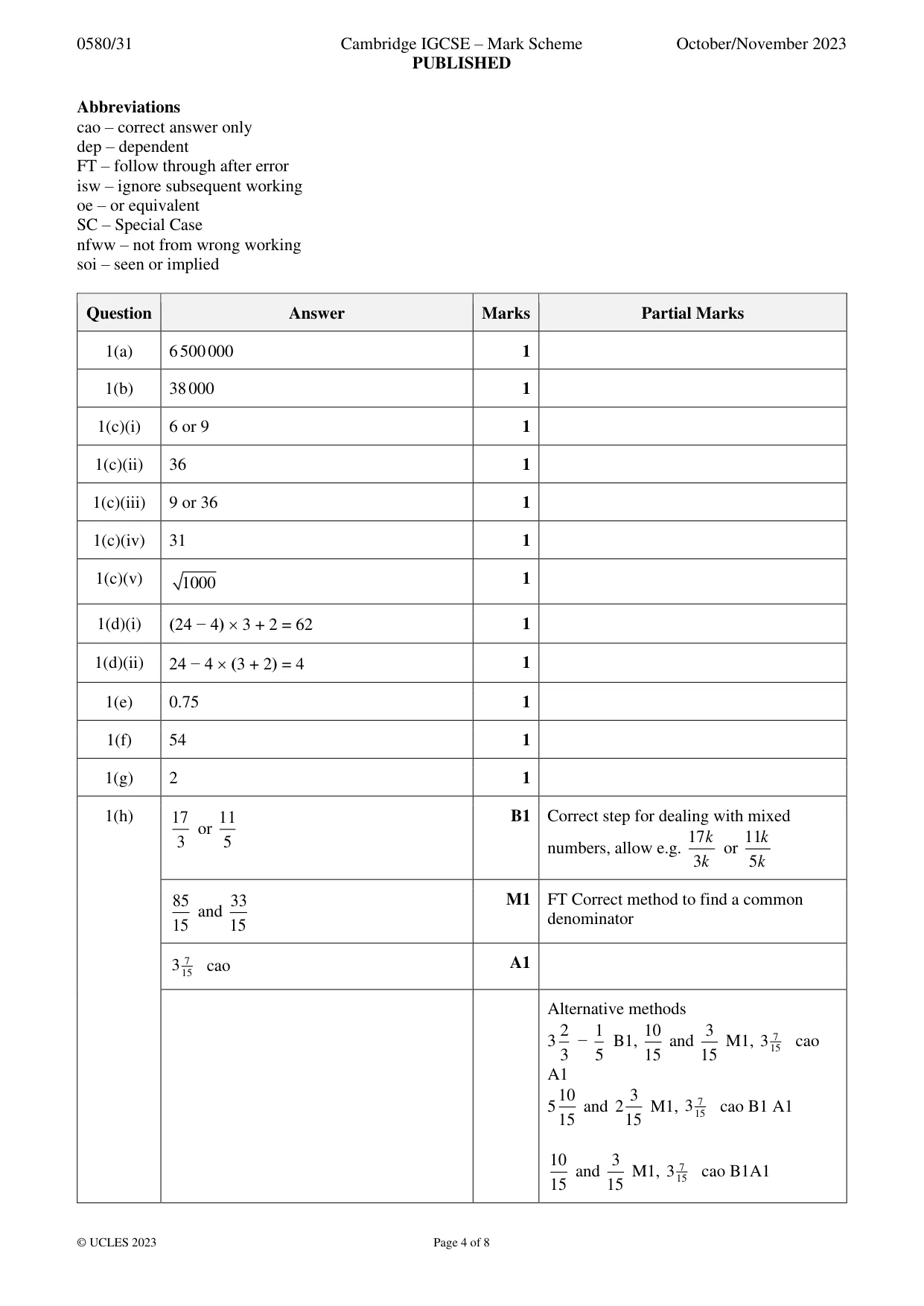
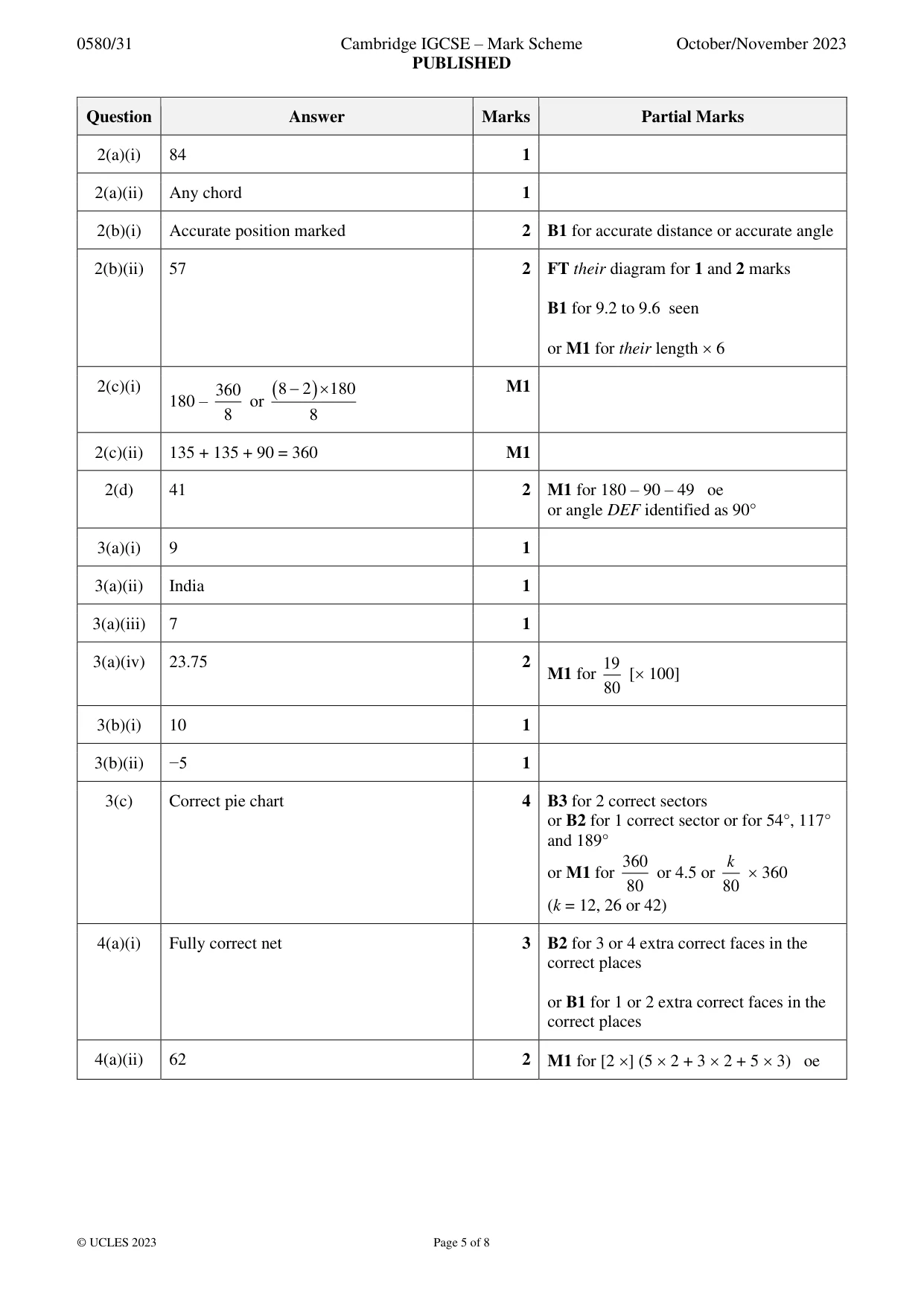
Mark scheme: Question Answer Marks Partial Marks 1(a) 6 500 000 1 1(b) 38 000 1 1(c)(i) 6 or 9 1 1(c)(ii) 36 1 1(c)(iii) 9 or 36 1 1(c)(iv) 31 1 1(c)(v) 1000 1 1(d)(i) (24 − 4) 3 + 2 = 62 1 1(d)(ii) 24 − 4 (3 + 2) = 4 1 1(e) 0.75 1 1(f) 54 1 1(g) 2 1 1(h) 17 11 B1 Correct step for dealing with mixed or 17 k 11k 3 5 numbers, allow e.g. or 3k 5 k 85 33 M1 FT Correct method to find a common and denominator 15 15 3 157 cao A1 Alternative methods 2 1 10 3 7 3 − B1, and M1, 3 15 cao 3 5 15 15 A1 510 and 3 M1, 3 157 cao B1 A1 15 215 10 3 7 and M1, 3 15 cao B1A1 15 15
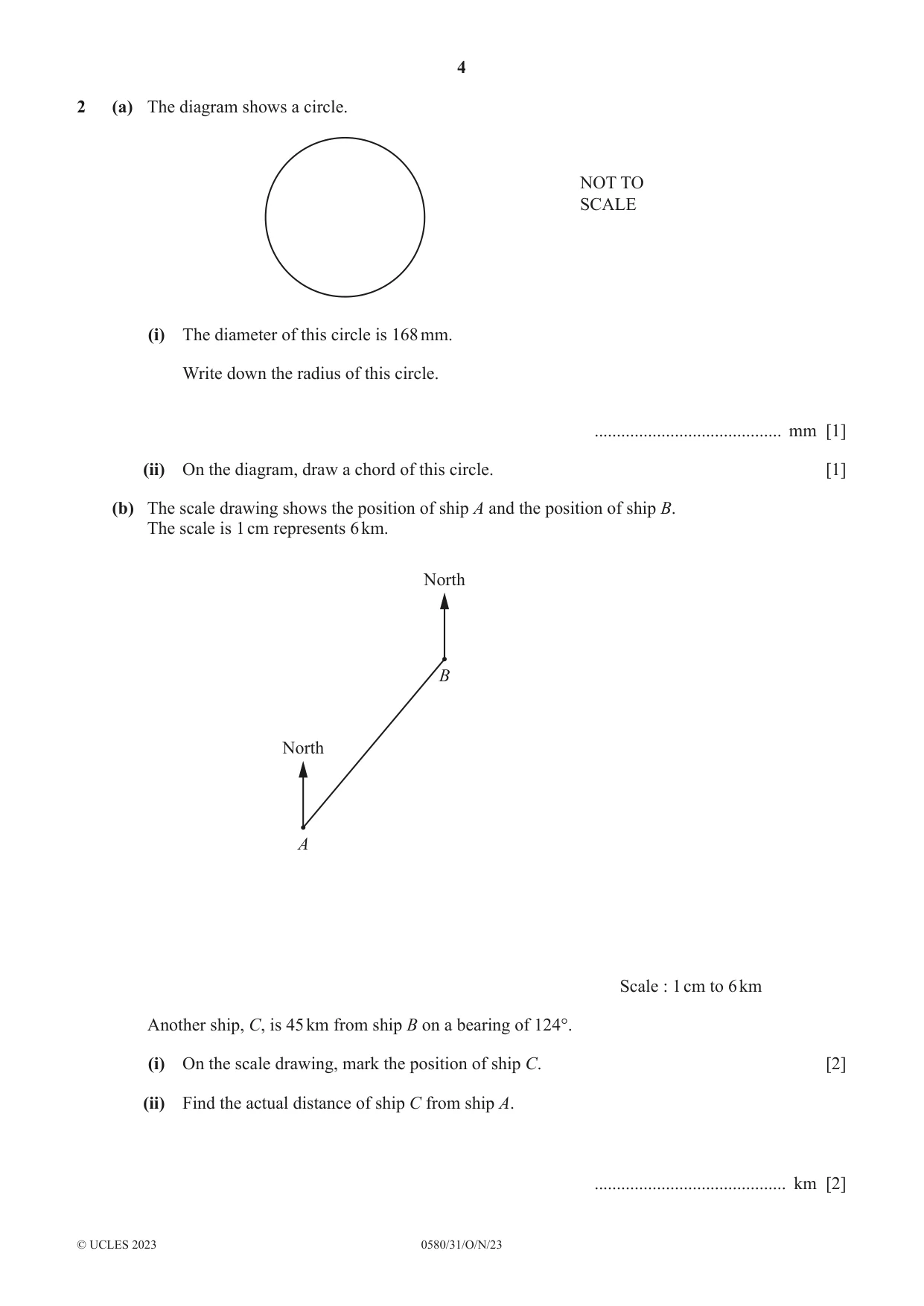
Q2 · The diagram shows a circle
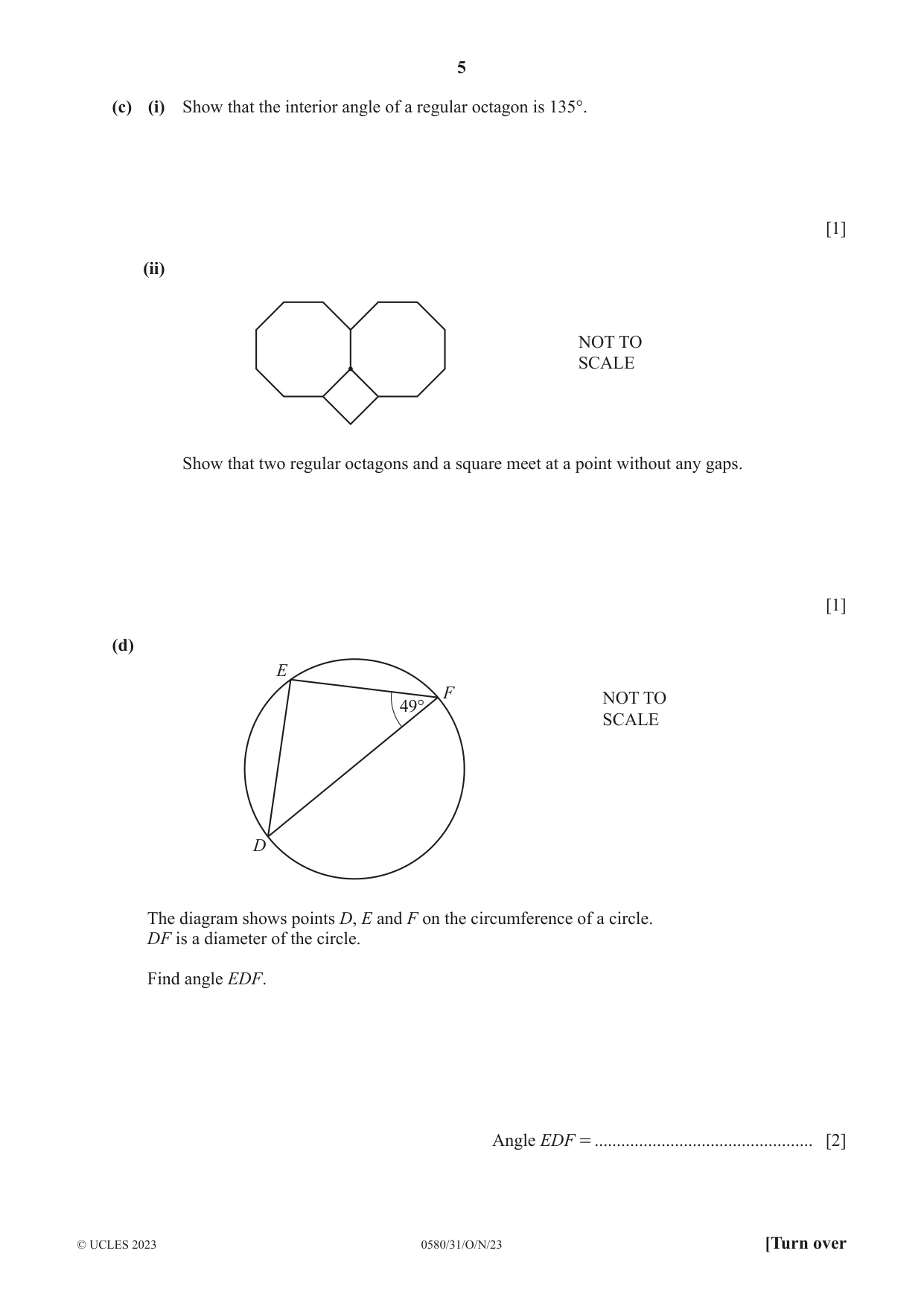
2 (a) The diagram shows a circle. NOT TO SCALE (i) The diameter of this circle is 168 mm. Write down the radius of this circle. .......................................... mm [1] (ii) On the diagram, draw a chord of this circle. [1] (b) The scale drawing shows the position of ship A and the position of ship B. The scale is 1 cm represents 6 km. North B North A Scale : 1 cm to 6 km Another ship, C, is 45 km from ship B on a bearing of 124°. (i) On the scale drawing, mark the position of ship C. [2] (ii) Find the actual distance of ship C from ship A. ........................................... km [2] (c) (i) Show that the interior angle of a regular octagon is 135°. [1] (ii) NOT TO SCALE Show that two regular octagons and a square meet at a point without any gaps. [1] (d) E F NOT TO 49° SCALE D The diagram shows points D, E and F on the circumference of a circle. DF is a diameter of the circle. Find angle EDF. Angle EDF = ................................................. [2]
Mark scheme: 2(a)(i) 84 1 2(a)(ii) Any chord 1 2(b)(i) Accurate position marked 2 B1 for accurate distance or accurate angle 2(b)(ii) 57 2 FT their diagram for 1 and 2 marks B1 for 9.2 to 9.6 seen or M1 for their length 6 2(c)(i) 360 ( 8 − 2 ) 180 M1 180 – or 8 8 2(c)(ii) 135 + 135 + 90 = 360 M1 2(d) 41 2 M1 for 180 – 90 – 49 oe or angle DEF identified as 90°
Q3 · The bar chart shows the country in which each of 80 students live
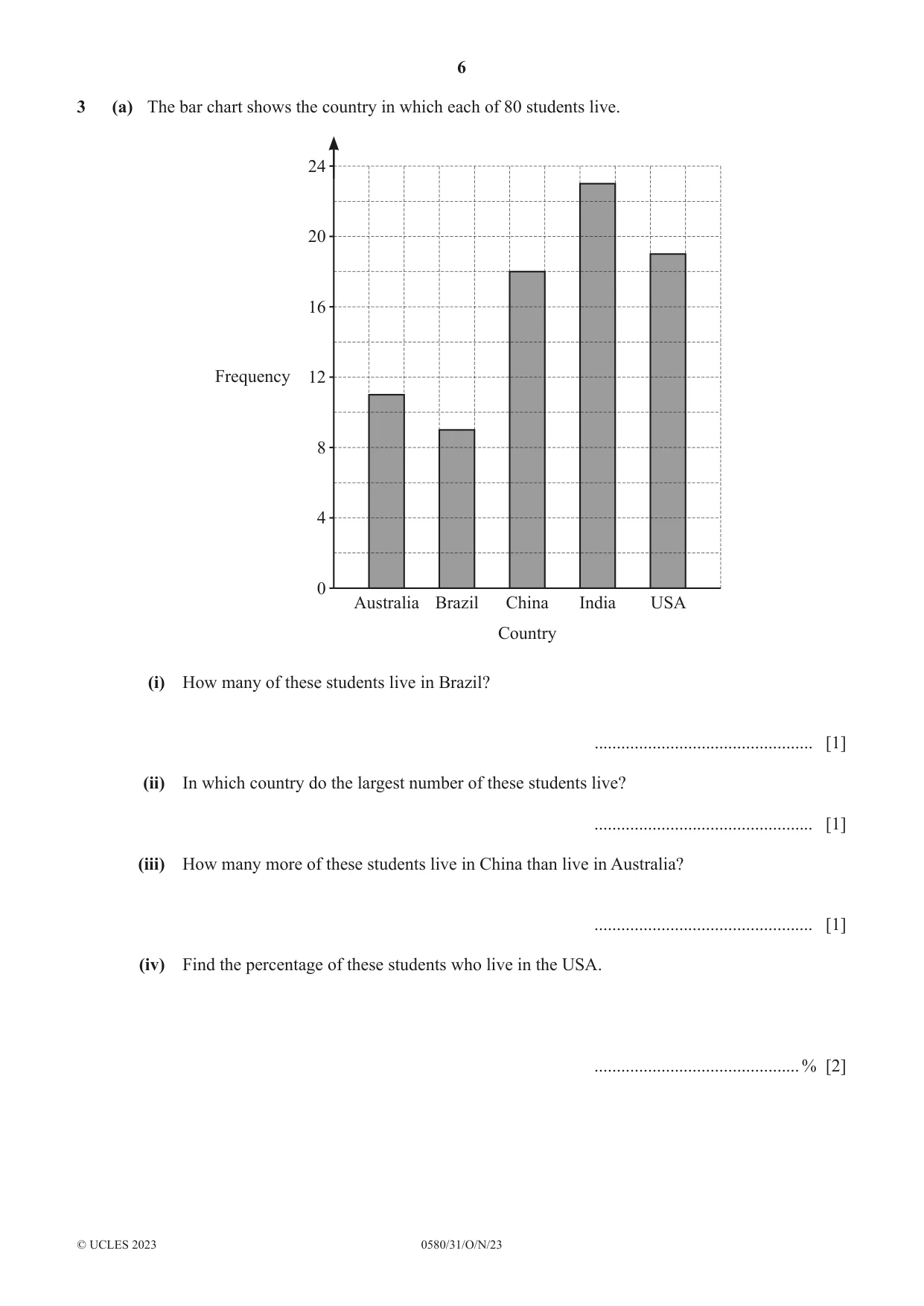
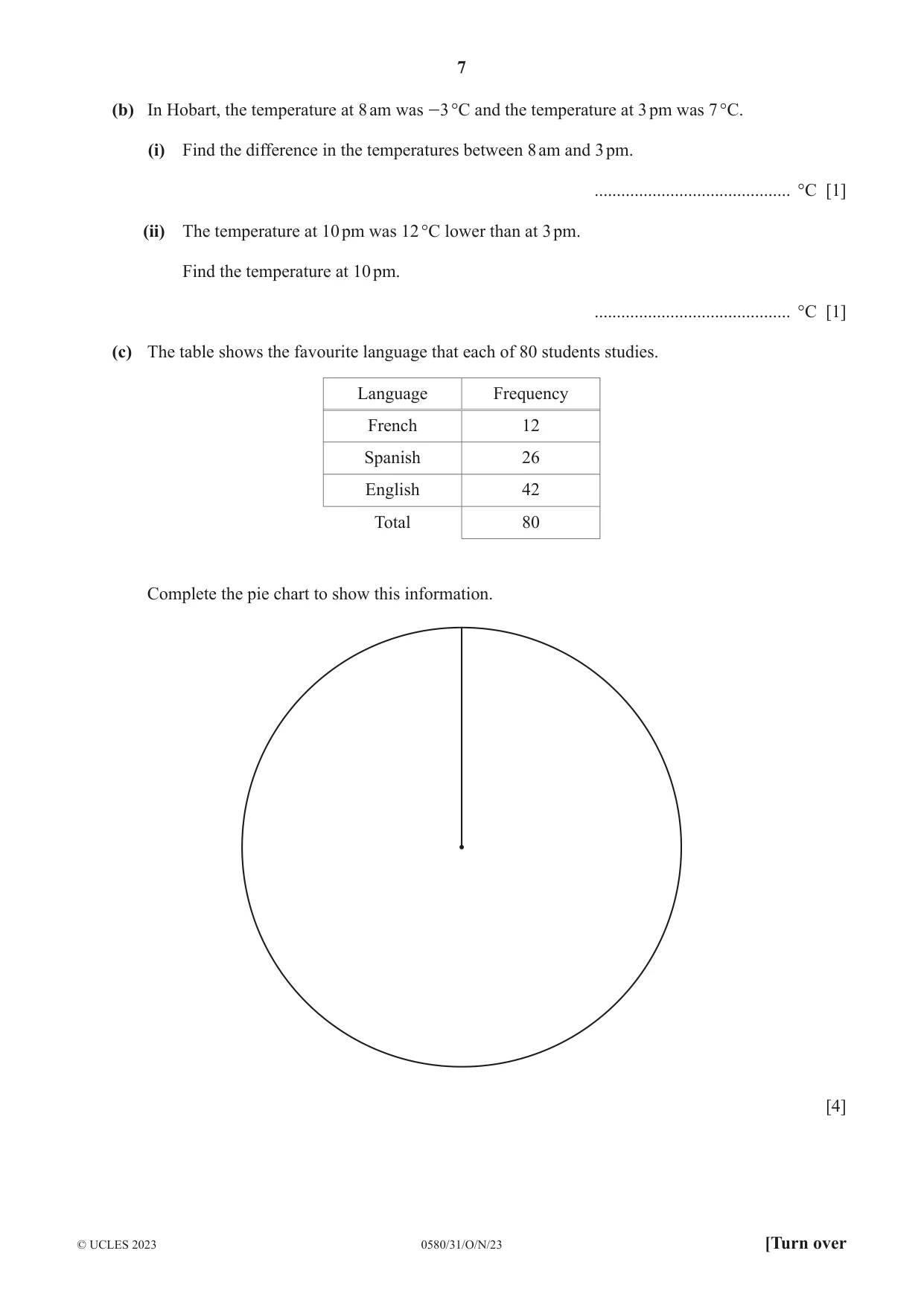
3 (a) The bar chart shows the country in which each of 80 students live. 24 20 16 Frequency 12 8 4 0 Australia Brazil China India USA Country (i) How many of these students live in Brazil? ................................................. [1] (ii) In which country do the largest number of these students live? ................................................. [1] (iii) How many more of these students live in China than live in Australia? ................................................. [1] (iv) Find the percentage of these students who live in the USA. ..............................................% [2] (b) In Hobart, the temperature at 8 am was -3 °C and the temperature at 3 pm was 7 °C. (i) Find the difference in the temperatures between 8 am and 3 pm. ............................................ °C [1] (ii) The temperature at 10 pm was 12 °C lower than at 3 pm. Find the temperature at 10 pm. ............................................ °C [1] (c) The table shows the favourite language that each of 80 students studies. Language Frequency French 12 Spanish 26 English 42 Total 80 Complete the pie chart to show this information. [4]
Mark scheme: 3(a)(i) 9 1 3(a)(ii) India 1 3(a)(iii) 7 1 3(a)(iv) 23.75 2 19 M1 for [ 100] 80 3(b)(i) 10 1 3(b)(ii) −5 1 3(c) Correct pie chart 4 B3 for 2 correct sectors or B2 for 1 correct sector or for 54°, 117° and 189° 360 k or M1 for or 4.5 or 360 80 80 (k = 12, 26 or 42)
Q4 · The diagram shows a cuboid
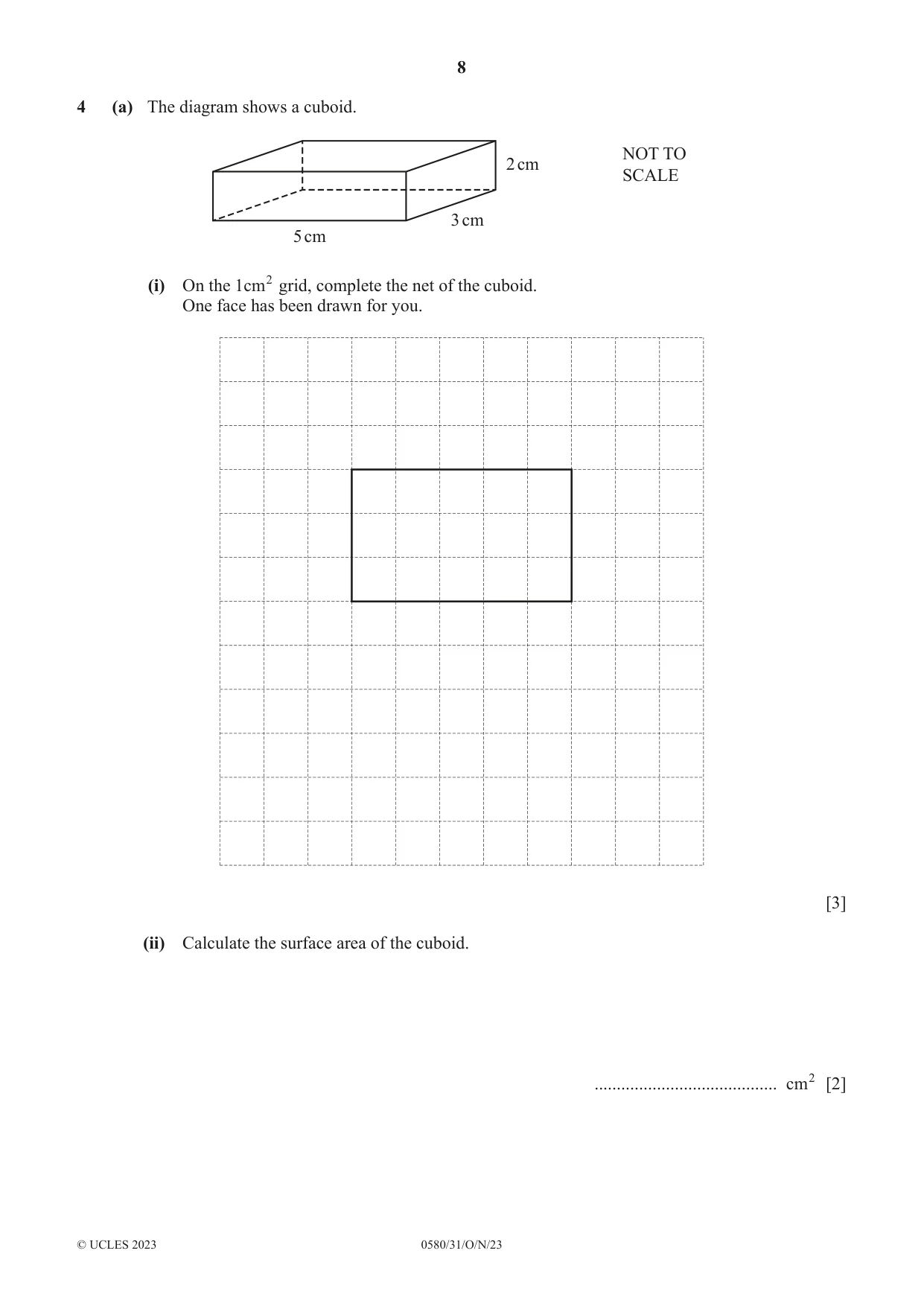
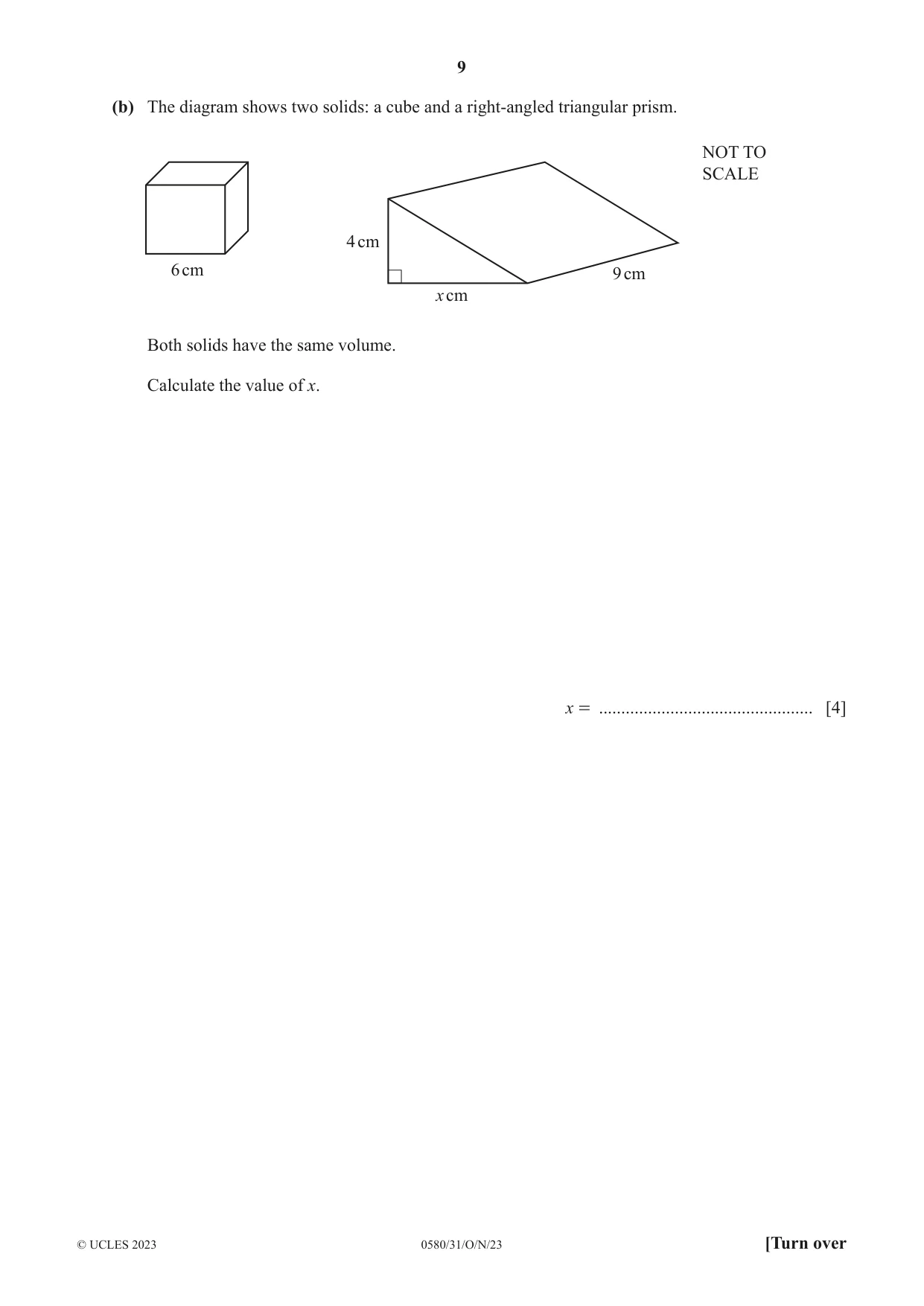
4 (a) The diagram shows a cuboid. NOT TO 2 cm SCALE 3 cm 5 cm (i) On the 1cm2 grid, complete the net of the cuboid. One face has been drawn for you. [3] (ii) Calculate the surface area of the cuboid. ......................................... cm2 [2] (b) The diagram shows two solids: a cube and a right-angled triangular prism. NOT TO SCALE 4 cm 6 cm 9 cm x cm Both solids have the same volume. Calculate the value of x. x = ................................................ [4]
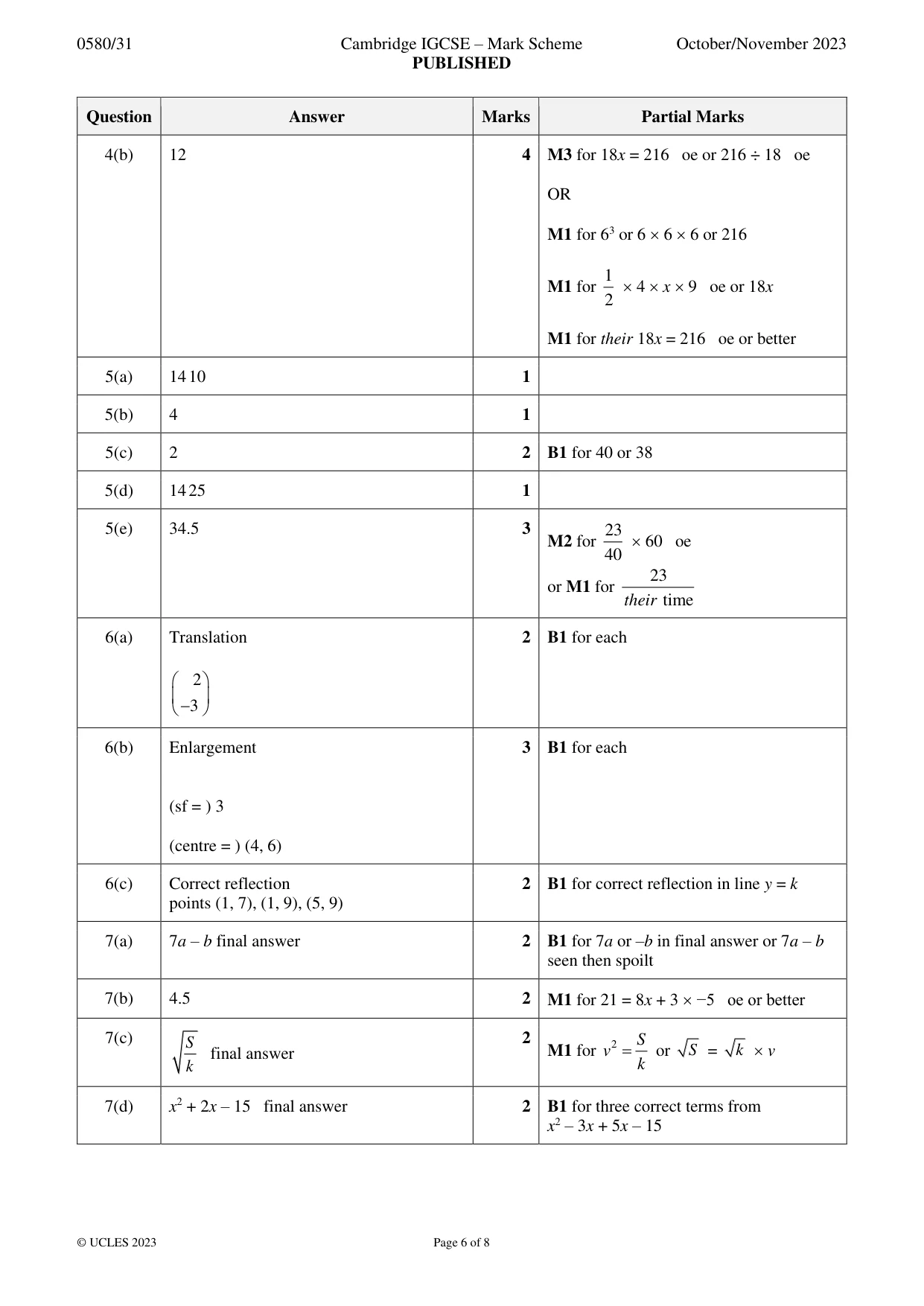
Mark scheme: 4(a)(i) Fully correct net 3 B2 for 3 or 4 extra correct faces in the correct places or B1 for 1 or 2 extra correct faces in the correct places 4(a)(ii) 62 2 M1 for [2 ] (5 2 + 3 2 + 5 3) oe 4(b) 12 4 M3 for 18x = 216 oe or 216 ÷ 18 oe OR M1 for 63 or 6 6 6 or 216 1 M1 for 4 x 9 oe or 18x 2 M1 for their 18x = 216 oe or better
Q5 · A railway line has three stations, Town, Port and Cove
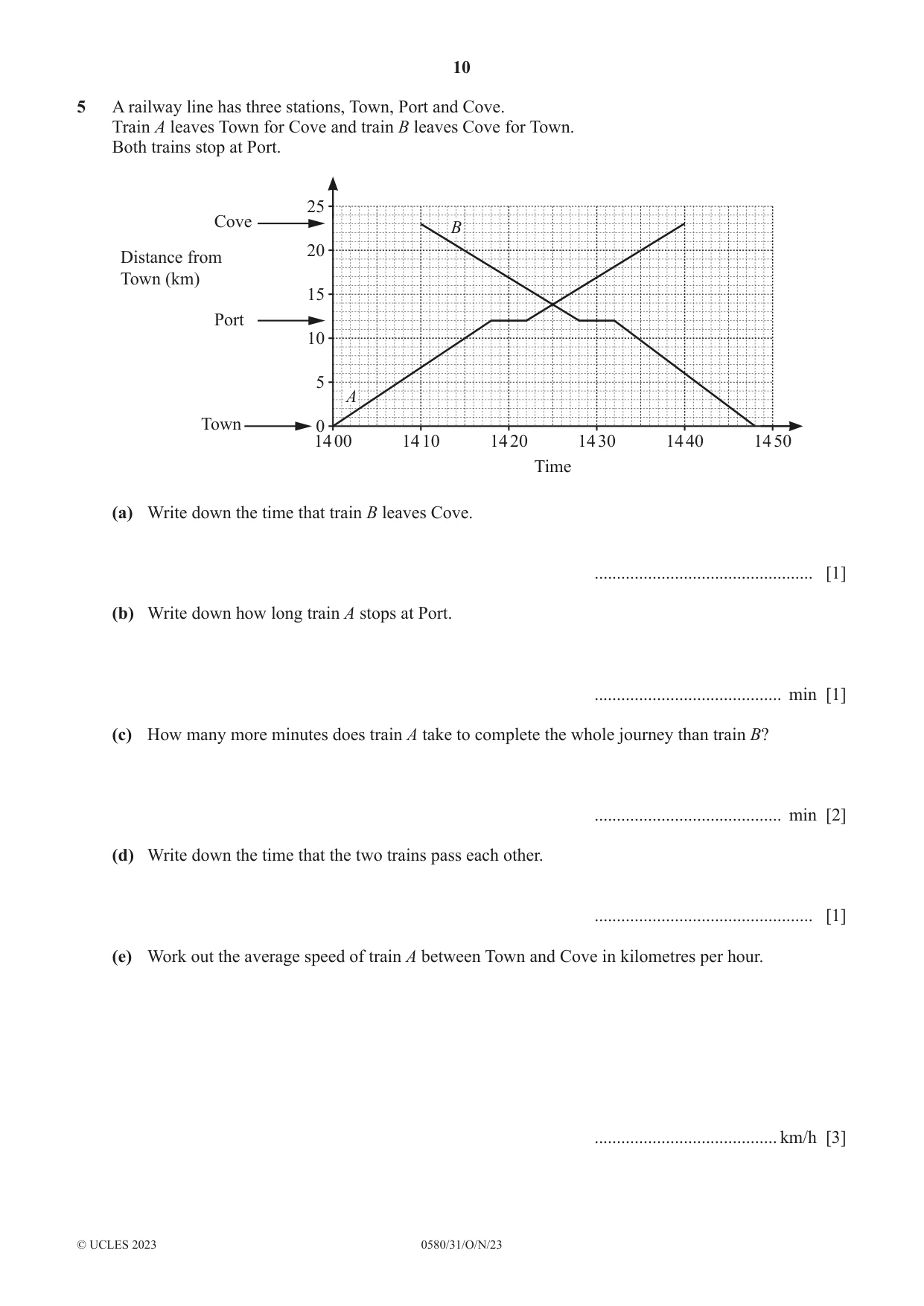
5 A railway line has three stations, Town, Port and Cove. Train A leaves Town for Cove and train B leaves Cove for Town. Both trains stop at Port. 25 Cove B 20 Distance from Town (km) 15 Port 10 5 A Town 0 14 00 14 10 14 20 14 30 14 40 14 50 Time (a) Write down the time that train B leaves Cove. ................................................. [1] (b) Write down how long train A stops at Port. .......................................... min [1] (c) How many more minutes does train A take to complete the whole journey than train B? .......................................... min [2] (d) Write down the time that the two trains pass each other. ................................................. [1] (e) Work out the average speed of train A between Town and Cove in kilometres per hour. ......................................... km/h [3]
Mark scheme: 5(a) 14 10 1 5(b) 4 1 5(c) 2 2 B1 for 40 or 38 5(d) 14 25 1 5(e) 34.5 3 23 M2 for 60 oe 40 23 or M1 for their time
Q6 · Y 10 9 8 7 6 5 4 A 3 2 1 B x - 8 - 7 - 6 - 5 - 4 - 3 - 2 - 1 0 1 2 3 4 5 6 7 8 - 1 C - 2…
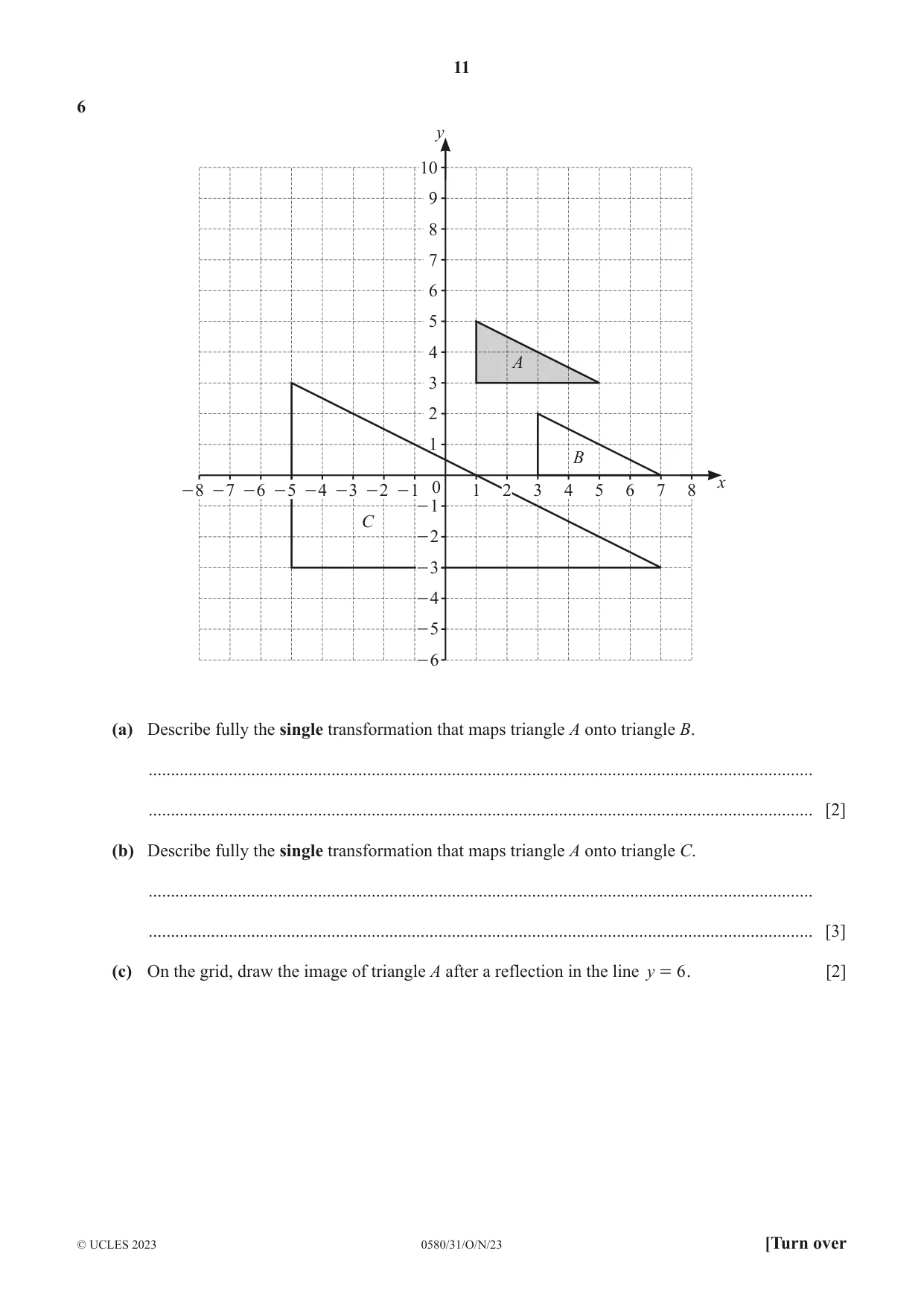
6 y 10 9 8 7 6 5 4 A 3 2 1 B x - 8 - 7 - 6 - 5 - 4 - 3 - 2 - 1 0 1 2 3 4 5 6 7 8 - 1 C - 2 - 3 - 4 - 5 - 6 (a) Describe fully the single transformation that maps triangle A onto triangle B. ..................................................................................................................................................... ..................................................................................................................................................... [2] (b) Describe fully the single transformation that maps triangle A onto triangle C. ..................................................................................................................................................... ..................................................................................................................................................... [3] (c) On the grid, draw the image of triangle A after a reflection in the line y = 6 . [2]
Mark scheme: 6(a) Translation 2 B1 for each 2 −3 6(b) Enlargement 3 B1 for each (sf = ) 3 (centre = ) (4, 6) 6(c) Correct reflection 2 B1 for correct reflection in line y = k points (1, 7), (1, 9), (5, 9)
Question 7
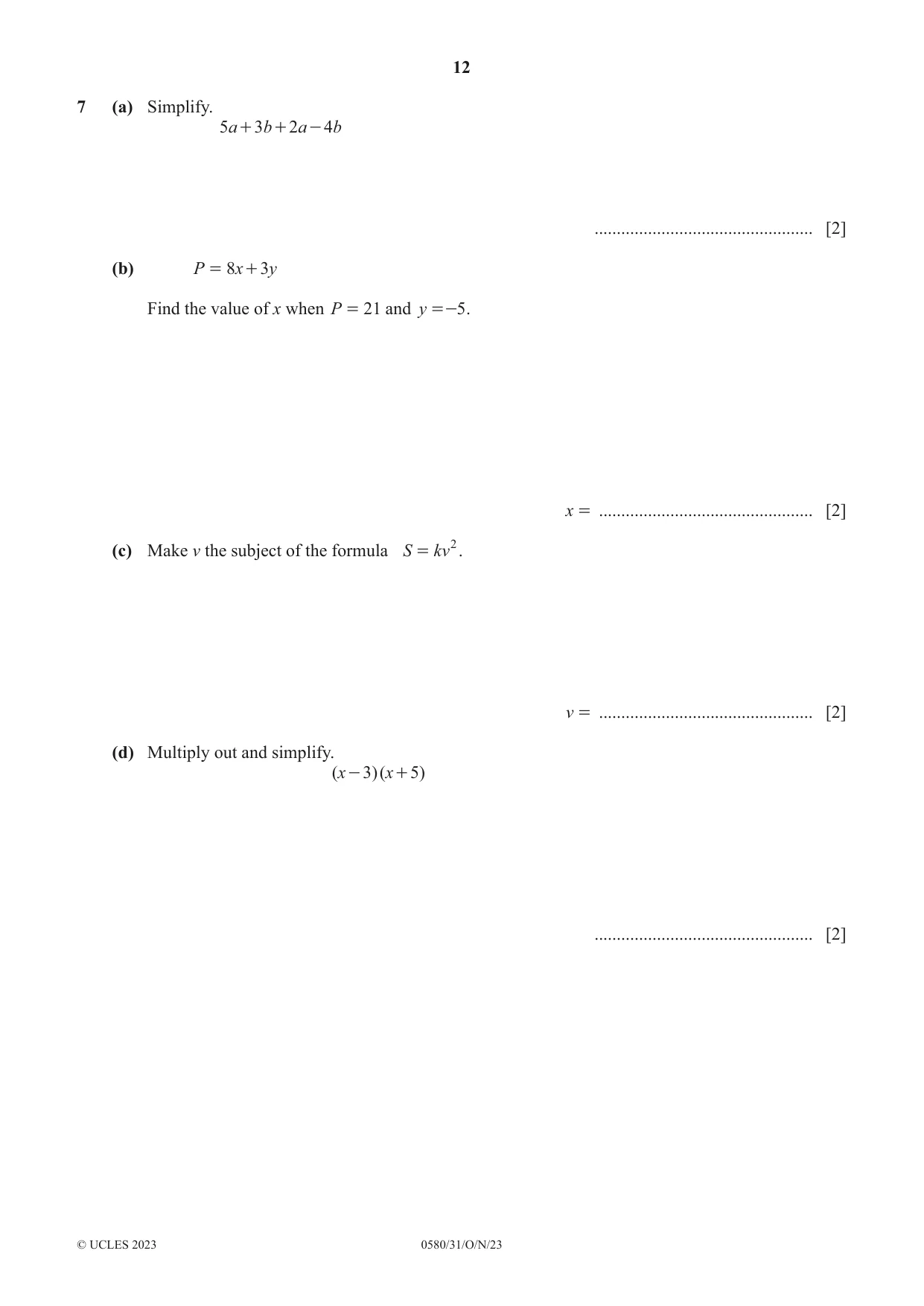
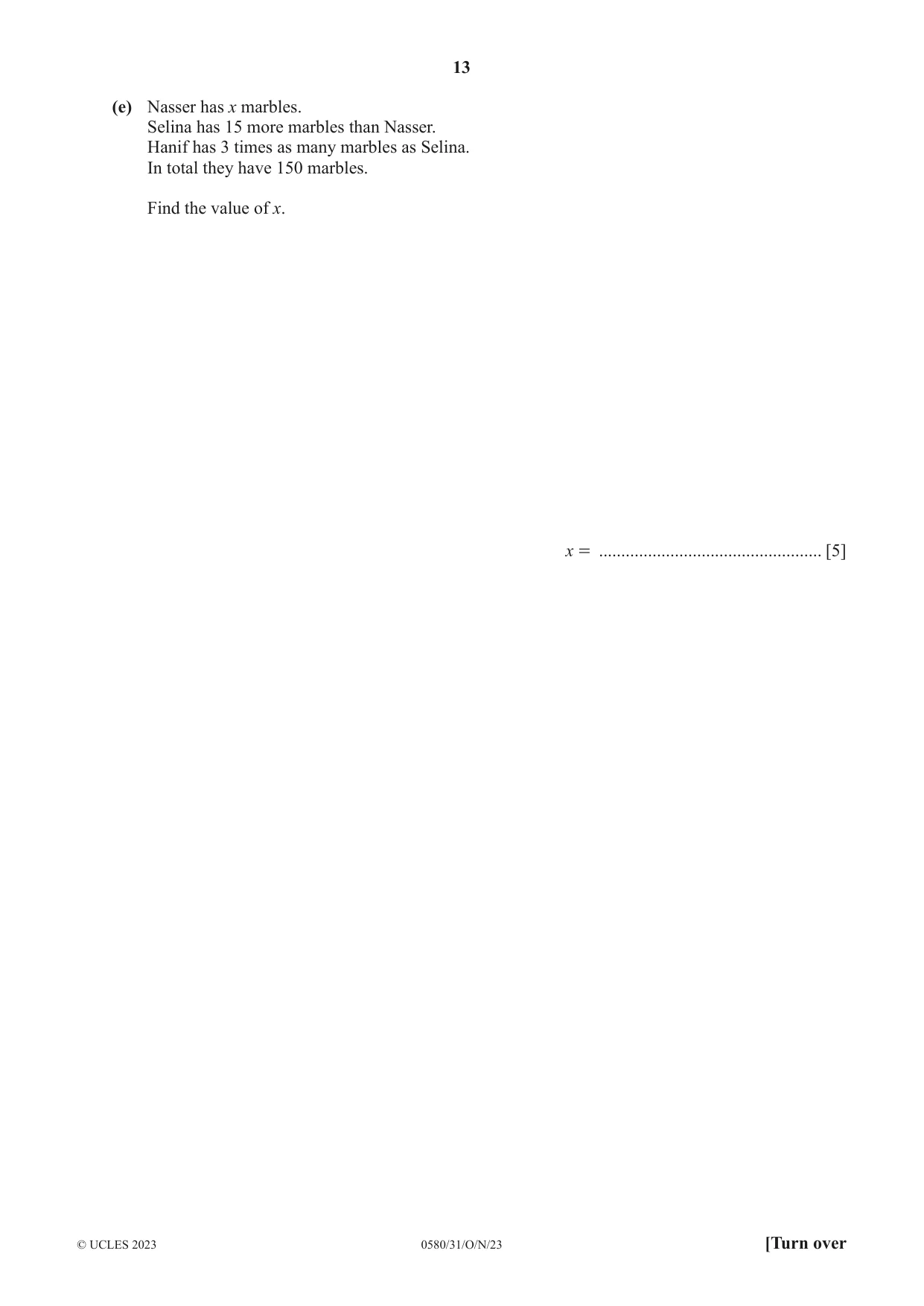
7 (a) Simplify. 5a + 3b + 2a - 4b ................................................. [2] (b) P = 8x + 3y Find the value of x when P = 21 and y =-5 . x = ................................................ [2] (c) Make v the subject of the formula S = kv2 . v = ................................................ [2] (d) Multiply out and simplify. ( x - 3)( x + 5) ................................................. [2] (e) Nasser has x marbles. Selina has 15 more marbles than Nasser. Hanif has 3 times as many marbles as Selina. In total they have 150 marbles. Find the value of x. x = .................................................. [5]
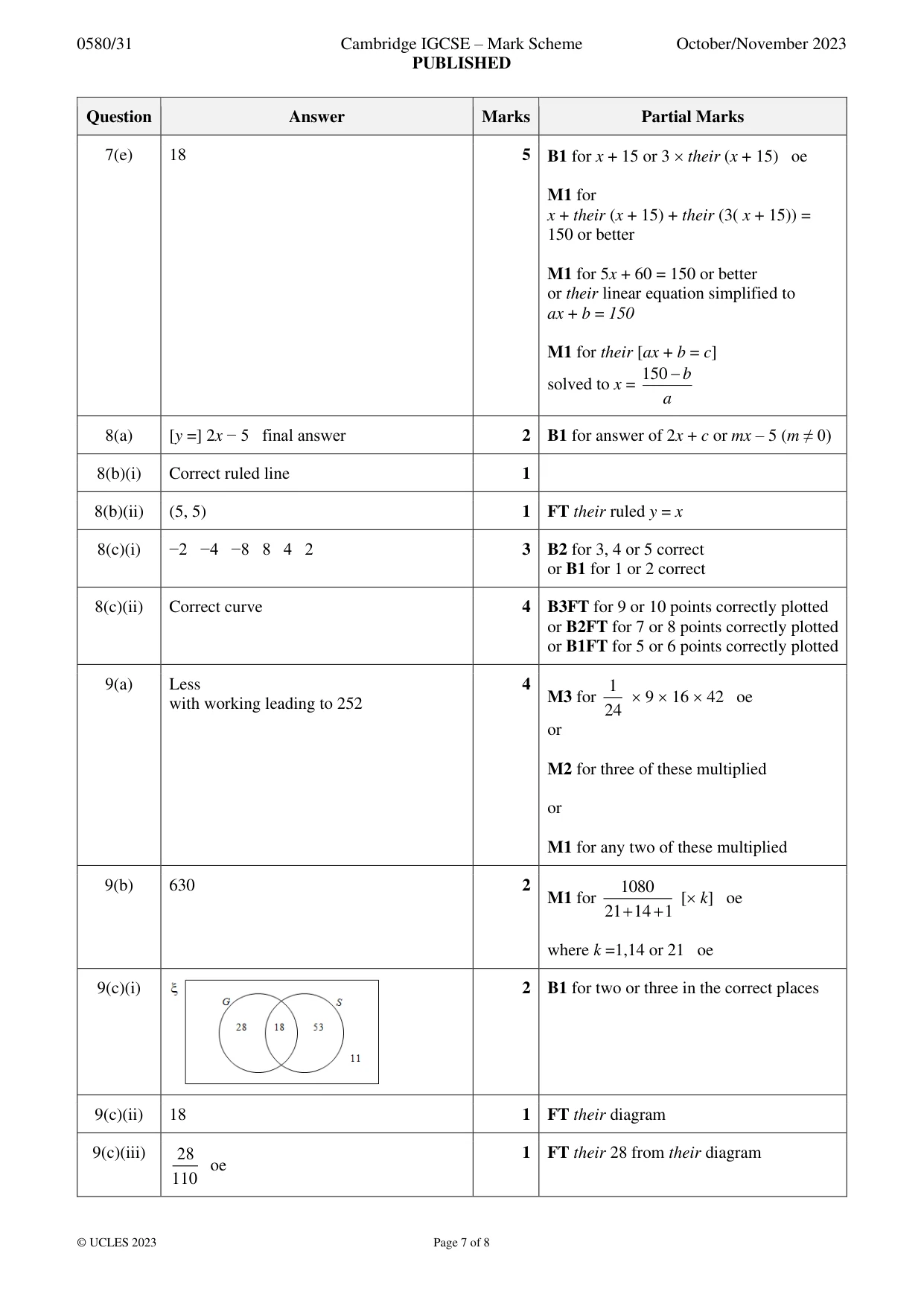
Mark scheme: 7(a) 7a – b final answer 2 B1 for 7a or –b in final answer or 7a – b seen then spoilt 7(b) 4.5 2 M1 for 21 = 8x + 3 −5 oe or better 7(c) S 2 2 S final answer M1 for v = or S = k v k k 7(d) x2 + 2x – 15 final answer 2 B1 for three correct terms from x2 – 3x + 5x – 15 7(e) 18 5 B1 for x + 15 or 3 their (x + 15) oe M1 for x + their (x + 15) + their (3( x + 15)) = 150 or better M1 for 5x + 60 = 150 or better or their linear equation simplified to ax + b = 150 M1 for their [ax + b = c] 150 − b solved to x = a
Q8 · Y L 6 5 4 3 2 1 x - 3 - 2 - 1 0 1 2 3 4 5 6 - 1 - 2 - 3 - 4 - 5 - 6 - 7 - 8 - 9 - 10 (a)…
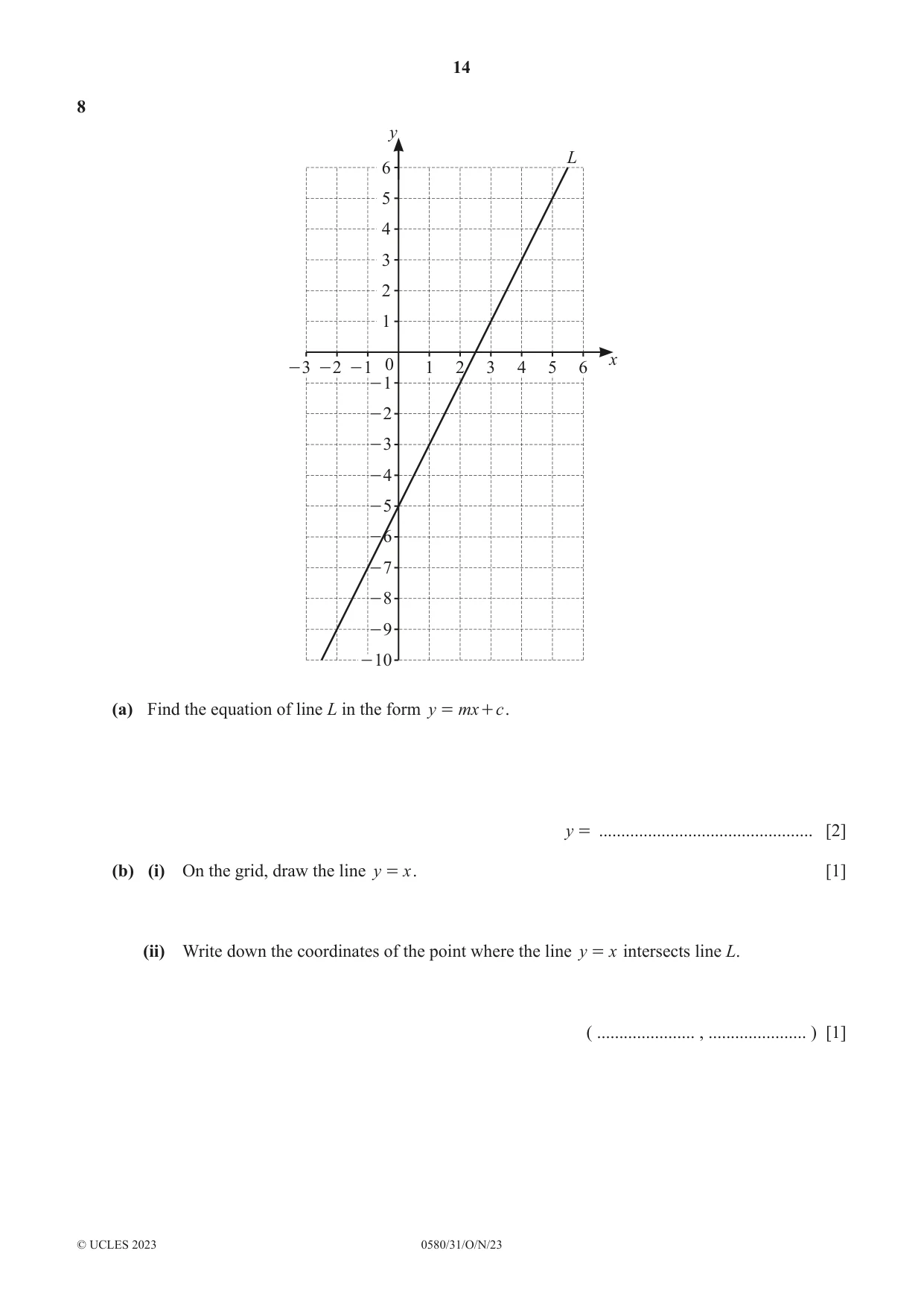
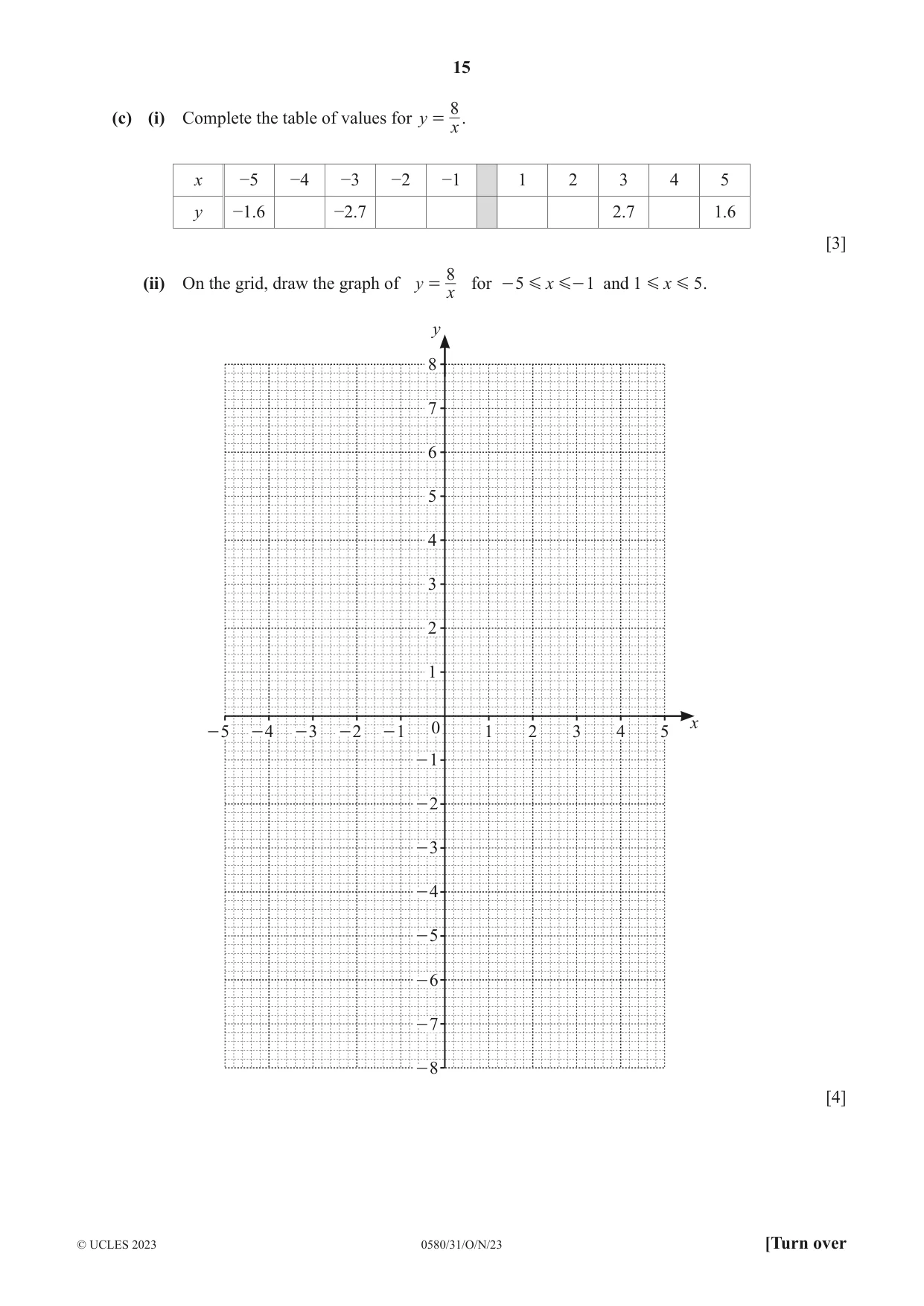
8 y L 6 5 4 3 2 1 x - 3 - 2 - 1 0 1 2 3 4 5 6 - 1 - 2 - 3 - 4 - 5 - 6 - 7 - 8 - 9 - 10 (a) Find the equation of line L in the form y = mx + c . y = ................................................ [2] (b) (i) On the grid, draw the line y = x . [1] (ii) Write down the coordinates of the point where the line y = x intersects line L. ( ...................... , ...................... ) [1] 8(c) (i) Complete the table of values for y = . x x −5 −4 −3 −2 −1 1 2 3 4 5 y −1.6 −2.7 2.7 1.6 [3] 8 (ii) On the grid, draw the graph of y = for - 5 G x G - 1 and 1 G x G 5 . x y 8 7 6 5 4 3 2 1 x - 5 - 4 - 3 - 2 - 1 0 1 2 3 4 5 - 1 - 2 - 3 - 4 - 5 - 6 - 7 - 8 [4]
Mark scheme: 8(a) [y =] 2x − 5 final answer 2 B1 for answer of 2x + c or mx – 5 (m ≠ 0) 8(b)(i) Correct ruled line 1 8(b)(ii) (5, 5) 1 FT their ruled y = x 8(c)(i) −2 −4 −8 8 4 2 3 B2 for 3, 4 or 5 correct or B1 for 1 or 2 correct 8(c)(ii) Correct curve 4 B3FT for 9 or 10 points correctly plotted or B2FT for 7 or 8 points correctly plotted or B1FT for 5 or 6 points correctly plotted
Q9 · Pure gold costs $42 per gram
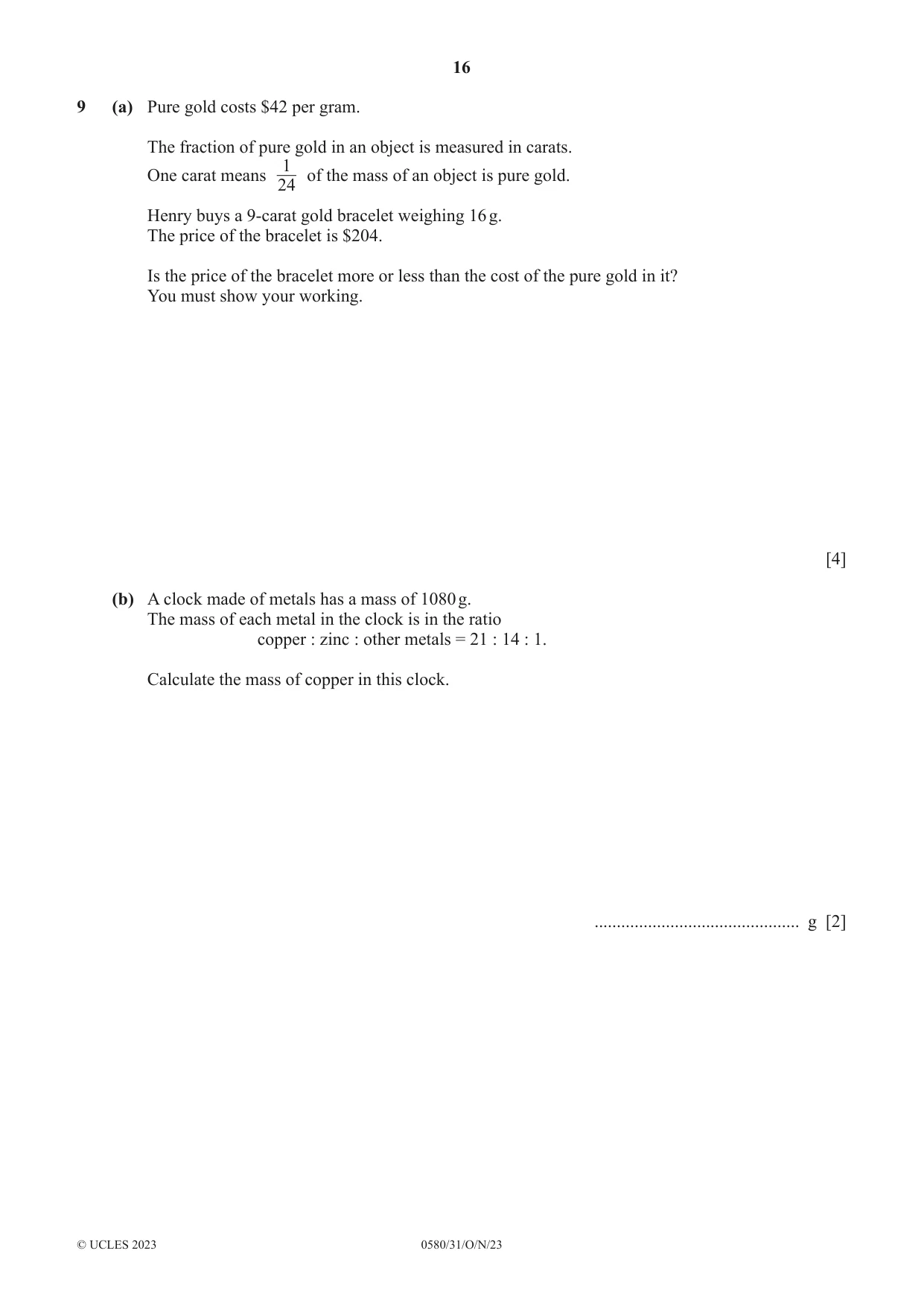
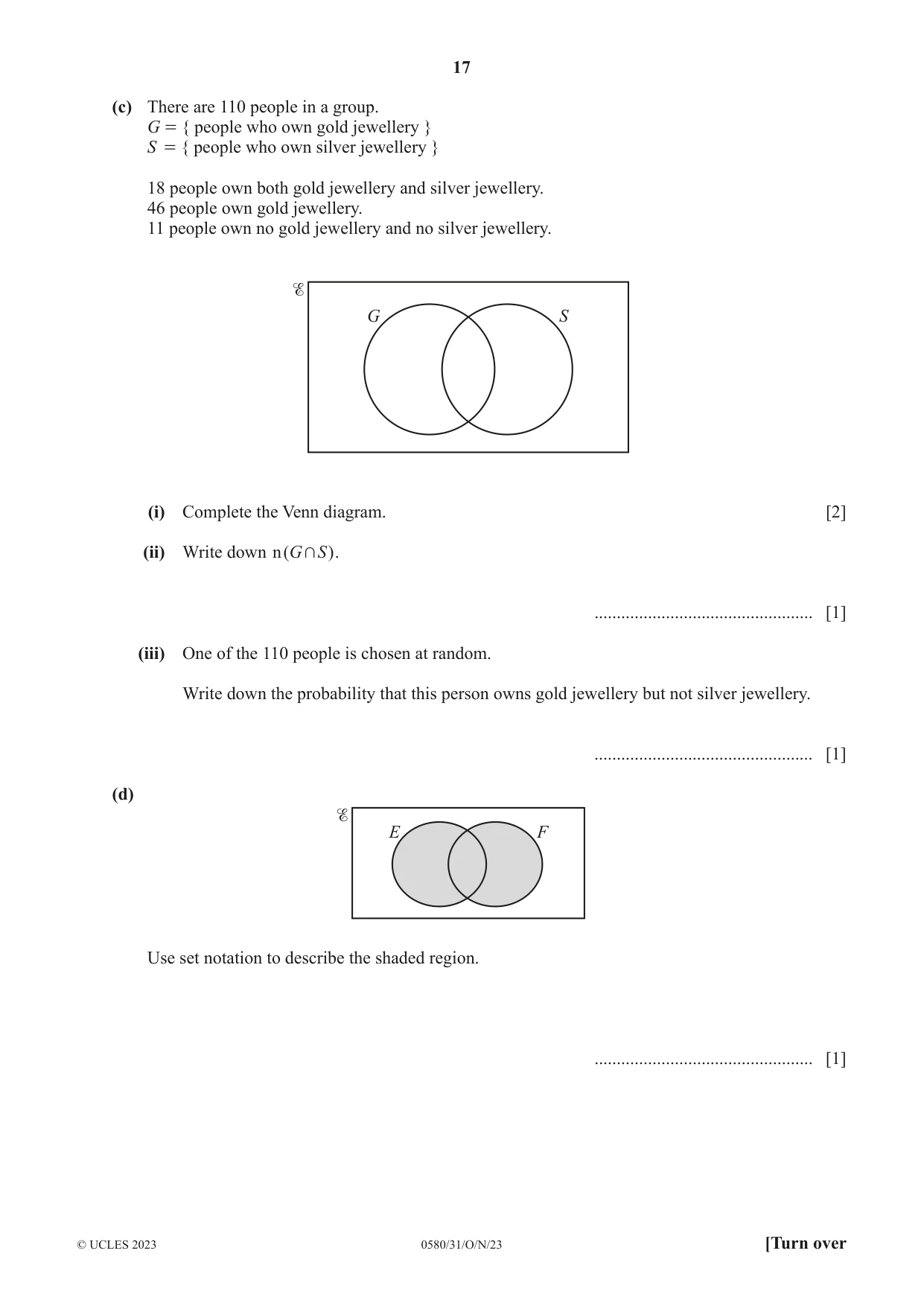
9 (a) Pure gold costs $42 per gram. The fraction of pure gold in an object is measured in carats. 1 One carat means of the mass of an object is pure gold. 24 Henry buys a 9-carat gold bracelet weighing 16 g. The price of the bracelet is $204. Is the price of the bracelet more or less than the cost of the pure gold in it? You must show your working. [4] (b) A clock made of metals has a mass of 1080 g. The mass of each metal in the clock is in the ratio copper : zinc : other metals = 21 : 14 : 1. Calculate the mass of copper in this clock. .............................................. g [2] (c) There are 110 people in a group. G = { people who own gold jewellery } S = { people who own silver jewellery } 18 people own both gold jewellery and silver jewellery. 46 people own gold jewellery. 11 people own no gold jewellery and no silver jewellery. G S (i) Complete the Venn diagram. [2] (ii) Write down n ( G + S ) . ................................................. [1] (iii) One of the 110 people is chosen at random. Write down the probability that this person owns gold jewellery but not silver jewellery. ................................................. [1] (d) E F Use set notation to describe the shaded region. ................................................. [1]
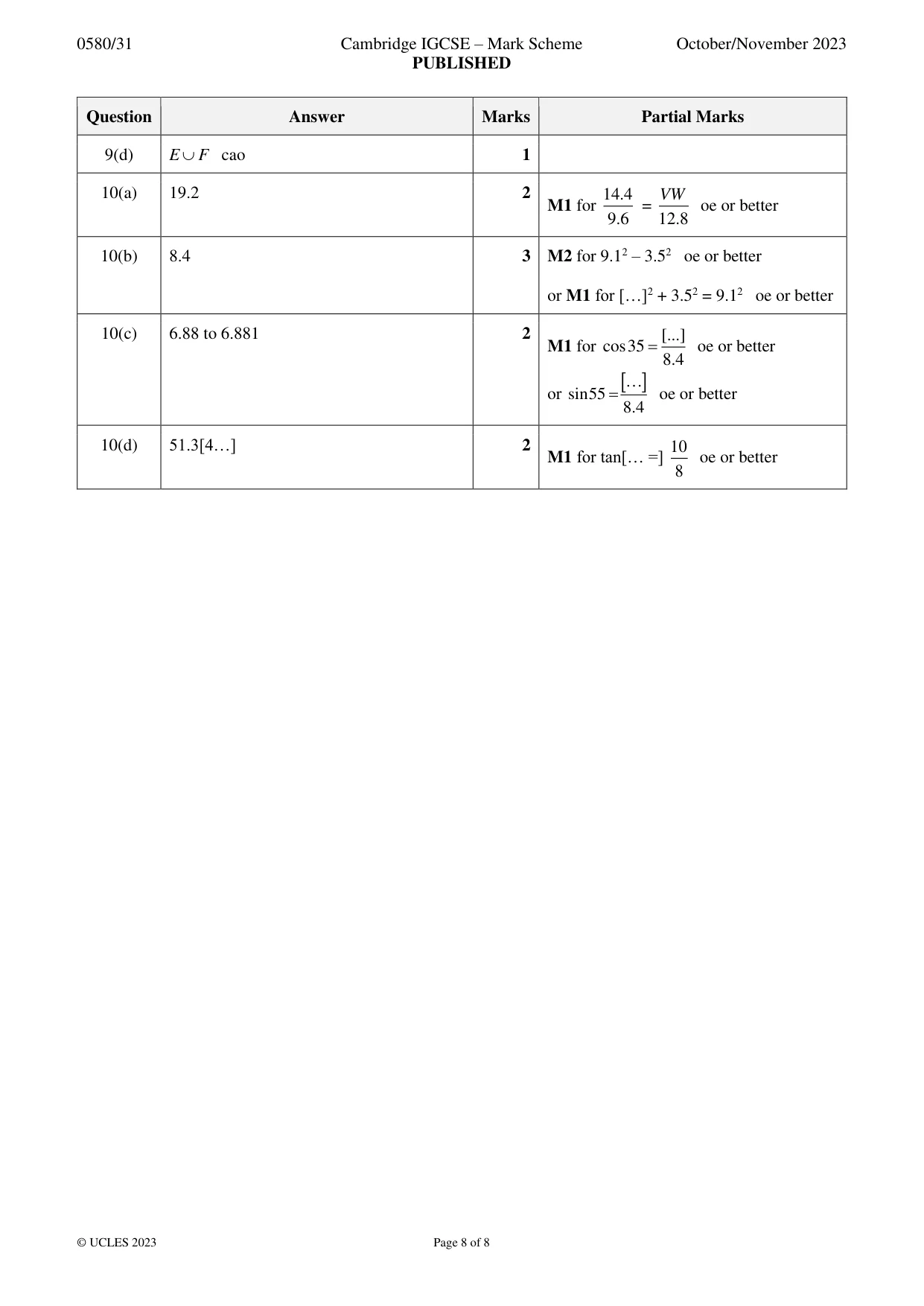
Mark scheme: 9(a) Less 4 1 M3 for 9 16 42 oe with working leading to 252 24 or M2 for three of these multiplied or M1 for any two of these multiplied 9(b) 630 2 1080 M1 for [ k] oe 21 + 14 + 1 where k =1,14 or 21 oe 9(c)(i) 2 B1 for two or three in the correct places 9(c)(ii) 18 1 FT their diagram 9(c)(iii) 28 1 FT their 28 from their diagram oe 110 9(d) E F cao 1
Q10 · U P 21.4 cm 14.4 cm NOT TO 9.6 cm SCALE Q R V W 12.8 cm Triangle PQR is mathematically…
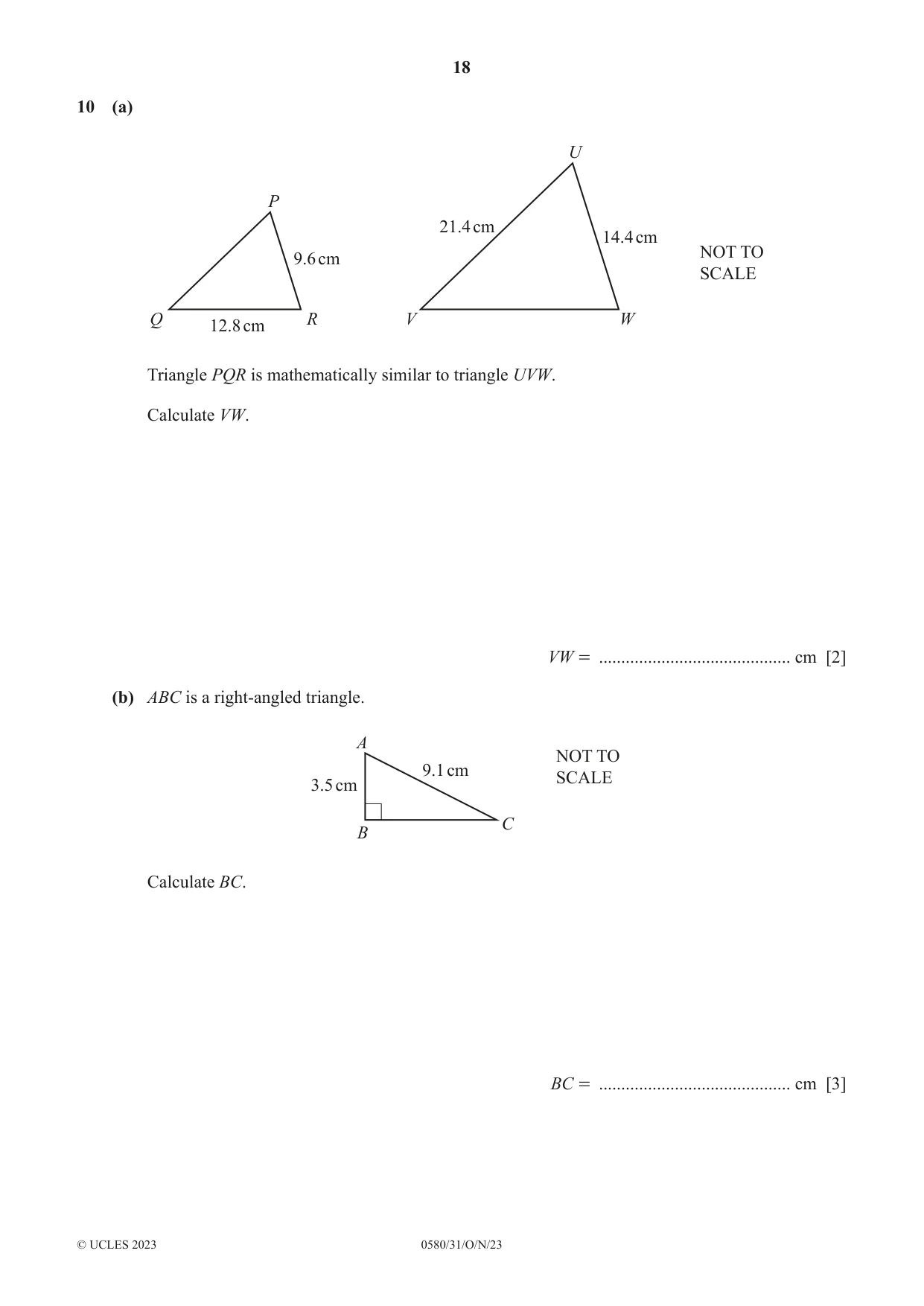
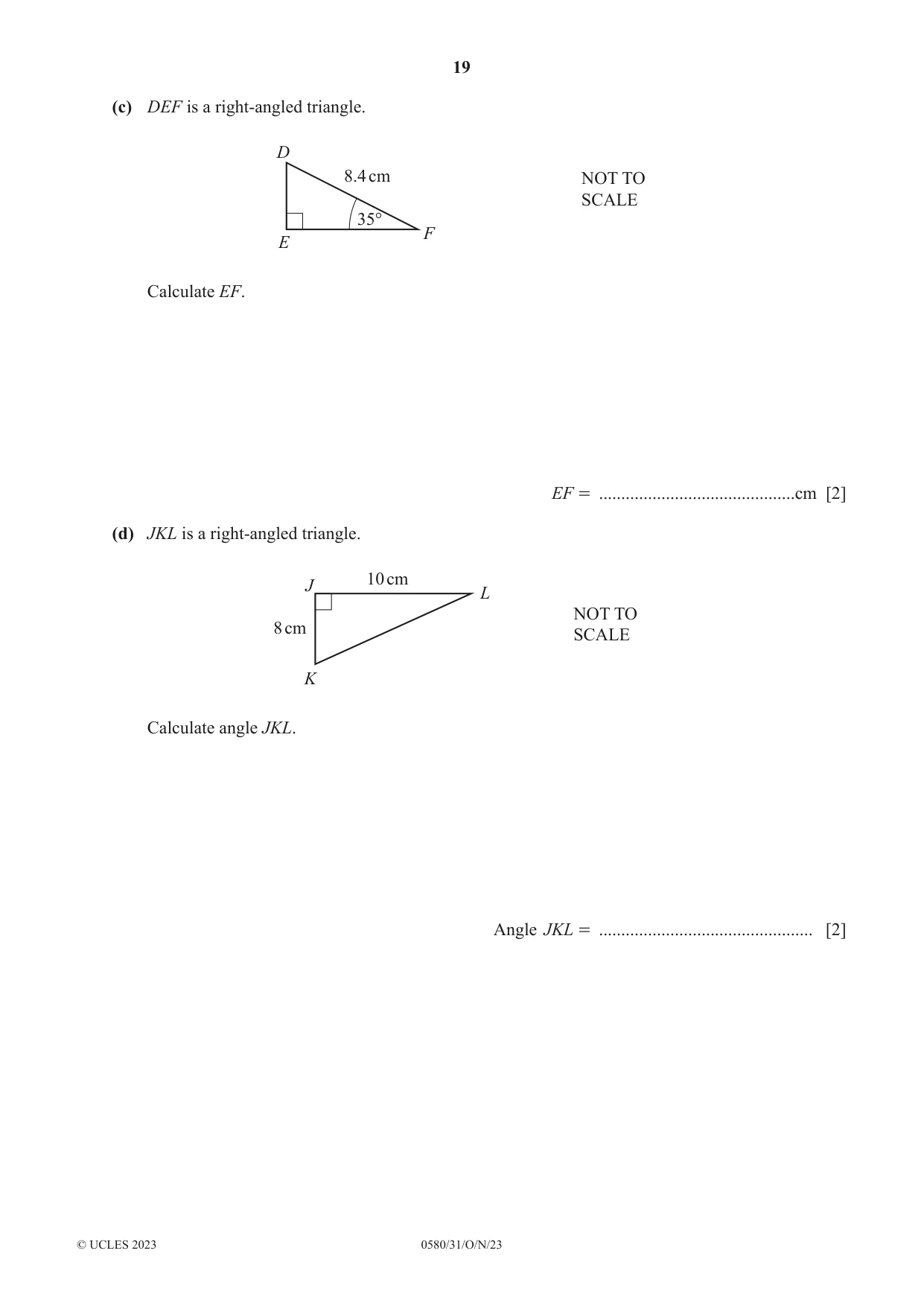
10 (a) U P 21.4 cm 14.4 cm NOT TO 9.6 cm SCALE Q R V W 12.8 cm Triangle PQR is mathematically similar to triangle UVW. Calculate VW. VW = ........................................... cm [2] (b) ABC is a right-angled triangle. A NOT TO 9.1 cm SCALE 3.5 cm C B Calculate BC. BC = ........................................... cm [3] (c) DEF is a right-angled triangle. D 8.4 cm NOT TO SCALE 35° F E Calculate EF. EF = ............................................cm [2] (d) JKL is a right-angled triangle. 10 cm J L NOT TO 8 cm SCALE K Calculate angle JKL. Angle JKL = ................................................ [2]
Mark scheme: 10(a) 19.2 2 14.4 VW M1 for = oe or better 9.6 12.8 10(b) 8.4 3 M2 for 9.12 – 3.52 oe or better or M1 for […]2 + 3.52 = 9.12 oe or better 10(c) 6.88 to 6.881 2 [...] M1 for cos35 = oe or better 8.4 or sin 55 = oe or better 8.4 10(d) 51.3[4…] 2 10 M1 for tan[… =] oe or better 8
What was in this paper
The subtopics covered by these 10 questions, and how many questions each got. Open one in a new tab to see every Cambridge question on it.
What you needed in this session
Cambridge’s own grade thresholds for 2023 Oct/Nov, Paper 3 · Variant 1. A higher threshold means an easier paper — the bar moves with how the cohort did.