Cambridge IGCSE Mathematics 0580 — 2023 May/June Paper 3 · Variant 2
0580/32/M/J/23 · 9 questions · 104 marks · ≈117 min
The question paper and its mark scheme, free to read here and free to download. This is Cambridge’s own paper, exactly as it was sat.
Question paper20 pages
Mark scheme7 pages
Answers below. Sit the paper first if you are practising.
Questions as text
Q1 · Write the number three hundred thousand and three in figures
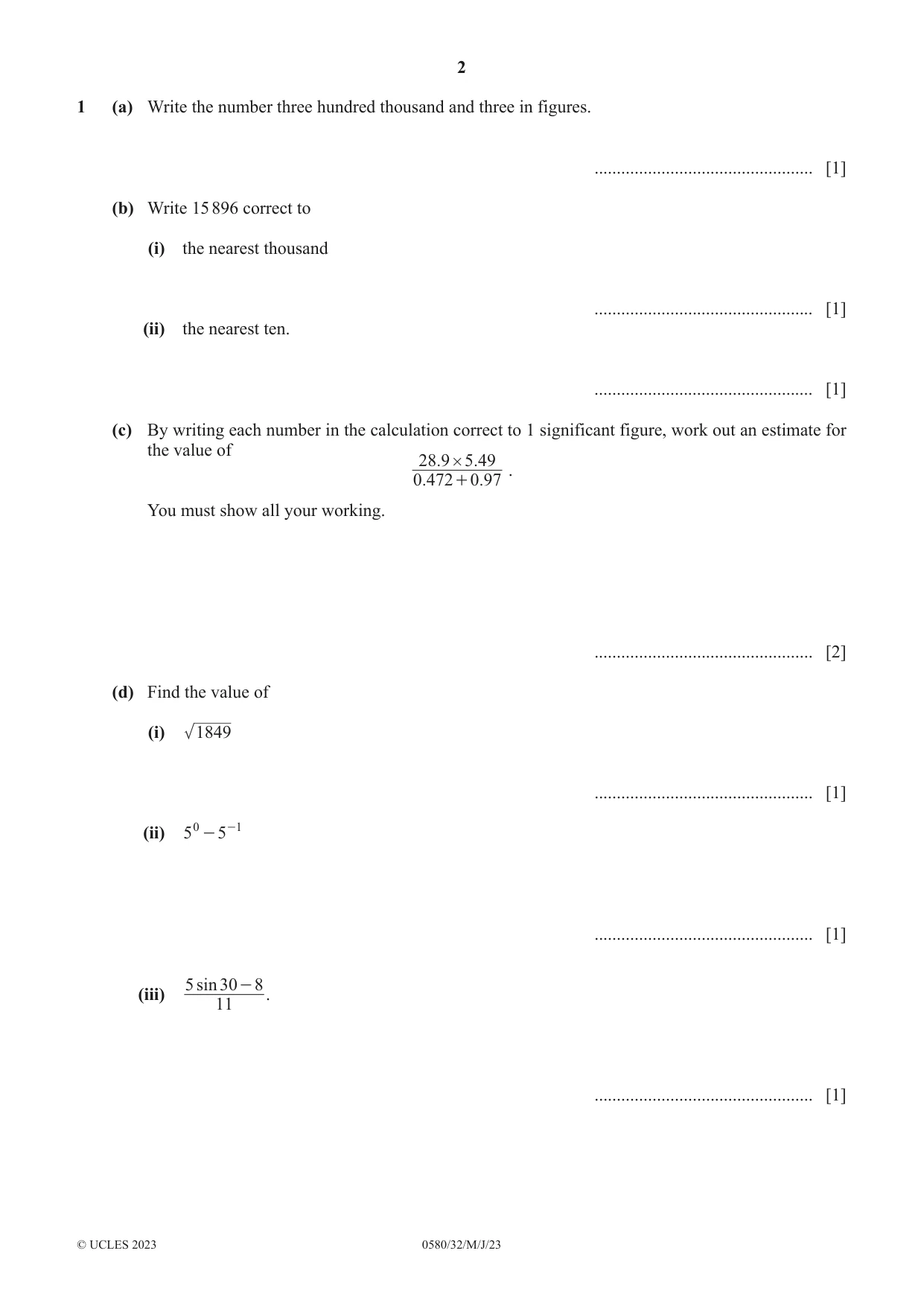
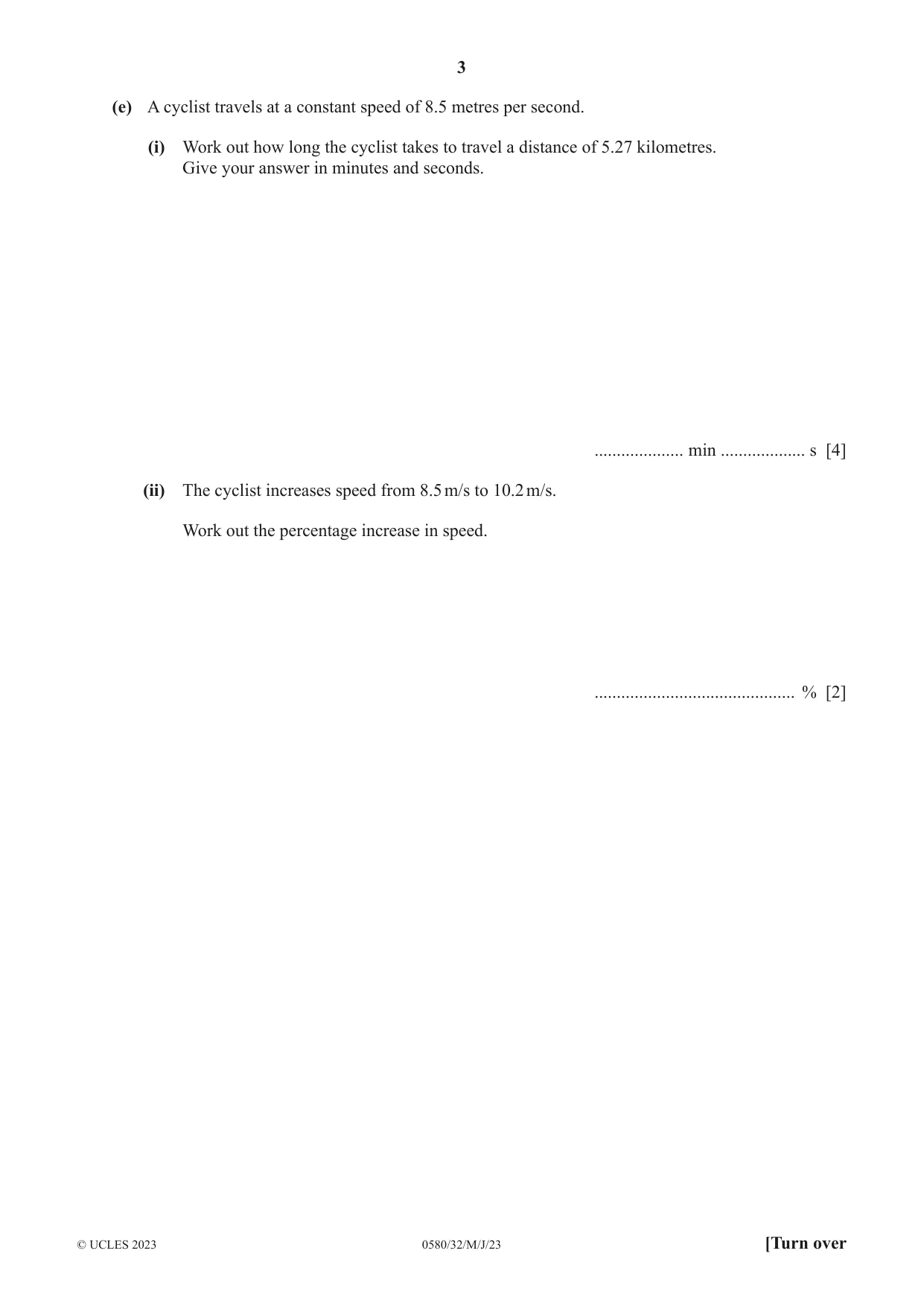
1 (a) Write the number three hundred thousand and three in figures. ................................................. [1] (b) Write 15 896 correct to (i) the nearest thousand ................................................. [1] (ii) the nearest ten. ................................................. [1] (c) By writing each number in the calculation correct to 1 significant figure, work out an estimate for the value of 28.9 # 5.49 . 0.472 + 0.97 You must show all your working. ................................................. [2] (d) Find the value of (i) 1849 ................................................. [1] (ii) 5 0 - 5 -1 ................................................. [1] 5 sin 30 - 8 (iii) . 11 ................................................. [1] (e) A cyclist travels at a constant speed of 8.5 metres per second. (i) Work out how long the cyclist takes to travel a distance of 5.27 kilometres. Give your answer in minutes and seconds. .................... min ................... s [4] (ii) The cyclist increases speed from 8.5 m/s to 10.2 m/s. Work out the percentage increase in speed. ............................................. % [2]
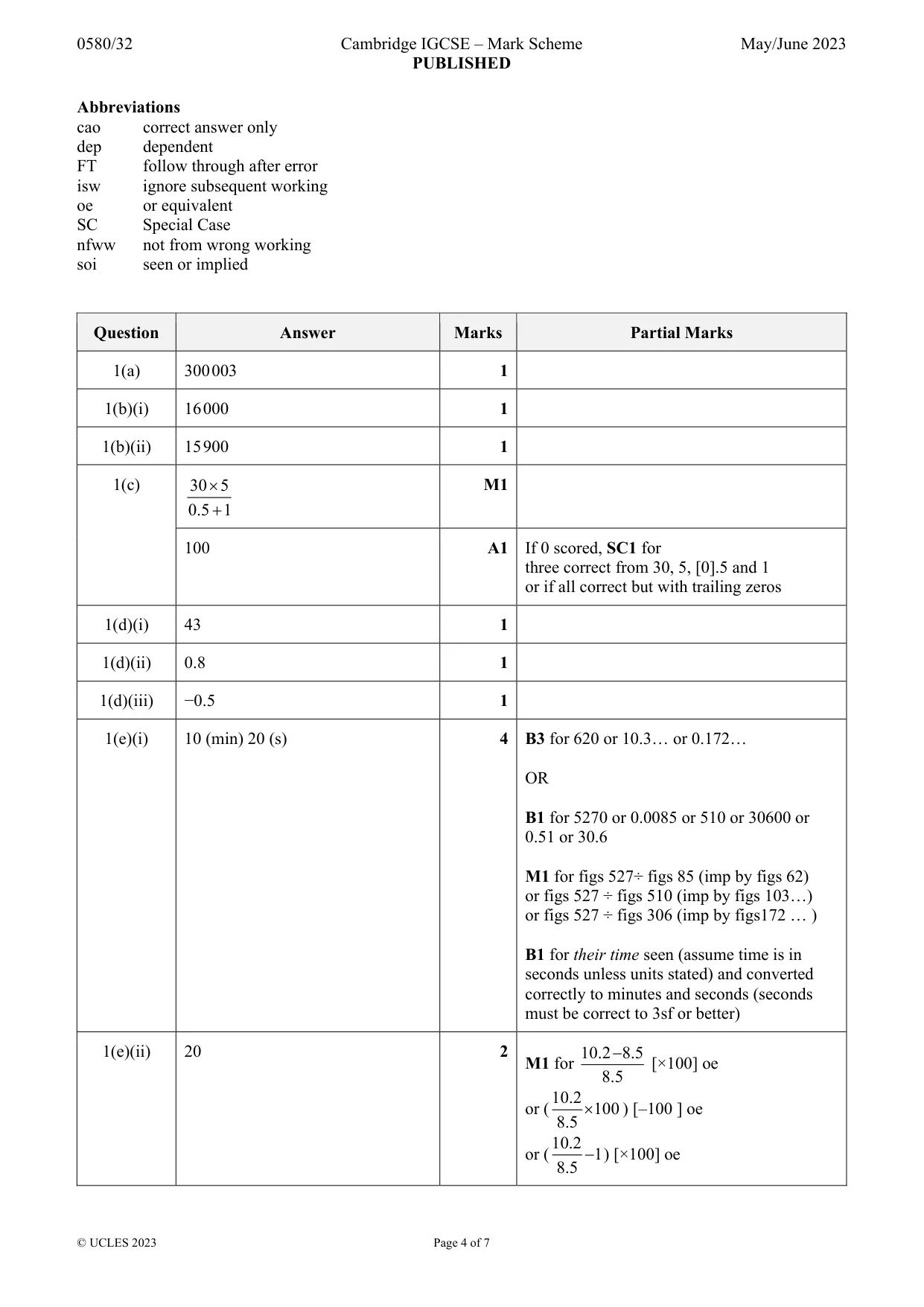
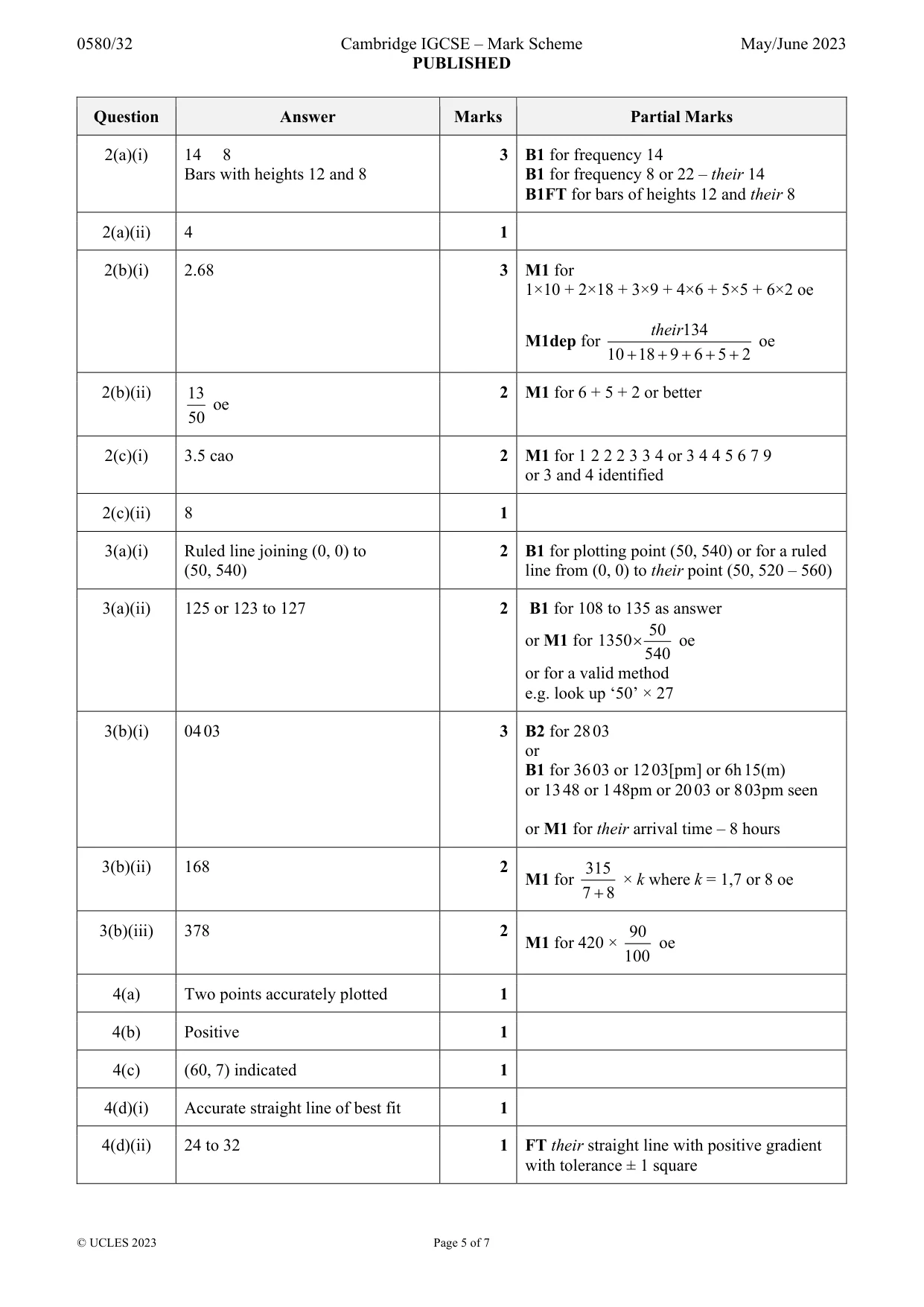
Mark scheme: Question Answer Marks Partial Marks 1(a) 300 003 1 1(b)(i) 16 000 1 1(b)(ii) 15 900 1 1(c) 30 5 M1 0.5 1 100 A1 If 0 scored, SC1 for three correct from 30, 5, [0].5 and 1 or if all correct but with trailing zeros 1(d)(i) 43 1 1(d)(ii) 0.8 1 1(d)(iii) −0.5 1 1(e)(i) 10 (min) 20 (s) 4 B3 for 620 or 10.3… or 0.172… OR B1 for 5270 or 0.0085 or 510 or 30600 or 0.51 or 30.6 M1 for figs 527÷ figs 85 (imp by figs 62) or figs 527 ÷ figs 510 (imp by figs 103…) or figs 527 ÷ figs 306 (imp by figs172 … ) B1 for their time seen (assume time is in seconds unless units stated) and converted correctly to minutes and seconds (seconds must be correct to 3sf or better) 1(e)(ii) 20 2 10.2 8.5 M1 for [×100] oe 8.5 or (10.2 100 ) [–100 ] oe 8.5 or (10.2 )1 [×100] oe 8.5
Q2 · Mika counts the number of letters in each of the 61 words in a paragraph
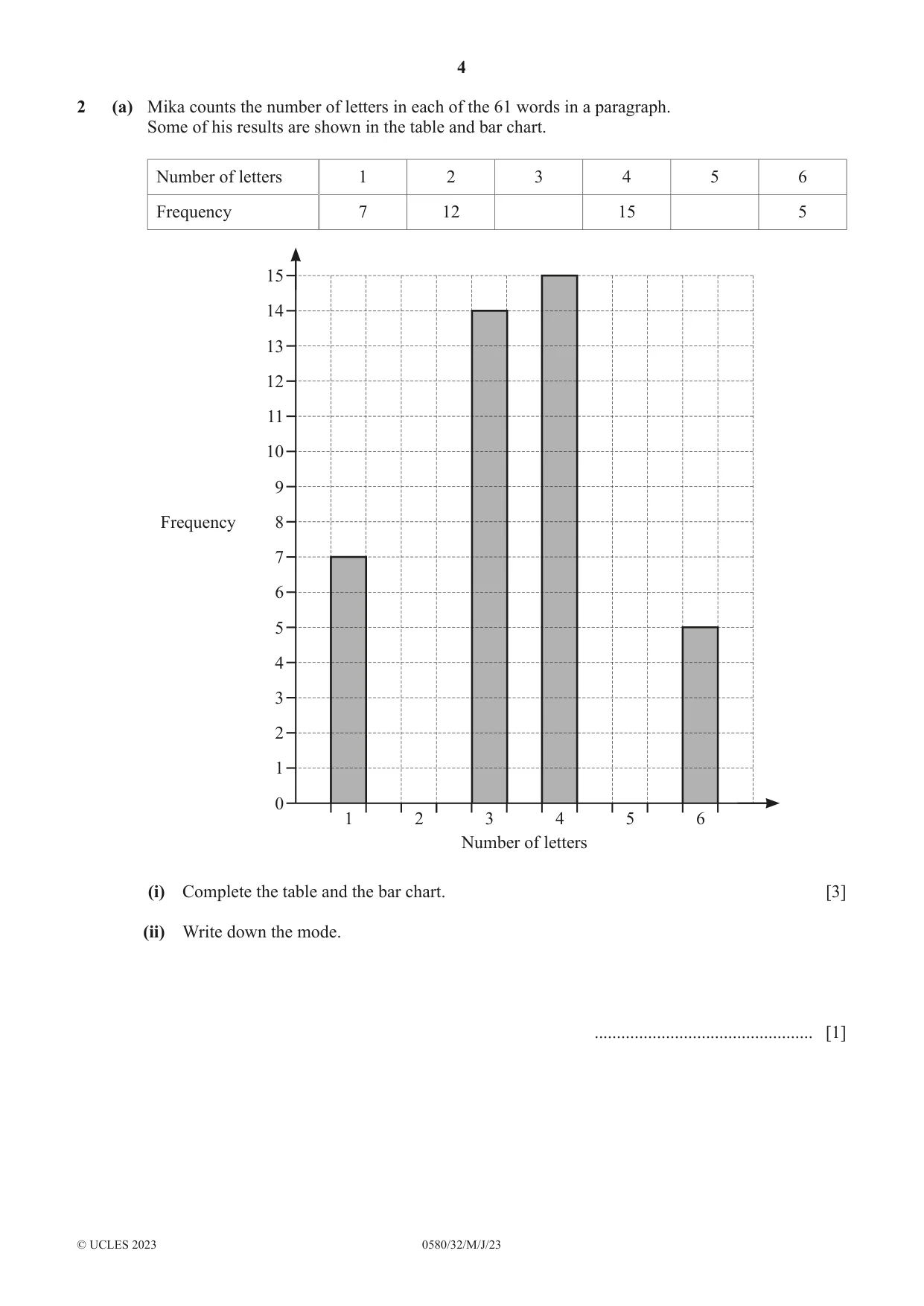
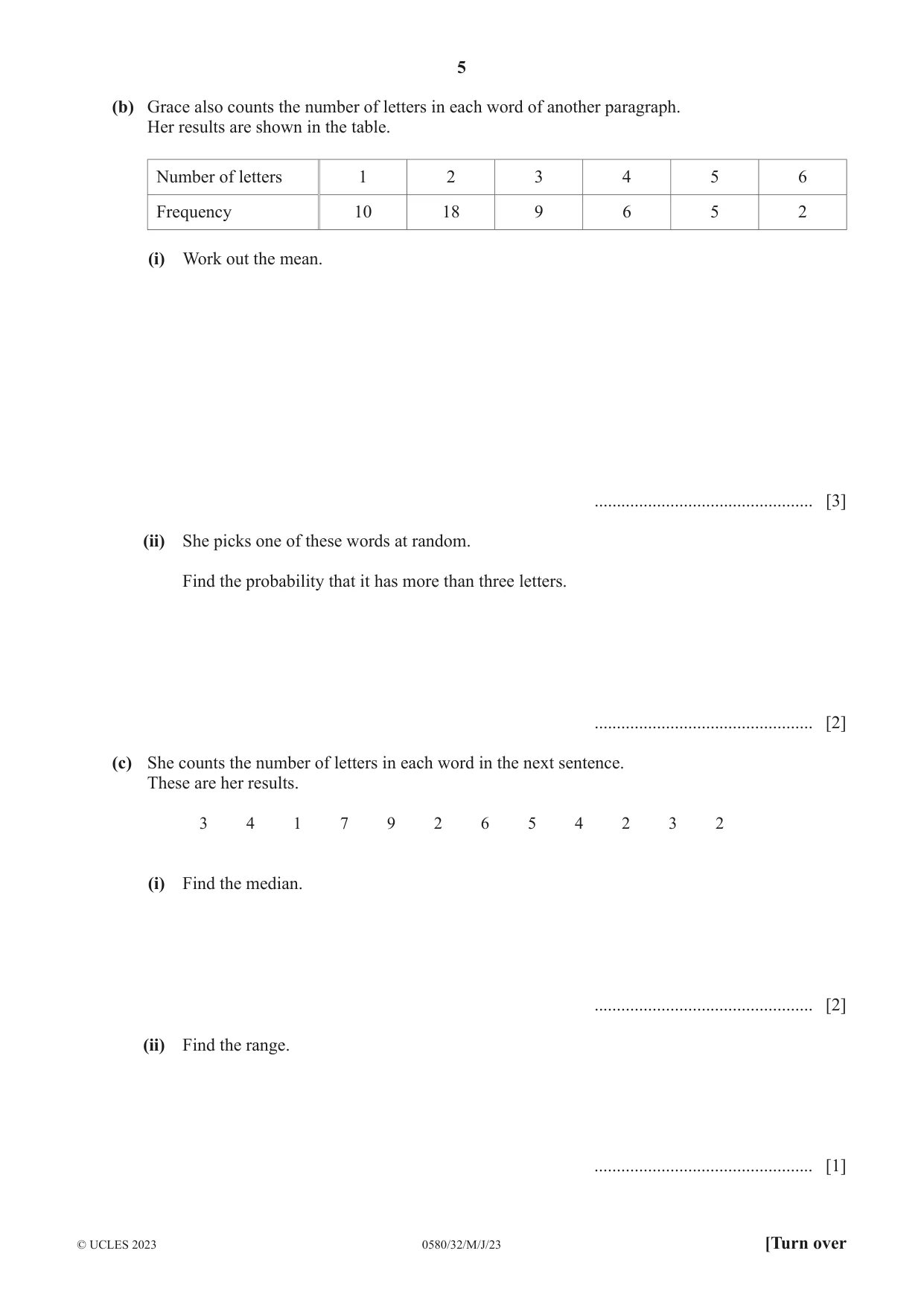
2 (a) Mika counts the number of letters in each of the 61 words in a paragraph. Some of his results are shown in the table and bar chart. Number of letters 1 2 3 4 5 6 Frequency 7 12 15 5 15 14 13 12 11 10 9 Frequency 8 7 6 5 4 3 2 1 0 1 2 3 4 5 6 Number of letters (i) Complete the table and the bar chart. [3] (ii) Write down the mode. ................................................. [1] (b) Grace also counts the number of letters in each word of another paragraph. Her results are shown in the table. Number of letters 1 2 3 4 5 6 Frequency 10 18 9 6 5 2 (i) Work out the mean. ................................................. [3] (ii) She picks one of these words at random. Find the probability that it has more than three letters. ................................................. [2] (c) She counts the number of letters in each word in the next sentence. These are her results. 3 4 1 7 9 2 6 5 4 2 3 2 (i) Find the median. ................................................. [2] (ii) Find the range. ................................................. [1]
Mark scheme: 2(a)(i) 14 8 3 B1 for frequency 14 Bars with heights 12 and 8 B1 for frequency 8 or 22 – their 14 B1FT for bars of heights 12 and their 8 2(a)(ii) 4 1 2(b)(i) 2.68 3 M1 for 1×10 + 2×18 + 3×9 + 4×6 + 5×5 + 6×2 oe their134 M1dep for oe 10 18 9 6 5 2 2(b)(ii) 13 2 M1 for 6 + 5 + 2 or better oe 50 2(c)(i) 3.5 cao 2 M1 for 1 2 2 2 3 3 4 or 3 4 4 5 6 7 9 or 3 and 4 identified 2(c)(ii) 8 1
Q3 · 50 Australian dollars = 540 South African rands 600 550 500 450 400 350 South African 300…
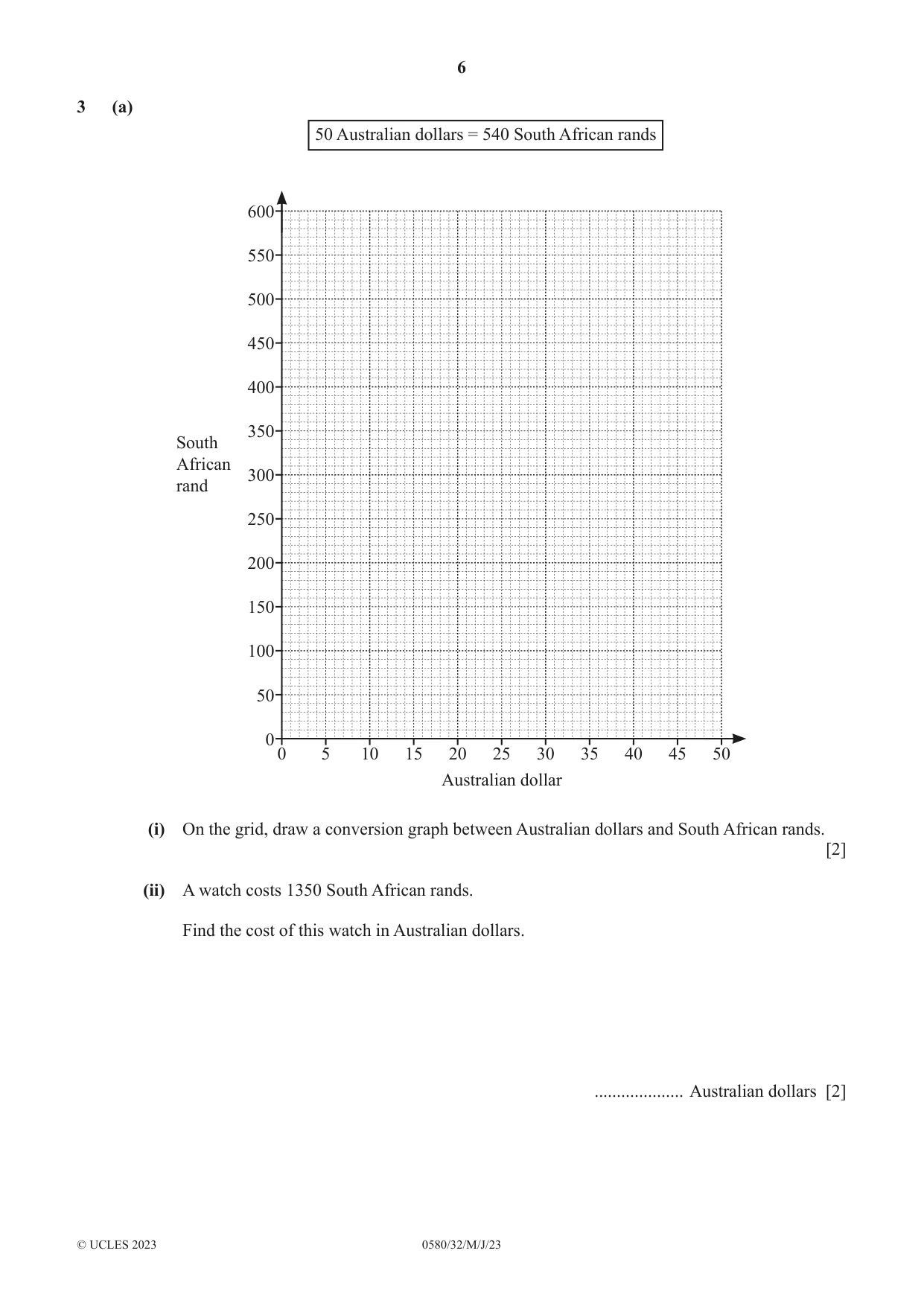
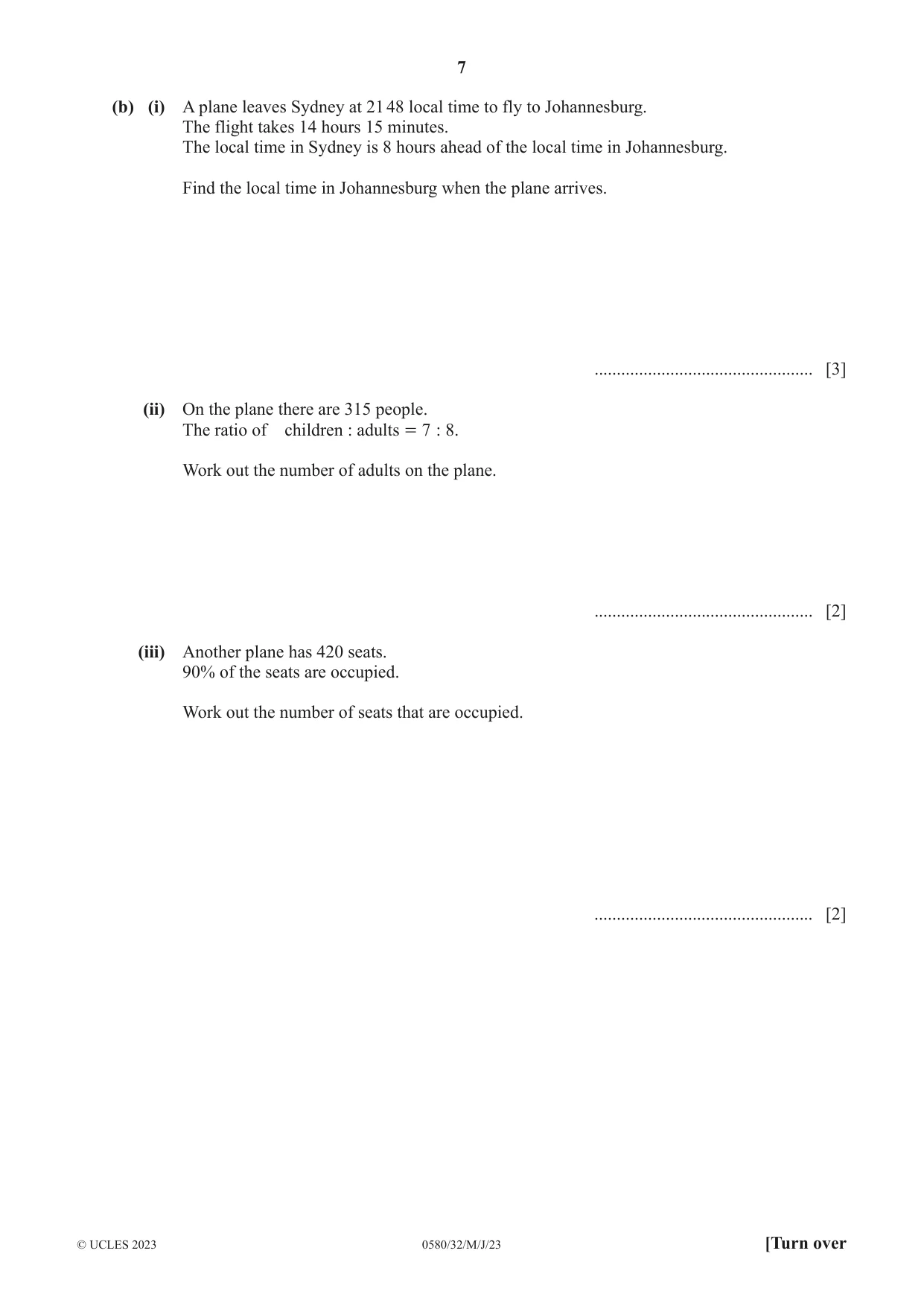
3 (a) 50 Australian dollars = 540 South African rands 600 550 500 450 400 350 South African 300 rand 250 200 150 100 50 0 0 5 10 15 20 25 30 35 40 45 50 Australian dollar (i) On the grid, draw a conversion graph between Australian dollars and South African rands. [2] (ii) A watch costs 1350 South African rands. Find the cost of this watch in Australian dollars. .................... Australian dollars [2] (b) (i) A plane leaves Sydney at 21 48 local time to fly to Johannesburg. The flight takes 14 hours 15 minutes. The local time in Sydney is 8 hours ahead of the local time in Johannesburg. Find the local time in Johannesburg when the plane arrives. ................................................. [3] (ii) On the plane there are 315 people. The ratio of children : adults = 7 : 8. Work out the number of adults on the plane. ................................................. [2] (iii) Another plane has 420 seats. 90% of the seats are occupied. Work out the number of seats that are occupied. ................................................. [2]
Mark scheme: 3(a)(i) Ruled line joining (0, 0) to 2 B1 for plotting point (50, 540) or for a ruled (50, 540) line from (0, 0) to their point (50, 520 – 560) 3(a)(ii) 125 or 123 to 127 2 B1 for 108 to 135 as answer 50 or M1 for 1350 oe 540 or for a valid method e.g. look up ‘50’ × 27 3(b)(i) 04 03 3 B2 for 28 03 or B1 for 36 03 or 12 03[pm] or 6h 15(m) or 13 48 or 1 48pm or 20 03 or 8 03pm seen or M1 for their arrival time – 8 hours 3(b)(ii) 168 2 315 M1 for × k where k = 1,7 or 8 oe 7 8 3(b)(iii) 378 2 90 M1 for 420 × oe 100
Q4 · Fidel gives different amounts of water to some plants
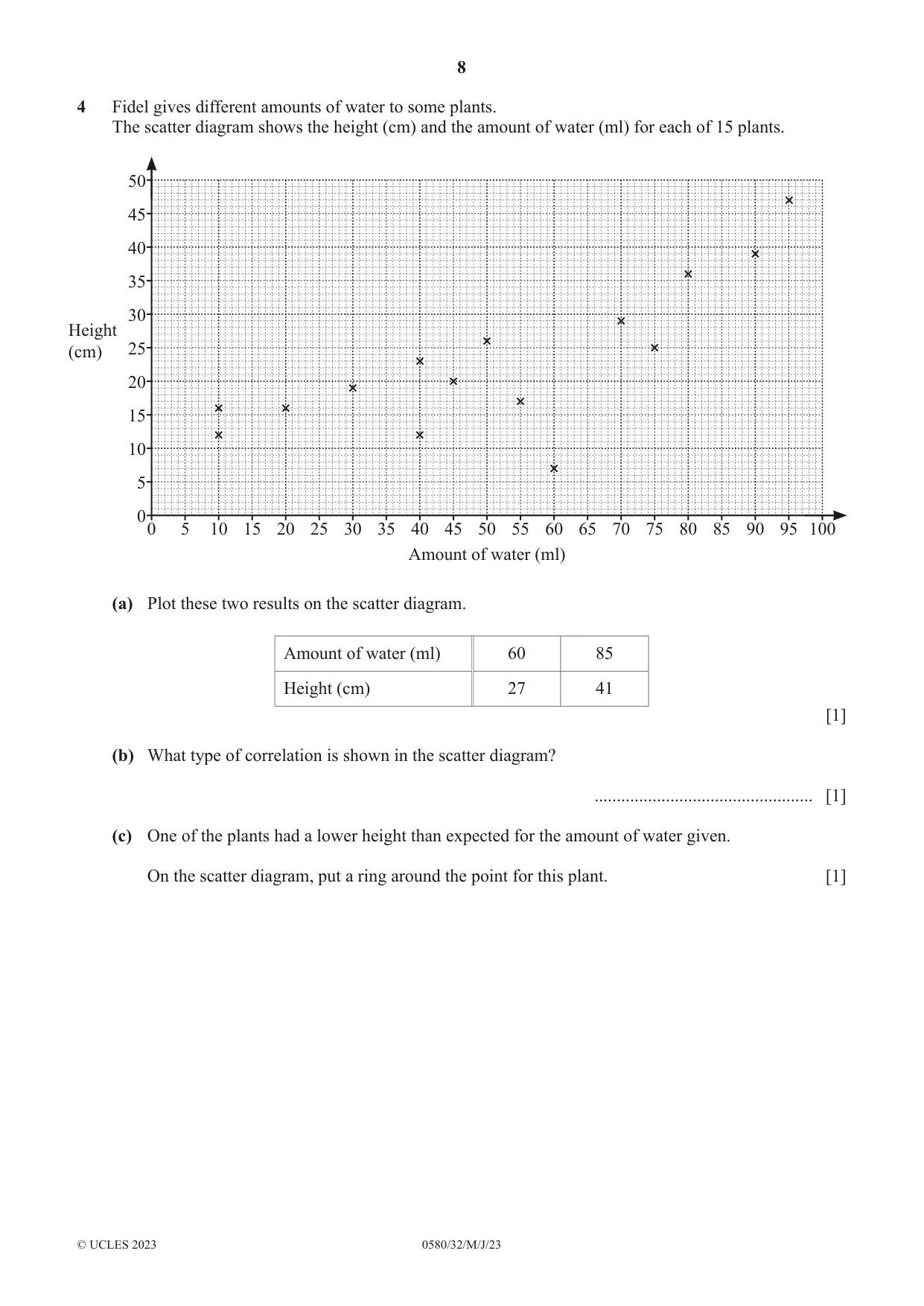
4 Fidel gives different amounts of water to some plants. The scatter diagram shows the height (cm) and the amount of water (ml) for each of 15 plants. 50 45 40 35 30 Height (cm) 25 20 15 10 5 0 0 5 10 15 20 25 30 35 40 45 50 55 60 65 70 75 80 85 90 95 100 Amount of water (ml) (a) Plot these two results on the scatter diagram. Amount of water (ml) 60 85 Height (cm) 27 41 [1] (b) What type of correlation is shown in the scatter diagram? ................................................. [1] (c) One of the plants had a lower height than expected for the amount of water given. On the scatter diagram, put a ring around the point for this plant. [1] (d) (i) On the scatter diagram, draw a line of best fit. [1] (ii) Another plant is given 65 ml of water. Use your line of best fit to estimate the height of this plant. ............................................ cm [1] (e) Find the percentage of these 17 plants that have a height of more than 24 cm. Give your answer correct to 1 decimal place. ............................................. % [3]
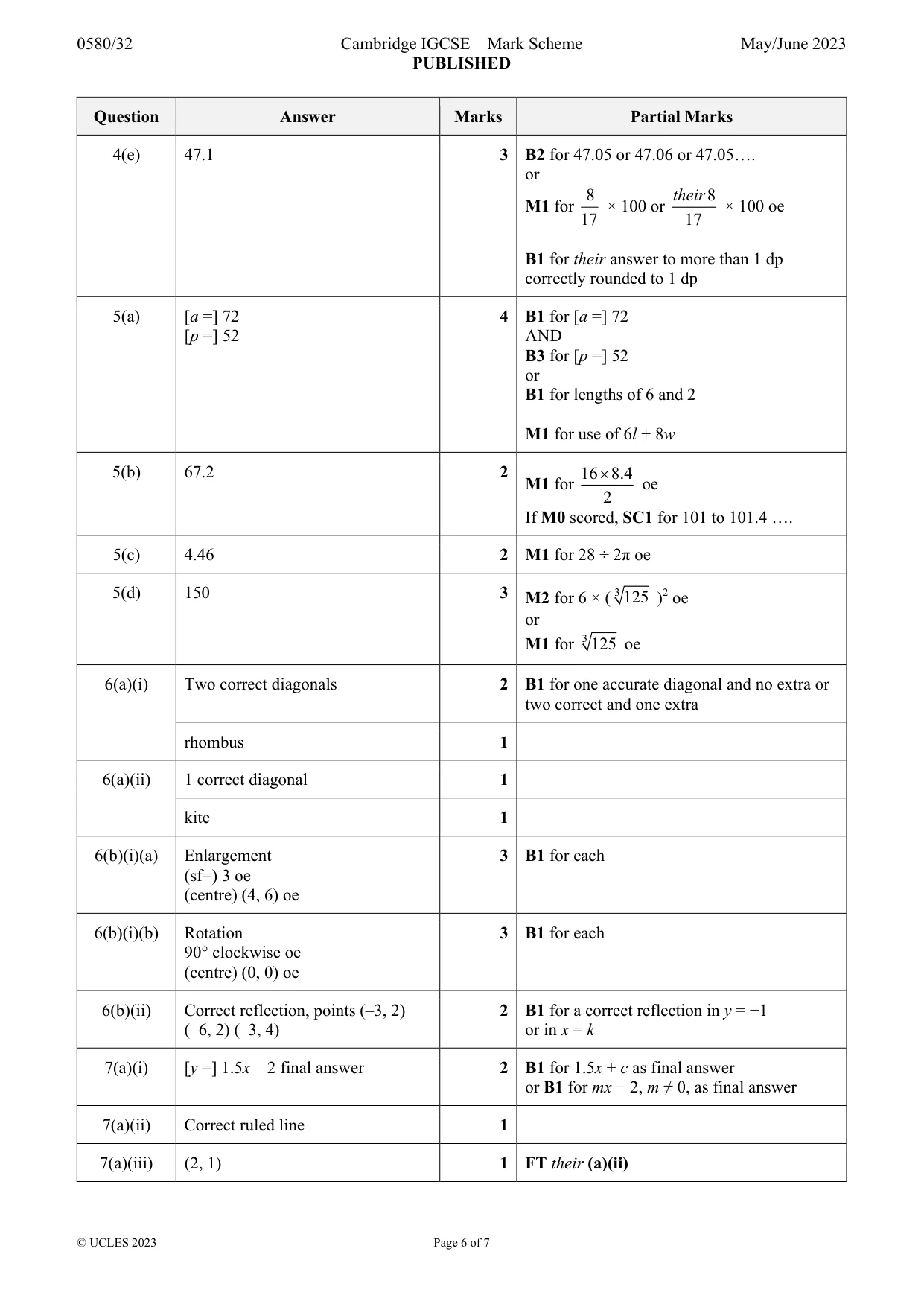
Mark scheme: 4(a) Two points accurately plotted 1 4(b) Positive 1 4(c) (60, 7) indicated 1 4(d)(i) Accurate straight line of best fit 1 4(d)(ii) 24 to 32 1 FT their straight line with positive gradient with tolerance ± 1 square 4(e) 47.1 3 B2 for 47.05 or 47.06 or 47.05…. or 8 their 8 M1 for × 100 or × 100 oe 17 17 B1 for their answer to more than 1 dp correctly rounded to 1 dp
Q5 · NOT TO SCALE This rectangle has an area of 12 cm2 and a perimeter of 16 cm
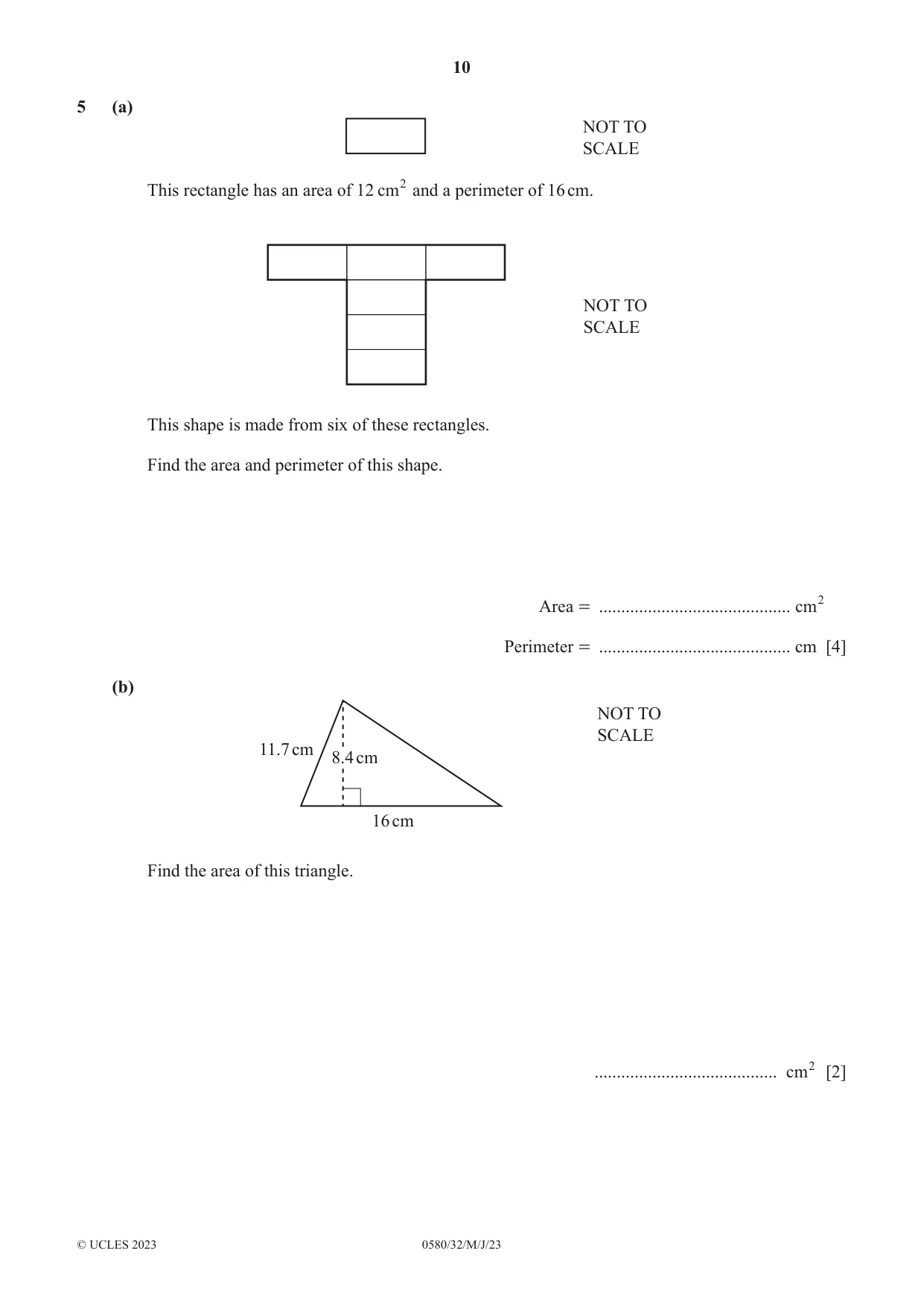
5 (a) NOT TO SCALE This rectangle has an area of 12 cm2 and a perimeter of 16 cm. NOT TO SCALE This shape is made from six of these rectangles. Find the area and perimeter of this shape. Area = ........................................... cm2 Perimeter = ........................................... cm [4] (b) NOT TO SCALE 11.7 cm 8.4 cm 16 cm Find the area of this triangle. ......................................... cm2 [2] (c) A circle has a circumference of 28 cm. Work out the radius of the circle. ............................................ cm [2] (d) A cube has a volume of 125 m3. Work out the surface area of the cube. ........................................... m2 [3]
Mark scheme: 5(a) [a =] 72 4 B1 for [a =] 72 [p =] 52 AND B3 for [p =] 52 or B1 for lengths of 6 and 2 M1 for use of 6l + 8w 5(b) 67.2 2 16 8.4 M1 for oe 2 If M0 scored, SC1 for 101 to 101.4 …. 5(c) 4.46 2 M1 for 28 ÷ 2π oe 5(d) 150 3 M2 for 6 × ( 3 125 )2 oe or M1 for 3 125 oe
Q6 · For each quadrilateral, draw any lines of symmetry and write down its mathematical name
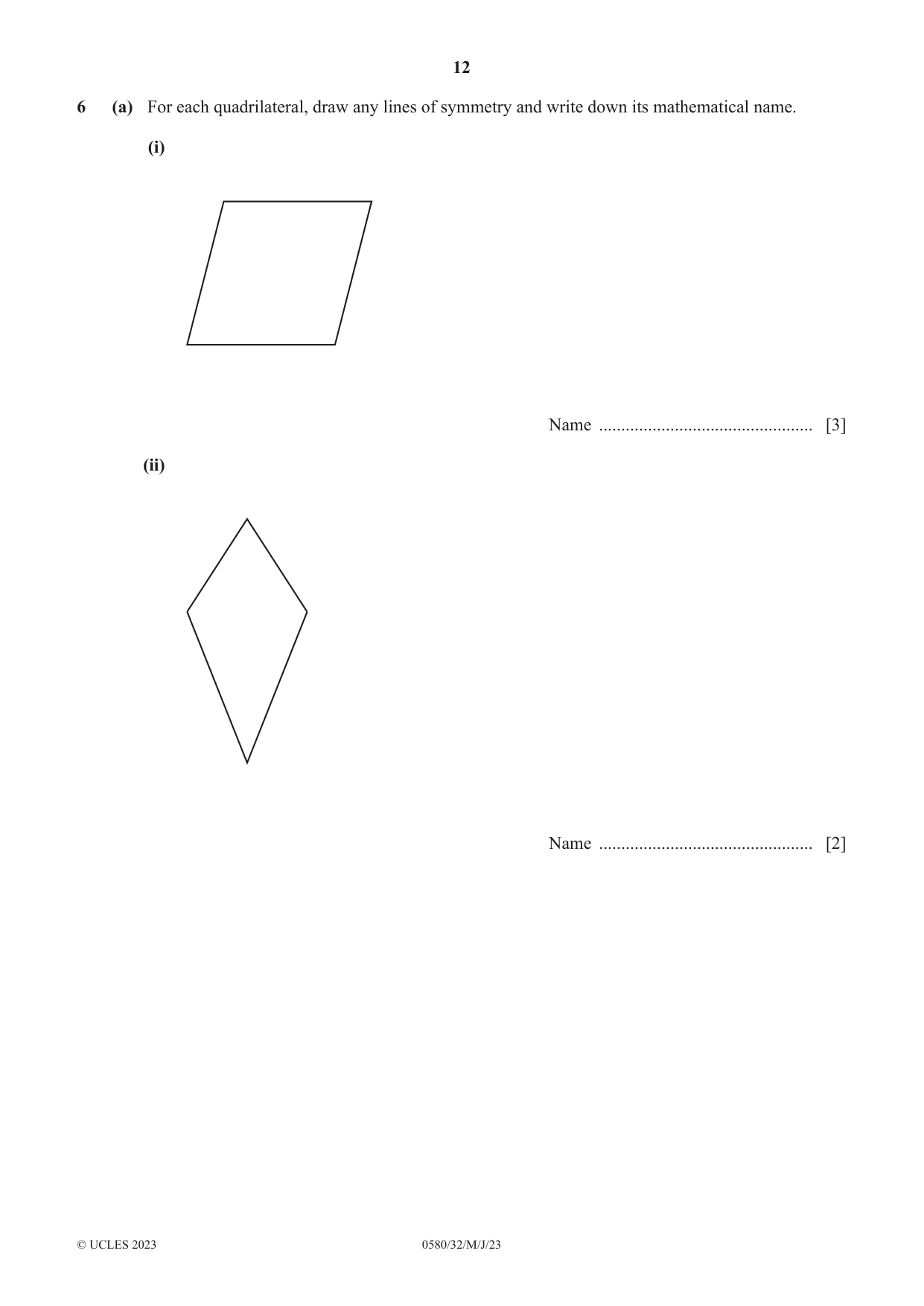
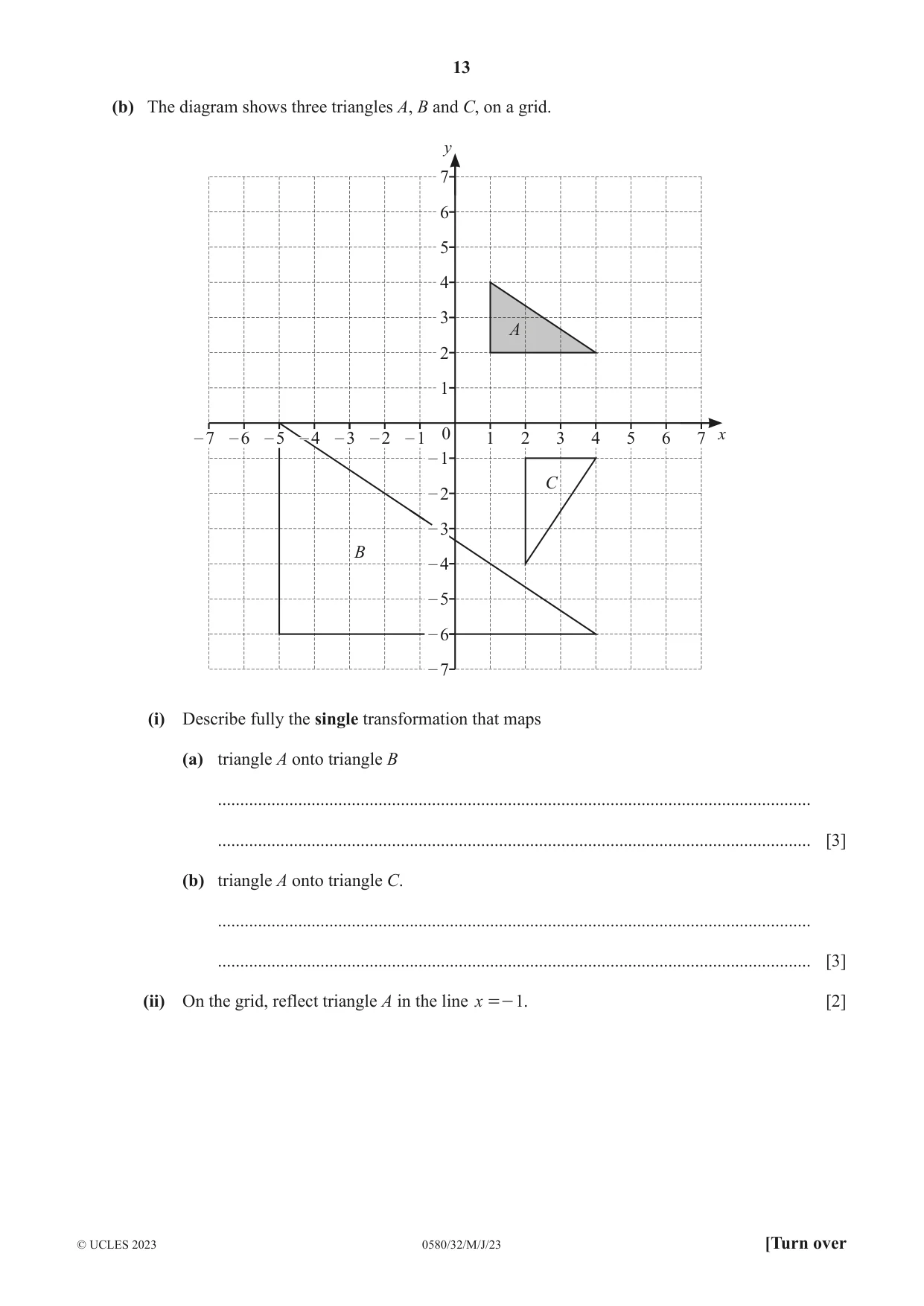
6 (a) For each quadrilateral, draw any lines of symmetry and write down its mathematical name. (i) Name ................................................ [3] (ii) Name ................................................ [2] (b) The diagram shows three triangles A, B and C, on a grid. y 7 6 5 4 3 A 2 1 – 7 – 6 – 5 –– 44 – 3 – 2 – 1 0 1 2 3 4 5 6 7 x – 1 C – 2 – 3 B – 4 – 5 – 6 – 7 (i) Describe fully the single transformation that maps (a) triangle A onto triangle B ..................................................................................................................................... ..................................................................................................................................... [3] (b) triangle A onto triangle C. ..................................................................................................................................... ..................................................................................................................................... [3] (ii) On the grid, reflect triangle A in the line x =- 1. [2]
Mark scheme: 6(a)(i) Two correct diagonals 2 B1 for one accurate diagonal and no extra or two correct and one extra rhombus 1 6(a)(ii) 1 correct diagonal 1 kite 1 6(b)(i)(a) Enlargement 3 B1 for each (sf=) 3 oe (centre) (4, 6) oe 6(b)(i)(b) Rotation 3 B1 for each 90° clockwise oe (centre) (0, 0) oe 6(b)(ii) Correct reflection, points (–3, 2) 2 B1 for a correct reflection in y = −1 (–6, 2) (–3, 4) or in x = k
Q7 · Y 6 L 5 4 3 2 1 – 3 – 2 – 1 0 1 2 3 4 5 x – 1 – 2 – 3 – 4 – 5 – 6 (i) Find the equation…
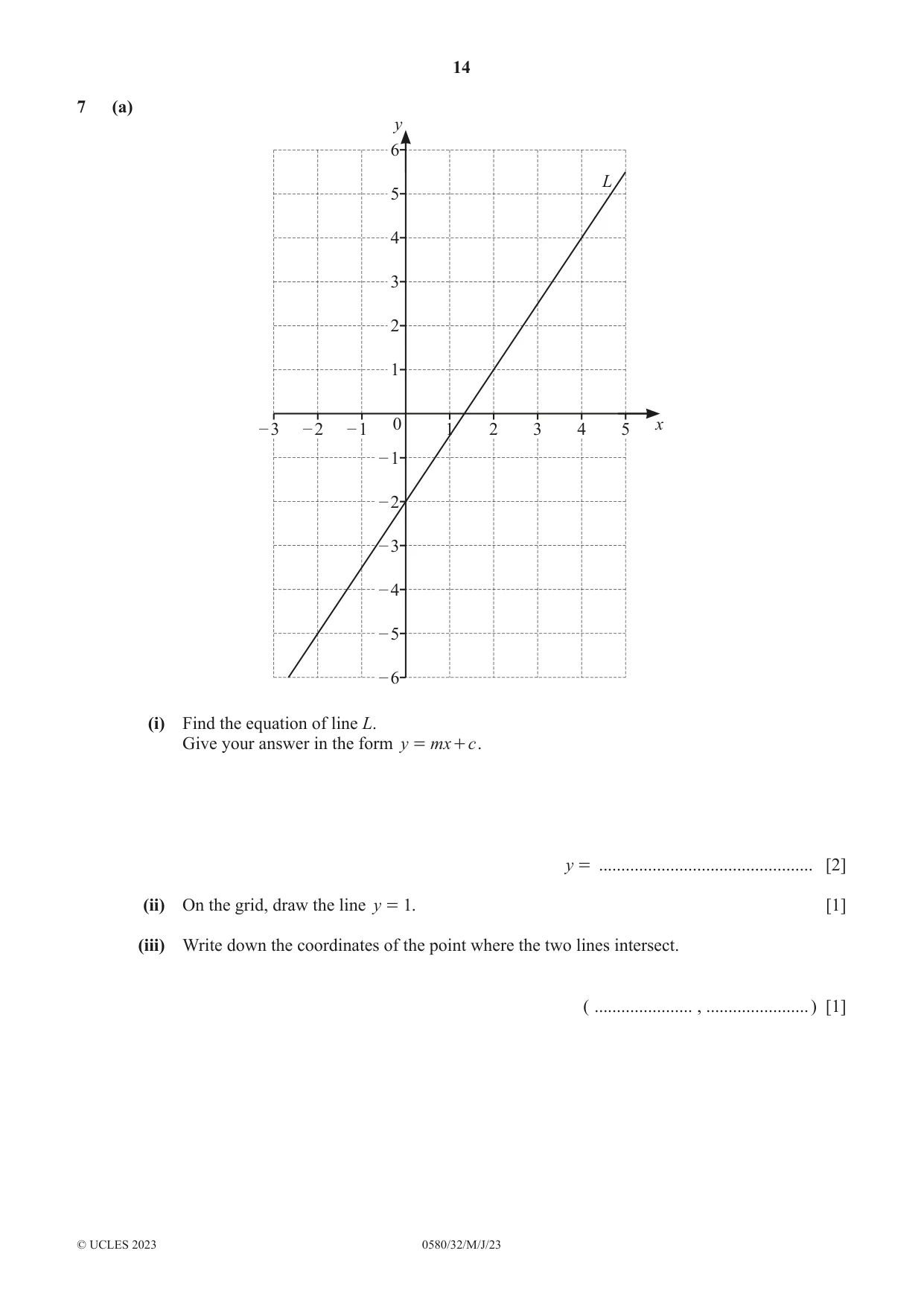
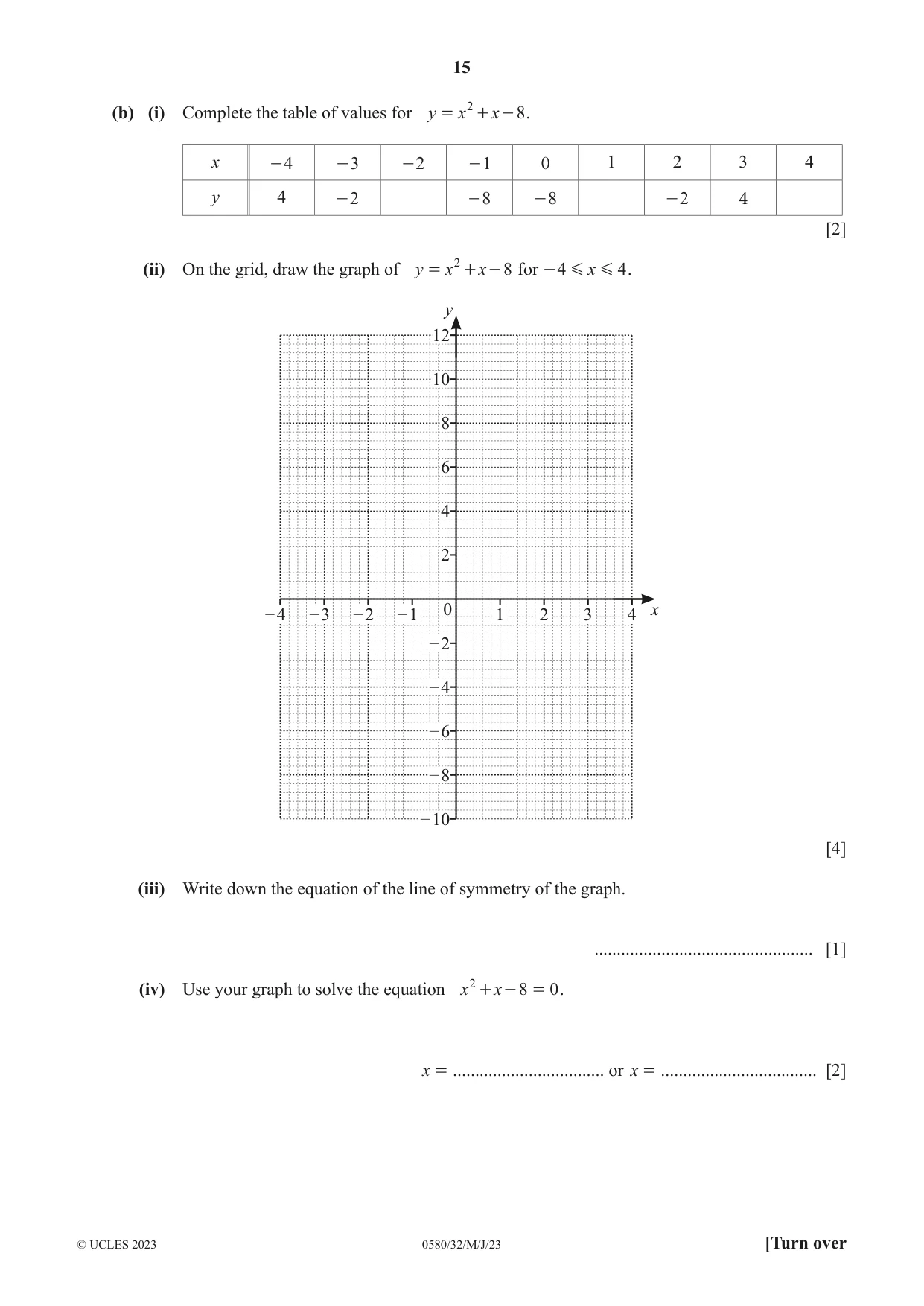
7 (a) y 6 L 5 4 3 2 1 – 3 – 2 – 1 0 1 2 3 4 5 x – 1 – 2 – 3 – 4 – 5 – 6 (i) Find the equation of line L. Give your answer in the form y = mx + c . y = ................................................ [2] (ii) On the grid, draw the line y = 1. [1] (iii) Write down the coordinates of the point where the two lines intersect. ( ...................... , ....................... ) [1] (b) (i) Complete the table of values for y = x 2 + x - 8 . x - 4 - 3 - 2 - 1 0 1 2 3 4 y 4 - 2 - 8 - 8 - 2 4 [2] (ii) On the grid, draw the graph of y = x 2 + x - 8 for - 4 G x G 4 . y 12 10 8 6 4 2 – 4 – 3 – 2 – 1 0 1 2 3 4 x – 2 – 4 – 6 – 8 – 10 [4] (iii) Write down the equation of the line of symmetry of the graph. ................................................. [1] (iv) Use your graph to solve the equation x 2 + x - 8 = 0 . x = .................................. or x = ................................... [2]
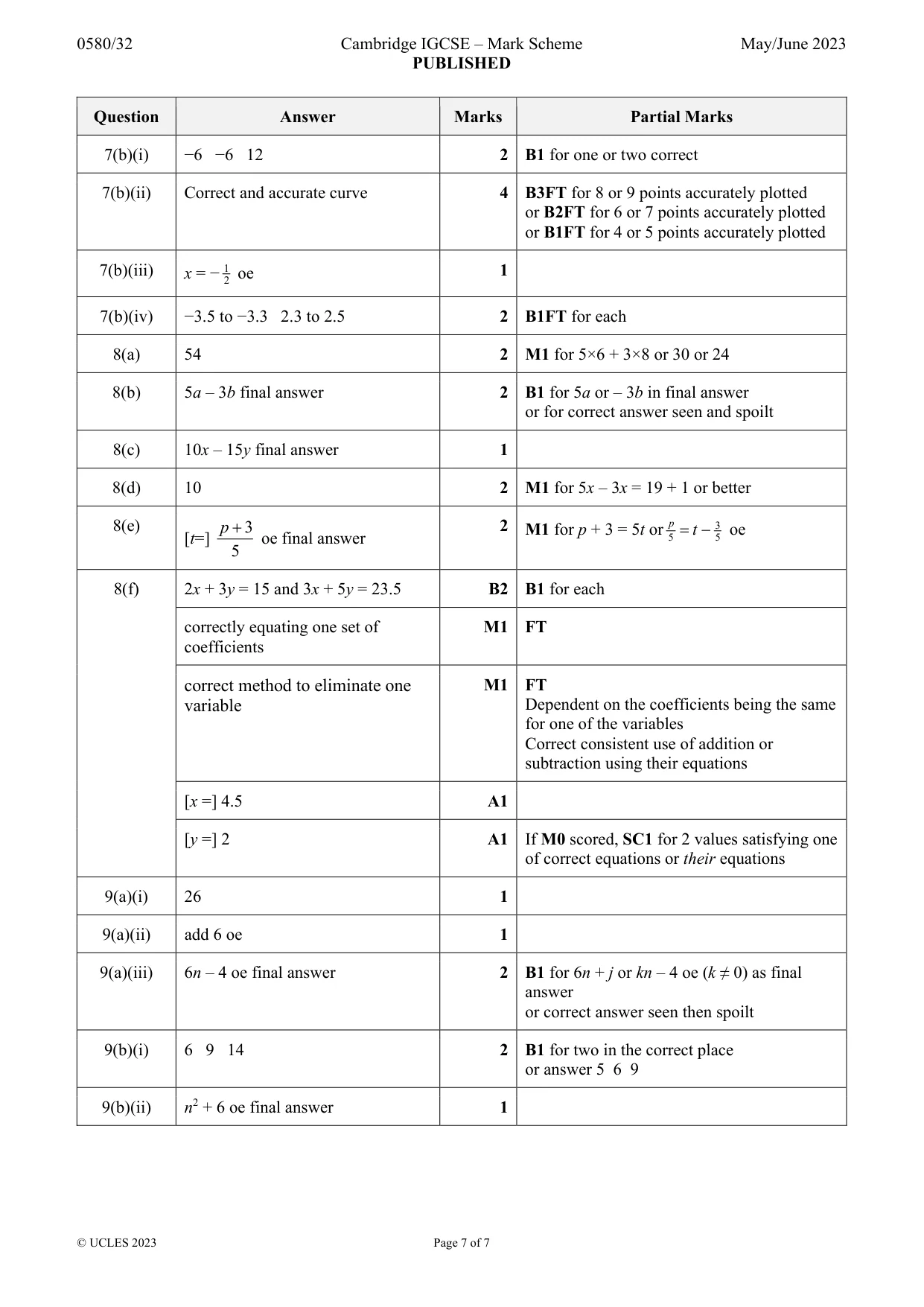
Mark scheme: 7(a)(i) [y =] 1.5x – 2 final answer 2 B1 for 1.5x + c as final answer or B1 for mx − 2, m ≠ 0, as final answer 7(a)(ii) Correct ruled line 1 7(a)(iii) (2, 1) 1 FT their (a)(ii) 7(b)(i) −6 −6 12 2 B1 for one or two correct 7(b)(ii) Correct and accurate curve 4 B3FT for 8 or 9 points accurately plotted or B2FT for 6 or 7 points accurately plotted or B1FT for 4 or 5 points accurately plotted 7(b)(iii) x = −12 oe 1 7(b)(iv) −3.5 to −3.3 2.3 to 2.5 2 B1FT for each
Q8 · T = 5P + 3Q Find the value of T when P = 6 and Q = 8
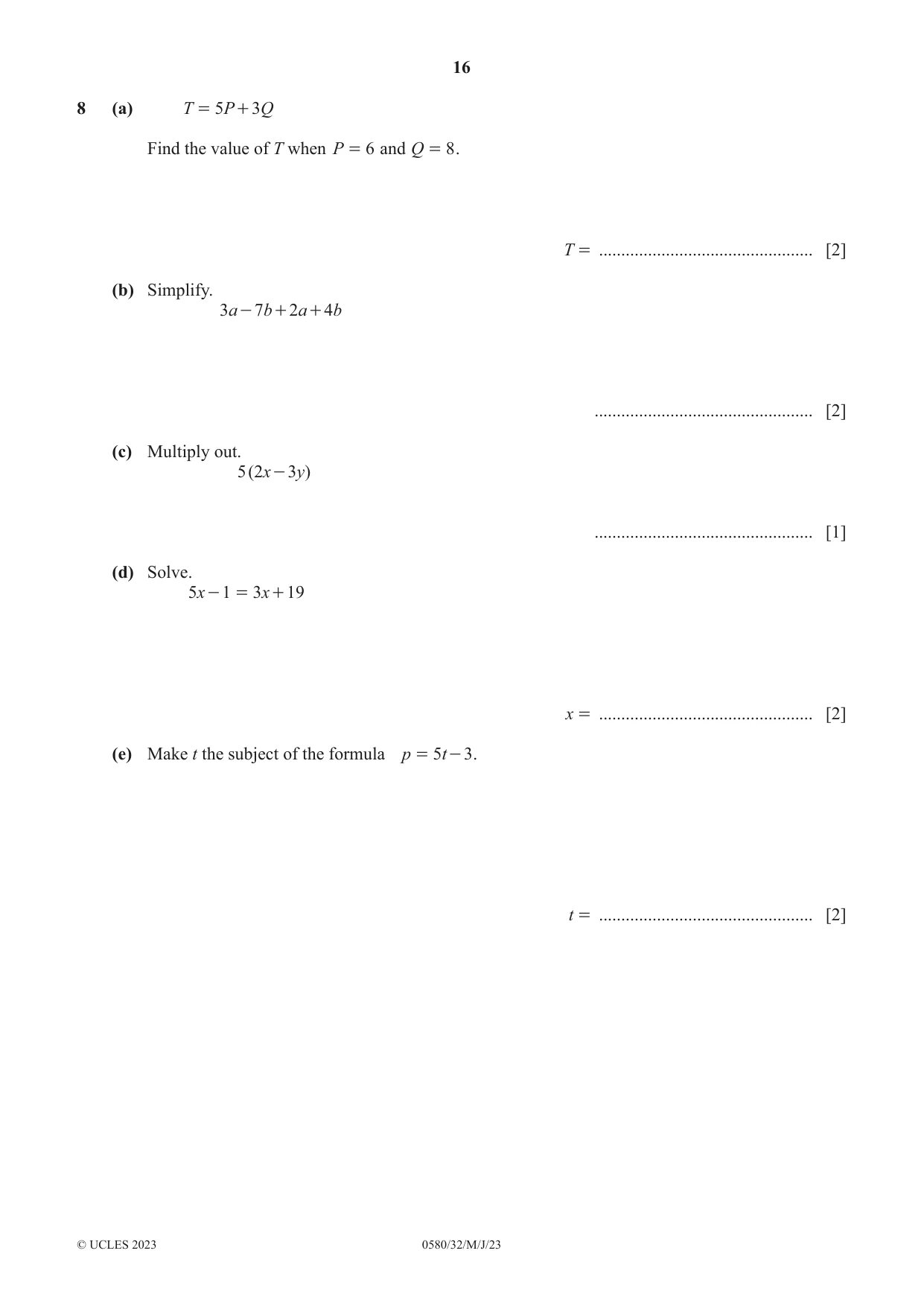
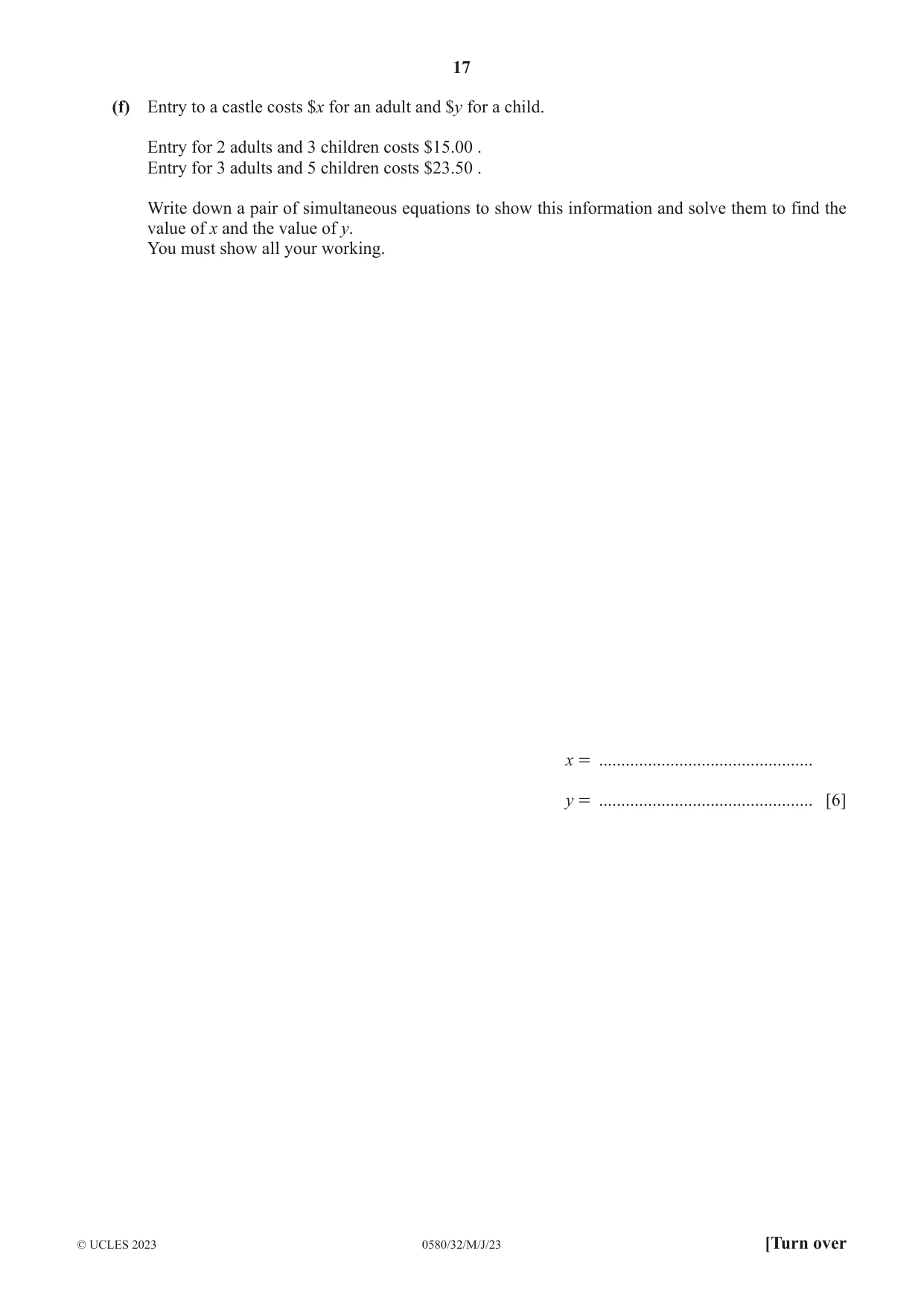
8 (a) T = 5P + 3Q Find the value of T when P = 6 and Q = 8 . T = ................................................ [2] (b) Simplify. 3a - 7b + 2a + 4b ................................................. [2] (c) Multiply out. 5 ( 2x - 3y) ................................................. [1] (d) Solve. 5x - 1 = 3x + 19 x = ................................................ [2] (e) Make t the subject of the formula p = t5 - 3 . t = ................................................ [2] (f) Entry to a castle costs $x for an adult and $y for a child. Entry for 2 adults and 3 children costs $15.00 . Entry for 3 adults and 5 children costs $23.50 . Write down a pair of simultaneous equations to show this information and solve them to find the value of x and the value of y. You must show all your working. x = ................................................ y = ................................................ [6]
Mark scheme: 8(a) 54 2 M1 for 5×6 + 3×8 or 30 or 24 8(b) 5a – 3b final answer 2 B1 for 5a or – 3b in final answer or for correct answer seen and spoilt 8(c) 10x – 15y final answer 1 8(d) 10 2 M1 for 5x – 3x = 19 + 1 or better 8(e) p 3 2 M1 for p + 3 = 5t or 5p t 53 oe [t=] oe final answer 5 8(f) 2x + 3y = 15 and 3x + 5y = 23.5 B2 B1 for each correctly equating one set of M1 FT coefficients correct method to eliminate one M1 FT variable Dependent on the coefficients being the same for one of the variables Correct consistent use of addition or subtraction using their equations [x =] 4.5 A1 [y =] 2 A1 If M0 scored, SC1 for 2 values satisfying one of correct equations or their equations
Q9 · These are the first four terms of a sequence
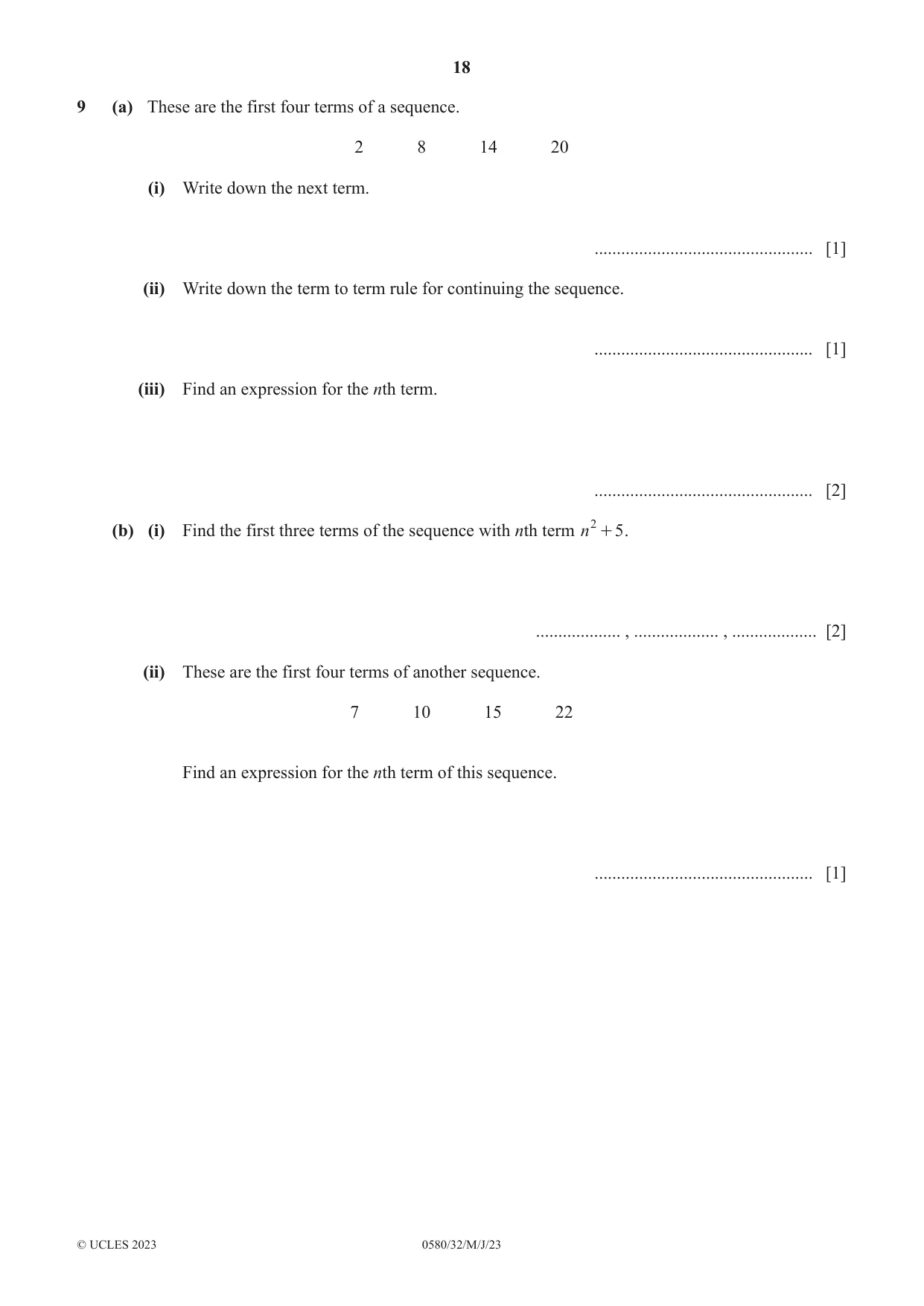
9 (a) These are the first four terms of a sequence. 2 8 14 20 (i) Write down the next term. ................................................. [1] (ii) Write down the term to term rule for continuing the sequence. ................................................. [1] (iii) Find an expression for the nth term. ................................................. [2] (b) (i) Find the first three terms of the sequence with nth term n 2 + 5 . ................... , ................... , ................... [2] (ii) These are the first four terms of another sequence. 7 10 15 22 Find an expression for the nth term of this sequence. ................................................. [1]
Mark scheme: 9(a)(i) 26 1 9(a)(ii) add 6 oe 1 9(a)(iii) 6n – 4 oe final answer 2 B1 for 6n + j or kn – 4 oe (k ≠ 0) as final answer or correct answer seen then spoilt 9(b)(i) 6 9 14 2 B1 for two in the correct place or answer 5 6 9 9(b)(ii) n2 + 6 oe final answer 1
What was in this paper
The subtopics covered by these 9 questions, and how many questions each got. Open one in a new tab to see every Cambridge question on it.
What you needed in this session
Cambridge’s own grade thresholds for 2023 May/June, Paper 3 · Variant 2. A higher threshold means an easier paper — the bar moves with how the cohort did.