Cambridge IGCSE Mathematics 0580 — 2022 May/June Paper 3 · Variant 1
0580/31/M/J/22 · 9 questions · 104 marks · ≈117 min
The question paper and its mark scheme, free to read here and free to download. This is Cambridge’s own paper, exactly as it was sat.
Question paper20 pages
Mark scheme7 pages
Answers below. Sit the paper first if you are practising.
Questions as text
Q1 · Write the number six and a half million in figures
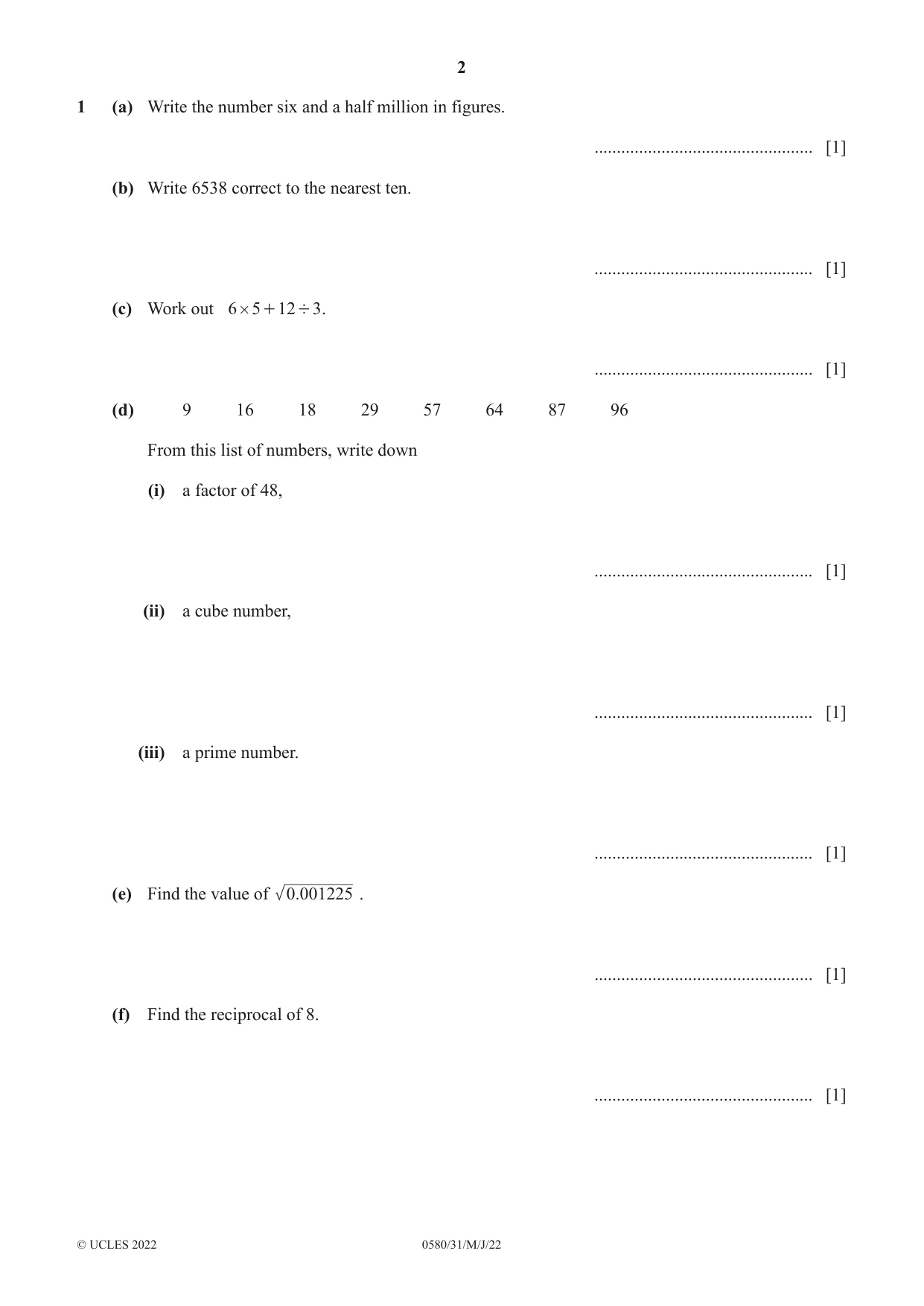
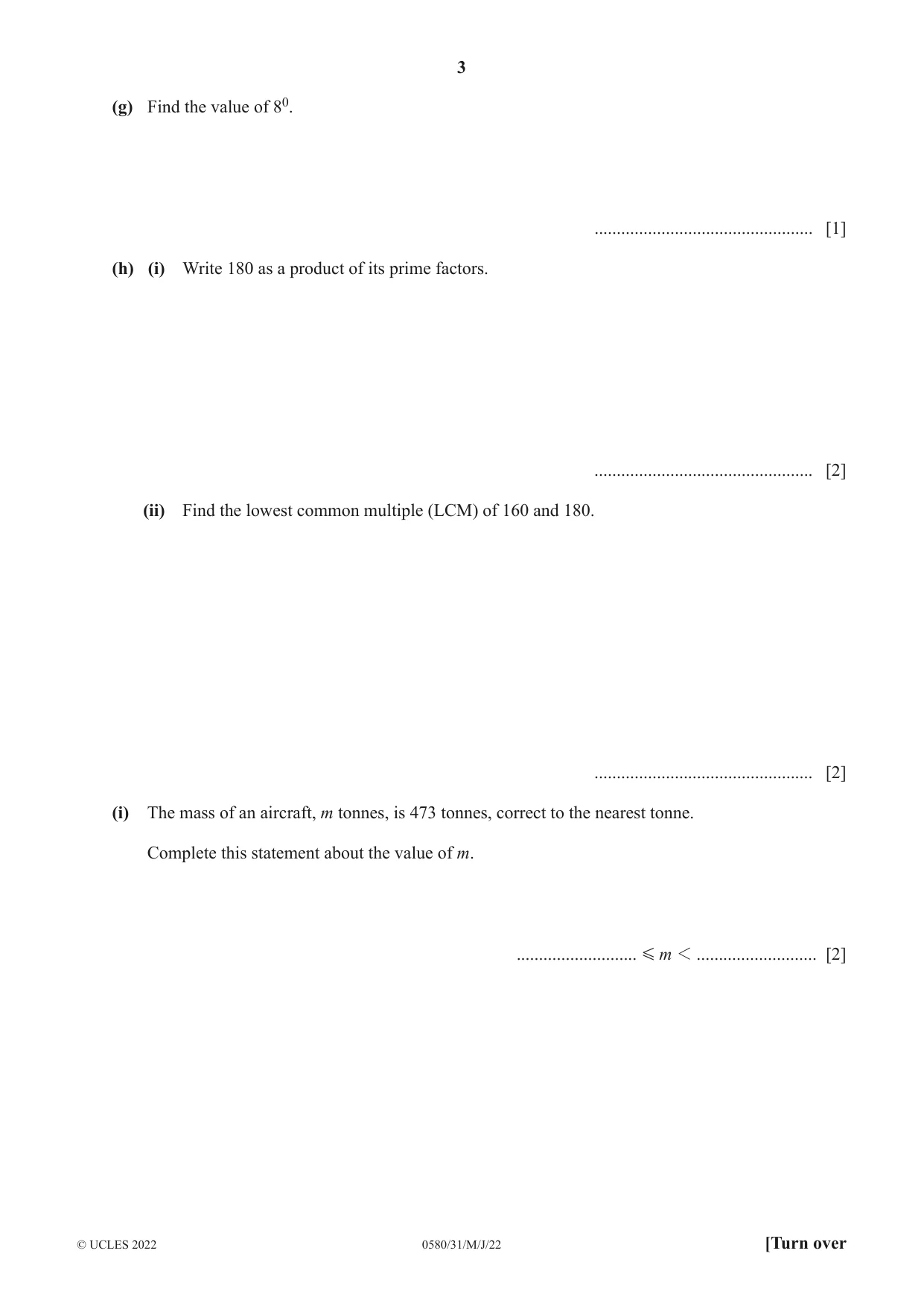
1 (a) Write the number six and a half million in figures. ................................................. [1] (b) Write 6538 correct to the nearest ten. ................................................. [1] (c) Work out 6 # 5 + 12 ' 3 . ................................................. [1] (d) 9 16 18 29 57 64 87 96 From this list of numbers, write down (i) a factor of 48, ................................................. [1] (ii) a cube number, ................................................. [1] (iii) a prime number. ................................................. [1] (e) Find the value of .0001225 . ................................................. [1] (f) Find the reciprocal of 8. ................................................. [1] (g) Find the value of 80. ................................................. [1] (h) (i) Write 180 as a product of its prime factors. ................................................. [2] (ii) Find the lowest common multiple (LCM) of 160 and 180. ................................................. [2] (i) The mass of an aircraft, m tonnes, is 473 tonnes, correct to the nearest tonne. Complete this statement about the value of m. ........................... G m 1 ........................... [2]
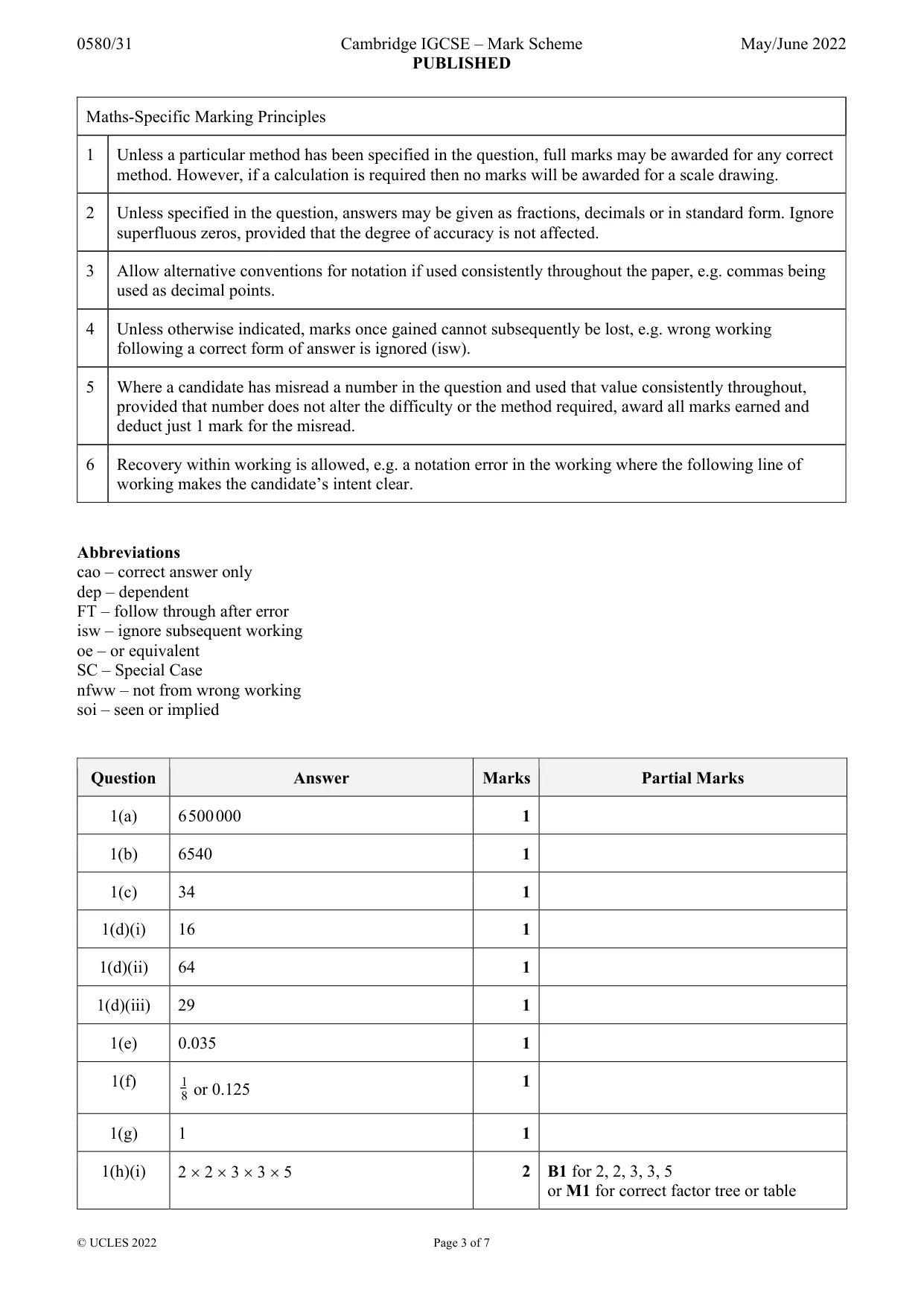
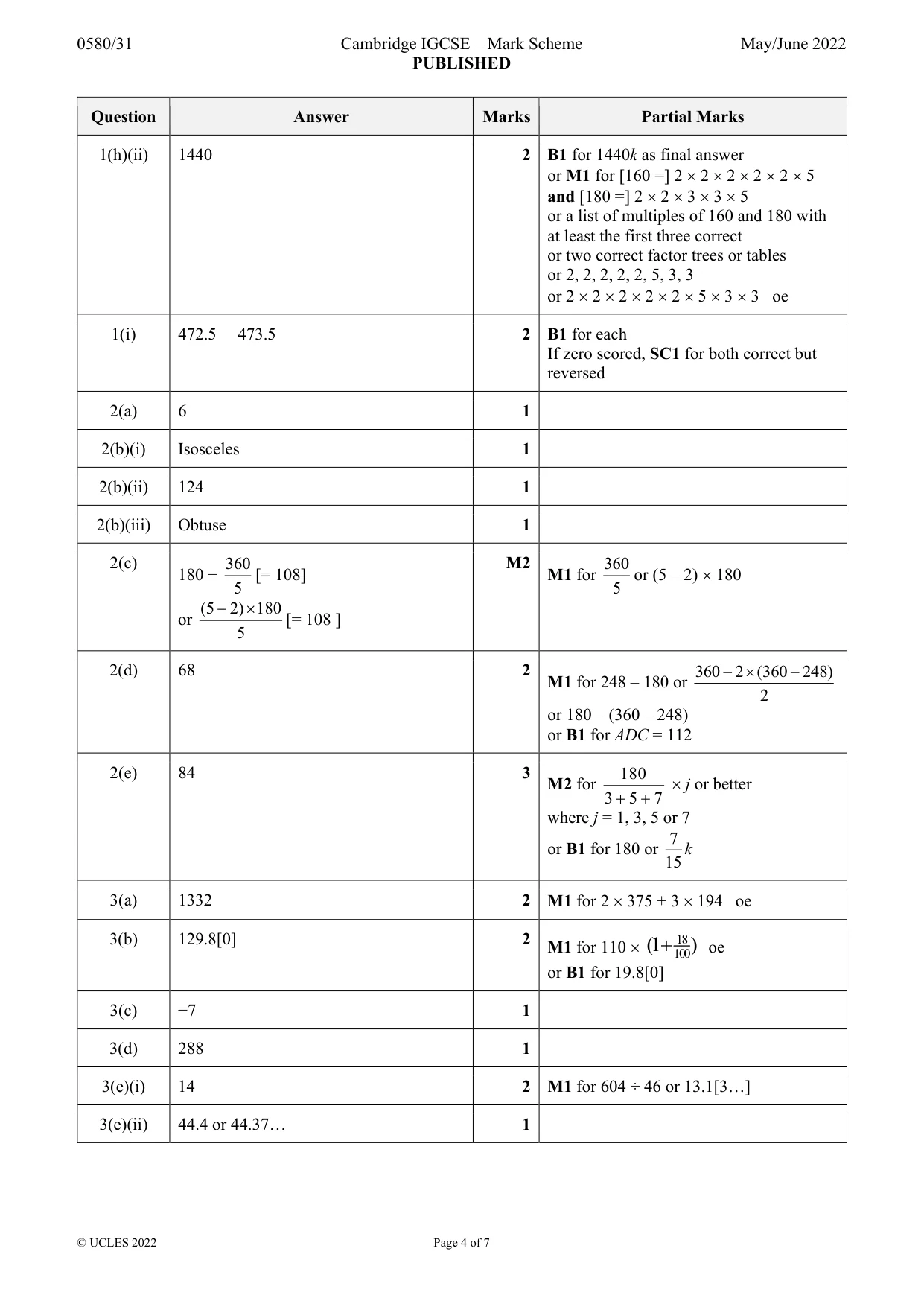
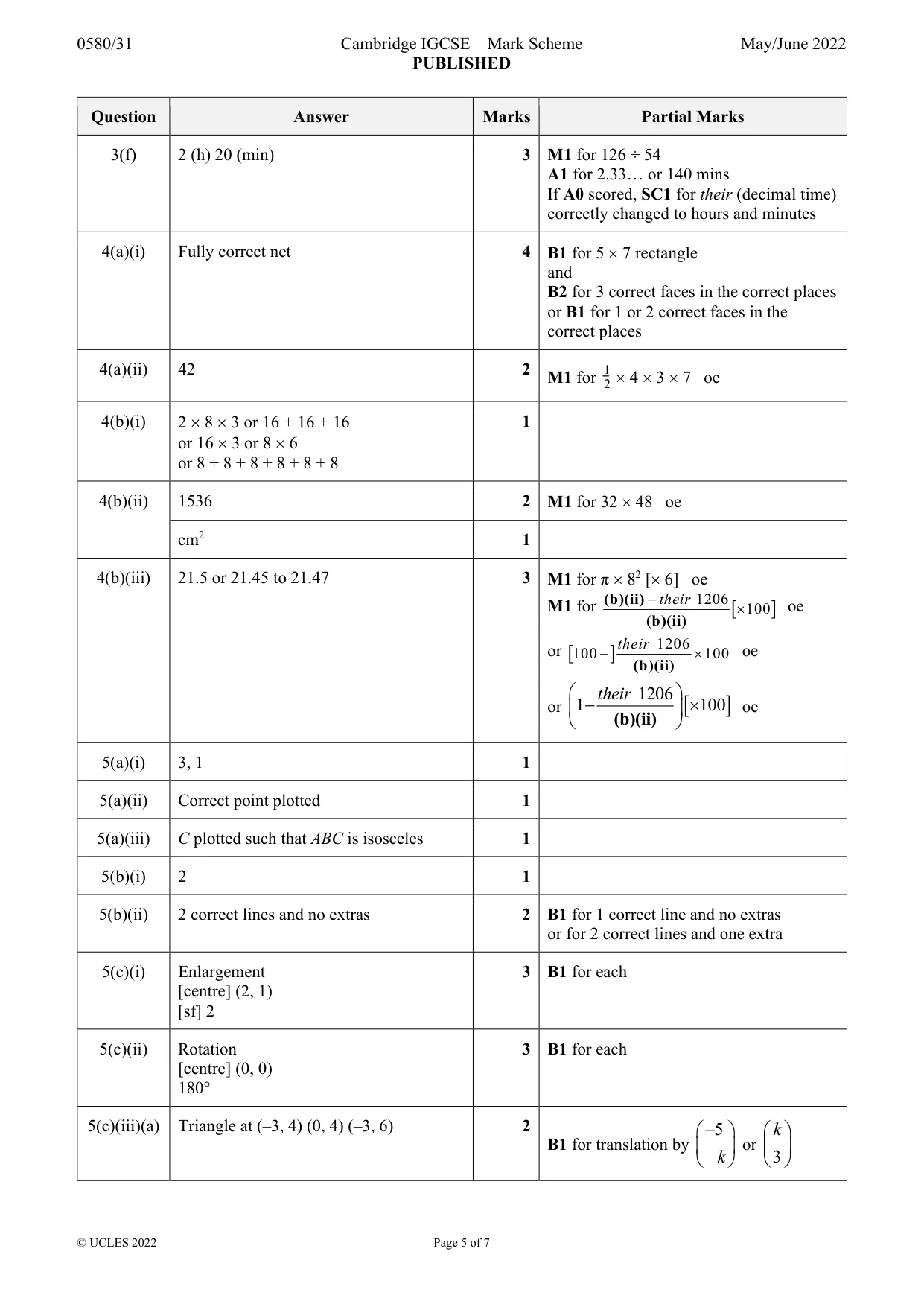
Mark scheme: Question Answer Marks Partial Marks 1(a) 6 500 000 1 1(b) 6540 1 1(c) 34 1 1(d)(i) 16 1 1(d)(ii) 64 1 1(d)(iii) 29 1 1(e) 0.035 1 1(f) 1 1 8 or 0.125 1(g) 1 1 1(h)(i) 2 2 3 3 5 2 B1 for 2, 2, 3, 3, 5 or M1 for correct factor tree or table 1(h)(ii) 1440 2 B1 for 1440k as final answer or M1 for [160 =] 2 2 2 2 2 5 and [180 =] 2 2 3 3 5 or a list of multiples of 160 and 180 with at least the first three correct or two correct factor trees or tables or 2, 2, 2, 2, 2, 5, 3, 3 or 2 2 2 2 2 5 3 3 oe 1(i) 472.5 473.5 2 B1 for each If zero scored, SC1 for both correct but reversed
Q2 · Write down the number of sides of a hexagon
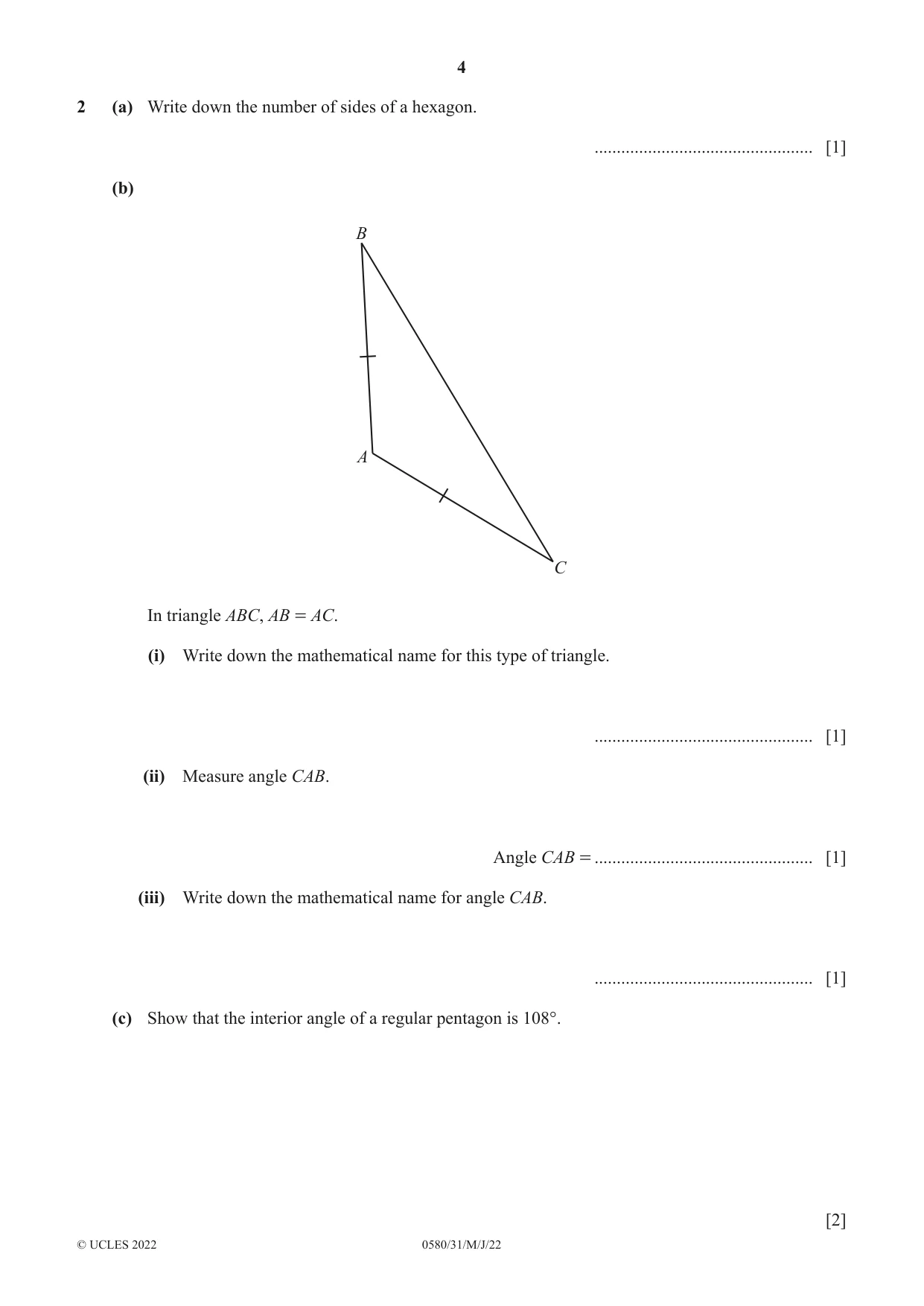
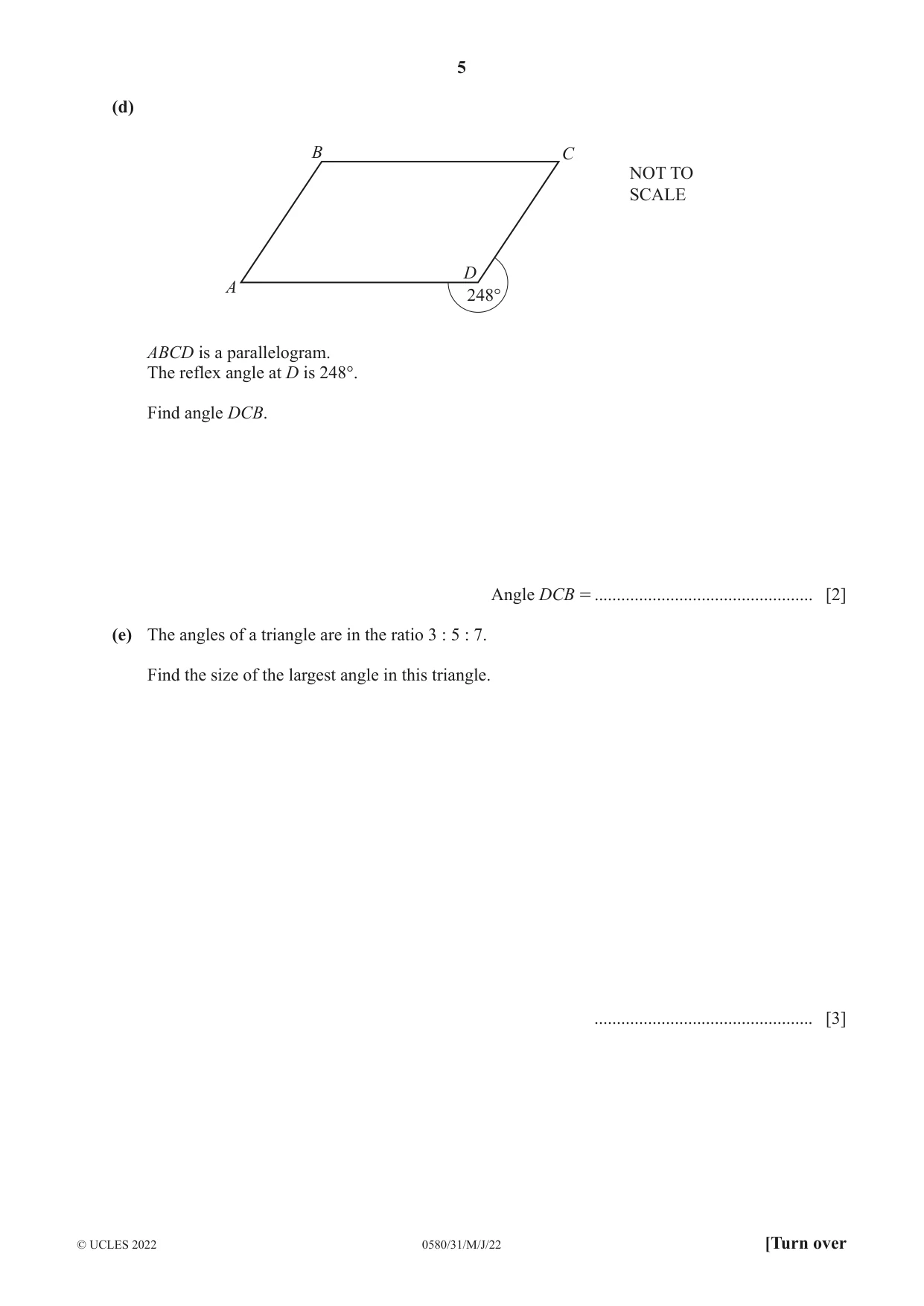
2 (a) Write down the number of sides of a hexagon. ................................................. [1] (b) B A C In triangle ABC, AB = AC. (i) Write down the mathematical name for this type of triangle. ................................................. [1] (ii) Measure angle CAB. Angle CAB = ................................................. [1] (iii) Write down the mathematical name for angle CAB. ................................................. [1] (c) Show that the interior angle of a regular pentagon is 108°. [2] (d) B C NOT TO SCALE D A 248° ABCD is a parallelogram. The reflex angle at D is 248°. Find angle DCB. Angle DCB = ................................................. [2] (e) The angles of a triangle are in the ratio 3 : 5 : 7. Find the size of the largest angle in this triangle. ................................................. [3]
Mark scheme: 2(a) 6 1 2(b)(i) Isosceles 1 2(b)(ii) 124 1 2(b)(iii) Obtuse 1 2(c) 360 M2 360 180 − [= 108] M1 for or (5 – 2) 180 5 5 (5 2) 180 or [= 108 ] 5 2(d) 68 2 360 2 (360 248) M1 for 248 – 180 or 2 or 180 – (360 – 248) or B1 for ADC = 112 2(e) 84 3 180 M2 for j or better 3 5 7 where j = 1, 3, 5 or 7 7 or B1 for 180 or k 15
Q3 · Sachin, his wife and three children go on a coach holiday
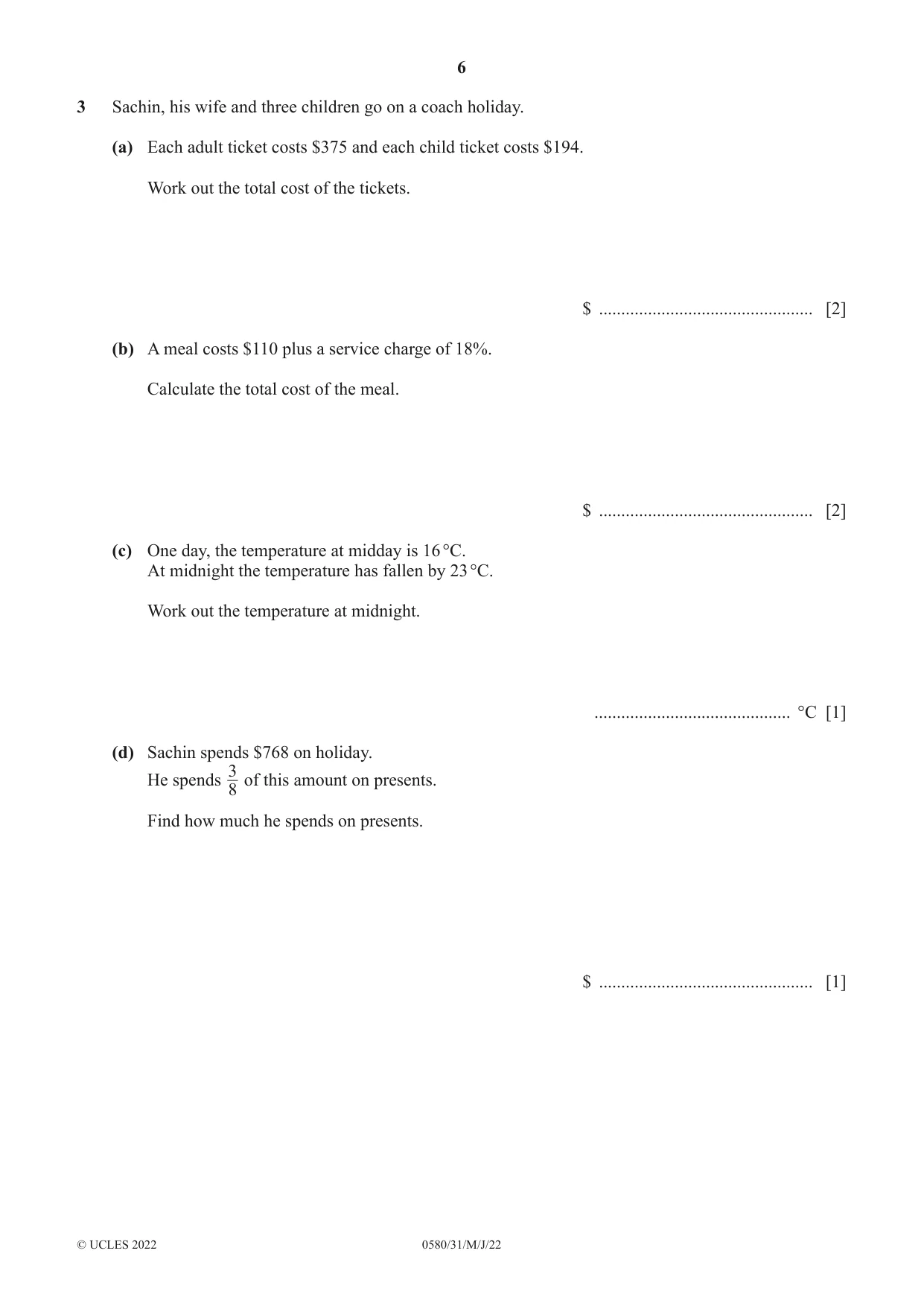
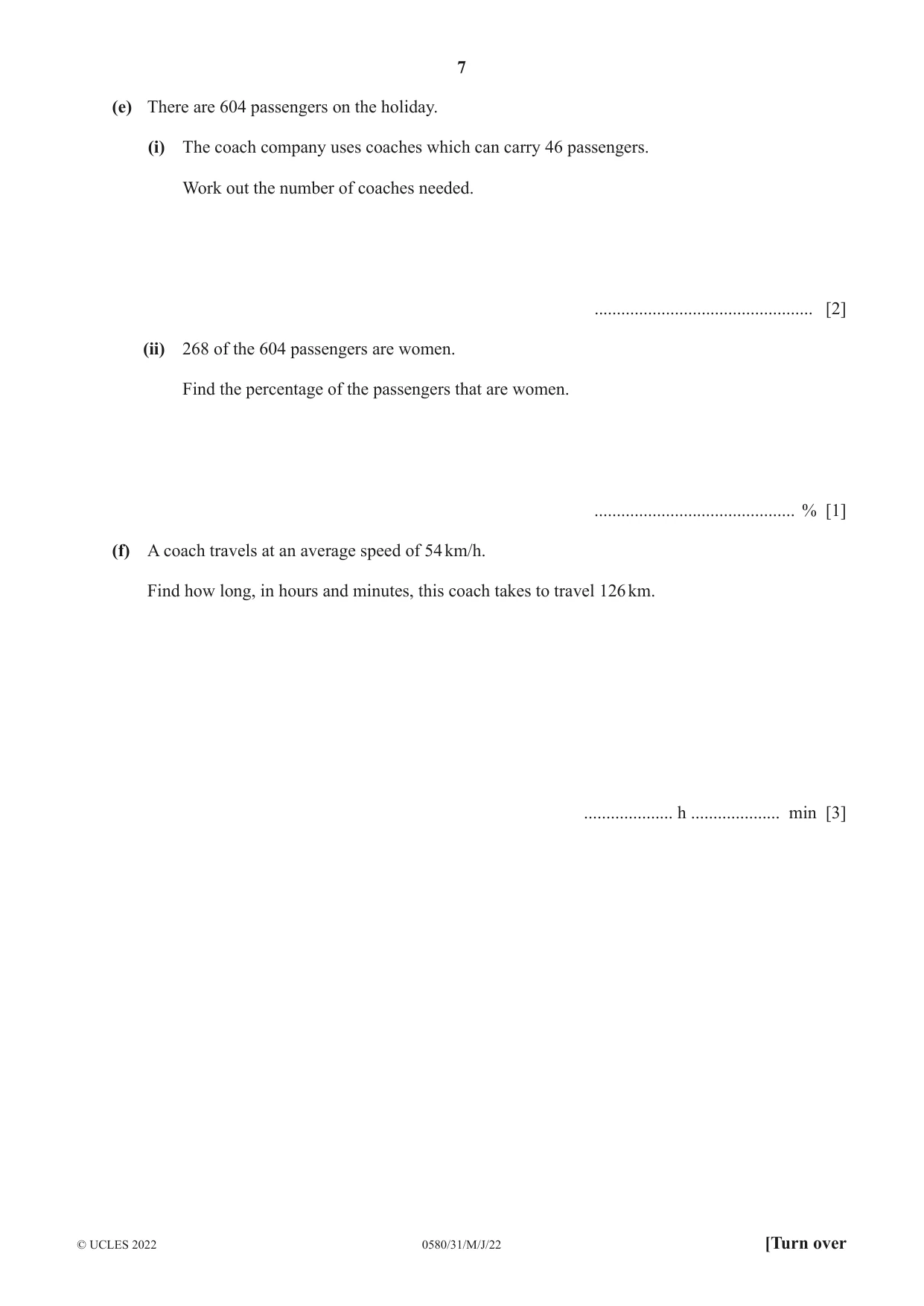
3 Sachin, his wife and three children go on a coach holiday. (a) Each adult ticket costs $375 and each child ticket costs $194. Work out the total cost of the tickets. $ ................................................ [2] (b) A meal costs $110 plus a service charge of 18%. Calculate the total cost of the meal. $ ................................................ [2] (c) One day, the temperature at midday is 16 °C. At midnight the temperature has fallen by 23 °C. Work out the temperature at midnight. ............................................ °C [1] (d) Sachin spends $768 on holiday. 3 He spends of this amount on presents. 8 Find how much he spends on presents. $ ................................................ [1] (e) There are 604 passengers on the holiday. (i) The coach company uses coaches which can carry 46 passengers. Work out the number of coaches needed. ................................................. [2] (ii) 268 of the 604 passengers are women. Find the percentage of the passengers that are women. ............................................. % [1] (f) A coach travels at an average speed of 54 km/h. Find how long, in hours and minutes, this coach takes to travel 126 km. .................... h .................... min [3]
Mark scheme: 3(a) 1332 2 M1 for 2 375 + 3 194 oe 3(b) 129.8[0] 2 M1 for 110 (1 10018 ) oe or B1 for 19.8[0] 3(c) −7 1 3(d) 288 1 3(e)(i) 14 2 M1 for 604 ÷ 46 or 13.1[3…] 3(e)(ii) 44.4 or 44.37… 1 3(f) 2 (h) 20 (min) 3 M1 for 126 ÷ 54 A1 for 2.33… or 140 mins If A0 scored, SC1 for their (decimal time) correctly changed to hours and minutes
Q4 · NOT TO SCALE 4 cm 7 cm 3 cm The diagram shows a right-angled triangular prism
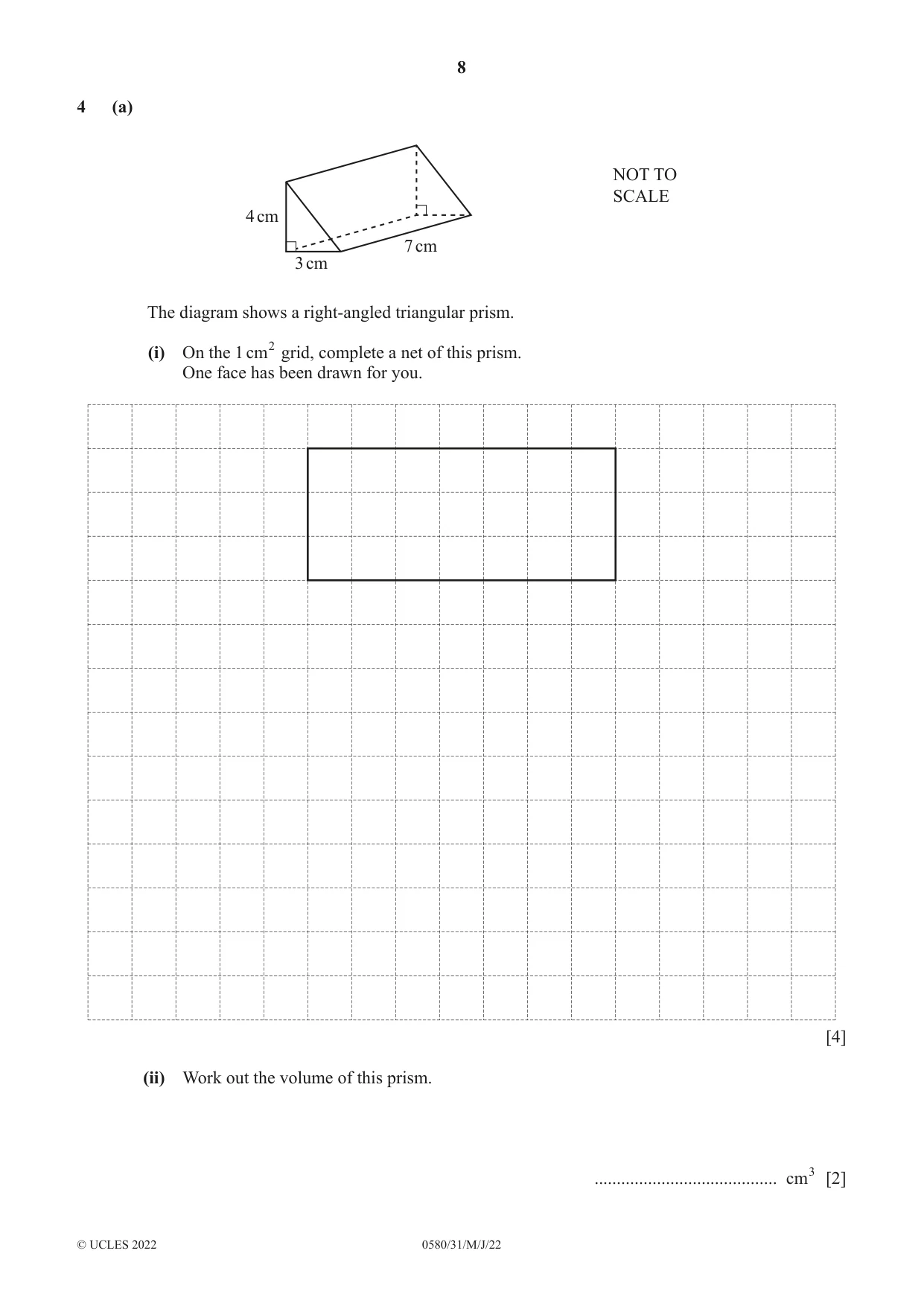
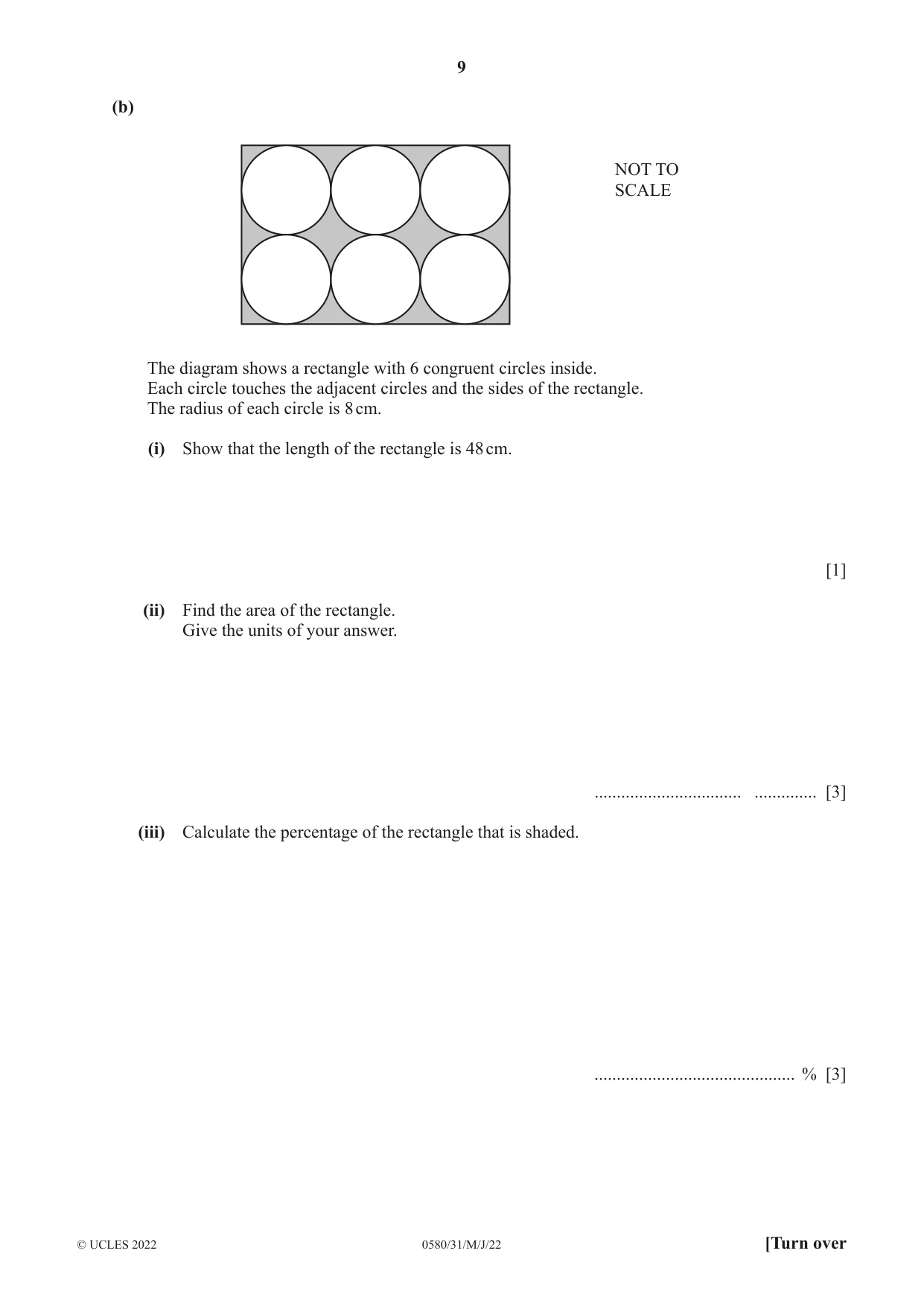
4 (a) NOT TO SCALE 4 cm 7 cm 3 cm The diagram shows a right-angled triangular prism. (i) On the 1 cm 2 grid, complete a net of this prism. One face has been drawn for you. [4] (ii) Work out the volume of this prism. ......................................... cm3 [2] (b) NOT TO SCALE The diagram shows a rectangle with 6 congruent circles inside. Each circle touches the adjacent circles and the sides of the rectangle. The radius of each circle is 8 cm. (i) Show that the length of the rectangle is 48 cm. [1] (ii) Find the area of the rectangle. Give the units of your answer. ................................. .............. [3] (iii) Calculate the percentage of the rectangle that is shaded. ............................................. % [3]
Mark scheme: 4(a)(i) Fully correct net 4 B1 for 5 7 rectangle and B2 for 3 correct faces in the correct places or B1 for 1 or 2 correct faces in the correct places 4(a)(ii) 42 2 1 M1 for 2 4 3 7 oe 4(b)(i) 2 8 3 or 16 + 16 + 16 1 or 16 3 or 8 6 or 8 + 8 + 8 + 8 + 8 + 8 4(b)(ii) 1536 2 M1 for 32 48 oe cm2 1 4(b)(iii) 21.5 or 21.45 to 21.47 3 M1 for π 82 [ 6] oe (b)(ii) their 1206 M1 for 100 oe (b)(ii) their 1206 or 100 100 oe (b)(ii) their 1206 or 1 100 oe (b)(ii)
Q5 · The grid shows a point A
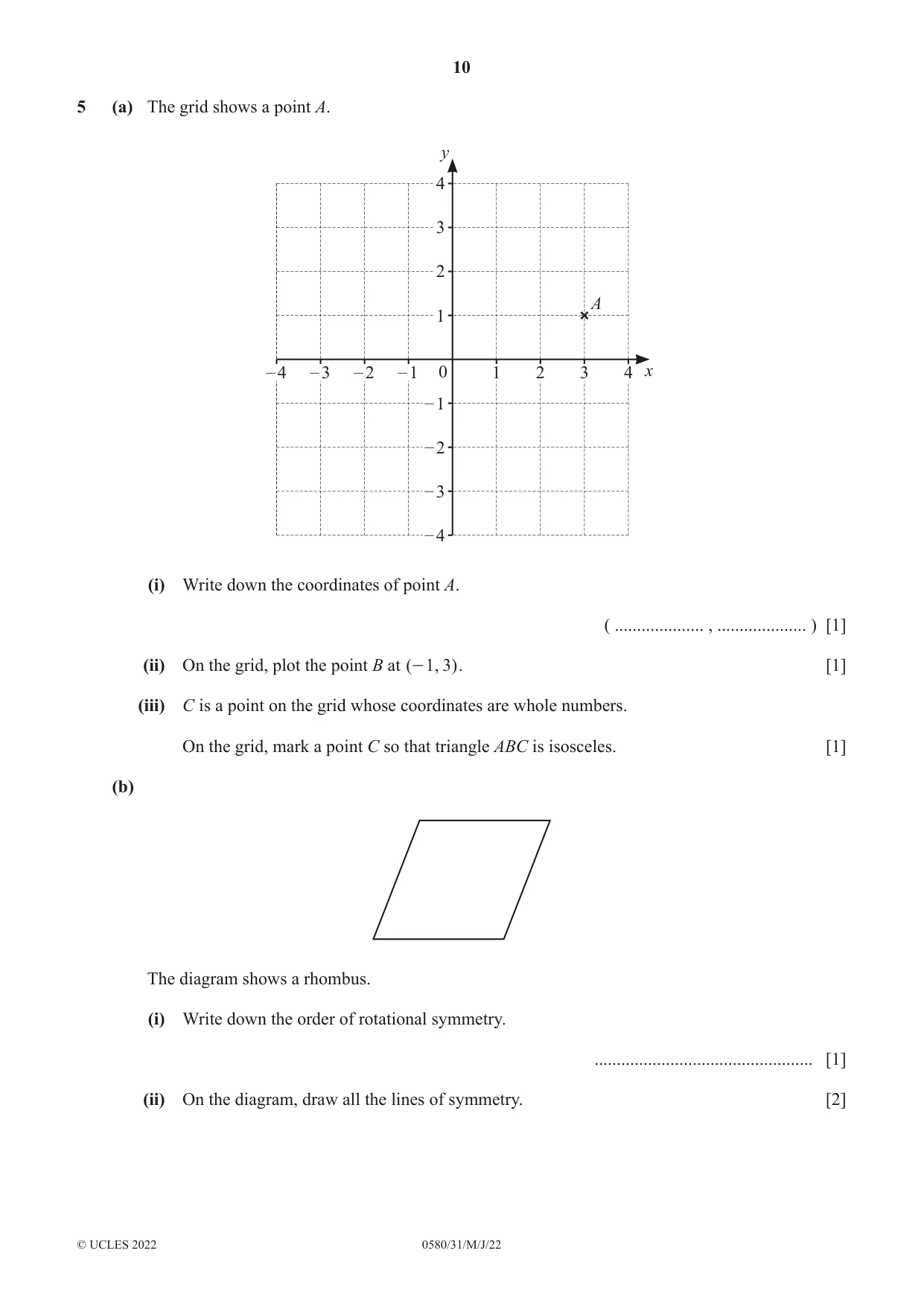
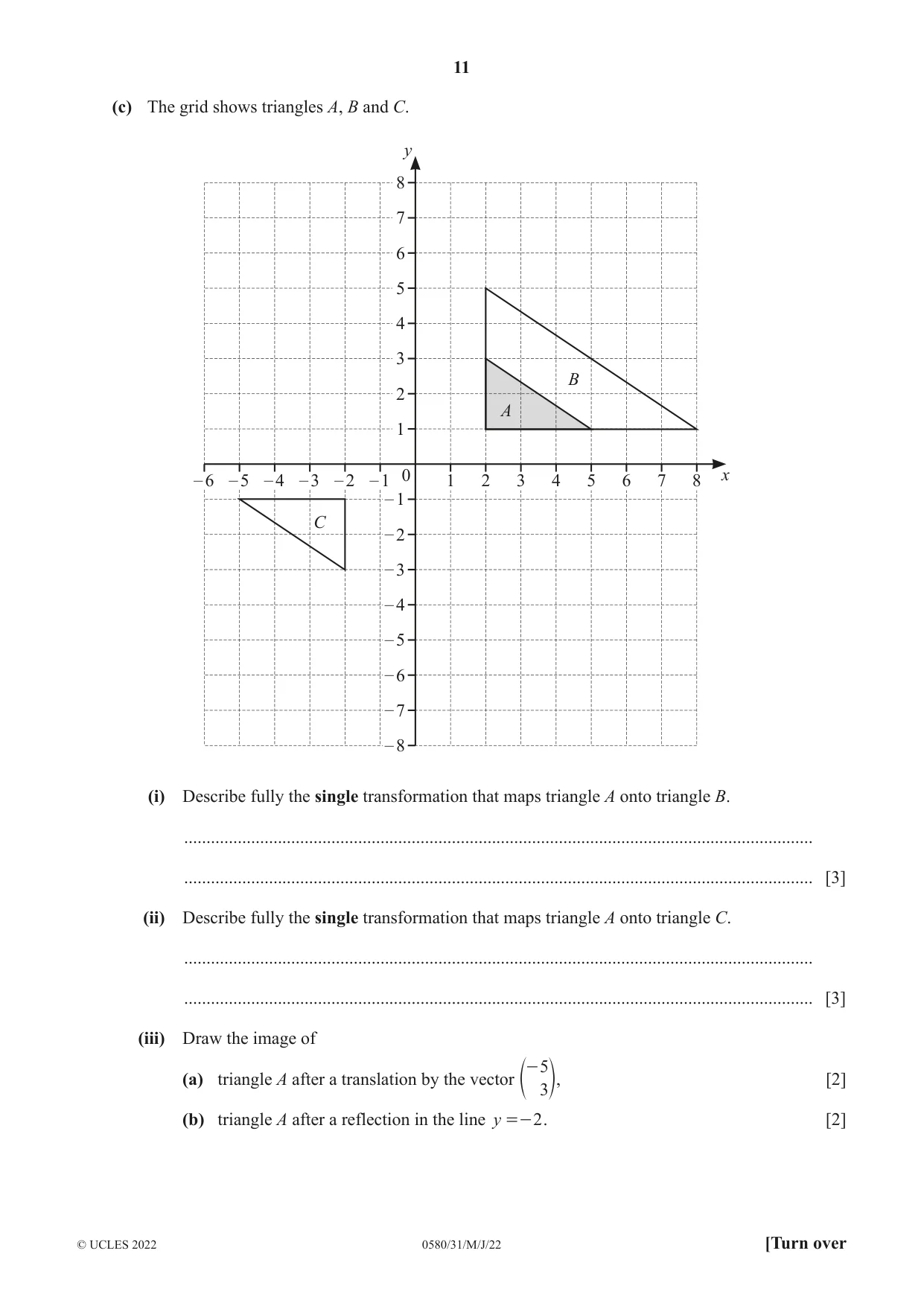
5 (a) The grid shows a point A. y 4 3 2 A 1 – 4 – 3 – 2 – 1 0 1 2 3 4 x – 1 – 2 – 3 – 4 (i) Write down the coordinates of point A. ( .................... , .................... ) [1] (ii) On the grid, plot the point B at ( - 1, 3) . [1] (iii) C is a point on the grid whose coordinates are whole numbers. On the grid, mark a point C so that triangle ABC is isosceles. [1] (b) The diagram shows a rhombus. (i) Write down the order of rotational symmetry. ................................................. [1] (ii) On the diagram, draw all the lines of symmetry. [2] (c) The grid shows triangles A, B and C. y 8 7 6 5 4 3 B 2 A 1 – 6 – 5 – 4 – 3 – 2 – 1 0 1 2 3 4 5 6 7 8 x – 1 C – 2 – 3 – 4 – 5 – 6 – 7 – 8 (i) Describe fully the single transformation that maps triangle A onto triangle B. ............................................................................................................................................. ............................................................................................................................................. [3] (ii) Describe fully the single transformation that maps triangle A onto triangle C. ............................................................................................................................................. ............................................................................................................................................. [3] (iii) Draw the image of - 5 (a) triangle A after a translation by the vector [2] e 3o, (b) triangle A after a reflection in the line y =- 2 . [2]
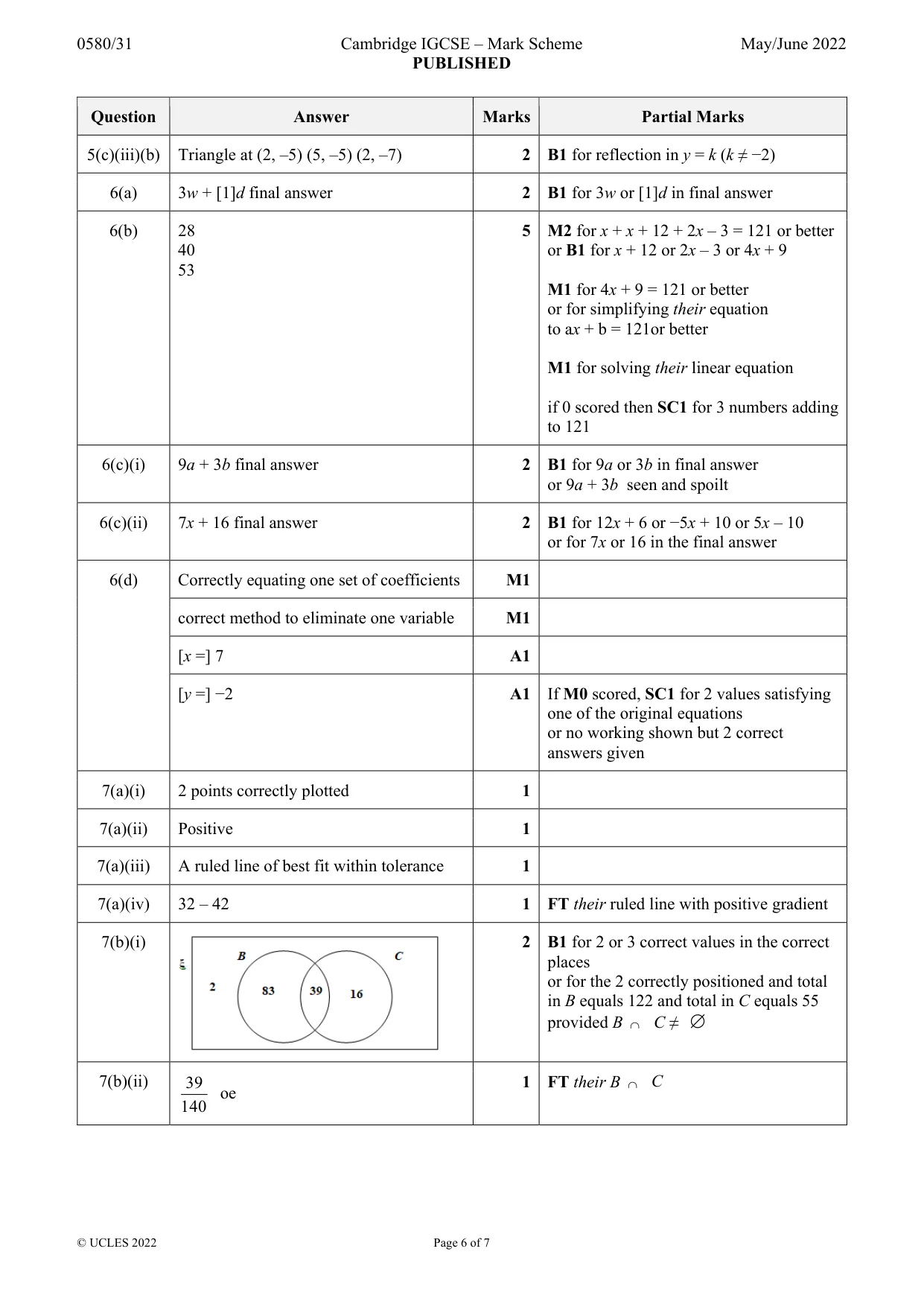
Mark scheme: 5(a)(i) 3, 1 1 5(a)(ii) Correct point plotted 1 5(a)(iii) C plotted such that ABC is isosceles 1 5(b)(i) 2 1 5(b)(ii) 2 correct lines and no extras 2 B1 for 1 correct line and no extras or for 2 correct lines and one extra 5(c)(i) Enlargement 3 B1 for each [centre] (2, 1) [sf] 2 5(c)(ii) Rotation 3 B1 for each [centre] (0, 0) 180° 5(c)(iii)(a) Triangle at (–3, 4) (0, 4) (–3, 6) 2 5 k B1 for translation by or k 3 5(c)(iii)(b) Triangle at (2, –5) (5, –5) (2, –7) 2 B1 for reflection in y = k (k ≠ −2)
Q6 · A football team has w wins and d draws
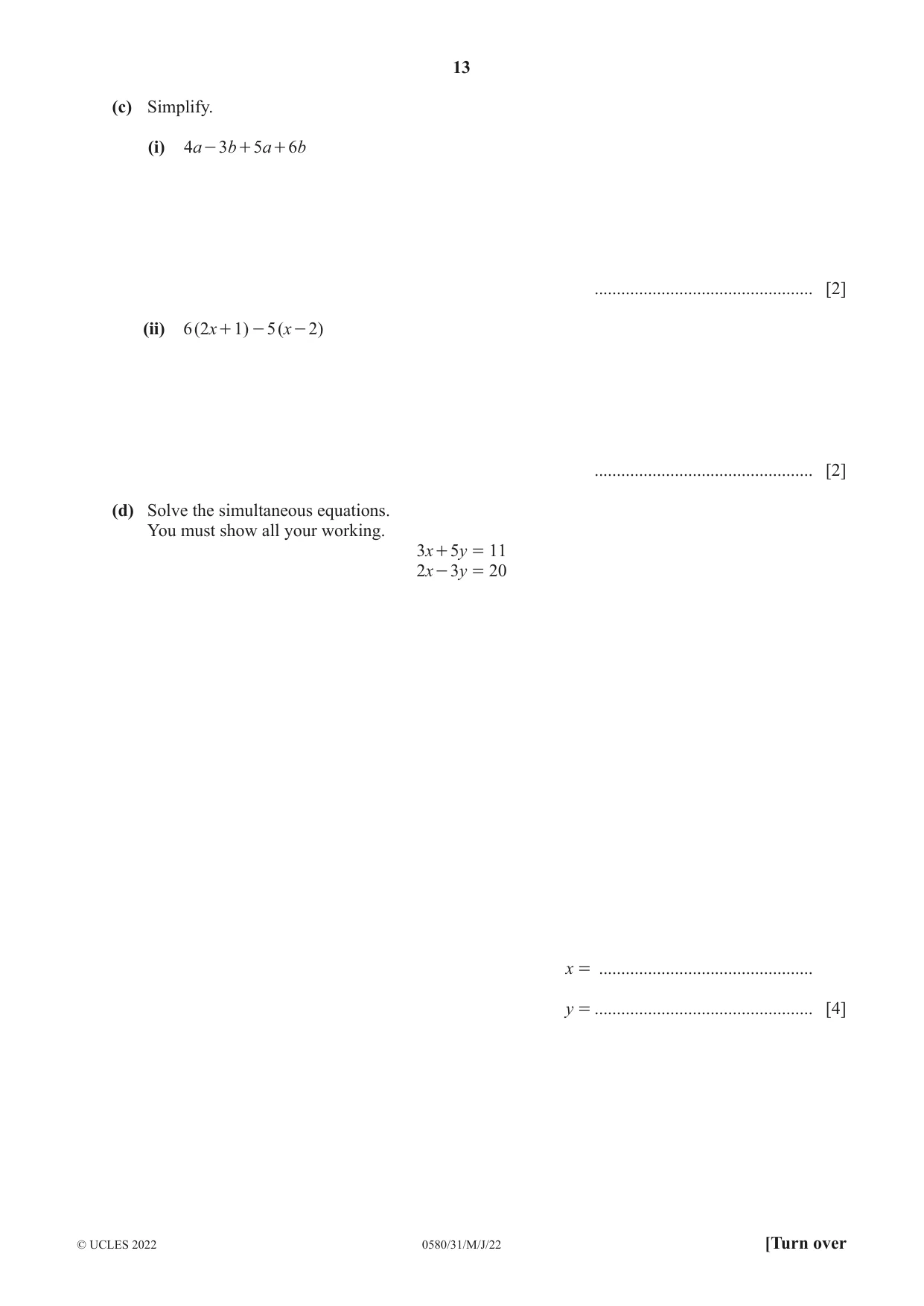
6 (a) A football team has w wins and d draws. The team scores 3 points for each win and 1 point for each draw. Write an expression, in terms of w and d, for the total number of points scored by the team. ................................................. [2] (b) Athletic, Rovers and United are three football teams. Athletic have a point score of x. Rovers have 12 points more than Athletic’s point score. United have 3 points fewer than twice Athletic’s point score. The total point score of all three teams is 121. Use this information to write down an equation in terms of x. Solve your equation to work out the point score for each team. Athletic .................................... points Rovers .................................... points United .................................... points [5] (c) Simplify. (i) 4a - 3b + 5a + 6b ................................................. [2] (ii) 6 ( 2x + 1) - 5 ( x - 2) ................................................. [2] (d) Solve the simultaneous equations. You must show all your working. 3x + 5y = 11 2x - 3y = 20 x = ................................................ y = ................................................. [4]
Mark scheme: 6(a) 3w + [1]d final answer 2 B1 for 3w or [1]d in final answer 6(b) 28 5 M2 for x + x + 12 + 2x – 3 = 121 or better 40 or B1 for x + 12 or 2x – 3 or 4x + 9 53 M1 for 4x + 9 = 121 or better or for simplifying their equation to ax + b = 121or better M1 for solving their linear equation if 0 scored then SC1 for 3 numbers adding to 121 6(c)(i) 9a + 3b final answer 2 B1 for 9a or 3b in final answer or 9a + 3b seen and spoilt 6(c)(ii) 7x + 16 final answer 2 B1 for 12x + 6 or −5x + 10 or 5x – 10 or for 7x or 16 in the final answer 6(d) Correctly equating one set of coefficients M1 correct method to eliminate one variable M1 [x =] 7 A1 [y =] −2 A1 If M0 scored, SC1 for 2 values satisfying one of the original equations or no working shown but 2 correct answers given
Q7 · A class of 15 students take two tests in science, paper 1 and paper 2
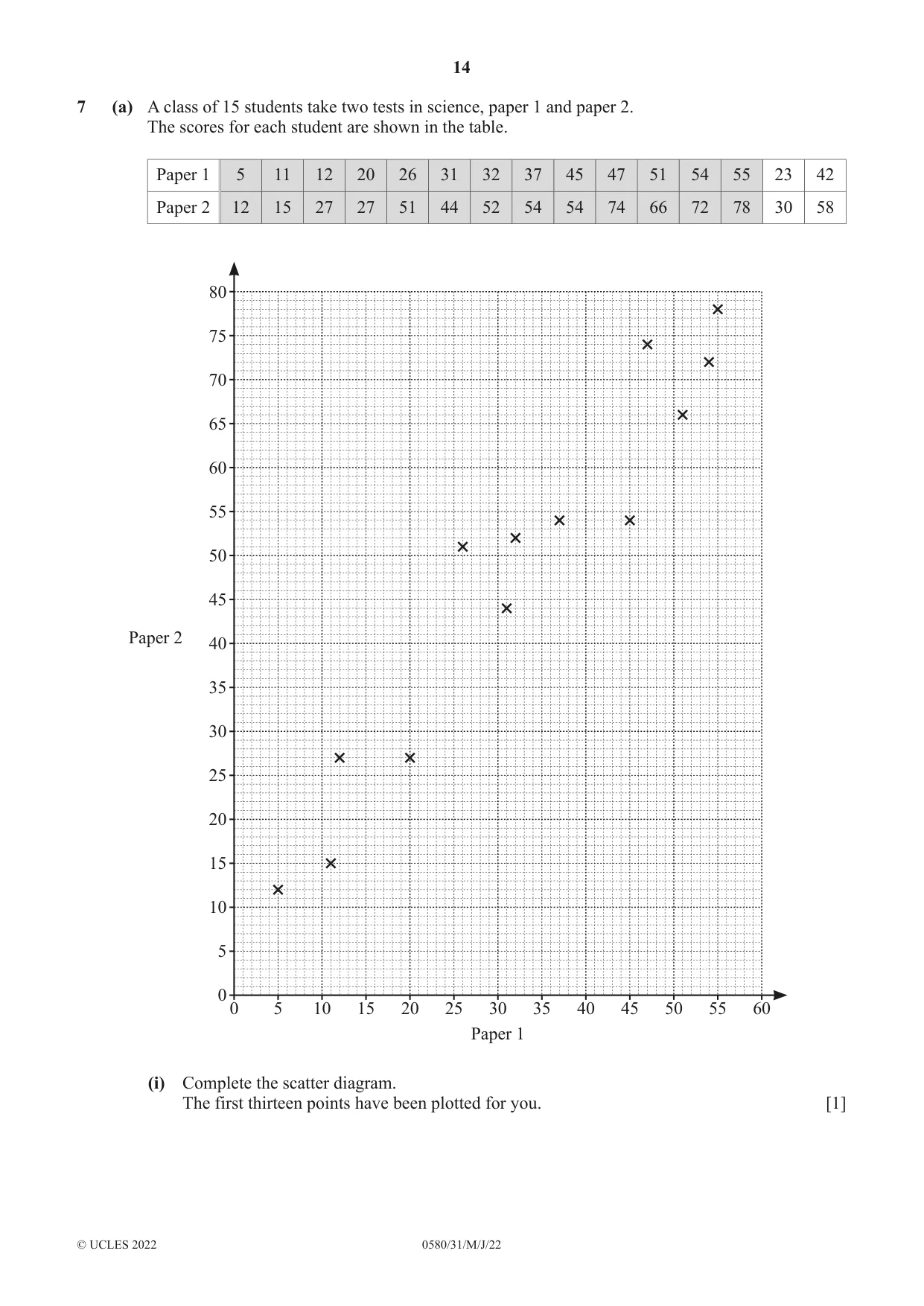
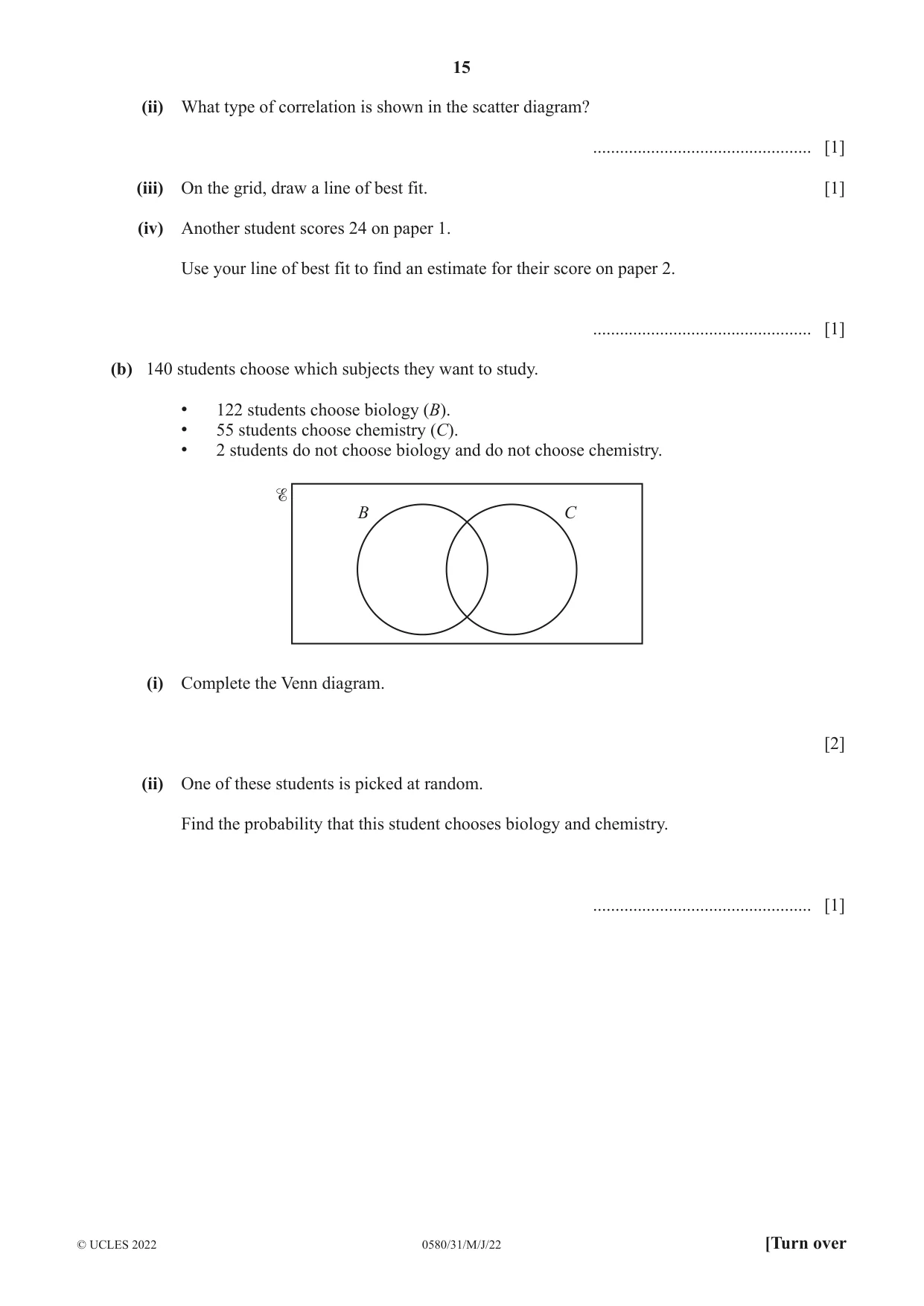
7 (a) A class of 15 students take two tests in science, paper 1 and paper 2. The scores for each student are shown in the table. Paper 1 5 11 12 20 26 31 32 37 45 47 51 54 55 23 42 Paper 2 12 15 27 27 51 44 52 54 54 74 66 72 78 30 58 80 75 70 65 60 55 50 45 Paper 2 40 35 30 25 20 15 10 5 0 0 5 10 15 20 25 30 35 40 45 50 55 60 Paper 1 (i) Complete the scatter diagram. The first thirteen points have been plotted for you. [1] (ii) What type of correlation is shown in the scatter diagram? ................................................. [1] (iii) On the grid, draw a line of best fit. [1] (iv) Another student scores 24 on paper 1. Use your line of best fit to find an estimate for their score on paper 2. ................................................. [1] (b) 140 students choose which subjects they want to study. • 122 students choose biology (B). • 55 students choose chemistry (C). • 2 students do not choose biology and do not choose chemistry. B C (i) Complete the Venn diagram. [2] (ii) One of these students is picked at random. Find the probability that this student chooses biology and chemistry. ................................................. [1]
Mark scheme: 7(a)(i) 2 points correctly plotted 1 7(a)(ii) Positive 1 7(a)(iii) A ruled line of best fit within tolerance 1 7(a)(iv) 32 – 42 1 FT their ruled line with positive gradient 7(b)(i) 2 B1 for 2 or 3 correct values in the correct places or for the 2 correctly positioned and total in B equals 122 and total in C equals 55 provided B C ≠ 7(b)(ii) 39 1 FT their B C oe 140
Q8 · The grid shows a line L
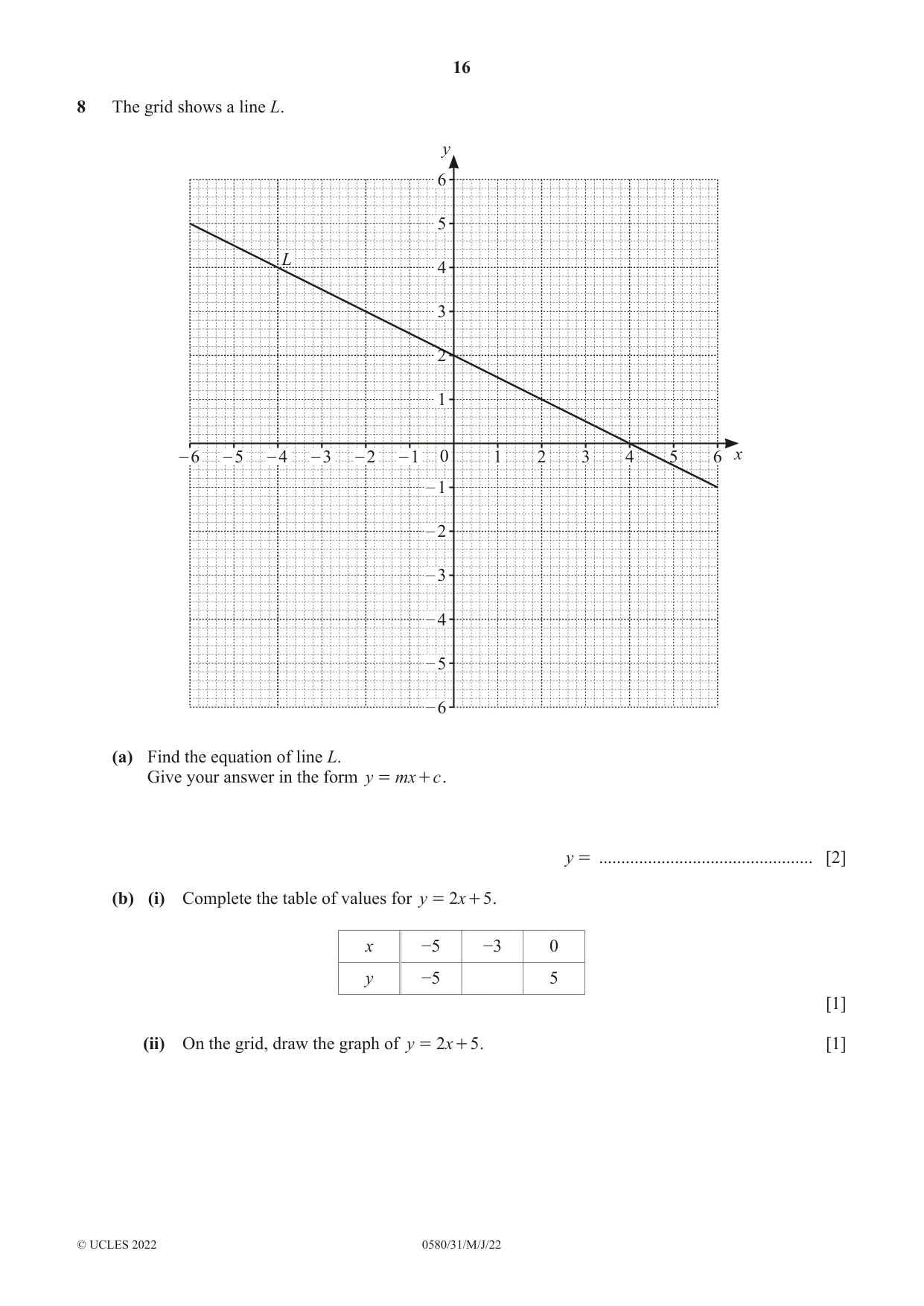
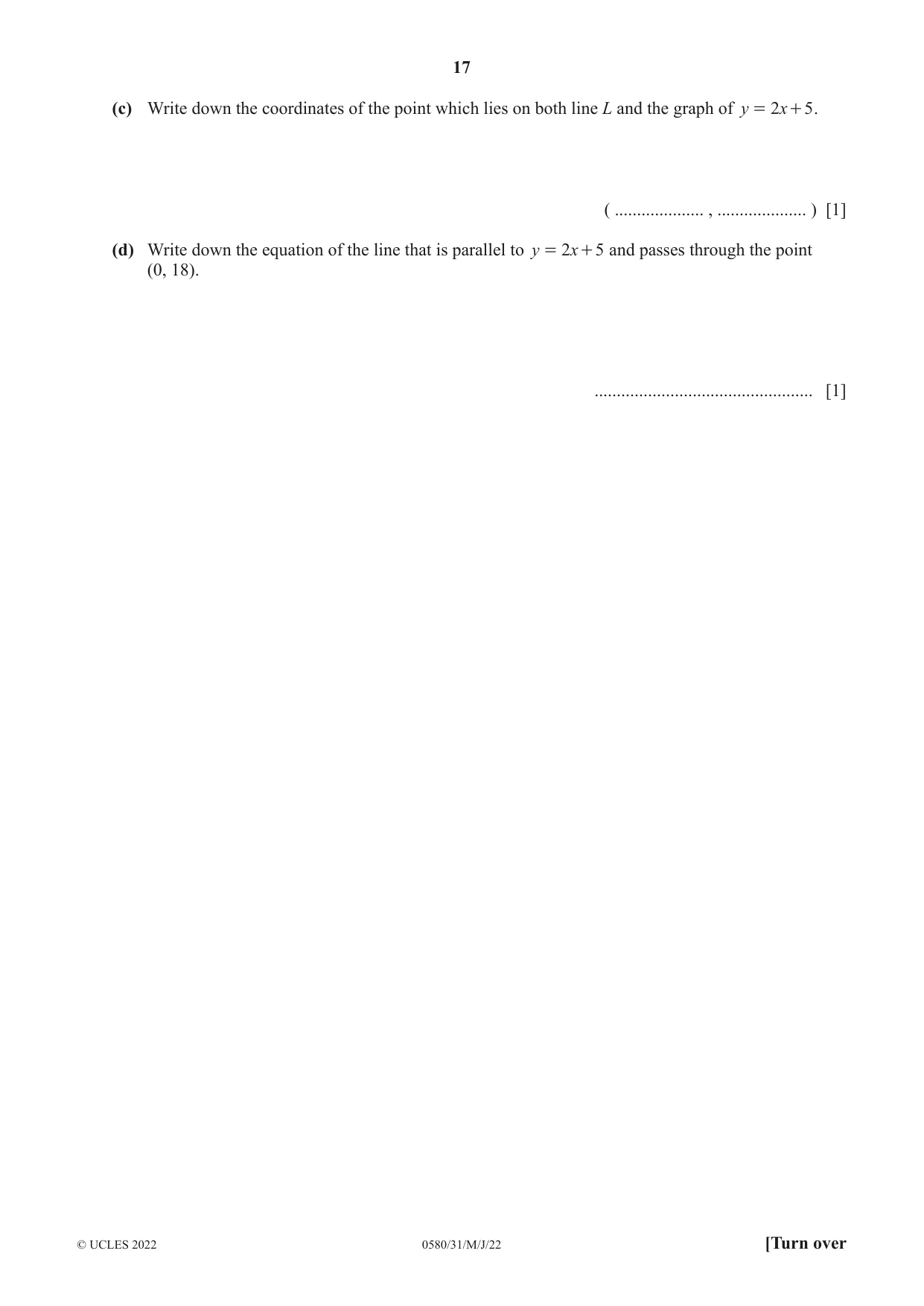
8 The grid shows a line L. y 6 5 L 4 3 2 1 – 6 – 5 – 4 – 3 – 2 – 1 0 1 2 3 4 5 6 x – 1 – 2 – 3 – 4 – 5 – 6 (a) Find the equation of line L. Give your answer in the form y = mx + c . y = ................................................ [2] (b) (i) Complete the table of values for y = 2x + 5 . x −5 −3 0 y −5 5 [1] (ii) On the grid, draw the graph of y = 2x + 5 . [1] (c) Write down the coordinates of the point which lies on both line L and the graph of y = 2x + 5 . ( .................... , .................... ) [1] (d) Write down the equation of the line that is parallel to y = 2x + 5 and passes through the point (0, 18). ................................................. [1]
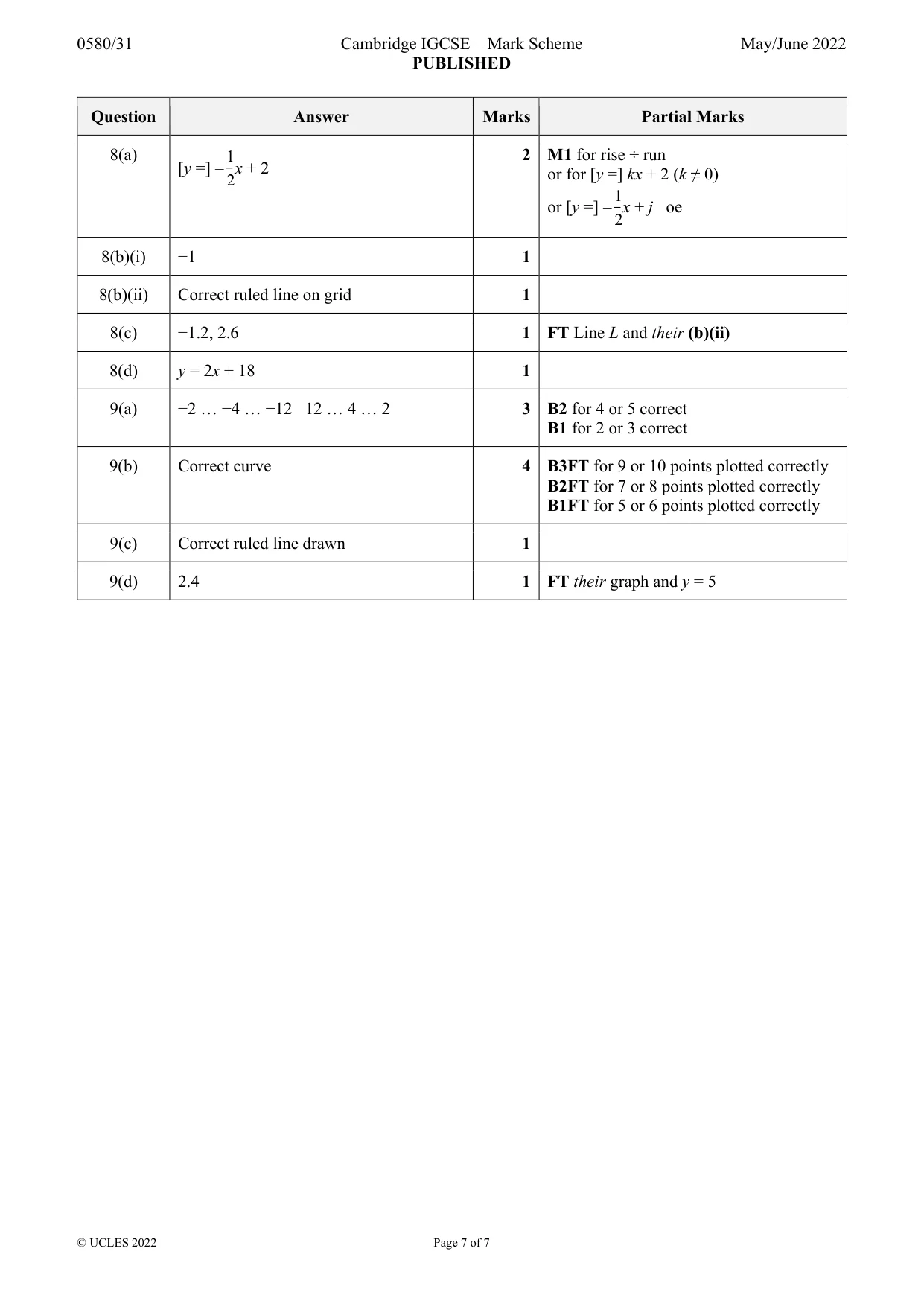
Mark scheme: 8(a) 1 2 M1 for rise ÷ run [y =] – + 2 or for [y =] kx + 2 (k ≠ 0) 2x 1 or [y =] – 2x + j oe 8(b)(i) −1 1 8(b)(ii) Correct ruled line on grid 1 8(c) −1.2, 2.6 1 FT Line L and their (b)(ii) 8(d) y = 2x + 18 1
Q9 · 9 (a) Complete the table of values for y = , x !
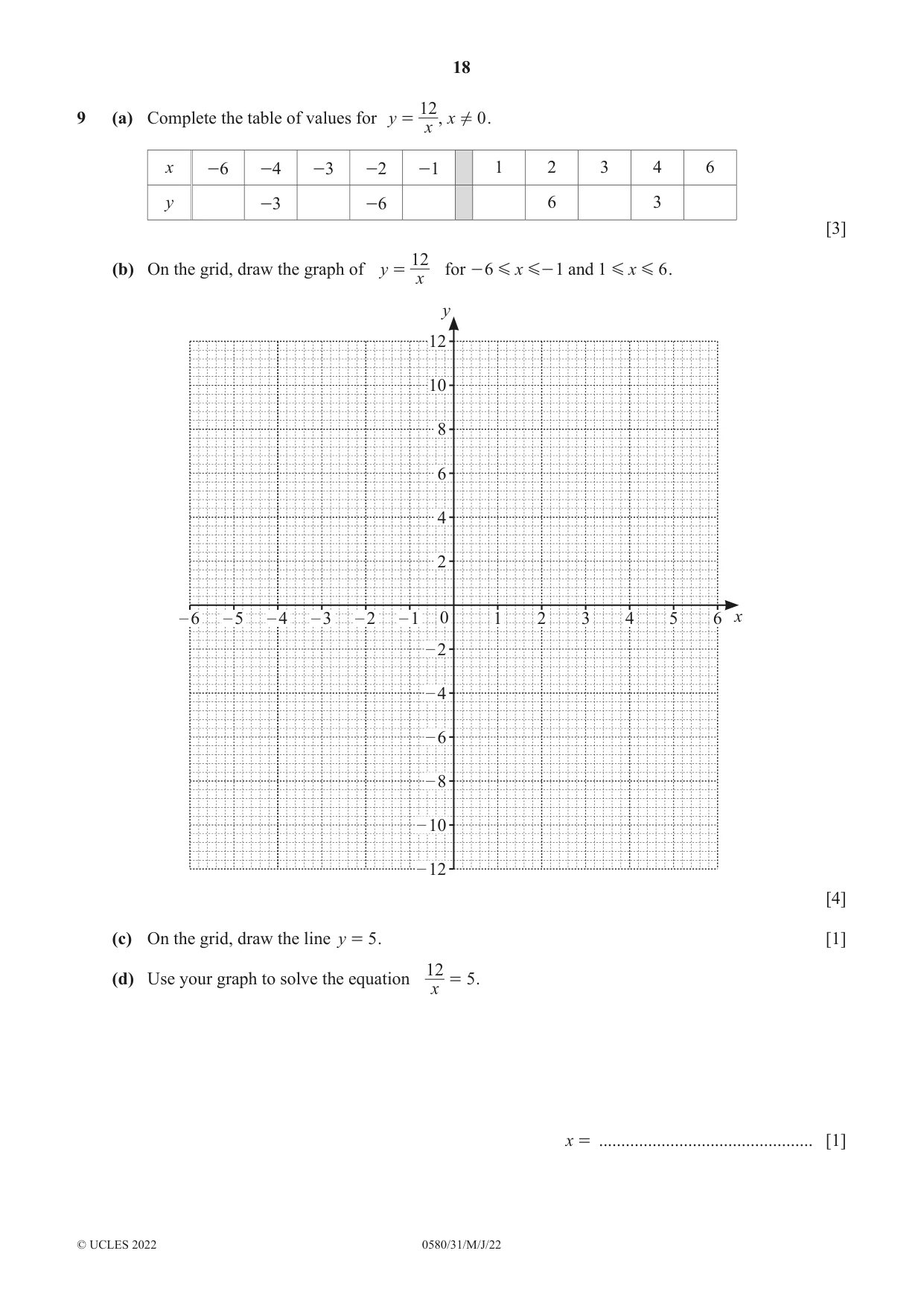
129 (a) Complete the table of values for y = , x ! 0 . x x -6 -4 -3 -2 -1 1 2 3 4 6 y -3 -6 6 3 [3] 12 (b) On the grid, draw the graph of y = for - 6 G x G - 1 and 1 G x G 6 . x y 12 10 8 6 4 2 – 6 – 5 – 4 – 3 – 2 – 1 0 1 2 3 4 5 6 x – 2 – 4 – 6 – 8 – 10 – 12 [4] (c) On the grid, draw the line y = 5 . [1] 12 (d) Use your graph to solve the equation = 5 . x x = ................................................ [1]
Mark scheme: 9(a) −2 … −4 … −12 12 … 4 … 2 3 B2 for 4 or 5 correct B1 for 2 or 3 correct 9(b) Correct curve 4 B3FT for 9 or 10 points plotted correctly B2FT for 7 or 8 points plotted correctly B1FT for 5 or 6 points plotted correctly 9(c) Correct ruled line drawn 1 9(d) 2.4 1 FT their graph and y = 5
What was in this paper
The subtopics covered by these 9 questions, and how many questions each got. Open one in a new tab to see every Cambridge question on it.
What you needed in this session
Cambridge’s own grade thresholds for 2022 May/June, Paper 3 · Variant 1. A higher threshold means an easier paper — the bar moves with how the cohort did.