Cambridge IGCSE Mathematics 0580 — 2024 May/June Paper 3 · Variant 1
0580/31/M/J/24 · 8 questions · 104 marks · ≈117 min
The question paper and its mark scheme, free to read here and free to download. This is Cambridge’s own paper, exactly as it was sat.
Question paper16 pages
Mark scheme8 pages
Answers below. Sit the paper first if you are practising.
Questions as text
Q1 · The cost of a cinema ticket is $6.30
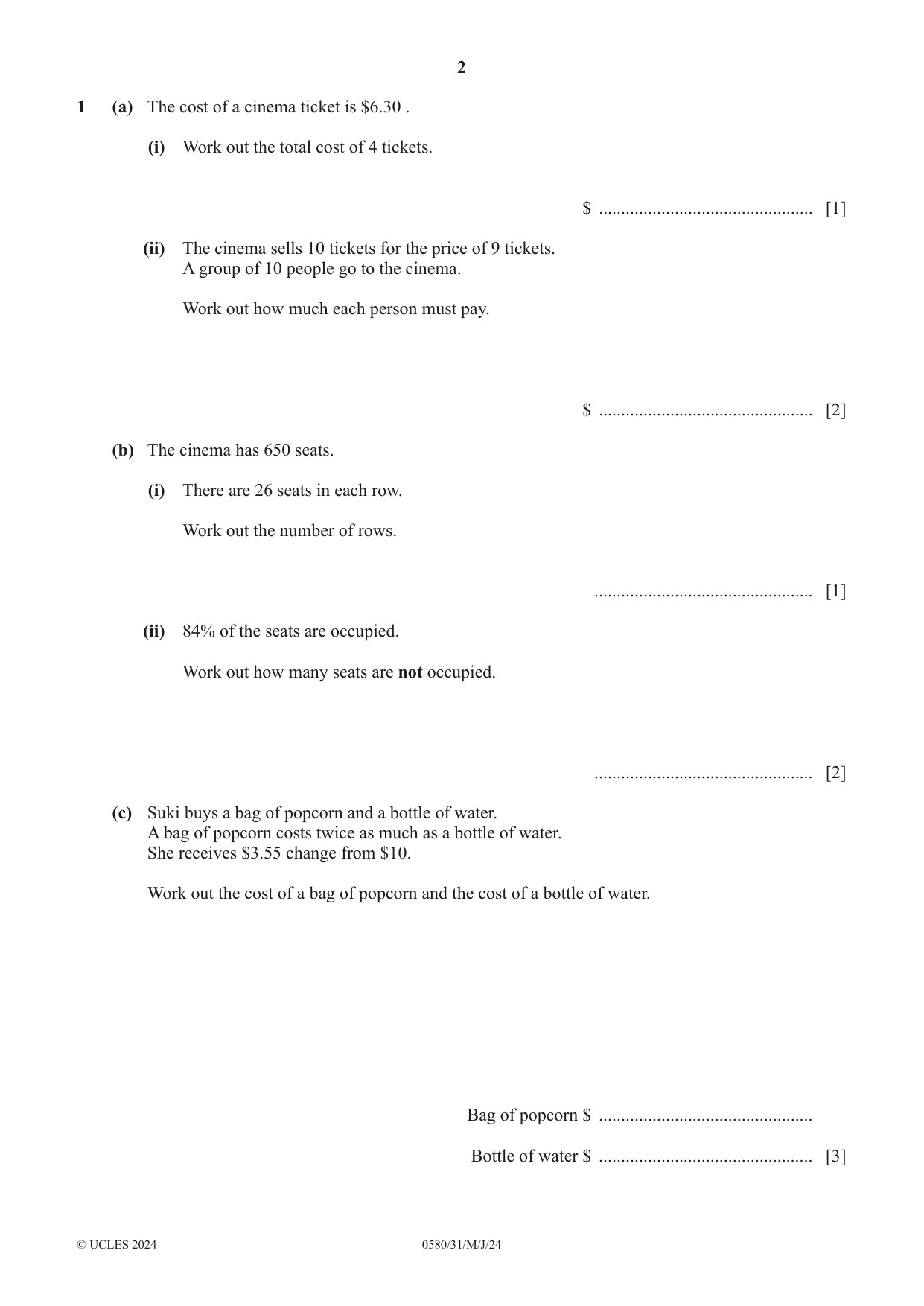
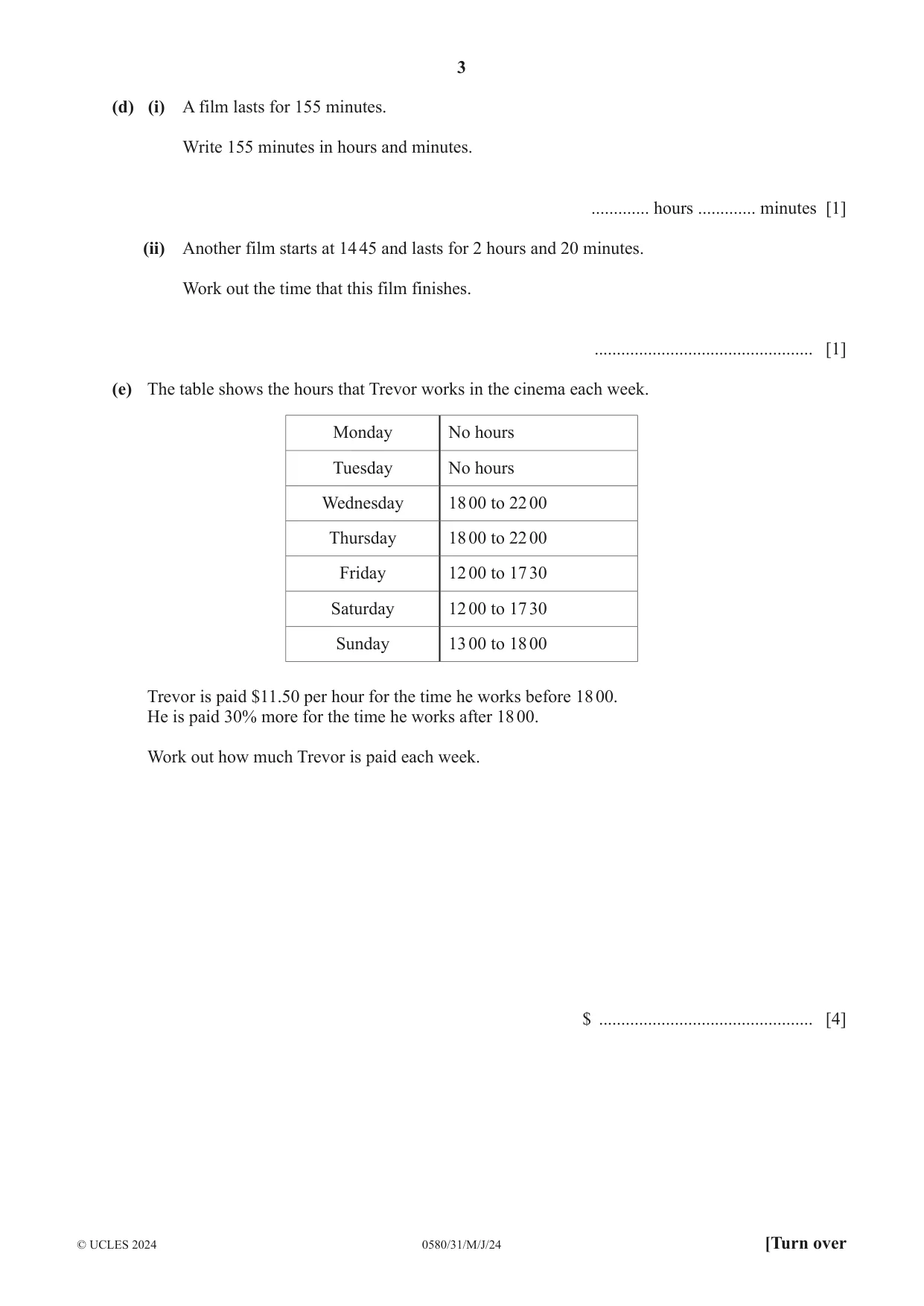
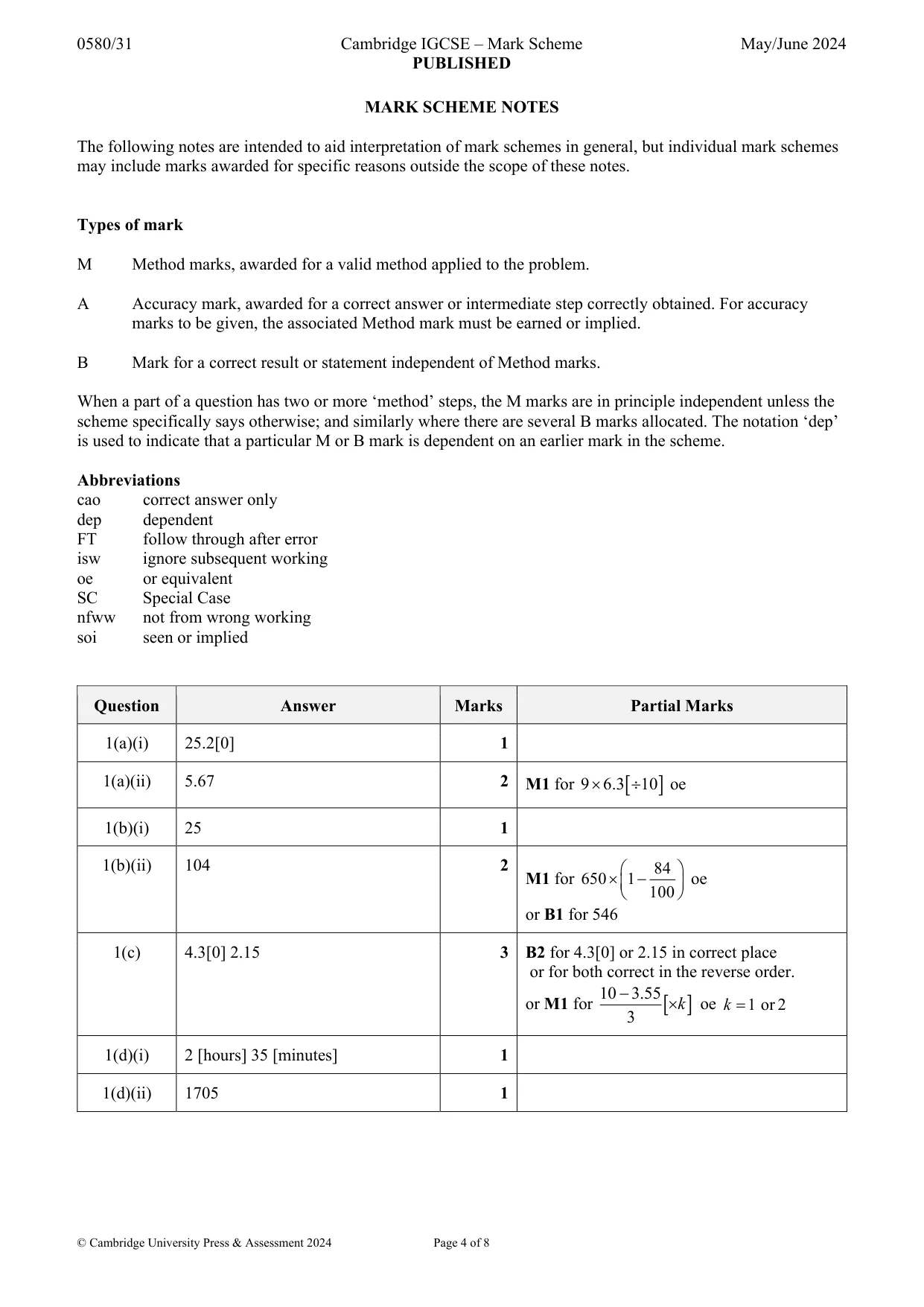
1 (a) The cost of a cinema ticket is $6.30 . (i) Work out the total cost of 4 tickets. $ ................................................ [1] (ii) The cinema sells 10 tickets for the price of 9 tickets. A group of 10 people go to the cinema. Work out how much each person must pay. $ ................................................ [2] (b) The cinema has 650 seats. (i) There are 26 seats in each row. Work out the number of rows. ................................................. [1] (ii) 84% of the seats are occupied. Work out how many seats are not occupied. ................................................. [2] (c) Suki buys a bag of popcorn and a bottle of water. A bag of popcorn costs twice as much as a bottle of water. She receives $3.55 change from $10. Work out the cost of a bag of popcorn and the cost of a bottle of water. Bag of popcorn $ ................................................ Bottle of water $ ................................................ [3] (d) (i) A film lasts for 155 minutes. Write 155 minutes in hours and minutes. ............. hours ............. minutes [1] (ii) Another film starts at 14 45 and lasts for 2 hours and 20 minutes. Work out the time that this film finishes. ................................................. [1] (e) The table shows the hours that Trevor works in the cinema each week. Monday No hours Tuesday No hours Wednesday 18 00 to 22 00 Thursday 18 00 to 22 00 Friday 12 00 to 17 30 Saturday 12 00 to 17 30 Sunday 13 00 to 18 00 Trevor is paid $11.50 per hour for the time he works before 18 00. He is paid 30% more for the time he works after 18 00. Work out how much Trevor is paid each week. $ ................................................ [4]
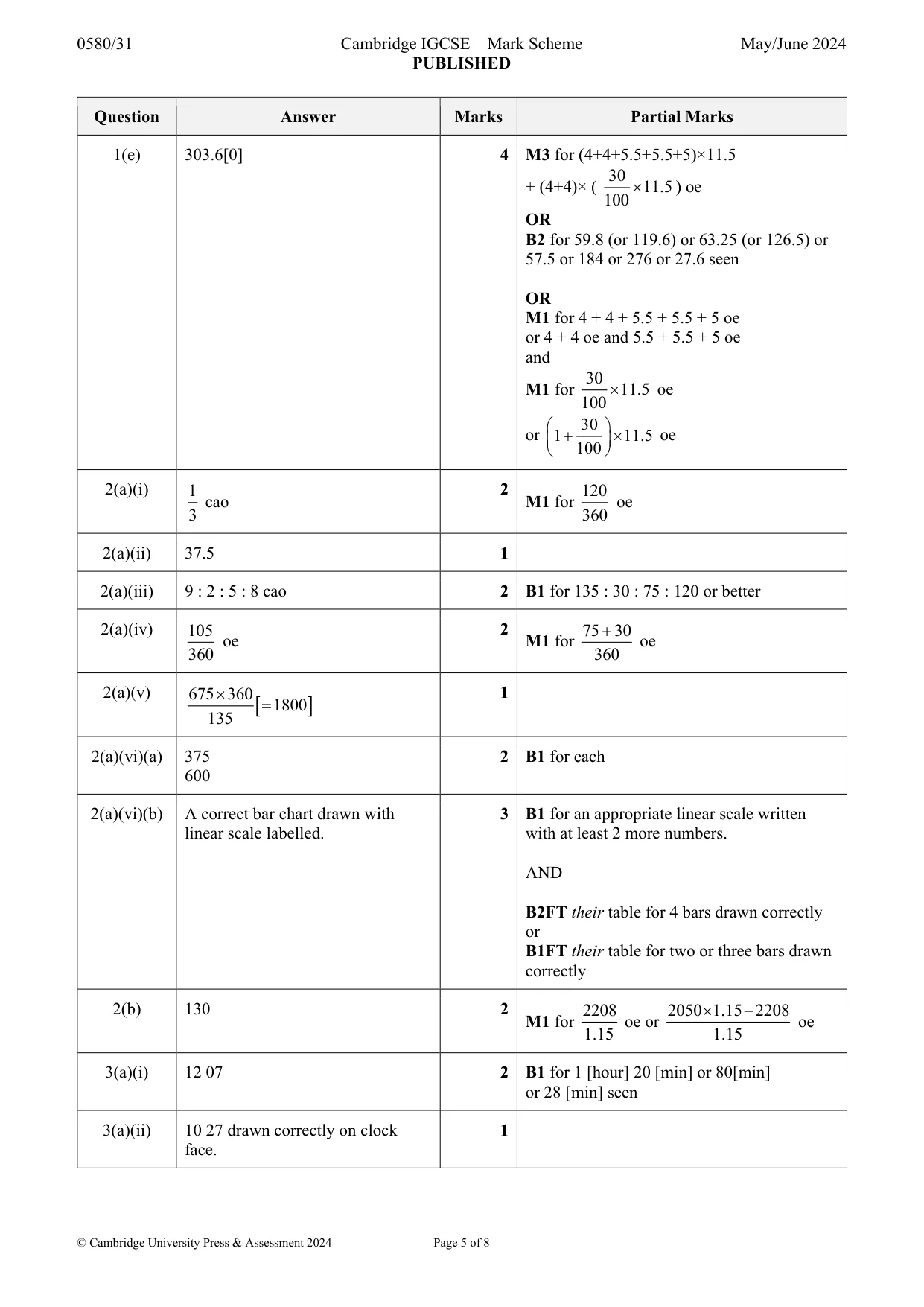
Mark scheme: Question Answer Marks Partial Marks 1(a)(i) 25.2[0] 1 1(a)(ii) 5.67 2 M1 for 9 6.3 10 oe 1(b)(i) 25 1 1(b)(ii) 104 2 84 M1 for 650 1 oe 100 or B1 for 546 1(c) 4.3[0] 2.15 3 B2 for 4.3[0] or 2.15 in correct place or for both correct in the reverse order. 10 3.55 or M1 for k oe k 1 or 2 3 1(d)(i) 2 [hours] 35 [minutes] 1 1(d)(ii) 1705 1 1(e) 303.6[0] 4 M3 for (4+4+5.5+5.5+5)×11.5 30 + (4+4)× ( 11.5 ) oe 100 OR B2 for 59.8 (or 119.6) or 63.25 (or 126.5) or 57.5 or 184 or 276 or 27.6 seen OR M1 for 4 + 4 + 5.5 + 5.5 + 5 oe or 4 + 4 oe and 5.5 + 5.5 + 5 oe and 30 M1 for 11.5 oe 100 30 or 1 11.5 oe 100
Q2 · Chen asks some people if they prefer a beach, cruise, lake or mountain holiday
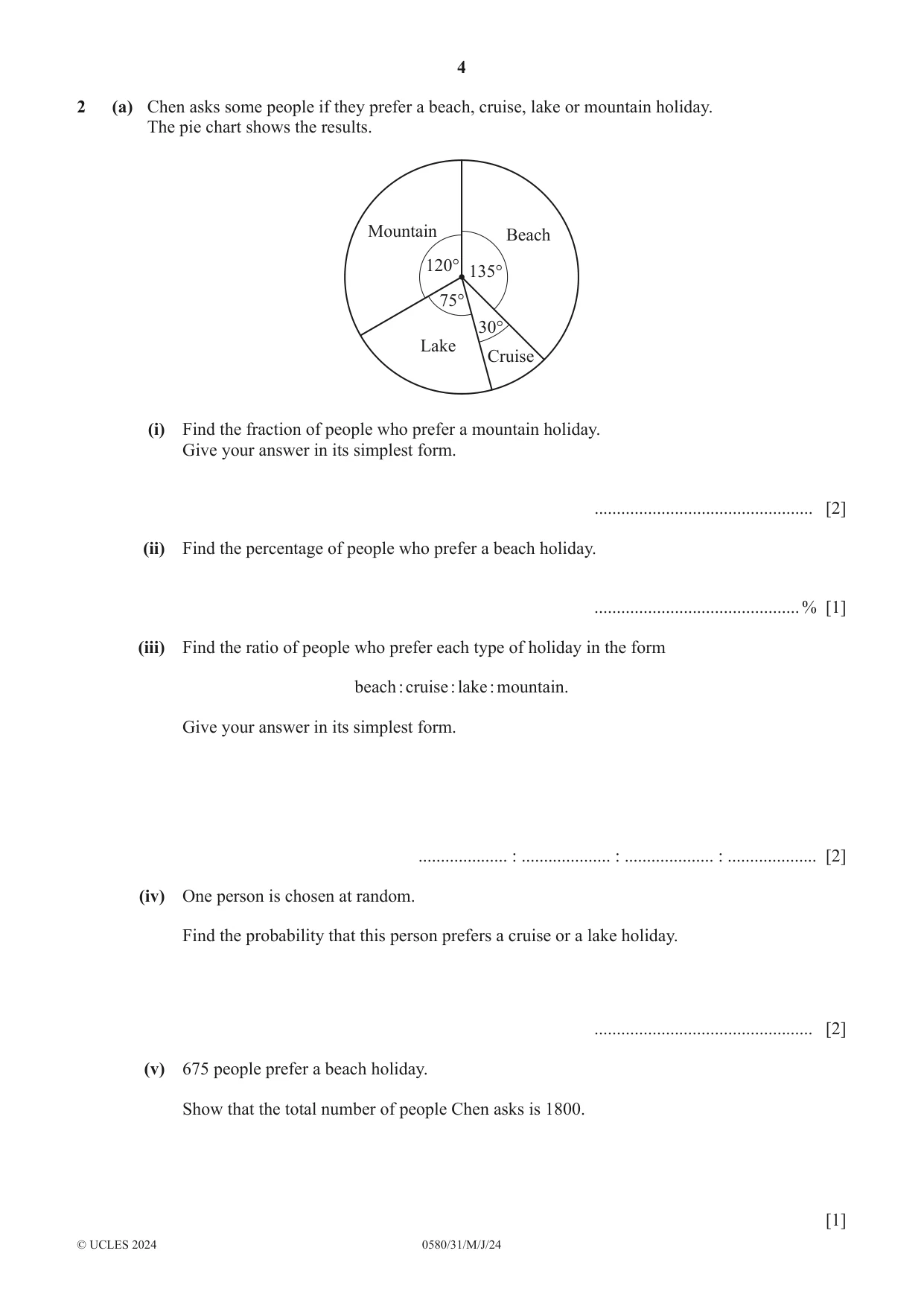
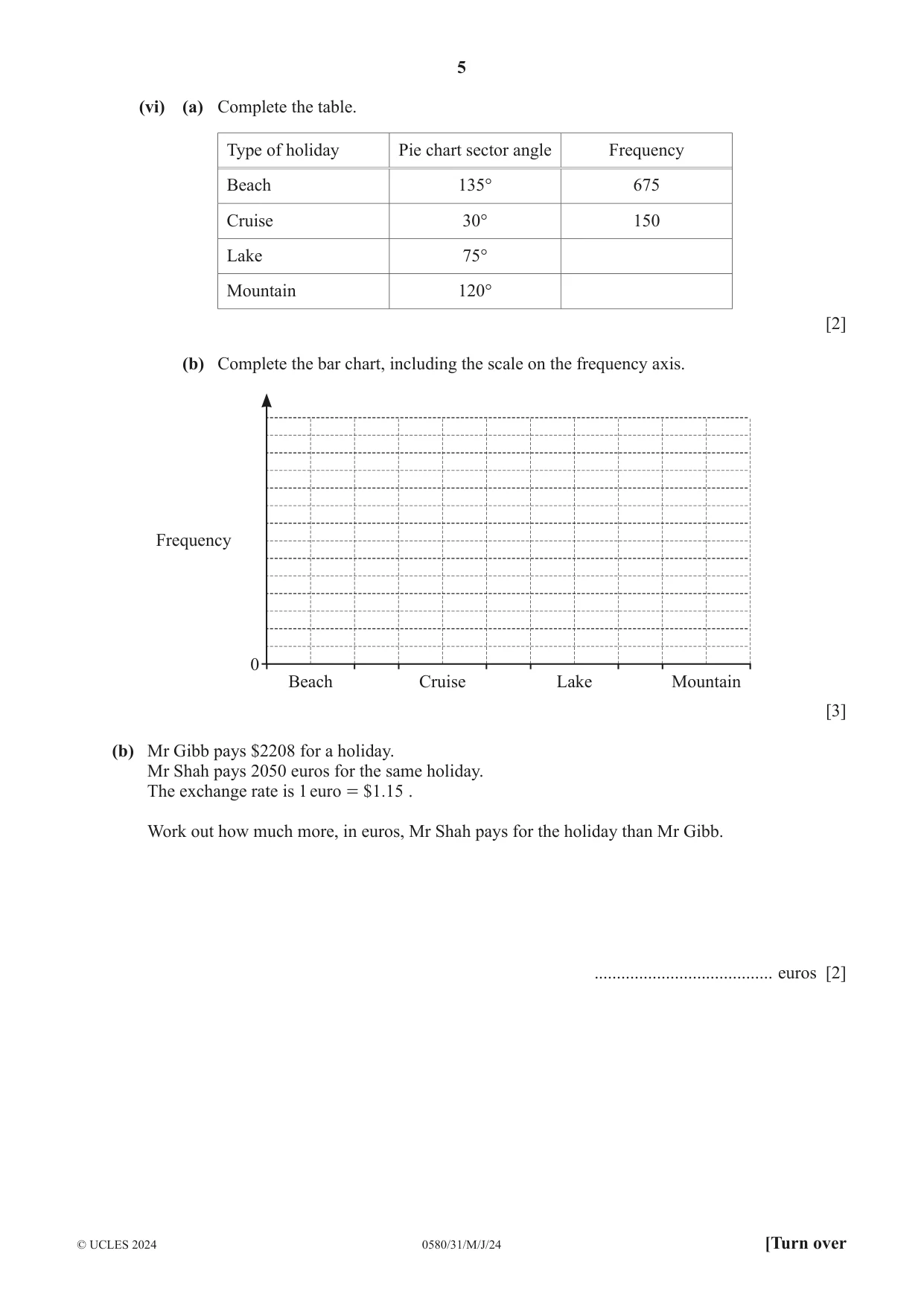
2 (a) Chen asks some people if they prefer a beach, cruise, lake or mountain holiday. The pie chart shows the results. Mountain Beach 120° 135° 75° 30° Lake Cruise (i) Find the fraction of people who prefer a mountain holiday. Give your answer in its simplest form. ................................................. [2] (ii) Find the percentage of people who prefer a beach holiday. ..............................................% [1] (iii) Find the ratio of people who prefer each type of holiday in the form beach : cruise : lake : mountain. Give your answer in its simplest form. .................... : .................... : .................... : .................... [2] (iv) One person is chosen at random. Find the probability that this person prefers a cruise or a lake holiday. ................................................. [2] (v) 675 people prefer a beach holiday. Show that the total number of people Chen asks is 1800. [1] (vi) (a) Complete the table. Type of holiday Pie chart sector angle Frequency Beach 135° 675 Cruise 30° 150 Lake 75° Mountain 120° [2] (b) Complete the bar chart, including the scale on the frequency axis. Frequency 0 Beach Cruise Lake Mountain [3] (b) Mr Gibb pays $2208 for a holiday. Mr Shah pays 2050 euros for the same holiday. The exchange rate is 1 euro = $1 .15 . Work out how much more, in euros, Mr Shah pays for the holiday than Mr Gibb. ........................................ euros [2]
Mark scheme: 2(a)(i) 1 2 120 cao M1 for oe 3 360 2(a)(ii) 37.5 1 2(a)(iii) 9 : 2 : 5 : 8 cao 2 B1 for 135 : 30 : 75 : 120 or better 2(a)(iv) 105 2 75 30 oe M1 for oe 360 360 2(a)(v) 675 360 1 1800 135 2(a)(vi)(a) 375 2 B1 for each 600 2(a)(vi)(b) A correct bar chart drawn with 3 B1 for an appropriate linear scale written linear scale labelled. with at least 2 more numbers. AND B2FT their table for 4 bars drawn correctly or B1FT their table for two or three bars drawn correctly 2(b) 130 2 2208 2050 1.15 2208 M1 for oe or oe 1.15 1.15
Q3 · Here is part of the timetable for trains from Hinton to Jarmouth
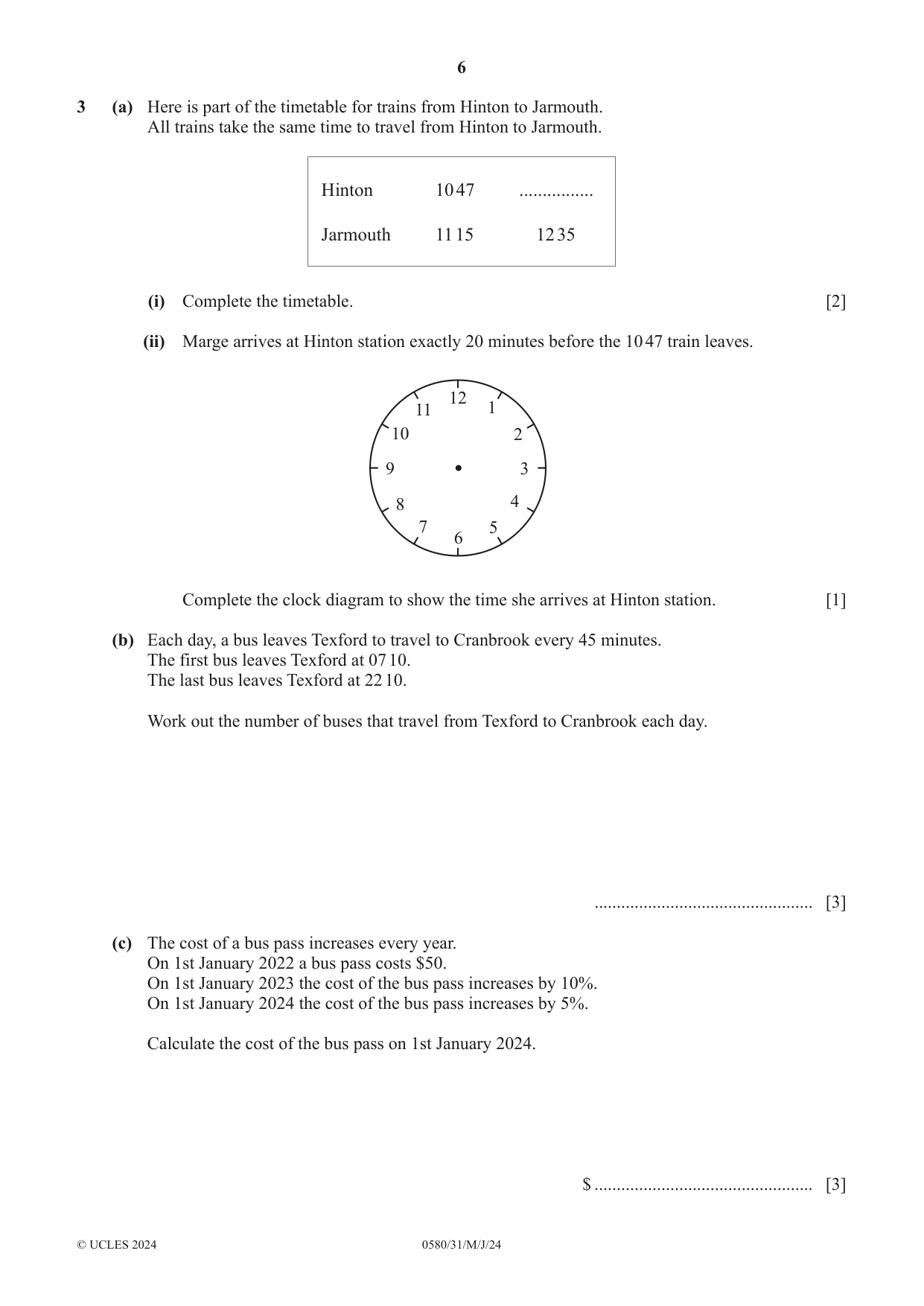
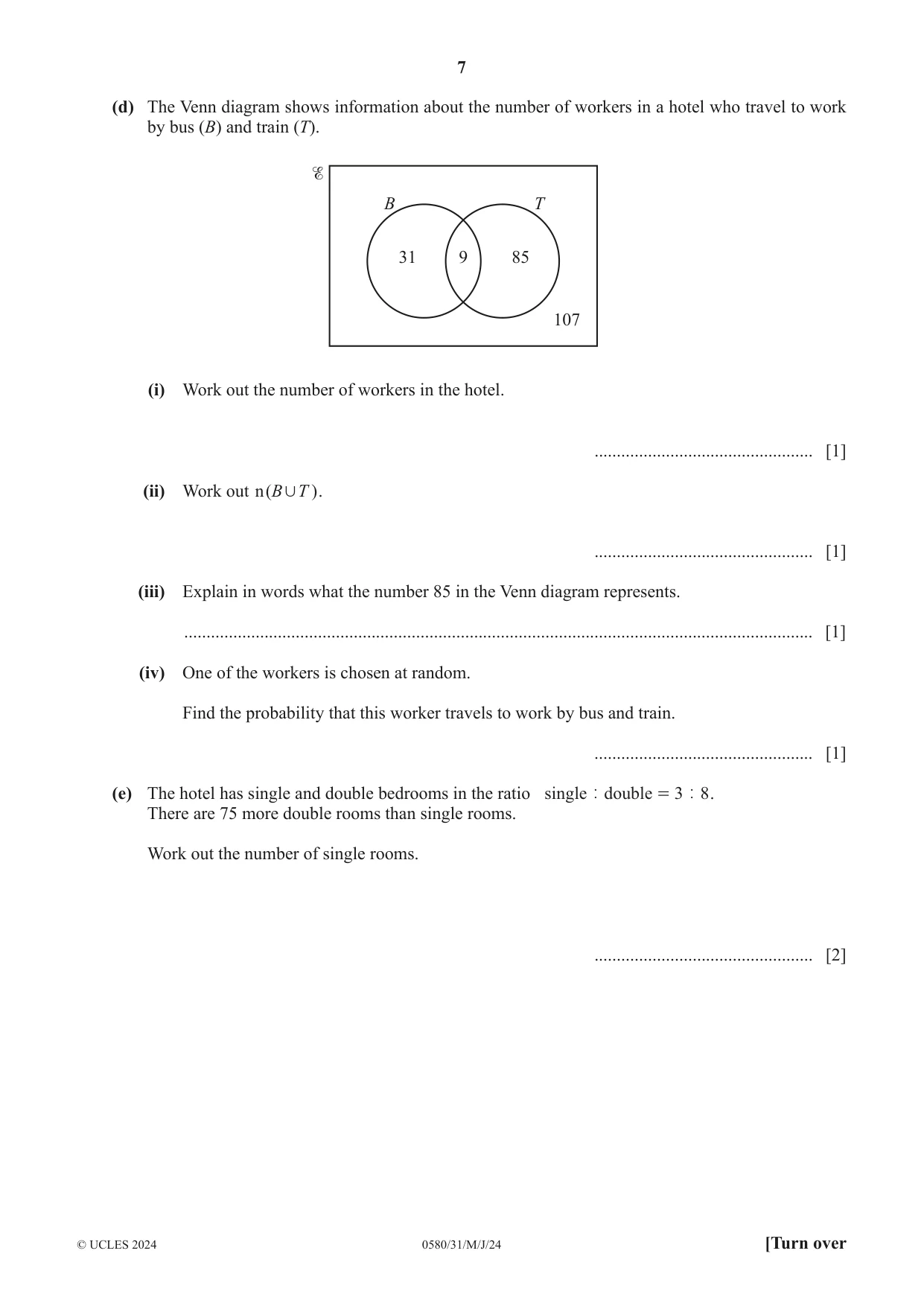
3 (a) Here is part of the timetable for trains from Hinton to Jarmouth. All trains take the same time to travel from Hinton to Jarmouth. Hinton 10 47 ................ Jarmouth 11 15 12 35 (i) Complete the timetable. [2] (ii) Marge arrives at Hinton station exactly 20 minutes before the 10 47 train leaves. 12 11 1 10 2 9 3 8 4 7 5 6 Complete the clock diagram to show the time she arrives at Hinton station. [1] (b) Each day, a bus leaves Texford to travel to Cranbrook every 45 minutes. The first bus leaves Texford at 07 10. The last bus leaves Texford at 22 10. Work out the number of buses that travel from Texford to Cranbrook each day. ................................................. [3] (c) The cost of a bus pass increases every year. On 1st January 2022 a bus pass costs $50. On 1st January 2023 the cost of the bus pass increases by 10%. On 1st January 2024 the cost of the bus pass increases by 5%. Calculate the cost of the bus pass on 1st January 2024. $ ................................................. [3] (d) The Venn diagram shows information about the number of workers in a hotel who travel to work by bus (B) and train (T). B T 31 9 85 107 (i) Work out the number of workers in the hotel. ................................................. [1] (ii) Work out n ( B , T ) . ................................................. [1] (iii) Explain in words what the number 85 in the Venn diagram represents. ............................................................................................................................................. [1] (iv) One of the workers is chosen at random. Find the probability that this worker travels to work by bus and train. ................................................. [1] (e) The hotel has single and double bedrooms in the ratio single | double = 3 | 8 . There are 75 more double rooms than single rooms. Work out the number of single rooms. ................................................. [2]
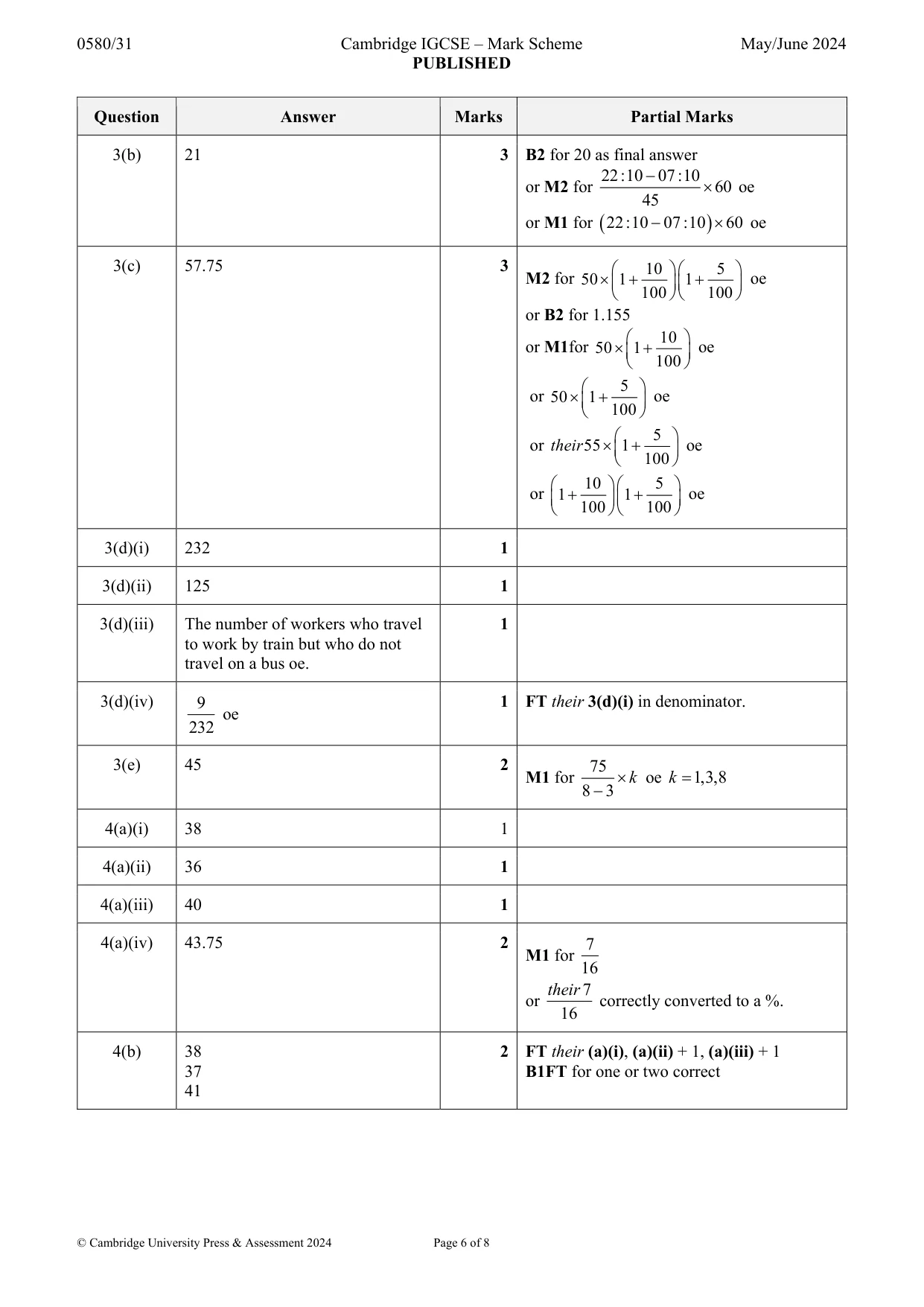
Mark scheme: 3(a)(i) 12 07 2 B1 for 1 [hour] 20 [min] or 80[min] or 28 [min] seen 3(a)(ii) 10 27 drawn correctly on clock 1 face. 3(b) 21 3 B2 for 20 as final answer 22:10 07:10 or M2 for 60 oe 45 or M1 for 22:10 07:10 60 oe 3(c) 57.75 3 10 5 M2 for 50 1 1 oe 100 100 or B2 for 1.155 10 or M1for 50 1 oe 100 5 or 50 1 oe 100 5 or their 55 1 oe 100 10 5 or 1 1 oe 100 100 3(d)(i) 232 1 3(d)(ii) 125 1 3(d)(iii) The number of workers who travel 1 to work by train but who do not travel on a bus oe. 3(d)(iv) 9 1 FT their 3(d)(i) in denominator. oe 232 3(e) 45 2 75 M1 for k oe k 1, 3, 8 8 3
Q4 · The stem-and-leaf diagram shows the ages of the 16 workers in a shop on 1st January 2022
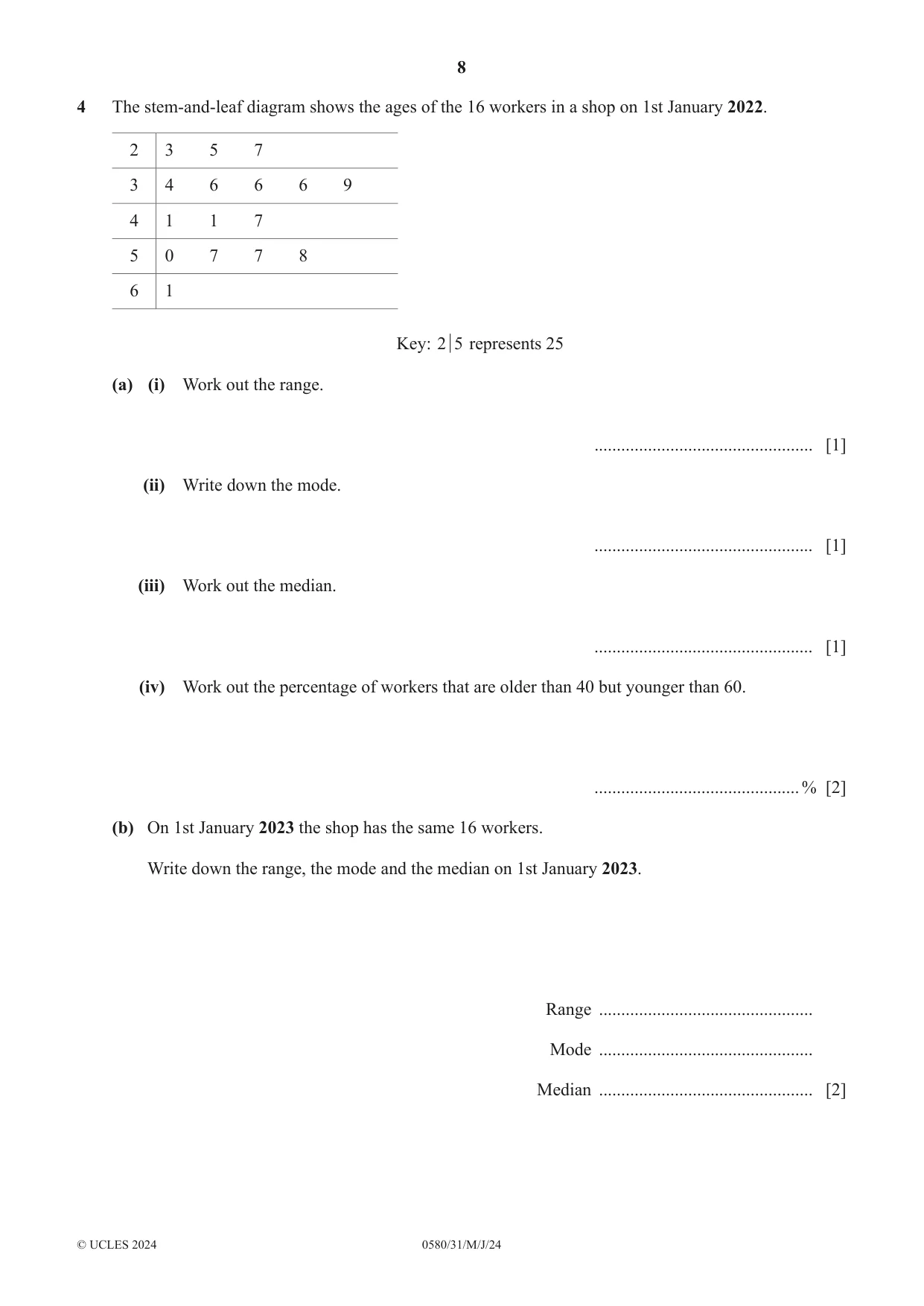
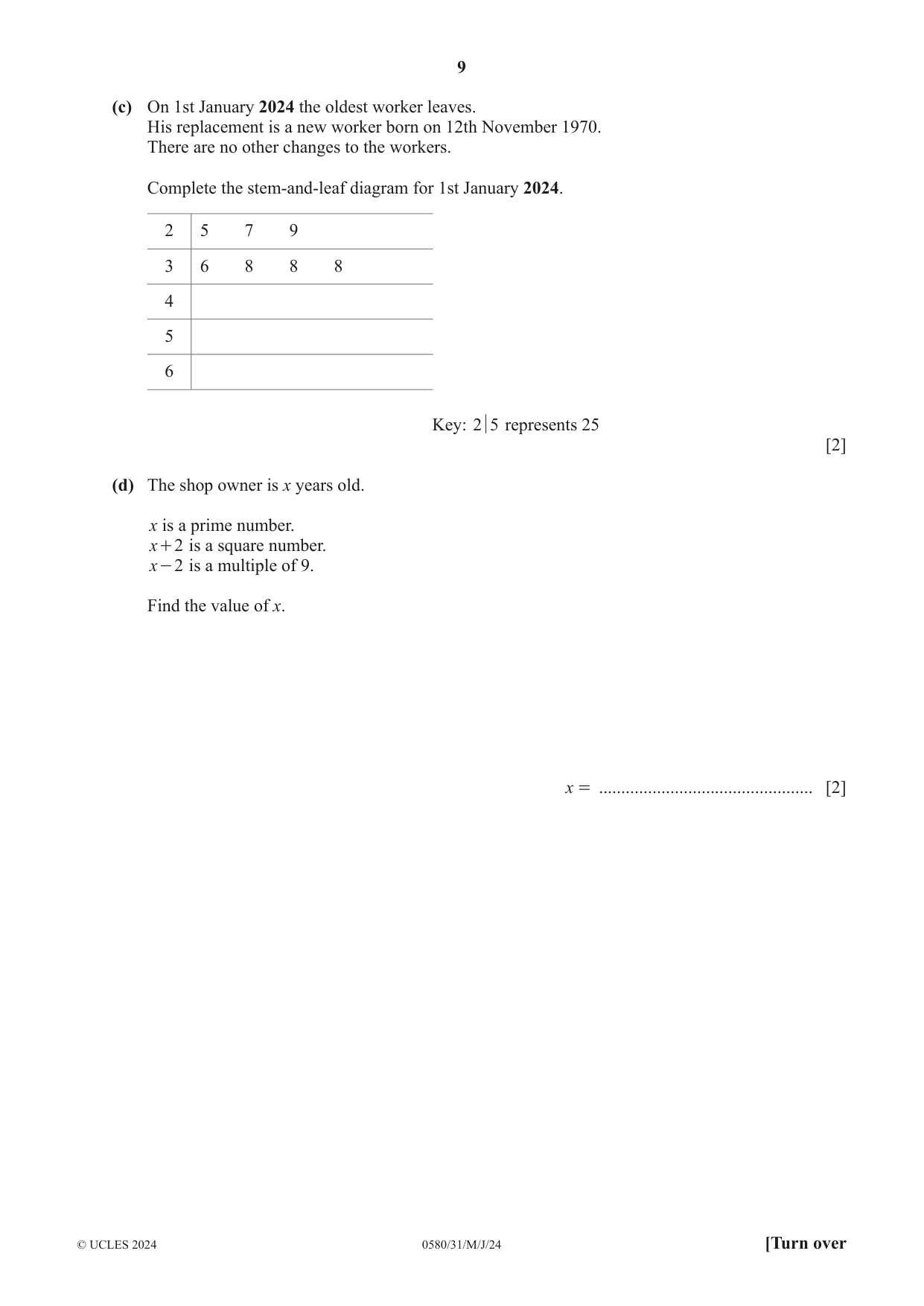
4 The stem-and-leaf diagram shows the ages of the 16 workers in a shop on 1st January 2022. 2 3 5 7 3 4 6 6 6 9 4 1 1 7 5 0 7 7 8 6 1 Key: 2 5 represents 25 (a) (i) Work out the range. ................................................. [1] (ii) Write down the mode. ................................................. [1] (iii) Work out the median. ................................................. [1] (iv) Work out the percentage of workers that are older than 40 but younger than 60. .............................................. % [2] (b) On 1st January 2023 the shop has the same 16 workers. Write down the range, the mode and the median on 1st January 2023. Range ................................................ Mode ................................................ Median ................................................ [2] (c) On 1st January 2024 the oldest worker leaves. His replacement is a new worker born on 12th November 1970. There are no other changes to the workers. Complete the stem-and-leaf diagram for 1st January 2024. 2 5 7 9 3 6 8 8 8 4 5 6 Key: 2 5 represents 25 [2] (d) The shop owner is x years old. x is a prime number. x + 2 is a square number. x - 2 is a multiple of 9. Find the value of x. x = ................................................ [2]
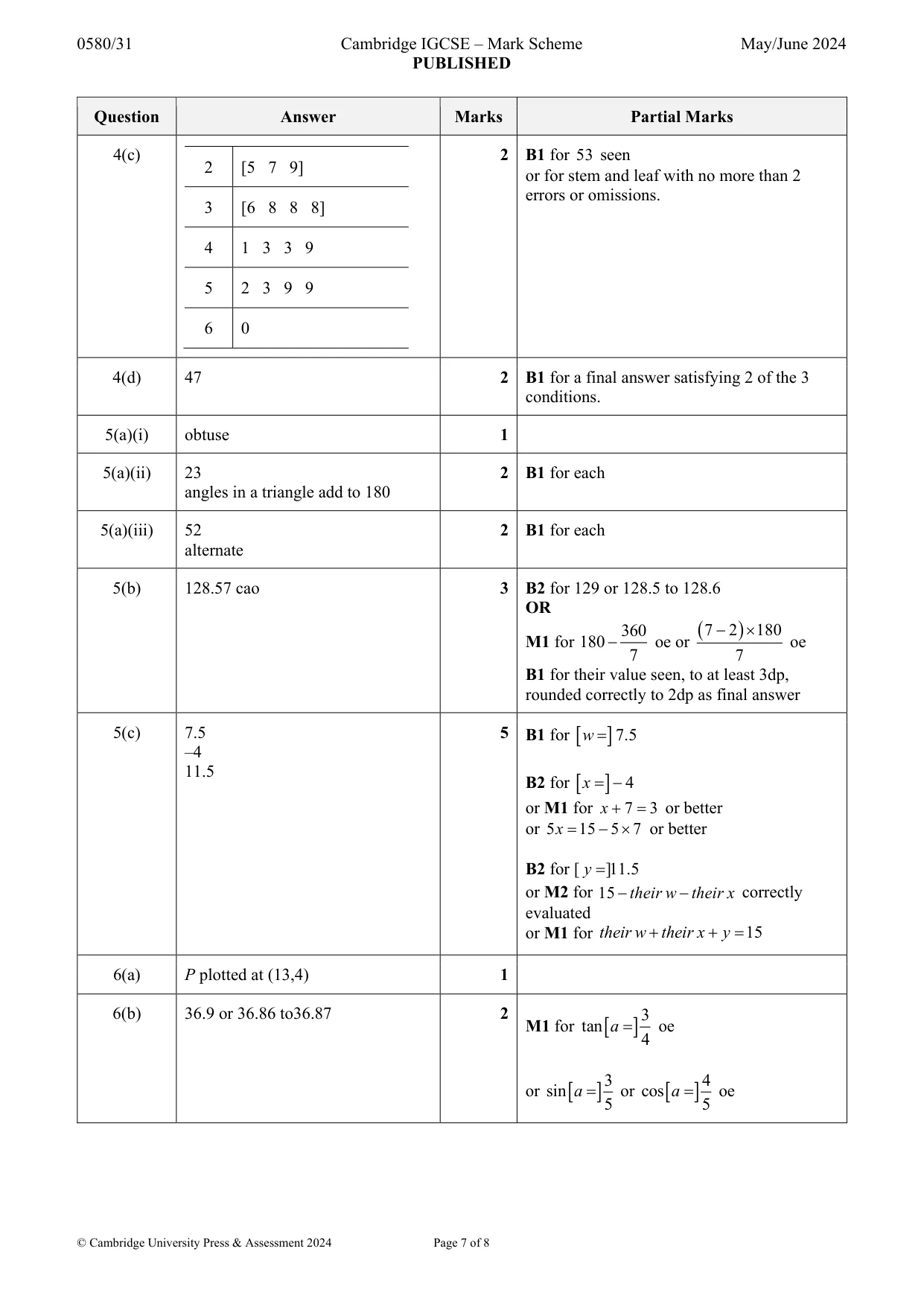
Mark scheme: 4(a)(i) 38 1 4(a)(ii) 36 1 4(a)(iii) 40 1 4(a)(iv) 43.75 2 7 M1 for 16 their 7 or correctly converted to a %. 16 4(b) 38 2 FT their (a)(i), (a)(ii) + 1, (a)(iii) + 1 37 B1FT for one or two correct 41 4(c) 2 B1 for 53 seen 2 [5 7 9] or for stem and leaf with no more than 2 errors or omissions. 3 [6 8 8 8] 4 1 3 3 9 5 2 3 9 9 6 0 4(d) 47 2 B1 for a final answer satisfying 2 of the 3 conditions.
Q5 · H F I NOT TO f ° 105° SCALE e° 52° E G The diagram shows a triangle EFG and a straight…
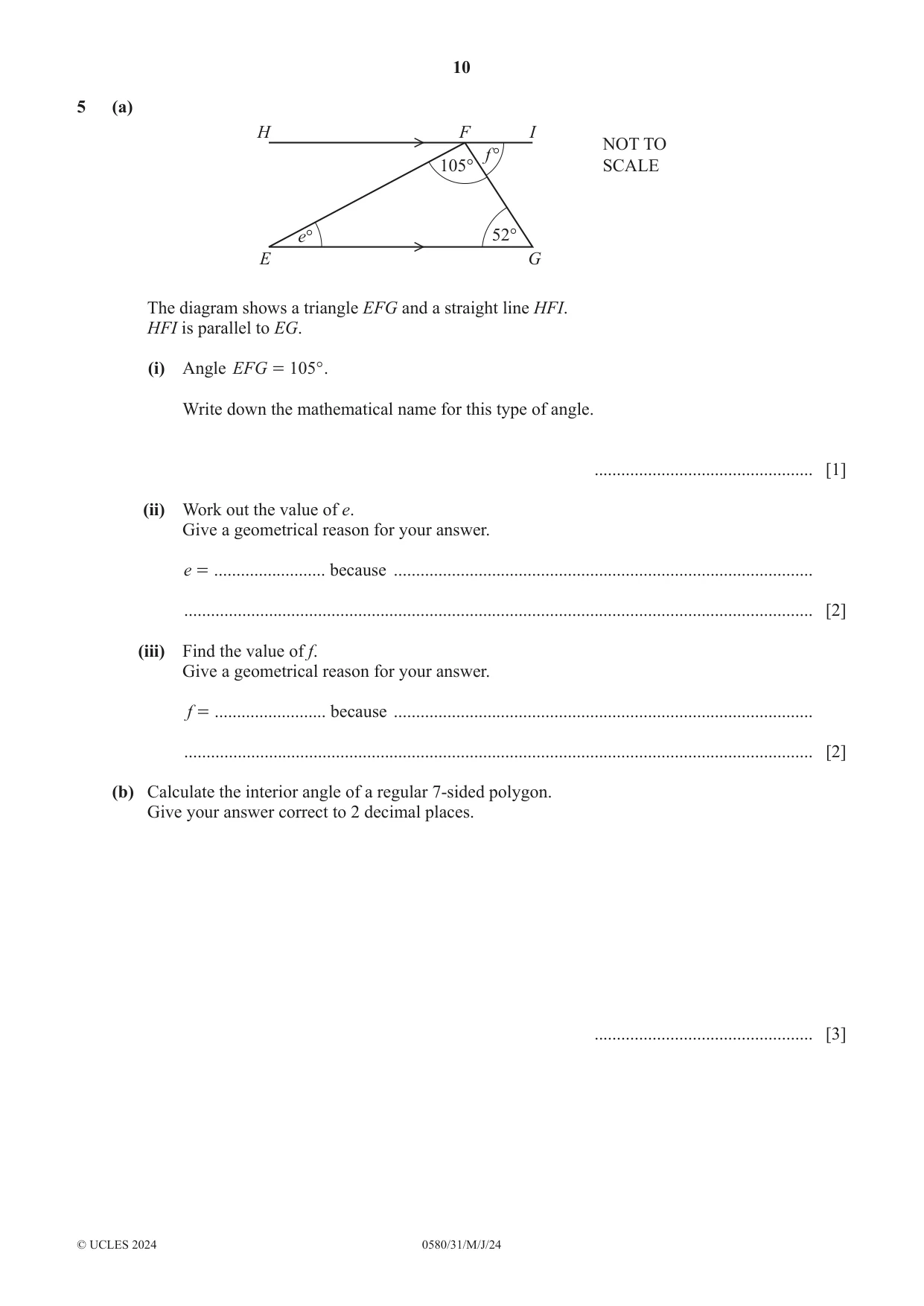
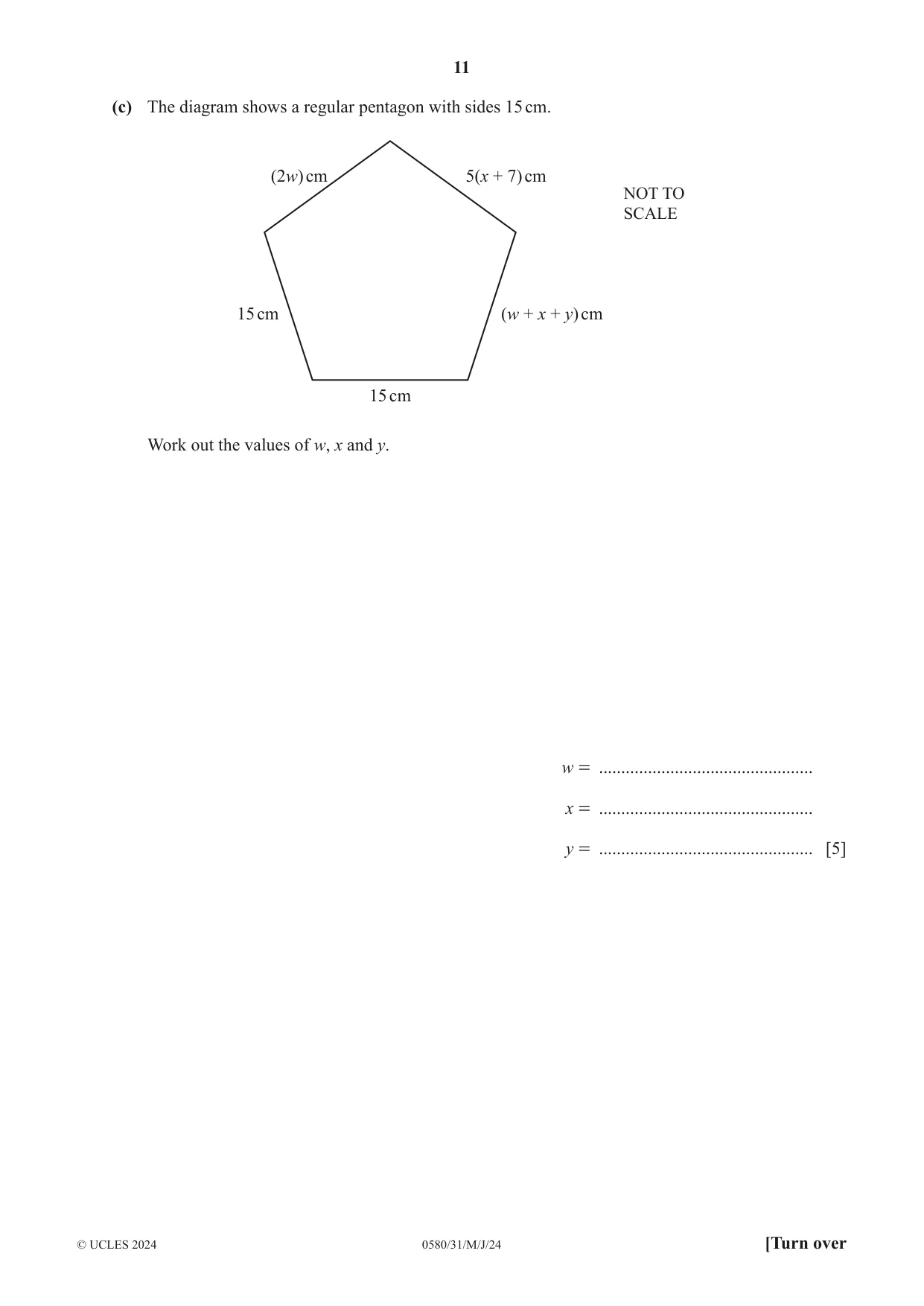
5 (a) H F I NOT TO f ° 105° SCALE e° 52° E G The diagram shows a triangle EFG and a straight line HFI. HFI is parallel to EG. (i) Angle EFG = 105° . Write down the mathematical name for this type of angle. ................................................. [1] (ii) Work out the value of e. Give a geometrical reason for your answer. e = ......................... because .............................................................................................. ............................................................................................................................................. [2] (iii) Find the value of f. Give a geometrical reason for your answer. f = ......................... because .............................................................................................. ............................................................................................................................................. [2] (b) Calculate the interior angle of a regular 7-sided polygon. Give your answer correct to 2 decimal places. ................................................. [3] (c) The diagram shows a regular pentagon with sides 15 cm. (2w) cm 5(x + 7) cm NOT TO SCALE 15 cm (w + x + y) cm 15 cm Work out the values of w, x and y. w = ................................................ x = ................................................ y = ................................................ [5]
Mark scheme: 5(a)(i) obtuse 1 5(a)(ii) 23 2 B1 for each angles in a triangle add to 180 5(a)(iii) 52 2 B1 for each alternate 5(b) 128.57 cao 3 B2 for 129 or 128.5 to 128.6 OR 360 7 2 180 M1 for 180 oe or oe 7 7 B1 for their value seen, to at least 3dp, rounded correctly to 2dp as final answer 5(c) 7.5 5 B1 for w 7.5 –4 11.5 B2 for x 4 or M1 for x 7 3 or better or 5 x 15 5 7 or better B2 for [ y ]11.5 or M2 for 15 their w their x correctly evaluated or M1 for their w their x y 15
Q6 · The diagram shows a point, P, three triangles, A, B and C, and part of triangle D on a 1…
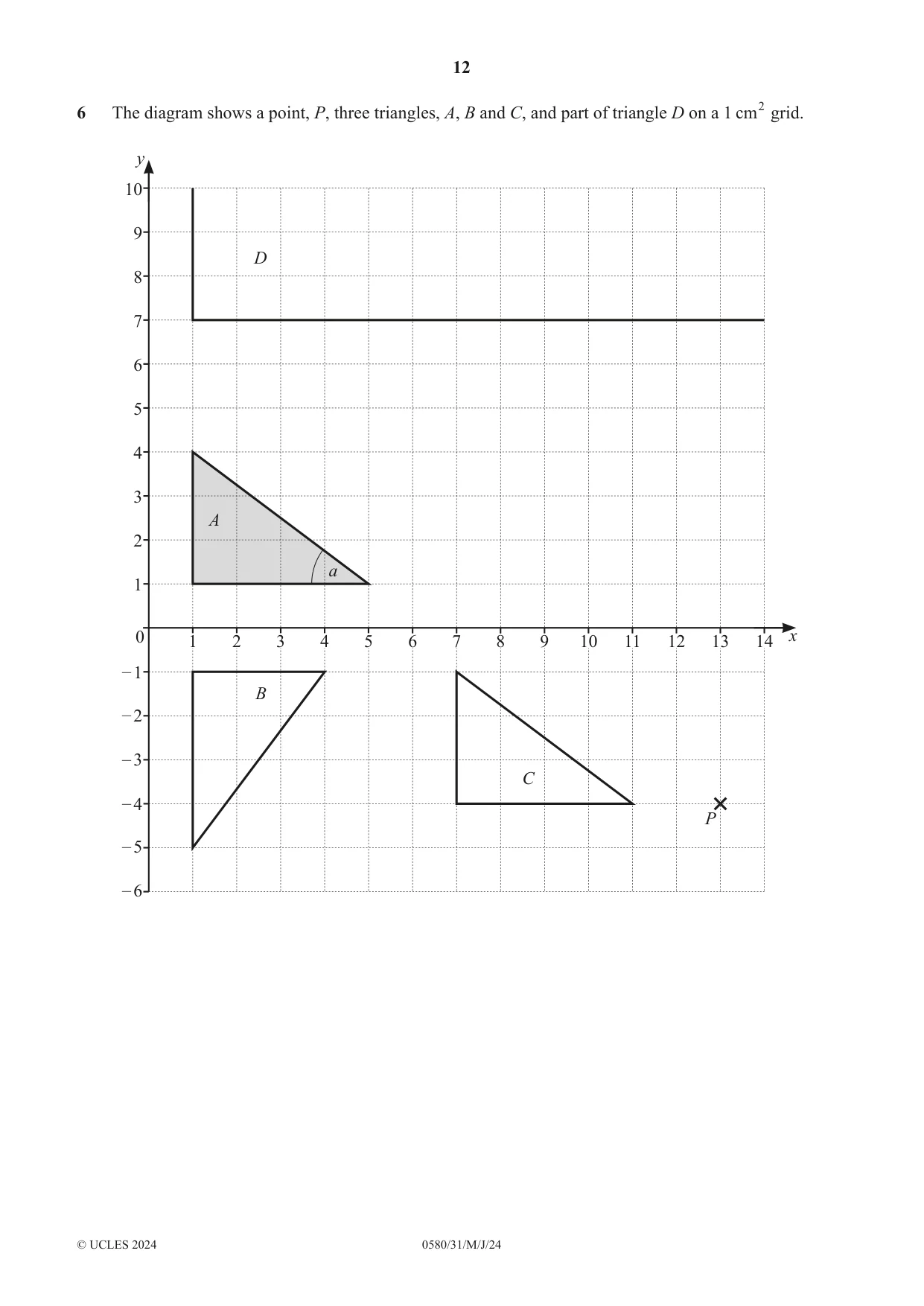
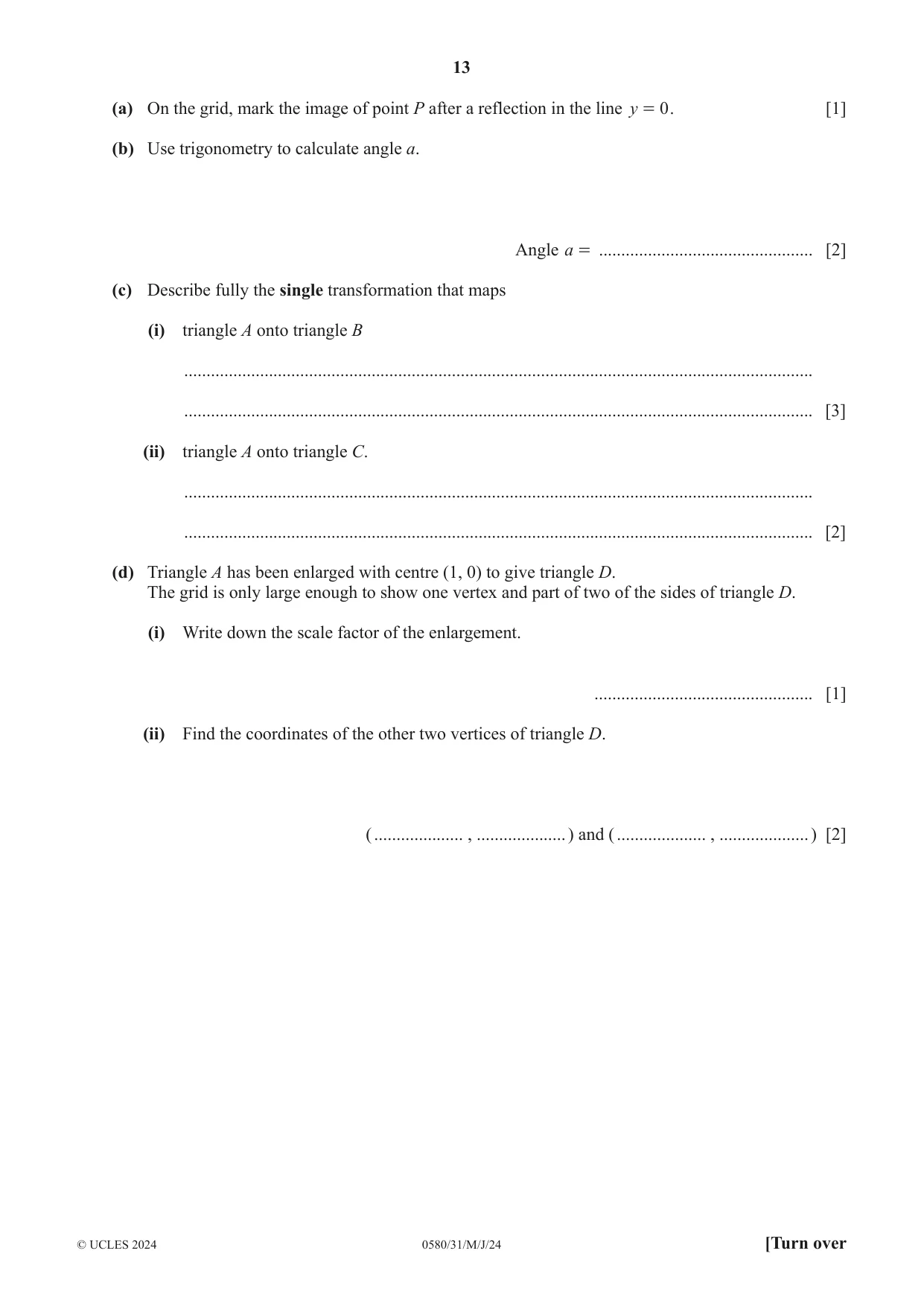
6 The diagram shows a point, P, three triangles, A, B and C, and part of triangle D on a 1 cm2 grid. y 10 9 D 8 7 6 5 4 3 A 2 a 1 0 x 1 2 3 4 5 6 7 8 9 10 11 12 13 14 – 1 B – 2 – 3 C –– 34 P – 5 – 6 (a) On the grid, mark the image of point P after a reflection in the line y = 0 . [1] (b) Use trigonometry to calculate angle a. Angle a = ................................................ [2] (c) Describe fully the single transformation that maps (i) triangle A onto triangle B ............................................................................................................................................. ............................................................................................................................................. [3] (ii) triangle A onto triangle C. ............................................................................................................................................. ............................................................................................................................................. [2] (d) Triangle A has been enlarged with centre (1, 0) to give triangle D. The grid is only large enough to show one vertex and part of two of the sides of triangle D. (i) Write down the scale factor of the enlargement. ................................................. [1] (ii) Find the coordinates of the other two vertices of triangle D. ( .................... , .................... ) and ( .................... , .................... ) [2]
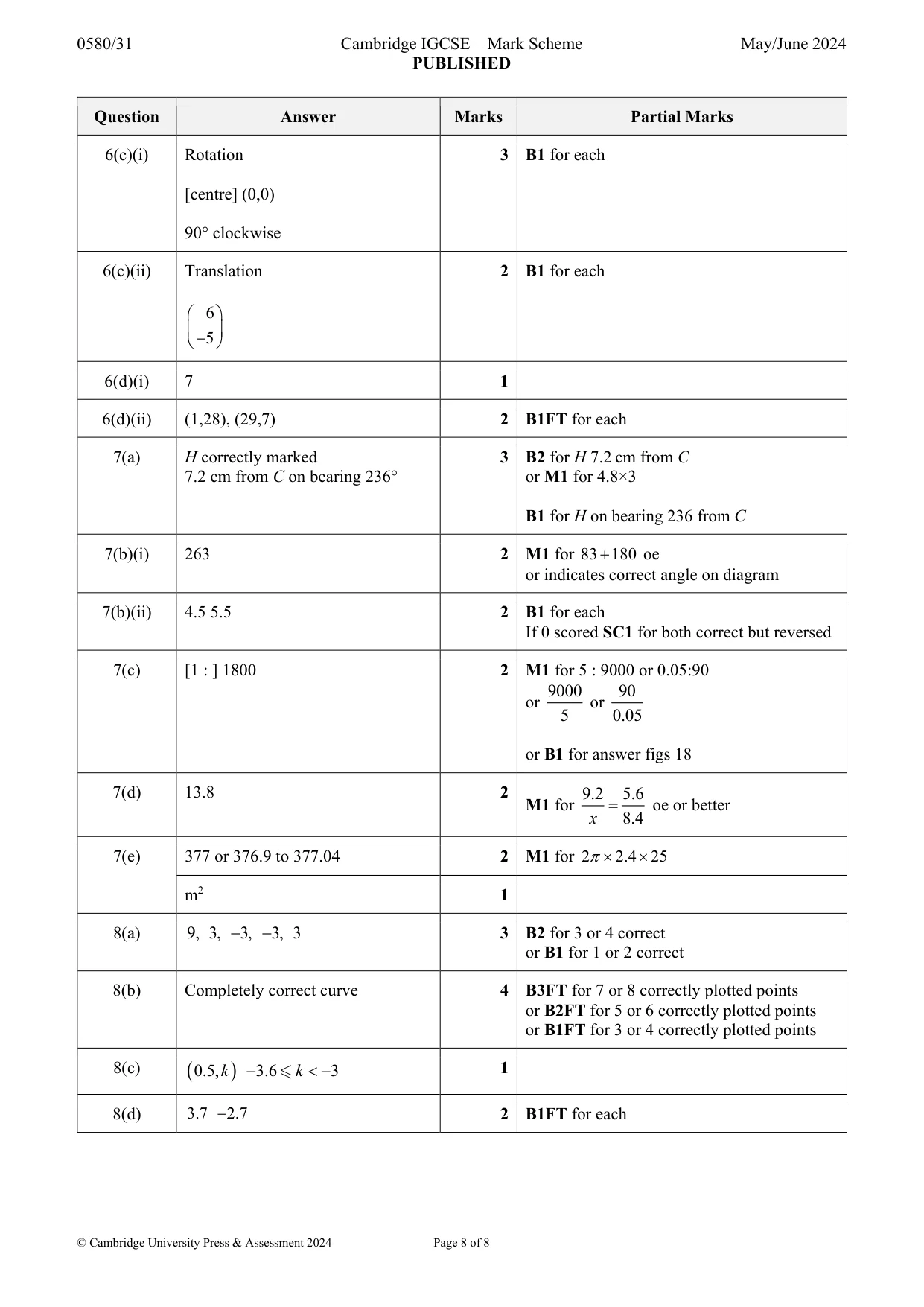
Mark scheme: 6(a) P plotted at (13,4) 1 6(b) 36.9 or 36.86 to36.87 2 M1 for tan a 3 oe 4 or sin a 3 or cos a 4 oe 5 5 6(c)(i) Rotation 3 B1 for each [centre] (0,0) 90° clockwise 6(c)(ii) Translation 2 B1 for each 6 5 6(d)(i) 7 1 6(d)(ii) (1,28), (29,7) 2 B1FT for each
Q7 · The scale drawing shows the position of a castle, C
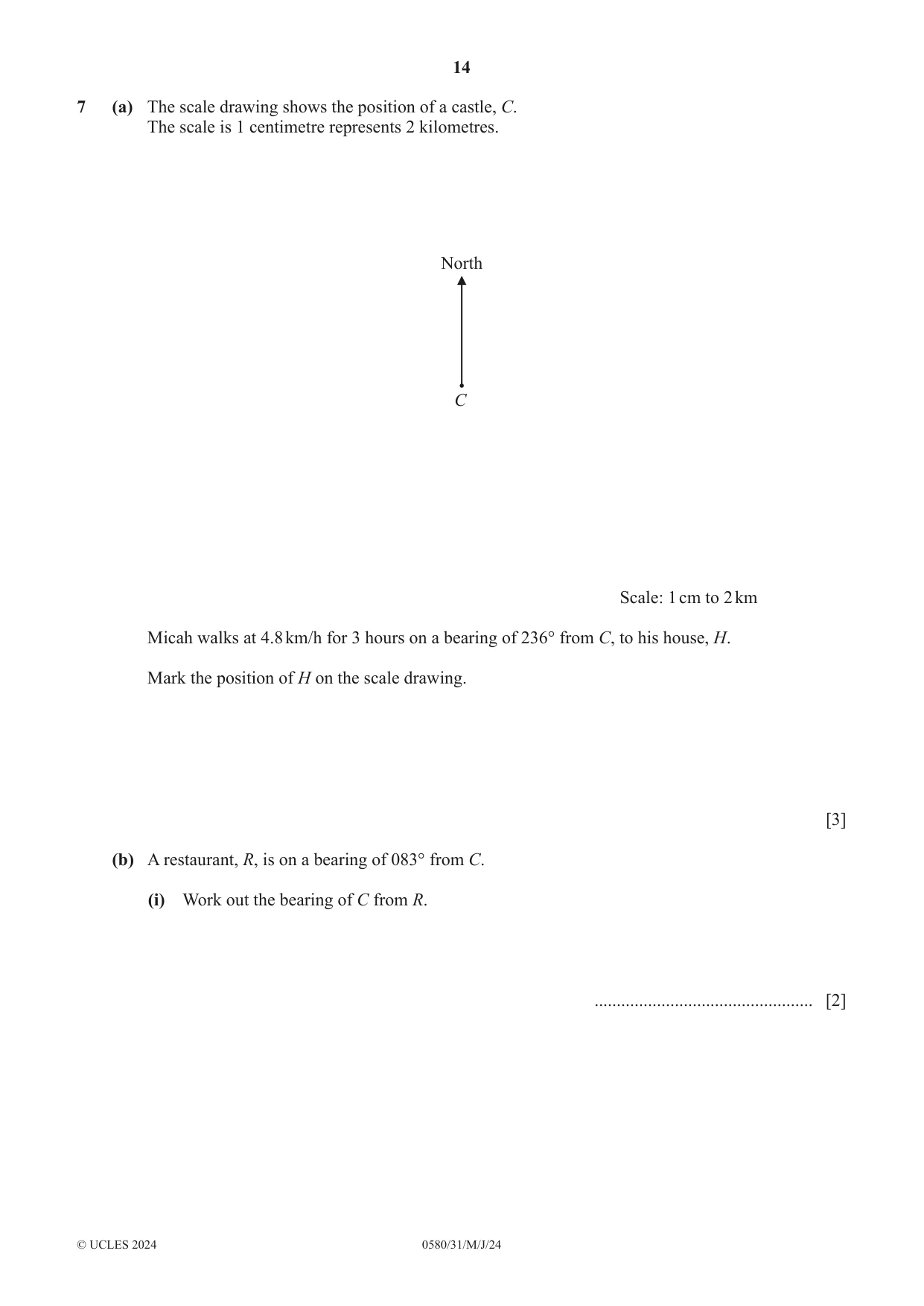
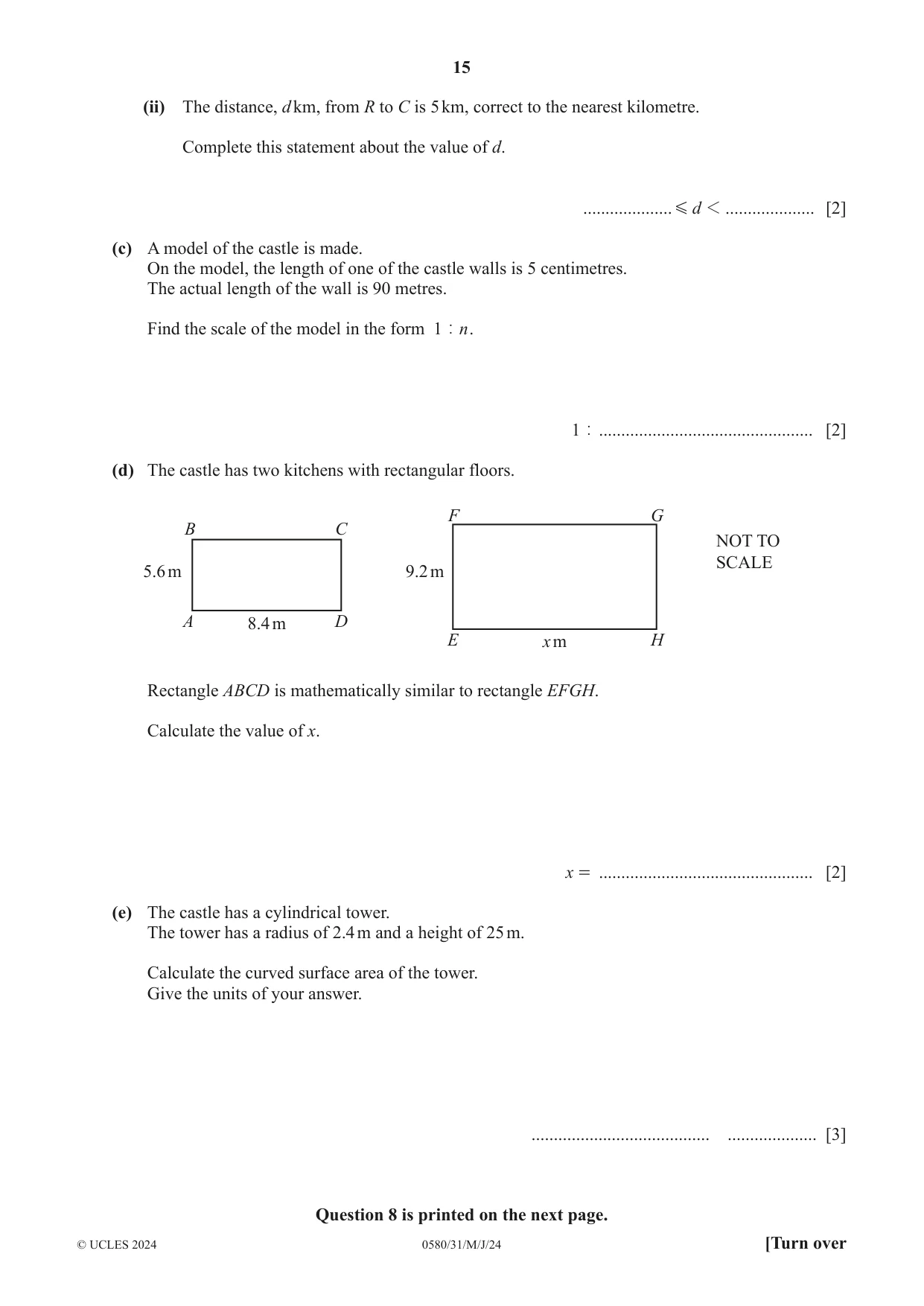
7 (a) The scale drawing shows the position of a castle, C. The scale is 1 centimetre represents 2 kilometres. North C Scale: 1 cm to 2 km Micah walks at 4.8 km/h for 3 hours on a bearing of 236° from C, to his house, H. Mark the position of H on the scale drawing. [3] (b) A restaurant, R, is on a bearing of 083° from C. (i) Work out the bearing of C from R. ................................................. [2] (ii) The distance, d km, from R to C is 5 km, correct to the nearest kilometre. Complete this statement about the value of d. .................... G d 1 .................... [2] (c) A model of the castle is made. On the model, the length of one of the castle walls is 5 centimetres. The actual length of the wall is 90 metres. Find the scale of the model in the form 1| n . 1| ................................................ [2] (d) The castle has two kitchens with rectangular floors. F G B C NOT TO SCALE 5.6 m 9.2 m A 8.4 m D E x m H Rectangle ABCD is mathematically similar to rectangle EFGH. Calculate the value of x. x = ................................................ [2] (e) The castle has a cylindrical tower. The tower has a radius of 2.4 m and a height of 25 m. Calculate the curved surface area of the tower. Give the units of your answer. ........................................ .................... [3] Question 8 is printed on the next page.
Mark scheme: 7(a) H correctly marked 3 B2 for H 7.2 cm from C 7.2 cm from C on bearing 236° or M1 for 4.8×3 B1 for H on bearing 236 from C 7(b)(i) 263 2 M1 for 83 180 oe or indicates correct angle on diagram 7(b)(ii) 4.5 5.5 2 B1 for each If 0 scored SC1 for both correct but reversed 7(c) [1 : ] 1800 2 M1 for 5 : 9000 or 0.05:90 9000 90 or or 5 0.05 or B1 for answer figs 18 7(d) 13.8 2 9.2 5.6 M1 for oe or better x 8.4 7(e) 377 or 376.9 to 377.04 2 M1 for 2 2.4 25 m2 1
Q8 · The table shows some values for y = x 2 - x - 3
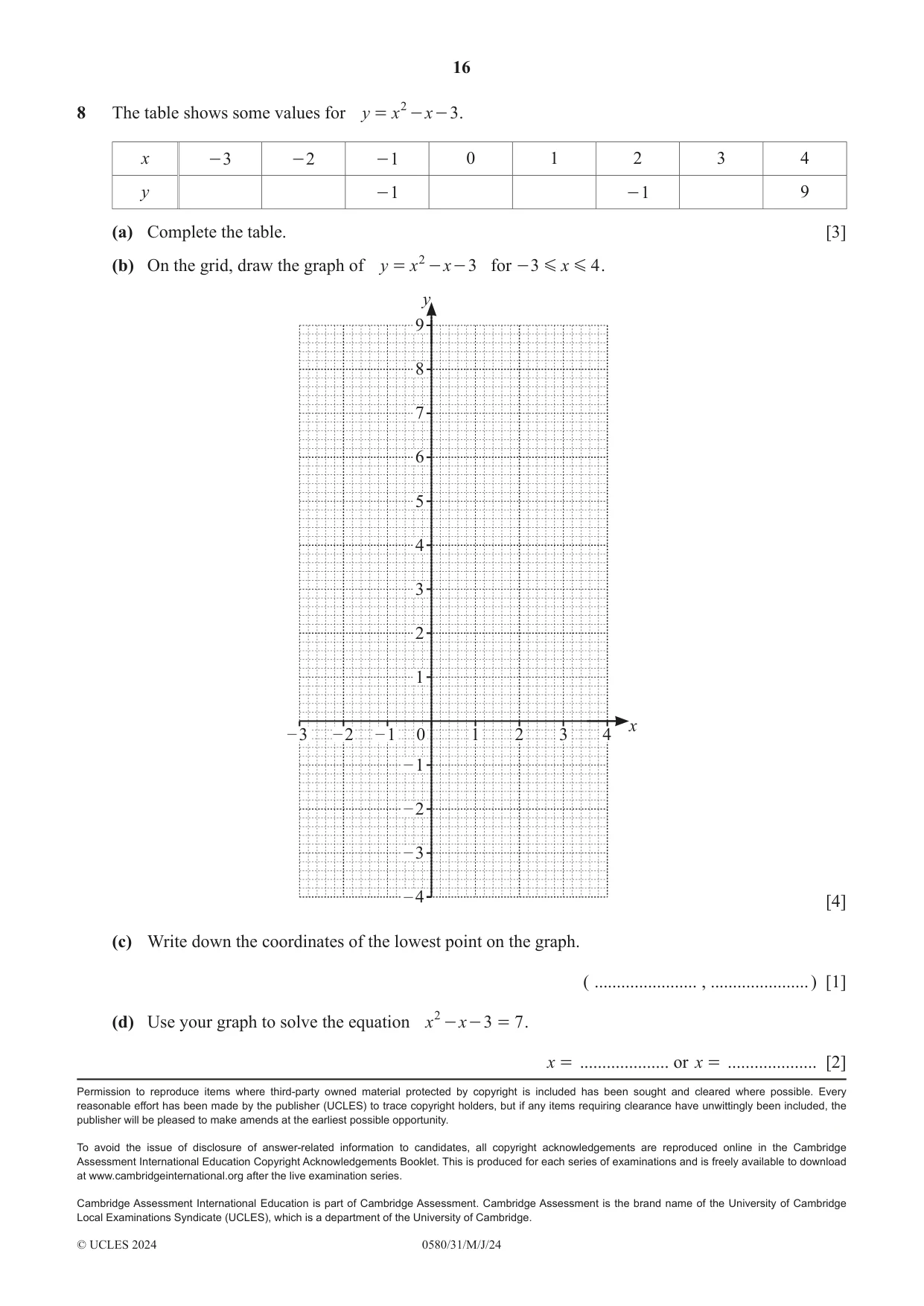
8 The table shows some values for y = x 2 - x - 3 . x - 3 - 2 - 1 0 1 2 3 4 y - 1 - 1 9 (a) Complete the table. [3] (b) On the grid, draw the graph of y = x 2 - x - 3 for - 3 G x G 4 . y 9 8 7 6 5 4 3 2 1 x – 3 – 2 – 1 0 1 2 3 4 – 1 – 2 – 3 – 4 [4] (c) Write down the coordinates of the lowest point on the graph. ( ....................... , ...................... ) [1] (d) Use your graph to solve the equation x 2 - x - 3 = 7 . x = .................... or x = .................... [2]
Mark scheme: 8(a) 9, 3, 3, 3, 3 3 B2 for 3 or 4 correct or B1 for 1 or 2 correct 8(b) Completely correct curve 4 B3FT for 7 or 8 correctly plotted points or B2FT for 5 or 6 correctly plotted points or B1FT for 3 or 4 correctly plotted points 8(c) 0.5,k 3.6 k 3 1 8(d) 3.7 2.7 2 B1FT for each
What was in this paper
The subtopics covered by these 8 questions, and how many questions each got. Open one in a new tab to see every Cambridge question on it.
What you needed in this session
Cambridge’s own grade thresholds for 2024 May/June, Paper 3 · Variant 1. A higher threshold means an easier paper — the bar moves with how the cohort did.