Cambridge IGCSE Mathematics 0580 — 2023 May/June Paper 3 · Variant 3
0580/33/M/J/23 · 8 questions · 104 marks · ≈117 min
The question paper and its mark scheme, free to read here and free to download. This is Cambridge’s own paper, exactly as it was sat.
Question paper16 pages
Mark scheme8 pages
Answers below. Sit the paper first if you are practising.
Questions as text
Q1 · Claudia asks some students to choose their favourite science from biology, chemistry and…
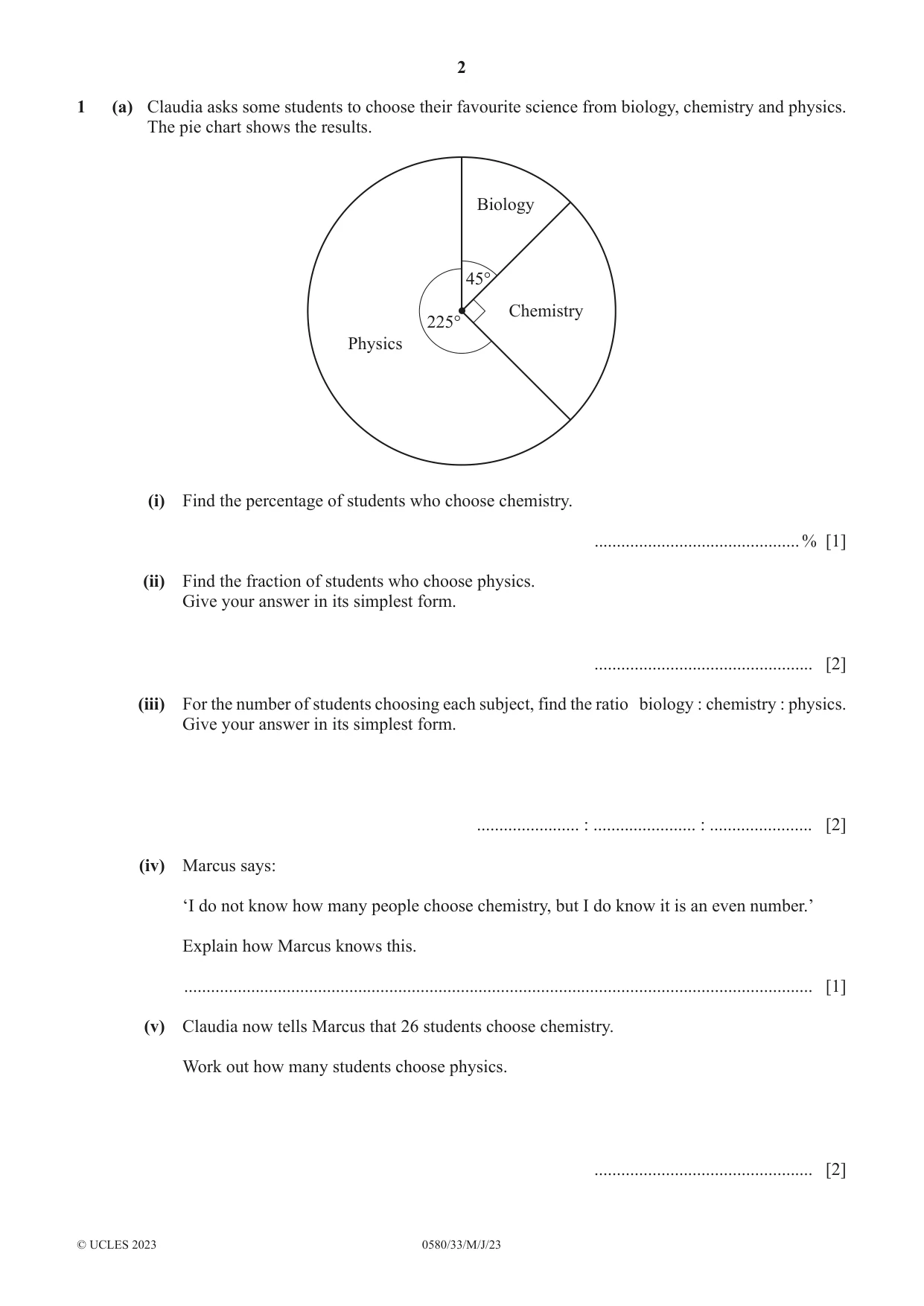
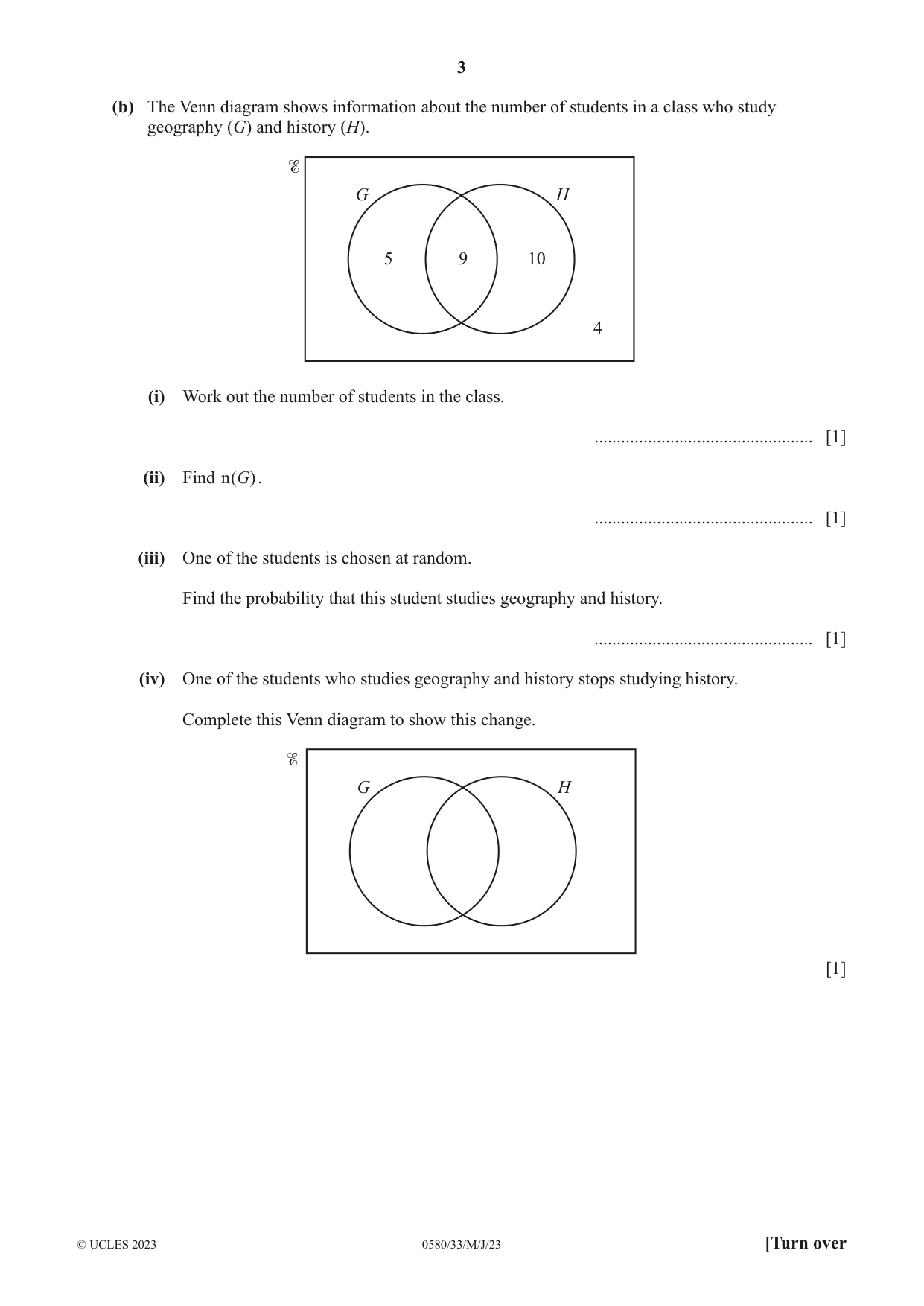
1 (a) Claudia asks some students to choose their favourite science from biology, chemistry and physics. The pie chart shows the results. Biology 45° Chemistry 225° Physics (i) Find the percentage of students who choose chemistry. ..............................................% [1] (ii) Find the fraction of students who choose physics. Give your answer in its simplest form. ................................................. [2] (iii) For the number of students choosing each subject, find the ratio biology : chemistry : physics. Give your answer in its simplest form. ....................... : ....................... : ....................... [2] (iv) Marcus says: ‘I do not know how many people choose chemistry, but I do know it is an even number.’ Explain how Marcus knows this. ............................................................................................................................................. [1] (v) Claudia now tells Marcus that 26 students choose chemistry. Work out how many students choose physics. ................................................. [2] (b) The Venn diagram shows information about the number of students in a class who study geography (G) and history (H). G H 5 9 10 4 (i) Work out the number of students in the class. ................................................. [1] (ii) Find n ( G ) . ................................................. [1] (iii) One of the students is chosen at random. Find the probability that this student studies geography and history. ................................................. [1] (iv) One of the students who studies geography and history stops studying history. Complete this Venn diagram to show this change. G H [1]
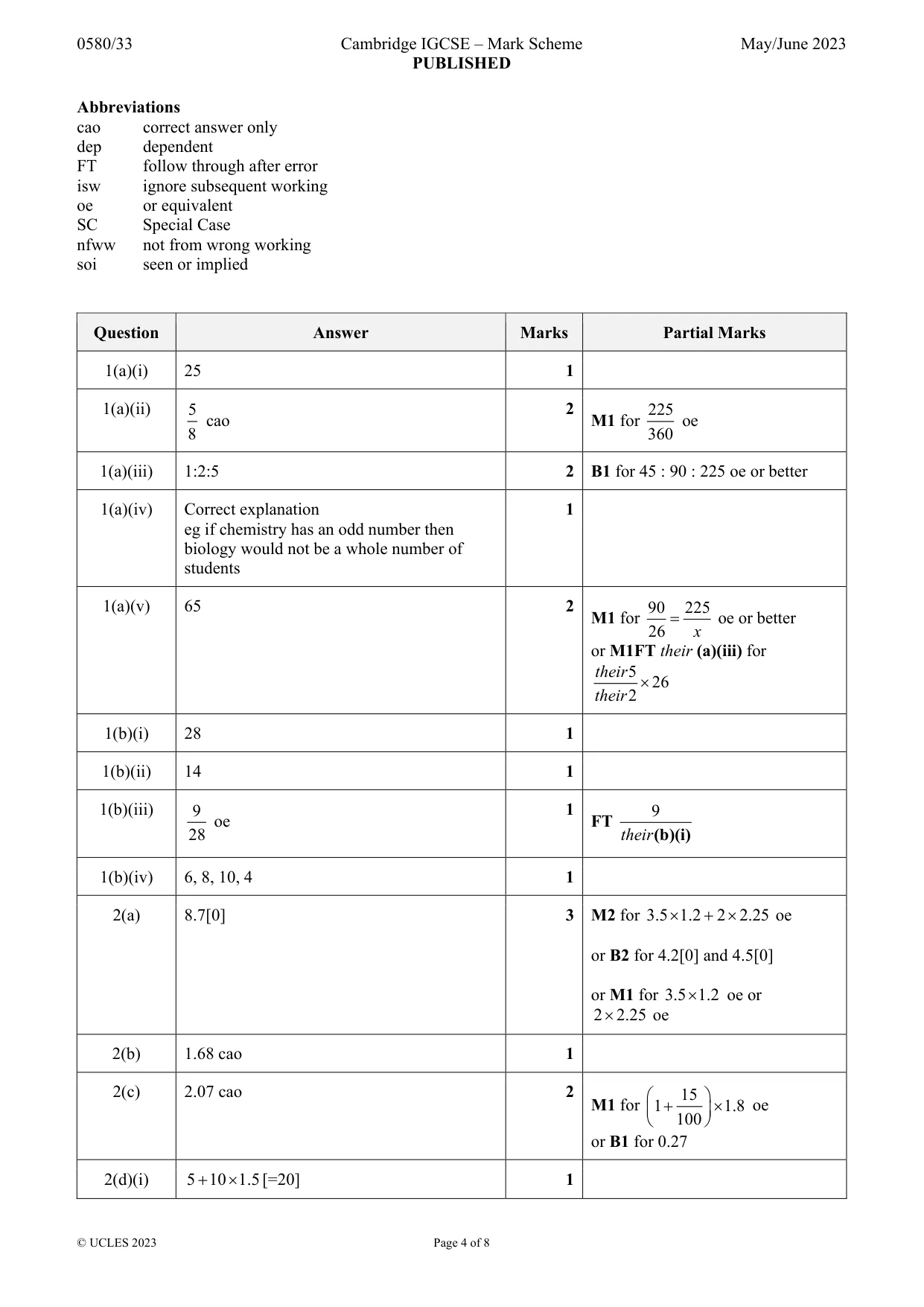
Mark scheme: Question Answer Marks Partial Marks 1(a)(i) 25 1 1(a)(ii) 5 2 225 cao M1 for oe 8 360 1(a)(iii) 1:2:5 2 B1 for 45 : 90 : 225 oe or better 1(a)(iv) Correct explanation 1 eg if chemistry has an odd number then biology would not be a whole number of students 1(a)(v) 65 2 90 225 M1 for oe or better 26 x or M1FT their (a)(iii) for their 5 26 their 2 1(b)(i) 28 1 1(b)(ii) 14 1 1(b)(iii) 9 1 9 oe FT 28 their(b)(i) 1(b)(iv) 6, 8, 10, 4 1
Q2 · A shop sells food and drink
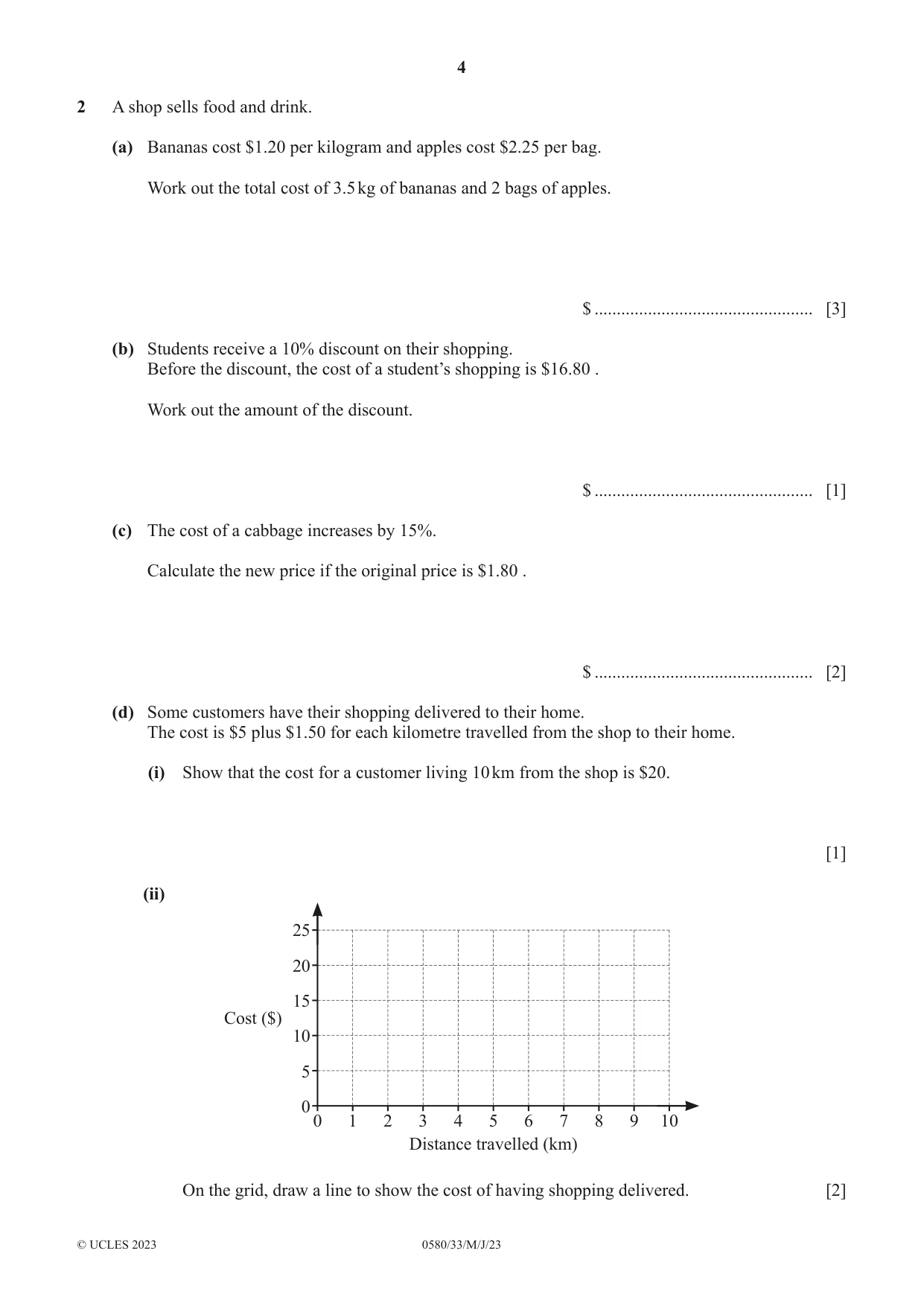
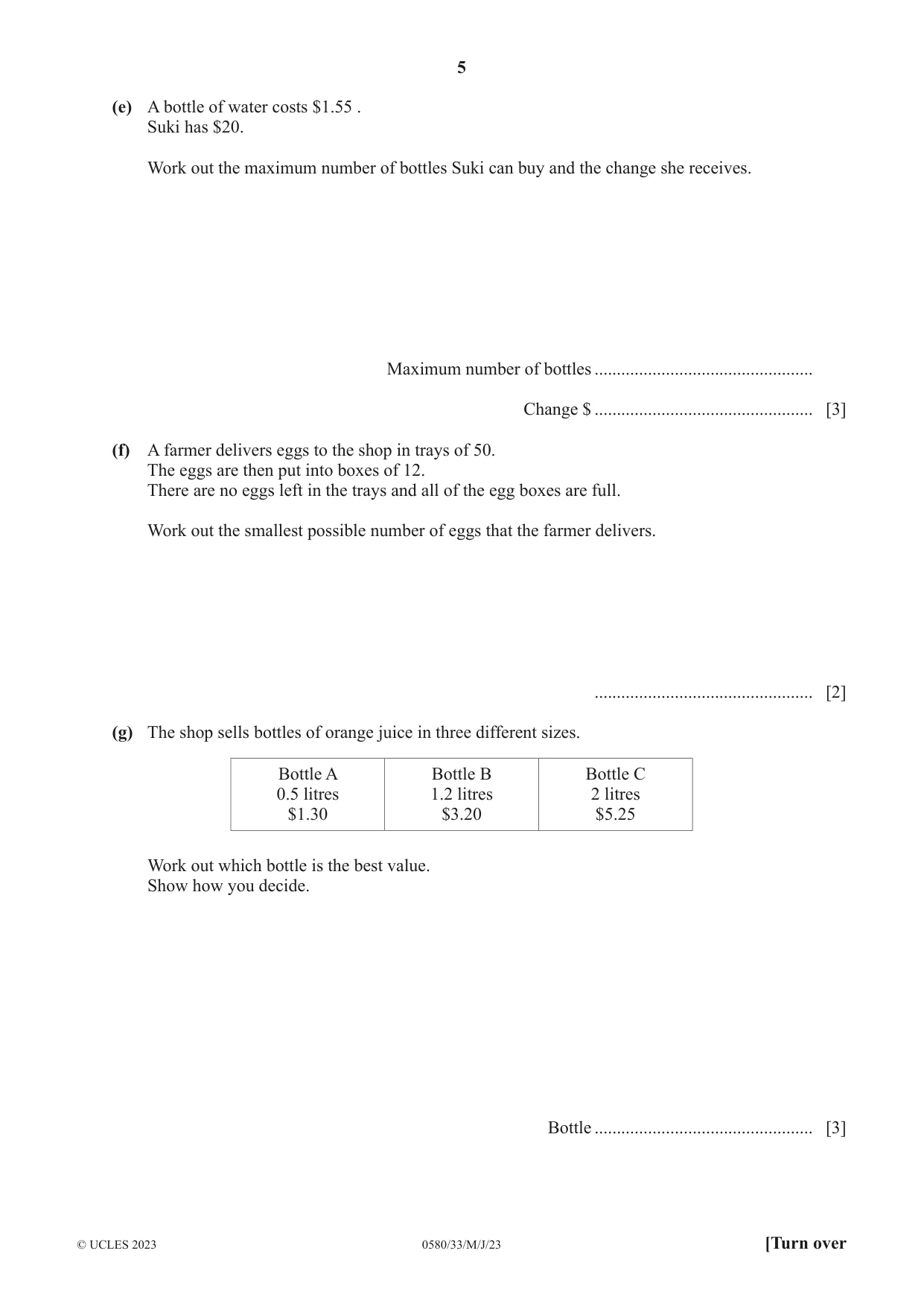
2 A shop sells food and drink. (a) Bananas cost $1.20 per kilogram and apples cost $2.25 per bag. Work out the total cost of 3.5 kg of bananas and 2 bags of apples. $ ................................................. [3] (b) Students receive a 10% discount on their shopping. Before the discount, the cost of a student’s shopping is $16.80 . Work out the amount of the discount. $ ................................................. [1] (c) The cost of a cabbage increases by 15%. Calculate the new price if the original price is $1.80 . $ ................................................. [2] (d) Some customers have their shopping delivered to their home. The cost is $5 plus $1.50 for each kilometre travelled from the shop to their home. (i) Show that the cost for a customer living 10 km from the shop is $20. [1] (ii) 25 20 15 Cost ($) 10 5 0 0 1 2 3 4 5 6 7 8 9 10 Distance travelled (km) On the grid, draw a line to show the cost of having shopping delivered. [2] (e) A bottle of water costs $1.55 . Suki has $20. Work out the maximum number of bottles Suki can buy and the change she receives. Maximum number of bottles ................................................. Change $ ................................................. [3] (f) A farmer delivers eggs to the shop in trays of 50. The eggs are then put into boxes of 12. There are no eggs left in the trays and all of the egg boxes are full. Work out the smallest possible number of eggs that the farmer delivers. ................................................. [2] (g) The shop sells bottles of orange juice in three different sizes. Bottle A Bottle B Bottle C 0.5 litres 1.2 litres 2 litres $1.30 $3.20 $5.25 Work out which bottle is the best value. Show how you decide. Bottle ................................................. [3]
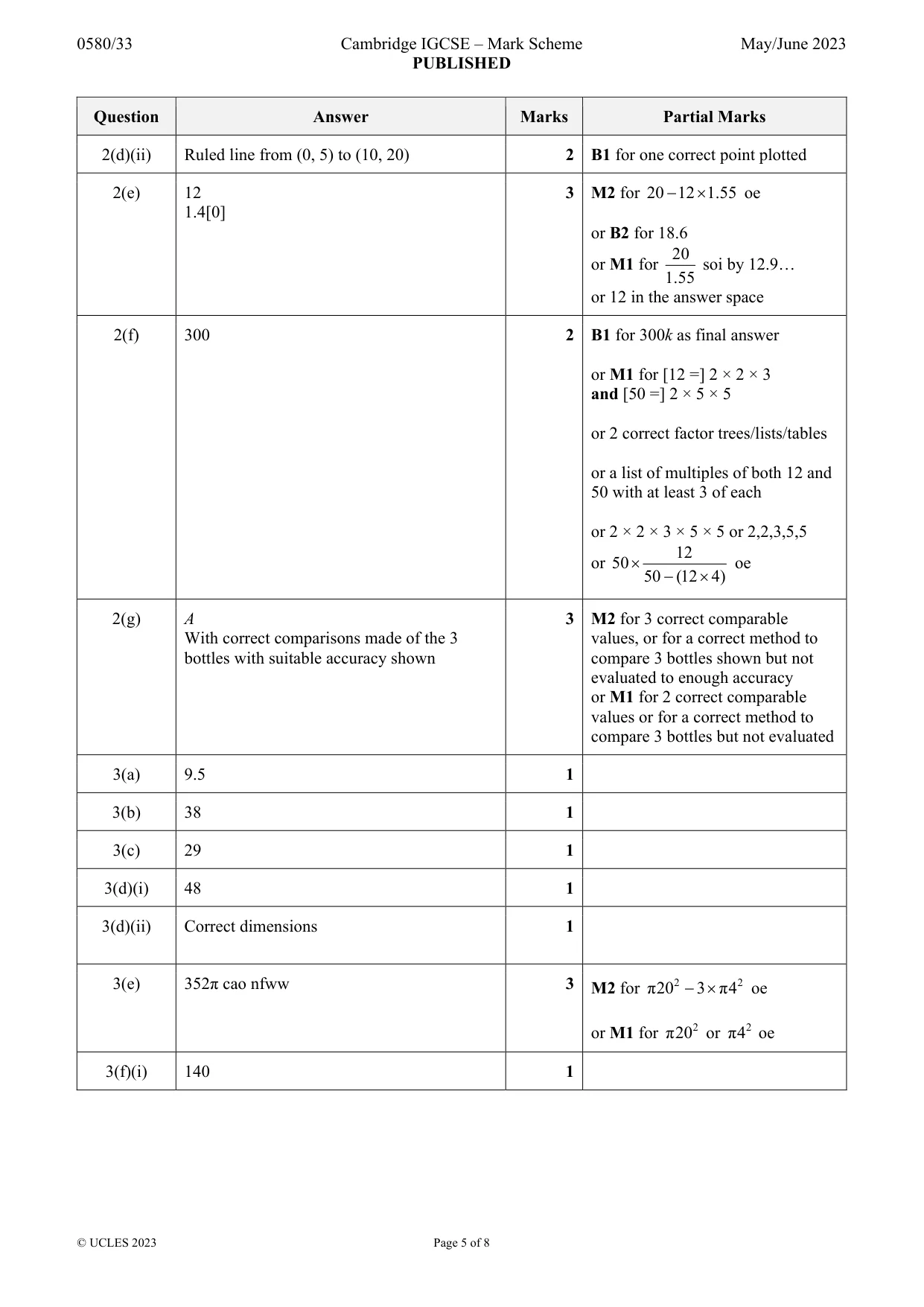
Mark scheme: 2(a) 8.7[0] 3 M2 for 3.5 1.2 2 2.25 oe or B2 for 4.2[0] and 4.5[0] or M1 for 3.5 1.2 oe or 2 2.25 oe 2(b) 1.68 cao 1 2(c) 2.07 cao 2 15 M1 for 1 1.8 oe 100 or B1 for 0.27 2(d)(i) 5 10 1.5 [=20] 1 2(d)(ii) Ruled line from (0, 5) to (10, 20) 2 B1 for one correct point plotted 2(e) 12 3 M2 for 20 12 1.55 oe 1.4[0] or B2 for 18.6 20 or M1 for soi by 12.9… 1.55 or 12 in the answer space 2(f) 300 2 B1 for 300k as final answer or M1 for [12 =] 2 × 2 × 3 and [50 =] 2 × 5 × 5 or 2 correct factor trees/lists/tables or a list of multiples of both 12 and 50 with at least 3 of each or 2 × 2 × 3 × 5 × 5 or 2,2,3,5,5 12 or 50 oe 50 (12 4) 2(g) A 3 M2 for 3 correct comparable With correct comparisons made of the 3 values, or for a correct method to bottles with suitable accuracy shown compare 3 bottles shown but not evaluated to enough accuracy or M1 for 2 correct comparable values or for a correct method to compare 3 bottles but not evaluated
Q3 · The diagram shows a shape on a 1 cm 2 grid
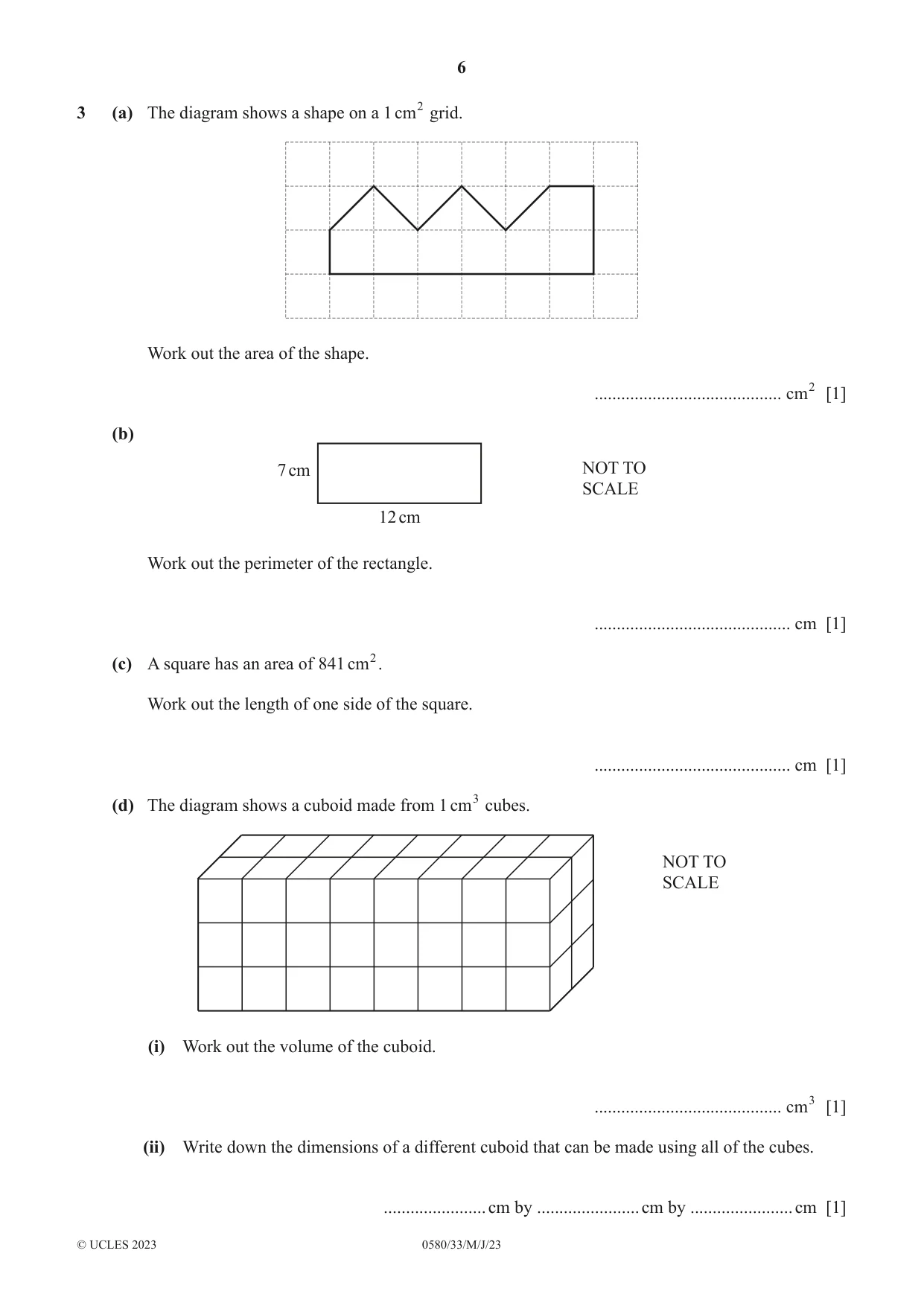
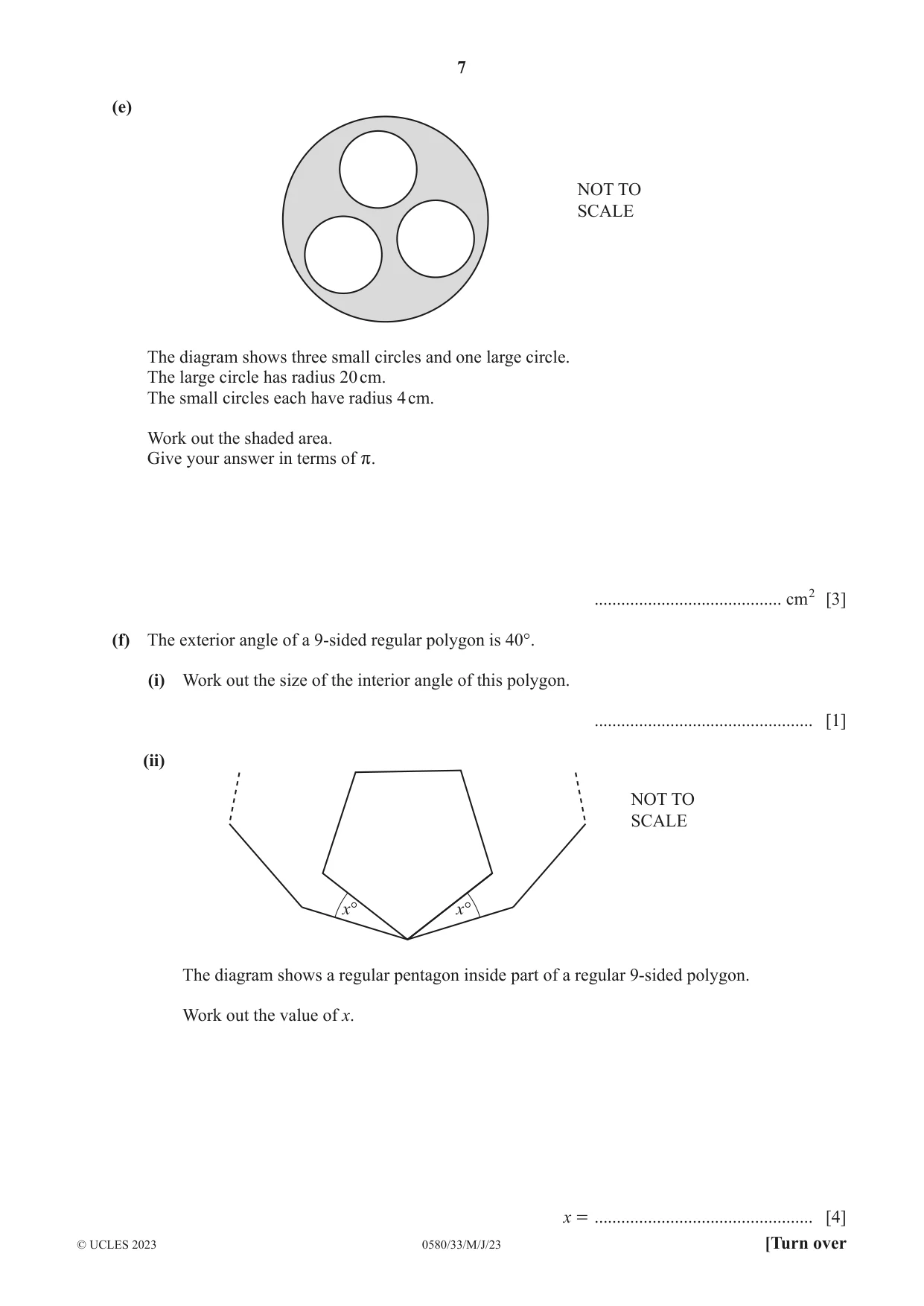
3 (a) The diagram shows a shape on a 1 cm 2 grid. Work out the area of the shape. .......................................... cm2 [1] (b) 7 cm NOT TO SCALE 12 cm Work out the perimeter of the rectangle. ............................................ cm [1] (c) A square has an area of 841 cm 2. Work out the length of one side of the square. ............................................ cm [1] (d) The diagram shows a cuboid made from 1 cm 3 cubes. NOT TO SCALE (i) Work out the volume of the cuboid. .......................................... cm3 [1] (ii) Write down the dimensions of a different cuboid that can be made using all of the cubes. ....................... cm by ....................... cm by ....................... cm [1] (e) NOT TO SCALE The diagram shows three small circles and one large circle. The large circle has radius 20 cm. The small circles each have radius 4 cm. Work out the shaded area. Give your answer in terms of r. .......................................... cm2 [3] (f) The exterior angle of a 9-sided regular polygon is 40°. (i) Work out the size of the interior angle of this polygon. ................................................. [1] (ii) NOT TO SCALE x° x° The diagram shows a regular pentagon inside part of a regular 9-sided polygon. Work out the value of x. x = ................................................. [4]
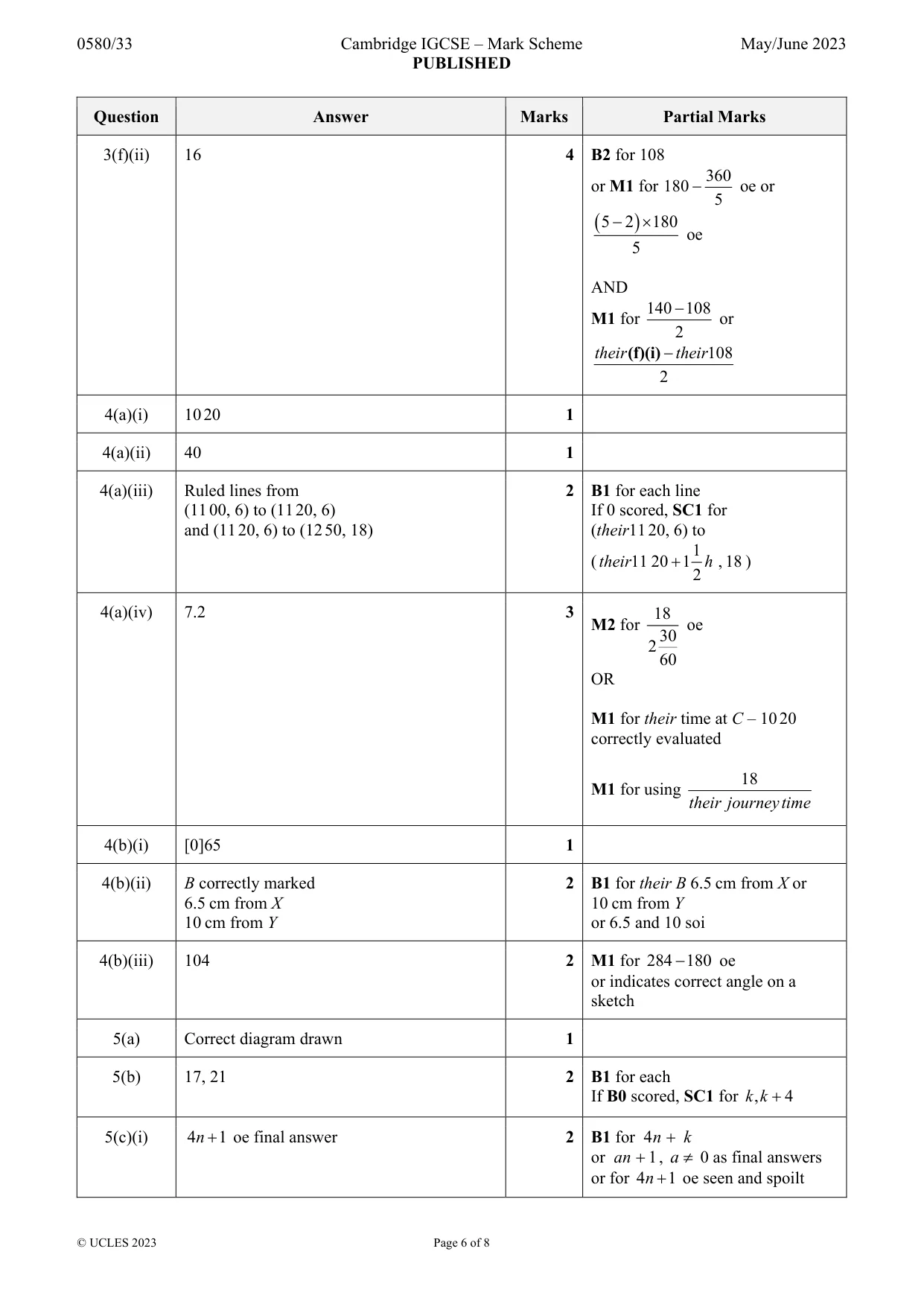
Mark scheme: 3(a) 9.5 1 3(b) 38 1 3(c) 29 1 3(d)(i) 48 1 3(d)(ii) Correct dimensions 1 3(e) 352π cao nfww 3 M2 for π20 2 3 π4 2 oe or M1 for π20 2 or π4 2 oe 3(f)(i) 140 1 3(f)(ii) 16 4 B2 for 108 360 or M1 for 180 oe or 5 5 2 180 oe 5 AND 140 108 M1 for or 2 their (f)(i) their108 2
Q4 · A boat sails from A to B
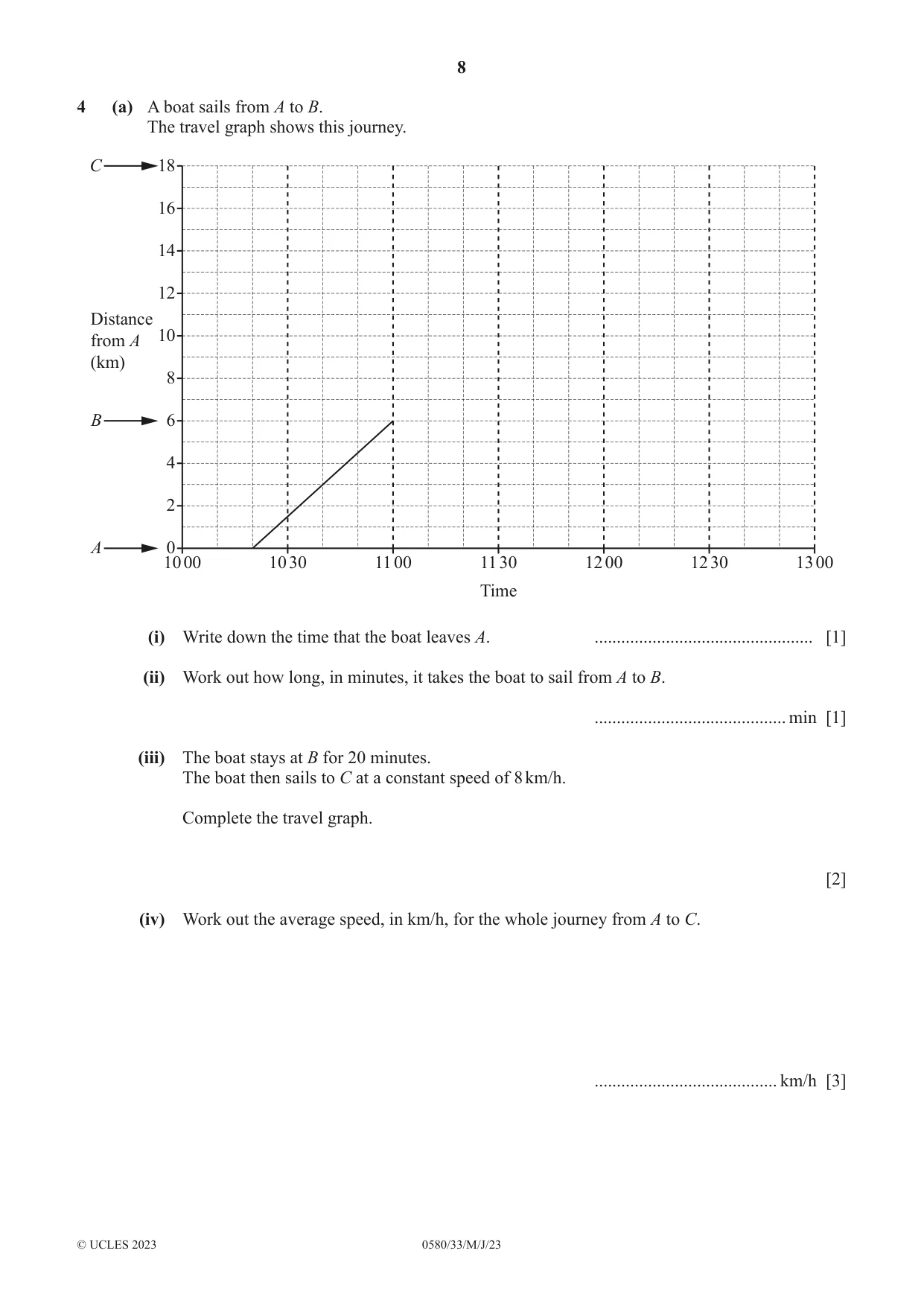
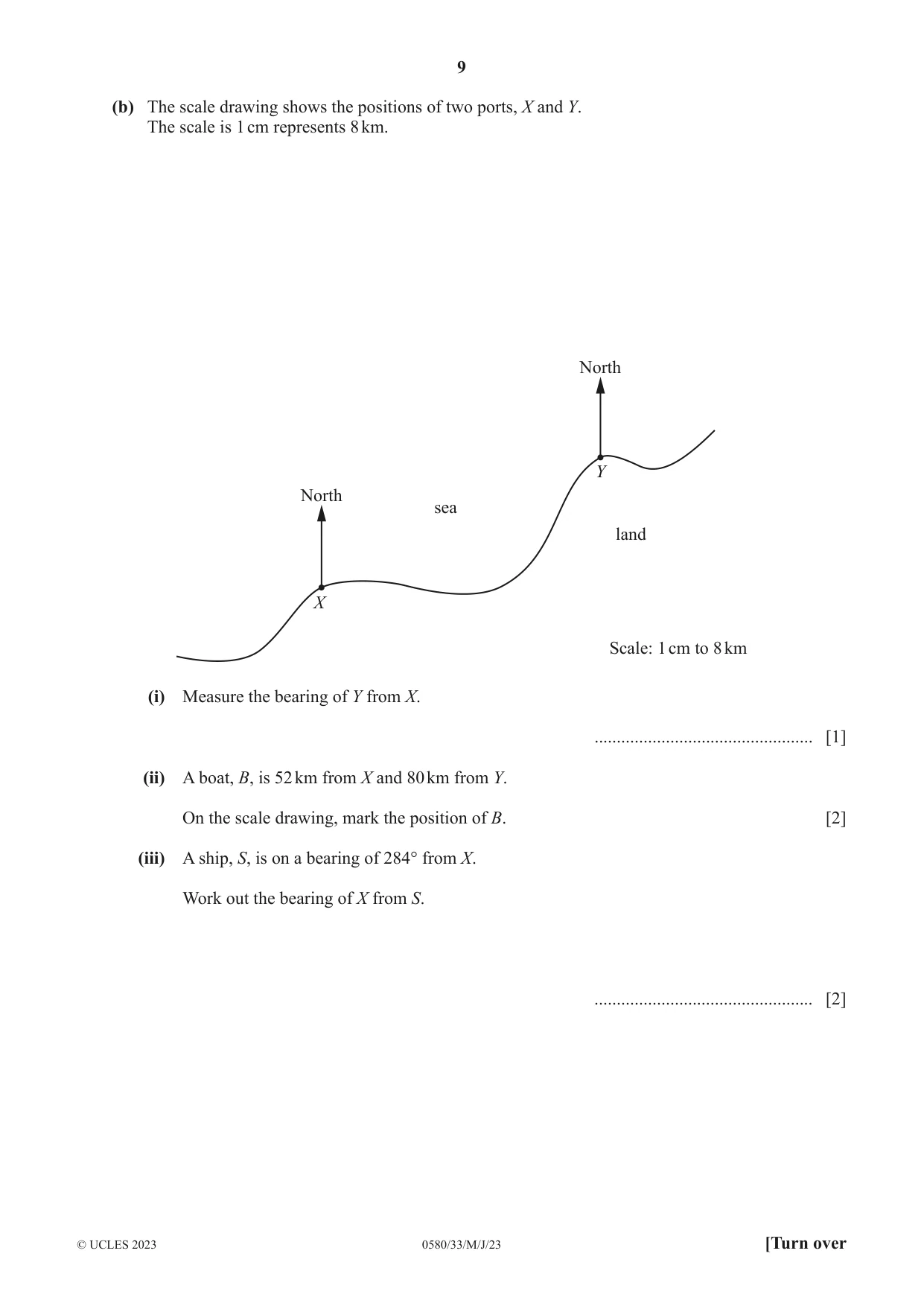
4 (a) A boat sails from A to B. The travel graph shows this journey. C 18 16 14 12 Distance 10 from A (km) 8 B 6 4 2 A 0 10 00 10 30 11 00 11 30 12 00 12 30 13 00 Time (i) Write down the time that the boat leaves A. ................................................. [1] (ii) Work out how long, in minutes, it takes the boat to sail from A to B. ........................................... min [1] (iii) The boat stays at B for 20 minutes. The boat then sails to C at a constant speed of 8 km/h. Complete the travel graph. [2] (iv) Work out the average speed, in km/h, for the whole journey from A to C. ......................................... km/h [3] (b) The scale drawing shows the positions of two ports, X and Y. The scale is 1 cm represents 8 km. North Y North sea land X Scale: 1 cm to 8 km (i) Measure the bearing of Y from X. ................................................. [1] (ii) A boat, B, is 52 km from X and 80 km from Y. On the scale drawing, mark the position of B. [2] (iii) A ship, S, is on a bearing of 284° from X. Work out the bearing of X from S. ................................................. [2]
Mark scheme: 4(a)(i) 10 20 1 4(a)(ii) 40 1 4(a)(iii) Ruled lines from 2 B1 for each line (11 00, 6) to (11 20, 6) If 0 scored, SC1 for and (11 20, 6) to (12 50, 18) (their11 20, 6) to 1 ( their11 20 1 h , 18 ) 2 4(a)(iv) 7.2 3 18 M2 for oe 30 2 60 OR M1 for their time at C – 10 20 correctly evaluated 18 M1 for using their journeytime 4(b)(i) [0]65 1 4(b)(ii) B correctly marked 2 B1 for their B 6.5 cm from X or 6.5 cm from X 10 cm from Y 10 cm from Y or 6.5 and 10 soi 4(b)(iii) 104 2 M1 for 284 180 oe or indicates correct angle on a sketch
Q5 · The grid shows the first three diagrams in a sequence
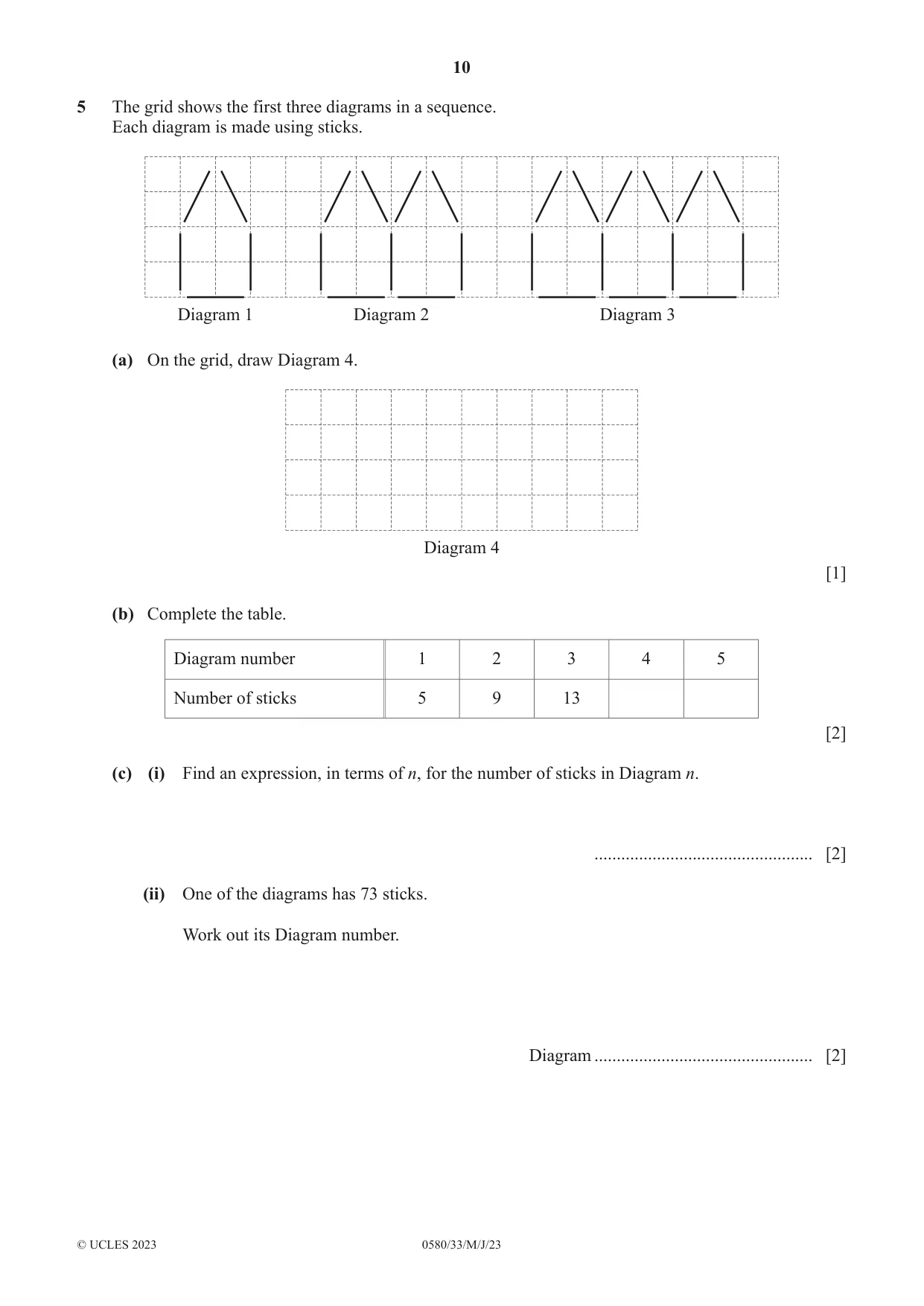
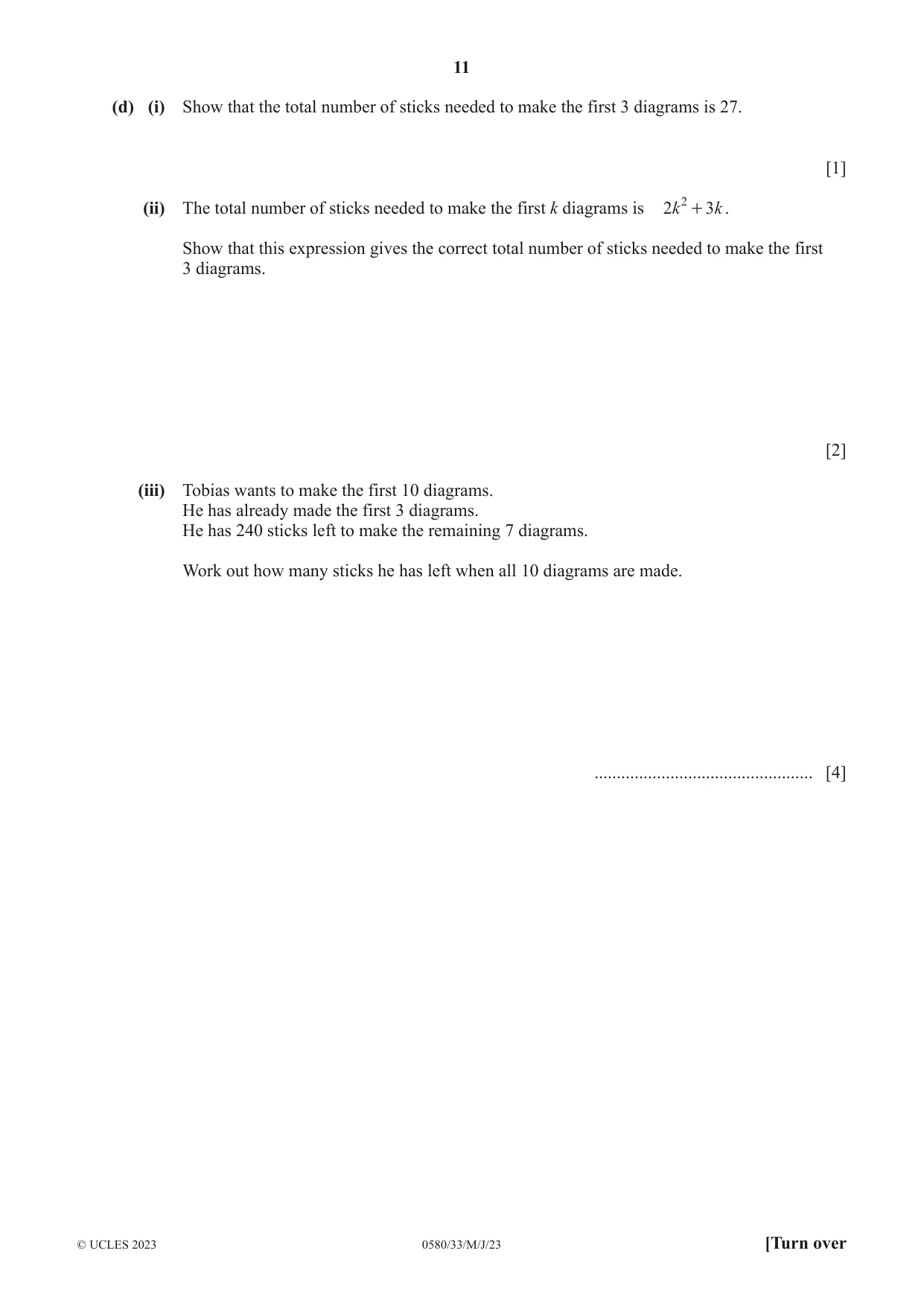
5 The grid shows the first three diagrams in a sequence. Each diagram is made using sticks. Diagram 1 Diagram 2 Diagram 3 (a) On the grid, draw Diagram 4. Diagram 4 [1] (b) Complete the table. Diagram number 1 2 3 4 5 Number of sticks 5 9 13 [2] (c) (i) Find an expression, in terms of n, for the number of sticks in Diagram n. ................................................. [2] (ii) One of the diagrams has 73 sticks. Work out its Diagram number. Diagram ................................................. [2] (d) (i) Show that the total number of sticks needed to make the first 3 diagrams is 27. [1] (ii) The total number of sticks needed to make the first k diagrams is 2k 2 + 3k . Show that this expression gives the correct total number of sticks needed to make the first 3 diagrams. [2] (iii) Tobias wants to make the first 10 diagrams. He has already made the first 3 diagrams. He has 240 sticks left to make the remaining 7 diagrams. Work out how many sticks he has left when all 10 diagrams are made. ................................................. [4]
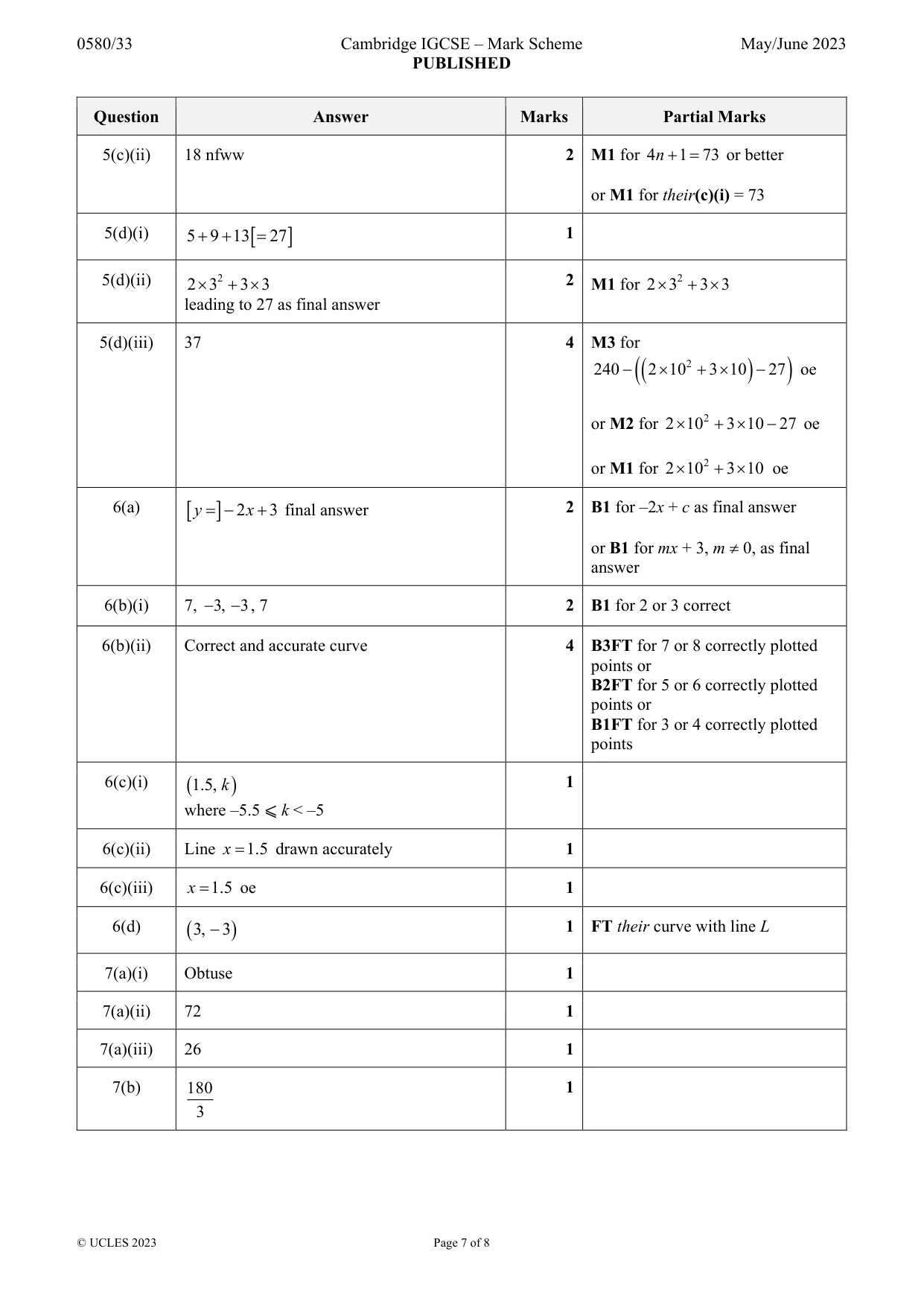
Mark scheme: 5(a) Correct diagram drawn 1 5(b) 17, 21 2 B1 for each If B0 scored, SC1 for k , k 4 5(c)(i) 4 n 1 oe final answer 2 B1 for 4 n k or an 1 , a 0 as final answers or for 4 n 1 oe seen and spoilt 5(c)(ii) 18 nfww 2 M1 for 4 n 1 73 or better or M1 for their(c)(i) = 73 5(d)(i) 5 9 13 27 1 5(d)(ii) 2 32 3 3 2 M1 for 2 32 3 3 leading to 27 as final answer 5(d)(iii) 37 4 M3 for 240 2 10 2 3 10 27 oe or M2 for 2 10 2 3 10 27 oe or M1 for 2 10 2 3 10 oe
Q6 · Y 8 L 7 6 5 4 3 2 1 – 4 – 3 – 2 – 1 0 1 2 3 4 5 6 x – 1 – 2 – 3 – 4 – 5 – 6 – 7 (a) Write…
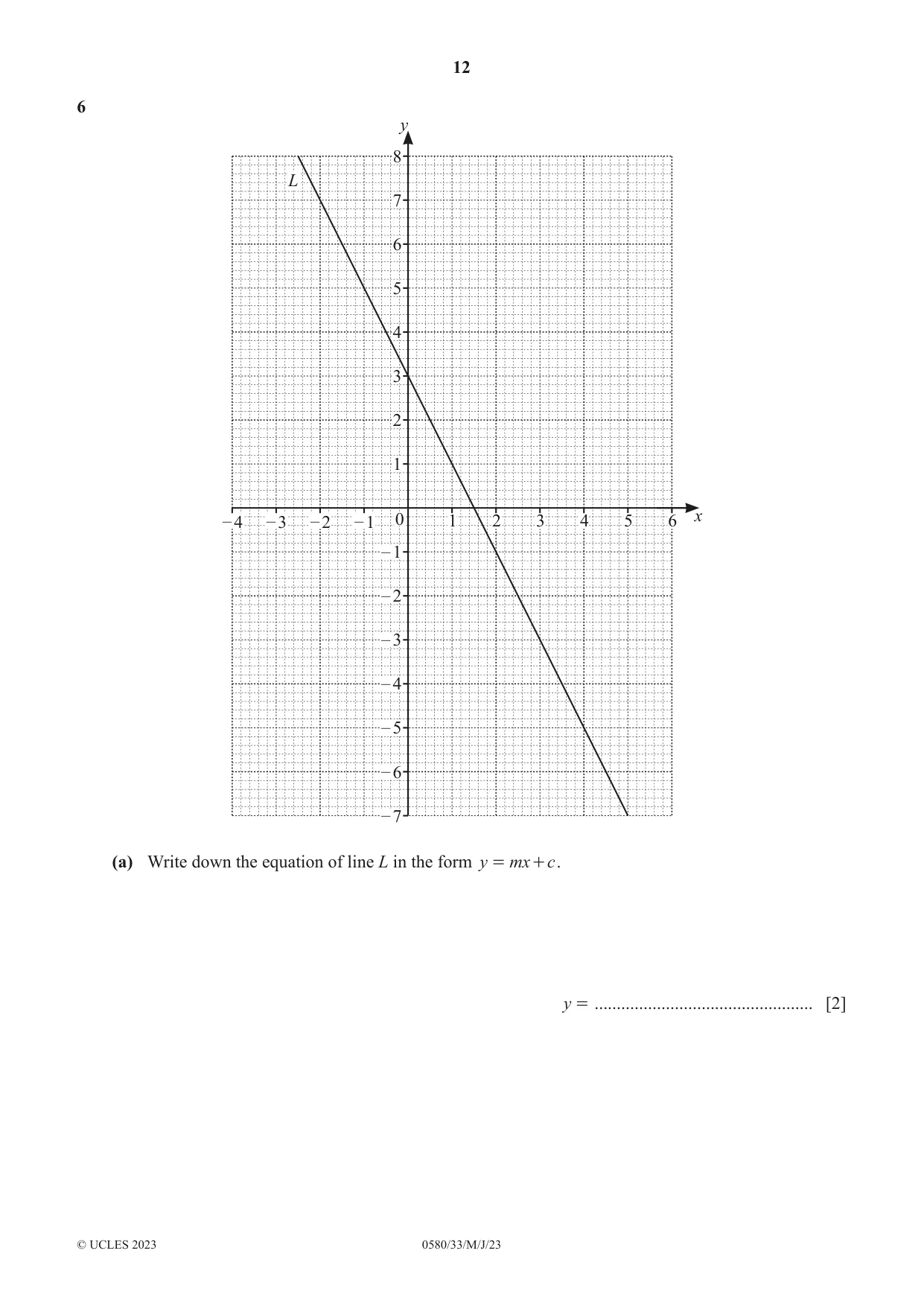
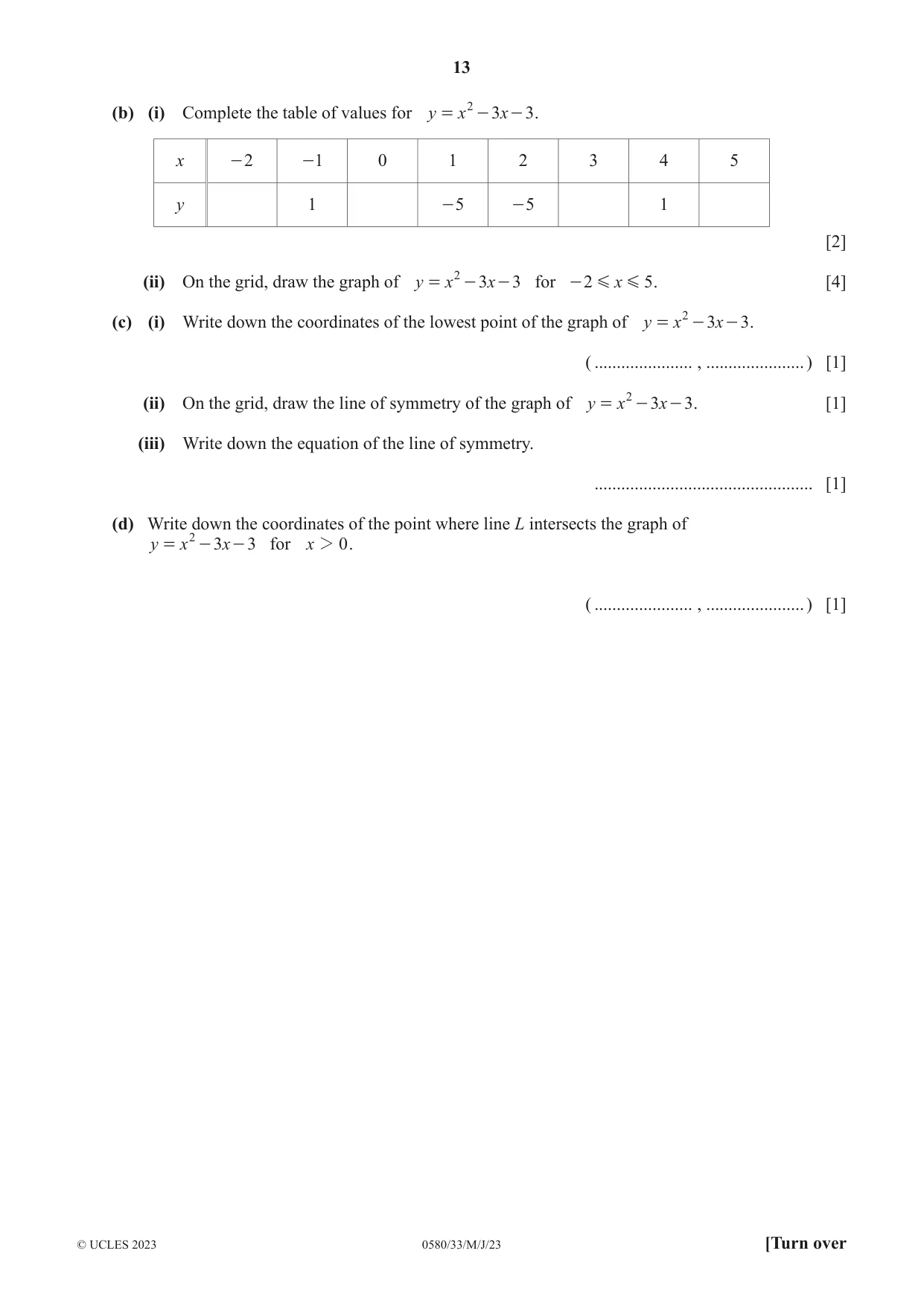
6 y 8 L 7 6 5 4 3 2 1 – 4 – 3 – 2 – 1 0 1 2 3 4 5 6 x – 1 – 2 – 3 – 4 – 5 – 6 – 7 (a) Write down the equation of line L in the form y = mx + c . y = ................................................. [2] (b) (i) Complete the table of values for y = x 2 - 3x - 3 . x - 2 - 1 0 1 2 3 4 5 y 1 - 5 - 5 1 [2] (ii) On the grid, draw the graph of y = x 2 - 3x - 3 for - 2 G x G 5 . [4] (c) (i) Write down the coordinates of the lowest point of the graph of y = x 2 - 3x - 3 . ( ...................... , ...................... ) [1] (ii) On the grid, draw the line of symmetry of the graph of y = x 2 - 3x - 3 . [1] (iii) Write down the equation of the line of symmetry. ................................................. [1] (d) Write down the coordinates of the point where line L intersects the graph of y = x 2 - 3x - 3 for x 2 0 . ( ...................... , ...................... ) [1]
Mark scheme: 6(a) y 2 x 3 final answer 2 B1 for –2x + c as final answer or B1 for mx + 3, m 0, as final answer 6(b)(i) 7, 3, ,3 7 2 B1 for 2 or 3 correct 6(b)(ii) Correct and accurate curve 4 B3FT for 7 or 8 correctly plotted points or B2FT for 5 or 6 correctly plotted points or B1FT for 3 or 4 correctly plotted points 6(c)(i) 1.5, k 1 where –5.5 ⩽ k < –5 6(c)(ii) Line x 1.5 drawn accurately 1 6(c)(iii) x 1.5 oe 1 6(d) 3, 3 1 FT their curve with line L
Q7 · D NOT TO SCALE C x° 108° y° 46° B A The diagram shows a triangle ABC and a straight line…
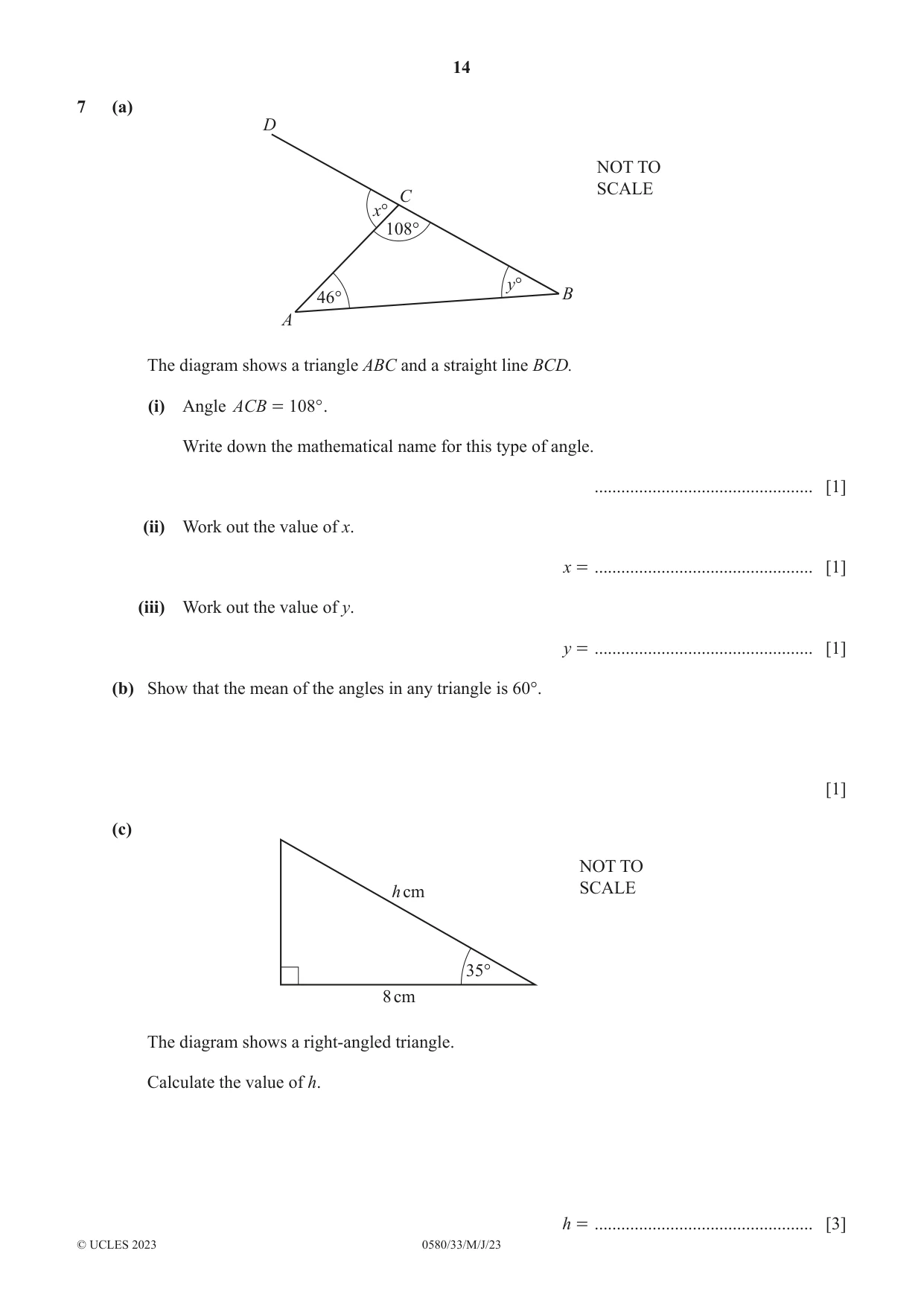
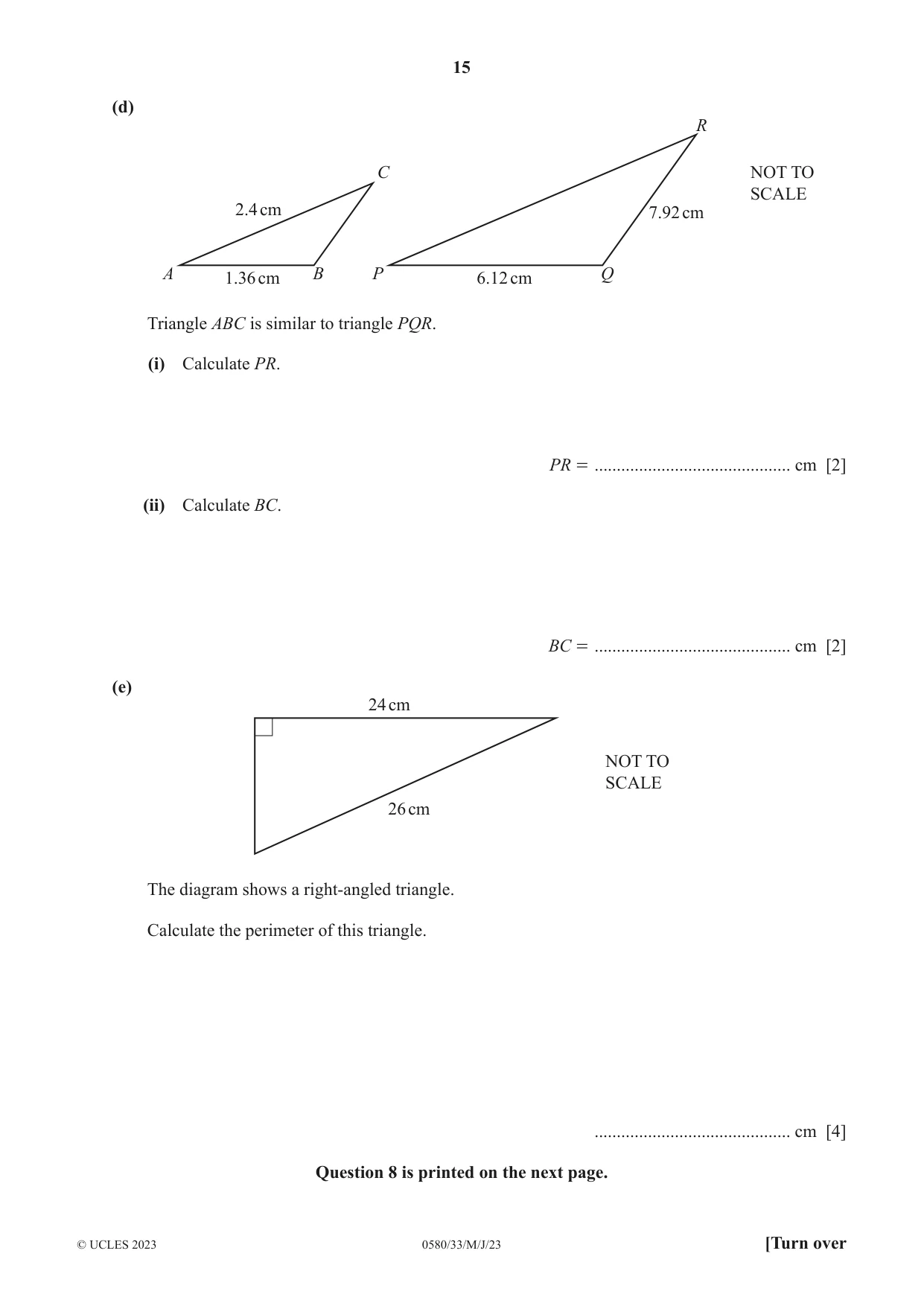
7 (a) D NOT TO SCALE C x° 108° y° 46° B A The diagram shows a triangle ABC and a straight line BCD. (i) Angle ACB = 108° . Write down the mathematical name for this type of angle. ................................................. [1] (ii) Work out the value of x. x = ................................................. [1] (iii) Work out the value of y. y = ................................................. [1] (b) Show that the mean of the angles in any triangle is 60°. [1] (c) NOT TO h cm SCALE 35° 8 cm The diagram shows a right-angled triangle. Calculate the value of h. h = ................................................. [3] (d) R C NOT TO SCALE 2.4 cm 7.92 cm A 1.36 cm B P 6.12 cm Q Triangle ABC is similar to triangle PQR. (i) Calculate PR. PR = ............................................ cm [2] (ii) Calculate BC. BC = ............................................ cm [2] (e) 24 cm NOT TO SCALE 26 cm The diagram shows a right-angled triangle. Calculate the perimeter of this triangle. ............................................ cm [4] Question 8 is printed on the next page.
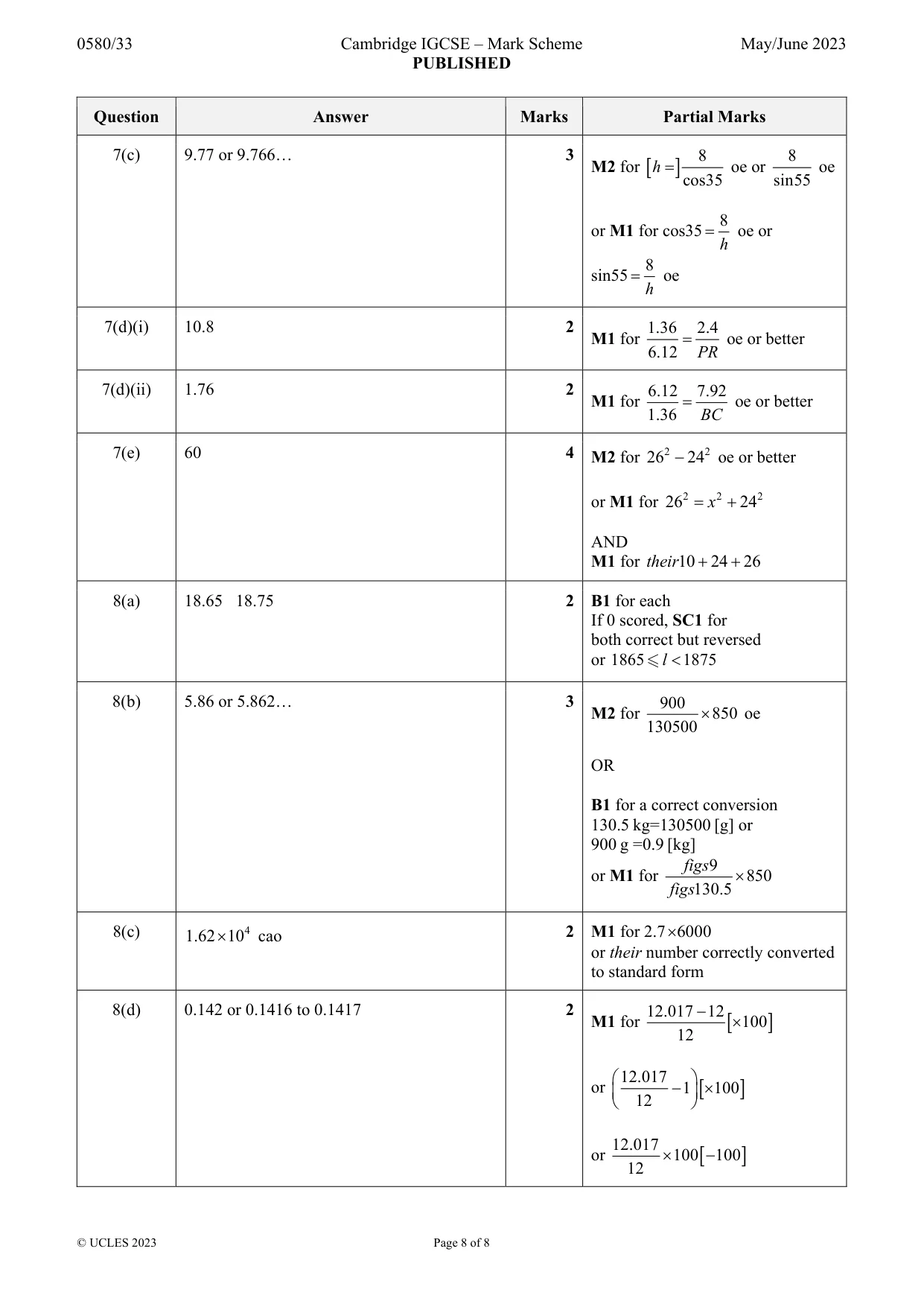
Mark scheme: 7(a)(i) Obtuse 1 7(a)(ii) 72 1 7(a)(iii) 26 1 7(b) 180 1 3 7(c) 9.77 or 9.766… 3 8 8 M2 for h oe or oe cos35 sin55 8 or M1 for cos35 oe or h 8 sin55 oe h 7(d)(i) 10.8 2 1.36 2.4 M1 for oe or better 6.12 PR 7(d)(ii) 1.76 2 6.12 7.92 M1 for oe or better 1.36 BC 7(e) 60 4 M2 for 26 2 24 2 oe or better or M1 for 26 2 x 2 24 2 AND M1 for their10 24 26
Q8 · The length, l m, of a piece of wire is 18.7 metres, correct to the nearest 10 centimetres
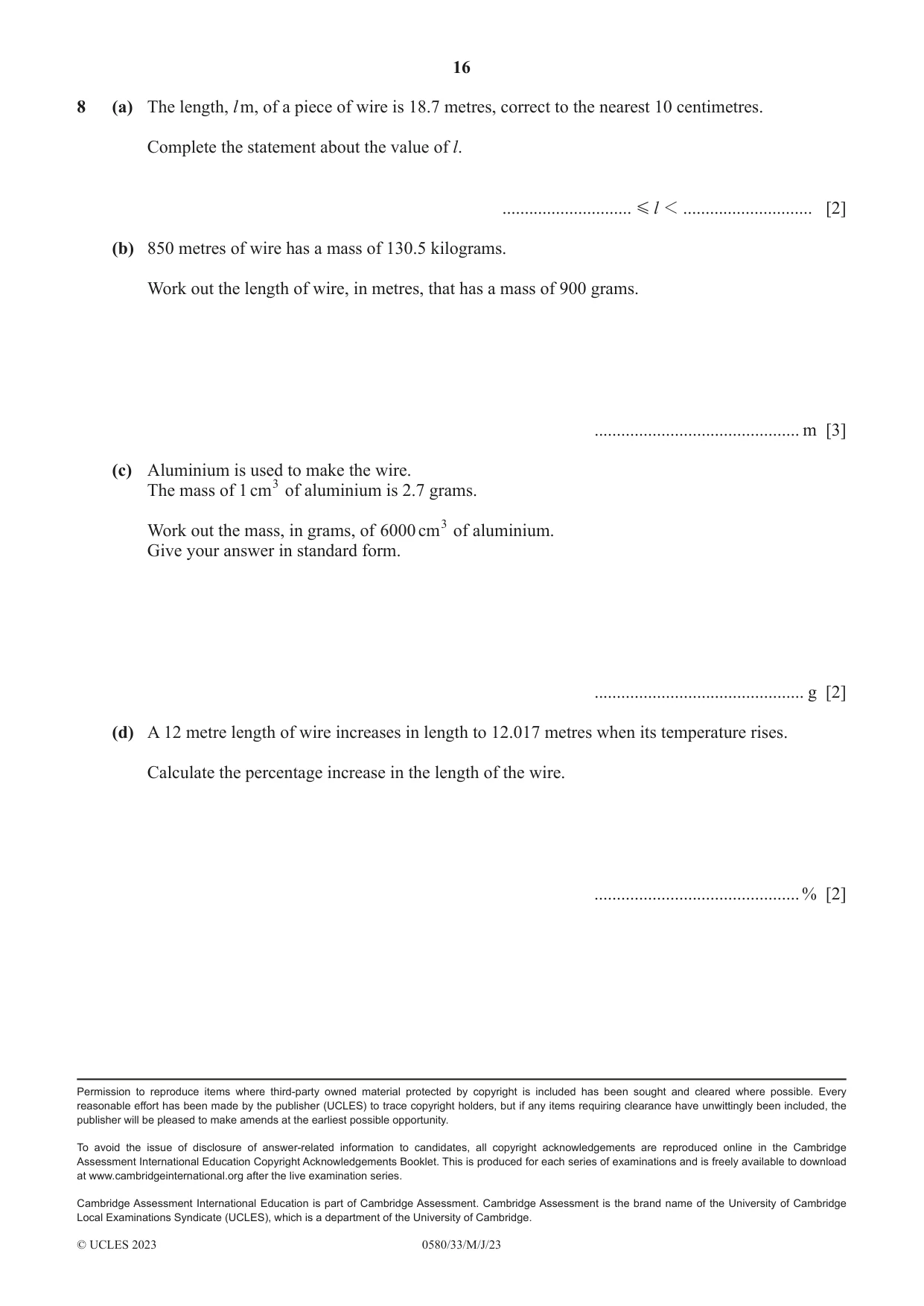
8 (a) The length, l m, of a piece of wire is 18.7 metres, correct to the nearest 10 centimetres. Complete the statement about the value of l. ............................. G l 1 ............................. [2] (b) 850 metres of wire has a mass of 130.5 kilograms. Work out the length of wire, in metres, that has a mass of 900 grams. .............................................. m [3] (c) Aluminium is used to make the wire. The mass of 1 cm 3 of aluminium is 2.7 grams. Work out the mass, in grams, of 6000 cm 3 of aluminium. Give your answer in standard form. ............................................... g [2] (d) A 12 metre length of wire increases in length to 12.017 metres when its temperature rises. Calculate the percentage increase in the length of the wire. ..............................................% [2]
Mark scheme: 8(a) 18.65 18.75 2 B1 for each If 0 scored, SC1 for both correct but reversed or 1865 l 1875 8(b) 5.86 or 5.862… 3 900 M2 for 850 oe 130500 OR B1 for a correct conversion 130.5 kg=130500 [g] or 900 g =0.9 [kg] figs 9 or M1 for 850 figs130.5 8(c) 1.62 10 4 cao 2 M1 for 2.7 6000 or their number correctly converted to standard form 8(d) 0.142 or 0.1416 to 0.1417 2 12.017 12 M1 for 100 12 12.017 100 or 1 12 12.017 or 100 100 12
What was in this paper
The subtopics covered by these 8 questions, and how many questions each got. Open one in a new tab to see every Cambridge question on it.
What you needed in this session
Cambridge’s own grade thresholds for 2023 May/June, Paper 3 · Variant 3. A higher threshold means an easier paper — the bar moves with how the cohort did.