Cambridge IGCSE Mathematics 0580 — 2017 Oct/Nov Paper 3 · Variant 1
0580/31/O/N/17 · 10 questions · 104 marks · ≈117 min
The question paper and its mark scheme, free to read here and free to download. This is Cambridge’s own paper, exactly as it was sat.
Question paper16 pages
Mark scheme5 pages
Answers below. Sit the paper first if you are practising.
Questions as text
Q1 · Write down the temperature shown by each arrow
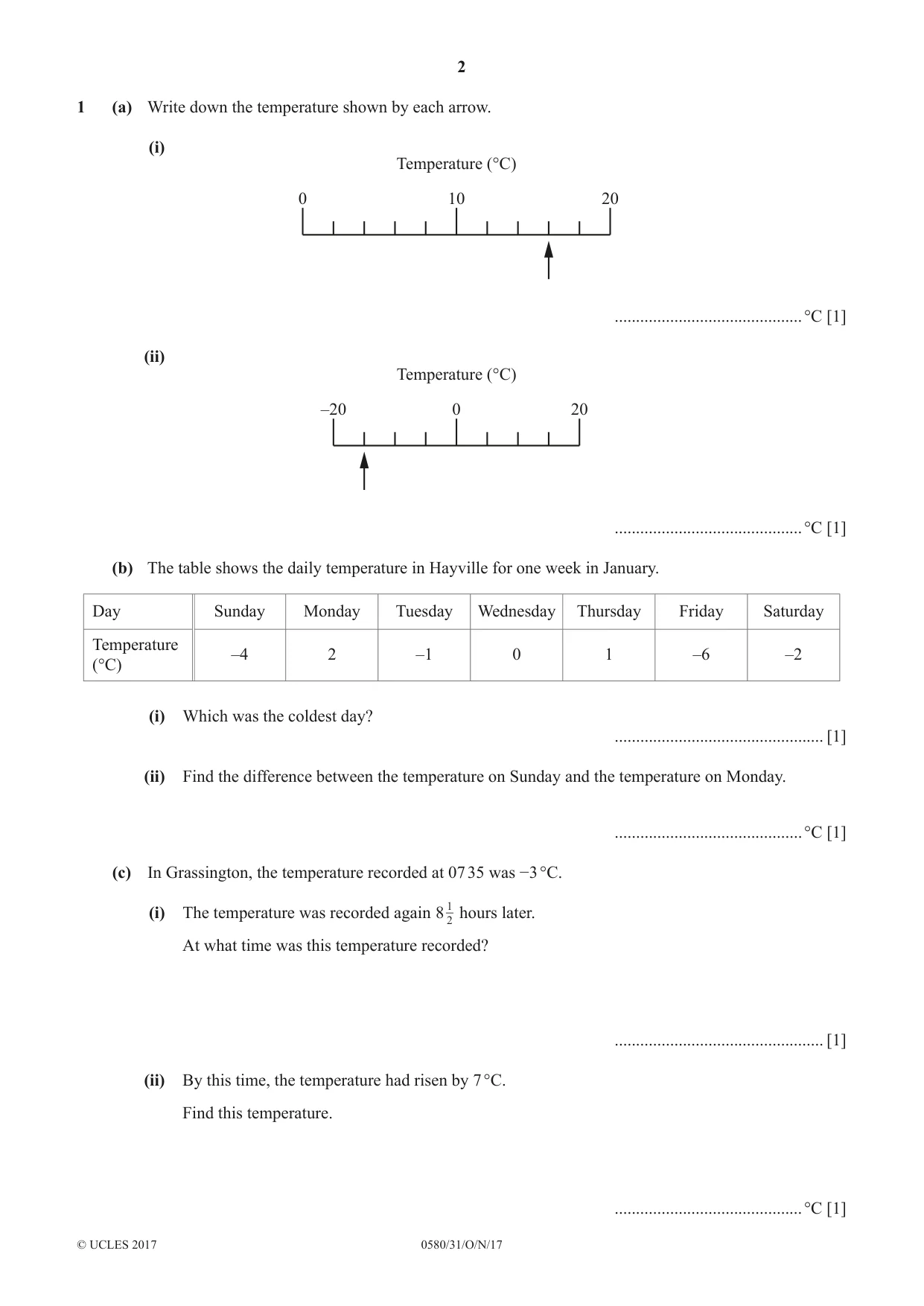
1 (a) Write down the temperature shown by each arrow. (i) Temperature (°C) 0 10 20 ............................................°C [1] (ii) Temperature (°C) –20 0 20 ............................................°C [1] (b) The table shows the daily temperature in Hayville for one week in January. Day Sunday Monday Tuesday Wednesday Thursday Friday Saturday Temperature –4 2 –1 0 1 –6 –2 (°C) (i) Which was the coldest day? ................................................. [1] (ii) Find the difference between the temperature on Sunday and the temperature on Monday. ............................................°C [1] (c) In Grassington, the temperature recorded at 07 35 was −3 °C. (i) The temperature was recorded again 8 12 hours later. At what time was this temperature recorded? ................................................. [1] (ii) By this time, the temperature had risen by 7 °C. Find this temperature. ............................................°C [1]
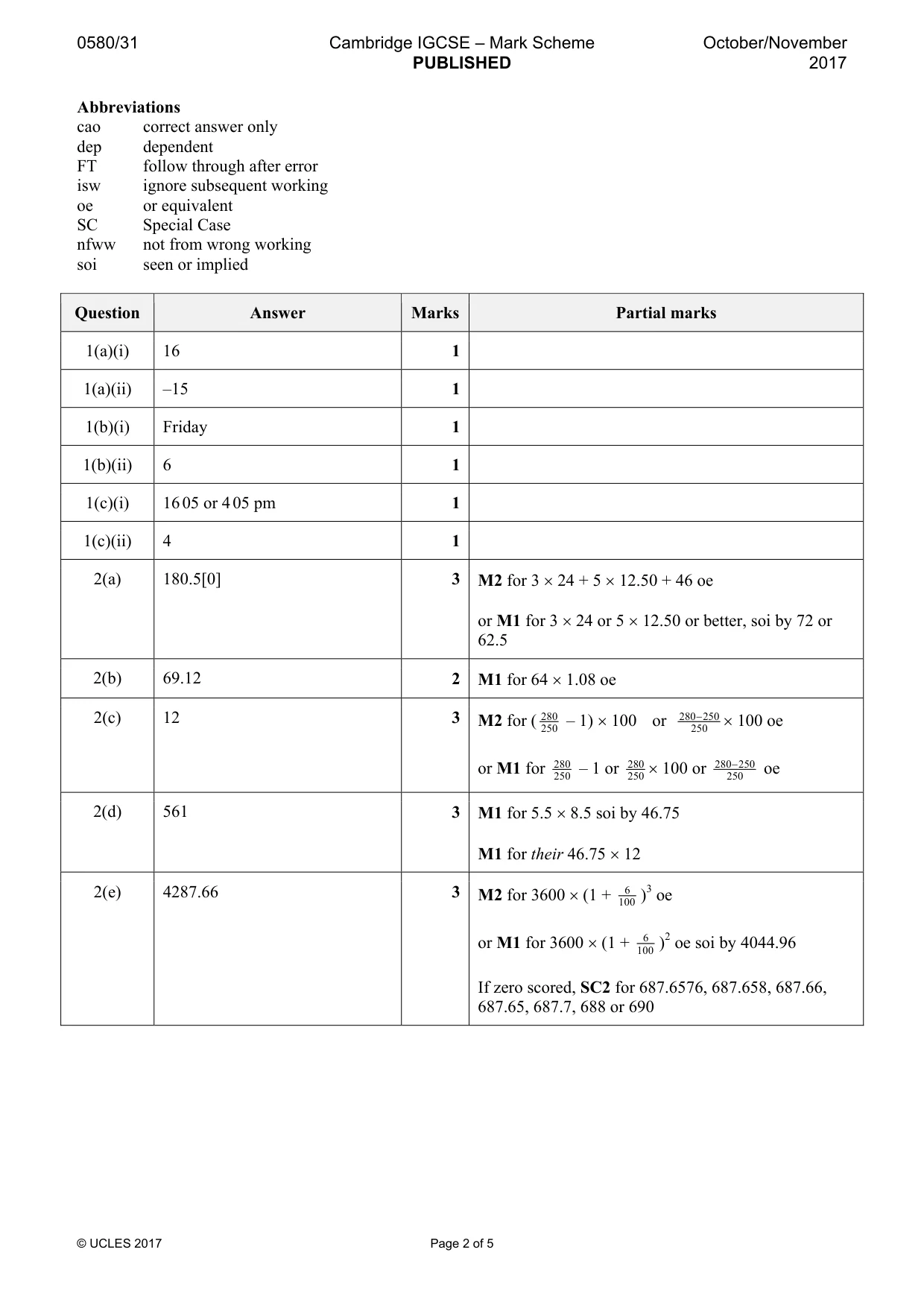
Mark scheme: Question Answer Marks Partial marks 1(a)(i) 16 1 1(a)(ii) –15 1 1(b)(i) Friday 1 1(b)(ii) 6 1 1(c)(i) 16 05 or 4 05 pm 1 1(c)(ii) 4 1
Q2 · Jeff owns a clothes shop
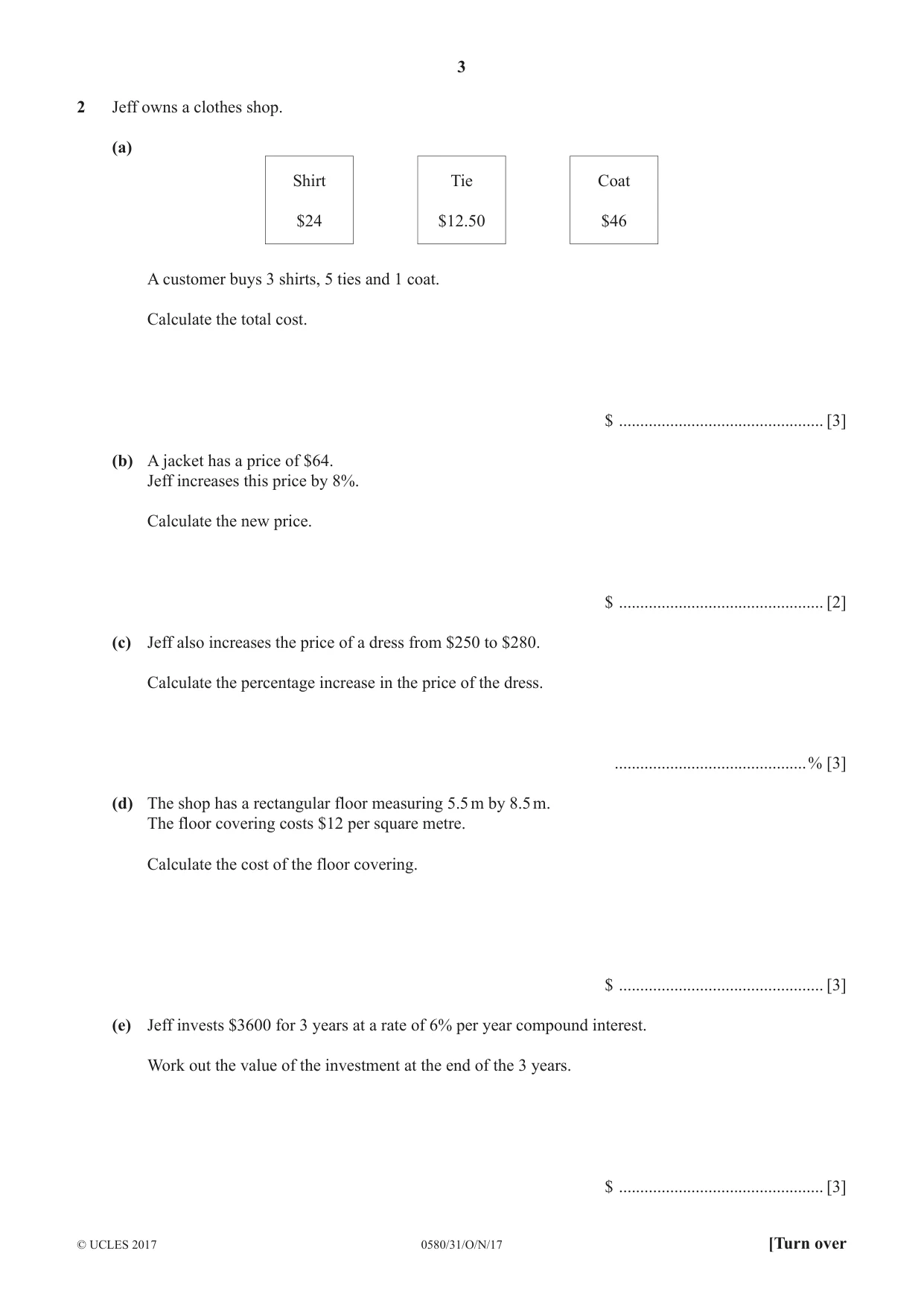
2 Jeff owns a clothes shop. (a) Shirt Tie Coat $24 $12.50 $46 A customer buys 3 shirts, 5 ties and 1 coat. Calculate the total cost. $ ................................................ [3] (b) A jacket has a price of $64. Jeff increases this price by 8%. Calculate the new price. $ ................................................ [2] (c) Jeff also increases the price of a dress from $250 to $280. Calculate the percentage increase in the price of the dress. .............................................% [3] (d) The shop has a rectangular floor measuring 5.5 m by 8.5 m. The floor covering costs $12 per square metre. Calculate the cost of the floor covering. $ ................................................ [3] (e) Jeff invests $3600 for 3 years at a rate of 6% per year compound interest. Work out the value of the investment at the end of the 3 years. $ ................................................ [3]
Mark scheme: 2(a) 180.5[0] 3 M2 for 3 × 24 + 5 × 12.50 + 46 oe or M1 for 3 × 24 or 5 × 12.50 or better, soi by 72 or 62.5 2(b) 69.12 2 M1 for 64 × 1.08 oe 2(c) 12 3 M2 for ( 280250 – 1) × 100 or 280250− 250 × 100 oe or M1 for 280250 – 1 or 280250 × 100 or 280250− 250 oe 2(d) 561 3 M1 for 5.5 × 8.5 soi by 46.75 M1 for their 46.75 × 12 2(e) 4287.66 3 M2 for 3600 × (1 + 1006 )3 oe or M1 for 3600 × (1 + 1006 )2 oe soi by 4044.96 If zero scored, SC2 for 687.6576, 687.658, 687.66, 687.65, 687.7, 688 or 690
Q3 · The scatter diagram shows the scores for each student in class A for the written test and…
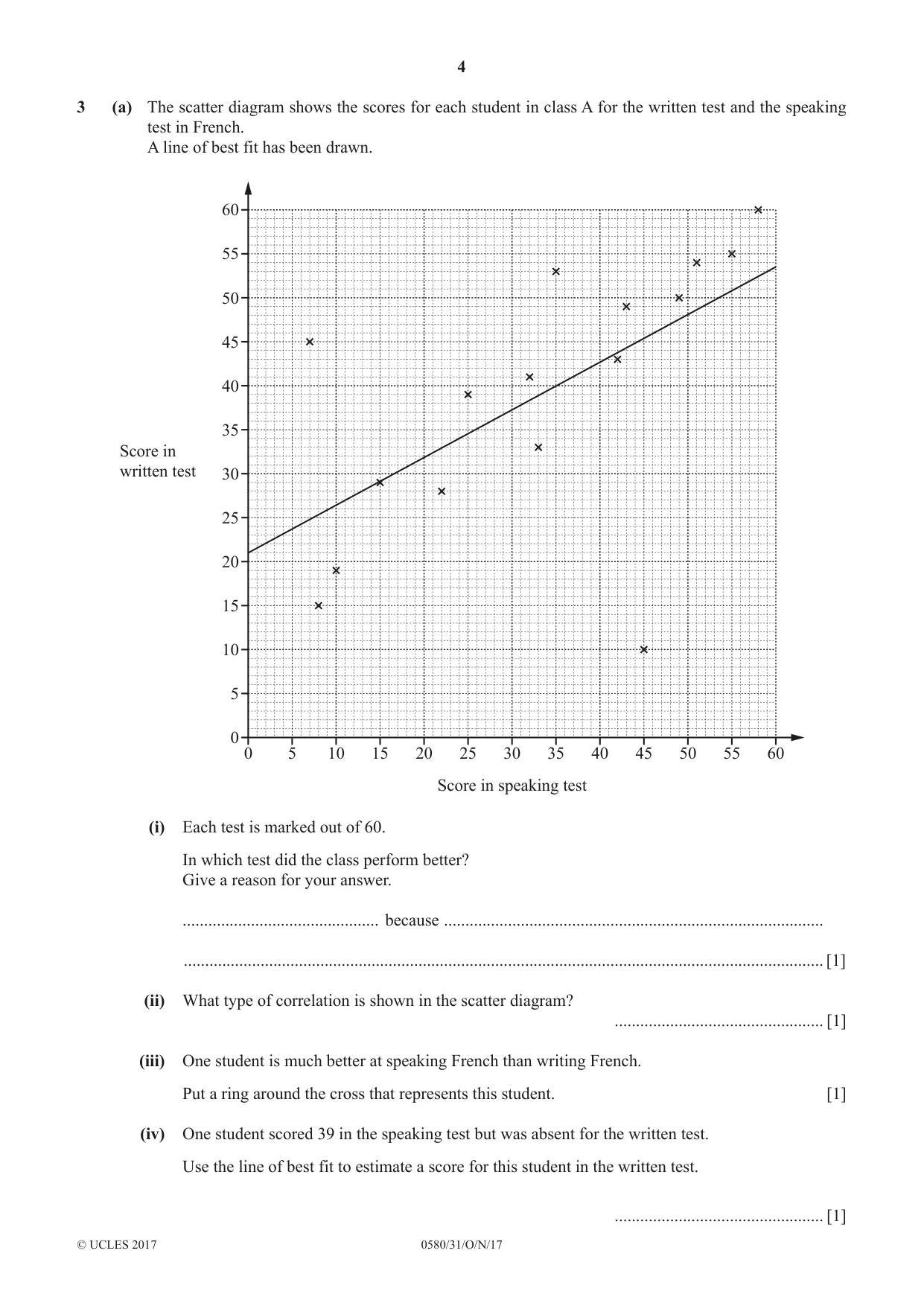
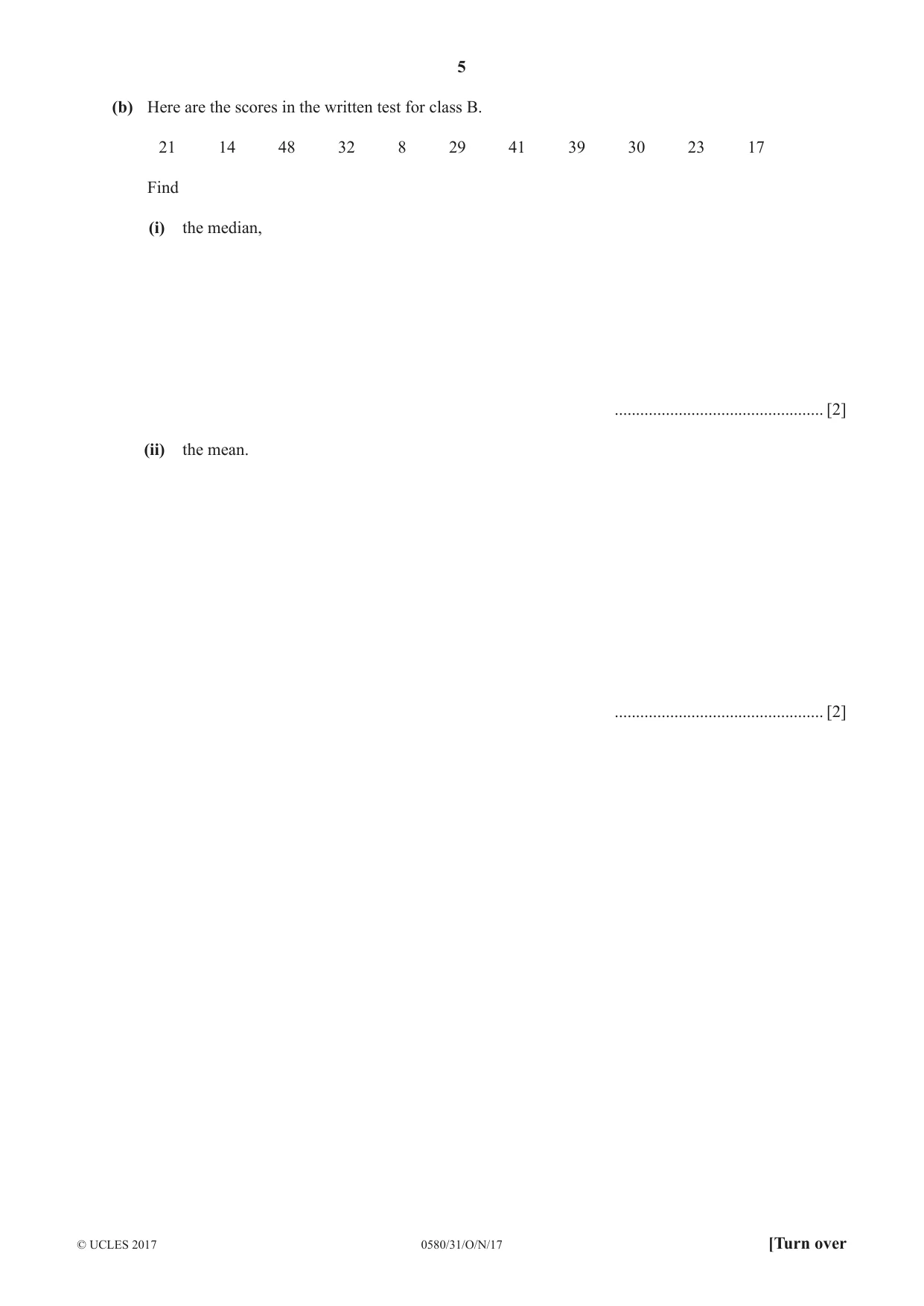
3 (a) The scatter diagram shows the scores for each student in class A for the written test and the speaking test in French. A line of best fit has been drawn. 60 55 50 45 40 35 Score in written test 30 25 20 15 10 5 0 0 5 10 15 20 25 30 35 40 45 50 55 60 Score in speaking test (i) Each test is marked out of 60. In which test did the class perform better? Give a reason for your answer. .............................................. because ......................................................................................... ...................................................................................................................................................... [1] (ii) What type of correlation is shown in the scatter diagram? ................................................. [1] (iii) One student is much better at speaking French than writing French. Put a ring around the cross that represents this student. [1] (iv) One student scored 39 in the speaking test but was absent for the written test. Use the line of best fit to estimate a score for this student in the written test. ................................................. [1] (b) Here are the scores in the written test for class B. 21 14 48 32 8 29 41 39 30 23 17 Find (i) the median, ................................................. [2] (ii) the mean. ................................................. [2]
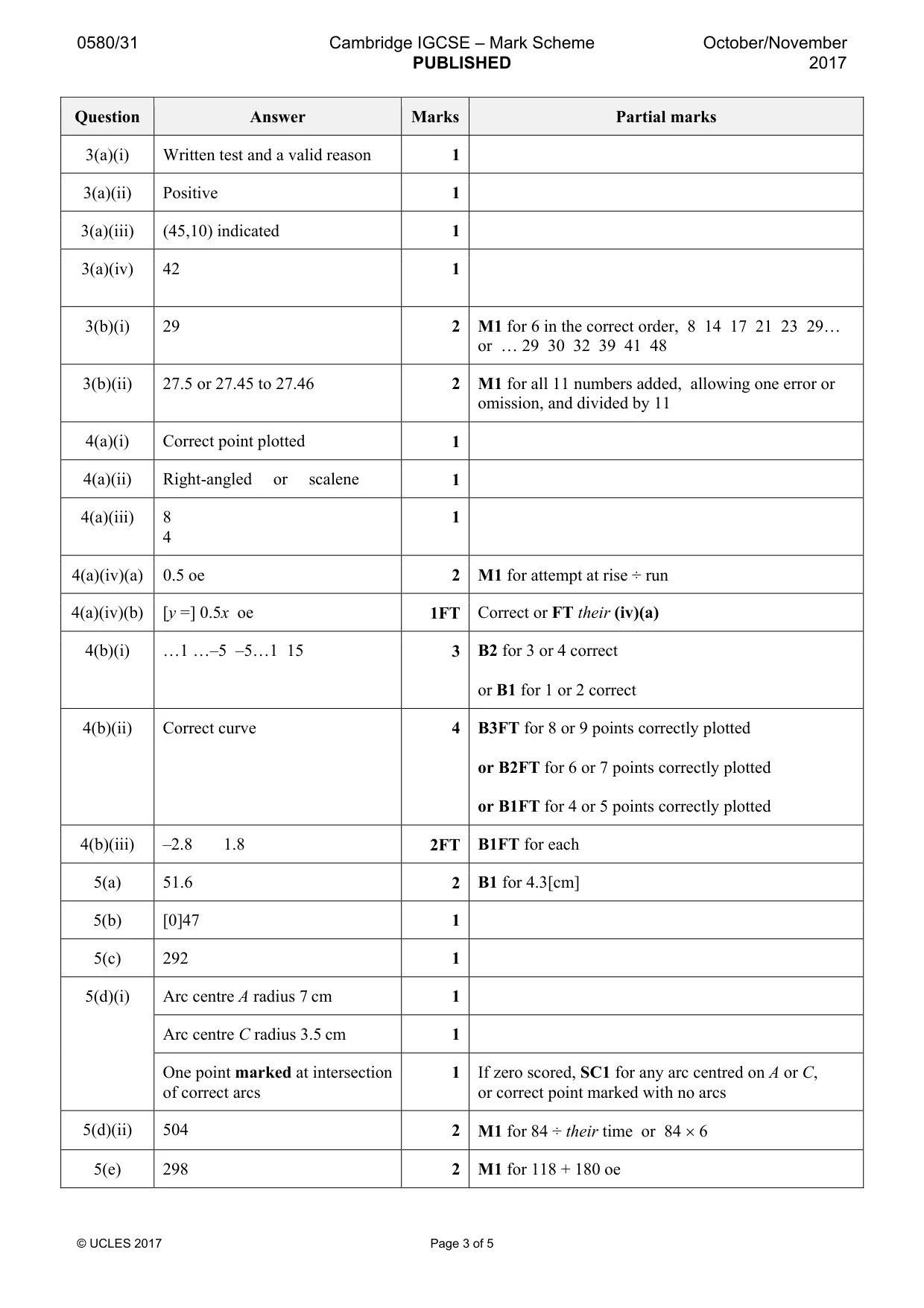
Mark scheme: 3(a)(i) Written test and a valid reason 1 3(a)(ii) Positive 1 3(a)(iii) (45,10) indicated 1 3(a)(iv) 42 1 3(b)(i) 29 2 M1 for 6 in the correct order, 8 14 17 21 23 29… or … 29 30 32 39 41 48 3(b)(ii) 27.5 or 27.45 to 27.46 2 M1 for all 11 numbers added, allowing one error or omission, and divided by 11
Q4 · Y 4 3 2 B 1 x –5 –4 –3 –2 –1 0 1 2 3 4 5 –1 –2 A –3 –4 (i) Plot point C at (–4, 2)
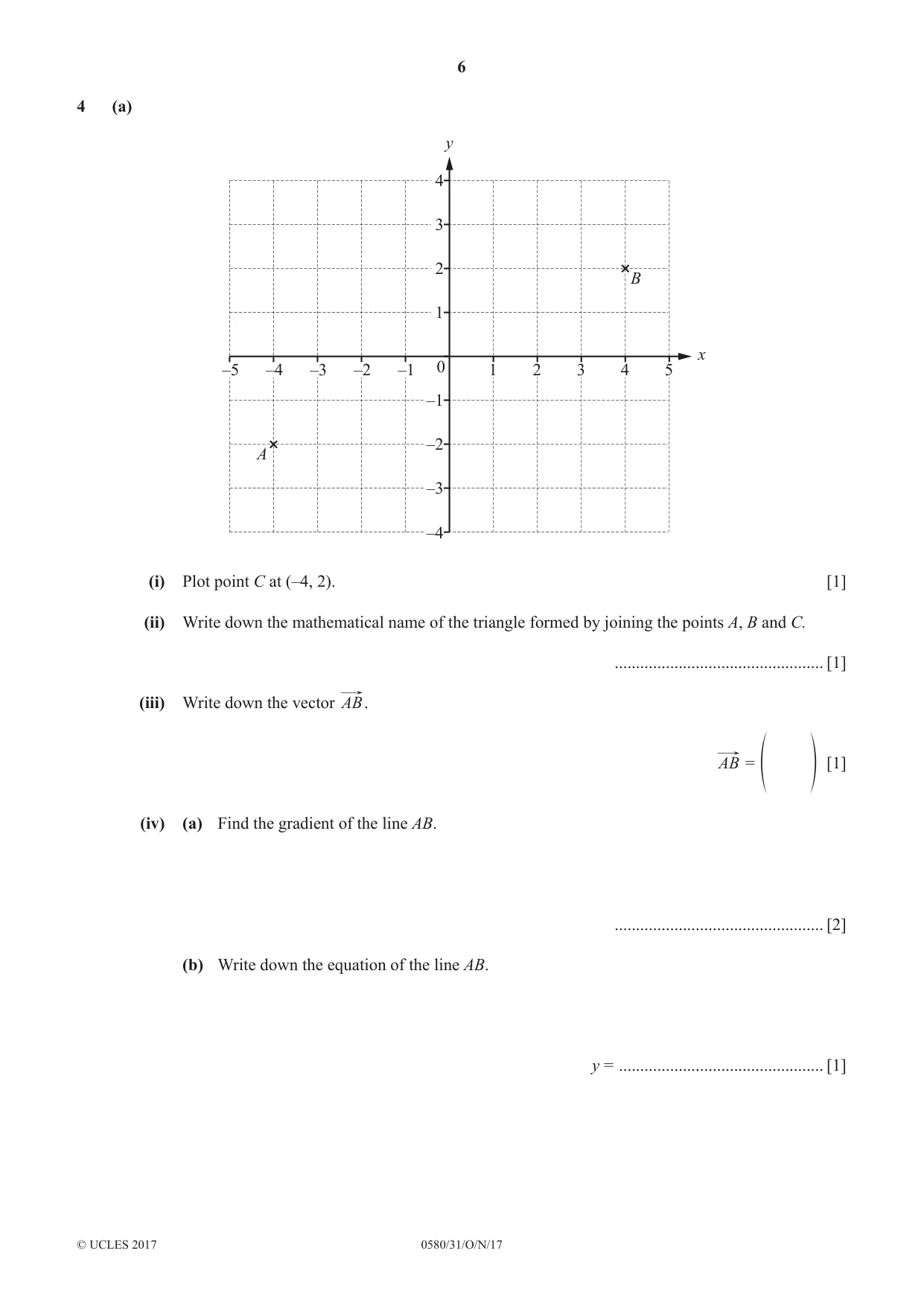
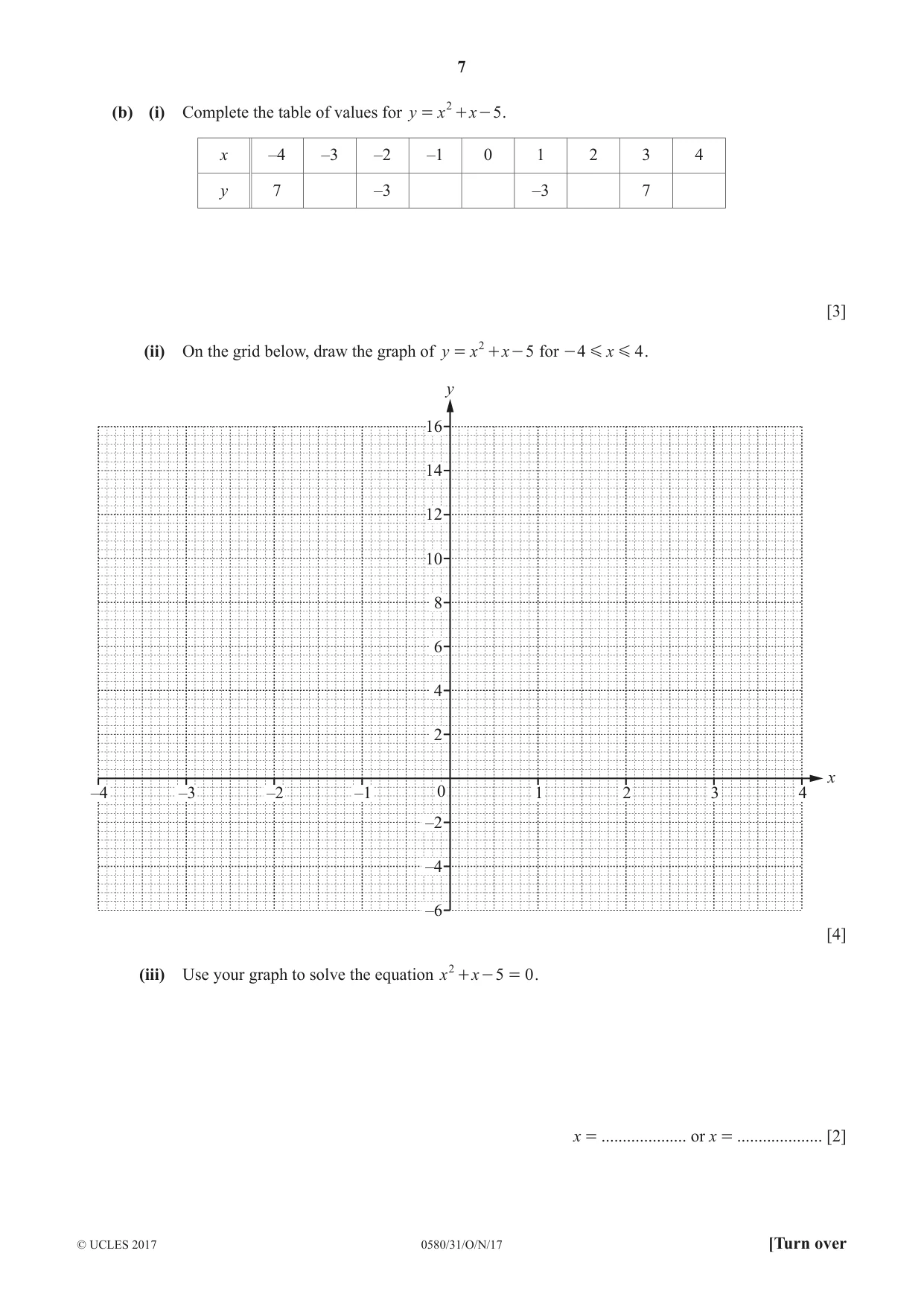
4 (a) y 4 3 2 B 1 x –5 –4 –3 –2 –1 0 1 2 3 4 5 –1 –2 A –3 –4 (i) Plot point C at (–4, 2). [1] (ii) Write down the mathematical name of the triangle formed by joining the points A, B and C. ................................................. [1] (iii) Write down the vector AB. AB = [1] f p (iv) (a) Find the gradient of the line AB. ................................................. [2] (b) Write down the equation of the line AB. y = ................................................ [1] (b) (i) Complete the table of values for y = x 2 + x - 5 . x –4 –3 –2 –1 0 1 2 3 4 y 7 –3 –3 7 [3] (ii) On the grid below, draw the graph of y = x 2 + x - 5 for - 4 G x G 4 . y 16 14 12 10 8 6 4 2 x –4 –3 –2 –1 0 1 2 3 4 –2 –4 –6 [4] (iii) Use your graph to solve the equation x 2 + x - 5 = 0 . x = .................... or x = .................... [2]
Mark scheme: 4(a)(i) Correct point plotted 1 4(a)(ii) Right-angled or scalene 1 4(a)(iii) 8 1 4 4(a)(iv)(a) 0.5 oe 2 M1 for attempt at rise ÷ run 4(a)(iv)(b) [y =] 0.5x oe 1FT Correct or FT their (iv)(a) 4(b)(i) …1 …–5 –5…1 15 3 B2 for 3 or 4 correct or B1 for 1 or 2 correct 4(b)(ii) Correct curve 4 B3FT for 8 or 9 points correctly plotted or B2FT for 6 or 7 points correctly plotted or B1FT for 4 or 5 points correctly plotted 4(b)(iii) –2.8 1.8 2FT B1FT for each
Q5 · The scale drawing shows the positions of three towns A, B and C
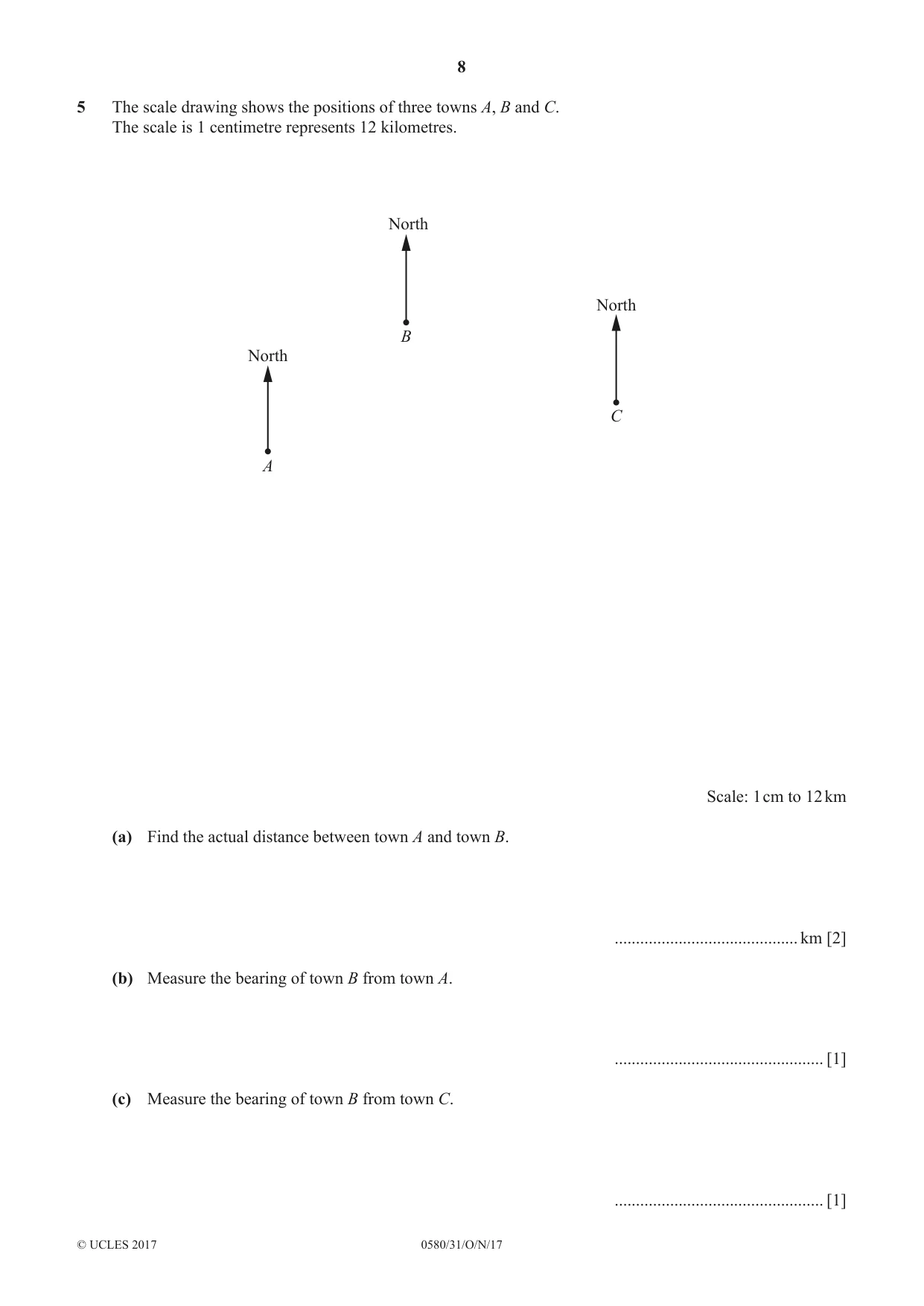
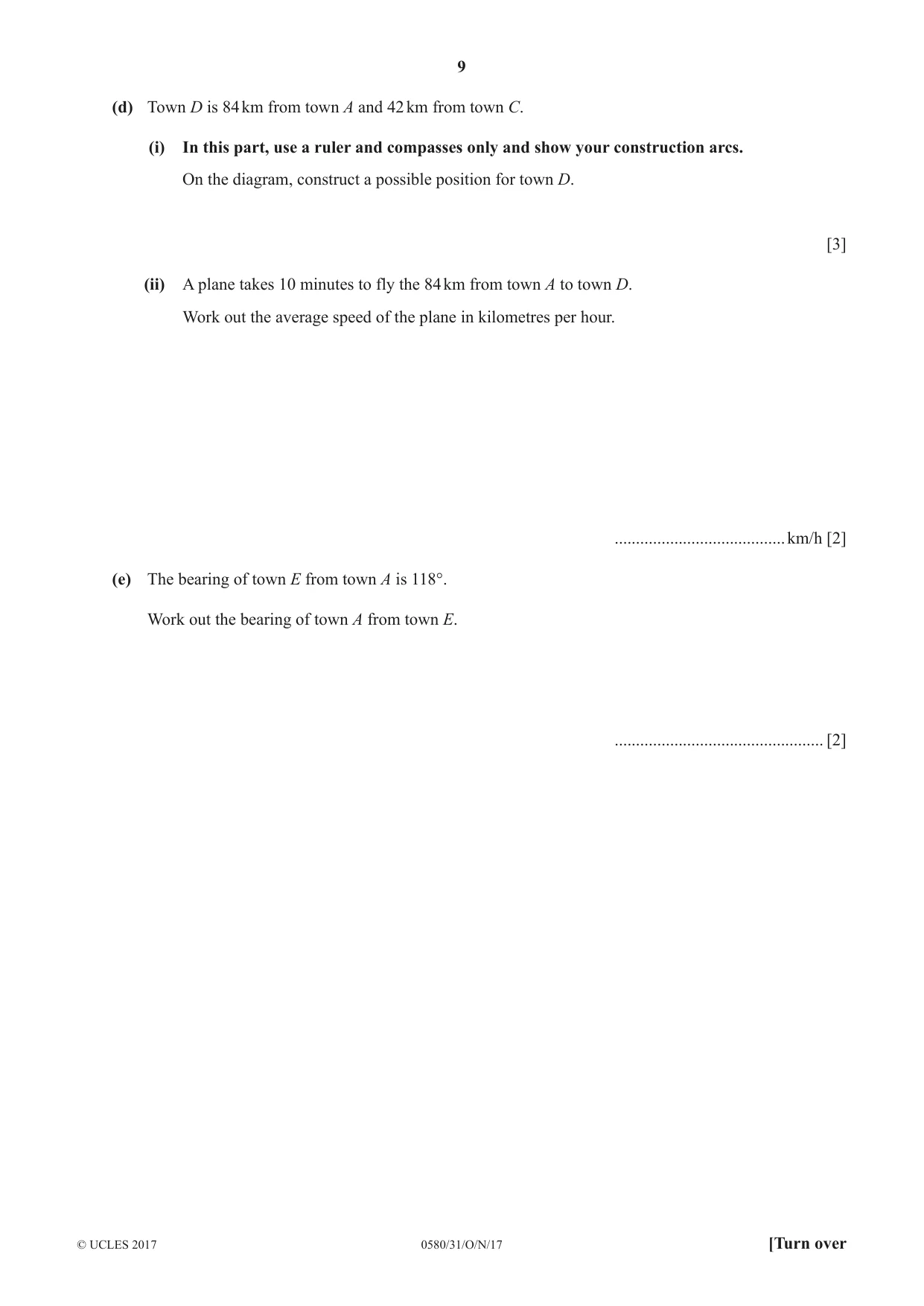
5 The scale drawing shows the positions of three towns A, B and C. The scale is 1 centimetre represents 12 kilometres. North North B North C A Scale: 1 cm to 12 km (a) Find the actual distance between town A and town B. ........................................... km [2] (b) Measure the bearing of town B from town A. ................................................. [1] (c) Measure the bearing of town B from town C. ................................................. [1] (d) Town D is 84 km from town A and 42 km from town C. (i) In this part, use a ruler and compasses only and show your construction arcs. On the diagram, construct a possible position for town D. [3] (ii) A plane takes 10 minutes to fly the 84 km from town A to town D. Work out the average speed of the plane in kilometres per hour. ........................................km/h [2] (e) The bearing of town E from town A is 118°. Work out the bearing of town A from town E. ................................................. [2]
Mark scheme: 5(a) 51.6 2 B1 for 4.3[cm] 5(b) [0]47 1 5(c) 292 1 5(d)(i) Arc centre A radius 7 cm 1 Arc centre C radius 3.5 cm 1 One point marked at intersection 1 If zero scored, SC1 for any arc centred on A or C, of correct arcs or correct point marked with no arcs 5(d)(ii) 504 2 M1 for 84 ÷ their time or 84 × 6 5(e) 298 2 M1 for 118 + 180 oe
Q6 · Find (i) all the factors of 18, ................................................
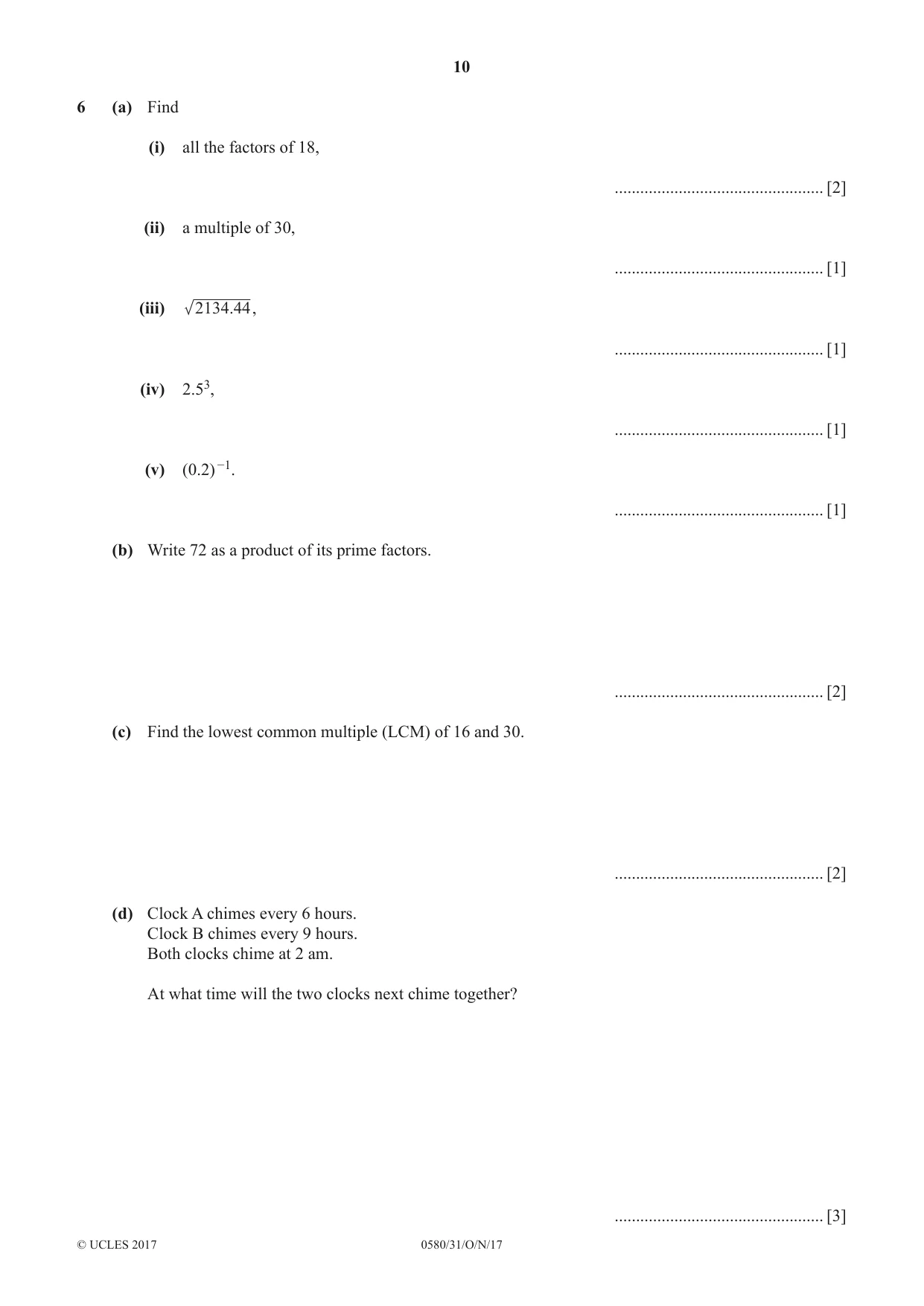
6 (a) Find (i) all the factors of 18, ................................................. [2] (ii) a multiple of 30, ................................................. [1] (iii) 2134.44, ................................................. [1] (iv) 2.53, ................................................. [1] (v) (0.2) −1. ................................................. [1] (b) Write 72 as a product of its prime factors. ................................................. [2] (c) Find the lowest common multiple (LCM) of 16 and 30. ................................................. [2] (d) Clock A chimes every 6 hours. Clock B chimes every 9 hours. Both clocks chime at 2 am. At what time will the two clocks next chime together? ................................................. [3]
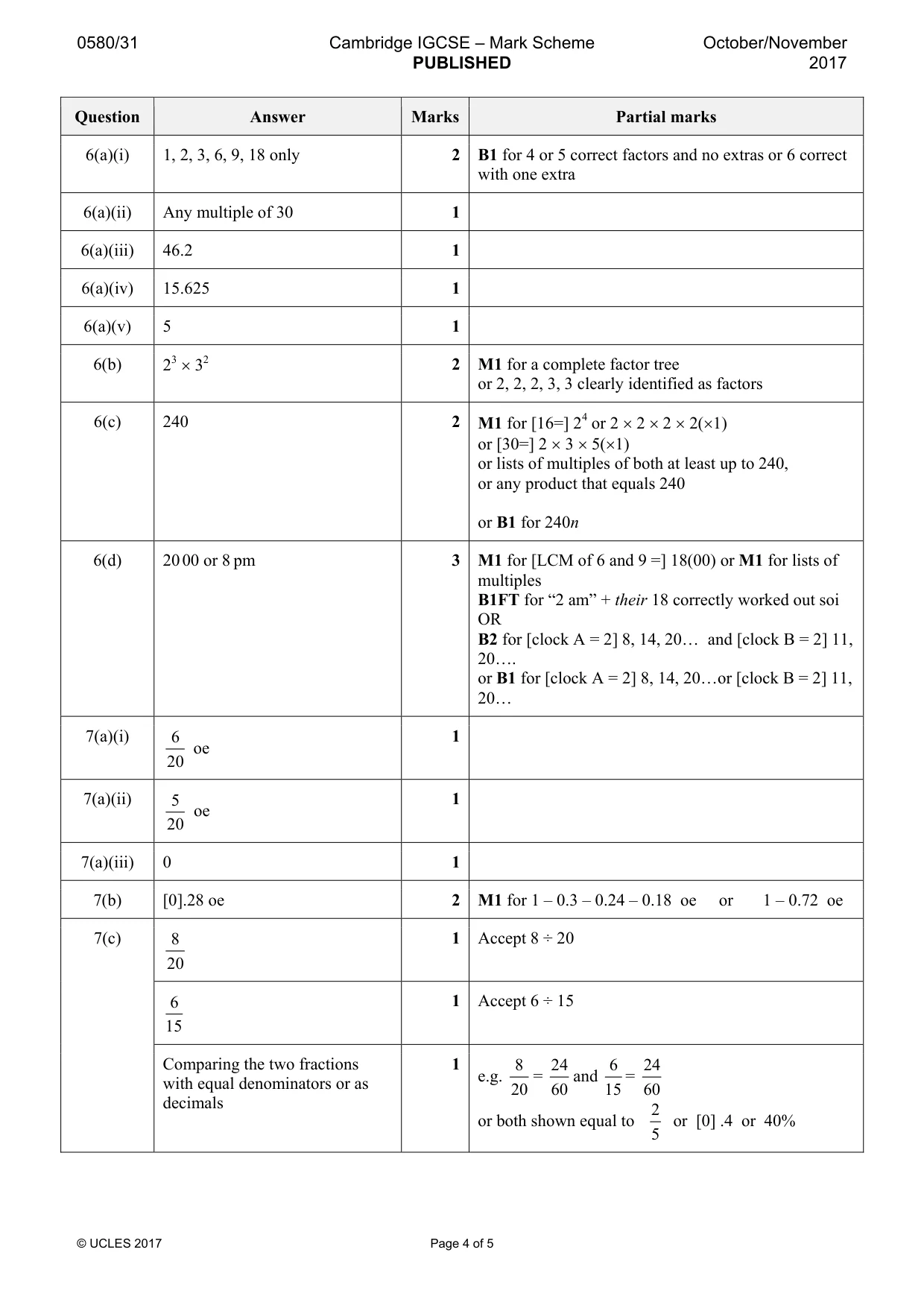
Mark scheme: 6(a)(i) 1, 2, 3, 6, 9, 18 only 2 B1 for 4 or 5 correct factors and no extras or 6 correct with one extra 6(a)(ii) Any multiple of 30 1 6(a)(iii) 46.2 1 6(a)(iv) 15.625 1 6(a)(v) 5 1 6(b) 23 × 32 2 M1 for a complete factor tree or 2, 2, 2, 3, 3 clearly identified as factors 6(c) 240 2 M1 for [16=] 24 or 2 × 2 × 2 × 2(×1) or [30=] 2 × 3 × 5(×1) or lists of multiples of both at least up to 240, or any product that equals 240 or B1 for 240n 6(d) 20 00 or 8 pm 3 M1 for [LCM of 6 and 9 =] 18(00) or M1 for lists of multiples B1FT for “2 am” + their 18 correctly worked out soi OR B2 for [clock A = 2] 8, 14, 20… and [clock B = 2] 11, 20…. or B1 for [clock A = 2] 8, 14, 20…or [clock B = 2] 11, 20…
Q7 · Bag A contains 20 counters
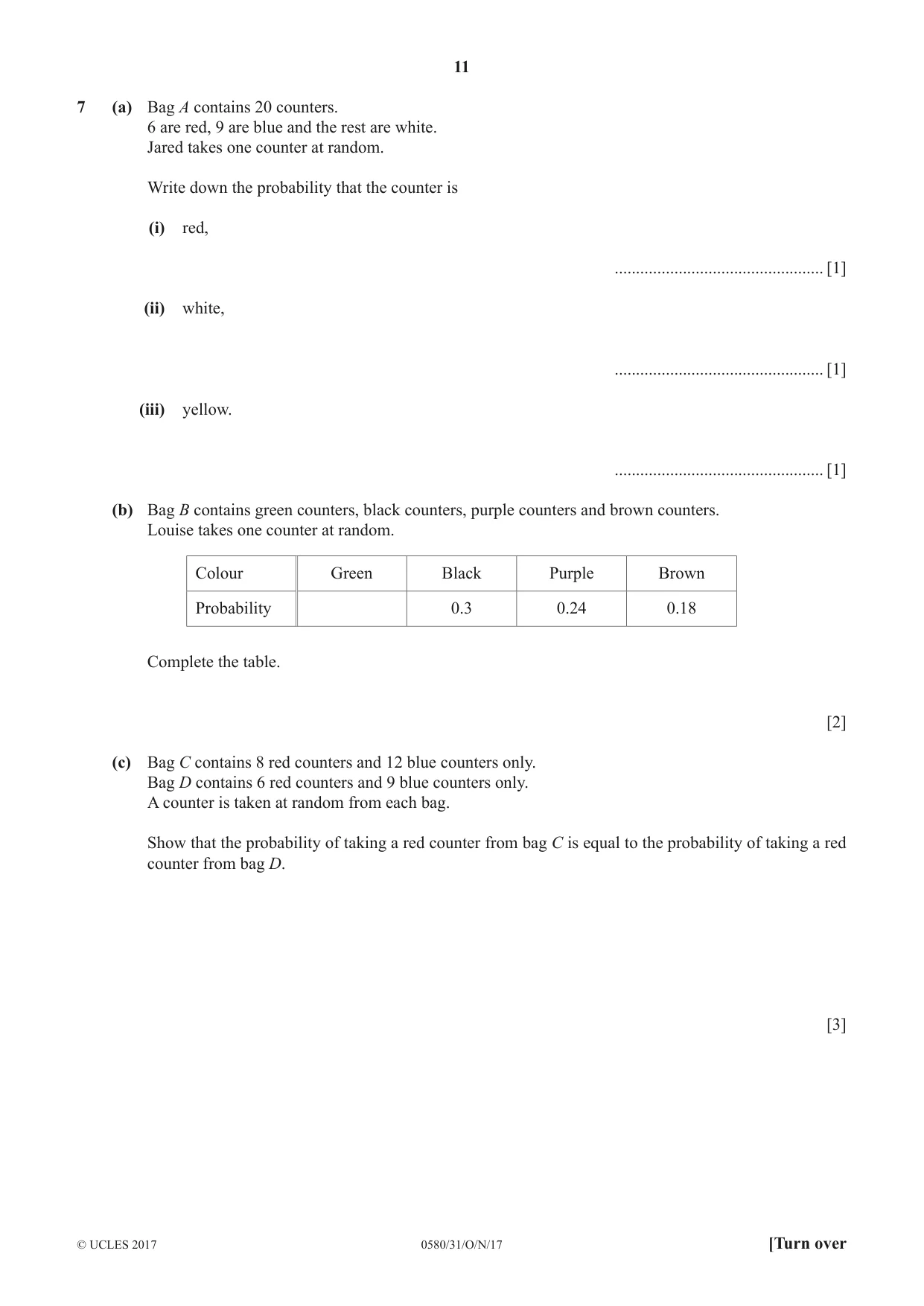
7 (a) Bag A contains 20 counters. 6 are red, 9 are blue and the rest are white. Jared takes one counter at random. Write down the probability that the counter is (i) red, ................................................. [1] (ii) white, ................................................. [1] (iii) yellow. ................................................. [1] (b) Bag B contains green counters, black counters, purple counters and brown counters. Louise takes one counter at random. Colour Green Black Purple Brown Probability 0.3 0.24 0.18 Complete the table. [2] (c) Bag C contains 8 red counters and 12 blue counters only. Bag D contains 6 red counters and 9 blue counters only. A counter is taken at random from each bag. Show that the probability of taking a red counter from bag C is equal to the probability of taking a red counter from bag D. [3]
Mark scheme: 7(a)(i) 6 1 oe 20 7(a)(ii) 5 1 oe 20 7(a)(iii) 0 1 7(b) [0].28 oe 2 M1 for 1 – 0.3 – 0.24 – 0.18 oe or 1 – 0.72 oe 7(c) 8 1 Accept 8 ÷ 20 20 6 1 Accept 6 ÷ 15 15 Comparing the two fractions 1 8 24 6 24 e.g. = and = with equal denominators or as 20 60 15 60 decimals 2 or both shown equal to or [0] .4 or 40% 5
Q8 · Multiply out the brackets and simplify
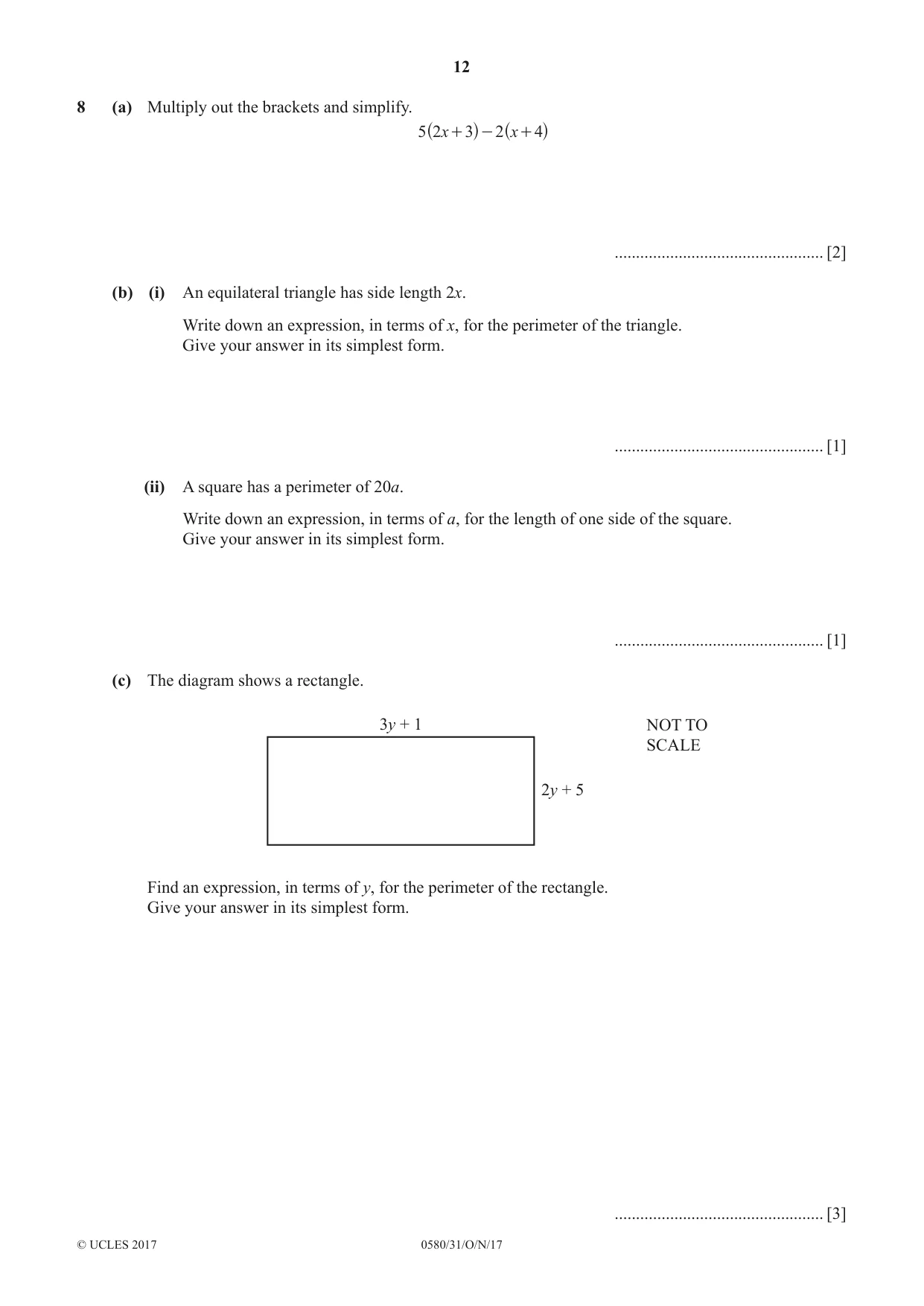
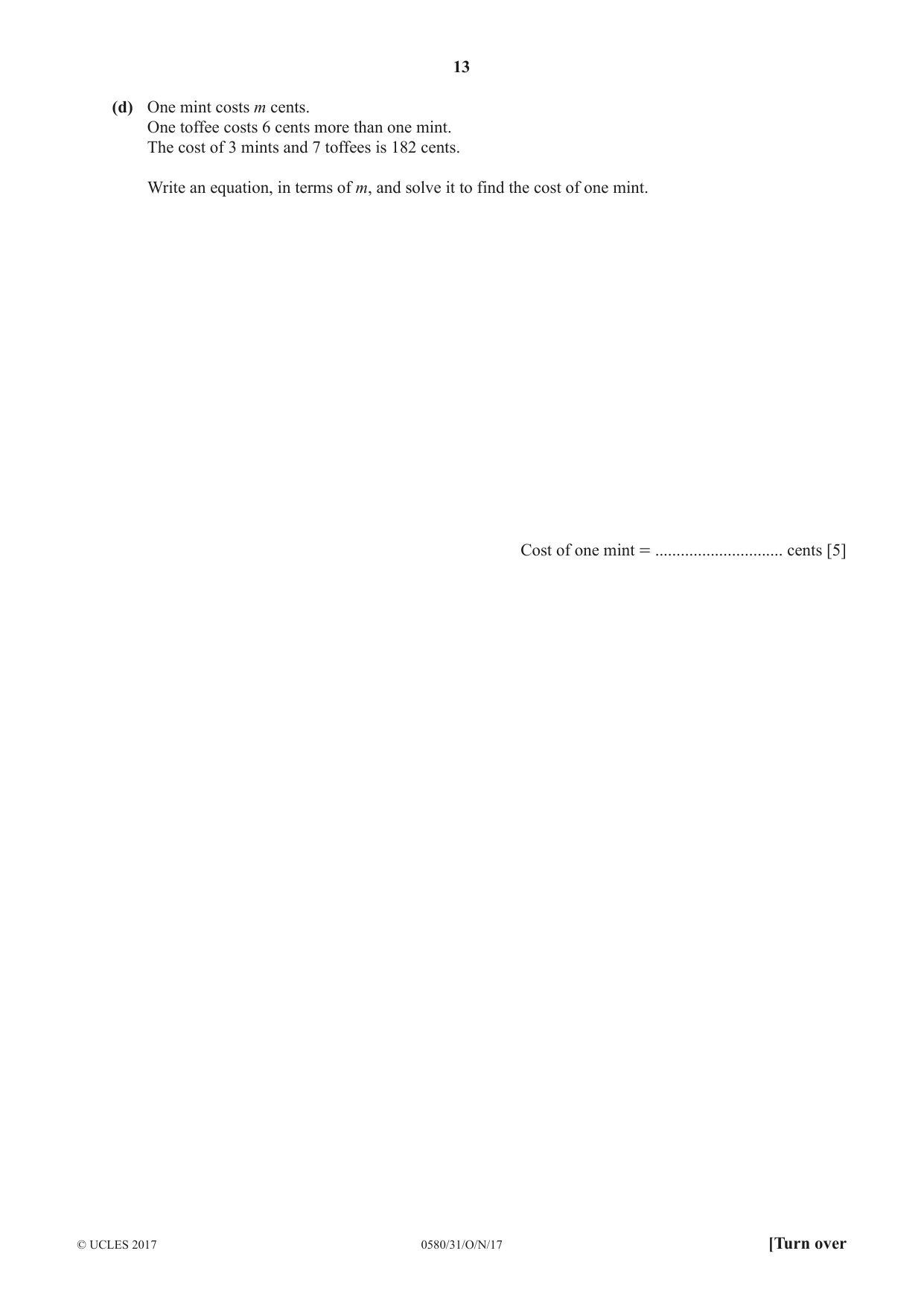
8 (a) Multiply out the brackets and simplify. 5 2x + 3 - 2 x + 4 ^ h ^ h ................................................. [2] (b) (i) An equilateral triangle has side length 2x. Write down an expression, in terms of x, for the perimeter of the triangle. Give your answer in its simplest form. ................................................. [1] (ii) A square has a perimeter of 20a. Write down an expression, in terms of a, for the length of one side of the square. Give your answer in its simplest form. ................................................. [1] (c) The diagram shows a rectangle. 3y + 1 NOT TO SCALE 2y + 5 Find an expression, in terms of y, for the perimeter of the rectangle. Give your answer in its simplest form. ................................................. [3] (d) One mint costs m cents. One toffee costs 6 cents more than one mint. The cost of 3 mints and 7 toffees is 182 cents. Write an equation, in terms of m, and solve it to find the cost of one mint. Cost of one mint = .............................. cents [5]
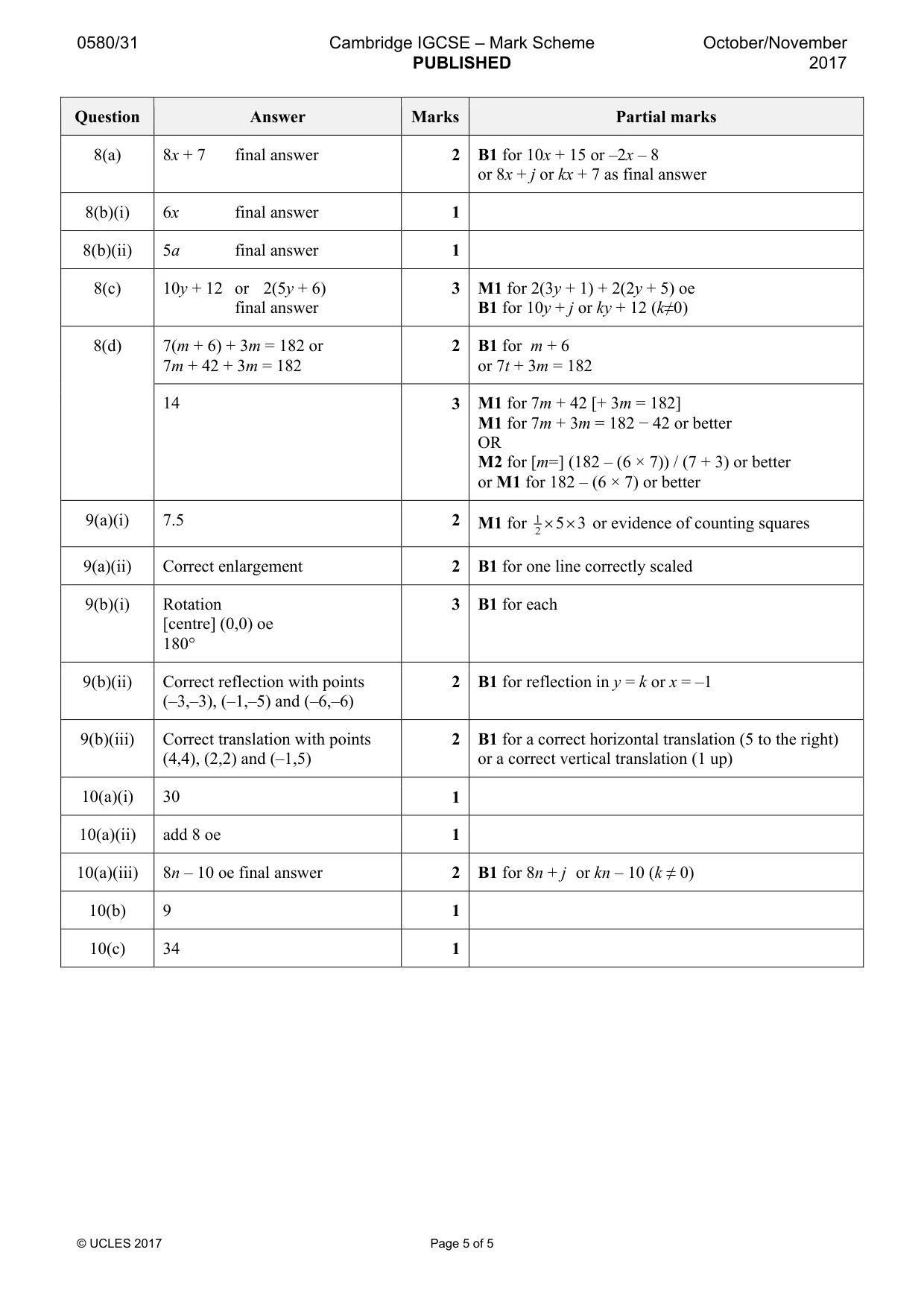
Mark scheme: 8(a) 8x + 7 final answer 2 B1 for 10x + 15 or –2x – 8 or 8x + j or kx + 7 as final answer 8(b)(i) 6x final answer 1 8(b)(ii) 5a final answer 1 8(c) 10y + 12 or 2(5y + 6) 3 M1 for 2(3y + 1) + 2(2y + 5) oe final answer B1 for 10y + j or ky + 12 (k≠0) 8(d) 7(m + 6) + 3m = 182 or 2 B1 for m + 6 7m + 42 + 3m = 182 or 7t + 3m = 182 14 3 M1 for 7m + 42 [+ 3m = 182] M1 for 7m + 3m = 182 − 42 or better OR M2 for [m=] (182 – (6 × 7)) / (7 + 3) or better or M1 for 182 – (6 × 7) or better
Q9 · The diagram shows a triangle, A, on a 1 cm2 grid
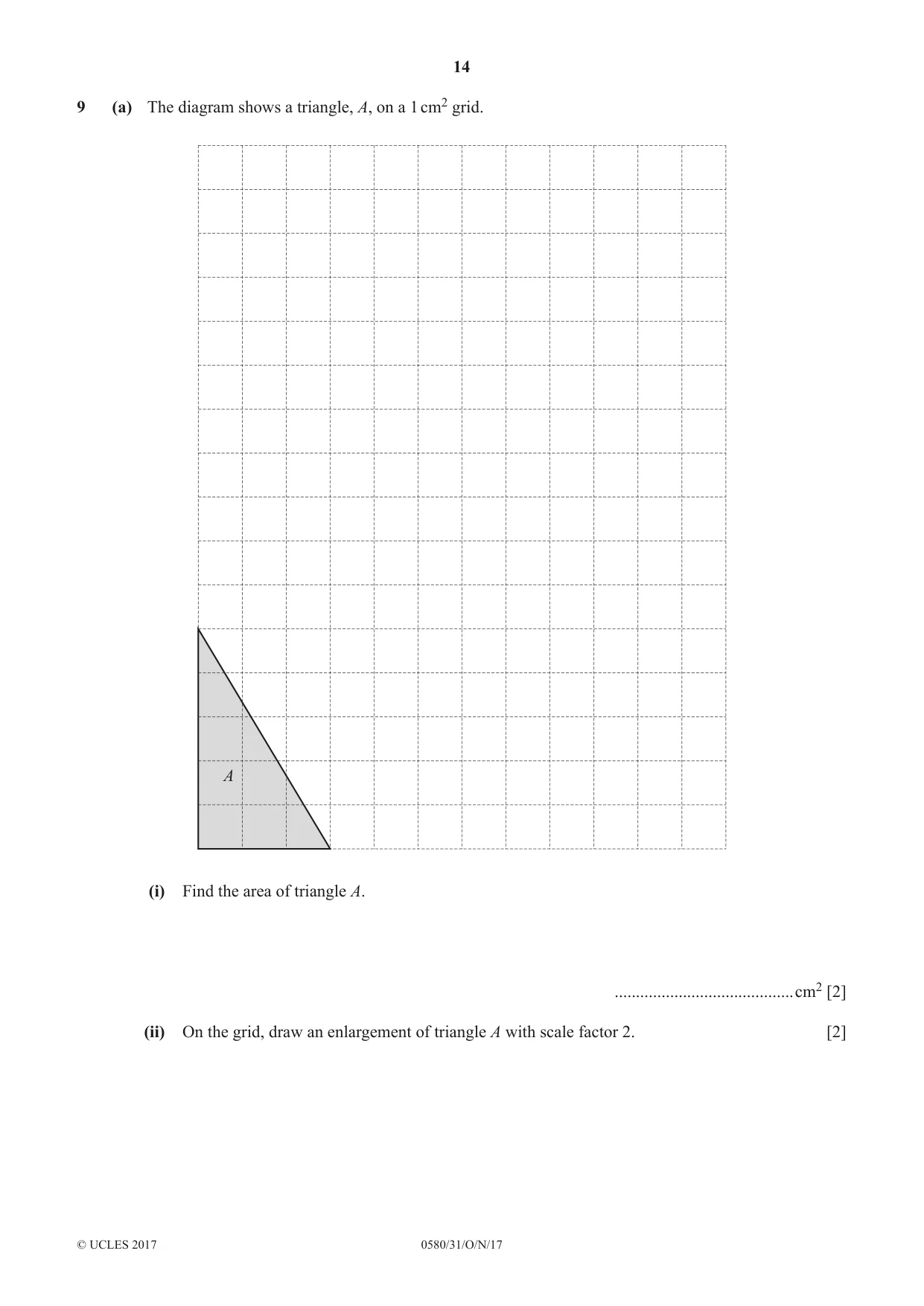
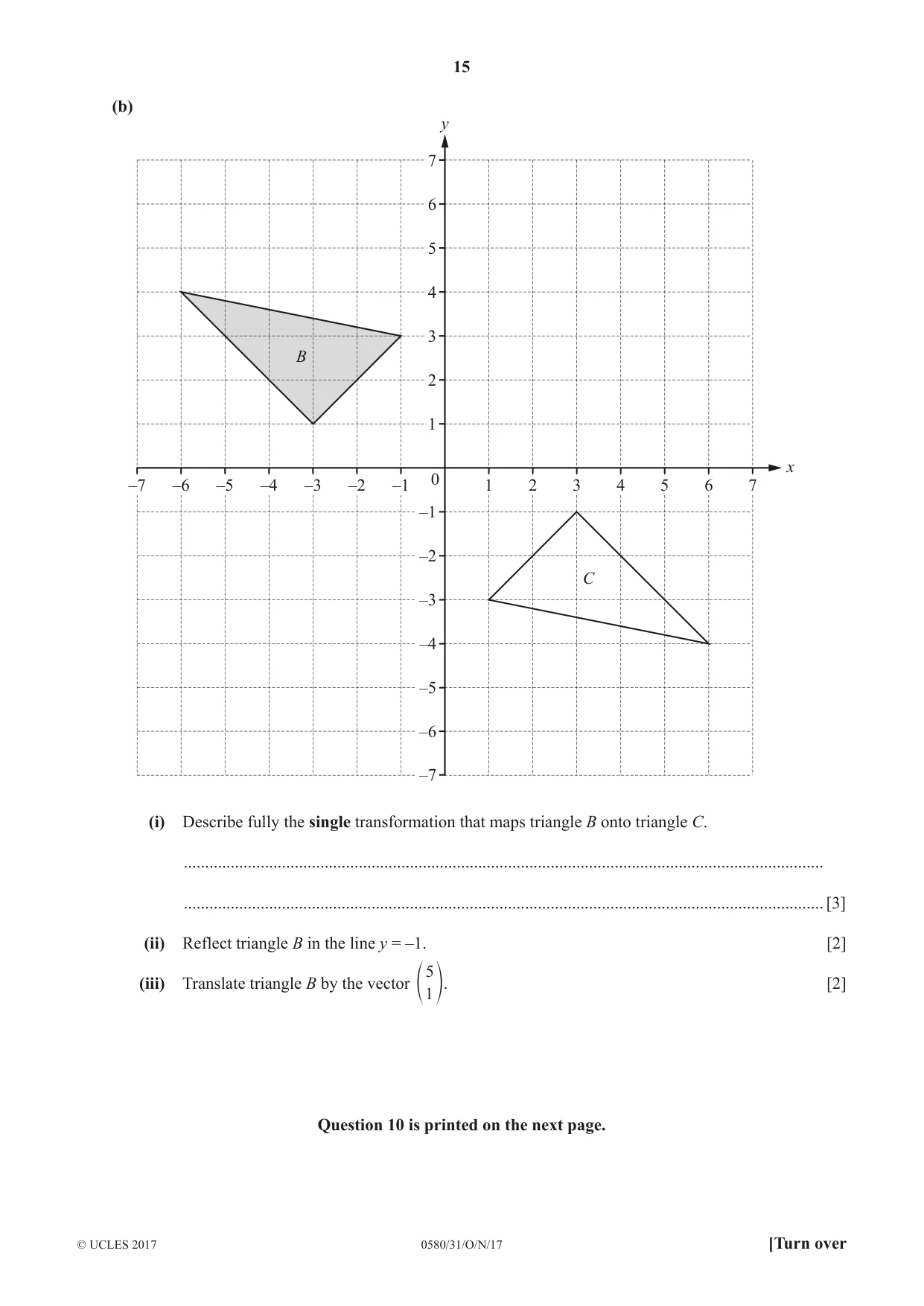
9 (a) The diagram shows a triangle, A, on a 1 cm2 grid. A (i) Find the area of triangle A. ..........................................cm2 [2] (ii) On the grid, draw an enlargement of triangle A with scale factor 2. [2] (b) y 7 6 5 4 3 B 2 1 x 0 –7 –6 –5 –4 –3 –2 –1 1 2 3 4 5 6 7 –1 –2 C –3 –4 –5 –6 –7 (i) Describe fully the single transformation that maps triangle B onto triangle C. ...................................................................................................................................................... ...................................................................................................................................................... [3] (ii) Reflect triangle B in the line y = –1. [2] 5 (iii) Translate triangle B by the vector [2] f 1 p. Question 10 is printed on the next page.
Mark scheme: 9(a)(i) 7.5 2 M1 for 12 × 5 × 3 or evidence of counting squares 9(a)(ii) Correct enlargement 2 B1 for one line correctly scaled 9(b)(i) Rotation 3 B1 for each [centre] (0,0) oe 180° 9(b)(ii) Correct reflection with points 2 B1 for reflection in y = k or x = –1 (–3,–3), (–1,–5) and (–6,–6) 9(b)(iii) Correct translation with points 2 B1 for a correct horizontal translation (5 to the right) (4,4), (2,2) and (–1,5) or a correct vertical translation (1 up)
Q10 · These are the first four terms of a sequence
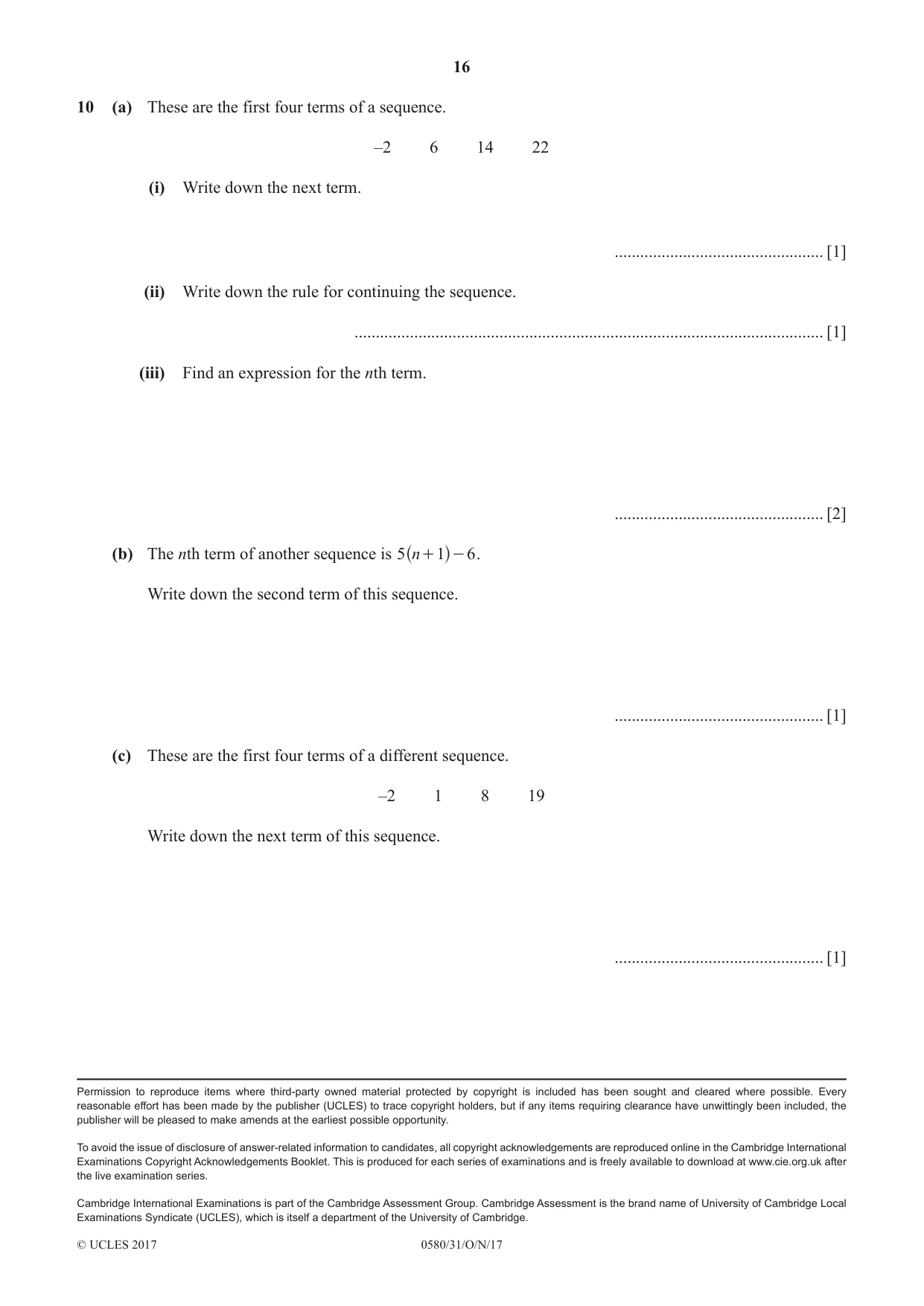
10 (a) These are the first four terms of a sequence. –2 6 14 22 (i) Write down the next term. ................................................. [1] (ii) Write down the rule for continuing the sequence. .............................................................................................................. [1] (iii) Find an expression for the nth term. ................................................. [2] (b) The nth term of another sequence is 5 n + 1 - 6 . ^ h Write down the second term of this sequence. ................................................. [1] (c) These are the first four terms of a different sequence. –2 1 8 19 Write down the next term of this sequence. ................................................. [1]
Mark scheme: 10(a)(i) 30 1 10(a)(ii) add 8 oe 1 10(a)(iii) 8n – 10 oe final answer 2 B1 for 8n + j or kn – 10 (k ≠ 0) 10(b) 9 1 10(c) 34 1
What was in this paper
The subtopics covered by these 10 questions, and how many questions each got. Open one in a new tab to see every Cambridge question on it.
What you needed in this session
Cambridge’s own grade thresholds for 2017 Oct/Nov, Paper 3 · Variant 1. A higher threshold means an easier paper — the bar moves with how the cohort did.