Cambridge IGCSE Mathematics 0580 — 2017 Oct/Nov Paper 3 · Variant 3
0580/33/O/N/17 · 9 questions · 104 marks · ≈117 min
The question paper and its mark scheme, free to read here and free to download. This is Cambridge’s own paper, exactly as it was sat.
Question paper16 pages
Mark scheme5 pages
Answers below. Sit the paper first if you are practising.
Questions as text
Question 1
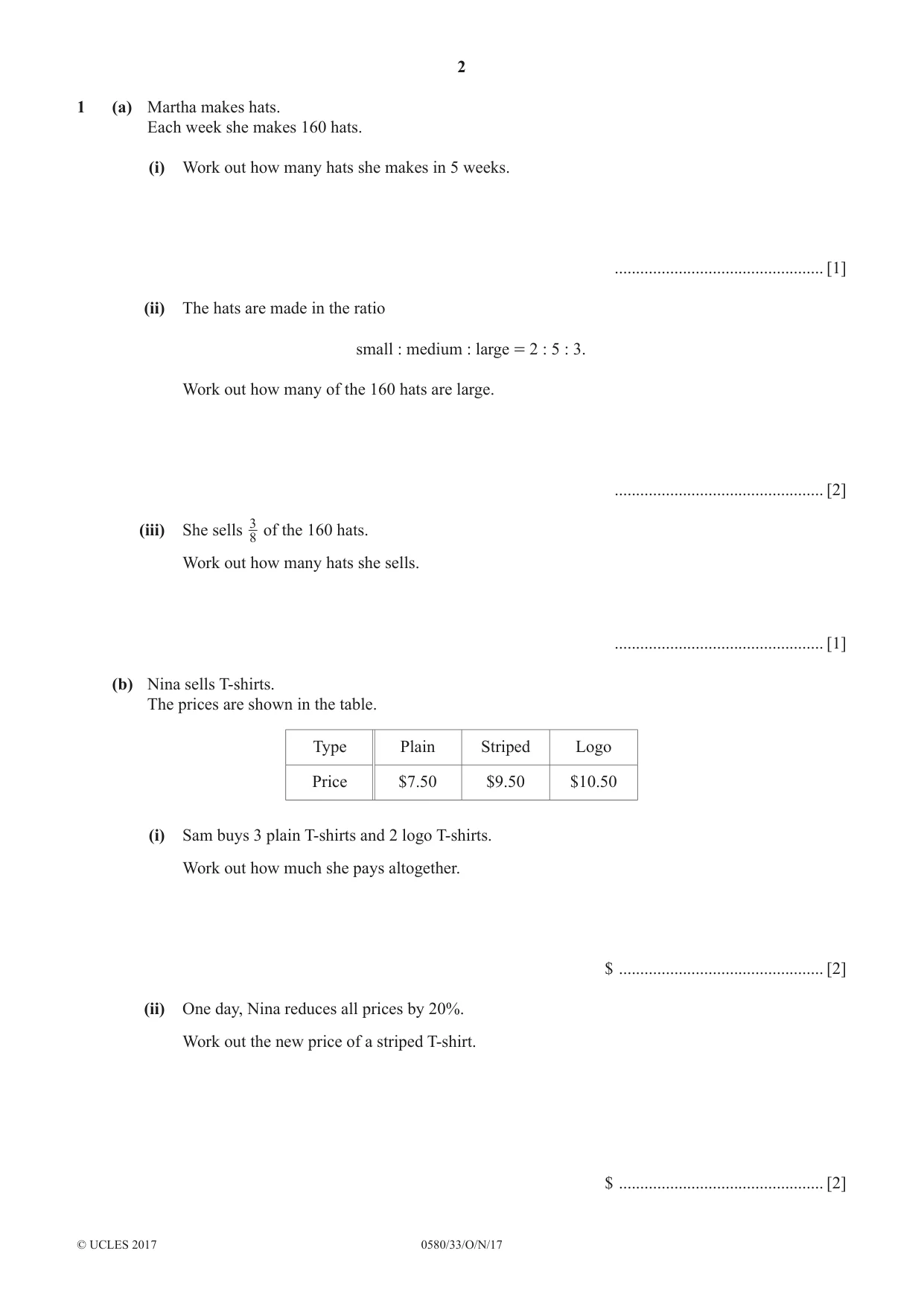
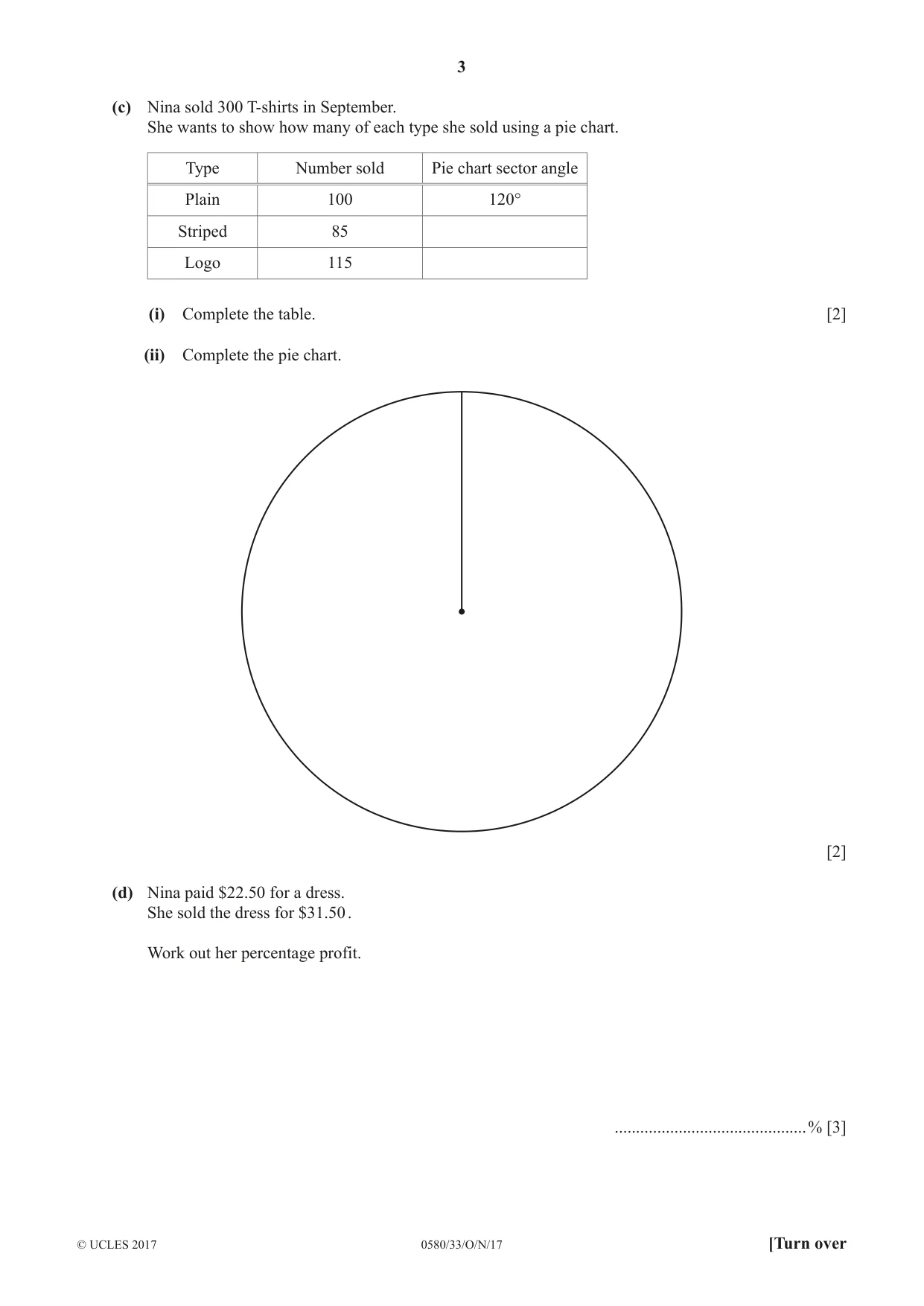
1 (a) Martha makes hats. Each week she makes 160 hats. (i) Work out how many hats she makes in 5 weeks. ................................................. [1] (ii) The hats are made in the ratio small : medium : large = 2 : 5 : 3. Work out how many of the 160 hats are large. ................................................. [2] (iii) She sells 3 of the 160 hats. 8 Work out how many hats she sells. ................................................. [1] (b) Nina sells T-shirts. The prices are shown in the table. Type Plain Striped Logo Price $7.50 $9.50 $10.50 (i) Sam buys 3 plain T-shirts and 2 logo T-shirts. Work out how much she pays altogether. $ ................................................ [2] (ii) One day, Nina reduces all prices by 20%. Work out the new price of a striped T-shirt. $ ................................................ [2] (c) Nina sold 300 T-shirts in September. She wants to show how many of each type she sold using a pie chart. Type Number sold Pie chart sector angle Plain 100 120° Striped 85 Logo 115 (i) Complete the table. [2] (ii) Complete the pie chart. [2] (d) Nina paid $22.50 for a dress. She sold the dress for $31.50 . Work out her percentage profit. .............................................% [3]
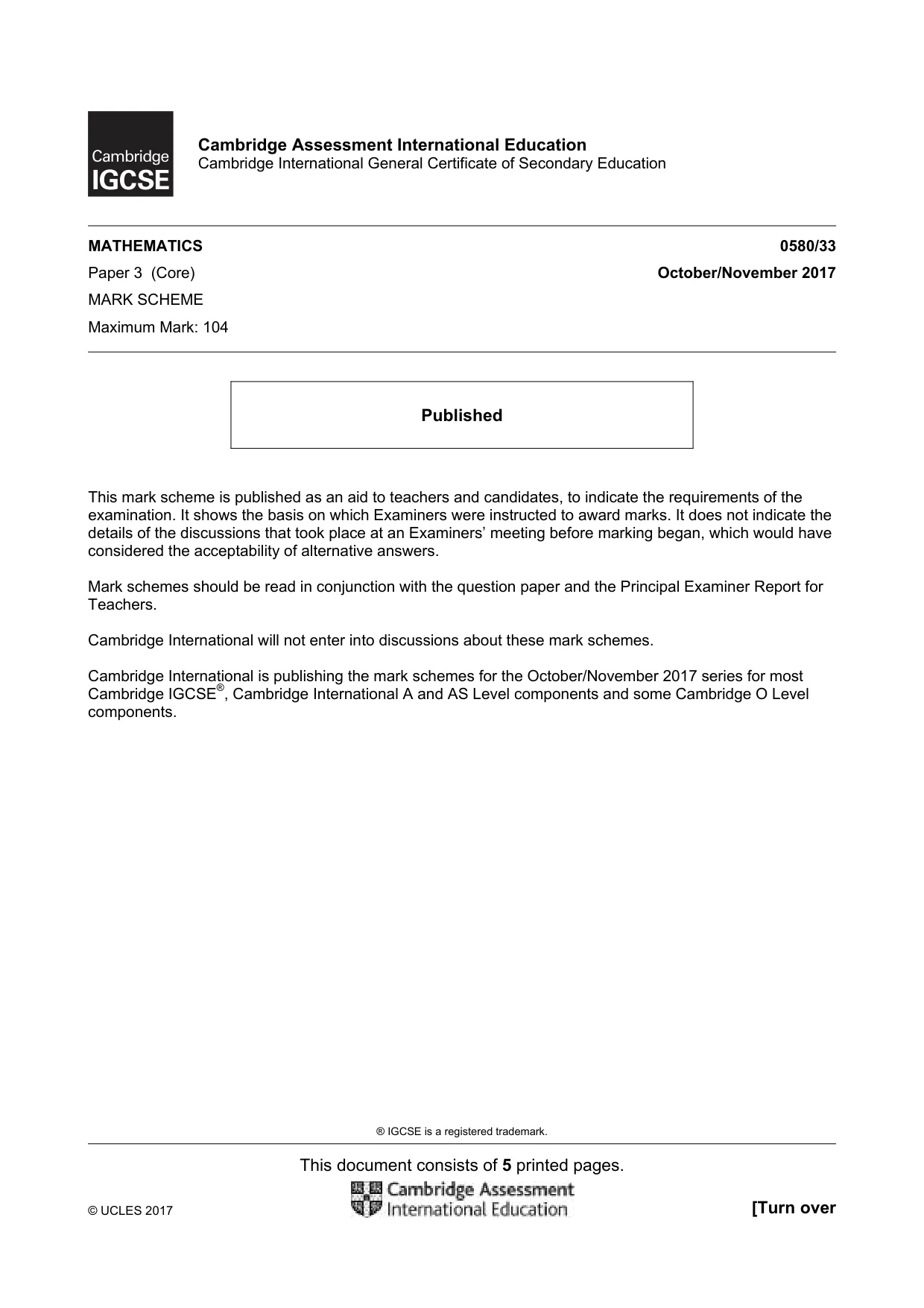
Mark scheme: Question Answer Marks Partial marks 1(a)(i) 800 1 1(a)(ii) 48 2 160 M1 for [ × 3] 2 + 5 + 3 1(a)(iii) 60 1 1(b)(i) 43.5[0] 2 M1 for 3 × 7.5[0] + 2 × 10.5[0] 1(b)(ii) 7.6[0] 2 20 M1 for 9.5 1 − oe 100 1(c)(i) 102 2 85 115 M1 for × 360 or × 360 or 138 300 300 120 120 × 85 or × 115 oe 100 100 1(c)(ii) 3 correct sectors 2FT FT if their angles add to 240° B1FT for one correct sector 1(d) 40 3 31.50 − 22.50 M2 for × 100 or 22.50 31.50 − 1 × 100 oe 22.50 31.50 − 22.50 or M1 for or 22.50 31.50 31.50 − 1 or × 100 oe 22.50 22.50
Q2 · Fill in the missing number in each calculation
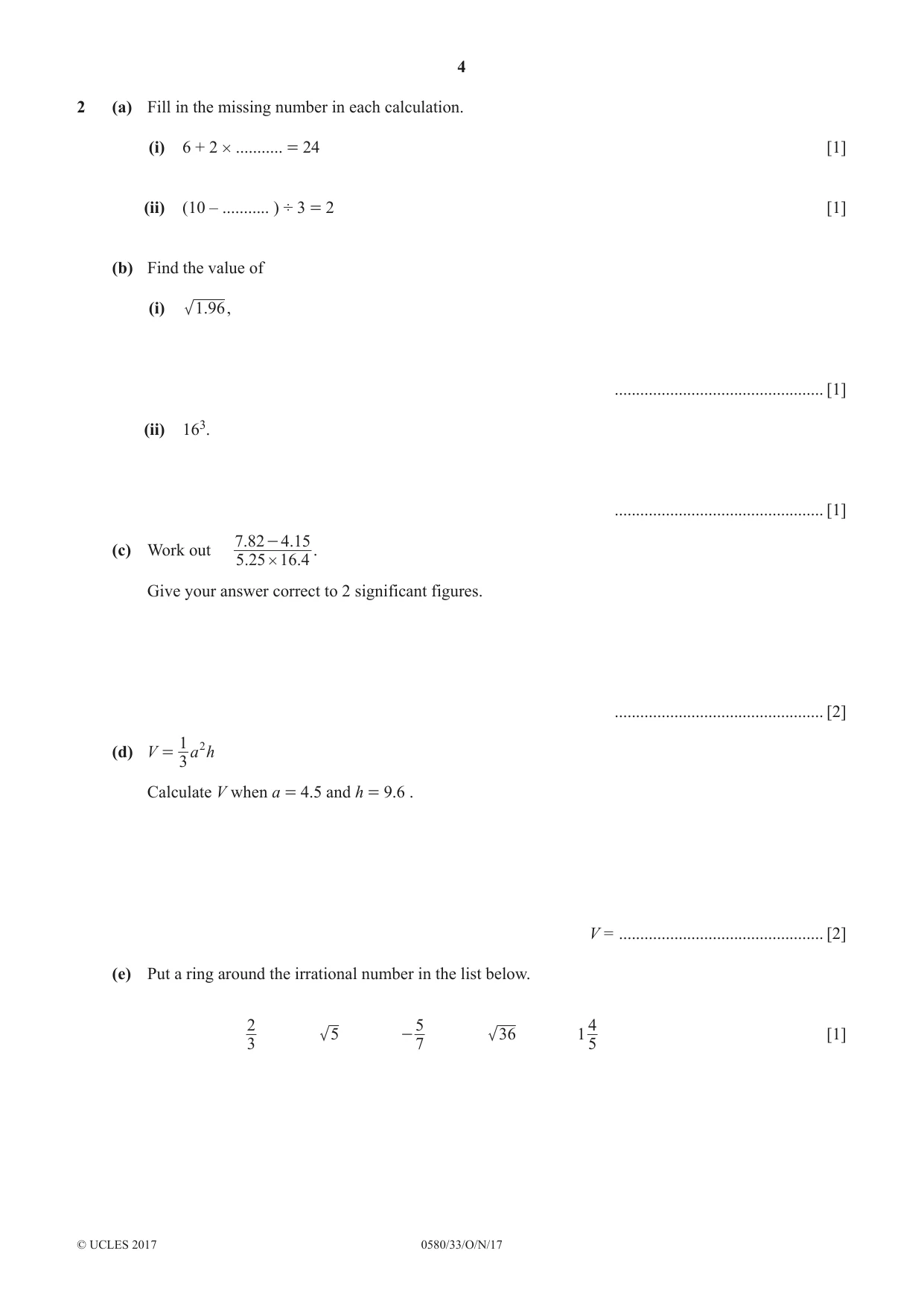
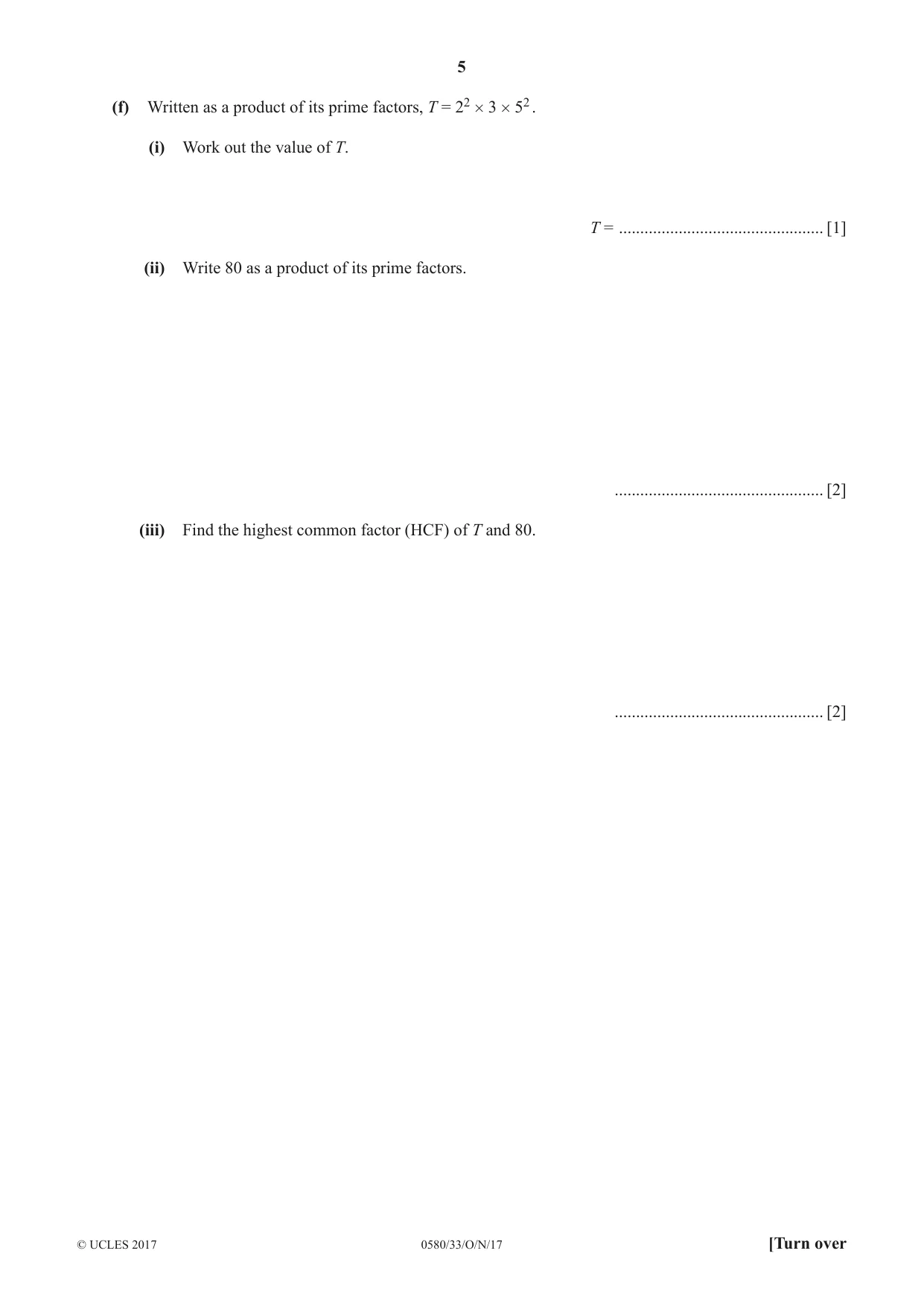
2 (a) Fill in the missing number in each calculation. (i) 6 + 2 # ........... = 24 [1] (ii) (10 – ........... ) ÷ 3 = 2 [1] (b) Find the value of (i) .196, ................................................. [1] (ii) 163. ................................................. [1] 7. 82 - 4. 15 (c) Work out . 5.25 # 16. 4 Give your answer correct to 2 significant figures. ................................................. [2] 1 2 (d) V = a h 3 Calculate V when a = 4.5 and h = 9.6 . V = ................................................ [2] (e) Put a ring around the irrational number in the list below. 2 5 4 5 - 36 1 [1] 3 7 5 (f) Written as a product of its prime factors, T = 22 # 3 # 52 . (i) Work out the value of T. T = ................................................ [1] (ii) Write 80 as a product of its prime factors. ................................................. [2] (iii) Find the highest common factor (HCF) of T and 80. ................................................. [2]
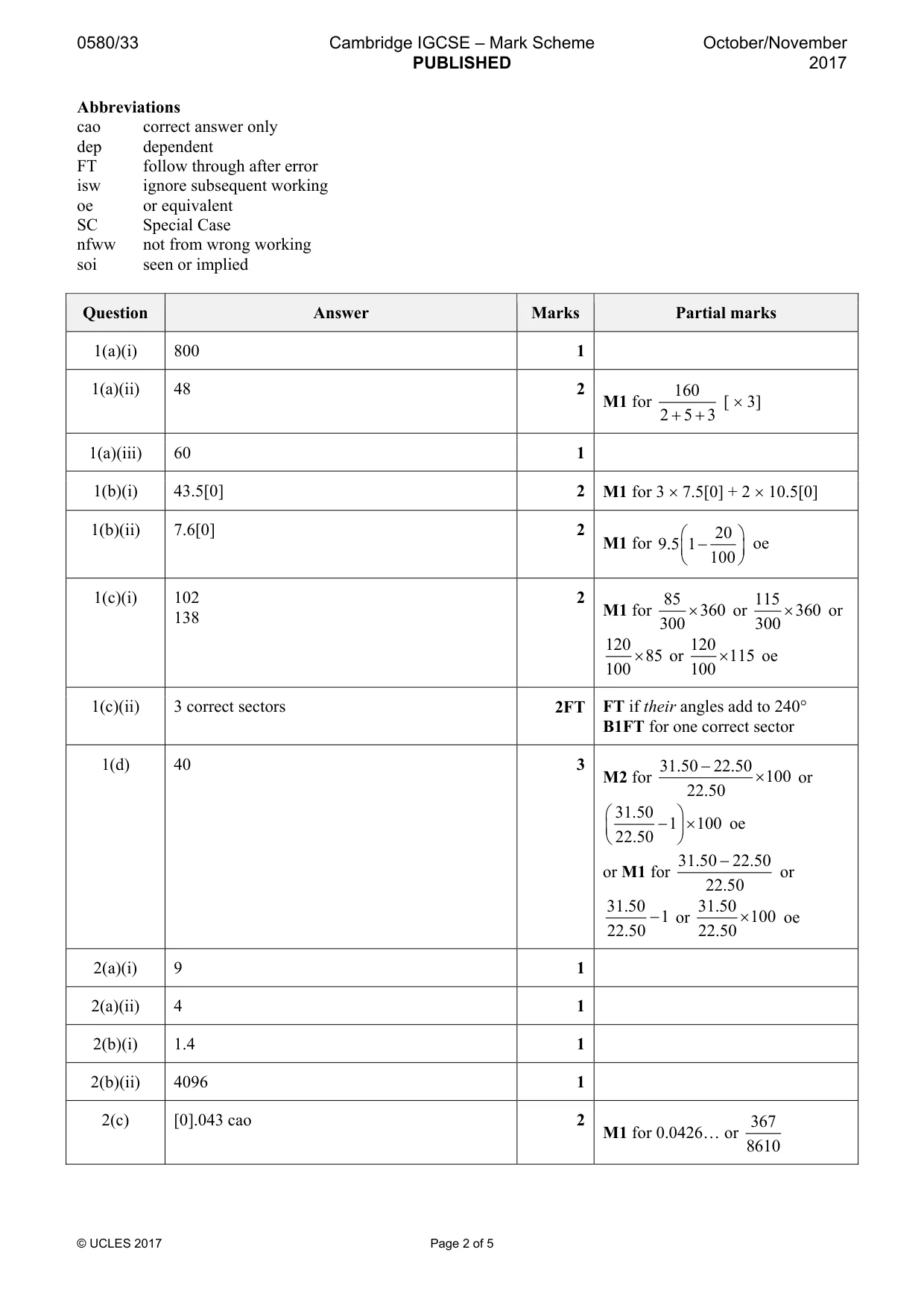
Mark scheme: 2(a)(i) 9 1 2(a)(ii) 4 1 2(b)(i) 1.4 1 2(b)(ii) 4096 1 2(c) [0].043 cao 2 367 M1 for 0.0426… or 8610 2(d) 64.8 2 1 2 324 M1 for × 4.5 × 9.6 or 3 5 2(e) 5 indicated 1 2(f)(i) 300 1 2(f)(ii) 24 × 5 or 2 × 2 × 2 × 2 × 5 2 M1 for 2, 2, 2, 2, 5 or 24,5 or 1 × 2 × 2 × 2 × 2 × 5 or 1 × 24 × 5 2(f)(iii) 20 2 B1 for 2 or 4 or 5 or 10 as answer or 22 × 5 as answer
Q3 · B A NOT TO 48° SCALE O P C Q A, B and C are points on the circumference of the circle…
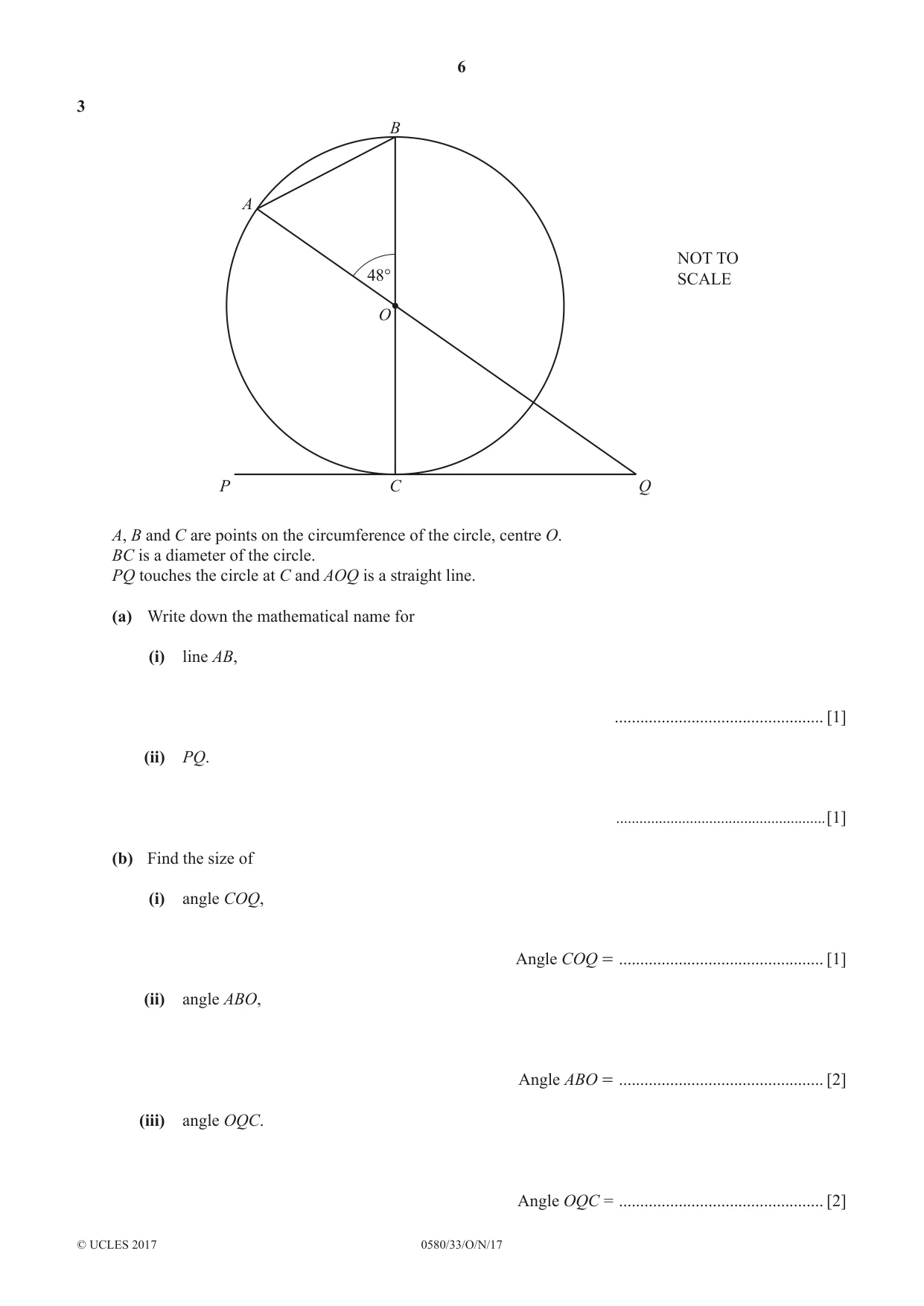
3 B A NOT TO 48° SCALE O P C Q A, B and C are points on the circumference of the circle, centre O. BC is a diameter of the circle. PQ touches the circle at C and AOQ is a straight line. (a) Write down the mathematical name for (i) line AB, ................................................. [1] (ii) PQ. ......................................................[1] (b) Find the size of (i) angle COQ, Angle COQ = ................................................ [1] (ii) angle ABO, Angle ABO = ................................................ [2] (iii) angle OQC. Angle OQC = ................................................ [2]
Mark scheme: 3(a)(i) Chord 1 3(a)(ii) Tangent 1 3(b)(i) 48 1 3(b)(ii) 66 2 M1 for 180 – 48 soi by 132 3(b)(iii) 42 2FT 2FT for 90 – their (b)(i) or B1 for angle OCQ = 90 soi
Q4 · The diagram shows two triangles A and B and point P on a 1 cm2 grid
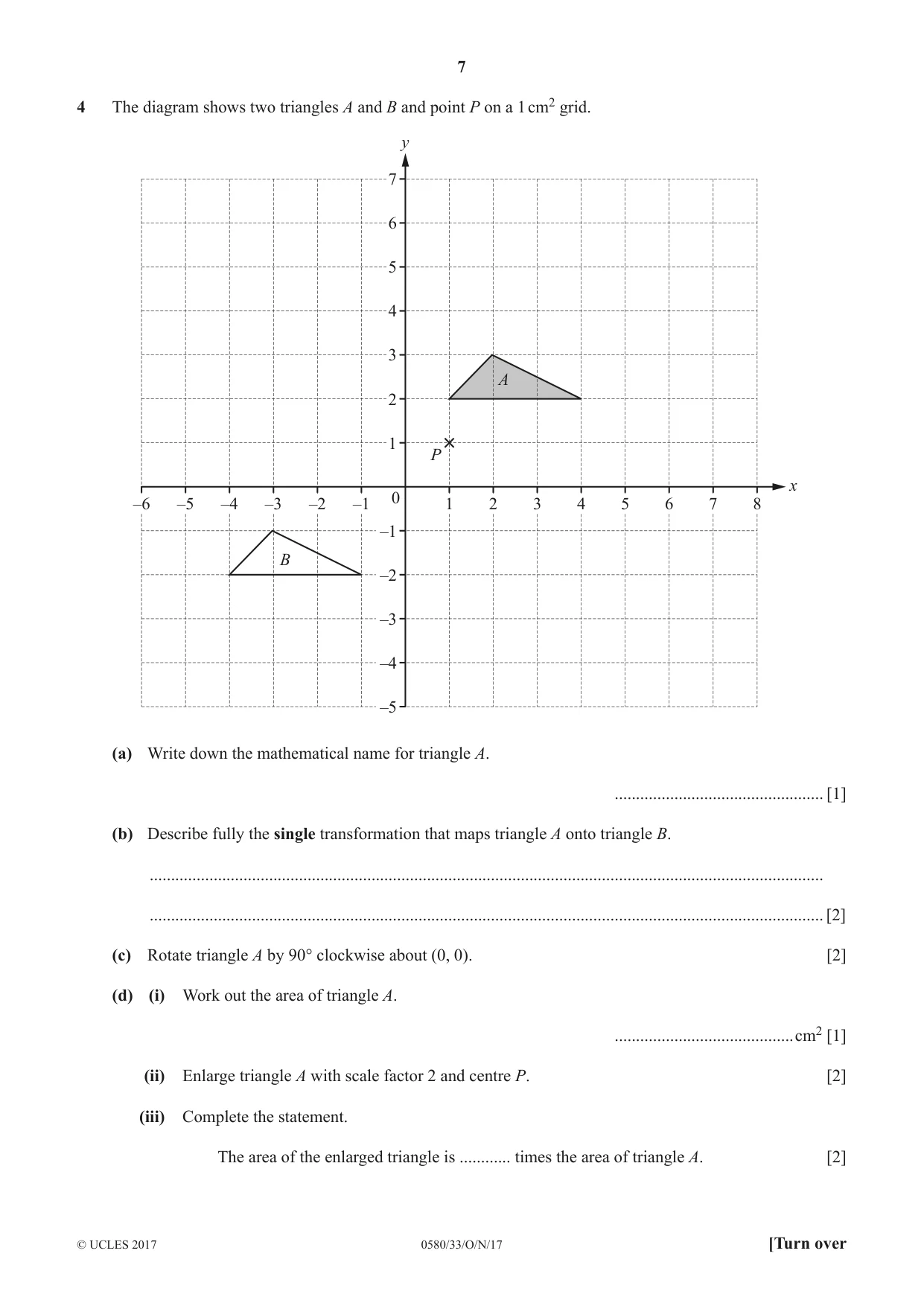
4 The diagram shows two triangles A and B and point P on a 1 cm2 grid. y 7 6 5 4 3 A 2 1 P x 0 –6 –5 –4 –3 –2 –1 1 2 3 4 5 6 7 8 –1 B –2 –3 –4 –5 (a) Write down the mathematical name for triangle A. ................................................. [1] (b) Describe fully the single transformation that maps triangle A onto triangle B. .............................................................................................................................................................. .............................................................................................................................................................. [2] (c) Rotate triangle A by 90° clockwise about (0, 0). [2] (d) (i) Work out the area of triangle A. ..........................................cm2 [1] (ii) Enlarge triangle A with scale factor 2 and centre P. [2] (iii) Complete the statement. The area of the enlarged triangle is ............ times the area of triangle A. [2]
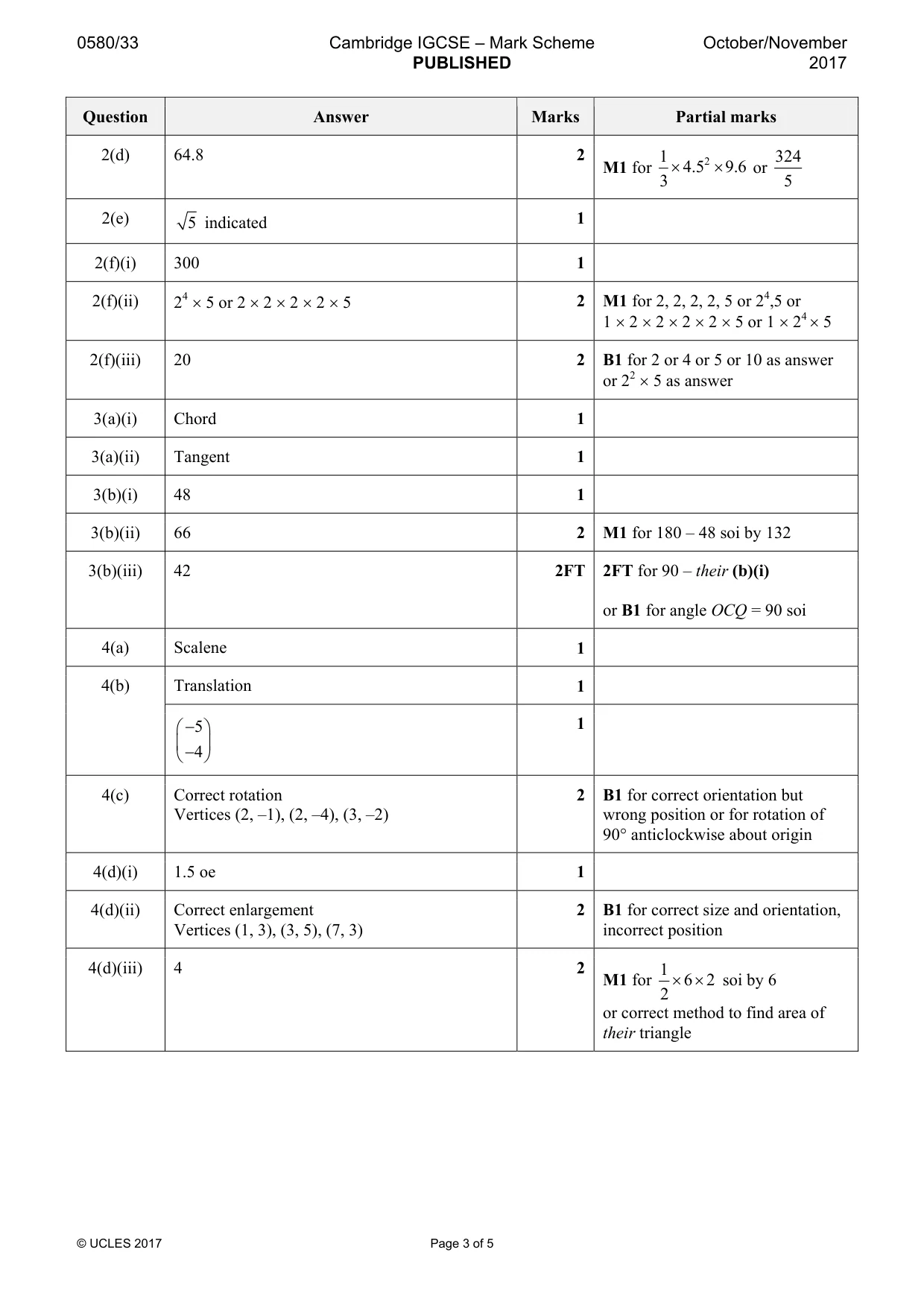
Mark scheme: 4(a) Scalene 1 4(b) Translation 1 −5 1 −4 4(c) Correct rotation 2 B1 for correct orientation but Vertices (2, –1), (2, –4), (3, –2) wrong position or for rotation of 90° anticlockwise about origin 4(d)(i) 1.5 oe 1 4(d)(ii) Correct enlargement 2 B1 for correct size and orientation, Vertices (1, 3), (3, 5), (7, 3) incorrect position 4(d)(iii) 4 2 1 M1 for × 6 × 2 soi by 6 2 or correct method to find area of their triangle
Q5 · A small box contains n biscuits
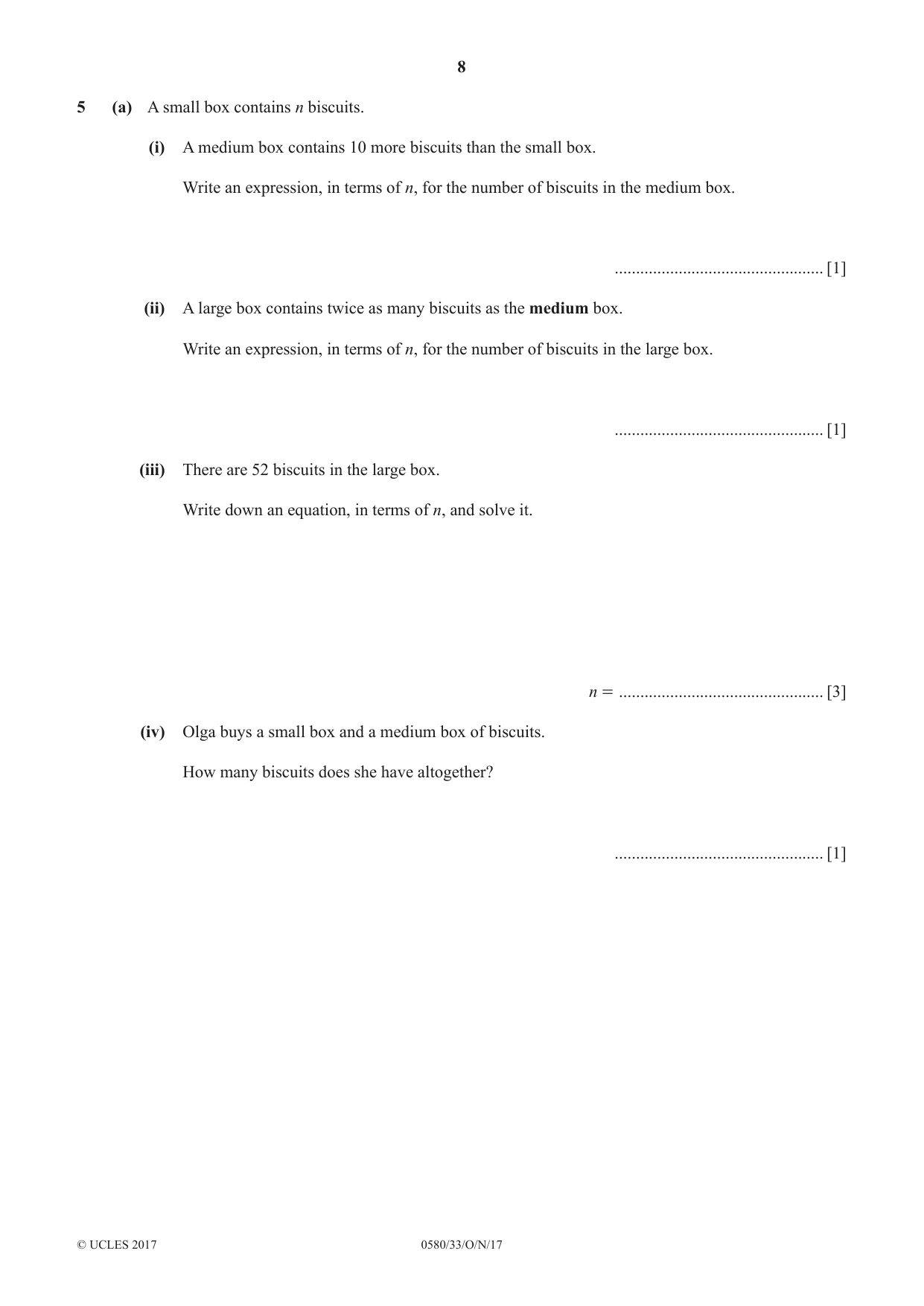
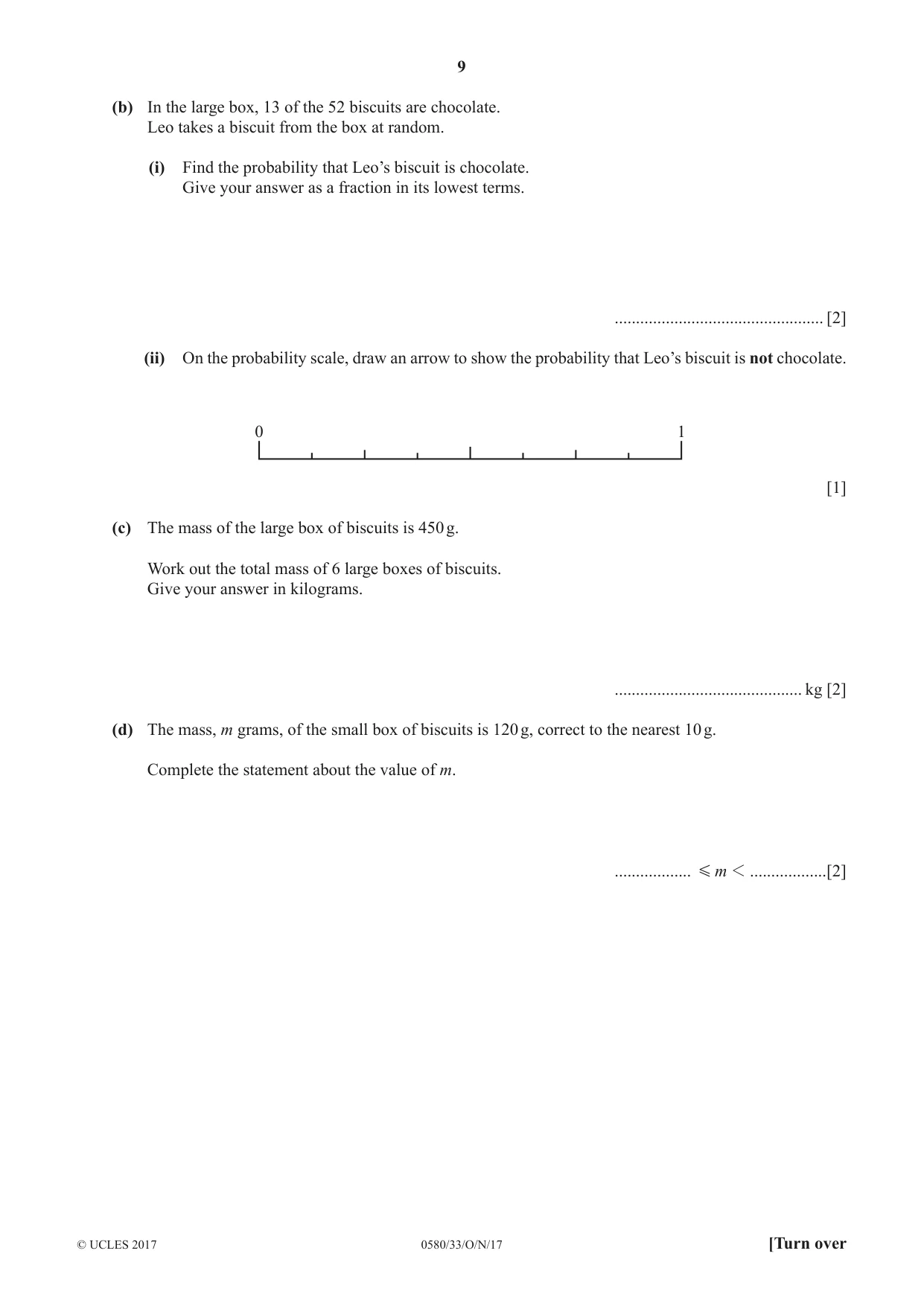
5 (a) A small box contains n biscuits. (i) A medium box contains 10 more biscuits than the small box. Write an expression, in terms of n, for the number of biscuits in the medium box. ................................................. [1] (ii) A large box contains twice as many biscuits as the medium box. Write an expression, in terms of n, for the number of biscuits in the large box. ................................................. [1] (iii) There are 52 biscuits in the large box. Write down an equation, in terms of n, and solve it. n = ................................................ [3] (iv) Olga buys a small box and a medium box of biscuits. How many biscuits does she have altogether? ................................................. [1] (b) In the large box, 13 of the 52 biscuits are chocolate. Leo takes a biscuit from the box at random. (i) Find the probability that Leo’s biscuit is chocolate. Give your answer as a fraction in its lowest terms. ................................................. [2] (ii) On the probability scale, draw an arrow to show the probability that Leo’s biscuit is not chocolate. 0 1 [1] (c) The mass of the large box of biscuits is 450 g. Work out the total mass of 6 large boxes of biscuits. Give your answer in kilograms. ............................................ kg [2] (d) The mass, m grams, of the small box of biscuits is 120 g, correct to the nearest 10 g. Complete the statement about the value of m. .................. G m 1 ..................[2]
Mark scheme: 5(a)(i) n + 10 1 5(a)(ii) 2(n + 10) oe isw 1FT 5(a)(iii) their (ii) = 52 M1 16 final answer B2 M1 for 2n = 52 – 20 or n = 26 – 10 or better 5(a)(iv) 42 1FT FT 2 × their (iii) + 10 5(b)(i) 1 2 13 cao B1 for oe soi 4 52 5(b)(ii) 3 1 Correct arrow at 4 5(c) 2.7[00] 2 B1 for answer figs 27 or for 0.45 seen 5(d) 115 2 B1 for one correct or both values 125 correct but reversed
Q6 · Luca records the total distance, in kilometres, he walks each day for 10 days
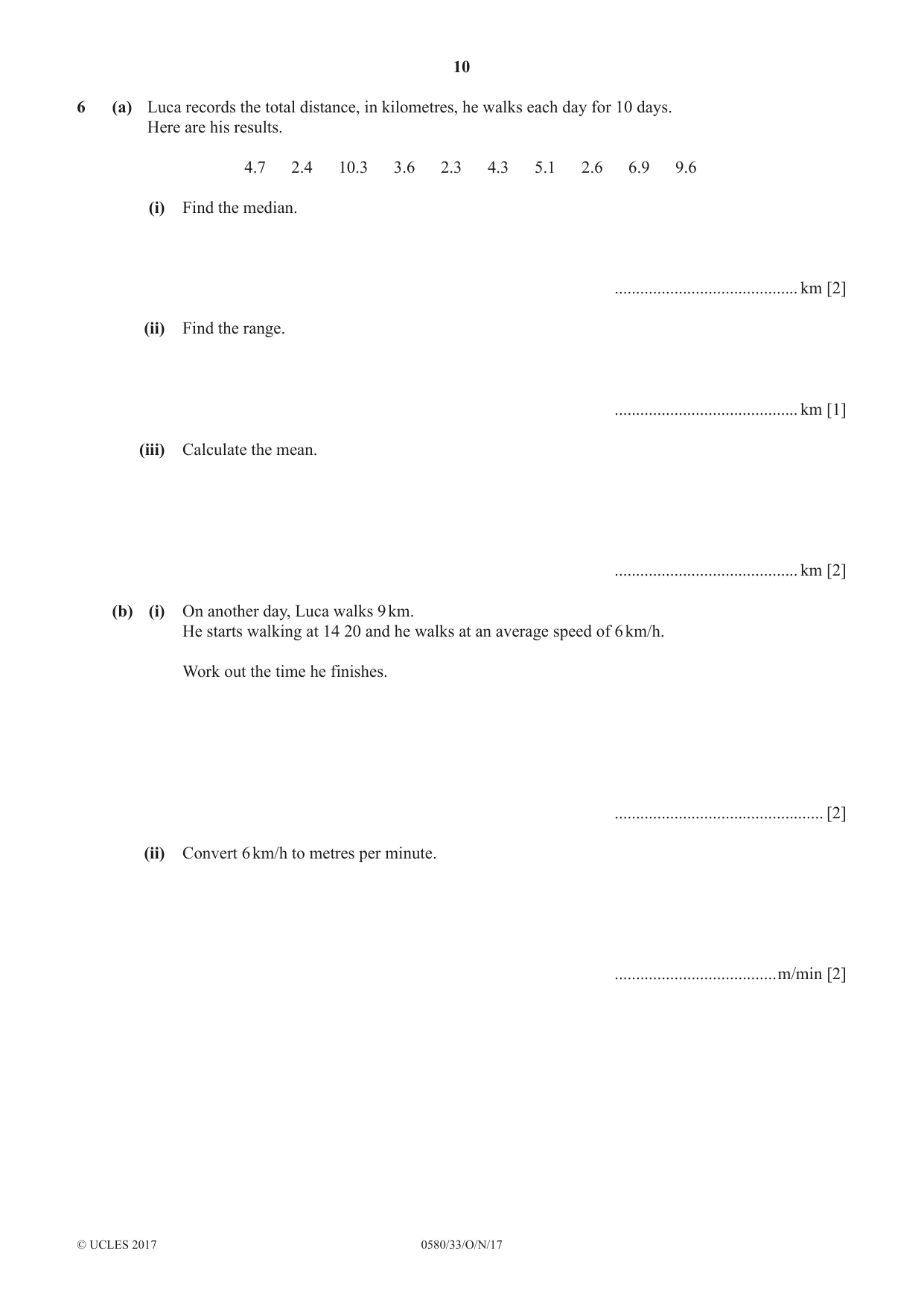
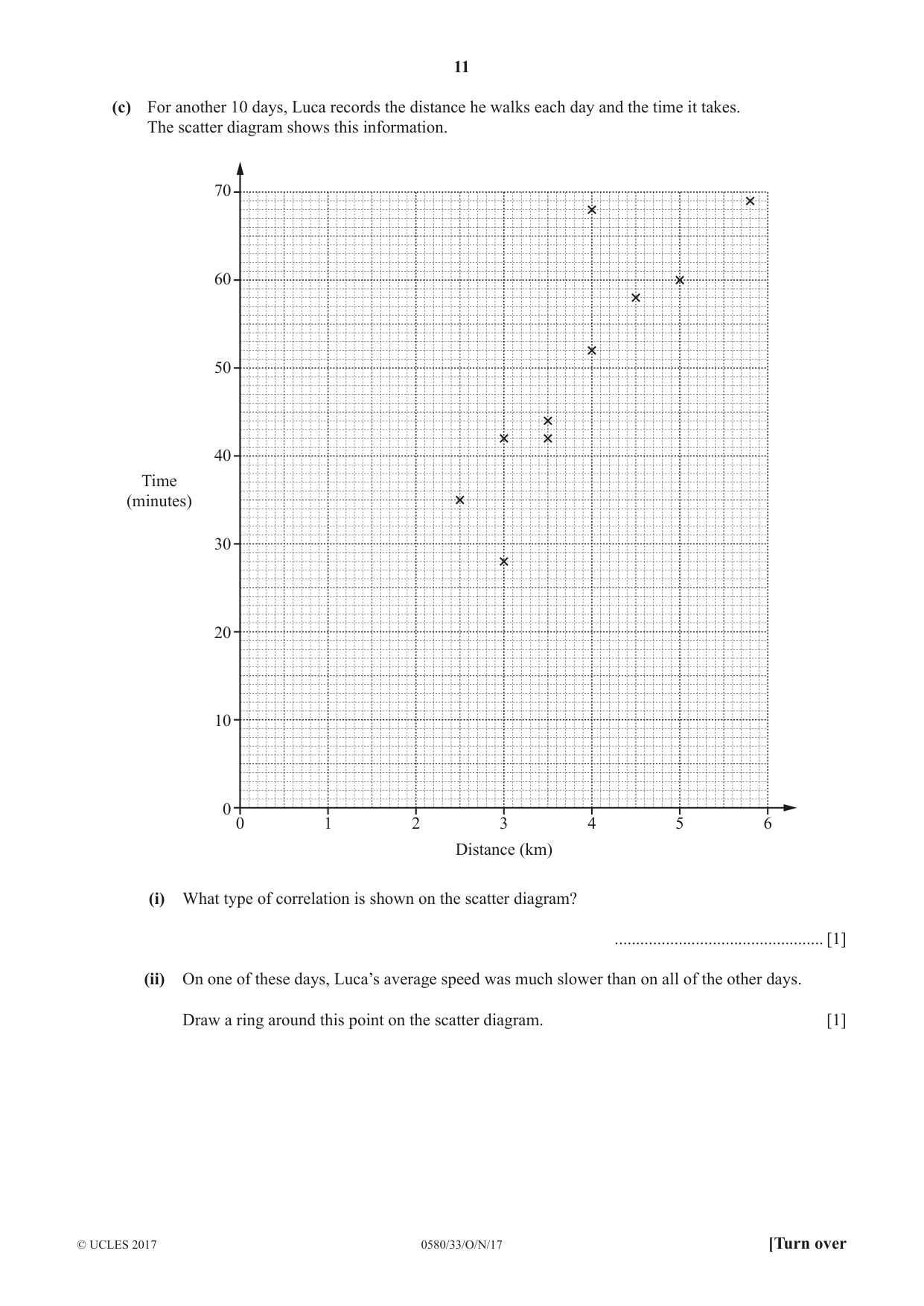
6 (a) Luca records the total distance, in kilometres, he walks each day for 10 days. Here are his results. 4.7 2.4 10.3 3.6 2.3 4.3 5.1 2.6 6.9 9.6 (i) Find the median. ........................................... km [2] (ii) Find the range. ........................................... km [1] (iii) Calculate the mean. ........................................... km [2] (b) (i) On another day, Luca walks 9 km. He starts walking at 14 20 and he walks at an average speed of 6 km/h. Work out the time he finishes. ................................................. [2] (ii) Convert 6 km/h to metres per minute. ......................................m/min [2] (c) For another 10 days, Luca records the distance he walks each day and the time it takes. The scatter diagram shows this information. 70 60 50 40 Time (minutes) 30 20 10 0 0 1 2 3 4 5 6 Distance (km) (i) What type of correlation is shown on the scatter diagram? ................................................. [1] (ii) On one of these days, Luca’s average speed was much slower than on all of the other days. Draw a ring around this point on the scatter diagram. [1]
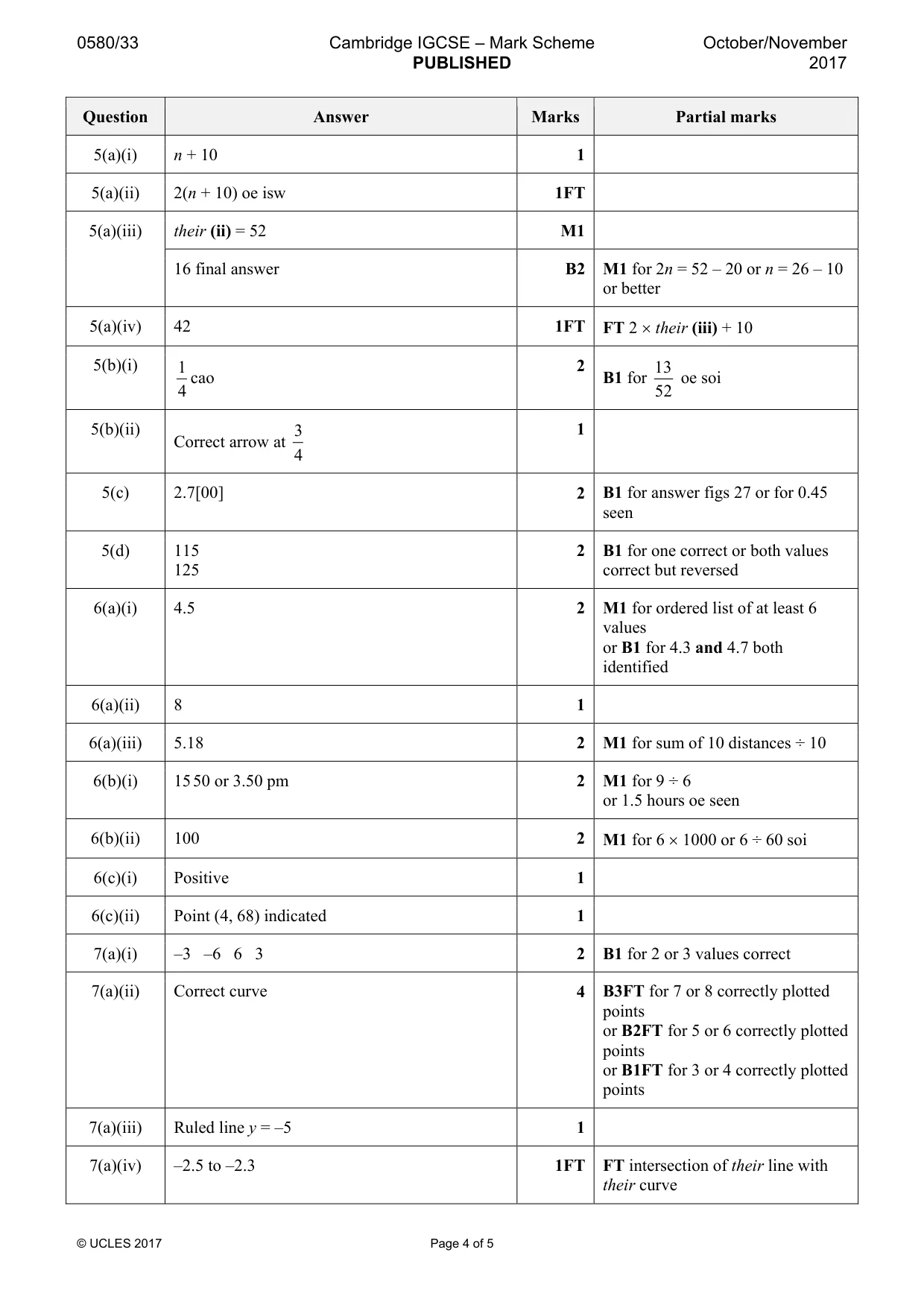
Mark scheme: 6(a)(i) 4.5 2 M1 for ordered list of at least 6 values or B1 for 4.3 and 4.7 both identified 6(a)(ii) 8 1 6(a)(iii) 5.18 2 M1 for sum of 10 distances ÷ 10 6(b)(i) 15 50 or 3.50 pm 2 M1 for 9 ÷ 6 or 1.5 hours oe seen 6(b)(ii) 100 2 M1 for 6 × 1000 or 6 ÷ 60 soi 6(c)(i) Positive 1 6(c)(ii) Point (4, 68) indicated 1
Q7 · 7 (a) (i) Complete the table of values for y =
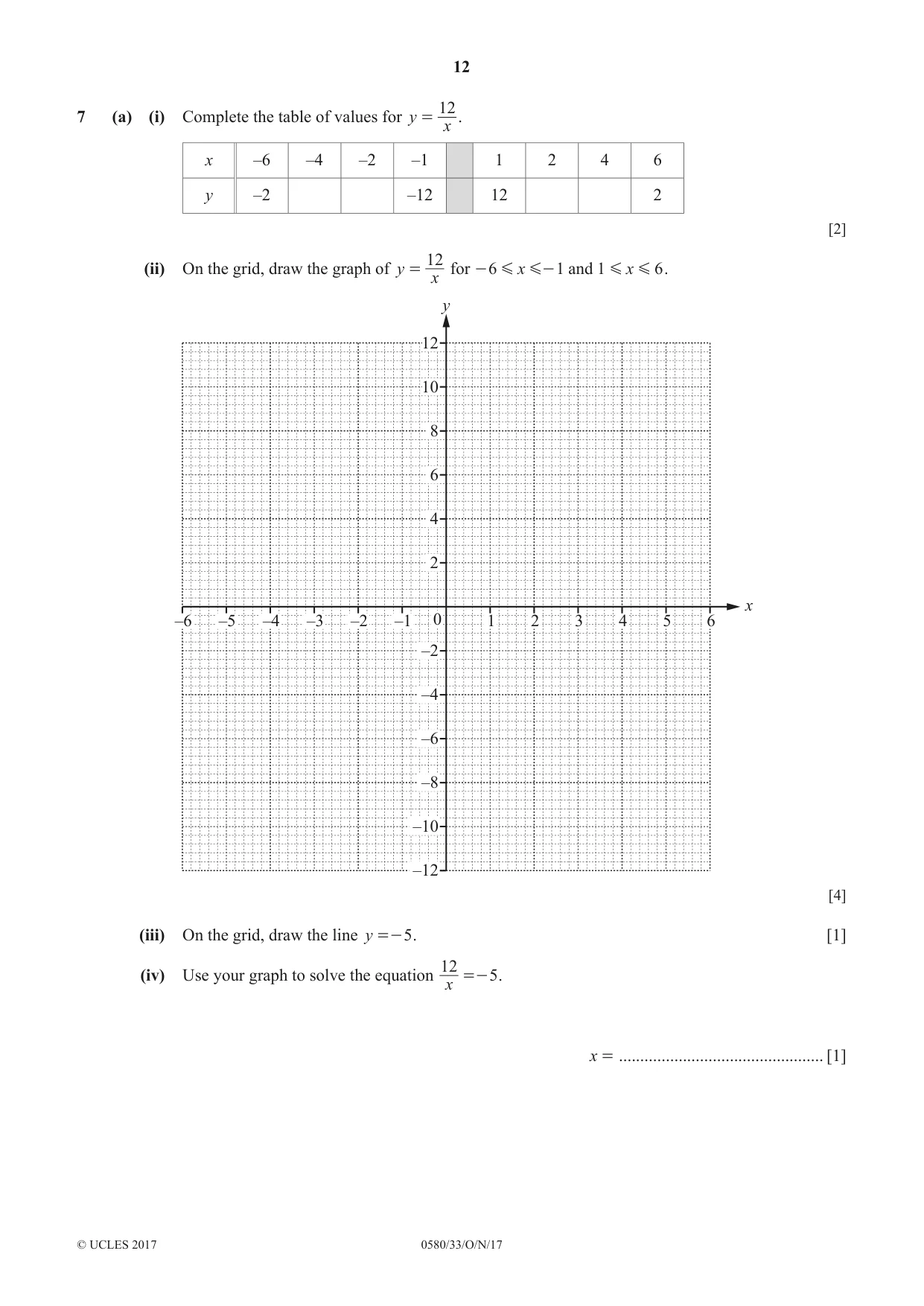
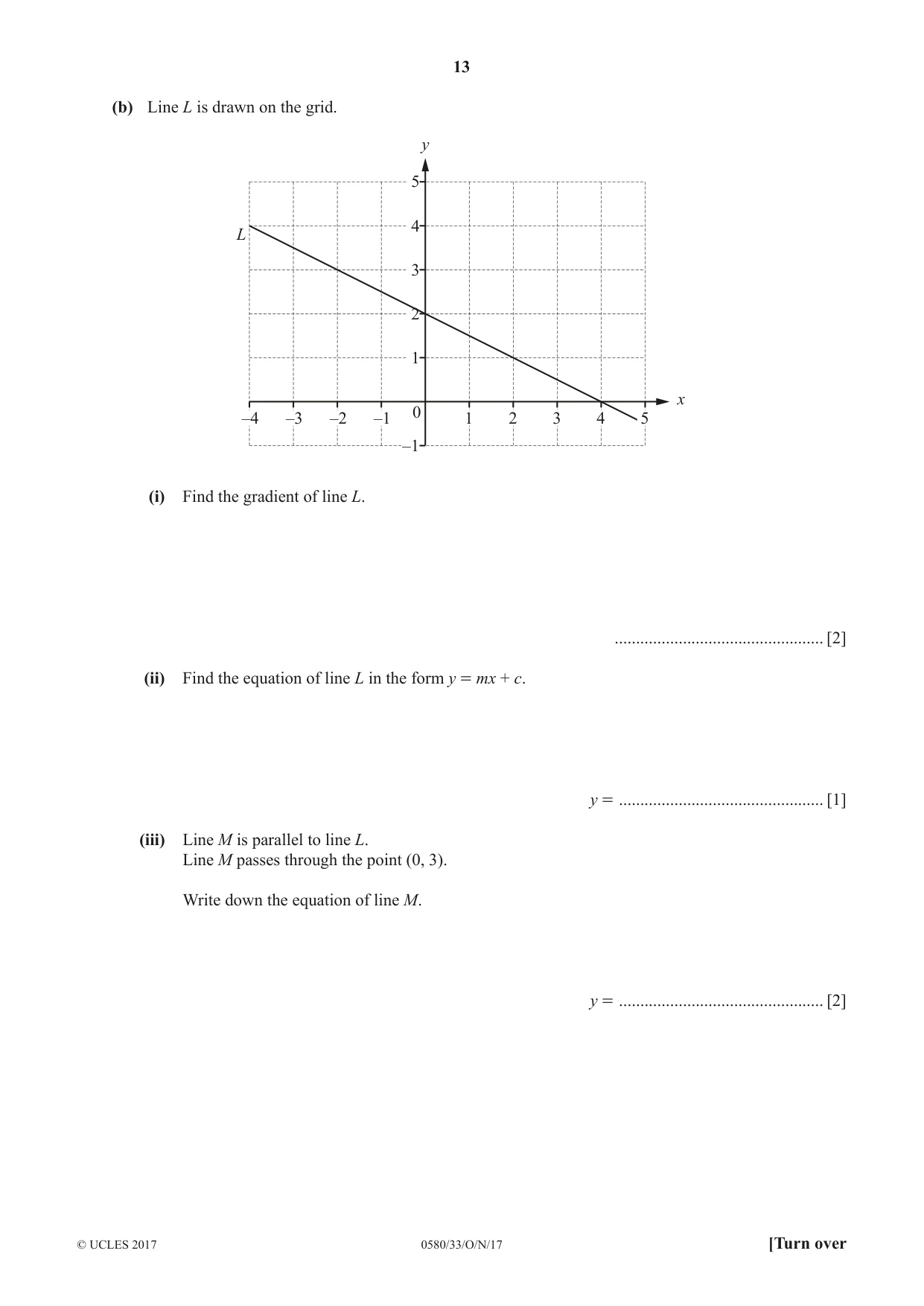
127 (a) (i) Complete the table of values for y = . x x –6 –4 –2 –1 1 2 4 6 y –2 –12 12 2 [2] 12 (ii) On the grid, draw the graph of y = for - 6 G x G - 1 and 1 G x G 6 . x y 12 10 8 6 4 2 x –6 –5 –4 –3 –2 –1 0 1 2 3 4 5 6 –2 –4 –6 –8 –10 –12 [4] (iii) On the grid, draw the line y =- 5 . [1] 12 (iv) Use your graph to solve the equation =- 5 . x x = ................................................ [1] (b) Line L is drawn on the grid. y 5 4 L 3 2 1 x 0 –4 –3 –2 –1 1 2 3 4 5 –1 (i) Find the gradient of line L. ................................................. [2] (ii) Find the equation of line L in the form y = mx + c. y = ................................................ [1] (iii) Line M is parallel to line L. Line M passes through the point (0, 3). Write down the equation of line M. y = ................................................ [2]
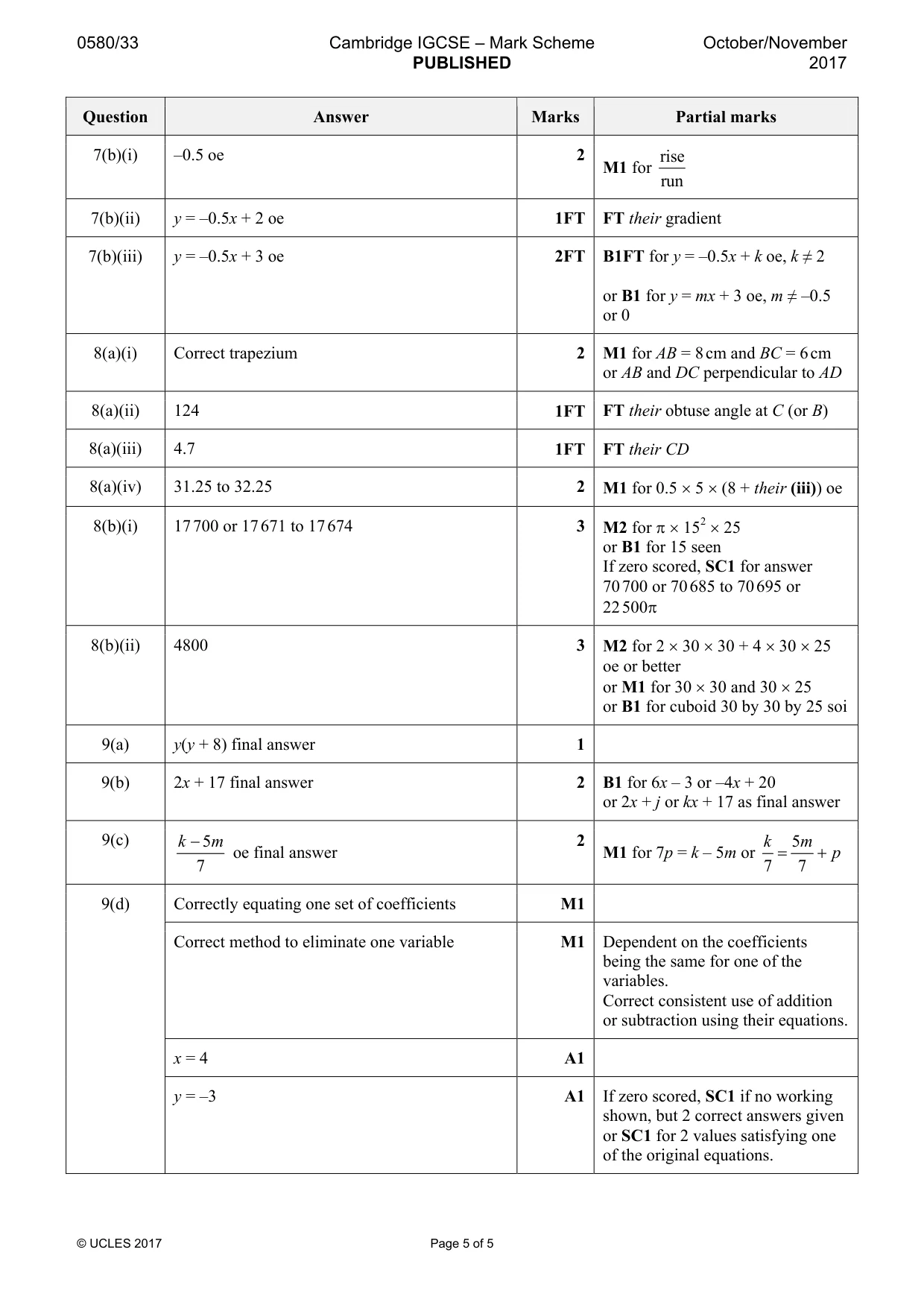
Mark scheme: 7(a)(i) –3 –6 6 3 2 B1 for 2 or 3 values correct 7(a)(ii) Correct curve 4 B3FT for 7 or 8 correctly plotted points or B2FT for 5 or 6 correctly plotted points or B1FT for 3 or 4 correctly plotted points 7(a)(iii) Ruled line y = –5 1 7(a)(iv) –2.5 to –2.3 1FT FT intersection of their line with their curve 7(b)(i) –0.5 oe 2 rise M1 for run 7(b)(ii) y = –0.5x + 2 oe 1FT FT their gradient 7(b)(iii) y = –0.5x + 3 oe 2FT B1FT for y = –0.5x + k oe, k ≠ 2 or B1 for y = mx + 3 oe, m ≠ –0.5 or 0
Q8 · The diagram shows a trapezium ABCD
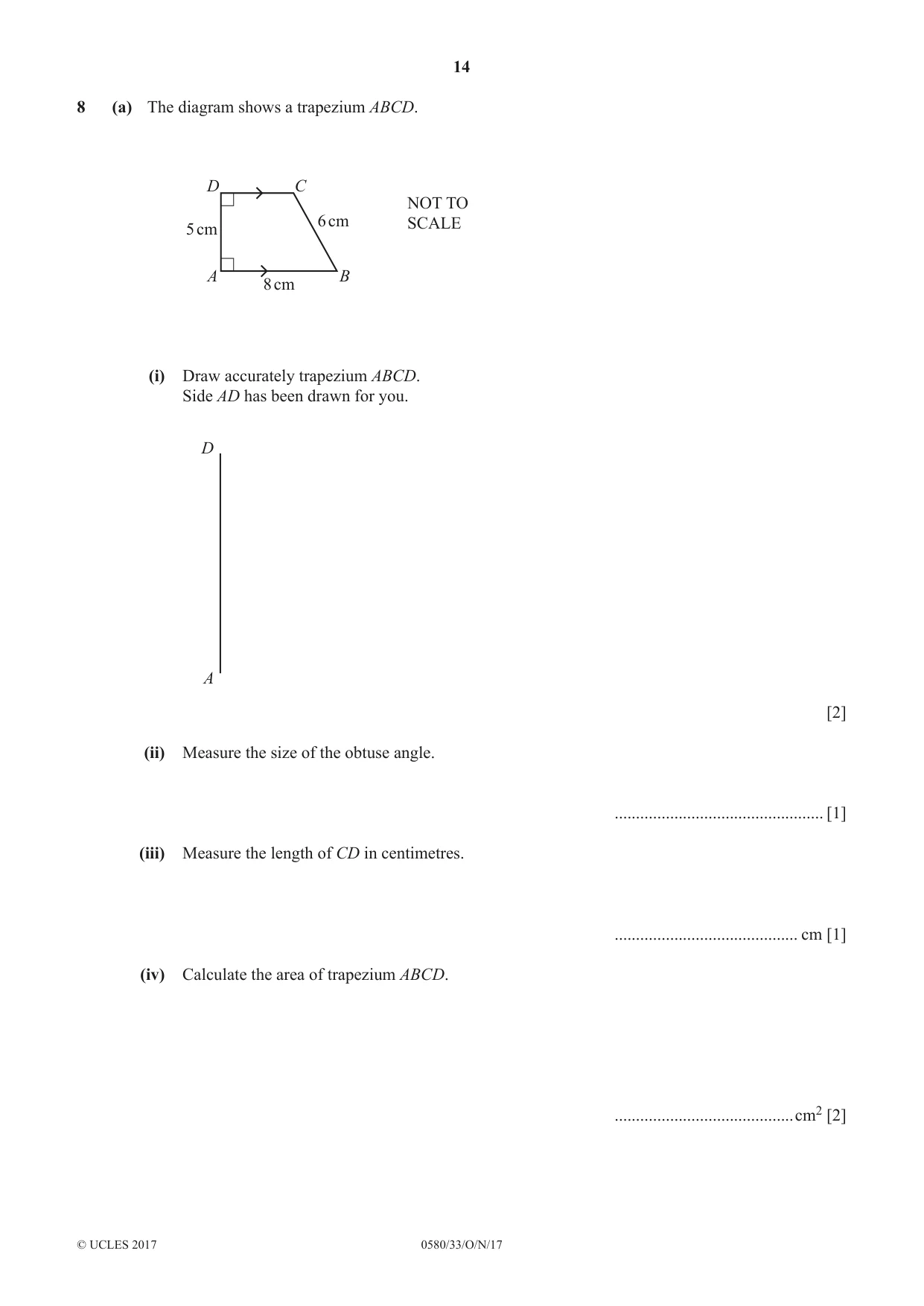
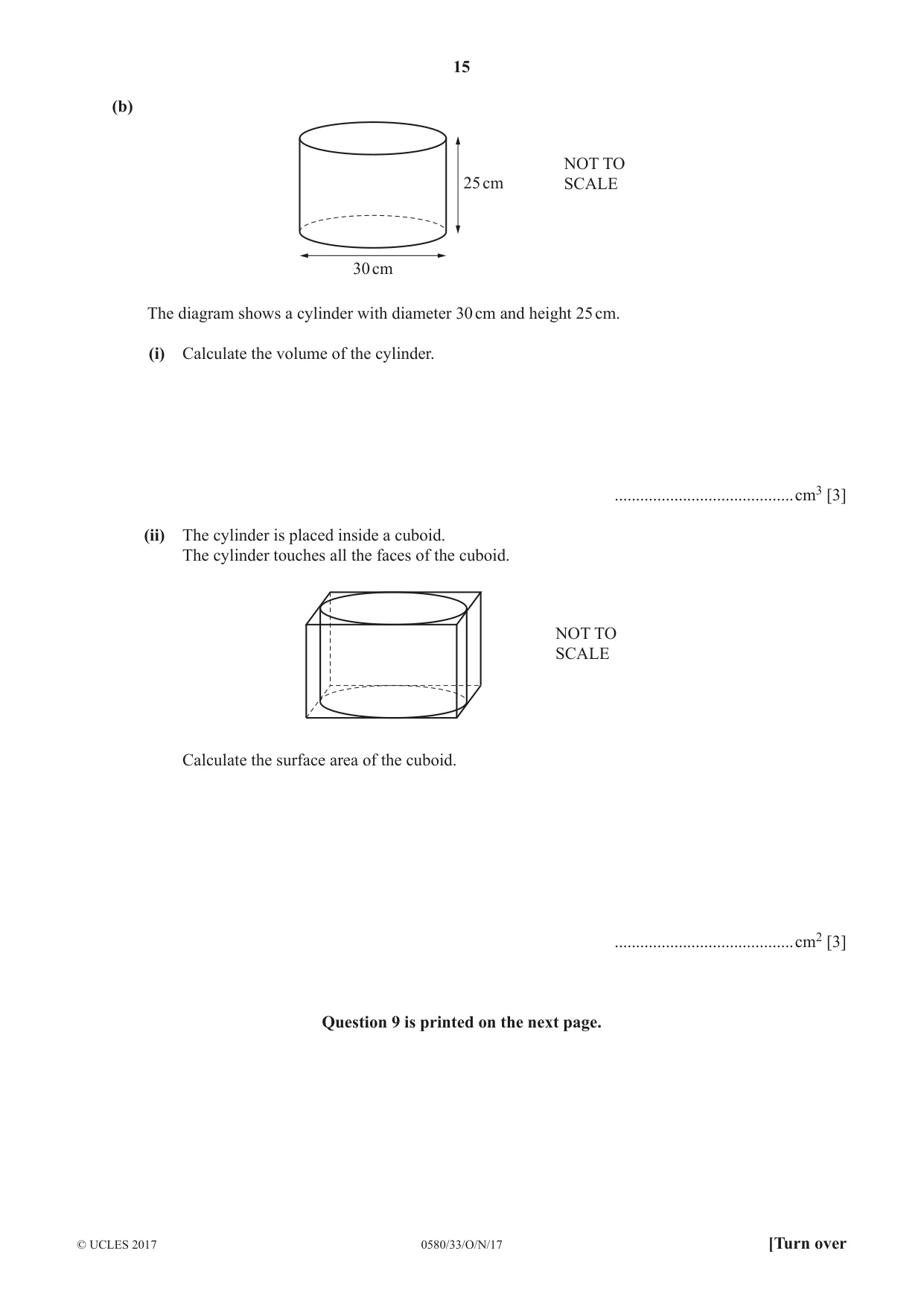
8 (a) The diagram shows a trapezium ABCD. D C NOT TO 6 cm SCALE 5 cm A B 8 cm (i) Draw accurately trapezium ABCD. Side AD has been drawn for you. D A [2] (ii) Measure the size of the obtuse angle. ................................................. [1] (iii) Measure the length of CD in centimetres. ........................................... cm [1] (iv) Calculate the area of trapezium ABCD. ..........................................cm2 [2] (b) NOT TO 25 cm SCALE 30 cm The diagram shows a cylinder with diameter 30 cm and height 25 cm. (i) Calculate the volume of the cylinder. ..........................................cm3 [3] (ii) The cylinder is placed inside a cuboid. The cylinder touches all the faces of the cuboid. NOT TO SCALE Calculate the surface area of the cuboid. ..........................................cm2 [3] Question 9 is printed on the next page.
Mark scheme: 8(a)(i) Correct trapezium 2 M1 for AB = 8 cm and BC = 6 cm or AB and DC perpendicular to AD 8(a)(ii) 124 1FT FT their obtuse angle at C (or B) 8(a)(iii) 4.7 1FT FT their CD 8(a)(iv) 31.25 to 32.25 2 M1 for 0.5 × 5 × (8 + their (iii)) oe 8(b)(i) 17 700 or 17 671 to 17 674 3 M2 for π × 152 × 25 or B1 for 15 seen If zero scored, SC1 for answer 70 700 or 70 685 to 70 695 or 22 500π 8(b)(ii) 4800 3 M2 for 2 × 30 × 30 + 4 × 30 × 25 oe or better or M1 for 30 × 30 and 30 × 25 or B1 for cuboid 30 by 30 by 25 soi
Question 9
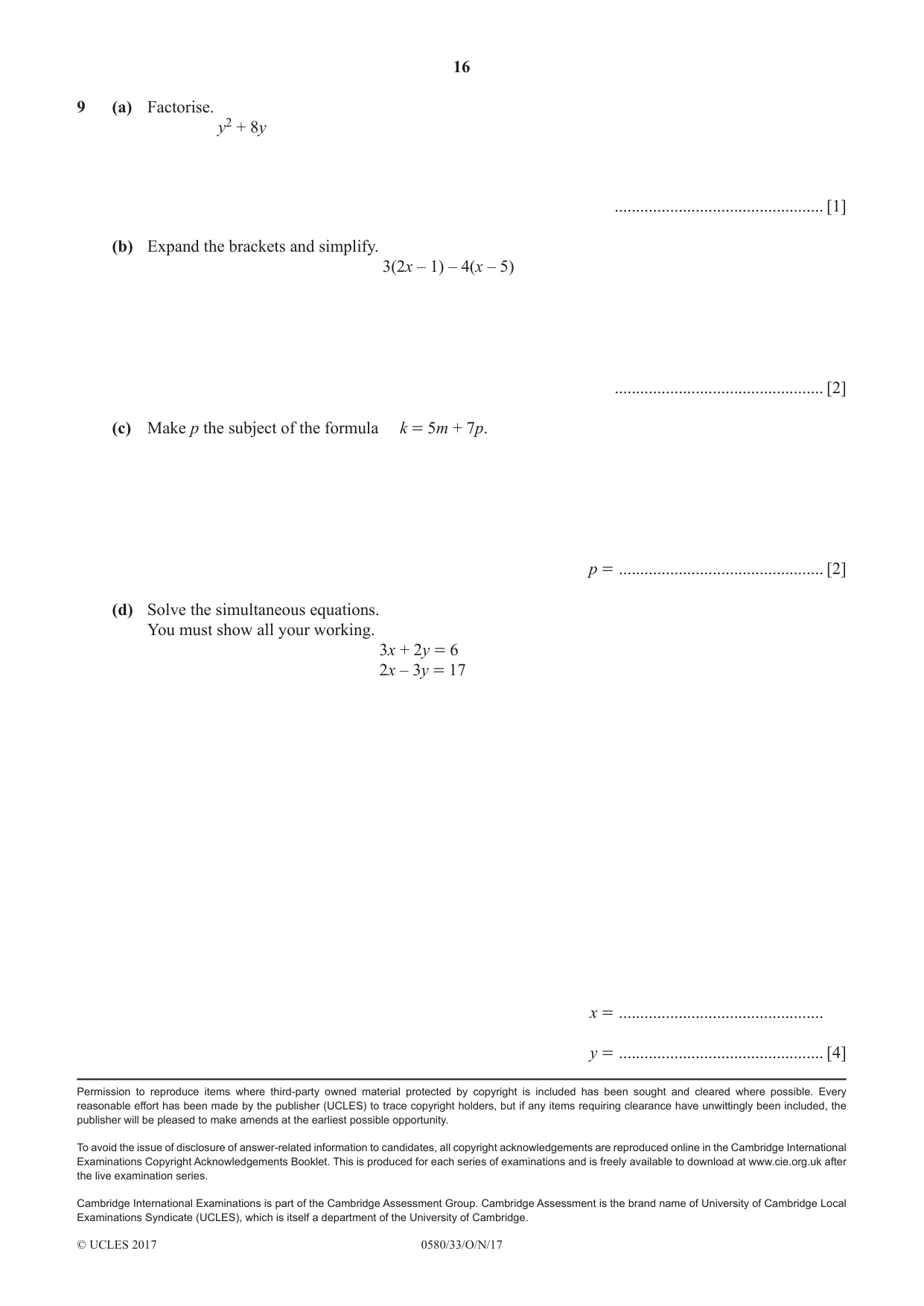
9 (a) Factorise. y2 + 8y ................................................. [1] (b) Expand the brackets and simplify. 3(2x – 1) – 4(x – 5) ................................................. [2] (c) Make p the subject of the formula k = 5m + 7p. p = ................................................ [2] (d) Solve the simultaneous equations. You must show all your working. 3x + 2y = 6 2x – 3y = 17 x = ................................................ y = ................................................ [4]
Mark scheme: 9(a) y(y + 8) final answer 1 9(b) 2x + 17 final answer 2 B1 for 6x – 3 or –4x + 20 or 2x + j or kx + 17 as final answer 9(c) k − 5 m 2 k 5m oe final answer M1 for 7p = k – 5m or = + p 7 7 7 9(d) Correctly equating one set of coefficients M1 Correct method to eliminate one variable M1 Dependent on the coefficients being the same for one of the variables. Correct consistent use of addition or subtraction using their equations. x = 4 A1 y = –3 A1 If zero scored, SC1 if no working shown, but 2 correct answers given or SC1 for 2 values satisfying one of the original equations.
What was in this paper
The subtopics covered by these 9 questions, and how many questions each got. Open one in a new tab to see every Cambridge question on it.
What you needed in this session
Cambridge’s own grade thresholds for 2017 Oct/Nov, Paper 3 · Variant 3. A higher threshold means an easier paper — the bar moves with how the cohort did.