Cambridge IGCSE Mathematics 0580 — 2017 Oct/Nov Paper 3 · Variant 2
0580/32/O/N/17 · 9 questions · 104 marks · ≈117 min
The question paper and its mark scheme, free to read here and free to download. This is Cambridge’s own paper, exactly as it was sat.
Question paper16 pages
Mark scheme5 pages
Answers below. Sit the paper first if you are practising.
Questions as text
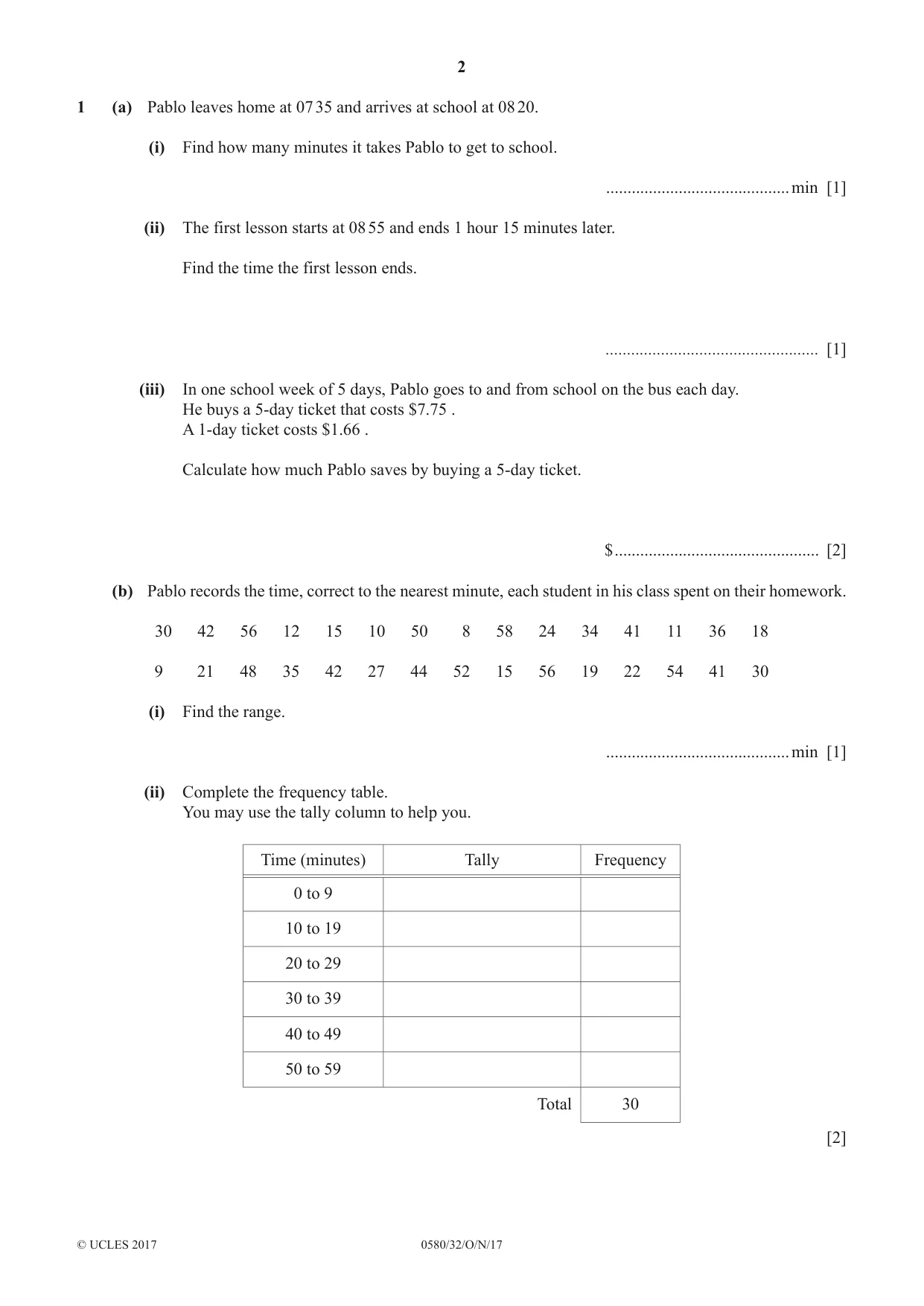
Q1 · Pablo leaves home at 07 35 and arrives at school at 08 20
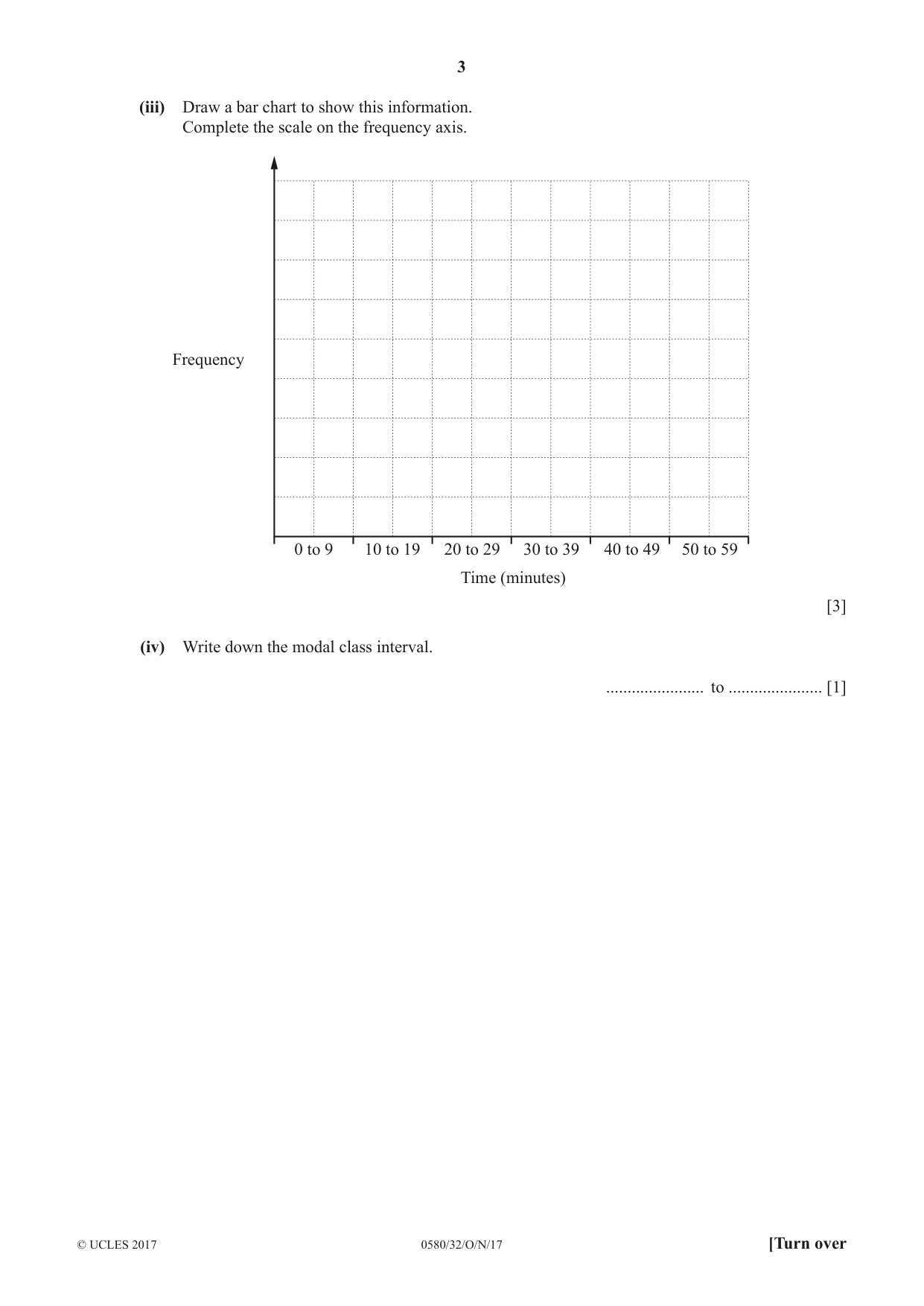
1 (a) Pablo leaves home at 07 35 and arrives at school at 08 20. (i) Find how many minutes it takes Pablo to get to school. ........................................... min [1] (ii) The first lesson starts at 08 55 and ends 1 hour 15 minutes later. Find the time the first lesson ends. .................................................. [1] (iii) In one school week of 5 days, Pablo goes to and from school on the bus each day. He buys a 5-day ticket that costs $7.75 . A 1-day ticket costs $1.66 . Calculate how much Pablo saves by buying a 5-day ticket. $ ................................................ [2] (b) Pablo records the time, correct to the nearest minute, each student in his class spent on their homework. 30 42 56 12 15 10 50 8 58 24 34 41 11 36 18 9 21 48 35 42 27 44 52 15 56 19 22 54 41 30 (i) Find the range. ........................................... min [1] (ii) Complete the frequency table. You may use the tally column to help you. Time (minutes) Tally Frequency 0 to 9 10 to 19 20 to 29 30 to 39 40 to 49 50 to 59 Total 30 [2] (iii) Draw a bar chart to show this information. Complete the scale on the frequency axis. Frequency 0 to 9 10 to 19 20 to 29 30 to 39 40 to 49 50 to 59 Time (minutes) [3] (iv) Write down the modal class interval. ....................... to ...................... [1]
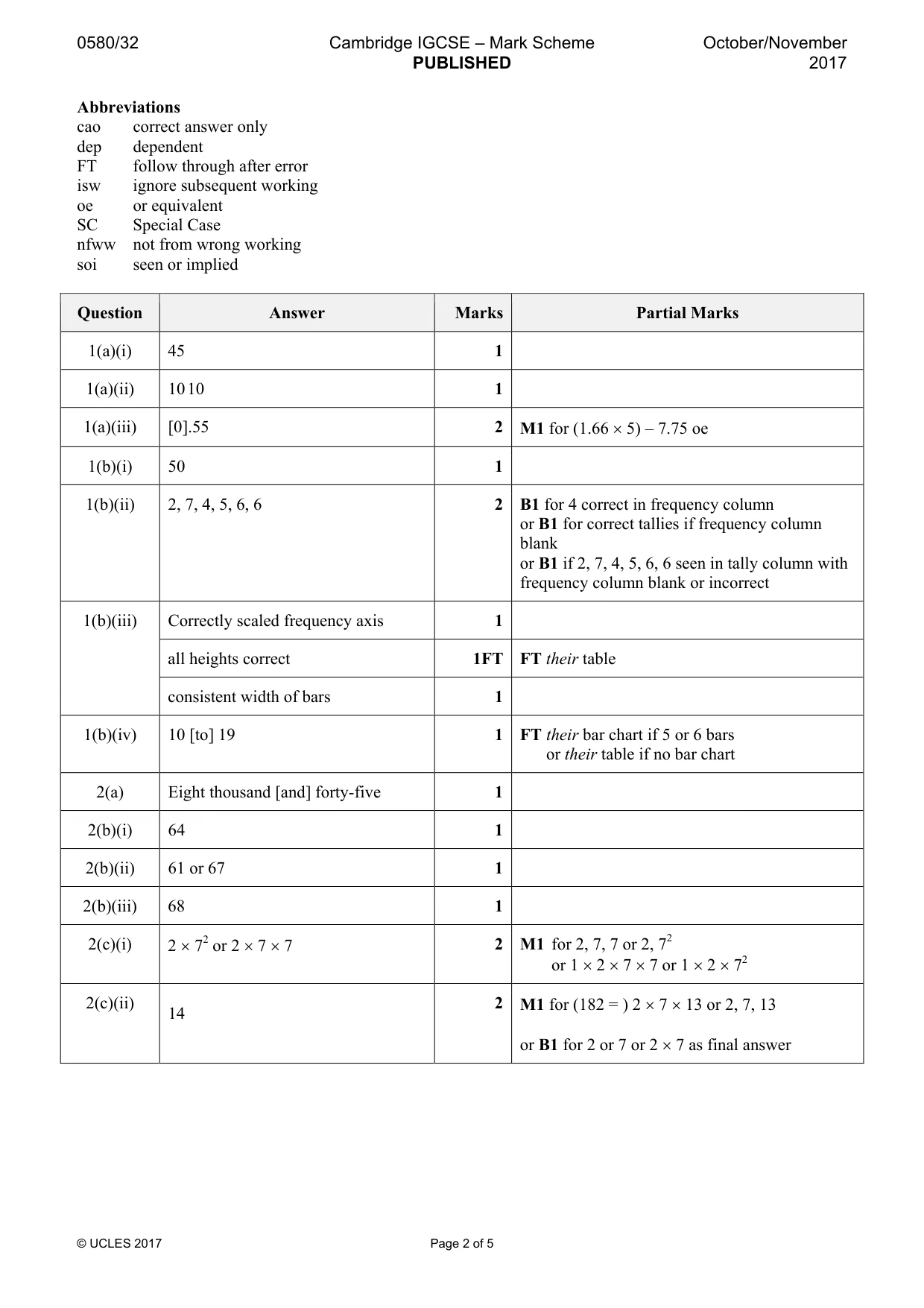
Mark scheme: Question Answer Marks Partial Marks 1(a)(i) 45 1 1(a)(ii) 10 10 1 1(a)(iii) [0].55 2 M1 for (1.66 × 5) – 7.75 oe 1(b)(i) 50 1 1(b)(ii) 2, 7, 4, 5, 6, 6 2 B1 for 4 correct in frequency column or B1 for correct tallies if frequency column blank or B1 if 2, 7, 4, 5, 6, 6 seen in tally column with frequency column blank or incorrect 1(b)(iii) Correctly scaled frequency axis 1 all heights correct 1FT FT their table consistent width of bars 1 1(b)(iv) 10 [to] 19 1 FT their bar chart if 5 or 6 bars or their table if no bar chart
Q2 · Write the number 8045 in words
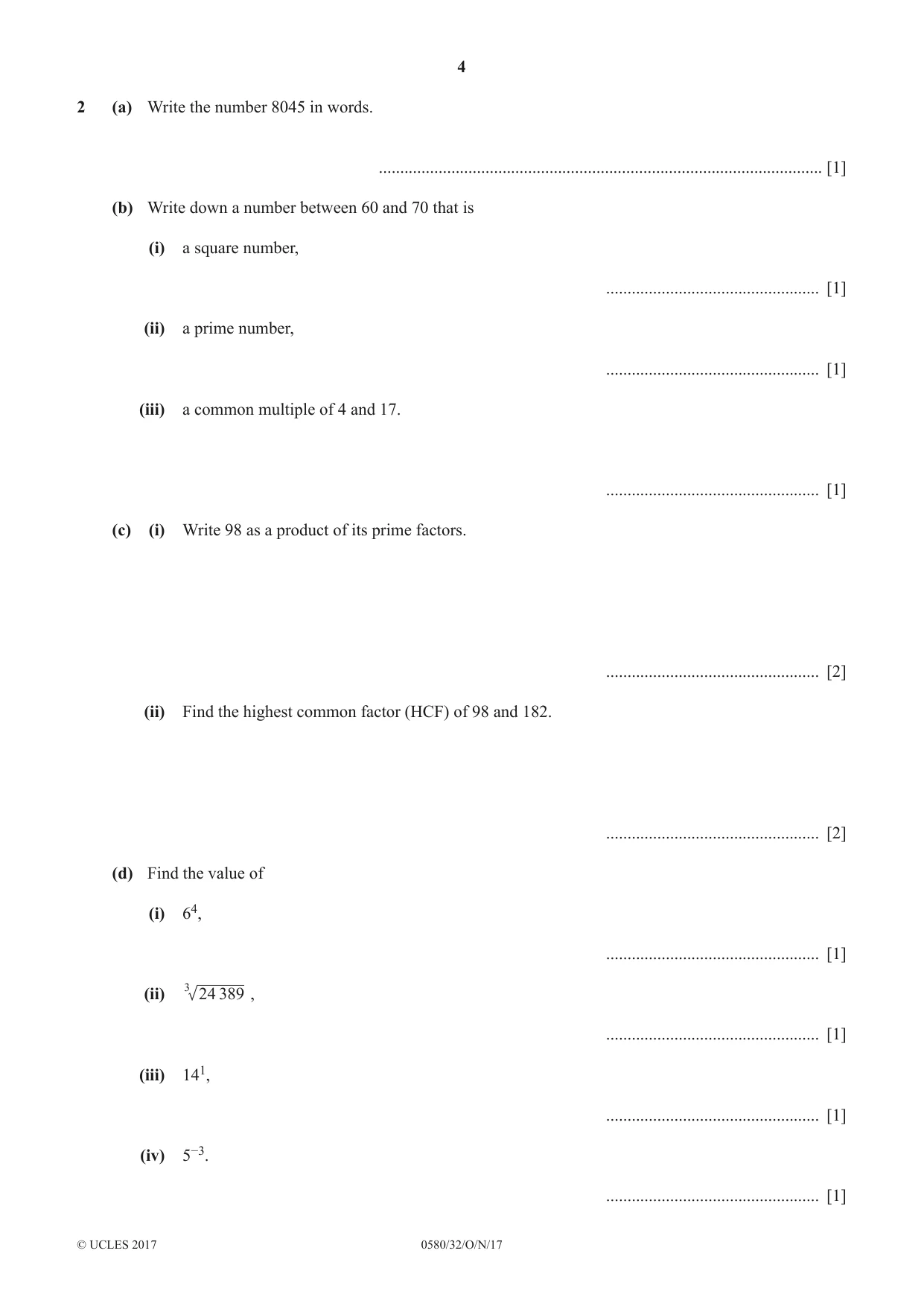
2 (a) Write the number 8045 in words. ........................................................................................................ [1] (b) Write down a number between 60 and 70 that is (i) a square number, .................................................. [1] (ii) a prime number, .................................................. [1] (iii) a common multiple of 4 and 17. .................................................. [1] (c) (i) Write 98 as a product of its prime factors. .................................................. [2] (ii) Find the highest common factor (HCF) of 98 and 182. .................................................. [2] (d) Find the value of (i) 64, .................................................. [1] (ii) 3 24 389 , .................................................. [1] (iii) 141, .................................................. [1] (iv) 5−3. .................................................. [1]
Mark scheme: 2(a) Eight thousand [and] forty-five 1 2(b)(i) 64 1 2(b)(ii) 61 or 67 1 2(b)(iii) 68 1 2(c)(i) 2 × 72 or 2 × 7 × 7 2 M1 for 2, 7, 7 or 2, 72 or 1 × 2 × 7 × 7 or 1 × 2 × 72 2(c)(ii) 2 M1 for (182 = ) 2 × 7 × 13 or 2, 7, 13 14 or B1 for 2 or 7 or 2 × 7 as final answer 2(d)(i) 1296 1 2(d)(ii) 29 1 2(d)(iii) 14 1 2(d)(iv) 1 1 0.008 or 125
Q3 · Write down the order of rotational symmetry of each shape
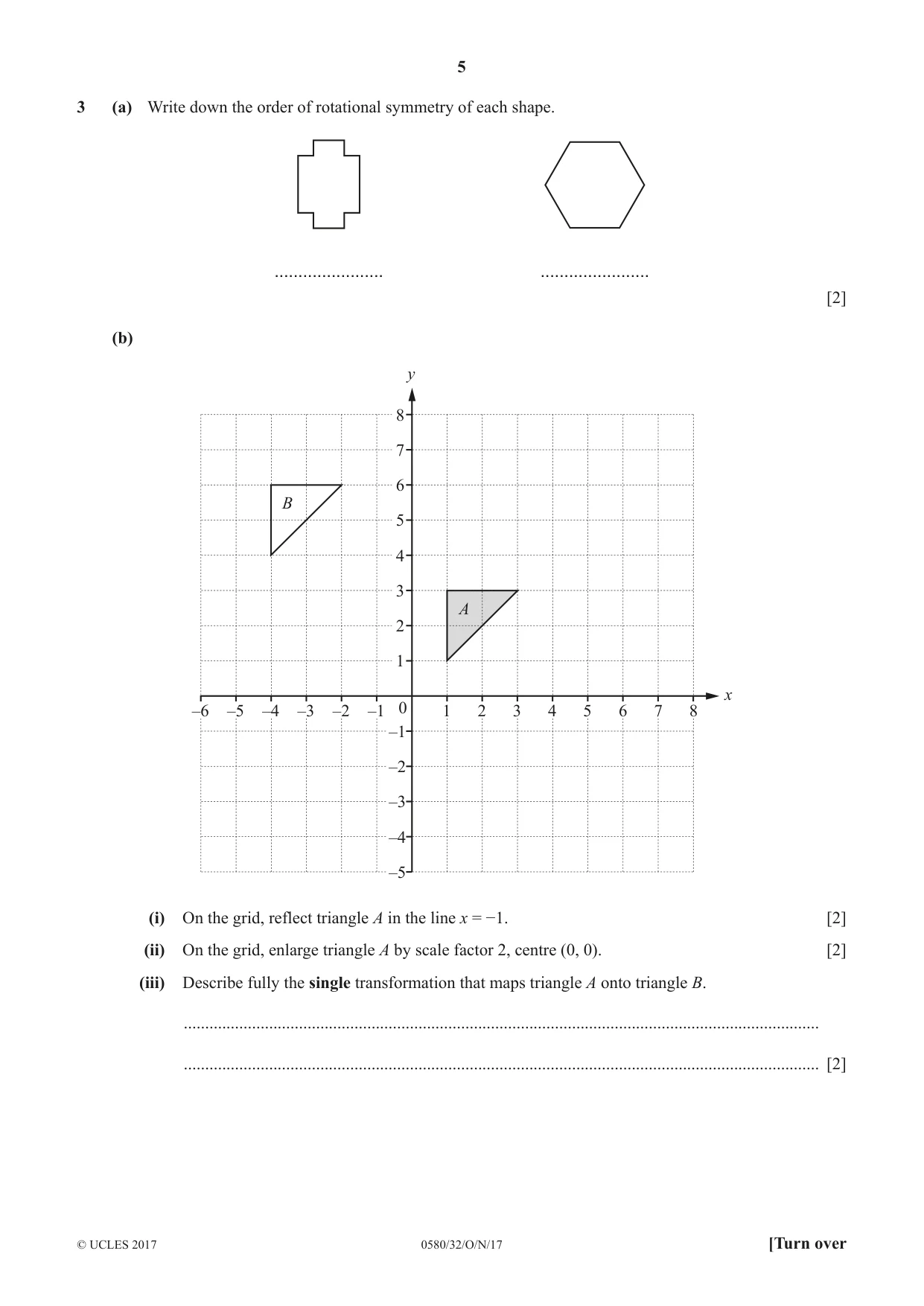
3 (a) Write down the order of rotational symmetry of each shape. ....................... ....................... [2] (b) y 8 7 6 B 5 4 3 A 2 1 x –6 –5 –4 –3 –2 –1 0 1 2 3 4 5 6 7 8 –1 –2 –3 –4 –5 (i) On the grid, reflect triangle A in the line x = −1. [2] (ii) On the grid, enlarge triangle A by scale factor 2, centre (0, 0). [2] (iii) Describe fully the single transformation that maps triangle A onto triangle B. ..................................................................................................................................................... ..................................................................................................................................................... [2]
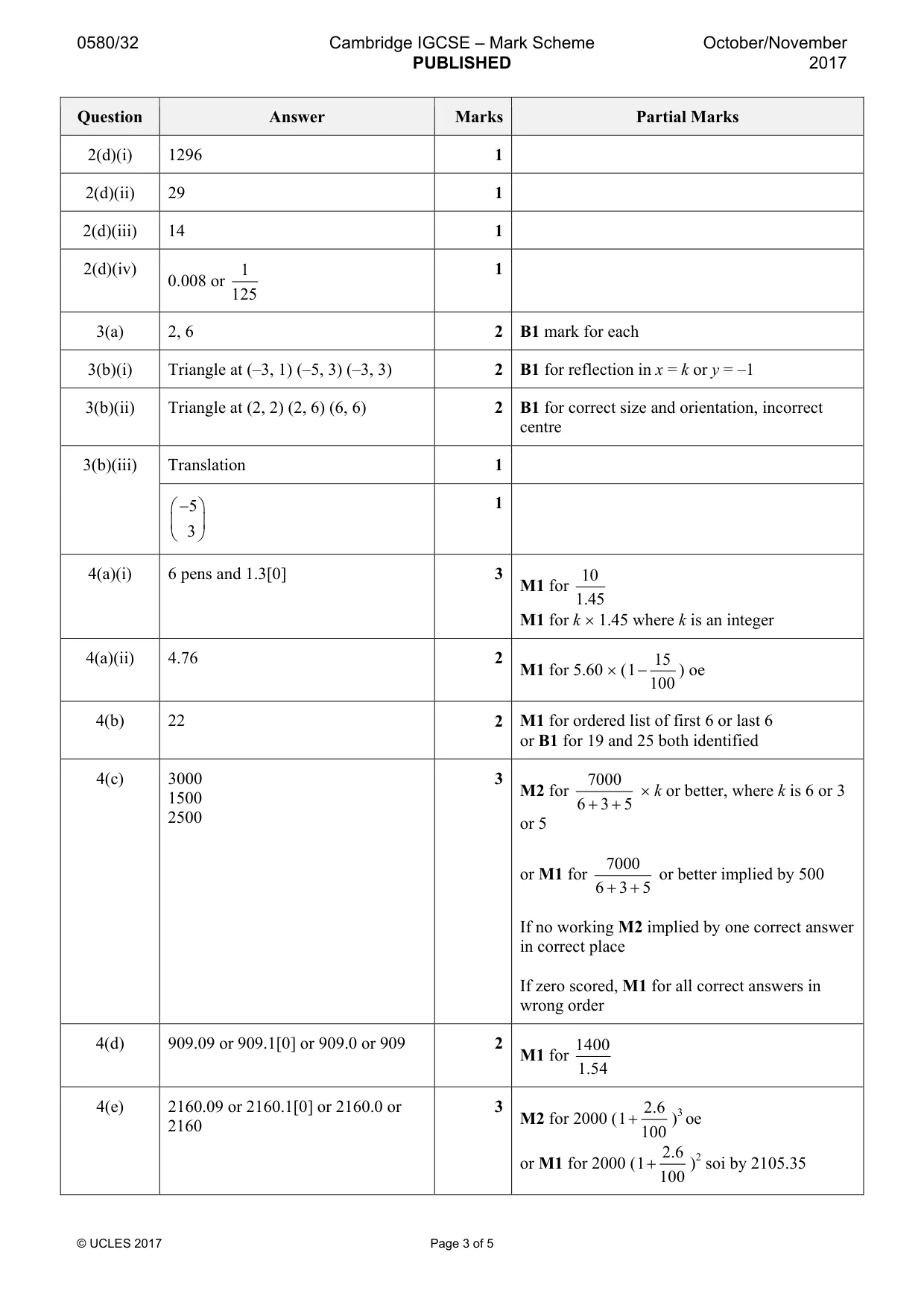
Mark scheme: 3(a) 2, 6 2 B1 mark for each 3(b)(i) Triangle at (–3, 1) (–5, 3) (–3, 3) 2 B1 for reflection in x = k or y = –1 3(b)(ii) Triangle at (2, 2) (2, 6) (6, 6) 2 B1 for correct size and orientation, incorrect centre 3(b)(iii) Translation 1 − 5 1 3
Q4 · Leo, Kim and Priya own a shop
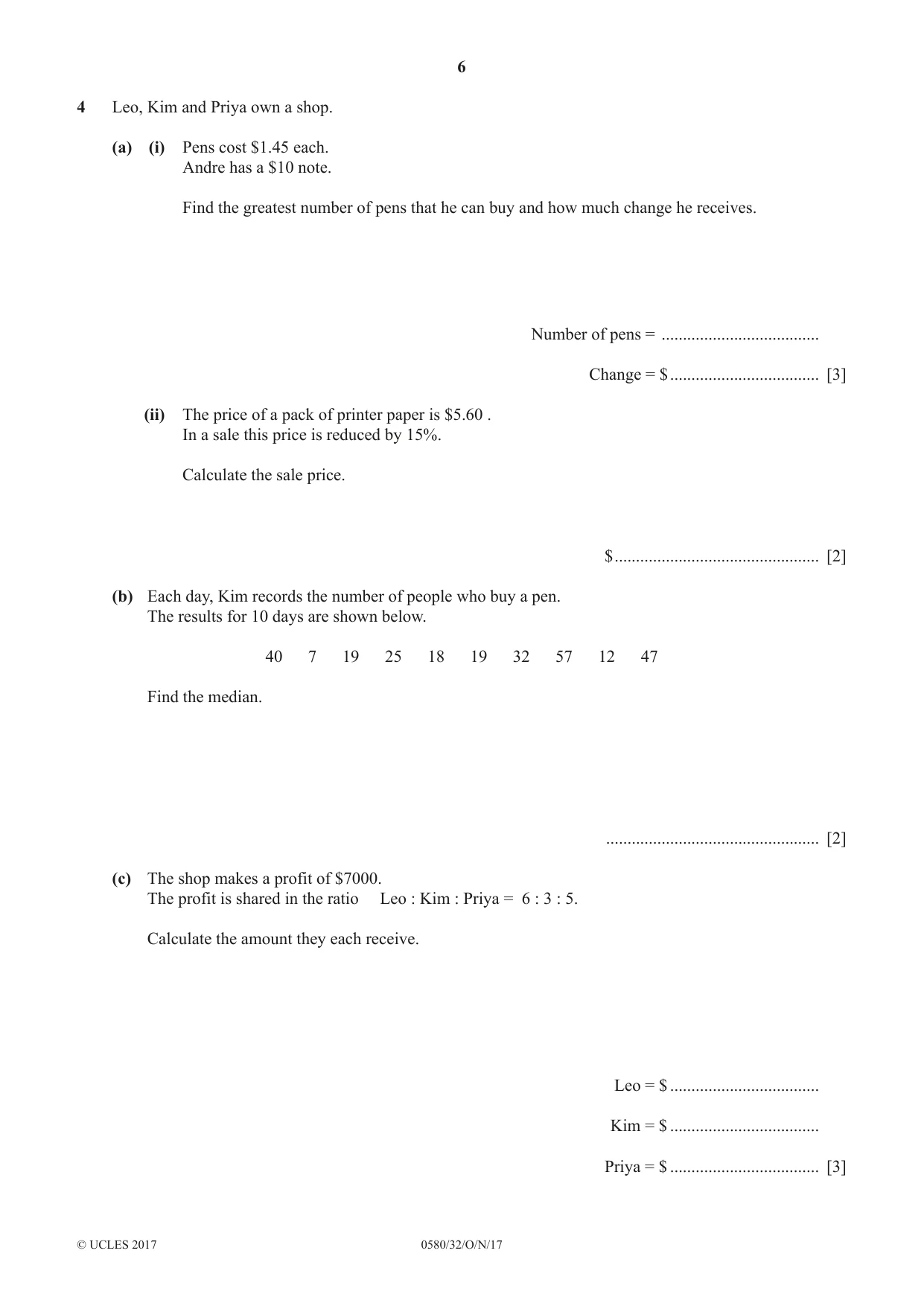
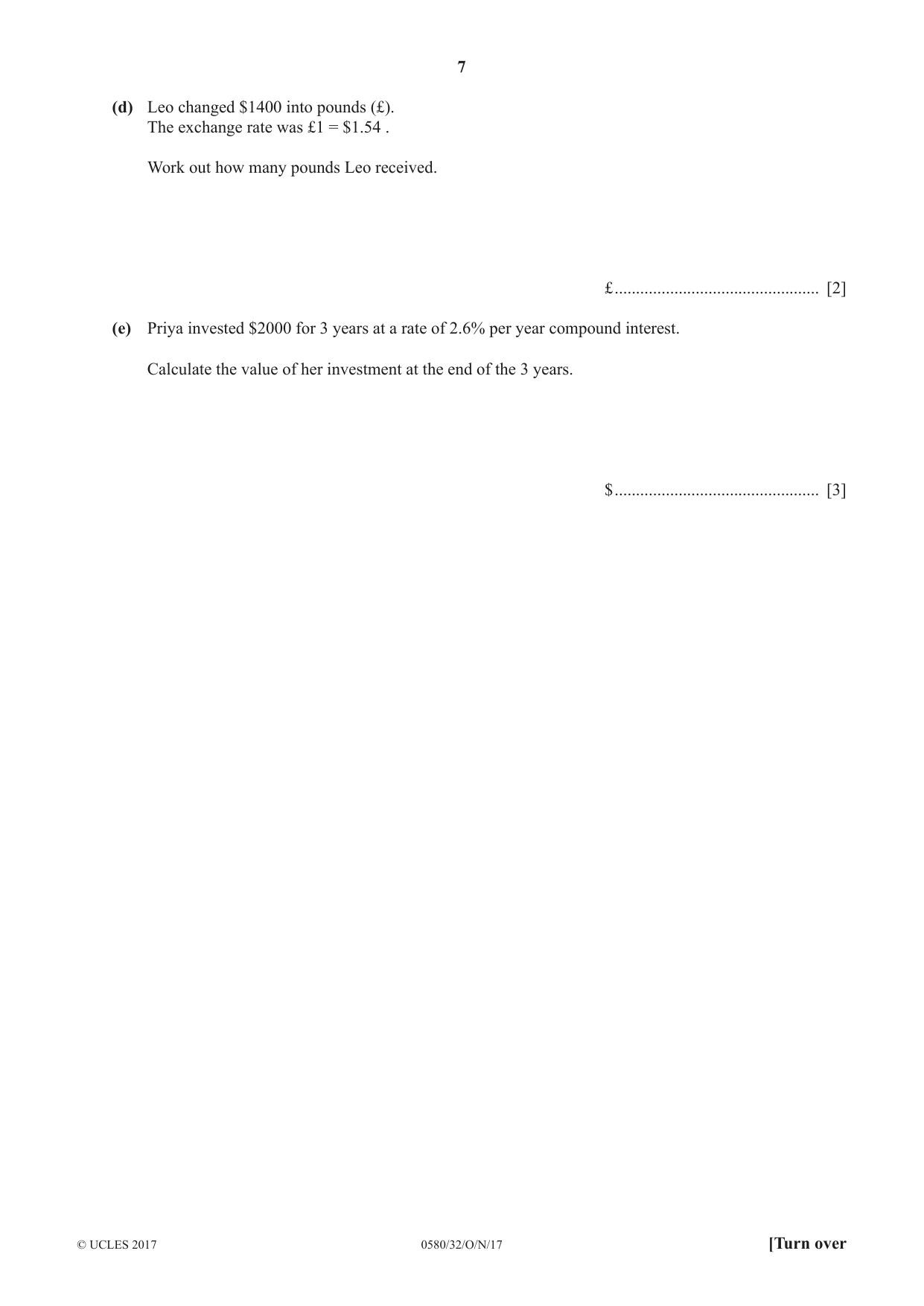
4 Leo, Kim and Priya own a shop. (a) (i) Pens cost $1.45 each. Andre has a $10 note. Find the greatest number of pens that he can buy and how much change he receives. Number of pens = ..................................... Change = $ ................................... [3] (ii) The price of a pack of printer paper is $5.60 . In a sale this price is reduced by 15%. Calculate the sale price. $ ................................................ [2] (b) Each day, Kim records the number of people who buy a pen. The results for 10 days are shown below. 40 7 19 25 18 19 32 57 12 47 Find the median. .................................................. [2] (c) The shop makes a profit of $7000. The profit is shared in the ratio Leo : Kim : Priya = 6 : 3 : 5. Calculate the amount they each receive. Leo = $ ................................... Kim = $ ................................... Priya = $ ................................... [3] (d) Leo changed $1400 into pounds (£). The exchange rate was £1 = $1.54 . Work out how many pounds Leo received. £ ................................................ [2] (e) Priya invested $2000 for 3 years at a rate of 2.6% per year compound interest. Calculate the value of her investment at the end of the 3 years. $ ................................................ [3]
Mark scheme: 4(a)(i) 6 pens and 1.3[0] 3 10 M1 for 1.45 M1 for k × 1.45 where k is an integer 4(a)(ii) 4.76 2 15 M1 for 5.60 × ( 1 − ) oe 100 4(b) 22 2 M1 for ordered list of first 6 or last 6 or B1 for 19 and 25 both identified 4(c) 3000 3 7000 M2 for × k or better, where k is 6 or 3 1500 6 + 3 + 5 2500 or 5 7000 or M1 for or better implied by 500 6 + 3 + 5 If no working M2 implied by one correct answer in correct place If zero scored, M1 for all correct answers in wrong order 4(d) 909.09 or 909.1[0] or 909.0 or 909 2 1400 M1 for 1.54 4(e) 2160.09 or 2160.1[0] or 2160.0 or 3 2.6 M2 for 2000 ( 1 + )3 oe 2160 100 2.6 or M1 for 2000 ( 1 + )2 soi by 2105.35 100
Q5 · Nico asked each of 900 students at her school what their favourite subject is
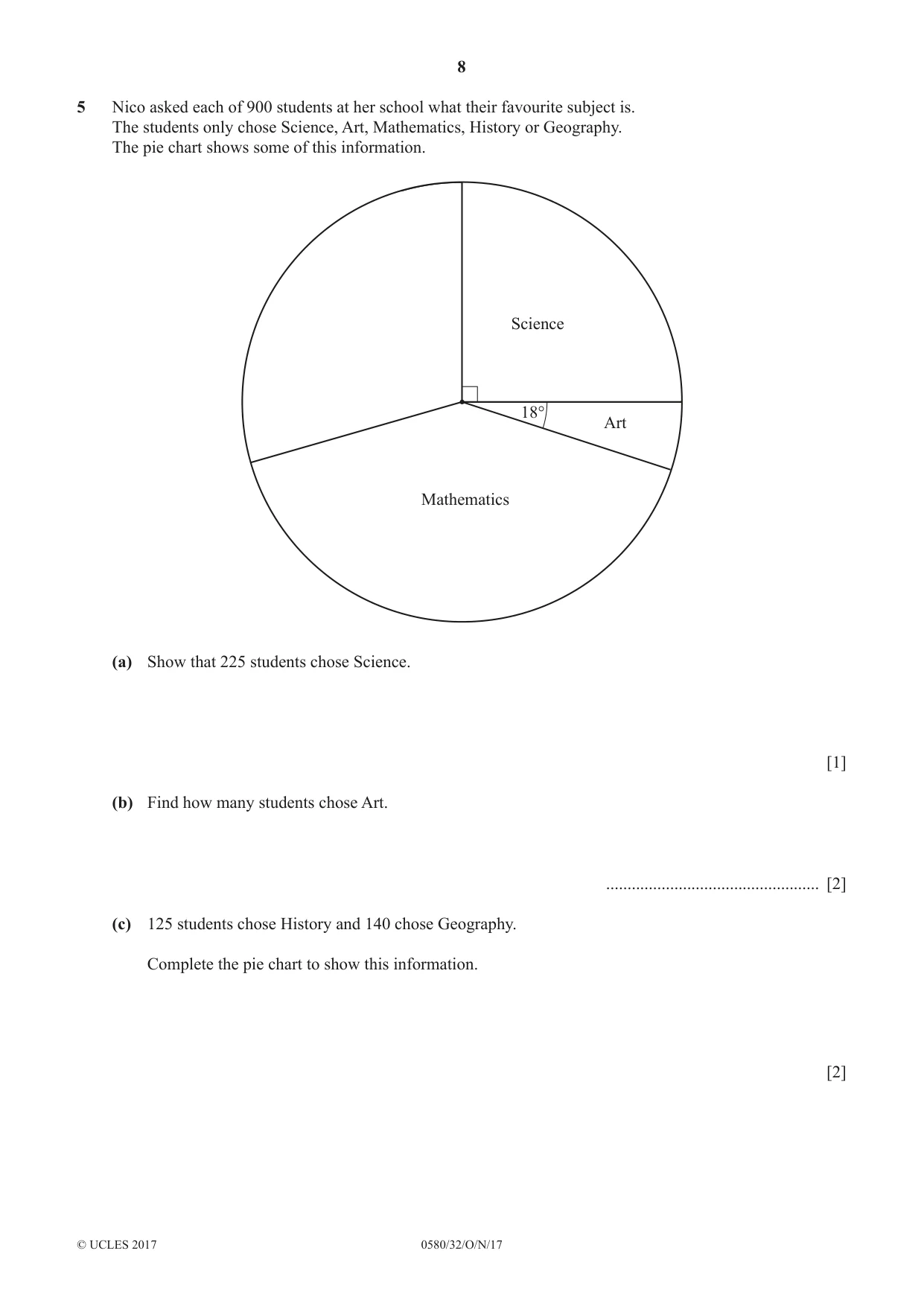
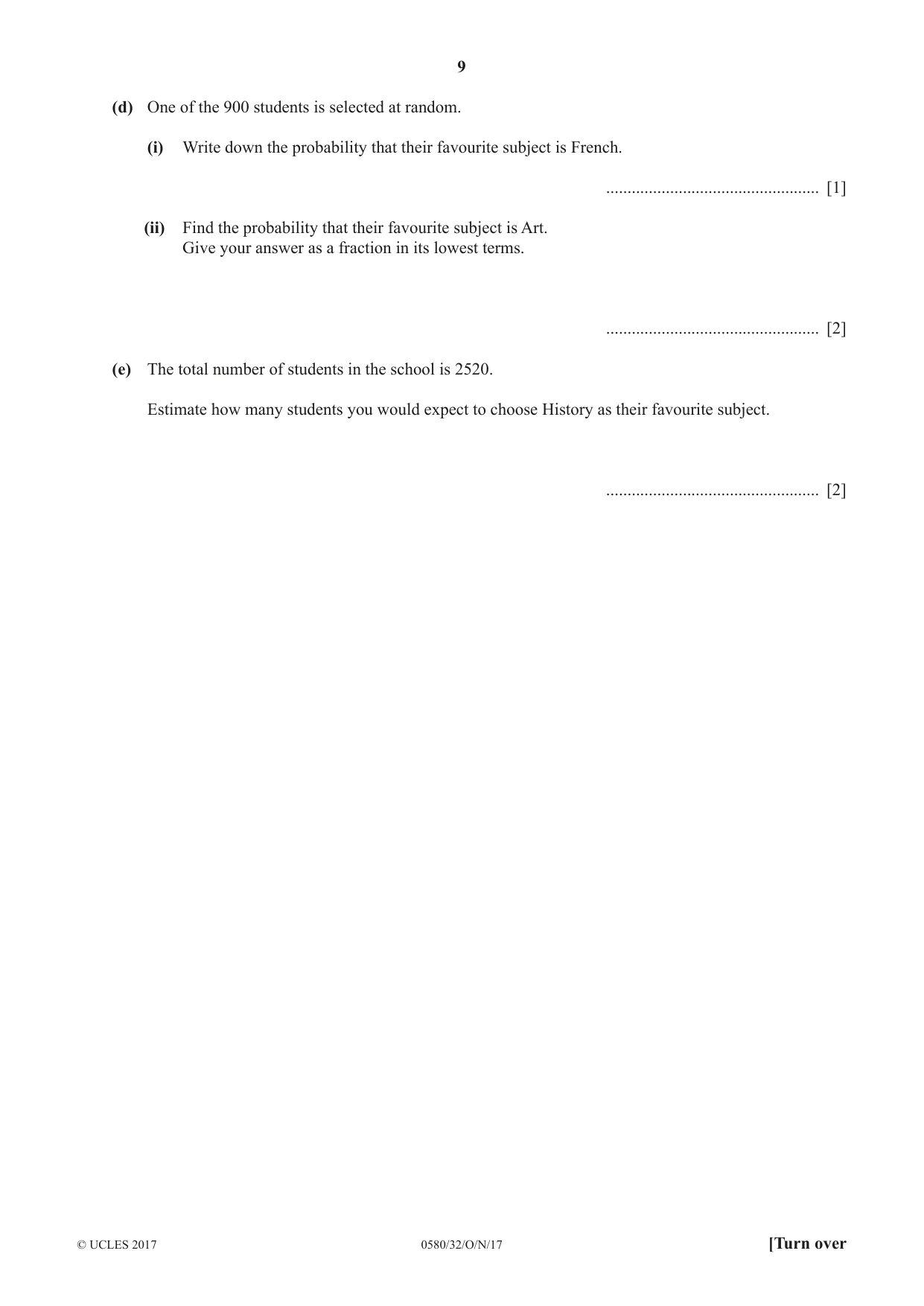
5 Nico asked each of 900 students at her school what their favourite subject is. The students only chose Science, Art, Mathematics, History or Geography. The pie chart shows some of this information. Science 18° Art Mathematics (a) Show that 225 students chose Science. [1] (b) Find how many students chose Art. .................................................. [2] (c) 125 students chose History and 140 chose Geography. Complete the pie chart to show this information. [2] (d) One of the 900 students is selected at random. (i) Write down the probability that their favourite subject is French. .................................................. [1] (ii) Find the probability that their favourite subject is Art. Give your answer as a fraction in its lowest terms. .................................................. [2] (e) The total number of students in the school is 2520. Estimate how many students you would expect to choose History as their favourite subject. .................................................. [2]
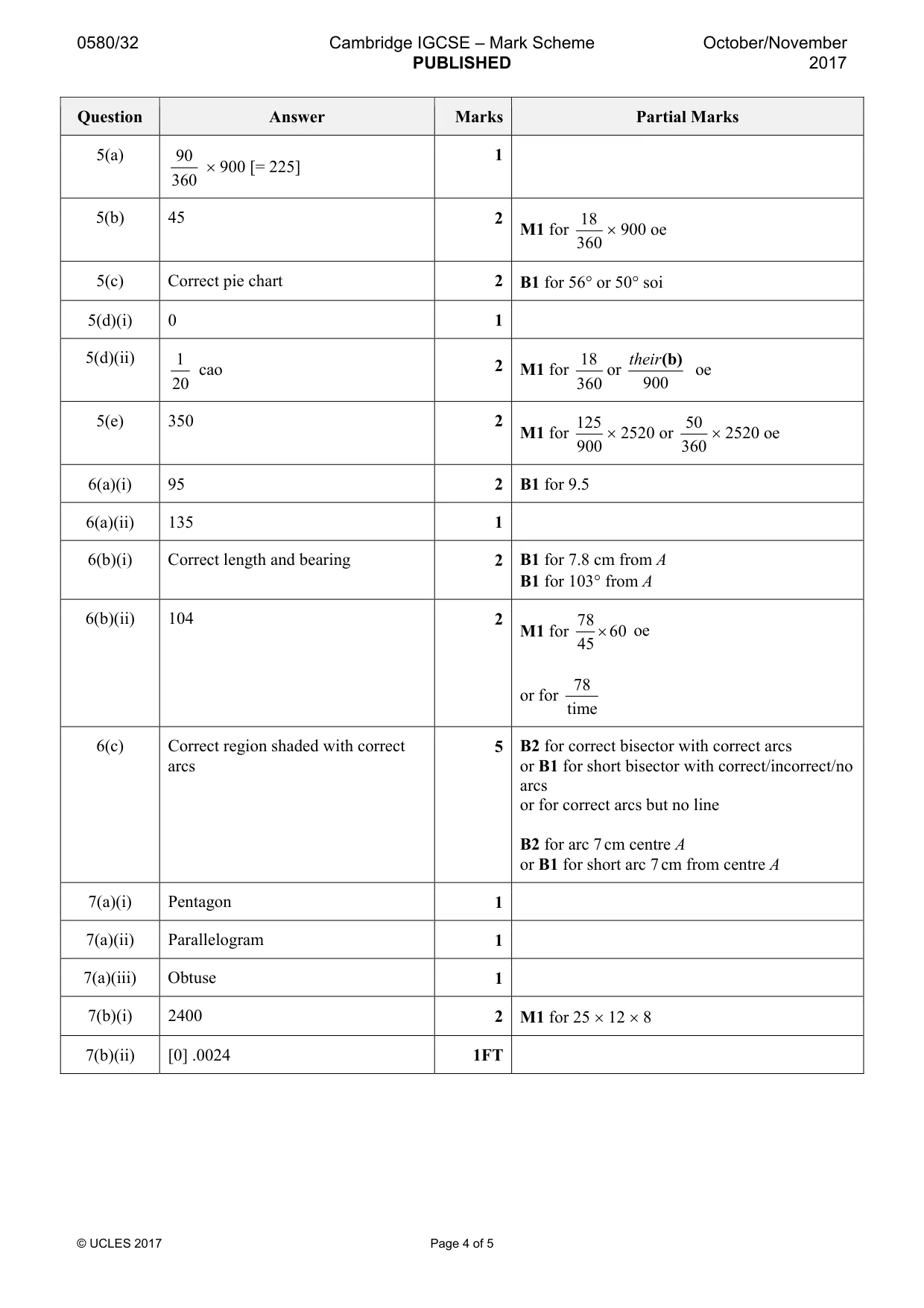
Mark scheme: 5(a) 90 1 × 900 [= 225] 360 5(b) 45 2 18 M1 for × 900 oe 360 5(c) Correct pie chart 2 B1 for 56° or 50° soi 5(d)(i) 0 1 5(d)(ii) 1 18 their(b) cao 2 M1 for or oe 20 360 900 5(e) 350 2 125 50 M1 for × 2520 or × 2520 oe 900 360
Q6 · The diagram shows the positions of two towns, A and B
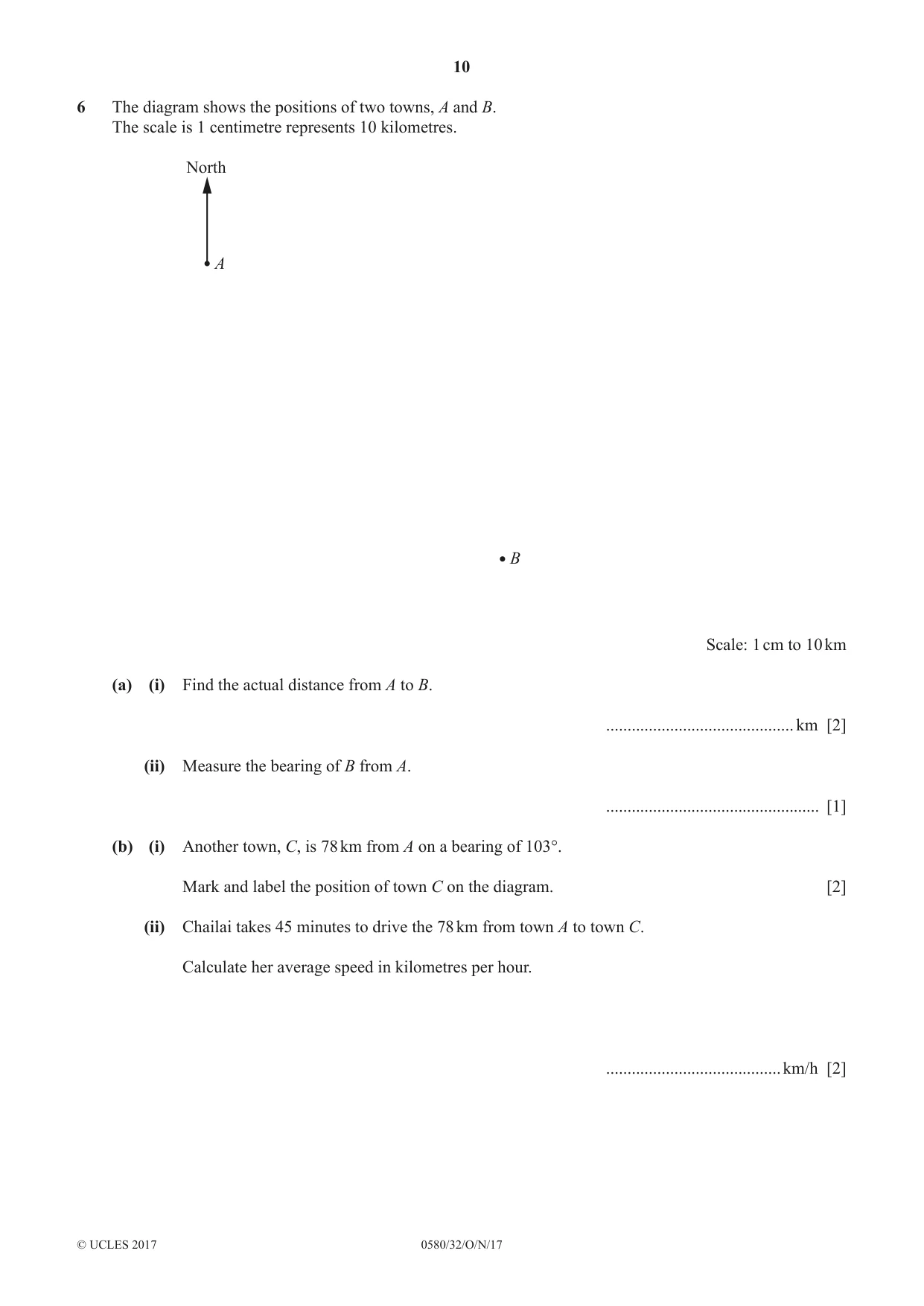
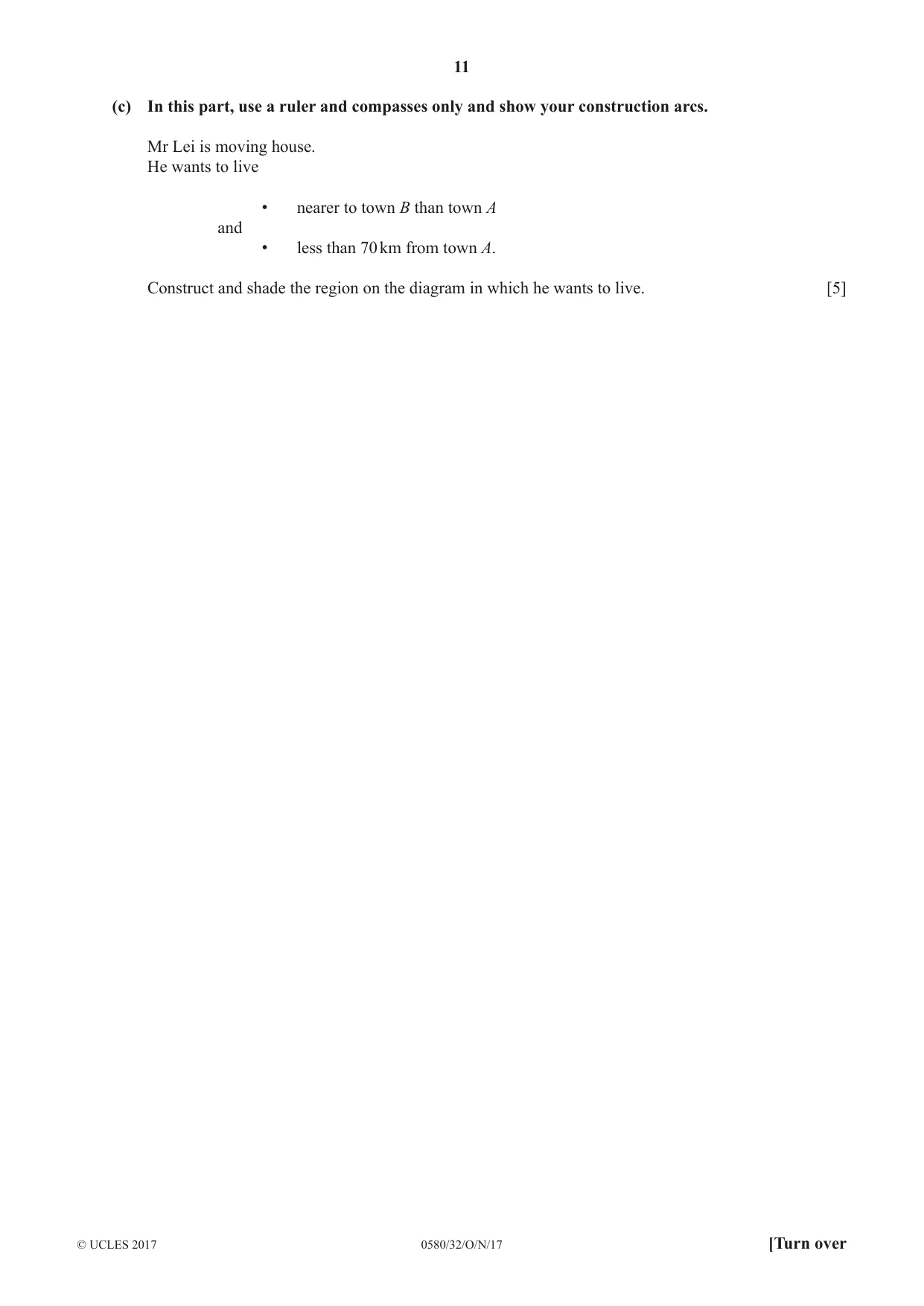
6 The diagram shows the positions of two towns, A and B. The scale is 1 centimetre represents 10 kilometres. North A B Scale: 1 cm to 10 km (a) (i) Find the actual distance from A to B. ............................................ km [2] (ii) Measure the bearing of B from A. .................................................. [1] (b) (i) Another town, C, is 78 km from A on a bearing of 103°. Mark and label the position of town C on the diagram. [2] (ii) Chailai takes 45 minutes to drive the 78 km from town A to town C. Calculate her average speed in kilometres per hour. ......................................... km/h [2] (c) In this part, use a ruler and compasses only and show your construction arcs. Mr Lei is moving house. He wants to live • nearer to town B than town A and • less than 70 km from town A. Construct and shade the region on the diagram in which he wants to live. [5]
Mark scheme: 6(a)(i) 95 2 B1 for 9.5 6(a)(ii) 135 1 6(b)(i) Correct length and bearing 2 B1 for 7.8 cm from A B1 for 103° from A 6(b)(ii) 104 2 78 M1 for × 60 oe 45 78 or for time 6(c) Correct region shaded with correct 5 B2 for correct bisector with correct arcs arcs or B1 for short bisector with correct/incorrect/no arcs or for correct arcs but no line B2 for arc 7 cm centre A or B1 for short arc 7 cm from centre A
Q7 · Write down the mathematical name for this polygon
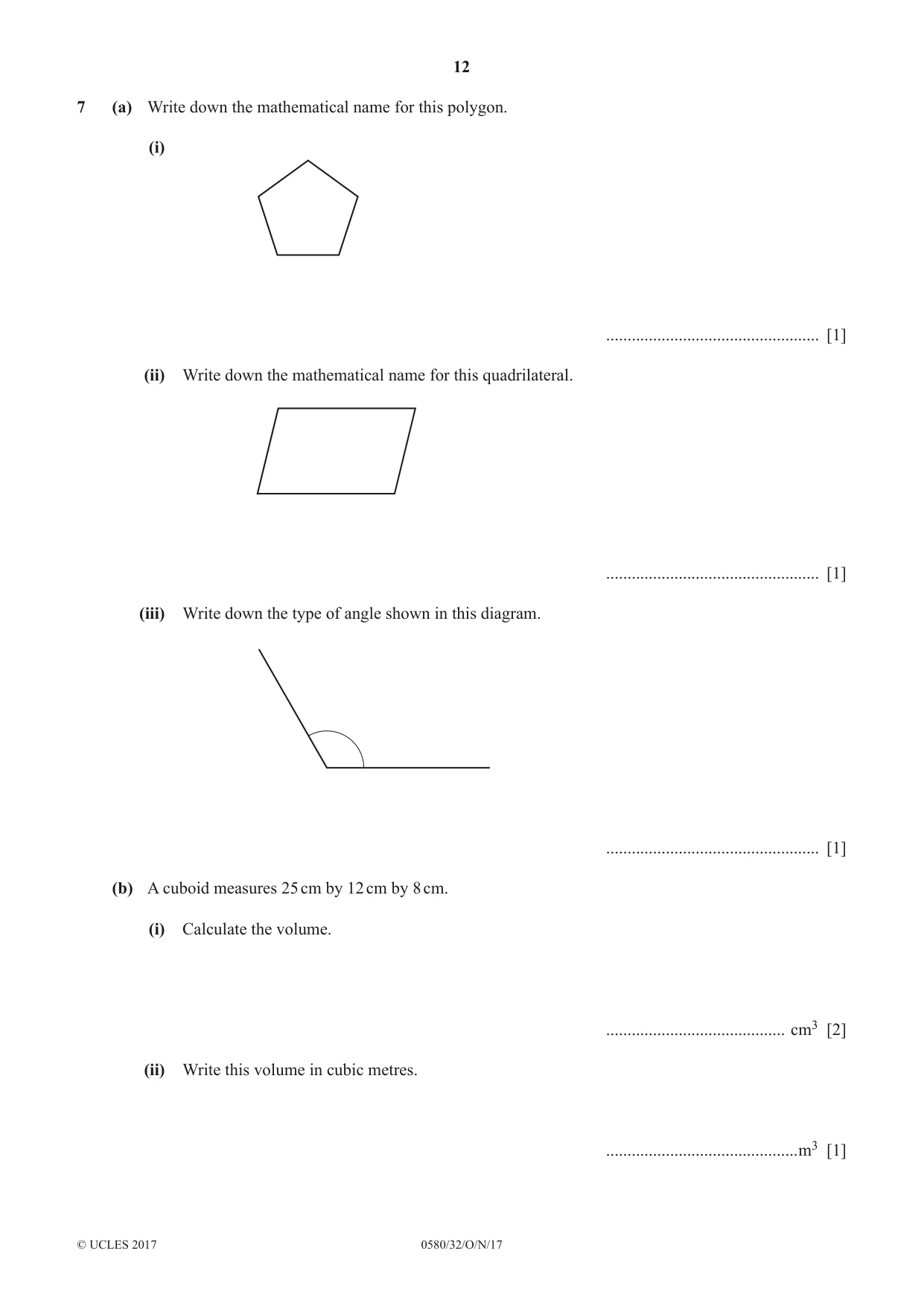
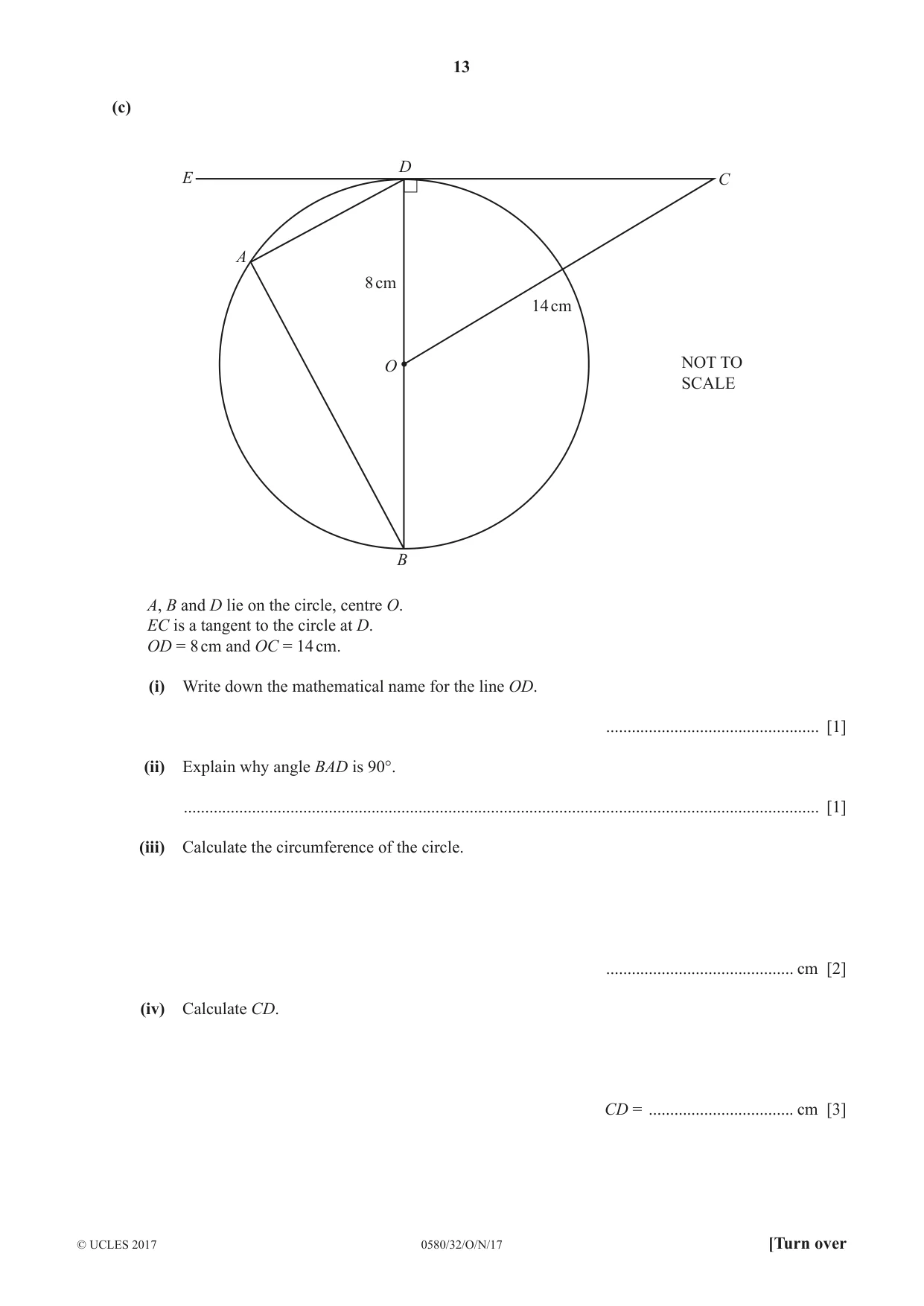
7 (a) Write down the mathematical name for this polygon. (i) .................................................. [1] (ii) Write down the mathematical name for this quadrilateral. .................................................. [1] (iii) Write down the type of angle shown in this diagram. .................................................. [1] (b) A cuboid measures 25 cm by 12 cm by 8 cm. (i) Calculate the volume. .......................................... cm3 [2] (ii) Write this volume in cubic metres. .............................................m3 [1] (c) D E C A 8 cm 14 cm O NOT TO SCALE B A, B and D lie on the circle, centre O. EC is a tangent to the circle at D. OD = 8 cm and OC = 14 cm. (i) Write down the mathematical name for the line OD. .................................................. [1] (ii) Explain why angle BAD is 90°. ..................................................................................................................................................... [1] (iii) Calculate the circumference of the circle. ............................................ cm [2] (iv) Calculate CD. CD = .................................. cm [3]
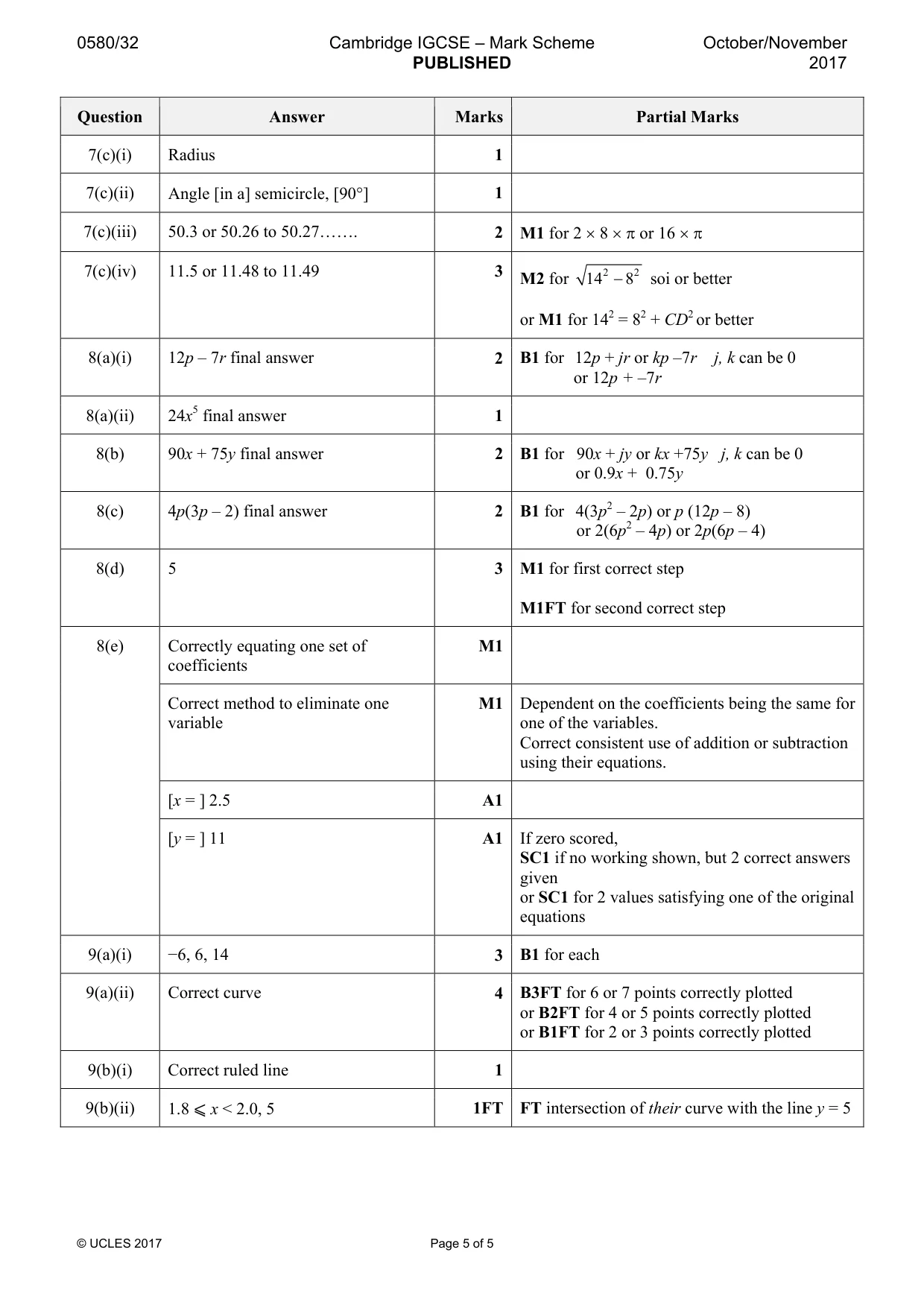
Mark scheme: 7(a)(i) Pentagon 1 7(a)(ii) Parallelogram 1 7(a)(iii) Obtuse 1 7(b)(i) 2400 2 M1 for 25 × 12 × 8 7(b)(ii) [0] .0024 1FT 7(c)(i) Radius 1 7(c)(ii) Angle [in a] semicircle, [90°] 1 7(c)(iii) 50.3 or 50.26 to 50.27……. 2 M1 for 2 × 8 × π or 16 × π 7(c)(iv) 11.5 or 11.48 to 11.49 3 2 2 M2 for 14 − 8 soi or better or M1 for 142 = 82 + CD2 or better
Question 8
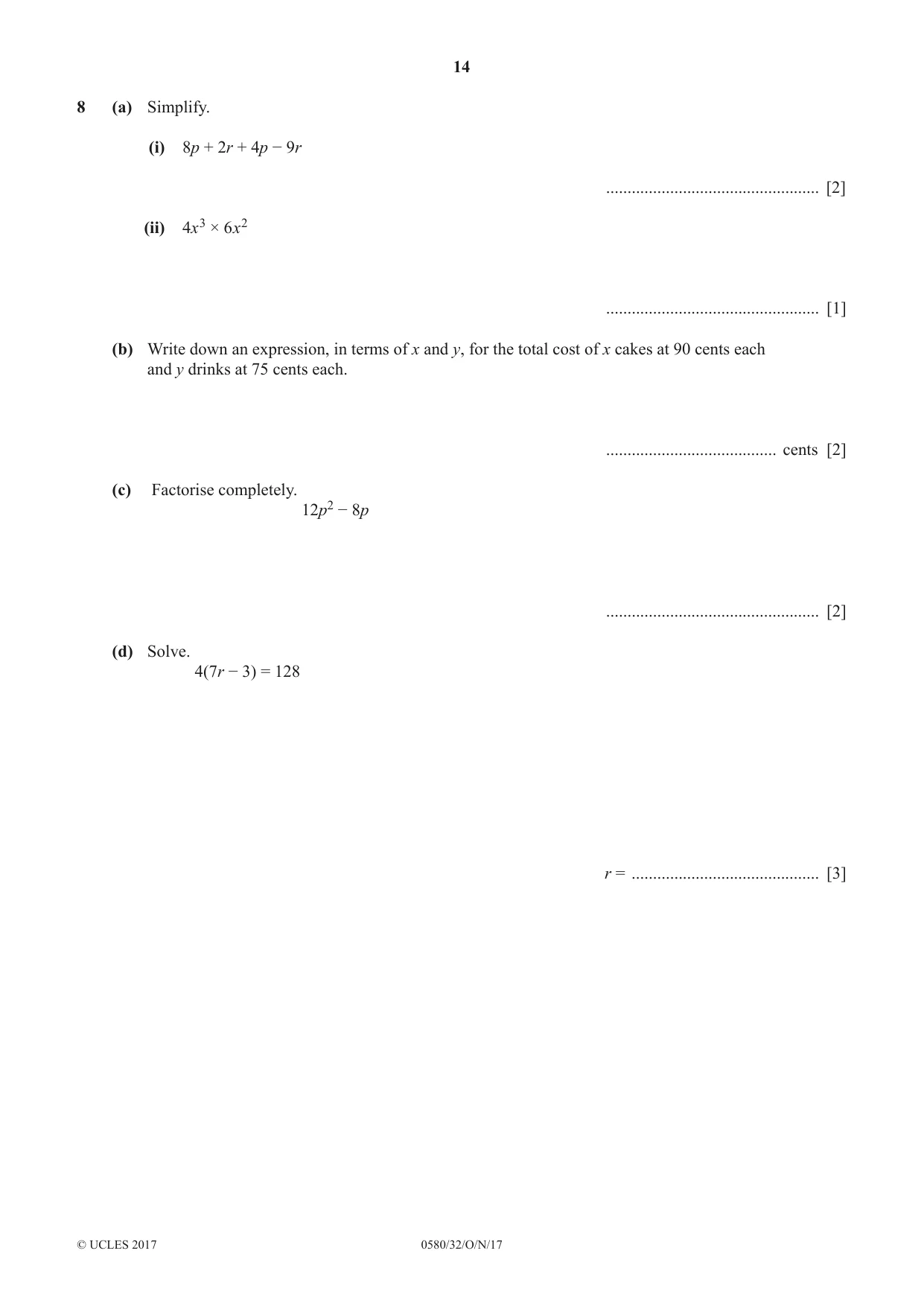
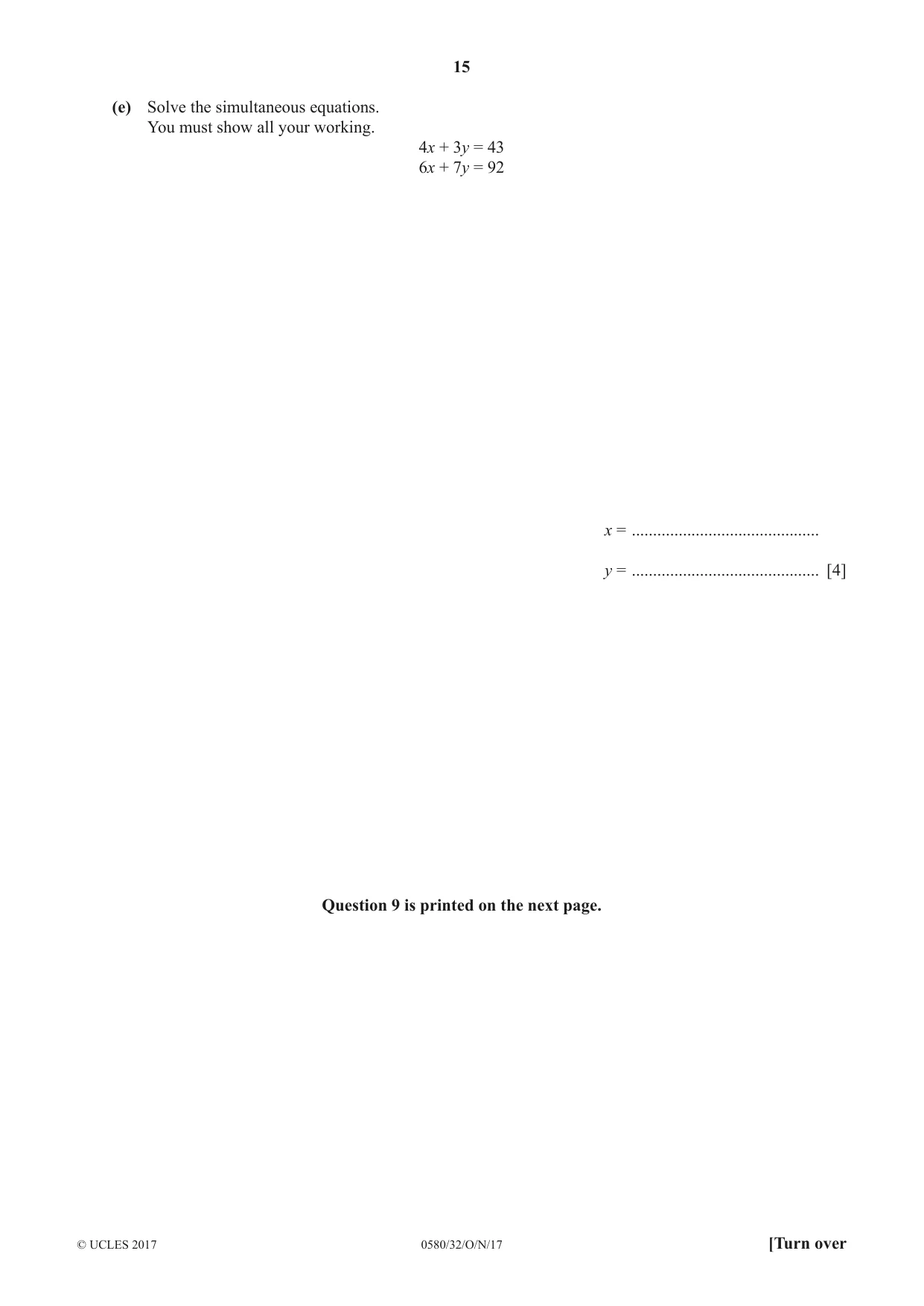
8 (a) Simplify. (i) 8p + 2r + 4p − 9r .................................................. [2] (ii) 4x3 × 6x2 .................................................. [1] (b) Write down an expression, in terms of x and y, for the total cost of x cakes at 90 cents each and y drinks at 75 cents each. ........................................ cents [2] (c) Factorise completely. 12p2 − 8p .................................................. [2] (d) Solve. 4(7r − 3) = 128 r = ............................................ [3] (e) Solve the simultaneous equations. You must show all your working. 4x + 3y = 43 6x + 7y = 92 x = ............................................ y = ............................................ [4] Question 9 is printed on the next page.
Mark scheme: 8(a)(i) 12p – 7r final answer 2 B1 for 12p + jr or kp –7r j, k can be 0 or 12p + –7r 8(a)(ii) 24x5 final answer 1 8(b) 90x + 75y final answer 2 B1 for 90x + jy or kx +75y j, k can be 0 or 0.9x + 0.75y 8(c) 4p(3p – 2) final answer 2 B1 for 4(3p2 – 2p) or p (12p – 8) or 2(6p2 – 4p) or 2p(6p – 4) 8(d) 5 3 M1 for first correct step M1FT for second correct step 8(e) Correctly equating one set of M1 coefficients Correct method to eliminate one M1 Dependent on the coefficients being the same for variable one of the variables. Correct consistent use of addition or subtraction using their equations. [x = ] 2.5 A1 [y = ] 11 A1 If zero scored, SC1 if no working shown, but 2 correct answers given or SC1 for 2 values satisfying one of the original equations
Q9 · Complete the table of values for y = x2 + 3x − 4
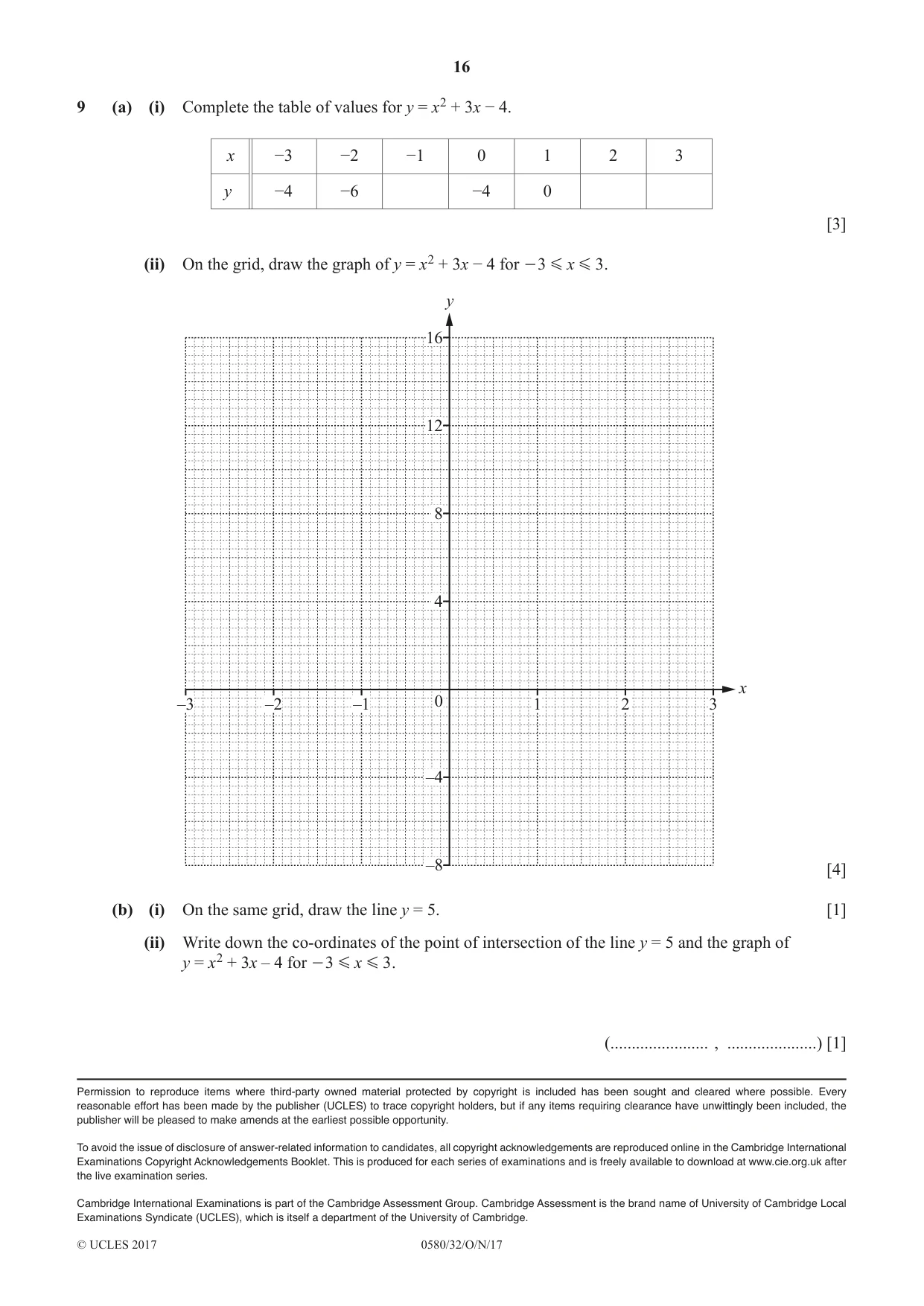
9 (a) (i) Complete the table of values for y = x2 + 3x − 4. x −3 −2 −1 0 1 2 3 y −4 −6 −4 0 [3] (ii) On the grid, draw the graph of y = x2 + 3x − 4 for - 3 G x G 3 . y 16 12 8 4 x –3 –2 –1 0 1 2 3 –4 –8 [4] (b) (i) On the same grid, draw the line y = 5. [1] (ii) Write down the co-ordinates of the point of intersection of the line y = 5 and the graph of y = x2 + 3x – 4 for - 3 G x G 3 . (....................... , .....................) [1]
Mark scheme: 9(a)(i) −6, 6, 14 3 B1 for each 9(a)(ii) Correct curve 4 B3FT for 6 or 7 points correctly plotted or B2FT for 4 or 5 points correctly plotted or B1FT for 2 or 3 points correctly plotted 9(b)(i) Correct ruled line 1 9(b)(ii) 1.8 ⩽ x < 2.0, 5 1FT FT intersection of their curve with the line y = 5
What was in this paper
The subtopics covered by these 9 questions, and how many questions each got. Open one in a new tab to see every Cambridge question on it.
What you needed in this session
Cambridge’s own grade thresholds for 2017 Oct/Nov, Paper 3 · Variant 2. A higher threshold means an easier paper — the bar moves with how the cohort did.