Cambridge IGCSE Mathematics 0580 — 2017 May/June Paper 3 · Variant 1
0580/31/M/J/17 · 9 questions · 104 marks · ≈117 min
The question paper and its mark scheme, free to read here and free to download. This is Cambridge’s own paper, exactly as it was sat.
Question paper16 pages
Mark scheme5 pages
Answers below. Sit the paper first if you are practising.
Questions as text
Q1 · Camilla joins a soccer club
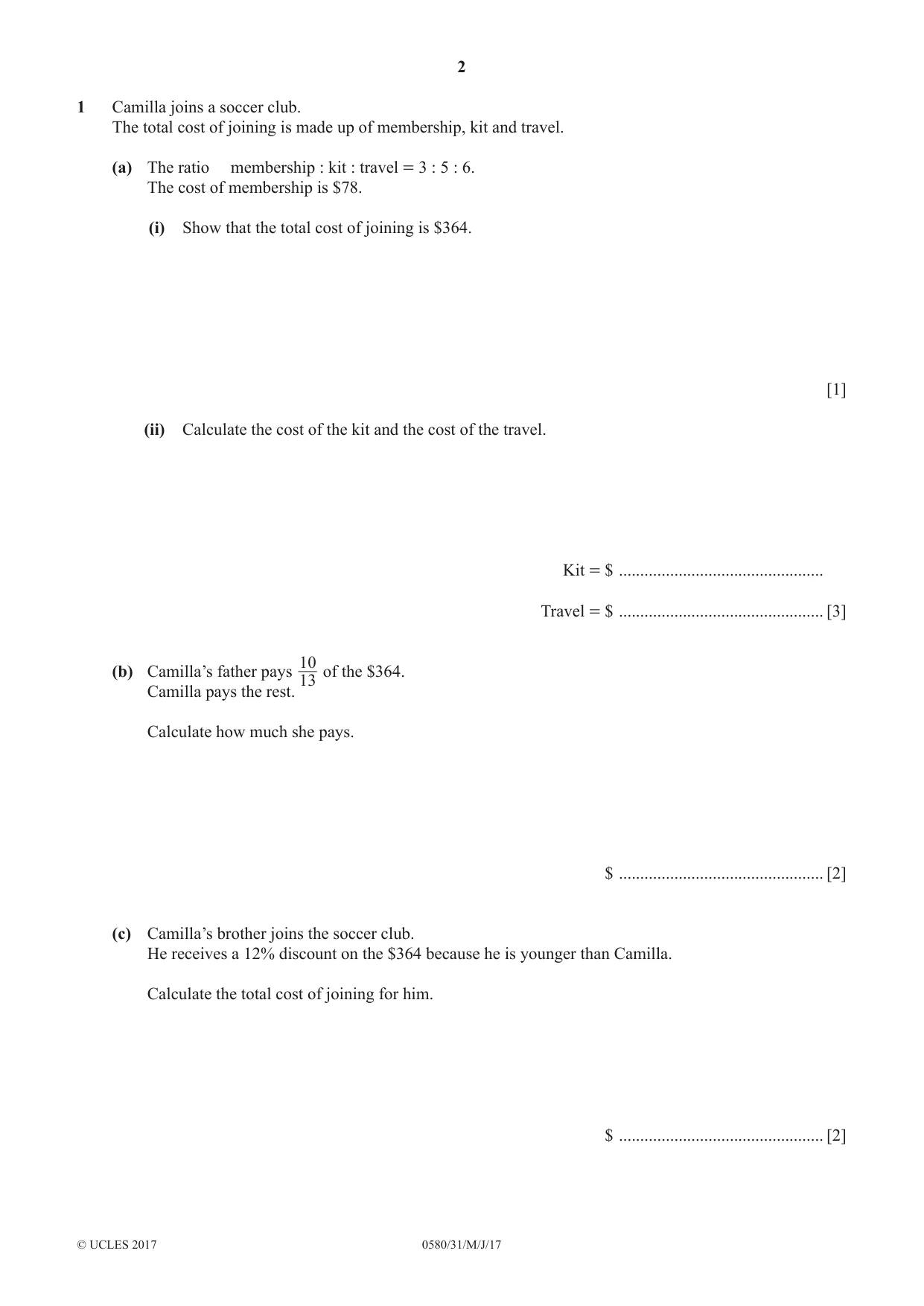
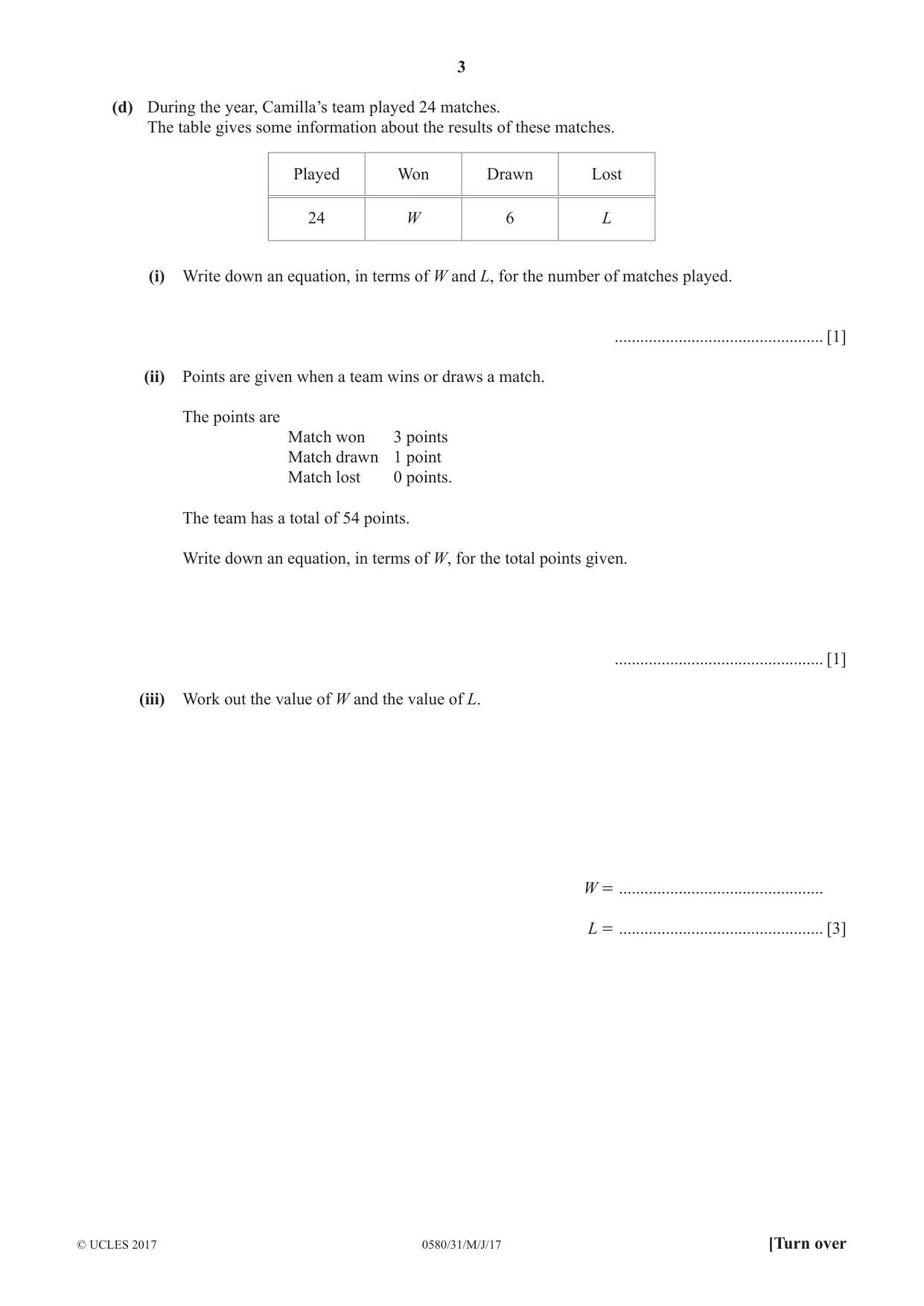
1 Camilla joins a soccer club. The total cost of joining is made up of membership, kit and travel. (a) The ratio membership : kit : travel = 3 : 5 : 6. The cost of membership is $78. (i) Show that the total cost of joining is $364. [1] (ii) Calculate the cost of the kit and the cost of the travel. Kit = $ ................................................ Travel = $ ................................................ [3] 10 (b) Camilla’s father pays of the $364. 13 Camilla pays the rest. Calculate how much she pays. $ ................................................ [2] (c) Camilla’s brother joins the soccer club. He receives a 12% discount on the $364 because he is younger than Camilla. Calculate the total cost of joining for him. $ ................................................ [2] (d) During the year, Camilla’s team played 24 matches. The table gives some information about the results of these matches. Played Won Drawn Lost 24 W 6 L (i) Write down an equation, in terms of W and L, for the number of matches played. ................................................. [1] (ii) Points are given when a team wins or draws a match. The points are Match won 3 points Match drawn 1 point Match lost 0 points. The team has a total of 54 points. Write down an equation, in terms of W, for the total points given. ................................................. [1] (iii) Work out the value of W and the value of L. W = ................................................ L = ................................................ [3]
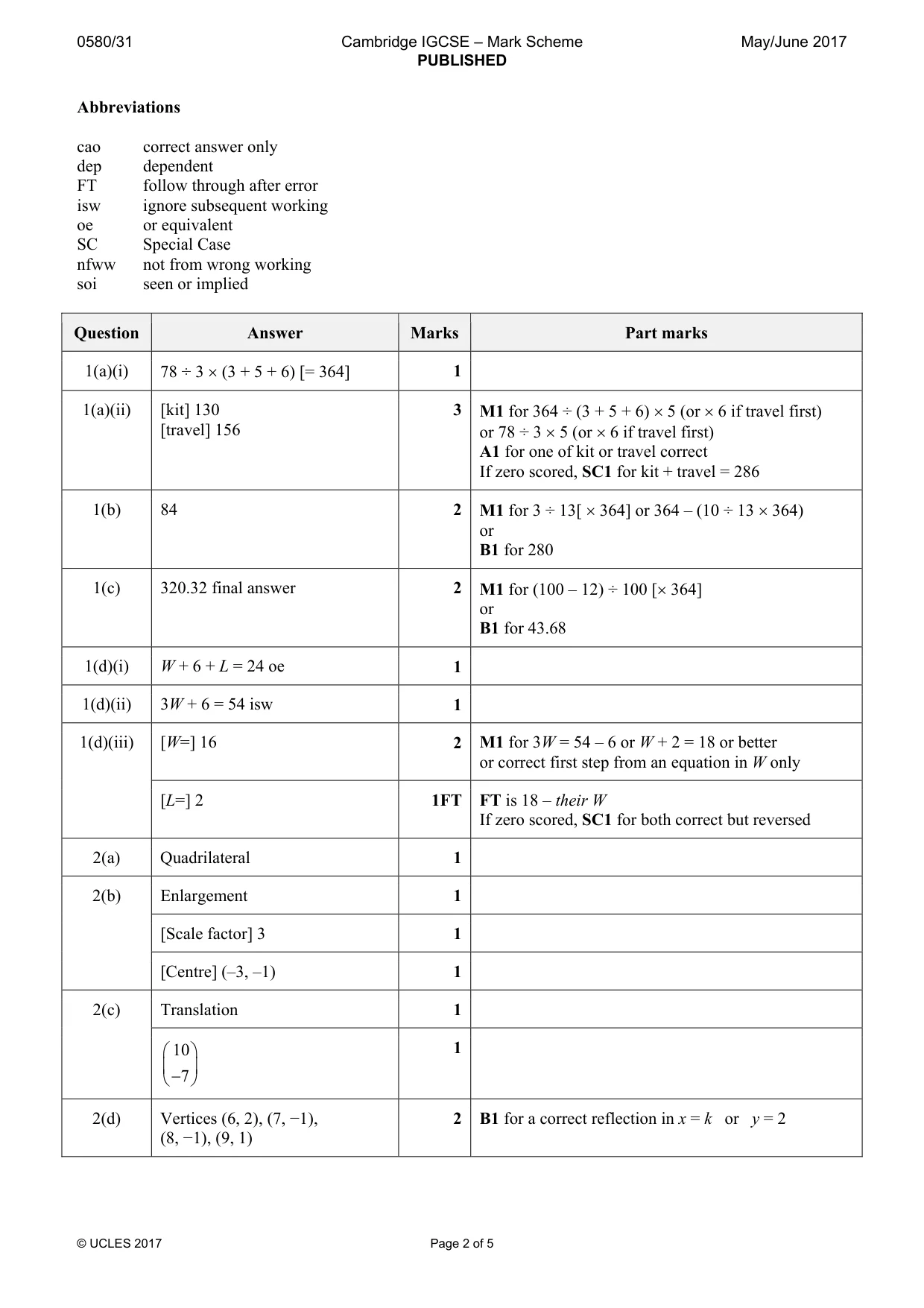
Mark scheme: Question Answer Marks Part marks 1(a)(i) 78 ÷ 3 × (3 + 5 + 6) [= 364] 1 1(a)(ii) [kit] 130 3 M1 for 364 ÷ (3 + 5 + 6) × 5 (or × 6 if travel first) [travel] 156 or 78 ÷ 3 × 5 (or × 6 if travel first) A1 for one of kit or travel correct If zero scored, SC1 for kit + travel = 286 1(b) 84 2 M1 for 3 ÷ 13[ × 364] or 364 – (10 ÷ 13 × 364) or B1 for 280 1(c) 320.32 final answer 2 M1 for (100 – 12) ÷ 100 [× 364] or B1 for 43.68 1(d)(i) W + 6 + L = 24 oe 1 1(d)(ii) 3W + 6 = 54 isw 1 1(d)(iii) [W=] 16 2 M1 for 3W = 54 – 6 or W + 2 = 18 or better or correct first step from an equation in W only [L=] 2 1FT FT is 18 – their W If zero scored, SC1 for both correct but reversed
Q2 · Y 10 8 6 4 A 2 x –10 –8 –6 –4 –2 0 2 4 6 8 10 –2 –4 –6 B –8 –10 (a) Write down the…
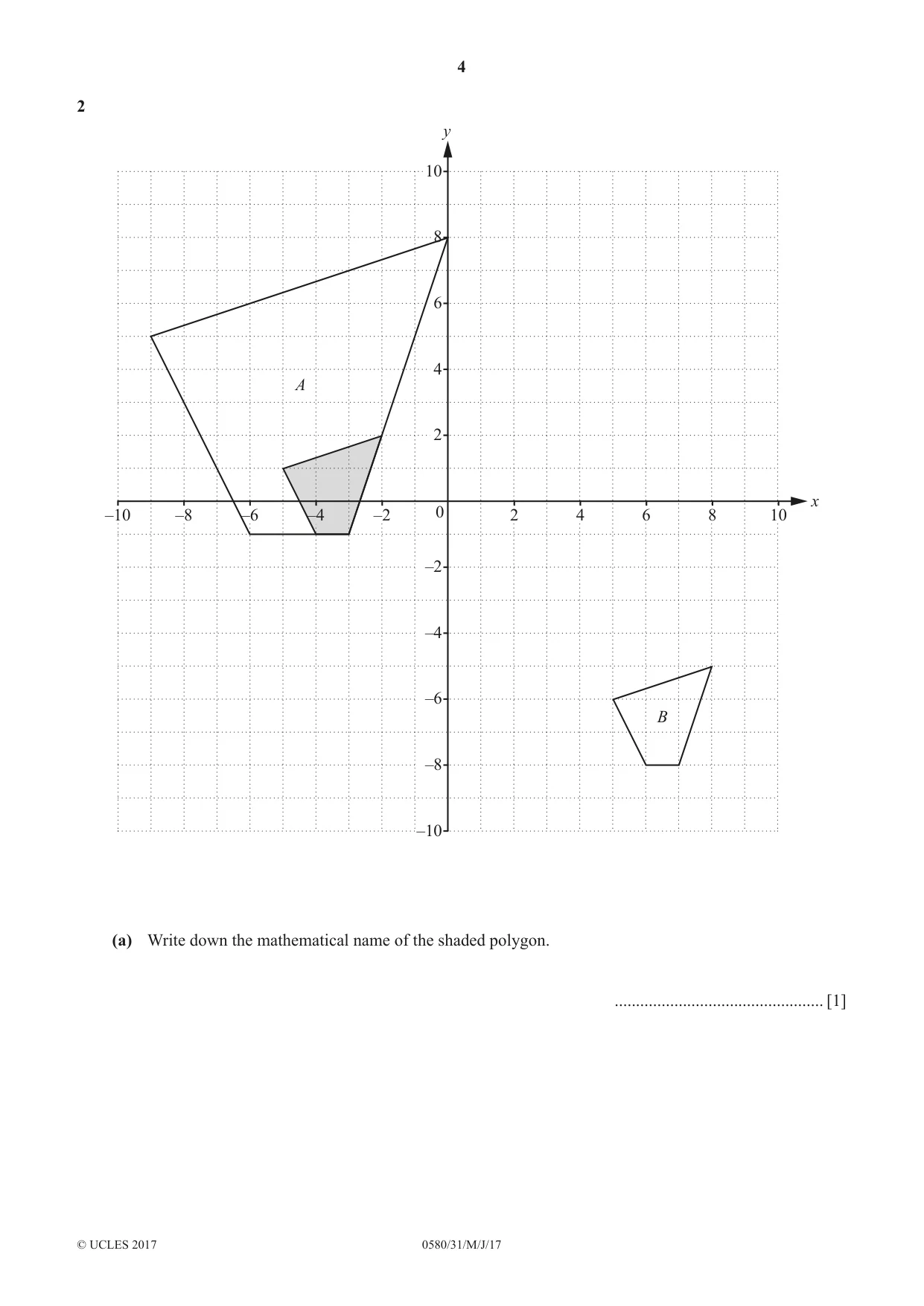
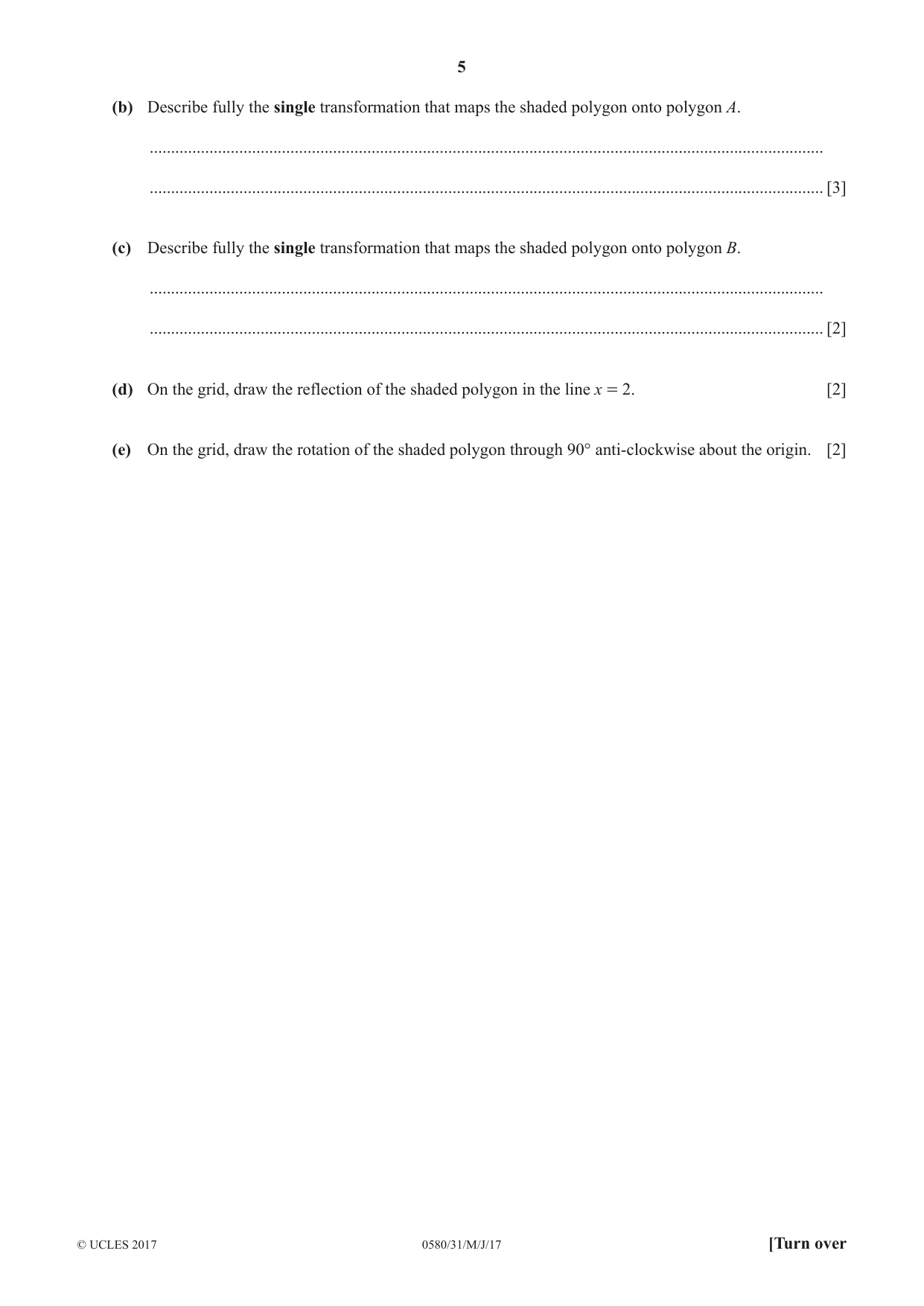
2 y 10 8 6 4 A 2 x –10 –8 –6 –4 –2 0 2 4 6 8 10 –2 –4 –6 B –8 –10 (a) Write down the mathematical name of the shaded polygon. ................................................. [1] (b) Describe fully the single transformation that maps the shaded polygon onto polygon A. .............................................................................................................................................................. .............................................................................................................................................................. [3] (c) Describe fully the single transformation that maps the shaded polygon onto polygon B. .............................................................................................................................................................. .............................................................................................................................................................. [2] (d) On the grid, draw the reflection of the shaded polygon in the line x = 2. [2] (e) On the grid, draw the rotation of the shaded polygon through 90° anti-clockwise about the origin. [2]
Mark scheme: 2(a) Quadrilateral 1 2(b) Enlargement 1 [Scale factor] 3 1 [Centre] (–3, –1) 1 2(c) Translation 1 10 1 −7 2(d) Vertices (6, 2), (7, −1), 2 B1 for a correct reflection in x = k or y = 2 (8, −1), (9, 1) 2(e) Vertices (−2, −2), (1, −3), 2 B1 for a ‘correct’ 90° clockwise rotation about the (1, −4), (−1, −5) origin If zero scored, SC1 for correct size and orientation but wrong position
Q3 · Francis asks 30 families how many children they have
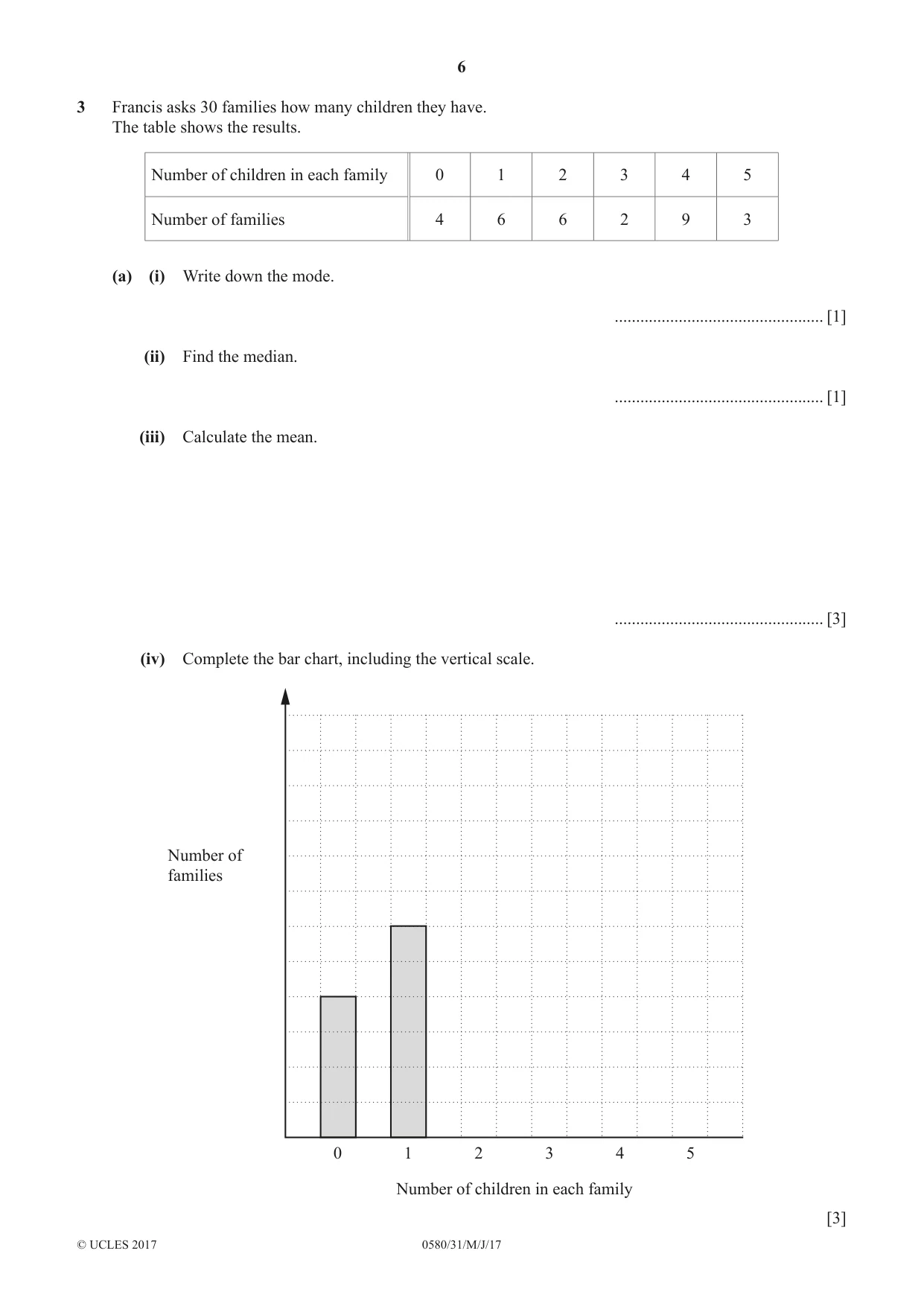
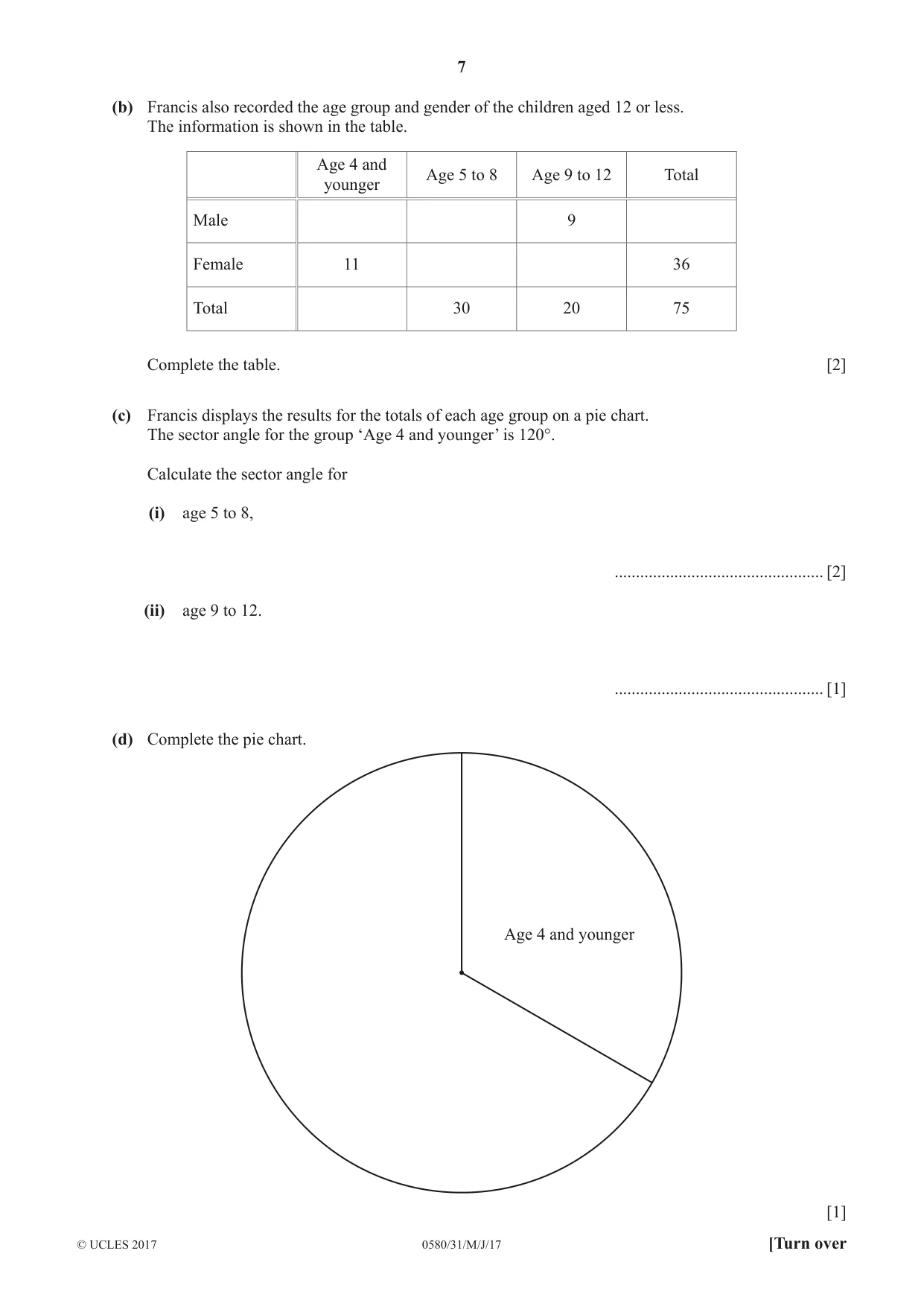
3 Francis asks 30 families how many children they have. The table shows the results. Number of children in each family 0 1 2 3 4 5 Number of families 4 6 6 2 9 3 (a) (i) Write down the mode. ................................................. [1] (ii) Find the median. ................................................. [1] (iii) Calculate the mean. ................................................. [3] (iv) Complete the bar chart, including the vertical scale. Number of families 0 1 2 3 4 5 Number of children in each family [3] (b) Francis also recorded the age group and gender of the children aged 12 or less. The information is shown in the table. Age 4 and Age 5 to 8 Age 9 to 12 Total younger Male 9 Female 11 36 Total 30 20 75 Complete the table. [2] (c) Francis displays the results for the totals of each age group on a pie chart. The sector angle for the group ‘Age 4 and younger’ is 120°. Calculate the sector angle for (i) age 5 to 8, ................................................. [2] (ii) age 9 to 12. ................................................. [1] (d) Complete the pie chart. Age 4 and younger [1]
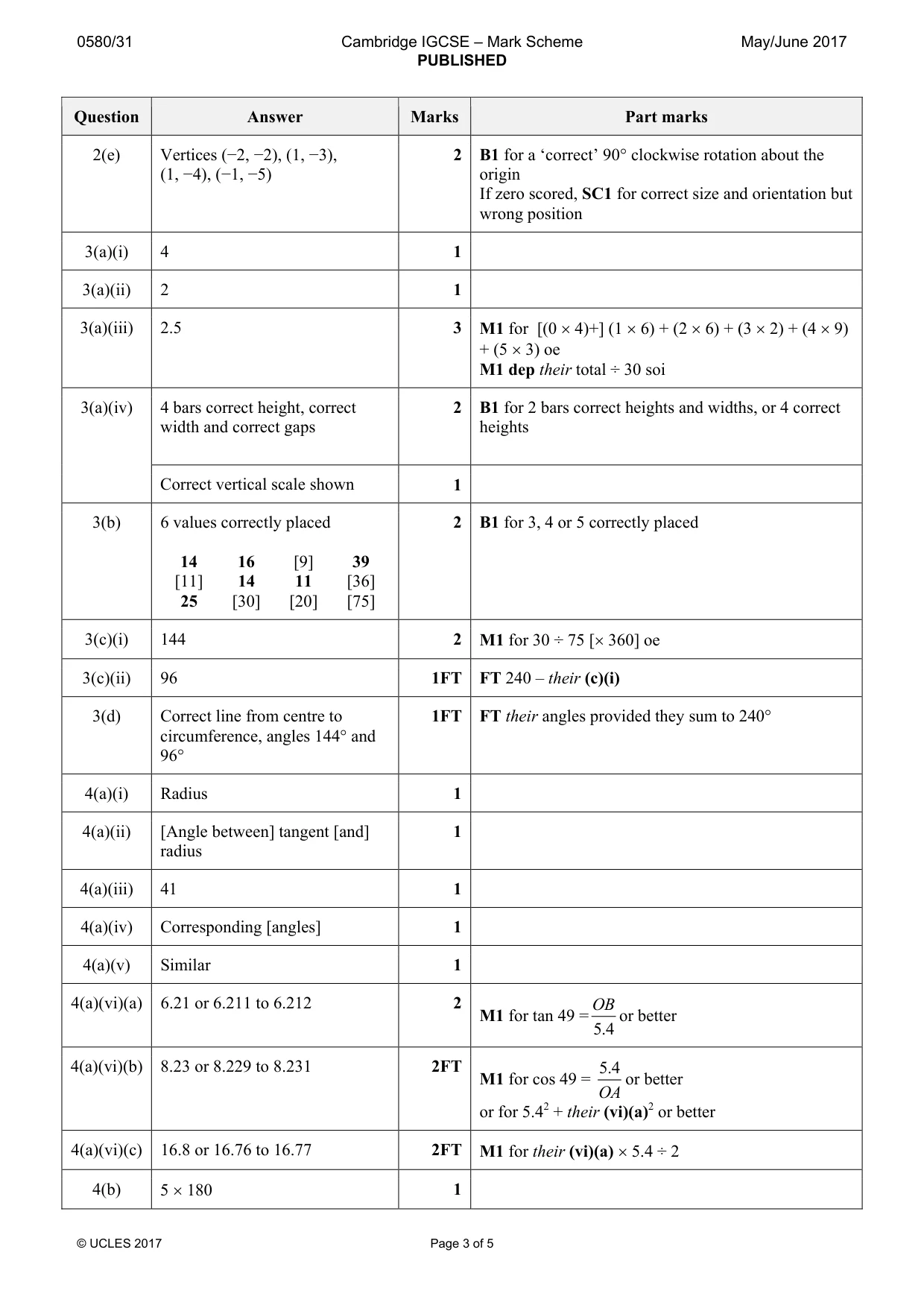
Mark scheme: 3(a)(i) 4 1 3(a)(ii) 2 1 3(a)(iii) 2.5 3 M1 for [(0 × 4)+] (1 × 6) + (2 × 6) + (3 × 2) + (4 × 9) + (5 × 3) oe M1 dep their total ÷ 30 soi 3(a)(iv) 4 bars correct height, correct 2 B1 for 2 bars correct heights and widths, or 4 correct width and correct gaps heights Correct vertical scale shown 1 3(b) 6 values correctly placed 2 B1 for 3, 4 or 5 correctly placed 14 16 [9] 39 [11] 14 11 [36] 25 [30] [20] [75] 3(c)(i) 144 2 M1 for 30 ÷ 75 [× 360] oe 3(c)(ii) 96 1FT FT 240 – their (c)(i) 3(d) Correct line from centre to 1FT FT their angles provided they sum to 240° circumference, angles 144° and 96°
Q4 · NOT TO SCALE D O A 49° 5.4 cm B C The diagram shows a circle, centre O, with points B and…
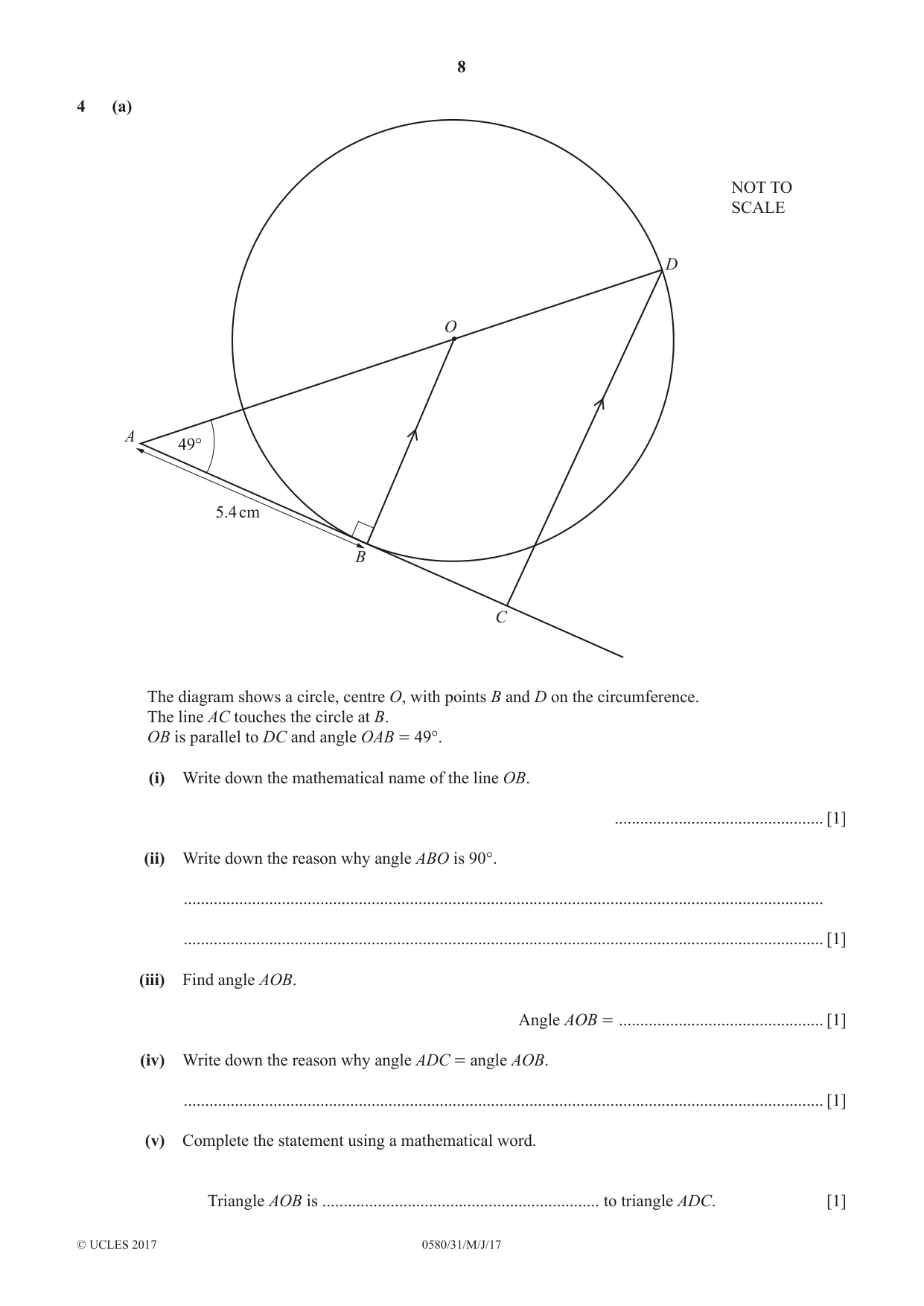
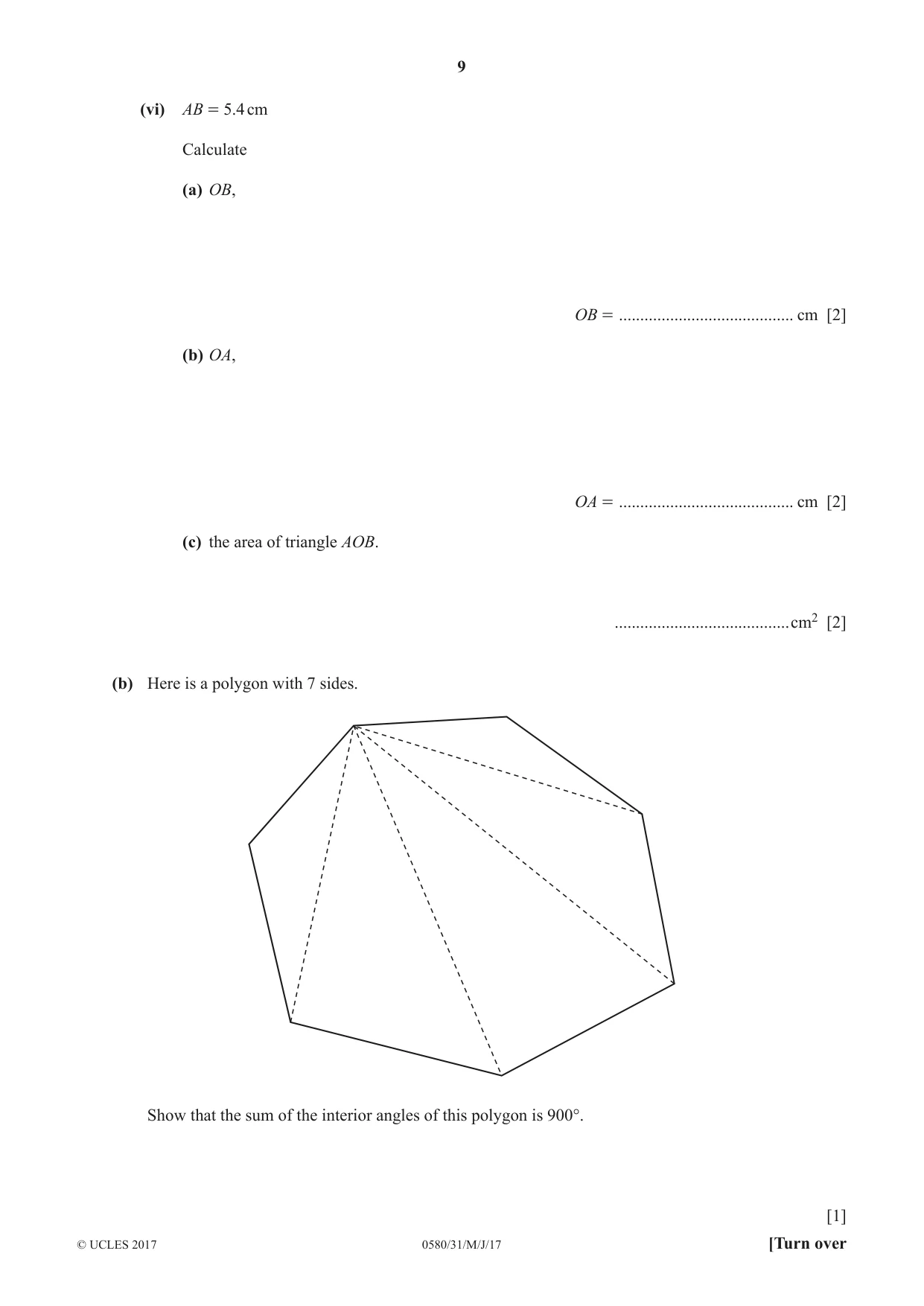
4 (a) NOT TO SCALE D O A 49° 5.4 cm B C The diagram shows a circle, centre O, with points B and D on the circumference. The line AC touches the circle at B. OB is parallel to DC and angle OAB = 49°. (i) Write down the mathematical name of the line OB. ................................................. [1] (ii) Write down the reason why angle ABO is 90°. ...................................................................................................................................................... ...................................................................................................................................................... [1] (iii) Find angle AOB. Angle AOB = ................................................ [1] (iv) Write down the reason why angle ADC = angle AOB. ...................................................................................................................................................... [1] (v) Complete the statement using a mathematical word. Triangle AOB is ................................................................. to triangle ADC. [1] (vi) AB = 5.4 cm Calculate (a) OB, OB = ......................................... cm [2] (b) OA, OA = ......................................... cm [2] (c) the area of triangle AOB. .........................................cm2 [2] (b) Here is a polygon with 7 sides. Show that the sum of the interior angles of this polygon is 900°. [1]
Mark scheme: 4(a)(i) Radius 1 4(a)(ii) [Angle between] tangent [and] 1 radius 4(a)(iii) 41 1 4(a)(iv) Corresponding [angles] 1 4(a)(v) Similar 1 4(a)(vi)(a) 6.21 or 6.211 to 6.212 2 OB M1 for tan 49 = or better 5.4 4(a)(vi)(b) 8.23 or 8.229 to 8.231 2FT 5.4 M1 for cos 49 = or better OA or for 5.42 + their (vi)(a)2 or better 4(a)(vi)(c) 16.8 or 16.76 to 16.77 2FT M1 for their (vi)(a) × 5.4 ÷ 2 4(b) 5 × 180 1
Q5 · Complete the table of values for y = x 2 + 2x - 1
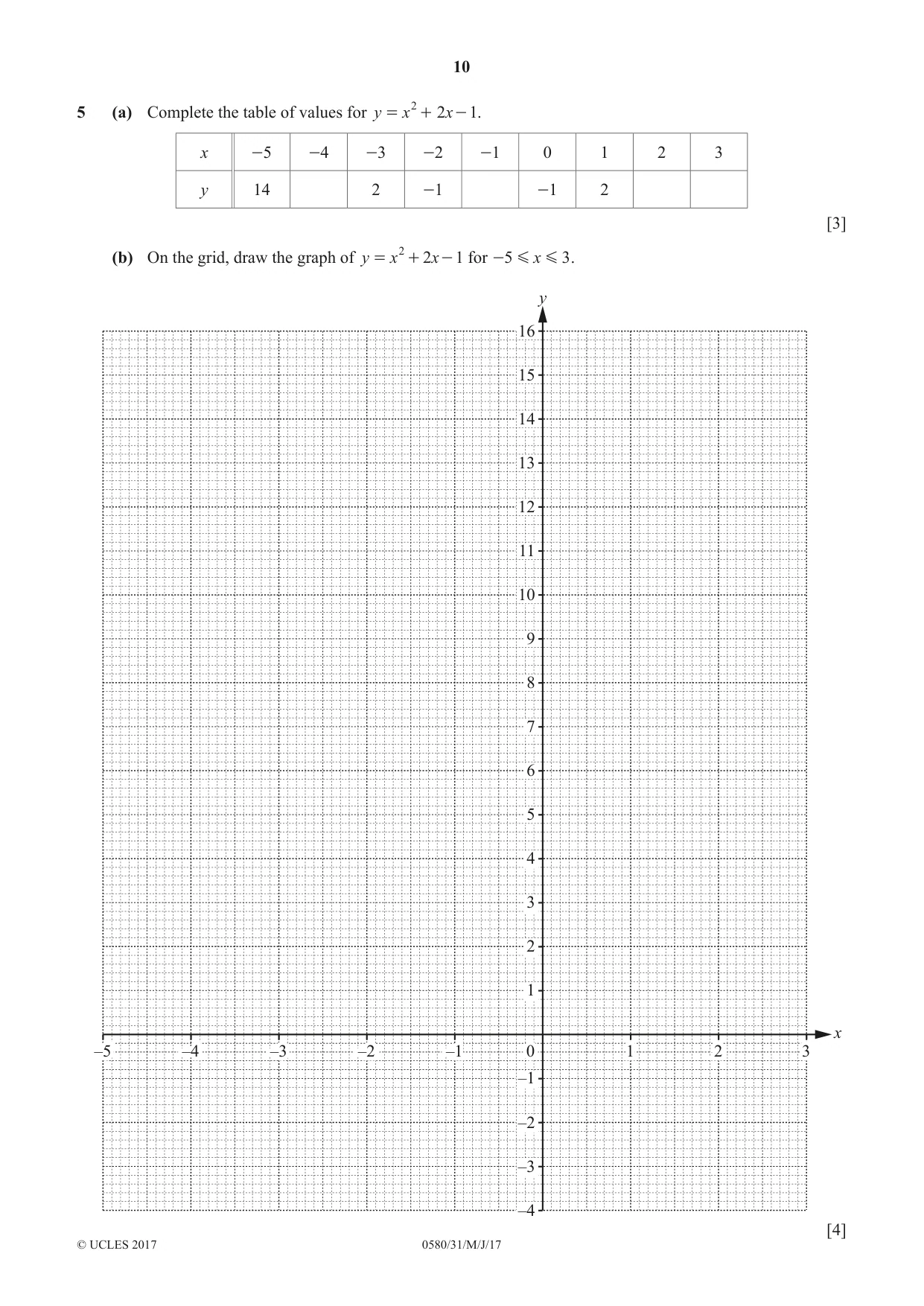
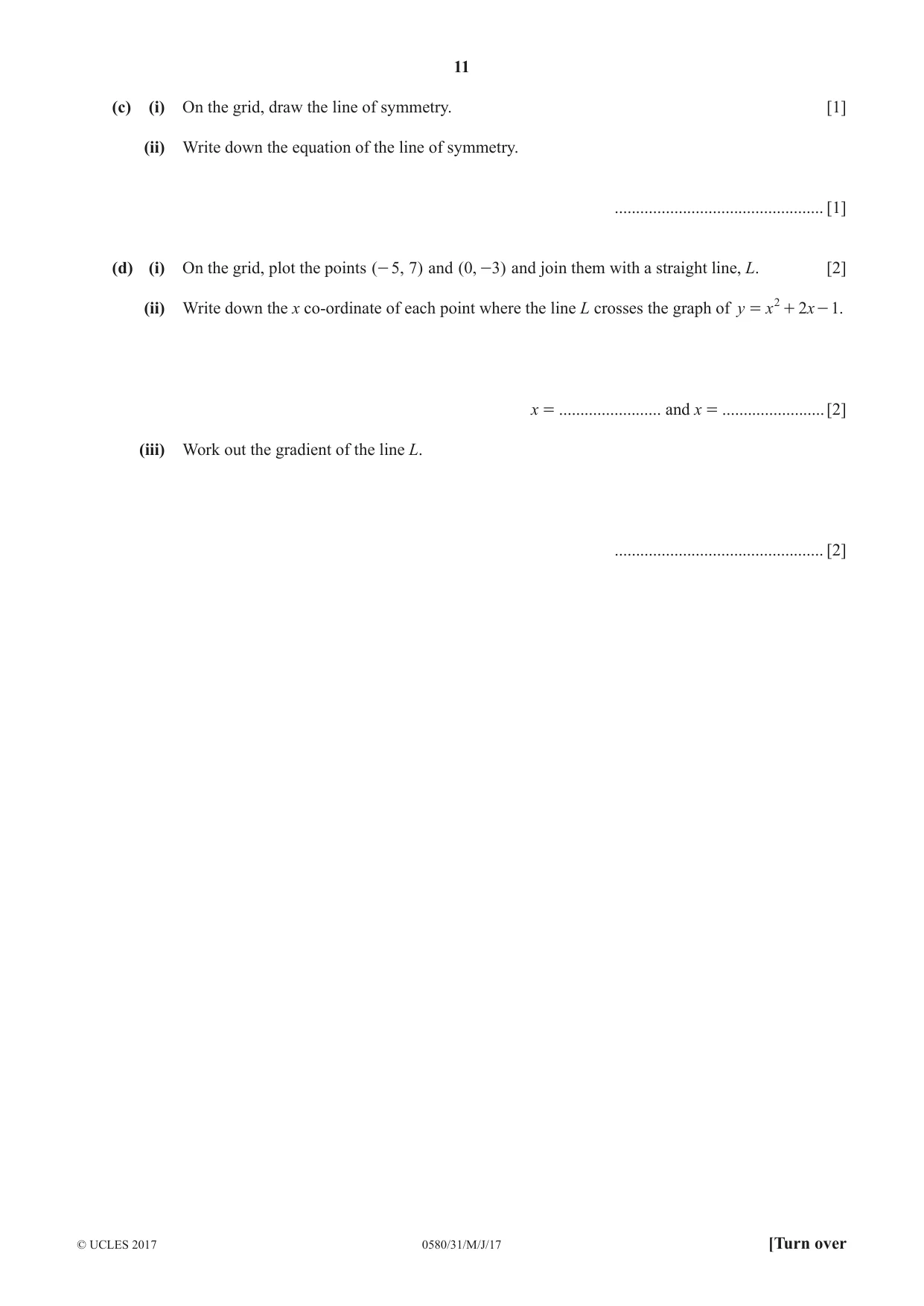
5 (a) Complete the table of values for y = x 2 + 2x - 1. x -5 -4 -3 -2 -1 0 1 2 3 y 14 2 -1 -1 2 [3] (b) On the grid, draw the graph of y = x 2 + 2x - 1 for -5 G x G 3 . y 16 15 14 13 12 11 10 9 8 7 6 5 4 3 2 1 x –5–5 –4–4 –3–3 –2–2 –1–1 00 11 22 33 –1 –2 –3 –4 (c) (i) On the grid, draw the line of symmetry. [1] (ii) Write down the equation of the line of symmetry. ................................................. [1] (d) (i) On the grid, plot the points (- 5 , 7) and (0, - 3) and join them with a straight line, L. [2] (ii) Write down the x co-ordinate of each point where the line L crosses the graph of y = x 2 + 2x - 1. x = ........................ and x = ........................ [2] (iii) Work out the gradient of the line L. ................................................. [2]
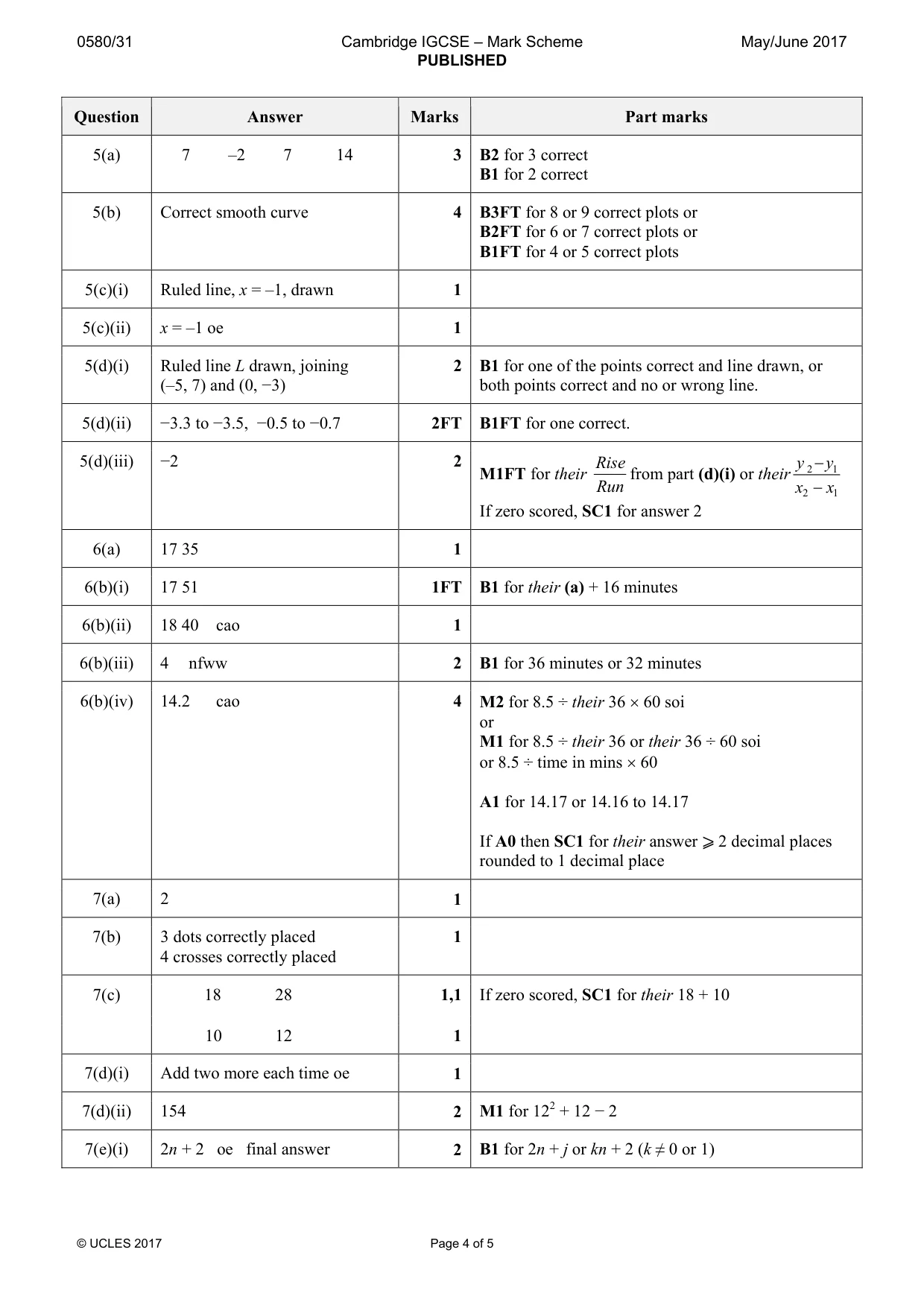
Mark scheme: 5(a) 7 –2 7 14 3 B2 for 3 correct B1 for 2 correct 5(b) Correct smooth curve 4 B3FT for 8 or 9 correct plots or B2FT for 6 or 7 correct plots or B1FT for 4 or 5 correct plots 5(c)(i) Ruled line, x = –1, drawn 1 5(c)(ii) x = –1 oe 1 5(d)(i) Ruled line L drawn, joining 2 B1 for one of the points correct and line drawn, or (–5, 7) and (0, −3) both points correct and no or wrong line. 5(d)(ii) −3.3 to −3.5, −0.5 to −0.7 2FT B1FT for one correct. 5(d)(iii) −2 2 Rise y 2 − y1 M1FT for their from part (d)(i) or their Run x2 − x1 If zero scored, SC1 for answer 2
Q6 · Eduardo goes to the Theatre
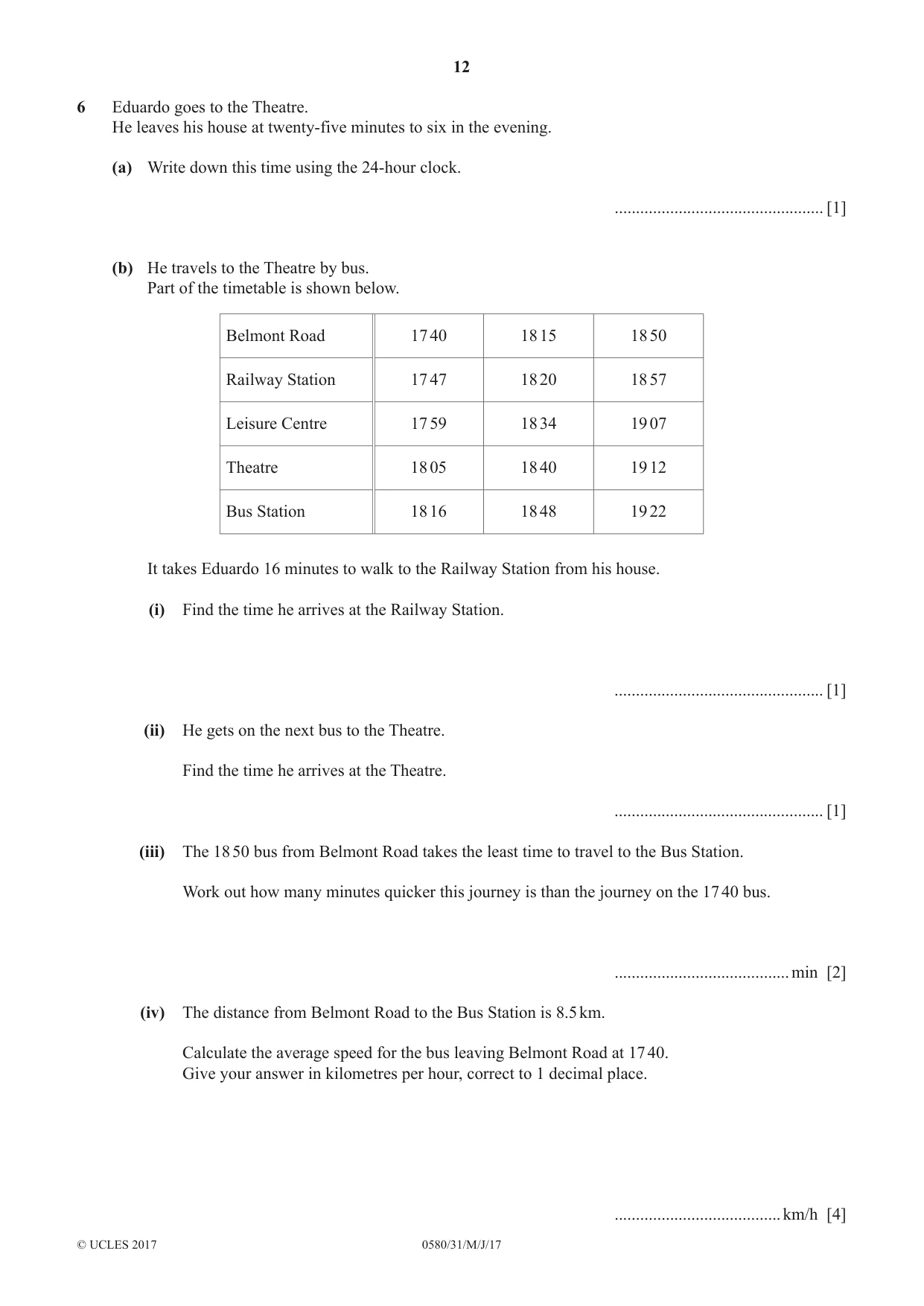
6 Eduardo goes to the Theatre. He leaves his house at twenty-five minutes to six in the evening. (a) Write down this time using the 24-hour clock. ................................................. [1] (b) He travels to the Theatre by bus. Part of the timetable is shown below. Belmont Road 17 40 18 15 18 50 Railway Station 17 47 18 20 18 57 Leisure Centre 17 59 18 34 19 07 Theatre 18 05 18 40 19 12 Bus Station 18 16 18 48 19 22 It takes Eduardo 16 minutes to walk to the Railway Station from his house. (i) Find the time he arrives at the Railway Station. ................................................. [1] (ii) He gets on the next bus to the Theatre. Find the time he arrives at the Theatre. ................................................. [1] (iii) The 18 50 bus from Belmont Road takes the least time to travel to the Bus Station. Work out how many minutes quicker this journey is than the journey on the 17 40 bus. .........................................min [2] (iv) The distance from Belmont Road to the Bus Station is 8.5 km. Calculate the average speed for the bus leaving Belmont Road at 17 40. Give your answer in kilometres per hour, correct to 1 decimal place. .......................................km/h [4]
Mark scheme: 6(a) 17 35 1 6(b)(i) 17 51 1FT B1 for their (a) + 16 minutes 6(b)(ii) 18 40 cao 1 6(b)(iii) 4 nfww 2 B1 for 36 minutes or 32 minutes 6(b)(iv) 14.2 cao 4 M2 for 8.5 ÷ their 36 × 60 soi or M1 for 8.5 ÷ their 36 or their 36 ÷ 60 soi or 8.5 ÷ time in mins × 60 A1 for 14.17 or 14.16 to 14.17 If A0 then SC1 for their answer ⩾ 2 decimal places rounded to 1 decimal place
Q7 · Here is a sequence of diagrams made using identical rectangles
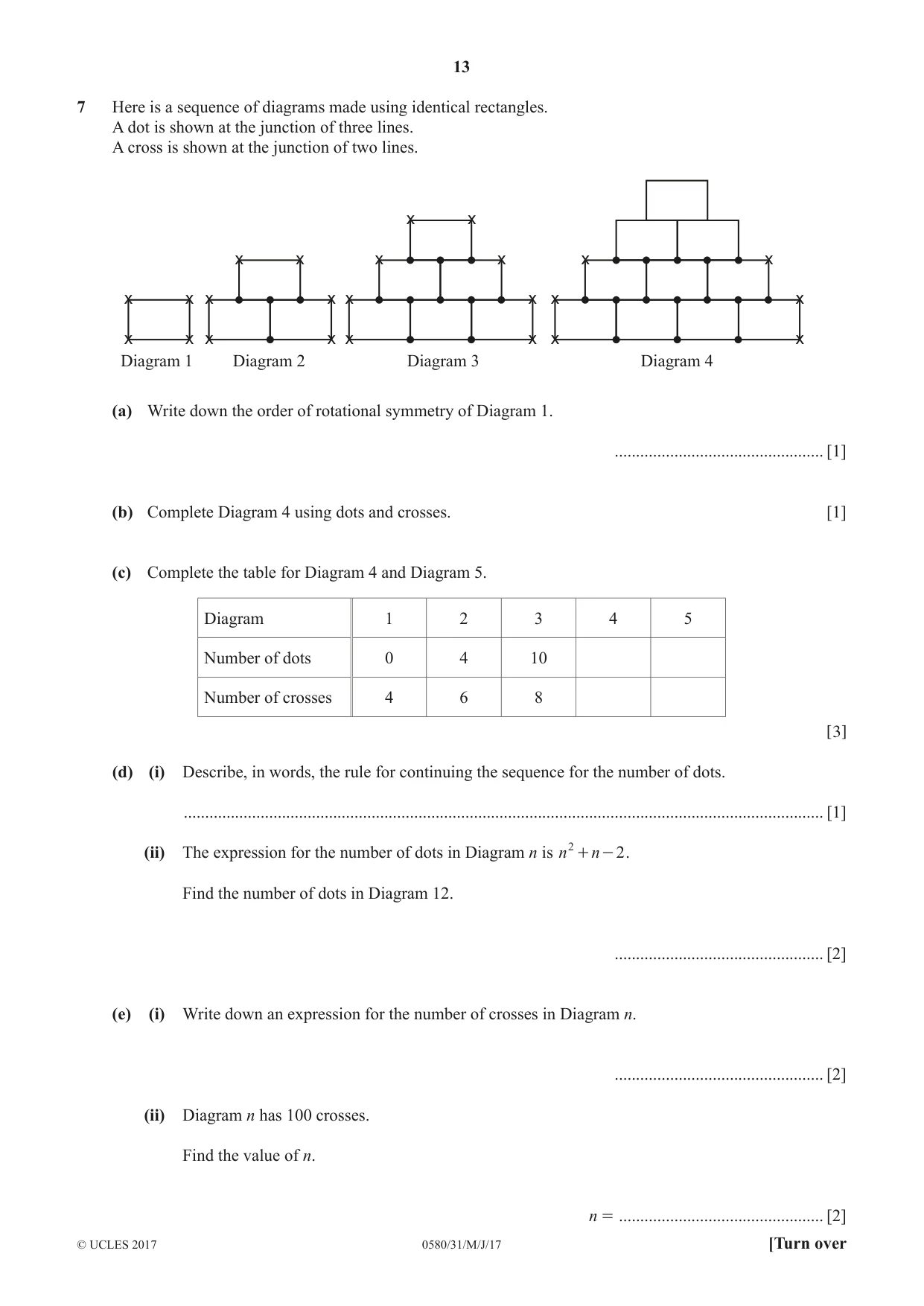
7 Here is a sequence of diagrams made using identical rectangles. A dot is shown at the junction of three lines. A cross is shown at the junction of two lines. x x x x x x x x x x x x x x x x x x x x x x x x Diagram 1 Diagram 2 Diagram 3 Diagram 4 (a) Write down the order of rotational symmetry of Diagram 1. ................................................. [1] (b) Complete Diagram 4 using dots and crosses. [1] (c) Complete the table for Diagram 4 and Diagram 5. Diagram 1 2 3 4 5 Number of dots 0 4 10 Number of crosses 4 6 8 [3] (d) (i) Describe, in words, the rule for continuing the sequence for the number of dots. ...................................................................................................................................................... [1] (ii) The expression for the number of dots in Diagram n is n 2 + n - 2 . Find the number of dots in Diagram 12. ................................................. [2] (e) (i) Write down an expression for the number of crosses in Diagram n. ................................................. [2] (ii) Diagram n has 100 crosses. Find the value of n. n = ................................................ [2]
Mark scheme: 7(a) 2 1 7(b) 3 dots correctly placed 1 4 crosses correctly placed 7(c) 18 28 1,1 If zero scored, SC1 for their 18 + 10 10 12 1 7(d)(i) Add two more each time oe 1 7(d)(ii) 154 2 M1 for 122 + 12 − 2 7(e)(i) 2n + 2 oe final answer 2 B1 for 2n + j or kn + 2 (k ≠ 0 or 1) 7(e)(ii) 49 2 M1 for their (e)(i) = 100 provided (e)(i) is algebraic soi
Q8 · The scale drawing shows the positions of Bogota (B) and Quito (Q)
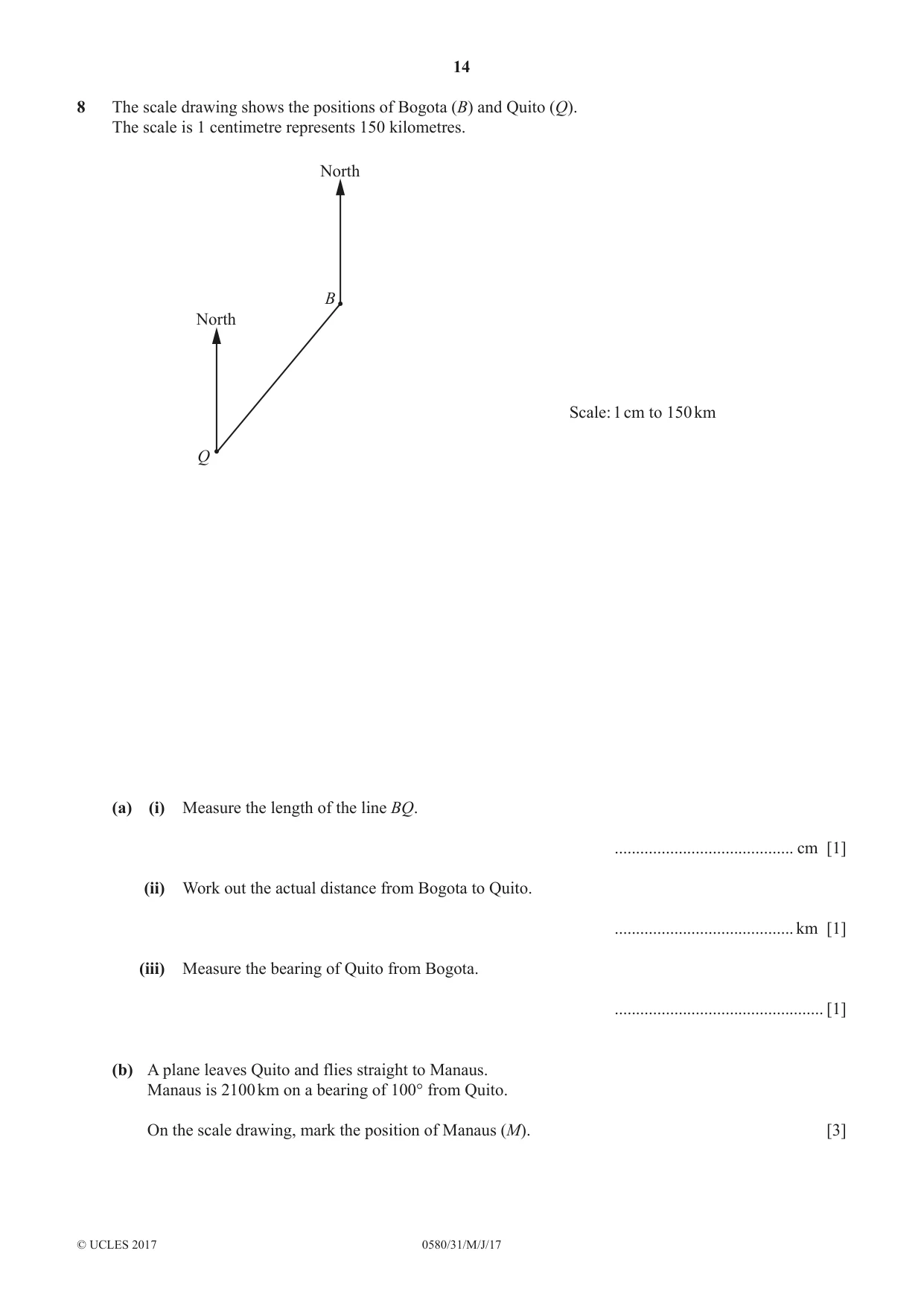
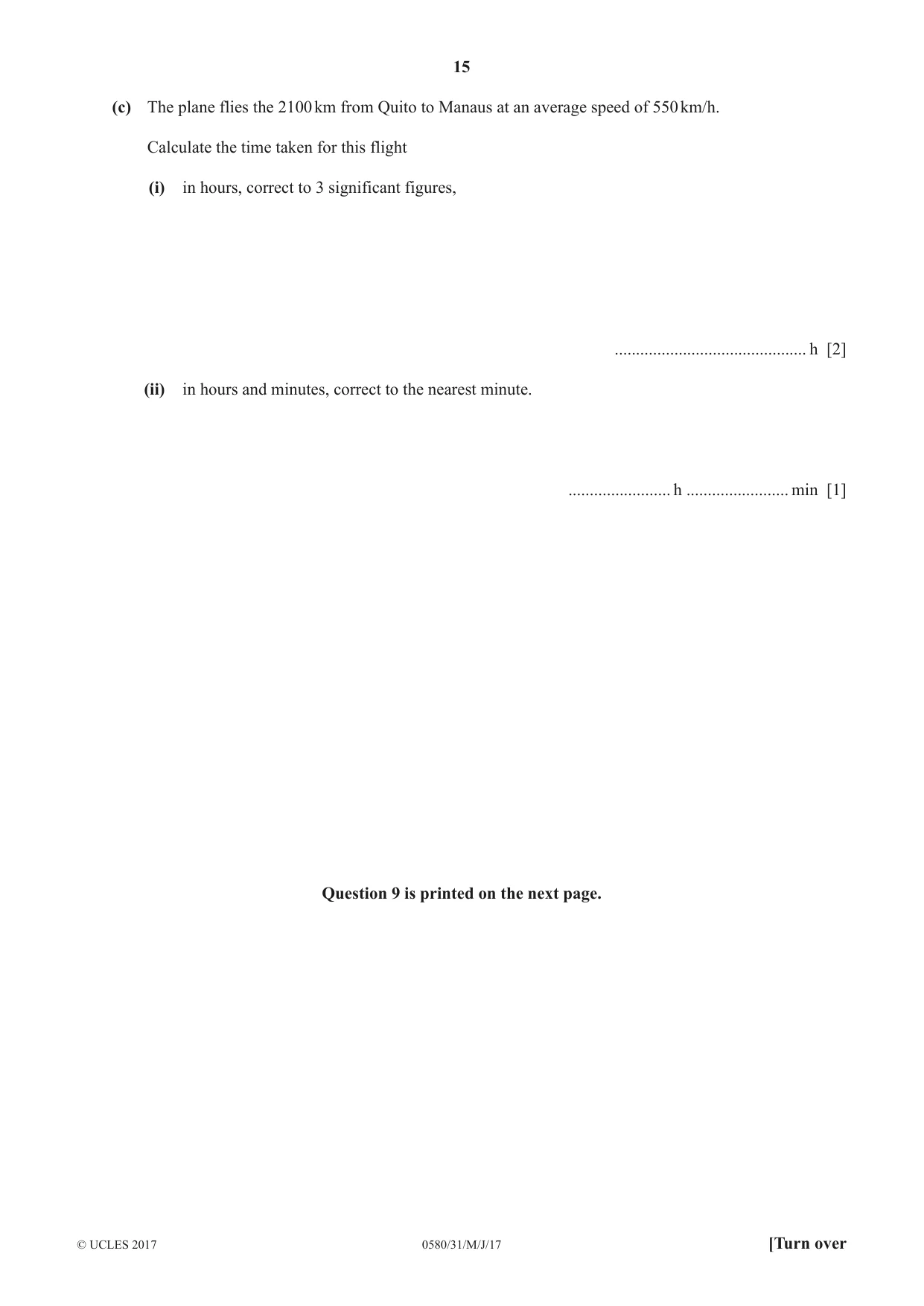
8 The scale drawing shows the positions of Bogota (B) and Quito (Q). The scale is 1 centimetre represents 150 kilometres. North B North Scale: 1 cm to 150 km Q (a) (i) Measure the length of the line BQ. .......................................... cm [1] (ii) Work out the actual distance from Bogota to Quito. .......................................... km [1] (iii) Measure the bearing of Quito from Bogota. ................................................. [1] (b) A plane leaves Quito and flies straight to Manaus. Manaus is 2100 km on a bearing of 100° from Quito. On the scale drawing, mark the position of Manaus (M). [3] (c) The plane flies the 2100 km from Quito to Manaus at an average speed of 550 km/h. Calculate the time taken for this flight (i) in hours, correct to 3 significant figures, ............................................. h [2] (ii) in hours and minutes, correct to the nearest minute. ........................ h ........................ min [1] Question 9 is printed on the next page.
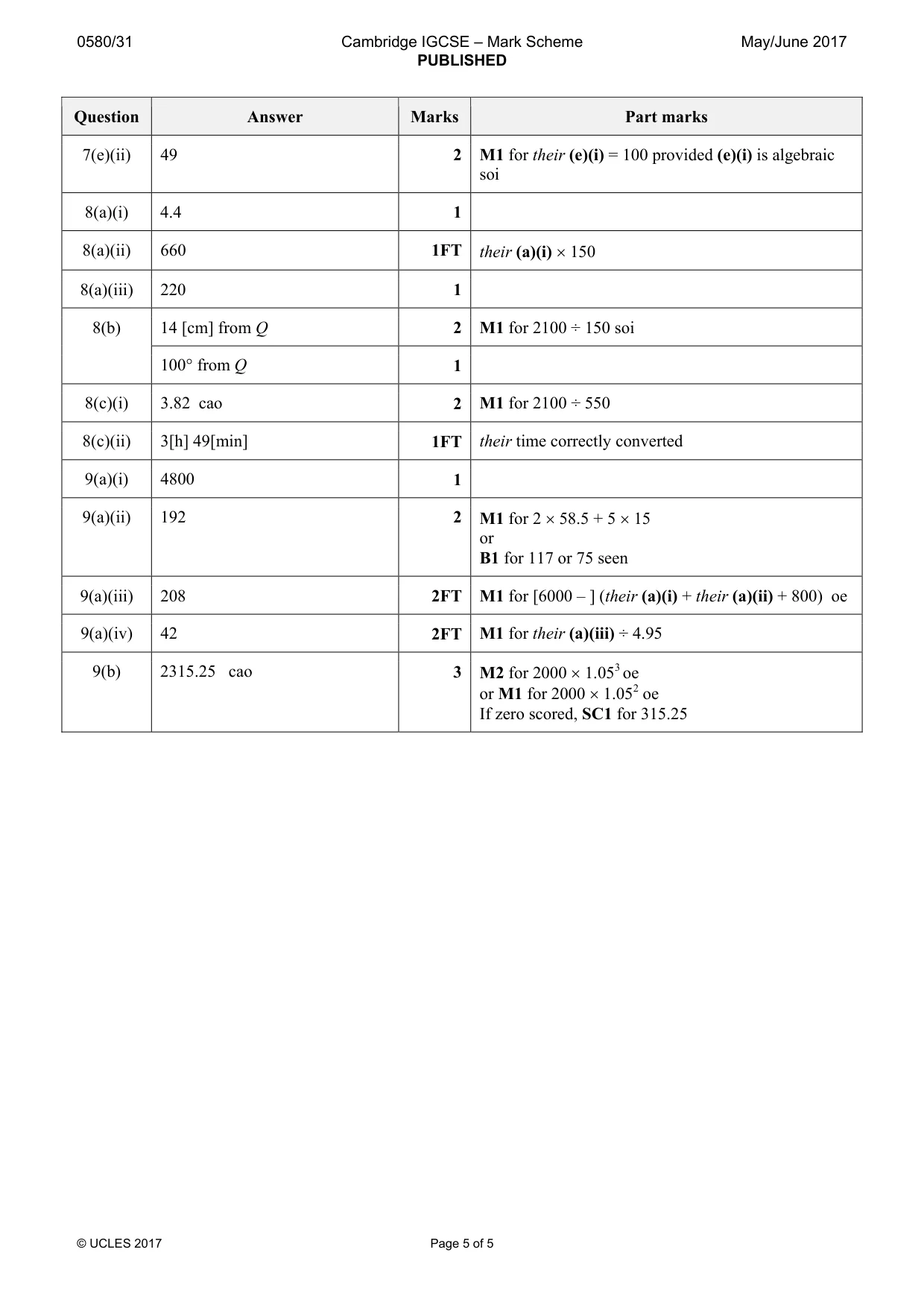
Mark scheme: 8(a)(i) 4.4 1 8(a)(ii) 660 1FT their (a)(i) × 150 8(a)(iii) 220 1 8(b) 14 [cm] from Q 2 M1 for 2100 ÷ 150 soi 100° from Q 1 8(c)(i) 3.82 cao 2 M1 for 2100 ÷ 550 8(c)(ii) 3[h] 49[min] 1FT their time correctly converted
Q9 · Francesca owns a business
9 Francesca owns a business. One year she has a total of $6000 to spend on rent, furniture and office equipment. (a) (i) The rent is $400 per month. Work out how much Francesca spends on rent in this year. $ ................................................ [1] (ii) Desks cost $58.50 each and chairs cost $15 each. Francesca buys 2 desks and 5 chairs. Work out how much Francesca spends on furniture. $ ................................................ [2] (iii) Francesca also spends $800 on office equipment. Work out how much remains of the $6000. $ ................................................ [2] (iv) She spends this remaining amount on boxes of paper. Paper costs $4.95 per box. Work out how many boxes she buys. ..................................... boxes [2] (b) Francesca needs to buy computer equipment. She borrows $2000 from a bank for 3 years at a rate of 5% per year compound interest. Calculate the total amount she pays back at the end of the 3 years. $ ................................................ [3]
Mark scheme: 9(a)(i) 4800 1 9(a)(ii) 192 2 M1 for 2 × 58.5 + 5 × 15 or B1 for 117 or 75 seen 9(a)(iii) 208 2FT M1 for [6000 – ] (their (a)(i) + their (a)(ii) + 800) oe 9(a)(iv) 42 2FT M1 for their (a)(iii) ÷ 4.95 9(b) 2315.25 cao 3 M2 for 2000 × 1.053 oe or M1 for 2000 × 1.052 oe If zero scored, SC1 for 315.25
What was in this paper
The subtopics covered by these 9 questions, and how many questions each got. Open one in a new tab to see every Cambridge question on it.
What you needed in this session
Cambridge’s own grade thresholds for 2017 May/June, Paper 3 · Variant 1. A higher threshold means an easier paper — the bar moves with how the cohort did.