Cambridge IGCSE Mathematics 0580 — 2017 May/June Paper 3 · Variant 2
0580/32/M/J/17 · 9 questions · 104 marks · ≈117 min
The question paper and its mark scheme, free to read here and free to download. This is Cambridge’s own paper, exactly as it was sat.
Question paper16 pages
Mark scheme6 pages
Answers below. Sit the paper first if you are practising.
Questions as text
Q1 · Here is part of the menu in a café
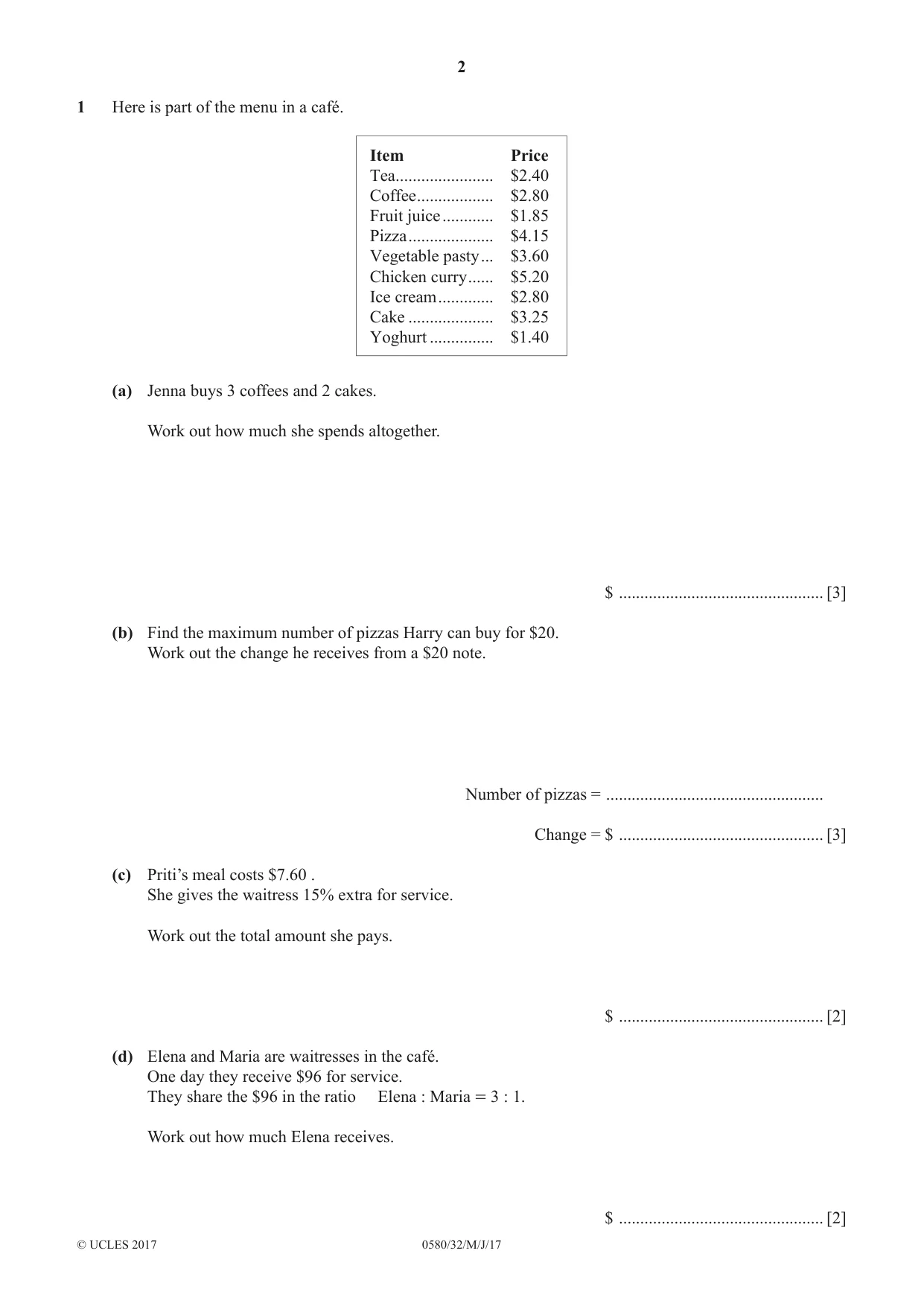
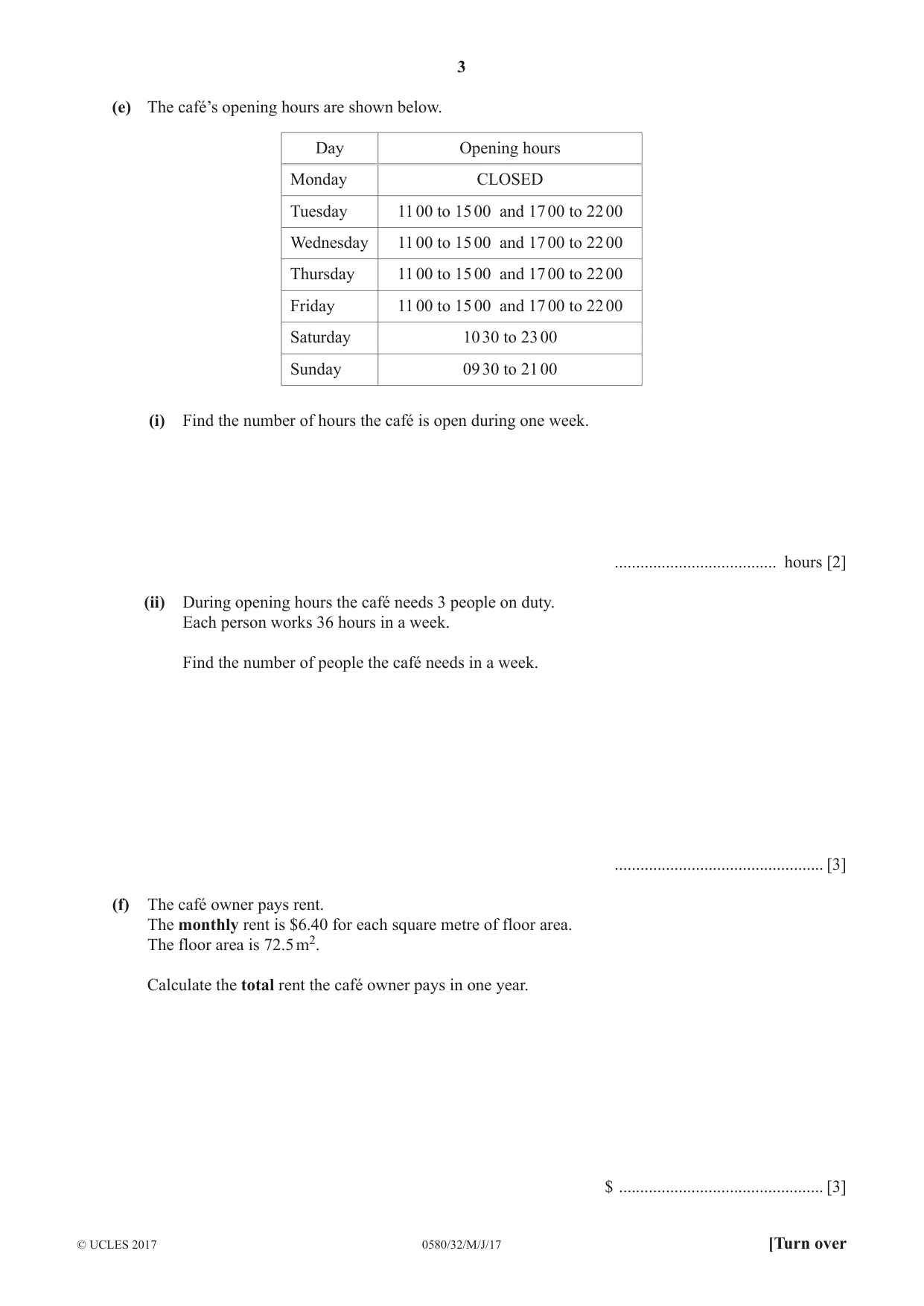
1 Here is part of the menu in a café. Item Price Tea ....................... $2.40 Coffee .................. $2.80 Fruit juice ............ $1.85 Pizza .................... $4.15 Vegetable pasty ... $3.60 Chicken curry ...... $5.20 Ice cream ............. $2.80 Cake .................... $3.25 Yoghurt ............... $1.40 (a) Jenna buys 3 coffees and 2 cakes. Work out how much she spends altogether. $ ................................................ [3] (b) Find the maximum number of pizzas Harry can buy for $20. Work out the change he receives from a $20 note. Number of pizzas = ................................................... Change = $ ................................................ [3] (c) Priti’s meal costs $7.60 . She gives the waitress 15% extra for service. Work out the total amount she pays. $ ................................................ [2] (d) Elena and Maria are waitresses in the café. One day they receive $96 for service. They share the $96 in the ratio Elena : Maria = 3 : 1. Work out how much Elena receives. $ ................................................ [2] (e) The café’s opening hours are shown below. Day Opening hours Monday CLOSED Tuesday 11 00 to 15 00 and 17 00 to 22 00 Wednesday 11 00 to 15 00 and 17 00 to 22 00 Thursday 11 00 to 15 00 and 17 00 to 22 00 Friday 11 00 to 15 00 and 17 00 to 22 00 Saturday 10 30 to 23 00 Sunday 09 30 to 21 00 (i) Find the number of hours the café is open during one week. ...................................... hours [2] (ii) During opening hours the café needs 3 people on duty. Each person works 36 hours in a week. Find the number of people the café needs in a week. ................................................. [3] (f) The café owner pays rent. The monthly rent is $6.40 for each square metre of floor area. The floor area is 72.5 m2. Calculate the total rent the café owner pays in one year. $ ................................................ [3]
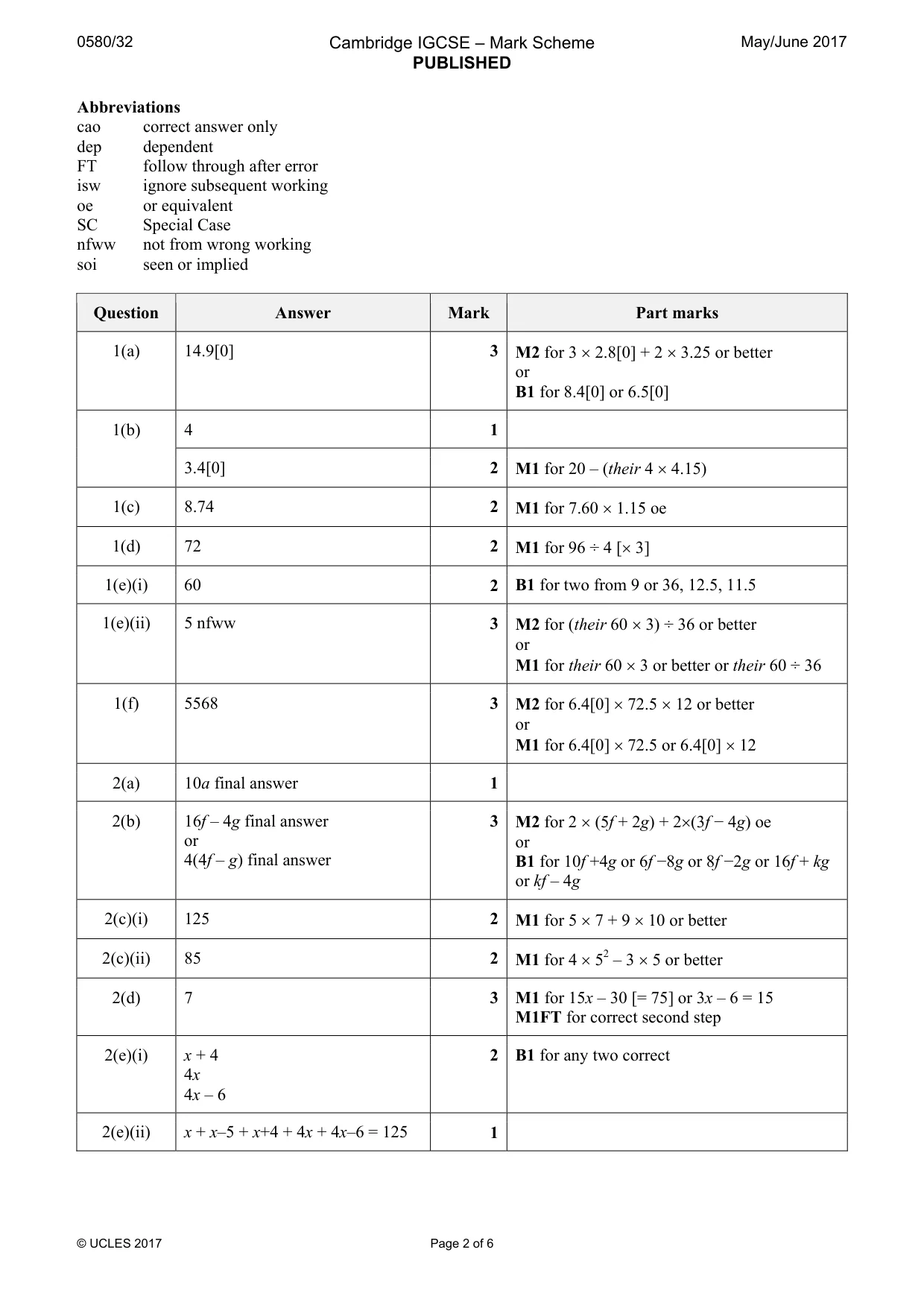
Mark scheme: Question Answer Mark Part marks 1(a) 14.9[0] 3 M2 for 3 × 2.8[0] + 2 × 3.25 or better or B1 for 8.4[0] or 6.5[0] 1(b) 4 1 3.4[0] 2 M1 for 20 – (their 4 × 4.15) 1(c) 8.74 2 M1 for 7.60 × 1.15 oe 1(d) 72 2 M1 for 96 ÷ 4 [× 3] 1(e)(i) 60 2 B1 for two from 9 or 36, 12.5, 11.5 1(e)(ii) 5 nfww 3 M2 for (their 60 × 3) ÷ 36 or better or M1 for their 60 × 3 or better or their 60 ÷ 36 1(f) 5568 3 M2 for 6.4[0] × 72.5 × 12 or better or M1 for 6.4[0] × 72.5 or 6.4[0] × 12
Question 2
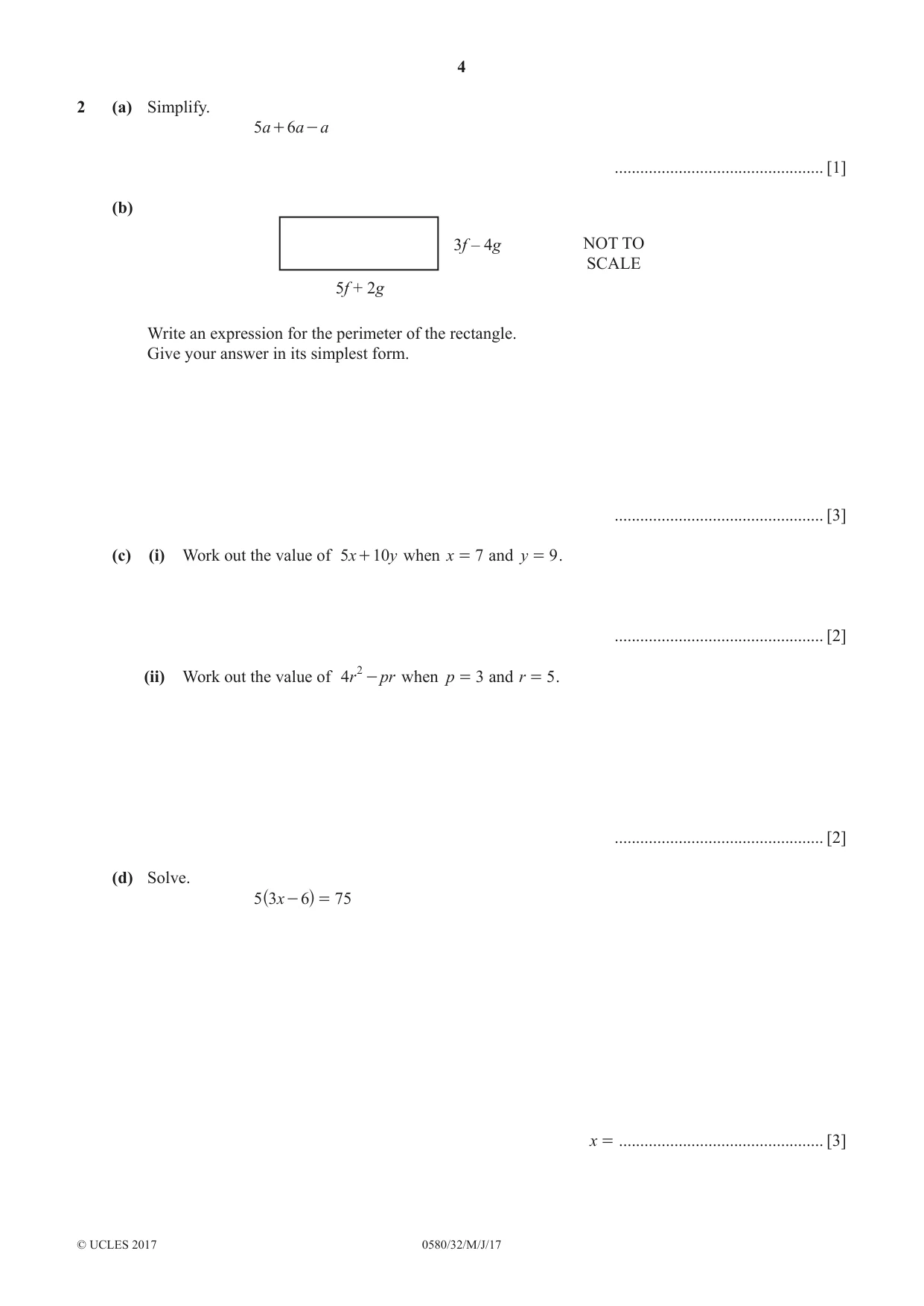
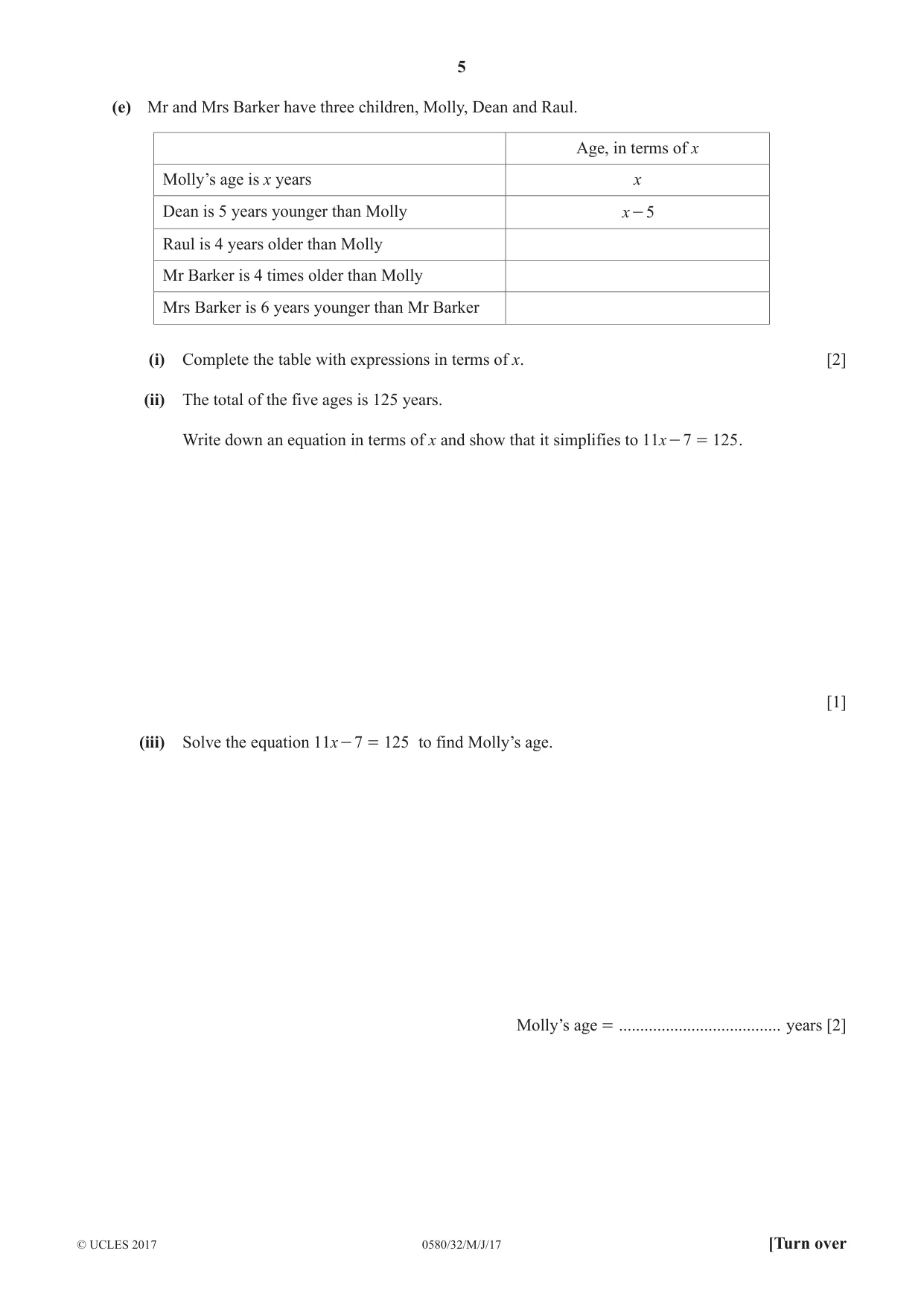
2 (a) Simplify. 5a + 6a - a ................................................. [1] (b) 3f – 4g NOT TO SCALE 5f + 2g Write an expression for the perimeter of the rectangle. Give your answer in its simplest form. ................................................. [3] (c) (i) Work out the value of 5x + 10 y when x = 7 and y = 9 . ................................................. [2] (ii) Work out the value of 4r 2 - pr when p = 3 and r = 5 . ................................................. [2] (d) Solve. 5 3x - 6 = 75 ^ h x = ................................................ [3] (e) Mr and Mrs Barker have three children, Molly, Dean and Raul. Age, in terms of x Molly’s age is x years x Dean is 5 years younger than Molly x - 5 Raul is 4 years older than Molly Mr Barker is 4 times older than Molly Mrs Barker is 6 years younger than Mr Barker (i) Complete the table with expressions in terms of x. [2] (ii) The total of the five ages is 125 years. Write down an equation in terms of x and show that it simplifies to 11x - 7 = 125 . [1] (iii) Solve the equation 11x - 7 = 125 to find Molly’s age. Molly’s age = ...................................... years [2]
Mark scheme: 2(a) 10a final answer 1 2(b) 16f – 4g final answer 3 M2 for 2 × (5f + 2g) + 2×(3f − 4g) oe or or 4(4f – g) final answer B1 for 10f +4g or 6f −8g or 8f −2g or 16f + kg or kf – 4g 2(c)(i) 125 2 M1 for 5 × 7 + 9 × 10 or better 2(c)(ii) 85 2 M1 for 4 × 52 – 3 × 5 or better 2(d) 7 3 M1 for 15x – 30 [= 75] or 3x – 6 = 15 M1FT for correct second step 2(e)(i) x + 4 2 B1 for any two correct 4x 4x – 6 2(e)(ii) x + x–5 + x+4 + 4x + 4x–6 = 125 1 2(e)(iii) 12 2 7 125 M1 for 11x = 125 + 7 or x – = 11 11 or better
Q3 · The table shows the results of a survey in a village
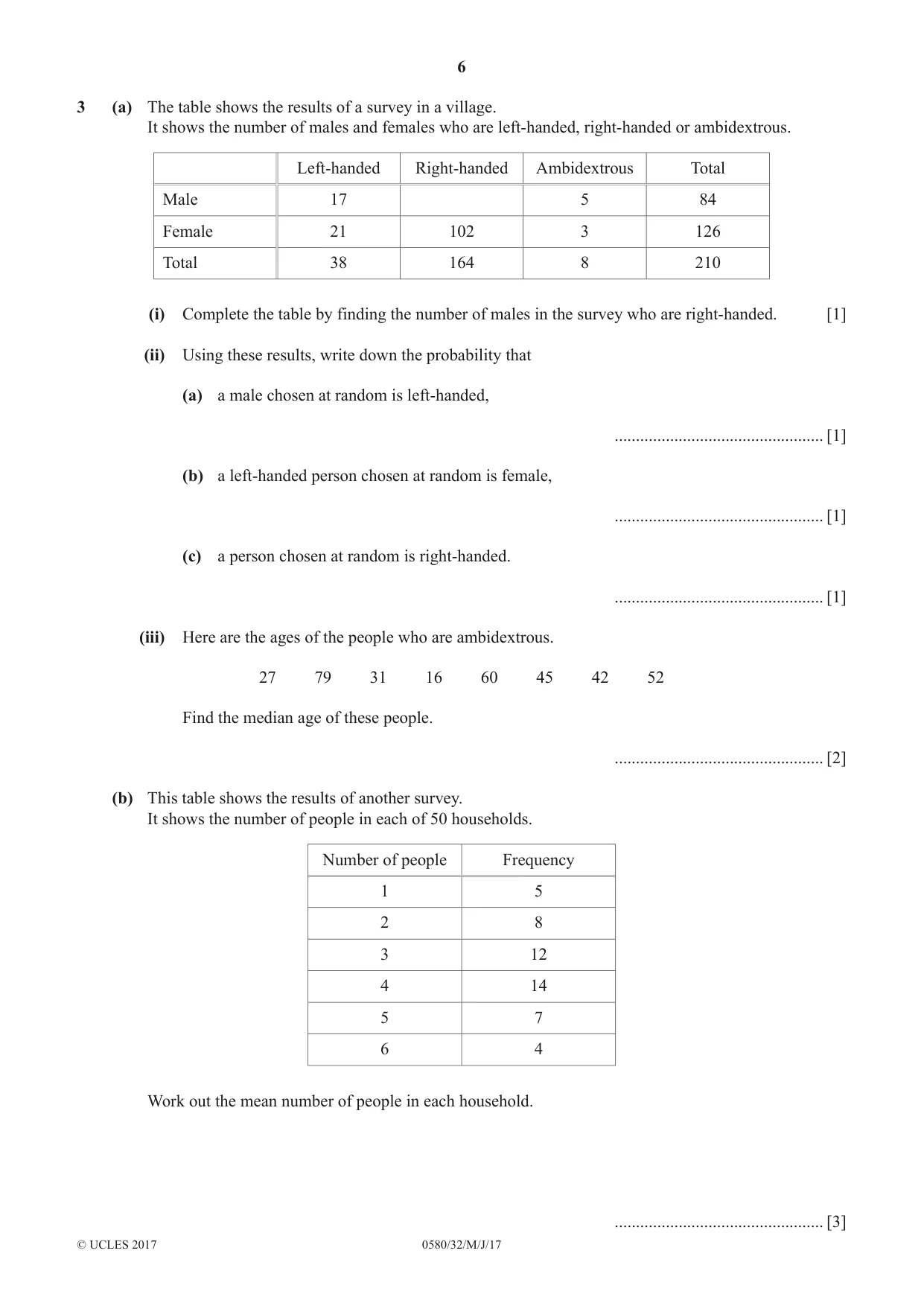
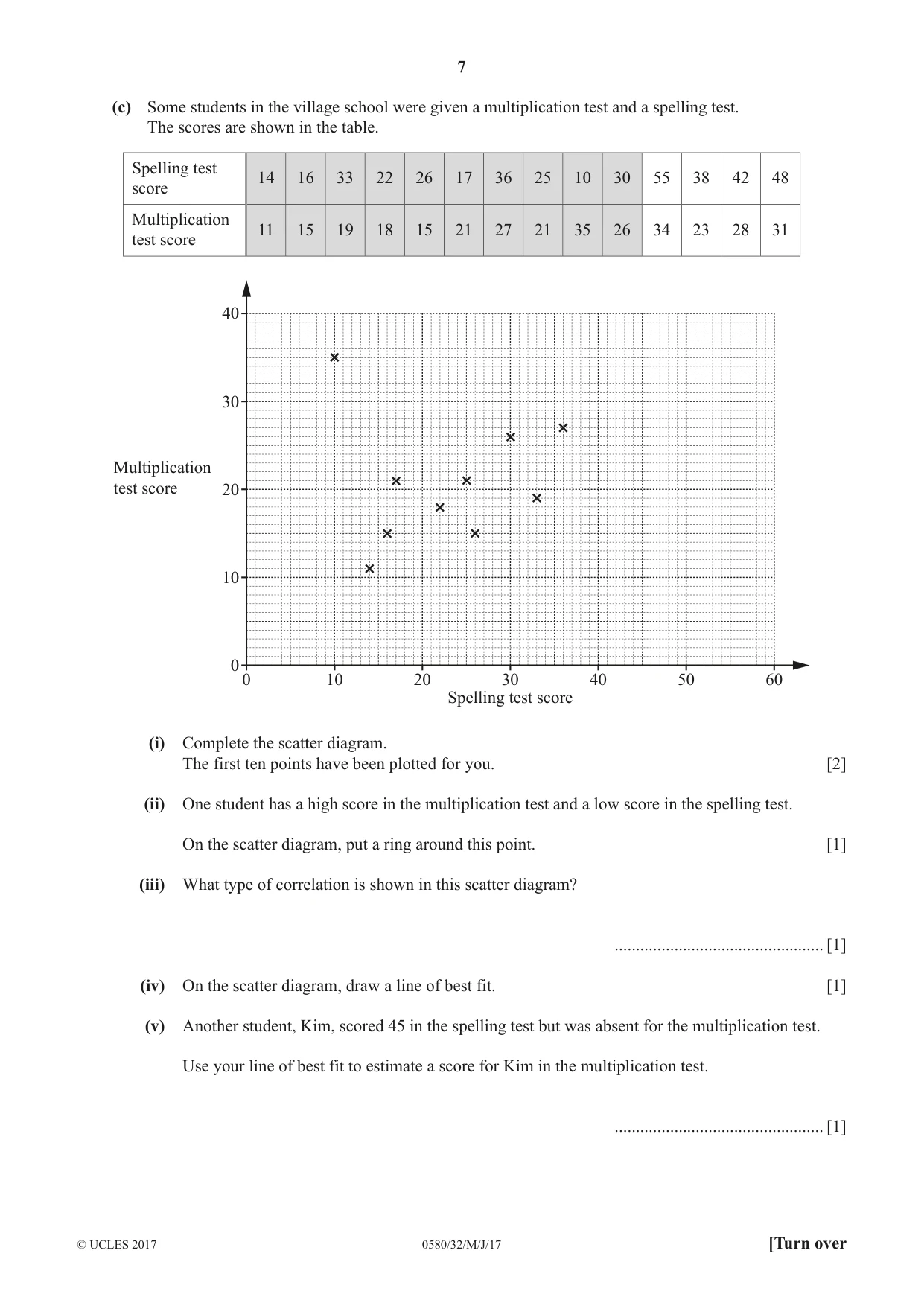
3 (a) The table shows the results of a survey in a village. It shows the number of males and females who are left-handed, right-handed or ambidextrous. Left-handed Right-handed Ambidextrous Total Male 17 5 84 Female 21 102 3 126 Total 38 164 8 210 (i) Complete the table by finding the number of males in the survey who are right-handed. [1] (ii) Using these results, write down the probability that (a) a male chosen at random is left-handed, ................................................. [1] (b) a left-handed person chosen at random is female, ................................................. [1] (c) a person chosen at random is right-handed. ................................................. [1] (iii) Here are the ages of the people who are ambidextrous. 27 79 31 16 60 45 42 52 Find the median age of these people. ................................................. [2] (b) This table shows the results of another survey. It shows the number of people in each of 50 households. Number of people Frequency 1 5 2 8 3 12 4 14 5 7 6 4 Work out the mean number of people in each household. ................................................. [3] (c) Some students in the village school were given a multiplication test and a spelling test. The scores are shown in the table. Spelling test 14 16 33 22 26 17 36 25 10 30 55 38 42 48 score Multiplication 11 15 19 18 15 21 27 21 35 26 34 23 28 31 test score 40 30 Multiplication test score 20 10 0 0 10 20 30 40 50 60 Spelling test score (i) Complete the scatter diagram. The first ten points have been plotted for you. [2] (ii) One student has a high score in the multiplication test and a low score in the spelling test. On the scatter diagram, put a ring around this point. [1] (iii) What type of correlation is shown in this scatter diagram? ................................................. [1] (iv) On the scatter diagram, draw a line of best fit. [1] (v) Another student, Kim, scored 45 in the spelling test but was absent for the multiplication test. Use your line of best fit to estimate a score for Kim in the multiplication test. ................................................. [1]
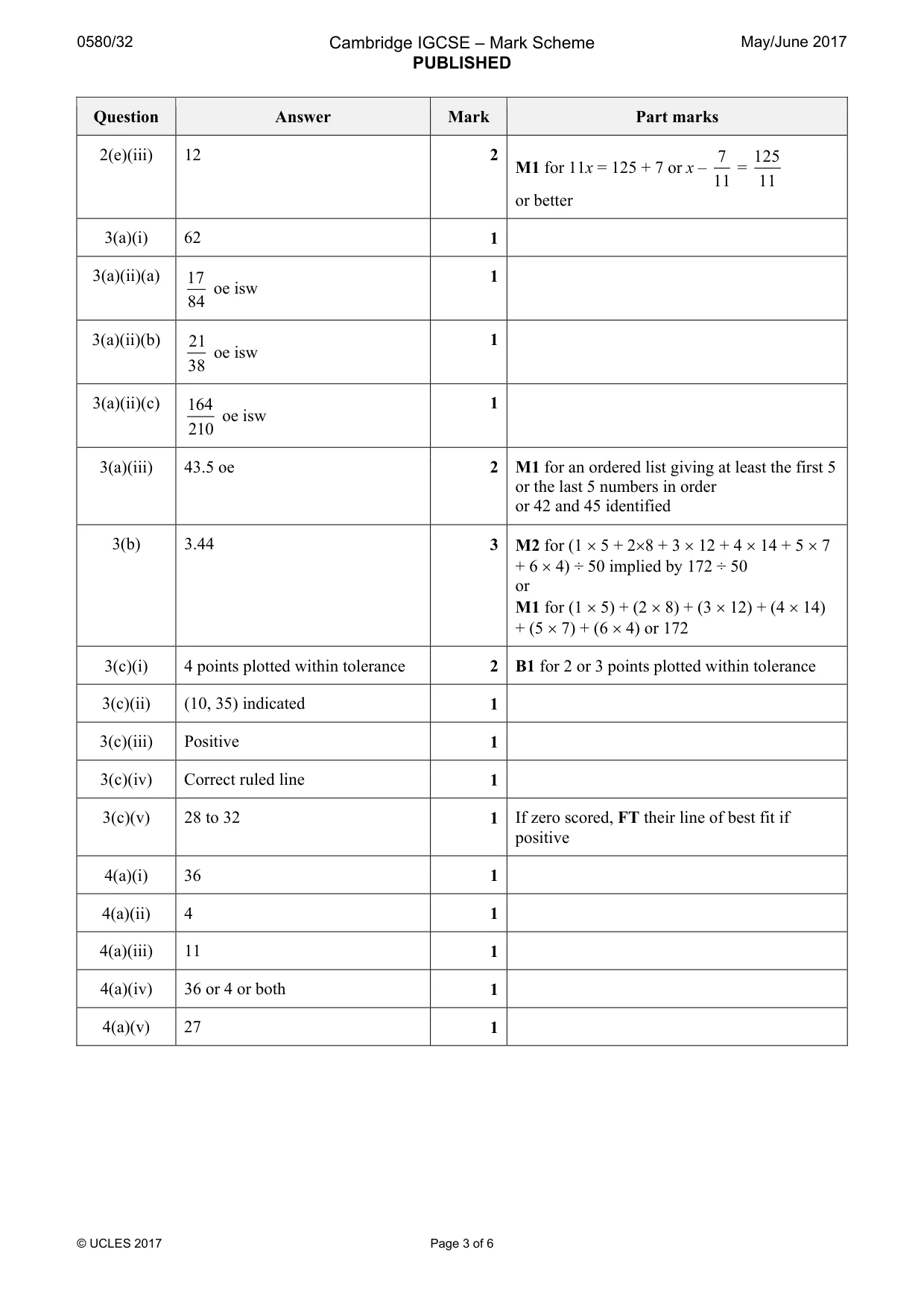
Mark scheme: 3(a)(i) 62 1 3(a)(ii)(a) 17 1 oe isw 84 3(a)(ii)(b) 21 1 oe isw 38 3(a)(ii)(c) 164 1 oe isw 210 3(a)(iii) 43.5 oe 2 M1 for an ordered list giving at least the first 5 or the last 5 numbers in order or 42 and 45 identified 3(b) 3.44 3 M2 for (1 × 5 + 2×8 + 3 × 12 + 4 × 14 + 5 × 7 + 6 × 4) ÷ 50 implied by 172 ÷ 50 or M1 for (1 × 5) + (2 × 8) + (3 × 12) + (4 × 14) + (5 × 7) + (6 × 4) or 172 3(c)(i) 4 points plotted within tolerance 2 B1 for 2 or 3 points plotted within tolerance 3(c)(ii) (10, 35) indicated 1 3(c)(iii) Positive 1 3(c)(iv) Correct ruled line 1 3(c)(v) 28 to 32 1 If zero scored, FT their line of best fit if positive
Q4 · 4 10 11 18 20 27 28 32 36 40 56 From the list above, write down (i) a multiple of 12…
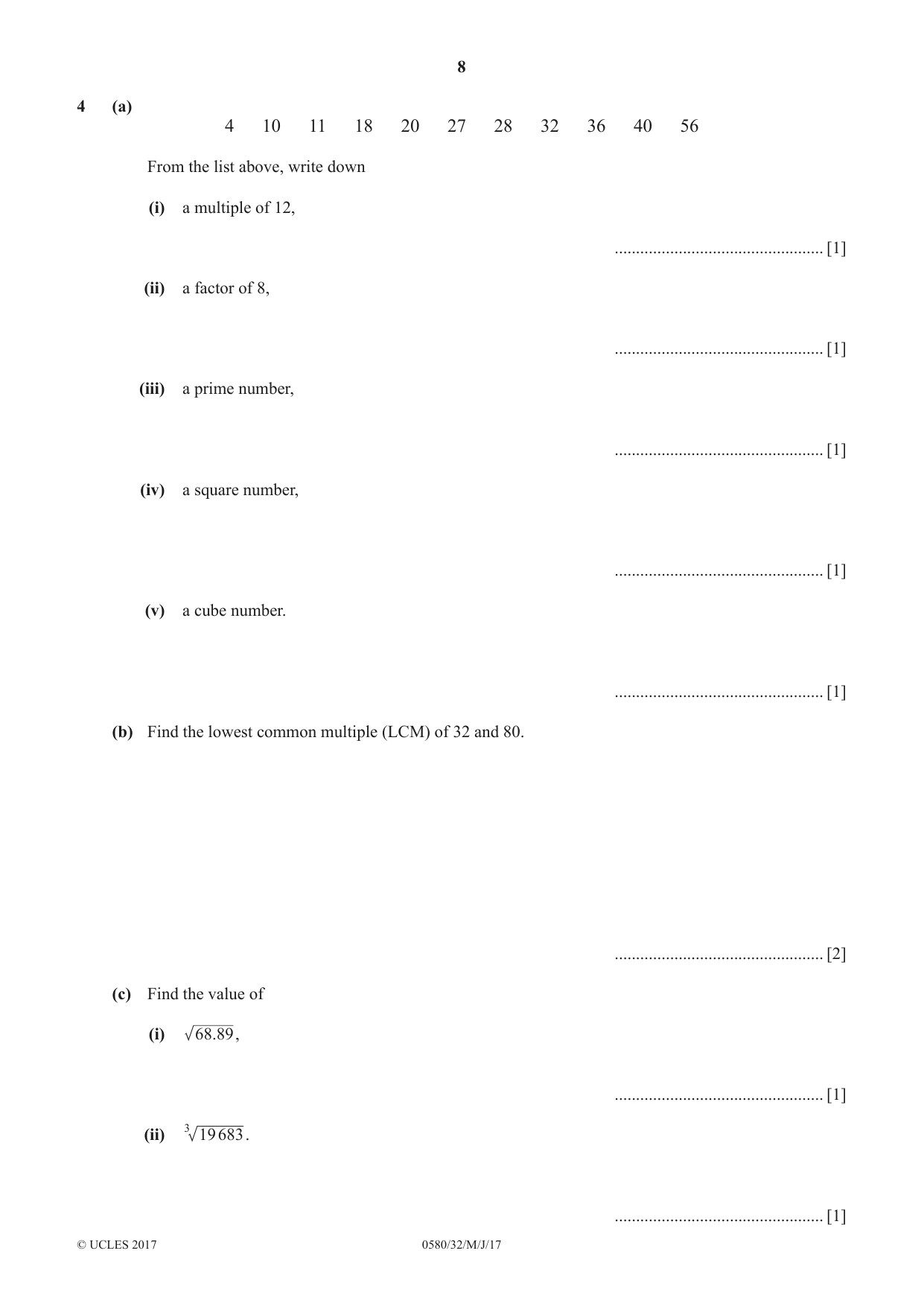
4 (a) 4 10 11 18 20 27 28 32 36 40 56 From the list above, write down (i) a multiple of 12, ................................................. [1] (ii) a factor of 8, ................................................. [1] (iii) a prime number, ................................................. [1] (iv) a square number, ................................................. [1] (v) a cube number. ................................................. [1] (b) Find the lowest common multiple (LCM) of 32 and 80. ................................................. [2] (c) Find the value of (i) 68.89, ................................................. [1] (ii) 3 19683 . ................................................. [1]
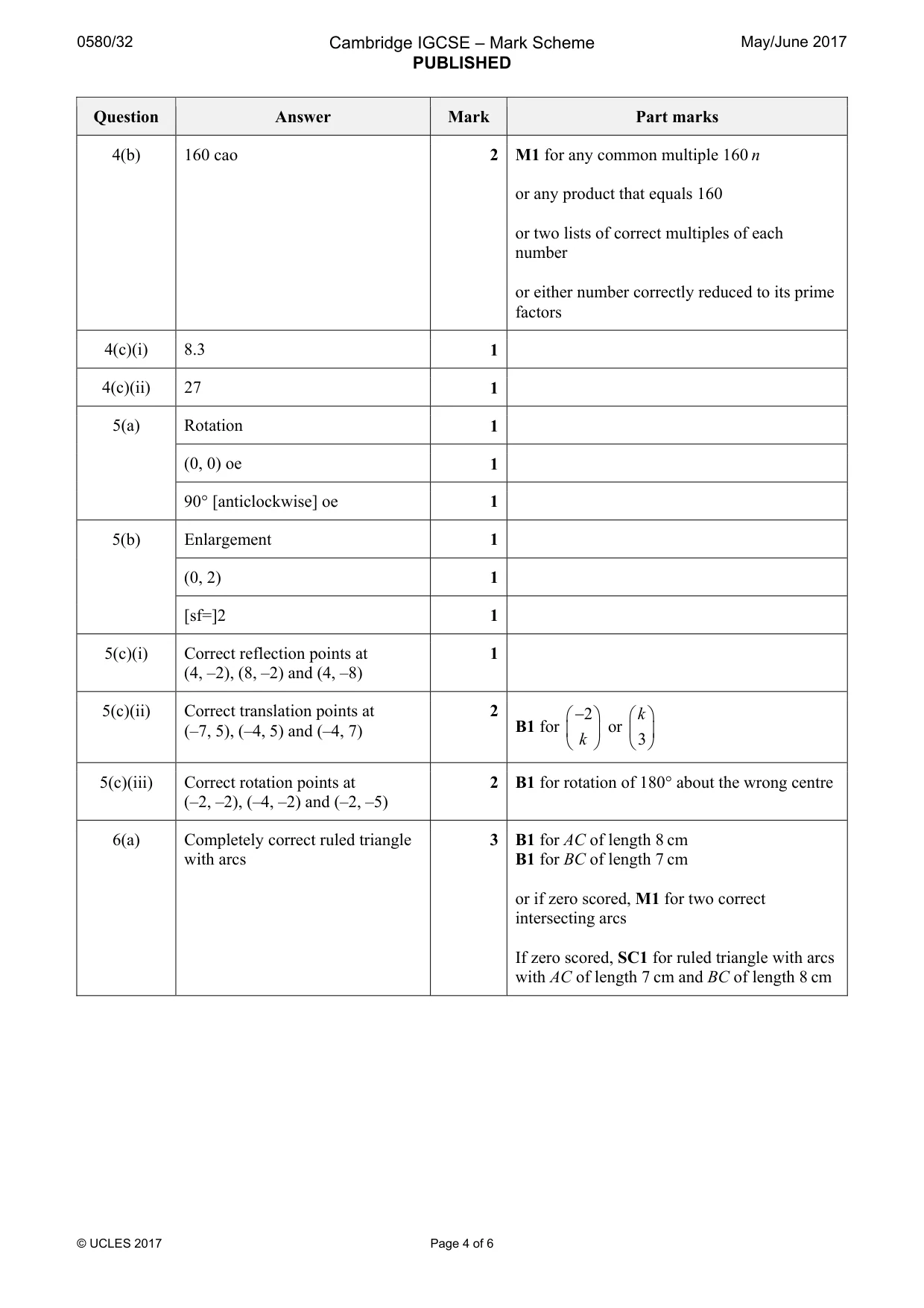
Mark scheme: 4(a)(i) 36 1 4(a)(ii) 4 1 4(a)(iii) 11 1 4(a)(iv) 36 or 4 or both 1 4(a)(v) 27 1 4(b) 160 cao 2 M1 for any common multiple 160 n or any product that equals 160 or two lists of correct multiples of each number or either number correctly reduced to its prime factors 4(c)(i) 8.3 1 4(c)(ii) 27 1
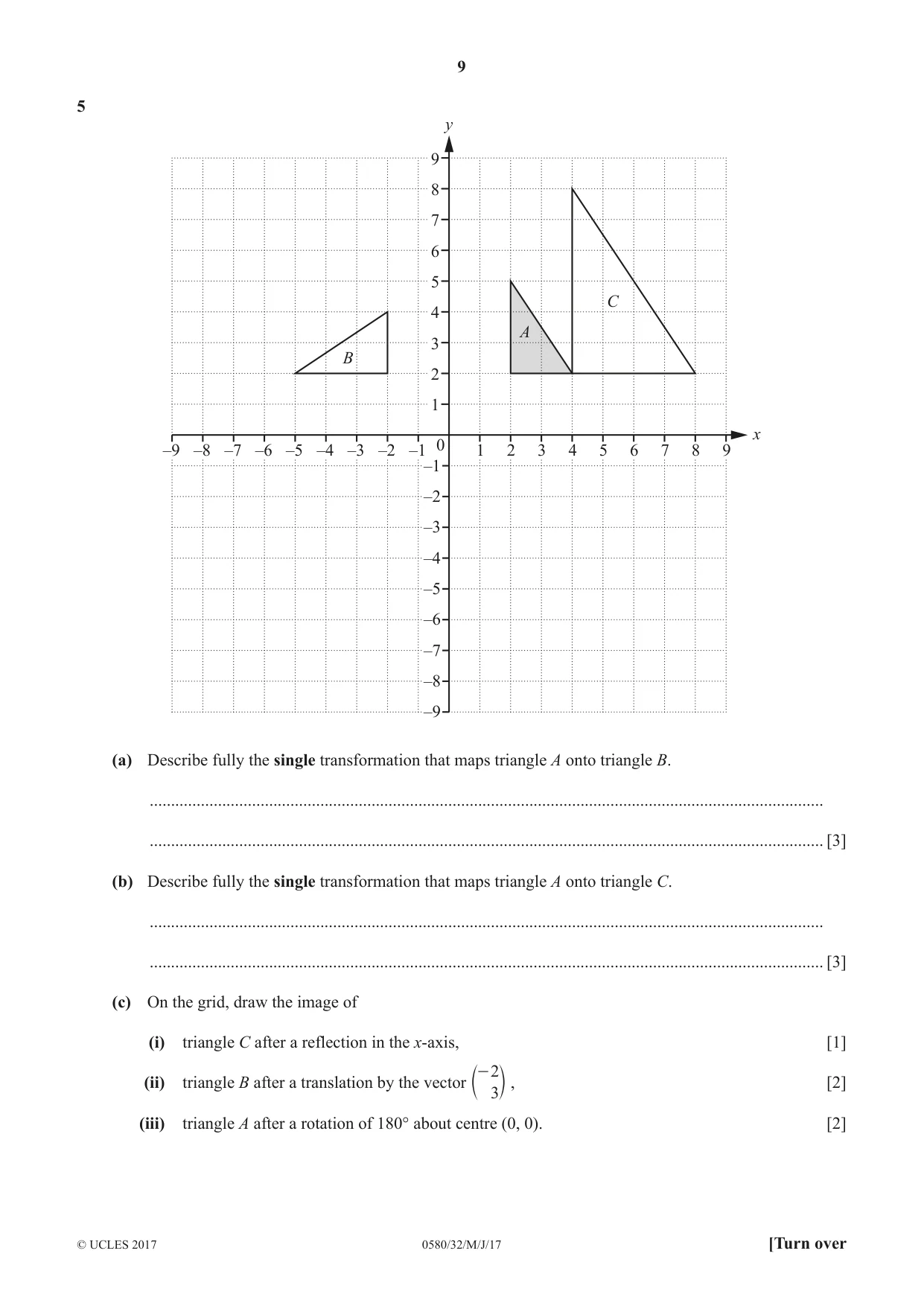
Q5 · Y 9 8 7 6 5 C 4 A 3 B 2 1 x 0 –9 –8 –7 –6 –5 –4 –3 –2 –1 1 2 3 4 5 6 7 8 9 –1 –2 –3 –4 –5…
5 y 9 8 7 6 5 C 4 A 3 B 2 1 x 0 –9 –8 –7 –6 –5 –4 –3 –2 –1 1 2 3 4 5 6 7 8 9 –1 –2 –3 –4 –5 –6 –7 –8 –9 (a) Describe fully the single transformation that maps triangle A onto triangle B. .............................................................................................................................................................. .............................................................................................................................................................. [3] (b) Describe fully the single transformation that maps triangle A onto triangle C. .............................................................................................................................................................. .............................................................................................................................................................. [3] (c) On the grid, draw the image of (i) triangle C after a reflection in the x-axis, [1] - 2 (ii) triangle B after a translation by the vector , [2] c 3m (iii) triangle A after a rotation of 180° about centre (0, 0). [2]
Mark scheme: 5(a) Rotation 1 (0, 0) oe 1 90° [anticlockwise] oe 1 5(b) Enlargement 1 (0, 2) 1 [sf=]2 1 5(c)(i) Correct reflection points at 1 (4, –2), (8, –2) and (4, –8) 5(c)(ii) Correct translation points at 2 −2 k (–7, 5), (–4, 5) and (–4, 7) B1 for or k 3 5(c)(iii) Correct rotation points at 2 B1 for rotation of 180° about the wrong centre (–2, –2), (–4, –2) and (–2, –5)
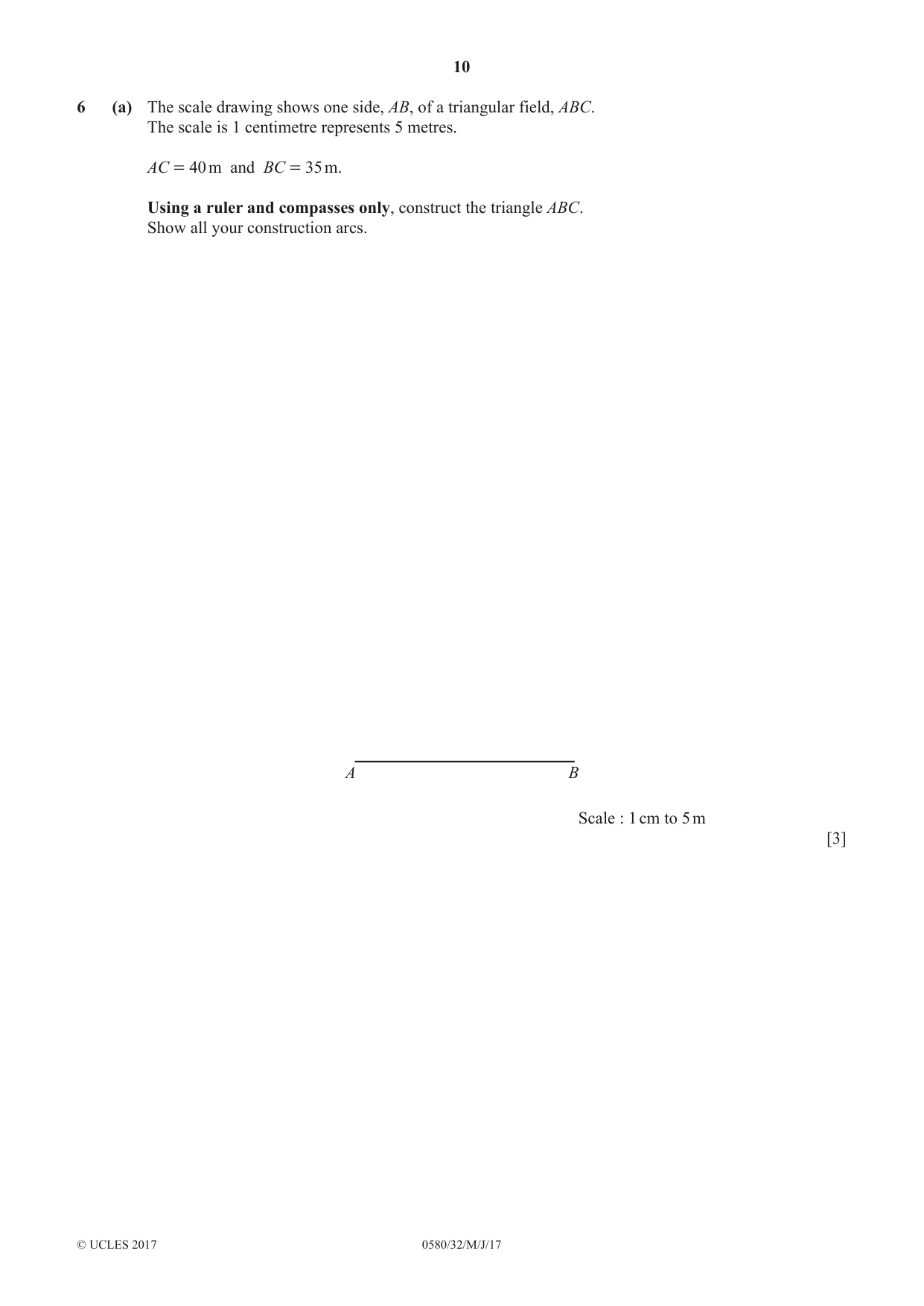
Q6 · The scale drawing shows one side, AB, of a triangular field, ABC
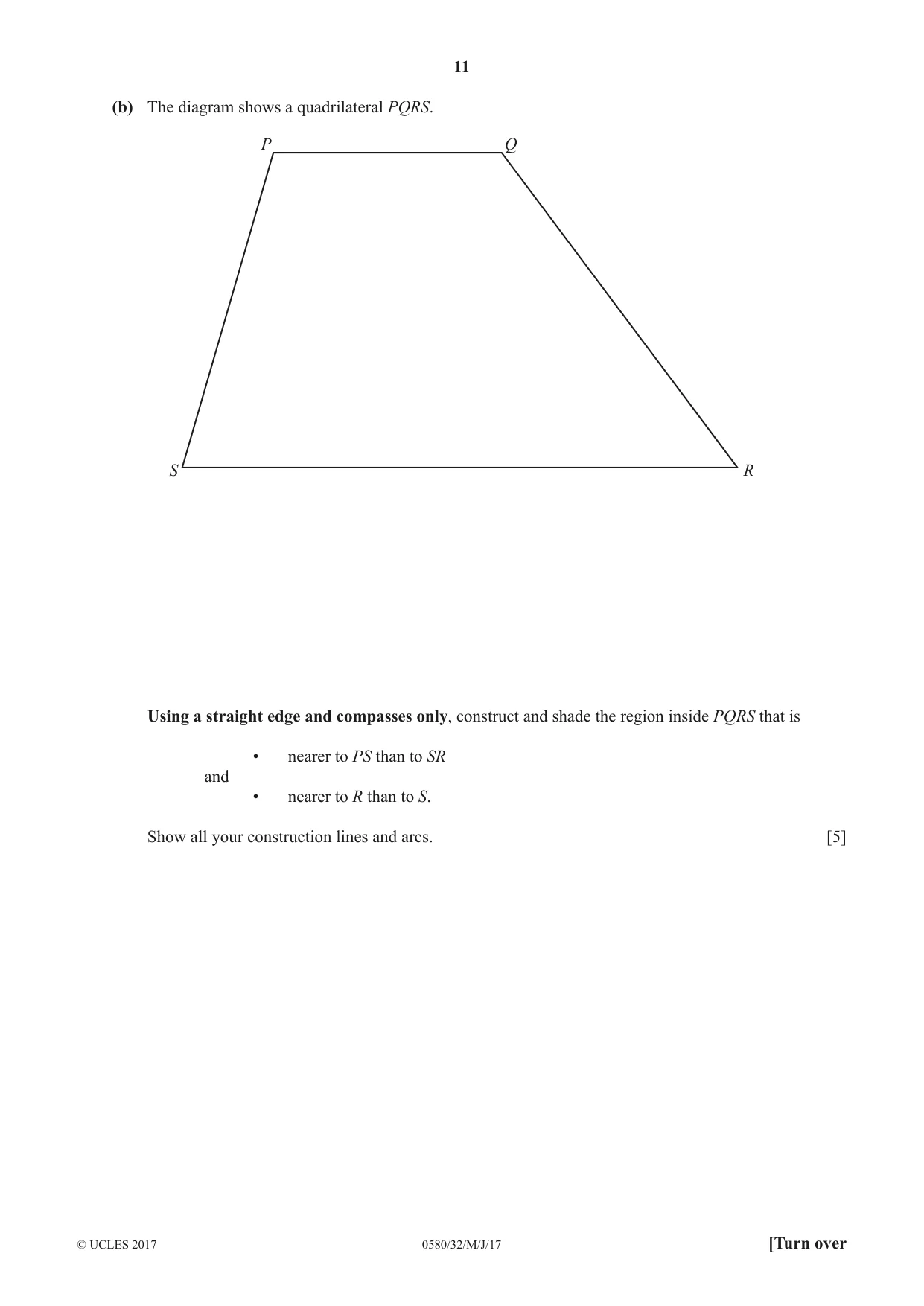
6 (a) The scale drawing shows one side, AB, of a triangular field, ABC. The scale is 1 centimetre represents 5 metres. AC = 40 m and BC = 35 m. Using a ruler and compasses only, construct the triangle ABC. Show all your construction arcs. A B Scale : 1 cm to 5 m [3] (b) The diagram shows a quadrilateral PQRS. P Q S R Using a straight edge and compasses only, construct and shade the region inside PQRS that is • nearer to PS than to SR and • nearer to R than to S. Show all your construction lines and arcs. [5]
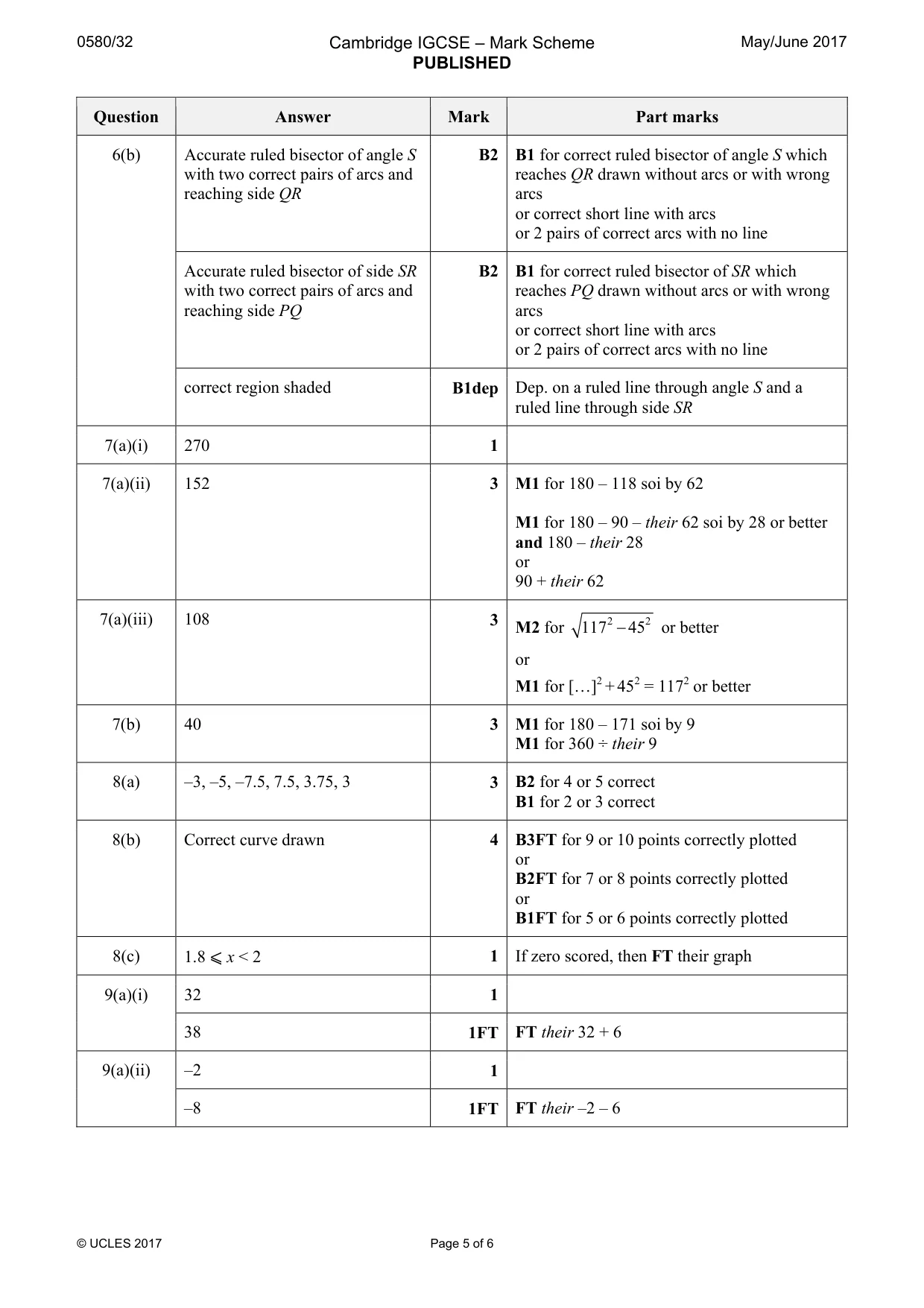
Mark scheme: 6(a) Completely correct ruled triangle 3 B1 for AC of length 8 cm with arcs B1 for BC of length 7 cm or if zero scored, M1 for two correct intersecting arcs If zero scored, SC1 for ruled triangle with arcs with AC of length 7 cm and BC of length 8 cm 6(b) Accurate ruled bisector of angle S B2 B1 for correct ruled bisector of angle S which with two correct pairs of arcs and reaches QR drawn without arcs or with wrong reaching side QR arcs or correct short line with arcs or 2 pairs of correct arcs with no line Accurate ruled bisector of side SR B2 B1 for correct ruled bisector of SR which with two correct pairs of arcs and reaches PQ drawn without arcs or with wrong reaching side PQ arcs or correct short line with arcs or 2 pairs of correct arcs with no line correct region shaded B1dep Dep. on a ruled line through angle S and a ruled line through side SR
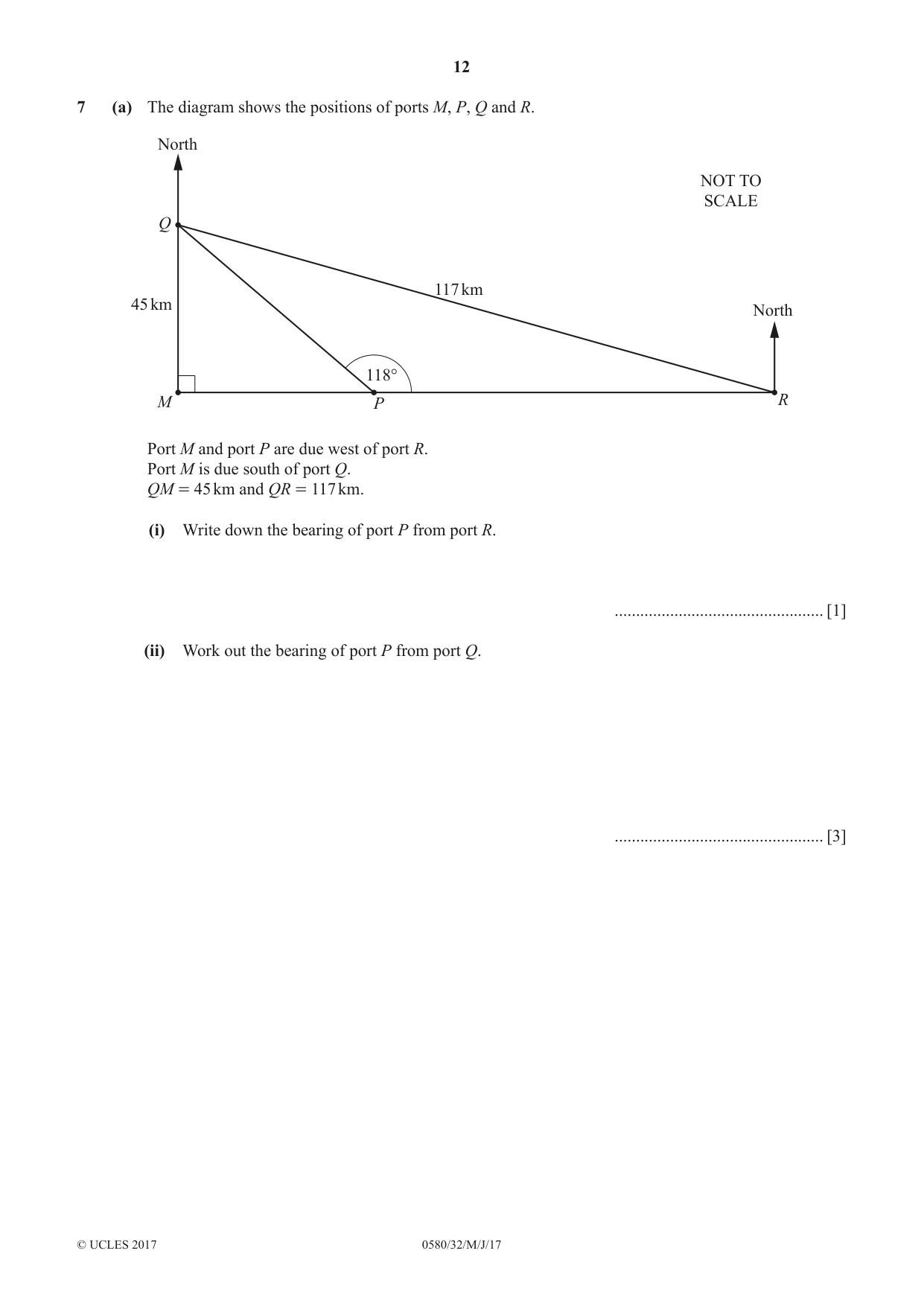
Q7 · The diagram shows the positions of ports M, P, Q and R
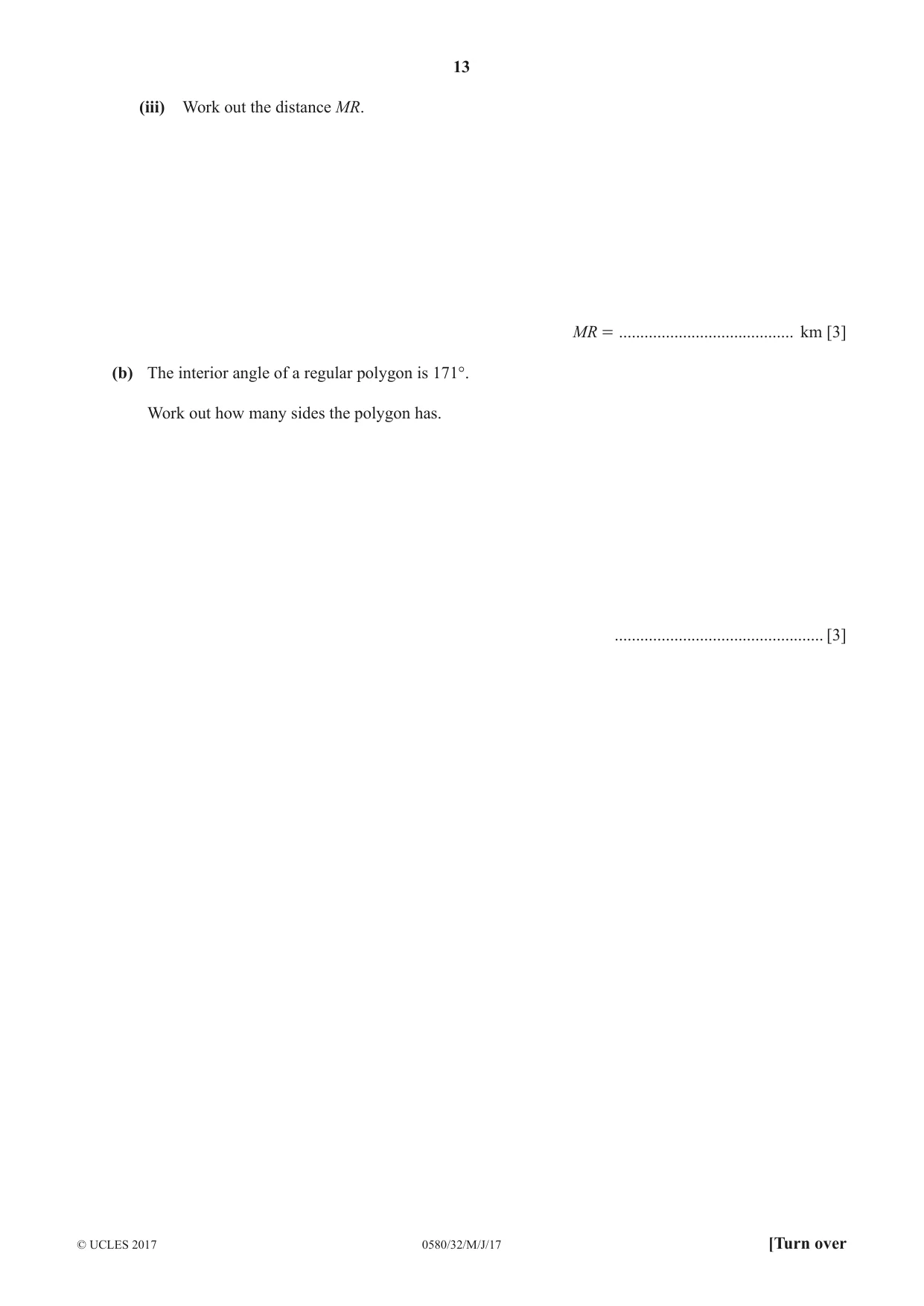
7 (a) The diagram shows the positions of ports M, P, Q and R. North NOT TO SCALE Q 117 km 45 km North 118° M P R Port M and port P are due west of port R. Port M is due south of port Q. QM = 45 km and QR = 117 km. (i) Write down the bearing of port P from port R. ................................................. [1] (ii) Work out the bearing of port P from port Q. ................................................. [3] (iii) Work out the distance MR. MR = ......................................... km [3] (b) The interior angle of a regular polygon is 171°. Work out how many sides the polygon has. ................................................. [3]
Mark scheme: 7(a)(i) 270 1 7(a)(ii) 152 3 M1 for 180 – 118 soi by 62 M1 for 180 – 90 – their 62 soi by 28 or better and 180 – their 28 or 90 + their 62 7(a)(iii) 108 3 2 2 M2 for 117 − 45 or better or M1 for […]2 + 452 = 1172 or better 7(b) 40 3 M1 for 180 – 171 soi by 9 M1 for 360 ÷ their 9
Q8 · 8 (a) Complete the table for y =
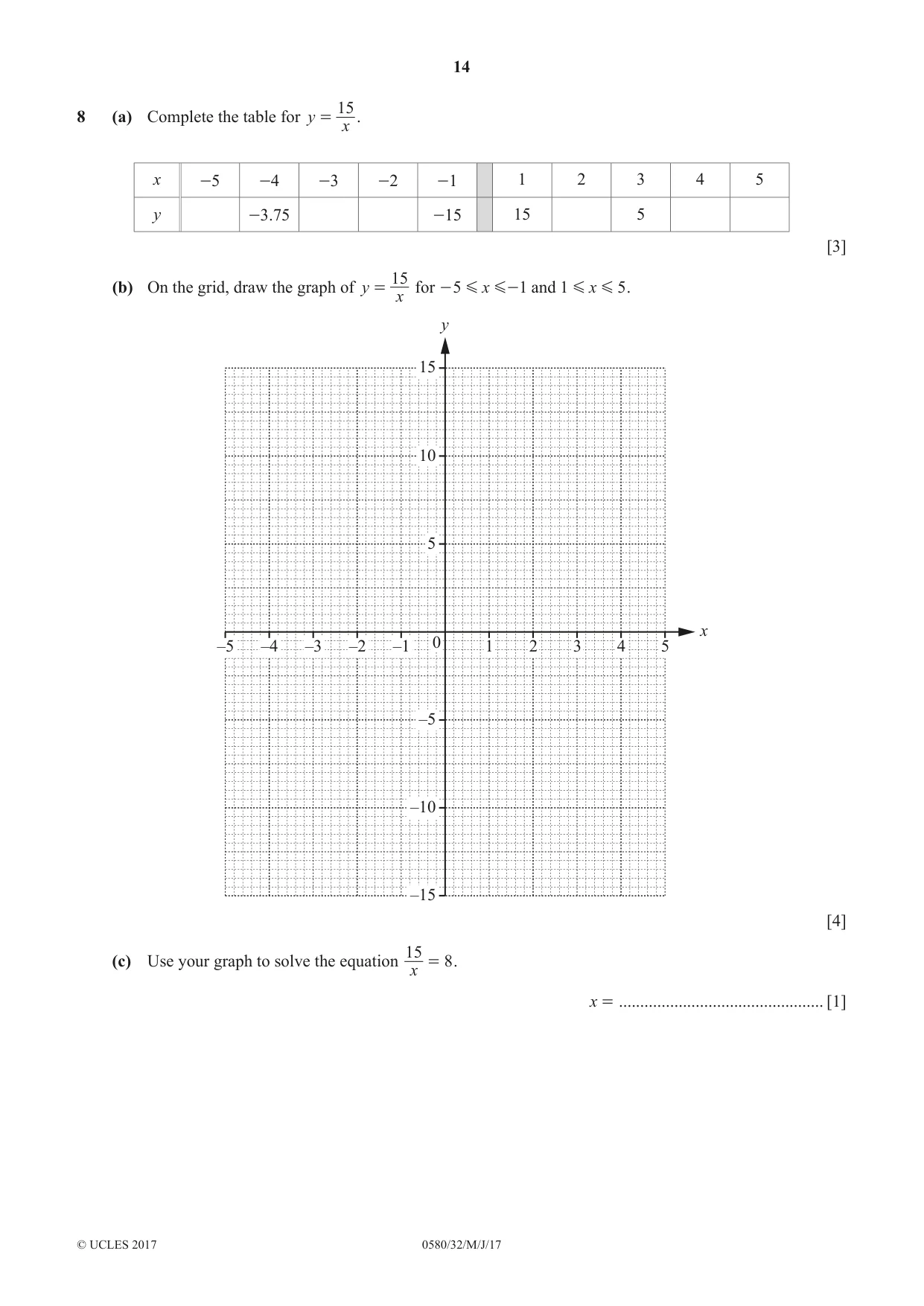
158 (a) Complete the table for y = . x x -5 -4 -3 -2 -1 1 2 3 4 5 y -3.75 -15 15 5 [3] 15 (b) On the grid, draw the graph of y = for - 5 G x G - 1 and 1 G x G 5 . x y 15 10 5 x –5 –4 –3 –2 –1 0 1 2 3 4 5 –5 –10 –15 [4] 15 (c) Use your graph to solve the equation = 8 . x x = ................................................ [1]
Mark scheme: 8(a) –3, –5, –7.5, 7.5, 3.75, 3 3 B2 for 4 or 5 correct B1 for 2 or 3 correct 8(b) Correct curve drawn 4 B3FT for 9 or 10 points correctly plotted or B2FT for 7 or 8 points correctly plotted or B1FT for 5 or 6 points correctly plotted 8(c) 1.8 ⩽ x < 2 1 If zero scored, then FT their graph
Q9 · Write down the next two terms in each of these sequences
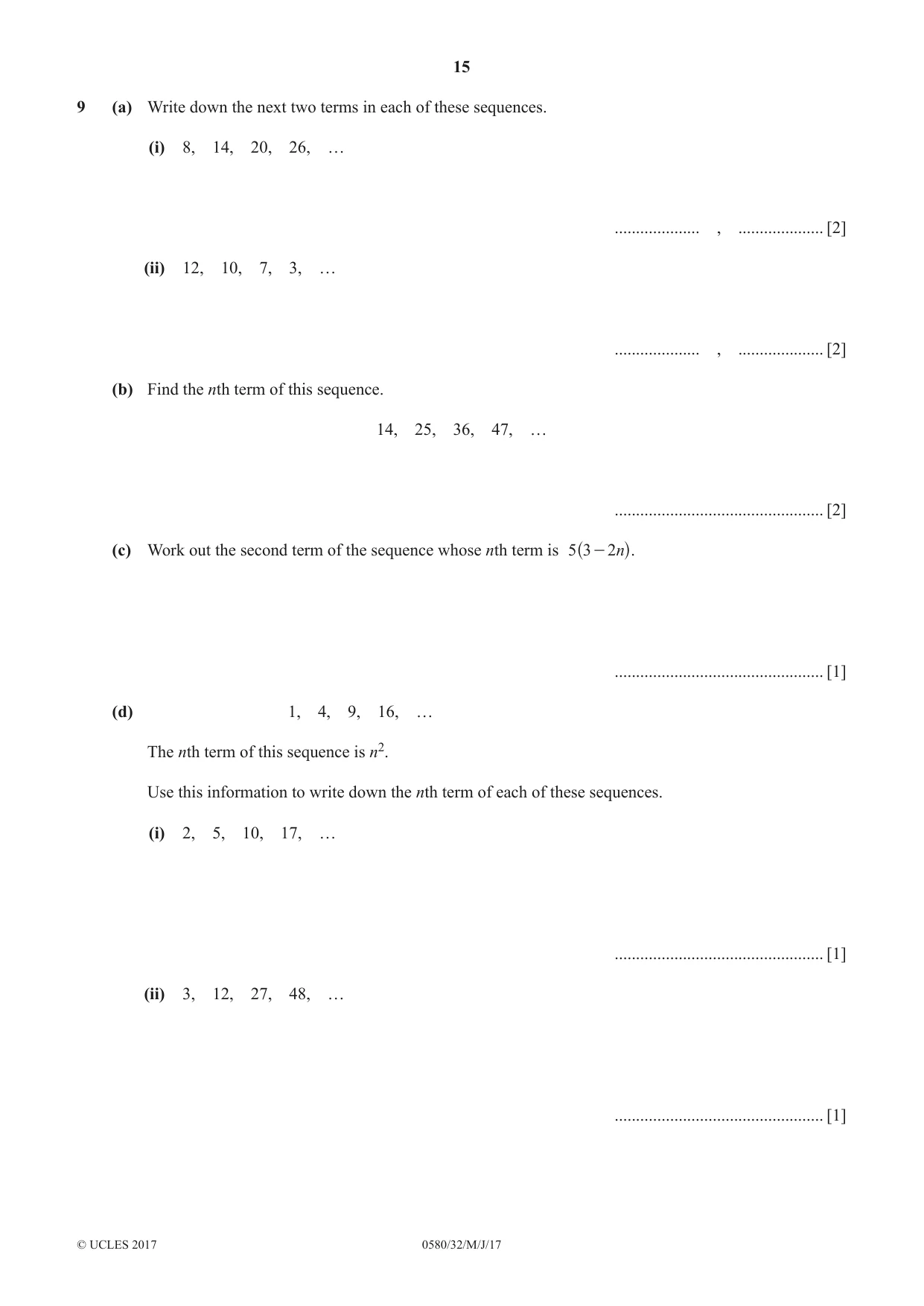
9 (a) Write down the next two terms in each of these sequences. (i) 8, 14, 20, 26, … .................... , .................... [2] (ii) 12, 10, 7, 3, … .................... , .................... [2] (b) Find the nth term of this sequence. 14, 25, 36, 47, … ................................................. [2] (c) Work out the second term of the sequence whose nth term is 5 3 - 2n ^ h. ................................................. [1] (d) 1, 4, 9, 16, … The nth term of this sequence is n2. Use this information to write down the nth term of each of these sequences. (i) 2, 5, 10, 17, … ................................................. [1] (ii) 3, 12, 27, 48, … ................................................. [1]
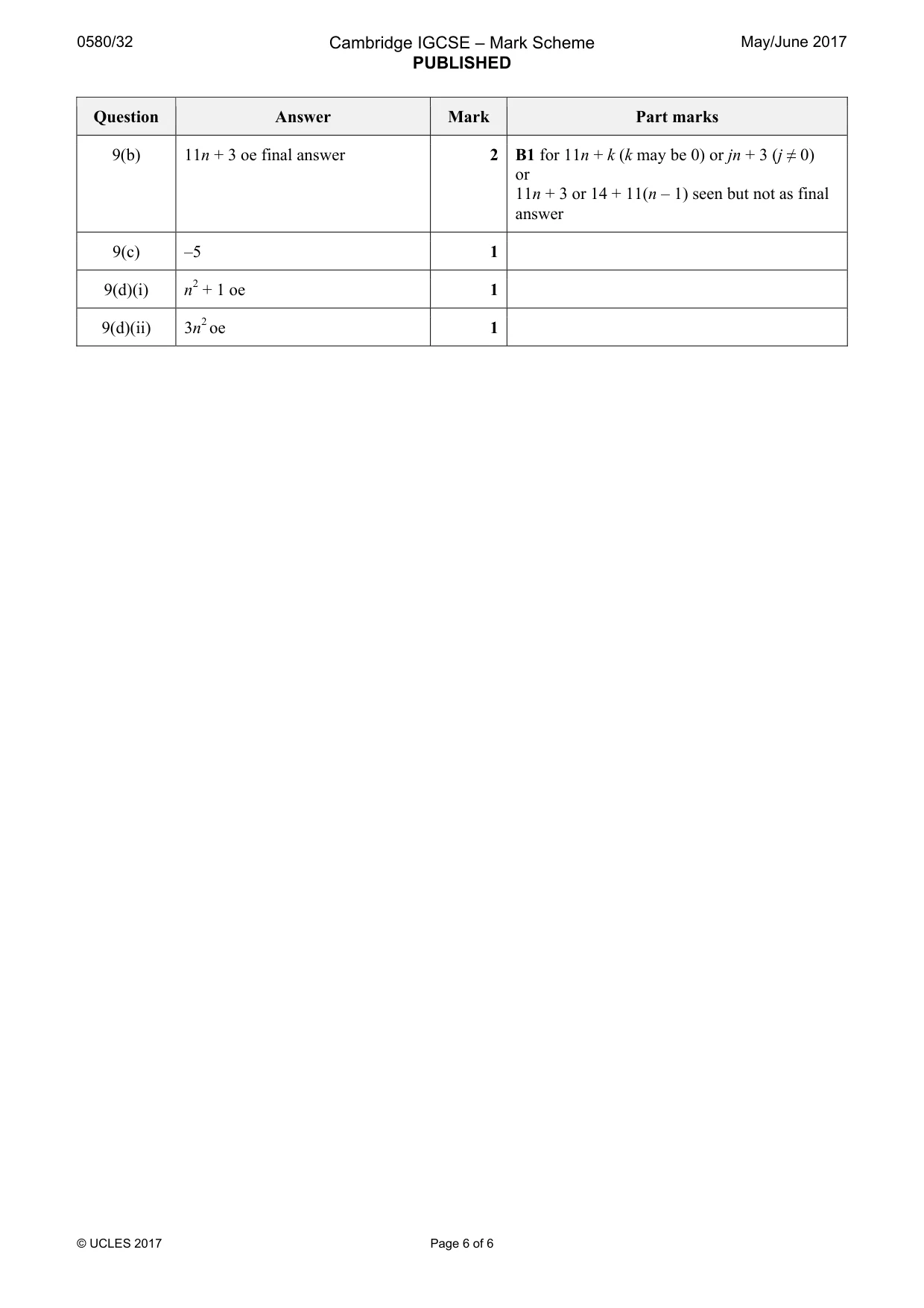
Mark scheme: 9(a)(i) 32 1 38 1FT FT their 32 + 6 9(a)(ii) –2 1 –8 1FT FT their –2 – 6 9(b) 11n + 3 oe final answer 2 B1 for 11n + k (k may be 0) or jn + 3 (j ≠ 0) or 11n + 3 or 14 + 11(n – 1) seen but not as final answer 9(c) –5 1 9(d)(i) n2 + 1 oe 1 9(d)(ii) 3n2 oe 1
What was in this paper
The subtopics covered by these 9 questions, and how many questions each got. Open one in a new tab to see every Cambridge question on it.
What you needed in this session
Cambridge’s own grade thresholds for 2017 May/June, Paper 3 · Variant 2. A higher threshold means an easier paper — the bar moves with how the cohort did.