Cambridge IGCSE Mathematics 0580 — 2017 May/June Paper 3 · Variant 3
0580/33/M/J/17 · 9 questions · 104 marks · ≈117 min
The question paper and its mark scheme, free to read here and free to download. This is Cambridge’s own paper, exactly as it was sat.
Question paper16 pages
Mark scheme5 pages
Answers below. Sit the paper first if you are practising.
Questions as text
Q1 · Some children chose their favourite ice-cream flavour from chocolate, vanilla, strawberry…
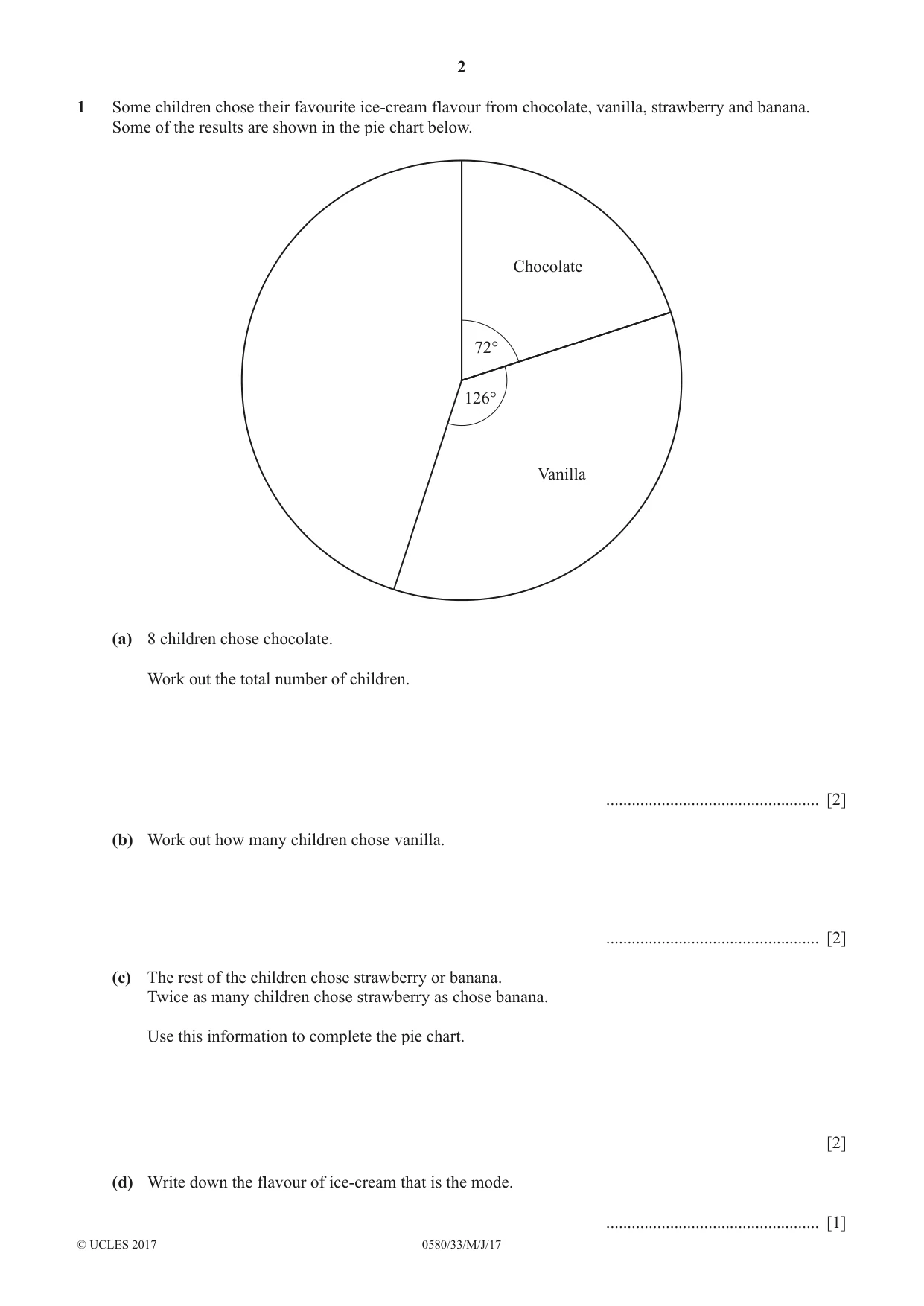
1 Some children chose their favourite ice-cream flavour from chocolate, vanilla, strawberry and banana. Some of the results are shown in the pie chart below. Chocolate 72° 126° Vanilla (a) 8 children chose chocolate. Work out the total number of children. .................................................. [2] (b) Work out how many children chose vanilla. .................................................. [2] (c) The rest of the children chose strawberry or banana. Twice as many children chose strawberry as chose banana. Use this information to complete the pie chart. [2] (d) Write down the flavour of ice-cream that is the mode. .................................................. [1]
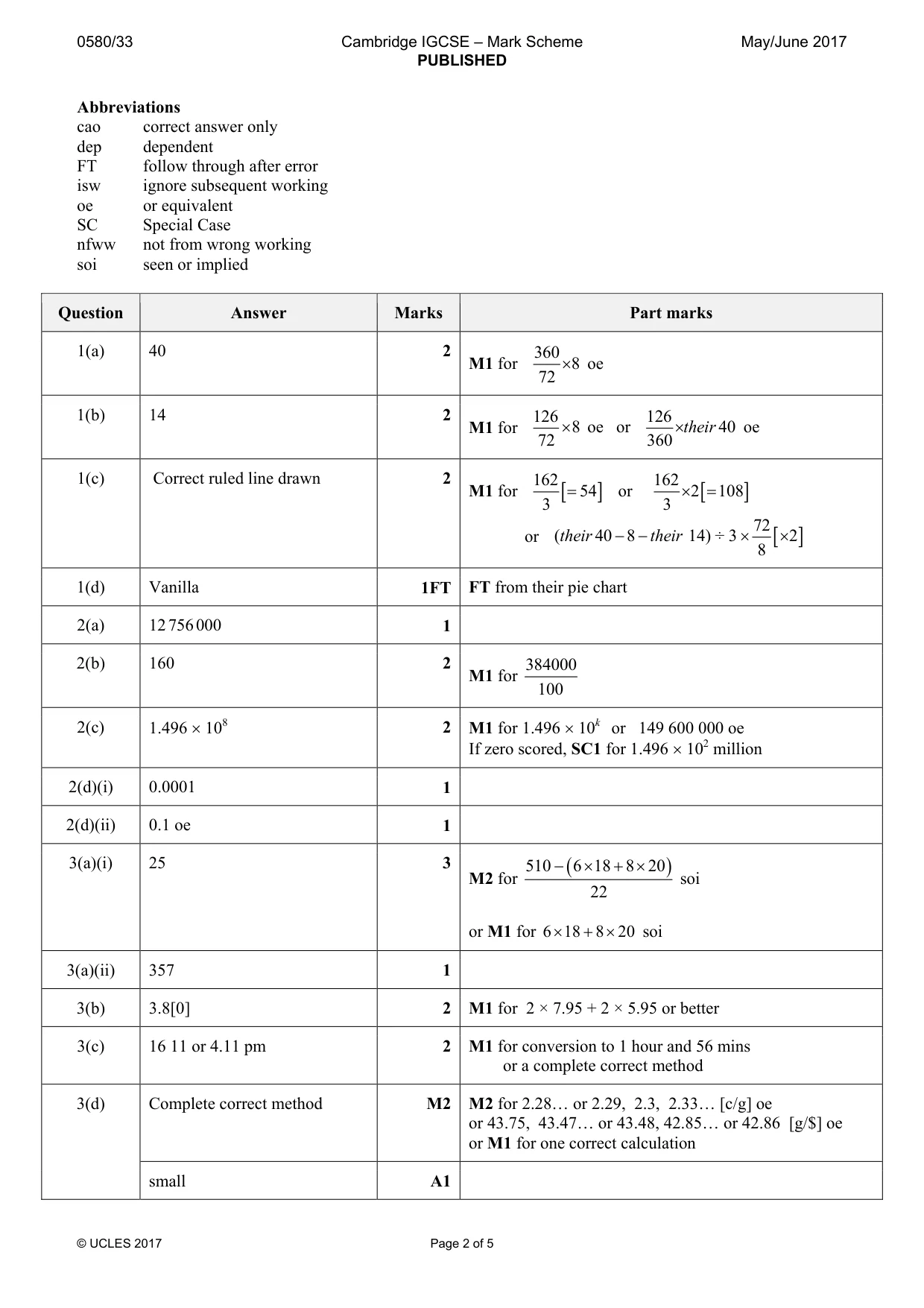
Mark scheme: Question Answer Marks Part marks 1(a) 40 2 360 M1 for × 8 oe 72 1(b) 14 2 126 126 M1 for × 8 oe or ×their 40 oe 72 360 1(c) Correct ruled line drawn 2 162 162 M1 for [ = 54 ] or × 2 [ = 108 ] 3 3 72 or (their 40 −−8 their 14) ÷ 3 × [ × 2 ] 8 1(d) Vanilla 1FT FT from their pie chart
Q2 · The diameter of the Earth is 12 756 km
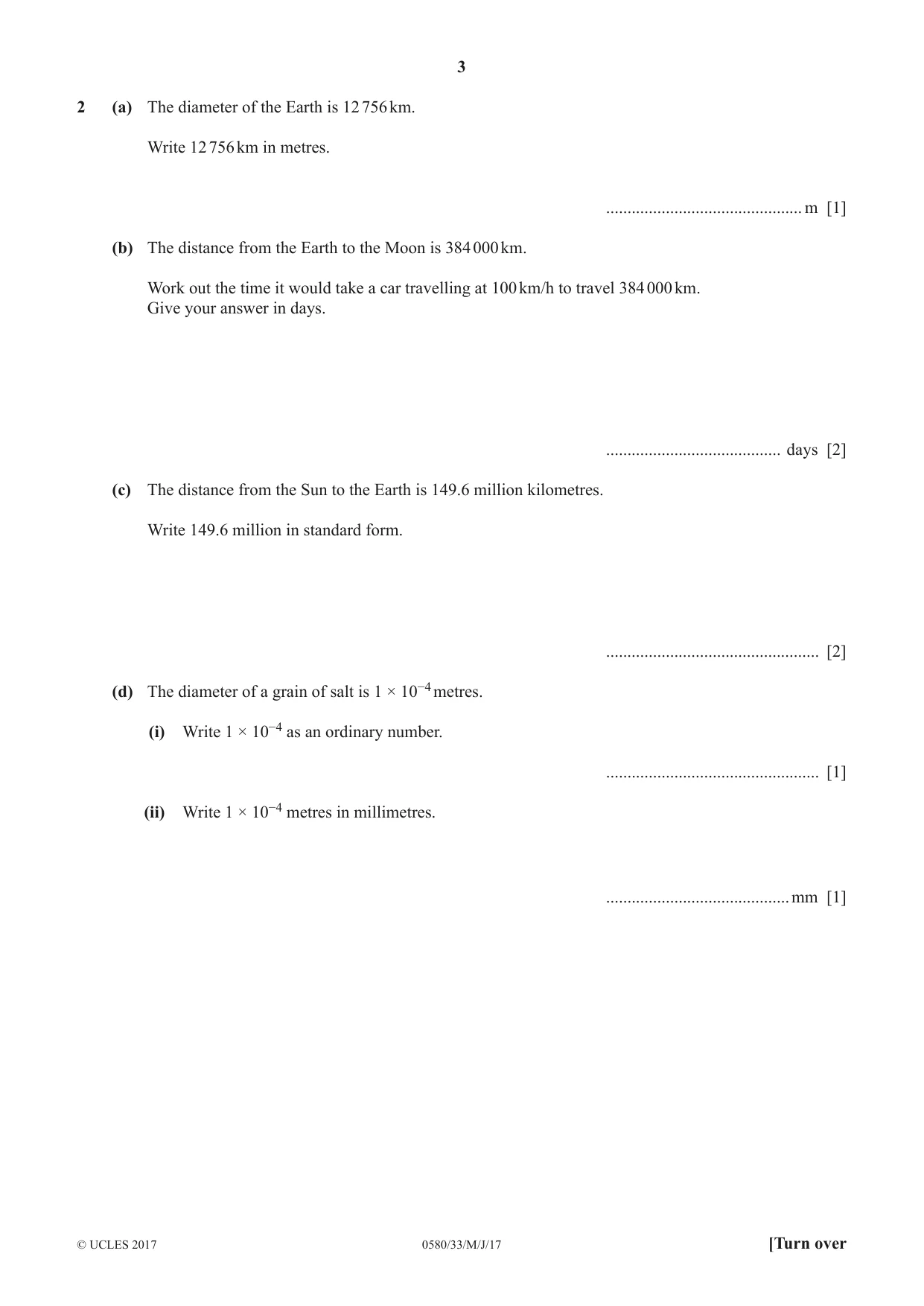
2 (a) The diameter of the Earth is 12 756 km. Write 12 756 km in metres. .............................................. m [1] (b) The distance from the Earth to the Moon is 384 000 km. Work out the time it would take a car travelling at 100 km/h to travel 384 000 km. Give your answer in days. ......................................... days [2] (c) The distance from the Sun to the Earth is 149.6 million kilometres. Write 149.6 million in standard form. .................................................. [2] (d) The diameter of a grain of salt is 1 × 10⁻⁴ metres. (i) Write 1 × 10⁻⁴ as an ordinary number. .................................................. [1] (ii) Write 1 × 10⁻⁴ metres in millimetres. ........................................... mm [1]
Mark scheme: 2(a) 12 756 000 1 2(b) 160 2 384000 M1 for 100 2(c) 1.496 × 10⁸ 2 M1 for 1.496 × 10k or 149 600 000 oe If zero scored, SC1 for 1.496 × 10² million 2(d)(i) 0.0001 1 2(d)(ii) 0.1 oe 1
Q3 · The McVay family go to the cinema
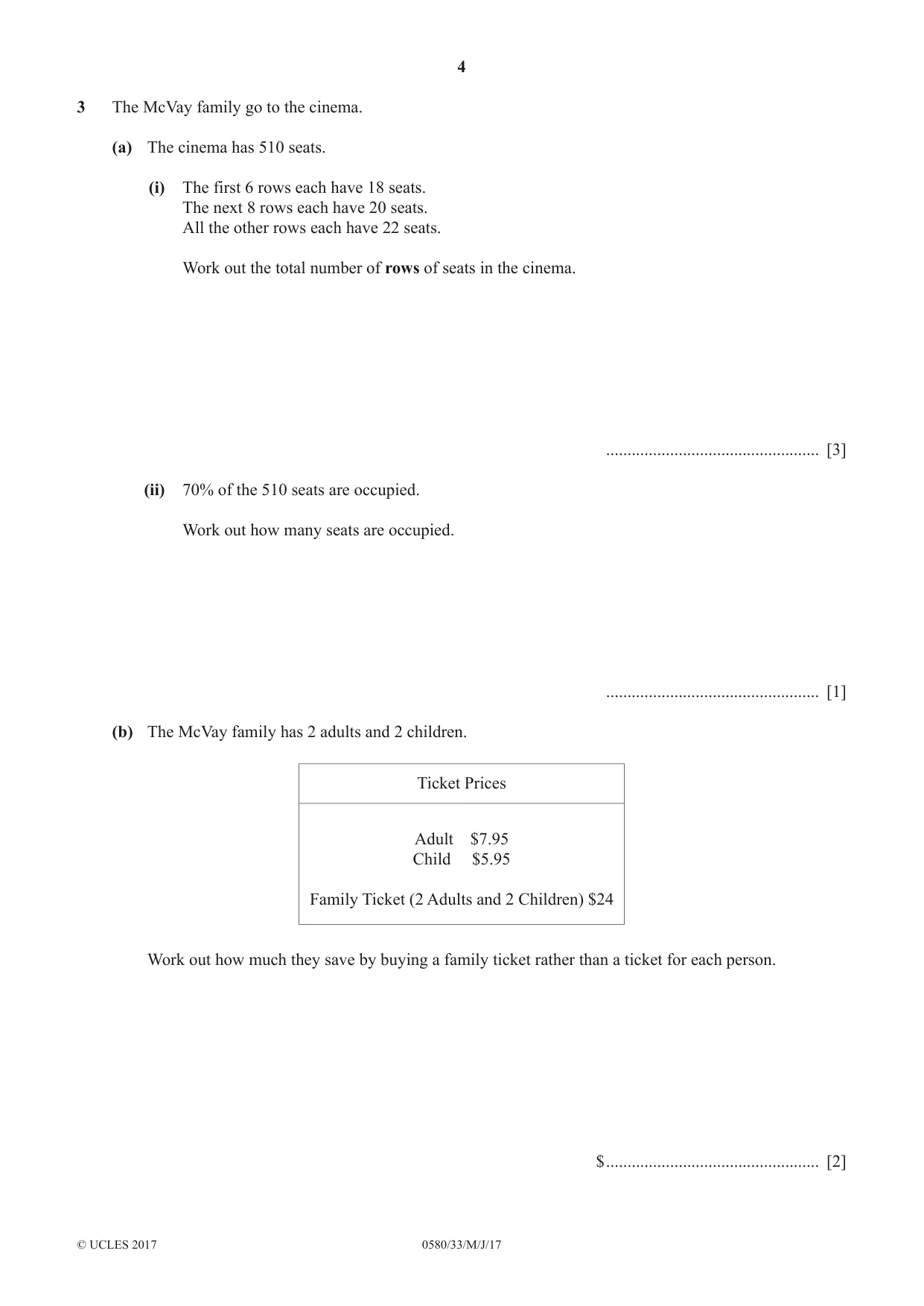
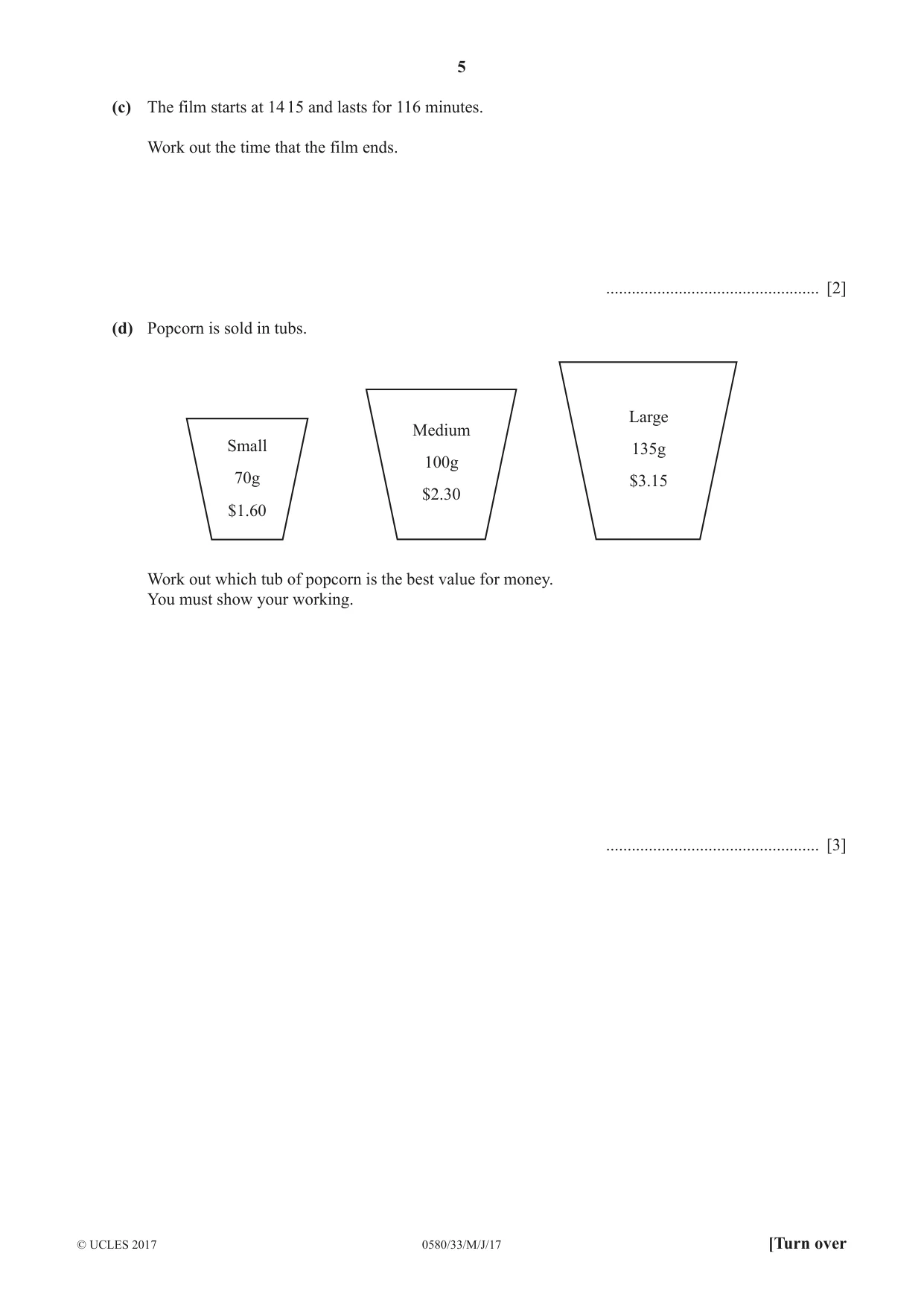
3 The McVay family go to the cinema. (a) The cinema has 510 seats. (i) The first 6 rows each have 18 seats. The next 8 rows each have 20 seats. All the other rows each have 22 seats. Work out the total number of rows of seats in the cinema. .................................................. [3] (ii) 70% of the 510 seats are occupied. Work out how many seats are occupied. .................................................. [1] (b) The McVay family has 2 adults and 2 children. Ticket Prices Adult $7.95 Child $5.95 Family Ticket (2 Adults and 2 Children) $24 Work out how much they save by buying a family ticket rather than a ticket for each person. $ .................................................. [2] (c) The film starts at 14 15 and lasts for 116 minutes. Work out the time that the film ends. .................................................. [2] (d) Popcorn is sold in tubs. Large Medium Small 135g 100g 70g $3.15 $2.30 $1.60 Work out which tub of popcorn is the best value for money. You must show your working. .................................................. [3]
Mark scheme: 3(a)(i) 25 3 510 − ( 6 × 18 + 8 × 20 ) M2 for soi 22 or M1 for 6 × 18 + 8 × 20 soi 3(a)(ii) 357 1 3(b) 3.8[0] 2 M1 for 2 × 7.95 + 2 × 5.95 or better 3(c) 16 11 or 4.11 pm 2 M1 for conversion to 1 hour and 56 mins or a complete correct method 3(d) Complete correct method M2 M2 for 2.28… or 2.29, 2.3, 2.33… [c/g] oe or 43.75, 43.47… or 43.48, 42.85… or 42.86 [g/$] oe or M1 for one correct calculation small A1
Q4 · Measure the reflex angle at A
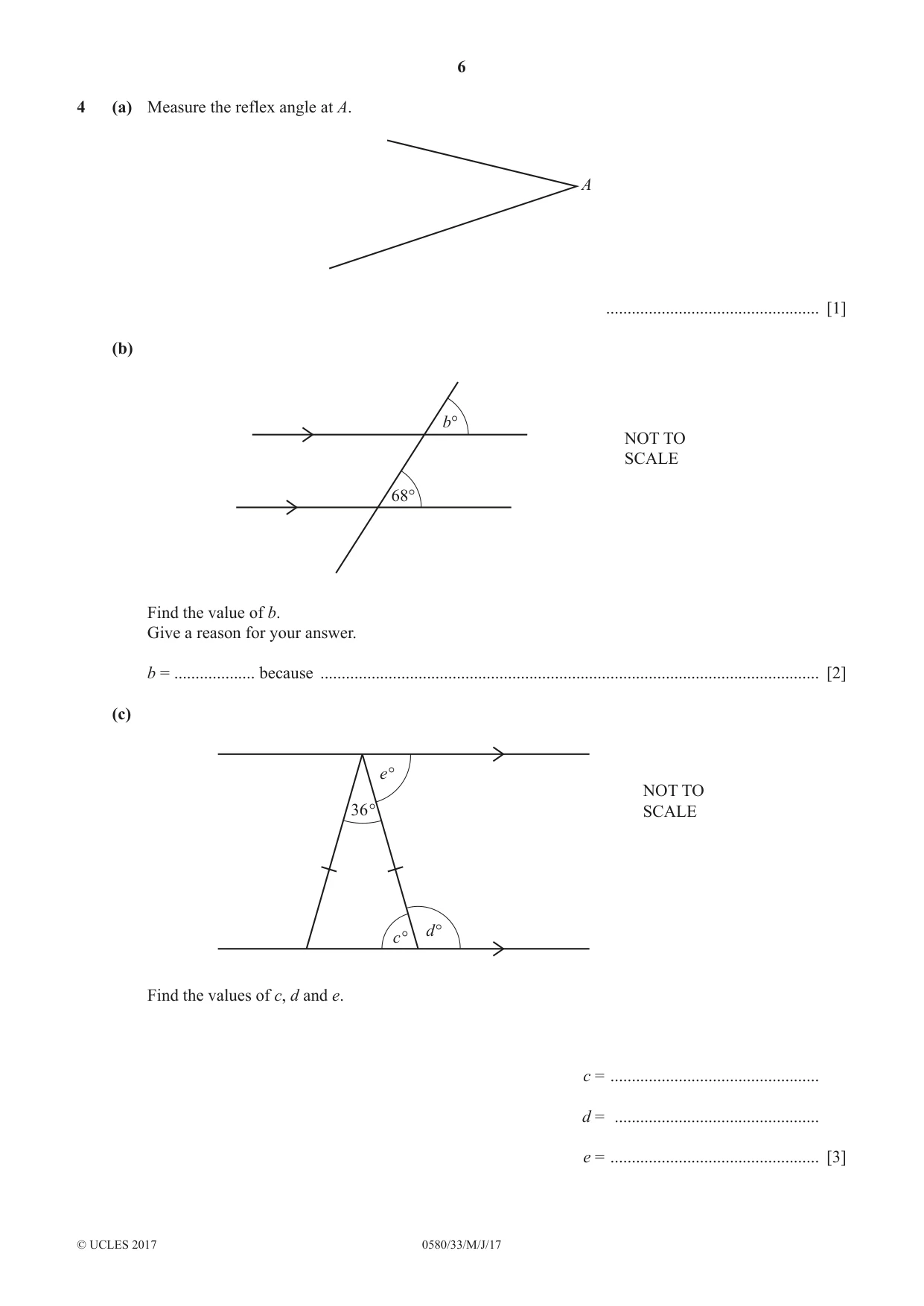
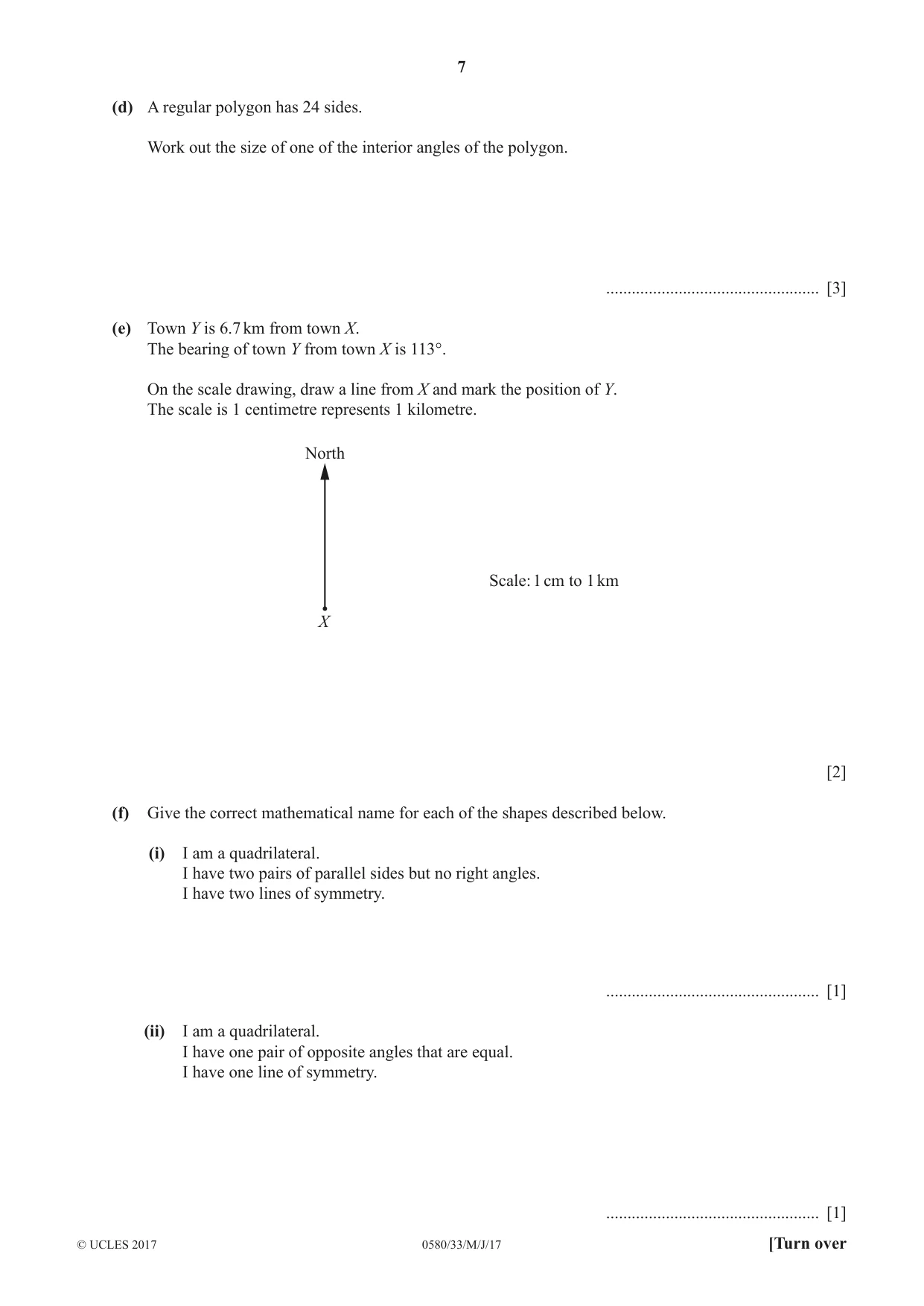
4 (a) Measure the reflex angle at A. A .................................................. [1] (b) b° NOT TO SCALE 68° Find the value of b. Give a reason for your answer. b = ................... because ..................................................................................................................... [2] (c) e° NOT TO 36° SCALE d° c° Find the values of c, d and e. c = ................................................. d = ................................................ e = ................................................. [3] (d) A regular polygon has 24 sides. Work out the size of one of the interior angles of the polygon. .................................................. [3] (e) Town Y is 6.7 km from town X. The bearing of town Y from town X is 113°. On the scale drawing, draw a line from X and mark the position of Y. The scale is 1 centimetre represents 1 kilometre. North Scale: 1 cm to 1 km X [2] (f) Give the correct mathematical name for each of the shapes described below. (i) I am a quadrilateral. I have two pairs of parallel sides but no right angles. I have two lines of symmetry. .................................................. [1] (ii) I am a quadrilateral. I have one pair of opposite angles that are equal. I have one line of symmetry. .................................................. [1]
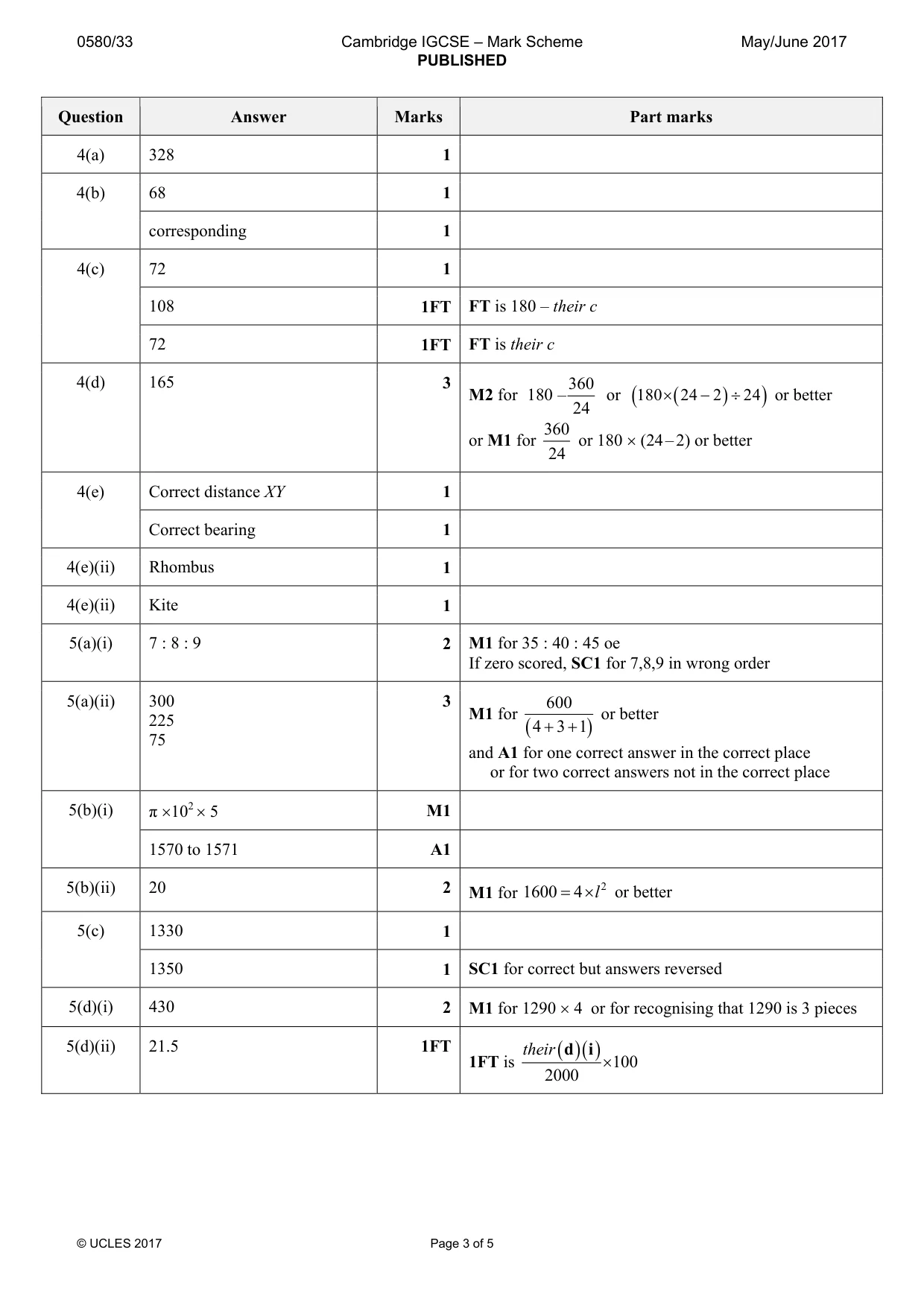
Mark scheme: 4(a) 328 1 4(b) 68 1 corresponding 1 4(c) 72 1 108 1FT FT is 180 – their c 72 1FT FT is their c 4(d) 165 3 360 M2 for 180 – or (180 × ( 24 − 2 ) ÷ 24 ) or better 24 360 or M1 for or 180 × (24 – 2) or better 24 4(e) Correct distance XY 1 Correct bearing 1 4(e)(ii) Rhombus 1 4(e)(ii) Kite 1
Q5 · Simone makes a fruit cake
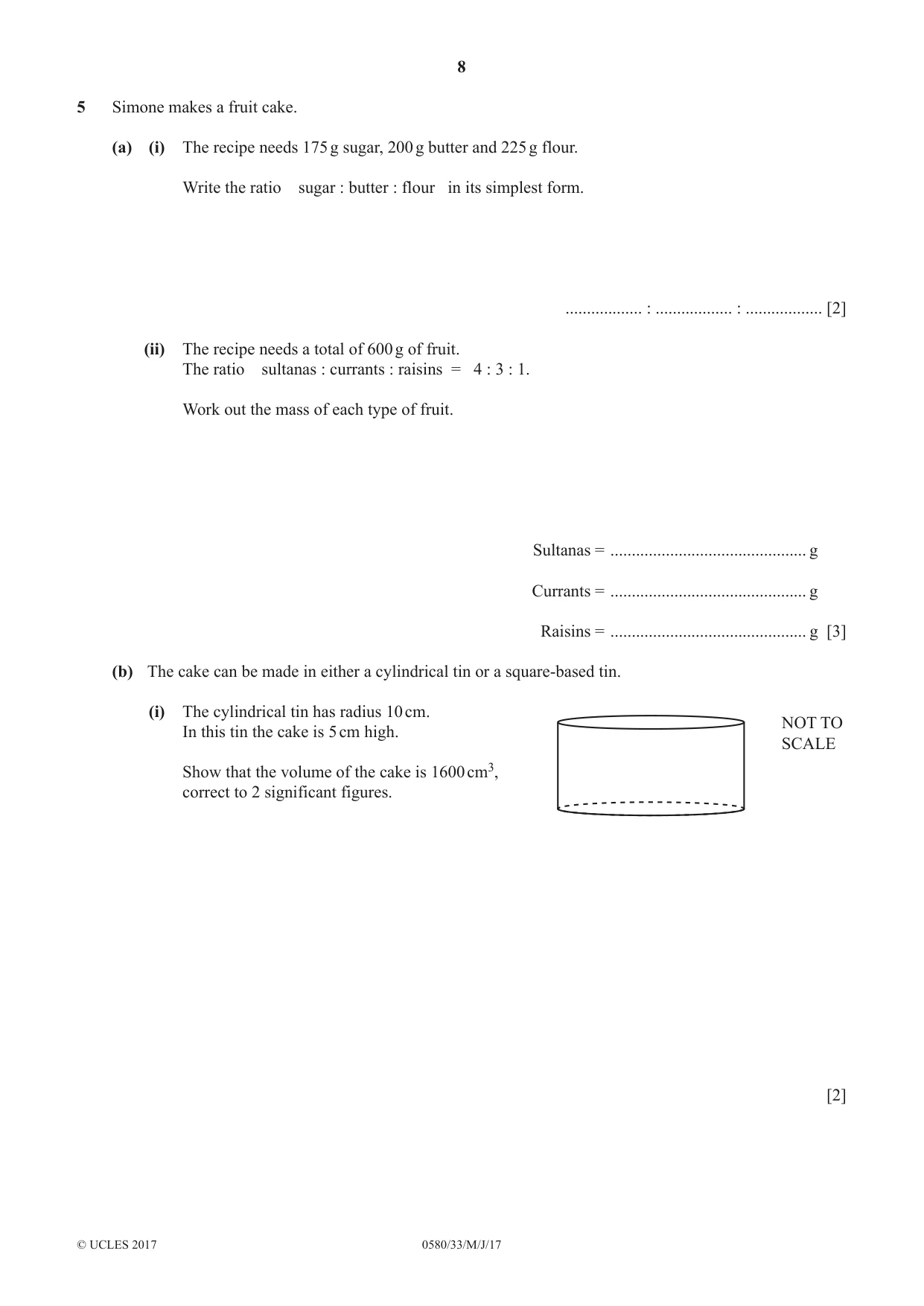
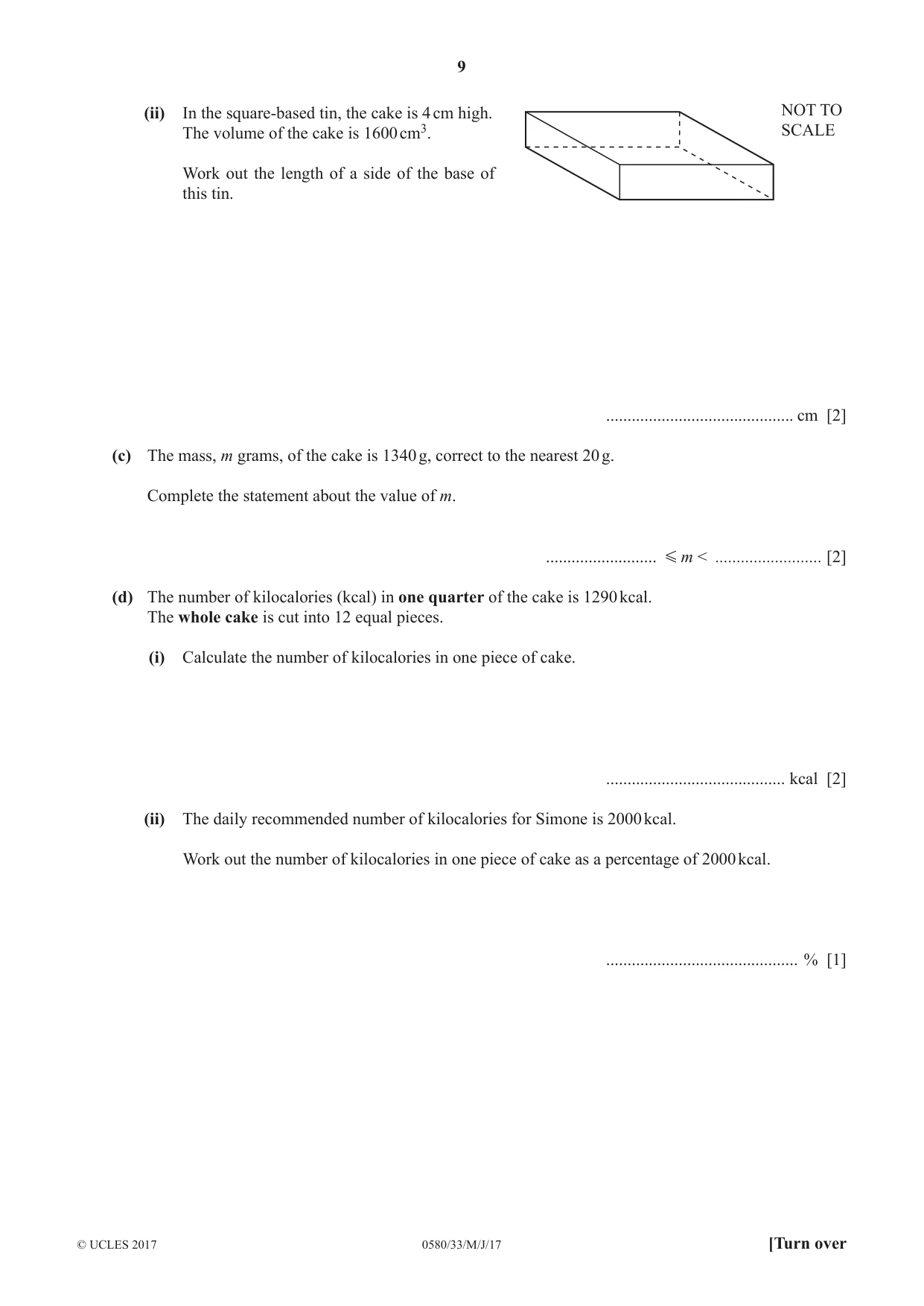
5 Simone makes a fruit cake. (a) (i) The recipe needs 175 g sugar, 200 g butter and 225 g flour. Write the ratio sugar : butter : flour in its simplest form. .................. : .................. : .................. [2] (ii) The recipe needs a total of 600 g of fruit. The ratio sultanas : currants : raisins = 4 : 3 : 1. Work out the mass of each type of fruit. Sultanas = .............................................. g Currants = .............................................. g Raisins = .............................................. g [3] (b) The cake can be made in either a cylindrical tin or a square-based tin. (i) The cylindrical tin has radius 10 cm. NOT TO In this tin the cake is 5 cm high. SCALE Show that the volume of the cake is 1600 cm3, correct to 2 significant figures. [2] (ii) In the square-based tin, the cake is 4 cm high. NOT TO The volume of the cake is 1600 cm3. SCALE Work out the length of a side of the base of this tin. ............................................ cm [2] (c) The mass, m grams, of the cake is 1340 g, correct to the nearest 20 g. Complete the statement about the value of m. .......................... G m < ......................... [2] (d) The number of kilocalories (kcal) in one quarter of the cake is 1290 kcal. The whole cake is cut into 12 equal pieces. (i) Calculate the number of kilocalories in one piece of cake. .......................................... kcal [2] (ii) The daily recommended number of kilocalories for Simone is 2000 kcal. Work out the number of kilocalories in one piece of cake as a percentage of 2000 kcal. ............................................. % [1]
Mark scheme: 5(a)(i) 7 : 8 : 9 2 M1 for 35 : 40 : 45 oe If zero scored, SC1 for 7,8,9 in wrong order 5(a)(ii) 300 3 600 M1 for or better 225 ( 4 + 3 + 1) 75 and A1 for one correct answer in the correct place or for two correct answers not in the correct place 5(b)(i) π ×102 × 5 M1 1570 to 1571 A1 5(b)(ii) 20 2 M1 for 1600 = 4 ×l 2 or better 5(c) 1330 1 1350 1 SC1 for correct but answers reversed 5(d)(i) 430 2 M1 for 1290 × 4 or for recognising that 1290 is 3 pieces 5(d)(ii) 21.5 1FT their ( d )( i ) 1FT is × 100 2000
Q6 · Complete the table of values for y = 2x2 − 4x − 6
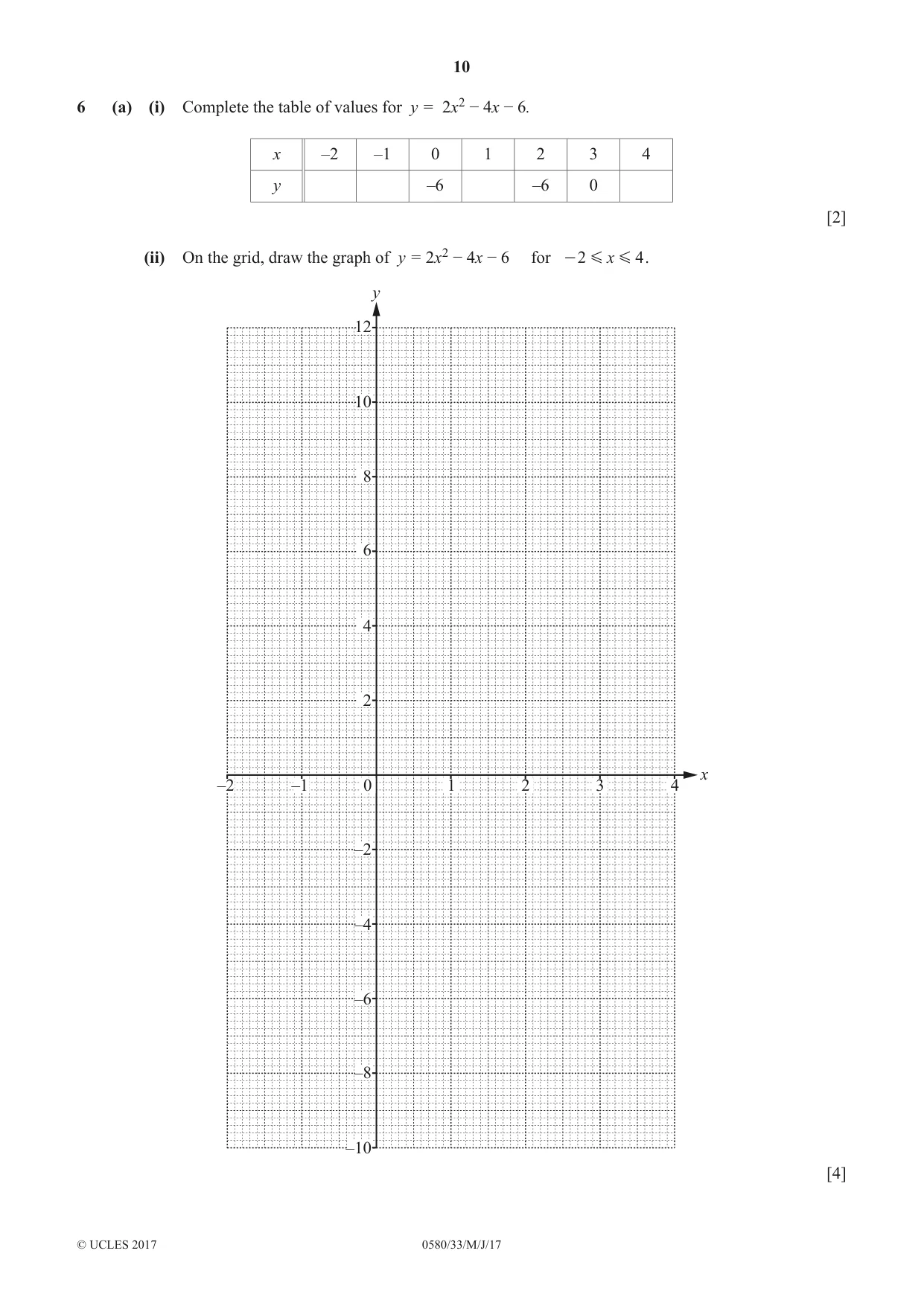
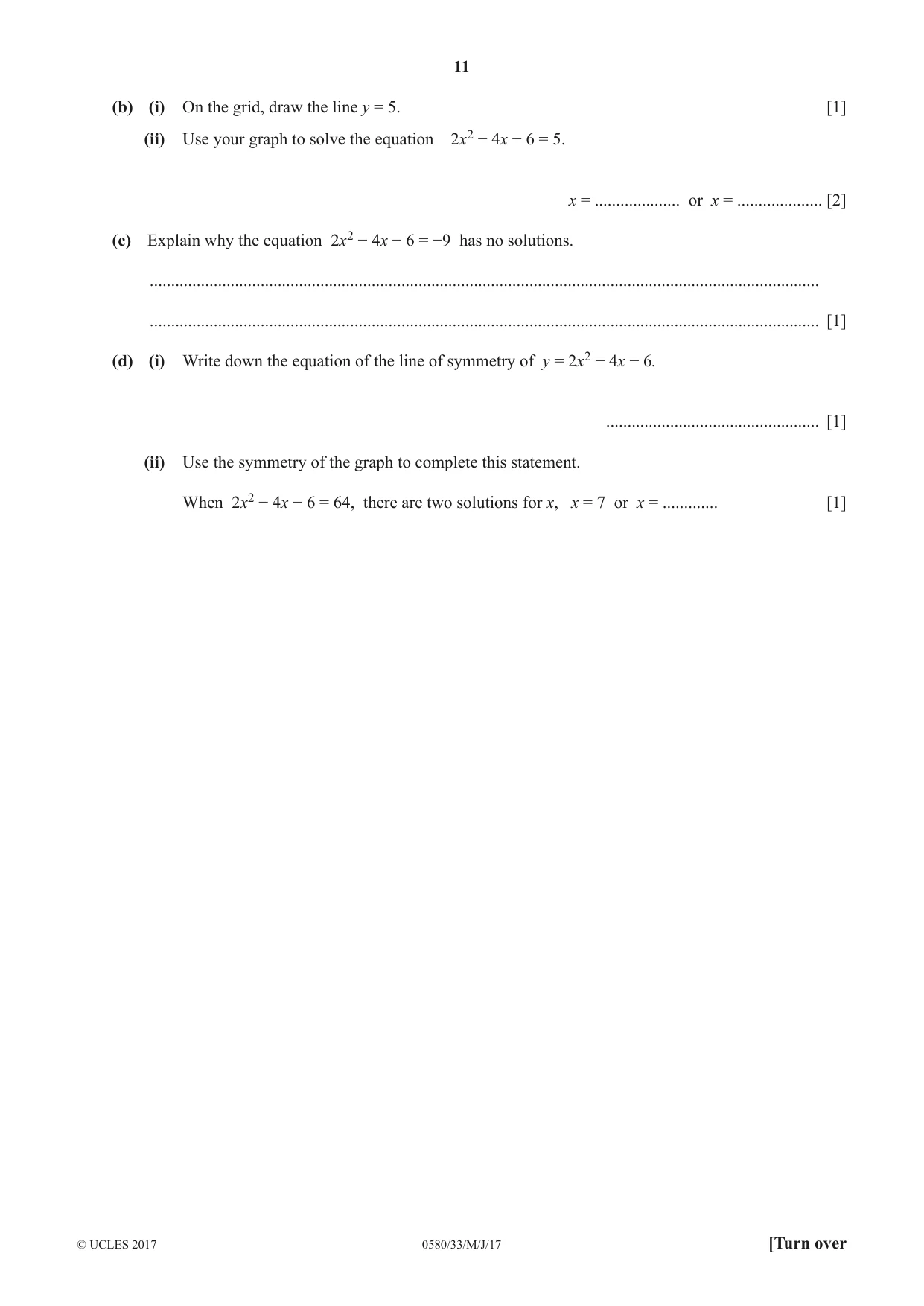
6 (a) (i) Complete the table of values for y = 2x2 − 4x − 6. x –2 –1 0 1 2 3 4 y –6 –6 0 [2] (ii) On the grid, draw the graph of y = 2x2 − 4x − 6 for - 2 G x G 4 . y 12 10 8 6 4 2 x –2 –1 0 1 2 3 4 –2 –4 –6 –8 –10 [4] (b) (i) On the grid, draw the line y = 5. [1] (ii) Use your graph to solve the equation 2x2 − 4x − 6 = 5. x = .................... or x = .................... [2] (c) Explain why the equation 2x2 − 4x − 6 = −9 has no solutions. ............................................................................................................................................................. ............................................................................................................................................................. [1] (d) (i) Write down the equation of the line of symmetry of y = 2x2 − 4x − 6. .................................................. [1] (ii) Use the symmetry of the graph to complete this statement. When 2x2 − 4x − 6 = 64, there are two solutions for x, x = 7 or x = ............. [1]
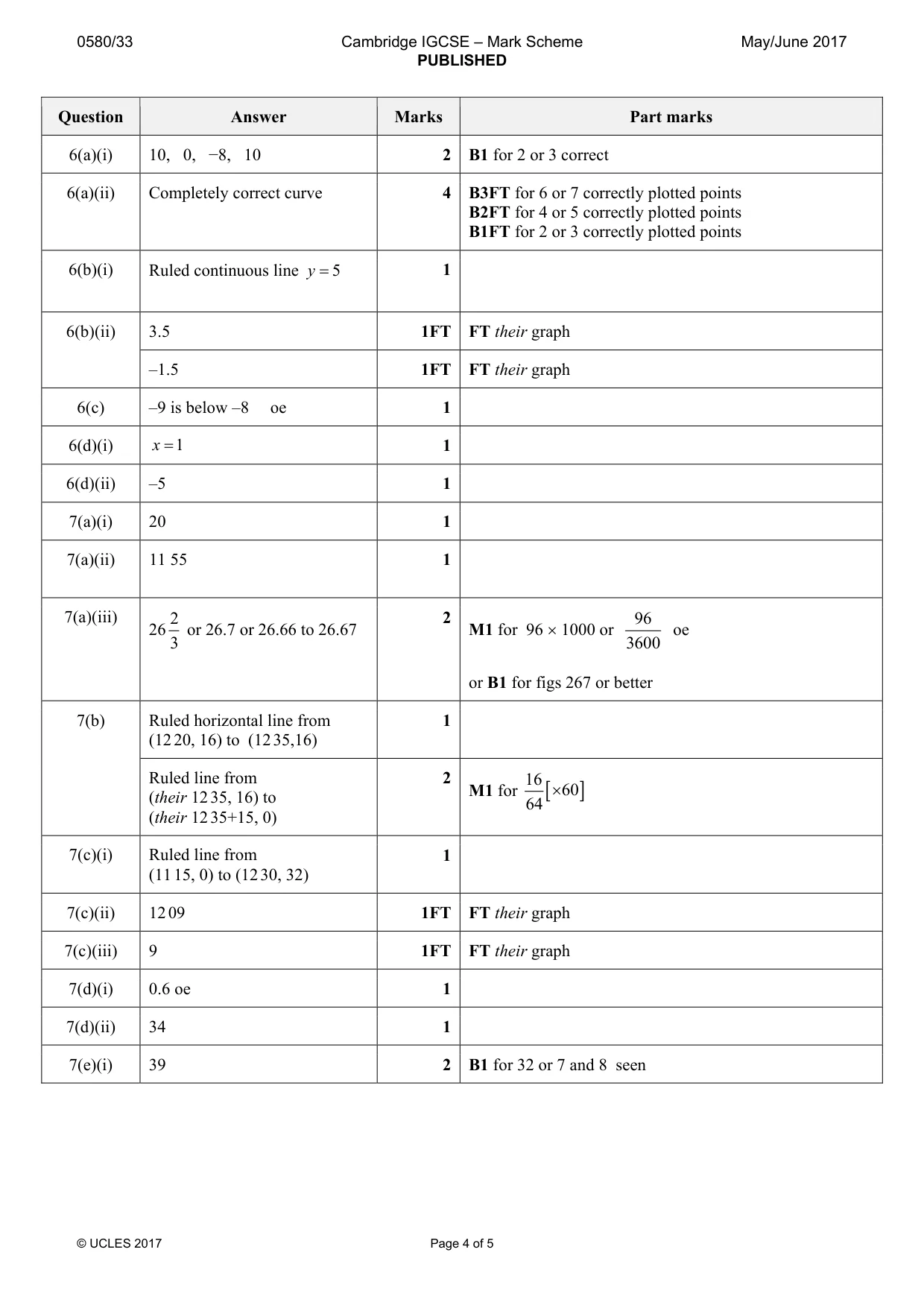
Mark scheme: 6(a)(i) 10, 0, −8, 10 2 B1 for 2 or 3 correct 6(a)(ii) Completely correct curve 4 B3FT for 6 or 7 correctly plotted points B2FT for 4 or 5 correctly plotted points B1FT for 2 or 3 correctly plotted points 6(b)(i) Ruled continuous line y = 5 1 6(b)(ii) 3.5 1FT FT their graph –1.5 1FT FT their graph 6(c) –9 is below –8 oe 1 6(d)(i) x = 1 1 6(d)(ii) –5 1
Q7 · 36 Wegmouth 32 28 Distance (km) 24 20 Tyneland 16 12 8 4 Seatown 0 11 00 11 30 12 00 12…
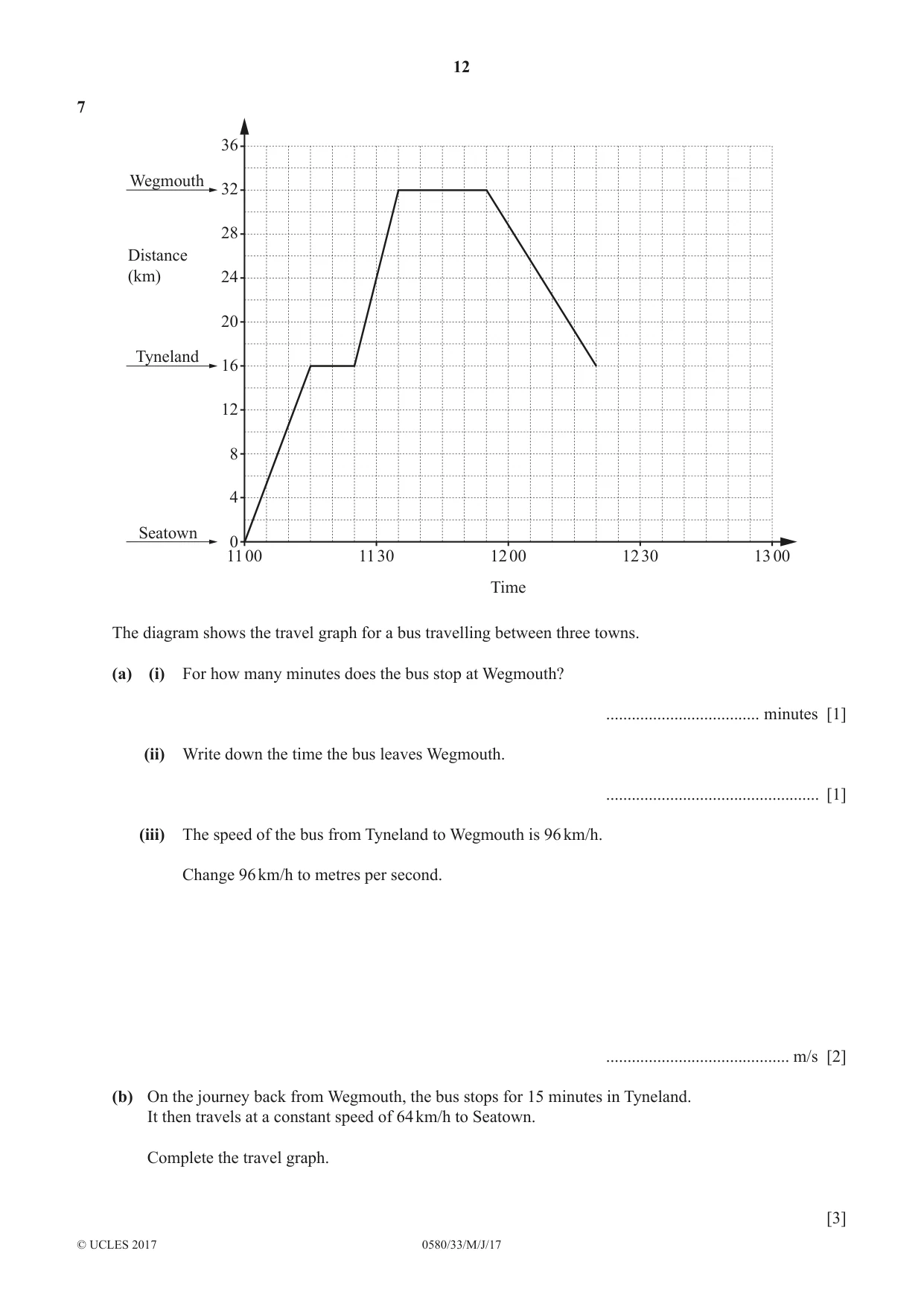
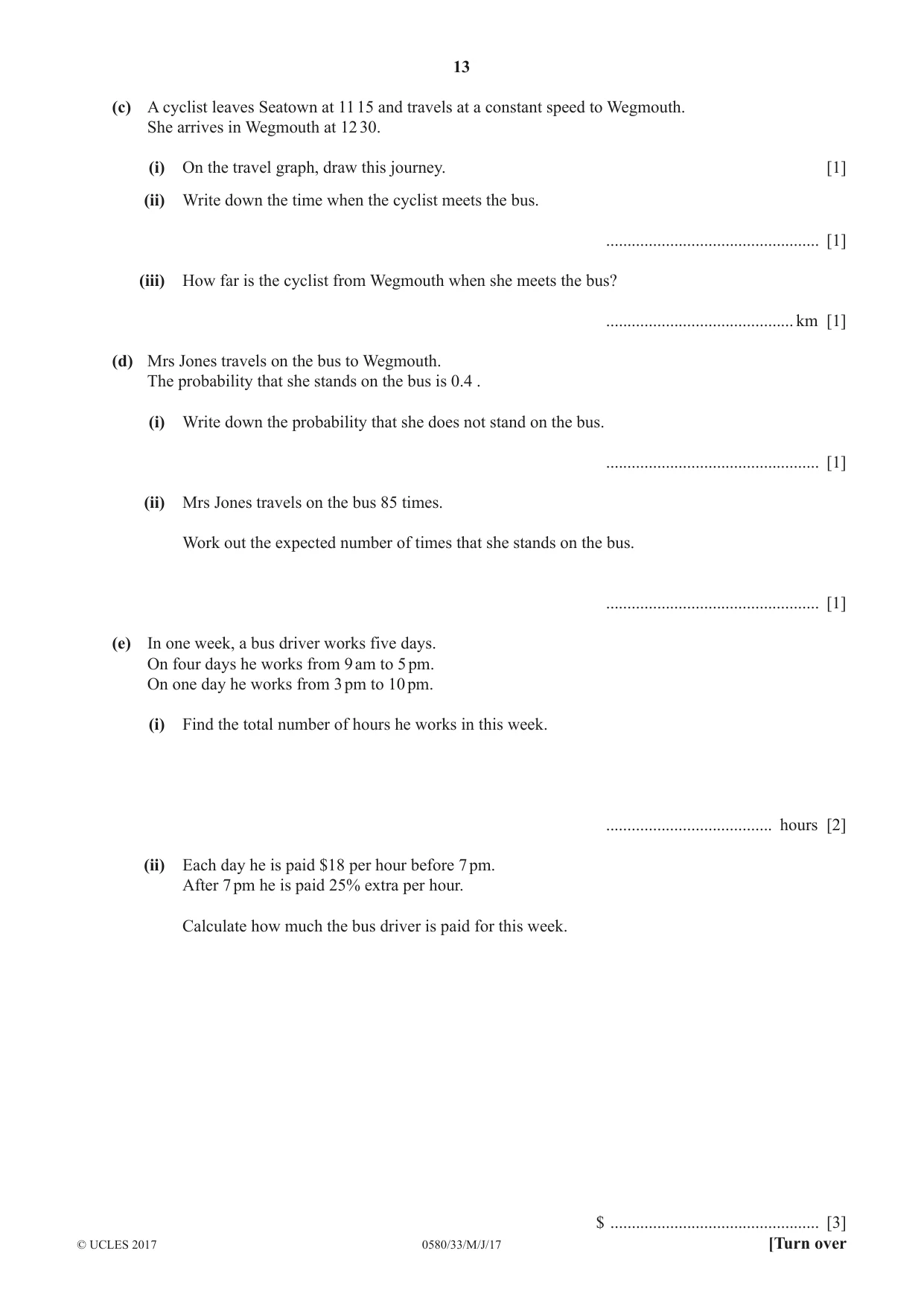
7 36 Wegmouth 32 28 Distance (km) 24 20 Tyneland 16 12 8 4 Seatown 0 11 00 11 30 12 00 12 30 13 00 Time The diagram shows the travel graph for a bus travelling between three towns. (a) (i) For how many minutes does the bus stop at Wegmouth? .................................... minutes [1] (ii) Write down the time the bus leaves Wegmouth. .................................................. [1] (iii) The speed of the bus from Tyneland to Wegmouth is 96 km/h. Change 96 km/h to metres per second. ........................................... m/s [2] (b) On the journey back from Wegmouth, the bus stops for 15 minutes in Tyneland. It then travels at a constant speed of 64 km/h to Seatown. Complete the travel graph. [3] (c) A cyclist leaves Seatown at 11 15 and travels at a constant speed to Wegmouth. She arrives in Wegmouth at 12 30. (i) On the travel graph, draw this journey. [1] (ii) Write down the time when the cyclist meets the bus. .................................................. [1] (iii) How far is the cyclist from Wegmouth when she meets the bus? ............................................ km [1] (d) Mrs Jones travels on the bus to Wegmouth. The probability that she stands on the bus is 0.4 . (i) Write down the probability that she does not stand on the bus. .................................................. [1] (ii) Mrs Jones travels on the bus 85 times. Work out the expected number of times that she stands on the bus. .................................................. [1] (e) In one week, a bus driver works five days. On four days he works from 9 am to 5 pm. On one day he works from 3 pm to 10 pm. (i) Find the total number of hours he works in this week. ....................................... hours [2] (ii) Each day he is paid $18 per hour before 7 pm. After 7 pm he is paid 25% extra per hour. Calculate how much the bus driver is paid for this week. $ ................................................. [3]
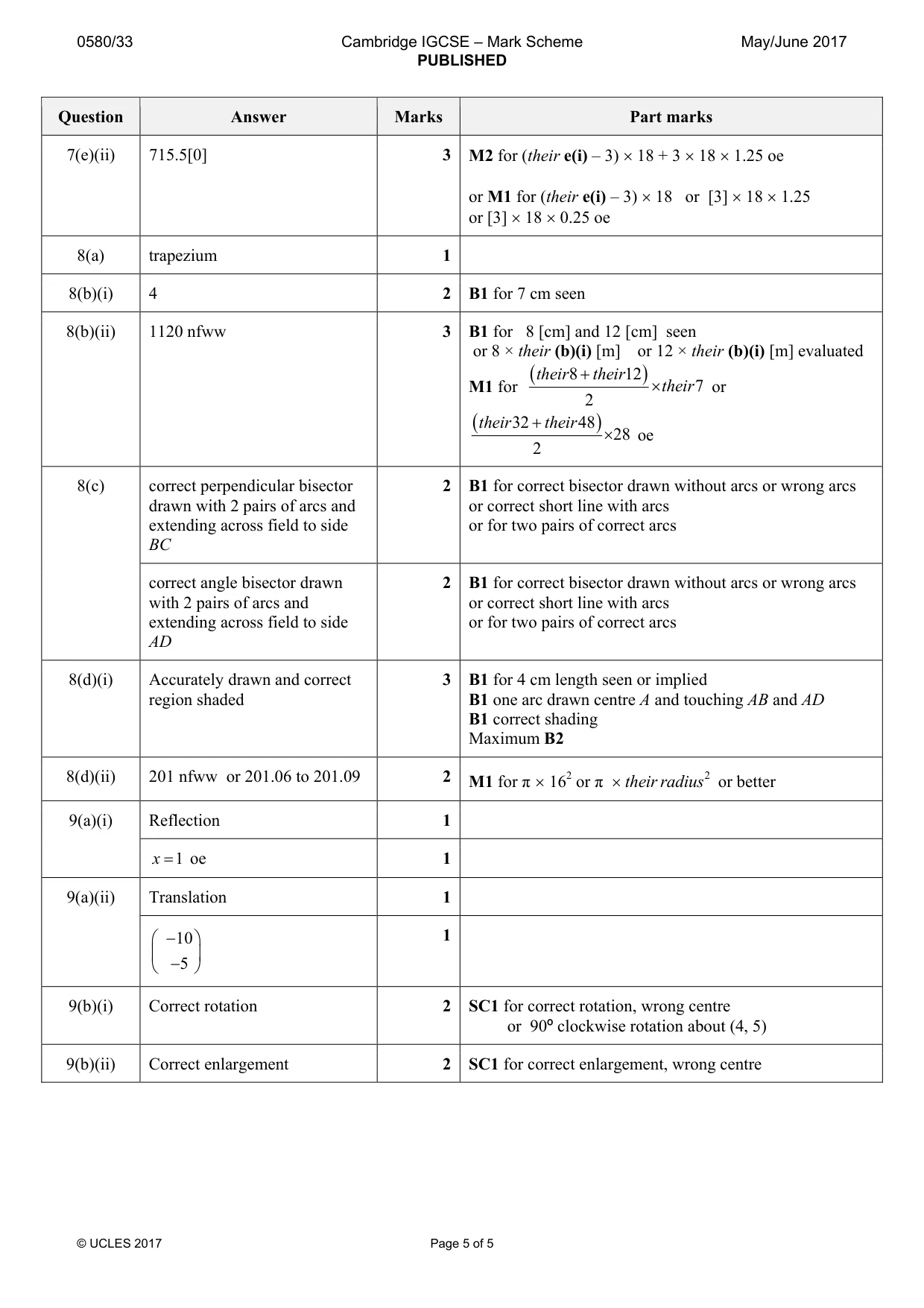
Mark scheme: 7(a)(i) 20 1 7(a)(ii) 11 55 1 7(a)(iii) 2 2 96 26 or 26.7 or 26.66 to 26.67 M1 for 96 × 1000 or oe 3 3600 or B1 for figs 267 or better 7(b) Ruled horizontal line from 1 (12 20, 16) to (12 35,16) Ruled line from 2 16 M1 for [ × 60 ] (their 12 35, 16) to 64 (their 12 35+15, 0) 7(c)(i) Ruled line from 1 (11 15, 0) to (12 30, 32) 7(c)(ii) 12 09 1FT FT their graph 7(c)(iii) 9 1FT FT their graph 7(d)(i) 0.6 oe 1 7(d)(ii) 34 1 7(e)(i) 39 2 B1 for 32 or 7 and 8 seen 7(e)(ii) 715.5[0] 3 M2 for (their e(i) – 3) × 18 + 3 × 18 × 1.25 oe or M1 for (their e(i) – 3) × 18 or [3] × 18 × 1.25 or [3] × 18 × 0.25 oe
Q8 · The quadrilateral ABCD is a scale drawing of a farmer’s field
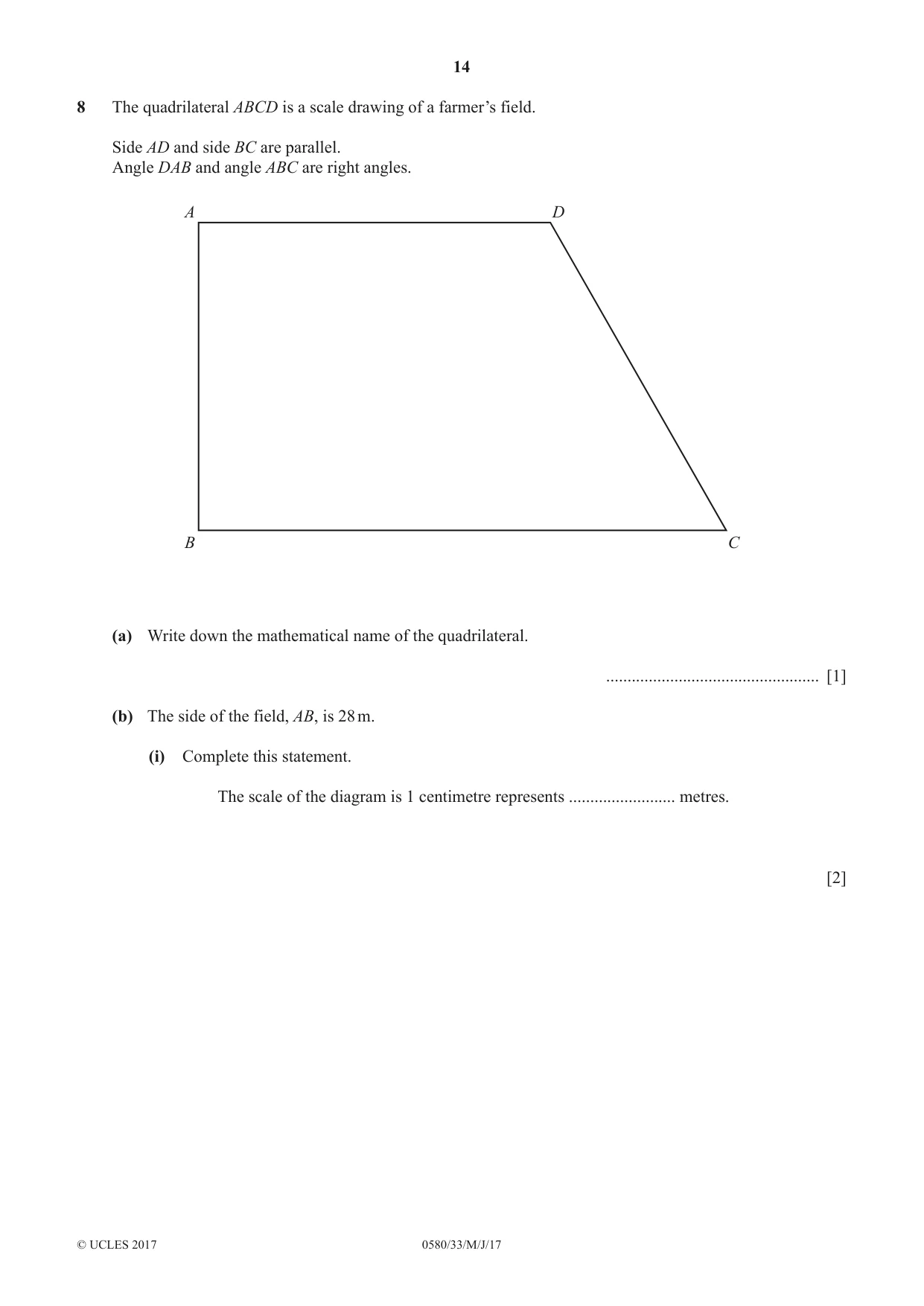
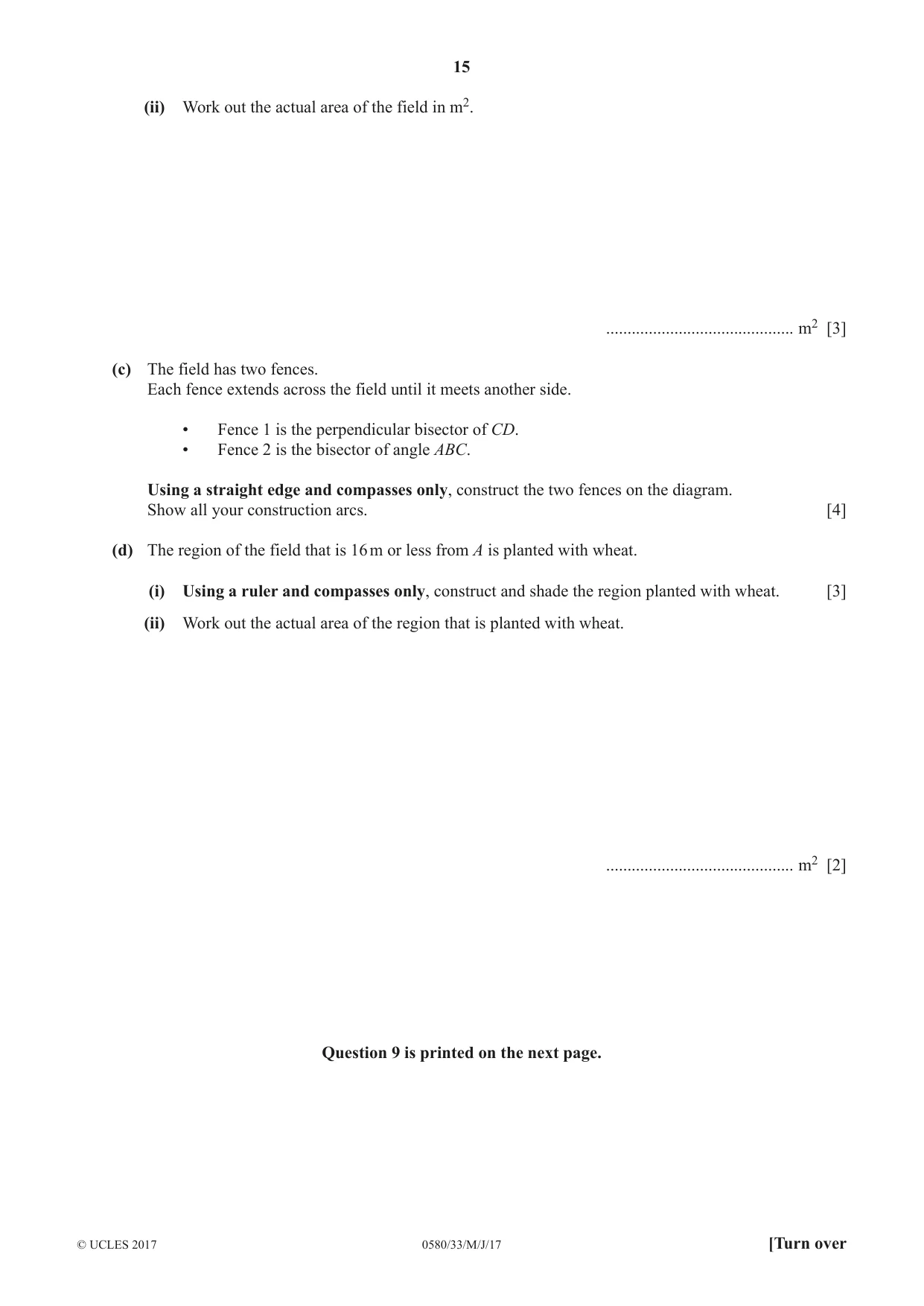
8 The quadrilateral ABCD is a scale drawing of a farmer’s field. Side AD and side BC are parallel. Angle DAB and angle ABC are right angles. A D B C (a) Write down the mathematical name of the quadrilateral. .................................................. [1] (b) The side of the field, AB, is 28 m. (i) Complete this statement. The scale of the diagram is 1 centimetre represents ......................... metres. [2] (ii) Work out the actual area of the field in m2. ............................................ m2 [3] (c) The field has two fences. Each fence extends across the field until it meets another side. • Fence 1 is the perpendicular bisector of CD. • Fence 2 is the bisector of angle ABC. Using a straight edge and compasses only, construct the two fences on the diagram. Show all your construction arcs. [4] (d) The region of the field that is 16 m or less from A is planted with wheat. (i) Using a ruler and compasses only, construct and shade the region planted with wheat. [3] (ii) Work out the actual area of the region that is planted with wheat. ............................................ m2 [2] Question 9 is printed on the next page.
Mark scheme: 8(a) trapezium 1 8(b)(i) 4 2 B1 for 7 cm seen 8(b)(ii) 1120 nfww 3 B1 for 8 [cm] and 12 [cm] seen or 8 × their (b)(i) [m] or 12 × their (b)(i) [m] evaluated ( their 8 + their12 ) M1 for × their 7 or 2 ( their 32 + their 48 ) × 28 oe 2 8(c) correct perpendicular bisector 2 B1 for correct bisector drawn without arcs or wrong arcs drawn with 2 pairs of arcs and or correct short line with arcs extending across field to side or for two pairs of correct arcs BC correct angle bisector drawn 2 B1 for correct bisector drawn without arcs or wrong arcs with 2 pairs of arcs and or correct short line with arcs extending across field to side or for two pairs of correct arcs AD 8(d)(i) Accurately drawn and correct 3 B1 for 4 cm length seen or implied region shaded B1 one arc drawn centre A and touching AB and AD B1 correct shading Maximum B2 8(d)(ii) 201 nfww or 201.06 to 201.09 2 M1 for π × 162 or π × their radius 2 or better
Q9 · Y 8 7 6 5 4 3 A B 2 1 x 0 –7 –6 –5 –4 –3 –2 –1 1 2 3 4 5 6 7 8 9 –1 –2 C –3 –4 (a) (i)…
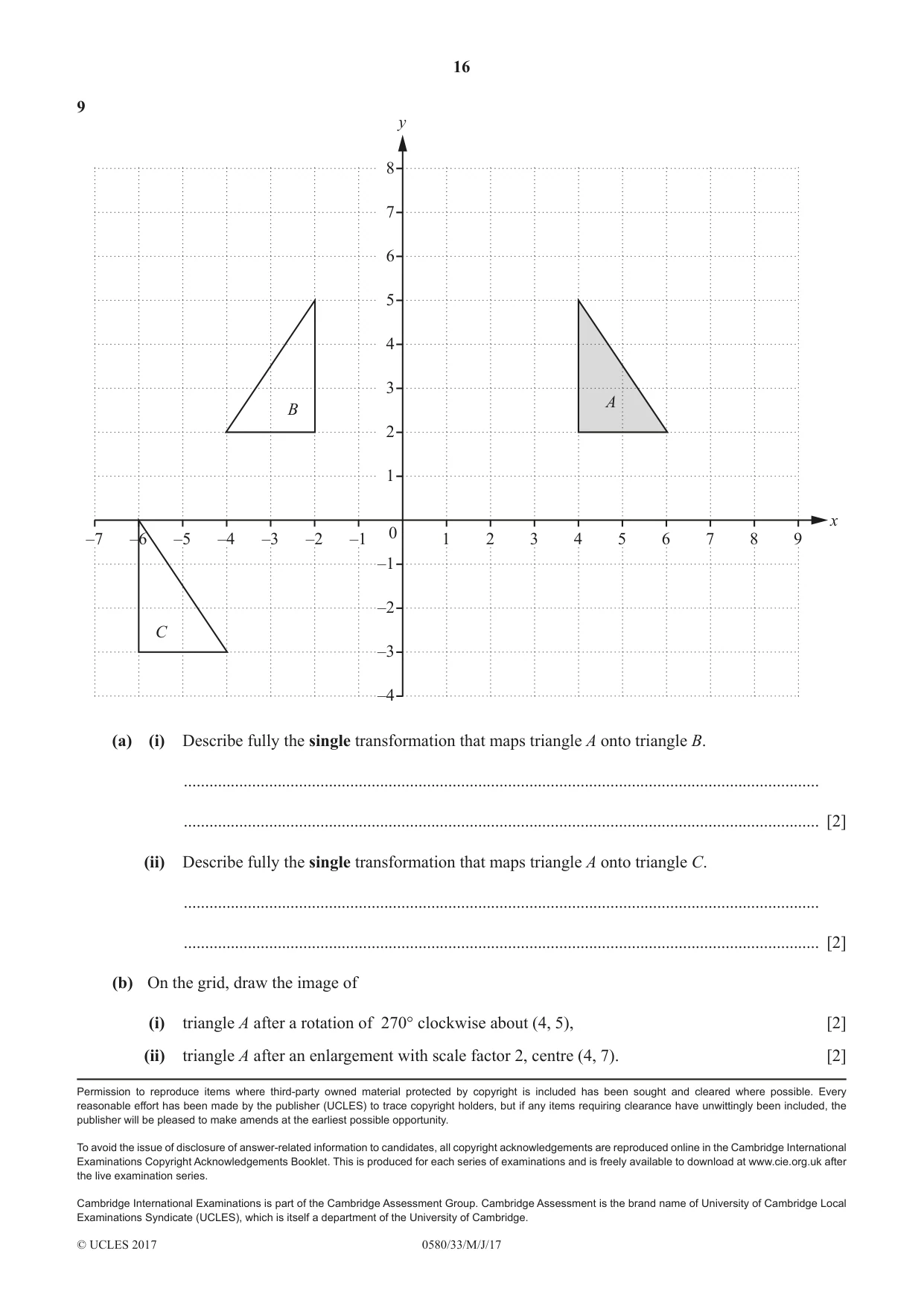
9 y 8 7 6 5 4 3 A B 2 1 x 0 –7 –6 –5 –4 –3 –2 –1 1 2 3 4 5 6 7 8 9 –1 –2 C –3 –4 (a) (i) Describe fully the single transformation that maps triangle A onto triangle B. ..................................................................................................................................................... ..................................................................................................................................................... [2] (ii) Describe fully the single transformation that maps triangle A onto triangle C. ..................................................................................................................................................... ..................................................................................................................................................... [2] (b) On the grid, draw the image of (i) triangle A after a rotation of 270° clockwise about (4, 5), [2] (ii) triangle A after an enlargement with scale factor 2, centre (4, 7). [2]
Mark scheme: 9(a)(i) Reflection 1 x = 1 oe 1 9(a)(ii) Translation 1 − 10 1 −5 9(b)(i) Correct rotation 2 SC1 for correct rotation, wrong centre or 90º clockwise rotation about (4, 5) 9(b)(ii) Correct enlargement 2 SC1 for correct enlargement, wrong centre
What was in this paper
The subtopics covered by these 9 questions, and how many questions each got. Open one in a new tab to see every Cambridge question on it.
What you needed in this session
Cambridge’s own grade thresholds for 2017 May/June, Paper 3 · Variant 3. A higher threshold means an easier paper — the bar moves with how the cohort did.