Cambridge IGCSE Mathematics 0580 — 2016 Oct/Nov Paper 4 · Variant 3
0580/43/O/N/16 · 10 questions · 130 marks · ≈146 min
The question paper and its mark scheme, free to read here and free to download. This is Cambridge’s own paper, exactly as it was sat.
Question paper20 pages
Mark scheme8 pages
Answers below. Sit the paper first if you are practising.
Questions as text
Q1 · A jigsaw puzzle has edge pieces and inside pieces
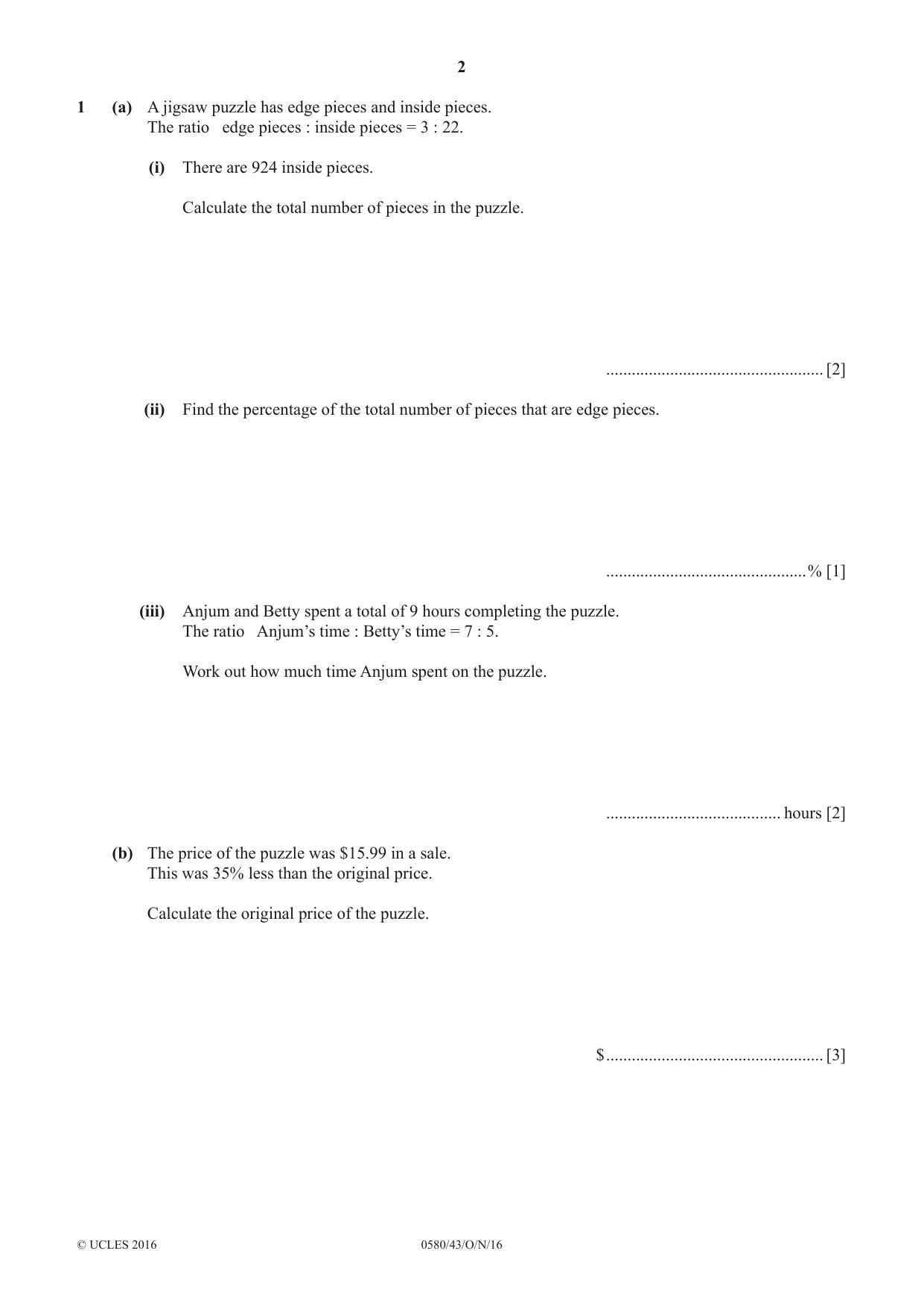
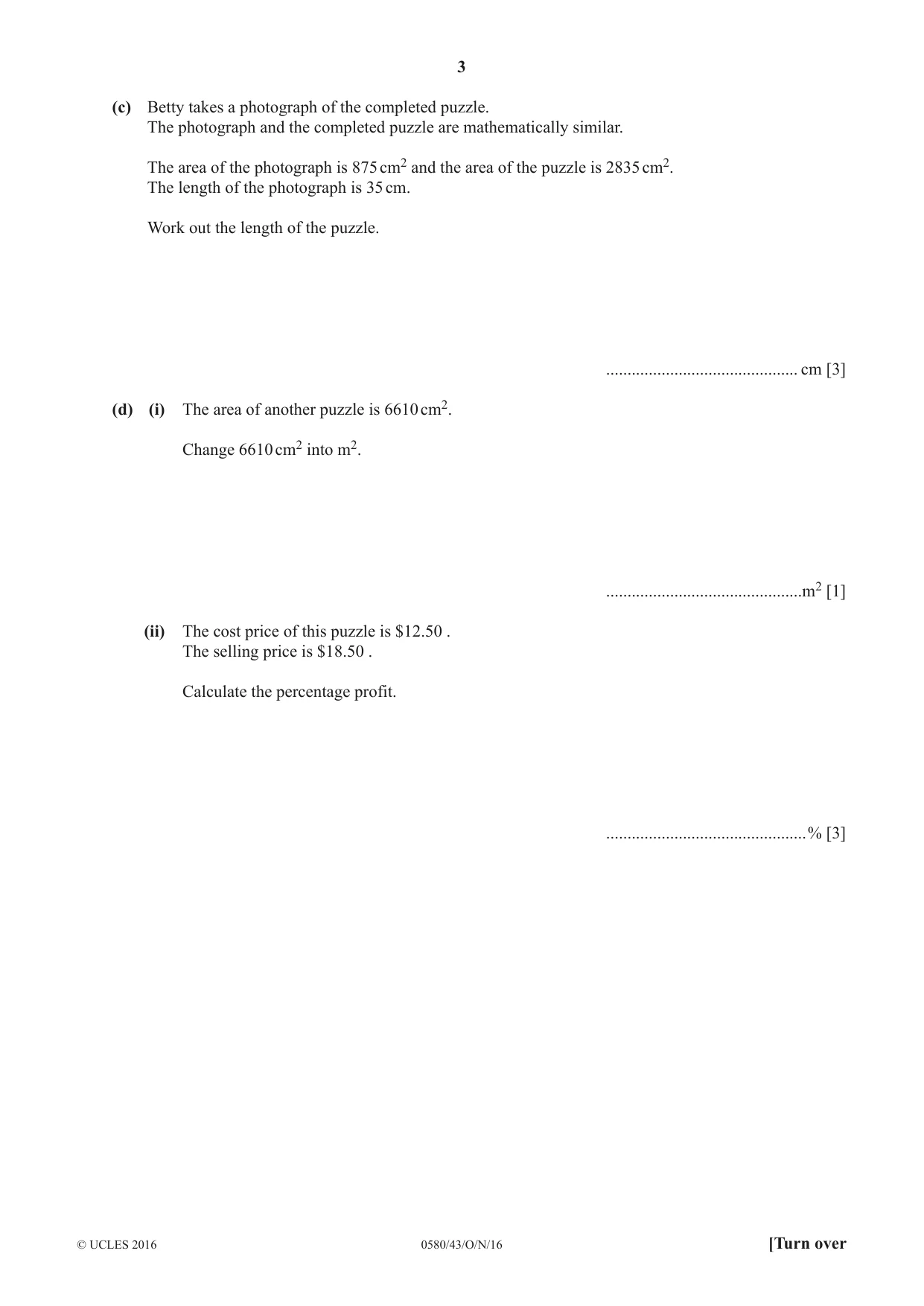
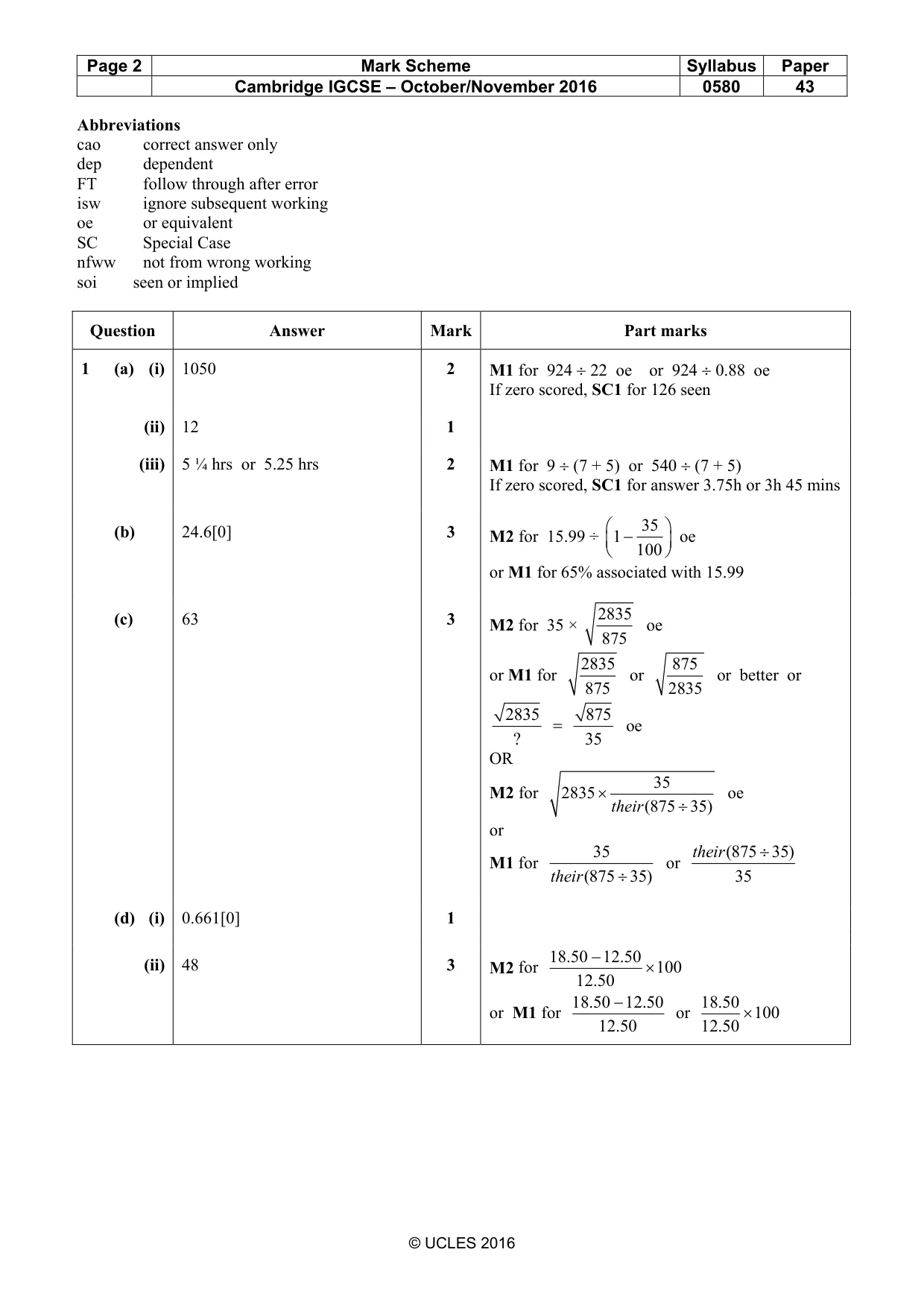
1 (a) A jigsaw puzzle has edge pieces and inside pieces. The ratio edge pieces : inside pieces = 3 : 22. (i) There are 924 inside pieces. Calculate the total number of pieces in the puzzle. ................................................... [2] (ii) Find the percentage of the total number of pieces that are edge pieces. ...............................................% [1] (iii) Anjum and Betty spent a total of 9 hours completing the puzzle. The ratio Anjum’s time : Betty’s time = 7 : 5. Work out how much time Anjum spent on the puzzle. ......................................... hours [2] (b) The price of the puzzle was $15.99 in a sale. This was 35% less than the original price. Calculate the original price of the puzzle. $ ................................................... [3] (c) Betty takes a photograph of the completed puzzle. The photograph and the completed puzzle are mathematically similar. The area of the photograph is 875 cm2 and the area of the puzzle is 2835 cm2. The length of the photograph is 35 cm. Work out the length of the puzzle. ............................................. cm [3] (d) (i) The area of another puzzle is 6610 cm2. Change 6610 cm2 into m2. ..............................................m2 [1] (ii) The cost price of this puzzle is $12.50 . The selling price is $18.50 . Calculate the percentage profit. ...............................................% [3]
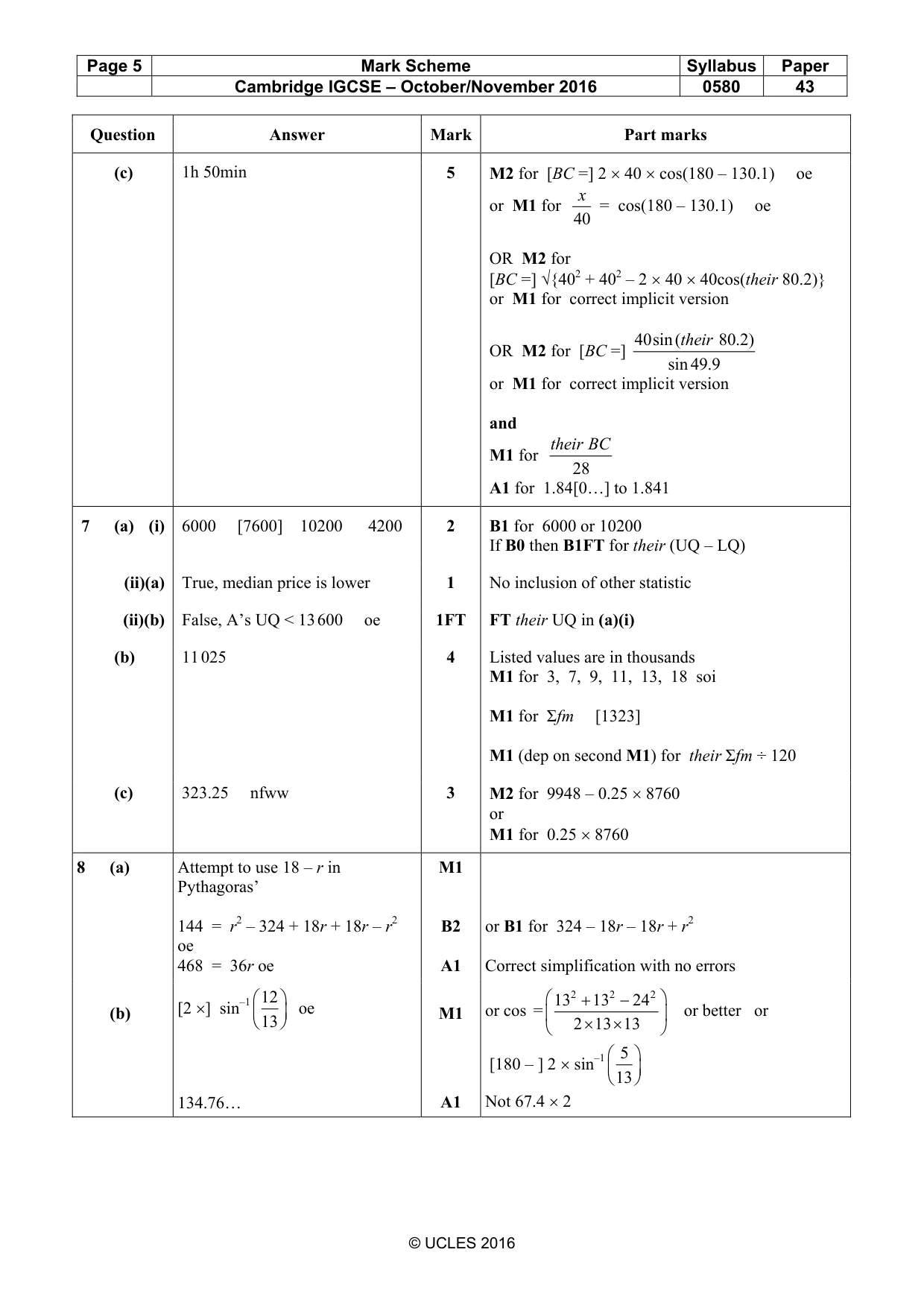
Mark scheme: Question Answer Mark Part marks 1 (a) (i) 1050 2 M1 for 924 ÷ 22 oe or 924 ÷ 0.88 oe If zero scored, SC1 for 126 seen (ii) 12 1 (iii) 5 ¼ hrs or 5.25 hrs 2 M1 for 9 ÷ (7 + 5) or 540 ÷ (7 + 5) If zero scored, SC1 for answer 3.75h or 3h 45 mins 35 (b) 24.6[0] 3 M2 for 15.99 ÷ 1 − oe 100 or M1 for 65% associated with 15.99 2835 (c) 63 3 M2 for 35 × oe 875 2835 875 or M1 for or or better or 875 2835 2835 875 = oe ? 35 OR 35 M2 for 2835 × oe their (875 ÷ 35) or 35 their (875 ÷ 35) M1 for or their (875 ÷ 35) 35 (d) (i) 0.661[0] 1 18.50 − 12.50 (ii) 48 3 M2 for × 100 12.50 18.50 − 12.50 18.50 or M1 for or × 100 12.50 12.50
Q2 · 2 (a) Complete the table for y = 3x + 2 + 1, x !
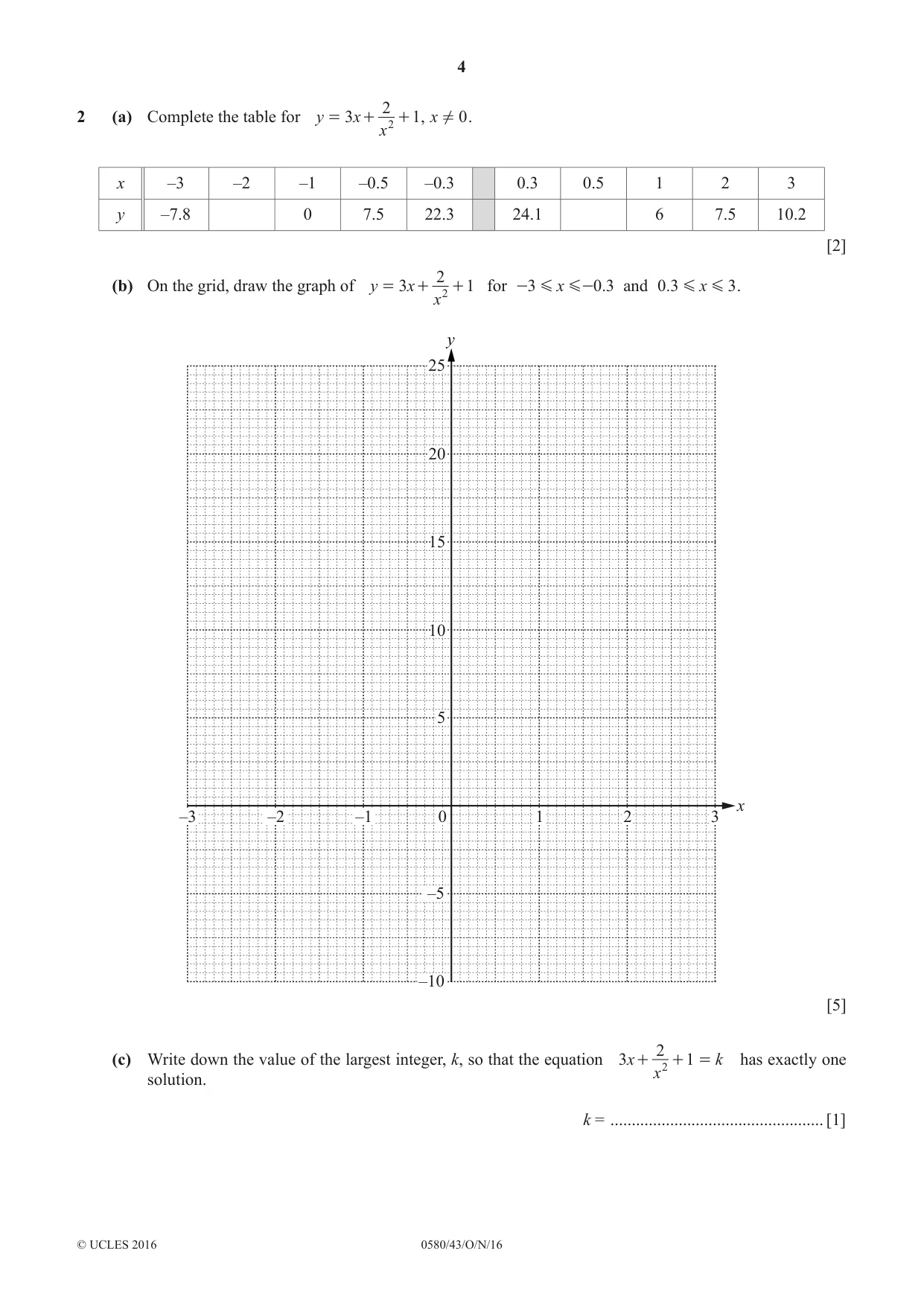
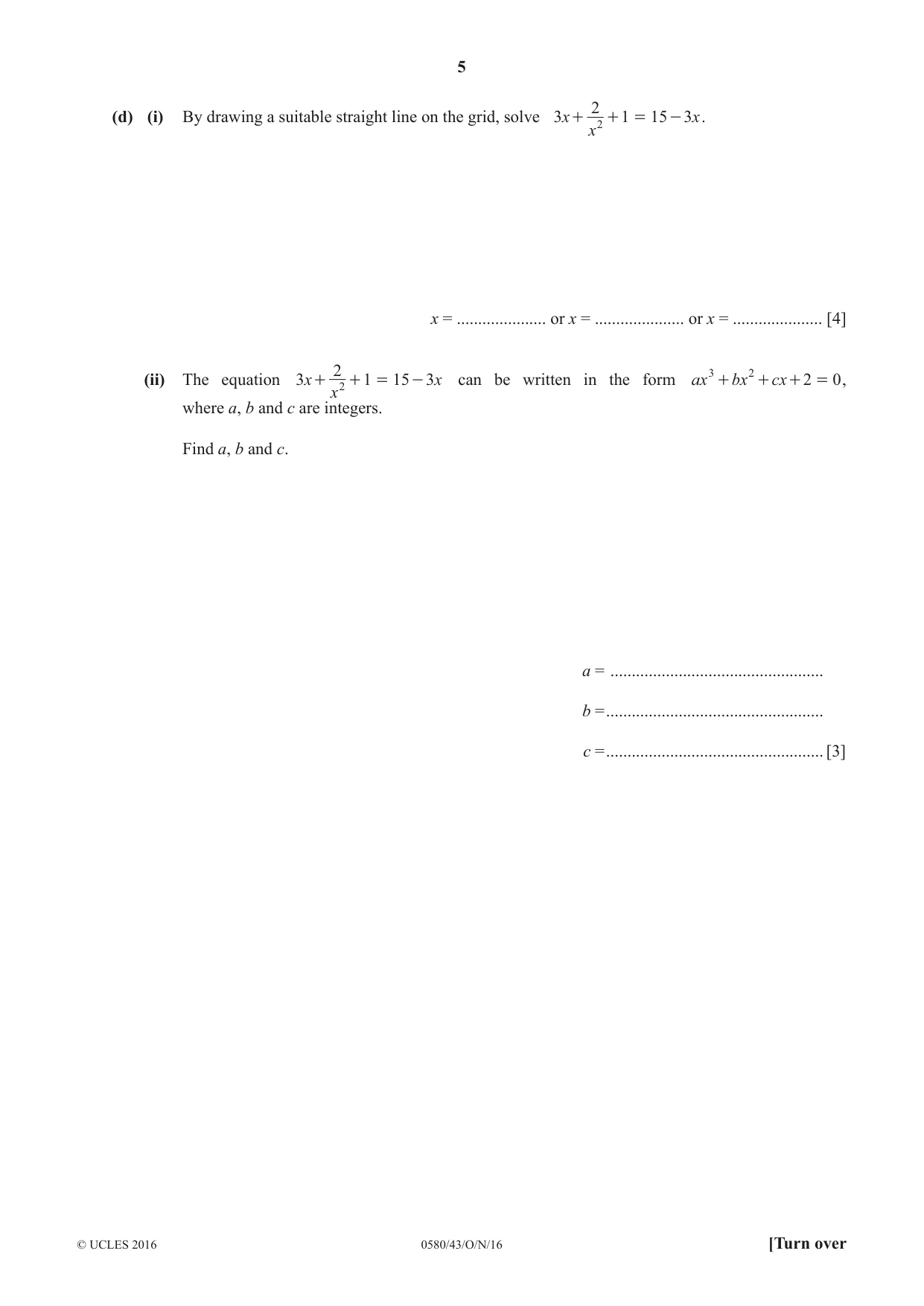
2 2 (a) Complete the table for y = 3x + 2 + 1, x ! 0 . x x –3 –2 –1 –0.5 –0.3 0.3 0.5 1 2 3 y –7.8 0 7.5 22.3 24.1 6 7.5 10.2 [2] 2 (b) On the grid, draw the graph of y = 3 x + + 1 for -3 G x G -0.3 and 0.3 G x G 3 . x2 y 25 20 15 10 5 x –3 –2 –1 0 1 2 3 –5 –10 [5] 2 (c) Write down the value of the largest integer, k, so that the equation 3x + 2 + 1 = k has exactly one x solution. k = .................................................. [1] 2 (d) (i) By drawing a suitable straight line on the grid, solve 3x + 2 + 1 = 15 - 3x . x x = ..................... or x = ..................... or x = ..................... [4] 2 3 2 (ii) The equation 3x + 2 + 1 = 15 - 3x can be written in the form ax + bx + cx + 2 = 0 , x where a, b and c are integers. Find a, b and c. a = .................................................. b = ................................................... c = ................................................... [3]
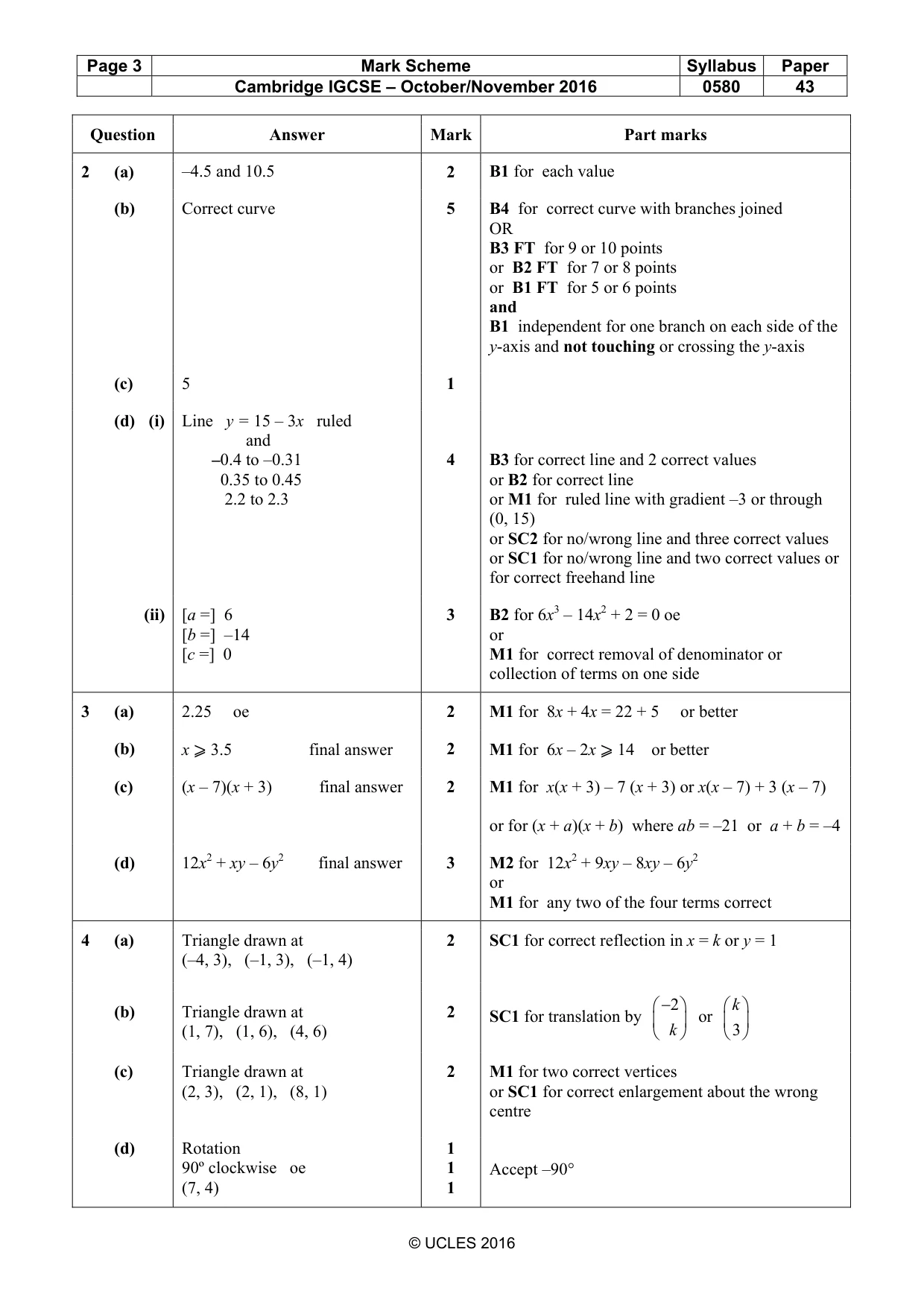
Mark scheme: 2 (a) –4.5 and 10.5 2 B1 for each value (b) Correct curve 5 B4 for correct curve with branches joined OR B3 FT for 9 or 10 points or B2 FT for 7 or 8 points or B1 FT for 5 or 6 points and B1 independent for one branch on each side of the y-axis and not touching or crossing the y-axis (c) 5 1 (d) (i) Line y = 15 – 3x ruled and –0.4 to –0.31 4 B3 for correct line and 2 correct values 0.35 to 0.45 or B2 for correct line 2.2 to 2.3 or M1 for ruled line with gradient –3 or through (0, 15) or SC2 for no/wrong line and three correct values or SC1 for no/wrong line and two correct values or for correct freehand line (ii) [a =] 6 3 B2 for 6x3 – 14x2 + 2 = 0 oe [b =] –14 or [c =] 0 M1 for correct removal of denominator or collection of terms on one side
Question 3
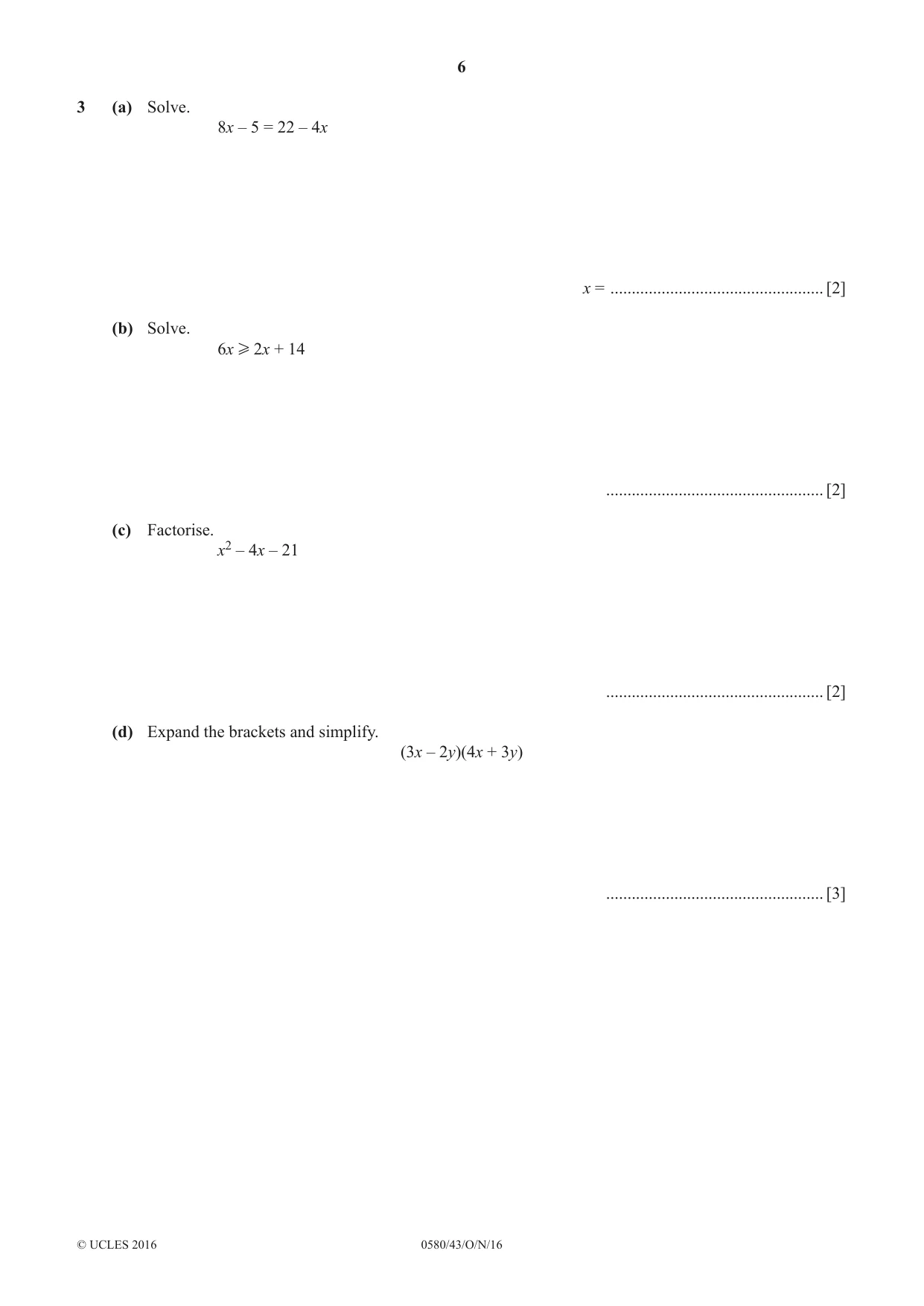
3 (a) Solve. 8x – 5 = 22 – 4x x = .................................................. [2] (b) Solve. 6x H 2x + 14 ................................................... [2] (c) Factorise. x2 – 4x – 21 ................................................... [2] (d) Expand the brackets and simplify. (3x – 2y)(4x + 3y) ................................................... [3]
Mark scheme: 3 (a) 2.25 oe 2 M1 for 8x + 4x = 22 + 5 or better (b) x ⩾ 3.5 final answer 2 M1 for 6x – 2x ⩾ 14 or better (c) (x – 7)(x + 3) final answer 2 M1 for x(x + 3) – 7 (x + 3) or x(x – 7) + 3 (x – 7) or for (x + a)(x + b) where ab = –21 or a + b = –4 (d) 12x2 + xy – 6y2 final answer 3 M2 for 12x2 + 9xy – 8xy – 6y2 or M1 for any two of the four terms correct
Q4 · Y 8 B 7 6 5 4 A 3 2 1 x –5 –4 –3 –2 –1 0 1 2 3 4 5 6 7 8 9 10 –1 –2 (a) Draw the image…
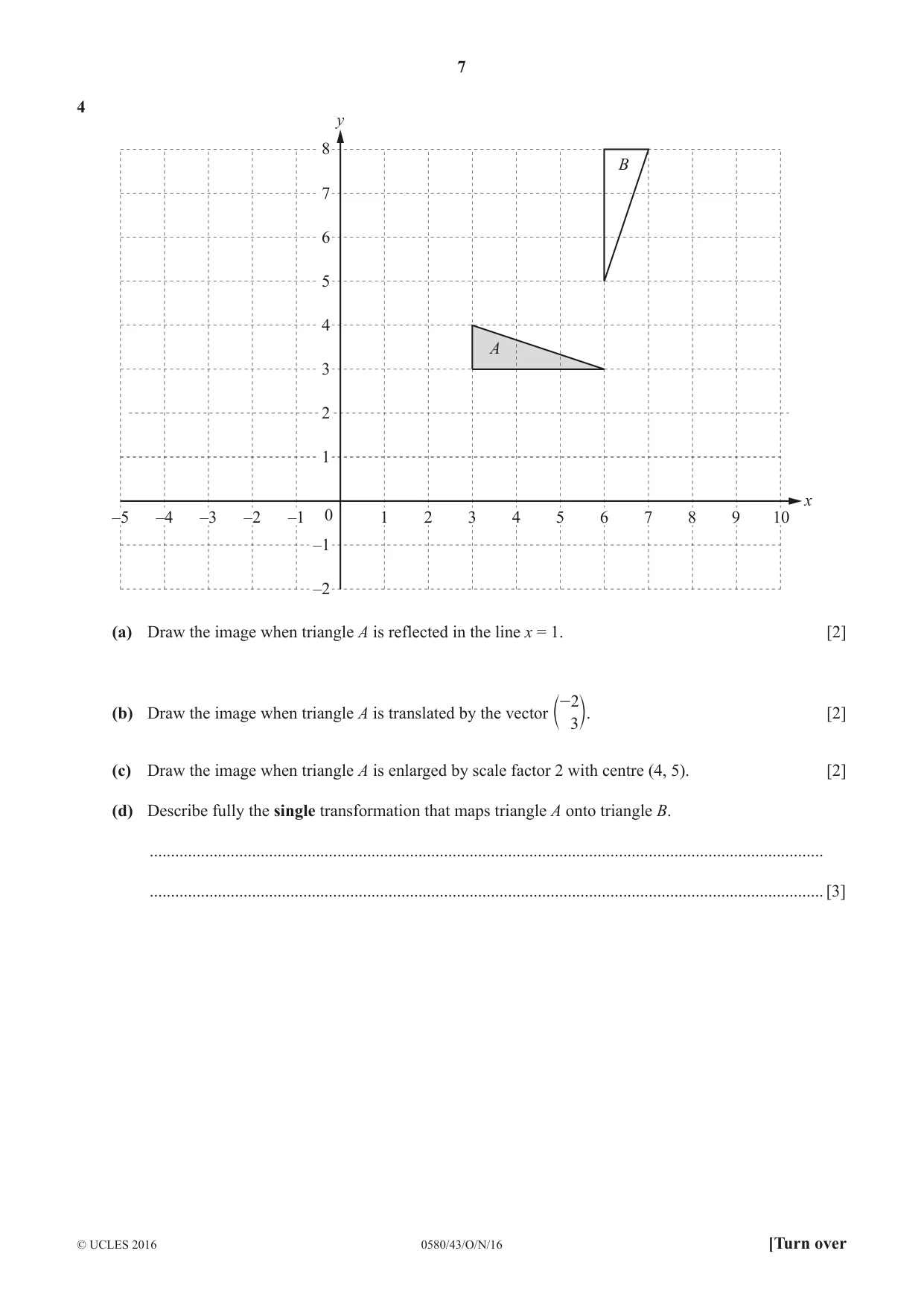
4 y 8 B 7 6 5 4 A 3 2 1 x –5 –4 –3 –2 –1 0 1 2 3 4 5 6 7 8 9 10 –1 –2 (a) Draw the image when triangle A is reflected in the line x = 1. [2] -2 (b) Draw the image when triangle A is translated by the vector [2] c 3 m. (c) Draw the image when triangle A is enlarged by scale factor 2 with centre (4, 5). [2] (d) Describe fully the single transformation that maps triangle A onto triangle B. .............................................................................................................................................................. .............................................................................................................................................................. [3]
Mark scheme: 4 (a) Triangle drawn at 2 SC1 for correct reflection in x = k or y = 1 (–4, 3), (–1, 3), (–1, 4) −2 k (b) Triangle drawn at 2 SC1 for translation by or (1, 7), (1, 6), (4, 6) k 3 (c) Triangle drawn at 2 M1 for two correct vertices (2, 3), (2, 1), (8, 1) or SC1 for correct enlargement about the wrong centre (d) Rotation 1 90º clockwise oe 1 Accept –90° (7, 4) 1
Q5 · Sandra has a fair eight-sided spinner
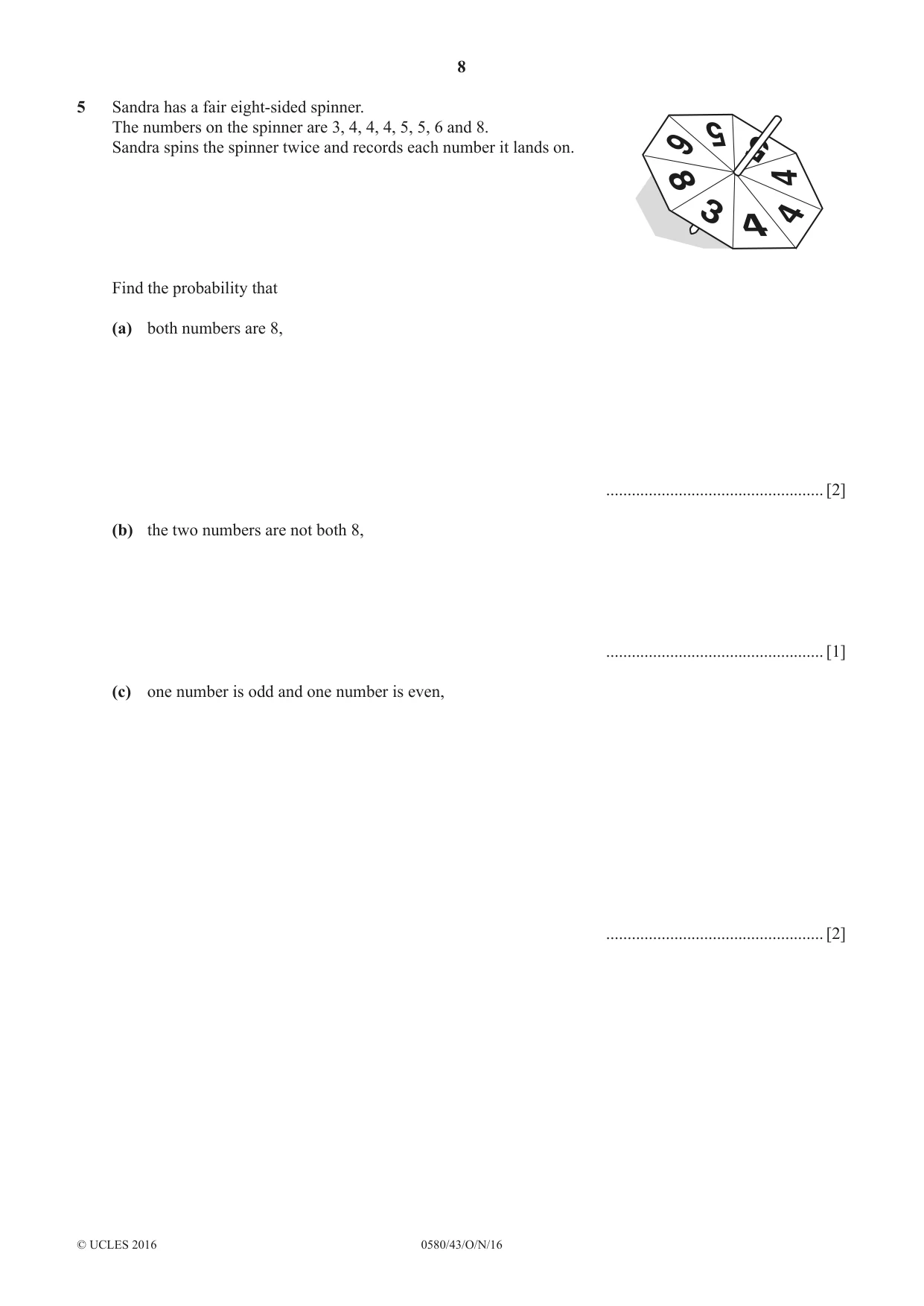
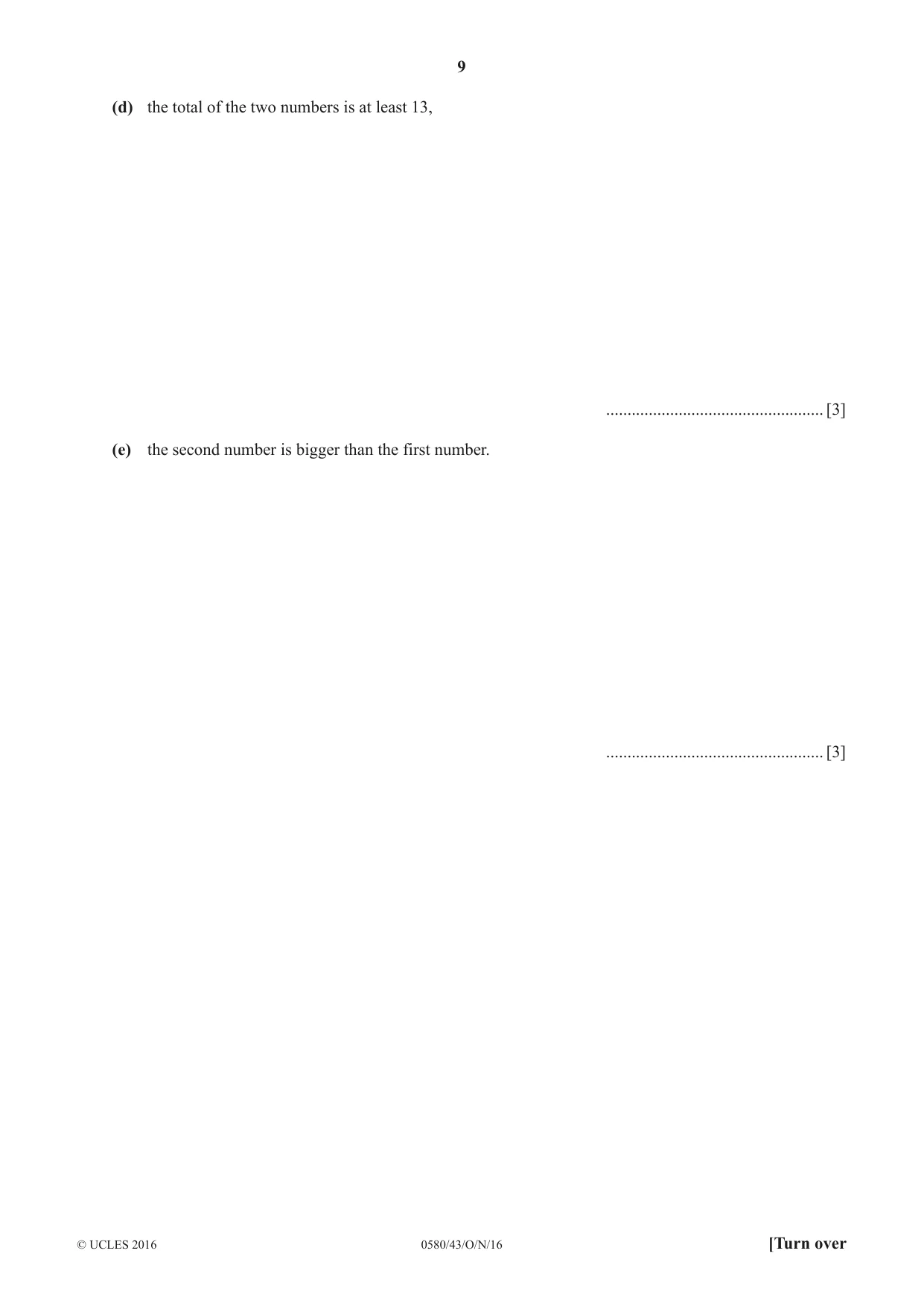
5 Sandra has a fair eight-sided spinner. The numbers on the spinner are 3, 4, 4, 4, 5, 5, 6 and 8. Sandra spins the spinner twice and records each number it lands on. 5 6 5 8 4 3 4 4 Find the probability that (a) both numbers are 8, ................................................... [2] (b) the two numbers are not both 8, ................................................... [1] (c) one number is odd and one number is even, ................................................... [2] (d) the total of the two numbers is at least 13, ................................................... [3] (e) the second number is bigger than the first number. ................................................... [3]
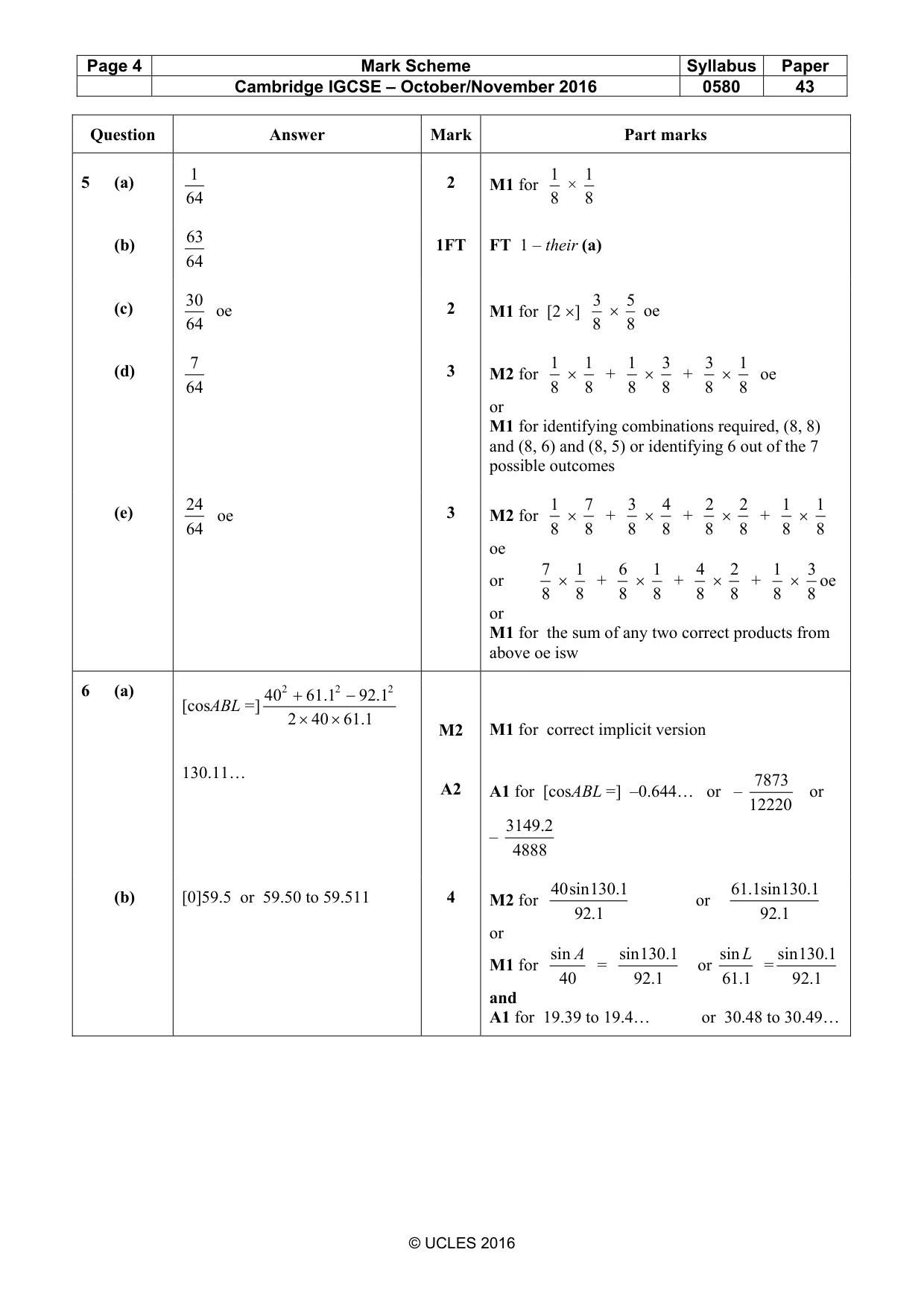
Mark scheme: 1 1 1 5 (a) 2 M1 for × 64 8 8 63 (b) 1FT FT 1 – their (a) 64 30 3 5 (c) oe 2 M1 for [2 ×] × oe 64 8 8 7 1 1 1 3 3 1 (d) 3 M2 for × + × + × oe 64 8 8 8 8 8 8 or M1 for identifying combinations required, (8, 8) and (8, 6) and (8, 5) or identifying 6 out of the 7 possible outcomes 24 1 7 3 4 2 2 1 1 (e) oe 3 M2 for × + × + × + × 64 8 8 8 8 8 8 8 8 oe 7 1 6 1 4 2 1 3 or × + × + × + × oe 8 8 8 8 8 8 8 8 or M1 for the sum of any two correct products from above oe isw
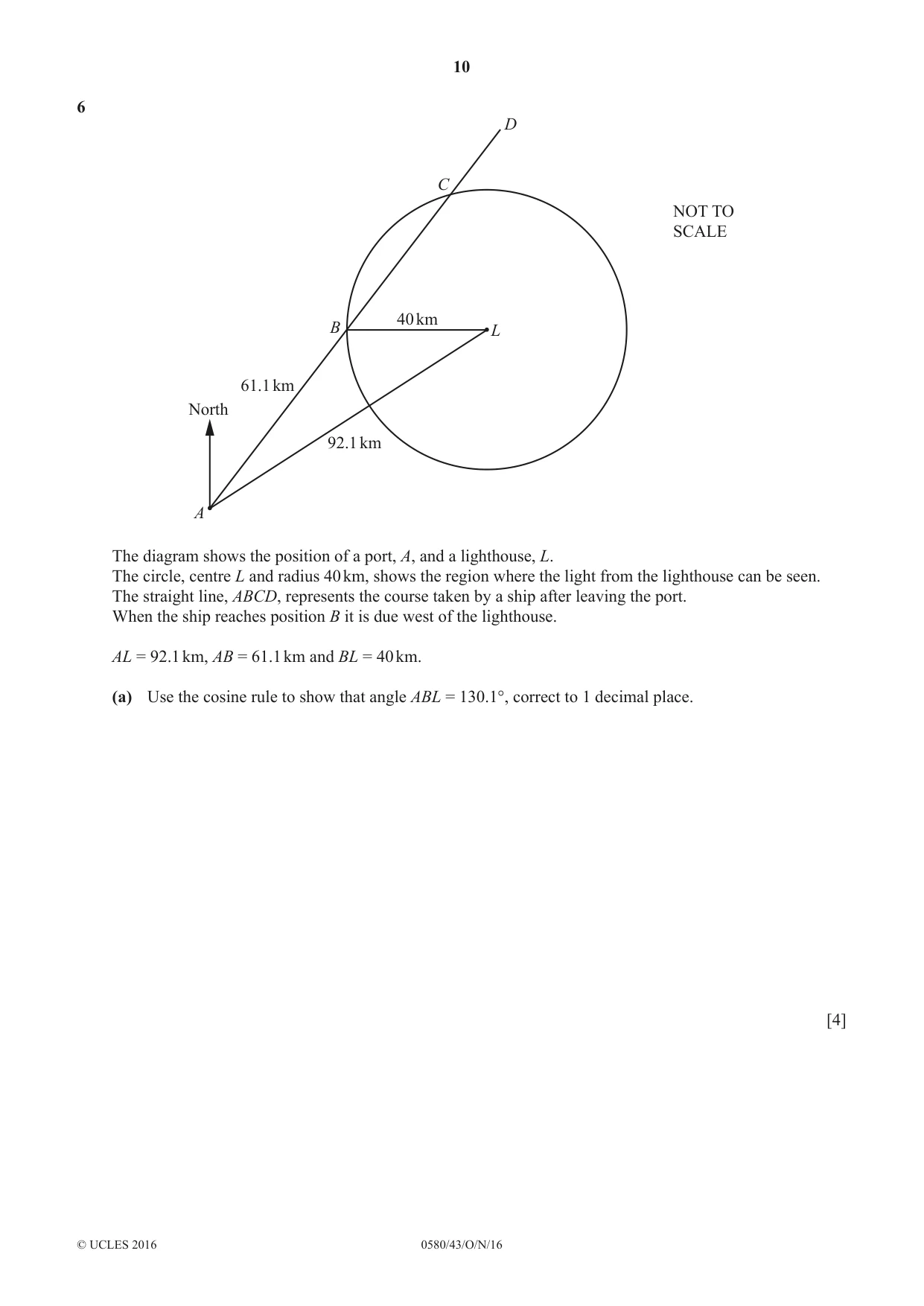
Q6 · D C NOT TO SCALE 40 km B L 61.1 km North 92.1 km A The diagram shows the position of a…
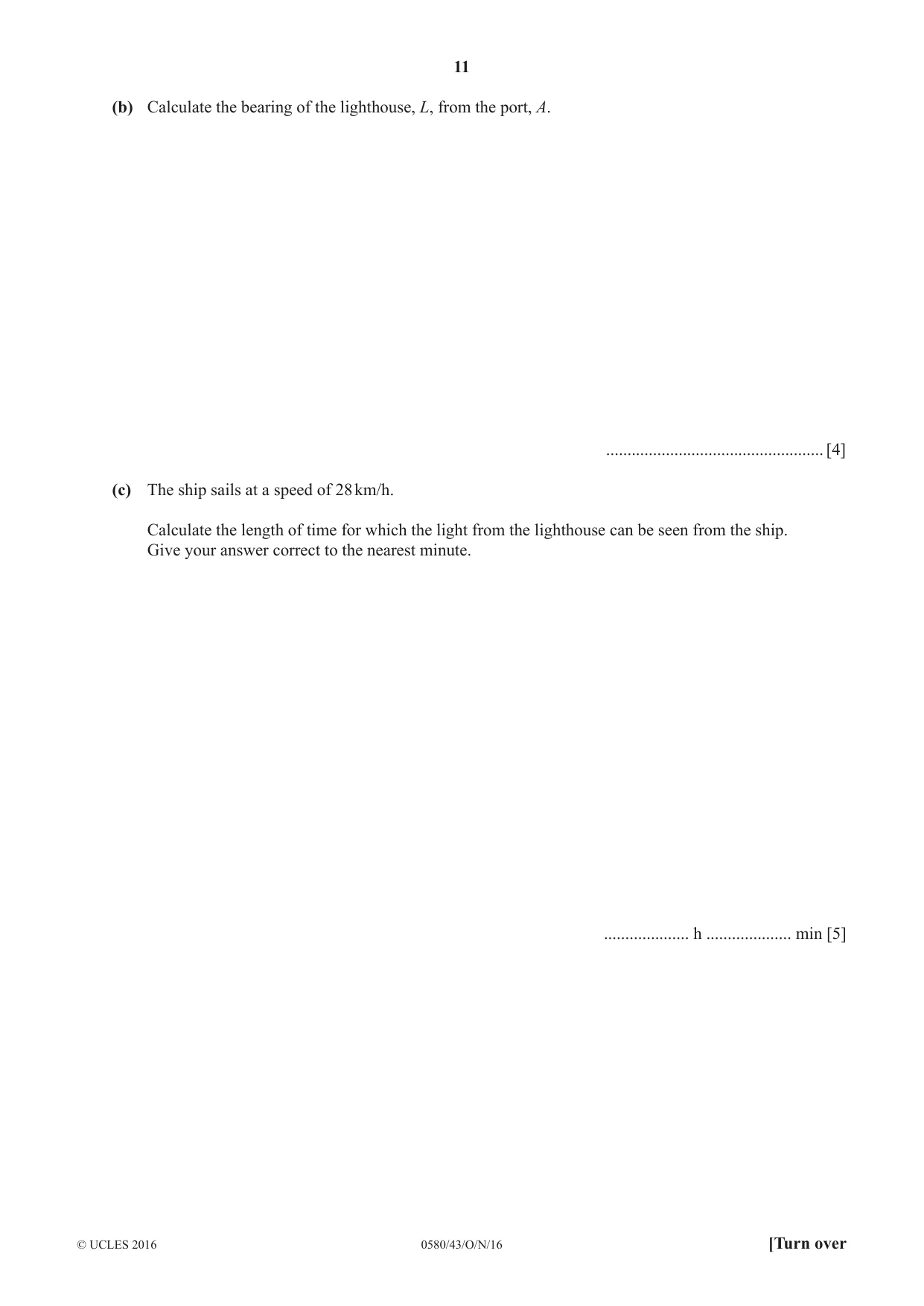
6 D C NOT TO SCALE 40 km B L 61.1 km North 92.1 km A The diagram shows the position of a port, A, and a lighthouse, L. The circle, centre L and radius 40 km, shows the region where the light from the lighthouse can be seen. The straight line, ABCD, represents the course taken by a ship after leaving the port. When the ship reaches position B it is due west of the lighthouse. AL = 92.1 km, AB = 61.1 km and BL = 40 km. (a) Use the cosine rule to show that angle ABL = 130.1°, correct to 1 decimal place. [4] (b) Calculate the bearing of the lighthouse, L, from the port, A. ................................................... [4] (c) The ship sails at a speed of 28 km/h. Calculate the length of time for which the light from the lighthouse can be seen from the ship. Give your answer correct to the nearest minute. .................... h .................... min [5]
Mark scheme: 6 (a) 40 2 + 61.12 − 92.12 [cosABL =] 2 × 40 × 61.1 M2 M1 for correct implicit version 130.11… 7873 A2 A1 for [cosABL =] –0.644… or – or 12220 3149.2 – 4888 40sin130.1 61.1sin130.1 (b) [0]59.5 or 59.50 to 59.511 4 M2 for or 92.1 92.1 or sin A sin130.1 sin L sin130.1 M1 for = or = 40 92.1 61.1 92.1 and A1 for 19.39 to 19.4… or 30.48 to 30.49…
Q7 · 100 80 60 Cumulative frequency 40 20 0 2 4 6 8 10 12 14 16 18 20 Price in $(thousands)…
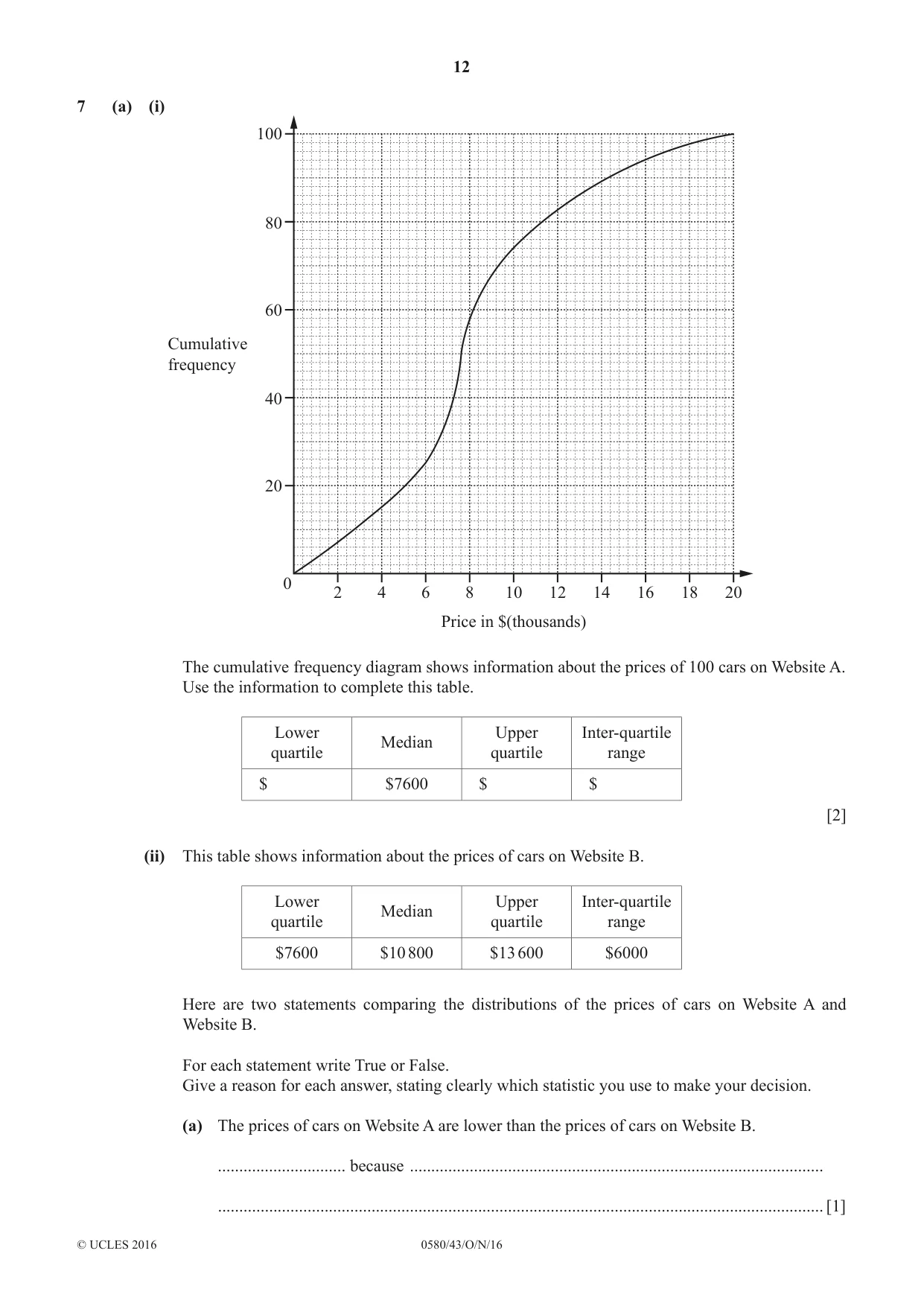
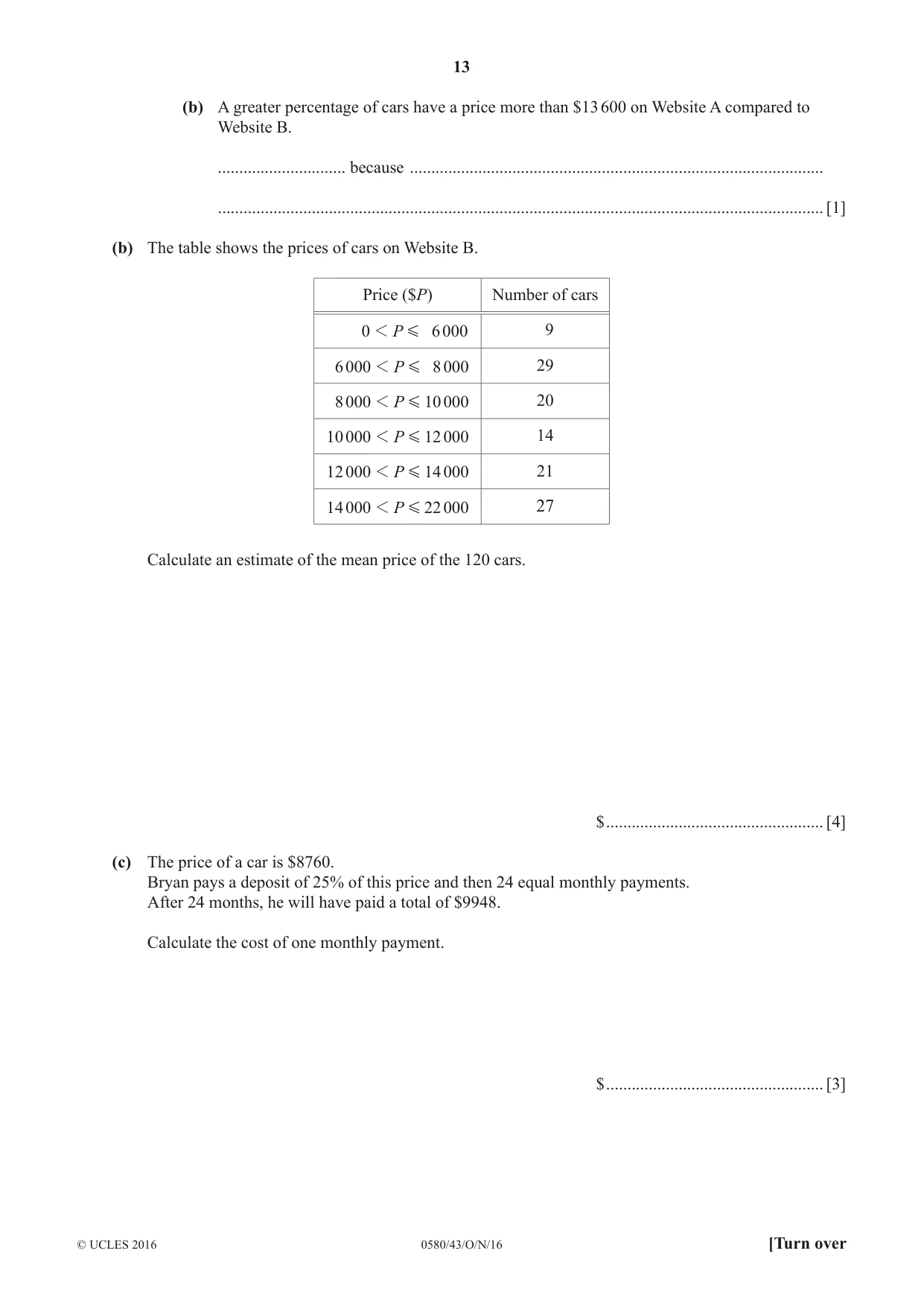
7 (a) (i) 100 80 60 Cumulative frequency 40 20 0 2 4 6 8 10 12 14 16 18 20 Price in $(thousands) The cumulative frequency diagram shows information about the prices of 100 cars on Website A. Use the information to complete this table. Lower Upper Inter-quartile Median quartile quartile range $ $7600 $ $ [2] (ii) This table shows information about the prices of cars on Website B. Lower Upper Inter-quartile Median quartile quartile range $7600 $10 800 $13 600 $6000 Here are two statements comparing the distributions of the prices of cars on Website A and Website B. For each statement write True or False. Give a reason for each answer, stating clearly which statistic you use to make your decision. (a) The prices of cars on Website A are lower than the prices of cars on Website B. .............................. because ................................................................................................. .............................................................................................................................................. [1] (b) A greater percentage of cars have a price more than $13 600 on Website A compared to Website B. .............................. because ................................................................................................. .............................................................................................................................................. [1] (b) The table shows the prices of cars on Website B. Price ($P) Number of cars 0 1 P G 6 000 9 6 000 1 P G 8 000 29 8 000 1 P G 10 000 20 10 000 1 P G 12 000 14 12 000 1 P G 14 000 21 14 000 1 P G 22 000 27 Calculate an estimate of the mean price of the 120 cars. $ ................................................... [4] (c) The price of a car is $8760. Bryan pays a deposit of 25% of this price and then 24 equal monthly payments. After 24 months, he will have paid a total of $9948. Calculate the cost of one monthly payment. $ ................................................... [3]
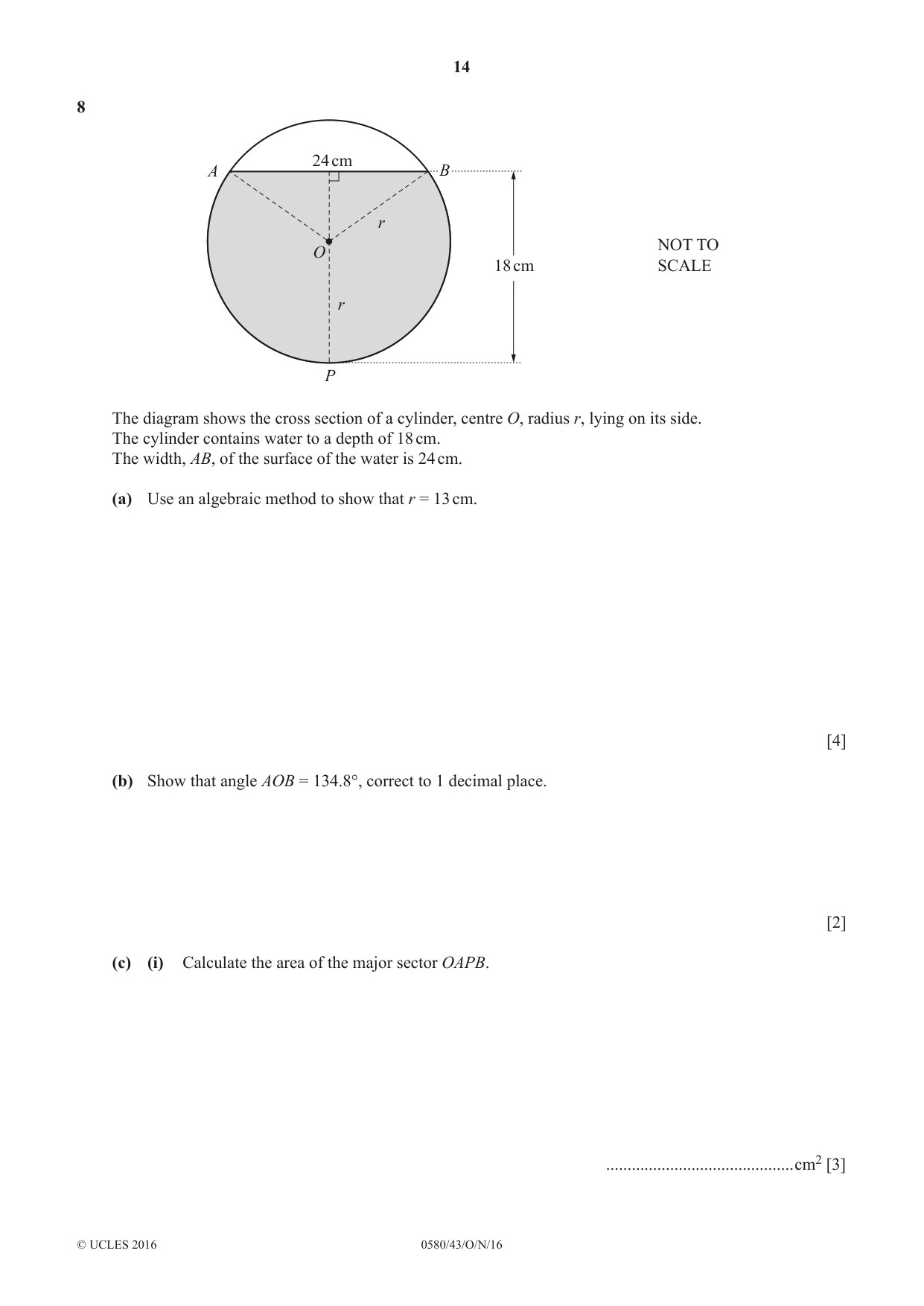
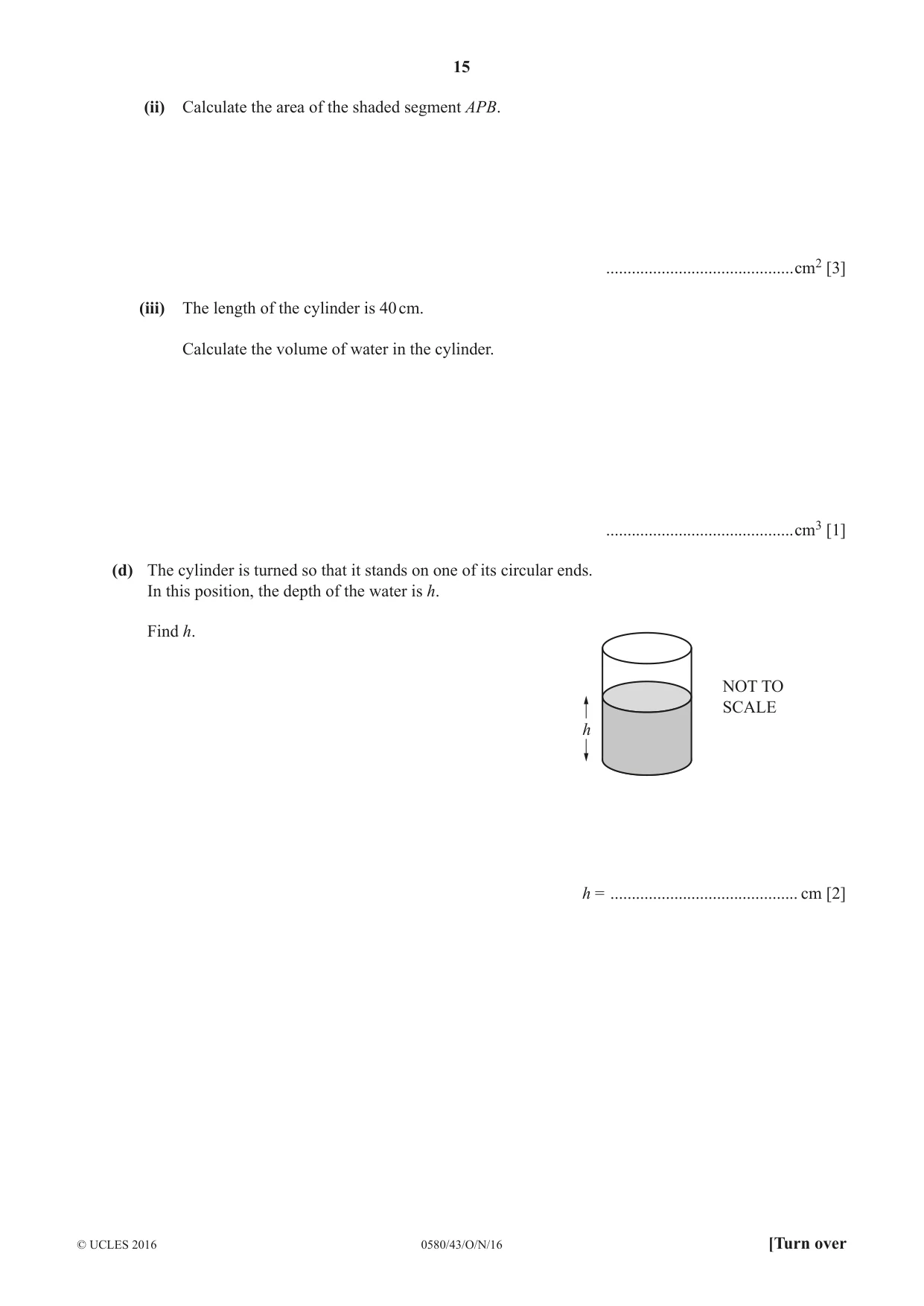
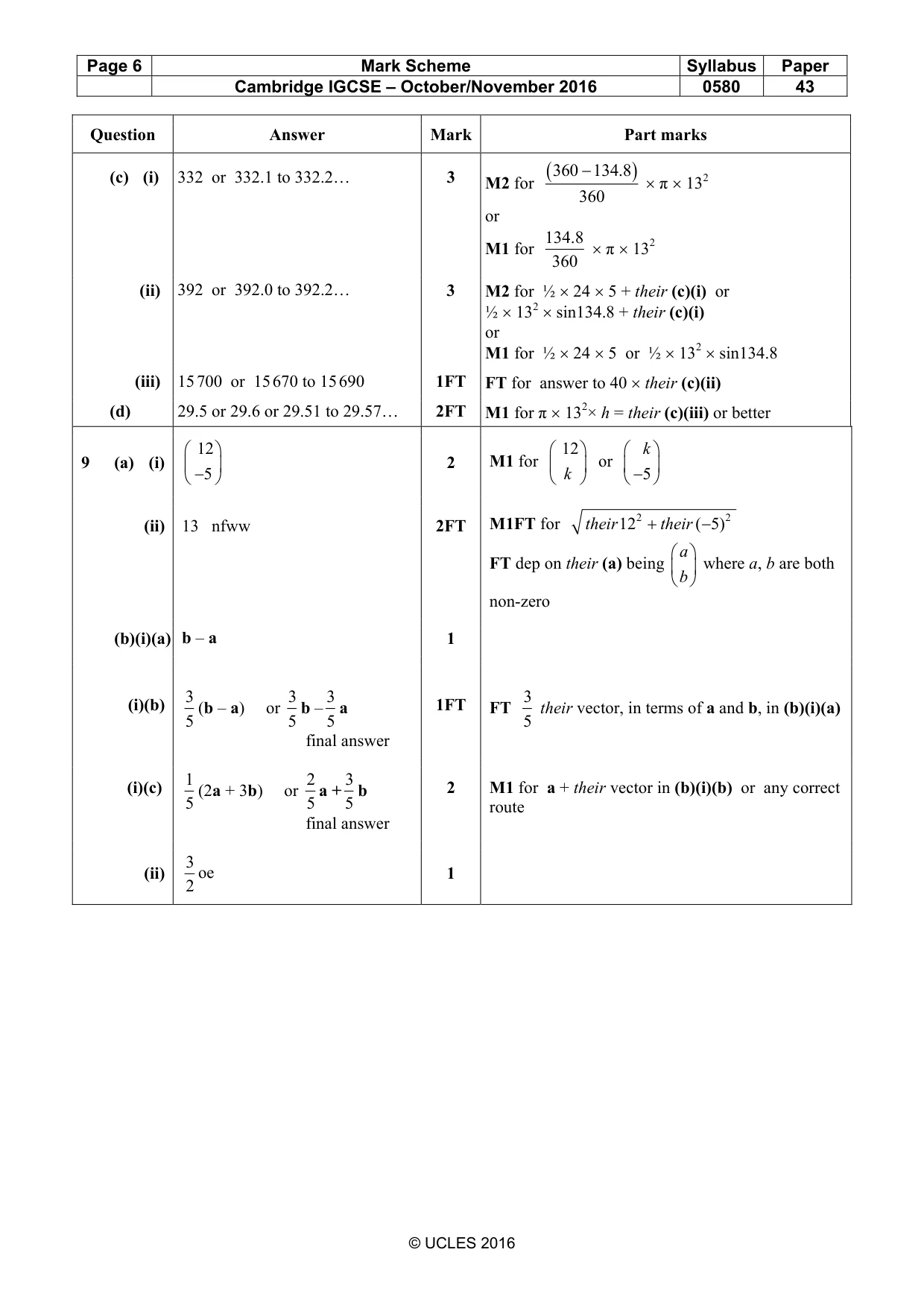
Mark scheme: 7 (a) (i) 6000 [7600] 10200 4200 2 B1 for 6000 or 10200 If B0 then B1FT for their (UQ – LQ) (ii)(a) True, median price is lower 1 No inclusion of other statistic (ii)(b) False, A’s UQ < 13 600 oe 1FT FT their UQ in (a)(i) (b) 11 025 4 Listed values are in thousands M1 for 3, 7, 9, 11, 13, 18 soi M1 for Σfm [1323] M1 (dep on second M1) for their Σfm ÷ 120 (c) 323.25 nfww 3 M2 for 9948 – 0.25 × 8760 or M1 for 0.25 × 8760 8 (a) Attempt to use 18 – r in M1 Pythagoras’ 144 = r2 – 324 + 18r + 18r – r2 B2 or B1 for 324 – 18r – 18r + r2 oe 468 = 36r oe A1 Correct simplification with no errors 12 132 + 132 − 24 2 (b) [2 ×] sin–1 oe M1 or cos = or better or 13 2 × 13 × 13 5 [180 – ] 2 × sin–1 13 134.76… A1 Not 67.4 × 2
Q9 · -2 9 (a) m = n = c 2 m c 3 m (i) Work out 2m – 3n
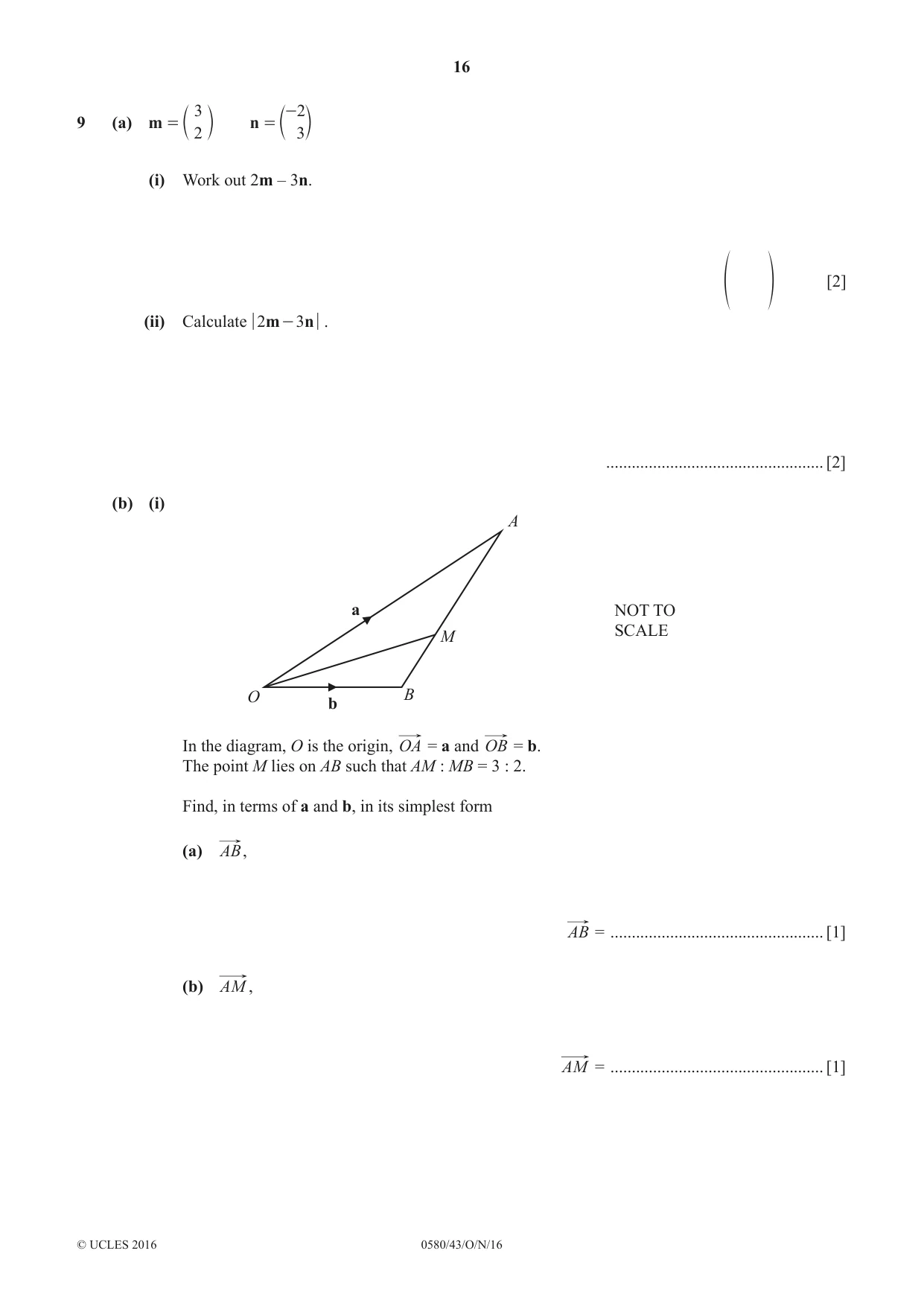
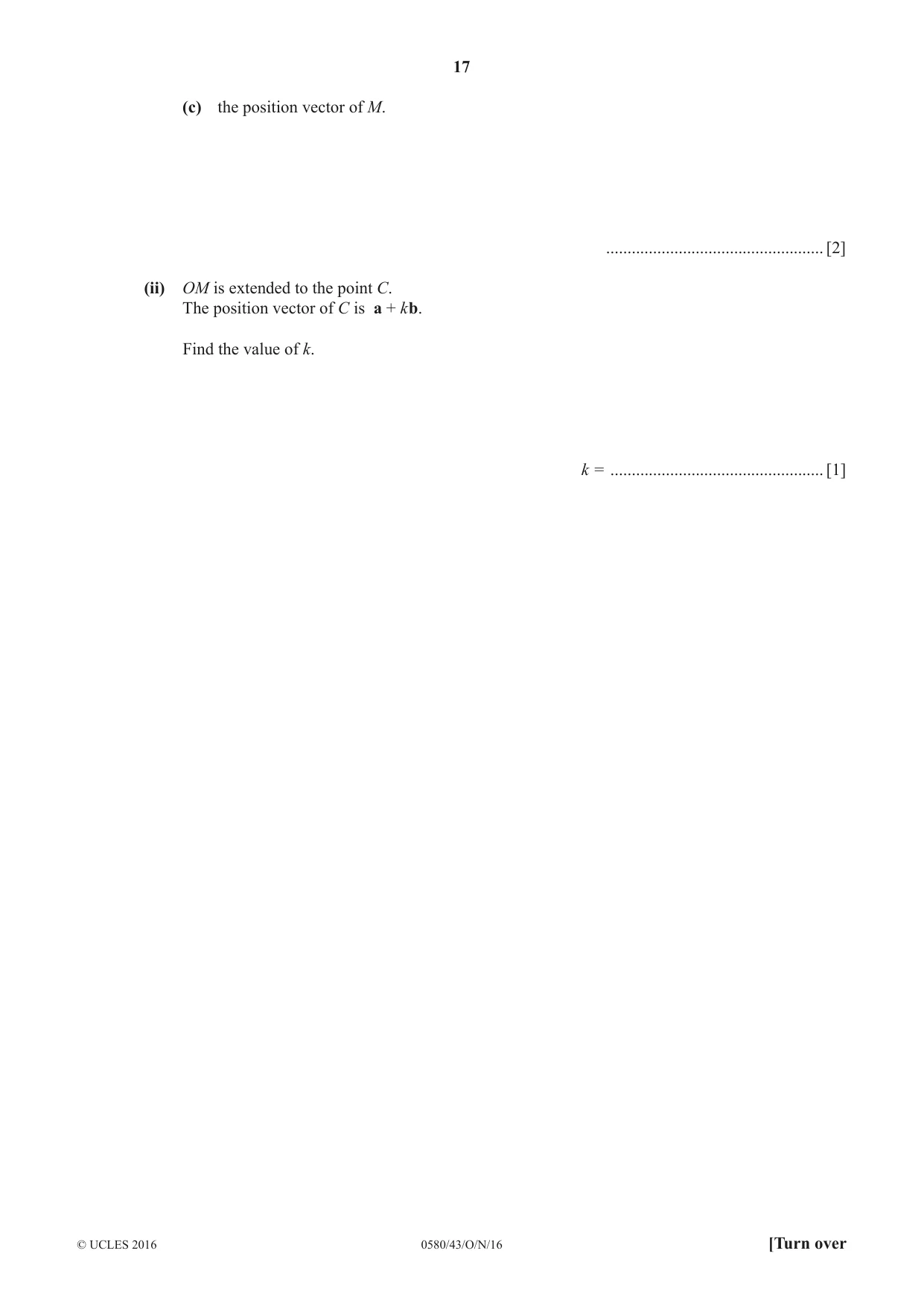
3 -2 9 (a) m = n = c 2 m c 3 m (i) Work out 2m – 3n. [2] f p (ii) Calculate 2m - 3n . ................................................... [2] (b) (i) A a NOT TO SCALE M O B b In the diagram, O is the origin, OA = a and OB = b. The point M lies on AB such that AM : MB = 3 : 2. Find, in terms of a and b, in its simplest form (a) AB, AB = .................................................. [1] (b) AM , AM = .................................................. [1] (c) the position vector of M. ................................................... [2] (ii) OM is extended to the point C. The position vector of C is a + kb. Find the value of k. k = .................................................. [1]
Mark scheme: 12 12 k 9 (a) (i) 2 M1 for or −5 k − 5 (ii) 13 nfww 2FT M1FT for their 12 2 + their ( −5) 2 a FT dep on their (a) being where a, b are both b non-zero (b)(i)(a) b – a 1 3 3 3 3 (i)(b) (b – a) or b – a 1FT FT their vector, in terms of a and b, in (b)(i)(a) 5 5 5 5 final answer 1 2 3 (i)(c) (2a + 3b) or a + b 2 M1 for a + their vector in (b)(i)(b) or any correct 5 5 5 route final answer 3 (ii) oe 1 2
Q10 · Complete the table for the four sequences A, B, C and D
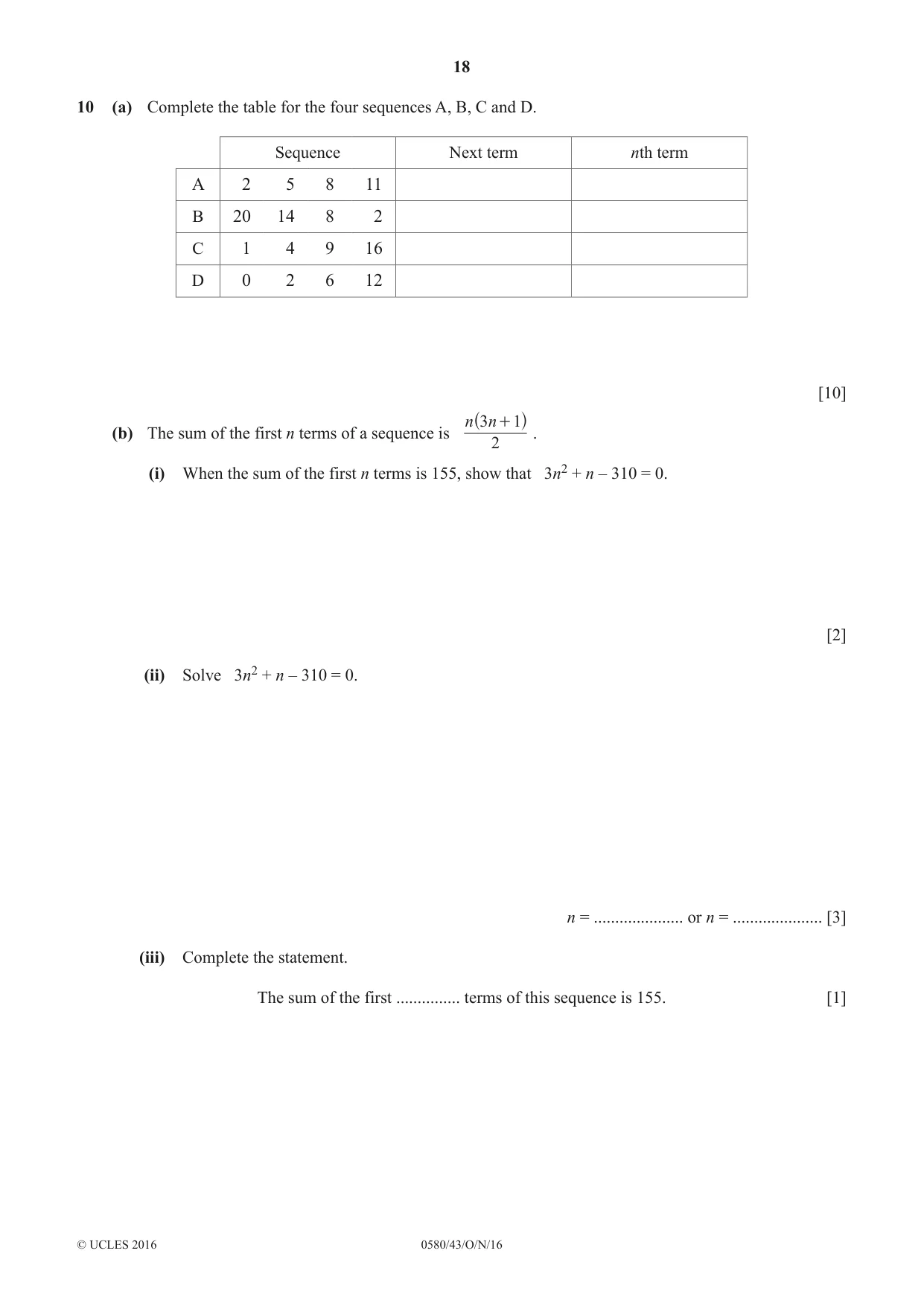
10 (a) Complete the table for the four sequences A, B, C and D. Sequence Next term nth term A 2 5 8 11 B 20 14 8 2 C 1 4 9 16 D 0 2 6 12 [10] n ^3 n+ 1h (b) The sum of the first n terms of a sequence is 2 . (i) When the sum of the first n terms is 155, show that 3n2 + n – 310 = 0. [2] (ii) Solve 3n2 + n – 310 = 0. n = ..................... or n = ..................... [3] (iii) Complete the statement. The sum of the first ............... terms of this sequence is 155. [1]
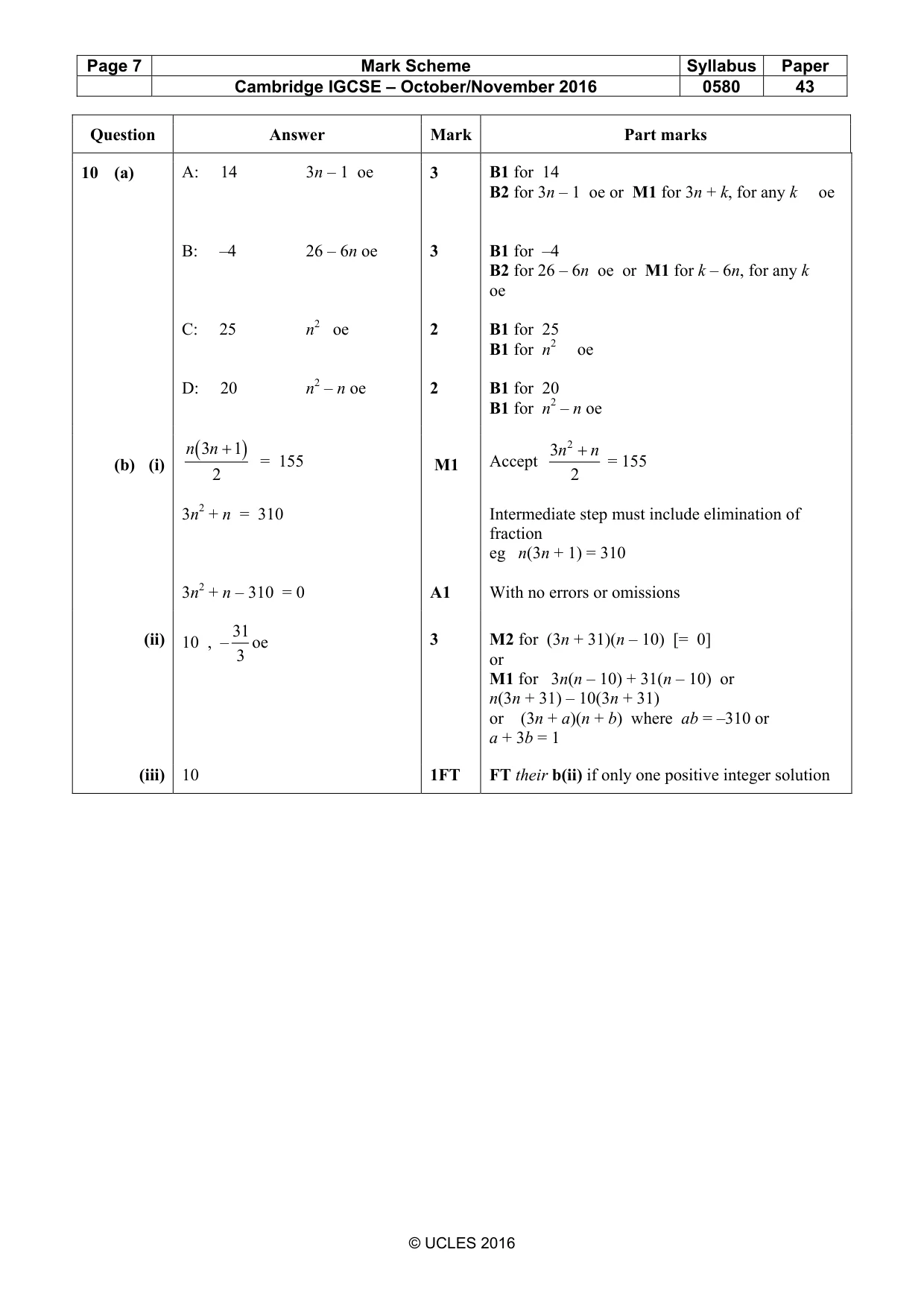
Mark scheme: 10 (a) A: 14 3n – 1 oe 3 B1 for 14 B2 for 3n – 1 oe or M1 for 3n + k, for any k oe B: –4 26 – 6n oe 3 B1 for –4 B2 for 26 – 6n oe or M1 for k – 6n, for any k oe C: 25 n2 oe 2 B1 for 25 B1 for n2 oe D: 20 n2 – n oe 2 B1 for 20 B1 for n2 – n oe 2 + n n ( 3n + 1) 3n (b) (i) = 155 M1 Accept = 155 2 2 3n2 + n = 310 Intermediate step must include elimination of fraction eg n(3n + 1) = 310 3n2 + n – 310 = 0 A1 With no errors or omissions 31 (ii) 10 , – oe 3 M2 for (3n + 31)(n – 10) [= 0] 3 or M1 for 3n(n – 10) + 31(n – 10) or n(3n + 31) – 10(3n + 31) or (3n + a)(n + b) where ab = –310 or a + 3b = 1 (iii) 10 1FT FT their b(ii) if only one positive integer solution
Question 11
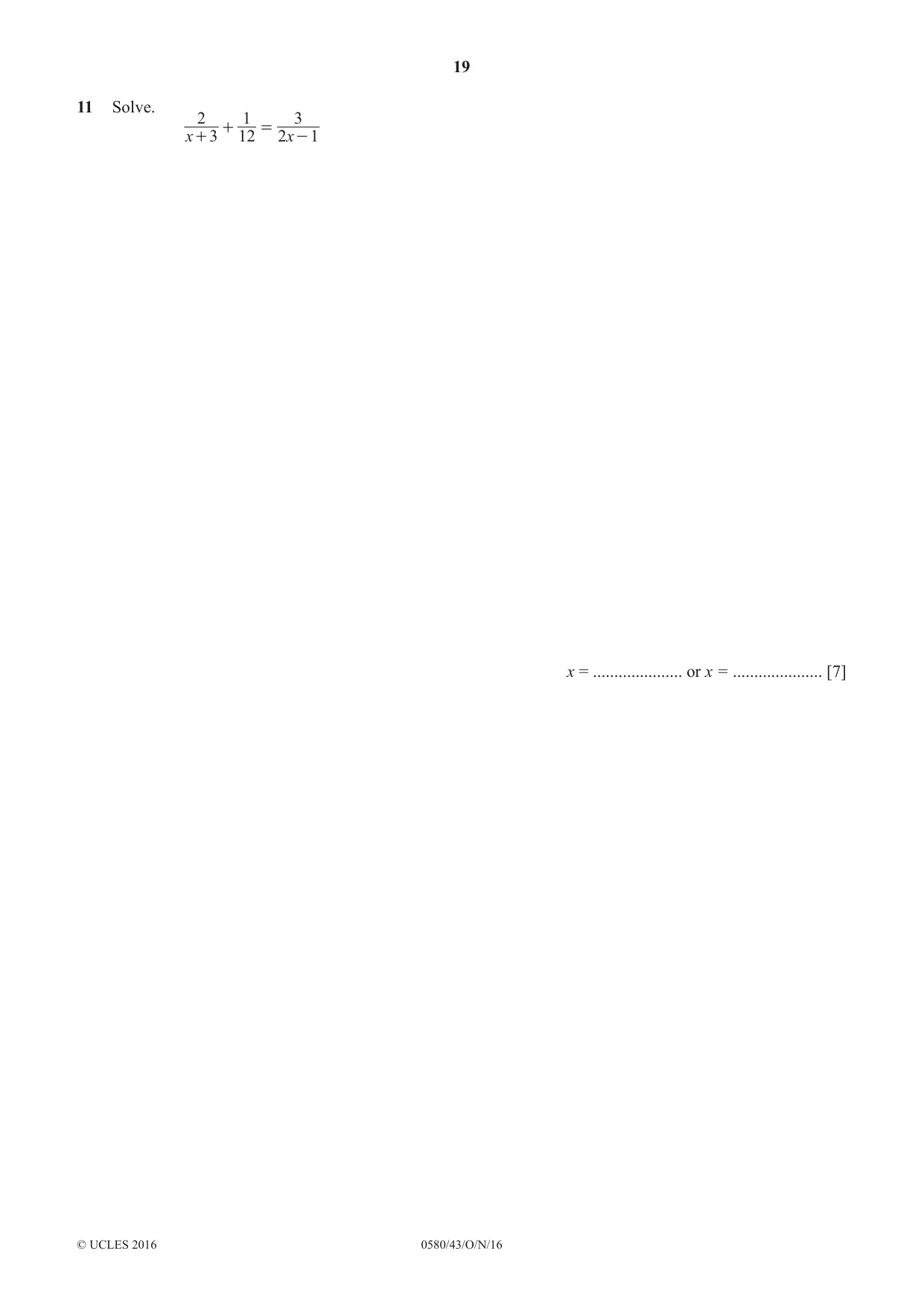
11 Solve. 2 1 3 + = x + 3 12 2 x - 1 x = ..................... or x = ..................... [7]
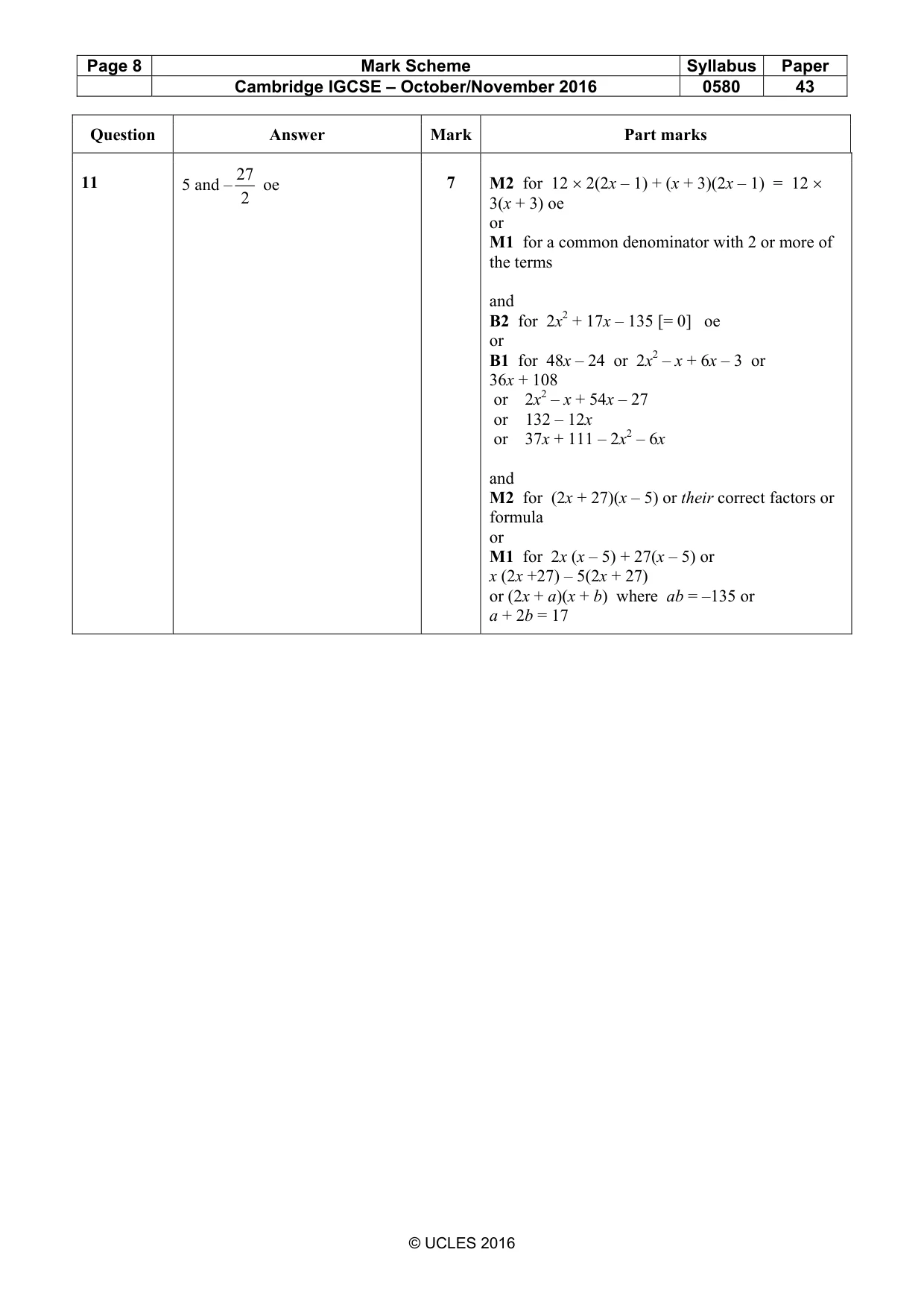
Mark scheme: 2711 5 and – oe 7 M2 for 12 × 2(2x – 1) + (x + 3)(2x – 1) = 12 × 2 3(x + 3) oe or M1 for a common denominator with 2 or more of the terms and B2 for 2x2 + 17x – 135 [= 0] oe or B1 for 48x – 24 or 2x2 – x + 6x – 3 or 36x + 108 or 2x2 – x + 54x – 27 or 132 – 12x or 37x + 111 – 2x2 – 6x and M2 for (2x + 27)(x – 5) or their correct factors or formula or M1 for 2x (x – 5) + 27(x – 5) or x (2x +27) – 5(2x + 27) or (2x + a)(x + b) where ab = –135 or a + 2b = 17
What was in this paper
The subtopics covered by these 10 questions, and how many questions each got. Open one in a new tab to see every Cambridge question on it.
What you needed in this session
Cambridge’s own grade thresholds for 2016 Oct/Nov, Paper 4 · Variant 3. A higher threshold means an easier paper — the bar moves with how the cohort did.