Cambridge IGCSE Mathematics 0580 — 2016 May/June Paper 4 · Variant 1
0580/41/M/J/16 · 8 questions · 130 marks · ≈146 min
The question paper and its mark scheme, free to read here and free to download. This is Cambridge’s own paper, exactly as it was sat.
Question paper20 pages
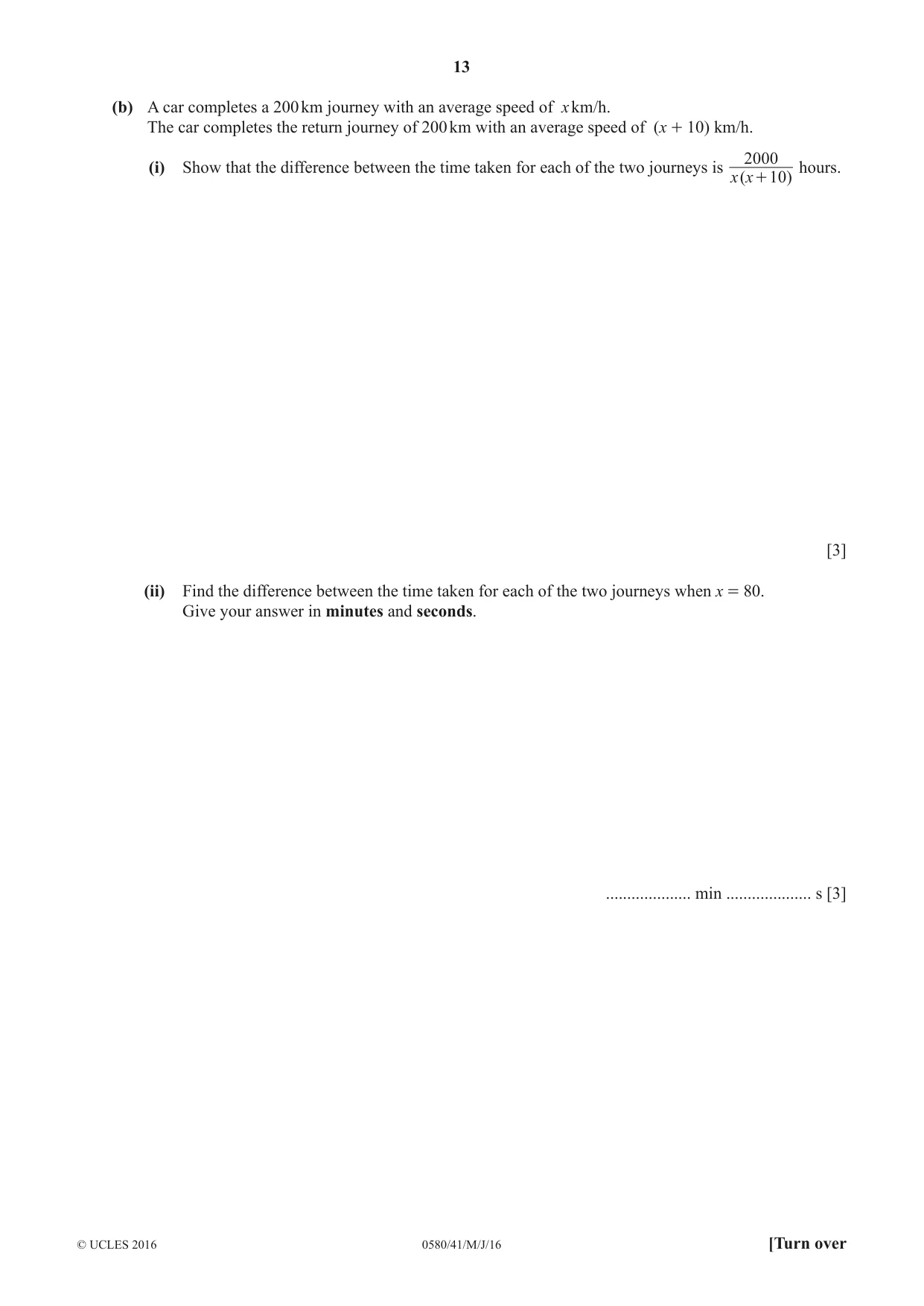
Mark scheme7 pages
Answers below. Sit the paper first if you are practising.
Questions as text
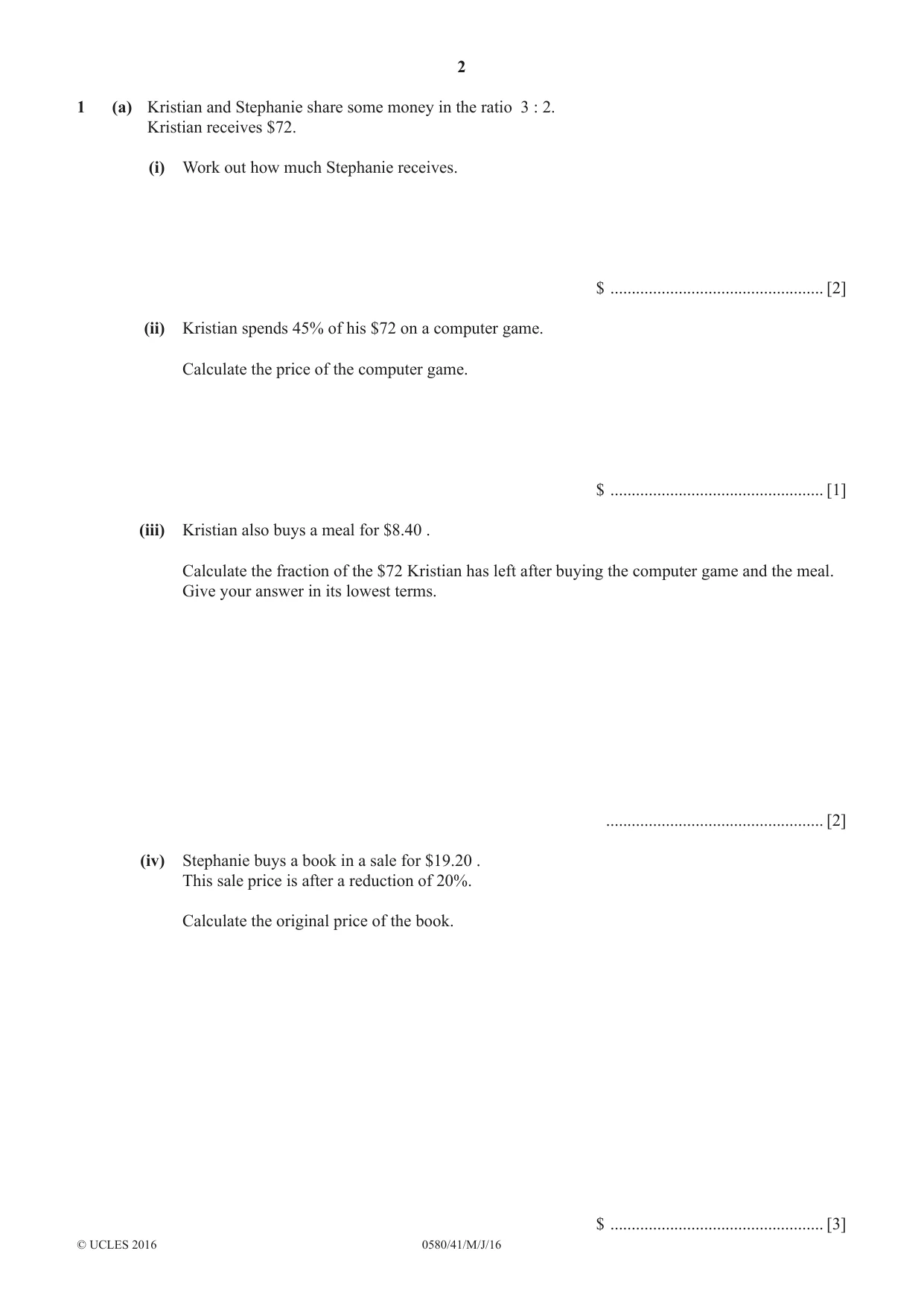
Q1 · Kristian and Stephanie share some money in the ratio 3 : 2
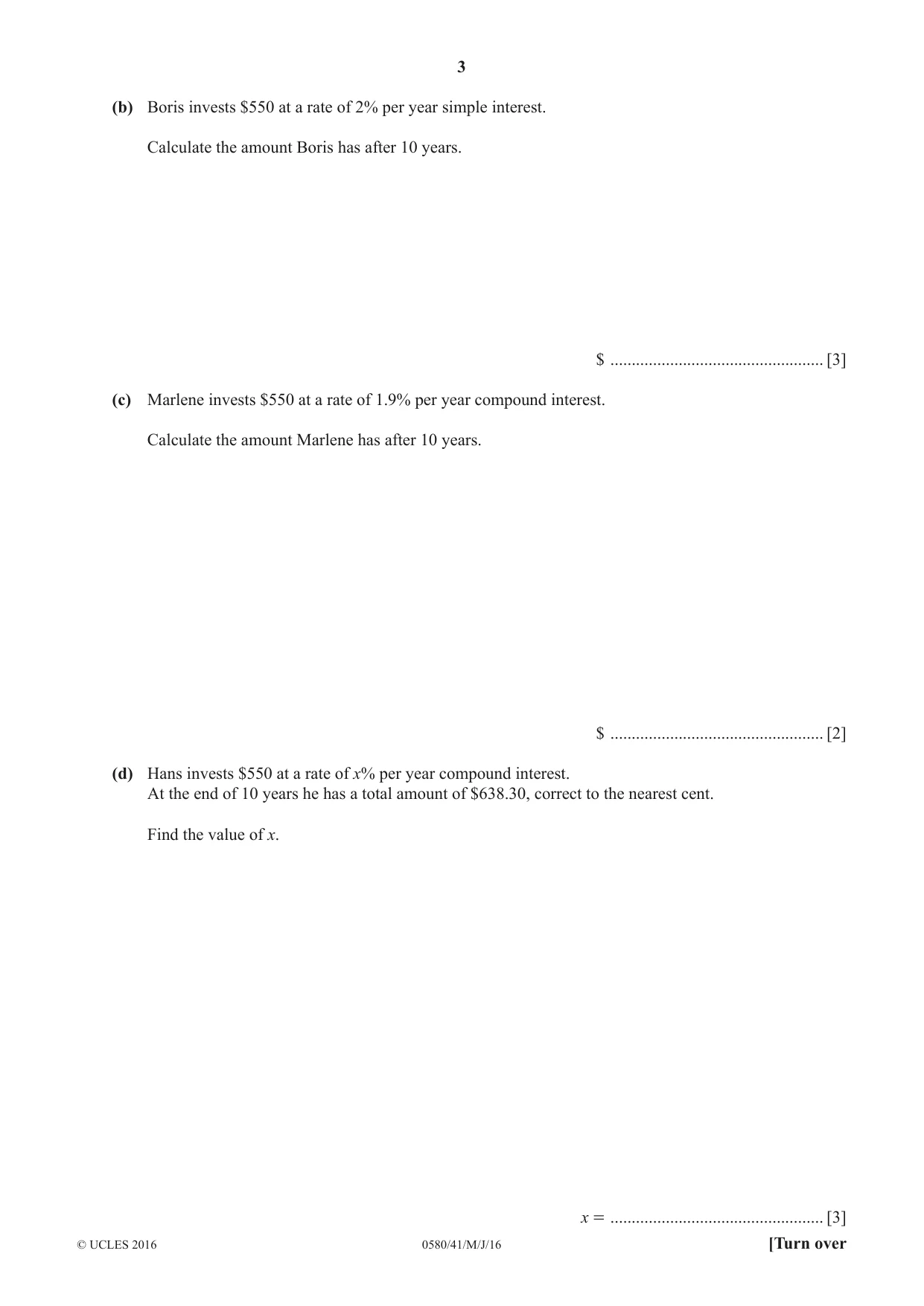
1 (a) Kristian and Stephanie share some money in the ratio 3 : 2. Kristian receives $72. (i) Work out how much Stephanie receives. $ .................................................. [2] (ii) Kristian spends 45% of his $72 on a computer game. Calculate the price of the computer game. $ .................................................. [1] (iii) Kristian also buys a meal for $8.40 . Calculate the fraction of the $72 Kristian has left after buying the computer game and the meal. Give your answer in its lowest terms. ................................................... [2] (iv) Stephanie buys a book in a sale for $19.20 . This sale price is after a reduction of 20%. Calculate the original price of the book. $ .................................................. [3] (b) Boris invests $550 at a rate of 2% per year simple interest. Calculate the amount Boris has after 10 years. $ .................................................. [3] (c) Marlene invests $550 at a rate of 1.9% per year compound interest. Calculate the amount Marlene has after 10 years. $ .................................................. [2] (d) Hans invests $550 at a rate of x% per year compound interest. At the end of 10 years he has a total amount of $638.30, correct to the nearest cent. Find the value of x. x = .................................................. [3]
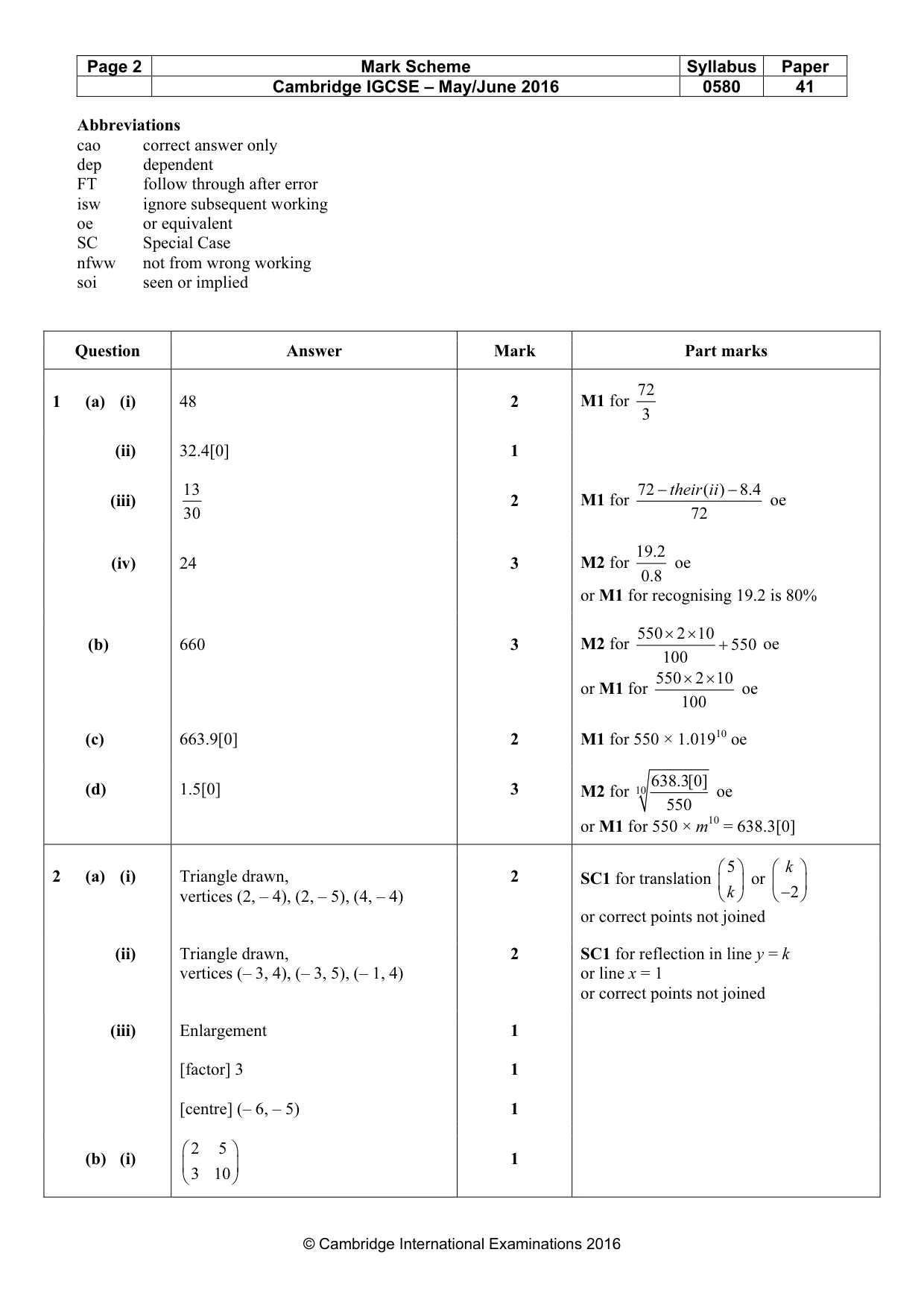
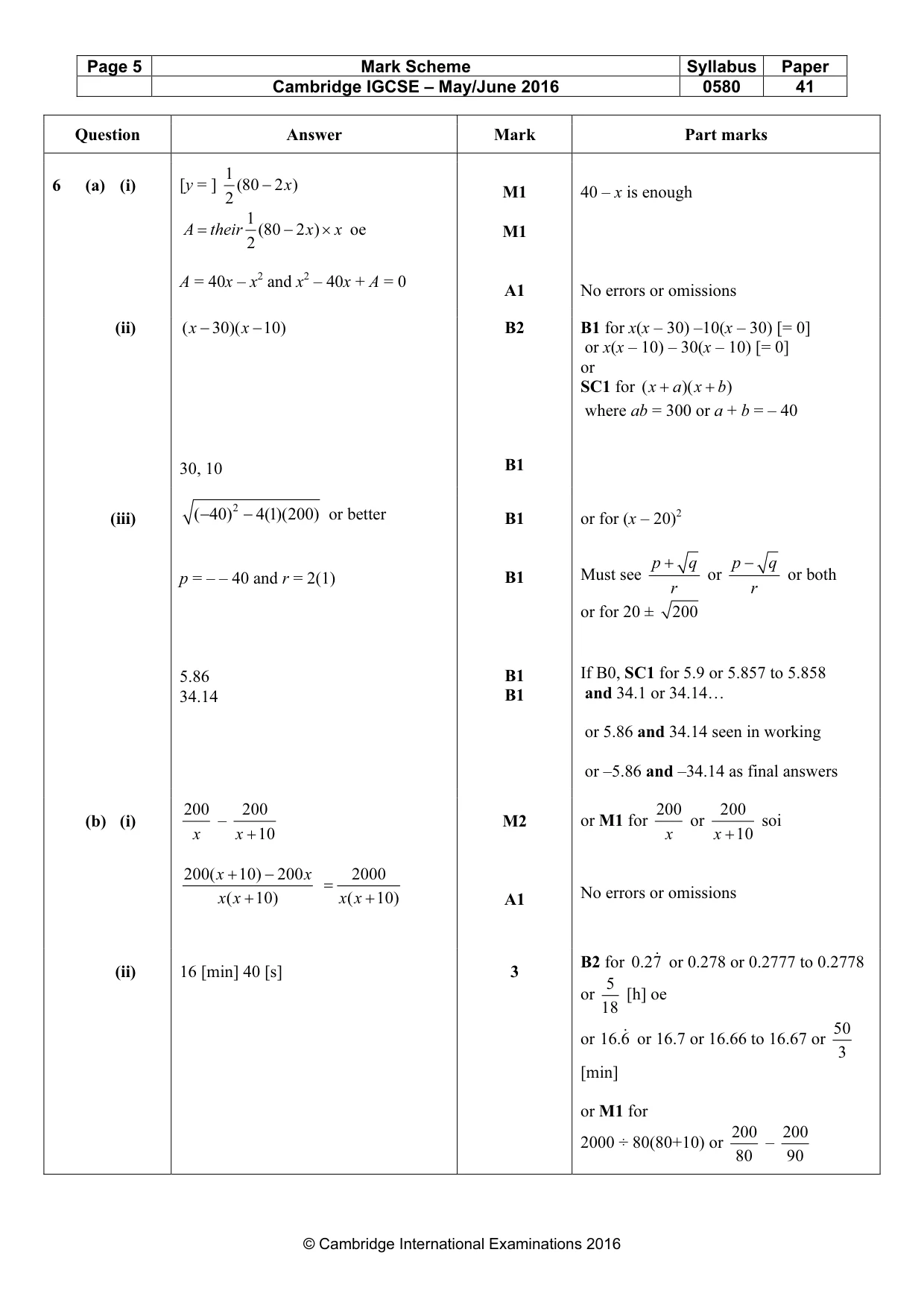
Mark scheme: Question Answer Mark Part marks 72721 (a) (i) 48 2 M1 for 3 (ii) 32.4[0] 1 13 72 − their ( ii ) − 8.4 (iii) 2 M1 for oe 30 72 19.2 (iv) 24 3 M2 for oe 0.8 or M1 for recognising 19.2 is 80% 550 × 2 × 10 (b) 660 3 M2 for + 550 oe 100 550 × 2 × 10 or M1 for oe 100 (c) 663.9[0] 2 M1 for 550 × 1.01910 oe 638.3[0] 10 oe (d) 1.5[0] 3 M2 for 550 or M1 for 550 × m10 = 638.3[0] 5 k
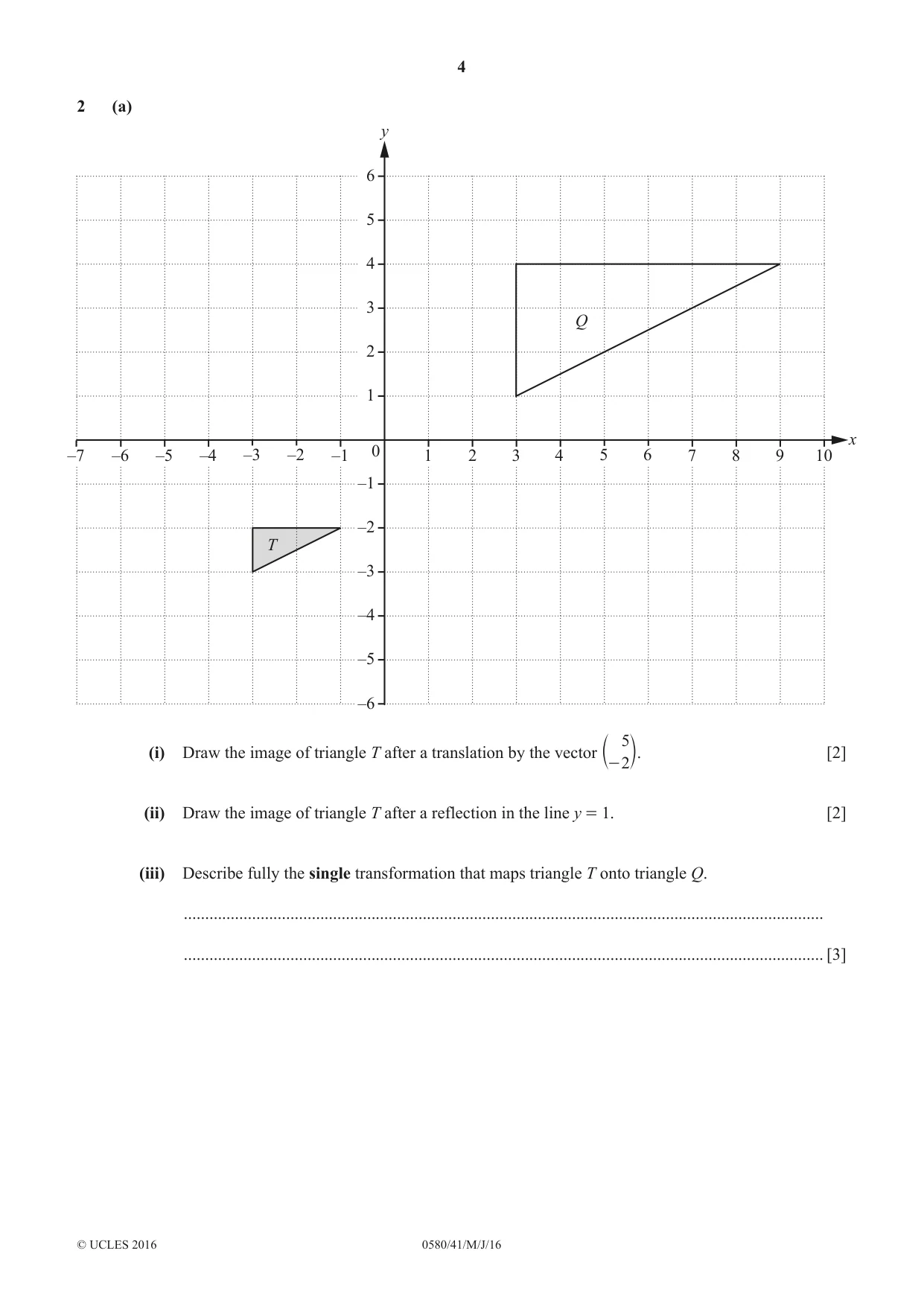
Q2 · Y 6 5 4 3 Q 2 1 x –7 –6 –5 –4 –3 –2 –1 0 1 2 3 4 5 6 7 8 9 10 –1 –2 T –3 –4 –5 –6 5 (i)…
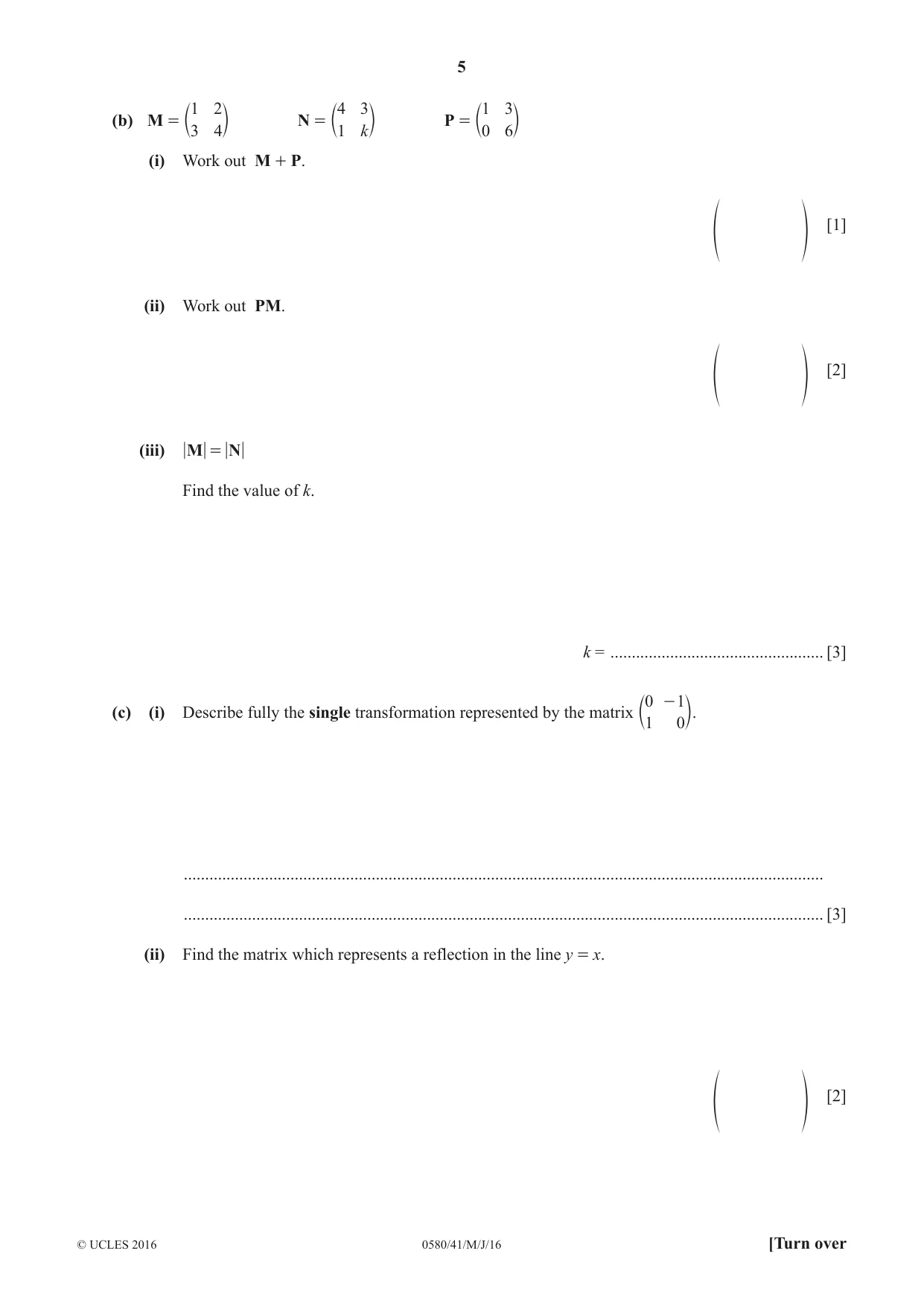
2 (a) y 6 5 4 3 Q 2 1 x –7 –6 –5 –4 –3 –2 –1 0 1 2 3 4 5 6 7 8 9 10 –1 –2 T –3 –4 –5 –6 5 (i) Draw the image of triangle T after a translation by the vector [2] c- 2m. (ii) Draw the image of triangle T after a reflection in the line y = 1. [2] (iii) Describe fully the single transformation that maps triangle T onto triangle Q. ...................................................................................................................................................... ...................................................................................................................................................... [3] 1 2 4 3 1 3 (b) M = N = P = 0 6m c3 4m c1 k m c (i) Work out M + P. [1] f p (ii) Work out PM. [2] f p (iii) M = N Find the value of k. k = .................................................. [3] 0 - 1 (c) (i) Describe fully the single transformation represented by the matrix c1 0m. ...................................................................................................................................................... ...................................................................................................................................................... [3] (ii) Find the matrix which represents a reflection in the line y = x. [2] f p
Mark scheme: 5 k 2 (a) (i) Triangle drawn, 2 SC1 for translation or vertices (2, – 4), (2, – 5), (4, – 4) k − 2 or correct points not joined (ii) Triangle drawn, 2 SC1 for reflection in line y = k vertices (– 3, 4), (– 3, 5), (– 1, 4) or line x = 1 or correct points not joined (iii) Enlargement 1 [factor] 3 1 [centre] (– 6, – 5) 1 2 5 (b) (i) 1 3 10
Q3 · 200 students estimate the volume, V m3, of a classroom
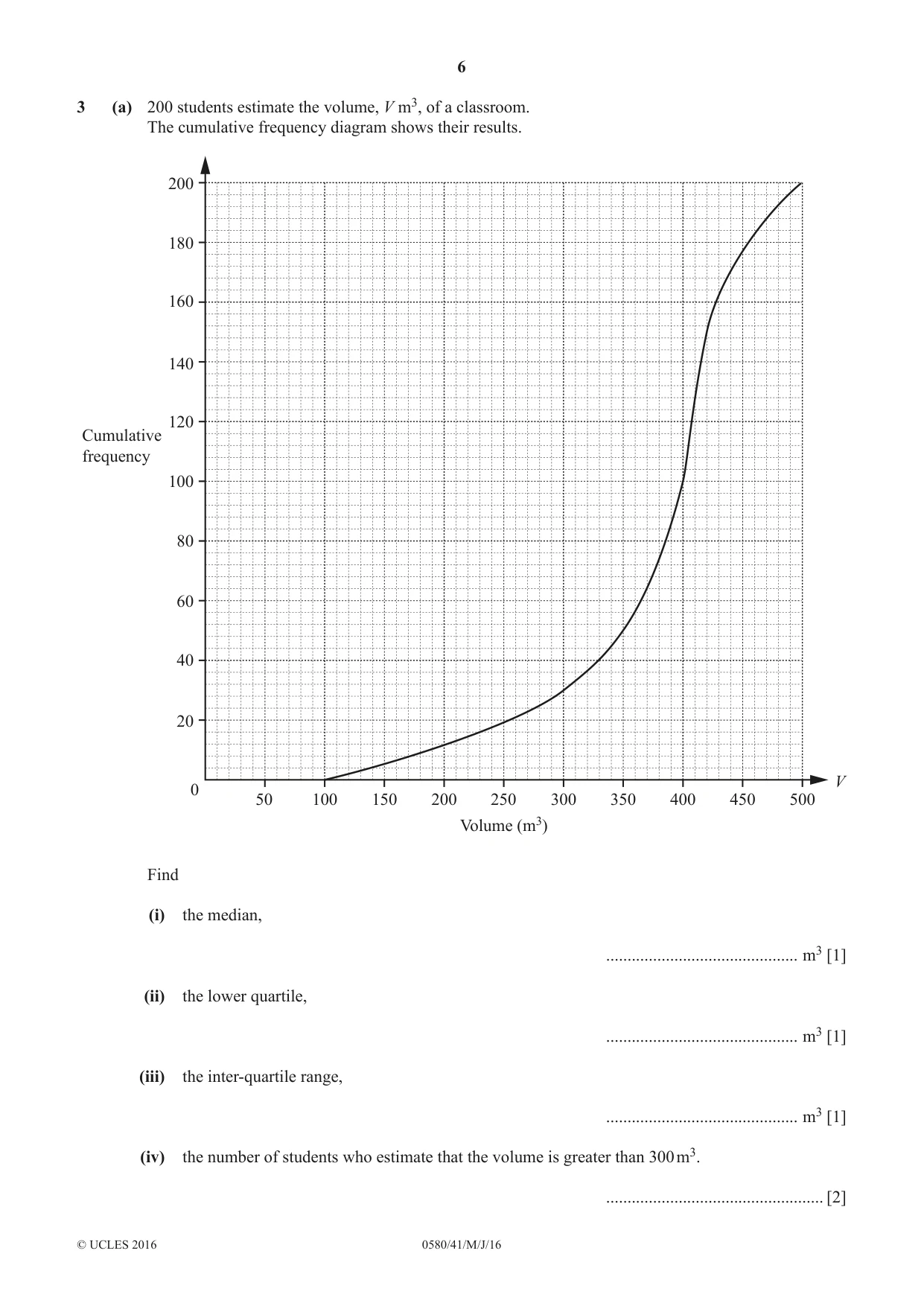
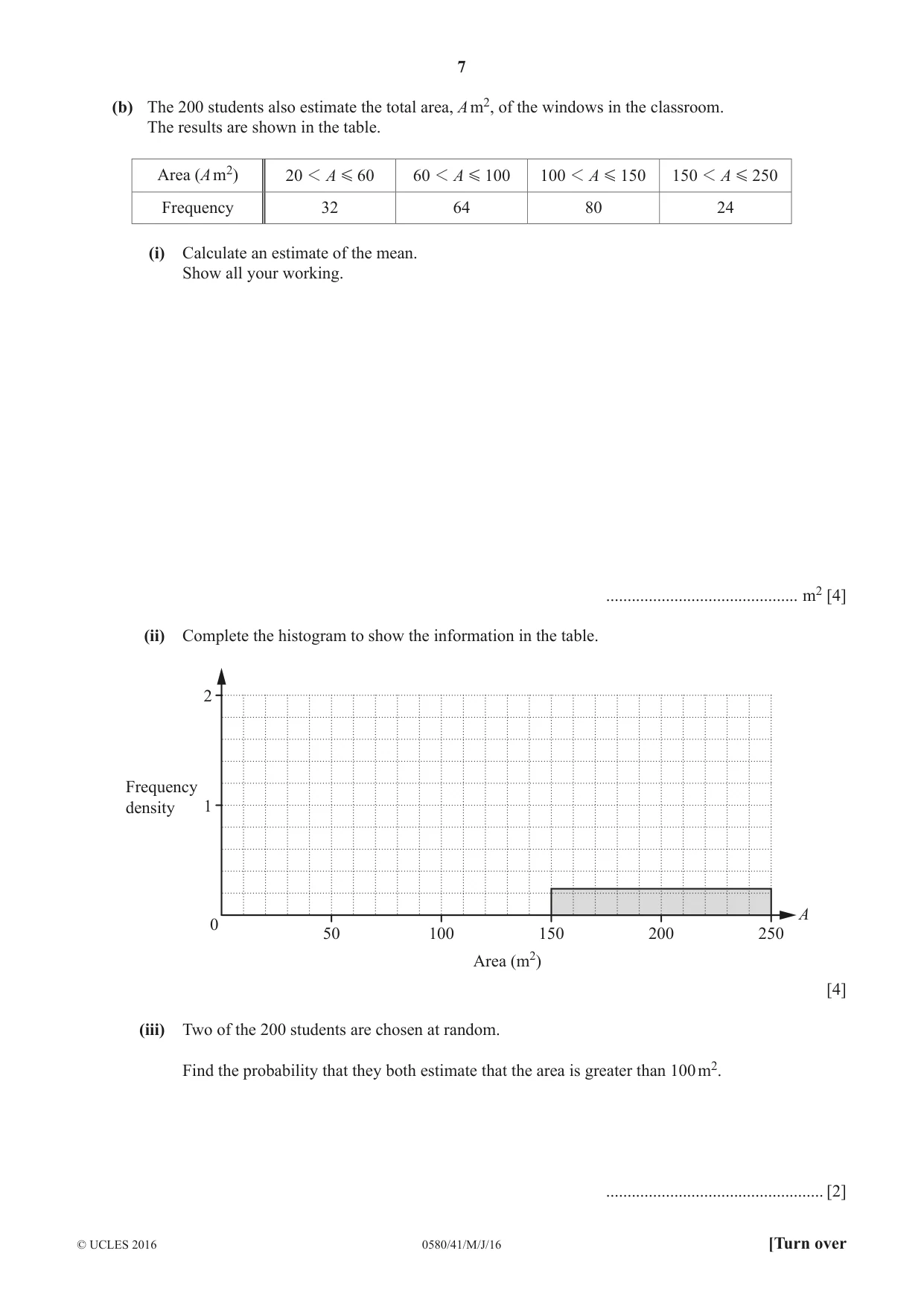
3 (a) 200 students estimate the volume, V m3, of a classroom. The cumulative frequency diagram shows their results. 200 180 160 140 120 Cumulative frequency 100 80 60 40 20 V 0 50 100 150 200 250 300 350 400 450 500 Volume (m3) Find (i) the median, ............................................. m3 [1] (ii) the lower quartile, ............................................. m3 [1] (iii) the inter-quartile range, ............................................. m3 [1] (iv) the number of students who estimate that the volume is greater than 300 m3. ................................................... [2] (b) The 200 students also estimate the total area, A m2, of the windows in the classroom. The results are shown in the table. Area (A m2) 20 1 A G 60 60 1 A G 100 100 1 A G 150 150 1 A G 250 Frequency 32 64 80 24 (i) Calculate an estimate of the mean. Show all your working. ............................................. m2 [4] (ii) Complete the histogram to show the information in the table. 2 Frequency density 1 A 0 50 100 150 200 250 Area (m2) [4] (iii) Two of the 200 students are chosen at random. Find the probability that they both estimate that the area is greater than 100 m2. ................................................... [2]
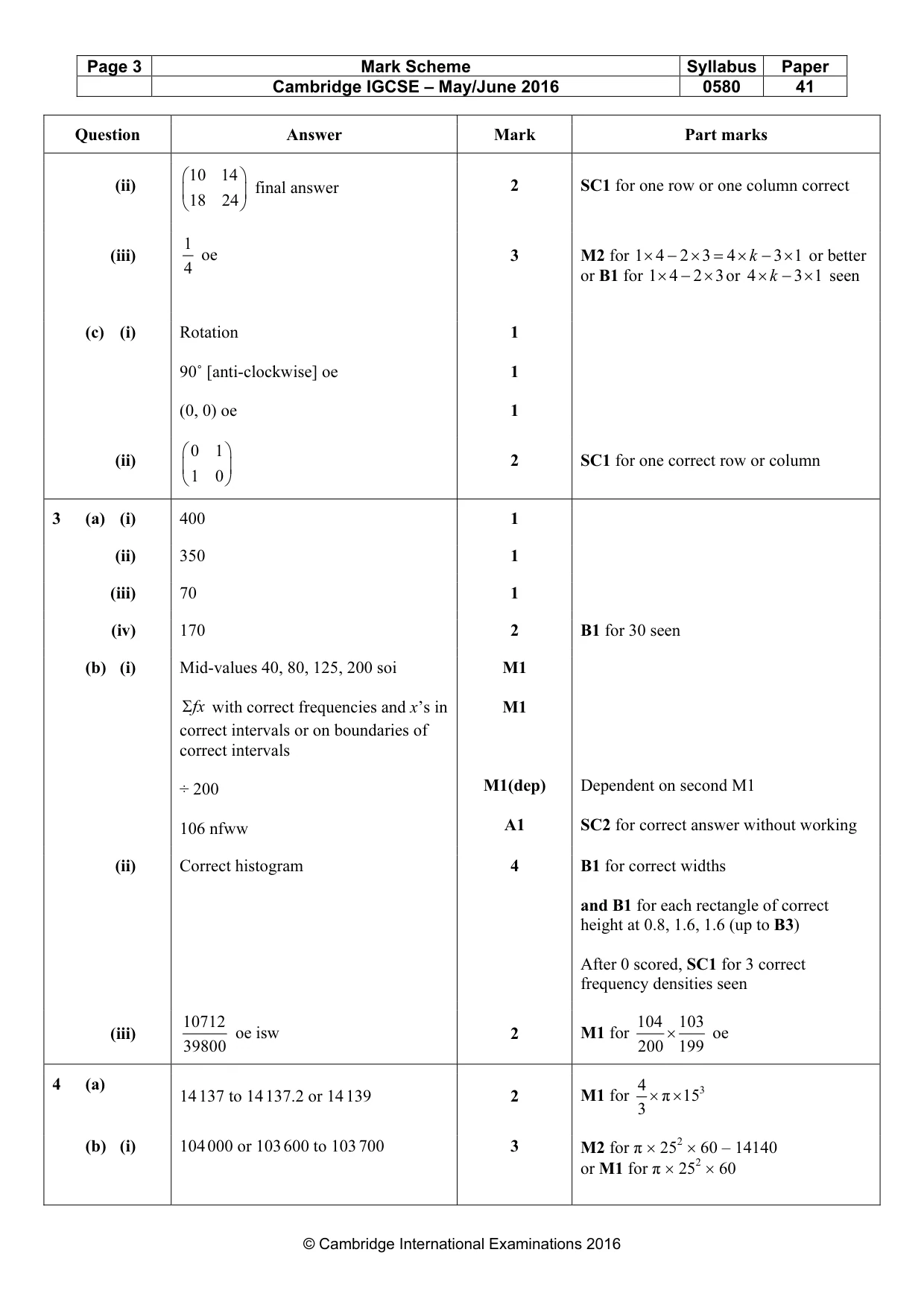
Mark scheme: 3 (a) (i) 400 1 (ii) 350 1 (iii) 70 1 (iv) 170 2 B1 for 30 seen (b) (i) Mid-values 40, 80, 125, 200 soi M1 Σ fx with correct frequencies and x’s in M1 correct intervals or on boundaries of correct intervals M1(dep) Dependent on second M1 ÷ 200 A1 SC2 for correct answer without working 106 nfww (ii) Correct histogram 4 B1 for correct widths and B1 for each rectangle of correct height at 0.8, 1.6, 1.6 (up to B3) After 0 scored, SC1 for 3 correct frequency densities seen 10712 104 103 (iii) oe isw 2 M1 for × oe 39800 200 199
Q4 · Calculate the volume of a metal sphere of radius 15 cm and show that it rounds to 14 140…
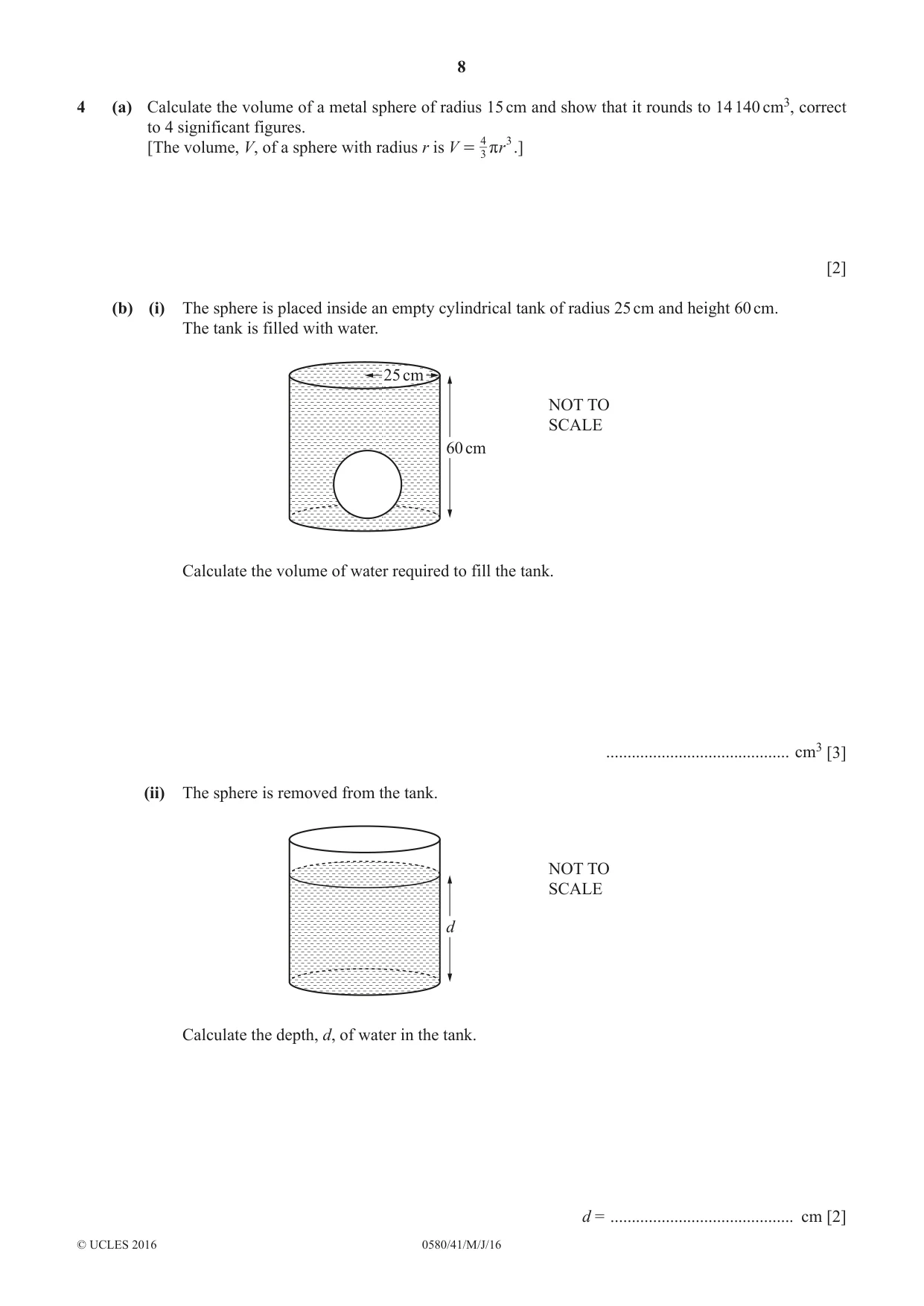
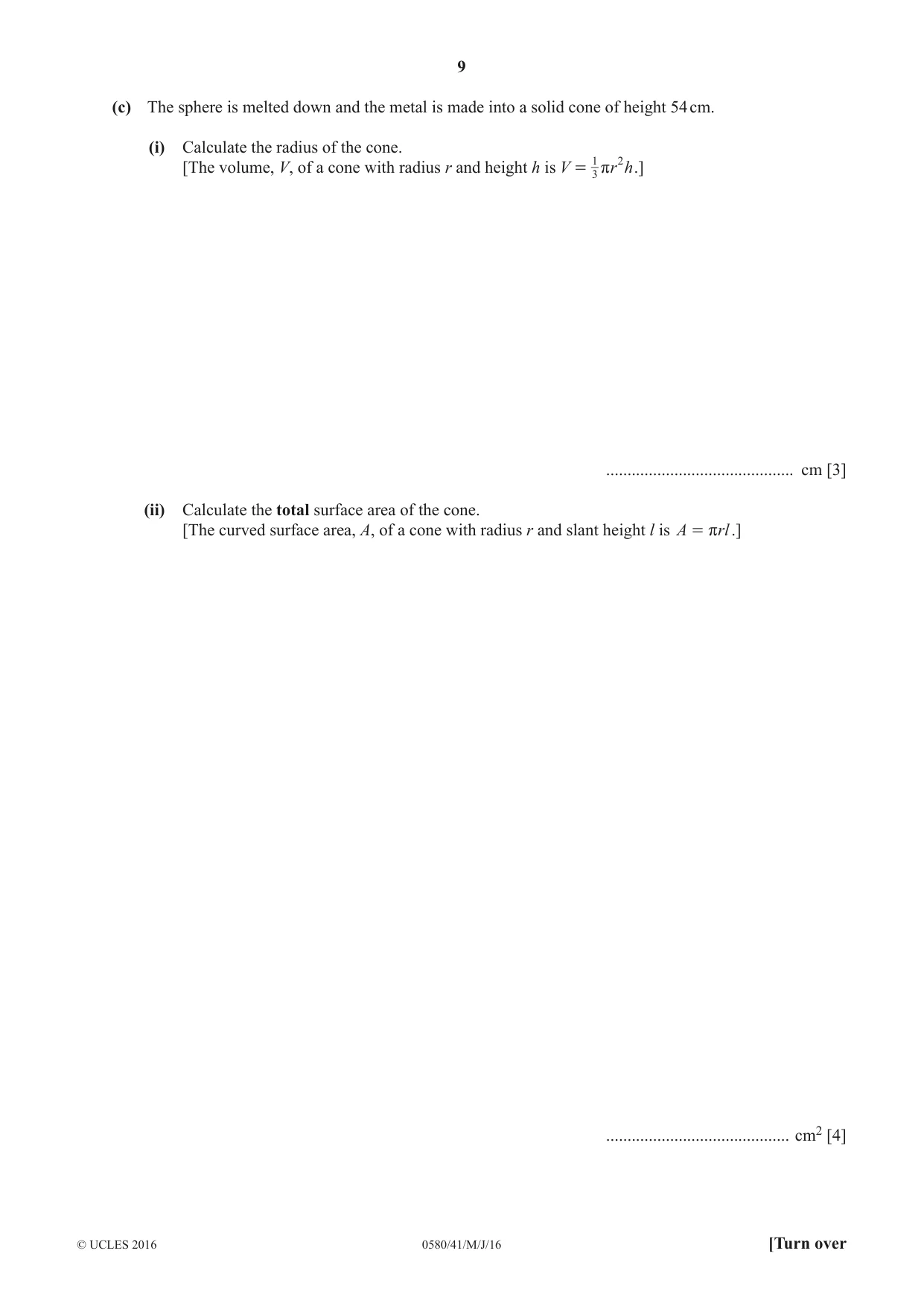
4 (a) Calculate the volume of a metal sphere of radius 15 cm and show that it rounds to 14 140 cm3, correct to 4 significant figures. [The volume, V, of a sphere with radius r is V = 43 r r 3 .] [2] (b) (i) The sphere is placed inside an empty cylindrical tank of radius 25 cm and height 60 cm. The tank is filled with water. 25 cm NOT TO SCALE 60 cm Calculate the volume of water required to fill the tank. ........................................... cm3 [3] (ii) The sphere is removed from the tank. NOT TO SCALE d Calculate the depth, d, of water in the tank. d = ........................................... cm [2] (c) The sphere is melted down and the metal is made into a solid cone of height 54 cm. (i) Calculate the radius of the cone. [The volume, V, of a cone with radius r and height h is V = 13 r r 2 h .] ............................................ cm [3] (ii) Calculate the total surface area of the cone. [The curved surface area, A, of a cone with radius r and slant height l is A = rrl .] ........................................... cm2 [4]
Mark scheme: 4 (a) 4 3 14 137 to 14 137.2 or 14 139 2 M1 for × π × 15 3 (b) (i) 104 000 or 103 600 to 103 700 3 M2 for π × 252 × 60 – 14140 or M1 for π × 252 × 60
Q5 · F ()x = 20 + x , x !
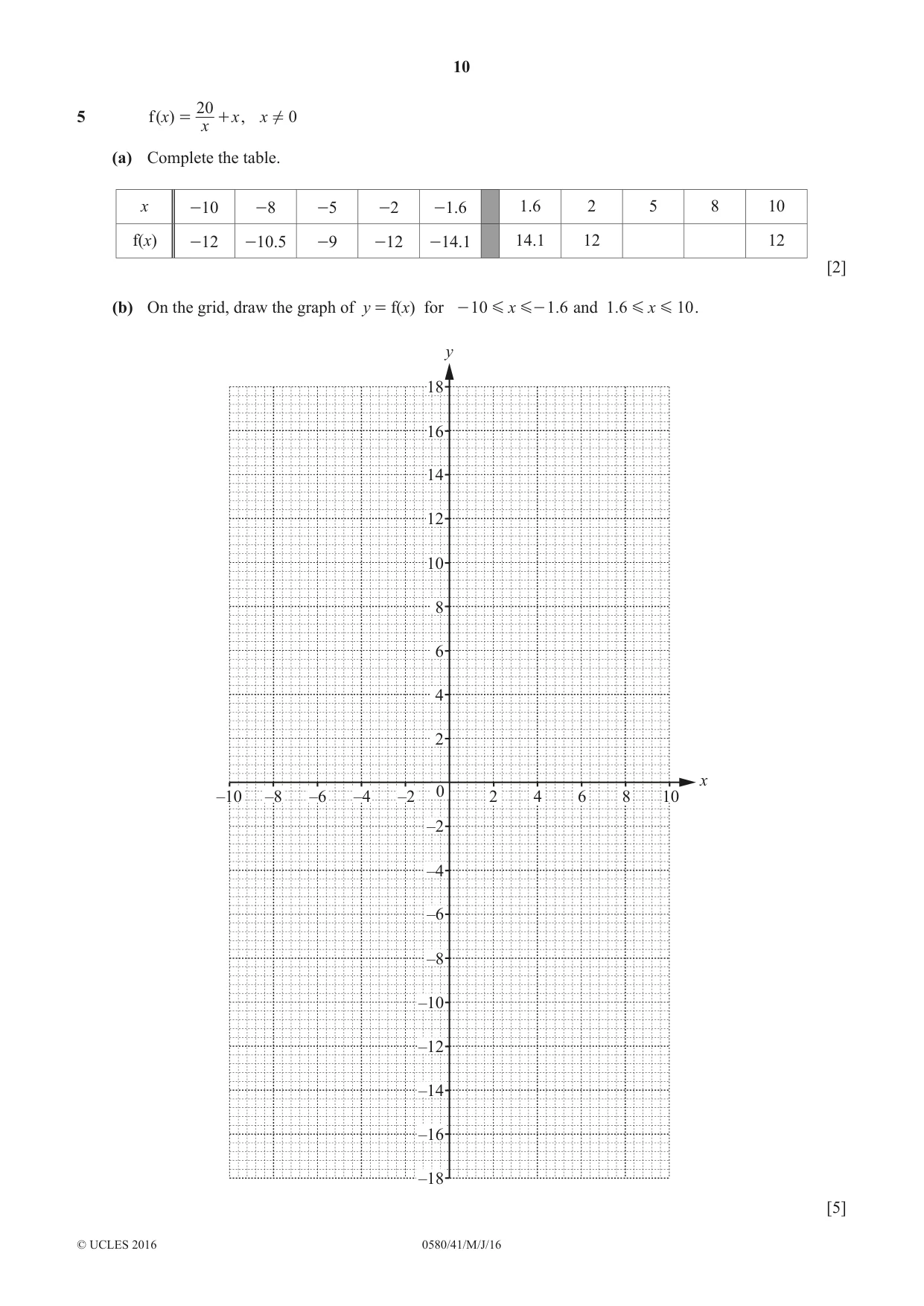
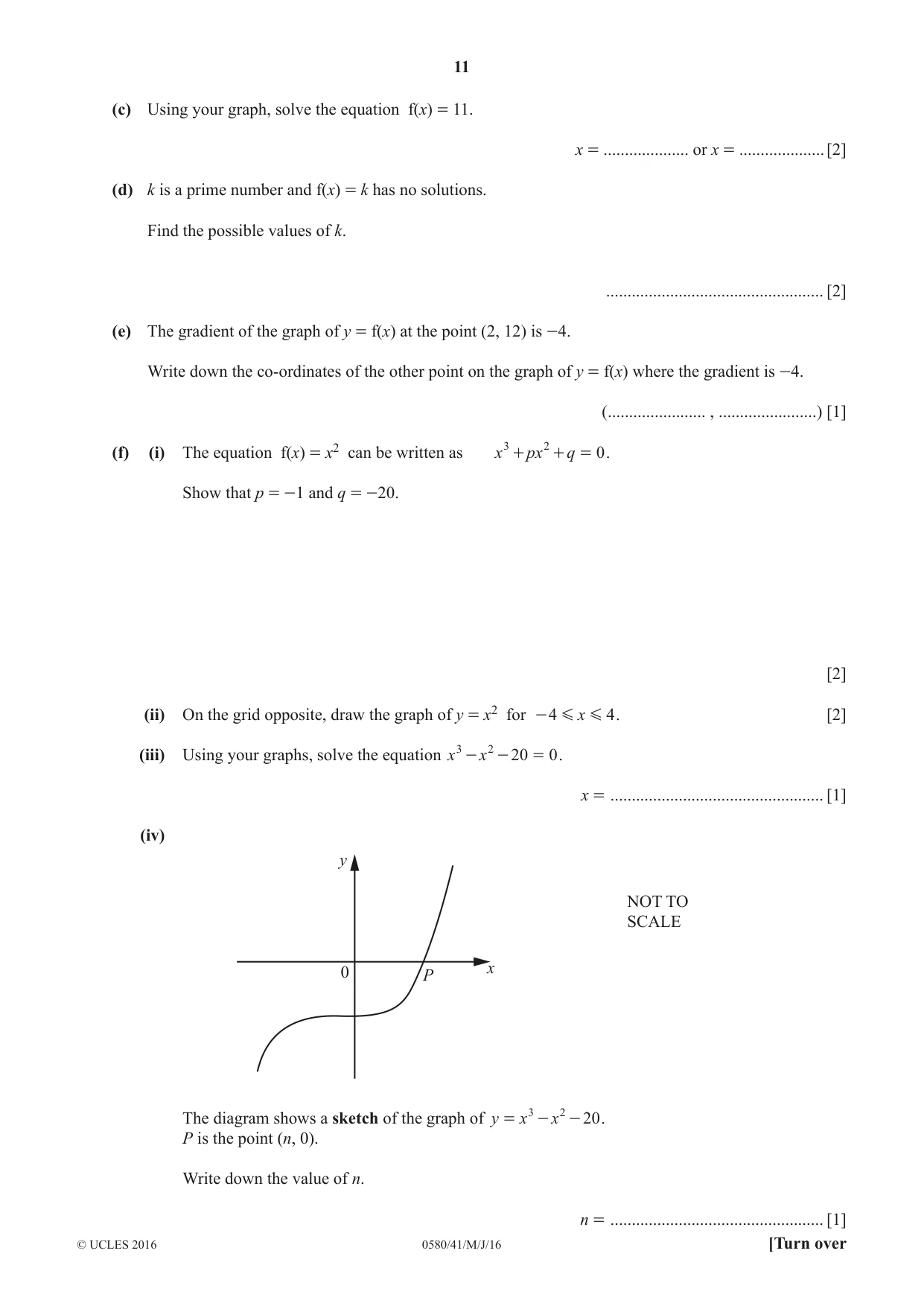
5 f ()x = 20 + x , x ! 0 x (a) Complete the table. x -10 -8 -5 -2 -1.6 1.6 2 5 8 10 f(x) -12 -10.5 -9 -12 -14.1 14.1 12 12 [2] (b) On the grid, draw the graph of y = f(x) for - 10 G x G - 1.6 and 1. 6 G x G 10 . y 18 16 14 12 10 8 6 4 2 x 0 –10 –8 –6 –4 –2 2 4 6 8 10 –2 –4 –6 –8 –10 –12 –14 –16 –18 [5] (c) Using your graph, solve the equation f(x) = 11. x = .................... or x = .................... [2] (d) k is a prime number and f(x) = k has no solutions. Find the possible values of k. ................................................... [2] (e) The gradient of the graph of y = f(x) at the point (2, 12) is -4. Write down the co-ordinates of the other point on the graph of y = f(x) where the gradient is -4. (....................... , .......................) [1] (f) (i) The equation f(x) = x2 can be written as x 3 + px 2 + q = 0 . Show that p = -1 and q = -20. [2] (ii) On the grid opposite, draw the graph of y = x2 for - 4 G x G 4 . [2] (iii) Using your graphs, solve the equation x 3 - x 2 - 20 = 0 . x = .................................................. [1] (iv) y NOT TO SCALE 0 P x The diagram shows a sketch of the graph of y = x 3 - x 2 - 20 . P is the point (n, 0). Write down the value of n. n = .................................................. [1]
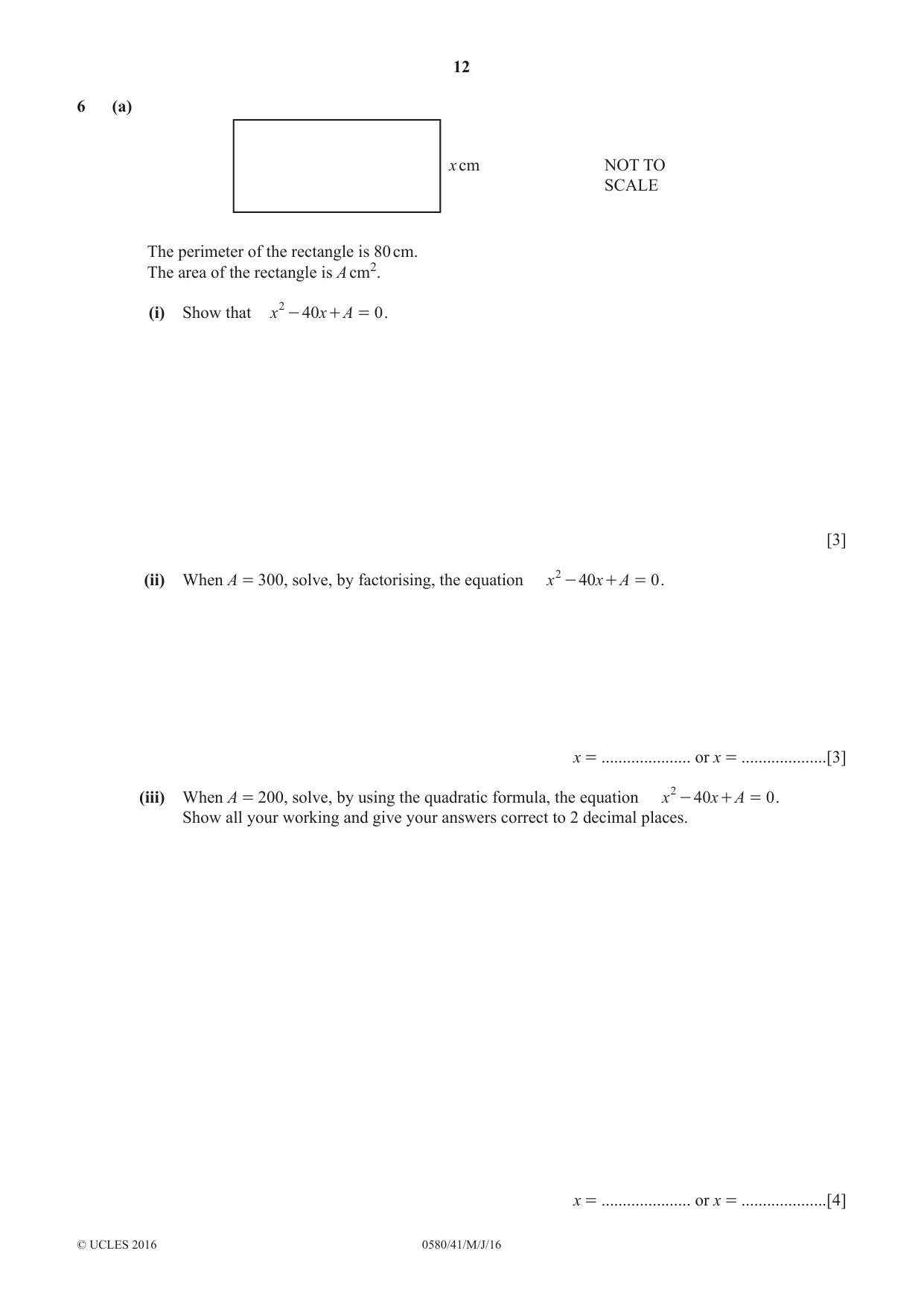
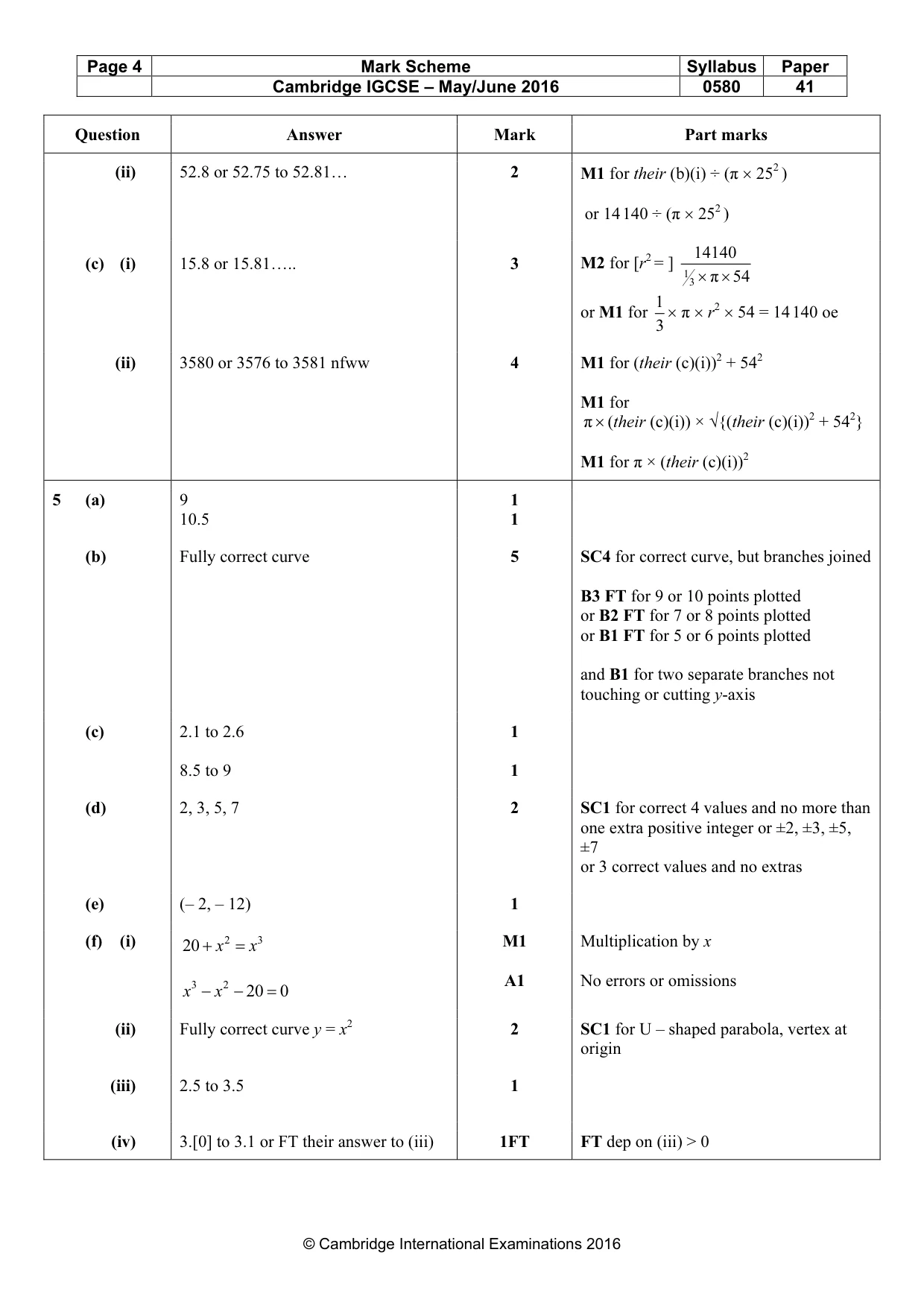
Mark scheme: 5 (a) 9 1 10.5 1 (b) Fully correct curve 5 SC4 for correct curve, but branches joined B3 FT for 9 or 10 points plotted or B2 FT for 7 or 8 points plotted or B1 FT for 5 or 6 points plotted and B1 for two separate branches not touching or cutting y-axis (c) 2.1 to 2.6 1 8.5 to 9 1 (d) 2, 3, 5, 7 2 SC1 for correct 4 values and no more than one extra positive integer or ±2, ±3, ±5, ±7 or 3 correct values and no extras (e) (– 2, – 12) 1 (f) (i) M1 Multiplication by x 20 + x 2 = x 3 A1 No errors or omissions 3 2 x − x − 20 = 0 (ii) Fully correct curve y = x2 2 SC1 for U – shaped parabola, vertex at origin (iii) 2.5 to 3.5 1 (iv) 3.[0] to 3.1 or FT their answer to (iii) 1FT FT dep on (iii) > 0 1 6 (a) (i) [y = ] (80 − 2 x ) M1 40 – x is enough 2 1 A = their (80 − 2 x ) × x oe M1 2 A = 40x – x2 and x2 – 40x + A = 0 A1 No errors or omissions (ii) ( x − 30)( x − 10) B2 B1 for x(x – 30) –10(x – 30) [= 0] or x(x – 10) – 30(x – 10) [= 0] or SC1 for ( x + a )( x + b ) where ab = 300 or a + b = – 40 B1 30, 10 (iii) ( −40) 2 − 4(1)(200) or better B1 or for (x – 20)2 p + q p − q p = – – 40 and r = 2(1) B1 Must see or or both r r or for 20 ± 200 B1 If B0, SC1 for 5.9 or 5.857 to 5.858 5.86 B1 and 34.1 or 34.14… 34.14 or 5.86 and 34.14 seen in working or –5.86 and –34.14 as final answers 200 200 200 200 (b) (i) – M2 or M1 for or soi x x + 10 x x + 10 200( x + 10) − 200 x 2000 = x ( x + 10) x ( x + 10) A1 No errors or omissions B2 for 0.27 or 0.278 or 0.2777 to 0.2778 (ii) 16 [min] 40 [s] 3 5 or [h] oe 18 50 or 16.6 or 16.7 or 16.66 to 16.67 or 3 [min] or M1 for 200 200 2000 ÷ 80(80+10) or – 80 90
Q7 · M R Q T r NOT TO SCALE O p P OPQR is a rectangle and O is the origin
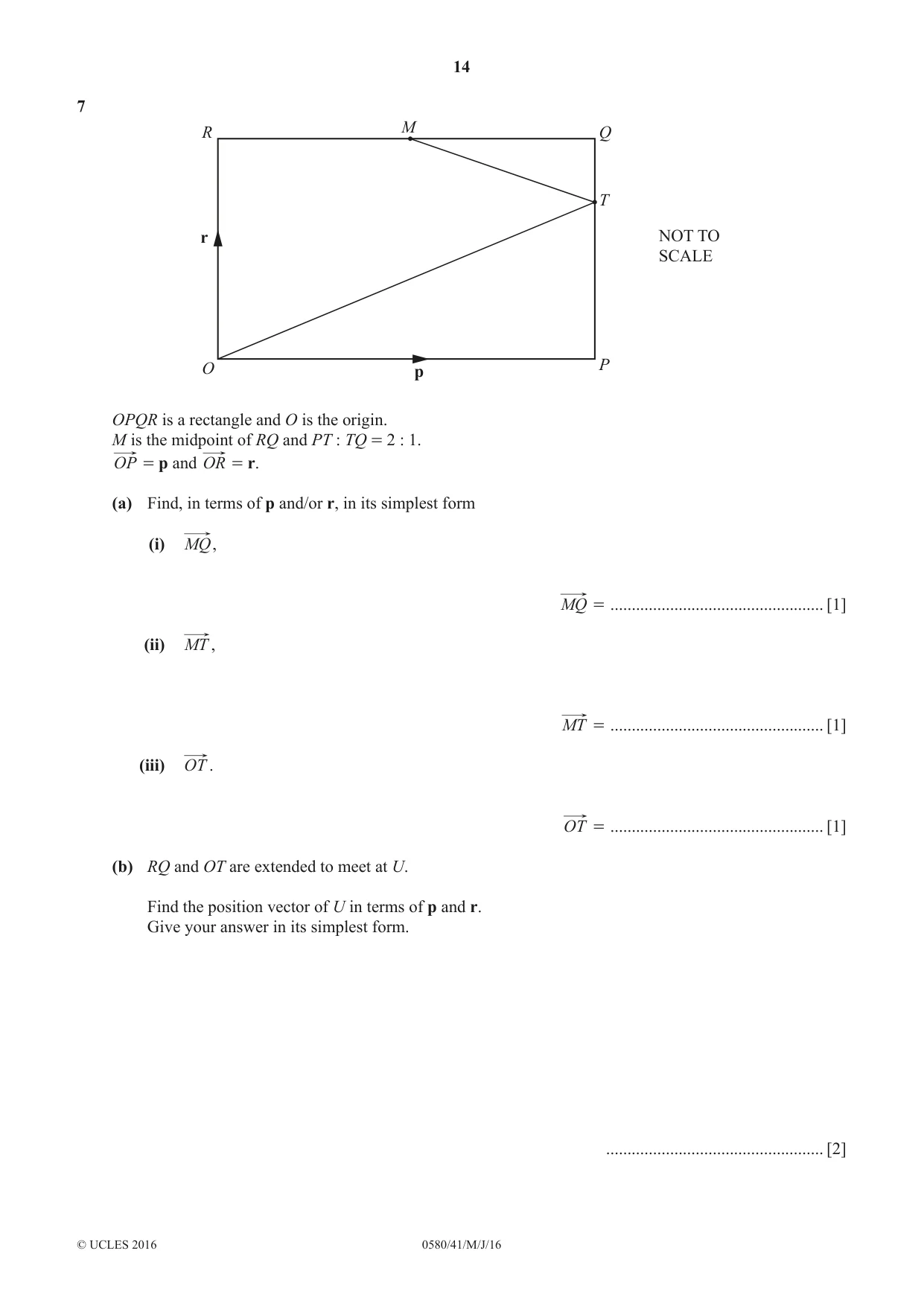
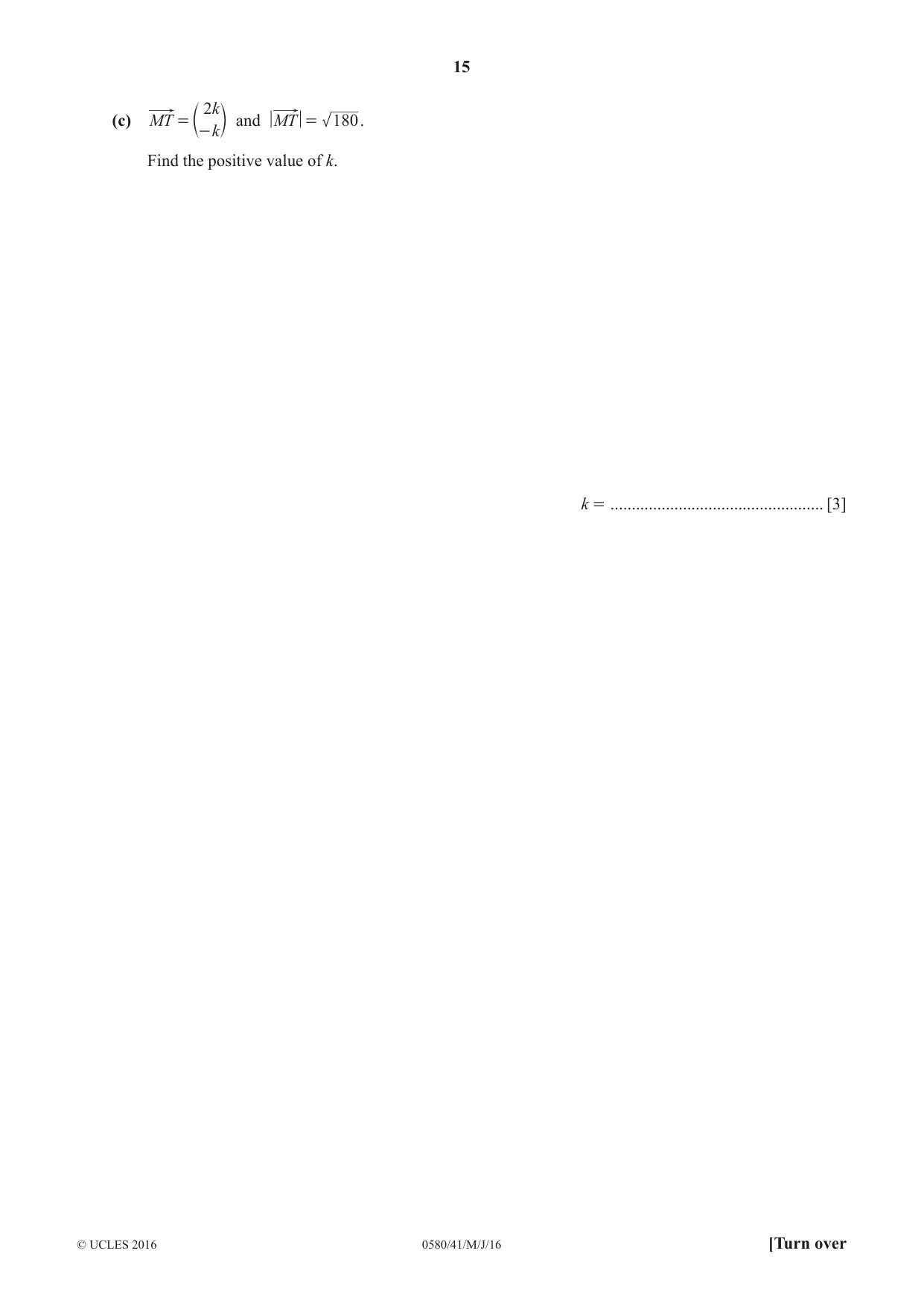
7 M R Q T r NOT TO SCALE O p P OPQR is a rectangle and O is the origin. M is the midpoint of RQ and PT : TQ = 2 : 1. OP = p and OR = r. (a) Find, in terms of p and/or r, in its simplest form (i) MQ, MQ = .................................................. [1] (ii) MT , MT = .................................................. [1] (iii) OT . OT = .................................................. [1] (b) RQ and OT are extended to meet at U. Find the position vector of U in terms of p and r. Give your answer in its simplest form. ................................................... [2] 2k (c) MT = and MT = 180 . c- k m Find the positive value of k. k = .................................................. [3]
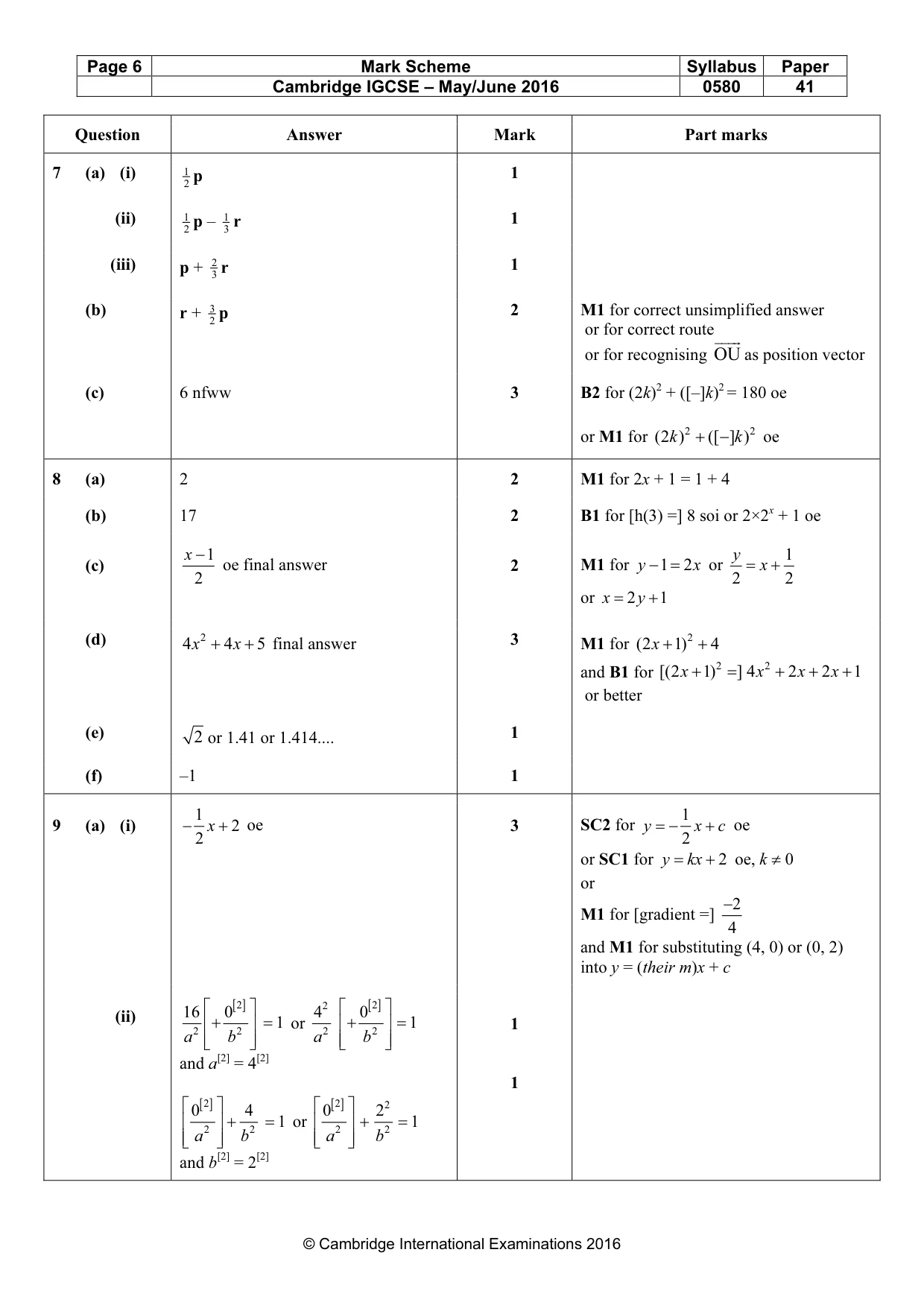
Mark scheme: 7 (a) (i) 1 p 1 2 (ii) 1 2 p – 13 r 1 2 r 1 (iii) p + 3 3 p 2 M1 for correct unsimplified answer (b) r + 2 or for correct route or for recognising OU as position vector (c) 6 nfww 3 B2 for (2k)2 + ([–]k)2 = 180 oe or M1 for (2 k ) 2 + ([ − ]k ) 2 oe
Q8 · F(x) = 2x + 1 g(x) = x2 + 4 h(x) = 2x (a) Solve the equation f(x) = g(1)
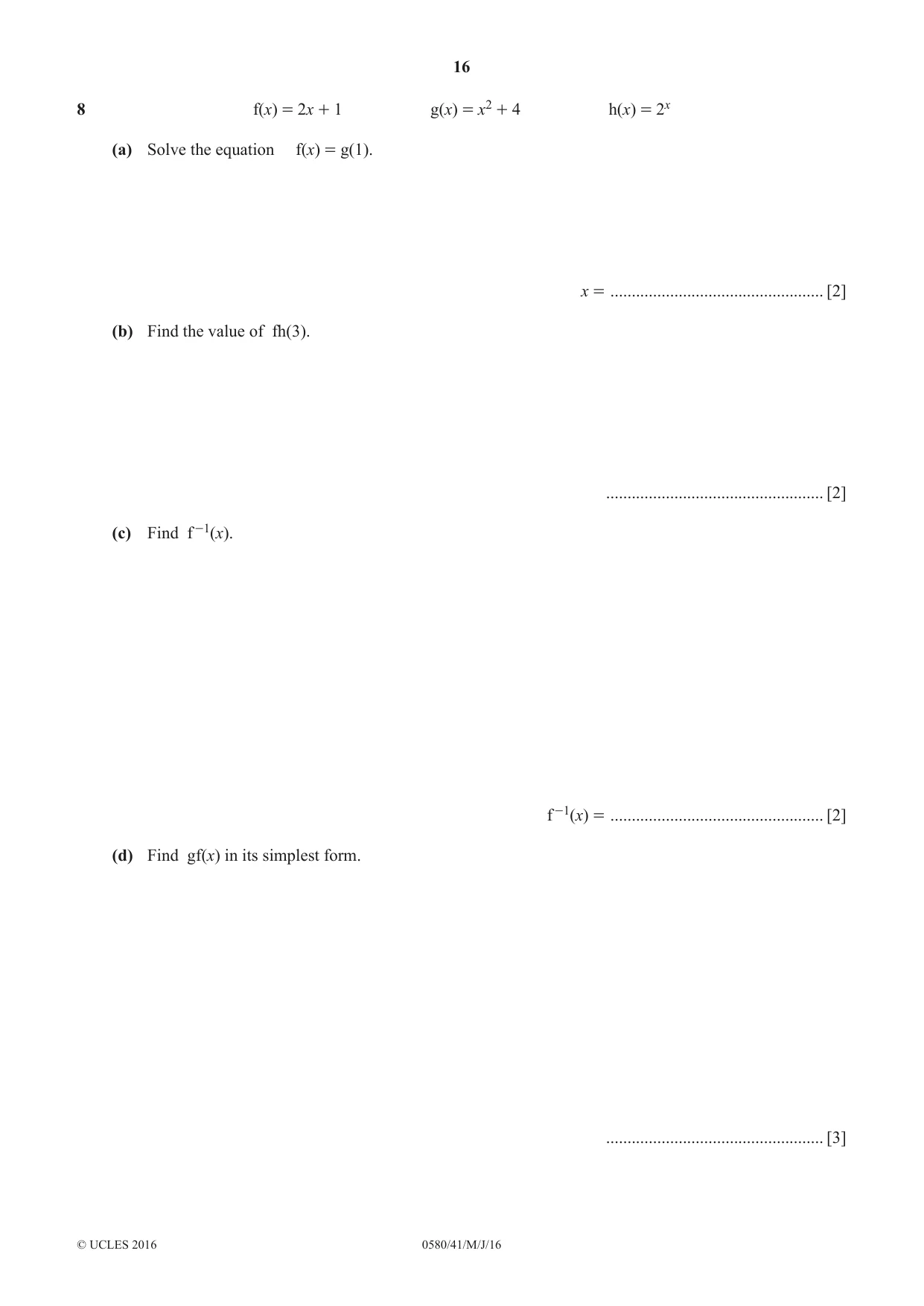
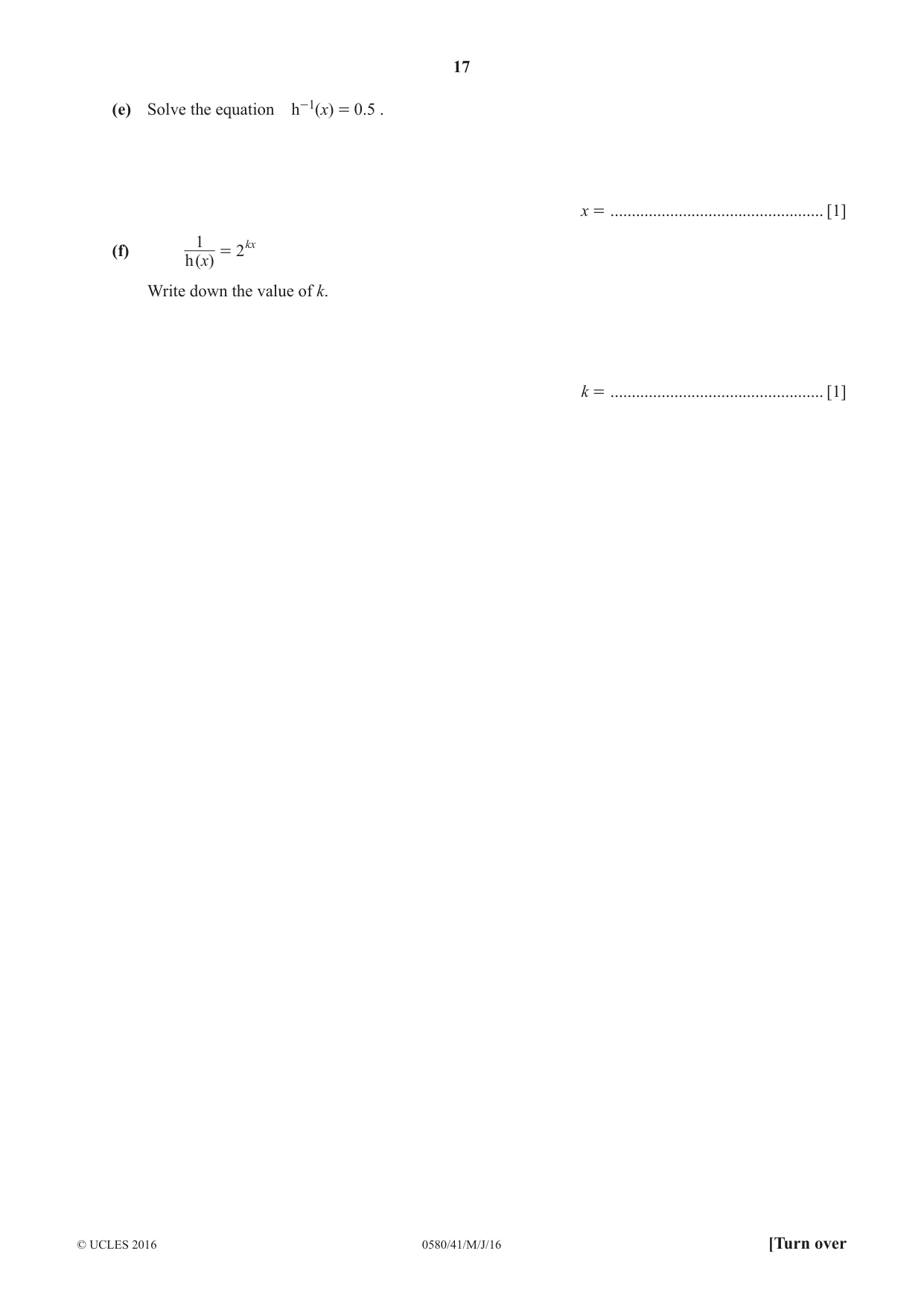
8 f(x) = 2x + 1 g(x) = x2 + 4 h(x) = 2x (a) Solve the equation f(x) = g(1). x = .................................................. [2] (b) Find the value of fh(3). ................................................... [2] (c) Find f -1(x). f -1(x) = .................................................. [2] (d) Find gf(x) in its simplest form. ................................................... [3] (e) Solve the equation h-1(x) = 0.5 . x = .................................................. [1] (f) 1 = 2 kx h ()x Write down the value of k. k = .................................................. [1]
Mark scheme: 8 (a) 2 2 M1 for 2x + 1 = 1 + 4 (b) 17 2 B1 for [h(3) =] 8 soi or 2×2x + 1 oe x − 1 y 1 (c) oe final answer 2 M1 for y −=1 2 x or = x + 2 2 2 or x = 2 y + 1 (d) 2 + 4 3 M1 for (2 x + 1) 4 x 2 + 4 x + 5 final answer and B1 for [(2 x + 1) 2 = ] 4 x 2 + 2 x + 2 x + 1 or better (e) 1 2 or 1.41 or 1.414.... (f) –1 1 1 1
Q9 · Y 2 B A NOT TO x –4 0 4 SCALE –2 2 y x 2 The diagram shows a curve with equation = 1
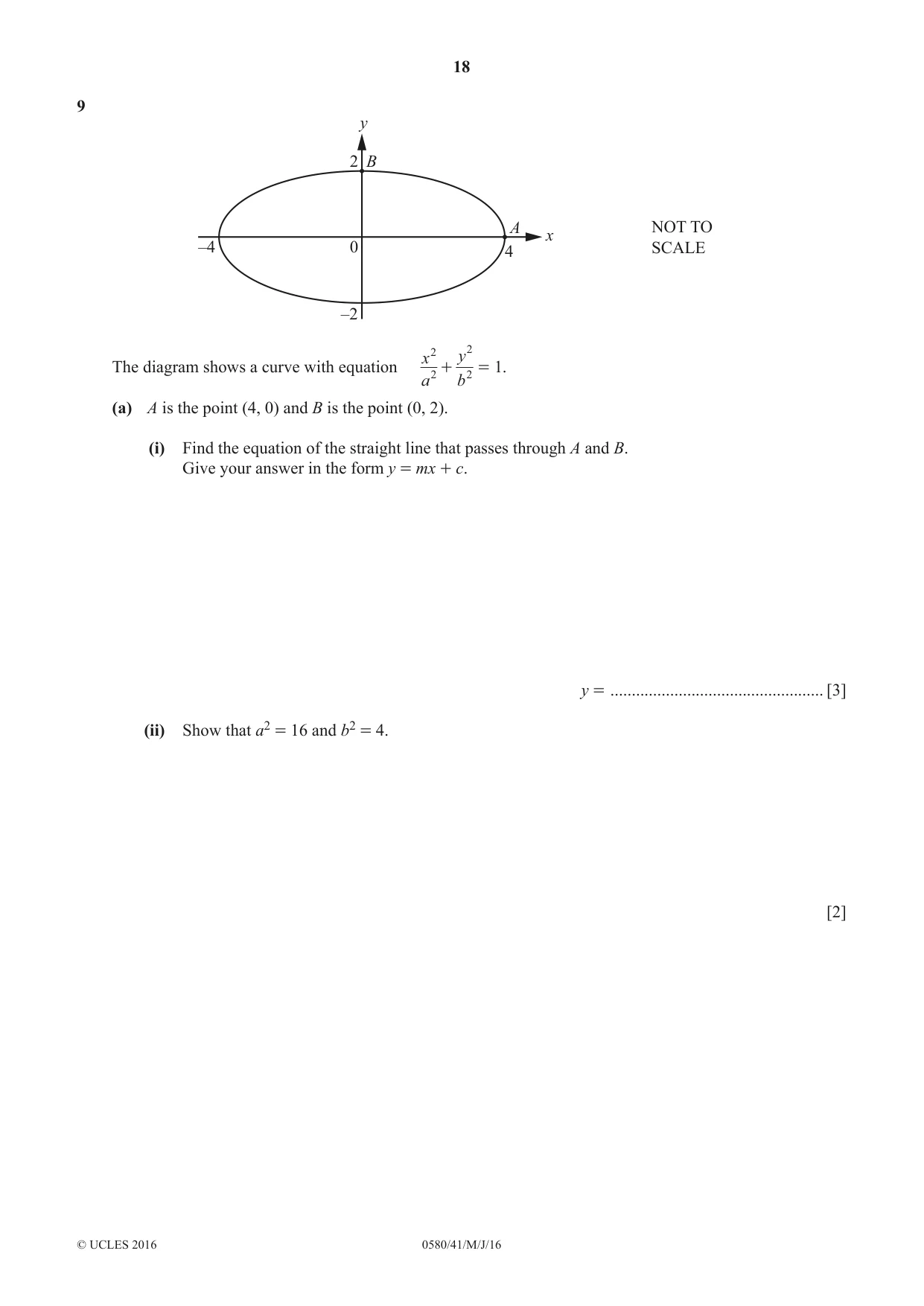
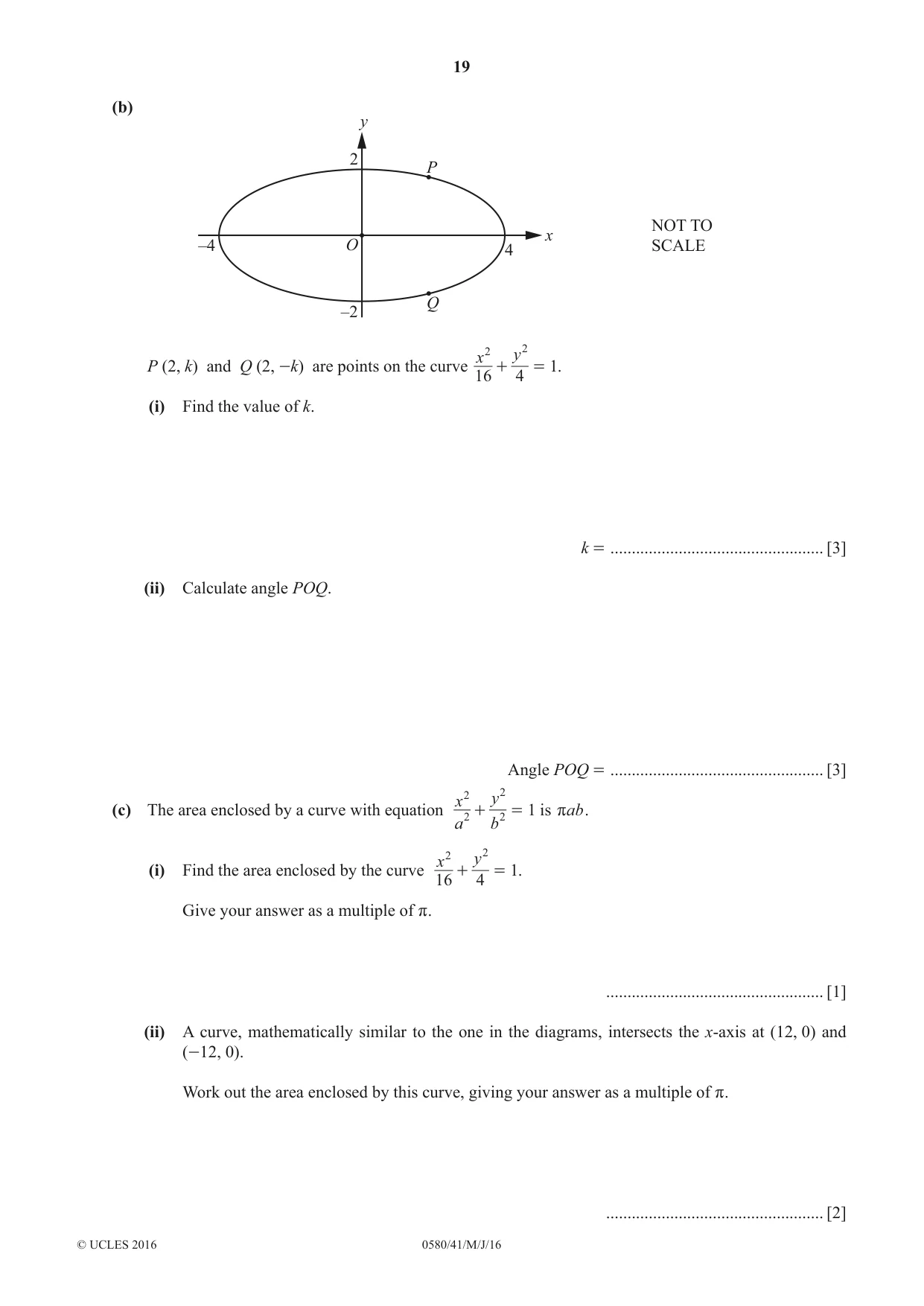
9 y 2 B A NOT TO x –4 0 4 SCALE –2 2 y x 2 The diagram shows a curve with equation = 1. 2 + 2 a b (a) A is the point (4, 0) and B is the point (0, 2). (i) Find the equation of the straight line that passes through A and B. Give your answer in the form y = mx + c. y = .................................................. [3] (ii) Show that a2 = 16 and b2 = 4. [2] (b) y 2 P NOT TO x –4 O 4 SCALE Q –2 2 y x 2 + = 1. P (2, k) and Q (2, -k) are points on the curve 16 4 (i) Find the value of k. k = .................................................. [3] (ii) Calculate angle POQ. Angle POQ = .................................................. [3] 2 y x 2 = 1 is r ab .(c) The area enclosed by a curve with equation 2 + 2 a b 2 y x 2 + = 1. (i) Find the area enclosed by the curve 16 4 Give your answer as a multiple of r. ................................................... [1] (ii) A curve, mathematically similar to the one in the diagrams, intersects the x-axis at (12, 0) and (-12, 0). Work out the area enclosed by this curve, giving your answer as a multiple of r. ................................................... [2]
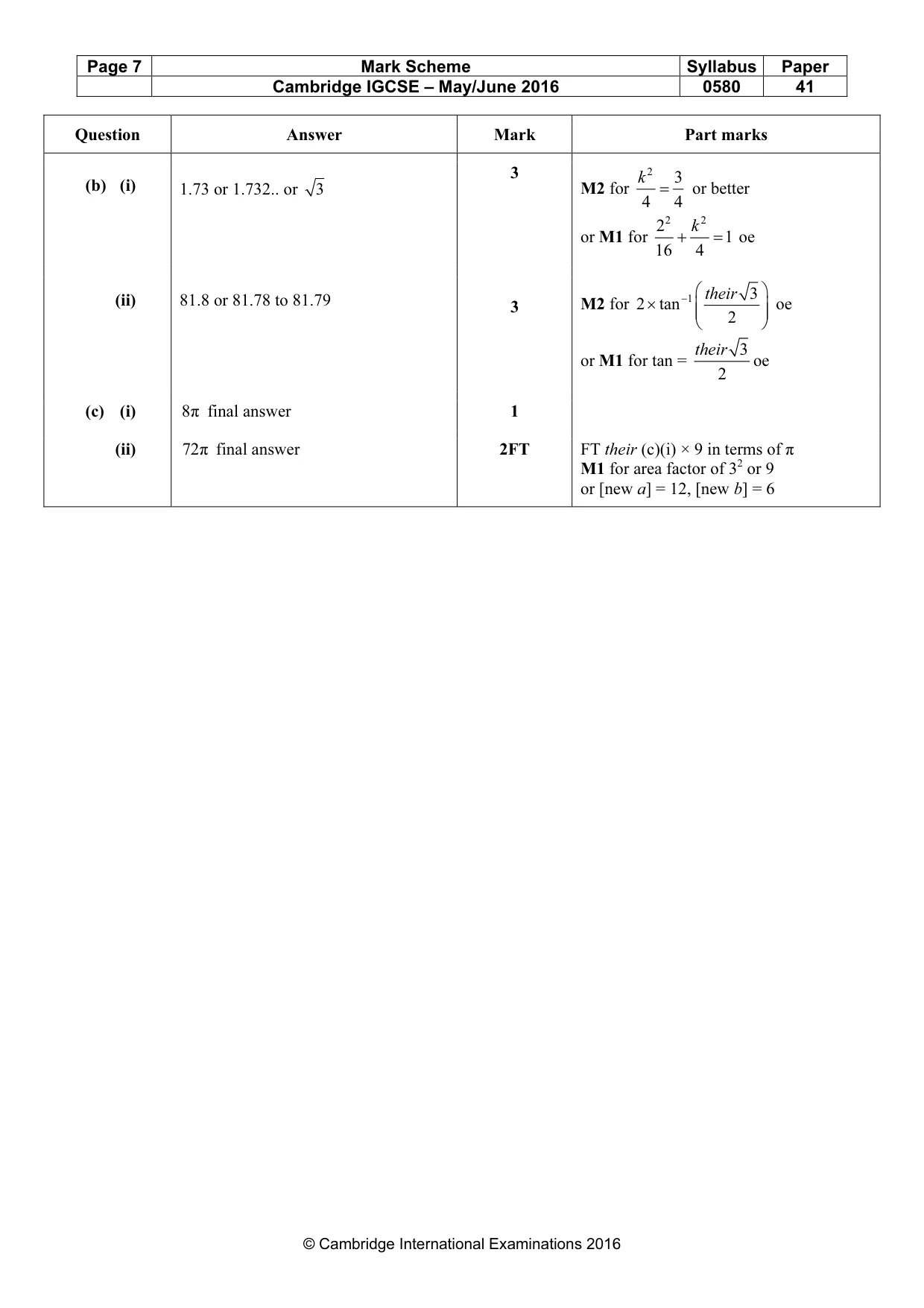
Mark scheme: 1 1 9 (a) (i) − x + 2 oe 3 SC2 for y = − x + c oe 2 2 or SC1 for y = kx + 2 oe, k ≠ 0 or − 2 M1 for [gradient =] 4 and M1 for substituting (4, 0) or (0, 2) into y = (their m)x + c (ii) 16 0[ 2 ] 4 2 0[ 2 ] 2 + 2 = 1 or 2 + 2 = 1 1 a b a b and a[2] = 4[2] 1 0[ 2 ] 4 0[ 2 ] 2 2 2 + 2 = 1 or 2 + 2 = 1 a b a b and b[2] = 2[2] 3 2 k 3 (b) (i) = or better 1.73 or 1.732.. or 3 M2 for 4 4 2 2 k 2 or M1 for + = 1 oe 16 4 their 3 −1 (ii) 81.8 or 81.78 to 81.79 3 M2 for 2 × tan oe 2 their 3 or M1 for tan = oe 2 (c) (i) 8π final answer 1 (ii) 72π final answer 2FT FT their (c)(i) × 9 in terms of π M1 for area factor of 32 or 9 or [new a] = 12, [new b] = 6
What was in this paper
The subtopics covered by these 8 questions, and how many questions each got. Open one in a new tab to see every Cambridge question on it.
What you needed in this session
Cambridge’s own grade thresholds for 2016 May/June, Paper 4 · Variant 1. A higher threshold means an easier paper — the bar moves with how the cohort did.