Cambridge IGCSE Mathematics 0580 — 2014 Oct/Nov Paper 4 · Variant 2
0580/42/O/N/14 · 6 questions · 130 marks · ≈146 min
The question paper and its mark scheme, free to read here and free to download. This is Cambridge’s own paper, exactly as it was sat.
Question paper20 pages
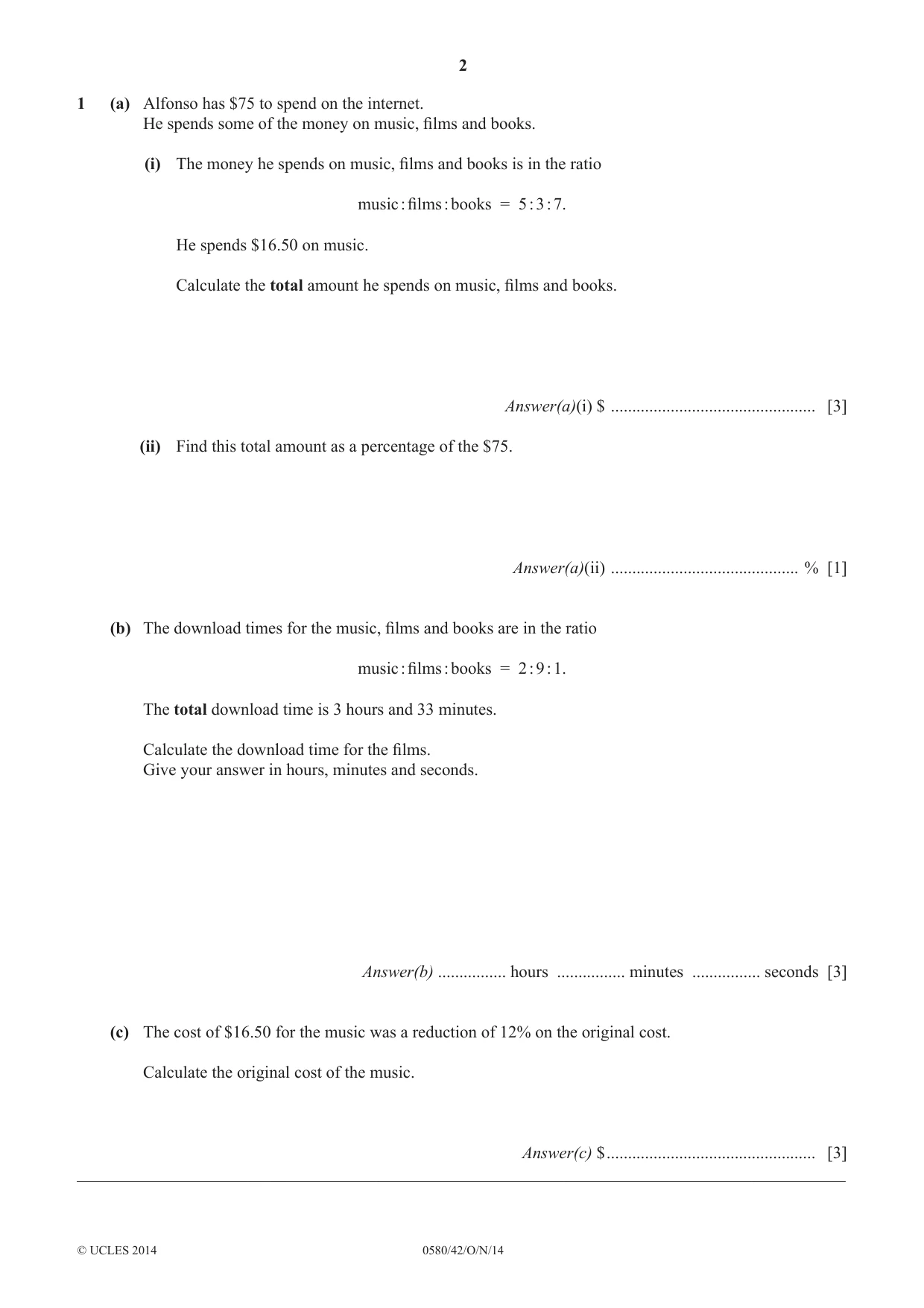
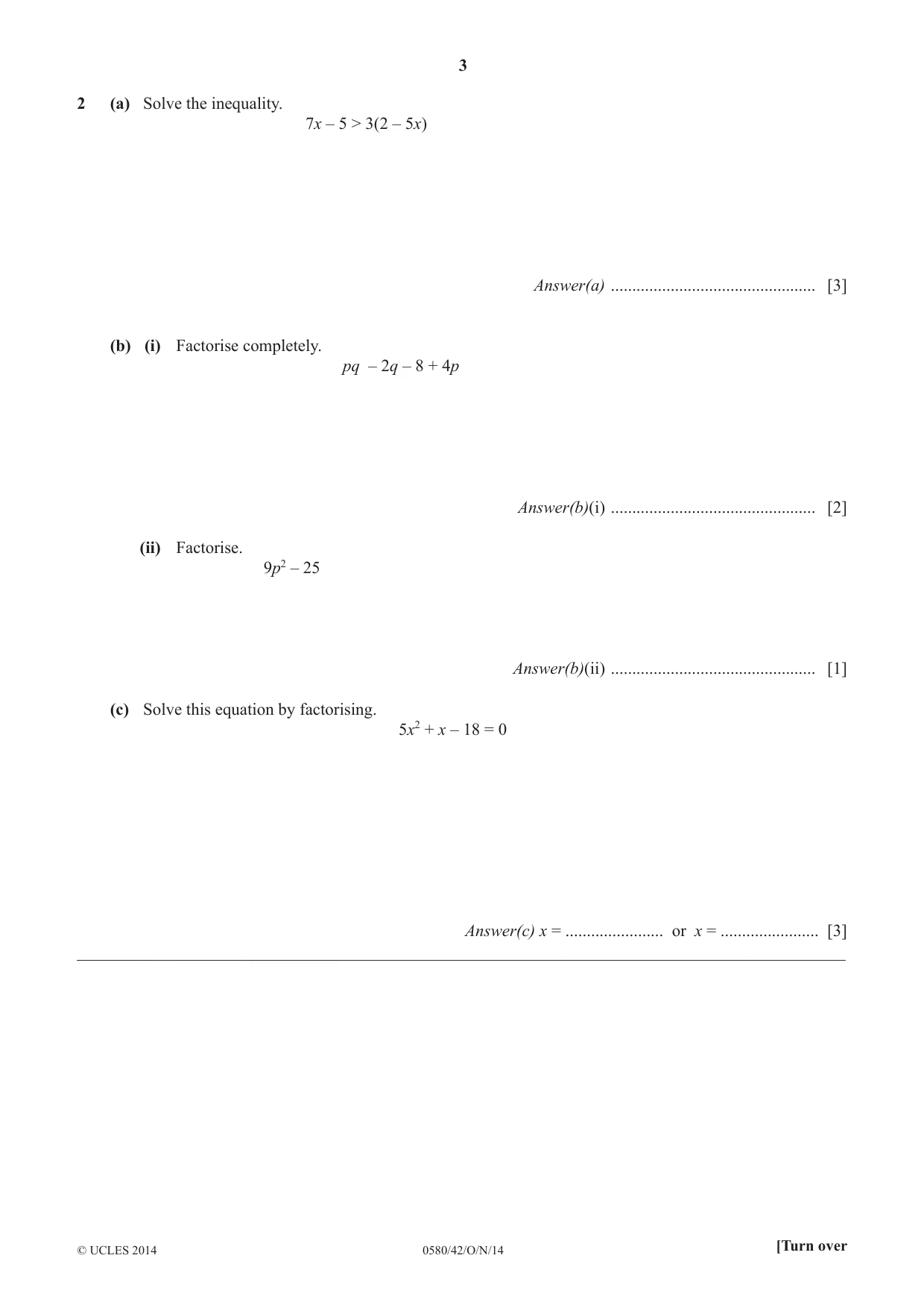
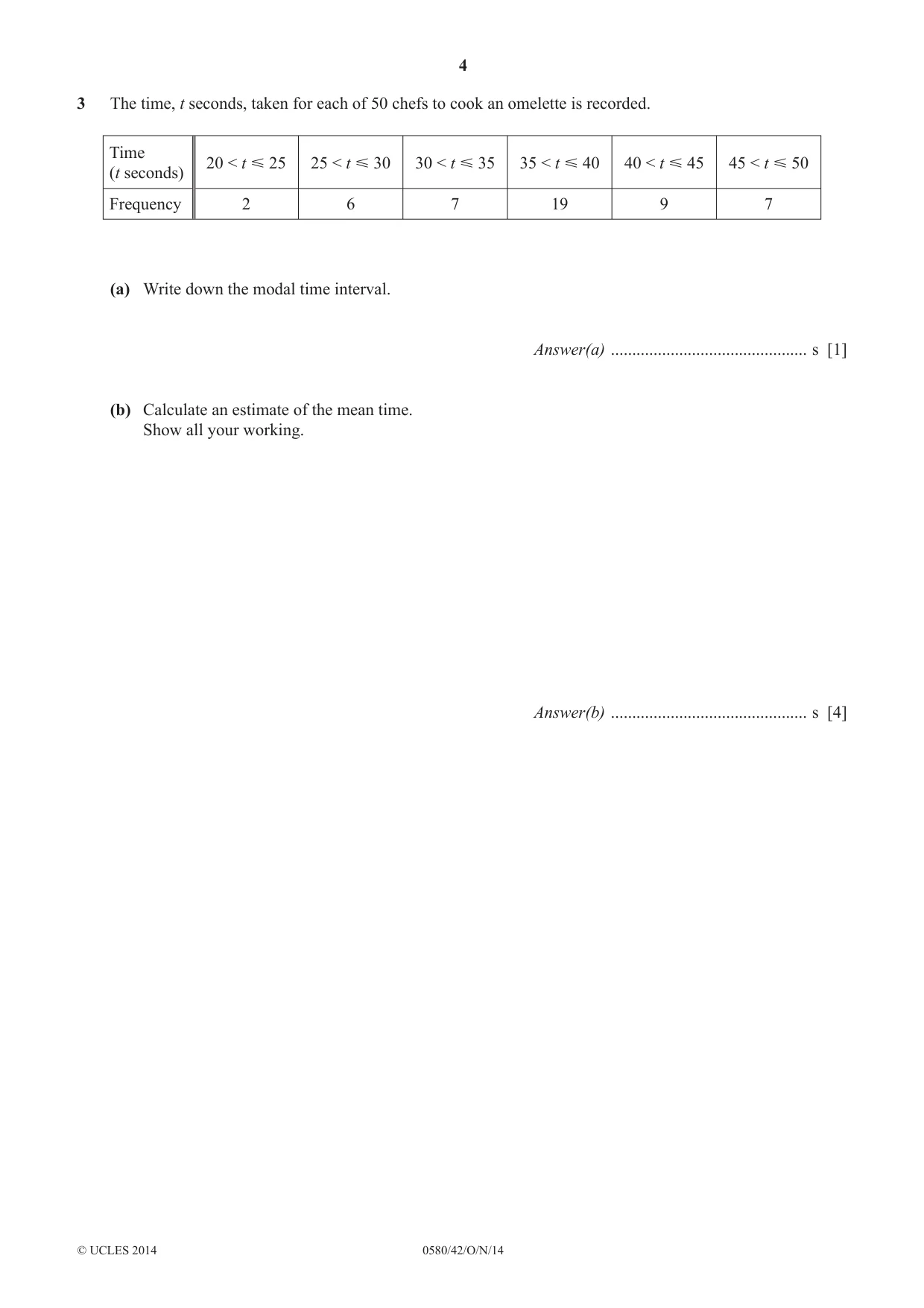
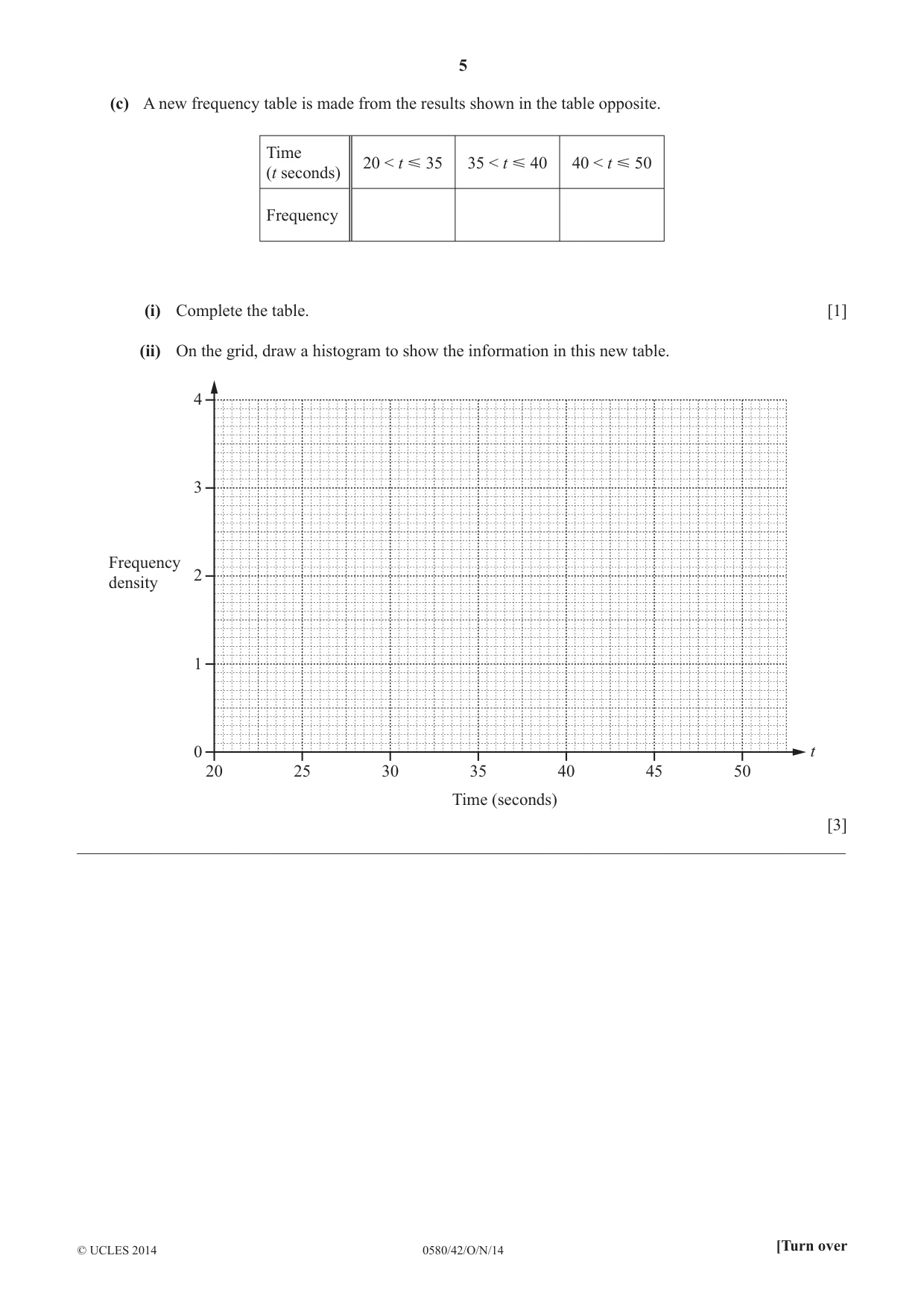
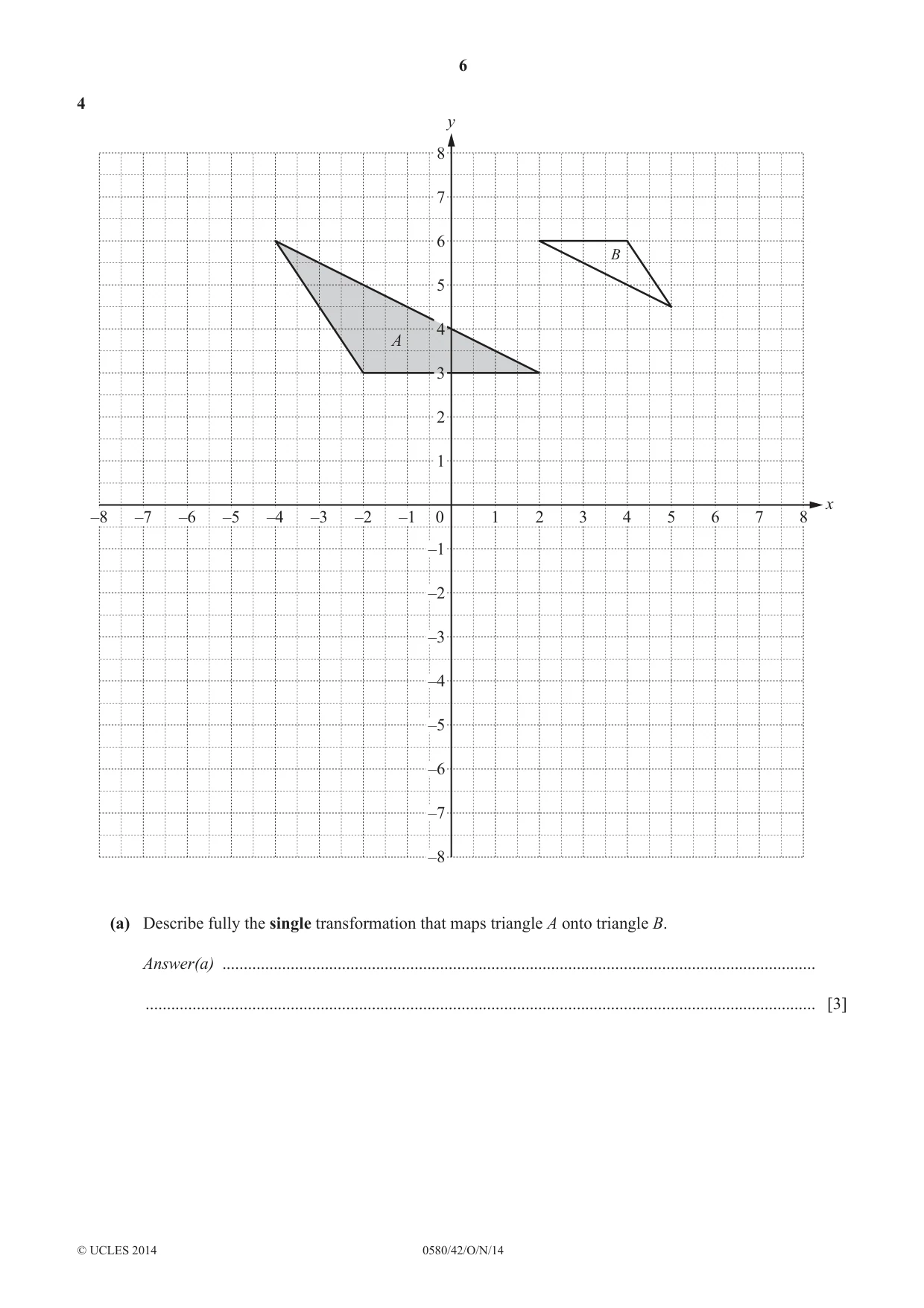
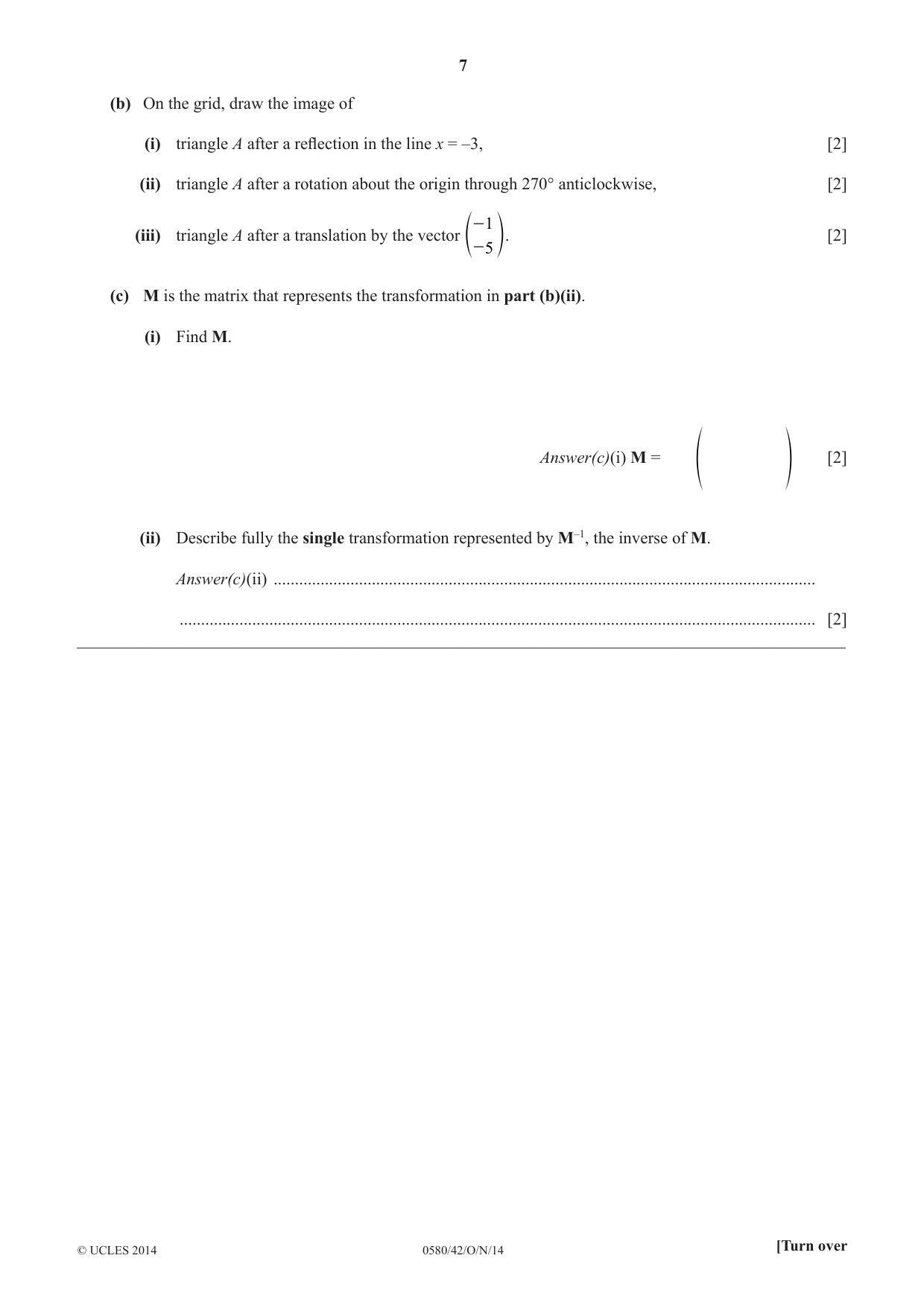
Mark scheme7 pages
Answers below. Sit the paper first if you are practising.
Questions as text
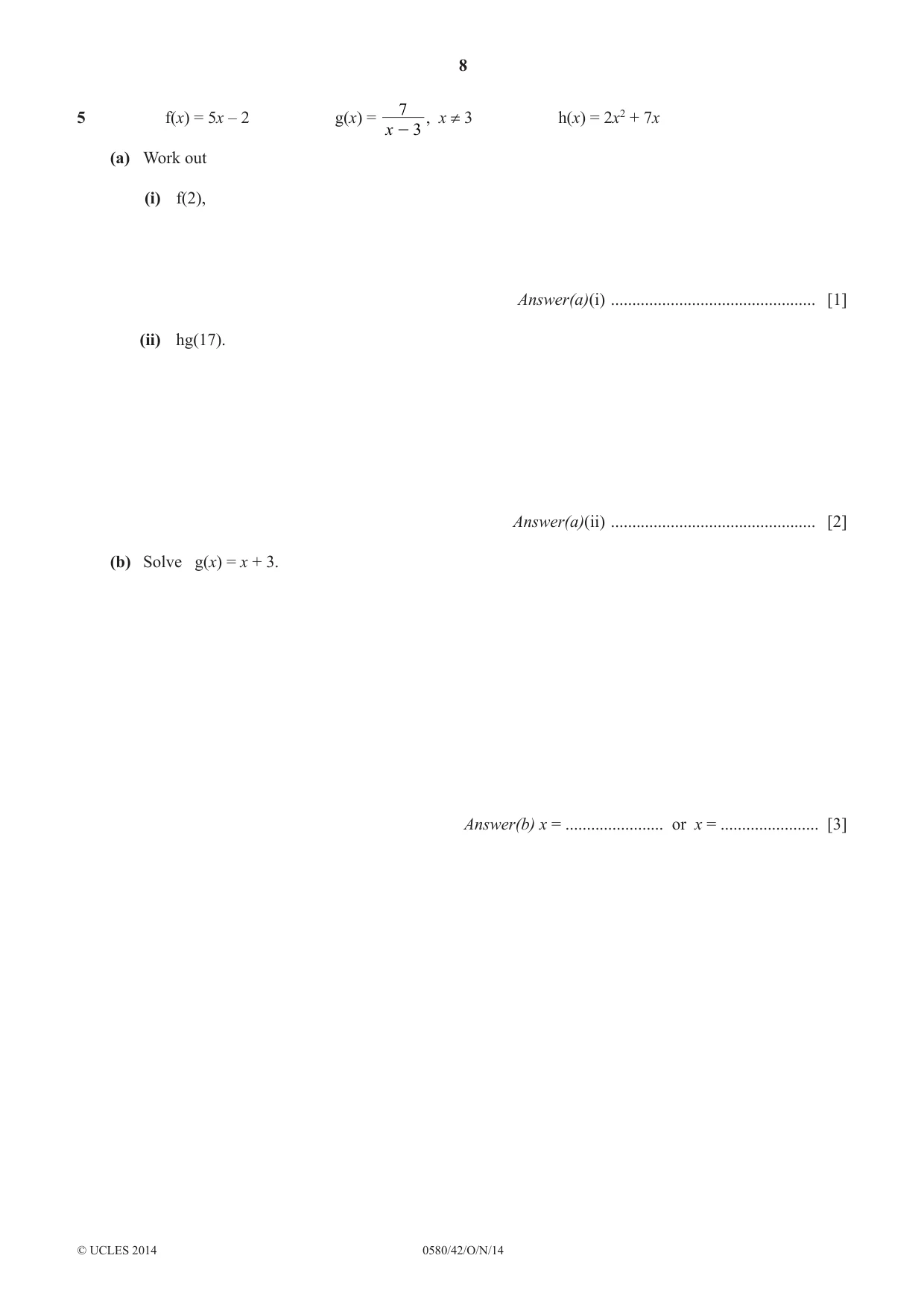
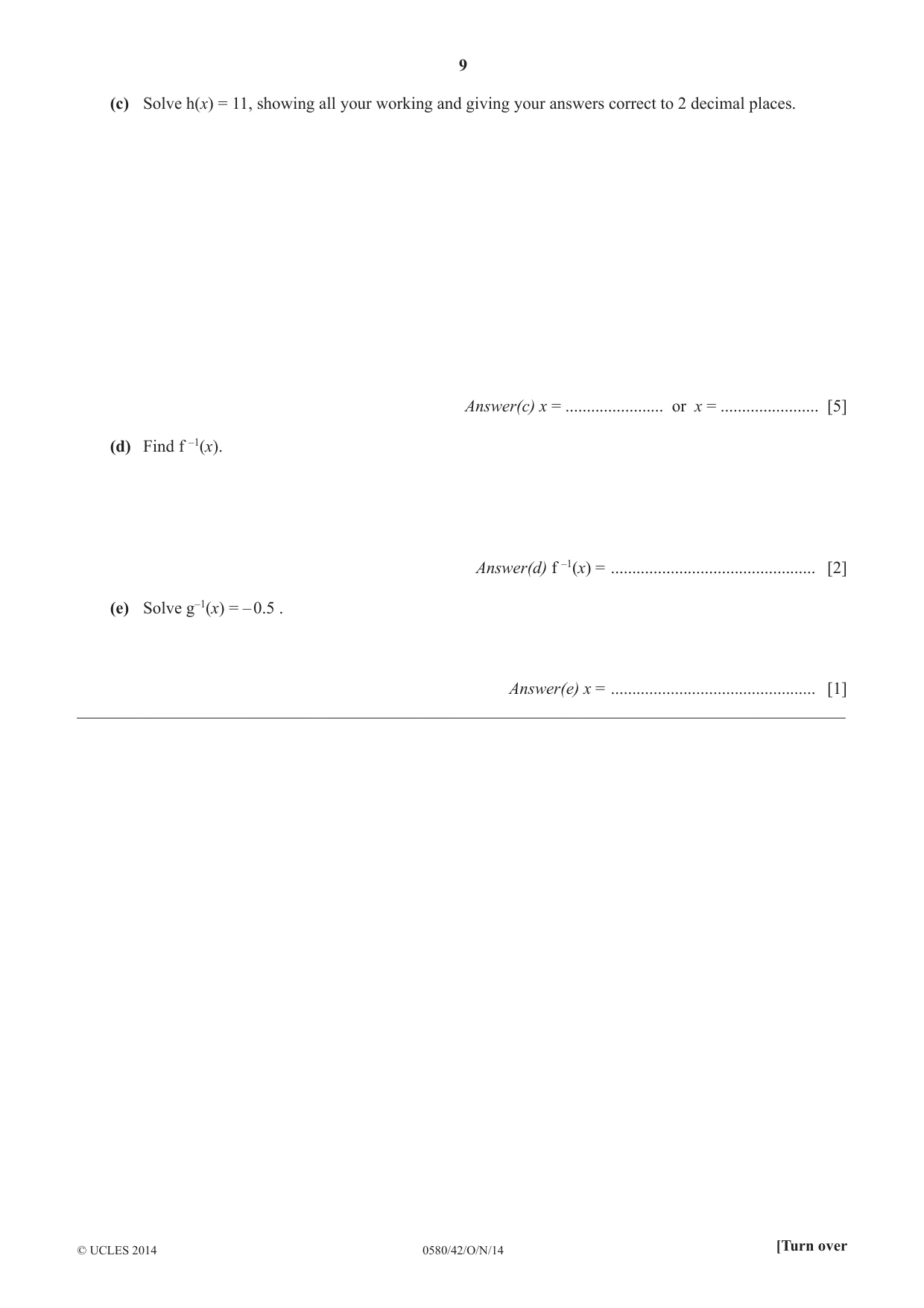
Q5 · F(x) = 5x – 2 g(x) = , x ≠ 3 h(x) = 2x2 + 7x x - 3 (a) Work out (i) f(2), Answer(a)(i)…
75 f(x) = 5x – 2 g(x) = , x ≠ 3 h(x) = 2x2 + 7x x - 3 (a) Work out (i) f(2), Answer(a)(i) ................................................ [1] (ii) hg(17). Answer(a)(ii) ................................................ [2] (b) Solve g(x) = x + 3. Answer(b) x = ....................... or x = ....................... [3] (c) Solve h(x) = 11, showing all your working and giving your answers correct to 2 decimal places. Answer(c) x = ....................... or x = ....................... [5] (d) Find f –1(x). Answer(d) f –1(x) = ................................................ [2] (e) Solve g–1(x) = – 0.5 . Answer(e) x = ................................................ [1] __________________________________________________________________________________________
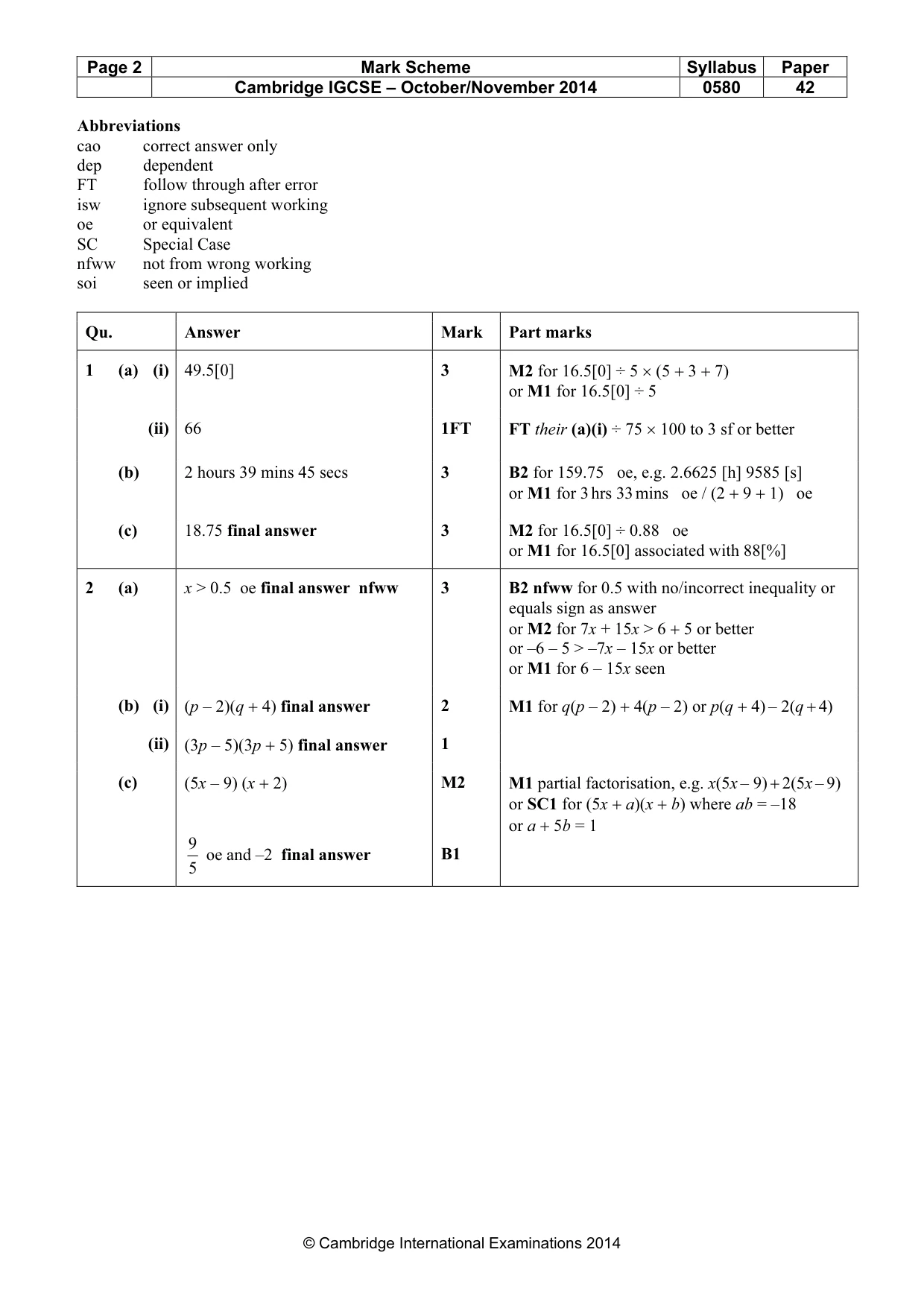
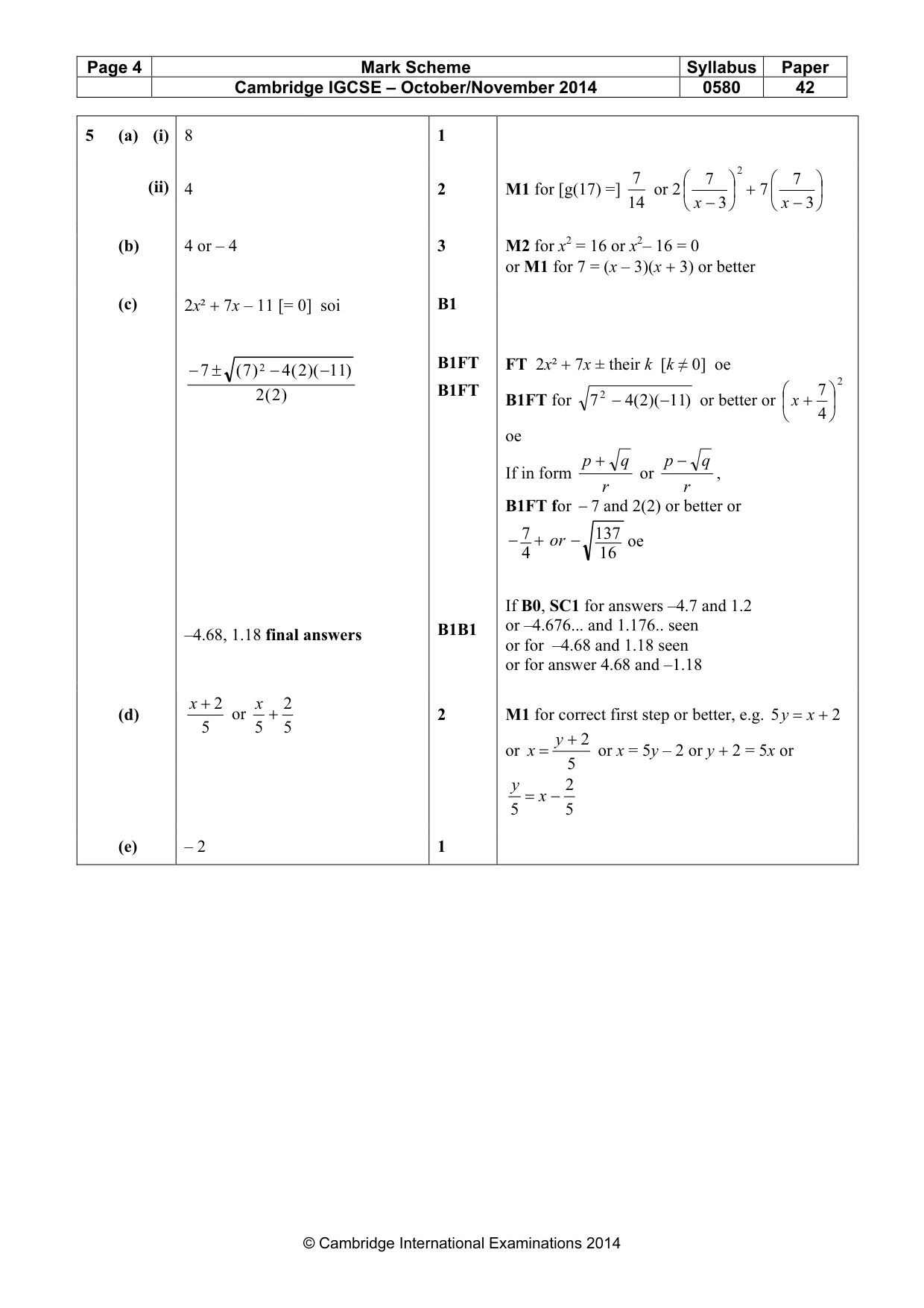
Mark scheme: 5 (a) (i) 8 1 2 7 7 7 (ii) or 2 + 7 4 2 M1 for [g(17) =] 14 x − 3 x −3 (b) 4 or – 4 3 M2 for x2 = 16 or x2– 16 = 0 or M1 for 7 = (x – 3)(x + 3) or better (c) 2x² + 7x – 11 [= 0] soi B1 2 B1FT FT 2x² + 7x ± their k [k ≠ 0] oe − 7 ± ( 7 ) − 4 ( 2 )( −11) 2 B1FT 7 2 ( 2 ) B1FT for 7 2 − 4 ( 2)( −11) or better or x + 4 oe p + q p − q If in form or , r r B1FT for − 7 and 2(2) or better or 7 137 − + or − oe 4 16 If B0, SC1 for answers –4.7 and 1.2 B1B1 or –4.676... and 1.176.. seen –4.68, 1.18 final answers or for –4.68 and 1.18 seen or for answer 4.68 and –1.18 x + 2 x 2 (d) or + 2 M1 for correct first step or better, e.g. 5 y = x + 2 5 5 5 y + 2 or x = or x = 5y – 2 or y + 2 = 5x or 5 y 2 = x − 5 5 (e) – 2 1
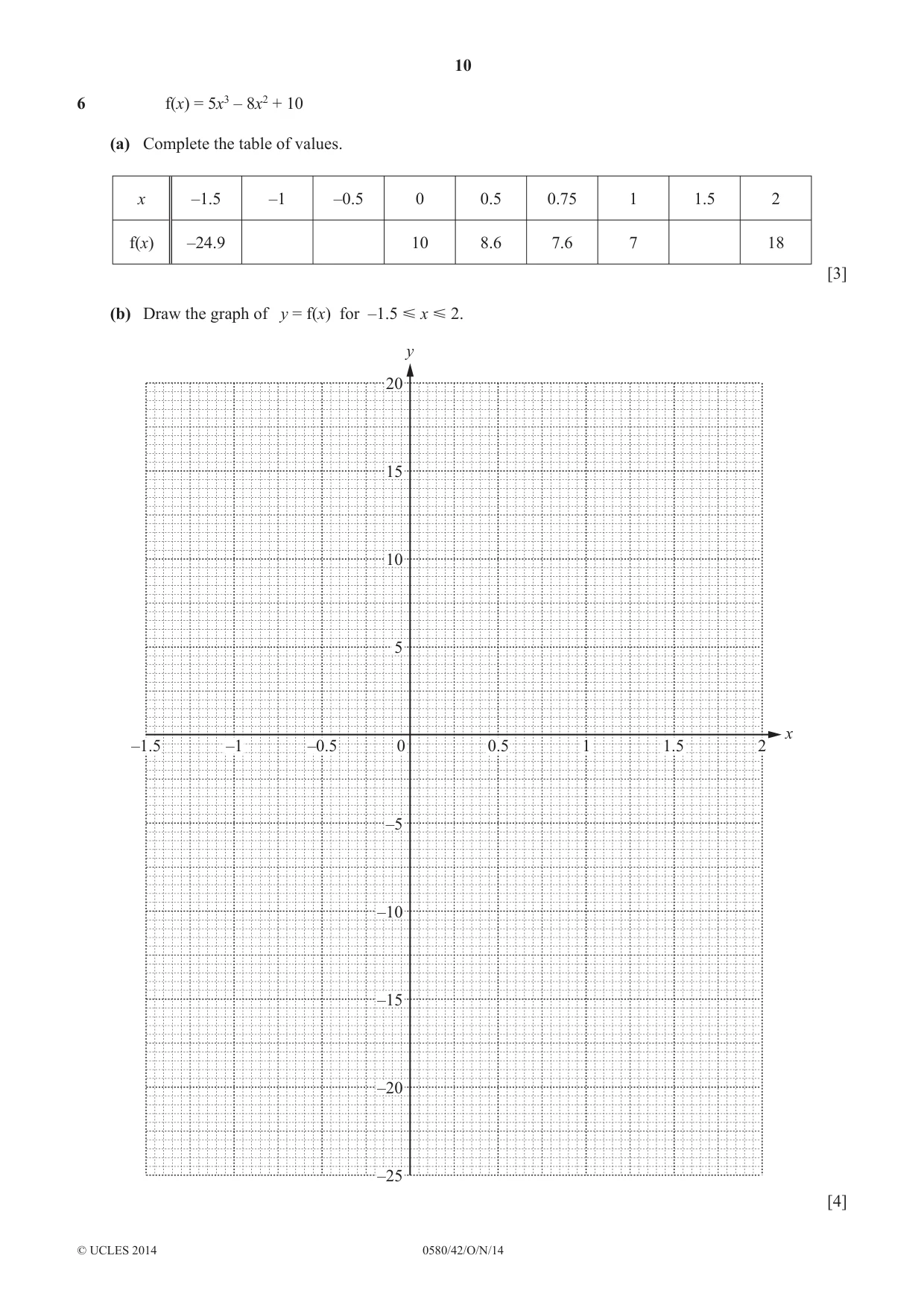
Q6 · F(x) = 5x3 – 8x2 + 10 (a) Complete the table of values
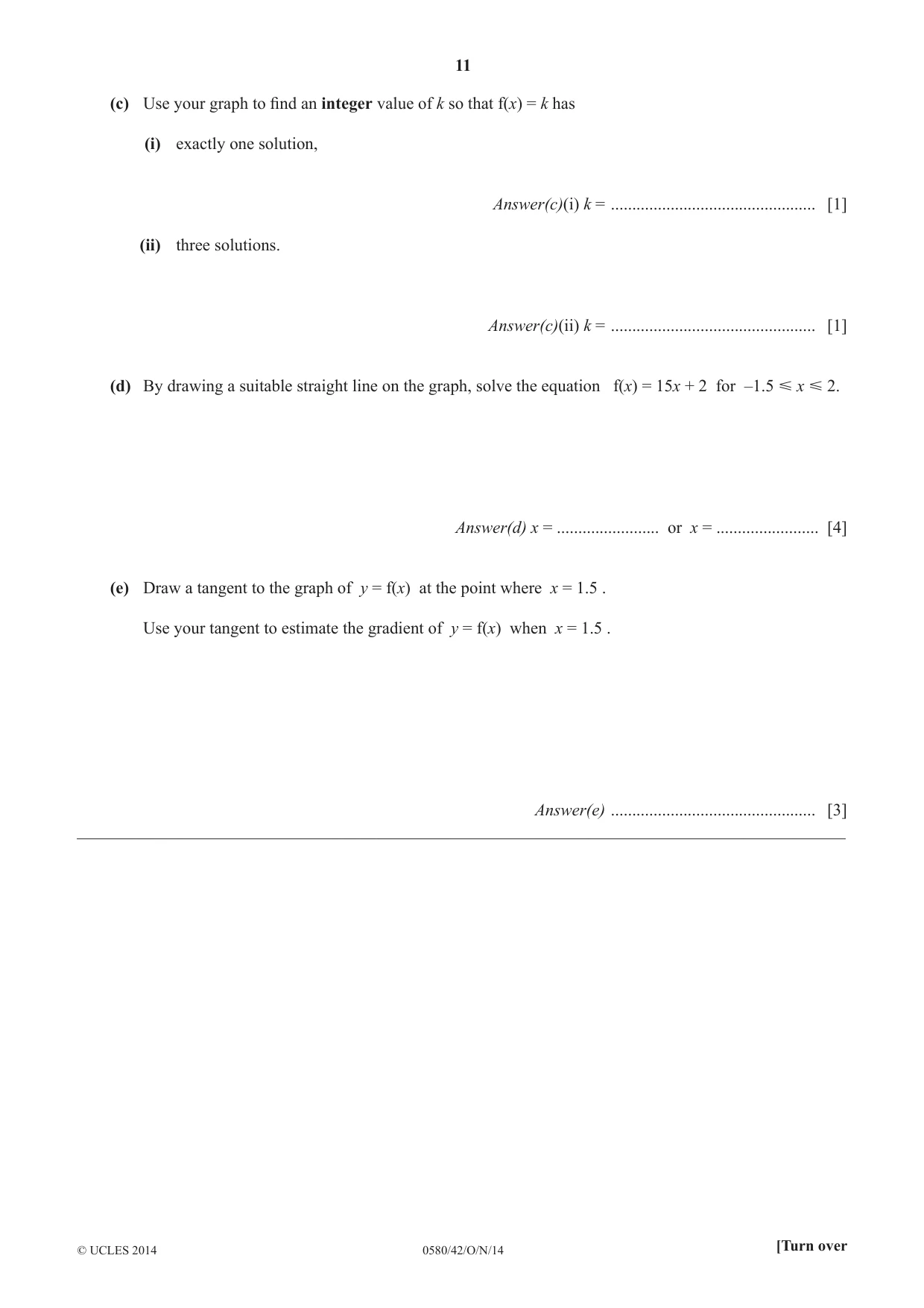
6 f(x) = 5x3 – 8x2 + 10 (a) Complete the table of values. x –1.5 –1 –0.5 0 0.5 0.75 1 1.5 2 f(x) –24.9 10 8.6 7.6 7 18 [3] (b) Draw the graph of y = f(x) for –1.5 Y x Y 2. y 20 15 10 5 x –1.5 –1 –0.5 0 0.5 1 1.5 2 –5 –10 –15 –20 –25 [4] (c) Use your graph to fi nd an integer value of k so that f(x) = k has (i) exactly one solution, Answer(c)(i) k = ................................................ [1] (ii) three solutions. Answer(c)(ii) k = ................................................ [1] (d) By drawing a suitable straight line on the graph, solve the equation f(x) = 15x + 2 for –1.5 Y x Y 2. Answer(d) x = ........................ or x = ........................ [4] (e) Draw a tangent to the graph of y = f(x) at the point where x = 1.5 . Use your tangent to estimate the gradient of y = f(x) when x = 1.5 . Answer(e) ................................................ [3] __________________________________________________________________________________________
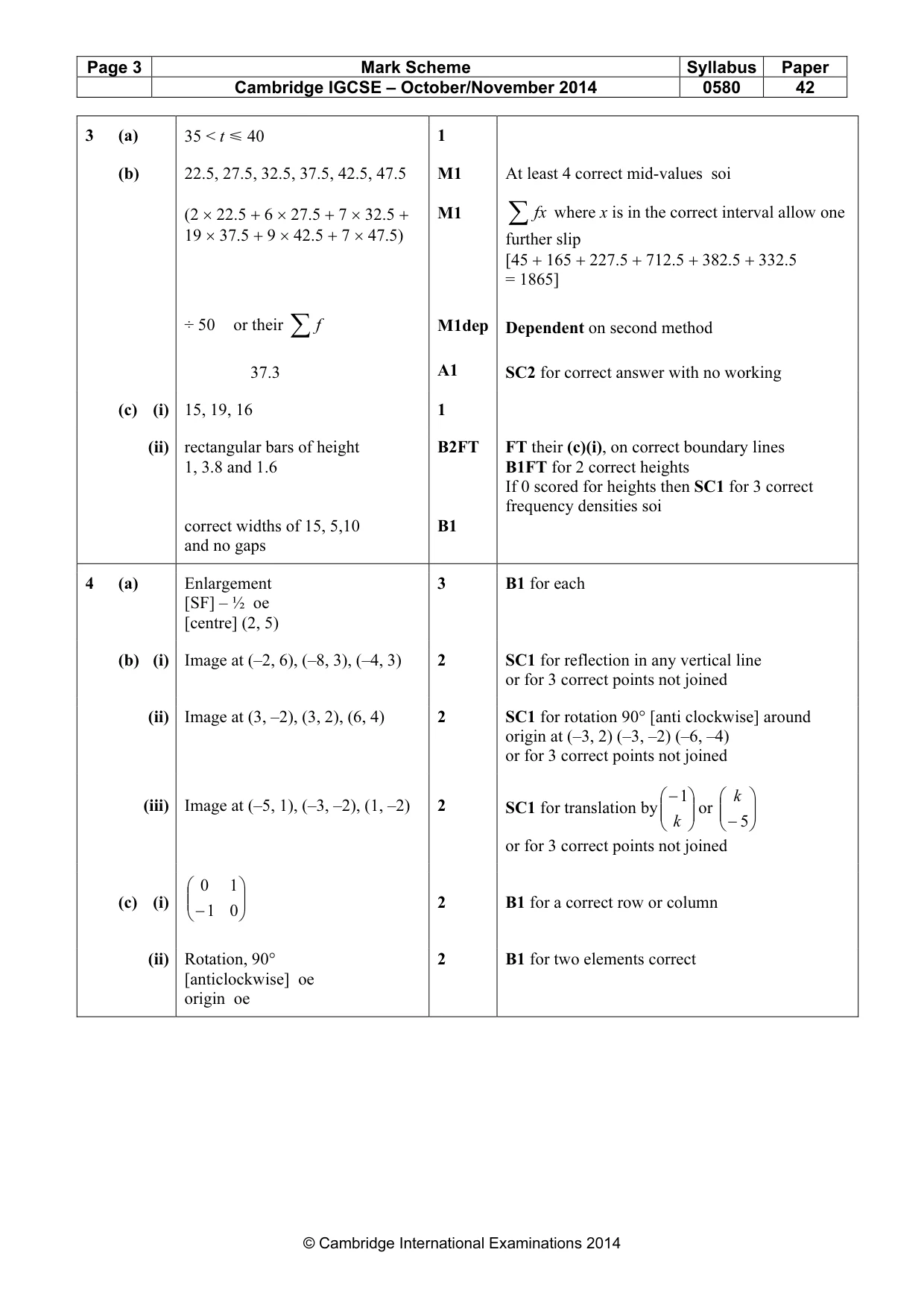
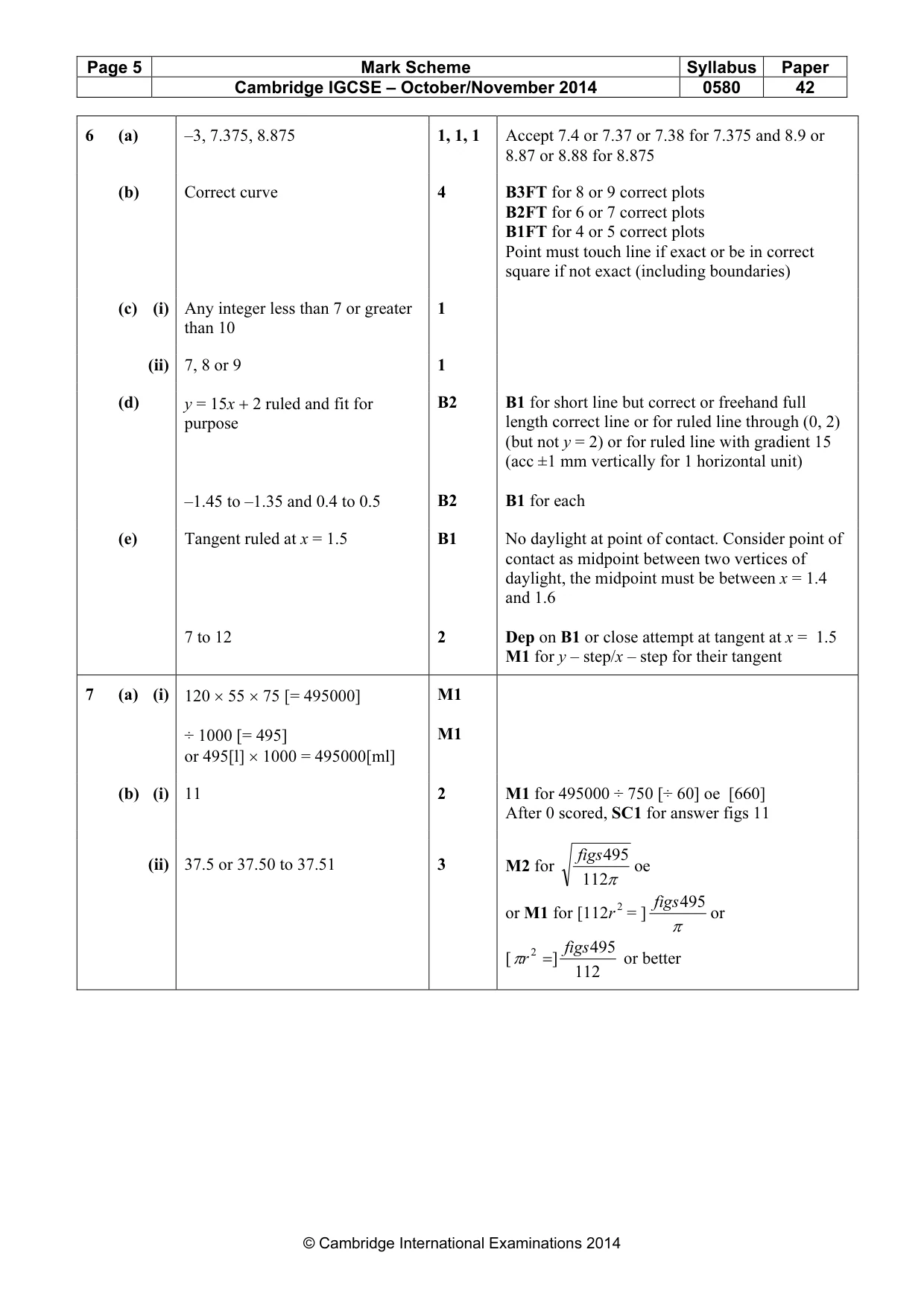
Mark scheme: 6 (a) –3, 7.375, 8.875 1, 1, 1 Accept 7.4 or 7.37 or 7.38 for 7.375 and 8.9 or 8.87 or 8.88 for 8.875 (b) Correct curve 4 B3FT for 8 or 9 correct plots B2FT for 6 or 7 correct plots B1FT for 4 or 5 correct plots Point must touch line if exact or be in correct square if not exact (including boundaries) (c) (i) Any integer less than 7 or greater 1 than 10 (ii) 7, 8 or 9 1 (d) y = 15x + 2 ruled and fit for B2 B1 for short line but correct or freehand full purpose length correct line or for ruled line through (0, 2) (but not y = 2) or for ruled line with gradient 15 (acc ±1 mm vertically for 1 horizontal unit) B2 B1 for each –1.45 to –1.35 and 0.4 to 0.5 (e) Tangent ruled at x = 1.5 B1 No daylight at point of contact. Consider point of contact as midpoint between two vertices of daylight, the midpoint must be between x = 1.4 and 1.6 7 to 12 2 Dep on B1 or close attempt at tangent at x = 1.5 M1 for y – step/x – step for their tangent
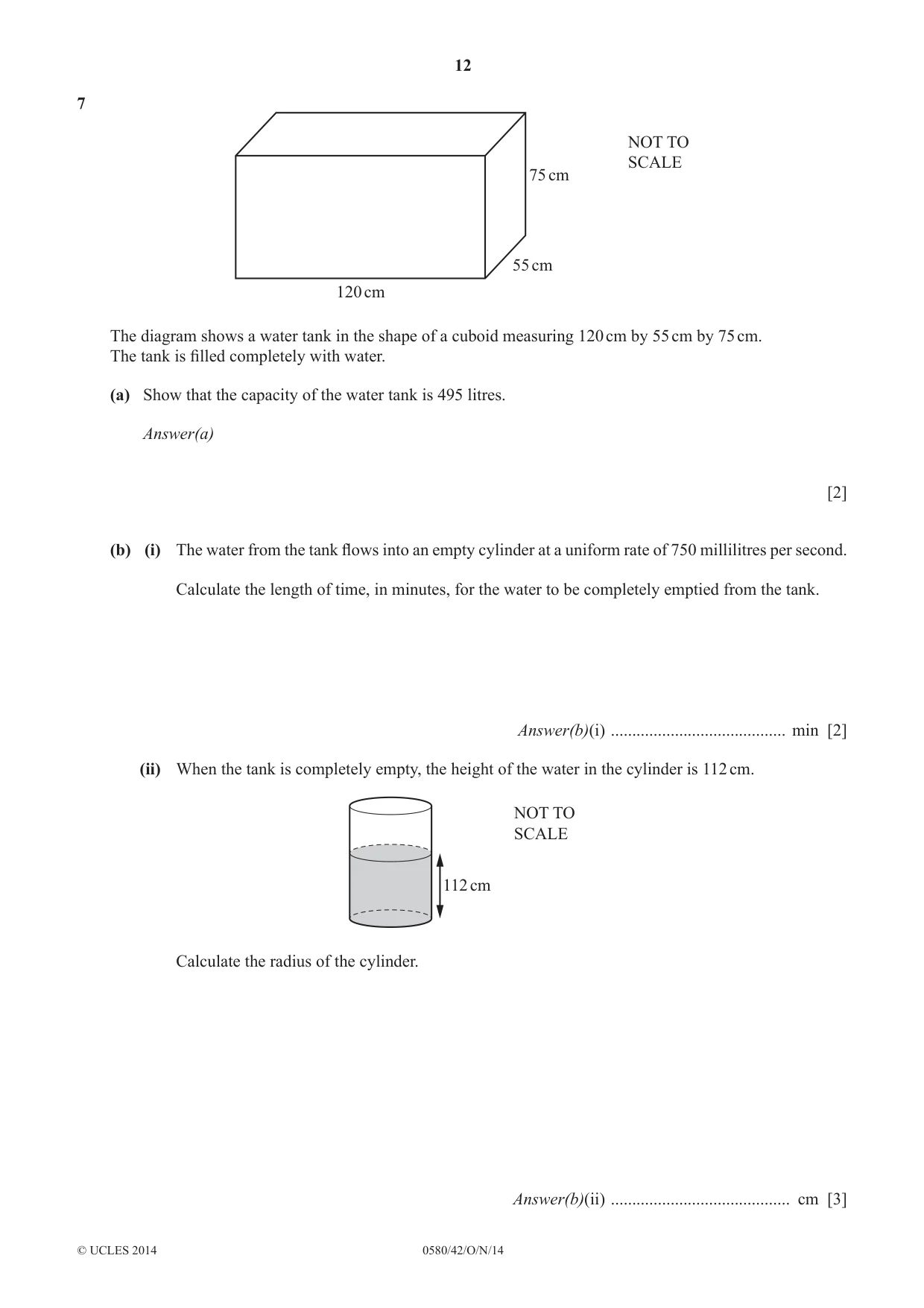
Q7 · NOT TO SCALE 75 cm 55 cm 120 cm The diagram shows a water tank in the shape of a cuboid…
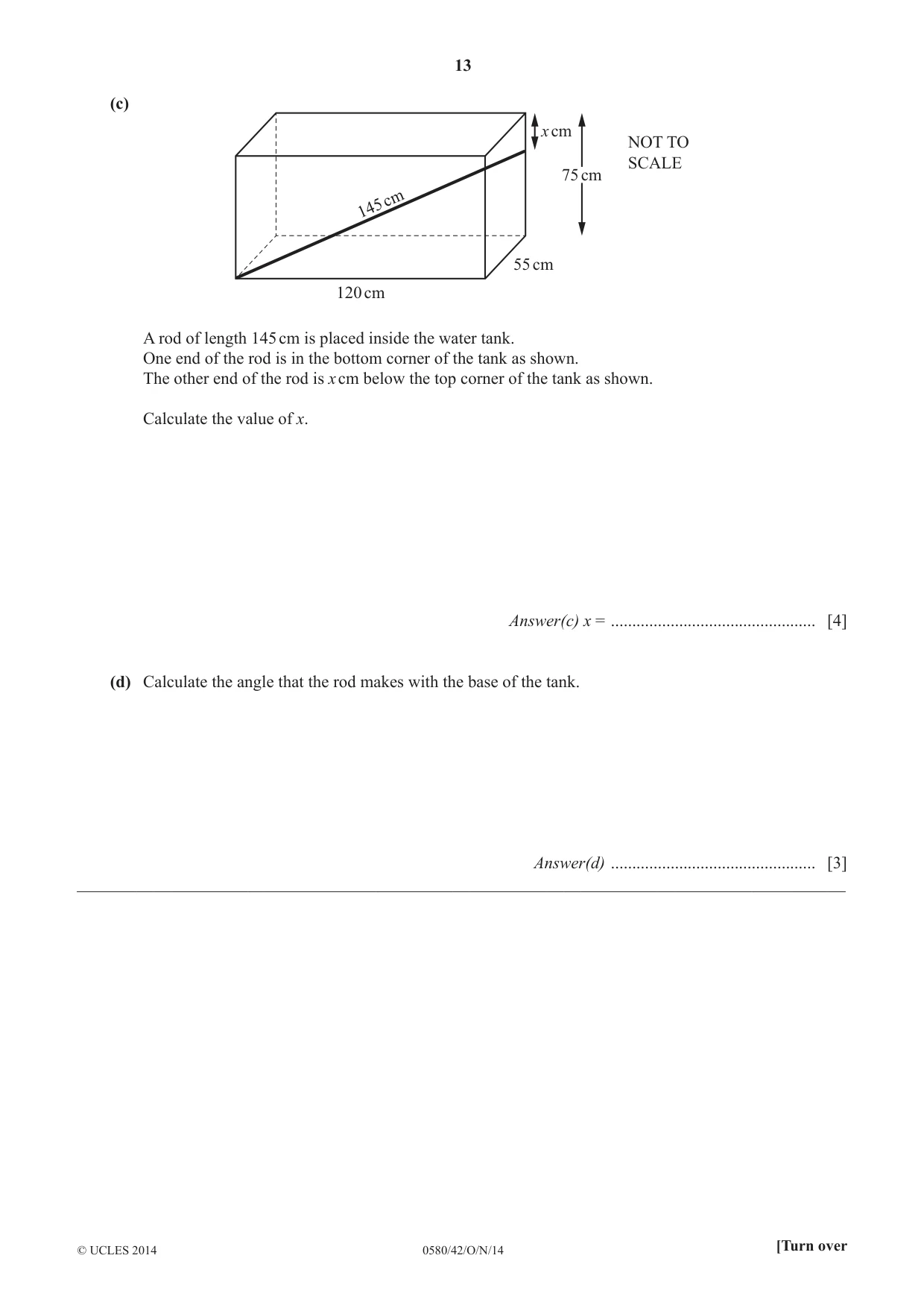
7 NOT TO SCALE 75 cm 55 cm 120 cm The diagram shows a water tank in the shape of a cuboid measuring 120 cm by 55 cm by 75 cm. The tank is fi lled completely with water. (a) Show that the capacity of the water tank is 495 litres. Answer(a) [2] (b) (i) The water from the tank fl ows into an empty cylinder at a uniform rate of 750 millilitres per second. Calculate the length of time, in minutes, for the water to be completely emptied from the tank. Answer(b)(i) ......................................... min [2] (ii) When the tank is completely empty, the height of the water in the cylinder is 112 cm. NOT TO SCALE 112 cm Calculate the radius of the cylinder. Answer(b)(ii) .......................................... cm [3] (c) x cm NOT TO SCALE 75 cm cm 145 55 cm 120 cm A rod of length 145 cm is placed inside the water tank. One end of the rod is in the bottom corner of the tank as shown. The other end of the rod is x cm below the top corner of the tank as shown. Calculate the value of x. Answer(c) x = ................................................ [4] (d) Calculate the angle that the rod makes with the base of the tank. Answer(d) ................................................ [3] __________________________________________________________________________________________
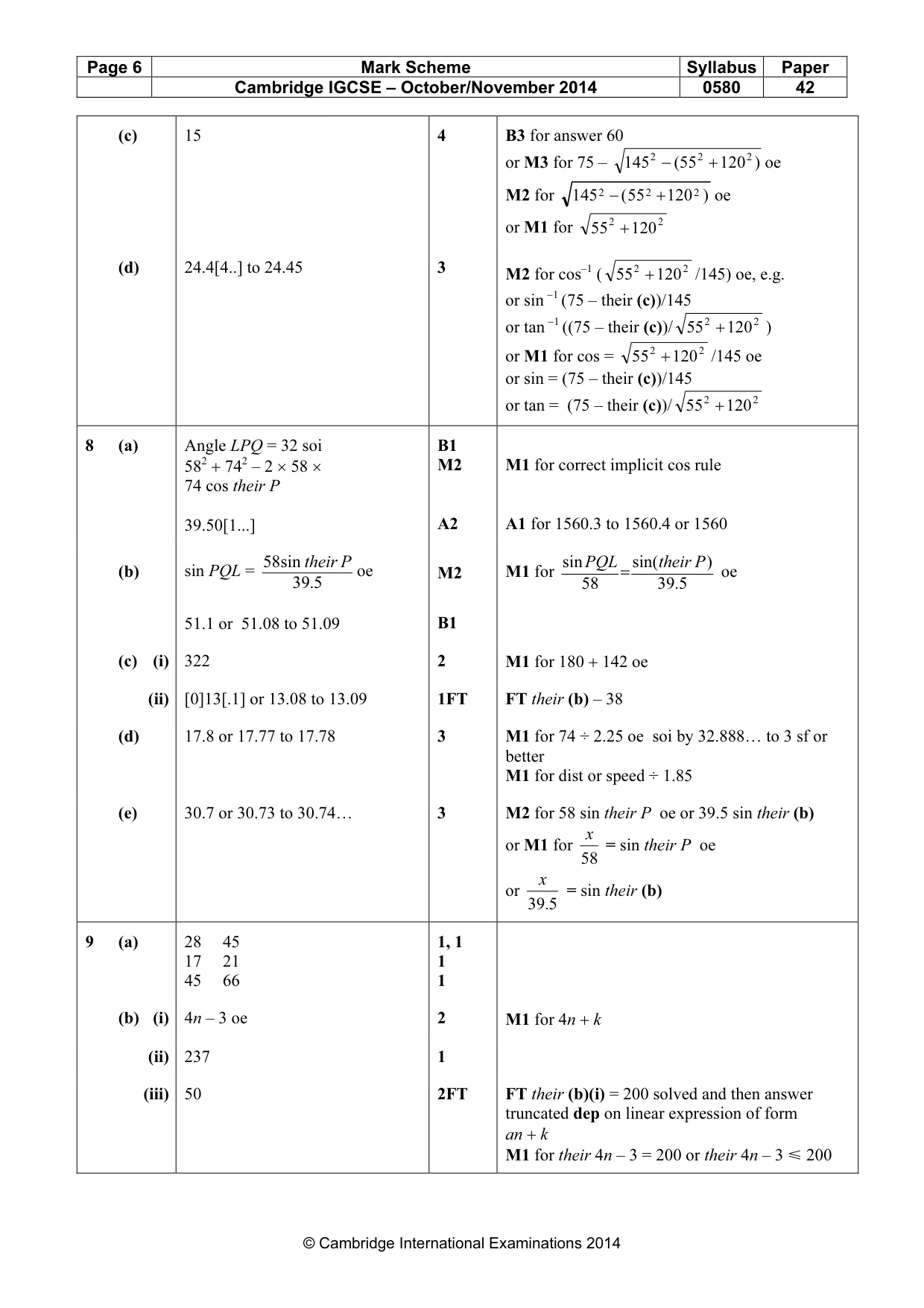
Mark scheme: 7 (a) (i) 120 × 55 × 75 [= 495000] M1 M1 ÷ 1000 [= 495] or 495[l] × 1000 = 495000[ml] (b) (i) 11 2 M1 for 495000 ÷ 750 [÷ 60] oe [660] After 0 scored, SC1 for answer figs 11 figs 495 (ii) 37.5 or 37.50 to 37.51 3 M2 for oe 112π 2 figs 495 or M1 for [112r = ] or π 2 figs 495 [ πr = ] or better 112 (c) 15 4 B3 for answer 60 or M3 for 75 – 145 2 − (55 2 + 120 2 ) oe M2 for 145 2 − ( 55 2 + 120 2 ) oe or M1 for 55 2 + 120 2 2 + 120 2 /145) oe, e.g. (d) 24.4[4..] to 24.45 3 M2 for cos–1 ( 55 or sin −(751 – their (c))/145 or tan −((751 – their (c))/ 55 2 + 120 2 ) or M1 for cos = 55 2 + 120 2 /145 oe or sin = (75 – their (c))/145 or tan = (75 – their (c))/ 55 2 + 120 2
Q8 · North NOT TO SCALE P 58 km L North 74 km Q A ship sails from port P to port Q
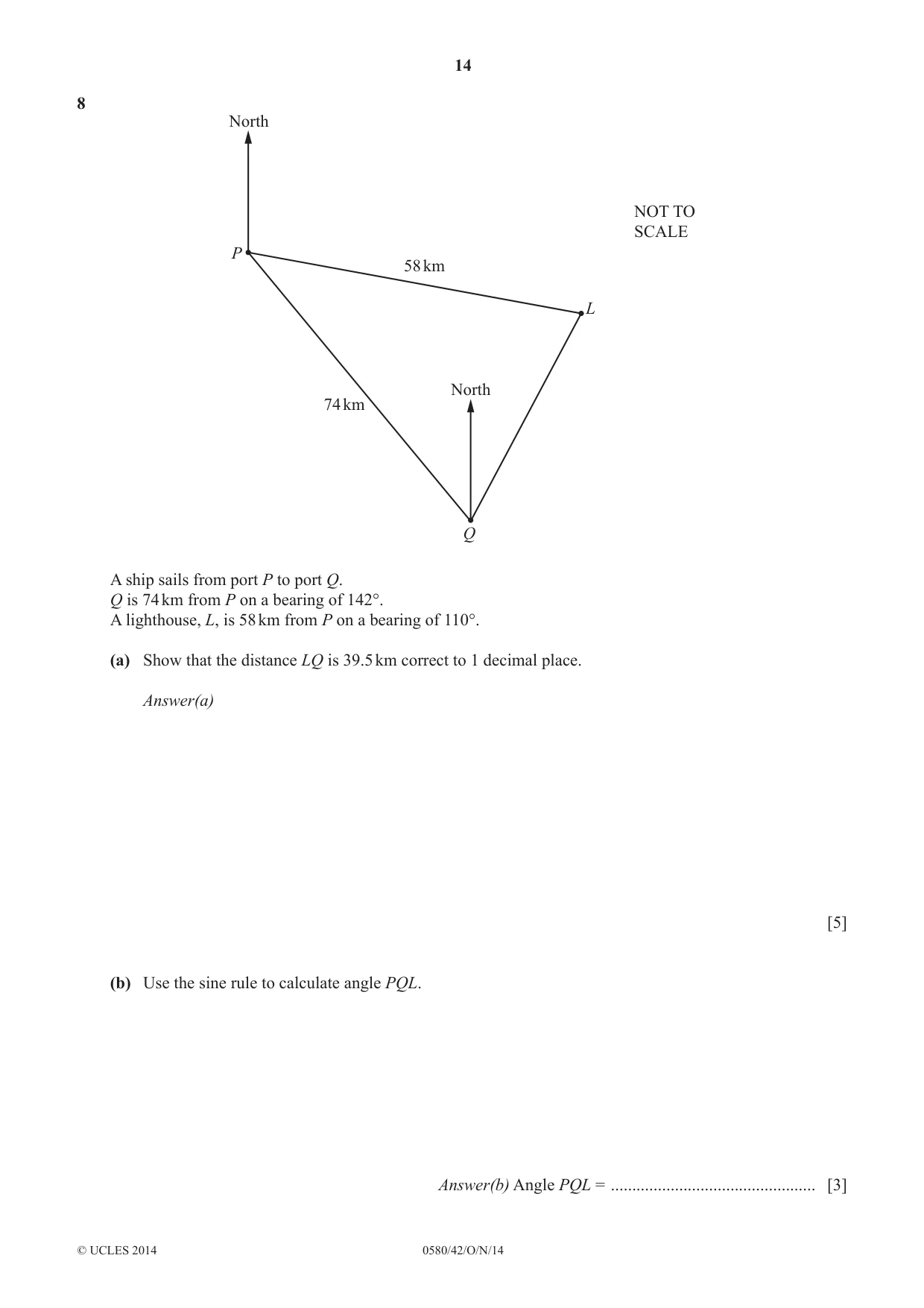
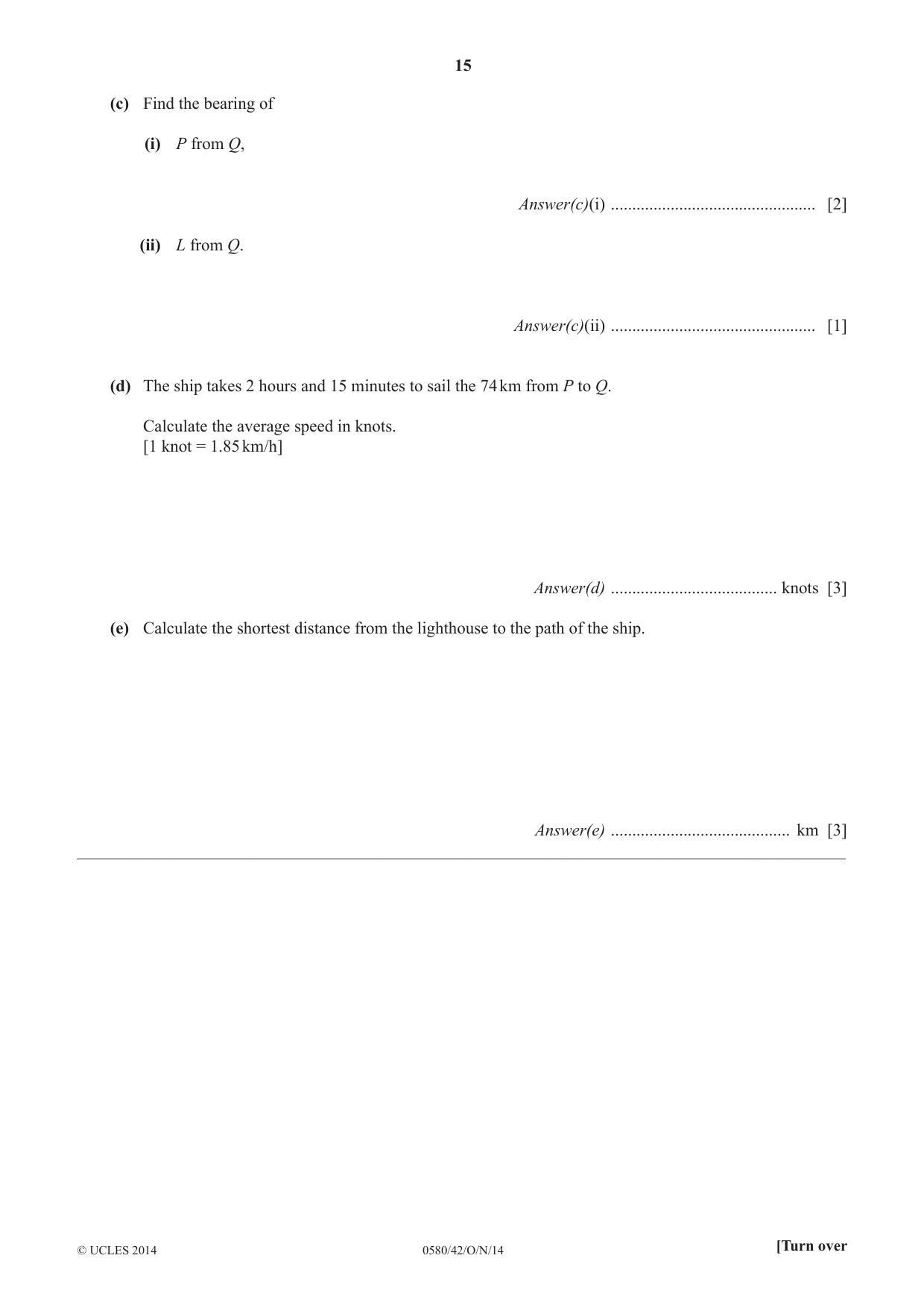
8 North NOT TO SCALE P 58 km L North 74 km Q A ship sails from port P to port Q. Q is 74 km from P on a bearing of 142°. A lighthouse, L, is 58 km from P on a bearing of 110°. (a) Show that the distance LQ is 39.5 km correct to 1 decimal place. Answer(a) [5] (b) Use the sine rule to calculate angle PQL. Answer(b) Angle PQL = ................................................ [3] (c) Find the bearing of (i) P from Q, Answer(c)(i) ................................................ [2] (ii) L from Q. Answer(c)(ii) ................................................ [1] (d) The ship takes 2 hours and 15 minutes to sail the 74 km from P to Q. Calculate the average speed in knots. [1 knot = 1.85 km/h] Answer(d) ....................................... knots [3] (e) Calculate the shortest distance from the lighthouse to the path of the ship. Answer(e) .......................................... km [3] __________________________________________________________________________________________
Mark scheme: 8 (a) Angle LPQ = 32 soi B1 582 + 742 – 2 × 58 × M2 M1 for correct implicit cos rule 74 cos their P A2 A1 for 1560.3 to 1560.4 or 1560 39.50[1...] 58 sin their P sin PQL sin( their P ) (b) sin PQL = oe M2 M1 for = oe 395. 58 395. 51.1 or 51.08 to 51.09 B1 (c) (i) 322 2 M1 for 180 + 142 oe (ii) [0]13[.1] or 13.08 to 13.09 1FT FT their (b) – 38 (d) 17.8 or 17.77 to 17.78 3 M1 for 74 ÷ 2.25 oe soi by 32.888… to 3 sf or better M1 for dist or speed ÷ 1.85 (e) 30.7 or 30.73 to 30.74… 3 M2 for 58 sin their P oe or 39.5 sin their (b) x or M1 for = sin their P oe 58 x or = sin their (b) 395.
Q9 · Layer 1 Layer 2 Layer 3 The diagrams show layers of white and grey cubes
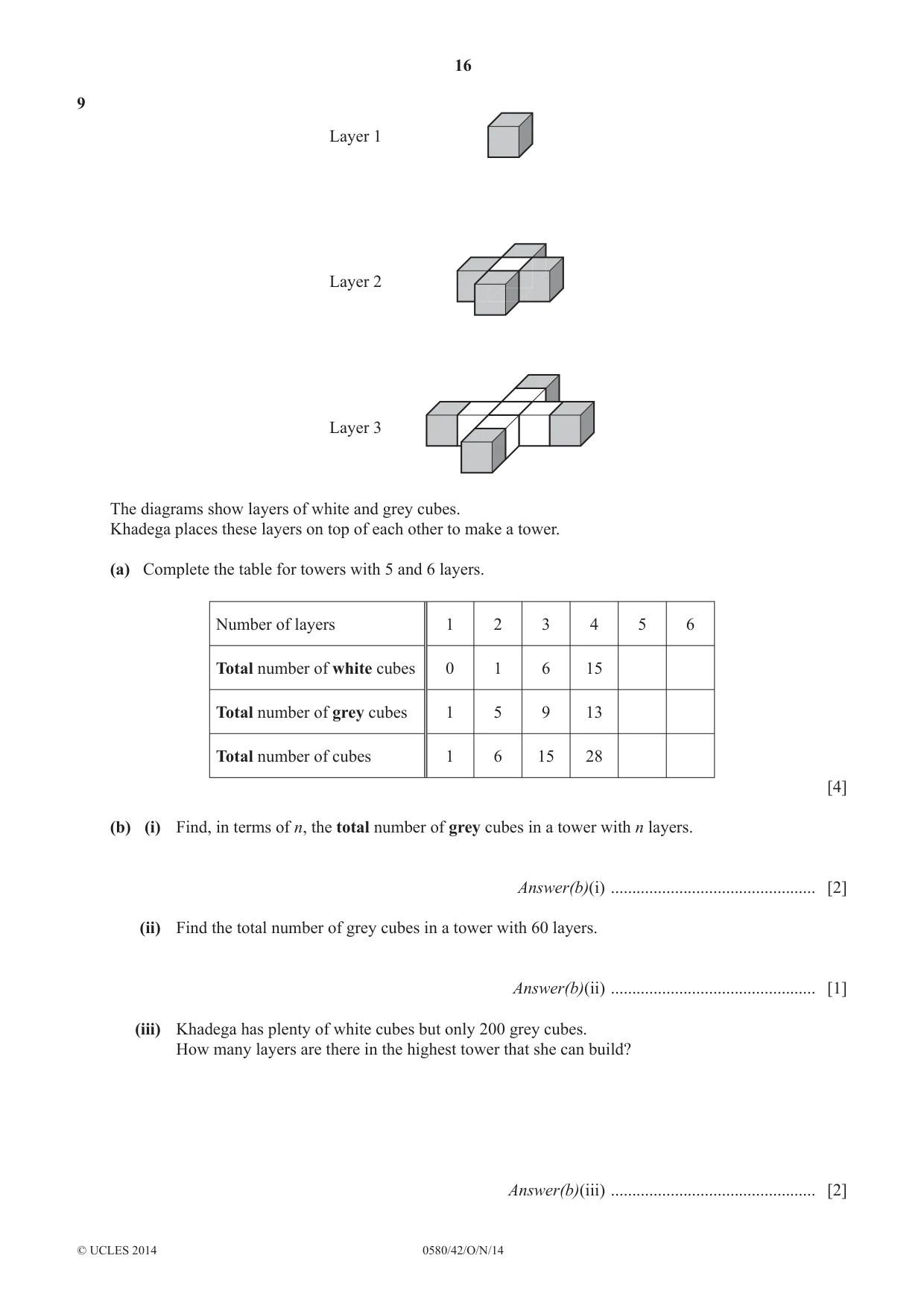
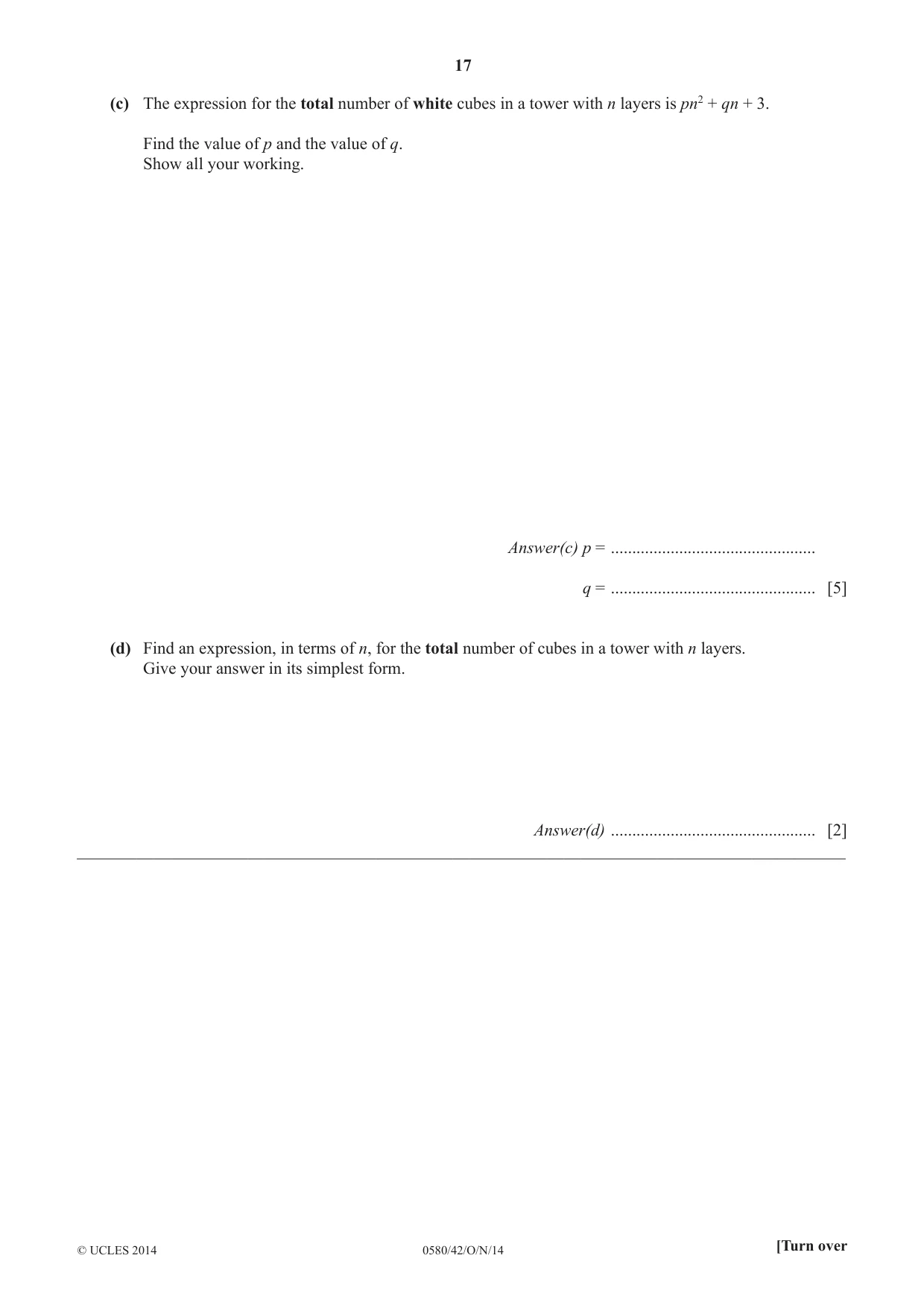
9 Layer 1 Layer 2 Layer 3 The diagrams show layers of white and grey cubes. Khadega places these layers on top of each other to make a tower. (a) Complete the table for towers with 5 and 6 layers. Number of layers 1 2 3 4 5 6 Total number of white cubes 0 1 6 15 Total number of grey cubes 1 5 9 13 Total number of cubes 1 6 15 28 [4] (b) (i) Find, in terms of n, the total number of grey cubes in a tower with n layers. Answer(b)(i) ................................................ [2] (ii) Find the total number of grey cubes in a tower with 60 layers. Answer(b)(ii) ................................................ [1] (iii) Khadega has plenty of white cubes but only 200 grey cubes. How many layers are there in the highest tower that she can build? Answer(b)(iii) ................................................ [2] (c) The expression for the total number of white cubes in a tower with n layers is pn2 + qn + 3. Find the value of p and the value of q. Show all your working. Answer(c) p = ................................................ q = ................................................ [5] (d) Find an expression, in terms of n, for the total number of cubes in a tower with n layers. Give your answer in its simplest form. Answer(d) ................................................ [2] __________________________________________________________________________________________
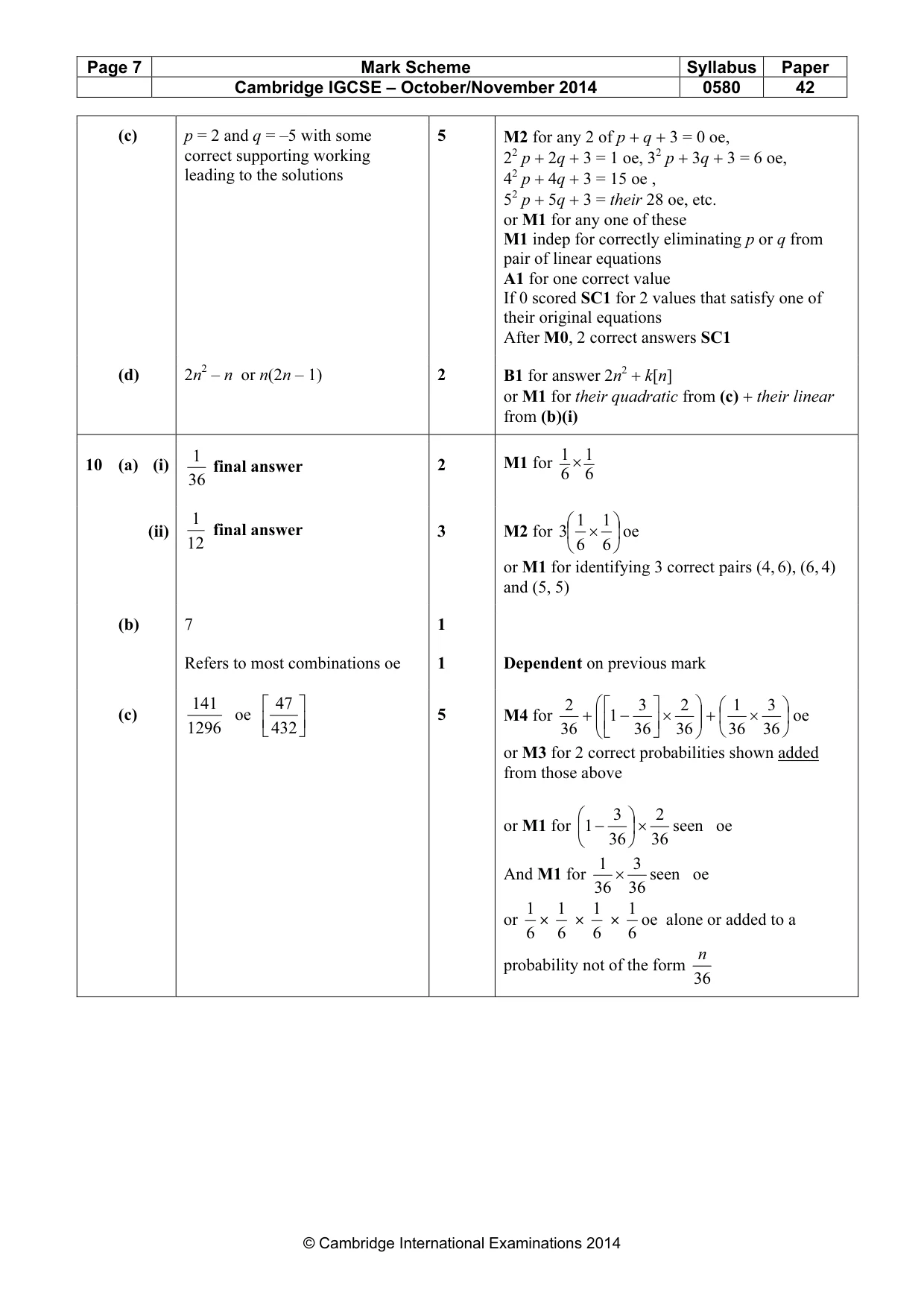
Mark scheme: 9 (a) 28 45 1, 1 17 21 1 45 66 1 (b) (i) 4n – 3 oe 2 M1 for 4n + k (ii) 237 1 (iii) 50 2FT FT their (b)(i) = 200 solved and then answer truncated dep on linear expression of form an + k M1 for their 4n – 3 = 200 or their 4n – 3 Y 200 (c) p = 2 and q = –5 with some 5 M2 for any 2 of p + q + 3 = 0 oe, correct supporting working 22 p + 2q + 3 = 1 oe, 32 p + 3q + 3 = 6 oe, leading to the solutions 42 p + 4q + 3 = 15 oe , 52 p + 5q + 3 = their 28 oe, etc. or M1 for any one of these M1 indep for correctly eliminating p or q from pair of linear equations A1 for one correct value If 0 scored SC1 for 2 values that satisfy one of their original equations After M0, 2 correct answers SC1 (d) 2n2 – n or n(2n – 1) 2 B1 for answer 2n2 + k[n] or M1 for their quadratic from (c) + their linear from (b)(i) 1 1 1
Q10 · Kenwyn plays a board game
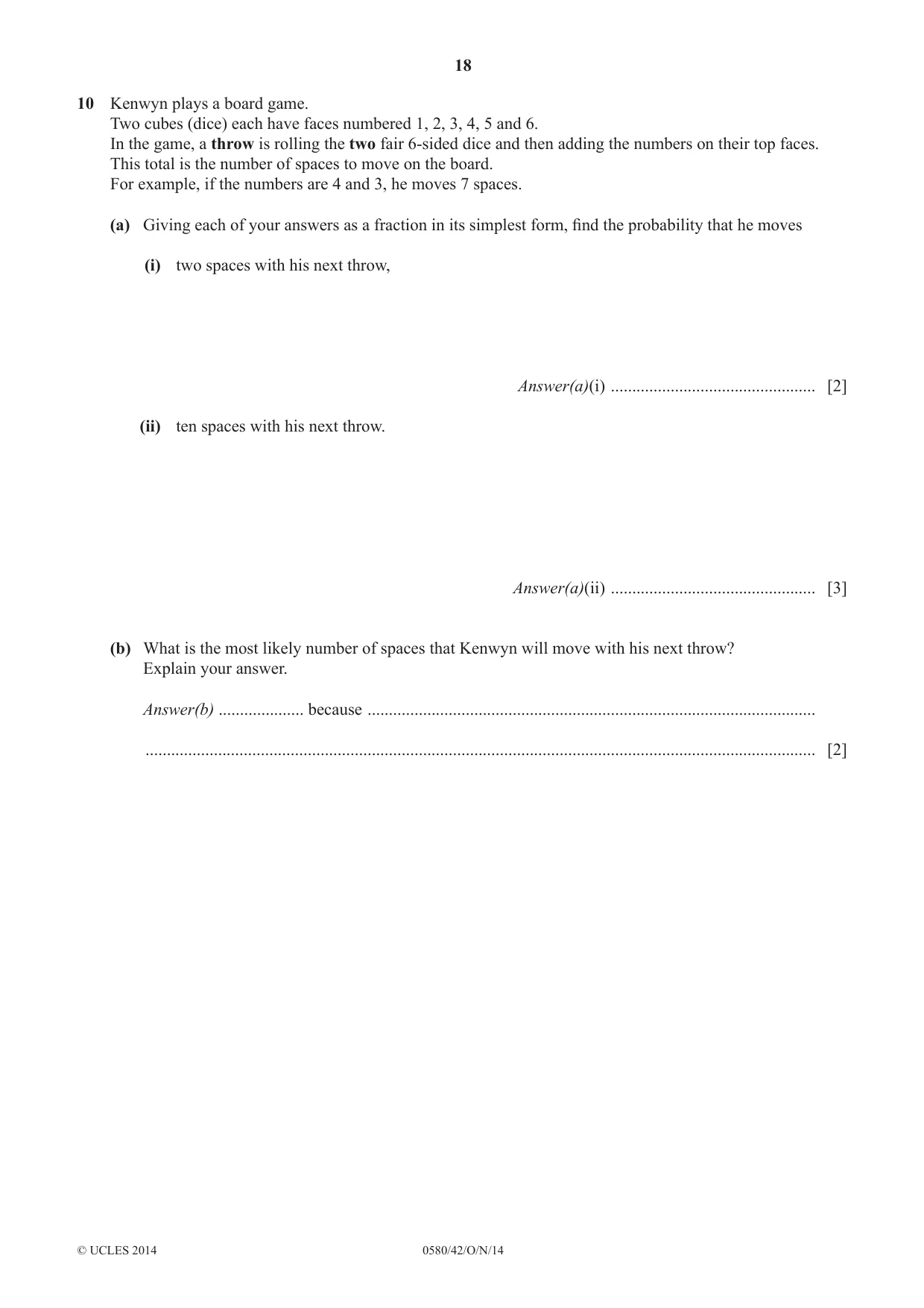
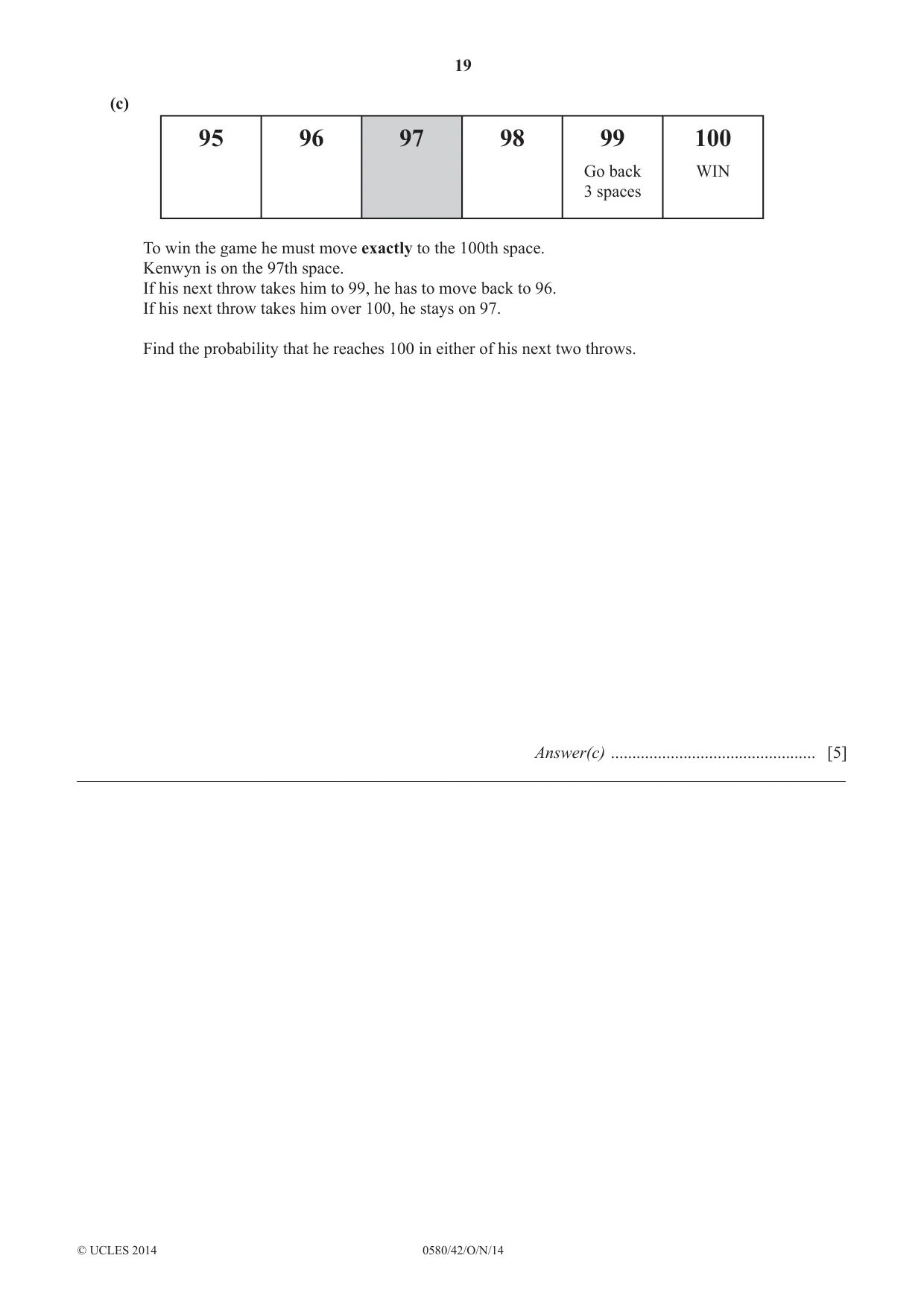
10 Kenwyn plays a board game. Two cubes (dice) each have faces numbered 1, 2, 3, 4, 5 and 6. In the game, a throw is rolling the two fair 6-sided dice and then adding the numbers on their top faces. This total is the number of spaces to move on the board. For example, if the numbers are 4 and 3, he moves 7 spaces. (a) Giving each of your answers as a fraction in its simplest form, fi nd the probability that he moves (i) two spaces with his next throw, Answer(a)(i) ................................................ [2] (ii) ten spaces with his next throw. Answer(a)(ii) ................................................ [3] (b) What is the most likely number of spaces that Kenwyn will move with his next throw? Explain your answer. Answer(b) .................... because ......................................................................................................... ............................................................................................................................................................. [2] (c) 95 96 97 98 99 100 Go back WIN 3 spaces To win the game he must move exactly to the 100th space. Kenwyn is on the 97th space. If his next throw takes him to 99, he has to move back to 96. If his next throw takes him over 100, he stays on 97. Find the probability that he reaches 100 in either of his next two throws. Answer(c) ................................................ [5] __________________________________________________________________________________________
Mark scheme: 110 (a) (i) final answer 2 M1 for 1 × 1 6 6 36 1 1 1 (ii) final answer 3 M2 for 3 × oe 12 6 6 or M1 for identifying 3 correct pairs (4, 6), (6, 4) and (5, 5) (b) 7 1 Refers to most combinations oe 1 Dependent on previous mark 141 47 2 3 2 1 3 (c) oe 5 M4 for + −1 × + × oe 1296 432 36 36 36 36 36 or M3 for 2 correct probabilities shown added from those above 3 2 or M1 for − 1 × seen oe 36 36 1 3 And M1 for × seen oe 36 36 1 1 1 1 or × × × oe alone or added to a 6 6 6 6 n probability not of the form 36
What was in this paper
The subtopics covered by these 6 questions, and how many questions each got. Open one in a new tab to see every Cambridge question on it.
What you needed in this session
Cambridge’s own grade thresholds for 2014 Oct/Nov, Paper 4 · Variant 2. A higher threshold means an easier paper — the bar moves with how the cohort did.