Cambridge IGCSE Mathematics 0580 — 2011 May/June Paper 4 · Variant 3
0580/43/M/J/11 · 6 questions · 130 marks · ≈146 min
The question paper and its mark scheme, free to read here and free to download. This is Cambridge’s own paper, exactly as it was sat.
Question paper20 pages
Mark scheme6 pages
Answers below. Sit the paper first if you are practising.
Questions as text
Q1 · Lucy works in a clothes shop
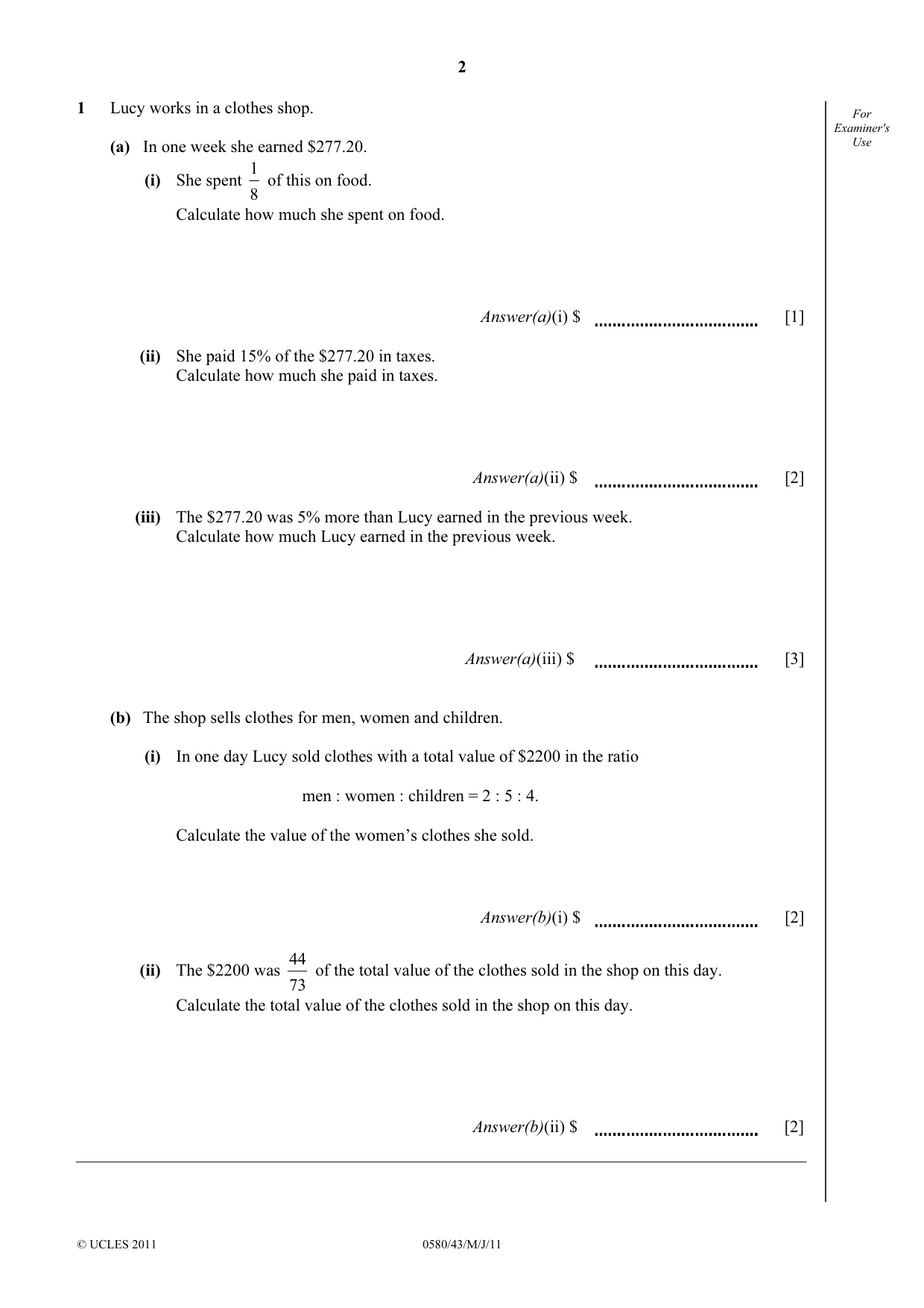
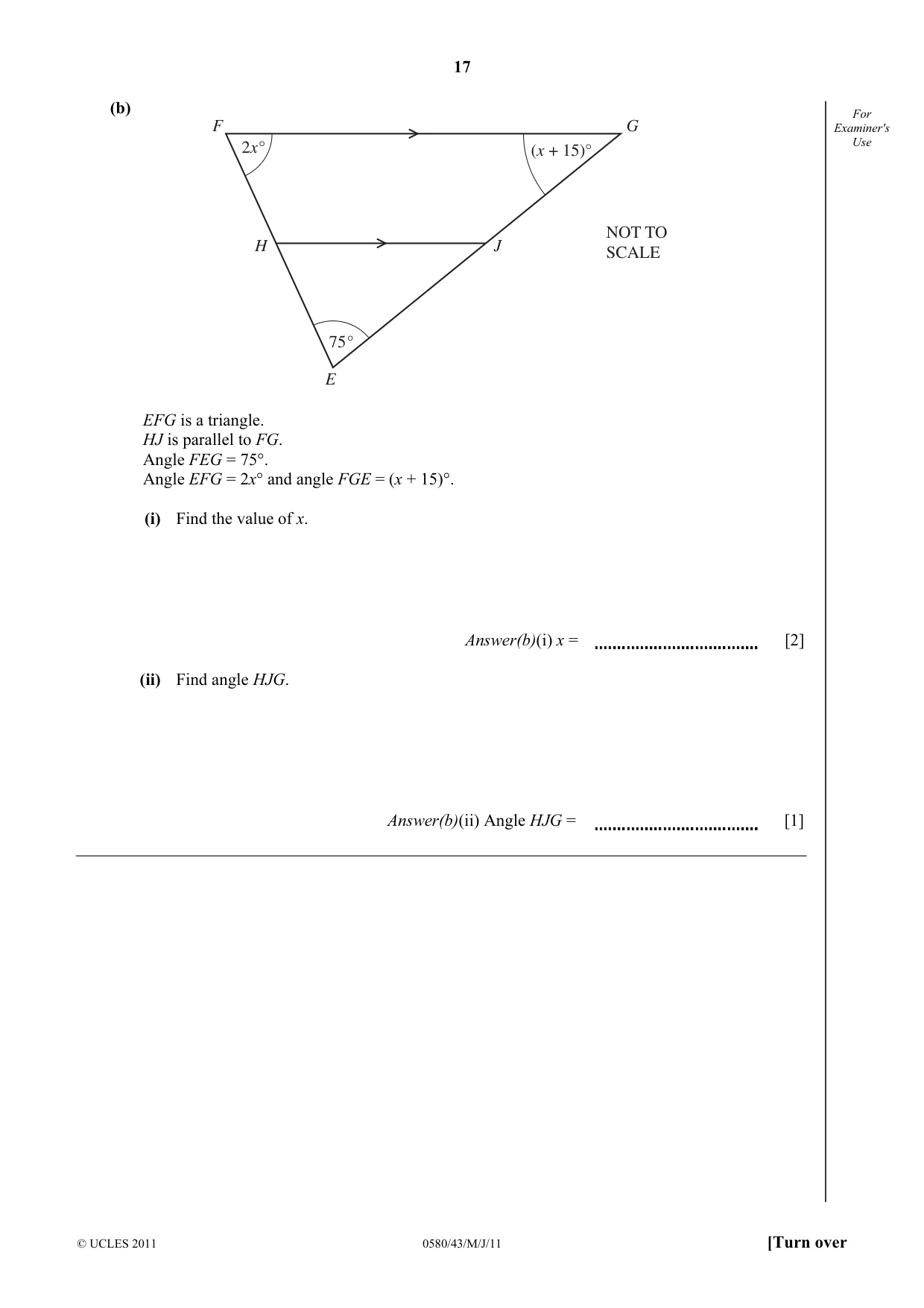
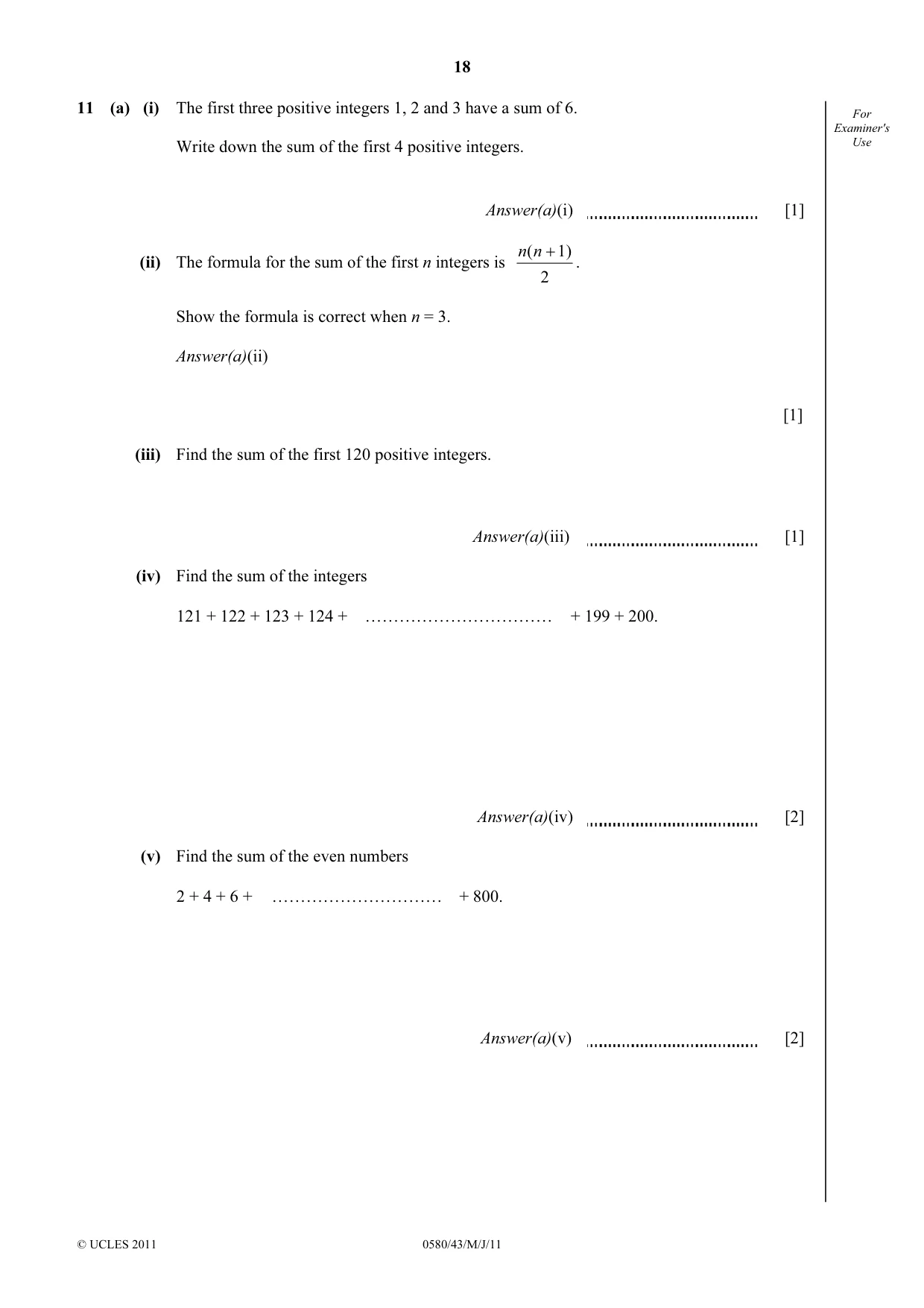
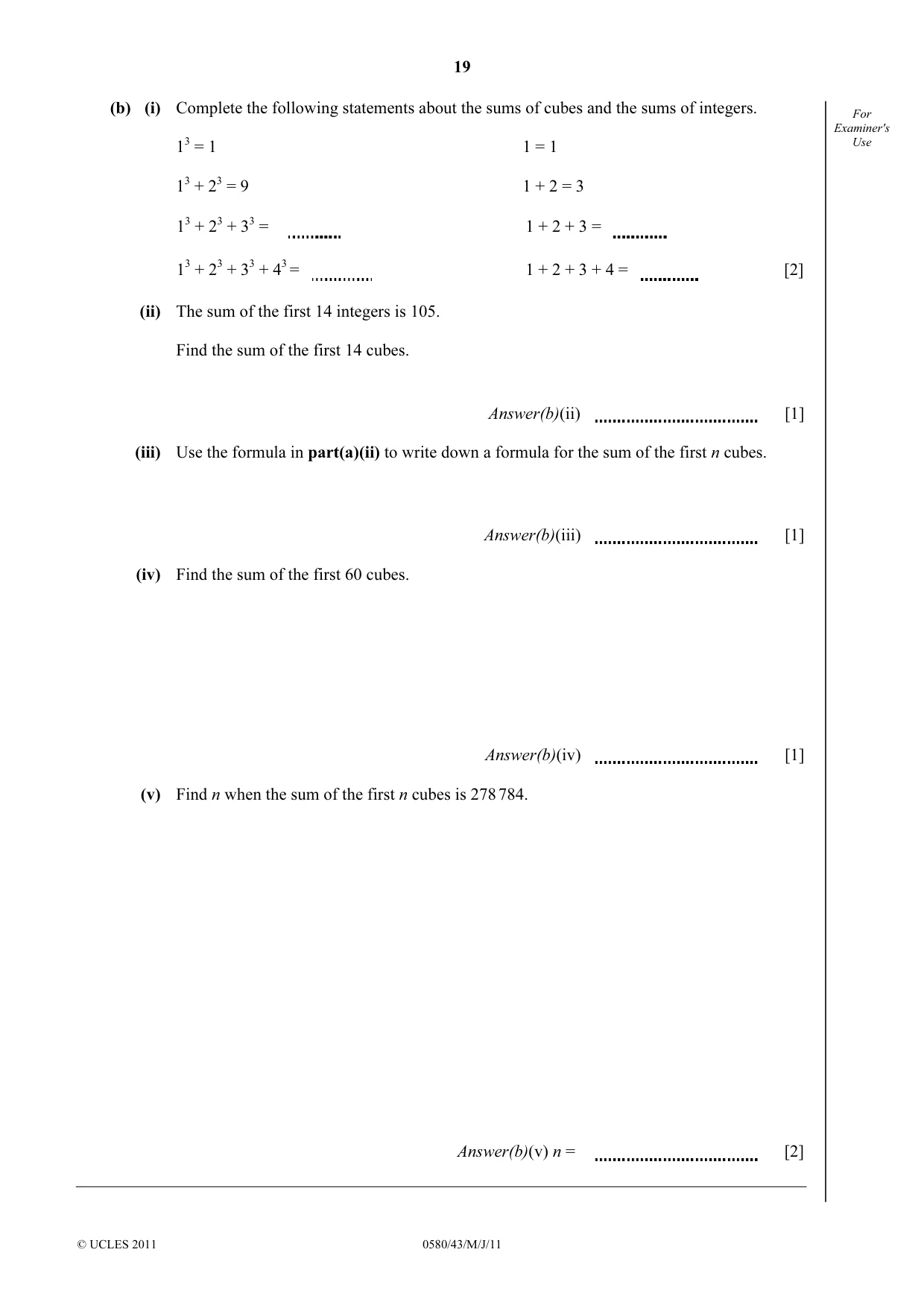
1 Lucy works in a clothes shop. For Examiner's (a) In one week she earned $277.20. Use 1 (i) She spent of this on food. 8 Calculate how much she spent on food. Answer(a)(i) $ [1] (ii) She paid 15% of the $277.20 in taxes. Calculate how much she paid in taxes. Answer(a)(ii) $ [2] (iii) The $277.20 was 5% more than Lucy earned in the previous week. Calculate how much Lucy earned in the previous week. Answer(a)(iii) $ [3] (b) The shop sells clothes for men, women and children. (i) In one day Lucy sold clothes with a total value of $2200 in the ratio men : women : children = 2 : 5 : 4. Calculate the value of the women’s clothes she sold. Answer(b)(i) $ [2] 44 (ii) The $2200 was of the total value of the clothes sold in the shop on this day. 73 Calculate the total value of the clothes sold in the shop on this day. Answer(b)(ii) $ [2]
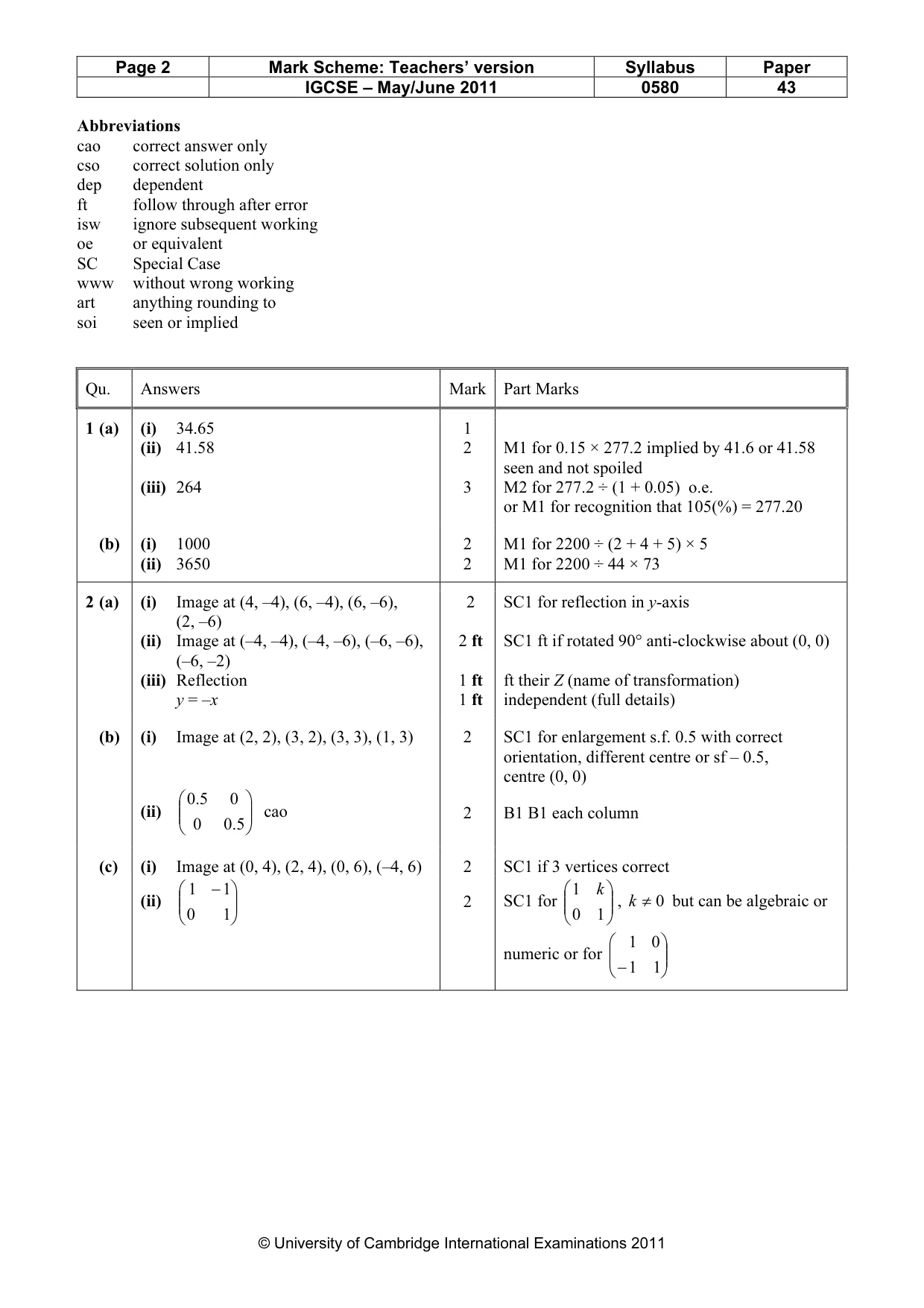
Mark scheme: Qu. Answers Mark Part Marks 1 (a) (i) 34.65 1 (ii) 41.58 2 M1 for 0.15 × 277.2 implied by 41.6 or 41.58 seen and not spoiled (iii) 264 3 M2 for 277.2 ÷ (1 + 0.05) o.e. or M1 for recognition that 105(%) = 277.20 (b) (i) 1000 2 M1 for 2200 ÷ (2 + 4 + 5) × 5 (ii) 3650 2 M1 for 2200 ÷ 44 × 73
Q2 · For y Examiner's Use 6 5 X 4 3 2 1 x –6 –5 –4 –3 –2 –1 0 1 2 3 4 5 6 –1 –2 –3 –4 –5 –6…
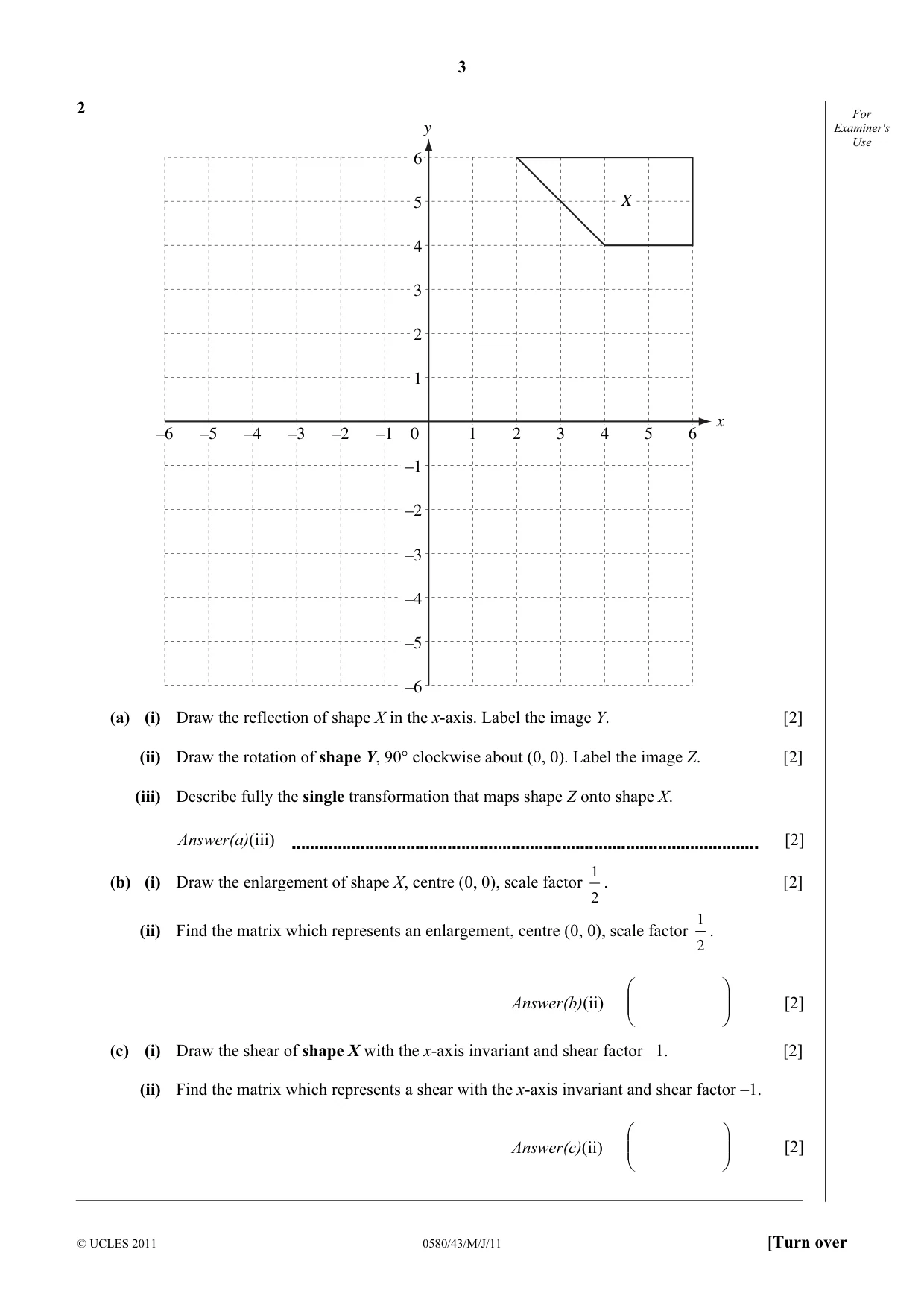
2 For y Examiner's Use 6 5 X 4 3 2 1 x –6 –5 –4 –3 –2 –1 0 1 2 3 4 5 6 –1 –2 –3 –4 –5 –6 (a) (i) Draw the reflection of shape X in the x-axis. Label the image Y. [2] (ii) Draw the rotation of shape Y, 90° clockwise about (0, 0). Label the image Z. [2] (iii) Describe fully the single transformation that maps shape Z onto shape X. Answer(a)(iii) [2] 1 (b) (i) Draw the enlargement of shape X, centre (0, 0), scale factor . [2] 2 1 (ii) Find the matrix which represents an enlargement, centre (0, 0), scale factor . 2 Answer(b)(ii) [2] (c) (i) Draw the shear of shape X with the x-axis invariant and shear factor –1. [2] (ii) Find the matrix which represents a shear with the x-axis invariant and shear factor –1. Answer(c)(ii) [2]
Mark scheme: 2 (a) (i) Image at (4, –4), (6, –4), (6, –6), 2 SC1 for reflection in y-axis (2, –6) (ii) Image at (–4, –4), (–4, –6), (–6, –6), 2 ft SC1 ft if rotated 90° anti-clockwise about (0, 0) (–6, –2) (iii) Reflection 1 ft ft their Z (name of transformation) y = –x 1 ft independent (full details) (b) (i) Image at (2, 2), (3, 2), (3, 3), (1, 3) 2 SC1 for enlargement s.f. 0.5 with correct orientation, different centre or sf – 0.5, centre (0, 0) 5.0 0 (ii) cao 2 B1 B1 each column 0 5.0 (c) (i) Image at (0, 4), (2, 4), (0, 6), (–4, 6) 2 SC1 if 3 vertices correct 1 − 1 1 k (ii) 2 SC1 for , k ≠ 0 but can be algebraic or 0 1 0 1 1 0 numeric or for − 1 1 IGCSE – May/June 2011 0580 43
Q3 · For Examiner's NOT TO Use SCALE x cm 2x cm (x + 5) cm The diagram shows a square of side…
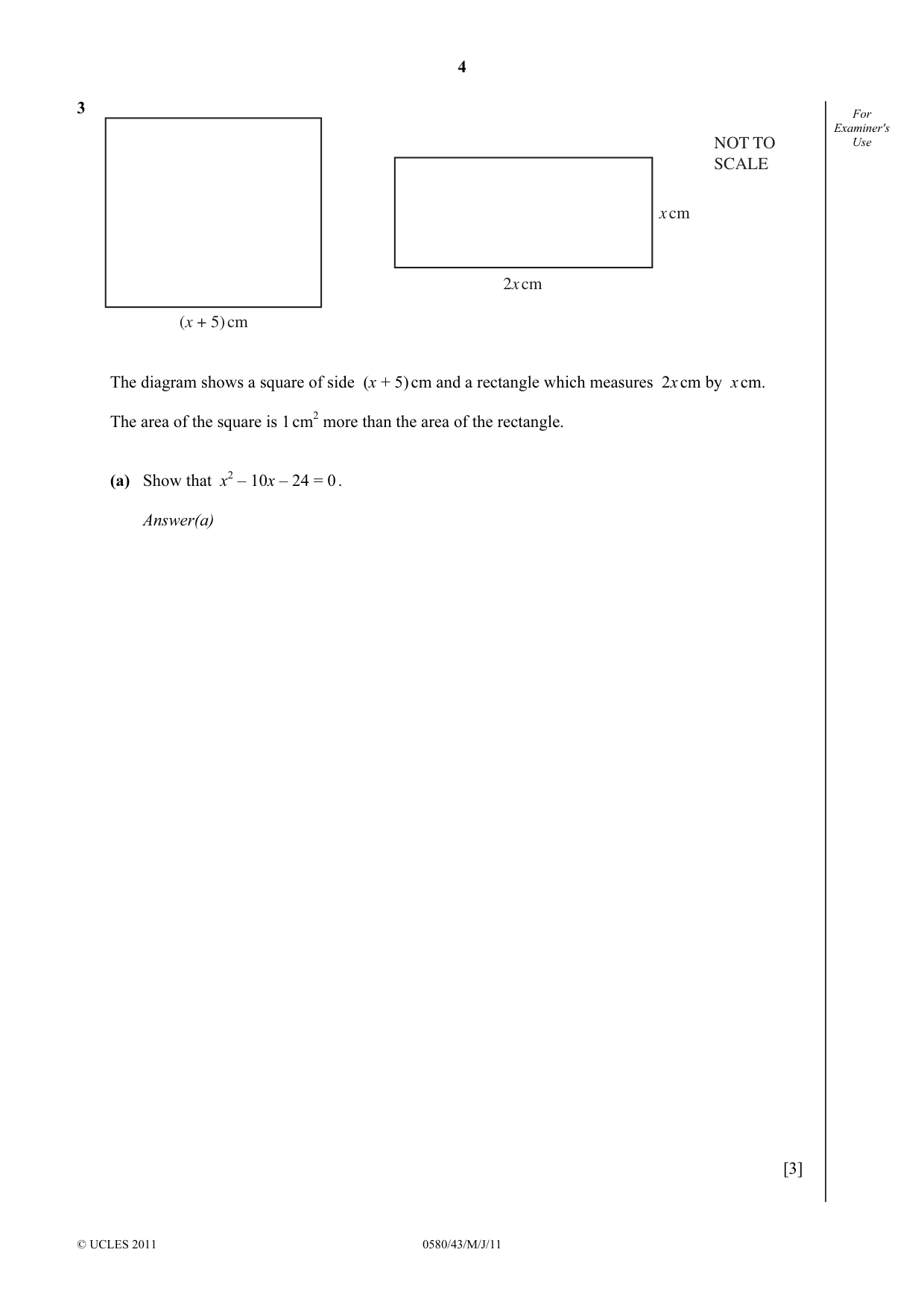
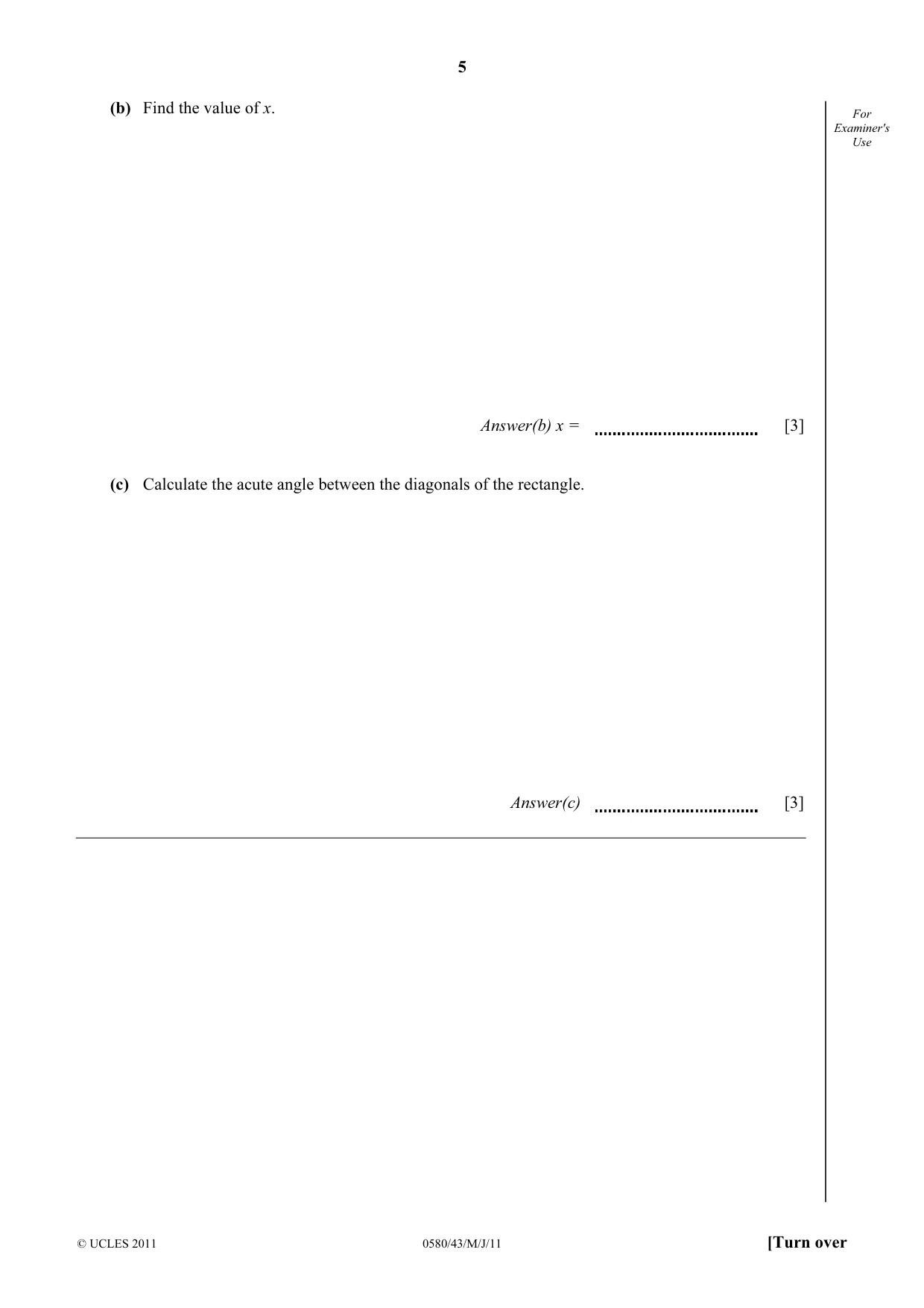
3 For Examiner's NOT TO Use SCALE x cm 2x cm (x + 5) cm The diagram shows a square of side (x + 5) cm and a rectangle which measures 2x cm by x cm. The area of the square is 1 cm2 more than the area of the rectangle. (a) Show that x2 – 10x – 24 = 0 . Answer(a) [3] (b) Find the value of x. For Examiner's Use Answer(b) x = [3] (c) Calculate the acute angle between the diagonals of the rectangle. Answer(c) [3]
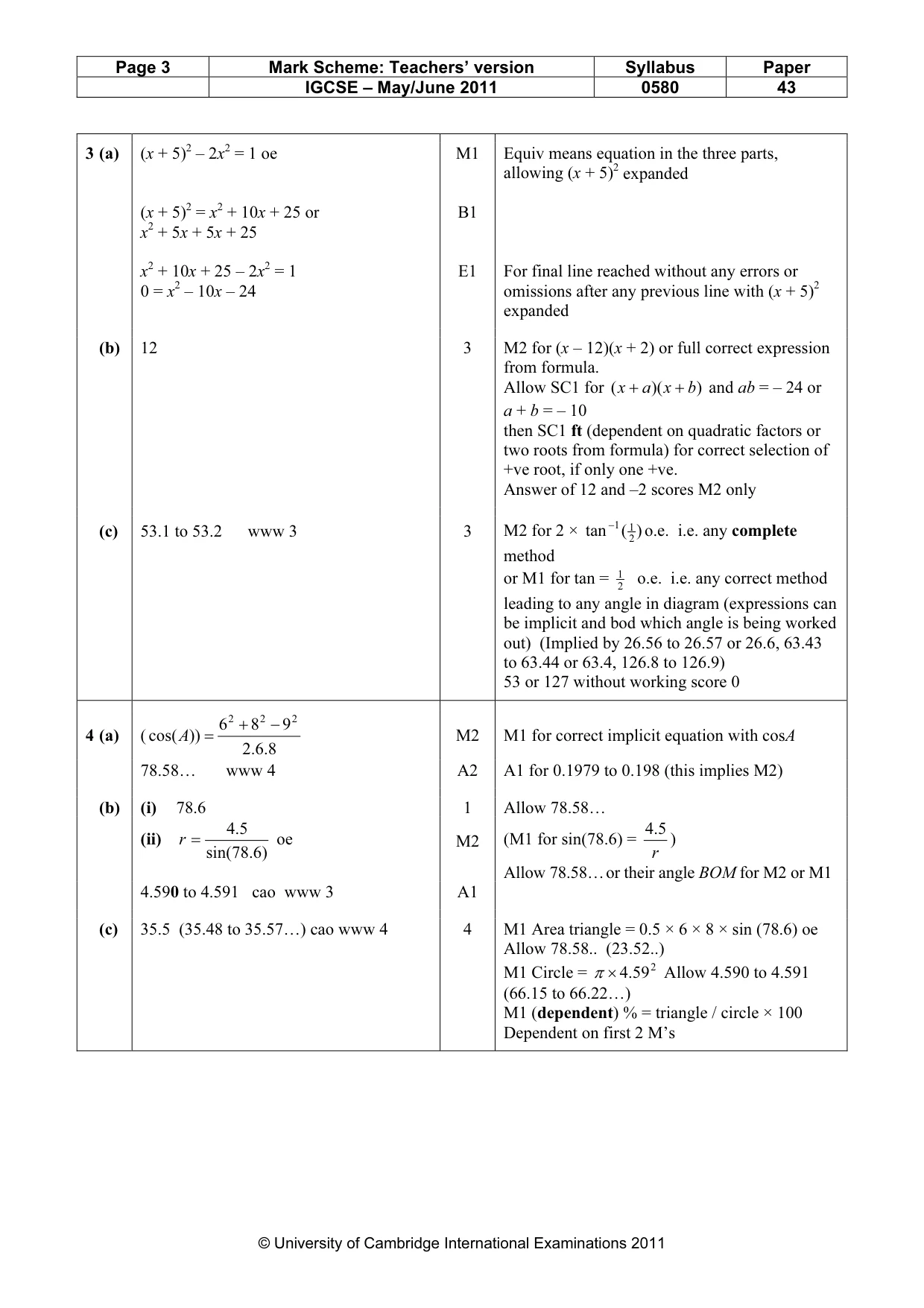
Mark scheme: 3 (a) (x + 5)2 – 2x2 = 1 oe M1 Equiv means equation in the three parts, allowing (x + 5)2 expanded (x + 5)2 = x2 + 10x + 25 or B1 x2 + 5x + 5x + 25 x2 + 10x + 25 – 2x2 = 1 E1 For final line reached without any errors or 0 = x2 – 10x – 24 omissions after any previous line with (x + 5)2 expanded (b) 12 3 M2 for (x – 12)(x + 2) or full correct expression from formula. Allow SC1 for ( x + a )( x + b ) and ab = – 24 or a + b = – 10 then SC1 ft (dependent on quadratic factors or two roots from formula) for correct selection of +ve root, if only one +ve. Answer of 12 and –2 scores M2 only (c) 53.1 to 53.2 www 3 3 M2 for 2 × tan −1 ( 12 ) o.e. i.e. any complete method or M1 for tan = 12 o.e. i.e. any correct method leading to any angle in diagram (expressions can be implicit and bod which angle is being worked out) (Implied by 26.56 to 26.57 or 26.6, 63.43 to 63.44 or 63.4, 126.8 to 126.9) 53 or 127 without working score 0 6 2 + 8 2 9 2
Q4 · For A Examiner's Use NOT TO 8 cm 6 cm SCALE O B C 9 cm The circle, centre O, passes…
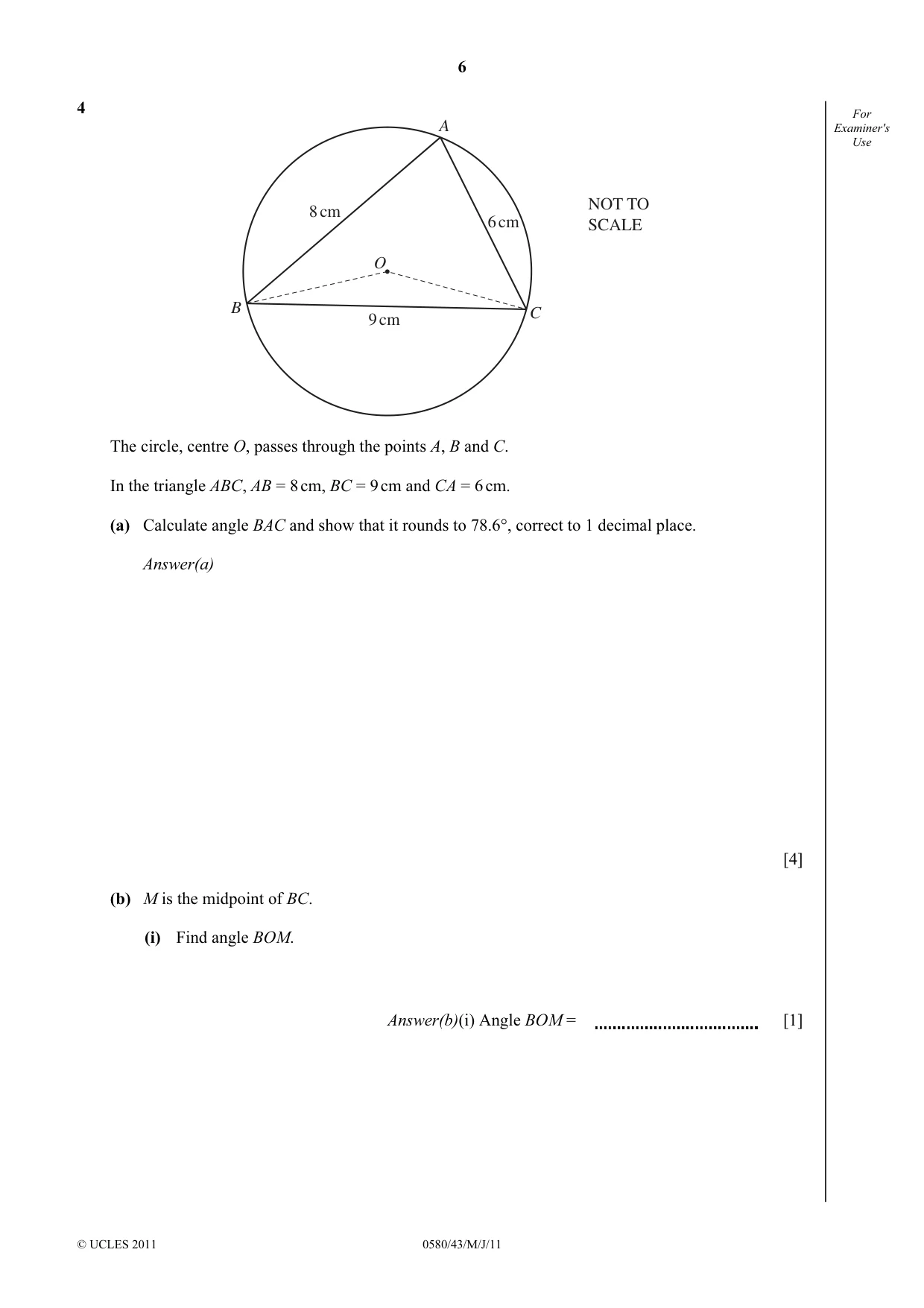
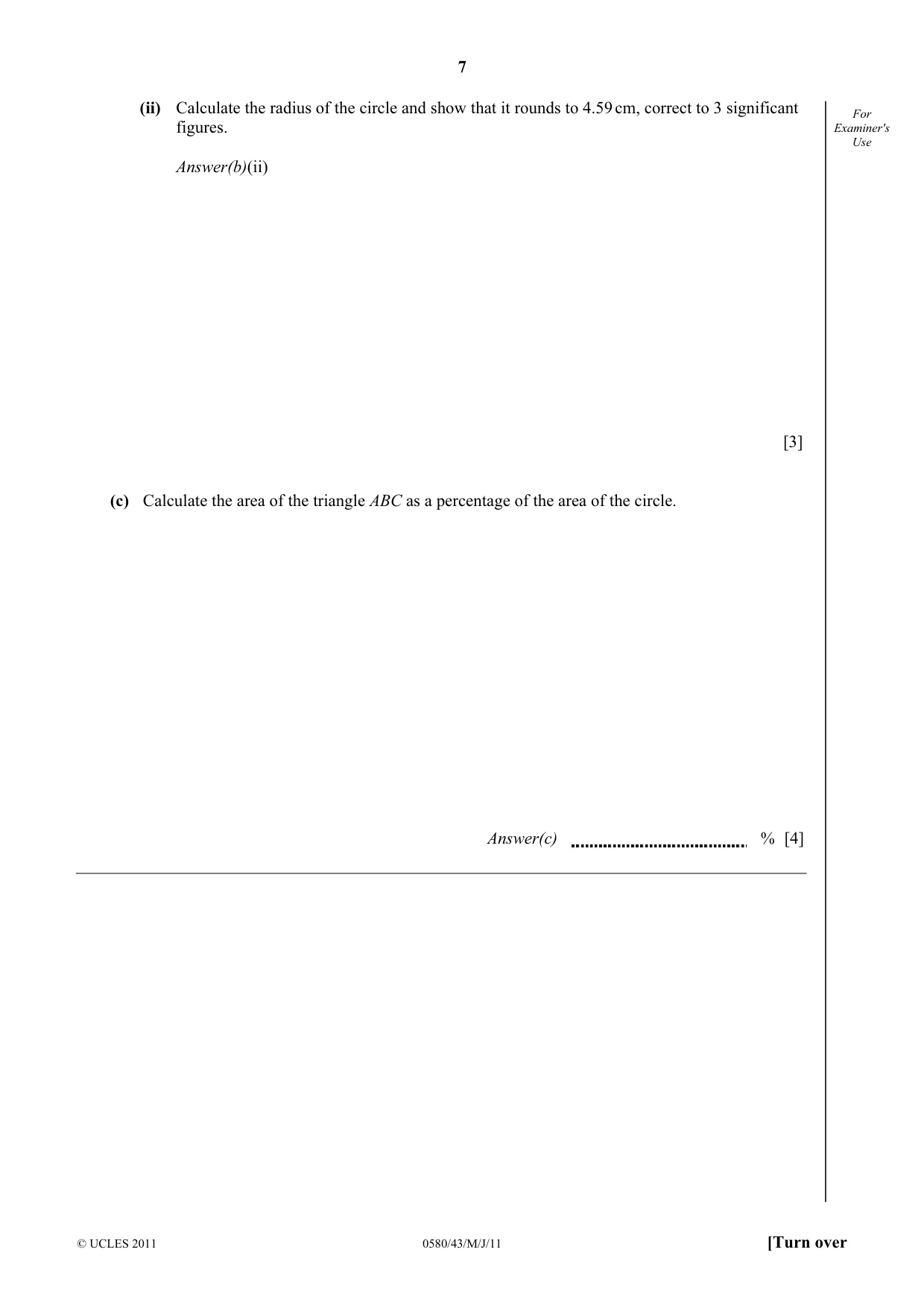
4 For A Examiner's Use NOT TO 8 cm 6 cm SCALE O B C 9 cm The circle, centre O, passes through the points A, B and C. In the triangle ABC, AB = 8 cm, BC = 9 cm and CA = 6 cm. (a) Calculate angle BAC and show that it rounds to 78.6°, correct to 1 decimal place. Answer(a) [4] (b) M is the midpoint of BC. (i) Find angle BOM. Answer(b)(i) Angle BOM = [1] (ii) Calculate the radius of the circle and show that it rounds to 4.59 cm, correct to 3 significant For figures. Examiner's Use Answer(b)(ii) [3] (c) Calculate the area of the triangle ABC as a percentage of the area of the circle. Answer(c) % [4]
Mark scheme: 6 + 8 − 9 4 (a) ( cos( A)) = M2 M1 for correct implicit equation with cosA 8.6.2 78.58… www 4 A2 A1 for 0.1979 to 0.198 (this implies M2) (b) (i) 78.6 1 Allow 78.58… 5.4 5.4 (ii) r = oe M2 (M1 for sin(78.6) = ) sin( 786.) r Allow 78.58… or their angle BOM for M2 or M1 4.590 to 4.591 cao www 3 A1 (c) 35.5 (35.48 to 35.57…) cao www 4 4 M1 Area triangle = 0.5 × 6 × 8 × sin (78.6) oe Allow 78.58.. (23.52..) M1 Circle = π × .4 59 2 Allow 4.590 to 4.591 (66.15 to 66.22…) M1 (dependent) % = triangle / circle × 100 Dependent on first 2 M’s IGCSE – May/June 2011 0580 43
Q5 · For 5 (a) Complete the table of values for the function f(x), where f(x) = x2 + 2 , x ≠ 0
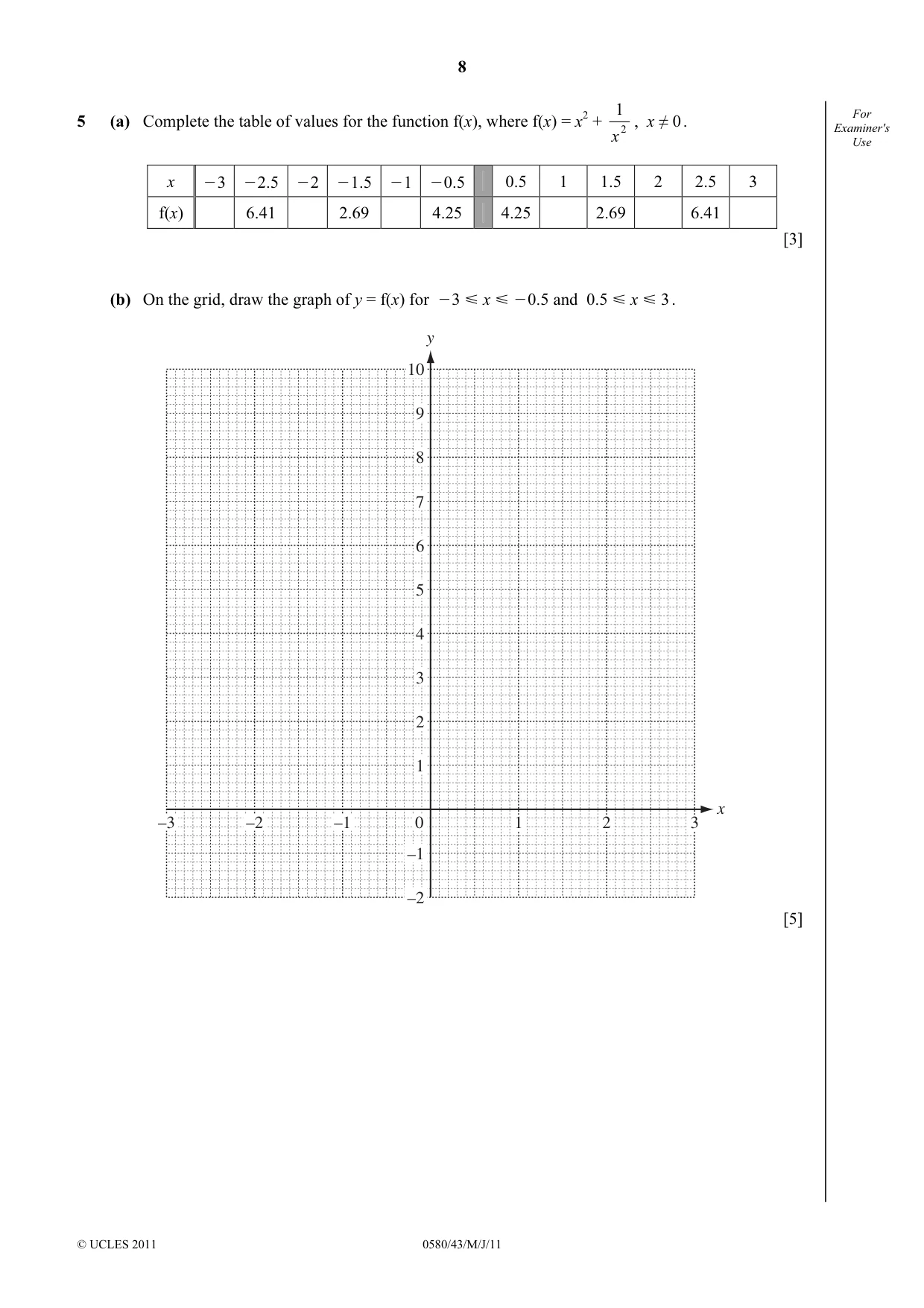
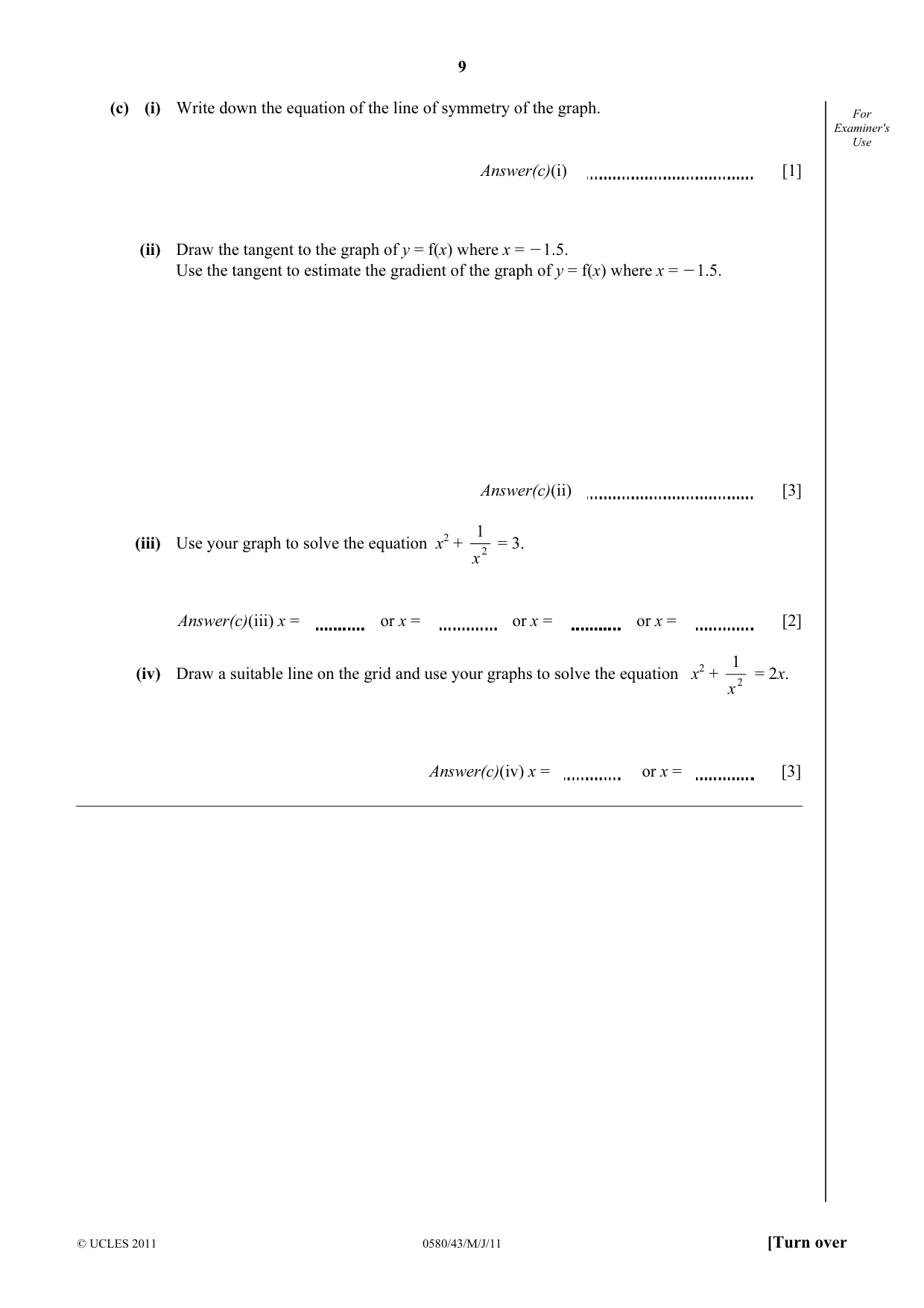
1 For 5 (a) Complete the table of values for the function f(x), where f(x) = x2 + 2 , x ≠ 0 . Examiner's x Use x O3 O2.5 O2 O1.5 O1 O0.5 0.5 1 1.5 2 2.5 3 f(x) 6.41 2.69 4.25 4.25 2.69 6.41 [3] (b) On the grid, draw the graph of y = f(x) for O3 Y x Y O0.5 and 0.5 Y x Y 3 . y 10 9 8 7 6 5 4 3 2 1 x –3 –2 –1 0 1 2 3 –1 –2 [5] (c) (i) Write down the equation of the line of symmetry of the graph. For Examiner's Use Answer(c)(i) [1] (ii) Draw the tangent to the graph of y = f(x) where x = O1.5. Use the tangent to estimate the gradient of the graph of y = f(x) where x = O1.5. Answer(c)(ii) [3] 1 (iii) Use your graph to solve the equation x2 + 2 = 3. x Answer(c)(iii) x = or x = or x = or x = [2] 1 (iv) Draw a suitable line on the grid and use your graphs to solve the equation x2 + 2 = 2x. x Answer(c)(iv) x = or x = [3]
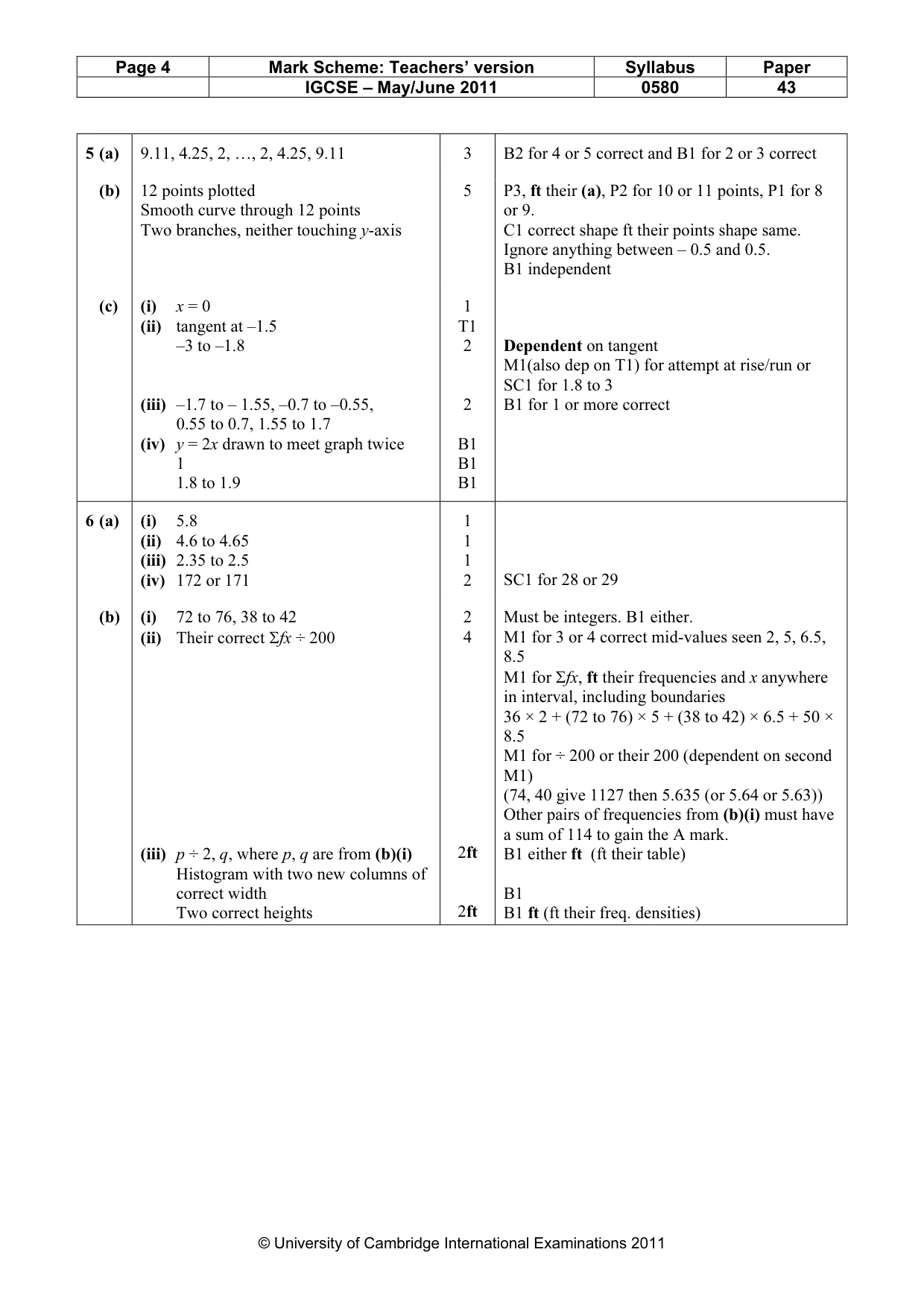
Mark scheme: 5 (a) 9.11, 4.25, 2, …, 2, 4.25, 9.11 3 B2 for 4 or 5 correct and B1 for 2 or 3 correct (b) 12 points plotted 5 P3, ft their (a), P2 for 10 or 11 points, P1 for 8 Smooth curve through 12 points or 9. Two branches, neither touching y-axis C1 correct shape ft their points shape same. Ignore anything between – 0.5 and 0.5. B1 independent (c) (i) x = 0 1 (ii) tangent at –1.5 T1 –3 to –1.8 2 Dependent on tangent M1(also dep on T1) for attempt at rise/run or SC1 for 1.8 to 3 (iii) –1.7 to – 1.55, –0.7 to –0.55, 2 B1 for 1 or more correct 0.55 to 0.7, 1.55 to 1.7 (iv) y = 2x drawn to meet graph twice B1 1 B1 1.8 to 1.9 B1
Q6 · For Examiner's 200 Use 180 160 140 120 Cumulative 100 frequency 80 60 40 20 m 0 1 2 3 4 5…
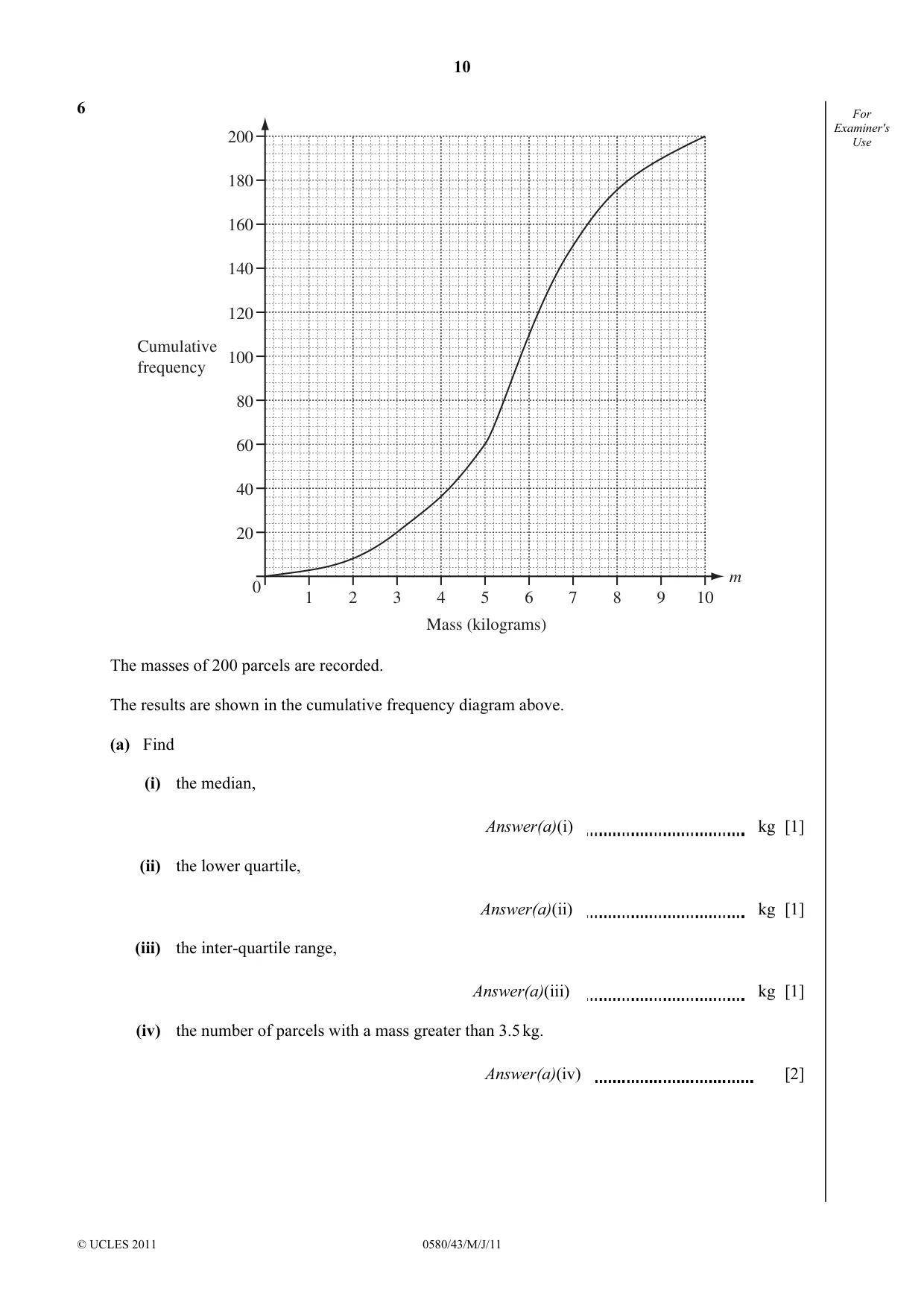
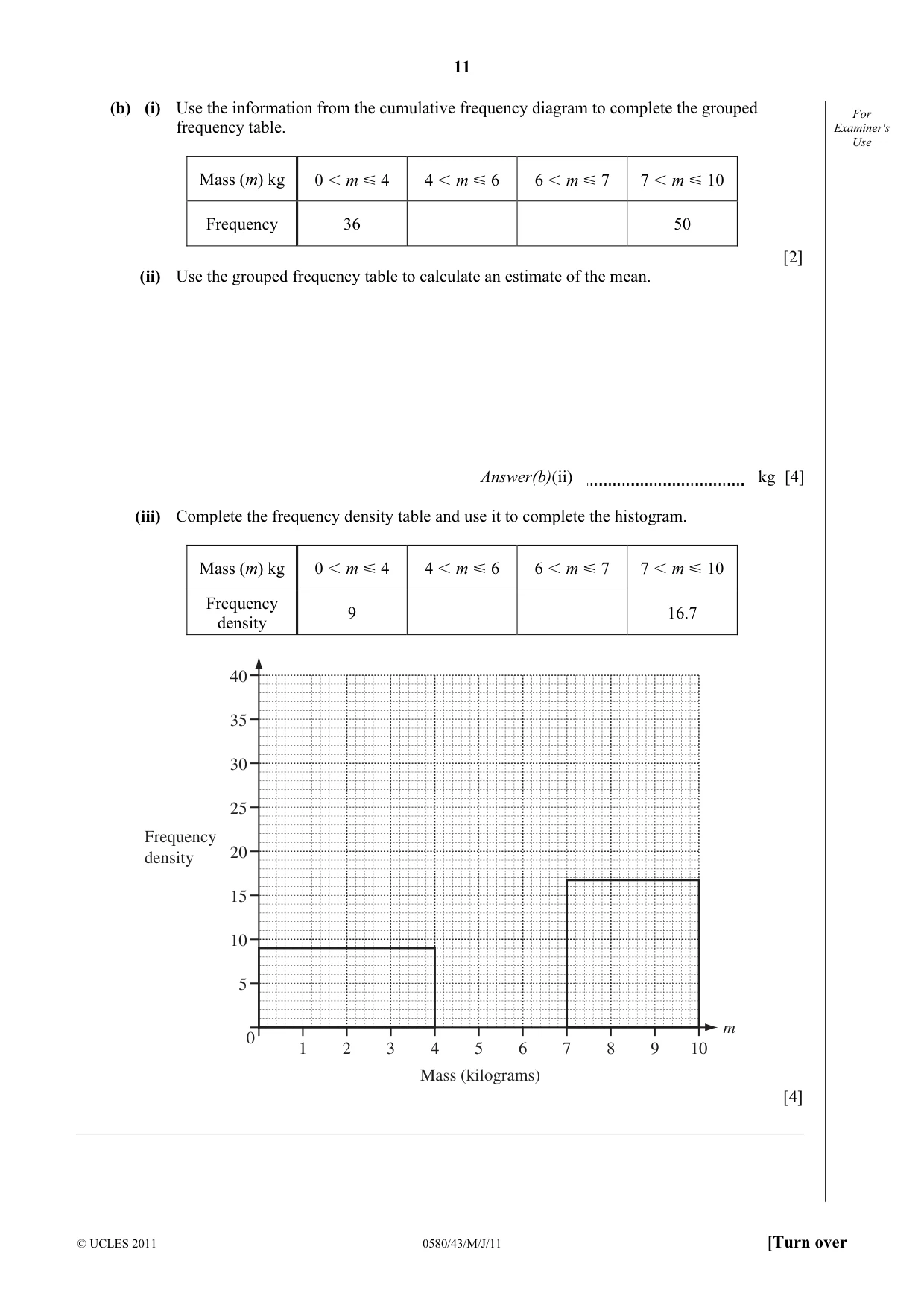
6 For Examiner's 200 Use 180 160 140 120 Cumulative 100 frequency 80 60 40 20 m 0 1 2 3 4 5 6 7 8 9 10 Mass (kilograms) The masses of 200 parcels are recorded. The results are shown in the cumulative frequency diagram above. (a) Find (i) the median, Answer(a)(i) kg [1] (ii) the lower quartile, Answer(a)(ii) kg [1] (iii) the inter-quartile range, Answer(a)(iii) kg [1] (iv) the number of parcels with a mass greater than 3.5 kg. Answer(a)(iv) [2] (b) (i) Use the information from the cumulative frequency diagram to complete the grouped For frequency table. Examiner's Use Mass (m) kg 0 I m Y 4 4 I m Y 6 6 I m Y 7 7 I m Y 10 Frequency 36 50 [2] (ii) Use the grouped frequency table to calculate an estimate of the mean. Answer(b)(ii) kg [4] (iii) Complete the frequency density table and use it to complete the histogram. Mass (m) kg 0 I m Y 4 4 I m Y 6 6 I m Y 7 7 I m Y 10 Frequency 9 16.7 density 40 35 30 25 Frequency 20 density 15 10 5 m 0 1 2 3 4 5 6 7 8 9 10 Mass (kilograms) [4]
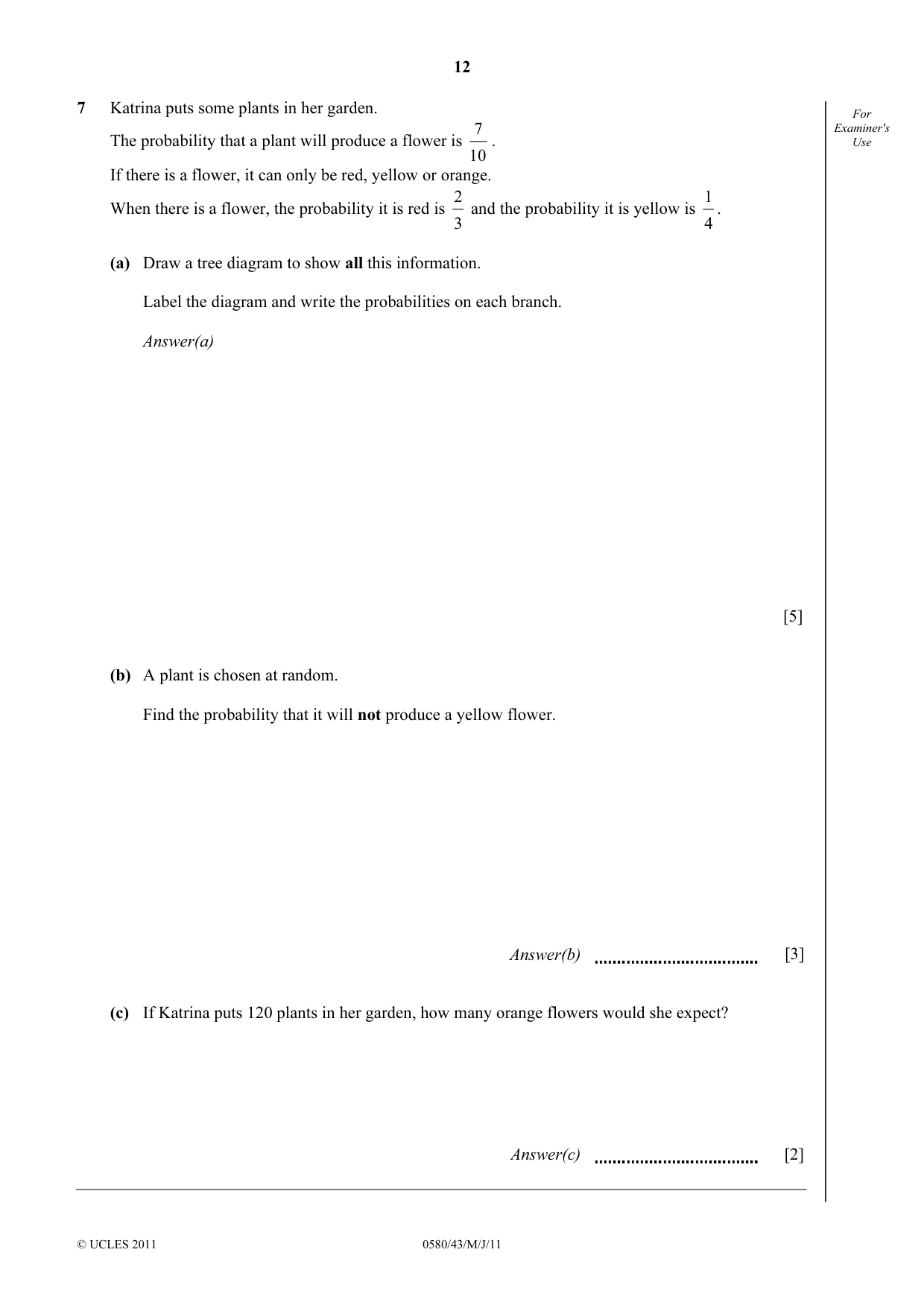
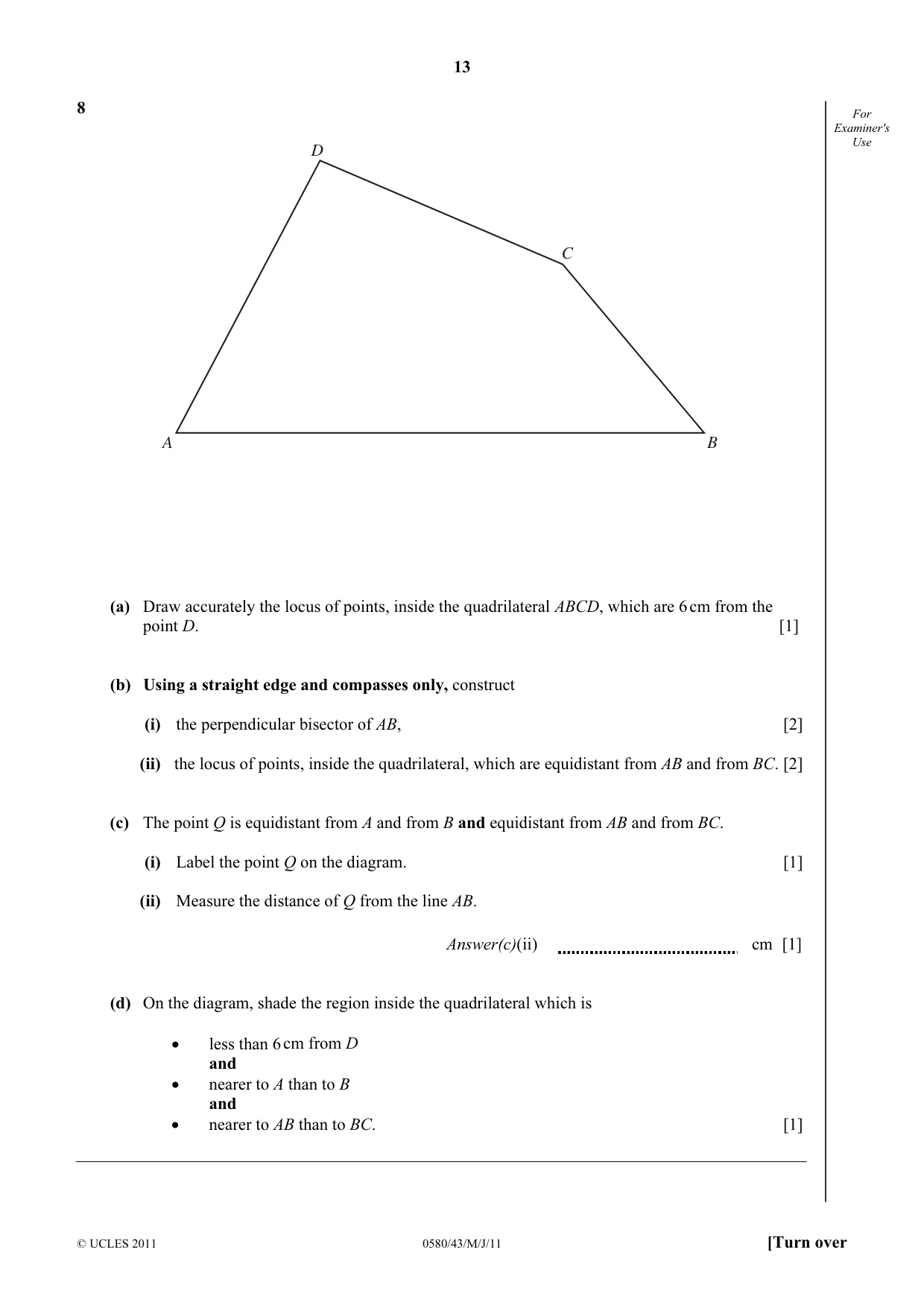
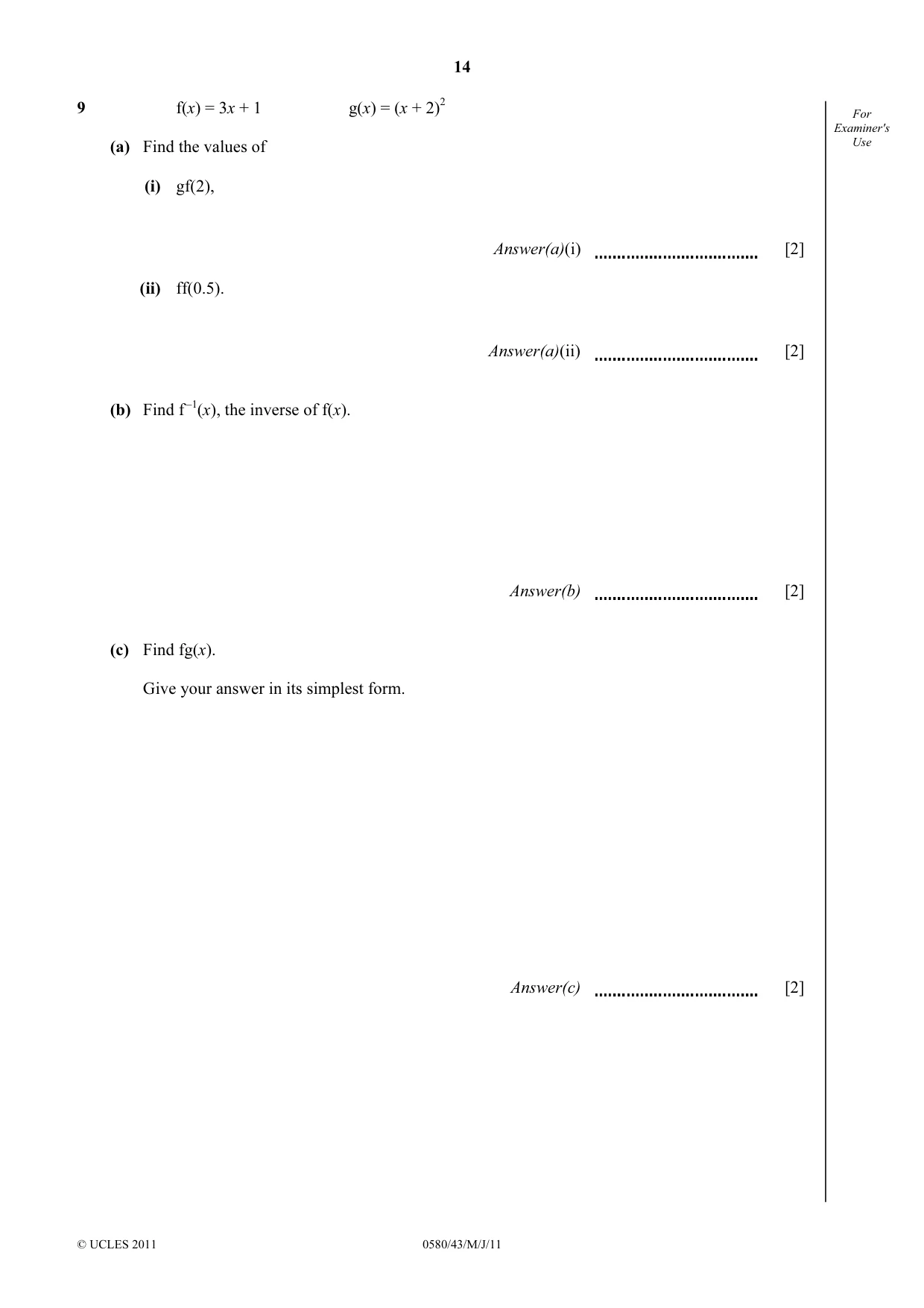
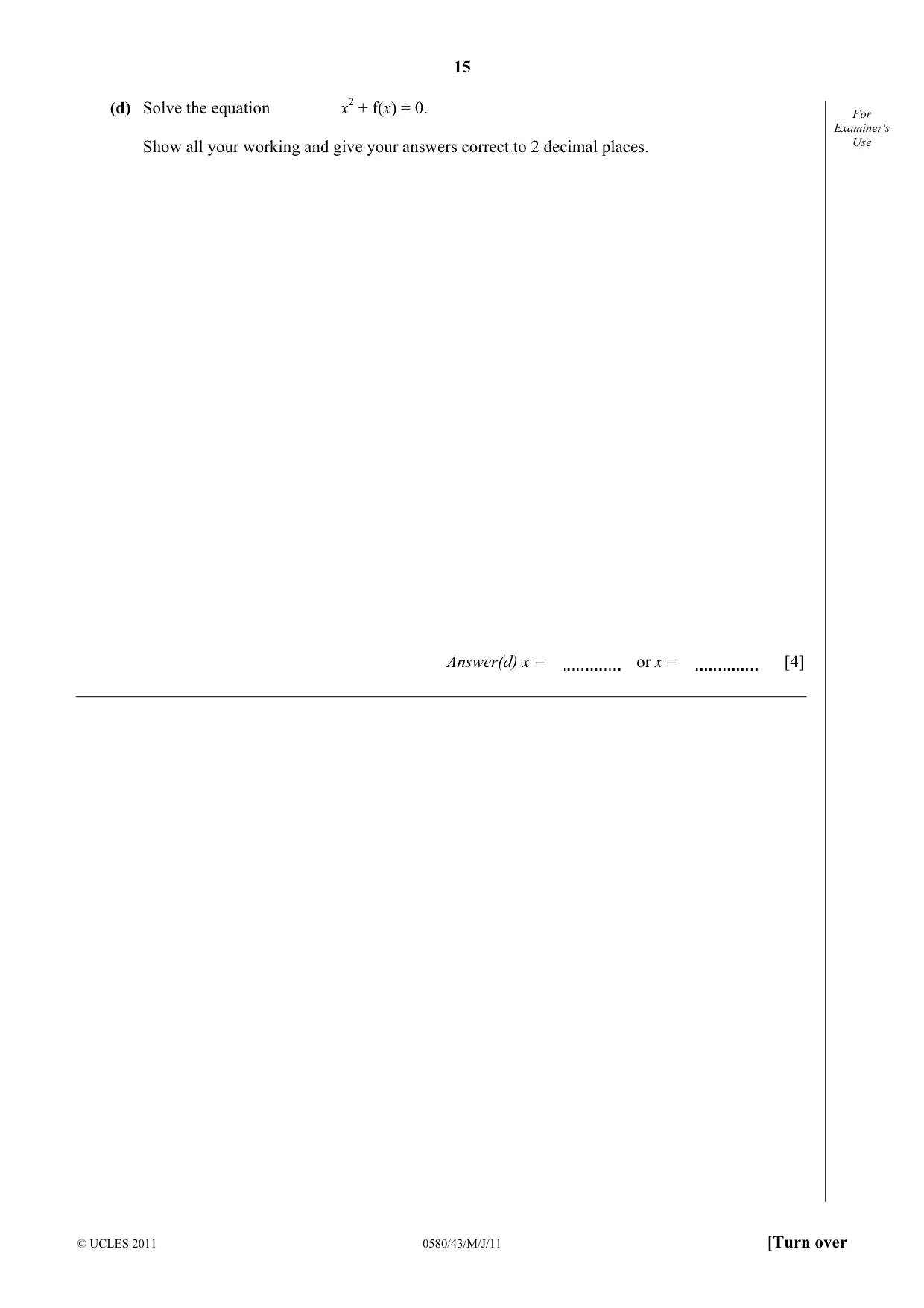
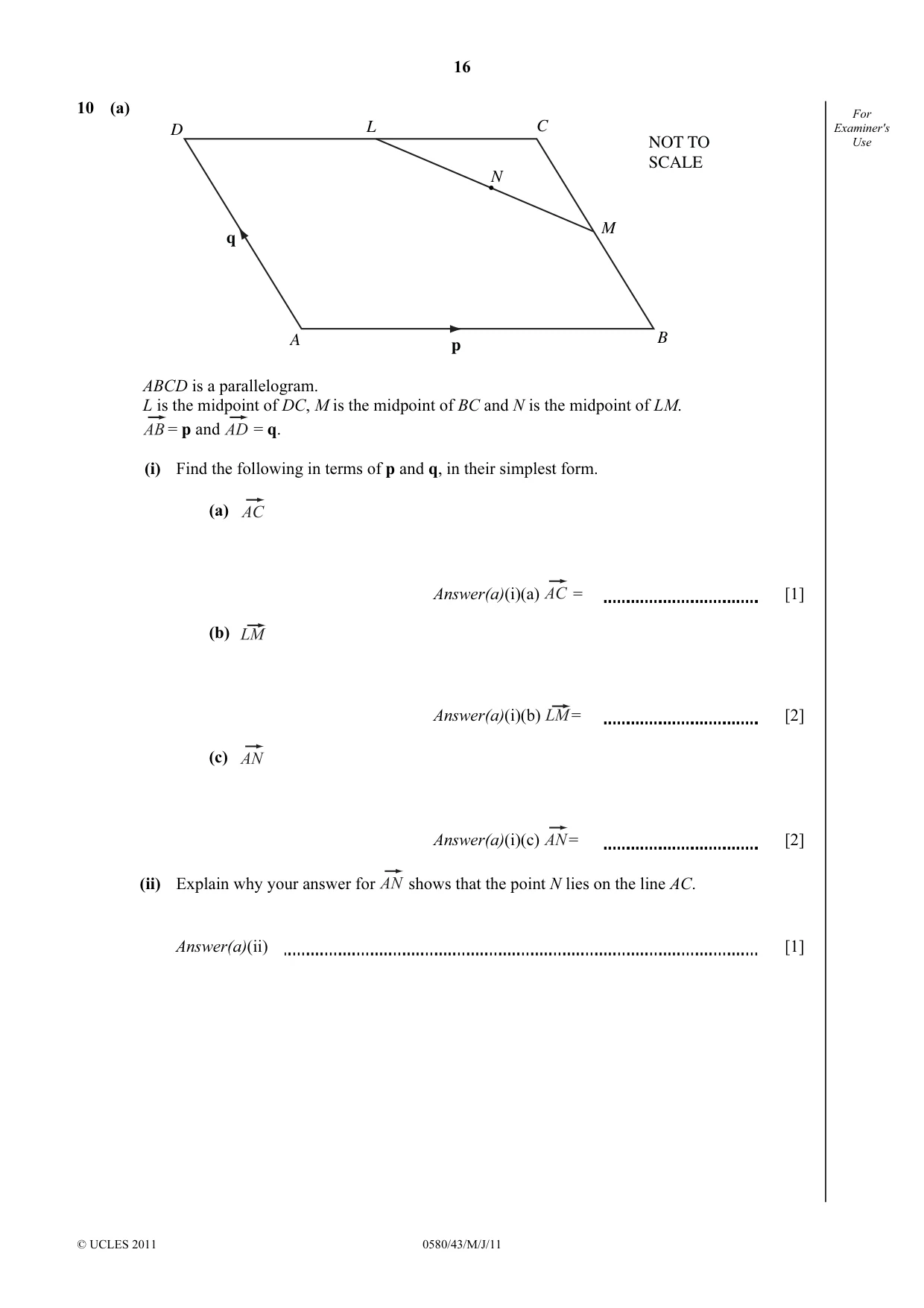
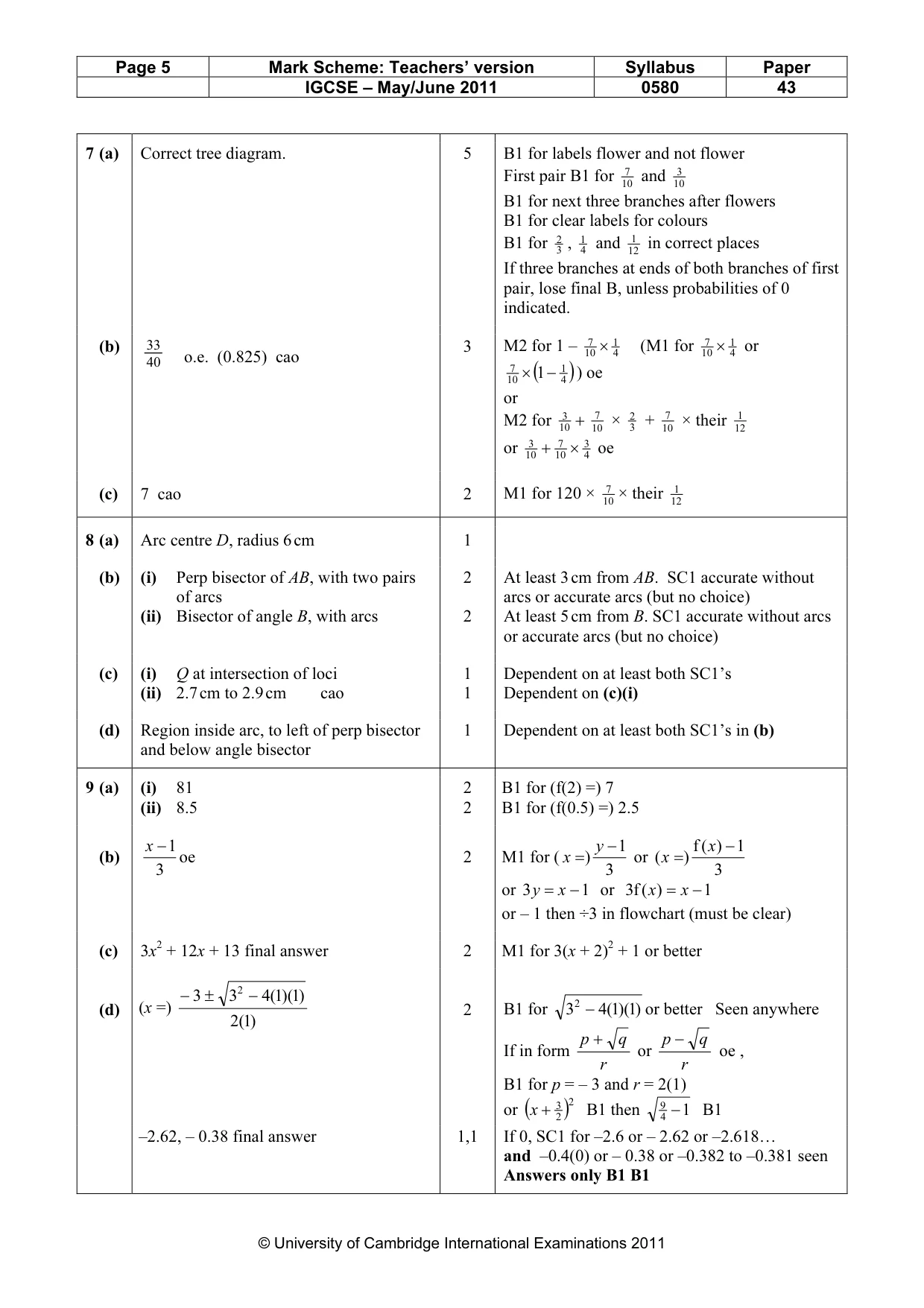
Mark scheme: 6 (a) (i) 5.8 1 (ii) 4.6 to 4.65 1 (iii) 2.35 to 2.5 1 (iv) 172 or 171 2 SC1 for 28 or 29 (b) (i) 72 to 76, 38 to 42 2 Must be integers. B1 either. (ii) Their correct Σfx ÷ 200 4 M1 for 3 or 4 correct mid-values seen 2, 5, 6.5, 8.5 M1 for Σfx, ft their frequencies and x anywhere in interval, including boundaries 36 × 2 + (72 to 76) × 5 + (38 to 42) × 6.5 + 50 × 8.5 M1 for ÷ 200 or their 200 (dependent on second M1) (74, 40 give 1127 then 5.635 (or 5.64 or 5.63)) Other pairs of frequencies from (b)(i) must have a sum of 114 to gain the A mark. (iii) p ÷ 2, q, where p, q are from (b)(i) 2ft B1 either ft (ft their table) Histogram with two new columns of correct width B1 Two correct heights 2ft B1 ft (ft their freq. densities) IGCSE – May/June 2011 0580 43 7 (a) Correct tree diagram. 5 B1 for labels flower and not flower First pair B1 for 107 and 103 B1 for next three branches after flowers B1 for clear labels for colours B1 for 23 , 14 and 121 in correct places If three branches at ends of both branches of first pair, lose final B, unless probabilities of 0 indicated. (b) 33 3 M2 for 1 – 107 × 14 (M1 for 107 × 14 or 40 o.e. (0.825) cao 7 1 10 × (1− 4 ) ) oe or M2 for 103 + 107 × 23 + 107 × their 121 or 103 + 107 × 34 oe (c) 7 cao 2 M1 for 120 × 107 × their 121 8 (a) Arc centre D, radius 6 cm 1 (b) (i) Perp bisector of AB, with two pairs 2 At least 3 cm from AB. SC1 accurate without of arcs arcs or accurate arcs (but no choice) (ii) Bisector of angle B, with arcs 2 At least 5 cm from B. SC1 accurate without arcs or accurate arcs (but no choice) (c) (i) Q at intersection of loci 1 Dependent on at least both SC1’s (ii) 2.7 cm to 2.9 cm cao 1 Dependent on (c)(i) (d) Region inside arc, to left of perp bisector 1 Dependent on at least both SC1’s in (b) and below angle bisector
What was in this paper
The subtopics covered by these 6 questions, and how many questions each got. Open one in a new tab to see every Cambridge question on it.
What you needed in this session
Cambridge’s own grade thresholds for 2011 May/June, Paper 4 · Variant 3. A higher threshold means an easier paper — the bar moves with how the cohort did.