Cambridge IGCSE Mathematics 0580 — 2011 May/June Paper 4 · Variant 2
0580/42/M/J/11 · 5 questions · 130 marks · ≈146 min
The question paper and its mark scheme, free to read here and free to download. This is Cambridge’s own paper, exactly as it was sat.
Question paper16 pages
Mark scheme7 pages
Answers below. Sit the paper first if you are practising.
Questions as text
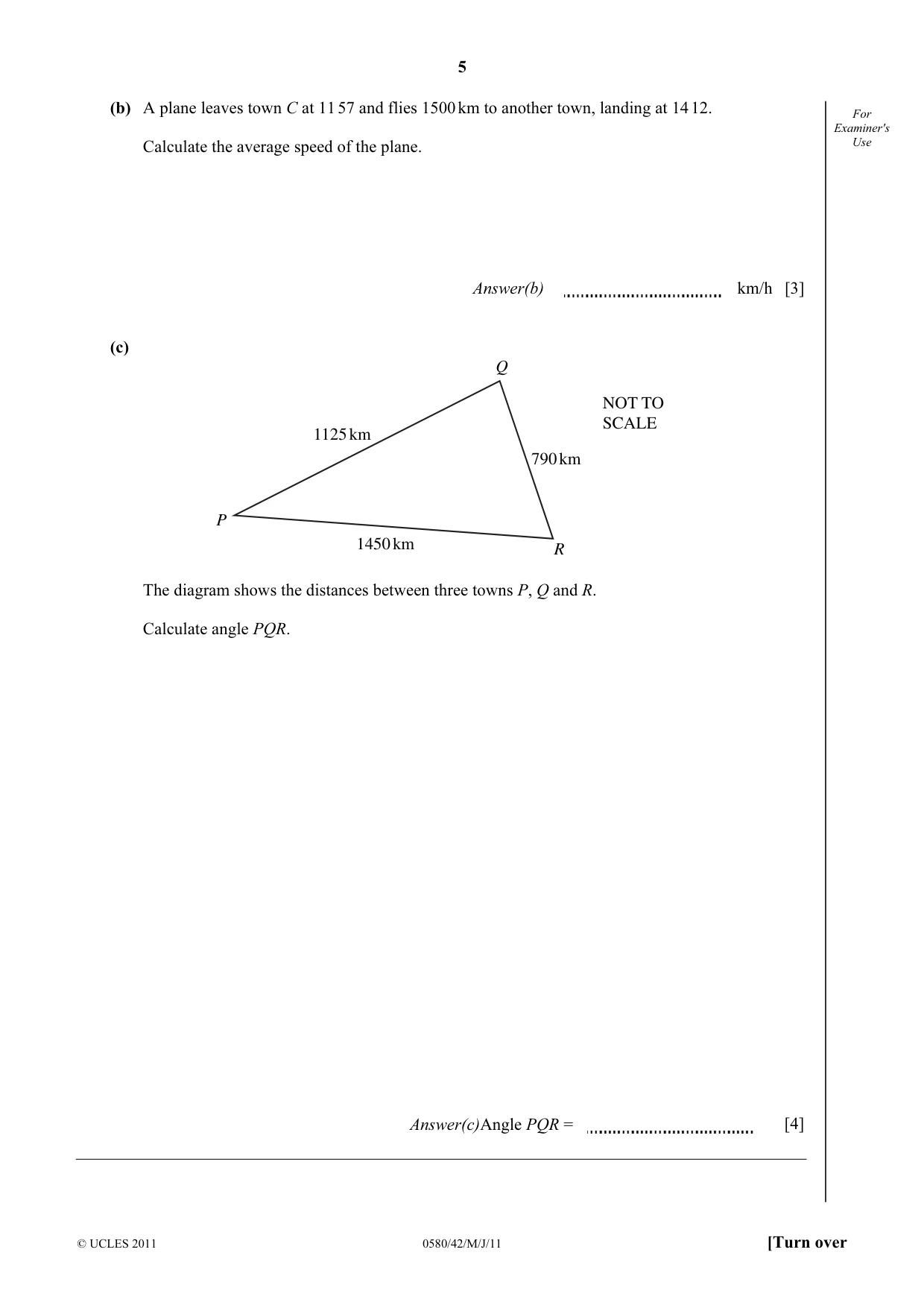
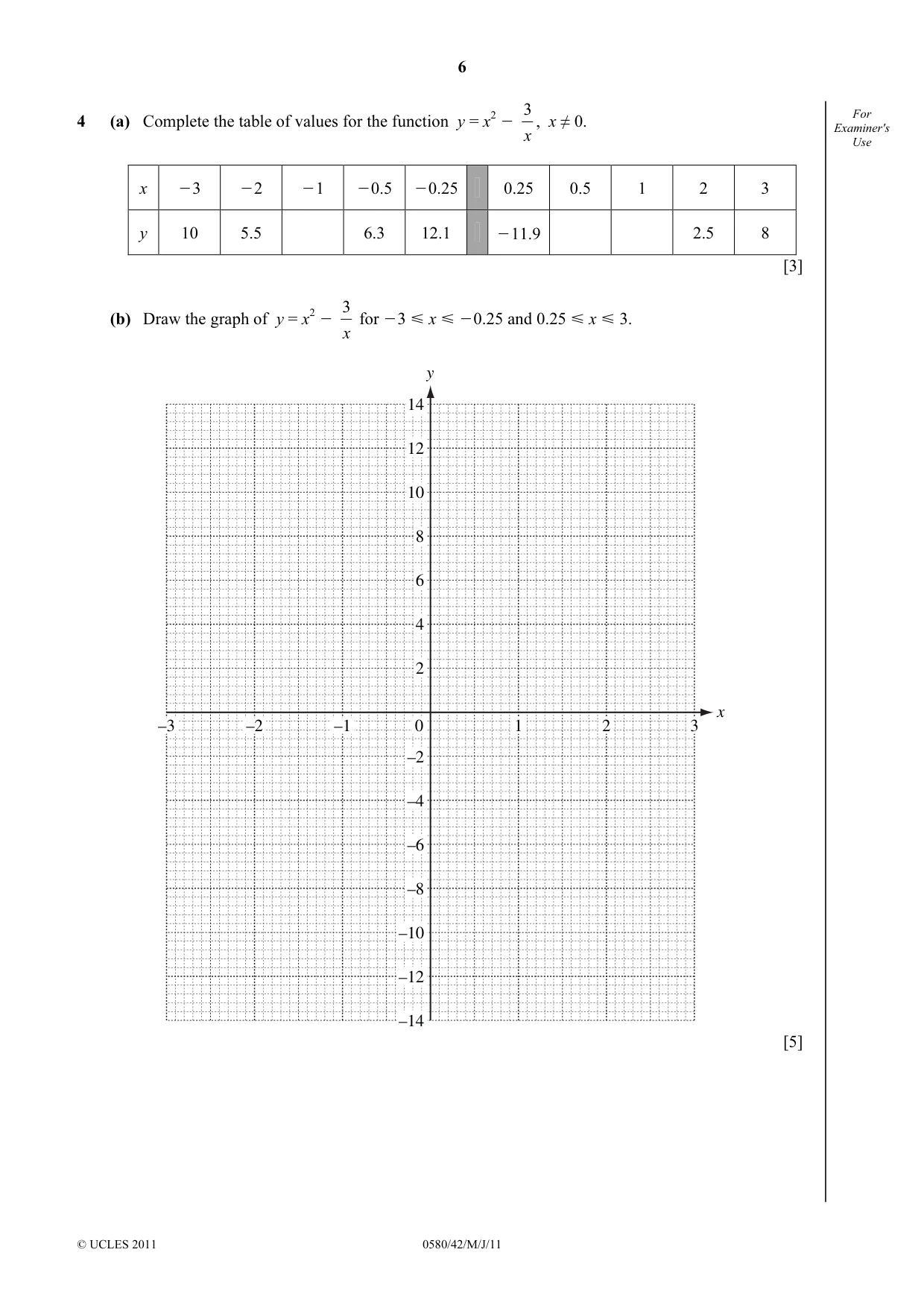
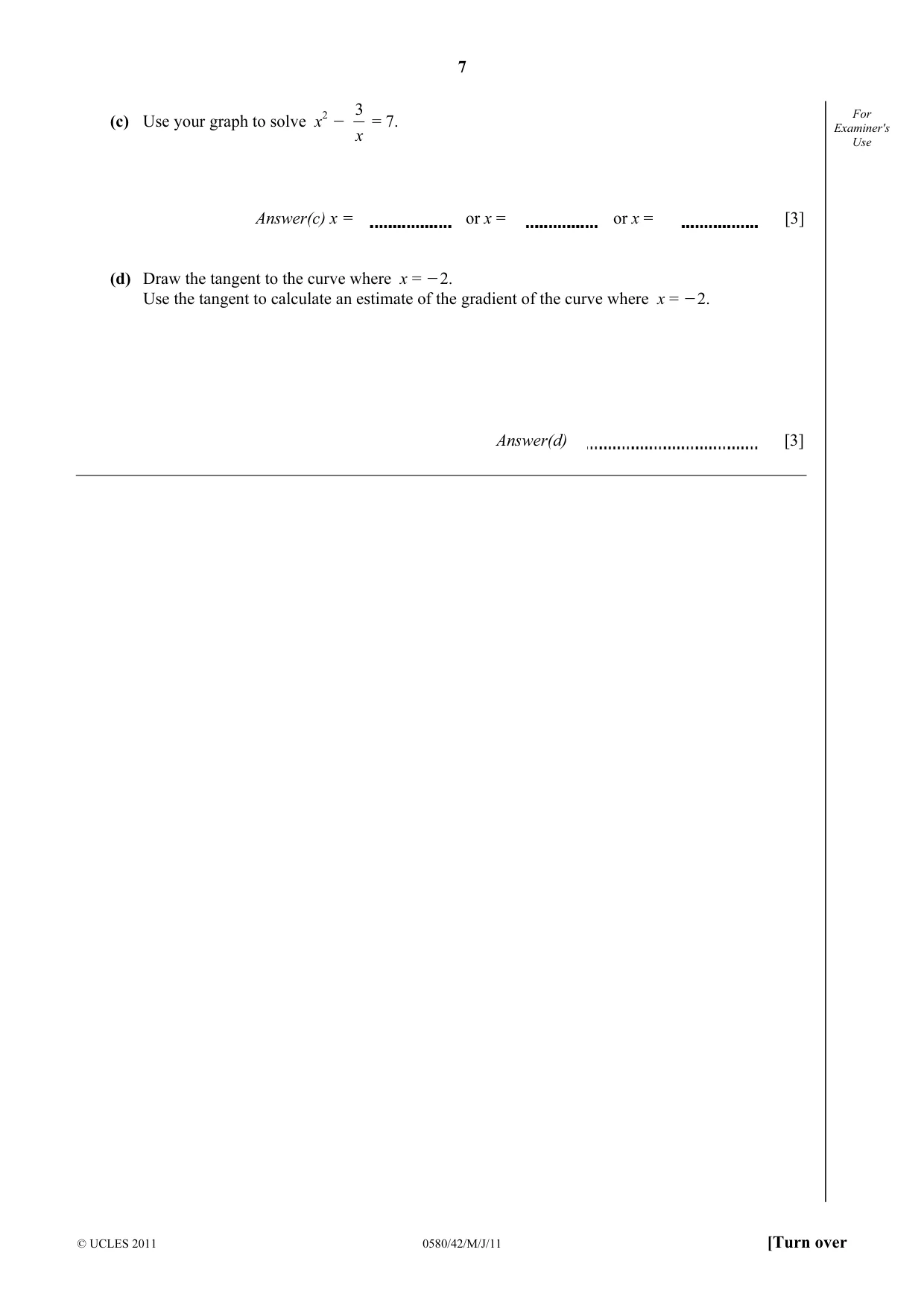
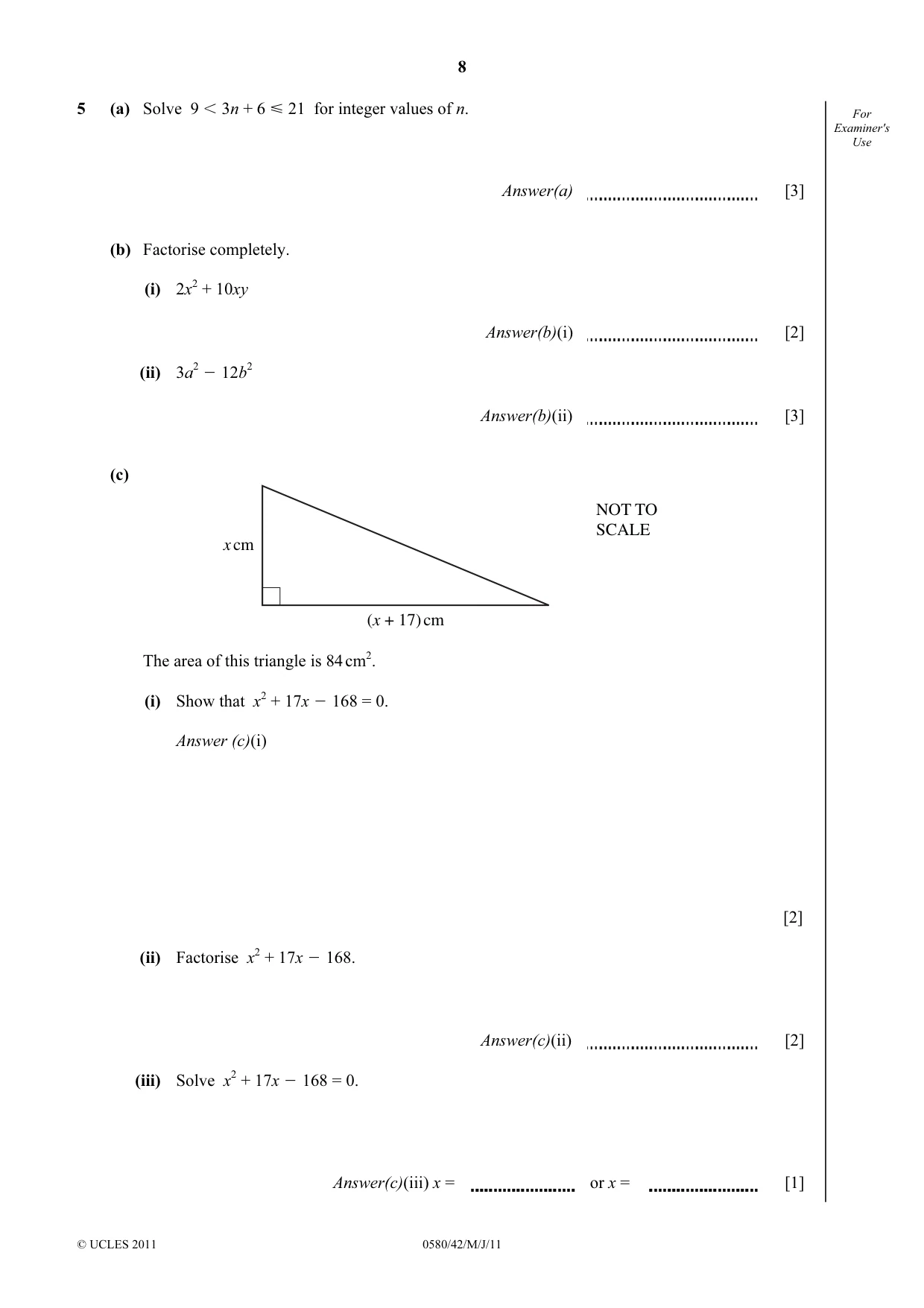
Q5 · Solve 9 I 3n + 6 Y 21 for integer values of n
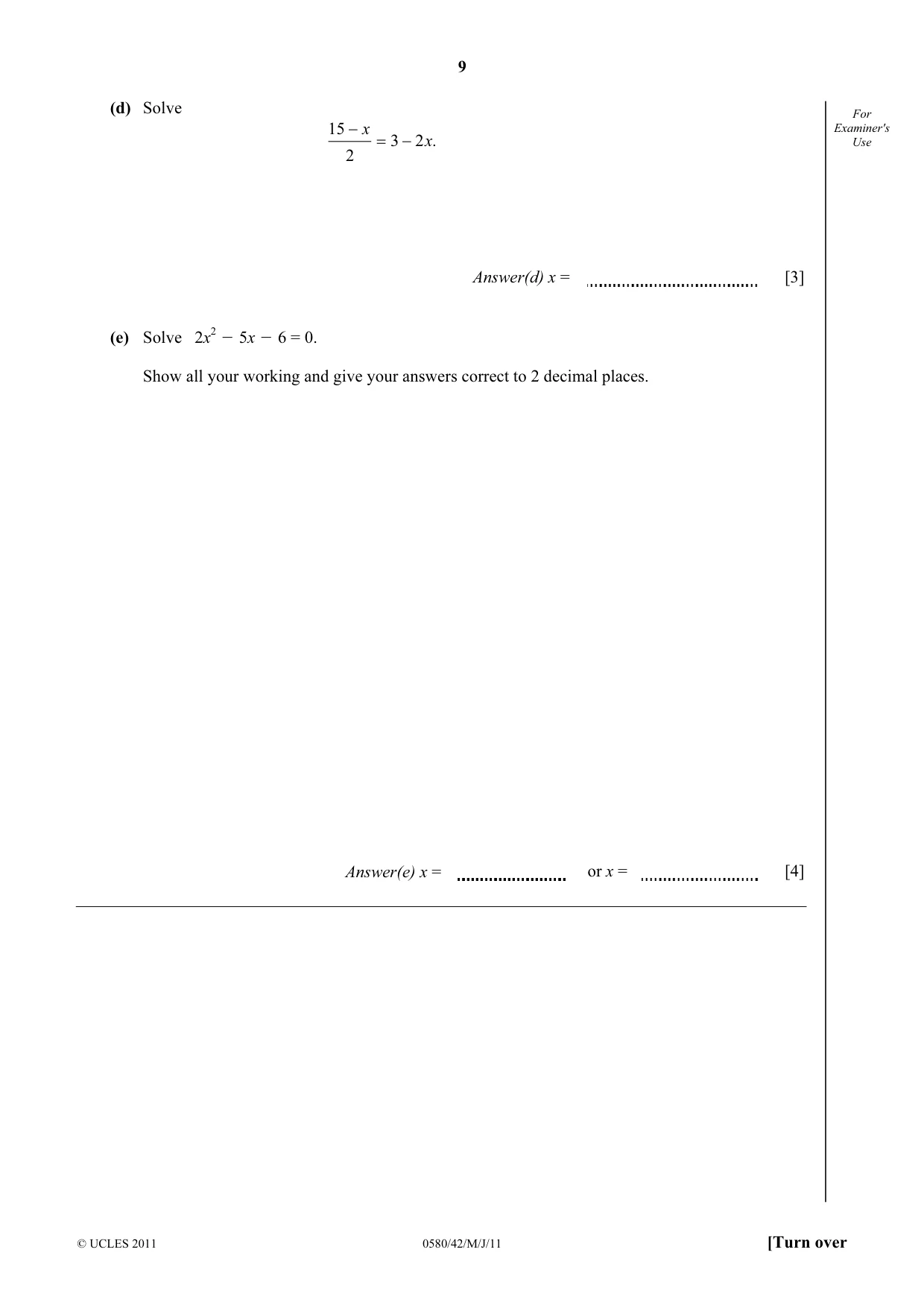
5 (a) Solve 9 I 3n + 6 Y 21 for integer values of n. For Examiner's Use Answer(a) [3] (b) Factorise completely. (i) 2x2 + 10xy Answer(b)(i) [2] (ii) 3a2 O 12b2 Answer(b)(ii) [3] (c) NOT TO SCALE x cm (x + 17) cm The area of this triangle is 84 cm2. (i) Show that x2 + 17x O 168 = 0. Answer (c)(i) [2] (ii) Factorise x2 + 17x O 168. Answer(c)(ii) [2] (iii) Solve x2 + 17x O 168 = 0. Answer(c)(iii) x = or x = [1] (d) Solve For 15 − x Examiner's = 3 − 2 x. Use 2 Answer(d) x = [3] (e) Solve 2x2 O 5x O 6 = 0. Show all your working and give your answers correct to 2 decimal places. Answer(e) x = or x = [4]
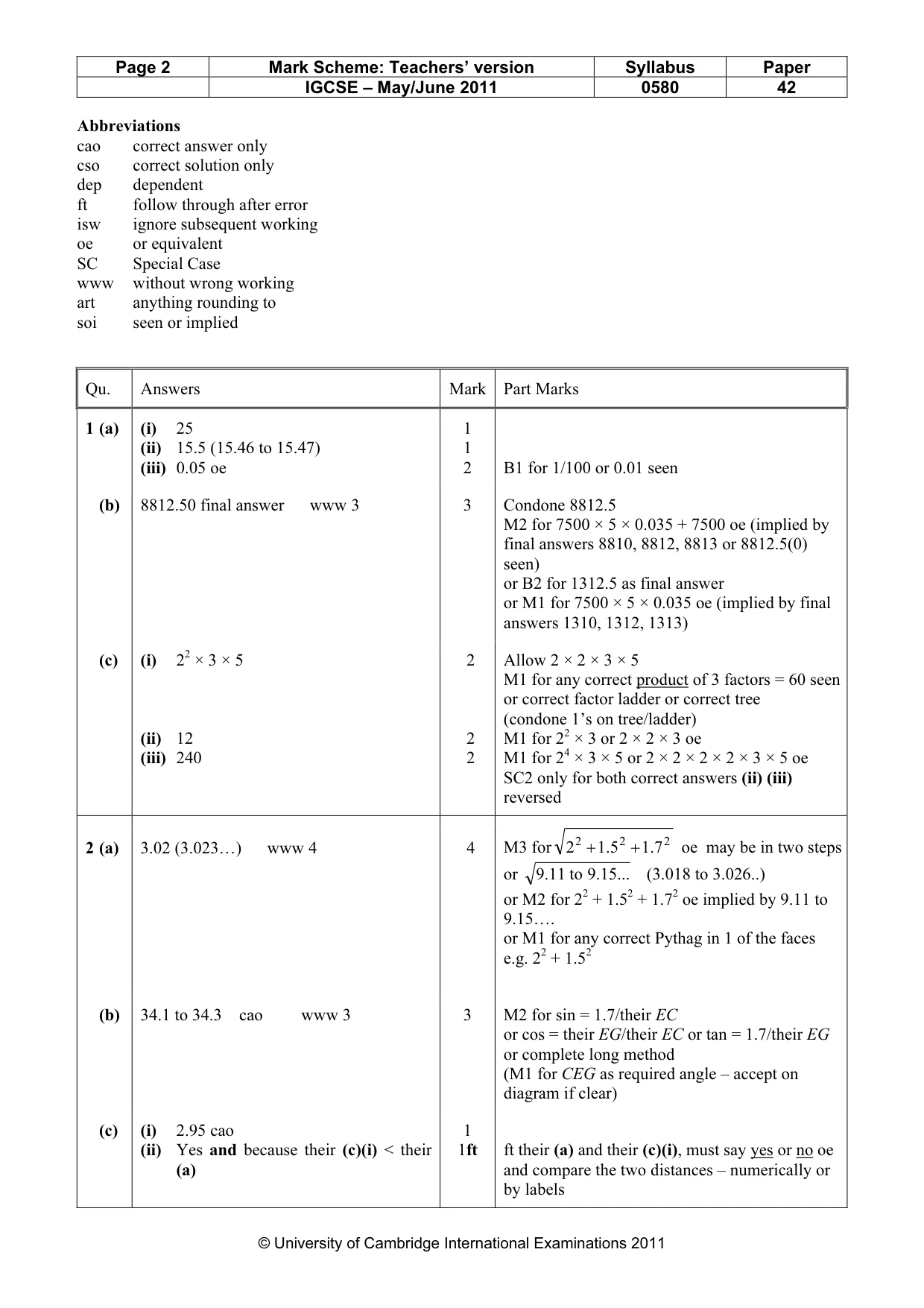
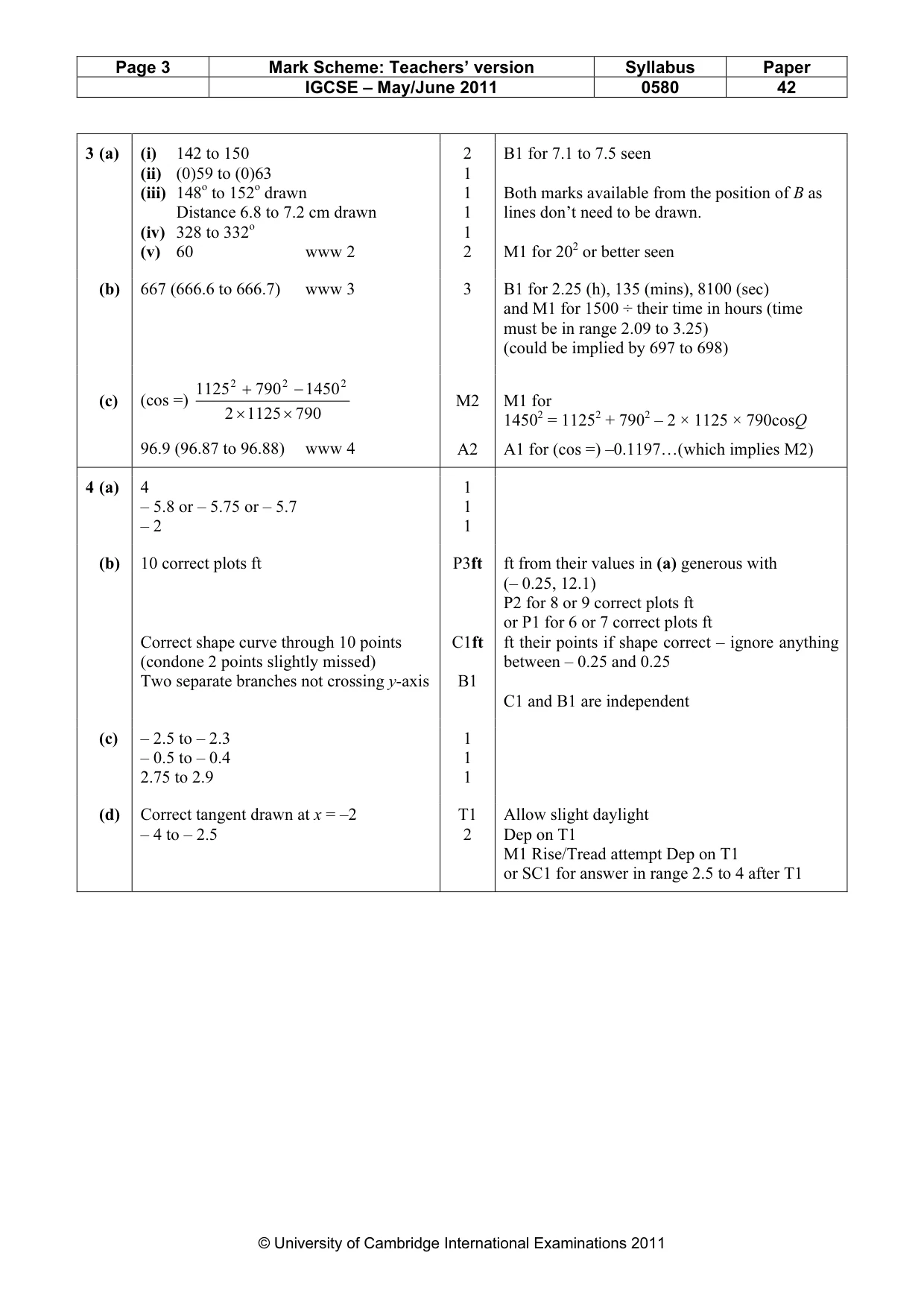
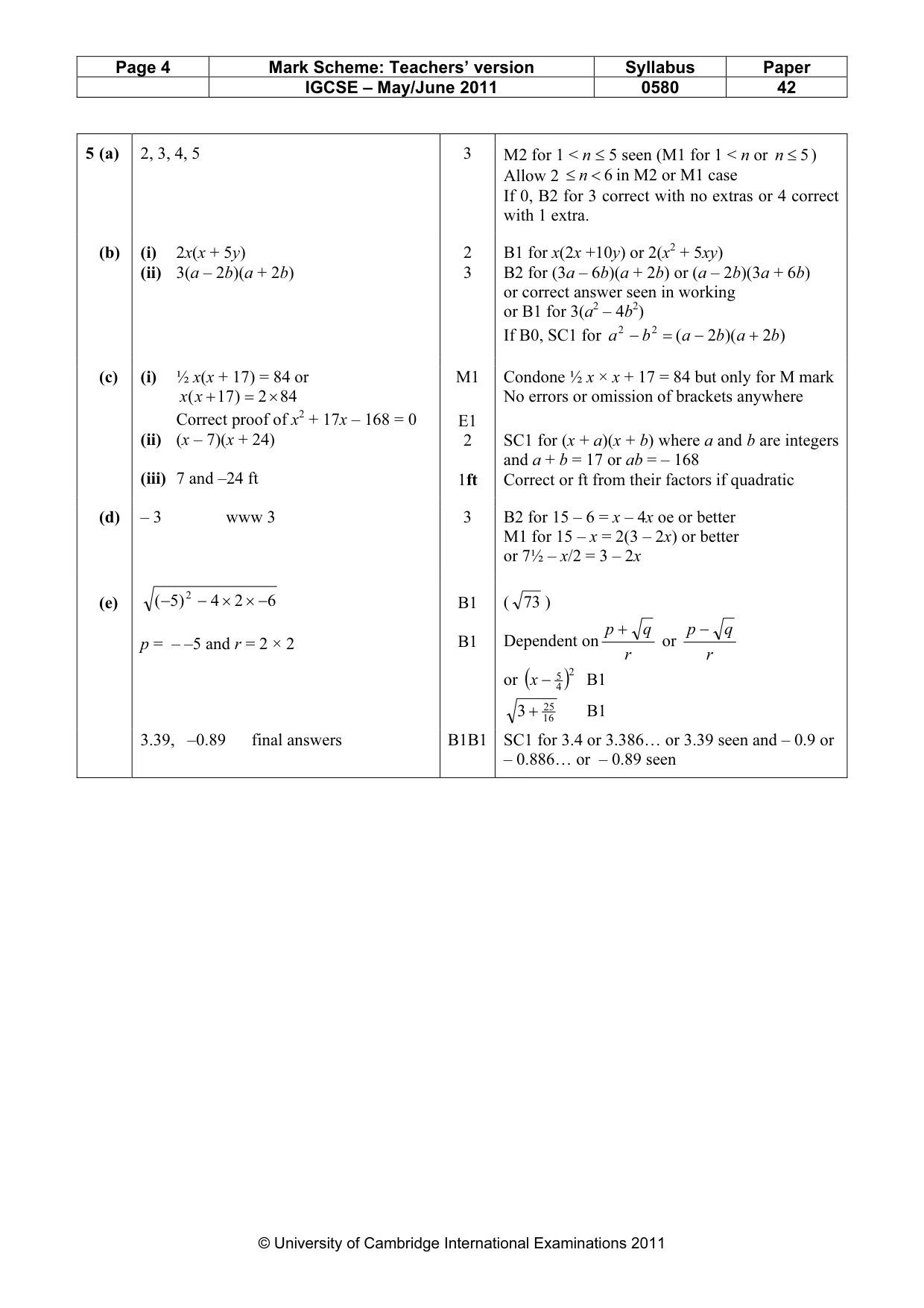
Mark scheme: 5 (a) 2, 3, 4, 5 3 M2 for 1 < n ≤ 5 seen (M1 for 1 < n or n ≤ 5 ) Allow 2 ≤n < 6 in M2 or M1 case If 0, B2 for 3 correct with no extras or 4 correct with 1 extra. (b) (i) 2x(x + 5y) 2 B1 for x(2x +10y) or 2(x2 + 5xy) (ii) 3(a – 2b)(a + 2b) 3 B2 for (3a – 6b)(a + 2b) or (a – 2b)(3a + 6b) or correct answer seen in working or B1 for 3(a2 – 4b2) If B0, SC1 for a 2 − b 2 = ( a − 2b )( a + 2b ) (c) (i) ½ x(x + 17) = 84 or M1 Condone ½ x × x + 17 = 84 but only for M mark x ( x + 17 ) = 2 × 84 No errors or omission of brackets anywhere Correct proof of x2 + 17x – 168 = 0 E1 (ii) (x – 7)(x + 24) 2 SC1 for (x + a)(x + b) where a and b are integers and a + b = 17 or ab = – 168 (iii) 7 and –24 ft 1ft Correct or ft from their factors if quadratic (d) – 3 www 3 3 B2 for 15 – 6 = x – 4x oe or better M1 for 15 – x = 2(3 – 2x) or better or 7½ – x/2 = 3 – 2x (e) ( −5) 2 − 4 × 2 × −6 B1 ( 73 ) p + q p − q p = – –5 and r = 2 × 2 B1 Dependent on or r r 5 or ( x − 4 )2 B1 3 + 1625 B1 3.39, –0.89 final answers B1B1 SC1 for 3.4 or 3.386… or 3.39 seen and – 0.9 or – 0.886… or – 0.89 seen IGCSE – May/June 2011 0580 42
Q6 · For Time Examiner's 0 I t Y 20 20 I t Y 35 35 I t Y 45 45 I t Y 55 55 I t Y 70 70 I t Y…
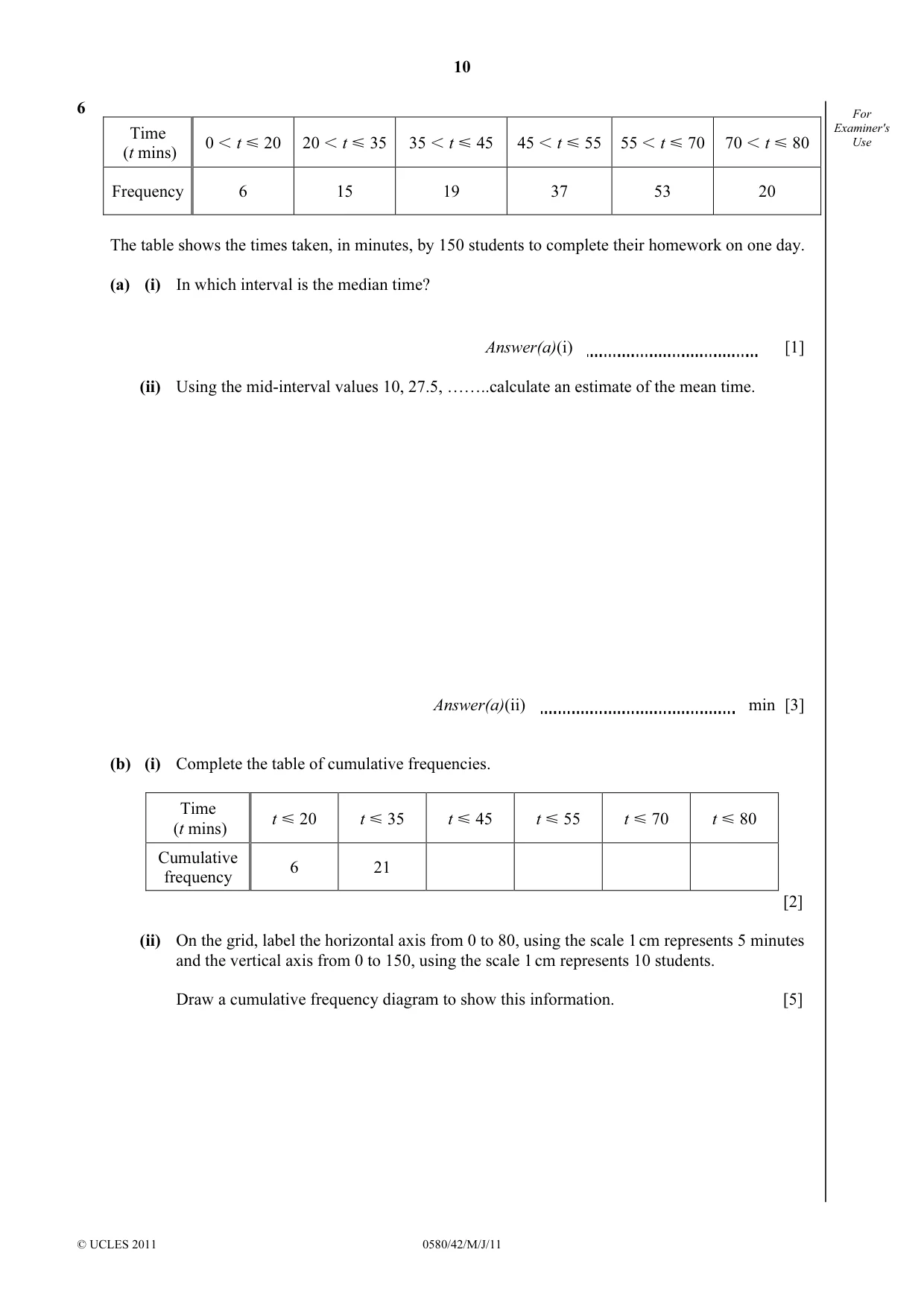
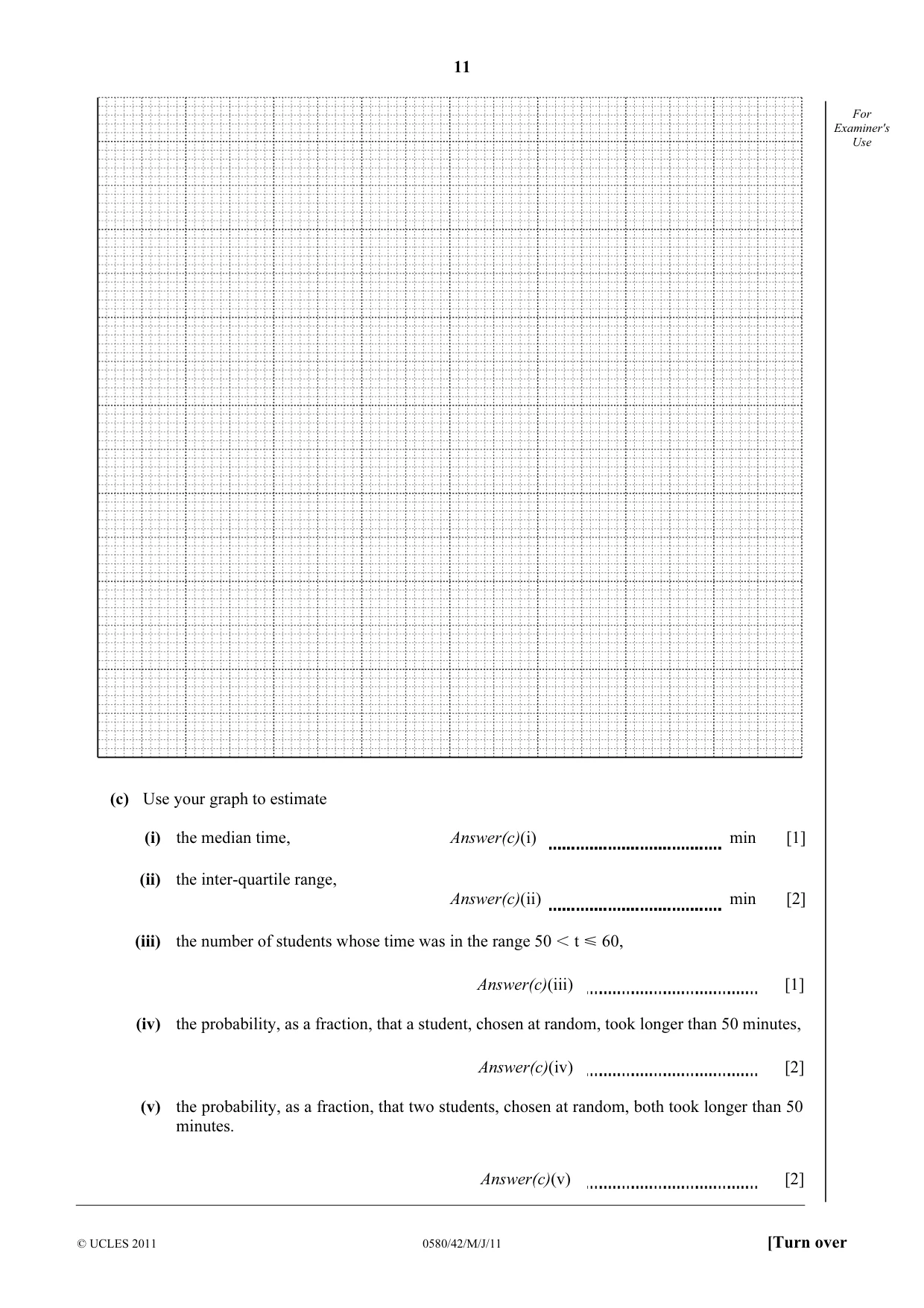
6 For Time Examiner's 0 I t Y 20 20 I t Y 35 35 I t Y 45 45 I t Y 55 55 I t Y 70 70 I t Y 80 Use (t mins) Frequency 6 15 19 37 53 20 The table shows the times taken, in minutes, by 150 students to complete their homework on one day. (a) (i) In which interval is the median time? Answer(a)(i) [1] (ii) Using the mid-interval values 10, 27.5, ……..calculate an estimate of the mean time. Answer(a)(ii) min [3] (b) (i) Complete the table of cumulative frequencies. Time t Y 20 t Y 35 t Y 45 t Y 55 t Y 70 t Y 80 (t mins) Cumulative 6 21 frequency [2] (ii) On the grid, label the horizontal axis from 0 to 80, using the scale 1 cm represents 5 minutes and the vertical axis from 0 to 150, using the scale 1 cm represents 10 students. Draw a cumulative frequency diagram to show this information. [5] For Examiner's Use (c) Use your graph to estimate (i) the median time, Answer(c)(i) min [1] (ii) the inter-quartile range, Answer(c)(ii) min [2] (iii) the number of students whose time was in the range 50 I t Y 60, Answer(c)(iii) [1] (iv) the probability, as a fraction, that a student, chosen at random, took longer than 50 minutes, Answer(c)(iv) [2] (v) the probability, as a fraction, that two students, chosen at random, both took longer than 50 minutes. Answer(c)(v) [2]
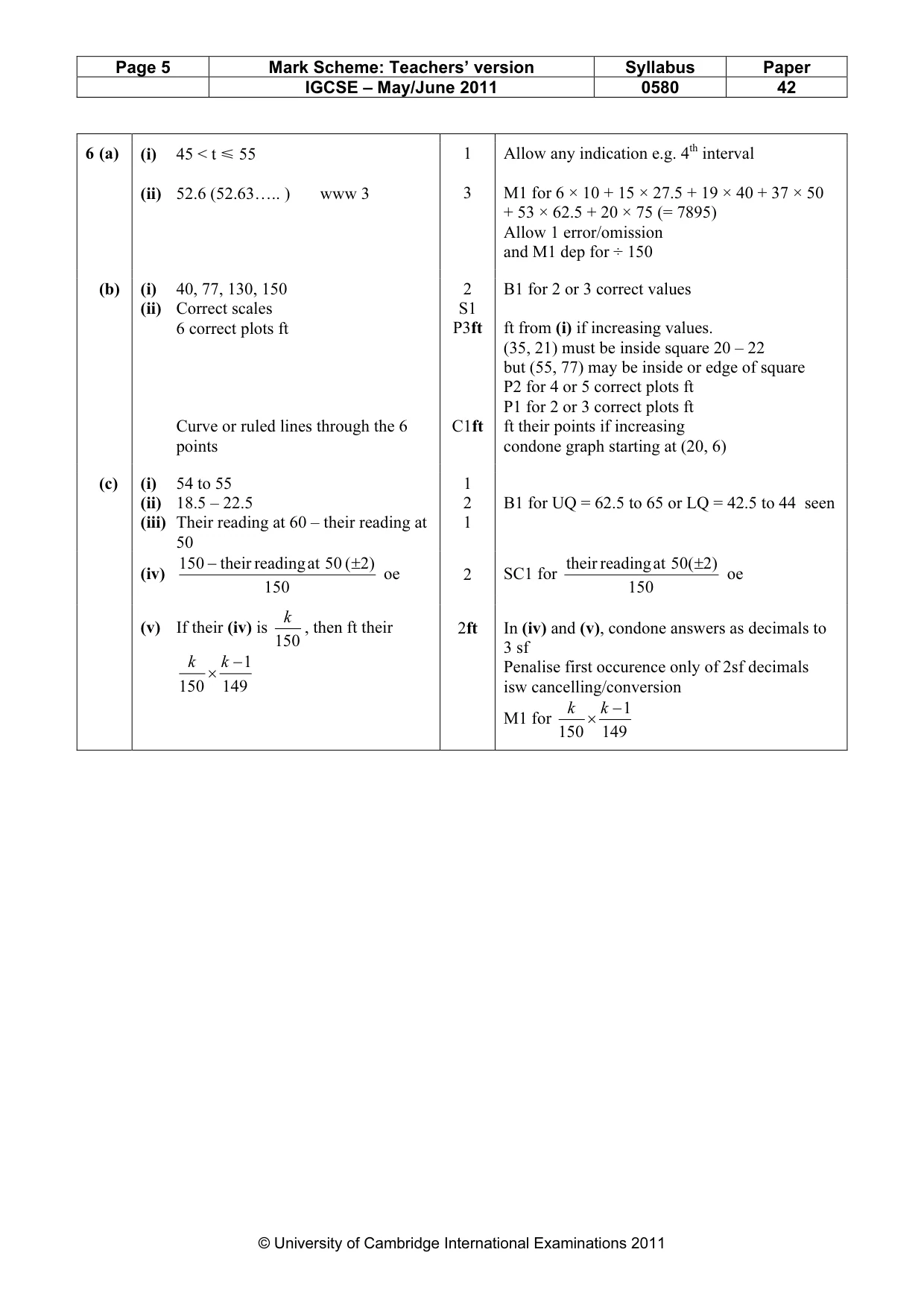
Mark scheme: 6 (a) (i) 45 < t Y 55 1 Allow any indication e.g. 4th interval (ii) 52.6 (52.63….. ) www 3 3 M1 for 6 × 10 + 15 × 27.5 + 19 × 40 + 37 × 50 + 53 × 62.5 + 20 × 75 (= 7895) Allow 1 error/omission and M1 dep for ÷ 150 (b) (i) 40, 77, 130, 150 2 B1 for 2 or 3 correct values (ii) Correct scales S1 6 correct plots ft P3ft ft from (i) if increasing values. (35, 21) must be inside square 20 – 22 but (55, 77) may be inside or edge of square P2 for 4 or 5 correct plots ft P1 for 2 or 3 correct plots ft Curve or ruled lines through the 6 C1ft ft their points if increasing points condone graph starting at (20, 6) (c) (i) 54 to 55 1 (ii) 18.5 – 22.5 2 B1 for UQ = 62.5 to 65 or LQ = 42.5 to 44 seen (iii) Their reading at 60 – their reading at 1 50 150 − their reading at 50 ( ±2) their reading at 50( ±2) (iv) oe 2 SC1 for oe 150 150 k (v) If their (iv) is , then ft their 2ft In (iv) and (v), condone answers as decimals to 150 3 sf k k − 1 Penalise first occurence only of 2sf decimals × 150 149 isw cancelling/conversion k k − 1 M1 for × 150 149 IGCSE – May/June 2011 0580 42
Q7 · For V Examiner's V Use B C NOT TO SCALE B C A D 9.5 cm A D 2.5 cm 2.5 cm F 2.5 cm E F E F…
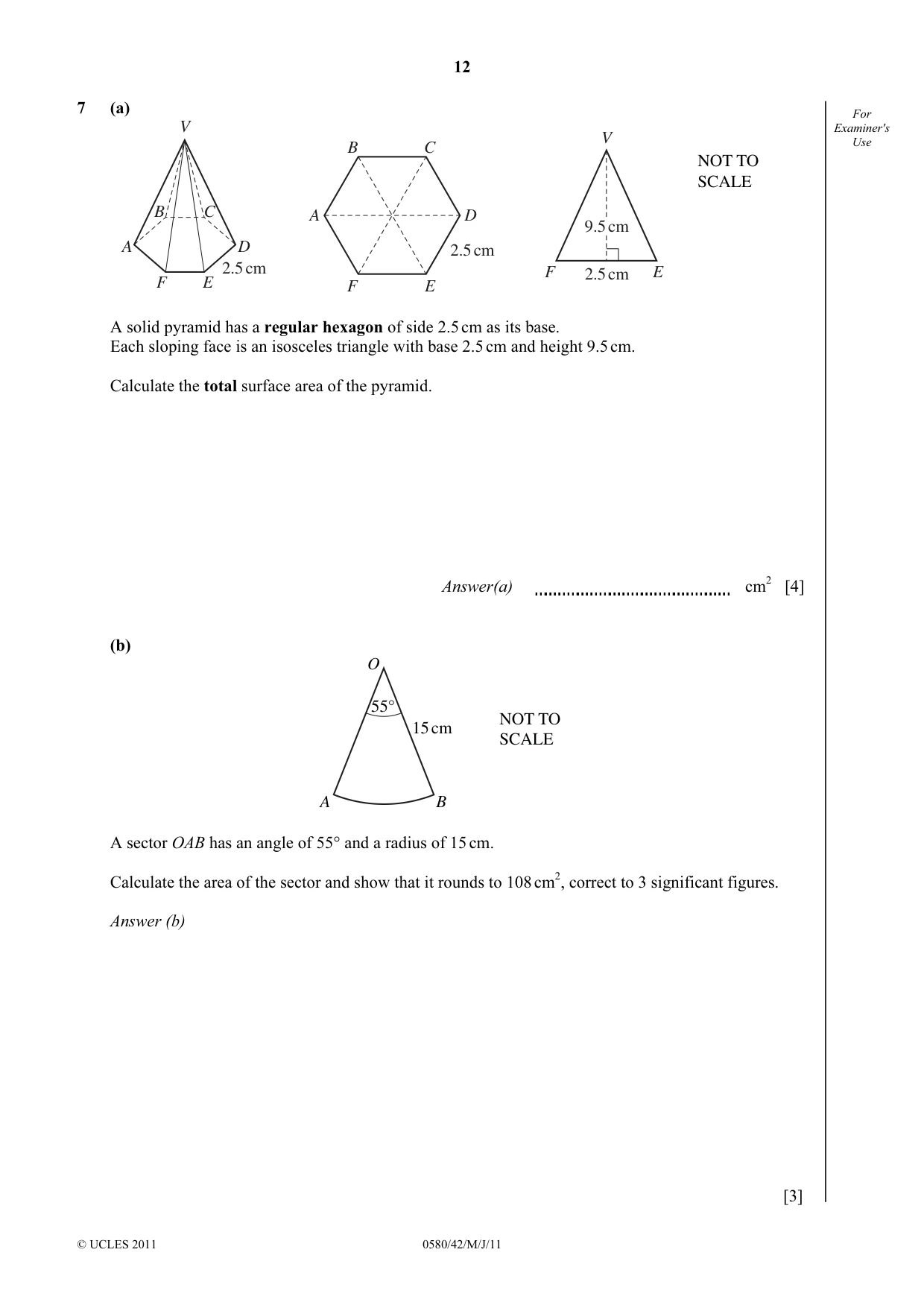
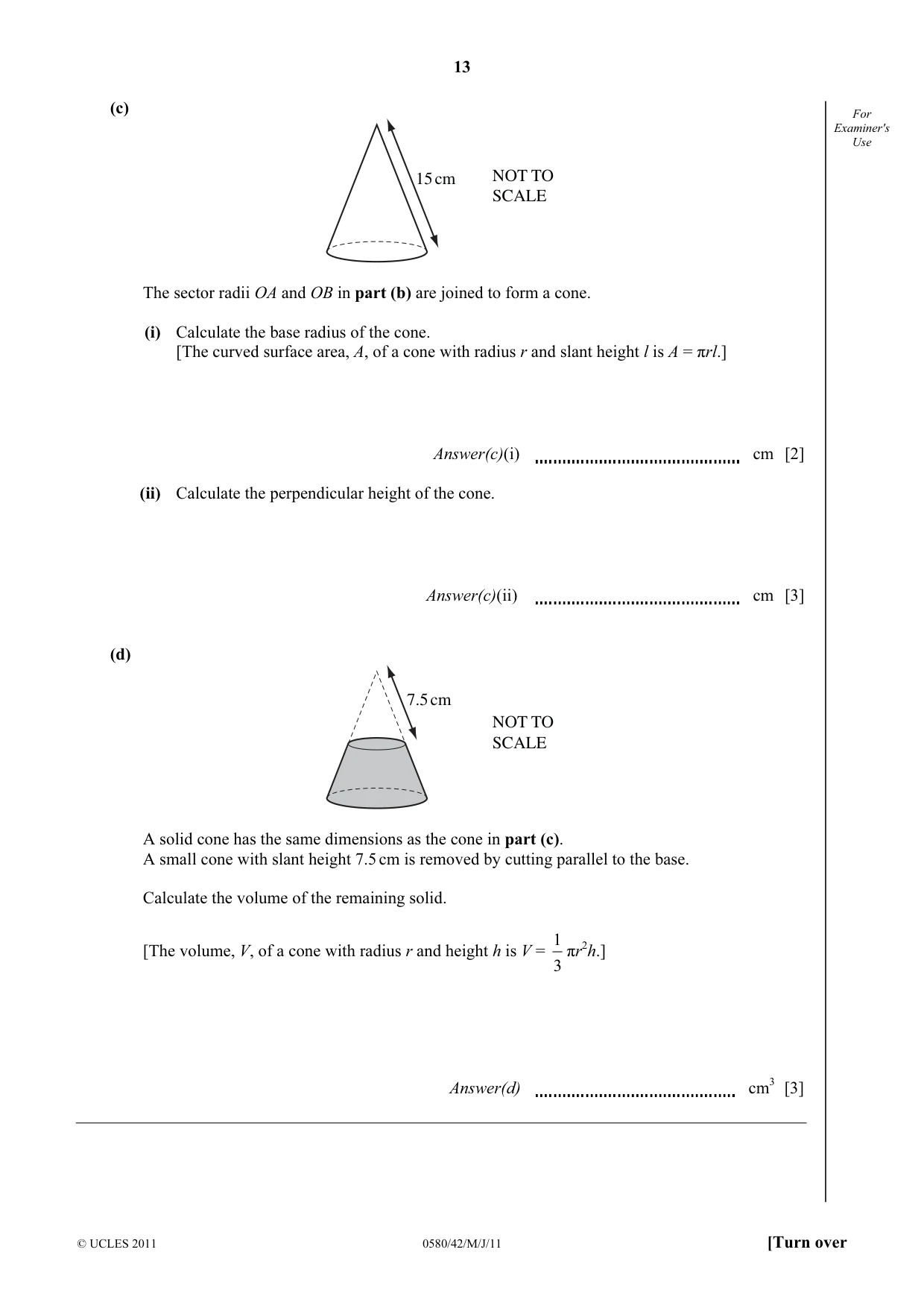
7 (a) For V Examiner's V Use B C NOT TO SCALE B C A D 9.5 cm A D 2.5 cm 2.5 cm F 2.5 cm E F E F E A solid pyramid has a regular hexagon of side 2.5 cm as its base. Each sloping face is an isosceles triangle with base 2.5 cm and height 9.5 cm. Calculate the total surface area of the pyramid. Answer(a) cm2 [4] (b) O 55° NOT TO 15 cm SCALE A B A sector OAB has an angle of 55° and a radius of 15 cm. Calculate the area of the sector and show that it rounds to 108 cm2, correct to 3 significant figures. Answer (b) [3] (c) For Examiner's Use 15 cm NOT TO SCALE The sector radii OA and OB in part (b) are joined to form a cone. (i) Calculate the base radius of the cone. [The curved surface area, A, of a cone with radius r and slant height l is A = πrl.] Answer(c)(i) cm [2] (ii) Calculate the perpendicular height of the cone. Answer(c)(ii) cm [3] (d) 7.5 cm NOT TO SCALE A solid cone has the same dimensions as the cone in part (c). A small cone with slant height 7.5 cm is removed by cutting parallel to the base. Calculate the volume of the remaining solid. 1 [The volume, V, of a cone with radius r and height h is V = πr2h.] 3 Answer(d) cm3 [3]
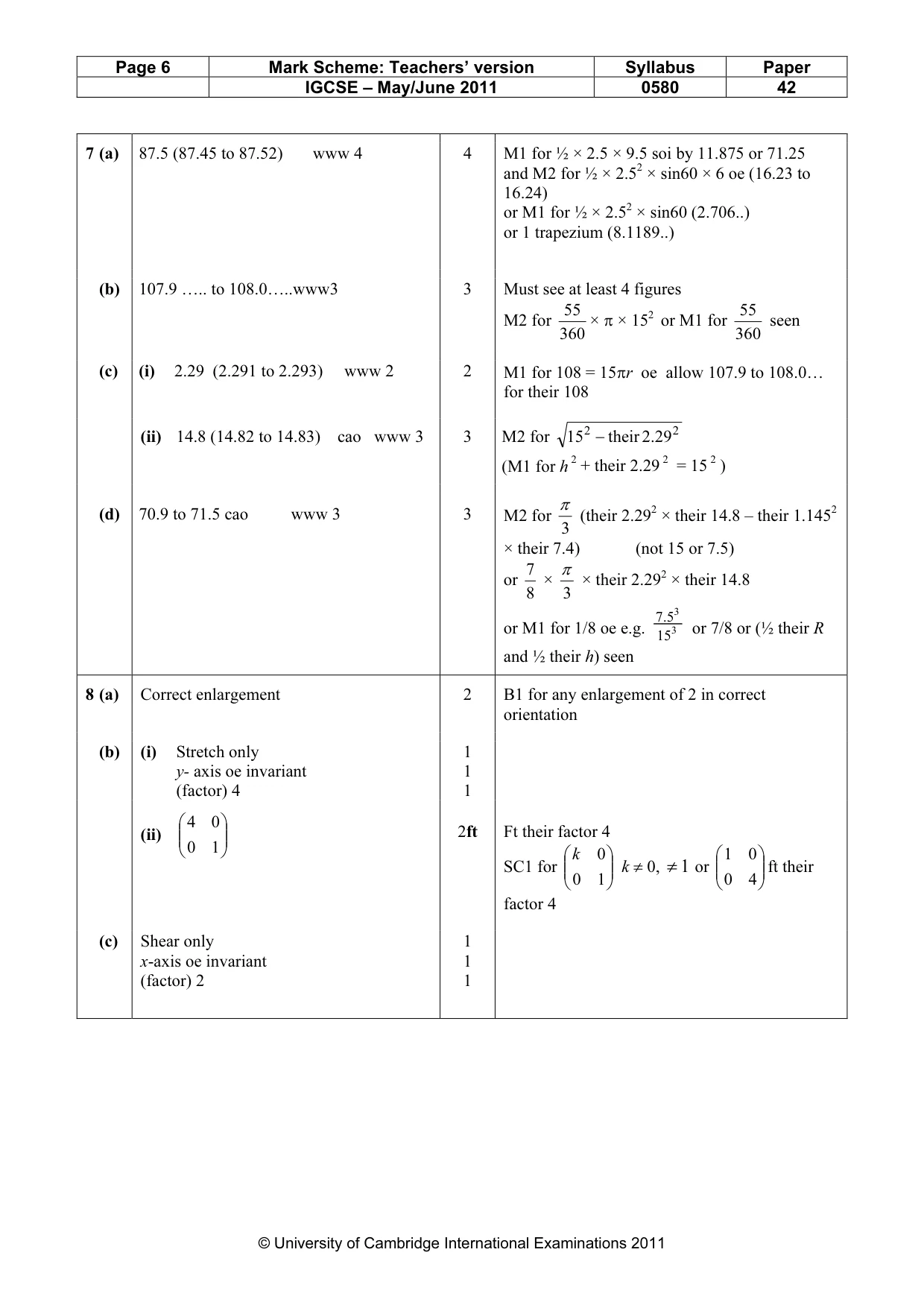
Mark scheme: 7 (a) 87.5 (87.45 to 87.52) www 4 4 M1 for ½ × 2.5 × 9.5 soi by 11.875 or 71.25 and M2 for ½ × 2.52 × sin60 × 6 oe (16.23 to 16.24) or M1 for ½ × 2.52 × sin60 (2.706..) or 1 trapezium (8.1189..) (b) 107.9 ….. to 108.0…..www3 3 Must see at least 4 figures 55 55 M2 for × π × 152 or M1 for seen 360 360 (c) (i) 2.29 (2.291 to 2.293) www 2 2 M1 for 108 = 15πr oe allow 107.9 to 108.0… for their 108 (ii) 14.8 (14.82 to 14.83) cao www 3 3 M2 for 15 2 − their 2.29 2 (M1 for h 2 + their 2.29 2 = 15 2 ) π (d) 70.9 to 71.5 cao www 3 3 M2 for (their 2.292 × their 14.8 – their 1.1452 3 × their 7.4) (not 15 or 7.5) 7 π or × × their 2.292 × their 14.8 8 3 5.7 3 or M1 for 1/8 oe e.g. 3 or 7/8 or (½ their R 15 and ½ their h) seen
Q8 · For Examiner's Use A P Draw the enlargement of triangle P with centre A and scale factor 2
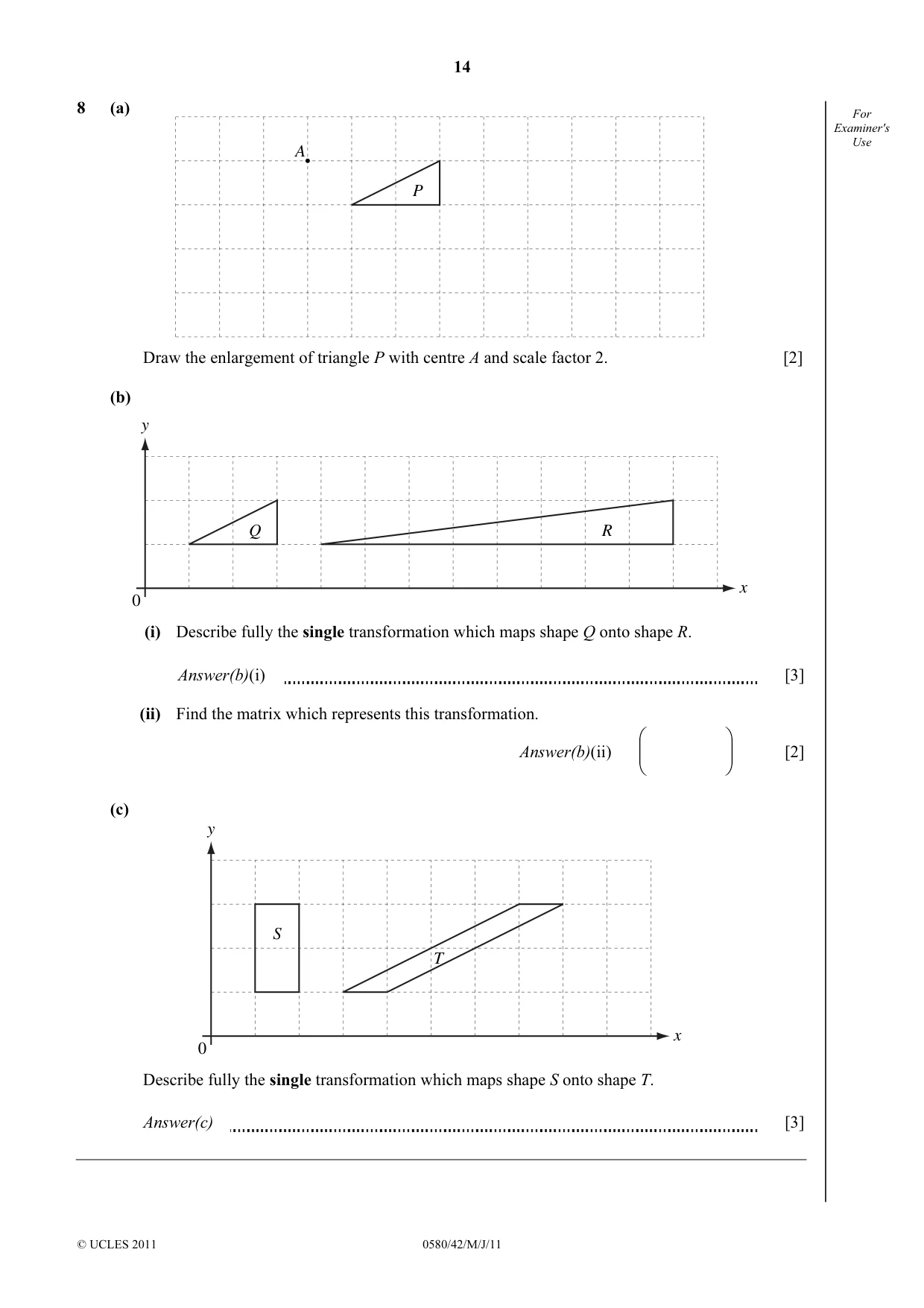
8 (a) For Examiner's Use A P Draw the enlargement of triangle P with centre A and scale factor 2. [2] (b) y Q R x 0 (i) Describe fully the single transformation which maps shape Q onto shape R. Answer(b)(i) [3] (ii) Find the matrix which represents this transformation. Answer(b)(ii) [2] (c) y S T x 0 Describe fully the single transformation which maps shape S onto shape T. Answer(c) [3]
Mark scheme: 8 (a) Correct enlargement 2 B1 for any enlargement of 2 in correct orientation (b) (i) Stretch only 1 y- axis oe invariant 1 (factor) 4 1 4 0 (ii) 2ft Ft their factor 4 0 1 k 0 1 0 SC1 for k ≠ 0, ≠ 1 or ft their 0 1 0 4 factor 4 (c) Shear only 1 x-axis oe invariant 1 (factor) 2 1 IGCSE – May/June 2011 0580 42
Q9 · Work out the first 3 terms of the sequence whose nth term is n(n + 2)
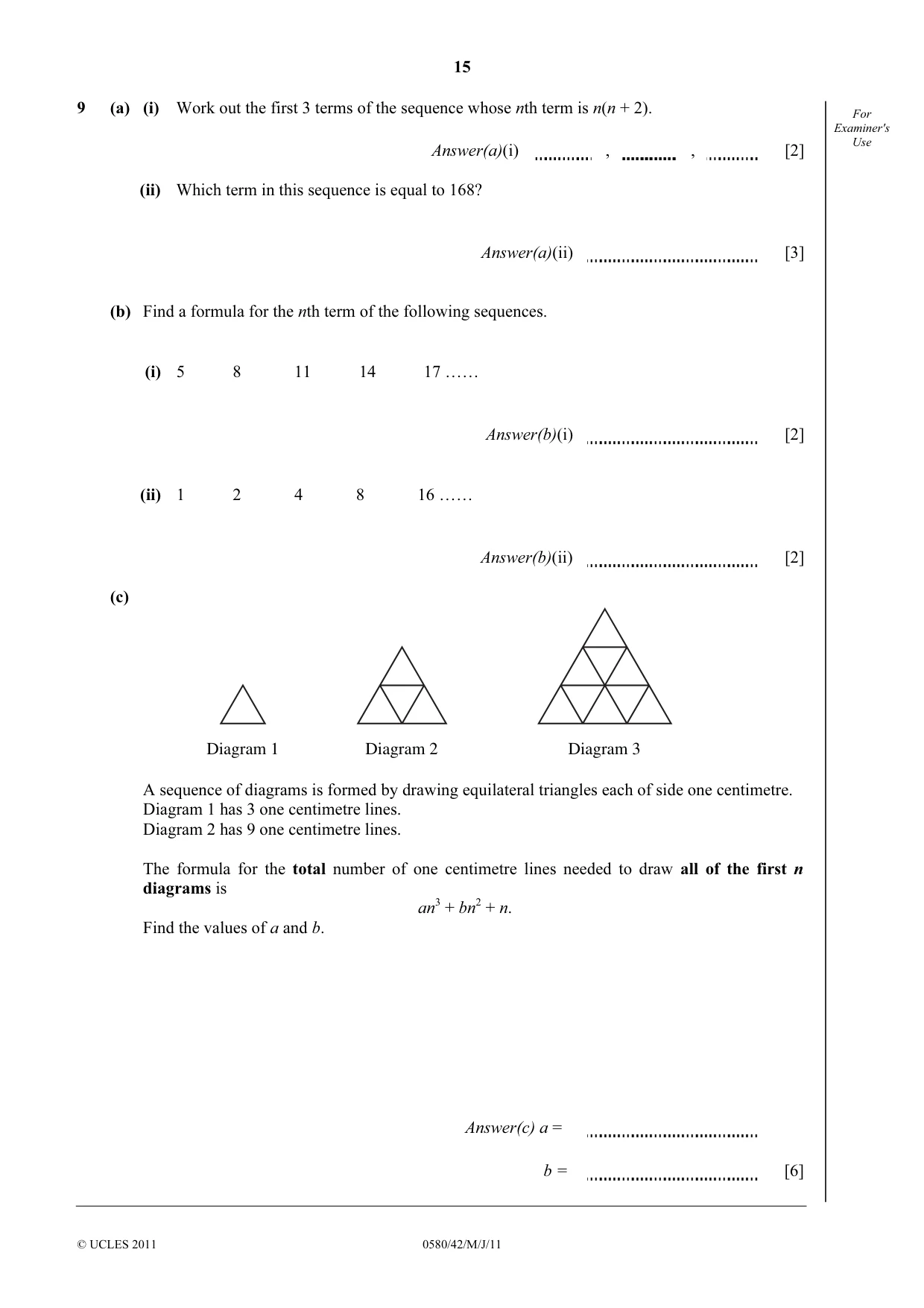
9 (a) (i) Work out the first 3 terms of the sequence whose nth term is n(n + 2). For Examiner's Answer(a)(i) , , [2] Use (ii) Which term in this sequence is equal to 168? Answer(a)(ii) [3] (b) Find a formula for the nth term of the following sequences. (i) 5 8 11 14 17 …… Answer(b)(i) [2] (ii) 1 2 4 8 16 …… Answer(b)(ii) [2] (c) Diagram 1 Diagram 2 Diagram 3 A sequence of diagrams is formed by drawing equilateral triangles each of side one centimetre. Diagram 1 has 3 one centimetre lines. Diagram 2 has 9 one centimetre lines. The formula for the total number of one centimetre lines needed to draw all of the first n diagrams is an3 + bn2 + n. Find the values of a and b. Answer(c) a = b = [6]
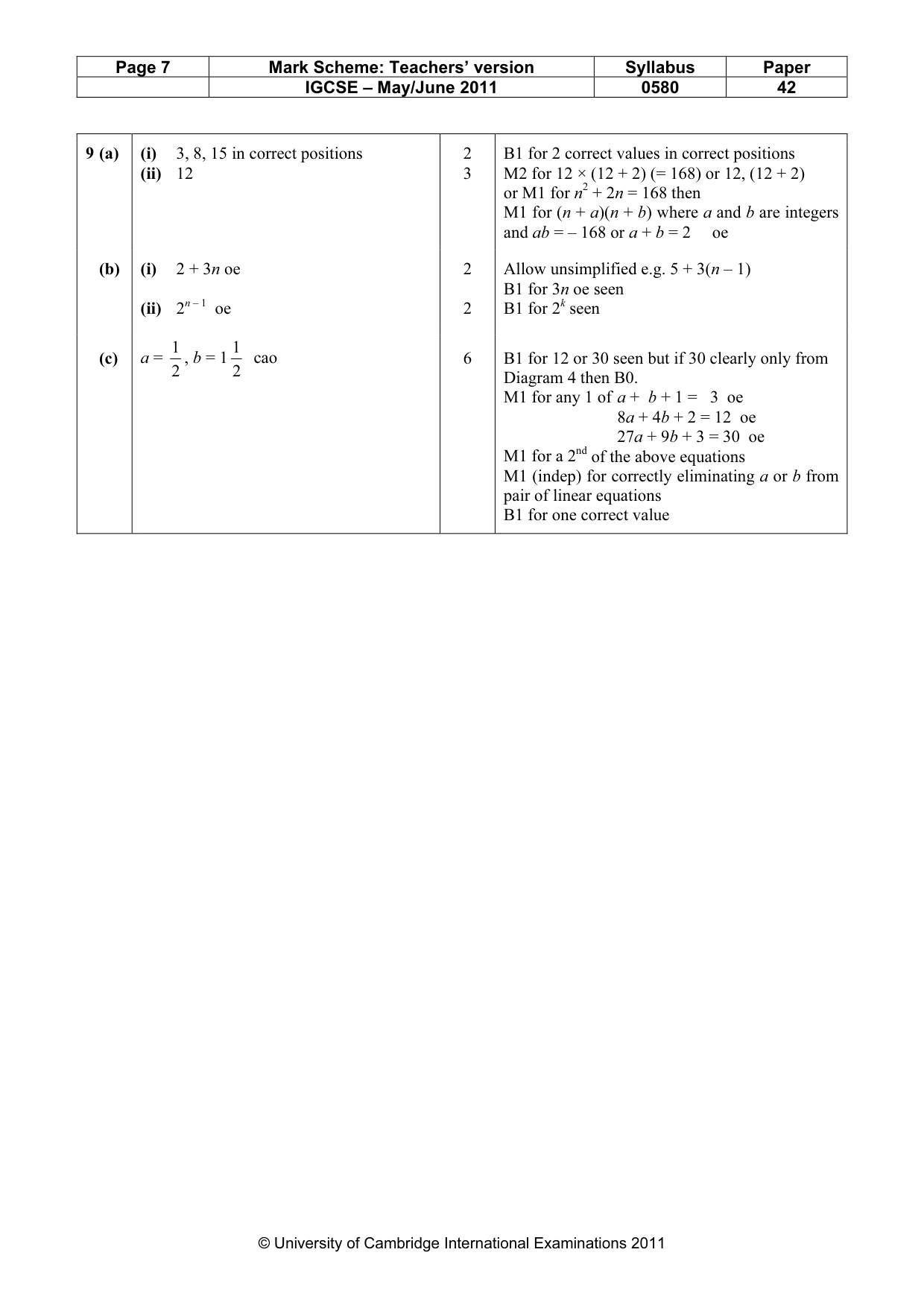
Mark scheme: 9 (a) (i) 3, 8, 15 in correct positions 2 B1 for 2 correct values in correct positions (ii) 12 3 M2 for 12 × (12 + 2) (= 168) or 12, (12 + 2) or M1 for n2 + 2n = 168 then M1 for (n + a)(n + b) where a and b are integers and ab = – 168 or a + b = 2 oe (b) (i) 2 + 3n oe 2 Allow unsimplified e.g. 5 + 3(n – 1) B1 for 3n oe seen (ii) 2n – 1 oe 2 B1 for 2k seen 1 1 (c) a = , b = 1 cao 6 B1 for 12 or 30 seen but if 30 clearly only from 2 2 Diagram 4 then B0. M1 for any 1 of a + b + 1 = 3 oe 8a + 4b + 2 = 12 oe 27a + 9b + 3 = 30 oe M1 for a 2nd of the above equations M1 (indep) for correctly eliminating a or b from pair of linear equations B1 for one correct value
What was in this paper
The subtopics covered by these 5 questions, and how many questions each got. Open one in a new tab to see every Cambridge question on it.
What you needed in this session
Cambridge’s own grade thresholds for 2011 May/June, Paper 4 · Variant 2. A higher threshold means an easier paper — the bar moves with how the cohort did.