Cambridge IGCSE Mathematics 0580 — 2010 Oct/Nov Paper 3 · Variant 1
0580/31/O/N/10 · 11 questions · 104 marks · ≈117 min
The question paper and its mark scheme, free to read here and free to download. This is Cambridge’s own paper, exactly as it was sat.
Question paper16 pages
Mark scheme4 pages
Answers below. Sit the paper first if you are practising.
Questions as text
Q1 · Write down For Examiner's (i) a multiple of 7 between 80 and 90, Use Answer(a)(i) [1]…
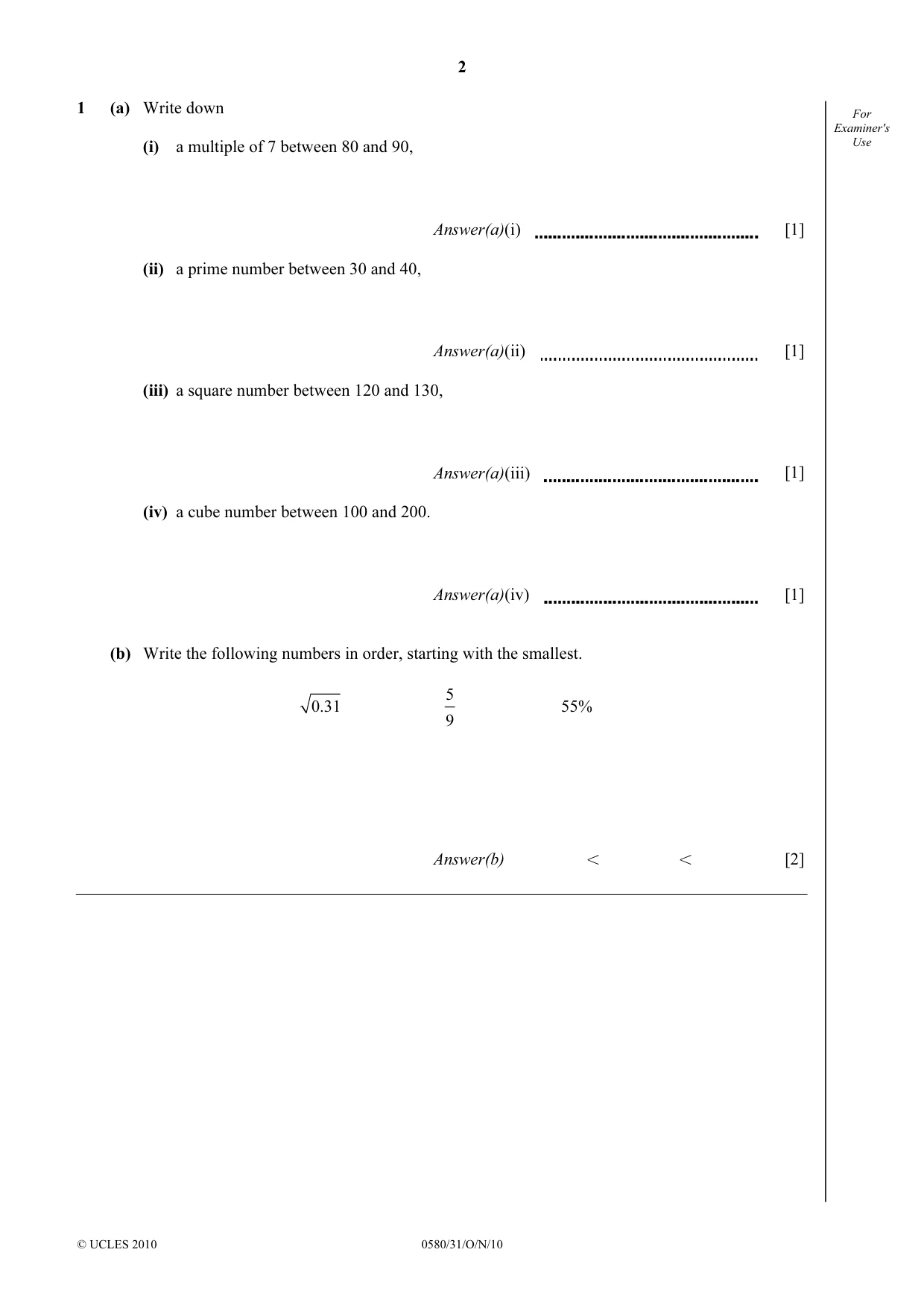
1 (a) Write down For Examiner's (i) a multiple of 7 between 80 and 90, Use Answer(a)(i) [1] (ii) a prime number between 30 and 40, Answer(a)(ii) [1] (iii) a square number between 120 and 130, Answer(a)(iii) [1] (iv) a cube number between 100 and 200. Answer(a)(iv) [1] (b) Write the following numbers in order, starting with the smallest. 5 0.31 55% 9 Answer(b) I I [2]
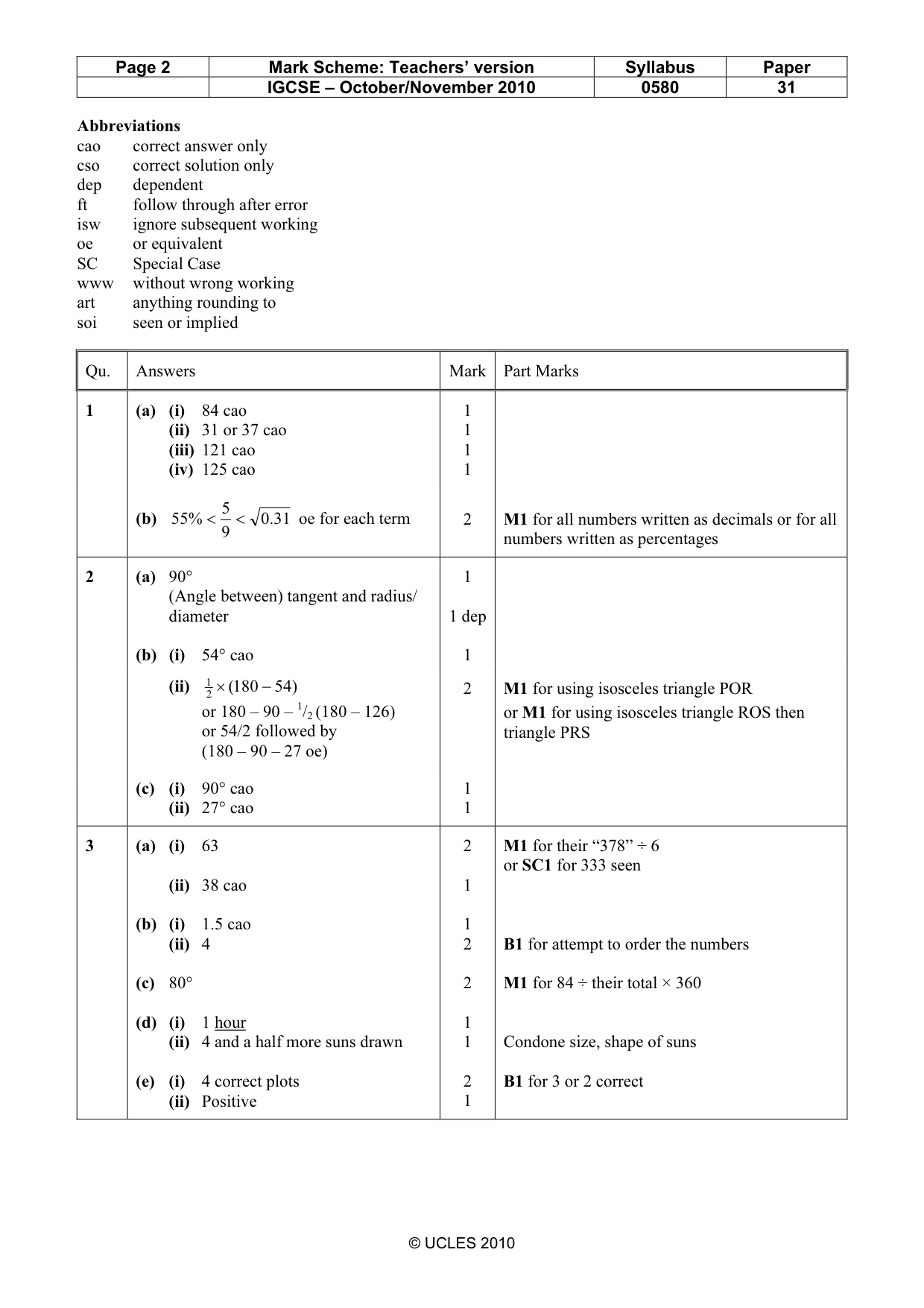
Mark scheme: Qu. Answers Mark Part Marks 1 (a) (i) 84 cao 1 (ii) 31 or 37 cao 1 (iii) 121 cao 1 (iv) 125 cao 1 5 (b) 55 % < < .031 oe for each term 2 M1 for all numbers written as decimals or for all 9 numbers written as percentages
Q2 · For S T Examiner's 36° Use NOT TO O SCALE R P The points P, R and S lie on a circle…
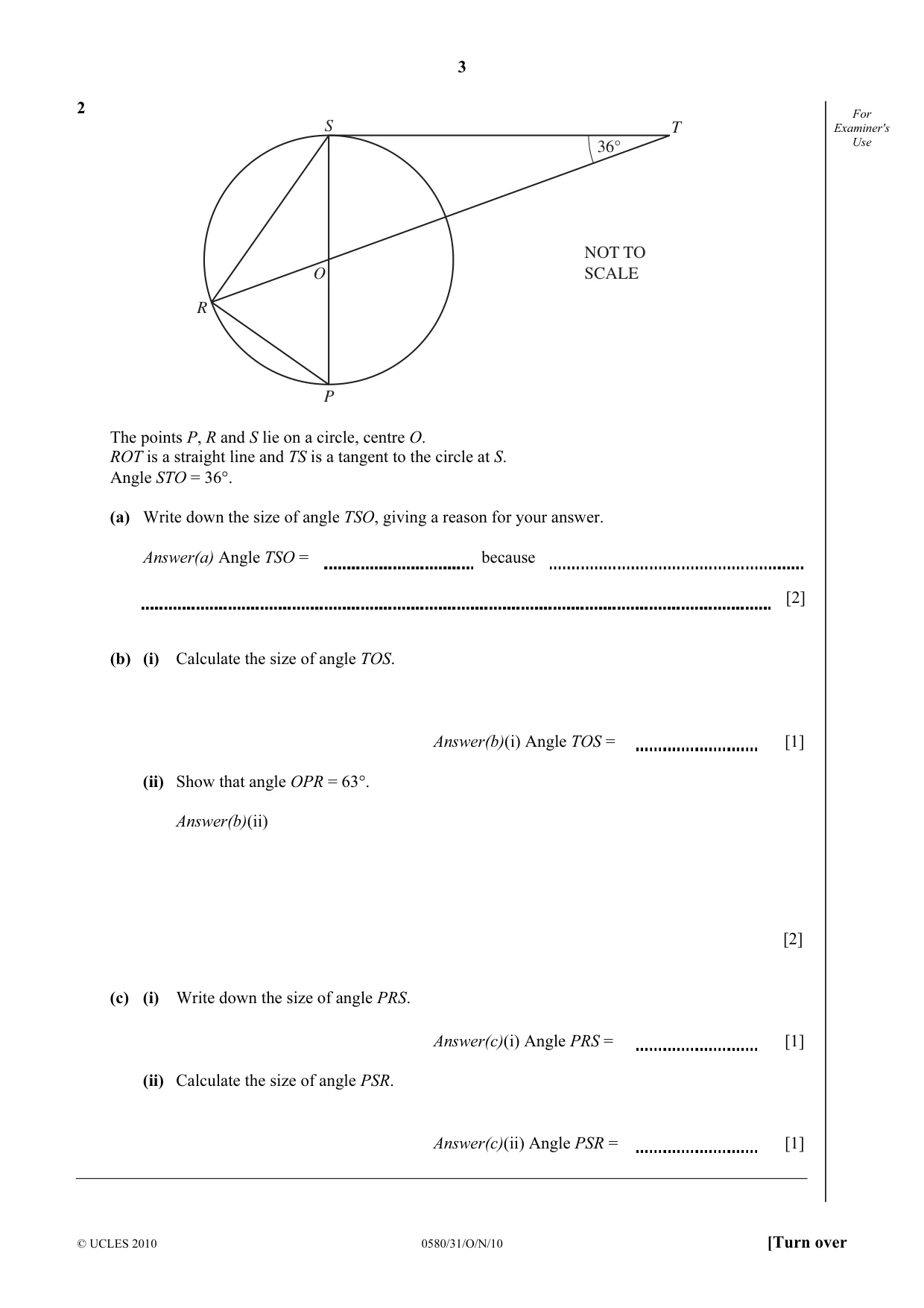
2 For S T Examiner's 36° Use NOT TO O SCALE R P The points P, R and S lie on a circle, centre O. ROT is a straight line and TS is a tangent to the circle at S. Angle STO = 36°. (a) Write down the size of angle TSO, giving a reason for your answer. Answer(a) Angle TSO = because [2] (b) (i) Calculate the size of angle TOS. Answer(b)(i) Angle TOS = [1] (ii) Show that angle OPR = 63°. Answer(b)(ii) [2] (c) (i) Write down the size of angle PRS. Answer(c)(i) Angle PRS = [1] (ii) Calculate the size of angle PSR. Answer(c)(ii) Angle PSR = [1]
Mark scheme: 2 (a) 90° 1 (Angle between) tangent and radius/ diameter 1 dep (b) (i) 54° cao 1 (ii) 1 2 × (180 − 54 ) 2 M1 for using isosceles triangle POR or 180 – 90 – 1/2 (180 – 126) or M1 for using isosceles triangle ROS then or 54/2 followed by triangle PRS (180 – 90 – 27 oe) (c) (i) 90° cao 1 (ii) 27° cao 1
Q3 · For Examiner's Month Total rainfall (mm) Average daily sunshine (hours) Use January 79 6…
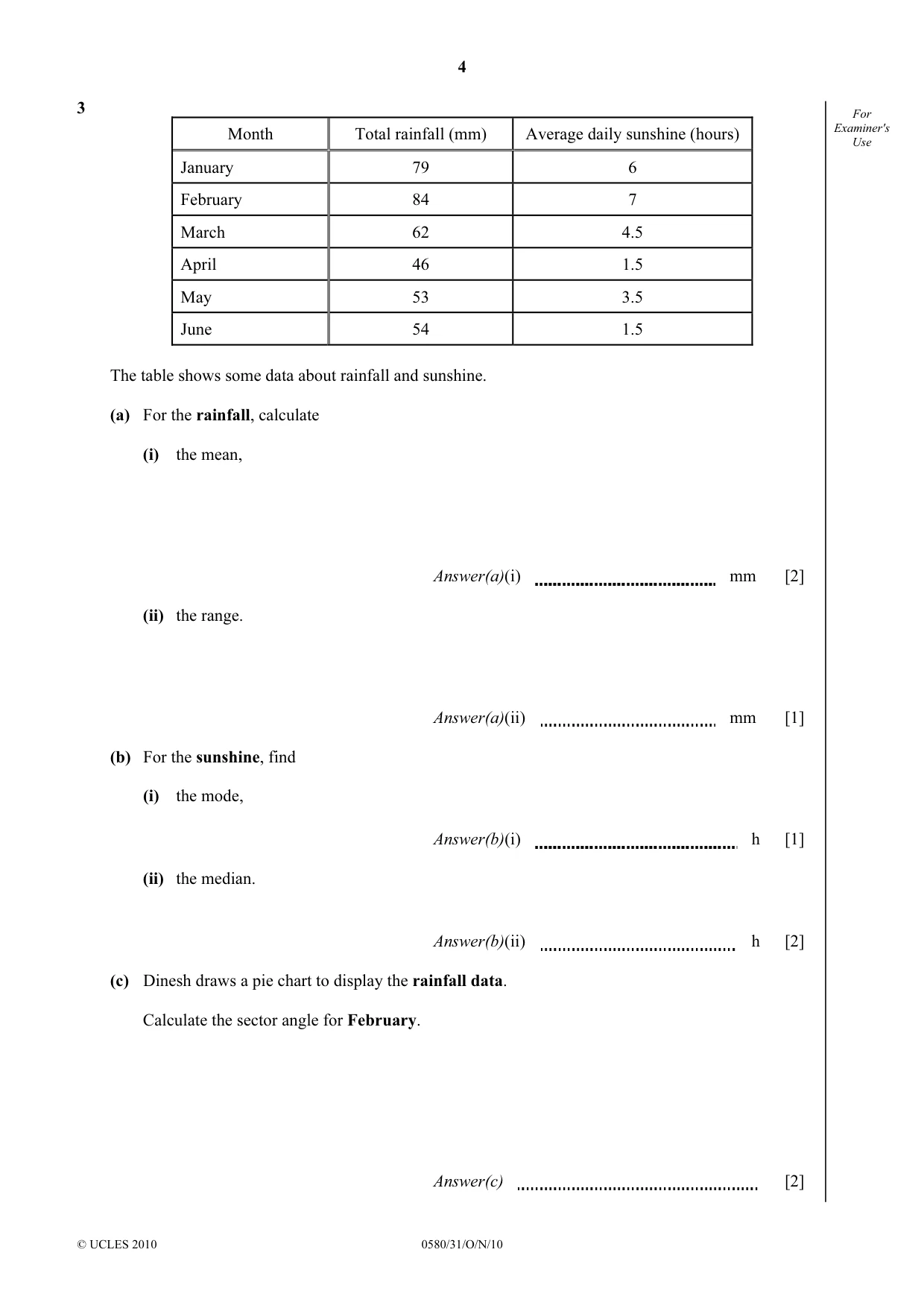
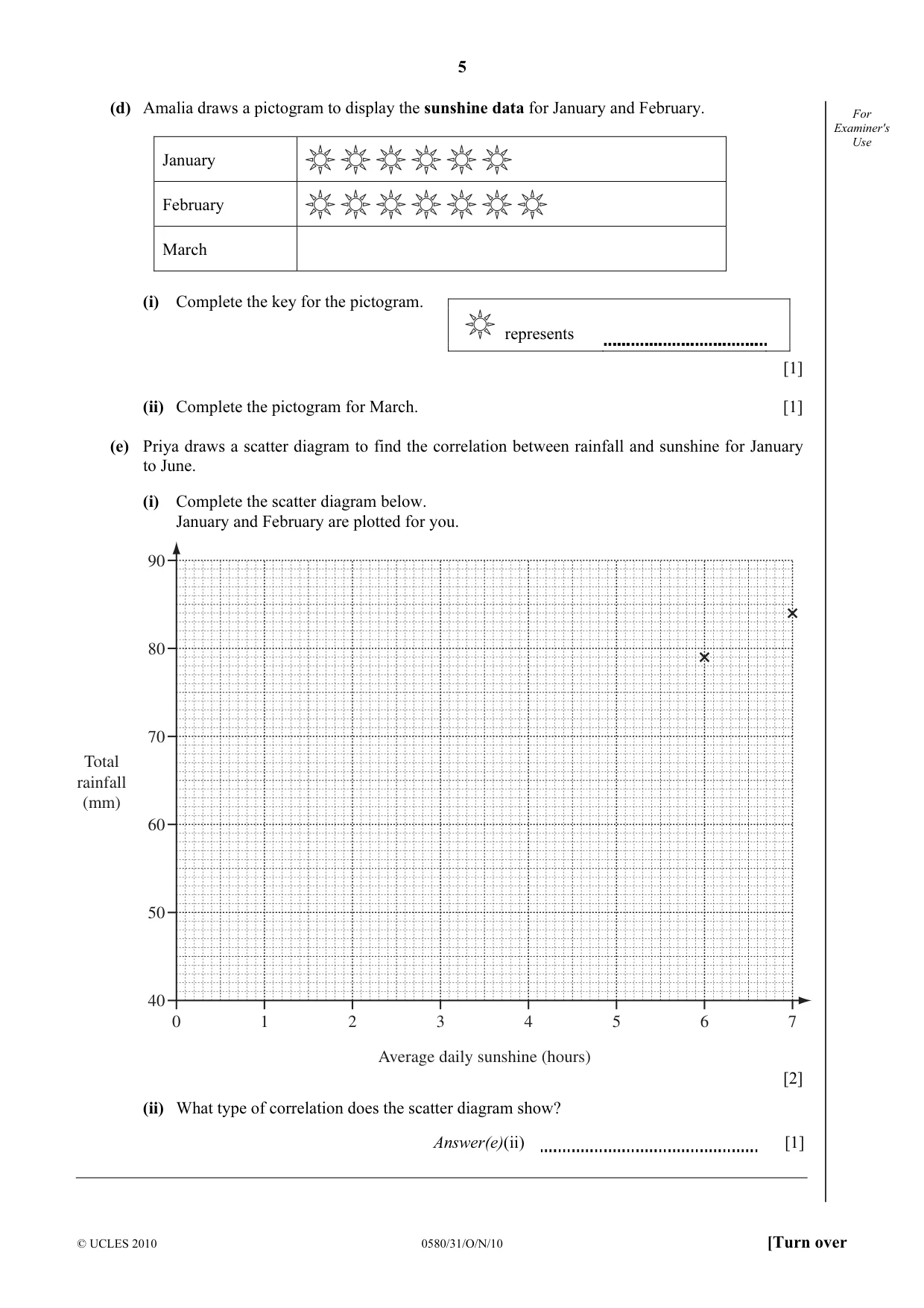
3 For Examiner's Month Total rainfall (mm) Average daily sunshine (hours) Use January 79 6 February 84 7 March 62 4.5 April 46 1.5 May 53 3.5 June 54 1.5 The table shows some data about rainfall and sunshine. (a) For the rainfall, calculate (i) the mean, Answer(a)(i) mm [2] (ii) the range. Answer(a)(ii) mm [1] (b) For the sunshine, find (i) the mode, Answer(b)(i) h [1] (ii) the median. Answer(b)(ii) h [2] (c) Dinesh draws a pie chart to display the rainfall data. Calculate the sector angle for February. Answer(c) [2] (d) Amalia draws a pictogram to display the sunshine data for January and February. For Examiner's Use January February March (i) Complete the key for the pictogram. represents [1] (ii) Complete the pictogram for March. [1] (e) Priya draws a scatter diagram to find the correlation between rainfall and sunshine for January to June. (i) Complete the scatter diagram below. January and February are plotted for you. 90 80 70 Total rainfall (mm) 60 50 40 0 1 2 3 4 5 6 7 Average daily sunshine (hours) [2] (ii) What type of correlation does the scatter diagram show? Answer(e)(ii) [1]
Mark scheme: 3 (a) (i) 63 2 M1 for their “378” ÷ 6 or SC1 for 333 seen (ii) 38 cao 1 (b) (i) 1.5 cao 1 (ii) 4 2 B1 for attempt to order the numbers (c) 80° 2 M1 for 84 ÷ their total × 360 (d) (i) 1 hour 1 (ii) 4 and a half more suns drawn 1 Condone size, shape of suns (e) (i) 4 correct plots 2 B1 for 3 or 2 correct (ii) Positive 1 IGCSE – October/November 2010 0580 31
Q4 · For D C Examiner's 7 cm NOT TO Use SCALE M X L A 7 cm B In the diagram, ABCD is a square…
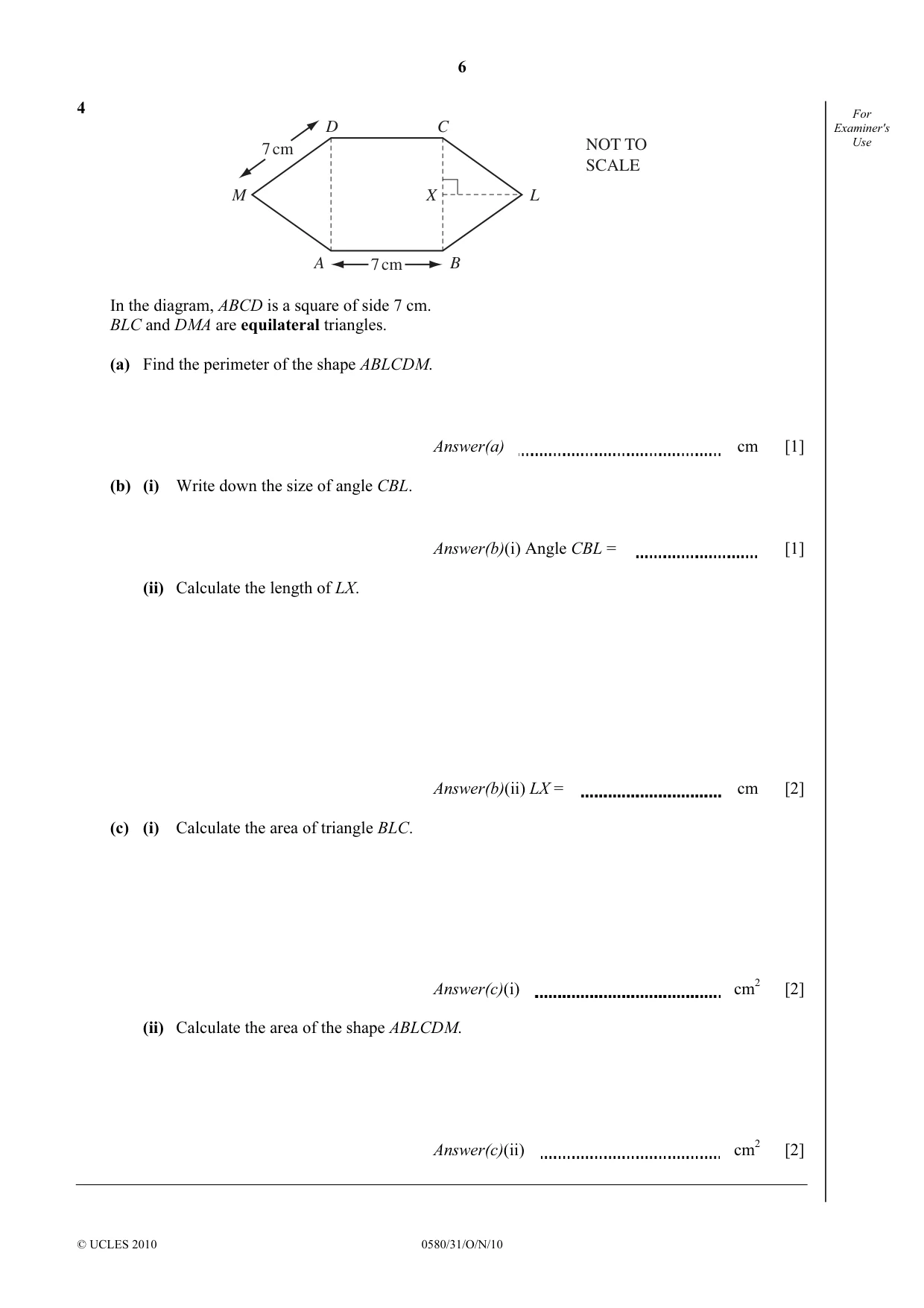
4 For D C Examiner's 7 cm NOT TO Use SCALE M X L A 7 cm B In the diagram, ABCD is a square of side 7 cm. BLC and DMA are equilateral triangles. (a) Find the perimeter of the shape ABLCDM. Answer(a) cm [1] (b) (i) Write down the size of angle CBL. Answer(b)(i) Angle CBL = [1] (ii) Calculate the length of LX. Answer(b)(ii) LX = cm [2] (c) (i) Calculate the area of triangle BLC. Answer(c)(i) cm2 [2] (ii) Calculate the area of the shape ABLCDM. Answer(c)(ii) cm2 [2]
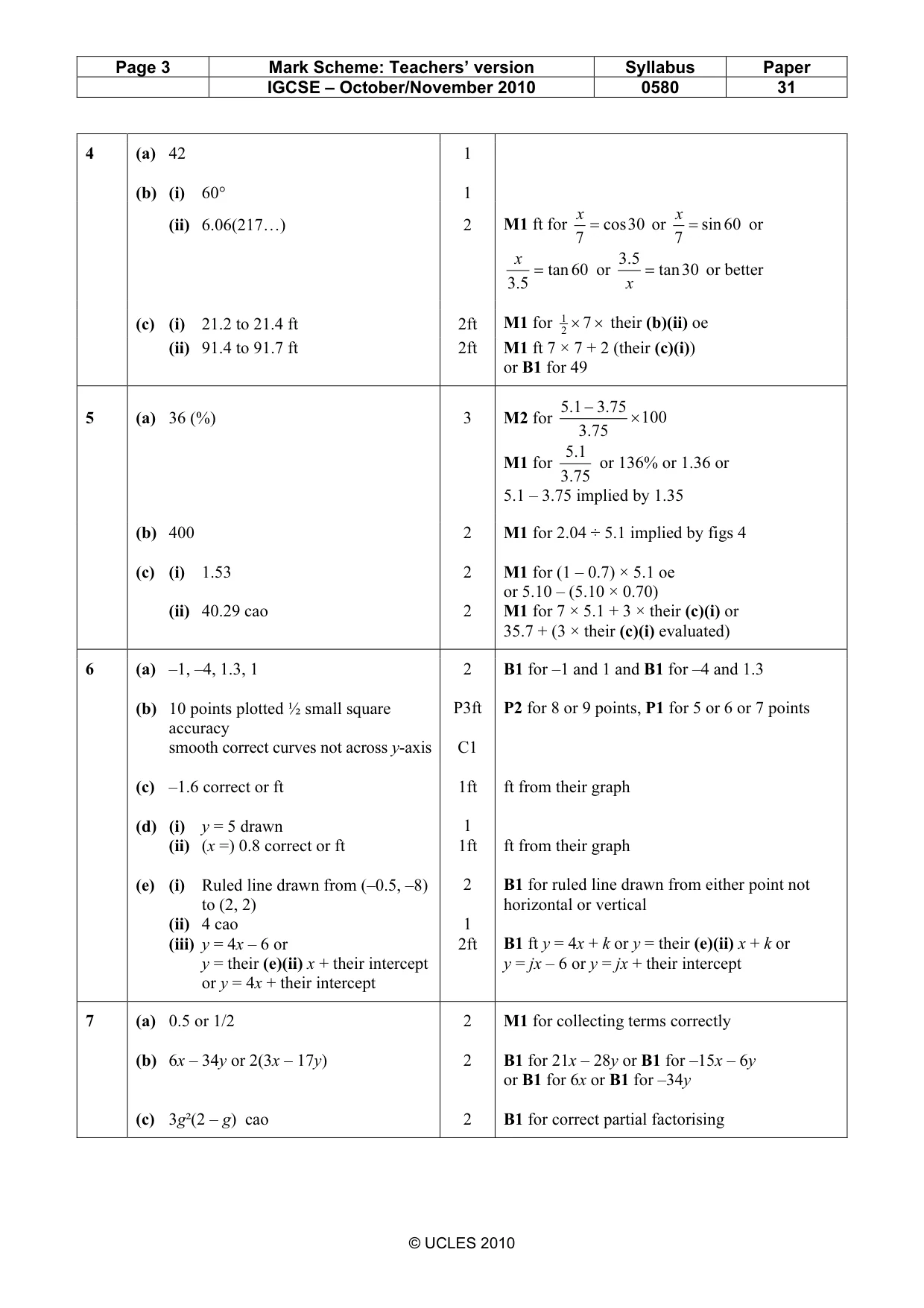
Mark scheme: 4 (a) 42 1 (b) (i) 60° 1 x x (ii) 6.06(217…) 2 M1 ft for = cos 30 or = sin 60 or 7 7 x 5.3 = tan 60 or = tan 30 or better 5.3 x (c) (i) 21.2 to 21.4 ft 2ft M1 for 12 × 7 × their (b)(ii) oe (ii) 91.4 to 91.7 ft 2ft M1 ft 7 × 7 + 2 (their (c)(i)) or B1 for 49 5 1 3 75
Q5 · A shopkeeper buys cheese for $3.75 per kilogram and sells it for $5.10 per kilogram
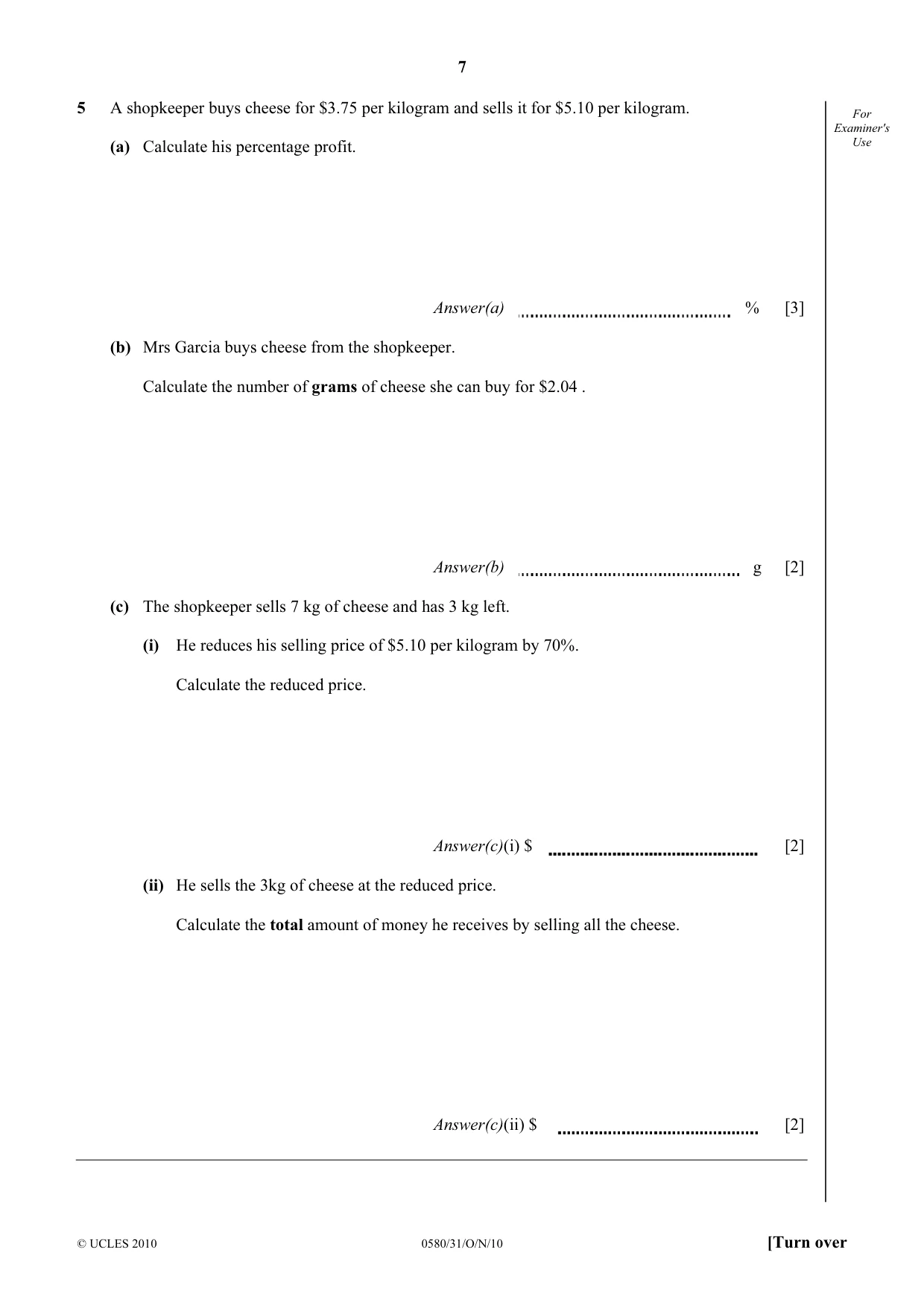
5 A shopkeeper buys cheese for $3.75 per kilogram and sells it for $5.10 per kilogram. For Examiner's (a) Calculate his percentage profit. Use Answer(a) % [3] (b) Mrs Garcia buys cheese from the shopkeeper. Calculate the number of grams of cheese she can buy for $2.04 . Answer(b) g [2] (c) The shopkeeper sells 7 kg of cheese and has 3 kg left. (i) He reduces his selling price of $5.10 per kilogram by 70%. Calculate the reduced price. Answer(c)(i) $ [2] (ii) He sells the 3kg of cheese at the reduced price. Calculate the total amount of money he receives by selling all the cheese. Answer(c)(ii) $ [2]
Mark scheme: 1.5 − .375 5 (a) 36 (%) 3 M2 for × 100 .375 1.5 M1 for or 136% or 1.36 or .375 5.1 – 3.75 implied by 1.35 (b) 400 2 M1 for 2.04 ÷ 5.1 implied by figs 4 (c) (i) 1.53 2 M1 for (1 – 0.7) × 5.1 oe or 5.10 – (5.10 × 0.70) (ii) 40.29 cao 2 M1 for 7 × 5.1 + 3 × their (c)(i) or 35.7 + (3 × their (c)(i) evaluated)
Q6 · For 6 (a) Complete the table of values for y = , x ≠ 0
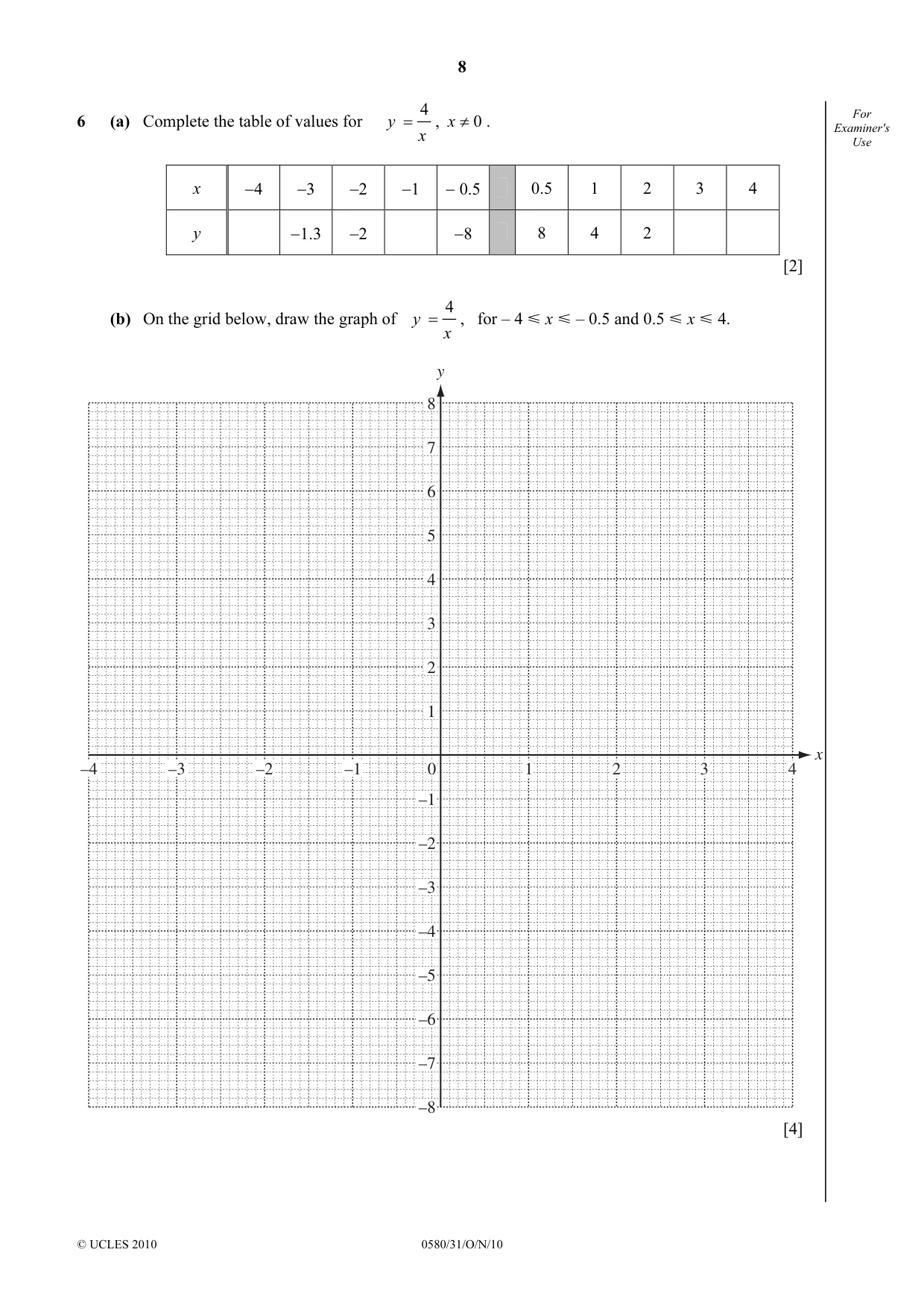
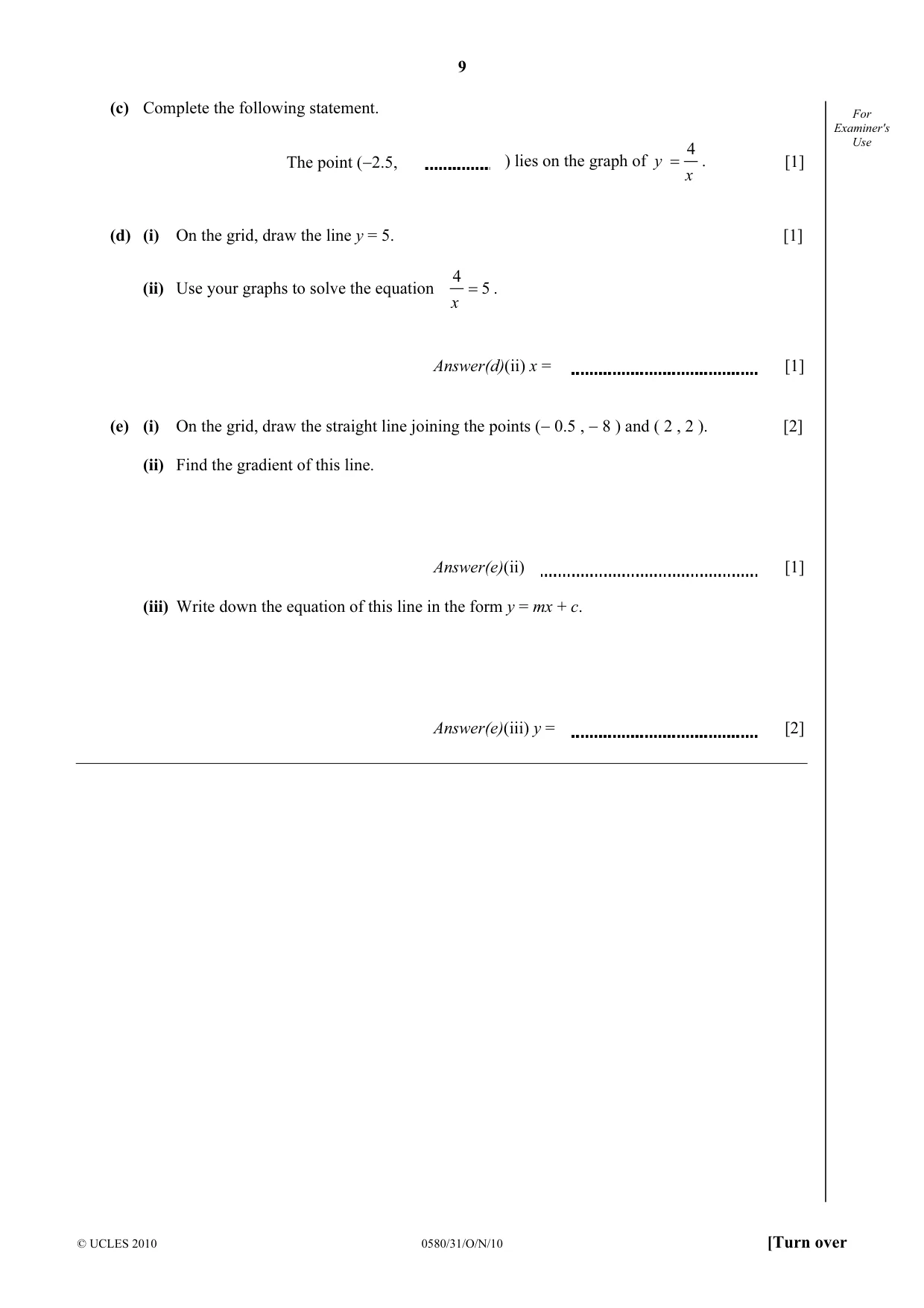
4 For 6 (a) Complete the table of values for y = , x ≠ 0 . Examiner's x Use x −4 −3 −2 −1 − 0.5 0.5 1 2 3 4 y −1.3 −2 −8 8 4 2 [2] 4 (b) On the grid below, draw the graph of y = , for – 4 Y x Y – 0.5 and 0.5 Y x Y 4. x y 8 7 6 5 4 3 2 1 x –4 –3 –2 –1 0 1 2 3 4 –1 –2 –3 –4 –5 –6 –7 –8 [4] (c) Complete the following statement. For Examiner's Use 4 The point (−2.5, ) lies on the graph of y = . [1] x (d) (i) On the grid, draw the line y = 5. [1] 4 (ii) Use your graphs to solve the equation = 5 . x Answer(d)(ii) x = [1] (e) (i) On the grid, draw the straight line joining the points (− 0.5 , − 8 ) and ( 2 , 2 ). [2] (ii) Find the gradient of this line. Answer(e)(ii) [1] (iii) Write down the equation of this line in the form y = mx + c. Answer(e)(iii) y = [2]
Mark scheme: 6 (a) –1, –4, 1.3, 1 2 B1 for –1 and 1 and B1 for –4 and 1.3 (b) 10 points plotted ½ small square P3ft P2 for 8 or 9 points, P1 for 5 or 6 or 7 points accuracy smooth correct curves not across y-axis C1 (c) –1.6 correct or ft 1ft ft from their graph (d) (i) y = 5 drawn 1 (ii) (x =) 0.8 correct or ft 1ft ft from their graph (e) (i) Ruled line drawn from (–0.5, –8) 2 B1 for ruled line drawn from either point not to (2, 2) horizontal or vertical (ii) 4 cao 1 (iii) y = 4x – 6 or 2ft B1 ft y = 4x + k or y = their (e)(ii) x + k or y = their (e)(ii) x + their intercept y = jx – 6 or y = jx + their intercept or y = 4x + their intercept
Question 7
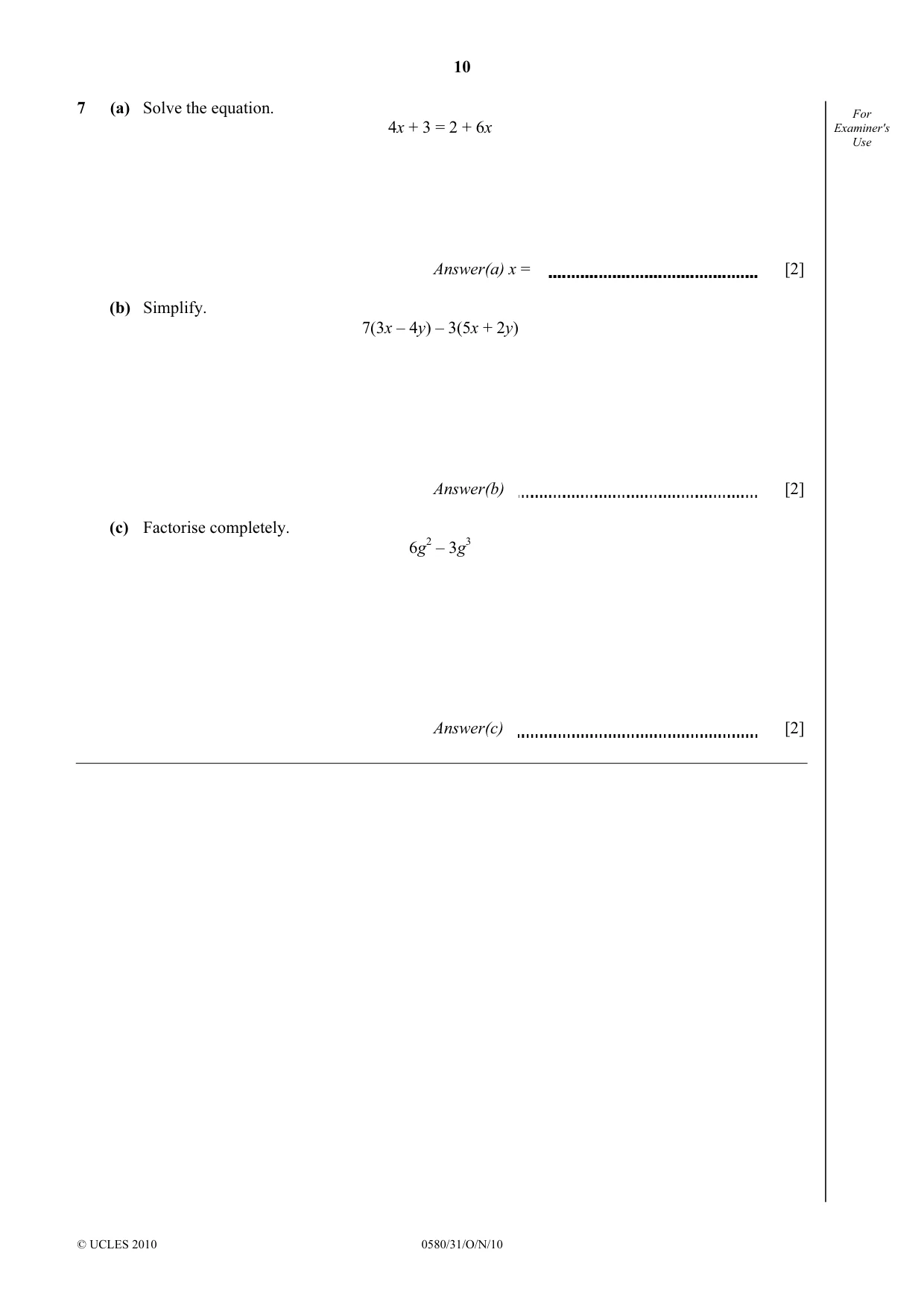
7 (a) Solve the equation. For 4x + 3 = 2 + 6x Examiner's Use Answer(a) x = [2] (b) Simplify. 7(3x – 4y) – 3(5x + 2y) Answer(b) [2] (c) Factorise completely. 6g2 – 3g3 Answer(c) [2]
Mark scheme: 7 (a) 0.5 or 1/2 2 M1 for collecting terms correctly (b) 6x – 34y or 2(3x – 17y) 2 B1 for 21x – 28y or B1 for –15x – 6y or B1 for 6x or B1 for –34y (c) 3g²(2 – g) cao 2 B1 for correct partial factorising IGCSE – October/November 2010 0580 31
Q8 · For y Examiner's Use 6 5 4 3 2 Q P 1 x –7 –6 –5 –4 –3 –2 –1 0 2 3 4 5 6 7 –1 R –2 –3 –4…
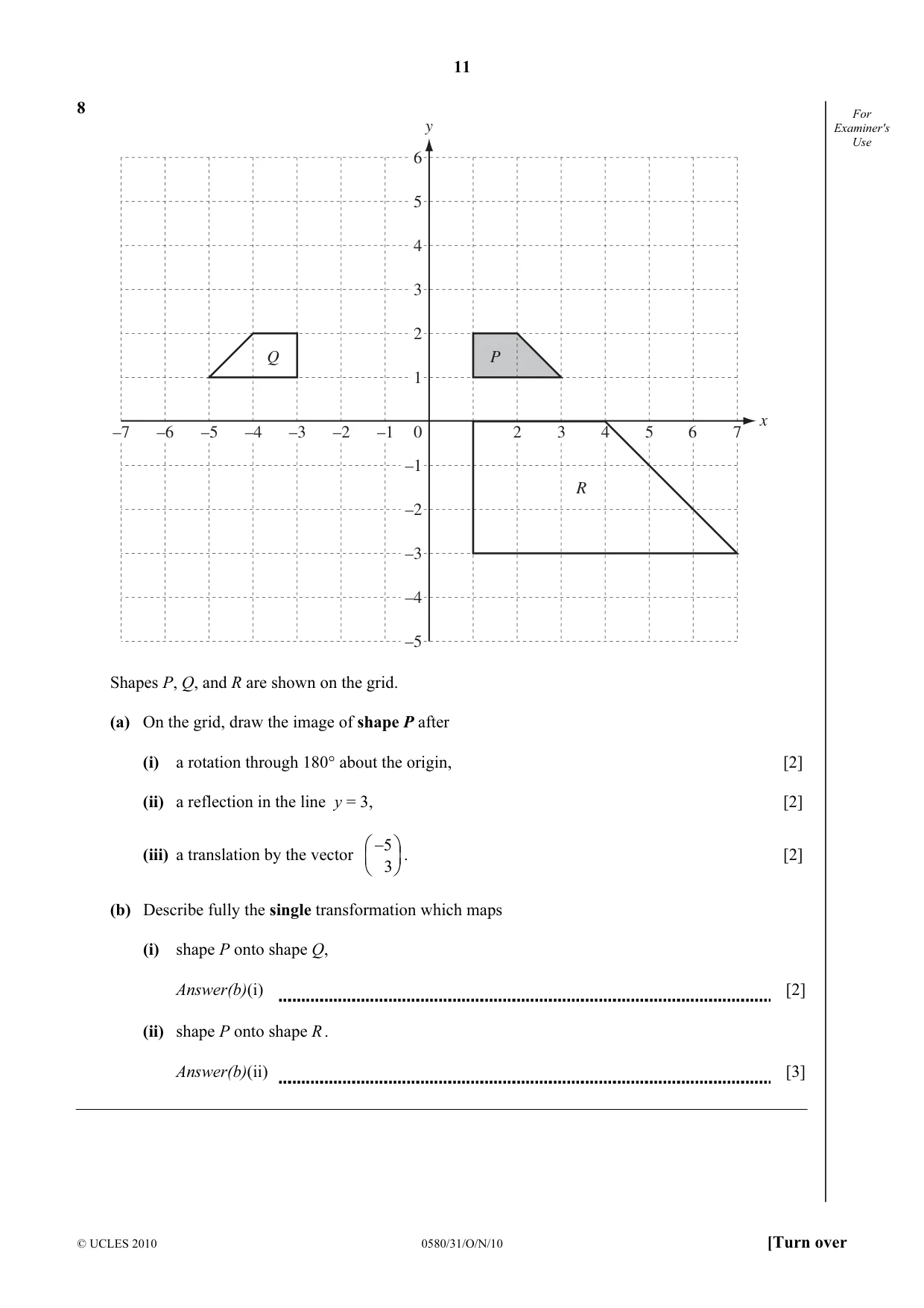
8 For y Examiner's Use 6 5 4 3 2 Q P 1 x –7 –6 –5 –4 –3 –2 –1 0 2 3 4 5 6 7 –1 R –2 –3 –4 –5 Shapes P, Q, and R are shown on the grid. (a) On the grid, draw the image of shape P after (i) a rotation through 180° about the origin, [2] (ii) a reflection in the line y = 3, [2] −5 (iii) a translation by the vector . [2] 3 (b) Describe fully the single transformation which maps (i) shape P onto shape Q, Answer(b)(i) [2] (ii) shape P onto shape R . Answer(b)(ii) [3]
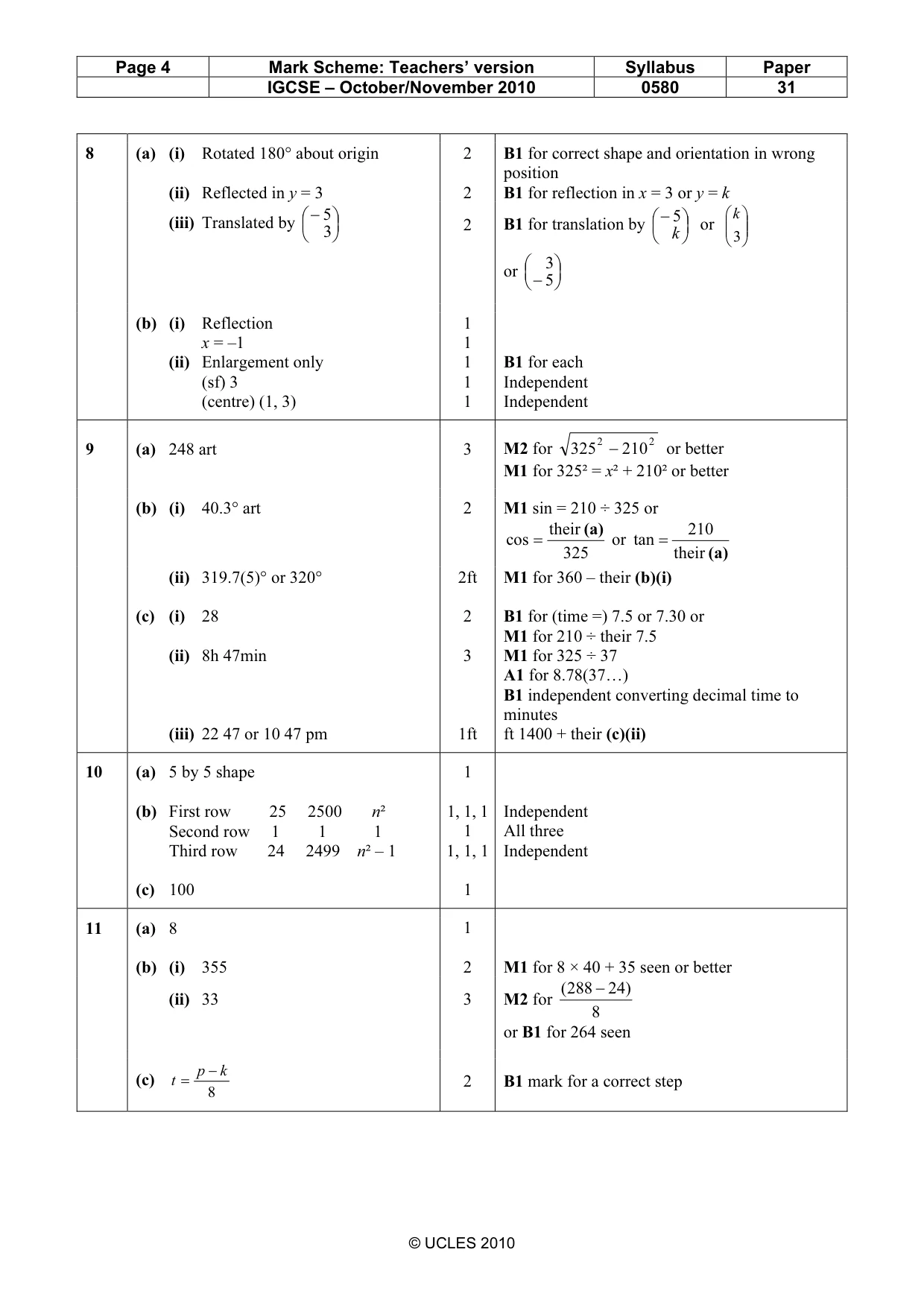
Mark scheme: 8 (a) (i) Rotated 180° about origin 2 B1 for correct shape and orientation in wrong position (ii) Reflected in y = 3 2 B1 for reflection in x = 3 or y = k k 5 − 5 − (iii) Translated by 3 2 B1 for translation by 3 or k 3 or −5 (b) (i) Reflection 1 x = –1 1 (ii) Enlargement only 1 B1 for each (sf) 3 1 Independent (centre) (1, 3) 1 Independent
Q9 · For 210 km Examiner's L M Use North NOT TO 325 km SCALE R The diagram shows three…
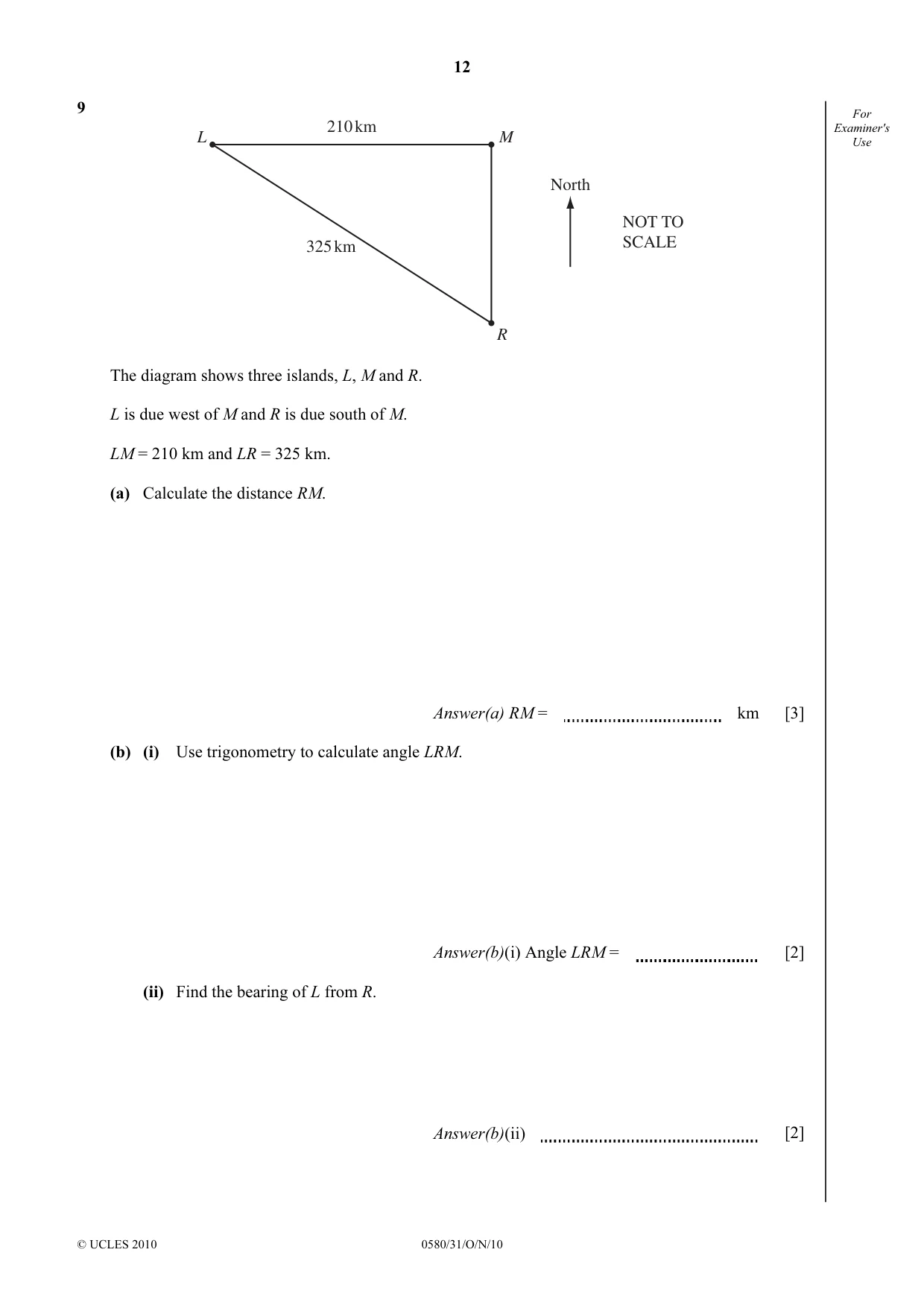
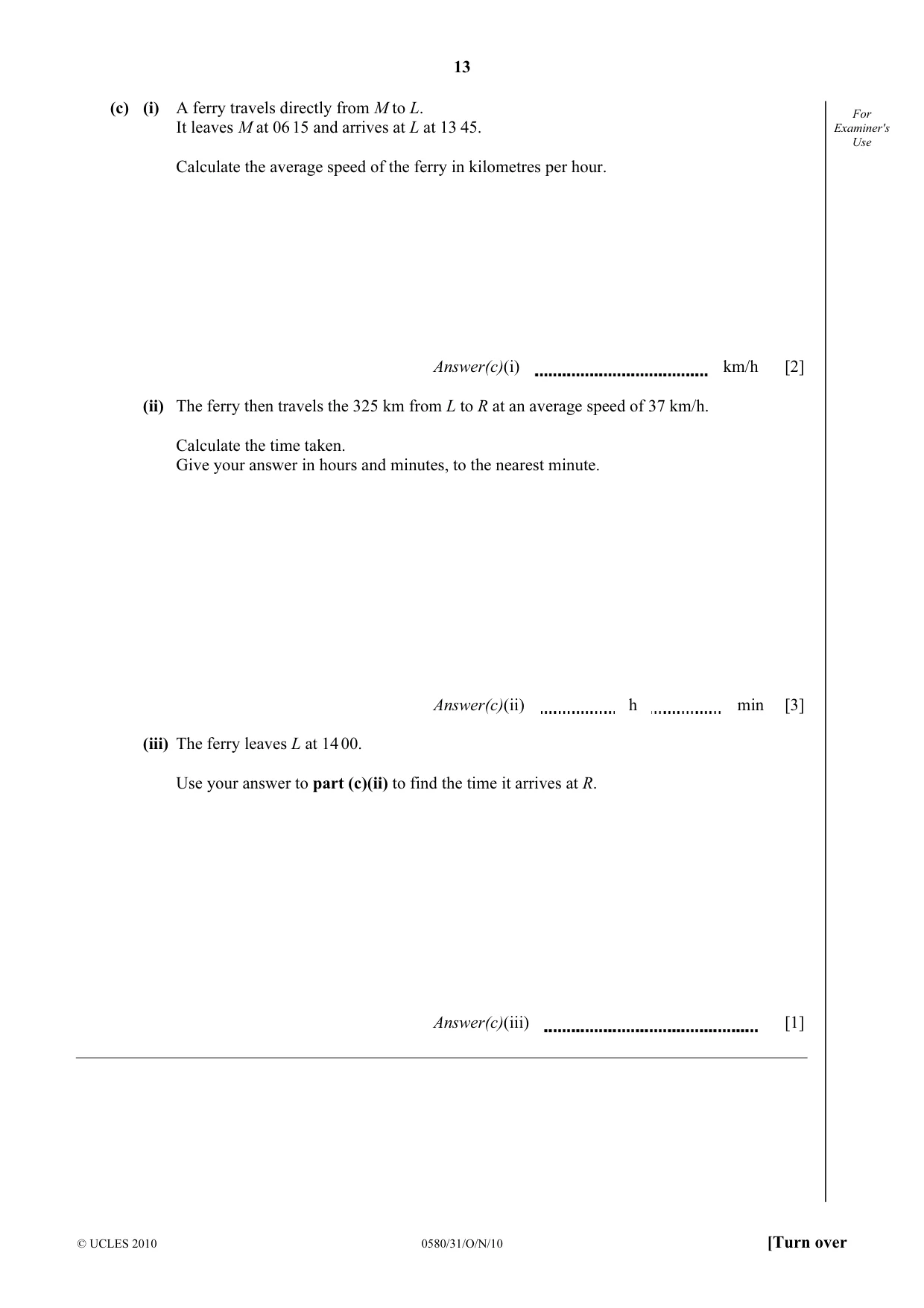
9 For 210 km Examiner's L M Use North NOT TO 325 km SCALE R The diagram shows three islands, L, M and R. L is due west of M and R is due south of M. LM = 210 km and LR = 325 km. (a) Calculate the distance RM. Answer(a) RM = km [3] (b) (i) Use trigonometry to calculate angle LRM. Answer(b)(i) Angle LRM = [2] (ii) Find the bearing of L from R. Answer(b)(ii) [2] (c) (i) A ferry travels directly from M to L. For It leaves M at 06 15 and arrives at L at 13 45. Examiner's Use Calculate the average speed of the ferry in kilometres per hour. Answer(c)(i) km/h [2] (ii) The ferry then travels the 325 km from L to R at an average speed of 37 km/h. Calculate the time taken. Give your answer in hours and minutes, to the nearest minute. Answer(c)(ii) h min [3] (iii) The ferry leaves L at 14 00. Use your answer to part (c)(ii) to find the time it arrives at R. Answer(c)(iii) [1]
Mark scheme: 9 (a) 248 art 3 M2 for 325 2 − 210 2 or better M1 for 325² = x² + 210² or better (b) (i) 40.3° art 2 M1 sin = 210 ÷ 325 or their (a) 210 cos = or tan = 325 their (a) (ii) 319.7(5)° or 320° 2ft M1 for 360 – their (b)(i) (c) (i) 28 2 B1 for (time =) 7.5 or 7.30 or M1 for 210 ÷ their 7.5 (ii) 8h 47min 3 M1 for 325 ÷ 37 A1 for 8.78(37…) B1 independent converting decimal time to minutes (iii) 22 47 or 10 47 pm 1ft ft 1400 + their (c)(ii)
Q10 · For Examiner's Use Diagram 1 Diagram 2 Diagram 3 Diagram 4 Diagram 5 Each of the diagrams…
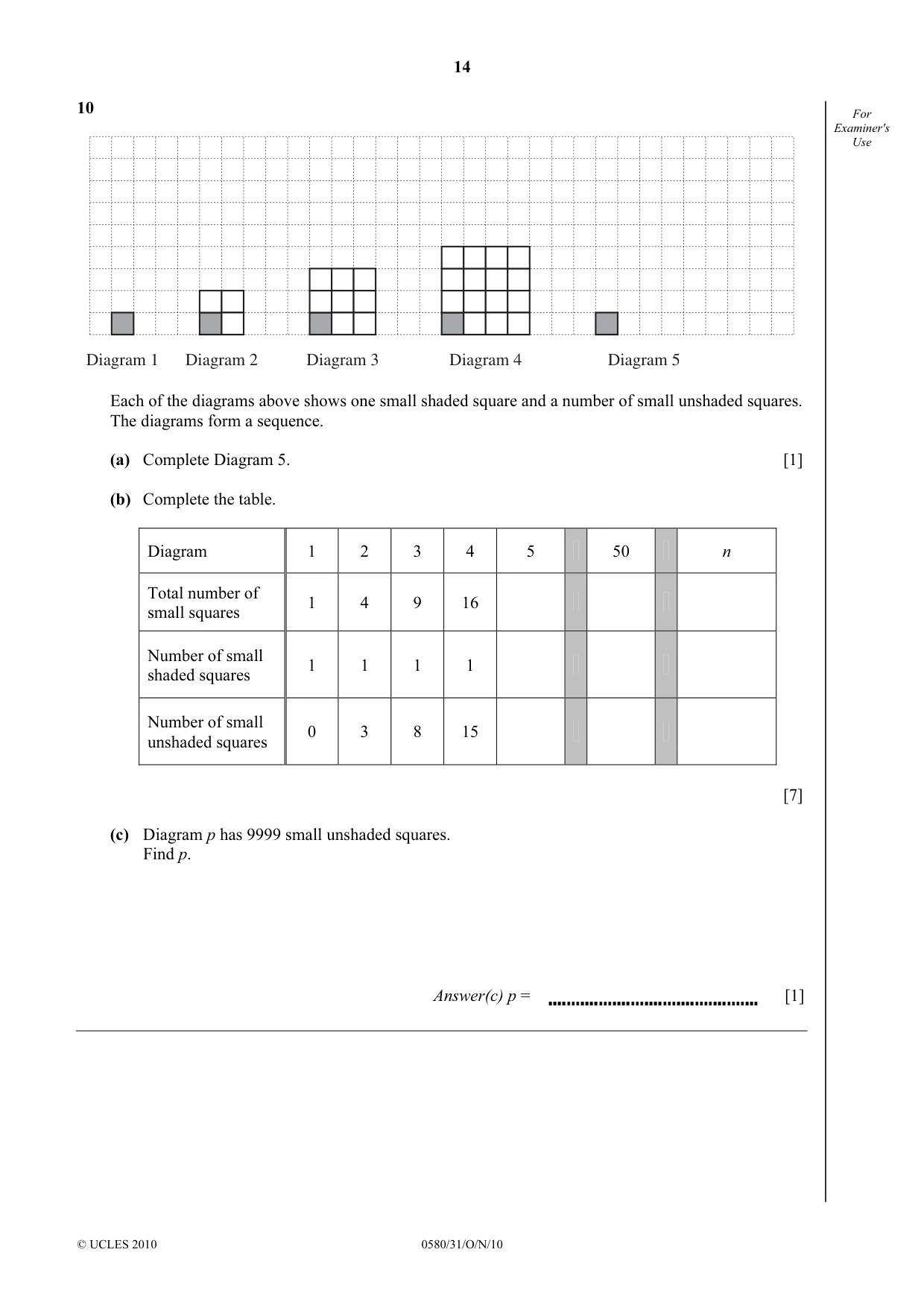
10 For Examiner's Use Diagram 1 Diagram 2 Diagram 3 Diagram 4 Diagram 5 Each of the diagrams above shows one small shaded square and a number of small unshaded squares. The diagrams form a sequence. (a) Complete Diagram 5. [1] (b) Complete the table. Diagram 1 2 3 4 5 50 n Total number of 1 4 9 16 small squares Number of small 1 1 1 1 shaded squares Number of small 0 3 8 15 unshaded squares [7] (c) Diagram p has 9999 small unshaded squares. Find p. Answer(c) p = [1]
Mark scheme: 10 (a) 5 by 5 shape 1 (b) First row 25 2500 n² 1, 1, 1 Independent Second row 1 1 1 1 All three Third row 24 2499 n² – 1 1, 1, 1 Independent (c) 100 1
Q11 · Roberto earns a total of $p per week
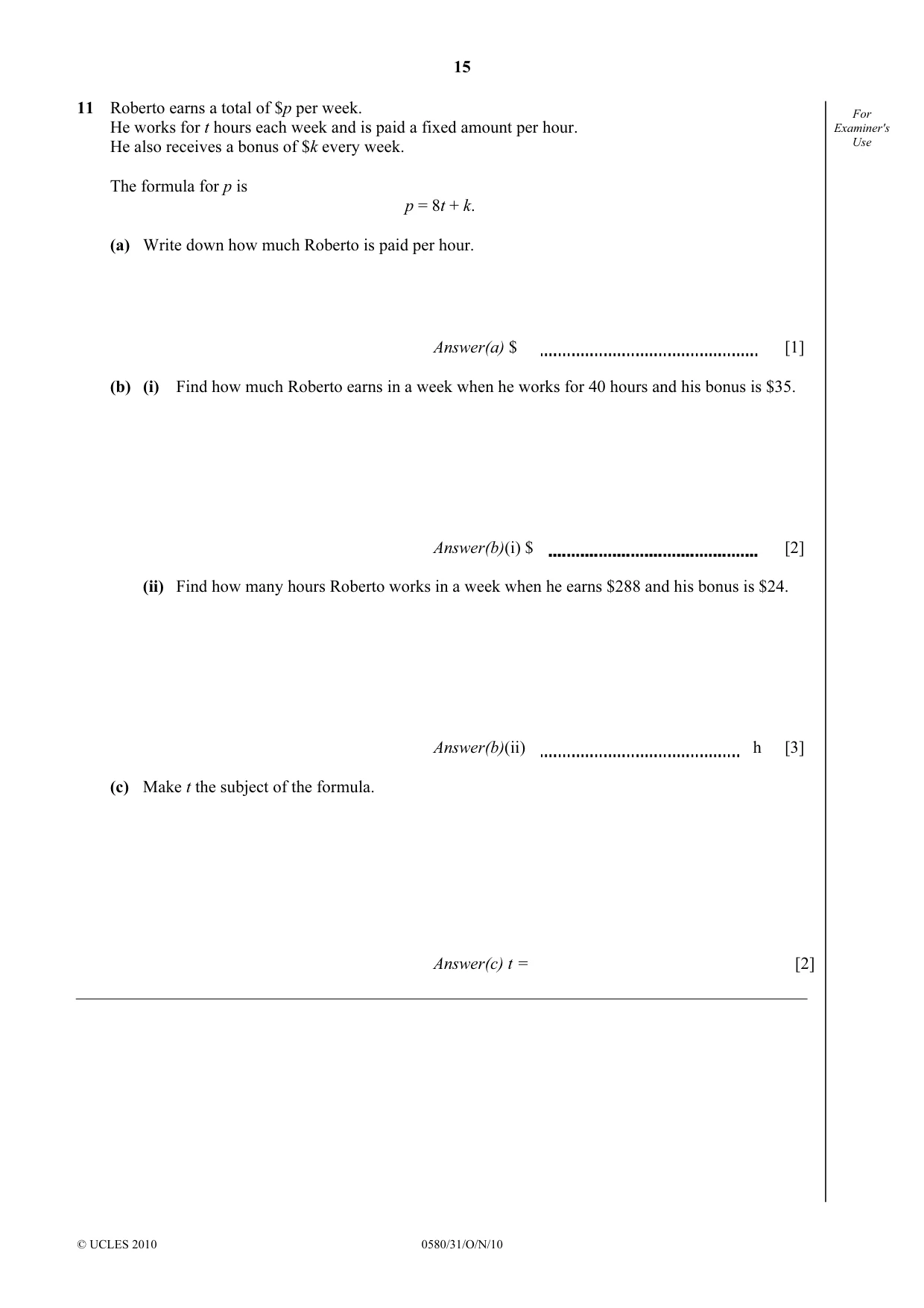
11 Roberto earns a total of $p per week. For He works for t hours each week and is paid a fixed amount per hour. Examiner's He also receives a bonus of $k every week. Use The formula for p is p = 8t + k. (a) Write down how much Roberto is paid per hour. Answer(a) $ [1] (b) (i) Find how much Roberto earns in a week when he works for 40 hours and his bonus is $35. Answer(b)(i) $ [2] (ii) Find how many hours Roberto works in a week when he earns $288 and his bonus is $24. Answer(b)(ii) h [3] (c) Make t the subject of the formula. Answer(c) t = [2]
Mark scheme: 11 (a) 8 1 (b) (i) 355 2 M1 for 8 × 40 + 35 seen or better ( 288 − 24) (ii) 33 3 M2 for 8 or B1 for 264 seen p − k (c) t = 2 B1 mark for a correct step 8
What was in this paper
The subtopics covered by these 11 questions, and how many questions each got. Open one in a new tab to see every Cambridge question on it.
What you needed in this session
Cambridge’s own grade thresholds for 2010 Oct/Nov, Paper 3 · Variant 1. A higher threshold means an easier paper — the bar moves with how the cohort did.