Cambridge IGCSE Mathematics 0580 — 2010 Oct/Nov Paper 3 · Variant 3
0580/33/O/N/10 · 10 questions · 104 marks · ≈117 min
The question paper and its mark scheme, free to read here and free to download. This is Cambridge’s own paper, exactly as it was sat.
Question paper16 pages
Mark scheme4 pages
Answers below. Sit the paper first if you are practising.
Questions as text
Q1 · For 10 Examiner's Use 9 8 7 6 Frequency 5 4 3 2 1 0 0 1 2 3 4 5 6 Number of children The…
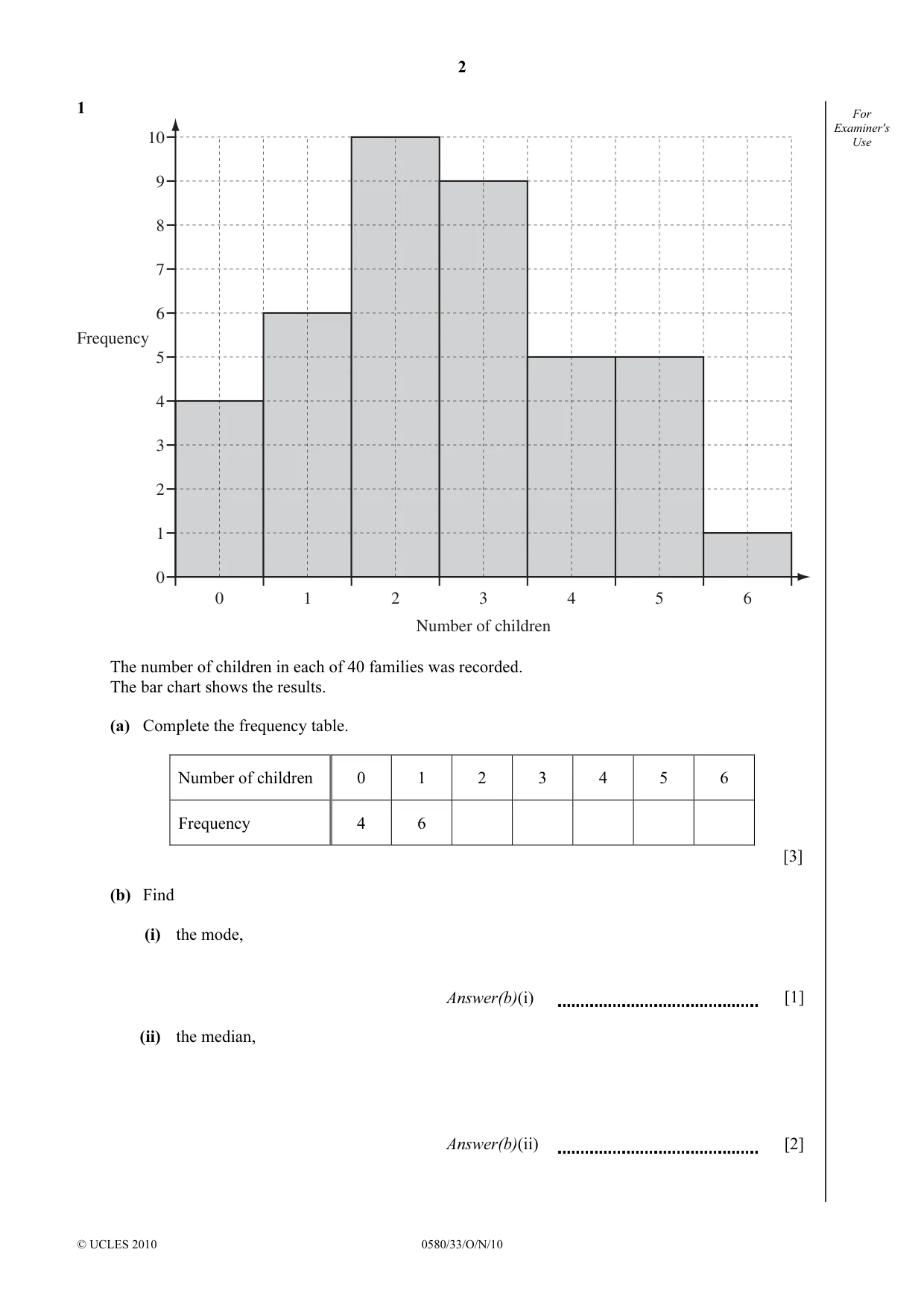
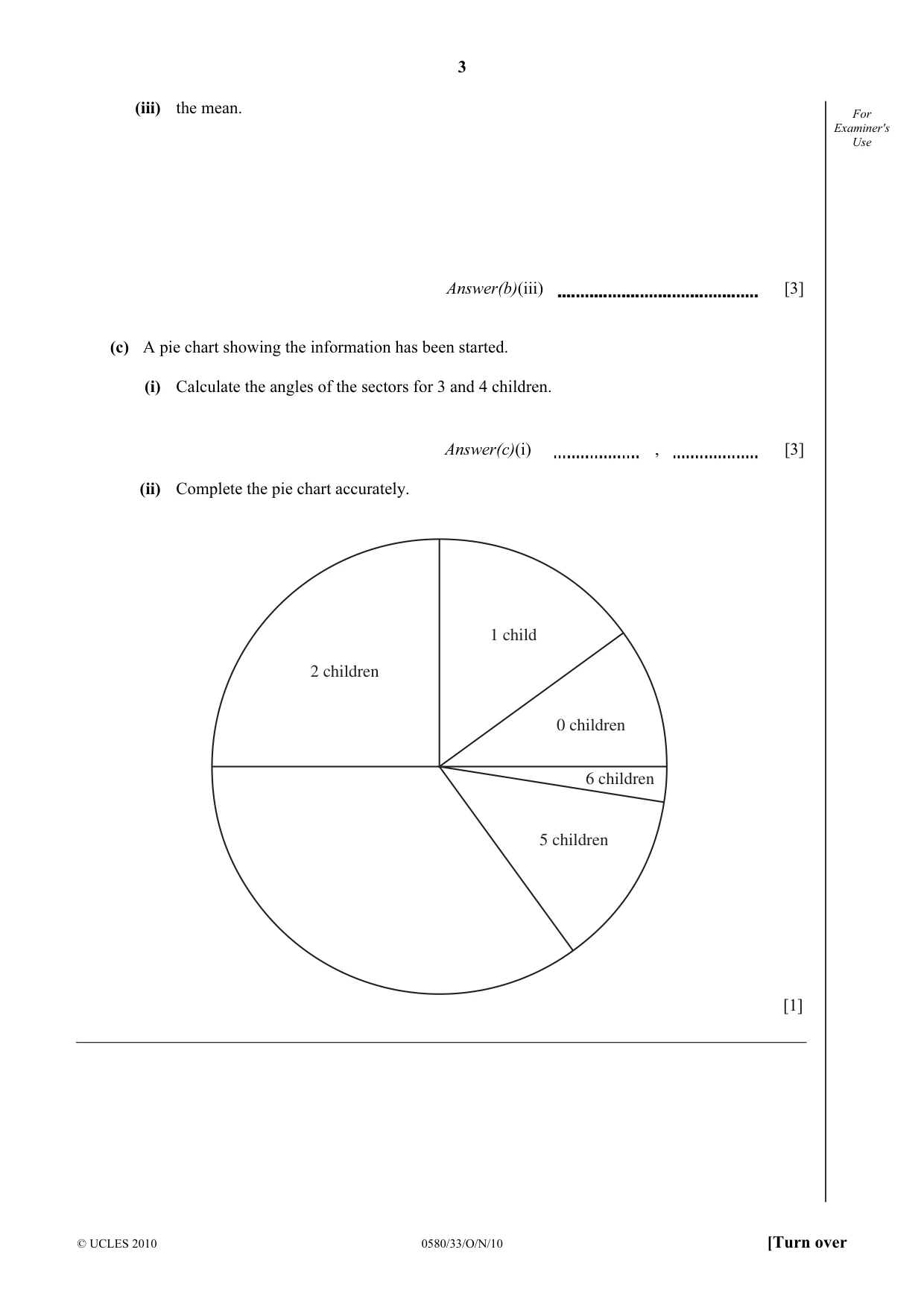
1 For 10 Examiner's Use 9 8 7 6 Frequency 5 4 3 2 1 0 0 1 2 3 4 5 6 Number of children The number of children in each of 40 families was recorded. The bar chart shows the results. (a) Complete the frequency table. Number of children 0 1 2 3 4 5 6 Frequency 4 6 [3] (b) Find (i) the mode, Answer(b)(i) [1] (ii) the median, Answer(b)(ii) [2] (iii) the mean. For Examiner's Use Answer(b)(iii) [3] (c) A pie chart showing the information has been started. (i) Calculate the angles of the sectors for 3 and 4 children. Answer(c)(i) , [3] (ii) Complete the pie chart accurately. 1 child 2 children 0 children 6 children 5 children [1]
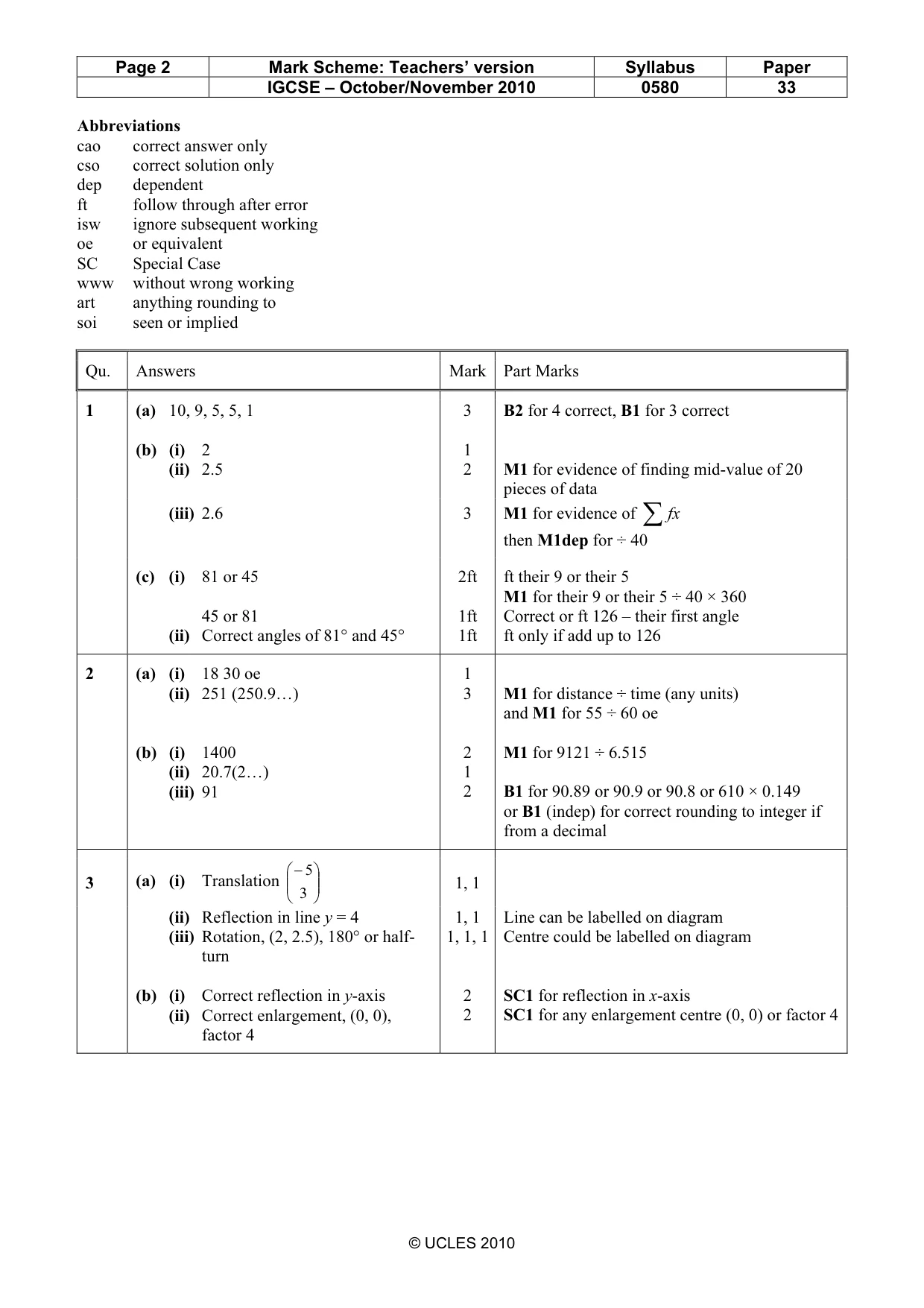
Mark scheme: Qu. Answers Mark Part Marks 1 (a) 10, 9, 5, 5, 1 3 B2 for 4 correct, B1 for 3 correct (b) (i) 2 1 (ii) 2.5 2 M1 for evidence of finding mid-value of 20 pieces of data (iii) 2.6 3 M1 for evidence of ∑fx then M1dep for ÷ 40 (c) (i) 81 or 45 2ft ft their 9 or their 5 M1 for their 9 or their 5 ÷ 40 × 360 45 or 81 1ft Correct or ft 126 – their first angle (ii) Correct angles of 81° and 45° 1ft ft only if add up to 126
Q2 · Eduardo lives in Argentina and travels to Uruguay for a holiday
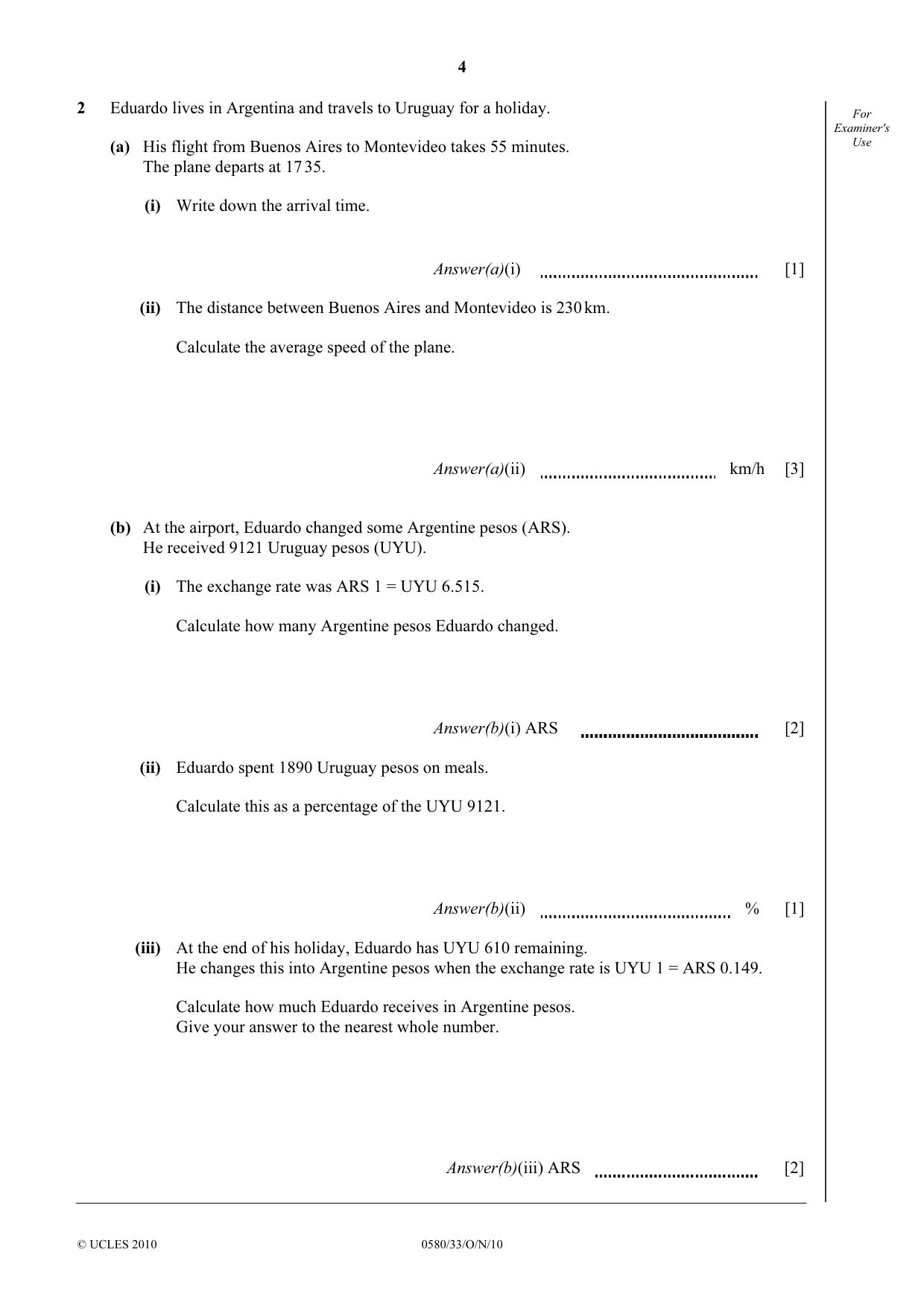
2 Eduardo lives in Argentina and travels to Uruguay for a holiday. For Examiner's (a) His flight from Buenos Aires to Montevideo takes 55 minutes. Use The plane departs at 17 35. (i) Write down the arrival time. Answer(a)(i) [1] (ii) The distance between Buenos Aires and Montevideo is 230 km. Calculate the average speed of the plane. Answer(a)(ii) km/h [3] (b) At the airport, Eduardo changed some Argentine pesos (ARS). He received 9121 Uruguay pesos (UYU). (i) The exchange rate was ARS 1 = UYU 6.515. Calculate how many Argentine pesos Eduardo changed. Answer(b)(i) ARS [2] (ii) Eduardo spent 1890 Uruguay pesos on meals. Calculate this as a percentage of the UYU 9121. Answer(b)(ii) % [1] (iii) At the end of his holiday, Eduardo has UYU 610 remaining. He changes this into Argentine pesos when the exchange rate is UYU 1 = ARS 0.149. Calculate how much Eduardo receives in Argentine pesos. Give your answer to the nearest whole number. Answer(b)(iii) ARS [2]
Mark scheme: 2 (a) (i) 18 30 oe 1 (ii) 251 (250.9…) 3 M1 for distance ÷ time (any units) and M1 for 55 ÷ 60 oe (b) (i) 1400 2 M1 for 9121 ÷ 6.515 (ii) 20.7(2…) 1 (iii) 91 2 B1 for 90.89 or 90.9 or 90.8 or 610 × 0.149 or B1 (indep) for correct rounding to integer if from a decimal −5
Q3 · For y Examiner's Use 12 11 10 9 8 7 6 G H 5 4 3 F I 2 1 x –5 –4 –3 –2 –1 0 1 2 3 4 5 6 7…
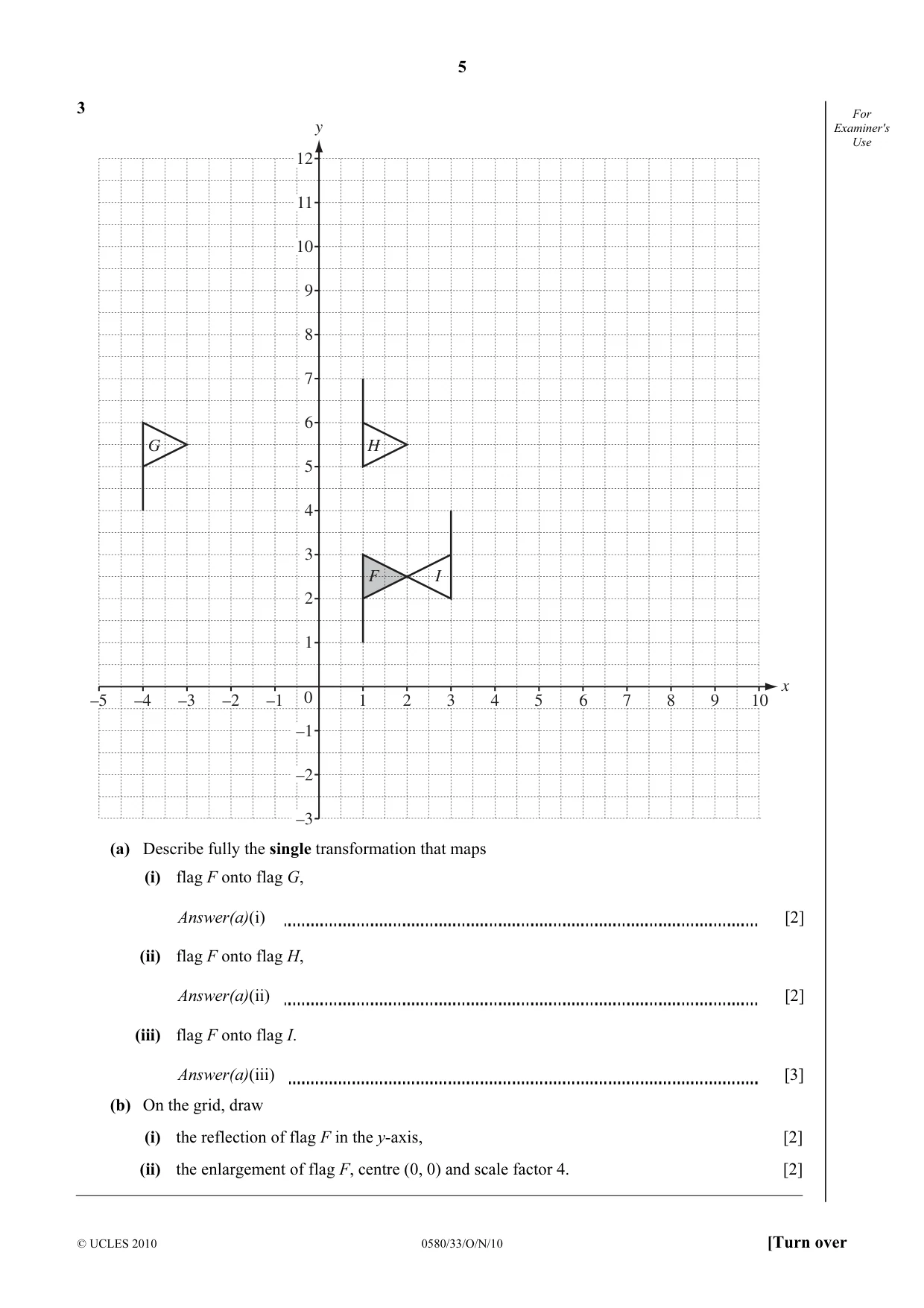
3 For y Examiner's Use 12 11 10 9 8 7 6 G H 5 4 3 F I 2 1 x –5 –4 –3 –2 –1 0 1 2 3 4 5 6 7 8 9 10 –1 –2 –3 (a) Describe fully the single transformation that maps (i) flag F onto flag G, Answer(a)(i) [2] (ii) flag F onto flag H, Answer(a)(ii) [2] (iii) flag F onto flag I. Answer(a)(iii) [3] (b) On the grid, draw (i) the reflection of flag F in the y-axis, [2] (ii) the enlargement of flag F, centre (0, 0) and scale factor 4. [2]
Mark scheme: 5 3 (a) (i) Translation 1, 1 3 (ii) Reflection in line y = 4 1, 1 Line can be labelled on diagram (iii) Rotation, (2, 2.5), 180° or half- 1, 1, 1 Centre could be labelled on diagram turn (b) (i) Correct reflection in y-axis 2 SC1 for reflection in x-axis (ii) Correct enlargement, (0, 0), 2 SC1 for any enlargement centre (0, 0) or factor 4 factor 4 IGCSE – October/November 2010 0580 33
Q4 · For North Examiner's Use North NOT TO C SCALE 75 m B 200 m North A Dariella walks 200 m…
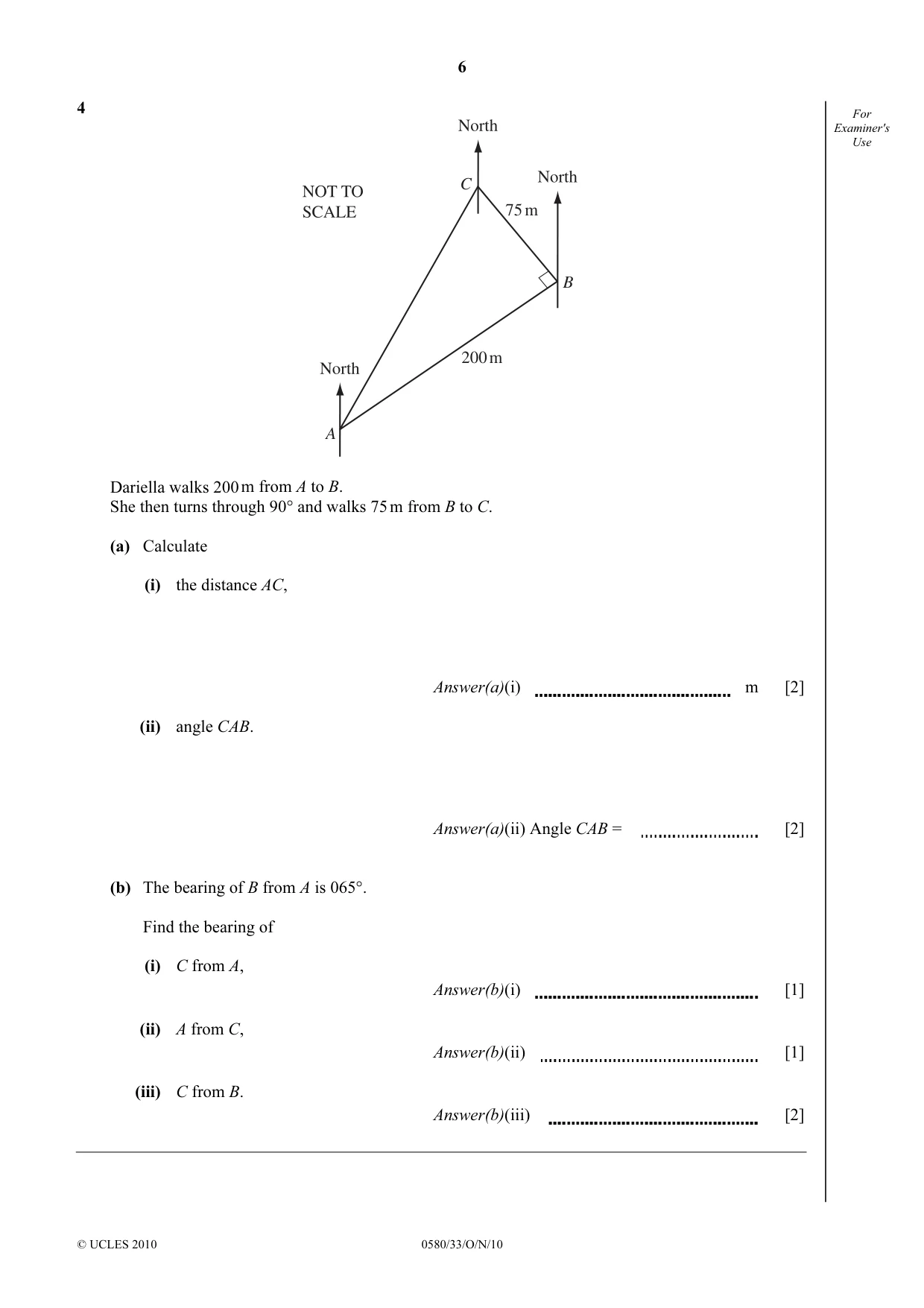
4 For North Examiner's Use North NOT TO C SCALE 75 m B 200 m North A Dariella walks 200 m from A to B. She then turns through 90° and walks 75 m from B to C. (a) Calculate (i) the distance AC, Answer(a)(i) m [2] (ii) angle CAB. Answer(a)(ii) Angle CAB = [2] (b) The bearing of B from A is 065°. Find the bearing of (i) C from A, Answer(b)(i) [1] (ii) A from C, Answer(b)(ii) [1] (iii) C from B. Answer(b)(iii) [2]
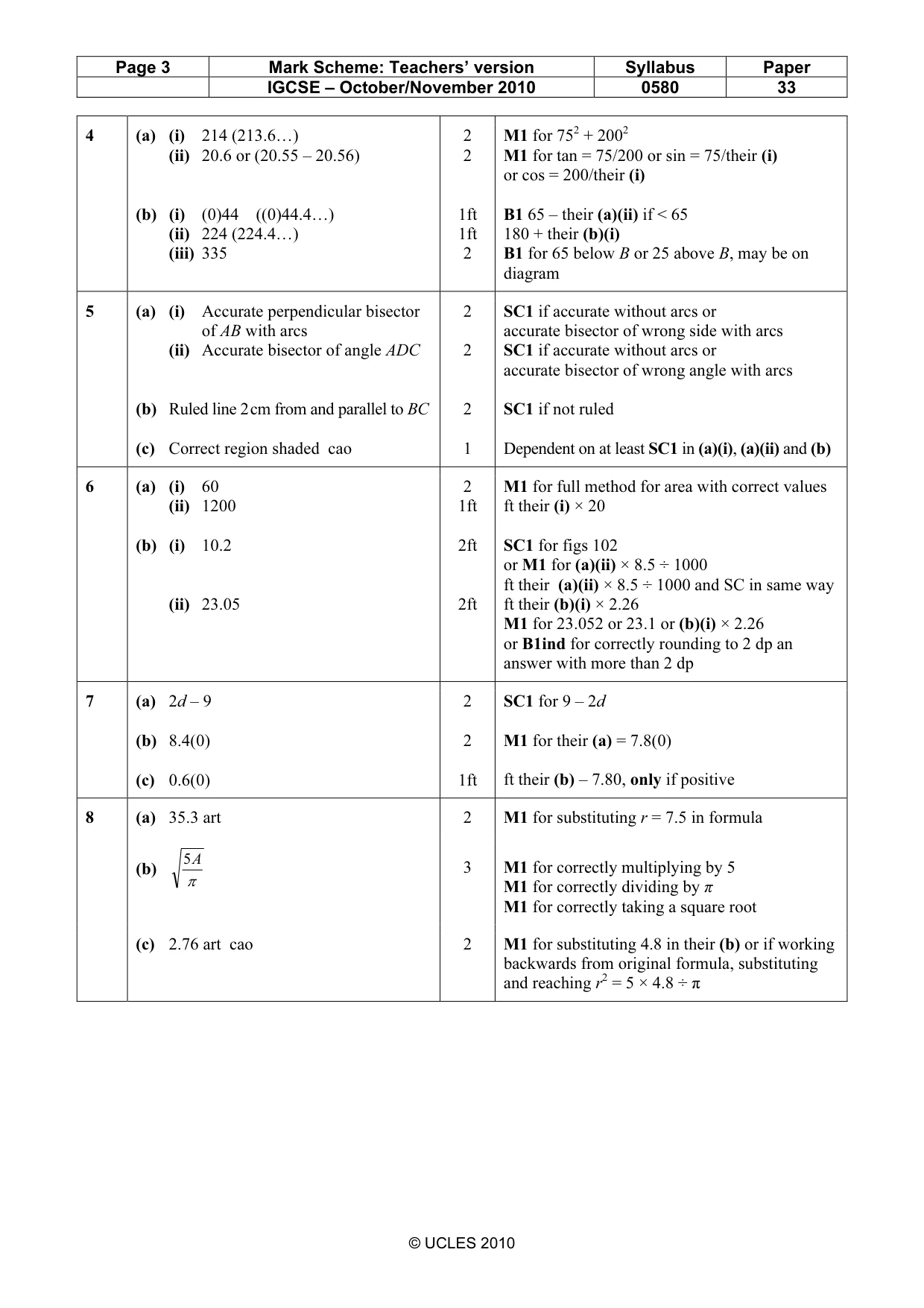
Mark scheme: 4 (a) (i) 214 (213.6…) 2 M1 for 752 + 2002 (ii) 20.6 or (20.55 – 20.56) 2 M1 for tan = 75/200 or sin = 75/their (i) or cos = 200/their (i) (b) (i) (0)44 ((0)44.4…) 1ft B1 65 – their (a)(ii) if < 65 (ii) 224 (224.4…) 1ft 180 + their (b)(i) (iii) 335 2 B1 for 65 below B or 25 above B, may be on diagram
Q5 · For C Examiner's Use D B A The diagram shows a quadrilateral ABCD
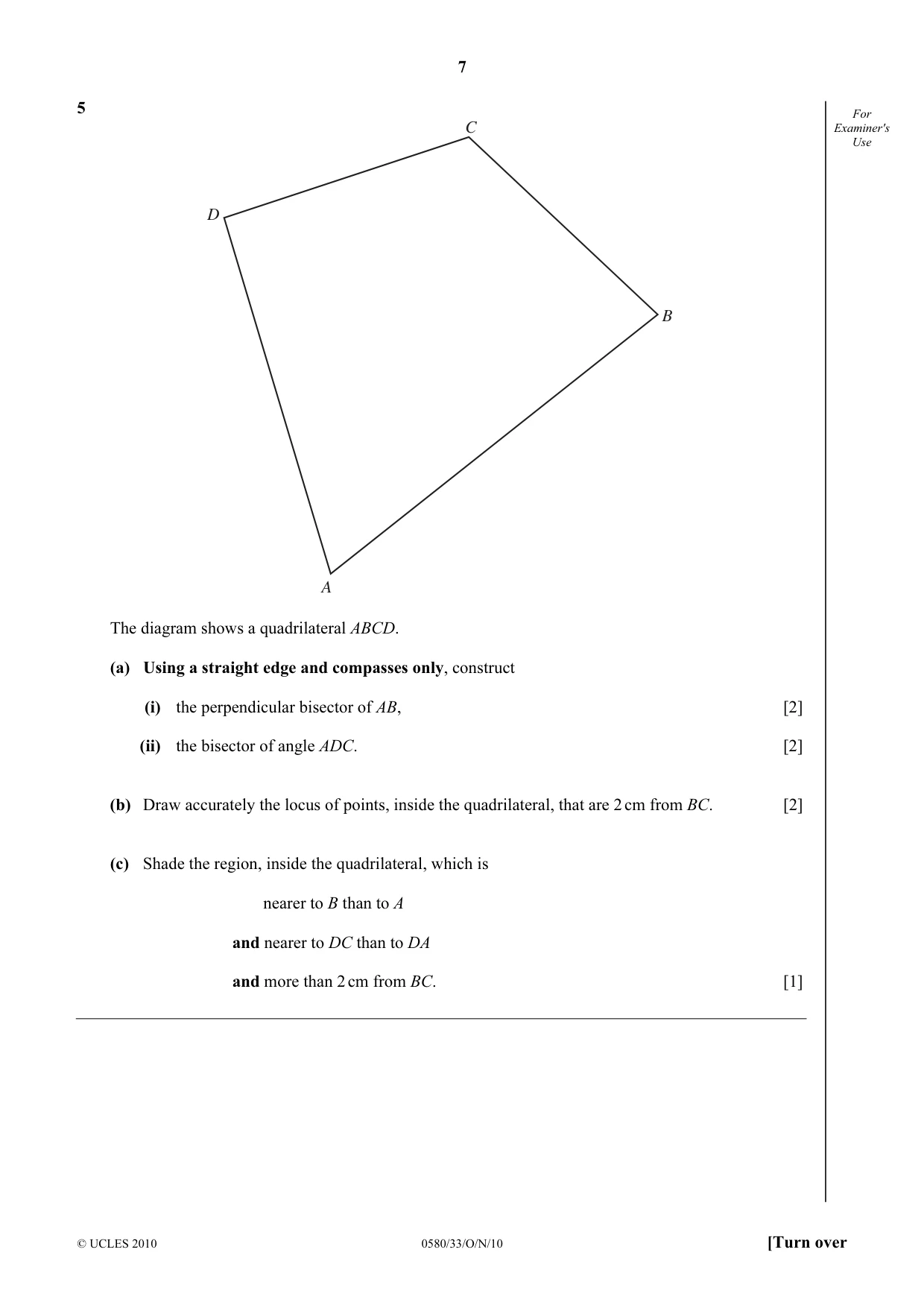
5 For C Examiner's Use D B A The diagram shows a quadrilateral ABCD. (a) Using a straight edge and compasses only, construct (i) the perpendicular bisector of AB, [2] (ii) the bisector of angle ADC. [2] (b) Draw accurately the locus of points, inside the quadrilateral, that are 2 cm from BC. [2] (c) Shade the region, inside the quadrilateral, which is nearer to B than to A and nearer to DC than to DA and more than 2 cm from BC. [1]
Mark scheme: 5 (a) (i) Accurate perpendicular bisector 2 SC1 if accurate without arcs or of AB with arcs accurate bisector of wrong side with arcs (ii) Accurate bisector of angle ADC 2 SC1 if accurate without arcs or accurate bisector of wrong angle with arcs (b) Ruled line 2 cm from and parallel to BC 2 SC1 if not ruled (c) Correct region shaded cao 1 Dependent on at least SC1 in (a)(i), (a)(ii) and (b)
Q6 · For Examiner's Use NOT TO SCALE 8 cm D C 6 cm 20 cm A 12 cm B The diagram shows a prism…
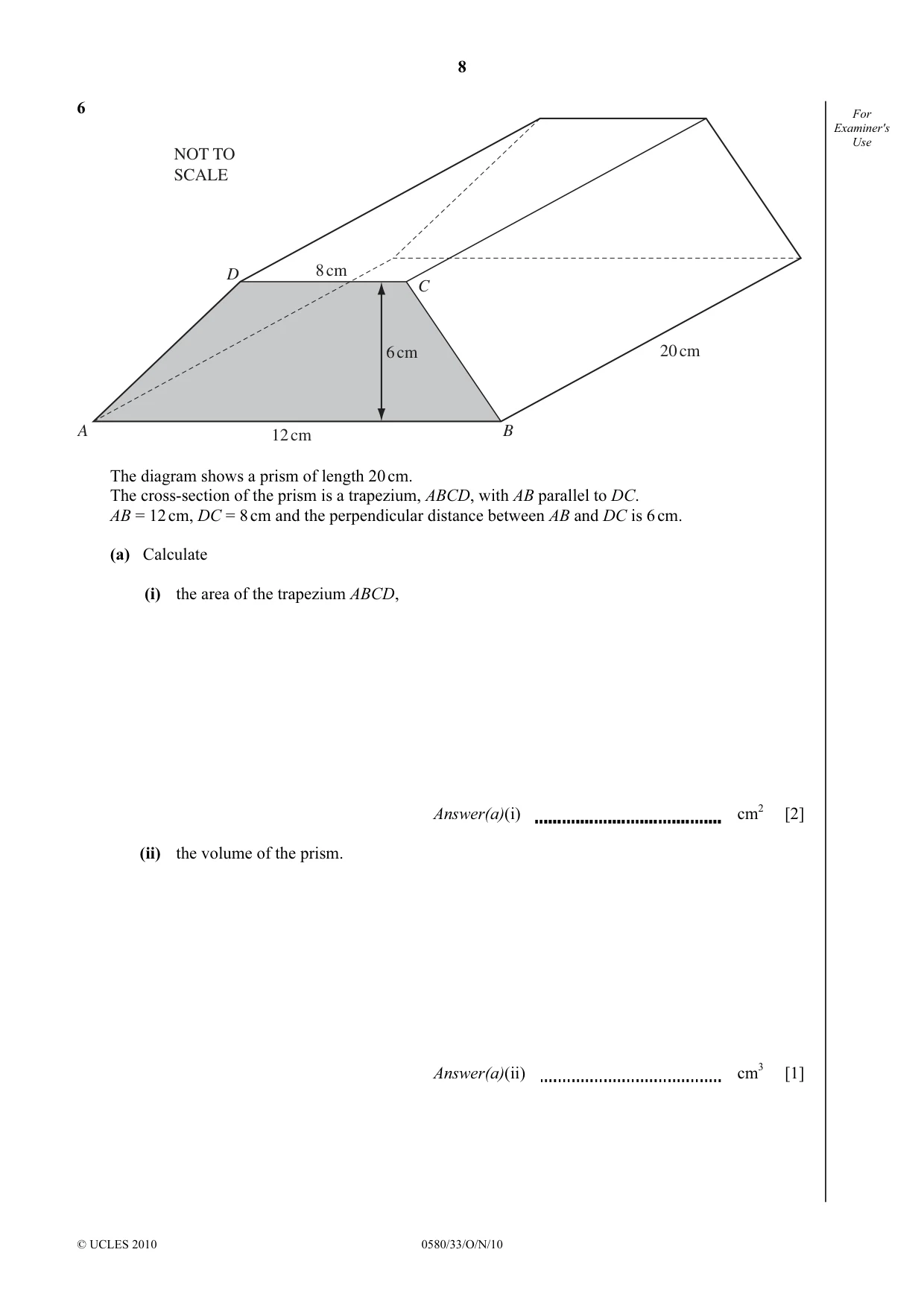
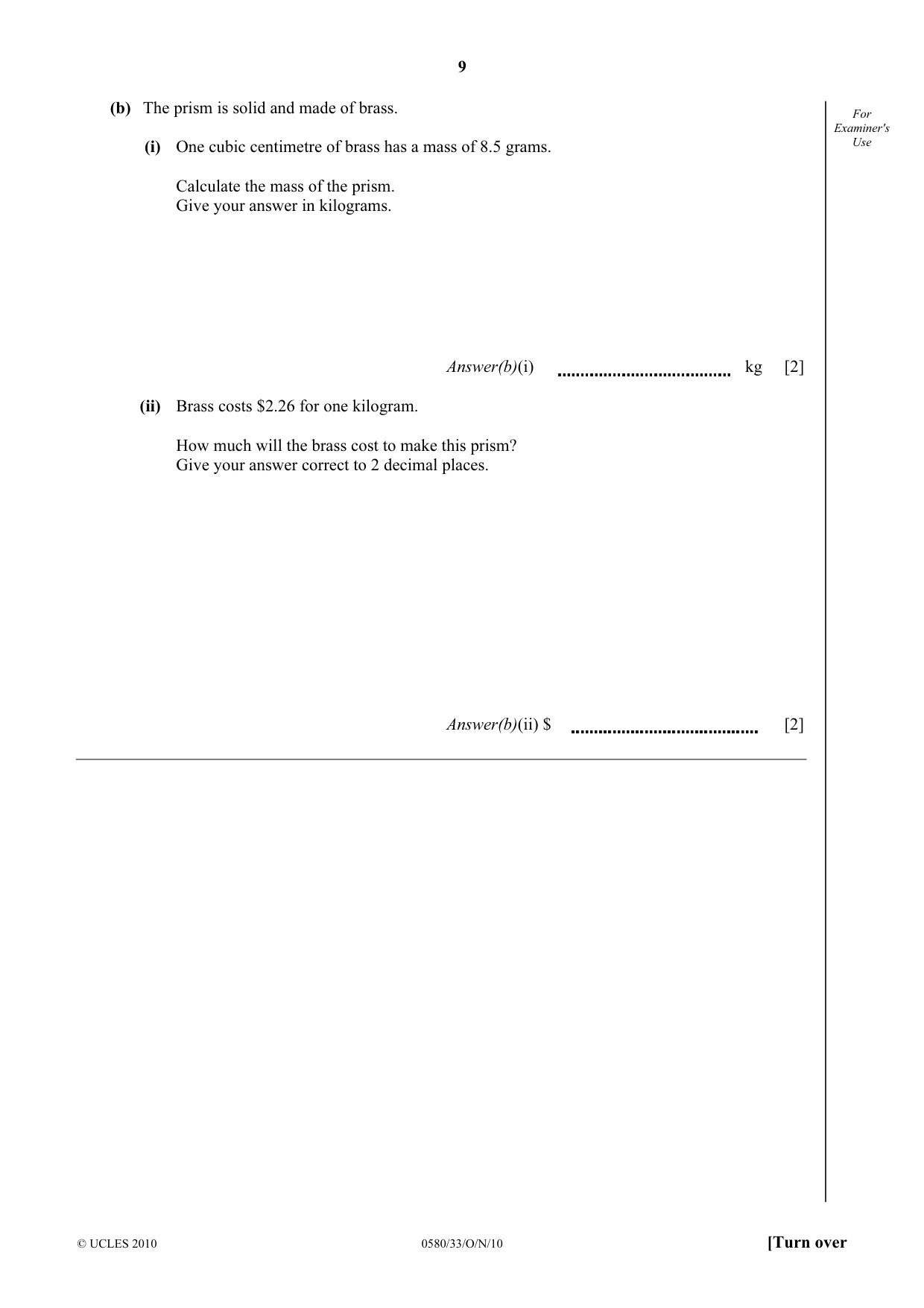
6 For Examiner's Use NOT TO SCALE 8 cm D C 6 cm 20 cm A 12 cm B The diagram shows a prism of length 20 cm. The cross-section of the prism is a trapezium, ABCD, with AB parallel to DC. AB = 12 cm, DC = 8 cm and the perpendicular distance between AB and DC is 6 cm. (a) Calculate (i) the area of the trapezium ABCD, Answer(a)(i) cm2 [2] (ii) the volume of the prism. Answer(a)(ii) cm3 [1] (b) The prism is solid and made of brass. For Examiner's (i) One cubic centimetre of brass has a mass of 8.5 grams. Use Calculate the mass of the prism. Give your answer in kilograms. Answer(b)(i) kg [2] (ii) Brass costs $2.26 for one kilogram. How much will the brass cost to make this prism? Give your answer correct to 2 decimal places. Answer(b)(ii) $ [2]
Mark scheme: 6 (a) (i) 60 2 M1 for full method for area with correct values (ii) 1200 1ft ft their (i) × 20 (b) (i) 10.2 2ft SC1 for figs 102 or M1 for (a)(ii) × 8.5 ÷ 1000 ft their (a)(ii) × 8.5 ÷ 1000 and SC in same way (ii) 23.05 2ft ft their (b)(i) × 2.26 M1 for 23.052 or 23.1 or (b)(i) × 2.26 or B1ind for correctly rounding to 2 dp an answer with more than 2 dp
Q7 · Alex has d dollars to spend
7 Alex has d dollars to spend. For He buys a book which costs $9 less than 2 times d. Examiner's Use (a) Write down an algebraic expression, in terms of d, for the cost of the book. Answer(a) $ [2] (b) The actual cost of the book is $7.80. Find the value of d. Answer(b) d = [2] (c) How much does Alex have left after buying the book? Answer(c) $ [1]
Mark scheme: 7 (a) 2d – 9 2 SC1 for 9 – 2d (b) 8.4(0) 2 M1 for their (a) = 7.8(0) (c) 0.6(0) 1ft ft their (b) – 7.80, only if positive
Q8 · The area, A, of a sector of a circle of radius r is given by the formula below
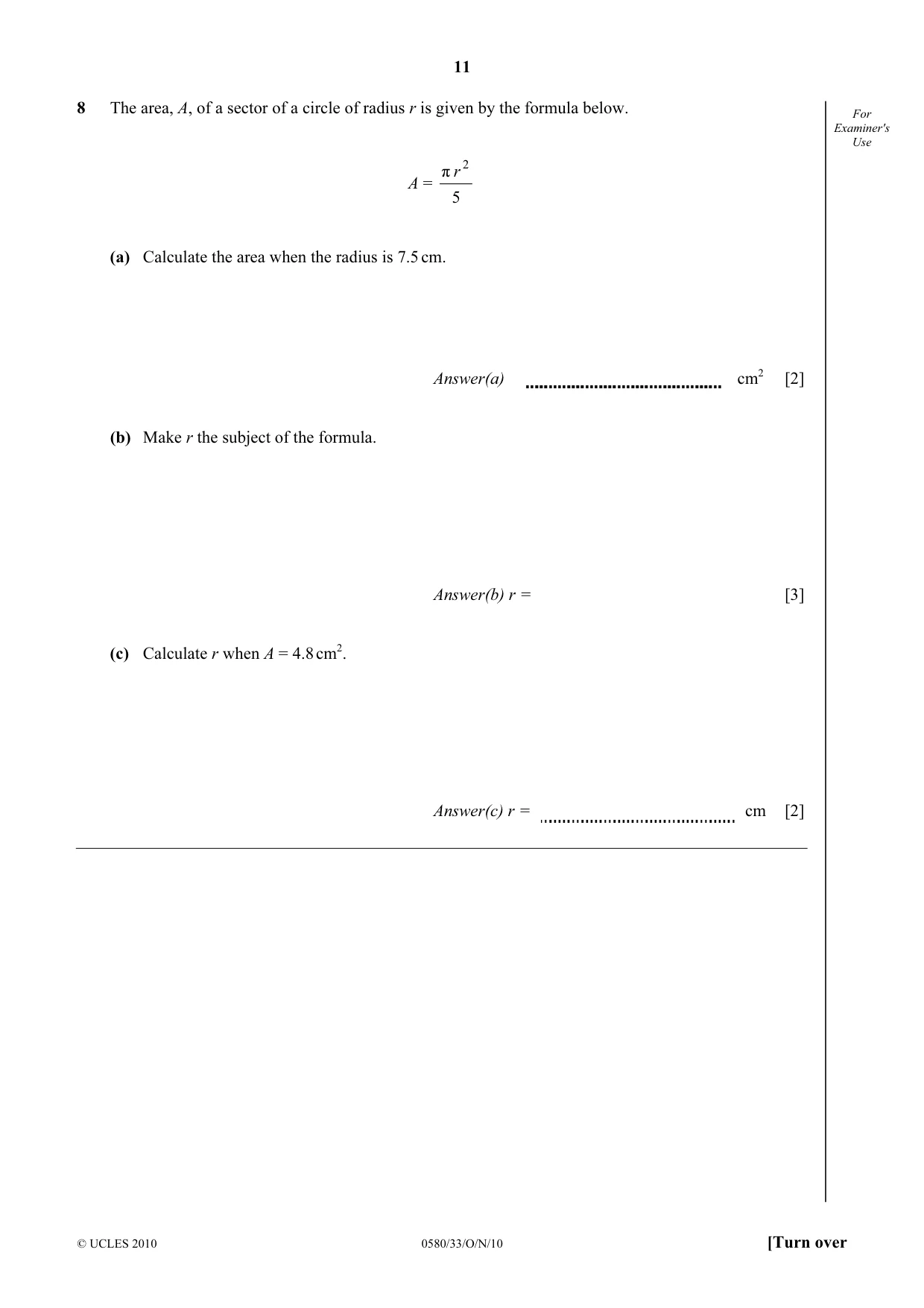
8 The area, A, of a sector of a circle of radius r is given by the formula below. For Examiner's Use π r 2 A = 5 (a) Calculate the area when the radius is 7.5 cm. Answer(a) cm2 [2] (b) Make r the subject of the formula. Answer(b) r = [3] (c) Calculate r when A = 4.8 cm2. Answer(c) r = cm [2]
Mark scheme: 8 (a) 35.3 art 2 M1 for substituting r = 7.5 in formula 5 A (b) 3 M1 for correctly multiplying by 5 π M1 for correctly dividing by π M1 for correctly taking a square root (c) 2.76 art cao 2 M1 for substituting 4.8 in their (b) or if working backwards from original formula, substituting and reaching r2 = 5 × 4.8 ÷ π IGCSE – October/November 2010 0580 33
Q9 · Complete the table for y = 12 – x2
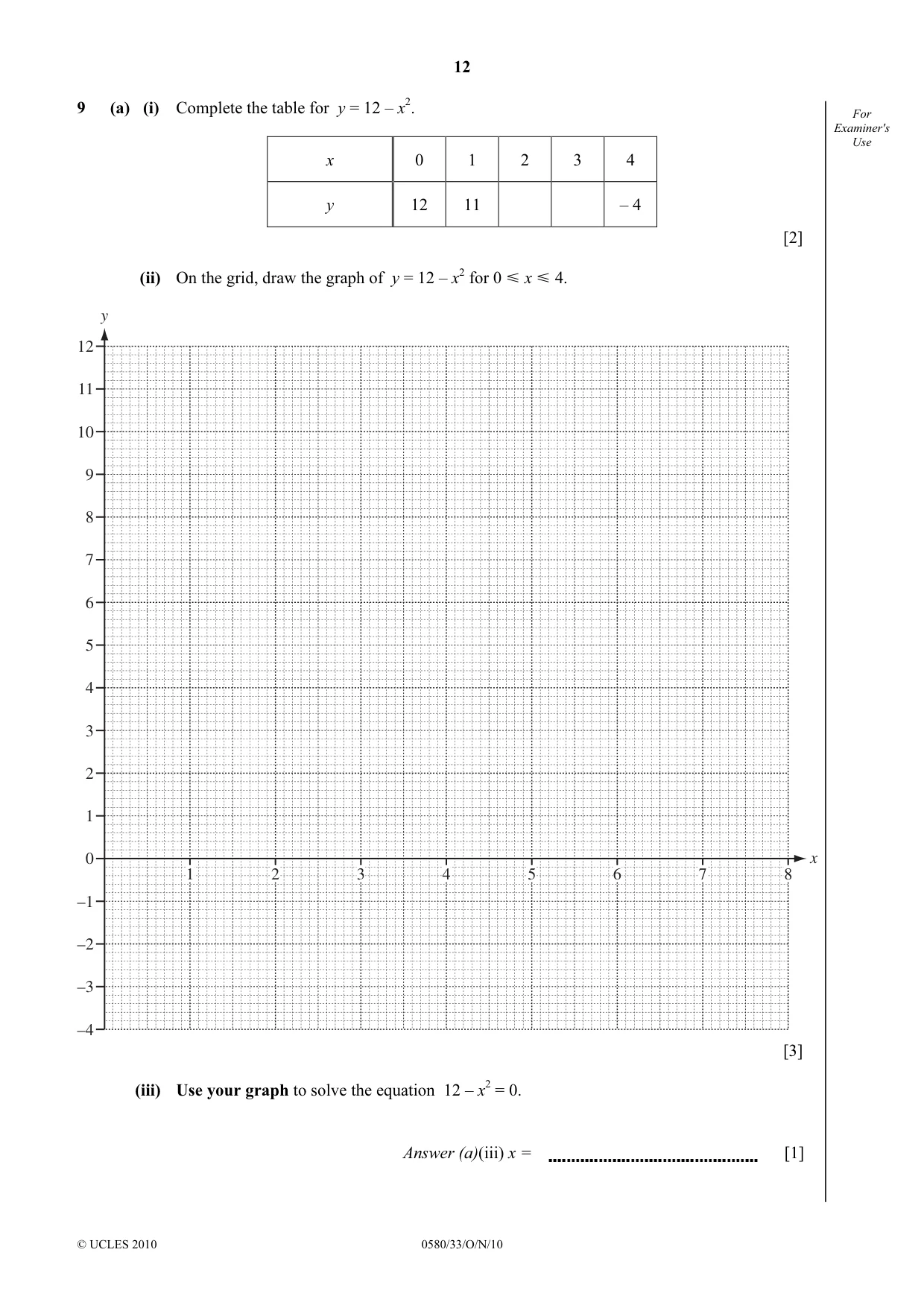
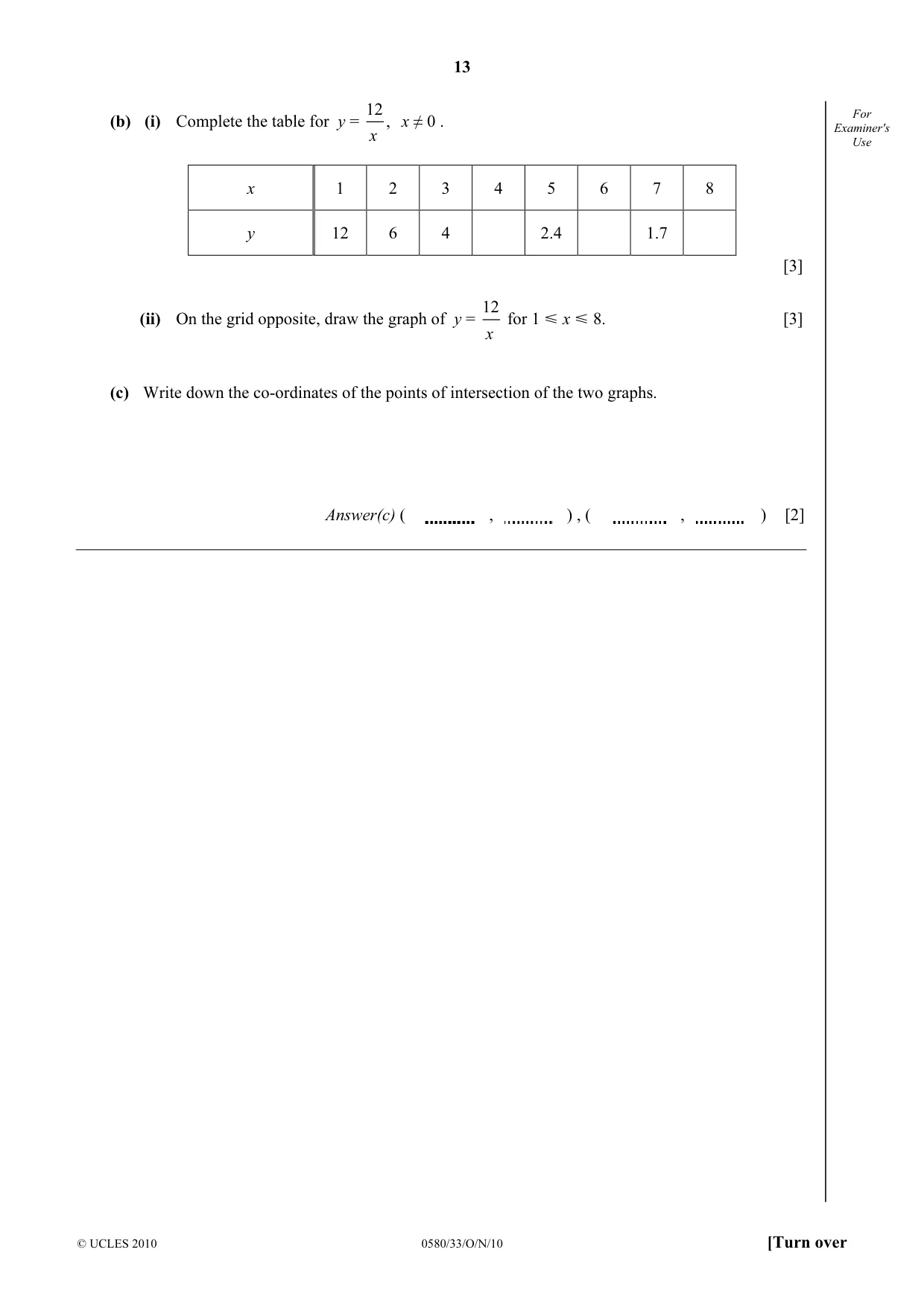
9 (a) (i) Complete the table for y = 12 – x2. For Examiner's Use x 0 1 2 3 4 y 12 11 – 4 [2] (ii) On the grid, draw the graph of y = 12 – x2 for 0 Y x Y 4. y 12 11
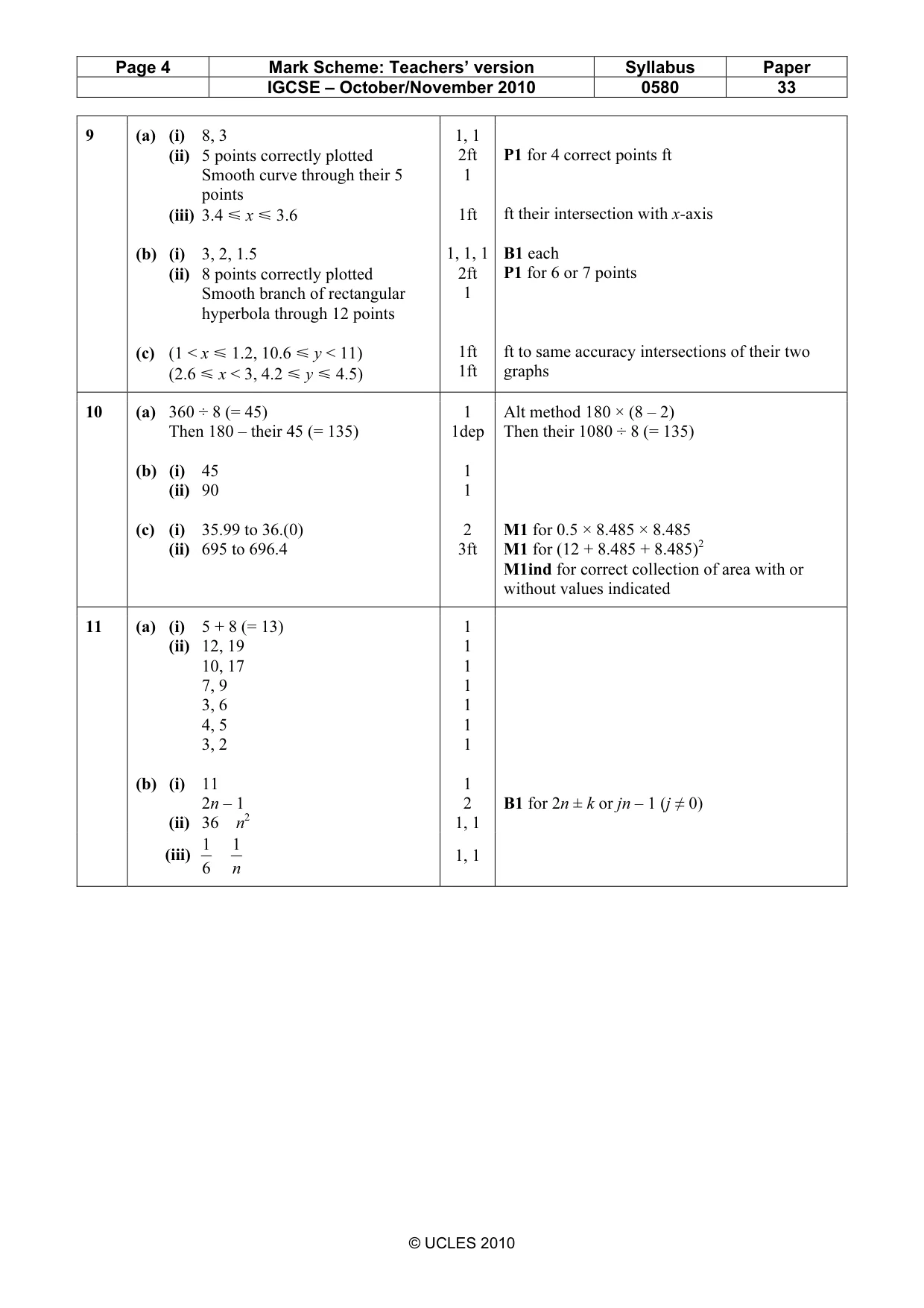
Mark scheme: 9 (a) (i) 8, 3 1, 1 (ii) 5 points correctly plotted 2ft P1 for 4 correct points ft Smooth curve through their 5 1 points (iii) 3.4 Y x Y 3.6 1ft ft their intersection with x-axis (b) (i) 3, 2, 1.5 1, 1, 1 B1 each (ii) 8 points correctly plotted 2ft P1 for 6 or 7 points Smooth branch of rectangular 1 hyperbola through 12 points (c) (1 < x Y 1.2, 10.6 Y y < 11) 1ft ft to same accuracy intersections of their two (2.6 Y x < 3, 4.2 Y y Y 4.5) 1ft graphs
Q11 · For Examiner's 0, 1, 1, 2, 3, 5, 8, …
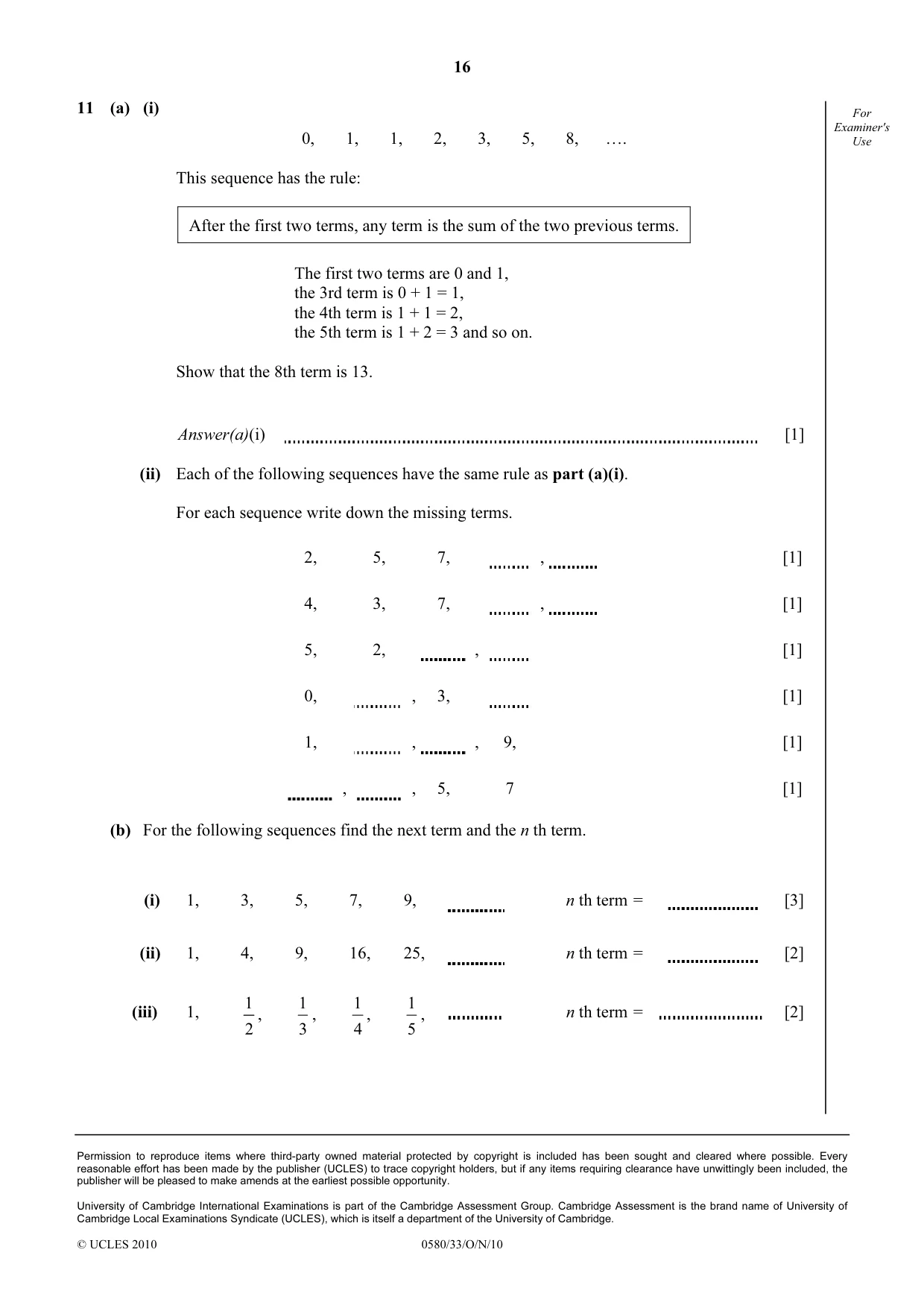
11 (a) (i) For Examiner's 0, 1, 1, 2, 3, 5, 8, …. Use This sequence has the rule: After the first two terms, any term is the sum of the two previous terms. The first two terms are 0 and 1, the 3rd term is 0 + 1 = 1, the 4th term is 1 + 1 = 2, the 5th term is 1 + 2 = 3 and so on. Show that the 8th term is 13. Answer(a)(i) [1] (ii) Each of the following sequences have the same rule as part (a)(i). For each sequence write down the missing terms. 2, 5, 7, , [1] 4, 3, 7, , [1] 5, 2, , [1] 0, , 3, [1] 1, , , 9, [1] , , 5, 7 [1] (b) For the following sequences find the next term and the n th term. (i) 1, 3, 5, 7, 9, n th term = [3] (ii) 1, 4, 9, 16, 25, n th term = [2] 1 1 1 1 (iii) 1, , , , , n th term = [2] 2 3 4 5
Mark scheme: 11 (a) (i) 5 + 8 (= 13) 1 (ii) 12, 19 1 10, 17 1 7, 9 1 3, 6 1 4, 5 1 3, 2 1 (b) (i) 11 1 2n – 1 2 B1 for 2n ± k or jn – 1 (j ≠ 0) (ii) 36 n2 1, 1 1 1 (iii) 1, 1 6 n
What was in this paper
The subtopics covered by these 10 questions, and how many questions each got. Open one in a new tab to see every Cambridge question on it.
What you needed in this session
Cambridge’s own grade thresholds for 2010 Oct/Nov, Paper 3 · Variant 3. A higher threshold means an easier paper — the bar moves with how the cohort did.