Cambridge IGCSE Mathematics 0580 — 2010 Oct/Nov Paper 3 · Variant 2
0580/32/O/N/10 · 9 questions · 104 marks · ≈117 min
The question paper and its mark scheme, free to read here and free to download. This is Cambridge’s own paper, exactly as it was sat.
Question paper16 pages
Mark scheme4 pages
Answers below. Sit the paper first if you are practising.
Questions as text
Q1 · A drink consists of water and fruit juice
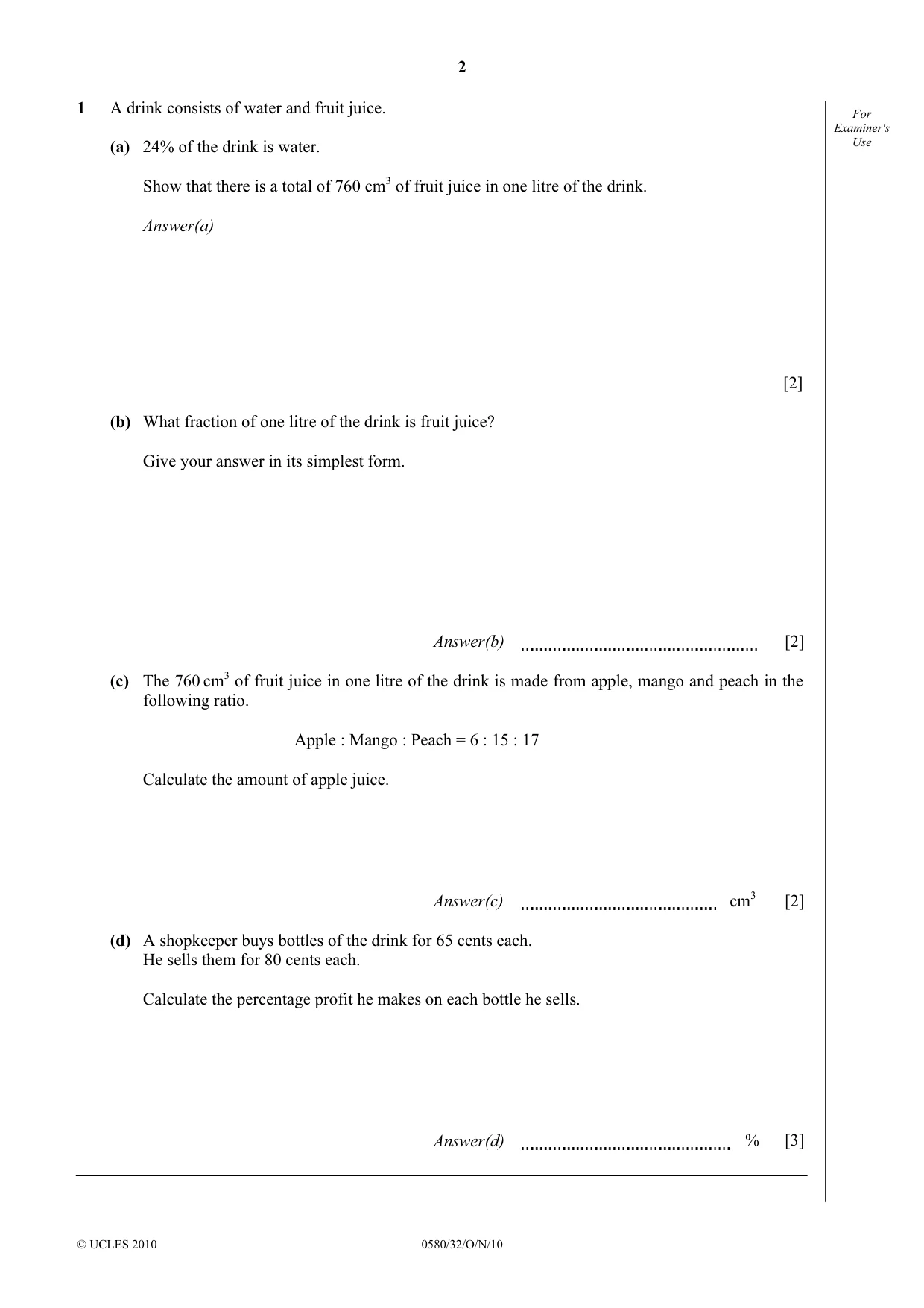
1 A drink consists of water and fruit juice. For Examiner's (a) 24% of the drink is water. Use Show that there is a total of 760 cm3 of fruit juice in one litre of the drink. Answer(a) [2] (b) What fraction of one litre of the drink is fruit juice? Give your answer in its simplest form. Answer(b) [2] (c) The 760 cm3 of fruit juice in one litre of the drink is made from apple, mango and peach in the following ratio. Apple : Mango : Peach = 6 : 15 : 17 Calculate the amount of apple juice. Answer(c) cm3 [2] (d) A shopkeeper buys bottles of the drink for 65 cents each. He sells them for 80 cents each. Calculate the percentage profit he makes on each bottle he sells. Answer(d) % [3]
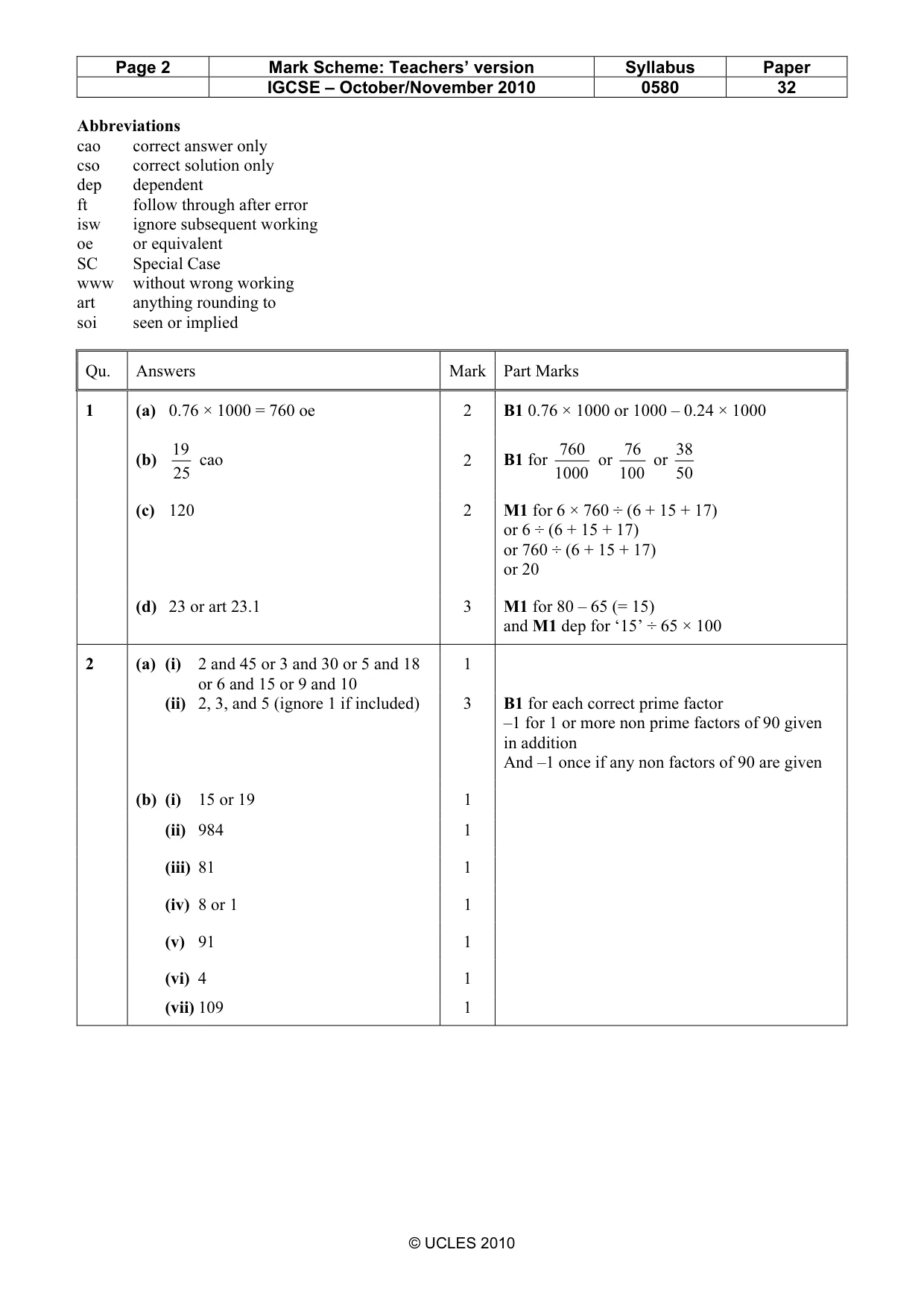
Mark scheme: Qu. Answers Mark Part Marks 1 (a) 0.76 × 1000 = 760 oe 2 B1 0.76 × 1000 or 1000 – 0.24 × 1000 19 760 76 38 (b) cao 2 B1 for or or 25 1000 100 50 (c) 120 2 M1 for 6 × 760 ÷ (6 + 15 + 17) or 6 ÷ (6 + 15 + 17) or 760 ÷ (6 + 15 + 17) or 20 (d) 23 or art 23.1 3 M1 for 80 – 65 (= 15) and M1 dep for ‘15’ ÷ 65 × 100
Q2 · F × g = 90 For Examiner's f and g are both integers greater than 1
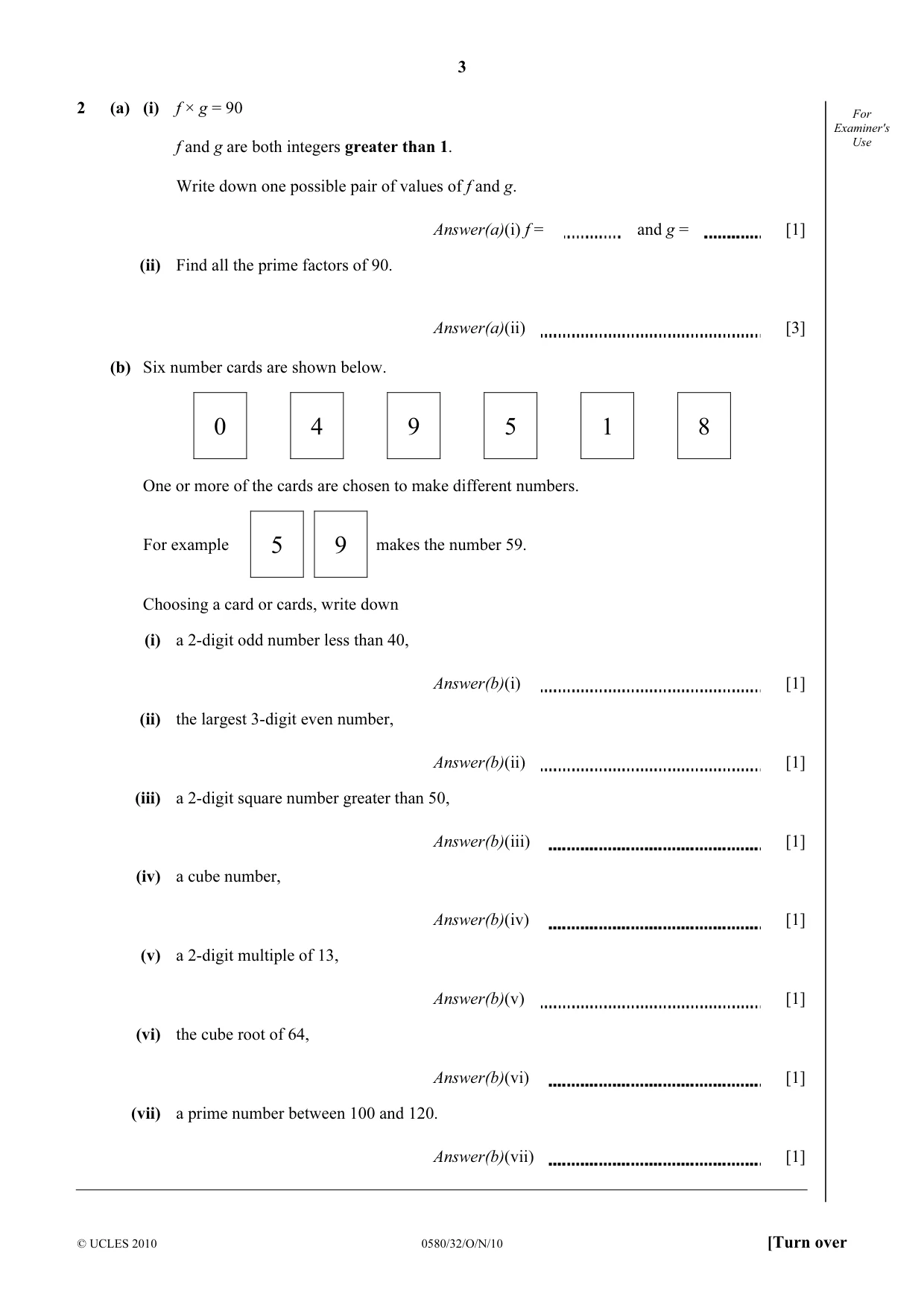
2 (a) (i) f × g = 90 For Examiner's f and g are both integers greater than 1. Use Write down one possible pair of values of f and g. Answer(a)(i) f = and g = [1] (ii) Find all the prime factors of 90. Answer(a)(ii) [3] (b) Six number cards are shown below. 0 4 9 5 1 8 One or more of the cards are chosen to make different numbers. For example 5 9 makes the number 59. Choosing a card or cards, write down (i) a 2-digit odd number less than 40, Answer(b)(i) [1] (ii) the largest 3-digit even number, Answer(b)(ii) [1] (iii) a 2-digit square number greater than 50, Answer(b)(iii) [1] (iv) a cube number, Answer(b)(iv) [1] (v) a 2-digit multiple of 13, Answer(b)(v) [1] (vi) the cube root of 64, Answer(b)(vi) [1] (vii) a prime number between 100 and 120. Answer(b)(vii) [1]
Mark scheme: 2 (a) (i) 2 and 45 or 3 and 30 or 5 and 18 1 or 6 and 15 or 9 and 10 (ii) 2, 3, and 5 (ignore 1 if included) 3 B1 for each correct prime factor –1 for 1 or more non prime factors of 90 given in addition And –1 once if any non factors of 90 are given (b) (i) 15 or 19 1 (ii) 984 1 (iii) 81 1 (iv) 8 or 1 1 (v) 91 1 (vi) 4 1 (vii) 109 1 IGCSE – October/November 2010 0580 32
Q3 · Kim left school at 15 30 to walk home
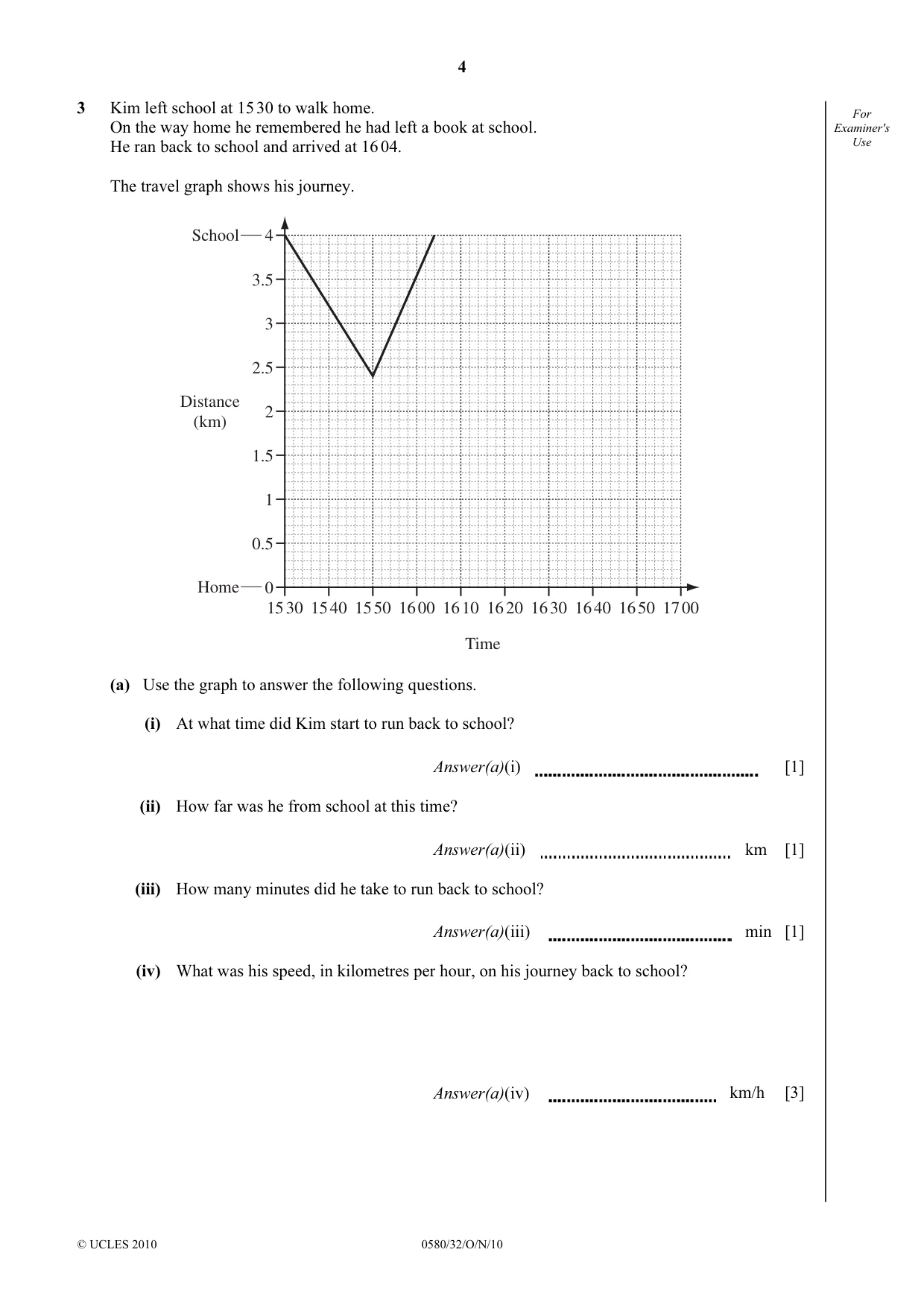
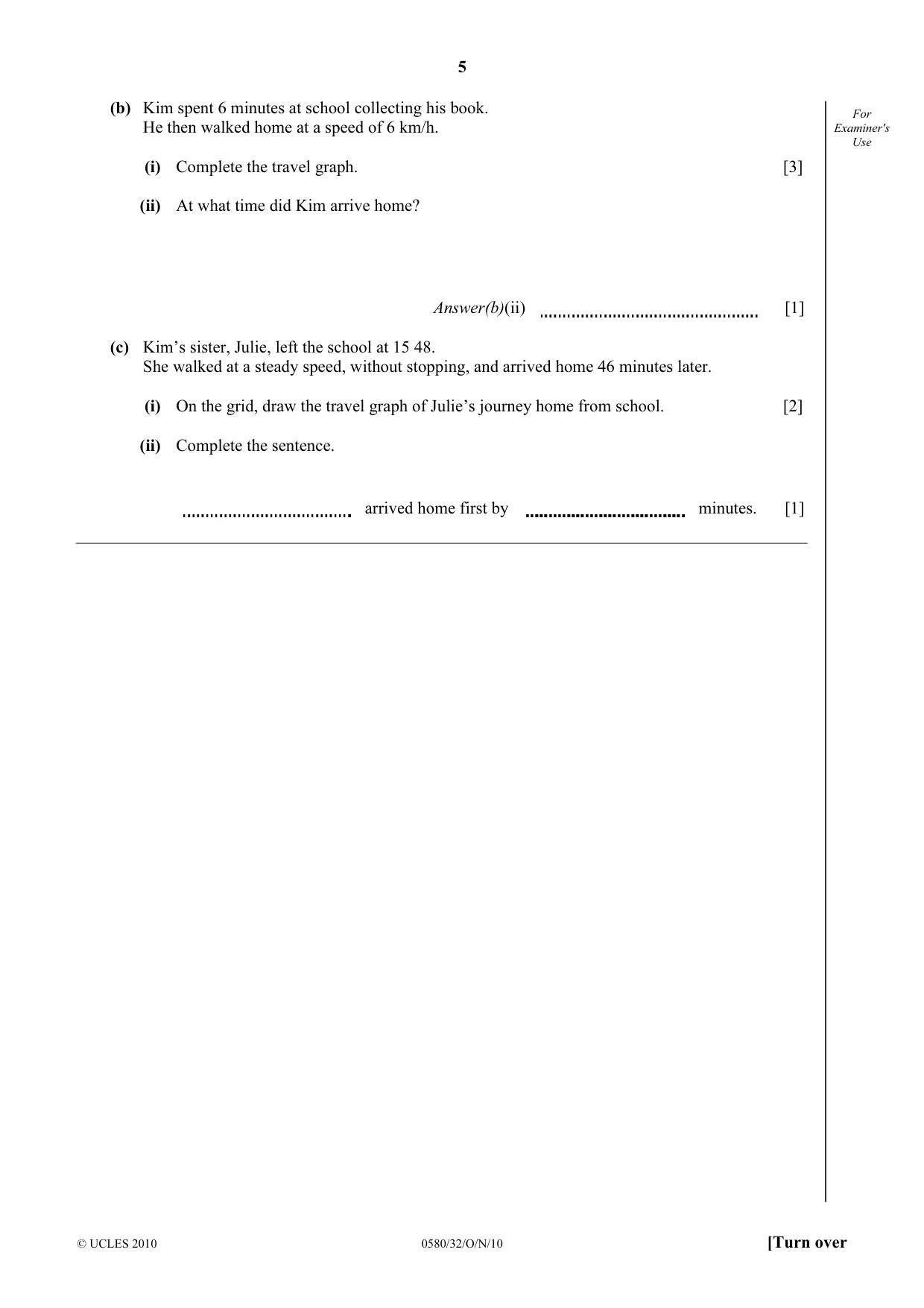
3 Kim left school at 15 30 to walk home. For On the way home he remembered he had left a book at school. Examiner's He ran back to school and arrived at 16 04. Use The travel graph shows his journey. School 4 3.5 3 2.5 Distance 2 (km) 1.5 1 0.5 Home 0 15 30 15 40 15 50 16 00 16 10 16 20 16 30 16 40 16 50 17 00 Time (a) Use the graph to answer the following questions. (i) At what time did Kim start to run back to school? Answer(a)(i) [1] (ii) How far was he from school at this time? Answer(a)(ii) km [1] (iii) How many minutes did he take to run back to school? Answer(a)(iii) min [1] (iv) What was his speed, in kilometres per hour, on his journey back to school? Answer(a)(iv) km/h [3] (b) Kim spent 6 minutes at school collecting his book. For He then walked home at a speed of 6 km/h. Examiner's Use (i) Complete the travel graph. [3] (ii) At what time did Kim arrive home? Answer(b)(ii) [1] (c) Kim’s sister, Julie, left the school at 15 48. She walked at a steady speed, without stopping, and arrived home 46 minutes later. (i) On the grid, draw the travel graph of Julie’s journey home from school. [2] (ii) Complete the sentence. arrived home first by minutes. [1]
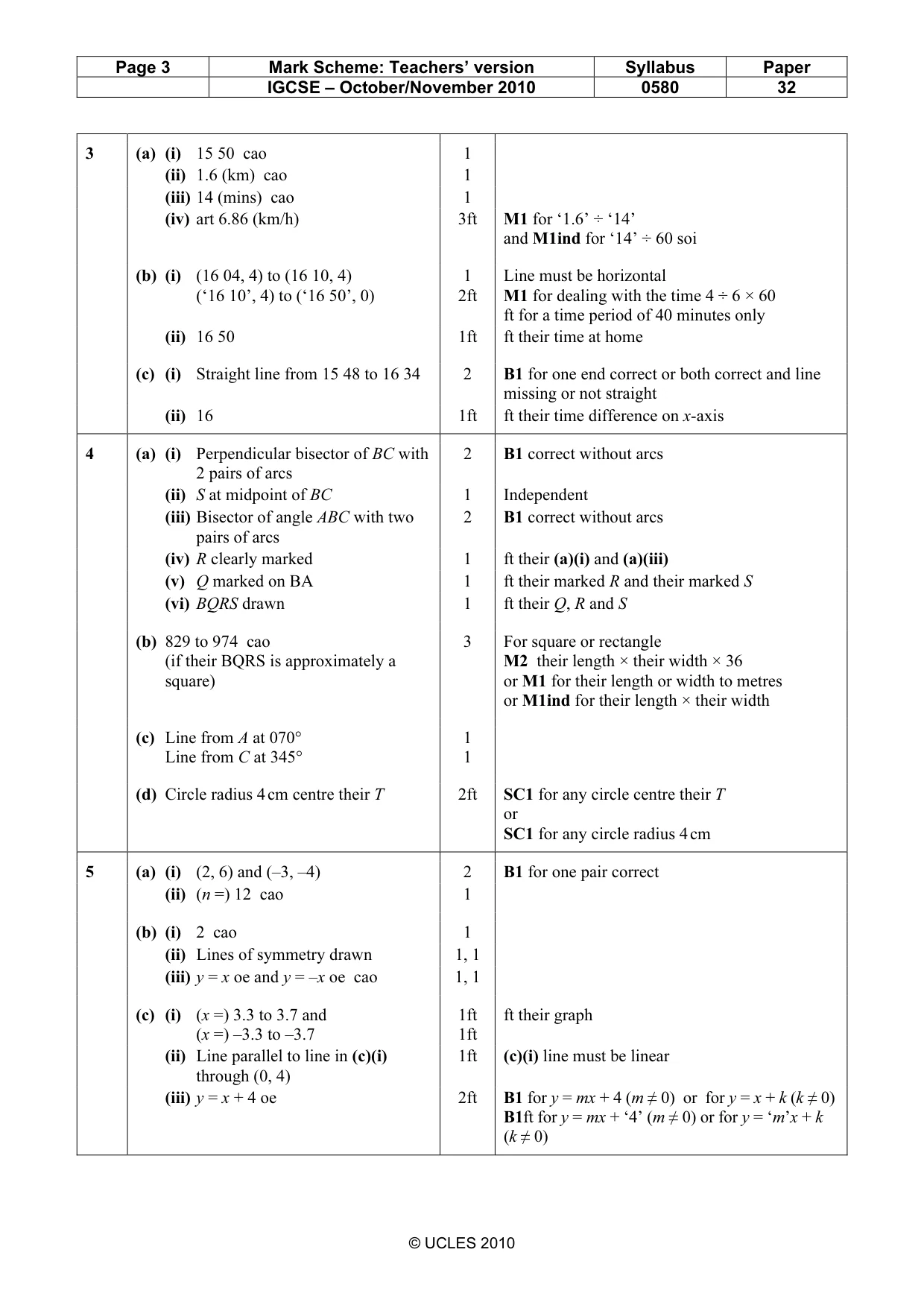
Mark scheme: 3 (a) (i) 15 50 cao 1 (ii) 1.6 (km) cao 1 (iii) 14 (mins) cao 1 (iv) art 6.86 (km/h) 3ft M1 for ‘1.6’ ÷ ‘14’ and M1ind for ‘14’ ÷ 60 soi (b) (i) (16 04, 4) to (16 10, 4) 1 Line must be horizontal (‘16 10’, 4) to (‘16 50’, 0) 2ft M1 for dealing with the time 4 ÷ 6 × 60 ft for a time period of 40 minutes only (ii) 16 50 1ft ft their time at home (c) (i) Straight line from 15 48 to 16 34 2 B1 for one end correct or both correct and line missing or not straight (ii) 16 1ft ft their time difference on x-axis
Q4 · An accurate scale drawing of three sides of a garden, AB, BC, and CD is shown on the…
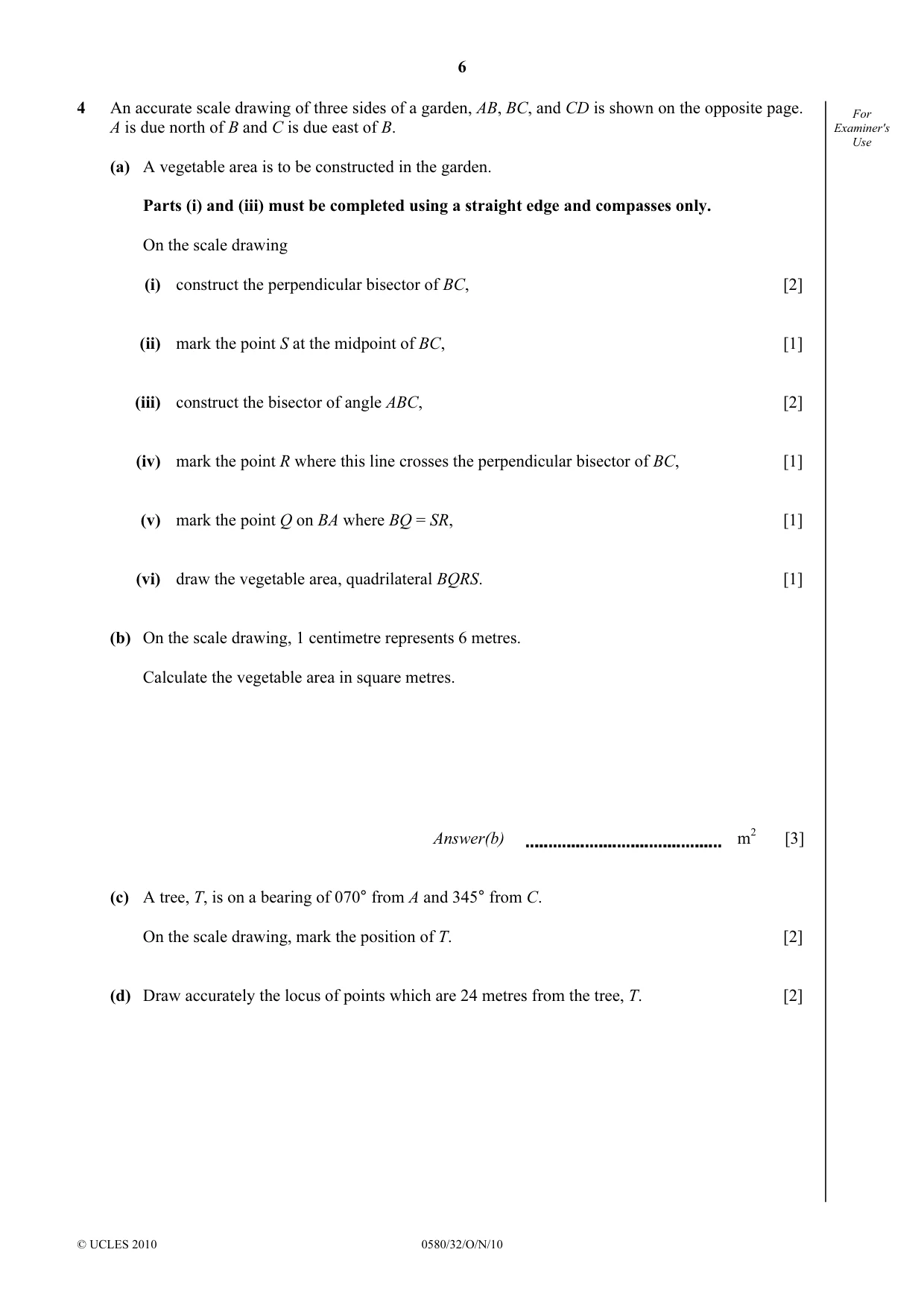
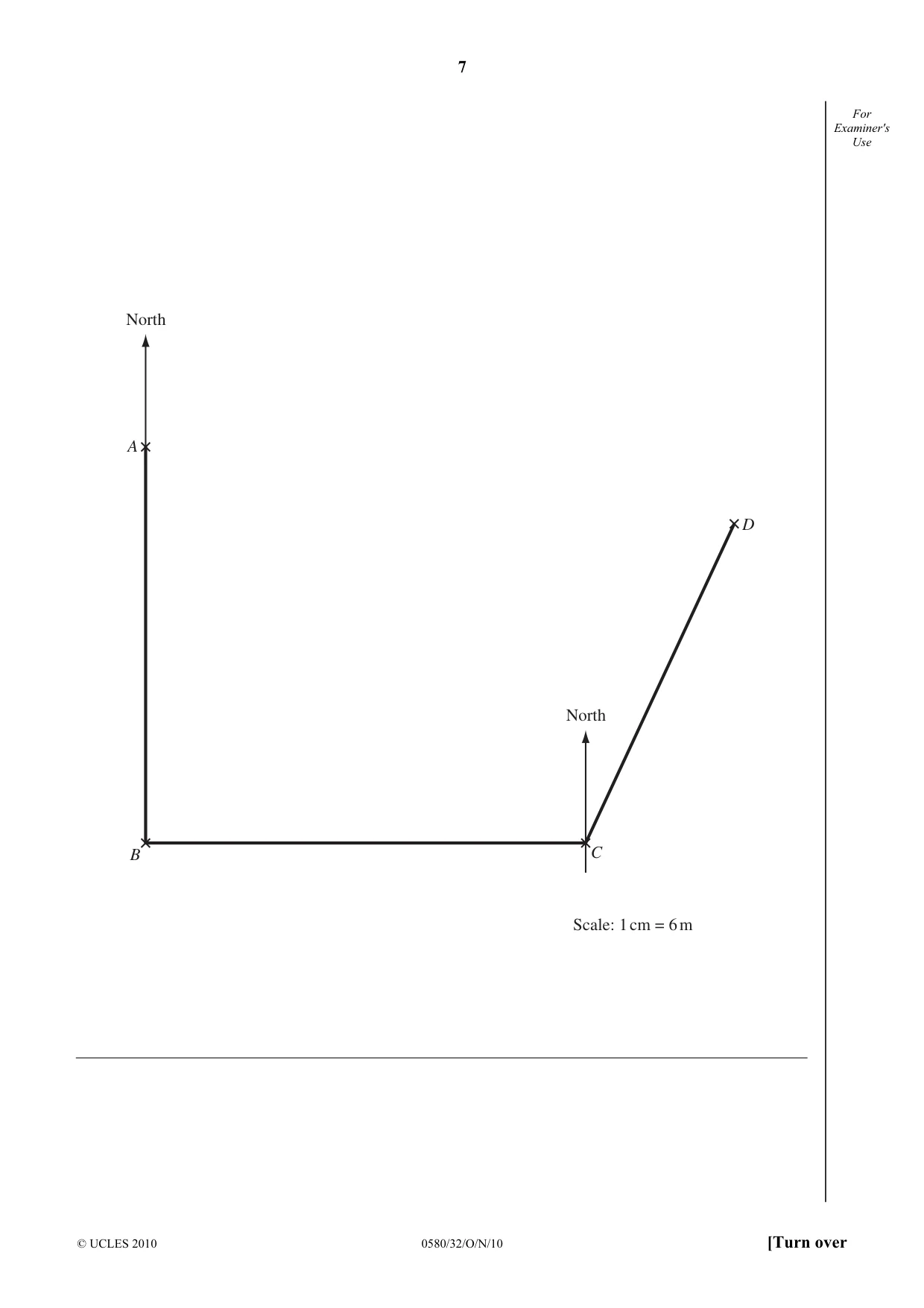
4 An accurate scale drawing of three sides of a garden, AB, BC, and CD is shown on the opposite page. For A is due north of B and C is due east of B. Examiner's Use (a) A vegetable area is to be constructed in the garden. Parts (i) and (iii) must be completed using a straight edge and compasses only. On the scale drawing (i) construct the perpendicular bisector of BC, [2] (ii) mark the point S at the midpoint of BC, [1] (iii) construct the bisector of angle ABC, [2] (iv) mark the point R where this line crosses the perpendicular bisector of BC, [1] (v) mark the point Q on BA where BQ = SR, [1] (vi) draw the vegetable area, quadrilateral BQRS. [1] (b) On the scale drawing, 1 centimetre represents 6 metres. Calculate the vegetable area in square metres. Answer(b) m2 [3] (c) A tree, T, is on a bearing of 070° from A and 345° from C. On the scale drawing, mark the position of T. [2] (d) Draw accurately the locus of points which are 24 metres from the tree, T. [2] For Examiner's Use North A D North B C Scale: 1 cm = 6 m
Mark scheme: 4 (a) (i) Perpendicular bisector of BC with 2 B1 correct without arcs 2 pairs of arcs (ii) S at midpoint of BC 1 Independent (iii) Bisector of angle ABC with two 2 B1 correct without arcs pairs of arcs (iv) R clearly marked 1 ft their (a)(i) and (a)(iii) (v) Q marked on BA 1 ft their marked R and their marked S (vi) BQRS drawn 1 ft their Q, R and S (b) 829 to 974 cao 3 For square or rectangle (if their BQRS is approximately a M2 their length × their width × 36 square) or M1 for their length or width to metres or M1ind for their length × their width (c) Line from A at 070° 1 Line from C at 345° 1 (d) Circle radius 4 cm centre their T 2ft SC1 for any circle centre their T or SC1 for any circle radius 4 cm
Q5 · For y Examiner's Use 12 10 8 6 A 4 2 x –12 –10 –8 –6 –4 –2 0 2 4 6 8 10 12 –2 –4 B –6 –8…
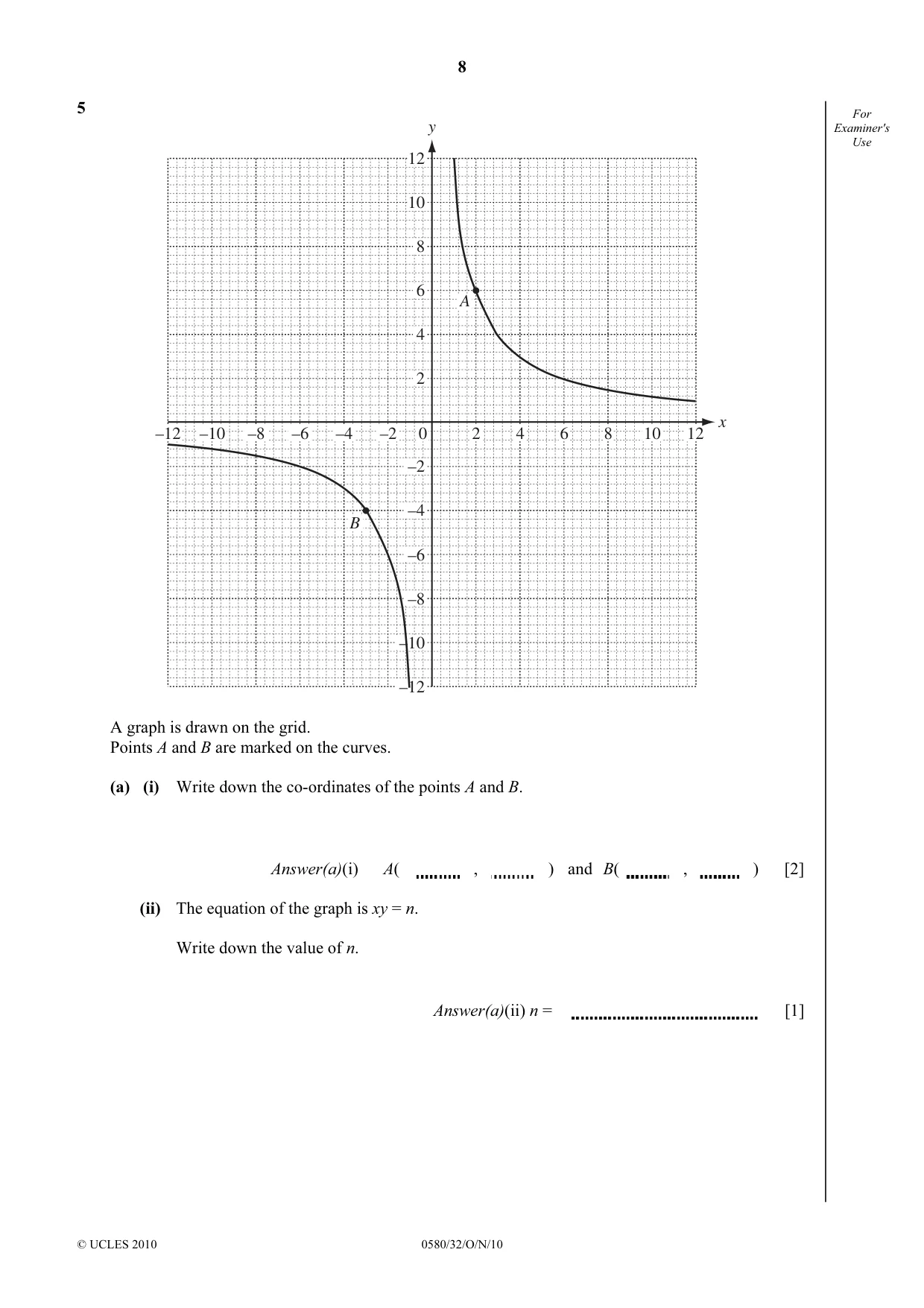
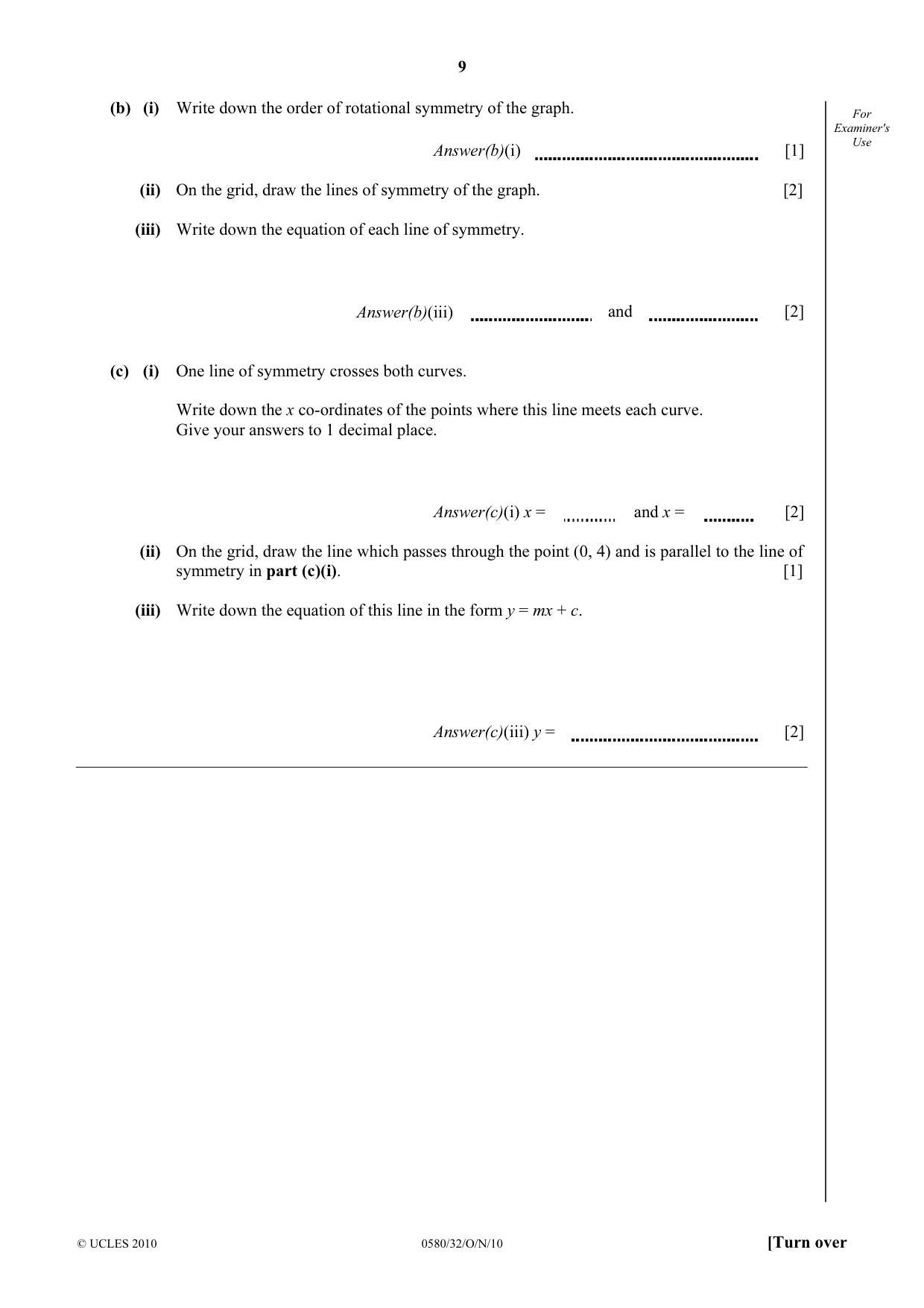
5 For y Examiner's Use 12 10 8 6 A 4 2 x –12 –10 –8 –6 –4 –2 0 2 4 6 8 10 12 –2 –4 B –6 –8 –10 –12 A graph is drawn on the grid. Points A and B are marked on the curves. (a) (i) Write down the co-ordinates of the points A and B. Answer(a)(i) A( , ) and B( , ) [2] (ii) The equation of the graph is xy = n. Write down the value of n. Answer(a)(ii) n = [1] (b) (i) Write down the order of rotational symmetry of the graph. For Examiner's Use Answer(b)(i) [1] (ii) On the grid, draw the lines of symmetry of the graph. [2] (iii) Write down the equation of each line of symmetry. Answer(b)(iii) and [2] (c) (i) One line of symmetry crosses both curves. Write down the x co-ordinates of the points where this line meets each curve. Give your answers to 1 decimal place. Answer(c)(i) x = and x = [2] (ii) On the grid, draw the line which passes through the point (0, 4) and is parallel to the line of symmetry in part (c)(i). [1] (iii) Write down the equation of this line in the form y = mx + c. Answer(c)(iii) y = [2]
Mark scheme: 5 (a) (i) (2, 6) and (–3, –4) 2 B1 for one pair correct (ii) (n =) 12 cao 1 (b) (i) 2 cao 1 (ii) Lines of symmetry drawn 1, 1 (iii) y = x oe and y = –x oe cao 1, 1 (c) (i) (x =) 3.3 to 3.7 and 1ft ft their graph (x =) –3.3 to –3.7 1ft (ii) Line parallel to line in (c)(i) 1ft (c)(i) line must be linear through (0, 4) (iii) y = x + 4 oe 2ft B1 for y = mx + 4 (m ≠ 0) or for y = x + k (k ≠ 0) B1ft for y = mx + ‘4’ (m ≠ 0) or for y = ‘m’x + k (k ≠ 0) IGCSE – October/November 2010 0580 32
Q6 · The formula for finding the interior angle of a regular polygon with n sides is given…
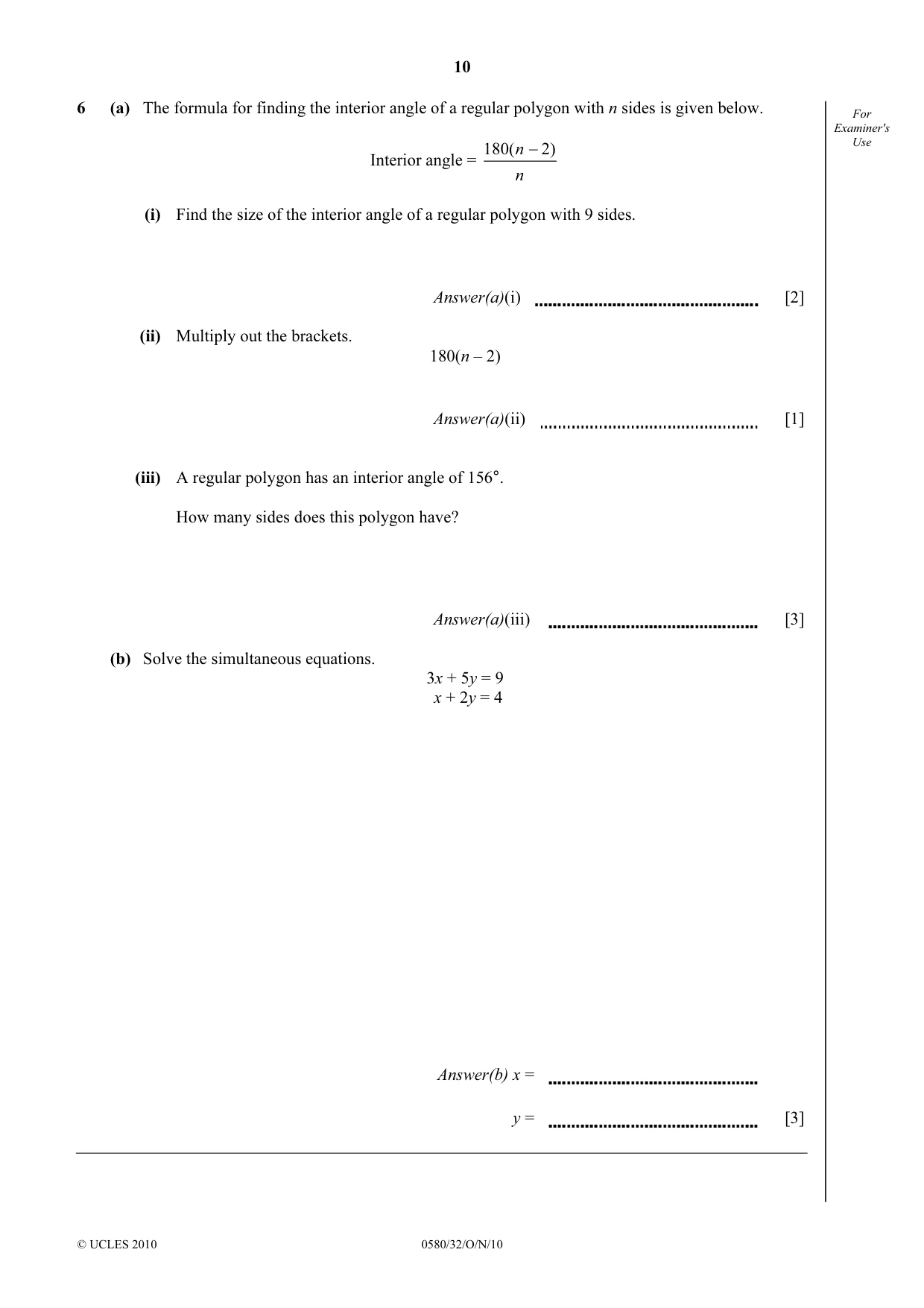
6 (a) The formula for finding the interior angle of a regular polygon with n sides is given below. For Examiner's 180( n − 2) Use Interior angle = n (i) Find the size of the interior angle of a regular polygon with 9 sides. Answer(a)(i) [2] (ii) Multiply out the brackets. 180(n – 2) Answer(a)(ii) [1] (iii) A regular polygon has an interior angle of 156°. How many sides does this polygon have? Answer(a)(iii) [3] (b) Solve the simultaneous equations. 3x + 5y = 9 x + 2y = 4 Answer(b) x = y = [3]
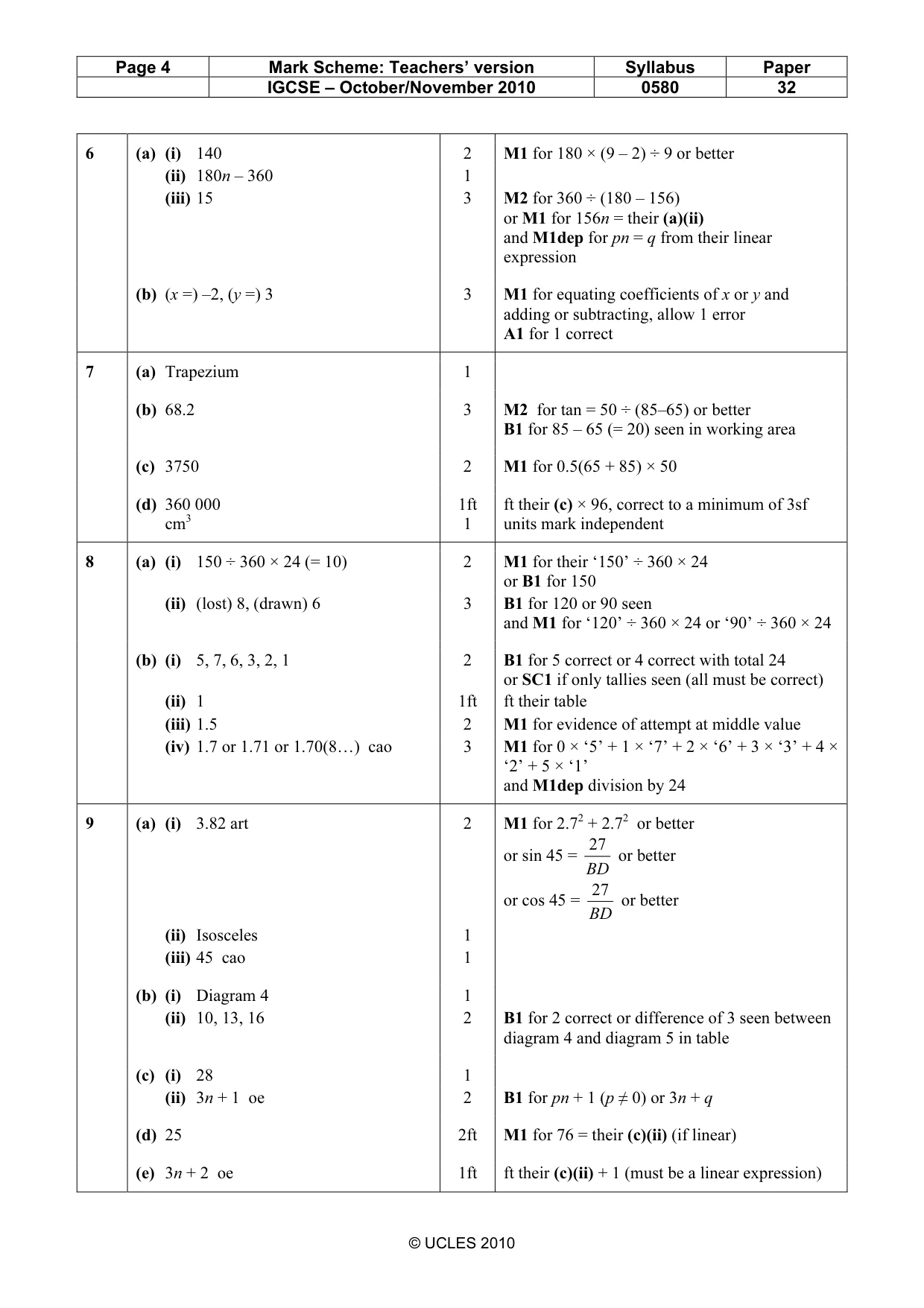
Mark scheme: 6 (a) (i) 140 2 M1 for 180 × (9 – 2) ÷ 9 or better (ii) 180n – 360 1 (iii) 15 3 M2 for 360 ÷ (180 – 156) or M1 for 156n = their (a)(ii) and M1dep for pn = q from their linear expression (b) (x =) –2, (y =) 3 3 M1 for equating coefficients of x or y and adding or subtracting, allow 1 error A1 for 1 correct
Q7 · For C Examiner's Use NOT TO D SCALE 85 cm 65 cm A 50 cm B The diagram represents the…
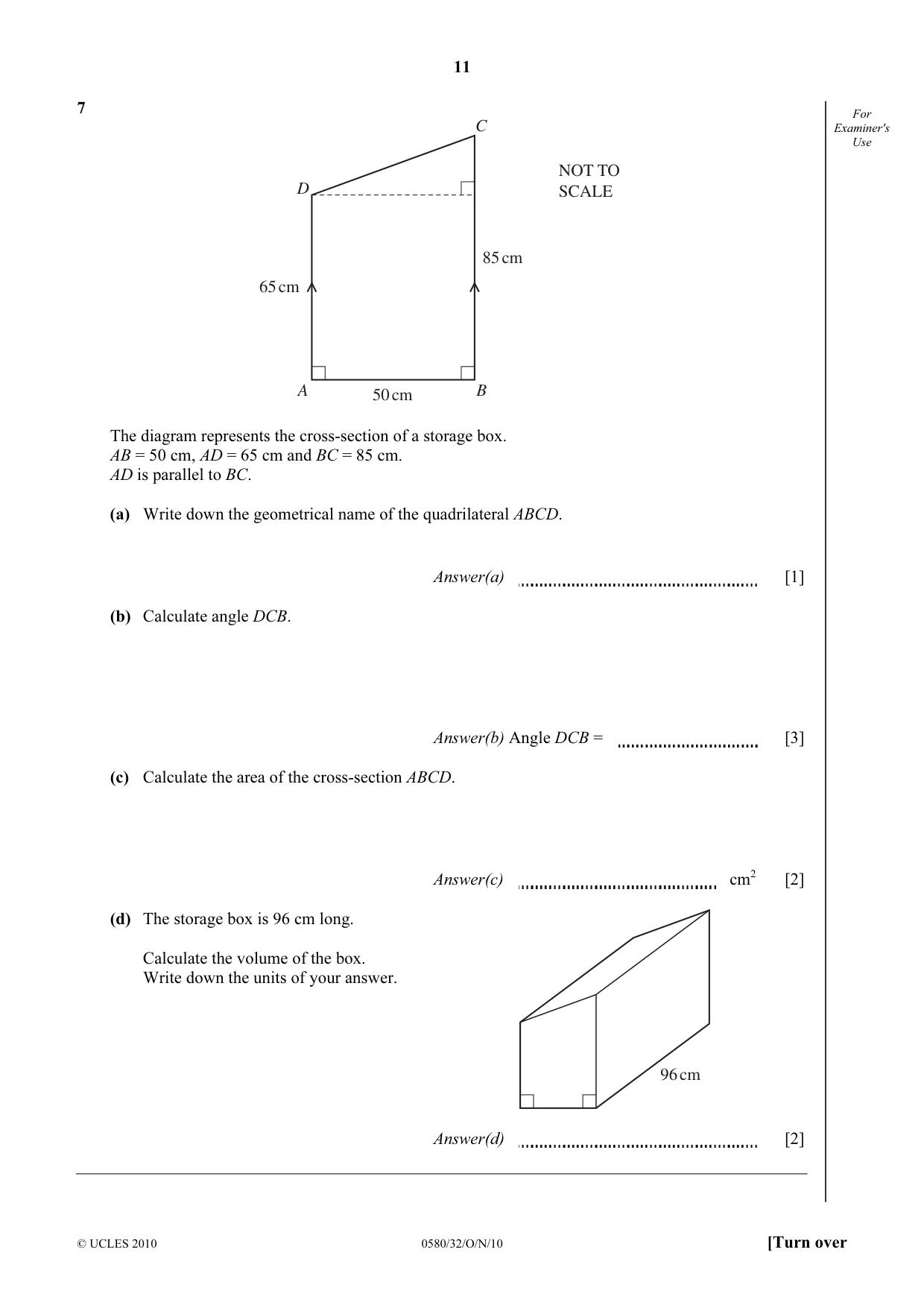
7 For C Examiner's Use NOT TO D SCALE 85 cm 65 cm A 50 cm B The diagram represents the cross-section of a storage box. AB = 50 cm, AD = 65 cm and BC = 85 cm. AD is parallel to BC. (a) Write down the geometrical name of the quadrilateral ABCD. Answer(a) [1] (b) Calculate angle DCB. Answer(b) Angle DCB = [3] (c) Calculate the area of the cross-section ABCD. Answer(c) cm2 [2] (d) The storage box is 96 cm long. Calculate the volume of the box. Write down the units of your answer. 96 cm Answer(d) [2]
Mark scheme: 7 (a) Trapezium 1 (b) 68.2 3 M2 for tan = 50 ÷ (85–65) or better B1 for 85 – 65 (= 20) seen in working area (c) 3750 2 M1 for 0.5(65 + 85) × 50 (d) 360 000 1ft ft their (c) × 96, correct to a minimum of 3sf cm3 1 units mark independent
Q8 · The results of 24 games of hockey played by a school team in one year are shown in the…
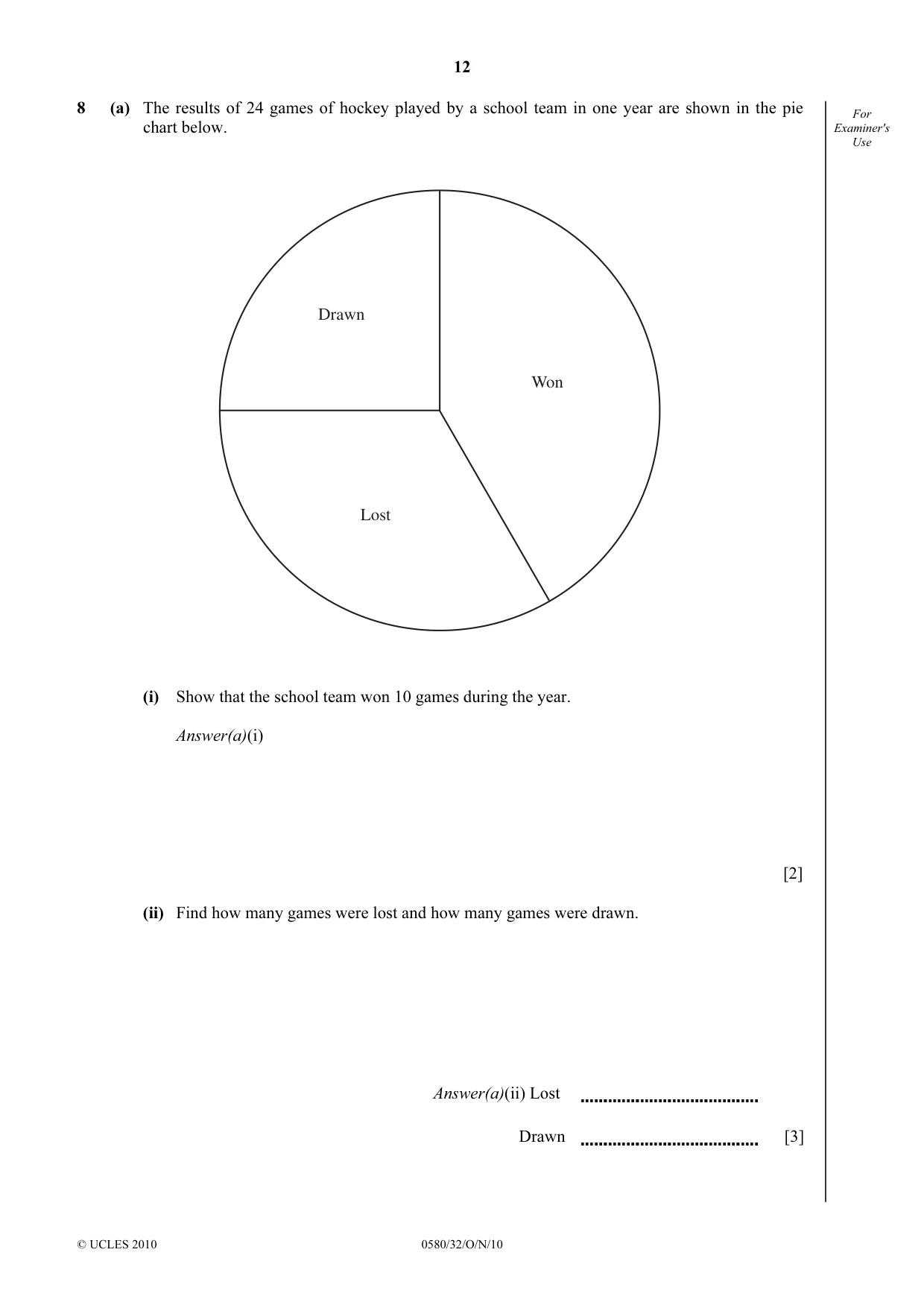
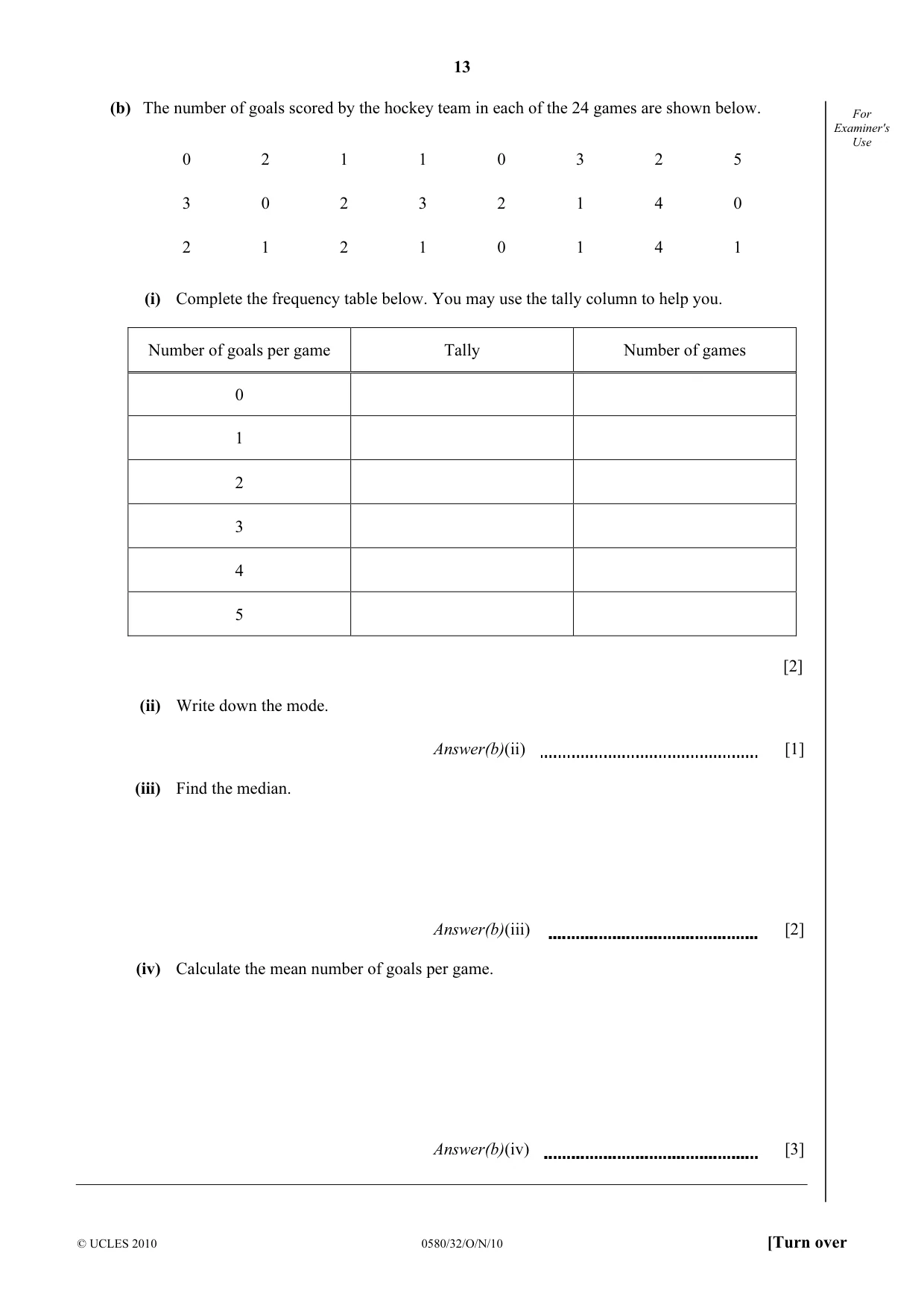
8 (a) The results of 24 games of hockey played by a school team in one year are shown in the pie For chart below. Examiner's Use Drawn Won Lost (i) Show that the school team won 10 games during the year. Answer(a)(i) [2] (ii) Find how many games were lost and how many games were drawn. Answer(a)(ii) Lost Drawn [3] (b) The number of goals scored by the hockey team in each of the 24 games are shown below. For Examiner's Use 0 2 1 1 0 3 2 5 3 0 2 3 2 1 4 0 2 1 2 1 0 1 4 1 (i) Complete the frequency table below. You may use the tally column to help you. Number of goals per game Tally Number of games 0 1 2 3 4 5 [2] (ii) Write down the mode. Answer(b)(ii) [1] (iii) Find the median. Answer(b)(iii) [2] (iv) Calculate the mean number of goals per game. Answer(b)(iv) [3]
Mark scheme: 8 (a) (i) 150 ÷ 360 × 24 (= 10) 2 M1 for their ‘150’ ÷ 360 × 24 or B1 for 150 (ii) (lost) 8, (drawn) 6 3 B1 for 120 or 90 seen and M1 for ‘120’ ÷ 360 × 24 or ‘90’ ÷ 360 × 24 (b) (i) 5, 7, 6, 3, 2, 1 2 B1 for 5 correct or 4 correct with total 24 or SC1 if only tallies seen (all must be correct) (ii) 1 1ft ft their table (iii) 1.5 2 M1 for evidence of attempt at middle value (iv) 1.7 or 1.71 or 1.70(8…) cao 3 M1 for 0 × ‘5’ + 1 × ‘7’ + 2 × ‘6’ + 3 × ‘3’ + 4 × ‘2’ + 5 × ‘1’ and M1dep division by 24
Q9 · For B D Examiner's Use 2.7 cm NOT TO cm 2.7 SCALE C A E (a) In the diagram above, AB and…
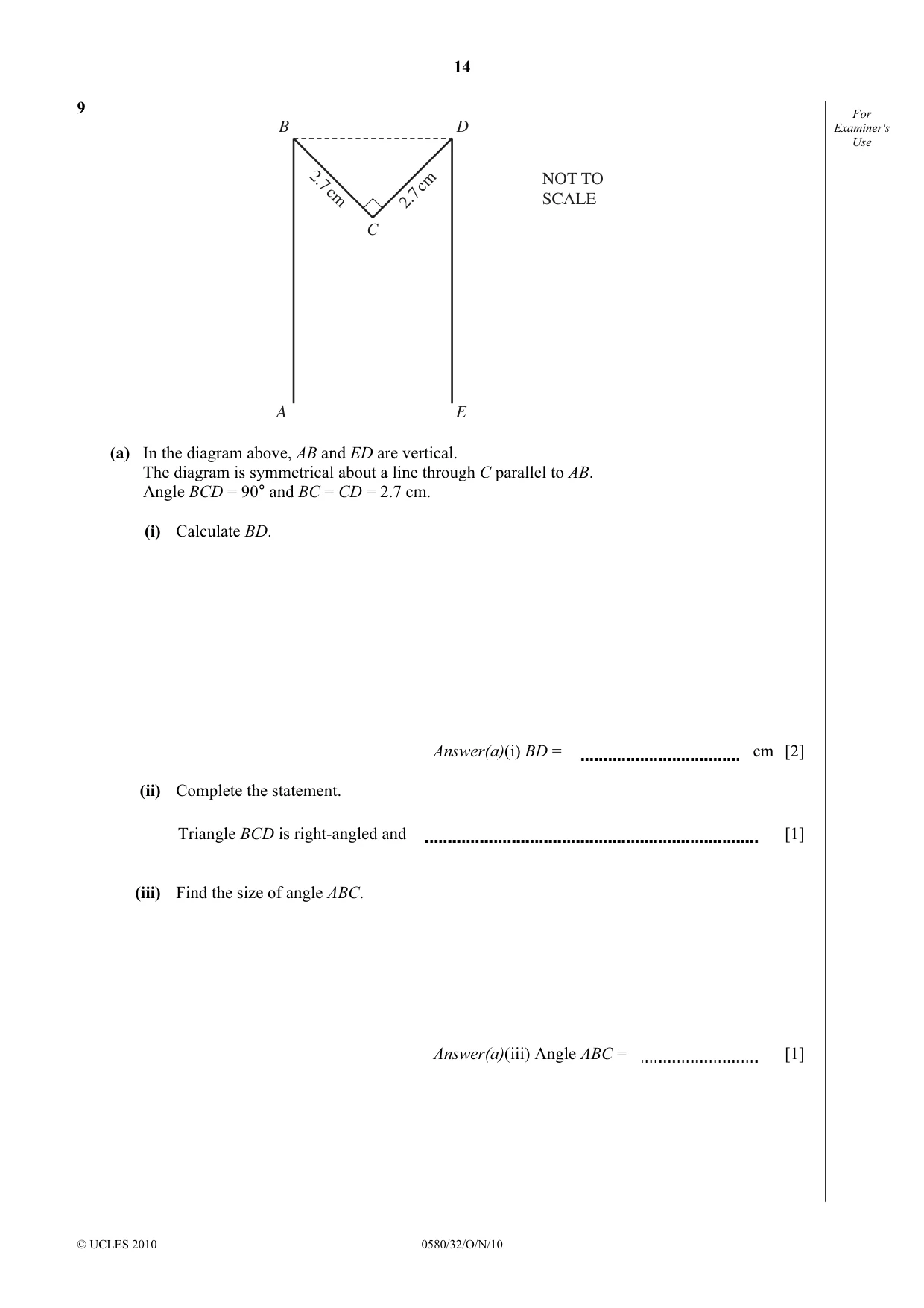
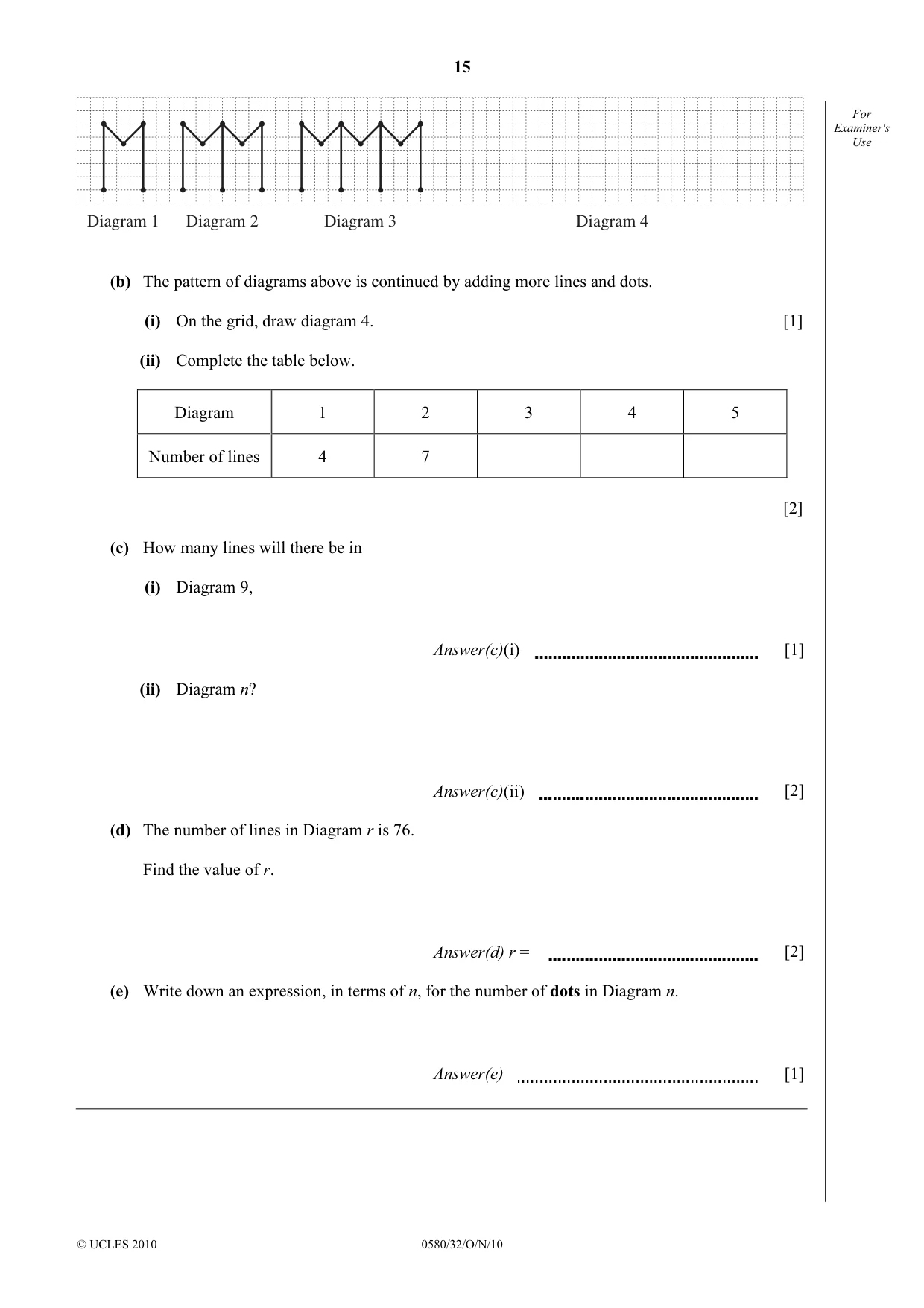
9 For B D Examiner's Use 2.7 cm NOT TO cm 2.7 SCALE C A E (a) In the diagram above, AB and ED are vertical. The diagram is symmetrical about a line through C parallel to AB. Angle BCD = 90° and BC = CD = 2.7 cm. (i) Calculate BD. Answer(a)(i) BD = cm [2] (ii) Complete the statement. Triangle BCD is right-angled and [1] (iii) Find the size of angle ABC. Answer(a)(iii) Angle ABC = [1] For Examiner's Use Diagram 1 Diagram 2 Diagram 3 Diagram 4 (b) The pattern of diagrams above is continued by adding more lines and dots. (i) On the grid, draw diagram 4. [1] (ii) Complete the table below. Diagram 1 2 3 4 5 Number of lines 4 7 [2] (c) How many lines will there be in (i) Diagram 9, Answer(c)(i) [1] (ii) Diagram n? Answer(c)(ii) [2] (d) The number of lines in Diagram r is 76. Find the value of r. Answer(d) r = [2] (e) Write down an expression, in terms of n, for the number of dots in Diagram n. Answer(e) [1]
Mark scheme: 9 (a) (i) 3.82 art 2 M1 for 2.72 + 2.72 or better 27 or sin 45 = or better BD 27 or cos 45 = or better BD (ii) Isosceles 1 (iii) 45 cao 1 (b) (i) Diagram 4 1 (ii) 10, 13, 16 2 B1 for 2 correct or difference of 3 seen between diagram 4 and diagram 5 in table (c) (i) 28 1 (ii) 3n + 1 oe 2 B1 for pn + 1 (p ≠ 0) or 3n + q (d) 25 2ft M1 for 76 = their (c)(ii) (if linear) (e) 3n + 2 oe 1ft ft their (c)(ii) + 1 (must be a linear expression)
What was in this paper
The subtopics covered by these 9 questions, and how many questions each got. Open one in a new tab to see every Cambridge question on it.
What you needed in this session
Cambridge’s own grade thresholds for 2010 Oct/Nov, Paper 3 · Variant 2. A higher threshold means an easier paper — the bar moves with how the cohort did.