Cambridge IGCSE Malay - Foreign Language 0546 — 2023 May/June Paper 2 · Variant 3
0546/23/M/J/23 · 45 marks · ≈51 min
The question paper and its mark scheme, free to read here and free to download. This is Cambridge’s own paper, exactly as it was sat.
Question paper12 pages

Mark scheme11 pages
Answers below. Sit the paper first if you are practising.
Paper as text
Question paper, page 1
This document has 12 pages. Any blank pages are indicated. [Turn over Cambridge IGCSE™ * 4 9 9 5 4 9 1 8 5 9 * DC (EF/CT) 313828/2 © UCLES 2023 MALAY 0546/23 Paper 2 Reading May/June 2023 1 hour You must answer on the question paper. No additional materials are needed. INSTRUCTIONS ● Answer all questions. ● Use a black or dark blue pen. ● Write your name, centre number and candidate number in the boxes at the top of the page. ● Write your answer to each question in the space provided. ● Do not use an erasable pen or correction fluid. ● Do not write on any bar codes. ● Dictionaries are not allowed. INFORMATION ● The total mark for this paper is 45. ● The number of marks for each question or part question is shown in brackets [ ].
Question paper, page 2
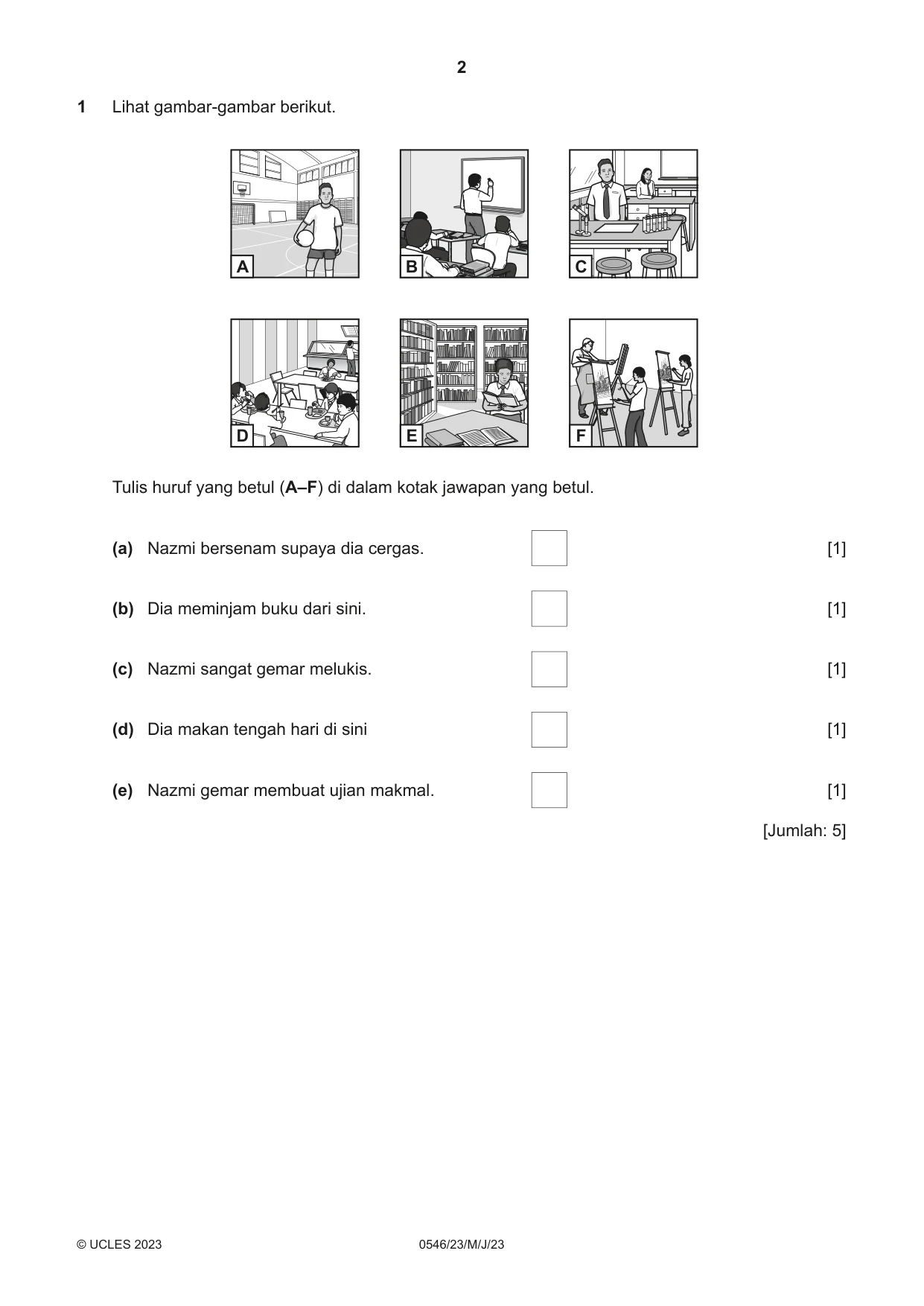
2 0546/23/ M / J /23 © UCLES 2023 1 Lihat gambar‑gambar berikut. A B C D E F Tulis huruf yang betul (A–F) di dalam kotak jawapan yang betul. (a) Nazmi bersenam supaya dia cergas. [1] (b) Dia meminjam buku dari sini. [1] (c) Nazmi sangat gemar melukis. [1] (d) Dia makan tengah hari di sini [1] (e) Nazmi gemar membuat ujian makmal. [1] [Jumlah: 5]
Question paper, page 3
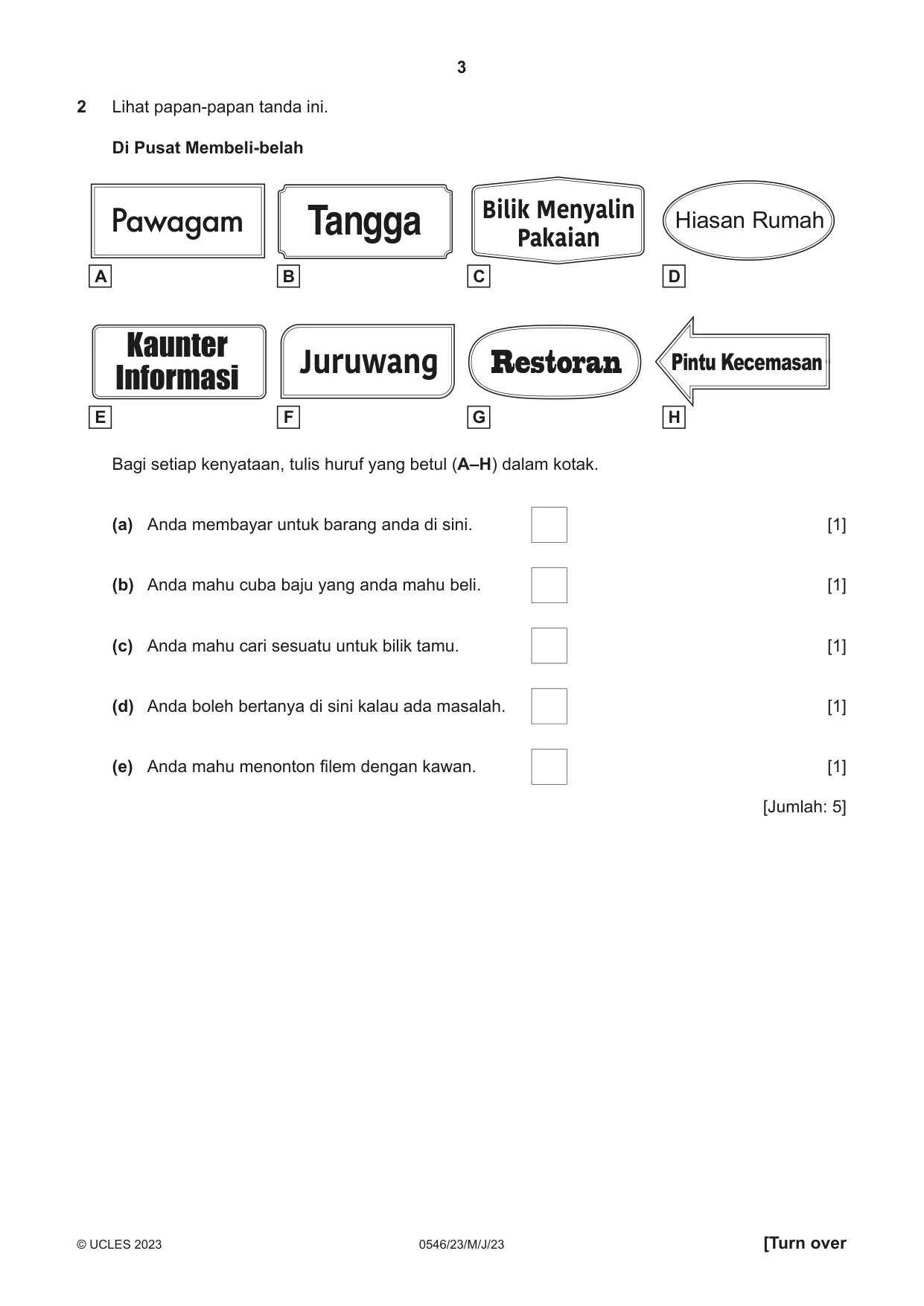
3 0546/23/M/J/23 © UCLES 2023 [Turn over 2 Lihat papan‑papan tanda ini. Di Pusat Membeli‑belah Tangga Kaunter Informasi Pintu Kecemasan Bilik Menyalin Pakaian Restoran Hiasan Rumah Pawagam Juruwang A B C D E F G H Bagi setiap kenyataan, tulis huruf yang betul (A–H) dalam kotak. (a) Anda membayar untuk barang anda di sini. [1] (b) Anda mahu cuba baju yang anda mahu beli. [1] (c) Anda mahu cari sesuatu untuk bilik tamu. [1] (d) Anda boleh bertanya di sini kalau ada masalah. [1] (e) Anda mahu menonton filem dengan kawan. [1] [Jumlah: 5]
Question paper, page 4
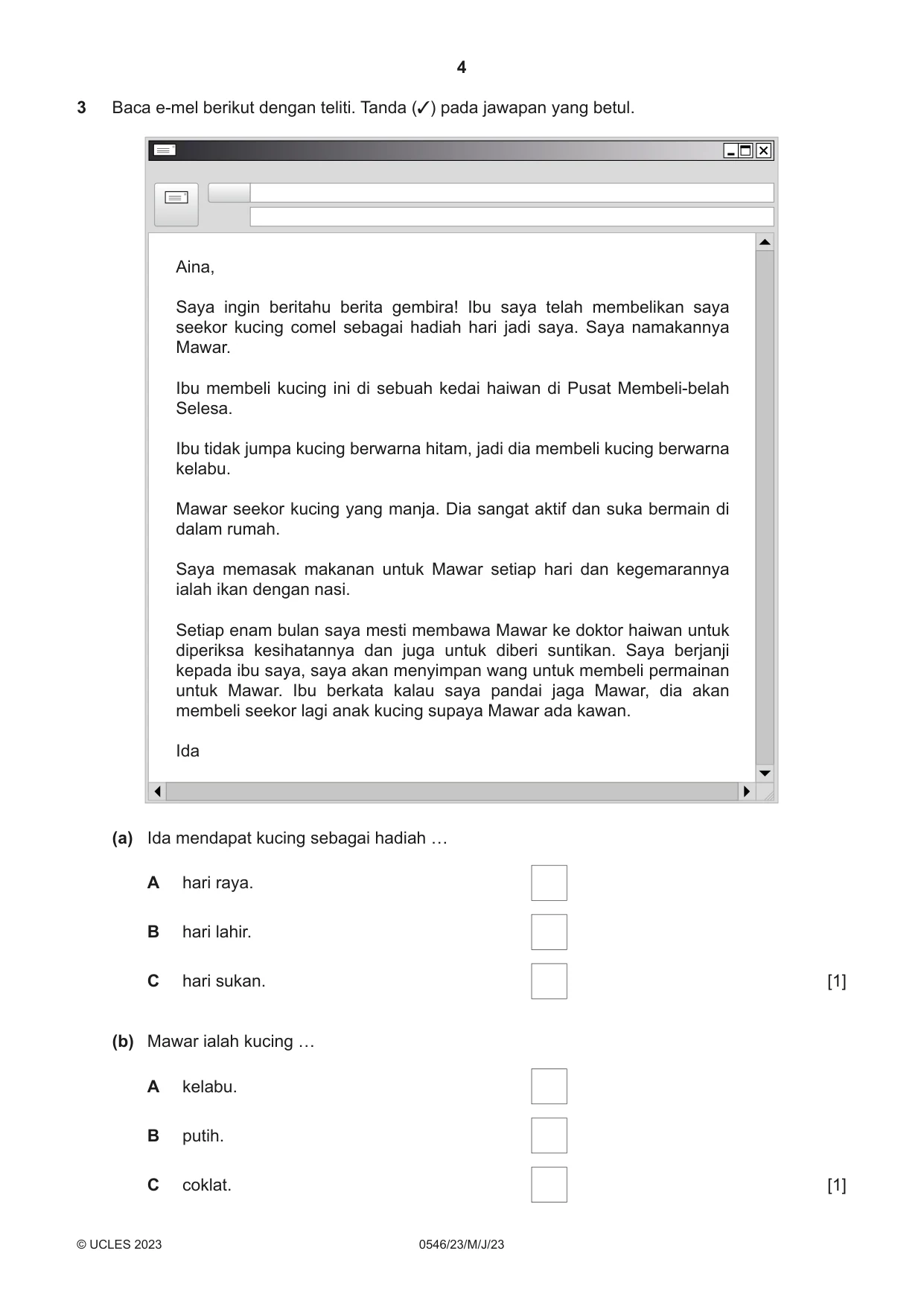
4 0546/23/M/J/23 © UCLES 2023 3 Baca e‑mel berikut dengan teliti. Tanda (3) pada jawapan yang betul. Aina, Saya ingin beritahu berita gembira! Ibu saya telah membelikan saya seekor kucing comel sebagai hadiah hari jadi saya. Saya namakannya Mawar. Ibu membeli kucing ini di sebuah kedai haiwan di Pusat Membeli‑belah Selesa. Ibu tidak jumpa kucing berwarna hitam, jadi dia membeli kucing berwarna kelabu. Mawar seekor kucing yang manja. Dia sangat aktif dan suka bermain di dalam rumah. Saya memasak makanan untuk Mawar setiap hari dan kegemarannya ialah ikan dengan nasi. Setiap enam bulan saya mesti membawa Mawar ke doktor haiwan untuk diperiksa kesihatannya dan juga untuk diberi suntikan. Saya berjanji kepada ibu saya, saya akan menyimpan wang untuk membeli permainan untuk Mawar. Ibu berkata kalau saya pandai jaga Mawar, dia akan membeli seekor lagi anak kucing supaya Mawar ada kawan. Ida (a) Ida mendapat kucing sebagai hadiah … A hari raya. B hari lahir. C hari sukan. [1] (b) Mawar ialah kucing … A kelabu. B putih. C coklat. [1]
Question paper, page 5
5 0546/23/M/J/23 © UCLES 2023 [Turn over (c) Mawar suka … di dalam rumah. A makan B berlari C tidur [1] (d) Makanan yang Mawar suka ialah makanan … A yang segar. B kering. C dalam tin. [1] (e) Setiap enam bulan, Ida akan bawa Mawar ke … A tempat bercuti. B rumah ibu saudaranya. C ke klinik binatang. [1] (f) Ida mahu menyimpan wang untuk … A barang Mawar. B makanan Mawar. C tempat tidur Mawar. [1] (g) Ida akan dapat seekor lagi kucing kalau … A dia rajin belajar di sekolah. B dia bela Mawar dengan baik. C dia menolong ibu di rumah. [1] [Jumlah: 7]
Question paper, page 6
6 0546/23/M/J/23 © UCLES 2023 4 Baca e‑mel di bawah dan jawab soalan‑soalan berikutnya dalam Bahasa Melayu. Haris, Saya sekeluarga sudah berpindah ke Pulau Pinang sebab ibu saya mendapat kerja baharu di pulau ini. Kami sudah pun mendapat rumah dekat dengan pantai. Kalau dahulu saya buka tingkap dan terus nampak bangunan, kali ini pemandangannya ialah laut biru sejauh mata memandang. Ada pokok‑pokok kelapa berderet di tepi pantai. Pada masa lapang, saya berlari di sepanjang pantai. Sekarang saya rasa lebih sihat daripada dahulu sebab udaranya segar. Sekolah yang saya pilih jauh dari rumah tetapi saya tidak rasa kesal. Sekolah ini mempunyai nama baik dan rekod yang baik. Ada juga beberapa orang kawan dari luar negara. Mereka datang bersama ibu bapa mereka yang bekerja di sini. Saya sudah menjadi ahli kelab memanah dan akan mula belajar pada bulan depan. Menurut kawan‑kawan, aktiviti memanah boleh menolong kita untuk menumpu perhatian terhadap sesuatu. Saya harap kegiatan baharu ini akan menolong saya memberi tumpuan dalam pelajaran. Saya rasa gembira meninggalkan Kuala Lumpur untuk tinggal di sebuah tempat di mana saya boleh mengenali persekitaran yang baharu. Apa kata kalau awak dan kawan‑kawan lain datang melawat saya? Ada banyak aktiviti yang kita boleh buat seperti mendaki Bukit Bendera atau berenang di laut di depan rumah saya. Walaupun Ibu sentiasa sibuk bekerja, dia masih sempat pulang ke rumah untuk makan malam bersama keluarga. Bapa pula ada masa untuk menolong kami membuat kerja sekolah. Kakak saya, Sarah, berazam untuk melanjutkan pelajarannya di Universiti Sains Malaysia (USM) di sini sebab kawan baiknya sudahpun mendapat tempat di situ. Buatlah rancangan dengan kawan‑kawan lain untuk datang ke sini. Rumah saya besar! Adli (a) Keluarga Adli berpindah ke mana? … [1]
Question paper, page 7
7 0546/23/M/J/23 © UCLES 2023 [Turn over (b) Apakah yang kelihatan dari rumah baharu Adli? Beri dua jawapan. 1 … 2 … [2] (c) Mengapakah Adli rasa lebih sihat sekarang? … [1] (d) Mengapakah Adli memilih sekolah yang jauh dari rumahnya? Beri satu jawapan. … [1] (e) Kawan‑kawan baharu Adli dari luar negara datang ke Malaysia dengan siapa? … [1] (f) Apakah tujuan Adli belajar memanah? … [1] (g) Mengapakah Adli merasa seronok untuk keluar dari Kuala Lumpur? … [1] (h) Apakah cadangan Adli kepada kawan‑kawannya untuk berjumpa semula? … [1] (i) Apakah yang Adli dan kawan‑kawannya boleh lakukan bersama? Beri satu jawapan. … [1] (j) Apakah yang bapa Adli buat dalam masa lapangnya? … [1] (k) Mengapakah kakaknya Sarah memilih untuk menyambung pengajiannya di USM? … [1] [Jumlah: 12]
Question paper, page 8
8 0546/23/M/J/23 © UCLES 2023 5 Baca kenyataan‑kenyataan (a–e) dan iklan (1–8). Padankan nama dengan tempat penginapan yang sesuai bagi mereka. Bagi setiap kenyataan (a–e) tulis nombor yang betul (1–8) di atas garisan. Memilih tempat penginapan a SURI: Dengan keluarga yang besar; dua anak perempuan dan seorang anak lelaki, kami memerlukan kawasan yang luas di mana mereka boleh bermain. Sekurang‑kurangnya empat bilik. Perabot tidak diperlukan. … b TIARA: Saya baru mendapat pekerjaan pertama dan memerlukan tempat tinggal yang selesa, lengkap dengan perabot. Bilik tidur kedua adalah penting untuk masa ibu bapa saya atau rakan‑rakan melawat. Tidak suka kesibukan. … c ALEX: Sebagai seorang pelajar yang menggunakan kerusi roda, saya memerlukan penginapan di paras tanah. Saya perlu sebuah bilik luas yang mempunyai katil, meja belajar dan kemudahan lain. Saya ingin tinggal bersendirian. … d RAMZI: Sebagai seorang pelajar yang baru mencuba kehidupan di bandar, saya inginkan suasana mesra dengan rakan‑rakan sebaya. Sedia berkongsi kemudahan lain asalkan saya boleh bawa katil sendiri. … e IMAN: Saya, suami dan anak kami suka bersenam. Tempat tinggal kami mesti ada kemudahan ini. Kediaman mestilah lengkap untuk kami terus masuk sahaja. Dengan adanya anak‑anak, keselamatan diutamakan. …
Question paper, page 9
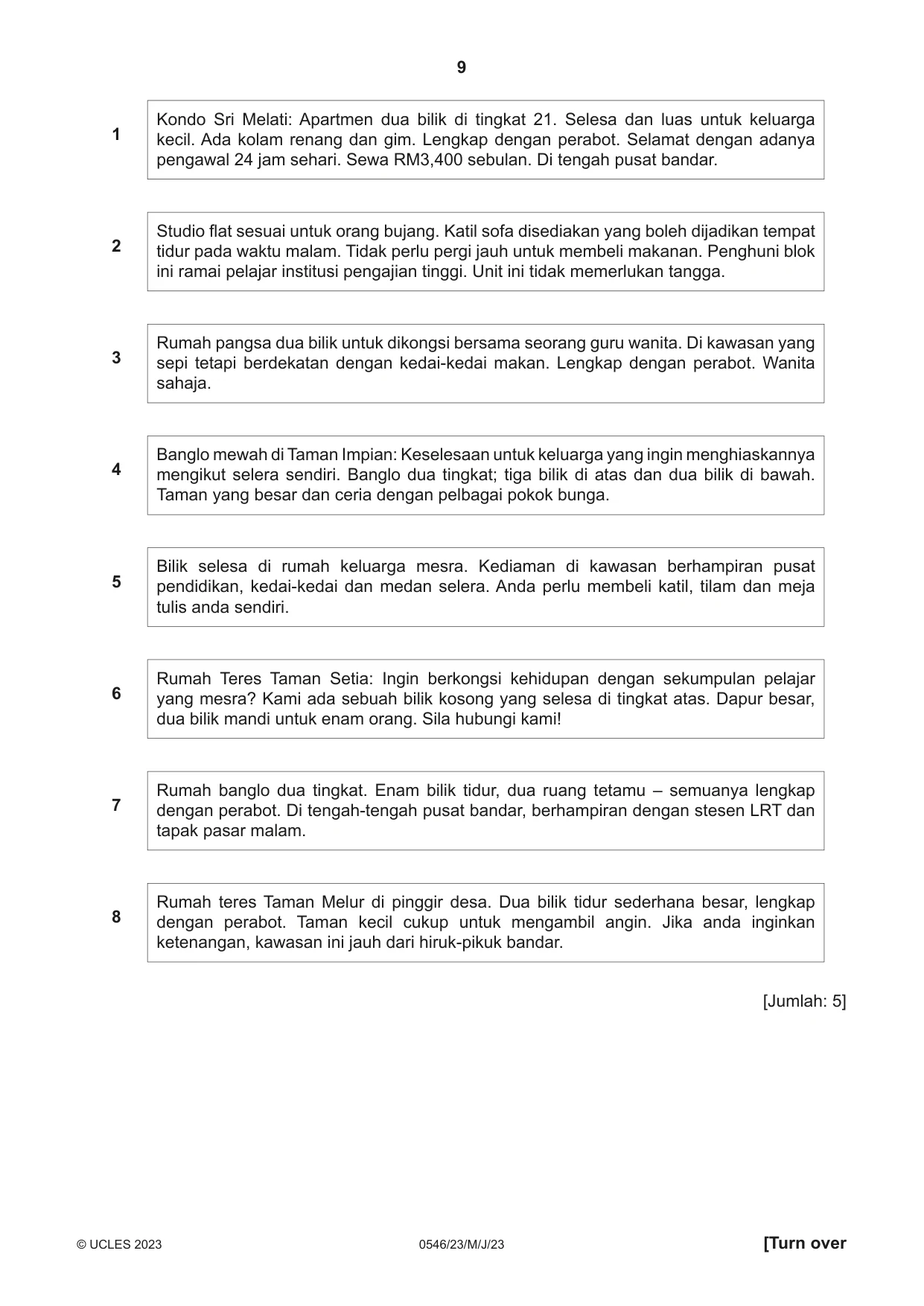
9 0546/23/M/J/23 © UCLES 2023 [Turn over 1 Kondo Sri Melati: Apartmen dua bilik di tingkat 21. Selesa dan luas untuk keluarga kecil. Ada kolam renang dan gim. Lengkap dengan perabot. Selamat dengan adanya pengawal 24 jam sehari. Sewa RM3,400 sebulan. Di tengah pusat bandar. 2 Studio flat sesuai untuk orang bujang. Katil sofa disediakan yang boleh dijadikan tempat tidur pada waktu malam. Tidak perlu pergi jauh untuk membeli makanan. Penghuni blok ini ramai pelajar institusi pengajian tinggi. Unit ini tidak memerlukan tangga. 3 Rumah pangsa dua bilik untuk dikongsi bersama seorang guru wanita. Di kawasan yang sepi tetapi berdekatan dengan kedai‑kedai makan. Lengkap dengan perabot. Wanita sahaja. 4 Banglo mewah di Taman Impian: Keselesaan untuk keluarga yang ingin menghiaskannya mengikut selera sendiri. Banglo dua tingkat; tiga bilik di atas dan dua bilik di bawah. Taman yang besar dan ceria dengan pelbagai pokok bunga. 5 Bilik selesa di rumah keluarga mesra. Kediaman di kawasan berhampiran pusat pendidikan, kedai‑kedai dan medan selera. Anda perlu membeli katil, tilam dan meja tulis anda sendiri. 6 Rumah Teres Taman Setia: Ingin berkongsi kehidupan dengan sekumpulan pelajar yang mesra? Kami ada sebuah bilik kosong yang selesa di tingkat atas. Dapur besar, dua bilik mandi untuk enam orang. Sila hubungi kami! 7 Rumah banglo dua tingkat. Enam bilik tidur, dua ruang tetamu – semuanya lengkap dengan perabot. Di tengah‑tengah pusat bandar, berhampiran dengan stesen LRT dan tapak pasar malam. 8 Rumah teres Taman Melur di pinggir desa. Dua bilik tidur sederhana besar, lengkap dengan perabot. Taman kecil cukup untuk mengambil angin. Jika anda inginkan ketenangan, kawasan ini jauh dari hiruk‑pikuk bandar. [Jumlah: 5]
Question paper, page 10
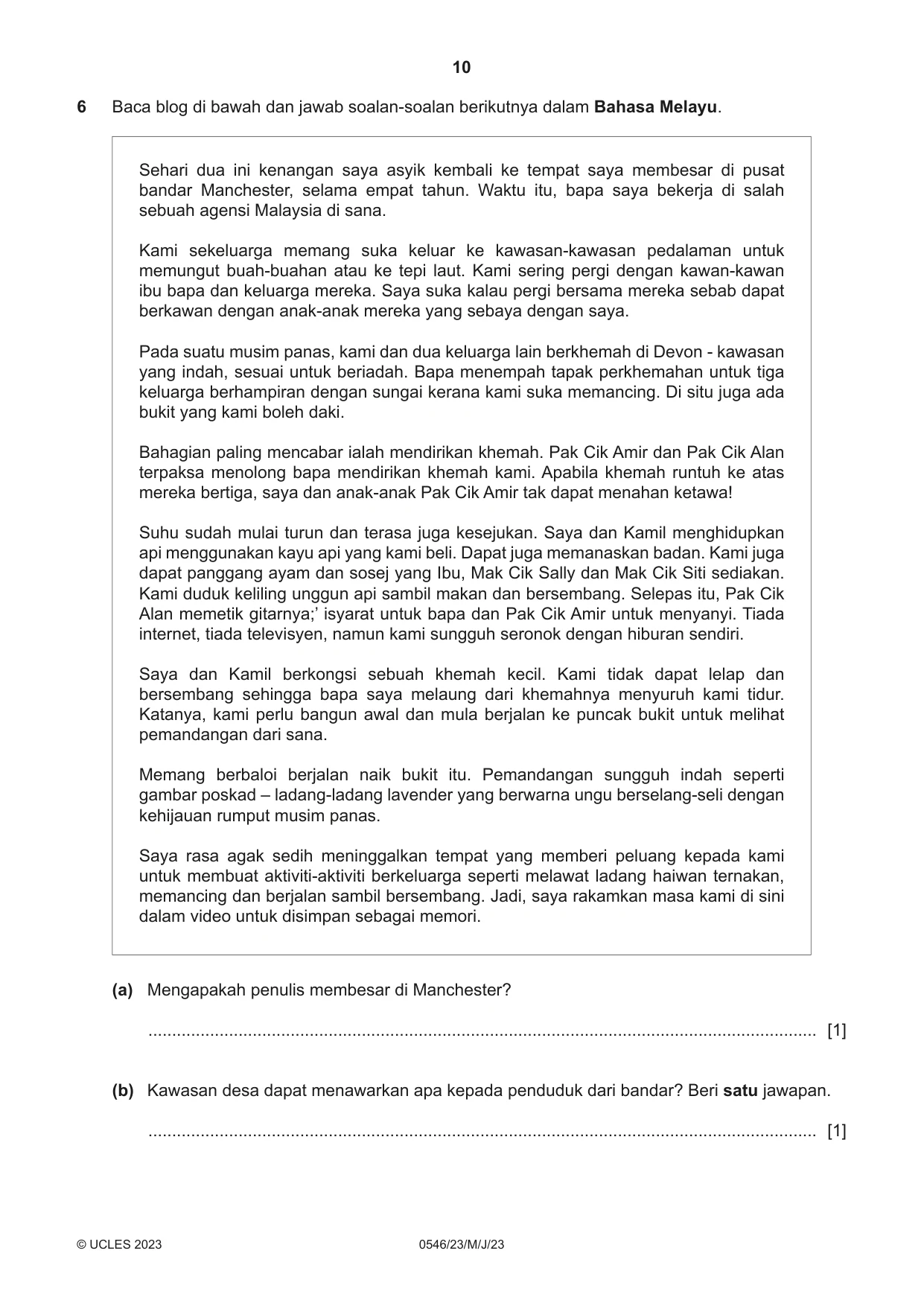
10 0546/23/M/J/23 © UCLES 2023 6 Baca blog di bawah dan jawab soalan‑soalan berikutnya dalam Bahasa Melayu. Sehari dua ini kenangan saya asyik kembali ke tempat saya membesar di pusat bandar Manchester, selama empat tahun. Waktu itu, bapa saya bekerja di salah sebuah agensi Malaysia di sana. Kami sekeluarga memang suka keluar ke kawasan‑kawasan pedalaman untuk memungut buah‑buahan atau ke tepi laut. Kami sering pergi dengan kawan‑kawan ibu bapa dan keluarga mereka. Saya suka kalau pergi bersama mereka sebab dapat berkawan dengan anak‑anak mereka yang sebaya dengan saya. Pada suatu musim panas, kami dan dua keluarga lain berkhemah di Devon ‑ kawasan yang indah, sesuai untuk beriadah. Bapa menempah tapak perkhemahan untuk tiga keluarga berhampiran dengan sungai kerana kami suka memancing. Di situ juga ada bukit yang kami boleh daki. Bahagian paling mencabar ialah mendirikan khemah. Pak Cik Amir dan Pak Cik Alan terpaksa menolong bapa mendirikan khemah kami. Apabila khemah runtuh ke atas mereka bertiga, saya dan anak‑anak Pak Cik Amir tak dapat menahan ketawa! Suhu sudah mulai turun dan terasa juga kesejukan. Saya dan Kamil menghidupkan api menggunakan kayu api yang kami beli. Dapat juga memanaskan badan. Kami juga dapat panggang ayam dan sosej yang Ibu, Mak Cik Sally dan Mak Cik Siti sediakan. Kami duduk keliling unggun api sambil makan dan bersembang. Selepas itu, Pak Cik Alan memetik gitarnya;’ isyarat untuk bapa dan Pak Cik Amir untuk menyanyi. Tiada internet, tiada televisyen, namun kami sungguh seronok dengan hiburan sendiri. Saya dan Kamil berkongsi sebuah khemah kecil. Kami tidak dapat lelap dan bersembang sehingga bapa saya melaung dari khemahnya menyuruh kami tidur. Katanya, kami perlu bangun awal dan mula berjalan ke puncak bukit untuk melihat pemandangan dari sana. Memang berbaloi berjalan naik bukit itu. Pemandangan sungguh indah seperti gambar poskad – ladang‑ladang lavender yang berwarna ungu berselang‑seli dengan kehijauan rumput musim panas. Saya rasa agak sedih meninggalkan tempat yang memberi peluang kepada kami untuk membuat aktiviti‑aktiviti berkeluarga seperti melawat ladang haiwan ternakan, memancing dan berjalan sambil bersembang. Jadi, saya rakamkan masa kami di sini dalam video untuk disimpan sebagai memori. (a) Mengapakah penulis membesar di Manchester? … [1] (b) Kawasan desa dapat menawarkan apa kepada penduduk dari bandar? Beri satu jawapan. … [1]
Question paper, page 11
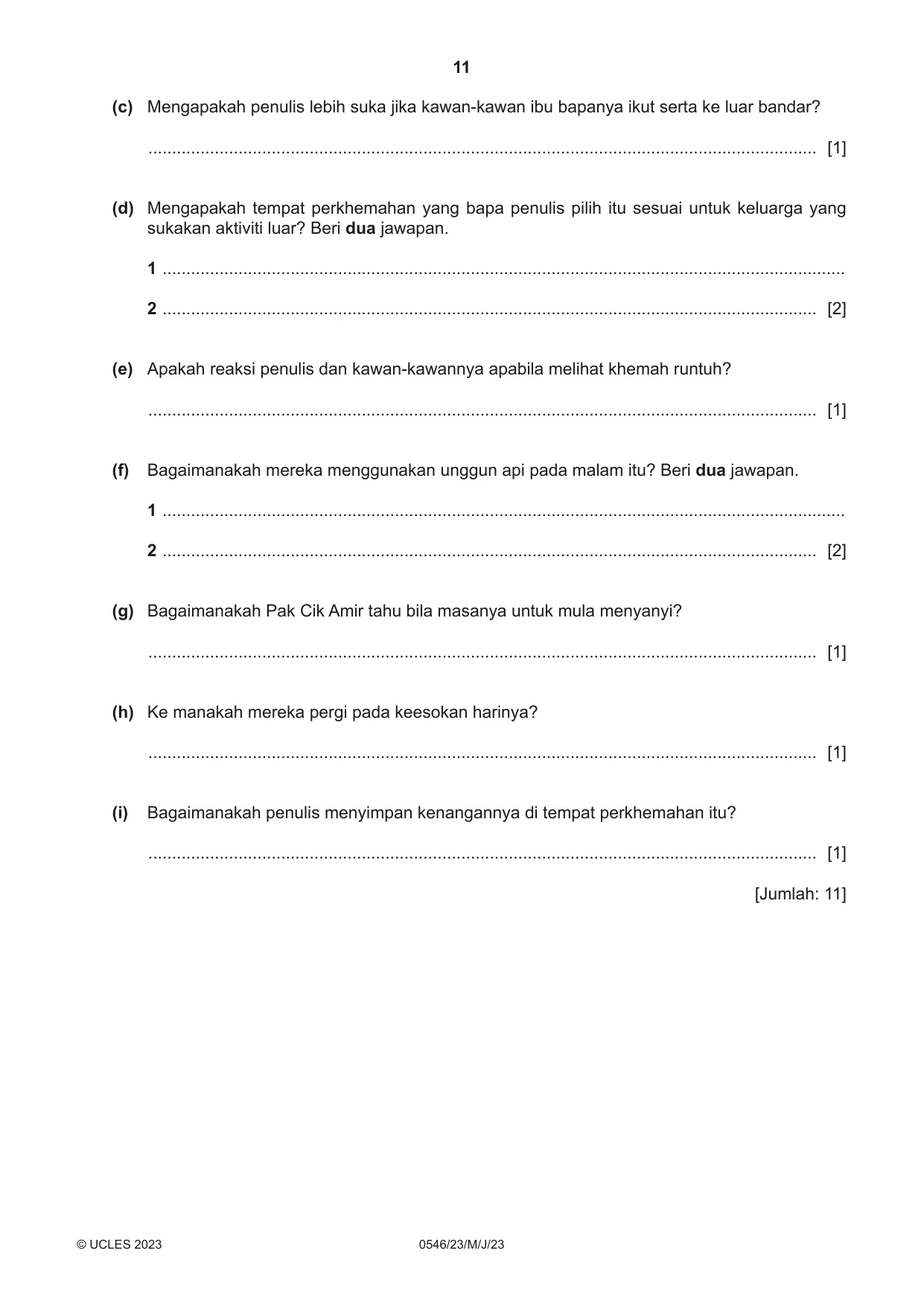
11 0546/23/M/J/23 © UCLES 2023 (c) Mengapakah penulis lebih suka jika kawan‑kawan ibu bapanya ikut serta ke luar bandar? … [1] (d) Mengapakah tempat perkhemahan yang bapa penulis pilih itu sesuai untuk keluarga yang sukakan aktiviti luar? Beri dua jawapan. 1 … 2 … [2] (e) Apakah reaksi penulis dan kawan‑kawannya apabila melihat khemah runtuh? … [1] (f) Bagaimanakah mereka menggunakan unggun api pada malam itu? Beri dua jawapan. 1 … 2 … [2] (g) Bagaimanakah Pak Cik Amir tahu bila masanya untuk mula menyanyi? … [1] (h) Ke manakah mereka pergi pada keesokan harinya? … [1] (i) Bagaimanakah penulis menyimpan kenangannya di tempat perkhemahan itu? … [1] [Jumlah: 11]
Question paper, page 12
12 0546/23/M/J/23 © UCLES 2023 Permission to reproduce items where third‑party owned material protected by copyright is included has been sought and cleared where possible. Every reasonable effort has been made by the publisher (UCLES) to trace copyright holders, but if any items requiring clearance have unwittingly been included, the publisher will be pleased to make amends at the earliest possible opportunity. To avoid the issue of disclosure of answer‑related information to candidates, all copyright acknowledgements are reproduced online in the Cambridge Assessment International Education Copyright Acknowledgements Booklet. This is produced for each series of examinations and is freely available to download at www.cambridgeinternational.org after the live examination series. Cambridge Assessment International Education is part of Cambridge Assessment. Cambridge Assessment is the brand name of the University of Cambridge Local Examinations Syndicate (UCLES), which is a department of the University of Cambridge. BLANK PAGE
Mark scheme, page 1
This document consists of 11 printed pages. © UCLES 2023 [Turn over Cambridge IGCSE™ MALAY 0546/23 Paper 2 Reading May/June 2023 MARK SCHEME Maximum Mark: 45 Published This mark scheme is published as an aid to teachers and candidates, to indicate the requirements of the examination. It shows the basis on which Examiners were instructed to award marks. It does not indicate the details of the discussions that took place at an Examiners’ meeting before marking began, which would have considered the acceptability of alternative answers. Mark schemes should be read in conjunction with the question paper and the Principal Examiner Report for Teachers. Cambridge International will not enter into discussions about these mark schemes. Cambridge International is publishing the mark schemes for the May/June 2023 series for most Cambridge IGCSE, Cambridge International A and AS Level and Cambridge Pre-U components, and some Cambridge O Level components.
Mark scheme, page 2
0546/23 Cambridge IGCSE – Mark Scheme PUBLISHED May/June 2023 © UCLES 2023 Page 2 of 11 Generic Marking Principles These general marking principles must be applied by all examiners when marking candidate answers. They should be applied alongside the specific content of the mark scheme or generic level descriptors for a question. Each question paper and mark scheme will also comply with these marking principles. GENERIC MARKING PRINCIPLE 1: Marks must be awarded in line with: the specific content of the mark scheme or the generic level descriptors for the question the specific skills defined in the mark scheme or in the generic level descriptors for the question the standard of response required by a candidate as exemplified by the standardisation scripts. GENERIC MARKING PRINCIPLE 2: Marks awarded are always whole marks (not half marks, or other fractions). GENERIC MARKING PRINCIPLE 3: Marks must be awarded positively: marks are awarded for correct/valid answers, as defined in the mark scheme. However, credit is given for valid answers which go beyond the scope of the syllabus and mark scheme, referring to your Team Leader as appropriate marks are awarded when candidates clearly demonstrate what they know and can do marks are not deducted for errors marks are not deducted for omissions answers should only be judged on the quality of spelling, punctuation and grammar when these features are specifically assessed by the question as indicated by the mark scheme. The meaning, however, should be unambiguous. GENERIC MARKING PRINCIPLE 4: Rules must be applied consistently, e.g. in situations where candidates have not followed instructions or in the application of generic level descriptors.
Mark scheme, page 3
0546/23 Cambridge IGCSE – Mark Scheme PUBLISHED May/June 2023 © UCLES 2023 Page 3 of 11 GENERIC MARKING PRINCIPLE 5: Marks should be awarded using the full range of marks defined in the mark scheme for the question (however; the use of the full mark range may be limited according to the quality of the candidate responses seen). GENERIC MARKING PRINCIPLE 6: Marks awarded are based solely on the requirements as defined in the mark scheme. Marks should not be awarded with grade thresholds or grade descriptors in mind.
Mark scheme, page 4
0546/23 Cambridge IGCSE – Mark Scheme PUBLISHED May/June 2023 © UCLES 2023 Page 4 of 11 Additional Guidance The following guidance underpins the detailed instructions provided in the mark scheme. Where a decision is taken to deviate from this guidance for a particular question, this will be specified in the mark scheme. Often the additional guidance points will have to be weighed up against each other, e.g. the answer might look or sound like the intended word/phrase in Malay, but if what the candidate has written means something different in Malay from what is expected, the mark cannot be awarded. It is not possible to list all acceptable alternatives in the mark scheme. If you encounter an answer which is not covered by the mark scheme, you will need to make a decision about whether it communicates the required elements (in consultation with your Team Leader if necessary, or with your Product Manager if you are a single examiner), and award marks accordingly. Crossing out: (a) If a candidate changes his/her mind about an answer and crosses out an attempt, award a mark if the final attempt is correct. (b) If a candidate crosses out the whole answer to a question but makes no second attempt at it, mark the crossed out work. (c) Where only a partial of the answer is crossed out, mark the remaining answer excluding the crossed out part of the answer. More than the stipulated number of boxes ticked/crossed by the candidate: (a) If more than one attempt is visible but the candidate has clearly indicated which attempt is his/her final answer (e.g. by crossing out other attempts or by annotating the script in some way), mark in the usual way. (b) If two attempts are visible (e.g. two boxes ticked instead of the one box stipulated), and neither has been crossed out/discounted by the candidate, no mark can be awarded. For questions requiring more than one element for the answer, 1 and 2, where the answers are interchangeable: (a) Both of the correct answers are on line 1 and line 2 blank (or vice versa) = 2 marks (b) Both correct answers on line 1, and line 2 contains a wrong answer (or vice versa) = 1 mark
Mark scheme, page 5
0546/23 Cambridge IGCSE – Mark Scheme PUBLISHED May/June 2023 © UCLES 2023 Page 5 of 11 Mark for communication: Answers requiring the use of Malay (rather than a non-verbal response) should be marked for communication. Tolerate inaccuracies provided that the message is clear. However, do not accept incorrect Malay if the word written by the candidate means something else in Malay (unless the mark scheme specifies otherwise). (a) If you read aloud what the candidate has written, does it sound like the correct answer? Would a native speaker of Malay understand it? (b) Does what the candidate has written look like the correct answer, e.g. one letter missing but no other word created? Would a native speaker of Malay understand it? Incorrect Malay which constitutes a word in any language other than Malay is marked (i) on the basis of whether it is accepted or rejected in the mark scheme and (ii) if it is not mentioned in the mark scheme, on the basis of points (a) to (d) above.
Mark scheme, page 6
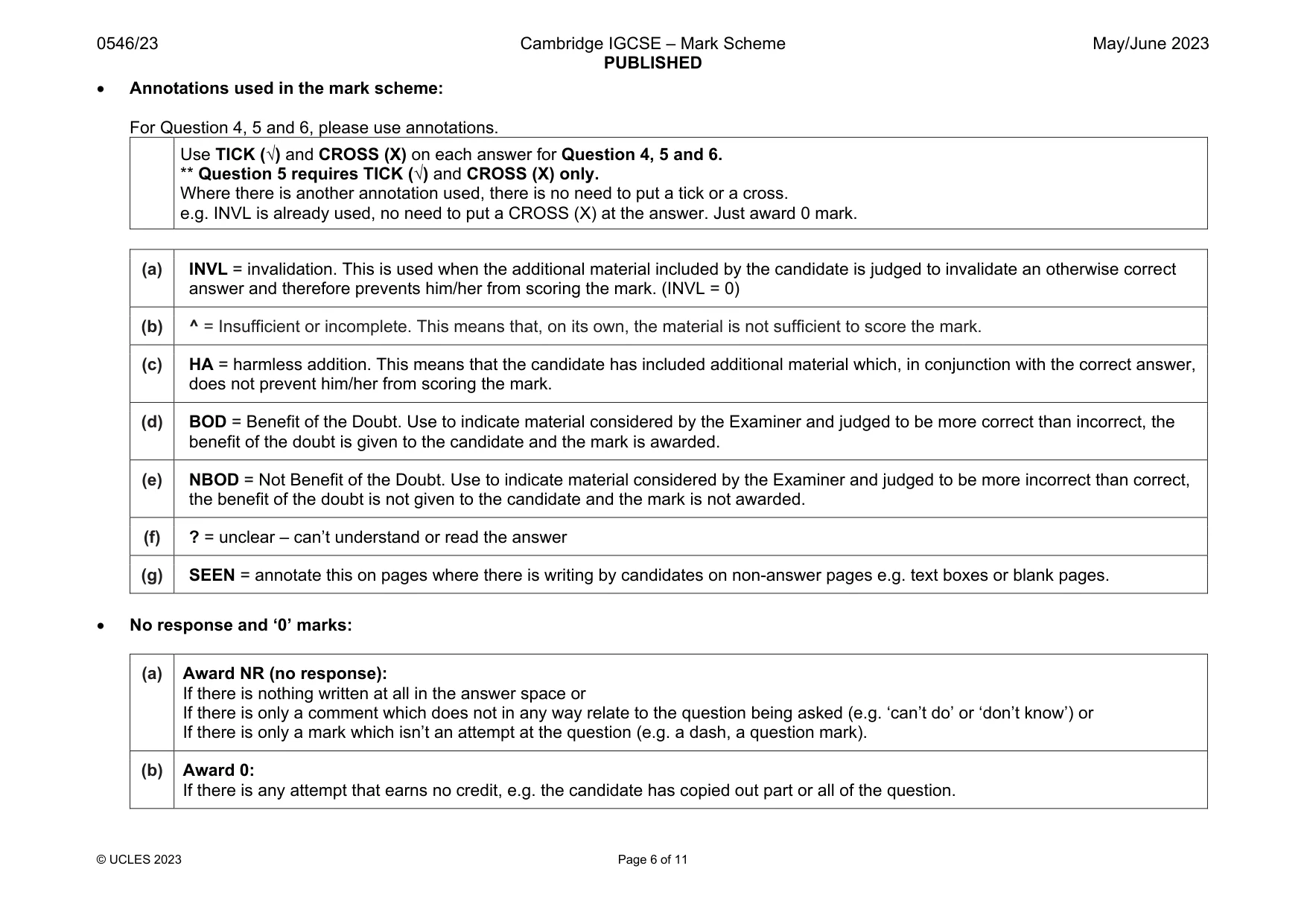
0546/23 Cambridge IGCSE – Mark Scheme PUBLISHED May/June 2023 © UCLES 2023 Page 6 of 11 Annotations used in the mark scheme: For Question 4, 5 and 6, please use annotations. Use TICK (√) and CROSS (X) on each answer for Question 4, 5 and 6. ** Question 5 requires TICK (√) and CROSS (X) only. Where there is another annotation used, there is no need to put a tick or a cross. e.g. INVL is already used, no need to put a CROSS (X) at the answer. Just award 0 mark. (a) INVL = invalidation. This is used when the additional material included by the candidate is judged to invalidate an otherwise correct answer and therefore prevents him/her from scoring the mark. (INVL = 0) (b) ^ = Insufficient or incomplete. This means that, on its own, the material is not sufficient to score the mark. (c) HA = harmless addition. This means that the candidate has included additional material which, in conjunction with the correct answer, does not prevent him/her from scoring the mark. (d) BOD = Benefit of the Doubt. Use to indicate material considered by the Examiner and judged to be more correct than incorrect, the benefit of the doubt is given to the candidate and the mark is awarded. (e) NBOD = Not Benefit of the Doubt. Use to indicate material considered by the Examiner and judged to be more incorrect than correct, the benefit of the doubt is not given to the candidate and the mark is not awarded. (f) ? = unclear – can’t understand or read the answer (g) SEEN = annotate this on pages where there is writing by candidates on non-answer pages e.g. text boxes or blank pages. No response and ‘0’ marks: (a) Award NR (no response): If there is nothing written at all in the answer space or If there is only a comment which does not in any way relate to the question being asked (e.g. ‘can’t do’ or ‘don’t know’) or If there is only a mark which isn’t an attempt at the question (e.g. a dash, a question mark). (b) Award 0: If there is any attempt that earns no credit, e.g. the candidate has copied out part or all of the question.
Mark scheme, page 7
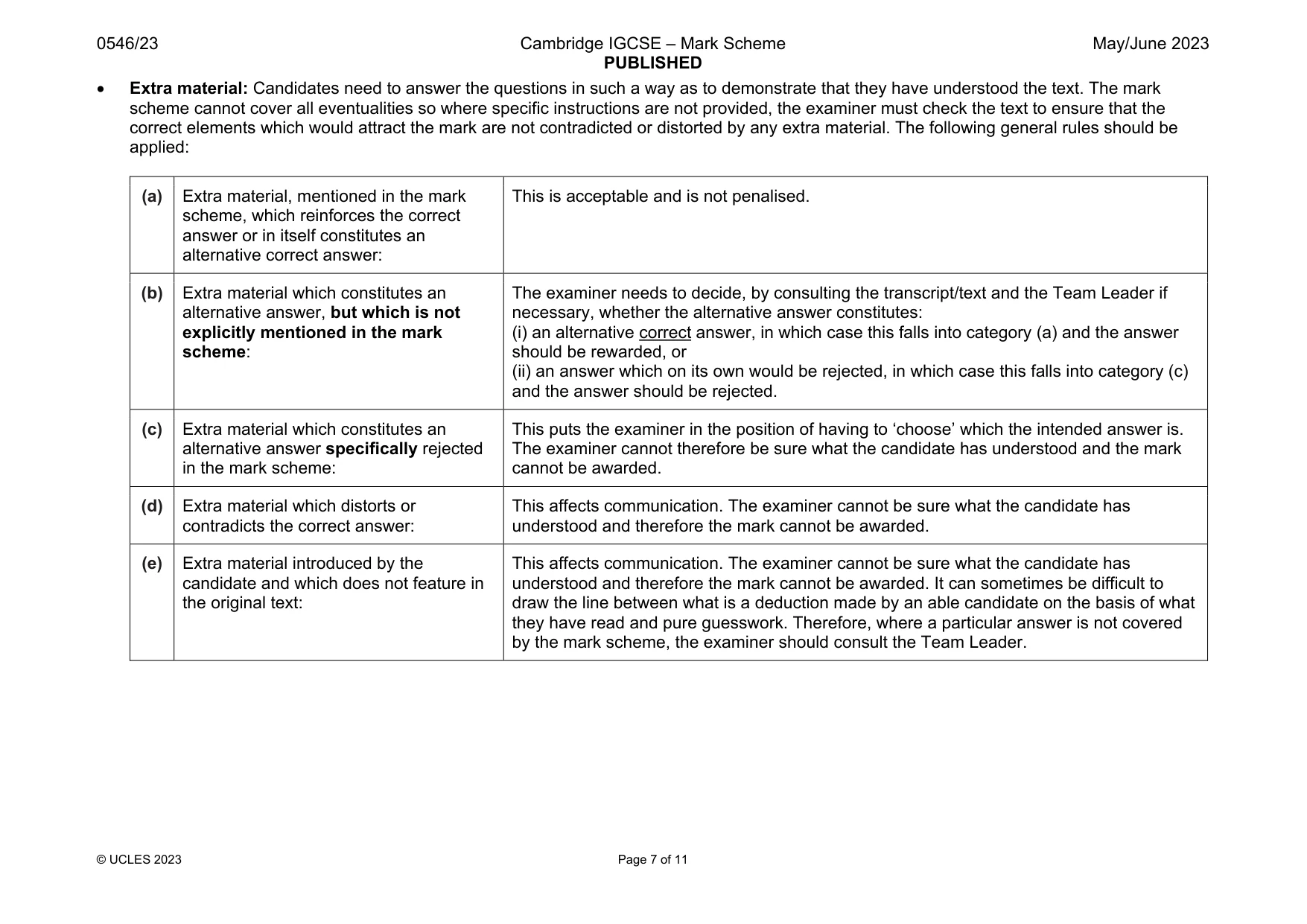
0546/23 Cambridge IGCSE – Mark Scheme PUBLISHED May/June 2023 © UCLES 2023 Page 7 of 11 Extra material: Candidates need to answer the questions in such a way as to demonstrate that they have understood the text. The mark scheme cannot cover all eventualities so where specific instructions are not provided, the examiner must check the text to ensure that the correct elements which would attract the mark are not contradicted or distorted by any extra material. The following general rules should be applied: (a) Extra material, mentioned in the mark scheme, which reinforces the correct answer or in itself constitutes an alternative correct answer: This is acceptable and is not penalised. (b) Extra material which constitutes an alternative answer, but which is not explicitly mentioned in the mark scheme: The examiner needs to decide, by consulting the transcript/text and the Team Leader if necessary, whether the alternative answer constitutes: (i) an alternative correct answer, in which case this falls into category (a) and the answer should be rewarded, or (ii) an answer which on its own would be rejected, in which case this falls into category (c) and the answer should be rejected. (c) Extra material which constitutes an alternative answer specifically rejected in the mark scheme: This puts the examiner in the position of having to ‘choose’ which the intended answer is. The examiner cannot therefore be sure what the candidate has understood and the mark cannot be awarded. (d) Extra material which distorts or contradicts the correct answer: This affects communication. The examiner cannot be sure what the candidate has understood and therefore the mark cannot be awarded. (e) Extra material introduced by the candidate and which does not feature in the original text: This affects communication. The examiner cannot be sure what the candidate has understood and therefore the mark cannot be awarded. It can sometimes be difficult to draw the line between what is a deduction made by an able candidate on the basis of what they have read and pure guesswork. Therefore, where a particular answer is not covered by the mark scheme, the examiner should consult the Team Leader.
Mark scheme, page 8
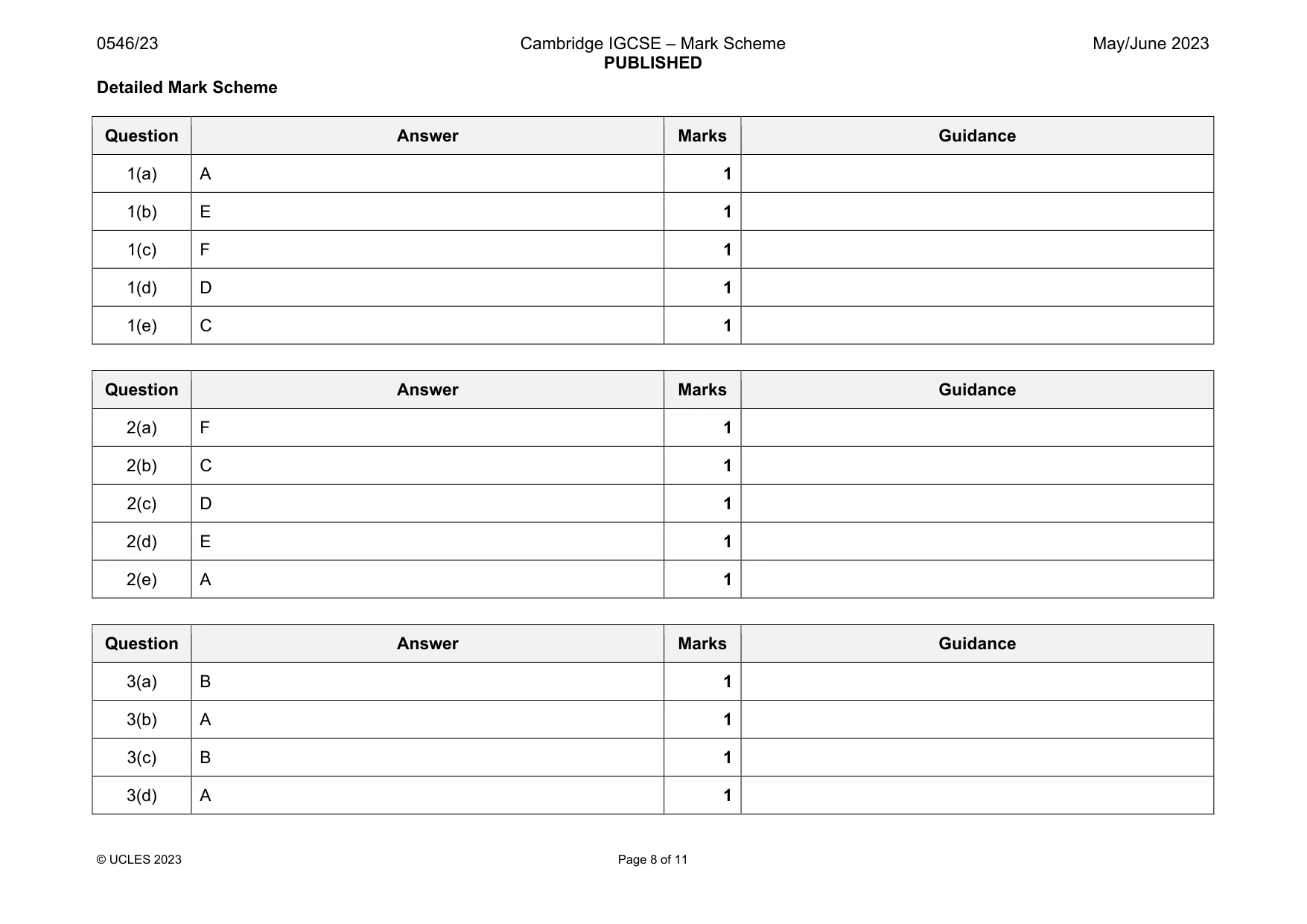
0546/23 Cambridge IGCSE – Mark Scheme PUBLISHED May/June 2023 © UCLES 2023 Page 8 of 11 Detailed Mark Scheme Question Answer Marks Guidance 1(a) A 1 1(b) E 1 1(c) F 1 1(d) D 1 1(e) C 1 Question Answer Marks Guidance 2(a) F 1 2(b) C 1 2(c) D 1 2(d) E 1 2(e) A 1 Question Answer Marks Guidance 3(a) B 1 3(b) A 1 3(c) B 1 3(d) A 1
Mark scheme, page 9
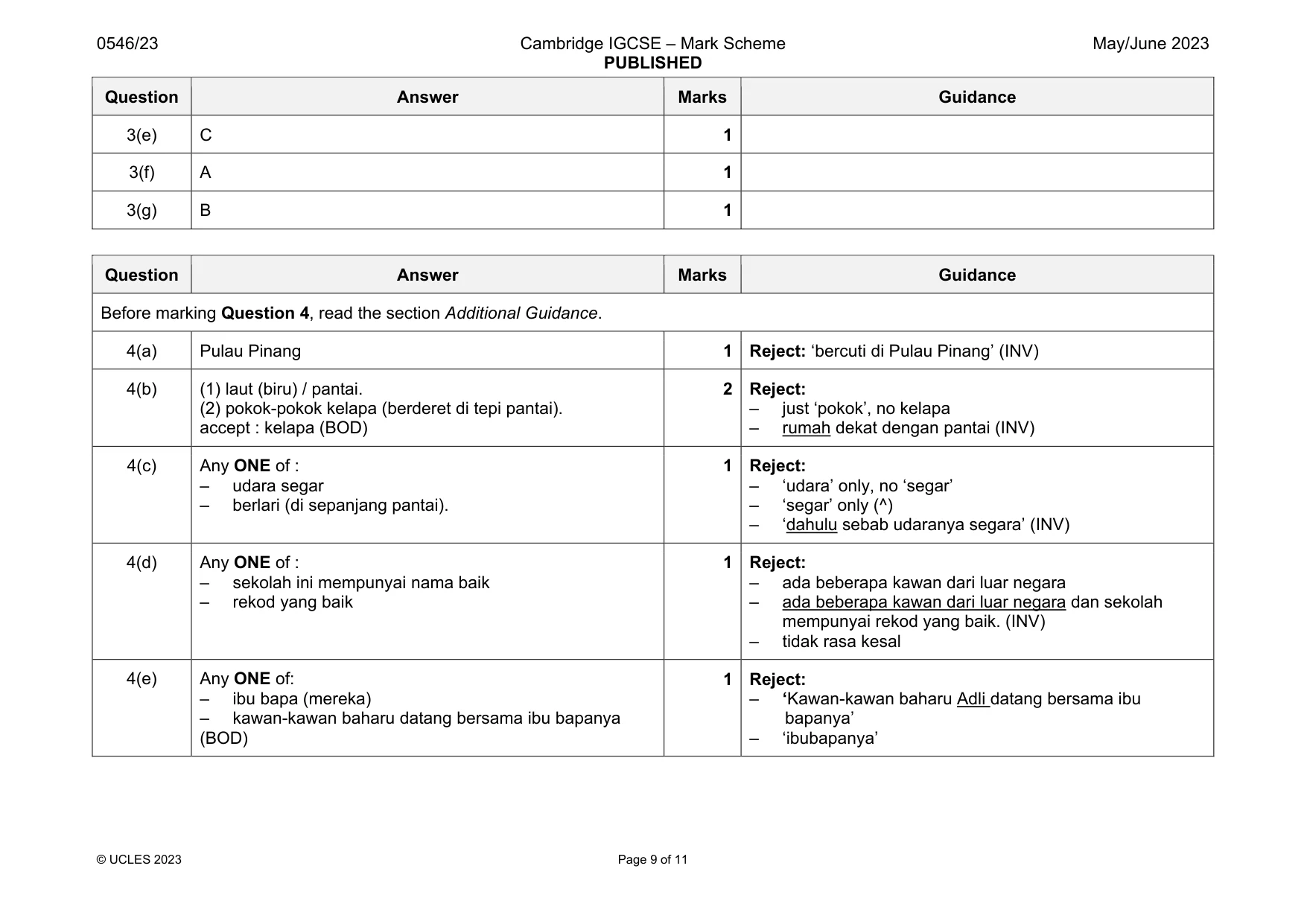
0546/23 Cambridge IGCSE – Mark Scheme PUBLISHED May/June 2023 © UCLES 2023 Page 9 of 11 Question Answer Marks Guidance 3(e) C 1 3(f) A 1 3(g) B 1 Question Answer Marks Guidance Before marking Question 4, read the section Additional Guidance. 4(a) Pulau Pinang 1 Reject: ‘bercuti di Pulau Pinang’ (INV) 4(b) (1) laut (biru) / pantai. (2) pokok-pokok kelapa (berderet di tepi pantai). accept : kelapa (BOD) 2 Reject: – just ‘pokok’, no kelapa – rumah dekat dengan pantai (INV) 4(c) Any ONE of : – udara segar – berlari (di sepanjang pantai). 1 Reject: – ‘udara’ only, no ‘segar’ – ‘segar’ only (^) – ‘dahulu sebab udaranya segara’ (INV) 4(d) Any ONE of : – sekolah ini mempunyai nama baik – rekod yang baik 1 Reject: – ada beberapa kawan dari luar negara – ada beberapa kawan dari luar negara dan sekolah mempunyai rekod yang baik. (INV) – tidak rasa kesal 4(e) Any ONE of: – ibu bapa (mereka) – kawan-kawan baharu datang bersama ibu bapanya (BOD) 1 Reject: – ‘Kawan-kawan baharu Adli datang bersama ibu bapanya’ – ‘ibubapanya’
Mark scheme, page 10
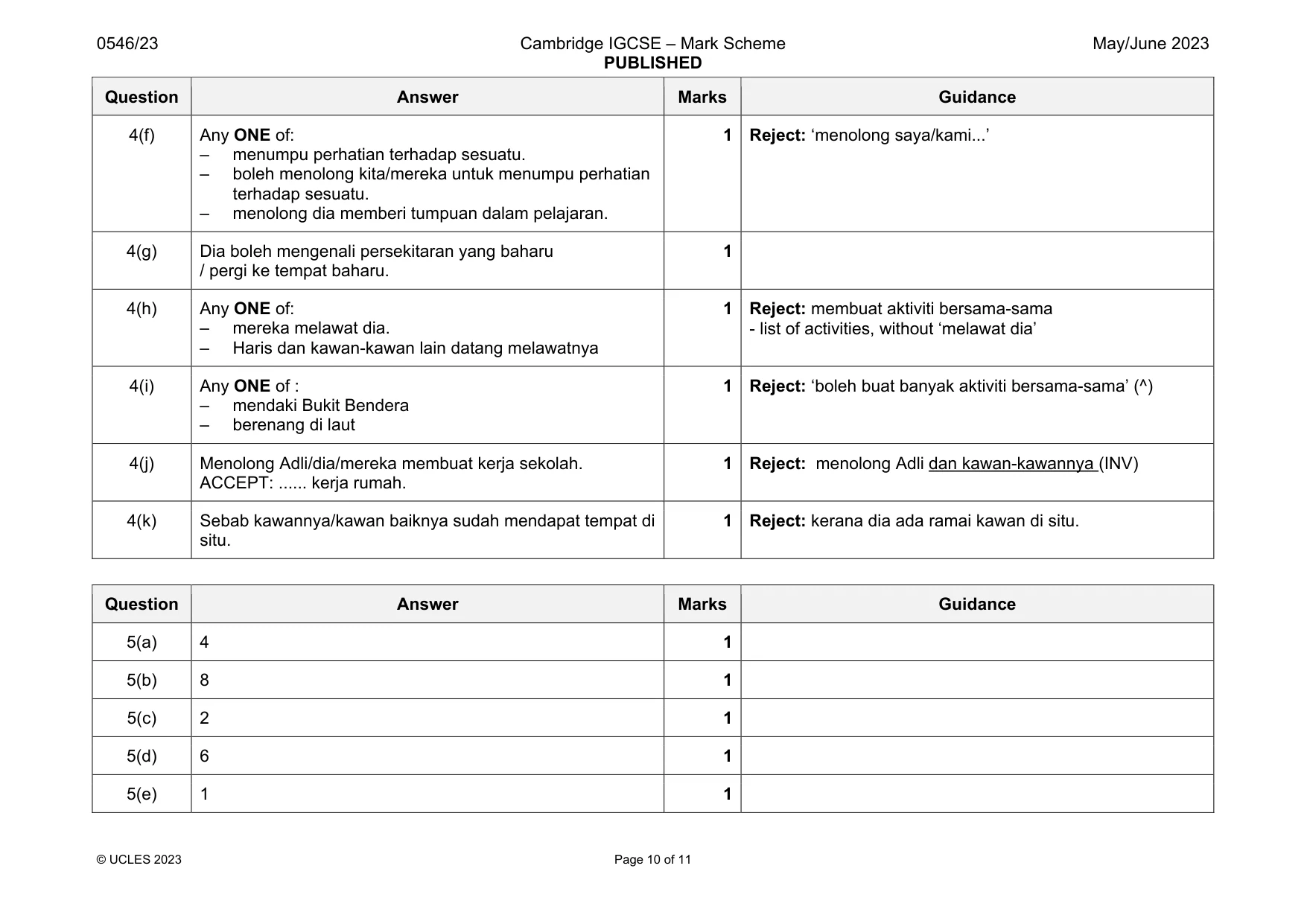
0546/23 Cambridge IGCSE – Mark Scheme PUBLISHED May/June 2023 © UCLES 2023 Page 10 of 11 Question Answer Marks Guidance 4(f) Any ONE of: – menumpu perhatian terhadap sesuatu. – boleh menolong kita/mereka untuk menumpu perhatian terhadap sesuatu. – menolong dia memberi tumpuan dalam pelajaran. 1 Reject: ‘menolong saya/kami...’ 4(g) Dia boleh mengenali persekitaran yang baharu / pergi ke tempat baharu. 1 4(h) Any ONE of: – mereka melawat dia. – Haris dan kawan-kawan lain datang melawatnya 1 Reject: membuat aktiviti bersama-sama - list of activities, without ‘melawat dia’ 4(i) Any ONE of : – mendaki Bukit Bendera – berenang di laut 1 Reject: ‘boleh buat banyak aktiviti bersama-sama’ (^) 4(j) Menolong Adli/dia/mereka membuat kerja sekolah. ACCEPT: … kerja rumah. 1 Reject: menolong Adli dan kawan-kawannya (INV) 4(k) Sebab kawannya/kawan baiknya sudah mendapat tempat di situ. 1 Reject: kerana dia ada ramai kawan di situ. Question Answer Marks Guidance 5(a) 4 1 5(b) 8 1 5(c) 2 1 5(d) 6 1 5(e) 1 1
Mark scheme, page 11
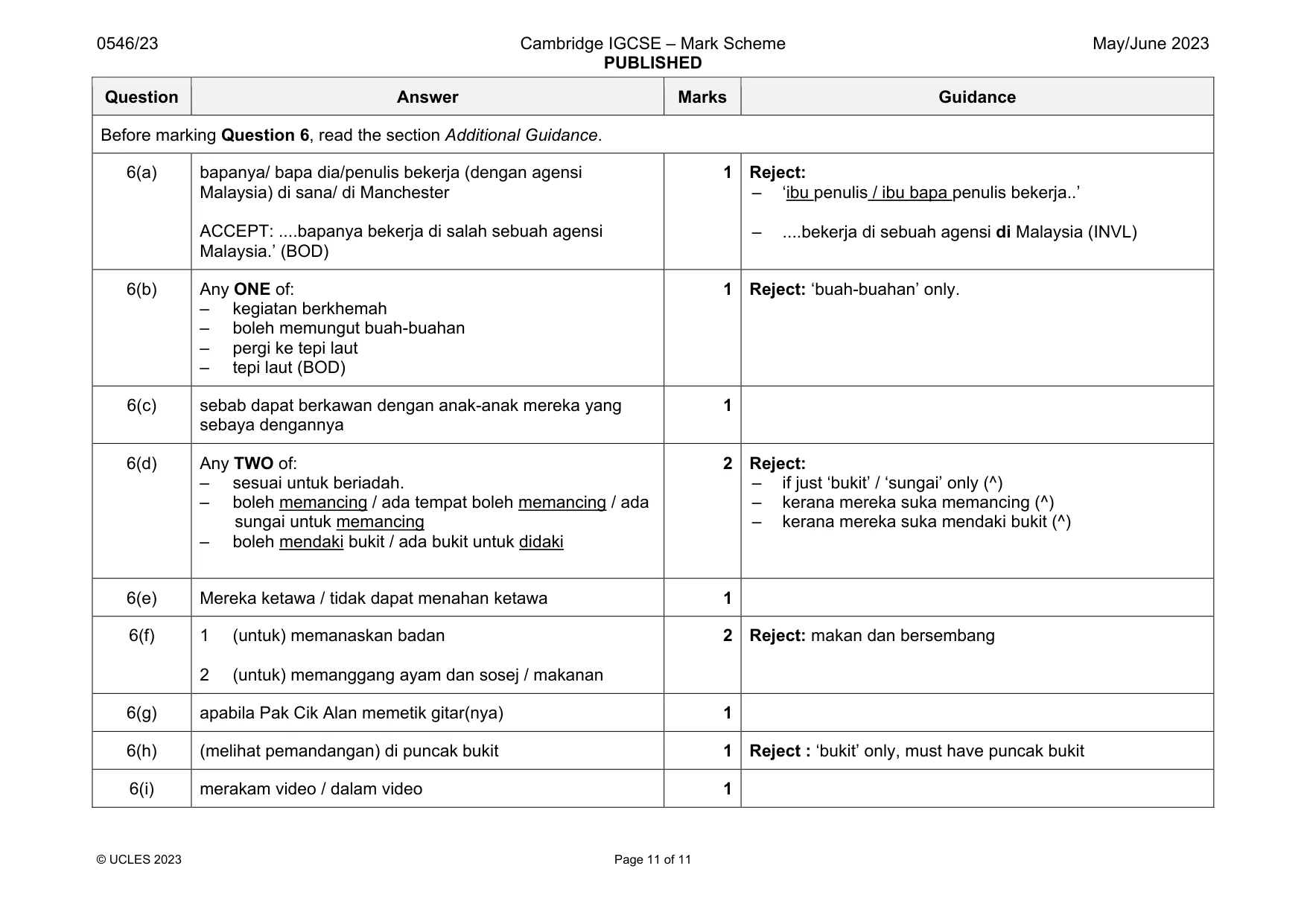
0546/23 Cambridge IGCSE – Mark Scheme PUBLISHED May/June 2023 © UCLES 2023 Page 11 of 11 Question Answer Marks Guidance Before marking Question 6, read the section Additional Guidance. 6(a) bapanya/ bapa dia/penulis bekerja (dengan agensi Malaysia) di sana/ di Manchester ACCEPT: …bapanya bekerja di salah sebuah agensi Malaysia.’ (BOD) 1 Reject: – ‘ibu penulis / ibu bapa penulis bekerja..’ – …bekerja di sebuah agensi di Malaysia (INVL) 6(b) Any ONE of: – kegiatan berkhemah – boleh memungut buah-buahan – pergi ke tepi laut – tepi laut (BOD) 1 Reject: ‘buah-buahan’ only. 6(c) sebab dapat berkawan dengan anak-anak mereka yang sebaya dengannya 1 6(d) Any TWO of: – sesuai untuk beriadah. – boleh memancing / ada tempat boleh memancing / ada sungai untuk memancing – boleh mendaki bukit / ada bukit untuk didaki 2 Reject: – if just ‘bukit’ / ‘sungai’ only (^) – kerana mereka suka memancing (^) – kerana mereka suka mendaki bukit (^) 6(e) Mereka ketawa / tidak dapat menahan ketawa 1 6(f) 1 (untuk) memanaskan badan 2 (untuk) memanggang ayam dan sosej / makanan 2 Reject: makan dan bersembang 6(g) apabila Pak Cik Alan memetik gitar(nya) 1 6(h) (melihat pemandangan) di puncak bukit 1 Reject : ‘bukit’ only, must have puncak bukit 6(i) merakam video / dalam video 1
What you needed in this session
Cambridge’s own grade thresholds for 2023 May/June, Paper 2 · Variant 3. A higher threshold means an easier paper — the bar moves with how the cohort did.