Cambridge IGCSE Malay - Foreign Language 0546 — 2023 May/June Paper 2 · Variant 2
0546/22/M/J/23 · 45 marks · ≈51 min
The question paper and its mark scheme, free to read here and free to download. This is Cambridge’s own paper, exactly as it was sat.
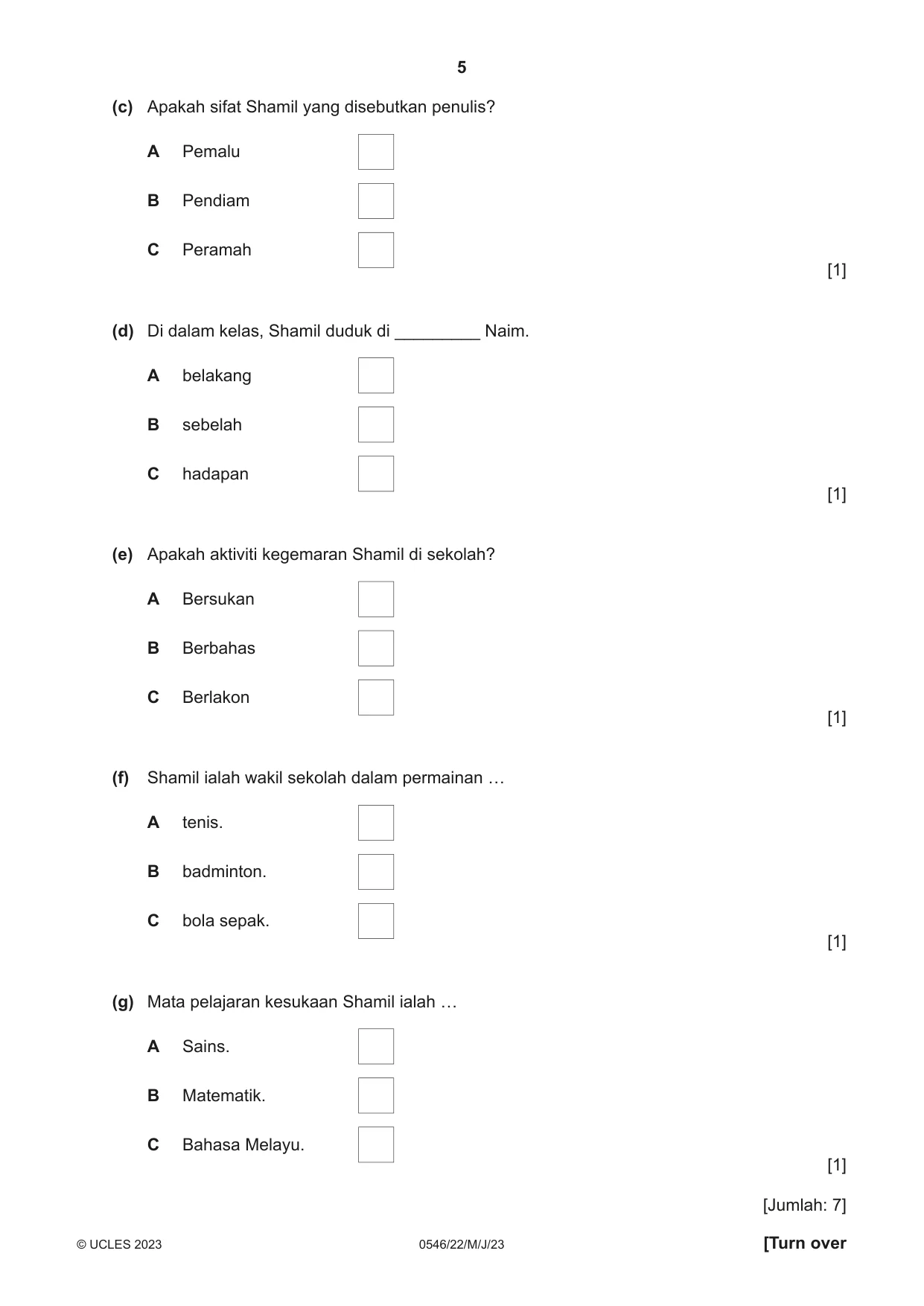
Question paper12 pages
Mark scheme11 pages
Answers below. Sit the paper first if you are practising.
Paper as text
Question paper, page 1
This document has 12 pages. Any blank pages are indicated. [Turn over Cambridge IGCSE™ * 6 8 4 8 6 4 8 9 8 6 * DC (EF/SG) 313831/2 © UCLES 2023 MALAY 0546/22 Paper 2 Reading May/June 2023 1 hour You must answer on the question paper. No additional materials are needed. INSTRUCTIONS ● Answer all questions. ● Use a black or dark blue pen. ● Write your name, centre number and candidate number in the boxes at the top of the page. ● Write your answer to each question in the space provided. ● Do not use an erasable pen or correction fluid. ● Do not write on any bar codes. ● Dictionaries are not allowed. INFORMATION ● The total mark for this paper is 45. ● The number of marks for each question or part question is shown in brackets [ ].
Question paper, page 2
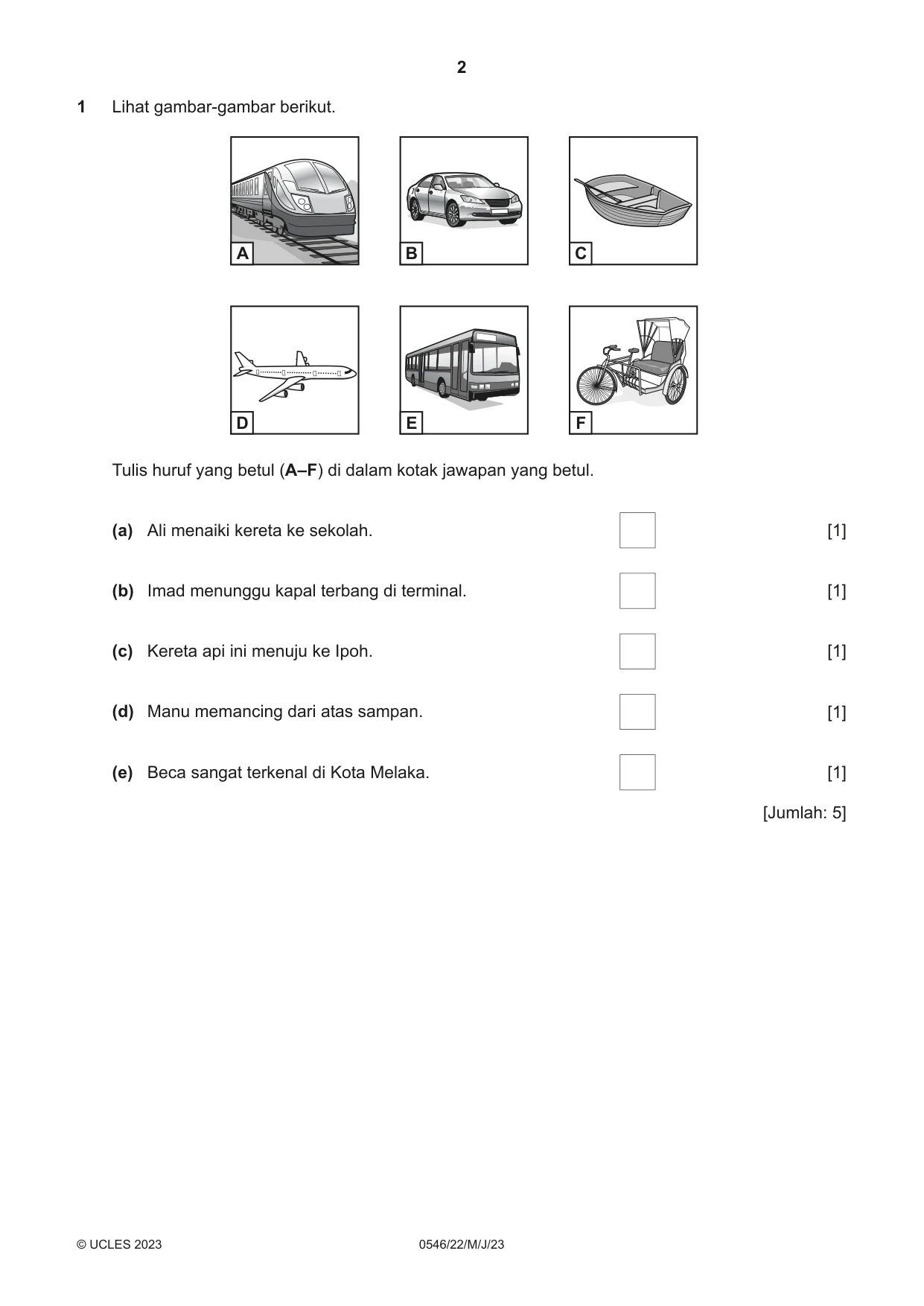
2 0546/22/M/J/23 © UCLES 2023 1 Lihat gambar‑gambar berikut. A B C D E F Tulis huruf yang betul (A–F) di dalam kotak jawapan yang betul. (a) Ali menaiki kereta ke sekolah. [1] (b) Imad menunggu kapal terbang di terminal. [1] (c) Kereta api ini menuju ke Ipoh. [1] (d) Manu memancing dari atas sampan. [1] (e) Beca sangat terkenal di Kota Melaka. [1] [Jumlah: 5]
Question paper, page 3
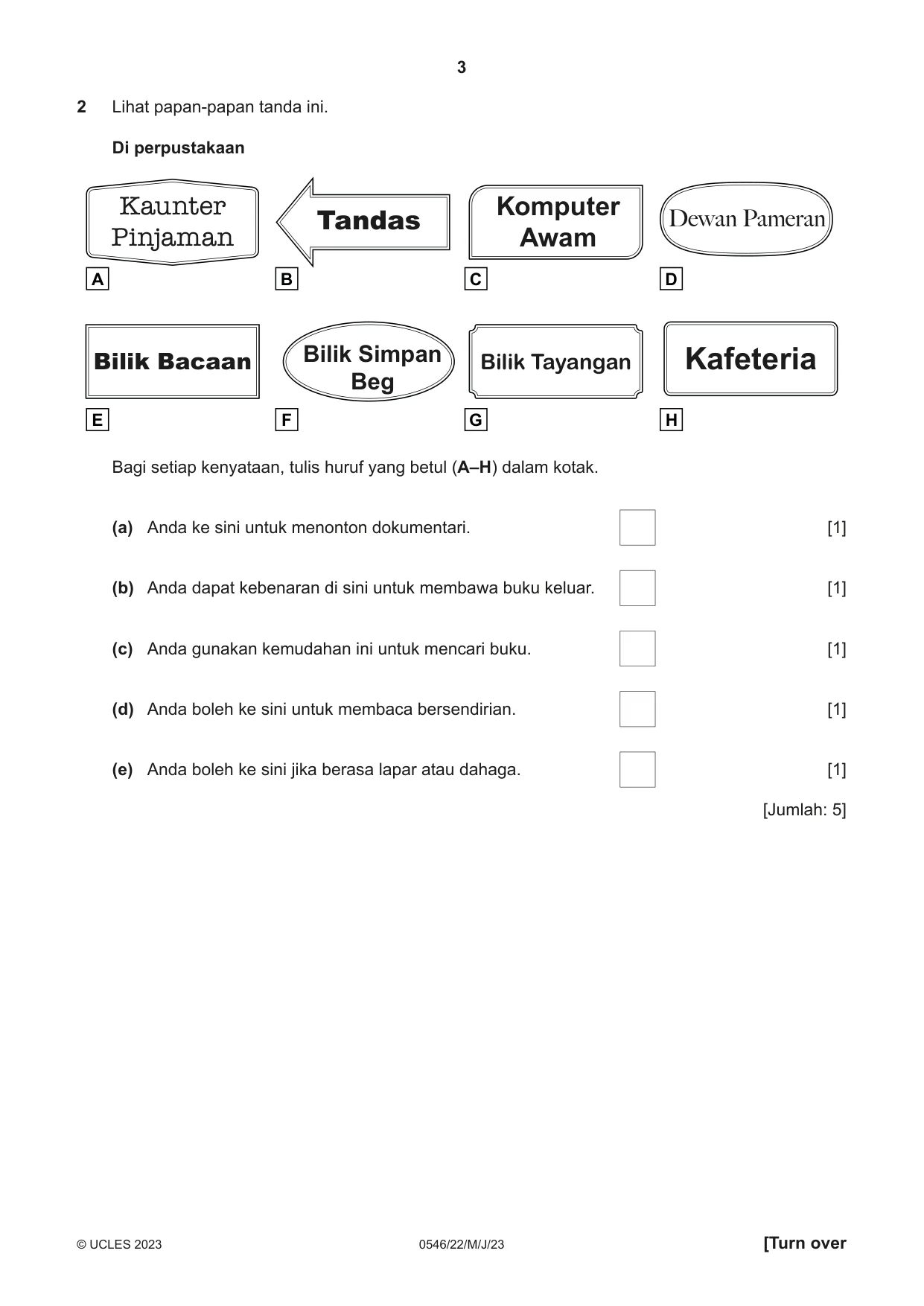
3 0546/22/M/J/23 © UCLES 2023 [Turn over 2 Lihat papan‑papan tanda ini. Di perpustakaan Kafeteria Bilik Simpan Beg Bilik Tayangan Kaunter Pinjaman Tandas Dewan Pameran Komputer Awam Bilik Bacaan A B C D E F G H Bagi setiap kenyataan, tulis huruf yang betul (A–H) dalam kotak. (a) Anda ke sini untuk menonton dokumentari. [1] (b) Anda dapat kebenaran di sini untuk membawa buku keluar. [1] (c) Anda gunakan kemudahan ini untuk mencari buku. [1] (d) Anda boleh ke sini untuk membaca bersendirian. [1] (e) Anda boleh ke sini jika berasa lapar atau dahaga. [1] [Jumlah: 5]
Question paper, page 4
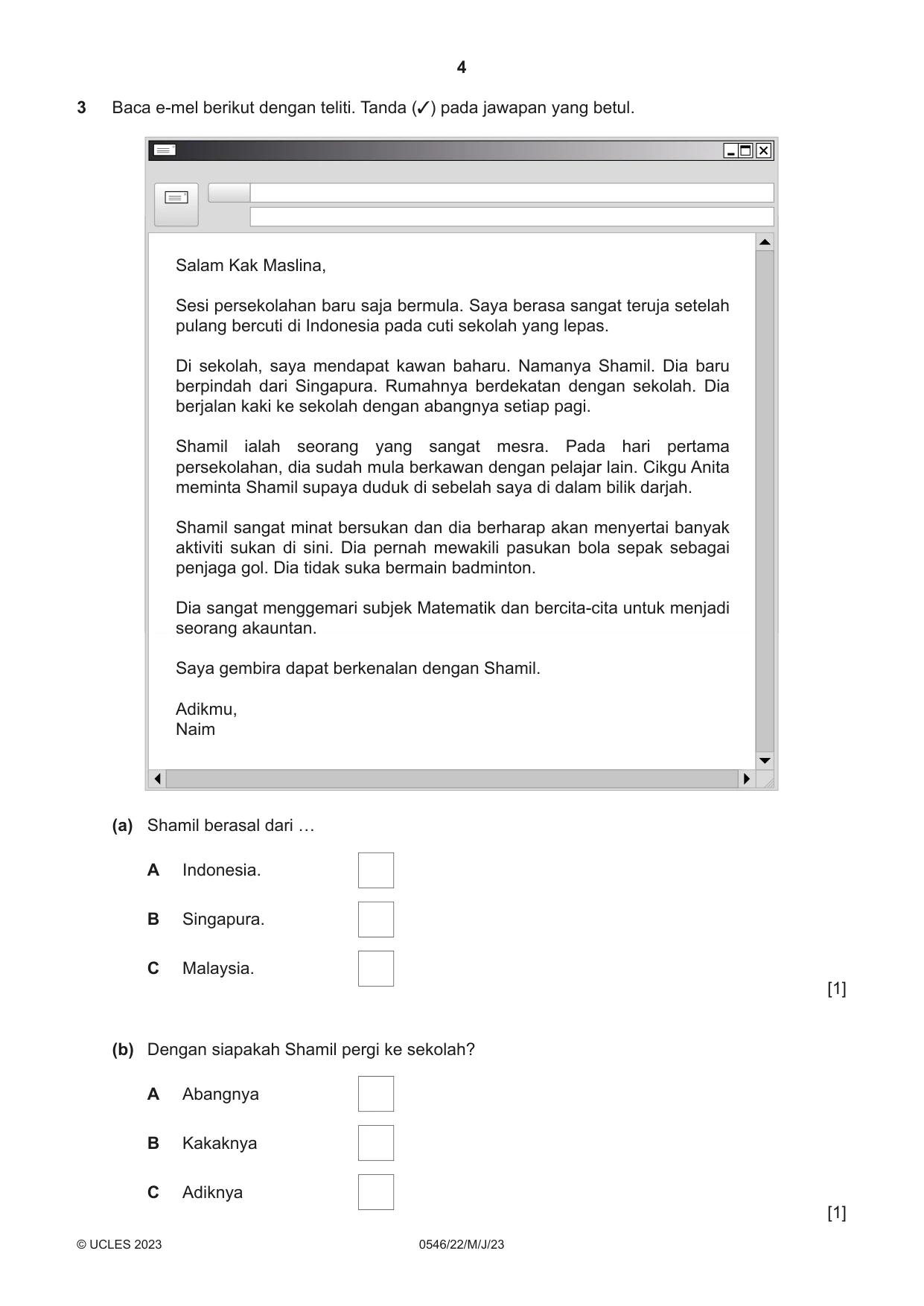
4 0546/22/M/J/23 © UCLES 2023 3 Baca e‑mel berikut dengan teliti. Tanda (3) pada jawapan yang betul. Salam Kak Maslina, Sesi persekolahan baru saja bermula. Saya berasa sangat teruja setelah pulang bercuti di Indonesia pada cuti sekolah yang lepas. Di sekolah, saya mendapat kawan baharu. Namanya Shamil. Dia baru berpindah dari Singapura. Rumahnya berdekatan dengan sekolah. Dia berjalan kaki ke sekolah dengan abangnya setiap pagi. Shamil ialah seorang yang sangat mesra. Pada hari pertama persekolahan, dia sudah mula berkawan dengan pelajar lain. Cikgu Anita meminta Shamil supaya duduk di sebelah saya di dalam bilik darjah. Shamil sangat minat bersukan dan dia berharap akan menyertai banyak aktiviti sukan di sini. Dia pernah mewakili pasukan bola sepak sebagai penjaga gol. Dia tidak suka bermain badminton. Dia sangat menggemari subjek Matematik dan bercita‑cita untuk menjadi seorang akauntan. Saya gembira dapat berkenalan dengan Shamil. Adikmu, Naim (a) Shamil berasal dari … A Indonesia. B Singapura. C Malaysia. [1] (b) Dengan siapakah Shamil pergi ke sekolah? A Abangnya B Kakaknya C Adiknya [1]
Question paper, page 5
5 0546/22/M/J/23 © UCLES 2023 [Turn over (c) Apakah sifat Shamil yang disebutkan penulis? A Pemalu B Pendiam C Peramah [1] (d) Di dalam kelas, Shamil duduk di _________ Naim. A belakang B sebelah C hadapan [1] (e) Apakah aktiviti kegemaran Shamil di sekolah? A Bersukan B Berbahas C Berlakon [1] (f) Shamil ialah wakil sekolah dalam permainan … A tenis. B badminton. C bola sepak. [1] (g) Mata pelajaran kesukaan Shamil ialah … A Sains. B Matematik. C Bahasa Melayu. [1] [Jumlah: 7]
Question paper, page 6
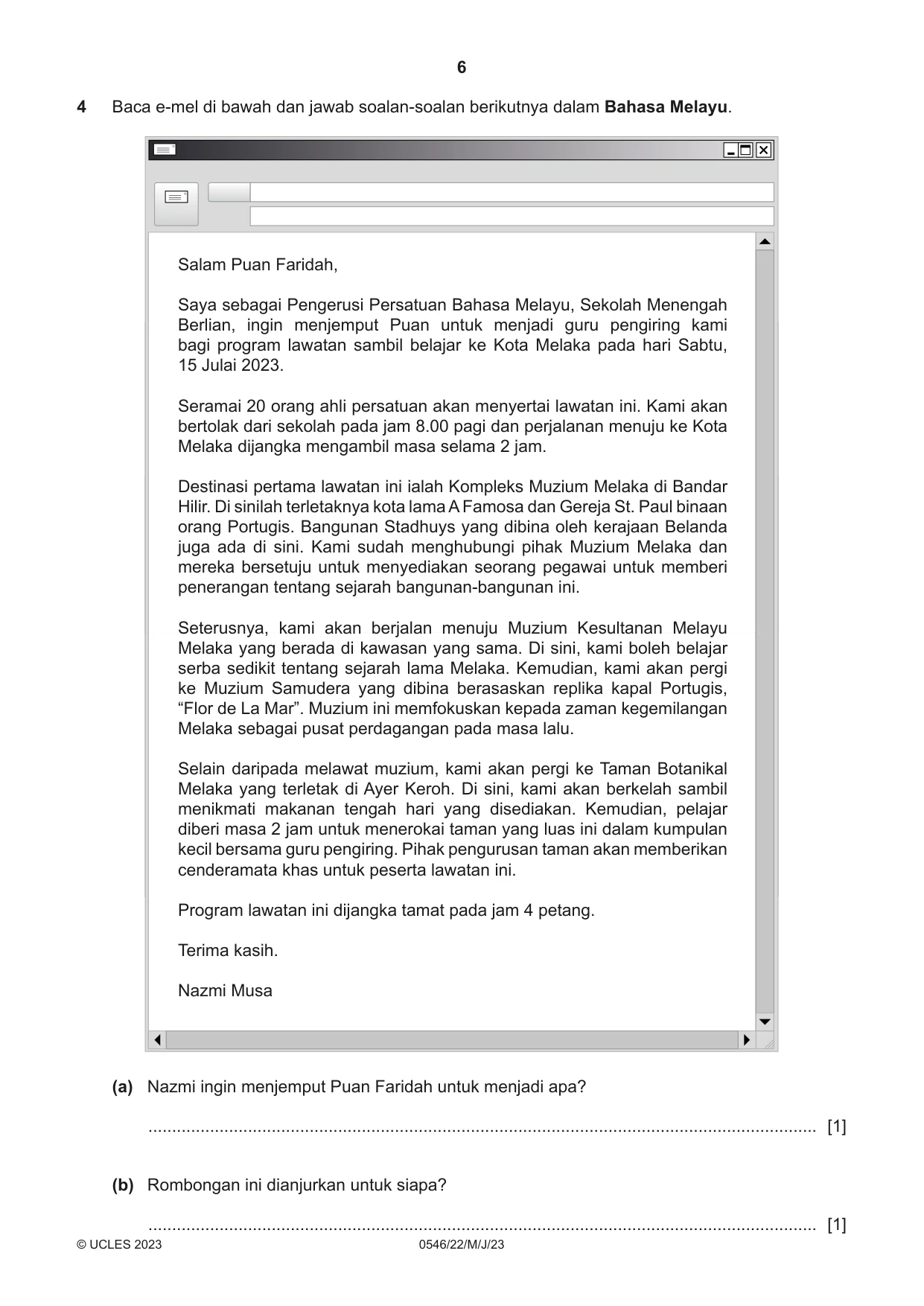
6 0546/22/M/J/23 © UCLES 2023 4 Baca e‑mel di bawah dan jawab soalan‑soalan berikutnya dalam Bahasa Melayu. Salam Puan Faridah, Saya sebagai Pengerusi Persatuan Bahasa Melayu, Sekolah Menengah Berlian, ingin menjemput Puan untuk menjadi guru pengiring kami bagi program lawatan sambil belajar ke Kota Melaka pada hari Sabtu, 15 Julai 2023. Seramai 20 orang ahli persatuan akan menyertai lawatan ini. Kami akan bertolak dari sekolah pada jam 8.00 pagi dan perjalanan menuju ke Kota Melaka dijangka mengambil masa selama 2 jam. Destinasi pertama lawatan ini ialah Kompleks Muzium Melaka di Bandar Hilir. Di sinilah terletaknya kota lama A Famosa dan Gereja St. Paul binaan orang Portugis. Bangunan Stadhuys yang dibina oleh kerajaan Belanda juga ada di sini. Kami sudah menghubungi pihak Muzium Melaka dan mereka bersetuju untuk menyediakan seorang pegawai untuk memberi penerangan tentang sejarah bangunan‑bangunan ini. Seterusnya, kami akan berjalan menuju Muzium Kesultanan Melayu Melaka yang berada di kawasan yang sama. Di sini, kami boleh belajar serba sedikit tentang sejarah lama Melaka. Kemudian, kami akan pergi ke Muzium Samudera yang dibina berasaskan replika kapal Portugis, “Flor de La Mar”. Muzium ini memfokuskan kepada zaman kegemilangan Melaka sebagai pusat perdagangan pada masa lalu. Selain daripada melawat muzium, kami akan pergi ke Taman Botanikal Melaka yang terletak di Ayer Keroh. Di sini, kami akan berkelah sambil menikmati makanan tengah hari yang disediakan. Kemudian, pelajar diberi masa 2 jam untuk menerokai taman yang luas ini dalam kumpulan kecil bersama guru pengiring. Pihak pengurusan taman akan memberikan cenderamata khas untuk peserta lawatan ini. Program lawatan ini dijangka tamat pada jam 4 petang. Terima kasih. Nazmi Musa (a) Nazmi ingin menjemput Puan Faridah untuk menjadi apa? … [1] (b) Rombongan ini dianjurkan untuk siapa? … [1]
Question paper, page 7
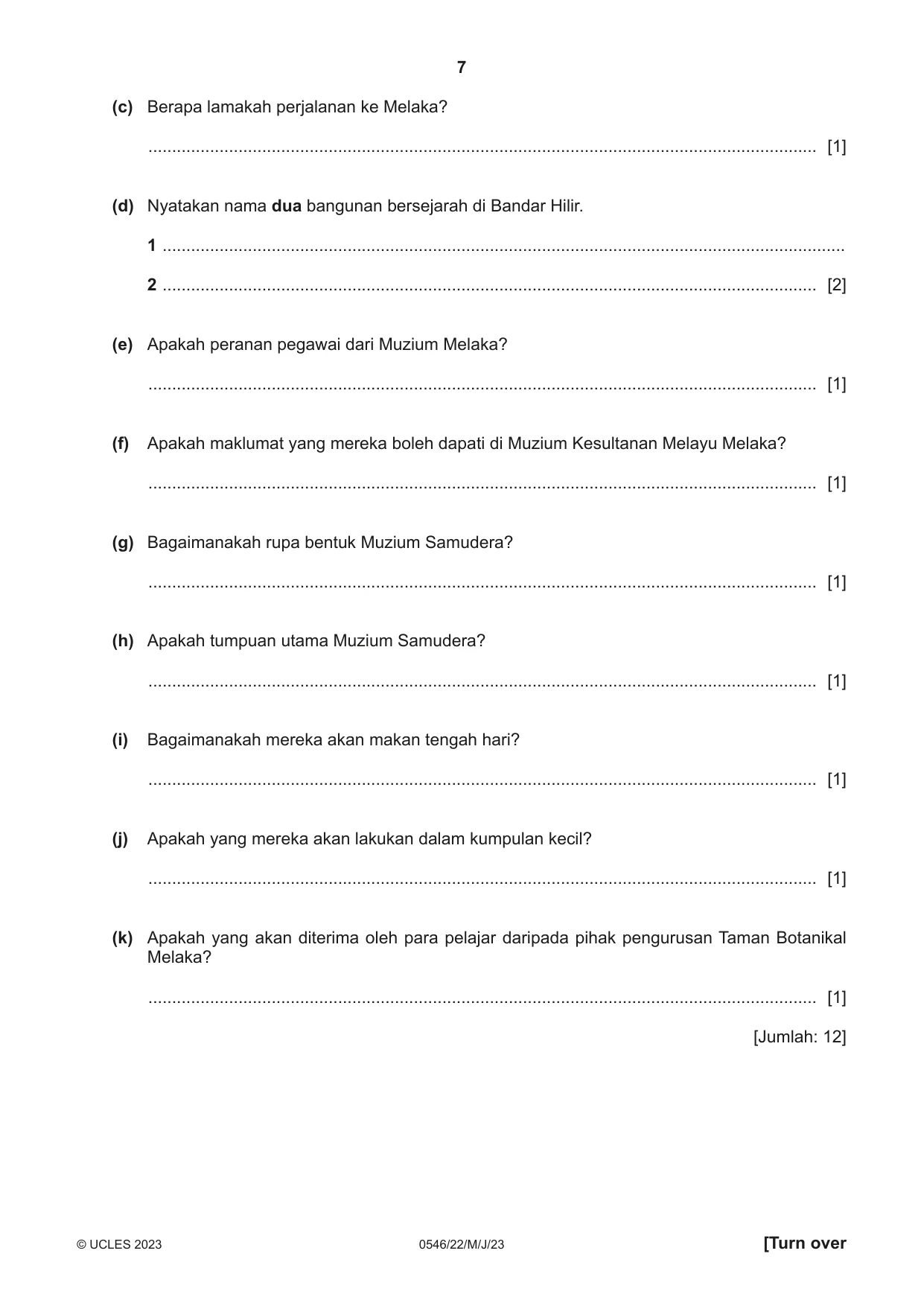
7 0546/22/M/J/23 © UCLES 2023 [Turn over (c) Berapa lamakah perjalanan ke Melaka? … [1] (d) Nyatakan nama dua bangunan bersejarah di Bandar Hilir. 1 … 2 … [2] (e) Apakah peranan pegawai dari Muzium Melaka? … [1] (f) Apakah maklumat yang mereka boleh dapati di Muzium Kesultanan Melayu Melaka? … [1] (g) Bagaimanakah rupa bentuk Muzium Samudera? … [1] (h) Apakah tumpuan utama Muzium Samudera? … [1] (i) Bagaimanakah mereka akan makan tengah hari? … [1] (j) Apakah yang mereka akan lakukan dalam kumpulan kecil? … [1] (k) Apakah yang akan diterima oleh para pelajar daripada pihak pengurusan Taman Botanikal Melaka? … [1] [Jumlah: 12]
Question paper, page 8
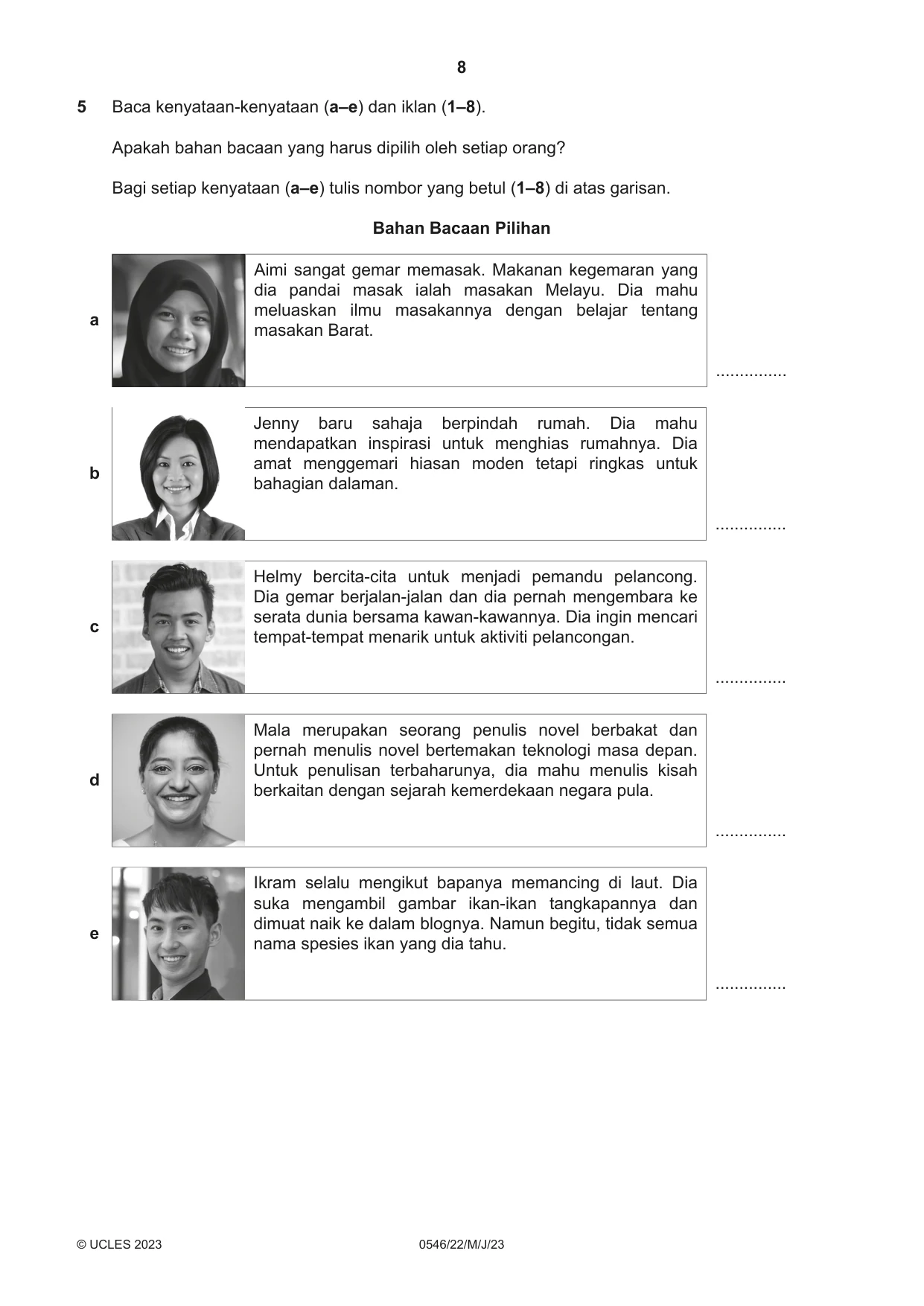
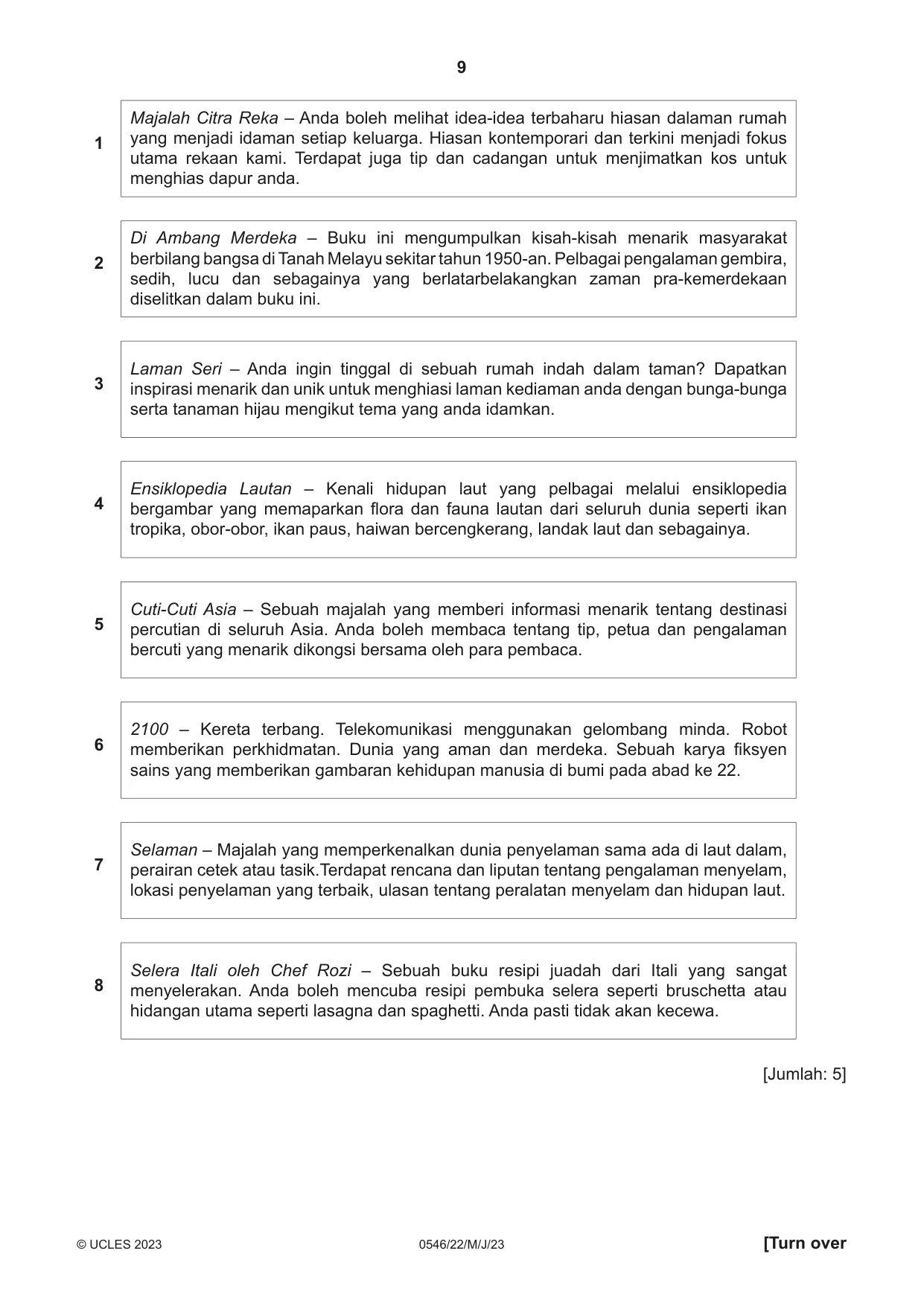
8 0546/22/M/J/23 © UCLES 2023 5 Baca kenyataan‑kenyataan (a–e) dan iklan (1–8). Apakah bahan bacaan yang harus dipilih oleh setiap orang? Bagi setiap kenyataan (a–e) tulis nombor yang betul (1–8) di atas garisan. Bahan Bacaan Pilihan a Aimi sangat gemar memasak. Makanan kegemaran yang dia pandai masak ialah masakan Melayu. Dia mahu meluaskan ilmu masakannya dengan belajar tentang masakan Barat. … b Jenny baru sahaja berpindah rumah. Dia mahu mendapatkan inspirasi untuk menghias rumahnya. Dia amat menggemari hiasan moden tetapi ringkas untuk bahagian dalaman. … c Helmy bercita‑cita untuk menjadi pemandu pelancong. Dia gemar berjalan‑jalan dan dia pernah mengembara ke serata dunia bersama kawan‑kawannya. Dia ingin mencari tempat‑tempat menarik untuk aktiviti pelancongan. … d Mala merupakan seorang penulis novel berbakat dan pernah menulis novel bertemakan teknologi masa depan. Untuk penulisan terbaharunya, dia mahu menulis kisah berkaitan dengan sejarah kemerdekaan negara pula. … e Ikram selalu mengikut bapanya memancing di laut. Dia suka mengambil gambar ikan‑ikan tangkapannya dan dimuat naik ke dalam blognya. Namun begitu, tidak semua nama spesies ikan yang dia tahu. …
Question paper, page 9
9 0546/22/M/J/23 © UCLES 2023 [Turn over 1 Majalah Citra Reka – Anda boleh melihat idea‑idea terbaharu hiasan dalaman rumah yang menjadi idaman setiap keluarga. Hiasan kontemporari dan terkini menjadi fokus utama rekaan kami. Terdapat juga tip dan cadangan untuk menjimatkan kos untuk menghias dapur anda. 2 Di Ambang Merdeka – Buku ini mengumpulkan kisah‑kisah menarik masyarakat berbilang bangsa di Tanah Melayu sekitar tahun 1950‑an. Pelbagai pengalaman gembira, sedih, lucu dan sebagainya yang berlatarbelakangkan zaman pra‑kemerdekaan diselitkan dalam buku ini. 3 Laman Seri – Anda ingin tinggal di sebuah rumah indah dalam taman? Dapatkan inspirasi menarik dan unik untuk menghiasi laman kediaman anda dengan bunga‑bunga serta tanaman hijau mengikut tema yang anda idamkan. 4 Ensiklopedia Lautan – Kenali hidupan laut yang pelbagai melalui ensiklopedia bergambar yang memaparkan flora dan fauna lautan dari seluruh dunia seperti ikan tropika, obor‑obor, ikan paus, haiwan bercengkerang, landak laut dan sebagainya. 5 Cuti‑Cuti Asia – Sebuah majalah yang memberi informasi menarik tentang destinasi percutian di seluruh Asia. Anda boleh membaca tentang tip, petua dan pengalaman bercuti yang menarik dikongsi bersama oleh para pembaca. 6 2100 – Kereta terbang. Telekomunikasi menggunakan gelombang minda. Robot memberikan perkhidmatan. Dunia yang aman dan merdeka. Sebuah karya fiksyen sains yang memberikan gambaran kehidupan manusia di bumi pada abad ke 22. 7 Selaman – Majalah yang memperkenalkan dunia penyelaman sama ada di laut dalam, perairan cetek atau tasik.Terdapat rencana dan liputan tentang pengalaman menyelam, lokasi penyelaman yang terbaik, ulasan tentang peralatan menyelam dan hidupan laut. 8 Selera Itali oleh Chef Rozi – Sebuah buku resipi juadah dari Itali yang sangat menyelerakan. Anda boleh mencuba resipi pembuka selera seperti bruschetta atau hidangan utama seperti lasagna dan spaghetti. Anda pasti tidak akan kecewa. [Jumlah: 5]
Question paper, page 10
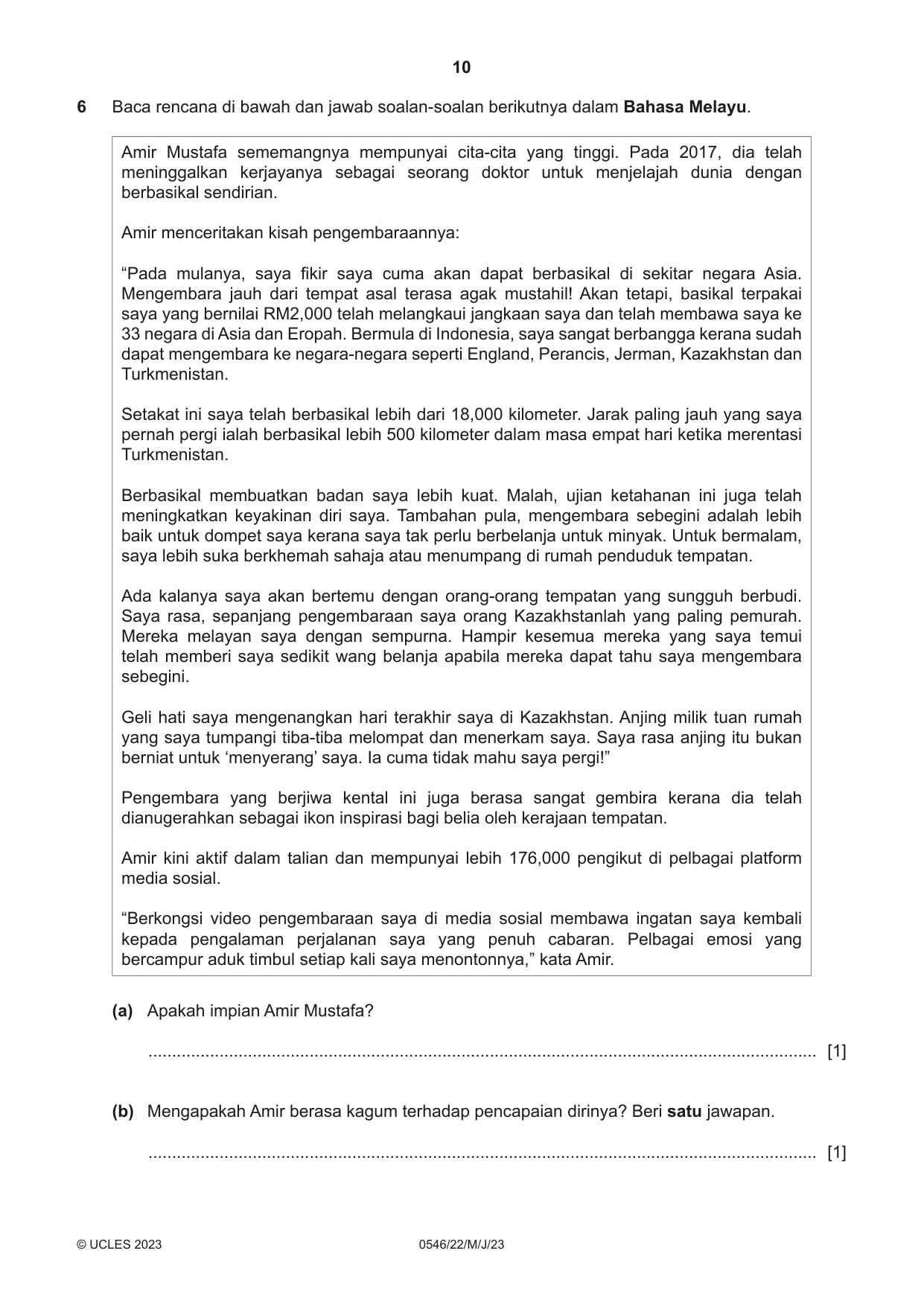
10 0546/22/M/J/23 © UCLES 2023 6 Baca rencana di bawah dan jawab soalan‑soalan berikutnya dalam Bahasa Melayu. Amir Mustafa sememangnya mempunyai cita‑cita yang tinggi. Pada 2017, dia telah meninggalkan kerjayanya sebagai seorang doktor untuk menjelajah dunia dengan berbasikal sendirian. Amir menceritakan kisah pengembaraannya: “Pada mulanya, saya fikir saya cuma akan dapat berbasikal di sekitar negara Asia. Mengembara jauh dari tempat asal terasa agak mustahil! Akan tetapi, basikal terpakai saya yang bernilai RM2,000 telah melangkaui jangkaan saya dan telah membawa saya ke 33 negara di Asia dan Eropah. Bermula di Indonesia, saya sangat berbangga kerana sudah dapat mengembara ke negara‑negara seperti England, Perancis, Jerman, Kazakhstan dan Turkmenistan. Setakat ini saya telah berbasikal lebih dari 18,000 kilometer. Jarak paling jauh yang saya pernah pergi ialah berbasikal lebih 500 kilometer dalam masa empat hari ketika merentasi Turkmenistan. Berbasikal membuatkan badan saya lebih kuat. Malah, ujian ketahanan ini juga telah meningkatkan keyakinan diri saya. Tambahan pula, mengembara sebegini adalah lebih baik untuk dompet saya kerana saya tak perlu berbelanja untuk minyak. Untuk bermalam, saya lebih suka berkhemah sahaja atau menumpang di rumah penduduk tempatan. Ada kalanya saya akan bertemu dengan orang‑orang tempatan yang sungguh berbudi. Saya rasa, sepanjang pengembaraan saya orang Kazakhstanlah yang paling pemurah. Mereka melayan saya dengan sempurna. Hampir kesemua mereka yang saya temui telah memberi saya sedikit wang belanja apabila mereka dapat tahu saya mengembara sebegini. Geli hati saya mengenangkan hari terakhir saya di Kazakhstan. Anjing milik tuan rumah yang saya tumpangi tiba‑tiba melompat dan menerkam saya. Saya rasa anjing itu bukan berniat untuk ‘menyerang’ saya. Ia cuma tidak mahu saya pergi!” Pengembara yang berjiwa kental ini juga berasa sangat gembira kerana dia telah dianugerahkan sebagai ikon inspirasi bagi belia oleh kerajaan tempatan. Amir kini aktif dalam talian dan mempunyai lebih 176,000 pengikut di pelbagai platform media sosial. “Berkongsi video pengembaraan saya di media sosial membawa ingatan saya kembali kepada pengalaman perjalanan saya yang penuh cabaran. Pelbagai emosi yang bercampur aduk timbul setiap kali saya menontonnya,” kata Amir. (a) Apakah impian Amir Mustafa? … [1] (b) Mengapakah Amir berasa kagum terhadap pencapaian dirinya? Beri satu jawapan. … [1]
Question paper, page 11
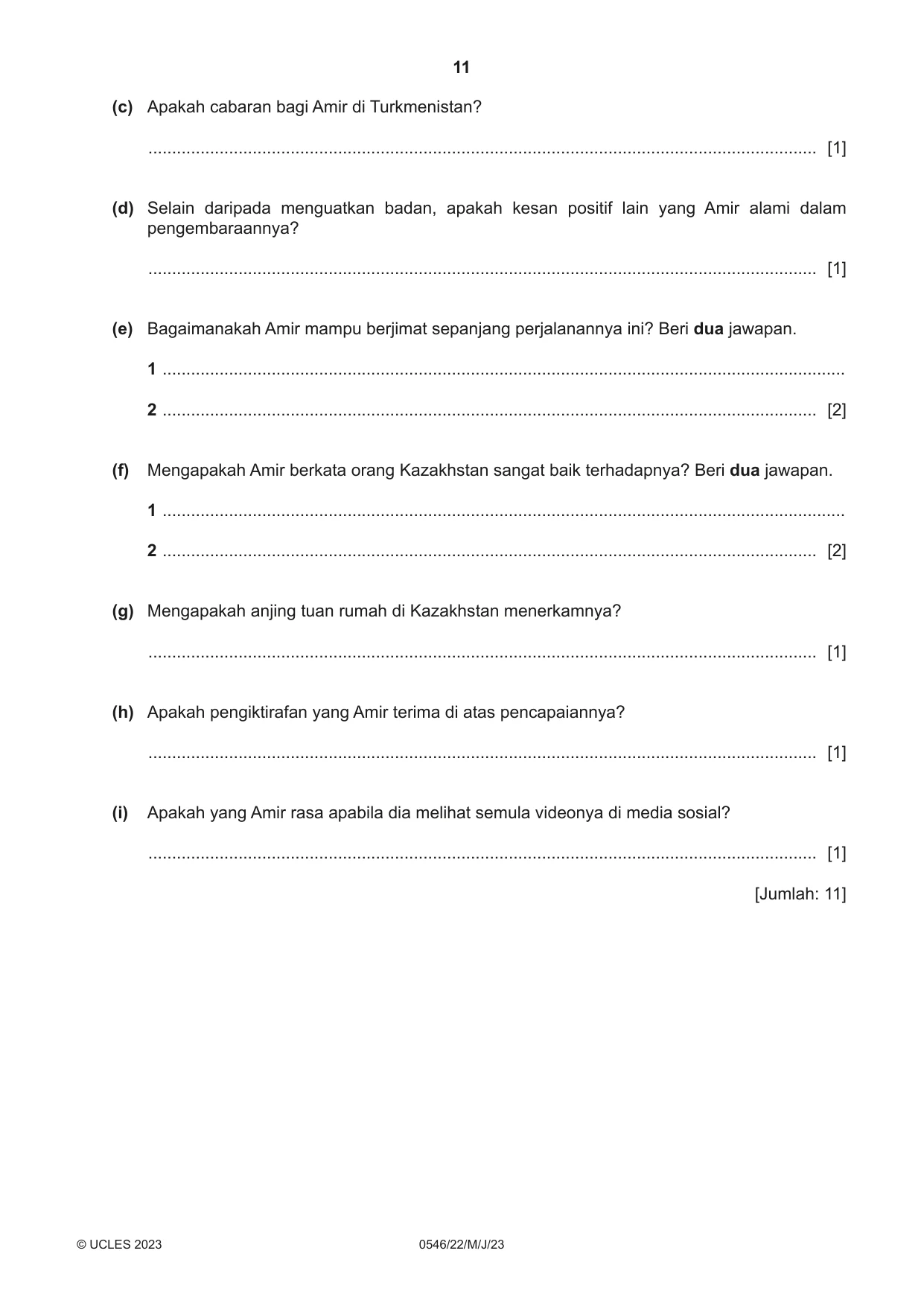
11 0546/22/M/J/23 © UCLES 2023 (c) Apakah cabaran bagi Amir di Turkmenistan? … [1] (d) Selain daripada menguatkan badan, apakah kesan positif lain yang Amir alami dalam pengembaraannya? … [1] (e) Bagaimanakah Amir mampu berjimat sepanjang perjalanannya ini? Beri dua jawapan. 1 … 2 … [2] (f) Mengapakah Amir berkata orang Kazakhstan sangat baik terhadapnya? Beri dua jawapan. 1 … 2 … [2] (g) Mengapakah anjing tuan rumah di Kazakhstan menerkamnya? … [1] (h) Apakah pengiktirafan yang Amir terima di atas pencapaiannya? … [1] (i) Apakah yang Amir rasa apabila dia melihat semula videonya di media sosial? … [1] [Jumlah: 11]
Question paper, page 12
12 0546/22/M/J/23 © UCLES 2023 Permission to reproduce items where third‑party owned material protected by copyright is included has been sought and cleared where possible. Every reasonable effort has been made by the publisher (UCLES) to trace copyright holders, but if any items requiring clearance have unwittingly been included, the publisher will be pleased to make amends at the earliest possible opportunity. To avoid the issue of disclosure of answer‑related information to candidates, all copyright acknowledgements are reproduced online in the Cambridge Assessment International Education Copyright Acknowledgements Booklet. This is produced for each series of examinations and is freely available to download at www.cambridgeinternational.org after the live examination series. Cambridge Assessment International Education is part of Cambridge Assessment. Cambridge Assessment is the brand name of the University of Cambridge Local Examinations Syndicate (UCLES), which is a department of the University of Cambridge. BLANK PAGE
Mark scheme, page 1
This document consists of 11 printed pages. © UCLES 2023 [Turn over Cambridge IGCSE™ MALAY 0546/22 Paper 2 Reading May/June 2023 MARK SCHEME Maximum Mark: 45 Published This mark scheme is published as an aid to teachers and candidates, to indicate the requirements of the examination. It shows the basis on which Examiners were instructed to award marks. It does not indicate the details of the discussions that took place at an Examiners’ meeting before marking began, which would have considered the acceptability of alternative answers. Mark schemes should be read in conjunction with the question paper and the Principal Examiner Report for Teachers. Cambridge International will not enter into discussions about these mark schemes. Cambridge International is publishing the mark schemes for the May/June 2023 series for most Cambridge IGCSE, Cambridge International A and AS Level and Cambridge Pre-U components, and some Cambridge O Level components.
Mark scheme, page 2
0546/22 Cambridge IGCSE – Mark Scheme PUBLISHED May/June 2023 © UCLES 2023 Page 2 of 11 Generic Marking Principles These general marking principles must be applied by all examiners when marking candidate answers. They should be applied alongside the specific content of the mark scheme or generic level descriptors for a question. Each question paper and mark scheme will also comply with these marking principles. GENERIC MARKING PRINCIPLE 1: Marks must be awarded in line with: the specific content of the mark scheme or the generic level descriptors for the question the specific skills defined in the mark scheme or in the generic level descriptors for the question the standard of response required by a candidate as exemplified by the standardisation scripts. GENERIC MARKING PRINCIPLE 2: Marks awarded are always whole marks (not half marks, or other fractions). GENERIC MARKING PRINCIPLE 3: Marks must be awarded positively: marks are awarded for correct/valid answers, as defined in the mark scheme. However, credit is given for valid answers which go beyond the scope of the syllabus and mark scheme, referring to your Team Leader as appropriate marks are awarded when candidates clearly demonstrate what they know and can do marks are not deducted for errors marks are not deducted for omissions answers should only be judged on the quality of spelling, punctuation and grammar when these features are specifically assessed by the question as indicated by the mark scheme. The meaning, however, should be unambiguous. GENERIC MARKING PRINCIPLE 4: Rules must be applied consistently, e.g. in situations where candidates have not followed instructions or in the application of generic level descriptors.
Mark scheme, page 3
0546/22 Cambridge IGCSE – Mark Scheme PUBLISHED May/June 2023 © UCLES 2023 Page 3 of 11 GENERIC MARKING PRINCIPLE 5: Marks should be awarded using the full range of marks defined in the mark scheme for the question (however; the use of the full mark range may be limited according to the quality of the candidate responses seen). GENERIC MARKING PRINCIPLE 6: Marks awarded are based solely on the requirements as defined in the mark scheme. Marks should not be awarded with grade thresholds or grade descriptors in mind.
Mark scheme, page 4
0546/22 Cambridge IGCSE – Mark Scheme PUBLISHED May/June 2023 © UCLES 2023 Page 4 of 11 Additional Guidance The following guidance underpins the detailed instructions provided in the mark scheme. Where a decision is taken to deviate from this guidance for a particular question, this will be specified in the mark scheme. Often the additional guidance points will have to be weighed up against each other, e.g. the answer might look or sound like the intended word/phrase in Malay, but if what the candidate has written means something different in Malay from what is expected, the mark cannot be awarded. It is not possible to list all acceptable alternatives in the mark scheme. If you encounter an answer which is not covered by the mark scheme, you will need to make a decision about whether it communicates the required elements (in consultation with your Team Leader if necessary, or with your Product Manager if you are a single examiner), and award marks accordingly. Crossing out: (a) If a candidate changes his/her mind about an answer and crosses out an attempt, award a mark if the final attempt is correct. (b) If a candidate crosses out the whole answer to a question but makes no second attempt at it, mark the crossed-out work. (c) Where only a partial of the answer is crossed out, mark the remaining answer excluding the crossed-out part of the answer. More than the stipulated number of boxes ticked/crossed by the candidate: (a) If more than one attempt is visible but the candidate has clearly indicated which attempt is his/her final answer (e.g. by crossing out other attempts or by annotating the script in some way), mark in the usual way. (b) If two attempts are visible (e.g. two boxes ticked instead of the one box stipulated), and neither has been crossed out/discounted by the candidate, no mark can be awarded. For questions requiring more than one element for the answer, 1 and 2, where the answers are interchangeable: (a) Both of the correct answers are on line 1 and line 2 blank (or vice versa) = 2 marks (b) Both correct answers on line 1, and line 2 contains a wrong answer (or vice versa) = 1 mark
Mark scheme, page 5
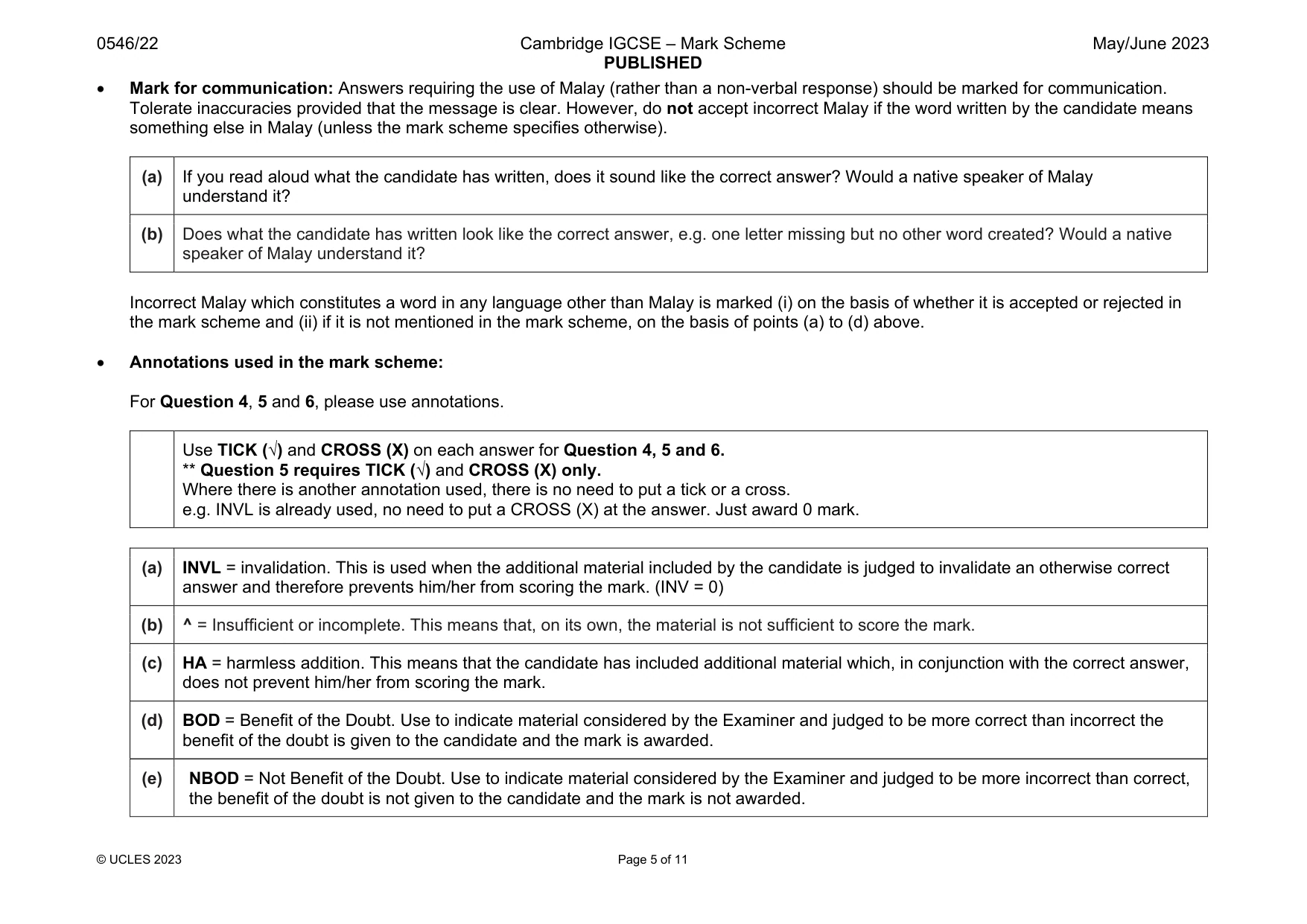
0546/22 Cambridge IGCSE – Mark Scheme PUBLISHED May/June 2023 © UCLES 2023 Page 5 of 11 Mark for communication: Answers requiring the use of Malay (rather than a non-verbal response) should be marked for communication. Tolerate inaccuracies provided that the message is clear. However, do not accept incorrect Malay if the word written by the candidate means something else in Malay (unless the mark scheme specifies otherwise). (a) If you read aloud what the candidate has written, does it sound like the correct answer? Would a native speaker of Malay understand it? (b) Does what the candidate has written look like the correct answer, e.g. one letter missing but no other word created? Would a native speaker of Malay understand it? Incorrect Malay which constitutes a word in any language other than Malay is marked (i) on the basis of whether it is accepted or rejected in the mark scheme and (ii) if it is not mentioned in the mark scheme, on the basis of points (a) to (d) above. Annotations used in the mark scheme: For Question 4, 5 and 6, please use annotations. Use TICK (√) and CROSS (X) on each answer for Question 4, 5 and 6. ** Question 5 requires TICK (√) and CROSS (X) only. Where there is another annotation used, there is no need to put a tick or a cross. e.g. INVL is already used, no need to put a CROSS (X) at the answer. Just award 0 mark. (a) INVL = invalidation. This is used when the additional material included by the candidate is judged to invalidate an otherwise correct answer and therefore prevents him/her from scoring the mark. (INV = 0) (b) ^ = Insufficient or incomplete. This means that, on its own, the material is not sufficient to score the mark. (c) HA = harmless addition. This means that the candidate has included additional material which, in conjunction with the correct answer, does not prevent him/her from scoring the mark. (d) BOD = Benefit of the Doubt. Use to indicate material considered by the Examiner and judged to be more correct than incorrect the benefit of the doubt is given to the candidate and the mark is awarded. (e) NBOD = Not Benefit of the Doubt. Use to indicate material considered by the Examiner and judged to be more incorrect than correct, the benefit of the doubt is not given to the candidate and the mark is not awarded.
Mark scheme, page 6
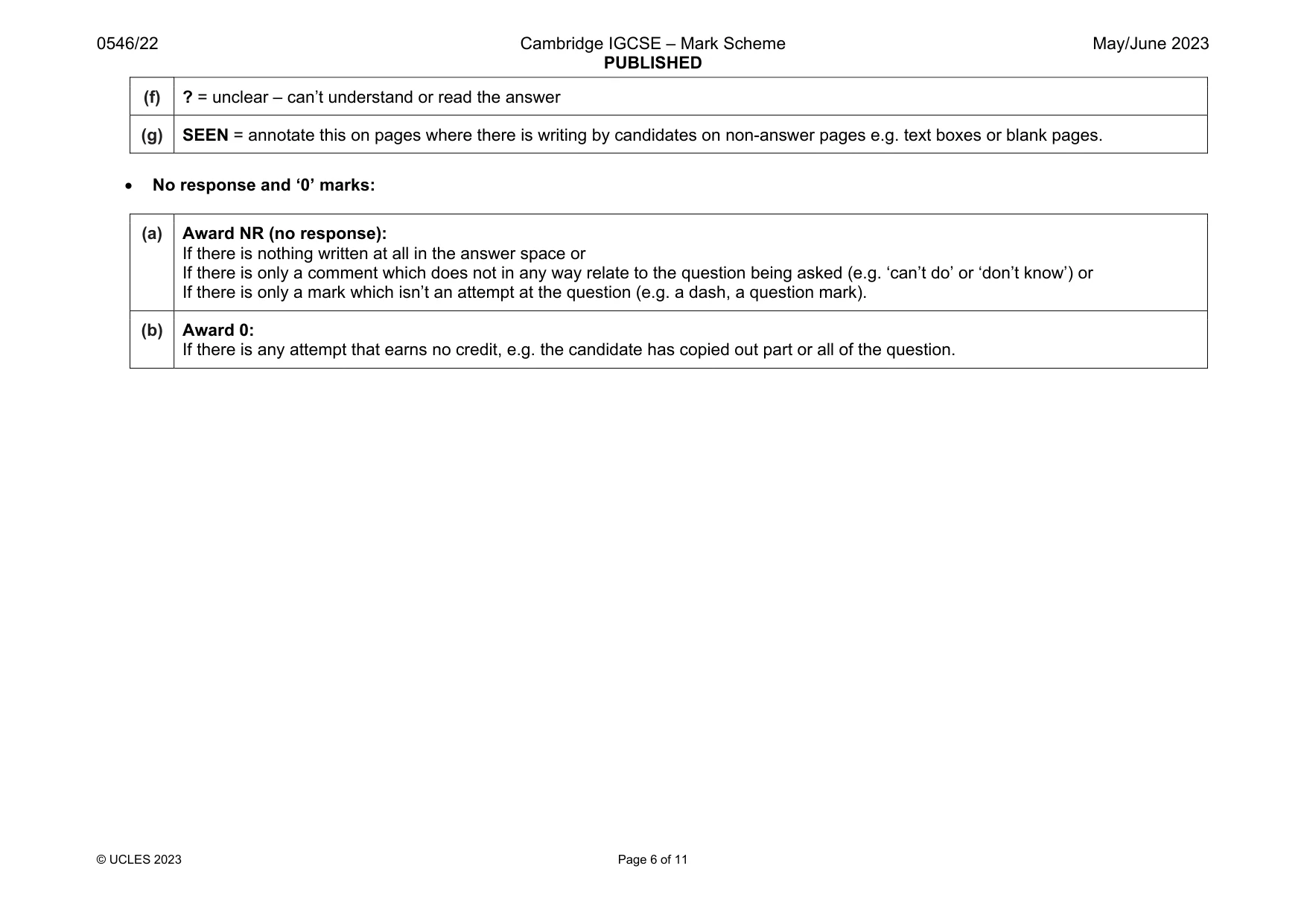
0546/22 Cambridge IGCSE – Mark Scheme PUBLISHED May/June 2023 © UCLES 2023 Page 6 of 11 (f) ? = unclear – can’t understand or read the answer (g) SEEN = annotate this on pages where there is writing by candidates on non-answer pages e.g. text boxes or blank pages. No response and ‘0’ marks: (a) Award NR (no response): If there is nothing written at all in the answer space or If there is only a comment which does not in any way relate to the question being asked (e.g. ‘can’t do’ or ‘don’t know’) or If there is only a mark which isn’t an attempt at the question (e.g. a dash, a question mark). (b) Award 0: If there is any attempt that earns no credit, e.g. the candidate has copied out part or all of the question.
Mark scheme, page 7
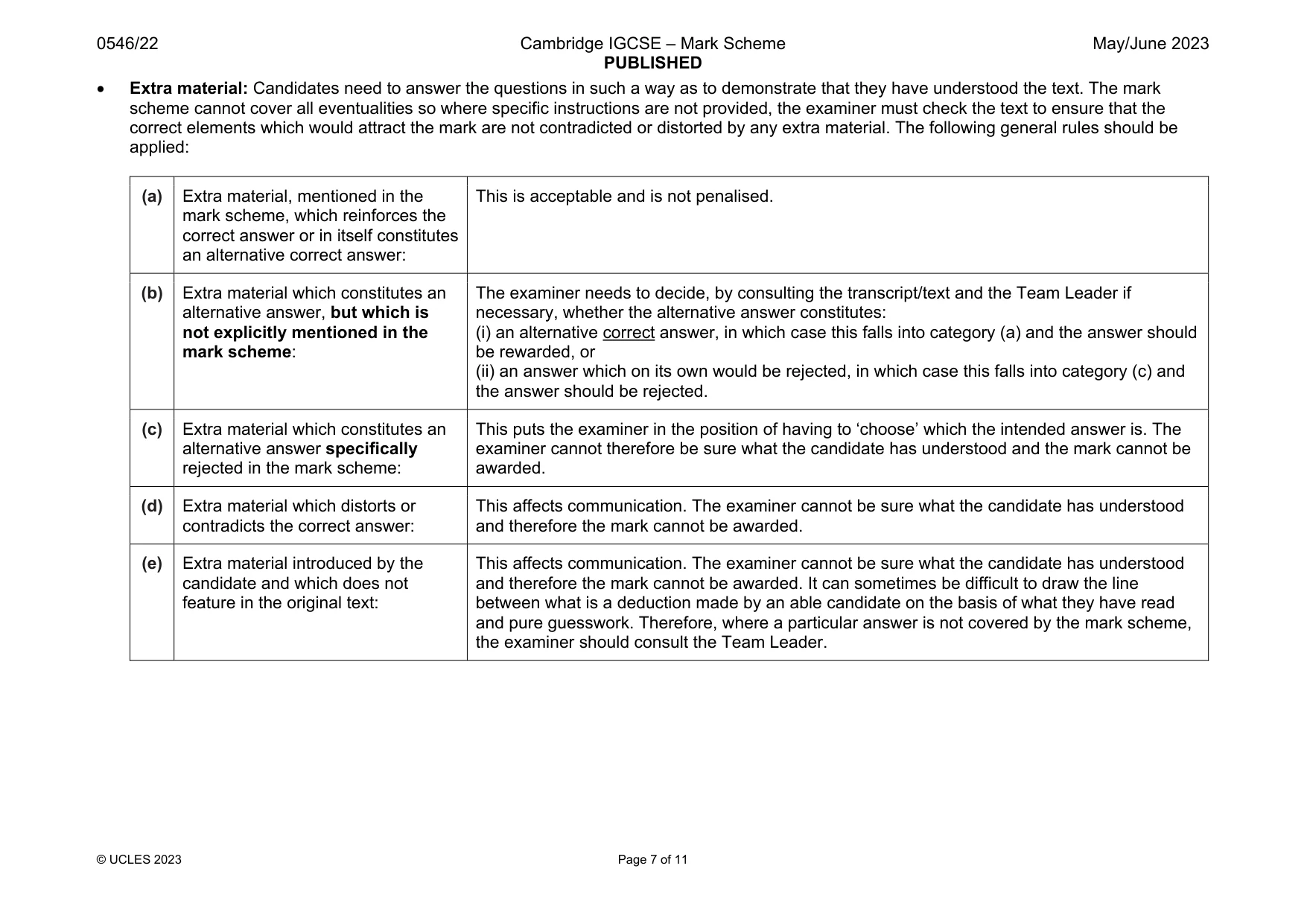
0546/22 Cambridge IGCSE – Mark Scheme PUBLISHED May/June 2023 © UCLES 2023 Page 7 of 11 Extra material: Candidates need to answer the questions in such a way as to demonstrate that they have understood the text. The mark scheme cannot cover all eventualities so where specific instructions are not provided, the examiner must check the text to ensure that the correct elements which would attract the mark are not contradicted or distorted by any extra material. The following general rules should be applied: (a) Extra material, mentioned in the mark scheme, which reinforces the correct answer or in itself constitutes an alternative correct answer: This is acceptable and is not penalised. (b) Extra material which constitutes an alternative answer, but which is not explicitly mentioned in the mark scheme: The examiner needs to decide, by consulting the transcript/text and the Team Leader if necessary, whether the alternative answer constitutes: (i) an alternative correct answer, in which case this falls into category (a) and the answer should be rewarded, or (ii) an answer which on its own would be rejected, in which case this falls into category (c) and the answer should be rejected. (c) Extra material which constitutes an alternative answer specifically rejected in the mark scheme: This puts the examiner in the position of having to ‘choose’ which the intended answer is. The examiner cannot therefore be sure what the candidate has understood and the mark cannot be awarded. (d) Extra material which distorts or contradicts the correct answer: This affects communication. The examiner cannot be sure what the candidate has understood and therefore the mark cannot be awarded. (e) Extra material introduced by the candidate and which does not feature in the original text: This affects communication. The examiner cannot be sure what the candidate has understood and therefore the mark cannot be awarded. It can sometimes be difficult to draw the line between what is a deduction made by an able candidate on the basis of what they have read and pure guesswork. Therefore, where a particular answer is not covered by the mark scheme, the examiner should consult the Team Leader.
Mark scheme, page 8
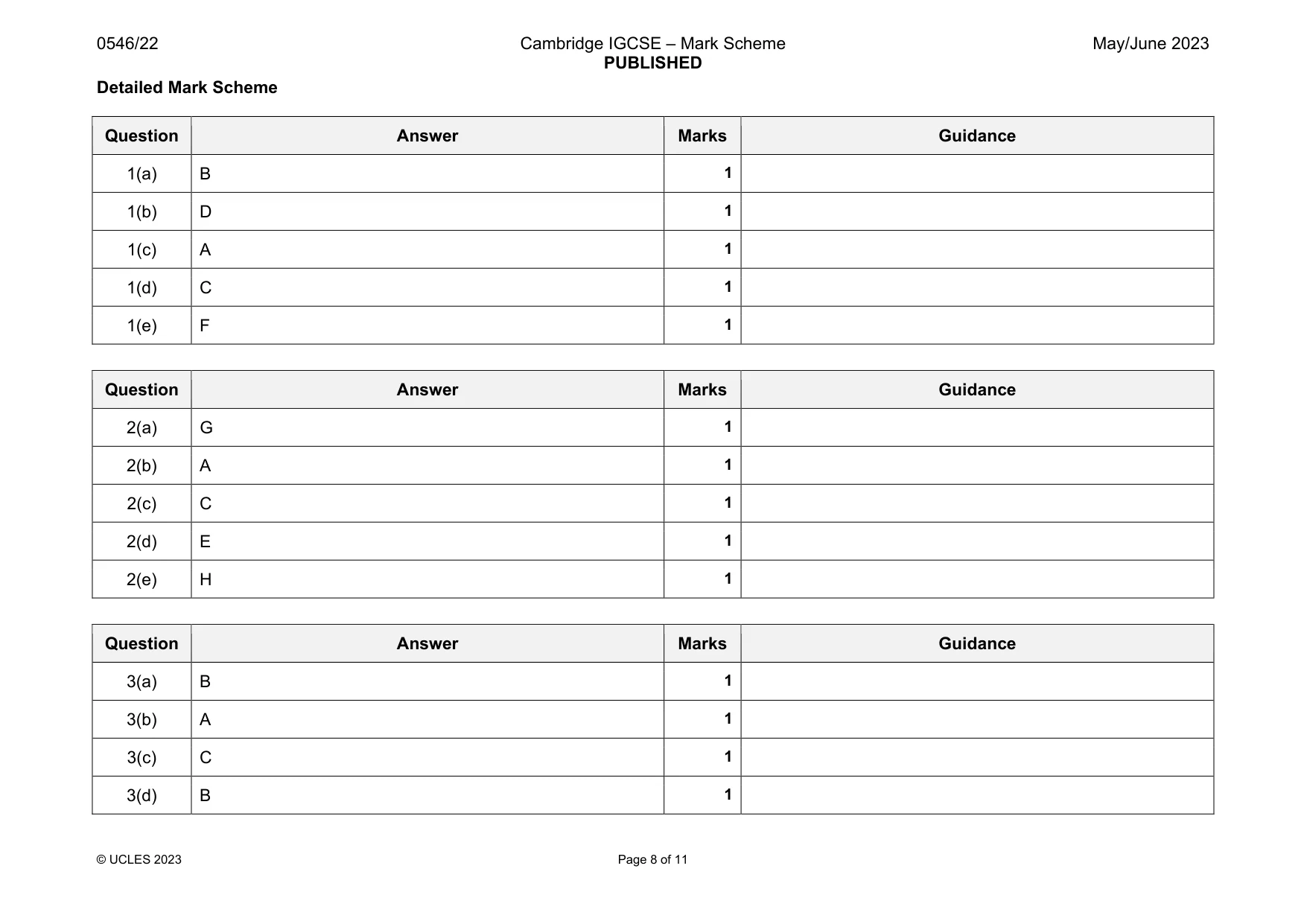
0546/22 Cambridge IGCSE – Mark Scheme PUBLISHED May/June 2023 © UCLES 2023 Page 8 of 11 Detailed Mark Scheme Question Answer Marks Guidance 1(a) B 1 1(b) D 1 1(c) A 1 1(d) C 1 1(e) F 1 Question Answer Marks Guidance 2(a) G 1 2(b) A 1 2(c) C 1 2(d) E 1 2(e) H 1 Question Answer Marks Guidance 3(a) B 1 3(b) A 1 3(c) C 1 3(d) B 1
Mark scheme, page 9
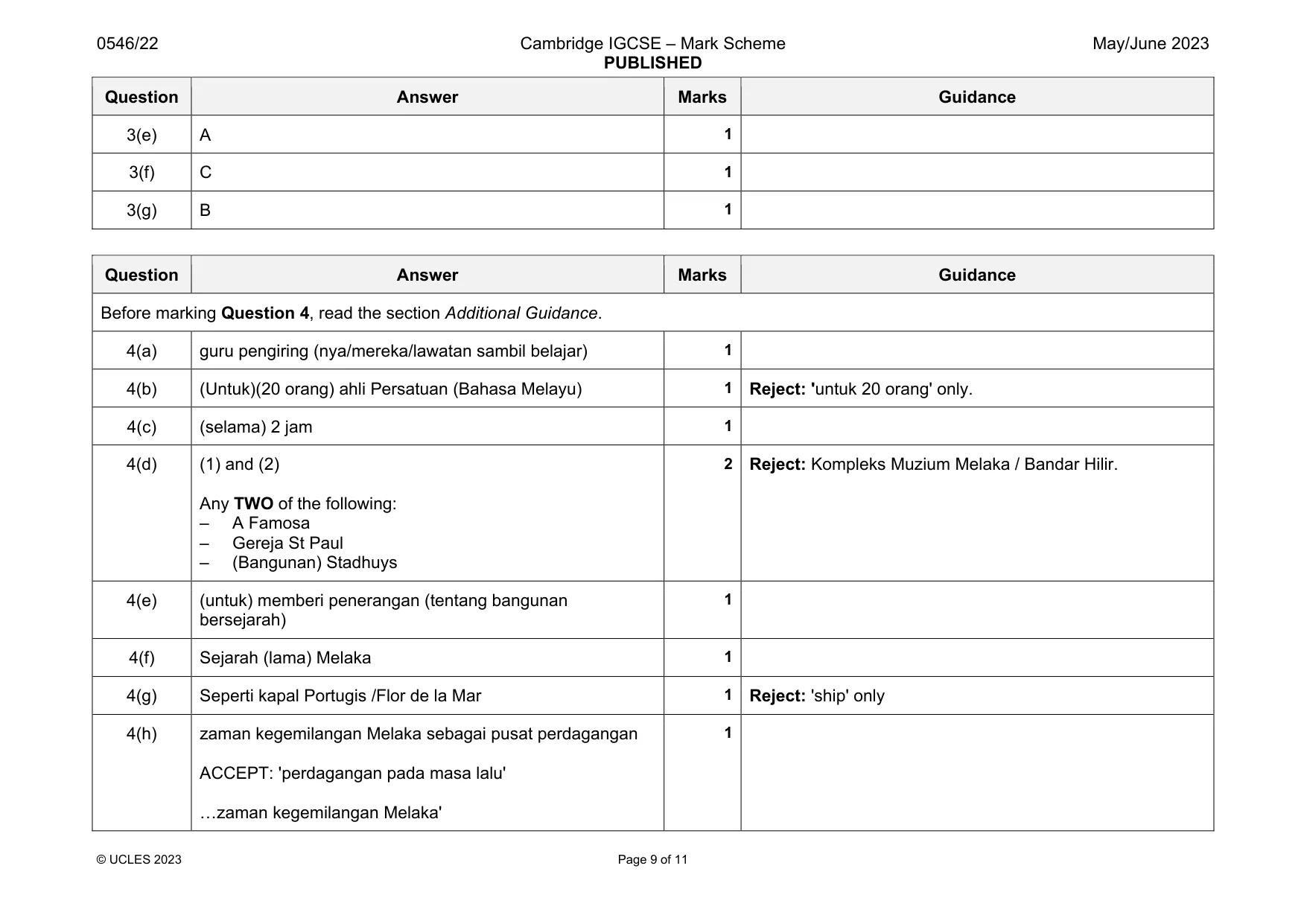
0546/22 Cambridge IGCSE – Mark Scheme PUBLISHED May/June 2023 © UCLES 2023 Page 9 of 11 Question Answer Marks Guidance 3(e) A 1 3(f) C 1 3(g) B 1 Question Answer Marks Guidance Before marking Question 4, read the section Additional Guidance. 4(a) guru pengiring (nya/mereka/lawatan sambil belajar) 1 4(b) (Untuk)(20 orang) ahli Persatuan (Bahasa Melayu) 1 Reject: 'untuk 20 orang' only. 4(c) (selama) 2 jam 1 4(d) (1) and (2) Any TWO of the following: – A Famosa – Gereja St Paul – (Bangunan) Stadhuys 2 Reject: Kompleks Muzium Melaka / Bandar Hilir. 4(e) (untuk) memberi penerangan (tentang bangunan bersejarah) 1 4(f) Sejarah (lama) Melaka 1 4(g) Seperti kapal Portugis /Flor de la Mar 1 Reject: 'ship' only 4(h) zaman kegemilangan Melaka sebagai pusat perdagangan ACCEPT: 'perdagangan pada masa lalu' …zaman kegemilangan Melaka' 1
Mark scheme, page 10
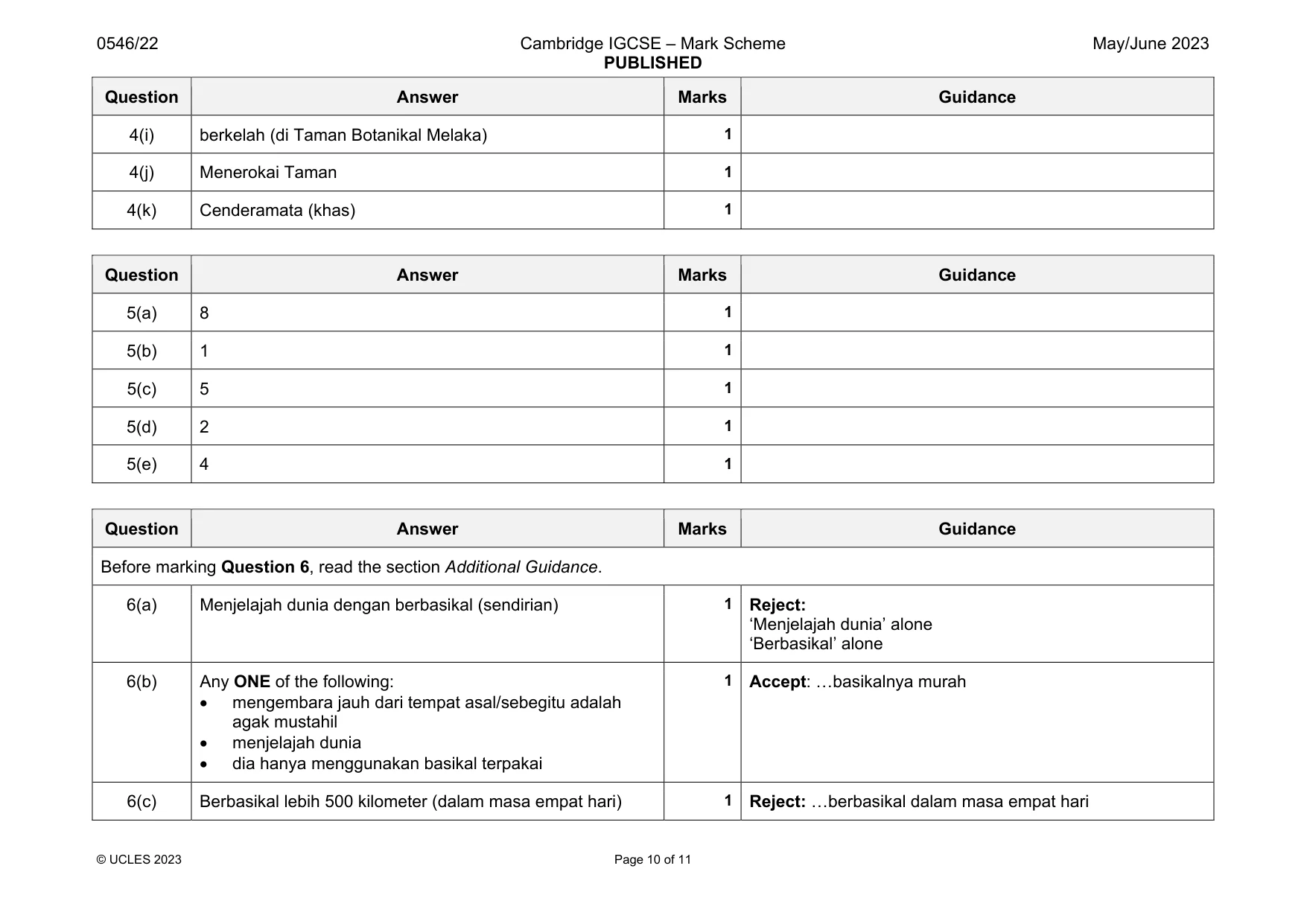
0546/22 Cambridge IGCSE – Mark Scheme PUBLISHED May/June 2023 © UCLES 2023 Page 10 of 11 Question Answer Marks Guidance 4(i) berkelah (di Taman Botanikal Melaka) 1 4(j) Menerokai Taman 1 4(k) Cenderamata (khas) 1 Question Answer Marks Guidance 5(a) 8 1 5(b) 1 1 5(c) 5 1 5(d) 2 1 5(e) 4 1 Question Answer Marks Guidance Before marking Question 6, read the section Additional Guidance. 6(a) Menjelajah dunia dengan berbasikal (sendirian) 1 Reject: ‘Menjelajah dunia’ alone ‘Berbasikal’ alone 6(b) Any ONE of the following: mengembara jauh dari tempat asal/sebegitu adalah agak mustahil menjelajah dunia dia hanya menggunakan basikal terpakai 1 Accept: …basikalnya murah 6(c) Berbasikal lebih 500 kilometer (dalam masa empat hari) 1 Reject: …berbasikal dalam masa empat hari
Mark scheme, page 11
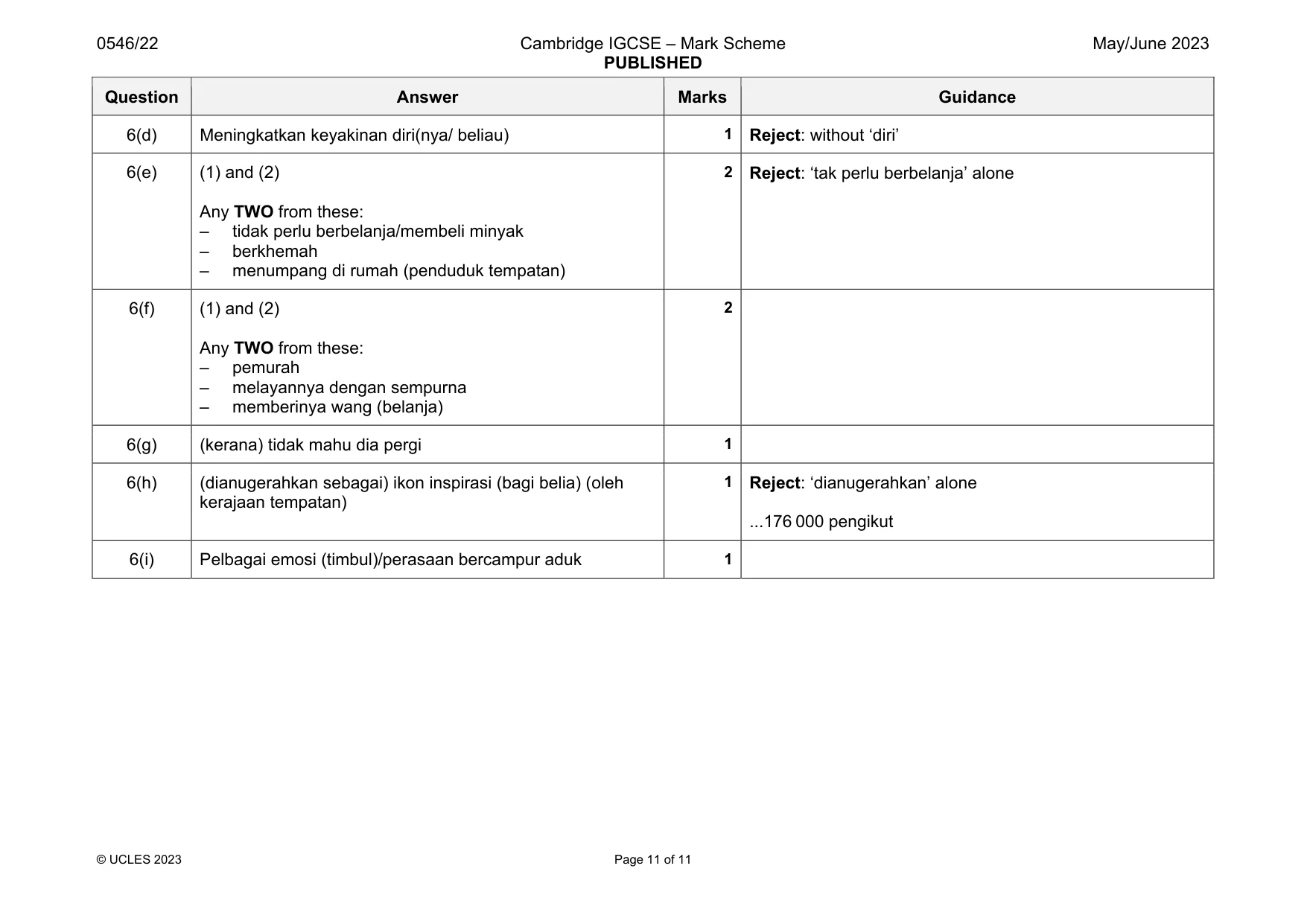
0546/22 Cambridge IGCSE – Mark Scheme PUBLISHED May/June 2023 © UCLES 2023 Page 11 of 11 Question Answer Marks Guidance 6(d) Meningkatkan keyakinan diri(nya/ beliau) 1 Reject: without ‘diri’ 6(e) (1) and (2) Any TWO from these: – tidak perlu berbelanja/membeli minyak – berkhemah – menumpang di rumah (penduduk tempatan) 2 Reject: ‘tak perlu berbelanja’ alone 6(f) (1) and (2) Any TWO from these: – pemurah – melayannya dengan sempurna – memberinya wang (belanja) 2 6(g) (kerana) tidak mahu dia pergi 1 6(h) (dianugerahkan sebagai) ikon inspirasi (bagi belia) (oleh kerajaan tempatan) 1 Reject: ‘dianugerahkan’ alone ...176 000 pengikut 6(i) Pelbagai emosi (timbul)/perasaan bercampur aduk 1
What you needed in this session
Cambridge’s own grade thresholds for 2023 May/June, Paper 2 · Variant 2. A higher threshold means an easier paper — the bar moves with how the cohort did.