Cambridge IGCSE Malay - Foreign Language 0546 — 2020 May/June Paper 2 · Variant 3
0546/23/M/J/20
The question paper and its mark scheme, free to read here and free to download. This is Cambridge’s own paper, exactly as it was sat.
Question paper16 pages



Mark scheme13 pages
Answers below. Sit the paper first if you are practising.
Paper as text
Question paper, page 1
Cambridge IGCSE™ This document has 16 pages. Blank pages are indicated. MALAY 0546/23 Paper 2 Reading May/June 2020 1 hour You must answer on the question paper. No additional materials are needed. INSTRUCTIONS ● Answer all questions. ● Use a black or dark blue pen. ● Write your name, centre number and candidate number in the boxes at the top of the page. ● Write your answer to each question in the space provided. ● Do not use an erasable pen or correction fluid. ● Do not write on any bar codes. INFORMATION ● The total mark for this paper is 45. ● The number of marks for each question or part question is shown in brackets [ ]. DC (ST/CT) 181294/1 © UCLES 2020 [Turn over * 4 9 7 8 7 7 8 4 6 1 *
Question paper, page 2
2 0546/23/M/J/20 © UCLES 2020 BLANK PAGE
Question paper, page 3
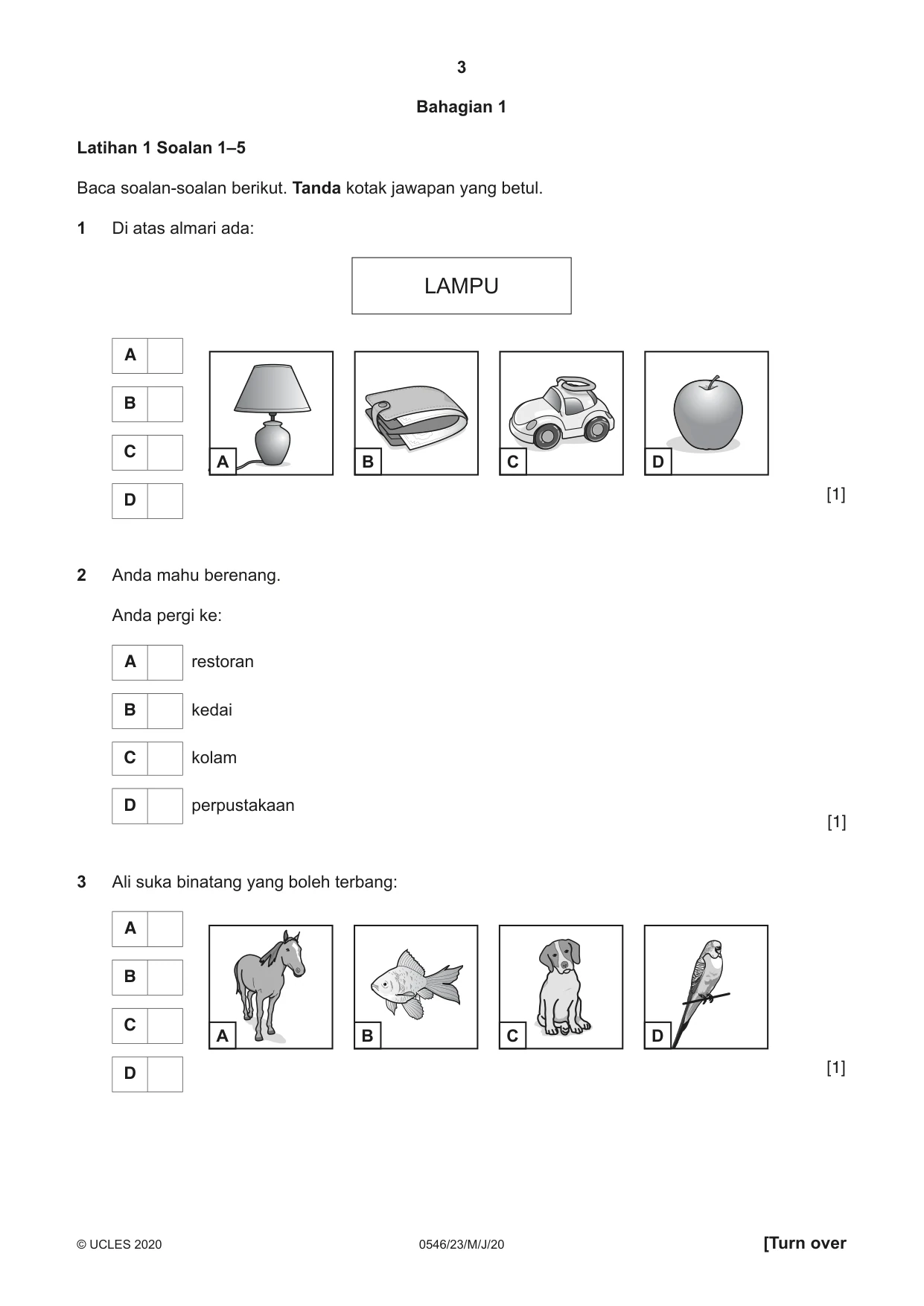
3 0546/23/M/J/20 © UCLES 2020 [Turn over Bahagian 1 Latihan 1 Soalan 1–5 Baca soalan-soalan berikut. Tanda kotak jawapan yang betul. 1 Di atas almari ada: LAMPU A A B C D [1] B C D 2 Anda mahu berenang. Anda pergi ke: A restoran B kedai C kolam D perpustakaan [1] 3 Ali suka binatang yang boleh terbang: A A B C D [1] B C D
Question paper, page 4
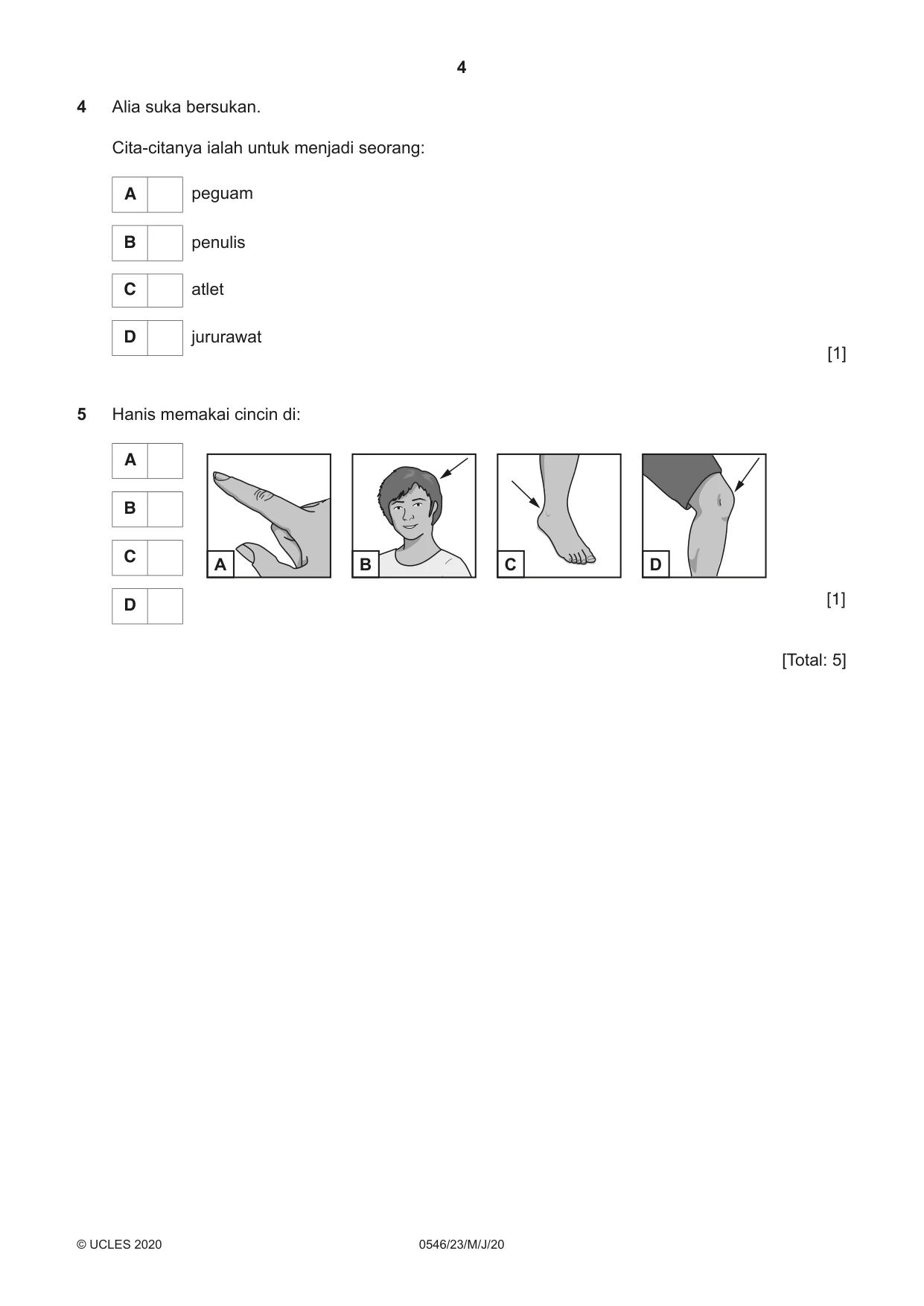
4 0546/23/M/J/20 © UCLES 2020 4 Alia suka bersukan. Cita-citanya ialah untuk menjadi seorang: A peguam B penulis C atlet D jururawat [1] 5 Hanis memakai cincin di: A A B C D [1] B C D [Total: 5]
Question paper, page 5
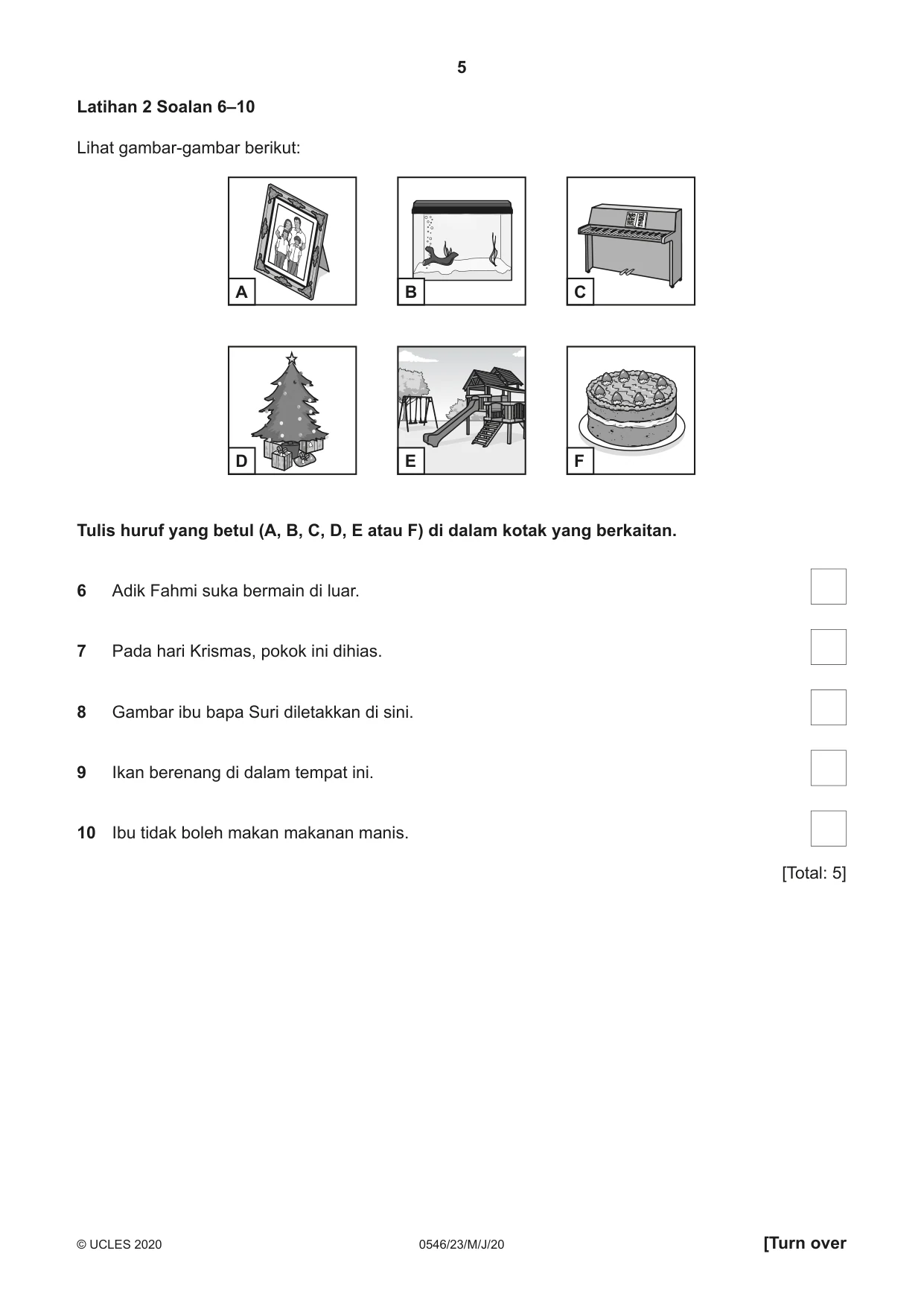
5 0546/23/M/J/20 © UCLES 2020 [Turn over Latihan 2 Soalan 6–10 Lihat gambar-gambar berikut: A B C D E F Tulis huruf yang betul (A, B, C, D, E atau F) di dalam kotak yang berkaitan. 6 Adik Fahmi suka bermain di luar. 7 Pada hari Krismas, pokok ini dihias. 8 Gambar ibu bapa Suri diletakkan di sini. 9 Ikan berenang di dalam tempat ini. 10 Ibu tidak boleh makan makanan manis. [Total: 5]
Question paper, page 6
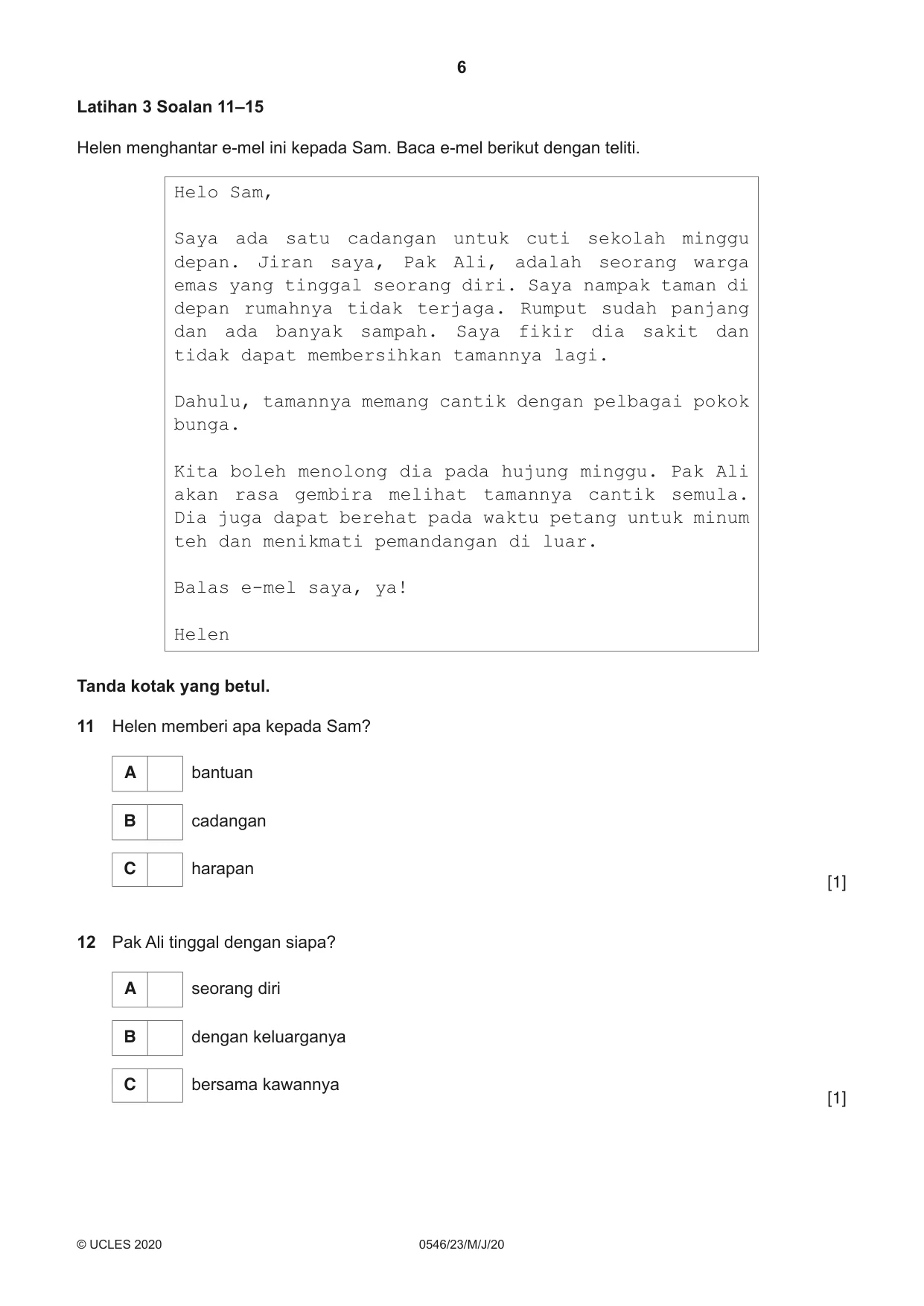
6 0546/23/M/J/20 © UCLES 2020 Latihan 3 Soalan 11–15 Helen menghantar e-mel ini kepada Sam. Baca e-mel berikut dengan teliti. Helo Sam, Saya ada satu cadangan untuk cuti sekolah minggu depan. Jiran saya, Pak Ali, adalah seorang warga emas yang tinggal seorang diri. Saya nampak taman di depan rumahnya tidak terjaga. Rumput sudah panjang dan ada banyak sampah. Saya fikir dia sakit dan tidak dapat membersihkan tamannya lagi. Dahulu, tamannya memang cantik dengan pelbagai pokok bunga. Kita boleh menolong dia pada hujung minggu. Pak Ali akan rasa gembira melihat tamannya cantik semula. Dia juga dapat berehat pada waktu petang untuk minum teh dan menikmati pemandangan di luar. Balas e-mel saya, ya! Helen Tanda kotak yang betul. 11 Helen memberi apa kepada Sam? A bantuan B cadangan C harapan [1] 12 Pak Ali tinggal dengan siapa? A seorang diri B dengan keluarganya C bersama kawannya [1]
Question paper, page 7
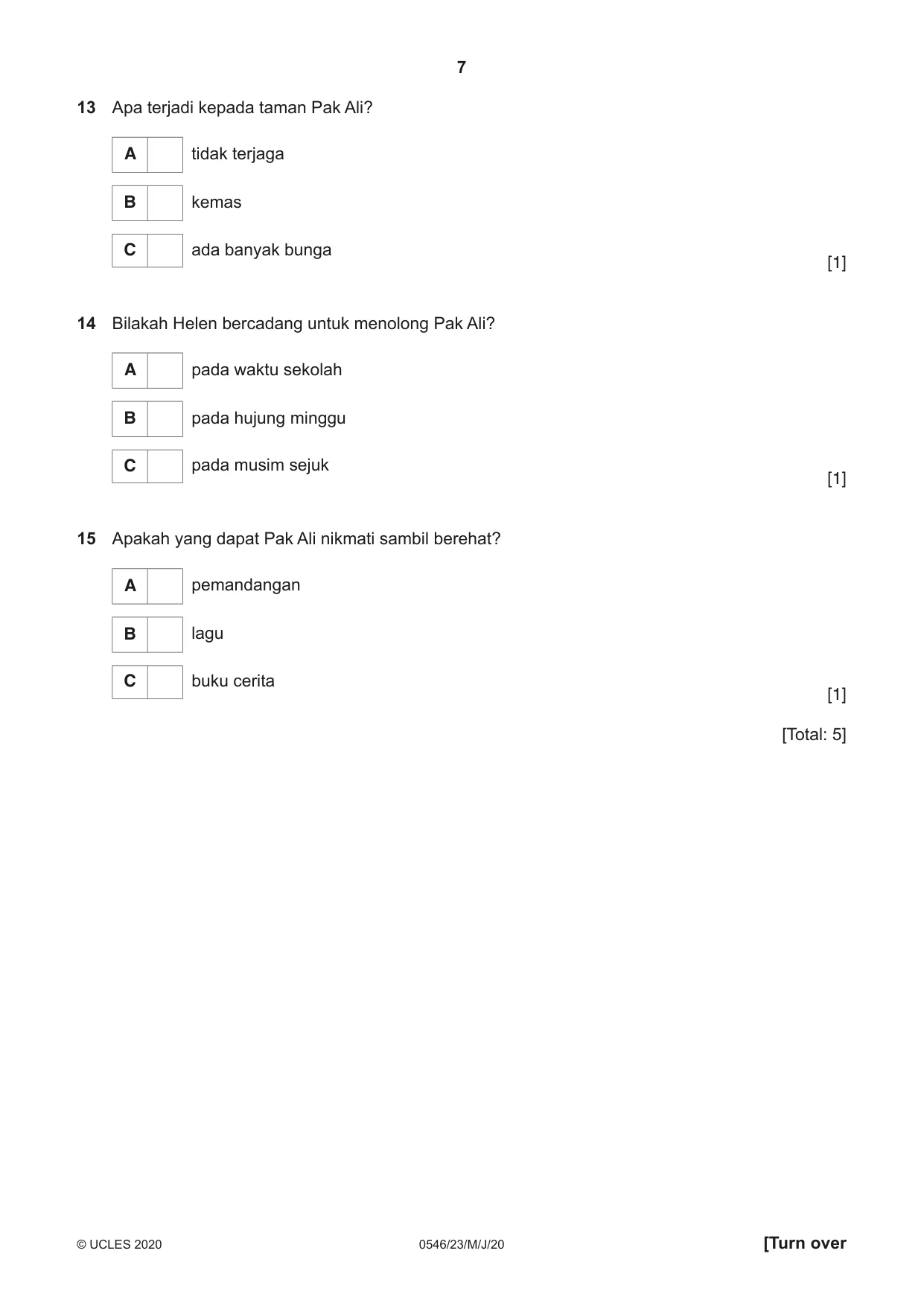
7 0546/23/M/J/20 © UCLES 2020 [Turn over 13 Apa terjadi kepada taman Pak Ali? A tidak terjaga B kemas C ada banyak bunga [1] 14 Bilakah Helen bercadang untuk menolong Pak Ali? A pada waktu sekolah B pada hujung minggu C pada musim sejuk [1] 15 Apakah yang dapat Pak Ali nikmati sambil berehat? A pemandangan B lagu C buku cerita [1] [Total: 5]
Question paper, page 8
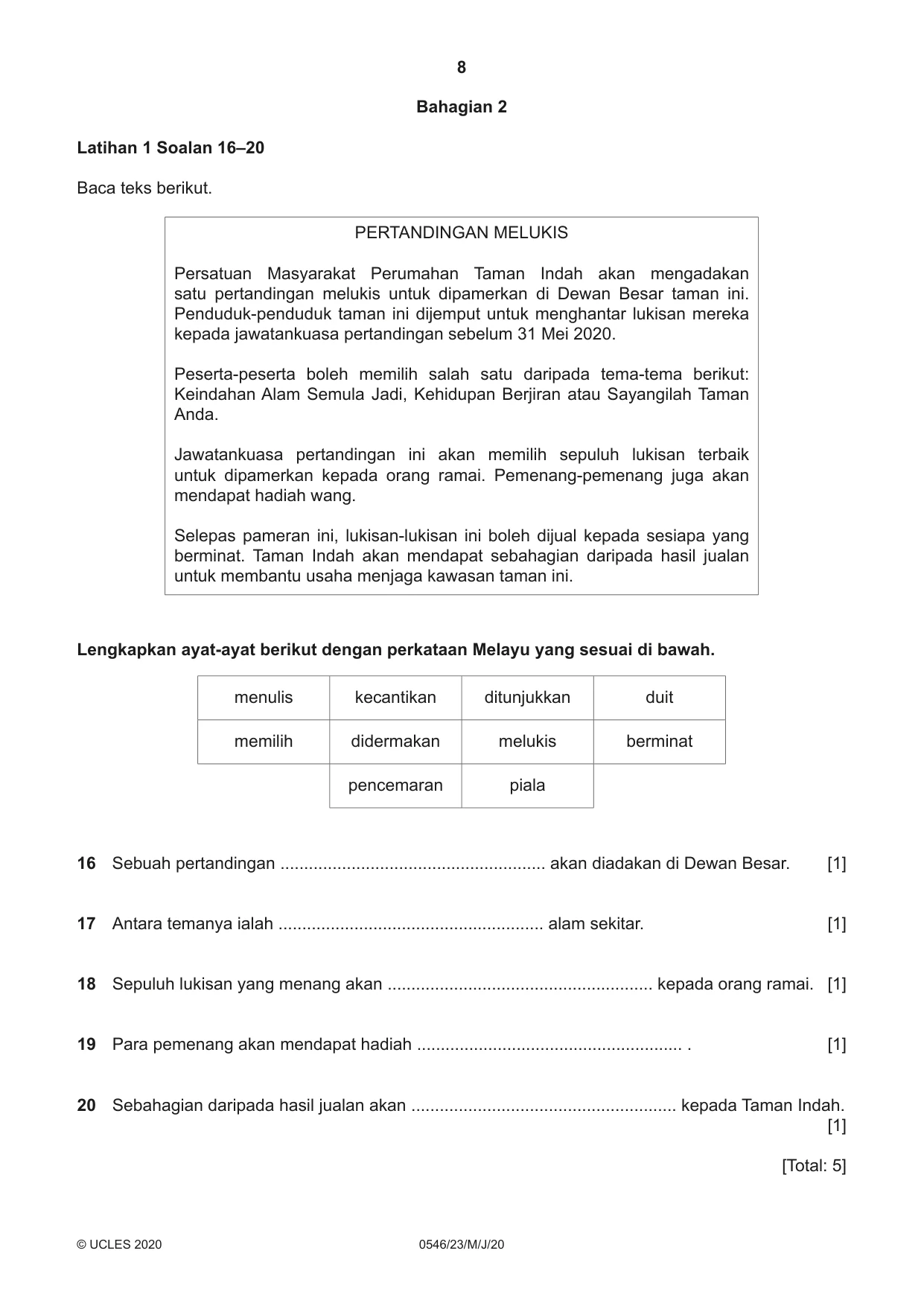
8 0546/23/M/J/20 © UCLES 2020 Bahagian 2 Latihan 1 Soalan 16–20 Baca teks berikut. PERTANDINGAN MELUKIS Persatuan Masyarakat Perumahan Taman Indah akan mengadakan satu pertandingan melukis untuk dipamerkan di Dewan Besar taman ini. Penduduk-penduduk taman ini dijemput untuk menghantar lukisan mereka kepada jawatankuasa pertandingan sebelum 31 Mei 2020. Peserta-peserta boleh memilih salah satu daripada tema-tema berikut: Keindahan Alam Semula Jadi, Kehidupan Berjiran atau Sayangilah Taman Anda. Jawatankuasa pertandingan ini akan memilih sepuluh lukisan terbaik untuk dipamerkan kepada orang ramai. Pemenang-pemenang juga akan mendapat hadiah wang. Selepas pameran ini, lukisan-lukisan ini boleh dijual kepada sesiapa yang berminat. Taman Indah akan mendapat sebahagian daripada hasil jualan untuk membantu usaha menjaga kawasan taman ini. Lengkapkan ayat-ayat berikut dengan perkataan Melayu yang sesuai di bawah. menulis kecantikan ditunjukkan duit memilih didermakan melukis berminat pencemaran piala 16 Sebuah pertandingan … akan diadakan di Dewan Besar. [1] 17 Antara temanya ialah … alam sekitar. [1] 18 Sepuluh lukisan yang menang akan … kepada orang ramai. [1] 19 Para pemenang akan mendapat hadiah … . [1] 20 Sebahagian daripada hasil jualan akan … kepada Taman Indah. [1] [Total: 5]
Question paper, page 9
9 0546/23/M/J/20 © UCLES 2020 [Turn over Sila buka halaman untuk Latihan 2.
Question paper, page 10
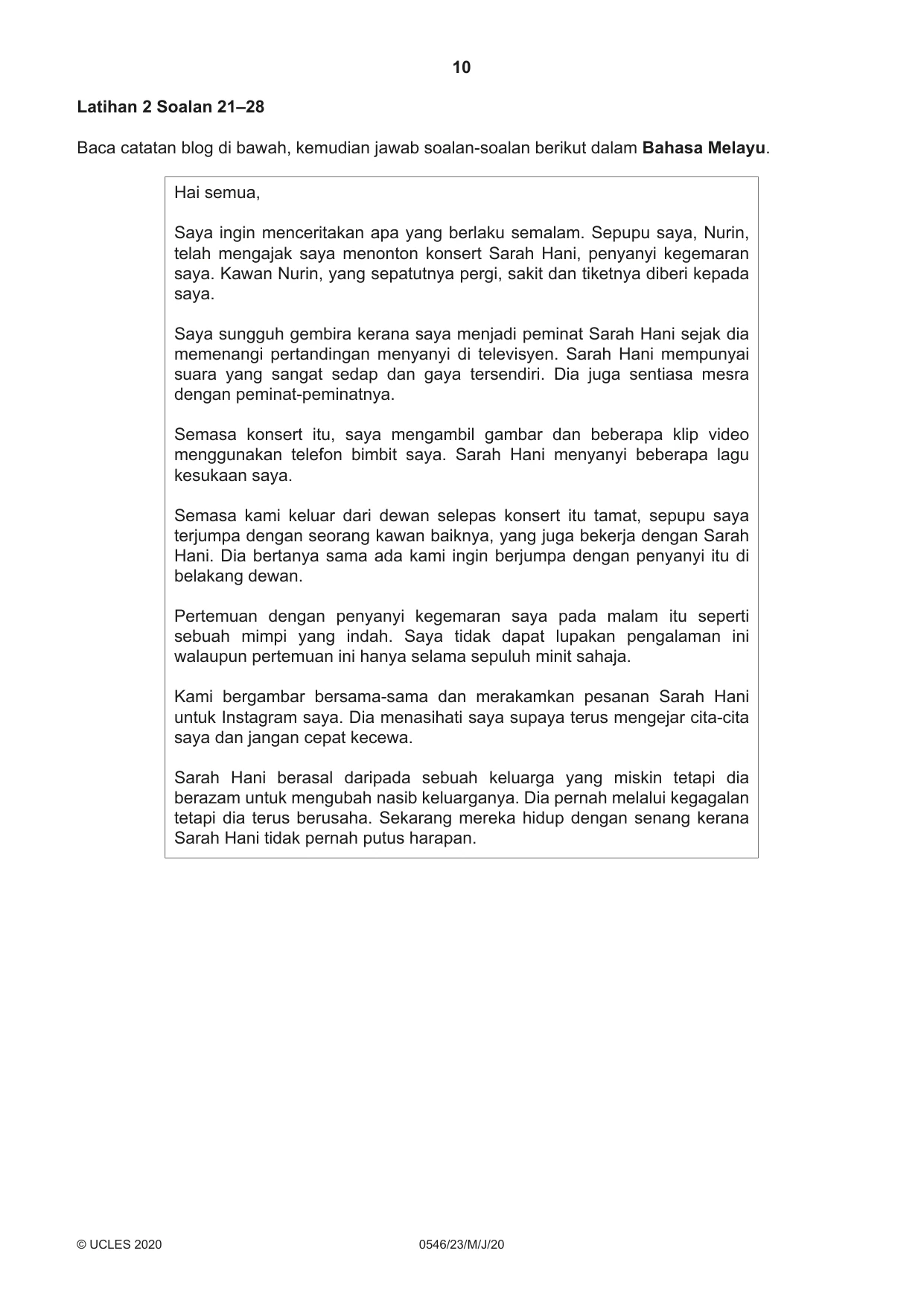
10 0546/23/M/J/20 © UCLES 2020 Latihan 2 Soalan 21–28 Baca catatan blog di bawah, kemudian jawab soalan-soalan berikut dalam Bahasa Melayu. Hai semua, Saya ingin menceritakan apa yang berlaku semalam. Sepupu saya, Nurin, telah mengajak saya menonton konsert Sarah Hani, penyanyi kegemaran saya. Kawan Nurin, yang sepatutnya pergi, sakit dan tiketnya diberi kepada saya. Saya sungguh gembira kerana saya menjadi peminat Sarah Hani sejak dia memenangi pertandingan menyanyi di televisyen. Sarah Hani mempunyai suara yang sangat sedap dan gaya tersendiri. Dia juga sentiasa mesra dengan peminat-peminatnya. Semasa konsert itu, saya mengambil gambar dan beberapa klip video menggunakan telefon bimbit saya. Sarah Hani menyanyi beberapa lagu kesukaan saya. Semasa kami keluar dari dewan selepas konsert itu tamat, sepupu saya terjumpa dengan seorang kawan baiknya, yang juga bekerja dengan Sarah Hani. Dia bertanya sama ada kami ingin berjumpa dengan penyanyi itu di belakang dewan. Pertemuan dengan penyanyi kegemaran saya pada malam itu seperti sebuah mimpi yang indah. Saya tidak dapat lupakan pengalaman ini walaupun pertemuan ini hanya selama sepuluh minit sahaja. Kami bergambar bersama-sama dan merakamkan pesanan Sarah Hani untuk Instagram saya. Dia menasihati saya supaya terus mengejar cita-cita saya dan jangan cepat kecewa. Sarah Hani berasal daripada sebuah keluarga yang miskin tetapi dia berazam untuk mengubah nasib keluarganya. Dia pernah melalui kegagalan tetapi dia terus berusaha. Sekarang mereka hidup dengan senang kerana Sarah Hani tidak pernah putus harapan.
Question paper, page 11
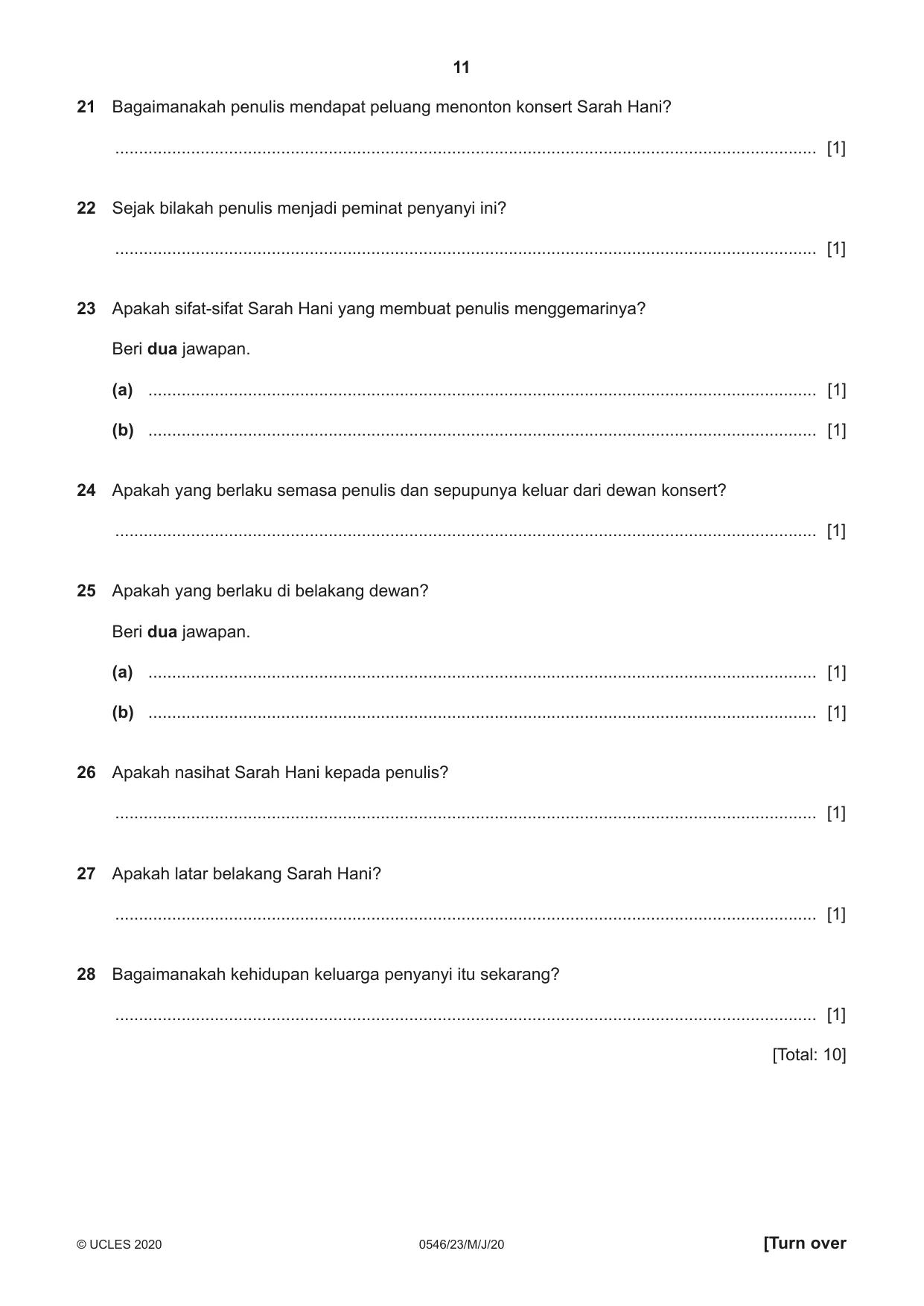
11 0546/23/M/J/20 © UCLES 2020 [Turn over 21 Bagaimanakah penulis mendapat peluang menonton konsert Sarah Hani? … [1] 22 Sejak bilakah penulis menjadi peminat penyanyi ini? … [1] 23 Apakah sifat-sifat Sarah Hani yang membuat penulis menggemarinya? Beri dua jawapan. (a) … [1] (b) … [1] 24 Apakah yang berlaku semasa penulis dan sepupunya keluar dari dewan konsert? … [1] 25 Apakah yang berlaku di belakang dewan? Beri dua jawapan. (a) … [1] (b) … [1] 26 Apakah nasihat Sarah Hani kepada penulis? … [1] 27 Apakah latar belakang Sarah Hani? … [1] 28 Bagaimanakah kehidupan keluarga penyanyi itu sekarang? … [1] [Total: 10]
Question paper, page 12
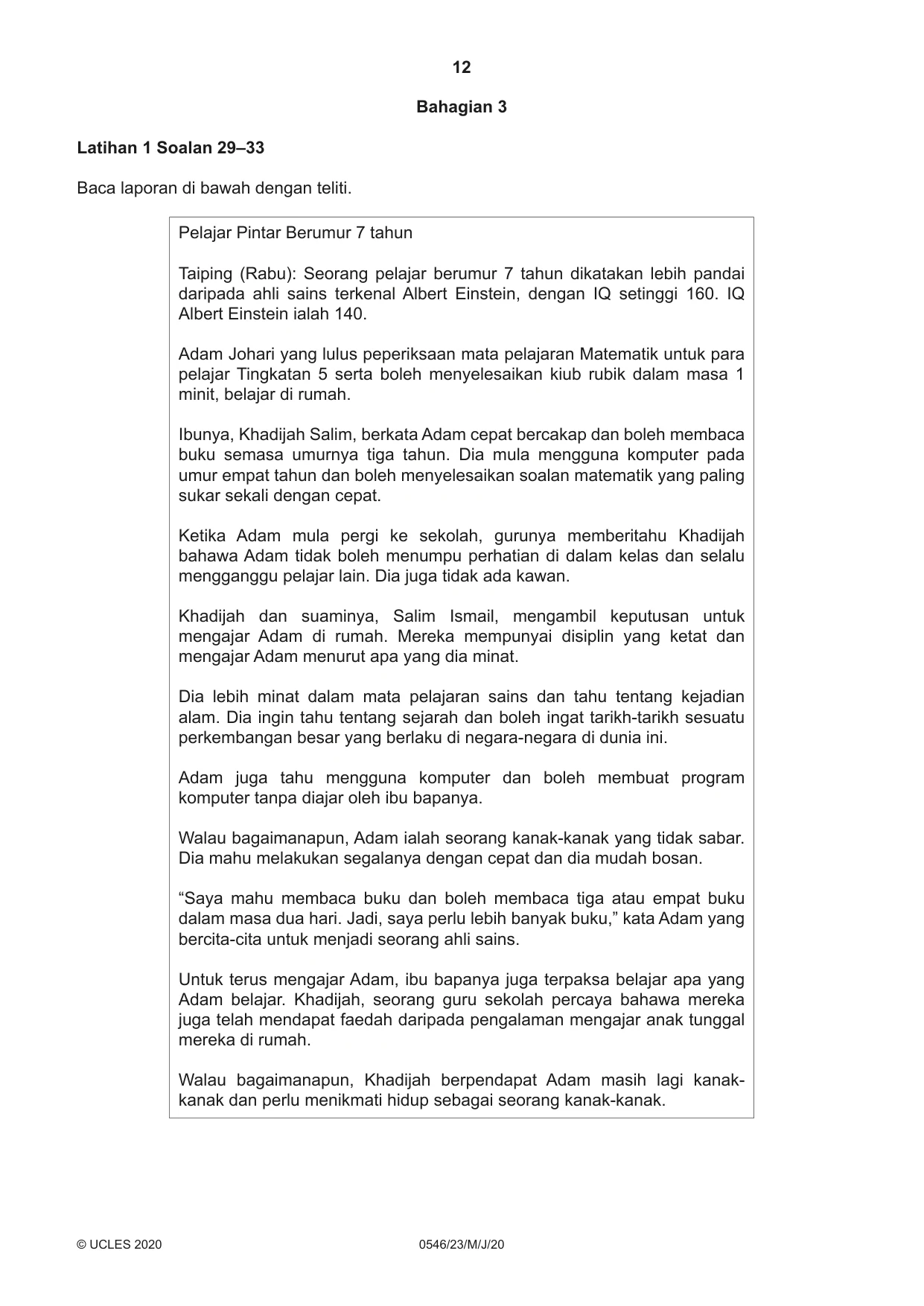
12 0546/23/M/J/20 © UCLES 2020 Bahagian 3 Latihan 1 Soalan 29–33 Baca laporan di bawah dengan teliti. Pelajar Pintar Berumur 7 tahun Taiping (Rabu): Seorang pelajar berumur 7 tahun dikatakan lebih pandai daripada ahli sains terkenal Albert Einstein, dengan IQ setinggi 160. IQ Albert Einstein ialah 140. Adam Johari yang lulus peperiksaan mata pelajaran Matematik untuk para pelajar Tingkatan 5 serta boleh menyelesaikan kiub rubik dalam masa 1 minit, belajar di rumah. Ibunya, Khadijah Salim, berkata Adam cepat bercakap dan boleh membaca buku semasa umurnya tiga tahun. Dia mula mengguna komputer pada umur empat tahun dan boleh menyelesaikan soalan matematik yang paling sukar sekali dengan cepat. Ketika Adam mula pergi ke sekolah, gurunya memberitahu Khadijah bahawa Adam tidak boleh menumpu perhatian di dalam kelas dan selalu mengganggu pelajar lain. Dia juga tidak ada kawan. Khadijah dan suaminya, Salim Ismail, mengambil keputusan untuk mengajar Adam di rumah. Mereka mempunyai disiplin yang ketat dan mengajar Adam menurut apa yang dia minat. Dia lebih minat dalam mata pelajaran sains dan tahu tentang kejadian alam. Dia ingin tahu tentang sejarah dan boleh ingat tarikh-tarikh sesuatu perkembangan besar yang berlaku di negara-negara di dunia ini. Adam juga tahu mengguna komputer dan boleh membuat program komputer tanpa diajar oleh ibu bapanya. Walau bagaimanapun, Adam ialah seorang kanak-kanak yang tidak sabar. Dia mahu melakukan segalanya dengan cepat dan dia mudah bosan. “Saya mahu membaca buku dan boleh membaca tiga atau empat buku dalam masa dua hari. Jadi, saya perlu lebih banyak buku,” kata Adam yang bercita-cita untuk menjadi seorang ahli sains. Untuk terus mengajar Adam, ibu bapanya juga terpaksa belajar apa yang Adam belajar. Khadijah, seorang guru sekolah percaya bahawa mereka juga telah mendapat faedah daripada pengalaman mengajar anak tunggal mereka di rumah. Walau bagaimanapun, Khadijah berpendapat Adam masih lagi kanak- kanak dan perlu menikmati hidup sebagai seorang kanak-kanak.
Question paper, page 13
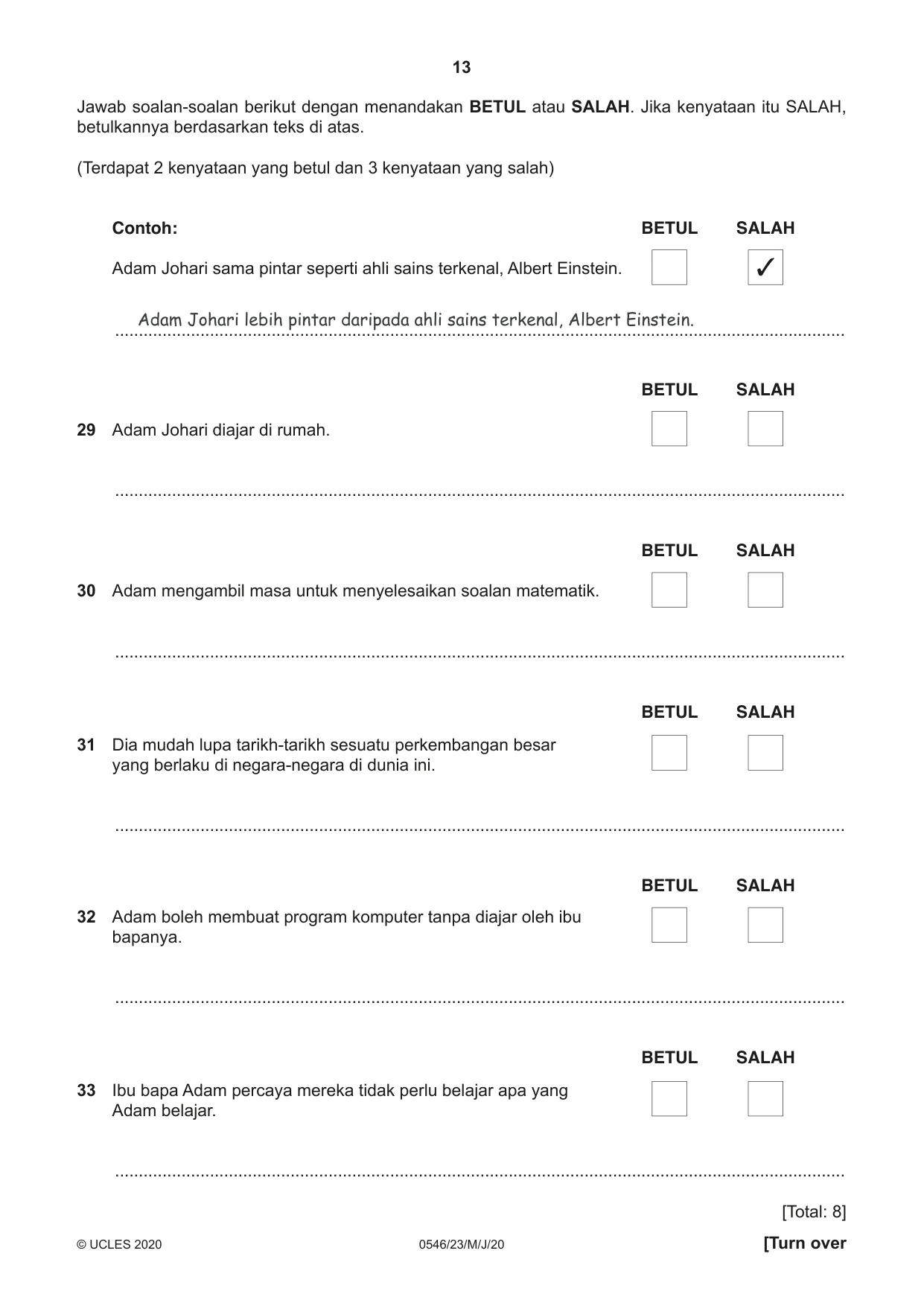
13 0546/23/M/J/20 © UCLES 2020 [Turn over Jawab soalan-soalan berikut dengan menandakan BETUL atau SALAH. Jika kenyataan itu SALAH, betulkannya berdasarkan teks di atas. (Terdapat 2 kenyataan yang betul dan 3 kenyataan yang salah) Contoh: BETUL SALAH Adam Johari sama pintar seperti ahli sains terkenal, Albert Einstein. 3 Adam Johari lebih pintar daripada ahli sains terkenal, Albert Einstein. … BETUL SALAH 29 Adam Johari diajar di rumah. … BETUL SALAH 30 Adam mengambil masa untuk menyelesaikan soalan matematik. … BETUL SALAH 31 Dia mudah lupa tarikh-tarikh sesuatu perkembangan besar yang berlaku di negara-negara di dunia ini. … BETUL SALAH 32 Adam boleh membuat program komputer tanpa diajar oleh ibu bapanya. … BETUL SALAH 33 Ibu bapa Adam percaya mereka tidak perlu belajar apa yang Adam belajar. … [Total: 8]
Question paper, page 14
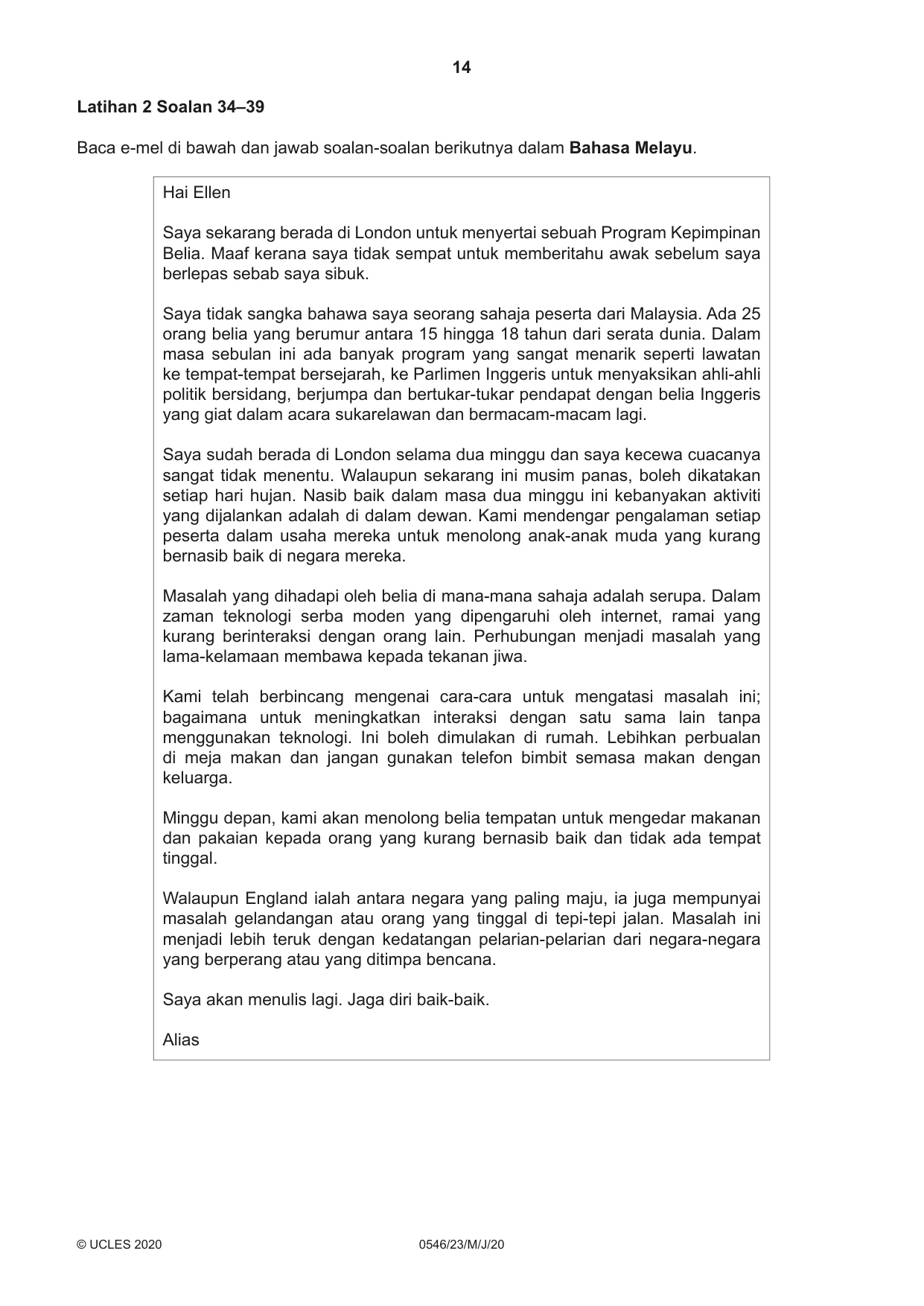
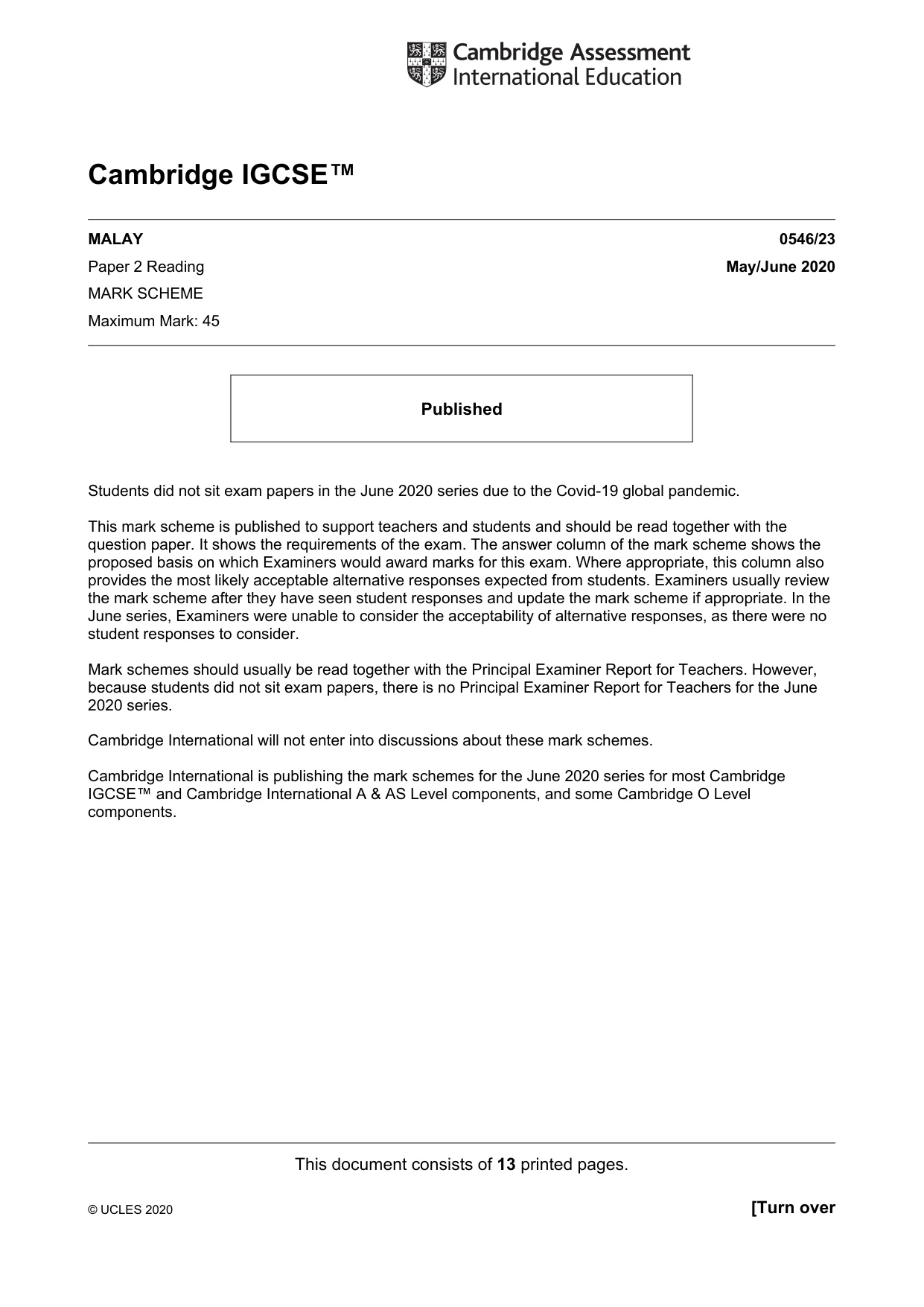
14 0546/23/M/J/20 © UCLES 2020 Latihan 2 Soalan 34–39 Baca e-mel di bawah dan jawab soalan-soalan berikutnya dalam Bahasa Melayu. Hai Ellen Saya sekarang berada di London untuk menyertai sebuah Program Kepimpinan Belia. Maaf kerana saya tidak sempat untuk memberitahu awak sebelum saya berlepas sebab saya sibuk. Saya tidak sangka bahawa saya seorang sahaja peserta dari Malaysia. Ada 25 orang belia yang berumur antara 15 hingga 18 tahun dari serata dunia. Dalam masa sebulan ini ada banyak program yang sangat menarik seperti lawatan ke tempat-tempat bersejarah, ke Parlimen Inggeris untuk menyaksikan ahli-ahli politik bersidang, berjumpa dan bertukar-tukar pendapat dengan belia Inggeris yang giat dalam acara sukarelawan dan bermacam-macam lagi. Saya sudah berada di London selama dua minggu dan saya kecewa cuacanya sangat tidak menentu. Walaupun sekarang ini musim panas, boleh dikatakan setiap hari hujan. Nasib baik dalam masa dua minggu ini kebanyakan aktiviti yang dijalankan adalah di dalam dewan. Kami mendengar pengalaman setiap peserta dalam usaha mereka untuk menolong anak-anak muda yang kurang bernasib baik di negara mereka. Masalah yang dihadapi oleh belia di mana-mana sahaja adalah serupa. Dalam zaman teknologi serba moden yang dipengaruhi oleh internet, ramai yang kurang berinteraksi dengan orang lain. Perhubungan menjadi masalah yang lama-kelamaan membawa kepada tekanan jiwa. Kami telah berbincang mengenai cara-cara untuk mengatasi masalah ini; bagaimana untuk meningkatkan interaksi dengan satu sama lain tanpa menggunakan teknologi. Ini boleh dimulakan di rumah. Lebihkan perbualan di meja makan dan jangan gunakan telefon bimbit semasa makan dengan keluarga. Minggu depan, kami akan menolong belia tempatan untuk mengedar makanan dan pakaian kepada orang yang kurang bernasib baik dan tidak ada tempat tinggal. Walaupun England ialah antara negara yang paling maju, ia juga mempunyai masalah gelandangan atau orang yang tinggal di tepi-tepi jalan. Masalah ini menjadi lebih teruk dengan kedatangan pelarian-pelarian dari negara-negara yang berperang atau yang ditimpa bencana. Saya akan menulis lagi. Jaga diri baik-baik. Alias
Question paper, page 15
15 0546/23/M/J/20 © UCLES 2020 34 Mengapakah Alias tidak memberitahu Ellen sebelum dia berlepas ke London? … [1] 35 Ke manakah para peserta dibawa untuk melihat ahli-ahli politik bersidang? … [1] 36 (a) Apakah perasaan Alias mengenai cuaca di London? … [1] (b) Mengapa? … [1] 37 Masalah apakah yang dihadapi oleh anak-anak muda serata dunia? … [1] 38 Apakah yang akan dibuat oleh Alias dengan belia-belia Inggeris? … [1] 39 Apakah yang menyebabkan masalah gelandangan di London menjadi lebih teruk? … [1] [Total: 7]
Question paper, page 16
16 0546/23/M/J/20 © UCLES 2020 Permission to reproduce items where third-party owned material protected by copyright is included has been sought and cleared where possible. Every reasonable effort has been made by the publisher (UCLES) to trace copyright holders, but if any items requiring clearance have unwittingly been included, the publisher will be pleased to make amends at the earliest possible opportunity. To avoid the issue of disclosure of answer-related information to candidates, all copyright acknowledgements are reproduced online in the Cambridge Assessment International Education Copyright Acknowledgements Booklet. This is produced for each series of examinations and is freely available to download at www.cambridgeinternational.org after the live examination series. Cambridge Assessment International Education is part of the Cambridge Assessment Group. Cambridge Assessment is the brand name of the University of Cambridge Local Examinations Syndicate (UCLES), which itself is a department of the University of Cambridge. BLANK PAGE
Mark scheme, page 1
This document consists of 13 printed pages. © UCLES 2020 [Turn over Cambridge IGCSE™ MALAY 0546/23 Paper 2 Reading May/June 2020 MARK SCHEME Maximum Mark: 45 Published Students did not sit exam papers in the June 2020 series due to the Covid-19 global pandemic. This mark scheme is published to support teachers and students and should be read together with the question paper. It shows the requirements of the exam. The answer column of the mark scheme shows the proposed basis on which Examiners would award marks for this exam. Where appropriate, this column also provides the most likely acceptable alternative responses expected from students. Examiners usually review the mark scheme after they have seen student responses and update the mark scheme if appropriate. In the June series, Examiners were unable to consider the acceptability of alternative responses, as there were no student responses to consider. Mark schemes should usually be read together with the Principal Examiner Report for Teachers. However, because students did not sit exam papers, there is no Principal Examiner Report for Teachers for the June 2020 series. Cambridge International will not enter into discussions about these mark schemes. Cambridge International is publishing the mark schemes for the June 2020 series for most Cambridge IGCSE™ and Cambridge International A & AS Level components, and some Cambridge O Level components.
Mark scheme, page 2
0546/23 Cambridge IGCSE – Mark Scheme PUBLISHED May/June 2020 © UCLES 2020 Page 2 of 13 Generic Marking Principles These general marking principles must be applied by all examiners when marking candidate answers. They should be applied alongside the specific content of the mark scheme or generic level descriptors for a question. Each question paper and mark scheme will also comply with these marking principles. GENERIC MARKING PRINCIPLE 1: Marks must be awarded in line with: • the specific content of the mark scheme or the generic level descriptors for the question • the specific skills defined in the mark scheme or in the generic level descriptors for the question • the standard of response required by a candidate as exemplified by the standardisation scripts. GENERIC MARKING PRINCIPLE 2: Marks awarded are always whole marks (not half marks, or other fractions). GENERIC MARKING PRINCIPLE 3: Marks must be awarded positively: • marks are awarded for correct/valid answers, as defined in the mark scheme. However, credit is given for valid answers which go beyond the scope of the syllabus and mark scheme, referring to your Team Leader as appropriate • marks are awarded when candidates clearly demonstrate what they know and can do • marks are not deducted for errors • marks are not deducted for omissions • answers should only be judged on the quality of spelling, punctuation and grammar when these features are specifically assessed by the question as indicated by the mark scheme. The meaning, however, should be unambiguous. GENERIC MARKING PRINCIPLE 4: Rules must be applied consistently e.g. in situations where candidates have not followed instructions or in the application of generic level descriptors.
Mark scheme, page 3
0546/23 Cambridge IGCSE – Mark Scheme PUBLISHED May/June 2020 © UCLES 2020 Page 3 of 13 GENERIC MARKING PRINCIPLE 5: Marks should be awarded using the full range of marks defined in the mark scheme for the question (however; the use of the full mark range may be limited according to the quality of the candidate responses seen). GENERIC MARKING PRINCIPLE 6: Marks awarded are based solely on the requirements as defined in the mark scheme. Marks should not be awarded with grade thresholds or grade descriptors in mind.
Mark scheme, page 4
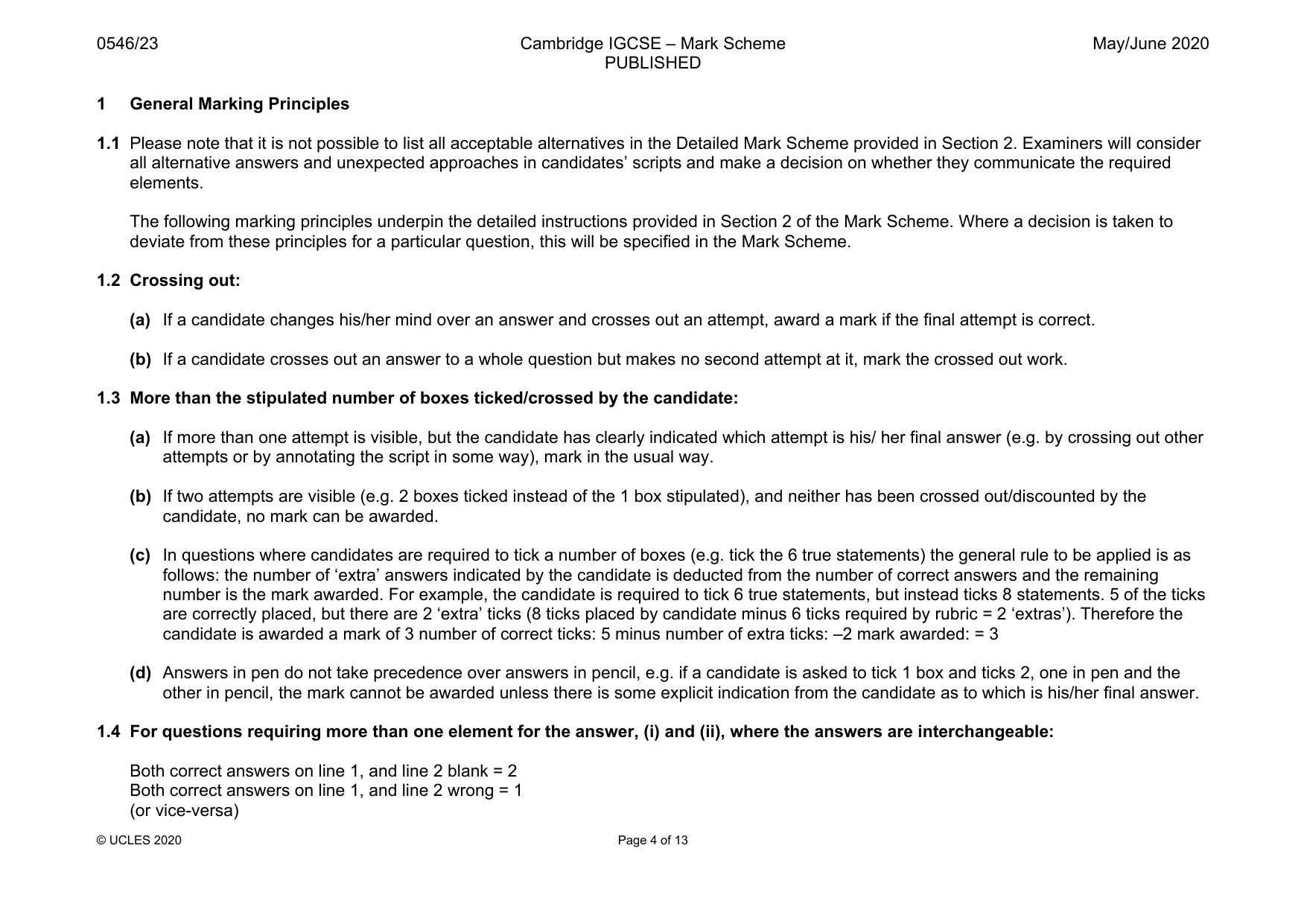
0546/23 Cambridge IGCSE – Mark Scheme PUBLISHED May/June 2020 © UCLES 2020 Page 4 of 13 1 General Marking Principles 1.1 Please note that it is not possible to list all acceptable alternatives in the Detailed Mark Scheme provided in Section 2. Examiners will consider all alternative answers and unexpected approaches in candidates’ scripts and make a decision on whether they communicate the required elements. The following marking principles underpin the detailed instructions provided in Section 2 of the Mark Scheme. Where a decision is taken to deviate from these principles for a particular question, this will be specified in the Mark Scheme. 1.2 Crossing out: (a) If a candidate changes his/her mind over an answer and crosses out an attempt, award a mark if the final attempt is correct. (b) If a candidate crosses out an answer to a whole question but makes no second attempt at it, mark the crossed out work. 1.3 More than the stipulated number of boxes ticked/crossed by the candidate: (a) If more than one attempt is visible, but the candidate has clearly indicated which attempt is his/ her final answer (e.g. by crossing out other attempts or by annotating the script in some way), mark in the usual way. (b) If two attempts are visible (e.g. 2 boxes ticked instead of the 1 box stipulated), and neither has been crossed out/discounted by the candidate, no mark can be awarded. (c) In questions where candidates are required to tick a number of boxes (e.g. tick the 6 true statements) the general rule to be applied is as follows: the number of ‘extra’ answers indicated by the candidate is deducted from the number of correct answers and the remaining number is the mark awarded. For example, the candidate is required to tick 6 true statements, but instead ticks 8 statements. 5 of the ticks are correctly placed, but there are 2 ‘extra’ ticks (8 ticks placed by candidate minus 6 ticks required by rubric = 2 ‘extras’). Therefore the candidate is awarded a mark of 3 number of correct ticks: 5 minus number of extra ticks: –2 mark awarded: = 3 (d) Answers in pen do not take precedence over answers in pencil, e.g. if a candidate is asked to tick 1 box and ticks 2, one in pen and the other in pencil, the mark cannot be awarded unless there is some explicit indication from the candidate as to which is his/her final answer. 1.4 For questions requiring more than one element for the answer, (i) and (ii), where the answers are interchangeable: Both correct answers on line 1, and line 2 blank = 2 Both correct answers on line 1, and line 2 wrong = 1 (or vice-versa)
Mark scheme, page 5
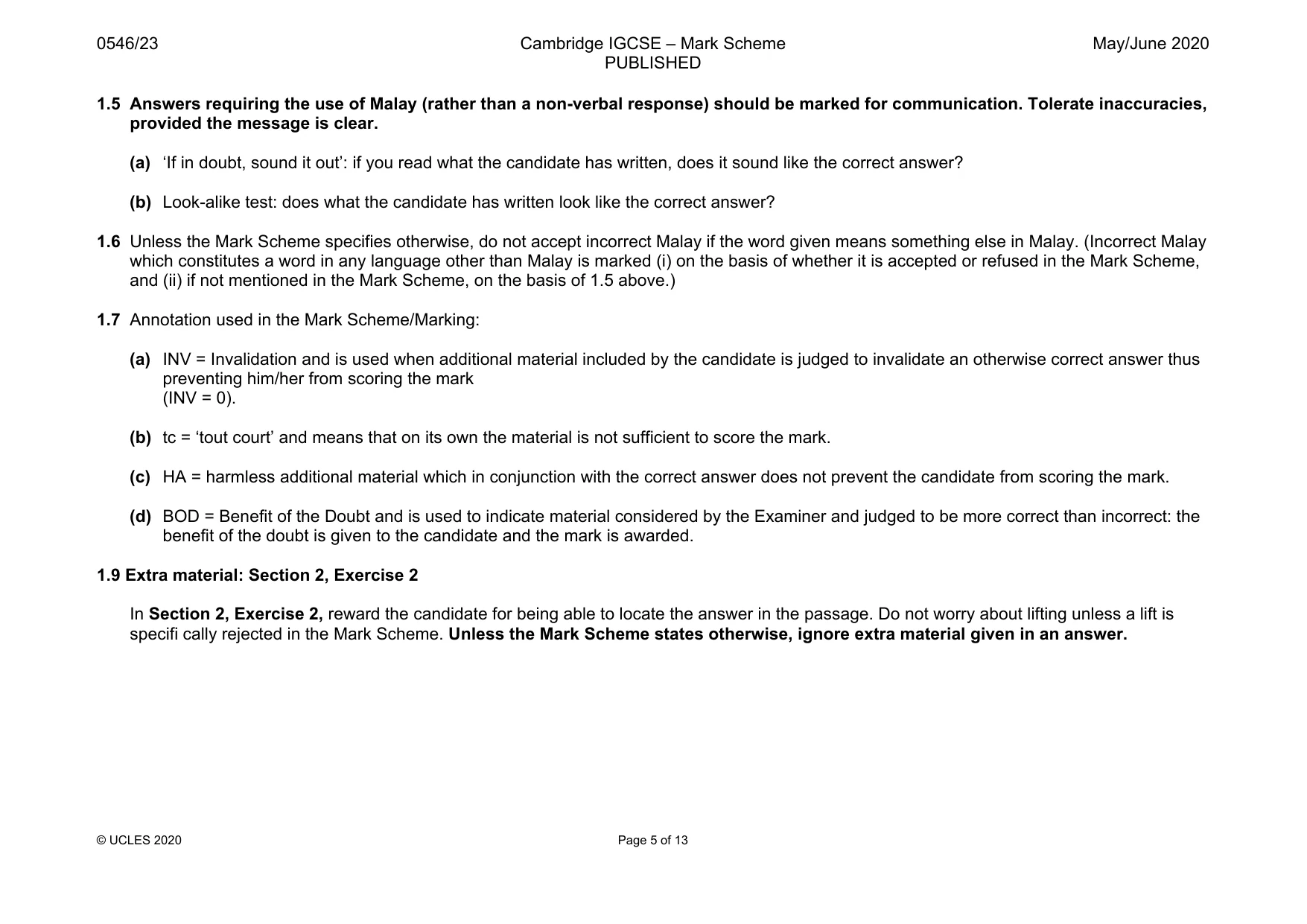
0546/23 Cambridge IGCSE – Mark Scheme PUBLISHED May/June 2020 © UCLES 2020 Page 5 of 13 1.5 Answers requiring the use of Malay (rather than a non-verbal response) should be marked for communication. Tolerate inaccuracies, provided the message is clear. (a) ‘If in doubt, sound it out’: if you read what the candidate has written, does it sound like the correct answer? (b) Look-alike test: does what the candidate has written look like the correct answer? 1.6 Unless the Mark Scheme specifies otherwise, do not accept incorrect Malay if the word given means something else in Malay. (Incorrect Malay which constitutes a word in any language other than Malay is marked (i) on the basis of whether it is accepted or refused in the Mark Scheme, and (ii) if not mentioned in the Mark Scheme, on the basis of 1.5 above.) 1.7 Annotation used in the Mark Scheme/Marking: (a) INV = Invalidation and is used when additional material included by the candidate is judged to invalidate an otherwise correct answer thus preventing him/her from scoring the mark (INV = 0). (b) tc = ‘tout court’ and means that on its own the material is not sufficient to score the mark. (c) HA = harmless additional material which in conjunction with the correct answer does not prevent the candidate from scoring the mark. (d) BOD = Benefit of the Doubt and is used to indicate material considered by the Examiner and judged to be more correct than incorrect: the benefit of the doubt is given to the candidate and the mark is awarded. 1.9 Extra material: Section 2, Exercise 2 In Section 2, Exercise 2, reward the candidate for being able to locate the answer in the passage. Do not worry about lifting unless a lift is specifi cally rejected in the Mark Scheme. Unless the Mark Scheme states otherwise, ignore extra material given in an answer.
Mark scheme, page 6
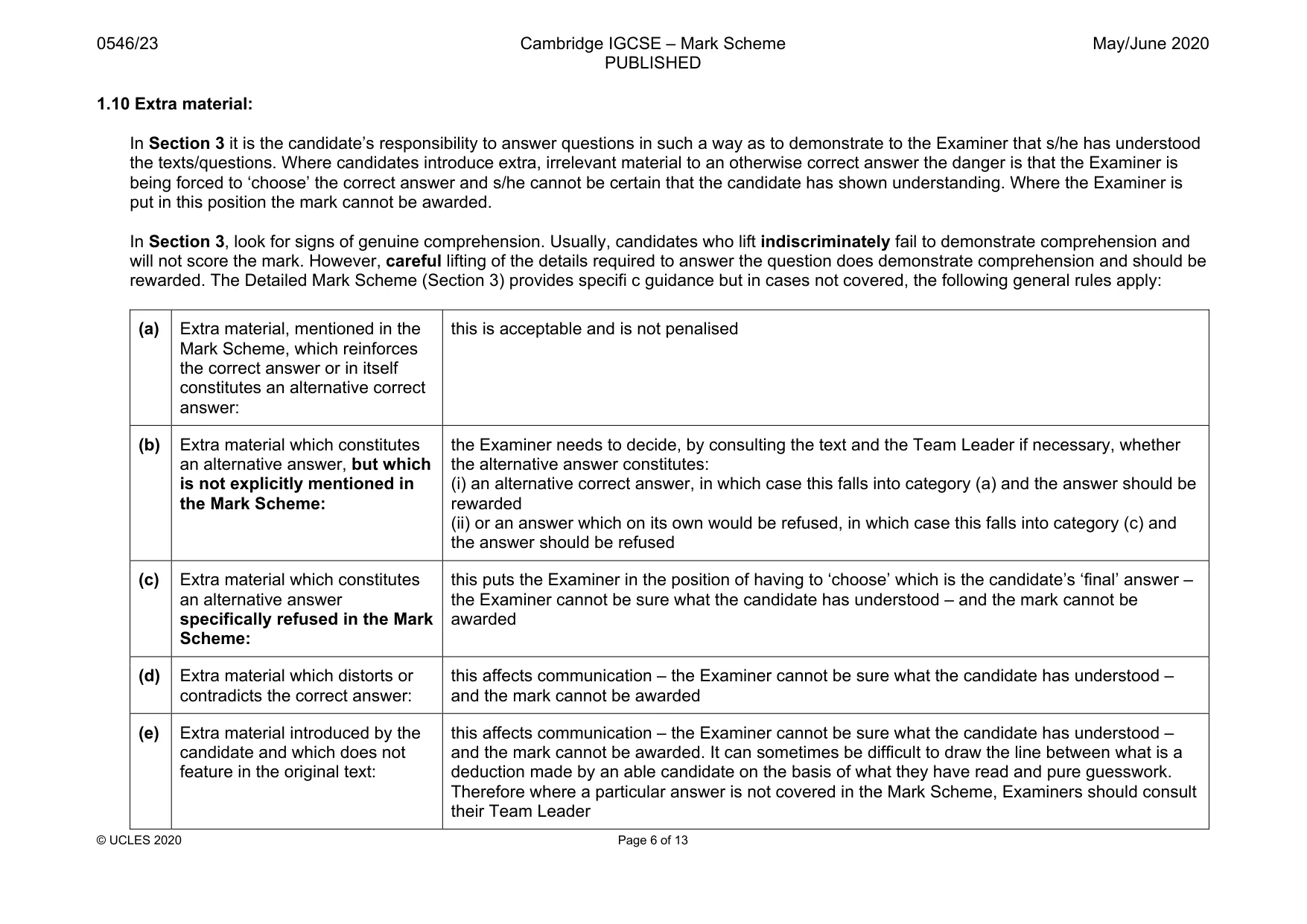
0546/23 Cambridge IGCSE – Mark Scheme PUBLISHED May/June 2020 © UCLES 2020 Page 6 of 13 1.10 Extra material: In Section 3 it is the candidate’s responsibility to answer questions in such a way as to demonstrate to the Examiner that s/he has understood the texts/questions. Where candidates introduce extra, irrelevant material to an otherwise correct answer the danger is that the Examiner is being forced to ‘choose’ the correct answer and s/he cannot be certain that the candidate has shown understanding. Where the Examiner is put in this position the mark cannot be awarded. In Section 3, look for signs of genuine comprehension. Usually, candidates who lift indiscriminately fail to demonstrate comprehension and will not score the mark. However, careful lifting of the details required to answer the question does demonstrate comprehension and should be rewarded. The Detailed Mark Scheme (Section 3) provides specifi c guidance but in cases not covered, the following general rules apply: (a) Extra material, mentioned in the Mark Scheme, which reinforces the correct answer or in itself constitutes an alternative correct answer: this is acceptable and is not penalised (b) Extra material which constitutes an alternative answer, but which is not explicitly mentioned in the Mark Scheme: the Examiner needs to decide, by consulting the text and the Team Leader if necessary, whether the alternative answer constitutes: (i) an alternative correct answer, in which case this falls into category (a) and the answer should be rewarded (ii) or an answer which on its own would be refused, in which case this falls into category (c) and the answer should be refused (c) Extra material which constitutes an alternative answer specifically refused in the Mark Scheme: this puts the Examiner in the position of having to ‘choose’ which is the candidate’s ‘final’ answer – the Examiner cannot be sure what the candidate has understood – and the mark cannot be awarded (d) Extra material which distorts or contradicts the correct answer: this affects communication – the Examiner cannot be sure what the candidate has understood – and the mark cannot be awarded (e) Extra material introduced by the candidate and which does not feature in the original text: this affects communication – the Examiner cannot be sure what the candidate has understood – and the mark cannot be awarded. It can sometimes be difficult to draw the line between what is a deduction made by an able candidate on the basis of what they have read and pure guesswork. Therefore where a particular answer is not covered in the Mark Scheme, Examiners should consult their Team Leader
Mark scheme, page 7
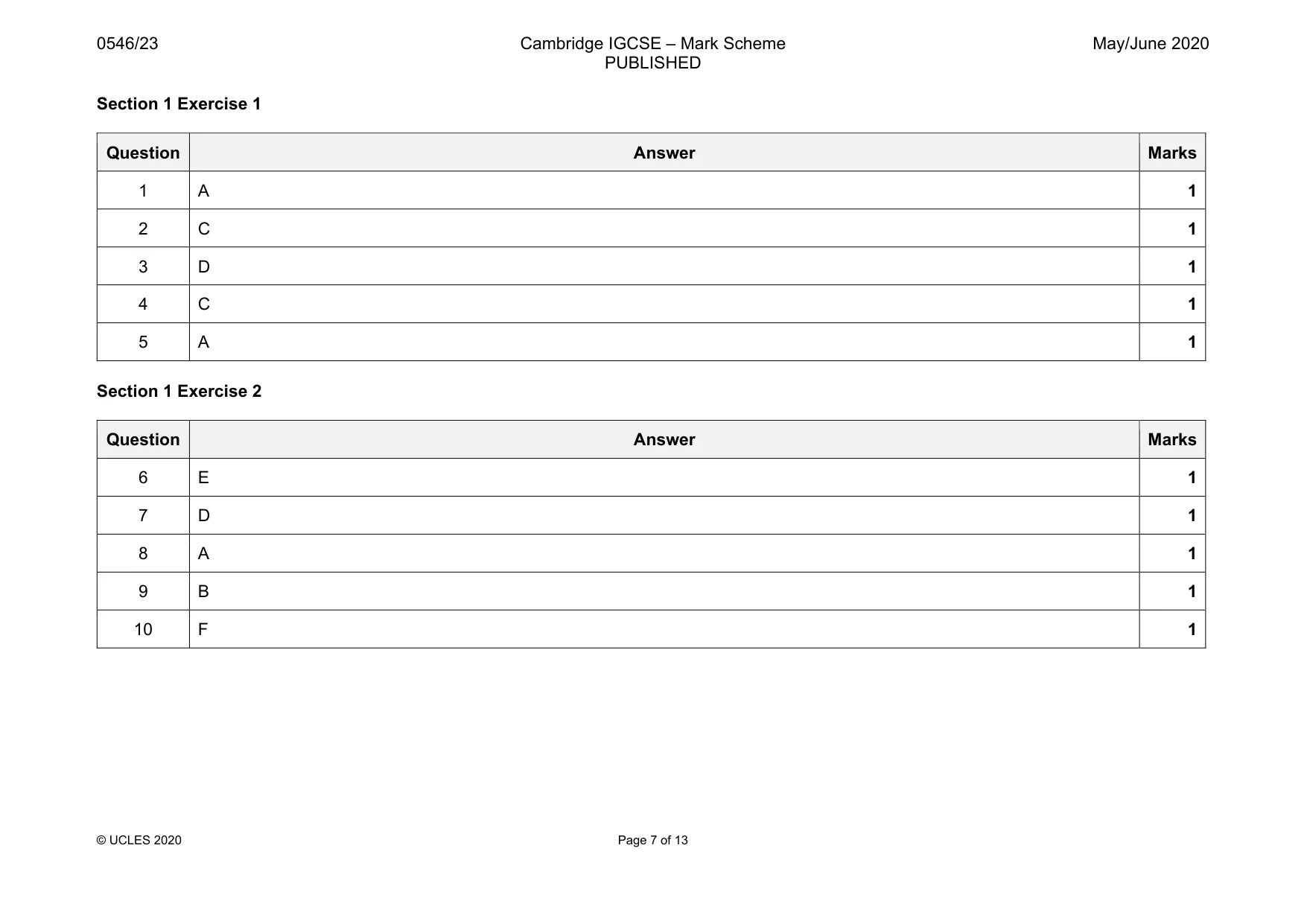
0546/23 Cambridge IGCSE – Mark Scheme PUBLISHED May/June 2020 © UCLES 2020 Page 7 of 13 Section 1 Exercise 1 Question Answer Marks 1 A 1 2 C 1 3 D 1 4 C 1 5 A 1 Section 1 Exercise 2 Question Answer Marks 6 E 1 7 D 1 8 A 1 9 B 1 10 F 1
Mark scheme, page 8
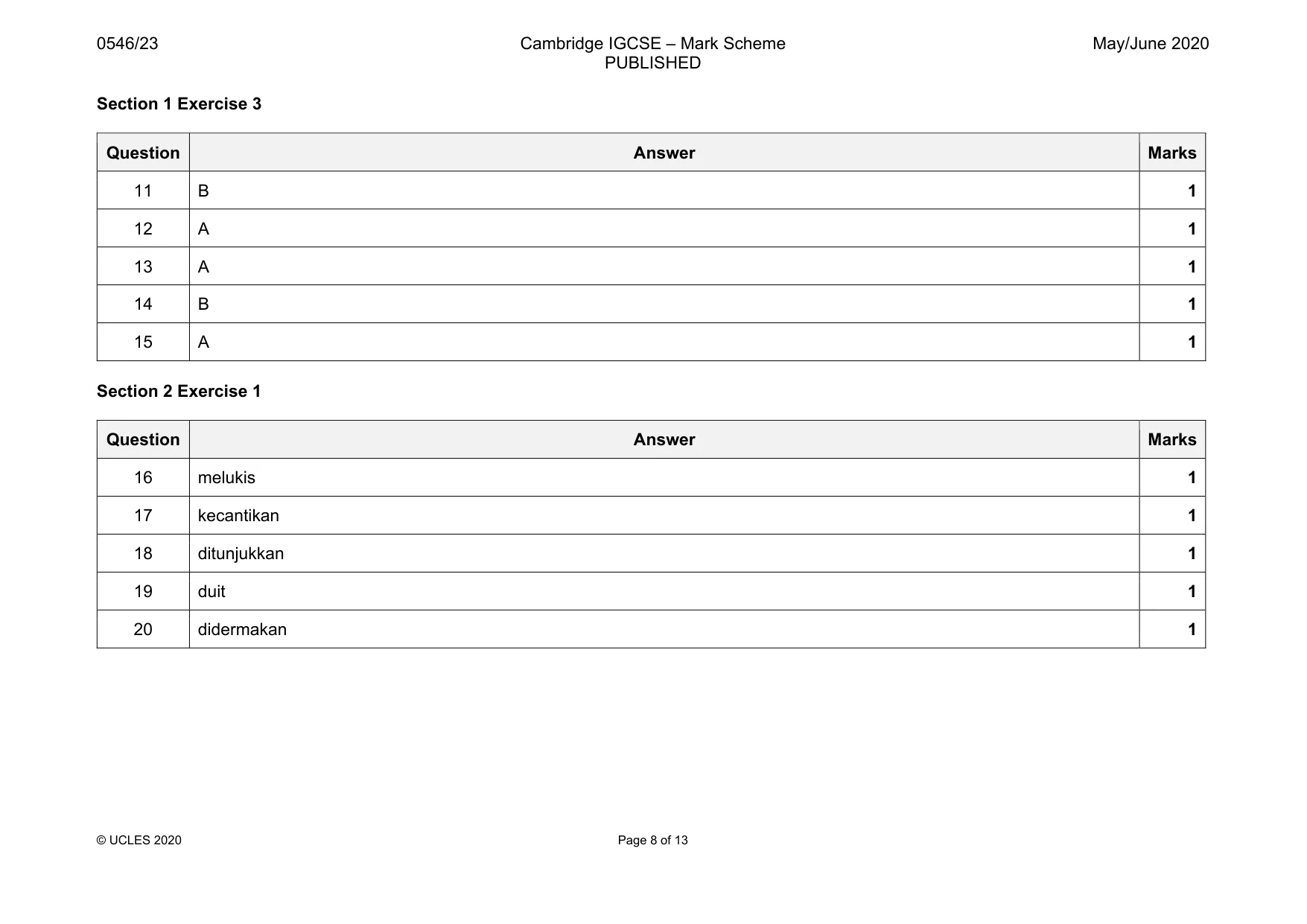
0546/23 Cambridge IGCSE – Mark Scheme PUBLISHED May/June 2020 © UCLES 2020 Page 8 of 13 Section 1 Exercise 3 Question Answer Marks 11 B 1 12 A 1 13 A 1 14 B 1 15 A 1 Section 2 Exercise 1 Question Answer Marks 16 melukis 1 17 kecantikan 1 18 ditunjukkan 1 19 duit 1 20 didermakan 1
Mark scheme, page 9
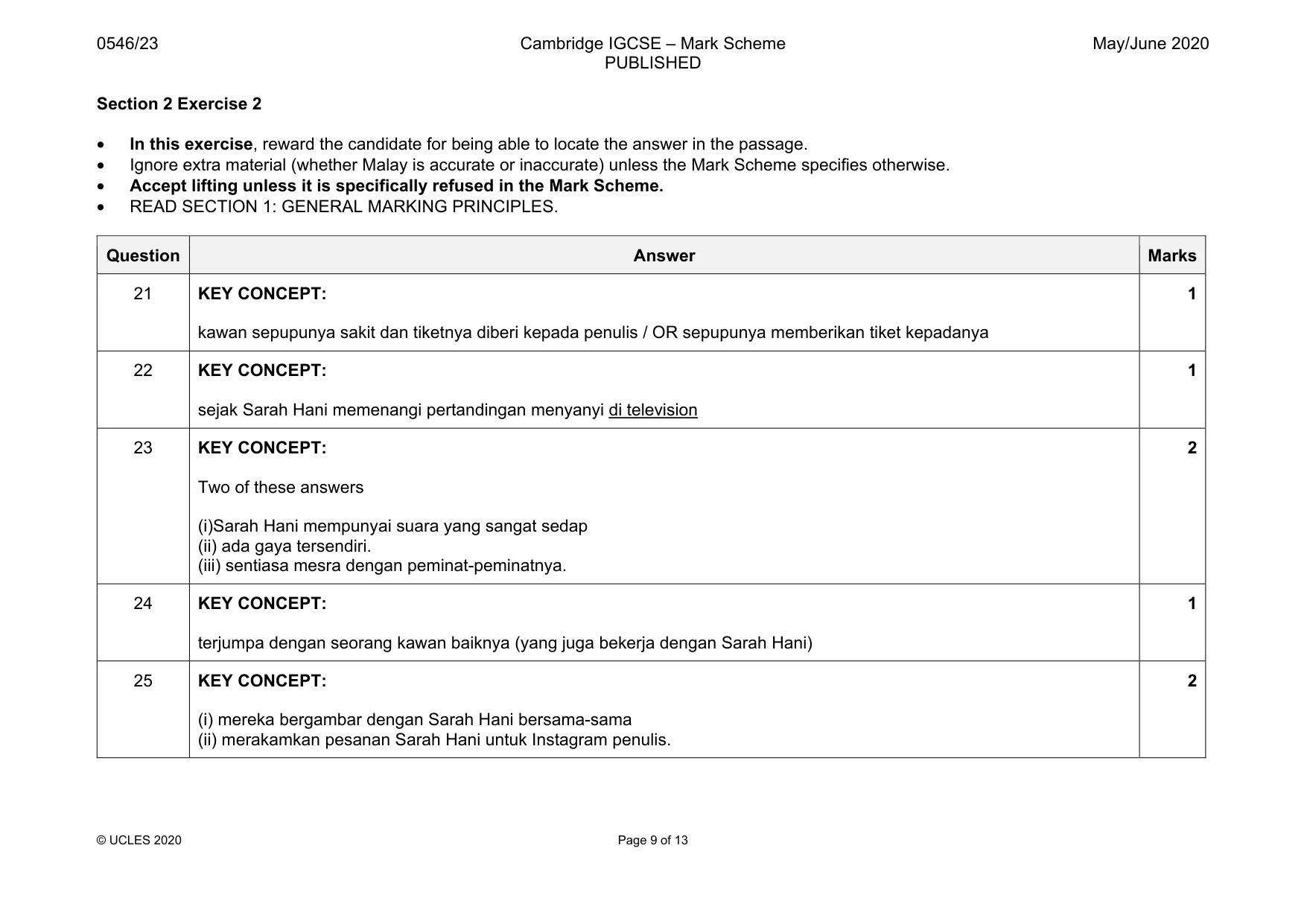
0546/23 Cambridge IGCSE – Mark Scheme PUBLISHED May/June 2020 © UCLES 2020 Page 9 of 13 Section 2 Exercise 2 • In this exercise, reward the candidate for being able to locate the answer in the passage. • Ignore extra material (whether Malay is accurate or inaccurate) unless the Mark Scheme specifies otherwise. • Accept lifting unless it is specifically refused in the Mark Scheme. • READ SECTION 1: GENERAL MARKING PRINCIPLES. Question Answer Marks 21 KEY CONCEPT: kawan sepupunya sakit dan tiketnya diberi kepada penulis / OR sepupunya memberikan tiket kepadanya 1 22 KEY CONCEPT: sejak Sarah Hani memenangi pertandingan menyanyi di television 1 23 KEY CONCEPT: Two of these answers (i)Sarah Hani mempunyai suara yang sangat sedap (ii) ada gaya tersendiri. (iii) sentiasa mesra dengan peminat-peminatnya. 2 24 KEY CONCEPT: terjumpa dengan seorang kawan baiknya (yang juga bekerja dengan Sarah Hani) 1 25 KEY CONCEPT: (i) mereka bergambar dengan Sarah Hani bersama-sama (ii) merakamkan pesanan Sarah Hani untuk Instagram penulis. 2
Mark scheme, page 10
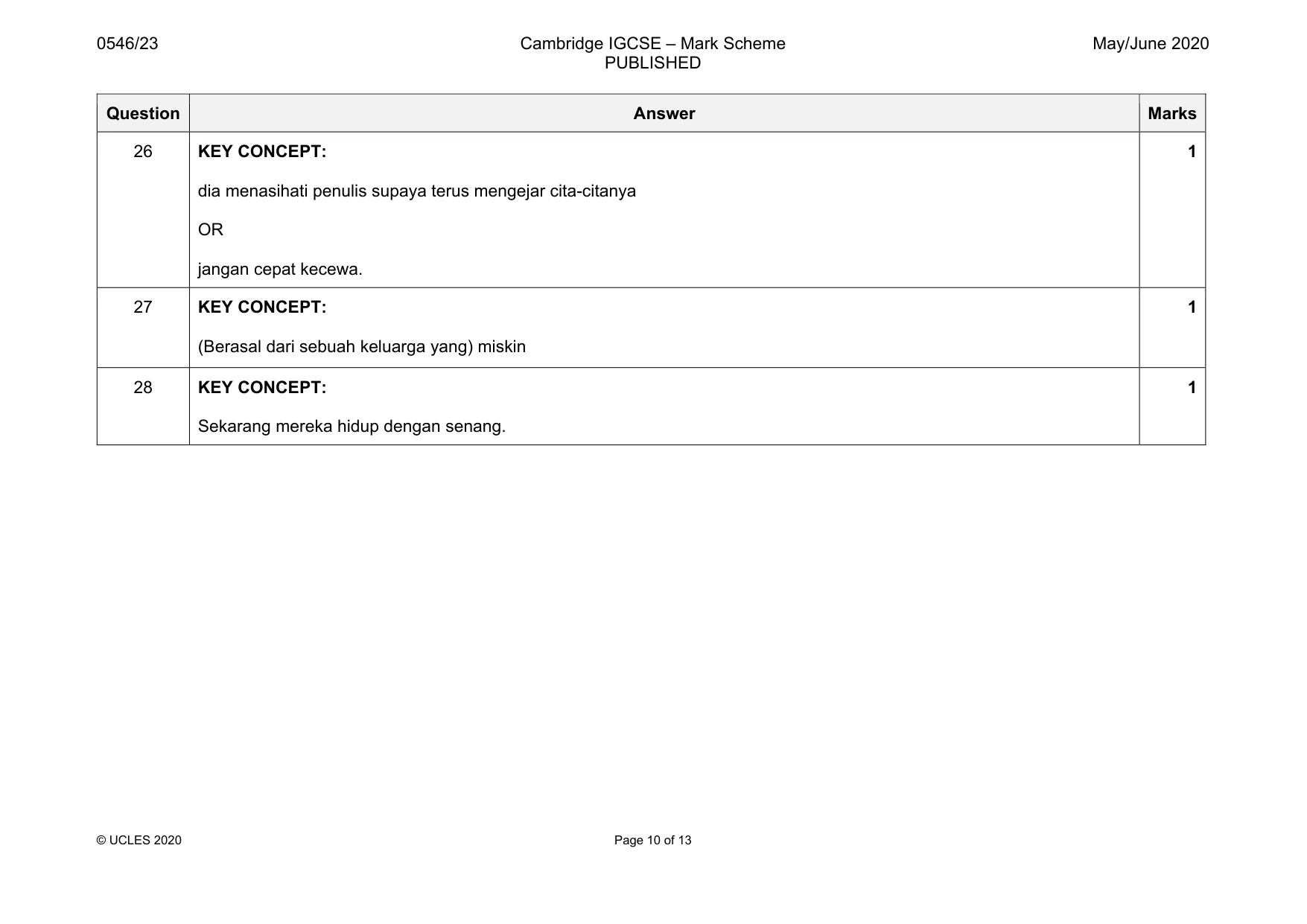
0546/23 Cambridge IGCSE – Mark Scheme PUBLISHED May/June 2020 © UCLES 2020 Page 10 of 13 Question Answer Marks 26 KEY CONCEPT: dia menasihati penulis supaya terus mengejar cita-citanya OR jangan cepat kecewa. 1 27 KEY CONCEPT: (Berasal dari sebuah keluarga yang) miskin 1 28 KEY CONCEPT: Sekarang mereka hidup dengan senang. 1
Mark scheme, page 11
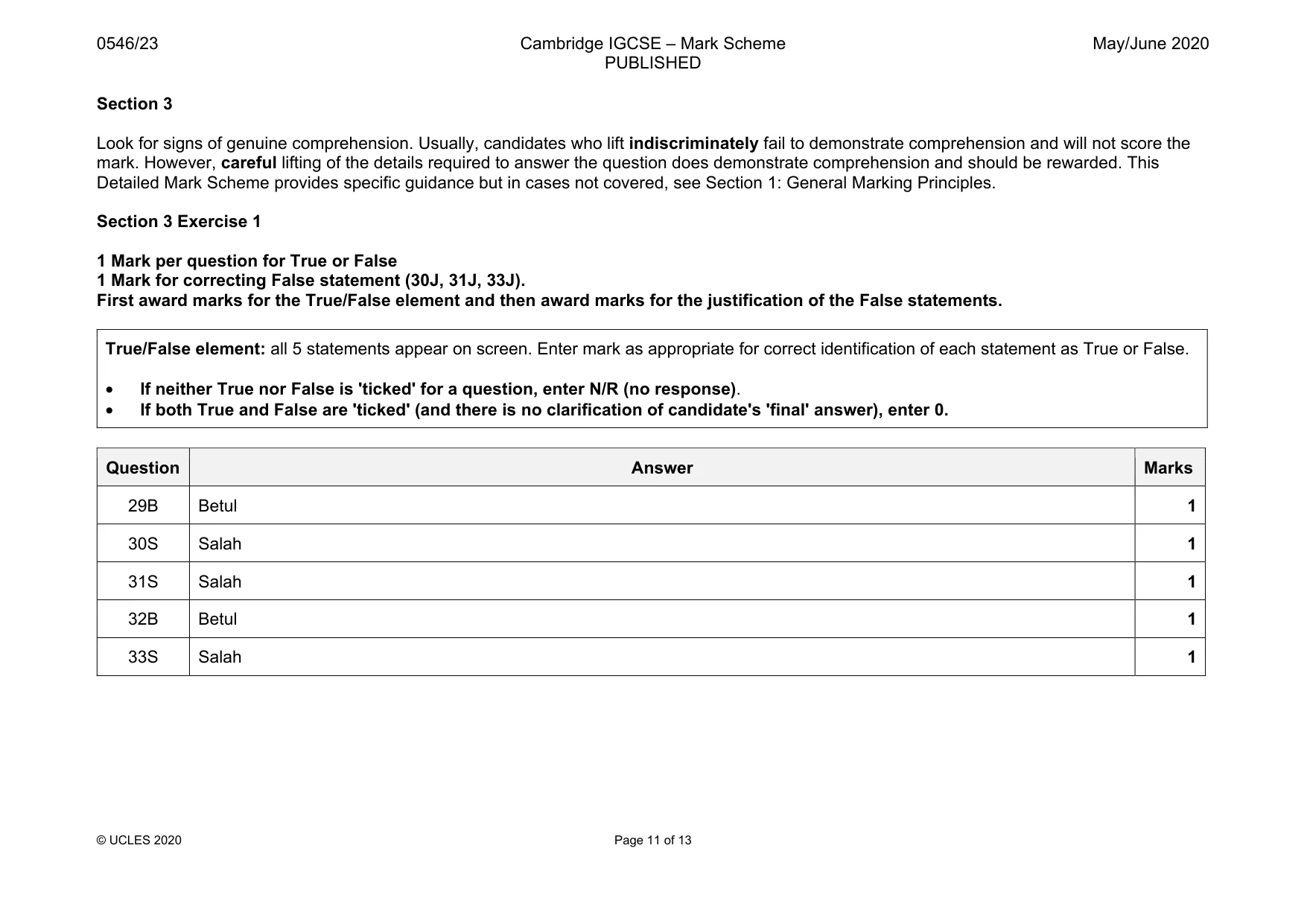
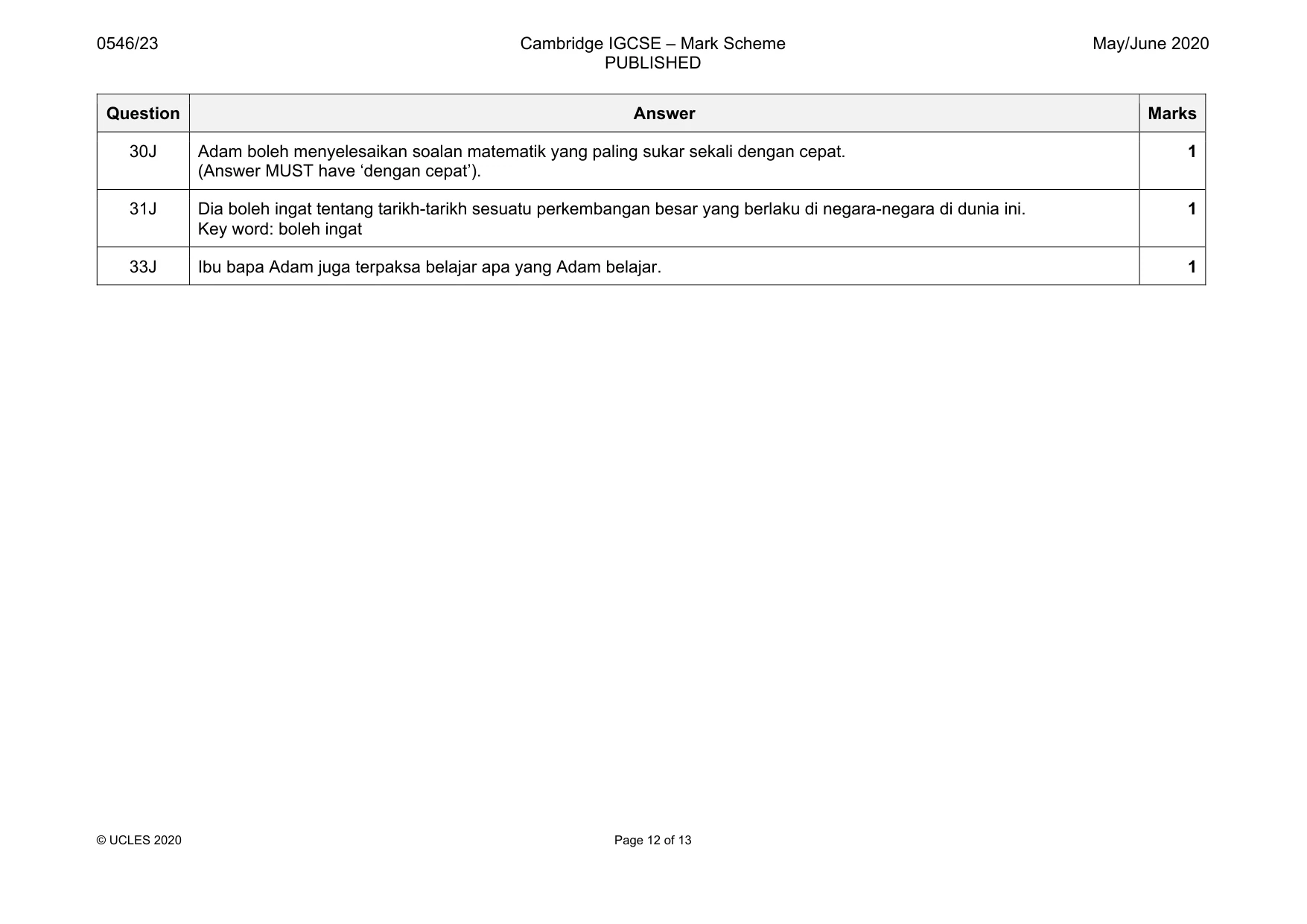
0546/23 Cambridge IGCSE – Mark Scheme PUBLISHED May/June 2020 © UCLES 2020 Page 11 of 13 Section 3 Look for signs of genuine comprehension. Usually, candidates who lift indiscriminately fail to demonstrate comprehension and will not score the mark. However, careful lifting of the details required to answer the question does demonstrate comprehension and should be rewarded. This Detailed Mark Scheme provides specific guidance but in cases not covered, see Section 1: General Marking Principles. Section 3 Exercise 1 1 Mark per question for True or False 1 Mark for correcting False statement (30J, 31J, 33J). First award marks for the True/False element and then award marks for the justification of the False statements. True/False element: all 5 statements appear on screen. Enter mark as appropriate for correct identification of each statement as True or False. • If neither True nor False is 'ticked' for a question, enter N/R (no response). • If both True and False are 'ticked' (and there is no clarification of candidate's 'final' answer), enter 0. Question Answer Marks 29B Betul 1 30S Salah 1 31S Salah 1 32B Betul 1 33S Salah 1
Mark scheme, page 12
0546/23 Cambridge IGCSE – Mark Scheme PUBLISHED May/June 2020 © UCLES 2020 Page 12 of 13 Question Answer Marks 30J Adam boleh menyelesaikan soalan matematik yang paling sukar sekali dengan cepat. (Answer MUST have ‘dengan cepat’). 1 31J Dia boleh ingat tentang tarikh-tarikh sesuatu perkembangan besar yang berlaku di negara-negara di dunia ini. Key word: boleh ingat 1 33J Ibu bapa Adam juga terpaksa belajar apa yang Adam belajar. 1
Mark scheme, page 13
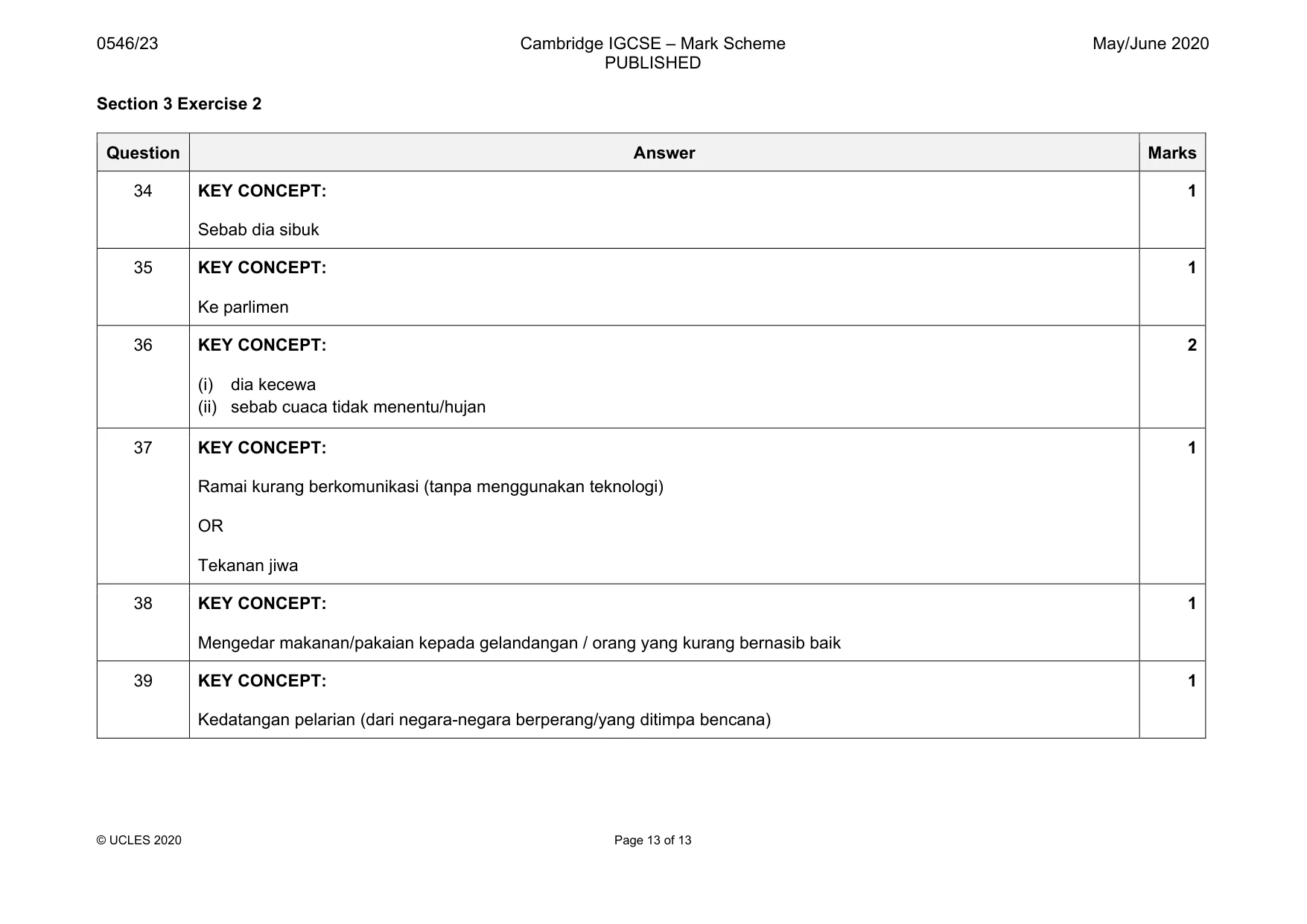
0546/23 Cambridge IGCSE – Mark Scheme PUBLISHED May/June 2020 © UCLES 2020 Page 13 of 13 Section 3 Exercise 2 Question Answer Marks 34 KEY CONCEPT: Sebab dia sibuk 1 35 KEY CONCEPT: Ke parlimen 1 36 KEY CONCEPT: (i) dia kecewa (ii) sebab cuaca tidak menentu/hujan 2 37 KEY CONCEPT: Ramai kurang berkomunikasi (tanpa menggunakan teknologi) OR Tekanan jiwa 1 38 KEY CONCEPT: Mengedar makanan/pakaian kepada gelandangan / orang yang kurang bernasib baik 1 39 KEY CONCEPT: Kedatangan pelarian (dari negara-negara berperang/yang ditimpa bencana) 1