Cambridge IGCSE Latin 0480 — 2019 May/June Paper 1 · Variant 1
0480/11/M/J/19 · 160 marks · ≈180 min
The question paper and its mark scheme, free to read here and free to download. This is Cambridge’s own paper, exactly as it was sat.
Question paper8 pages




Mark scheme5 pages
Answers below. Sit the paper first if you are practising.
Paper as text
Question paper, page 1
This document consists of 4 printed pages and 4 blank pages. DC (SC) 180640 © UCLES 2019 [Turn over Cambridge Assessment International Education Cambridge International General Certificate of Secondary Education * 6 2 0 4 0 8 5 1 5 6 * LATIN 0480/11 Paper 1 Language May/June 2019 1 hour 30 minutes Additional Materials: Answer Booklet/Paper. READ THESE INSTRUCTIONS FIRST If you have been given an Answer Booklet, follow the instructions on the front cover of the Booklet. Write your centre number, candidate number and name on all the work you hand in. Write in dark blue or black pen. Do not use staples, paper clips, glue or correction fluid. DO NOT WRITE IN ANY BARCODES. Answer all questions. At the end of the examination, fasten all your work securely together. The number of marks is given in brackets [ ] at the end of each question or part question. The total number of marks for this paper is 160.
Question paper, page 2
2 0480/11/M/J/19 © UCLES 2019 BLANK PAGE
Question paper, page 3
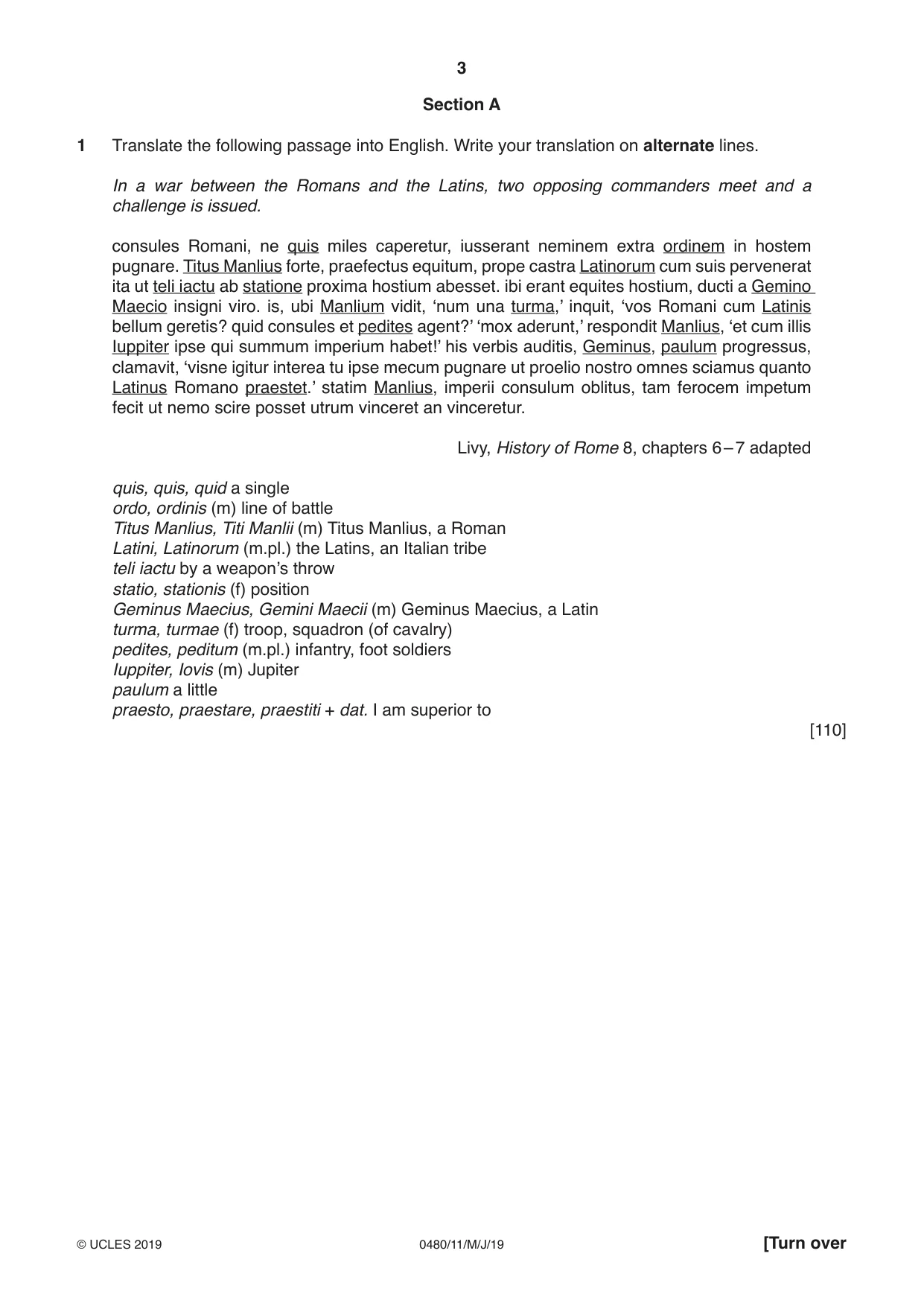
3 0480/11/M/J/19 © UCLES 2019 [Turn over Section A 1 Translate the following passage into English. Write your translation on alternate lines. In a war between the Romans and the Latins, two opposing commanders meet and a challenge is issued. consules Romani, ne quis miles caperetur, iusserant neminem extra ordinem in hostem pugnare. Titus Manlius forte, praefectus equitum, prope castra Latinorum cum suis pervenerat ita ut teli iactu ab statione proxima hostium abesset. ibi erant equites hostium, ducti a Gemino Maecio insigni viro. is, ubi Manlium vidit, ‘num una turma,’ inquit, ‘vos Romani cum Latinis bellum geretis? quid consules et pedites agent?’ ‘mox aderunt,’ respondit Manlius, ‘et cum illis Iuppiter ipse qui summum imperium habet!’ his verbis auditis, Geminus, paulum progressus, clamavit, ‘visne igitur interea tu ipse mecum pugnare ut proelio nostro omnes sciamus quanto Latinus Romano praestet.’ statim Manlius, imperii consulum oblitus, tam ferocem impetum fecit ut nemo scire posset utrum vinceret an vinceretur. Livy, History of Rome 8, chapters 6 – 7 adapted quis, quis, quid a single ordo, ordinis (m) line of battle Titus Manlius, Titi Manlii (m) Titus Manlius, a Roman Latini, Latinorum (m.pl.) the Latins, an Italian tribe teli iactu by a weapon’s throw statio, stationis (f) position Geminus Maecius, Gemini Maecii (m) Geminus Maecius, a Latin turma, turmae (f) troop, squadron (of cavalry) pedites, peditum (m.pl.) infantry, foot soldiers Iuppiter, Iovis (m) Jupiter paulum a little praesto, praestare, praestiti + dat. I am superior to [110]
Question paper, page 4
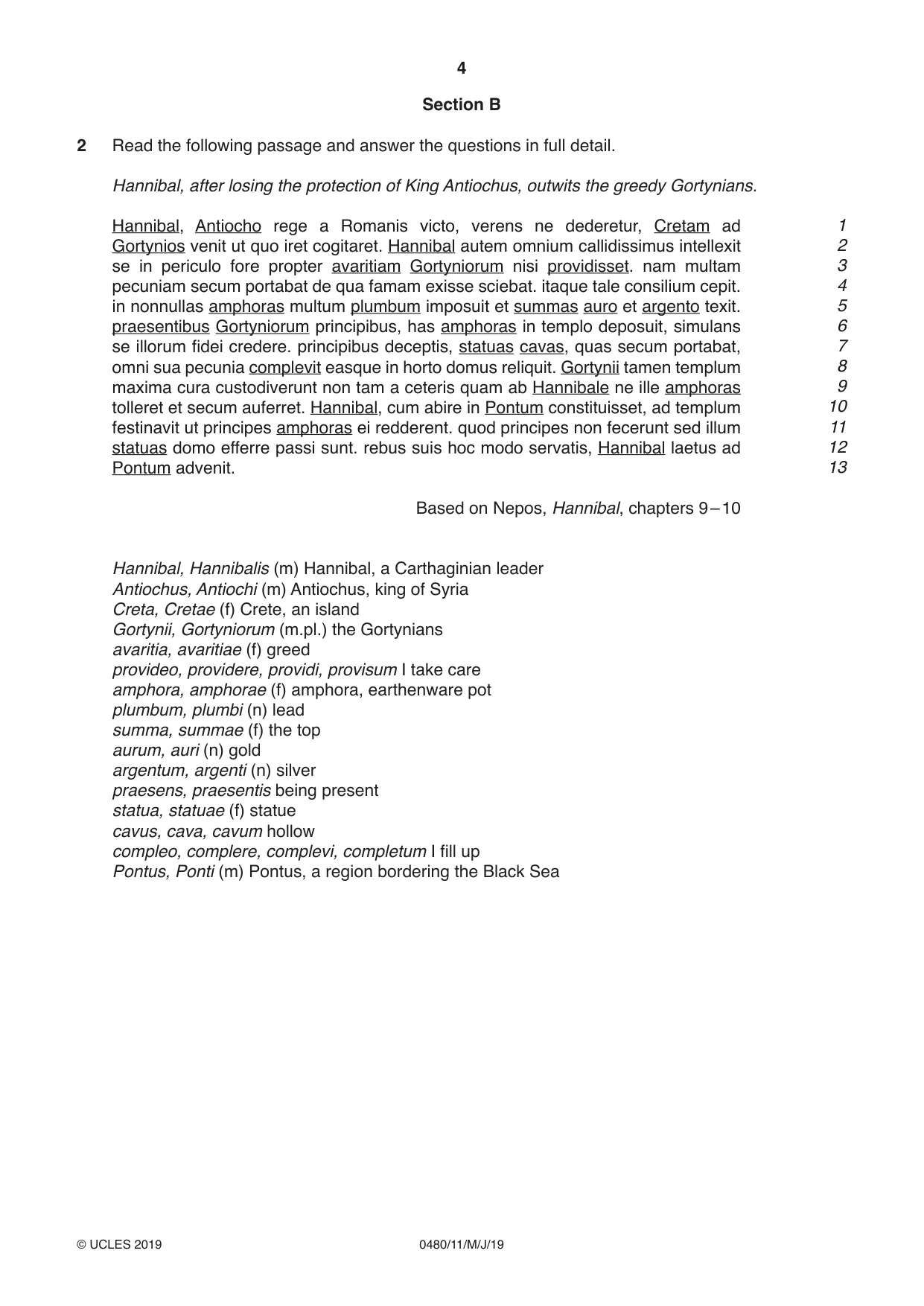
4 0480/11/M/J/19 © UCLES 2019 Section B 2 Read the following passage and answer the questions in full detail. Hannibal, after losing the protection of King Antiochus, outwits the greedy Gortynians. Hannibal, Antiocho rege a Romanis victo, verens ne dederetur, Cretam ad Gortynios venit ut quo iret cogitaret. Hannibal autem omnium callidissimus intellexit se in periculo fore propter avaritiam Gortyniorum nisi providisset. nam multam pecuniam secum portabat de qua famam exisse sciebat. itaque tale consilium cepit. in nonnullas amphoras multum plumbum imposuit et summas auro et argento texit. praesentibus Gortyniorum principibus, has amphoras in templo deposuit, simulans se illorum fidei credere. principibus deceptis, statuas cavas, quas secum portabat, omni sua pecunia complevit easque in horto domus reliquit. Gortynii tamen templum maxima cura custodiverunt non tam a ceteris quam ab Hannibale ne ille amphoras tolleret et secum auferret. Hannibal, cum abire in Pontum constituisset, ad templum festinavit ut principes amphoras ei redderent. quod principes non fecerunt sed illum statuas domo efferre passi sunt. rebus suis hoc modo servatis, Hannibal laetus ad Pontum advenit. Based on Nepos, Hannibal, chapters 9 – 10 Hannibal, Hannibalis (m) Hannibal, a Carthaginian leader Antiochus, Antiochi (m) Antiochus, king of Syria Creta, Cretae (f) Crete, an island Gortynii, Gortyniorum (m.pl.) the Gortynians avaritia, avaritiae (f) greed provideo, providere, providi, provisum I take care amphora, amphorae (f) amphora, earthenware pot plumbum, plumbi (n) lead summa, summae (f) the top aurum, auri (n) gold argentum, argenti (n) silver praesens, praesentis being present statua, statuae (f) statue cavus, cava, cavum hollow compleo, complere, complevi, completum I fill up Pontus, Ponti (m) Pontus, a region bordering the Black Sea 1 2 3 4 5 6 7 8 9 10 11 12 13
Question paper, page 5
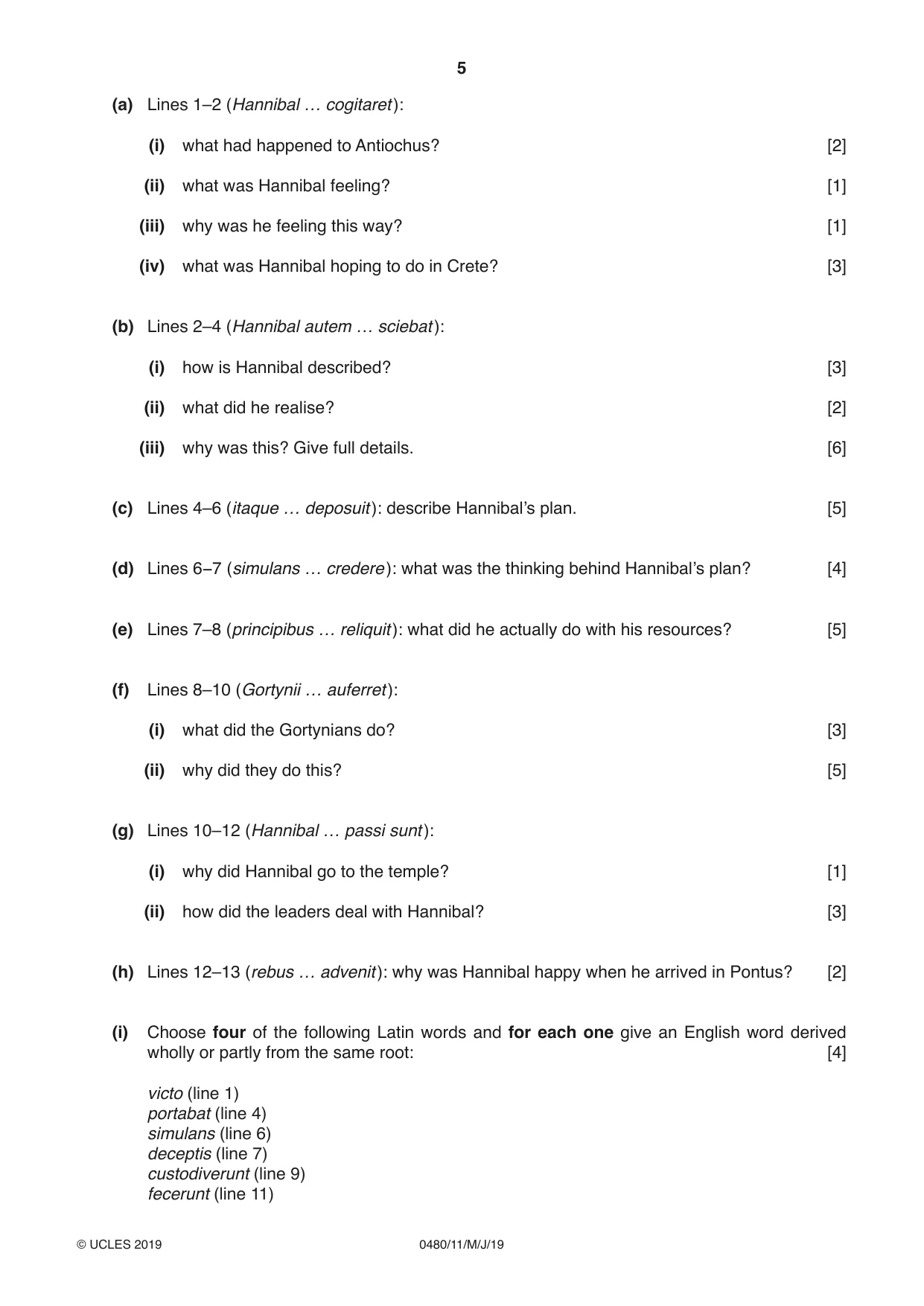
5 0480/11/M/J/19 © UCLES 2019 (a) Lines 1–2 (Hannibal … cogitaret ): (i) what had happened to Antiochus? [2] (ii) what was Hannibal feeling? [1] (iii) why was he feeling this way? [1] (iv) what was Hannibal hoping to do in Crete? [3] (b) Lines 2–4 (Hannibal autem … sciebat ): (i) how is Hannibal described? [3] (ii) what did he realise? [2] (iii) why was this? Give full details. [6] (c) Lines 4–6 (itaque … deposuit ): describe Hannibal’s plan. [5] (d) Lines 6−7 (simulans … credere ): what was the thinking behind Hannibal’s plan? [4] (e) Lines 7–8 (principibus … reliquit ): what did he actually do with his resources? [5] (f) Lines 8–10 (Gortynii … auferret ): (i) what did the Gortynians do? [3] (ii) why did they do this? [5] (g) Lines 10–12 (Hannibal … passi sunt ): (i) why did Hannibal go to the temple? [1] (ii) how did the leaders deal with Hannibal? [3] (h) Lines 12–13 (rebus … advenit ): why was Hannibal happy when he arrived in Pontus? [2] (i) Choose four of the following Latin words and for each one give an English word derived wholly or partly from the same root: [4] victo (line 1) portabat (line 4) simulans (line 6) deceptis (line 7) custodiverunt (line 9) fecerunt (line 11)
Question paper, page 6
6 0480/11/M/J/19 © UCLES 2019 BLANK PAGE
Question paper, page 7
7 0480/11/M/J/19 © UCLES 2019 BLANK PAGE
Question paper, page 8
8 0480/11/M/J/19 © UCLES 2019 Permission to reproduce items where third-party owned material protected by copyright is included has been sought and cleared where possible. Every reasonable effort has been made by the publisher (UCLES) to trace copyright holders, but if any items requiring clearance have unwittingly been included, the publisher will be pleased to make amends at the earliest possible opportunity. To avoid the issue of disclosure of answer-related information to candidates, all copyright acknowledgements are reproduced online in the Cambridge Assessment International Education Copyright Acknowledgements Booklet. This is produced for each series of examinations and is freely available to download at www.cambridgeinternational.org after the live examination series. Cambridge Assessment International Education is part of the Cambridge Assessment Group. Cambridge Assessment is the brand name of the University of Cambridge Local Examinations Syndicate (UCLES), which itself is a department of the University of Cambridge. BLANK PAGE
Mark scheme, page 1
This document consists of 5 printed pages. © UCLES 2019 [Turn over Cambridge Assessment International Education Cambridge International General Certificate of Secondary Education LATIN 0480/11 Paper 1 Language May/June 2019 MARK SCHEME Maximum Mark: 160 Published This mark scheme is published as an aid to teachers and candidates, to indicate the requirements of the examination. It shows the basis on which Examiners were instructed to award marks. It does not indicate the details of the discussions that took place at an Examiners’ meeting before marking began, which would have considered the acceptability of alternative answers. Mark schemes should be read in conjunction with the question paper and the Principal Examiner Report for Teachers. Cambridge International will not enter into discussions about these mark schemes. Cambridge International is publishing the mark schemes for the May/June 2019 series for most Cambridge IGCSE™, Cambridge International A and AS Level and Cambridge Pre-U components, and some Cambridge O Level components.
Mark scheme, page 2
0480/11 Cambridge IGCSE – Mark Scheme PUBLISHED May/June 2019 © UCLES 2019 Page 2 of 5 Generic Marking Principles These general marking principles must be applied by all examiners when marking candidate answers. They should be applied alongside the specific content of the mark scheme or generic level descriptors for a question. Each question paper and mark scheme will also comply with these marking principles. GENERIC MARKING PRINCIPLE 1: Marks must be awarded in line with: • the specific content of the mark scheme or the generic level descriptors for the question • the specific skills defined in the mark scheme or in the generic level descriptors for the question • the standard of response required by a candidate as exemplified by the standardisation scripts. GENERIC MARKING PRINCIPLE 2: Marks awarded are always whole marks (not half marks, or other fractions). GENERIC MARKING PRINCIPLE 3: Marks must be awarded positively: • marks are awarded for correct/valid answers, as defined in the mark scheme. However, credit is given for valid answers which go beyond the scope of the syllabus and mark scheme, referring to your Team Leader as appropriate • marks are awarded when candidates clearly demonstrate what they know and can do • marks are not deducted for errors • marks are not deducted for omissions • answers should only be judged on the quality of spelling, punctuation and grammar when these features are specifically assessed by the question as indicated by the mark scheme. The meaning, however, should be unambiguous. GENERIC MARKING PRINCIPLE 4: Rules must be applied consistently e.g. in situations where candidates have not followed instructions or in the application of generic level descriptors. GENERIC MARKING PRINCIPLE 5: Marks should be awarded using the full range of marks defined in the mark scheme for the question (however; the use of the full mark range may be limited according to the quality of the candidate responses seen). GENERIC MARKING PRINCIPLE 6: Marks awarded are based solely on the requirements as defined in the mark scheme. Marks should not be awarded with grade thresholds or grade descriptors in mind.
Mark scheme, page 3
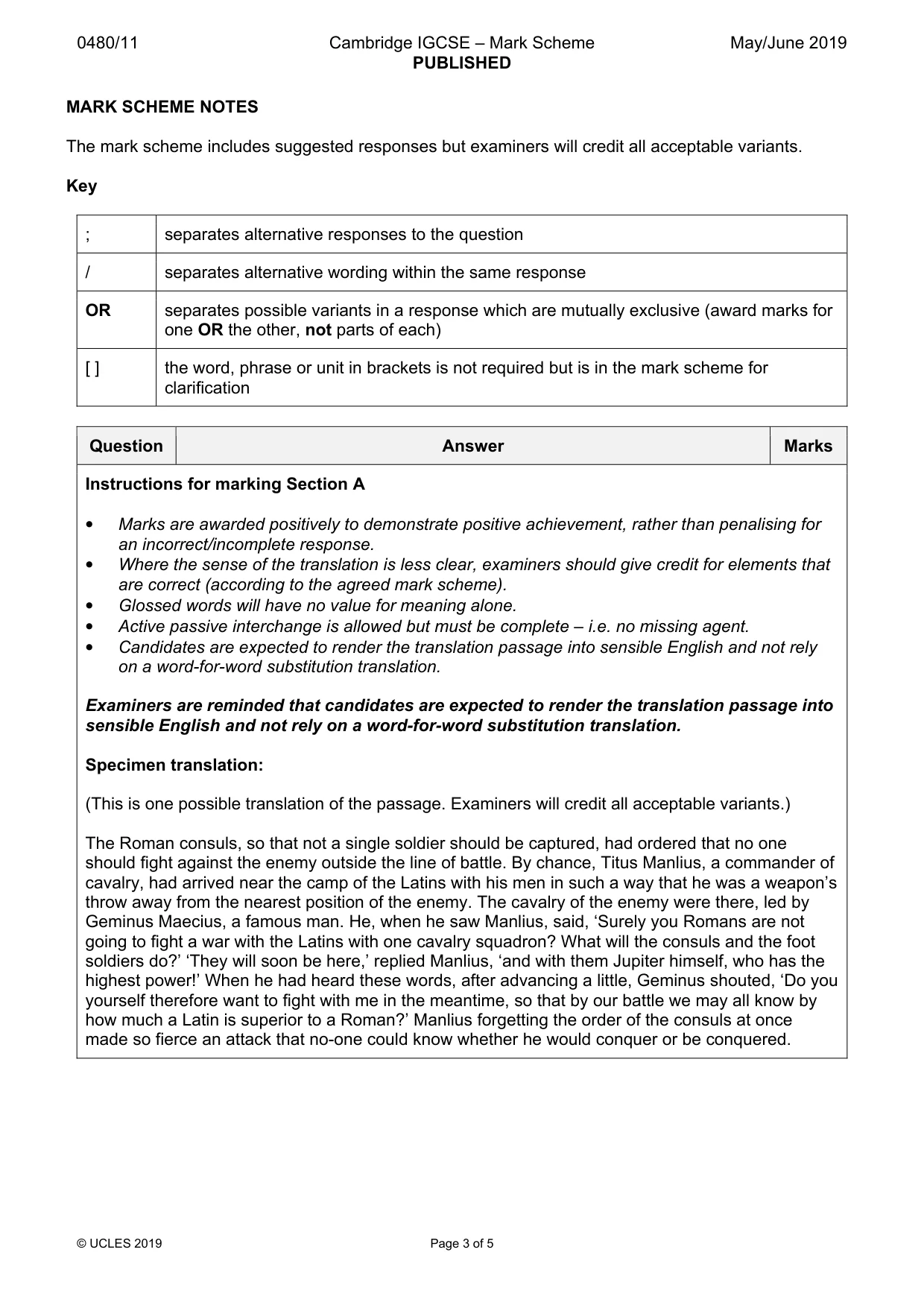
0480/11 Cambridge IGCSE – Mark Scheme PUBLISHED May/June 2019 © UCLES 2019 Page 3 of 5 MARK SCHEME NOTES The mark scheme includes suggested responses but examiners will credit all acceptable variants. Key ; separates alternative responses to the question / separates alternative wording within the same response OR separates possible variants in a response which are mutually exclusive (award marks for one OR the other, not parts of each) [ ] the word, phrase or unit in brackets is not required but is in the mark scheme for clarification Question Answer Marks Instructions for marking Section A • Marks are awarded positively to demonstrate positive achievement, rather than penalising for an incorrect/incomplete response. • Where the sense of the translation is less clear, examiners should give credit for elements that are correct (according to the agreed mark scheme). • Glossed words will have no value for meaning alone. • Active passive interchange is allowed but must be complete – i.e. no missing agent. • Candidates are expected to render the translation passage into sensible English and not rely on a word-for-word substitution translation. Examiners are reminded that candidates are expected to render the translation passage into sensible English and not rely on a word-for-word substitution translation. Specimen translation: (This is one possible translation of the passage. Examiners will credit all acceptable variants.) The Roman consuls, so that not a single soldier should be captured, had ordered that no one should fight against the enemy outside the line of battle. By chance, Titus Manlius, a commander of cavalry, had arrived near the camp of the Latins with his men in such a way that he was a weapon’s throw away from the nearest position of the enemy. The cavalry of the enemy were there, led by Geminus Maecius, a famous man. He, when he saw Manlius, said, ‘Surely you Romans are not going to fight a war with the Latins with one cavalry squadron? What will the consuls and the foot soldiers do?’ ‘They will soon be here,’ replied Manlius, ‘and with them Jupiter himself, who has the highest power!’ When he had heard these words, after advancing a little, Geminus shouted, ‘Do you yourself therefore want to fight with me in the meantime, so that by our battle we may all know by how much a Latin is superior to a Roman?’ Manlius forgetting the order of the consuls at once made so fierce an attack that no-one could know whether he would conquer or be conquered.
Mark scheme, page 4
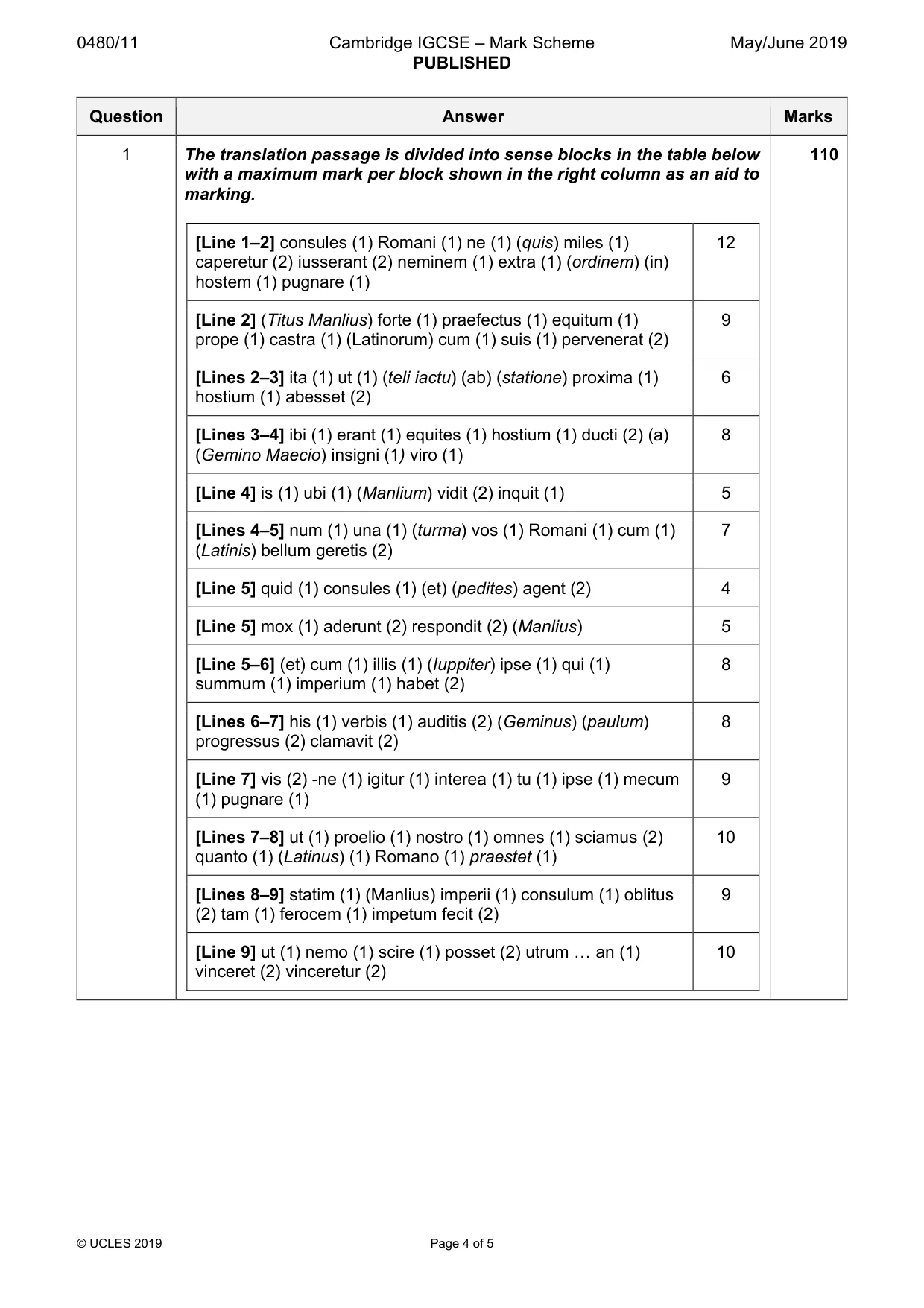
0480/11 Cambridge IGCSE – Mark Scheme PUBLISHED May/June 2019 © UCLES 2019 Page 4 of 5 Question Answer Marks 1 The translation passage is divided into sense blocks in the table below with a maximum mark per block shown in the right column as an aid to marking. [Line 1–2] consules (1) Romani (1) ne (1) (quis) miles (1) caperetur (2) iusserant (2) neminem (1) extra (1) (ordinem) (in) hostem (1) pugnare (1) 12 [Line 2] (Titus Manlius) forte (1) praefectus (1) equitum (1) prope (1) castra (1) (Latinorum) cum (1) suis (1) pervenerat (2) 9 [Lines 2–3] ita (1) ut (1) (teli iactu) (ab) (statione) proxima (1) hostium (1) abesset (2) 6 [Lines 3–4] ibi (1) erant (1) equites (1) hostium (1) ducti (2) (a) (Gemino Maecio) insigni (1) viro (1) 8 [Line 4] is (1) ubi (1) (Manlium) vidit (2) inquit (1) 5 [Lines 4–5] num (1) una (1) (turma) vos (1) Romani (1) cum (1) (Latinis) bellum geretis (2) 7 [Line 5] quid (1) consules (1) (et) (pedites) agent (2) 4 [Line 5] mox (1) aderunt (2) respondit (2) (Manlius) 5 [Line 5–6] (et) cum (1) illis (1) (Iuppiter) ipse (1) qui (1) summum (1) imperium (1) habet (2) 8 [Lines 6–7] his (1) verbis (1) auditis (2) (Geminus) (paulum) progressus (2) clamavit (2) 8 [Line 7] vis (2) -ne (1) igitur (1) interea (1) tu (1) ipse (1) mecum (1) pugnare (1) 9 [Lines 7–8] ut (1) proelio (1) nostro (1) omnes (1) sciamus (2) quanto (1) (Latinus) (1) Romano (1) praestet (1) 10 [Lines 8–9] statim (1) (Manlius) imperii (1) consulum (1) oblitus (2) tam (1) ferocem (1) impetum fecit (2) 9 [Line 9] ut (1) nemo (1) scire (1) posset (2) utrum « an (1) vinceret (2) vinceretur (2) 10 110
Mark scheme, page 5
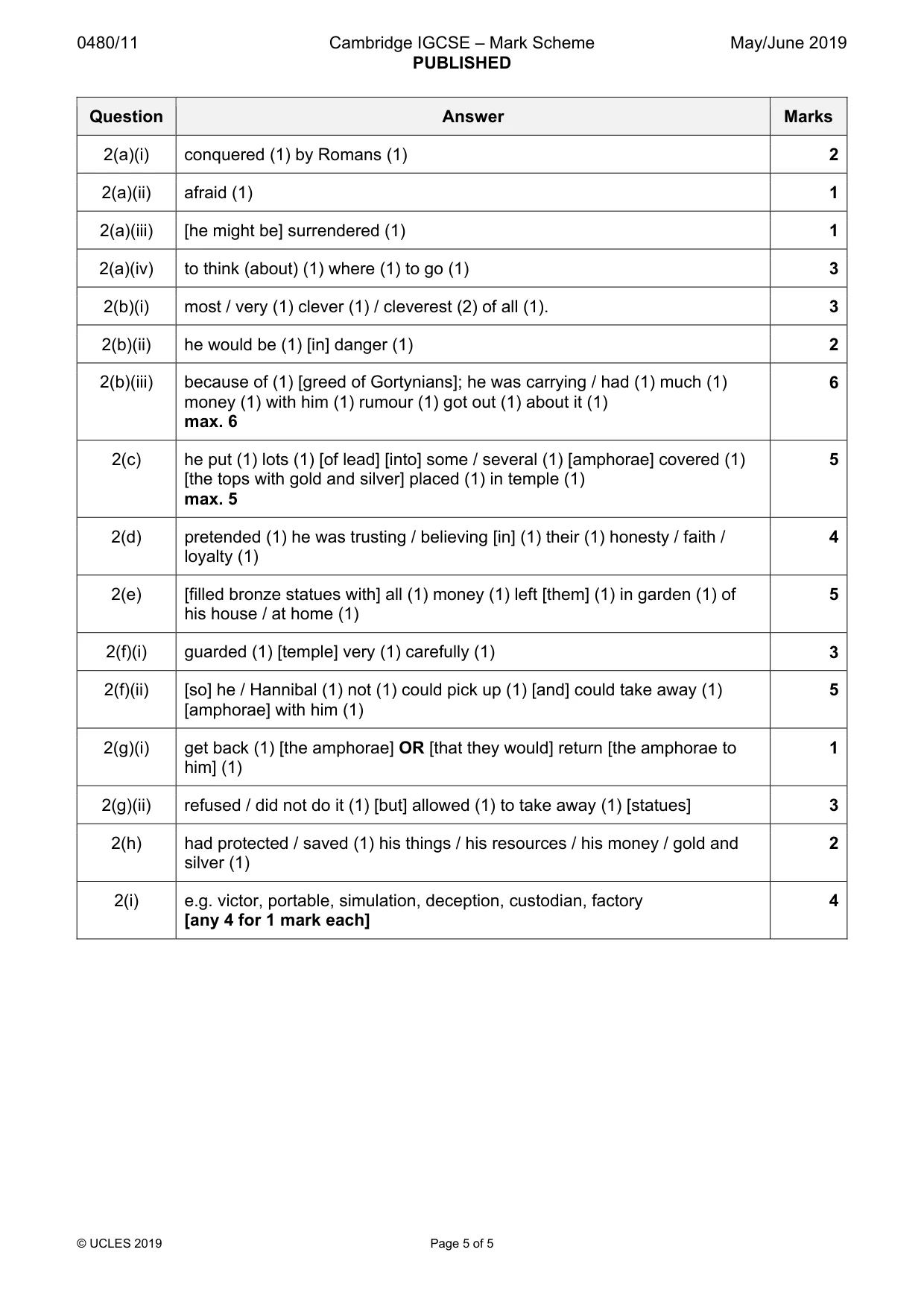
0480/11 Cambridge IGCSE – Mark Scheme PUBLISHED May/June 2019 © UCLES 2019 Page 5 of 5 Question Answer Marks 2(a)(i) conquered (1) by Romans (1) 2 2(a)(ii) afraid (1) 1 2(a)(iii) [he might be] surrendered (1) 1 2(a)(iv) to think (about) (1) where (1) to go (1) 3 2(b)(i) most / very (1) clever (1) / cleverest (2) of all (1). 3 2(b)(ii) he would be (1) [in] danger (1) 2 2(b)(iii) because of (1) [greed of Gortynians]; he was carrying / had (1) much (1) money (1) with him (1) rumour (1) got out (1) about it (1) max. 6 6 2(c) he put (1) lots (1) [of lead] [into] some / several (1) [amphorae] covered (1) [the tops with gold and silver] placed (1) in temple (1) max. 5 5 2(d) pretended (1) he was trusting / believing [in] (1) their (1) honesty / faith / loyalty (1) 4 2(e) [filled bronze statues with] all (1) money (1) left [them] (1) in garden (1) of his house / at home (1) 5 2(f)(i) guarded (1) [temple] very (1) carefully (1) 3 2(f)(ii) [so] he / Hannibal (1) not (1) could pick up (1) [and] could take away (1) [amphorae] with him (1) 5 2(g)(i) get back (1) [the amphorae] OR [that they would] return [the amphorae to him] (1) 1 2(g)(ii) refused / did not do it (1) [but] allowed (1) to take away (1) [statues] 3 2(h) had protected / saved (1) his things / his resources / his money / gold and silver (1) 2 2(i) e.g. victor, portable, simulation, deception, custodian, factory [any 4 for 1 mark each] 4
What you needed in this session
Cambridge’s own grade thresholds for 2019 May/June, Paper 1 · Variant 1. A higher threshold means an easier paper — the bar moves with how the cohort did.