Cambridge IGCSE Latin 0480 — 2017 May/June Paper 1 · Variant 1
0480/11/M/J/17 · 65 marks · ≈73 min
The question paper and its mark scheme, free to read here and free to download. This is Cambridge’s own paper, exactly as it was sat.
Question paper8 pages




Mark scheme3 pages
Answers below. Sit the paper first if you are practising.
Paper as text
Question paper, page 1
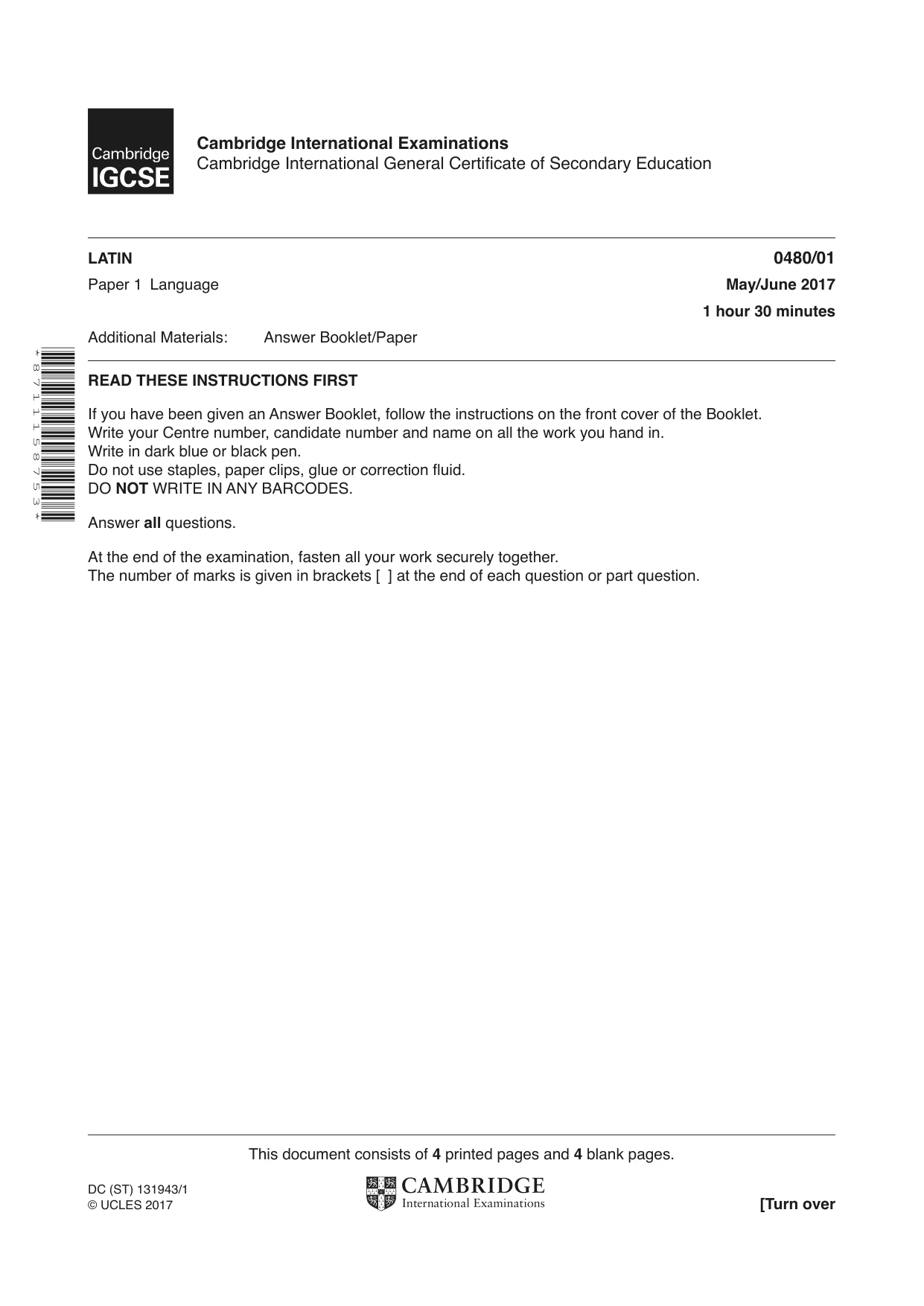
This document consists of 4 printed pages and 4 blank pages. DC (ST) 131943/1 © UCLES 2017 [Turn over Cambridge International Examinations Cambridge International General Certificate of Secondary Education * 8 7 1 1 1 5 8 7 5 3 * LATIN 0480/01 Paper 1 Language May/June 2017 1 hour 30 minutes Additional Materials: Answer Booklet/Paper READ THESE INSTRUCTIONS FIRST If you have been given an Answer Booklet, follow the instructions on the front cover of the Booklet. Write your Centre number, candidate number and name on all the work you hand in. Write in dark blue or black pen. Do not use staples, paper clips, glue or correction fluid. DO NOT WRITE IN ANY BARCODES. Answer all questions. At the end of the examination, fasten all your work securely together. The number of marks is given in brackets [ ] at the end of each question or part question.
Question paper, page 2
2 0480/01/M/J/17 © UCLES 2017 BLANK PAGE
Question paper, page 3
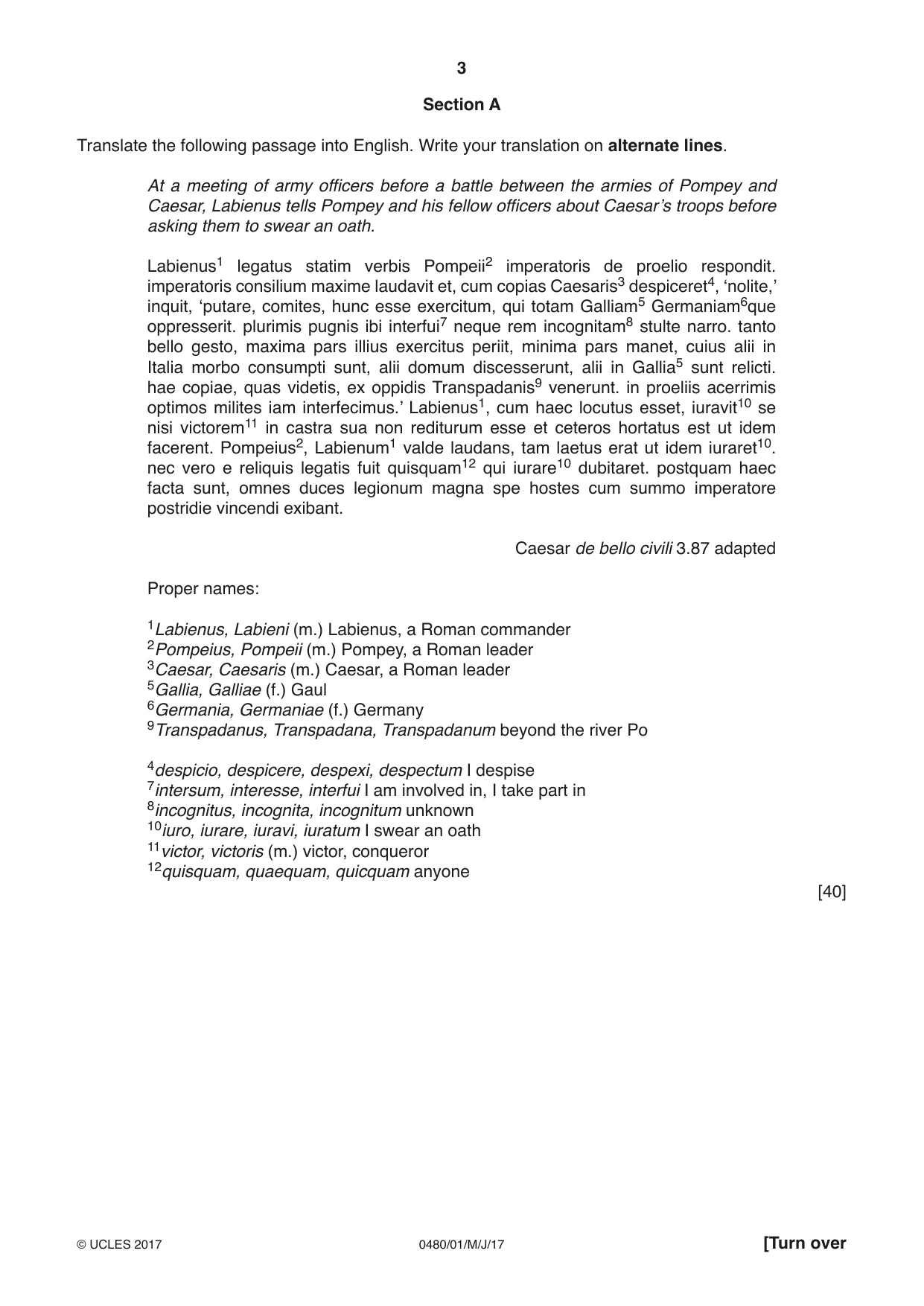
3 0480/01/M/J/17 © UCLES 2017 [Turn over Section A Translate the following passage into English. Write your translation on alternate lines. At a meeting of army officers before a battle between the armies of Pompey and Caesar, Labienus tells Pompey and his fellow officers about Caesar’s troops before asking them to swear an oath. Labienus1 legatus statim verbis Pompeii2 imperatoris de proelio respondit. imperatoris consilium maxime laudavit et, cum copias Caesaris3 despiceret4, ‘nolite,’ inquit, ‘putare, comites, hunc esse exercitum, qui totam Galliam5 Germaniam6que oppresserit. plurimis pugnis ibi interfui7 neque rem incognitam8 stulte narro. tanto bello gesto, maxima pars illius exercitus periit, minima pars manet, cuius alii in Italia morbo consumpti sunt, alii domum discesserunt, alii in Gallia5 sunt relicti. hae copiae, quas videtis, ex oppidis Transpadanis9 venerunt. in proeliis acerrimis optimos milites iam interfecimus.’ Labienus1, cum haec locutus esset, iuravit10 se nisi victorem11 in castra sua non rediturum esse et ceteros hortatus est ut idem facerent. Pompeius2, Labienum1 valde laudans, tam laetus erat ut idem iuraret10. nec vero e reliquis legatis fuit quisquam12 qui iurare10 dubitaret. postquam haec facta sunt, omnes duces legionum magna spe hostes cum summo imperatore postridie vincendi exibant. Caesar de bello civili 3.87 adapted Proper names: 1Labienus, Labieni (m.) Labienus, a Roman commander 2Pompeius, Pompeii (m.) Pompey, a Roman leader 3Caesar, Caesaris (m.) Caesar, a Roman leader 5Gallia, Galliae (f.) Gaul 6Germania, Germaniae (f.) Germany 9Transpadanus, Transpadana, Transpadanum beyond the river Po 4despicio, despicere, despexi, despectum I despise 7intersum, interesse, interfui I am involved in, I take part in 8incognitus, incognita, incognitum unknown 10iuro, iurare, iuravi, iuratum I swear an oath 11victor, victoris (m.) victor, conqueror 12quisquam, quaequam, quicquam anyone [40]
Question paper, page 4
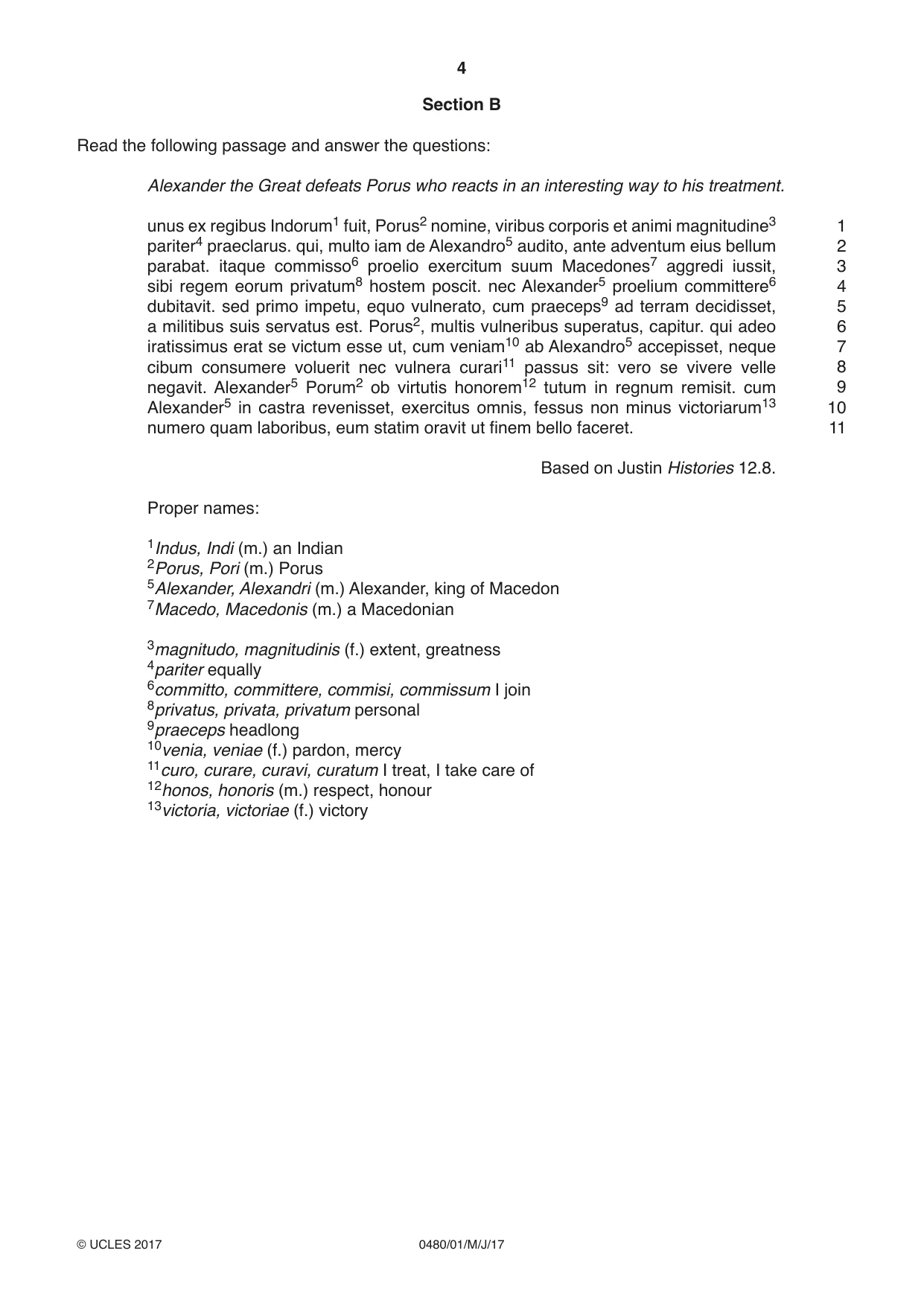
4 0480/01/M/J/17 © UCLES 2017 Section B Read the following passage and answer the questions: Alexander the Great defeats Porus who reacts in an interesting way to his treatment. unus ex regibus Indorum1 fuit, Porus2 nomine, viribus corporis et animi magnitudine3 pariter4 praeclarus. qui, multo iam de Alexandro5 audito, ante adventum eius bellum parabat. itaque commisso6 proelio exercitum suum Macedones7 aggredi iussit, sibi regem eorum privatum8 hostem poscit. nec Alexander5 proelium committere6 dubitavit. sed primo impetu, equo vulnerato, cum praeceps9 ad terram decidisset, a militibus suis servatus est. Porus2, multis vulneribus superatus, capitur. qui adeo iratissimus erat se victum esse ut, cum veniam10 ab Alexandro5 accepisset, neque cibum consumere voluerit nec vulnera curari11 passus sit: vero se vivere velle negavit. Alexander5 Porum2 ob virtutis honorem12 tutum in regnum remisit. cum Alexander5 in castra revenisset, exercitus omnis, fessus non minus victoriarum13 numero quam laboribus, eum statim oravit ut finem bello faceret. Based on Justin Histories 12.8. Proper names: 1Indus, Indi (m.) an Indian 2Porus, Pori (m.) Porus 5Alexander, Alexandri (m.) Alexander, king of Macedon 7Macedo, Macedonis (m.) a Macedonian 3magnitudo, magnitudinis (f.) extent, greatness 4pariter equally 6committo, committere, commisi, commissum I join 8privatus, privata, privatum personal 9praeceps headlong 10venia, veniae (f.) pardon, mercy 11curo, curare, curavi, curatum I treat, I take care of 12honos, honoris (m.) respect, honour 13victoria, victoriae (f.) victory 1 2 3 4 5 6 7 8 9 10 11
Question paper, page 5
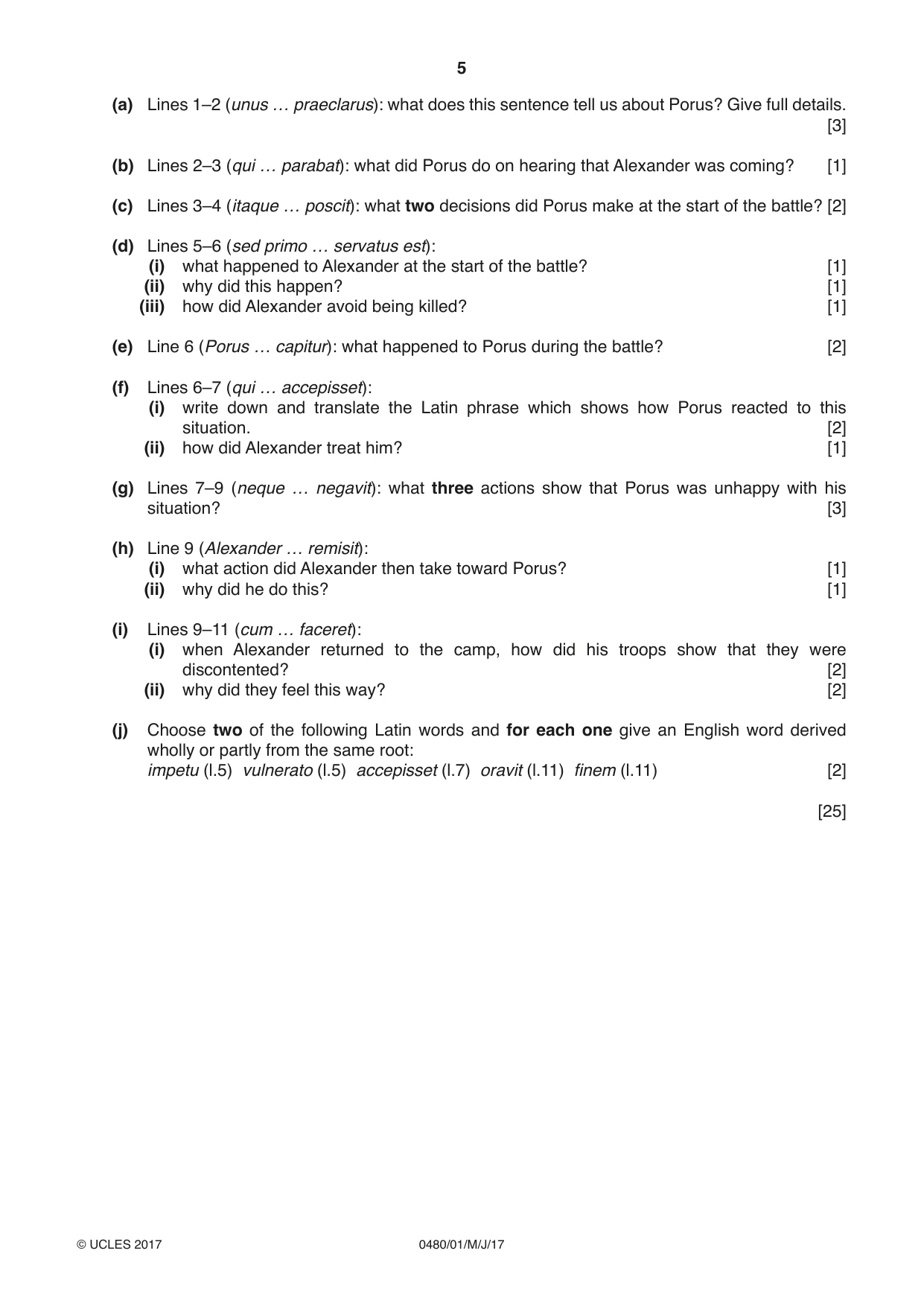
5 0480/01/M/J/17 © UCLES 2017 (a) Lines 1–2 (unus … praeclarus): what does this sentence tell us about Porus? Give full details. [3] (b) Lines 2–3 (qui … parabat): what did Porus do on hearing that Alexander was coming? [1] (c) Lines 3–4 (itaque … poscit): what two decisions did Porus make at the start of the battle? [2] (d) Lines 5–6 (sed primo … servatus est): (i) what happened to Alexander at the start of the battle? [1] (ii) why did this happen? [1] (iii) how did Alexander avoid being killed? [1] (e) Line 6 (Porus … capitur): what happened to Porus during the battle? [2] (f) Lines 6–7 (qui … accepisset): (i) write down and translate the Latin phrase which shows how Porus reacted to this situation. [2] (ii) how did Alexander treat him? [1] (g) Lines 7–9 (neque … negavit): what three actions show that Porus was unhappy with his situation? [3] (h) Line 9 (Alexander … remisit): (i) what action did Alexander then take toward Porus? [1] (ii) why did he do this? [1] (i) Lines 9–11 (cum … faceret): (i) when Alexander returned to the camp, how did his troops show that they were discontented? [2] (ii) why did they feel this way? [2] (j) Choose two of the following Latin words and for each one give an English word derived wholly or partly from the same root: impetu (l.5) vulnerato (l.5) accepisset (l.7) oravit (l.11) finem (l.11) [2] [25]
Question paper, page 6
6 0480/01/M/J/17 © UCLES 2017 BLANK PAGE
Question paper, page 7
7 0480/01/M/J/17 © UCLES 2017 BLANK PAGE
Question paper, page 8
8 0480/01/M/J/17 © UCLES 2017 Permission to reproduce items where third-party owned material protected by copyright is included has been sought and cleared where possible. Every reasonable effort has been made by the publisher (UCLES) to trace copyright holders, but if any items requiring clearance have unwittingly been included, the publisher will be pleased to make amends at the earliest possible opportunity. To avoid the issue of disclosure of answer-related information to candidates, all copyright acknowledgements are reproduced online in the Cambridge International Examinations Copyright Acknowledgements Booklet. This is produced for each series of examinations and is freely available to download at www.cie.org.uk after the live examination series. Cambridge International Examinations is part of the Cambridge Assessment Group. Cambridge Assessment is the brand name of University of Cambridge Local Examinations Syndicate (UCLES), which is itself a department of the University of Cambridge. BLANK PAGE
Mark scheme, page 1
® IGCSE is a registered trademark. This document consists of 3 printed pages. © UCLES 2017 [Turn over Cambridge International Examinations Cambridge International General Certificate of Secondary Education LATIN 0480/01 Paper 1 Language May/June 2017 MARK SCHEME Maximum Mark: 65 Published This mark scheme is published as an aid to teachers and candidates, to indicate the requirements of the examination. It shows the basis on which Examiners were instructed to award marks. It does not indicate the details of the discussions that took place at an Examiners’ meeting before marking began, which would have considered the acceptability of alternative answers. Mark schemes should be read in conjunction with the question paper and the Principal Examiner Report for Teachers. Cambridge will not enter into discussions about these mark schemes. Cambridge is publishing the mark schemes for the May/June 2017 series for most Cambridge IGCSE®, Cambridge International A and AS Level and Cambridge Pre-U components, and some Cambridge O Level components.
Mark scheme, page 2
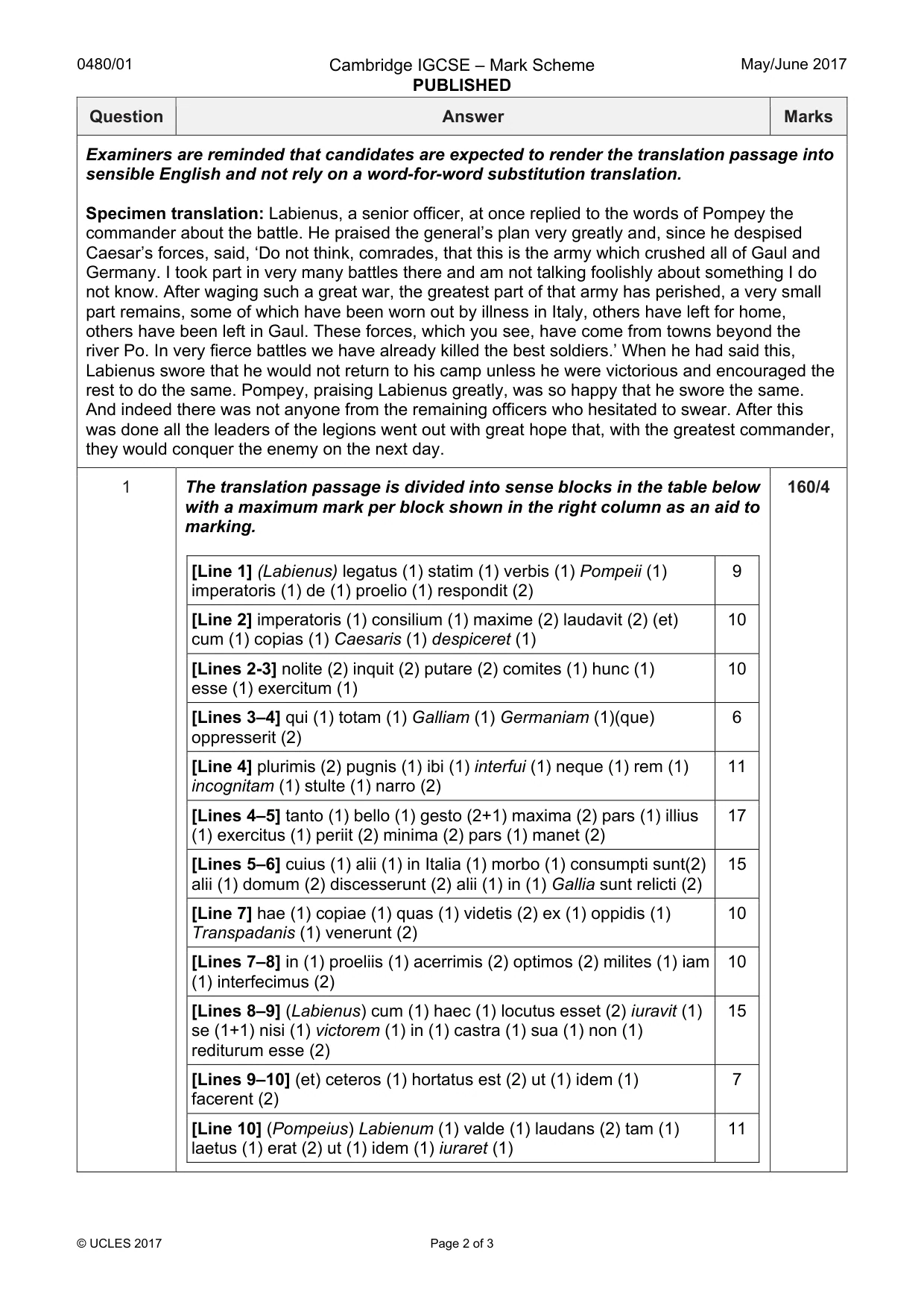
0480/01 Cambridge IGCSE – Mark Scheme PUBLISHED May/June 2017 © UCLES 2017 Page 2 of 3 Question Answer Marks Examiners are reminded that candidates are expected to render the translation passage into sensible English and not rely on a word-for-word substitution translation. Specimen translation: Labienus, a senior officer, at once replied to the words of Pompey the commander about the battle. He praised the general’s plan very greatly and, since he despised Caesar’s forces, said, ‘Do not think, comrades, that this is the army which crushed all of Gaul and Germany. I took part in very many battles there and am not talking foolishly about something I do not know. After waging such a great war, the greatest part of that army has perished, a very small part remains, some of which have been worn out by illness in Italy, others have left for home, others have been left in Gaul. These forces, which you see, have come from towns beyond the river Po. In very fierce battles we have already killed the best soldiers.’ When he had said this, Labienus swore that he would not return to his camp unless he were victorious and encouraged the rest to do the same. Pompey, praising Labienus greatly, was so happy that he swore the same. And indeed there was not anyone from the remaining officers who hesitated to swear. After this was done all the leaders of the legions went out with great hope that, with the greatest commander, they would conquer the enemy on the next day. 1 The translation passage is divided into sense blocks in the table below with a maximum mark per block shown in the right column as an aid to marking. [Line 1] (Labienus) legatus (1) statim (1) verbis (1) Pompeii (1) imperatoris (1) de (1) proelio (1) respondit (2) 9 [Line 2] imperatoris (1) consilium (1) maxime (2) laudavit (2) (et) cum (1) copias (1) Caesaris (1) despiceret (1) 10 [Lines 2-3] nolite (2) inquit (2) putare (2) comites (1) hunc (1) esse (1) exercitum (1) 10 [Lines 3–4] qui (1) totam (1) Galliam (1) Germaniam (1)(que) oppresserit (2) 6 [Line 4] plurimis (2) pugnis (1) ibi (1) interfui (1) neque (1) rem (1) incognitam (1) stulte (1) narro (2) 11 [Lines 4–5] tanto (1) bello (1) gesto (2+1) maxima (2) pars (1) illius (1) exercitus (1) periit (2) minima (2) pars (1) manet (2) 17 [Lines 5–6] cuius (1) alii (1) in Italia (1) morbo (1) consumpti sunt(2) alii (1) domum (2) discesserunt (2) alii (1) in (1) Gallia sunt relicti (2) 15 [Line 7] hae (1) copiae (1) quas (1) videtis (2) ex (1) oppidis (1) Transpadanis (1) venerunt (2) 10 [Lines 7–8] in (1) proeliis (1) acerrimis (2) optimos (2) milites (1) iam (1) interfecimus (2) 10 [Lines 8–9] (Labienus) cum (1) haec (1) locutus esset (2) iuravit (1) se (1+1) nisi (1) victorem (1) in (1) castra (1) sua (1) non (1) rediturum esse (2) 15 [Lines 9–10] (et) ceteros (1) hortatus est (2) ut (1) idem (1) facerent (2) 7 [Line 10] (Pompeius) Labienum (1) valde (1) laudans (2) tam (1) laetus (1) erat (2) ut (1) idem (1) iuraret (1) 11 160/4
Mark scheme, page 3
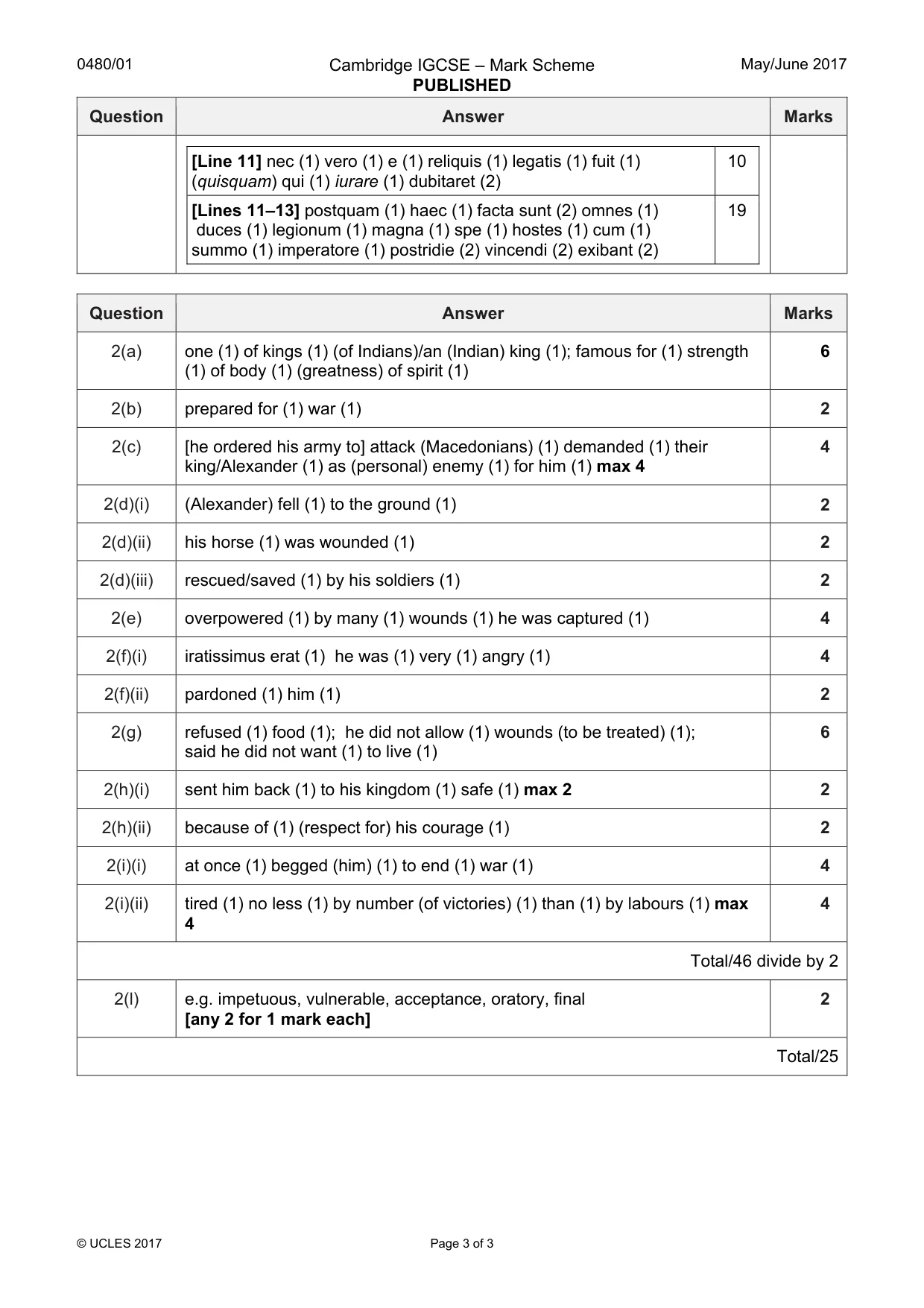
0480/01 Cambridge IGCSE – Mark Scheme PUBLISHED May/June 2017 © UCLES 2017 Page 3 of 3 Question Answer Marks [Line 11] nec (1) vero (1) e (1) reliquis (1) legatis (1) fuit (1) (quisquam) qui (1) iurare (1) dubitaret (2) 10 [Lines 11–13] postquam (1) haec (1) facta sunt (2) omnes (1) duces (1) legionum (1) magna (1) spe (1) hostes (1) cum (1) summo (1) imperatore (1) postridie (2) vincendi (2) exibant (2) 19 Question Answer Marks 2(a) one (1) of kings (1) (of Indians)/an (Indian) king (1); famous for (1) strength (1) of body (1) (greatness) of spirit (1) 6 2(b) prepared for (1) war (1) 2 2(c) [he ordered his army to] attack (Macedonians) (1) demanded (1) their king/Alexander (1) as (personal) enemy (1) for him (1) max 4 4 2(d)(i) (Alexander) fell (1) to the ground (1) 2 2(d)(ii) his horse (1) was wounded (1) 2 2(d)(iii) rescued/saved (1) by his soldiers (1) 2 2(e) overpowered (1) by many (1) wounds (1) he was captured (1) 4 2(f)(i) iratissimus erat (1) he was (1) very (1) angry (1) 4 2(f)(ii) pardoned (1) him (1) 2 2(g) refused (1) food (1); he did not allow (1) wounds (to be treated) (1); said he did not want (1) to live (1) 6 2(h)(i) sent him back (1) to his kingdom (1) safe (1) max 2 2 2(h)(ii) because of (1) (respect for) his courage (1) 2 2(i)(i) at once (1) begged (him) (1) to end (1) war (1) 4 2(i)(ii) tired (1) no less (1) by number (of victories) (1) than (1) by labours (1) max 4 4 Total/46 divide by 2 2(l) e.g. impetuous, vulnerable, acceptance, oratory, final [any 2 for 1 mark each] 2 Total/25
What you needed in this session
Cambridge’s own grade thresholds for 2017 May/June, Paper 1 · Variant 1. A higher threshold means an easier paper — the bar moves with how the cohort did.