Cambridge IGCSE Latin 0480 — 2018 May/June Paper 1 · Variant 1
0480/11/M/J/18 · 160 marks · ≈180 min
The question paper and its mark scheme, free to read here and free to download. This is Cambridge’s own paper, exactly as it was sat.
Question paper8 pages



Mark scheme5 pages
Answers below. Sit the paper first if you are practising.
Paper as text
Question paper, page 1
* 7 0 8 4 1 7 9 5 4 7 * This document consists of 5 printed pages and 3 blank pages. DC (KS) 161840 © UCLES 2018 [Turn over Cambridge International Examinations Cambridge International General Certificate of Secondary Education LATIN 0480/11 Paper 1 Language May/June 2018 1 hour 30 minutes Additional Materials: Answer Booklet/Paper. READ THESE INSTRUCTIONS FIRST If you have been given an Answer Booklet, follow the instructions on the front cover of the Booklet. Write your Centre number, candidate number and name on all the work you hand in. Write in dark blue or black pen. Do not use staples, paper clips, glue or correction fluid. DO NOT WRITE IN ANY BARCODES. Answer all questions. At the end of the examination, fasten all your work securely together. The number of marks is given in brackets [ ] at the end of each question or part question. The total number of marks for this paper is 160.
Question paper, page 2
2 0480/11/M/J/18 © UCLES 2018 BLANK PAGE
Question paper, page 3
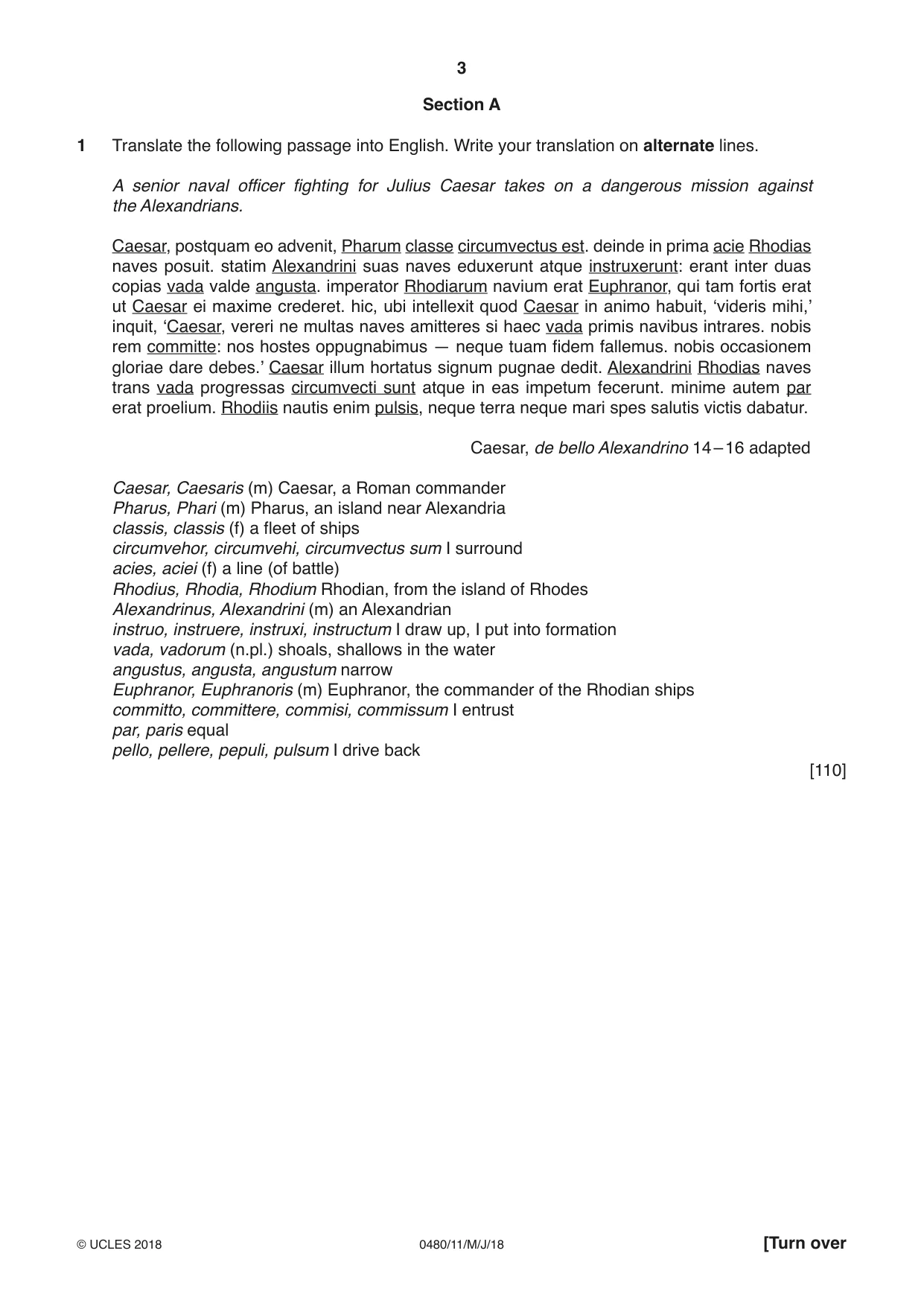
3 0480/11/M/J/18 © UCLES 2018 [Turn over Section A 1 Translate the following passage into English. Write your translation on alternate lines. A senior naval officer fighting for Julius Caesar takes on a dangerous mission against the Alexandrians. Caesar, postquam eo advenit, Pharum classe circumvectus est. deinde in prima acie Rhodias naves posuit. statim Alexandrini suas naves eduxerunt atque instruxerunt: erant inter duas copias vada valde angusta. imperator Rhodiarum navium erat Euphranor, qui tam fortis erat ut Caesar ei maxime crederet. hic, ubi intellexit quod Caesar in animo habuit, ‘videris mihi,’ inquit, ‘Caesar, vereri ne multas naves amitteres si haec vada primis navibus intrares. nobis rem committe: nos hostes oppugnabimus — neque tuam fidem fallemus. nobis occasionem gloriae dare debes.’ Caesar illum hortatus signum pugnae dedit. Alexandrini Rhodias naves trans vada progressas circumvecti sunt atque in eas impetum fecerunt. minime autem par erat proelium. Rhodiis nautis enim pulsis, neque terra neque mari spes salutis victis dabatur. Caesar, de bello Alexandrino 14 – 16 adapted Caesar, Caesaris (m) Caesar, a Roman commander Pharus, Phari (m) Pharus, an island near Alexandria classis, classis (f) a fleet of ships circumvehor, circumvehi, circumvectus sum I surround acies, aciei (f) a line (of battle) Rhodius, Rhodia, Rhodium Rhodian, from the island of Rhodes Alexandrinus, Alexandrini (m) an Alexandrian instruo, instruere, instruxi, instructum I draw up, I put into formation vada, vadorum (n.pl.) shoals, shallows in the water angustus, angusta, angustum narrow Euphranor, Euphranoris (m) Euphranor, the commander of the Rhodian ships committo, committere, commisi, commissum I entrust par, paris equal pello, pellere, pepuli, pulsum I drive back [110]
Question paper, page 4
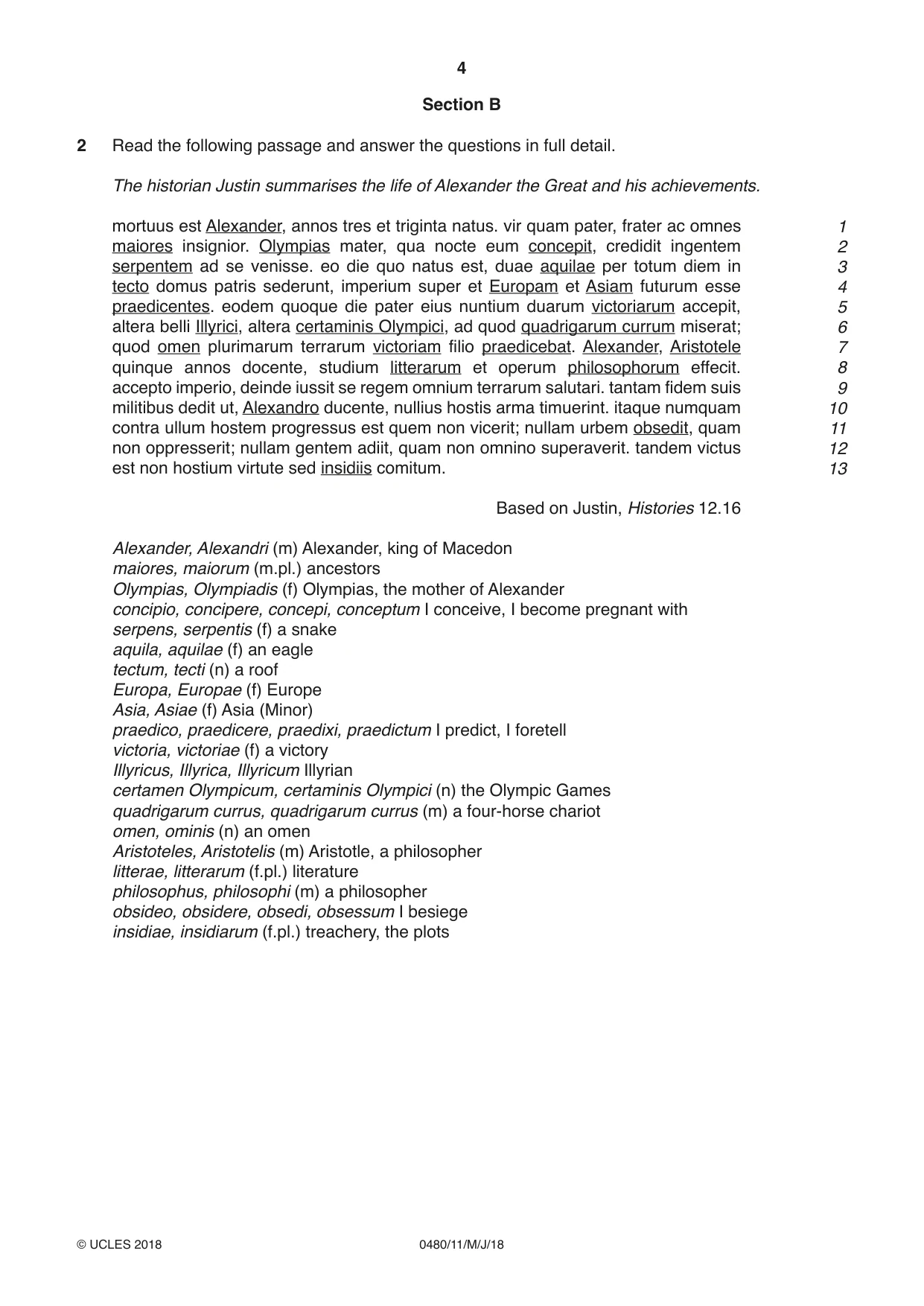
4 0480/11/M/J/18 © UCLES 2018 Section B 2 Read the following passage and answer the questions in full detail. The historian Justin summarises the life of Alexander the Great and his achievements. mortuus est Alexander, annos tres et triginta natus. vir quam pater, frater ac omnes maiores insignior. Olympias mater, qua nocte eum concepit, credidit ingentem serpentem ad se venisse. eo die quo natus est, duae aquilae per totum diem in tecto domus patris sederunt, imperium super et Europam et Asiam futurum esse praedicentes. eodem quoque die pater eius nuntium duarum victoriarum accepit, altera belli Illyrici, altera certaminis Olympici, ad quod quadrigarum currum miserat; quod omen plurimarum terrarum victoriam filio praedicebat. Alexander, Aristotele quinque annos docente, studium litterarum et operum philosophorum effecit. accepto imperio, deinde iussit se regem omnium terrarum salutari. tantam fidem suis militibus dedit ut, Alexandro ducente, nullius hostis arma timuerint. itaque numquam contra ullum hostem progressus est quem non vicerit; nullam urbem obsedit, quam non oppresserit; nullam gentem adiit, quam non omnino superaverit. tandem victus est non hostium virtute sed insidiis comitum. Based on Justin, Histories 12.16 Alexander, Alexandri (m) Alexander, king of Macedon maiores, maiorum (m.pl.) ancestors Olympias, Olympiadis (f) Olympias, the mother of Alexander concipio, concipere, concepi, conceptum I conceive, I become pregnant with serpens, serpentis (f) a snake aquila, aquilae (f) an eagle tectum, tecti (n) a roof Europa, Europae (f) Europe Asia, Asiae (f) Asia (Minor) praedico, praedicere, praedixi, praedictum I predict, I foretell victoria, victoriae (f) a victory Illyricus, Illyrica, Illyricum Illyrian certamen Olympicum, certaminis Olympici (n) the Olympic Games quadrigarum currus, quadrigarum currus (m) a four-horse chariot omen, ominis (n) an omen Aristoteles, Aristotelis (m) Aristotle, a philosopher litterae, litterarum (f.pl.) literature philosophus, philosophi (m) a philosopher obsideo, obsidere, obsedi, obsessum I besiege insidiae, insidiarum (f.pl.) treachery, the plots 1 2 3 4 5 6 7 8 9 10 11 12 13
Question paper, page 5
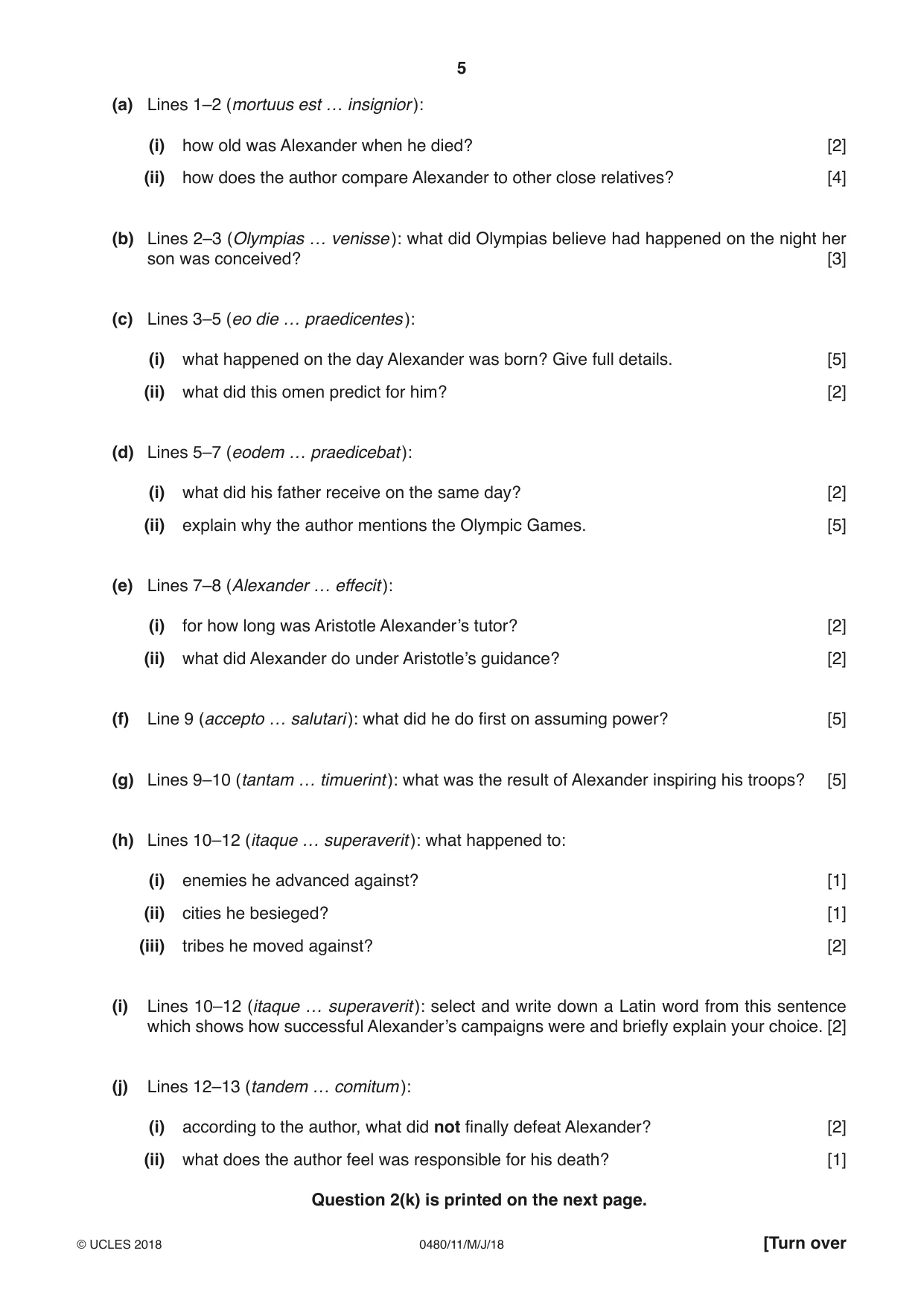
5 0480/11/M/J/18 © UCLES 2018 [Turn over (a) Lines 1–2 (mortuus est … insignior ): (i) how old was Alexander when he died? [2] (ii) how does the author compare Alexander to other close relatives? [4] (b) Lines 2–3 (Olympias … venisse ): what did Olympias believe had happened on the night her son was conceived? [3] (c) Lines 3–5 (eo die … praedicentes ): (i) what happened on the day Alexander was born? Give full details. [5] (ii) what did this omen predict for him? [2] (d) Lines 5–7 (eodem … praedicebat ): (i) what did his father receive on the same day? [2] (ii) explain why the author mentions the Olympic Games. [5] (e) Lines 7–8 (Alexander … effecit ): (i) for how long was Aristotle Alexander’s tutor? [2] (ii) what did Alexander do under Aristotle’s guidance? [2] (f) Line 9 (accepto … salutari ): what did he do first on assuming power? [5] (g) Lines 9–10 (tantam … timuerint ): what was the result of Alexander inspiring his troops? [5] (h) Lines 10–12 (itaque … superaverit ): what happened to: (i) enemies he advanced against? [1] (ii) cities he besieged? [1] (iii) tribes he moved against? [2] (i) Lines 10–12 (itaque … superaverit ): select and write down a Latin word from this sentence which shows how successful Alexander’s campaigns were and briefly explain your choice. [2] (j) Lines 12–13 (tandem … comitum ): (i) according to the author, what did not finally defeat Alexander? [2] (ii) what does the author feel was responsible for his death? [1] Question 2(k) is printed on the next page.
Question paper, page 6
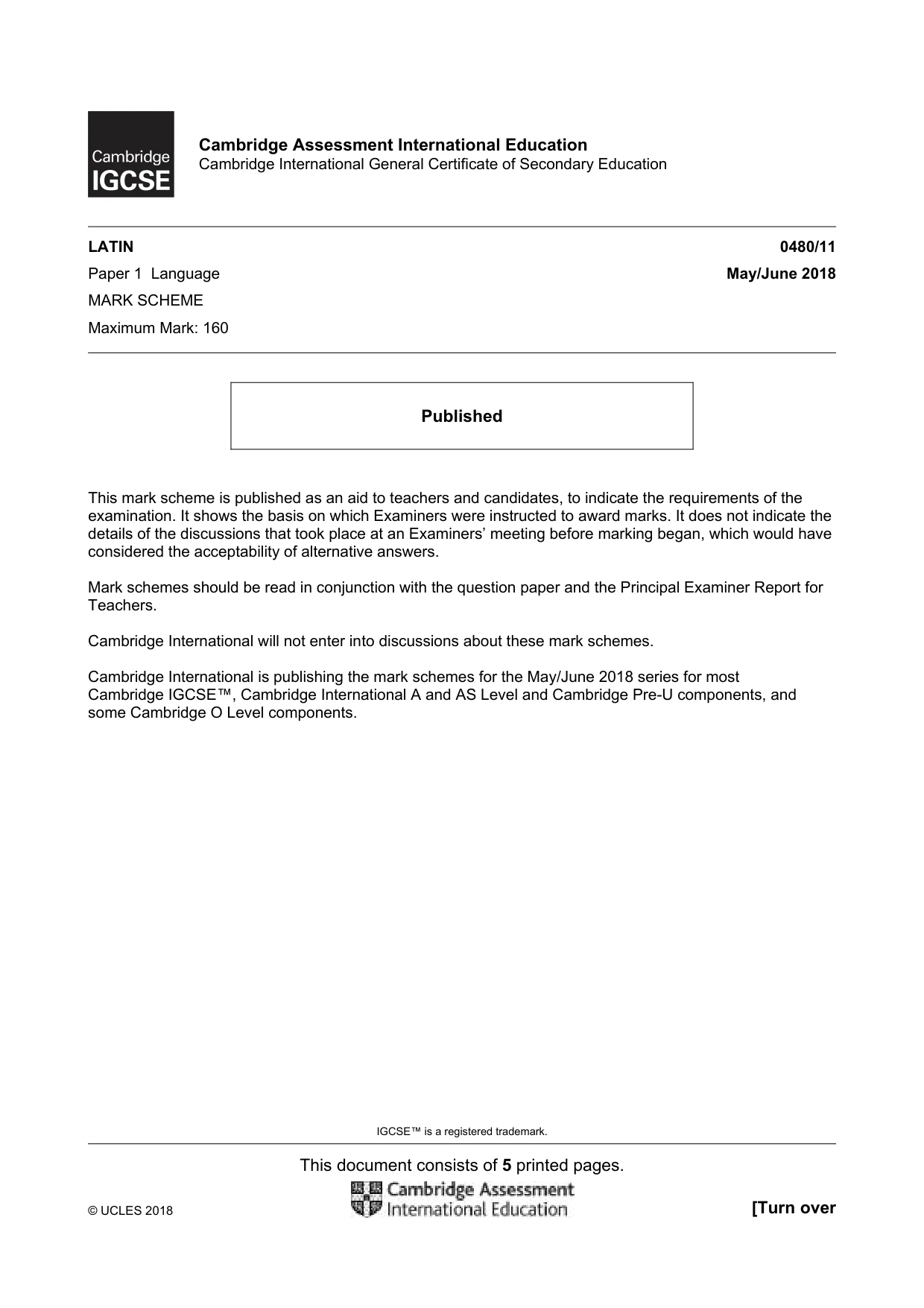
6 0480/11/M/J/18 © UCLES 2018 (k) Choose four of the following Latin words and for each one give an English word derived wholly or partly from the same root: mortuus (line 1) credidit (line 2) sederunt (line 4) accepit (line 5) imperio (line 9) oppresserit (line 12) [4]
Question paper, page 7
7 0480/11/M/J/18 © UCLES 2018 BLANK PAGE
Question paper, page 8
8 0480/11/M/J/18 © UCLES 2018 BLANK PAGE Permission to reproduce items where third-party owned material protected by copyright is included has been sought and cleared where possible. Every reasonable effort has been made by the publisher (UCLES) to trace copyright holders, but if any items requiring clearance have unwittingly been included, the publisher will be pleased to make amends at the earliest possible opportunity. To avoid the issue of disclosure of answer-related information to candidates, all copyright acknowledgements are reproduced online in the Cambridge International Examinations Copyright Acknowledgements Booklet. This is produced for each series of examinations and is freely available to download at www.cie.org.uk after the live examination series. Cambridge International Examinations is part of the Cambridge Assessment Group. Cambridge Assessment is the brand name of University of Cambridge Local Examinations Syndicate (UCLES), which is itself a department of the University of Cambridge.
Mark scheme, page 1
IGCSE™ is a registered trademark. This document consists of 5 printed pages. © UCLES 2018 [Turn over Cambridge Assessment International Education Cambridge International General Certificate of Secondary Education LATIN 0480/11 Paper 1 Language May/June 2018 MARK SCHEME Maximum Mark: 160 Published This mark scheme is published as an aid to teachers and candidates, to indicate the requirements of the examination. It shows the basis on which Examiners were instructed to award marks. It does not indicate the details of the discussions that took place at an Examiners’ meeting before marking began, which would have considered the acceptability of alternative answers. Mark schemes should be read in conjunction with the question paper and the Principal Examiner Report for Teachers. Cambridge International will not enter into discussions about these mark schemes. Cambridge International is publishing the mark schemes for the May/June 2018 series for most Cambridge IGCSE™, Cambridge International A and AS Level and Cambridge Pre-U components, and some Cambridge O Level components.
Mark scheme, page 2
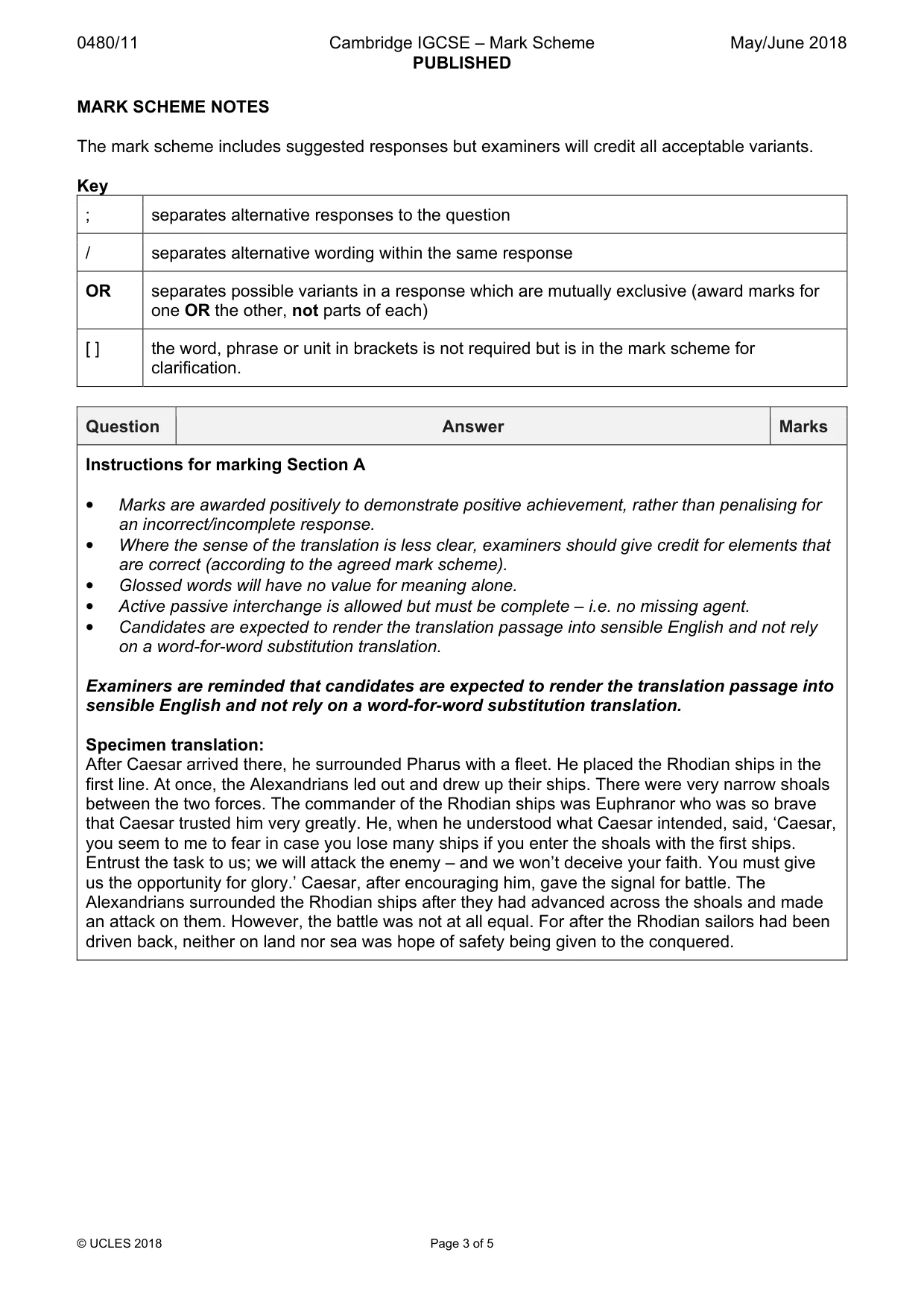
0480/11 Cambridge IGCSE – Mark Scheme PUBLISHED May/June 2018 © UCLES 2018 Page 2 of 5 Generic Marking Principles These generic marking principles must be applied by all examiners when marking candidate answers. They should be applied alongside the specific content of the mark scheme or generic level descriptors for a question. Each question paper and mark scheme will also comply with these marking principles. GENERIC MARKING PRINCIPLE 1: Marks must be awarded in line with: • the specific content of the mark scheme or the generic level descriptors for the question • the specific skills defined in the mark scheme or in the generic level descriptors for the question • the standard of response required by a candidate as exemplified by the standardisation scripts. GENERIC MARKING PRINCIPLE 2: Marks awarded are always whole marks (not half marks, or other fractions). GENERIC MARKING PRINCIPLE 3: Marks must be awarded positively: • marks are awarded for correct/valid answers, as defined in the mark scheme. However, credit is given for valid answers which go beyond the scope of the syllabus and mark scheme, referring to your Team Leader as appropriate • marks are awarded when candidates clearly demonstrate what they know and can do • marks are not deducted for errors • marks are not deducted for omissions • answers should only be judged on the quality of spelling, punctuation and grammar when these features are specifically assessed by the question as indicated by the mark scheme. The meaning, however, should be unambiguous. GENERIC MARKING PRINCIPLE 4: Rules must be applied consistently, e.g. in situations where candidates have not followed instructions or in the application of generic level descriptors. GENERIC MARKING PRINCIPLE 5: Marks should be awarded using the full range of marks defined in the mark scheme for the question (however; the use of the full mark range may be limited according to the quality of the candidate responses seen). GENERIC MARKING PRINCIPLE 6: Marks awarded are based solely on the requirements as defined in the mark scheme. Marks should not be awarded with grade thresholds or grade descriptors in mind.
Mark scheme, page 3
0480/11 Cambridge IGCSE – Mark Scheme PUBLISHED May/June 2018 © UCLES 2018 Page 3 of 5 MARK SCHEME NOTES The mark scheme includes suggested responses but examiners will credit all acceptable variants. Key ; separates alternative responses to the question / separates alternative wording within the same response OR separates possible variants in a response which are mutually exclusive (award marks for one OR the other, not parts of each) [ ] the word, phrase or unit in brackets is not required but is in the mark scheme for clarification. Question Answer Marks Instructions for marking Section A • Marks are awarded positively to demonstrate positive achievement, rather than penalising for an incorrect/incomplete response. • Where the sense of the translation is less clear, examiners should give credit for elements that are correct (according to the agreed mark scheme). • Glossed words will have no value for meaning alone. • Active passive interchange is allowed but must be complete – i.e. no missing agent. • Candidates are expected to render the translation passage into sensible English and not rely on a word-for-word substitution translation. Examiners are reminded that candidates are expected to render the translation passage into sensible English and not rely on a word-for-word substitution translation. Specimen translation: After Caesar arrived there, he surrounded Pharus with a fleet. He placed the Rhodian ships in the first line. At once, the Alexandrians led out and drew up their ships. There were very narrow shoals between the two forces. The commander of the Rhodian ships was Euphranor who was so brave that Caesar trusted him very greatly. He, when he understood what Caesar intended, said, ‘Caesar, you seem to me to fear in case you lose many ships if you enter the shoals with the first ships. Entrust the task to us; we will attack the enemy – and we won’t deceive your faith. You must give us the opportunity for glory.’ Caesar, after encouraging him, gave the signal for battle. The Alexandrians surrounded the Rhodian ships after they had advanced across the shoals and made an attack on them. However, the battle was not at all equal. For after the Rhodian sailors had been driven back, neither on land nor sea was hope of safety being given to the conquered.
Mark scheme, page 4
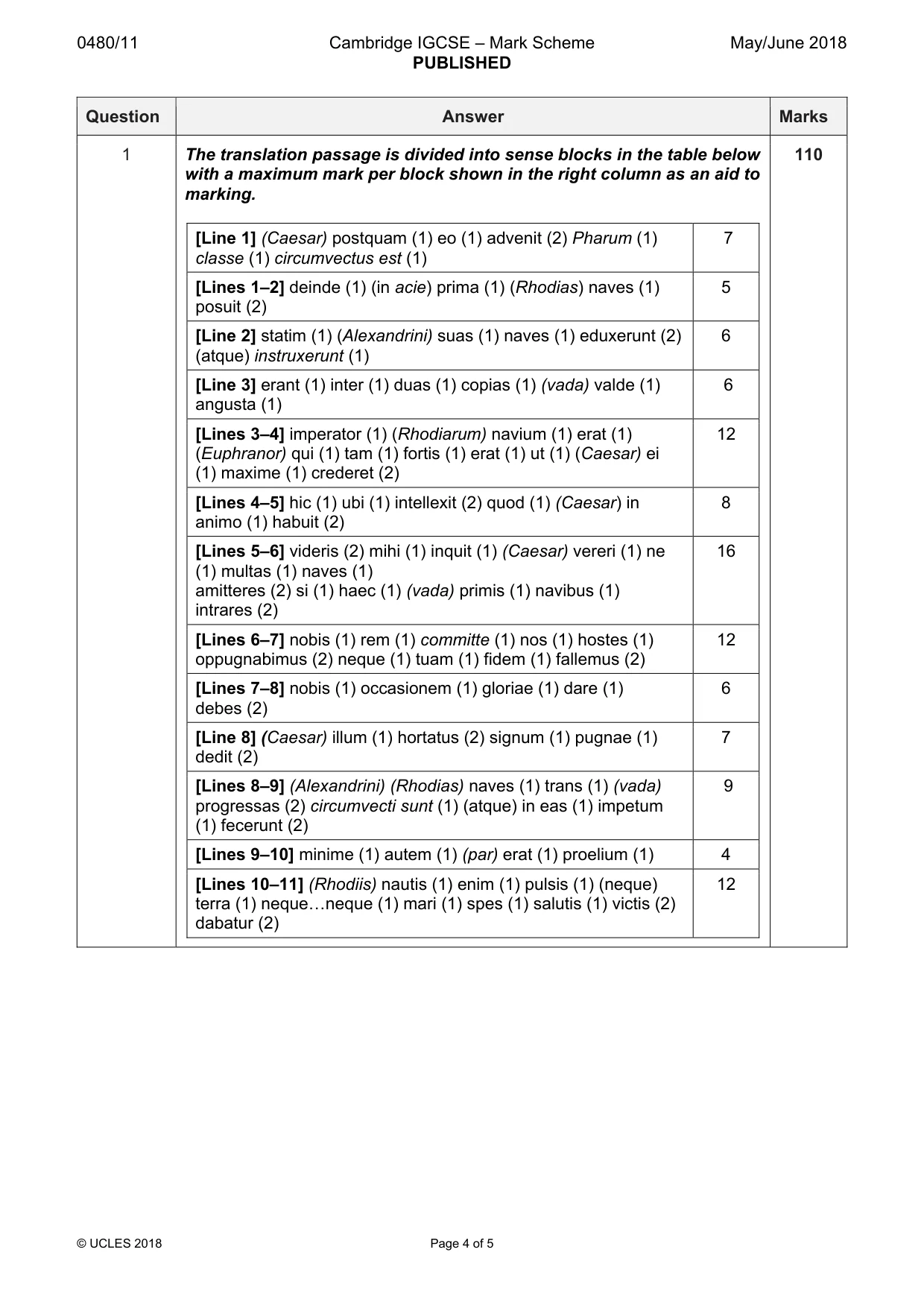
0480/11 Cambridge IGCSE – Mark Scheme PUBLISHED May/June 2018 © UCLES 2018 Page 4 of 5 Question Answer Marks 1 The translation passage is divided into sense blocks in the table below with a maximum mark per block shown in the right column as an aid to marking. [Line 1] (Caesar) postquam (1) eo (1) advenit (2) Pharum (1) classe (1) circumvectus est (1) 7 [Lines 1–2] deinde (1) (in acie) prima (1) (Rhodias) naves (1) posuit (2) 5 [Line 2] statim (1) (Alexandrini) suas (1) naves (1) eduxerunt (2) (atque) instruxerunt (1) 6 [Line 3] erant (1) inter (1) duas (1) copias (1) (vada) valde (1) angusta (1) 6 [Lines 3–4] imperator (1) (Rhodiarum) navium (1) erat (1) (Euphranor) qui (1) tam (1) fortis (1) erat (1) ut (1) (Caesar) ei (1) maxime (1) crederet (2) 12 [Lines 4–5] hic (1) ubi (1) intellexit (2) quod (1) (Caesar) in animo (1) habuit (2) 8 [Lines 5–6] videris (2) mihi (1) inquit (1) (Caesar) vereri (1) ne (1) multas (1) naves (1) amitteres (2) si (1) haec (1) (vada) primis (1) navibus (1) intrares (2) 16 [Lines 6–7] nobis (1) rem (1) committe (1) nos (1) hostes (1) oppugnabimus (2) neque (1) tuam (1) fidem (1) fallemus (2) 12 [Lines 7–8] nobis (1) occasionem (1) gloriae (1) dare (1) debes (2) 6 [Line 8] (Caesar) illum (1) hortatus (2) signum (1) pugnae (1) dedit (2) 7 [Lines 8–9] (Alexandrini) (Rhodias) naves (1) trans (1) (vada) progressas (2) circumvecti sunt (1) (atque) in eas (1) impetum (1) fecerunt (2) 9 [Lines 9–10] minime (1) autem (1) (par) erat (1) proelium (1) 4 [Lines 10–11] (Rhodiis) nautis (1) enim (1) pulsis (1) (neque) terra (1) neque«neque (1) mari (1) spes (1) salutis (1) victis (2) dabatur (2) 12 110
Mark scheme, page 5
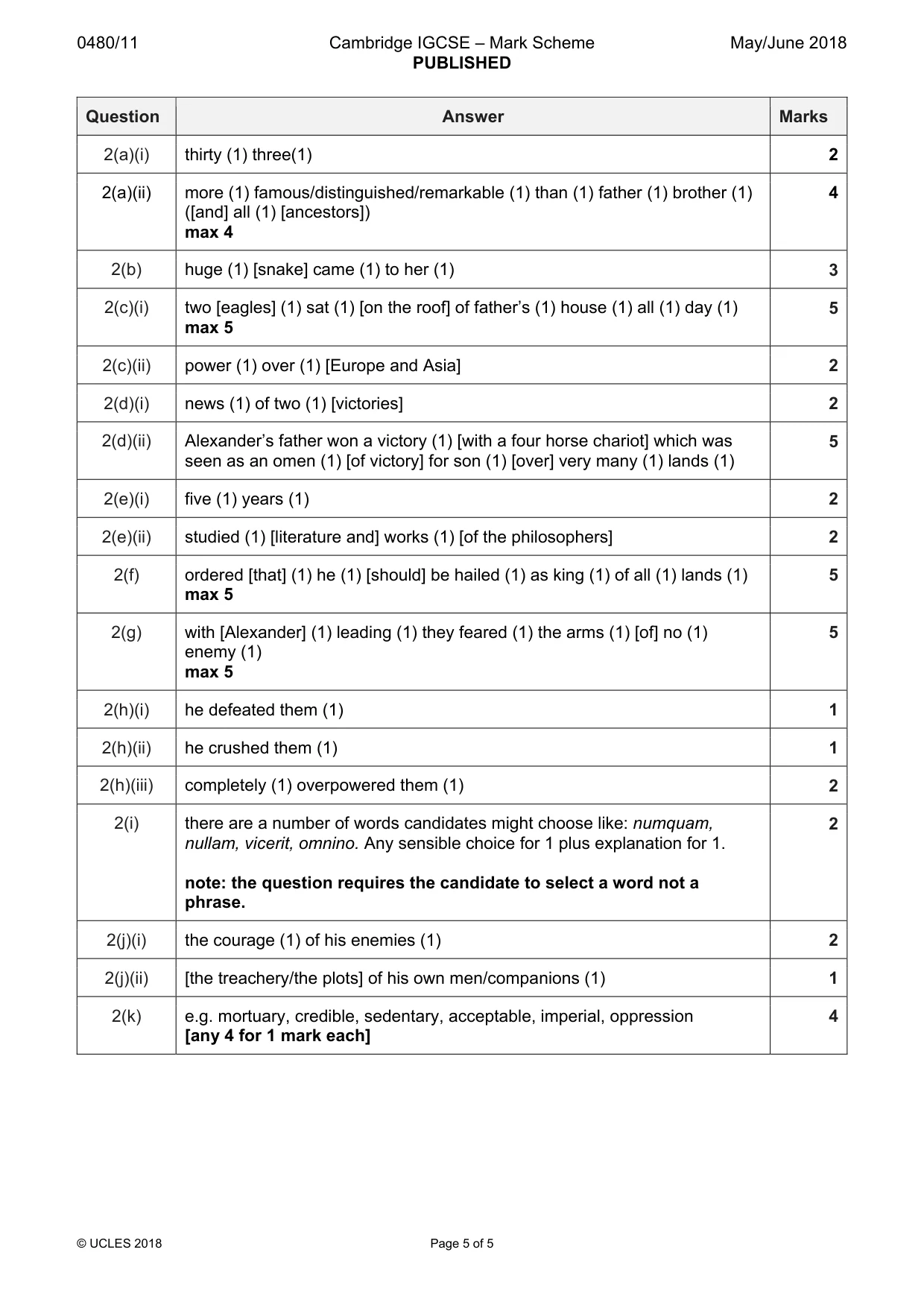
0480/11 Cambridge IGCSE – Mark Scheme PUBLISHED May/June 2018 © UCLES 2018 Page 5 of 5 Question Answer Marks 2(a)(i) thirty (1) three(1) 2 2(a)(ii) more (1) famous/distinguished/remarkable (1) than (1) father (1) brother (1) ([and] all (1) [ancestors]) max 4 4 2(b) huge (1) [snake] came (1) to her (1) 3 2(c)(i) two [eagles] (1) sat (1) [on the roof] of father’s (1) house (1) all (1) day (1) max 5 5 2(c)(ii) power (1) over (1) [Europe and Asia] 2 2(d)(i) news (1) of two (1) [victories] 2 2(d)(ii) Alexander’s father won a victory (1) [with a four horse chariot] which was seen as an omen (1) [of victory] for son (1) [over] very many (1) lands (1) 5 2(e)(i) five (1) years (1) 2 2(e)(ii) studied (1) [literature and] works (1) [of the philosophers] 2 2(f) ordered [that] (1) he (1) [should] be hailed (1) as king (1) of all (1) lands (1) max 5 5 2(g) with [Alexander] (1) leading (1) they feared (1) the arms (1) [of] no (1) enemy (1) max 5 5 2(h)(i) he defeated them (1) 1 2(h)(ii) he crushed them (1) 1 2(h)(iii) completely (1) overpowered them (1) 2 2(i) there are a number of words candidates might choose like: numquam, nullam, vicerit, omnino. Any sensible choice for 1 plus explanation for 1. note: the question requires the candidate to select a word not a phrase. 2 2(j)(i) the courage (1) of his enemies (1) 2 2(j)(ii) [the treachery/the plots] of his own men/companions (1) 1 2(k) e.g. mortuary, credible, sedentary, acceptable, imperial, oppression [any 4 for 1 mark each] 4
What you needed in this session
Cambridge’s own grade thresholds for 2018 May/June, Paper 1 · Variant 1. A higher threshold means an easier paper — the bar moves with how the cohort did.