Cambridge IGCSE Latin 0480 — 2011 May/June Paper 1 · Variant 1
0480/11/M/J/11 · 65 marks · ≈73 min
The question paper and its mark scheme, free to read here and free to download. This is Cambridge’s own paper, exactly as it was sat.
Question paper8 pages




Mark scheme3 pages
Answers below. Sit the paper first if you are practising.
Paper as text
Question paper, page 1
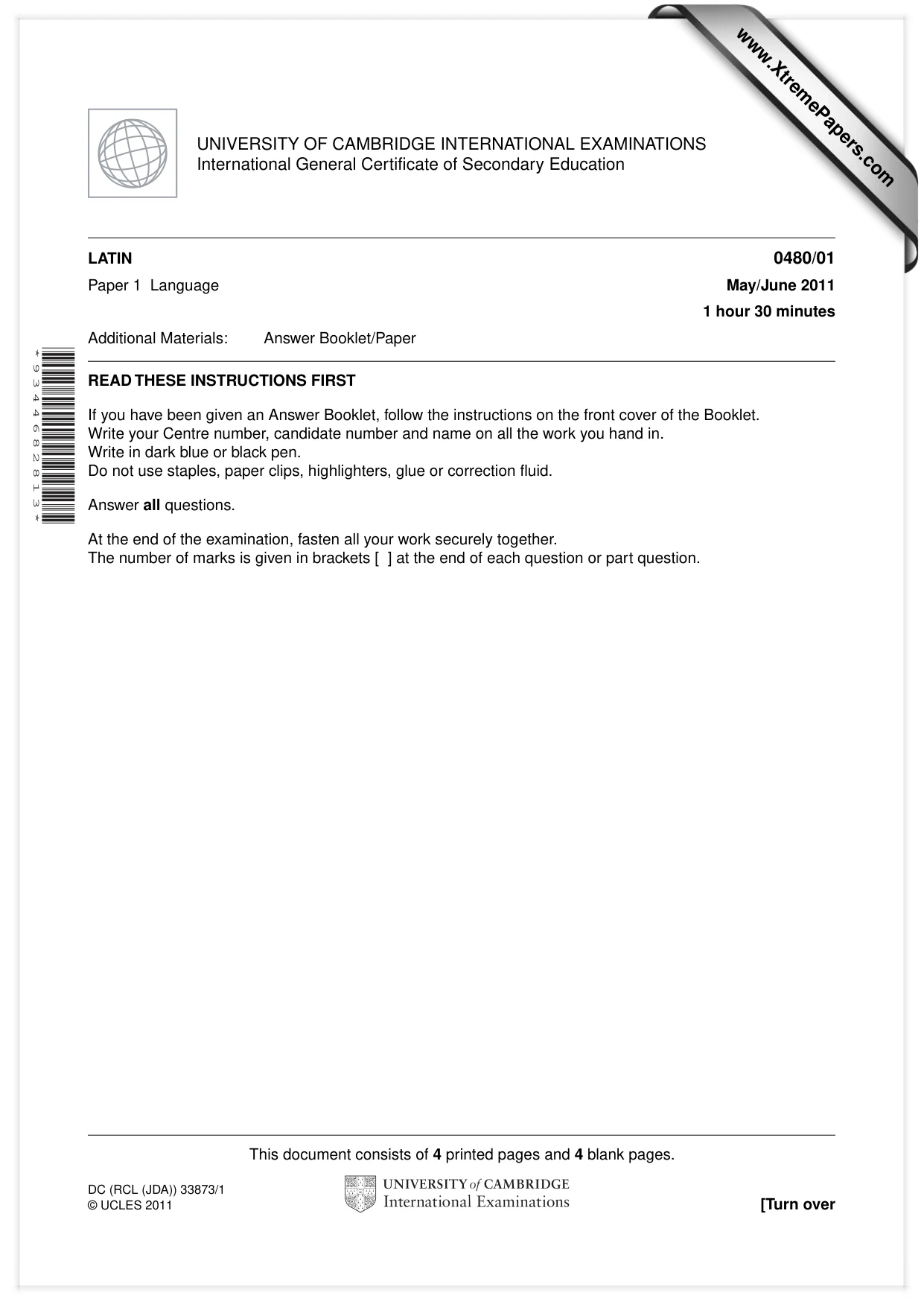
This document consists of 4 printed pages and 4 blank pages. DC (RCL (JDA)) 33873/1 © UCLES 2011 [Turn over UNIVERSITY OF CAMBRIDGE INTERNATIONAL EXAMINATIONS International General Certificate of Secondary Education * 9 3 4 4 6 8 2 8 1 3 * LATIN 0480/01 Paper 1 Language May/June 2011 1 hour 30 minutes Additional Materials: Answer Booklet/Paper READ THESE INSTRUCTIONS FIRST If you have been given an Answer Booklet, follow the instructions on the front cover of the Booklet. Write your Centre number, candidate number and name on all the work you hand in. Write in dark blue or black pen. Do not use staples, paper clips, highlighters, glue or correction fluid. Answer all questions. At the end of the examination, fasten all your work securely together. The number of marks is given in brackets [ ] at the end of each question or part question. www.XtremePapers.com
Question paper, page 2
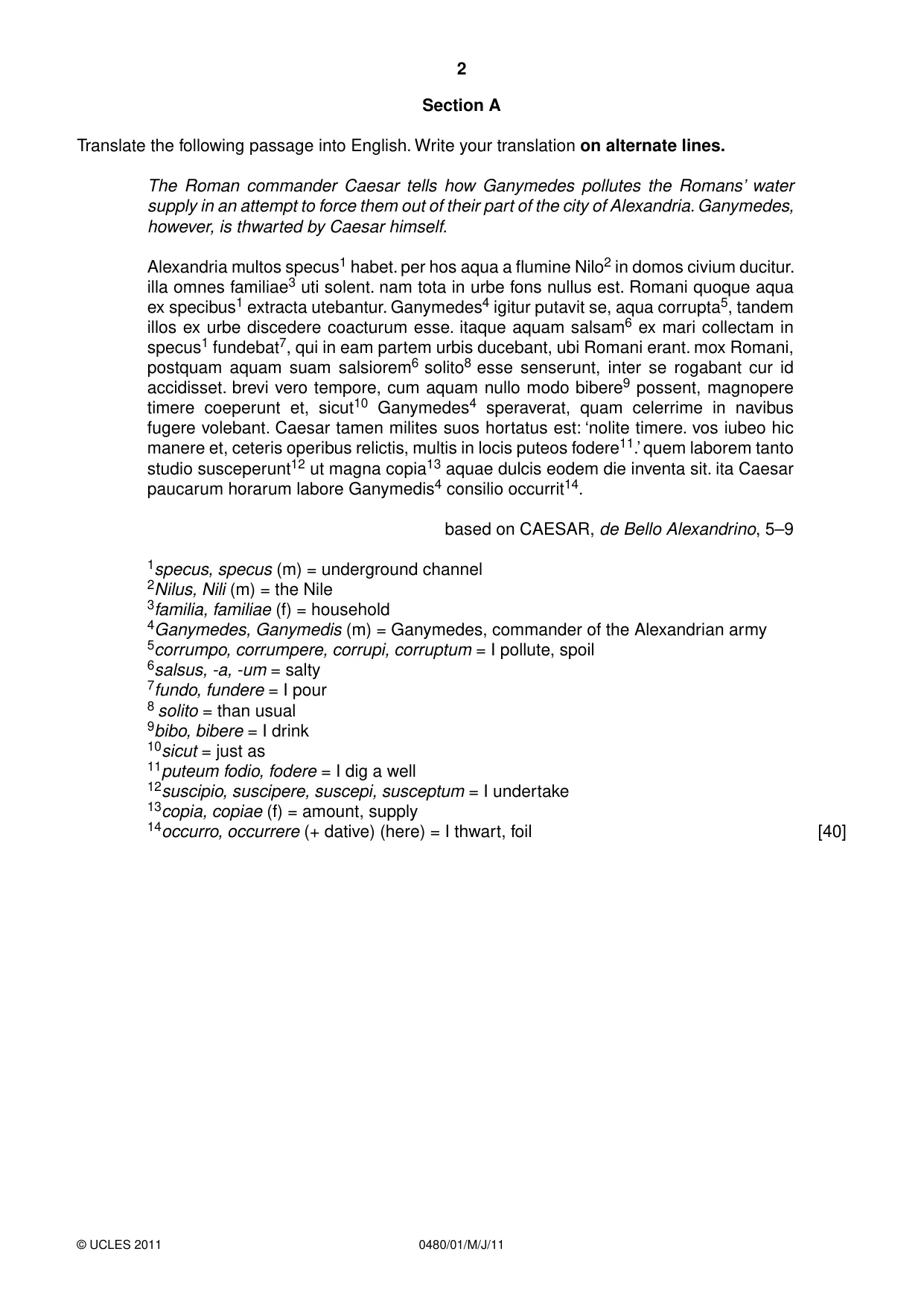
2 0480/01/M/J/11 © UCLES 2011 Section A Translate the following passage into English. Write your translation on alternate lines. The Roman commander Caesar tells how Ganymedes pollutes the Romans’ water supply in an attempt to force them out of their part of the city of Alexandria. Ganymedes, however, is thwarted by Caesar himself. Alexandria multos specus1 habet. per hos aqua a flumine Nilo2 in domos civium ducitur. illa omnes familiae3 uti solent. nam tota in urbe fons nullus est. Romani quoque aqua ex specibus1 extracta utebantur. Ganymedes4 igitur putavit se, aqua corrupta5, tandem illos ex urbe discedere coacturum esse. itaque aquam salsam6 ex mari collectam in specus1 fundebat7, qui in eam partem urbis ducebant, ubi Romani erant. mox Romani, postquam aquam suam salsiorem6 solito8 esse senserunt, inter se rogabant cur id accidisset. brevi vero tempore, cum aquam nullo modo bibere9 possent, magnopere timere coeperunt et, sicut10 Ganymedes4 speraverat, quam celerrime in navibus fugere volebant. Caesar tamen milites suos hortatus est: ‘nolite timere. vos iubeo hic manere et, ceteris operibus relictis, multis in locis puteos fodere11.’ quem laborem tanto studio susceperunt12 ut magna copia13 aquae dulcis eodem die inventa sit. ita Caesar paucarum horarum labore Ganymedis4 consilio occurrit14. based on CAESAR, de Bello Alexandrino, 5–9 1specus, specus (m) = underground channel 2Nilus, Nili (m) = the Nile 3familia, familiae (f) = household 4Ganymedes, Ganymedis (m) = Ganymedes, commander of the Alexandrian army 5corrumpo, corrumpere, corrupi, corruptum = I pollute, spoil 6salsus, -a, -um = salty 7fundo, fundere = I pour 8 solito = than usual 9bibo, bibere = I drink 10sicut = just as 11puteum fodio, fodere = I dig a well 12suscipio, suscipere, suscepi, susceptum = I undertake 13copia, copiae (f) = amount, supply 14occurro, occurrere (+ dative) (here) = I thwart, foil [40]
Question paper, page 3
3 0480/01/M/J/11 © UCLES 2011 [Turn over BLANK PAGE SECTION B IS ON NEXT PAGE
Question paper, page 4
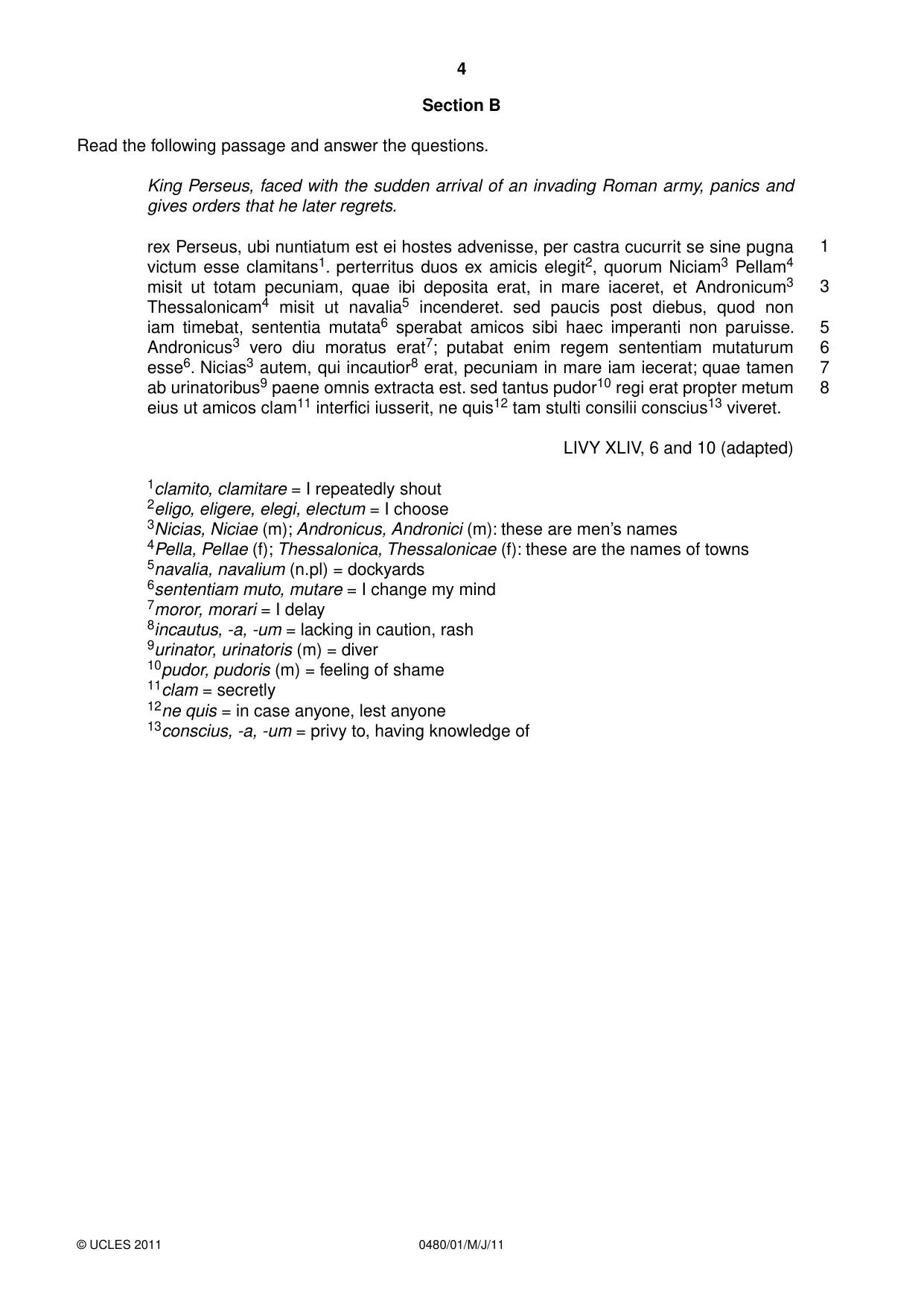
4 0480/01/M/J/11 © UCLES 2011 Section B Read the following passage and answer the questions. King Perseus, faced with the sudden arrival of an invading Roman army, panics and gives orders that he later regrets. rex Perseus, ubi nuntiatum est ei hostes advenisse, per castra cucurrit se sine pugna victum esse clamitans1. perterritus duos ex amicis elegit2, quorum Niciam3 Pellam4 misit ut totam pecuniam, quae ibi deposita erat, in mare iaceret, et Andronicum3 Thessalonicam4 misit ut navalia5 incenderet. sed paucis post diebus, quod non iam timebat, sententia mutata6 sperabat amicos sibi haec imperanti non paruisse. Andronicus3 vero diu moratus erat7; putabat enim regem sententiam mutaturum esse6. Nicias3 autem, qui incautior8 erat, pecuniam in mare iam iecerat; quae tamen ab urinatoribus9 paene omnis extracta est. sed tantus pudor10 regi erat propter metum eius ut amicos clam11 interfici iusserit, ne quis12 tam stulti consilii conscius13 viveret. LIVY XLIV, 6 and 10 (adapted) 1clamito, clamitare = I repeatedly shout 2eligo, eligere, elegi, electum = I choose 3Nicias, Niciae (m); Andronicus, Andronici (m): these are men’s names 4Pella, Pellae (f); Thessalonica, Thessalonicae (f): these are the names of towns 5navalia, navalium (n.pl) = dockyards 6sententiam muto, mutare = I change my mind 7moror, morari = I delay 8incautus, -a, -um = lacking in caution, rash 9urinator, urinatoris (m) = diver 10pudor, pudoris (m) = feeling of shame 11clam = secretly 12ne quis = in case anyone, lest anyone 13conscius, -a, -um = privy to, having knowledge of 1 3 5 6 7 8
Question paper, page 5
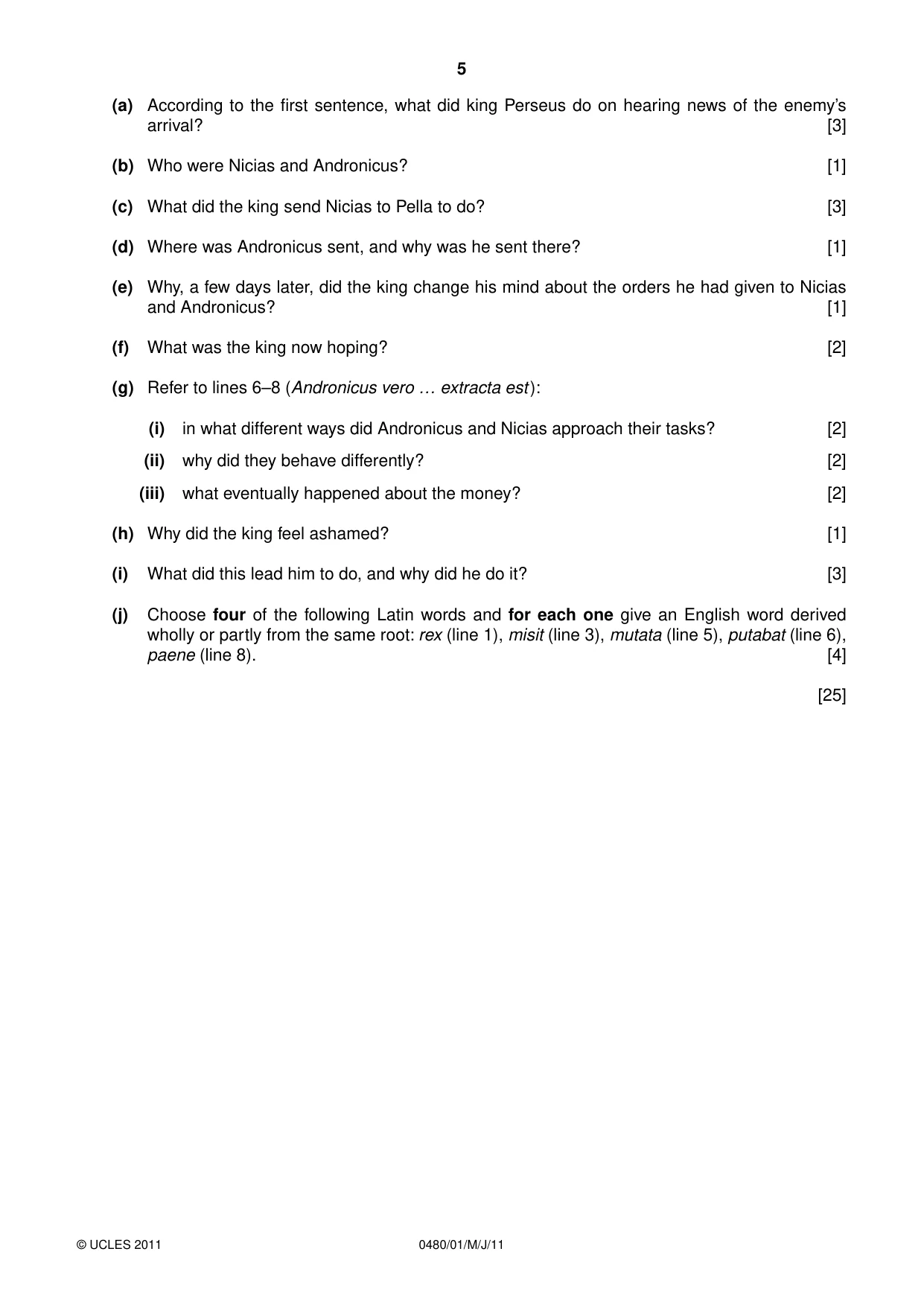
5 0480/01/M/J/11 © UCLES 2011 (a) According to the first sentence, what did king Perseus do on hearing news of the enemy’s arrival? [3] (b) Who were Nicias and Andronicus? [1] (c) What did the king send Nicias to Pella to do? [3] (d) Where was Andronicus sent, and why was he sent there? [1] (e) Why, a few days later, did the king change his mind about the orders he had given to Nicias and Andronicus? [1] (f) What was the king now hoping? [2] (g) Refer to lines 6–8 (Andronicus vero … extracta est ): (i) in what different ways did Andronicus and Nicias approach their tasks? [2] (ii) why did they behave differently? [2] (iii) what eventually happened about the money? [2] (h) Why did the king feel ashamed? [1] (i) What did this lead him to do, and why did he do it? [3] (j) Choose four of the following Latin words and for each one give an English word derived wholly or partly from the same root: rex (line 1), misit (line 3), mutata (line 5), putabat (line 6), paene (line 8). [4] [25]
Question paper, page 6
6 0480/01/M/J/11 © UCLES 2011 BLANK PAGE
Question paper, page 7
7 0480/01/M/J/11 © UCLES 2011 BLANK PAGE
Question paper, page 8
8 0480/01/M/J/11 © UCLES 2011 Permission to reproduce items where third-party owned material protected by copyright is included has been sought and cleared where possible. Every reasonable effort has been made by the publisher (UCLES) to trace copyright holders, but if any items requiring clearance have unwittingly been included, the publisher will be pleased to make amends at the earliest possible opportunity. University of Cambridge International Examinations is part of the Cambridge Assessment Group. Cambridge Assessment is the brand name of University of Cambridge Local Examinations Syndicate (UCLES), which is itself a department of the University of Cambridge. BLANK PAGE
Mark scheme, page 1
UNIVERSITY OF CAMBRIDGE INTERNATIONAL EXAMINATIONS International General Certificate of Secondary Education MARK SCHEME for the May/June 2011 question paper for the guidance of teachers 0480 LATIN 0480/01 Paper 1 (Language), maximum raw mark 65 This mark scheme is published as an aid to teachers and candidates, to indicate the requirements of the examination. It shows the basis on which Examiners were instructed to award marks. It does not indicate the details of the discussions that took place at an Examiners’ meeting before marking began, which would have considered the acceptability of alternative answers. Mark schemes must be read in conjunction with the question papers and the report on the examination. • Cambridge will not enter into discussions or correspondence in connection with these mark schemes. Cambridge is publishing the mark schemes for the May/June 2010 question papers for most IGCSE, GCE Advanced Level and Advanced Subsidiary Level syllabuses and some Ordinary Level syllabuses. www.XtremePapers.com
Mark scheme, page 2
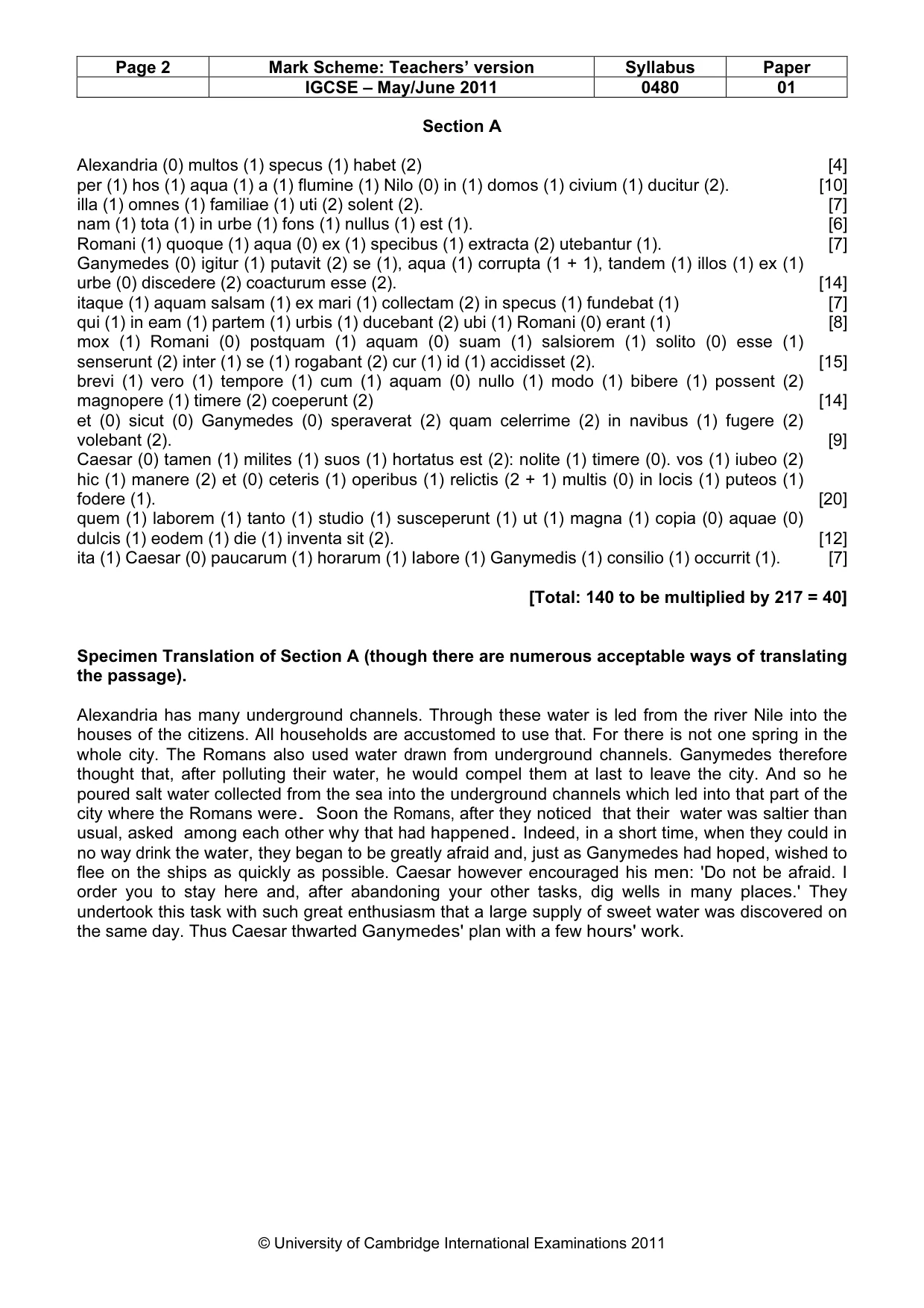
Page 2 Mark Scheme: Teachers’ version Syllabus Paper IGCSE – May/June 2011 0480 01 © University of Cambridge International Examinations 2011 Section A Alexandria (0) multos (1) specus (1) habet (2) [4] per (1) hos (1) aqua (1) a (1) flumine (1) Nilo (0) in (1) domos (1) civium (1) ducitur (2). [10] illa (1) omnes (1) familiae (1) uti (2) solent (2). [7] nam (1) tota (1) in urbe (1) fons (1) nullus (1) est (1). [6] Romani (1) quoque (1) aqua (0) ex (1) specibus (1) extracta (2) utebantur (1). [7] Ganymedes (0) igitur (1) putavit (2) se (1), aqua (1) corrupta (1 + 1), tandem (1) illos (1) ex (1) urbe (0) discedere (2) coacturum esse (2). [14] itaque (1) aquam salsam (1) ex mari (1) collectam (2) in specus (1) fundebat (1) [7] qui (1) in eam (1) partem (1) urbis (1) ducebant (2) ubi (1) Romani (0) erant (1) [8] mox (1) Romani (0) postquam (1) aquam (0) suam (1) salsiorem (1) solito (0) esse (1) senserunt (2) inter (1) se (1) rogabant (2) cur (1) id (1) accidisset (2). [15] brevi (1) vero (1) tempore (1) cum (1) aquam (0) nullo (1) modo (1) bibere (1) possent (2) magnopere (1) timere (2) coeperunt (2) [14] et (0) sicut (0) Ganymedes (0) speraverat (2) quam celerrime (2) in navibus (1) fugere (2) volebant (2). [9] Caesar (0) tamen (1) milites (1) suos (1) hortatus est (2): nolite (1) timere (0). vos (1) iubeo (2) hic (1) manere (2) et (0) ceteris (1) operibus (1) relictis (2 + 1) multis (0) in locis (1) puteos (1) fodere (1). [20] quem (1) laborem (1) tanto (1) studio (1) susceperunt (1) ut (1) magna (1) copia (0) aquae (0) dulcis (1) eodem (1) die (1) inventa sit (2). [12] ita (1) Caesar (0) paucarum (1) horarum (1) Iabore (1) Ganymedis (1) consilio (1) occurrit (1). [7] [Total: 140 to be multiplied by 217 = 40] Specimen Translation of Section A (though there are numerous acceptable ways of translating the passage). Alexandria has many underground channels. Through these water is led from the river Nile into the houses of the citizens. All households are accustomed to use that. For there is not one spring in the whole city. The Romans also used water drawn from underground channels. Ganymedes therefore thought that, after polluting their water, he would compel them at last to leave the city. And so he poured salt water collected from the sea into the underground channels which led into that part of the city where the Romans were. Soon the Romans, after they noticed that their water was saltier than usual, asked among each other why that had happened. Indeed, in a short time, when they could in no way drink the water, they began to be greatly afraid and, just as Ganymedes had hoped, wished to flee on the ships as quickly as possible. Caesar however encouraged his men: 'Do not be afraid. I order you to stay here and, after abandoning your other tasks, dig wells in many places.' They undertook this task with such great enthusiasm that a large supply of sweet water was discovered on the same day. Thus Caesar thwarted Ganymedes' plan with a few hours' work.
Mark scheme, page 3
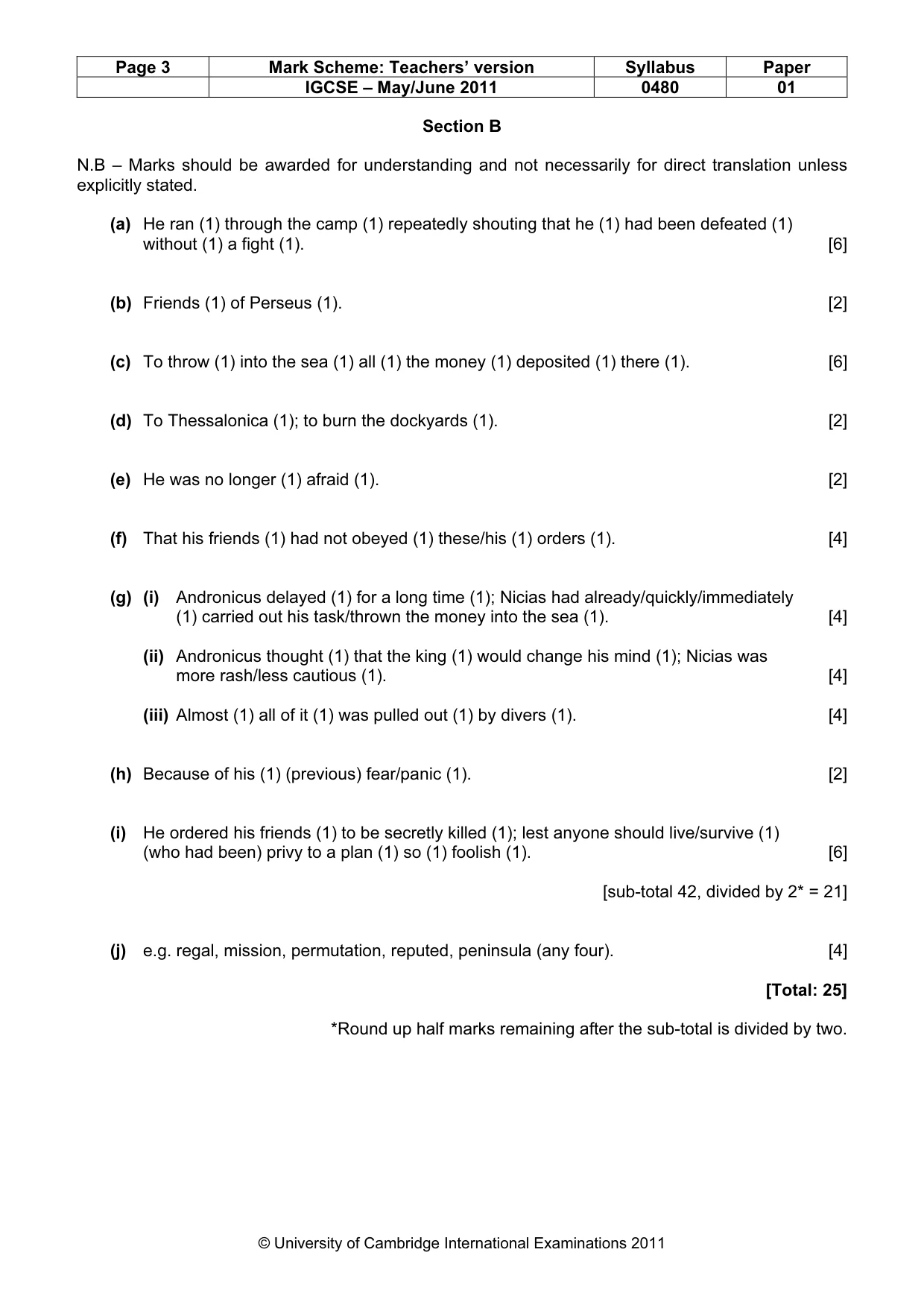
Page 3 Mark Scheme: Teachers’ version Syllabus Paper IGCSE – May/June 2011 0480 01 © University of Cambridge International Examinations 2011 Section B N.B – Marks should be awarded for understanding and not necessarily for direct translation unless explicitly stated. (a) He ran (1) through the camp (1) repeatedly shouting that he (1) had been defeated (1) without (1) a fight (1). [6] (b) Friends (1) of Perseus (1). [2] (c) To throw (1) into the sea (1) all (1) the money (1) deposited (1) there (1). [6] (d) To Thessalonica (1); to burn the dockyards (1). [2] (e) He was no longer (1) afraid (1). [2] (f) That his friends (1) had not obeyed (1) these/his (1) orders (1). [4] (g) (i) Andronicus delayed (1) for a long time (1); Nicias had already/quickly/immediately (1) carried out his task/thrown the money into the sea (1). [4] (ii) Andronicus thought (1) that the king (1) would change his mind (1); Nicias was more rash/less cautious (1). [4] (iii) Almost (1) all of it (1) was pulled out (1) by divers (1). [4] (h) Because of his (1) (previous) fear/panic (1). [2] (i) He ordered his friends (1) to be secretly killed (1); lest anyone should live/survive (1) (who had been) privy to a plan (1) so (1) foolish (1). [6] [sub-total 42, divided by 2* = 21] (j) e.g. regal, mission, permutation, reputed, peninsula (any four). [4] [Total: 25] *Round up half marks remaining after the sub-total is divided by two.
What you needed in this session
Cambridge’s own grade thresholds for 2011 May/June, Paper 1 · Variant 1. A higher threshold means an easier paper — the bar moves with how the cohort did.