Cambridge IGCSE Latin 0480 — 2019 May/June Paper 1 · Variant 3
0480/13/M/J/19 · 160 marks · ≈180 min
The question paper and its mark scheme, free to read here and free to download. This is Cambridge’s own paper, exactly as it was sat.
Question paper8 pages



Mark scheme5 pages
Answers below. Sit the paper first if you are practising.
Paper as text
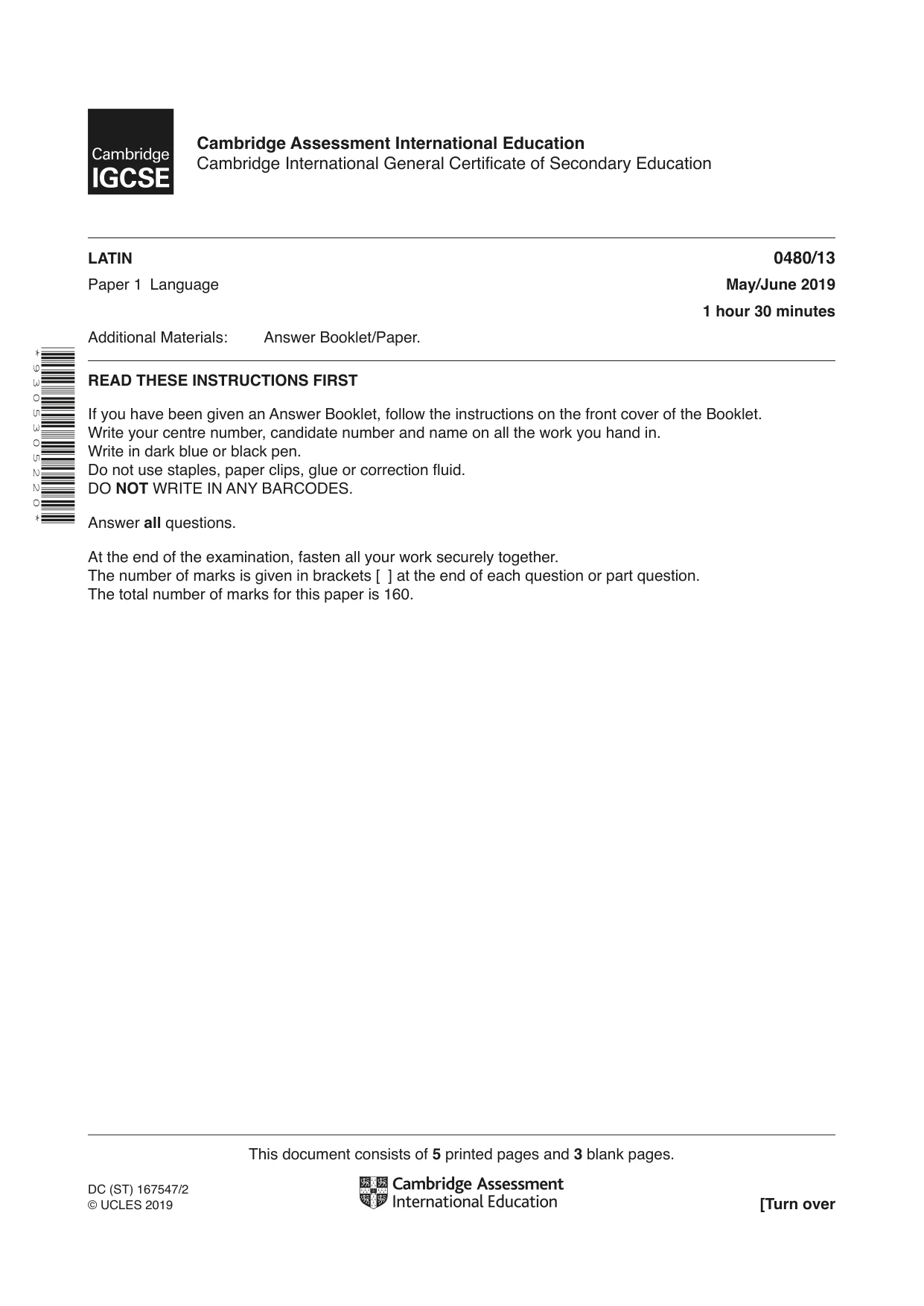
Question paper, page 1
This document consists of 5 printed pages and 3 blank pages. DC (ST) 167547/2 © UCLES 2019 [Turn over Cambridge Assessment International Education Cambridge International General Certificate of Secondary Education * 9 3 0 5 3 0 5 2 2 0 * LATIN 0480/13 Paper 1 Language May/June 2019 1 hour 30 minutes Additional Materials: Answer Booklet/Paper. READ THESE INSTRUCTIONS FIRST If you have been given an Answer Booklet, follow the instructions on the front cover of the Booklet. Write your centre number, candidate number and name on all the work you hand in. Write in dark blue or black pen. Do not use staples, paper clips, glue or correction fluid. DO NOT WRITE IN ANY BARCODES. Answer all questions. At the end of the examination, fasten all your work securely together. The number of marks is given in brackets [ ] at the end of each question or part question. The total number of marks for this paper is 160.
Question paper, page 2
2 0480/13/M/J/19 © UCLES 2019 BLANK PAGE
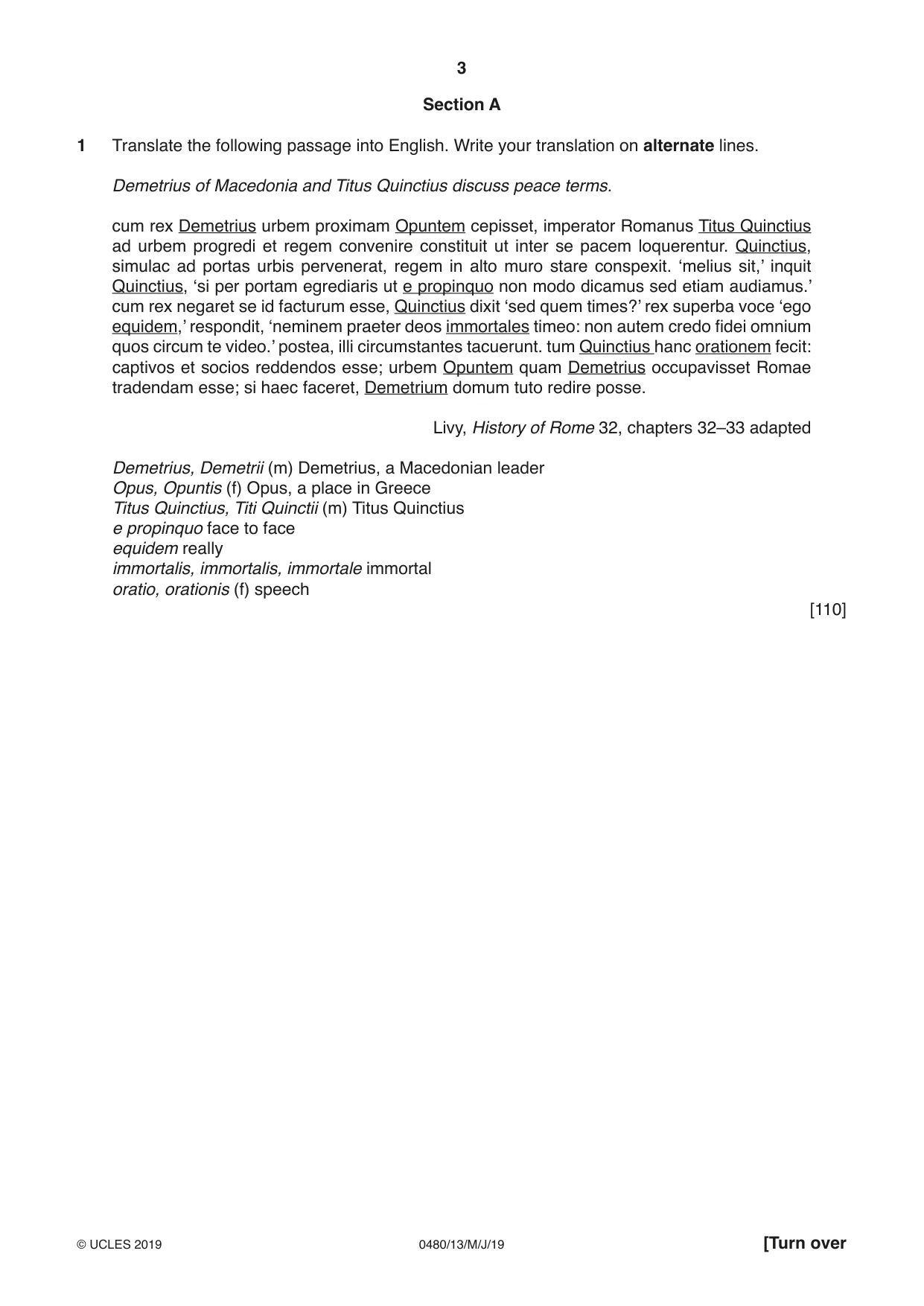
Question paper, page 3
3 0480/13/M/J/19 © UCLES 2019 [Turn over Section A 1 Translate the following passage into English. Write your translation on alternate lines. Demetrius of Macedonia and Titus Quinctius discuss peace terms. cum rex Demetrius urbem proximam Opuntem cepisset, imperator Romanus Titus Quinctius ad urbem progredi et regem convenire constituit ut inter se pacem loquerentur. Quinctius, simulac ad portas urbis pervenerat, regem in alto muro stare conspexit. ‘melius sit,’ inquit Quinctius, ‘si per portam egrediaris ut e propinquo non modo dicamus sed etiam audiamus.’ cum rex negaret se id facturum esse, Quinctius dixit ‘sed quem times?’ rex superba voce ‘ego equidem,’ respondit, ‘neminem praeter deos immortales timeo: non autem credo fidei omnium quos circum te video.’ postea, illi circumstantes tacuerunt. tum Quinctius hanc orationem fecit: captivos et socios reddendos esse; urbem Opuntem quam Demetrius occupavisset Romae tradendam esse; si haec faceret, Demetrium domum tuto redire posse. Livy, History of Rome 32, chapters 32–33 adapted Demetrius, Demetrii (m) Demetrius, a Macedonian leader Opus, Opuntis (f) Opus, a place in Greece Titus Quinctius, Titi Quinctii (m) Titus Quinctius e propinquo face to face equidem really immortalis, immortalis, immortale immortal oratio, orationis (f) speech [110]
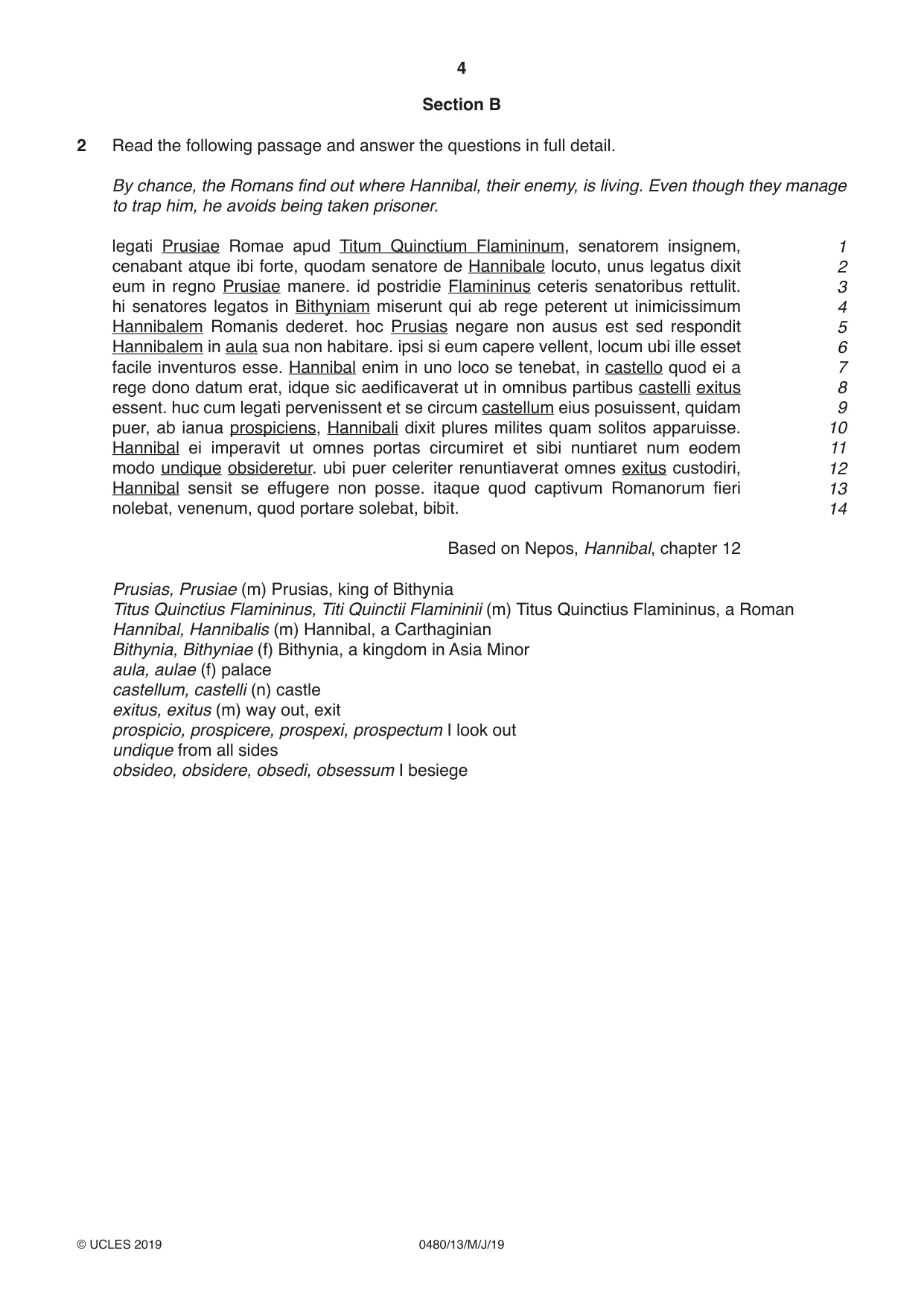
Question paper, page 4
4 0480/13/M/J/19 © UCLES 2019 Section B 2 Read the following passage and answer the questions in full detail. By chance, the Romans find out where Hannibal, their enemy, is living. Even though they manage to trap him, he avoids being taken prisoner. legati Prusiae Romae apud Titum Quinctium Flamininum, senatorem insignem, cenabant atque ibi forte, quodam senatore de Hannibale locuto, unus legatus dixit eum in regno Prusiae manere. id postridie Flamininus ceteris senatoribus rettulit. hi senatores legatos in Bithyniam miserunt qui ab rege peterent ut inimicissimum Hannibalem Romanis dederet. hoc Prusias negare non ausus est sed respondit Hannibalem in aula sua non habitare. ipsi si eum capere vellent, locum ubi ille esset facile inventuros esse. Hannibal enim in uno loco se tenebat, in castello quod ei a rege dono datum erat, idque sic aedificaverat ut in omnibus partibus castelli exitus essent. huc cum legati pervenissent et se circum castellum eius posuissent, quidam puer, ab ianua prospiciens, Hannibali dixit plures milites quam solitos apparuisse. Hannibal ei imperavit ut omnes portas circumiret et sibi nuntiaret num eodem modo undique obsideretur. ubi puer celeriter renuntiaverat omnes exitus custodiri, Hannibal sensit se effugere non posse. itaque quod captivum Romanorum fieri nolebat, venenum, quod portare solebat, bibit. Based on Nepos, Hannibal, chapter 12 Prusias, Prusiae (m) Prusias, king of Bithynia Titus Quinctius Flamininus, Titi Quinctii Flamininii (m) Titus Quinctius Flamininus, a Roman Hannibal, Hannibalis (m) Hannibal, a Carthaginian Bithynia, Bithyniae (f) Bithynia, a kingdom in Asia Minor aula, aulae (f) palace castellum, castelli (n) castle exitus, exitus (m) way out, exit prospicio, prospicere, prospexi, prospectum I look out undique from all sides obsideo, obsidere, obsedi, obsessum I besiege 1 2 3 4 5 6 7 8 9 10 11 12 13 14
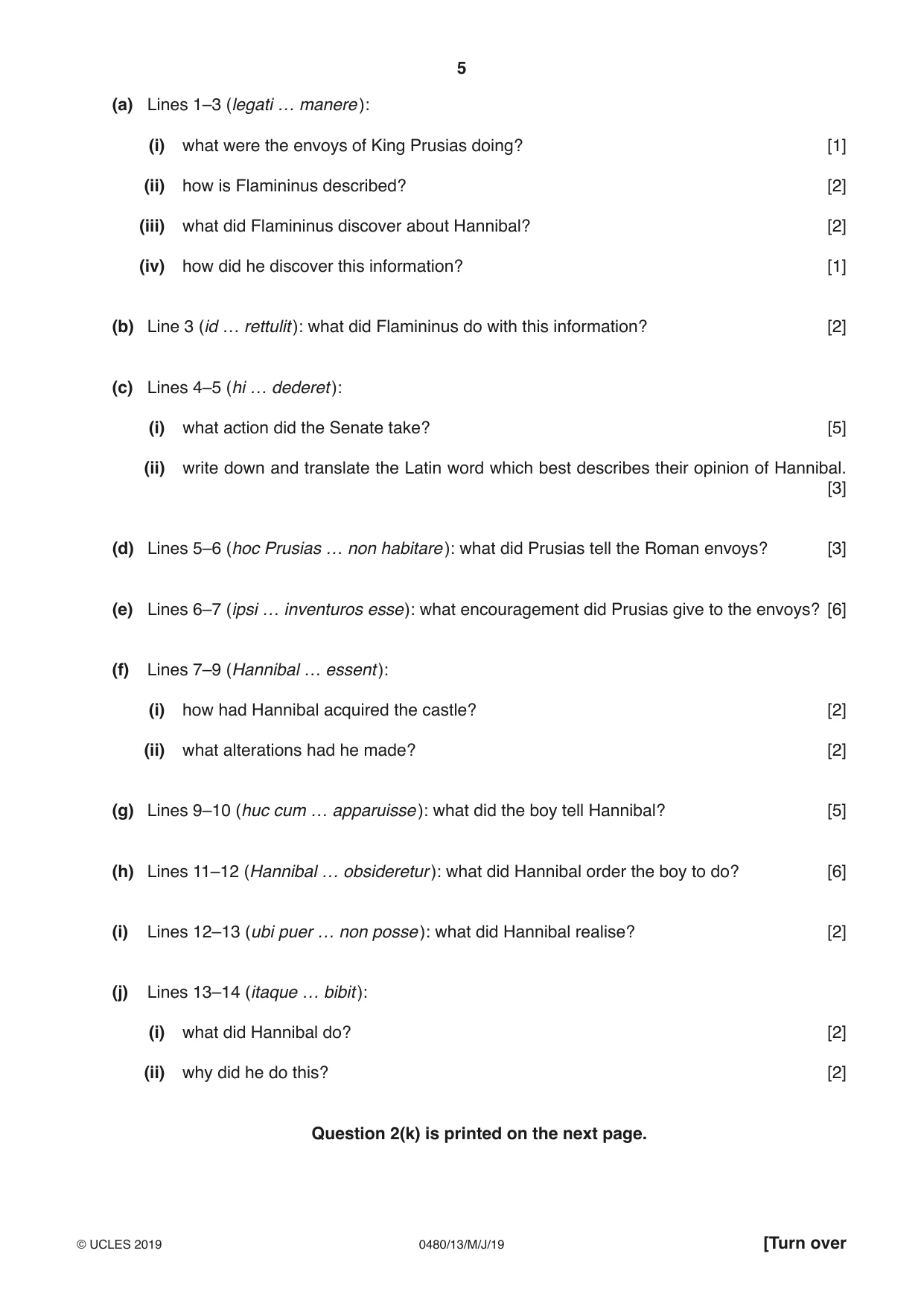
Question paper, page 5
5 0480/13/M/J/19 © UCLES 2019 [Turn over (a) Lines 1–3 (legati … manere ): (i) what were the envoys of King Prusias doing? [1] (ii) how is Flamininus described? [2] (iii) what did Flamininus discover about Hannibal? [2] (iv) how did he discover this information? [1] (b) Line 3 (id … rettulit ): what did Flamininus do with this information? [2] (c) Lines 4–5 (hi … dederet ): (i) what action did the Senate take? [5] (ii) write down and translate the Latin word which best describes their opinion of Hannibal. [3] (d) Lines 5–6 (hoc Prusias … non habitare ): what did Prusias tell the Roman envoys? [3] (e) Lines 6–7 (ipsi … inventuros esse ): what encouragement did Prusias give to the envoys? [6] (f) Lines 7–9 (Hannibal … essent ): (i) how had Hannibal acquired the castle? [2] (ii) what alterations had he made? [2] (g) Lines 9–10 (huc cum … apparuisse ): what did the boy tell Hannibal? [5] (h) Lines 11–12 (Hannibal … obsideretur ): what did Hannibal order the boy to do? [6] (i) Lines 12–13 (ubi puer … non posse ): what did Hannibal realise? [2] (j) Lines 13–14 (itaque … bibit ): (i) what did Hannibal do? [2] (ii) why did he do this? [2] Question 2(k) is printed on the next page.
Question paper, page 6
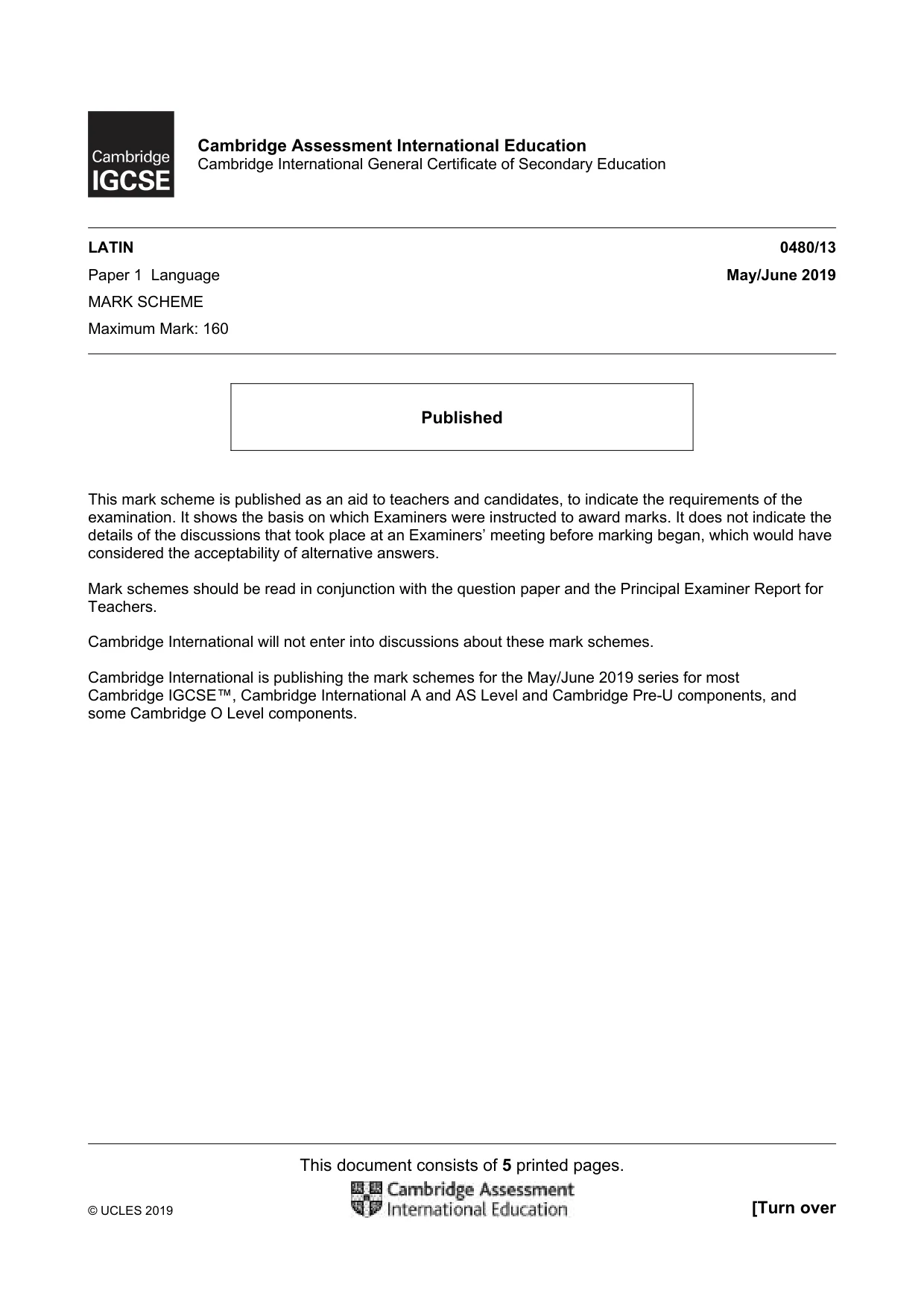
6 0480/13/M/J/19 © UCLES 2019 (k) Choose four of the following Latin words and for each one give an English word derived wholly or partly from the same root: locuto (line 2) miserunt (line 4) inventuros esse (line 7) apparuisse (line 10) renuntiaverat (line 12) bibit (line 14) [4]
Question paper, page 7
7 0480/13/M/J/19 © UCLES 2019 BLANK PAGE
Question paper, page 8
8 0480/13/M/J/19 © UCLES 2019 Permission to reproduce items where third-party owned material protected by copyright is included has been sought and cleared where possible. Every reasonable effort has been made by the publisher (UCLES) to trace copyright holders, but if any items requiring clearance have unwittingly been included, the publisher will be pleased to make amends at the earliest possible opportunity. To avoid the issue of disclosure of answer-related information to candidates, all copyright acknowledgements are reproduced online in the Cambridge Assessment International Education Copyright Acknowledgements Booklet. This is produced for each series of examinations and is freely available to download at www.cambridgeinternational.org after the live examination series. Cambridge Assessment International Education is part of the Cambridge Assessment Group. Cambridge Assessment is the brand name of the University of Cambridge Local Examinations Syndicate (UCLES), which itself is a department of the University of Cambridge. BLANK PAGE
Mark scheme, page 1
This document consists of 5 printed pages. © UCLES 2019 [Turn over Cambridge Assessment International Education Cambridge International General Certificate of Secondary Education LATIN 0480/13 Paper 1 Language May/June 2019 MARK SCHEME Maximum Mark: 160 Published This mark scheme is published as an aid to teachers and candidates, to indicate the requirements of the examination. It shows the basis on which Examiners were instructed to award marks. It does not indicate the details of the discussions that took place at an Examiners’ meeting before marking began, which would have considered the acceptability of alternative answers. Mark schemes should be read in conjunction with the question paper and the Principal Examiner Report for Teachers. Cambridge International will not enter into discussions about these mark schemes. Cambridge International is publishing the mark schemes for the May/June 2019 series for most Cambridge IGCSE™, Cambridge International A and AS Level and Cambridge Pre-U components, and some Cambridge O Level components.
Mark scheme, page 2
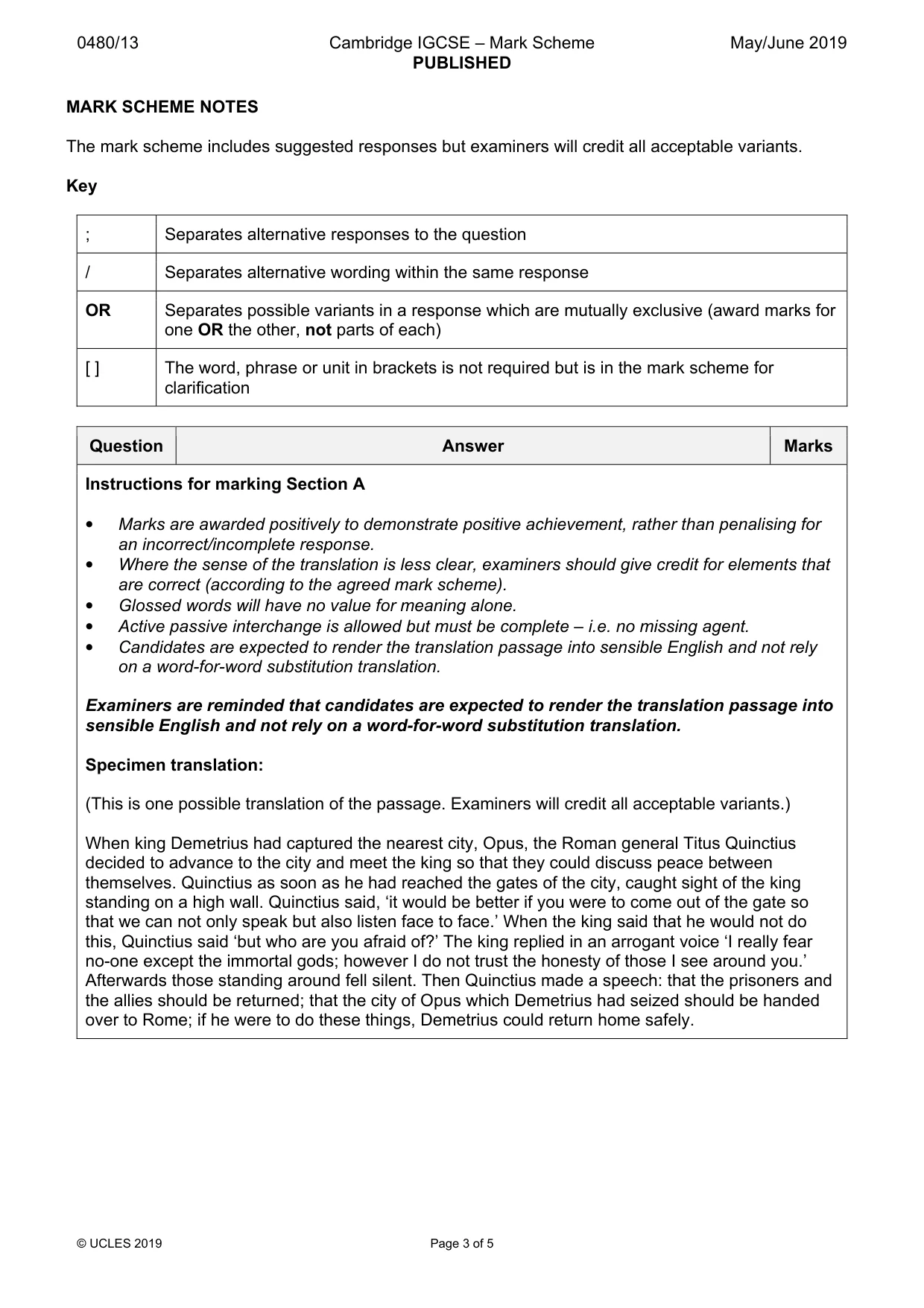
0480/13 Cambridge IGCSE – Mark Scheme PUBLISHED May/June 2019 © UCLES 2019 Page 2 of 5 Generic Marking Principles These general marking principles must be applied by all examiners when marking candidate answers. They should be applied alongside the specific content of the mark scheme or generic level descriptors for a question. Each question paper and mark scheme will also comply with these marking principles. GENERIC MARKING PRINCIPLE 1: Marks must be awarded in line with: • the specific content of the mark scheme or the generic level descriptors for the question • the specific skills defined in the mark scheme or in the generic level descriptors for the question • the standard of response required by a candidate as exemplified by the standardisation scripts. GENERIC MARKING PRINCIPLE 2: Marks awarded are always whole marks (not half marks, or other fractions). GENERIC MARKING PRINCIPLE 3: Marks must be awarded positively: • marks are awarded for correct/valid answers, as defined in the mark scheme. However, credit is given for valid answers which go beyond the scope of the syllabus and mark scheme, referring to your Team Leader as appropriate • marks are awarded when candidates clearly demonstrate what they know and can do • marks are not deducted for errors • marks are not deducted for omissions • answers should only be judged on the quality of spelling, punctuation and grammar when these features are specifically assessed by the question as indicated by the mark scheme. The meaning, however, should be unambiguous. GENERIC MARKING PRINCIPLE 4: Rules must be applied consistently e.g. in situations where candidates have not followed instructions or in the application of generic level descriptors. GENERIC MARKING PRINCIPLE 5: Marks should be awarded using the full range of marks defined in the mark scheme for the question (however; the use of the full mark range may be limited according to the quality of the candidate responses seen). GENERIC MARKING PRINCIPLE 6: Marks awarded are based solely on the requirements as defined in the mark scheme. Marks should not be awarded with grade thresholds or grade descriptors in mind.
Mark scheme, page 3
0480/13 Cambridge IGCSE – Mark Scheme PUBLISHED May/June 2019 © UCLES 2019 Page 3 of 5 MARK SCHEME NOTES The mark scheme includes suggested responses but examiners will credit all acceptable variants. Key ; Separates alternative responses to the question / Separates alternative wording within the same response OR Separates possible variants in a response which are mutually exclusive (award marks for one OR the other, not parts of each) [ ] The word, phrase or unit in brackets is not required but is in the mark scheme for clarification Question Answer Marks Instructions for marking Section A • Marks are awarded positively to demonstrate positive achievement, rather than penalising for an incorrect/incomplete response. • Where the sense of the translation is less clear, examiners should give credit for elements that are correct (according to the agreed mark scheme). • Glossed words will have no value for meaning alone. • Active passive interchange is allowed but must be complete – i.e. no missing agent. • Candidates are expected to render the translation passage into sensible English and not rely on a word-for-word substitution translation. Examiners are reminded that candidates are expected to render the translation passage into sensible English and not rely on a word-for-word substitution translation. Specimen translation: (This is one possible translation of the passage. Examiners will credit all acceptable variants.) When king Demetrius had captured the nearest city, Opus, the Roman general Titus Quinctius decided to advance to the city and meet the king so that they could discuss peace between themselves. Quinctius as soon as he had reached the gates of the city, caught sight of the king standing on a high wall. Quinctius said, ‘it would be better if you were to come out of the gate so that we can not only speak but also listen face to face.’ When the king said that he would not do this, Quinctius said ‘but who are you afraid of?’ The king replied in an arrogant voice ‘I really fear no-one except the immortal gods; however I do not trust the honesty of those I see around you.’ Afterwards those standing around fell silent. Then Quinctius made a speech: that the prisoners and the allies should be returned; that the city of Opus which Demetrius had seized should be handed over to Rome; if he were to do these things, Demetrius could return home safely.
Mark scheme, page 4
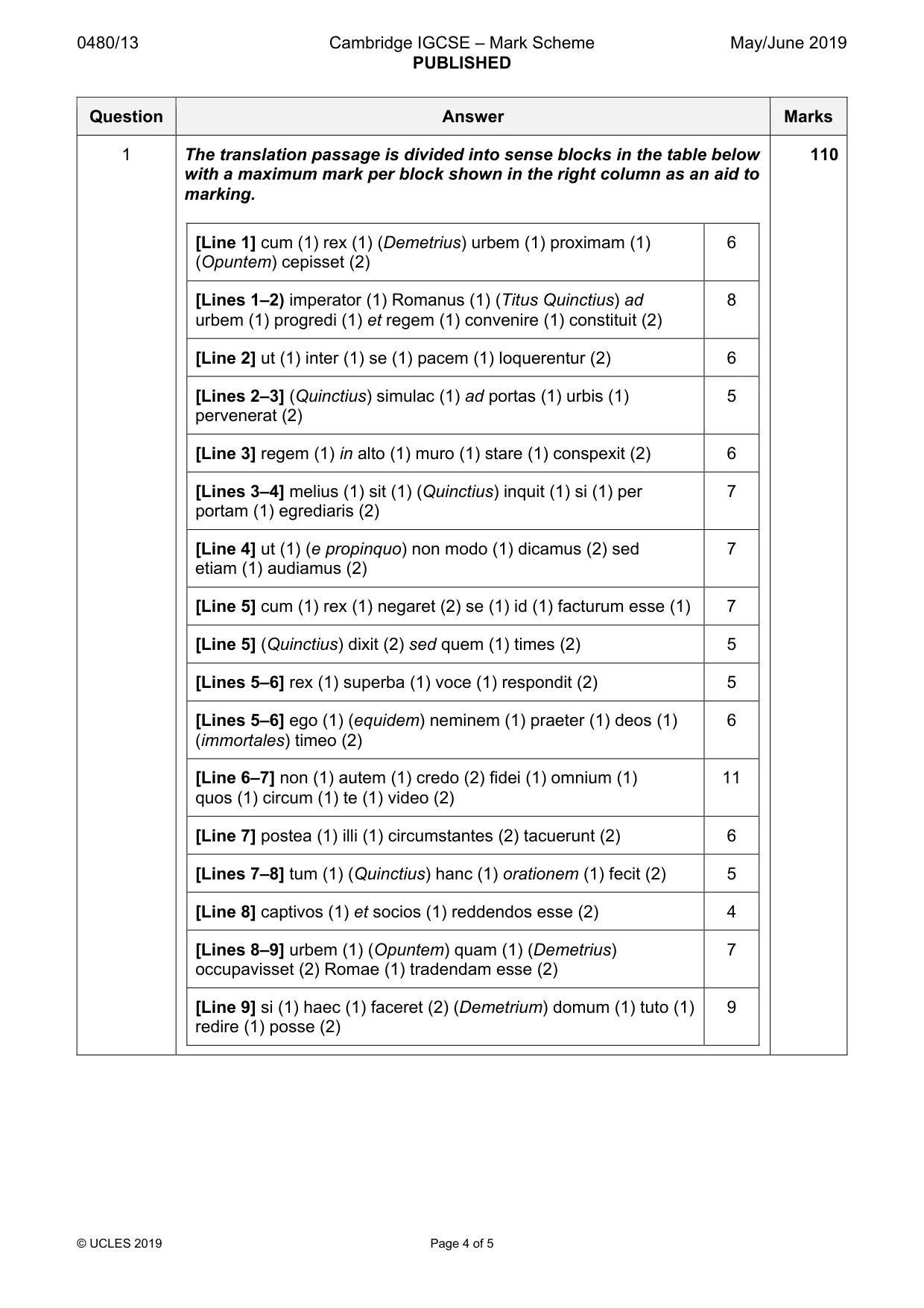
0480/13 Cambridge IGCSE – Mark Scheme PUBLISHED May/June 2019 © UCLES 2019 Page 4 of 5 Question Answer Marks 1 The translation passage is divided into sense blocks in the table below with a maximum mark per block shown in the right column as an aid to marking. [Line 1] cum (1) rex (1) (Demetrius) urbem (1) proximam (1) (Opuntem) cepisset (2) 6 [Lines 1–2) imperator (1) Romanus (1) (Titus Quinctius) ad urbem (1) progredi (1) et regem (1) convenire (1) constituit (2) 8 [Line 2] ut (1) inter (1) se (1) pacem (1) loquerentur (2) 6 [Lines 2–3] (Quinctius) simulac (1) ad portas (1) urbis (1) pervenerat (2) 5 [Line 3] regem (1) in alto (1) muro (1) stare (1) conspexit (2) 6 [Lines 3–4] melius (1) sit (1) (Quinctius) inquit (1) si (1) per portam (1) egrediaris (2) 7 [Line 4] ut (1) (e propinquo) non modo (1) dicamus (2) sed etiam (1) audiamus (2) 7 [Line 5] cum (1) rex (1) negaret (2) se (1) id (1) facturum esse (1) 7 [Line 5] (Quinctius) dixit (2) sed quem (1) times (2) 5 [Lines 5–6] rex (1) superba (1) voce (1) respondit (2) 5 [Lines 5–6] ego (1) (equidem) neminem (1) praeter (1) deos (1) (immortales) timeo (2) 6 [Line 6–7] non (1) autem (1) credo (2) fidei (1) omnium (1) quos (1) circum (1) te (1) video (2) 11 [Line 7] postea (1) illi (1) circumstantes (2) tacuerunt (2) 6 [Lines 7–8] tum (1) (Quinctius) hanc (1) orationem (1) fecit (2) 5 [Line 8] captivos (1) et socios (1) reddendos esse (2) 4 [Lines 8–9] urbem (1) (Opuntem) quam (1) (Demetrius) occupavisset (2) Romae (1) tradendam esse (2) 7 [Line 9] si (1) haec (1) faceret (2) (Demetrium) domum (1) tuto (1) redire (1) posse (2) 9 110
Mark scheme, page 5
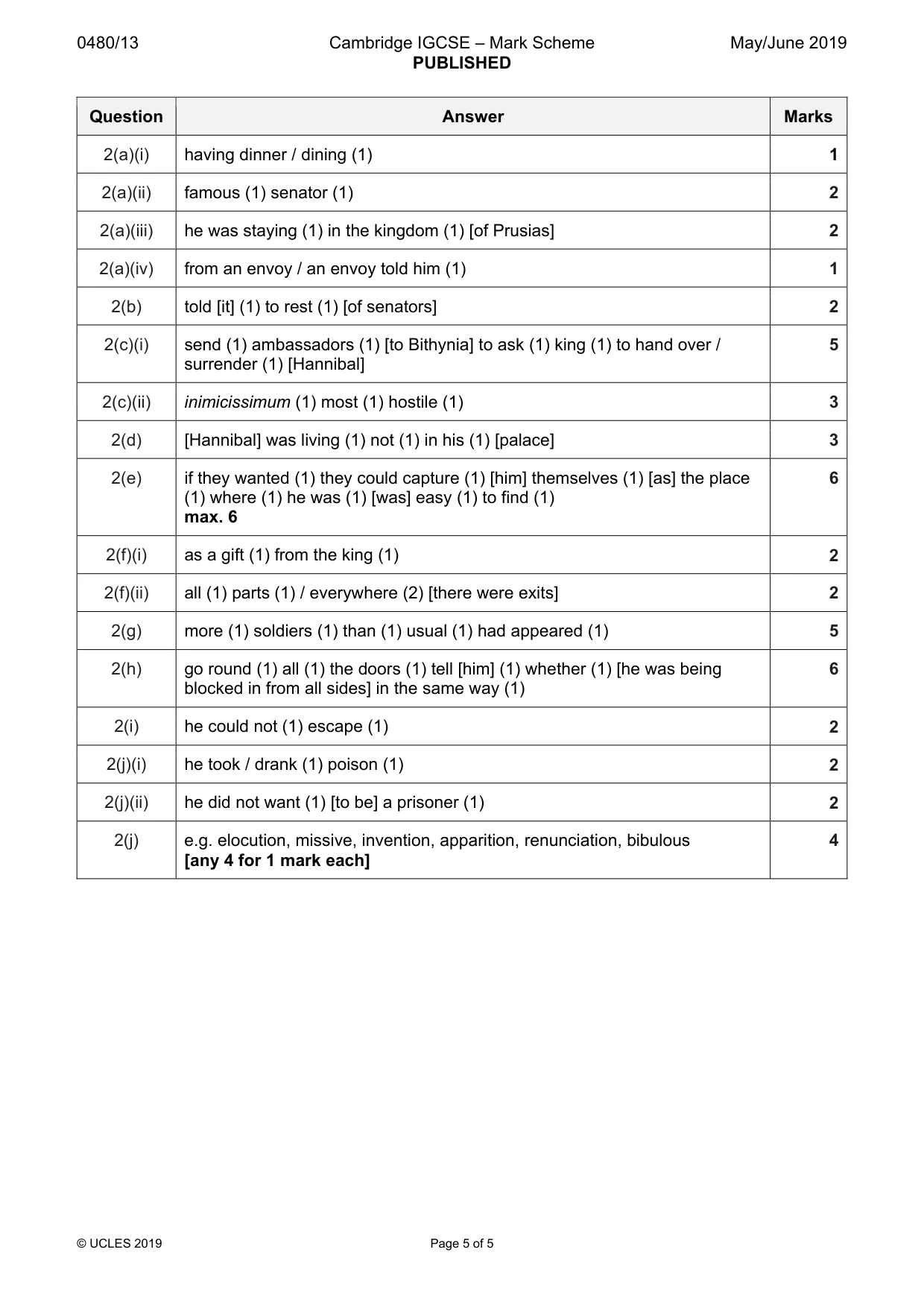
0480/13 Cambridge IGCSE – Mark Scheme PUBLISHED May/June 2019 © UCLES 2019 Page 5 of 5 Question Answer Marks 2(a)(i) having dinner / dining (1) 1 2(a)(ii) famous (1) senator (1) 2 2(a)(iii) he was staying (1) in the kingdom (1) [of Prusias] 2 2(a)(iv) from an envoy / an envoy told him (1) 1 2(b) told [it] (1) to rest (1) [of senators] 2 2(c)(i) send (1) ambassadors (1) [to Bithynia] to ask (1) king (1) to hand over / surrender (1) [Hannibal] 5 2(c)(ii) inimicissimum (1) most (1) hostile (1) 3 2(d) [Hannibal] was living (1) not (1) in his (1) [palace] 3 2(e) if they wanted (1) they could capture (1) [him] themselves (1) [as] the place (1) where (1) he was (1) [was] easy (1) to find (1) max. 6 6 2(f)(i) as a gift (1) from the king (1) 2 2(f)(ii) all (1) parts (1) / everywhere (2) [there were exits] 2 2(g) more (1) soldiers (1) than (1) usual (1) had appeared (1) 5 2(h) go round (1) all (1) the doors (1) tell [him] (1) whether (1) [he was being blocked in from all sides] in the same way (1) 6 2(i) he could not (1) escape (1) 2 2(j)(i) he took / drank (1) poison (1) 2 2(j)(ii) he did not want (1) [to be] a prisoner (1) 2 2(j) e.g. elocution, missive, invention, apparition, renunciation, bibulous [any 4 for 1 mark each] 4
What you needed in this session
Cambridge’s own grade thresholds for 2019 May/June, Paper 1 · Variant 3. A higher threshold means an easier paper — the bar moves with how the cohort did.