Cambridge IGCSE Latin 0480 — 2013 May/June Paper 1 · Variant 1
0480/11/M/J/13 · 65 marks · ≈73 min
The question paper and its mark scheme, free to read here and free to download. This is Cambridge’s own paper, exactly as it was sat.
Question paper8 pages




Mark scheme3 pages
Answers below. Sit the paper first if you are practising.
Paper as text
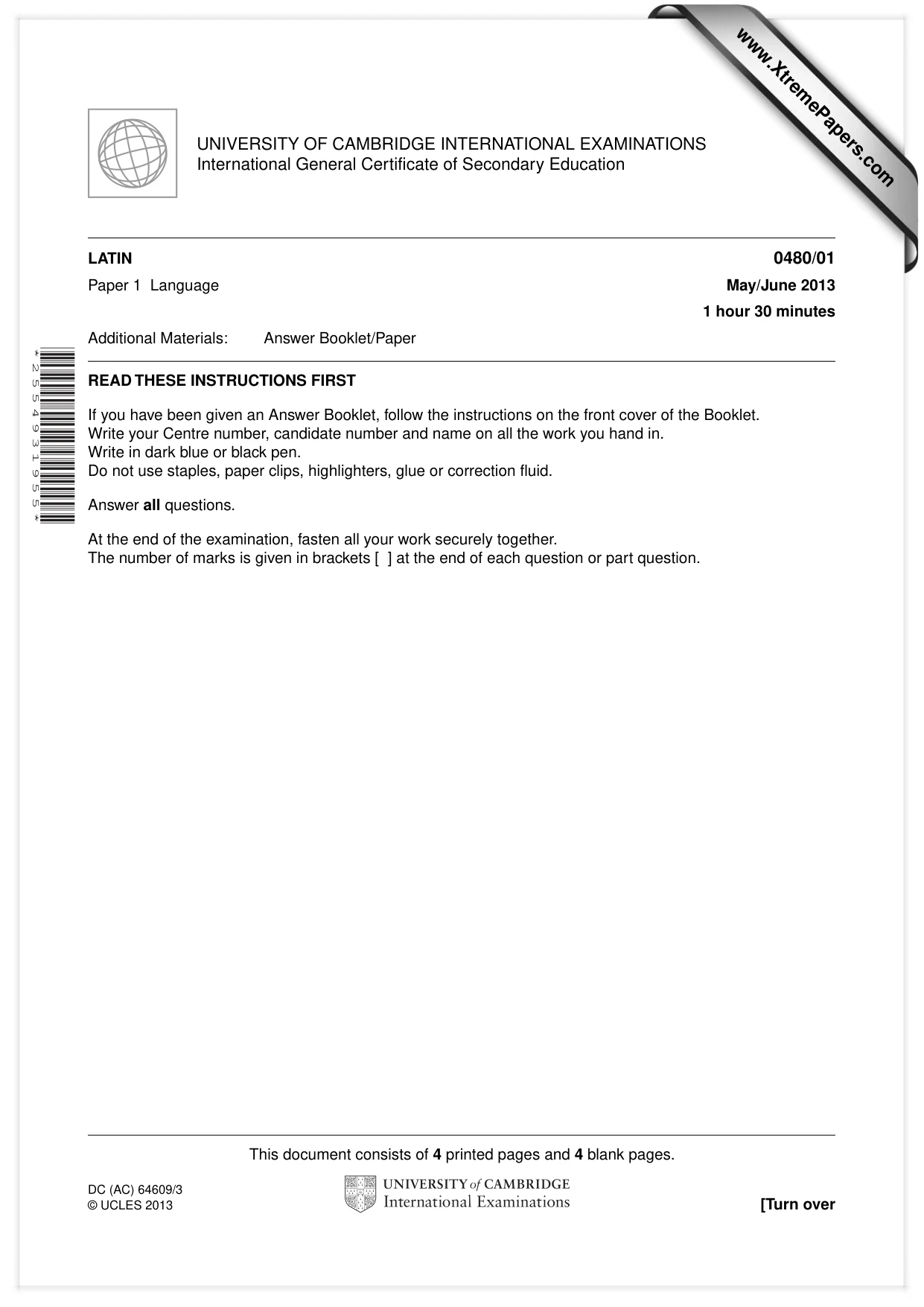
Question paper, page 1
This document consists of 4 printed pages and 4 blank pages. DC (AC) 64609/3 © UCLES 2013 [Turn over UNIVERSITY OF CAMBRIDGE INTERNATIONAL EXAMINATIONS International General Certificate of Secondary Education * 2 5 5 4 9 3 1 9 5 5 * LATIN 0480/01 Paper 1 Language May/June 2013 1 hour 30 minutes Additional Materials: Answer Booklet/Paper READ THESE INSTRUCTIONS FIRST If you have been given an Answer Booklet, follow the instructions on the front cover of the Booklet. Write your Centre number, candidate number and name on all the work you hand in. Write in dark blue or black pen. Do not use staples, paper clips, highlighters, glue or correction fluid. Answer all questions. At the end of the examination, fasten all your work securely together. The number of marks is given in brackets [ ] at the end of each question or part question. www.XtremePapers.com
Question paper, page 2
2 0480/01/M/J/13 © UCLES 2013 BLANK PAGE
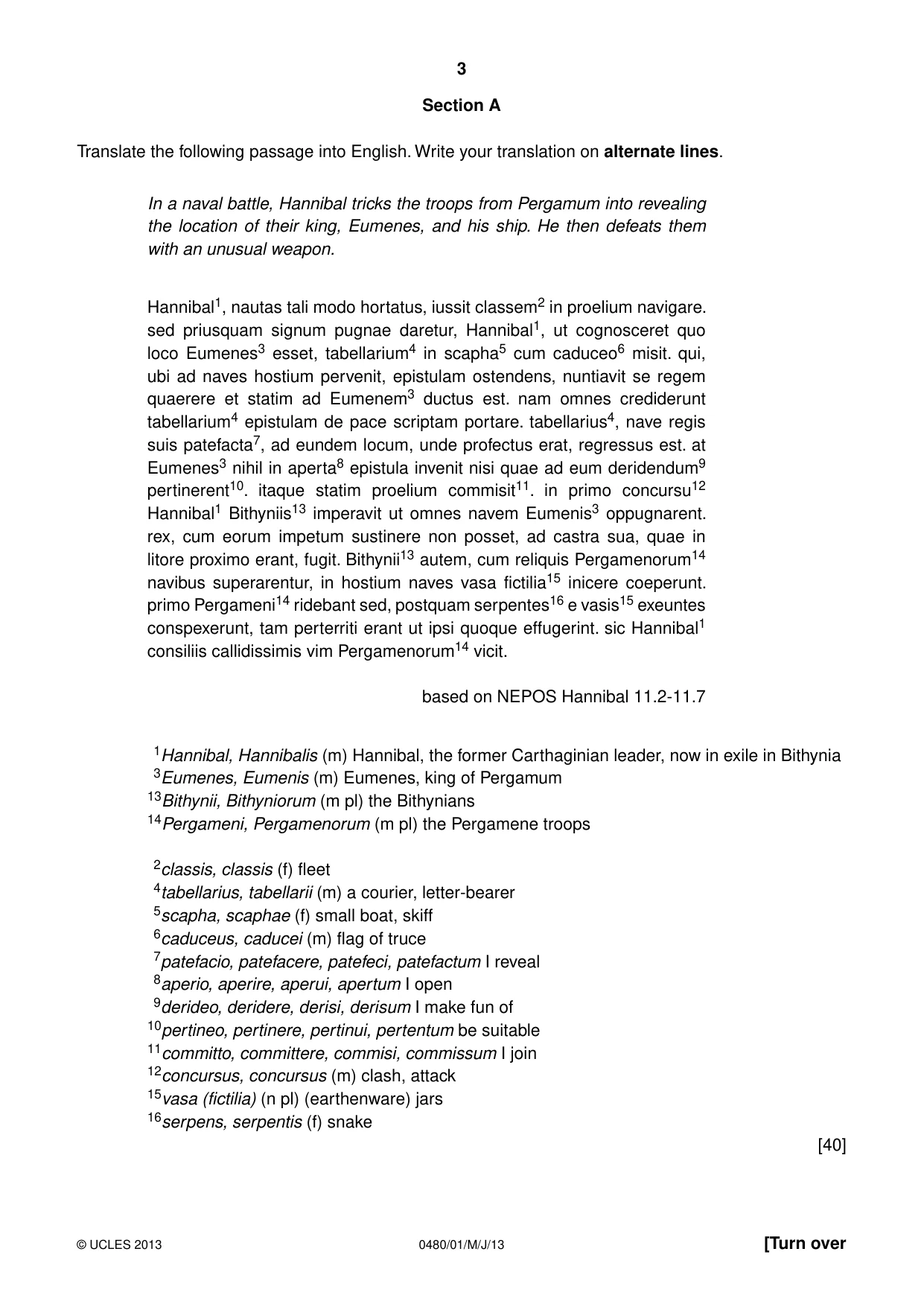
Question paper, page 3
3 0480/01/M/J/13 © UCLES 2013 [Turn over Section A Translate the following passage into English. Write your translation on alternate lines. In a naval battle, Hannibal tricks the troops from Pergamum into revealing the location of their king, Eumenes, and his ship. He then defeats them with an unusual weapon. Hannibal1, nautas tali modo hortatus, iussit classem2 in proelium navigare. sed priusquam signum pugnae daretur, Hannibal1, ut cognosceret quo loco Eumenes3 esset, tabellarium4 in scapha5 cum caduceo6 misit. qui, ubi ad naves hostium pervenit, epistulam ostendens, nuntiavit se regem quaerere et statim ad Eumenem3 ductus est. nam omnes crediderunt tabellarium4 epistulam de pace scriptam portare. tabellarius4, nave regis suis patefacta7, ad eundem locum, unde profectus erat, regressus est. at Eumenes3 nihil in aperta8 epistula invenit nisi quae ad eum deridendum9 pertinerent10. itaque statim proelium commisit11. in primo concursu12 Hannibal1 Bithyniis13 imperavit ut omnes navem Eumenis3 oppugnarent. rex, cum eorum impetum sustinere non posset, ad castra sua, quae in litore proximo erant, fugit. Bithynii13 autem, cum reliquis Pergamenorum14 navibus superarentur, in hostium naves vasa fictilia15 inicere coeperunt. primo Pergameni14 ridebant sed, postquam serpentes16 e vasis15 exeuntes conspexerunt, tam perterriti erant ut ipsi quoque effugerint. sic Hannibal1 consiliis callidissimis vim Pergamenorum14 vicit. based on NEPOS Hannibal 11.2-11.7 1Hannibal, Hannibalis (m) Hannibal, the former Carthaginian leader, now in exile in Bithynia 3Eumenes, Eumenis (m) Eumenes, king of Pergamum 13Bithynii, Bithyniorum (m pl) the Bithynians 14Pergameni, Pergamenorum (m pl) the Pergamene troops 2classis, classis (f) fleet 4tabellarius, tabellarii (m) a courier, letter-bearer 5scapha, scaphae (f) small boat, skiff 6caduceus, caducei (m) flag of truce 7patefacio, patefacere, patefeci, patefactum I reveal 8aperio, aperire, aperui, apertum I open 9derideo, deridere, derisi, derisum I make fun of 10pertineo, pertinere, pertinui, pertentum be suitable 11committo, committere, commisi, commissum I join 12concursus, concursus (m) clash, attack 15vasa (fictilia) (n pl) (earthenware) jars 16serpens, serpentis (f) snake [40]
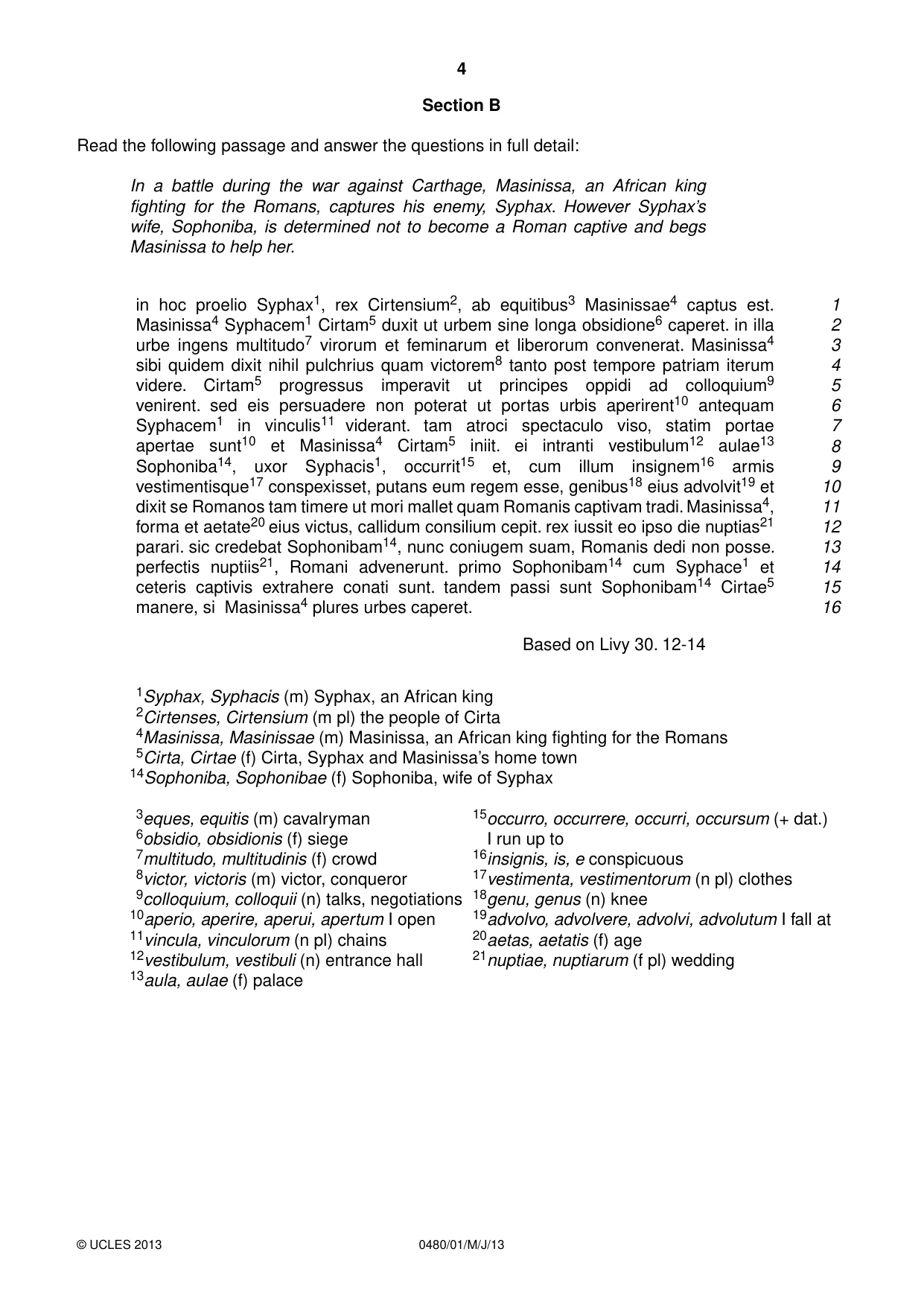
Question paper, page 4
4 0480/01/M/J/13 © UCLES 2013 Section B Read the following passage and answer the questions in full detail: In a battle during the war against Carthage, Masinissa, an African king fighting for the Romans, captures his enemy, Syphax. However Syphax’s wife, Sophoniba, is determined not to become a Roman captive and begs Masinissa to help her. in hoc proelio Syphax1, rex Cirtensium2, ab equitibus3 Masinissae4 captus est. Masinissa4 Syphacem1 Cirtam5 duxit ut urbem sine longa obsidione6 caperet. in illa urbe ingens multitudo7 virorum et feminarum et liberorum convenerat. Masinissa4 sibi quidem dixit nihil pulchrius quam victorem8 tanto post tempore patriam iterum videre. Cirtam5 progressus imperavit ut principes oppidi ad colloquium9 venirent. sed eis persuadere non poterat ut portas urbis aperirent10 antequam Syphacem1 in vinculis11 viderant. tam atroci spectaculo viso, statim portae apertae sunt10 et Masinissa4 Cirtam5 iniit. ei intranti vestibulum12 aulae13 Sophoniba14, uxor Syphacis1, occurrit15 et, cum illum insignem16 armis vestimentisque17 conspexisset, putans eum regem esse, genibus18 eius advolvit19 et dixit se Romanos tam timere ut mori mallet quam Romanis captivam tradi. Masinissa4, forma et aetate20 eius victus, callidum consilium cepit. rex iussit eo ipso die nuptias21 parari. sic credebat Sophonibam14, nunc coniugem suam, Romanis dedi non posse. perfectis nuptiis21, Romani advenerunt. primo Sophonibam14 cum Syphace1 et ceteris captivis extrahere conati sunt. tandem passi sunt Sophonibam14 Cirtae5 manere, si Masinissa4 plures urbes caperet. 1 2 3 4 5 6 7 8 9 10 11 12 13 14 15 16 Based on Livy 30. 12-14 1Syphax, Syphacis (m) Syphax, an African king 2Cirtenses, Cirtensium (m pl) the people of Cirta 4Masinissa, Masinissae (m) Masinissa, an African king fighting for the Romans 5Cirta, Cirtae (f) Cirta, Syphax and Masinissa’s home town 14Sophoniba, Sophonibae (f) Sophoniba, wife of Syphax 3eques, equitis (m) cavalryman 15occurro, occurrere, occurri, occursum (+ dat.) 6obsidio, obsidionis (f) siege I run up to 7multitudo, multitudinis (f) crowd 16insignis, is, e conspicuous 8victor, victoris (m) victor, conqueror 17vestimenta, vestimentorum (n pl) clothes 9colloquium, colloquii (n) talks, negotiations 18genu, genus (n) knee 10aperio, aperire, aperui, apertum I open 19advolvo, advolvere, advolvi, advolutum I fall at 11vincula, vinculorum (n pl) chains 20aetas, aetatis (f) age 12vestibulum, vestibuli (n) entrance hall 21nuptiae, nuptiarum (f pl) wedding 13aula, aulae (f) palace
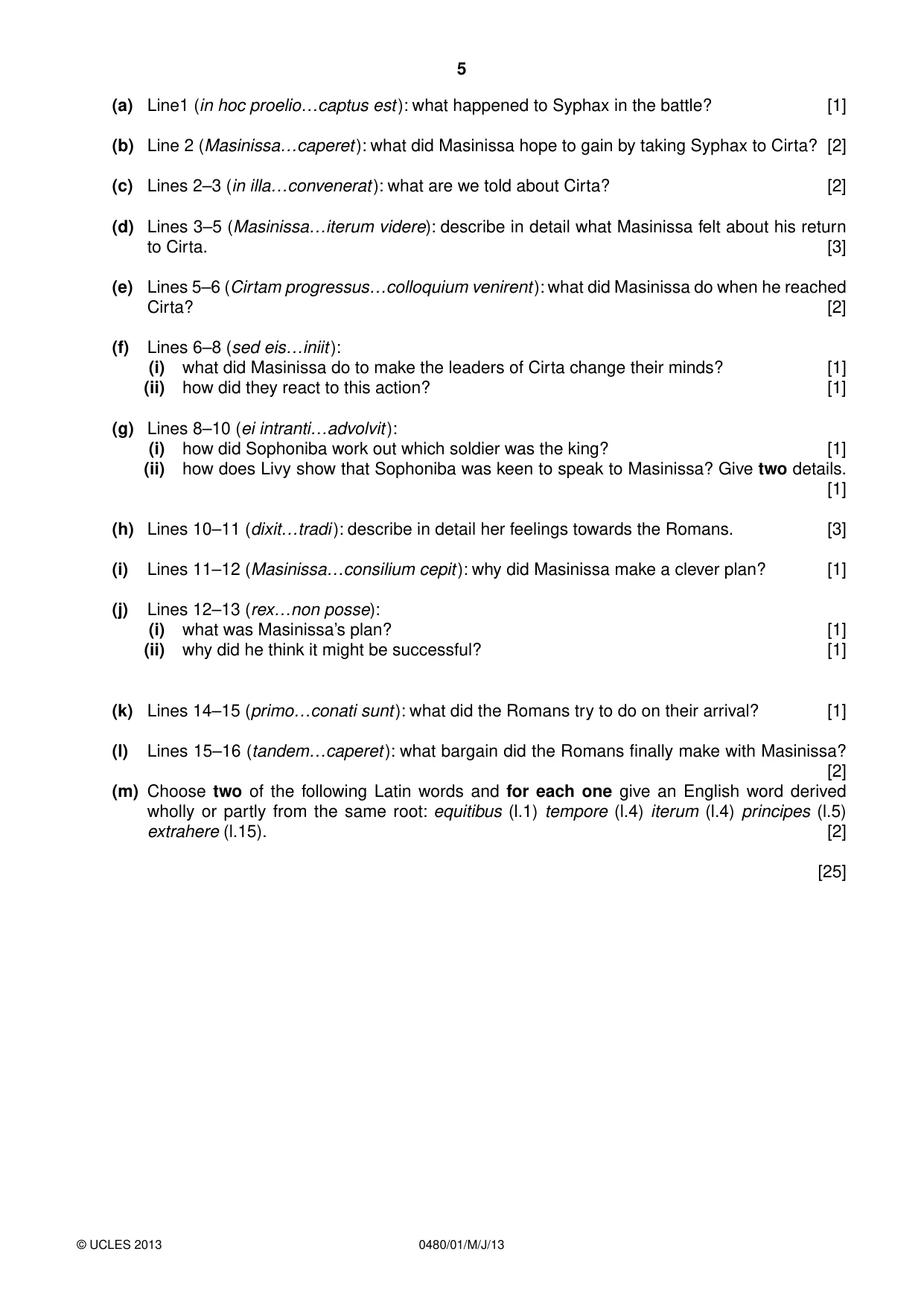
Question paper, page 5
5 0480/01/M/J/13 © UCLES 2013 (a) Line1 (in hoc proelio…captus est ): what happened to Syphax in the battle? [1] (b) Line 2 (Masinissa…caperet ): what did Masinissa hope to gain by taking Syphax to Cirta? [2] (c) Lines 2–3 (in illa…convenerat ): what are we told about Cirta? [2] (d) Lines 3–5 (Masinissa…iterum videre): describe in detail what Masinissa felt about his return to Cirta. [3] (e) Lines 5–6 (Cirtam progressus…colloquium venirent ): what did Masinissa do when he reached Cirta? [2] (f) Lines 6–8 (sed eis…iniit ): (i) what did Masinissa do to make the leaders of Cirta change their minds? [1] (ii) how did they react to this action? [1] (g) Lines 8–10 (ei intranti…advolvit ): (i) how did Sophoniba work out which soldier was the king? [1] (ii) how does Livy show that Sophoniba was keen to speak to Masinissa? Give two details. [1] (h) Lines 10–11 (dixit…tradi ): describe in detail her feelings towards the Romans. [3] (i) Lines 11–12 (Masinissa…consilium cepit ): why did Masinissa make a clever plan? [1] (j) Lines 12–13 (rex…non posse): (i) what was Masinissa’s plan? [1] (ii) why did he think it might be successful? [1] (k) Lines 14–15 (primo…conati sunt ): what did the Romans try to do on their arrival? [1] (l) Lines 15–16 (tandem…caperet ): what bargain did the Romans finally make with Masinissa? [2] (m) Choose two of the following Latin words and for each one give an English word derived wholly or partly from the same root: equitibus (l.1) tempore (l.4) iterum (l.4) principes (l.5) extrahere (l.15). [2] [25]
Question paper, page 6
6 0480/01/M/J/13 © UCLES 2013 BLANK PAGE
Question paper, page 7
7 0480/01/M/J/13 © UCLES 2013 BLANK PAGE
Question paper, page 8
8 0480/01/M/J/13 © UCLES 2013 Permission to reproduce items where third-party owned material protected by copyright is included has been sought and cleared where possible. Every reasonable effort has been made by the publisher (UCLES) to trace copyright holders, but if any items requiring clearance have unwittingly been included, the publisher will be pleased to make amends at the earliest possible opportunity. University of Cambridge International Examinations is part of the Cambridge Assessment Group. Cambridge Assessment is the brand name of University of Cambridge Local Examinations Syndicate (UCLES), which is itself a department of the University of Cambridge. BLANK PAGE
Mark scheme, page 1
CAMBRIDGE INTERNATIONAL EXAMINATIONS International General Certificate of Secondary Education MARK SCHEME for the May/June 2013 series 0480 LATIN 0480/01 Paper 1 (Language), maximum raw mark 65 This mark scheme is published as an aid to teachers and candidates, to indicate the requirements of the examination. It shows the basis on which Examiners were instructed to award marks. It does not indicate the details of the discussions that took place at an Examiners’ meeting before marking began, which would have considered the acceptability of alternative answers. Mark schemes should be read in conjunction with the question paper and the Principal Examiner Report for Teachers. Cambridge will not enter into discussions about these mark schemes. Cambridge is publishing the mark schemes for the May/June 2013 series for most IGCSE, GCE Advanced Level and Advanced Subsidiary Level components and some Ordinary Level components. www.XtremePapers.com
Mark scheme, page 2
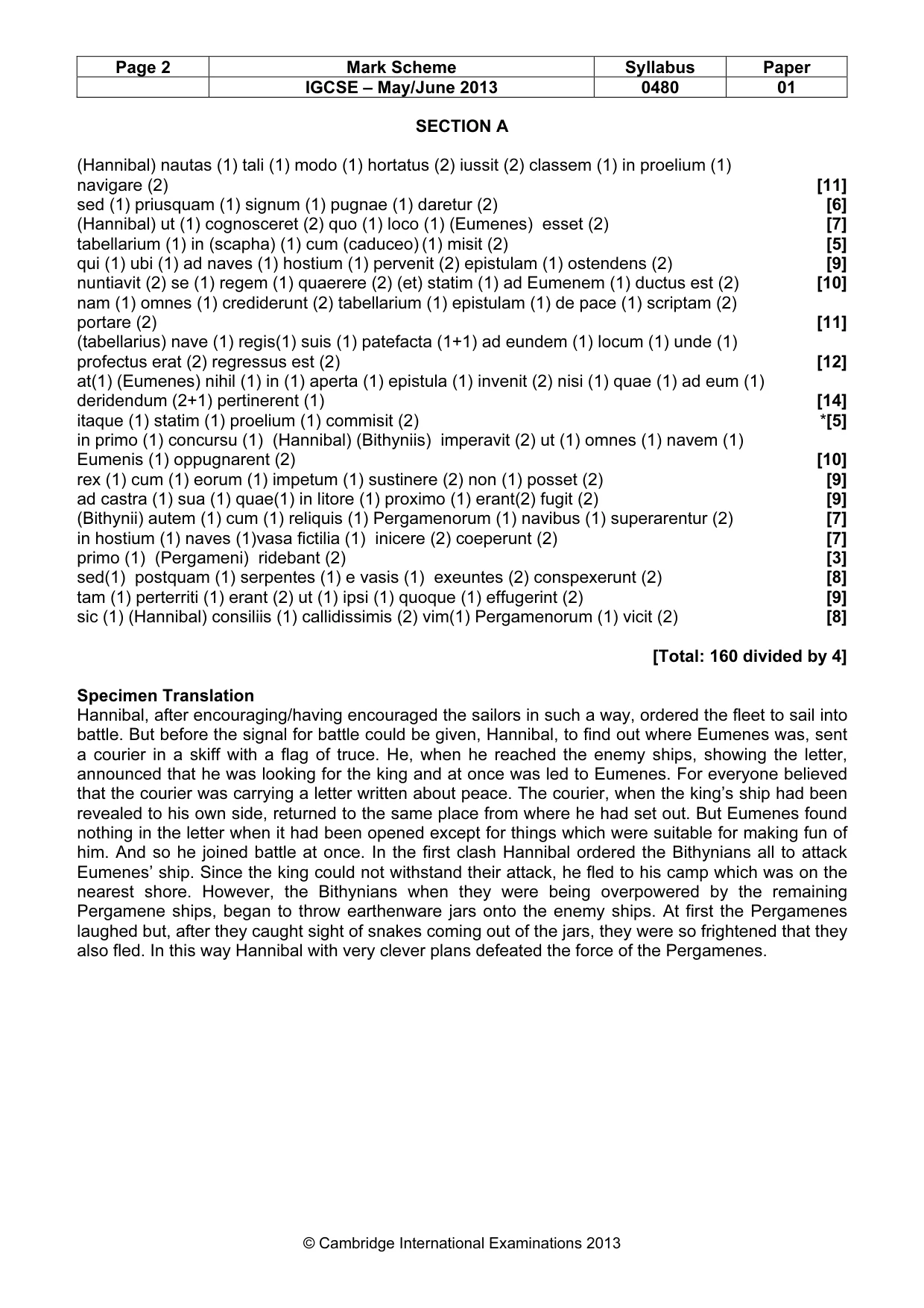
Page 2 Mark Scheme Syllabus Paper IGCSE – May/June 2013 0480 01 © Cambridge International Examinations 2013 SECTION A (Hannibal) nautas (1) tali (1) modo (1) hortatus (2) iussit (2) classem (1) in proelium (1) navigare (2) [11] sed (1) priusquam (1) signum (1) pugnae (1) daretur (2) [6] (Hannibal) ut (1) cognosceret (2) quo (1) loco (1) (Eumenes) esset (2) [7] tabellarium (1) in (scapha) (1) cum (caduceo) (1) misit (2) [5] qui (1) ubi (1) ad naves (1) hostium (1) pervenit (2) epistulam (1) ostendens (2) [9] nuntiavit (2) se (1) regem (1) quaerere (2) (et) statim (1) ad Eumenem (1) ductus est (2) [10] nam (1) omnes (1) crediderunt (2) tabellarium (1) epistulam (1) de pace (1) scriptam (2) portare (2) [11] (tabellarius) nave (1) regis(1) suis (1) patefacta (1+1) ad eundem (1) locum (1) unde (1) profectus erat (2) regressus est (2) [12] at(1) (Eumenes) nihil (1) in (1) aperta (1) epistula (1) invenit (2) nisi (1) quae (1) ad eum (1) deridendum (2+1) pertinerent (1) [14] itaque (1) statim (1) proelium (1) commisit (2) *[5] in primo (1) concursu (1) (Hannibal) (Bithyniis) imperavit (2) ut (1) omnes (1) navem (1) Eumenis (1) oppugnarent (2) [10] rex (1) cum (1) eorum (1) impetum (1) sustinere (2) non (1) posset (2) [9] ad castra (1) sua (1) quae(1) in litore (1) proximo (1) erant(2) fugit (2) [9] (Bithynii) autem (1) cum (1) reliquis (1) Pergamenorum (1) navibus (1) superarentur (2) [7] in hostium (1) naves (1)vasa fictilia (1) inicere (2) coeperunt (2) [7] primo (1) (Pergameni) ridebant (2) [3] sed(1) postquam (1) serpentes (1) e vasis (1) exeuntes (2) conspexerunt (2) [8] tam (1) perterriti (1) erant (2) ut (1) ipsi (1) quoque (1) effugerint (2) [9] sic (1) (Hannibal) consiliis (1) callidissimis (2) vim(1) Pergamenorum (1) vicit (2) [8] [Total: 160 divided by 4] Specimen Translation Hannibal, after encouraging/having encouraged the sailors in such a way, ordered the fleet to sail into battle. But before the signal for battle could be given, Hannibal, to find out where Eumenes was, sent a courier in a skiff with a flag of truce. He, when he reached the enemy ships, showing the letter, announced that he was looking for the king and at once was led to Eumenes. For everyone believed that the courier was carrying a letter written about peace. The courier, when the king’s ship had been revealed to his own side, returned to the same place from where he had set out. But Eumenes found nothing in the letter when it had been opened except for things which were suitable for making fun of him. And so he joined battle at once. In the first clash Hannibal ordered the Bithynians all to attack Eumenes’ ship. Since the king could not withstand their attack, he fled to his camp which was on the nearest shore. However, the Bithynians when they were being overpowered by the remaining Pergamene ships, began to throw earthenware jars onto the enemy ships. At first the Pergamenes laughed but, after they caught sight of snakes coming out of the jars, they were so frightened that they also fled. In this way Hannibal with very clever plans defeated the force of the Pergamenes.
Mark scheme, page 3
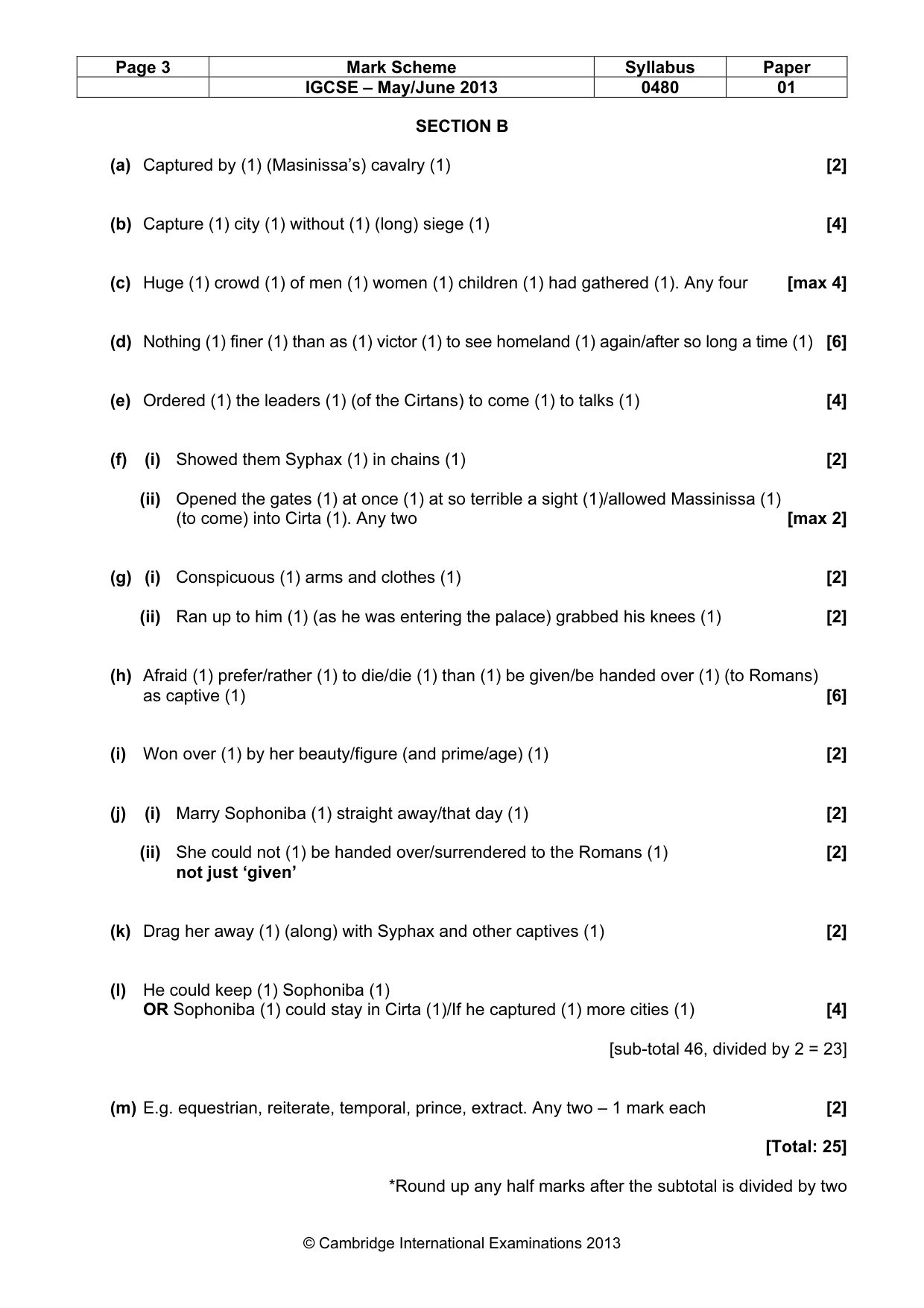
Page 3 Mark Scheme Syllabus Paper IGCSE – May/June 2013 0480 01 © Cambridge International Examinations 2013 SECTION B (a) Captured by (1) (Masinissa’s) cavalry (1) [2] (b) Capture (1) city (1) without (1) (long) siege (1) [4] (c) Huge (1) crowd (1) of men (1) women (1) children (1) had gathered (1). Any four [max 4] (d) Nothing (1) finer (1) than as (1) victor (1) to see homeland (1) again/after so long a time (1) [6] (e) Ordered (1) the leaders (1) (of the Cirtans) to come (1) to talks (1) [4] (f) (i) Showed them Syphax (1) in chains (1) [2] (ii) Opened the gates (1) at once (1) at so terrible a sight (1)/allowed Massinissa (1) (to come) into Cirta (1). Any two [max 2] (g) (i) Conspicuous (1) arms and clothes (1) [2] (ii) Ran up to him (1) (as he was entering the palace) grabbed his knees (1) [2] (h) Afraid (1) prefer/rather (1) to die/die (1) than (1) be given/be handed over (1) (to Romans) as captive (1) [6] (i) Won over (1) by her beauty/figure (and prime/age) (1) [2] (j) (i) Marry Sophoniba (1) straight away/that day (1) [2] (ii) She could not (1) be handed over/surrendered to the Romans (1) [2] not just ‘given’ (k) Drag her away (1) (along) with Syphax and other captives (1) [2] (l) He could keep (1) Sophoniba (1) OR Sophoniba (1) could stay in Cirta (1)/If he captured (1) more cities (1) [4] [sub-total 46, divided by 2 = 23] (m) E.g. equestrian, reiterate, temporal, prince, extract. Any two – 1 mark each [2] [Total: 25] *Round up any half marks after the subtotal is divided by two
What you needed in this session
Cambridge’s own grade thresholds for 2013 May/June, Paper 1 · Variant 1. A higher threshold means an easier paper — the bar moves with how the cohort did.