Cambridge IGCSE Latin 0480 — 2015 May/June Paper 1 · Variant 1
0480/11/M/J/15 · 65 marks · ≈73 min
The question paper and its mark scheme, free to read here and free to download. This is Cambridge’s own paper, exactly as it was sat.
Question paper8 pages




Mark scheme4 pages
Answers below. Sit the paper first if you are practising.
Paper as text
Question paper, page 1
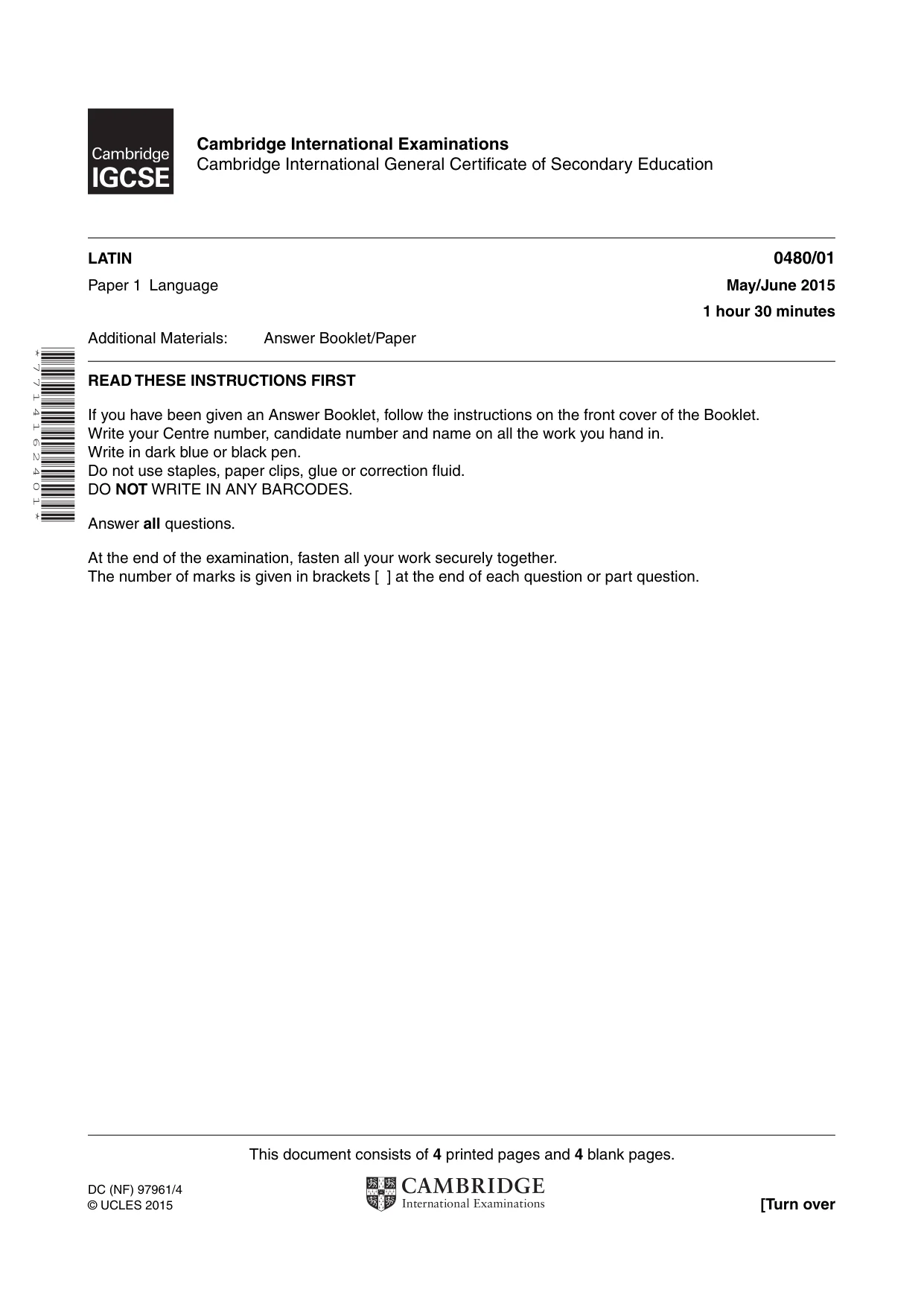
This document consists of 4 printed pages and 4 blank pages. DC (NF) 97961/4 © UCLES 2015 [Turn over Cambridge International Examinations Cambridge International General Certificate of Secondary Education * 7 7 1 4 1 6 2 4 0 1 * LATIN 0480/01 Paper 1 Language May/June 2015 1 hour 30 minutes Additional Materials: Answer Booklet/Paper READ THESE INSTRUCTIONS FIRST If you have been given an Answer Booklet, follow the instructions on the front cover of the Booklet. Write your Centre number, candidate number and name on all the work you hand in. Write in dark blue or black pen. Do not use staples, paper clips, glue or correction fluid. DO NOT WRITE IN ANY BARCODES. Answer all questions. At the end of the examination, fasten all your work securely together. The number of marks is given in brackets [ ] at the end of each question or part question.
Question paper, page 2
2 0480/01/M/J/15 © UCLES 2015 BLANK PAGE
Question paper, page 3
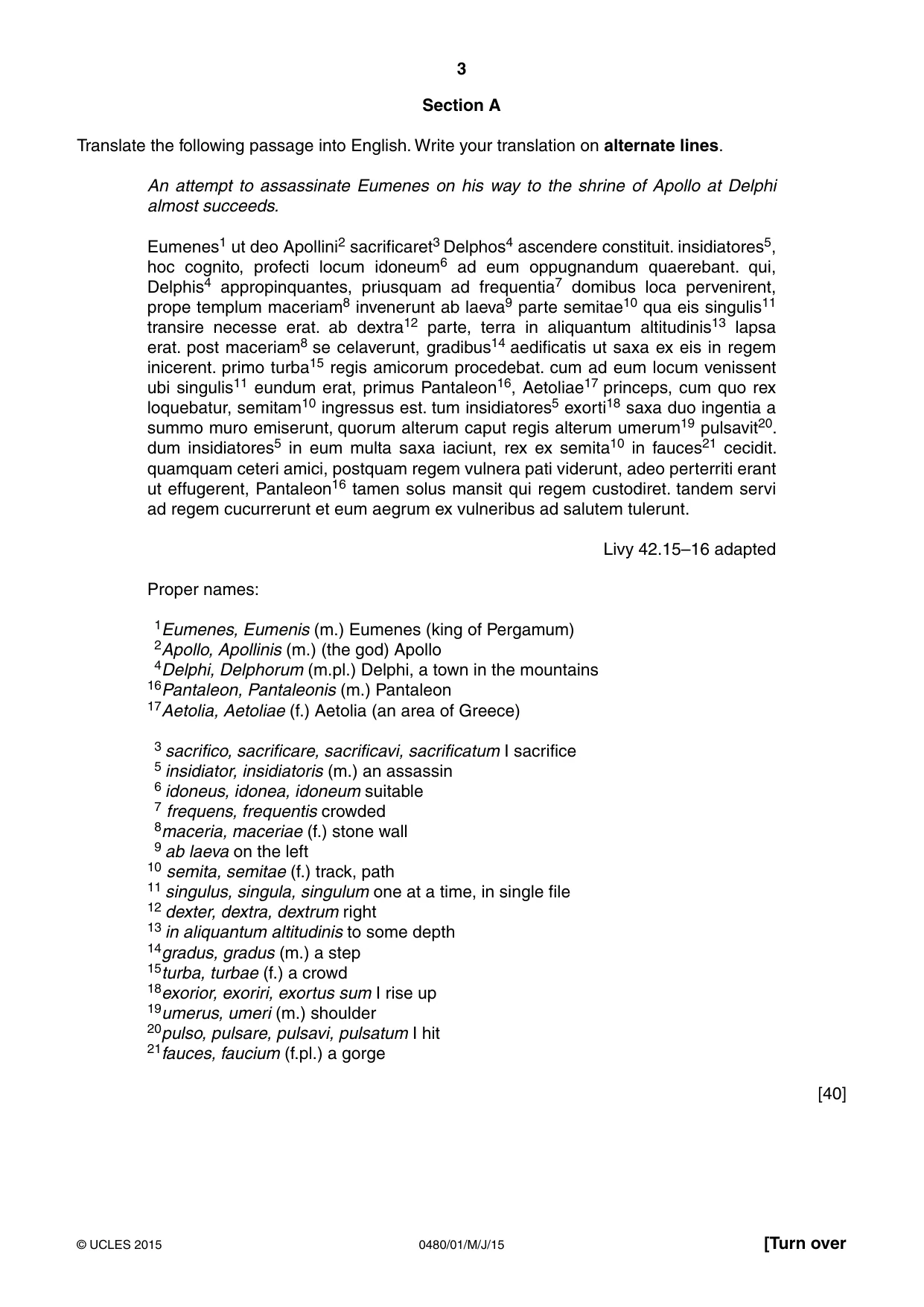
3 0480/01/M/J/15 © UCLES 2015 [Turn over Section A Translate the following passage into English. Write your translation on alternate lines. An attempt to assassinate Eumenes on his way to the shrine of Apollo at Delphi almost succeeds. Eumenes1 ut deo Apollini2 sacrificaret3 Delphos4 ascendere constituit. insidiatores5, hoc cognito, profecti locum idoneum6 ad eum oppugnandum quaerebant. qui, Delphis4 appropinquantes, priusquam ad frequentia7 domibus loca pervenirent, prope templum maceriam8 invenerunt ab laeva9 parte semitae10 qua eis singulis11 transire necesse erat. ab dextra12 parte, terra in aliquantum altitudinis13 lapsa erat. post maceriam8 se celaverunt, gradibus14 aedificatis ut saxa ex eis in regem inicerent. primo turba15 regis amicorum procedebat. cum ad eum locum venissent ubi singulis11 eundum erat, primus Pantaleon16, Aetoliae17 princeps, cum quo rex loquebatur, semitam10 ingressus est. tum insidiatores5 exorti18 saxa duo ingentia a summo muro emiserunt, quorum alterum caput regis alterum umerum19 pulsavit20. dum insidiatores5 in eum multa saxa iaciunt, rex ex semita10 in fauces21 cecidit. quamquam ceteri amici, postquam regem vulnera pati viderunt, adeo perterriti erant ut effugerent, Pantaleon16 tamen solus mansit qui regem custodiret. tandem servi ad regem cucurrerunt et eum aegrum ex vulneribus ad salutem tulerunt. Livy 42.15–16 adapted Proper names: 1Eumenes, Eumenis (m.) Eumenes (king of Pergamum) 2Apollo, Apollinis (m.) (the god) Apollo 4Delphi, Delphorum (m.pl.) Delphi, a town in the mountains 16Pantaleon, Pantaleonis (m.) Pantaleon 17Aetolia, Aetoliae (f.) Aetolia (an area of Greece) 3 sacrifico, sacrificare, sacrificavi, sacrificatum I sacrifice 5 insidiator, insidiatoris (m.) an assassin 6 idoneus, idonea, idoneum suitable 7 frequens, frequentis crowded 8maceria, maceriae (f.) stone wall 9 ab laeva on the left 10 semita, semitae (f.) track, path 11 singulus, singula, singulum one at a time, in single file 12 dexter, dextra, dextrum right 13 in aliquantum altitudinis to some depth 14gradus, gradus (m.) a step 15turba, turbae (f.) a crowd 18exorior, exoriri, exortus sum I rise up 19umerus, umeri (m.) shoulder 20pulso, pulsare, pulsavi, pulsatum I hit 21fauces, faucium (f.pl.) a gorge [40]
Question paper, page 4
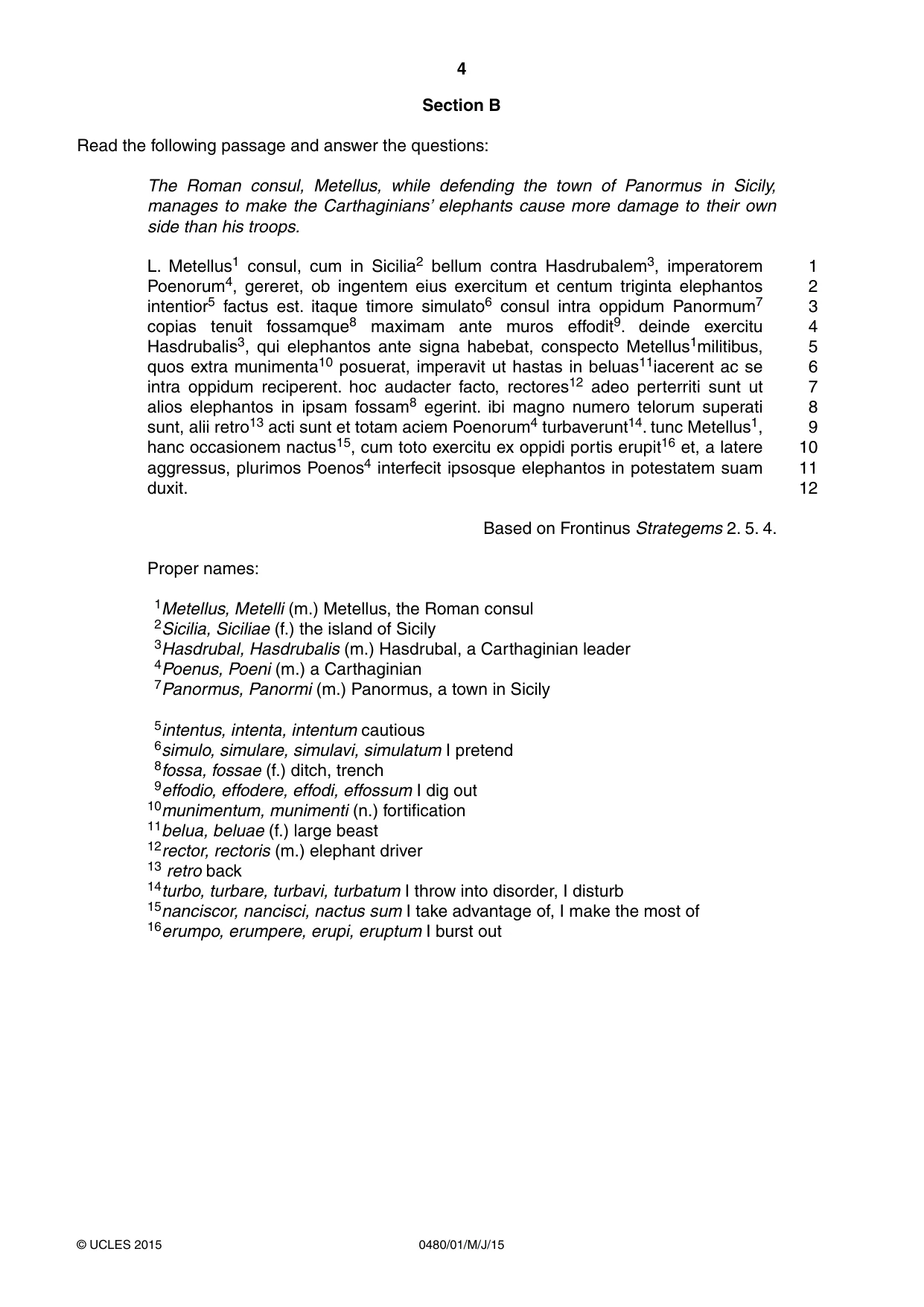
4 0480/01/M/J/15 © UCLES 2015 Section B Read the following passage and answer the questions: The Roman consul, Metellus, while defending the town of Panormus in Sicily, manages to make the Carthaginians’ elephants cause more damage to their own side than his troops. L. Metellus1 consul, cum in Sicilia2 bellum contra Hasdrubalem3, imperatorem Poenorum4, gereret, ob ingentem eius exercitum et centum triginta elephantos intentior5 factus est. itaque timore simulato6 consul intra oppidum Panormum7 copias tenuit fossamque8 maximam ante muros effodit9. deinde exercitu Hasdrubalis3, qui elephantos ante signa habebat, conspecto Metellus1militibus, quos extra munimenta10 posuerat, imperavit ut hastas in beluas11iacerent ac se intra oppidum reciperent. hoc audacter facto, rectores12 adeo perterriti sunt ut alios elephantos in ipsam fossam8 egerint. ibi magno numero telorum superati sunt, alii retro13 acti sunt et totam aciem Poenorum4 turbaverunt14. tunc Metellus1, hanc occasionem nactus15, cum toto exercitu ex oppidi portis erupit16 et, a latere aggressus, plurimos Poenos4 interfecit ipsosque elephantos in potestatem suam duxit. 1 2 3 4 5 6 7 8 9 10 11 12 Based on Frontinus Strategems 2. 5. 4. Proper names: 1Metellus, Metelli (m.) Metellus, the Roman consul 2Sicilia, Siciliae (f.) the island of Sicily 3Hasdrubal, Hasdrubalis (m.) Hasdrubal, a Carthaginian leader 4Poenus, Poeni (m.) a Carthaginian 7Panormus, Panormi (m.) Panormus, a town in Sicily 5intentus, intenta, intentum cautious 6simulo, simulare, simulavi, simulatum I pretend 8fossa, fossae (f.) ditch, trench 9effodio, effodere, effodi, effossum I dig out 10munimentum, munimenti (n.) fortification 11belua, beluae (f.) large beast 12rector, rectoris (m.) elephant driver 13 retro back 14turbo, turbare, turbavi, turbatum I throw into disorder, I disturb 15nanciscor, nancisci, nactus sum I take advantage of, I make the most of 16erumpo, erumpere, erupi, eruptum I burst out
Question paper, page 5
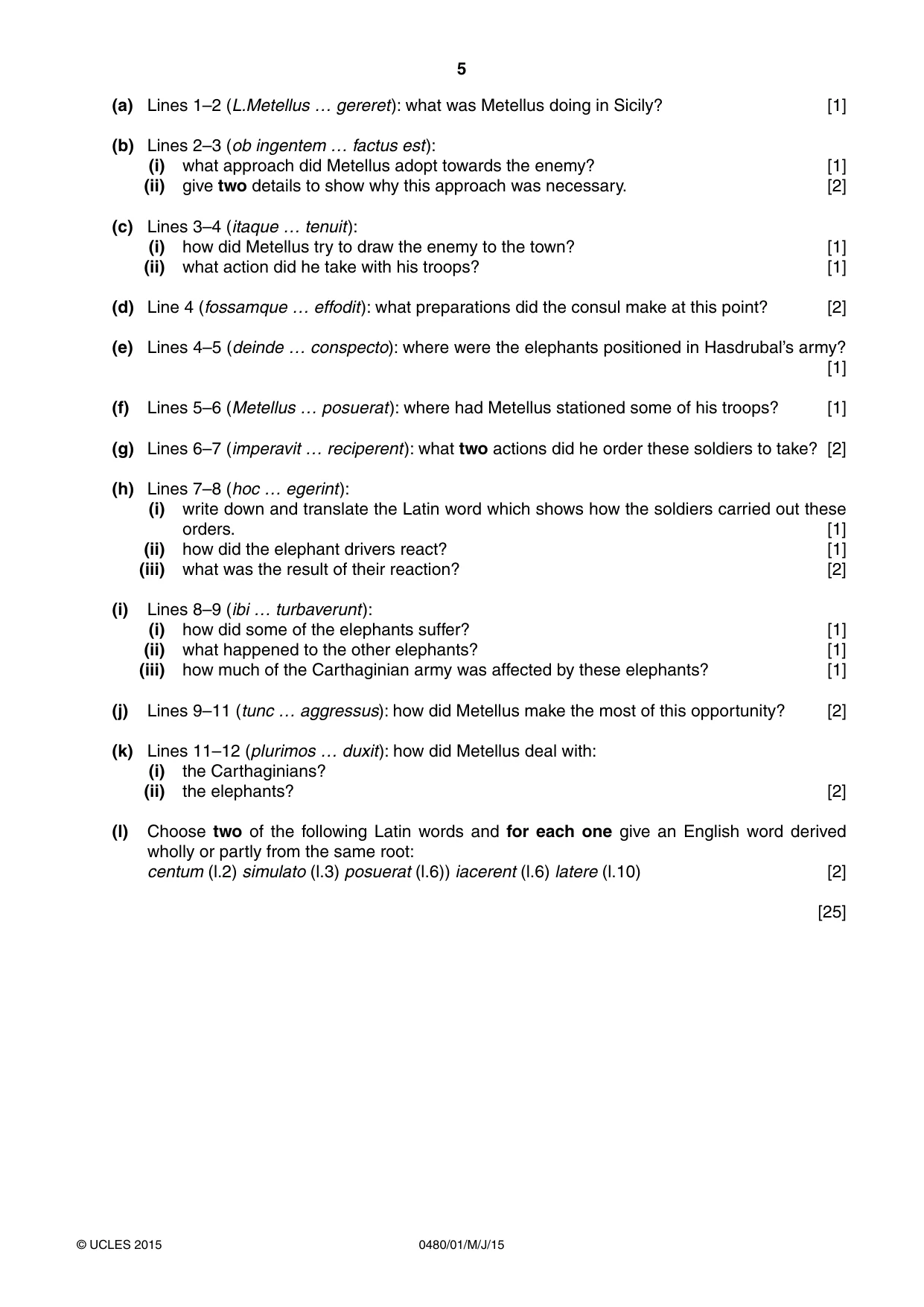
5 0480/01/M/J/15 © UCLES 2015 (a) Lines 1–2 (L.Metellus … gereret): what was Metellus doing in Sicily? [1] (b) Lines 2–3 (ob ingentem … factus est): (i) what approach did Metellus adopt towards the enemy? [1] (ii) give two details to show why this approach was necessary. [2] (c) Lines 3–4 (itaque … tenuit): (i) how did Metellus try to draw the enemy to the town? [1] (ii) what action did he take with his troops? [1] (d) Line 4 (fossamque … effodit): what preparations did the consul make at this point? [2] (e) Lines 4–5 (deinde … conspecto): where were the elephants positioned in Hasdrubal’s army? [1] (f) Lines 5–6 (Metellus … posuerat): where had Metellus stationed some of his troops? [1] (g) Lines 6–7 (imperavit … reciperent): what two actions did he order these soldiers to take? [2] (h) Lines 7–8 (hoc … egerint): (i) w rite down and translate the Latin word which shows how the soldiers carried out these orders. [1] (ii) how did the elephant drivers react? [1] (iii) what was the result of their reaction? [2] (i) Lines 8–9 (ibi … turbaverunt): (i) how did some of the elephants suffer? [1] (ii) what happened to the other elephants? [1] (iii) how much of the Carthaginian army was affected by these elephants? [1] (j) Lines 9–11 (tunc … aggressus): how did Metellus make the most of this opportunity? [2] (k) Lines 11–12 (plurimos … duxit): how did Metellus deal with: (i) the Carthaginians? (ii) the elephants? [2] (l) Choose two of the following Latin words and for each one give an English word derived wholly or partly from the same root: centum (l.2) simulato (l.3) posuerat (l.6)) iacerent (l.6) latere (l.10) [2] [25]
Question paper, page 6
6 0480/01/M/J/15 © UCLES 2015 BLANK PAGE
Question paper, page 7
7 0480/01/M/J/15 © UCLES 2015 BLANK PAGE
Question paper, page 8
8 0480/01/M/J/15 © UCLES 2015 BLANK PAGE Permission to reproduce items where third-party owned material protected by copyright is included has been sought and cleared where possible. Every reasonable effort has been made by the publisher (UCLES) to trace copyright holders, but if any items requiring clearance have unwittingly been included, the publisher will be pleased to make amends at the earliest possible opportunity. To avoid the issue of disclosure of answer-related information to candidates, all copyright acknowledgements are reproduced online in the Cambridge International Examinations Copyright Acknowledgements Booklet. This is produced for each series of examinations and is freely available to download at www.cie.org.uk after the live examination series. Cambridge International Examinations is part of the Cambridge Assessment Group. Cambridge Assessment is the brand name of University of Cambridge Local Examinations Syndicate (UCLES), which is itself a department of the University of Cambridge.
Mark scheme, page 1
® IGCSE is the registered trademark of Cambridge International Examinations. CAMBRIDGE INTERNATIONAL EXAMINATIONS Cambridge International General Certificate of Secondary Education MARK SCHEME for the May/June 2015 series 0480 LATIN 0480/01 Paper 1 (Language), maximum raw mark 65 This mark scheme is published as an aid to teachers and candidates, to indicate the requirements of the examination. It shows the basis on which Examiners were instructed to award marks. It does not indicate the details of the discussions that took place at an Examiners’ meeting before marking began, which would have considered the acceptability of alternative answers. Mark schemes should be read in conjunction with the question paper and the Principal Examiner Report for Teachers. Cambridge will not enter into discussions about these mark schemes. Cambridge is publishing the mark schemes for the May/June 2015 series for most Cambridge IGCSE®, Cambridge International A and AS Level components and some Cambridge O Level components.
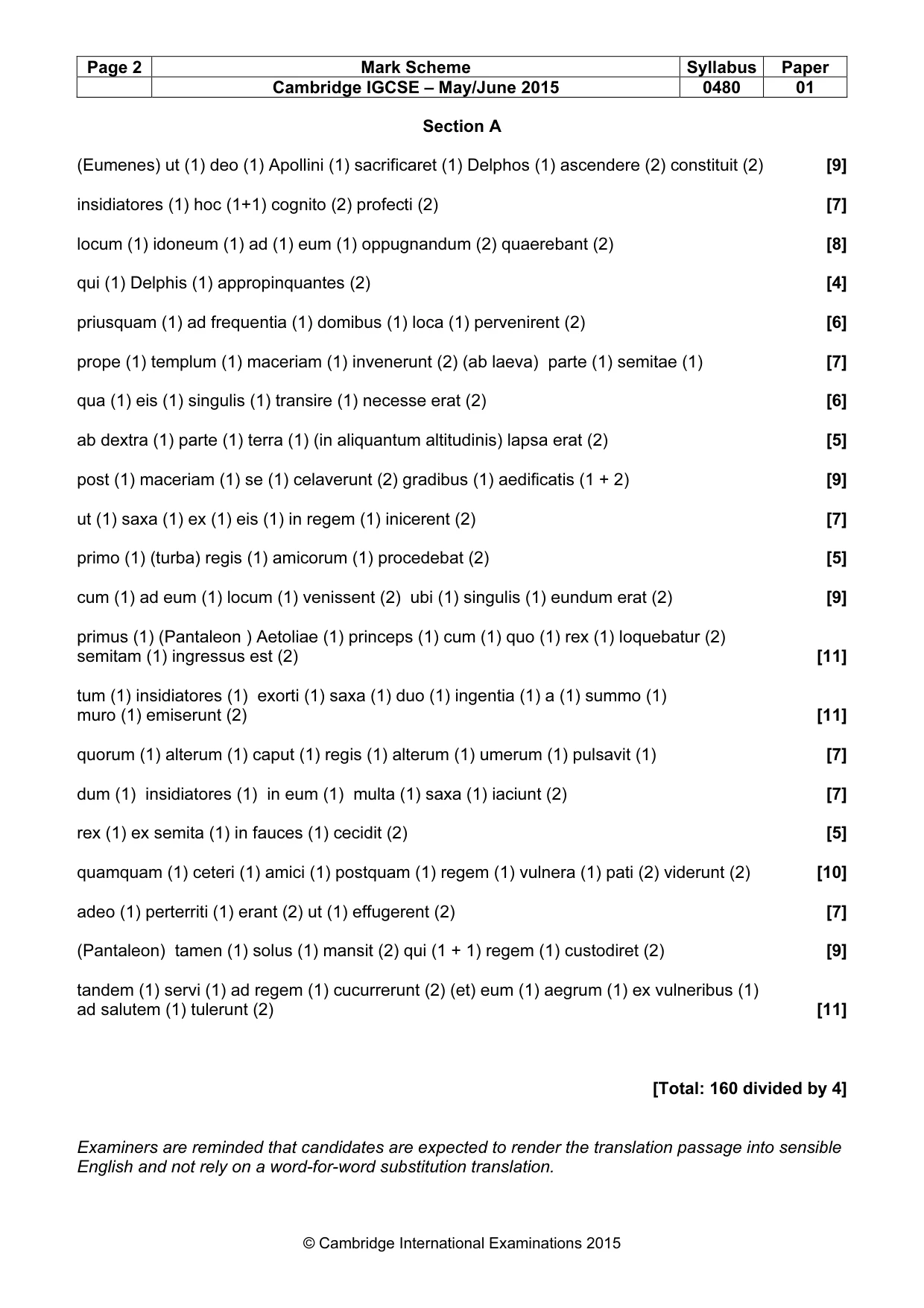
Mark scheme, page 2
Page 2 Mark Scheme Syllabus Paper Cambridge IGCSE – May/June 2015 0480 01 © Cambridge International Examinations 2015 Section A (Eumenes) ut (1) deo (1) Apollini (1) sacrificaret (1) Delphos (1) ascendere (2) constituit (2) [9] insidiatores (1) hoc (1+1) cognito (2) profecti (2) [7] locum (1) idoneum (1) ad (1) eum (1) oppugnandum (2) quaerebant (2) [8] qui (1) Delphis (1) appropinquantes (2) [4] priusquam (1) ad frequentia (1) domibus (1) loca (1) pervenirent (2) [6] prope (1) templum (1) maceriam (1) invenerunt (2) (ab laeva) parte (1) semitae (1) [7] qua (1) eis (1) singulis (1) transire (1) necesse erat (2) [6] ab dextra (1) parte (1) terra (1) (in aliquantum altitudinis) lapsa erat (2) [5] post (1) maceriam (1) se (1) celaverunt (2) gradibus (1) aedificatis (1 + 2) [9] ut (1) saxa (1) ex (1) eis (1) in regem (1) inicerent (2) [7] primo (1) (turba) regis (1) amicorum (1) procedebat (2) [5] cum (1) ad eum (1) locum (1) venissent (2) ubi (1) singulis (1) eundum erat (2) [9] primus (1) (Pantaleon ) Aetoliae (1) princeps (1) cum (1) quo (1) rex (1) loquebatur (2) semitam (1) ingressus est (2) [11] tum (1) insidiatores (1) exorti (1) saxa (1) duo (1) ingentia (1) a (1) summo (1) muro (1) emiserunt (2) [11] quorum (1) alterum (1) caput (1) regis (1) alterum (1) umerum (1) pulsavit (1) [7] dum (1) insidiatores (1) in eum (1) multa (1) saxa (1) iaciunt (2) [7] rex (1) ex semita (1) in fauces (1) cecidit (2) [5] quamquam (1) ceteri (1) amici (1) postquam (1) regem (1) vulnera (1) pati (2) viderunt (2) [10] adeo (1) perterriti (1) erant (2) ut (1) effugerent (2) [7] (Pantaleon) tamen (1) solus (1) mansit (2) qui (1 + 1) regem (1) custodiret (2) [9] tandem (1) servi (1) ad regem (1) cucurrerunt (2) (et) eum (1) aegrum (1) ex vulneribus (1) ad salutem (1) tulerunt (2) [11] [Total: 160 divided by 4] Examiners are reminded that candidates are expected to render the translation passage into sensible English and not rely on a word-for-word substitution translation.
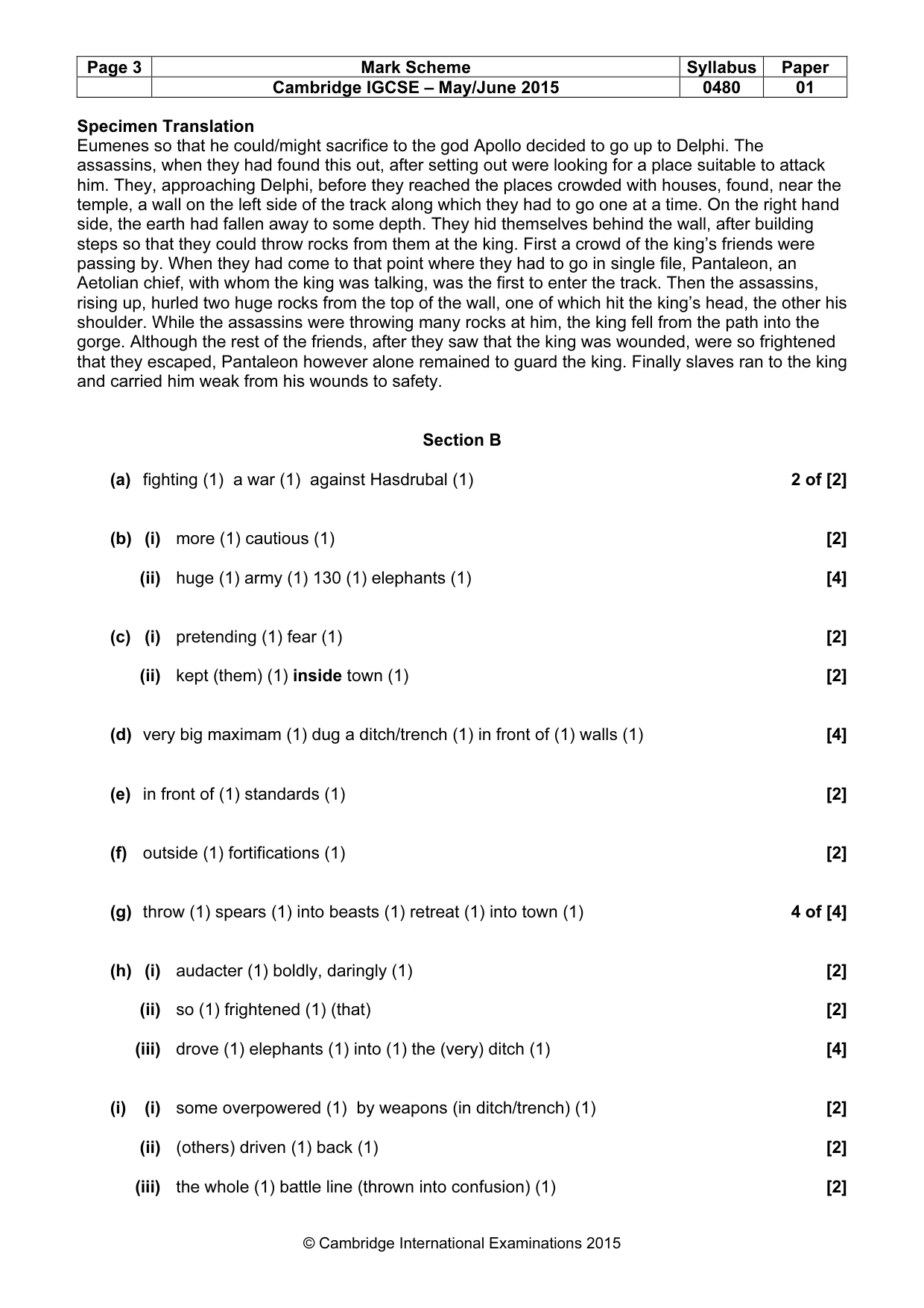
Mark scheme, page 3
Page 3 Mark Scheme Syllabus Paper Cambridge IGCSE – May/June 2015 0480 01 © Cambridge International Examinations 2015 Specimen Translation Eumenes so that he could/might sacrifice to the god Apollo decided to go up to Delphi. The assassins, when they had found this out, after setting out were looking for a place suitable to attack him. They, approaching Delphi, before they reached the places crowded with houses, found, near the temple, a wall on the left side of the track along which they had to go one at a time. On the right hand side, the earth had fallen away to some depth. They hid themselves behind the wall, after building steps so that they could throw rocks from them at the king. First a crowd of the king’s friends were passing by. When they had come to that point where they had to go in single file, Pantaleon, an Aetolian chief, with whom the king was talking, was the first to enter the track. Then the assassins, rising up, hurled two huge rocks from the top of the wall, one of which hit the king’s head, the other his shoulder. While the assassins were throwing many rocks at him, the king fell from the path into the gorge. Although the rest of the friends, after they saw that the king was wounded, were so frightened that they escaped, Pantaleon however alone remained to guard the king. Finally slaves ran to the king and carried him weak from his wounds to safety. Section B (a) fighting (1) a war (1) against Hasdrubal (1) 2 of [2] (b) (i) more (1) cautious (1) [2] (ii) huge (1) army (1) 130 (1) elephants (1) [4] (c) (i) pretending (1) fear (1) [2] (ii) kept (them) (1) inside town (1) [2] (d) very big maximam (1) dug a ditch/trench (1) in front of (1) walls (1) [4] (e) in front of (1) standards (1) [2] (f) outside (1) fortifications (1) [2] (g) throw (1) spears (1) into beasts (1) retreat (1) into town (1) 4 of [4] (h) (i) audacter (1) boldly, daringly (1) [2] (ii) so (1) frightened (1) (that) [2] (iii) drove (1) elephants (1) into (1) the (very) ditch (1) [4] (i) (i) some overpowered (1) by weapons (in ditch/trench) (1) [2] (ii) (others) driven (1) back (1) [2] (iii) the whole (1) battle line (thrown into confusion) (1) [2]
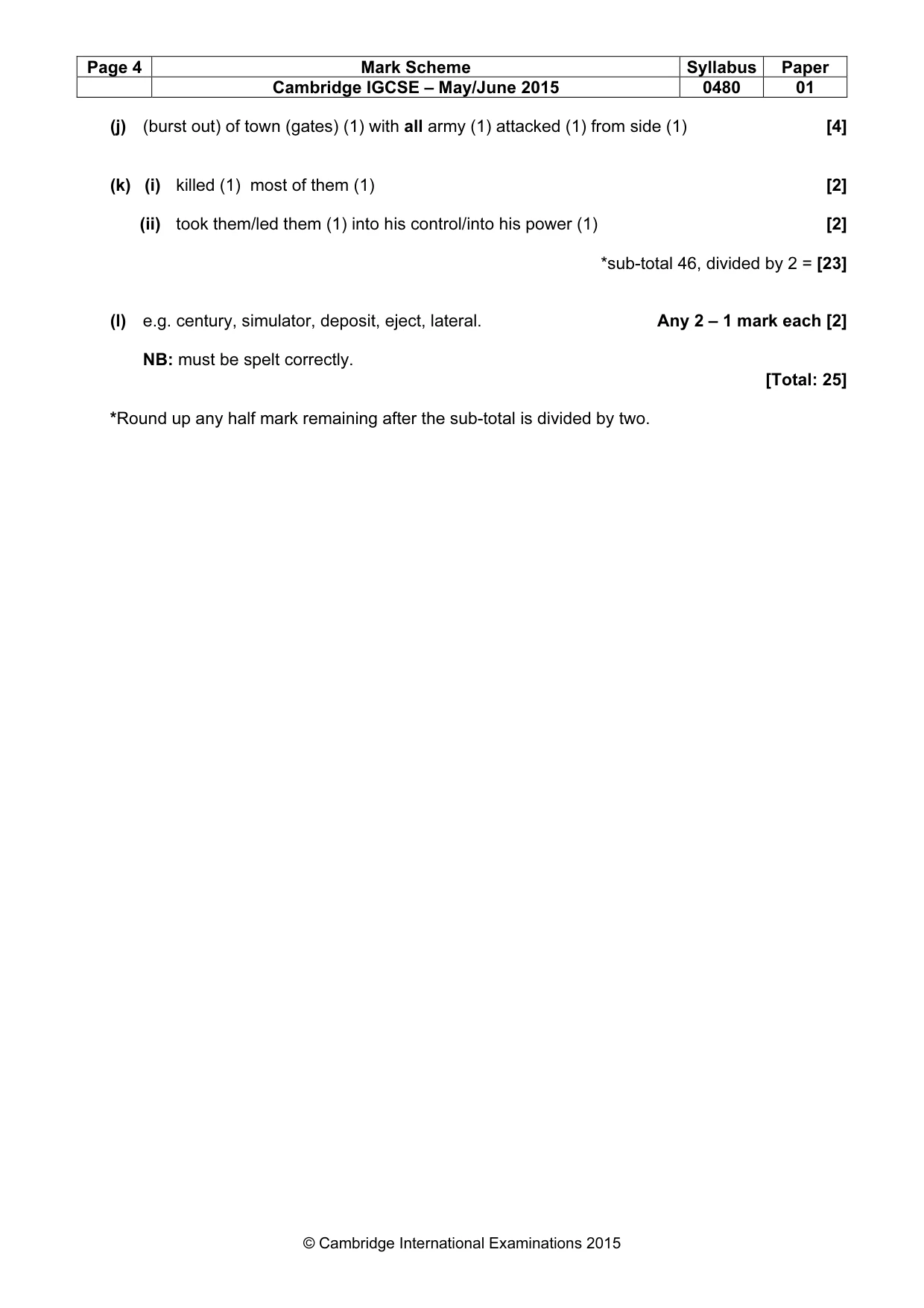
Mark scheme, page 4
Page 4 Mark Scheme Syllabus Paper Cambridge IGCSE – May/June 2015 0480 01 © Cambridge International Examinations 2015 (j) (burst out) of town (gates) (1) with all army (1) attacked (1) from side (1) [4] (k) (i) killed (1) most of them (1) [2] (ii) took them/led them (1) into his control/into his power (1) [2] *sub-total 46, divided by 2 = [23] (l) e.g. century, simulator, deposit, eject, lateral. Any 2 – 1 mark each [2] NB: must be spelt correctly. [Total: 25] *Round up any half mark remaining after the sub-total is divided by two.
What you needed in this session
Cambridge’s own grade thresholds for 2015 May/June, Paper 1 · Variant 1. A higher threshold means an easier paper — the bar moves with how the cohort did.