Cambridge IGCSE Indonesian - Foreign Language 0545 — 2019 May/June Paper 2 · Variant 1
0545/21/M/J/19 · 45 marks · ≈51 min
The question paper and its mark scheme, free to read here and free to download. This is Cambridge’s own paper, exactly as it was sat.
Question paper16 pages



Mark scheme12 pages
Answers below. Sit the paper first if you are practising.
Paper as text
Question paper, page 1
This document consists of 14 printed pages and 2 blank pages. DC (ST/CB) 164197/2 © UCLES 2019 [Turn over Cambridge Assessment International Education Cambridge International General Certificate of Secondary Education * 0 9 3 4 1 4 5 7 3 2 * INDONESIAN 0545/02 Paper 2 Reading May/June 2019 1 hour Candidates answer on the Question Paper. No Additional Materials are required. READ THESE INSTRUCTIONS FIRST Write your centre number, candidate number and name in the spaces at the top of this page. Write in dark blue or black pen. Do not use staples, paper clips, glue or correction fluid. DO NOT WRITE IN ANY BARCODES. Answer all questions. The number of marks is given in brackets [ ] at the end of each question or part question.
Question paper, page 2
2 0545/02/M/J/19 © UCLES 2019 BLANK PAGE
Question paper, page 3
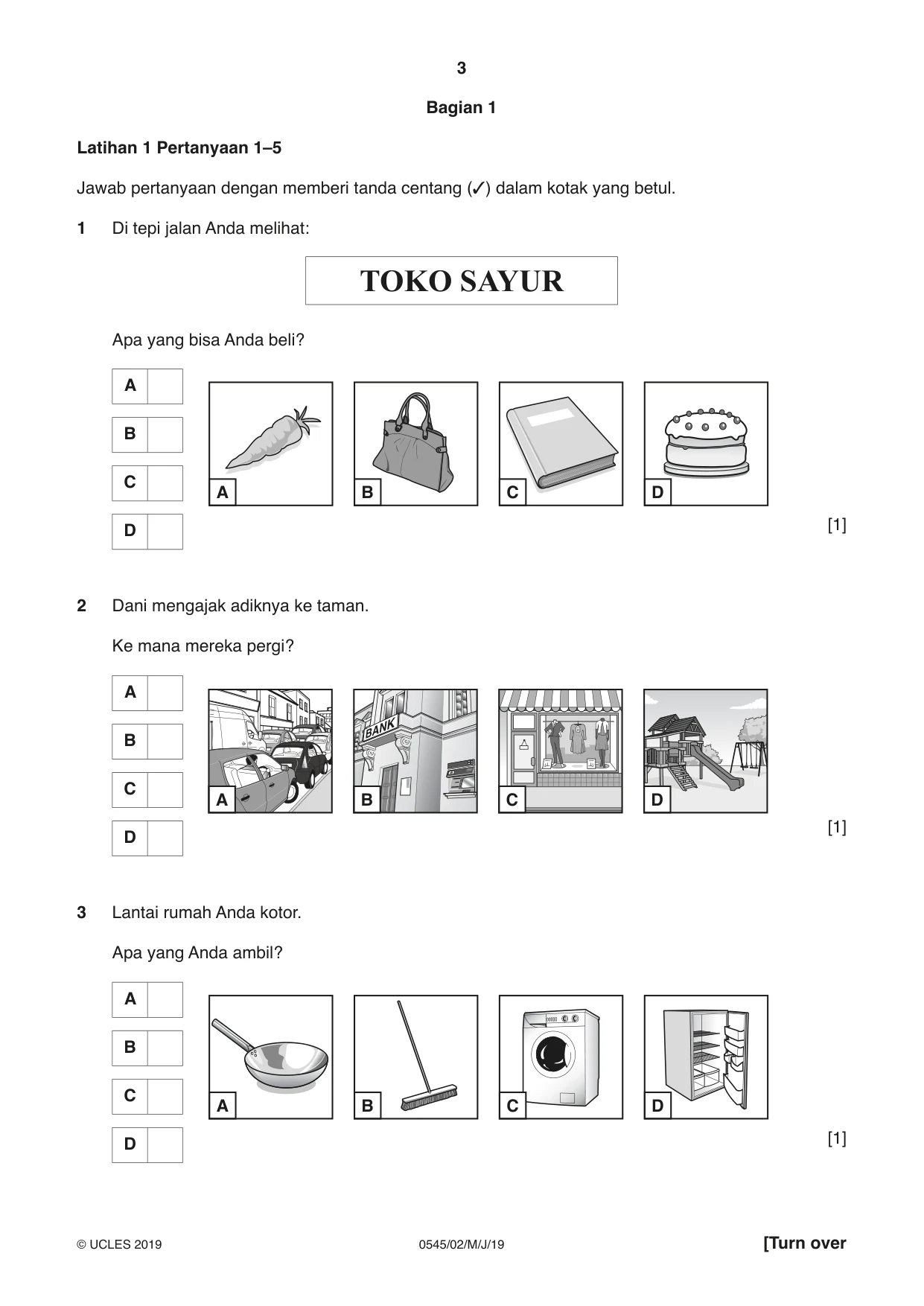
3 0545/02/M/J/19 © UCLES 2019 [Turn over Bagian 1 Latihan 1 Pertanyaan 1–5 Jawab pertanyaan dengan memberi tanda centang (3) dalam kotak yang betul. 1 Di tepi jalan Anda melihat: TOKO SAYUR Apa yang bisa Anda beli? A A B C D [1] B C D 2 Dani mengajak adiknya ke taman. Ke mana mereka pergi? A A B C D [1] B C D 3 Lantai rumah Anda kotor. Apa yang Anda ambil? A A B C D [1] B C D
Question paper, page 4
4 0545/02/M/J/19 © UCLES 2019 4 Latifah melihat kolam ikan di mal. Tulisan apa yang ada di tepi kolam? A Buang Sampah di Sini! B Awas, Anjing Galak! C Dilarang Memancing! D Pinjam Buku di Sini! [1] 5 Bapak membaca pesan dari Nina: Ujian bahasa Inggris selesai jam 2. Tolong saya dijemput. Nina ada di mana? A di stasiun kereta B di kantor polisi C di rumah sakit D di sekolah [1] [Total: 5]
Question paper, page 5
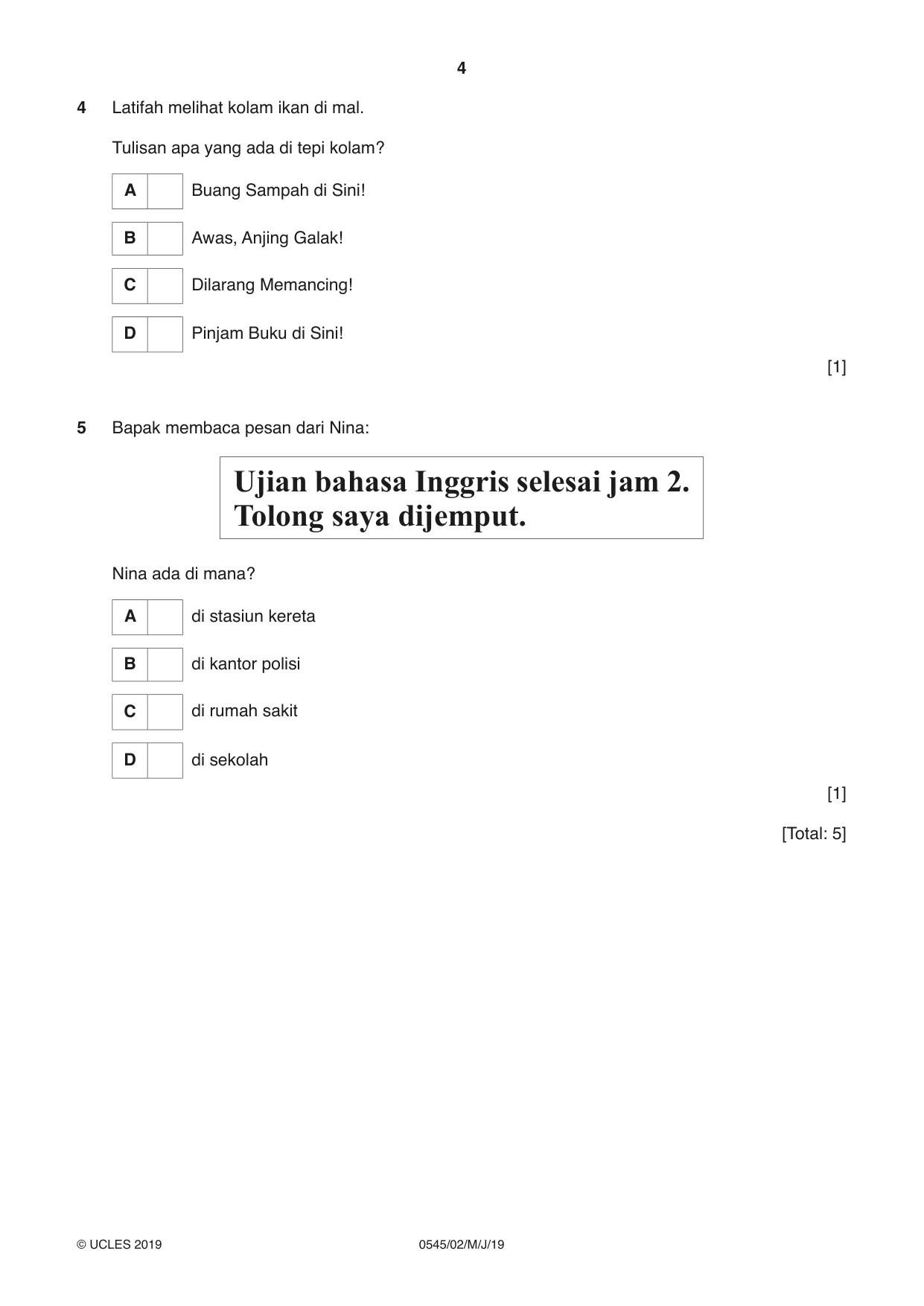
5 0545/02/M/J/19 © UCLES 2019 [Turn over Latihan 2 Pertanyaan 6–10 Lihat gambar-gambar berikut. 3 4 5 A B C D E F Ke mana orang-orang ini pergi? Tulis huruf yang betul (A, B, C, D, E atau F) dalam kotak yang cocok. 6 Edi dan temannya merasa lapar. 7 Halim ikut lomba renang hari ini. 8 Ella harus belajar. 9 Bapak berangkat ke luar negeri pagi ini. 10 Kakek saya suka udara segar. [Total: 5]
Question paper, page 6
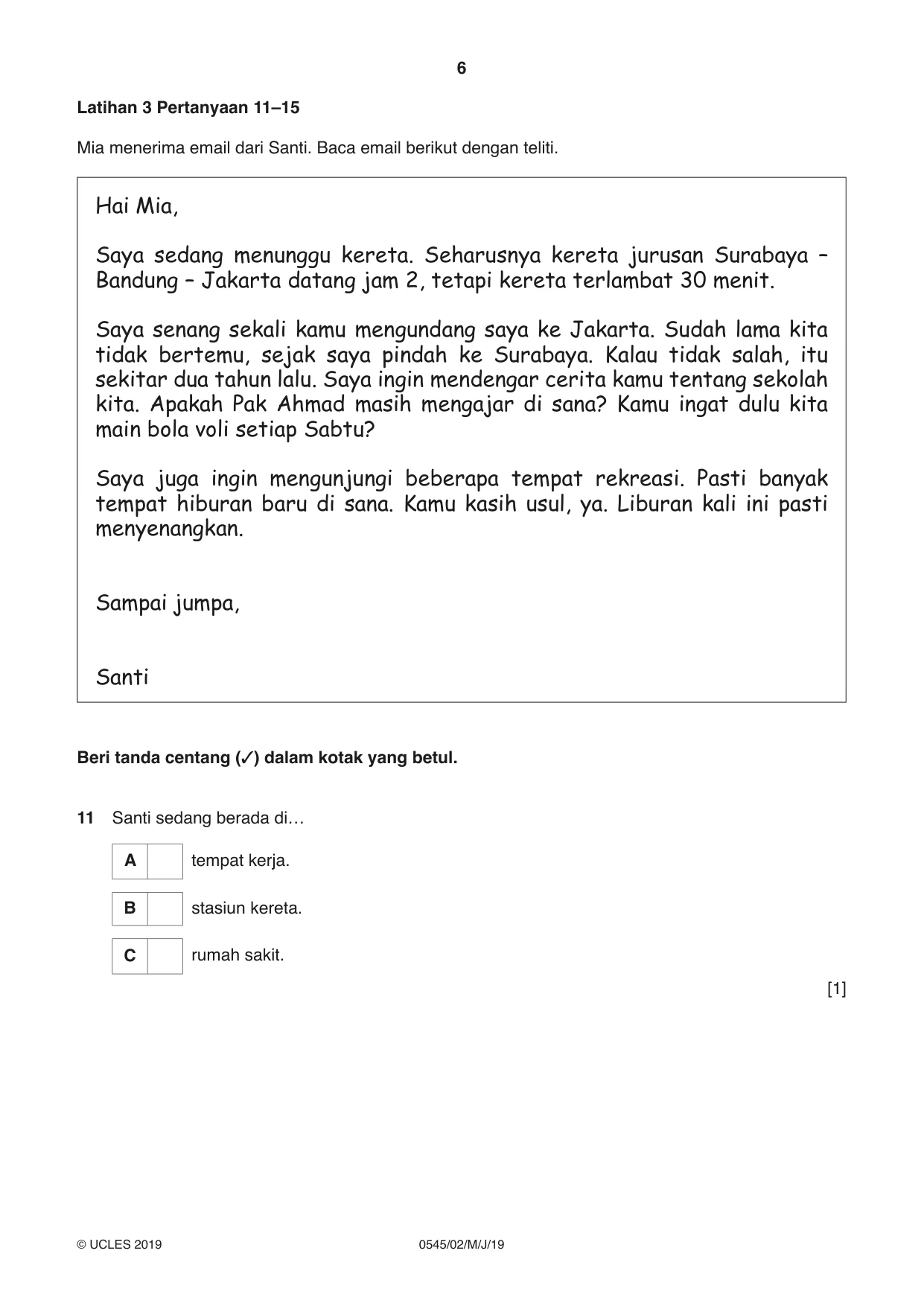
6 0545/02/M/J/19 © UCLES 2019 Latihan 3 Pertanyaan 11–15 Mia menerima email dari Santi. Baca email berikut dengan teliti. Hai Mia, Saya sedang menunggu kereta. Seharusnya kereta jurusan Surabaya – Bandung – Jakarta datang jam 2, tetapi kereta terlambat 30 menit. Saya senang sekali kamu mengundang saya ke Jakarta. Sudah lama kita tidak bertemu, sejak saya pindah ke Surabaya. Kalau tidak salah, itu sekitar dua tahun lalu. Saya ingin mendengar cerita kamu tentang sekolah kita. Apakah Pak Ahmad masih mengajar di sana? Kamu ingat dulu kita main bola voli setiap Sabtu? Saya juga ingin mengunjungi beberapa tempat rekreasi. Pasti banyak tempat hiburan baru di sana. Kamu kasih usul, ya. Liburan kali ini pasti menyenangkan. Sampai jumpa, Santi Beri tanda centang (3) dalam kotak yang betul. 11 Santi sedang berada di… A tempat kerja. B stasiun kereta. C rumah sakit. [1]
Question paper, page 7
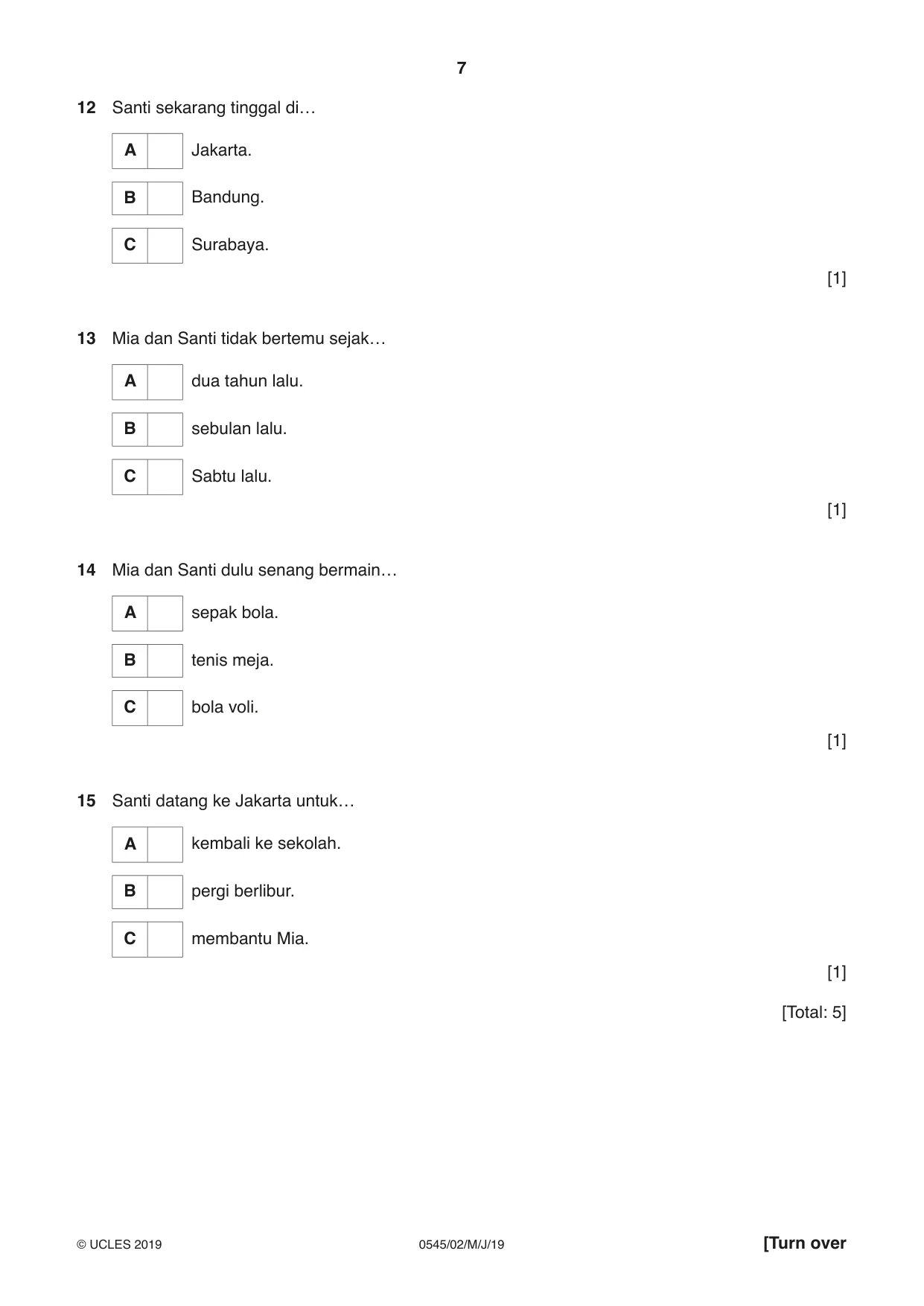
7 0545/02/M/J/19 © UCLES 2019 [Turn over 12 Santi sekarang tinggal di… A Jakarta. B Bandung. C Surabaya. [1] 13 Mia dan Santi tidak bertemu sejak… A dua tahun lalu. B sebulan lalu. C Sabtu lalu. [1] 14 Mia dan Santi dulu senang bermain… A sepak bola. B tenis meja. C bola voli. [1] 15 Santi datang ke Jakarta untuk… A kembali ke sekolah. B pergi berlibur. C membantu Mia. [1] [Total: 5]
Question paper, page 8
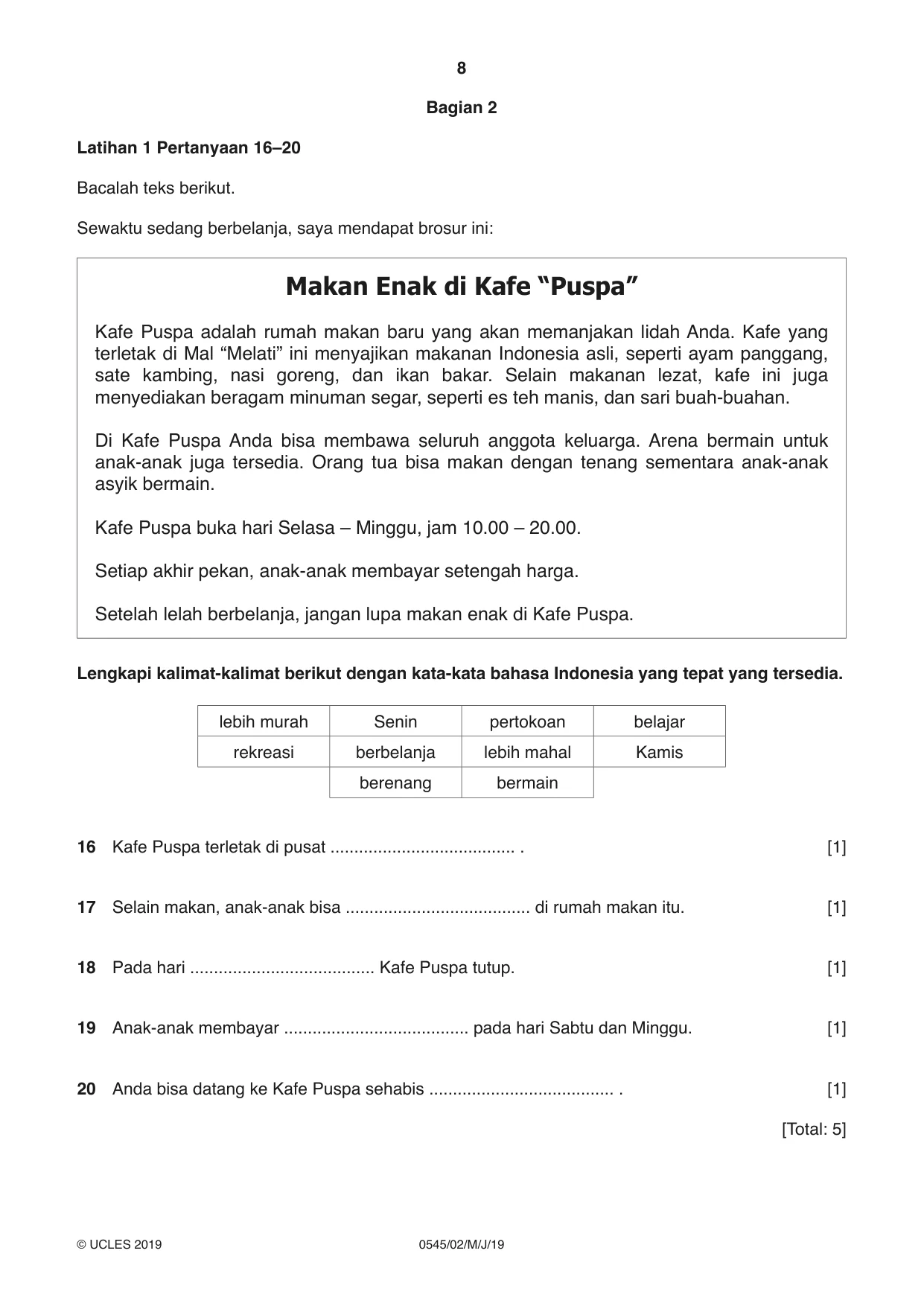
8 0545/02/M/J/19 © UCLES 2019 Bagian 2 Latihan 1 Pertanyaan 16–20 Bacalah teks berikut. Sewaktu sedang berbelanja, saya mendapat brosur ini: Makan Enak di Kafe “Puspa” Kafe Puspa adalah rumah makan baru yang akan memanjakan lidah Anda. Kafe yang terletak di Mal “Melati” ini menyajikan makanan Indonesia asli, seperti ayam panggang, sate kambing, nasi goreng, dan ikan bakar. Selain makanan lezat, kafe ini juga menyediakan beragam minuman segar, seperti es teh manis, dan sari buah-buahan. Di Kafe Puspa Anda bisa membawa seluruh anggota keluarga. Arena bermain untuk anak-anak juga tersedia. Orang tua bisa makan dengan tenang sementara anak-anak asyik bermain. Kafe Puspa buka hari Selasa – Minggu, jam 10.00 – 20.00. Setiap akhir pekan, anak-anak membayar setengah harga. Setelah lelah berbelanja, jangan lupa makan enak di Kafe Puspa. Lengkapi kalimat-kalimat berikut dengan kata-kata bahasa Indonesia yang tepat yang tersedia. lebih murah Senin pertokoan belajar rekreasi berbelanja lebih mahal Kamis berenang bermain 16 Kafe Puspa terletak di pusat … . [1] 17 Selain makan, anak-anak bisa … di rumah makan itu. [1] 18 Pada hari … Kafe Puspa tutup. [1] 19 Anak-anak membayar … pada hari Sabtu dan Minggu. [1] 20 Anda bisa datang ke Kafe Puspa sehabis … . [1] [Total: 5]
Question paper, page 9
9 0545/02/M/J/19 © UCLES 2019 [Turn over Balikkan kertas untuk Latihan 2
Question paper, page 10
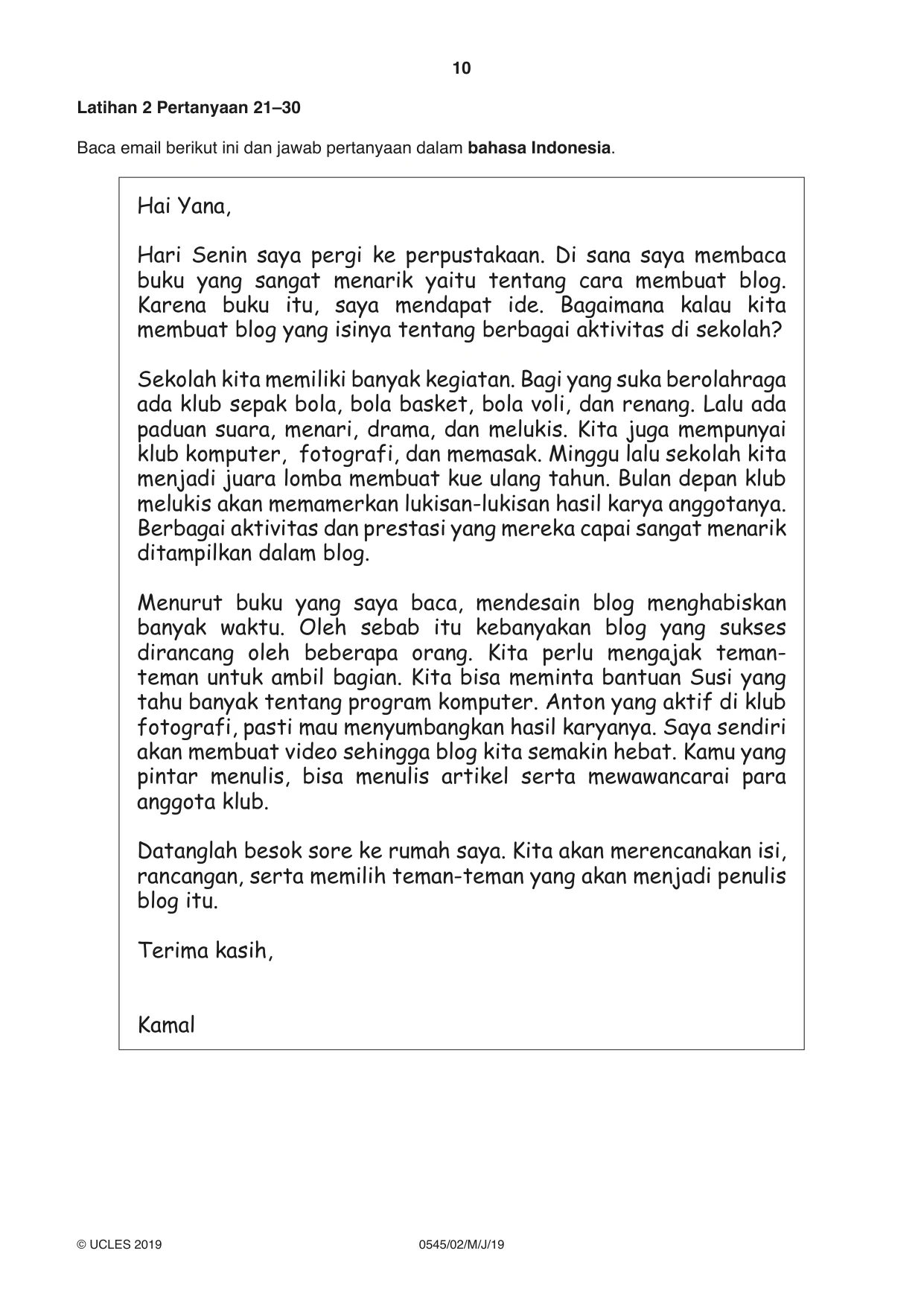
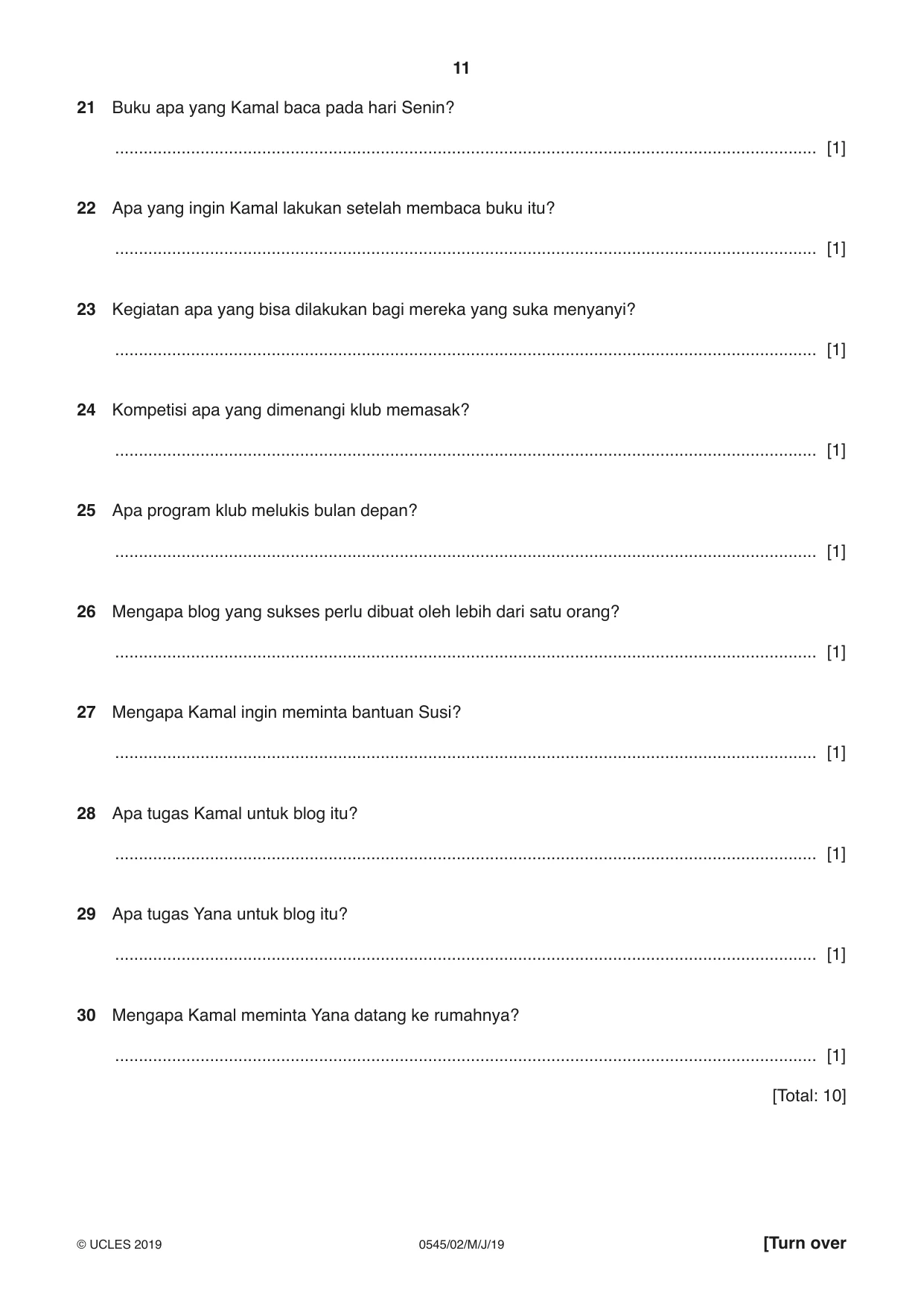
10 0545/02/M/J/19 © UCLES 2019 Latihan 2 Pertanyaan 21–30 Baca email berikut ini dan jawab pertanyaan dalam bahasa Indonesia. Hai Yana, Hari Senin saya pergi ke perpustakaan. Di sana saya membaca buku yang sangat menarik yaitu tentang cara membuat blog. Karena buku itu, saya mendapat ide. Bagaimana kalau kita membuat blog yang isinya tentang berbagai aktivitas di sekolah? Sekolah kita memiliki banyak kegiatan. Bagi yang suka berolahraga ada klub sepak bola, bola basket, bola voli, dan renang. Lalu ada paduan suara, menari, drama, dan melukis. Kita juga mempunyai klub komputer, fotografi, dan memasak. Minggu lalu sekolah kita menjadi juara lomba membuat kue ulang tahun. Bulan depan klub melukis akan memamerkan lukisan-lukisan hasil karya anggotanya. Berbagai aktivitas dan prestasi yang mereka capai sangat menarik ditampilkan dalam blog. Menurut buku yang saya baca, mendesain blog menghabiskan banyak waktu. Oleh sebab itu kebanyakan blog yang sukses dirancang oleh beberapa orang. Kita perlu mengajak teman- teman untuk ambil bagian. Kita bisa meminta bantuan Susi yang tahu banyak tentang program komputer. Anton yang aktif di klub fotografi, pasti mau menyumbangkan hasil karyanya. Saya sendiri akan membuat video sehingga blog kita semakin hebat. Kamu yang pintar menulis, bisa menulis artikel serta mewawancarai para anggota klub. Datanglah besok sore ke rumah saya. Kita akan merencanakan isi, rancangan, serta memilih teman-teman yang akan menjadi penulis blog itu. Terima kasih, Kamal
Question paper, page 11
11 0545/02/M/J/19 © UCLES 2019 [Turn over 21 Buku apa yang Kamal baca pada hari Senin? … [1] 22 Apa yang ingin Kamal lakukan setelah membaca buku itu? … [1] 23 Kegiatan apa yang bisa dilakukan bagi mereka yang suka menyanyi? … [1] 24 Kompetisi apa yang dimenangi klub memasak? … [1] 25 Apa program klub melukis bulan depan? … [1] 26 Mengapa blog yang sukses perlu dibuat oleh lebih dari satu orang? … [1] 27 Mengapa Kamal ingin meminta bantuan Susi? … [1] 28 Apa tugas Kamal untuk blog itu? … [1] 29 Apa tugas Yana untuk blog itu? … [1] 30 Mengapa Kamal meminta Yana datang ke rumahnya? … [1] [Total: 10]
Question paper, page 12
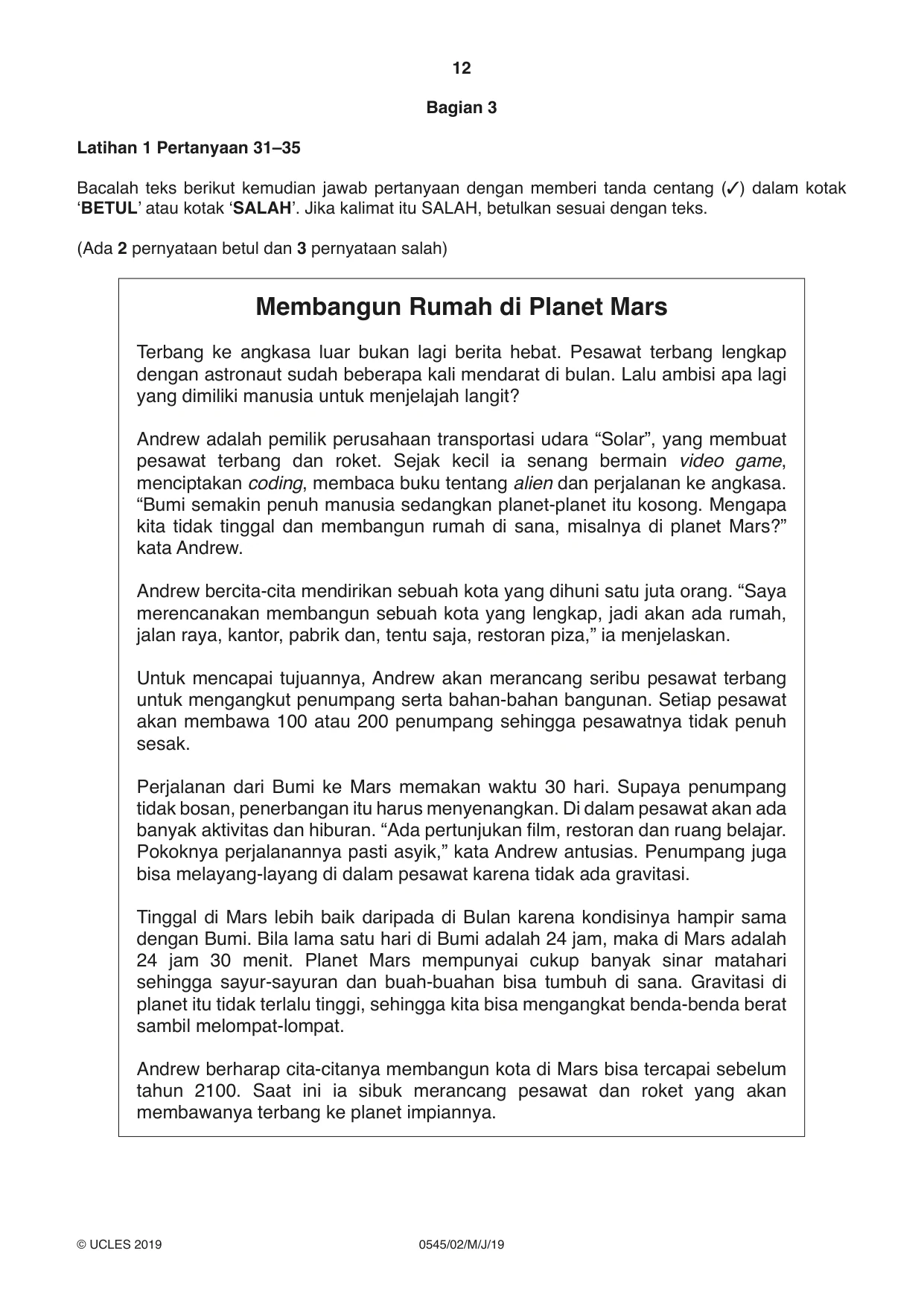
12 0545/02/M/J/19 © UCLES 2019 Bagian 3 Latihan 1 Pertanyaan 31–35 Bacalah teks berikut kemudian jawab pertanyaan dengan memberi tanda centang (3) dalam kotak ‘BETUL’ atau kotak ‘SALAH’. Jika kalimat itu SALAH, betulkan sesuai dengan teks. (Ada 2 pernyataan betul dan 3 pernyataan salah) Membangun Rumah di Planet Mars Terbang ke angkasa luar bukan lagi berita hebat. Pesawat terbang lengkap dengan astronaut sudah beberapa kali mendarat di bulan. Lalu ambisi apa lagi yang dimiliki manusia untuk menjelajah langit? Andrew adalah pemilik perusahaan transportasi udara “Solar”, yang membuat pesawat terbang dan roket. Sejak kecil ia senang bermain video game, menciptakan coding, membaca buku tentang alien dan perjalanan ke angkasa. “Bumi semakin penuh manusia sedangkan planet-planet itu kosong. Mengapa kita tidak tinggal dan membangun rumah di sana, misalnya di planet Mars?” kata Andrew. Andrew bercita-cita mendirikan sebuah kota yang dihuni satu juta orang. “Saya merencanakan membangun sebuah kota yang lengkap, jadi akan ada rumah, jalan raya, kantor, pabrik dan, tentu saja, restoran piza,” ia menjelaskan. Untuk mencapai tujuannya, Andrew akan merancang seribu pesawat terbang untuk mengangkut penumpang serta bahan-bahan bangunan. Setiap pesawat akan membawa 100 atau 200 penumpang sehingga pesawatnya tidak penuh sesak. Perjalanan dari Bumi ke Mars memakan waktu 30 hari. Supaya penumpang tidak bosan, penerbangan itu harus menyenangkan. Di dalam pesawat akan ada banyak aktivitas dan hiburan. “Ada pertunjukan film, restoran dan ruang belajar. Pokoknya perjalanannya pasti asyik,” kata Andrew antusias. Penumpang juga bisa melayang-layang di dalam pesawat karena tidak ada gravitasi. Tinggal di Mars lebih baik daripada di Bulan karena kondisinya hampir sama dengan Bumi. Bila lama satu hari di Bumi adalah 24 jam, maka di Mars adalah 24 jam 30 menit. Planet Mars mempunyai cukup banyak sinar matahari sehingga sayur-sayuran dan buah-buahan bisa tumbuh di sana. Gravitasi di planet itu tidak terlalu tinggi, sehingga kita bisa mengangkat benda-benda berat sambil melompat-lompat. Andrew berharap cita-citanya membangun kota di Mars bisa tercapai sebelum tahun 2100. Saat ini ia sibuk merancang pesawat dan roket yang akan membawanya terbang ke planet impiannya.
Question paper, page 13
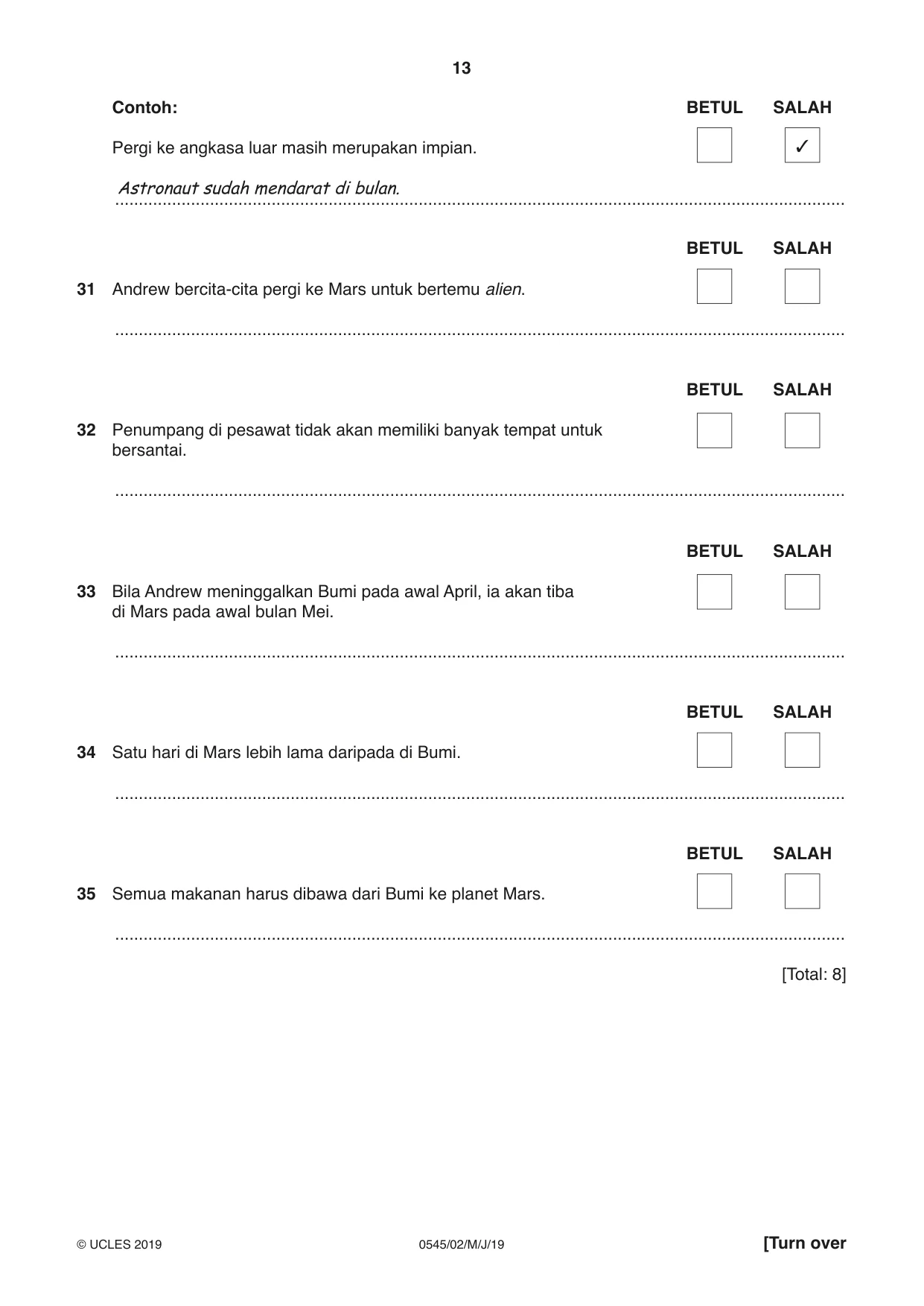
13 0545/02/M/J/19 © UCLES 2019 [Turn over Contoh: BETUL SALAH Pergi ke angkasa luar masih merupakan impian. 3 Astronaut sudah mendarat di bulan. … BETUL SALAH 31 Andrew bercita-cita pergi ke Mars untuk bertemu alien. … BETUL SALAH 32 Penumpang di pesawat tidak akan memiliki banyak tempat untuk bersantai. … BETUL SALAH 33 Bila Andrew meninggalkan Bumi pada awal April, ia akan tiba di Mars pada awal bulan Mei. … BETUL SALAH 34 Satu hari di Mars lebih lama daripada di Bumi. … BETUL SALAH 35 Semua makanan harus dibawa dari Bumi ke planet Mars. … [Total: 8]
Question paper, page 14
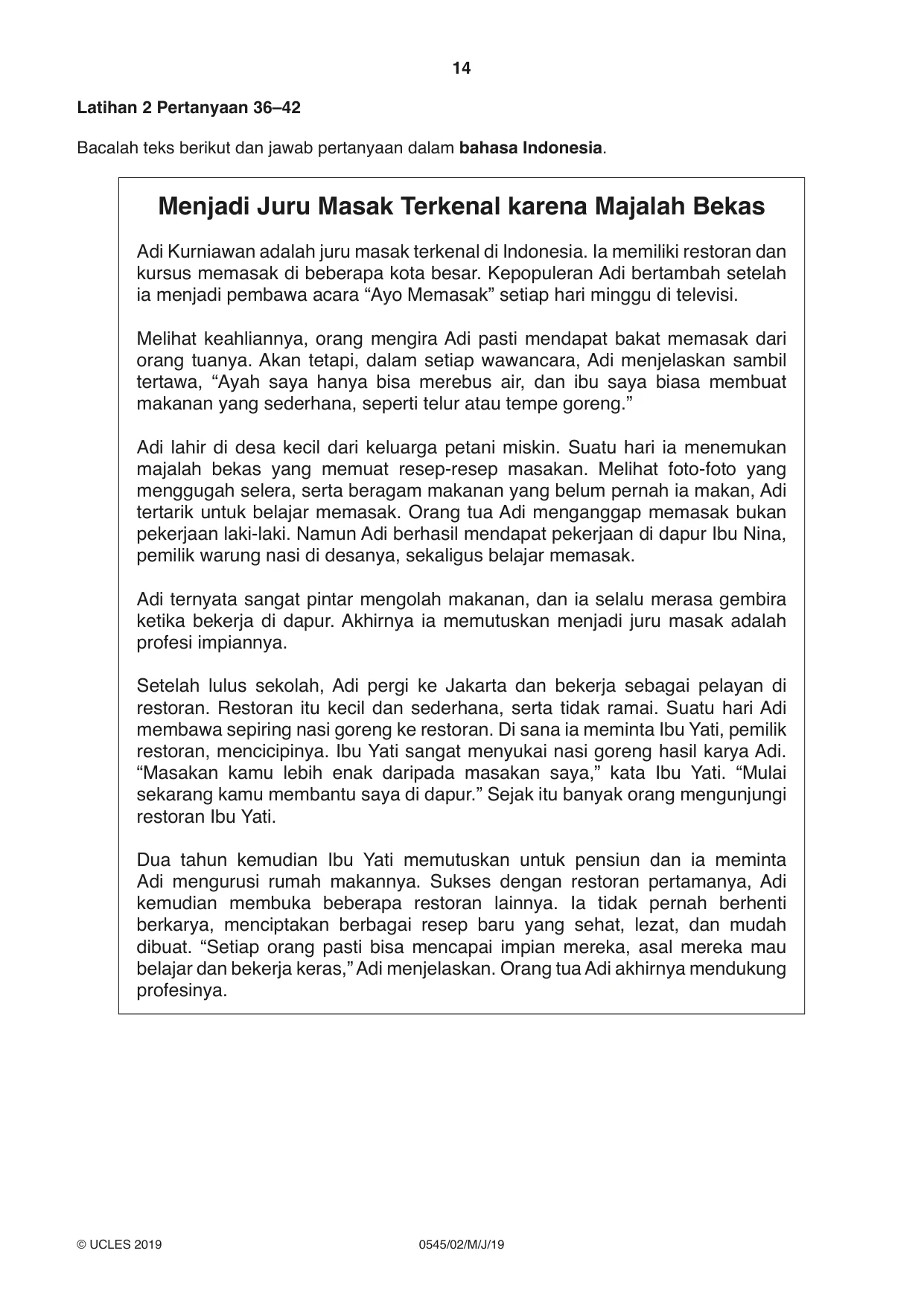
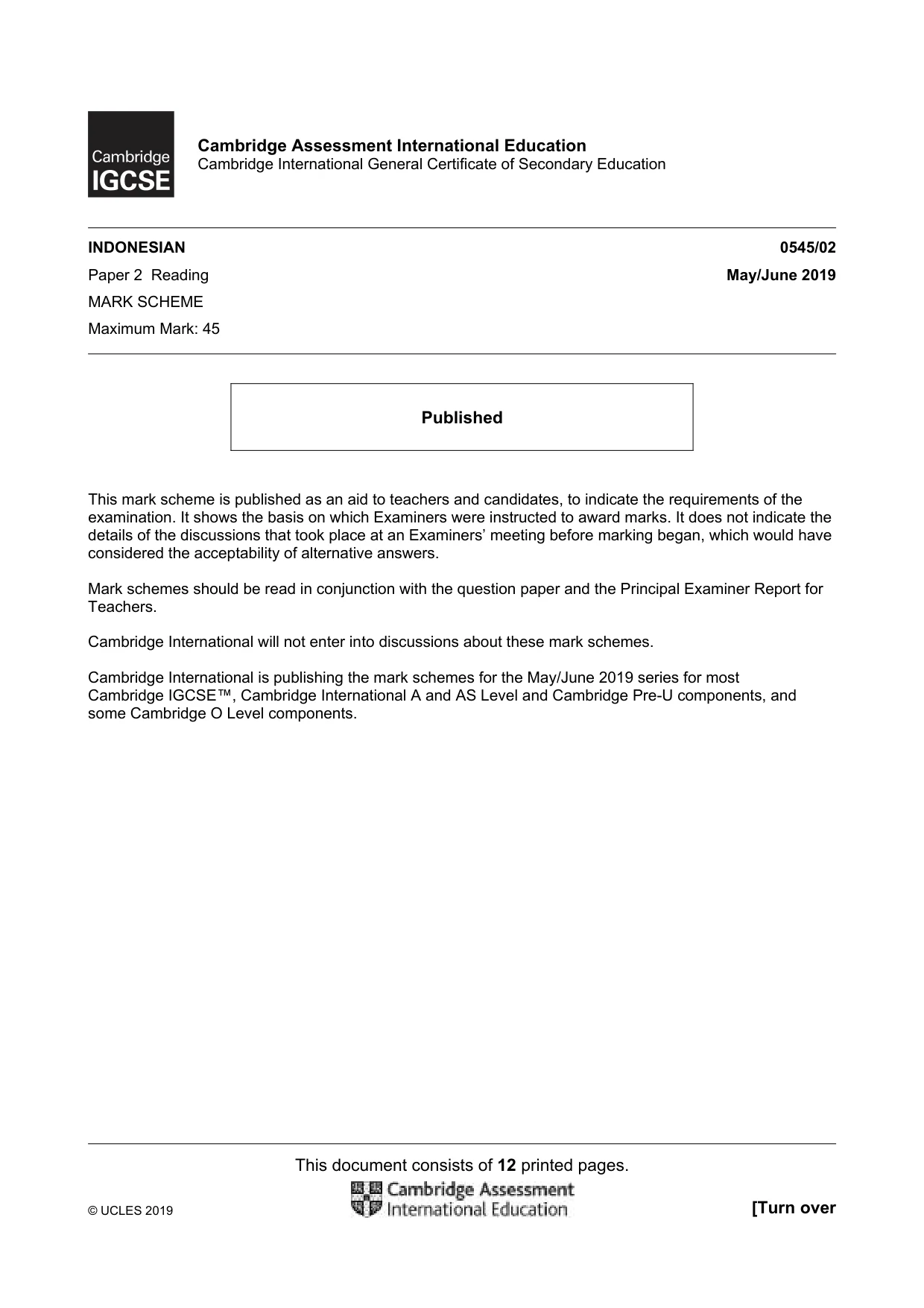
14 0545/02/M/J/19 © UCLES 2019 Latihan 2 Pertanyaan 36–42 Bacalah teks berikut dan jawab pertanyaan dalam bahasa Indonesia. Menjadi Juru Masak Terkenal karena Majalah Bekas Adi Kurniawan adalah juru masak terkenal di Indonesia. Ia memiliki restoran dan kursus memasak di beberapa kota besar. Kepopuleran Adi bertambah setelah ia menjadi pembawa acara “Ayo Memasak” setiap hari minggu di televisi. Melihat keahliannya, orang mengira Adi pasti mendapat bakat memasak dari orang tuanya. Akan tetapi, dalam setiap wawancara, Adi menjelaskan sambil tertawa, “Ayah saya hanya bisa merebus air, dan ibu saya biasa membuat makanan yang sederhana, seperti telur atau tempe goreng.” Adi lahir di desa kecil dari keluarga petani miskin. Suatu hari ia menemukan majalah bekas yang memuat resep-resep masakan. Melihat foto-foto yang menggugah selera, serta beragam makanan yang belum pernah ia makan, Adi tertarik untuk belajar memasak. Orang tua Adi menganggap memasak bukan pekerjaan laki-laki. Namun Adi berhasil mendapat pekerjaan di dapur Ibu Nina, pemilik warung nasi di desanya, sekaligus belajar memasak. Adi ternyata sangat pintar mengolah makanan, dan ia selalu merasa gembira ketika bekerja di dapur. Akhirnya ia memutuskan menjadi juru masak adalah profesi impiannya. Setelah lulus sekolah, Adi pergi ke Jakarta dan bekerja sebagai pelayan di restoran. Restoran itu kecil dan sederhana, serta tidak ramai. Suatu hari Adi membawa sepiring nasi goreng ke restoran. Di sana ia meminta Ibu Yati, pemilik restoran, mencicipinya. Ibu Yati sangat menyukai nasi goreng hasil karya Adi. “Masakan kamu lebih enak daripada masakan saya,” kata Ibu Yati. “Mulai sekarang kamu membantu saya di dapur.” Sejak itu banyak orang mengunjungi restoran Ibu Yati. Dua tahun kemudian Ibu Yati memutuskan untuk pensiun dan ia meminta Adi mengurusi rumah makannya. Sukses dengan restoran pertamanya, Adi kemudian membuka beberapa restoran lainnya. Ia tidak pernah berhenti berkarya, menciptakan berbagai resep baru yang sehat, lezat, dan mudah dibuat. “Setiap orang pasti bisa mencapai impian mereka, asal mereka mau belajar dan bekerja keras,” Adi menjelaskan. Orang tua Adi akhirnya mendukung profesinya.
Question paper, page 15
15 0545/02/M/J/19 © UCLES 2019 36 Mengapa nama Adi semakin dikenal orang? … [1] 37 Mengapa dalam wawancara Adi perlu menjelaskan bahwa orang tuanya tidak pintar memasak? … [1] 38 Apa yang mendorong Adi belajar memasak? … [1] 39 Siapa yang pertama menjadi guru memasak Adi? … [1] 40 Bagaimana masakan Adi mengubah restoran Ibu Yati? … [1] 41 Dari pengalaman Adi, apa syarat-syarat supaya kita sukses dalam hidup? … [1] 42 Bagaimana kita tahu bahwa orang tua Adi tidak selalu mendukung pekerjaan pilihan Adi? … [1] [Total: 7]
Question paper, page 16
16 0545/02/M/J/19 © UCLES 2019 Permission to reproduce items where third-party owned material protected by copyright is included has been sought and cleared where possible. Every reasonable effort has been made by the publisher (UCLES) to trace copyright holders, but if any items requiring clearance have unwittingly been included, the publisher will be pleased to make amends at the earliest possible opportunity. To avoid the issue of disclosure of answer-related information to candidates, all copyright acknowledgements are reproduced online in the Cambridge Assessment International Education Copyright Acknowledgements Booklet. This is produced for each series of examinations and is freely available to download at www.cambridgeinternational.org after the live examination series. Cambridge Assessment International Education is part of the Cambridge Assessment Group. Cambridge Assessment is the brand name of the University of Cambridge Local Examinations Syndicate (UCLES), which itself is a department of the University of Cambridge. BLANK PAGE
Mark scheme, page 1
This document consists of 12 printed pages. © UCLES 2019 [Turn over Cambridge Assessment International Education Cambridge International General Certificate of Secondary Education INDONESIAN 0545/02 Paper 2 Reading May/June 2019 MARK SCHEME Maximum Mark: 45 Published This mark scheme is published as an aid to teachers and candidates, to indicate the requirements of the examination. It shows the basis on which Examiners were instructed to award marks. It does not indicate the details of the discussions that took place at an Examiners’ meeting before marking began, which would have considered the acceptability of alternative answers. Mark schemes should be read in conjunction with the question paper and the Principal Examiner Report for Teachers. Cambridge International will not enter into discussions about these mark schemes. Cambridge International is publishing the mark schemes for the May/June 2019 series for most Cambridge IGCSE™, Cambridge International A and AS Level and Cambridge Pre-U components, and some Cambridge O Level components.
Mark scheme, page 2
0545/02 Cambridge IGCSE – Mark Scheme PUBLISHED May/June 2019 © UCLES 2019 Page 2 of 12 Generic Marking Principles These general marking principles must be applied by all examiners when marking candidate answers. They should be applied alongside the specific content of the mark scheme or generic level descriptors for a question. Each question paper and mark scheme will also comply with these marking principles. GENERIC MARKING PRINCIPLE 1: Marks must be awarded in line with: • the specific content of the mark scheme or the generic level descriptors for the question • the specific skills defined in the mark scheme or in the generic level descriptors for the question • the standard of response required by a candidate as exemplified by the standardisation scripts. GENERIC MARKING PRINCIPLE 2: Marks awarded are always whole marks (not half marks, or other fractions). GENERIC MARKING PRINCIPLE 3: Marks must be awarded positively: • marks are awarded for correct/valid answers, as defined in the mark scheme. However, credit is given for valid answers which go beyond the scope of the syllabus and mark scheme, referring to your Team Leader as appropriate • marks are awarded when candidates clearly demonstrate what they know and can do • marks are not deducted for errors • marks are not deducted for omissions • answers should only be judged on the quality of spelling, punctuation and grammar when these features are specifically assessed by the question as indicated by the mark scheme. The meaning, however, should be unambiguous. GENERIC MARKING PRINCIPLE 4: Rules must be applied consistently e.g. in situations where candidates have not followed instructions or in the application of generic level descriptors.
Mark scheme, page 3
0545/02 Cambridge IGCSE – Mark Scheme PUBLISHED May/June 2019 © UCLES 2019 Page 3 of 12 GENERIC MARKING PRINCIPLE 5: Marks should be awarded using the full range of marks defined in the mark scheme for the question (however; the use of the full mark range may be limited according to the quality of the candidate responses seen). GENERIC MARKING PRINCIPLE 6: Marks awarded are based solely on the requirements as defined in the mark scheme. Marks should not be awarded with grade thresholds or grade descriptors in mind.
Mark scheme, page 4
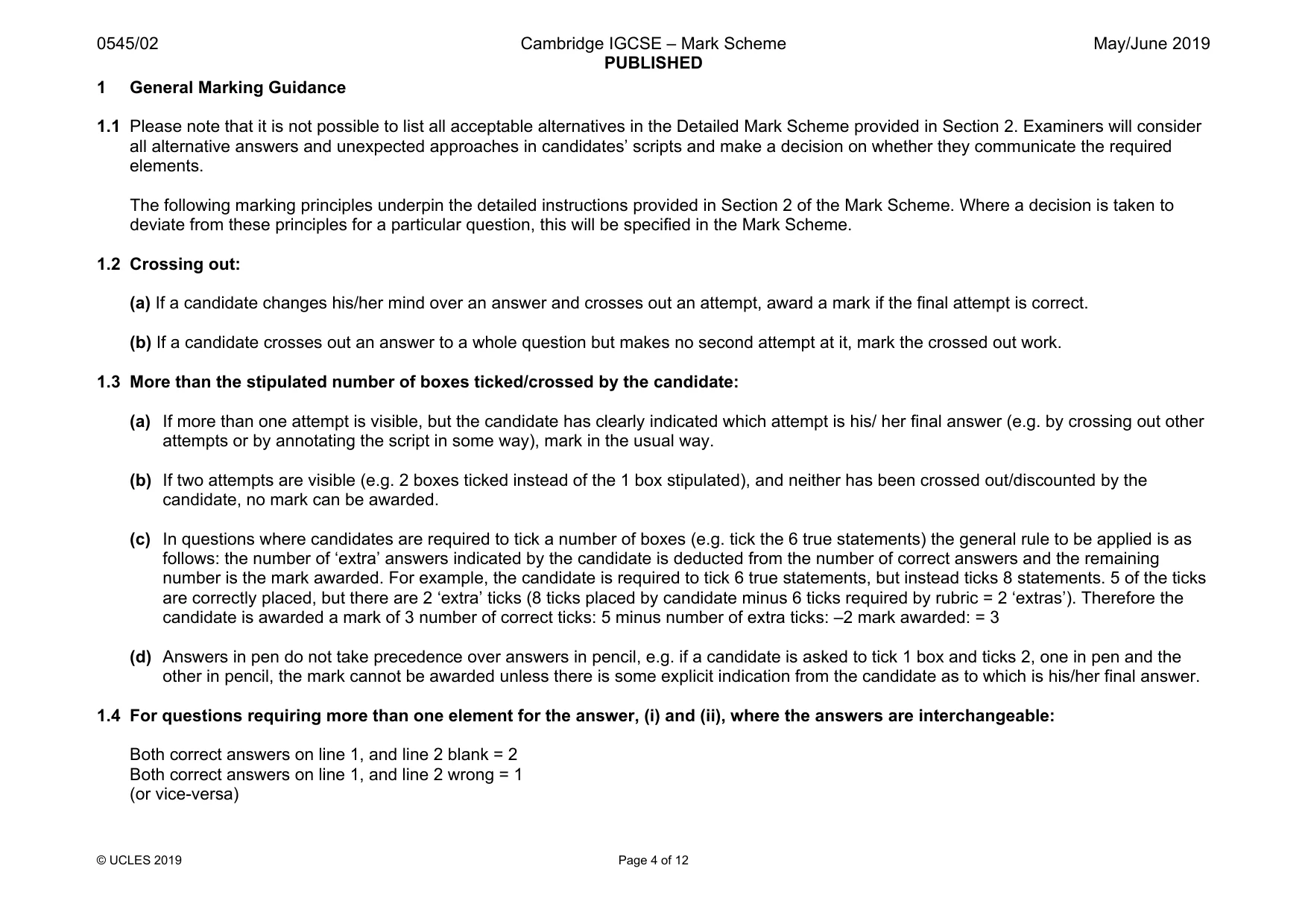
0545/02 Cambridge IGCSE – Mark Scheme PUBLISHED May/June 2019 © UCLES 2019 Page 4 of 12 1 General Marking Guidance 1.1 Please note that it is not possible to list all acceptable alternatives in the Detailed Mark Scheme provided in Section 2. Examiners will consider all alternative answers and unexpected approaches in candidates’ scripts and make a decision on whether they communicate the required elements. The following marking principles underpin the detailed instructions provided in Section 2 of the Mark Scheme. Where a decision is taken to deviate from these principles for a particular question, this will be specified in the Mark Scheme. 1.2 Crossing out: (a) If a candidate changes his/her mind over an answer and crosses out an attempt, award a mark if the final attempt is correct. (b) If a candidate crosses out an answer to a whole question but makes no second attempt at it, mark the crossed out work. 1.3 More than the stipulated number of boxes ticked/crossed by the candidate: (a) If more than one attempt is visible, but the candidate has clearly indicated which attempt is his/ her final answer (e.g. by crossing out other attempts or by annotating the script in some way), mark in the usual way. (b) If two attempts are visible (e.g. 2 boxes ticked instead of the 1 box stipulated), and neither has been crossed out/discounted by the candidate, no mark can be awarded. (c) In questions where candidates are required to tick a number of boxes (e.g. tick the 6 true statements) the general rule to be applied is as follows: the number of ‘extra’ answers indicated by the candidate is deducted from the number of correct answers and the remaining number is the mark awarded. For example, the candidate is required to tick 6 true statements, but instead ticks 8 statements. 5 of the ticks are correctly placed, but there are 2 ‘extra’ ticks (8 ticks placed by candidate minus 6 ticks required by rubric = 2 ‘extras’). Therefore the candidate is awarded a mark of 3 number of correct ticks: 5 minus number of extra ticks: –2 mark awarded: = 3 (d) Answers in pen do not take precedence over answers in pencil, e.g. if a candidate is asked to tick 1 box and ticks 2, one in pen and the other in pencil, the mark cannot be awarded unless there is some explicit indication from the candidate as to which is his/her final answer. 1.4 For questions requiring more than one element for the answer, (i) and (ii), where the answers are interchangeable: Both correct answers on line 1, and line 2 blank = 2 Both correct answers on line 1, and line 2 wrong = 1 (or vice-versa)
Mark scheme, page 5
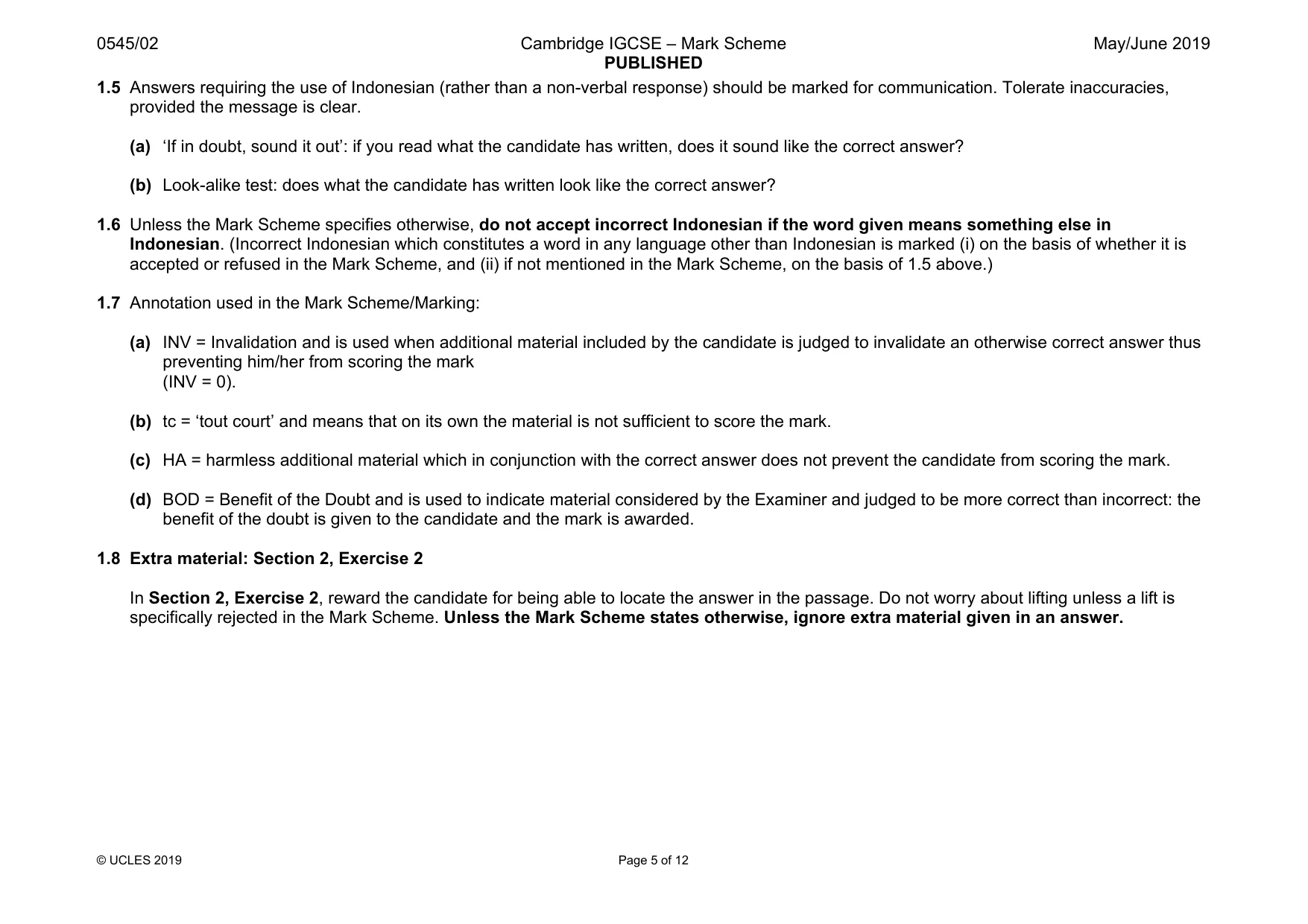
0545/02 Cambridge IGCSE – Mark Scheme PUBLISHED May/June 2019 © UCLES 2019 Page 5 of 12 1.5 Answers requiring the use of Indonesian (rather than a non-verbal response) should be marked for communication. Tolerate inaccuracies, provided the message is clear. (a) ‘If in doubt, sound it out’: if you read what the candidate has written, does it sound like the correct answer? (b) Look-alike test: does what the candidate has written look like the correct answer? 1.6 Unless the Mark Scheme specifies otherwise, do not accept incorrect Indonesian if the word given means something else in Indonesian. (Incorrect Indonesian which constitutes a word in any language other than Indonesian is marked (i) on the basis of whether it is accepted or refused in the Mark Scheme, and (ii) if not mentioned in the Mark Scheme, on the basis of 1.5 above.) 1.7 Annotation used in the Mark Scheme/Marking: (a) INV = Invalidation and is used when additional material included by the candidate is judged to invalidate an otherwise correct answer thus preventing him/her from scoring the mark (INV = 0). (b) tc = ‘tout court’ and means that on its own the material is not sufficient to score the mark. (c) HA = harmless additional material which in conjunction with the correct answer does not prevent the candidate from scoring the mark. (d) BOD = Benefit of the Doubt and is used to indicate material considered by the Examiner and judged to be more correct than incorrect: the benefit of the doubt is given to the candidate and the mark is awarded. 1.8 Extra material: Section 2, Exercise 2 In Section 2, Exercise 2, reward the candidate for being able to locate the answer in the passage. Do not worry about lifting unless a lift is specifically rejected in the Mark Scheme. Unless the Mark Scheme states otherwise, ignore extra material given in an answer.
Mark scheme, page 6
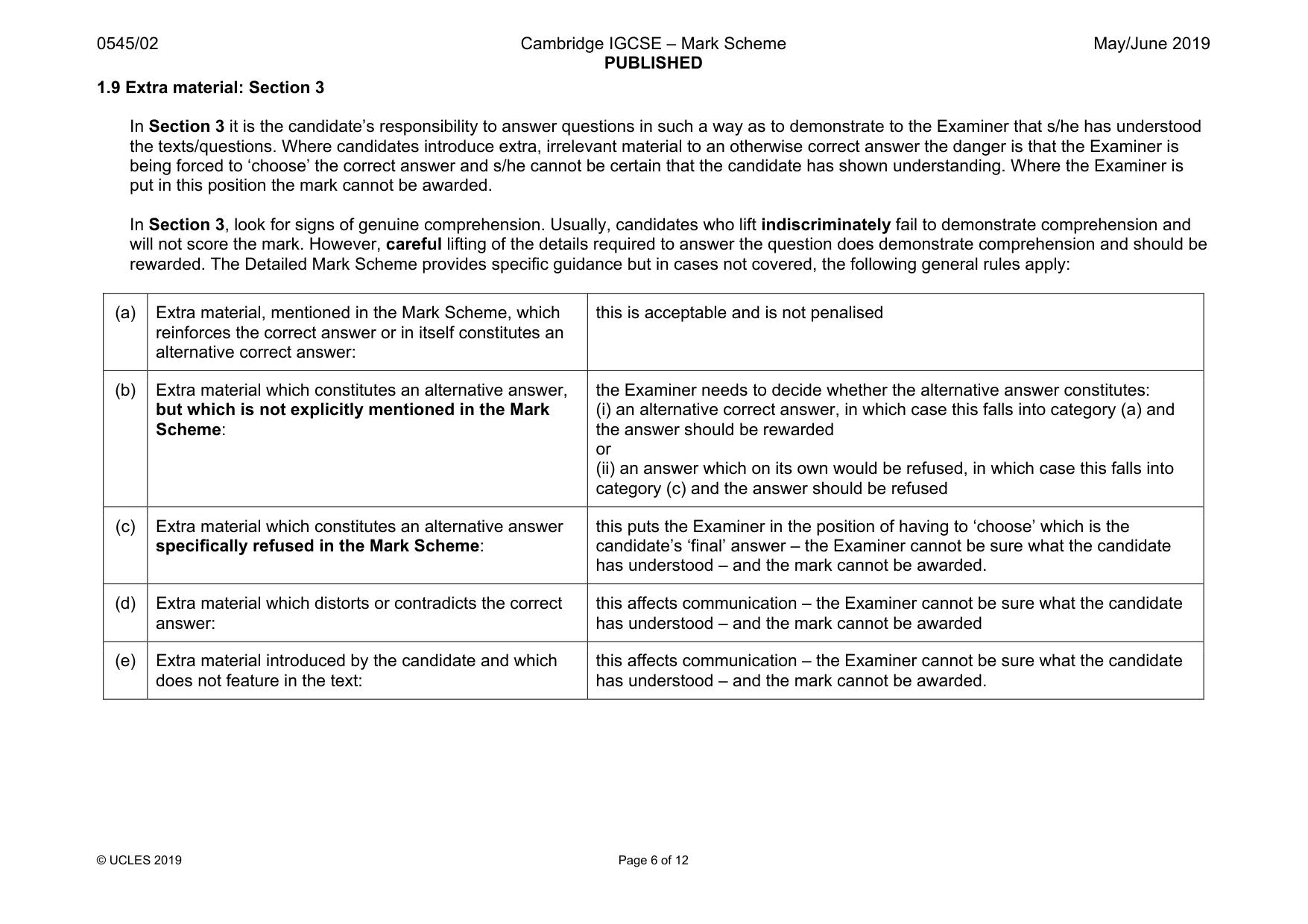
0545/02 Cambridge IGCSE – Mark Scheme PUBLISHED May/June 2019 © UCLES 2019 Page 6 of 12 1.9 Extra material: Section 3 In Section 3 it is the candidate’s responsibility to answer questions in such a way as to demonstrate to the Examiner that s/he has understood the texts/questions. Where candidates introduce extra, irrelevant material to an otherwise correct answer the danger is that the Examiner is being forced to ‘choose’ the correct answer and s/he cannot be certain that the candidate has shown understanding. Where the Examiner is put in this position the mark cannot be awarded. In Section 3, look for signs of genuine comprehension. Usually, candidates who lift indiscriminately fail to demonstrate comprehension and will not score the mark. However, careful lifting of the details required to answer the question does demonstrate comprehension and should be rewarded. The Detailed Mark Scheme provides specific guidance but in cases not covered, the following general rules apply: (a) Extra material, mentioned in the Mark Scheme, which reinforces the correct answer or in itself constitutes an alternative correct answer: this is acceptable and is not penalised (b) Extra material which constitutes an alternative answer, but which is not explicitly mentioned in the Mark Scheme: the Examiner needs to decide whether the alternative answer constitutes: (i) an alternative correct answer, in which case this falls into category (a) and the answer should be rewarded or (ii) an answer which on its own would be refused, in which case this falls into category (c) and the answer should be refused (c) Extra material which constitutes an alternative answer specifically refused in the Mark Scheme: this puts the Examiner in the position of having to ‘choose’ which is the candidate’s ‘final’ answer – the Examiner cannot be sure what the candidate has understood – and the mark cannot be awarded. (d) Extra material which distorts or contradicts the correct answer: this affects communication – the Examiner cannot be sure what the candidate has understood – and the mark cannot be awarded (e) Extra material introduced by the candidate and which does not feature in the text: this affects communication – the Examiner cannot be sure what the candidate has understood – and the mark cannot be awarded.
Mark scheme, page 7
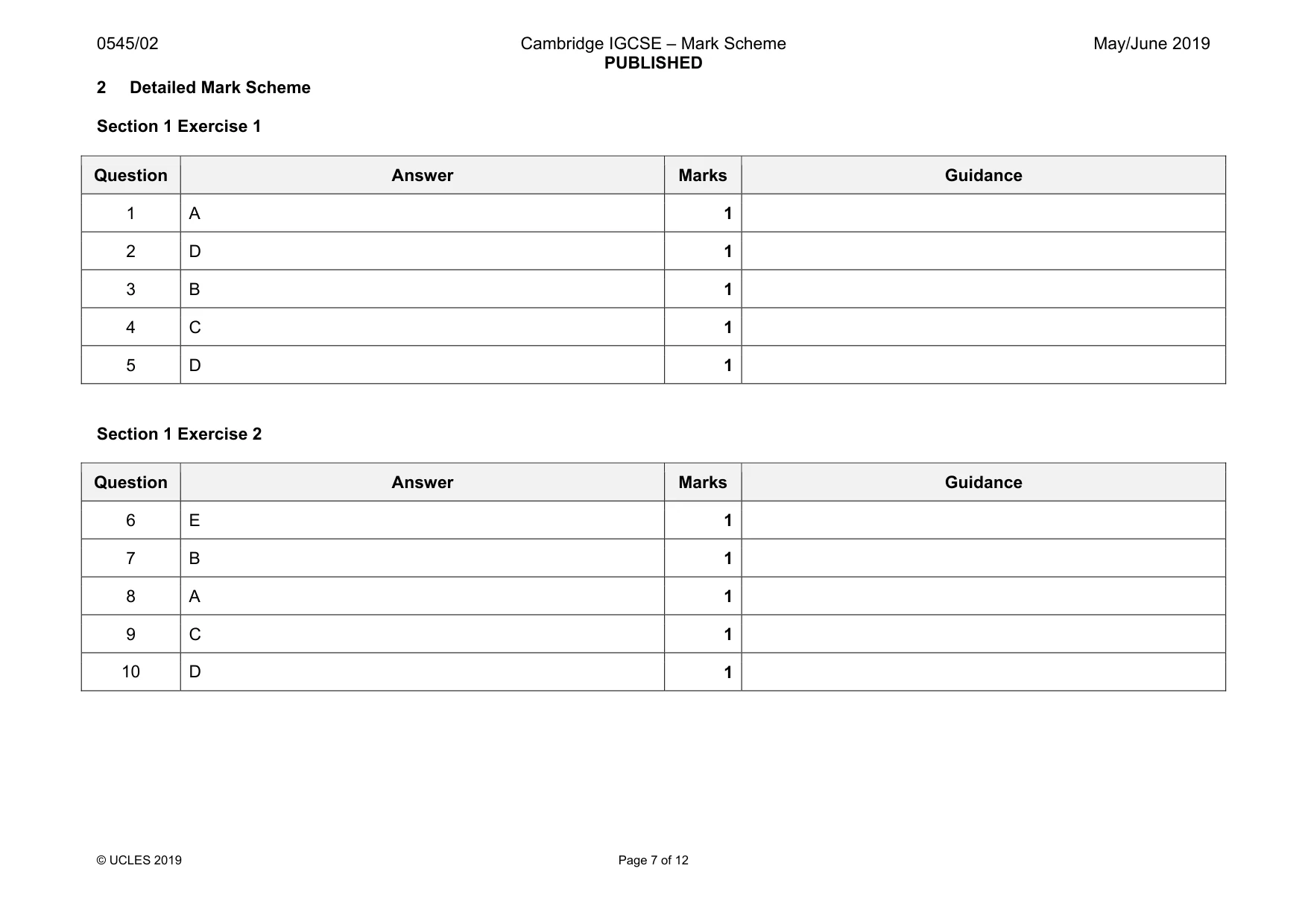
0545/02 Cambridge IGCSE – Mark Scheme PUBLISHED May/June 2019 © UCLES 2019 Page 7 of 12 2 Detailed Mark Scheme Section 1 Exercise 1 Question Answer Marks Guidance 1 A 1 2 D 1 3 B 1 4 C 1 5 D 1 Section 1 Exercise 2 Question Answer Marks Guidance 6 E 1 7 B 1 8 A 1 9 C 1 10 D 1
Mark scheme, page 8
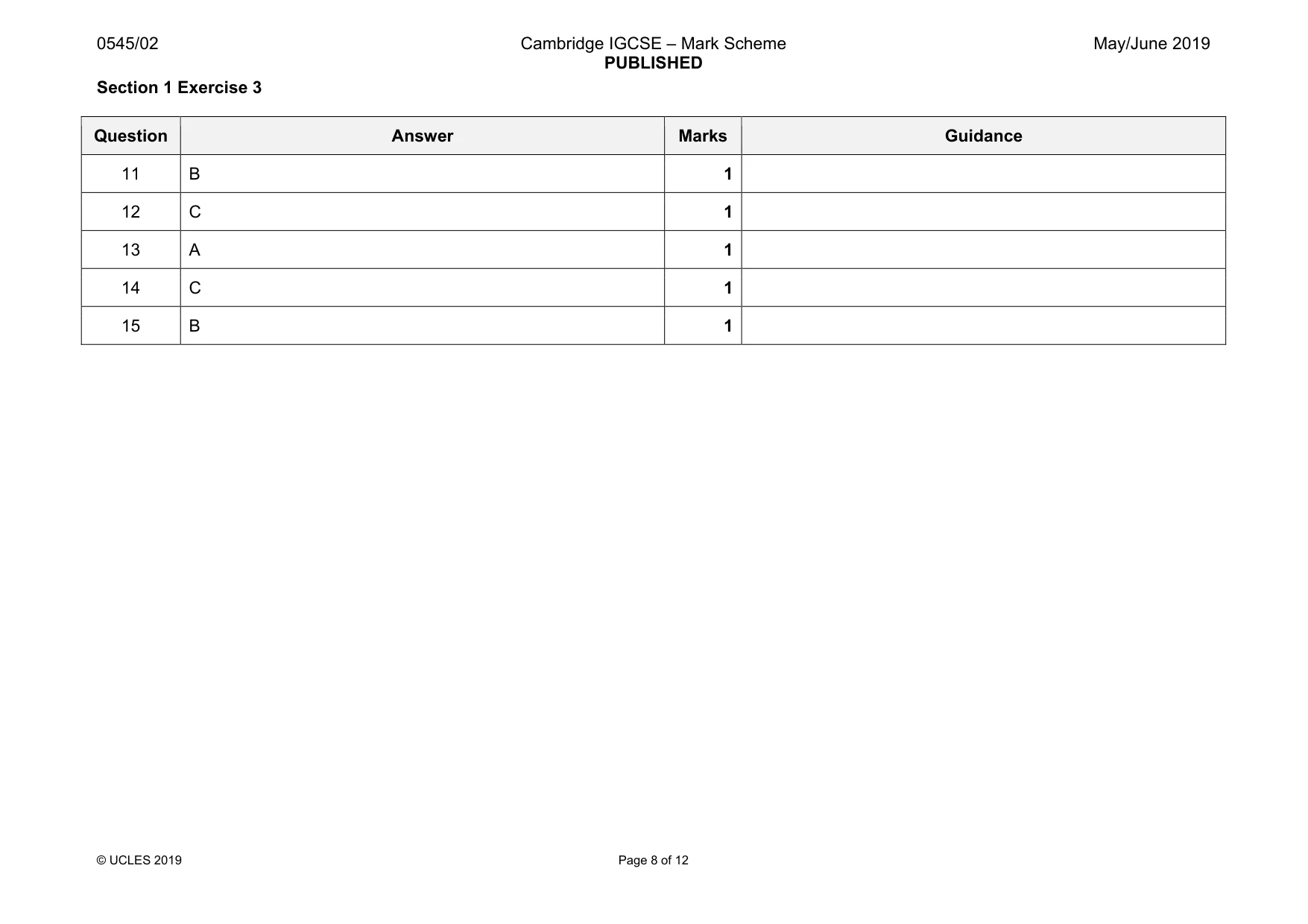
0545/02 Cambridge IGCSE – Mark Scheme PUBLISHED May/June 2019 © UCLES 2019 Page 8 of 12 Section 1 Exercise 3 Question Answer Marks Guidance 11 B 1 12 C 1 13 A 1 14 C 1 15 B 1
Mark scheme, page 9
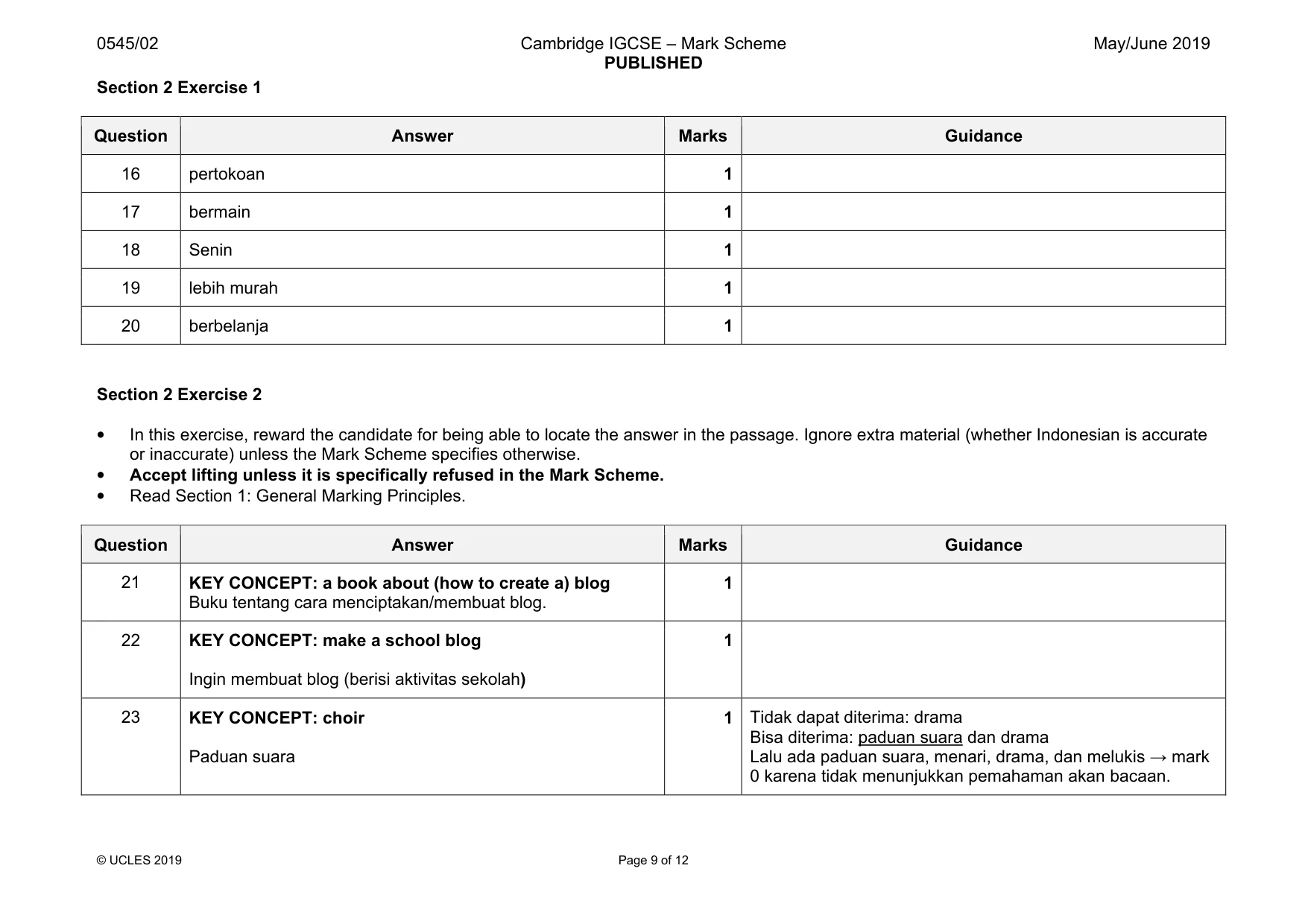
0545/02 Cambridge IGCSE – Mark Scheme PUBLISHED May/June 2019 © UCLES 2019 Page 9 of 12 Section 2 Exercise 1 Question Answer Marks Guidance 16 pertokoan 1 17 bermain 1 18 Senin 1 19 lebih murah 1 20 berbelanja 1 Section 2 Exercise 2 • In this exercise, reward the candidate for being able to locate the answer in the passage. Ignore extra material (whether Indonesian is accurate or inaccurate) unless the Mark Scheme specifies otherwise. • Accept lifting unless it is specifically refused in the Mark Scheme. • Read Section 1: General Marking Principles. Question Answer Marks Guidance 21 KEY CONCEPT: a book about (how to create a) blog Buku tentang cara menciptakan/membuat blog. 1 22 KEY CONCEPT: make a school blog Ingin membuat blog (berisi aktivitas sekolah) 1 23 KEY CONCEPT: choir Paduan suara 1 Tidak dapat diterima: drama Bisa diterima: paduan suara dan drama Lalu ada paduan suara, menari, drama, dan melukis → mark 0 karena tidak menunjukkan pemahaman akan bacaan.
Mark scheme, page 10
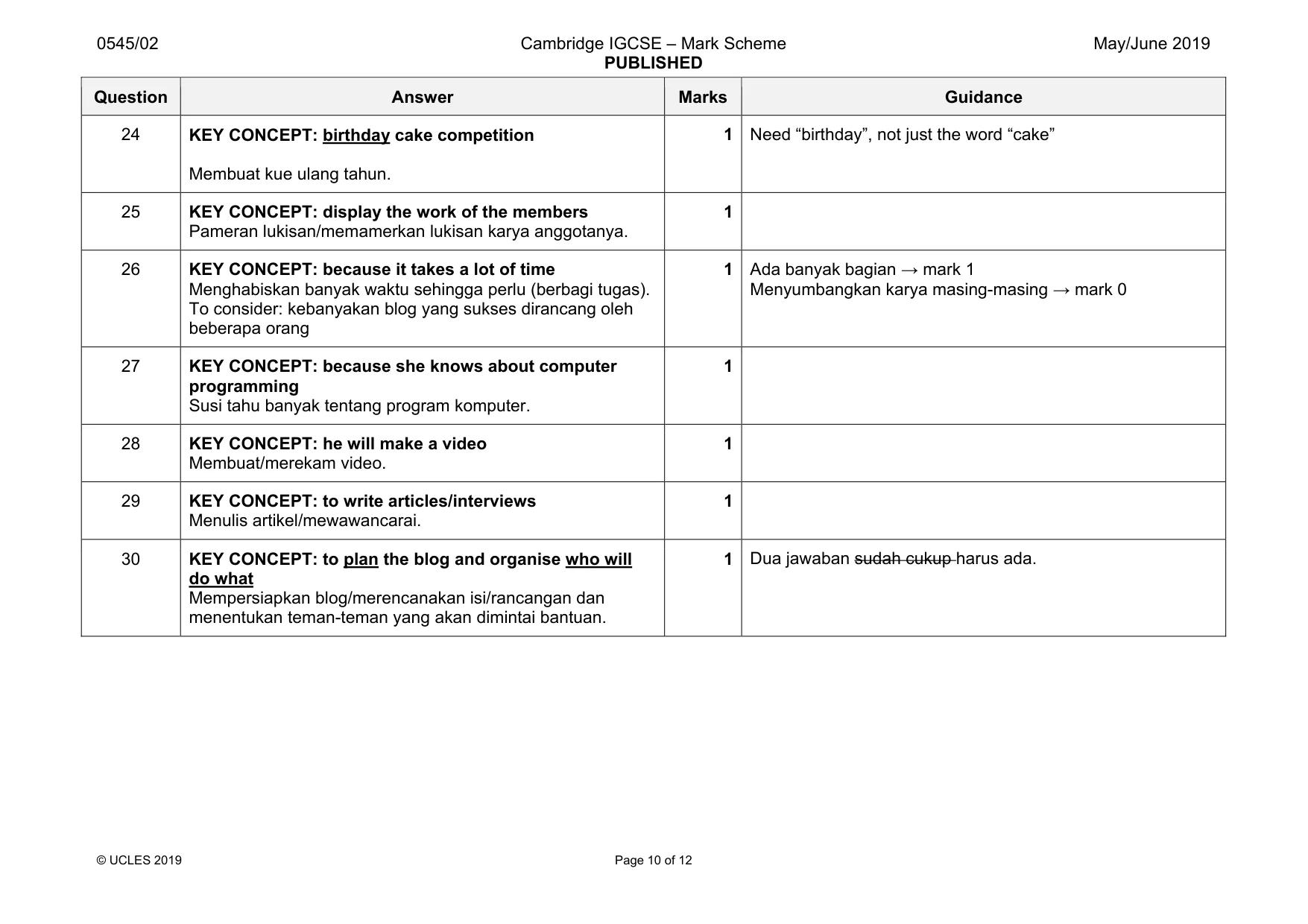
0545/02 Cambridge IGCSE – Mark Scheme PUBLISHED May/June 2019 © UCLES 2019 Page 10 of 12 Question Answer Marks Guidance 24 KEY CONCEPT: birthday cake competition Membuat kue ulang tahun. 1 Need “birthday”, not just the word “cake” 25 KEY CONCEPT: display the work of the members Pameran lukisan/memamerkan lukisan karya anggotanya. 1 26 KEY CONCEPT: because it takes a lot of time Menghabiskan banyak waktu sehingga perlu (berbagi tugas). To consider: kebanyakan blog yang sukses dirancang oleh beberapa orang 1 Ada banyak bagian → mark 1 Menyumbangkan karya masing-masing → mark 0 27 KEY CONCEPT: because she knows about computer programming Susi tahu banyak tentang program komputer. 1 28 KEY CONCEPT: he will make a video Membuat/merekam video. 1 29 KEY CONCEPT: to write articles/interviews Menulis artikel/mewawancarai. 1 30 KEY CONCEPT: to plan the blog and organise who will do what Mempersiapkan blog/merencanakan isi/rancangan dan menentukan teman-teman yang akan dimintai bantuan. 1 Dua jawaban sudah cukup harus ada.
Mark scheme, page 11
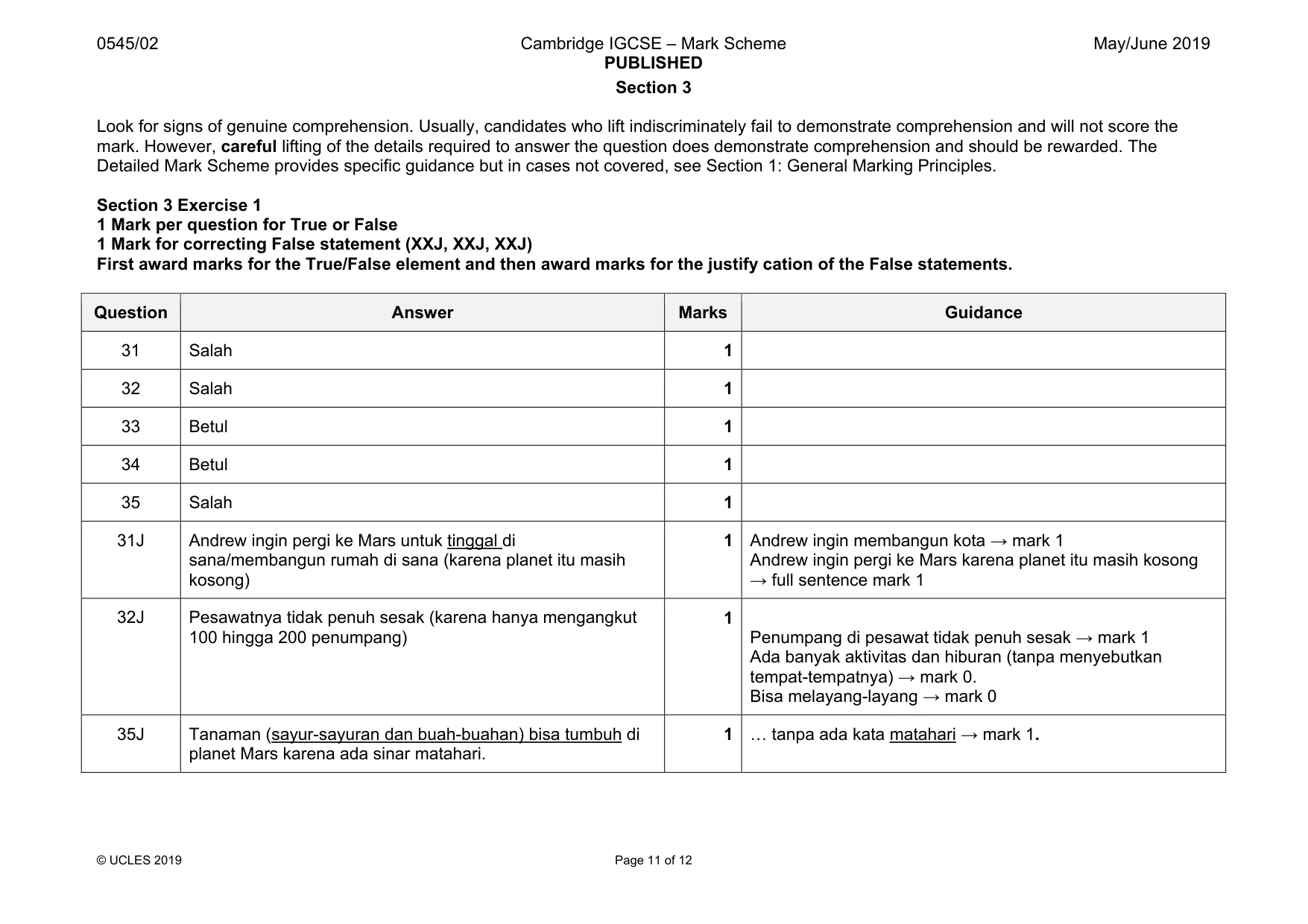
0545/02 Cambridge IGCSE – Mark Scheme PUBLISHED May/June 2019 © UCLES 2019 Page 11 of 12 Section 3 Look for signs of genuine comprehension. Usually, candidates who lift indiscriminately fail to demonstrate comprehension and will not score the mark. However, careful lifting of the details required to answer the question does demonstrate comprehension and should be rewarded. The Detailed Mark Scheme provides specific guidance but in cases not covered, see Section 1: General Marking Principles. Section 3 Exercise 1 1 Mark per question for True or False 1 Mark for correcting False statement (XXJ, XXJ, XXJ) First award marks for the True/False element and then award marks for the justify cation of the False statements. Question Answer Marks Guidance 31 Salah 1 32 Salah 1 33 Betul 1 34 Betul 1 35 Salah 1 31J Andrew ingin pergi ke Mars untuk tinggal di sana/membangun rumah di sana (karena planet itu masih kosong) 1 Andrew ingin membangun kota → mark 1 Andrew ingin pergi ke Mars karena planet itu masih kosong → full sentence mark 1 32J Pesawatnya tidak penuh sesak (karena hanya mengangkut 100 hingga 200 penumpang) 1 Penumpang di pesawat tidak penuh sesak → mark 1 Ada banyak aktivitas dan hiburan (tanpa menyebutkan tempat-tempatnya) → mark 0. Bisa melayang-layang → mark 0 35J Tanaman (sayur-sayuran dan buah-buahan) bisa tumbuh di planet Mars karena ada sinar matahari. 1 « tanpa ada kata matahari → mark 1.
Mark scheme, page 12
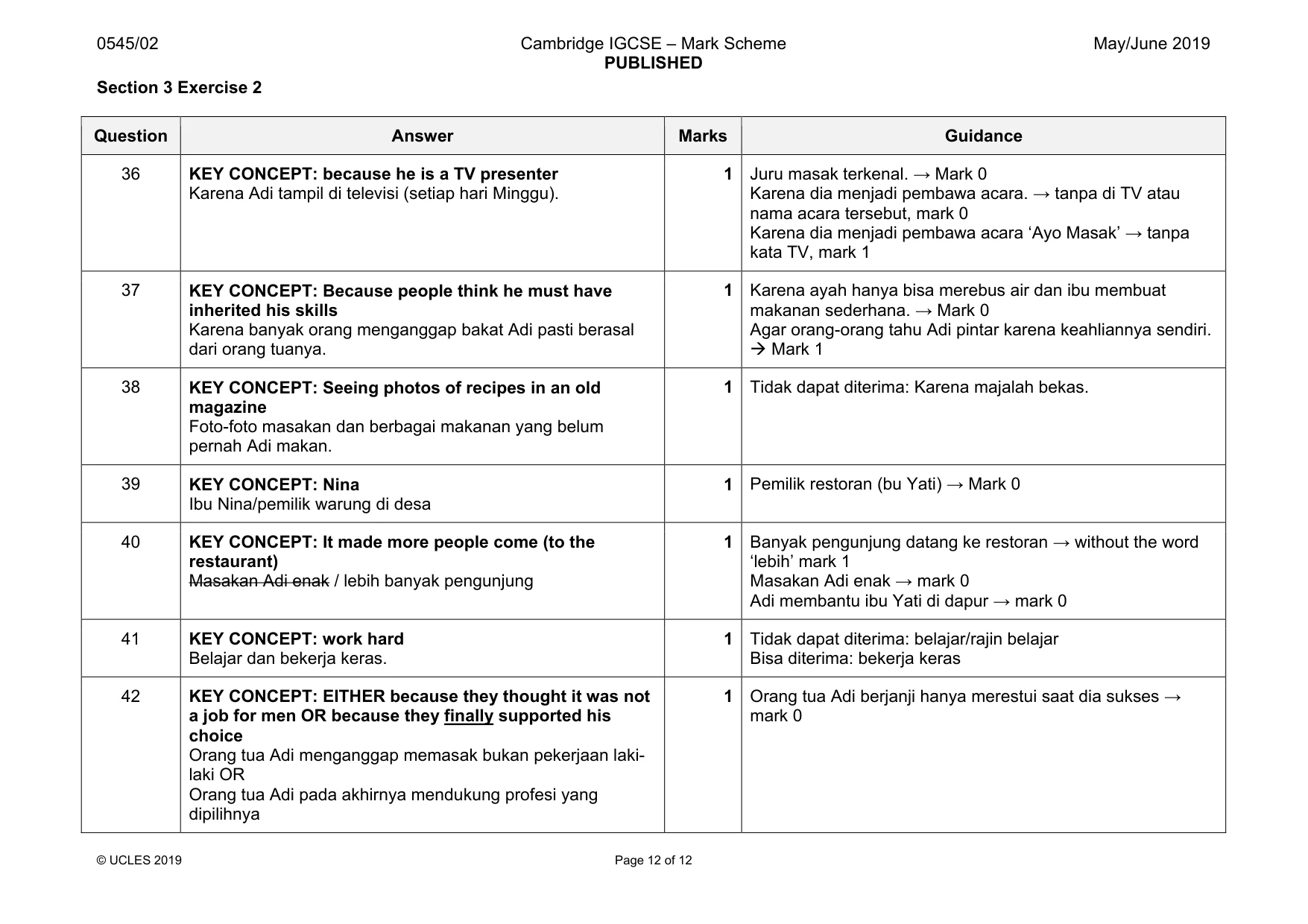
0545/02 Cambridge IGCSE – Mark Scheme PUBLISHED May/June 2019 © UCLES 2019 Page 12 of 12 Section 3 Exercise 2 Question Answer Marks Guidance 36 KEY CONCEPT: because he is a TV presenter Karena Adi tampil di televisi (setiap hari Minggu). 1 Juru masak terkenal. → Mark 0 Karena dia menjadi pembawa acara. → tanpa di TV atau nama acara tersebut, mark 0 Karena dia menjadi pembawa acara ‘Ayo Masak’ → tanpa kata TV, mark 1 37 KEY CONCEPT: Because people think he must have inherited his skills Karena banyak orang menganggap bakat Adi pasti berasal dari orang tuanya. 1 Karena ayah hanya bisa merebus air dan ibu membuat makanan sederhana. → Mark 0 Agar orang-orang tahu Adi pintar karena keahliannya sendiri. Æ Mark 1 38 KEY CONCEPT: Seeing photos of recipes in an old magazine Foto-foto masakan dan berbagai makanan yang belum pernah Adi makan. 1 Tidak dapat diterima: Karena majalah bekas. 39 KEY CONCEPT: Nina Ibu Nina/pemilik warung di desa 1 Pemilik restoran (bu Yati) → Mark 0 40 KEY CONCEPT: It made more people come (to the restaurant) Masakan Adi enak / lebih banyak pengunjung 1 Banyak pengunjung datang ke restoran → without the word ‘lebih’ mark 1 Masakan Adi enak → mark 0 Adi membantu ibu Yati di dapur → mark 0 41 KEY CONCEPT: work hard Belajar dan bekerja keras. 1 Tidak dapat diterima: belajar/rajin belajar Bisa diterima: bekerja keras 42 KEY CONCEPT: EITHER because they thought it was not a job for men OR because they finally supported his choice Orang tua Adi menganggap memasak bukan pekerjaan laki- laki OR Orang tua Adi pada akhirnya mendukung profesi yang dipilihnya 1 Orang tua Adi berjanji hanya merestui saat dia sukses → mark 0
What you needed in this session
Cambridge’s own grade thresholds for 2019 May/June, Paper 2 · Variant 1. A higher threshold means an easier paper — the bar moves with how the cohort did.