Cambridge IGCSE Indonesian - Foreign Language 0545 — 2013 Oct/Nov Paper 2 · Variant 1
0545/21/O/N/13 · 65 marks · ≈73 min
The question paper and its mark scheme, free to read here and free to download. This is Cambridge’s own paper, exactly as it was sat.
Question paper16 pages
Mark scheme11 pages
Answers below. Sit the paper first if you are practising.
Paper as text
Question paper, page 1
This document consists of 13 printed pages and 3 blank pages. DC (CW/SW) 67969/4 © UCLES 2013 [Turn over UNIVERSITY OF CAMBRIDGE INTERNATIONAL EXAMINATIONS International General Certificate of Secondary Education * 7 3 9 6 2 7 4 3 3 7 * INDONESIAN 0545/02 Paper 2 Reading and Directed Writing October/November 2013 1 hour 30 minutes Candidates answer on the Question Paper. No Additional Materials are required. READ THESE INSTRUCTIONS FIRST Write your Centre number, candidate number and name on all the work you hand in. Write in dark blue or black pen. Do not use staples, paper clips, highlighters, glue or correction fluid. DO NOT WRITE IN ANY BARCODES. Answer all questions in Section 1, Section 2 and Section 3. At the end of the examination, fasten all your work securely together. All questions in this paper carry equal marks. www.XtremePapers.com
Question paper, page 2
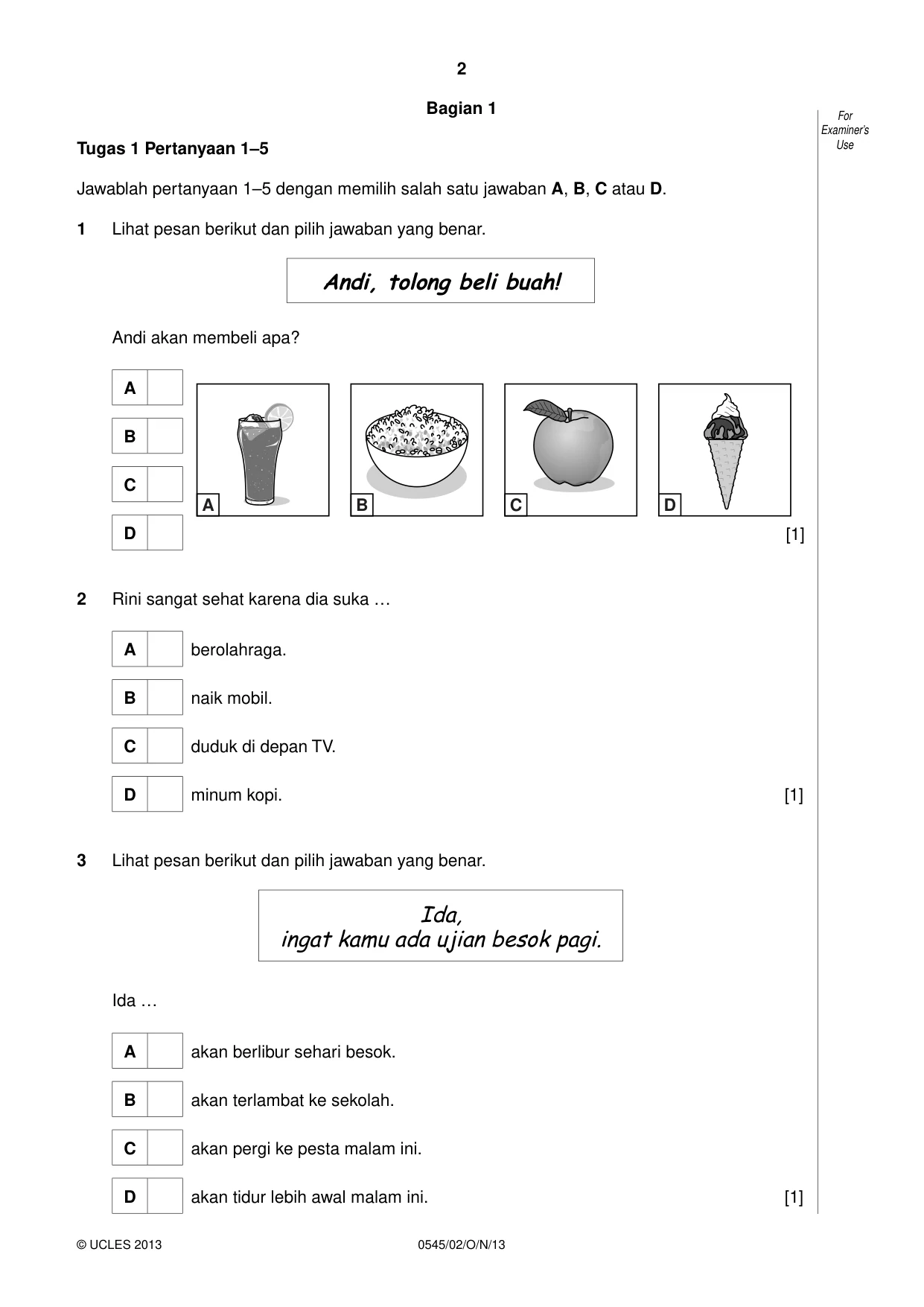
2 0545/02/O/N/13 © UCLES 2013 For Examiner’s Use Ba gian 1 Tugas 1 Pertanyaan 1–5 Jawablah pertanyaan 1–5 dengan memilih salah satu jawaban A, B, C atau D. 1 Lihat pesan berikut dan pilih jawaban yang benar. Andi, tolong beli buah! Andi akan membeli apa? A A B C D [1] B C D 2 Rini sangat sehat karena dia suka … A berolahraga. B naik mobil. C duduk di depan TV. D minum kopi. [1] 3 Lihat pesan berikut dan pilih jawaban yang benar. Ida, ingat kamu ada ujian besok pagi. Ida … A akan berlibur sehari besok. B akan terlambat ke sekolah. C akan pergi ke pesta malam ini. D akan tidur lebih awal malam ini. [1]
Question paper, page 3
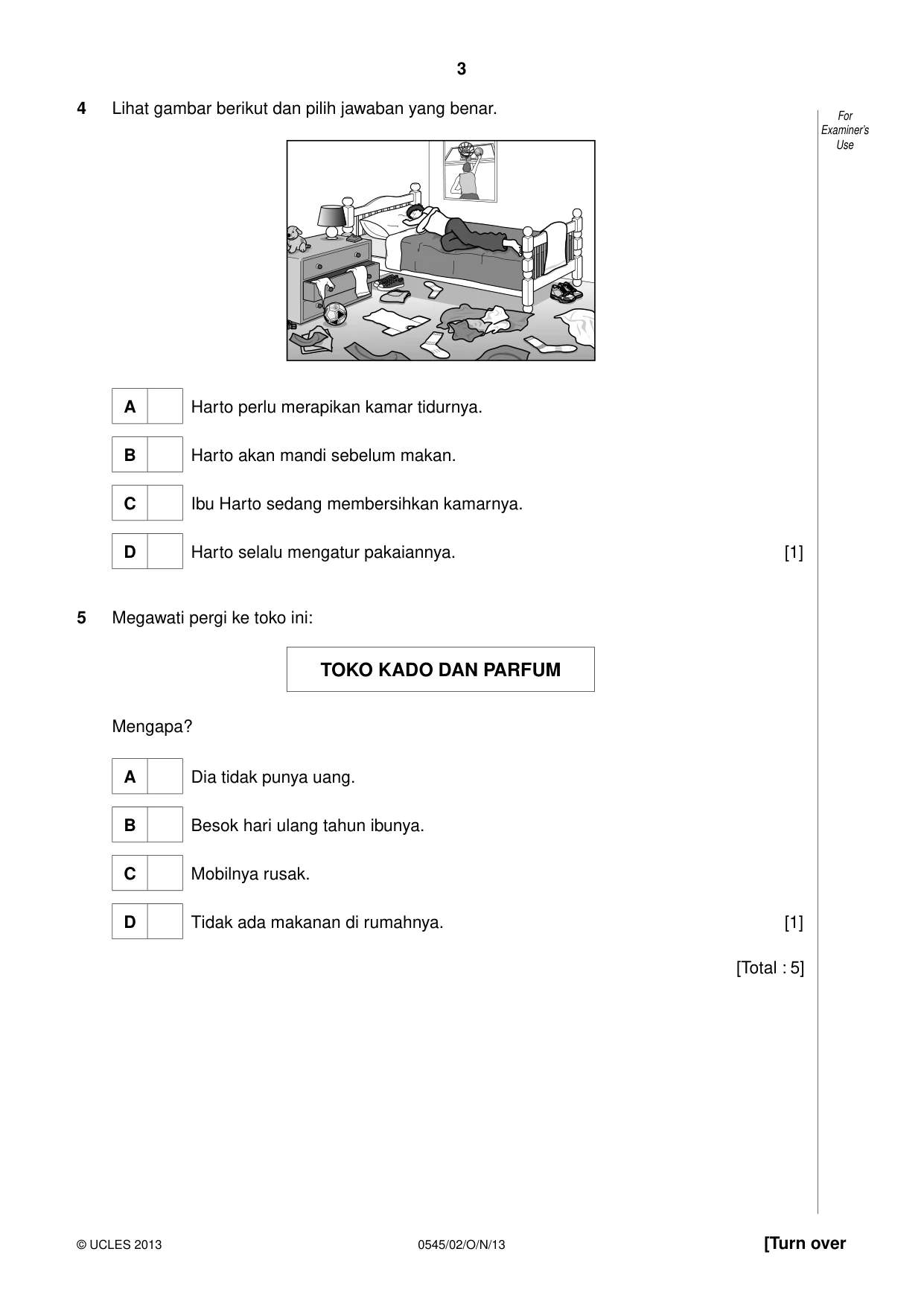
3 0545/02/O/N/13 © UCLES 2013 [Turn over For Examiner’s Use 4 Lihat gambar berikut dan pilih jawaban yang benar. A Harto perlu merapikan kamar tidurnya. B Harto akan mandi sebelum makan. C Ibu Harto sedang membersihkan kamarnya. D Harto selalu mengatur pakaiannya. [1] 5 Megawati pergi ke toko ini: TOKO KADO DAN PARFUM Mengapa? A Dia tidak punya uang. B Besok hari ulang tahun ibunya. C Mobilnya rusak. D Tidak ada makanan di rumahnya. [1] [Total : 5]
Question paper, page 4
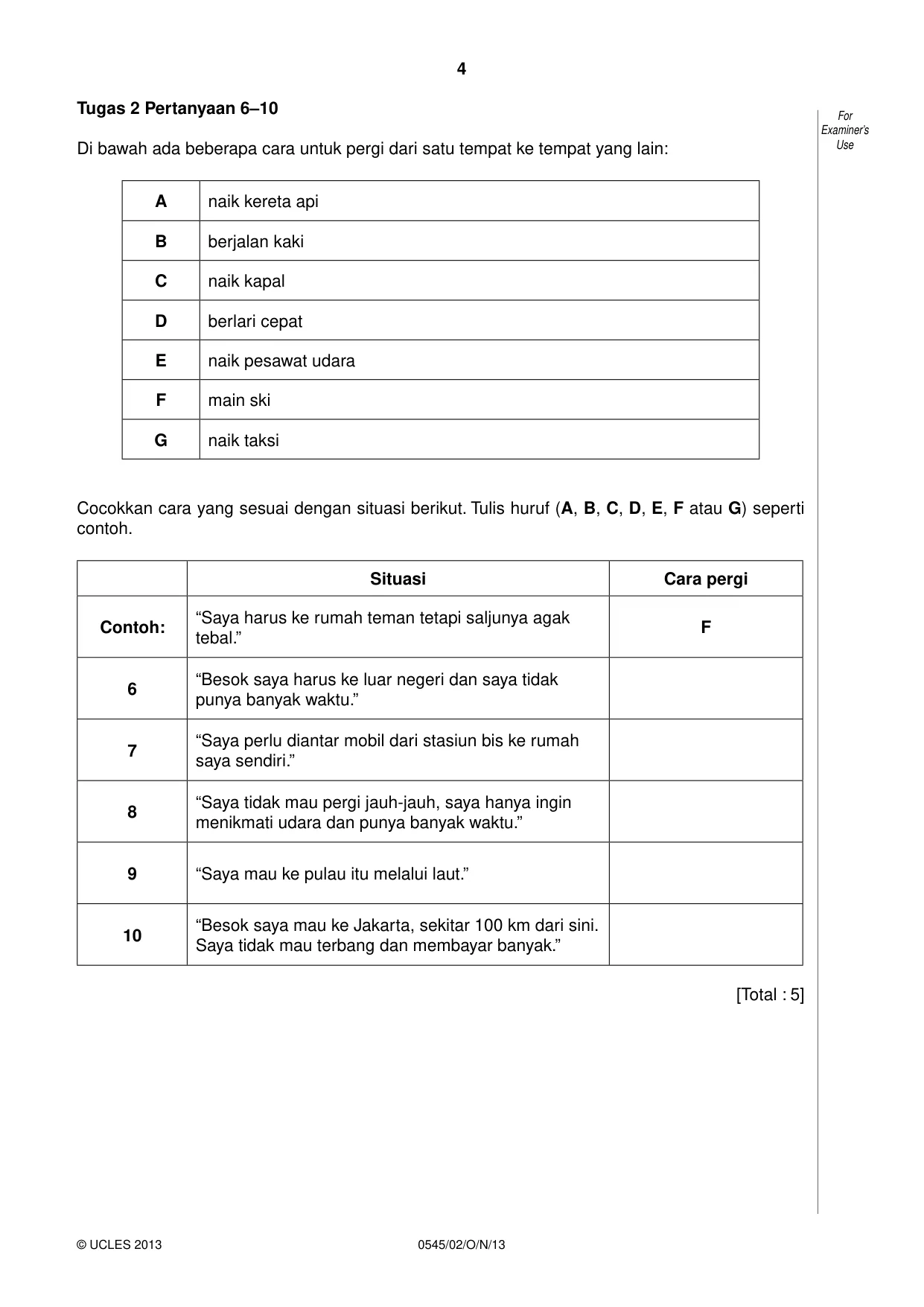
4 0545/02/O/N/13 © UCLES 2013 For Examiner’s Use Tugas 2 Pertanyaan 6–10 Di bawah ada beberapa cara untuk pergi dari satu tempat ke tempat yang lain: A naik kereta api B berjalan kaki C naik kapal D berlari cepat E naik pesawat udara F main ski G naik taksi Cocokkan cara yang sesuai dengan situasi berikut. Tulis huruf (A, B, C, D, E, F atau G) seperti contoh. Situasi Cara pergi Contoh: “Saya harus ke rumah teman tetapi saljunya agak tebal.” F 6 “Besok saya harus ke luar negeri dan saya tidak punya banyak waktu.” 7 “Saya perlu diantar mobil dari stasiun bis ke rumah saya sendiri.” 8 “Saya tidak mau pergi jauh-jauh, saya hanya ingin menikmati udara dan punya banyak waktu.” 9 “Saya mau ke pulau itu melalui laut.” 10 “Besok saya mau ke Jakarta, sekitar 100 km dari sini. Saya tidak mau terbang dan membayar banyak.” [Total : 5]
Question paper, page 5
5 0545/02/O/N/13 © UCLES 2013 [Turn over BLANK PAGE
Question paper, page 6
6 0545/02/O/N/13 © UCLES 2013 For Examiner’s Use Tugas 3 Pertanyaan 11–15 Bacalah cerita di bawah ini dan jawablah pertanyaan berikutnya dengan memilih jawaban yang betul: Arif bangun jam lima pagi seperti biasanya. Dia turun dari tempat tidurnya dan mencari pakaiannya di lemari. Kemudian dia mencari sepatunya. Arif selalu menyimpan sepatunya di bawah tempat tidurnya. Tetapi hari ini sepatunya tidak ada di situ. Arif bingung. Kemudian Arif ingat tadi malam dia pulang dari rumah teman agak terburu-buru. Dia membuka sepatunya sebelum masuk rumah. Jadi barangkali sepatunya masih di luar, di depan pintu rumahnya. Arif cepat lari ke pintu depan rumah untuk melihat apakah sepatunya ketinggalan di luar. Dia kecewa karena sepatunya tidak ada di situ. Arif takut sepatunya dicuri orang karena dia baru membelinya minggu lalu. Arif langsung mencari ibunya yang berada di dapur. Dia bertanya kepada ibunya kalau dia melihat sepatunya. Beruntung ibunya sudah bangun sebelum Arif. Ibu tertawa dan menjawab, “Saya bangun sebelum kamu lalu ke luar rumah untuk menyapu halaman dan menemukan sepatumu. Saya sudah menyimpannya di dapur.” 11 Arif biasanya menyimpan sepatunya A di lemari. B di luar kamarnya. C di bawah tempat tidurnya. 12 Arif bingung karena A dia tidak menemukan sepatunya di kamarnya. B dia bangun terlambat. C sepatunya kotor sekali. 13 Reaksi Arif A pergi ke luar rumah. B menelpon temannya. C pergi ke kamar mandi. [Total : 5] 14 Sepatu Arif A mahal. B baru. C keren. 15 Ibu Arif A marah. B sedih. C senang.
Question paper, page 7
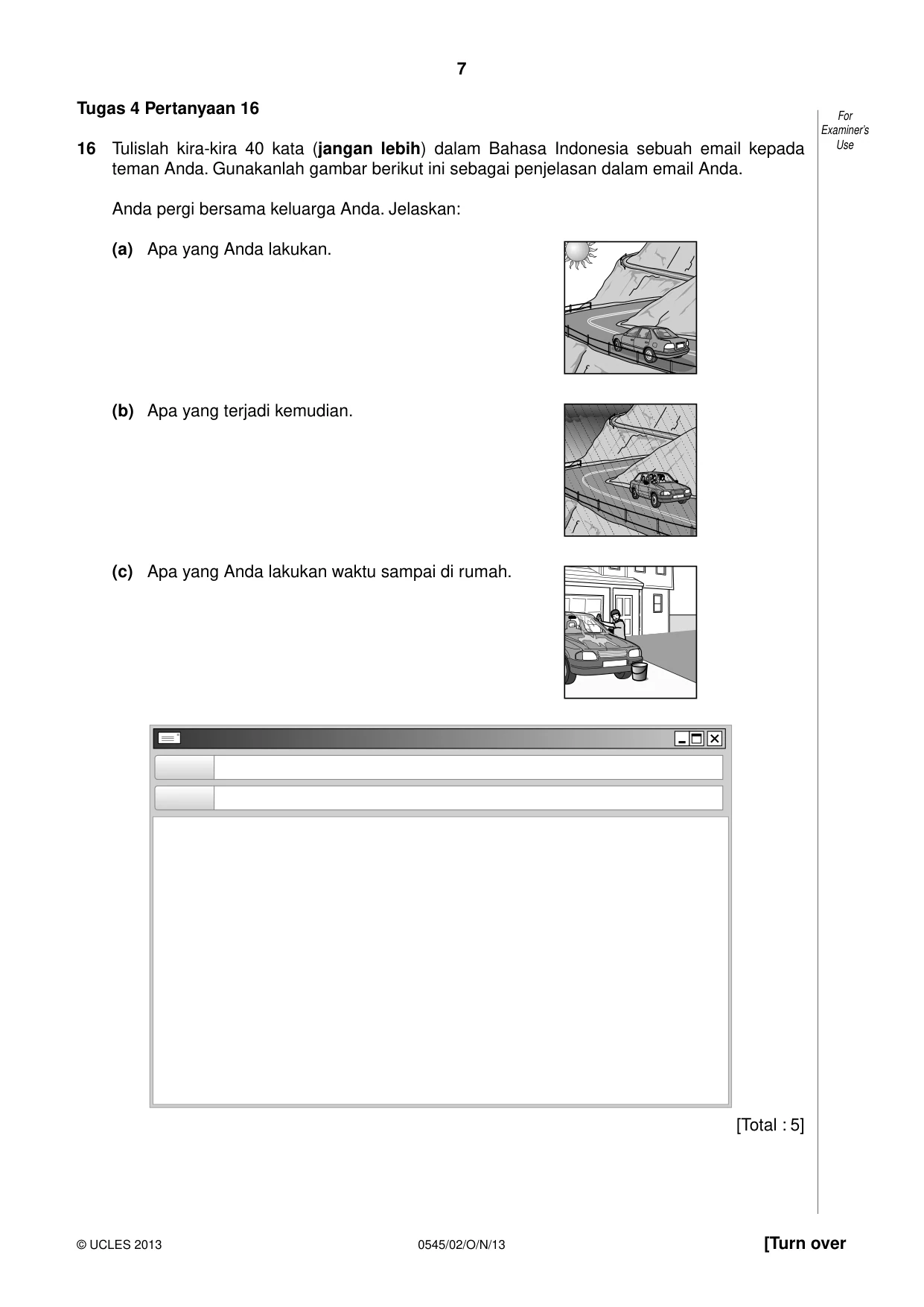
7 0545/02/O/N/13 © UCLES 2013 [Turn over For Examiner’s Use Tugas 4 Pertanyaan 16 16 Tulislah kira-kira 40 kata (jangan lebih) dalam Bahasa Indonesia sebuah email kepada teman Anda. Gunakanlah gambar berikut ini sebagai penjelasan dalam email Anda. Anda pergi bersama keluarga Anda. Jelaskan: (a) Apa yang Anda lakukan. (b) Apa yang terjadi kemudian. (c) Apa yang Anda lakukan waktu sampai di rumah. [Total : 5]
Question paper, page 8
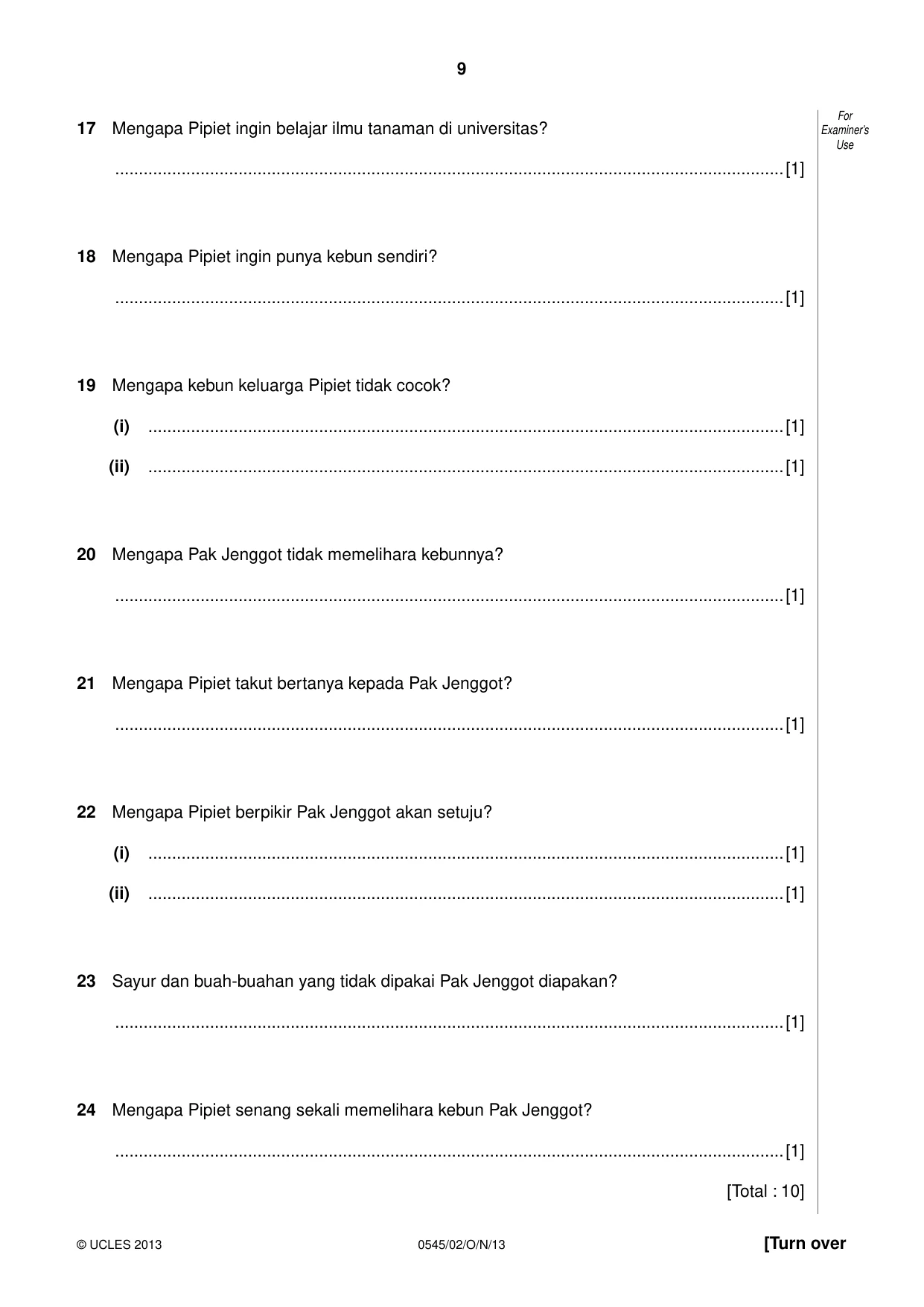
8 0545/02/O/N/13 © UCLES 2013 Bagian 2 Tugas 1 Pertanyaan 17–24 Bacalah cerita tentang Pipiet, seorang murid SMA dan jawab pertanyaan berikutnya : Mata pelajaran favorit Pipiet di sekolah adalah biologi, khususnya ilmu tanaman. Cita-cita Pipiet ingin ke universitas dan belajar tentang cara-cara mengembangkan tanaman yang dapat dimakan oleh orang Indonesia. Oleh karena itu, Pipiet ingin punya kebun sendiri supaya dia bisa menanam sayur-sayuran dan buah-buahan. Pipiet dari keluarga miskin yang tinggal di rumah kecil. Sayang sekali kebunnya sangat kecil dan dipakai untuk mengeringkan pakaian yang dicuci Pipiet dan ibunya. Di depan rumah mereka tinggal seorang laki-laki tua yang bernama Pak Jenggot. Dia tidak punya keluarga. Pak Jenggot memiliki kebun yang cukup luas tetapi tidak dipelihara karena dia sudah terlalu tua. Dengan takut Pipiet bertanya kepada Pak Jenggot kalau dia boleh memelihara kebunnya. Pak Jenggot terkenal tidak ramah dan cepat marah. Pipiet bertanya karena dia tahu Pak Jenggot miskin dan mungkin juga akan senang kalau kebunnya menghasilkan sayur-sayuran dan buah- buahan. Untung sekali Pak Jenggot setuju. Selama satu tahun Pipiet bekerja keras membersihkan kebun Pak Jenggot dan menanaminya dengan bermacam-macam tanaman. Oleh karena sayur dan buah yang dihasilkan terlalu banyak untuk Pak Jenggot sendiri maka sebagian dijual Pipiet di pasar. Uang hasil penjualan dibagi antara Pak Jenggot dan keluarga Pipiet. Pipiet senang sekali mendapatkan banyak ilmu dan pengalaman tentang menanam tanaman.
Question paper, page 9
9 0545/02/O/N/13 © UCLES 2013 [Turn over For Examiner’s Use 17 Mengapa Pipiet ingin belajar ilmu tanaman di universitas? …[1] 18 Mengapa Pipiet ingin punya kebun sendiri? …[1] 19 Mengapa kebun keluarga Pipiet tidak cocok? (i) …[1] (ii) …[1] 20 Mengapa Pak Jenggot tidak memelihara kebunnya? …[1] 21 Mengapa Pipiet takut bertanya kepada Pak Jenggot? …[1] 22 Mengapa Pipiet berpikir Pak Jenggot akan setuju? (i) …[1] (ii) …[1] 23 Sayur dan buah-buahan yang tidak dipakai Pak Jenggot diapakan? …[1] 24 Mengapa Pipiet senang sekali memelihara kebun Pak Jenggot? …[1] [Total : 10]
Question paper, page 10
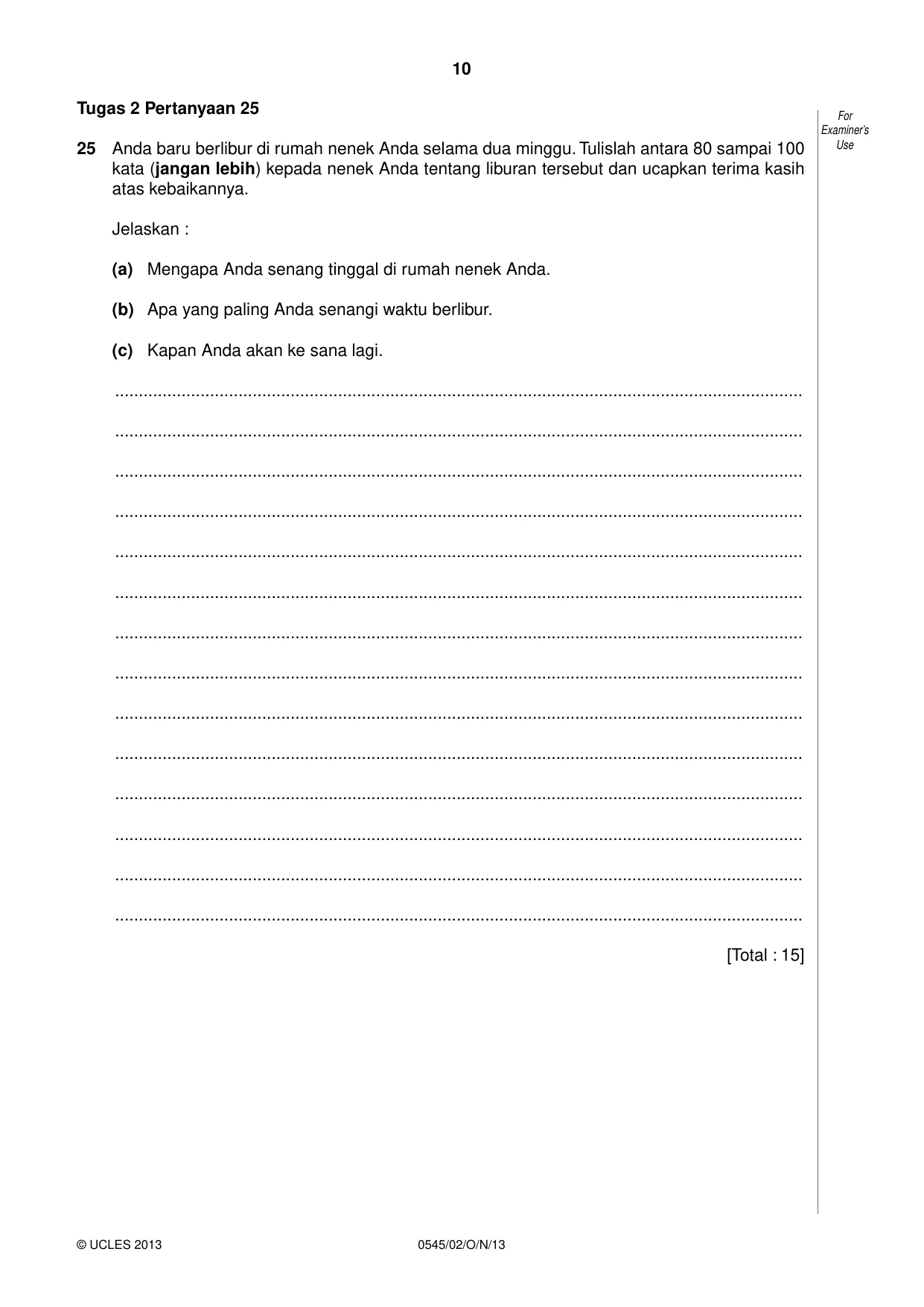
10 0545/02/O/N/13 © UCLES 2013 For Examiner’s Use Tugas 2 Pertanyaan 25 25 Anda baru berlibur di rumah nenek Anda selama dua minggu. Tulislah antara 80 sampai 100 kata (jangan lebih) kepada nenek Anda tentang liburan tersebut dan ucapkan terima kasih atas kebaikannya. Jelaskan : (a) Mengapa Anda senang tinggal di rumah nenek Anda. (b) Apa yang paling Anda senangi waktu berlibur. (c) Kapan Anda akan ke sana lagi. … … … … … … … … … … … … … … [Total : 15]
Question paper, page 11
11 0545/02/O/N/13 © UCLES 2013 [Turn over BLANK PAGE
Question paper, page 12
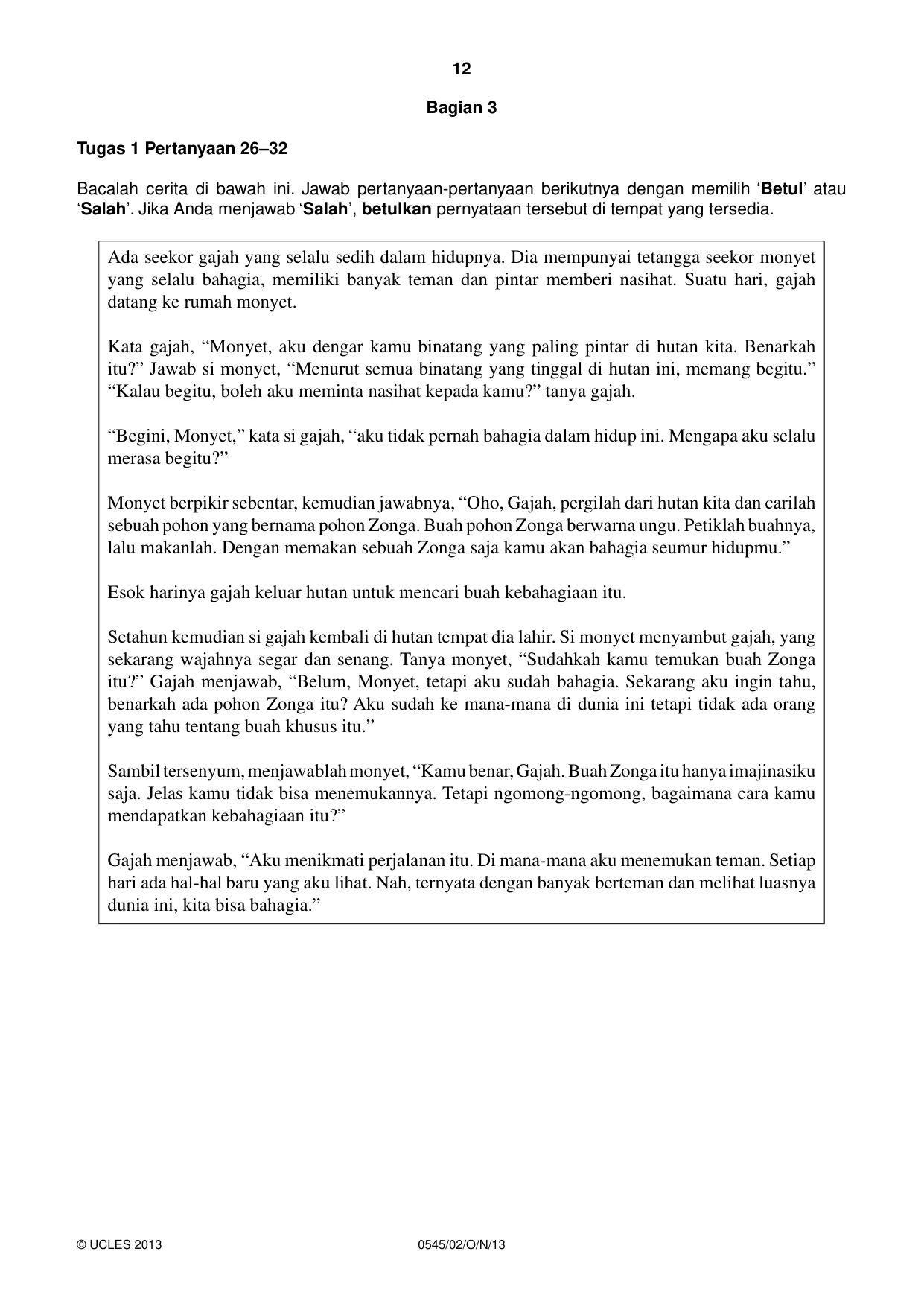
12 0545/02/O/N/13 © UCLES 2013 Bagi an 3 Tugas 1 Pertanyaan 26–32 Bacalah cerita di bawah ini. Jawab pertanyaan-pertanyaan berikutnya dengan memilih ‘Betul’ atau ‘Salah’. Jika Anda menjawab ‘Salah’, betulkan pernyataan tersebut di tempat yang tersedia. Ada seekor gajah yang selalu sedih dalam hidupnya. Dia mempunyai tetangga seekor monyet yang selalu bahagia, memiliki banyak teman dan pintar memberi nasihat. Suatu hari, gajah datang ke rumah monyet. Kata gajah, “Monyet, aku dengar kamu binatang yang paling pintar di hutan kita. Benarkah itu?” Jawab si monyet, “Menurut semua binatang yang tinggal di hutan ini, memang begitu.” “Kalau begitu, boleh aku meminta nasihat kepada kamu?” tanya gajah. “Begini, Monyet,” kata si gajah, “aku tidak pernah bahagia dalam hidup ini. Mengapa aku selalu merasa begitu?” Monyet berpikir sebentar, kemudian jawabnya, “Oho, Gajah, pergilah dari hutan kita dan carilah sebuah pohon yang bernama pohon Zonga. Buah pohon Zonga berwarna ungu. Petiklah buahnya, lalu makanlah. Dengan memakan sebuah Zonga saja kamu akan bahagia seumur hidupmu.” Esok harinya gajah keluar hutan untuk mencari buah kebahagiaan itu. Setahun kemudian si gajah kembali di hutan tempat dia lahir. Si monyet menyambut gajah, yang sekarang wajahnya segar dan senang. Tanya monyet, “Sudahkah kamu temukan buah Zonga itu?” Gajah menjawab, “Belum, Monyet, tetapi aku sudah bahagia. Sekarang aku ingin tahu, benarkah ada pohon Zonga itu? Aku sudah ke mana-mana di dunia ini tetapi tidak ada orang yang tahu tentang buah khusus itu.” Sambil tersenyum, menjawablah monyet, “Kamu benar, Gajah. Buah Zonga itu hanya imajinasiku saja. Jelas kamu tidak bisa menemukannya. Tetapi ngomong-ngomong, bagaimana cara kamu mendapatkan kebahagiaan itu?” Gajah menjawab, “Aku menikmati perjalanan itu. Di mana-mana aku menemukan teman. Setiap hari ada hal-hal baru yang aku lihat. Nah, ternyata dengan banyak berteman dan melihat luasnya dunia ini, kita bisa bahagia.”
Question paper, page 13
13 0545/02/O/N/13 © UCLES 2013 [Turn over For Examiner’s Use Betul Salah Contoh: Si gajah dulu selalu bahagia. ✓ Tidak, si gajah selalu sedih. … 26 Si monyet selalu sendiri di hutan. … 27 Semua binatang di hutan berpikir si monyet pandai. … 28 Si monyet menyuruh si gajah mencari sebuah pohon istimewa. … 29 Si gajah mencari buah itu di dalam hutan. … 30 Waktu si gajah kembali ke hutan dia bahagia. … 31 Banyak orang berbicara tentang buah Zonga itu. … 32 Si gajah banyak mandapatkan pengalaman waktu berjalan-jalan. … [Total : 10]
Question paper, page 14
14 0545/02/O/N/13 © UCLES 2013 Tugas 2 Pertanyaan 33–37 Di bawah ada surat keluhan kepada perusahaan tentang barang-barang yang diterima. Bacalah surat di bawah ini dan jawab pertanyaan berikutnya dengan kata-kata Anda sendiri. Dengan hormat, Kami ingin mengajukan keluhan tentang kiriman piring-piring keramik yang kami pesan tanggal 24 Mei. Semua barang itu sudah kami bayar dengan kartu kredit di website Anda dan kami juga membayar lebih supaya barang-barang dikirim lebih cepat, yaitu dalam dua hari. Pesanan kami datang terlambat dua minggu dan itu sangat mengecewakan karena barang-barang itu kado untuk pesta pernikahan tetangga kami. Kami terpaksa membeli kado lain dan itu sangat merugikan kami. Setelah barang-barang itu kami periksa, ada beberapa masalah. Pertama, kami pesan 24 piring tetapi hanya ada 23 dalam paket kiriman itu. Kedua, ukuran piring-piring itu tidak sama dengan iklan di website Anda, saya memesan piring-piring ukuran 25 cm bukan 20 cm. Kami pesan piring berwarna putih tetapi kami terima barang berwarna krem. Terakhir, dua buah piring dalam paket itu pecah karena tidak dibungkus dengan baik. Kami kirimkan kembali piring-piring itu supaya Anda dapat melihat kondisinya. Kami minta semua piring yang Anda kirim dapat diganti. Kami juga minta ganti rugi sebesar dua puluh persen harga barang itu untuk ongkos kirim kembali barang itu dan semua kerepotan yang kami alami. Kalau kami tidak menerima barang-barang itu dalam 5 hari atau tidak ada kabar dari perusahaan Anda, kami akan menghubungi seorang ahli hukum untuk mendapatkan nasihat. Kami juga akan menulis surat kepada surat kabar setempat untuk melaporkan pelayanan Anda yang kurang baik. Atas perhatian Anda kami ucapkan terima kasih.
Question paper, page 15
15 0545/02/O/N/13 © UCLES 2013 For Examiner’s Use 33 Mengapa si penulis kecewa barang-barang itu datang terlambat? Berikan dua perincian. (i) …[1] (ii) …[1] 34 Bagaimana keadaan barang-barang waktu diterima? Berikan tiga perincian. (i) …[1] (ii) …[1] (iii) …[1] 35 Apa yang penulis lakukan dengan piring-piring yang sudah diterima? …[1] 36 Mengapa si penulis minta ganti rugi dari perusahaan itu? Berikan dua perincian. (i) …[1] (ii) …[1] 37 Apa yang akan penulis lakukan kalau dia tidak mendapatkan jawaban yang memuaskan? Berikan dua perincian. (i) …[1] (ii) …[1] [Total : 10]
Question paper, page 16
16 0545/02/O/N/13 © UCLES 2013 BLANK PAGE Permission to reproduce items where third-party owned material protected by copyright is included has been sought and cleared where possible. Every reasonable effort has been made by the publisher (UCLES) to trace copyright holders, but if any items requiring clearance have unwittingly been included, the publisher will be pleased to make amends at the earliest possible opportunity. University of Cambridge International Examinations is part of the Cambridge Assessment Group. Cambridge Assessment is the brand name of University of Cambridge Local Examinations Syndicate (UCLES), which is itself a department of the University of Cambridge.
Mark scheme, page 1
CAMBRIDGE INTERNATIONAL EXAMINATIONS International General Certificate of Secondary Education MARK SCHEME for the October/November 2013 series 0545 INDONESIAN 0545/02 Paper 2 (Reading and Directed Writing), maximum raw mark 65 This mark scheme is published as an aid to teachers and candidates, to indicate the requirements of the examination. It shows the basis on which Examiners were instructed to award marks. It does not indicate the details of the discussions that took place at an Examiners’ meeting before marking began, which would have considered the acceptability of alternative answers. Mark schemes should be read in conjunction with the question paper and the Principal Examiner Report for Teachers. Cambridge will not enter into discussions about these mark schemes. Cambridge is publishing the mark schemes for the October/November 2013 series for most IGCSE, GCE Advanced Level and Advanced Subsidiary Level components and some Ordinary Level components. www.XtremePapers.com
Mark scheme, page 2
Page 2 Mark Scheme Syllabus Paper IGCSE – October/November 2013 0545 02 © Cambridge International Examinations 2013 1 General Marking Principles 1.1 Please note that it is not possible to list all acceptable alternatives in the Detailed Mark Scheme provided in Section 3. You will need to consider all alternative answers and unexpected approaches in candidates' scripts, make a decision on whether they communicate the required elements, in consultation with your Principal Examiner, and award marks accordingly. 1.2 Crossing out: (a) If a candidate changes his/her mind over an answer and crosses out an attempt, award a mark if the final attempt is correct. (b) If a candidate crosses out an answer to a whole question but makes no second attempt at it, mark the crossed out work. 1.3 Reading tasks: more than the stipulated number of boxes ticked/crossed by the candidate: (a) If more than one attempt is visible, but the candidate has clearly indicated which attempt is his/her final answer (eg by crossing out other attempts or by annotating the script in some way), mark in the usual way. (b) If two attempts are visible (eg two boxes ticked instead of the 1 box stipulated), and neither has been crossed out/discounted by the candidate, no mark can be awarded. (c) Answers in pen do not take precedence over answers in pencil, eg if a candidate is asked to tick 1 box and ticks two, one in pen and the other in pencil, the mark cannot be awarded unless there is some explicit indication from the candidate as to which is his/her final answer. 1.4 Reading tasks: for questions requiring more than one element for the answer, (i) and (ii), where the answers are interchangeable: Both correct answers on line 1 and line 2 blank = 2 Both correct answers on line 1 and another, wrong answer on line 2 = 1 (or vice-versa) 1.5 Reading tasks: answers requiring the use of Indonesian (rather than a non-verbal response) should be marked for communication. Tolerate inaccuracies provided the message is clear. (a) ‘If in doubt, sound it out’: if you read what the candidate has written, does it sound like the correct answer? (b) Look-alike test: does what the candidate has written look like the correct answer?
Mark scheme, page 3
Page 3 Mark Scheme Syllabus Paper IGCSE – October/November 2013 0545 02 © Cambridge International Examinations 2013 1.6 Unless the Mark Scheme specifies otherwise, do not accept incorrect Indonesian if the word given means something else in Indonesian. (Incorrect Indonesian which constitutes a word in any language other than Indonesian is marked (i) on the basis of whether it is accepted or refused in the Mark Scheme and (ii) if not mentioned in the Mark Scheme, on the basis of 1.5 above). 1.7 Annotation used in the Mark Scheme: (a) INV = Invalidation and is used when additional material included by the candidate is judged to invalidate an otherwise correct answer thus preventing him / her from scoring the mark (INV = 0). (b) tc = ‘tout court’ and means that on its own the material is not sufficient to score the mark. (c) HA = harmless additional material which in conjunction with the correct answer does not prevent the candidate from scoring the mark. (d) BOD = Benefit of the Doubt and is used to indicate material considered by the Examiner and judged to be more correct than incorrect: the benefit of the doubt is given to the candidate and the mark is awarded. 1.8 Extra material: Section 2, Exercise 1 In Section 2, Exercise 1, reward the candidate for being able to locate the answer in the passage. Do not worry about lifting unless this would cause the message to be seriously distorted – in which case a lift will be specifically rejected in the Mark Scheme. Ignore extra material given in an answer providing that it does not invalidate an answer. 1.9 Extra material: Section 3 In Section 3 it is the candidate’s responsibility to answer questions in such a way as to demonstrate to the Examiner that s/he has understood the texts/questions. Where candidates introduce extra, irrelevant material to an otherwise correct answer the danger is that the Examiner is being forced to ‘choose’ the correct answer and s/he cannot be certain that the candidate has shown understanding. Where the Examiner is put in this position the mark cannot be awarded. In Section 3, look for signs of genuine comprehension. Usually, candidates who lift indiscriminately fail to demonstrate comprehension and will not score the mark. However, careful lifting of the details required to answer the question does demonstrate comprehension and should be rewarded. The Detailed Mark Scheme provides specific guidance but in cases not covered, the following general rules apply (see next page):
Mark scheme, page 4
Page 4 Mark Scheme Syllabus Paper IGCSE – October/November 2013 0545 02 © Cambridge International Examinations 2013 (a) Extra material, mentioned in the Mark Scheme, which reinforces the correct answer or in itself constitutes an alternative correct answer: this is acceptable and is not penalised (b) Extra material which constitutes an alternative answer, but which is not explicitly mentioned in the Mark Scheme: the Examiner needs to decide, by consulting the text and the PE if necessary whether the alternative answer constitutes: (i) an alternative correct answer, in which case this falls into category (a) and the answer should be rewarded (ii) or an answer which on its own would be refused, in which case this falls into category (c) and the answer should be refused (c) Extra material which constitutes an alternative answer specifically refused in the Mark Scheme: this puts the Examiner in the position of having to ‘choose’ which is the candidate's 'final' answer – the Examiner cannot be sure what the candidate has understood – and the mark cannot be awarded (d) Extra material which distorts or contradicts the correct answer: this affects communication – the Examiner cannot be sure what the candidate has understood – and the mark cannot be awarded (e) Extra material introduced by the candidate and which does not feature in the text: this affects communication – the Examiner cannot be sure what the candidate has understood – and the mark cannot be awarded. It can sometimes be difficult to draw the line between what is a deduction made by an able candidate on the basis of what they have read and pure guesswork. Therefore where an answer of this sort occurs which is not covered in the Mark Scheme, Examiners should consult their PE
Mark scheme, page 5
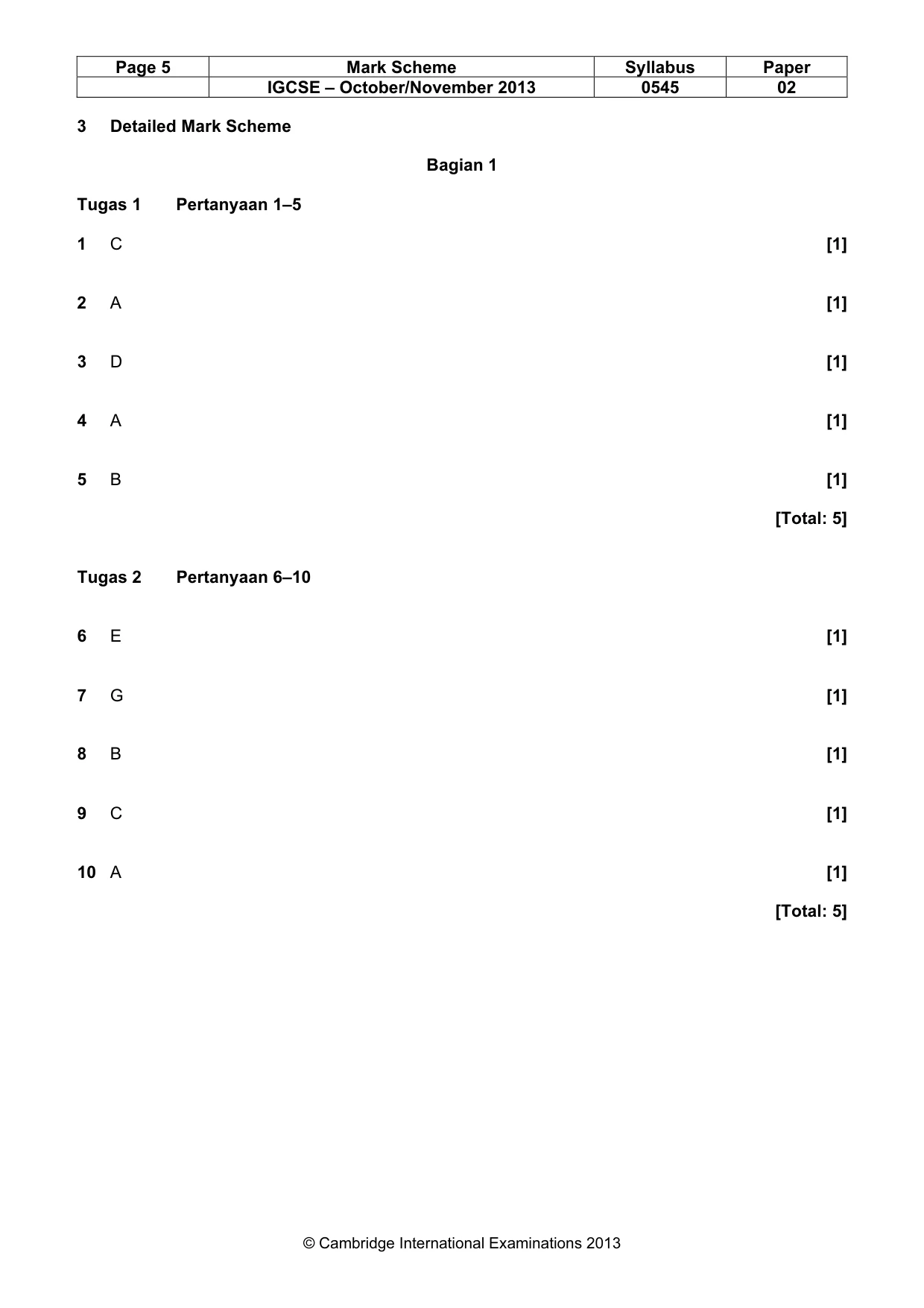
Page 5 Mark Scheme Syllabus Paper IGCSE – October/November 2013 0545 02 © Cambridge International Examinations 2013 3 Detailed Mark Scheme Bagian 1 Tugas 1 Pertanyaan 1–5 1 C [1] 2 A [1] 3 D [1] 4 A [1] 5 B [1] [Total: 5] Tugas 2 Pertanyaan 6–10 6 E [1] 7 G [1] 8 B [1] 9 C [1] 10 A [1] [Total: 5]
Mark scheme, page 6
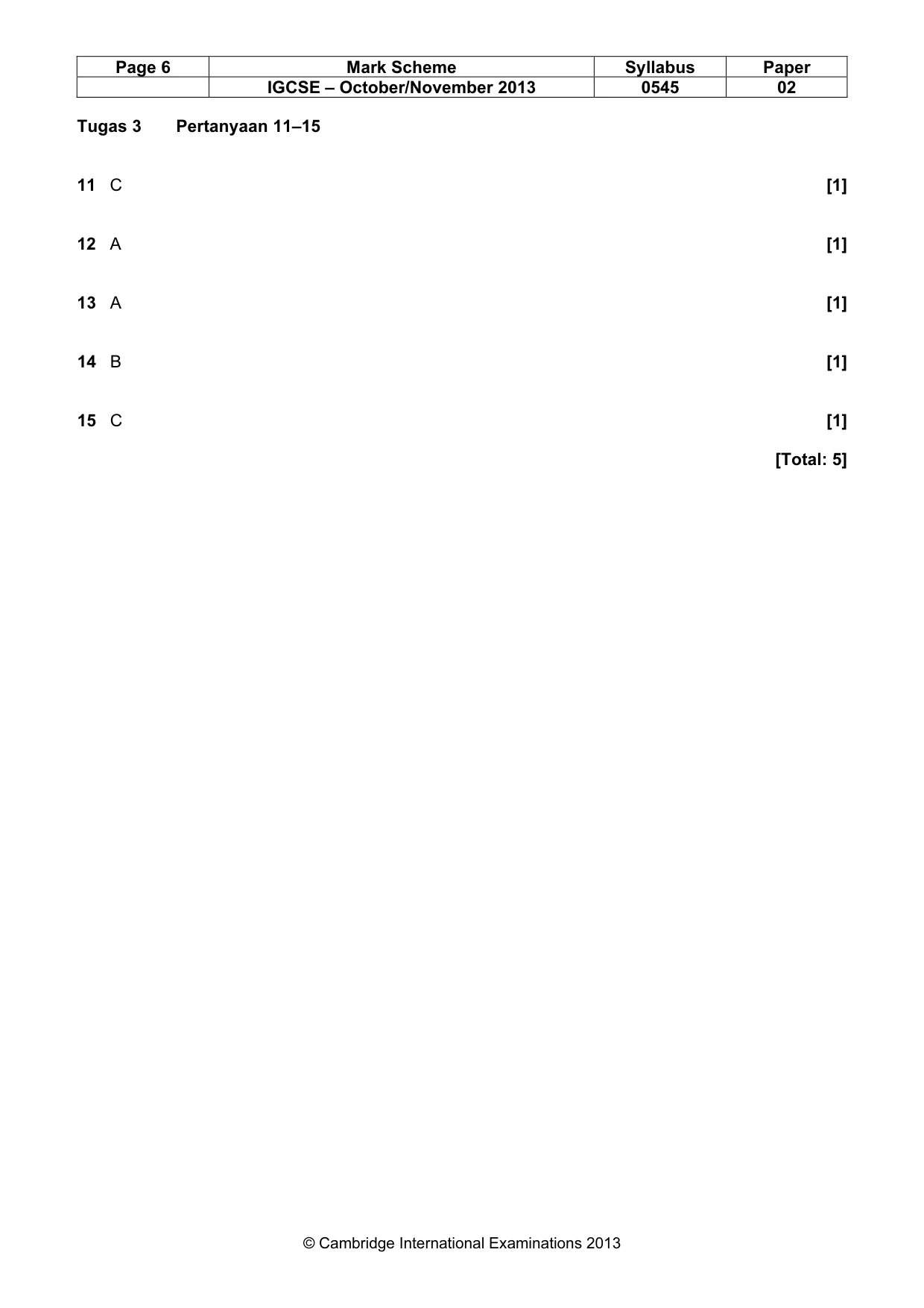
Page 6 Mark Scheme Syllabus Paper IGCSE – October/November 2013 0545 02 © Cambridge International Examinations 2013 Tugas 3 Pertanyaan 11–15 11 C [1] 12 A [1] 13 A [1] 14 B [1] 15 C [1] [Total: 5]
Mark scheme, page 7
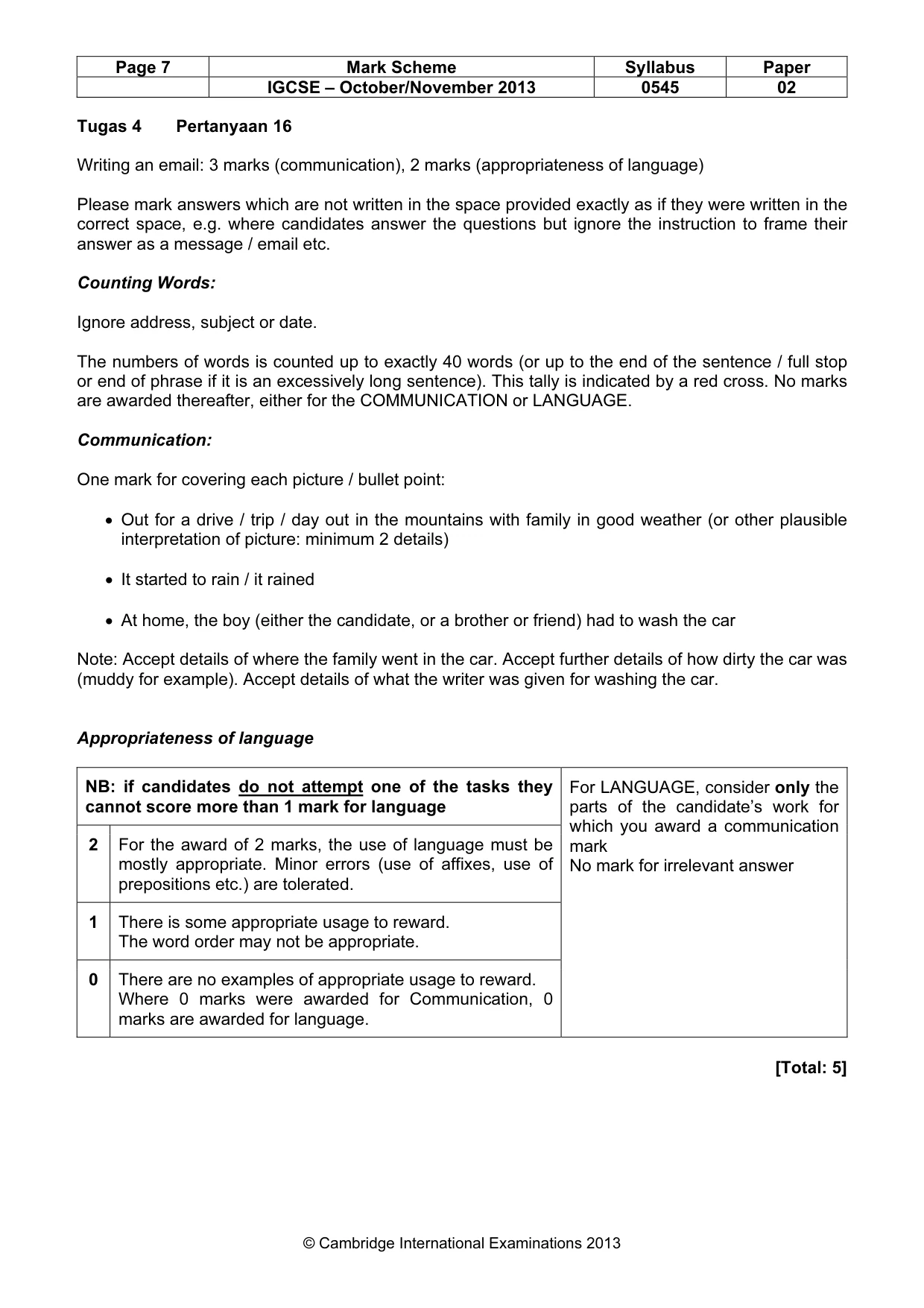
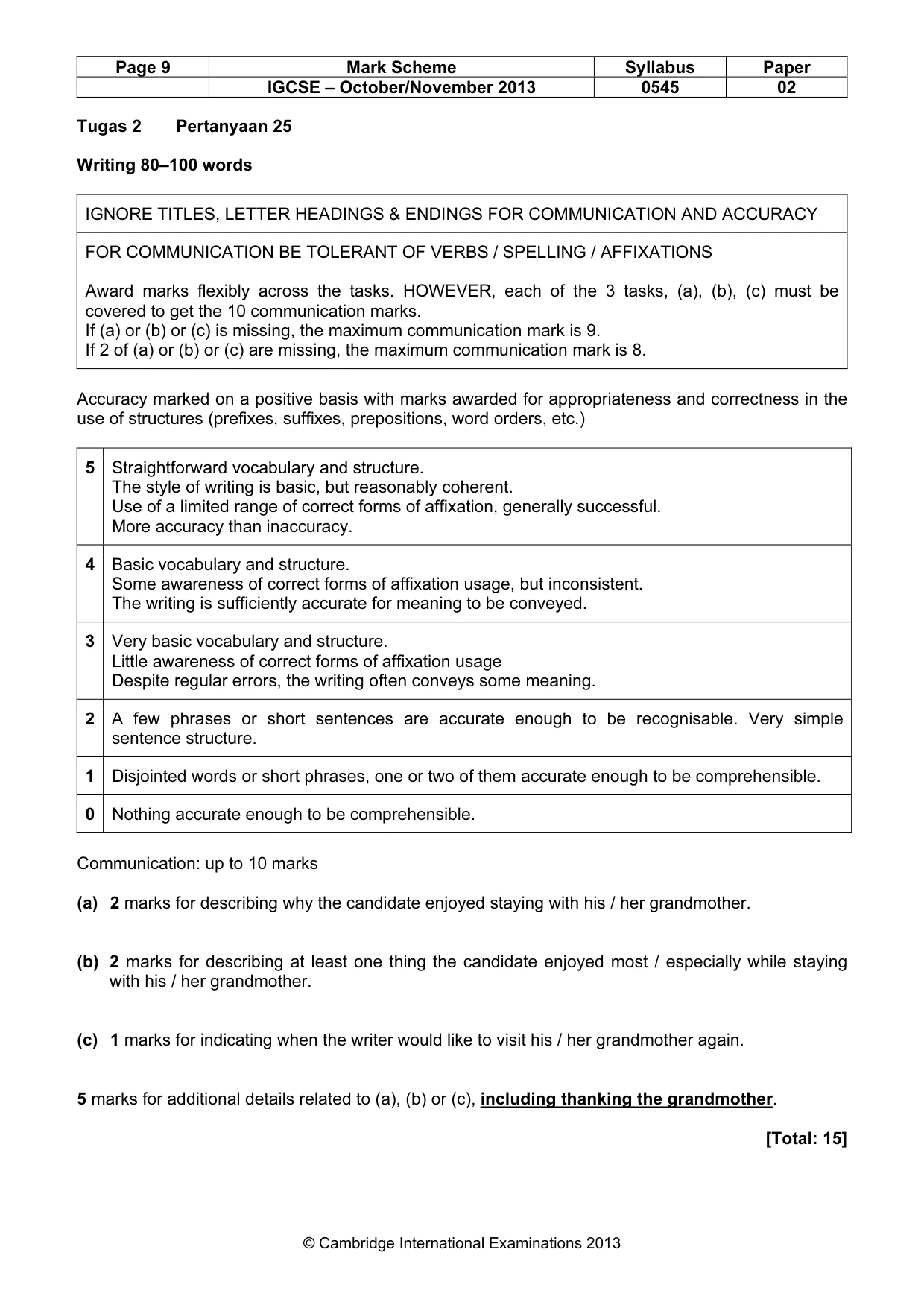
Page 7 Mark Scheme Syllabus Paper IGCSE – October/November 2013 0545 02 © Cambridge International Examinations 2013 Tugas 4 Pertanyaan 16 Writing an email: 3 marks (communication), 2 marks (appropriateness of language) Please mark answers which are not written in the space provided exactly as if they were written in the correct space, e.g. where candidates answer the questions but ignore the instruction to frame their answer as a message / email etc. Counting Words: Ignore address, subject or date. The numbers of words is counted up to exactly 40 words (or up to the end of the sentence / full stop or end of phrase if it is an excessively long sentence). This tally is indicated by a red cross. No marks are awarded thereafter, either for the COMMUNICATION or LANGUAGE. Communication: One mark for covering each picture / bullet point: • Out for a drive / trip / day out in the mountains with family in good weather (or other plausible interpretation of picture: minimum 2 details) • It started to rain / it rained • At home, the boy (either the candidate, or a brother or friend) had to wash the car Note: Accept details of where the family went in the car. Accept further details of how dirty the car was (muddy for example). Accept details of what the writer was given for washing the car. Appropriateness of language NB: if candidates do not attempt one of the tasks they cannot score more than 1 mark for language For LANGUAGE, consider only the parts of the candidate’s work for which you award a communication mark No mark for irrelevant answer 2 For the award of 2 marks, the use of language must be mostly appropriate. Minor errors (use of affixes, use of prepositions etc.) are tolerated. 1 There is some appropriate usage to reward. The word order may not be appropriate. 0 There are no examples of appropriate usage to reward. Where 0 marks were awarded for Communication, 0 marks are awarded for language. [Total: 5]
Mark scheme, page 8
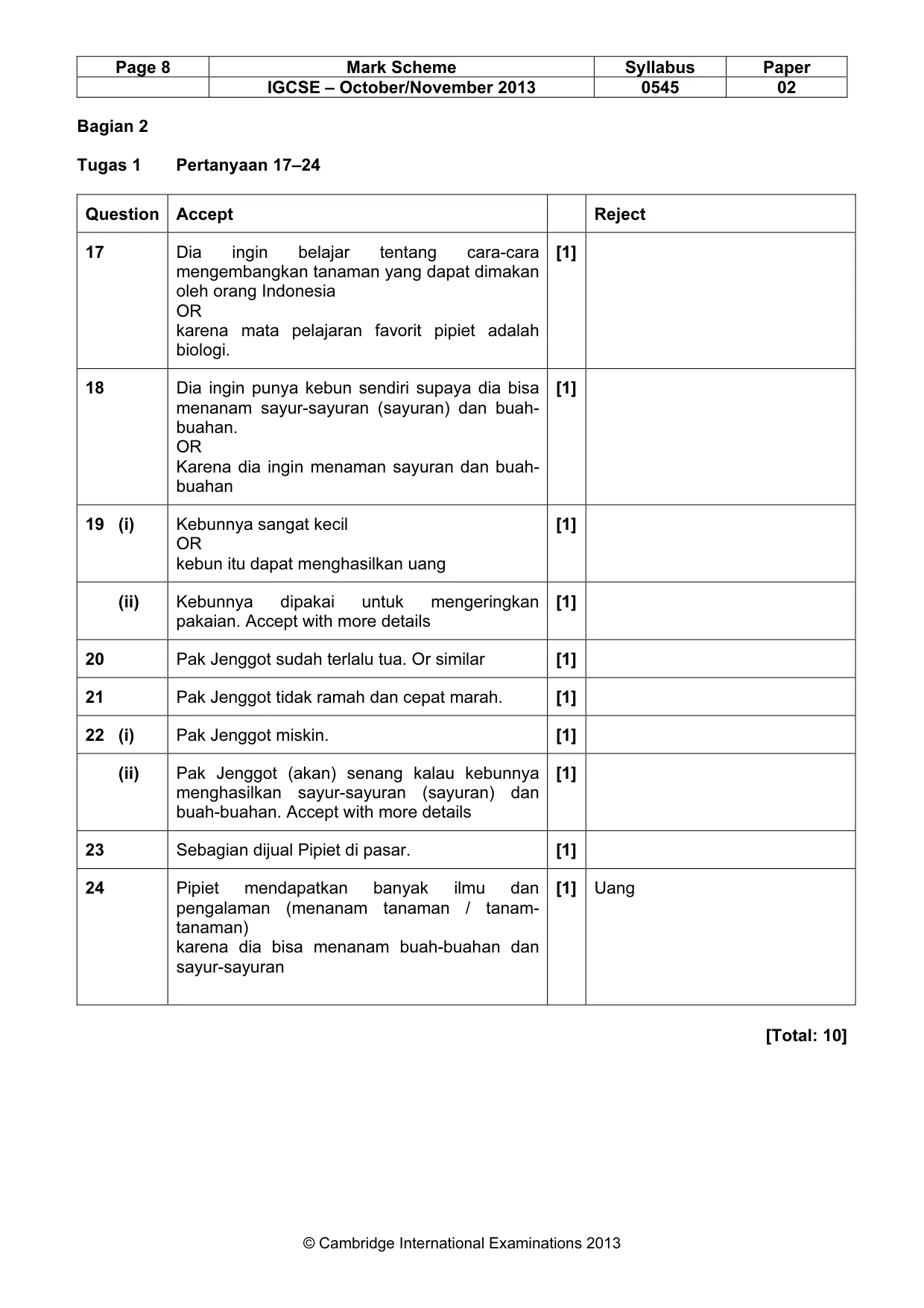
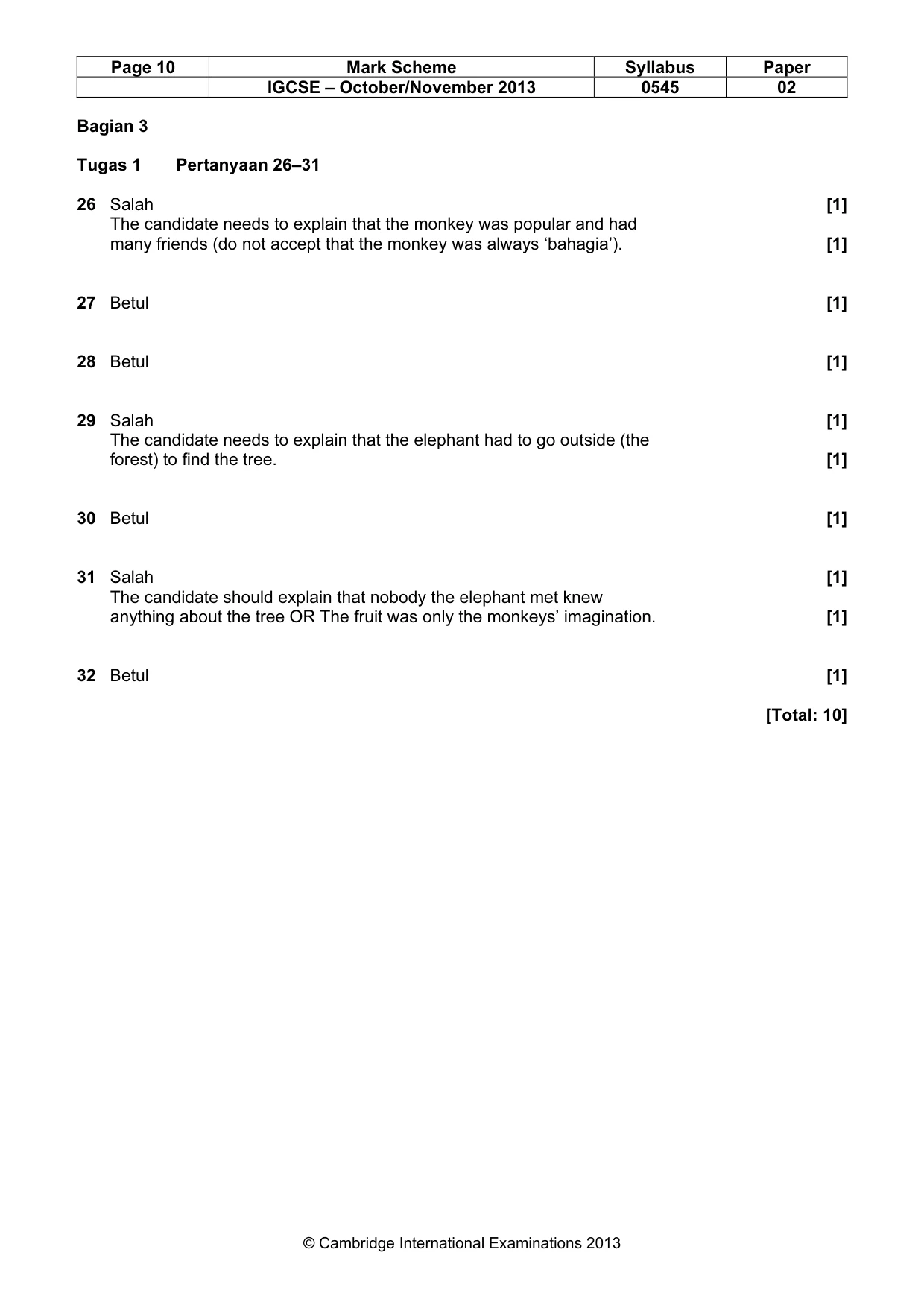
Page 8 Mark Scheme Syllabus Paper IGCSE – October/November 2013 0545 02 © Cambridge International Examinations 2013 Bagian 2 Tugas 1 Pertanyaan 17–24 Question Accept Reject 17 Dia ingin belajar tentang cara-cara mengembangkan tanaman yang dapat dimakan oleh orang Indonesia OR karena mata pelajaran favorit pipiet adalah biologi. [1] 18 Dia ingin punya kebun sendiri supaya dia bisa menanam sayur-sayuran (sayuran) dan buah- buahan. OR Karena dia ingin menaman sayuran dan buah- buahan [1] 19 (i) Kebunnya sangat kecil OR kebun itu dapat menghasilkan uang [1] (ii) Kebunnya dipakai untuk mengeringkan pakaian. Accept with more details [1] 20 Pak Jenggot sudah terlalu tua. Or similar [1] 21 Pak Jenggot tidak ramah dan cepat marah. [1] 22 (i) Pak Jenggot miskin. [1] (ii) Pak Jenggot (akan) senang kalau kebunnya menghasilkan sayur-sayuran (sayuran) dan buah-buahan. Accept with more details [1] 23 Sebagian dijual Pipiet di pasar. [1] 24 Pipiet mendapatkan banyak ilmu dan pengalaman (menanam tanaman / tanam- tanaman) karena dia bisa menanam buah-buahan dan sayur-sayuran [1] Uang [Total: 10]
Mark scheme, page 9
Page 9 Mark Scheme Syllabus Paper IGCSE – October/November 2013 0545 02 © Cambridge International Examinations 2013 Tugas 2 Pertanyaan 25 Writing 80–100 words IGNORE TITLES, LETTER HEADINGS & ENDINGS FOR COMMUNICATION AND ACCURACY FOR COMMUNICATION BE TOLERANT OF VERBS / SPELLING / AFFIXATIONS Award marks flexibly across the tasks. HOWEVER, each of the 3 tasks, (a), (b), (c) must be covered to get the 10 communication marks. If (a) or (b) or (c) is missing, the maximum communication mark is 9. If 2 of (a) or (b) or (c) are missing, the maximum communication mark is 8. Accuracy marked on a positive basis with marks awarded for appropriateness and correctness in the use of structures (prefixes, suffixes, prepositions, word orders, etc.) 5 Straightforward vocabulary and structure. The style of writing is basic, but reasonably coherent. Use of a limited range of correct forms of affixation, generally successful. More accuracy than inaccuracy. 4 Basic vocabulary and structure. Some awareness of correct forms of affixation usage, but inconsistent. The writing is sufficiently accurate for meaning to be conveyed. 3 Very basic vocabulary and structure. Little awareness of correct forms of affixation usage Despite regular errors, the writing often conveys some meaning. 2 A few phrases or short sentences are accurate enough to be recognisable. Very simple sentence structure. 1 Disjointed words or short phrases, one or two of them accurate enough to be comprehensible. 0 Nothing accurate enough to be comprehensible. Communication: up to 10 marks (a) 2 marks for describing why the candidate enjoyed staying with his / her grandmother. (b) 2 marks for describing at least one thing the candidate enjoyed most / especially while staying with his / her grandmother. (c) 1 marks for indicating when the writer would like to visit his / her grandmother again. 5 marks for additional details related to (a), (b) or (c), including thanking the grandmother. [Total: 15]
Mark scheme, page 10
Page 10 Mark Scheme Syllabus Paper IGCSE – October/November 2013 0545 02 © Cambridge International Examinations 2013 Bagian 3 Tugas 1 Pertanyaan 26–31 26 Salah [1] The candidate needs to explain that the monkey was popular and had many friends (do not accept that the monkey was always ‘bahagia’). [1] 27 Betul [1] 28 Betul [1] 29 Salah [1] The candidate needs to explain that the elephant had to go outside (the forest) to find the tree. [1] 30 Betul [1] 31 Salah [1] The candidate should explain that nobody the elephant met knew anything about the tree OR The fruit was only the monkeys’ imagination. [1] 32 Betul [1] [Total: 10]
Mark scheme, page 11
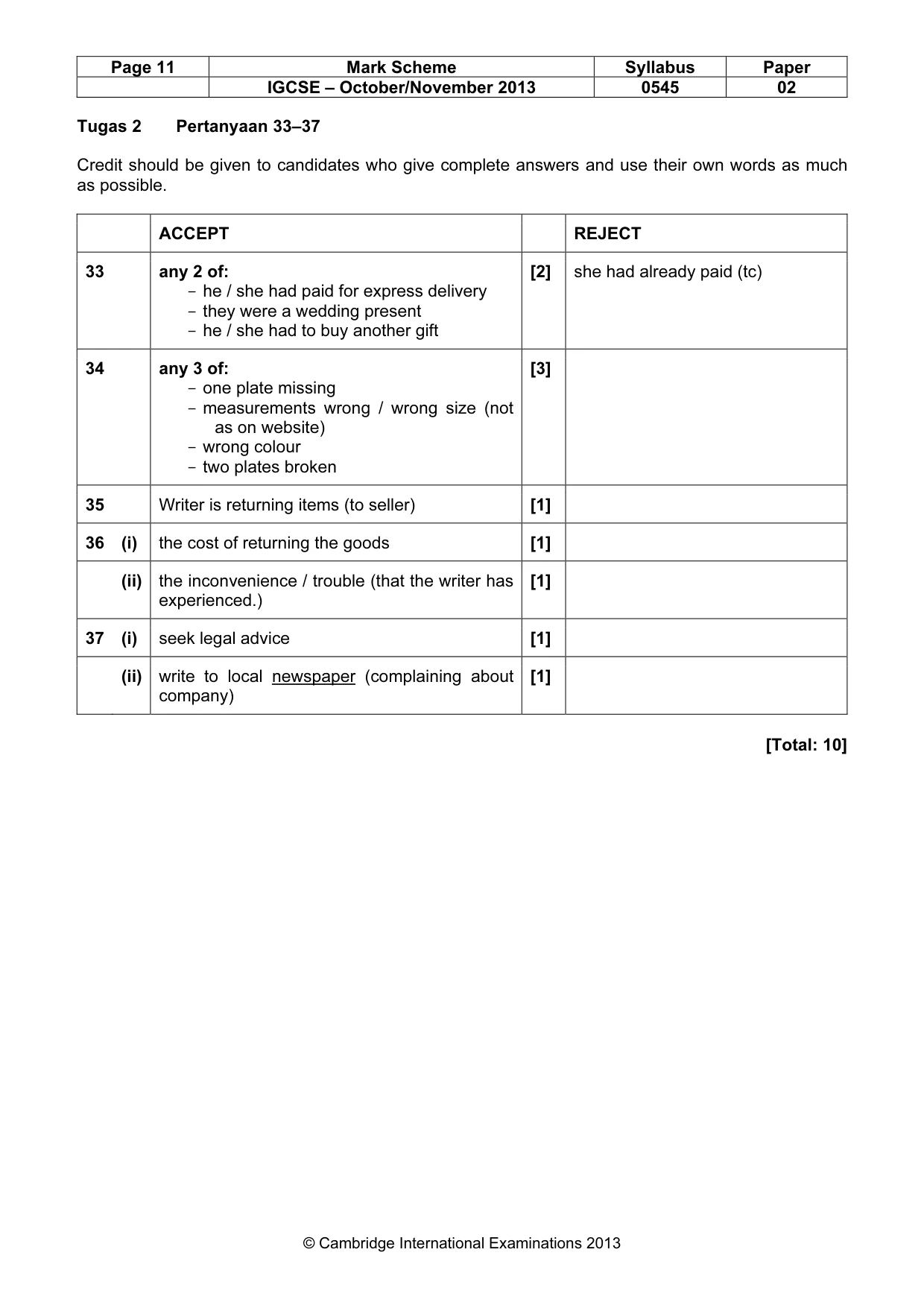
Page 11 Mark Scheme Syllabus Paper IGCSE – October/November 2013 0545 02 © Cambridge International Examinations 2013 Tugas 2 Pertanyaan 33–37 Credit should be given to candidates who give complete answers and use their own words as much as possible. ACCEPT REJECT 33 any 2 of: - he / she had paid for express delivery - they were a wedding present - he / she had to buy another gift [2] she had already paid (tc) 34 any 3 of: - one plate missing - measurements wrong / wrong size (not as on website) - wrong colour - two plates broken [3] 35 Writer is returning items (to seller) [1] 36 (i) the cost of returning the goods [1] (ii) the inconvenience / trouble (that the writer has experienced.) [1] 37 (i) seek legal advice [1] (ii) write to local newspaper (complaining about company) [1] [Total: 10]
What you needed in this session
Cambridge’s own grade thresholds for 2013 Oct/Nov, Paper 2 · Variant 1. A higher threshold means an easier paper — the bar moves with how the cohort did.