Cambridge IGCSE Indonesian - Foreign Language 0545 — 2017 May/June Paper 2 · Variant 1
0545/21/M/J/17 · 45 marks · ≈51 min
The question paper and its mark scheme, free to read here and free to download. This is Cambridge’s own paper, exactly as it was sat.
Question paper16 pages

Mark scheme14 pages
Answers below. Sit the paper first if you are practising.
Paper as text
Question paper, page 1
This document consists of 14 printed pages and 2 blank pages. DC (ST/SW) 129084/3 © UCLES 2017 [Turn over Cambridge International Examinations Cambridge International General Certificate of Secondary Education * 2 0 2 8 4 0 0 0 2 1 * INDONESIAN 0545/02 Paper 2 Reading May/June 2017 1 hour Candidates answer on the Question Paper. No Additional Materials are required. READ THESE INSTRUCTIONS FIRST Write your Centre number, candidate number and name in the spaces at the top of this page. Write in dark blue or black pen. Do not use staples, paper clips, glue or correction fluid. DO NOT WRITE IN ANY BARCODES. Answer all questions. The number of marks is given in brackets [ ] at the end of each question or part question.
Question paper, page 2
2 0545/02/M/J/17 © UCLES 2017 BLANK PAGE
Question paper, page 3
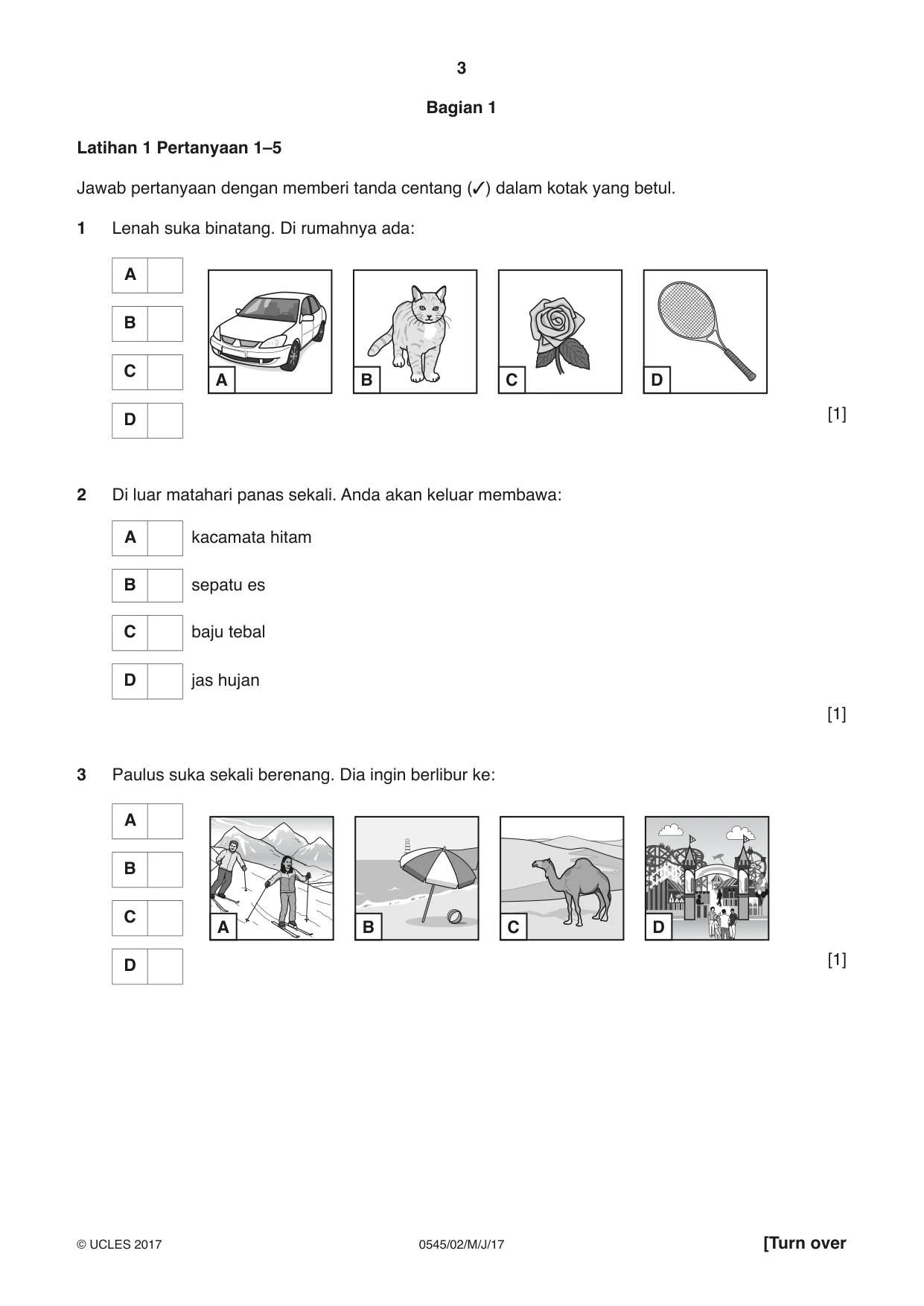
3 0545/02/M/J/17 © UCLES 2017 [Turn over Bagian 1 Latihan 1 Pertanyaan 1–5 Jawab pertanyaan dengan memberi tanda centang (3) dalam kotak yang betul. 1 Lenah suka binatang. Di rumahnya ada: A A B C D [1] B C D 2 Di luar matahari panas sekali. Anda akan keluar membawa: A kacamata hitam B sepatu es C baju tebal D jas hujan [1] 3 Paulus suka sekali berenang. Dia ingin berlibur ke: A A B C D [1] B C D
Question paper, page 4
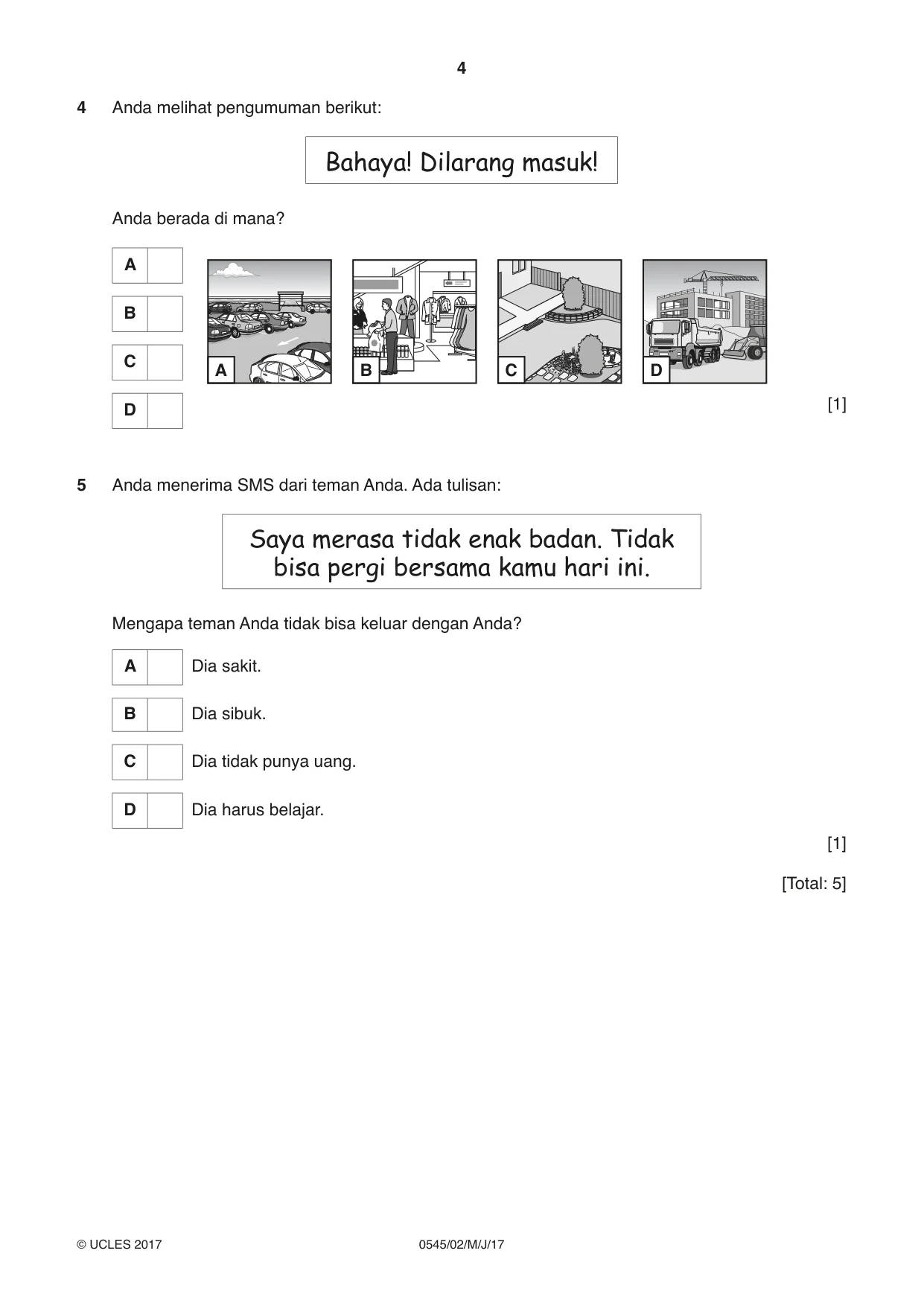
4 0545/02/M/J/17 © UCLES 2017 4 Anda melihat pengumuman berikut: Bahaya! Dilarang masuk! Anda berada di mana? A A B C D [1] B C D 5 Anda menerima SMS dari teman Anda. Ada tulisan: Saya merasa tidak enak badan. Tidak bisa pergi bersama kamu hari ini. Mengapa teman Anda tidak bisa keluar dengan Anda? A Dia sakit. B Dia sibuk. C Dia tidak punya uang. D Dia harus belajar. [1] [Total: 5]
Question paper, page 5
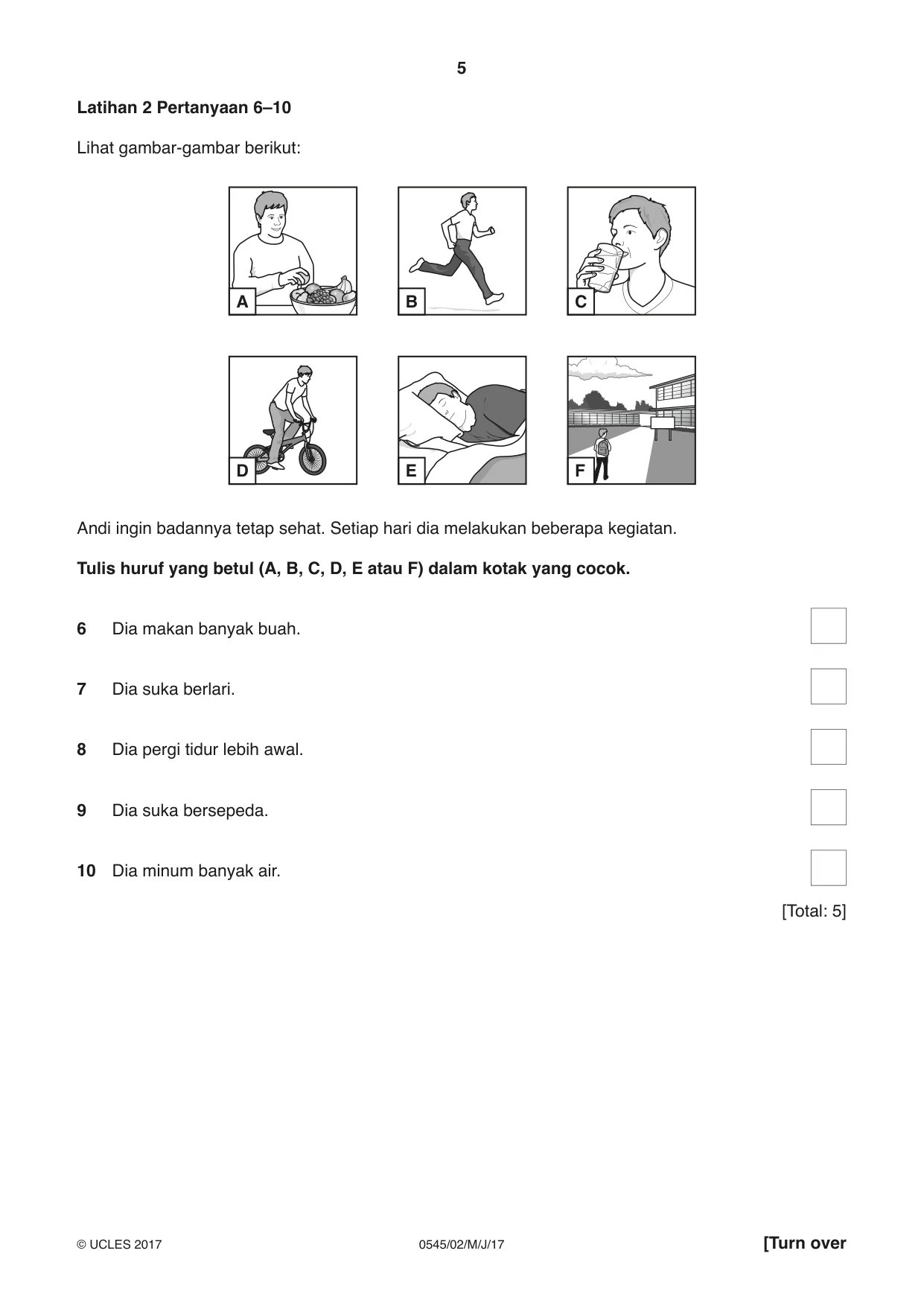
5 0545/02/M/J/17 © UCLES 2017 [Turn over Latihan 2 Pertanyaan 6–10 Lihat gambar-gambar berikut: A B C D E F Andi ingin badannya tetap sehat. Setiap hari dia melakukan beberapa kegiatan. Tulis huruf yang betul (A, B, C, D, E atau F) dalam kotak yang cocok. 6 Dia makan banyak buah. 7 Dia suka berlari. 8 Dia pergi tidur lebih awal. 9 Dia suka bersepeda. 10 Dia minum banyak air. [Total: 5]
Question paper, page 6
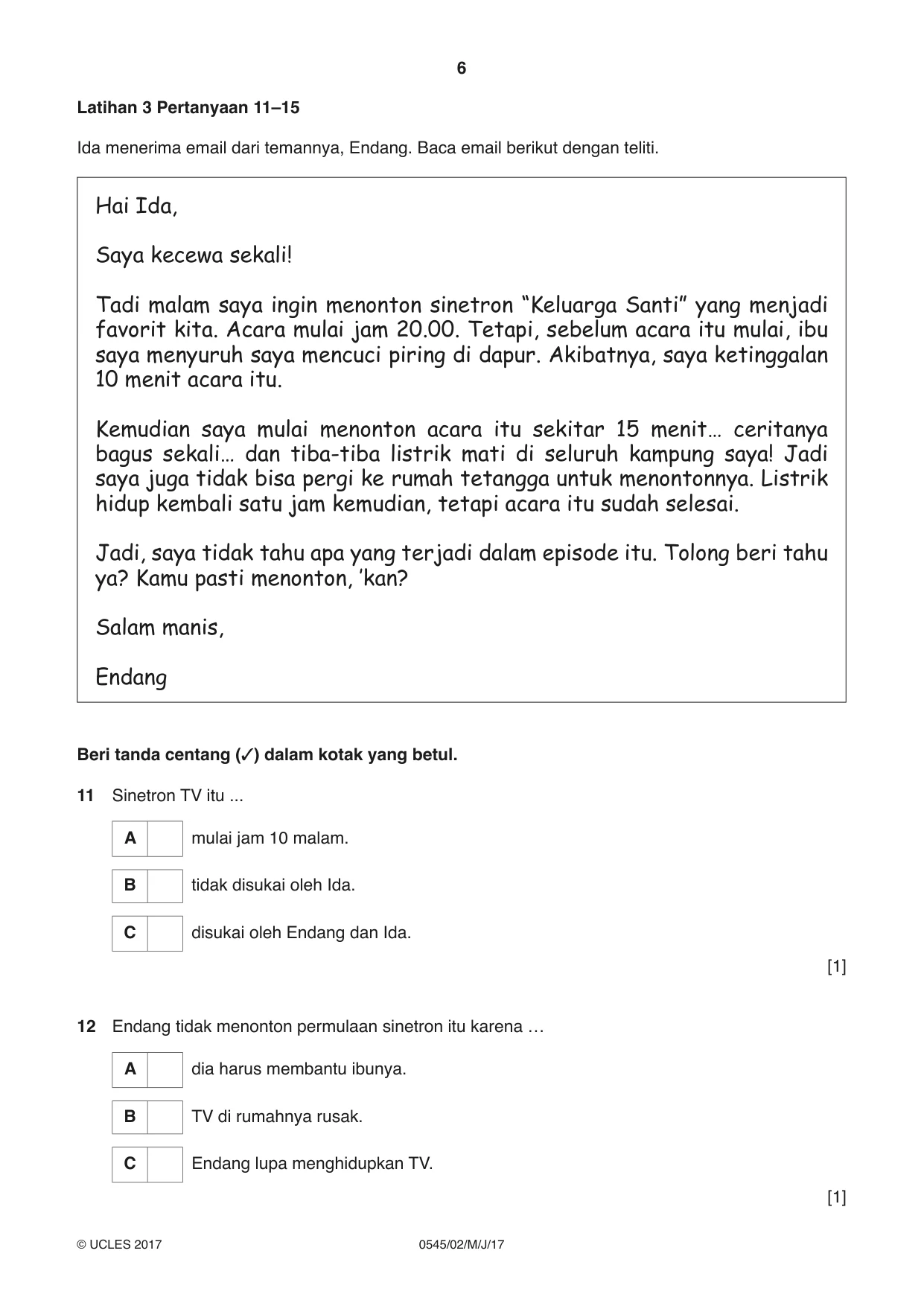
6 0545/02/M/J/17 © UCLES 2017 Latihan 3 Pertanyaan 11–15 Ida menerima email dari temannya, Endang. Baca email berikut dengan teliti. Hai Ida, Saya kecewa sekali! Tadi malam saya ingin menonton sinetron “Keluarga Santi” yang menjadi favorit kita. Acara mulai jam 20.00. Tetapi, sebelum acara itu mulai, ibu saya menyuruh saya mencuci piring di dapur. Akibatnya, saya ketinggalan 10 menit acara itu. Kemudian saya mulai menonton acara itu sekitar 15 menit… ceritanya bagus sekali… dan tiba-tiba listrik mati di seluruh kampung saya! Jadi saya juga tidak bisa pergi ke rumah tetangga untuk menontonnya. Listrik hidup kembali satu jam kemudian, tetapi acara itu sudah selesai. Jadi, saya tidak tahu apa yang terjadi dalam episode itu. Tolong beri tahu ya? Kamu pasti menonton, ’kan? Salam manis, Endang Beri tanda centang (3) dalam kotak yang betul. 11 Sinetron TV itu ... A mulai jam 10 malam. B tidak disukai oleh Ida. C disukai oleh Endang dan Ida. [1] 12 Endang tidak menonton permulaan sinetron itu karena … A dia harus membantu ibunya. B TV di rumahnya rusak. C Endang lupa menghidupkan TV. [1]
Question paper, page 7
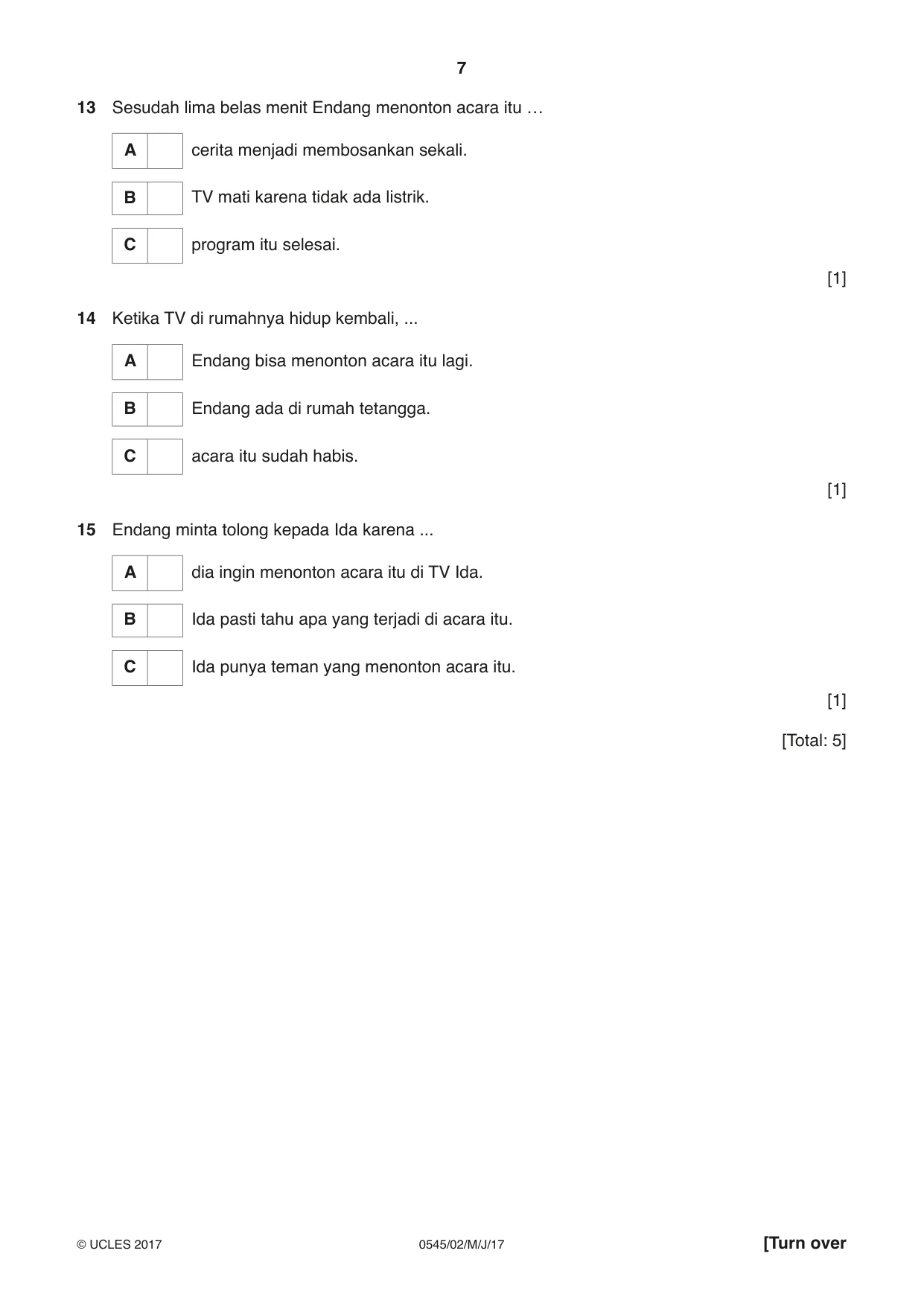
7 0545/02/M/J/17 © UCLES 2017 [Turn over 13 Sesudah lima belas menit Endang menonton acara itu … A cerita menjadi membosankan sekali. B TV mati karena tidak ada listrik. C program itu selesai. [1] 14 Ketika TV di rumahnya hidup kembali, ... A Endang bisa menonton acara itu lagi. B Endang ada di rumah tetangga. C acara itu sudah habis. [1] 15 Endang minta tolong kepada Ida karena ... A dia ingin menonton acara itu di TV Ida. B Ida pasti tahu apa yang terjadi di acara itu. C Ida punya teman yang menonton acara itu. [1] [Total: 5]
Question paper, page 8
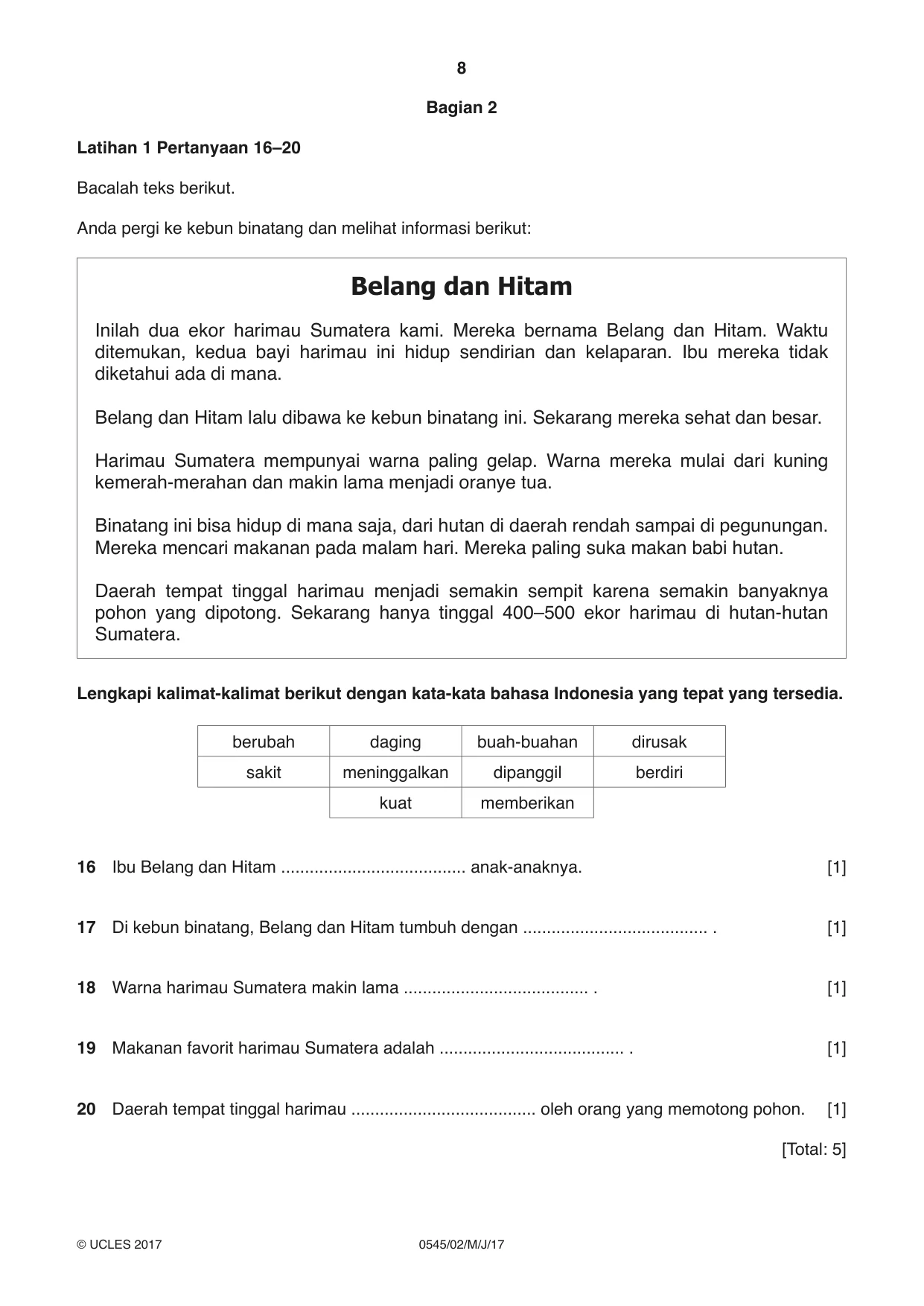
8 0545/02/M/J/17 © UCLES 2017 Bagian 2 Latihan 1 Pertanyaan 16–20 Bacalah teks berikut. Anda pergi ke kebun binatang dan melihat informasi berikut: Belang dan Hitam Inilah dua ekor harimau Sumatera kami. Mereka bernama Belang dan Hitam. Waktu ditemukan, kedua bayi harimau ini hidup sendirian dan kelaparan. Ibu mereka tidak diketahui ada di mana. Belang dan Hitam lalu dibawa ke kebun binatang ini. Sekarang mereka sehat dan besar. Harimau Sumatera mempunyai warna paling gelap. Warna mereka mulai dari kuning kemerah-merahan dan makin lama menjadi oranye tua. Binatang ini bisa hidup di mana saja, dari hutan di daerah rendah sampai di pegunungan. Mereka mencari makanan pada malam hari. Mereka paling suka makan babi hutan. Daerah tempat tinggal harimau menjadi semakin sempit karena semakin banyaknya pohon yang dipotong. Sekarang hanya tinggal 400–500 ekor harimau di hutan-hutan Sumatera. Lengkapi kalimat-kalimat berikut dengan kata-kata bahasa Indonesia yang tepat yang tersedia. berubah daging buah-buahan dirusak sakit meninggalkan dipanggil berdiri kuat memberikan 16 Ibu Belang dan Hitam … anak-anaknya. [1] 17 Di kebun binatang, Belang dan Hitam tumbuh dengan … . [1] 18 Warna harimau Sumatera makin lama … . [1] 19 Makanan favorit harimau Sumatera adalah … . [1] 20 Daerah tempat tinggal harimau … oleh orang yang memotong pohon. [1] [Total: 5]
Question paper, page 9
9 0545/02/M/J/17 © UCLES 2017 [Turn over Balikkan kertas untuk Latihan 2
Question paper, page 10
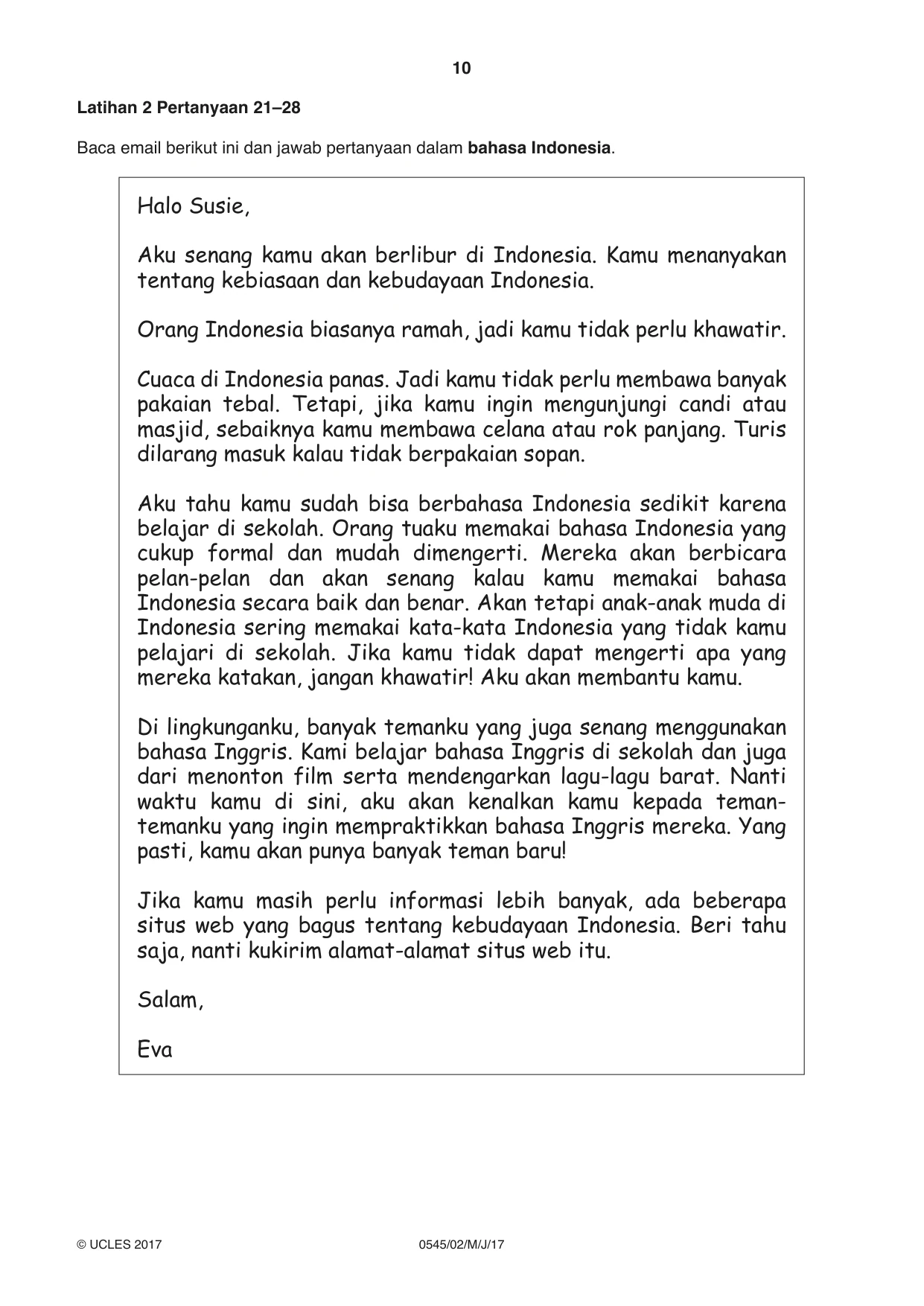
10 0545/02/M/J/17 © UCLES 2017 Latihan 2 Pertanyaan 21–28 Baca email berikut ini dan jawab pertanyaan dalam bahasa Indonesia. Halo Susie, Aku senang kamu akan berlibur di Indonesia. Kamu menanyakan tentang kebiasaan dan kebudayaan Indonesia. Orang Indonesia biasanya ramah, jadi kamu tidak perlu khawatir. Cuaca di Indonesia panas. Jadi kamu tidak perlu membawa banyak pakaian tebal. Tetapi, jika kamu ingin mengunjungi candi atau masjid, sebaiknya kamu membawa celana atau rok panjang. Turis dilarang masuk kalau tidak berpakaian sopan. Aku tahu kamu sudah bisa berbahasa Indonesia sedikit karena belajar di sekolah. Orang tuaku memakai bahasa Indonesia yang cukup formal dan mudah dimengerti. Mereka akan berbicara pelan-pelan dan akan senang kalau kamu memakai bahasa Indonesia secara baik dan benar. Akan tetapi anak-anak muda di Indonesia sering memakai kata-kata Indonesia yang tidak kamu pelajari di sekolah. Jika kamu tidak dapat mengerti apa yang mereka katakan, jangan khawatir! Aku akan membantu kamu. Di lingkunganku, banyak temanku yang juga senang menggunakan bahasa Inggris. Kami belajar bahasa Inggris di sekolah dan juga dari menonton film serta mendengarkan lagu-lagu barat. Nanti waktu kamu di sini, aku akan kenalkan kamu kepada teman- temanku yang ingin mempraktikkan bahasa Inggris mereka. Yang pasti, kamu akan punya banyak teman baru! Jika kamu masih perlu informasi lebih banyak, ada beberapa situs web yang bagus tentang kebudayaan Indonesia. Beri tahu saja, nanti kukirim alamat-alamat situs web itu. Salam, Eva
Question paper, page 11
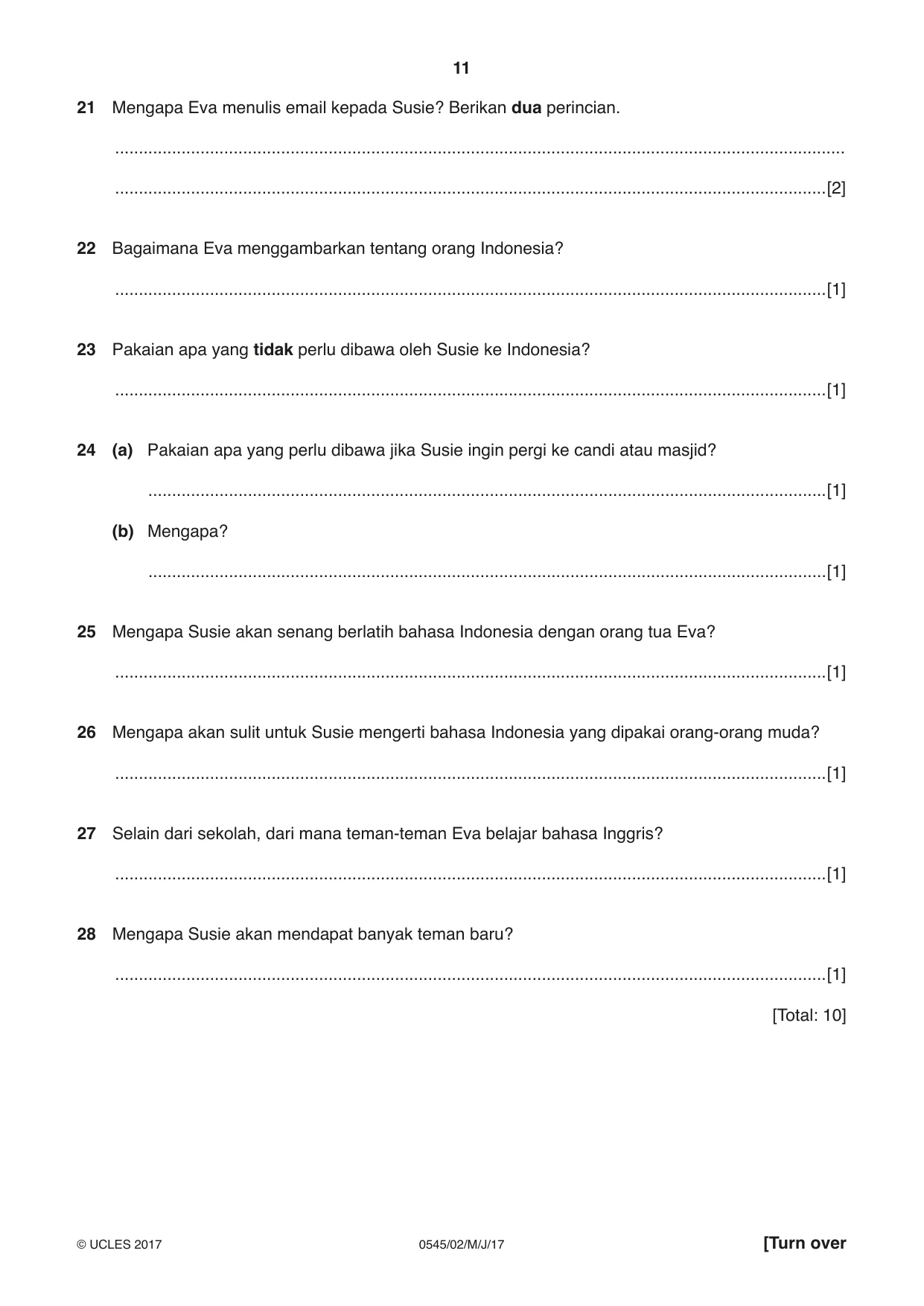
11 0545/02/M/J/17 © UCLES 2017 [Turn over 21 Mengapa Eva menulis email kepada Susie? Berikan dua perincian. … …[2] 22 Bagaimana Eva menggambarkan tentang orang Indonesia? …[1] 23 Pakaian apa yang tidak perlu dibawa oleh Susie ke Indonesia? …[1] 24 (a) Pakaian apa yang perlu dibawa jika Susie ingin pergi ke candi atau masjid? …[1] (b) Mengapa? …[1] 25 Mengapa Susie akan senang berlatih bahasa Indonesia dengan orang tua Eva? …[1] 26 Mengapa akan sulit untuk Susie mengerti bahasa Indonesia yang dipakai orang-orang muda? …[1] 27 Selain dari sekolah, dari mana teman-teman Eva belajar bahasa Inggris? …[1] 28 Mengapa Susie akan mendapat banyak teman baru? …[1] [Total: 10]
Question paper, page 12
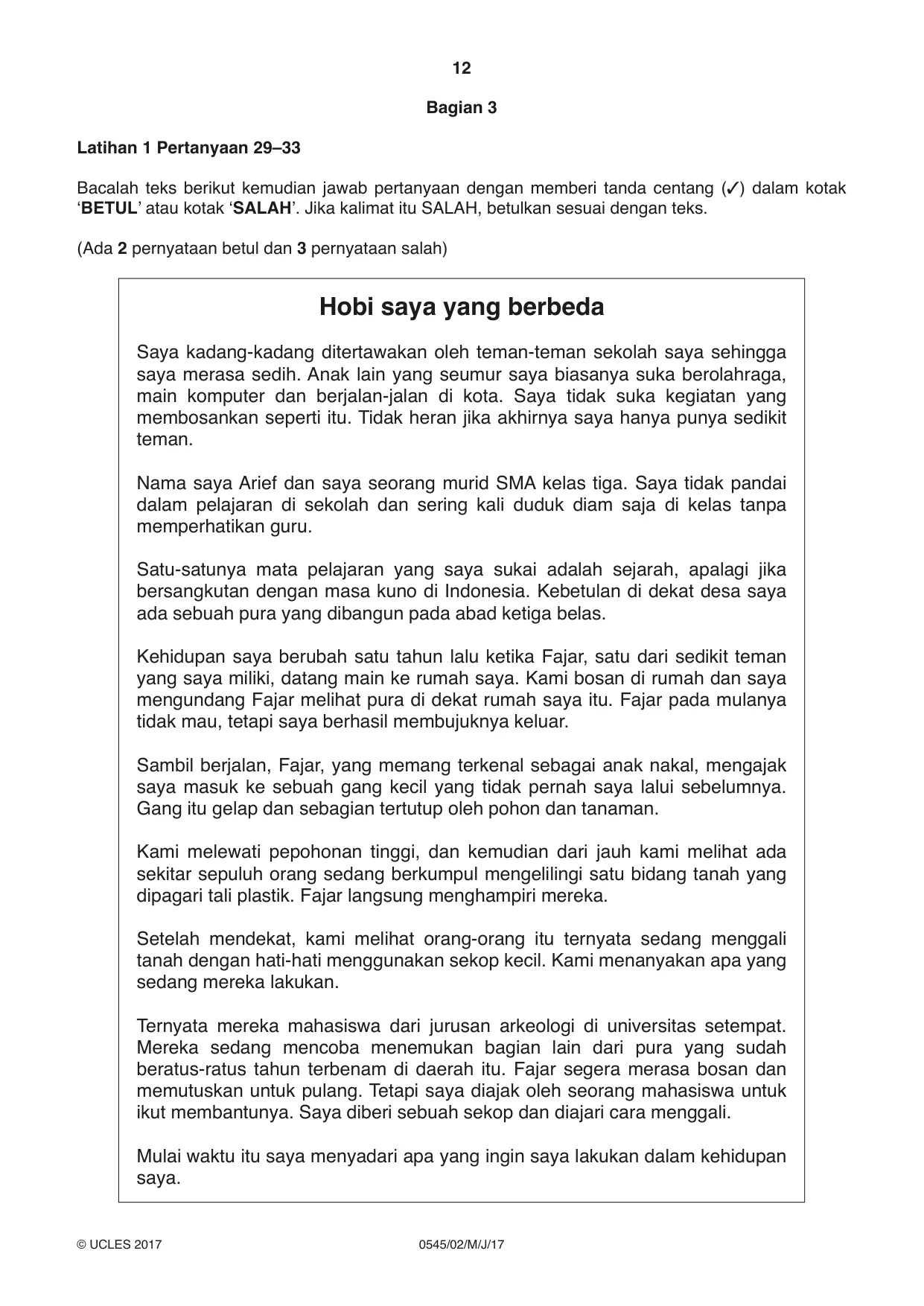
12 0545/02/M/J/17 © UCLES 2017 Bagian 3 Latihan 1 Pertanyaan 29–33 Bacalah teks berikut kemudian jawab pertanyaan dengan memberi tanda centang (3) dalam kotak ‘BETUL’ atau kotak ‘SALAH’. Jika kalimat itu SALAH, betulkan sesuai dengan teks. (Ada 2 pernyataan betul dan 3 pernyataan salah) Hobi saya yang berbeda Saya kadang-kadang ditertawakan oleh teman-teman sekolah saya sehingga saya merasa sedih. Anak lain yang seumur saya biasanya suka berolahraga, main komputer dan berjalan-jalan di kota. Saya tidak suka kegiatan yang membosankan seperti itu. Tidak heran jika akhirnya saya hanya punya sedikit teman. Nama saya Arief dan saya seorang murid SMA kelas tiga. Saya tidak pandai dalam pelajaran di sekolah dan sering kali duduk diam saja di kelas tanpa memperhatikan guru. Satu-satunya mata pelajaran yang saya sukai adalah sejarah, apalagi jika bersangkutan dengan masa kuno di Indonesia. Kebetulan di dekat desa saya ada sebuah pura yang dibangun pada abad ketiga belas. Kehidupan saya berubah satu tahun lalu ketika Fajar, satu dari sedikit teman yang saya miliki, datang main ke rumah saya. Kami bosan di rumah dan saya mengundang Fajar melihat pura di dekat rumah saya itu. Fajar pada mulanya tidak mau, tetapi saya berhasil membujuknya keluar. Sambil berjalan, Fajar, yang memang terkenal sebagai anak nakal, mengajak saya masuk ke sebuah gang kecil yang tidak pernah saya lalui sebelumnya. Gang itu gelap dan sebagian tertutup oleh pohon dan tanaman. Kami melewati pepohonan tinggi, dan kemudian dari jauh kami melihat ada sekitar sepuluh orang sedang berkumpul mengelilingi satu bidang tanah yang dipagari tali plastik. Fajar langsung menghampiri mereka. Setelah mendekat, kami melihat orang-orang itu ternyata sedang menggali tanah dengan hati-hati menggunakan sekop kecil. Kami menanyakan apa yang sedang mereka lakukan. Ternyata mereka mahasiswa dari jurusan arkeologi di universitas setempat. Mereka sedang mencoba menemukan bagian lain dari pura yang sudah beratus-ratus tahun terbenam di daerah itu. Fajar segera merasa bosan dan memutuskan untuk pulang. Tetapi saya diajak oleh seorang mahasiswa untuk ikut membantunya. Saya diberi sebuah sekop dan diajari cara menggali. Mulai waktu itu saya menyadari apa yang ingin saya lakukan dalam kehidupan saya.
Question paper, page 13
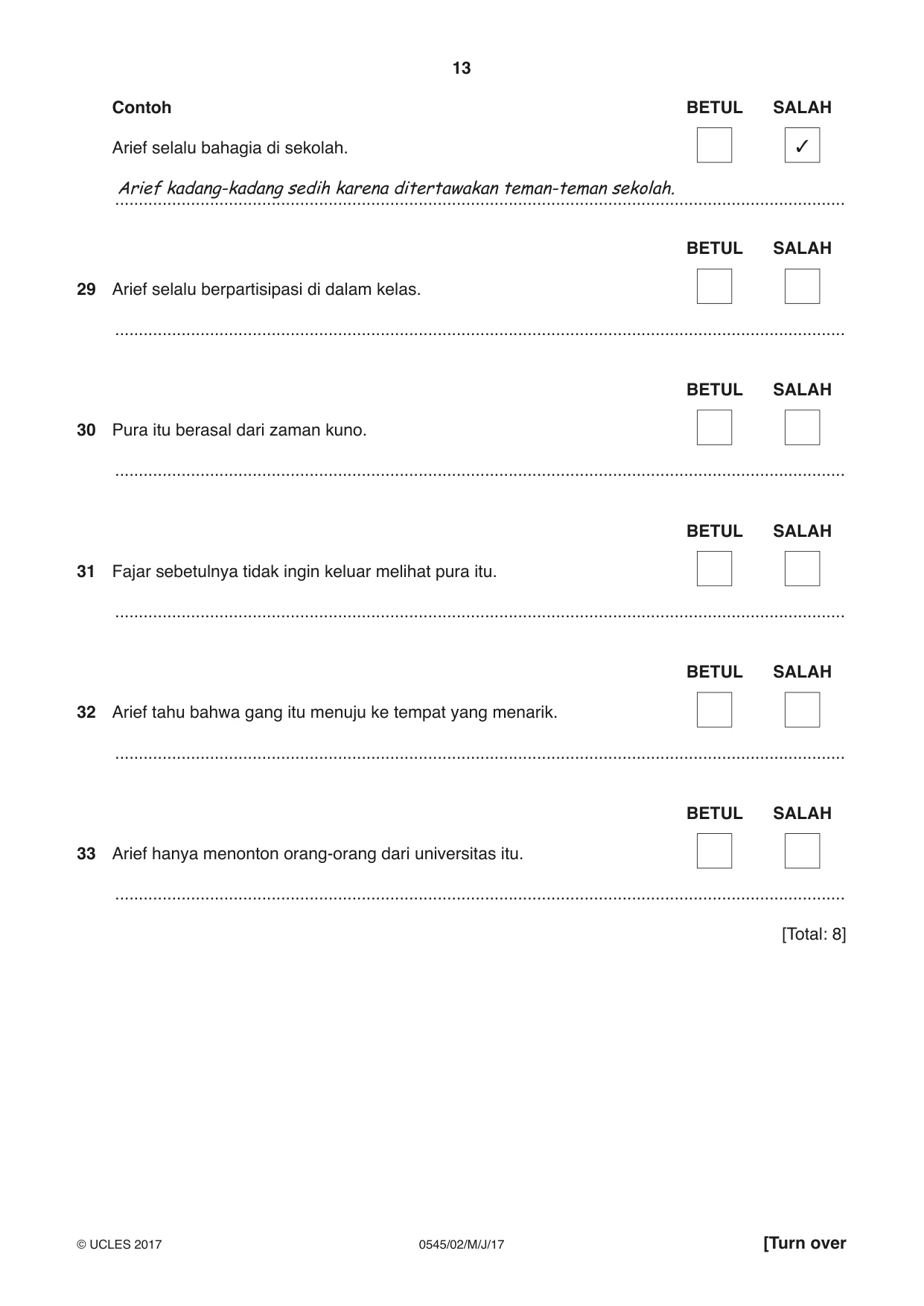
13 0545/02/M/J/17 © UCLES 2017 [Turn over Contoh BETUL SALAH Arief selalu bahagia di sekolah. 3 Arief kadang-kadang sedih karena ditertawakan teman-teman sekolah. … BETUL SALAH 29 Arief selalu berpartisipasi di dalam kelas. … BETUL SALAH 30 Pura itu berasal dari zaman kuno. … BETUL SALAH 31 Fajar sebetulnya tidak ingin keluar melihat pura itu. … BETUL SALAH 32 Arief tahu bahwa gang itu menuju ke tempat yang menarik. … BETUL SALAH 33 Arief hanya menonton orang-orang dari universitas itu. … [Total: 8]
Question paper, page 14
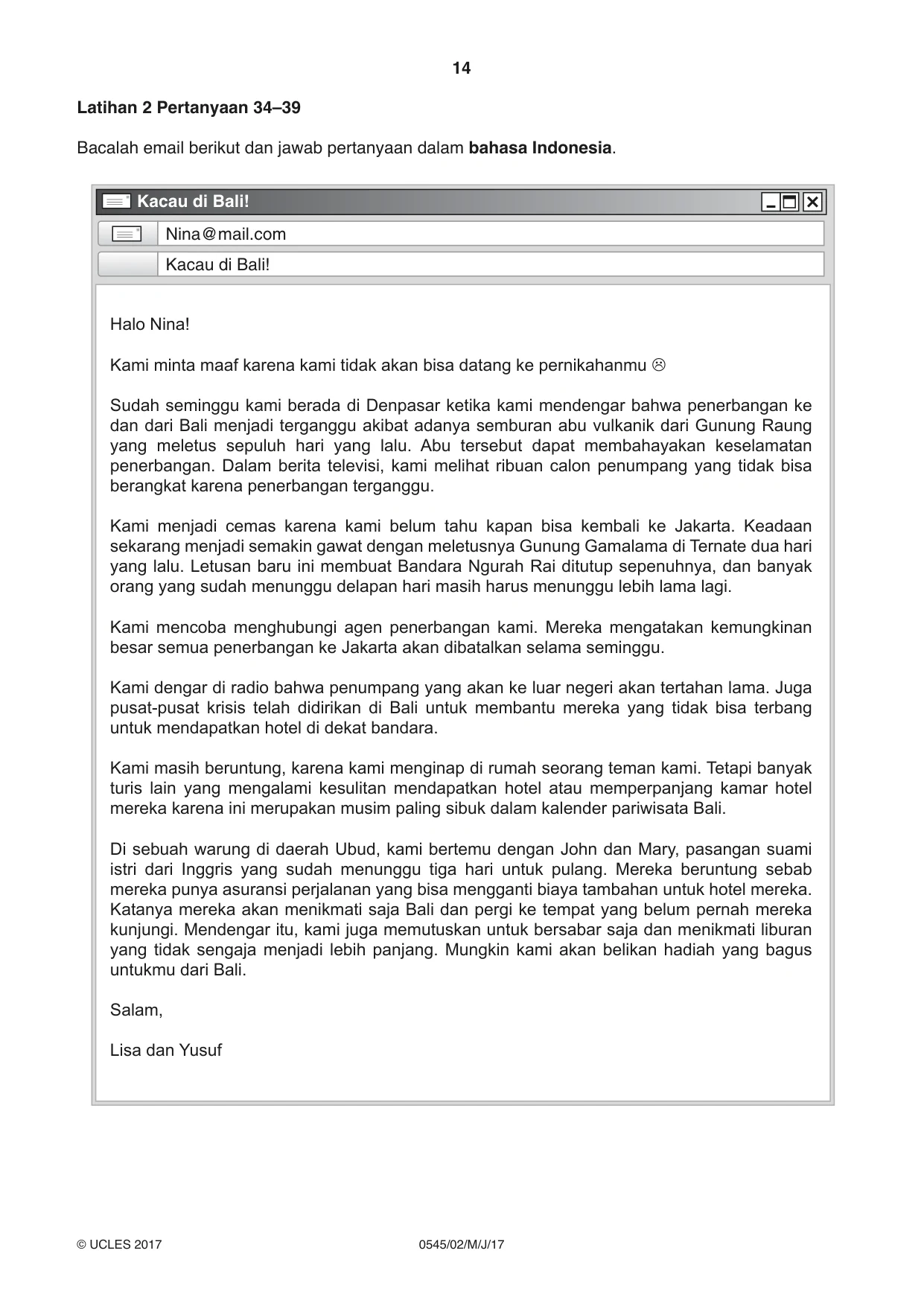
14 0545/02/M/J/17 © UCLES 2017 Latihan 2 Pertanyaan 34–39 Bacalah email berikut dan jawab pertanyaan dalam bahasa Indonesia. Kacau di Bali! Nina@mail.com Kacau di Bali! Halo Nina! Kami minta maaf karena kami tidak akan bisa datang ke pernikahanmu Sudah seminggu kami berada di Denpasar ketika kami mendengar bahwa penerbangan ke dan dari Bali menjadi terganggu akibat adanya semburan abu vulkanik dari Gunung Raung yang meletus sepuluh hari yang lalu. Abu tersebut dapat membahayakan keselamatan penerbangan. Dalam berita televisi, kami melihat ribuan calon penumpang yang tidak bisa berangkat karena penerbangan terganggu. Kami menjadi cemas karena kami belum tahu kapan bisa kembali ke Jakarta. Keadaan sekarang menjadi semakin gawat dengan meletusnya Gunung Gamalama di Ternate dua hari yang lalu. Letusan baru ini membuat Bandara Ngurah Rai ditutup sepenuhnya, dan banyak orang yang sudah menunggu delapan hari masih harus menunggu lebih lama lagi. Kami mencoba menghubungi agen penerbangan kami. Mereka mengatakan kemungkinan besar semua penerbangan ke Jakarta akan dibatalkan selama seminggu. Kami dengar di radio bahwa penumpang yang akan ke luar negeri akan tertahan lama. Juga pusat-pusat krisis telah didirikan di Bali untuk membantu mereka yang tidak bisa terbang untuk mendapatkan hotel di dekat bandara. Kami masih beruntung, karena kami menginap di rumah seorang teman kami. Tetapi banyak turis lain yang mengalami kesulitan mendapatkan hotel atau memperpanjang kamar hotel mereka karena ini merupakan musim paling sibuk dalam kalender pariwisata Bali. Di sebuah warung di daerah Ubud, kami bertemu dengan John dan Mary, pasangan suami istri dari Inggris yang sudah menunggu tiga hari untuk pulang. Mereka beruntung sebab mereka punya asuransi perjalanan yang bisa mengganti biaya tambahan untuk hotel mereka. Katanya mereka akan menikmati saja Bali dan pergi ke tempat yang belum pernah mereka kunjungi. Mendengar itu, kami juga memutuskan untuk bersabar saja dan menikmati liburan yang tidak sengaja menjadi lebih panjang. Mungkin kami akan belikan hadiah yang bagus untukmu dari Bali. Salam, Lisa dan Yusuf
Question paper, page 15
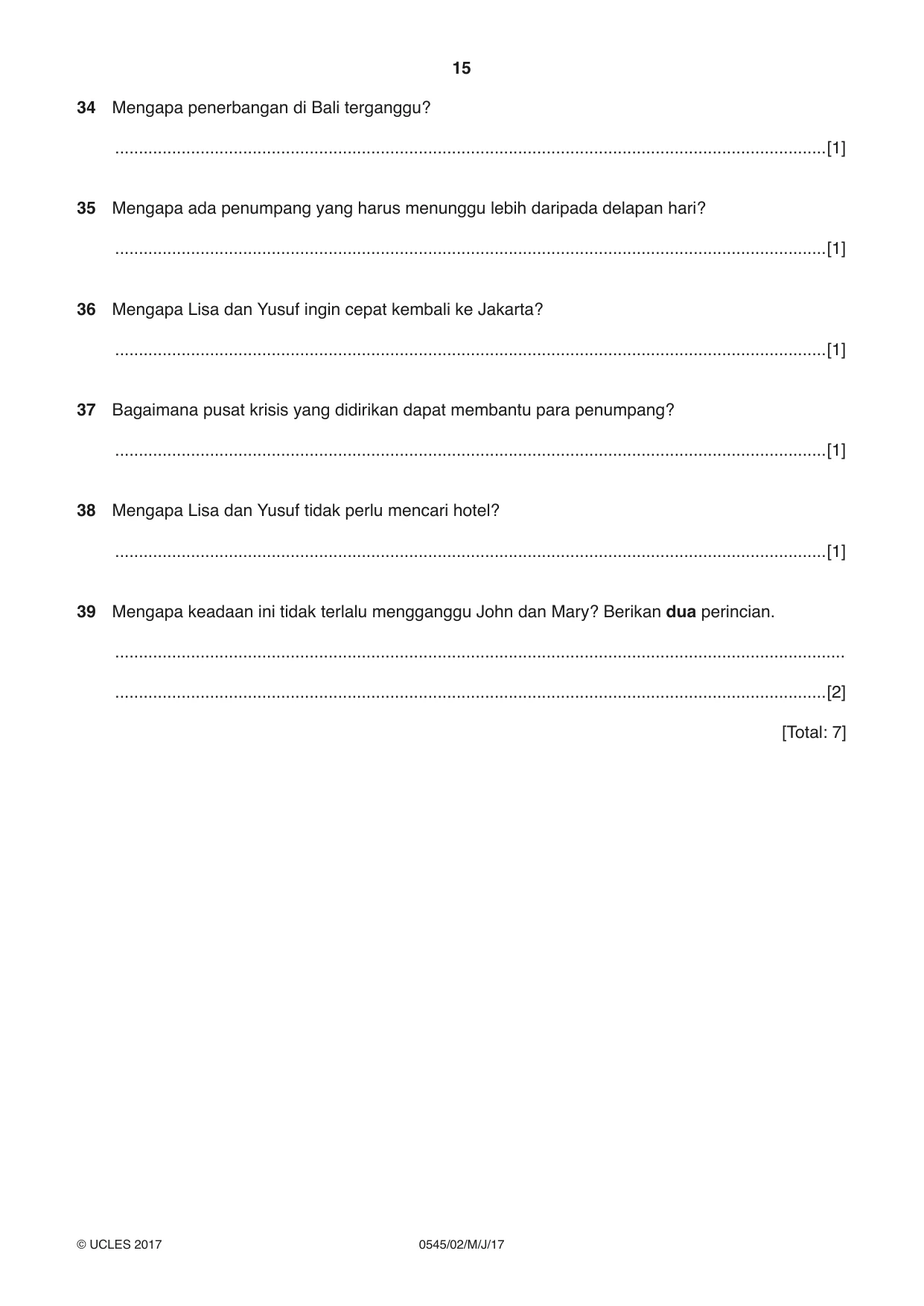
15 0545/02/M/J/17 © UCLES 2017 34 Mengapa penerbangan di Bali terganggu? …[1] 35 Mengapa ada penumpang yang harus menunggu lebih daripada delapan hari? …[1] 36 Mengapa Lisa dan Yusuf ingin cepat kembali ke Jakarta? …[1] 37 Bagaimana pusat krisis yang didirikan dapat membantu para penumpang? …[1] 38 Mengapa Lisa dan Yusuf tidak perlu mencari hotel? …[1] 39 Mengapa keadaan ini tidak terlalu mengganggu John dan Mary? Berikan dua perincian. … …[2] [Total: 7]
Question paper, page 16
16 0545/02/M/J/17 © UCLES 2017 Permission to reproduce items where third-party owned material protected by copyright is included has been sought and cleared where possible. Every reasonable effort has been made by the publisher (UCLES) to trace copyright holders, but if any items requiring clearance have unwittingly been included, the publisher will be pleased to make amends at the earliest possible opportunity. To avoid the issue of disclosure of answer-related information to candidates, all copyright acknowledgements are reproduced online in the Cambridge International Examinations Copyright Acknowledgements Booklet. This is produced for each series of examinations and is freely available to download at www.cie.org.uk after the live examination series. Cambridge International Examinations is part of the Cambridge Assessment Group. Cambridge Assessment is the brand name of University of Cambridge Local Examinations Syndicate (UCLES), which is itself a department of the University of Cambridge. BLANK PAGE
Mark scheme, page 1
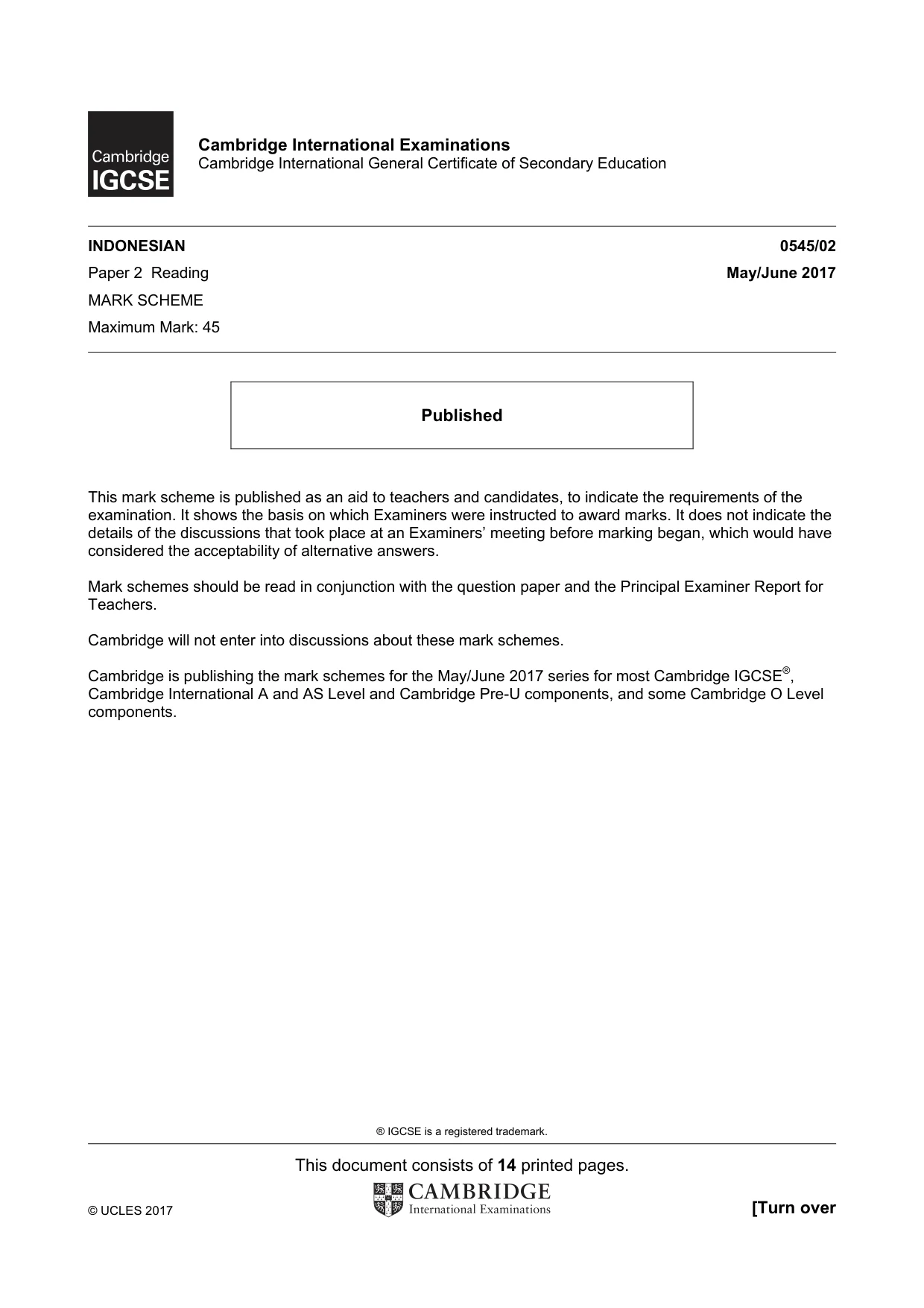
® IGCSE is a registered trademark. This document consists of 14 printed pages. © UCLES 2017 [Turn over Cambridge International Examinations Cambridge International General Certificate of Secondary Education INDONESIAN 0545/02 Paper 2 Reading May/June 2017 MARK SCHEME Maximum Mark: 45 Published This mark scheme is published as an aid to teachers and candidates, to indicate the requirements of the examination. It shows the basis on which Examiners were instructed to award marks. It does not indicate the details of the discussions that took place at an Examiners’ meeting before marking began, which would have considered the acceptability of alternative answers. Mark schemes should be read in conjunction with the question paper and the Principal Examiner Report for Teachers. Cambridge will not enter into discussions about these mark schemes. Cambridge is publishing the mark schemes for the May/June 2017 series for most Cambridge IGCSE®, Cambridge International A and AS Level and Cambridge Pre-U components, and some Cambridge O Level components.
Mark scheme, page 2
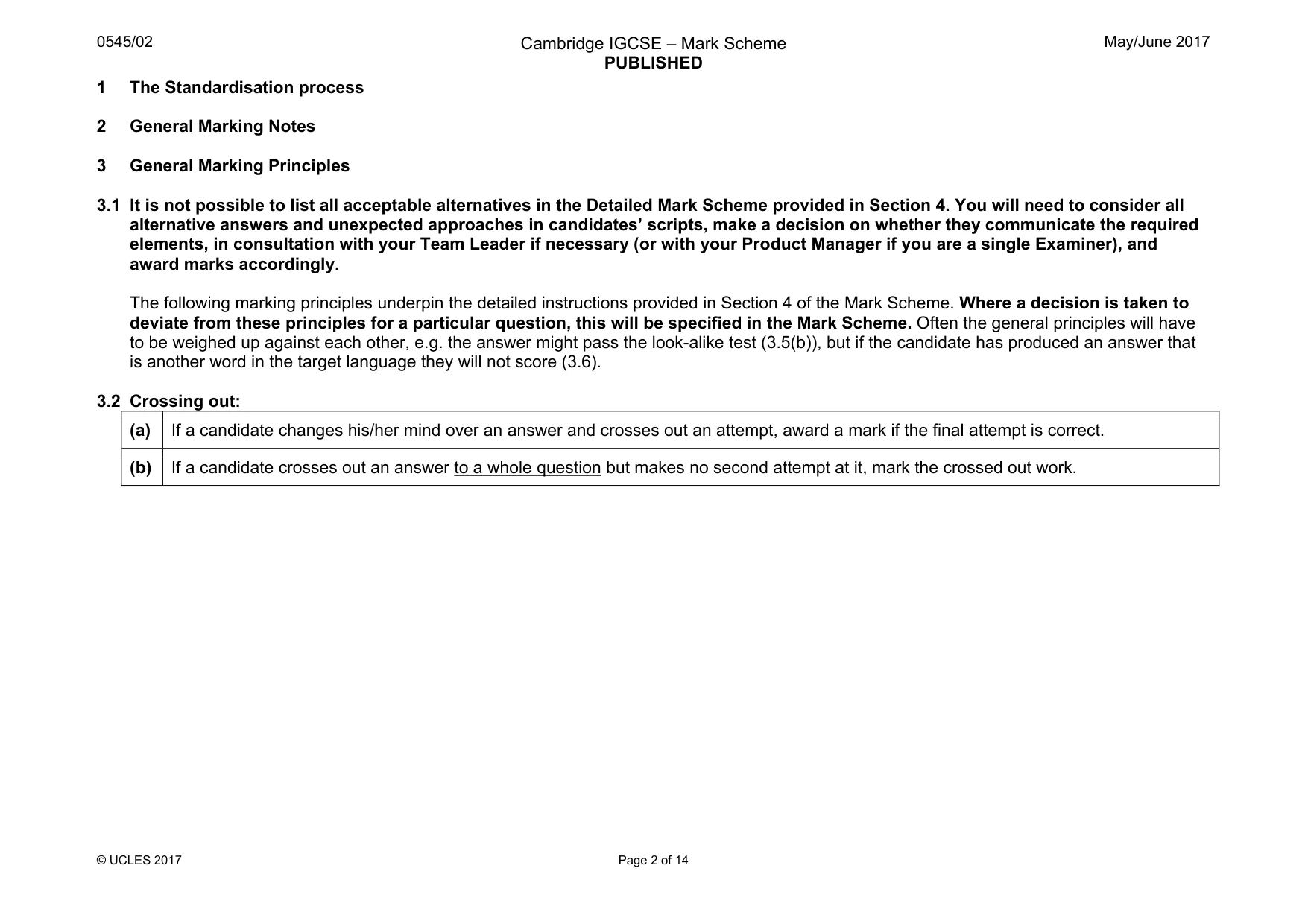
0545/02 Cambridge IGCSE – Mark Scheme PUBLISHED May/June 2017 © UCLES 2017 Page 2 of 14 1 The Standardisation process 2 General Marking Notes 3 General Marking Principles 3.1 It is not possible to list all acceptable alternatives in the Detailed Mark Scheme provided in Section 4. You will need to consider all alternative answers and unexpected approaches in candidates’ scripts, make a decision on whether they communicate the required elements, in consultation with your Team Leader if necessary (or with your Product Manager if you are a single Examiner), and award marks accordingly. The following marking principles underpin the detailed instructions provided in Section 4 of the Mark Scheme. Where a decision is taken to deviate from these principles for a particular question, this will be specified in the Mark Scheme. Often the general principles will have to be weighed up against each other, e.g. the answer might pass the look-alike test (3.5(b)), but if the candidate has produced an answer that is another word in the target language they will not score (3.6). 3.2 Crossing out: (a) If a candidate changes his/her mind over an answer and crosses out an attempt, award a mark if the final attempt is correct. (b) If a candidate crosses out an answer to a whole question but makes no second attempt at it, mark the crossed out work.
Mark scheme, page 3
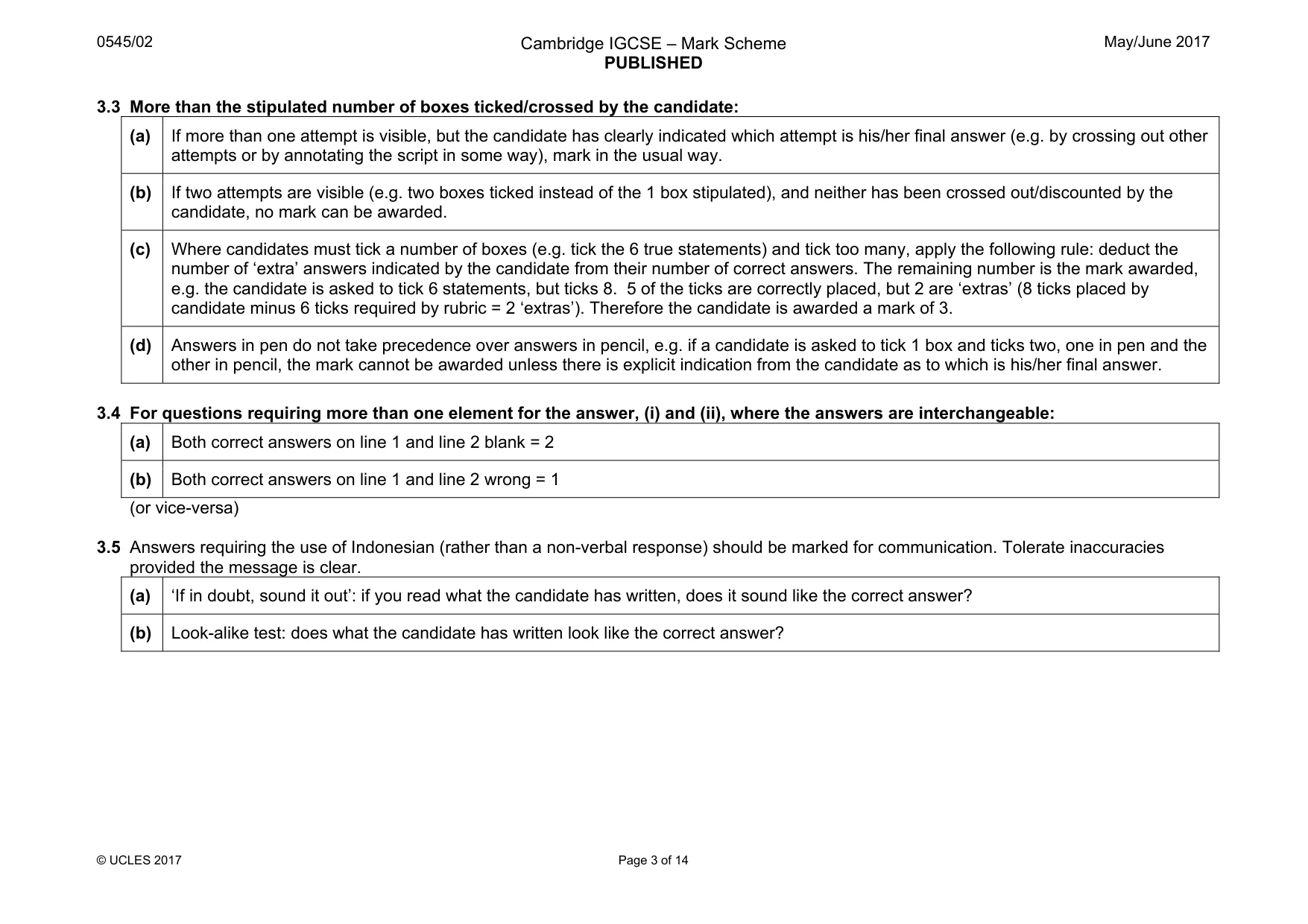
0545/02 Cambridge IGCSE – Mark Scheme PUBLISHED May/June 2017 © UCLES 2017 Page 3 of 14 3.3 More than the stipulated number of boxes ticked/crossed by the candidate: (a) If more than one attempt is visible, but the candidate has clearly indicated which attempt is his/her final answer (e.g. by crossing out other attempts or by annotating the script in some way), mark in the usual way. (b) If two attempts are visible (e.g. two boxes ticked instead of the 1 box stipulated), and neither has been crossed out/discounted by the candidate, no mark can be awarded. (c) Where candidates must tick a number of boxes (e.g. tick the 6 true statements) and tick too many, apply the following rule: deduct the number of ‘extra’ answers indicated by the candidate from their number of correct answers. The remaining number is the mark awarded, e.g. the candidate is asked to tick 6 statements, but ticks 8. 5 of the ticks are correctly placed, but 2 are ‘extras’ (8 ticks placed by candidate minus 6 ticks required by rubric = 2 ‘extras’). Therefore the candidate is awarded a mark of 3. (d) Answers in pen do not take precedence over answers in pencil, e.g. if a candidate is asked to tick 1 box and ticks two, one in pen and the other in pencil, the mark cannot be awarded unless there is explicit indication from the candidate as to which is his/her final answer. 3.4 For questions requiring more than one element for the answer, (i) and (ii), where the answers are interchangeable: (a) Both correct answers on line 1 and line 2 blank = 2 (b) Both correct answers on line 1 and line 2 wrong = 1 (or vice-versa) 3.5 Answers requiring the use of Indonesian (rather than a non-verbal response) should be marked for communication. Tolerate inaccuracies provided the message is clear. (a) ‘If in doubt, sound it out’: if you read what the candidate has written, does it sound like the correct answer? (b) Look-alike test: does what the candidate has written look like the correct answer?
Mark scheme, page 4
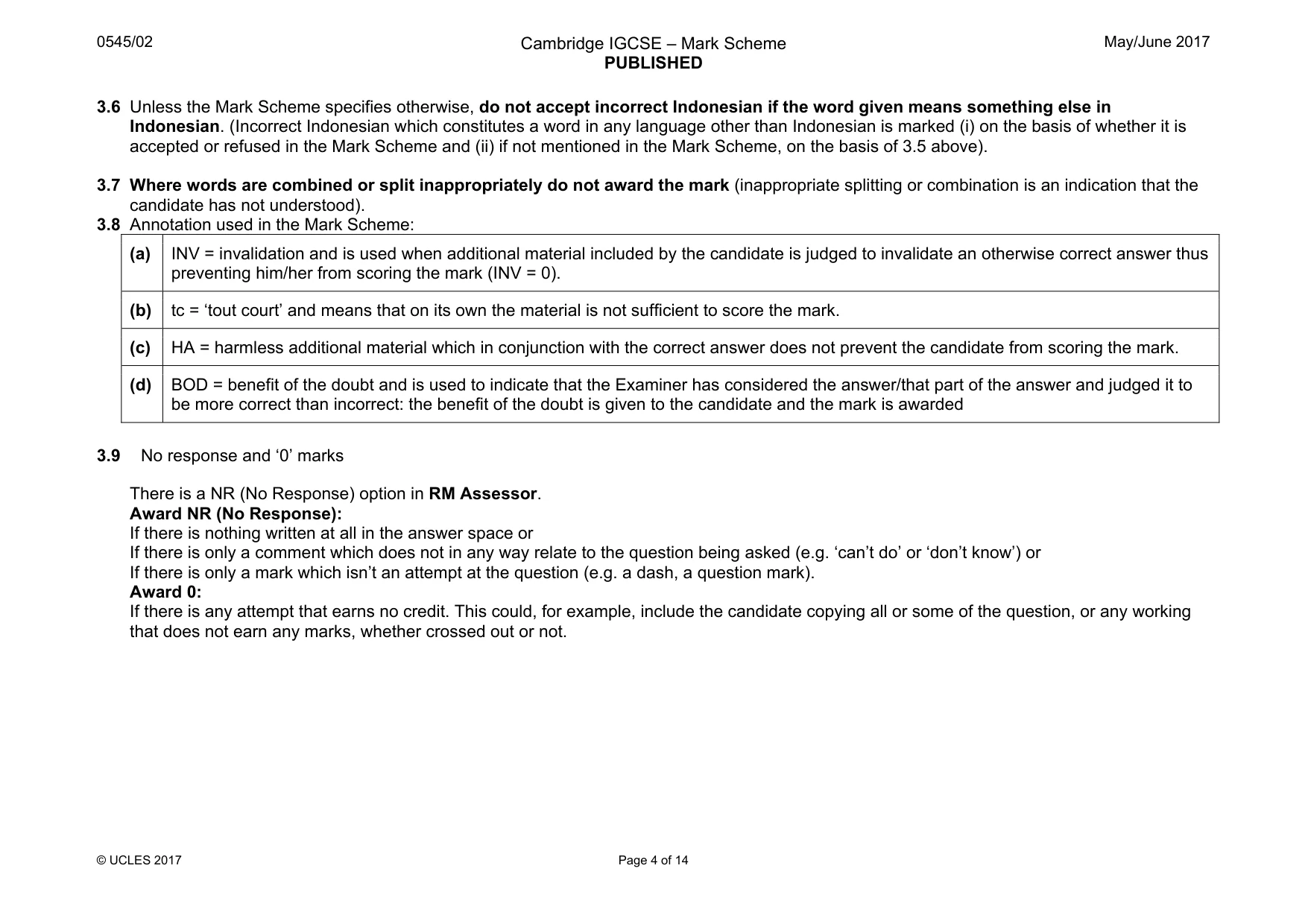
0545/02 Cambridge IGCSE – Mark Scheme PUBLISHED May/June 2017 © UCLES 2017 Page 4 of 14 3.6 Unless the Mark Scheme specifies otherwise, do not accept incorrect Indonesian if the word given means something else in Indonesian. (Incorrect Indonesian which constitutes a word in any language other than Indonesian is marked (i) on the basis of whether it is accepted or refused in the Mark Scheme and (ii) if not mentioned in the Mark Scheme, on the basis of 3.5 above). 3.7 Where words are combined or split inappropriately do not award the mark (inappropriate splitting or combination is an indication that the candidate has not understood). 3.8 Annotation used in the Mark Scheme: (a) INV = invalidation and is used when additional material included by the candidate is judged to invalidate an otherwise correct answer thus preventing him/her from scoring the mark (INV = 0). (b) tc = ‘tout court’ and means that on its own the material is not sufficient to score the mark. (c) HA = harmless additional material which in conjunction with the correct answer does not prevent the candidate from scoring the mark. (d) BOD = benefit of the doubt and is used to indicate that the Examiner has considered the answer/that part of the answer and judged it to be more correct than incorrect: the benefit of the doubt is given to the candidate and the mark is awarded 3.9 No response and ‘0’ marks There is a NR (No Response) option in RM Assessor. Award NR (No Response): If there is nothing written at all in the answer space or If there is only a comment which does not in any way relate to the question being asked (e.g. ‘can’t do’ or ‘don’t know’) or If there is only a mark which isn’t an attempt at the question (e.g. a dash, a question mark). Award 0: If there is any attempt that earns no credit. This could, for example, include the candidate copying all or some of the question, or any working that does not earn any marks, whether crossed out or not.
Mark scheme, page 5
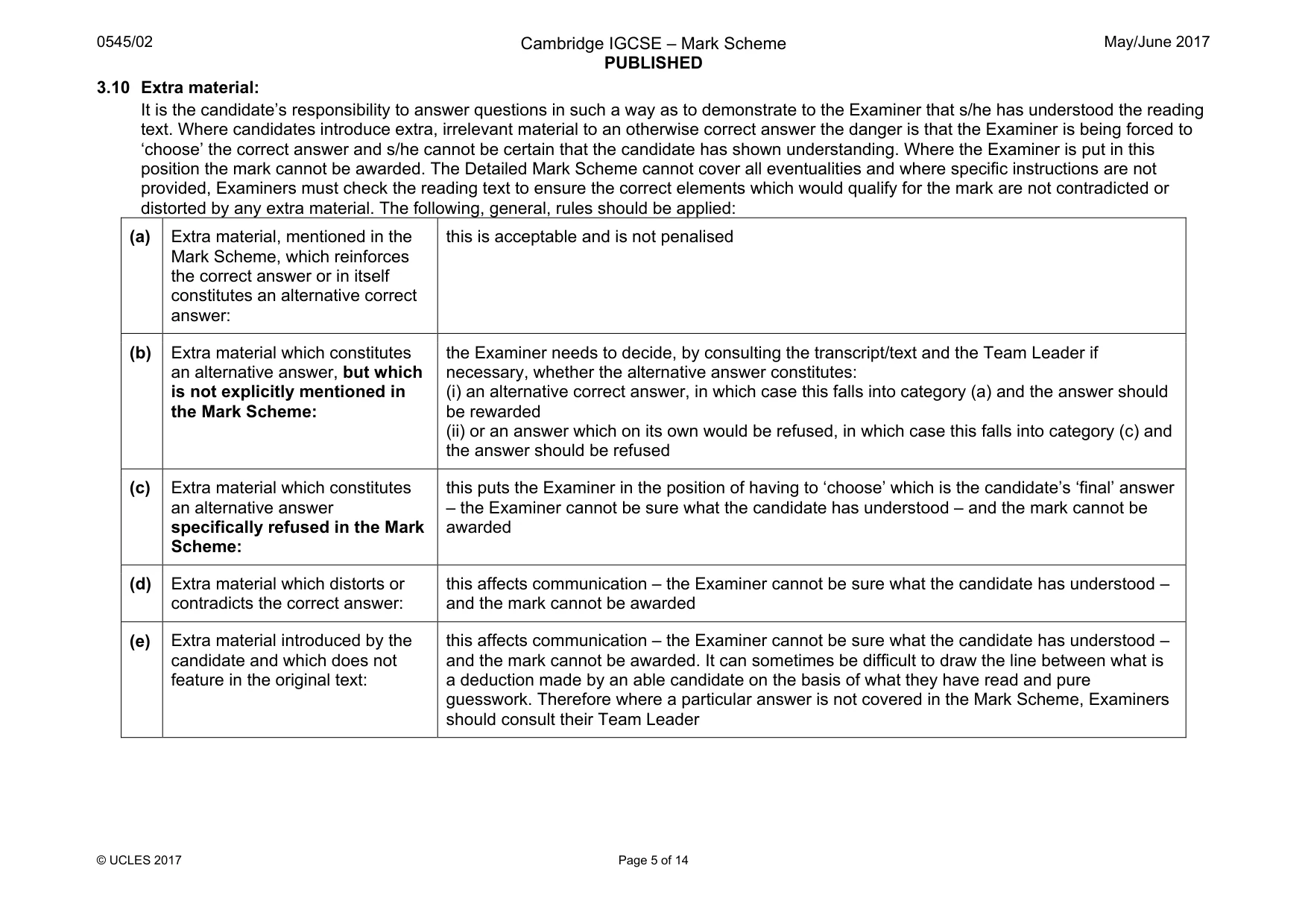
0545/02 Cambridge IGCSE – Mark Scheme PUBLISHED May/June 2017 © UCLES 2017 Page 5 of 14 3.10 Extra material: It is the candidate’s responsibility to answer questions in such a way as to demonstrate to the Examiner that s/he has understood the reading text. Where candidates introduce extra, irrelevant material to an otherwise correct answer the danger is that the Examiner is being forced to ‘choose’ the correct answer and s/he cannot be certain that the candidate has shown understanding. Where the Examiner is put in this position the mark cannot be awarded. The Detailed Mark Scheme cannot cover all eventualities and where specific instructions are not provided, Examiners must check the reading text to ensure the correct elements which would qualify for the mark are not contradicted or distorted by any extra material. The following, general, rules should be applied: (a) Extra material, mentioned in the Mark Scheme, which reinforces the correct answer or in itself constitutes an alternative correct answer: this is acceptable and is not penalised (b) Extra material which constitutes an alternative answer, but which is not explicitly mentioned in the Mark Scheme: the Examiner needs to decide, by consulting the transcript/text and the Team Leader if necessary, whether the alternative answer constitutes: (i) an alternative correct answer, in which case this falls into category (a) and the answer should be rewarded (ii) or an answer which on its own would be refused, in which case this falls into category (c) and the answer should be refused (c) Extra material which constitutes an alternative answer specifically refused in the Mark Scheme: this puts the Examiner in the position of having to ‘choose’ which is the candidate’s ‘final’ answer – the Examiner cannot be sure what the candidate has understood – and the mark cannot be awarded (d) Extra material which distorts or contradicts the correct answer: this affects communication – the Examiner cannot be sure what the candidate has understood – and the mark cannot be awarded (e) Extra material introduced by the candidate and which does not feature in the original text: this affects communication – the Examiner cannot be sure what the candidate has understood – and the mark cannot be awarded. It can sometimes be difficult to draw the line between what is a deduction made by an able candidate on the basis of what they have read and pure guesswork. Therefore where a particular answer is not covered in the Mark Scheme, Examiners should consult their Team Leader
Mark scheme, page 6
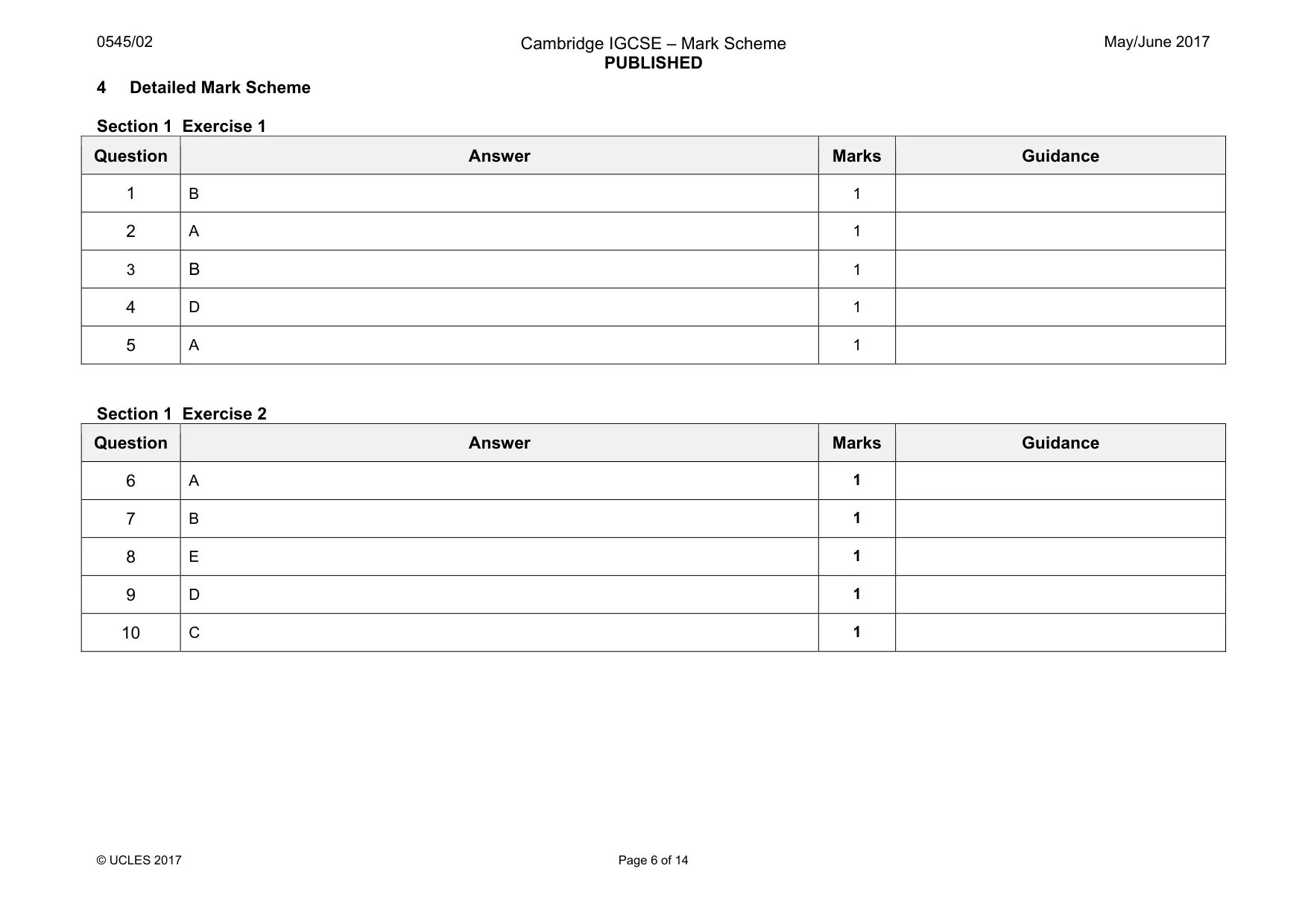
0545/02 Cambridge IGCSE – Mark Scheme PUBLISHED May/June 2017 © UCLES 2017 Page 6 of 14 4 Detailed Mark Scheme Section 1 Exercise 1 Question Answer Marks Guidance 1 B 1 2 A 1 3 B 1 4 D 1 5 A 1 Section 1 Exercise 2 Question Answer Marks Guidance 6 A 1 7 B 1 8 E 1 9 D 1 10 C 1
Mark scheme, page 7
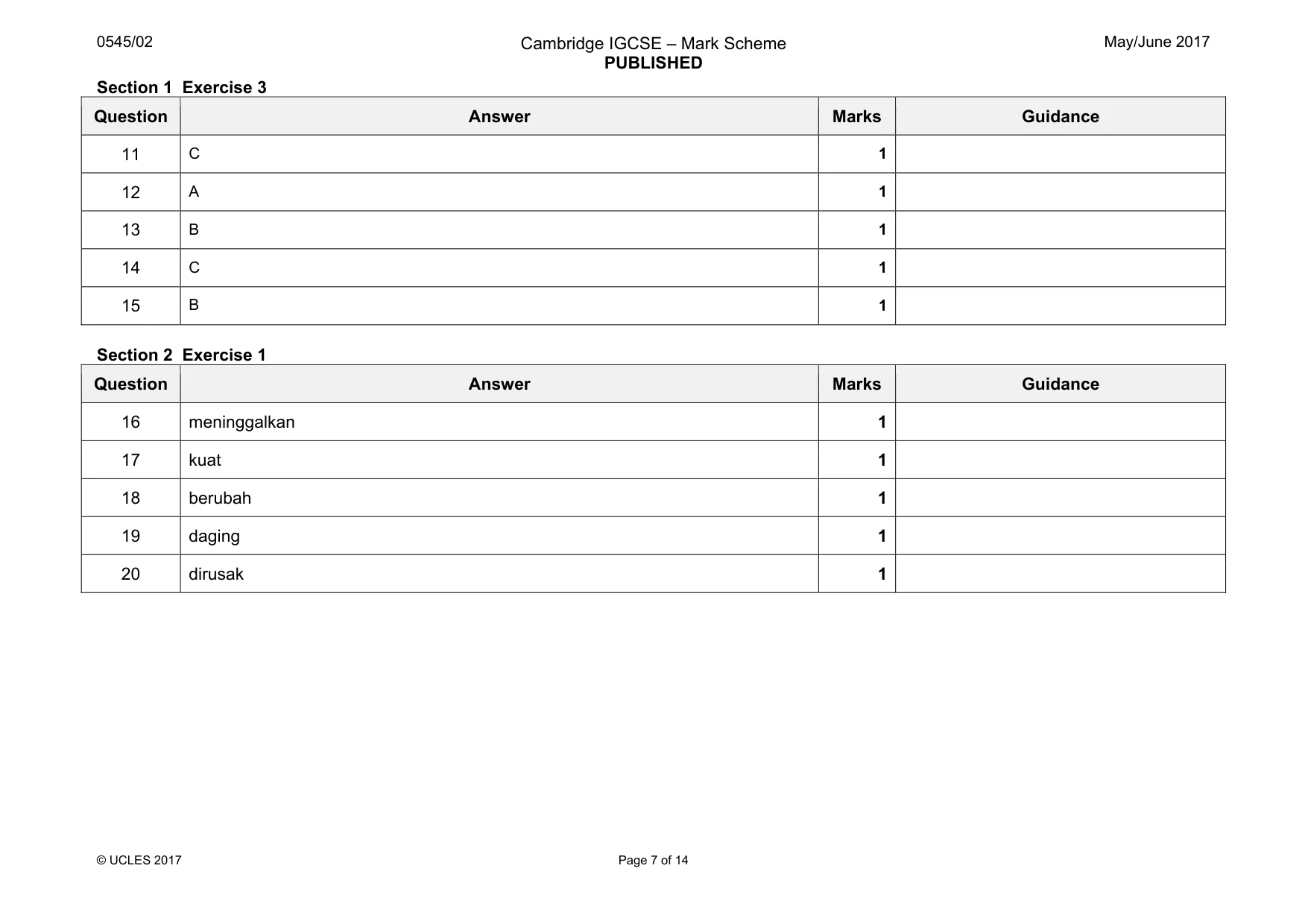
0545/02 Cambridge IGCSE – Mark Scheme PUBLISHED May/June 2017 © UCLES 2017 Page 7 of 14 Section 1 Exercise 3 Question Answer Marks Guidance 11 C 1 12 A 1 13 B 1 14 C 1 15 B 1 Section 2 Exercise 1 Question Answer Marks Guidance 16 meninggalkan 1 17 kuat 1 18 berubah 1 19 daging 1 20 dirusak 1
Mark scheme, page 8
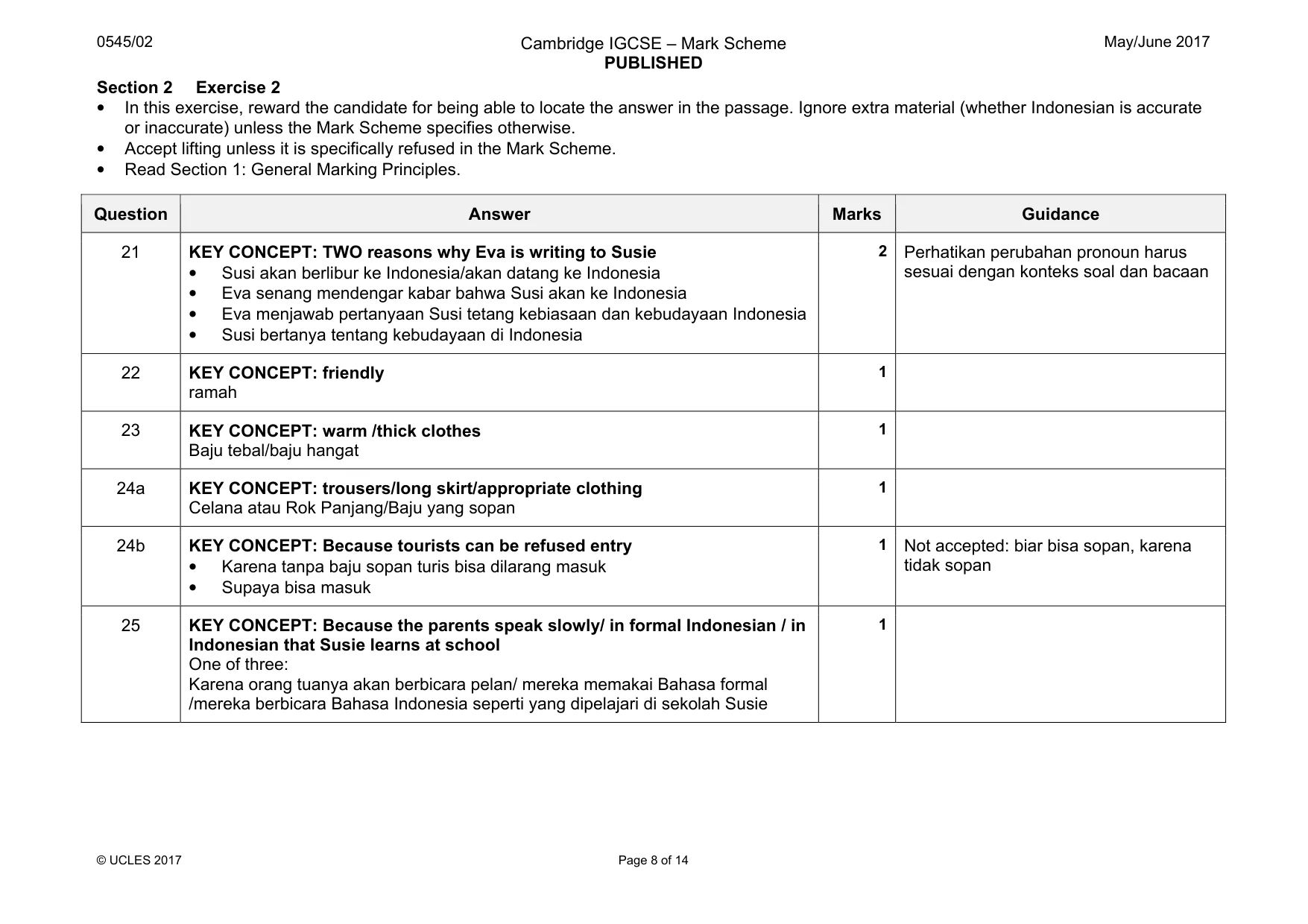
0545/02 Cambridge IGCSE – Mark Scheme PUBLISHED May/June 2017 © UCLES 2017 Page 8 of 14 Section 2 Exercise 2 • In this exercise, reward the candidate for being able to locate the answer in the passage. Ignore extra material (whether Indonesian is accurate or inaccurate) unless the Mark Scheme specifies otherwise. • Accept lifting unless it is specifically refused in the Mark Scheme. • Read Section 1: General Marking Principles. Question Answer Marks Guidance 21 KEY CONCEPT: TWO reasons why Eva is writing to Susie • Susi akan berlibur ke Indonesia/akan datang ke Indonesia • Eva senang mendengar kabar bahwa Susi akan ke Indonesia • Eva menjawab pertanyaan Susi tetang kebiasaan dan kebudayaan Indonesia • Susi bertanya tentang kebudayaan di Indonesia 2 Perhatikan perubahan pronoun harus sesuai dengan konteks soal dan bacaan 22 KEY CONCEPT: friendly ramah 1 23 KEY CONCEPT: warm /thick clothes Baju tebal/baju hangat 1 24a KEY CONCEPT: trousers/long skirt/appropriate clothing Celana atau Rok Panjang/Baju yang sopan 1 24b KEY CONCEPT: Because tourists can be refused entry • Karena tanpa baju sopan turis bisa dilarang masuk • Supaya bisa masuk 1 Not accepted: biar bisa sopan, karena tidak sopan 25 KEY CONCEPT: Because the parents speak slowly/ in formal Indonesian / in Indonesian that Susie learns at school One of three: Karena orang tuanya akan berbicara pelan/ mereka memakai Bahasa formal /mereka berbicara Bahasa Indonesia seperti yang dipelajari di sekolah Susie 1
Mark scheme, page 9
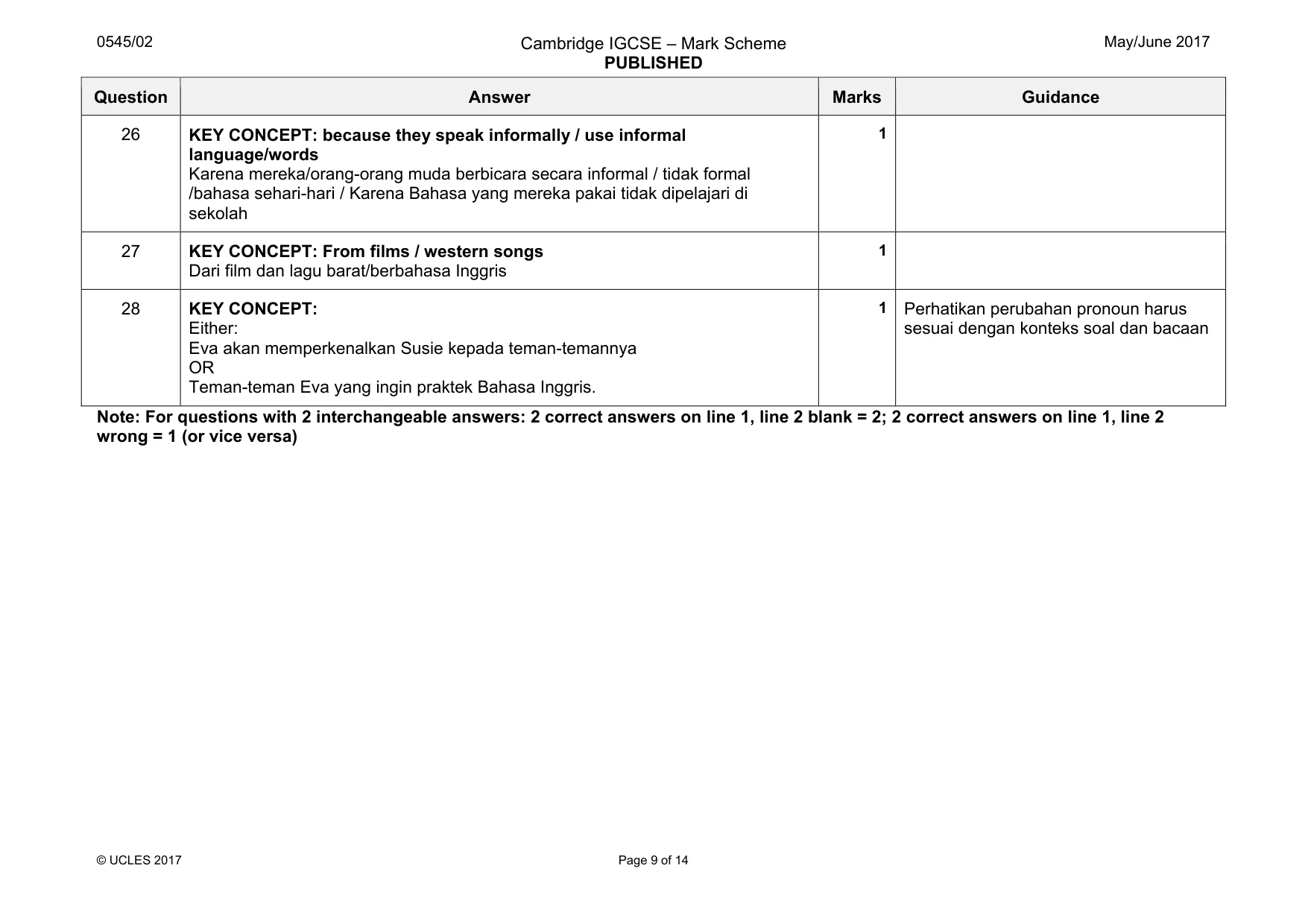
0545/02 Cambridge IGCSE – Mark Scheme PUBLISHED May/June 2017 © UCLES 2017 Page 9 of 14 Question Answer Marks Guidance 26 KEY CONCEPT: because they speak informally / use informal language/words Karena mereka/orang-orang muda berbicara secara informal / tidak formal /bahasa sehari-hari / Karena Bahasa yang mereka pakai tidak dipelajari di sekolah 1 27 KEY CONCEPT: From films / western songs Dari film dan lagu barat/berbahasa Inggris 1 28 KEY CONCEPT: Either: Eva akan memperkenalkan Susie kepada teman-temannya OR Teman-teman Eva yang ingin praktek Bahasa Inggris. 1 Perhatikan perubahan pronoun harus sesuai dengan konteks soal dan bacaan Note: For questions with 2 interchangeable answers: 2 correct answers on line 1, line 2 blank = 2; 2 correct answers on line 1, line 2 wrong = 1 (or vice versa)
Mark scheme, page 10
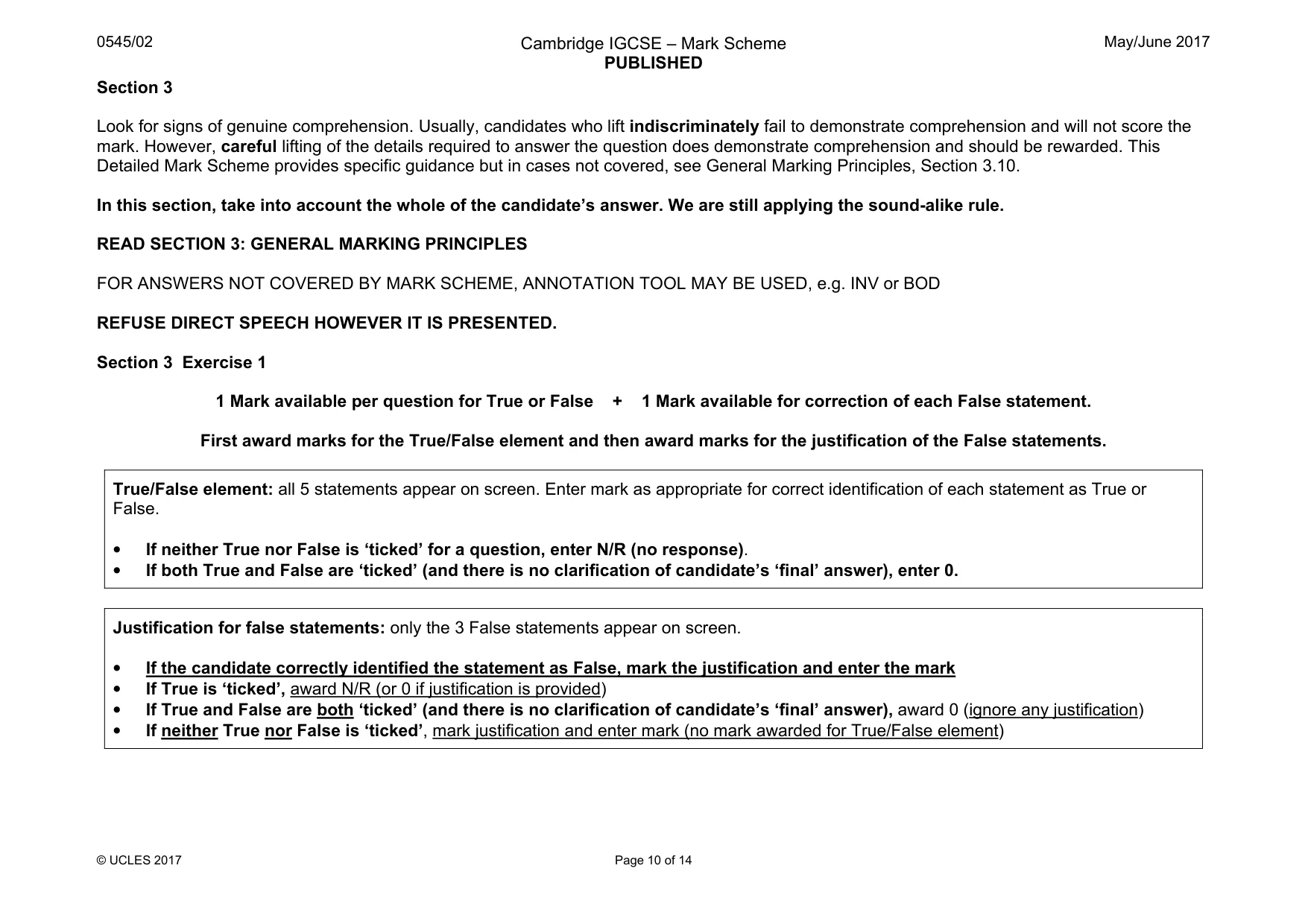
0545/02 Cambridge IGCSE – Mark Scheme PUBLISHED May/June 2017 © UCLES 2017 Page 10 of 14 Section 3 Look for signs of genuine comprehension. Usually, candidates who lift indiscriminately fail to demonstrate comprehension and will not score the mark. However, careful lifting of the details required to answer the question does demonstrate comprehension and should be rewarded. This Detailed Mark Scheme provides specific guidance but in cases not covered, see General Marking Principles, Section 3.10. In this section, take into account the whole of the candidate’s answer. We are still applying the sound-alike rule. READ SECTION 3: GENERAL MARKING PRINCIPLES FOR ANSWERS NOT COVERED BY MARK SCHEME, ANNOTATION TOOL MAY BE USED, e.g. INV or BOD REFUSE DIRECT SPEECH HOWEVER IT IS PRESENTED. Section 3 Exercise 1 1 Mark available per question for True or False + 1 Mark available for correction of each False statement. First award marks for the True/False element and then award marks for the justification of the False statements. True/False element: all 5 statements appear on screen. Enter mark as appropriate for correct identification of each statement as True or False. • If neither True nor False is ‘ticked’ for a question, enter N/R (no response). • If both True and False are ‘ticked’ (and there is no clarification of candidate’s ‘final’ answer), enter 0. Justification for false statements: only the 3 False statements appear on screen. • If the candidate correctly identified the statement as False, mark the justification and enter the mark • If True is ‘ticked’, award N/R (or 0 if justification is provided) • If True and False are both ‘ticked’ (and there is no clarification of candidate’s ‘final’ answer), award 0 (ignore any justification) • If neither True nor False is ‘ticked’, mark justification and enter mark (no mark awarded for True/False element)
Mark scheme, page 11
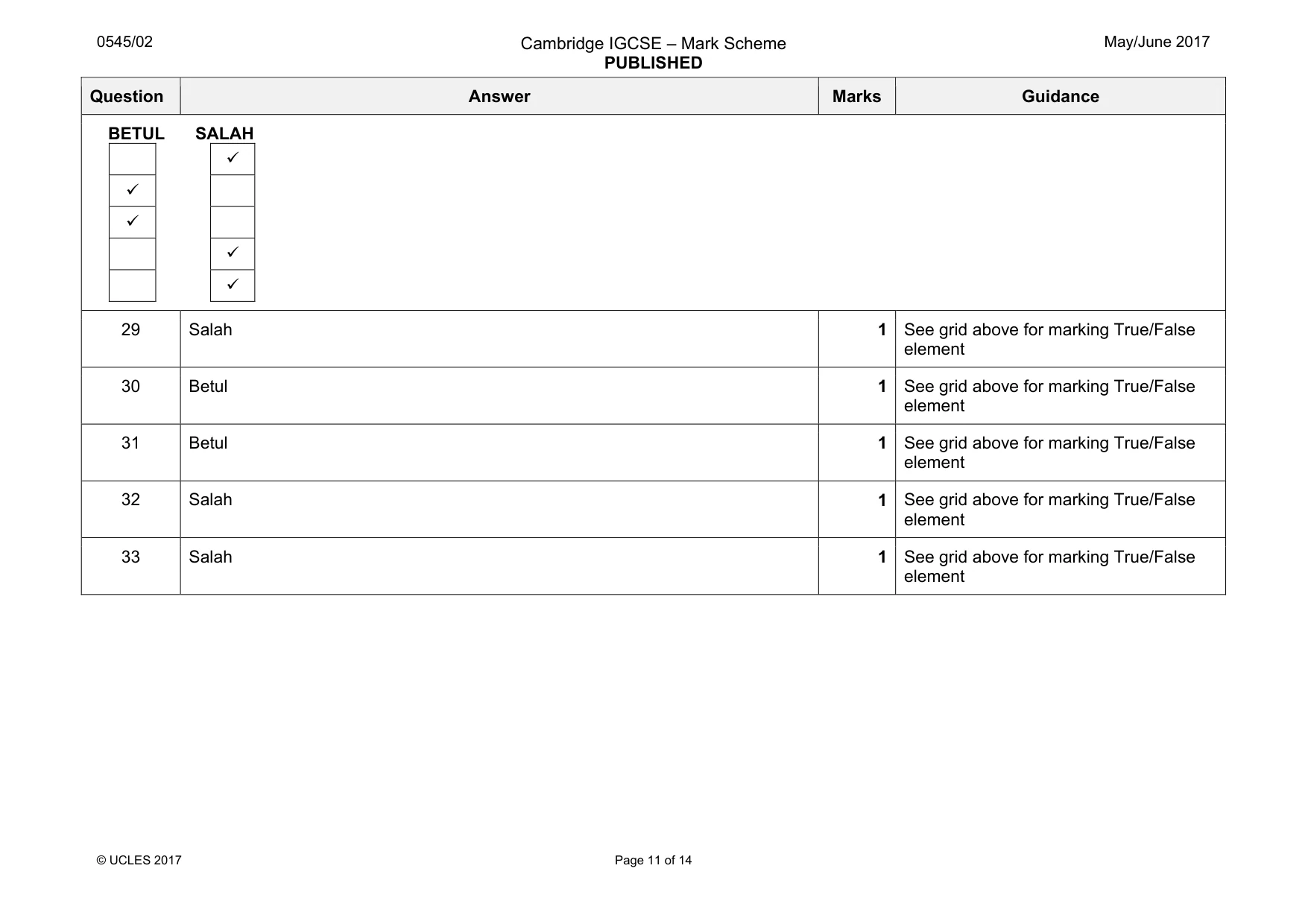
0545/02 Cambridge IGCSE – Mark Scheme PUBLISHED May/June 2017 © UCLES 2017 Page 11 of 14 Question Answer Marks Guidance BETUL SALAH 9 9 9 9 9 29 Salah 1 See grid above for marking True/False element 30 Betul 1 See grid above for marking True/False element 31 Betul 1 See grid above for marking True/False element 32 Salah 1 See grid above for marking True/False element 33 Salah 1 See grid above for marking True/False element
Mark scheme, page 12
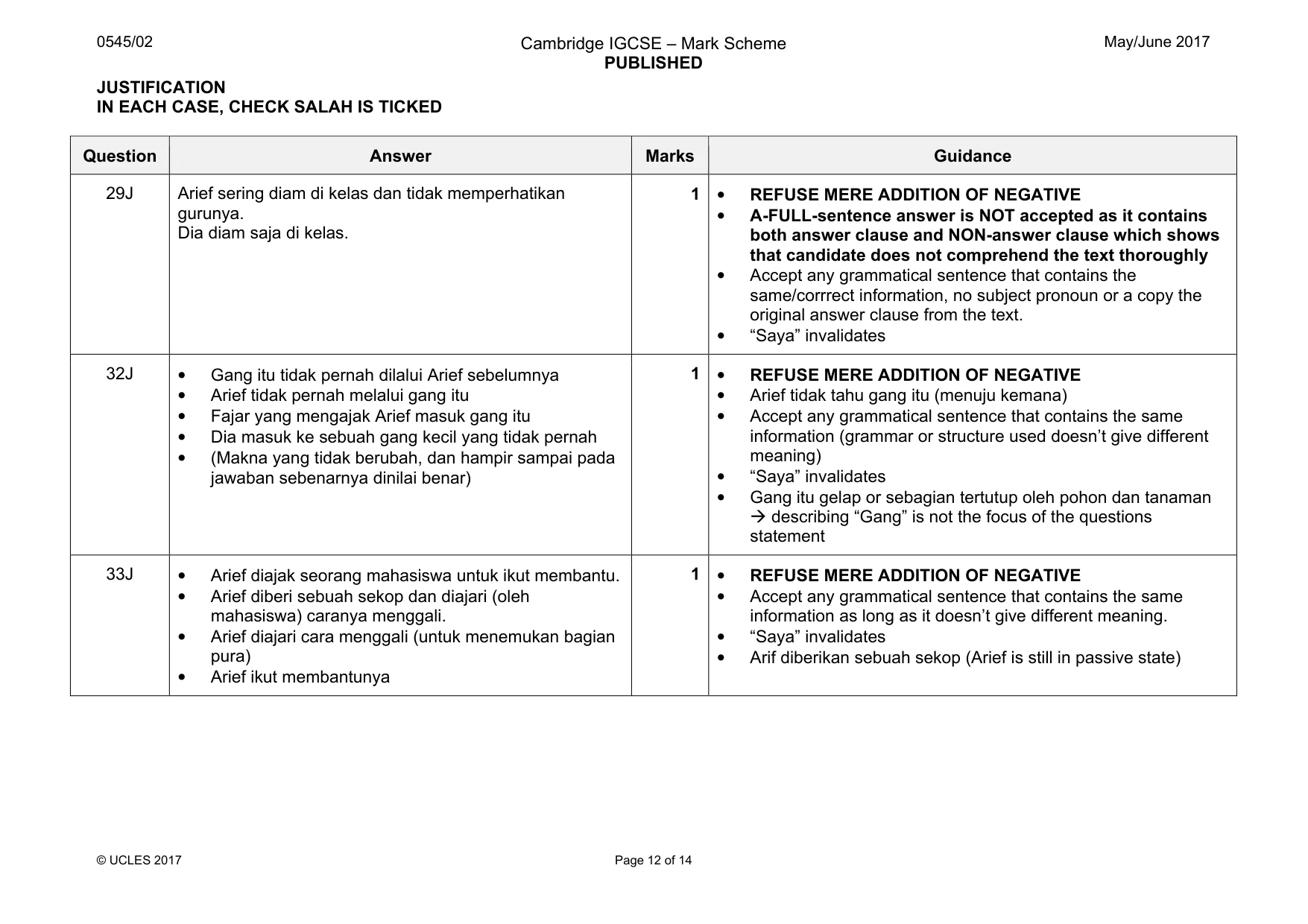
0545/02 Cambridge IGCSE – Mark Scheme PUBLISHED May/June 2017 © UCLES 2017 Page 12 of 14 JUSTIFICATION IN EACH CASE, CHECK SALAH IS TICKED Question Answer Marks Guidance 29J Arief sering diam di kelas dan tidak memperhatikan gurunya. Dia diam saja di kelas. 1 • REFUSE MERE ADDITION OF NEGATIVE • A-FULL-sentence answer is NOT accepted as it contains both answer clause and NON-answer clause which shows that candidate does not comprehend the text thoroughly • Accept any grammatical sentence that contains the same/corrrect information, no subject pronoun or a copy the original answer clause from the text. • “Saya” invalidates 32J • Gang itu tidak pernah dilalui Arief sebelumnya • Arief tidak pernah melalui gang itu • Fajar yang mengajak Arief masuk gang itu • Dia masuk ke sebuah gang kecil yang tidak pernah • (Makna yang tidak berubah, dan hampir sampai pada jawaban sebenarnya dinilai benar) 1 • REFUSE MERE ADDITION OF NEGATIVE • Arief tidak tahu gang itu (menuju kemana) • Accept any grammatical sentence that contains the same information (grammar or structure used doesn’t give different meaning) • “Saya” invalidates • Gang itu gelap or sebagian tertutup oleh pohon dan tanaman Æ describing “Gang” is not the focus of the questions statement 33J • Arief diajak seorang mahasiswa untuk ikut membantu. • Arief diberi sebuah sekop dan diajari (oleh mahasiswa) caranya menggali. • Arief diajari cara menggali (untuk menemukan bagian pura) • Arief ikut membantunya 1 • REFUSE MERE ADDITION OF NEGATIVE • Accept any grammatical sentence that contains the same information as long as it doesn’t give different meaning. • “Saya” invalidates • Arif diberikan sebuah sekop (Arief is still in passive state)
Mark scheme, page 13
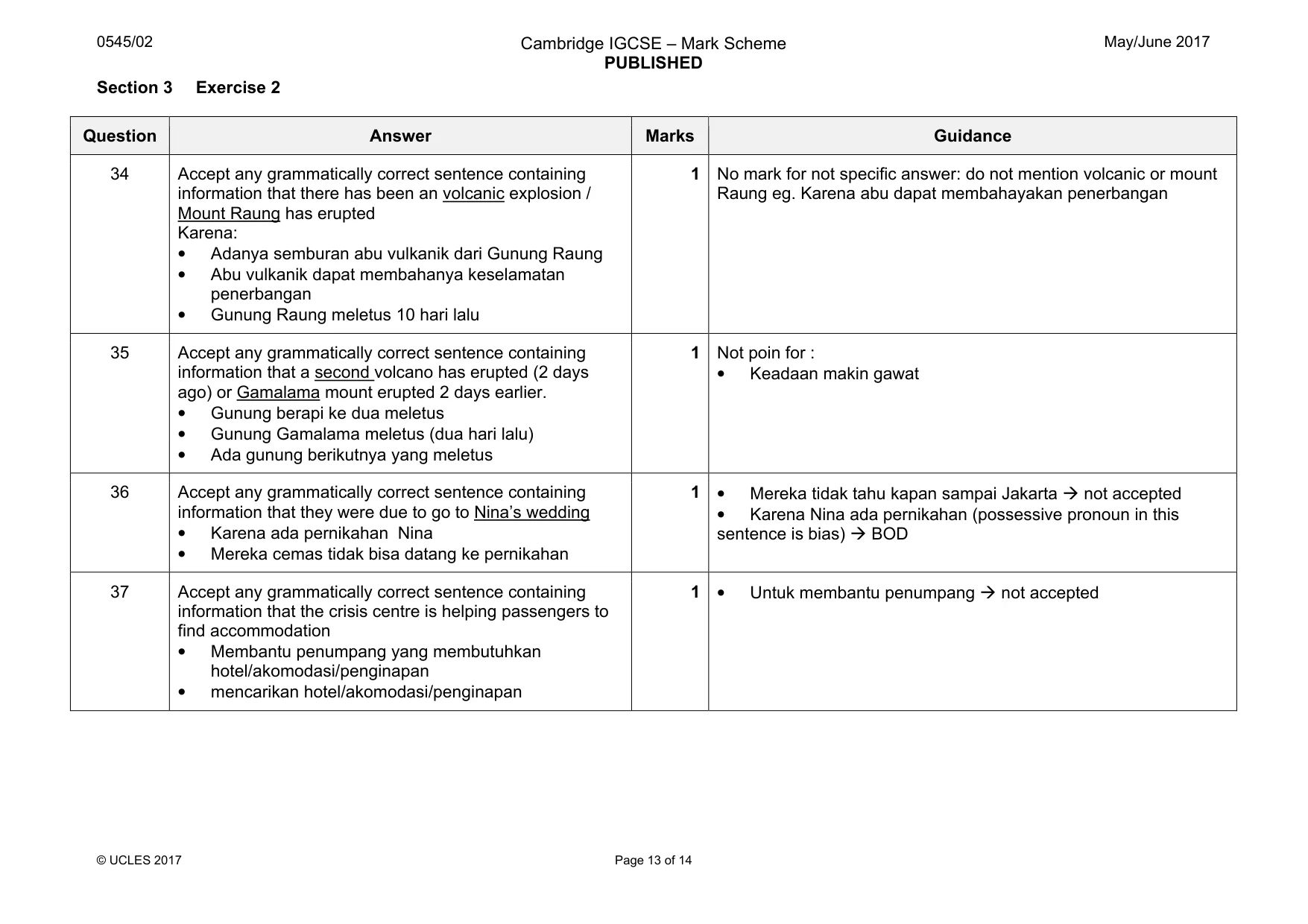
0545/02 Cambridge IGCSE – Mark Scheme PUBLISHED May/June 2017 © UCLES 2017 Page 13 of 14 Section 3 Exercise 2 Question Answer Marks Guidance 34 Accept any grammatically correct sentence containing information that there has been an volcanic explosion / Mount Raung has erupted Karena: • Adanya semburan abu vulkanik dari Gunung Raung • Abu vulkanik dapat membahanya keselamatan penerbangan • Gunung Raung meletus 10 hari lalu 1 No mark for not specific answer: do not mention volcanic or mount Raung eg. Karena abu dapat membahayakan penerbangan 35 Accept any grammatically correct sentence containing information that a second volcano has erupted (2 days ago) or Gamalama mount erupted 2 days earlier. • Gunung berapi ke dua meletus • Gunung Gamalama meletus (dua hari lalu) • Ada gunung berikutnya yang meletus 1 Not poin for : • Keadaan makin gawat 36 Accept any grammatically correct sentence containing information that they were due to go to Nina’s wedding • Karena ada pernikahan Nina • Mereka cemas tidak bisa datang ke pernikahan 1 • Mereka tidak tahu kapan sampai Jakarta Æ not accepted • Karena Nina ada pernikahan (possessive pronoun in this sentence is bias) Æ BOD 37 Accept any grammatically correct sentence containing information that the crisis centre is helping passengers to find accommodation • Membantu penumpang yang membutuhkan hotel/akomodasi/penginapan • mencarikan hotel/akomodasi/penginapan 1 • Untuk membantu penumpang Æ not accepted
Mark scheme, page 14
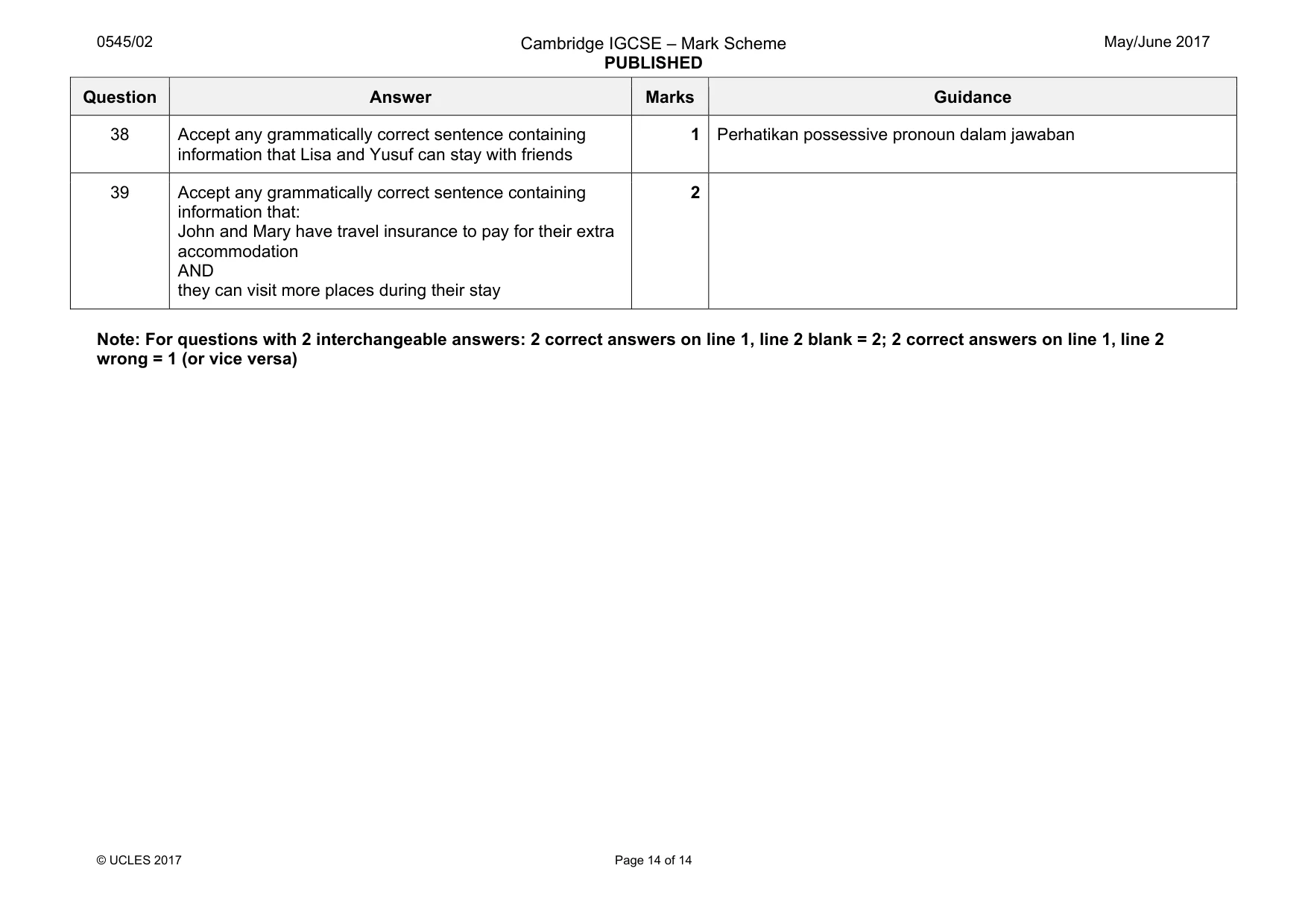
0545/02 Cambridge IGCSE – Mark Scheme PUBLISHED May/June 2017 © UCLES 2017 Page 14 of 14 Question Answer Marks Guidance 38 Accept any grammatically correct sentence containing information that Lisa and Yusuf can stay with friends 1 Perhatikan possessive pronoun dalam jawaban 39 Accept any grammatically correct sentence containing information that: John and Mary have travel insurance to pay for their extra accommodation AND they can visit more places during their stay 2 Note: For questions with 2 interchangeable answers: 2 correct answers on line 1, line 2 blank = 2; 2 correct answers on line 1, line 2 wrong = 1 (or vice versa)
What you needed in this session
Cambridge’s own grade thresholds for 2017 May/June, Paper 2 · Variant 1. A higher threshold means an easier paper — the bar moves with how the cohort did.