Cambridge IGCSE History (9-1) 0977 — 2025 May/June Paper 4 · Variant 2
0977/42/M/J/25 · 40 marks · 60 min
The question paper and its mark scheme, free to read here and free to download. This is Cambridge’s own paper, exactly as it was sat.
Question paper4 pages

Mark scheme17 pages
Answers below. Sit the paper first if you are practising.
Paper as text
Question paper, page 1
Cambridge IGCSE™(9-1) 0977/42 May/June 2025 1 hour HISTORY Paper 4 Alternative to Coursework You must answer on the enclosed answer booklet. You will need: Answer booklet (enclosed) INSTRUCTIONS • Answer one question from your chosen Depth study. • Follow the instructions on the front cover of the answer booklet. If you need additional answer paper, ask the invigilator for a continuation booklet. INFORMATION • The total mark for this paper is 40. • The number of marks for each question or part question is shown in brackets [ ]. This document has 4 pages. Any blank pages are indicated. [Turn over 06_0977_42_2025_1.3 © UCLES 2025 *2227412666*
Question paper, page 2
Answer one question. Depth study A: The First World War, 1914–18 Write an account of the German offensive on the Western Front in 1914 to the end of the Battle of the Marne. [15] (a) 1 Discuss the importance of Moltke in the failure of the Schlieffen Plan. [25] (b) Write an account of Japan’s contribution to the Allied war effort. [15] (a) 2 Discuss the importance of Japan’s naval assistance to the Western Allies. [25] (b) Depth study B: Germany, 1918–45 Write an account of the methods used by the Nazis to increase their electoral support up to 1932. [15] (a) 3 Discuss the impact of the SA in Germany to 1932. [25] (b) Write an account of the Night of the Long Knives. [15] (a) 4 Discuss the importance of Hindenburg’s death. [25] (b) Depth study C: Russia, 1905–41 Write an account of Stolypin’s reforms. [15] (a) 5 Discuss the importance of the peasants in Russia up to 1914. [25] (b) Write an account of the first Five-Year Plan. [15] (a) 6 Discuss the importance of Stalin’s policies against the kulaks. [25] (b) 06_0977_42_2025_1.3 © UCLES 2025 2
Question paper, page 3
Depth study D: The United States, 1919–41 Write an account of new developments in industry in the 1920s. [15] (a) 7 Discuss the impact of electrification on the USA in the 1920s. [25] (b) Write an account of the changes experienced by women in the 1920s. [15] (a) 8 Discuss the impact of the entertainment industry in the 1920s. [25] (b) Depth study E: The Second World War in Europe and the Asia–Pacific, 1939–c.1945 Write an account of Operation Sea Lion. [15] (a) 9 Discuss the importance of innovations and technology used by the British during the Battle of Britain. [25] (b) Write an account of the Battle of Guadalcanal. [15] (a) 10 Discuss the importance of the United States’ navy in the war in the Asia–Pacific. [25] (b) 06_0977_42_2025_1.3 © UCLES 2025 3
Question paper, page 4
BLANK PAGE Permission to reproduce items where third-party owned material protected by copyright is included has been sought and cleared where possible. Every reasonable effort has been made by the publisher (UCLES) to trace copyright holders, but if any items requiring clearance have unwittingly been included, the publisher will be pleased to make amends at the earliest possible opportunity. To avoid the issue of disclosure of answer-related information to candidates, all copyright acknowledgements are reproduced online in the Cambridge Assessment International Education Copyright Acknowledgements Booklet. This is produced for each series of examinations and is freely available to download at www.cambridgeinternational.org after the live examination series. Cambridge Assessment International Education is part of Cambridge Assessment. Cambridge Assessment is the brand name of the University of Cambridge Local Examinations Syndicate (UCLES), which is a department of the University of Cambridge. 06_0977_42_2025_1.3 © UCLES 2025 4
Mark scheme, page 1
This document consists of 17 printed pages. © Cambridge University Press & Assessment 2025 [Turn over Cambridge IGCSE™ (9–1) HISTORY 0977/42 Paper 4 Alternative to Coursework May/June 2025 MARK SCHEME Maximum Mark: 40 Published This mark scheme is published as an aid to teachers and candidates, to indicate the requirements of the examination. It shows the basis on which Examiners were instructed to award marks. It does not indicate the details of the discussions that took place at an Examiners’ meeting before marking began, which would have considered the acceptability of alternative answers. Mark schemes should be read in conjunction with the question paper and the Principal Examiner Report for Teachers. Cambridge International will not enter into discussions about these mark schemes. Cambridge International is publishing the mark schemes for the May/June 2025 series for most Cambridge IGCSE, Cambridge International A and AS Level components, and some Cambridge O Level components.
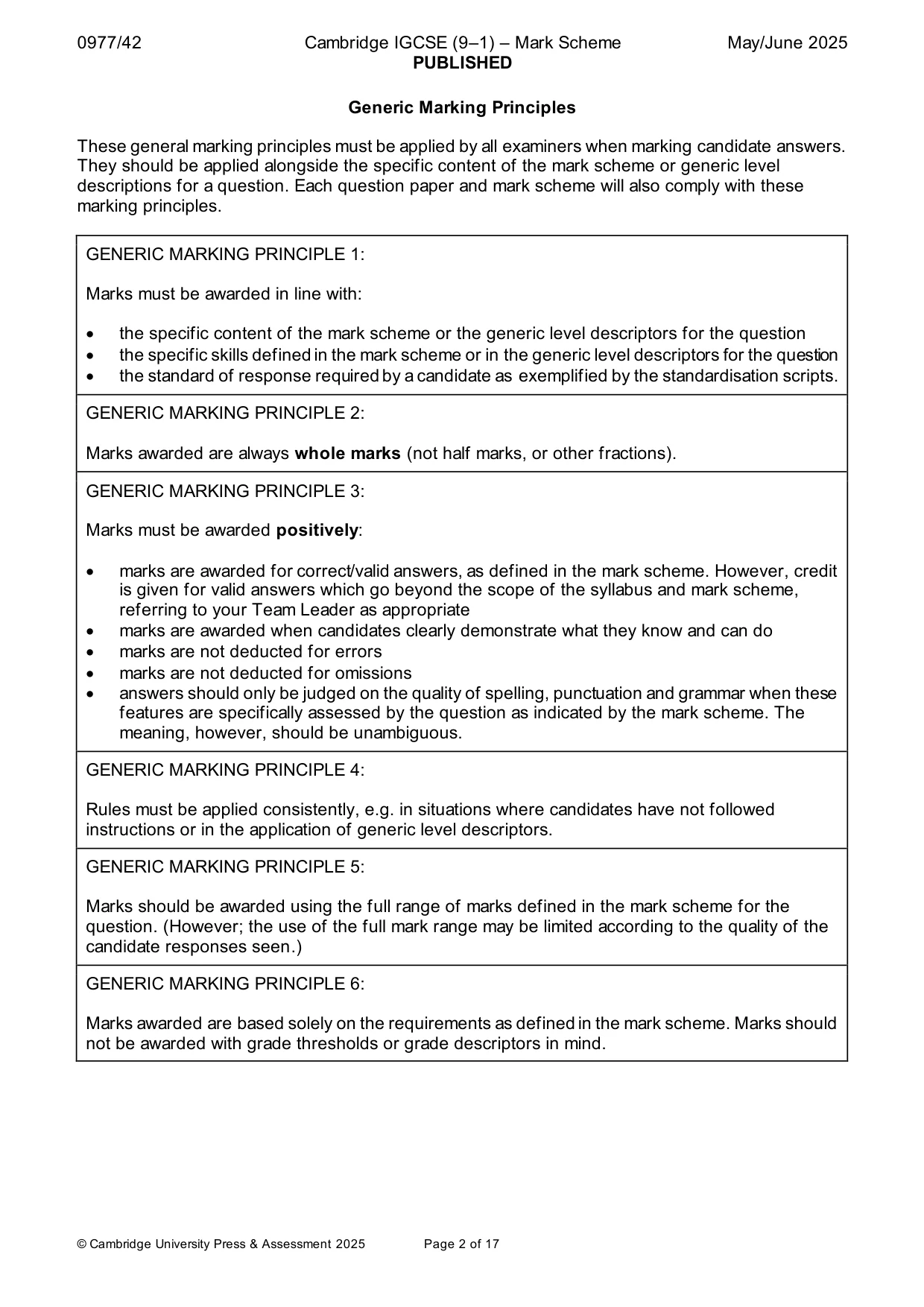
Mark scheme, page 2
0977/42 Cambridge IGCSE (9–1) – Mark Scheme PUBLISHED May/June 2025 © Cambridge University Press & Assessment 2025 Page 2 of 17 Generic Marking Principles These general marking principles must be applied by all examiners when marking candidate answers. They should be applied alongside the specific content of the mark scheme or generic level descriptions for a question. Each question paper and mark scheme will also comply with these marking principles. GENERIC MARKING PRINCIPLE 1: Marks must be awarded in line with: • the specific content of the mark scheme or the generic level descriptors for the question • the specific skills defined in the mark scheme or in the generic level descriptors for the question • the standard of response required by a candidate as exemplified by the standardisation scripts. GENERIC MARKING PRINCIPLE 2: Marks awarded are always whole marks (not half marks, or other fractions). GENERIC MARKING PRINCIPLE 3: Marks must be awarded positively: • marks are awarded for correct/valid answers, as defined in the mark scheme. However, credit is given for valid answers which go beyond the scope of the syllabus and mark scheme, referring to your Team Leader as appropriate • marks are awarded when candidates clearly demonstrate what they know and can do • marks are not deducted for errors • marks are not deducted for omissions • answers should only be judged on the quality of spelling, punctuation and grammar when these features are specifically assessed by the question as indicated by the mark scheme. The meaning, however, should be unambiguous. GENERIC MARKING PRINCIPLE 4: Rules must be applied consistently, e.g. in situations where candidates have not followed instructions or in the application of generic level descriptors. GENERIC MARKING PRINCIPLE 5: Marks should be awarded using the full range of marks defined in the mark scheme for the question. (However; the use of the full mark range may be limited according to the quality of the candidate responses seen.) GENERIC MARKING PRINCIPLE 6: Marks awarded are based solely on the requirements as defined in the mark scheme. Marks should not be awarded with grade thresholds or grade descriptors in mind.
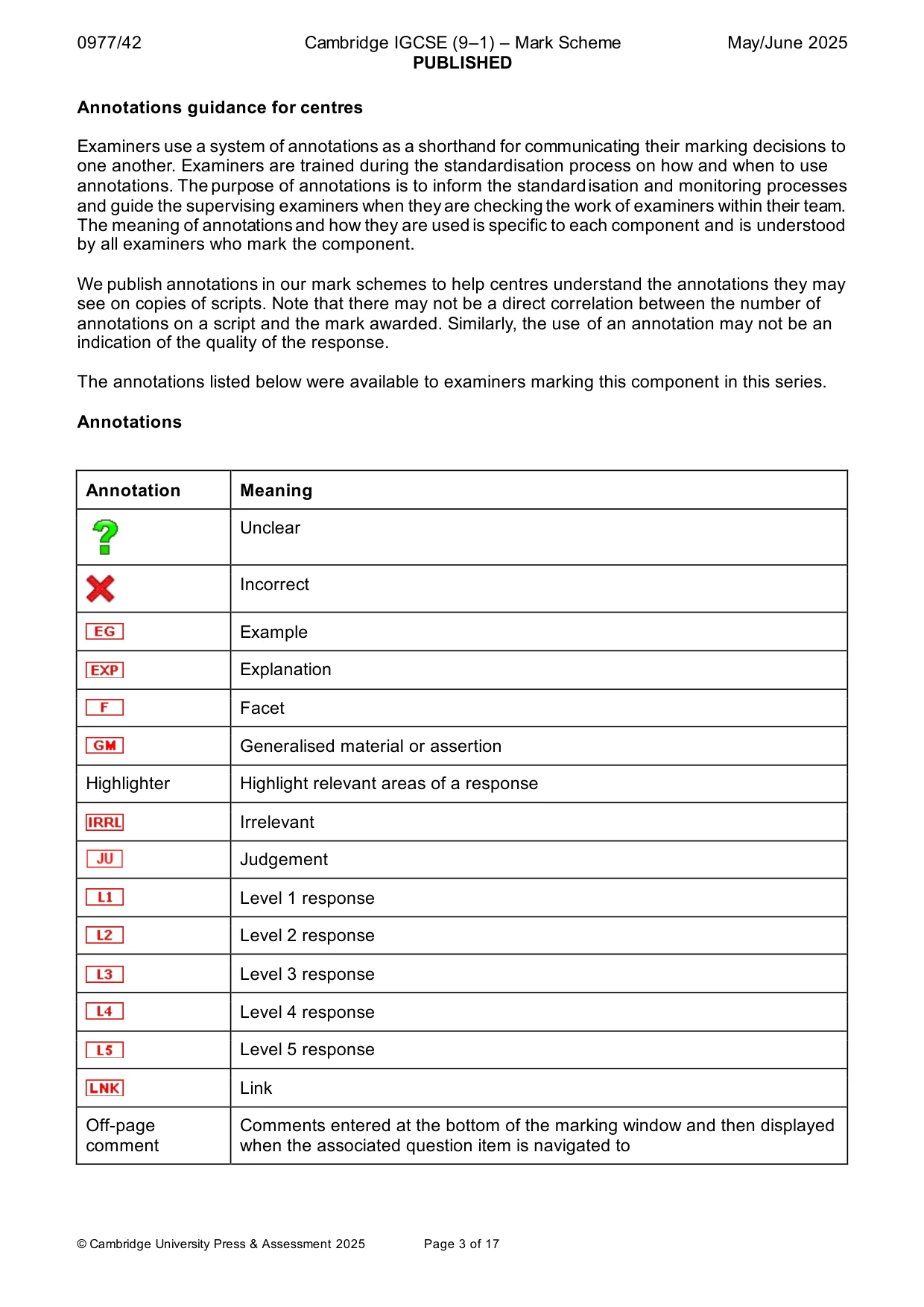
Mark scheme, page 3
0977/42 Cambridge IGCSE (9–1) – Mark Scheme PUBLISHED May/June 2025 © Cambridge University Press & Assessment 2025 Page 3 of 17 Annotations guidance for centres Examiners use a system of annotations as a shorthand for communicating their marking decisions to one another. Examiners are trained during the standardisation process on how and when to use annotations. The purpose of annotations is to inform the standardisation and monitoring processes and guide the supervising examiners when they are checking the work of examiners within their team. The meaning of annotations and how they are used is specific to each component and is understood by all examiners who mark the component. We publish annotations in our mark schemes to help centres understand the annotations they may see on copies of scripts. Note that there may not be a direct correlation between the number of annotations on a script and the mark awarded. Similarly, the use of an annotation may not be an indication of the quality of the response. The annotations listed below were available to examiners marking this component in this series. Annotations Annotation Meaning Unclear Incorrect Example Explanation Facet Generalised material or assertion Highlighter Highlight relevant areas of a response Irrelevant Judgement Level 1 response Level 2 response Level 3 response Level 4 response Level 5 response Link Off-page comment Comments entered at the bottom of the marking window and then displayed when the associated question item is navigated to
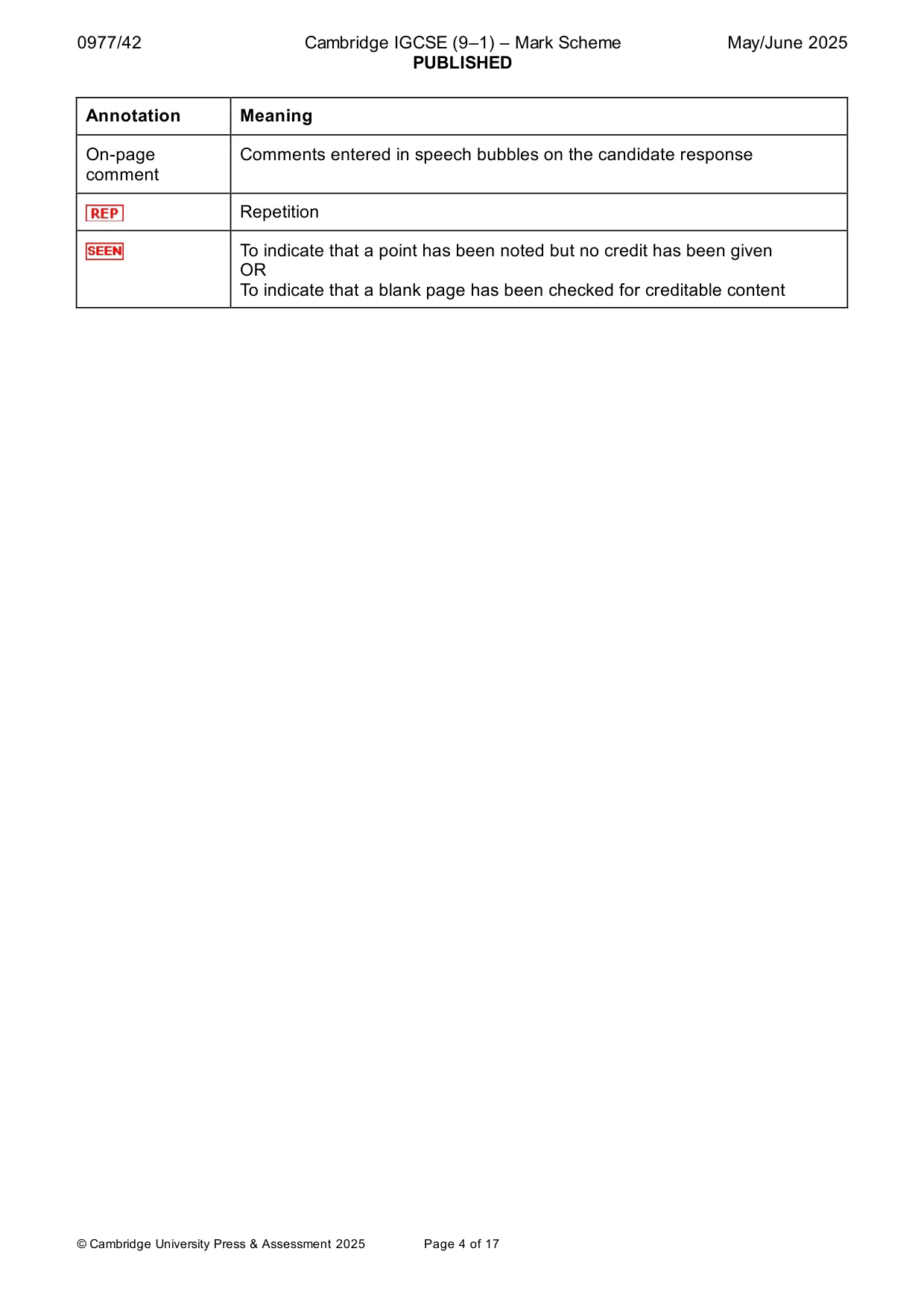
Mark scheme, page 4
0977/42 Cambridge IGCSE (9–1) – Mark Scheme PUBLISHED May/June 2025 © Cambridge University Press & Assessment 2025 Page 4 of 17 Annotation Meaning On-page comment Comments entered in speech bubbles on the candidate response Repetition To indicate that a point has been noted but no credit has been given OR To indicate that a blank page has been checked for creditable content
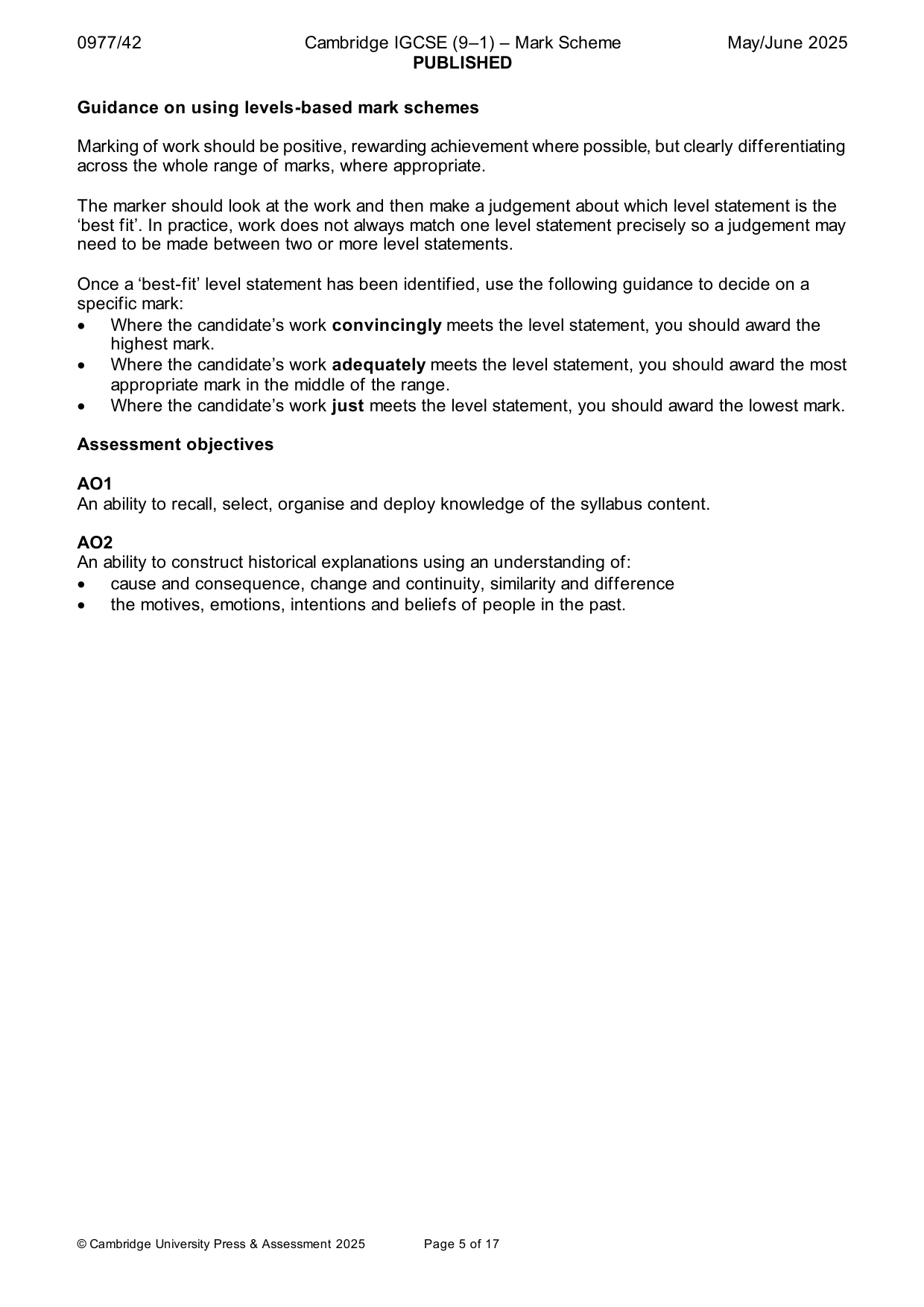
Mark scheme, page 5
0977/42 Cambridge IGCSE (9–1) – Mark Scheme PUBLISHED May/June 2025 © Cambridge University Press & Assessment 2025 Page 5 of 17 Guidance on using levels-based mark schemes Marking of work should be positive, rewarding achievement where possible, but clearly differentiating across the whole range of marks, where appropriate. The marker should look at the work and then make a judgement about which level statement is the ‘best fit’. In practice, work does not always match one level statement precisely so a judgement may need to be made between two or more level statements. Once a ‘best-fit’ level statement has been identified, use the following guidance to decide on a specific mark: • Where the candidate’s work convincingly meets the level statement, you should award the highest mark. • Where the candidate’s work adequately meets the level statement, you should award the most appropriate mark in the middle of the range. • Where the candidate’s work just meets the level statement, you should award the lowest mark. Assessment objectives AO1 An ability to recall, select, organise and deploy knowledge of the syllabus content. AO2 An ability to construct historical explanations using an understanding of: • cause and consequence, change and continuity, similarity and difference • the motives, emotions, intentions and beliefs of people in the past.
Mark scheme, page 6
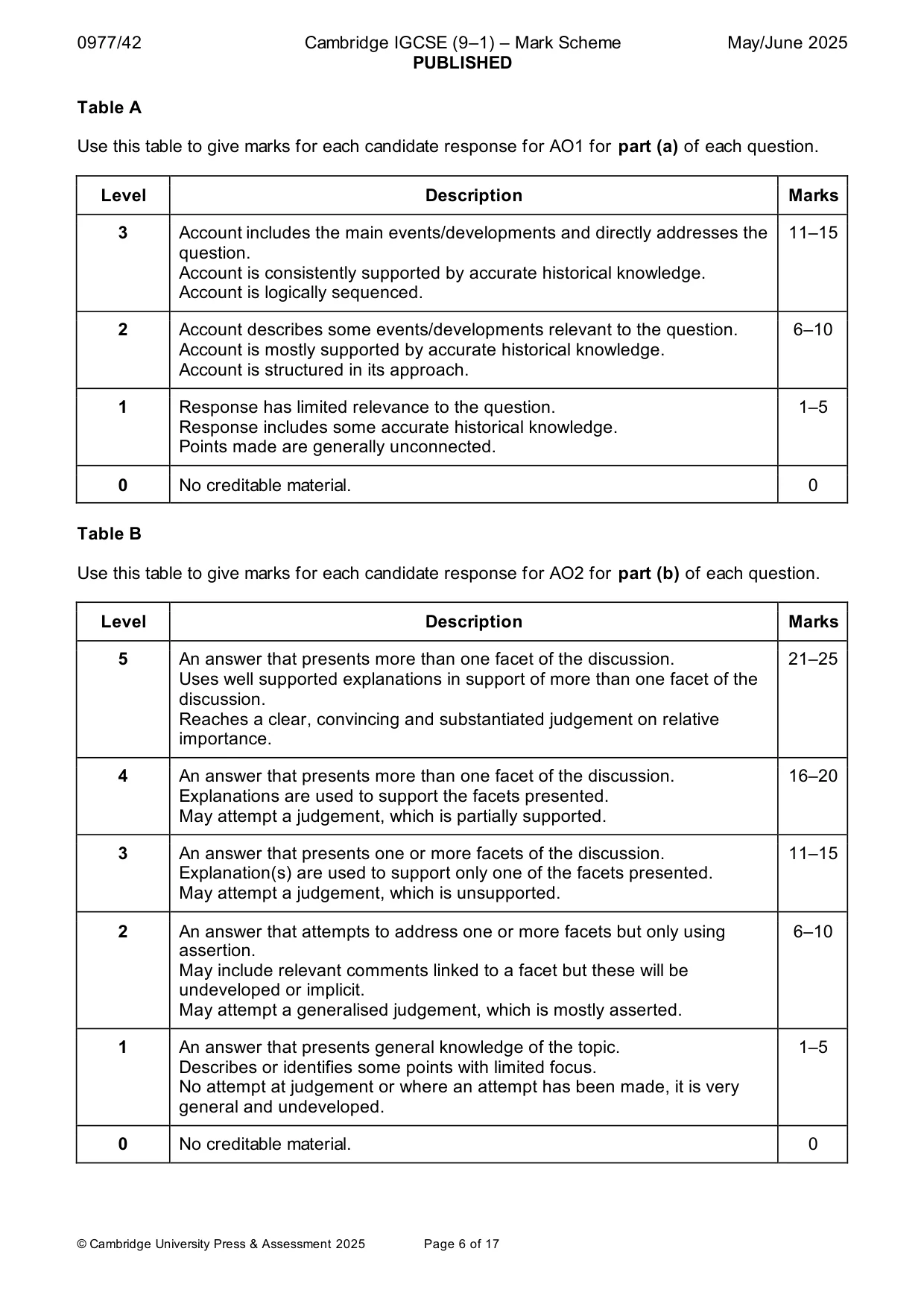
0977/42 Cambridge IGCSE (9–1) – Mark Scheme PUBLISHED May/June 2025 © Cambridge University Press & Assessment 2025 Page 6 of 17 Table A Use this table to give marks for each candidate response for AO1 for part (a) of each question. Level Description Marks 3 Account includes the main events/developments and directly addresses the question. Account is consistently supported by accurate historical knowledge. Account is logically sequenced. 11–15 2 Account describes some events/developments relevant to the question. Account is mostly supported by accurate historical knowledge. Account is structured in its approach. 6–10 1 Response has limited relevance to the question. Response includes some accurate historical knowledge. Points made are generally unconnected. 1–5 0 No creditable material. 0 Table B Use this table to give marks for each candidate response for AO2 for part (b) of each question. Level Description Marks 5 An answer that presents more than one facet of the discussion. Uses well supported explanations in support of more than one facet of the discussion. Reaches a clear, convincing and substantiated judgement on relative importance. 21–25 4 An answer that presents more than one facet of the discussion. Explanations are used to support the facets presented. May attempt a judgement, which is partially supported. 16–20 3 An answer that presents one or more facets of the discussion. Explanation(s) are used to support only one of the facets presented. May attempt a judgement, which is unsupported. 11–15 2 An answer that attempts to address one or more facets but only using assertion. May include relevant comments linked to a facet but these will be undeveloped or implicit. May attempt a generalised judgement, which is mostly asserted. 6–10 1 An answer that presents general knowledge of the topic. Describes or identifies some points with limited focus. No attempt at judgement or where an attempt has been made, it is very general and undeveloped. 1–5 0 No creditable material. 0
Mark scheme, page 7
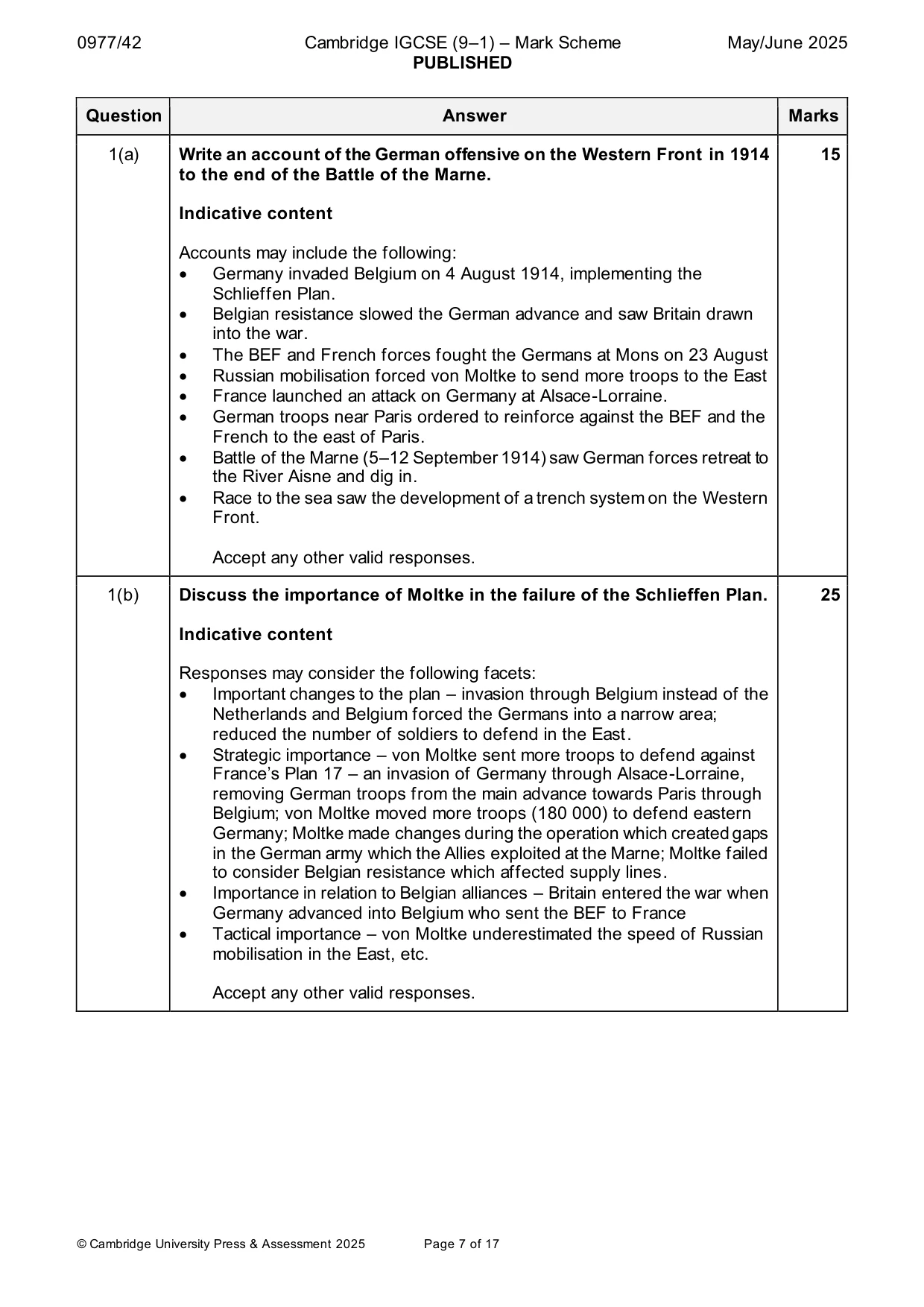
0977/42 Cambridge IGCSE (9–1) – Mark Scheme PUBLISHED May/June 2025 © Cambridge University Press & Assessment 2025 Page 7 of 17 Question Answer Marks 1(a) Write an account of the German offensive on the Western Front in 1914 to the end of the Battle of the Marne. Indicative content Accounts may include the following: • Germany invaded Belgium on 4 August 1914, implementing the Schlieffen Plan. • Belgian resistance slowed the German advance and saw Britain drawn into the war. • The BEF and French forces fought the Germans at Mons on 23 August • Russian mobilisation forced von Moltke to send more troops to the East • France launched an attack on Germany at Alsace-Lorraine. • German troops near Paris ordered to reinforce against the BEF and the French to the east of Paris. • Battle of the Marne (5–12 September 1914) saw German forces retreat to the River Aisne and dig in. • Race to the sea saw the development of a trench system on the Western Front. Accept any other valid responses. 15 1(b) Discuss the importance of Moltke in the failure of the Schlieffen Plan. Indicative content Responses may consider the following facets: • Important changes to the plan – invasion through Belgium instead of the Netherlands and Belgium forced the Germans into a narrow area; reduced the number of soldiers to defend in the East. • Strategic importance – von Moltke sent more troops to defend against France’s Plan 17 – an invasion of Germany through Alsace-Lorraine, removing German troops from the main advance towards Paris through Belgium; von Moltke moved more troops (180 000) to defend eastern Germany; Moltke made changes during the operation which created gaps in the German army which the Allies exploited at the Marne; Moltke failed to consider Belgian resistance which affected supply lines. • Importance in relation to Belgian alliances – Britain entered the war when Germany advanced into Belgium who sent the BEF to France • Tactical importance – von Moltke underestimated the speed of Russian mobilisation in the East, etc. Accept any other valid responses. 25
Mark scheme, page 8
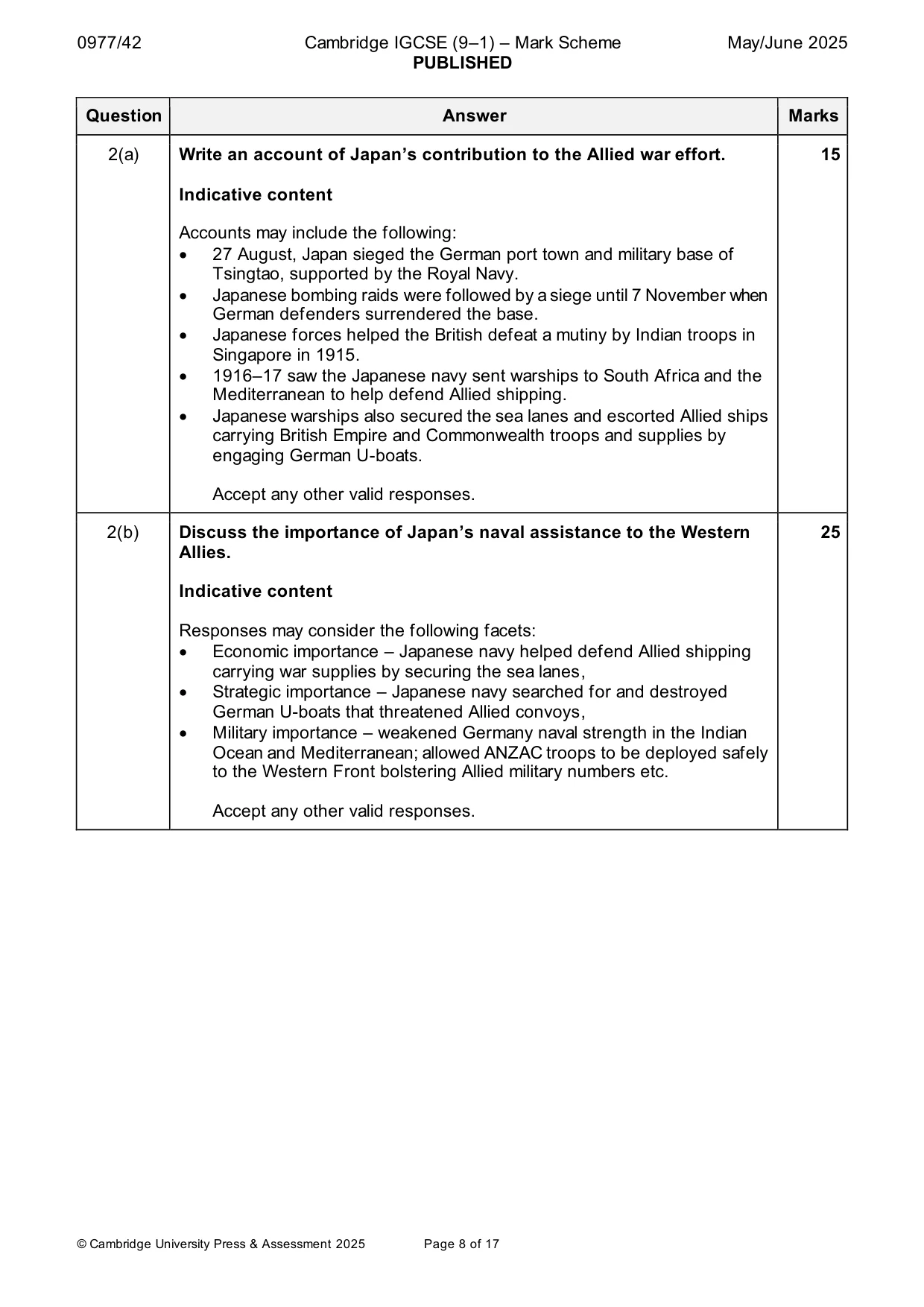
0977/42 Cambridge IGCSE (9–1) – Mark Scheme PUBLISHED May/June 2025 © Cambridge University Press & Assessment 2025 Page 8 of 17 Question Answer Marks 2(a) Write an account of Japan’s contribution to the Allied war effort. Indicative content Accounts may include the following: • 27 August, Japan sieged the German port town and military base of Tsingtao, supported by the Royal Navy. • Japanese bombing raids were followed by a siege until 7 November when German defenders surrendered the base. • Japanese forces helped the British defeat a mutiny by Indian troops in Singapore in 1915. • 1916–17 saw the Japanese navy sent warships to South Africa and the Mediterranean to help defend Allied shipping. • Japanese warships also secured the sea lanes and escorted Allied ships carrying British Empire and Commonwealth troops and supplies by engaging German U-boats. Accept any other valid responses. 15 2(b) Discuss the importance of Japan’s naval assistance to the Western Allies. Indicative content Responses may consider the following facets: • Economic importance – Japanese navy helped defend Allied shipping carrying war supplies by securing the sea lanes, • Strategic importance – Japanese navy searched for and destroyed German U-boats that threatened Allied convoys, • Military importance – weakened Germany naval strength in the Indian Ocean and Mediterranean; allowed ANZAC troops to be deployed safely to the Western Front bolstering Allied military numbers etc. Accept any other valid responses. 25
Mark scheme, page 9
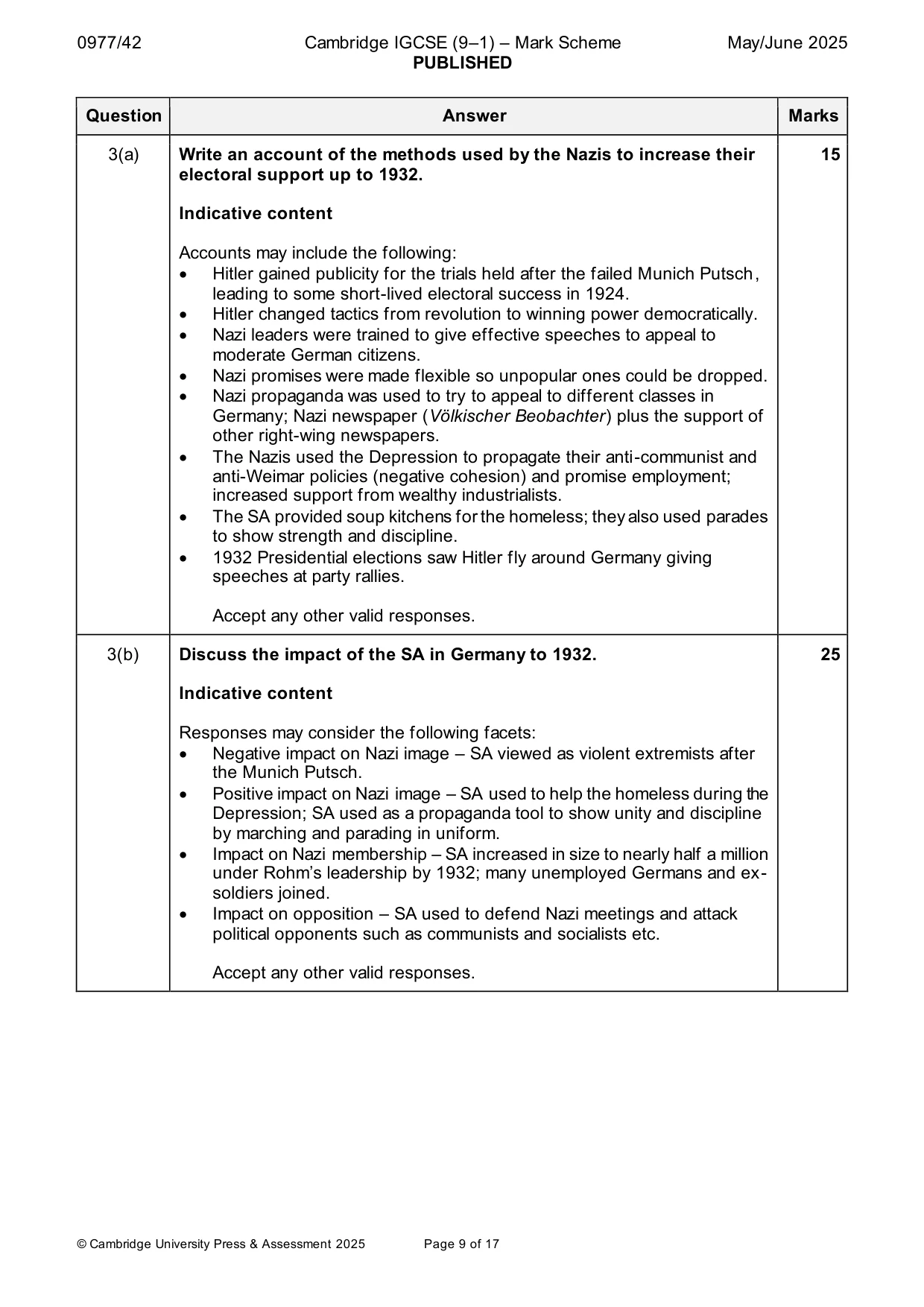
0977/42 Cambridge IGCSE (9–1) – Mark Scheme PUBLISHED May/June 2025 © Cambridge University Press & Assessment 2025 Page 9 of 17 Question Answer Marks 3(a) Write an account of the methods used by the Nazis to increase their electoral support up to 1932. Indicative content Accounts may include the following: • Hitler gained publicity for the trials held after the failed Munich Putsch, leading to some short-lived electoral success in 1924. • Hitler changed tactics from revolution to winning power democratically. • Nazi leaders were trained to give effective speeches to appeal to moderate German citizens. • Nazi promises were made flexible so unpopular ones could be dropped. • Nazi propaganda was used to try to appeal to different classes in Germany; Nazi newspaper (Völkischer Beobachter) plus the support of other right-wing newspapers. • The Nazis used the Depression to propagate their anti-communist and anti-Weimar policies (negative cohesion) and promise employment; increased support from wealthy industrialists. • The SA provided soup kitchens for the homeless; they also used parades to show strength and discipline. • 1932 Presidential elections saw Hitler fly around Germany giving speeches at party rallies. Accept any other valid responses. 15 3(b) Discuss the impact of the SA in Germany to 1932. Indicative content Responses may consider the following facets: • Negative impact on Nazi image – SA viewed as violent extremists after the Munich Putsch. • Positive impact on Nazi image – SA used to help the homeless during the Depression; SA used as a propaganda tool to show unity and discipline by marching and parading in uniform. • Impact on Nazi membership – SA increased in size to nearly half a million under Rohm’s leadership by 1932; many unemployed Germans and ex- soldiers joined. • Impact on opposition – SA used to defend Nazi meetings and attack political opponents such as communists and socialists etc. Accept any other valid responses. 25
Mark scheme, page 10
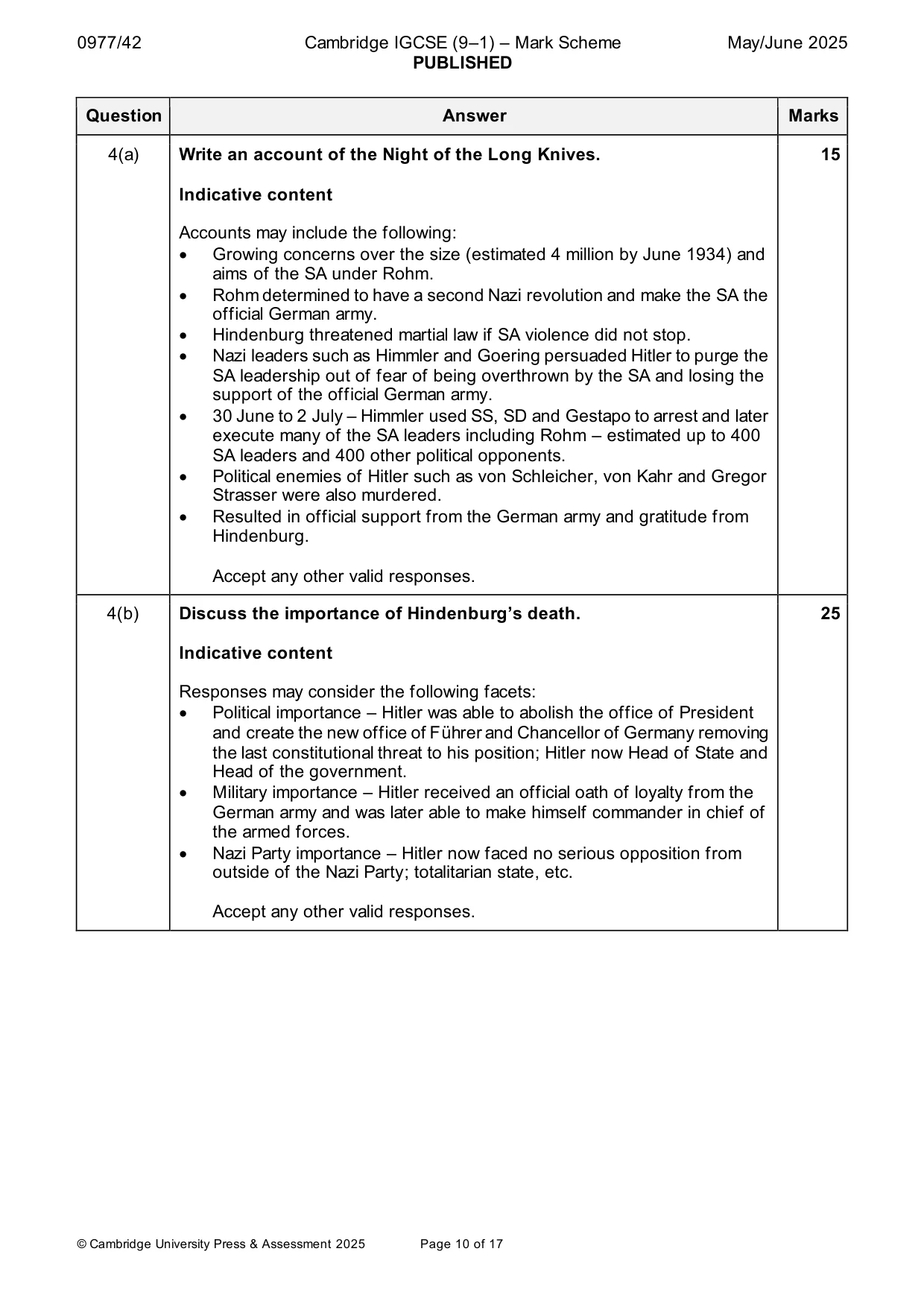
0977/42 Cambridge IGCSE (9–1) – Mark Scheme PUBLISHED May/June 2025 © Cambridge University Press & Assessment 2025 Page 10 of 17 Question Answer Marks 4(a) Write an account of the Night of the Long Knives. Indicative content Accounts may include the following: • Growing concerns over the size (estimated 4 million by June 1934) and aims of the SA under Rohm. • Rohm determined to have a second Nazi revolution and make the SA the official German army. • Hindenburg threatened martial law if SA violence did not stop. • Nazi leaders such as Himmler and Goering persuaded Hitler to purge the SA leadership out of fear of being overthrown by the SA and losing the support of the official German army. • 30 June to 2 July – Himmler used SS, SD and Gestapo to arrest and later execute many of the SA leaders including Rohm – estimated up to 400 SA leaders and 400 other political opponents. • Political enemies of Hitler such as von Schleicher, von Kahr and Gregor Strasser were also murdered. • Resulted in official support from the German army and gratitude from Hindenburg. Accept any other valid responses. 15 4(b) Discuss the importance of Hindenburg’s death. Indicative content Responses may consider the following facets: • Political importance – Hitler was able to abolish the office of President and create the new office of Führer and Chancellor of Germany removing the last constitutional threat to his position; Hitler now Head of State and Head of the government. • Military importance – Hitler received an official oath of loyalty from the German army and was later able to make himself commander in chief of the armed forces. • Nazi Party importance – Hitler now faced no serious opposition from outside of the Nazi Party; totalitarian state, etc. Accept any other valid responses. 25
Mark scheme, page 11
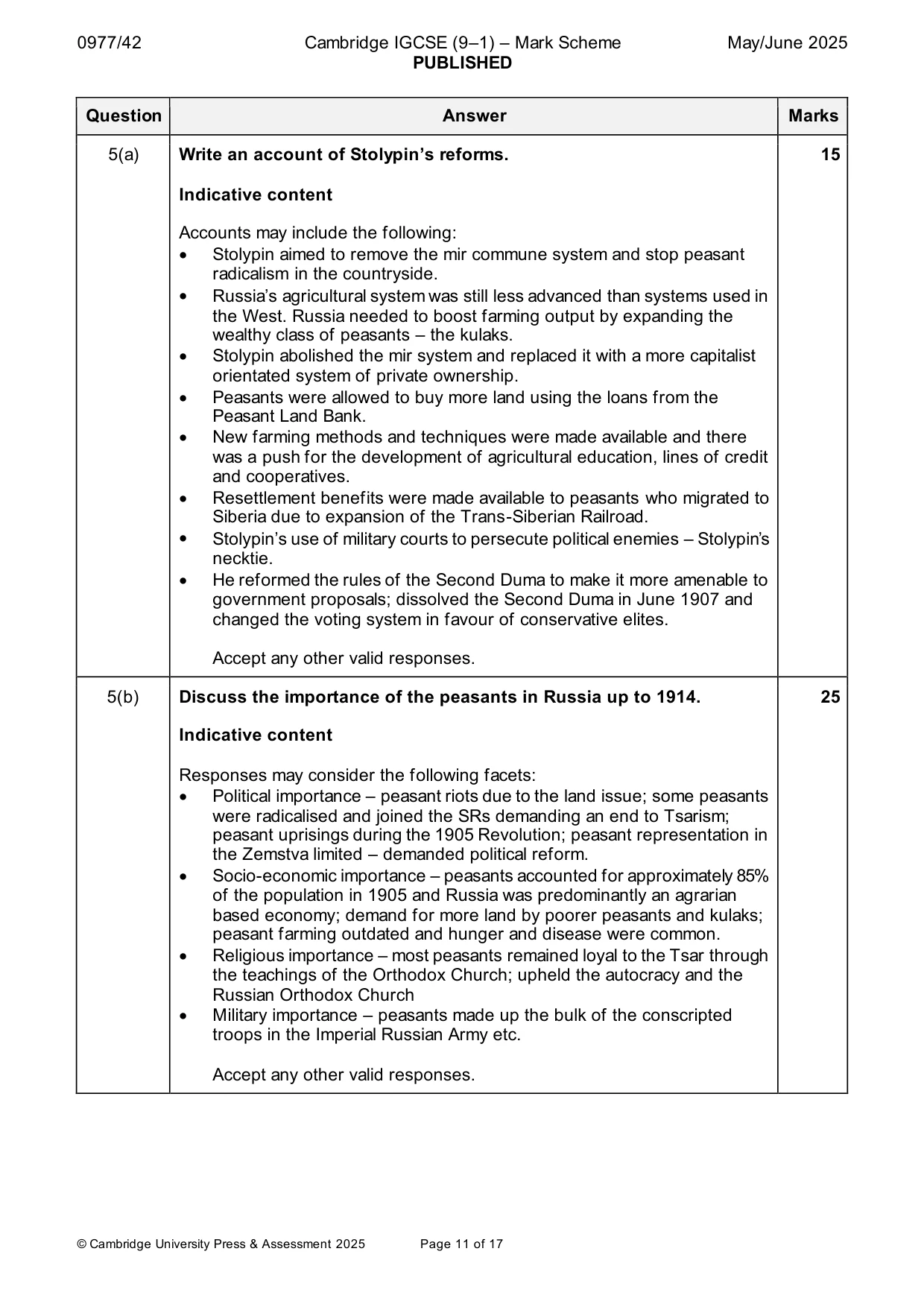
0977/42 Cambridge IGCSE (9–1) – Mark Scheme PUBLISHED May/June 2025 © Cambridge University Press & Assessment 2025 Page 11 of 17 Question Answer Marks 5(a) Write an account of Stolypin’s reforms. Indicative content Accounts may include the following: • Stolypin aimed to remove the mir commune system and stop peasant radicalism in the countryside. • Russia’s agricultural system was still less advanced than systems used in the West. Russia needed to boost farming output by expanding the wealthy class of peasants – the kulaks. • Stolypin abolished the mir system and replaced it with a more capitalist orientated system of private ownership. • Peasants were allowed to buy more land using the loans from the Peasant Land Bank. • New farming methods and techniques were made available and there was a push for the development of agricultural education, lines of credit and cooperatives. • Resettlement benefits were made available to peasants who migrated to Siberia due to expansion of the Trans-Siberian Railroad. • Stolypin’s use of military courts to persecute political enemies – Stolypin’s necktie. • He reformed the rules of the Second Duma to make it more amenable to government proposals; dissolved the Second Duma in June 1907 and changed the voting system in favour of conservative elites. Accept any other valid responses. 15 5(b) Discuss the importance of the peasants in Russia up to 1914. Indicative content Responses may consider the following facets: • Political importance – peasant riots due to the land issue; some peasants were radicalised and joined the SRs demanding an end to Tsarism; peasant uprisings during the 1905 Revolution; peasant representation in the Zemstva limited – demanded political reform. • Socio-economic importance – peasants accounted for approximately 85% of the population in 1905 and Russia was predominantly an agrarian based economy; demand for more land by poorer peasants and kulaks; peasant farming outdated and hunger and disease were common. • Religious importance – most peasants remained loyal to the Tsar through the teachings of the Orthodox Church; upheld the autocracy and the Russian Orthodox Church • Military importance – peasants made up the bulk of the conscripted troops in the Imperial Russian Army etc. Accept any other valid responses. 25
Mark scheme, page 12
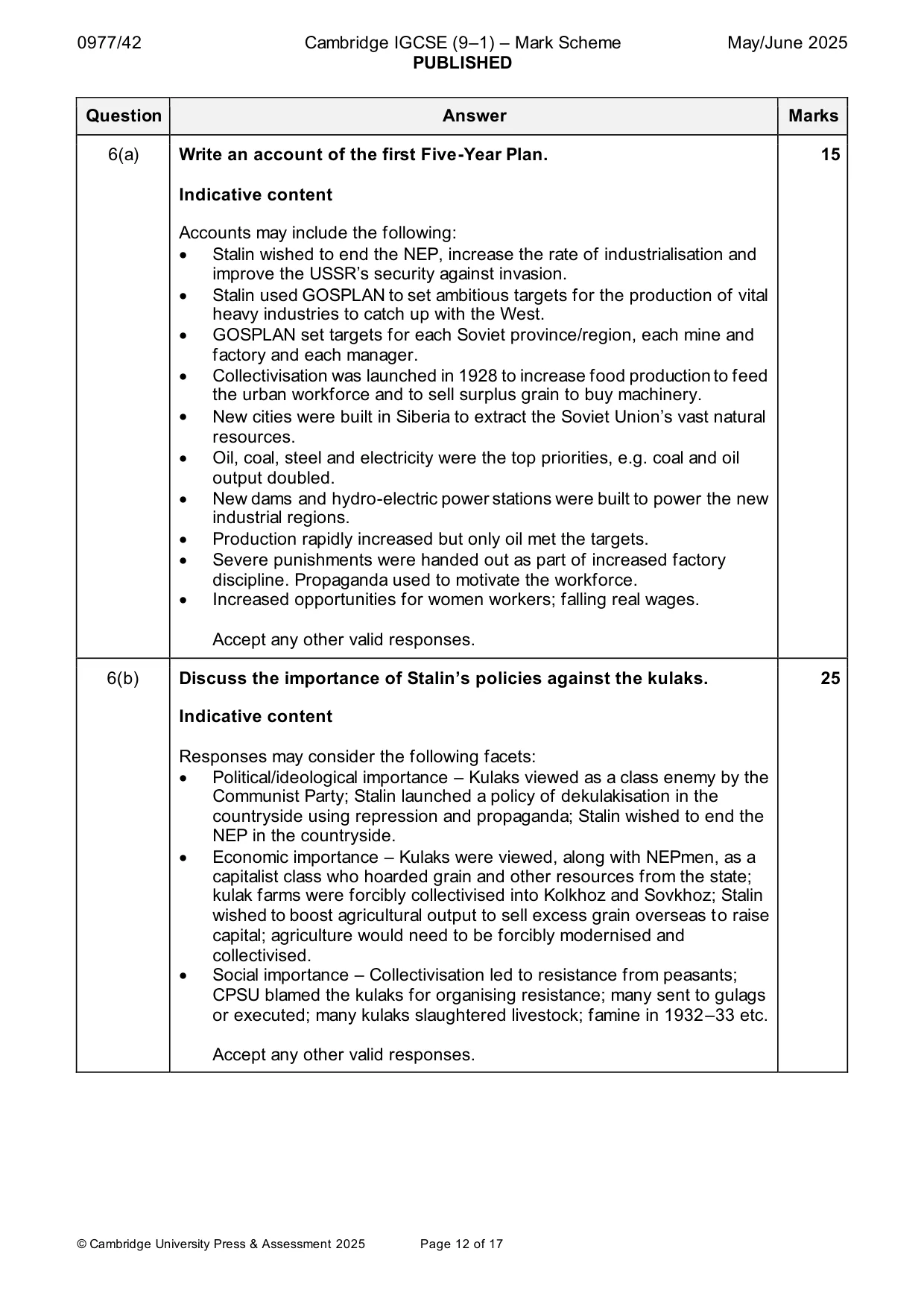
0977/42 Cambridge IGCSE (9–1) – Mark Scheme PUBLISHED May/June 2025 © Cambridge University Press & Assessment 2025 Page 12 of 17 Question Answer Marks 6(a) Write an account of the first Five-Year Plan. Indicative content Accounts may include the following: • Stalin wished to end the NEP, increase the rate of industrialisation and improve the USSR’s security against invasion. • Stalin used GOSPLAN to set ambitious targets for the production of vital heavy industries to catch up with the West. • GOSPLAN set targets for each Soviet province/region, each mine and factory and each manager. • Collectivisation was launched in 1928 to increase food production to feed the urban workforce and to sell surplus grain to buy machinery. • New cities were built in Siberia to extract the Soviet Union’s vast natural resources. • Oil, coal, steel and electricity were the top priorities, e.g. coal and oil output doubled. • New dams and hydro-electric power stations were built to power the new industrial regions. • Production rapidly increased but only oil met the targets. • Severe punishments were handed out as part of increased factory discipline. Propaganda used to motivate the workforce. • Increased opportunities for women workers; falling real wages. Accept any other valid responses. 15 6(b) Discuss the importance of Stalin’s policies against the kulaks. Indicative content Responses may consider the following facets: • Political/ideological importance – Kulaks viewed as a class enemy by the Communist Party; Stalin launched a policy of dekulakisation in the countryside using repression and propaganda; Stalin wished to end the NEP in the countryside. • Economic importance – Kulaks were viewed, along with NEPmen, as a capitalist class who hoarded grain and other resources from the state; kulak farms were forcibly collectivised into Kolkhoz and Sovkhoz; Stalin wished to boost agricultural output to sell excess grain overseas to raise capital; agriculture would need to be forcibly modernised and collectivised. • Social importance – Collectivisation led to resistance from peasants; CPSU blamed the kulaks for organising resistance; many sent to gulags or executed; many kulaks slaughtered livestock; famine in 1932–33 etc. Accept any other valid responses. 25
Mark scheme, page 13
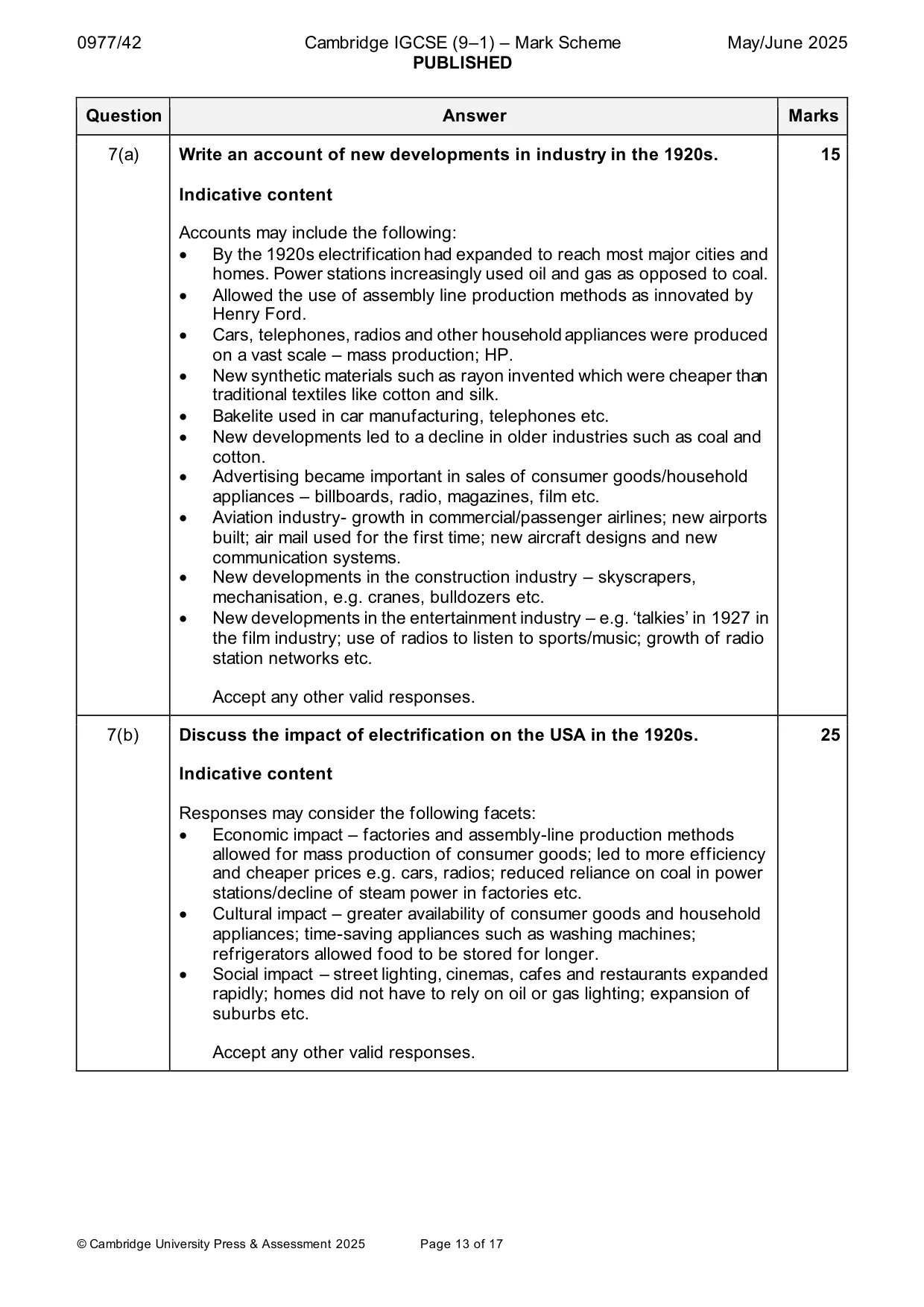
0977/42 Cambridge IGCSE (9–1) – Mark Scheme PUBLISHED May/June 2025 © Cambridge University Press & Assessment 2025 Page 13 of 17 Question Answer Marks 7(a) Write an account of new developments in industry in the 1920s. Indicative content Accounts may include the following: • By the 1920s electrification had expanded to reach most major cities and homes. Power stations increasingly used oil and gas as opposed to coal. • Allowed the use of assembly line production methods as innovated by Henry Ford. • Cars, telephones, radios and other household appliances were produced on a vast scale – mass production; HP. • New synthetic materials such as rayon invented which were cheaper than traditional textiles like cotton and silk. • Bakelite used in car manufacturing, telephones etc. • New developments led to a decline in older industries such as coal and cotton. • Advertising became important in sales of consumer goods/household appliances – billboards, radio, magazines, film etc. • Aviation industry- growth in commercial/passenger airlines; new airports built; air mail used for the first time; new aircraft designs and new communication systems. • New developments in the construction industry – skyscrapers, mechanisation, e.g. cranes, bulldozers etc. • New developments in the entertainment industry – e.g. ‘talkies’ in 1927 in the film industry; use of radios to listen to sports/music; growth of radio station networks etc. Accept any other valid responses. 15 7(b) Discuss the impact of electrification on the USA in the 1920s. Indicative content Responses may consider the following facets: • Economic impact – factories and assembly-line production methods allowed for mass production of consumer goods; led to more efficiency and cheaper prices e.g. cars, radios; reduced reliance on coal in power stations/decline of steam power in factories etc. • Cultural impact – greater availability of consumer goods and household appliances; time-saving appliances such as washing machines; refrigerators allowed food to be stored for longer. • Social impact – street lighting, cinemas, cafes and restaurants expanded rapidly; homes did not have to rely on oil or gas lighting; expansion of suburbs etc. Accept any other valid responses. 25
Mark scheme, page 14
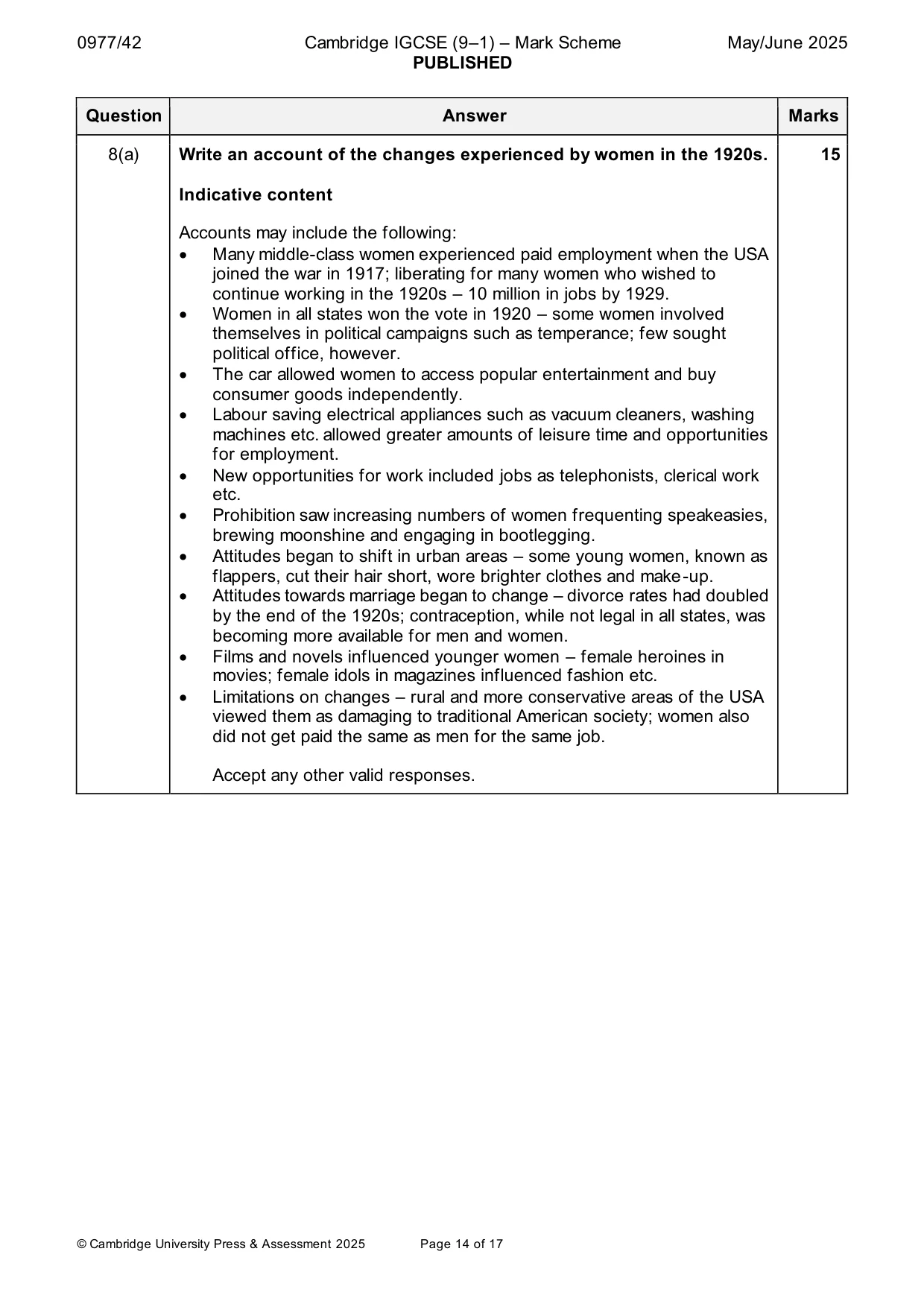
0977/42 Cambridge IGCSE (9–1) – Mark Scheme PUBLISHED May/June 2025 © Cambridge University Press & Assessment 2025 Page 14 of 17 Question Answer Marks 8(a) Write an account of the changes experienced by women in the 1920s. Indicative content Accounts may include the following: • Many middle-class women experienced paid employment when the USA joined the war in 1917; liberating for many women who wished to continue working in the 1920s – 10 million in jobs by 1929. • Women in all states won the vote in 1920 – some women involved themselves in political campaigns such as temperance; few sought political office, however. • The car allowed women to access popular entertainment and buy consumer goods independently. • Labour saving electrical appliances such as vacuum cleaners, washing machines etc. allowed greater amounts of leisure time and opportunities for employment. • New opportunities for work included jobs as telephonists, clerical work etc. • Prohibition saw increasing numbers of women frequenting speakeasies, brewing moonshine and engaging in bootlegging. • Attitudes began to shift in urban areas – some young women, known as flappers, cut their hair short, wore brighter clothes and make-up. • Attitudes towards marriage began to change – divorce rates had doubled by the end of the 1920s; contraception, while not legal in all states, was becoming more available for men and women. • Films and novels influenced younger women – female heroines in movies; female idols in magazines influenced fashion etc. • Limitations on changes – rural and more conservative areas of the USA viewed them as damaging to traditional American society; women also did not get paid the same as men for the same job. Accept any other valid responses. 15
Mark scheme, page 15
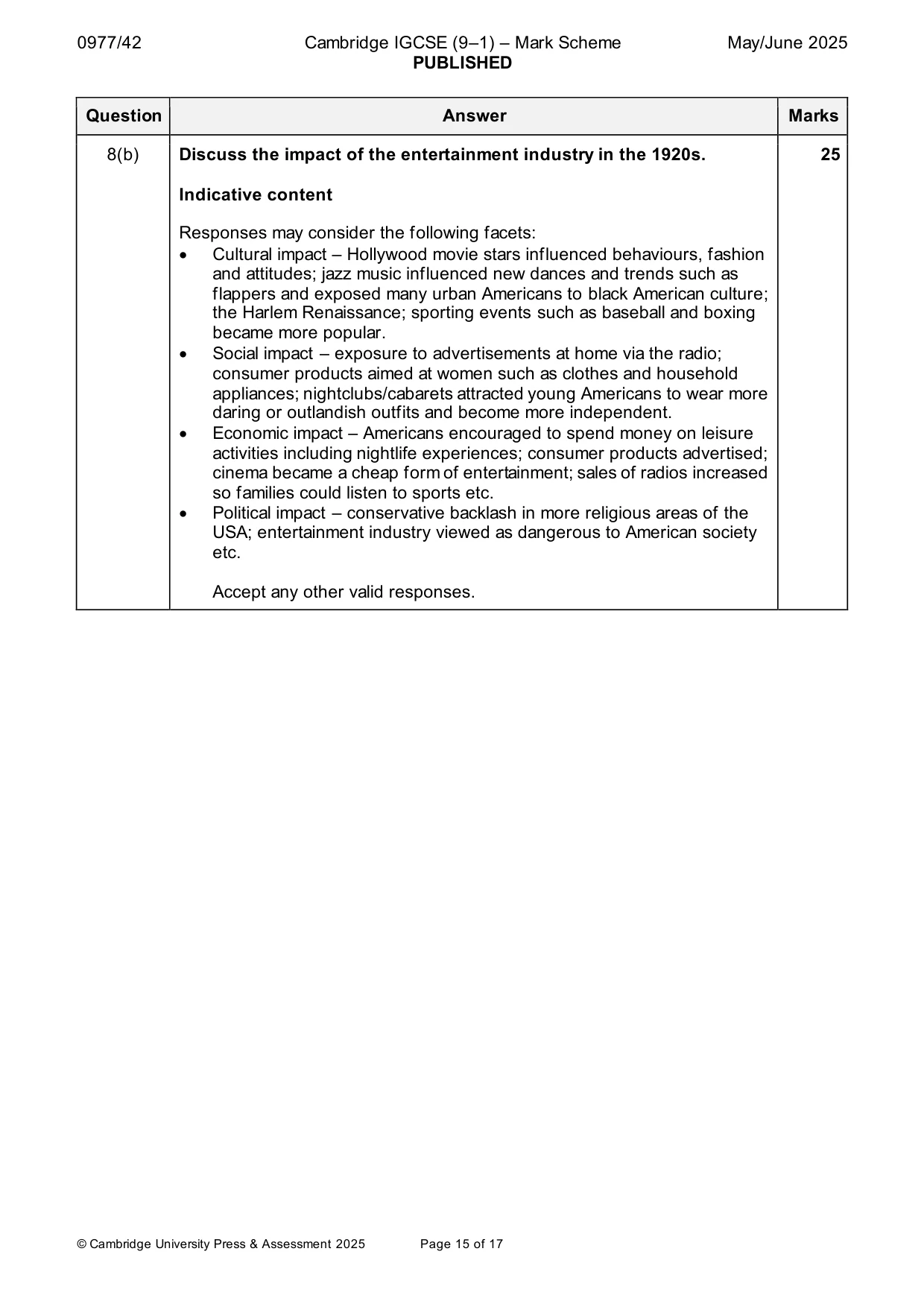
0977/42 Cambridge IGCSE (9–1) – Mark Scheme PUBLISHED May/June 2025 © Cambridge University Press & Assessment 2025 Page 15 of 17 Question Answer Marks 8(b) Discuss the impact of the entertainment industry in the 1920s. Indicative content Responses may consider the following facets: • Cultural impact – Hollywood movie stars influenced behaviours, fashion and attitudes; jazz music influenced new dances and trends such as flappers and exposed many urban Americans to black American culture; the Harlem Renaissance; sporting events such as baseball and boxing became more popular. • Social impact – exposure to advertisements at home via the radio; consumer products aimed at women such as clothes and household appliances; nightclubs/cabarets attracted young Americans to wear more daring or outlandish outfits and become more independent. • Economic impact – Americans encouraged to spend money on leisure activities including nightlife experiences; consumer products advertised; cinema became a cheap form of entertainment; sales of radios increased so families could listen to sports etc. • Political impact – conservative backlash in more religious areas of the USA; entertainment industry viewed as dangerous to American society etc. Accept any other valid responses. 25
Mark scheme, page 16
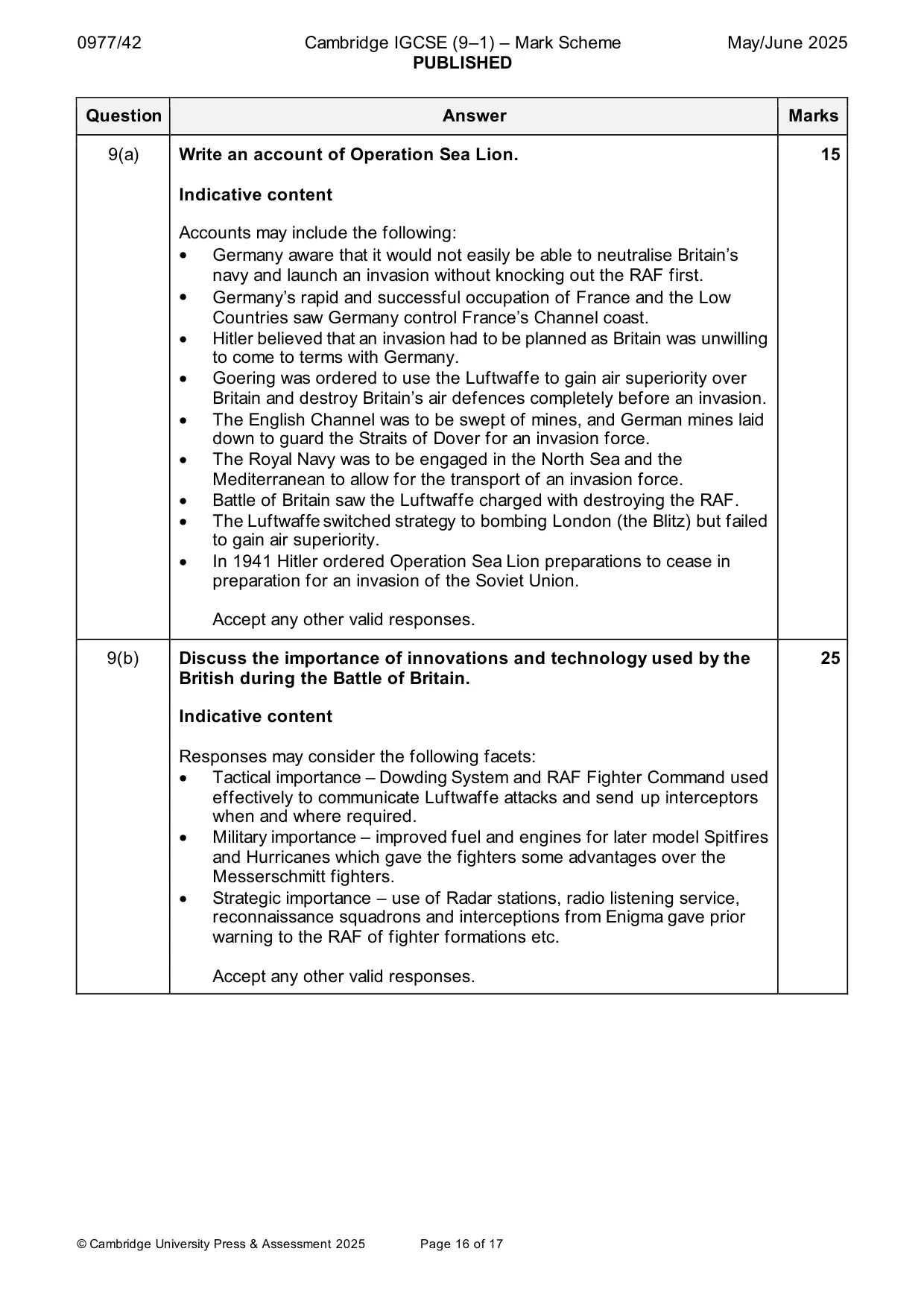
0977/42 Cambridge IGCSE (9–1) – Mark Scheme PUBLISHED May/June 2025 © Cambridge University Press & Assessment 2025 Page 16 of 17 Question Answer Marks 9(a) Write an account of Operation Sea Lion. Indicative content Accounts may include the following: • Germany aware that it would not easily be able to neutralise Britain’s navy and launch an invasion without knocking out the RAF first. • Germany’s rapid and successful occupation of France and the Low Countries saw Germany control France’s Channel coast. • Hitler believed that an invasion had to be planned as Britain was unwilling to come to terms with Germany. • Goering was ordered to use the Luftwaffe to gain air superiority over Britain and destroy Britain’s air defences completely before an invasion. • The English Channel was to be swept of mines, and German mines laid down to guard the Straits of Dover for an invasion force. • The Royal Navy was to be engaged in the North Sea and the Mediterranean to allow for the transport of an invasion force. • Battle of Britain saw the Luftwaffe charged with destroying the RAF. • The Luftwaffe switched strategy to bombing London (the Blitz) but failed to gain air superiority. • In 1941 Hitler ordered Operation Sea Lion preparations to cease in preparation for an invasion of the Soviet Union. Accept any other valid responses. 15 9(b) Discuss the importance of innovations and technology used by the British during the Battle of Britain. Indicative content Responses may consider the following facets: • Tactical importance – Dowding System and RAF Fighter Command used effectively to communicate Luftwaffe attacks and send up interceptors when and where required. • Military importance – improved fuel and engines for later model Spitfires and Hurricanes which gave the fighters some advantages over the Messerschmitt fighters. • Strategic importance – use of Radar stations, radio listening service, reconnaissance squadrons and interceptions from Enigma gave prior warning to the RAF of fighter formations etc. Accept any other valid responses. 25
Mark scheme, page 17
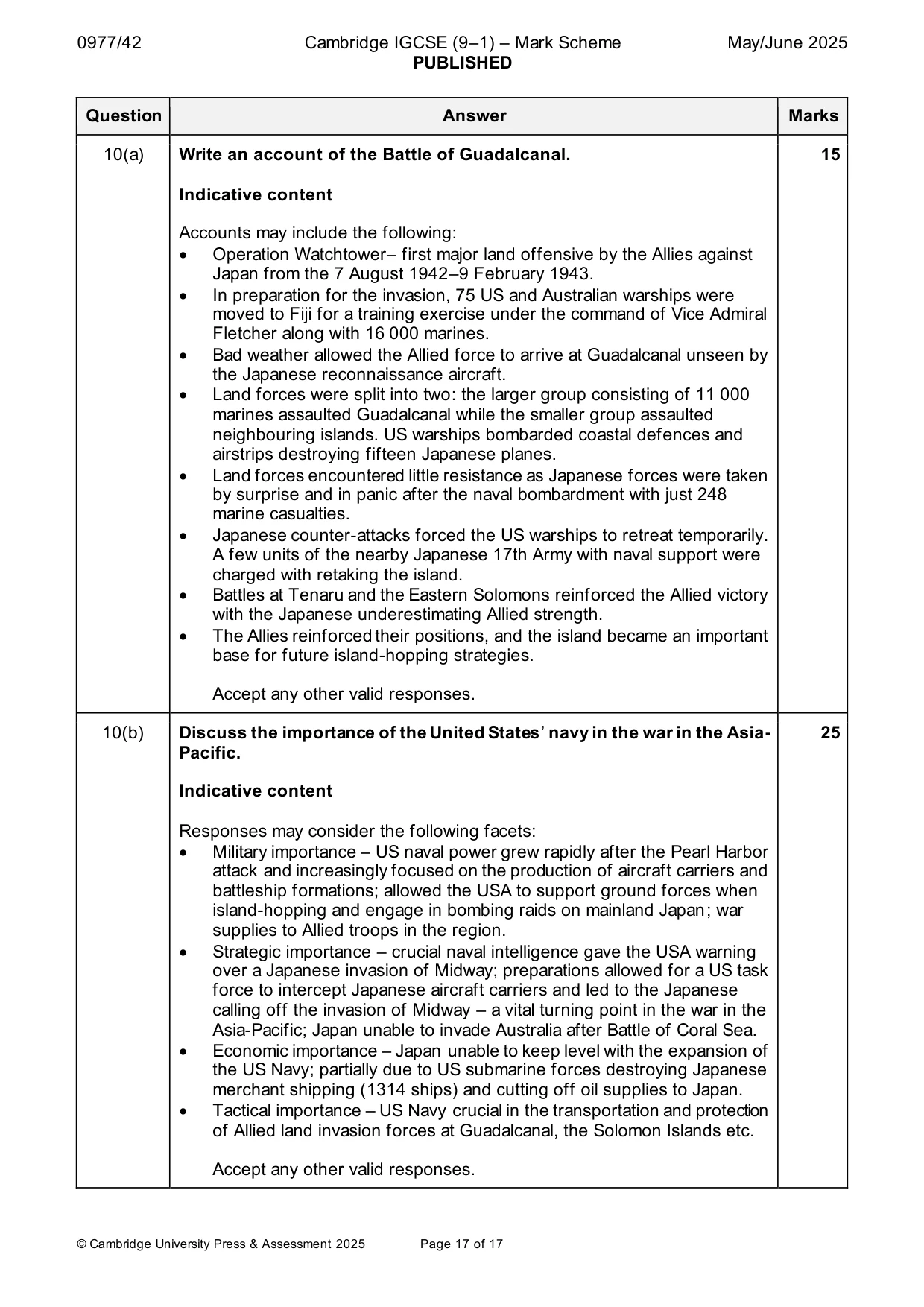
0977/42 Cambridge IGCSE (9–1) – Mark Scheme PUBLISHED May/June 2025 © Cambridge University Press & Assessment 2025 Page 17 of 17 Question Answer Marks 10(a) Write an account of the Battle of Guadalcanal. Indicative content Accounts may include the following: • Operation Watchtower– first major land offensive by the Allies against Japan from the 7 August 1942–9 February 1943. • In preparation for the invasion, 75 US and Australian warships were moved to Fiji for a training exercise under the command of Vice Admiral Fletcher along with 16 000 marines. • Bad weather allowed the Allied force to arrive at Guadalcanal unseen by the Japanese reconnaissance aircraft. • Land forces were split into two: the larger group consisting of 11 000 marines assaulted Guadalcanal while the smaller group assaulted neighbouring islands. US warships bombarded coastal defences and airstrips destroying fifteen Japanese planes. • Land forces encountered little resistance as Japanese forces were taken by surprise and in panic after the naval bombardment with just 248 marine casualties. • Japanese counter-attacks forced the US warships to retreat temporarily. A few units of the nearby Japanese 17th Army with naval support were charged with retaking the island. • Battles at Tenaru and the Eastern Solomons reinforced the Allied victory with the Japanese underestimating Allied strength. • The Allies reinforced their positions, and the island became an important base for future island-hopping strategies. Accept any other valid responses. 15 10(b) Discuss the importance of the United States’ navy in the war in the Asia- Pacific. Indicative content Responses may consider the following facets: • Military importance – US naval power grew rapidly after the Pearl Harbor attack and increasingly focused on the production of aircraft carriers and battleship formations; allowed the USA to support ground forces when island-hopping and engage in bombing raids on mainland Japan; war supplies to Allied troops in the region. • Strategic importance – crucial naval intelligence gave the USA warning over a Japanese invasion of Midway; preparations allowed for a US task force to intercept Japanese aircraft carriers and led to the Japanese calling off the invasion of Midway – a vital turning point in the war in the Asia-Pacific; Japan unable to invade Australia after Battle of Coral Sea. • Economic importance – Japan unable to keep level with the expansion of the US Navy; partially due to US submarine forces destroying Japanese merchant shipping (1314 ships) and cutting off oil supplies to Japan. • Tactical importance – US Navy crucial in the transportation and protection of Allied land invasion forces at Guadalcanal, the Solomon Islands etc. Accept any other valid responses. 25
What you needed in this session
Cambridge’s own grade thresholds for 2025 May/June, Paper 4 · Variant 2. A higher threshold means an easier paper — the bar moves with how the cohort did.