Cambridge IGCSE History (9-1) 0977 — 2020 May/June Paper 4 · Variant 2
0977/42/M/J/20 · 14 questions · 560 marks · ≈630 min
The question paper and its mark scheme, free to read here and free to download. This is Cambridge’s own paper, exactly as it was sat.
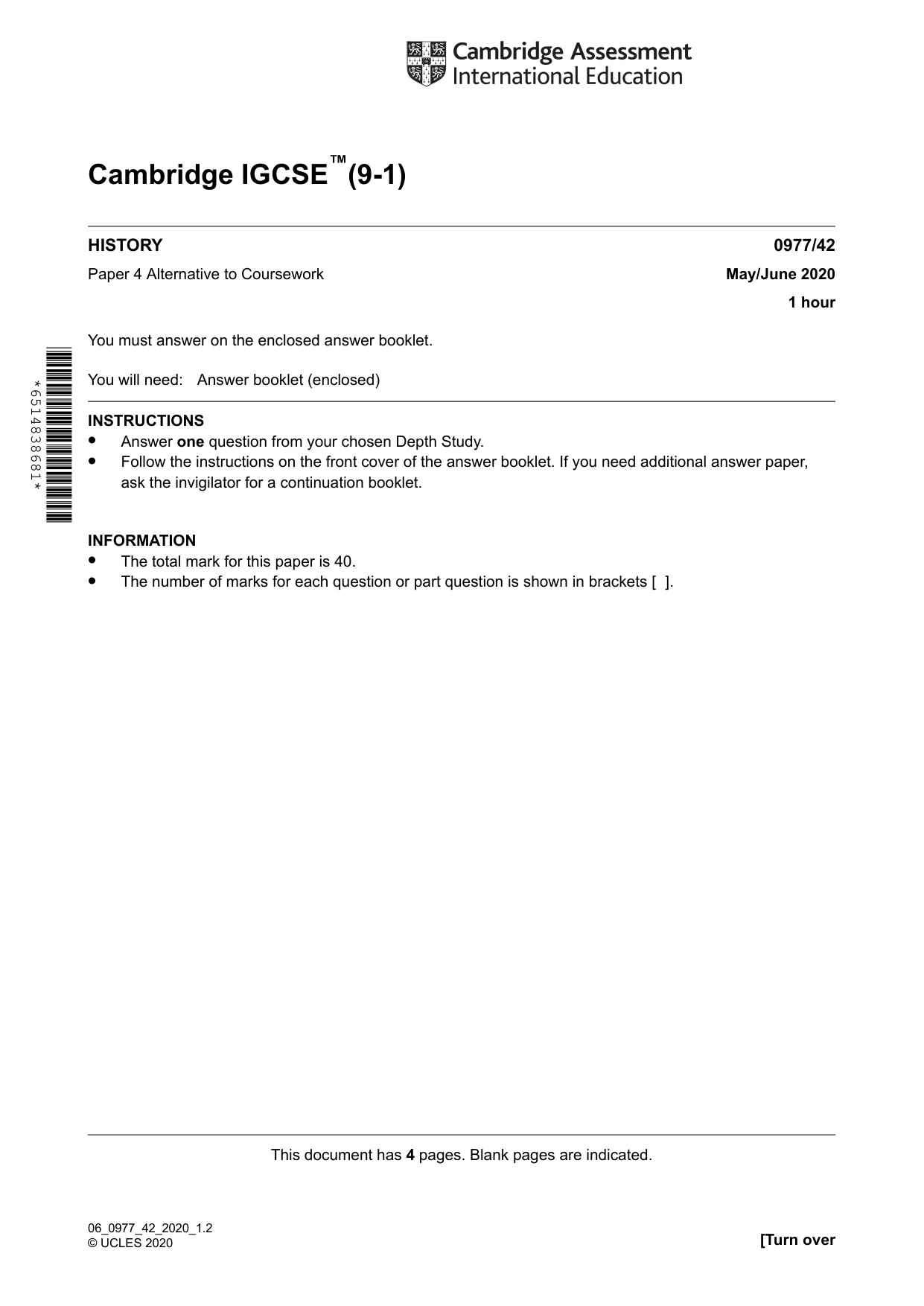
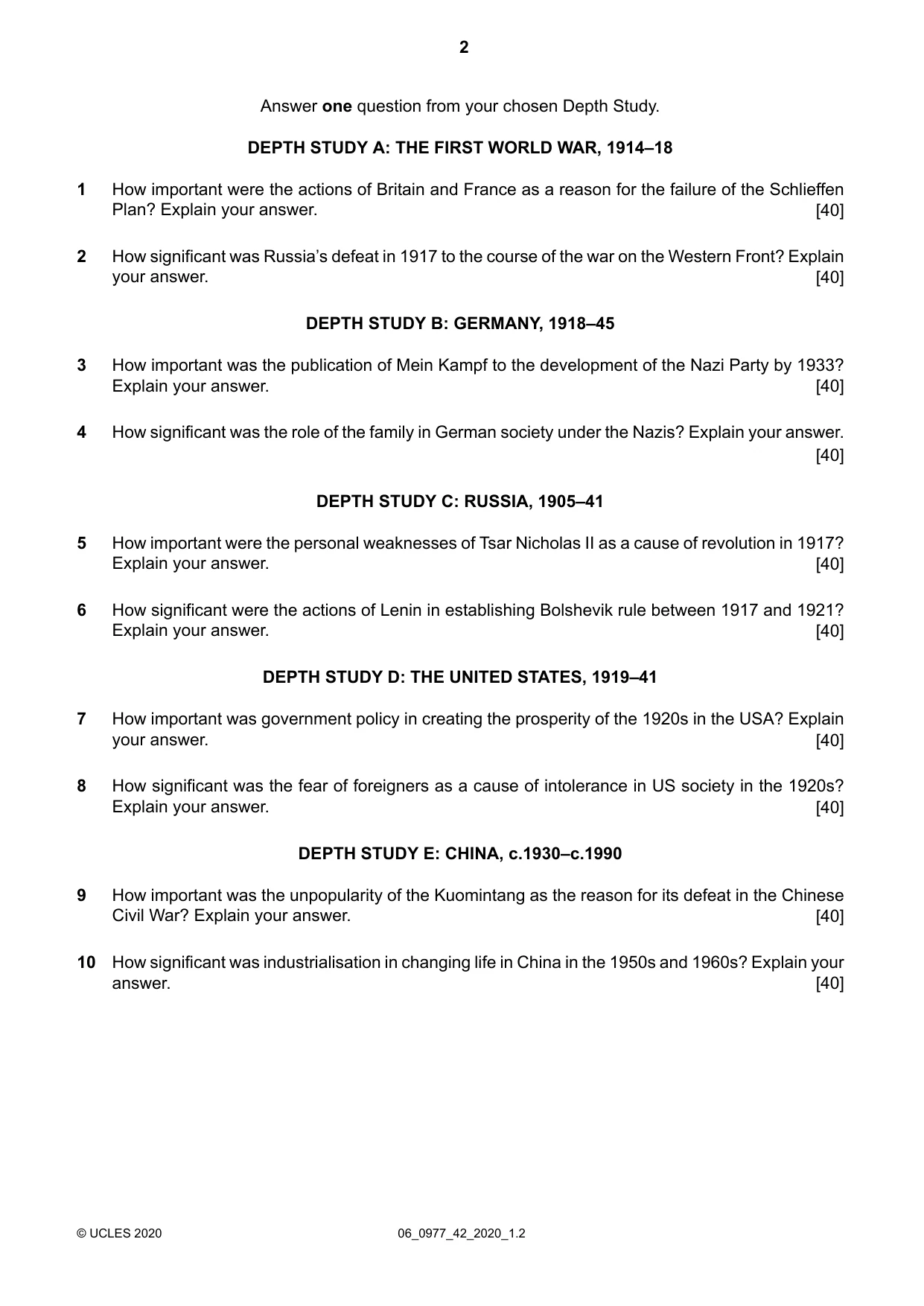
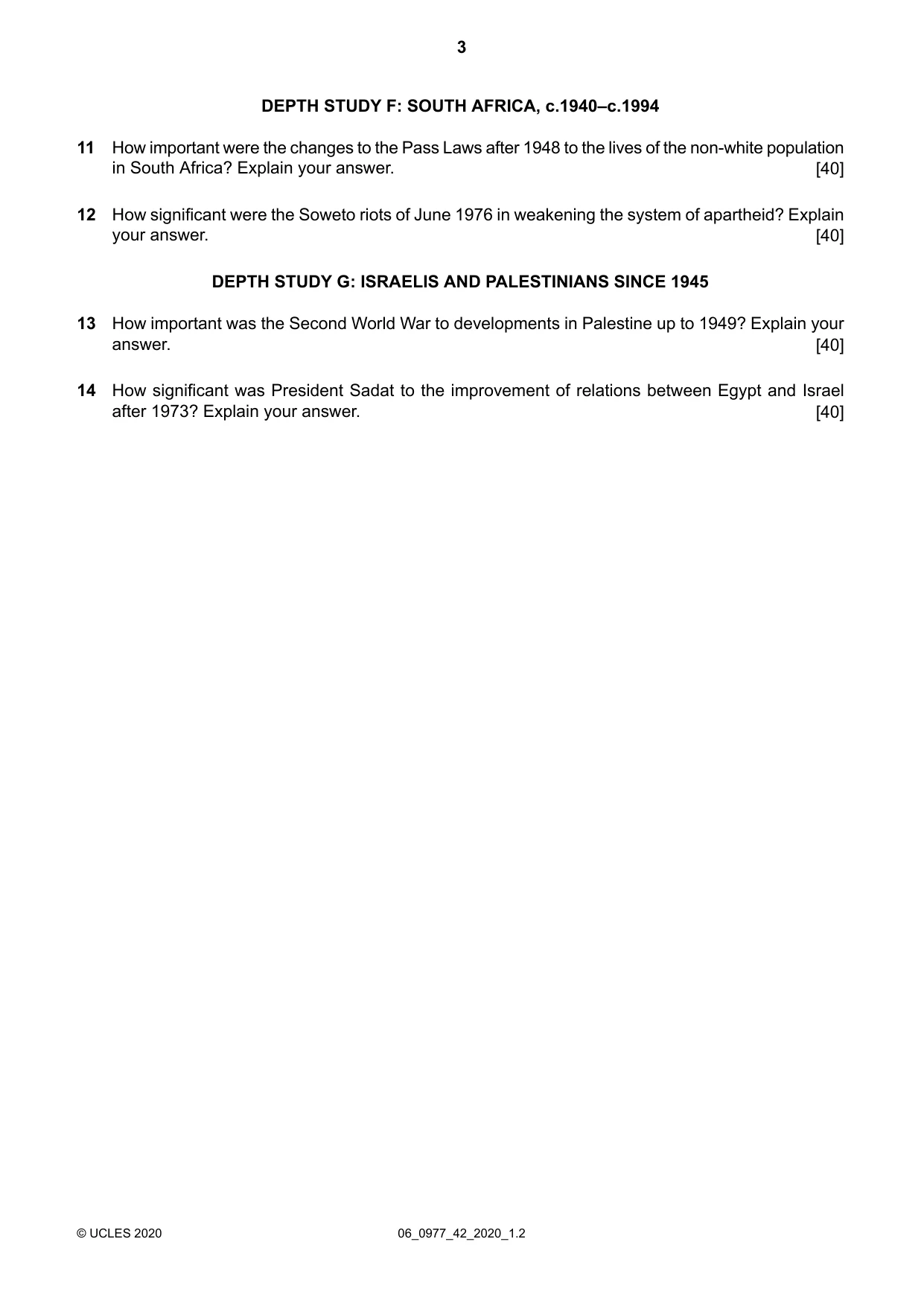
Question paper4 pages

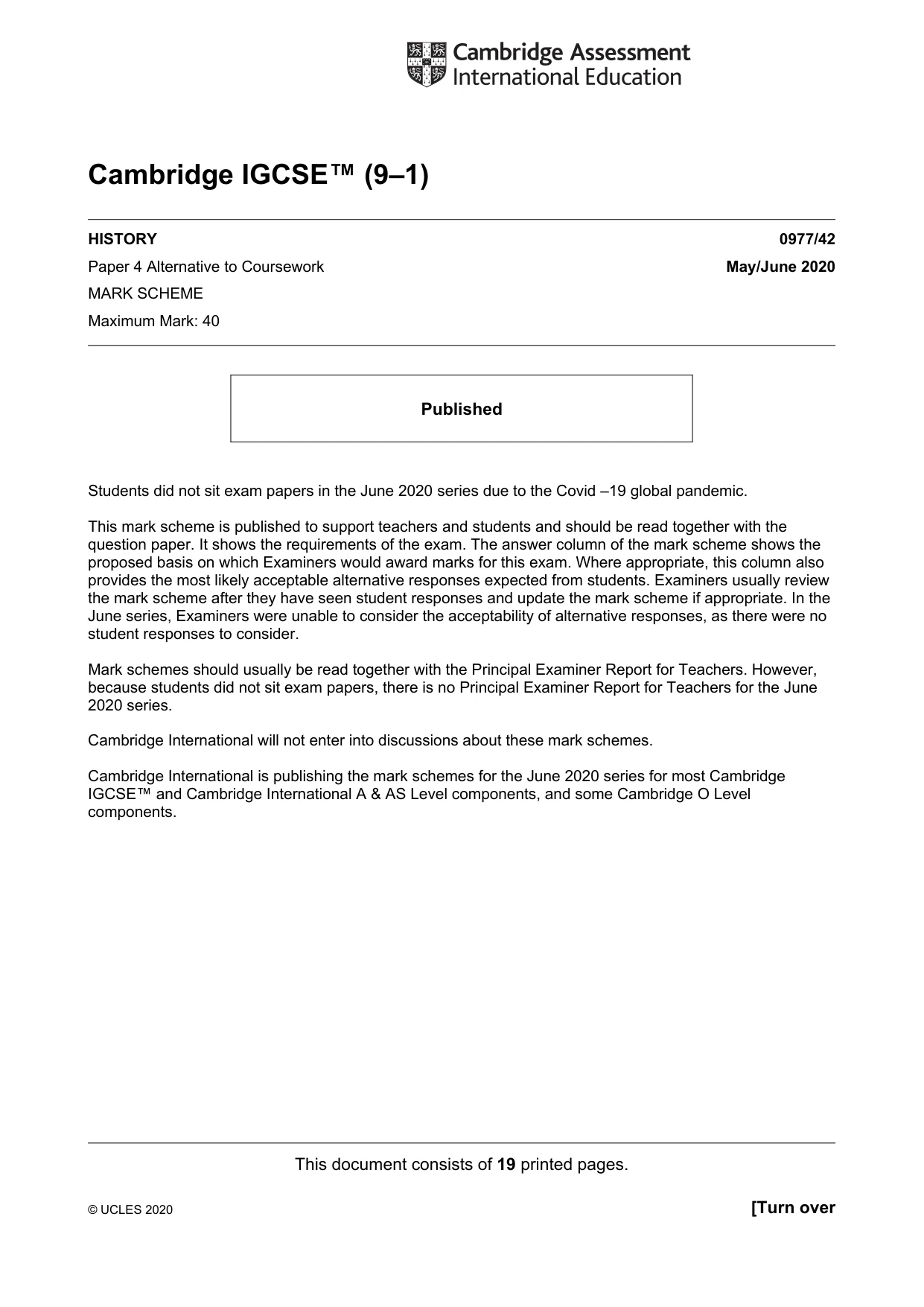
Mark scheme19 pages
Answers below. Sit the paper first if you are practising.
Questions as text
Q1 · How important were the actions of Britain and France as a reason for the failure of the…
1 How important were the actions of Britain and France as a reason for the failure of the Schlieffen Plan? Explain your answer. [40]
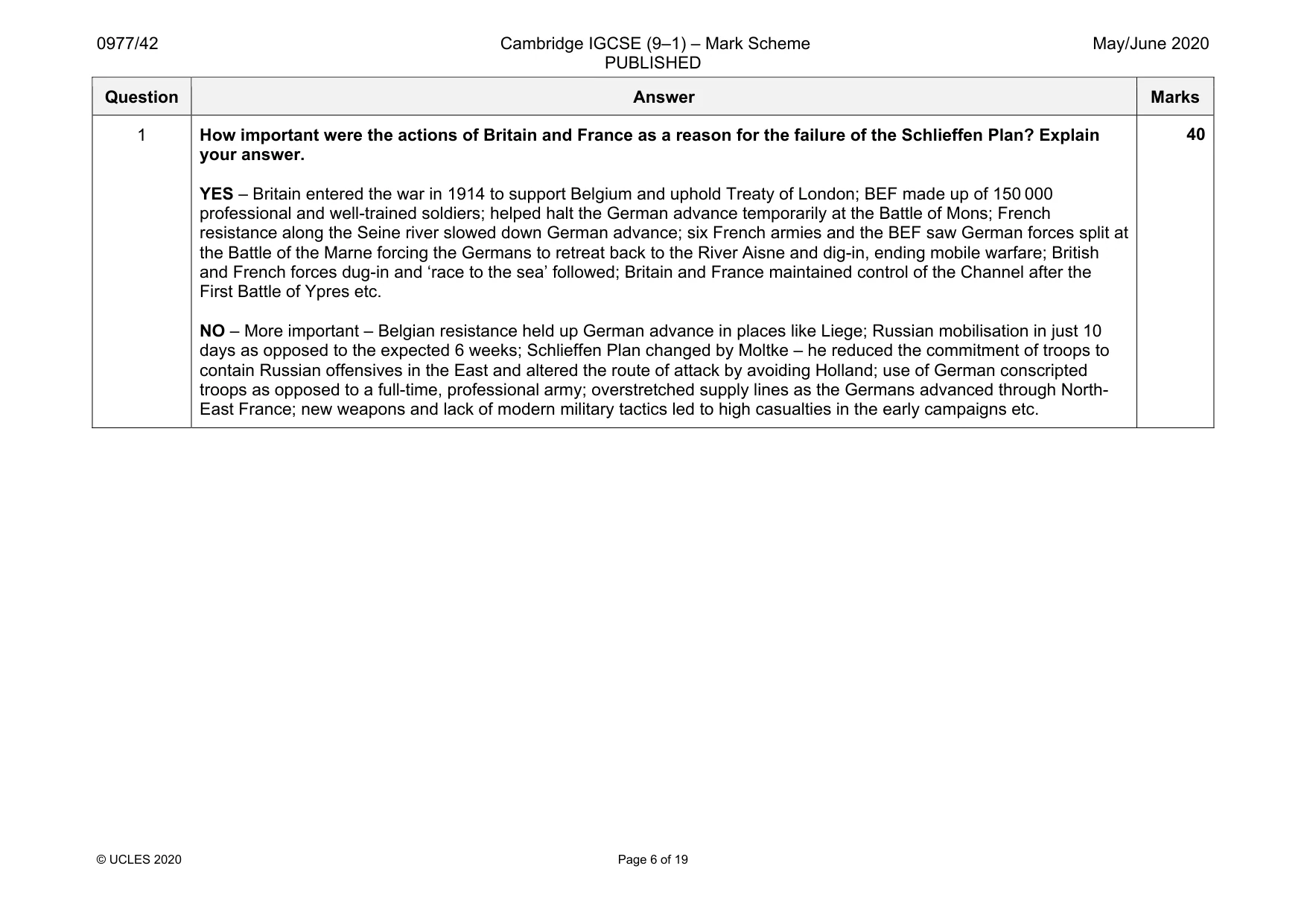
Mark scheme: 1 How important were the actions of Britain and France as a reason for the failure of the Schlieffen Plan? Explain your answer. YES – Britain entered the war in 1914 to support Belgium and uphold Treaty of London; BEF made up of 150 000 professional and well-trained soldiers; helped halt the German advance temporarily at the Battle of Mons; French resistance along the Seine river slowed down German advance; six French armies and the BEF saw German forces split at the Battle of the Marne forcing the Germans to retreat back to the River Aisne and dig-in, ending mobile warfare; British and French forces dug-in and ‘race to the sea’ followed; Britain and France maintained control of the Channel after the First Battle of Ypres etc. NO – More important – Belgian resistance held up German advance in places like Liege; Russian mobilisation in just 10 days as opposed to the expected 6 weeks; Schlieffen Plan changed by Moltke – he reduced the commitment of troops to contain Russian offensives in the East and altered the route of attack by avoiding Holland; use of German conscripted troops as opposed to a full-time, professional army; overstretched supply lines as the Germans advanced through North- East France; new weapons and lack of modern military tactics led to high casualties in the early campaigns etc.
Q2 · How significant was Russia’s defeat in 1917 to the course of the war on the Western Front?
2 How significant was Russia’s defeat in 1917 to the course of the war on the Western Front? Explain your answer. [40] DEPTH STUDY B: GERMANY, 1918–45
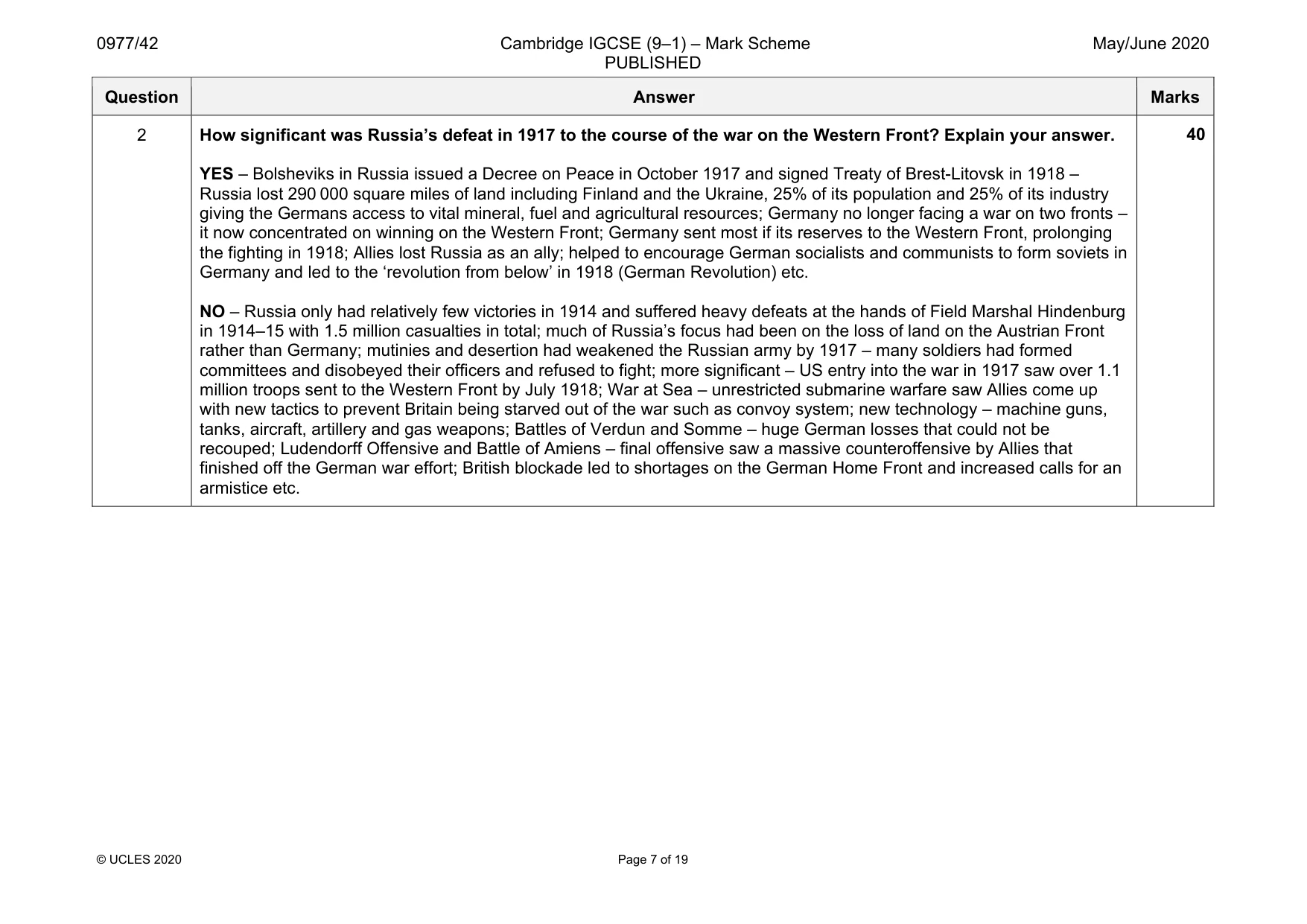
Mark scheme: 2 How significant was Russia’s defeat in 1917 to the course of the war on the Western Front? Explain your answer. YES – Bolsheviks in Russia issued a Decree on Peace in October 1917 and signed Treaty of Brest-Litovsk in 1918 – Russia lost 290 000 square miles of land including Finland and the Ukraine, 25% of its population and 25% of its industry giving the Germans access to vital mineral, fuel and agricultural resources; Germany no longer facing a war on two fronts – it now concentrated on winning on the Western Front; Germany sent most if its reserves to the Western Front, prolonging the fighting in 1918; Allies lost Russia as an ally; helped to encourage German socialists and communists to form soviets in Germany and led to the ‘revolution from below’ in 1918 (German Revolution) etc. NO – Russia only had relatively few victories in 1914 and suffered heavy defeats at the hands of Field Marshal Hindenburg in 1914–15 with 1.5 million casualties in total; much of Russia’s focus had been on the loss of land on the Austrian Front rather than Germany; mutinies and desertion had weakened the Russian army by 1917 – many soldiers had formed committees and disobeyed their officers and refused to fight; more significant – US entry into the war in 1917 saw over 1.1 million troops sent to the Western Front by July 1918; War at Sea – unrestricted submarine warfare saw Allies come up with new tactics to prevent Britain being starved out of the war such as convoy system; new technology – machine guns, tanks, aircraft, artillery and gas weapons; Battles of Verdun and Somme – huge German losses that could not be recouped; Ludendorff Offensive and Battle of Amiens – final offensive saw a massive counteroffensive by Allies that finished off the German war effort; British blockade led to shortages on the German Home Front and increased calls for an armistice etc.
Q3 · How important was the publication of Mein Kampf to the development of the Nazi Party by…
3 How important was the publication of Mein Kampf to the development of the Nazi Party by 1933? Explain your answer. [40]
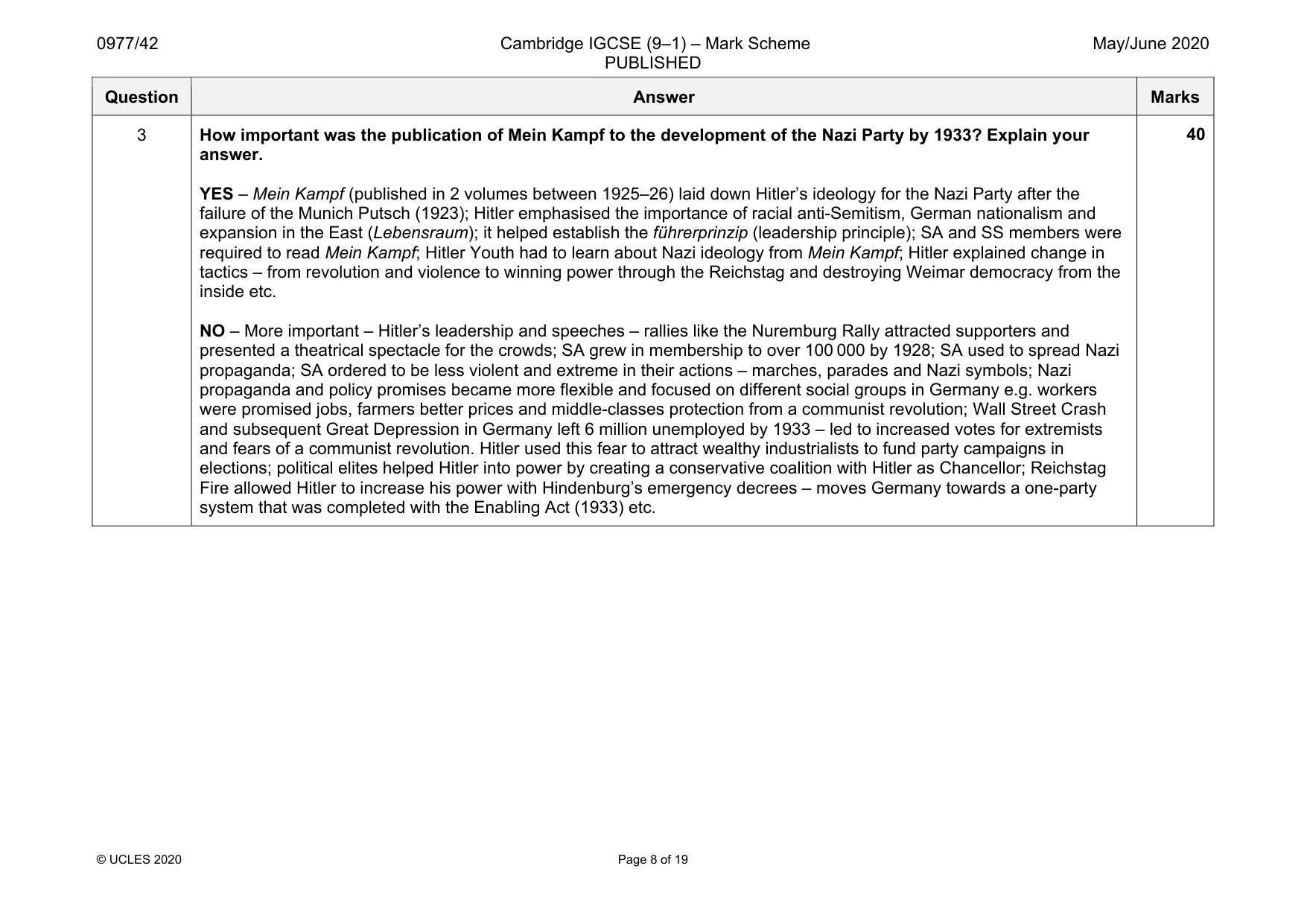
Mark scheme: 3 How important was the publication of Mein Kampf to the development of the Nazi Party by 1933? Explain your answer. YES – Mein Kampf (published in 2 volumes between 1925–26) laid down Hitler’s ideology for the Nazi Party after the failure of the Munich Putsch (1923); Hitler emphasised the importance of racial anti-Semitism, German nationalism and expansion in the East (Lebensraum); it helped establish the führerprinzip (leadership principle); SA and SS members were required to read Mein Kampf; Hitler Youth had to learn about Nazi ideology from Mein Kampf; Hitler explained change in tactics – from revolution and violence to winning power through the Reichstag and destroying Weimar democracy from the inside etc. NO – More important – Hitler’s leadership and speeches – rallies like the Nuremburg Rally attracted supporters and presented a theatrical spectacle for the crowds; SA grew in membership to over 100 000 by 1928; SA used to spread Nazi propaganda; SA ordered to be less violent and extreme in their actions – marches, parades and Nazi symbols; Nazi propaganda and policy promises became more flexible and focused on different social groups in Germany e.g. workers were promised jobs, farmers better prices and middle-classes protection from a communist revolution; Wall Street Crash and subsequent Great Depression in Germany left 6 million unemployed by 1933 – led to increased votes for extremists and fears of a communist revolution. Hitler used this fear to attract wealthy industrialists to fund party campaigns in elections; political elites helped Hitler into power by creating a conservative coalition with Hitler as Chancellor; Reichstag Fire allowed Hitler to increase his power with Hindenburg’s emergency decrees – moves Germany towards a one-party system that was completed with the Enabling Act (1933) etc.
Q4 · How significant was the role of the family in German society under the Nazis?
4 How significant was the role of the family in German society under the Nazis? Explain your answer. [40] DEPTH STUDY C: RUSSIA, 1905–41
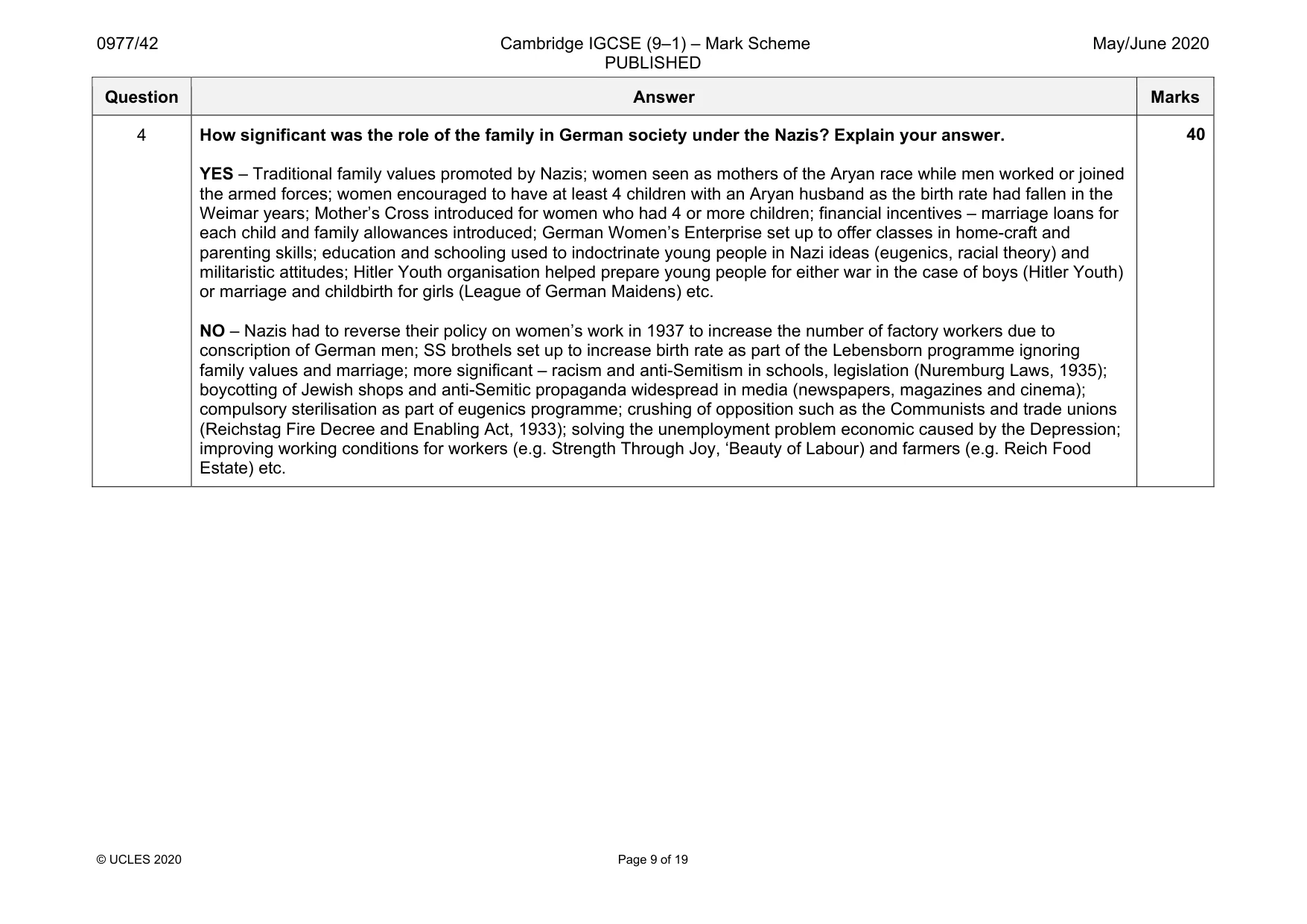
Mark scheme: 4 How significant was the role of the family in German society under the Nazis? Explain your answer. YES – Traditional family values promoted by Nazis; women seen as mothers of the Aryan race while men worked or joined the armed forces; women encouraged to have at least 4 children with an Aryan husband as the birth rate had fallen in the Weimar years; Mother’s Cross introduced for women who had 4 or more children; financial incentives – marriage loans for each child and family allowances introduced; German Women’s Enterprise set up to offer classes in home-craft and parenting skills; education and schooling used to indoctrinate young people in Nazi ideas (eugenics, racial theory) and militaristic attitudes; Hitler Youth organisation helped prepare young people for either war in the case of boys (Hitler Youth) or marriage and childbirth for girls (League of German Maidens) etc. NO – Nazis had to reverse their policy on women’s work in 1937 to increase the number of factory workers due to conscription of German men; SS brothels set up to increase birth rate as part of the Lebensborn programme ignoring family values and marriage; more significant – racism and anti-Semitism in schools, legislation (Nuremburg Laws, 1935); boycotting of Jewish shops and anti-Semitic propaganda widespread in media (newspapers, magazines and cinema); compulsory sterilisation as part of eugenics programme; crushing of opposition such as the Communists and trade unions (Reichstag Fire Decree and Enabling Act, 1933); solving the unemployment problem economic caused by the Depression; improving working conditions for workers (e.g. Strength Through Joy, ‘Beauty of Labour) and farmers (e.g. Reich Food Estate) etc.
Q5 · How important were the personal weaknesses of Tsar Nicholas II as a cause of revolution…
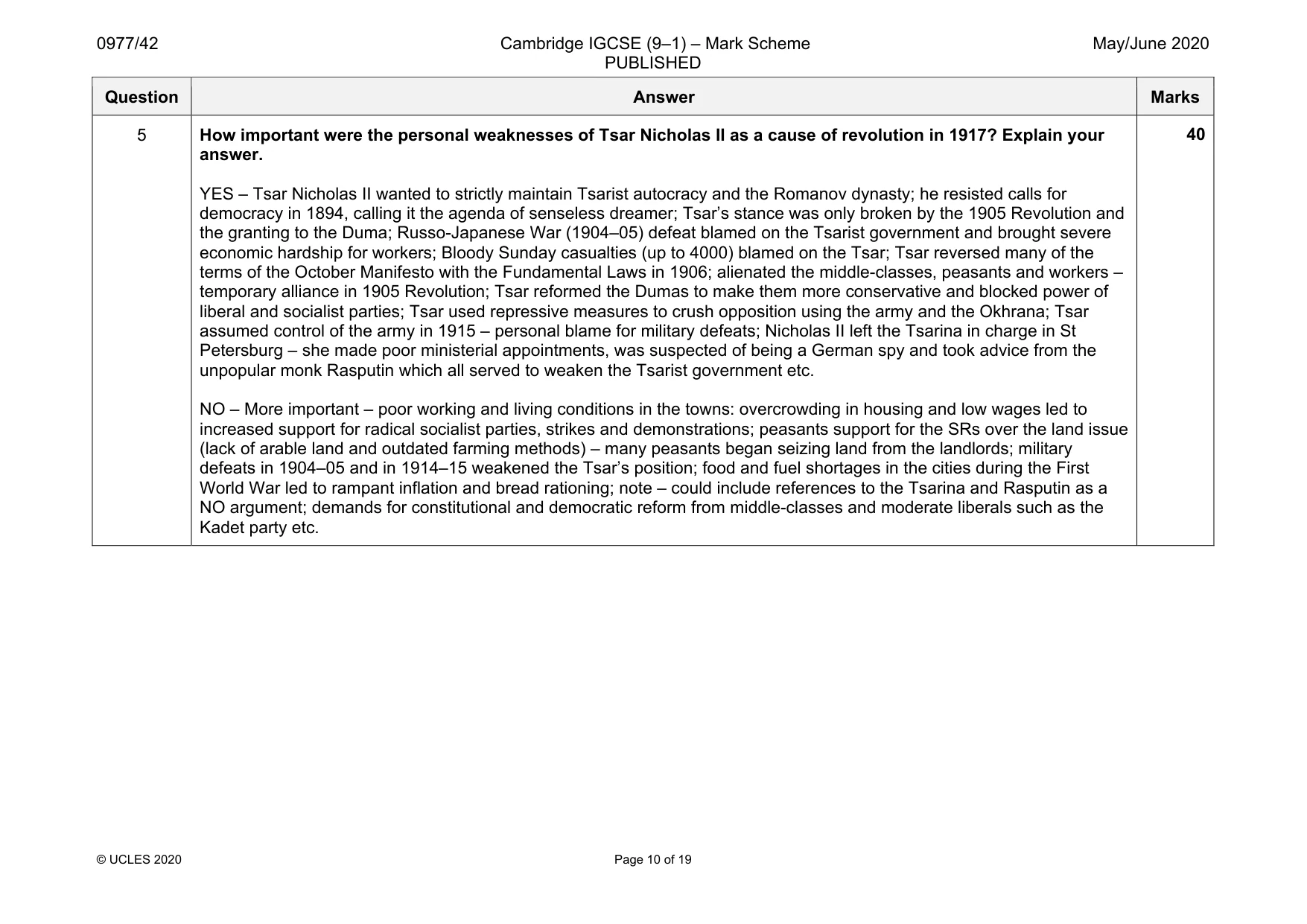
5 How important were the personal weaknesses of Tsar Nicholas II as a cause of revolution in 1917? Explain your answer. [40]
Mark scheme: 5 How important were the personal weaknesses of Tsar Nicholas II as a cause of revolution in 1917? Explain your answer. YES – Tsar Nicholas II wanted to strictly maintain Tsarist autocracy and the Romanov dynasty; he resisted calls for democracy in 1894, calling it the agenda of senseless dreamer; Tsar’s stance was only broken by the 1905 Revolution and the granting to the Duma; Russo-Japanese War (1904–05) defeat blamed on the Tsarist government and brought severe economic hardship for workers; Bloody Sunday casualties (up to 4000) blamed on the Tsar; Tsar reversed many of the terms of the October Manifesto with the Fundamental Laws in 1906; alienated the middle-classes, peasants and workers – temporary alliance in 1905 Revolution; Tsar reformed the Dumas to make them more conservative and blocked power of liberal and socialist parties; Tsar used repressive measures to crush opposition using the army and the Okhrana; Tsar assumed control of the army in 1915 – personal blame for military defeats; Nicholas II left the Tsarina in charge in St Petersburg – she made poor ministerial appointments, was suspected of being a German spy and took advice from the unpopular monk Rasputin which all served to weaken the Tsarist government etc. NO – More important – poor working and living conditions in the towns: overcrowding in housing and low wages led to increased support for radical socialist parties, strikes and demonstrations; peasants support for the SRs over the land issue (lack of arable land and outdated farming methods) – many peasants began seizing land from the landlords; military defeats in 1904–05 and in 1914–15 weakened the Tsar’s position; food and fuel shortages in the cities during the First World War led to rampant inflation and bread rationing; note – could include references to the Tsarina and Rasputin as a NO argument; demands for constitutional and democratic reform from middle-classes and moderate liberals such as the Kadet party etc.
Q6 · How significant were the actions of Lenin in establishing Bolshevik rule between 1917 and…
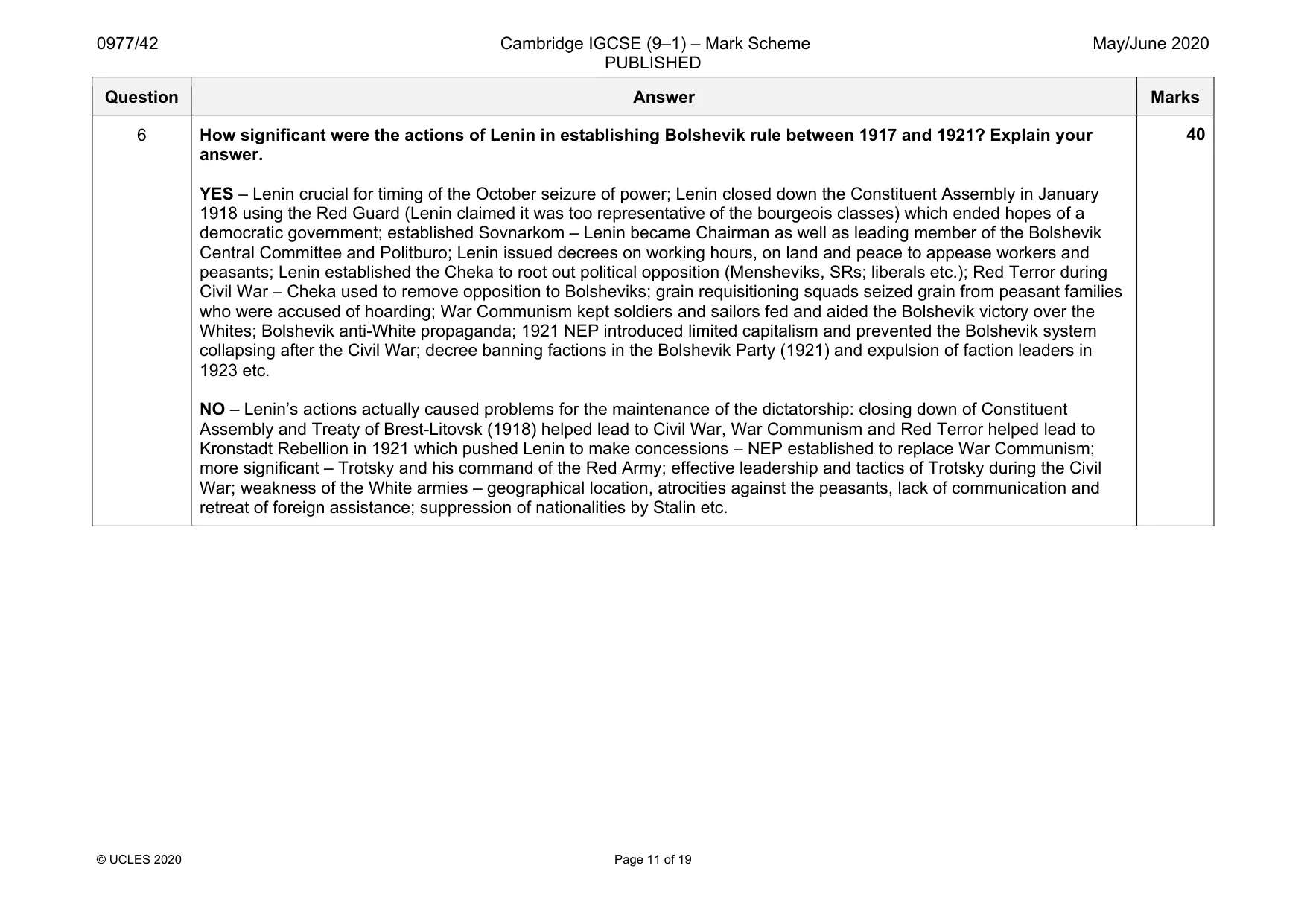
6 How significant were the actions of Lenin in establishing Bolshevik rule between 1917 and 1921? Explain your answer. [40] DEPTH STUDY D: THE UNITED STATES, 1919–41
Mark scheme: 6 How significant were the actions of Lenin in establishing Bolshevik rule between 1917 and 1921? Explain your answer. YES – Lenin crucial for timing of the October seizure of power; Lenin closed down the Constituent Assembly in January 1918 using the Red Guard (Lenin claimed it was too representative of the bourgeois classes) which ended hopes of a democratic government; established Sovnarkom – Lenin became Chairman as well as leading member of the Bolshevik Central Committee and Politburo; Lenin issued decrees on working hours, on land and peace to appease workers and peasants; Lenin established the Cheka to root out political opposition (Mensheviks, SRs; liberals etc.); Red Terror during Civil War – Cheka used to remove opposition to Bolsheviks; grain requisitioning squads seized grain from peasant families who were accused of hoarding; War Communism kept soldiers and sailors fed and aided the Bolshevik victory over the Whites; Bolshevik anti-White propaganda; 1921 NEP introduced limited capitalism and prevented the Bolshevik system collapsing after the Civil War; decree banning factions in the Bolshevik Party (1921) and expulsion of faction leaders in 1923 etc. NO – Lenin’s actions actually caused problems for the maintenance of the dictatorship: closing down of Constituent Assembly and Treaty of Brest-Litovsk (1918) helped lead to Civil War, War Communism and Red Terror helped lead to Kronstadt Rebellion in 1921 which pushed Lenin to make concessions – NEP established to replace War Communism; more significant – Trotsky and his command of the Red Army; effective leadership and tactics of Trotsky during the Civil War; weakness of the White armies – geographical location, atrocities against the peasants, lack of communication and retreat of foreign assistance; suppression of nationalities by Stalin etc.
Q7 · How important was government policy in creating the prosperity of the 1920s in the USA?
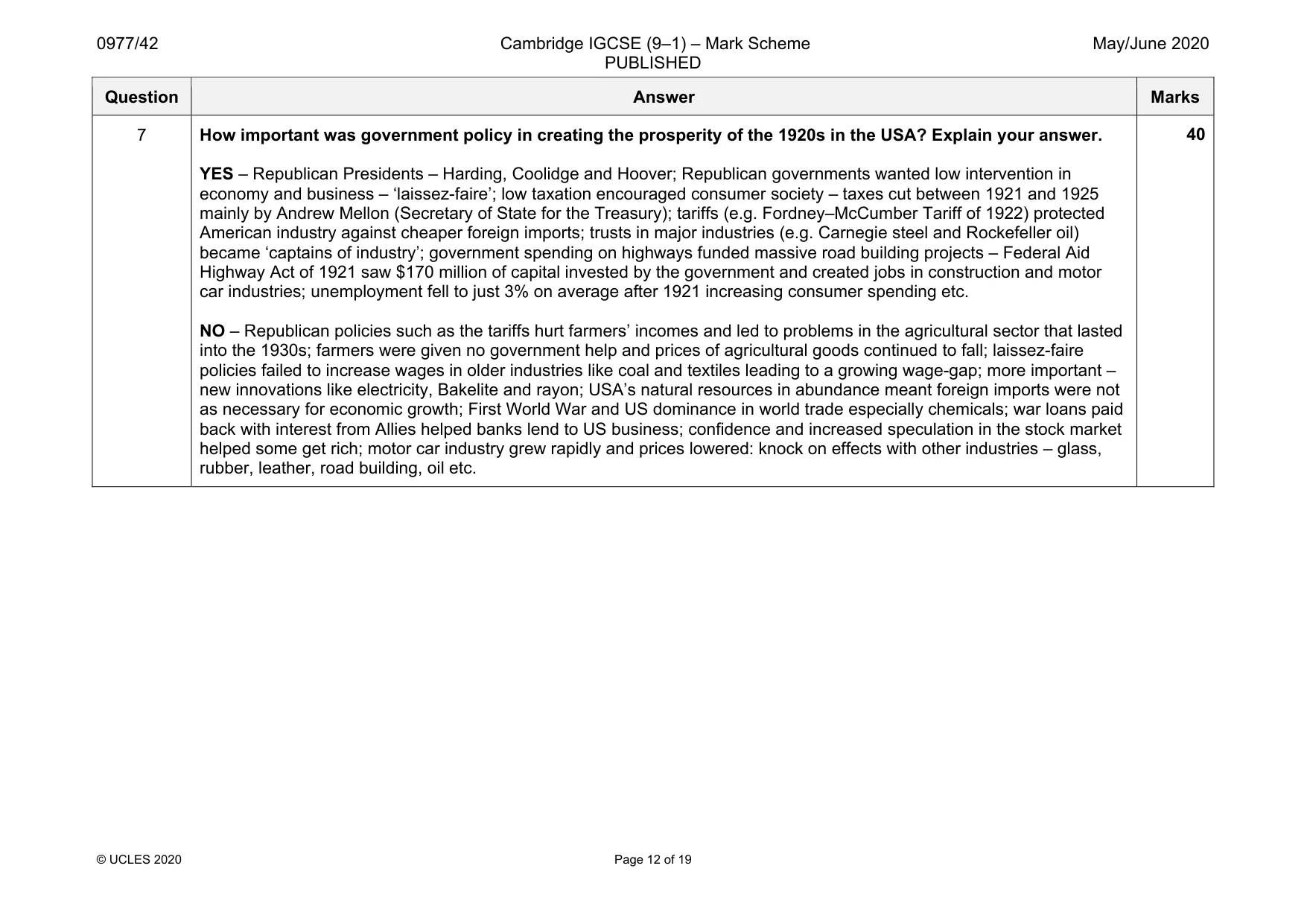
7 How important was government policy in creating the prosperity of the 1920s in the USA? Explain your answer. [40]
Mark scheme: 7 How important was government policy in creating the prosperity of the 1920s in the USA? Explain your answer. YES – Republican Presidents – Harding, Coolidge and Hoover; Republican governments wanted low intervention in economy and business – ‘laissez-faire’; low taxation encouraged consumer society – taxes cut between 1921 and 1925 mainly by Andrew Mellon (Secretary of State for the Treasury); tariffs (e.g. Fordney–McCumber Tariff of 1922) protected American industry against cheaper foreign imports; trusts in major industries (e.g. Carnegie steel and Rockefeller oil) became ‘captains of industry’; government spending on highways funded massive road building projects – Federal Aid Highway Act of 1921 saw $170 million of capital invested by the government and created jobs in construction and motor car industries; unemployment fell to just 3% on average after 1921 increasing consumer spending etc. NO – Republican policies such as the tariffs hurt farmers’ incomes and led to problems in the agricultural sector that lasted into the 1930s; farmers were given no government help and prices of agricultural goods continued to fall; laissez-faire policies failed to increase wages in older industries like coal and textiles leading to a growing wage-gap; more important – new innovations like electricity, Bakelite and rayon; USA’s natural resources in abundance meant foreign imports were not as necessary for economic growth; First World War and US dominance in world trade especially chemicals; war loans paid back with interest from Allies helped banks lend to US business; confidence and increased speculation in the stock market helped some get rich; motor car industry grew rapidly and prices lowered: knock on effects with other industries – glass, rubber, leather, road building, oil etc.
Q8 · How significant was the fear of foreigners as a cause of intolerance in US society in the…
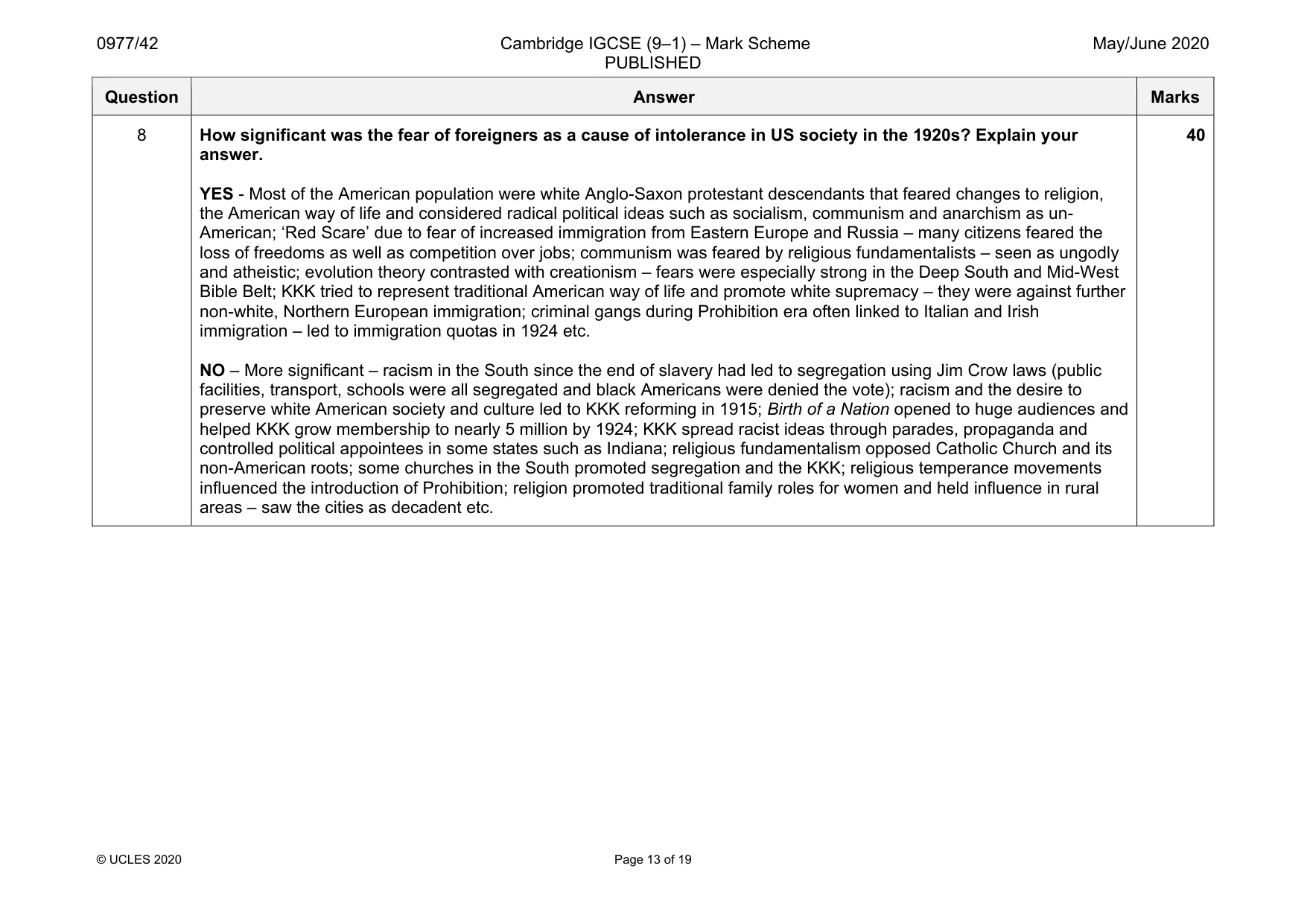
8 How significant was the fear of foreigners as a cause of intolerance in US society in the 1920s? Explain your answer. [40] DEPTH STUDY E: CHINA, c.1930–c.1990
Mark scheme: 8 How significant was the fear of foreigners as a cause of intolerance in US society in the 1920s? Explain your answer. YES - Most of the American population were white Anglo-Saxon protestant descendants that feared changes to religion, the American way of life and considered radical political ideas such as socialism, communism and anarchism as un- American; ‘Red Scare’ due to fear of increased immigration from Eastern Europe and Russia – many citizens feared the loss of freedoms as well as competition over jobs; communism was feared by religious fundamentalists – seen as ungodly and atheistic; evolution theory contrasted with creationism – fears were especially strong in the Deep South and Mid-West Bible Belt; KKK tried to represent traditional American way of life and promote white supremacy – they were against further non-white, Northern European immigration; criminal gangs during Prohibition era often linked to Italian and Irish immigration – led to immigration quotas in 1924 etc. NO – More significant – racism in the South since the end of slavery had led to segregation using Jim Crow laws (public facilities, transport, schools were all segregated and black Americans were denied the vote); racism and the desire to preserve white American society and culture led to KKK reforming in 1915; Birth of a Nation opened to huge audiences and helped KKK grow membership to nearly 5 million by 1924; KKK spread racist ideas through parades, propaganda and controlled political appointees in some states such as Indiana; religious fundamentalism opposed Catholic Church and its non-American roots; some churches in the South promoted segregation and the KKK; religious temperance movements influenced the introduction of Prohibition; religion promoted traditional family roles for women and held influence in rural areas – saw the cities as decadent etc. 40
Q9 · How important was the unpopularity of the Kuomintang as the reason for its defeat in the…
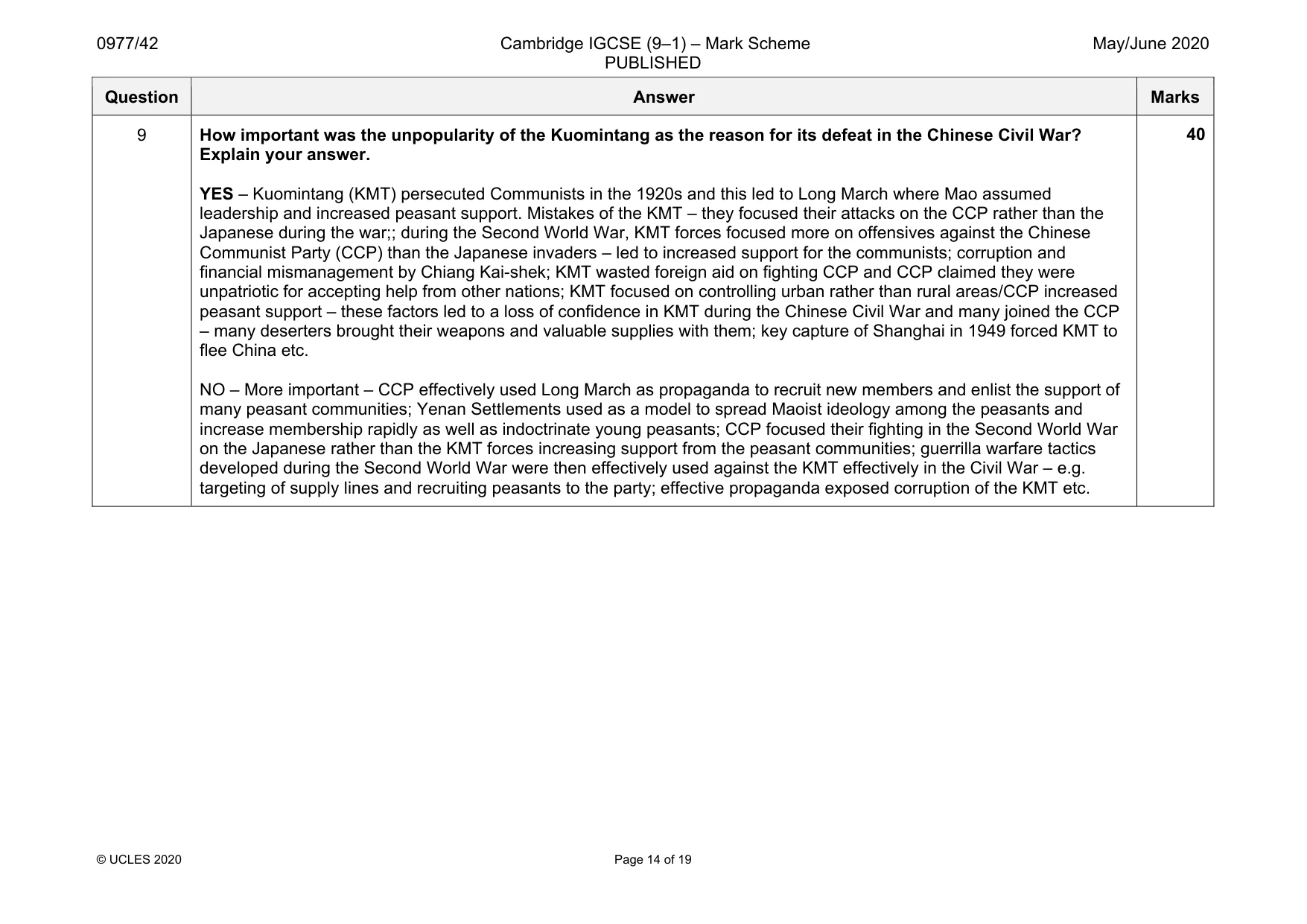
9 How important was the unpopularity of the Kuomintang as the reason for its defeat in the Chinese Civil War? Explain your answer. [40]
Mark scheme: 9 How important was the unpopularity of the Kuomintang as the reason for its defeat in the Chinese Civil War? Explain your answer. YES – Kuomintang (KMT) persecuted Communists in the 1920s and this led to Long March where Mao assumed leadership and increased peasant support. Mistakes of the KMT – they focused their attacks on the CCP rather than the Japanese during the war;; during the Second World War, KMT forces focused more on offensives against the Chinese Communist Party (CCP) than the Japanese invaders – led to increased support for the communists; corruption and financial mismanagement by Chiang Kai-shek; KMT wasted foreign aid on fighting CCP and CCP claimed they were unpatriotic for accepting help from other nations; KMT focused on controlling urban rather than rural areas/CCP increased peasant support – these factors led to a loss of confidence in KMT during the Chinese Civil War and many joined the CCP – many deserters brought their weapons and valuable supplies with them; key capture of Shanghai in 1949 forced KMT to flee China etc. NO – More important – CCP effectively used Long March as propaganda to recruit new members and enlist the support of many peasant communities; Yenan Settlements used as a model to spread Maoist ideology among the peasants and increase membership rapidly as well as indoctrinate young peasants; CCP focused their fighting in the Second World War on the Japanese rather than the KMT forces increasing support from the peasant communities; guerrilla warfare tactics developed during the Second World War were then effectively used against the KMT effectively in the Civil War – e.g. targeting of supply lines and recruiting peasants to the party; effective propaganda exposed corruption of the KMT etc.
Q10 · DEPTH STUDY F: SOUTH AFRICA, c.1940–c.1994
DEPTH STUDY F: SOUTH AFRICA, c.1940–c.1994
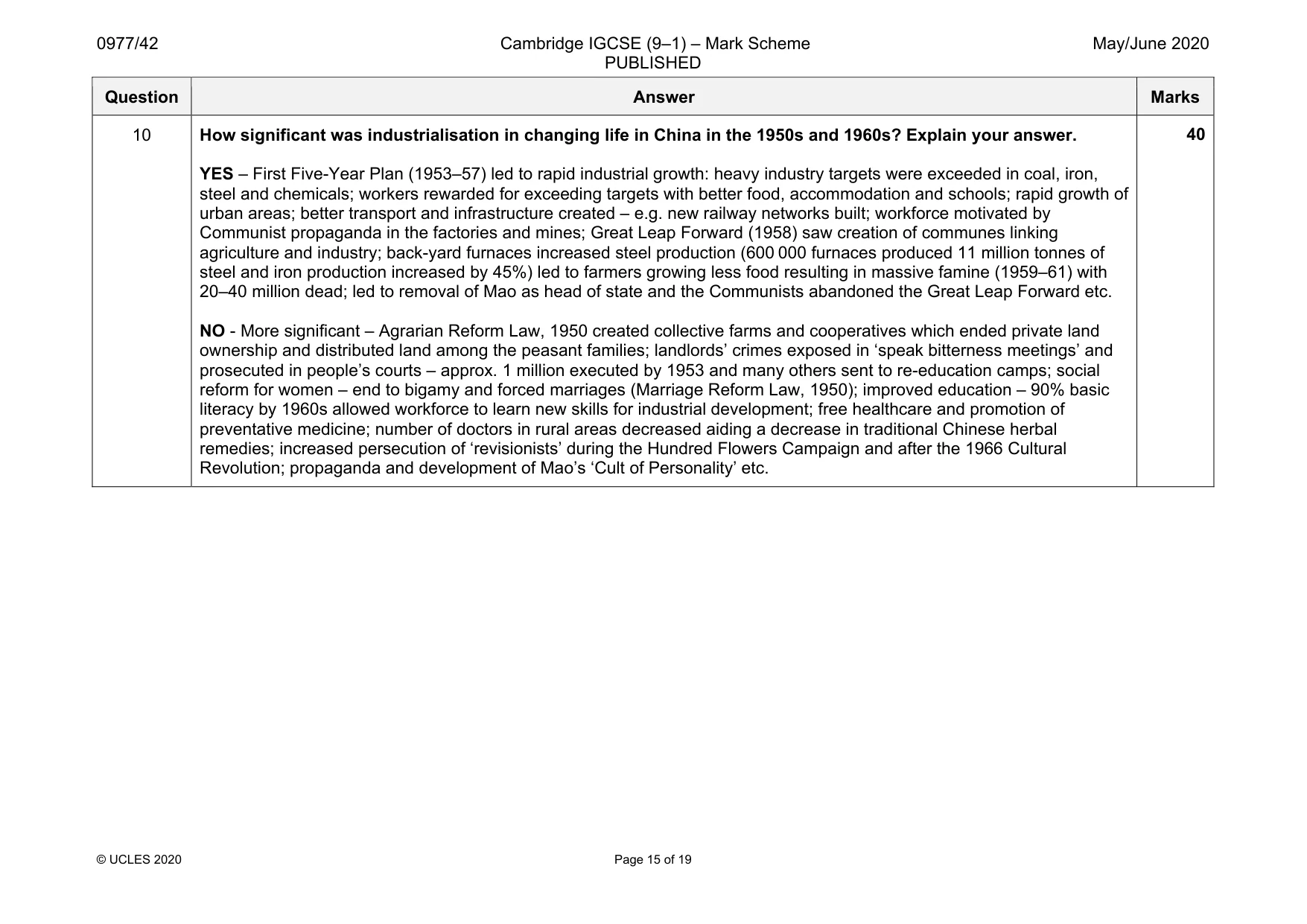
Mark scheme: 10 How significant was industrialisation in changing life in China in the 1950s and 1960s? Explain your answer. YES – First Five-Year Plan (1953–57) led to rapid industrial growth: heavy industry targets were exceeded in coal, iron, steel and chemicals; workers rewarded for exceeding targets with better food, accommodation and schools; rapid growth of urban areas; better transport and infrastructure created – e.g. new railway networks built; workforce motivated by Communist propaganda in the factories and mines; Great Leap Forward (1958) saw creation of communes linking agriculture and industry; back-yard furnaces increased steel production (600 000 furnaces produced 11 million tonnes of steel and iron production increased by 45%) led to farmers growing less food resulting in massive famine (1959–61) with 20–40 million dead; led to removal of Mao as head of state and the Communists abandoned the Great Leap Forward etc. NO - More significant – Agrarian Reform Law, 1950 created collective farms and cooperatives which ended private land ownership and distributed land among the peasant families; landlords’ crimes exposed in ‘speak bitterness meetings’ and prosecuted in people’s courts – approx. 1 million executed by 1953 and many others sent to re-education camps; social reform for women – end to bigamy and forced marriages (Marriage Reform Law, 1950); improved education – 90% basic literacy by 1960s allowed workforce to learn new skills for industrial development; free healthcare and promotion of preventative medicine; number of doctors in rural areas decreased aiding a decrease in traditional Chinese herbal remedies; increased persecution of ‘revisionists’ during the Hundred Flowers Campaign and after the 1966 Cultural Revolution; propaganda and development of Mao’s ‘Cult of Personality’ etc.
Q11 · How important were the changes to the Pass Laws after 1948 to the lives of the non-white…
11 How important were the changes to the Pass Laws after 1948 to the lives of the non-white population in South Africa? Explain your answer. [40]
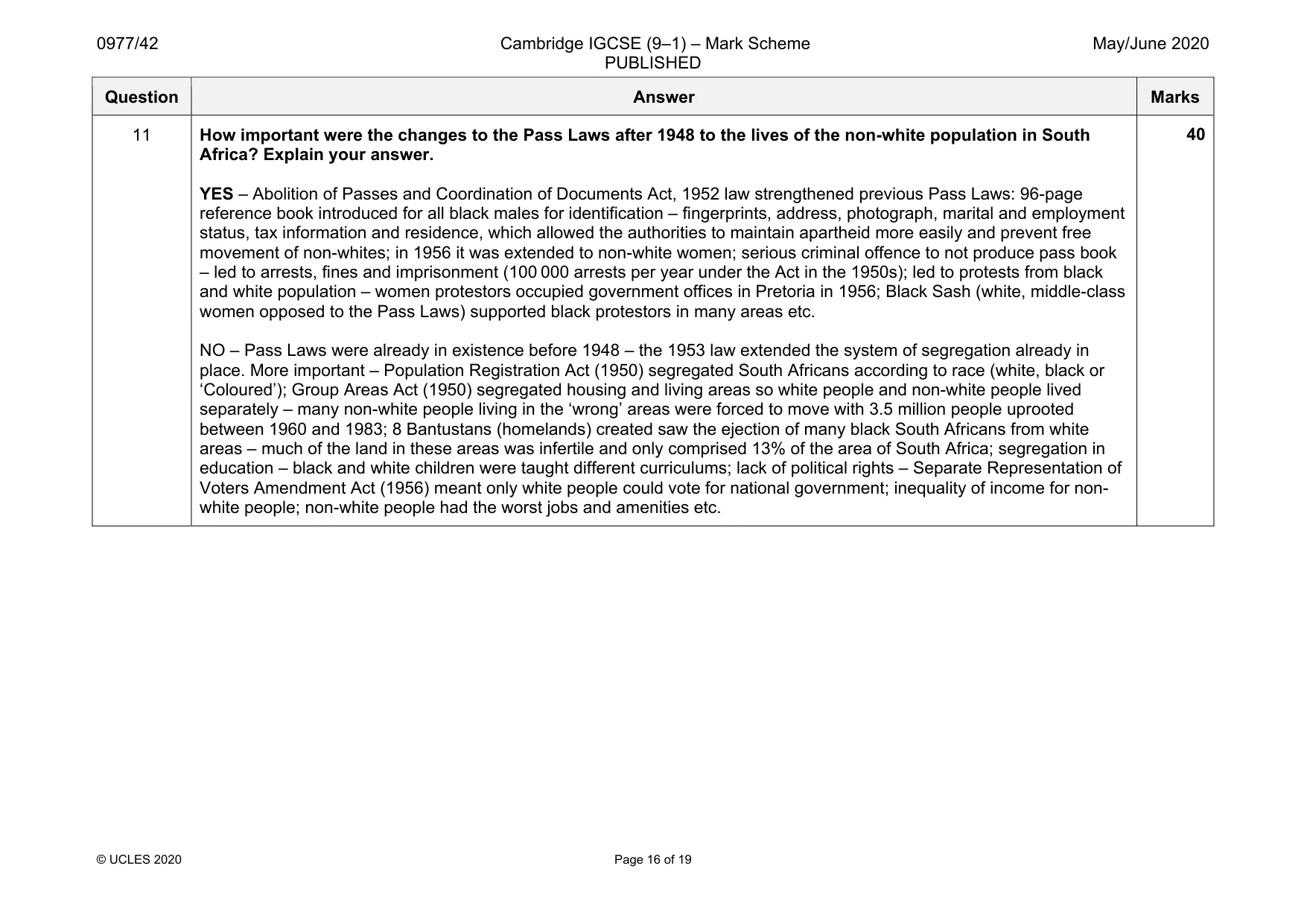
Mark scheme: 11 How important were the changes to the Pass Laws after 1948 to the lives of the non-white population in South Africa? Explain your answer. YES – Abolition of Passes and Coordination of Documents Act, 1952 law strengthened previous Pass Laws: 96-page reference book introduced for all black males for identification – fingerprints, address, photograph, marital and employment status, tax information and residence, which allowed the authorities to maintain apartheid more easily and prevent free movement of non-whites; in 1956 it was extended to non-white women; serious criminal offence to not produce pass book – led to arrests, fines and imprisonment (100 000 arrests per year under the Act in the 1950s); led to protests from black and white population – women protestors occupied government offices in Pretoria in 1956; Black Sash (white, middle-class women opposed to the Pass Laws) supported black protestors in many areas etc. NO – Pass Laws were already in existence before 1948 – the 1953 law extended the system of segregation already in place. More important – Population Registration Act (1950) segregated South Africans according to race (white, black or ‘Coloured’); Group Areas Act (1950) segregated housing and living areas so white people and non-white people lived separately – many non-white people living in the ‘wrong’ areas were forced to move with 3.5 million people uprooted between 1960 and 1983; 8 Bantustans (homelands) created saw the ejection of many black South Africans from white areas – much of the land in these areas was infertile and only comprised 13% of the area of South Africa; segregation in education – black and white children were taught different curriculums; lack of political rights – Separate Representation of Voters Amendment Act (1956) meant only white people could vote for national government; inequality of income for non- white people; non-white people had the worst jobs and amenities etc.
Q12 · How significant were the Soweto riots of June 1976 in weakening the system of apartheid?
12 How significant were the Soweto riots of June 1976 in weakening the system of apartheid? Explain your answer. [40] DEPTH STUDY G: ISRAELIS AND PALESTINIANS SINCE 1945
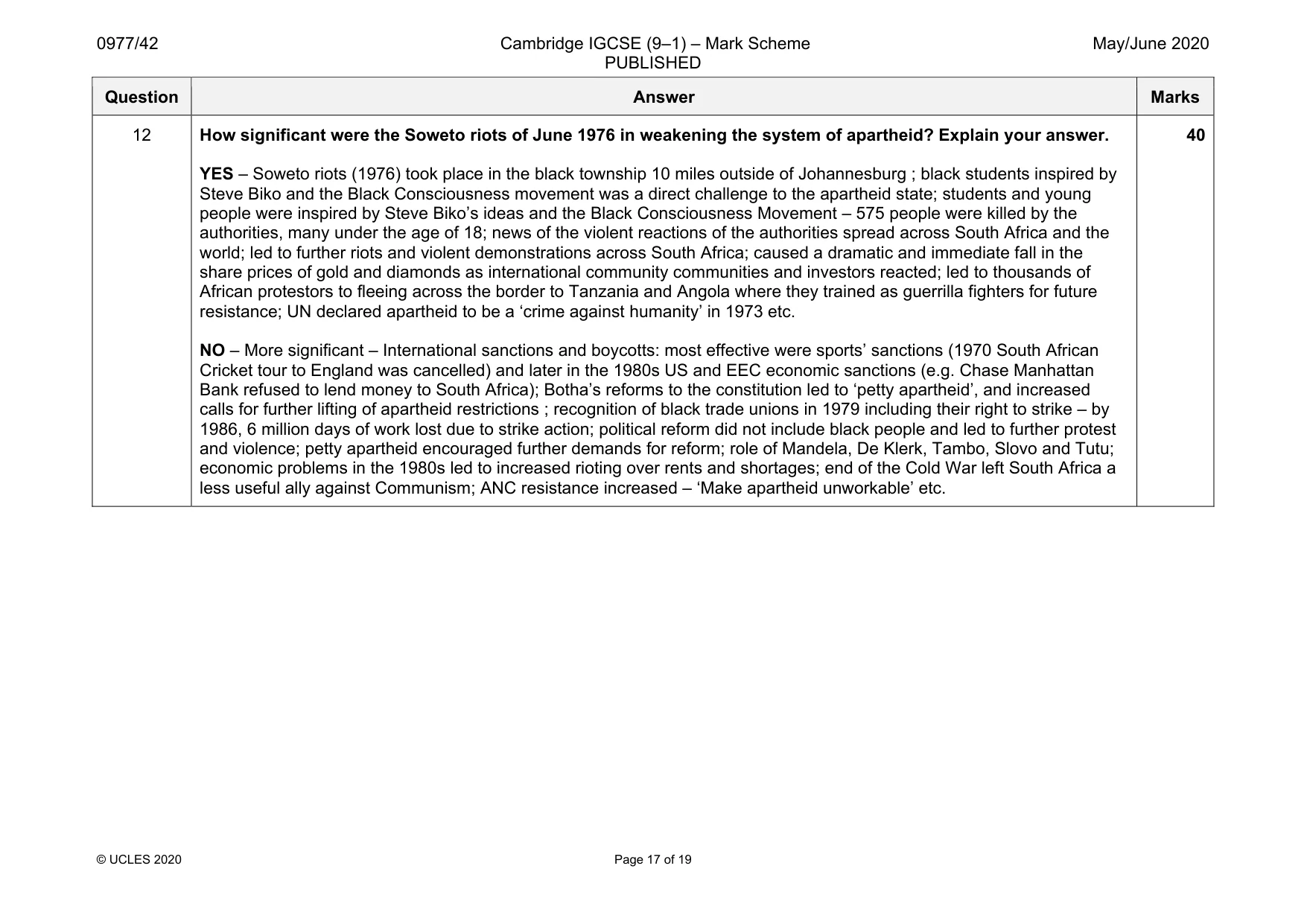
Mark scheme: 12 How significant were the Soweto riots of June 1976 in weakening the system of apartheid? Explain your answer. YES – Soweto riots (1976) took place in the black township 10 miles outside of Johannesburg ; black students inspired by Steve Biko and the Black Consciousness movement was a direct challenge to the apartheid state; students and young people were inspired by Steve Biko’s ideas and the Black Consciousness Movement – 575 people were killed by the authorities, many under the age of 18; news of the violent reactions of the authorities spread across South Africa and the world; led to further riots and violent demonstrations across South Africa; caused a dramatic and immediate fall in the share prices of gold and diamonds as international community communities and investors reacted; led to thousands of African protestors to fleeing across the border to Tanzania and Angola where they trained as guerrilla fighters for future resistance; UN declared apartheid to be a ‘crime against humanity’ in 1973 etc. NO – More significant – International sanctions and boycotts: most effective were sports’ sanctions (1970 South African Cricket tour to England was cancelled) and later in the 1980s US and EEC economic sanctions (e.g. Chase Manhattan Bank refused to lend money to South Africa); Botha’s reforms to the constitution led to ‘petty apartheid’, and increased calls for further lifting of apartheid restrictions ; recognition of black trade unions in 1979 including their right to strike – by 1986, 6 million days of work lost due to strike action; political reform did not include black people and led to further protest and violence; petty apartheid encouraged further demands for reform; role of Mandela, De Klerk, Tambo, Slovo and Tutu; economic problems in the 1980s led to increased rioting over rents and shortages; end of the Cold War left South Africa a less useful ally against Communism; ANC resistance increased – ‘Make apartheid unworkable’ etc. 40
Q13 · How important was the Second World War to developments in Palestine up to 1949?
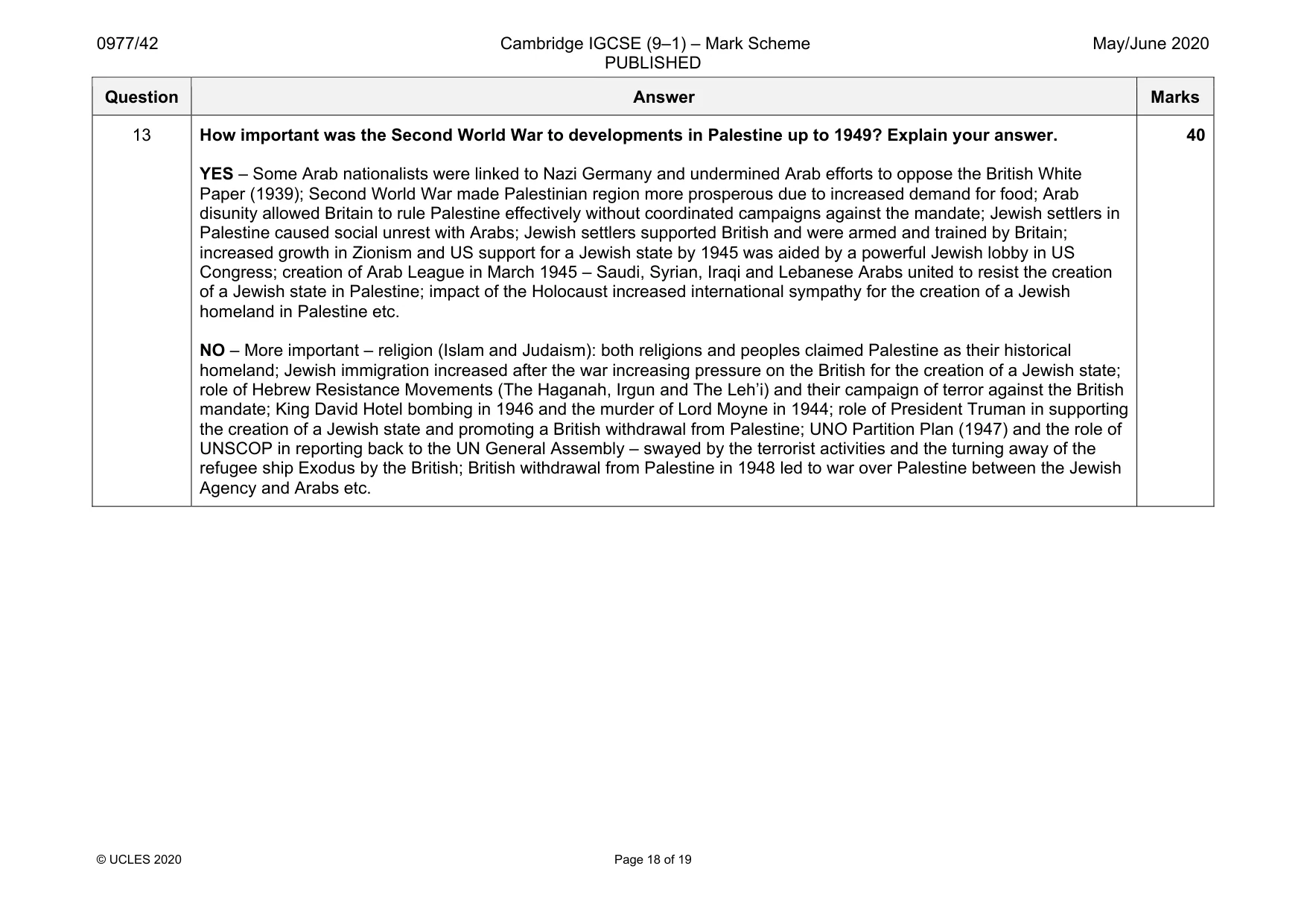
13 How important was the Second World War to developments in Palestine up to 1949? Explain your answer. [40]
Mark scheme: 13 How important was the Second World War to developments in Palestine up to 1949? Explain your answer. YES – Some Arab nationalists were linked to Nazi Germany and undermined Arab efforts to oppose the British White Paper (1939); Second World War made Palestinian region more prosperous due to increased demand for food; Arab disunity allowed Britain to rule Palestine effectively without coordinated campaigns against the mandate; Jewish settlers in Palestine caused social unrest with Arabs; Jewish settlers supported British and were armed and trained by Britain; increased growth in Zionism and US support for a Jewish state by 1945 was aided by a powerful Jewish lobby in US Congress; creation of Arab League in March 1945 – Saudi, Syrian, Iraqi and Lebanese Arabs united to resist the creation of a Jewish state in Palestine; impact of the Holocaust increased international sympathy for the creation of a Jewish homeland in Palestine etc. NO – More important – religion (Islam and Judaism): both religions and peoples claimed Palestine as their historical homeland; Jewish immigration increased after the war increasing pressure on the British for the creation of a Jewish state; role of Hebrew Resistance Movements (The Haganah, Irgun and The Leh’i) and their campaign of terror against the British mandate; King David Hotel bombing in 1946 and the murder of Lord Moyne in 1944; role of President Truman in supporting the creation of a Jewish state and promoting a British withdrawal from Palestine; UNO Partition Plan (1947) and the role of UNSCOP in reporting back to the UN General Assembly – swayed by the terrorist activities and the turning away of the refugee ship Exodus by the British; British withdrawal from Palestine in 1948 led to war over Palestine between the Jewish Agency and Arabs etc. 40
Q14 · How significant was President Sadat to the improvement of relations between Egypt and…
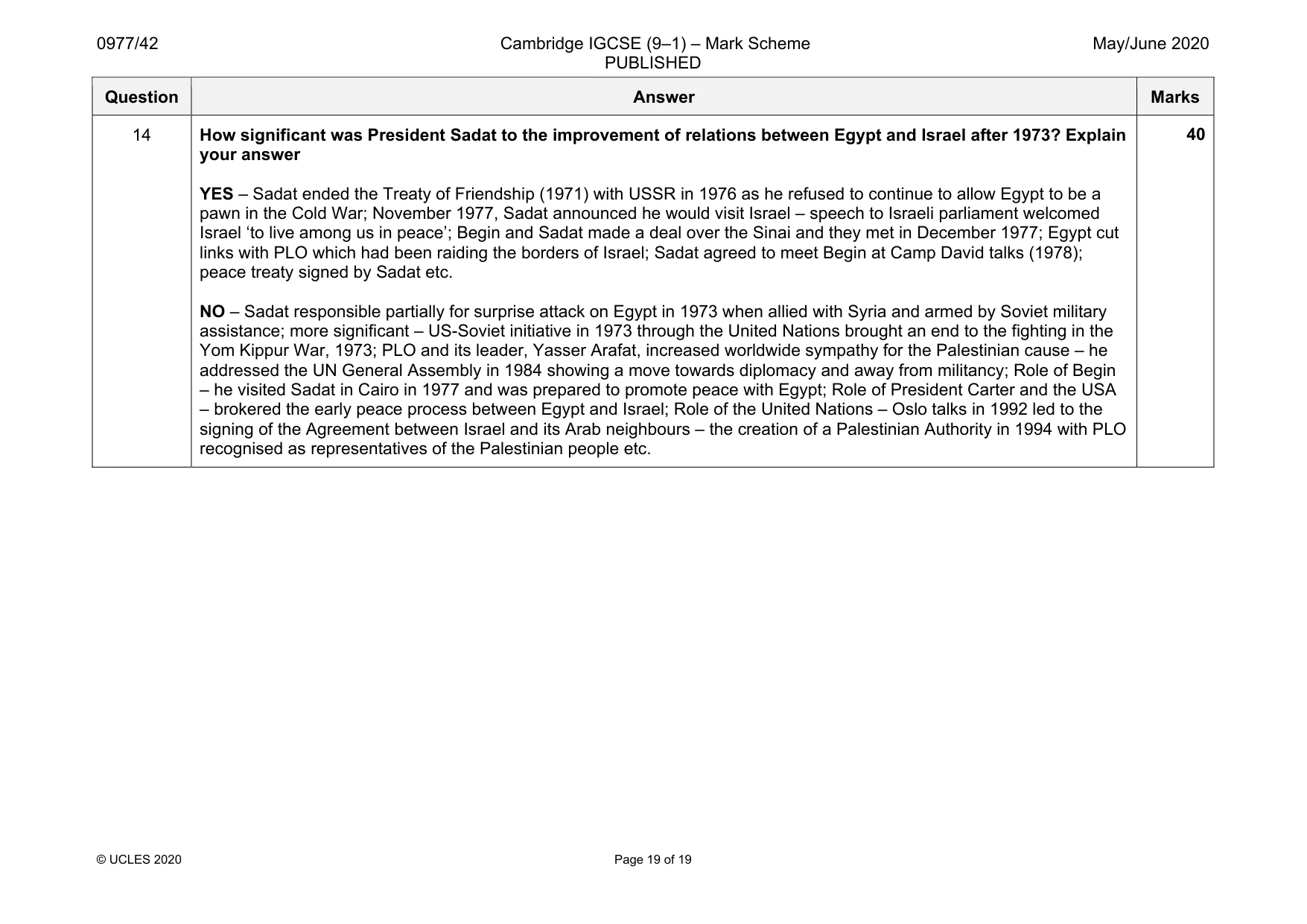
14 How significant was President Sadat to the improvement of relations between Egypt and Israel after 1973? Explain your answer. [40]
Mark scheme: 14 How significant was President Sadat to the improvement of relations between Egypt and Israel after 1973? Explain your answer YES – Sadat ended the Treaty of Friendship (1971) with USSR in 1976 as he refused to continue to allow Egypt to be a pawn in the Cold War; November 1977, Sadat announced he would visit Israel – speech to Israeli parliament welcomed Israel ‘to live among us in peace’; Begin and Sadat made a deal over the Sinai and they met in December 1977; Egypt cut links with PLO which had been raiding the borders of Israel; Sadat agreed to meet Begin at Camp David talks (1978); peace treaty signed by Sadat etc. NO – Sadat responsible partially for surprise attack on Egypt in 1973 when allied with Syria and armed by Soviet military assistance; more significant – US-Soviet initiative in 1973 through the United Nations brought an end to the fighting in the Yom Kippur War, 1973; PLO and its leader, Yasser Arafat, increased worldwide sympathy for the Palestinian cause – he addressed the UN General Assembly in 1984 showing a move towards diplomacy and away from militancy; Role of Begin – he visited Sadat in Cairo in 1977 and was prepared to promote peace with Egypt; Role of President Carter and the USA – brokered the early peace process between Egypt and Israel; Role of the United Nations – Oslo talks in 1992 led to the signing of the Agreement between Israel and its Arab neighbours – the creation of a Palestinian Authority in 1994 with PLO recognised as representatives of the Palestinian people etc.