Cambridge IGCSE History (9-1) 0977 — 2024 May/June Paper 4 · Variant 2
0977/42/M/J/24 · 40 marks · 60 min
The question paper and its mark scheme, free to read here and free to download. This is Cambridge’s own paper, exactly as it was sat.
Question paper4 pages
Mark scheme18 pages
Answers below. Sit the paper first if you are practising.
Paper as text
Question paper, page 1
Cambridge IGCSE™(9-1) 0977/42 May/June 2024 1 hour HISTORY Paper 4 Alternative to Coursework You must answer on the enclosed answer booklet. You will need: Answer booklet (enclosed) INSTRUCTIONS • Answer one question from your chosen Depth Study. • Follow the instructions on the front cover of the answer booklet. If you need additional answer paper, ask the invigilator for a continuation booklet. INFORMATION • The total mark for this paper is 40. • The number of marks for each question or part question is shown in brackets [ ]. This document has 4 pages. Any blank pages are indicated. [Turn over 06_0977_42_2024_1.2 © UCLES 2024 *1385093281*
Question paper, page 2
Answer one question. Depth study A: The First World War, 1914–18 Write an account of the ‘race to the sea’. [15] (a) 1 Discuss the importance of the Battle of the Marne (1914). [25] (b) Write an account of Germany’s unrestricted submarine warfare. [15] (a) 2 Discuss the extent to which the introduction of the convoy system was the turning point in the war at sea. [25] (b) Depth study B: Germany, 1918–45 Write an account of the Spartacist uprising in 1919. [15] (a) 3 Discuss the impact of political disorder in Weimar Germany between 1919 and 1923. [25] (b) Write an account of Himmler’s role in Nazi Germany. [15] (a) 4 Discuss the importance of the SS to Nazi rule. [25] (b) Depth study C: Russia, 1905–41 Write an account of the revolution of March 1917. [15] (a) 5 Discuss the importance to Russia of military defeats in the First World War. [25] (b) Write an account of the Russian Civil War. [15] (a) 6 Discuss the impact of Lenin’s decrees. [25] (b) 06_0977_42_2024_1.2 © UCLES 2024 2
Question paper, page 3
Depth study D: The United States, 1919–41 Write an account of the problems faced by farmers in the USA in the 1920s. [15] (a) 7 Discuss the impact of overproduction in agriculture in the USA in the 1920s. [25] (b) Write an account of the measures taken by Roosevelt to help the unemployed. [15] (a) 8 Discuss the impact of the Second New Deal. [25] (b) Depth study E: The Second World War in Europe and the Asia–Pacific, 1939–c.1945 Write an account of Operation Barbarossa. [15] (a) 9 Discuss the extent to which the Battle of Stalingrad was the turning point in the war in Europe. [25] (b) Write an account of the Japanese occupation of Malaya. [15] (a) 10 Discuss the impact on Singapore of the Japanese occupation. [25] (b) 06_0977_42_2024_1.2 © UCLES 2024 3
Question paper, page 4
BLANK PAGE Permission to reproduce items where third-party owned material protected by copyright is included has been sought and cleared where possible. Every reasonable effort has been made by the publisher (UCLES) to trace copyright holders, but if any items requiring clearance have unwittingly been included, the publisher will be pleased to make amends at the earliest possible opportunity. To avoid the issue of disclosure of answer-related information to candidates, all copyright acknowledgements are reproduced online in the Cambridge Assessment International Education Copyright Acknowledgements Booklet. This is produced for each series of examinations and is freely available to download at www.cambridgeinternational.org after the live examination series. Cambridge Assessment International Education is part of Cambridge Assessment. Cambridge Assessment is the brand name of the University of Cambridge Local Examinations Syndicate (UCLES), which is a department of the University of Cambridge. 06_0977_42_2024_1.2 © UCLES 2024 4
Mark scheme, page 1
This document consists of 18 printed pages. © Cambridge University Press & Assessment 2024 [Turn over Cambridge IGCSE™ (9–1) HISTORY 0977/42 Paper 4 Alternative to Coursework May/June 2024 MARK SCHEME Maximum Mark: 40 Published This mark scheme is published as an aid to teachers and candidates, to indicate the requirements of the examination. It shows the basis on which Examiners were instructed to award marks. It does not indicate the details of the discussions that took place at an Examiners’ meeting before marking began, which would have considered the acceptability of alternative answers. Mark schemes should be read in conjunction with the question paper and the Principal Examiner Report for Teachers. Cambridge International will not enter into discussions about these mark schemes. Cambridge International is publishing the mark schemes for the May/June 2024 series for most Cambridge IGCSE, Cambridge International A and AS Level and Cambridge Pre-U components, and some Cambridge O Level components.
Mark scheme, page 2
0977/42 Cambridge IGCSE (9–1) – Mark Scheme PUBLISHED May/June 2024 © Cambridge University Press & Assessment 2024 Page 2 of 18 Generic Marking Principles These general marking principles must be applied by all examiners when marking candidate answers. They should be applied alongside the specific content of the mark scheme or generic level descriptions for a question. Each question paper and mark scheme will also comply with these marking principles. GENERIC MARKING PRINCIPLE 1: Marks must be awarded in line with: the specific content of the mark scheme or the generic level descriptors for the question the specific skills defined in the mark scheme or in the generic level descriptors for the question the standard of response required by a candidate as exemplified by the standardisation scripts. GENERIC MARKING PRINCIPLE 2: Marks awarded are always whole marks (not half marks, or other fractions). GENERIC MARKING PRINCIPLE 3: Marks must be awarded positively: marks are awarded for correct/valid answers, as defined in the mark scheme. However, credit is given for valid answers which go beyond the scope of the syllabus and mark scheme, referring to your Team Leader as appropriate marks are awarded when candidates clearly demonstrate what they know and can do marks are not deducted for errors marks are not deducted for omissions answers should only be judged on the quality of spelling, punctuation and grammar when these features are specifically assessed by the question as indicated by the mark scheme. The meaning, however, should be unambiguous. GENERIC MARKING PRINCIPLE 4: Rules must be applied consistently, e.g. in situations where candidates have not followed instructions or in the application of generic level descriptors. GENERIC MARKING PRINCIPLE 5: Marks should be awarded using the full range of marks defined in the mark scheme for the question (however; the use of the full mark range may be limited according to the quality of the candidate responses seen). GENERIC MARKING PRINCIPLE 6: Marks awarded are based solely on the requirements as defined in the mark scheme. Marks should not be awarded with grade thresholds or grade descriptors in mind.
Mark scheme, page 3
0977/42 Cambridge IGCSE (9–1) – Mark Scheme PUBLISHED May/June 2024 © Cambridge University Press & Assessment 2024 Page 3 of 18 Guidance on using levels-based mark schemes Marking of work should be positive, rewarding achievement where possible, but clearly differentiating across the whole range of marks, where appropriate. The marker should look at the work and then make a judgement about which level statement is the ‘best fit’. In practice, work does not always match one level statement precisely so a judgement may need to be made between two or more level statements. Once a ‘best-fit’ level statement has been identified, use the following guidance to decide on a specific mark: Where the candidate’s work convincingly meets the level statement, you should award the highest mark. Where the candidate’s work adequately meets the level statement, you should award the most appropriate mark in the middle of the range. Where the candidate’s work just meets the level statement, you should award the lowest mark. Assessment objectives AO1 An ability to recall, select, organise and deploy knowledge of the syllabus content. AO2 An ability to construct historical explanations using an understanding of: cause and consequence, change and continuity, similarity and difference the motives, emotions, intentions and beliefs of people in the past.
Mark scheme, page 4
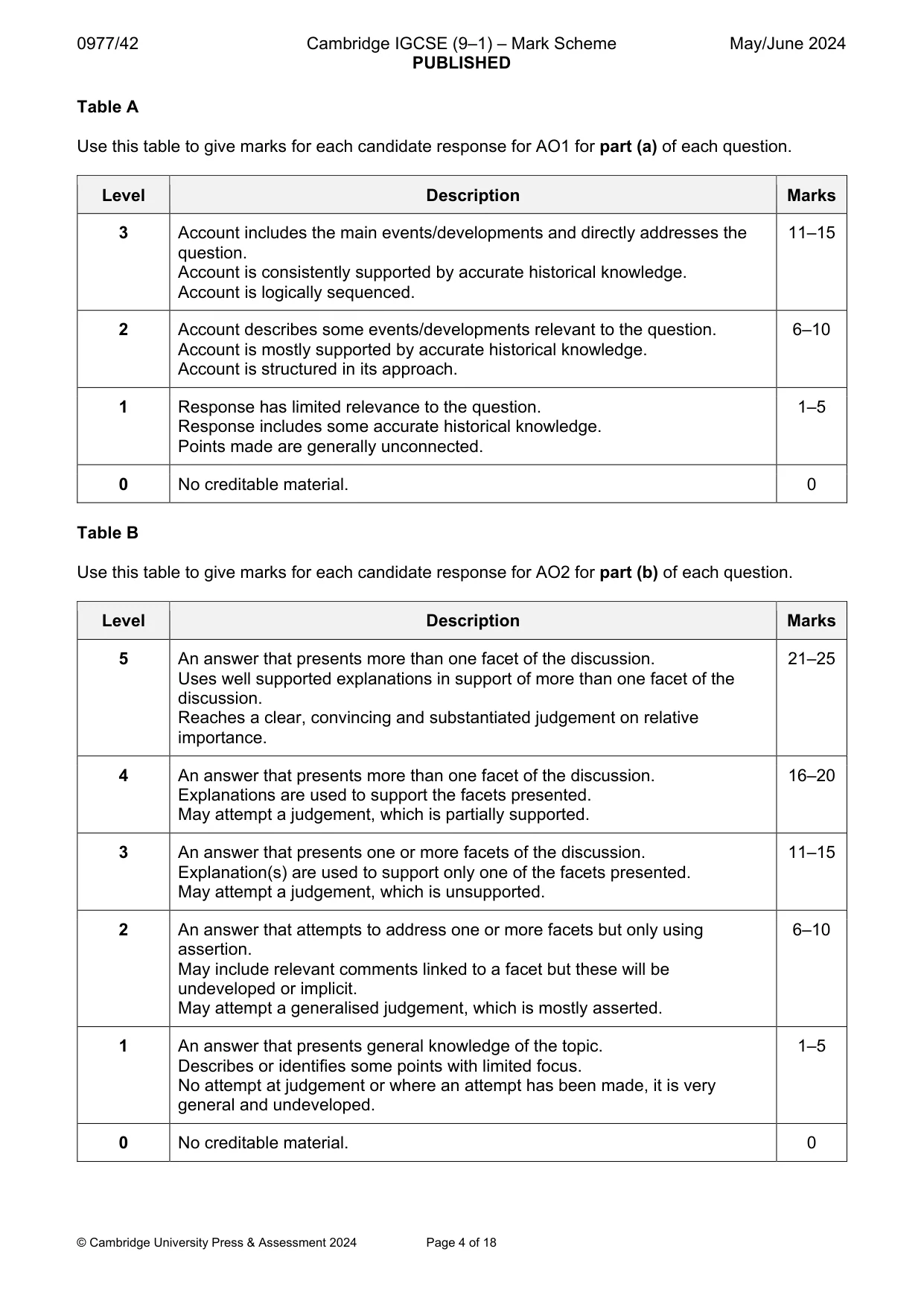
0977/42 Cambridge IGCSE (9–1) – Mark Scheme PUBLISHED May/June 2024 © Cambridge University Press & Assessment 2024 Page 4 of 18 Table A Use this table to give marks for each candidate response for AO1 for part (a) of each question. Level Description Marks 3 Account includes the main events/developments and directly addresses the question. Account is consistently supported by accurate historical knowledge. Account is logically sequenced. 11–15 2 Account describes some events/developments relevant to the question. Account is mostly supported by accurate historical knowledge. Account is structured in its approach. 6–10 1 Response has limited relevance to the question. Response includes some accurate historical knowledge. Points made are generally unconnected. 1–5 0 No creditable material. 0 Table B Use this table to give marks for each candidate response for AO2 for part (b) of each question. Level Description Marks 5 An answer that presents more than one facet of the discussion. Uses well supported explanations in support of more than one facet of the discussion. Reaches a clear, convincing and substantiated judgement on relative importance. 21–25 4 An answer that presents more than one facet of the discussion. Explanations are used to support the facets presented. May attempt a judgement, which is partially supported. 16–20 3 An answer that presents one or more facets of the discussion. Explanation(s) are used to support only one of the facets presented. May attempt a judgement, which is unsupported. 11–15 2 An answer that attempts to address one or more facets but only using assertion. May include relevant comments linked to a facet but these will be undeveloped or implicit. May attempt a generalised judgement, which is mostly asserted. 6–10 1 An answer that presents general knowledge of the topic. Describes or identifies some points with limited focus. No attempt at judgement or where an attempt has been made, it is very general and undeveloped. 1–5 0 No creditable material. 0
Mark scheme, page 5
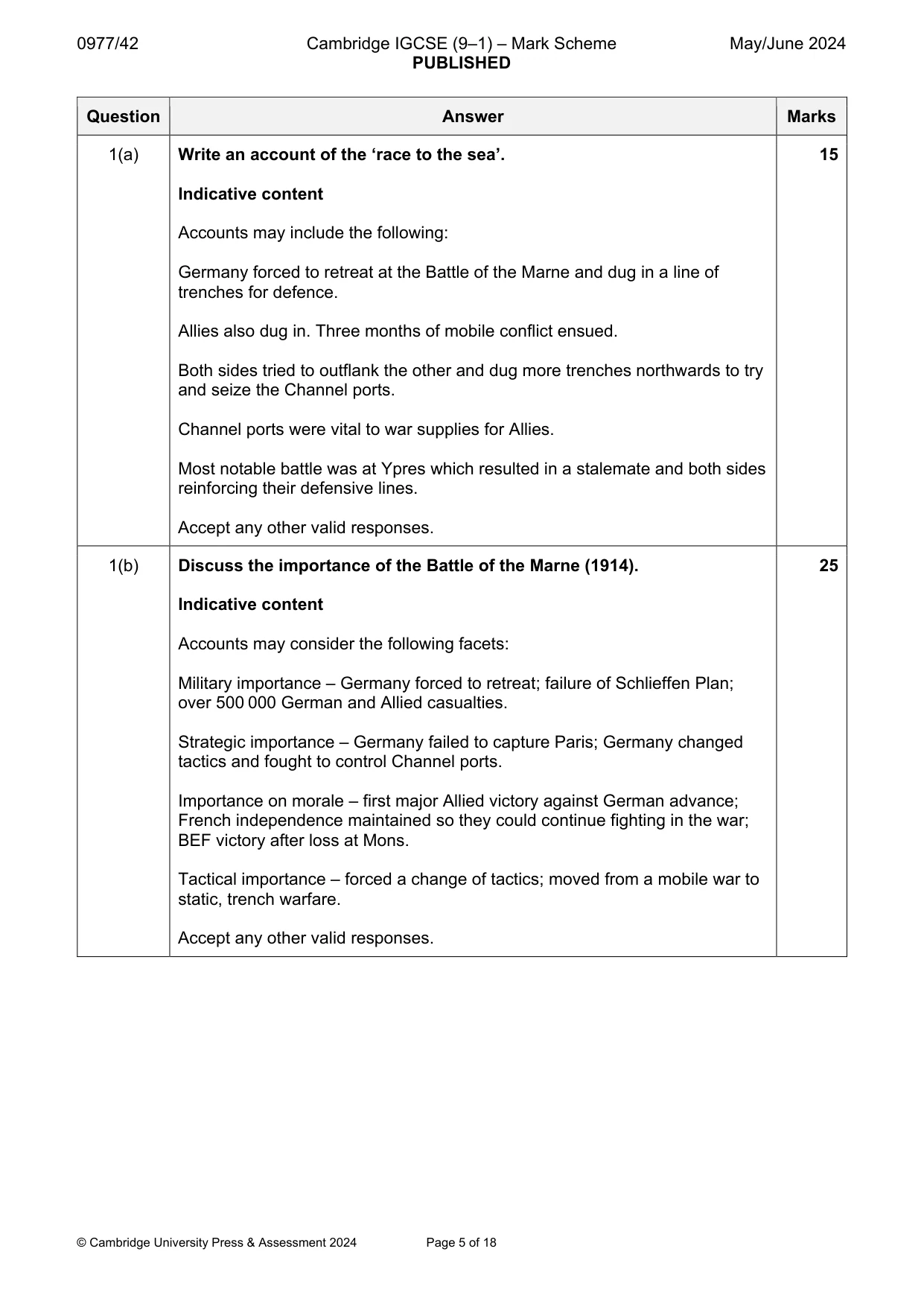
0977/42 Cambridge IGCSE (9–1) – Mark Scheme PUBLISHED May/June 2024 © Cambridge University Press & Assessment 2024 Page 5 of 18 Question Answer Marks 1(a) Write an account of the ‘race to the sea’. Indicative content Accounts may include the following: Germany forced to retreat at the Battle of the Marne and dug in a line of trenches for defence. Allies also dug in. Three months of mobile conflict ensued. Both sides tried to outflank the other and dug more trenches northwards to try and seize the Channel ports. Channel ports were vital to war supplies for Allies. Most notable battle was at Ypres which resulted in a stalemate and both sides reinforcing their defensive lines. Accept any other valid responses. 15 1(b) Discuss the importance of the Battle of the Marne (1914). Indicative content Accounts may consider the following facets: Military importance – Germany forced to retreat; failure of Schlieffen Plan; over 500 000 German and Allied casualties. Strategic importance – Germany failed to capture Paris; Germany changed tactics and fought to control Channel ports. Importance on morale – first major Allied victory against German advance; French independence maintained so they could continue fighting in the war; BEF victory after loss at Mons. Tactical importance – forced a change of tactics; moved from a mobile war to static, trench warfare. Accept any other valid responses. 25
Mark scheme, page 6
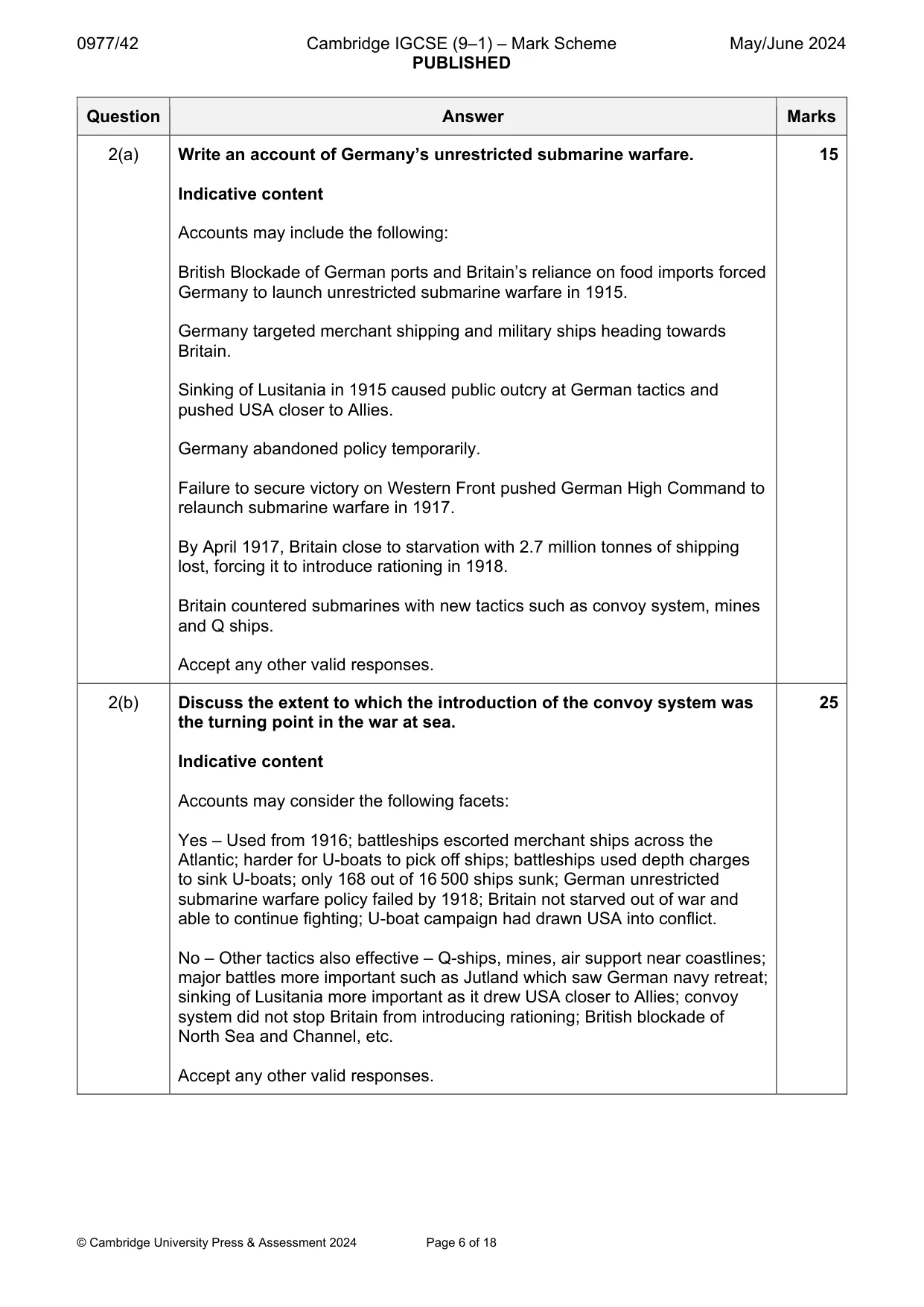
0977/42 Cambridge IGCSE (9–1) – Mark Scheme PUBLISHED May/June 2024 © Cambridge University Press & Assessment 2024 Page 6 of 18 Question Answer Marks 2(a) Write an account of Germany’s unrestricted submarine warfare. Indicative content Accounts may include the following: British Blockade of German ports and Britain’s reliance on food imports forced Germany to launch unrestricted submarine warfare in 1915. Germany targeted merchant shipping and military ships heading towards Britain. Sinking of Lusitania in 1915 caused public outcry at German tactics and pushed USA closer to Allies. Germany abandoned policy temporarily. Failure to secure victory on Western Front pushed German High Command to relaunch submarine warfare in 1917. By April 1917, Britain close to starvation with 2.7 million tonnes of shipping lost, forcing it to introduce rationing in 1918. Britain countered submarines with new tactics such as convoy system, mines and Q ships. Accept any other valid responses. 15 2(b) Discuss the extent to which the introduction of the convoy system was the turning point in the war at sea. Indicative content Accounts may consider the following facets: Yes – Used from 1916; battleships escorted merchant ships across the Atlantic; harder for U-boats to pick off ships; battleships used depth charges to sink U-boats; only 168 out of 16 500 ships sunk; German unrestricted submarine warfare policy failed by 1918; Britain not starved out of war and able to continue fighting; U-boat campaign had drawn USA into conflict. No – Other tactics also effective – Q-ships, mines, air support near coastlines; major battles more important such as Jutland which saw German navy retreat; sinking of Lusitania more important as it drew USA closer to Allies; convoy system did not stop Britain from introducing rationing; British blockade of North Sea and Channel, etc. Accept any other valid responses. 25
Mark scheme, page 7
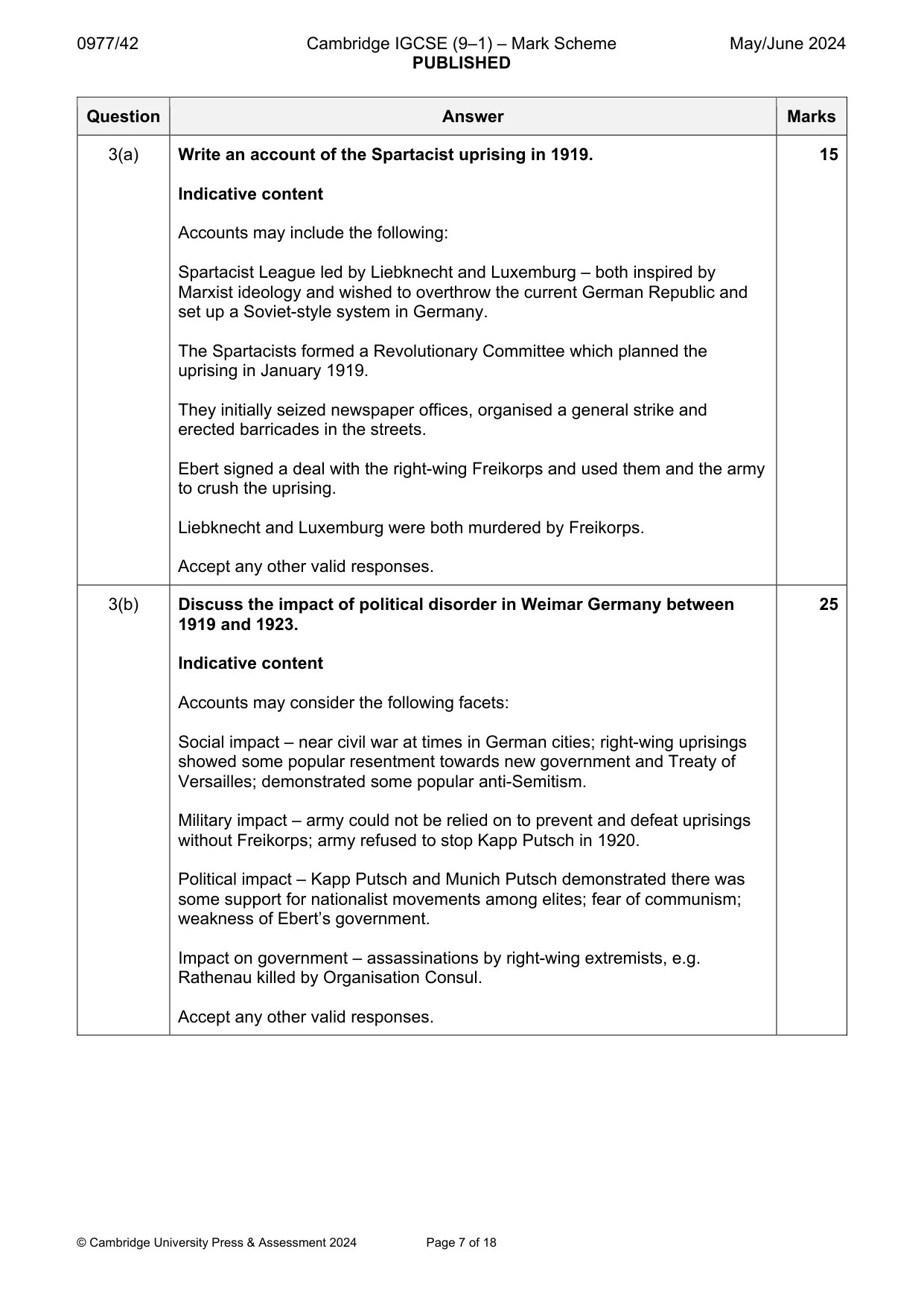
0977/42 Cambridge IGCSE (9–1) – Mark Scheme PUBLISHED May/June 2024 © Cambridge University Press & Assessment 2024 Page 7 of 18 Question Answer Marks 3(a) Write an account of the Spartacist uprising in 1919. Indicative content Accounts may include the following: Spartacist League led by Liebknecht and Luxemburg – both inspired by Marxist ideology and wished to overthrow the current German Republic and set up a Soviet-style system in Germany. The Spartacists formed a Revolutionary Committee which planned the uprising in January 1919. They initially seized newspaper offices, organised a general strike and erected barricades in the streets. Ebert signed a deal with the right-wing Freikorps and used them and the army to crush the uprising. Liebknecht and Luxemburg were both murdered by Freikorps. Accept any other valid responses. 15 3(b) Discuss the impact of political disorder in Weimar Germany between 1919 and 1923. Indicative content Accounts may consider the following facets: Social impact – near civil war at times in German cities; right-wing uprisings showed some popular resentment towards new government and Treaty of Versailles; demonstrated some popular anti-Semitism. Military impact – army could not be relied on to prevent and defeat uprisings without Freikorps; army refused to stop Kapp Putsch in 1920. Political impact – Kapp Putsch and Munich Putsch demonstrated there was some support for nationalist movements among elites; fear of communism; weakness of Ebert’s government. Impact on government – assassinations by right-wing extremists, e.g. Rathenau killed by Organisation Consul. Accept any other valid responses. 25
Mark scheme, page 8
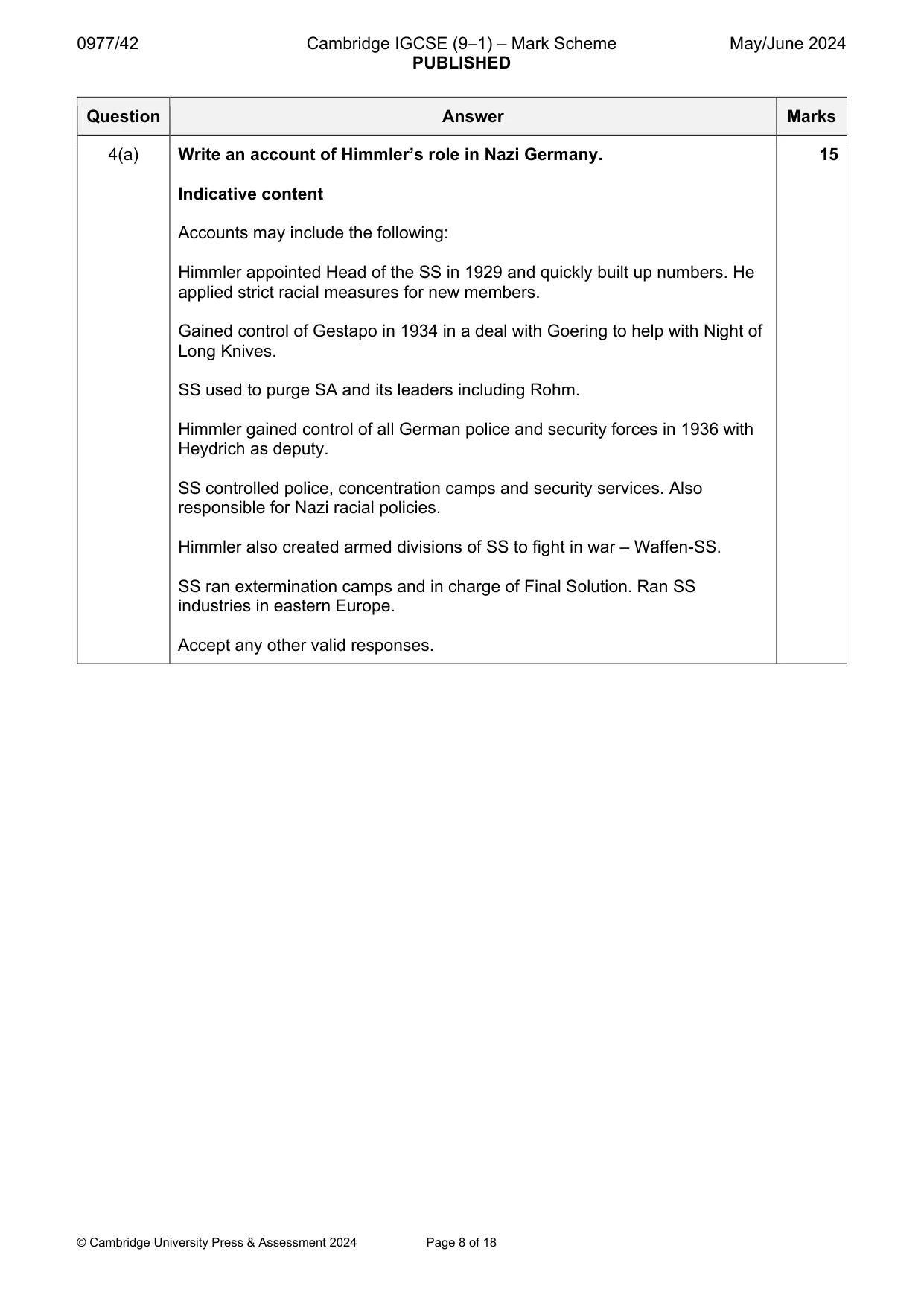
0977/42 Cambridge IGCSE (9–1) – Mark Scheme PUBLISHED May/June 2024 © Cambridge University Press & Assessment 2024 Page 8 of 18 Question Answer Marks 4(a) Write an account of Himmler’s role in Nazi Germany. Indicative content Accounts may include the following: Himmler appointed Head of the SS in 1929 and quickly built up numbers. He applied strict racial measures for new members. Gained control of Gestapo in 1934 in a deal with Goering to help with Night of Long Knives. SS used to purge SA and its leaders including Rohm. Himmler gained control of all German police and security forces in 1936 with Heydrich as deputy. SS controlled police, concentration camps and security services. Also responsible for Nazi racial policies. Himmler also created armed divisions of SS to fight in war – Waffen-SS. SS ran extermination camps and in charge of Final Solution. Ran SS industries in eastern Europe. Accept any other valid responses. 15
Mark scheme, page 9
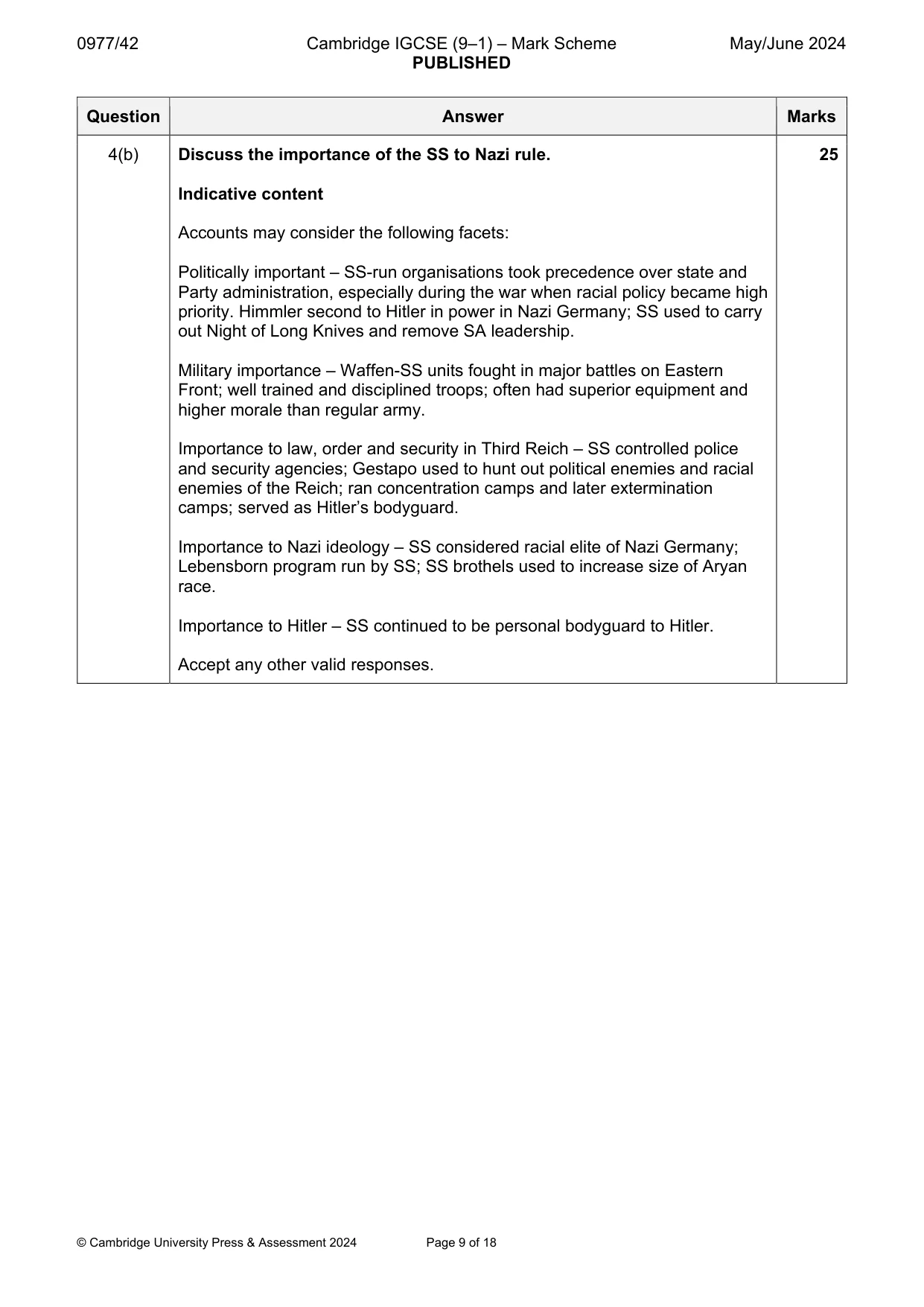
0977/42 Cambridge IGCSE (9–1) – Mark Scheme PUBLISHED May/June 2024 © Cambridge University Press & Assessment 2024 Page 9 of 18 Question Answer Marks 4(b) Discuss the importance of the SS to Nazi rule. Indicative content Accounts may consider the following facets: Politically important – SS-run organisations took precedence over state and Party administration, especially during the war when racial policy became high priority. Himmler second to Hitler in power in Nazi Germany; SS used to carry out Night of Long Knives and remove SA leadership. Military importance – Waffen-SS units fought in major battles on Eastern Front; well trained and disciplined troops; often had superior equipment and higher morale than regular army. Importance to law, order and security in Third Reich – SS controlled police and security agencies; Gestapo used to hunt out political enemies and racial enemies of the Reich; ran concentration camps and later extermination camps; served as Hitler’s bodyguard. Importance to Nazi ideology – SS considered racial elite of Nazi Germany; Lebensborn program run by SS; SS brothels used to increase size of Aryan race. Importance to Hitler – SS continued to be personal bodyguard to Hitler. Accept any other valid responses. 25
Mark scheme, page 10
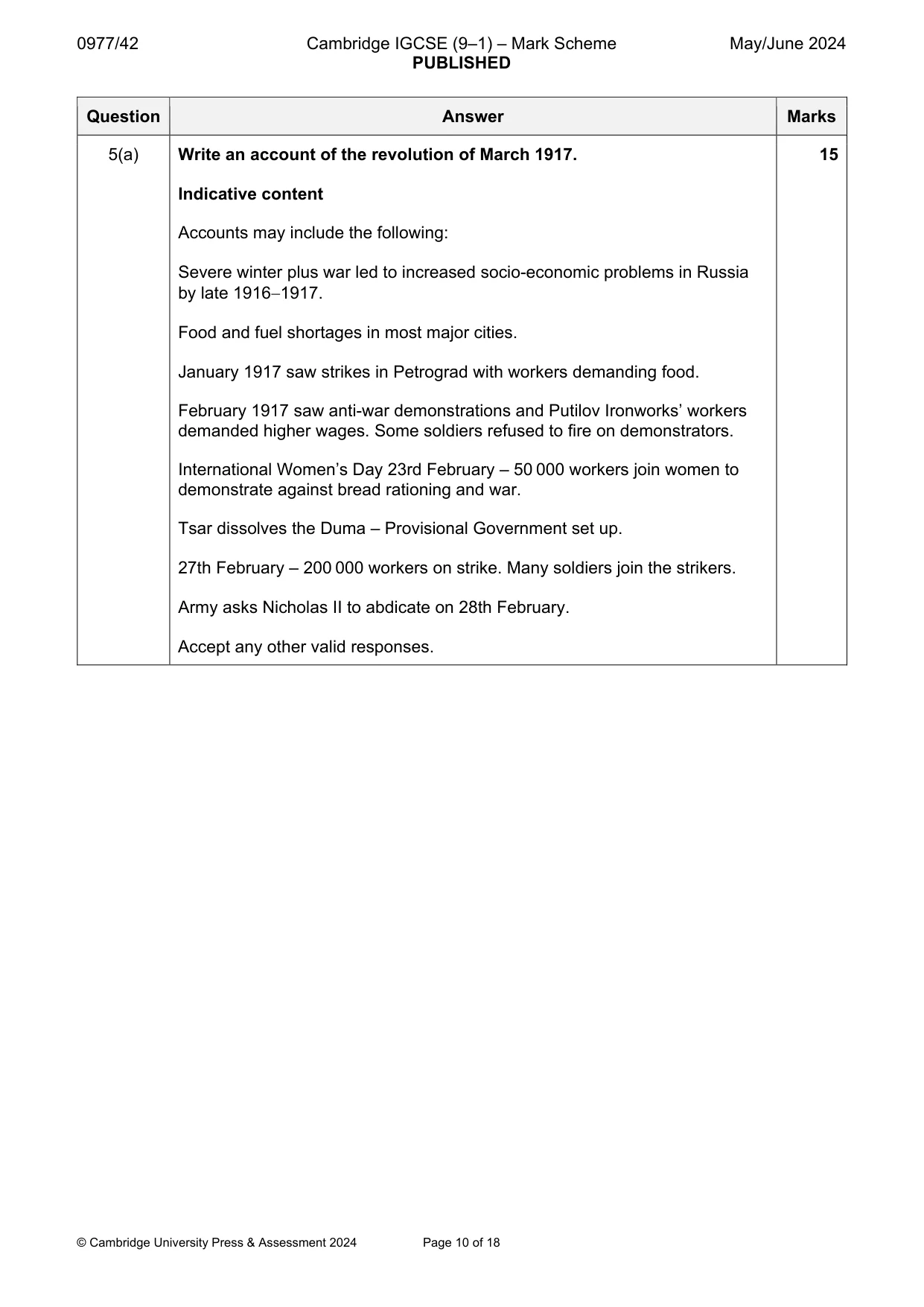
0977/42 Cambridge IGCSE (9–1) – Mark Scheme PUBLISHED May/June 2024 © Cambridge University Press & Assessment 2024 Page 10 of 18 Question Answer Marks 5(a) Write an account of the revolution of March 1917. Indicative content Accounts may include the following: Severe winter plus war led to increased socio-economic problems in Russia by late 19161917. Food and fuel shortages in most major cities. January 1917 saw strikes in Petrograd with workers demanding food. February 1917 saw anti-war demonstrations and Putilov Ironworks’ workers demanded higher wages. Some soldiers refused to fire on demonstrators. International Women’s Day 23rd February – 50 000 workers join women to demonstrate against bread rationing and war. Tsar dissolves the Duma – Provisional Government set up. 27th February – 200 000 workers on strike. Many soldiers join the strikers. Army asks Nicholas II to abdicate on 28th February. Accept any other valid responses. 15
Mark scheme, page 11
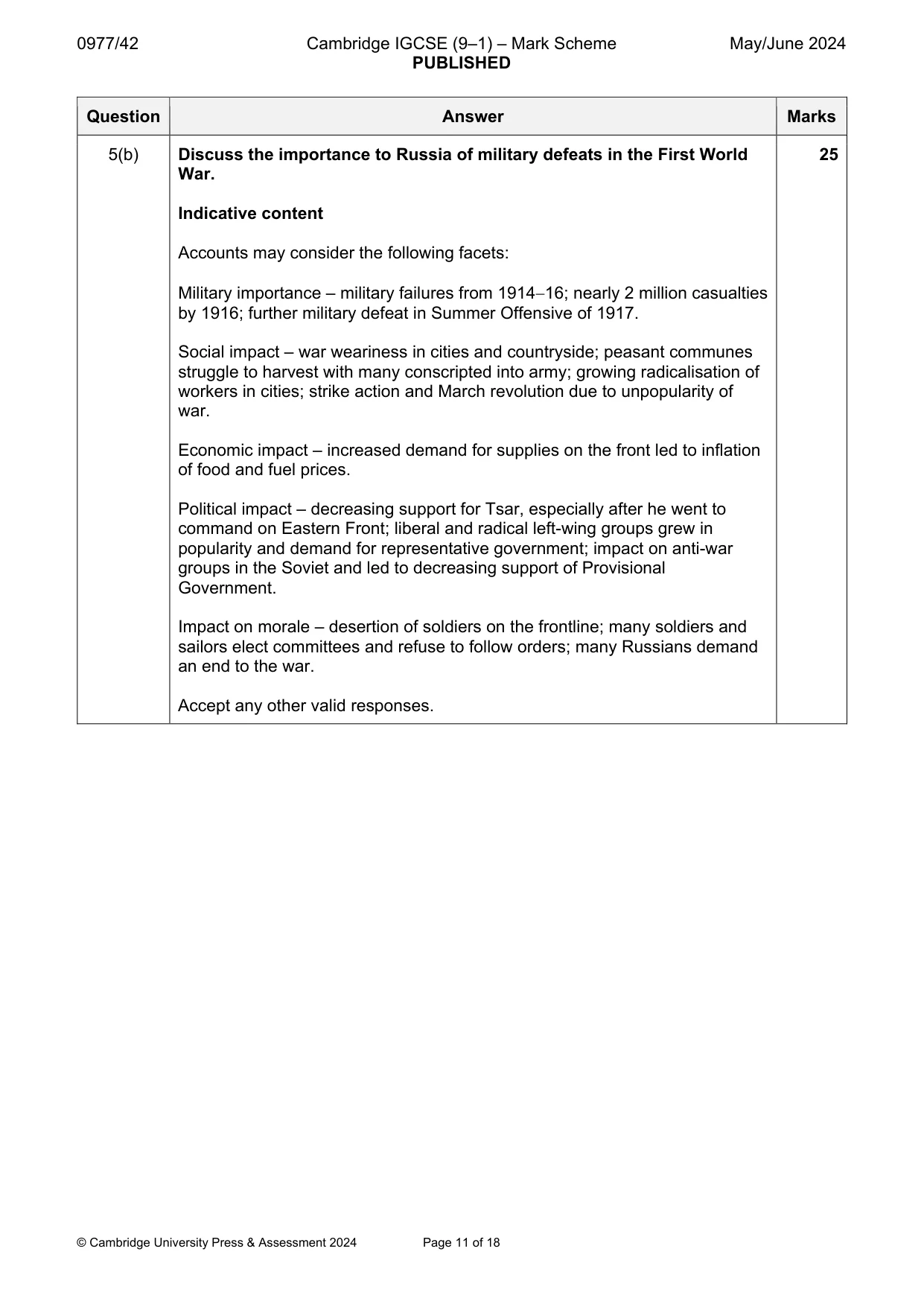
0977/42 Cambridge IGCSE (9–1) – Mark Scheme PUBLISHED May/June 2024 © Cambridge University Press & Assessment 2024 Page 11 of 18 Question Answer Marks 5(b) Discuss the importance to Russia of military defeats in the First World War. Indicative content Accounts may consider the following facets: Military importance – military failures from 191416; nearly 2 million casualties by 1916; further military defeat in Summer Offensive of 1917. Social impact – war weariness in cities and countryside; peasant communes struggle to harvest with many conscripted into army; growing radicalisation of workers in cities; strike action and March revolution due to unpopularity of war. Economic impact – increased demand for supplies on the front led to inflation of food and fuel prices. Political impact – decreasing support for Tsar, especially after he went to command on Eastern Front; liberal and radical left-wing groups grew in popularity and demand for representative government; impact on anti-war groups in the Soviet and led to decreasing support of Provisional Government. Impact on morale – desertion of soldiers on the frontline; many soldiers and sailors elect committees and refuse to follow orders; many Russians demand an end to the war. Accept any other valid responses. 25
Mark scheme, page 12
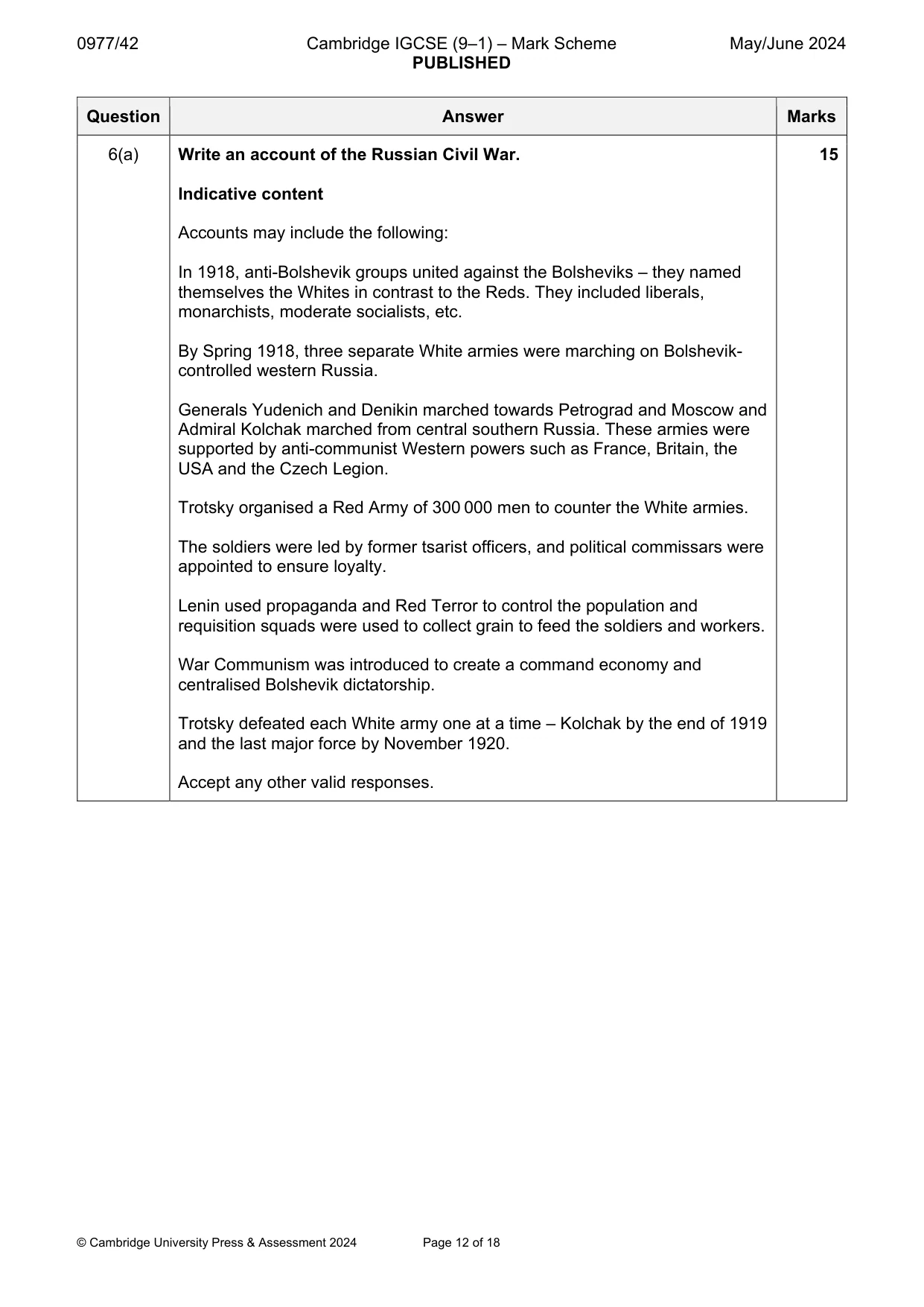
0977/42 Cambridge IGCSE (9–1) – Mark Scheme PUBLISHED May/June 2024 © Cambridge University Press & Assessment 2024 Page 12 of 18 Question Answer Marks 6(a) Write an account of the Russian Civil War. Indicative content Accounts may include the following: In 1918, anti-Bolshevik groups united against the Bolsheviks – they named themselves the Whites in contrast to the Reds. They included liberals, monarchists, moderate socialists, etc. By Spring 1918, three separate White armies were marching on Bolshevik- controlled western Russia. Generals Yudenich and Denikin marched towards Petrograd and Moscow and Admiral Kolchak marched from central southern Russia. These armies were supported by anti-communist Western powers such as France, Britain, the USA and the Czech Legion. Trotsky organised a Red Army of 300 000 men to counter the White armies. The soldiers were led by former tsarist officers, and political commissars were appointed to ensure loyalty. Lenin used propaganda and Red Terror to control the population and requisition squads were used to collect grain to feed the soldiers and workers. War Communism was introduced to create a command economy and centralised Bolshevik dictatorship. Trotsky defeated each White army one at a time – Kolchak by the end of 1919 and the last major force by November 1920. Accept any other valid responses. 15
Mark scheme, page 13
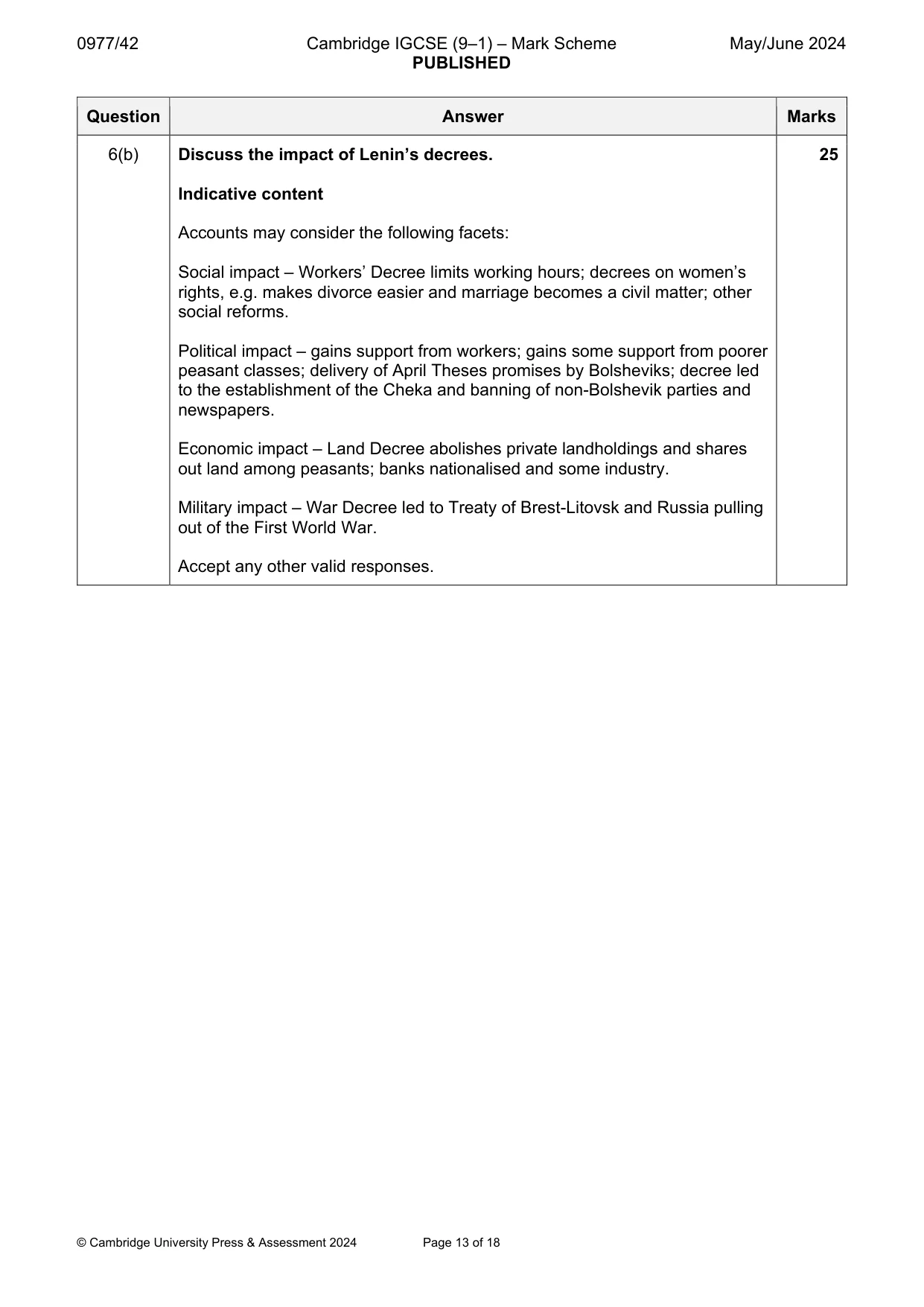
0977/42 Cambridge IGCSE (9–1) – Mark Scheme PUBLISHED May/June 2024 © Cambridge University Press & Assessment 2024 Page 13 of 18 Question Answer Marks 6(b) Discuss the impact of Lenin’s decrees. Indicative content Accounts may consider the following facets: Social impact – Workers’ Decree limits working hours; decrees on women’s rights, e.g. makes divorce easier and marriage becomes a civil matter; other social reforms. Political impact – gains support from workers; gains some support from poorer peasant classes; delivery of April Theses promises by Bolsheviks; decree led to the establishment of the Cheka and banning of non-Bolshevik parties and newspapers. Economic impact – Land Decree abolishes private landholdings and shares out land among peasants; banks nationalised and some industry. Military impact – War Decree led to Treaty of Brest-Litovsk and Russia pulling out of the First World War. Accept any other valid responses. 25
Mark scheme, page 14
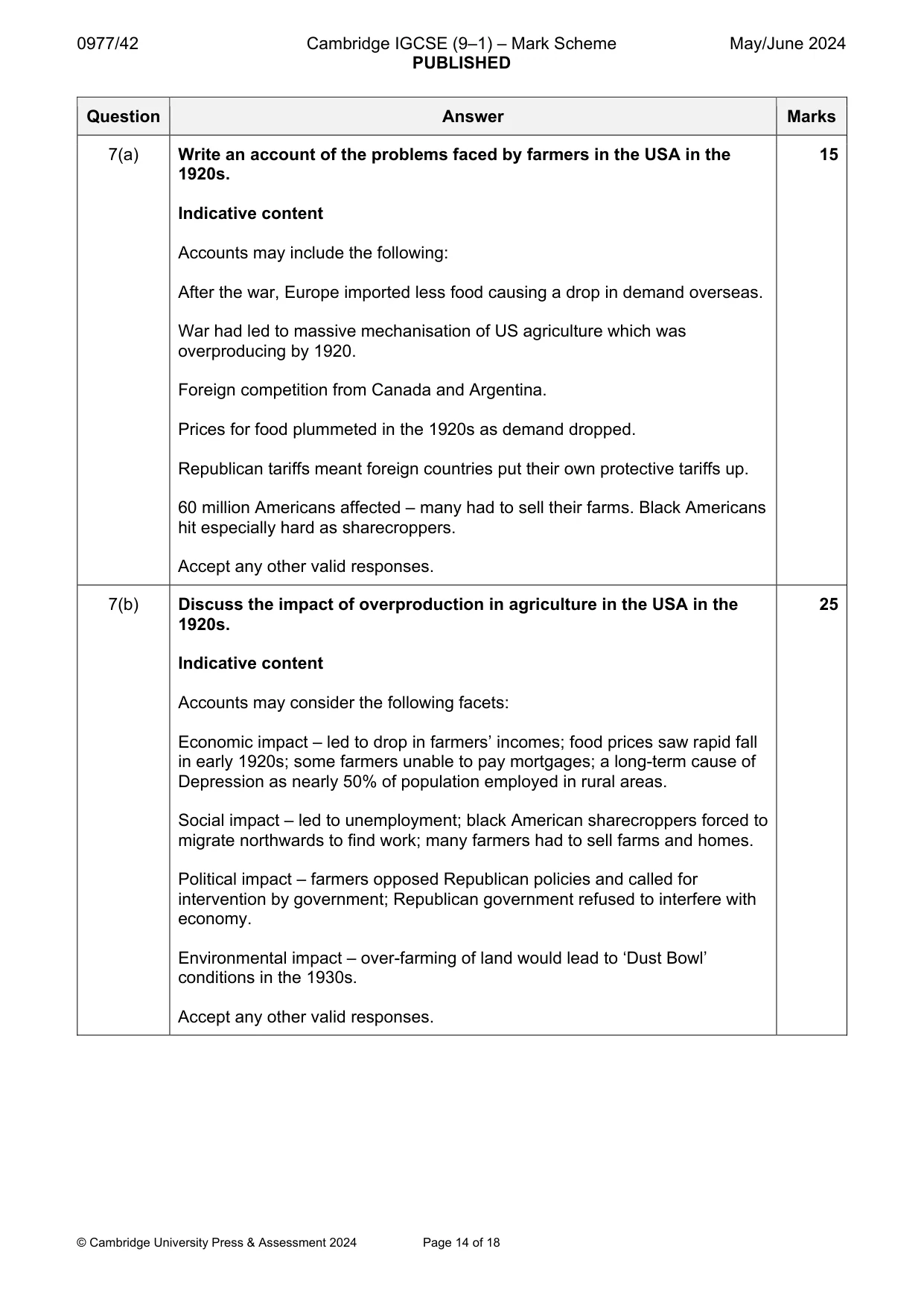
0977/42 Cambridge IGCSE (9–1) – Mark Scheme PUBLISHED May/June 2024 © Cambridge University Press & Assessment 2024 Page 14 of 18 Question Answer Marks 7(a) Write an account of the problems faced by farmers in the USA in the 1920s. Indicative content Accounts may include the following: After the war, Europe imported less food causing a drop in demand overseas. War had led to massive mechanisation of US agriculture which was overproducing by 1920. Foreign competition from Canada and Argentina. Prices for food plummeted in the 1920s as demand dropped. Republican tariffs meant foreign countries put their own protective tariffs up. 60 million Americans affected – many had to sell their farms. Black Americans hit especially hard as sharecroppers. Accept any other valid responses. 15 7(b) Discuss the impact of overproduction in agriculture in the USA in the 1920s. Indicative content Accounts may consider the following facets: Economic impact – led to drop in farmers’ incomes; food prices saw rapid fall in early 1920s; some farmers unable to pay mortgages; a long-term cause of Depression as nearly 50% of population employed in rural areas. Social impact – led to unemployment; black American sharecroppers forced to migrate northwards to find work; many farmers had to sell farms and homes. Political impact – farmers opposed Republican policies and called for intervention by government; Republican government refused to interfere with economy. Environmental impact – over-farming of land would lead to ‘Dust Bowl’ conditions in the 1930s. Accept any other valid responses. 25
Mark scheme, page 15
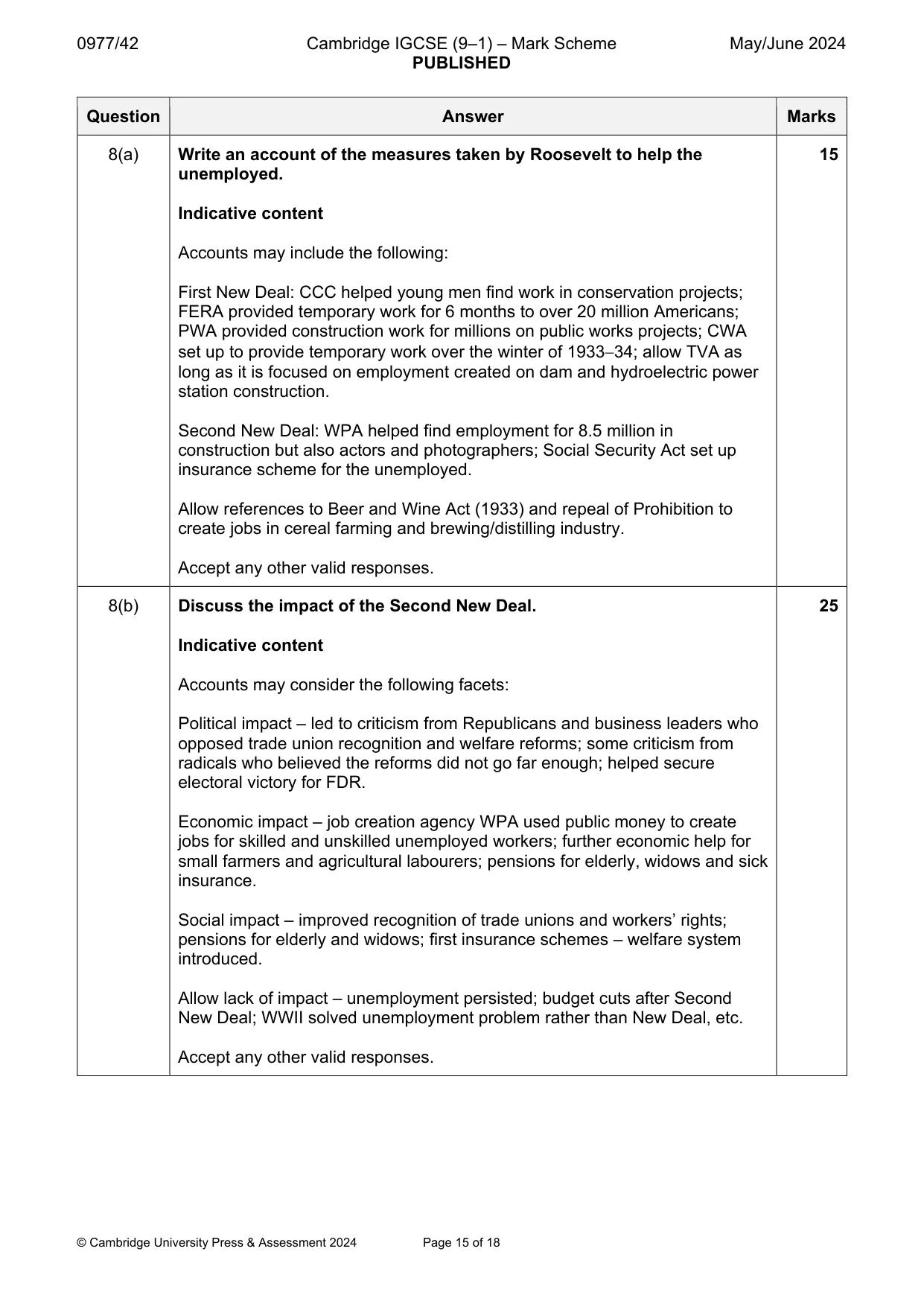
0977/42 Cambridge IGCSE (9–1) – Mark Scheme PUBLISHED May/June 2024 © Cambridge University Press & Assessment 2024 Page 15 of 18 Question Answer Marks 8(a) Write an account of the measures taken by Roosevelt to help the unemployed. Indicative content Accounts may include the following: First New Deal: CCC helped young men find work in conservation projects; FERA provided temporary work for 6 months to over 20 million Americans; PWA provided construction work for millions on public works projects; CWA set up to provide temporary work over the winter of 193334; allow TVA as long as it is focused on employment created on dam and hydroelectric power station construction. Second New Deal: WPA helped find employment for 8.5 million in construction but also actors and photographers; Social Security Act set up insurance scheme for the unemployed. Allow references to Beer and Wine Act (1933) and repeal of Prohibition to create jobs in cereal farming and brewing/distilling industry. Accept any other valid responses. 15 8(b) Discuss the impact of the Second New Deal. Indicative content Accounts may consider the following facets: Political impact – led to criticism from Republicans and business leaders who opposed trade union recognition and welfare reforms; some criticism from radicals who believed the reforms did not go far enough; helped secure electoral victory for FDR. Economic impact – job creation agency WPA used public money to create jobs for skilled and unskilled unemployed workers; further economic help for small farmers and agricultural labourers; pensions for elderly, widows and sick insurance. Social impact – improved recognition of trade unions and workers’ rights; pensions for elderly and widows; first insurance schemes – welfare system introduced. Allow lack of impact – unemployment persisted; budget cuts after Second New Deal; WWII solved unemployment problem rather than New Deal, etc. Accept any other valid responses. 25
Mark scheme, page 16
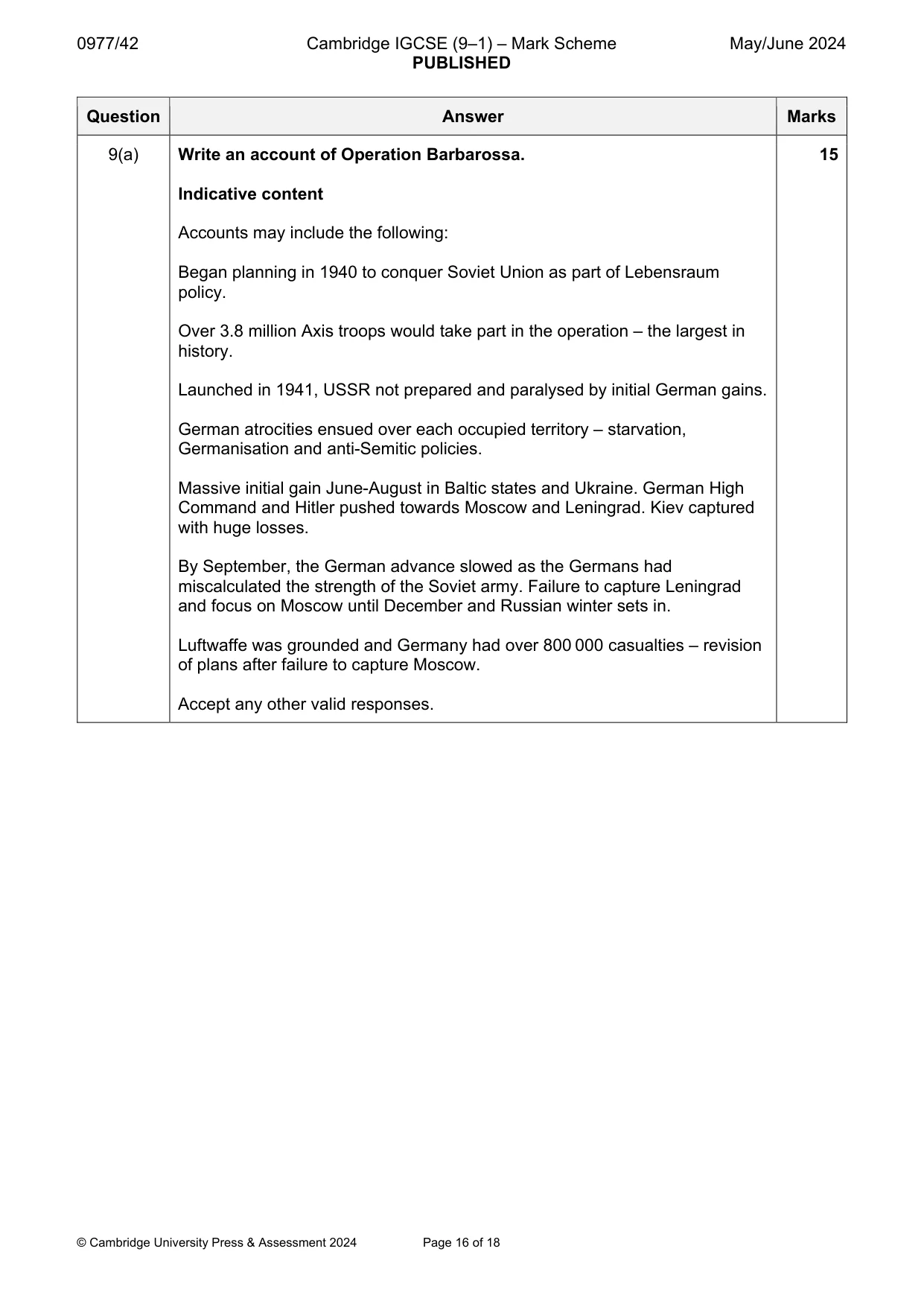
0977/42 Cambridge IGCSE (9–1) – Mark Scheme PUBLISHED May/June 2024 © Cambridge University Press & Assessment 2024 Page 16 of 18 Question Answer Marks 9(a) Write an account of Operation Barbarossa. Indicative content Accounts may include the following: Began planning in 1940 to conquer Soviet Union as part of Lebensraum policy. Over 3.8 million Axis troops would take part in the operation – the largest in history. Launched in 1941, USSR not prepared and paralysed by initial German gains. German atrocities ensued over each occupied territory – starvation, Germanisation and anti-Semitic policies. Massive initial gain June-August in Baltic states and Ukraine. German High Command and Hitler pushed towards Moscow and Leningrad. Kiev captured with huge losses. By September, the German advance slowed as the Germans had miscalculated the strength of the Soviet army. Failure to capture Leningrad and focus on Moscow until December and Russian winter sets in. Luftwaffe was grounded and Germany had over 800 000 casualties – revision of plans after failure to capture Moscow. Accept any other valid responses. 15
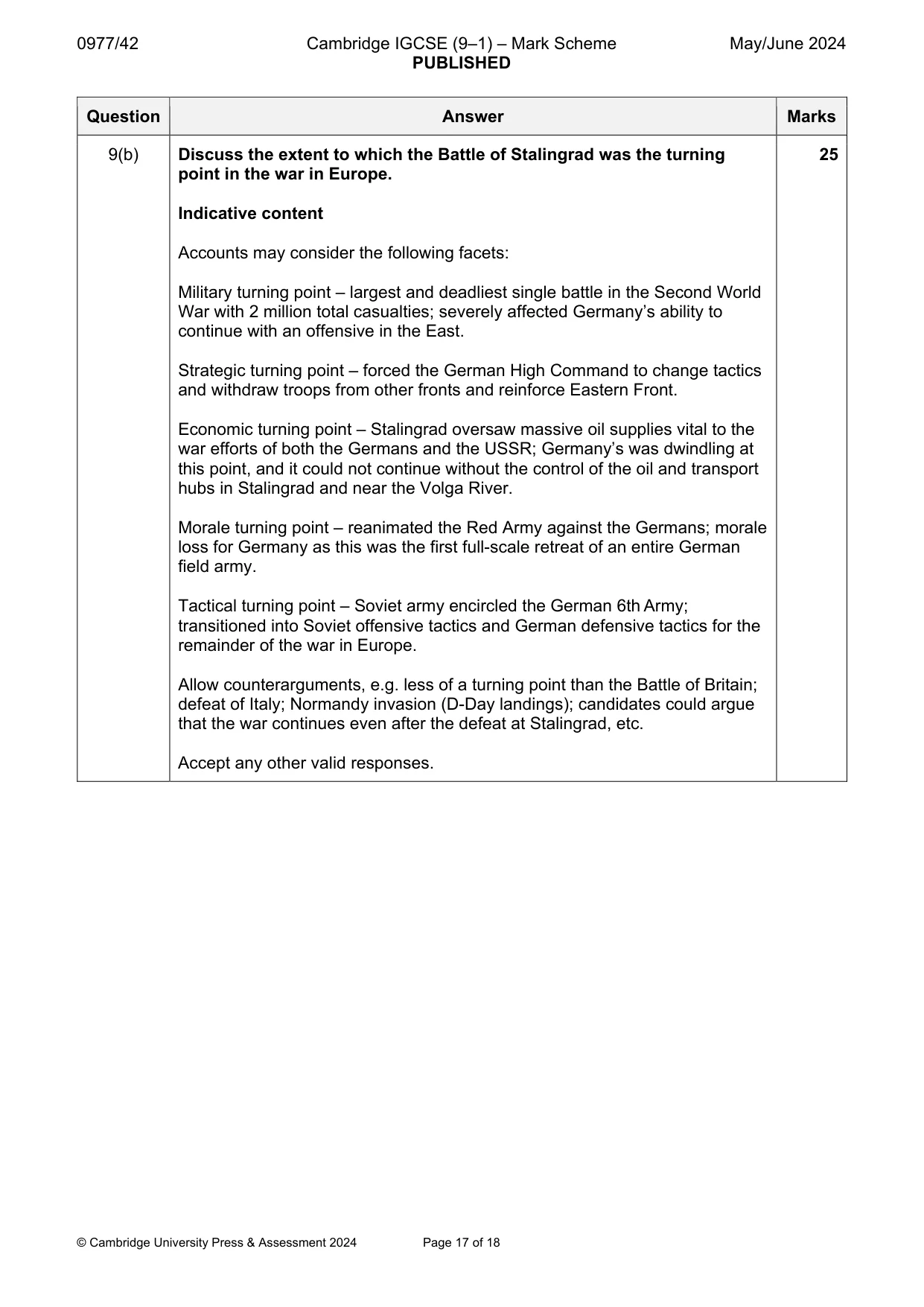
Mark scheme, page 17
0977/42 Cambridge IGCSE (9–1) – Mark Scheme PUBLISHED May/June 2024 © Cambridge University Press & Assessment 2024 Page 17 of 18 Question Answer Marks 9(b) Discuss the extent to which the Battle of Stalingrad was the turning point in the war in Europe. Indicative content Accounts may consider the following facets: Military turning point – largest and deadliest single battle in the Second World War with 2 million total casualties; severely affected Germany’s ability to continue with an offensive in the East. Strategic turning point – forced the German High Command to change tactics and withdraw troops from other fronts and reinforce Eastern Front. Economic turning point – Stalingrad oversaw massive oil supplies vital to the war efforts of both the Germans and the USSR; Germany’s was dwindling at this point, and it could not continue without the control of the oil and transport hubs in Stalingrad and near the Volga River. Morale turning point – reanimated the Red Army against the Germans; morale loss for Germany as this was the first full-scale retreat of an entire German field army. Tactical turning point – Soviet army encircled the German 6th Army; transitioned into Soviet offensive tactics and German defensive tactics for the remainder of the war in Europe. Allow counterarguments, e.g. less of a turning point than the Battle of Britain; defeat of Italy; Normandy invasion (D-Day landings); candidates could argue that the war continues even after the defeat at Stalingrad, etc. Accept any other valid responses. 25
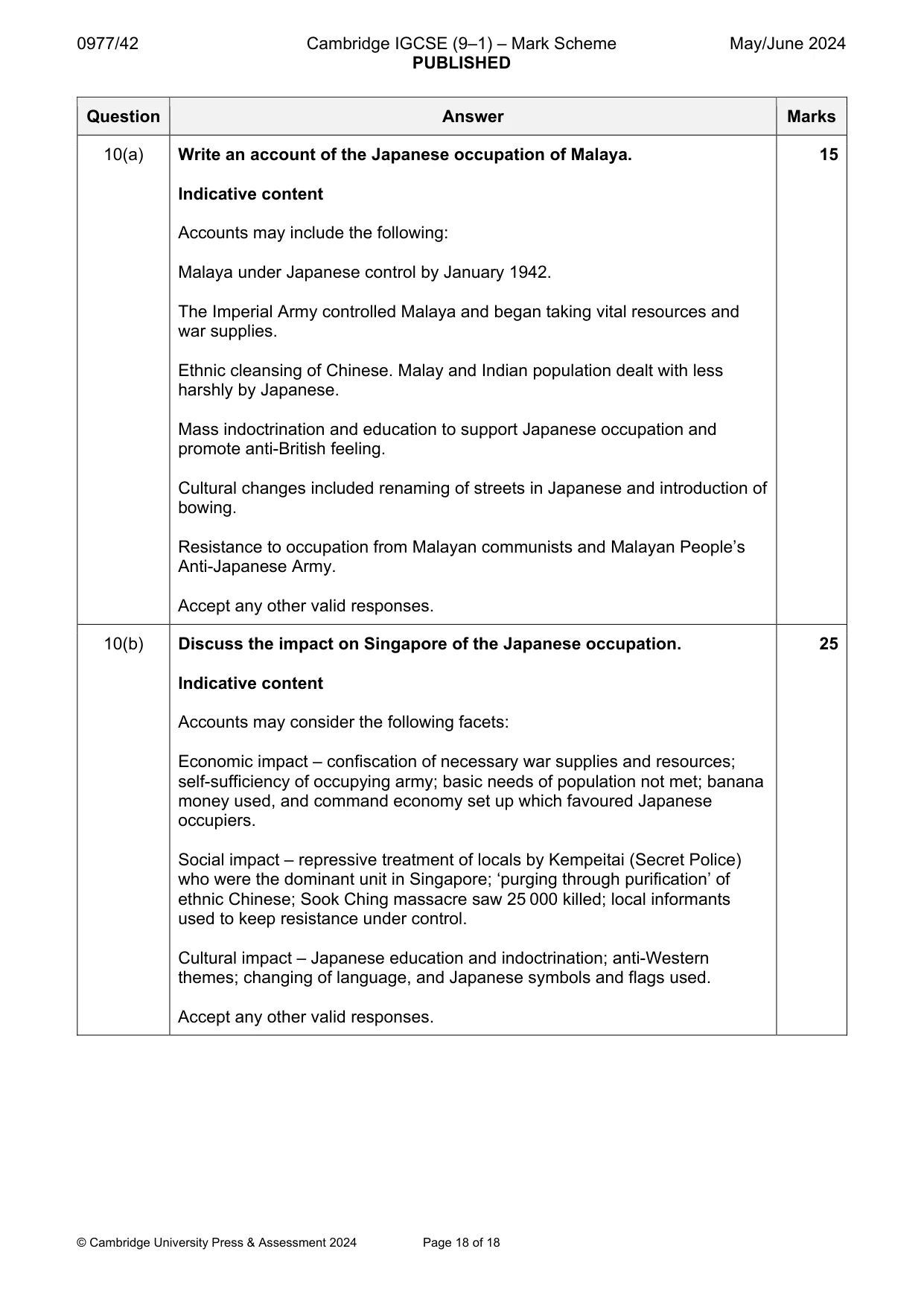
Mark scheme, page 18
0977/42 Cambridge IGCSE (9–1) – Mark Scheme PUBLISHED May/June 2024 © Cambridge University Press & Assessment 2024 Page 18 of 18 Question Answer Marks 10(a) Write an account of the Japanese occupation of Malaya. Indicative content Accounts may include the following: Malaya under Japanese control by January 1942. The Imperial Army controlled Malaya and began taking vital resources and war supplies. Ethnic cleansing of Chinese. Malay and Indian population dealt with less harshly by Japanese. Mass indoctrination and education to support Japanese occupation and promote anti-British feeling. Cultural changes included renaming of streets in Japanese and introduction of bowing. Resistance to occupation from Malayan communists and Malayan People’s Anti-Japanese Army. Accept any other valid responses. 15 10(b) Discuss the impact on Singapore of the Japanese occupation. Indicative content Accounts may consider the following facets: Economic impact – confiscation of necessary war supplies and resources; self-sufficiency of occupying army; basic needs of population not met; banana money used, and command economy set up which favoured Japanese occupiers. Social impact – repressive treatment of locals by Kempeitai (Secret Police) who were the dominant unit in Singapore; ‘purging through purification’ of ethnic Chinese; Sook Ching massacre saw 25 000 killed; local informants used to keep resistance under control. Cultural impact – Japanese education and indoctrination; anti-Western themes; changing of language, and Japanese symbols and flags used. Accept any other valid responses. 25
What you needed in this session
Cambridge’s own grade thresholds for 2024 May/June, Paper 4 · Variant 2. A higher threshold means an easier paper — the bar moves with how the cohort did.