Cambridge IGCSE History (9-1) 0977 — 2022 May/June Paper 4 · Variant 2
0977/42/M/J/22 · 14 questions · 40 marks · ≈45 min
The question paper and its mark scheme, free to read here and free to download. This is Cambridge’s own paper, exactly as it was sat.
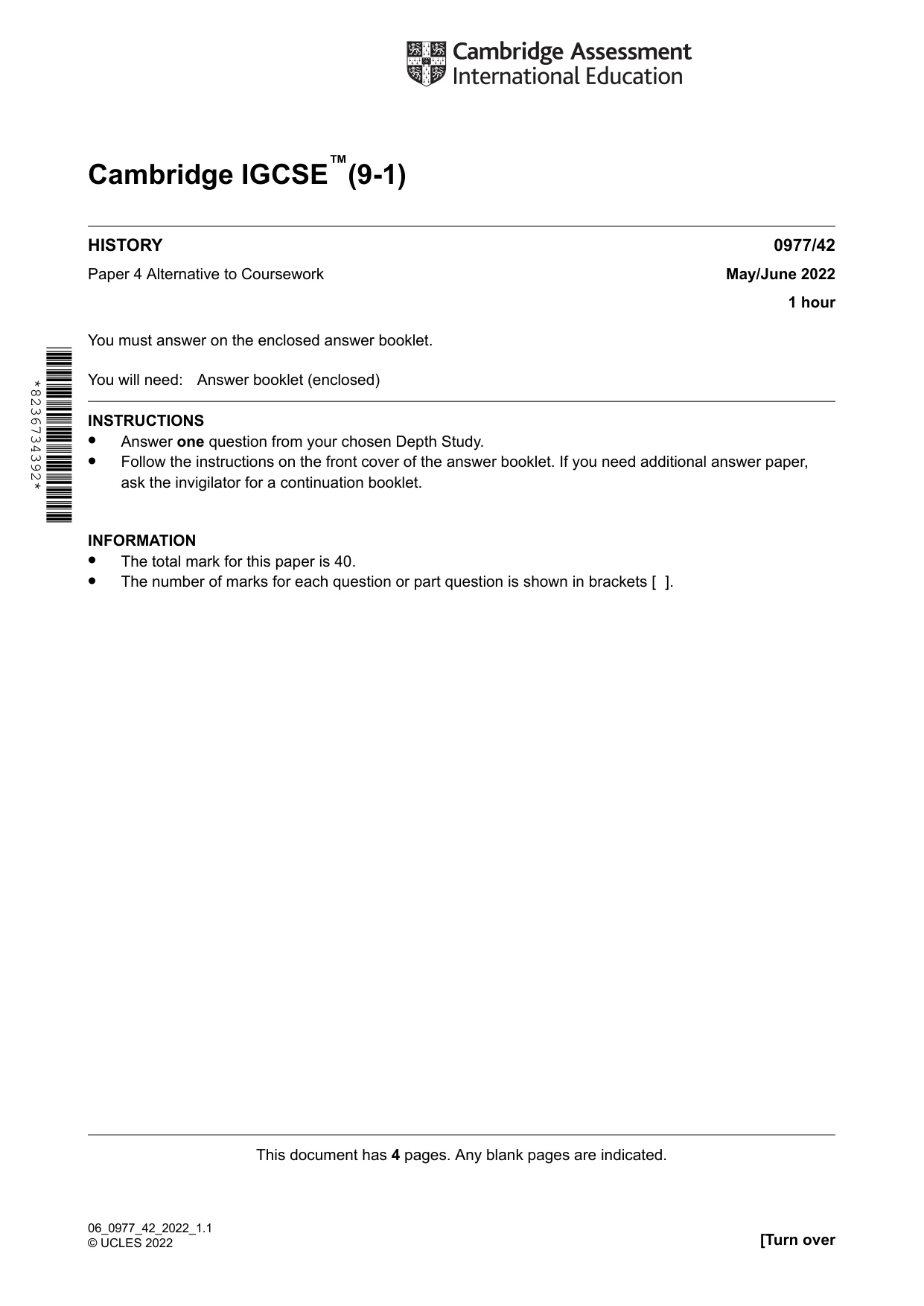
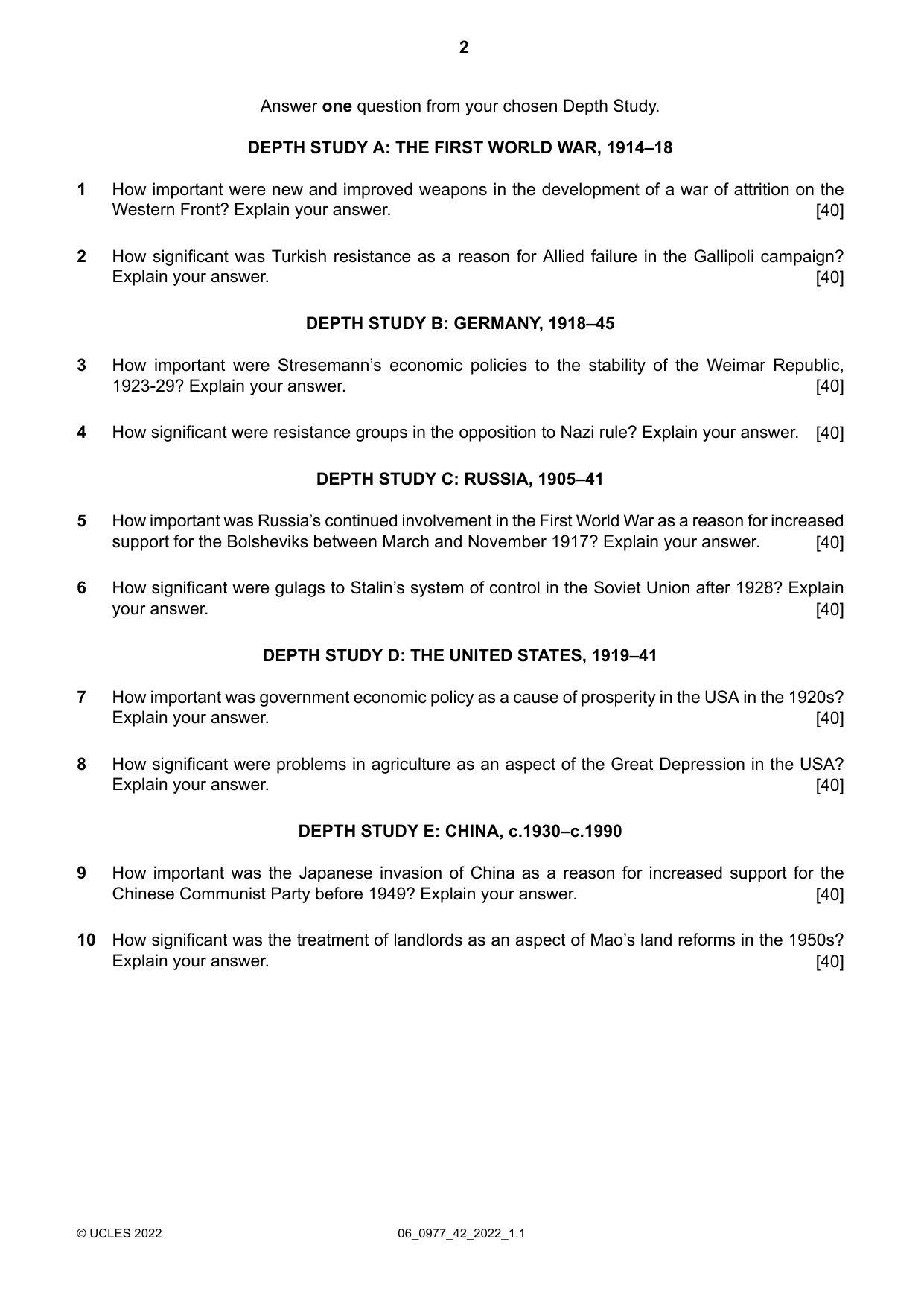
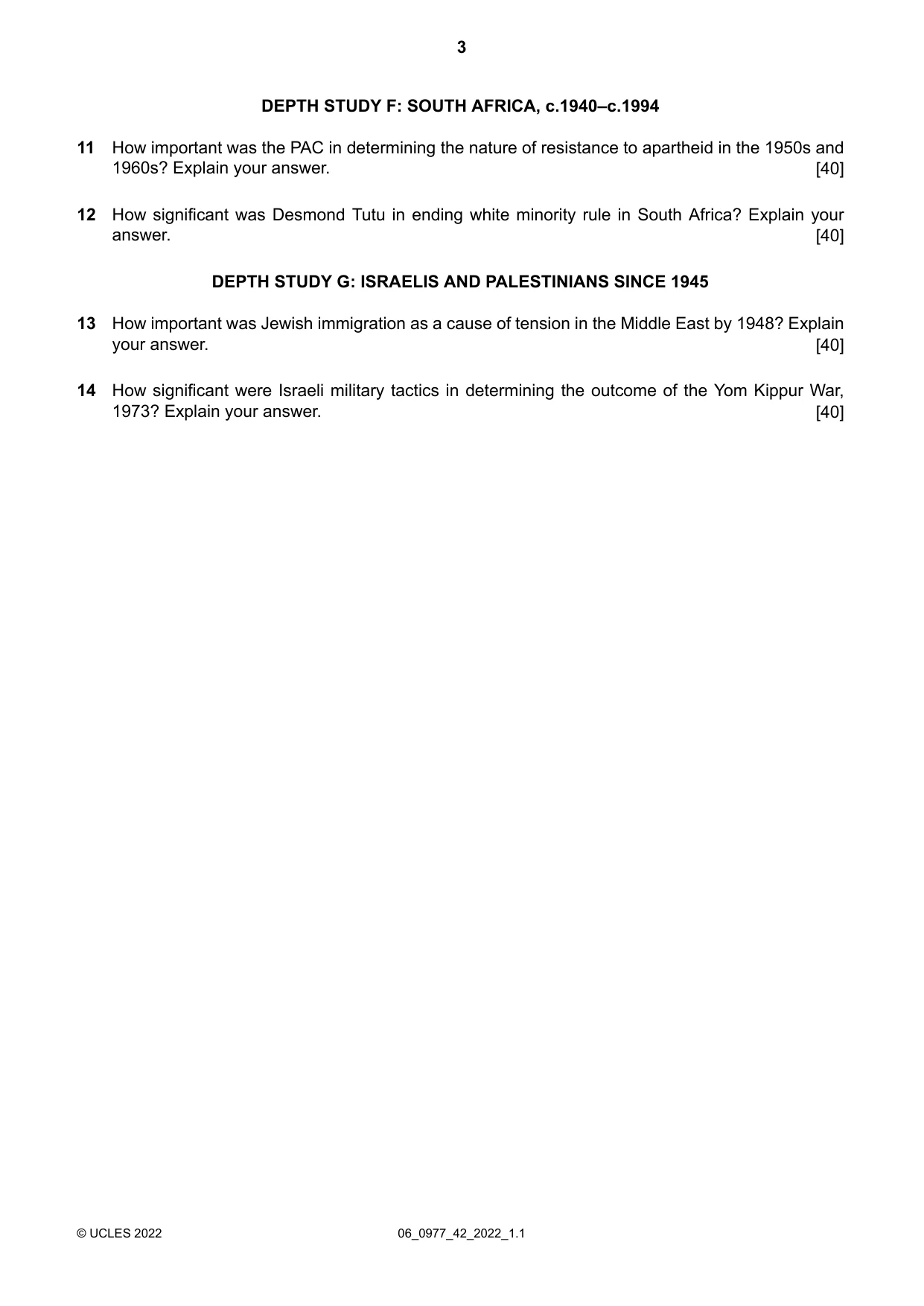
Question paper4 pages

Mark scheme15 pages
Answers below. Sit the paper first if you are practising.

Questions as text
Q1 · How important were new and improved weapons in the development of a war of attrition on…
1 How important were new and improved weapons in the development of a war of attrition on the Western Front? Explain your answer. [40]
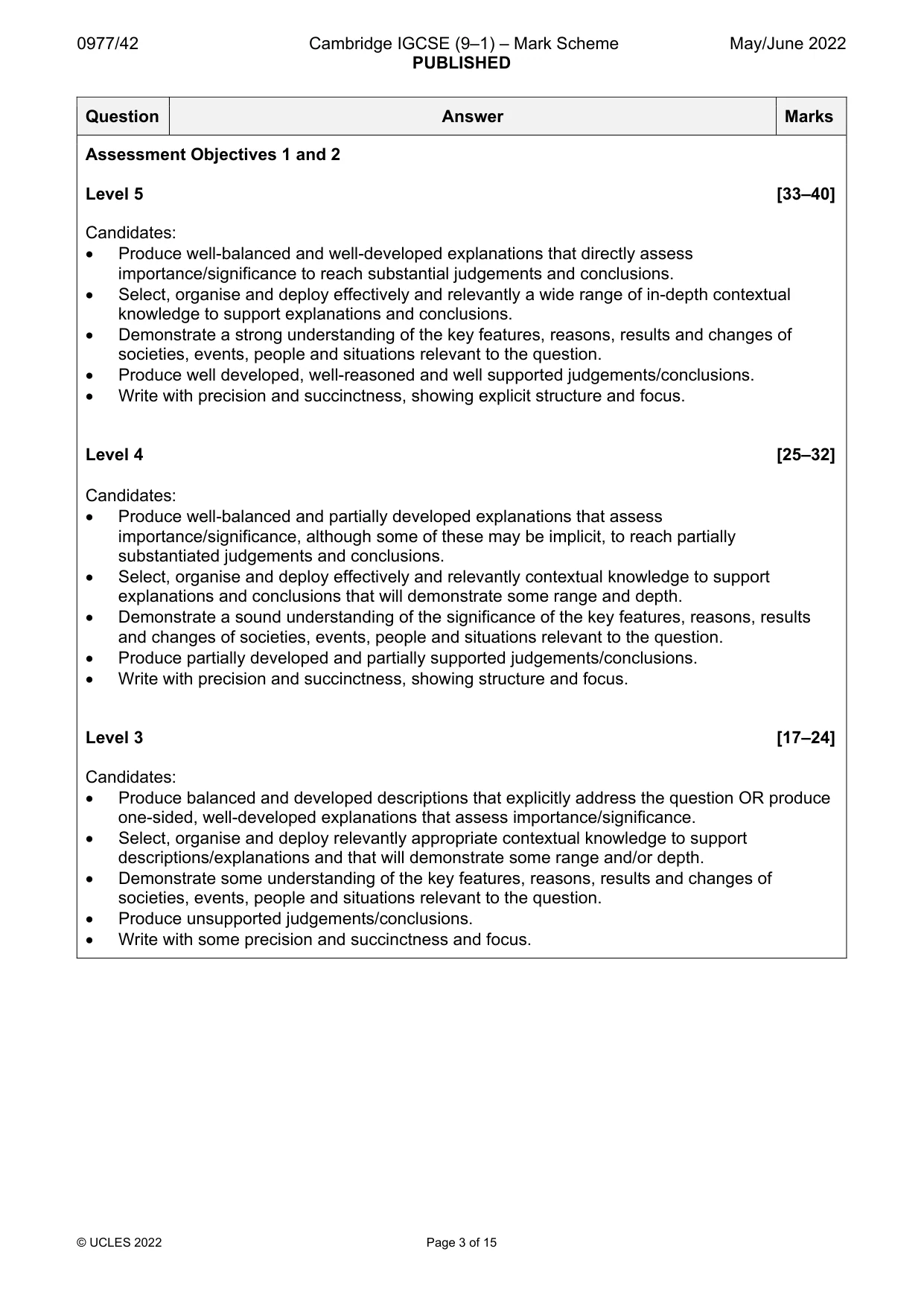
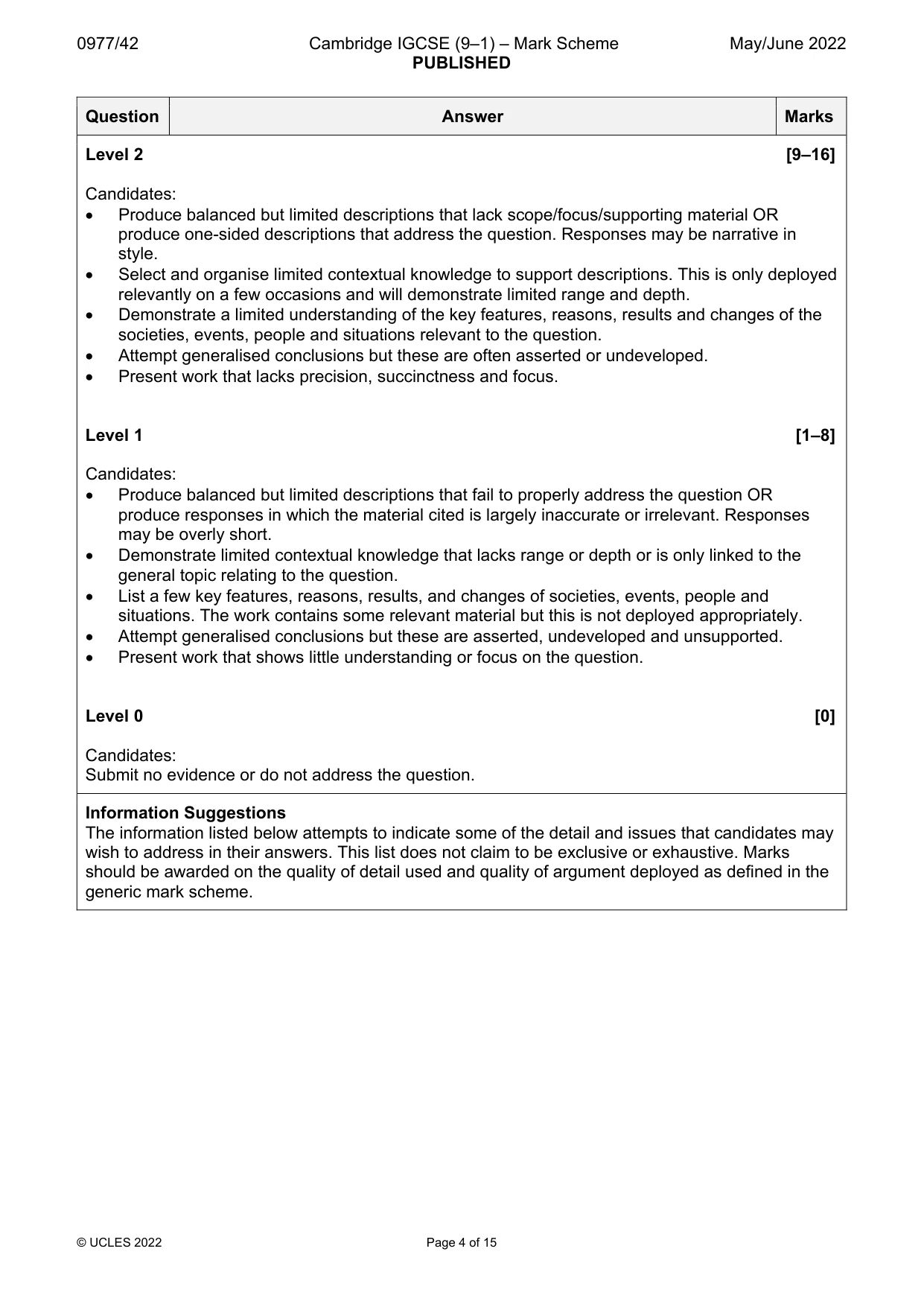
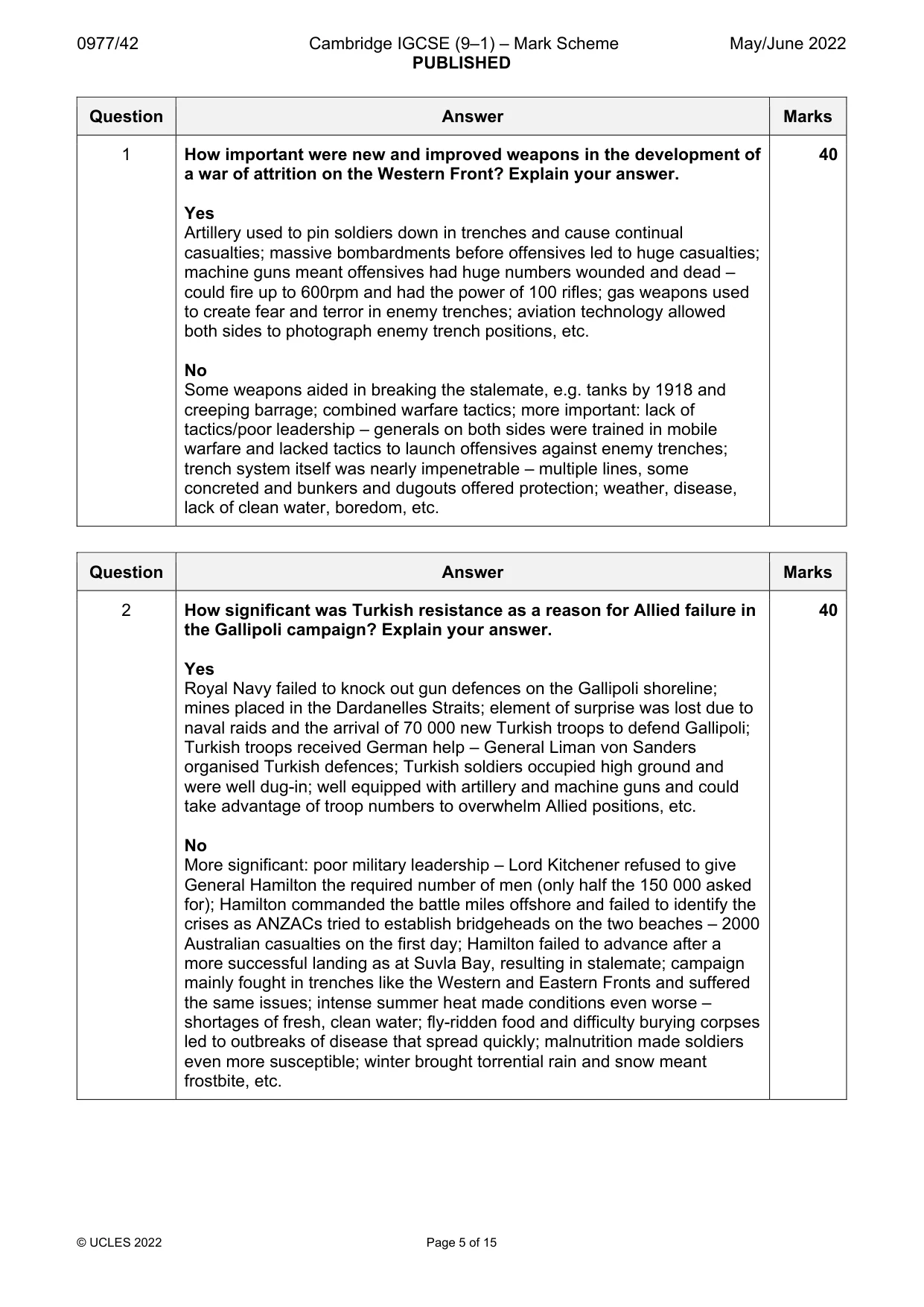
Mark scheme: Question Answer Marks 1 How important were new and improved weapons in the development of 40 a war of attrition on the Western Front? Explain your answer. Yes Artillery used to pin soldiers down in trenches and cause continual casualties; massive bombardments before offensives led to huge casualties; machine guns meant offensives had huge numbers wounded and dead – could fire up to 600rpm and had the power of 100 rifles; gas weapons used to create fear and terror in enemy trenches; aviation technology allowed both sides to photograph enemy trench positions, etc. No Some weapons aided in breaking the stalemate, e.g. tanks by 1918 and creeping barrage; combined warfare tactics; more important: lack of tactics/poor leadership – generals on both sides were trained in mobile warfare and lacked tactics to launch offensives against enemy trenches; trench system itself was nearly impenetrable – multiple lines, some concreted and bunkers and dugouts offered protection; weather, disease, lack of clean water, boredom, etc.
Q2 · How significant was Turkish resistance as a reason for Allied failure in the Gallipoli…
2 How significant was Turkish resistance as a reason for Allied failure in the Gallipoli campaign? Explain your answer. [40] DEPTH STUDY B: GERMANY, 1918–45
Mark scheme: 2 How significant was Turkish resistance as a reason for Allied failure in 40 the Gallipoli campaign? Explain your answer. Yes Royal Navy failed to knock out gun defences on the Gallipoli shoreline; mines placed in the Dardanelles Straits; element of surprise was lost due to naval raids and the arrival of 70 000 new Turkish troops to defend Gallipoli; Turkish troops received German help – General Liman von Sanders organised Turkish defences; Turkish soldiers occupied high ground and were well dug-in; well equipped with artillery and machine guns and could take advantage of troop numbers to overwhelm Allied positions, etc. No More significant: poor military leadership – Lord Kitchener refused to give General Hamilton the required number of men (only half the 150 000 asked for); Hamilton commanded the battle miles offshore and failed to identify the crises as ANZACs tried to establish bridgeheads on the two beaches – 2000 Australian casualties on the first day; Hamilton failed to advance after a more successful landing as at Suvla Bay, resulting in stalemate; campaign mainly fought in trenches like the Western and Eastern Fronts and suffered the same issues; intense summer heat made conditions even worse – shortages of fresh, clean water; fly-ridden food and difficulty burying corpses led to outbreaks of disease that spread quickly; malnutrition made soldiers even more susceptible; winter brought torrential rain and snow meant frostbite, etc.
Q3 · How important were Stresemann’s economic policies to the stability of the Weimar…
3 How important were Stresemann’s economic policies to the stability of the Weimar Republic, 1923-29? Explain your answer. [40]
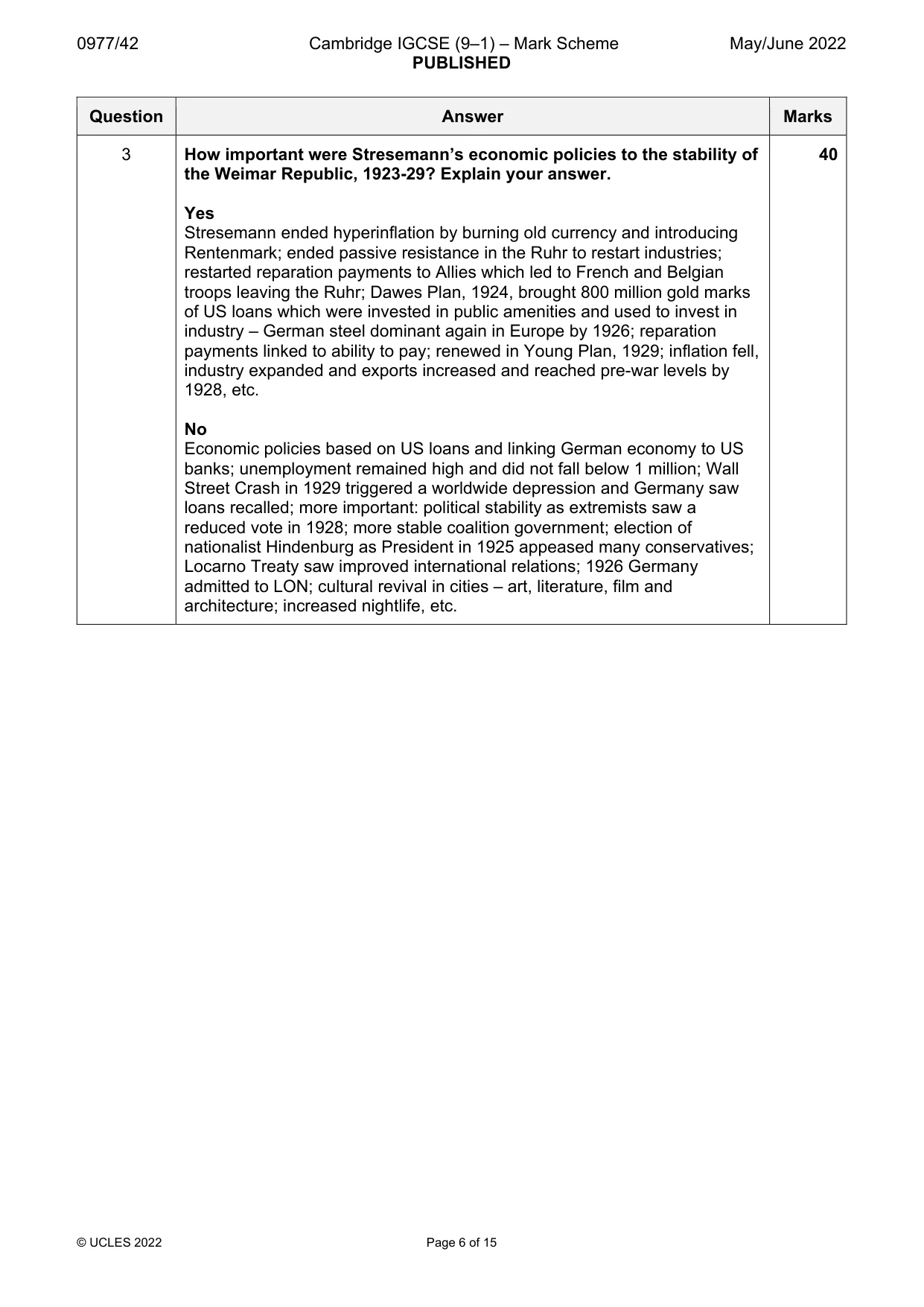
Mark scheme: 3 How important were Stresemann’s economic policies to the stability of 40 the Weimar Republic, 1923-29? Explain your answer. Yes Stresemann ended hyperinflation by burning old currency and introducing Rentenmark; ended passive resistance in the Ruhr to restart industries; restarted reparation payments to Allies which led to French and Belgian troops leaving the Ruhr; Dawes Plan, 1924, brought 800 million gold marks of US loans which were invested in public amenities and used to invest in industry – German steel dominant again in Europe by 1926; reparation payments linked to ability to pay; renewed in Young Plan, 1929; inflation fell, industry expanded and exports increased and reached pre-war levels by 1928, etc. No Economic policies based on US loans and linking German economy to US banks; unemployment remained high and did not fall below 1 million; Wall Street Crash in 1929 triggered a worldwide depression and Germany saw loans recalled; more important: political stability as extremists saw a reduced vote in 1928; more stable coalition government; election of nationalist Hindenburg as President in 1925 appeased many conservatives; Locarno Treaty saw improved international relations; 1926 Germany admitted to LON; cultural revival in cities – art, literature, film and architecture; increased nightlife, etc.
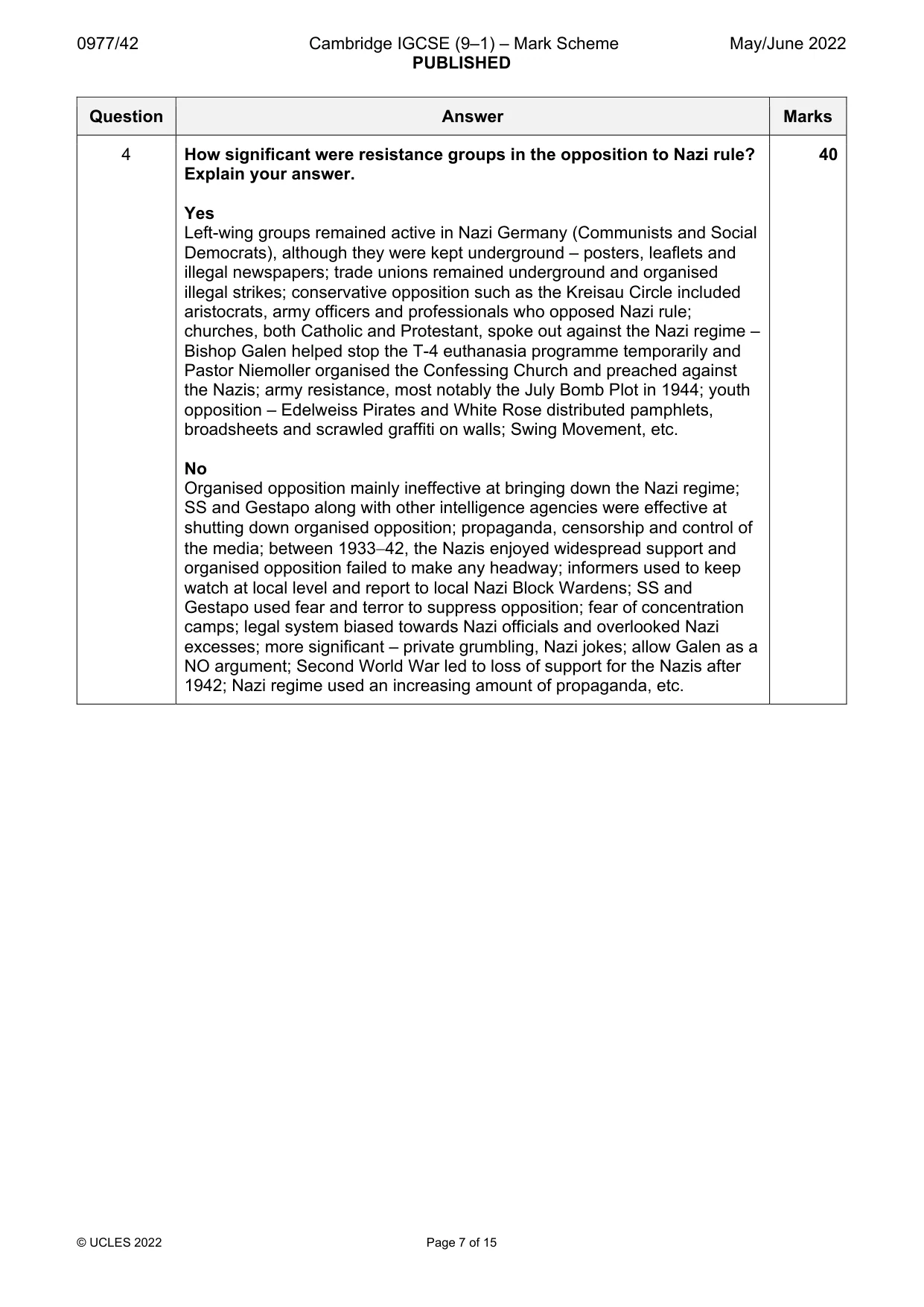
Q4 · How significant were resistance groups in the opposition to Nazi rule?
4 How significant were resistance groups in the opposition to Nazi rule? Explain your answer. [40] DEPTH STUDY C: RUSSIA, 1905–41
Mark scheme: 4 How significant were resistance groups in the opposition to Nazi rule? 40 Explain your answer. Yes Left-wing groups remained active in Nazi Germany (Communists and Social Democrats), although they were kept underground – posters, leaflets and illegal newspapers; trade unions remained underground and organised illegal strikes; conservative opposition such as the Kreisau Circle included aristocrats, army officers and professionals who opposed Nazi rule; churches, both Catholic and Protestant, spoke out against the Nazi regime – Bishop Galen helped stop the T-4 euthanasia programme temporarily and Pastor Niemoller organised the Confessing Church and preached against the Nazis; army resistance, most notably the July Bomb Plot in 1944; youth opposition – Edelweiss Pirates and White Rose distributed pamphlets, broadsheets and scrawled graffiti on walls; Swing Movement, etc. No Organised opposition mainly ineffective at bringing down the Nazi regime; SS and Gestapo along with other intelligence agencies were effective at shutting down organised opposition; propaganda, censorship and control of the media; between 193342, the Nazis enjoyed widespread support and organised opposition failed to make any headway; informers used to keep watch at local level and report to local Nazi Block Wardens; SS and Gestapo used fear and terror to suppress opposition; fear of concentration camps; legal system biased towards Nazi officials and overlooked Nazi excesses; more significant – private grumbling, Nazi jokes; allow Galen as a NO argument; Second World War led to loss of support for the Nazis after 1942; Nazi regime used an increasing amount of propaganda, etc.
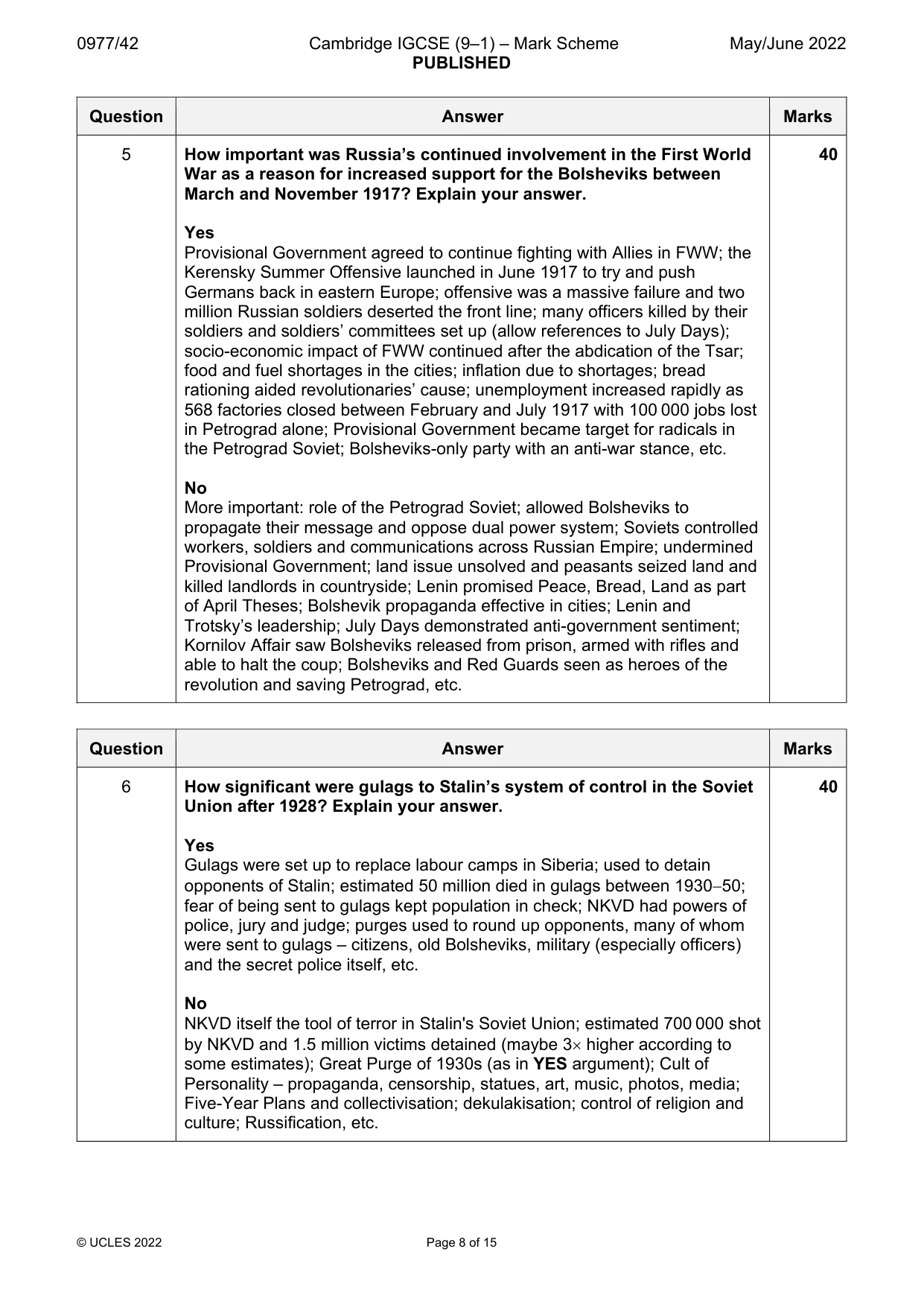
Q5 · How important was Russia’s continued involvement in the First World War as a reason for…
5 How important was Russia’s continued involvement in the First World War as a reason for increased support for the Bolsheviks between March and November 1917? Explain your answer. [40]
Mark scheme: 5 How important was Russia’s continued involvement in the First World 40 War as a reason for increased support for the Bolsheviks between March and November 1917? Explain your answer. Yes Provisional Government agreed to continue fighting with Allies in FWW; the Kerensky Summer Offensive launched in June 1917 to try and push Germans back in eastern Europe; offensive was a massive failure and two million Russian soldiers deserted the front line; many officers killed by their soldiers and soldiers’ committees set up (allow references to July Days); socio-economic impact of FWW continued after the abdication of the Tsar; food and fuel shortages in the cities; inflation due to shortages; bread rationing aided revolutionaries’ cause; unemployment increased rapidly as 568 factories closed between February and July 1917 with 100 000 jobs lost in Petrograd alone; Provisional Government became target for radicals in the Petrograd Soviet; Bolsheviks-only party with an anti-war stance, etc. No More important: role of the Petrograd Soviet; allowed Bolsheviks to propagate their message and oppose dual power system; Soviets controlled workers, soldiers and communications across Russian Empire; undermined Provisional Government; land issue unsolved and peasants seized land and killed landlords in countryside; Lenin promised Peace, Bread, Land as part of April Theses; Bolshevik propaganda effective in cities; Lenin and Trotsky’s leadership; July Days demonstrated anti-government sentiment; Kornilov Affair saw Bolsheviks released from prison, armed with rifles and able to halt the coup; Bolsheviks and Red Guards seen as heroes of the revolution and saving Petrograd, etc.
Q6 · How significant were gulags to Stalin’s system of control in the Soviet Union after 1928?
6 How significant were gulags to Stalin’s system of control in the Soviet Union after 1928? Explain your answer. [40] DEPTH STUDY D: THE UNITED STATES, 1919–41
Mark scheme: 6 How significant were gulags to Stalin’s system of control in the Soviet 40 Union after 1928? Explain your answer. Yes Gulags were set up to replace labour camps in Siberia; used to detain opponents of Stalin; estimated 50 million died in gulags between 193050; fear of being sent to gulags kept population in check; NKVD had powers of police, jury and judge; purges used to round up opponents, many of whom were sent to gulags – citizens, old Bolsheviks, military (especially officers) and the secret police itself, etc. No NKVD itself the tool of terror in Stalin's Soviet Union; estimated 700 000 shot by NKVD and 1.5 million victims detained (maybe 3 higher according to some estimates); Great Purge of 1930s (as in YES argument); Cult of Personality – propaganda, censorship, statues, art, music, photos, media; Five-Year Plans and collectivisation; dekulakisation; control of religion and culture; Russification, etc.
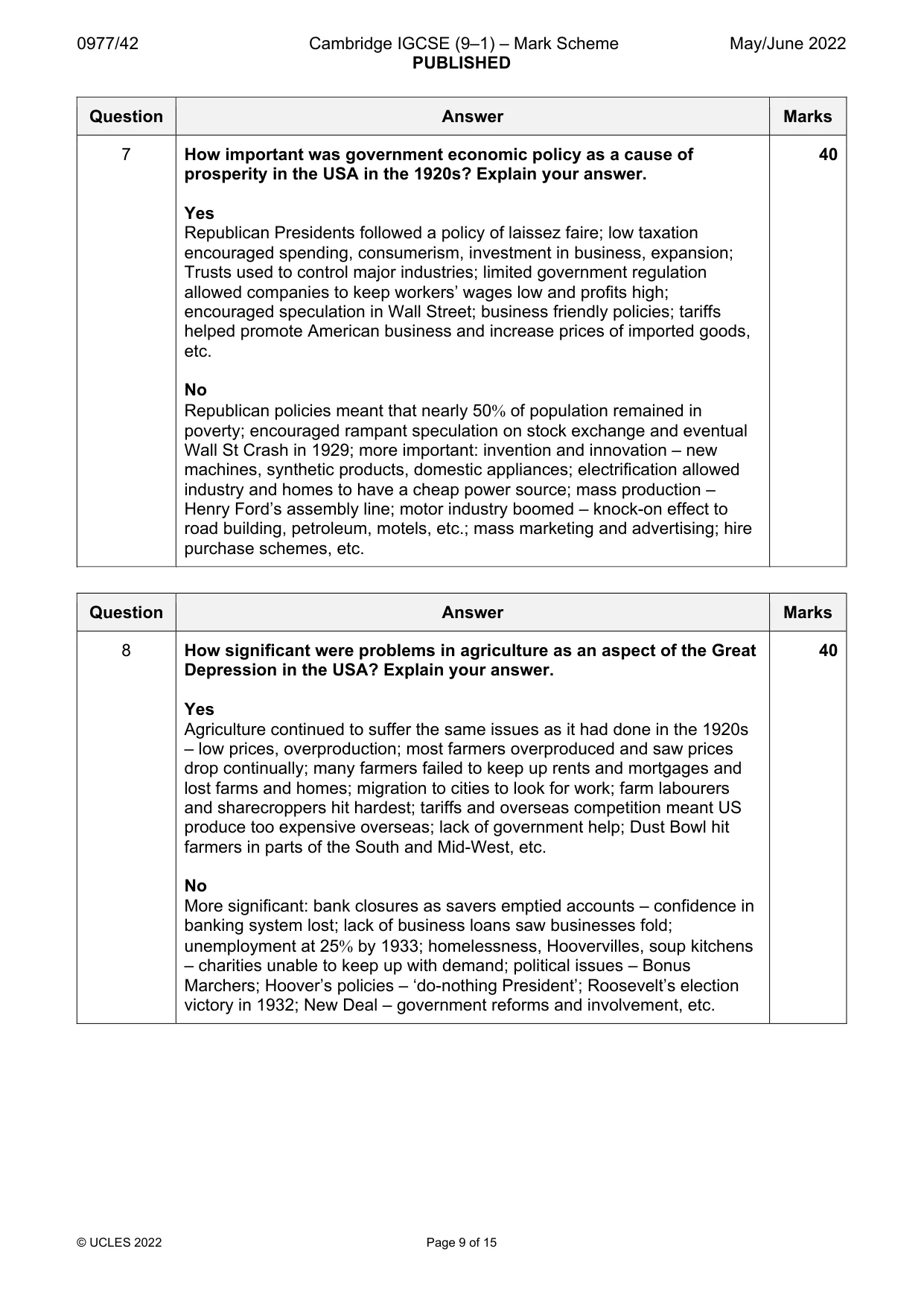
Q7 · How important was government economic policy as a cause of prosperity in the USA in the…
7 How important was government economic policy as a cause of prosperity in the USA in the 1920s? Explain your answer. [40]
Mark scheme: 7 How important was government economic policy as a cause of 40 prosperity in the USA in the 1920s? Explain your answer. Yes Republican Presidents followed a policy of laissez faire; low taxation encouraged spending, consumerism, investment in business, expansion; Trusts used to control major industries; limited government regulation allowed companies to keep workers’ wages low and profits high; encouraged speculation in Wall Street; business friendly policies; tariffs helped promote American business and increase prices of imported goods, etc. No Republican policies meant that nearly 50 of population remained in poverty; encouraged rampant speculation on stock exchange and eventual Wall St Crash in 1929; more important: invention and innovation – new machines, synthetic products, domestic appliances; electrification allowed industry and homes to have a cheap power source; mass production – Henry Ford’s assembly line; motor industry boomed – knock-on effect to road building, petroleum, motels, etc.; mass marketing and advertising; hire purchase schemes, etc.
Q8 · How significant were problems in agriculture as an aspect of the Great Depression in the…
8 How significant were problems in agriculture as an aspect of the Great Depression in the USA? Explain your answer. [40] DEPTH STUDY E: CHINA, c.1930–c.1990
Mark scheme: 8 How significant were problems in agriculture as an aspect of the Great 40 Depression in the USA? Explain your answer. Yes Agriculture continued to suffer the same issues as it had done in the 1920s – low prices, overproduction; most farmers overproduced and saw prices drop continually; many farmers failed to keep up rents and mortgages and lost farms and homes; migration to cities to look for work; farm labourers and sharecroppers hit hardest; tariffs and overseas competition meant US produce too expensive overseas; lack of government help; Dust Bowl hit farmers in parts of the South and Mid-West, etc. No More significant: bank closures as savers emptied accounts – confidence in banking system lost; lack of business loans saw businesses fold; unemployment at 25 by 1933; homelessness, Hoovervilles, soup kitchens – charities unable to keep up with demand; political issues – Bonus Marchers; Hoover’s policies – ‘do-nothing President’; Roosevelt’s election victory in 1932; New Deal – government reforms and involvement, etc.
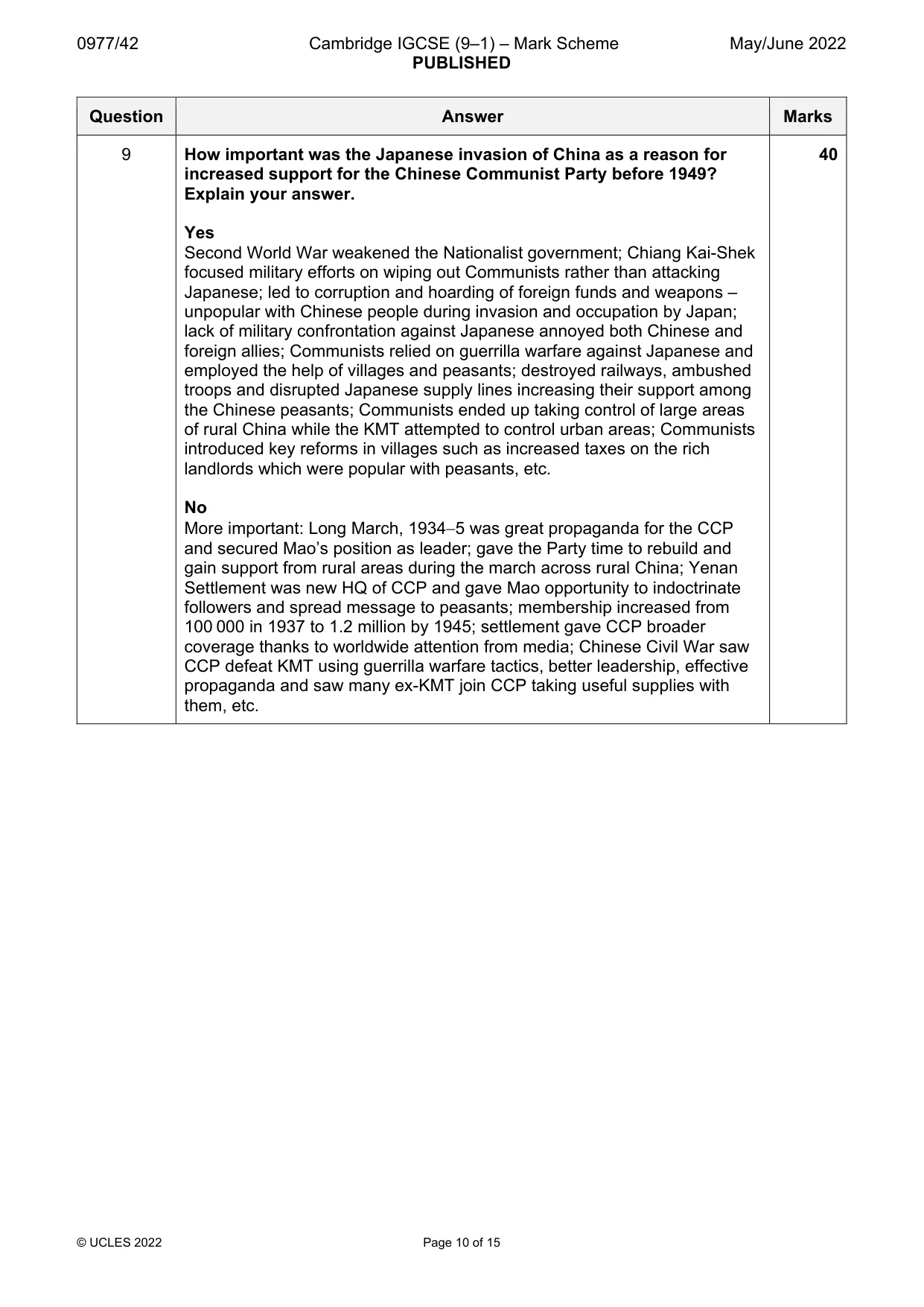
Q9 · How important was the Japanese invasion of China as a reason for increased support for…
9 How important was the Japanese invasion of China as a reason for increased support for the Chinese Communist Party before 1949? Explain your answer. [40]
Mark scheme: 9 How important was the Japanese invasion of China as a reason for 40 increased support for the Chinese Communist Party before 1949? Explain your answer. Yes Second World War weakened the Nationalist government; Chiang Kai-Shek focused military efforts on wiping out Communists rather than attacking Japanese; led to corruption and hoarding of foreign funds and weapons – unpopular with Chinese people during invasion and occupation by Japan; lack of military confrontation against Japanese annoyed both Chinese and foreign allies; Communists relied on guerrilla warfare against Japanese and employed the help of villages and peasants; destroyed railways, ambushed troops and disrupted Japanese supply lines increasing their support among the Chinese peasants; Communists ended up taking control of large areas of rural China while the KMT attempted to control urban areas; Communists introduced key reforms in villages such as increased taxes on the rich landlords which were popular with peasants, etc. No More important: Long March, 19345 was great propaganda for the CCP and secured Mao’s position as leader; gave the Party time to rebuild and gain support from rural areas during the march across rural China; Yenan Settlement was new HQ of CCP and gave Mao opportunity to indoctrinate followers and spread message to peasants; membership increased from 100 000 in 1937 to 1.2 million by 1945; settlement gave CCP broader coverage thanks to worldwide attention from media; Chinese Civil War saw CCP defeat KMT using guerrilla warfare tactics, better leadership, effective propaganda and saw many ex-KMT join CCP taking useful supplies with them, etc.
Q10 · DEPTH STUDY F: SOUTH AFRICA, c.1940–c.1994
DEPTH STUDY F: SOUTH AFRICA, c.1940–c.1994
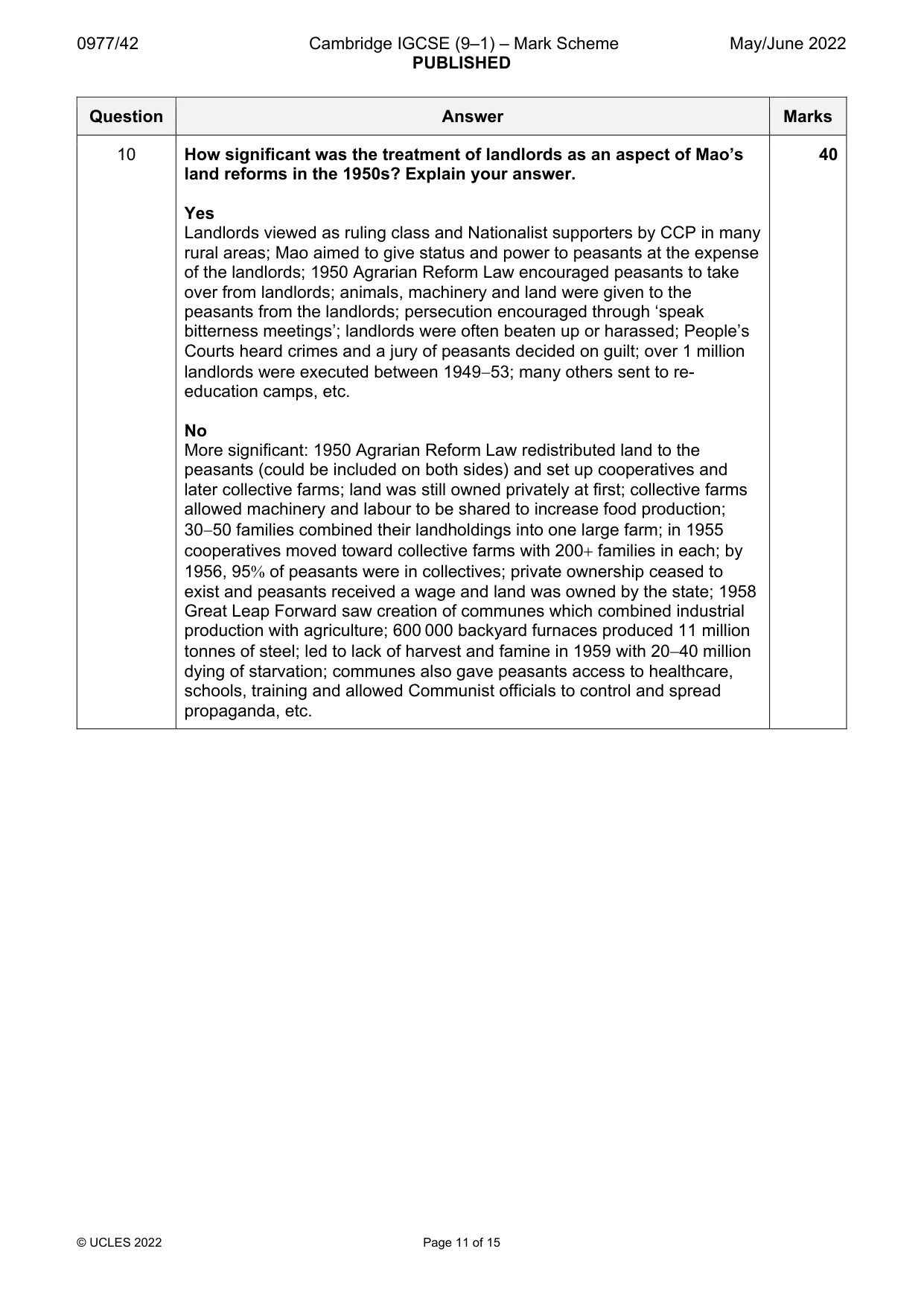
Mark scheme: 10 How significant was the treatment of landlords as an aspect of Mao’s 40 land reforms in the 1950s? Explain your answer. Yes Landlords viewed as ruling class and Nationalist supporters by CCP in many rural areas; Mao aimed to give status and power to peasants at the expense of the landlords; 1950 Agrarian Reform Law encouraged peasants to take over from landlords; animals, machinery and land were given to the peasants from the landlords; persecution encouraged through ‘speak bitterness meetings’; landlords were often beaten up or harassed; People’s Courts heard crimes and a jury of peasants decided on guilt; over 1 million landlords were executed between 194953; many others sent to re- education camps, etc. No More significant: 1950 Agrarian Reform Law redistributed land to the peasants (could be included on both sides) and set up cooperatives and later collective farms; land was still owned privately at first; collective farms allowed machinery and labour to be shared to increase food production; 3050 families combined their landholdings into one large farm; in 1955 cooperatives moved toward collective farms with 200 families in each; by 1956, 95 of peasants were in collectives; private ownership ceased to exist and peasants received a wage and land was owned by the state; 1958 Great Leap Forward saw creation of communes which combined industrial production with agriculture; 600 000 backyard furnaces produced 11 million tonnes of steel; led to lack of harvest and famine in 1959 with 2040 million dying of starvation; communes also gave peasants access to healthcare, schools, training and allowed Communist officials to control and spread propaganda, etc.
Q11 · How important was the PAC in determining the nature of resistance to apartheid in the…
11 How important was the PAC in determining the nature of resistance to apartheid in the 1950s and 1960s? Explain your answer. [40]
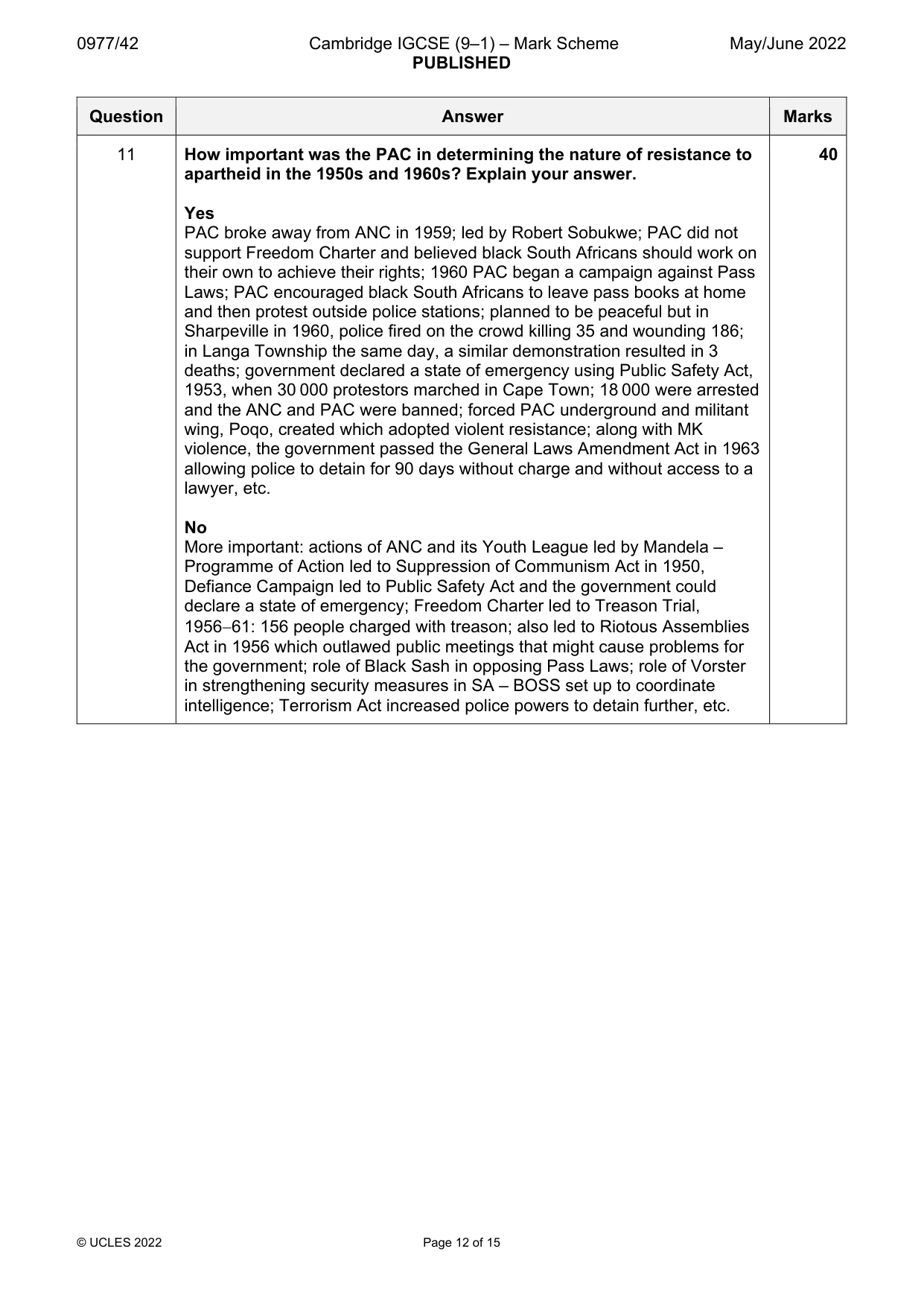
Mark scheme: 11 How important was the PAC in determining the nature of resistance to 40 apartheid in the 1950s and 1960s? Explain your answer. Yes PAC broke away from ANC in 1959; led by Robert Sobukwe; PAC did not support Freedom Charter and believed black South Africans should work on their own to achieve their rights; 1960 PAC began a campaign against Pass Laws; PAC encouraged black South Africans to leave pass books at home and then protest outside police stations; planned to be peaceful but in Sharpeville in 1960, police fired on the crowd killing 35 and wounding 186; in Langa Township the same day, a similar demonstration resulted in 3 deaths; government declared a state of emergency using Public Safety Act, 1953, when 30 000 protestors marched in Cape Town; 18 000 were arrested and the ANC and PAC were banned; forced PAC underground and militant wing, Poqo, created which adopted violent resistance; along with MK violence, the government passed the General Laws Amendment Act in 1963 allowing police to detain for 90 days without charge and without access to a lawyer, etc. No More important: actions of ANC and its Youth League led by Mandela – Programme of Action led to Suppression of Communism Act in 1950, Defiance Campaign led to Public Safety Act and the government could declare a state of emergency; Freedom Charter led to Treason Trial, 195661: 156 people charged with treason; also led to Riotous Assemblies Act in 1956 which outlawed public meetings that might cause problems for the government; role of Black Sash in opposing Pass Laws; role of Vorster in strengthening security measures in SA – BOSS set up to coordinate intelligence; Terrorism Act increased police powers to detain further, etc.
Q12 · How significant was Desmond Tutu in ending white minority rule in South Africa?
12 How significant was Desmond Tutu in ending white minority rule in South Africa? Explain your answer. [40] DEPTH STUDY G: ISRAELIS AND PALESTINIANS SINCE 1945
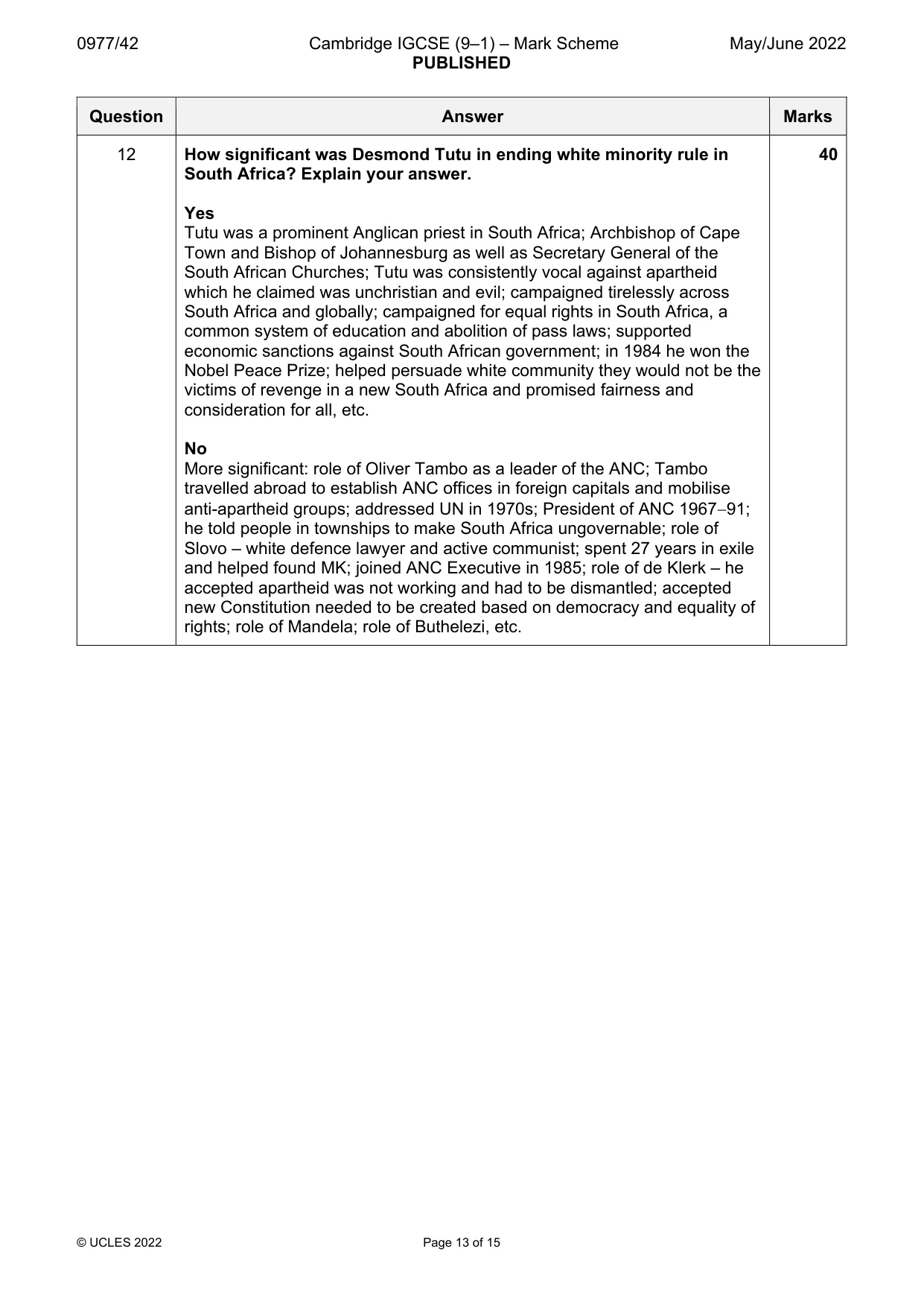
Mark scheme: 12 How significant was Desmond Tutu in ending white minority rule in 40 South Africa? Explain your answer. Yes Tutu was a prominent Anglican priest in South Africa; Archbishop of Cape Town and Bishop of Johannesburg as well as Secretary General of the South African Churches; Tutu was consistently vocal against apartheid which he claimed was unchristian and evil; campaigned tirelessly across South Africa and globally; campaigned for equal rights in South Africa, a common system of education and abolition of pass laws; supported economic sanctions against South African government; in 1984 he won the Nobel Peace Prize; helped persuade white community they would not be the victims of revenge in a new South Africa and promised fairness and consideration for all, etc. No More significant: role of Oliver Tambo as a leader of the ANC; Tambo travelled abroad to establish ANC offices in foreign capitals and mobilise anti-apartheid groups; addressed UN in 1970s; President of ANC 196791; he told people in townships to make South Africa ungovernable; role of Slovo – white defence lawyer and active communist; spent 27 years in exile and helped found MK; joined ANC Executive in 1985; role of de Klerk – he accepted apartheid was not working and had to be dismantled; accepted new Constitution needed to be created based on democracy and equality of rights; role of Mandela; role of Buthelezi, etc.
Q13 · How important was Jewish immigration as a cause of tension in the Middle East by 1948?
13 How important was Jewish immigration as a cause of tension in the Middle East by 1948? Explain your answer. [40]
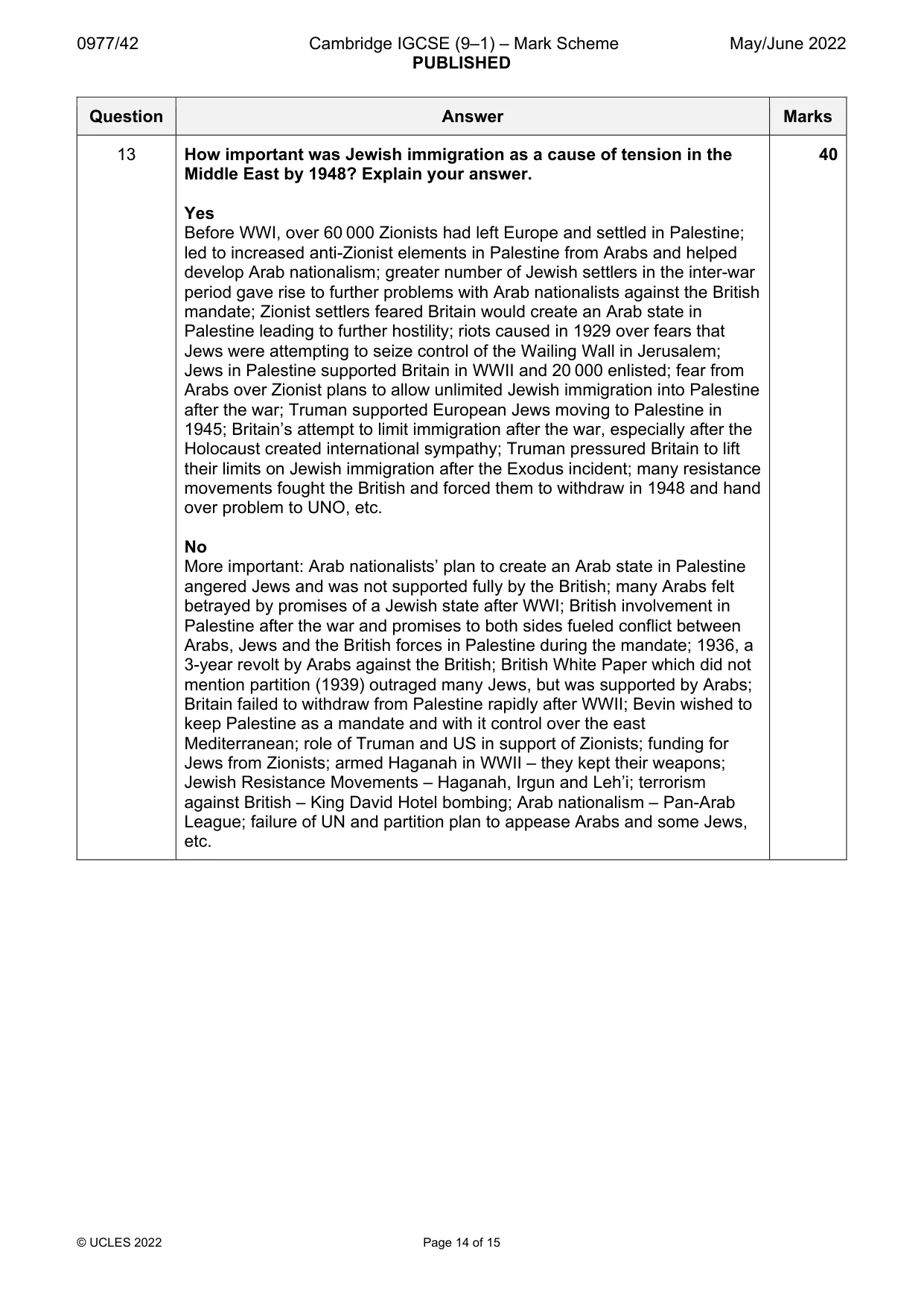
Mark scheme: 13 How important was Jewish immigration as a cause of tension in the 40 Middle East by 1948? Explain your answer. Yes Before WWI, over 60 000 Zionists had left Europe and settled in Palestine; led to increased anti-Zionist elements in Palestine from Arabs and helped develop Arab nationalism; greater number of Jewish settlers in the inter-war period gave rise to further problems with Arab nationalists against the British mandate; Zionist settlers feared Britain would create an Arab state in Palestine leading to further hostility; riots caused in 1929 over fears that Jews were attempting to seize control of the Wailing Wall in Jerusalem; Jews in Palestine supported Britain in WWII and 20 000 enlisted; fear from Arabs over Zionist plans to allow unlimited Jewish immigration into Palestine after the war; Truman supported European Jews moving to Palestine in 1945; Britain’s attempt to limit immigration after the war, especially after the Holocaust created international sympathy; Truman pressured Britain to lift their limits on Jewish immigration after the Exodus incident; many resistance movements fought the British and forced them to withdraw in 1948 and hand over problem to UNO, etc. No More important: Arab nationalists’ plan to create an Arab state in Palestine angered Jews and was not supported fully by the British; many Arabs felt betrayed by promises of a Jewish state after WWI; British involvement in Palestine after the war and promises to both sides fueled conflict between Arabs, Jews and the British forces in Palestine during the mandate; 1936, a 3-year revolt by Arabs against the British; British White Paper which did not mention partition (1939) outraged many Jews, but was supported by Arabs; Britain failed to withdraw from Palestine rapidly after WWII; Bevin wished to keep Palestine as a mandate and with it control over the east Mediterranean; role of Truman and US in support of Zionists; funding for Jews from Zionists; armed Haganah in WWII – they kept their weapons; Jewish Resistance Movements – Haganah, Irgun and Leh’i; terrorism against British – King David Hotel bombing; Arab nationalism – Pan-Arab League; failure of UN and partition plan to appease Arabs and some Jews, etc.
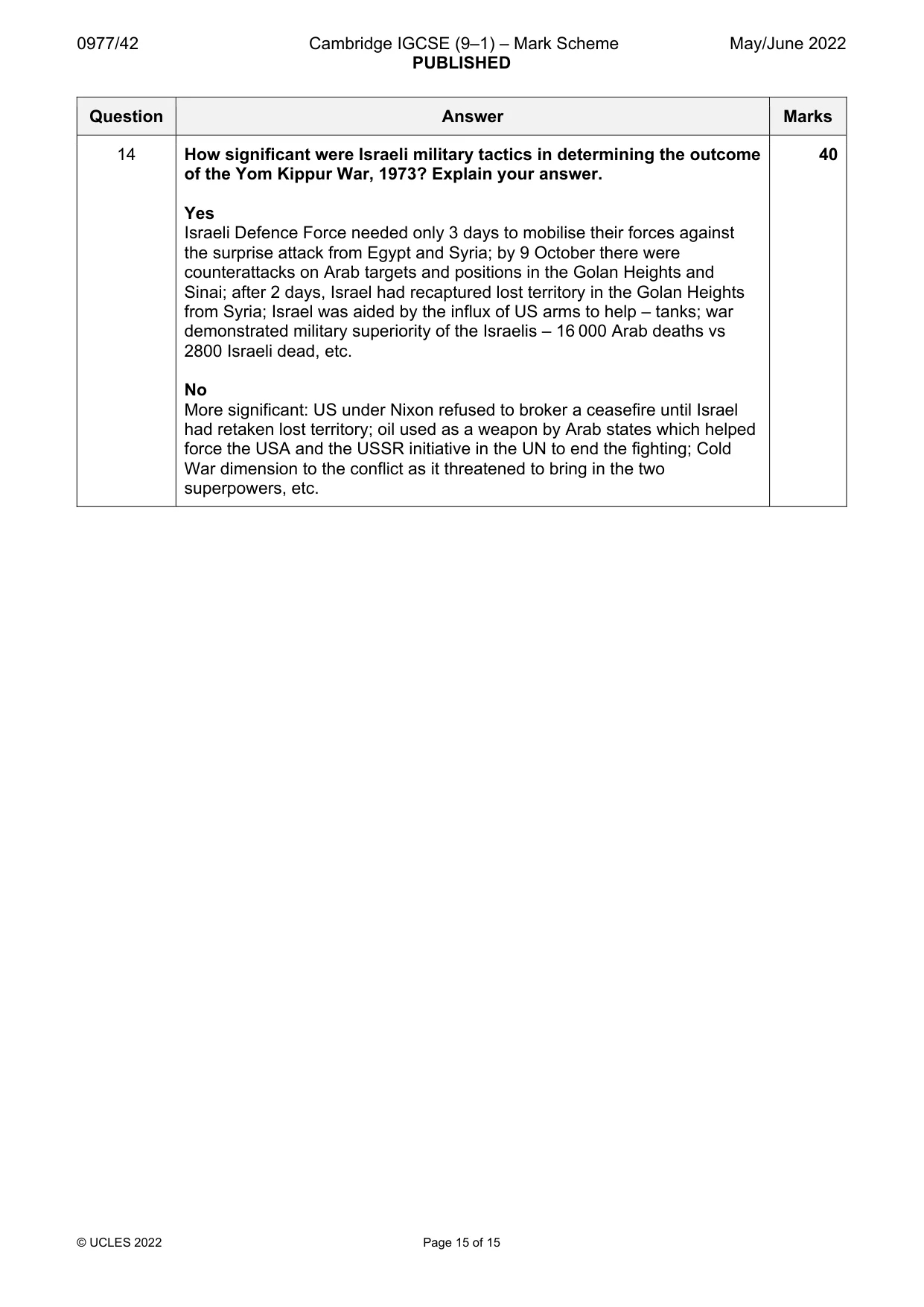
Q14 · How significant were Israeli military tactics in determining the outcome of the Yom…
14 How significant were Israeli military tactics in determining the outcome of the Yom Kippur War, 1973? Explain your answer. [40]
Mark scheme: 14 How significant were Israeli military tactics in determining the outcome 40 of the Yom Kippur War, 1973? Explain your answer. Yes Israeli Defence Force needed only 3 days to mobilise their forces against the surprise attack from Egypt and Syria; by 9 October there were counterattacks on Arab targets and positions in the Golan Heights and Sinai; after 2 days, Israel had recaptured lost territory in the Golan Heights from Syria; Israel was aided by the influx of US arms to help – tanks; war demonstrated military superiority of the Israelis – 16 000 Arab deaths vs 2800 Israeli dead, etc. No More significant: US under Nixon refused to broker a ceasefire until Israel had retaken lost territory; oil used as a weapon by Arab states which helped force the USA and the USSR initiative in the UN to end the fighting; Cold War dimension to the conflict as it threatened to bring in the two superpowers, etc.
What you needed in this session
Cambridge’s own grade thresholds for 2022 May/June, Paper 4 · Variant 2. A higher threshold means an easier paper — the bar moves with how the cohort did.