Cambridge IGCSE History (9-1) 0977 — 2021 May/June Paper 4 · Variant 2
0977/42/M/J/21 · 14 questions · 40 marks · ≈45 min
The question paper and its mark scheme, free to read here and free to download. This is Cambridge’s own paper, exactly as it was sat.
Question paper4 pages
Mark scheme11 pages
Answers below. Sit the paper first if you are practising.

Questions as text
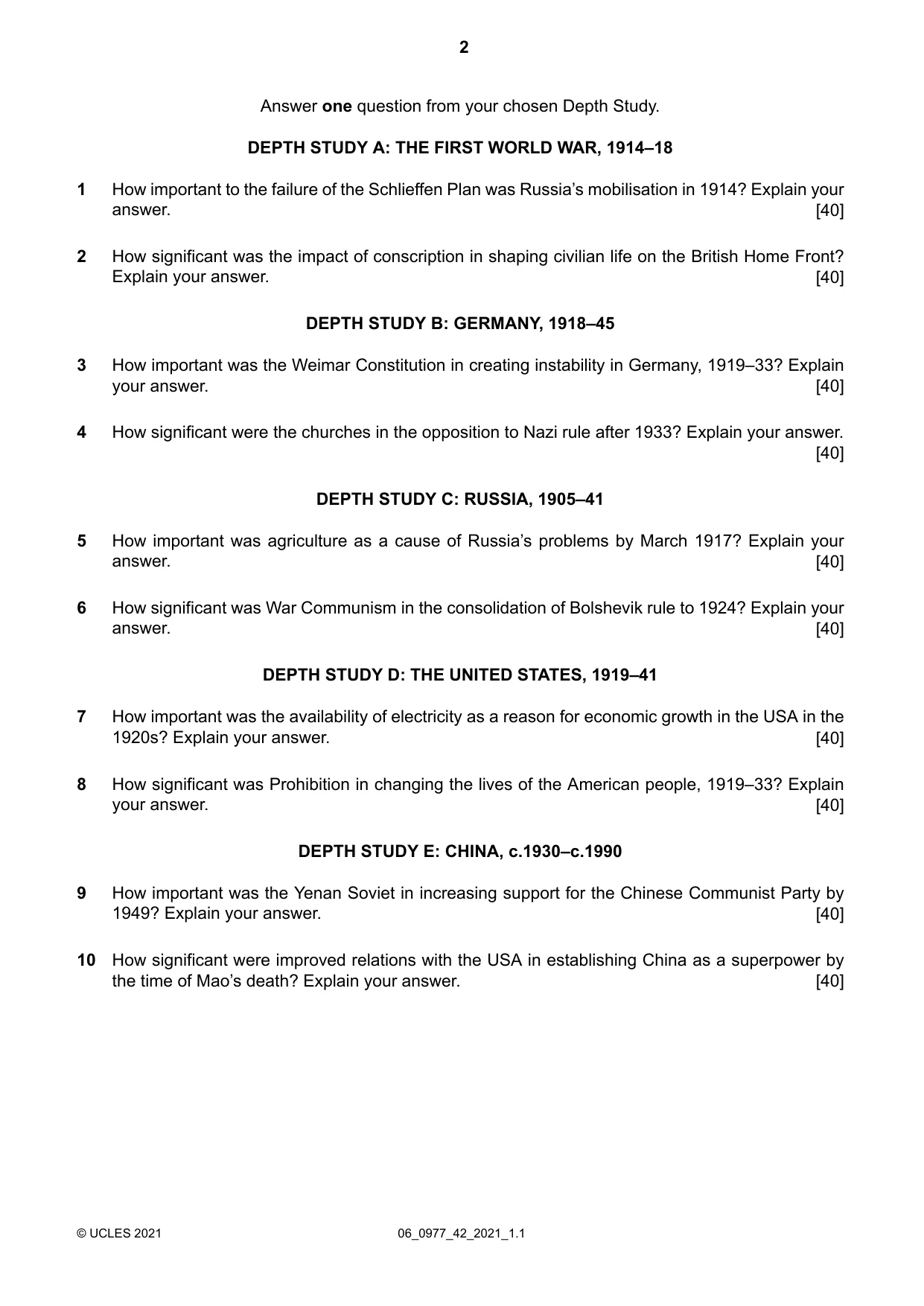
Q1 · How important to the failure of the Schlieffen Plan was Russia’s mobilisation in 1914?
1 How important to the failure of the Schlieffen Plan was Russia’s mobilisation in 1914? Explain your answer. [40]
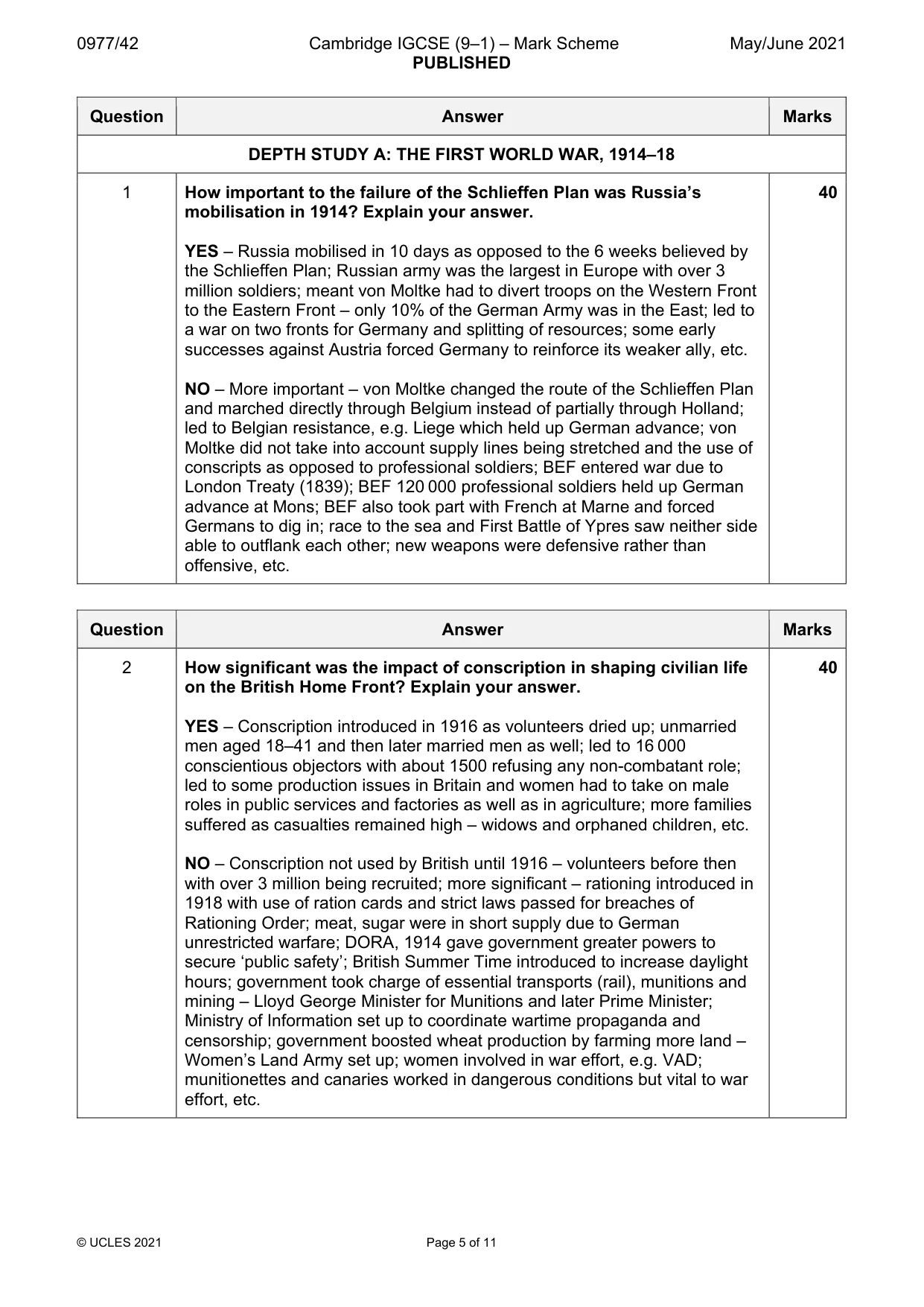
Mark scheme: Question Answer Marks DEPTH STUDY A: THE FIRST WORLD WAR, 1914–18 1 How important to the failure of the Schlieffen Plan was Russia’s 40 mobilisation in 1914? Explain your answer. YES – Russia mobilised in 10 days as opposed to the 6 weeks believed by the Schlieffen Plan; Russian army was the largest in Europe with over 3 million soldiers; meant von Moltke had to divert troops on the Western Front to the Eastern Front – only 10% of the German Army was in the East; led to a war on two fronts for Germany and splitting of resources; some early successes against Austria forced Germany to reinforce its weaker ally, etc. NO – More important – von Moltke changed the route of the Schlieffen Plan and marched directly through Belgium instead of partially through Holland; led to Belgian resistance, e.g. Liege which held up German advance; von Moltke did not take into account supply lines being stretched and the use of conscripts as opposed to professional soldiers; BEF entered war due to London Treaty (1839); BEF 120 000 professional soldiers held up German advance at Mons; BEF also took part with French at Marne and forced Germans to dig in; race to the sea and First Battle of Ypres saw neither side able to outflank each other; new weapons were defensive rather than offensive, etc.
Q2 · How significant was the impact of conscription in shaping civilian life on the British…
2 How significant was the impact of conscription in shaping civilian life on the British Home Front? Explain your answer. [40] DEPTH STUDY B: GERMANY, 1918–45
Mark scheme: 2 How significant was the impact of conscription in shaping civilian life 40 on the British Home Front? Explain your answer. YES – Conscription introduced in 1916 as volunteers dried up; unmarried men aged 18–41 and then later married men as well; led to 16 000 conscientious objectors with about 1500 refusing any non-combatant role; led to some production issues in Britain and women had to take on male roles in public services and factories as well as in agriculture; more families suffered as casualties remained high – widows and orphaned children, etc. NO – Conscription not used by British until 1916 – volunteers before then with over 3 million being recruited; more significant – rationing introduced in 1918 with use of ration cards and strict laws passed for breaches of Rationing Order; meat, sugar were in short supply due to German unrestricted warfare; DORA, 1914 gave government greater powers to secure ‘public safety’; British Summer Time introduced to increase daylight hours; government took charge of essential transports (rail), munitions and mining – Lloyd George Minister for Munitions and later Prime Minister; Ministry of Information set up to coordinate wartime propaganda and censorship; government boosted wheat production by farming more land – Women’s Land Army set up; women involved in war effort, e.g. VAD; munitionettes and canaries worked in dangerous conditions but vital to war effort, etc.
Q3 · How important was the Weimar Constitution in creating instability in Germany, 1919–33?
3 How important was the Weimar Constitution in creating instability in Germany, 1919–33? Explain your answer. [40]
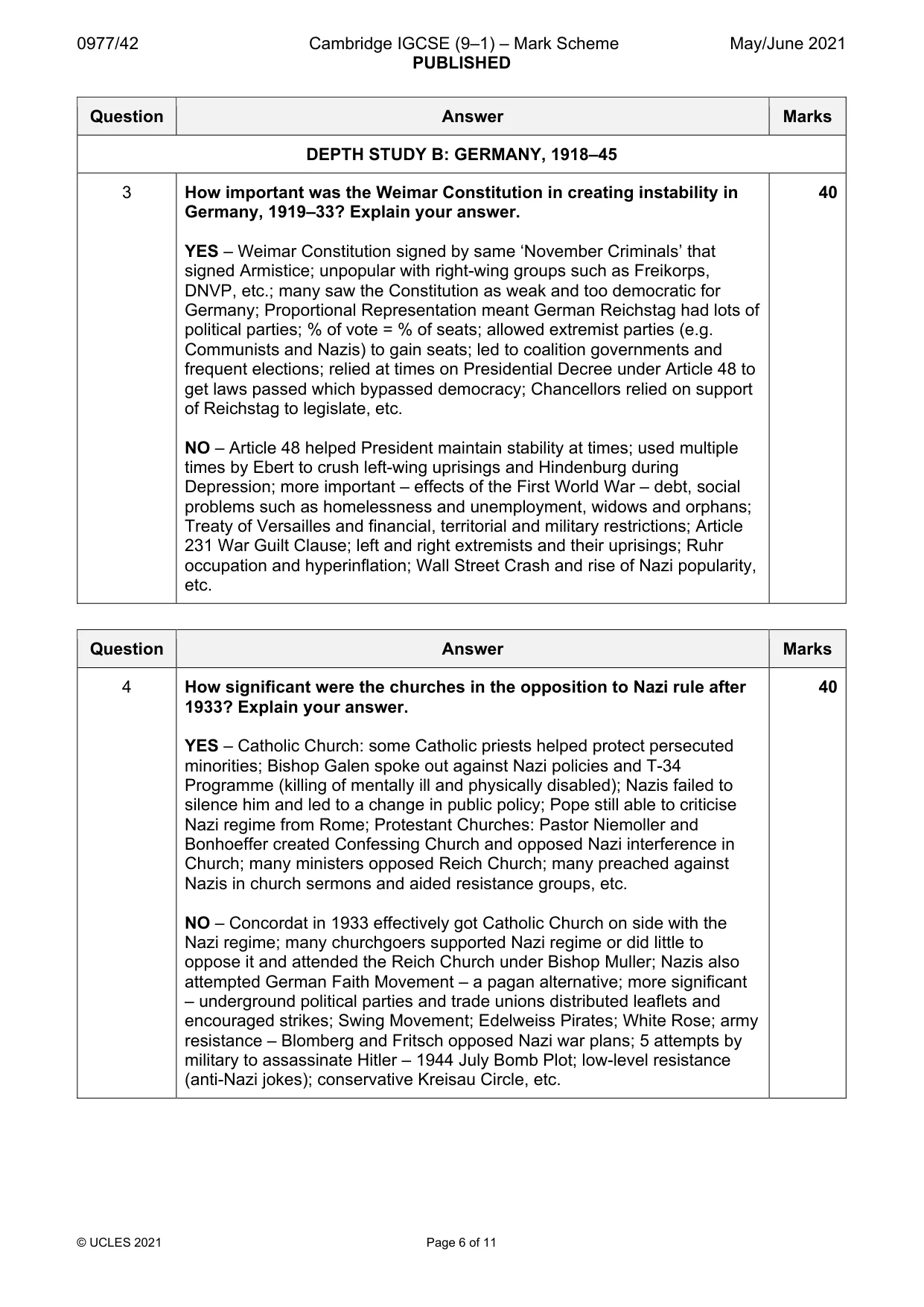
Mark scheme: 3 How important was the Weimar Constitution in creating instability in 40 Germany, 1919–33? Explain your answer. YES – Weimar Constitution signed by same ‘November Criminals’ that signed Armistice; unpopular with right-wing groups such as Freikorps, DNVP, etc.; many saw the Constitution as weak and too democratic for Germany; Proportional Representation meant German Reichstag had lots of political parties; % of vote = % of seats; allowed extremist parties (e.g. Communists and Nazis) to gain seats; led to coalition governments and frequent elections; relied at times on Presidential Decree under Article 48 to get laws passed which bypassed democracy; Chancellors relied on support of Reichstag to legislate, etc. NO – Article 48 helped President maintain stability at times; used multiple times by Ebert to crush left-wing uprisings and Hindenburg during Depression; more important – effects of the First World War – debt, social problems such as homelessness and unemployment, widows and orphans; Treaty of Versailles and financial, territorial and military restrictions; Article 231 War Guilt Clause; left and right extremists and their uprisings; Ruhr occupation and hyperinflation; Wall Street Crash and rise of Nazi popularity, etc.
Q4 · How significant were the churches in the opposition to Nazi rule after 1933?
4 How significant were the churches in the opposition to Nazi rule after 1933? Explain your answer. [40] DEPTH STUDY C: RUSSIA, 1905–41
Mark scheme: 4 How significant were the churches in the opposition to Nazi rule after 40 1933? Explain your answer. YES – Catholic Church: some Catholic priests helped protect persecuted minorities; Bishop Galen spoke out against Nazi policies and T-34 Programme (killing of mentally ill and physically disabled); Nazis failed to silence him and led to a change in public policy; Pope still able to criticise Nazi regime from Rome; Protestant Churches: Pastor Niemoller and Bonhoeffer created Confessing Church and opposed Nazi interference in Church; many ministers opposed Reich Church; many preached against Nazis in church sermons and aided resistance groups, etc. NO – Concordat in 1933 effectively got Catholic Church on side with the Nazi regime; many churchgoers supported Nazi regime or did little to oppose it and attended the Reich Church under Bishop Muller; Nazis also attempted German Faith Movement – a pagan alternative; more significant – underground political parties and trade unions distributed leaflets and encouraged strikes; Swing Movement; Edelweiss Pirates; White Rose; army resistance – Blomberg and Fritsch opposed Nazi war plans; 5 attempts by military to assassinate Hitler – 1944 July Bomb Plot; low-level resistance (anti-Nazi jokes); conservative Kreisau Circle, etc.
Q5 · How important was agriculture as a cause of Russia’s problems by March 1917?
5 How important was agriculture as a cause of Russia’s problems by March 1917? Explain your answer. [40]
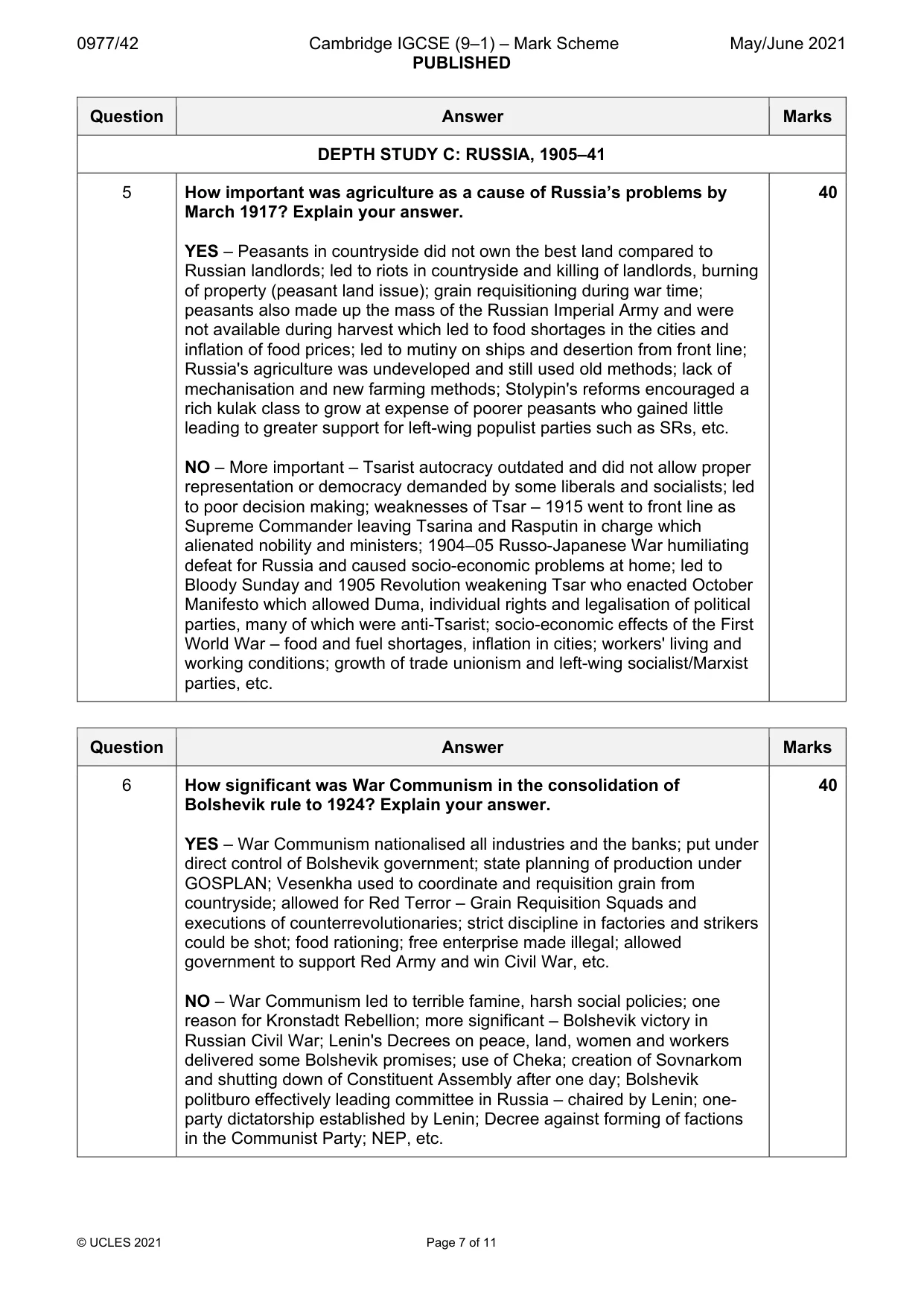
Mark scheme: 5 How important was agriculture as a cause of Russia’s problems by 40 March 1917? Explain your answer. YES – Peasants in countryside did not own the best land compared to Russian landlords; led to riots in countryside and killing of landlords, burning of property (peasant land issue); grain requisitioning during war time; peasants also made up the mass of the Russian Imperial Army and were not available during harvest which led to food shortages in the cities and inflation of food prices; led to mutiny on ships and desertion from front line; Russia's agriculture was undeveloped and still used old methods; lack of mechanisation and new farming methods; Stolypin's reforms encouraged a rich kulak class to grow at expense of poorer peasants who gained little leading to greater support for left-wing populist parties such as SRs, etc. NO – More important – Tsarist autocracy outdated and did not allow proper representation or democracy demanded by some liberals and socialists; led to poor decision making; weaknesses of Tsar – 1915 went to front line as Supreme Commander leaving Tsarina and Rasputin in charge which alienated nobility and ministers; 1904–05 Russo-Japanese War humiliating defeat for Russia and caused socio-economic problems at home; led to Bloody Sunday and 1905 Revolution weakening Tsar who enacted October Manifesto which allowed Duma, individual rights and legalisation of political parties, many of which were anti-Tsarist; socio-economic effects of the First World War – food and fuel shortages, inflation in cities; workers' living and working conditions; growth of trade unionism and left-wing socialist/Marxist parties, etc.
Q6 · How significant was War Communism in the consolidation of Bolshevik rule to 1924?
6 How significant was War Communism in the consolidation of Bolshevik rule to 1924? Explain your answer. [40] DEPTH STUDY D: THE UNITED STATES, 1919–41
Mark scheme: 6 How significant was War Communism in the consolidation of 40 Bolshevik rule to 1924? Explain your answer. YES – War Communism nationalised all industries and the banks; put under direct control of Bolshevik government; state planning of production under GOSPLAN; Vesenkha used to coordinate and requisition grain from countryside; allowed for Red Terror – Grain Requisition Squads and executions of counterrevolutionaries; strict discipline in factories and strikers could be shot; food rationing; free enterprise made illegal; allowed government to support Red Army and win Civil War, etc. NO – War Communism led to terrible famine, harsh social policies; one reason for Kronstadt Rebellion; more significant – Bolshevik victory in Russian Civil War; Lenin's Decrees on peace, land, women and workers delivered some Bolshevik promises; use of Cheka; creation of Sovnarkom and shutting down of Constituent Assembly after one day; Bolshevik politburo effectively leading committee in Russia – chaired by Lenin; one- party dictatorship established by Lenin; Decree against forming of factions in the Communist Party; NEP, etc.
Q7 · How important was the availability of electricity as a reason for economic growth in the…
7 How important was the availability of electricity as a reason for economic growth in the USA in the 1920s? Explain your answer. [40]
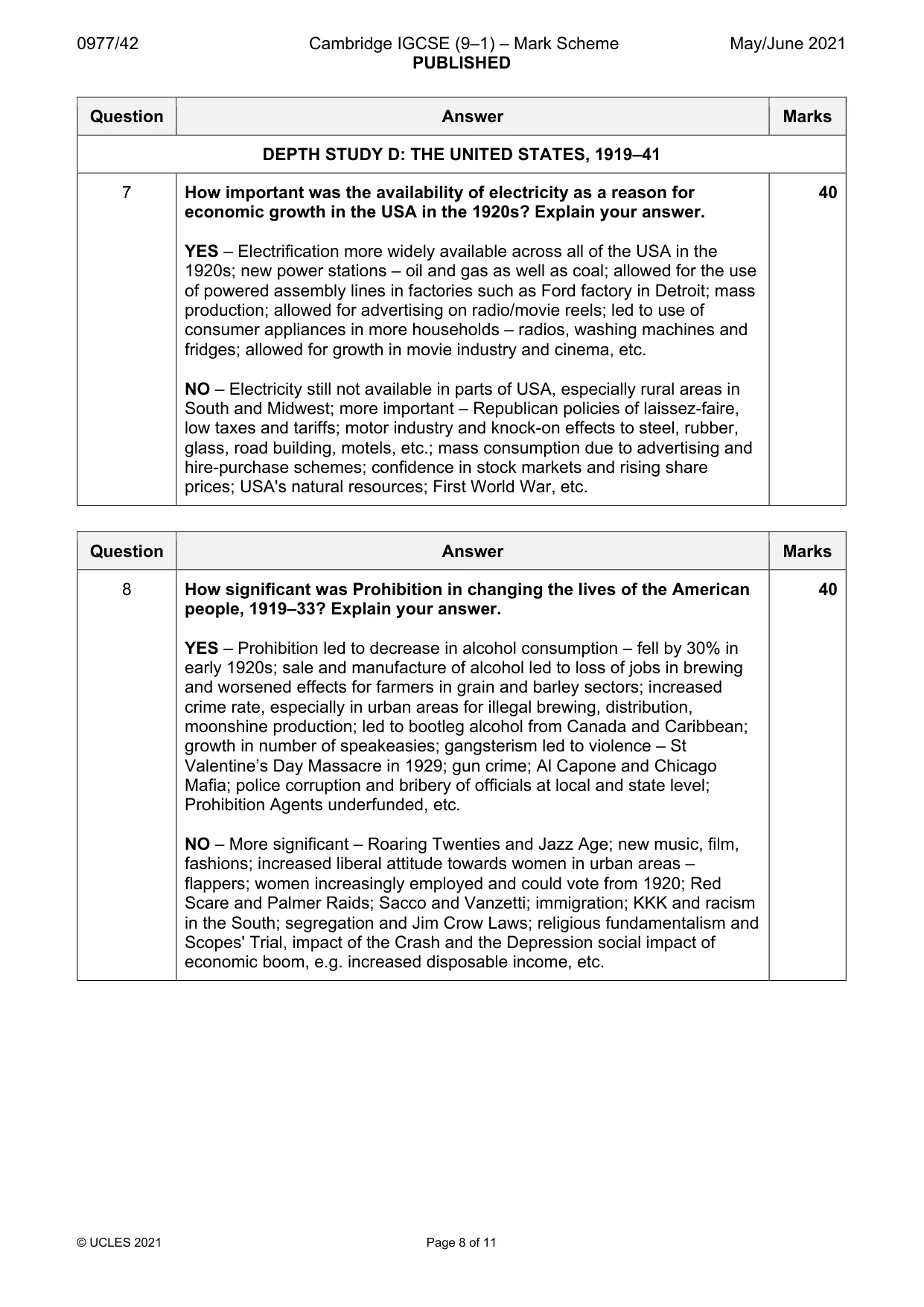
Mark scheme: 7 How important was the availability of electricity as a reason for 40 economic growth in the USA in the 1920s? Explain your answer. YES – Electrification more widely available across all of the USA in the 1920s; new power stations – oil and gas as well as coal; allowed for the use of powered assembly lines in factories such as Ford factory in Detroit; mass production; allowed for advertising on radio/movie reels; led to use of consumer appliances in more households – radios, washing machines and fridges; allowed for growth in movie industry and cinema, etc. NO – Electricity still not available in parts of USA, especially rural areas in South and Midwest; more important – Republican policies of laissez-faire, low taxes and tariffs; motor industry and knock-on effects to steel, rubber, glass, road building, motels, etc.; mass consumption due to advertising and hire-purchase schemes; confidence in stock markets and rising share prices; USA's natural resources; First World War, etc.
Q8 · How significant was Prohibition in changing the lives of the American people, 1919–33?
8 How significant was Prohibition in changing the lives of the American people, 1919–33? Explain your answer. [40] DEPTH STUDY E: CHINA, c.1930–c.1990
Mark scheme: 8 How significant was Prohibition in changing the lives of the American 40 people, 1919–33? Explain your answer. YES – Prohibition led to decrease in alcohol consumption – fell by 30% in early 1920s; sale and manufacture of alcohol led to loss of jobs in brewing and worsened effects for farmers in grain and barley sectors; increased crime rate, especially in urban areas for illegal brewing, distribution, moonshine production; led to bootleg alcohol from Canada and Caribbean; growth in number of speakeasies; gangsterism led to violence – St Valentine’s Day Massacre in 1929; gun crime; Al Capone and Chicago Mafia; police corruption and bribery of officials at local and state level; Prohibition Agents underfunded, etc. NO – More significant – Roaring Twenties and Jazz Age; new music, film, fashions; increased liberal attitude towards women in urban areas – flappers; women increasingly employed and could vote from 1920; Red Scare and Palmer Raids; Sacco and Vanzetti; immigration; KKK and racism in the South; segregation and Jim Crow Laws; religious fundamentalism and Scopes' Trial, impact of the Crash and the Depression social impact of economic boom, e.g. increased disposable income, etc.
Q9 · How important was the Yenan Soviet in increasing support for the Chinese Communist Party…
9 How important was the Yenan Soviet in increasing support for the Chinese Communist Party by 1949? Explain your answer. [40]
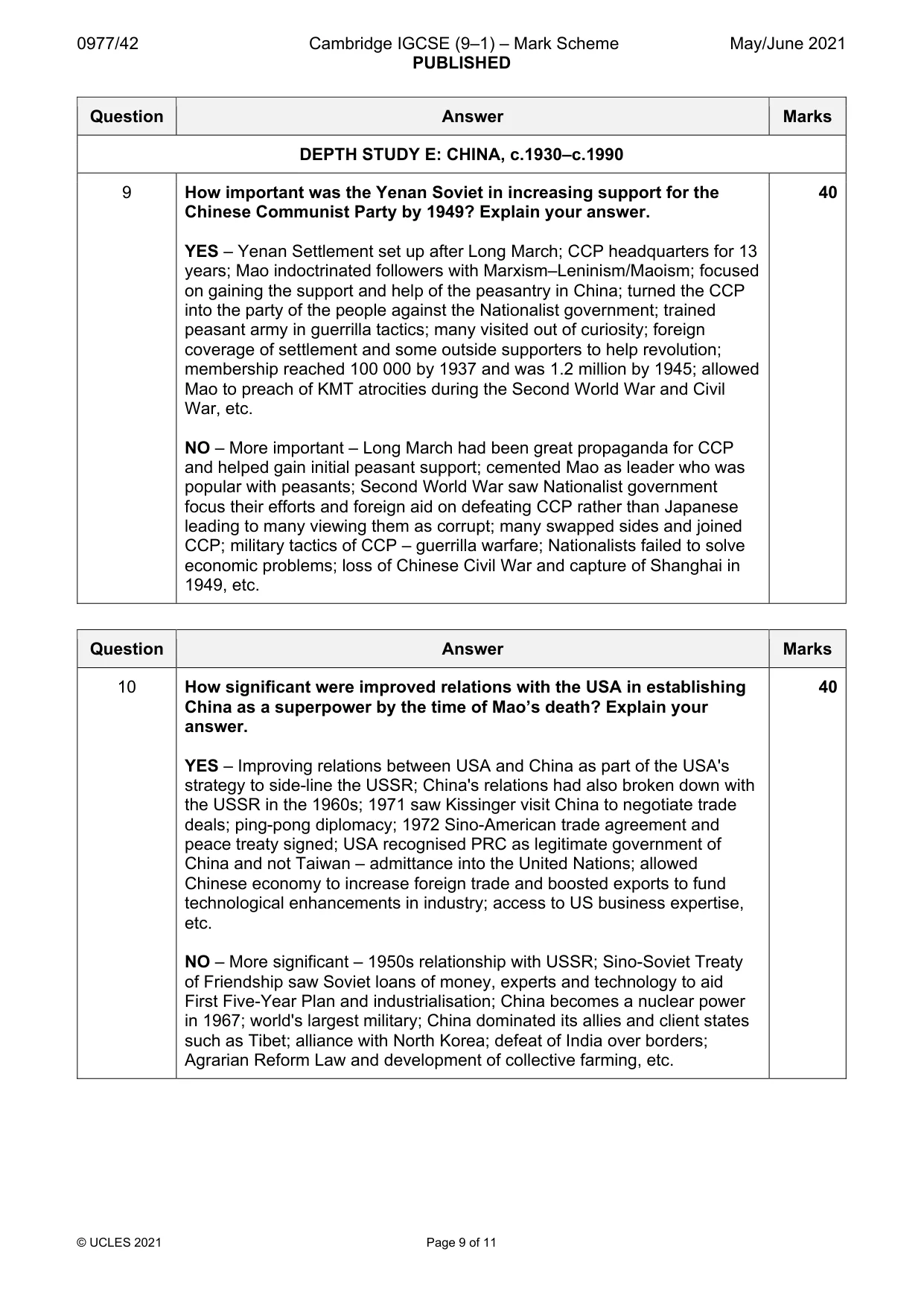
Mark scheme: 9 How important was the Yenan Soviet in increasing support for the 40 Chinese Communist Party by 1949? Explain your answer. YES – Yenan Settlement set up after Long March; CCP headquarters for 13 years; Mao indoctrinated followers with Marxism–Leninism/Maoism; focused on gaining the support and help of the peasantry in China; turned the CCP into the party of the people against the Nationalist government; trained peasant army in guerrilla tactics; many visited out of curiosity; foreign coverage of settlement and some outside supporters to help revolution; membership reached 100 000 by 1937 and was 1.2 million by 1945; allowed Mao to preach of KMT atrocities during the Second World War and Civil War, etc. NO – More important – Long March had been great propaganda for CCP and helped gain initial peasant support; cemented Mao as leader who was popular with peasants; Second World War saw Nationalist government focus their efforts and foreign aid on defeating CCP rather than Japanese leading to many viewing them as corrupt; many swapped sides and joined CCP; military tactics of CCP – guerrilla warfare; Nationalists failed to solve economic problems; loss of Chinese Civil War and capture of Shanghai in 1949, etc.
Q10 · DEPTH STUDY F: SOUTH AFRICA, c.1940–c.1994
DEPTH STUDY F: SOUTH AFRICA, c.1940–c.1994
Mark scheme: 10 How significant were improved relations with the USA in establishing 40 China as a superpower by the time of Mao’s death? Explain your answer. YES – Improving relations between USA and China as part of the USA's strategy to side-line the USSR; China's relations had also broken down with the USSR in the 1960s; 1971 saw Kissinger visit China to negotiate trade deals; ping-pong diplomacy; 1972 Sino-American trade agreement and peace treaty signed; USA recognised PRC as legitimate government of China and not Taiwan – admittance into the United Nations; allowed Chinese economy to increase foreign trade and boosted exports to fund technological enhancements in industry; access to US business expertise, etc. NO – More significant – 1950s relationship with USSR; Sino-Soviet Treaty of Friendship saw Soviet loans of money, experts and technology to aid First Five-Year Plan and industrialisation; China becomes a nuclear power in 1967; world's largest military; China dominated its allies and client states such as Tibet; alliance with North Korea; defeat of India over borders; Agrarian Reform Law and development of collective farming, etc.
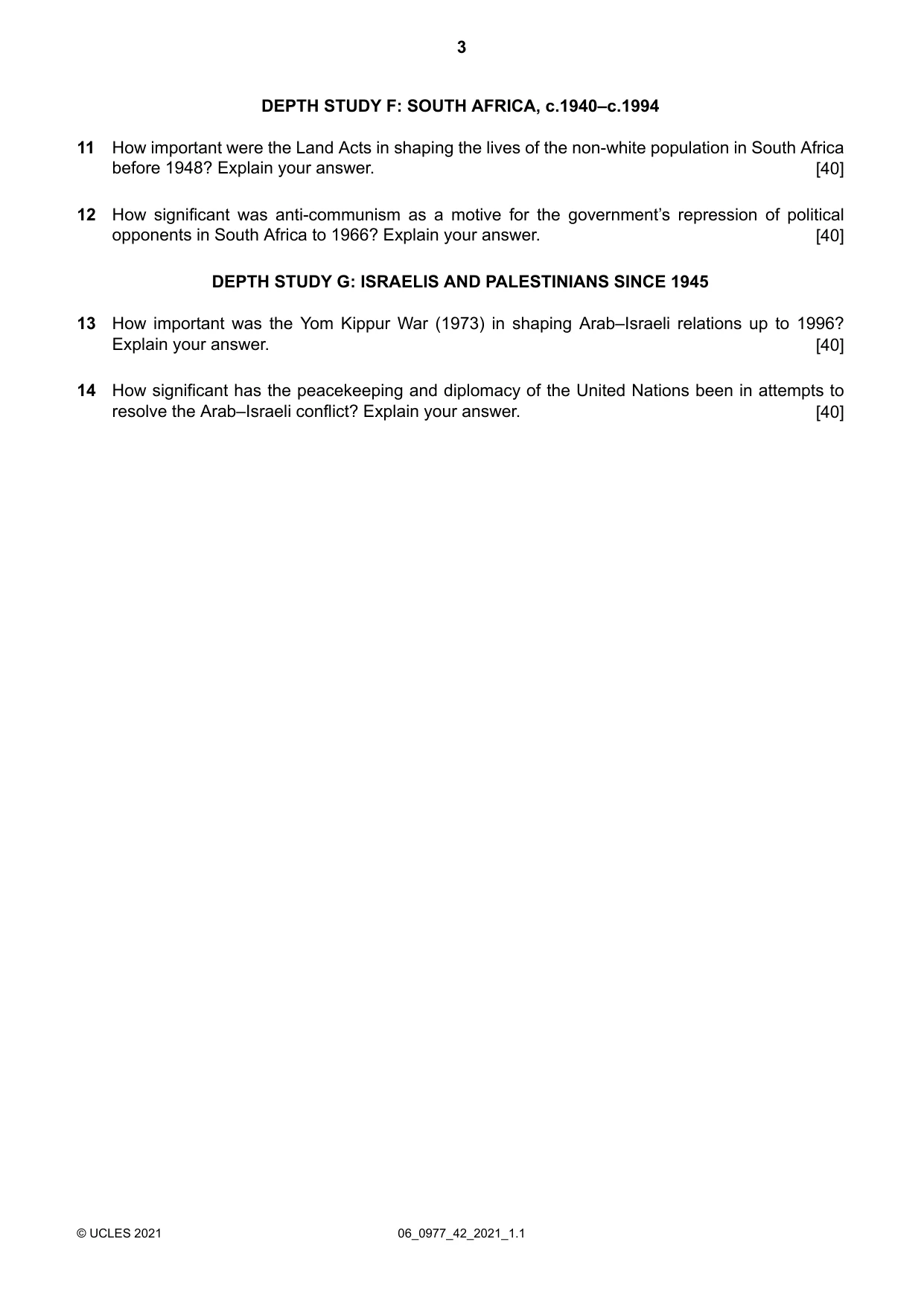
Q11 · How important were the Land Acts in shaping the lives of the non-white population in…
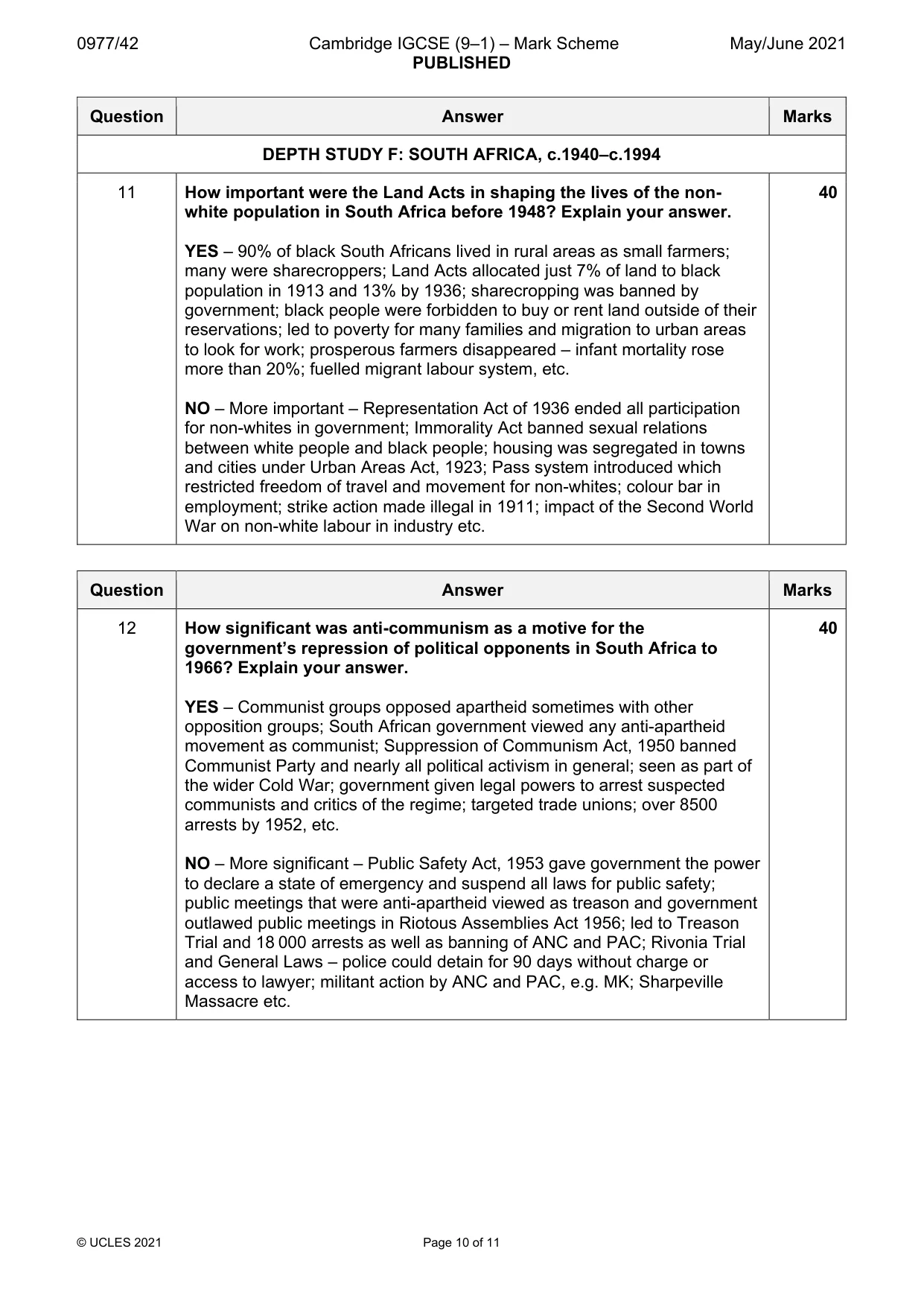
11 How important were the Land Acts in shaping the lives of the non-white population in South Africa before 1948? Explain your answer. [40]
Mark scheme: 11 How important were the Land Acts in shaping the lives of the non- 40 white population in South Africa before 1948? Explain your answer. YES – 90% of black South Africans lived in rural areas as small farmers; many were sharecroppers; Land Acts allocated just 7% of land to black population in 1913 and 13% by 1936; sharecropping was banned by government; black people were forbidden to buy or rent land outside of their reservations; led to poverty for many families and migration to urban areas to look for work; prosperous farmers disappeared – infant mortality rose more than 20%; fuelled migrant labour system, etc. NO – More important – Representation Act of 1936 ended all participation for non-whites in government; Immorality Act banned sexual relations between white people and black people; housing was segregated in towns and cities under Urban Areas Act, 1923; Pass system introduced which restricted freedom of travel and movement for non-whites; colour bar in employment; strike action made illegal in 1911; impact of the Second World War on non-white labour in industry etc.
Q12 · How significant was anti-communism as a motive for the government’s repression of…
12 How significant was anti-communism as a motive for the government’s repression of political opponents in South Africa to 1966? Explain your answer. [40] DEPTH STUDY G: ISRAELIS AND PALESTINIANS SINCE 1945
Mark scheme: 12 How significant was anti-communism as a motive for the 40 government’s repression of political opponents in South Africa to 1966? Explain your answer. YES – Communist groups opposed apartheid sometimes with other opposition groups; South African government viewed any anti-apartheid movement as communist; Suppression of Communism Act, 1950 banned Communist Party and nearly all political activism in general; seen as part of the wider Cold War; government given legal powers to arrest suspected communists and critics of the regime; targeted trade unions; over 8500 arrests by 1952, etc. NO – More significant – Public Safety Act, 1953 gave government the power to declare a state of emergency and suspend all laws for public safety; public meetings that were anti-apartheid viewed as treason and government outlawed public meetings in Riotous Assemblies Act 1956; led to Treason Trial and 18 000 arrests as well as banning of ANC and PAC; Rivonia Trial and General Laws – police could detain for 90 days without charge or access to lawyer; militant action by ANC and PAC, e.g. MK; Sharpeville Massacre etc.
Q13 · How important was the Yom Kippur War (1973) in shaping Arab–Israeli relations up to 1996?
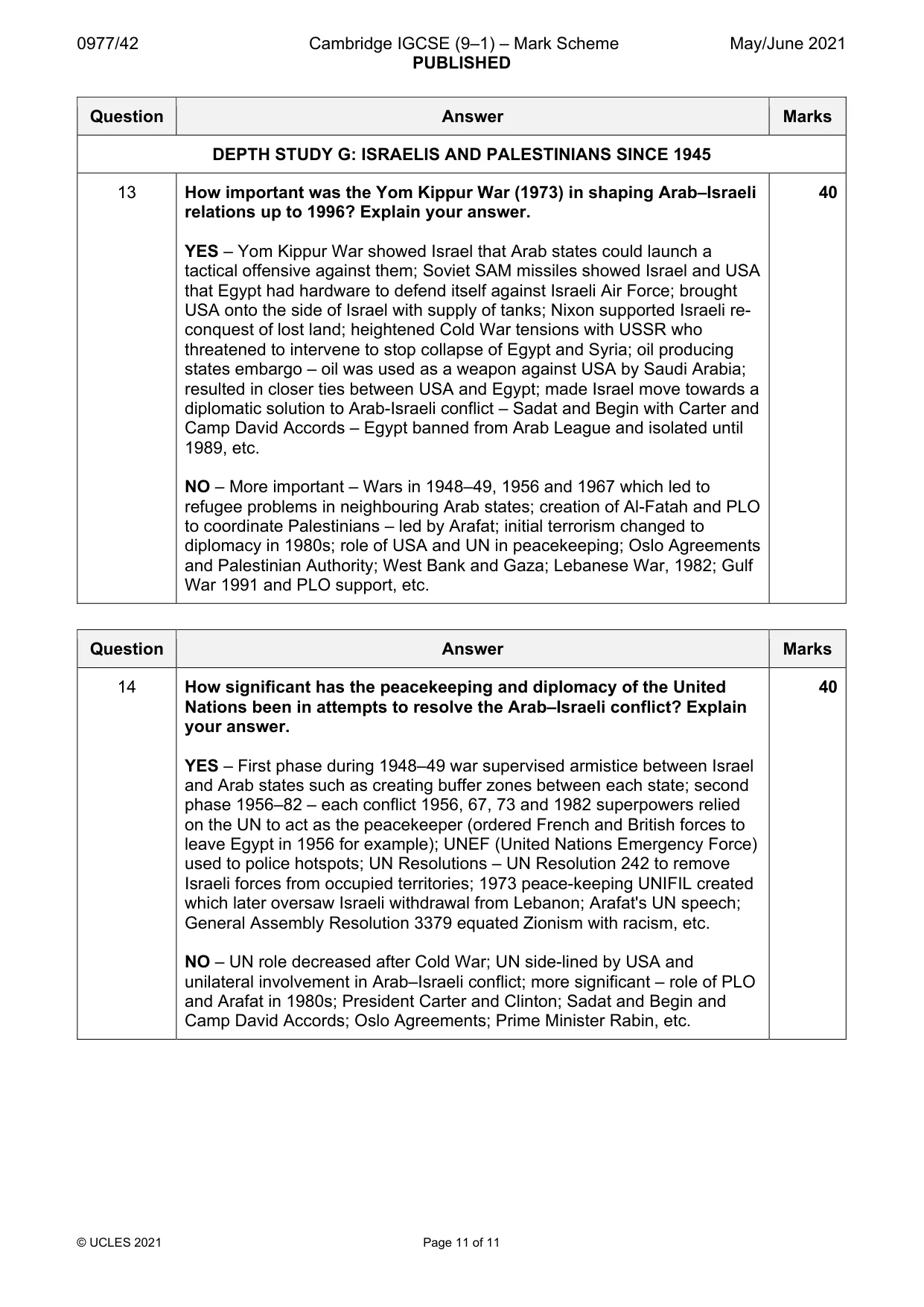
13 How important was the Yom Kippur War (1973) in shaping Arab–Israeli relations up to 1996? Explain your answer. [40]
Mark scheme: 13 How important was the Yom Kippur War (1973) in shaping Arab–Israeli 40 relations up to 1996? Explain your answer. YES – Yom Kippur War showed Israel that Arab states could launch a tactical offensive against them; Soviet SAM missiles showed Israel and USA that Egypt had hardware to defend itself against Israeli Air Force; brought USA onto the side of Israel with supply of tanks; Nixon supported Israeli re- conquest of lost land; heightened Cold War tensions with USSR who threatened to intervene to stop collapse of Egypt and Syria; oil producing states embargo – oil was used as a weapon against USA by Saudi Arabia; resulted in closer ties between USA and Egypt; made Israel move towards a diplomatic solution to Arab-Israeli conflict – Sadat and Begin with Carter and Camp David Accords – Egypt banned from Arab League and isolated until 1989, etc. NO – More important – Wars in 1948–49, 1956 and 1967 which led to refugee problems in neighbouring Arab states; creation of Al-Fatah and PLO to coordinate Palestinians – led by Arafat; initial terrorism changed to diplomacy in 1980s; role of USA and UN in peacekeeping; Oslo Agreements and Palestinian Authority; West Bank and Gaza; Lebanese War, 1982; Gulf War 1991 and PLO support, etc.
Q14 · How significant has the peacekeeping and diplomacy of the United Nations been in attempts…
14 How significant has the peacekeeping and diplomacy of the United Nations been in attempts to resolve the Arab–Israeli conflict? Explain your answer. [40]
Mark scheme: 14 How significant has the peacekeeping and diplomacy of the United 40 Nations been in attempts to resolve the Arab–Israeli conflict? Explain your answer. YES – First phase during 1948–49 war supervised armistice between Israel and Arab states such as creating buffer zones between each state; second phase 1956–82 – each conflict 1956, 67, 73 and 1982 superpowers relied on the UN to act as the peacekeeper (ordered French and British forces to leave Egypt in 1956 for example); UNEF (United Nations Emergency Force) used to police hotspots; UN Resolutions – UN Resolution 242 to remove Israeli forces from occupied territories; 1973 peace-keeping UNIFIL created which later oversaw Israeli withdrawal from Lebanon; Arafat's UN speech; General Assembly Resolution 3379 equated Zionism with racism, etc. NO – UN role decreased after Cold War; UN side-lined by USA and unilateral involvement in Arab–Israeli conflict; more significant – role of PLO and Arafat in 1980s; President Carter and Clinton; Sadat and Begin and Camp David Accords; Oslo Agreements; Prime Minister Rabin, etc.
What you needed in this session
Cambridge’s own grade thresholds for 2021 May/June, Paper 4 · Variant 2. A higher threshold means an easier paper — the bar moves with how the cohort did.