Cambridge IGCSE History (9-1) 0977 — 2023 May/June Paper 4 · Variant 2
0977/42/M/J/23 · 14 questions · 40 marks · ≈45 min
The question paper and its mark scheme, free to read here and free to download. This is Cambridge’s own paper, exactly as it was sat.
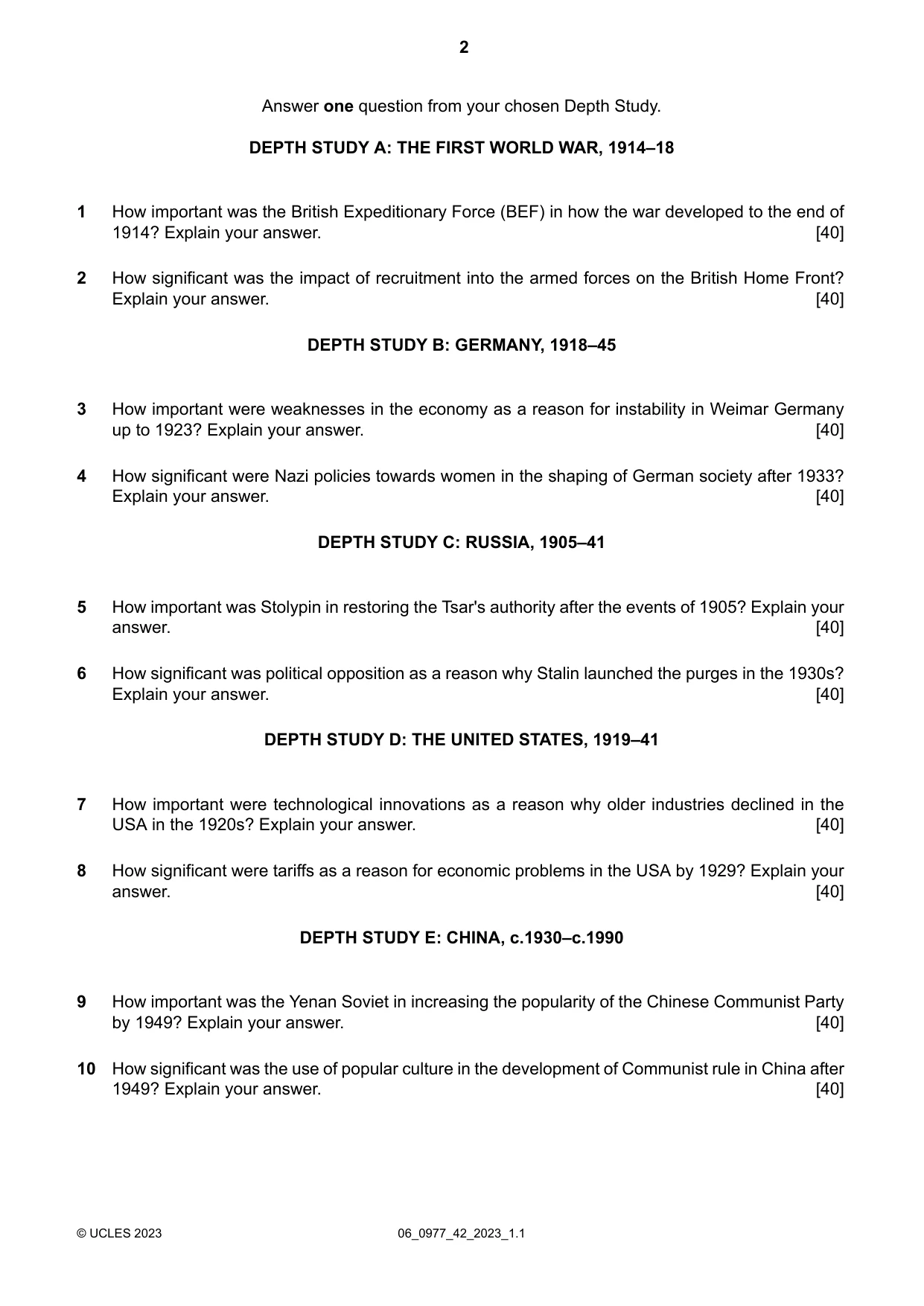
Question paper4 pages

Mark scheme12 pages
Answers below. Sit the paper first if you are practising.

Questions as text
Q1 · How important was the British Expeditionary Force (BEF) in how the war developed to the…
1 How important was the British Expeditionary Force (BEF) in how the war developed to the end of 1914? Explain your answer. [40]
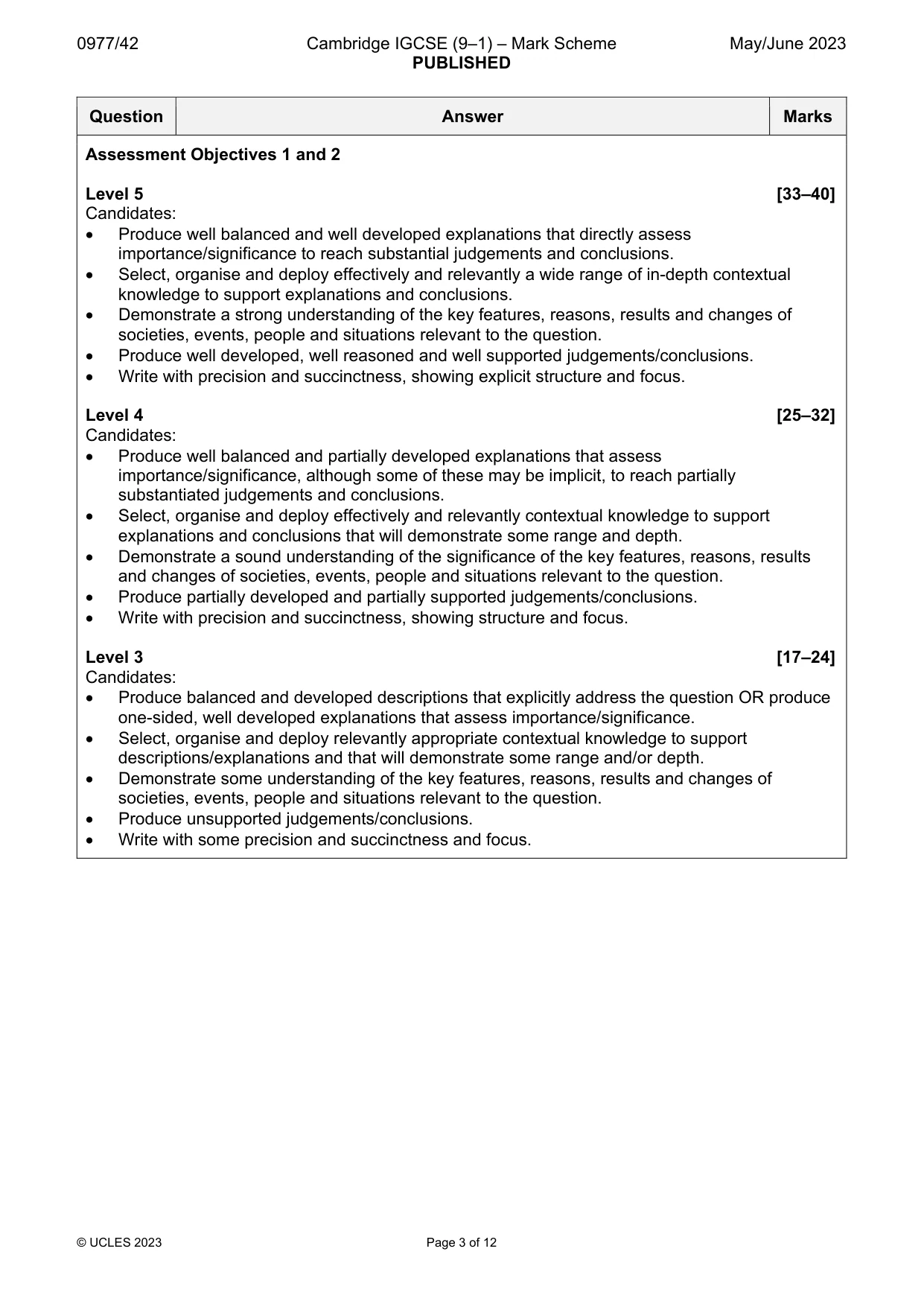
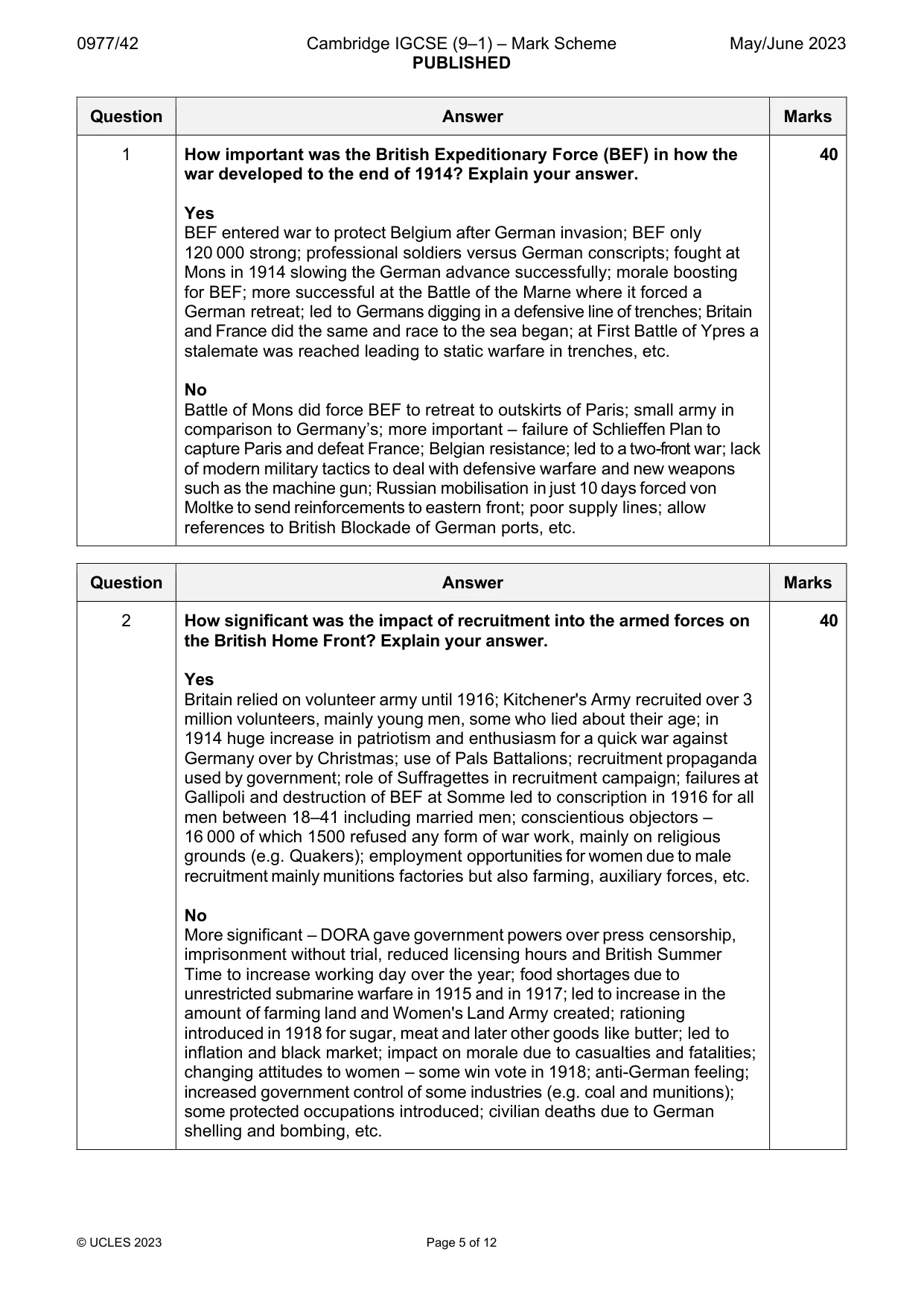
Mark scheme: Question Answer Marks 1 How important was the British Expeditionary Force (BEF) in how the 40 war developed to the end of 1914? Explain your answer. Yes BEF entered war to protect Belgium after German invasion; BEF only 120 000 strong; professional soldiers versus German conscripts; fought at Mons in 1914 slowing the German advance successfully; morale boosting for BEF; more successful at the Battle of the Marne where it forced a German retreat; led to Germans digging in a defensive line of trenches; Britain and France did the same and race to the sea began; at First Battle of Ypres a stalemate was reached leading to static warfare in trenches, etc. No Battle of Mons did force BEF to retreat to outskirts of Paris; small army in comparison to Germany’s; more important – failure of Schlieffen Plan to capture Paris and defeat France; Belgian resistance; led to a two-front war; lack of modern military tactics to deal with defensive warfare and new weapons such as the machine gun; Russian mobilisation in just 10 days forced von Moltke to send reinforcements to eastern front; poor supply lines; allow references to British Blockade of German ports, etc.
Q2 · How significant was the impact of recruitment into the armed forces on the British Home…
2 How significant was the impact of recruitment into the armed forces on the British Home Front? Explain your answer. [40] DEPTH STUDY B: GERMANY, 1918–45
Mark scheme: 2 How significant was the impact of recruitment into the armed forces on 40 the British Home Front? Explain your answer. Yes Britain relied on volunteer army until 1916; Kitchener's Army recruited over 3 million volunteers, mainly young men, some who lied about their age; in 1914 huge increase in patriotism and enthusiasm for a quick war against Germany over by Christmas; use of Pals Battalions; recruitment propaganda used by government; role of Suffragettes in recruitment campaign; failures at Gallipoli and destruction of BEF at Somme led to conscription in 1916 for all men between 18–41 including married men; conscientious objectors – 16 000 of which 1500 refused any form of war work, mainly on religious grounds (e.g. Quakers); employment opportunities for women due to male recruitment mainly munitions factories but also farming, auxiliary forces, etc. No More significant – DORA gave government powers over press censorship, imprisonment without trial, reduced licensing hours and British Summer Time to increase working day over the year; food shortages due to unrestricted submarine warfare in 1915 and in 1917; led to increase in the amount of farming land and Women's Land Army created; rationing introduced in 1918 for sugar, meat and later other goods like butter; led to inflation and black market; impact on morale due to casualties and fatalities; changing attitudes to women – some win vote in 1918; anti-German feeling; increased government control of some industries (e.g. coal and munitions); some protected occupations introduced; civilian deaths due to German shelling and bombing, etc.
Q3 · How important were weaknesses in the economy as a reason for instability in Weimar…
3 How important were weaknesses in the economy as a reason for instability in Weimar Germany up to 1923? Explain your answer. [40]
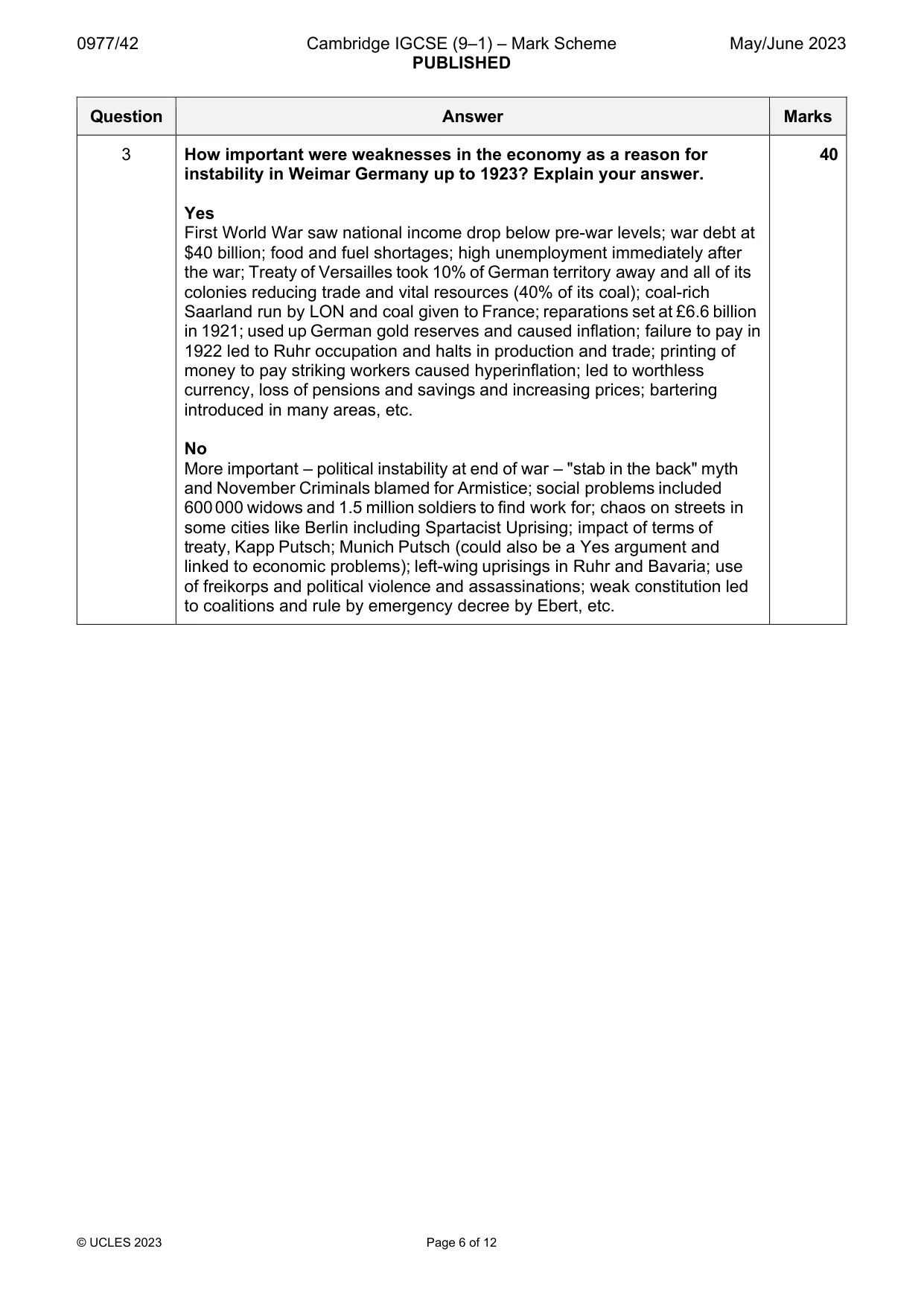
Mark scheme: 3 How important were weaknesses in the economy as a reason for 40 instability in Weimar Germany up to 1923? Explain your answer. Yes First World War saw national income drop below pre-war levels; war debt at $40 billion; food and fuel shortages; high unemployment immediately after the war; Treaty of Versailles took 10% of German territory away and all of its colonies reducing trade and vital resources (40% of its coal); coal-rich Saarland run by LON and coal given to France; reparations set at £6.6 billion in 1921; used up German gold reserves and caused inflation; failure to pay in 1922 led to Ruhr occupation and halts in production and trade; printing of money to pay striking workers caused hyperinflation; led to worthless currency, loss of pensions and savings and increasing prices; bartering introduced in many areas, etc. No More important – political instability at end of war – "stab in the back" myth and November Criminals blamed for Armistice; social problems included 600 000 widows and 1.5 million soldiers to find work for; chaos on streets in some cities like Berlin including Spartacist Uprising; impact of terms of treaty, Kapp Putsch; Munich Putsch (could also be a Yes argument and linked to economic problems); left-wing uprisings in Ruhr and Bavaria; use of freikorps and political violence and assassinations; weak constitution led to coalitions and rule by emergency decree by Ebert, etc.
Q4 · How significant were Nazi policies towards women in the shaping of German society after…
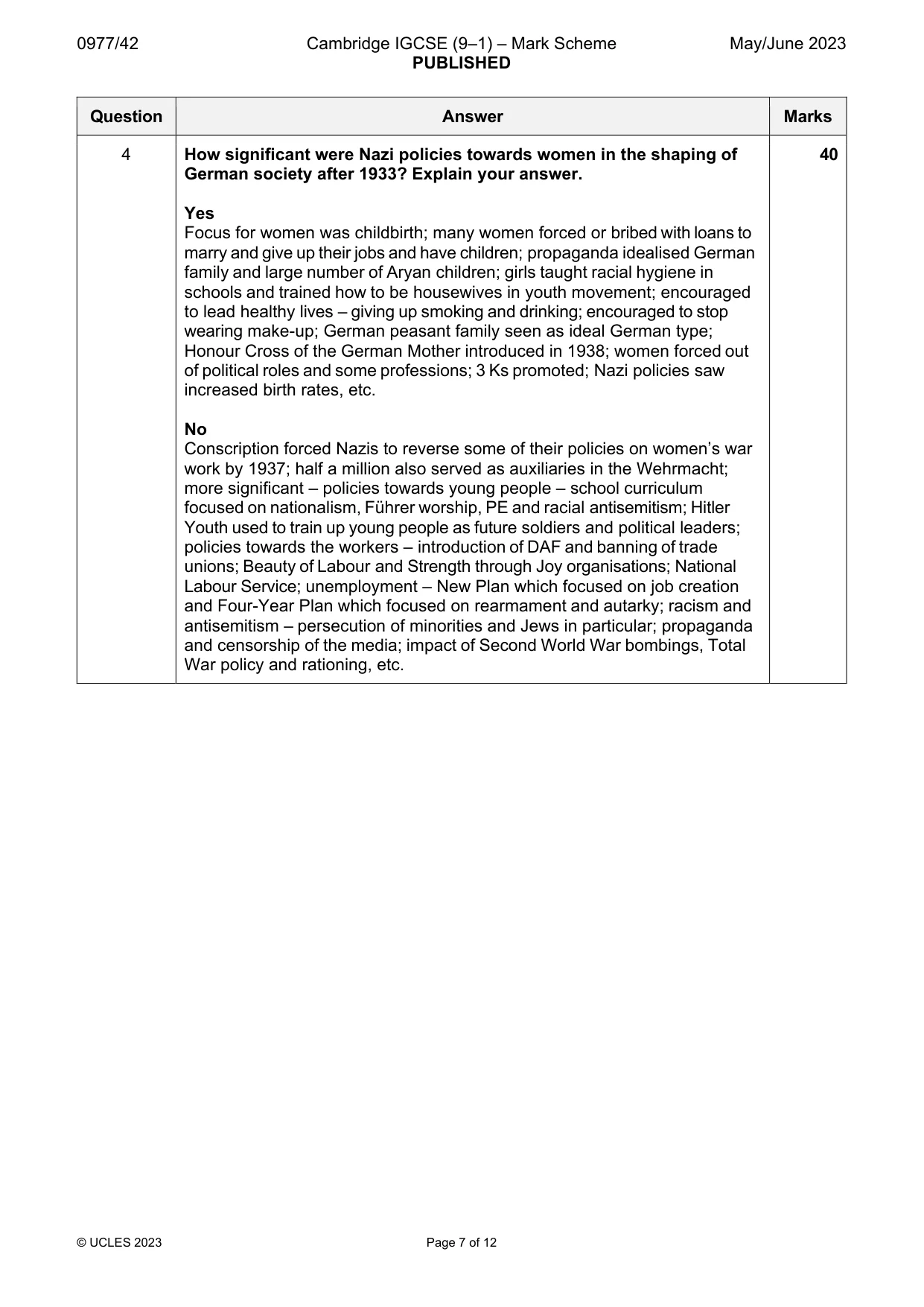
4 How significant were Nazi policies towards women in the shaping of German society after 1933? Explain your answer. [40] DEPTH STUDY C: RUSSIA, 1905–41
Mark scheme: 4 How significant were Nazi policies towards women in the shaping of 40 German society after 1933? Explain your answer. Yes Focus for women was childbirth; many women forced or bribed with loans to marry and give up their jobs and have children; propaganda idealised German family and large number of Aryan children; girls taught racial hygiene in schools and trained how to be housewives in youth movement; encouraged to lead healthy lives – giving up smoking and drinking; encouraged to stop wearing make-up; German peasant family seen as ideal German type; Honour Cross of the German Mother introduced in 1938; women forced out of political roles and some professions; 3 Ks promoted; Nazi policies saw increased birth rates, etc. No Conscription forced Nazis to reverse some of their policies on women’s war work by 1937; half a million also served as auxiliaries in the Wehrmacht; more significant – policies towards young people – school curriculum focused on nationalism, Führer worship, PE and racial antisemitism; Hitler Youth used to train up young people as future soldiers and political leaders; policies towards the workers – introduction of DAF and banning of trade unions; Beauty of Labour and Strength through Joy organisations; National Labour Service; unemployment – New Plan which focused on job creation and Four-Year Plan which focused on rearmament and autarky; racism and antisemitism – persecution of minorities and Jews in particular; propaganda and censorship of the media; impact of Second World War bombings, Total War policy and rationing, etc.
Q5 · How important was Stolypin in restoring the Tsar's authority after the events of 1905?
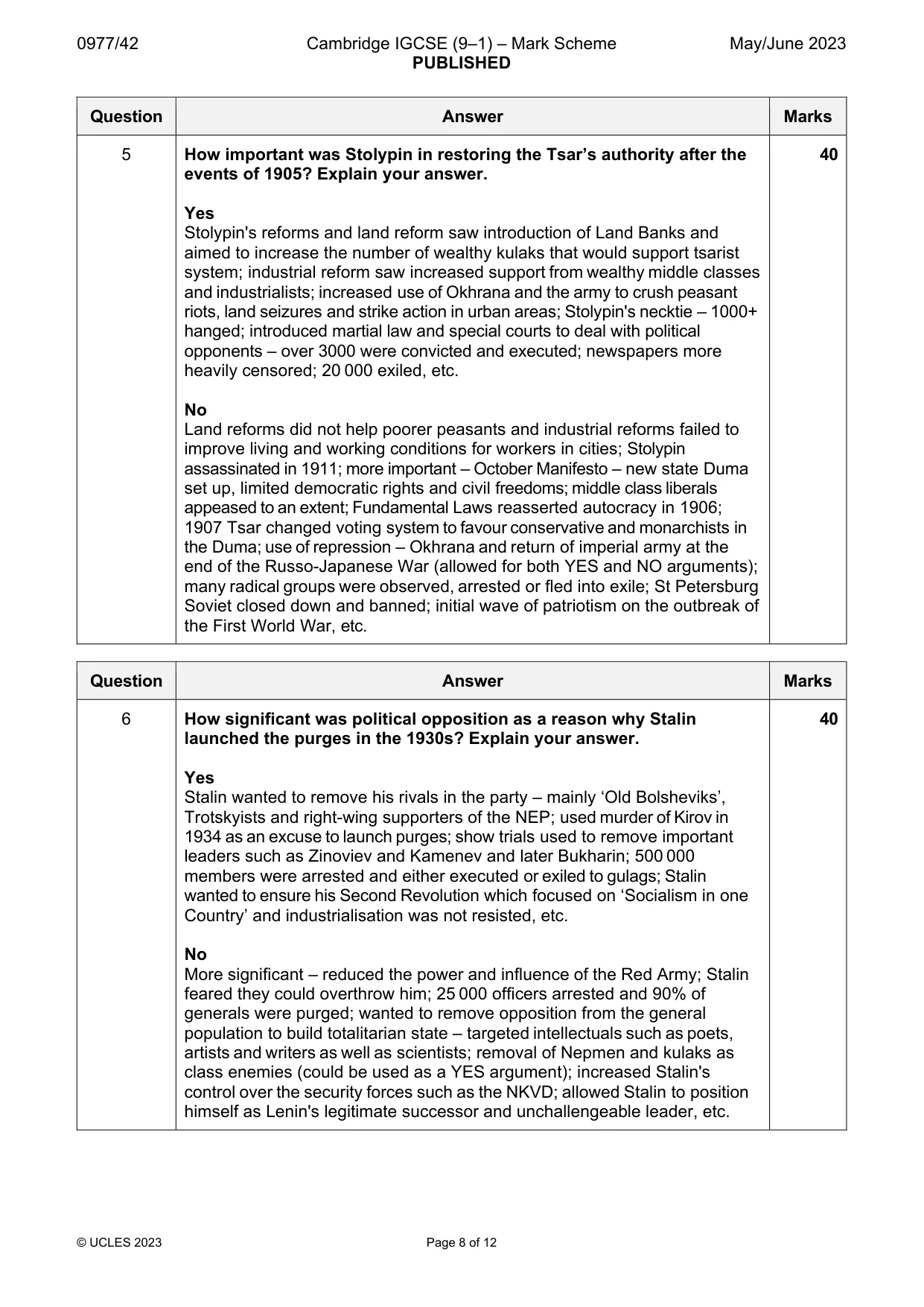
5 How important was Stolypin in restoring the Tsar's authority after the events of 1905? Explain your answer. [40]
Mark scheme: 5 How important was Stolypin in restoring the Tsar’s authority after the 40 events of 1905? Explain your answer. Yes Stolypin's reforms and land reform saw introduction of Land Banks and aimed to increase the number of wealthy kulaks that would support tsarist system; industrial reform saw increased support from wealthy middle classes and industrialists; increased use of Okhrana and the army to crush peasant riots, land seizures and strike action in urban areas; Stolypin's necktie – 1000+ hanged; introduced martial law and special courts to deal with political opponents – over 3000 were convicted and executed; newspapers more heavily censored; 20 000 exiled, etc. No Land reforms did not help poorer peasants and industrial reforms failed to improve living and working conditions for workers in cities; Stolypin assassinated in 1911; more important – October Manifesto – new state Duma set up, limited democratic rights and civil freedoms; middle class liberals appeased to an extent; Fundamental Laws reasserted autocracy in 1906; 1907 Tsar changed voting system to favour conservative and monarchists in the Duma; use of repression – Okhrana and return of imperial army at the end of the Russo-Japanese War (allowed for both YES and NO arguments); many radical groups were observed, arrested or fled into exile; St Petersburg Soviet closed down and banned; initial wave of patriotism on the outbreak of the First World War, etc.
Q6 · How significant was political opposition as a reason why Stalin launched the purges in…
6 How significant was political opposition as a reason why Stalin launched the purges in the 1930s? Explain your answer. [40] DEPTH STUDY D: THE UNITED STATES, 1919–41
Mark scheme: 6 How significant was political opposition as a reason why Stalin 40 launched the purges in the 1930s? Explain your answer. Yes Stalin wanted to remove his rivals in the party – mainly ‘Old Bolsheviks’, Trotskyists and right-wing supporters of the NEP; used murder of Kirov in 1934 as an excuse to launch purges; show trials used to remove important leaders such as Zinoviev and Kamenev and later Bukharin; 500 000 members were arrested and either executed or exiled to gulags; Stalin wanted to ensure his Second Revolution which focused on ‘Socialism in one Country’ and industrialisation was not resisted, etc. No More significant – reduced the power and influence of the Red Army; Stalin feared they could overthrow him; 25 000 officers arrested and 90% of generals were purged; wanted to remove opposition from the general population to build totalitarian state – targeted intellectuals such as poets, artists and writers as well as scientists; removal of Nepmen and kulaks as class enemies (could be used as a YES argument); increased Stalin's control over the security forces such as the NKVD; allowed Stalin to position himself as Lenin's legitimate successor and unchallengeable leader, etc.
Q7 · How important were technological innovations as a reason why older industries declined in…
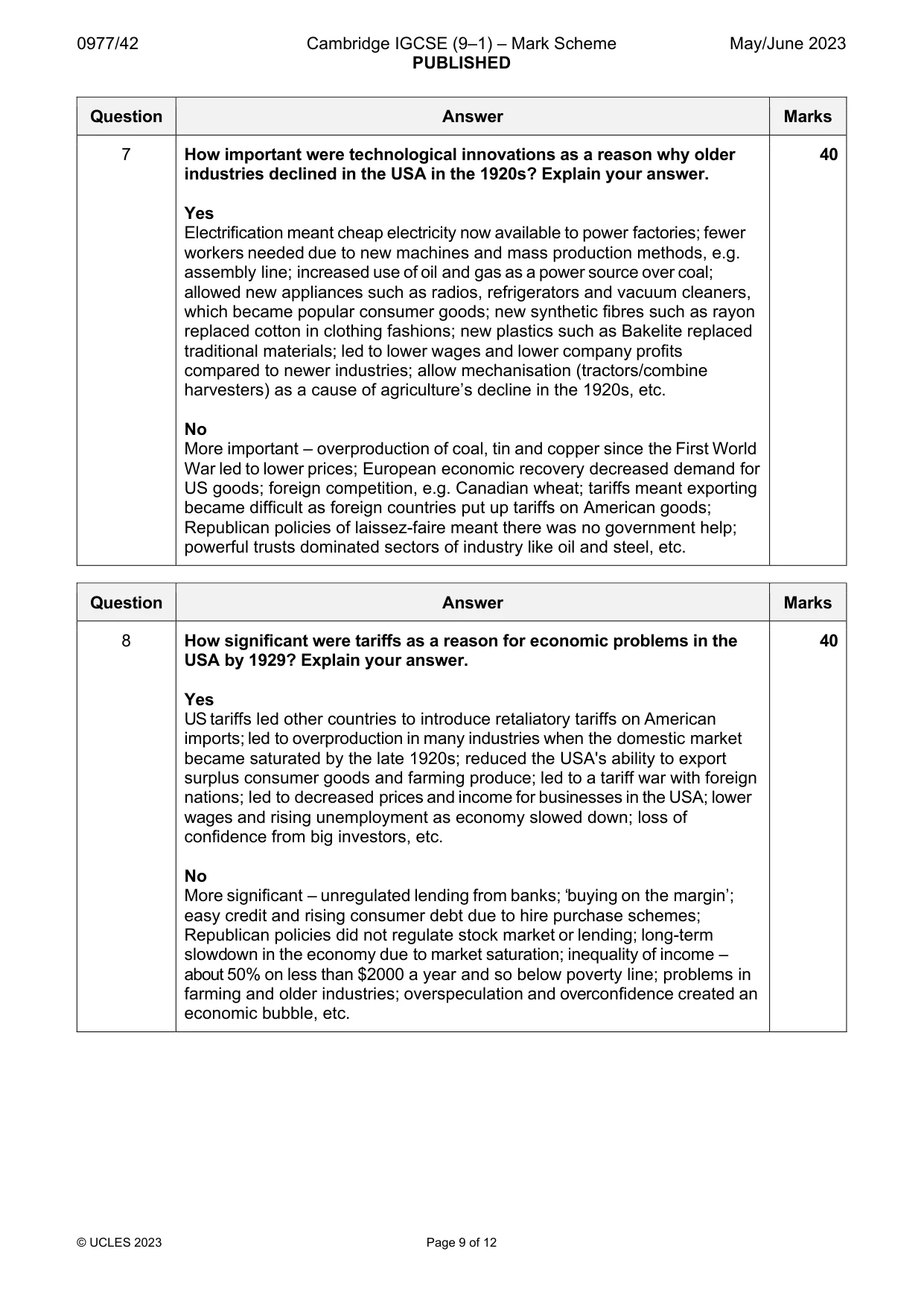
7 How important were technological innovations as a reason why older industries declined in the USA in the 1920s? Explain your answer. [40]
Mark scheme: 7 How important were technological innovations as a reason why older 40 industries declined in the USA in the 1920s? Explain your answer. Yes Electrification meant cheap electricity now available to power factories; fewer workers needed due to new machines and mass production methods, e.g. assembly line; increased use of oil and gas as a power source over coal; allowed new appliances such as radios, refrigerators and vacuum cleaners, which became popular consumer goods; new synthetic fibres such as rayon replaced cotton in clothing fashions; new plastics such as Bakelite replaced traditional materials; led to lower wages and lower company profits compared to newer industries; allow mechanisation (tractors/combine harvesters) as a cause of agriculture’s decline in the 1920s, etc. No More important – overproduction of coal, tin and copper since the First World War led to lower prices; European economic recovery decreased demand for US goods; foreign competition, e.g. Canadian wheat; tariffs meant exporting became difficult as foreign countries put up tariffs on American goods; Republican policies of laissez-faire meant there was no government help; powerful trusts dominated sectors of industry like oil and steel, etc.
Q8 · How significant were tariffs as a reason for economic problems in the USA by 1929?
8 How significant were tariffs as a reason for economic problems in the USA by 1929? Explain your answer. [40] DEPTH STUDY E: CHINA, c.1930–c.1990
Mark scheme: 8 How significant were tariffs as a reason for economic problems in the 40 USA by 1929? Explain your answer. Yes US tariffs led other countries to introduce retaliatory tariffs on American imports; led to overproduction in many industries when the domestic market became saturated by the late 1920s; reduced the USA's ability to export surplus consumer goods and farming produce; led to a tariff war with foreign nations; led to decreased prices and income for businesses in the USA; lower wages and rising unemployment as economy slowed down; loss of confidence from big investors, etc. No More significant – unregulated lending from banks; ‘buying on the margin’; easy credit and rising consumer debt due to hire purchase schemes; Republican policies did not regulate stock market or lending; long-term slowdown in the economy due to market saturation; inequality of income – about 50% on less than $2000 a year and so below poverty line; problems in farming and older industries; overspeculation and overconfidence created an economic bubble, etc.
Q9 · How important was the Yenan Soviet in increasing the popularity of the Chinese Communist…
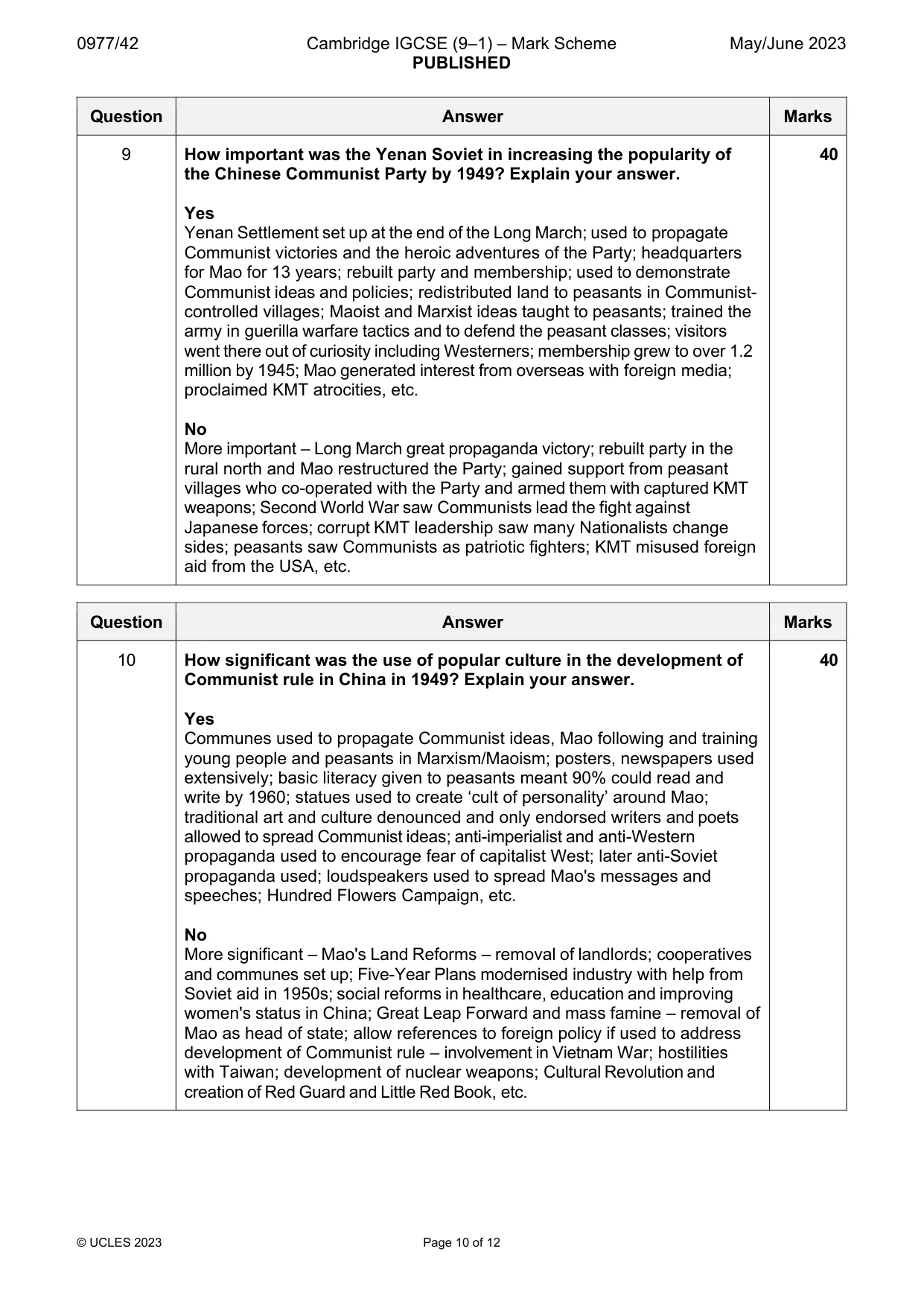
9 How important was the Yenan Soviet in increasing the popularity of the Chinese Communist Party by 1949? Explain your answer. [40]
Mark scheme: 9 How important was the Yenan Soviet in increasing the popularity of 40 the Chinese Communist Party by 1949? Explain your answer. Yes Yenan Settlement set up at the end of the Long March; used to propagate Communist victories and the heroic adventures of the Party; headquarters for Mao for 13 years; rebuilt party and membership; used to demonstrate Communist ideas and policies; redistributed land to peasants in Communist- controlled villages; Maoist and Marxist ideas taught to peasants; trained the army in guerilla warfare tactics and to defend the peasant classes; visitors went there out of curiosity including Westerners; membership grew to over 1.2 million by 1945; Mao generated interest from overseas with foreign media; proclaimed KMT atrocities, etc. No More important – Long March great propaganda victory; rebuilt party in the rural north and Mao restructured the Party; gained support from peasant villages who co-operated with the Party and armed them with captured KMT weapons; Second World War saw Communists lead the fight against Japanese forces; corrupt KMT leadership saw many Nationalists change sides; peasants saw Communists as patriotic fighters; KMT misused foreign aid from the USA, etc.
Q10 · DEPTH STUDY F: SOUTH AFRICA, c.1940–c.1994
DEPTH STUDY F: SOUTH AFRICA, c.1940–c.1994
Mark scheme: 10 How significant was the use of popular culture in the development of 40 Communist rule in China in 1949? Explain your answer. Yes Communes used to propagate Communist ideas, Mao following and training young people and peasants in Marxism/Maoism; posters, newspapers used extensively; basic literacy given to peasants meant 90% could read and write by 1960; statues used to create ‘cult of personality’ around Mao; traditional art and culture denounced and only endorsed writers and poets allowed to spread Communist ideas; anti-imperialist and anti-Western propaganda used to encourage fear of capitalist West; later anti-Soviet propaganda used; loudspeakers used to spread Mao's messages and speeches; Hundred Flowers Campaign, etc. No More significant – Mao's Land Reforms – removal of landlords; cooperatives and communes set up; Five-Year Plans modernised industry with help from Soviet aid in 1950s; social reforms in healthcare, education and improving women's status in China; Great Leap Forward and mass famine – removal of Mao as head of state; allow references to foreign policy if used to address development of Communist rule – involvement in Vietnam War; hostilities with Taiwan; development of nuclear weapons; Cultural Revolution and creation of Red Guard and Little Red Book, etc.
Q11 · How important was the African National Congress (ANC) in the development of opposition to…
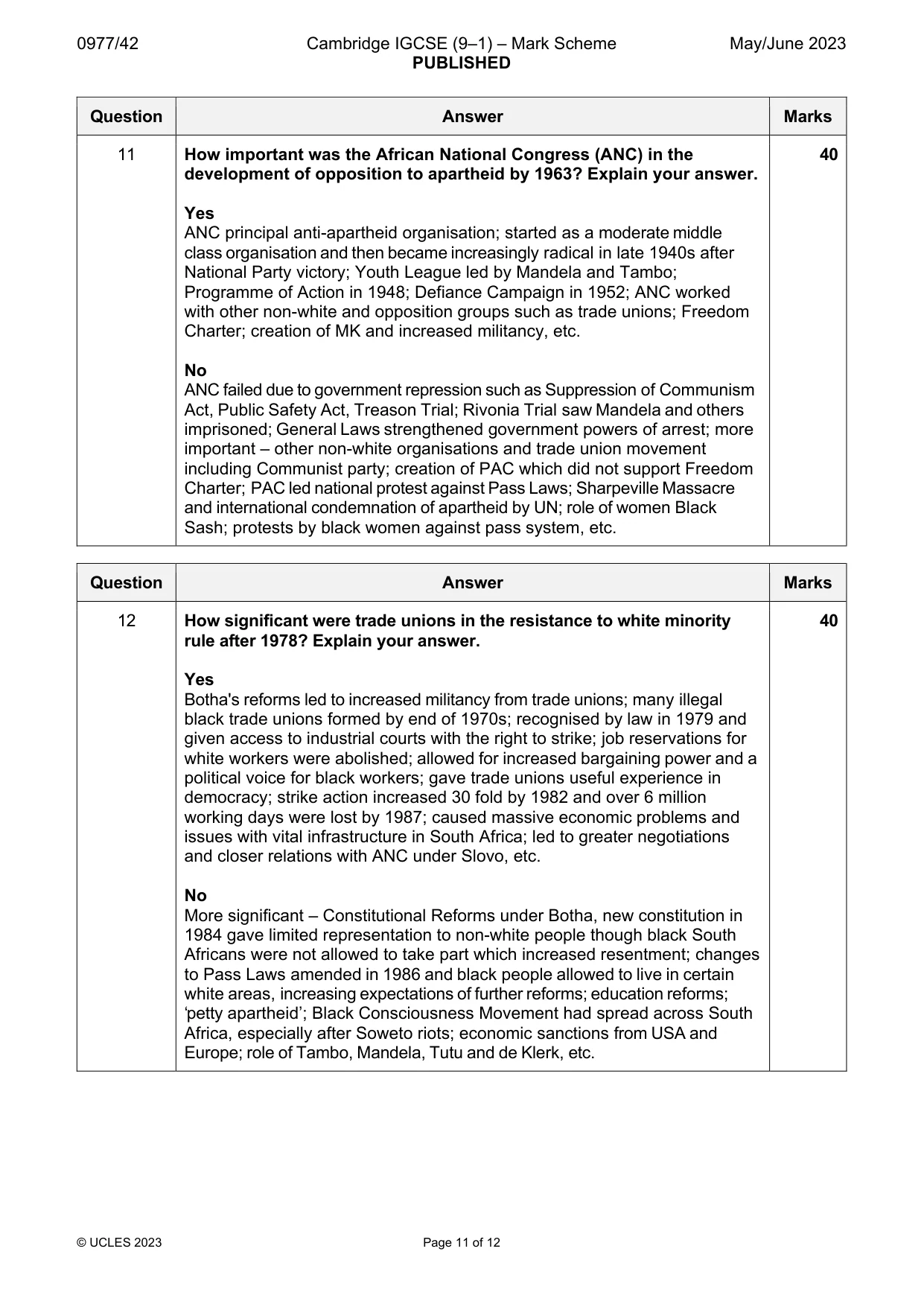
11 How important was the African National Congress (ANC) in the development of opposition to apartheid by 1963? Explain your answer. [40]
Mark scheme: 11 How important was the African National Congress (ANC) in the 40 development of opposition to apartheid by 1963? Explain your answer. Yes ANC principal anti-apartheid organisation; started as a moderate middle class organisation and then became increasingly radical in late 1940s after National Party victory; Youth League led by Mandela and Tambo; Programme of Action in 1948; Defiance Campaign in 1952; ANC worked with other non-white and opposition groups such as trade unions; Freedom Charter; creation of MK and increased militancy, etc. No ANC failed due to government repression such as Suppression of Communism Act, Public Safety Act, Treason Trial; Rivonia Trial saw Mandela and others imprisoned; General Laws strengthened government powers of arrest; more important – other non-white organisations and trade union movement including Communist party; creation of PAC which did not support Freedom Charter; PAC led national protest against Pass Laws; Sharpeville Massacre and international condemnation of apartheid by UN; role of women Black Sash; protests by black women against pass system, etc.
Q12 · How significant were trade unions in the resistance to white minority rule after 1978?
12 How significant were trade unions in the resistance to white minority rule after 1978? Explain your answer. [40] DEPTH STUDY G: ISRAELIS AND PALESTINIANS SINCE 1945
Mark scheme: 12 How significant were trade unions in the resistance to white minority 40 rule after 1978? Explain your answer. Yes Botha's reforms led to increased militancy from trade unions; many illegal black trade unions formed by end of 1970s; recognised by law in 1979 and given access to industrial courts with the right to strike; job reservations for white workers were abolished; allowed for increased bargaining power and a political voice for black workers; gave trade unions useful experience in democracy; strike action increased 30 fold by 1982 and over 6 million working days were lost by 1987; caused massive economic problems and issues with vital infrastructure in South Africa; led to greater negotiations and closer relations with ANC under Slovo, etc. No More significant – Constitutional Reforms under Botha, new constitution in 1984 gave limited representation to non-white people though black South Africans were not allowed to take part which increased resentment; changes to Pass Laws amended in 1986 and black people allowed to live in certain white areas, increasing expectations of further reforms; education reforms; ‘petty apartheid’; Black Consciousness Movement had spread across South Africa, especially after Soweto riots; economic sanctions from USA and Europe; role of Tambo, Mandela, Tutu and de Klerk, etc.
Q13 · How important was the Yom Kippur War to the development of Arab-Israeli relations?
13 How important was the Yom Kippur War to the development of Arab-Israeli relations? Explain your answer. [40]
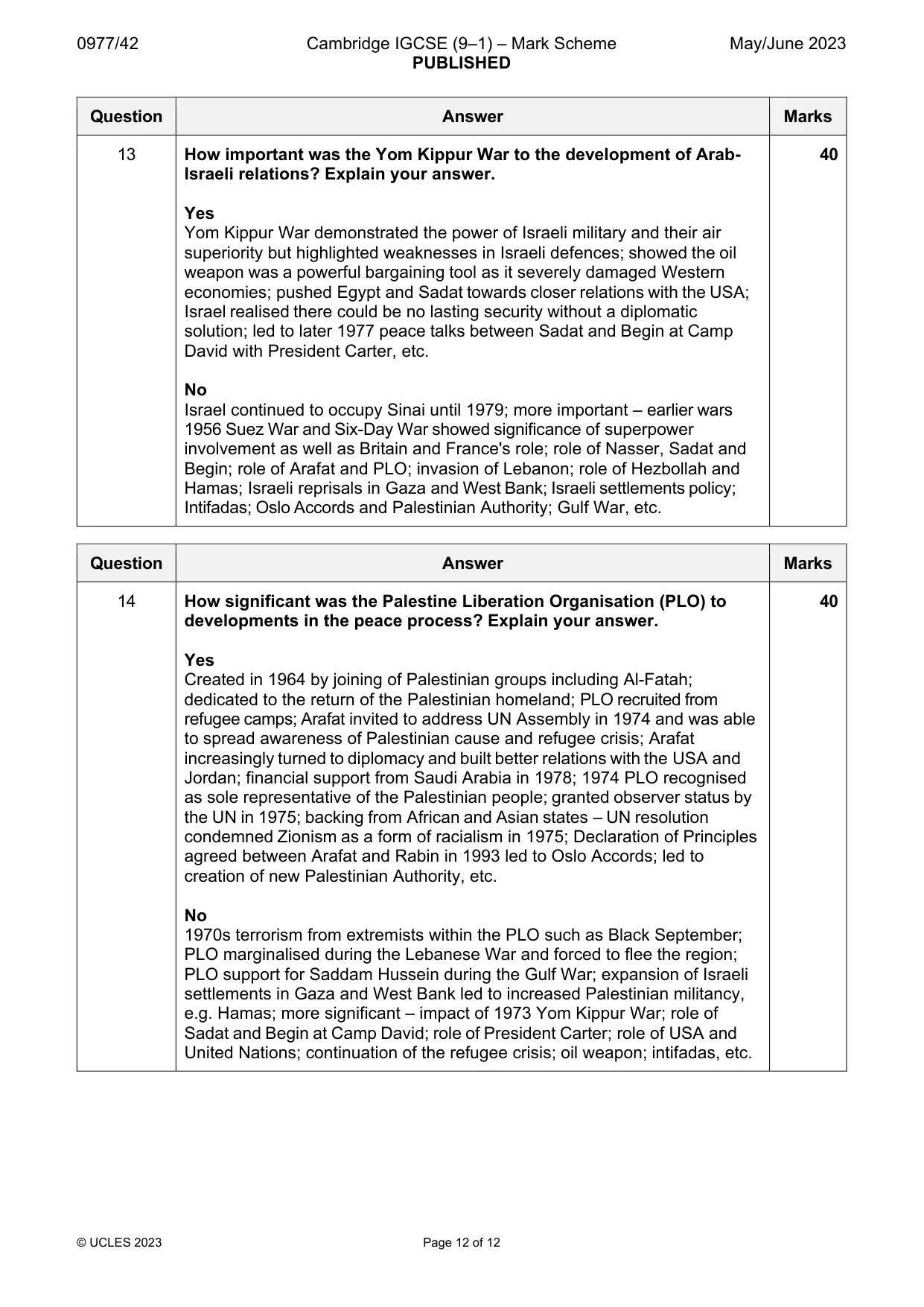
Mark scheme: 13 How important was the Yom Kippur War to the development of Arab- 40 Israeli relations? Explain your answer. Yes Yom Kippur War demonstrated the power of Israeli military and their air superiority but highlighted weaknesses in Israeli defences; showed the oil weapon was a powerful bargaining tool as it severely damaged Western economies; pushed Egypt and Sadat towards closer relations with the USA; Israel realised there could be no lasting security without a diplomatic solution; led to later 1977 peace talks between Sadat and Begin at Camp David with President Carter, etc. No Israel continued to occupy Sinai until 1979; more important – earlier wars 1956 Suez War and Six-Day War showed significance of superpower involvement as well as Britain and France's role; role of Nasser, Sadat and Begin; role of Arafat and PLO; invasion of Lebanon; role of Hezbollah and Hamas; Israeli reprisals in Gaza and West Bank; Israeli settlements policy; Intifadas; Oslo Accords and Palestinian Authority; Gulf War, etc.
Q14 · How significant was the Palestine Liberation Organisation (PLO) to developments in the…
14 How significant was the Palestine Liberation Organisation (PLO) to developments in the peace process? Explain your answer. [40]
Mark scheme: 14 How significant was the Palestine Liberation Organisation (PLO) to 40 developments in the peace process? Explain your answer. Yes Created in 1964 by joining of Palestinian groups including Al-Fatah; dedicated to the return of the Palestinian homeland; PLO recruited from refugee camps; Arafat invited to address UN Assembly in 1974 and was able to spread awareness of Palestinian cause and refugee crisis; Arafat increasingly turned to diplomacy and built better relations with the USA and Jordan; financial support from Saudi Arabia in 1978; 1974 PLO recognised as sole representative of the Palestinian people; granted observer status by the UN in 1975; backing from African and Asian states – UN resolution condemned Zionism as a form of racialism in 1975; Declaration of Principles agreed between Arafat and Rabin in 1993 led to Oslo Accords; led to creation of new Palestinian Authority, etc. No 1970s terrorism from extremists within the PLO such as Black September; PLO marginalised during the Lebanese War and forced to flee the region; PLO support for Saddam Hussein during the Gulf War; expansion of Israeli settlements in Gaza and West Bank led to increased Palestinian militancy, e.g. Hamas; more significant – impact of 1973 Yom Kippur War; role of Sadat and Begin at Camp David; role of President Carter; role of USA and United Nations; continuation of the refugee crisis; oil weapon; intifadas, etc.
What you needed in this session
Cambridge’s own grade thresholds for 2023 May/June, Paper 4 · Variant 2. A higher threshold means an easier paper — the bar moves with how the cohort did.