Cambridge IGCSE History 0470 — 2025 Feb/March Paper 4 · Variant 2
0470/42/F/M/25 · 40 marks · 60 min
The question paper and its mark scheme, free to read here and free to download. This is Cambridge’s own paper, exactly as it was sat.
Question paper4 pages

Mark scheme26 pages
Answers below. Sit the paper first if you are practising.
Paper as text
Question paper, page 1
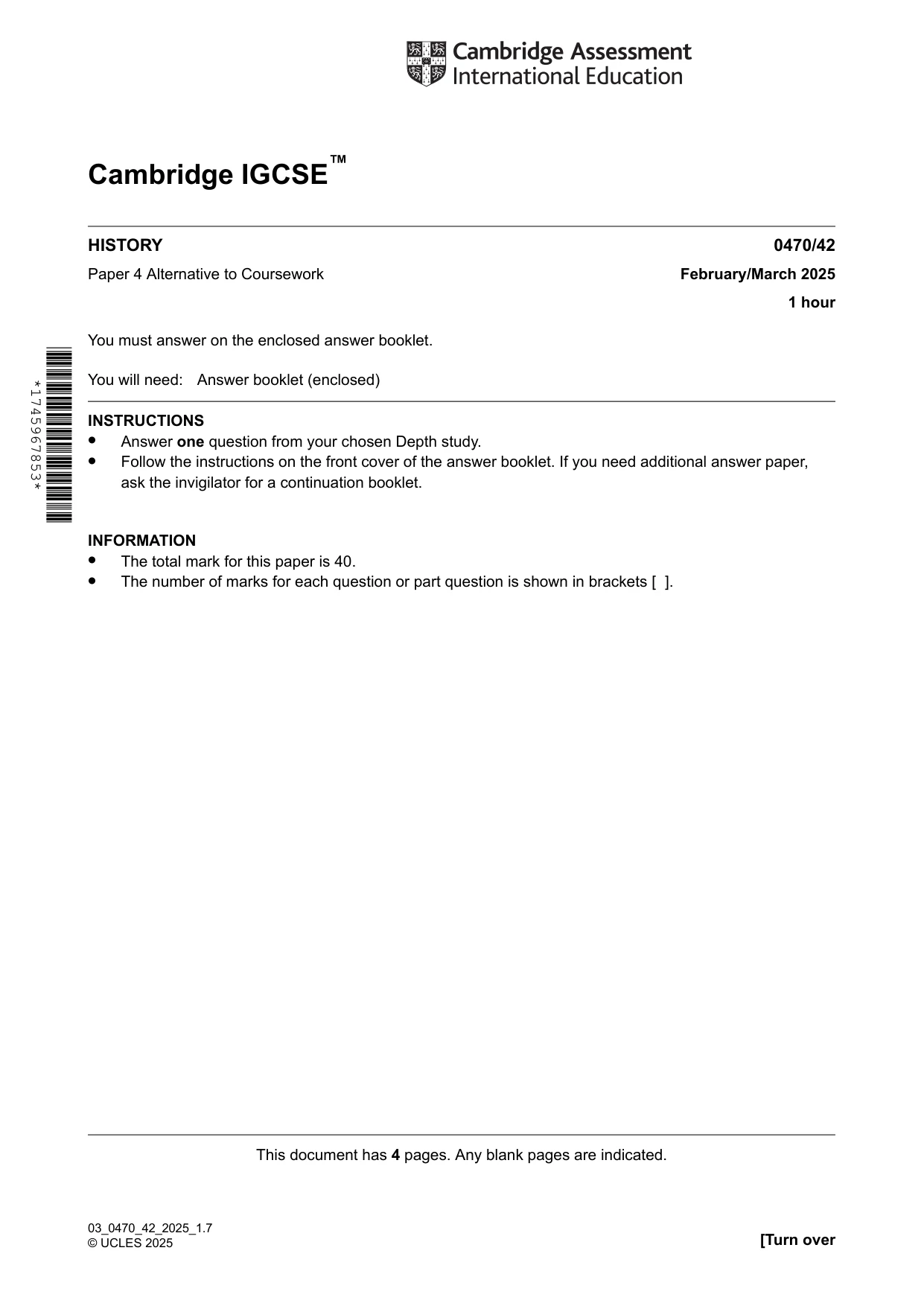
Cambridge IGCSE™ 0470/42 February/March 2025 1 hour HISTORY Paper 4 Alternative to Coursework You must answer on the enclosed answer booklet. You will need: Answer booklet (enclosed) INSTRUCTIONS • Answer one question from your chosen Depth study. • Follow the instructions on the front cover of the answer booklet. If you need additional answer paper, ask the invigilator for a continuation booklet. INFORMATION • The total mark for this paper is 40. • The number of marks for each question or part question is shown in brackets [ ]. This document has 4 pages. Any blank pages are indicated. [Turn over 03_0470_42_2025_1.7 © UCLES 2025 *1745967853*
Question paper, page 2
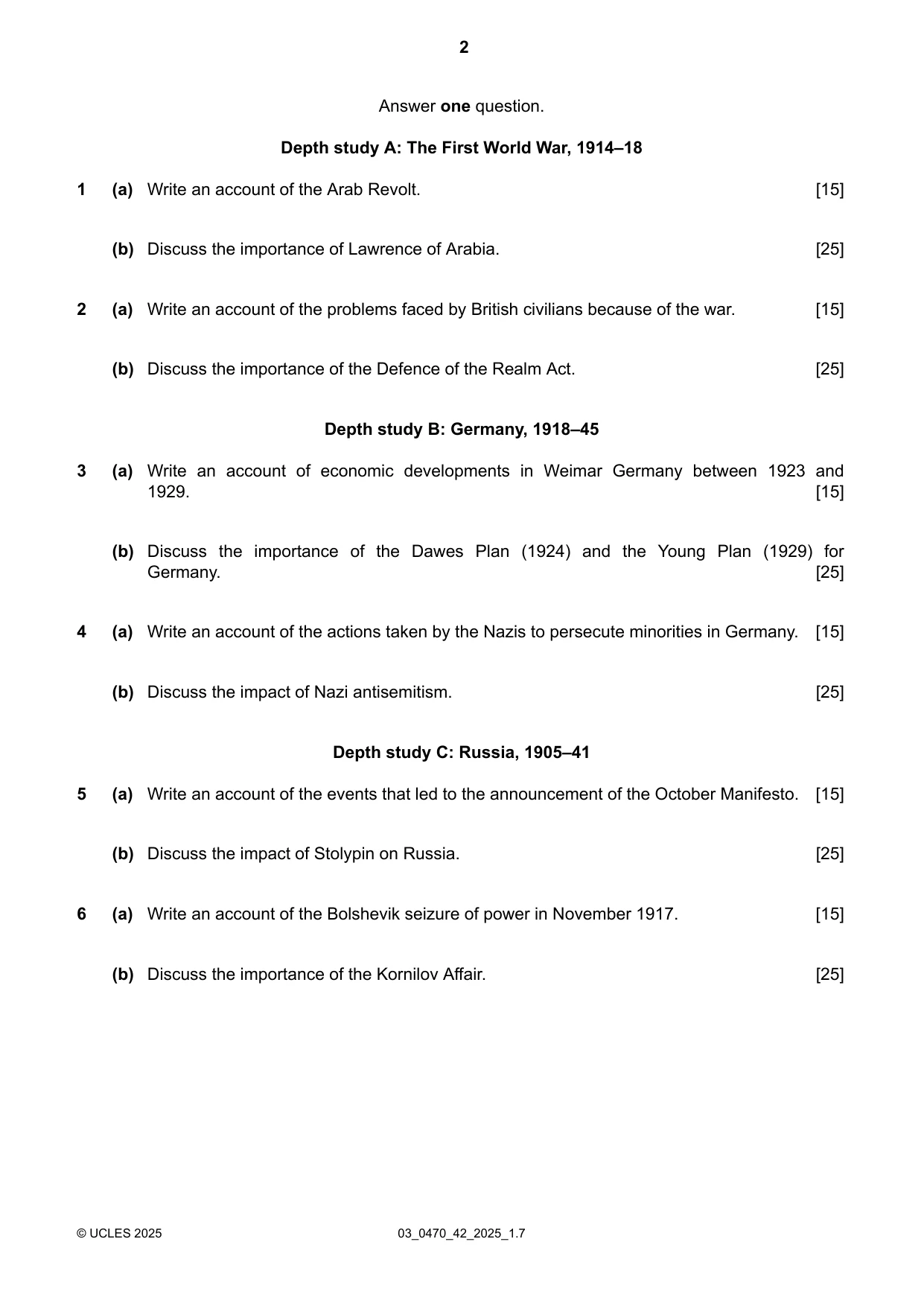
Answer one question. Depth study A: The First World War, 1914–18 Write an account of the Arab Revolt. [15] (a) 1 Discuss the importance of Lawrence of Arabia. [25] (b) Write an account of the problems faced by British civilians because of the war. [15] (a) 2 Discuss the importance of the Defence of the Realm Act. [25] (b) Depth study B: Germany, 1918–45 Write an account of economic developments in Weimar Germany between 1923 and 1929. [15] (a) 3 Discuss the importance of the Dawes Plan (1924) and the Young Plan (1929) for Germany. [25] (b) Write an account of the actions taken by the Nazis to persecute minorities in Germany. [15] (a) 4 Discuss the impact of Nazi antisemitism. [25] (b) Depth study C: Russia, 1905–41 Write an account of the events that led to the announcement of the October Manifesto. [15] (a) 5 Discuss the impact of Stolypin on Russia. [25] (b) Write an account of the Bolshevik seizure of power in November 1917. [15] (a) 6 Discuss the importance of the Kornilov Affair. [25] (b) 03_0470_42_2025_1.7 © UCLES 2025 2
Question paper, page 3
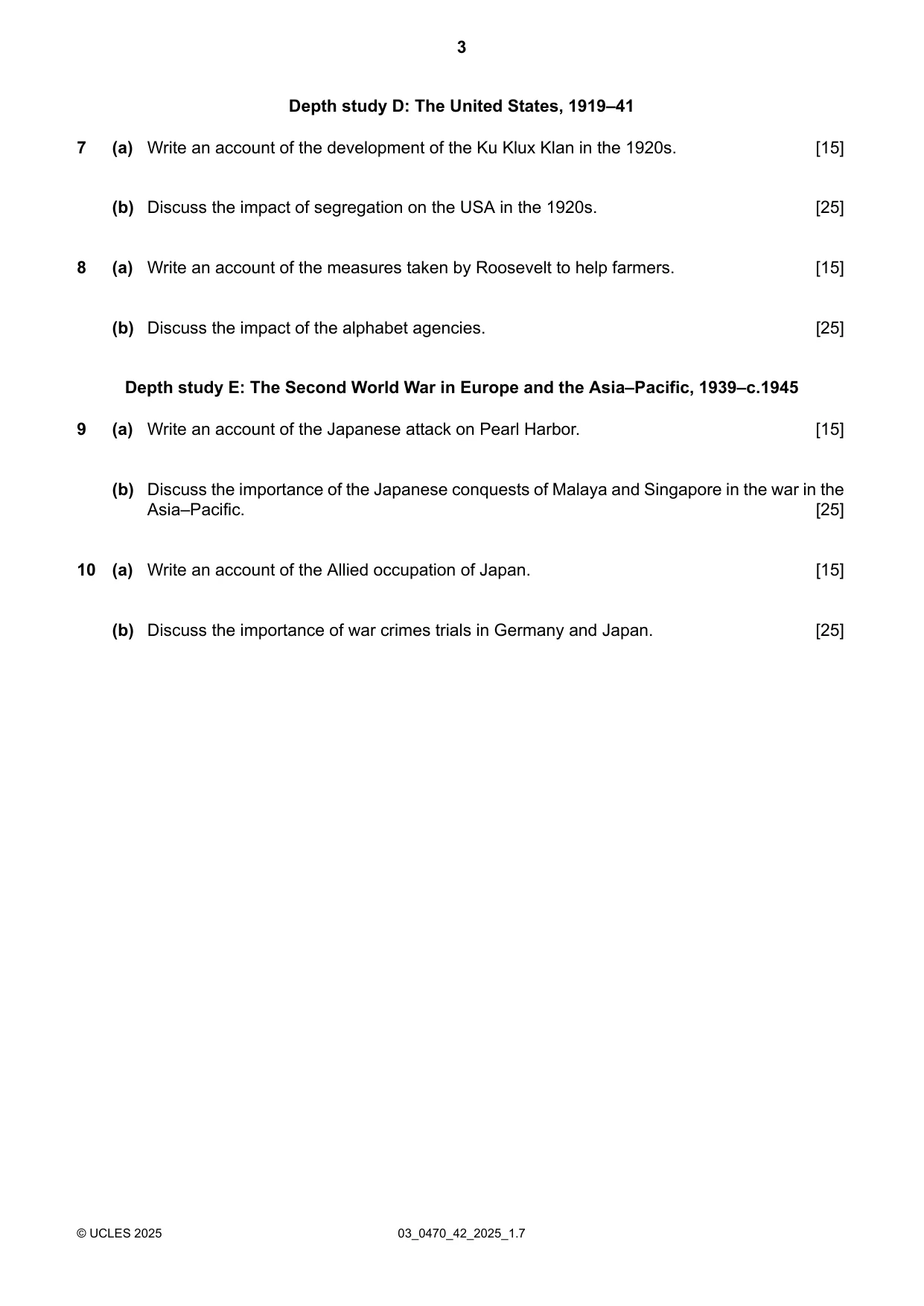
Depth study D: The United States, 1919–41 Write an account of the development of the Ku Klux Klan in the 1920s. [15] (a) 7 Discuss the impact of segregation on the USA in the 1920s. [25] (b) Write an account of the measures taken by Roosevelt to help farmers. [15] (a) 8 Discuss the impact of the alphabet agencies. [25] (b) Depth study E: The Second World War in Europe and the Asia–Pacific, 1939–c.1945 Write an account of the Japanese attack on Pearl Harbor. [15] (a) 9 Discuss the importance of the Japanese conquests of Malaya and Singapore in the war in the Asia–Pacific. [25] (b) Write an account of the Allied occupation of Japan. [15] (a) 10 Discuss the importance of war crimes trials in Germany and Japan. [25] (b) 03_0470_42_2025_1.7 © UCLES 2025 3
Question paper, page 4
BLANK PAGE Permission to reproduce items where third-party owned material protected by copyright is included has been sought and cleared where possible. Every reasonable effort has been made by the publisher (UCLES) to trace copyright holders, but if any items requiring clearance have unwittingly been included, the publisher will be pleased to make amends at the earliest possible opportunity. To avoid the issue of disclosure of answer-related information to candidates, all copyright acknowledgements are reproduced online in the Cambridge Assessment International Education Copyright Acknowledgements Booklet. This is produced for each series of examinations and is freely available to download at www.cambridgeinternational.org after the live examination series. Cambridge Assessment International Education is part of Cambridge Assessment. Cambridge Assessment is the brand name of the University of Cambridge Local Examinations Syndicate (UCLES), which is a department of the University of Cambridge. 03_0470_42_2025_1.7 © UCLES 2025 4
Mark scheme, page 1
This document consists of 26 printed pages. © Cambridge University Press & Assessment 2025 [Turn over Cambridge IGCSE™ HISTORY 0470/42 Paper 4 Alternative to Coursework February/March 2025 MARK SCHEME Maximum Mark: 40 Published This mark scheme is published as an aid to teachers and candidates, to indicate the requirements of the examination. It shows the basis on which Examiners were instructed to award marks. It does not indicate the details of the discussions that took place at an Examiners’ meeting before marking began, which would have considered the acceptability of alternative answers. Mark schemes should be read in conjunction with the question paper and the Principal Examiner Report for Teachers. Cambridge International will not enter into discussions about these mark schemes. Cambridge International is publishing the mark schemes for the February/March 2025 series for most Cambridge IGCSE, Cambridge International A and AS Level components, and some Cambridge O Level components.
Mark scheme, page 2
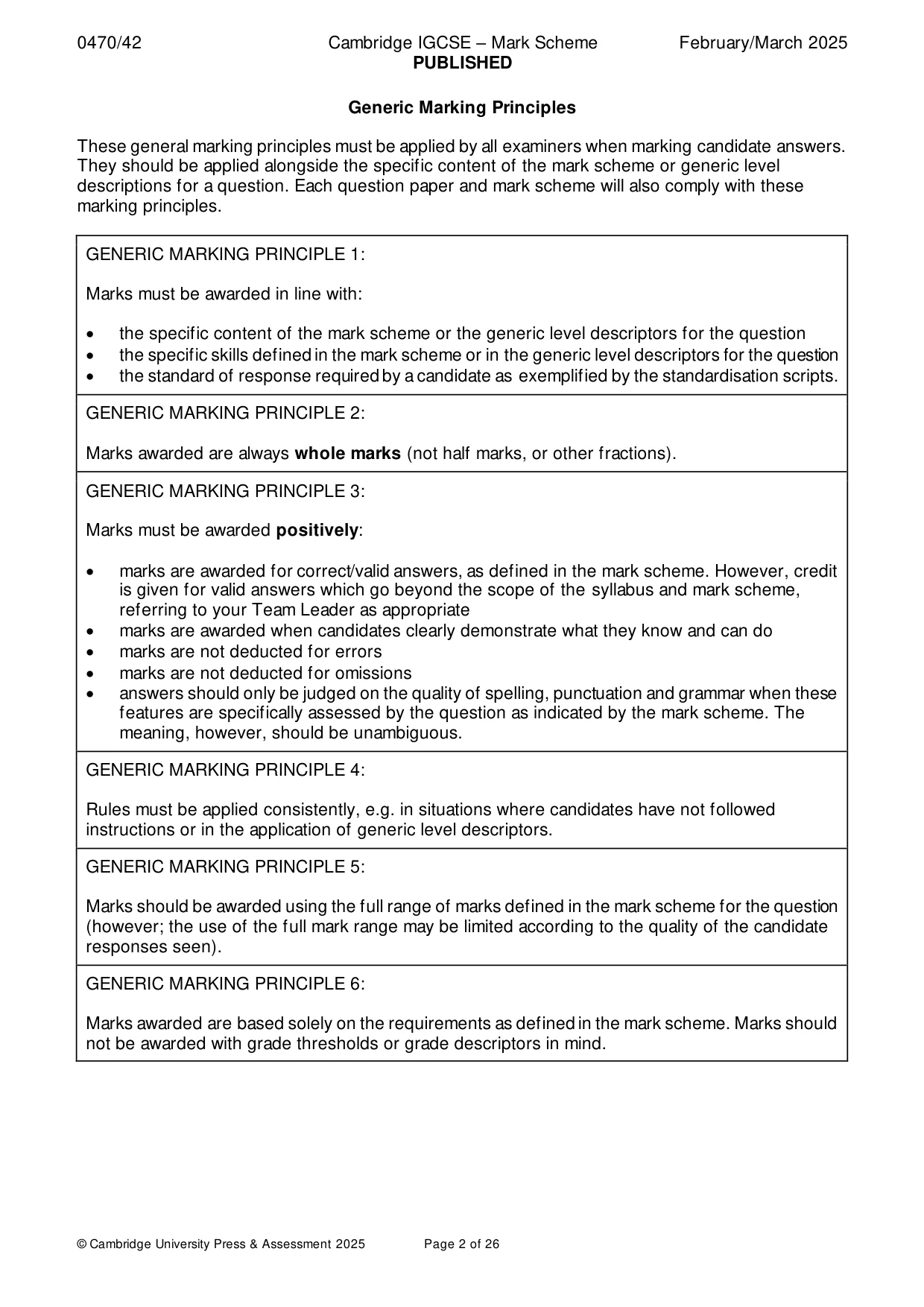
0470/42 Cambridge IGCSE – Mark Scheme PUBLISHED February/March 2025 © Cambridge University Press & Assessment 2025 Page 2 of 26 Generic Marking Principles These general marking principles must be applied by all examiners when marking candidate answers. They should be applied alongside the specific content of the mark scheme or generic level descriptions for a question. Each question paper and mark scheme will also comply with these marking principles. GENERIC MARKING PRINCIPLE 1: Marks must be awarded in line with: • the specific content of the mark scheme or the generic level descriptors for the question • the specific skills defined in the mark scheme or in the generic level descriptors for the question • the standard of response required by a candidate as exemplified by the standardisation scripts. GENERIC MARKING PRINCIPLE 2: Marks awarded are always whole marks (not half marks, or other fractions). GENERIC MARKING PRINCIPLE 3: Marks must be awarded positively: • marks are awarded for correct/valid answers, as defined in the mark scheme. However, credit is given for valid answers which go beyond the scope of the syllabus and mark scheme, referring to your Team Leader as appropriate • marks are awarded when candidates clearly demonstrate what they know and can do • marks are not deducted for errors • marks are not deducted for omissions • answers should only be judged on the quality of spelling, punctuation and grammar when these features are specifically assessed by the question as indicated by the mark scheme. The meaning, however, should be unambiguous. GENERIC MARKING PRINCIPLE 4: Rules must be applied consistently, e.g. in situations where candidates have not followed instructions or in the application of generic level descriptors. GENERIC MARKING PRINCIPLE 5: Marks should be awarded using the full range of marks defined in the mark scheme for the question (however; the use of the full mark range may be limited according to the quality of the candidate responses seen). GENERIC MARKING PRINCIPLE 6: Marks awarded are based solely on the requirements as defined in the mark scheme. Marks should not be awarded with grade thresholds or grade descriptors in mind.
Mark scheme, page 3
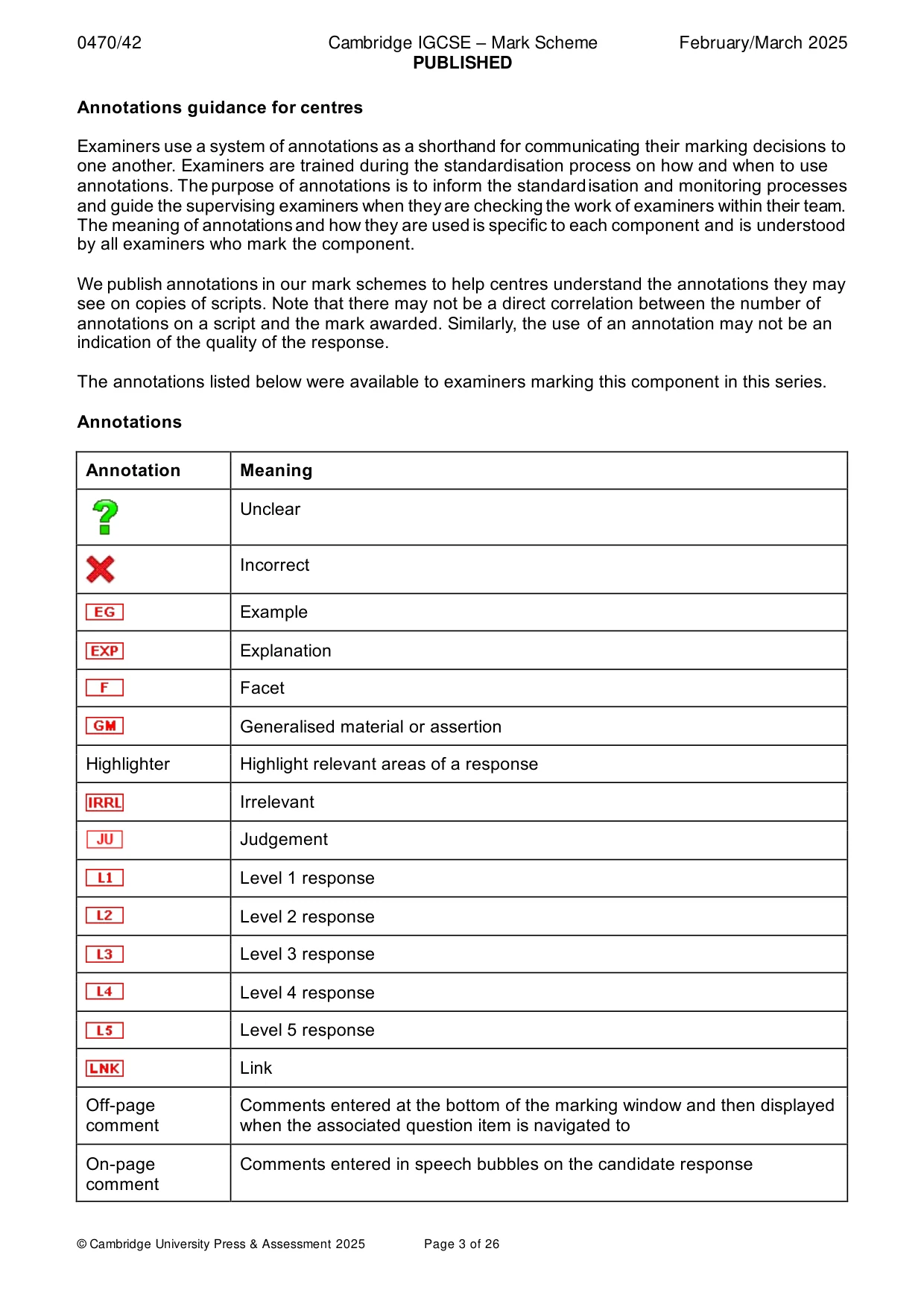
0470/42 Cambridge IGCSE – Mark Scheme PUBLISHED February/March 2025 © Cambridge University Press & Assessment 2025 Page 3 of 26 Annotations guidance for centres Examiners use a system of annotations as a shorthand for communicating their marking decisions to one another. Examiners are trained during the standardisation process on how and when to use annotations. The purpose of annotations is to inform the standardisation and monitoring processes and guide the supervising examiners when they are checking the work of examiners within their team. The meaning of annotations and how they are used is specific to each component and is understood by all examiners who mark the component. We publish annotations in our mark schemes to help centres understand the annotations they may see on copies of scripts. Note that there may not be a direct correlation between the number of annotations on a script and the mark awarded. Similarly, the use of an annotation may not be an indication of the quality of the response. The annotations listed below were available to examiners marking this component in this series. Annotations Annotation Meaning Unclear Incorrect Example Explanation Facet Generalised material or assertion Highlighter Highlight relevant areas of a response Irrelevant Judgement Level 1 response Level 2 response Level 3 response Level 4 response Level 5 response Link Off-page comment Comments entered at the bottom of the marking window and then displayed when the associated question item is navigated to On-page comment Comments entered in speech bubbles on the candidate response
Mark scheme, page 4
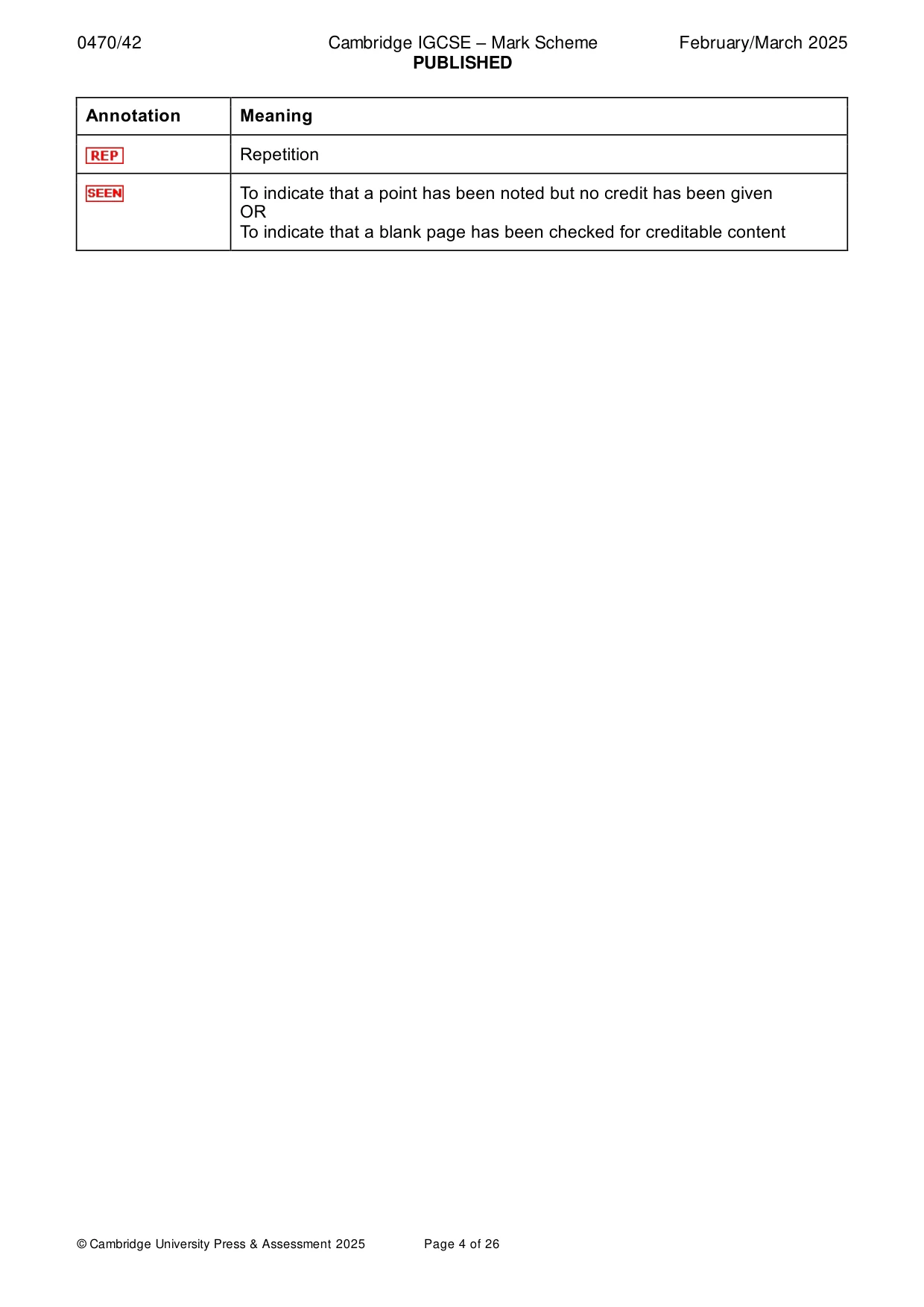
0470/42 Cambridge IGCSE – Mark Scheme PUBLISHED February/March 2025 © Cambridge University Press & Assessment 2025 Page 4 of 26 Annotation Meaning Repetition To indicate that a point has been noted but no credit has been given OR To indicate that a blank page has been checked for creditable content
Mark scheme, page 5
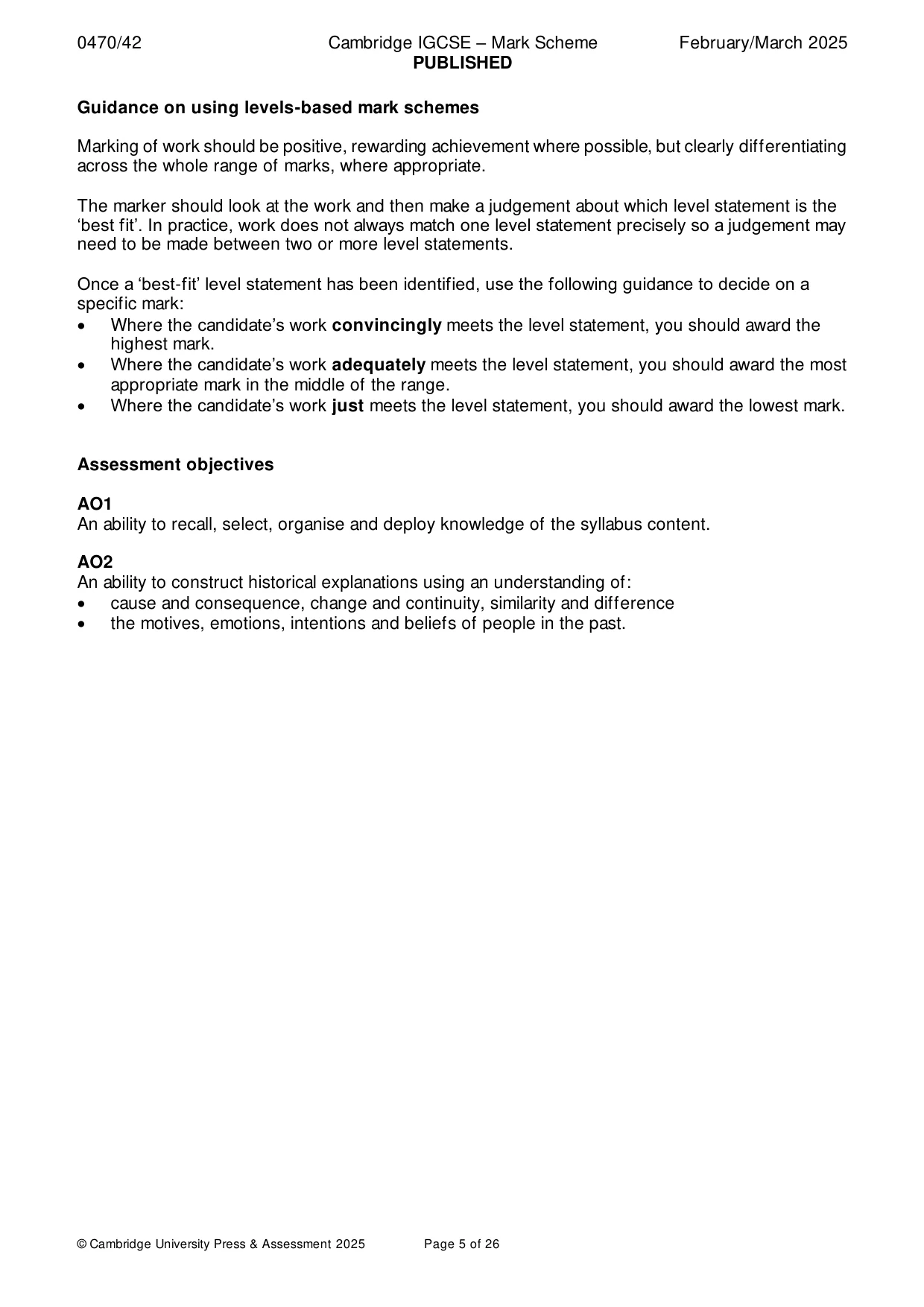
0470/42 Cambridge IGCSE – Mark Scheme PUBLISHED February/March 2025 © Cambridge University Press & Assessment 2025 Page 5 of 26 Guidance on using levels-based mark schemes Marking of work should be positive, rewarding achievement where possible, but clearly differentiating across the whole range of marks, where appropriate. The marker should look at the work and then make a judgement about which level statement is the ‘best fit’. In practice, work does not always match one level statement precisely so a judgement may need to be made between two or more level statements. Once a ‘best-fit’ level statement has been identified, use the following guidance to decide on a specific mark: • Where the candidate’s work convincingly meets the level statement, you should award the highest mark. • Where the candidate’s work adequately meets the level statement, you should award the most appropriate mark in the middle of the range. • Where the candidate’s work just meets the level statement, you should award the lowest mark. Assessment objectives AO1 An ability to recall, select, organise and deploy knowledge of the syllabus content. AO2 An ability to construct historical explanations using an understanding of: • cause and consequence, change and continuity, similarity and difference • the motives, emotions, intentions and beliefs of people in the past.
Mark scheme, page 6
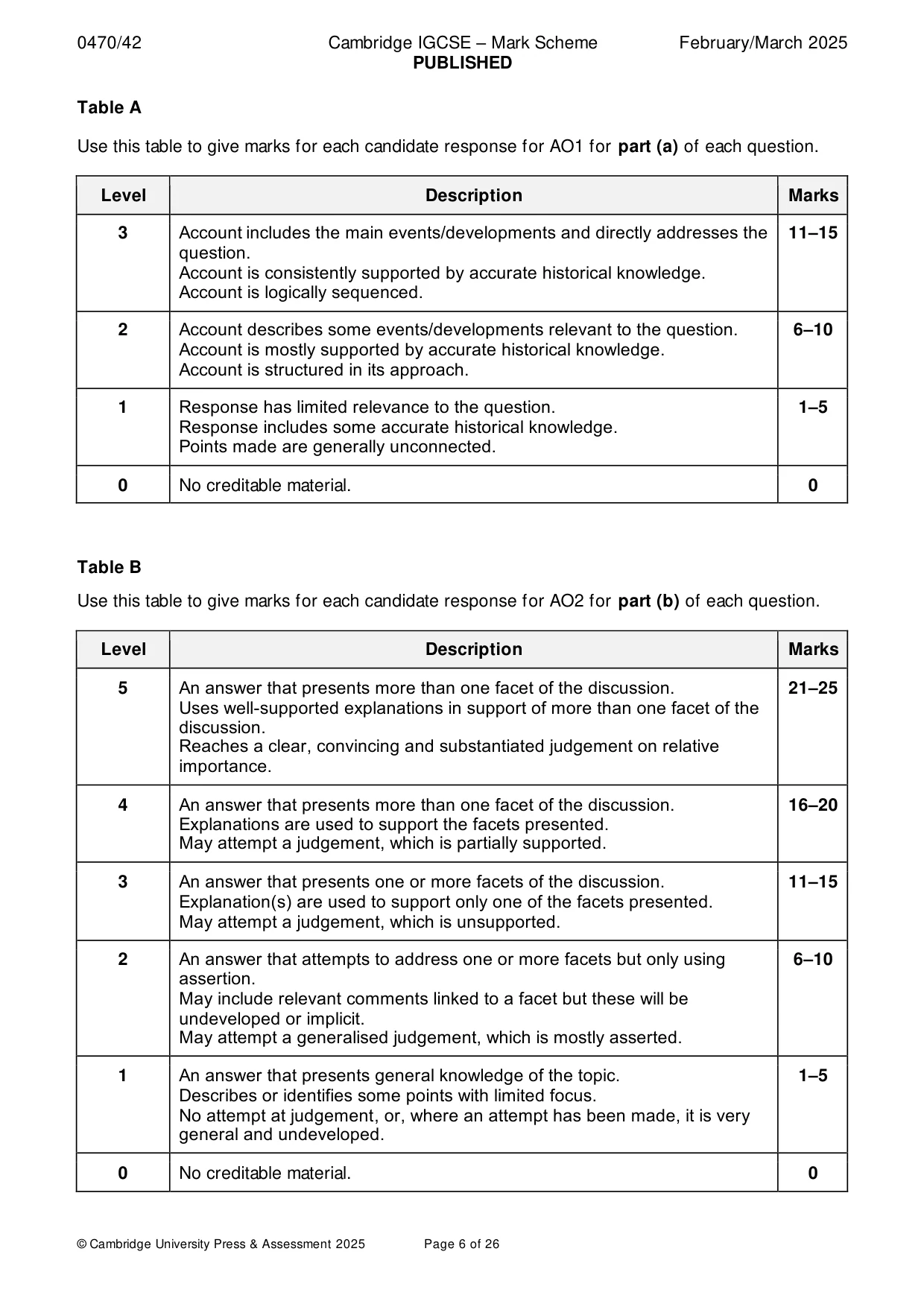
0470/42 Cambridge IGCSE – Mark Scheme PUBLISHED February/March 2025 © Cambridge University Press & Assessment 2025 Page 6 of 26 Table A Use this table to give marks for each candidate response for AO1 for part (a) of each question. Level Description Marks 3 Account includes the main events/developments and directly addresses the question. Account is consistently supported by accurate historical knowledge. Account is logically sequenced. 11–15 2 Account describes some events/developments relevant to the question. Account is mostly supported by accurate historical knowledge. Account is structured in its approach. 6–10 1 Response has limited relevance to the question. Response includes some accurate historical knowledge. Points made are generally unconnected. 1–5 0 No creditable material. 0 Table B Use this table to give marks for each candidate response for AO2 for part (b) of each question. Level Description Marks 5 An answer that presents more than one facet of the discussion. Uses well-supported explanations in support of more than one facet of the discussion. Reaches a clear, convincing and substantiated judgement on relative importance. 21–25 4 An answer that presents more than one facet of the discussion. Explanations are used to support the facets presented. May attempt a judgement, which is partially supported. 16–20 3 An answer that presents one or more facets of the discussion. Explanation(s) are used to support only one of the facets presented. May attempt a judgement, which is unsupported. 11–15 2 An answer that attempts to address one or more facets but only using assertion. May include relevant comments linked to a facet but these will be undeveloped or implicit. May attempt a generalised judgement, which is mostly asserted. 6–10 1 An answer that presents general knowledge of the topic. Describes or identifies some points with limited focus. No attempt at judgement, or, where an attempt has been made, it is very general and undeveloped. 1–5 0 No creditable material. 0
Mark scheme, page 7
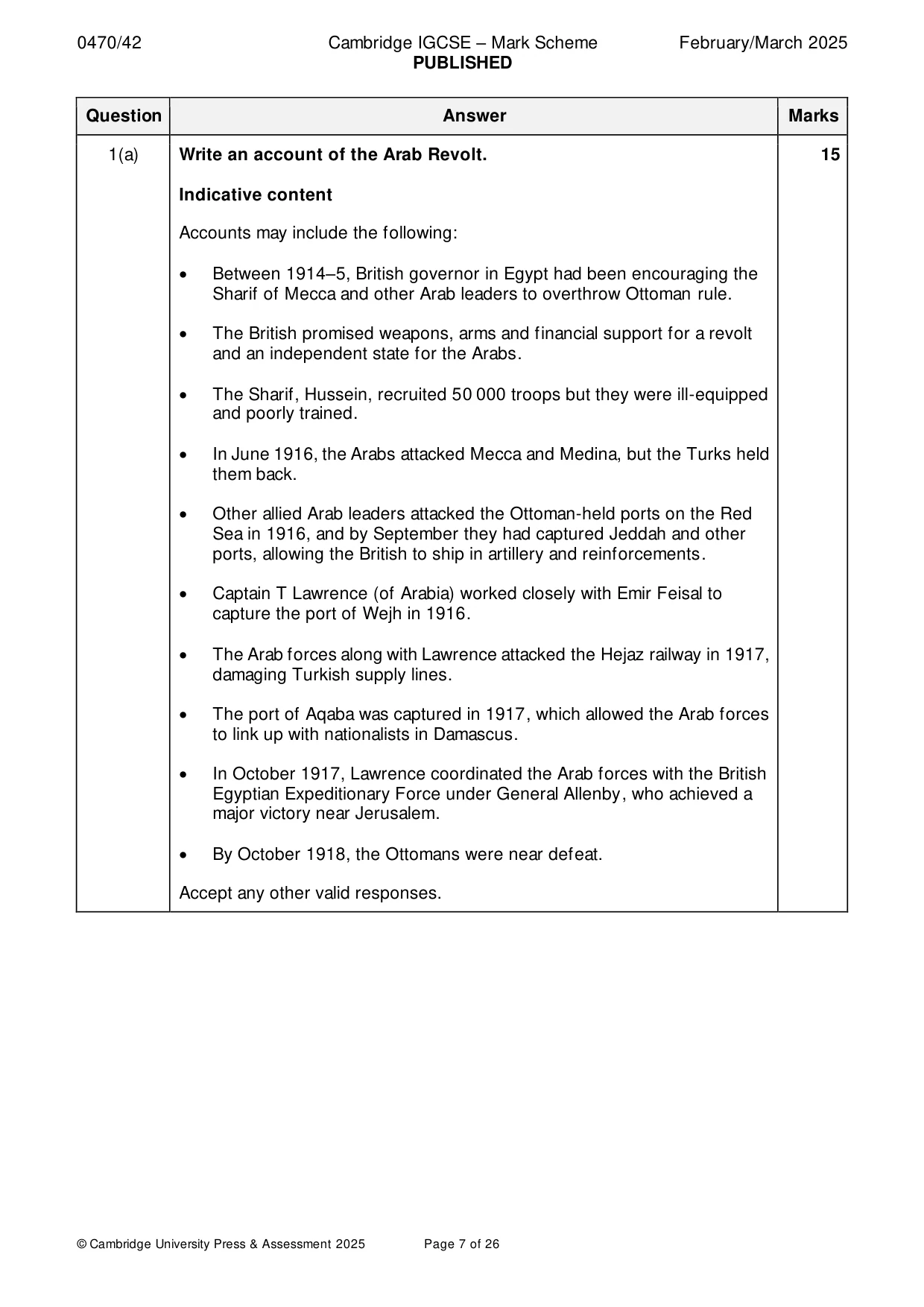
0470/42 Cambridge IGCSE – Mark Scheme PUBLISHED February/March 2025 © Cambridge University Press & Assessment 2025 Page 7 of 26 Question Answer Marks 1(a) Write an account of the Arab Revolt. Indicative content Accounts may include the following: • Between 1914–5, British governor in Egypt had been encouraging the Sharif of Mecca and other Arab leaders to overthrow Ottoman rule. • The British promised weapons, arms and financial support for a revolt and an independent state for the Arabs. • The Sharif, Hussein, recruited 50 000 troops but they were ill-equipped and poorly trained. • In June 1916, the Arabs attacked Mecca and Medina, but the Turks held them back. • Other allied Arab leaders attacked the Ottoman-held ports on the Red Sea in 1916, and by September they had captured Jeddah and other ports, allowing the British to ship in artillery and reinforcements. • Captain T Lawrence (of Arabia) worked closely with Emir Feisal to capture the port of Wejh in 1916. • The Arab forces along with Lawrence attacked the Hejaz railway in 1917, damaging Turkish supply lines. • The port of Aqaba was captured in 1917, which allowed the Arab forces to link up with nationalists in Damascus. • In October 1917, Lawrence coordinated the Arab forces with the British Egyptian Expeditionary Force under General Allenby, who achieved a major victory near Jerusalem. • By October 1918, the Ottomans were near defeat. Accept any other valid responses. 15
Mark scheme, page 8
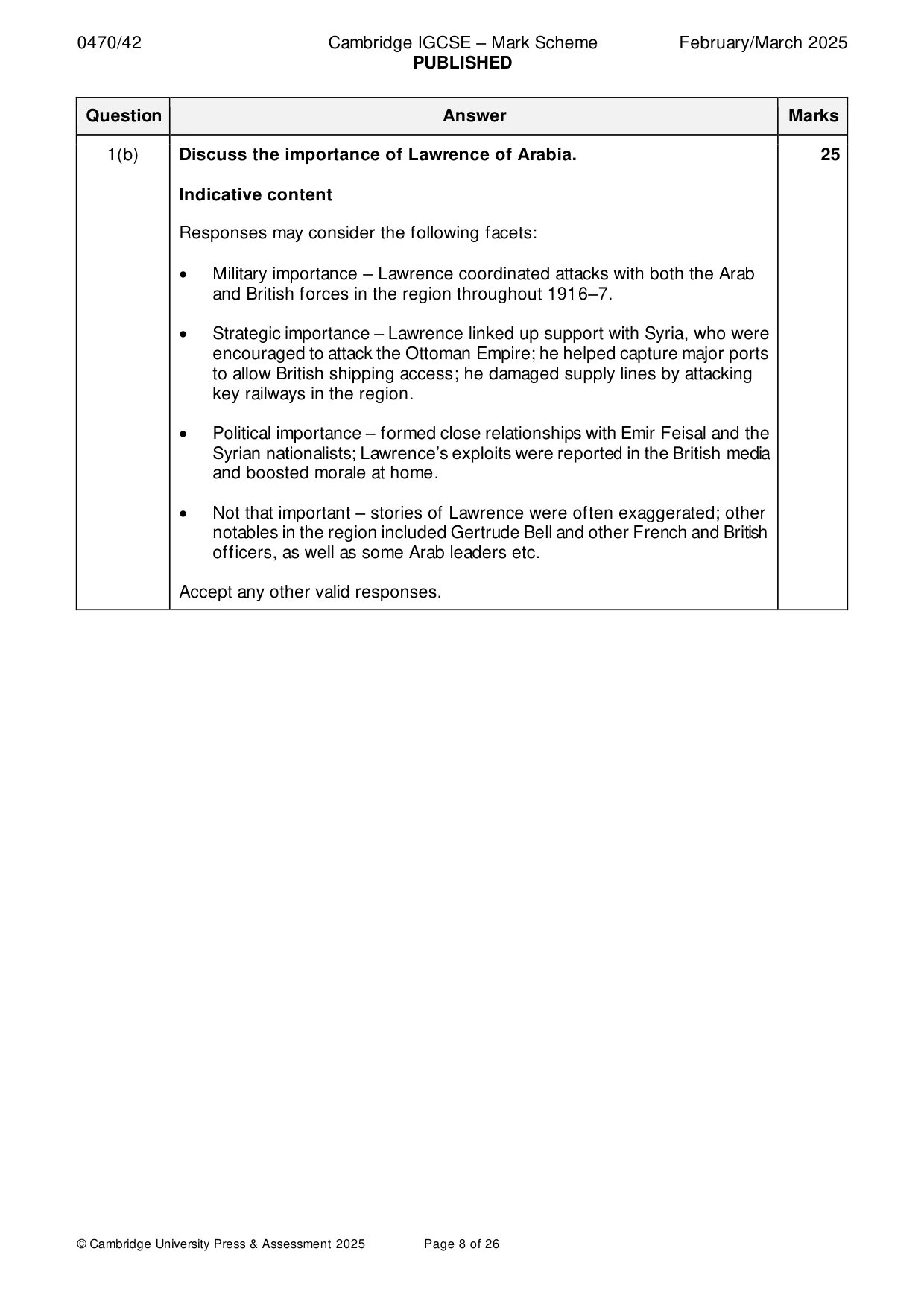
0470/42 Cambridge IGCSE – Mark Scheme PUBLISHED February/March 2025 © Cambridge University Press & Assessment 2025 Page 8 of 26 Question Answer Marks 1(b) Discuss the importance of Lawrence of Arabia. Indicative content Responses may consider the following facets: • Military importance – Lawrence coordinated attacks with both the Arab and British forces in the region throughout 1916–7. • Strategic importance – Lawrence linked up support with Syria, who were encouraged to attack the Ottoman Empire; he helped capture major ports to allow British shipping access; he damaged supply lines by attacking key railways in the region. • Political importance – formed close relationships with Emir Feisal and the Syrian nationalists; Lawrence’s exploits were reported in the British media and boosted morale at home. • Not that important – stories of Lawrence were often exaggerated; other notables in the region included Gertrude Bell and other French and British officers, as well as some Arab leaders etc. Accept any other valid responses. 25
Mark scheme, page 9
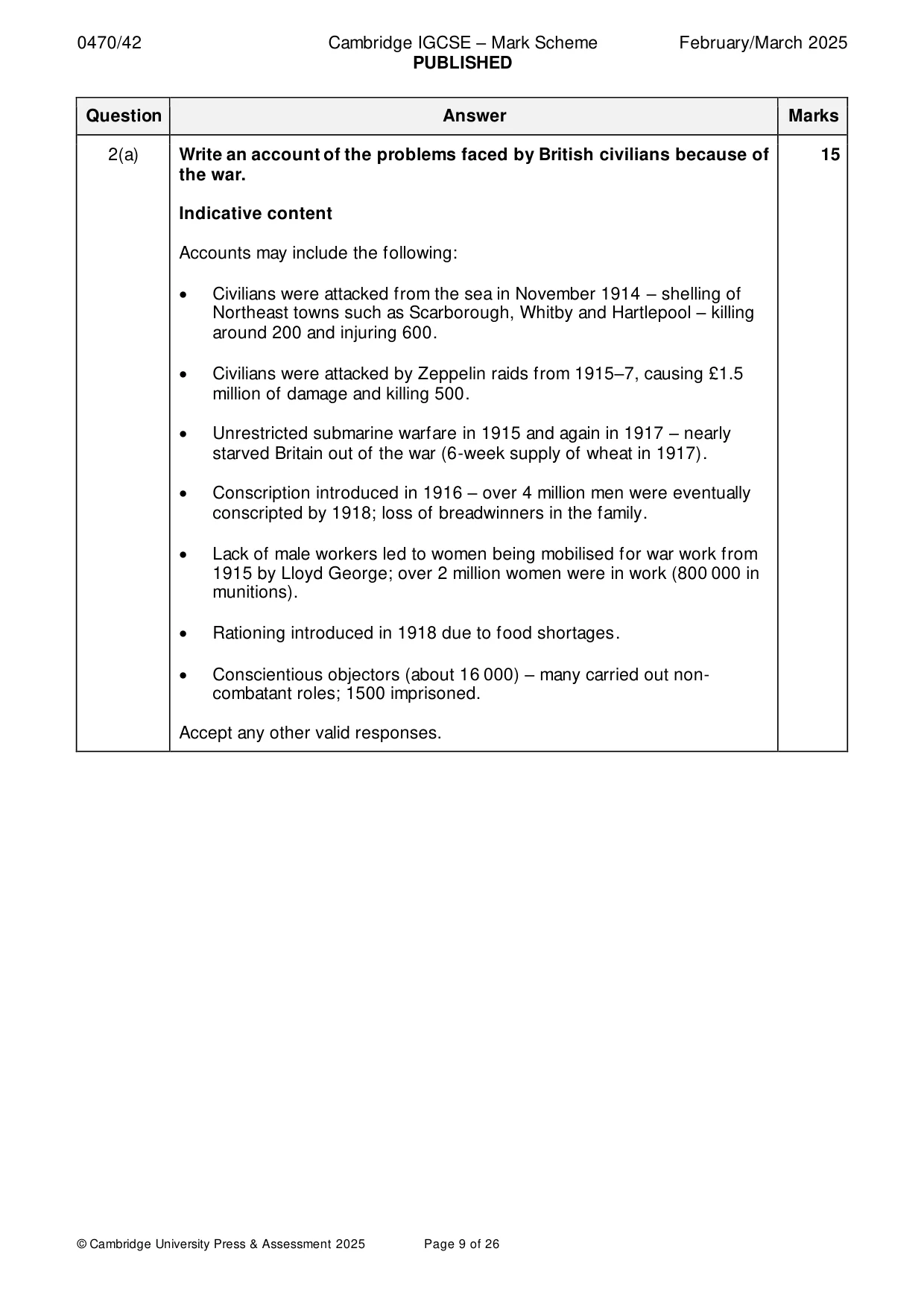
0470/42 Cambridge IGCSE – Mark Scheme PUBLISHED February/March 2025 © Cambridge University Press & Assessment 2025 Page 9 of 26 Question Answer Marks 2(a) Write an account of the problems faced by British civilians because of the war. Indicative content Accounts may include the following: • Civilians were attacked from the sea in November 1914 – shelling of Northeast towns such as Scarborough, Whitby and Hartlepool – killing around 200 and injuring 600. • Civilians were attacked by Zeppelin raids from 1915–7, causing £1.5 million of damage and killing 500. • Unrestricted submarine warfare in 1915 and again in 1917 – nearly starved Britain out of the war (6-week supply of wheat in 1917). • Conscription introduced in 1916 – over 4 million men were eventually conscripted by 1918; loss of breadwinners in the family. • Lack of male workers led to women being mobilised for war work from 1915 by Lloyd George; over 2 million women were in work (800 000 in munitions). • Rationing introduced in 1918 due to food shortages. • Conscientious objectors (about 16 000) – many carried out non- combatant roles; 1500 imprisoned. Accept any other valid responses. 15
Mark scheme, page 10
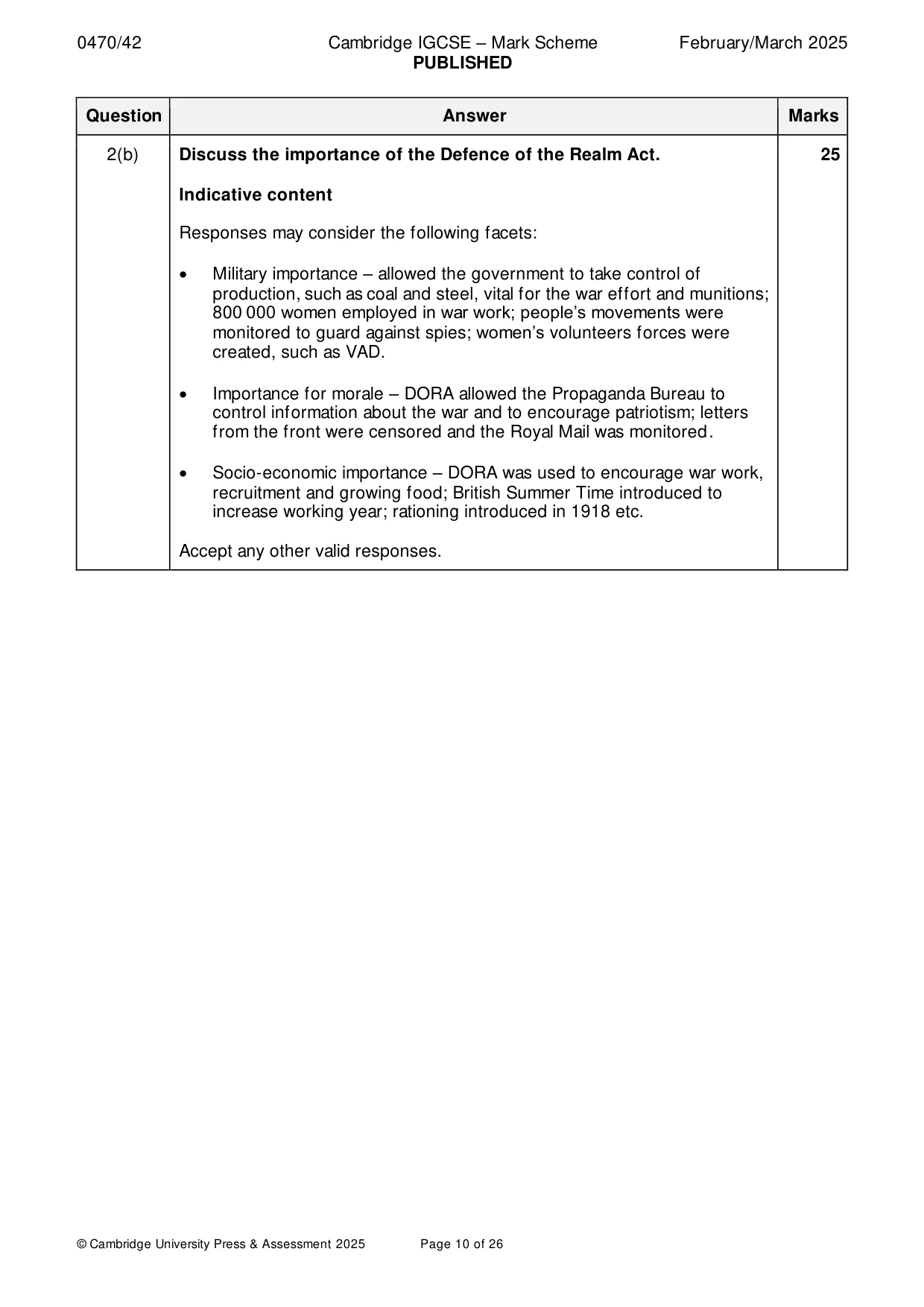
0470/42 Cambridge IGCSE – Mark Scheme PUBLISHED February/March 2025 © Cambridge University Press & Assessment 2025 Page 10 of 26 Question Answer Marks 2(b) Discuss the importance of the Defence of the Realm Act. Indicative content Responses may consider the following facets: • Military importance – allowed the government to take control of production, such as coal and steel, vital for the war effort and munitions; 800 000 women employed in war work; people’s movements were monitored to guard against spies; women’s volunteers forces were created, such as VAD. • Importance for morale – DORA allowed the Propaganda Bureau to control information about the war and to encourage patriotism; letters from the front were censored and the Royal Mail was monitored. • Socio-economic importance – DORA was used to encourage war work, recruitment and growing food; British Summer Time introduced to increase working year; rationing introduced in 1918 etc. Accept any other valid responses. 25
Mark scheme, page 11
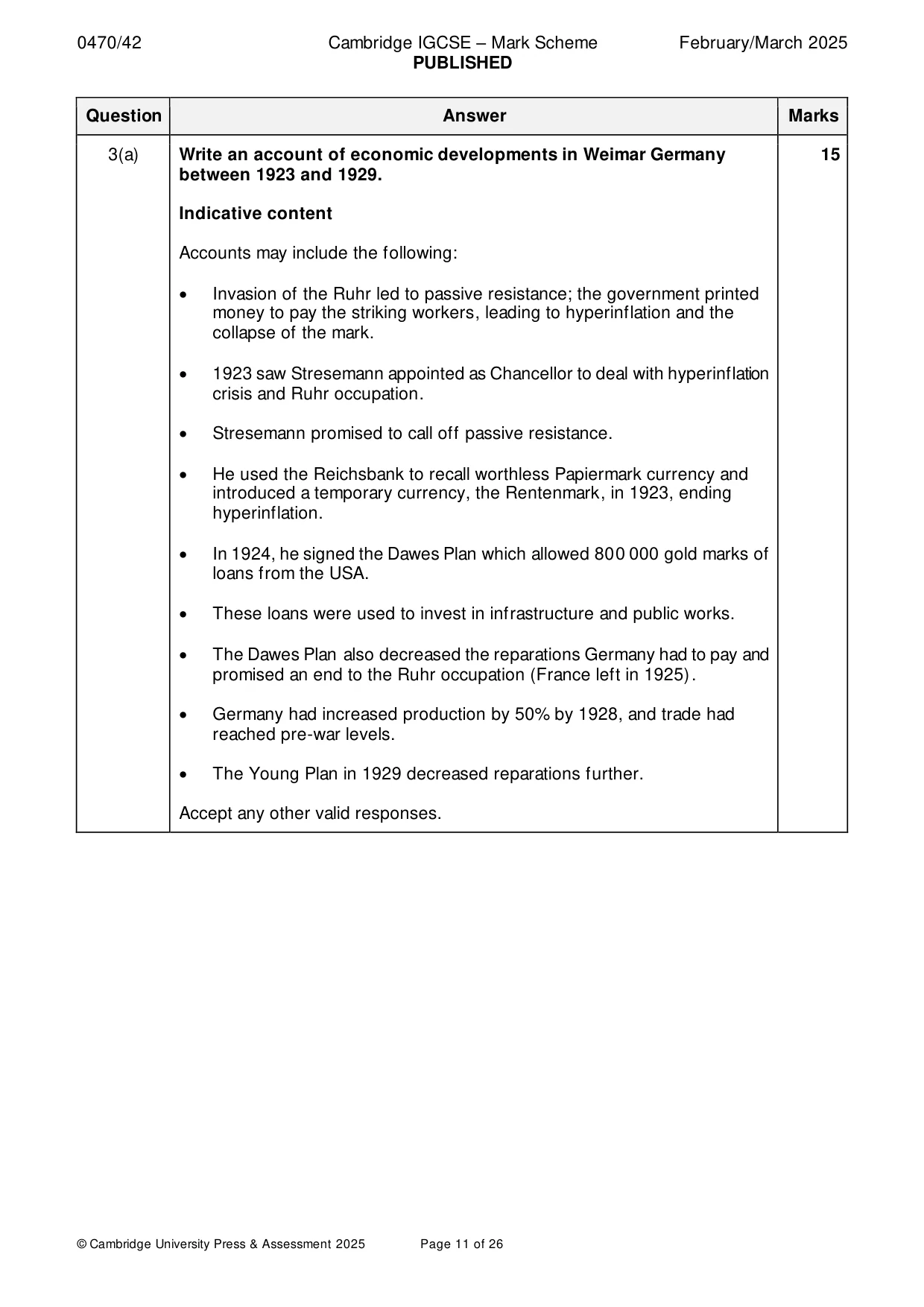
0470/42 Cambridge IGCSE – Mark Scheme PUBLISHED February/March 2025 © Cambridge University Press & Assessment 2025 Page 11 of 26 Question Answer Marks 3(a) Write an account of economic developments in Weimar Germany between 1923 and 1929. Indicative content Accounts may include the following: • Invasion of the Ruhr led to passive resistance; the government printed money to pay the striking workers, leading to hyperinflation and the collapse of the mark. • 1923 saw Stresemann appointed as Chancellor to deal with hyperinflation crisis and Ruhr occupation. • Stresemann promised to call off passive resistance. • He used the Reichsbank to recall worthless Papiermark currency and introduced a temporary currency, the Rentenmark, in 1923, ending hyperinflation. • In 1924, he signed the Dawes Plan which allowed 800 000 gold marks of loans from the USA. • These loans were used to invest in infrastructure and public works. • The Dawes Plan also decreased the reparations Germany had to pay and promised an end to the Ruhr occupation (France left in 1925). • Germany had increased production by 50% by 1928, and trade had reached pre-war levels. • The Young Plan in 1929 decreased reparations further. Accept any other valid responses. 15
Mark scheme, page 12
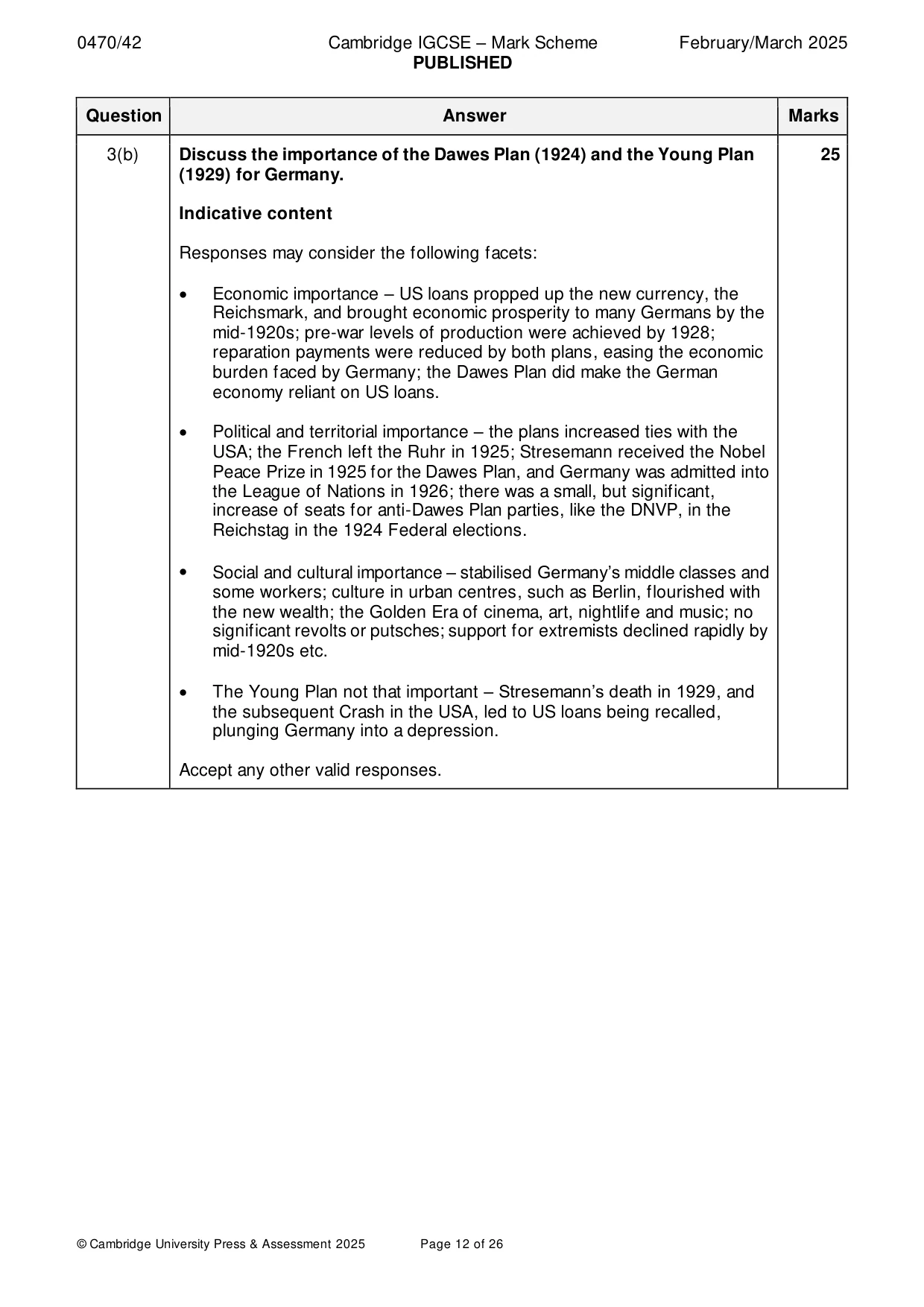
0470/42 Cambridge IGCSE – Mark Scheme PUBLISHED February/March 2025 © Cambridge University Press & Assessment 2025 Page 12 of 26 Question Answer Marks 3(b) Discuss the importance of the Dawes Plan (1924) and the Young Plan (1929) for Germany. Indicative content Responses may consider the following facets: • Economic importance – US loans propped up the new currency, the Reichsmark, and brought economic prosperity to many Germans by the mid-1920s; pre-war levels of production were achieved by 1928; reparation payments were reduced by both plans, easing the economic burden faced by Germany; the Dawes Plan did make the German economy reliant on US loans. • Political and territorial importance – the plans increased ties with the USA; the French left the Ruhr in 1925; Stresemann received the Nobel Peace Prize in 1925 for the Dawes Plan, and Germany was admitted into the League of Nations in 1926; there was a small, but significant, increase of seats for anti-Dawes Plan parties, like the DNVP, in the Reichstag in the 1924 Federal elections. • Social and cultural importance – stabilised Germany’s middle classes and some workers; culture in urban centres, such as Berlin, flourished with the new wealth; the Golden Era of cinema, art, nightlife and music; no significant revolts or putsches; support for extremists declined rapidly by mid-1920s etc. • The Young Plan not that important – Stresemann’s death in 1929, and the subsequent Crash in the USA, led to US loans being recalled, plunging Germany into a depression. Accept any other valid responses. 25
Mark scheme, page 13
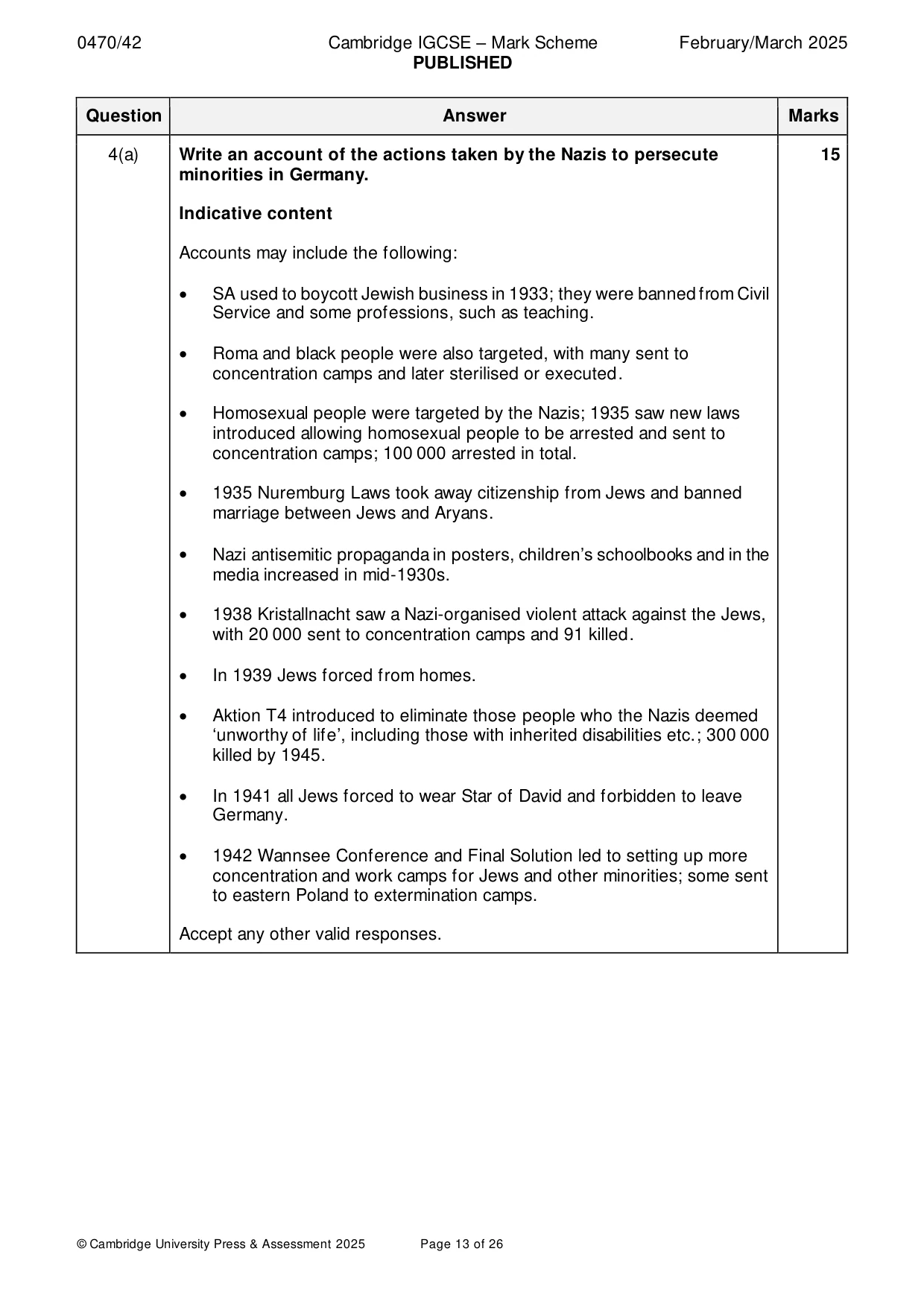
0470/42 Cambridge IGCSE – Mark Scheme PUBLISHED February/March 2025 © Cambridge University Press & Assessment 2025 Page 13 of 26 Question Answer Marks 4(a) Write an account of the actions taken by the Nazis to persecute minorities in Germany. Indicative content Accounts may include the following: • SA used to boycott Jewish business in 1933; they were banned from Civil Service and some professions, such as teaching. • Roma and black people were also targeted, with many sent to concentration camps and later sterilised or executed. • Homosexual people were targeted by the Nazis; 1935 saw new laws introduced allowing homosexual people to be arrested and sent to concentration camps; 100 000 arrested in total. • 1935 Nuremburg Laws took away citizenship from Jews and banned marriage between Jews and Aryans. • Nazi antisemitic propaganda in posters, children’s schoolbooks and in the media increased in mid-1930s. • 1938 Kristallnacht saw a Nazi-organised violent attack against the Jews, with 20 000 sent to concentration camps and 91 killed. • In 1939 Jews forced from homes. • Aktion T4 introduced to eliminate those people who the Nazis deemed ‘unworthy of life’, including those with inherited disabilities etc.; 300 000 killed by 1945. • In 1941 all Jews forced to wear Star of David and forbidden to leave Germany. • 1942 Wannsee Conference and Final Solution led to setting up more concentration and work camps for Jews and other minorities; some sent to eastern Poland to extermination camps. Accept any other valid responses. 15
Mark scheme, page 14
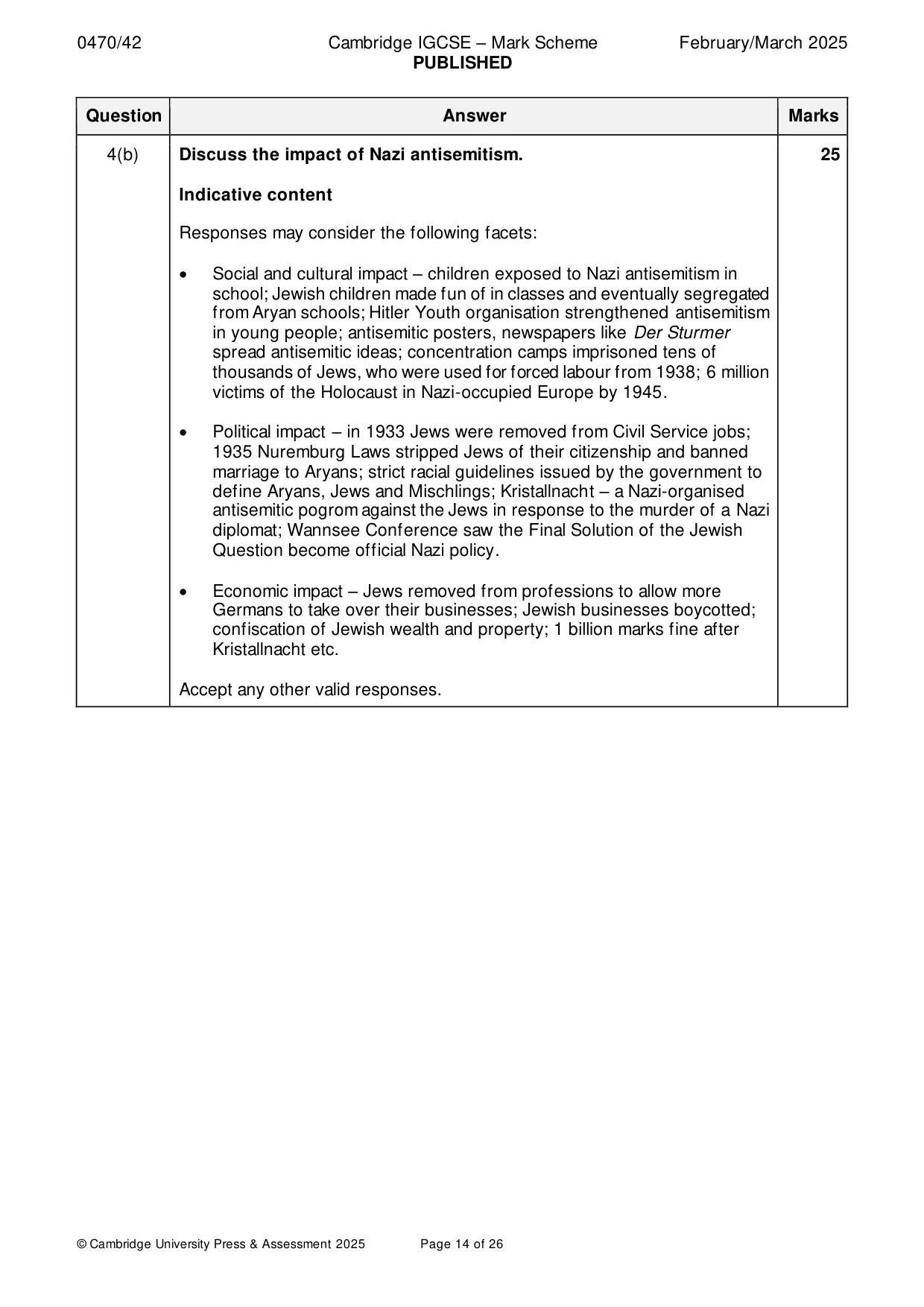
0470/42 Cambridge IGCSE – Mark Scheme PUBLISHED February/March 2025 © Cambridge University Press & Assessment 2025 Page 14 of 26 Question Answer Marks 4(b) Discuss the impact of Nazi antisemitism. Indicative content Responses may consider the following facets: • Social and cultural impact – children exposed to Nazi antisemitism in school; Jewish children made fun of in classes and eventually segregated from Aryan schools; Hitler Youth organisation strengthened antisemitism in young people; antisemitic posters, newspapers like Der Sturmer spread antisemitic ideas; concentration camps imprisoned tens of thousands of Jews, who were used for forced labour from 1938; 6 million victims of the Holocaust in Nazi-occupied Europe by 1945. • Political impact – in 1933 Jews were removed from Civil Service jobs; 1935 Nuremburg Laws stripped Jews of their citizenship and banned marriage to Aryans; strict racial guidelines issued by the government to define Aryans, Jews and Mischlings; Kristallnacht – a Nazi-organised antisemitic pogrom against the Jews in response to the murder of a Nazi diplomat; Wannsee Conference saw the Final Solution of the Jewish Question become official Nazi policy. • Economic impact – Jews removed from professions to allow more Germans to take over their businesses; Jewish businesses boycotted; confiscation of Jewish wealth and property; 1 billion marks fine after Kristallnacht etc. Accept any other valid responses. 25
Mark scheme, page 15
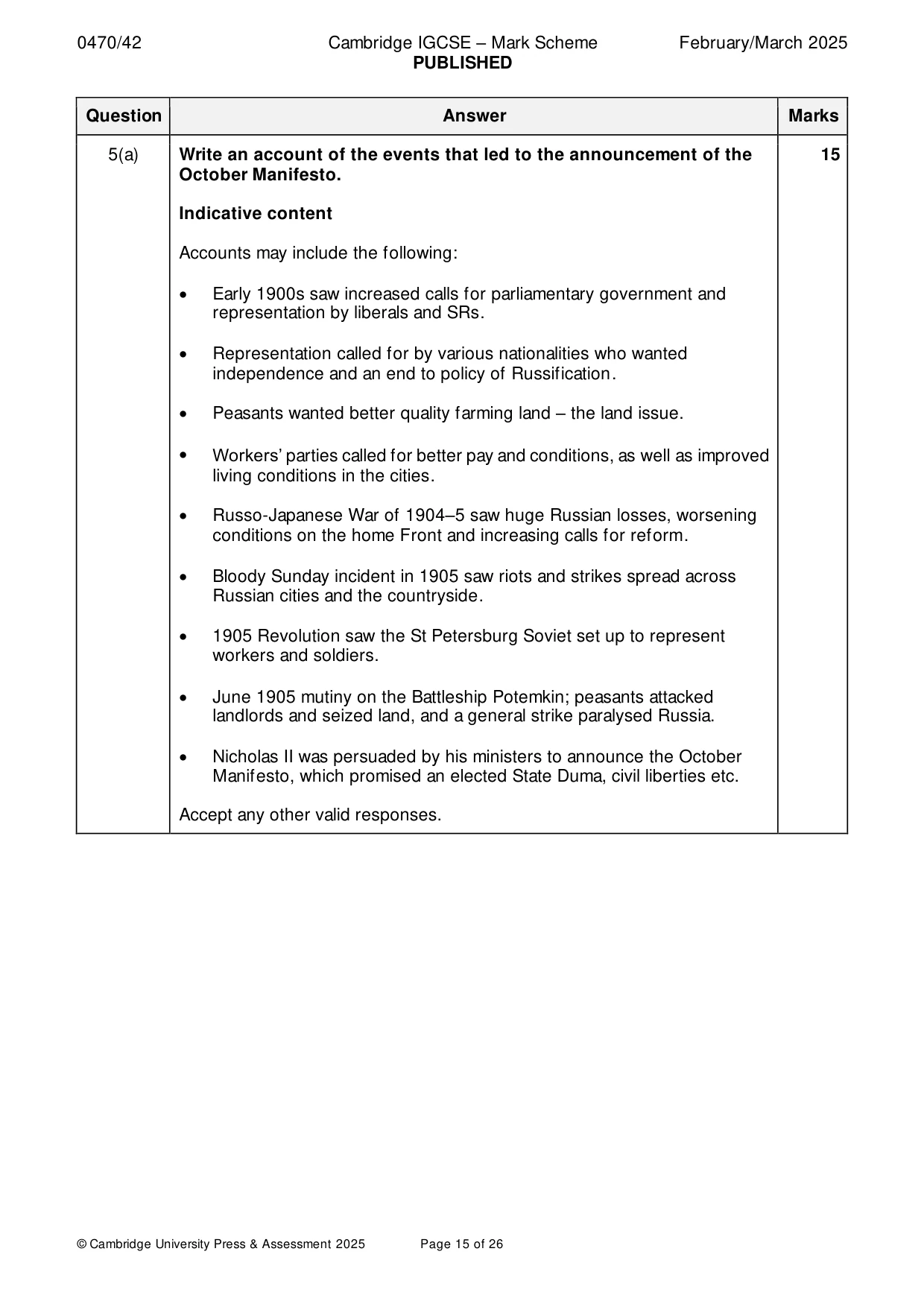
0470/42 Cambridge IGCSE – Mark Scheme PUBLISHED February/March 2025 © Cambridge University Press & Assessment 2025 Page 15 of 26 Question Answer Marks 5(a) Write an account of the events that led to the announcement of the October Manifesto. Indicative content Accounts may include the following: • Early 1900s saw increased calls for parliamentary government and representation by liberals and SRs. • Representation called for by various nationalities who wanted independence and an end to policy of Russification. • Peasants wanted better quality farming land – the land issue. • Workers’ parties called for better pay and conditions, as well as improved living conditions in the cities. • Russo-Japanese War of 1904–5 saw huge Russian losses, worsening conditions on the home Front and increasing calls for reform. • Bloody Sunday incident in 1905 saw riots and strikes spread across Russian cities and the countryside. • 1905 Revolution saw the St Petersburg Soviet set up to represent workers and soldiers. • June 1905 mutiny on the Battleship Potemkin; peasants attacked landlords and seized land, and a general strike paralysed Russia. • Nicholas II was persuaded by his ministers to announce the October Manifesto, which promised an elected State Duma, civil liberties etc. Accept any other valid responses. 15
Mark scheme, page 16
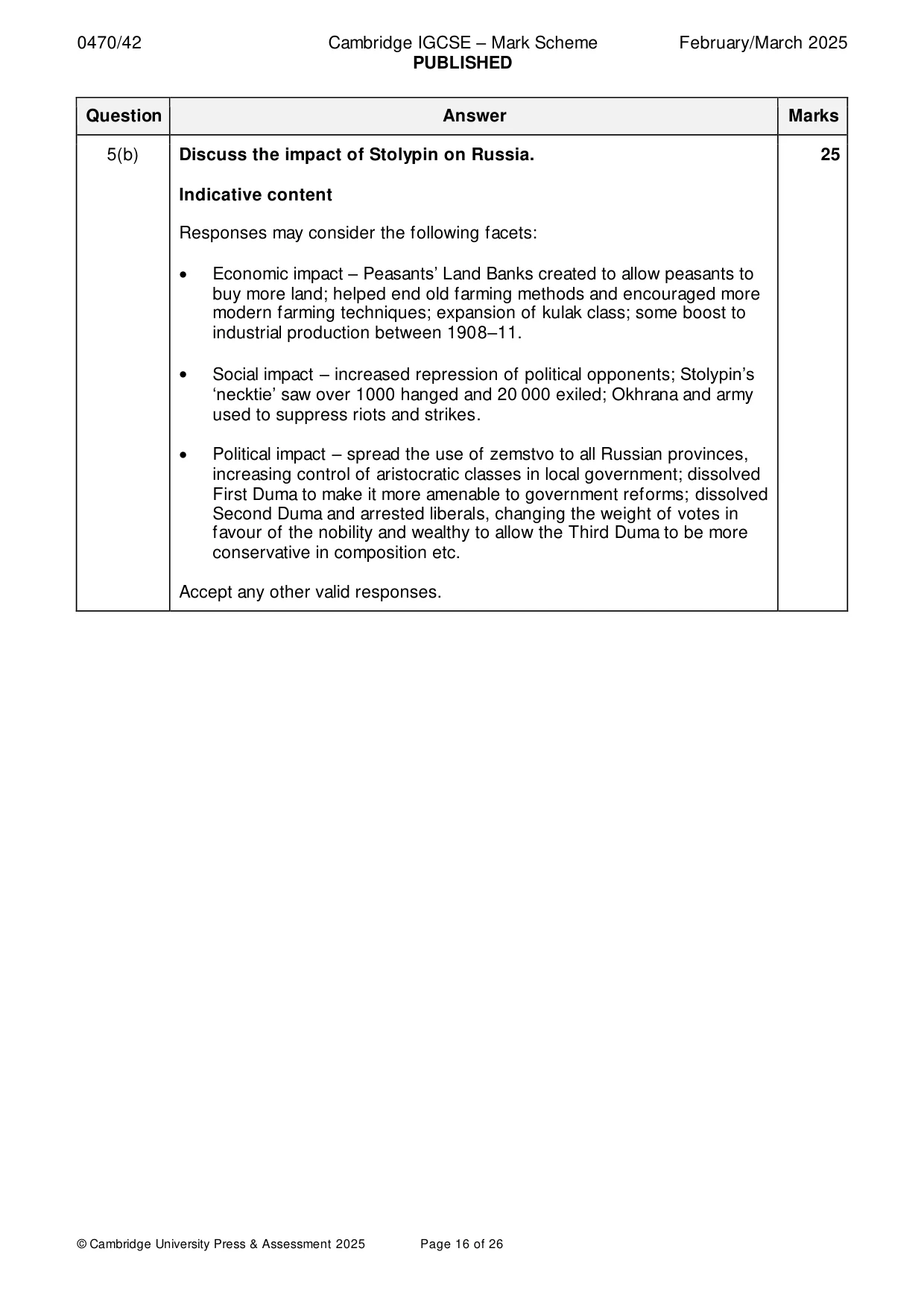
0470/42 Cambridge IGCSE – Mark Scheme PUBLISHED February/March 2025 © Cambridge University Press & Assessment 2025 Page 16 of 26 Question Answer Marks 5(b) Discuss the impact of Stolypin on Russia. Indicative content Responses may consider the following facets: • Economic impact – Peasants’ Land Banks created to allow peasants to buy more land; helped end old farming methods and encouraged more modern farming techniques; expansion of kulak class; some boost to industrial production between 1908–11. • Social impact – increased repression of political opponents; Stolypin’s ‘necktie’ saw over 1000 hanged and 20 000 exiled; Okhrana and army used to suppress riots and strikes. • Political impact – spread the use of zemstvo to all Russian provinces, increasing control of aristocratic classes in local government; dissolved First Duma to make it more amenable to government reforms; dissolved Second Duma and arrested liberals, changing the weight of votes in favour of the nobility and wealthy to allow the Third Duma to be more conservative in composition etc. Accept any other valid responses. 25
Mark scheme, page 17
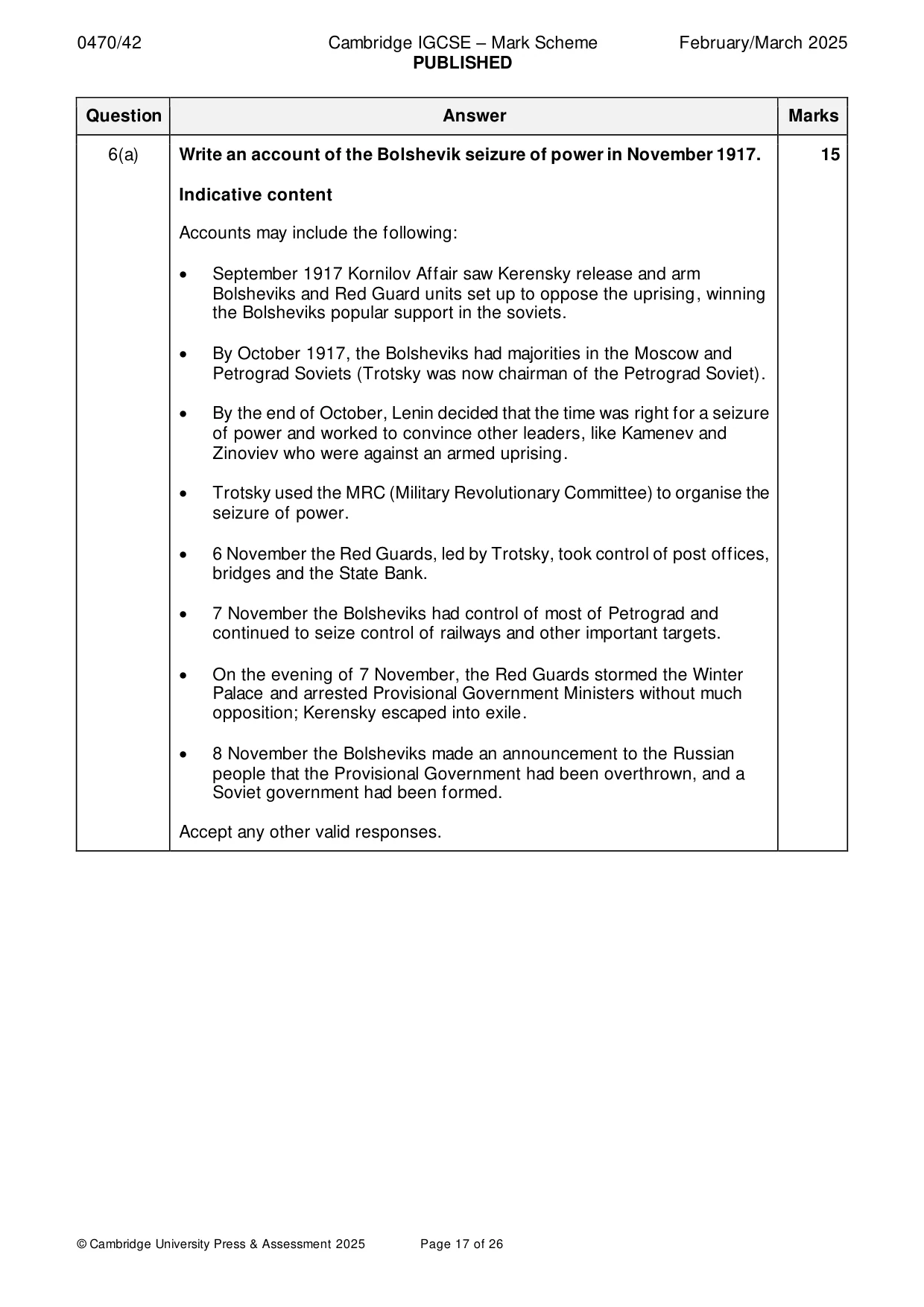
0470/42 Cambridge IGCSE – Mark Scheme PUBLISHED February/March 2025 © Cambridge University Press & Assessment 2025 Page 17 of 26 Question Answer Marks 6(a) Write an account of the Bolshevik seizure of power in November 1917. Indicative content Accounts may include the following: • September 1917 Kornilov Affair saw Kerensky release and arm Bolsheviks and Red Guard units set up to oppose the uprising, winning the Bolsheviks popular support in the soviets. • By October 1917, the Bolsheviks had majorities in the Moscow and Petrograd Soviets (Trotsky was now chairman of the Petrograd Soviet). • By the end of October, Lenin decided that the time was right for a seizure of power and worked to convince other leaders, like Kamenev and Zinoviev who were against an armed uprising. • Trotsky used the MRC (Military Revolutionary Committee) to organise the seizure of power. • 6 November the Red Guards, led by Trotsky, took control of post offices, bridges and the State Bank. • 7 November the Bolsheviks had control of most of Petrograd and continued to seize control of railways and other important targets. • On the evening of 7 November, the Red Guards stormed the Winter Palace and arrested Provisional Government Ministers without much opposition; Kerensky escaped into exile. • 8 November the Bolsheviks made an announcement to the Russian people that the Provisional Government had been overthrown, and a Soviet government had been formed. Accept any other valid responses. 15
Mark scheme, page 18
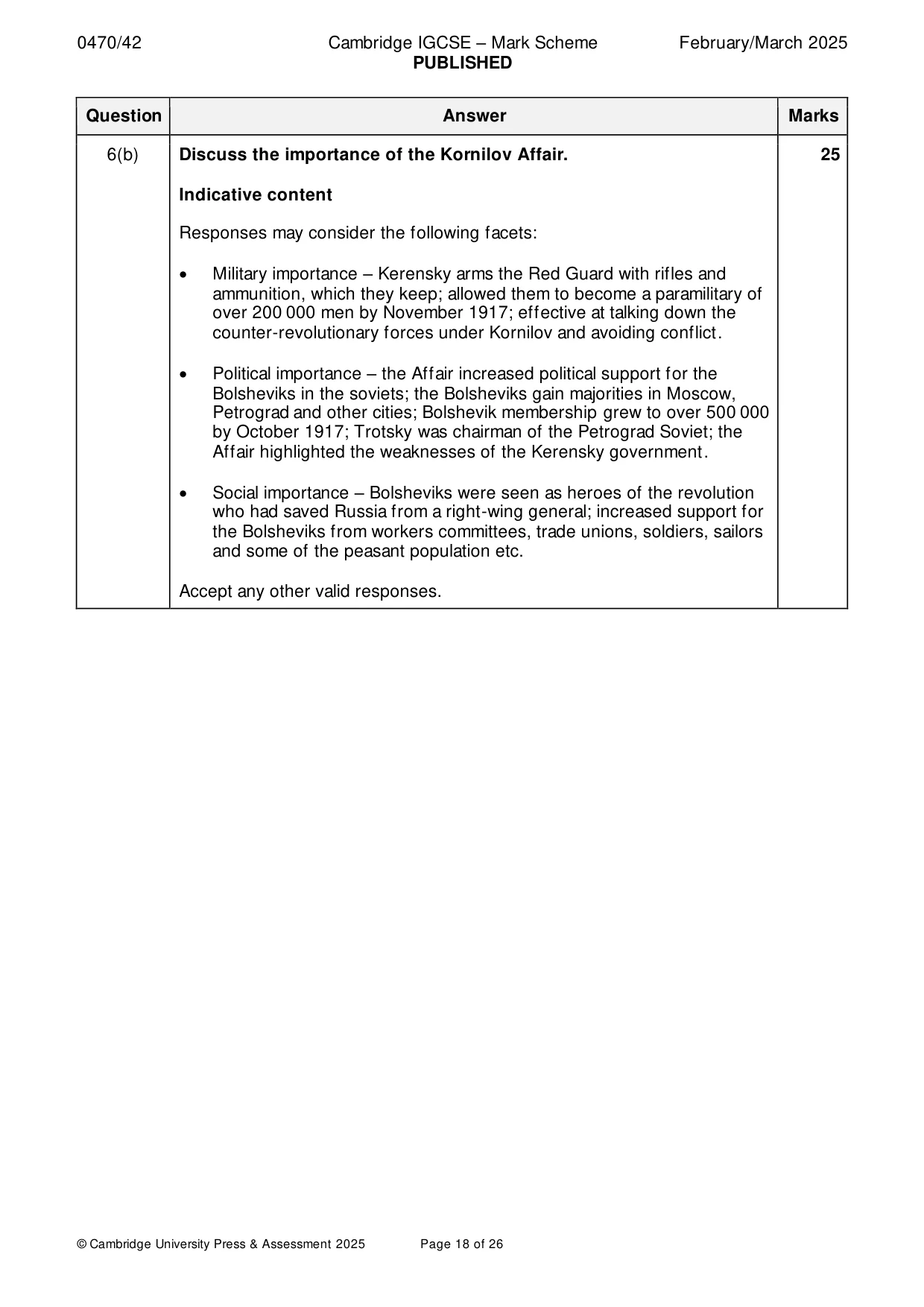
0470/42 Cambridge IGCSE – Mark Scheme PUBLISHED February/March 2025 © Cambridge University Press & Assessment 2025 Page 18 of 26 Question Answer Marks 6(b) Discuss the importance of the Kornilov Affair. Indicative content Responses may consider the following facets: • Military importance – Kerensky arms the Red Guard with rifles and ammunition, which they keep; allowed them to become a paramilitary of over 200 000 men by November 1917; effective at talking down the counter-revolutionary forces under Kornilov and avoiding conflict. • Political importance – the Affair increased political support for the Bolsheviks in the soviets; the Bolsheviks gain majorities in Moscow, Petrograd and other cities; Bolshevik membership grew to over 500 000 by October 1917; Trotsky was chairman of the Petrograd Soviet; the Affair highlighted the weaknesses of the Kerensky government. • Social importance – Bolsheviks were seen as heroes of the revolution who had saved Russia from a right-wing general; increased support for the Bolsheviks from workers committees, trade unions, soldiers, sailors and some of the peasant population etc. Accept any other valid responses. 25
Mark scheme, page 19
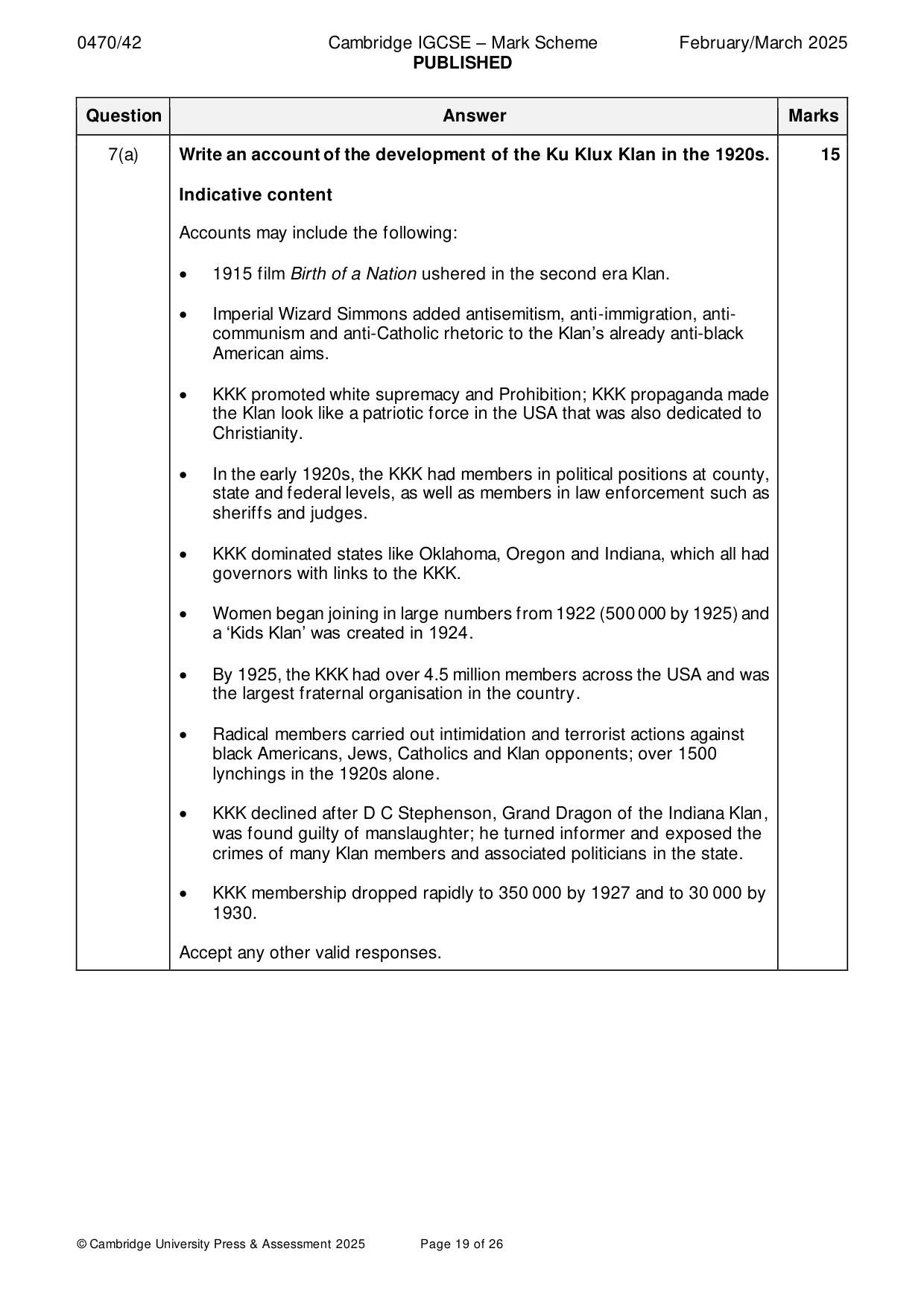
0470/42 Cambridge IGCSE – Mark Scheme PUBLISHED February/March 2025 © Cambridge University Press & Assessment 2025 Page 19 of 26 Question Answer Marks 7(a) Write an account of the development of the Ku Klux Klan in the 1920s. Indicative content Accounts may include the following: • 1915 film Birth of a Nation ushered in the second era Klan. • Imperial Wizard Simmons added antisemitism, anti-immigration, anti- communism and anti-Catholic rhetoric to the Klan’s already anti-black American aims. • KKK promoted white supremacy and Prohibition; KKK propaganda made the Klan look like a patriotic force in the USA that was also dedicated to Christianity. • In the early 1920s, the KKK had members in political positions at county, state and federal levels, as well as members in law enforcement such as sheriffs and judges. • KKK dominated states like Oklahoma, Oregon and Indiana, which all had governors with links to the KKK. • Women began joining in large numbers from 1922 (500 000 by 1925) and a ‘Kids Klan’ was created in 1924. • By 1925, the KKK had over 4.5 million members across the USA and was the largest fraternal organisation in the country. • Radical members carried out intimidation and terrorist actions against black Americans, Jews, Catholics and Klan opponents; over 1500 lynchings in the 1920s alone. • KKK declined after D C Stephenson, Grand Dragon of the Indiana Klan, was found guilty of manslaughter; he turned informer and exposed the crimes of many Klan members and associated politicians in the state. • KKK membership dropped rapidly to 350 000 by 1927 and to 30 000 by 1930. Accept any other valid responses. 15
Mark scheme, page 20
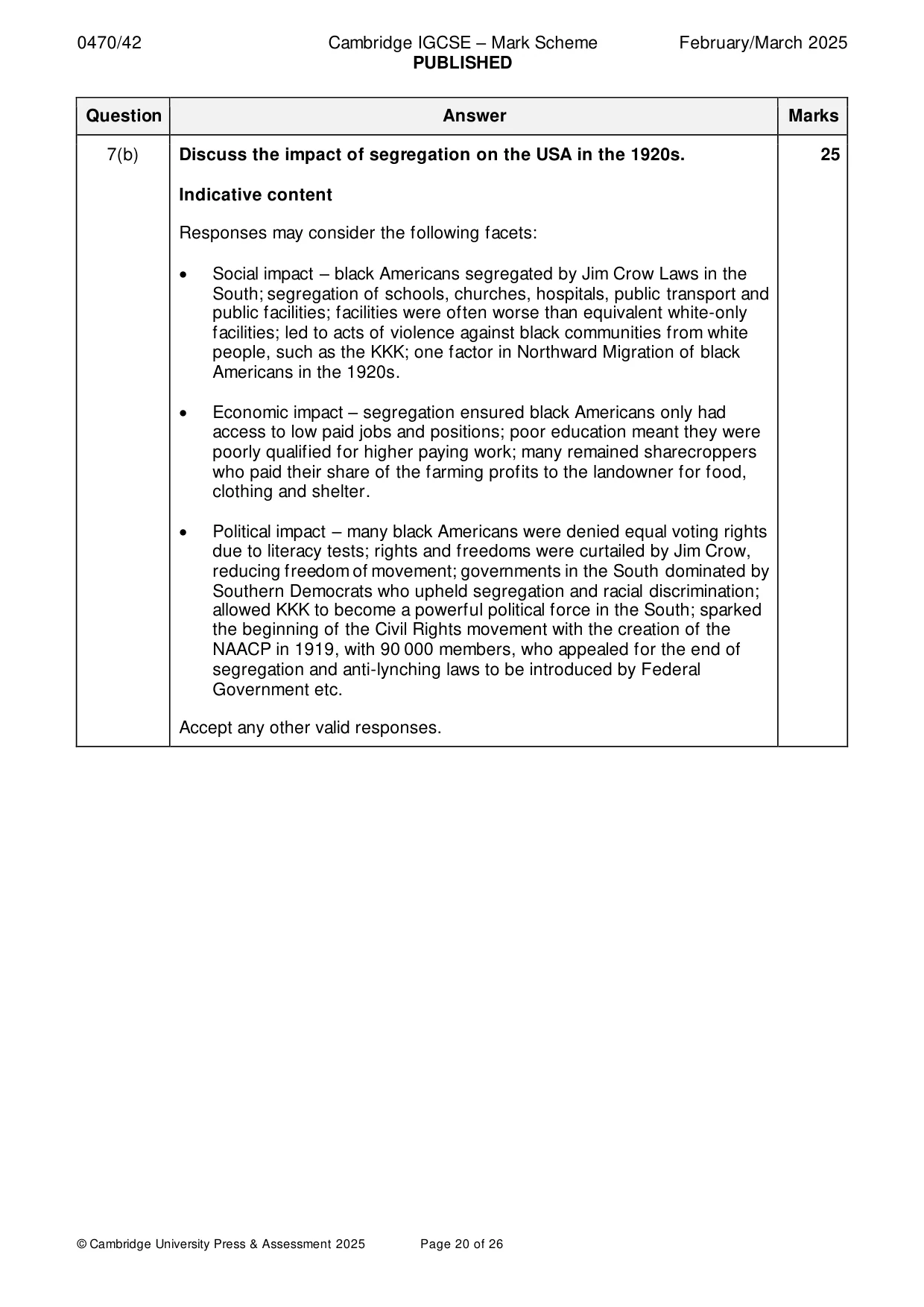
0470/42 Cambridge IGCSE – Mark Scheme PUBLISHED February/March 2025 © Cambridge University Press & Assessment 2025 Page 20 of 26 Question Answer Marks 7(b) Discuss the impact of segregation on the USA in the 1920s. Indicative content Responses may consider the following facets: • Social impact – black Americans segregated by Jim Crow Laws in the South; segregation of schools, churches, hospitals, public transport and public facilities; facilities were often worse than equivalent white-only facilities; led to acts of violence against black communities from white people, such as the KKK; one factor in Northward Migration of black Americans in the 1920s. • Economic impact – segregation ensured black Americans only had access to low paid jobs and positions; poor education meant they were poorly qualified for higher paying work; many remained sharecroppers who paid their share of the farming profits to the landowner for food, clothing and shelter. • Political impact – many black Americans were denied equal voting rights due to literacy tests; rights and freedoms were curtailed by Jim Crow, reducing freedom of movement; governments in the South dominated by Southern Democrats who upheld segregation and racial discrimination; allowed KKK to become a powerful political force in the South; sparked the beginning of the Civil Rights movement with the creation of the NAACP in 1919, with 90 000 members, who appealed for the end of segregation and anti-lynching laws to be introduced by Federal Government etc. Accept any other valid responses. 25
Mark scheme, page 21
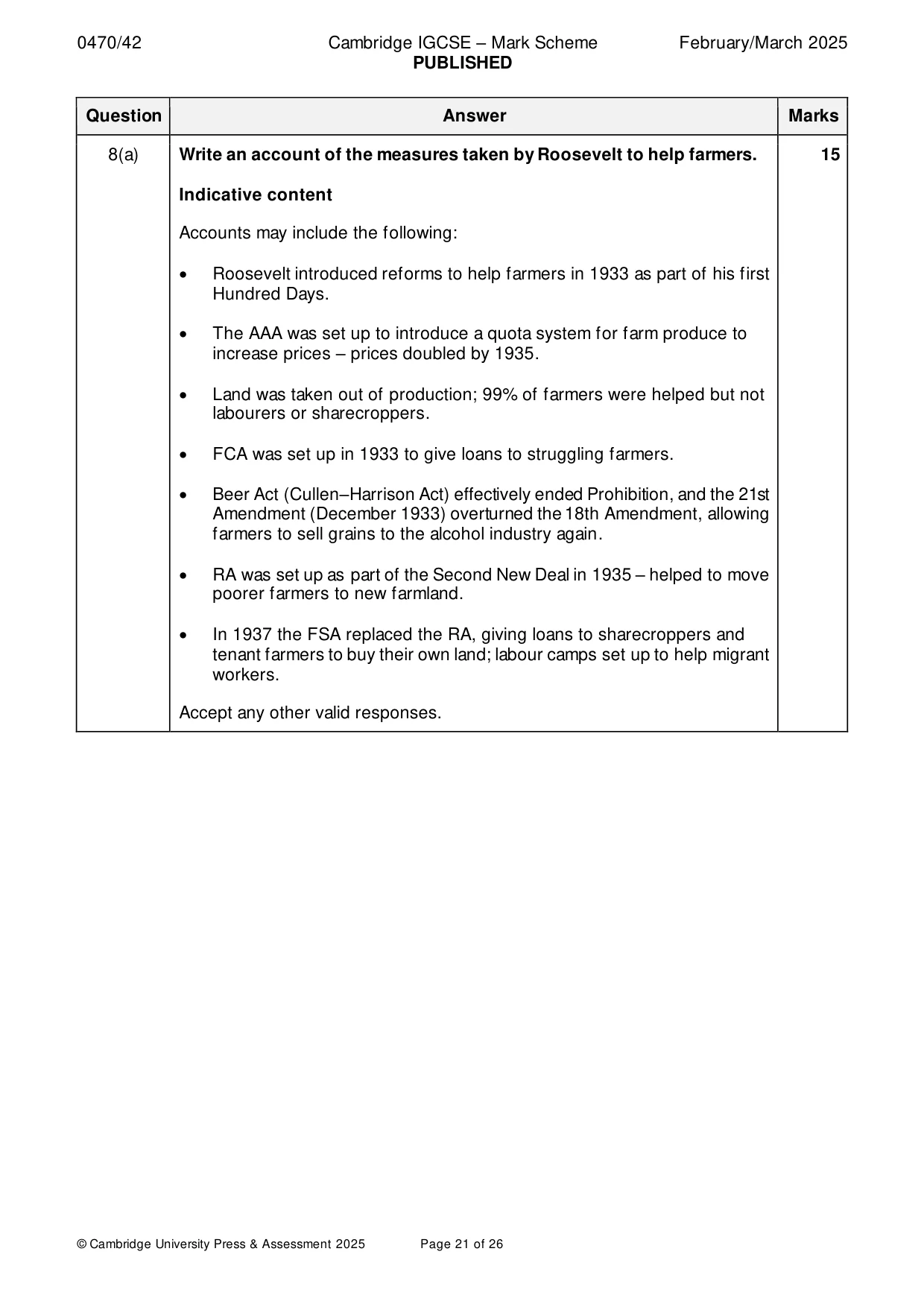
0470/42 Cambridge IGCSE – Mark Scheme PUBLISHED February/March 2025 © Cambridge University Press & Assessment 2025 Page 21 of 26 Question Answer Marks 8(a) Write an account of the measures taken by Roosevelt to help farmers. Indicative content Accounts may include the following: • Roosevelt introduced reforms to help farmers in 1933 as part of his first Hundred Days. • The AAA was set up to introduce a quota system for farm produce to increase prices – prices doubled by 1935. • Land was taken out of production; 99% of farmers were helped but not labourers or sharecroppers. • FCA was set up in 1933 to give loans to struggling farmers. • Beer Act (Cullen–Harrison Act) effectively ended Prohibition, and the 21st Amendment (December 1933) overturned the 18th Amendment, allowing farmers to sell grains to the alcohol industry again. • RA was set up as part of the Second New Deal in 1935 – helped to move poorer farmers to new farmland. • In 1937 the FSA replaced the RA, giving loans to sharecroppers and tenant farmers to buy their own land; labour camps set up to help migrant workers. Accept any other valid responses. 15
Mark scheme, page 22
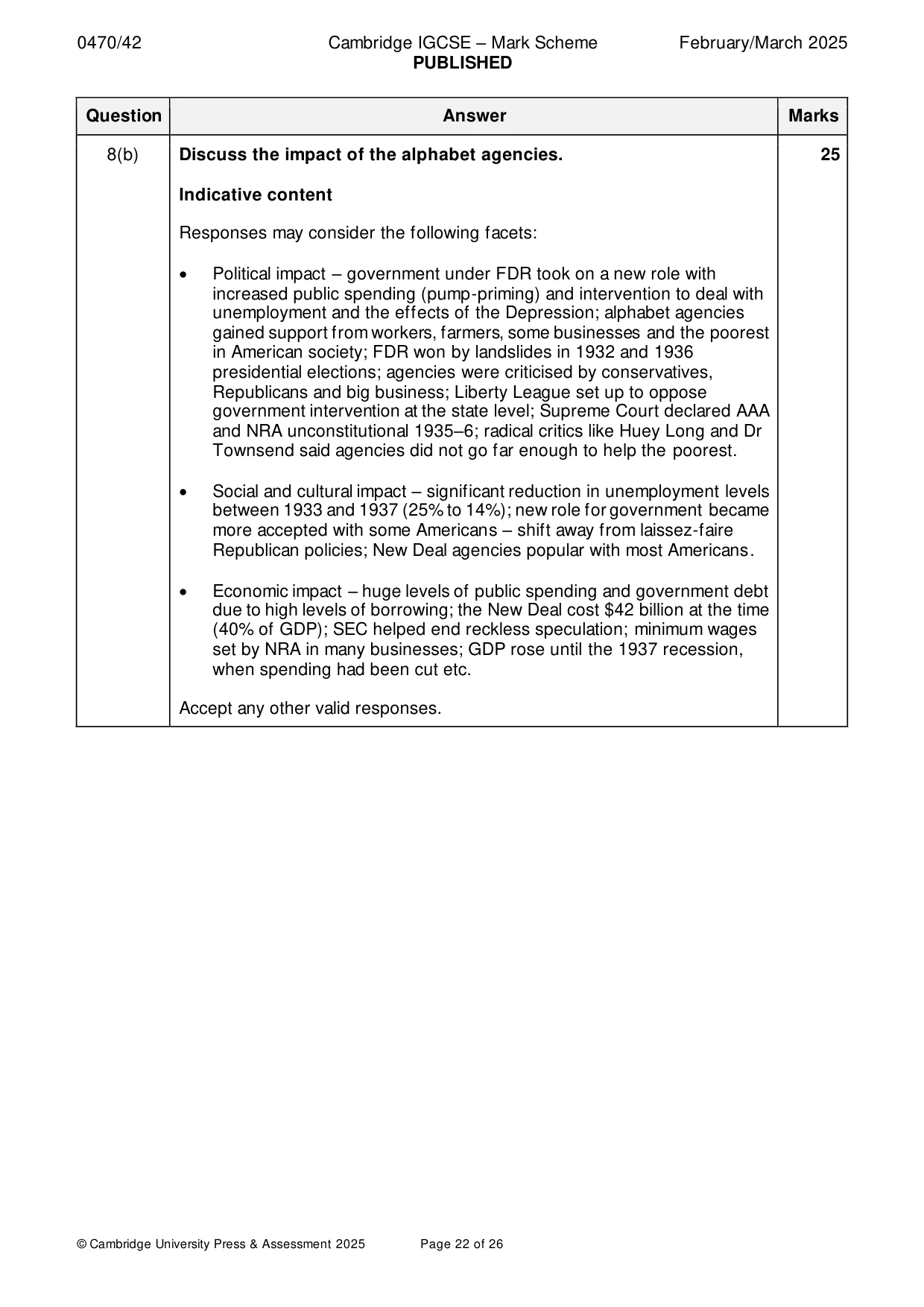
0470/42 Cambridge IGCSE – Mark Scheme PUBLISHED February/March 2025 © Cambridge University Press & Assessment 2025 Page 22 of 26 Question Answer Marks 8(b) Discuss the impact of the alphabet agencies. Indicative content Responses may consider the following facets: • Political impact – government under FDR took on a new role with increased public spending (pump-priming) and intervention to deal with unemployment and the effects of the Depression; alphabet agencies gained support from workers, farmers, some businesses and the poorest in American society; FDR won by landslides in 1932 and 1936 presidential elections; agencies were criticised by conservatives, Republicans and big business; Liberty League set up to oppose government intervention at the state level; Supreme Court declared AAA and NRA unconstitutional 1935–6; radical critics like Huey Long and Dr Townsend said agencies did not go far enough to help the poorest. • Social and cultural impact – significant reduction in unemployment levels between 1933 and 1937 (25% to 14%); new role for government became more accepted with some Americans – shift away from laissez-faire Republican policies; New Deal agencies popular with most Americans. • Economic impact – huge levels of public spending and government debt due to high levels of borrowing; the New Deal cost $42 billion at the time (40% of GDP); SEC helped end reckless speculation; minimum wages set by NRA in many businesses; GDP rose until the 1937 recession, when spending had been cut etc. Accept any other valid responses. 25
Mark scheme, page 23
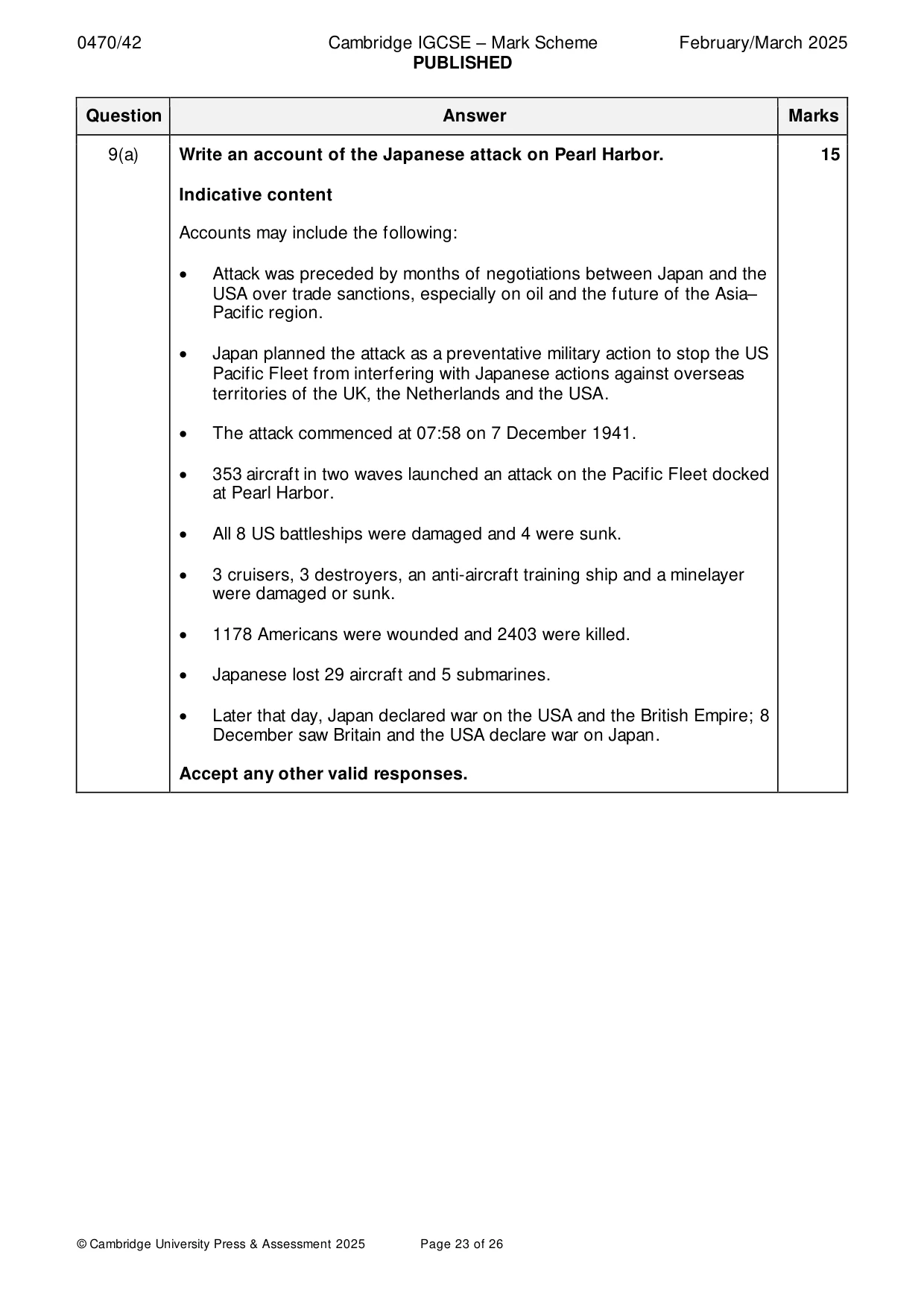
0470/42 Cambridge IGCSE – Mark Scheme PUBLISHED February/March 2025 © Cambridge University Press & Assessment 2025 Page 23 of 26 Question Answer Marks 9(a) Write an account of the Japanese attack on Pearl Harbor. Indicative content Accounts may include the following: • Attack was preceded by months of negotiations between Japan and the USA over trade sanctions, especially on oil and the future of the Asia– Pacific region. • Japan planned the attack as a preventative military action to stop the US Pacific Fleet from interfering with Japanese actions against overseas territories of the UK, the Netherlands and the USA. • The attack commenced at 07:58 on 7 December 1941. • 353 aircraft in two waves launched an attack on the Pacific Fleet docked at Pearl Harbor. • All 8 US battleships were damaged and 4 were sunk. • 3 cruisers, 3 destroyers, an anti-aircraft training ship and a minelayer were damaged or sunk. • 1178 Americans were wounded and 2403 were killed. • Japanese lost 29 aircraft and 5 submarines. • Later that day, Japan declared war on the USA and the British Empire; 8 December saw Britain and the USA declare war on Japan. Accept any other valid responses. 15
Mark scheme, page 24
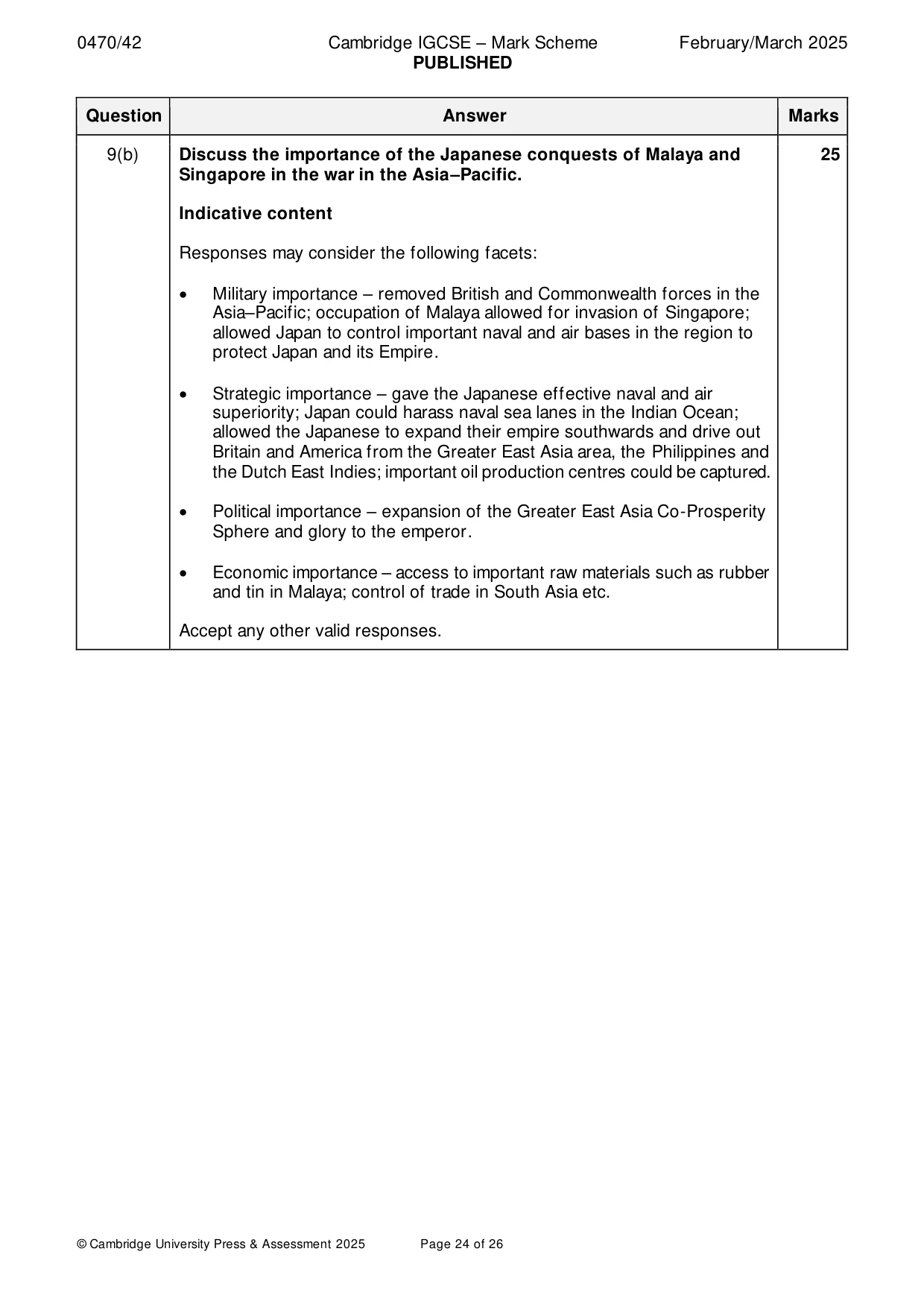
0470/42 Cambridge IGCSE – Mark Scheme PUBLISHED February/March 2025 © Cambridge University Press & Assessment 2025 Page 24 of 26 Question Answer Marks 9(b) Discuss the importance of the Japanese conquests of Malaya and Singapore in the war in the Asia–Pacific. Indicative content Responses may consider the following facets: • Military importance – removed British and Commonwealth forces in the Asia–Pacific; occupation of Malaya allowed for invasion of Singapore; allowed Japan to control important naval and air bases in the region to protect Japan and its Empire. • Strategic importance – gave the Japanese effective naval and air superiority; Japan could harass naval sea lanes in the Indian Ocean; allowed the Japanese to expand their empire southwards and drive out Britain and America from the Greater East Asia area, the Philippines and the Dutch East Indies; important oil production centres could be captured. • Political importance – expansion of the Greater East Asia Co-Prosperity Sphere and glory to the emperor. • Economic importance – access to important raw materials such as rubber and tin in Malaya; control of trade in South Asia etc. Accept any other valid responses. 25
Mark scheme, page 25
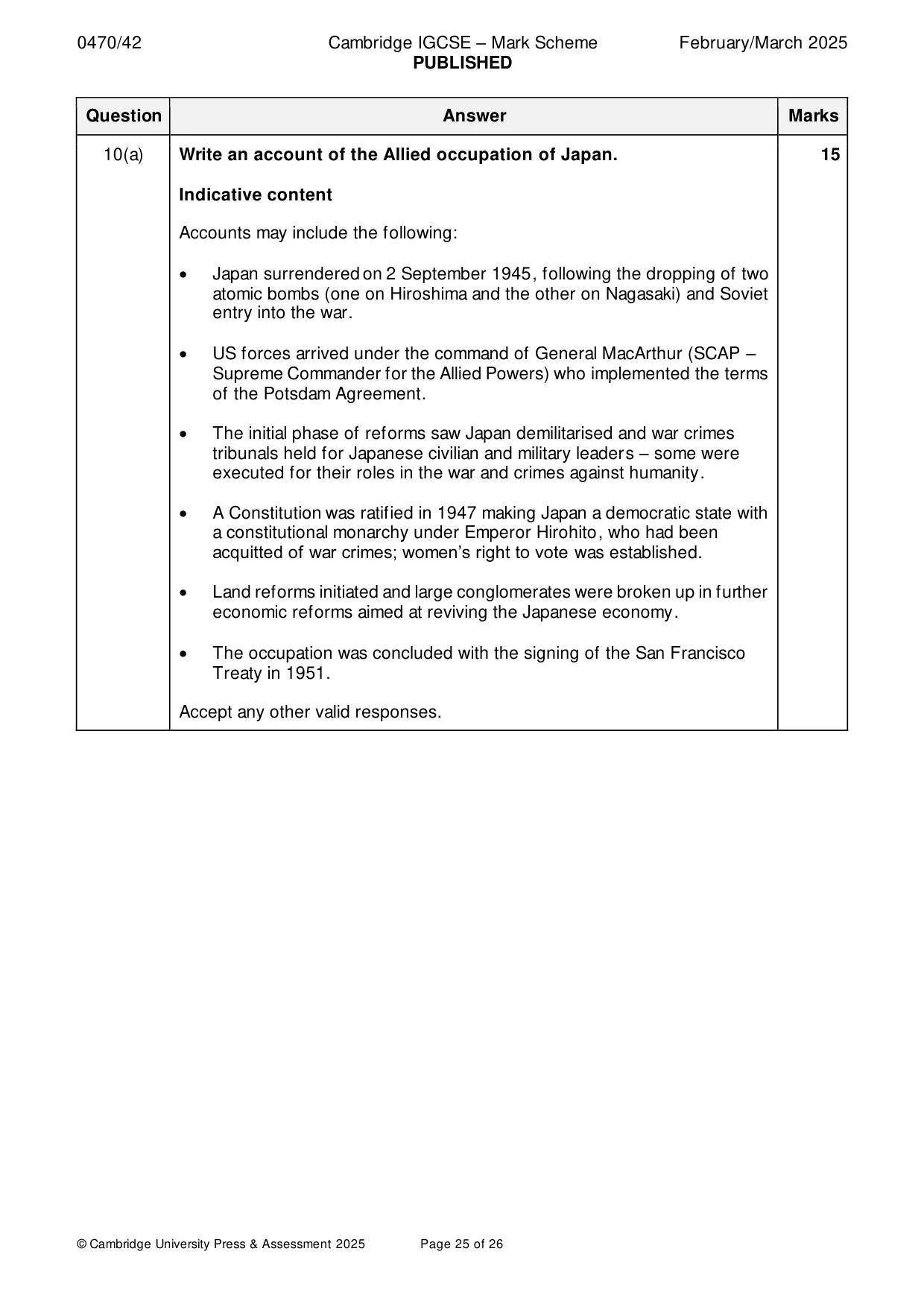
0470/42 Cambridge IGCSE – Mark Scheme PUBLISHED February/March 2025 © Cambridge University Press & Assessment 2025 Page 25 of 26 Question Answer Marks 10(a) Write an account of the Allied occupation of Japan. Indicative content Accounts may include the following: • Japan surrendered on 2 September 1945, following the dropping of two atomic bombs (one on Hiroshima and the other on Nagasaki) and Soviet entry into the war. • US forces arrived under the command of General MacArthur (SCAP – Supreme Commander for the Allied Powers) who implemented the terms of the Potsdam Agreement. • The initial phase of reforms saw Japan demilitarised and war crimes tribunals held for Japanese civilian and military leaders – some were executed for their roles in the war and crimes against humanity. • A Constitution was ratified in 1947 making Japan a democratic state with a constitutional monarchy under Emperor Hirohito, who had been acquitted of war crimes; women’s right to vote was established. • Land reforms initiated and large conglomerates were broken up in further economic reforms aimed at reviving the Japanese economy. • The occupation was concluded with the signing of the San Francisco Treaty in 1951. Accept any other valid responses. 15
Mark scheme, page 26
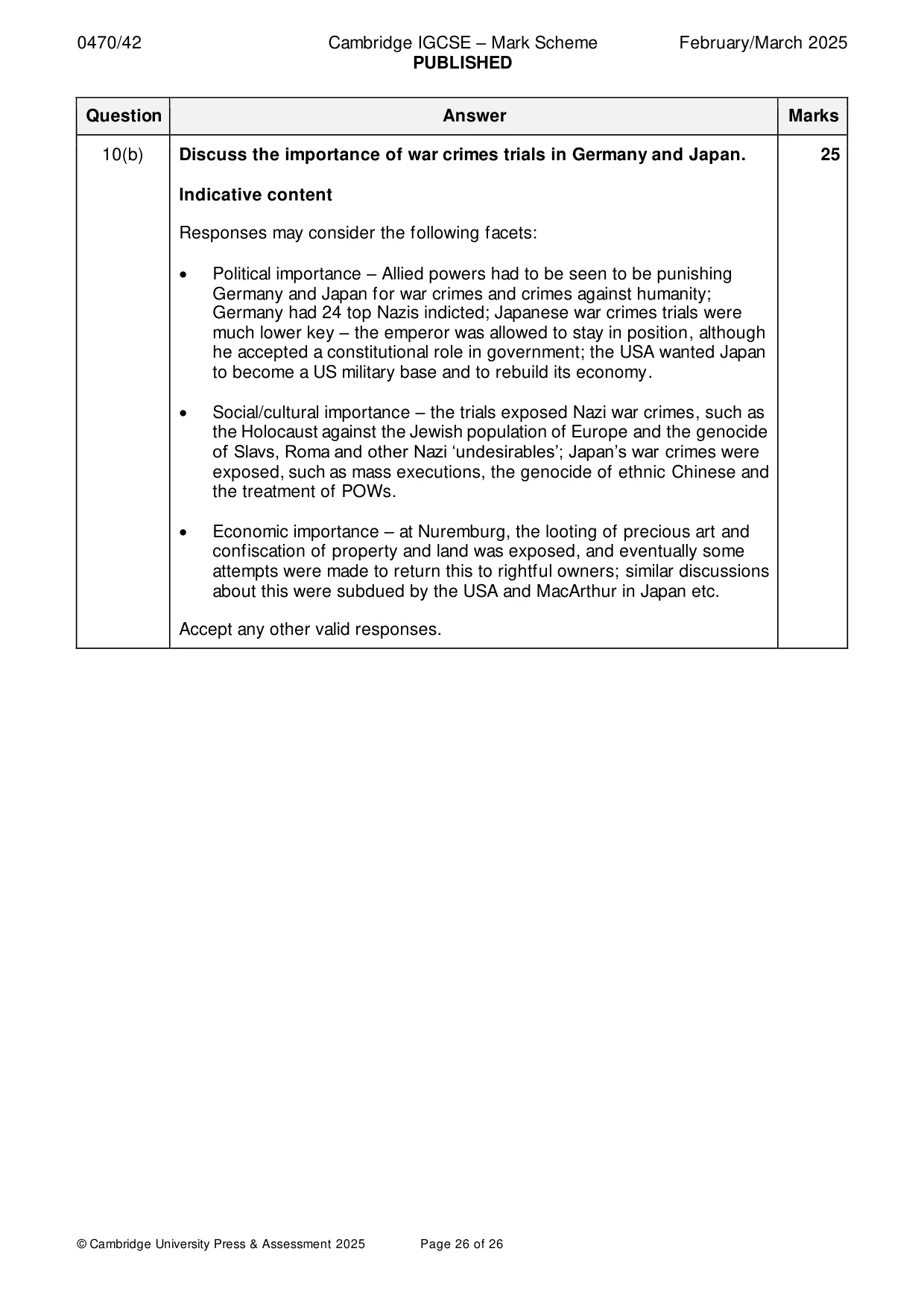
0470/42 Cambridge IGCSE – Mark Scheme PUBLISHED February/March 2025 © Cambridge University Press & Assessment 2025 Page 26 of 26 Question Answer Marks 10(b) Discuss the importance of war crimes trials in Germany and Japan. Indicative content Responses may consider the following facets: • Political importance – Allied powers had to be seen to be punishing Germany and Japan for war crimes and crimes against humanity; Germany had 24 top Nazis indicted; Japanese war crimes trials were much lower key – the emperor was allowed to stay in position, although he accepted a constitutional role in government; the USA wanted Japan to become a US military base and to rebuild its economy. • Social/cultural importance – the trials exposed Nazi war crimes, such as the Holocaust against the Jewish population of Europe and the genocide of Slavs, Roma and other Nazi ‘undesirables’; Japan’s war crimes were exposed, such as mass executions, the genocide of ethnic Chinese and the treatment of POWs. • Economic importance – at Nuremburg, the looting of precious art and confiscation of property and land was exposed, and eventually some attempts were made to return this to rightful owners; similar discussions about this were subdued by the USA and MacArthur in Japan etc. Accept any other valid responses. 25
What you needed in this session
Cambridge’s own grade thresholds for 2025 Feb/March, Paper 4 · Variant 2. A higher threshold means an easier paper — the bar moves with how the cohort did.