Cambridge IGCSE History 0470 — 2023 Feb/March Paper 4 · Variant 2
0470/42/F/M/23 · 40 marks · ≈45 min
The question paper and its mark scheme, free to read here and free to download. This is Cambridge’s own paper, exactly as it was sat.
Question paper4 pages

Mark scheme13 pages
Answers below. Sit the paper first if you are practising.

Paper as text
Question paper, page 1
Cambridge IGCSE™ 0470/42 February/March 2023 1 hour HISTORY Paper 4 Alternative to Coursework You must answer on the enclosed answer booklet. You will need: Answer booklet (enclosed) INSTRUCTIONS • Answer one question from your chosen Depth Study. • Follow the instructions on the front cover of the answer booklet. If you need additional answer paper, ask the invigilator for a continuation booklet. INFORMATION • The total mark for this paper is 40. • The number of marks for each question or part question is shown in brackets [ ]. This document has 4 pages. Any blank pages are indicated. [Turn over 03_0470_42_2023_1.9 © UCLES 2023 *4351432613*
Question paper, page 2
Answer one question from your chosen Depth Study. DEPTH STUDY A: THE FIRST WORLD WAR, 1914–18 How important was the use of poison gas as an aspect of trench warfare on the Western Front? Explain your answer. [40] 1 How significant was the Gallipoli campaign of 1915 to the course of the war? Explain your answer. [40] 2 DEPTH STUDY B: GERMANY, 1918–45 How important were foreign policy achievements under Stresemann in stabilising Weimar Germany between 1923 and 1929? Explain your answer. [40] 3 How significant were the Nuremberg Laws (1935) in the development of Nazi policies towards the Jews? Explain your answer. [40] 4 DEPTH STUDY C: RUSSIA, 1905–41 How important was Bloody Sunday (1905) in changing the nature of Tsarist rule up to 1914? Explain your answer. [40] 5 How significant was the Kornilov Affair in the Bolsheviks’ rise to power in 1917? Explain your answer. [40] 6 DEPTH STUDY D: THE UNITED STATES, 1919–41 How important was jazz music as an aspect of the Roaring Twenties? Explain your answer. [40] 7 How significant a feature of the New Deal were policies aimed at improving the lives of workers? Explain your answer. [40] 8 DEPTH STUDY E: CHINA, c.1930–c.1990 How important were relations with the Soviet Union to China’s economic development by 1960? Explain your answer. [40] 9 How significant was the Cultural Revolution in changing the lives of the Chinese people under Mao? Explain your answer. [40] 10 03_0470_42_2023_1.9 © UCLES 2023 2
Question paper, page 3
DEPTH STUDY F: SOUTH AFRICA, c.1940–c.1994 How important were travel restrictions in maintaining segregation in South Africa before 1948? Explain your answer. [40] 11 How significant were the riots in Soweto (1976) in the development of opposition to apartheid? Explain your answer. [40] 12 DEPTH STUDY G: ISRAELIS AND PALESTINIANS SINCE 1945 How important was the United Nations’ Partition Plan as a cause of tension in Palestine by 1948? Explain your answer. [40] 13 How significant was President Sadat in the development of the Arab–Israeli peace process? Explain your answer. [40] 14 03_0470_42_2023_1.9 © UCLES 2023 3
Question paper, page 4
BLANK PAGE Permission to reproduce items where third-party owned material protected by copyright is included has been sought and cleared where possible. Every reasonable effort has been made by the publisher (UCLES) to trace copyright holders, but if any items requiring clearance have unwittingly been included, the publisher will be pleased to make amends at the earliest possible opportunity. To avoid the issue of disclosure of answer-related information to candidates, all copyright acknowledgements are reproduced online in the Cambridge Assessment International Education Copyright Acknowledgements Booklet. This is produced for each series of examinations and is freely available to download at www.cambridgeinternational.org after the live examination series. Cambridge Assessment International Education is part of Cambridge Assessment. Cambridge Assessment is the brand name of the University of Cambridge Local Examinations Syndicate (UCLES), which is a department of the University of Cambridge. 03_0470_42_2023_1.9 © UCLES 2023 4
Mark scheme, page 1
This document consists of 13 printed pages. © UCLES 2023 [Turn over Cambridge IGCSE™ HISTORY 0470/42 Paper 4 Alternative to Coursework February/March 2023 MARK SCHEME Maximum Mark: 40 Published This mark scheme is published as an aid to teachers and candidates, to indicate the requirements of the examination. It shows the basis on which Examiners were instructed to award marks. It does not indicate the details of the discussions that took place at an Examiners’ meeting before marking began, which would have considered the acceptability of alternative answers. Mark schemes should be read in conjunction with the question paper and the Principal Examiner Report for Teachers. Cambridge International will not enter into discussions about these mark schemes. Cambridge International is publishing the mark schemes for the February/March 2023 series for most Cambridge IGCSE™, Cambridge International A and AS Level components and some Cambridge O Level components.
Mark scheme, page 2
0470/42 Cambridge IGCSE – Mark Scheme PUBLISHED February/March 2023 © UCLES 2023 Page 2 of 13 Generic Marking Principles These general marking principles must be applied by all examiners when marking candidate answers. They should be applied alongside the specific content of the mark scheme or generic level descriptors for a question. Each question paper and mark scheme will also comply with these marking principles. GENERIC MARKING PRINCIPLE 1: Marks must be awarded in line with: • the specific content of the mark scheme or the generic level descriptors for the question • the specific skills defined in the mark scheme or in the generic level descriptors for the question • the standard of response required by a candidate as exemplified by the standardisation scripts. GENERIC MARKING PRINCIPLE 2: Marks awarded are always whole marks (not half marks, or other fractions). GENERIC MARKING PRINCIPLE 3: Marks must be awarded positively: • marks are awarded for correct/valid answers, as defined in the mark scheme. However, credit is given for valid answers which go beyond the scope of the syllabus and mark scheme, referring to your Team Leader as appropriate • marks are awarded when candidates clearly demonstrate what they know and can do • marks are not deducted for errors • marks are not deducted for omissions • answers should only be judged on the quality of spelling, punctuation and grammar when these features are specifically assessed by the question as indicated by the mark scheme. The meaning, however, should be unambiguous. GENERIC MARKING PRINCIPLE 4: Rules must be applied consistently, e.g. in situations where candidates have not followed instructions or in the application of generic level descriptors. GENERIC MARKING PRINCIPLE 5: Marks should be awarded using the full range of marks defined in the mark scheme for the question (however; the use of the full mark range may be limited according to the quality of the candidate responses seen). GENERIC MARKING PRINCIPLE 6: Marks awarded are based solely on the requirements as defined in the mark scheme. Marks should not be awarded with grade thresholds or grade descriptors in mind.
Mark scheme, page 3
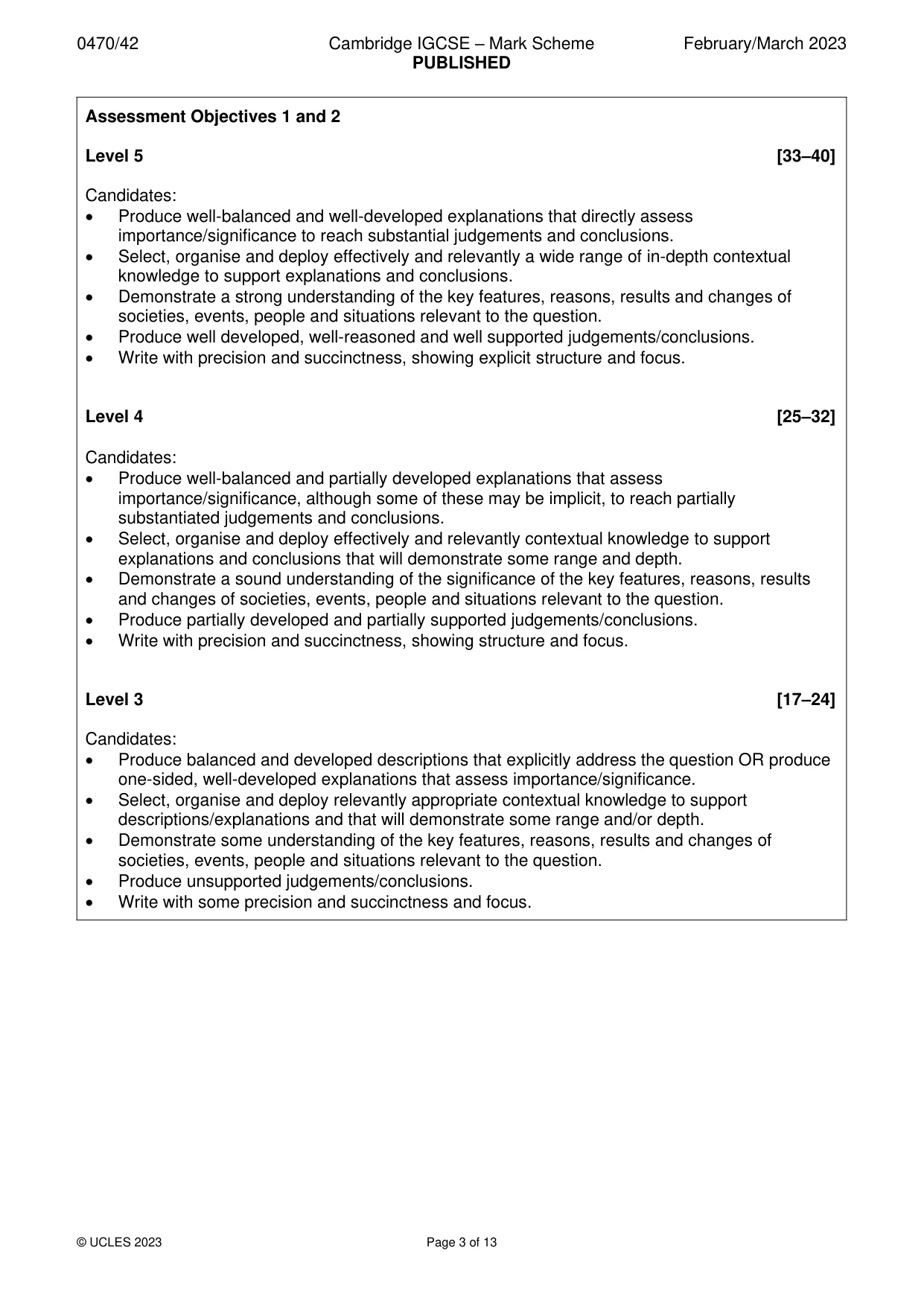
0470/42 Cambridge IGCSE – Mark Scheme PUBLISHED February/March 2023 © UCLES 2023 Page 3 of 13 Assessment Objectives 1 and 2 Level 5 [33–40] Candidates: • Produce well-balanced and well-developed explanations that directly assess importance/significance to reach substantial judgements and conclusions. • Select, organise and deploy effectively and relevantly a wide range of in-depth contextual knowledge to support explanations and conclusions. • Demonstrate a strong understanding of the key features, reasons, results and changes of societies, events, people and situations relevant to the question. • Produce well developed, well-reasoned and well supported judgements/conclusions. • Write with precision and succinctness, showing explicit structure and focus. Level 4 [25–32] Candidates: • Produce well-balanced and partially developed explanations that assess importance/significance, although some of these may be implicit, to reach partially substantiated judgements and conclusions. • Select, organise and deploy effectively and relevantly contextual knowledge to support explanations and conclusions that will demonstrate some range and depth. • Demonstrate a sound understanding of the significance of the key features, reasons, results and changes of societies, events, people and situations relevant to the question. • Produce partially developed and partially supported judgements/conclusions. • Write with precision and succinctness, showing structure and focus. Level 3 [17–24] Candidates: • Produce balanced and developed descriptions that explicitly address the question OR produce one-sided, well-developed explanations that assess importance/significance. • Select, organise and deploy relevantly appropriate contextual knowledge to support descriptions/explanations and that will demonstrate some range and/or depth. • Demonstrate some understanding of the key features, reasons, results and changes of societies, events, people and situations relevant to the question. • Produce unsupported judgements/conclusions. • Write with some precision and succinctness and focus.
Mark scheme, page 4
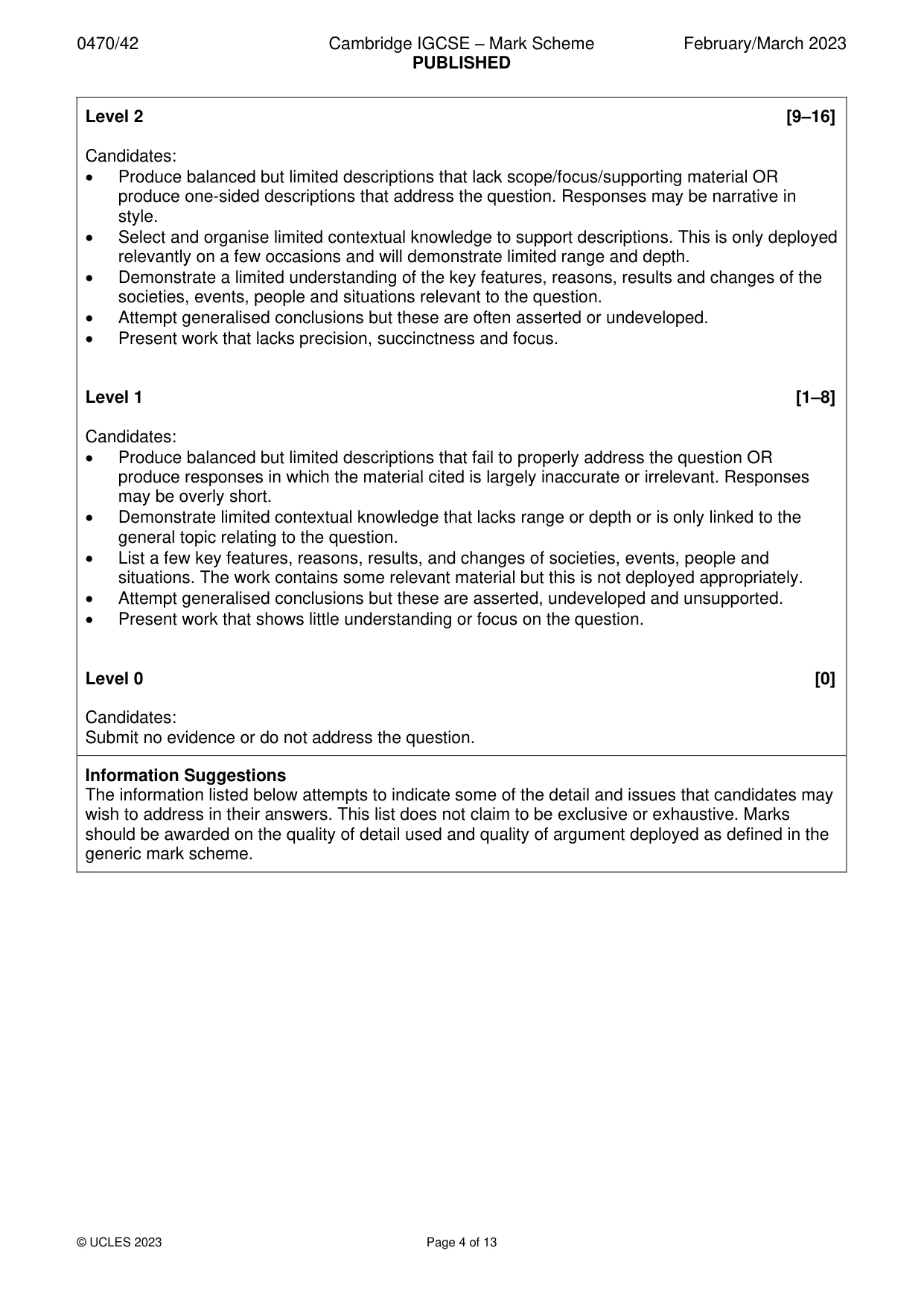
0470/42 Cambridge IGCSE – Mark Scheme PUBLISHED February/March 2023 © UCLES 2023 Page 4 of 13 Level 2 [9–16] Candidates: • Produce balanced but limited descriptions that lack scope/focus/supporting material OR produce one-sided descriptions that address the question. Responses may be narrative in style. • Select and organise limited contextual knowledge to support descriptions. This is only deployed relevantly on a few occasions and will demonstrate limited range and depth. • Demonstrate a limited understanding of the key features, reasons, results and changes of the societies, events, people and situations relevant to the question. • Attempt generalised conclusions but these are often asserted or undeveloped. • Present work that lacks precision, succinctness and focus. Level 1 [1–8] Candidates: • Produce balanced but limited descriptions that fail to properly address the question OR produce responses in which the material cited is largely inaccurate or irrelevant. Responses may be overly short. • Demonstrate limited contextual knowledge that lacks range or depth or is only linked to the general topic relating to the question. • List a few key features, reasons, results, and changes of societies, events, people and situations. The work contains some relevant material but this is not deployed appropriately. • Attempt generalised conclusions but these are asserted, undeveloped and unsupported. • Present work that shows little understanding or focus on the question. Level 0 [0] Candidates: Submit no evidence or do not address the question. Information Suggestions The information listed below attempts to indicate some of the detail and issues that candidates may wish to address in their answers. This list does not claim to be exclusive or exhaustive. Marks should be awarded on the quality of detail used and quality of argument deployed as defined in the generic mark scheme.
Mark scheme, page 5
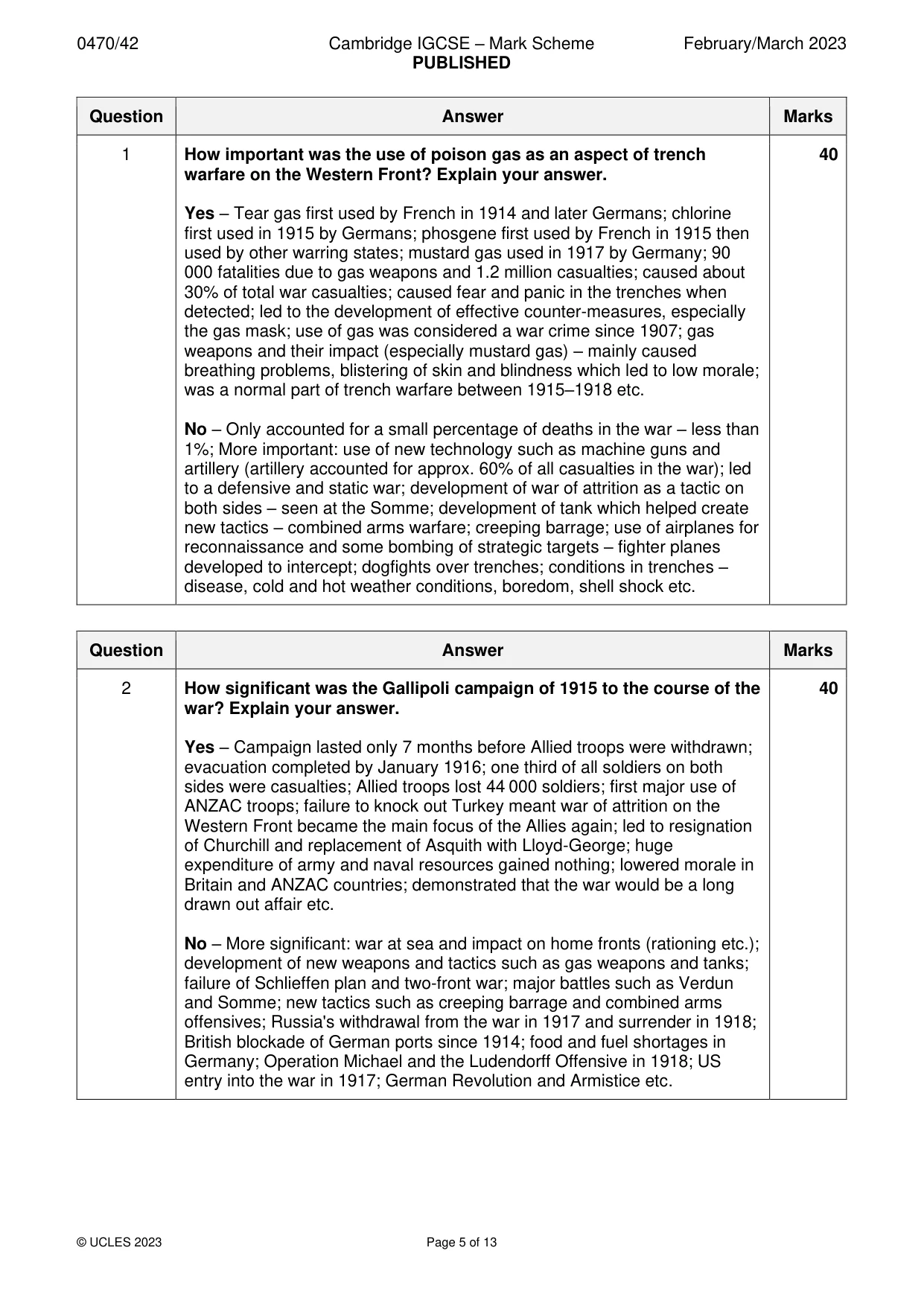
0470/42 Cambridge IGCSE – Mark Scheme PUBLISHED February/March 2023 © UCLES 2023 Page 5 of 13 Question Answer Marks 1 How important was the use of poison gas as an aspect of trench warfare on the Western Front? Explain your answer. Yes – Tear gas first used by French in 1914 and later Germans; chlorine first used in 1915 by Germans; phosgene first used by French in 1915 then used by other warring states; mustard gas used in 1917 by Germany; 90 000 fatalities due to gas weapons and 1.2 million casualties; caused about 30% of total war casualties; caused fear and panic in the trenches when detected; led to the development of effective counter-measures, especially the gas mask; use of gas was considered a war crime since 1907; gas weapons and their impact (especially mustard gas) – mainly caused breathing problems, blistering of skin and blindness which led to low morale; was a normal part of trench warfare between 1915–1918 etc. No – Only accounted for a small percentage of deaths in the war – less than 1%; More important: use of new technology such as machine guns and artillery (artillery accounted for approx. 60% of all casualties in the war); led to a defensive and static war; development of war of attrition as a tactic on both sides – seen at the Somme; development of tank which helped create new tactics – combined arms warfare; creeping barrage; use of airplanes for reconnaissance and some bombing of strategic targets – fighter planes developed to intercept; dogfights over trenches; conditions in trenches – disease, cold and hot weather conditions, boredom, shell shock etc. 40 Question Answer Marks 2 How significant was the Gallipoli campaign of 1915 to the course of the war? Explain your answer. Yes – Campaign lasted only 7 months before Allied troops were withdrawn; evacuation completed by January 1916; one third of all soldiers on both sides were casualties; Allied troops lost 44 000 soldiers; first major use of ANZAC troops; failure to knock out Turkey meant war of attrition on the Western Front became the main focus of the Allies again; led to resignation of Churchill and replacement of Asquith with Lloyd-George; huge expenditure of army and naval resources gained nothing; lowered morale in Britain and ANZAC countries; demonstrated that the war would be a long drawn out affair etc. No – More significant: war at sea and impact on home fronts (rationing etc.); development of new weapons and tactics such as gas weapons and tanks; failure of Schlieffen plan and two-front war; major battles such as Verdun and Somme; new tactics such as creeping barrage and combined arms offensives; Russia's withdrawal from the war in 1917 and surrender in 1918; British blockade of German ports since 1914; food and fuel shortages in Germany; Operation Michael and the Ludendorff Offensive in 1918; US entry into the war in 1917; German Revolution and Armistice etc. 40
Mark scheme, page 6
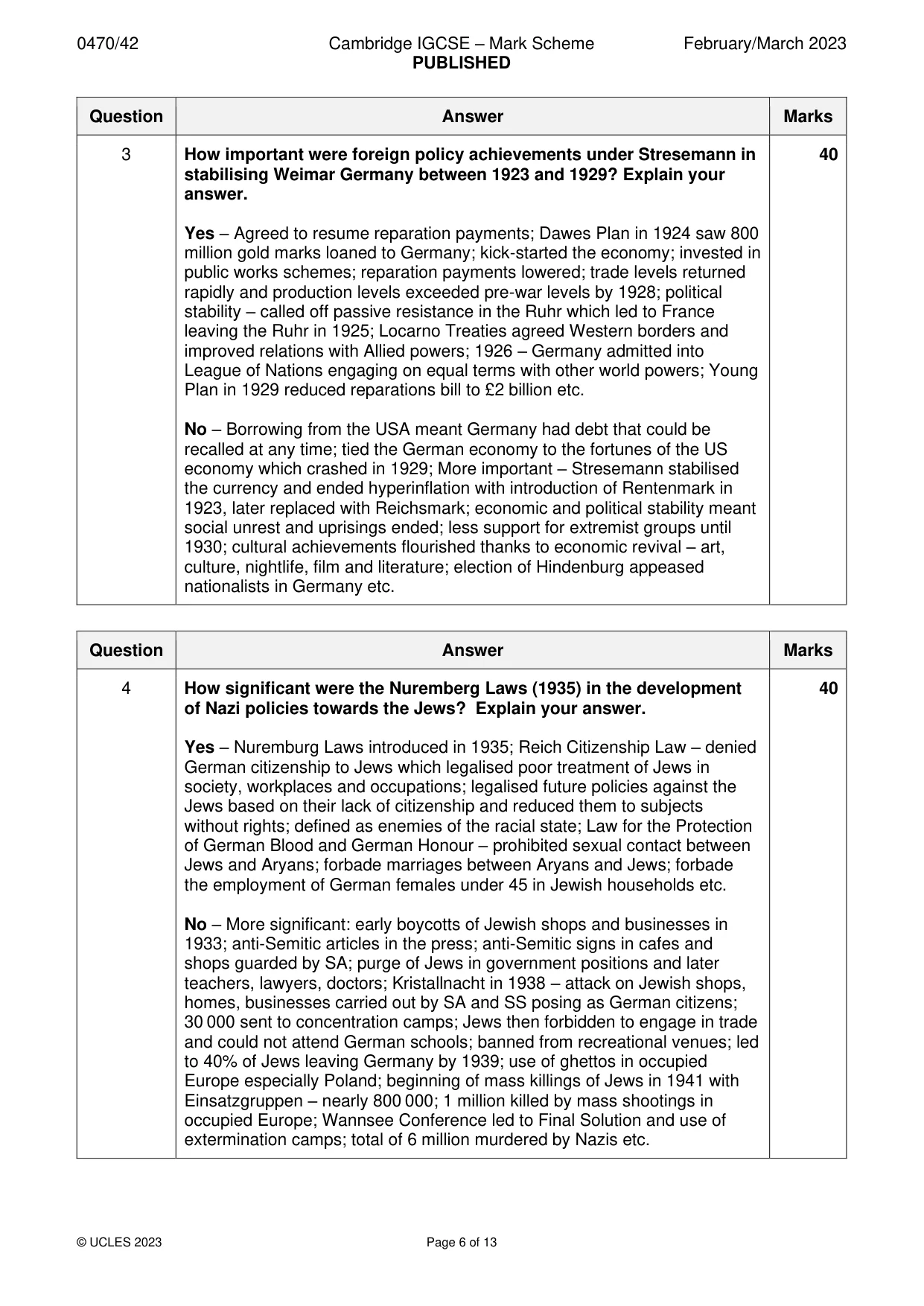
0470/42 Cambridge IGCSE – Mark Scheme PUBLISHED February/March 2023 © UCLES 2023 Page 6 of 13 Question Answer Marks 3 How important were foreign policy achievements under Stresemann in stabilising Weimar Germany between 1923 and 1929? Explain your answer. Yes – Agreed to resume reparation payments; Dawes Plan in 1924 saw 800 million gold marks loaned to Germany; kick-started the economy; invested in public works schemes; reparation payments lowered; trade levels returned rapidly and production levels exceeded pre-war levels by 1928; political stability – called off passive resistance in the Ruhr which led to France leaving the Ruhr in 1925; Locarno Treaties agreed Western borders and improved relations with Allied powers; 1926 – Germany admitted into League of Nations engaging on equal terms with other world powers; Young Plan in 1929 reduced reparations bill to £2 billion etc. No – Borrowing from the USA meant Germany had debt that could be recalled at any time; tied the German economy to the fortunes of the US economy which crashed in 1929; More important – Stresemann stabilised the currency and ended hyperinflation with introduction of Rentenmark in 1923, later replaced with Reichsmark; economic and political stability meant social unrest and uprisings ended; less support for extremist groups until 1930; cultural achievements flourished thanks to economic revival – art, culture, nightlife, film and literature; election of Hindenburg appeased nationalists in Germany etc. 40 Question Answer Marks 4 How significant were the Nuremberg Laws (1935) in the development of Nazi policies towards the Jews? Explain your answer. Yes – Nuremburg Laws introduced in 1935; Reich Citizenship Law – denied German citizenship to Jews which legalised poor treatment of Jews in society, workplaces and occupations; legalised future policies against the Jews based on their lack of citizenship and reduced them to subjects without rights; defined as enemies of the racial state; Law for the Protection of German Blood and German Honour – prohibited sexual contact between Jews and Aryans; forbade marriages between Aryans and Jews; forbade the employment of German females under 45 in Jewish households etc. No – More significant: early boycotts of Jewish shops and businesses in 1933; anti-Semitic articles in the press; anti-Semitic signs in cafes and shops guarded by SA; purge of Jews in government positions and later teachers, lawyers, doctors; Kristallnacht in 1938 – attack on Jewish shops, homes, businesses carried out by SA and SS posing as German citizens; 30 000 sent to concentration camps; Jews then forbidden to engage in trade and could not attend German schools; banned from recreational venues; led to 40% of Jews leaving Germany by 1939; use of ghettos in occupied Europe especially Poland; beginning of mass killings of Jews in 1941 with Einsatzgruppen – nearly 800 000; 1 million killed by mass shootings in occupied Europe; Wannsee Conference led to Final Solution and use of extermination camps; total of 6 million murdered by Nazis etc. 40
Mark scheme, page 7
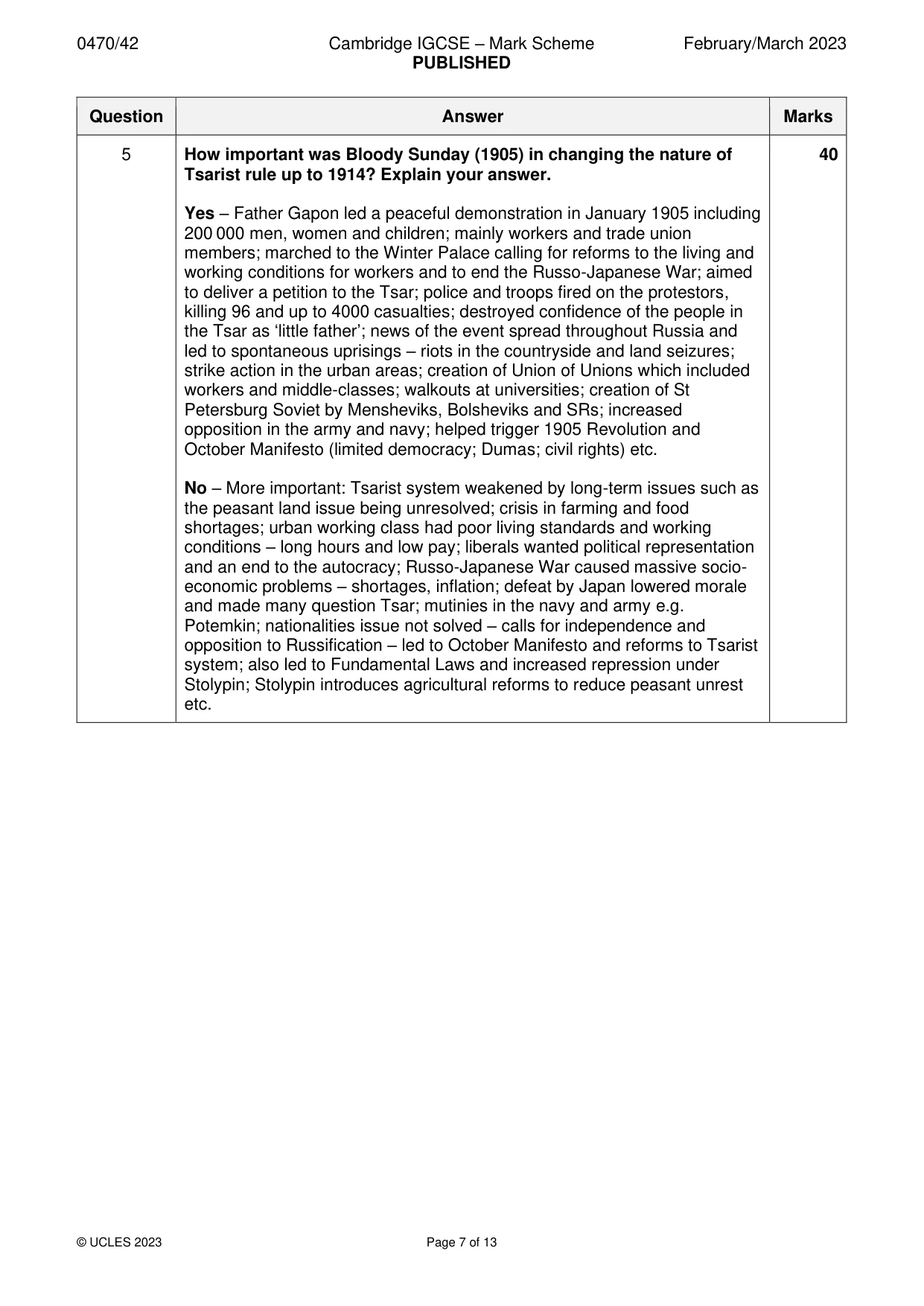
0470/42 Cambridge IGCSE – Mark Scheme PUBLISHED February/March 2023 © UCLES 2023 Page 7 of 13 Question Answer Marks 5 How important was Bloody Sunday (1905) in changing the nature of Tsarist rule up to 1914? Explain your answer. Yes – Father Gapon led a peaceful demonstration in January 1905 including 200 000 men, women and children; mainly workers and trade union members; marched to the Winter Palace calling for reforms to the living and working conditions for workers and to end the Russo-Japanese War; aimed to deliver a petition to the Tsar; police and troops fired on the protestors, killing 96 and up to 4000 casualties; destroyed confidence of the people in the Tsar as ‘little father’; news of the event spread throughout Russia and led to spontaneous uprisings – riots in the countryside and land seizures; strike action in the urban areas; creation of Union of Unions which included workers and middle-classes; walkouts at universities; creation of St Petersburg Soviet by Mensheviks, Bolsheviks and SRs; increased opposition in the army and navy; helped trigger 1905 Revolution and October Manifesto (limited democracy; Dumas; civil rights) etc. No – More important: Tsarist system weakened by long-term issues such as the peasant land issue being unresolved; crisis in farming and food shortages; urban working class had poor living standards and working conditions – long hours and low pay; liberals wanted political representation and an end to the autocracy; Russo-Japanese War caused massive socio- economic problems – shortages, inflation; defeat by Japan lowered morale and made many question Tsar; mutinies in the navy and army e.g. Potemkin; nationalities issue not solved – calls for independence and opposition to Russification – led to October Manifesto and reforms to Tsarist system; also led to Fundamental Laws and increased repression under Stolypin; Stolypin introduces agricultural reforms to reduce peasant unrest etc. 40
Mark scheme, page 8
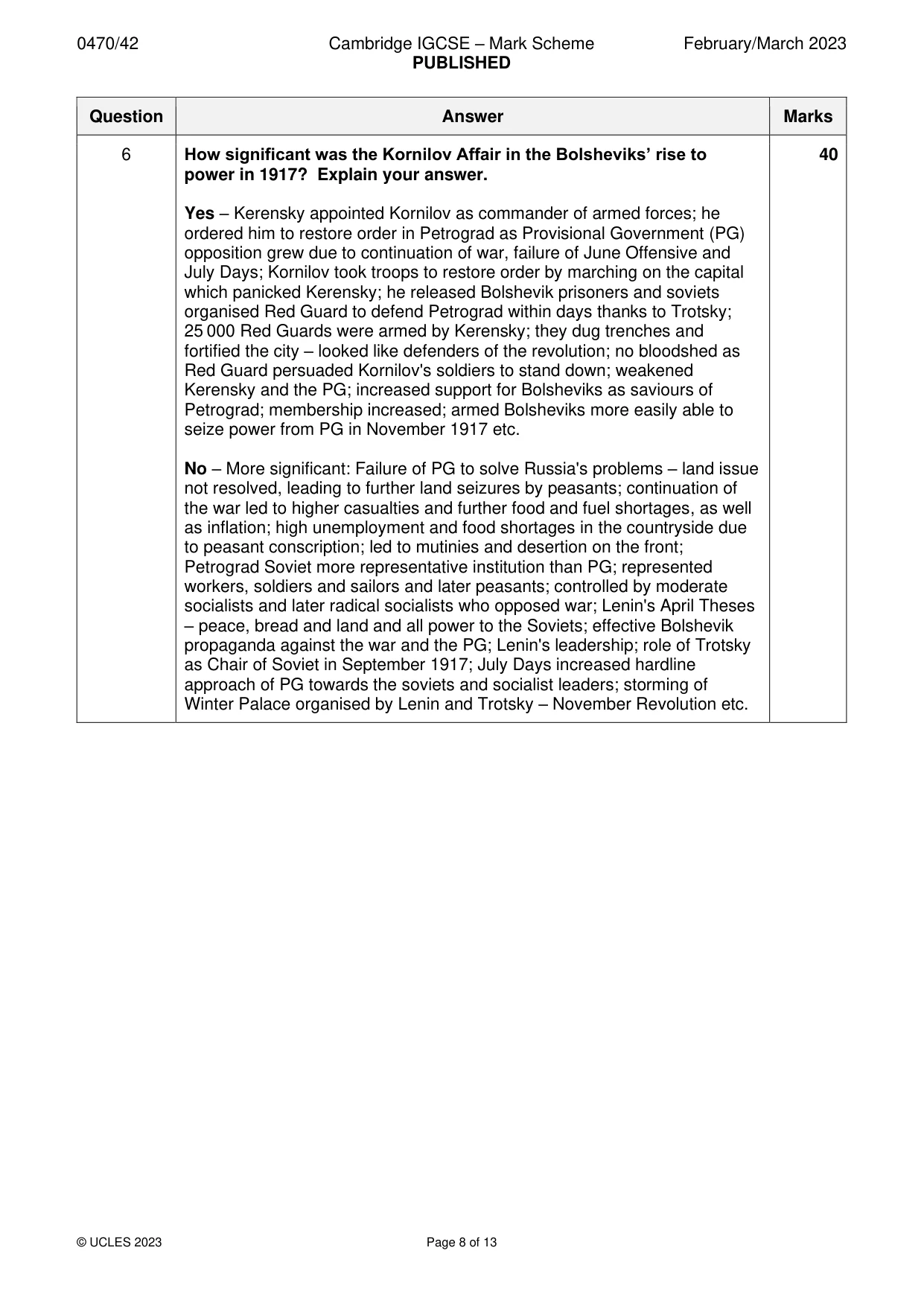
0470/42 Cambridge IGCSE – Mark Scheme PUBLISHED February/March 2023 © UCLES 2023 Page 8 of 13 Question Answer Marks 6 How significant was the Kornilov Affair in the Bolsheviks’ rise to power in 1917? Explain your answer. Yes – Kerensky appointed Kornilov as commander of armed forces; he ordered him to restore order in Petrograd as Provisional Government (PG) opposition grew due to continuation of war, failure of June Offensive and July Days; Kornilov took troops to restore order by marching on the capital which panicked Kerensky; he released Bolshevik prisoners and soviets organised Red Guard to defend Petrograd within days thanks to Trotsky; 25 000 Red Guards were armed by Kerensky; they dug trenches and fortified the city – looked like defenders of the revolution; no bloodshed as Red Guard persuaded Kornilov's soldiers to stand down; weakened Kerensky and the PG; increased support for Bolsheviks as saviours of Petrograd; membership increased; armed Bolsheviks more easily able to seize power from PG in November 1917 etc. No – More significant: Failure of PG to solve Russia's problems – land issue not resolved, leading to further land seizures by peasants; continuation of the war led to higher casualties and further food and fuel shortages, as well as inflation; high unemployment and food shortages in the countryside due to peasant conscription; led to mutinies and desertion on the front; Petrograd Soviet more representative institution than PG; represented workers, soldiers and sailors and later peasants; controlled by moderate socialists and later radical socialists who opposed war; Lenin's April Theses – peace, bread and land and all power to the Soviets; effective Bolshevik propaganda against the war and the PG; Lenin's leadership; role of Trotsky as Chair of Soviet in September 1917; July Days increased hardline approach of PG towards the soviets and socialist leaders; storming of Winter Palace organised by Lenin and Trotsky – November Revolution etc. 40
Mark scheme, page 9
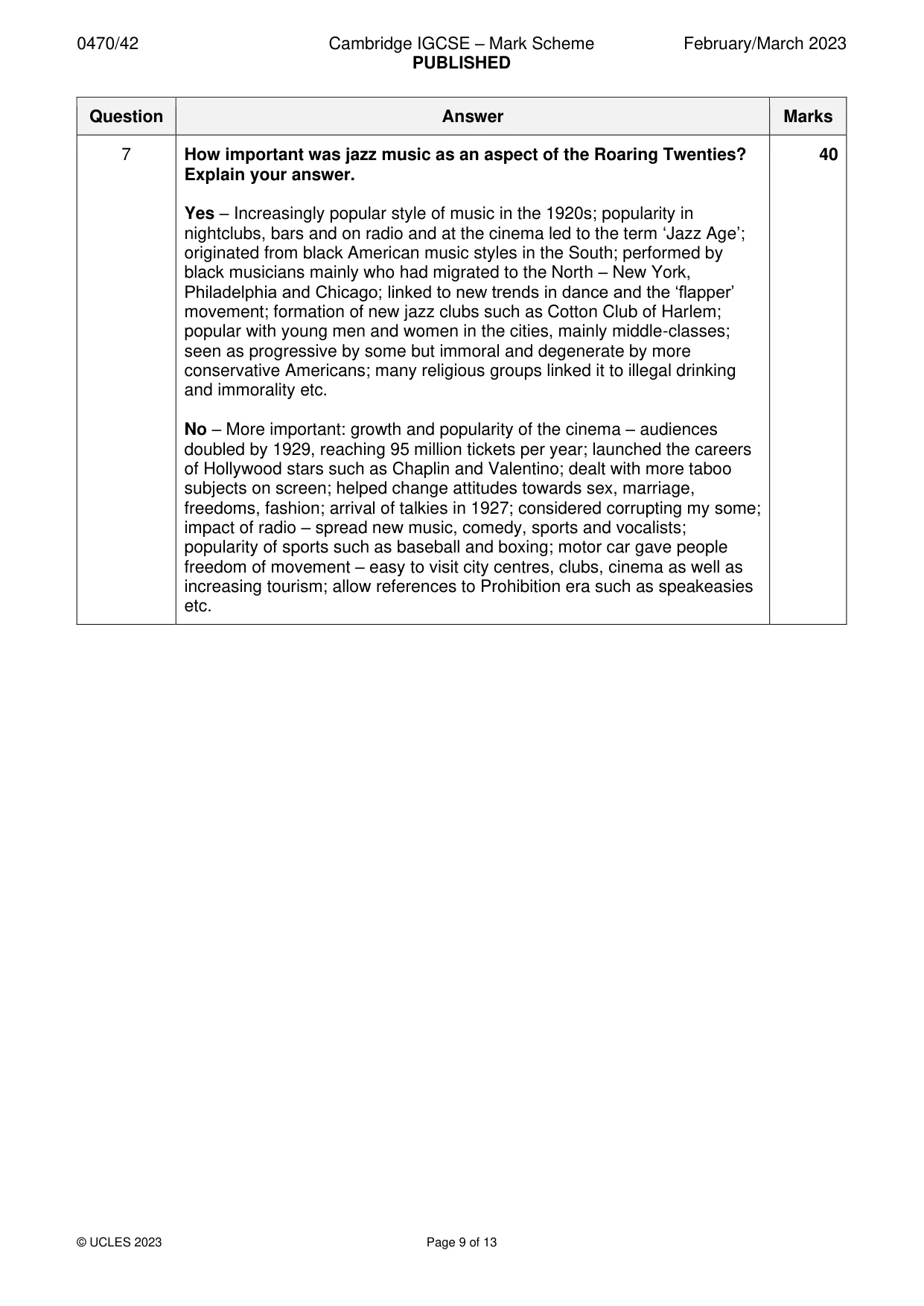
0470/42 Cambridge IGCSE – Mark Scheme PUBLISHED February/March 2023 © UCLES 2023 Page 9 of 13 Question Answer Marks 7 How important was jazz music as an aspect of the Roaring Twenties? Explain your answer. Yes – Increasingly popular style of music in the 1920s; popularity in nightclubs, bars and on radio and at the cinema led to the term ‘Jazz Age’; originated from black American music styles in the South; performed by black musicians mainly who had migrated to the North – New York, Philadelphia and Chicago; linked to new trends in dance and the ‘flapper’ movement; formation of new jazz clubs such as Cotton Club of Harlem; popular with young men and women in the cities, mainly middle-classes; seen as progressive by some but immoral and degenerate by more conservative Americans; many religious groups linked it to illegal drinking and immorality etc. No – More important: growth and popularity of the cinema – audiences doubled by 1929, reaching 95 million tickets per year; launched the careers of Hollywood stars such as Chaplin and Valentino; dealt with more taboo subjects on screen; helped change attitudes towards sex, marriage, freedoms, fashion; arrival of talkies in 1927; considered corrupting my some; impact of radio – spread new music, comedy, sports and vocalists; popularity of sports such as baseball and boxing; motor car gave people freedom of movement – easy to visit city centres, clubs, cinema as well as increasing tourism; allow references to Prohibition era such as speakeasies etc. 40
Mark scheme, page 10
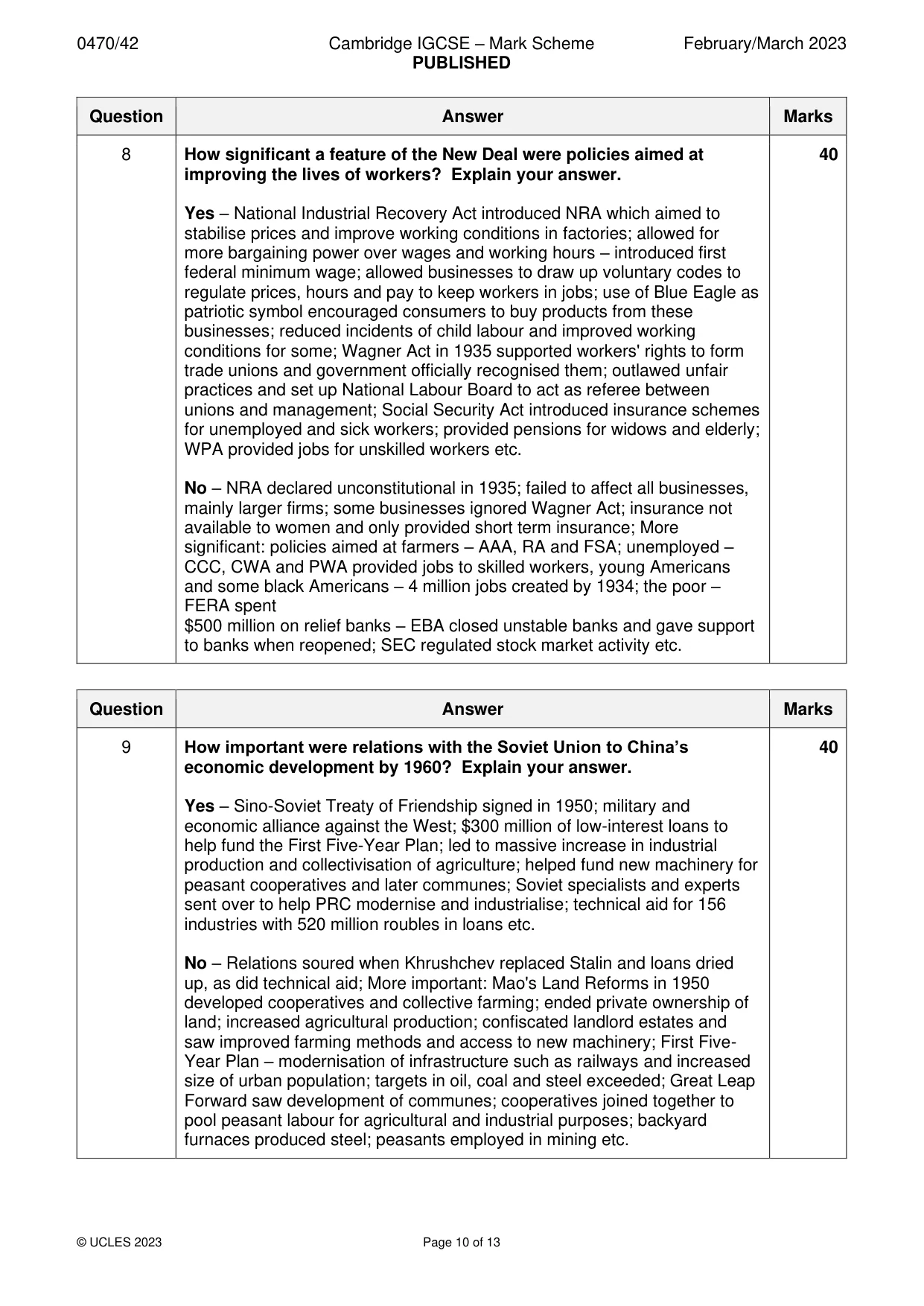
0470/42 Cambridge IGCSE – Mark Scheme PUBLISHED February/March 2023 © UCLES 2023 Page 10 of 13 Question Answer Marks 8 How significant a feature of the New Deal were policies aimed at improving the lives of workers? Explain your answer. Yes – National Industrial Recovery Act introduced NRA which aimed to stabilise prices and improve working conditions in factories; allowed for more bargaining power over wages and working hours – introduced first federal minimum wage; allowed businesses to draw up voluntary codes to regulate prices, hours and pay to keep workers in jobs; use of Blue Eagle as patriotic symbol encouraged consumers to buy products from these businesses; reduced incidents of child labour and improved working conditions for some; Wagner Act in 1935 supported workers' rights to form trade unions and government officially recognised them; outlawed unfair practices and set up National Labour Board to act as referee between unions and management; Social Security Act introduced insurance schemes for unemployed and sick workers; provided pensions for widows and elderly; WPA provided jobs for unskilled workers etc. No – NRA declared unconstitutional in 1935; failed to affect all businesses, mainly larger firms; some businesses ignored Wagner Act; insurance not available to women and only provided short term insurance; More significant: policies aimed at farmers – AAA, RA and FSA; unemployed – CCC, CWA and PWA provided jobs to skilled workers, young Americans and some black Americans – 4 million jobs created by 1934; the poor – FERA spent $500 million on relief banks – EBA closed unstable banks and gave support to banks when reopened; SEC regulated stock market activity etc. 40 Question Answer Marks 9 How important were relations with the Soviet Union to China’s economic development by 1960? Explain your answer. Yes – Sino-Soviet Treaty of Friendship signed in 1950; military and economic alliance against the West; $300 million of low-interest loans to help fund the First Five-Year Plan; led to massive increase in industrial production and collectivisation of agriculture; helped fund new machinery for peasant cooperatives and later communes; Soviet specialists and experts sent over to help PRC modernise and industrialise; technical aid for 156 industries with 520 million roubles in loans etc. No – Relations soured when Khrushchev replaced Stalin and loans dried up, as did technical aid; More important: Mao's Land Reforms in 1950 developed cooperatives and collective farming; ended private ownership of land; increased agricultural production; confiscated landlord estates and saw improved farming methods and access to new machinery; First Five- Year Plan – modernisation of infrastructure such as railways and increased size of urban population; targets in oil, coal and steel exceeded; Great Leap Forward saw development of communes; cooperatives joined together to pool peasant labour for agricultural and industrial purposes; backyard furnaces produced steel; peasants employed in mining etc. 40
Mark scheme, page 11
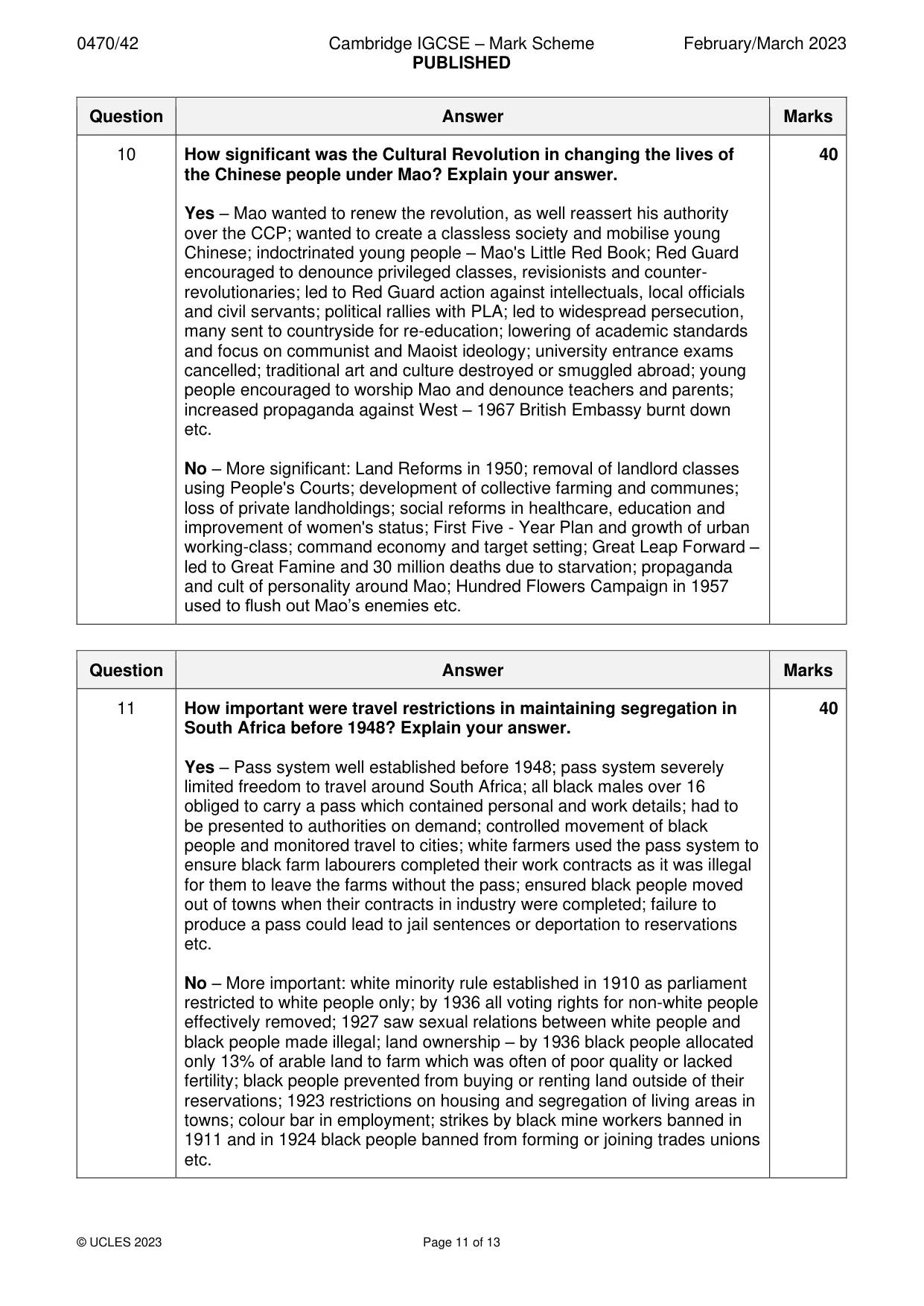
0470/42 Cambridge IGCSE – Mark Scheme PUBLISHED February/March 2023 © UCLES 2023 Page 11 of 13 Question Answer Marks 10 How significant was the Cultural Revolution in changing the lives of the Chinese people under Mao? Explain your answer. Yes – Mao wanted to renew the revolution, as well reassert his authority over the CCP; wanted to create a classless society and mobilise young Chinese; indoctrinated young people – Mao's Little Red Book; Red Guard encouraged to denounce privileged classes, revisionists and counter- revolutionaries; led to Red Guard action against intellectuals, local officials and civil servants; political rallies with PLA; led to widespread persecution, many sent to countryside for re-education; lowering of academic standards and focus on communist and Maoist ideology; university entrance exams cancelled; traditional art and culture destroyed or smuggled abroad; young people encouraged to worship Mao and denounce teachers and parents; increased propaganda against West – 1967 British Embassy burnt down etc. No – More significant: Land Reforms in 1950; removal of landlord classes using People's Courts; development of collective farming and communes; loss of private landholdings; social reforms in healthcare, education and improvement of women's status; First Five - Year Plan and growth of urban working-class; command economy and target setting; Great Leap Forward – led to Great Famine and 30 million deaths due to starvation; propaganda and cult of personality around Mao; Hundred Flowers Campaign in 1957 used to flush out Mao’s enemies etc. 40 Question Answer Marks 11 How important were travel restrictions in maintaining segregation in South Africa before 1948? Explain your answer. Yes – Pass system well established before 1948; pass system severely limited freedom to travel around South Africa; all black males over 16 obliged to carry a pass which contained personal and work details; had to be presented to authorities on demand; controlled movement of black people and monitored travel to cities; white farmers used the pass system to ensure black farm labourers completed their work contracts as it was illegal for them to leave the farms without the pass; ensured black people moved out of towns when their contracts in industry were completed; failure to produce a pass could lead to jail sentences or deportation to reservations etc. No – More important: white minority rule established in 1910 as parliament restricted to white people only; by 1936 all voting rights for non-white people effectively removed; 1927 saw sexual relations between white people and black people made illegal; land ownership – by 1936 black people allocated only 13% of arable land to farm which was often of poor quality or lacked fertility; black people prevented from buying or renting land outside of their reservations; 1923 restrictions on housing and segregation of living areas in towns; colour bar in employment; strikes by black mine workers banned in 1911 and in 1924 black people banned from forming or joining trades unions etc. 40
Mark scheme, page 12
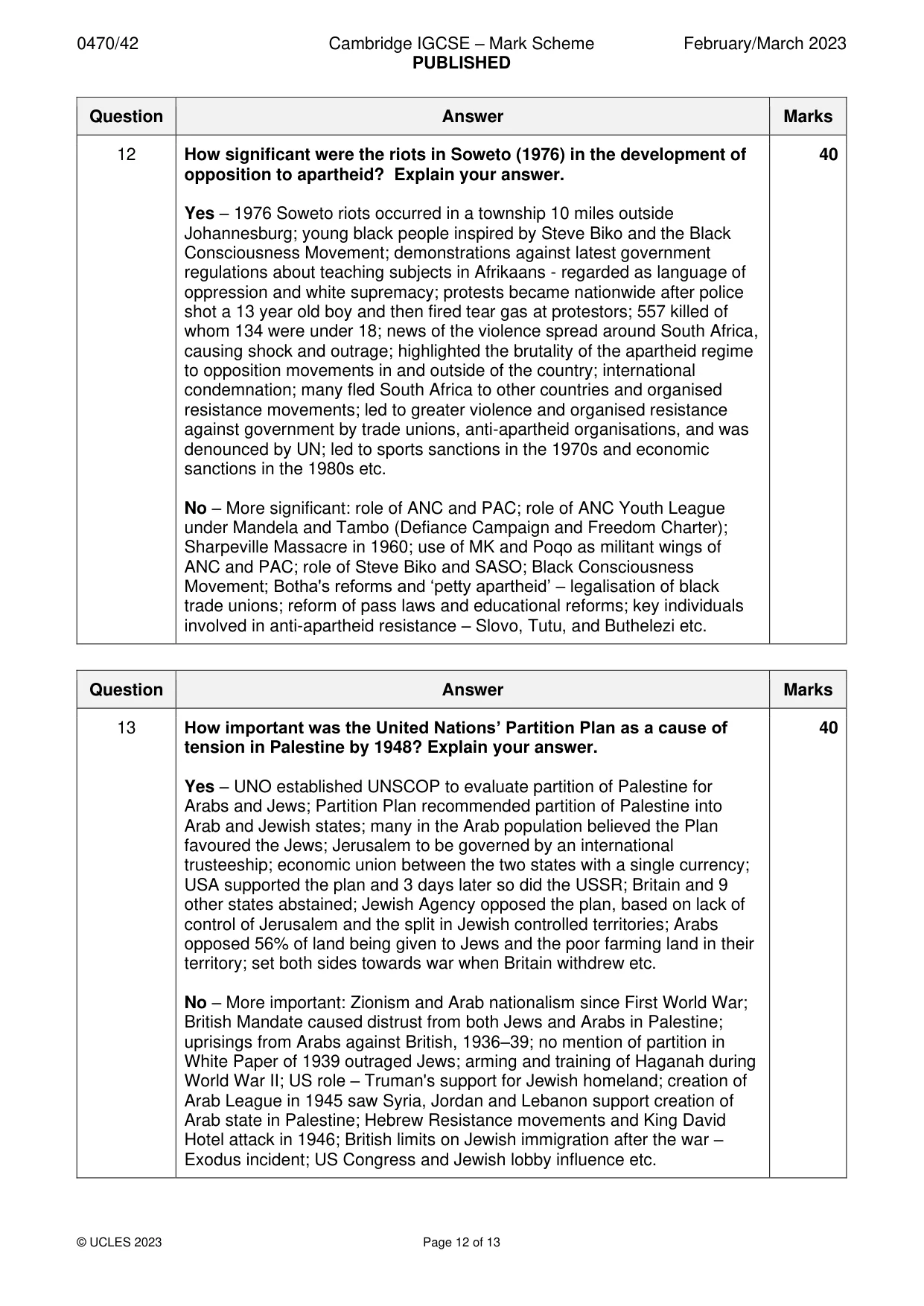
0470/42 Cambridge IGCSE – Mark Scheme PUBLISHED February/March 2023 © UCLES 2023 Page 12 of 13 Question Answer Marks 12 How significant were the riots in Soweto (1976) in the development of opposition to apartheid? Explain your answer. Yes – 1976 Soweto riots occurred in a township 10 miles outside Johannesburg; young black people inspired by Steve Biko and the Black Consciousness Movement; demonstrations against latest government regulations about teaching subjects in Afrikaans - regarded as language of oppression and white supremacy; protests became nationwide after police shot a 13 year old boy and then fired tear gas at protestors; 557 killed of whom 134 were under 18; news of the violence spread around South Africa, causing shock and outrage; highlighted the brutality of the apartheid regime to opposition movements in and outside of the country; international condemnation; many fled South Africa to other countries and organised resistance movements; led to greater violence and organised resistance against government by trade unions, anti-apartheid organisations, and was denounced by UN; led to sports sanctions in the 1970s and economic sanctions in the 1980s etc. No – More significant: role of ANC and PAC; role of ANC Youth League under Mandela and Tambo (Defiance Campaign and Freedom Charter); Sharpeville Massacre in 1960; use of MK and Poqo as militant wings of ANC and PAC; role of Steve Biko and SASO; Black Consciousness Movement; Botha's reforms and ‘petty apartheid’ – legalisation of black trade unions; reform of pass laws and educational reforms; key individuals involved in anti-apartheid resistance – Slovo, Tutu, and Buthelezi etc. 40 Question Answer Marks 13 How important was the United Nations’ Partition Plan as a cause of tension in Palestine by 1948? Explain your answer. Yes – UNO established UNSCOP to evaluate partition of Palestine for Arabs and Jews; Partition Plan recommended partition of Palestine into Arab and Jewish states; many in the Arab population believed the Plan favoured the Jews; Jerusalem to be governed by an international trusteeship; economic union between the two states with a single currency; USA supported the plan and 3 days later so did the USSR; Britain and 9 other states abstained; Jewish Agency opposed the plan, based on lack of control of Jerusalem and the split in Jewish controlled territories; Arabs opposed 56% of land being given to Jews and the poor farming land in their territory; set both sides towards war when Britain withdrew etc. No – More important: Zionism and Arab nationalism since First World War; British Mandate caused distrust from both Jews and Arabs in Palestine; uprisings from Arabs against British, 1936–39; no mention of partition in White Paper of 1939 outraged Jews; arming and training of Haganah during World War II; US role – Truman's support for Jewish homeland; creation of Arab League in 1945 saw Syria, Jordan and Lebanon support creation of Arab state in Palestine; Hebrew Resistance movements and King David Hotel attack in 1946; British limits on Jewish immigration after the war – Exodus incident; US Congress and Jewish lobby influence etc. 40
Mark scheme, page 13
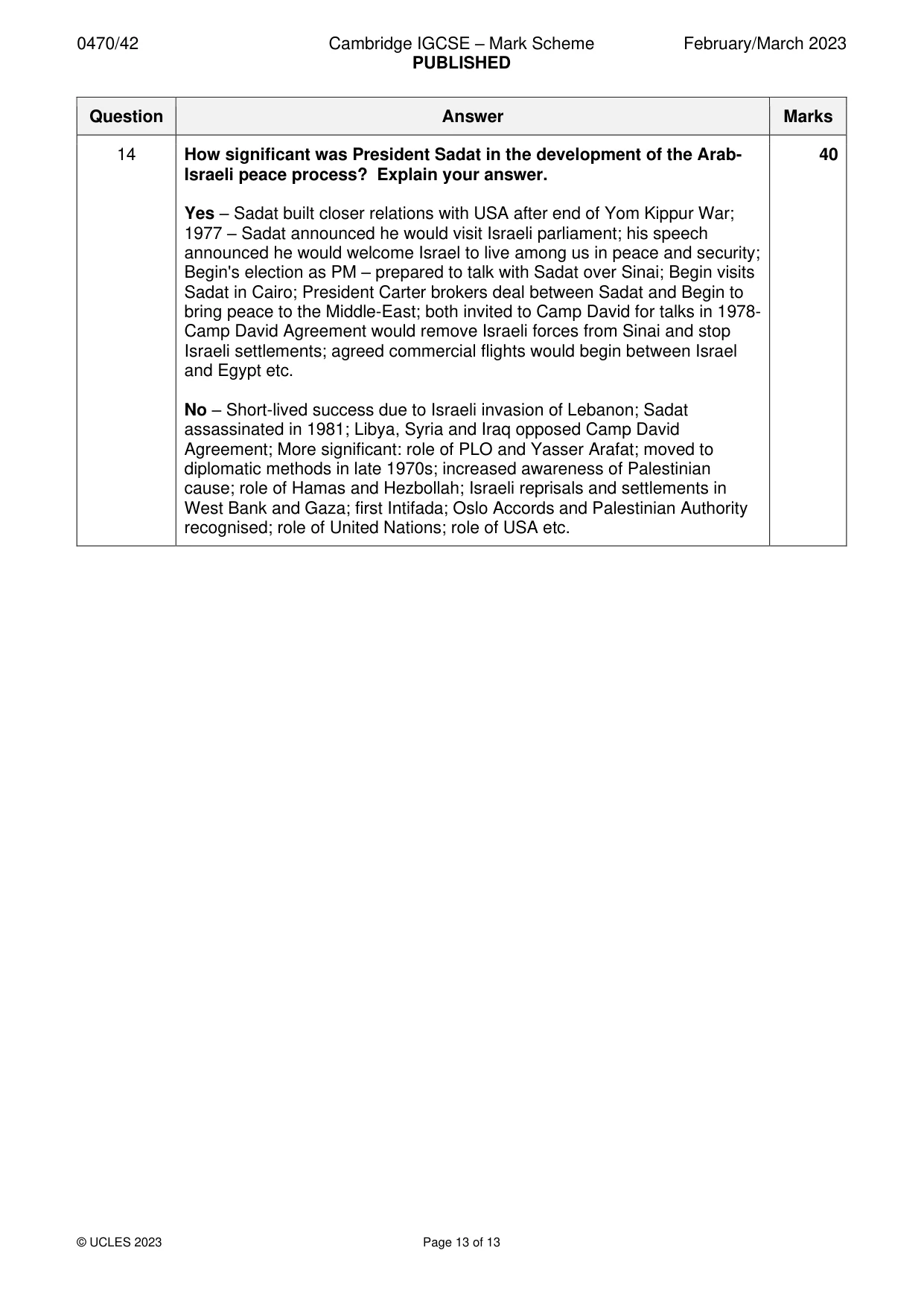
0470/42 Cambridge IGCSE – Mark Scheme PUBLISHED February/March 2023 © UCLES 2023 Page 13 of 13 Question Answer Marks 14 How significant was President Sadat in the development of the Arab- Israeli peace process? Explain your answer. Yes – Sadat built closer relations with USA after end of Yom Kippur War; 1977 – Sadat announced he would visit Israeli parliament; his speech announced he would welcome Israel to live among us in peace and security; Begin's election as PM – prepared to talk with Sadat over Sinai; Begin visits Sadat in Cairo; President Carter brokers deal between Sadat and Begin to bring peace to the Middle-East; both invited to Camp David for talks in 1978- Camp David Agreement would remove Israeli forces from Sinai and stop Israeli settlements; agreed commercial flights would begin between Israel and Egypt etc. No – Short-lived success due to Israeli invasion of Lebanon; Sadat assassinated in 1981; Libya, Syria and Iraq opposed Camp David Agreement; More significant: role of PLO and Yasser Arafat; moved to diplomatic methods in late 1970s; increased awareness of Palestinian cause; role of Hamas and Hezbollah; Israeli reprisals and settlements in West Bank and Gaza; first Intifada; Oslo Accords and Palestinian Authority recognised; role of United Nations; role of USA etc. 40
What you needed in this session
Cambridge’s own grade thresholds for 2023 Feb/March, Paper 4 · Variant 2. A higher threshold means an easier paper — the bar moves with how the cohort did.