Cambridge IGCSE History 0470 — 2022 Oct/Nov Paper 1 · Variant 3
0470/13/O/N/22 · 60 marks · ≈68 min
The question paper and its mark scheme, free to read here and free to download. This is Cambridge’s own paper, exactly as it was sat.
Question paper12 pages


Mark scheme72 pages
Answers below. Sit the paper first if you are practising.
Paper as text
Question paper, page 1
This document has 12 pages. Any blank pages are indicated. [Turn over Cambridge IGCSE™ DC (PQ) 303423/2 © UCLES 2022 HISTORY 0470/13 Paper 1 October/November 2022 2 hours You must answer on the enclosed answer booklet. You will need: Answer booklet (enclosed) INSTRUCTIONS ● Answer three questions in total: Section A (Core Content): answer two questions. Section B (Depth Studies): answer one question. ● Follow the instructions on the front cover of the answer booklet. If you need additional answer paper, ask the invigilator for a continuation booklet. INFORMATION ● The total mark for this paper is 60. ● The number of marks for each question or part question is shown in brackets [ ]. * 3 0 1 9 5 8 7 2 0 7 *
Question paper, page 2
2 0470/13/O/N/22 © UCLES 2022 SECTION A: CORE CONTENT Answer any two questions from this section. 1 The path to Italian unification was not smooth. (a) Describe how the power of Piedmont changed in the 1850s. [4] (b) Why was there tension between Austria and some Italian states by 1848? [6] (c) How united was Italy by 1861? Explain your answer. [10] 2 Despite setbacks, Prussia grew in strength. (a) Describe the development of the Prussian army between 1859 and 1866. [4] (b) Why was the Treaty of Olmütz a humiliation for Prussia? [6] (c) How far do you agree that the defeat of Austria in 1866 was the most important step towards the unification of Germany? Explain your answer. [10] 3 There were many causes of tension in the years before the American Civil War. (a) Describe the terms of the Compromise of 1850. [4] (b) Why was the Dred Scott case controversial? [6] (c) ‘Lincoln’s election was the main cause of the Civil War.’ How far do you agree with this statement? Explain your answer. [10] 4 European powers ruled their colonies in different ways. (a) What was meant by ‘indirect’ rule? [4] (b) Why did Britain seek to expand its empire in the nineteenth century? [6] (c) How similar were the ways in which France and Belgium treated their African colonies? Explain your answer. [10]
Question paper, page 3
3 0470/13/O/N/22 © UCLES 2022 [Turn over 5 There were many aspects to the work of the League of Nations. (a) Describe the work of the League in helping refugees. [4] (b) Why did the League fail to bring about disarmament? [6] (c) How far do you agree that the League handled disputes between states effectively in the 1920s? Explain your answer. [10] 6 Tension between states increased in the 1930s. (a) What did the Soviet Union gain from the Nazi–Soviet Pact? [4] (b) Why was Japan a threat to world peace in the 1930s? [6] (c) ‘The Anschluss was more important than the takeover of the Sudetenland in achieving Hitler’s aims.’ How far do you agree with this statement? Explain your answer. [10] 7 American policies in the Cold War were not always successful. (a) What was the policy of ‘containment’? [4] (b) Why did Khrushchev place nuclear missiles in Cuba? [6] (c) How surprising is it that the United States did not win the Vietnam War? Explain your answer. [10] 8 The rise of Solidarity challenged Soviet control over Eastern Europe. (a) What were the aims of Solidarity? [4] (b) Why did the Polish government introduce Martial Law in 1981? [6] (c) How far do you agree that Solidarity was the main reason for the collapse of Soviet power in Eastern Europe? Explain your answer. [10]
Question paper, page 4
4 0470/13/O/N/22 © UCLES 2022 SECTION B: DEPTH STUDIES Answer any one question from this section. DEPTH STUDY A: THE FIRST WORLD WAR, 1914–18 9 Fighting on the Western Front involved many dangers. (a) Describe Allied preparations for the Battle of the Somme. [4] (b) Why was ‘going over the top’ dangerous for the troops? [6] (c) ‘The tank was the most effective of the new technologies employed on the Western Front.’ How far do you agree with this statement? Explain your answer. [10] 10 Germany faced many difficulties in 1918. (a) Describe the German offensive on the Western Front in March 1918. [4] (b) Why were the Germans defeated at the Battle of Amiens? [6] (c) How far do you agree that socialist ideas caused revolution to break out in Germany in October 1918? Explain your answer. [10]
Question paper, page 5
5 0470/13/O/N/22 © UCLES 2022 [Turn over DEPTH STUDY B: GERMANY, 1918–45 11 Hitler strengthened his position in many ways. (a) Describe how the Nazis tried to win support in elections up to 1933. [4] (b) Why did Hitler attempt the Munich Putsch? [6] (c) How far do you agree that Hitler launched the Night of the Long Knives because he saw Rӧhm as a threat? Explain your answer. [10] 12 Nazi rule had a profound impact on German society. (a) What changes did the Nazis bring to education in Germany? [4] (b) Why did some churchmen oppose the Nazis? [6] (c) How far do you agree that living standards improved under the Nazis? Explain your answer. [10]
Question paper, page 6
6 0470/13/O/N/22 © UCLES 2022 DEPTH STUDY C: RUSSIA, 1905–41 13 The Tsar faced many problems between 1905 and 1917. (a) What was the October Manifesto? [4] (b) Why did the Russian government become increasingly unpopular from 1914? [6] (c) How far do you agree that the 1905 revolution was caused by Russia’s defeat by Japan? Explain your answer. [10] 14 Society and economy changed dramatically under Stalin. (a) Describe Stalin’s policy of ‘Russification’. [4] (b) Why did heavy industry develop rapidly in the 1930s? [6] (c) ‘For the Soviet people, the gains made by collectivisation were worth the cost.’ How far do you agree with this statement? Explain your answer. [10]
Question paper, page 7
7 0470/13/O/N/22 © UCLES 2022 [Turn over DEPTH STUDY D: THE UNITED STATES, 1919–41 15 Some sectors of the economy benefited more than others in the 1920s. (a) Describe the impact of the boom on people’s lives. [4] (b) Why was there a farming crisis in the 1920s? [6] (c) ‘Mass production was the main reason for the boom.’ How far do you agree with this statement? Explain your answer. [10] 16 The New Deal was not always successful and popular. (a) Describe the terms of the Social Security Act, 1935. [4] (b) Why did the Liberty League oppose the New Deal? [6] (c) How effective was the New Deal in dealing with unemployment? Explain your answer. [10]
Question paper, page 8
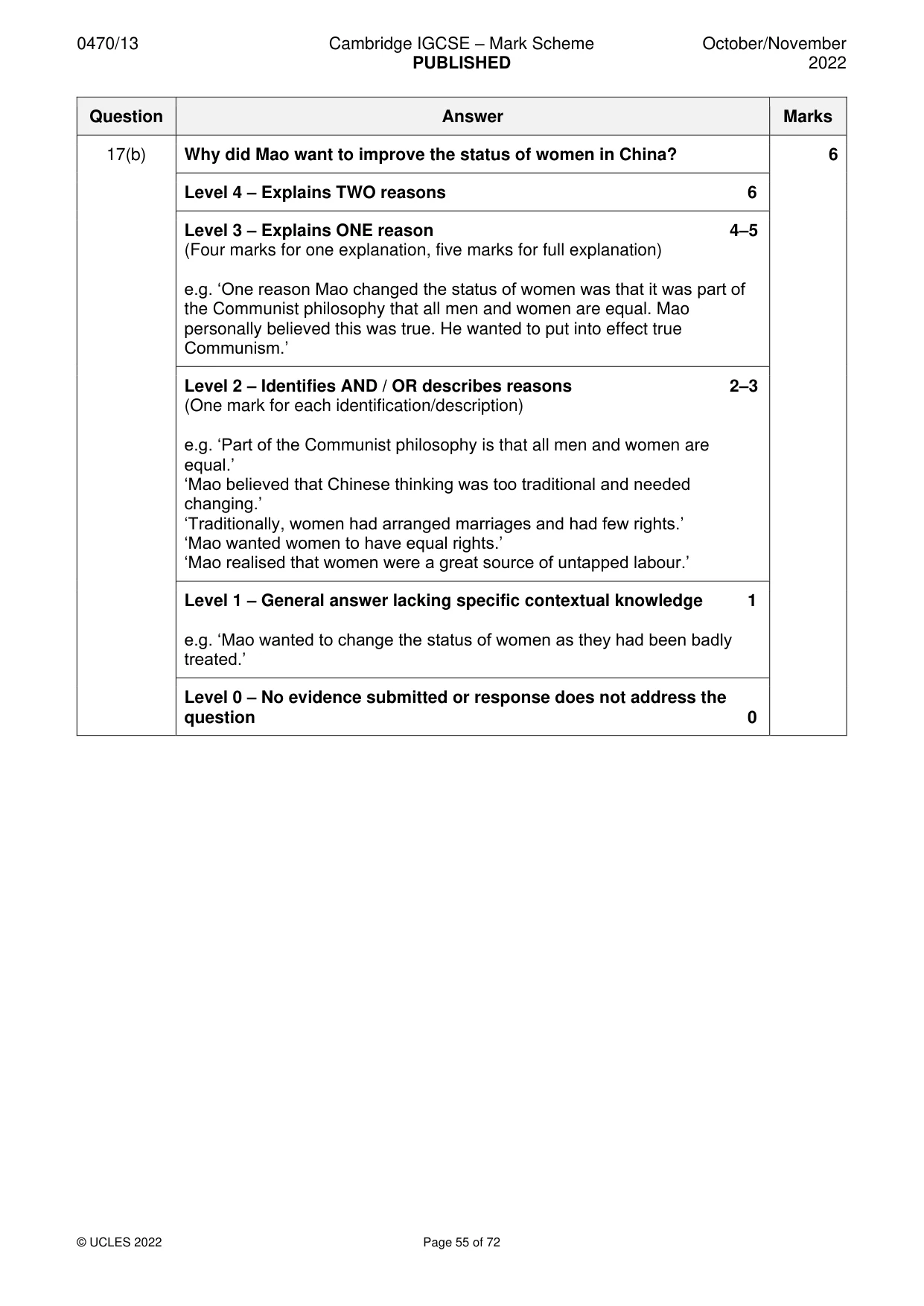
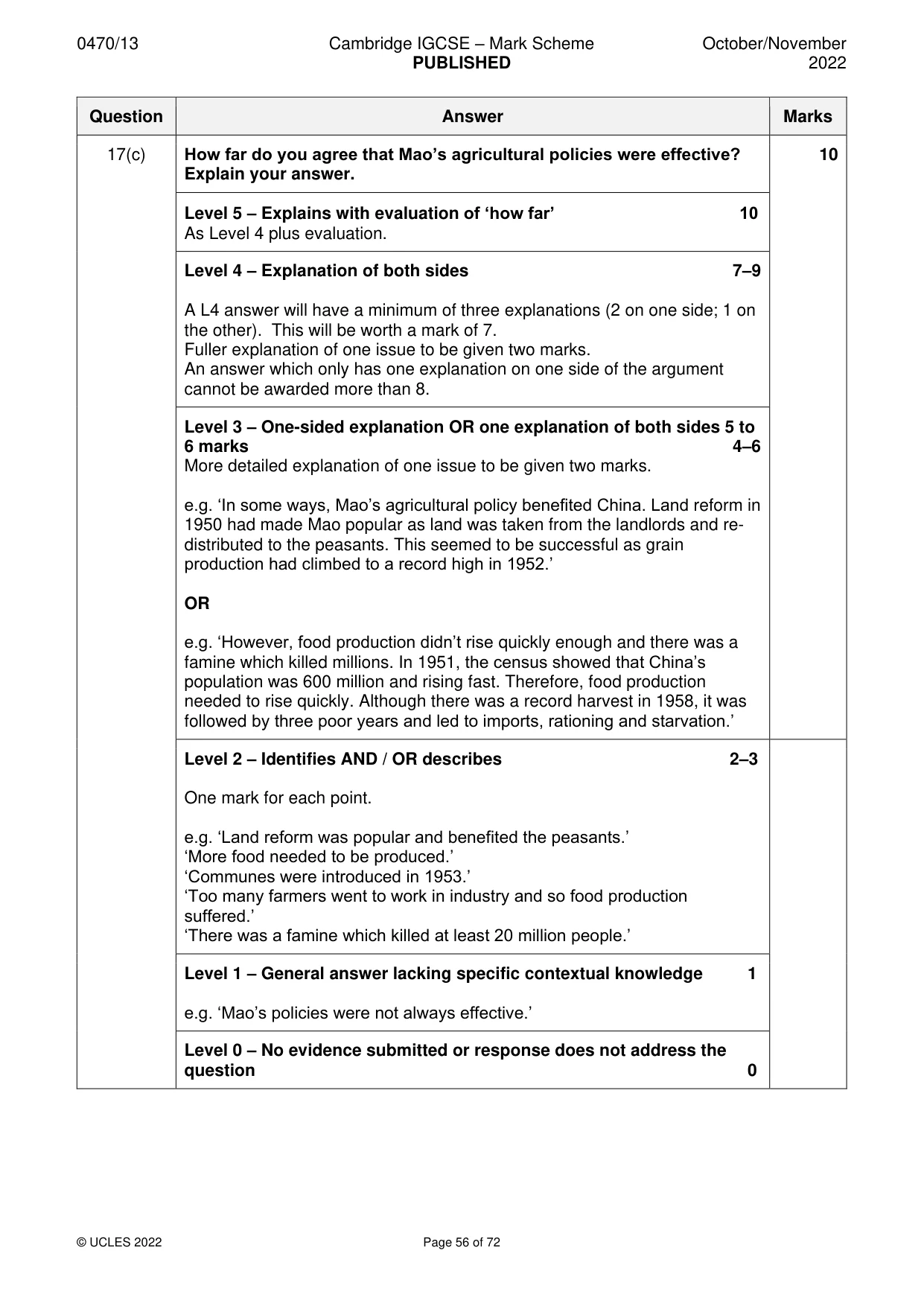
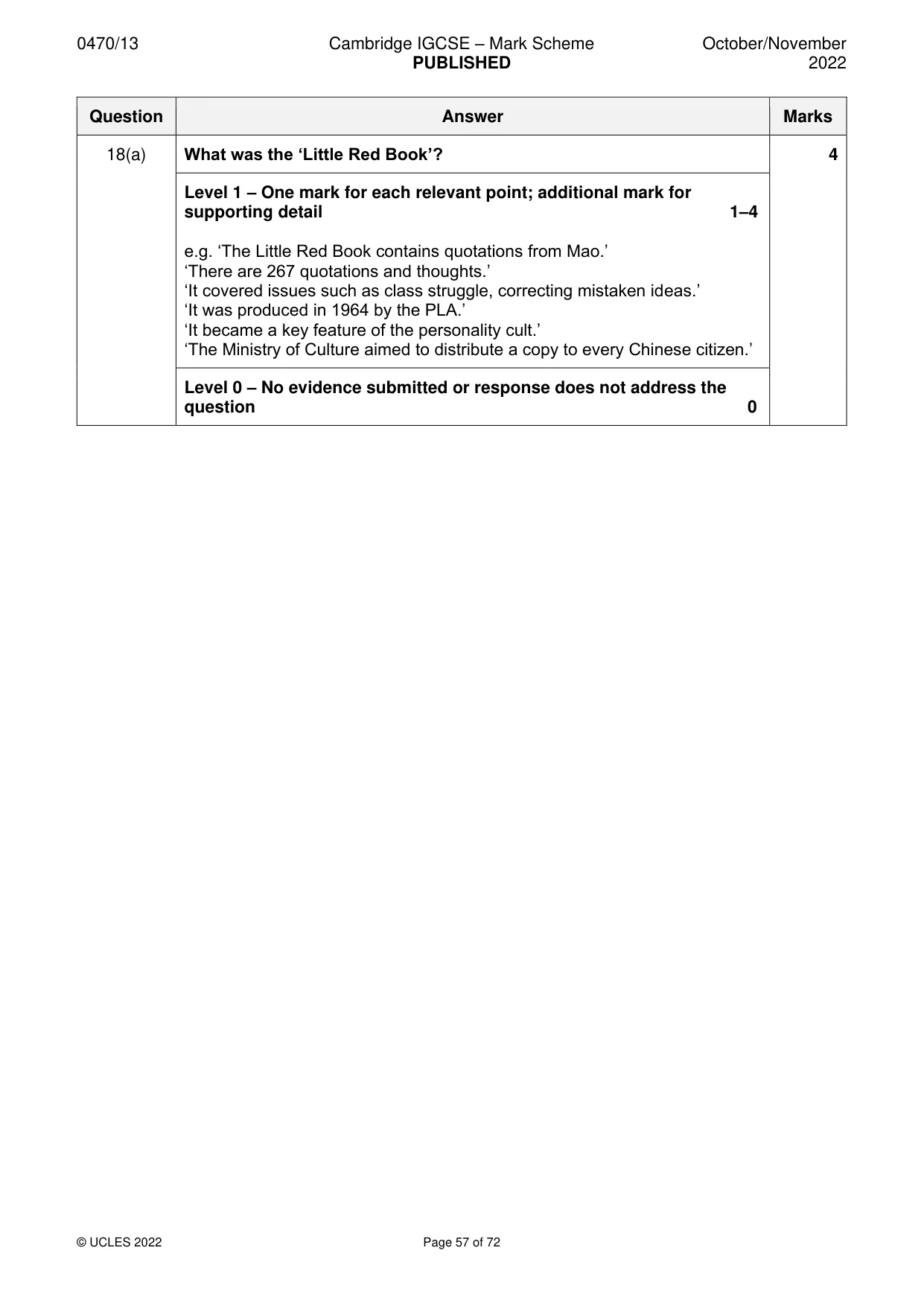
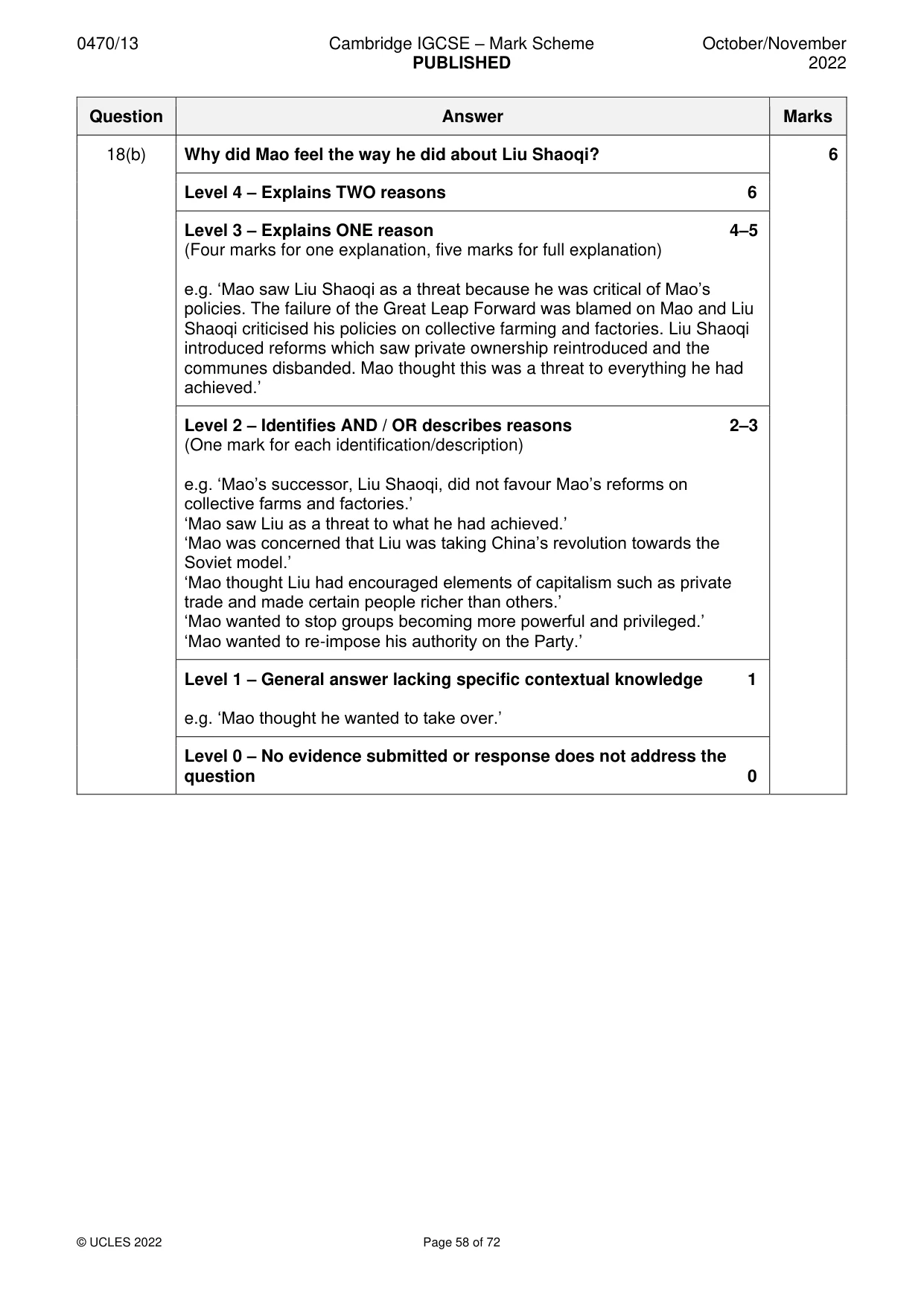
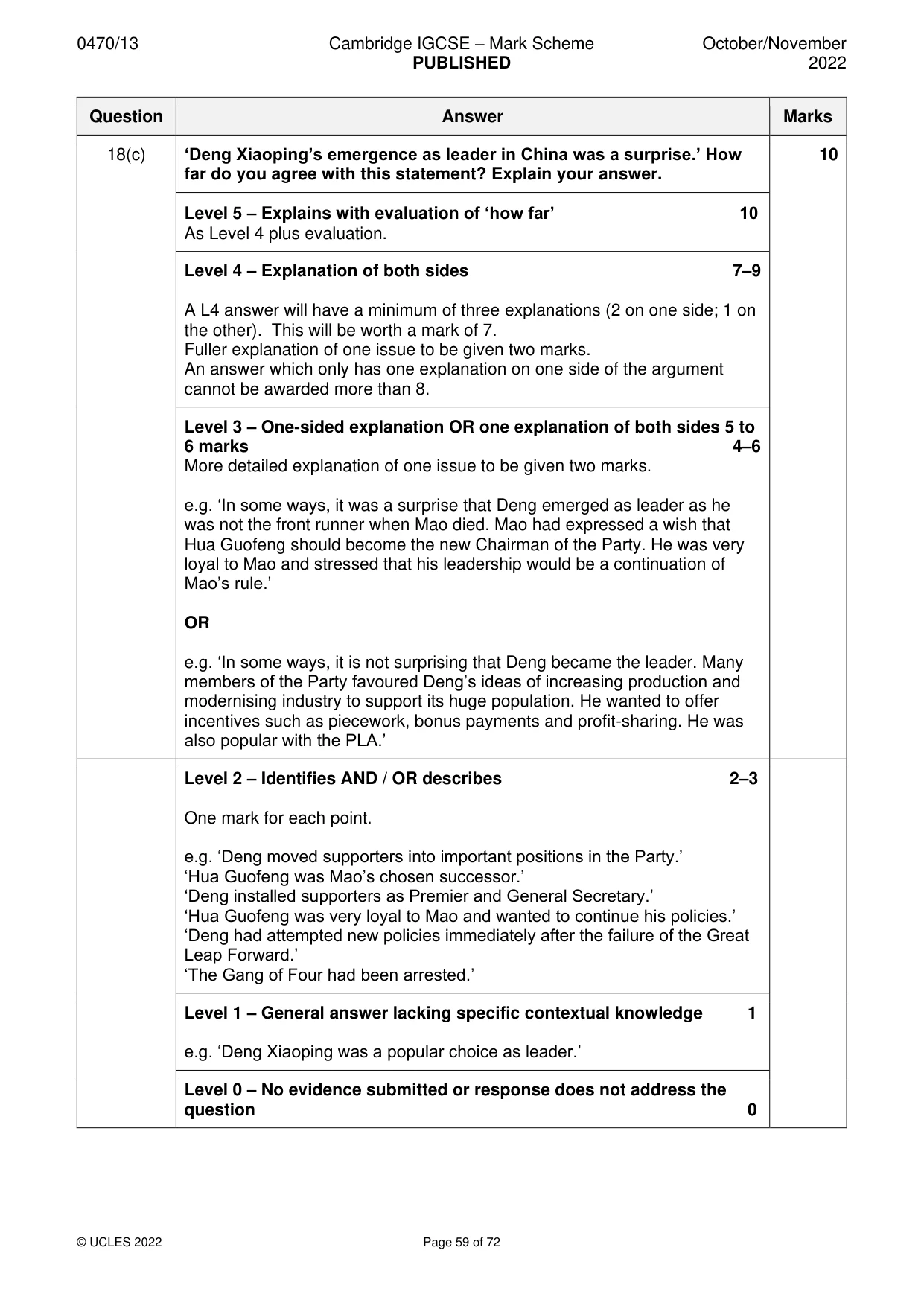
8 0470/13/O/N/22 © UCLES 2022 DEPTH STUDY E: CHINA, c.1930–c.1990 17 Mao wanted to reform society and the economy in the 1950s. (a) Describe the work of the ‘barefoot doctors’. [4] (b) Why did Mao want to improve the status of women in China? [6] (c) How far do you agree that Mao’s agricultural policies were effective? Explain your answer. [10] 18 Leadership in China changed over time. (a) What was the ‘Little Red Book’? [4] (b) Why did Mao feel the way he did about Liu Shaoqi? [6] (c) ‘Deng Xiaoping’s emergence as leader in China was a surprise.’ How far do you agree with this statement? Explain your answer. [10]
Question paper, page 9
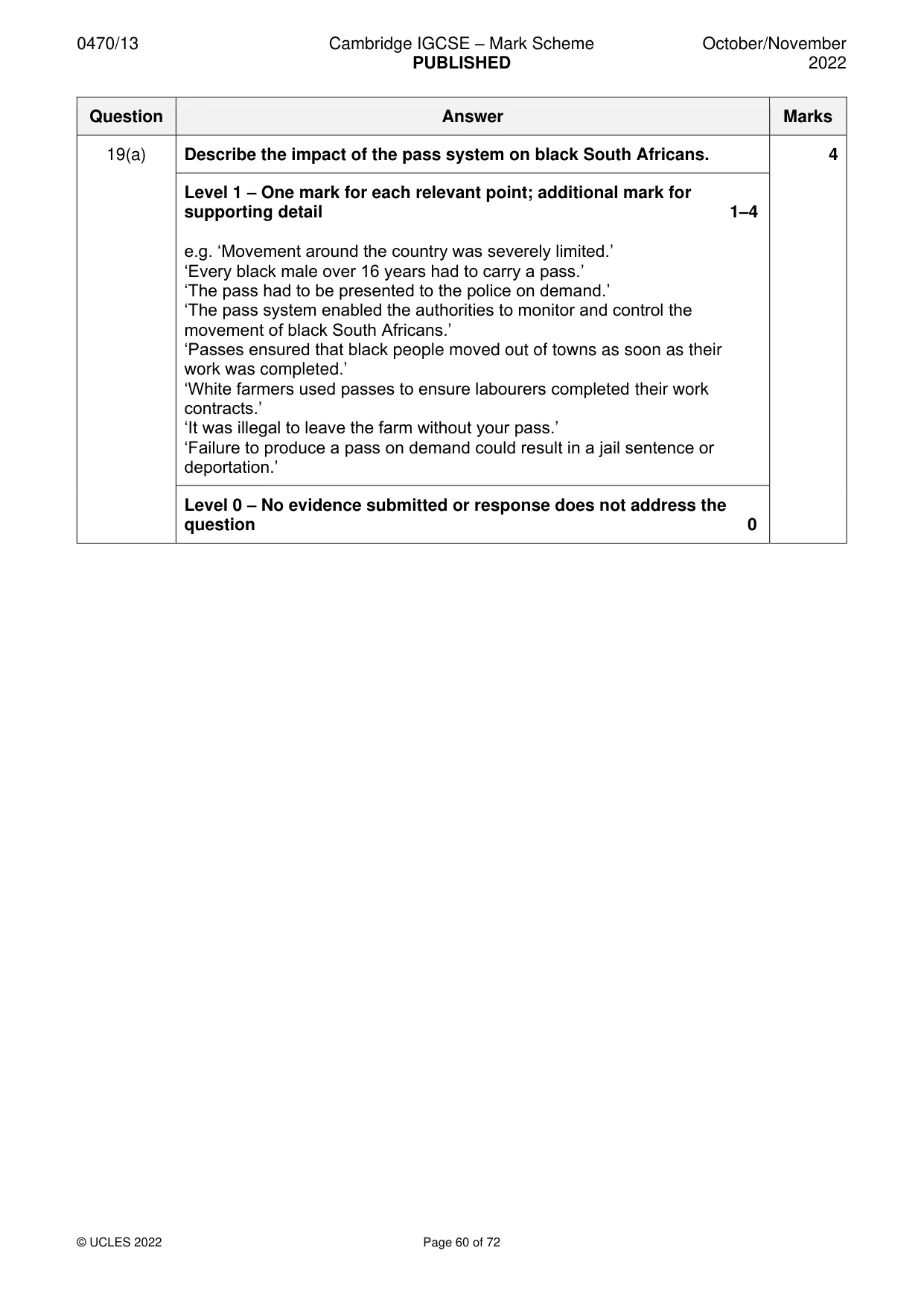
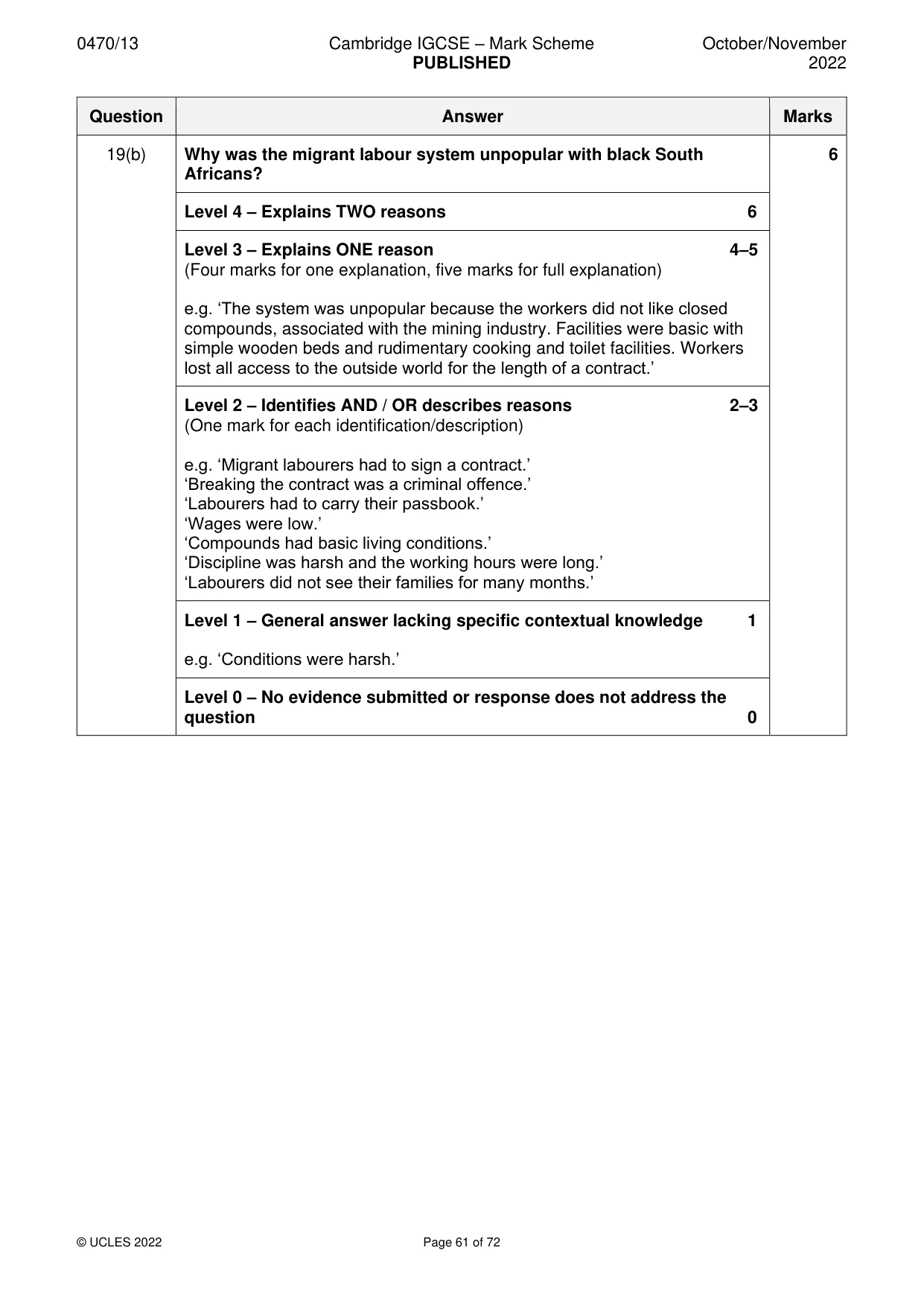
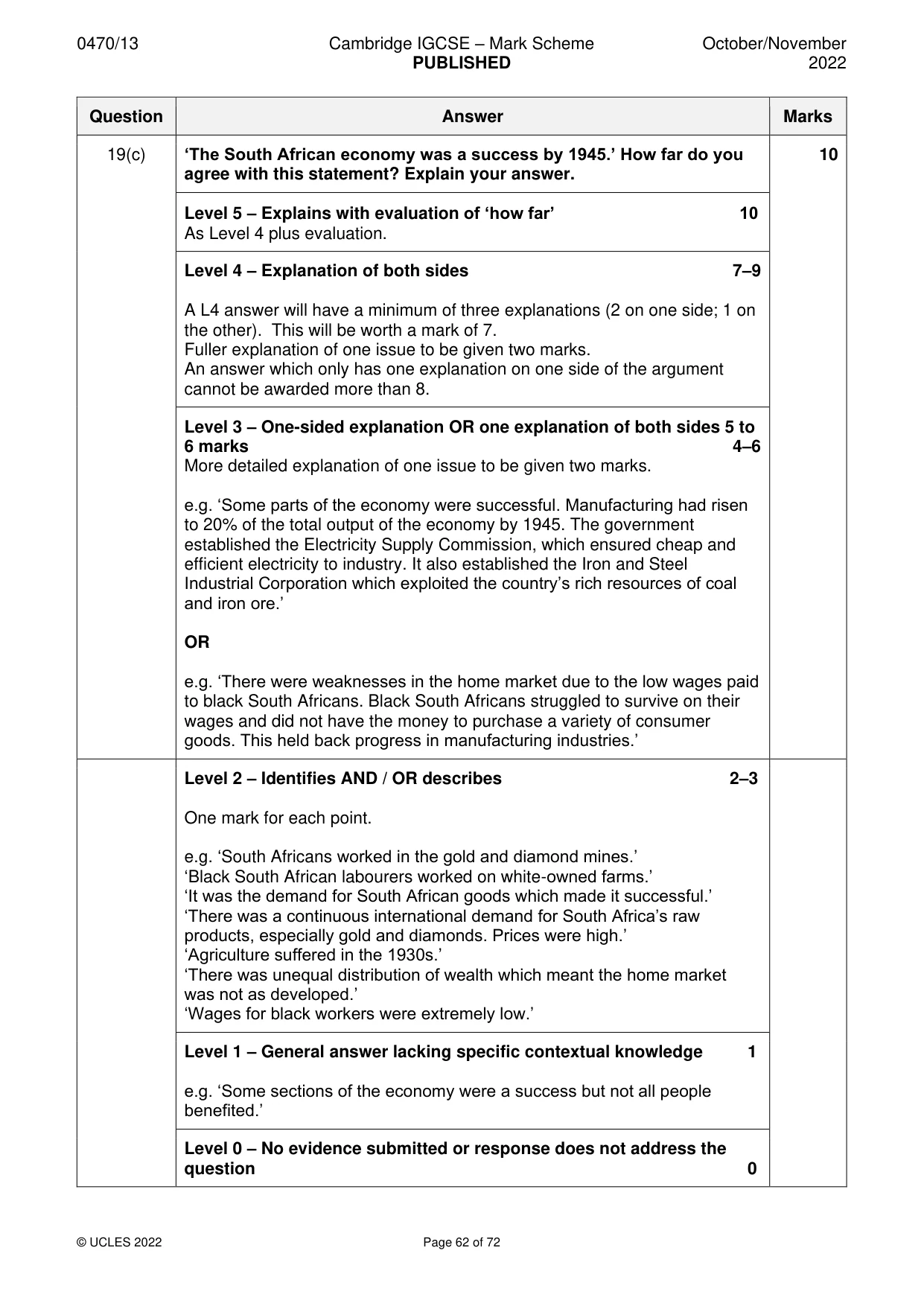
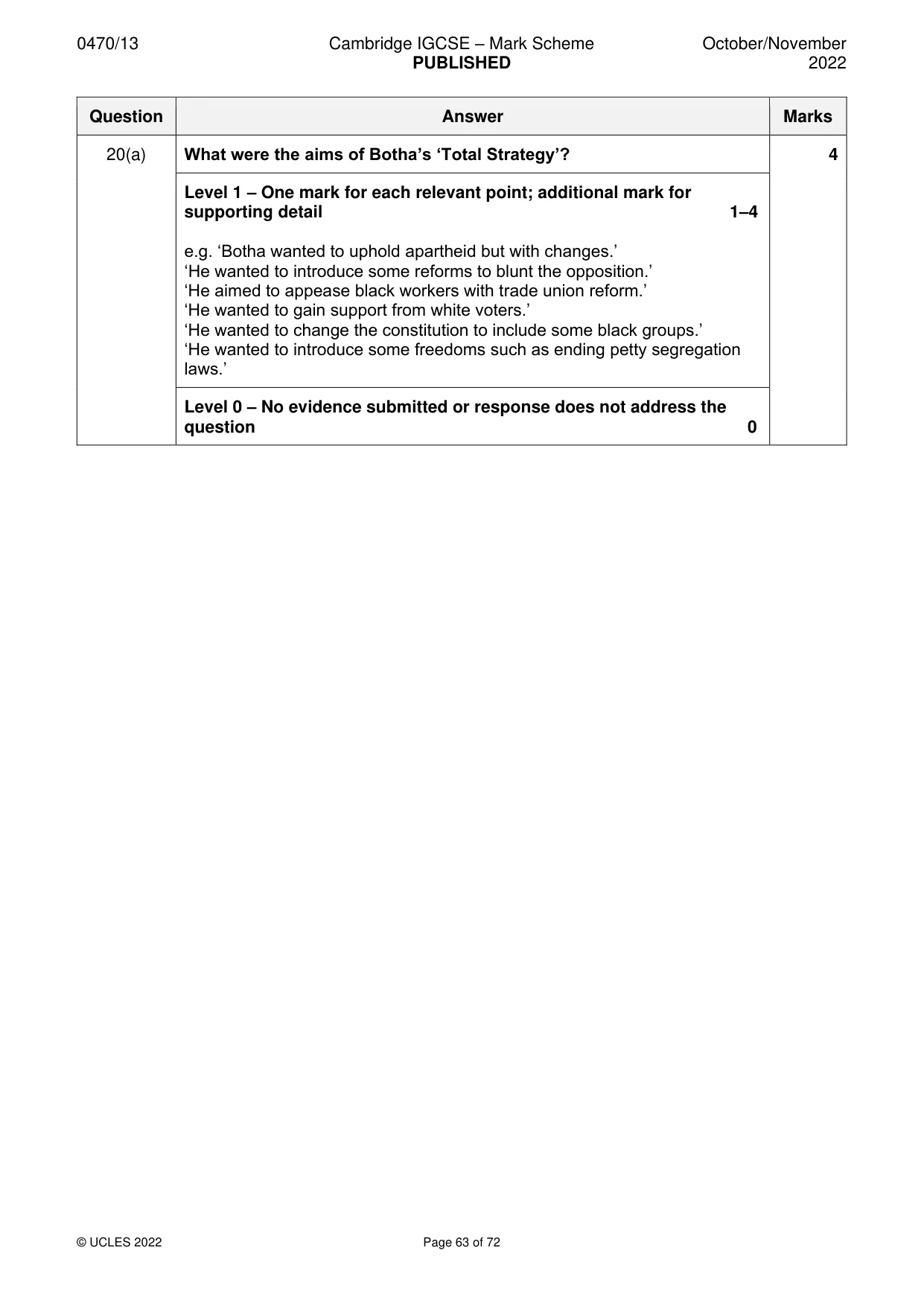
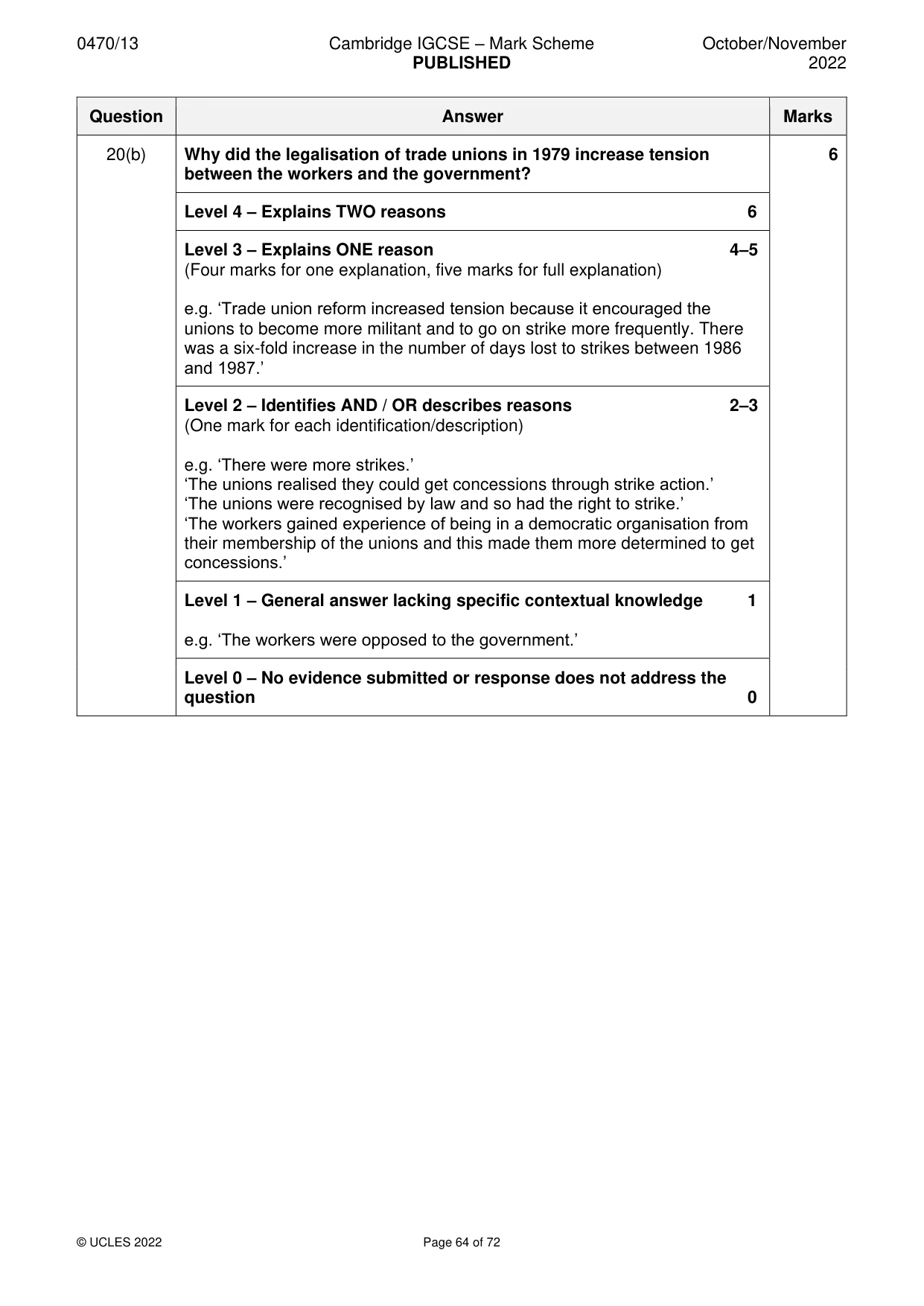
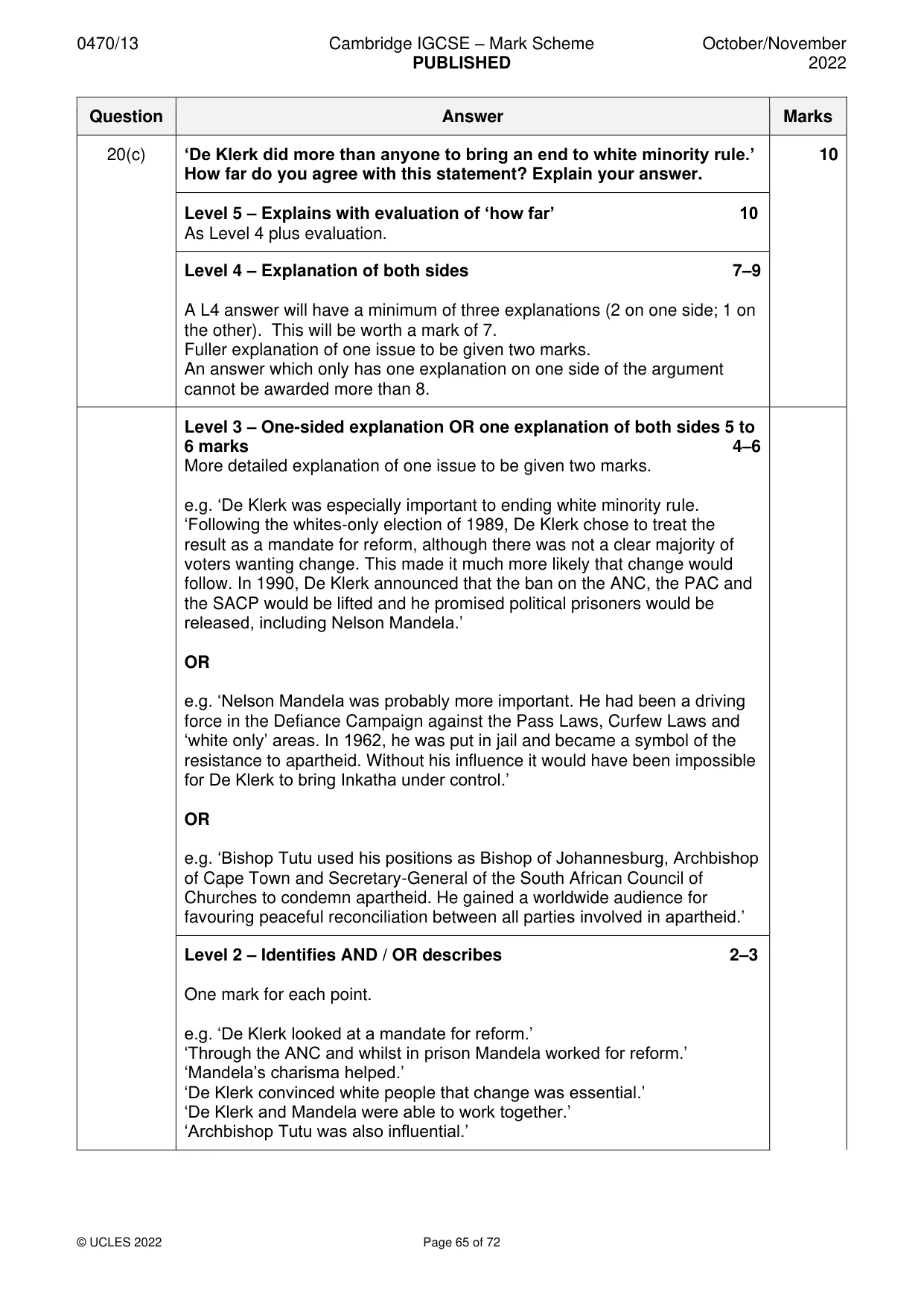
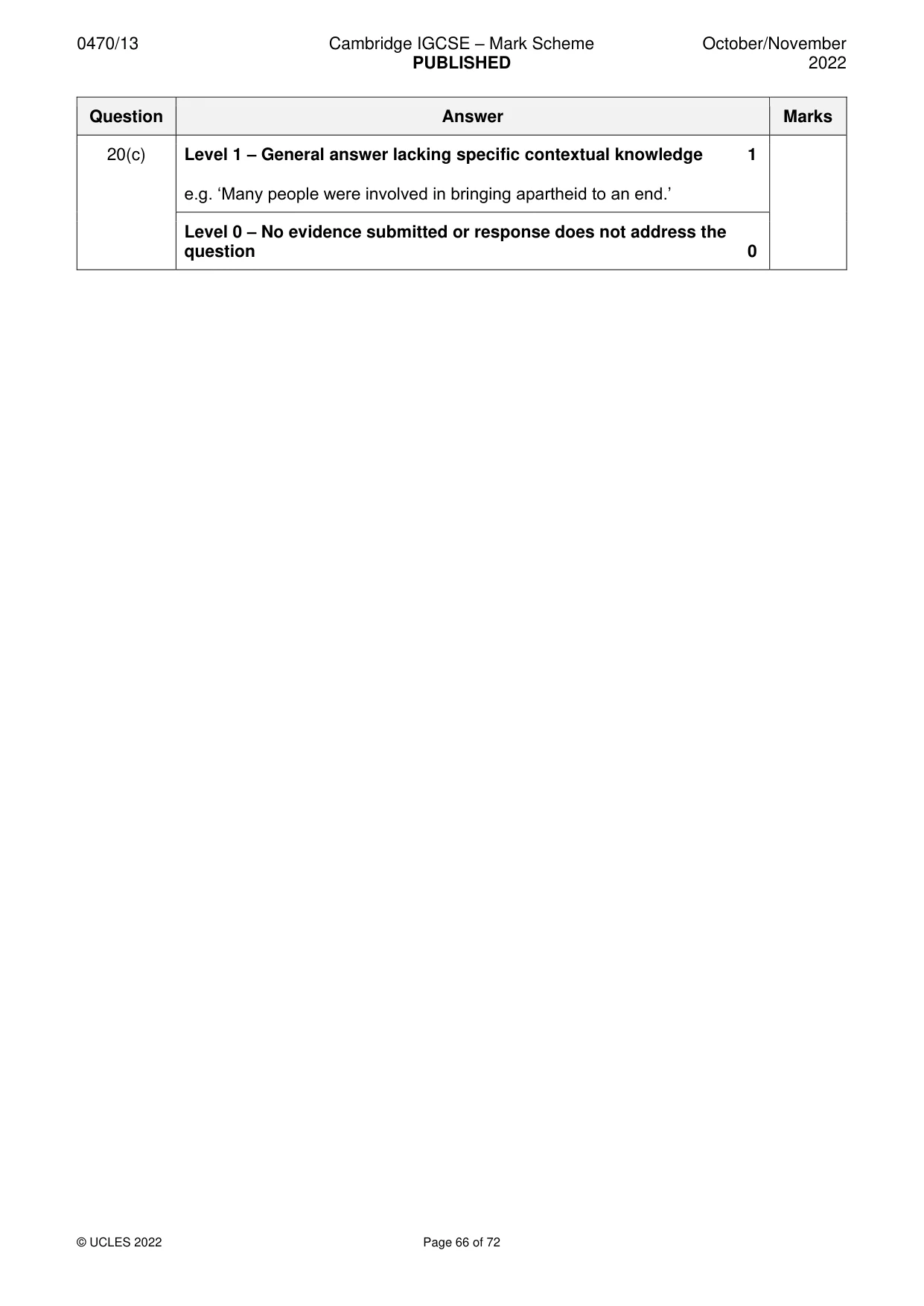
9 0470/13/O/N/22 © UCLES 2022 [Turn over DEPTH STUDY F: SOUTH AFRICA, c.1940–c.1994 19 Many restrictions were placed on black South Africans. (a) Describe the impact of the pass system on black South Africans. [4] (b) Why was the migrant labour system unpopular with black South Africans? [6] (c) ‘The South African economy was a success by 1945.’ How far do you agree with this statement? Explain your answer. [10] 20 The ending of apartheid was not a smooth process. (a) What were the aims of Botha’s ‘Total Strategy’? [4] (b) Why did the legalisation of trade unions in 1979 increase tension between the workers and the government? [6] (c) ‘De Klerk did more than anyone to bring an end to white minority rule.’ How far do you agree with this statement? Explain your answer. [10]
Question paper, page 10
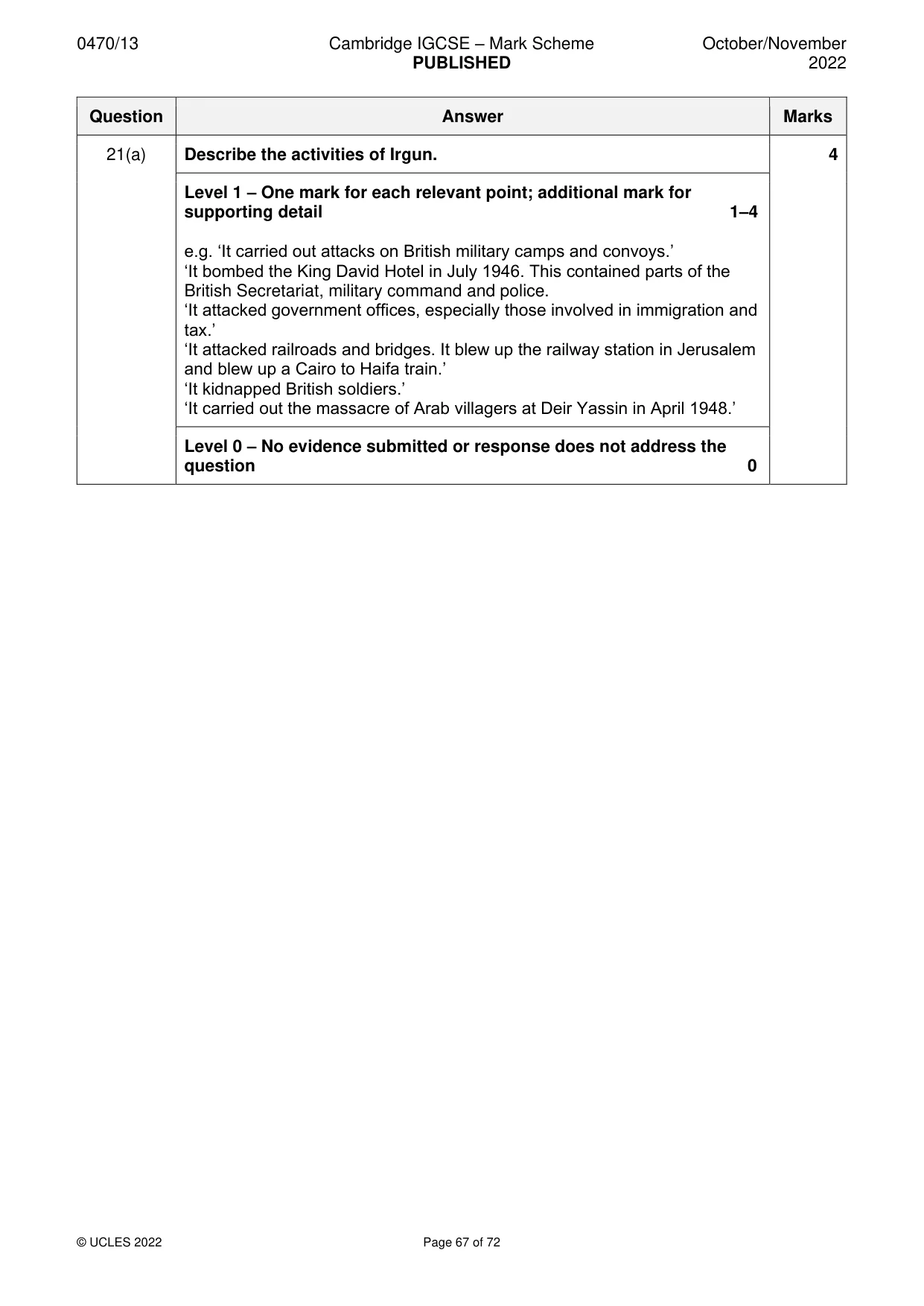
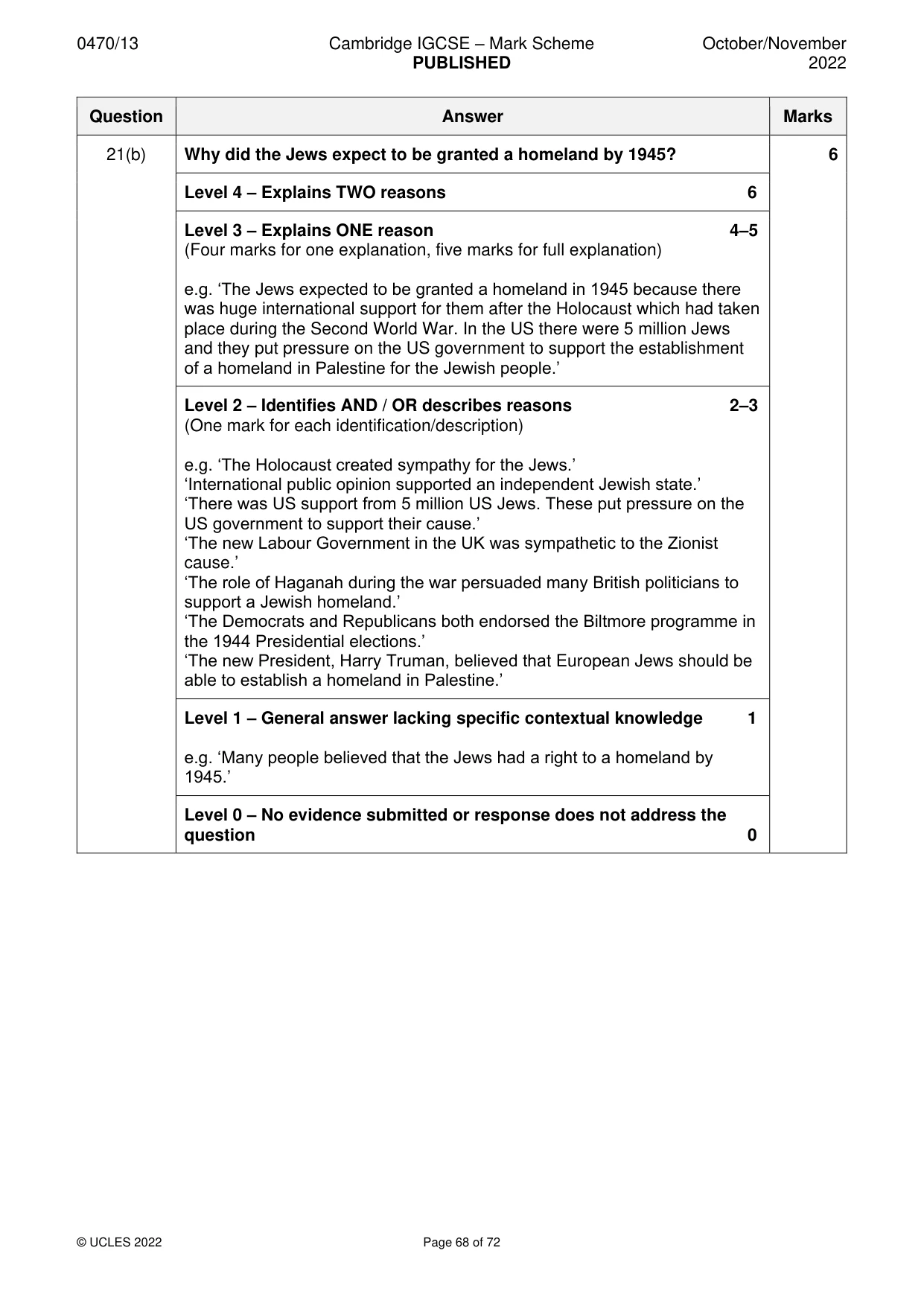
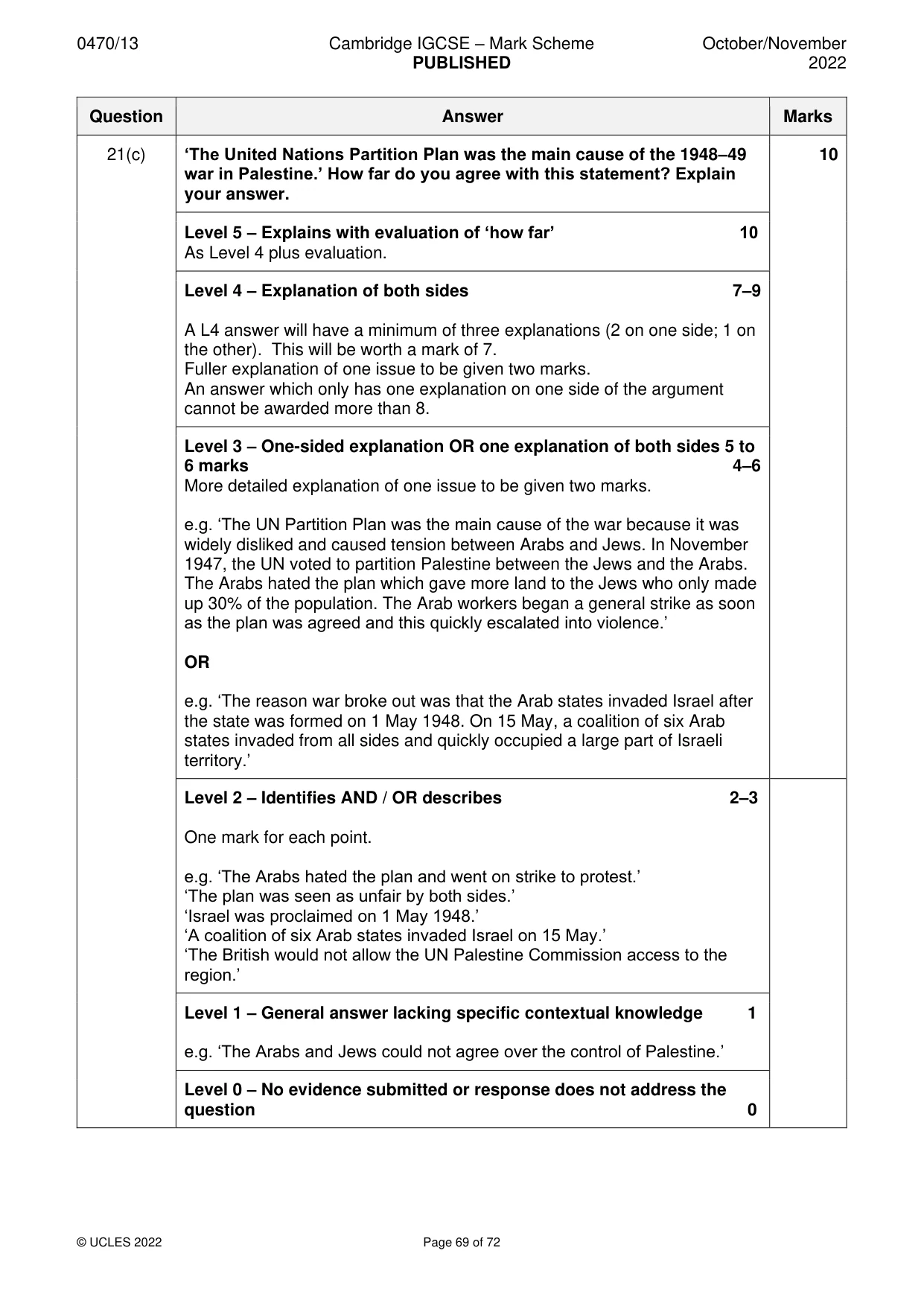
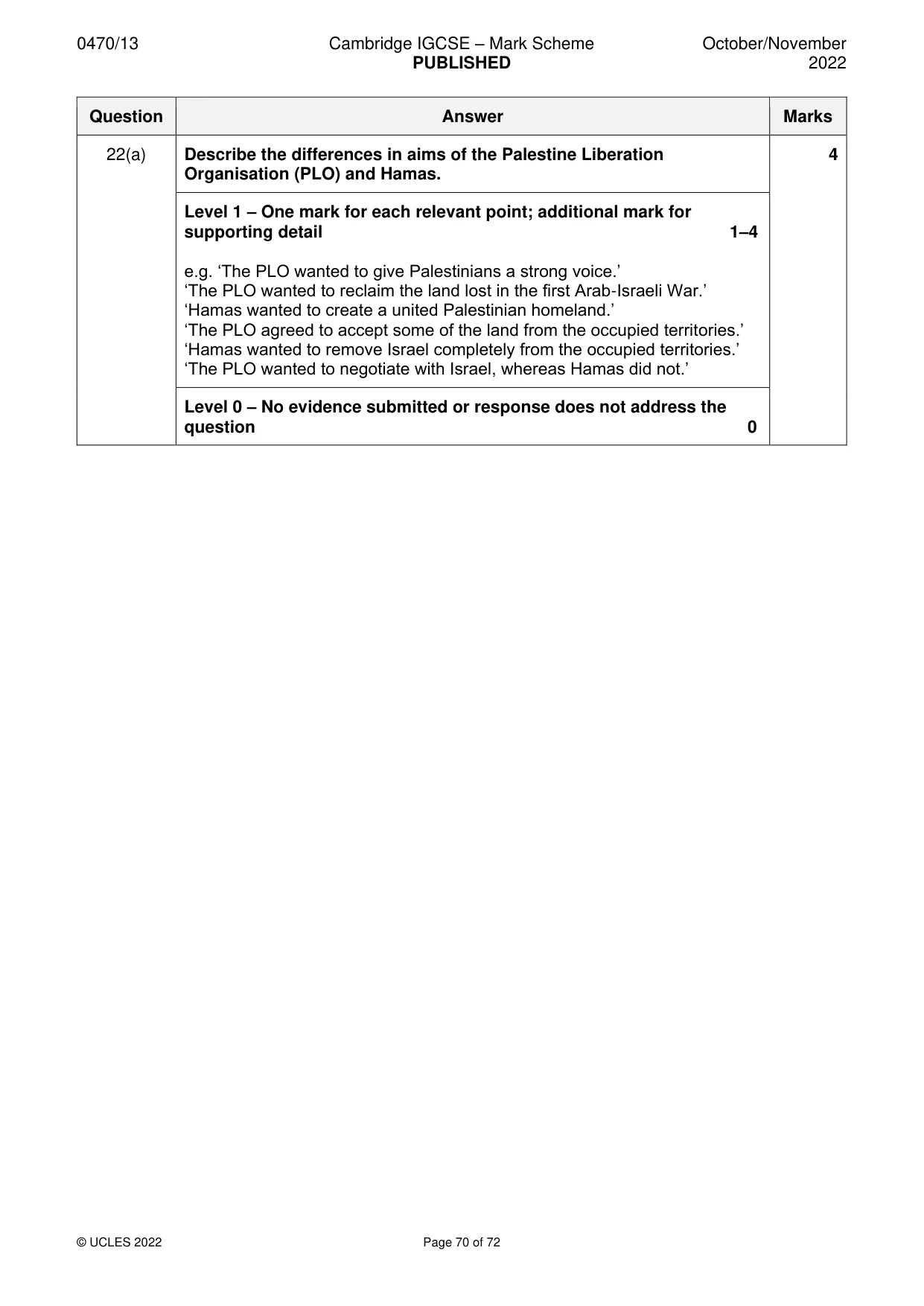
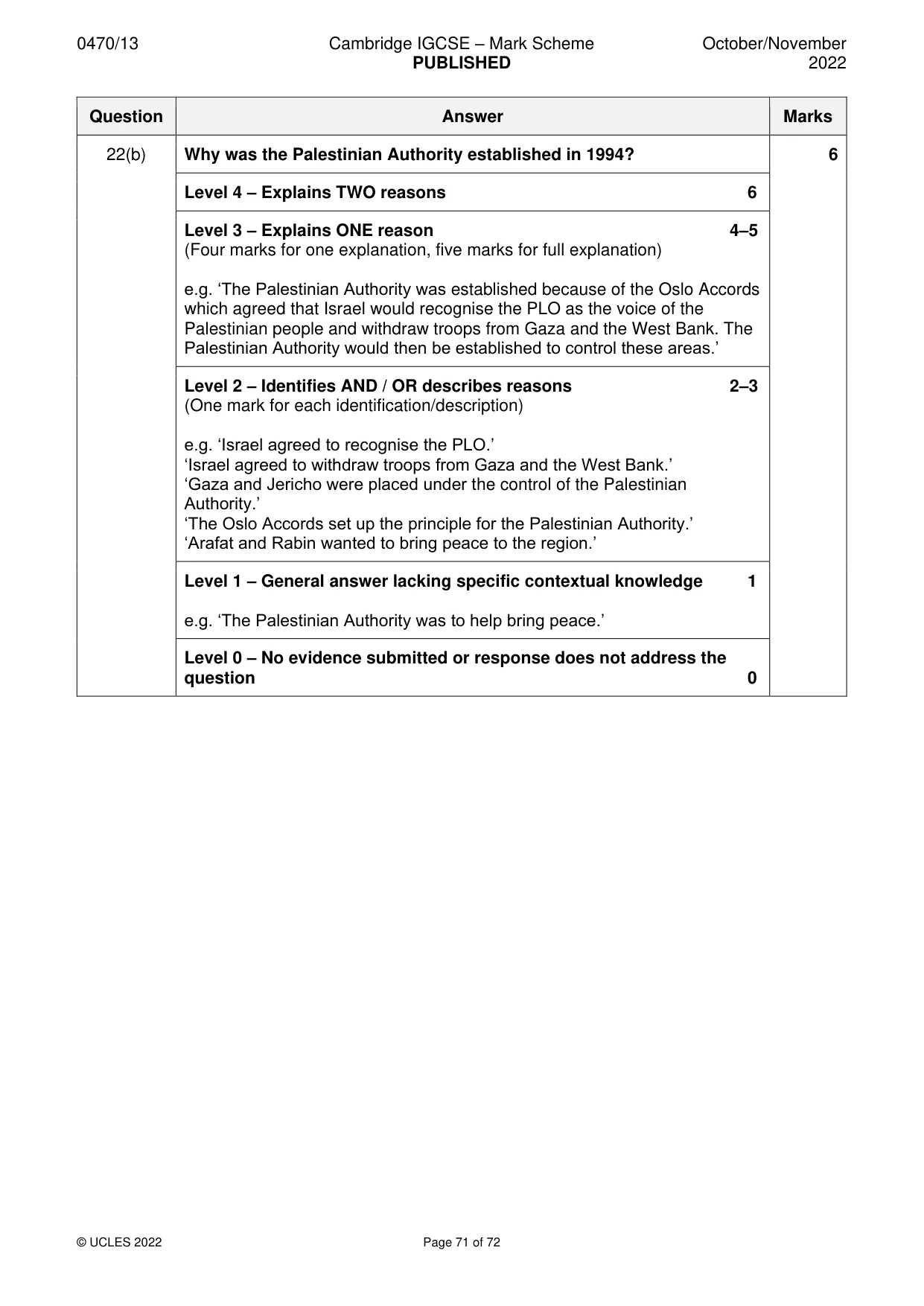
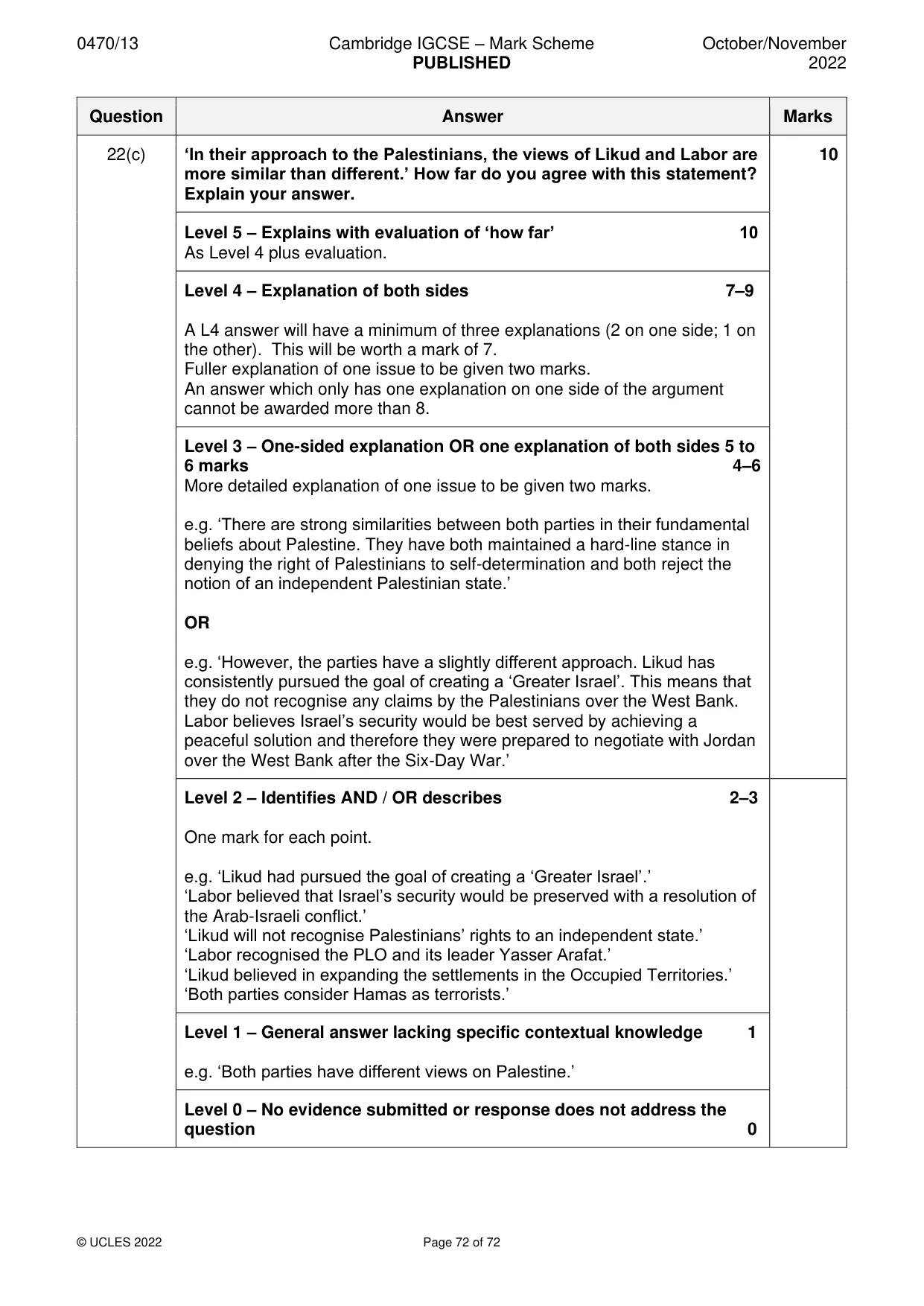
10 0470/13/O/N/22 © UCLES 2022 DEPTH STUDY G: ISRAELIS AND PALESTINIANS SINCE 1945 21 There was much disagreement over Palestine in the 1940s. (a) Describe the activities of Irgun. [4] (b) Why did the Jews expect to be granted a homeland by 1945? [6] (c) ‘The United Nations Partition Plan was the main cause of the 1948–49 war in Palestine.’ How far do you agree with this statement? Explain your answer. [10] 22 Differences exist between groups on both sides of the conflict in the Middle East. (a) Describe the differences in aims of the Palestine Liberation Organisation (PLO) and Hamas. [4] (b) Why was the Palestinian Authority established in 1994? [6] (c) ‘In their approach to the Palestinians, the views of Likud and Labor are more similar than different.’ How far do you agree with this statement? Explain your answer. [10]
Question paper, page 11
11 0470/13/O/N/22 © UCLES 2022 BLANK PAGE
Question paper, page 12
12 0470/13/O/N/22 © UCLES 2022 Permission to reproduce items where third-party owned material protected by copyright is included has been sought and cleared where possible. Every reasonable effort has been made by the publisher (UCLES) to trace copyright holders, but if any items requiring clearance have unwittingly been included, the publisher will be pleased to make amends at the earliest possible opportunity. To avoid the issue of disclosure of answer-related information to candidates, all copyright acknowledgements are reproduced online in the Cambridge Assessment International Education Copyright Acknowledgements Booklet. This is produced for each series of examinations and is freely available to download at www.cambridgeinternational.org after the live examination series. Cambridge Assessment International Education is part of Cambridge Assessment. Cambridge Assessment is the brand name of the University of Cambridge Local Examinations Syndicate (UCLES), which is a department of the University of Cambridge. BLANK PAGE
Mark scheme, page 1
This document consists of 72 printed pages. © UCLES 2022 [Turn over Cambridge IGCSE™ HISTORY 0470/13 Paper 1 October/November 2022 MARK SCHEME Maximum Mark: 60 Published This mark scheme is published as an aid to teachers and candidates, to indicate the requirements of the examination. It shows the basis on which Examiners were instructed to award marks. It does not indicate the details of the discussions that took place at an Examiners’ meeting before marking began, which would have considered the acceptability of alternative answers. Mark schemes should be read in conjunction with the question paper and the Principal Examiner Report for Teachers. Cambridge International will not enter into discussions about these mark schemes. Cambridge International is publishing the mark schemes for the October/November 2022 series for most Cambridge IGCSE™, Cambridge International A and AS Level components and some Cambridge O Level components.
Mark scheme, page 2
0470/13 Cambridge IGCSE – Mark Scheme PUBLISHED October/November 2022 © UCLES 2022 Page 2 of 72 Generic Marking Principles These general marking principles must be applied by all examiners when marking candidate answers. They should be applied alongside the specific content of the mark scheme or generic level descriptors for a question. Each question paper and mark scheme will also comply with these marking principles. GENERIC MARKING PRINCIPLE 1: Marks must be awarded in line with: • the specific content of the mark scheme or the generic level descriptors for the question • the specific skills defined in the mark scheme or in the generic level descriptors for the question • the standard of response required by a candidate as exemplified by the standardisation scripts. GENERIC MARKING PRINCIPLE 2: Marks awarded are always whole marks (not half marks, or other fractions). GENERIC MARKING PRINCIPLE 3: Marks must be awarded positively: • marks are awarded for correct/valid answers, as defined in the mark scheme. However, credit is given for valid answers which go beyond the scope of the syllabus and mark scheme, referring to your Team Leader as appropriate • marks are awarded when candidates clearly demonstrate what they know and can do • marks are not deducted for errors • marks are not deducted for omissions • answers should only be judged on the quality of spelling, punctuation and grammar when these features are specifically assessed by the question as indicated by the mark scheme. The meaning, however, should be unambiguous. GENERIC MARKING PRINCIPLE 4: Rules must be applied consistently, e.g. in situations where candidates have not followed instructions or in the application of generic level descriptors. GENERIC MARKING PRINCIPLE 5: Marks should be awarded using the full range of marks defined in the mark scheme for the question (however; the use of the full mark range may be limited according to the quality of the candidate responses seen). GENERIC MARKING PRINCIPLE 6: Marks awarded are based solely on the requirements as defined in the mark scheme. Marks should not be awarded with grade thresholds or grade descriptors in mind.
Mark scheme, page 3
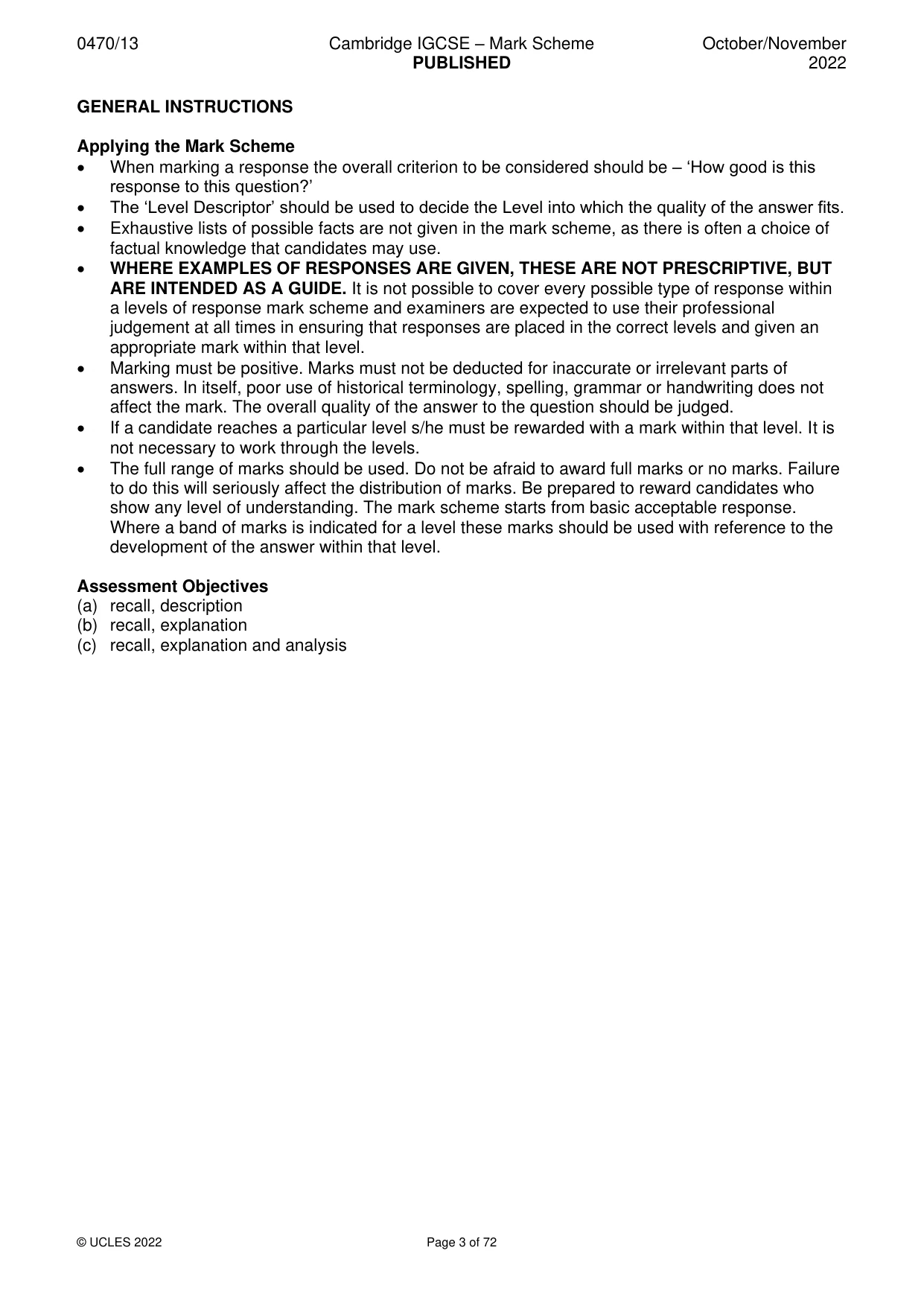
0470/13 Cambridge IGCSE – Mark Scheme PUBLISHED October/November 2022 © UCLES 2022 Page 3 of 72 GENERAL INSTRUCTIONS Applying the Mark Scheme • When marking a response the overall criterion to be considered should be – ‘How good is this response to this question?’ • The ‘Level Descriptor’ should be used to decide the Level into which the quality of the answer fits. • Exhaustive lists of possible facts are not given in the mark scheme, as there is often a choice of factual knowledge that candidates may use. • WHERE EXAMPLES OF RESPONSES ARE GIVEN, THESE ARE NOT PRESCRIPTIVE, BUT ARE INTENDED AS A GUIDE. It is not possible to cover every possible type of response within a levels of response mark scheme and examiners are expected to use their professional judgement at all times in ensuring that responses are placed in the correct levels and given an appropriate mark within that level. • Marking must be positive. Marks must not be deducted for inaccurate or irrelevant parts of answers. In itself, poor use of historical terminology, spelling, grammar or handwriting does not affect the mark. The overall quality of the answer to the question should be judged. • If a candidate reaches a particular level s/he must be rewarded with a mark within that level. It is not necessary to work through the levels. • The full range of marks should be used. Do not be afraid to award full marks or no marks. Failure to do this will seriously affect the distribution of marks. Be prepared to reward candidates who show any level of understanding. The mark scheme starts from basic acceptable response. Where a band of marks is indicated for a level these marks should be used with reference to the development of the answer within that level. Assessment Objectives (a) recall, description (b) recall, explanation (c) recall, explanation and analysis
Mark scheme, page 4
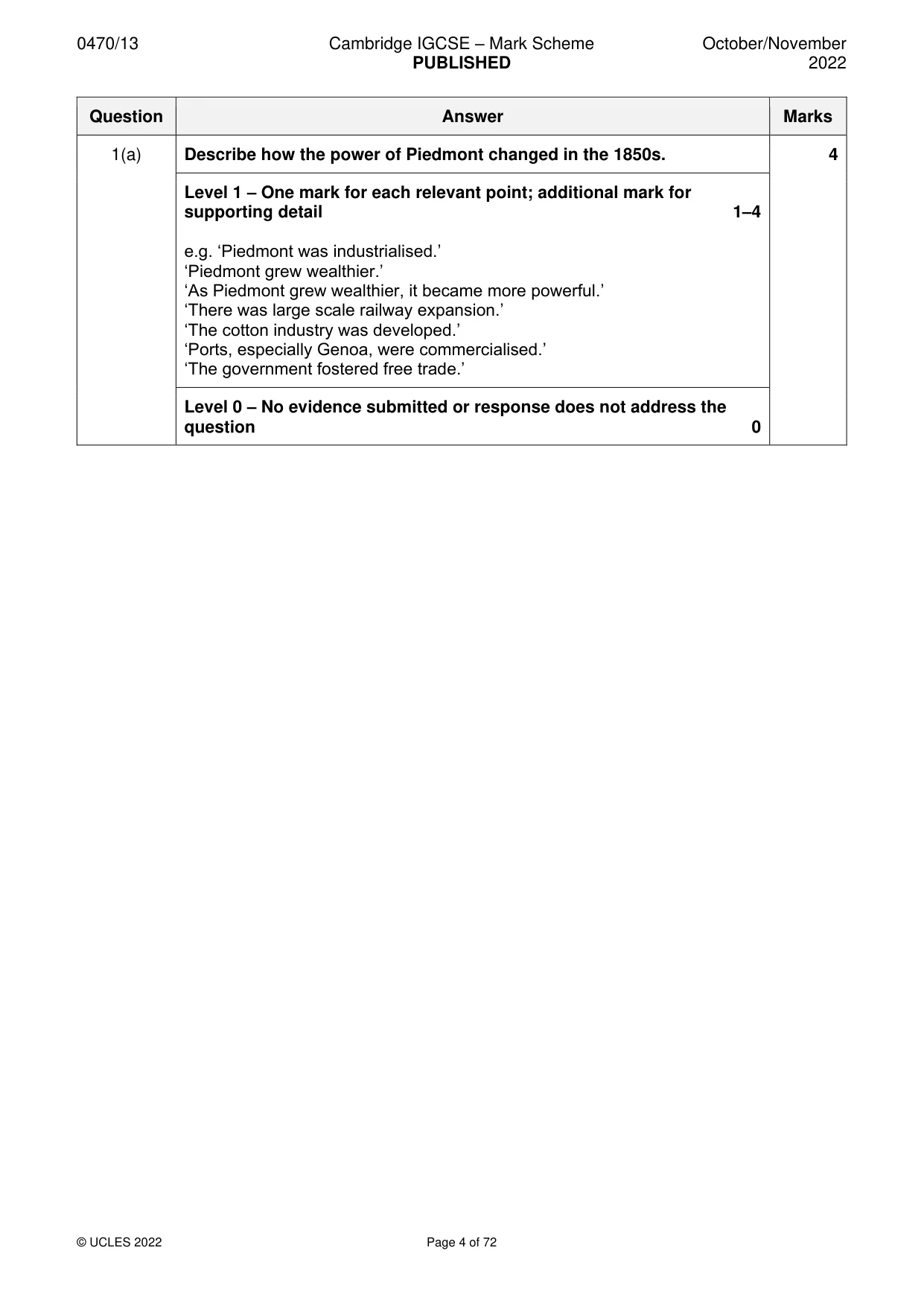
0470/13 Cambridge IGCSE – Mark Scheme PUBLISHED October/November 2022 © UCLES 2022 Page 4 of 72 Question Answer Marks 1(a) Describe how the power of Piedmont changed in the 1850s. 4 Level 1 – One mark for each relevant point; additional mark for supporting detail 1–4 e.g. ‘Piedmont was industrialised.’ ‘Piedmont grew wealthier.’ ‘As Piedmont grew wealthier, it became more powerful.’ ‘There was large scale railway expansion.’ ‘The cotton industry was developed.’ ‘Ports, especially Genoa, were commercialised.’ ‘The government fostered free trade.’ Level 0 – No evidence submitted or response does not address the question 0
Mark scheme, page 5
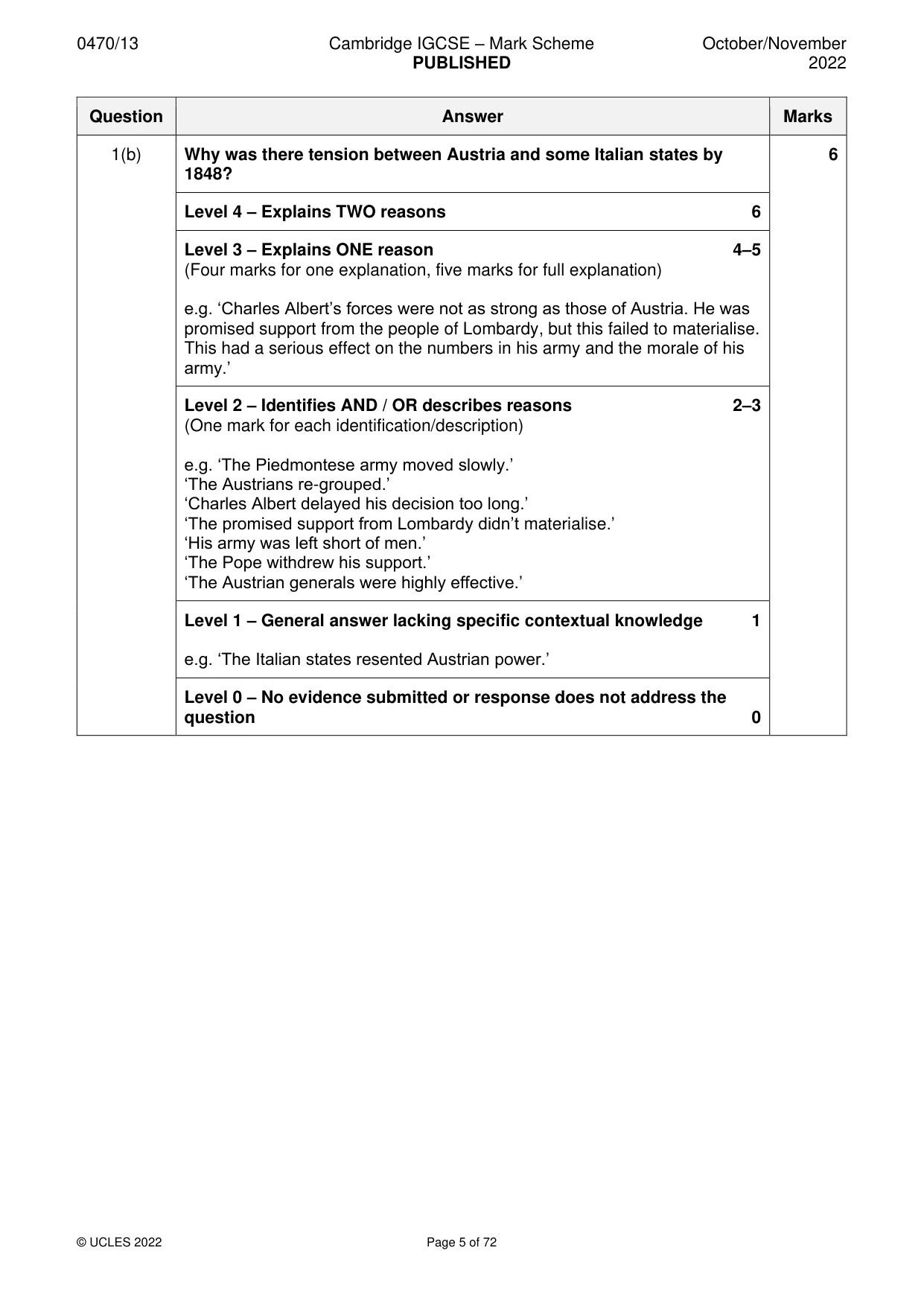
0470/13 Cambridge IGCSE – Mark Scheme PUBLISHED October/November 2022 © UCLES 2022 Page 5 of 72 Question Answer Marks 1(b) Why was there tension between Austria and some Italian states by 1848? 6 Level 4 – Explains TWO reasons 6 Level 3 – Explains ONE reason 4–5 (Four marks for one explanation, five marks for full explanation) e.g. ‘Charles Albert’s forces were not as strong as those of Austria. He was promised support from the people of Lombardy, but this failed to materialise. This had a serious effect on the numbers in his army and the morale of his army.’ Level 2 – Identifies AND / OR describes reasons 2–3 (One mark for each identification/description) e.g. ‘The Piedmontese army moved slowly.’ ‘The Austrians re-grouped.’ ‘Charles Albert delayed his decision too long.’ ‘The promised support from Lombardy didn’t materialise.’ ‘His army was left short of men.’ ‘The Pope withdrew his support.’ ‘The Austrian generals were highly effective.’ Level 1 – General answer lacking specific contextual knowledge 1 e.g. ‘The Italian states resented Austrian power.’ Level 0 – No evidence submitted or response does not address the question 0
Mark scheme, page 6
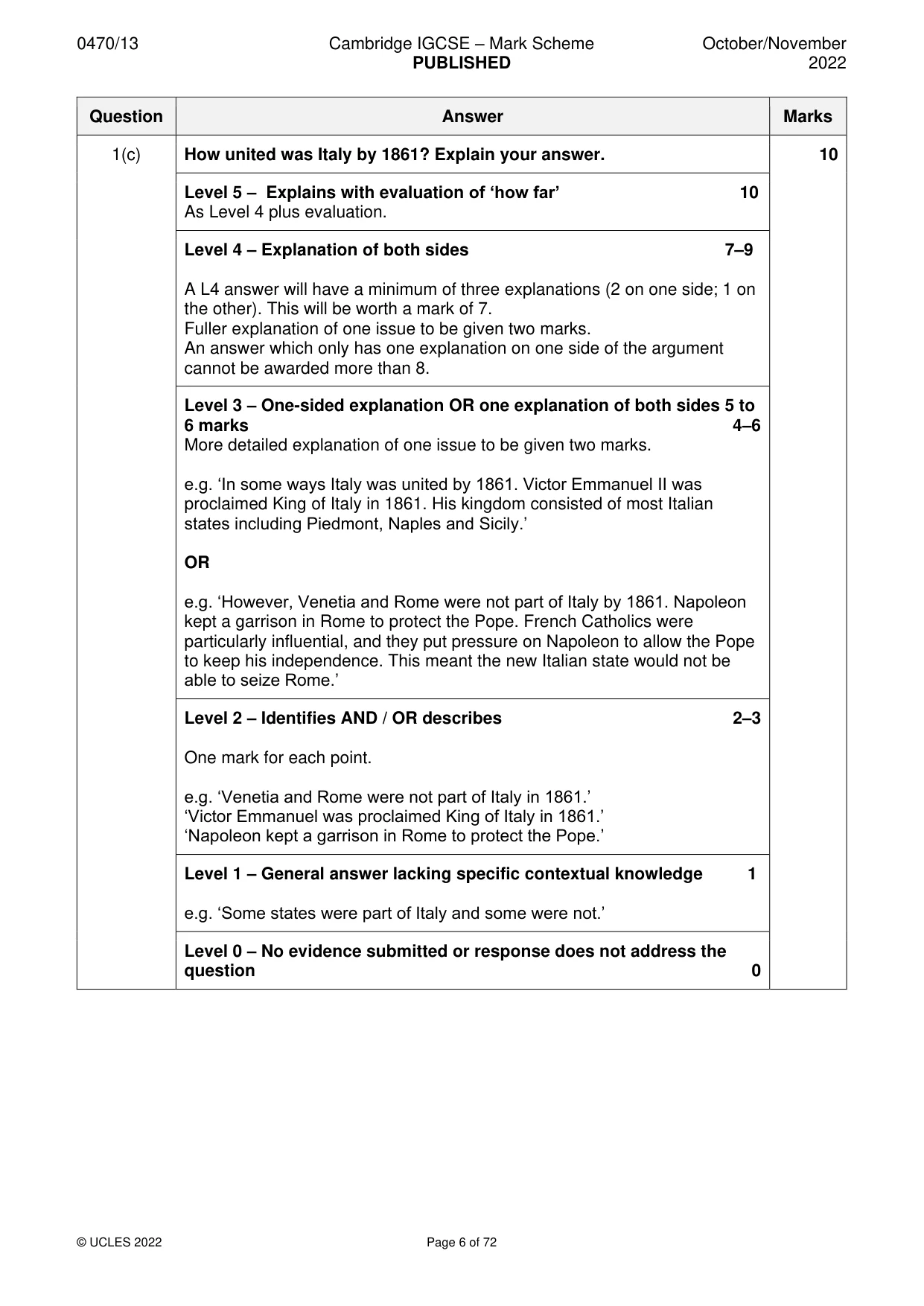
0470/13 Cambridge IGCSE – Mark Scheme PUBLISHED October/November 2022 © UCLES 2022 Page 6 of 72 Question Answer Marks 1(c) How united was Italy by 1861? Explain your answer. 10 Level 5 – Explains with evaluation of ‘how far’ 10 As Level 4 plus evaluation. Level 4 – Explanation of both sides 7–9 A L4 answer will have a minimum of three explanations (2 on one side; 1 on the other). This will be worth a mark of 7. Fuller explanation of one issue to be given two marks. An answer which only has one explanation on one side of the argument cannot be awarded more than 8. Level 3 – One-sided explanation OR one explanation of both sides 5 to 6 marks 4–6 More detailed explanation of one issue to be given two marks. e.g. ‘In some ways Italy was united by 1861. Victor Emmanuel II was proclaimed King of Italy in 1861. His kingdom consisted of most Italian states including Piedmont, Naples and Sicily.’ OR e.g. ‘However, Venetia and Rome were not part of Italy by 1861. Napoleon kept a garrison in Rome to protect the Pope. French Catholics were particularly influential, and they put pressure on Napoleon to allow the Pope to keep his independence. This meant the new Italian state would not be able to seize Rome.’ Level 2 – Identifies AND / OR describes 2–3 One mark for each point. e.g. ‘Venetia and Rome were not part of Italy in 1861.’ ‘Victor Emmanuel was proclaimed King of Italy in 1861.’ ‘Napoleon kept a garrison in Rome to protect the Pope.’ Level 1 – General answer lacking specific contextual knowledge 1 e.g. ‘Some states were part of Italy and some were not.’ Level 0 – No evidence submitted or response does not address the question 0
Mark scheme, page 7
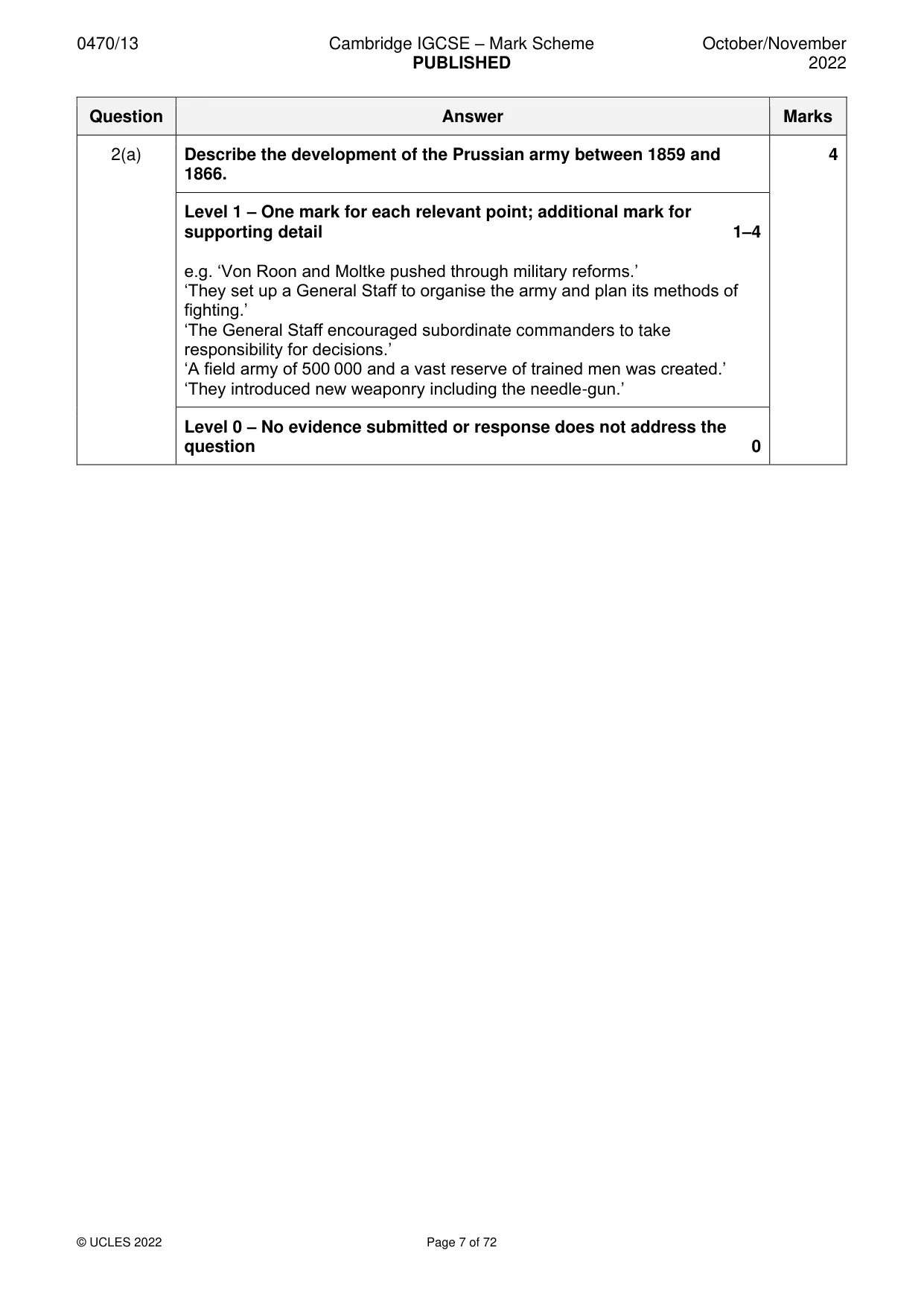
0470/13 Cambridge IGCSE – Mark Scheme PUBLISHED October/November 2022 © UCLES 2022 Page 7 of 72 Question Answer Marks 2(a) Describe the development of the Prussian army between 1859 and 1866. 4 Level 1 – One mark for each relevant point; additional mark for supporting detail 1–4 e.g. ‘Von Roon and Moltke pushed through military reforms.’ ‘They set up a General Staff to organise the army and plan its methods of fighting.’ ‘The General Staff encouraged subordinate commanders to take responsibility for decisions.’ ‘A field army of 500 000 and a vast reserve of trained men was created.’ ‘They introduced new weaponry including the needle-gun.’ Level 0 – No evidence submitted or response does not address the question 0
Mark scheme, page 8
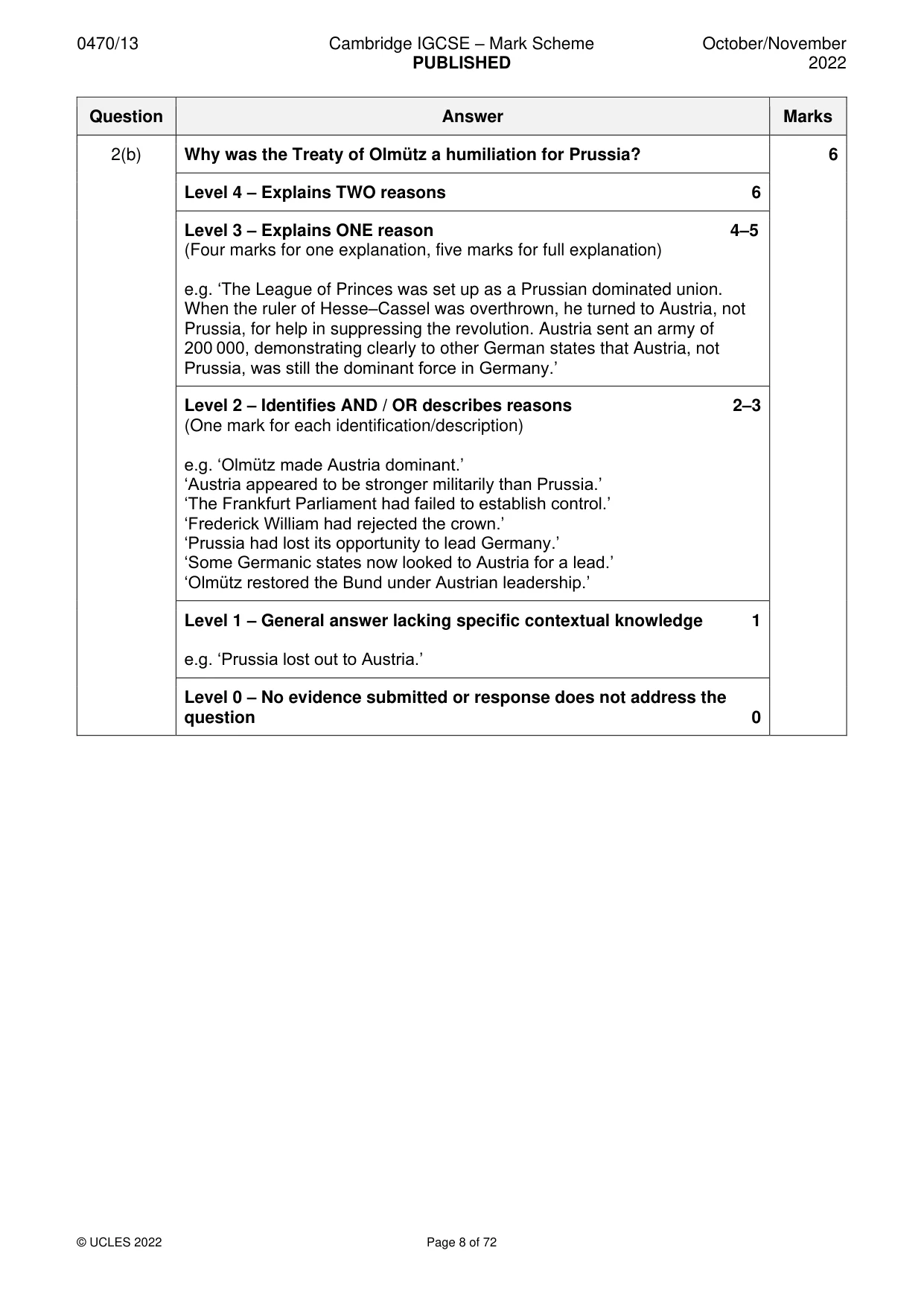
0470/13 Cambridge IGCSE – Mark Scheme PUBLISHED October/November 2022 © UCLES 2022 Page 8 of 72 Question Answer Marks 2(b) Why was the Treaty of Olmütz a humiliation for Prussia? 6 Level 4 – Explains TWO reasons 6 Level 3 – Explains ONE reason 4–5 (Four marks for one explanation, five marks for full explanation) e.g. ‘The League of Princes was set up as a Prussian dominated union. When the ruler of Hesse–Cassel was overthrown, he turned to Austria, not Prussia, for help in suppressing the revolution. Austria sent an army of 200 000, demonstrating clearly to other German states that Austria, not Prussia, was still the dominant force in Germany.’ Level 2 – Identifies AND / OR describes reasons 2–3 (One mark for each identification/description) e.g. ‘Olmütz made Austria dominant.’ ‘Austria appeared to be stronger militarily than Prussia.’ ‘The Frankfurt Parliament had failed to establish control.’ ‘Frederick William had rejected the crown.’ ‘Prussia had lost its opportunity to lead Germany.’ ‘Some Germanic states now looked to Austria for a lead.’ ‘Olmütz restored the Bund under Austrian leadership.’ Level 1 – General answer lacking specific contextual knowledge 1 e.g. ‘Prussia lost out to Austria.’ Level 0 – No evidence submitted or response does not address the question 0
Mark scheme, page 9
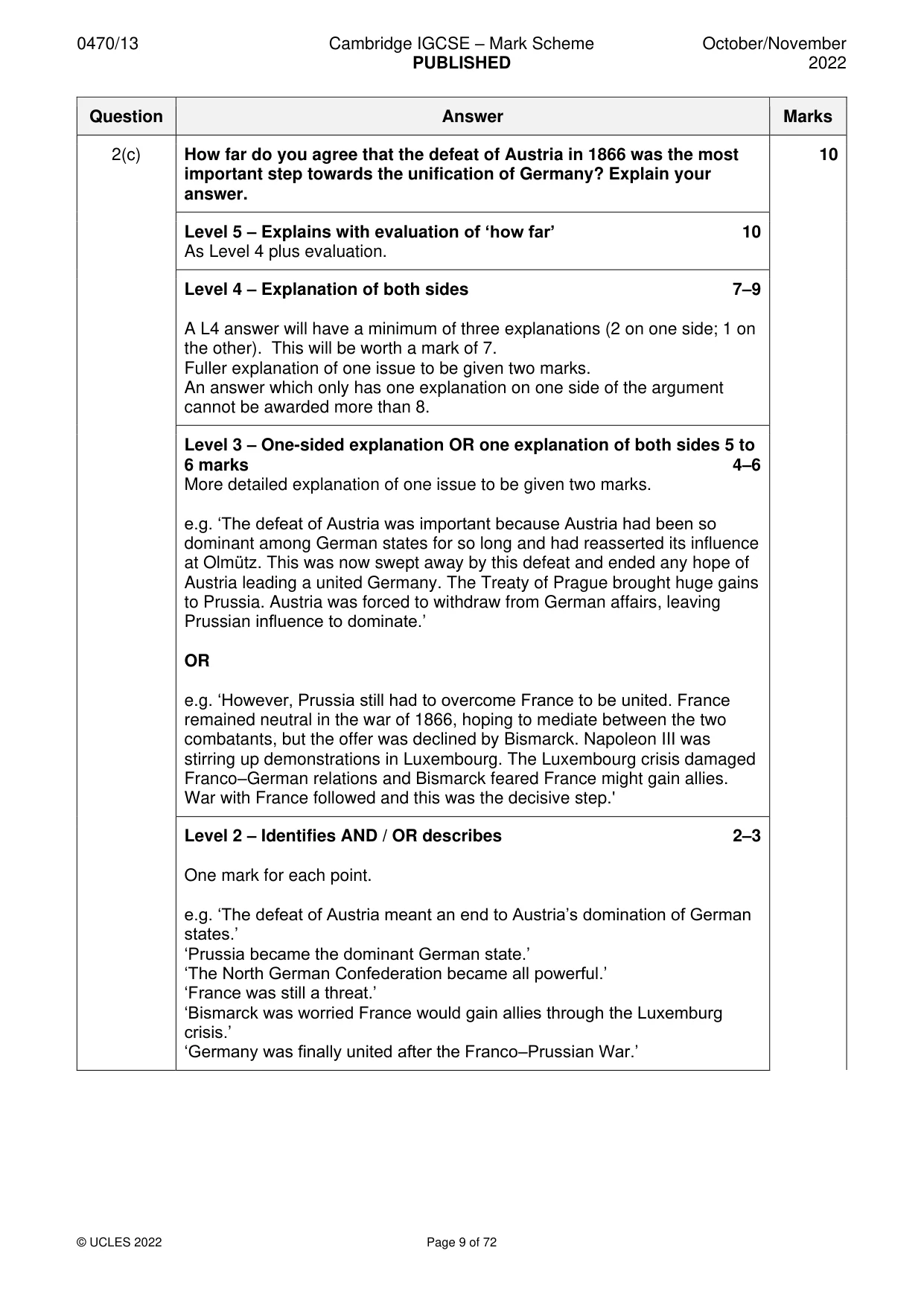
0470/13 Cambridge IGCSE – Mark Scheme PUBLISHED October/November 2022 © UCLES 2022 Page 9 of 72 Question Answer Marks 2(c) How far do you agree that the defeat of Austria in 1866 was the most important step towards the unification of Germany? Explain your answer. 10 Level 5 – Explains with evaluation of ‘how far’ 10 As Level 4 plus evaluation. Level 4 – Explanation of both sides 7–9 A L4 answer will have a minimum of three explanations (2 on one side; 1 on the other). This will be worth a mark of 7. Fuller explanation of one issue to be given two marks. An answer which only has one explanation on one side of the argument cannot be awarded more than 8. Level 3 – One-sided explanation OR one explanation of both sides 5 to 6 marks 4–6 More detailed explanation of one issue to be given two marks. e.g. ‘The defeat of Austria was important because Austria had been so dominant among German states for so long and had reasserted its influence at Olmütz. This was now swept away by this defeat and ended any hope of Austria leading a united Germany. The Treaty of Prague brought huge gains to Prussia. Austria was forced to withdraw from German affairs, leaving Prussian influence to dominate.’ OR e.g. ‘However, Prussia still had to overcome France to be united. France remained neutral in the war of 1866, hoping to mediate between the two combatants, but the offer was declined by Bismarck. Napoleon III was stirring up demonstrations in Luxembourg. The Luxembourg crisis damaged Franco–German relations and Bismarck feared France might gain allies. War with France followed and this was the decisive step.' Level 2 – Identifies AND / OR describes 2–3 One mark for each point. e.g. ‘The defeat of Austria meant an end to Austria’s domination of German states.’ ‘Prussia became the dominant German state.’ ‘The North German Confederation became all powerful.’ ‘France was still a threat.’ ‘Bismarck was worried France would gain allies through the Luxemburg crisis.’ ‘Germany was finally united after the Franco–Prussian War.’
Mark scheme, page 10
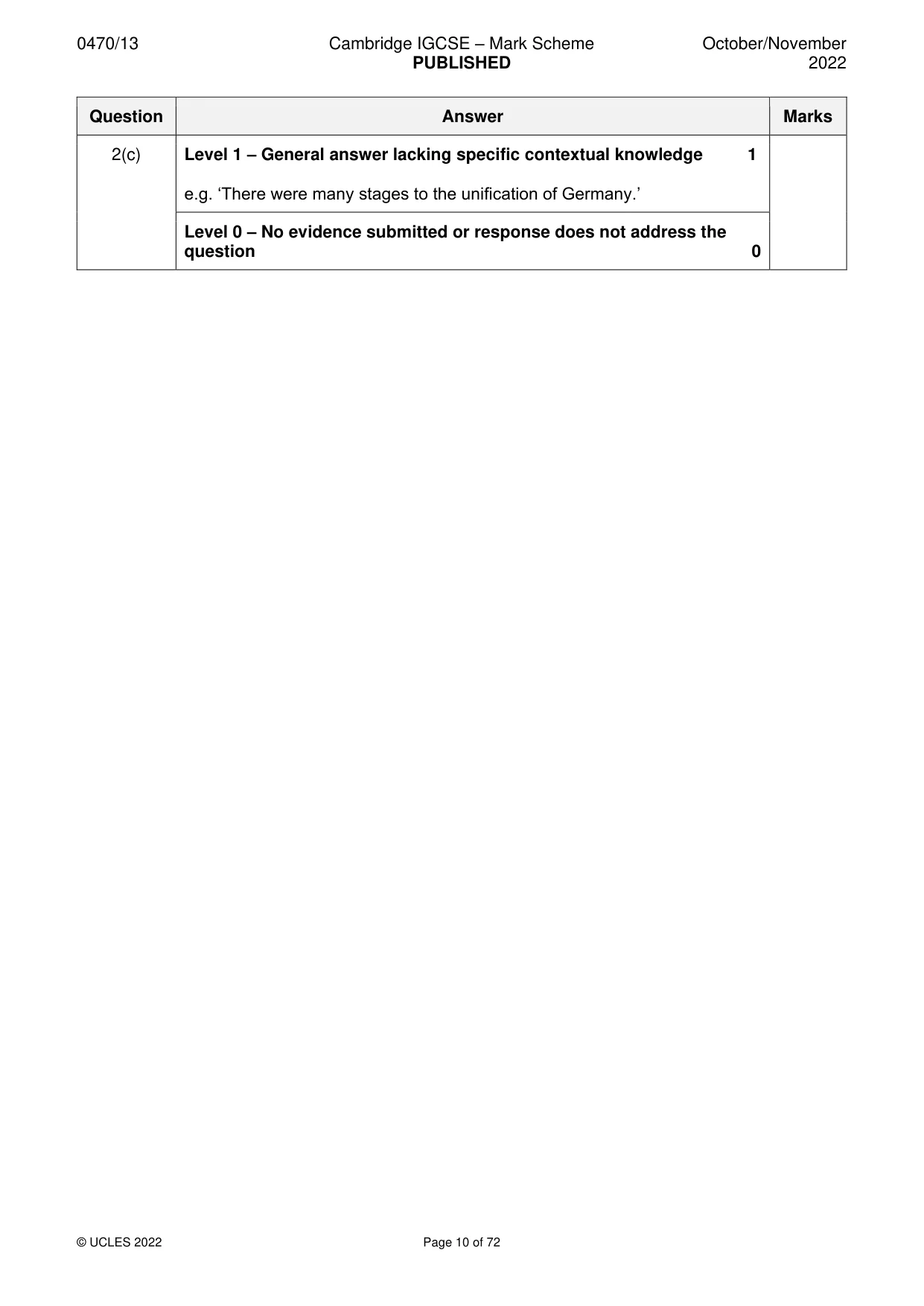
0470/13 Cambridge IGCSE – Mark Scheme PUBLISHED October/November 2022 © UCLES 2022 Page 10 of 72 Question Answer Marks 2(c) Level 1 – General answer lacking specific contextual knowledge 1 e.g. ‘There were many stages to the unification of Germany.’ Level 0 – No evidence submitted or response does not address the question 0
Mark scheme, page 11
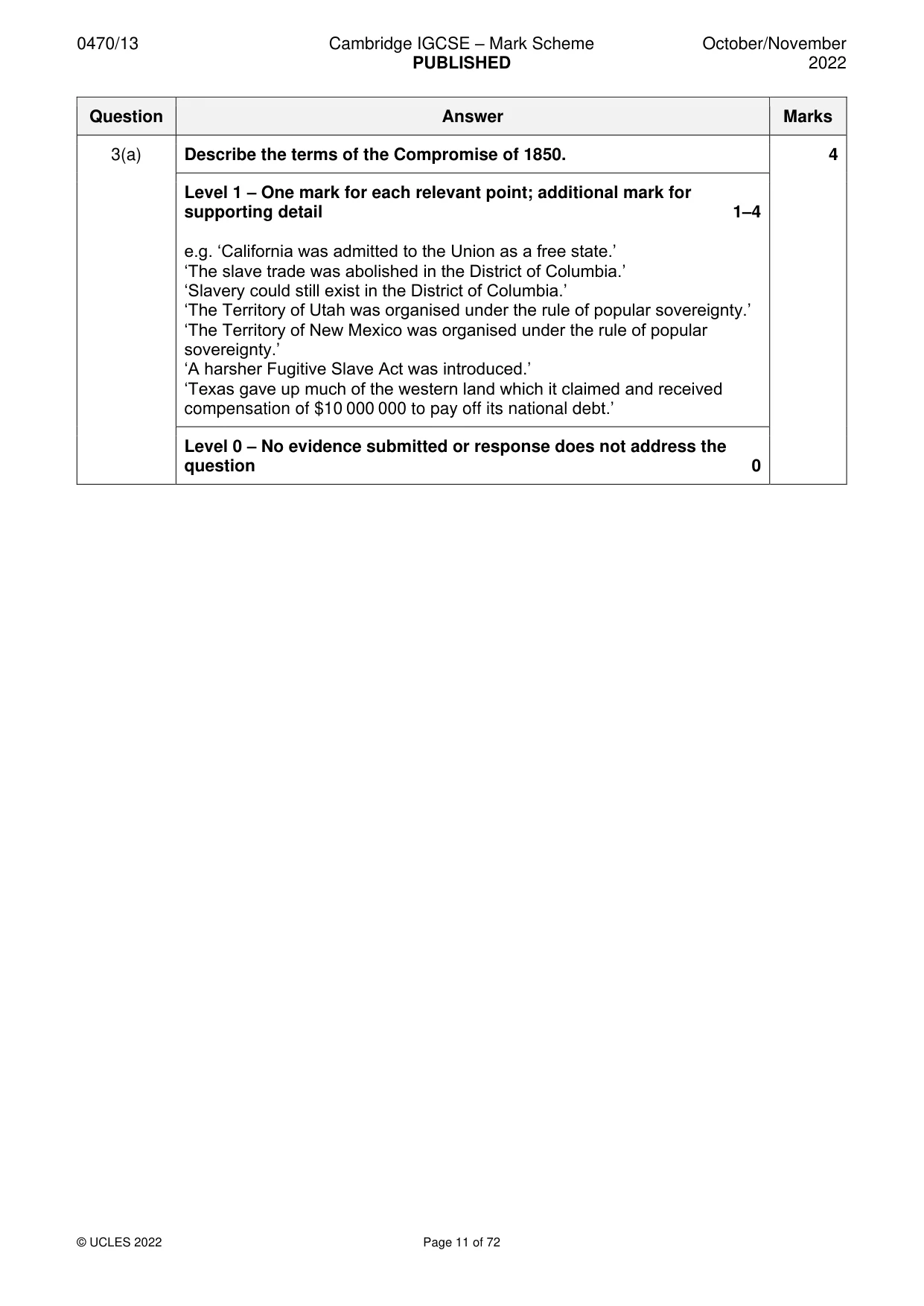
0470/13 Cambridge IGCSE – Mark Scheme PUBLISHED October/November 2022 © UCLES 2022 Page 11 of 72 Question Answer Marks 3(a) Describe the terms of the Compromise of 1850. 4 Level 1 – One mark for each relevant point; additional mark for supporting detail 1–4 e.g. ‘California was admitted to the Union as a free state.’ ‘The slave trade was abolished in the District of Columbia.’ ‘Slavery could still exist in the District of Columbia.’ ‘The Territory of Utah was organised under the rule of popular sovereignty.’ ‘The Territory of New Mexico was organised under the rule of popular sovereignty.’ ‘A harsher Fugitive Slave Act was introduced.’ ‘Texas gave up much of the western land which it claimed and received compensation of $10 000 000 to pay off its national debt.’ Level 0 – No evidence submitted or response does not address the question 0
Mark scheme, page 12
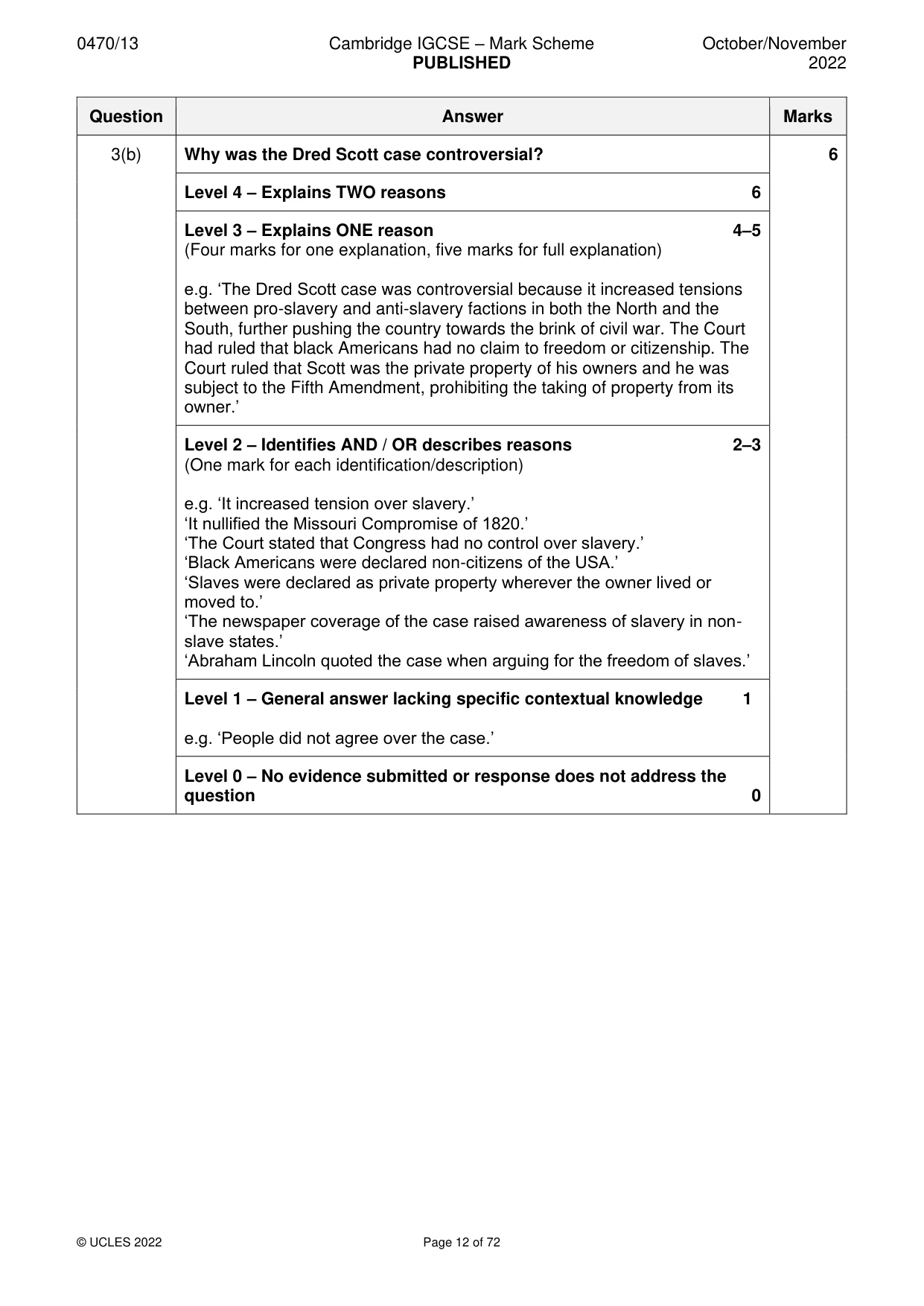
0470/13 Cambridge IGCSE – Mark Scheme PUBLISHED October/November 2022 © UCLES 2022 Page 12 of 72 Question Answer Marks 3(b) Why was the Dred Scott case controversial? 6 Level 4 – Explains TWO reasons 6 Level 3 – Explains ONE reason 4–5 (Four marks for one explanation, five marks for full explanation) e.g. ‘The Dred Scott case was controversial because it increased tensions between pro-slavery and anti-slavery factions in both the North and the South, further pushing the country towards the brink of civil war. The Court had ruled that black Americans had no claim to freedom or citizenship. The Court ruled that Scott was the private property of his owners and he was subject to the Fifth Amendment, prohibiting the taking of property from its owner.’ Level 2 – Identifies AND / OR describes reasons 2–3 (One mark for each identification/description) e.g. ‘It increased tension over slavery.’ ‘It nullified the Missouri Compromise of 1820.’ ‘The Court stated that Congress had no control over slavery.’ ‘Black Americans were declared non-citizens of the USA.’ ‘Slaves were declared as private property wherever the owner lived or moved to.’ ‘The newspaper coverage of the case raised awareness of slavery in non- slave states.’ ‘Abraham Lincoln quoted the case when arguing for the freedom of slaves.’ Level 1 – General answer lacking specific contextual knowledge 1 e.g. ‘People did not agree over the case.’ Level 0 – No evidence submitted or response does not address the question 0
Mark scheme, page 13
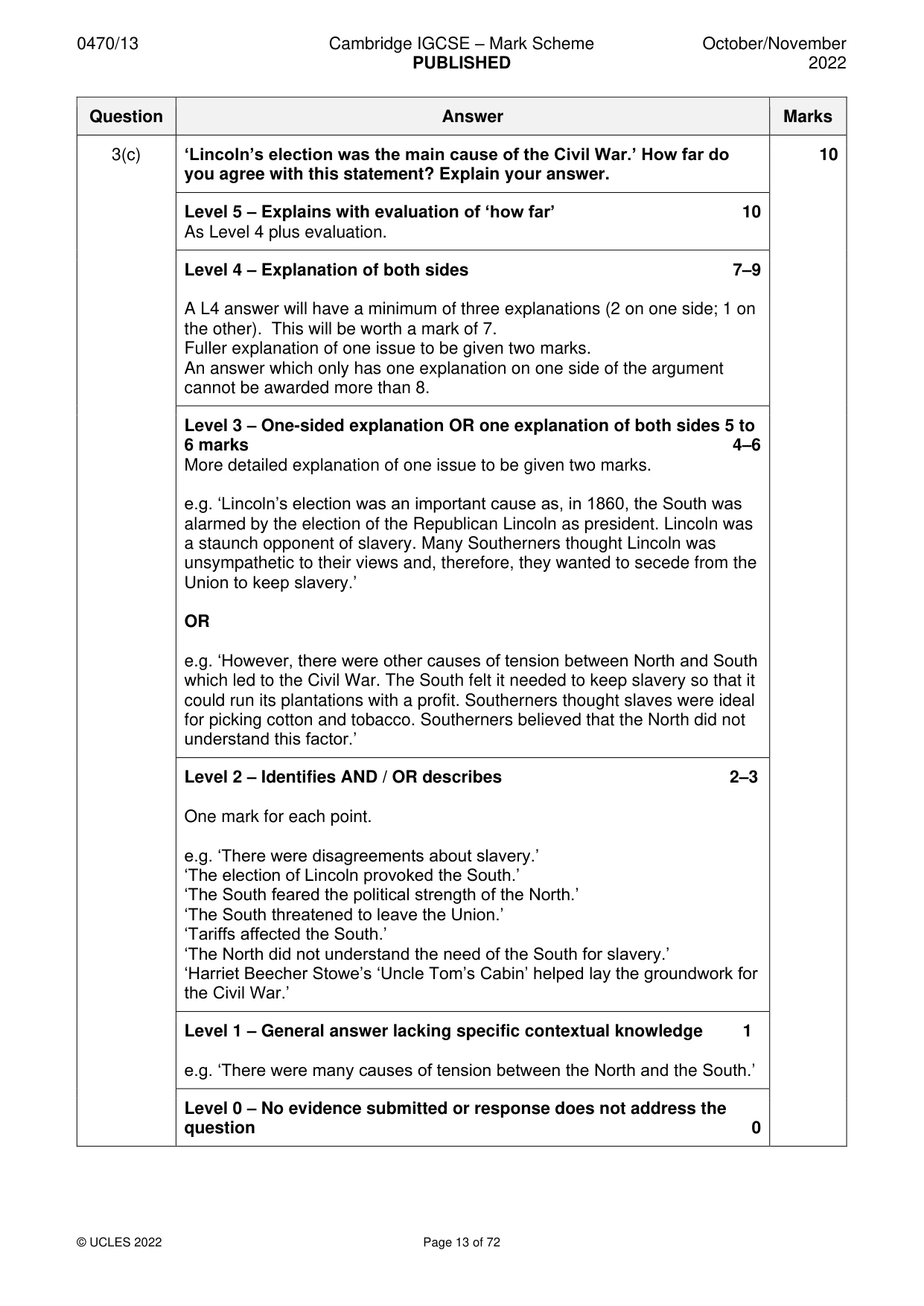
0470/13 Cambridge IGCSE – Mark Scheme PUBLISHED October/November 2022 © UCLES 2022 Page 13 of 72 Question Answer Marks 3(c) ‘Lincoln’s election was the main cause of the Civil War.’ How far do you agree with this statement? Explain your answer. 10 Level 5 – Explains with evaluation of ‘how far’ 10 As Level 4 plus evaluation. Level 4 – Explanation of both sides 7–9 A L4 answer will have a minimum of three explanations (2 on one side; 1 on the other). This will be worth a mark of 7. Fuller explanation of one issue to be given two marks. An answer which only has one explanation on one side of the argument cannot be awarded more than 8. Level 3 – One-sided explanation OR one explanation of both sides 5 to 6 marks 4–6 More detailed explanation of one issue to be given two marks. e.g. ‘Lincoln’s election was an important cause as, in 1860, the South was alarmed by the election of the Republican Lincoln as president. Lincoln was a staunch opponent of slavery. Many Southerners thought Lincoln was unsympathetic to their views and, therefore, they wanted to secede from the Union to keep slavery.’ OR e.g. ‘However, there were other causes of tension between North and South which led to the Civil War. The South felt it needed to keep slavery so that it could run its plantations with a profit. Southerners thought slaves were ideal for picking cotton and tobacco. Southerners believed that the North did not understand this factor.’ Level 2 – Identifies AND / OR describes 2–3 One mark for each point. e.g. ‘There were disagreements about slavery.’ ‘The election of Lincoln provoked the South.’ ‘The South feared the political strength of the North.’ ‘The South threatened to leave the Union.’ ‘Tariffs affected the South.’ ‘The North did not understand the need of the South for slavery.’ ‘Harriet Beecher Stowe’s ‘Uncle Tom’s Cabin’ helped lay the groundwork for the Civil War.’ Level 1 – General answer lacking specific contextual knowledge 1 e.g. ‘There were many causes of tension between the North and the South.’ Level 0 – No evidence submitted or response does not address the question 0
Mark scheme, page 14
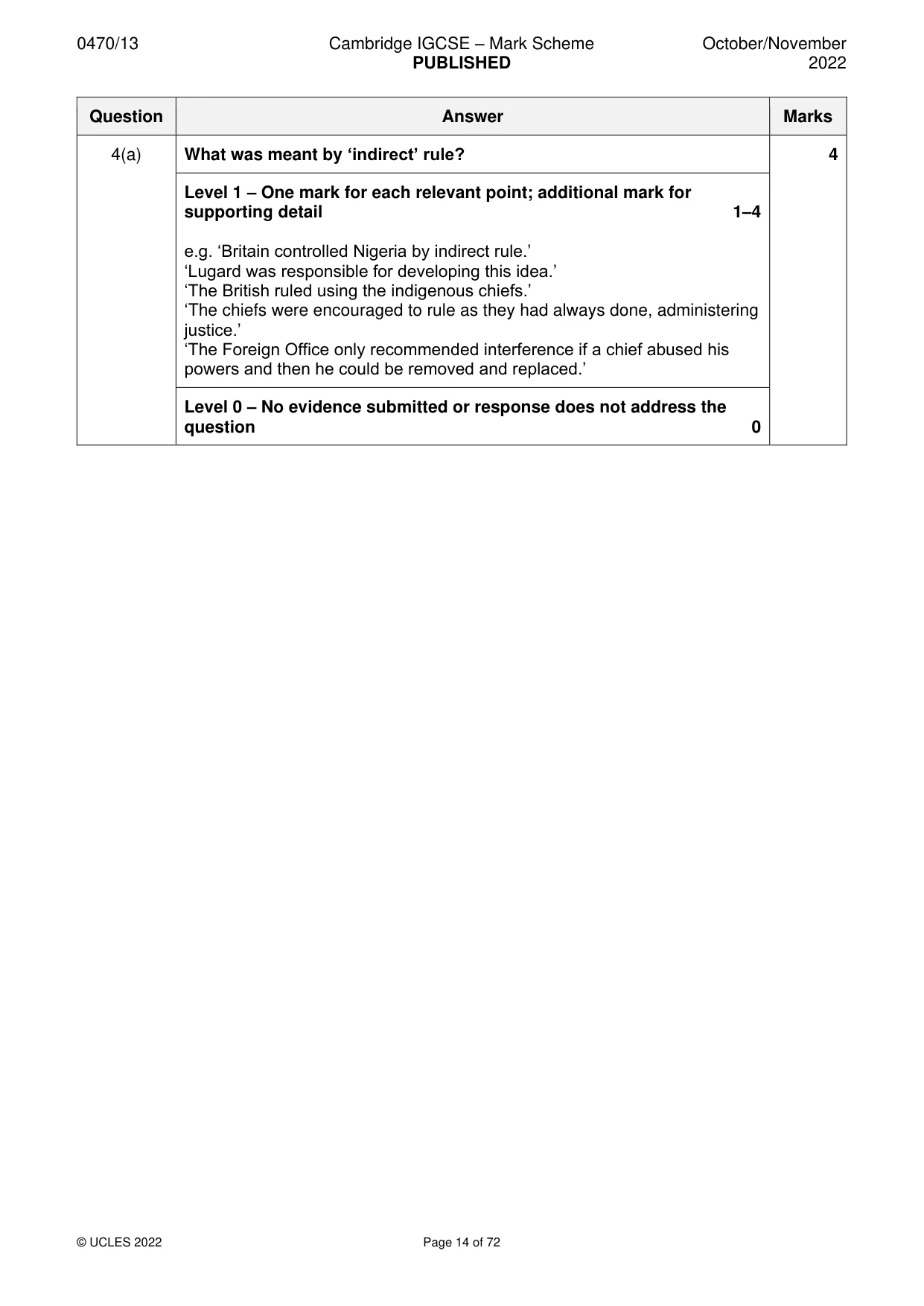
0470/13 Cambridge IGCSE – Mark Scheme PUBLISHED October/November 2022 © UCLES 2022 Page 14 of 72 Question Answer Marks 4(a) What was meant by ‘indirect’ rule? 4 Level 1 – One mark for each relevant point; additional mark for supporting detail 1–4 e.g. ‘Britain controlled Nigeria by indirect rule.’ ‘Lugard was responsible for developing this idea.’ ‘The British ruled using the indigenous chiefs.’ ‘The chiefs were encouraged to rule as they had always done, administering justice.’ ‘The Foreign Office only recommended interference if a chief abused his powers and then he could be removed and replaced.’ Level 0 – No evidence submitted or response does not address the question 0
Mark scheme, page 15
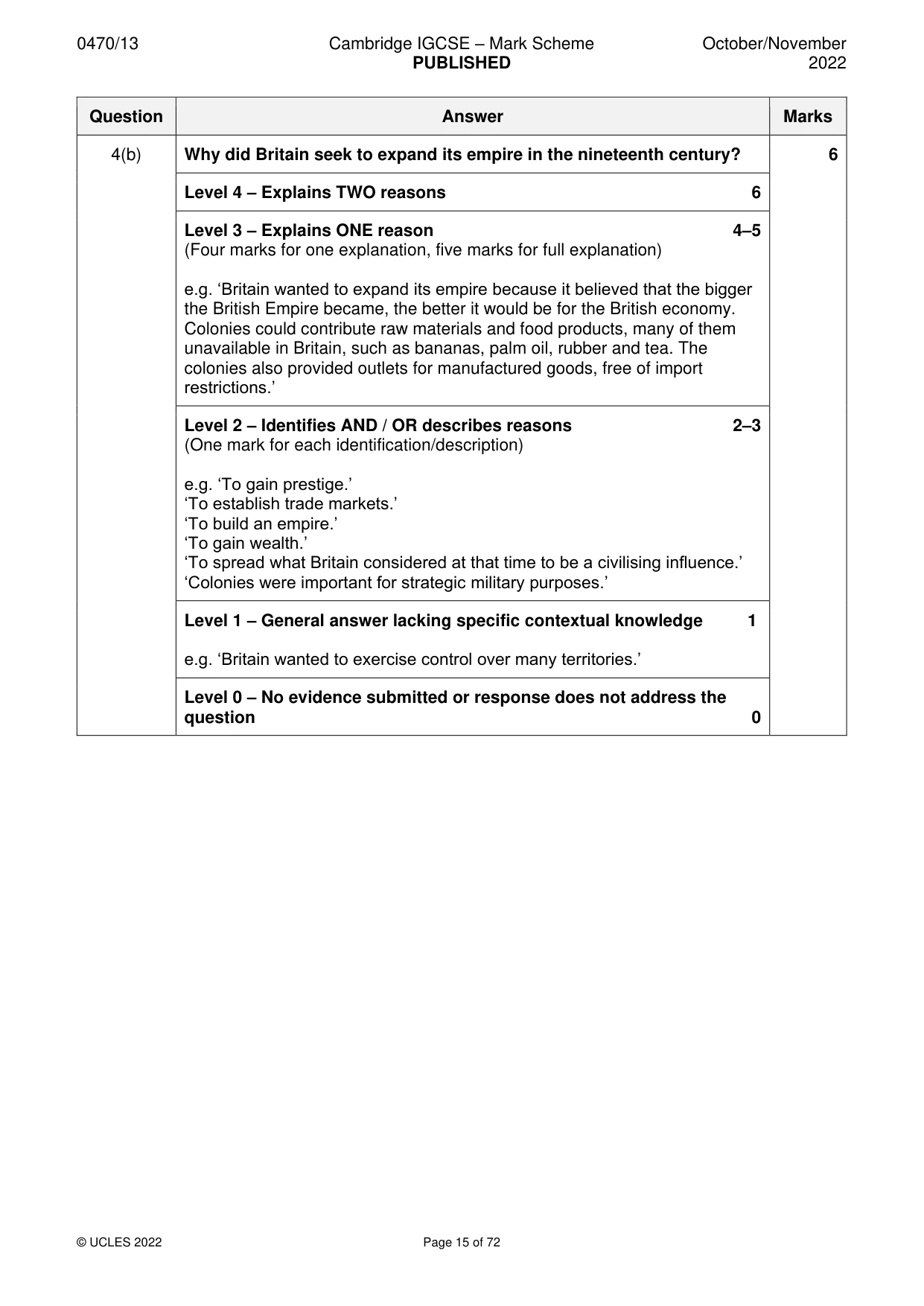
0470/13 Cambridge IGCSE – Mark Scheme PUBLISHED October/November 2022 © UCLES 2022 Page 15 of 72 Question Answer Marks 4(b) Why did Britain seek to expand its empire in the nineteenth century? 6 Level 4 – Explains TWO reasons 6 Level 3 – Explains ONE reason 4–5 (Four marks for one explanation, five marks for full explanation) e.g. ‘Britain wanted to expand its empire because it believed that the bigger the British Empire became, the better it would be for the British economy. Colonies could contribute raw materials and food products, many of them unavailable in Britain, such as bananas, palm oil, rubber and tea. The colonies also provided outlets for manufactured goods, free of import restrictions.’ Level 2 – Identifies AND / OR describes reasons 2–3 (One mark for each identification/description) e.g. ‘To gain prestige.’ ‘To establish trade markets.’ ‘To build an empire.’ ‘To gain wealth.’ ‘To spread what Britain considered at that time to be a civilising influence.’ ‘Colonies were important for strategic military purposes.’ Level 1 – General answer lacking specific contextual knowledge 1 e.g. ‘Britain wanted to exercise control over many territories.’ Level 0 – No evidence submitted or response does not address the question 0
Mark scheme, page 16
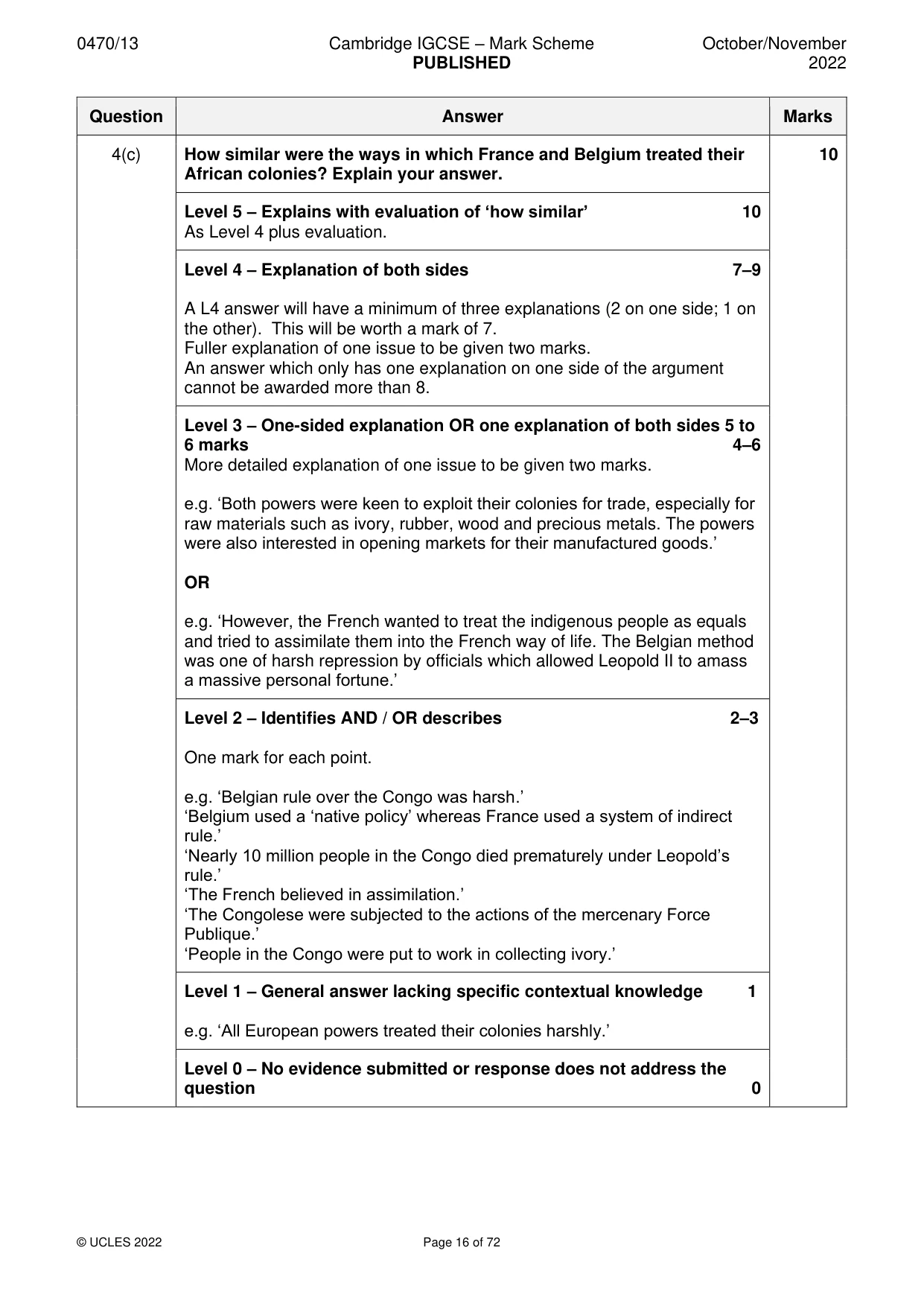
0470/13 Cambridge IGCSE – Mark Scheme PUBLISHED October/November 2022 © UCLES 2022 Page 16 of 72 Question Answer Marks 4(c) How similar were the ways in which France and Belgium treated their African colonies? Explain your answer. 10 Level 5 – Explains with evaluation of ‘how similar’ 10 As Level 4 plus evaluation. Level 4 – Explanation of both sides 7–9 A L4 answer will have a minimum of three explanations (2 on one side; 1 on the other). This will be worth a mark of 7. Fuller explanation of one issue to be given two marks. An answer which only has one explanation on one side of the argument cannot be awarded more than 8. Level 3 – One-sided explanation OR one explanation of both sides 5 to 6 marks 4–6 More detailed explanation of one issue to be given two marks. e.g. ‘Both powers were keen to exploit their colonies for trade, especially for raw materials such as ivory, rubber, wood and precious metals. The powers were also interested in opening markets for their manufactured goods.’ OR e.g. ‘However, the French wanted to treat the indigenous people as equals and tried to assimilate them into the French way of life. The Belgian method was one of harsh repression by officials which allowed Leopold II to amass a massive personal fortune.’ Level 2 – Identifies AND / OR describes 2–3 One mark for each point. e.g. ‘Belgian rule over the Congo was harsh.’ ‘Belgium used a ‘native policy’ whereas France used a system of indirect rule.’ ‘Nearly 10 million people in the Congo died prematurely under Leopold’s rule.’ ‘The French believed in assimilation.’ ‘The Congolese were subjected to the actions of the mercenary Force Publique.’ ‘People in the Congo were put to work in collecting ivory.’ Level 1 – General answer lacking specific contextual knowledge 1 e.g. ‘All European powers treated their colonies harshly.’ Level 0 – No evidence submitted or response does not address the question 0
Mark scheme, page 17
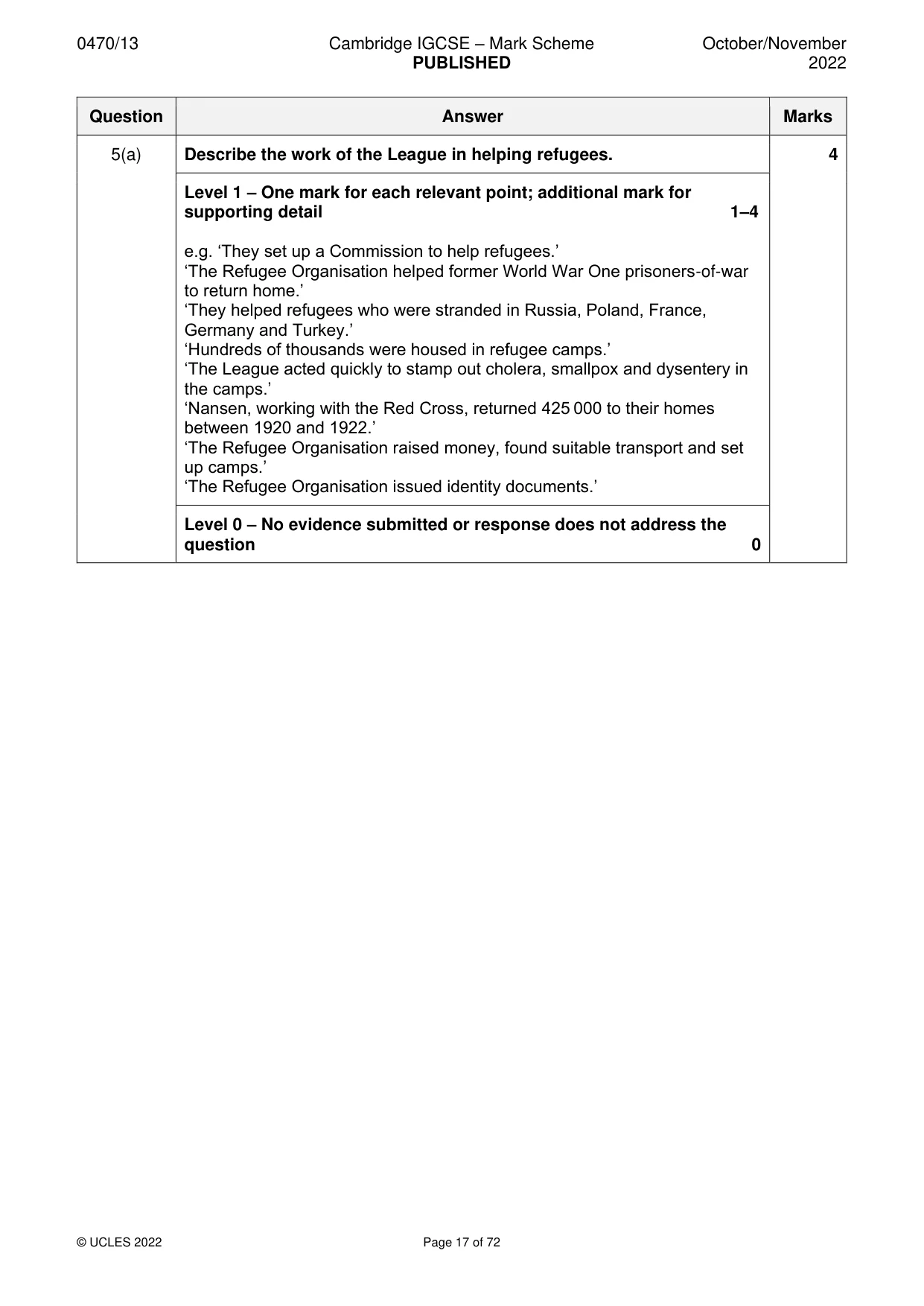
0470/13 Cambridge IGCSE – Mark Scheme PUBLISHED October/November 2022 © UCLES 2022 Page 17 of 72 Question Answer Marks 5(a) Describe the work of the League in helping refugees. 4 Level 1 – One mark for each relevant point; additional mark for supporting detail 1–4 e.g. ‘They set up a Commission to help refugees.’ ‘The Refugee Organisation helped former World War One prisoners-of-war to return home.’ ‘They helped refugees who were stranded in Russia, Poland, France, Germany and Turkey.’ ‘Hundreds of thousands were housed in refugee camps.’ ‘The League acted quickly to stamp out cholera, smallpox and dysentery in the camps.’ ‘Nansen, working with the Red Cross, returned 425 000 to their homes between 1920 and 1922.’ ‘The Refugee Organisation raised money, found suitable transport and set up camps.’ ‘The Refugee Organisation issued identity documents.’ Level 0 – No evidence submitted or response does not address the question 0
Mark scheme, page 18
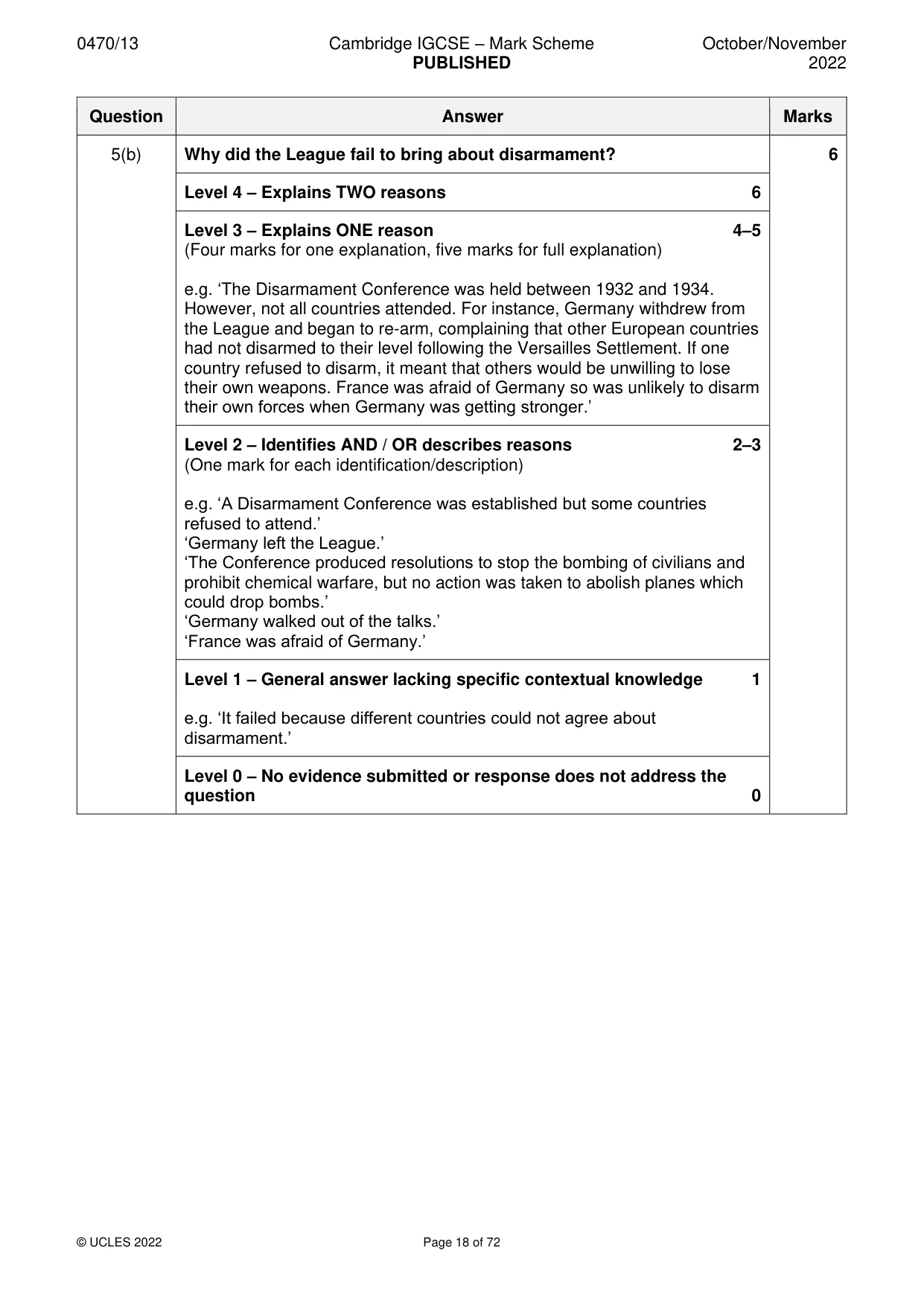
0470/13 Cambridge IGCSE – Mark Scheme PUBLISHED October/November 2022 © UCLES 2022 Page 18 of 72 Question Answer Marks 5(b) Why did the League fail to bring about disarmament? 6 Level 4 – Explains TWO reasons 6 Level 3 – Explains ONE reason 4–5 (Four marks for one explanation, five marks for full explanation) e.g. ‘The Disarmament Conference was held between 1932 and 1934. However, not all countries attended. For instance, Germany withdrew from the League and began to re-arm, complaining that other European countries had not disarmed to their level following the Versailles Settlement. If one country refused to disarm, it meant that others would be unwilling to lose their own weapons. France was afraid of Germany so was unlikely to disarm their own forces when Germany was getting stronger.’ Level 2 – Identifies AND / OR describes reasons 2–3 (One mark for each identification/description) e.g. ‘A Disarmament Conference was established but some countries refused to attend.’ ‘Germany left the League.’ ‘The Conference produced resolutions to stop the bombing of civilians and prohibit chemical warfare, but no action was taken to abolish planes which could drop bombs.’ ‘Germany walked out of the talks.’ ‘France was afraid of Germany.’ Level 1 – General answer lacking specific contextual knowledge 1 e.g. ‘It failed because different countries could not agree about disarmament.’ Level 0 – No evidence submitted or response does not address the question 0
Mark scheme, page 19
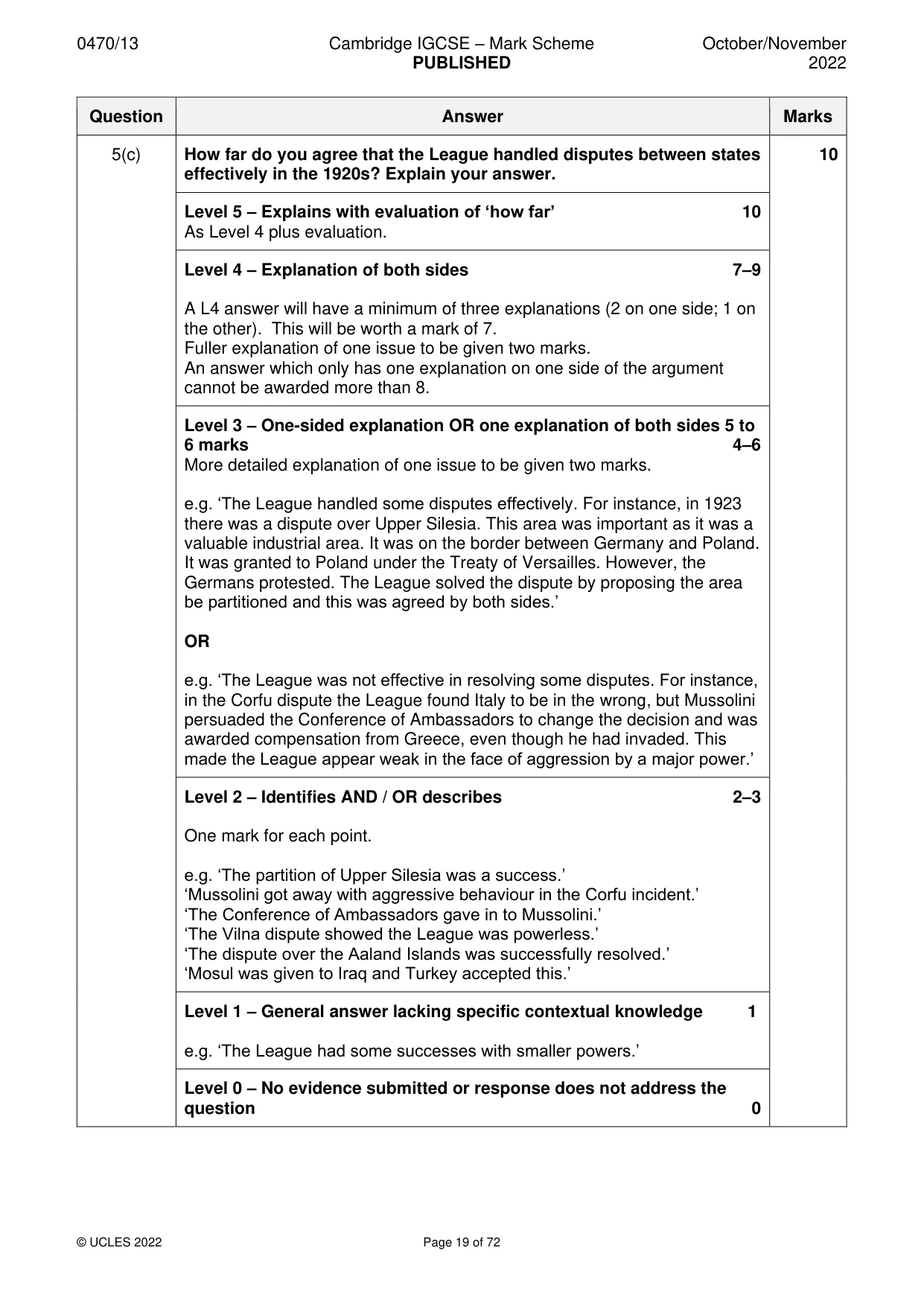
0470/13 Cambridge IGCSE – Mark Scheme PUBLISHED October/November 2022 © UCLES 2022 Page 19 of 72 Question Answer Marks 5(c) How far do you agree that the League handled disputes between states effectively in the 1920s? Explain your answer. 10 Level 5 – Explains with evaluation of ‘how far’ 10 As Level 4 plus evaluation. Level 4 – Explanation of both sides 7–9 A L4 answer will have a minimum of three explanations (2 on one side; 1 on the other). This will be worth a mark of 7. Fuller explanation of one issue to be given two marks. An answer which only has one explanation on one side of the argument cannot be awarded more than 8. Level 3 – One-sided explanation OR one explanation of both sides 5 to 6 marks 4–6 More detailed explanation of one issue to be given two marks. e.g. ‘The League handled some disputes effectively. For instance, in 1923 there was a dispute over Upper Silesia. This area was important as it was a valuable industrial area. It was on the border between Germany and Poland. It was granted to Poland under the Treaty of Versailles. However, the Germans protested. The League solved the dispute by proposing the area be partitioned and this was agreed by both sides.’ OR e.g. ‘The League was not effective in resolving some disputes. For instance, in the Corfu dispute the League found Italy to be in the wrong, but Mussolini persuaded the Conference of Ambassadors to change the decision and was awarded compensation from Greece, even though he had invaded. This made the League appear weak in the face of aggression by a major power.’ Level 2 – Identifies AND / OR describes 2–3 One mark for each point. e.g. ‘The partition of Upper Silesia was a success.’ ‘Mussolini got away with aggressive behaviour in the Corfu incident.’ ‘The Conference of Ambassadors gave in to Mussolini.’ ‘The Vilna dispute showed the League was powerless.’ ‘The dispute over the Aaland Islands was successfully resolved.’ ‘Mosul was given to Iraq and Turkey accepted this.’ Level 1 – General answer lacking specific contextual knowledge 1 e.g. ‘The League had some successes with smaller powers.’ Level 0 – No evidence submitted or response does not address the question 0
Mark scheme, page 20
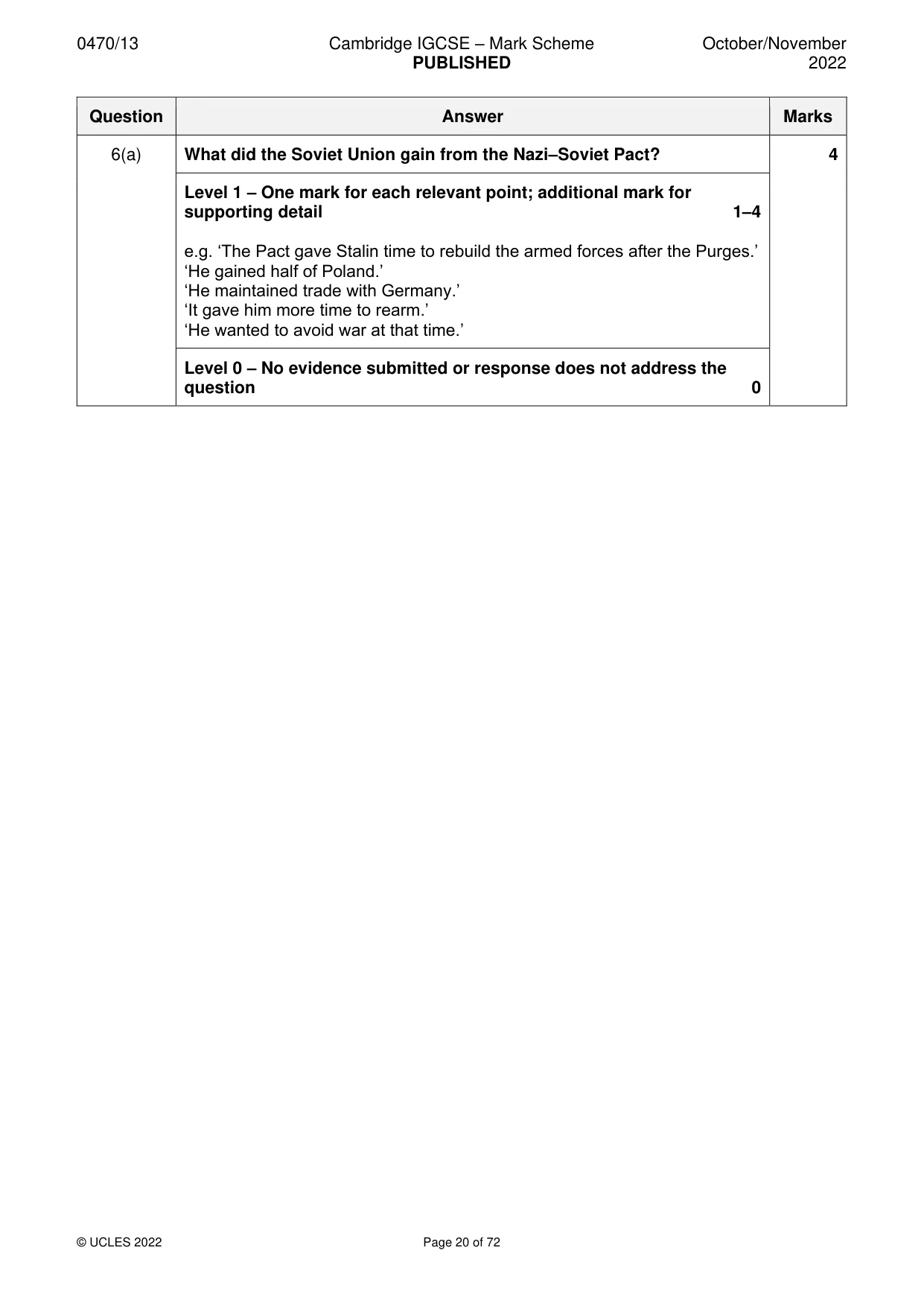
0470/13 Cambridge IGCSE – Mark Scheme PUBLISHED October/November 2022 © UCLES 2022 Page 20 of 72 Question Answer Marks 6(a) What did the Soviet Union gain from the Nazi–Soviet Pact? 4 Level 1 – One mark for each relevant point; additional mark for supporting detail 1–4 e.g. ‘The Pact gave Stalin time to rebuild the armed forces after the Purges.’ ‘He gained half of Poland.’ ‘He maintained trade with Germany.’ ‘It gave him more time to rearm.’ ‘He wanted to avoid war at that time.’ Level 0 – No evidence submitted or response does not address the question 0
Mark scheme, page 21
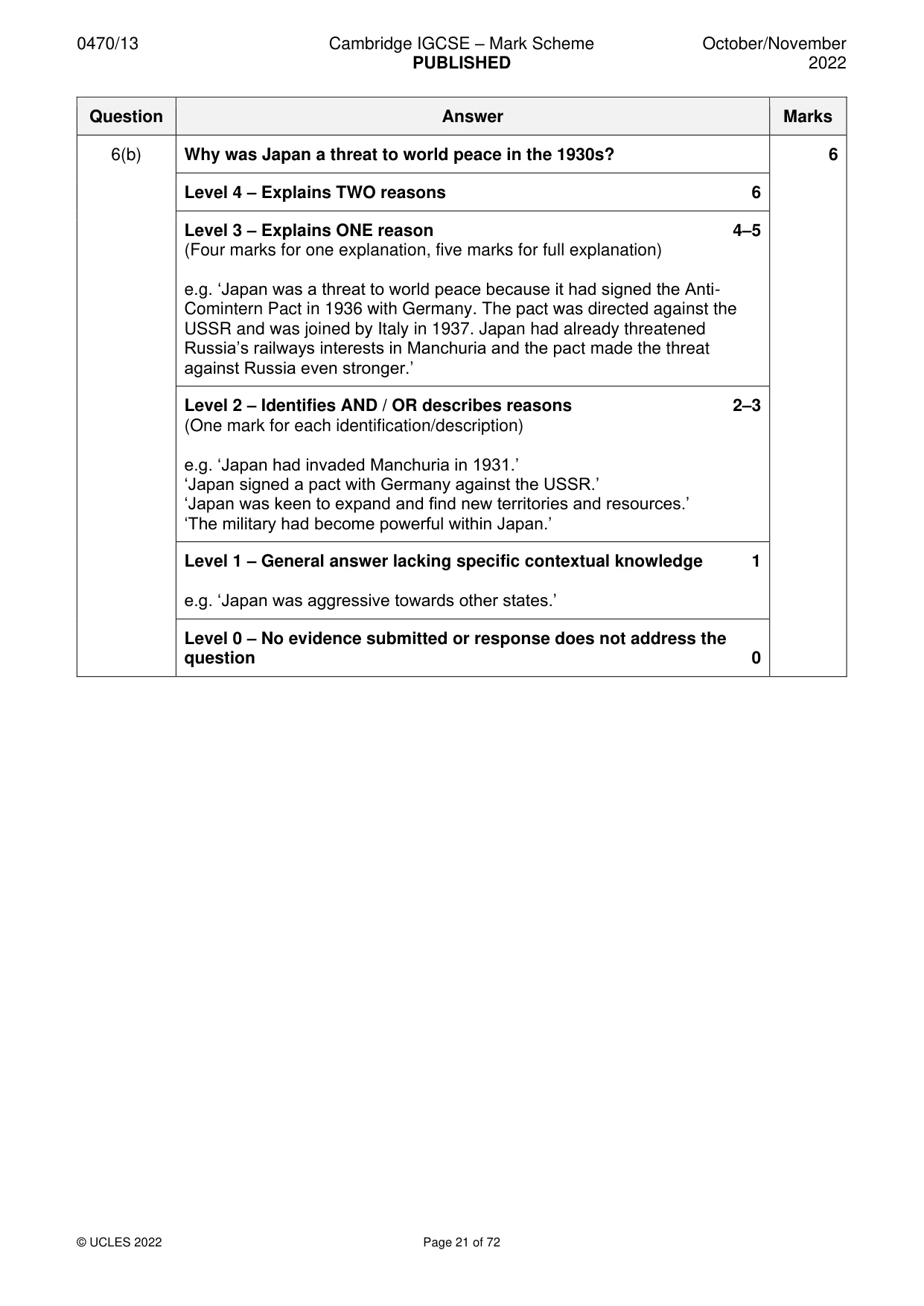
0470/13 Cambridge IGCSE – Mark Scheme PUBLISHED October/November 2022 © UCLES 2022 Page 21 of 72 Question Answer Marks 6(b) Why was Japan a threat to world peace in the 1930s? 6 Level 4 – Explains TWO reasons 6 Level 3 – Explains ONE reason 4–5 (Four marks for one explanation, five marks for full explanation) e.g. ‘Japan was a threat to world peace because it had signed the Anti- Comintern Pact in 1936 with Germany. The pact was directed against the USSR and was joined by Italy in 1937. Japan had already threatened Russia’s railways interests in Manchuria and the pact made the threat against Russia even stronger.’ Level 2 – Identifies AND / OR describes reasons 2–3 (One mark for each identification/description) e.g. ‘Japan had invaded Manchuria in 1931.’ ‘Japan signed a pact with Germany against the USSR.’ ‘Japan was keen to expand and find new territories and resources.’ ‘The military had become powerful within Japan.’ Level 1 – General answer lacking specific contextual knowledge 1 e.g. ‘Japan was aggressive towards other states.’ Level 0 – No evidence submitted or response does not address the question 0
Mark scheme, page 22
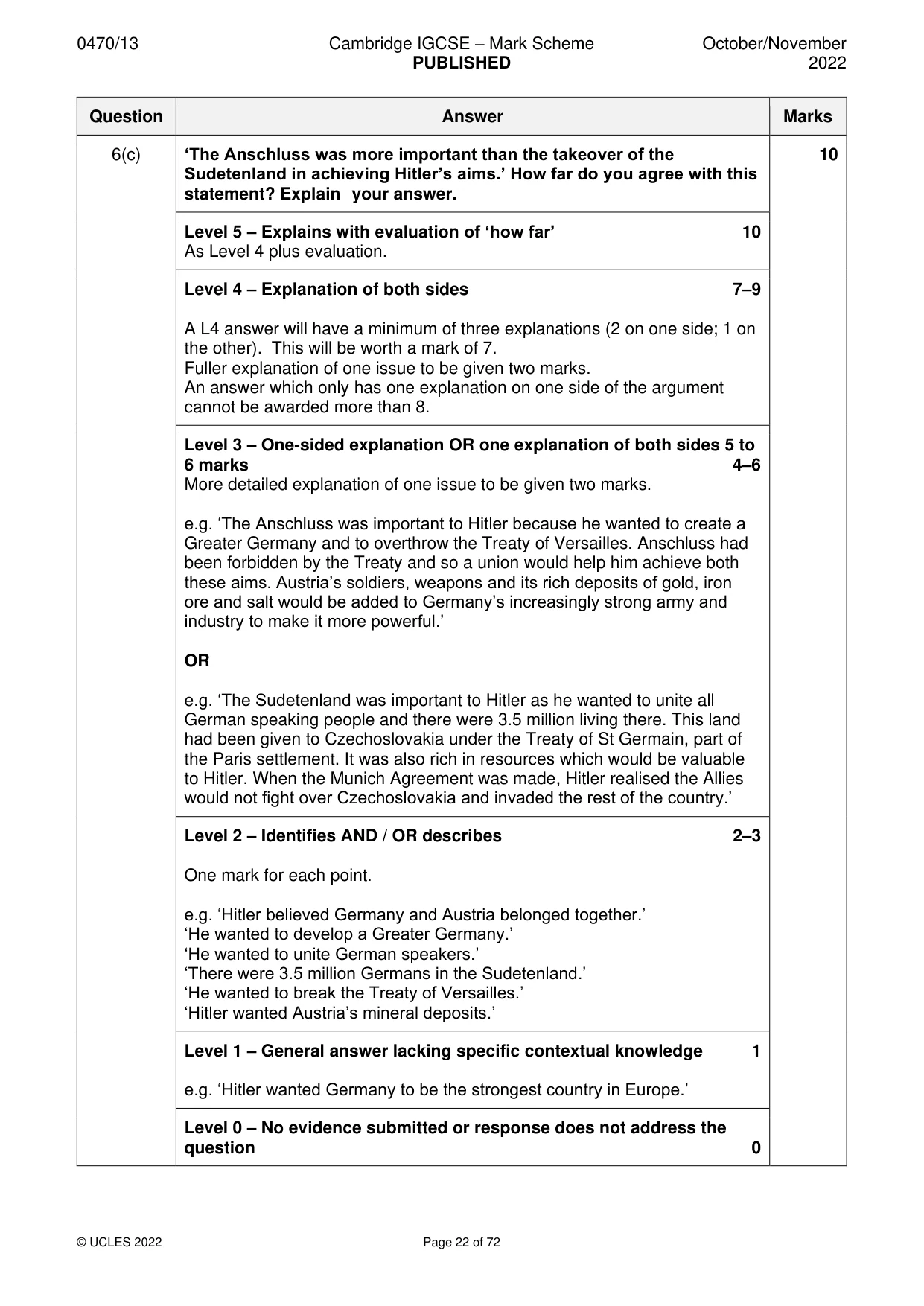
0470/13 Cambridge IGCSE – Mark Scheme PUBLISHED October/November 2022 © UCLES 2022 Page 22 of 72 Question Answer Marks 6(c) ‘The Anschluss was more important than the takeover of the Sudetenland in achieving Hitler’s aims.’ How far do you agree with this statement? Explain your answer. 10 Level 5 – Explains with evaluation of ‘how far’ 10 As Level 4 plus evaluation. Level 4 – Explanation of both sides 7–9 A L4 answer will have a minimum of three explanations (2 on one side; 1 on the other). This will be worth a mark of 7. Fuller explanation of one issue to be given two marks. An answer which only has one explanation on one side of the argument cannot be awarded more than 8. Level 3 – One-sided explanation OR one explanation of both sides 5 to 6 marks 4–6 More detailed explanation of one issue to be given two marks. e.g. ‘The Anschluss was important to Hitler because he wanted to create a Greater Germany and to overthrow the Treaty of Versailles. Anschluss had been forbidden by the Treaty and so a union would help him achieve both these aims. Austria’s soldiers, weapons and its rich deposits of gold, iron ore and salt would be added to Germany’s increasingly strong army and industry to make it more powerful.’ OR e.g. ‘The Sudetenland was important to Hitler as he wanted to unite all German speaking people and there were 3.5 million living there. This land had been given to Czechoslovakia under the Treaty of St Germain, part of the Paris settlement. It was also rich in resources which would be valuable to Hitler. When the Munich Agreement was made, Hitler realised the Allies would not fight over Czechoslovakia and invaded the rest of the country.’ Level 2 – Identifies AND / OR describes 2–3 One mark for each point. e.g. ‘Hitler believed Germany and Austria belonged together.’ ‘He wanted to develop a Greater Germany.’ ‘He wanted to unite German speakers.’ ‘There were 3.5 million Germans in the Sudetenland.’ ‘He wanted to break the Treaty of Versailles.’ ‘Hitler wanted Austria’s mineral deposits.’ Level 1 – General answer lacking specific contextual knowledge 1 e.g. ‘Hitler wanted Germany to be the strongest country in Europe.’ Level 0 – No evidence submitted or response does not address the question 0
Mark scheme, page 23
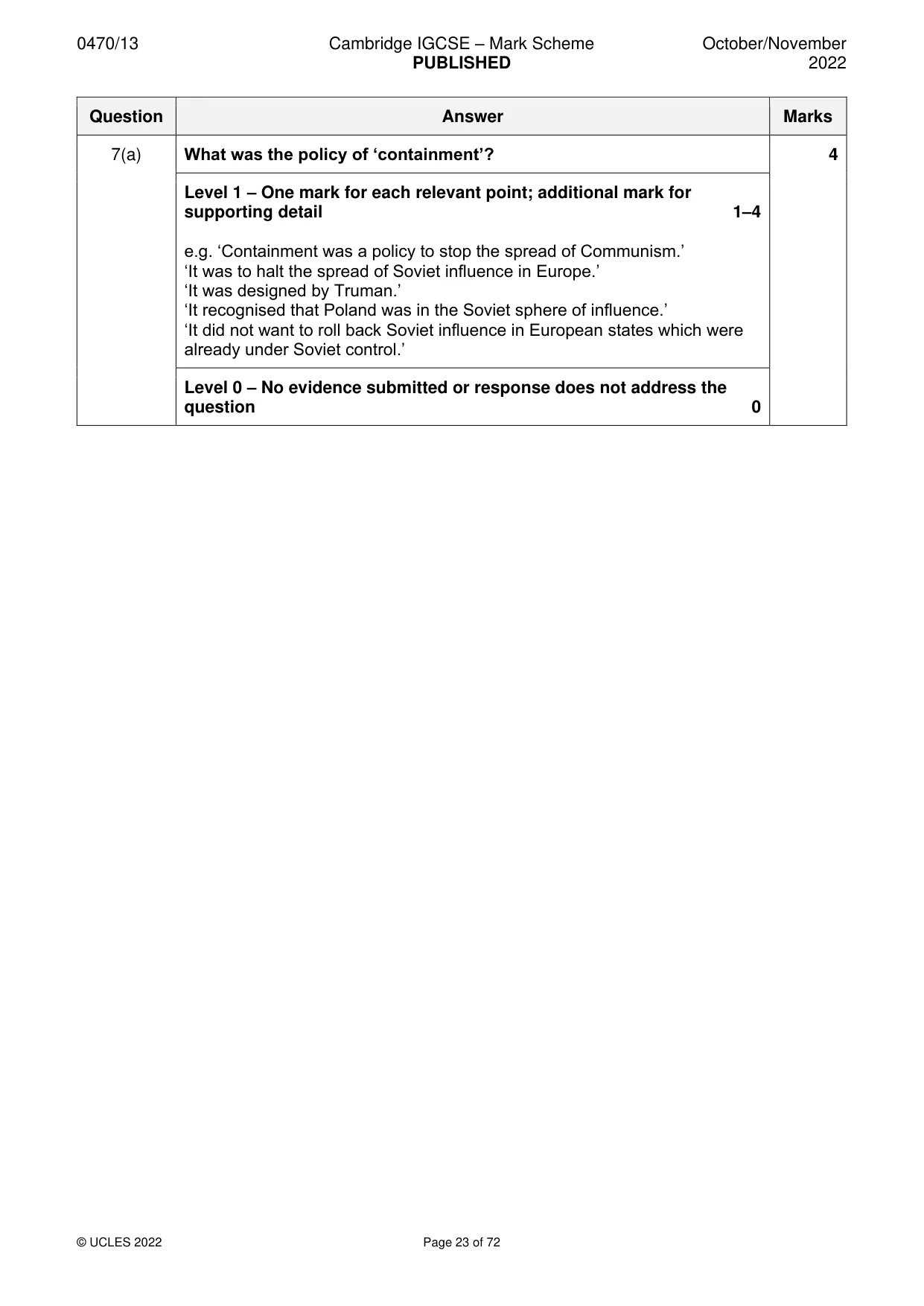
0470/13 Cambridge IGCSE – Mark Scheme PUBLISHED October/November 2022 © UCLES 2022 Page 23 of 72 Question Answer Marks 7(a) What was the policy of ‘containment’? 4 Level 1 – One mark for each relevant point; additional mark for supporting detail 1–4 e.g. ‘Containment was a policy to stop the spread of Communism.’ ‘It was to halt the spread of Soviet influence in Europe.’ ‘It was designed by Truman.’ ‘It recognised that Poland was in the Soviet sphere of influence.’ ‘It did not want to roll back Soviet influence in European states which were already under Soviet control.’ Level 0 – No evidence submitted or response does not address the question 0
Mark scheme, page 24
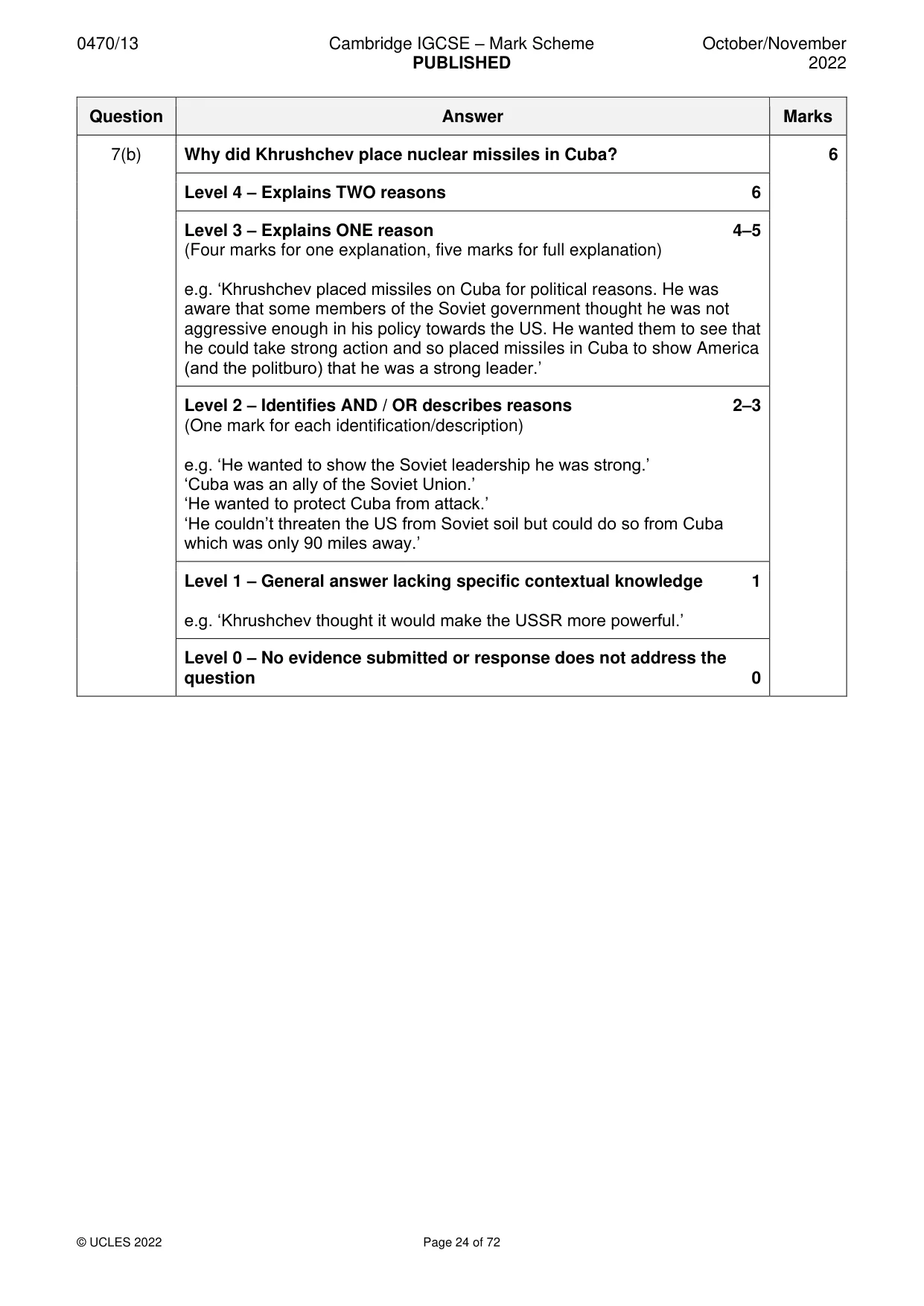
0470/13 Cambridge IGCSE – Mark Scheme PUBLISHED October/November 2022 © UCLES 2022 Page 24 of 72 Question Answer Marks 7(b) Why did Khrushchev place nuclear missiles in Cuba? 6 Level 4 – Explains TWO reasons 6 Level 3 – Explains ONE reason 4–5 (Four marks for one explanation, five marks for full explanation) e.g. ‘Khrushchev placed missiles on Cuba for political reasons. He was aware that some members of the Soviet government thought he was not aggressive enough in his policy towards the US. He wanted them to see that he could take strong action and so placed missiles in Cuba to show America (and the politburo) that he was a strong leader.’ Level 2 – Identifies AND / OR describes reasons 2–3 (One mark for each identification/description) e.g. ‘He wanted to show the Soviet leadership he was strong.’ ‘Cuba was an ally of the Soviet Union.’ ‘He wanted to protect Cuba from attack.’ ‘He couldn’t threaten the US from Soviet soil but could do so from Cuba which was only 90 miles away.’ Level 1 – General answer lacking specific contextual knowledge 1 e.g. ‘Khrushchev thought it would make the USSR more powerful.’ Level 0 – No evidence submitted or response does not address the question 0
Mark scheme, page 25
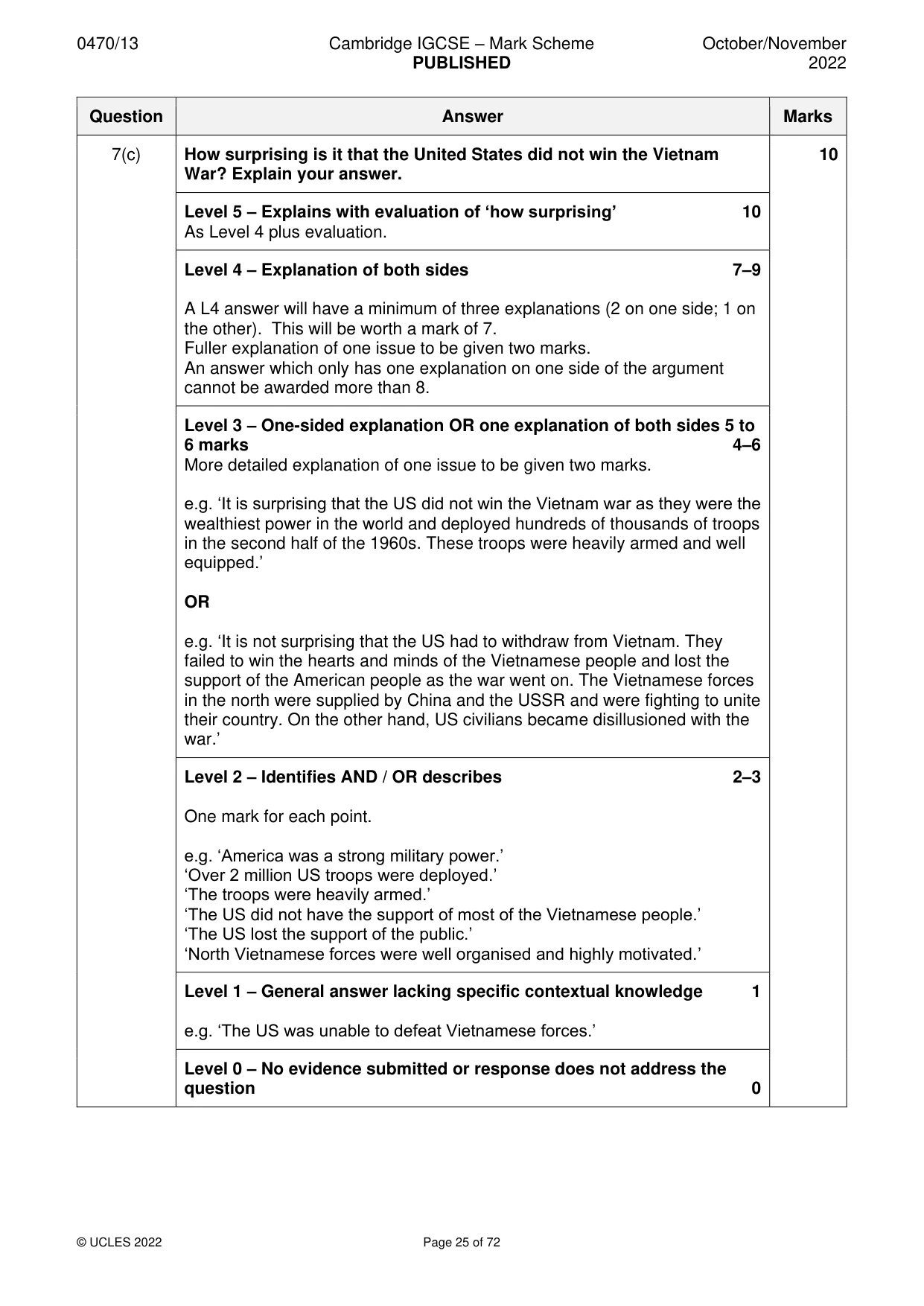
0470/13 Cambridge IGCSE – Mark Scheme PUBLISHED October/November 2022 © UCLES 2022 Page 25 of 72 Question Answer Marks 7(c) How surprising is it that the United States did not win the Vietnam War? Explain your answer. 10 Level 5 – Explains with evaluation of ‘how surprising’ 10 As Level 4 plus evaluation. Level 4 – Explanation of both sides 7–9 A L4 answer will have a minimum of three explanations (2 on one side; 1 on the other). This will be worth a mark of 7. Fuller explanation of one issue to be given two marks. An answer which only has one explanation on one side of the argument cannot be awarded more than 8. Level 3 – One-sided explanation OR one explanation of both sides 5 to 6 marks 4–6 More detailed explanation of one issue to be given two marks. e.g. ‘It is surprising that the US did not win the Vietnam war as they were the wealthiest power in the world and deployed hundreds of thousands of troops in the second half of the 1960s. These troops were heavily armed and well equipped.’ OR e.g. ‘It is not surprising that the US had to withdraw from Vietnam. They failed to win the hearts and minds of the Vietnamese people and lost the support of the American people as the war went on. The Vietnamese forces in the north were supplied by China and the USSR and were fighting to unite their country. On the other hand, US civilians became disillusioned with the war.’ Level 2 – Identifies AND / OR describes 2–3 One mark for each point. e.g. ‘America was a strong military power.’ ‘Over 2 million US troops were deployed.’ ‘The troops were heavily armed.’ ‘The US did not have the support of most of the Vietnamese people.’ ‘The US lost the support of the public.’ ‘North Vietnamese forces were well organised and highly motivated.’ Level 1 – General answer lacking specific contextual knowledge 1 e.g. ‘The US was unable to defeat Vietnamese forces.’ Level 0 – No evidence submitted or response does not address the question 0
Mark scheme, page 26
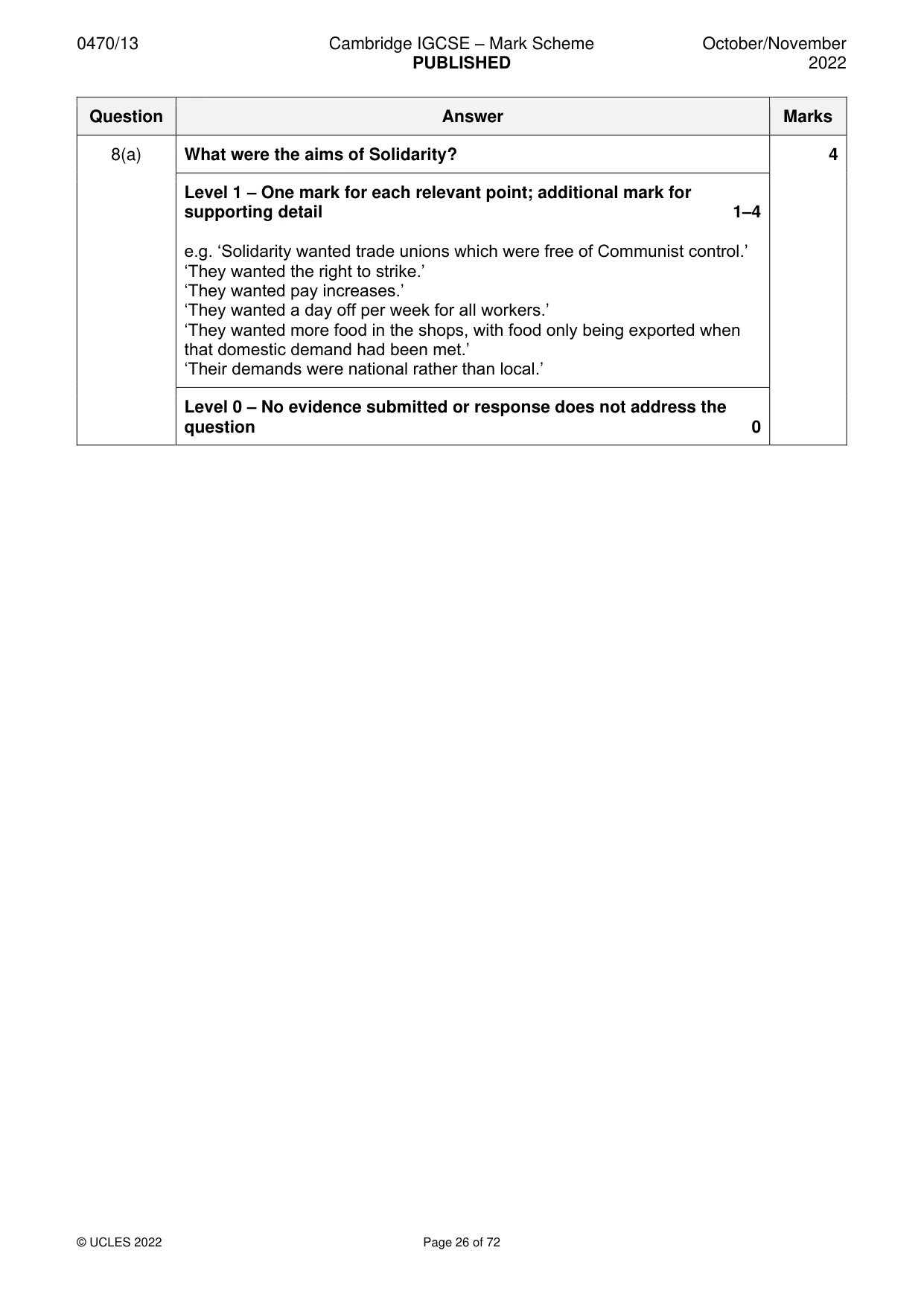
0470/13 Cambridge IGCSE – Mark Scheme PUBLISHED October/November 2022 © UCLES 2022 Page 26 of 72 Question Answer Marks 8(a) What were the aims of Solidarity? 4 Level 1 – One mark for each relevant point; additional mark for supporting detail 1–4 e.g. ‘Solidarity wanted trade unions which were free of Communist control.’ ‘They wanted the right to strike.’ ‘They wanted pay increases.’ ‘They wanted a day off per week for all workers.’ ‘They wanted more food in the shops, with food only being exported when that domestic demand had been met.’ ‘Their demands were national rather than local.’ Level 0 – No evidence submitted or response does not address the question 0
Mark scheme, page 27
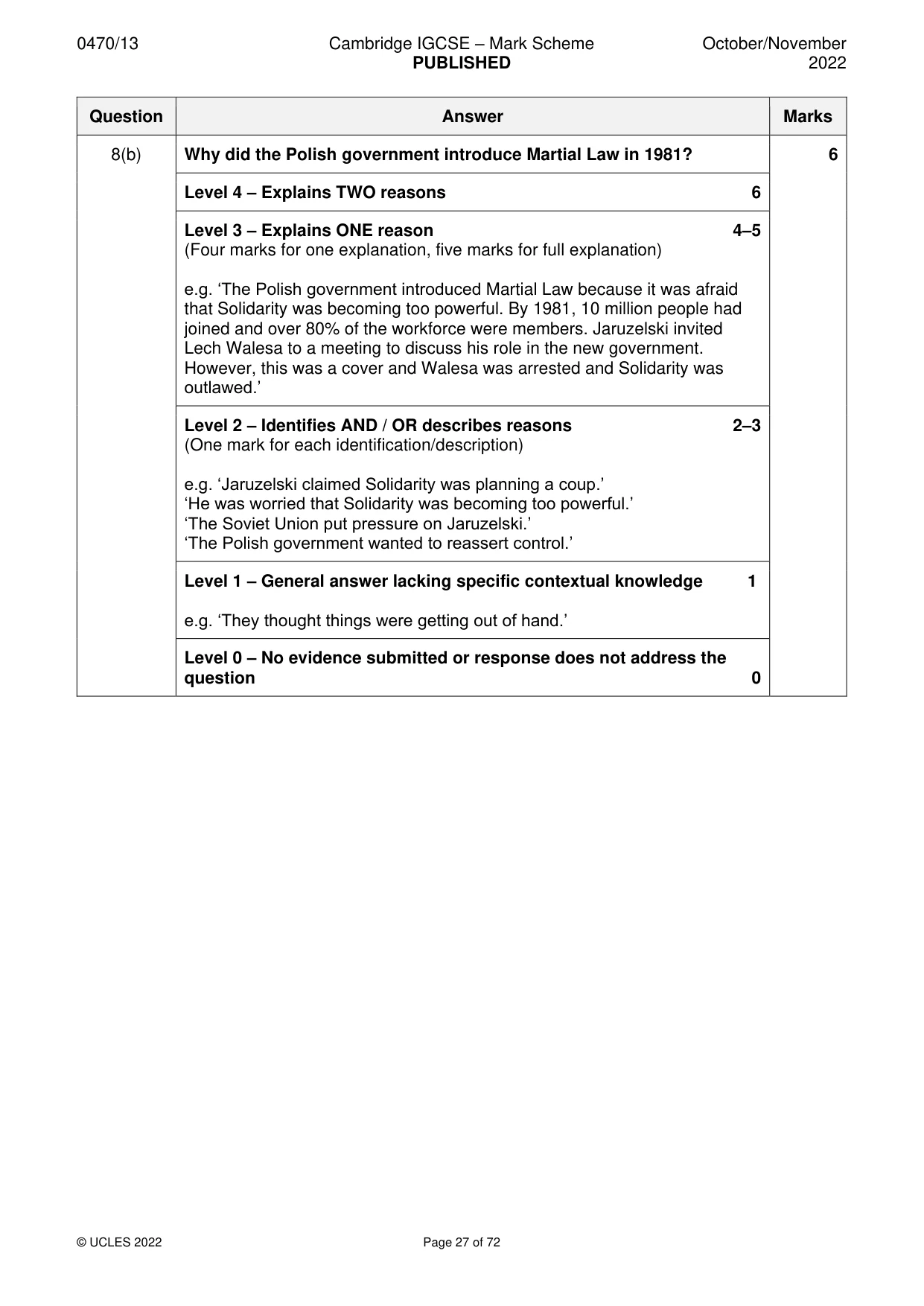
0470/13 Cambridge IGCSE – Mark Scheme PUBLISHED October/November 2022 © UCLES 2022 Page 27 of 72 Question Answer Marks 8(b) Why did the Polish government introduce Martial Law in 1981? 6 Level 4 – Explains TWO reasons 6 Level 3 – Explains ONE reason 4–5 (Four marks for one explanation, five marks for full explanation) e.g. ‘The Polish government introduced Martial Law because it was afraid that Solidarity was becoming too powerful. By 1981, 10 million people had joined and over 80% of the workforce were members. Jaruzelski invited Lech Walesa to a meeting to discuss his role in the new government. However, this was a cover and Walesa was arrested and Solidarity was outlawed.’ Level 2 – Identifies AND / OR describes reasons 2–3 (One mark for each identification/description) e.g. ‘Jaruzelski claimed Solidarity was planning a coup.’ ‘He was worried that Solidarity was becoming too powerful.’ ‘The Soviet Union put pressure on Jaruzelski.’ ‘The Polish government wanted to reassert control.’ Level 1 – General answer lacking specific contextual knowledge 1 e.g. ‘They thought things were getting out of hand.’ Level 0 – No evidence submitted or response does not address the question 0
Mark scheme, page 28
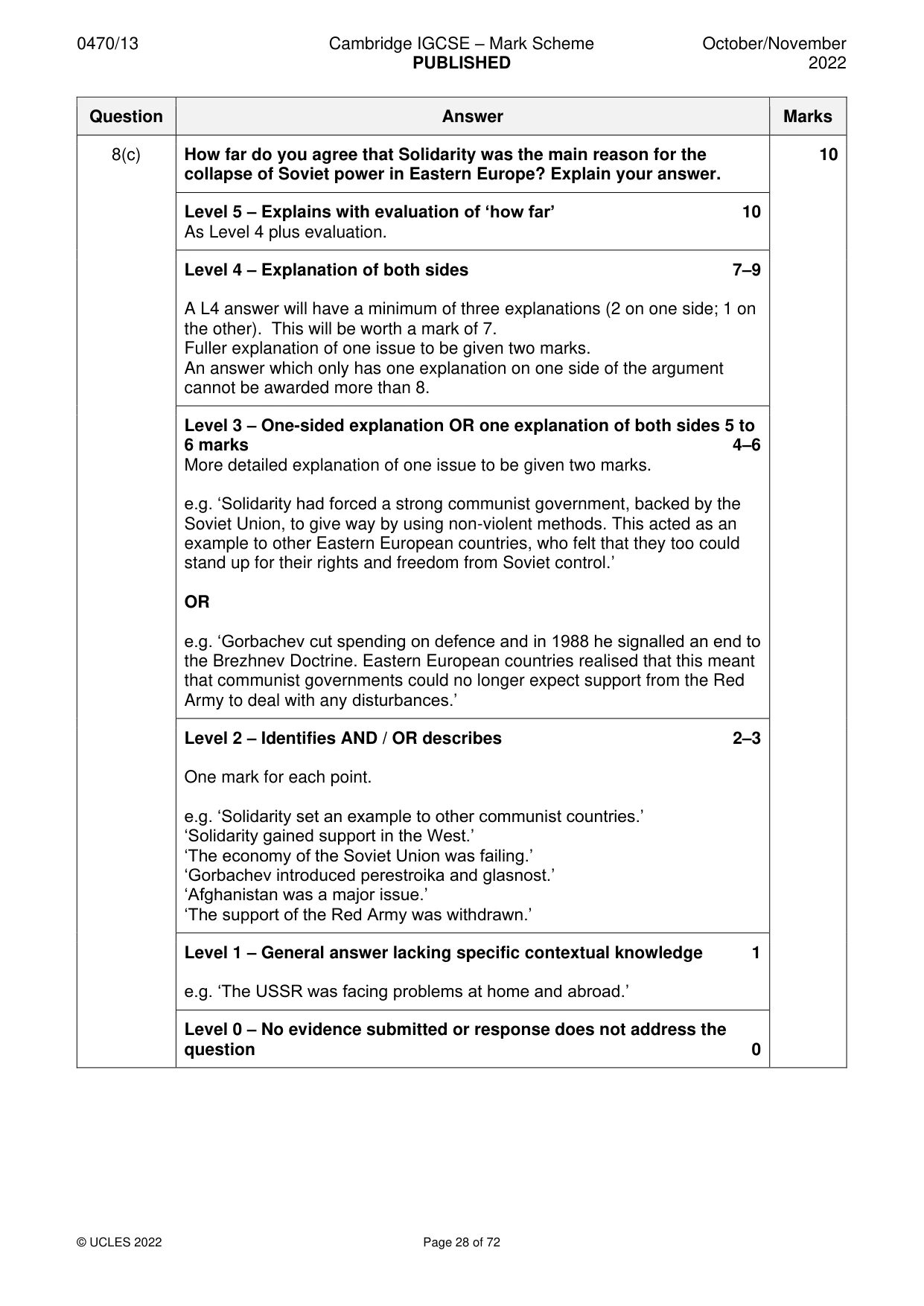
0470/13 Cambridge IGCSE – Mark Scheme PUBLISHED October/November 2022 © UCLES 2022 Page 28 of 72 Question Answer Marks 8(c) How far do you agree that Solidarity was the main reason for the collapse of Soviet power in Eastern Europe? Explain your answer. 10 Level 5 – Explains with evaluation of ‘how far’ 10 As Level 4 plus evaluation. Level 4 – Explanation of both sides 7–9 A L4 answer will have a minimum of three explanations (2 on one side; 1 on the other). This will be worth a mark of 7. Fuller explanation of one issue to be given two marks. An answer which only has one explanation on one side of the argument cannot be awarded more than 8. Level 3 – One-sided explanation OR one explanation of both sides 5 to 6 marks 4–6 More detailed explanation of one issue to be given two marks. e.g. ‘Solidarity had forced a strong communist government, backed by the Soviet Union, to give way by using non-violent methods. This acted as an example to other Eastern European countries, who felt that they too could stand up for their rights and freedom from Soviet control.’ OR e.g. ‘Gorbachev cut spending on defence and in 1988 he signalled an end to the Brezhnev Doctrine. Eastern European countries realised that this meant that communist governments could no longer expect support from the Red Army to deal with any disturbances.’ Level 2 – Identifies AND / OR describes 2–3 One mark for each point. e.g. ‘Solidarity set an example to other communist countries.’ ‘Solidarity gained support in the West.’ ‘The economy of the Soviet Union was failing.’ ‘Gorbachev introduced perestroika and glasnost.’ ‘Afghanistan was a major issue.’ ‘The support of the Red Army was withdrawn.’ Level 1 – General answer lacking specific contextual knowledge 1 e.g. ‘The USSR was facing problems at home and abroad.’ Level 0 – No evidence submitted or response does not address the question 0
Mark scheme, page 29
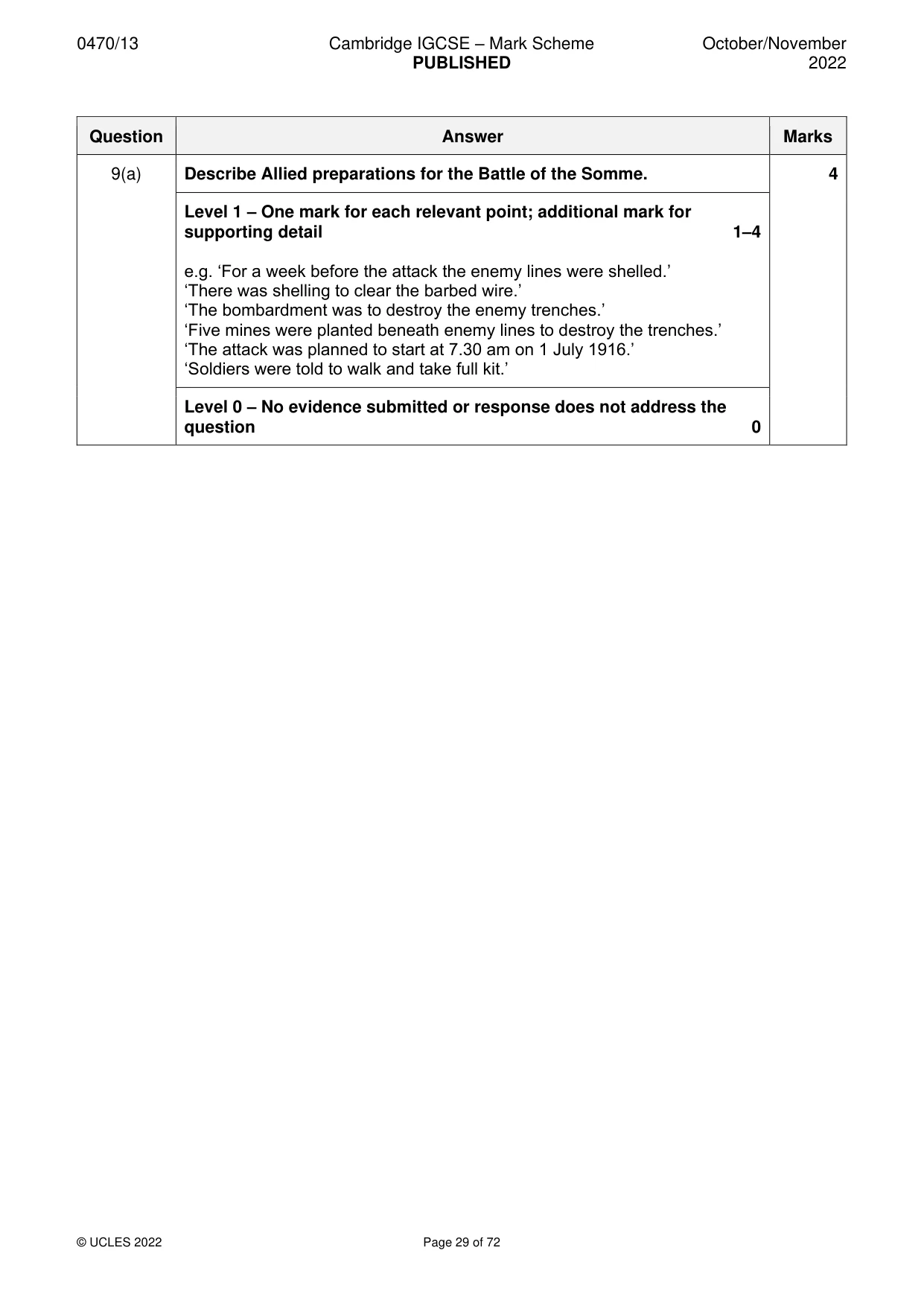
0470/13 Cambridge IGCSE – Mark Scheme PUBLISHED October/November 2022 © UCLES 2022 Page 29 of 72 Question Answer Marks 9(a) Describe Allied preparations for the Battle of the Somme. 4 Level 1 – One mark for each relevant point; additional mark for supporting detail 1–4 e.g. ‘For a week before the attack the enemy lines were shelled.’ ‘There was shelling to clear the barbed wire.’ ‘The bombardment was to destroy the enemy trenches.’ ‘Five mines were planted beneath enemy lines to destroy the trenches.’ ‘The attack was planned to start at 7.30 am on 1 July 1916.’ ‘Soldiers were told to walk and take full kit.’ Level 0 – No evidence submitted or response does not address the question 0
Mark scheme, page 30
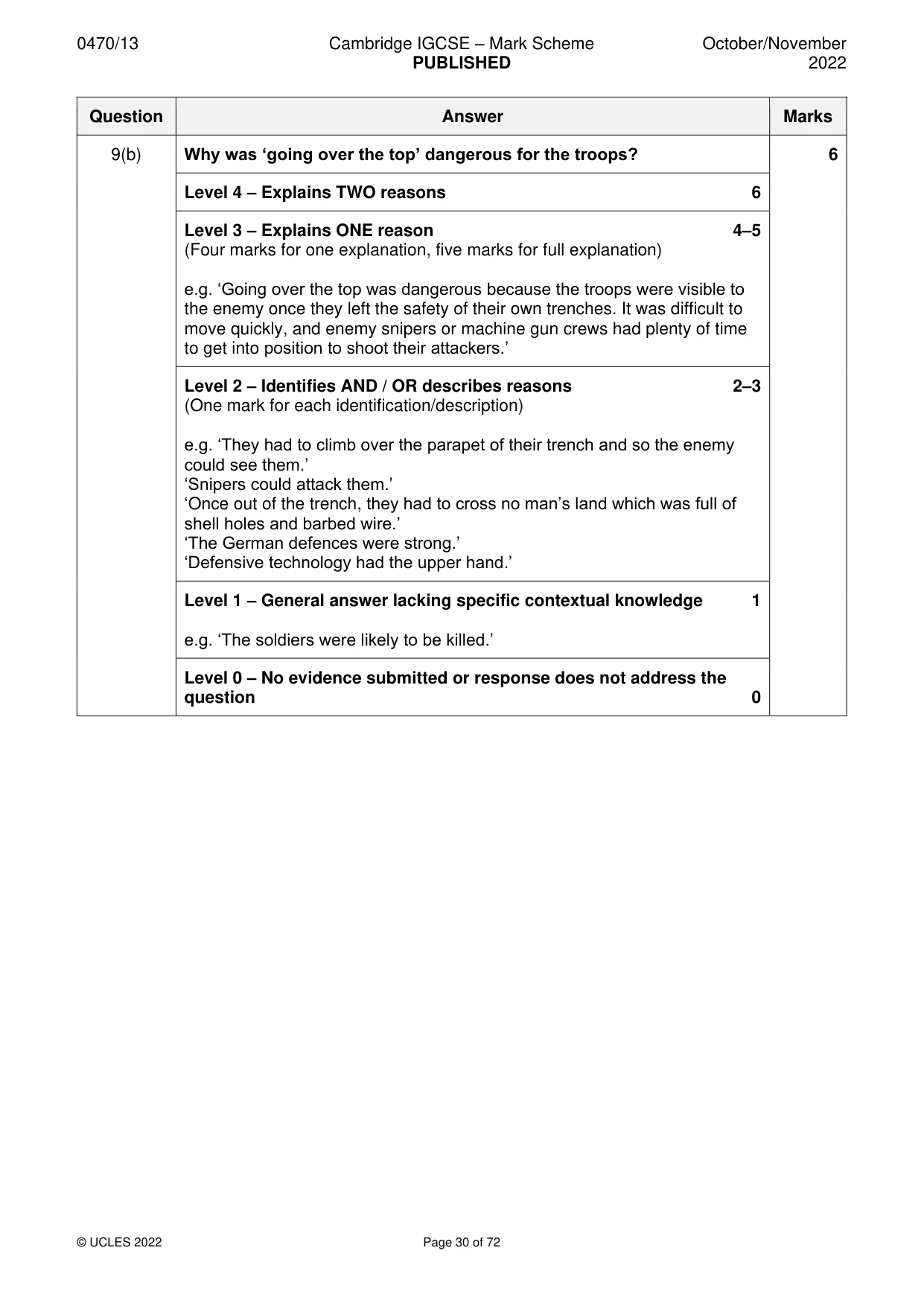
0470/13 Cambridge IGCSE – Mark Scheme PUBLISHED October/November 2022 © UCLES 2022 Page 30 of 72 Question Answer Marks 9(b) Why was ‘going over the top’ dangerous for the troops? 6 Level 4 – Explains TWO reasons 6 Level 3 – Explains ONE reason 4–5 (Four marks for one explanation, five marks for full explanation) e.g. ‘Going over the top was dangerous because the troops were visible to the enemy once they left the safety of their own trenches. It was difficult to move quickly, and enemy snipers or machine gun crews had plenty of time to get into position to shoot their attackers.’ Level 2 – Identifies AND / OR describes reasons 2–3 (One mark for each identification/description) e.g. ‘They had to climb over the parapet of their trench and so the enemy could see them.’ ‘Snipers could attack them.’ ‘Once out of the trench, they had to cross no man’s land which was full of shell holes and barbed wire.’ ‘The German defences were strong.’ ‘Defensive technology had the upper hand.’ Level 1 – General answer lacking specific contextual knowledge 1 e.g. ‘The soldiers were likely to be killed.’ Level 0 – No evidence submitted or response does not address the question 0
Mark scheme, page 31
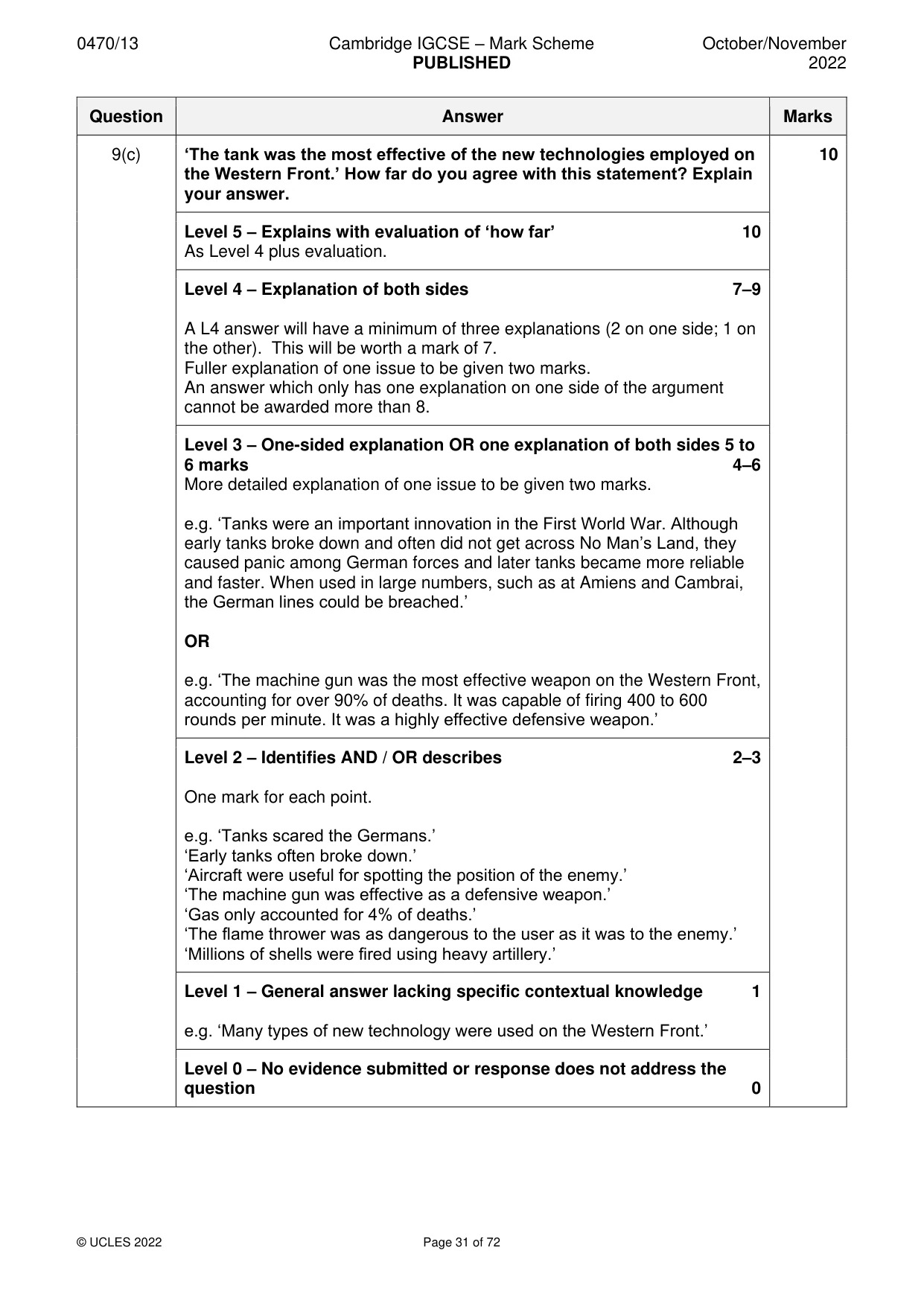
0470/13 Cambridge IGCSE – Mark Scheme PUBLISHED October/November 2022 © UCLES 2022 Page 31 of 72 Question Answer Marks 9(c) ‘The tank was the most effective of the new technologies employed on the Western Front.’ How far do you agree with this statement? Explain your answer. 10 Level 5 – Explains with evaluation of ‘how far’ 10 As Level 4 plus evaluation. Level 4 – Explanation of both sides 7–9 A L4 answer will have a minimum of three explanations (2 on one side; 1 on the other). This will be worth a mark of 7. Fuller explanation of one issue to be given two marks. An answer which only has one explanation on one side of the argument cannot be awarded more than 8. Level 3 – One-sided explanation OR one explanation of both sides 5 to 6 marks 4–6 More detailed explanation of one issue to be given two marks. e.g. ‘Tanks were an important innovation in the First World War. Although early tanks broke down and often did not get across No Man’s Land, they caused panic among German forces and later tanks became more reliable and faster. When used in large numbers, such as at Amiens and Cambrai, the German lines could be breached.’ OR e.g. ‘The machine gun was the most effective weapon on the Western Front, accounting for over 90% of deaths. It was capable of firing 400 to 600 rounds per minute. It was a highly effective defensive weapon.’ Level 2 – Identifies AND / OR describes 2–3 One mark for each point. e.g. ‘Tanks scared the Germans.’ ‘Early tanks often broke down.’ ‘Aircraft were useful for spotting the position of the enemy.’ ‘The machine gun was effective as a defensive weapon.’ ‘Gas only accounted for 4% of deaths.’ ‘The flame thrower was as dangerous to the user as it was to the enemy.’ ‘Millions of shells were fired using heavy artillery.’ Level 1 – General answer lacking specific contextual knowledge 1 e.g. ‘Many types of new technology were used on the Western Front.’ Level 0 – No evidence submitted or response does not address the question 0
Mark scheme, page 32
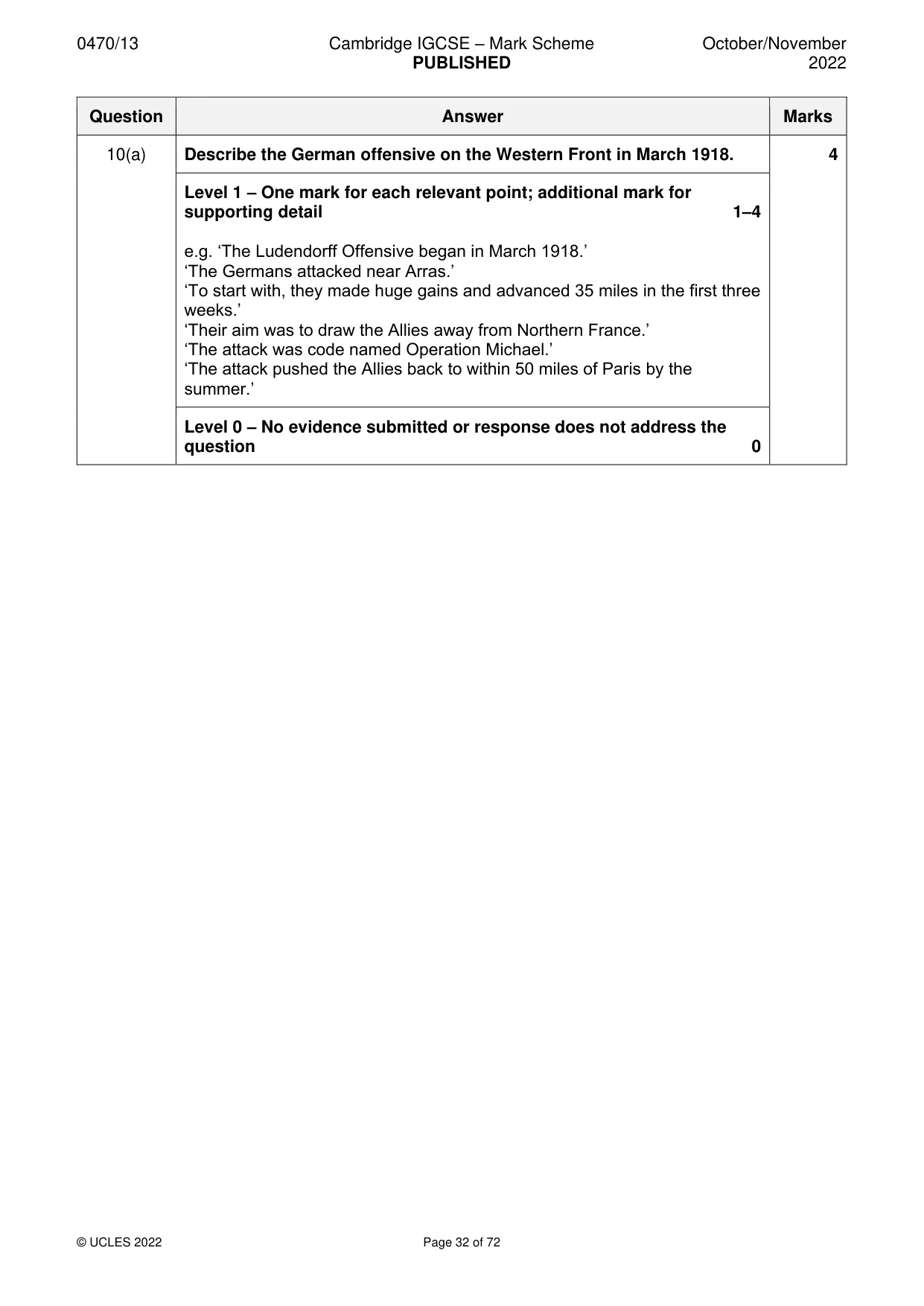
0470/13 Cambridge IGCSE – Mark Scheme PUBLISHED October/November 2022 © UCLES 2022 Page 32 of 72 Question Answer Marks 10(a) Describe the German offensive on the Western Front in March 1918. 4 Level 1 – One mark for each relevant point; additional mark for supporting detail 1–4 e.g. ‘The Ludendorff Offensive began in March 1918.’ ‘The Germans attacked near Arras.’ ‘To start with, they made huge gains and advanced 35 miles in the first three weeks.’ ‘Their aim was to draw the Allies away from Northern France.’ ‘The attack was code named Operation Michael.’ ‘The attack pushed the Allies back to within 50 miles of Paris by the summer.’ Level 0 – No evidence submitted or response does not address the question 0
Mark scheme, page 33
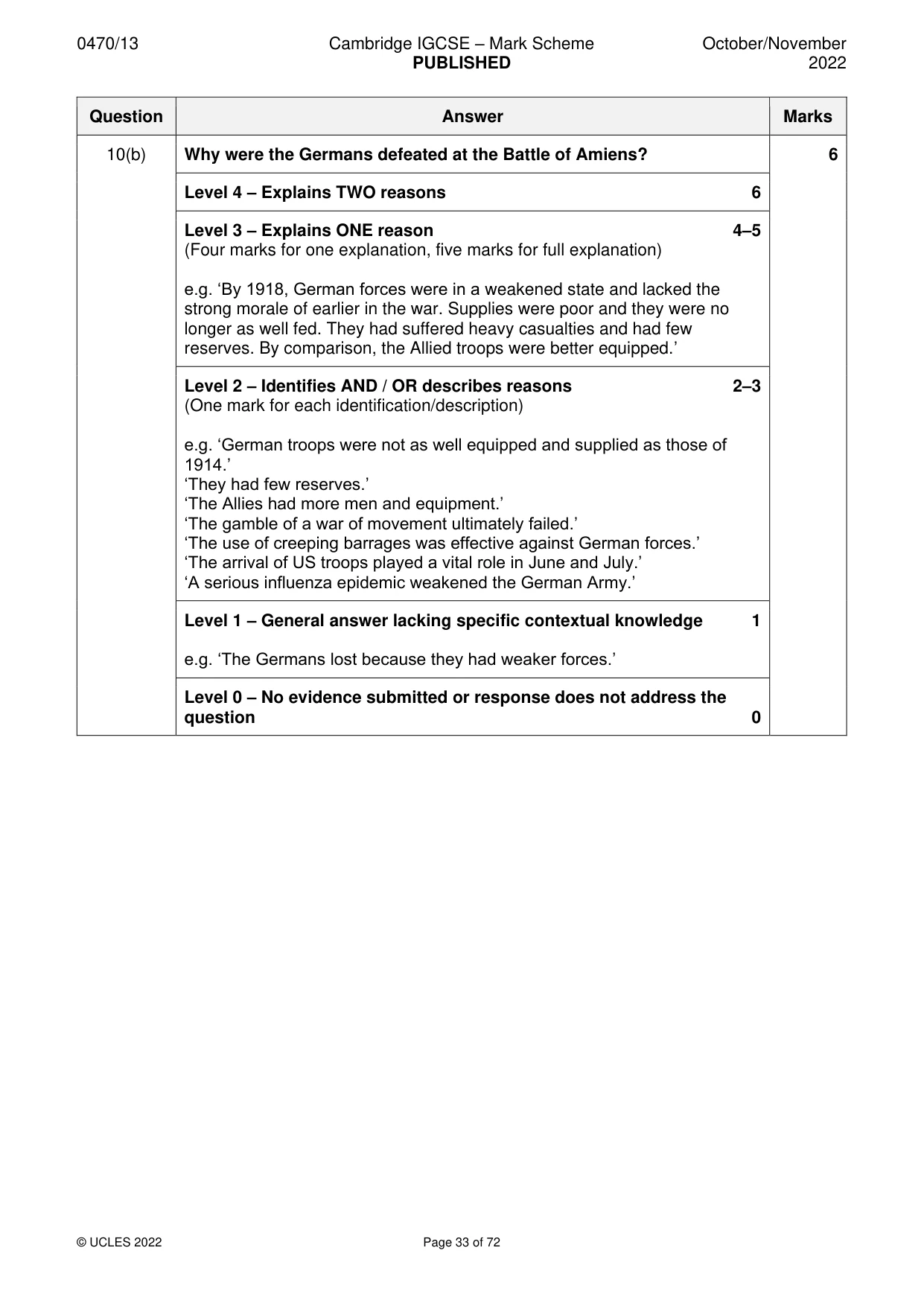
0470/13 Cambridge IGCSE – Mark Scheme PUBLISHED October/November 2022 © UCLES 2022 Page 33 of 72 Question Answer Marks 10(b) Why were the Germans defeated at the Battle of Amiens? 6 Level 4 – Explains TWO reasons 6 Level 3 – Explains ONE reason 4–5 (Four marks for one explanation, five marks for full explanation) e.g. ‘By 1918, German forces were in a weakened state and lacked the strong morale of earlier in the war. Supplies were poor and they were no longer as well fed. They had suffered heavy casualties and had few reserves. By comparison, the Allied troops were better equipped.’ Level 2 – Identifies AND / OR describes reasons 2–3 (One mark for each identification/description) e.g. ‘German troops were not as well equipped and supplied as those of 1914.’ ‘They had few reserves.’ ‘The Allies had more men and equipment.’ ‘The gamble of a war of movement ultimately failed.’ ‘The use of creeping barrages was effective against German forces.’ ‘The arrival of US troops played a vital role in June and July.’ ‘A serious influenza epidemic weakened the German Army.’ Level 1 – General answer lacking specific contextual knowledge 1 e.g. ‘The Germans lost because they had weaker forces.’ Level 0 – No evidence submitted or response does not address the question 0
Mark scheme, page 34
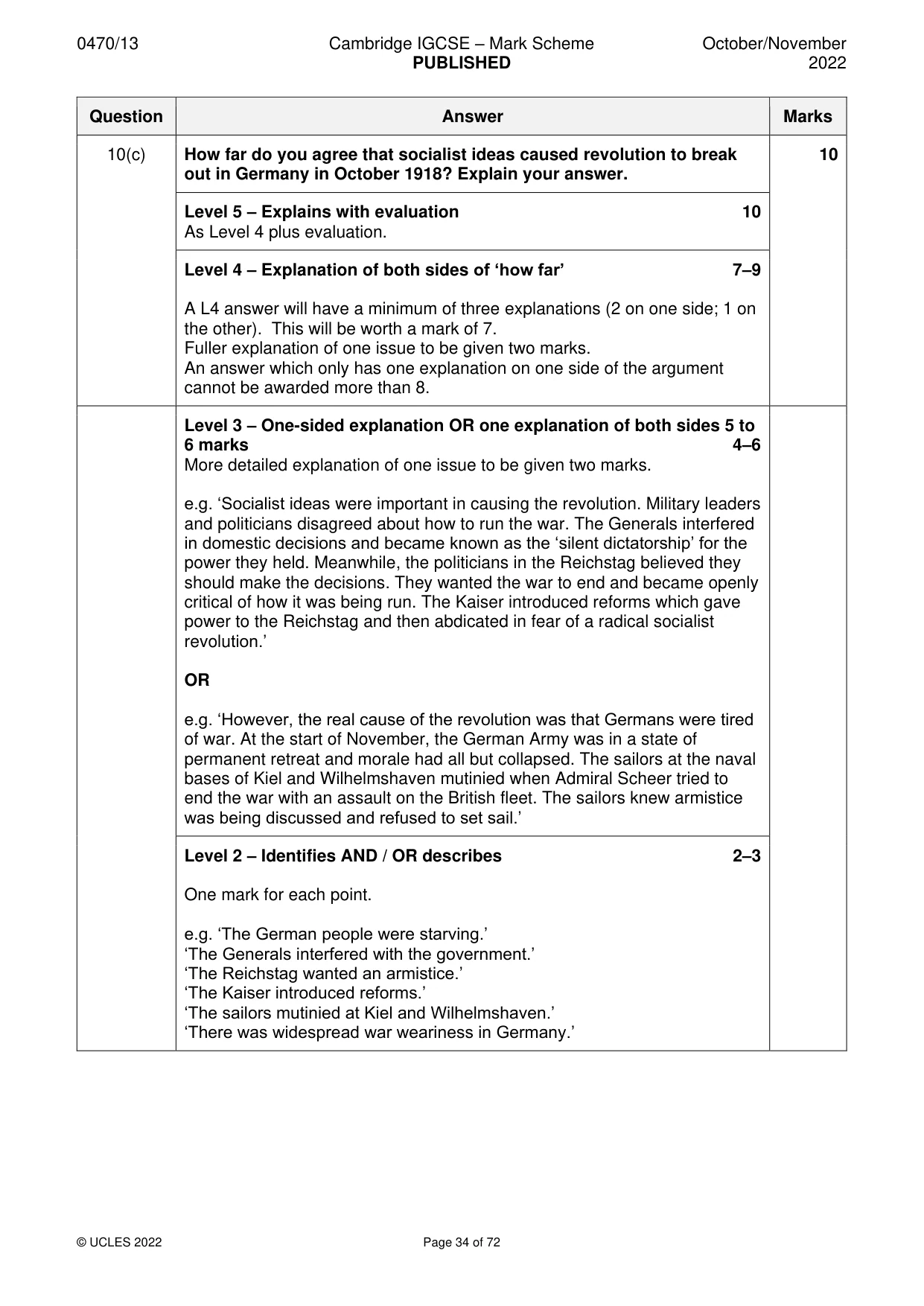
0470/13 Cambridge IGCSE – Mark Scheme PUBLISHED October/November 2022 © UCLES 2022 Page 34 of 72 Question Answer Marks 10(c) How far do you agree that socialist ideas caused revolution to break out in Germany in October 1918? Explain your answer. 10 Level 5 – Explains with evaluation 10 As Level 4 plus evaluation. Level 4 – Explanation of both sides of ‘how far’ 7–9 A L4 answer will have a minimum of three explanations (2 on one side; 1 on the other). This will be worth a mark of 7. Fuller explanation of one issue to be given two marks. An answer which only has one explanation on one side of the argument cannot be awarded more than 8. Level 3 – One-sided explanation OR one explanation of both sides 5 to 6 marks 4–6 More detailed explanation of one issue to be given two marks. e.g. ‘Socialist ideas were important in causing the revolution. Military leaders and politicians disagreed about how to run the war. The Generals interfered in domestic decisions and became known as the ‘silent dictatorship’ for the power they held. Meanwhile, the politicians in the Reichstag believed they should make the decisions. They wanted the war to end and became openly critical of how it was being run. The Kaiser introduced reforms which gave power to the Reichstag and then abdicated in fear of a radical socialist revolution.’ OR e.g. ‘However, the real cause of the revolution was that Germans were tired of war. At the start of November, the German Army was in a state of permanent retreat and morale had all but collapsed. The sailors at the naval bases of Kiel and Wilhelmshaven mutinied when Admiral Scheer tried to end the war with an assault on the British fleet. The sailors knew armistice was being discussed and refused to set sail.’ Level 2 – Identifies AND / OR describes 2–3 One mark for each point. e.g. ‘The German people were starving.’ ‘The Generals interfered with the government.’ ‘The Reichstag wanted an armistice.’ ‘The Kaiser introduced reforms.’ ‘The sailors mutinied at Kiel and Wilhelmshaven.’ ‘There was widespread war weariness in Germany.’
Mark scheme, page 35
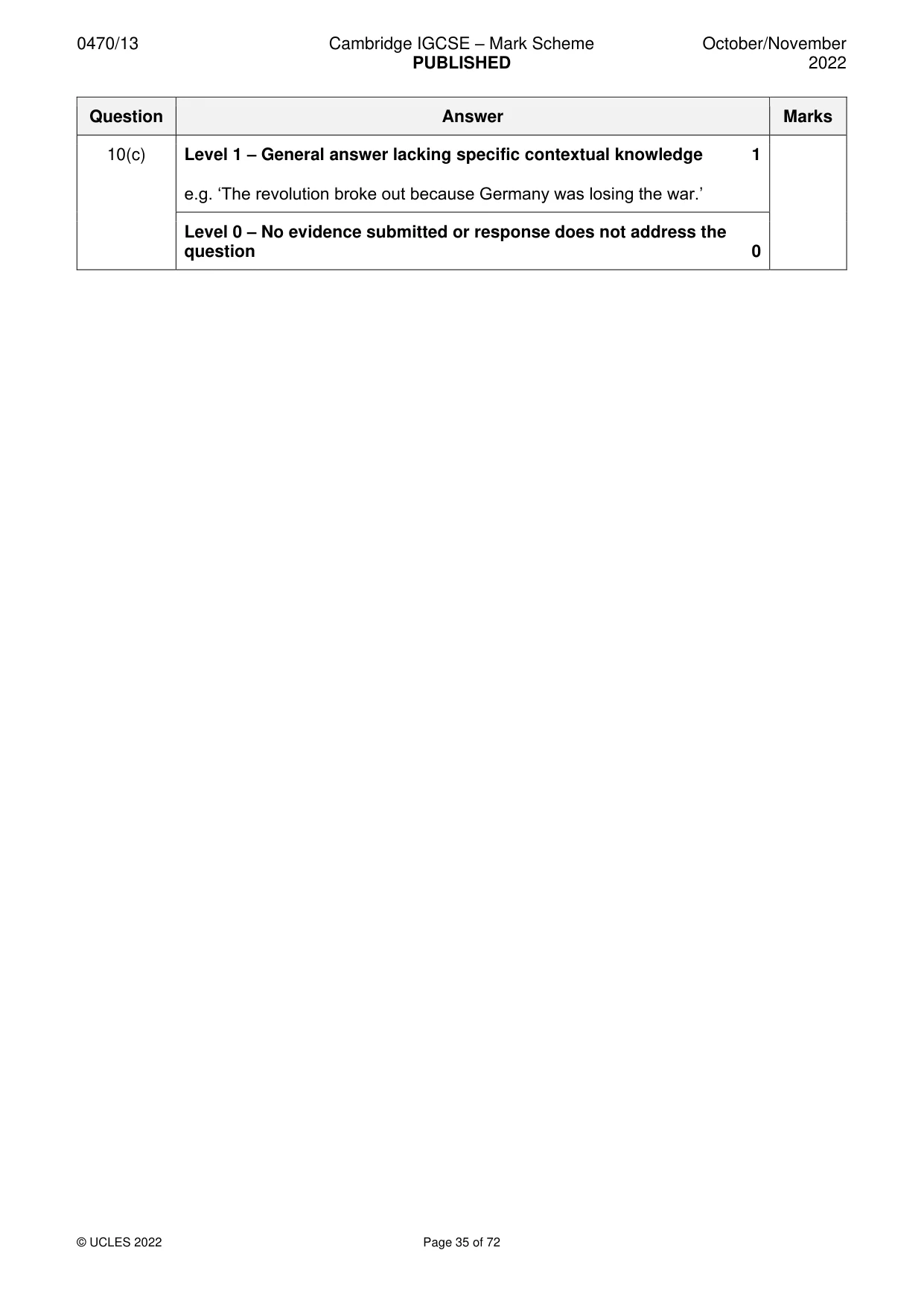
0470/13 Cambridge IGCSE – Mark Scheme PUBLISHED October/November 2022 © UCLES 2022 Page 35 of 72 Question Answer Marks 10(c) Level 1 – General answer lacking specific contextual knowledge 1 e.g. ‘The revolution broke out because Germany was losing the war.’ Level 0 – No evidence submitted or response does not address the question 0
Mark scheme, page 36
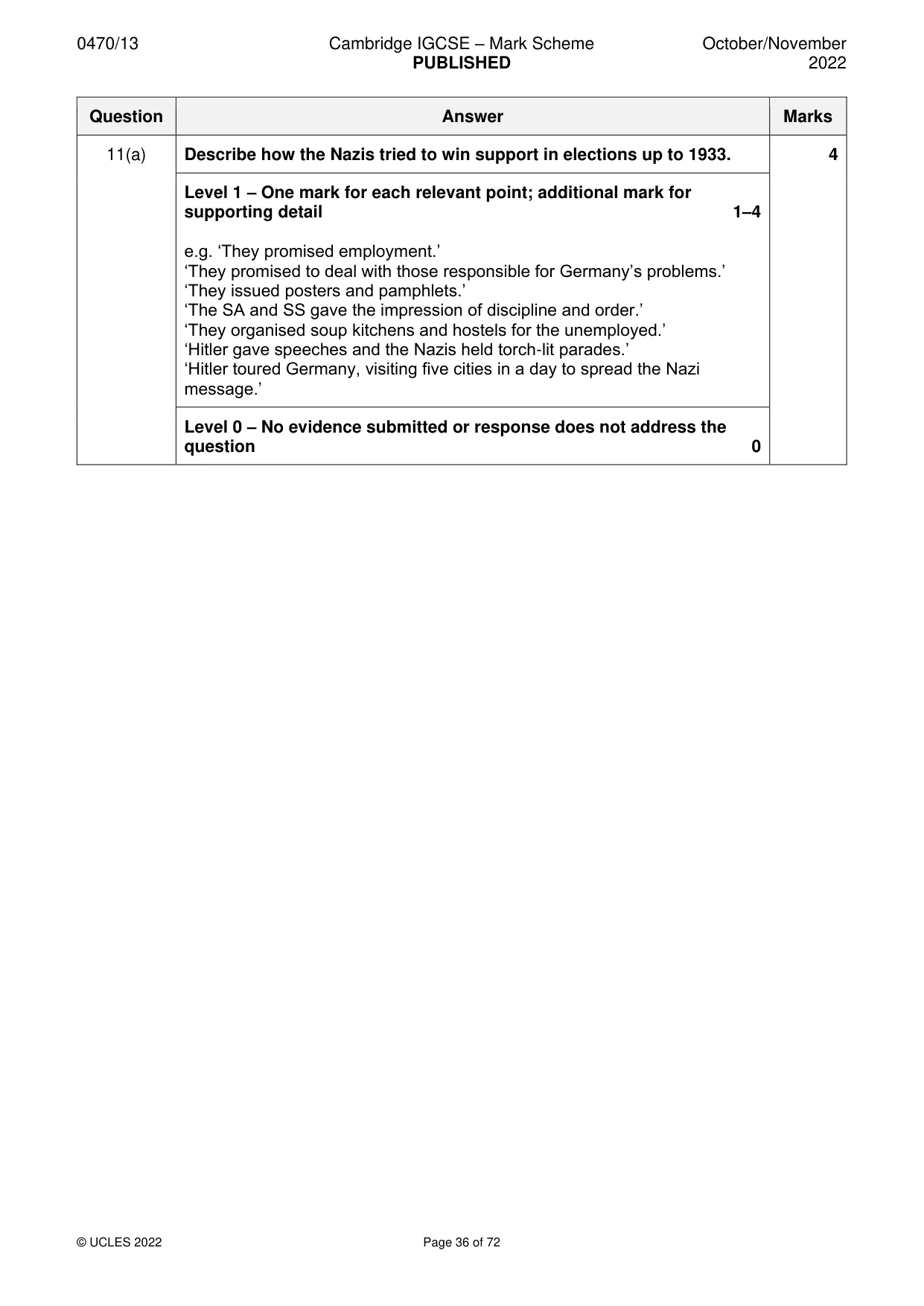
0470/13 Cambridge IGCSE – Mark Scheme PUBLISHED October/November 2022 © UCLES 2022 Page 36 of 72 Question Answer Marks 11(a) Describe how the Nazis tried to win support in elections up to 1933. 4 Level 1 – One mark for each relevant point; additional mark for supporting detail 1–4 e.g. ‘They promised employment.’ ‘They promised to deal with those responsible for Germany’s problems.’ ‘They issued posters and pamphlets.’ ‘The SA and SS gave the impression of discipline and order.’ ‘They organised soup kitchens and hostels for the unemployed.’ ‘Hitler gave speeches and the Nazis held torch-lit parades.’ ‘Hitler toured Germany, visiting five cities in a day to spread the Nazi message.’ Level 0 – No evidence submitted or response does not address the question 0
Mark scheme, page 37
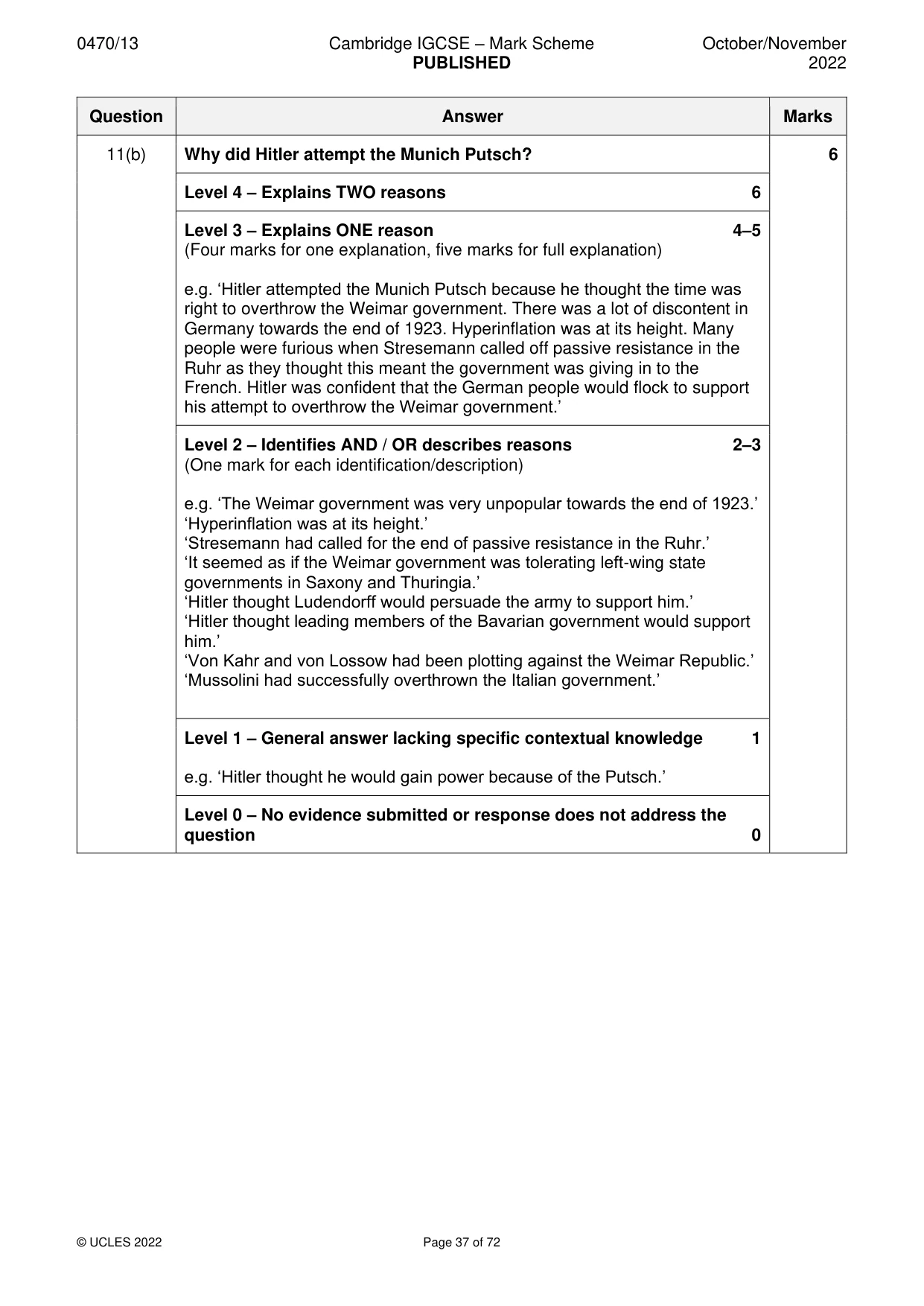
0470/13 Cambridge IGCSE – Mark Scheme PUBLISHED October/November 2022 © UCLES 2022 Page 37 of 72 Question Answer Marks 11(b) Why did Hitler attempt the Munich Putsch? 6 Level 4 – Explains TWO reasons 6 Level 3 – Explains ONE reason 4–5 (Four marks for one explanation, five marks for full explanation) e.g. ‘Hitler attempted the Munich Putsch because he thought the time was right to overthrow the Weimar government. There was a lot of discontent in Germany towards the end of 1923. Hyperinflation was at its height. Many people were furious when Stresemann called off passive resistance in the Ruhr as they thought this meant the government was giving in to the French. Hitler was confident that the German people would flock to support his attempt to overthrow the Weimar government.’ Level 2 – Identifies AND / OR describes reasons 2–3 (One mark for each identification/description) e.g. ‘The Weimar government was very unpopular towards the end of 1923.’ ‘Hyperinflation was at its height.’ ‘Stresemann had called for the end of passive resistance in the Ruhr.’ ‘It seemed as if the Weimar government was tolerating left-wing state governments in Saxony and Thuringia.’ ‘Hitler thought Ludendorff would persuade the army to support him.’ ‘Hitler thought leading members of the Bavarian government would support him.’ ‘Von Kahr and von Lossow had been plotting against the Weimar Republic.’ ‘Mussolini had successfully overthrown the Italian government.’ Level 1 – General answer lacking specific contextual knowledge 1 e.g. ‘Hitler thought he would gain power because of the Putsch.’ Level 0 – No evidence submitted or response does not address the question 0
Mark scheme, page 38
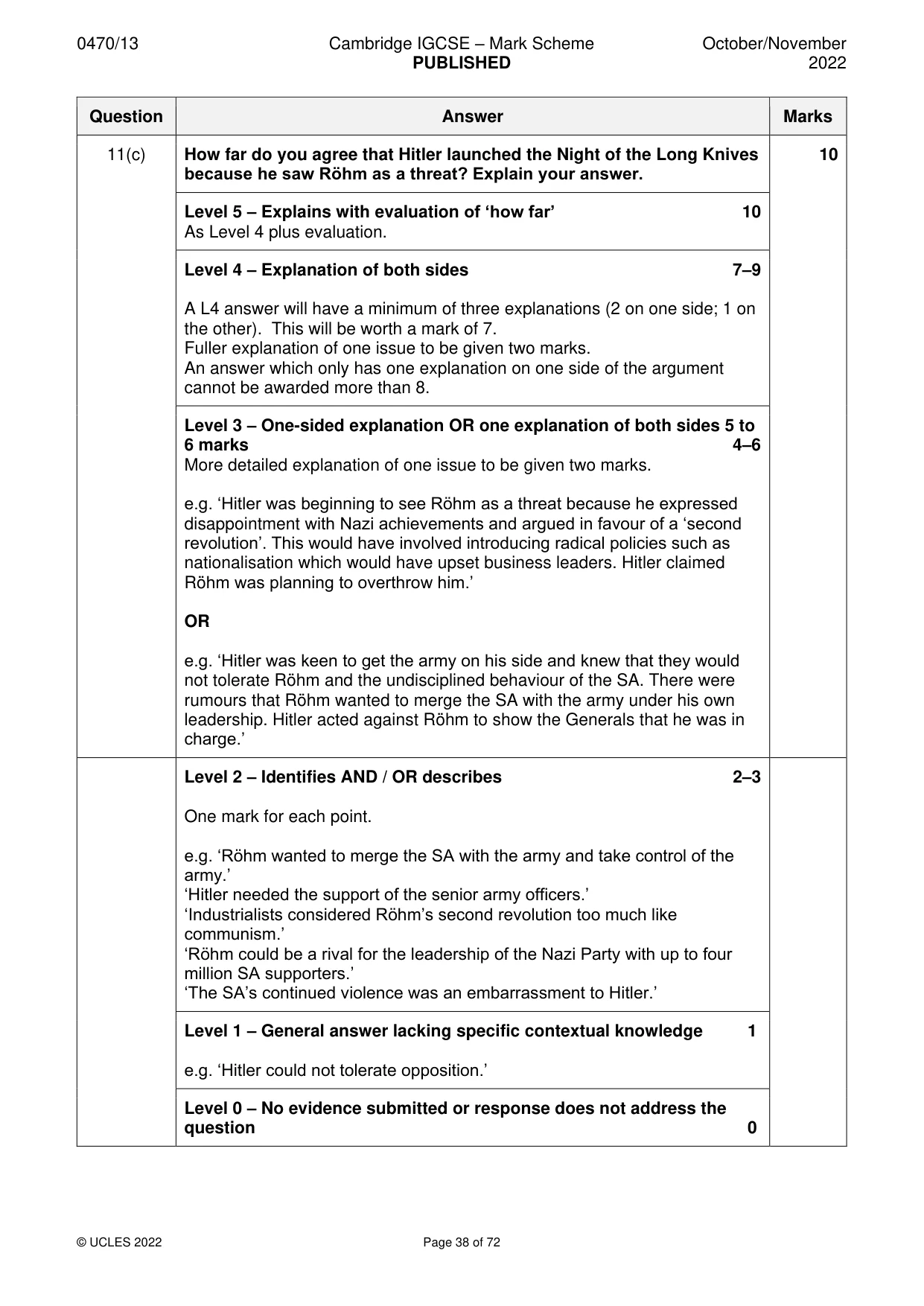
0470/13 Cambridge IGCSE – Mark Scheme PUBLISHED October/November 2022 © UCLES 2022 Page 38 of 72 Question Answer Marks 11(c) How far do you agree that Hitler launched the Night of the Long Knives because he saw Rӧhm as a threat? Explain your answer. 10 Level 5 – Explains with evaluation of ‘how far’ 10 As Level 4 plus evaluation. Level 4 – Explanation of both sides 7–9 A L4 answer will have a minimum of three explanations (2 on one side; 1 on the other). This will be worth a mark of 7. Fuller explanation of one issue to be given two marks. An answer which only has one explanation on one side of the argument cannot be awarded more than 8. Level 3 – One-sided explanation OR one explanation of both sides 5 to 6 marks 4–6 More detailed explanation of one issue to be given two marks. e.g. ‘Hitler was beginning to see Röhm as a threat because he expressed disappointment with Nazi achievements and argued in favour of a ‘second revolution’. This would have involved introducing radical policies such as nationalisation which would have upset business leaders. Hitler claimed Röhm was planning to overthrow him.’ OR e.g. ‘Hitler was keen to get the army on his side and knew that they would not tolerate Röhm and the undisciplined behaviour of the SA. There were rumours that Röhm wanted to merge the SA with the army under his own leadership. Hitler acted against Röhm to show the Generals that he was in charge.’ Level 2 – Identifies AND / OR describes 2–3 One mark for each point. e.g. ‘Röhm wanted to merge the SA with the army and take control of the army.’ ‘Hitler needed the support of the senior army officers.’ ‘Industrialists considered Röhm’s second revolution too much like communism.’ ‘Röhm could be a rival for the leadership of the Nazi Party with up to four million SA supporters.’ ‘The SA’s continued violence was an embarrassment to Hitler.’ Level 1 – General answer lacking specific contextual knowledge 1 e.g. ‘Hitler could not tolerate opposition.’ Level 0 – No evidence submitted or response does not address the question 0
Mark scheme, page 39
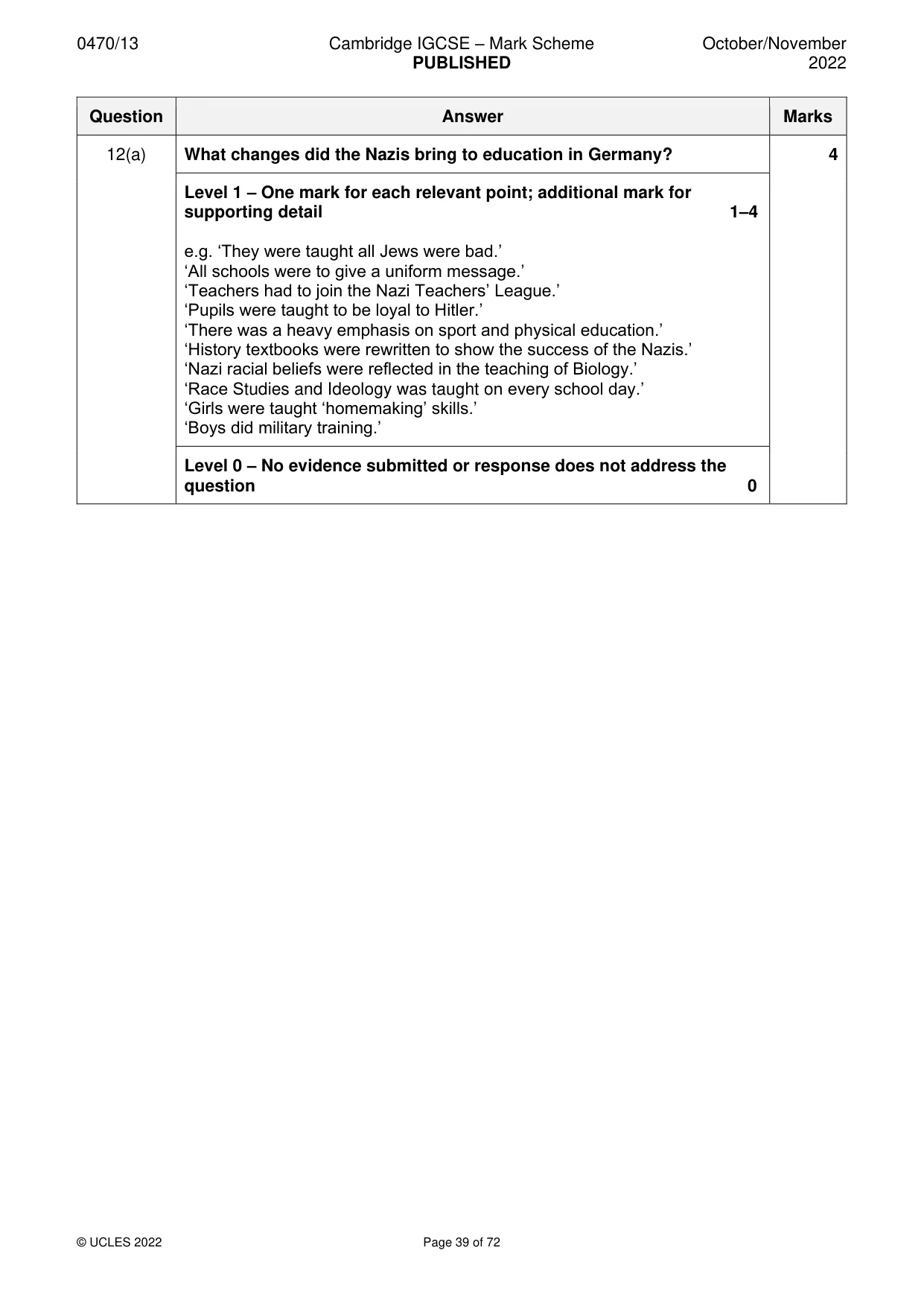
0470/13 Cambridge IGCSE – Mark Scheme PUBLISHED October/November 2022 © UCLES 2022 Page 39 of 72 Question Answer Marks 12(a) What changes did the Nazis bring to education in Germany? 4 Level 1 – One mark for each relevant point; additional mark for supporting detail 1–4 e.g. ‘They were taught all Jews were bad.’ ‘All schools were to give a uniform message.’ ‘Teachers had to join the Nazi Teachers’ League.’ ‘Pupils were taught to be loyal to Hitler.’ ‘There was a heavy emphasis on sport and physical education.’ ‘History textbooks were rewritten to show the success of the Nazis.’ ‘Nazi racial beliefs were reflected in the teaching of Biology.’ ‘Race Studies and Ideology was taught on every school day.’ ‘Girls were taught ‘homemaking’ skills.’ ‘Boys did military training.’ Level 0 – No evidence submitted or response does not address the question 0
Mark scheme, page 40
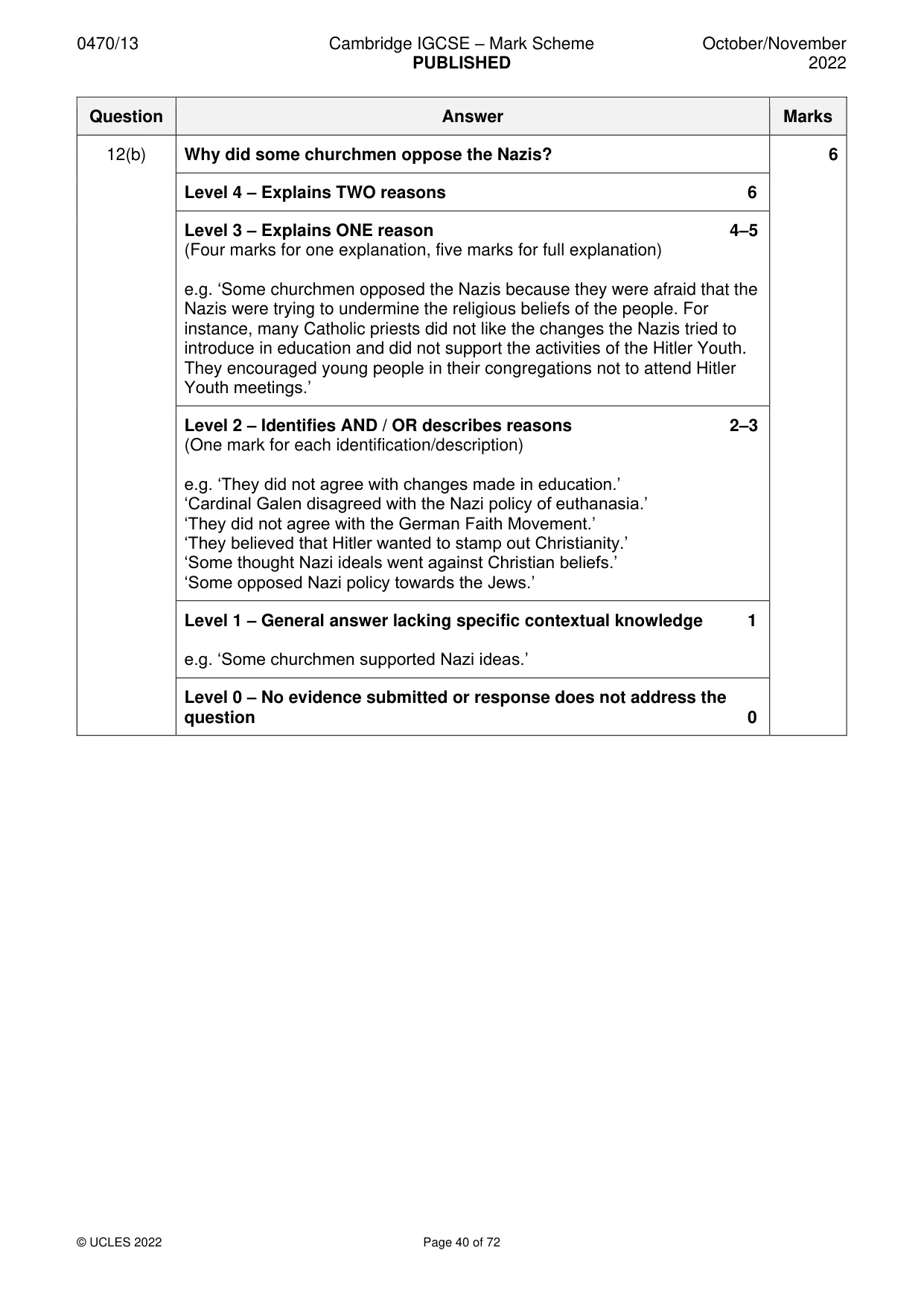
0470/13 Cambridge IGCSE – Mark Scheme PUBLISHED October/November 2022 © UCLES 2022 Page 40 of 72 Question Answer Marks 12(b) Why did some churchmen oppose the Nazis? 6 Level 4 – Explains TWO reasons 6 Level 3 – Explains ONE reason 4–5 (Four marks for one explanation, five marks for full explanation) e.g. ‘Some churchmen opposed the Nazis because they were afraid that the Nazis were trying to undermine the religious beliefs of the people. For instance, many Catholic priests did not like the changes the Nazis tried to introduce in education and did not support the activities of the Hitler Youth. They encouraged young people in their congregations not to attend Hitler Youth meetings.’ Level 2 – Identifies AND / OR describes reasons 2–3 (One mark for each identification/description) e.g. ‘They did not agree with changes made in education.’ ‘Cardinal Galen disagreed with the Nazi policy of euthanasia.’ ‘They did not agree with the German Faith Movement.’ ‘They believed that Hitler wanted to stamp out Christianity.’ ‘Some thought Nazi ideals went against Christian beliefs.’ ‘Some opposed Nazi policy towards the Jews.’ Level 1 – General answer lacking specific contextual knowledge 1 e.g. ‘Some churchmen supported Nazi ideas.’ Level 0 – No evidence submitted or response does not address the question 0
Mark scheme, page 41
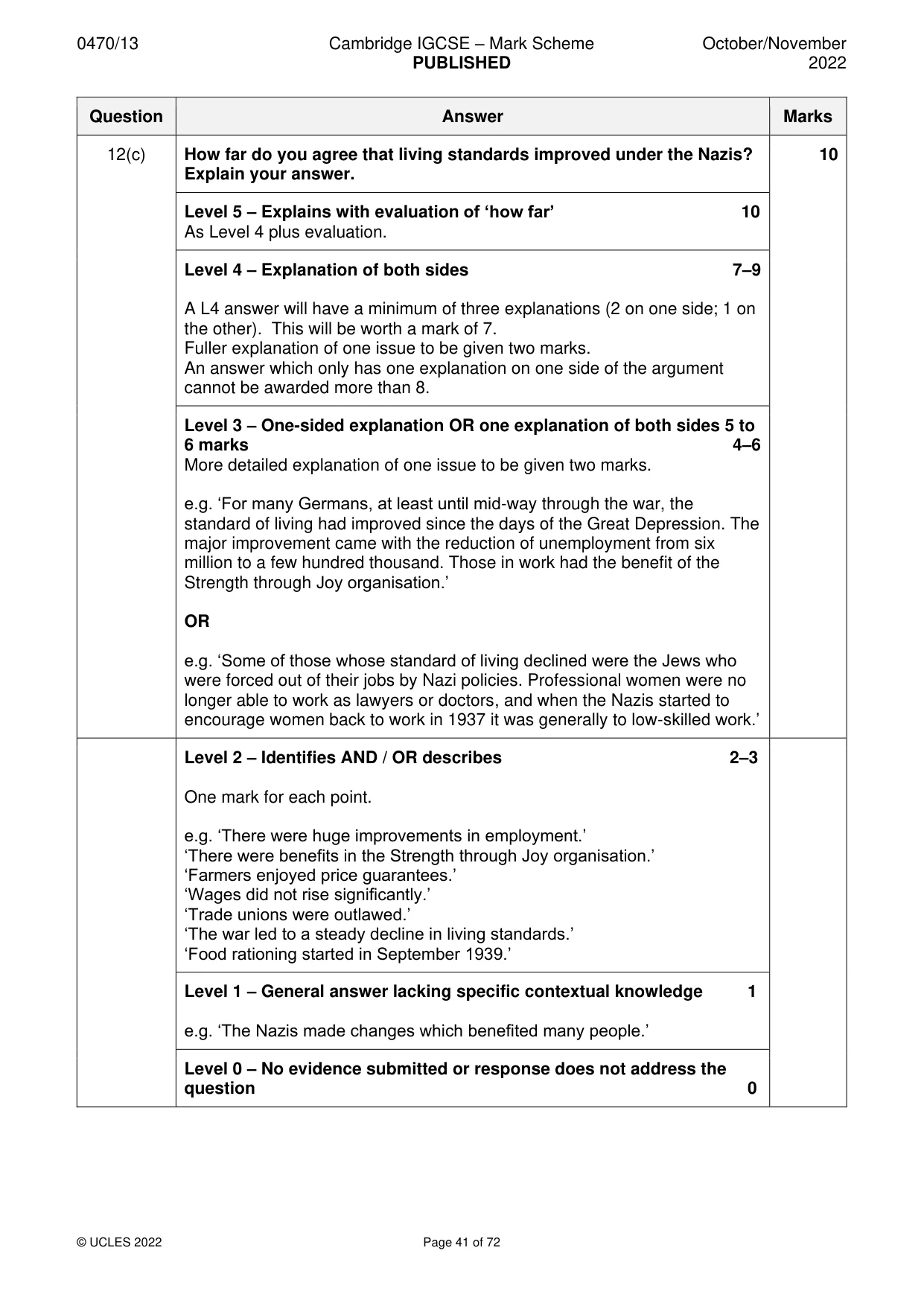
0470/13 Cambridge IGCSE – Mark Scheme PUBLISHED October/November 2022 © UCLES 2022 Page 41 of 72 Question Answer Marks 12(c) How far do you agree that living standards improved under the Nazis? Explain your answer. 10 Level 5 – Explains with evaluation of ‘how far’ 10 As Level 4 plus evaluation. Level 4 – Explanation of both sides 7–9 A L4 answer will have a minimum of three explanations (2 on one side; 1 on the other). This will be worth a mark of 7. Fuller explanation of one issue to be given two marks. An answer which only has one explanation on one side of the argument cannot be awarded more than 8. Level 3 – One-sided explanation OR one explanation of both sides 5 to 6 marks 4–6 More detailed explanation of one issue to be given two marks. e.g. ‘For many Germans, at least until mid-way through the war, the standard of living had improved since the days of the Great Depression. The major improvement came with the reduction of unemployment from six million to a few hundred thousand. Those in work had the benefit of the Strength through Joy organisation.’ OR e.g. ‘Some of those whose standard of living declined were the Jews who were forced out of their jobs by Nazi policies. Professional women were no longer able to work as lawyers or doctors, and when the Nazis started to encourage women back to work in 1937 it was generally to low-skilled work.’ Level 2 – Identifies AND / OR describes 2–3 One mark for each point. e.g. ‘There were huge improvements in employment.’ ‘There were benefits in the Strength through Joy organisation.’ ‘Farmers enjoyed price guarantees.’ ‘Wages did not rise significantly.’ ‘Trade unions were outlawed.’ ‘The war led to a steady decline in living standards.’ ‘Food rationing started in September 1939.’ Level 1 – General answer lacking specific contextual knowledge 1 e.g. ‘The Nazis made changes which benefited many people.’ Level 0 – No evidence submitted or response does not address the question 0
Mark scheme, page 42
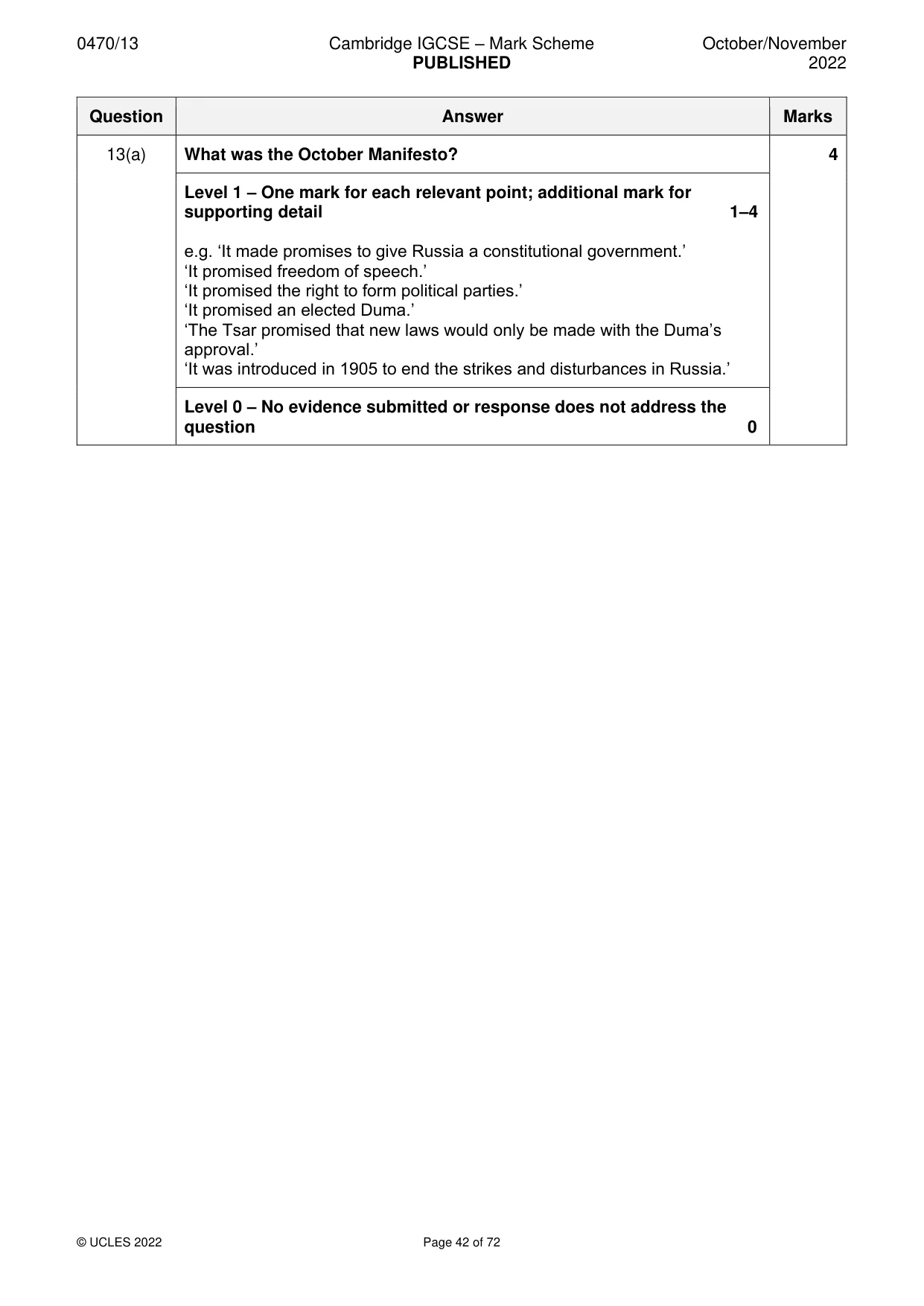
0470/13 Cambridge IGCSE – Mark Scheme PUBLISHED October/November 2022 © UCLES 2022 Page 42 of 72 Question Answer Marks 13(a) What was the October Manifesto? 4 Level 1 – One mark for each relevant point; additional mark for supporting detail 1–4 e.g. ‘It made promises to give Russia a constitutional government.’ ‘It promised freedom of speech.’ ‘It promised the right to form political parties.’ ‘It promised an elected Duma.’ ‘The Tsar promised that new laws would only be made with the Duma’s approval.’ ‘It was introduced in 1905 to end the strikes and disturbances in Russia.’ Level 0 – No evidence submitted or response does not address the question 0
Mark scheme, page 43
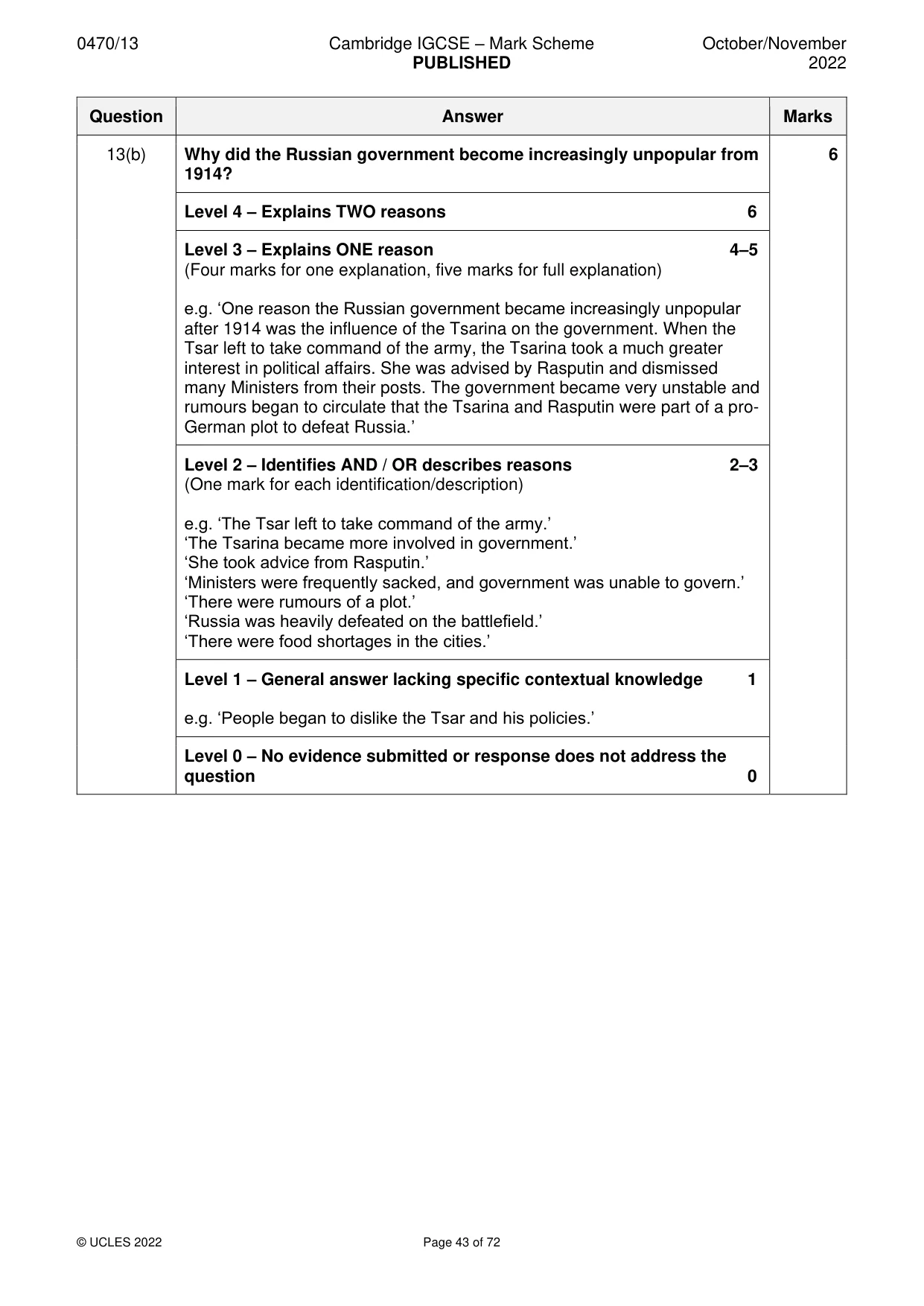
0470/13 Cambridge IGCSE – Mark Scheme PUBLISHED October/November 2022 © UCLES 2022 Page 43 of 72 Question Answer Marks 13(b) Why did the Russian government become increasingly unpopular from 1914? 6 Level 4 – Explains TWO reasons 6 Level 3 – Explains ONE reason 4–5 (Four marks for one explanation, five marks for full explanation) e.g. ‘One reason the Russian government became increasingly unpopular after 1914 was the influence of the Tsarina on the government. When the Tsar left to take command of the army, the Tsarina took a much greater interest in political affairs. She was advised by Rasputin and dismissed many Ministers from their posts. The government became very unstable and rumours began to circulate that the Tsarina and Rasputin were part of a pro- German plot to defeat Russia.’ Level 2 – Identifies AND / OR describes reasons 2–3 (One mark for each identification/description) e.g. ‘The Tsar left to take command of the army.’ ‘The Tsarina became more involved in government.’ ‘She took advice from Rasputin.’ ‘Ministers were frequently sacked, and government was unable to govern.’ ‘There were rumours of a plot.’ ‘Russia was heavily defeated on the battlefield.’ ‘There were food shortages in the cities.’ Level 1 – General answer lacking specific contextual knowledge 1 e.g. ‘People began to dislike the Tsar and his policies.’ Level 0 – No evidence submitted or response does not address the question 0
Mark scheme, page 44
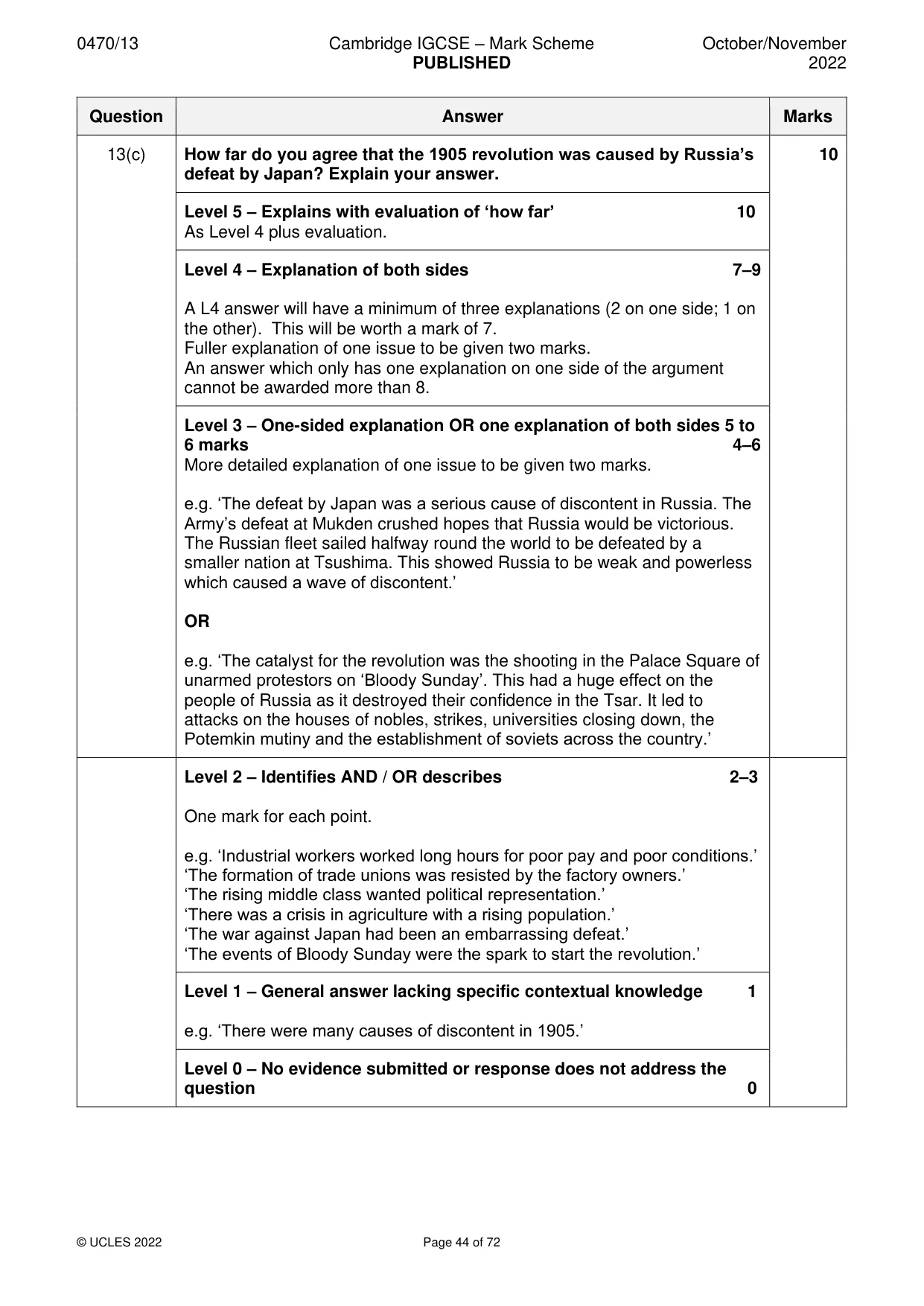
0470/13 Cambridge IGCSE – Mark Scheme PUBLISHED October/November 2022 © UCLES 2022 Page 44 of 72 Question Answer Marks 13(c) How far do you agree that the 1905 revolution was caused by Russia’s defeat by Japan? Explain your answer. 10 Level 5 – Explains with evaluation of ‘how far’ 10 As Level 4 plus evaluation. Level 4 – Explanation of both sides 7–9 A L4 answer will have a minimum of three explanations (2 on one side; 1 on the other). This will be worth a mark of 7. Fuller explanation of one issue to be given two marks. An answer which only has one explanation on one side of the argument cannot be awarded more than 8. Level 3 – One-sided explanation OR one explanation of both sides 5 to 6 marks 4–6 More detailed explanation of one issue to be given two marks. e.g. ‘The defeat by Japan was a serious cause of discontent in Russia. The Army’s defeat at Mukden crushed hopes that Russia would be victorious. The Russian fleet sailed halfway round the world to be defeated by a smaller nation at Tsushima. This showed Russia to be weak and powerless which caused a wave of discontent.’ OR e.g. ‘The catalyst for the revolution was the shooting in the Palace Square of unarmed protestors on ‘Bloody Sunday’. This had a huge effect on the people of Russia as it destroyed their confidence in the Tsar. It led to attacks on the houses of nobles, strikes, universities closing down, the Potemkin mutiny and the establishment of soviets across the country.’ Level 2 – Identifies AND / OR describes 2–3 One mark for each point. e.g. ‘Industrial workers worked long hours for poor pay and poor conditions.’ ‘The formation of trade unions was resisted by the factory owners.’ ‘The rising middle class wanted political representation.’ ‘There was a crisis in agriculture with a rising population.’ ‘The war against Japan had been an embarrassing defeat.’ ‘The events of Bloody Sunday were the spark to start the revolution.’ Level 1 – General answer lacking specific contextual knowledge 1 e.g. ‘There were many causes of discontent in 1905.’ Level 0 – No evidence submitted or response does not address the question 0
Mark scheme, page 45
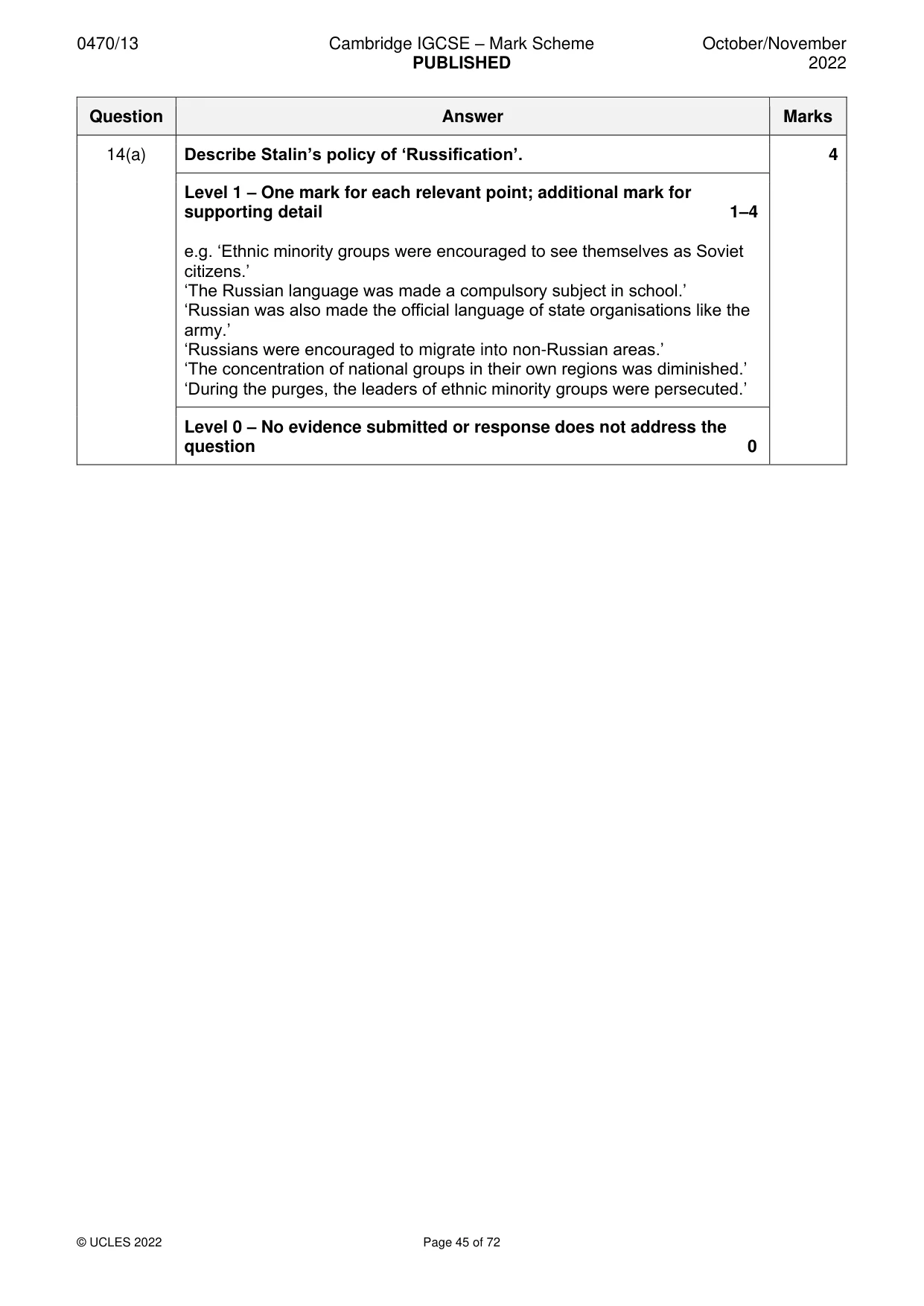
0470/13 Cambridge IGCSE – Mark Scheme PUBLISHED October/November 2022 © UCLES 2022 Page 45 of 72 Question Answer Marks 14(a) Describe Stalin’s policy of ‘Russification’. 4 Level 1 – One mark for each relevant point; additional mark for supporting detail 1–4 e.g. ‘Ethnic minority groups were encouraged to see themselves as Soviet citizens.’ ‘The Russian language was made a compulsory subject in school.’ ‘Russian was also made the official language of state organisations like the army.’ ‘Russians were encouraged to migrate into non-Russian areas.’ ‘The concentration of national groups in their own regions was diminished.’ ‘During the purges, the leaders of ethnic minority groups were persecuted.’ Level 0 – No evidence submitted or response does not address the question 0
Mark scheme, page 46
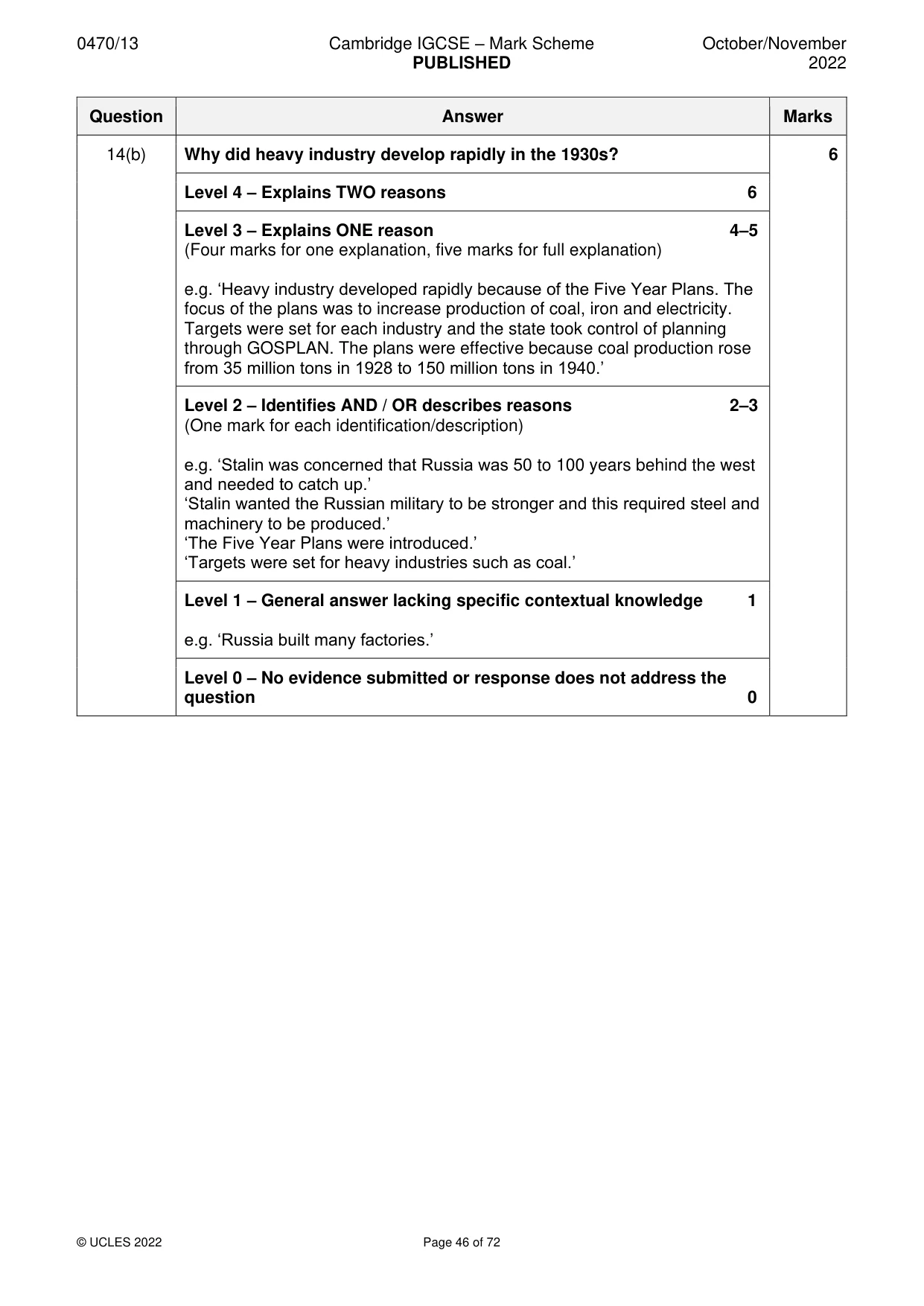
0470/13 Cambridge IGCSE – Mark Scheme PUBLISHED October/November 2022 © UCLES 2022 Page 46 of 72 Question Answer Marks 14(b) Why did heavy industry develop rapidly in the 1930s? 6 Level 4 – Explains TWO reasons 6 Level 3 – Explains ONE reason 4–5 (Four marks for one explanation, five marks for full explanation) e.g. ‘Heavy industry developed rapidly because of the Five Year Plans. The focus of the plans was to increase production of coal, iron and electricity. Targets were set for each industry and the state took control of planning through GOSPLAN. The plans were effective because coal production rose from 35 million tons in 1928 to 150 million tons in 1940.’ Level 2 – Identifies AND / OR describes reasons 2–3 (One mark for each identification/description) e.g. ‘Stalin was concerned that Russia was 50 to 100 years behind the west and needed to catch up.’ ‘Stalin wanted the Russian military to be stronger and this required steel and machinery to be produced.’ ‘The Five Year Plans were introduced.’ ‘Targets were set for heavy industries such as coal.’ Level 1 – General answer lacking specific contextual knowledge 1 e.g. ‘Russia built many factories.’ Level 0 – No evidence submitted or response does not address the question 0
Mark scheme, page 47
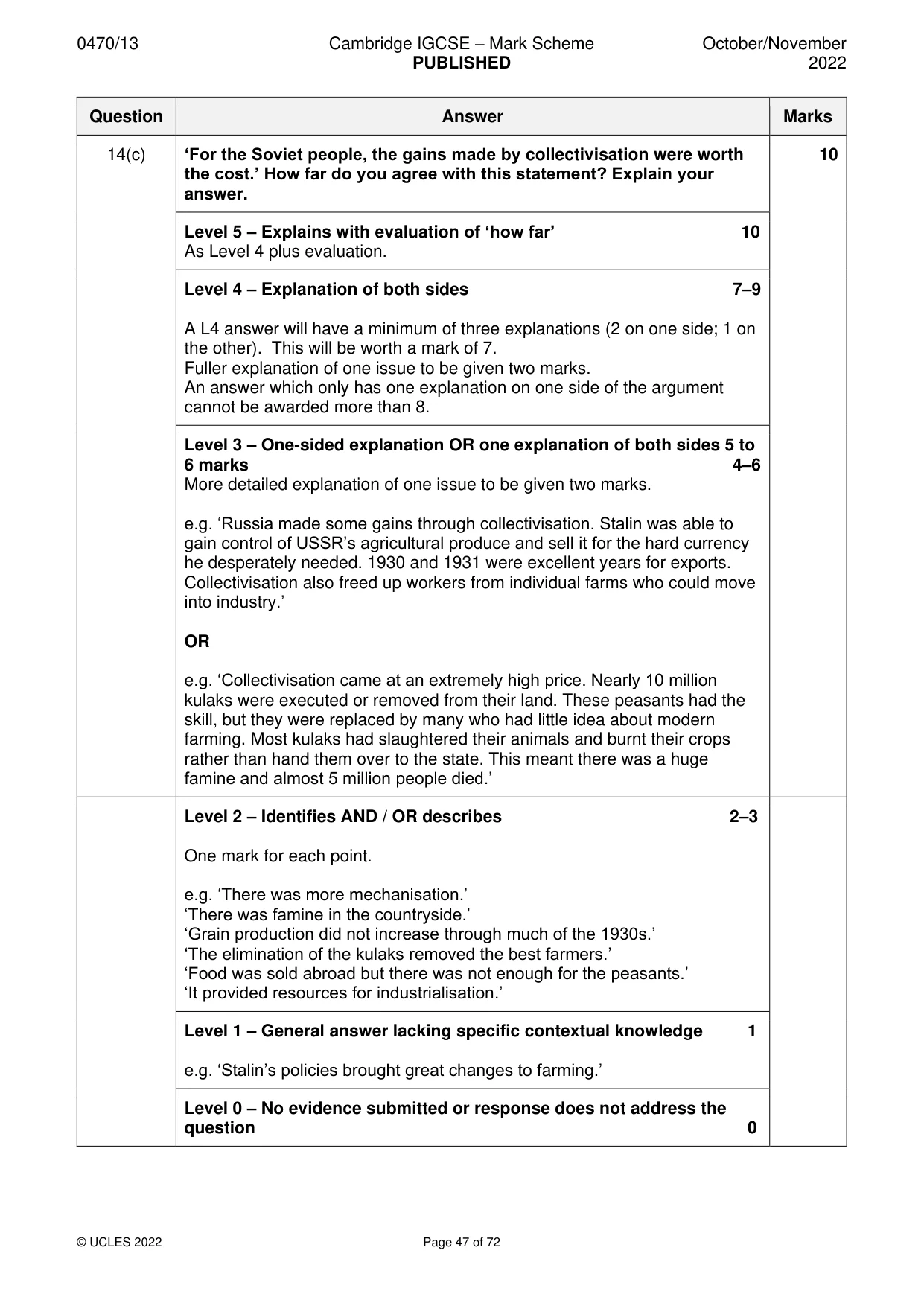
0470/13 Cambridge IGCSE – Mark Scheme PUBLISHED October/November 2022 © UCLES 2022 Page 47 of 72 Question Answer Marks 14(c) ‘For the Soviet people, the gains made by collectivisation were worth the cost.’ How far do you agree with this statement? Explain your answer. 10 Level 5 – Explains with evaluation of ‘how far’ 10 As Level 4 plus evaluation. Level 4 – Explanation of both sides 7–9 A L4 answer will have a minimum of three explanations (2 on one side; 1 on the other). This will be worth a mark of 7. Fuller explanation of one issue to be given two marks. An answer which only has one explanation on one side of the argument cannot be awarded more than 8. Level 3 – One-sided explanation OR one explanation of both sides 5 to 6 marks 4–6 More detailed explanation of one issue to be given two marks. e.g. ‘Russia made some gains through collectivisation. Stalin was able to gain control of USSR’s agricultural produce and sell it for the hard currency he desperately needed. 1930 and 1931 were excellent years for exports. Collectivisation also freed up workers from individual farms who could move into industry.’ OR e.g. ‘Collectivisation came at an extremely high price. Nearly 10 million kulaks were executed or removed from their land. These peasants had the skill, but they were replaced by many who had little idea about modern farming. Most kulaks had slaughtered their animals and burnt their crops rather than hand them over to the state. This meant there was a huge famine and almost 5 million people died.’ Level 2 – Identifies AND / OR describes 2–3 One mark for each point. e.g. ‘There was more mechanisation.’ ‘There was famine in the countryside.’ ‘Grain production did not increase through much of the 1930s.’ ‘The elimination of the kulaks removed the best farmers.’ ‘Food was sold abroad but there was not enough for the peasants.’ ‘It provided resources for industrialisation.’ Level 1 – General answer lacking specific contextual knowledge 1 e.g. ‘Stalin’s policies brought great changes to farming.’ Level 0 – No evidence submitted or response does not address the question 0
Mark scheme, page 48
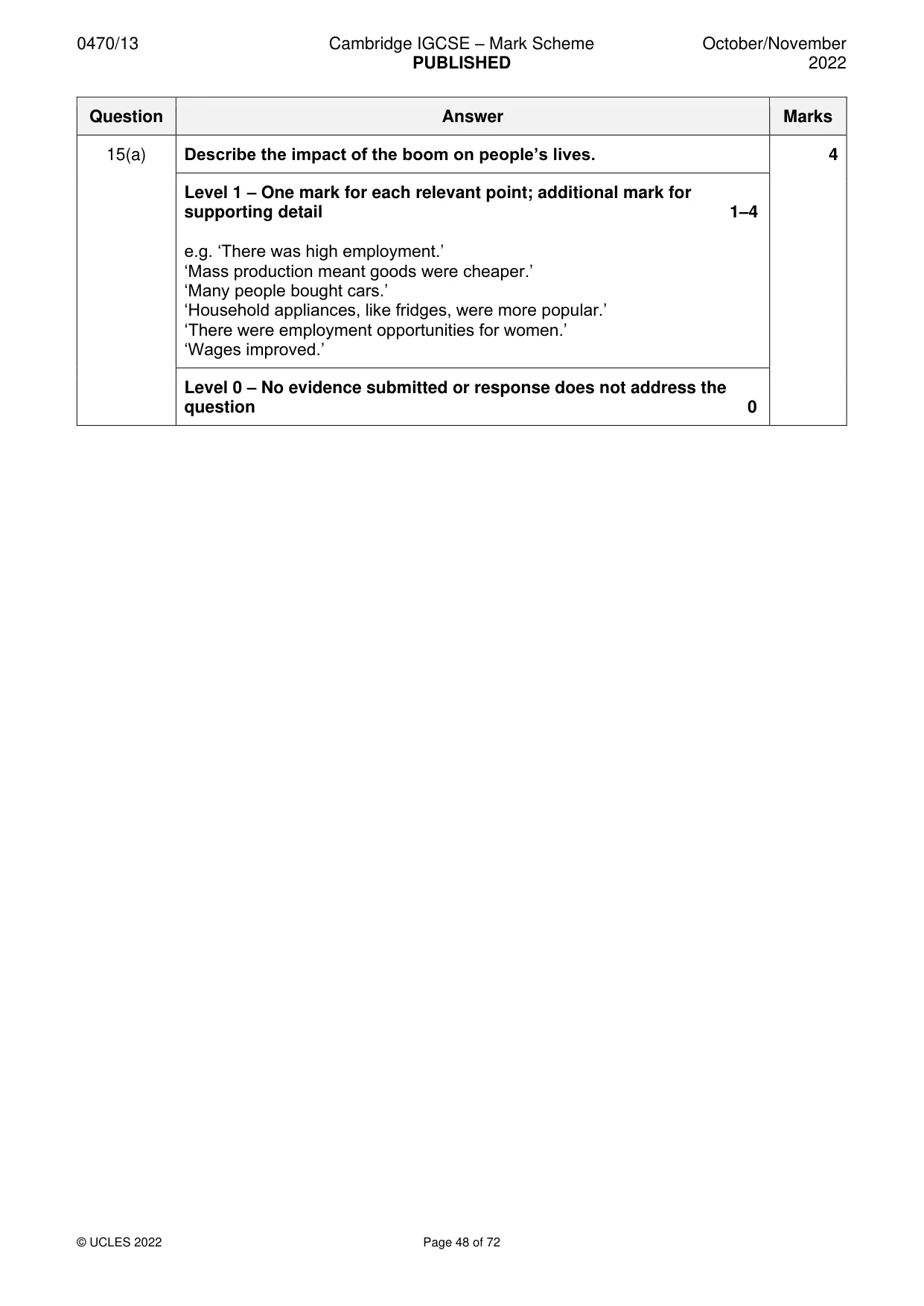
0470/13 Cambridge IGCSE – Mark Scheme PUBLISHED October/November 2022 © UCLES 2022 Page 48 of 72 Question Answer Marks 15(a) Describe the impact of the boom on people’s lives. 4 Level 1 – One mark for each relevant point; additional mark for supporting detail 1–4 e.g. ‘There was high employment.’ ‘Mass production meant goods were cheaper.’ ‘Many people bought cars.’ ‘Household appliances, like fridges, were more popular.’ ‘There were employment opportunities for women.’ ‘Wages improved.’ Level 0 – No evidence submitted or response does not address the question 0
Mark scheme, page 49
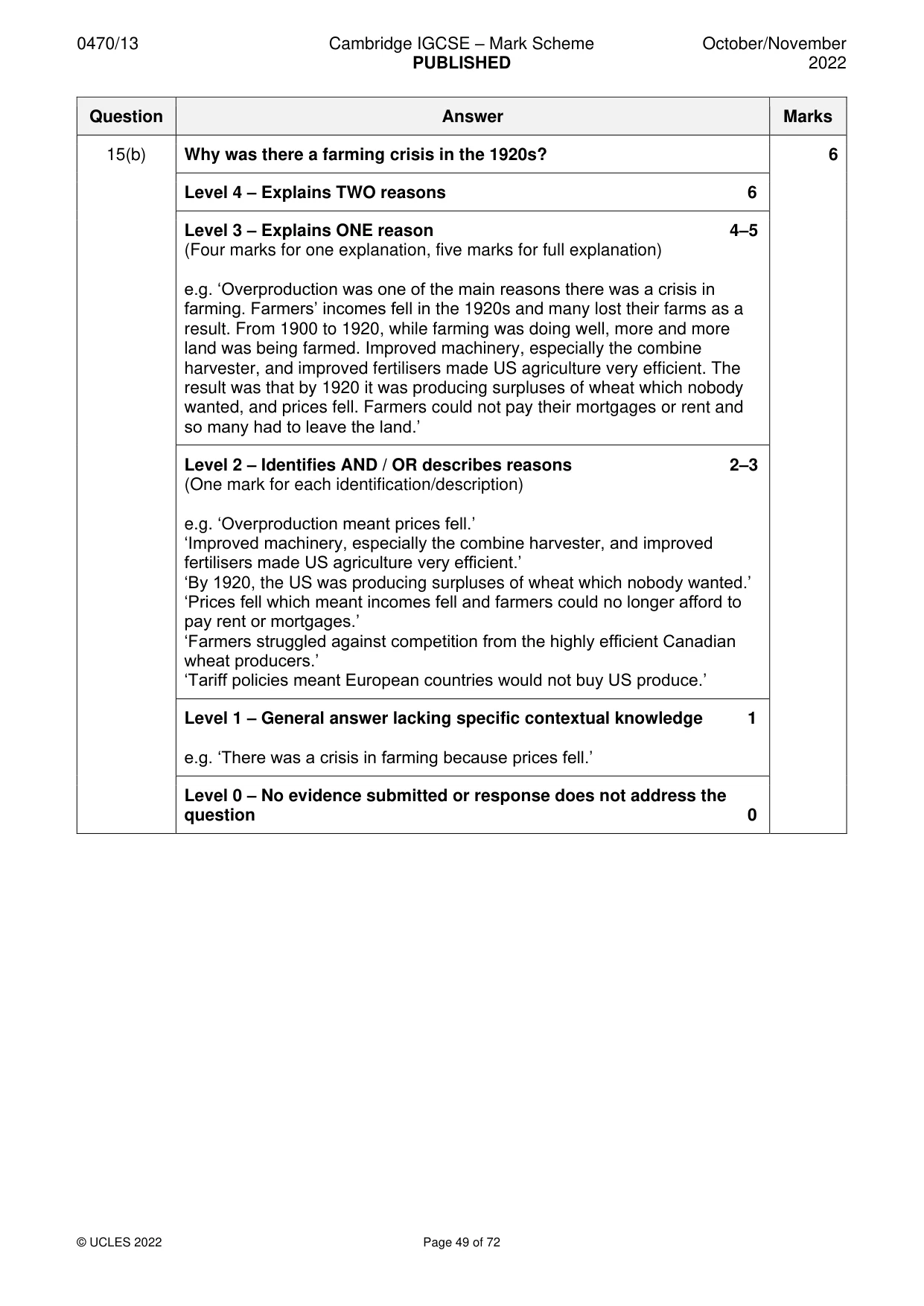
0470/13 Cambridge IGCSE – Mark Scheme PUBLISHED October/November 2022 © UCLES 2022 Page 49 of 72 Question Answer Marks 15(b) Why was there a farming crisis in the 1920s? 6 Level 4 – Explains TWO reasons 6 Level 3 – Explains ONE reason 4–5 (Four marks for one explanation, five marks for full explanation) e.g. ‘Overproduction was one of the main reasons there was a crisis in farming. Farmers’ incomes fell in the 1920s and many lost their farms as a result. From 1900 to 1920, while farming was doing well, more and more land was being farmed. Improved machinery, especially the combine harvester, and improved fertilisers made US agriculture very efficient. The result was that by 1920 it was producing surpluses of wheat which nobody wanted, and prices fell. Farmers could not pay their mortgages or rent and so many had to leave the land.’ Level 2 – Identifies AND / OR describes reasons 2–3 (One mark for each identification/description) e.g. ‘Overproduction meant prices fell.’ ‘Improved machinery, especially the combine harvester, and improved fertilisers made US agriculture very efficient.’ ‘By 1920, the US was producing surpluses of wheat which nobody wanted.’ ‘Prices fell which meant incomes fell and farmers could no longer afford to pay rent or mortgages.’ ‘Farmers struggled against competition from the highly efficient Canadian wheat producers.’ ‘Tariff policies meant European countries would not buy US produce.’ Level 1 – General answer lacking specific contextual knowledge 1 e.g. ‘There was a crisis in farming because prices fell.’ Level 0 – No evidence submitted or response does not address the question 0
Mark scheme, page 50
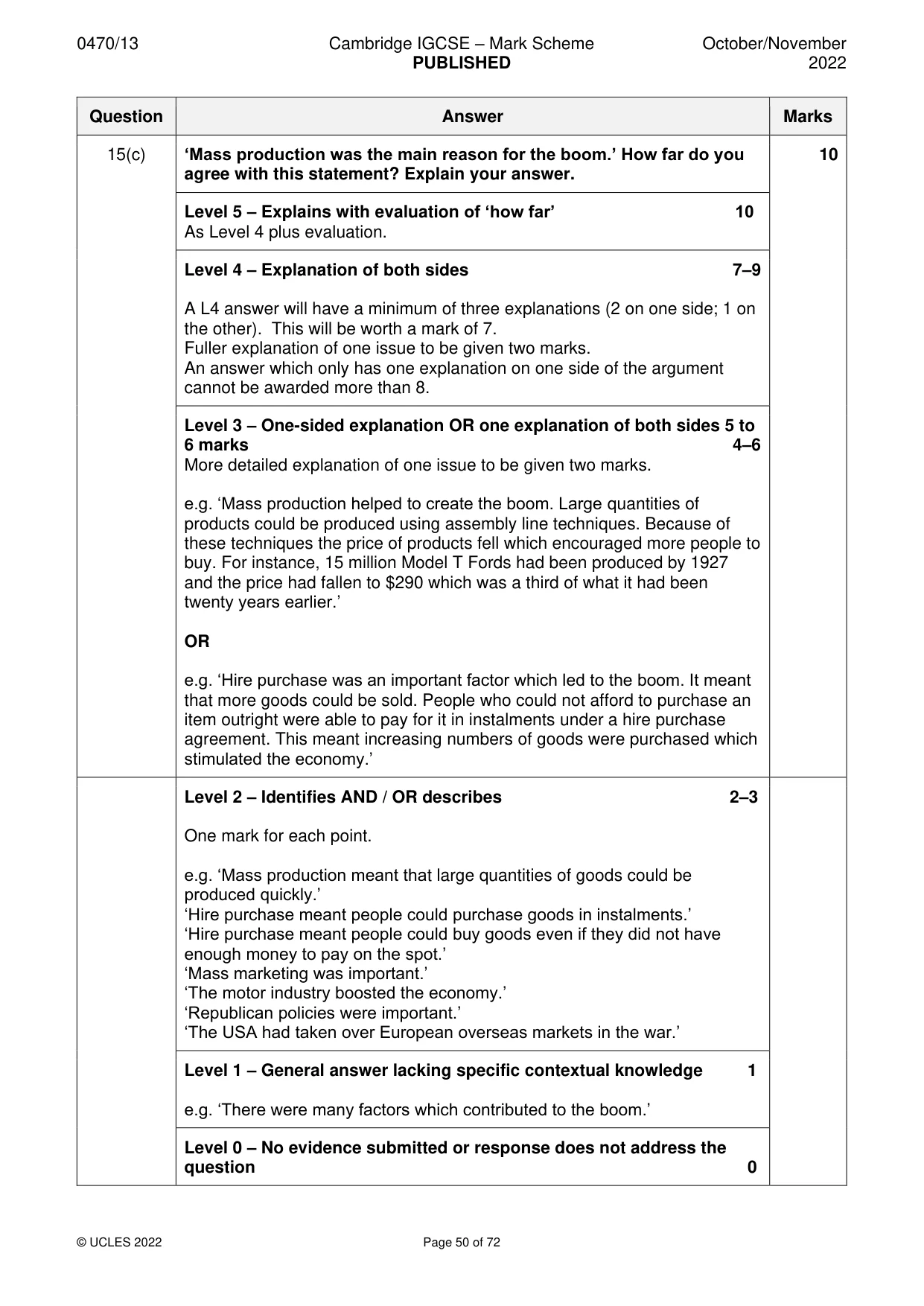
0470/13 Cambridge IGCSE – Mark Scheme PUBLISHED October/November 2022 © UCLES 2022 Page 50 of 72 Question Answer Marks 15(c) ‘Mass production was the main reason for the boom.’ How far do you agree with this statement? Explain your answer. 10 Level 5 – Explains with evaluation of ‘how far’ 10 As Level 4 plus evaluation. Level 4 – Explanation of both sides 7–9 A L4 answer will have a minimum of three explanations (2 on one side; 1 on the other). This will be worth a mark of 7. Fuller explanation of one issue to be given two marks. An answer which only has one explanation on one side of the argument cannot be awarded more than 8. Level 3 – One-sided explanation OR one explanation of both sides 5 to 6 marks 4–6 More detailed explanation of one issue to be given two marks. e.g. ‘Mass production helped to create the boom. Large quantities of products could be produced using assembly line techniques. Because of these techniques the price of products fell which encouraged more people to buy. For instance, 15 million Model T Fords had been produced by 1927 and the price had fallen to $290 which was a third of what it had been twenty years earlier.’ OR e.g. ‘Hire purchase was an important factor which led to the boom. It meant that more goods could be sold. People who could not afford to purchase an item outright were able to pay for it in instalments under a hire purchase agreement. This meant increasing numbers of goods were purchased which stimulated the economy.’ Level 2 – Identifies AND / OR describes 2–3 One mark for each point. e.g. ‘Mass production meant that large quantities of goods could be produced quickly.’ ‘Hire purchase meant people could purchase goods in instalments.’ ‘Hire purchase meant people could buy goods even if they did not have enough money to pay on the spot.’ ‘Mass marketing was important.’ ‘The motor industry boosted the economy.’ ‘Republican policies were important.’ ‘The USA had taken over European overseas markets in the war.’ Level 1 – General answer lacking specific contextual knowledge 1 e.g. ‘There were many factors which contributed to the boom.’ Level 0 – No evidence submitted or response does not address the question 0
Mark scheme, page 51
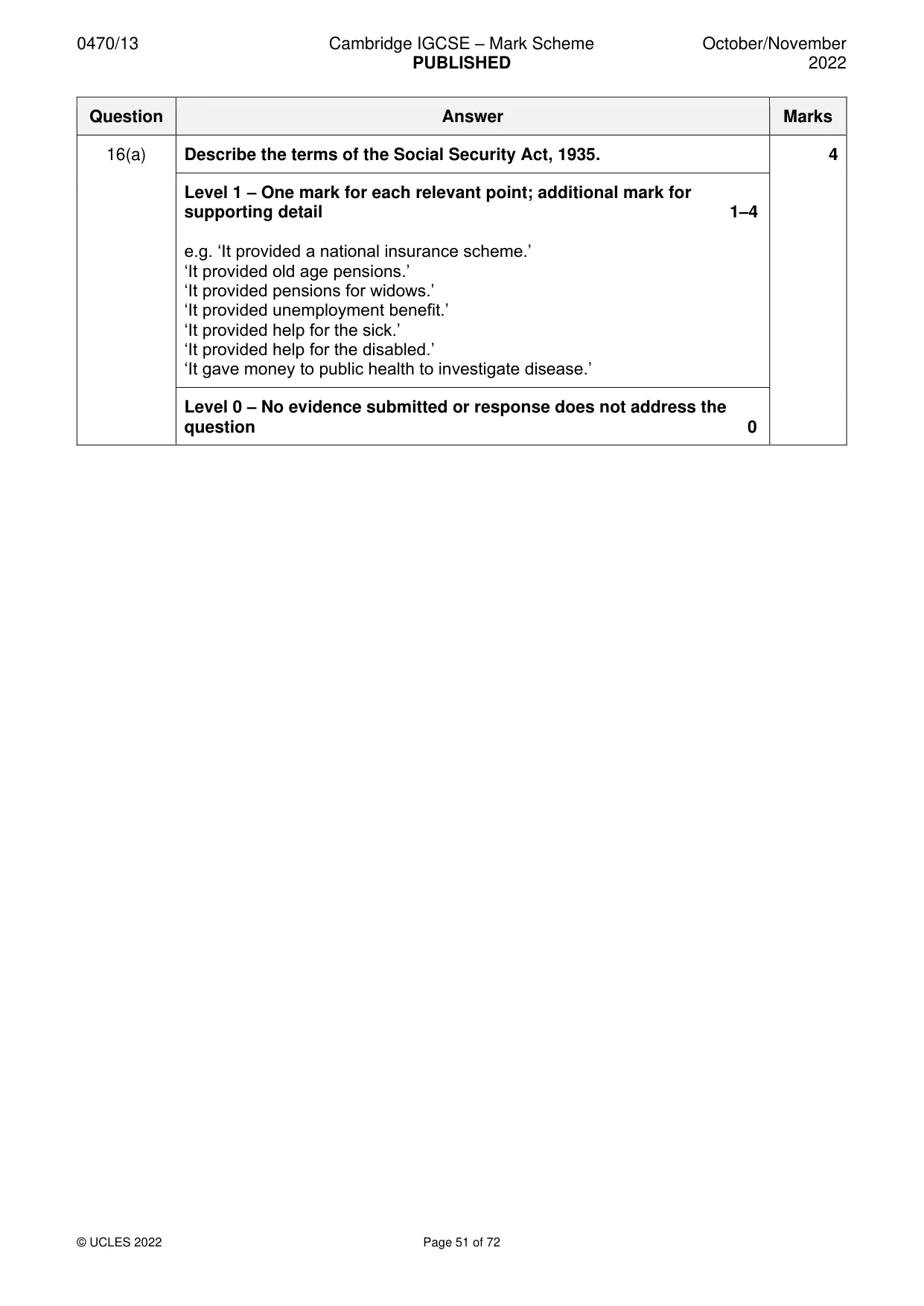
0470/13 Cambridge IGCSE – Mark Scheme PUBLISHED October/November 2022 © UCLES 2022 Page 51 of 72 Question Answer Marks 16(a) Describe the terms of the Social Security Act, 1935. 4 Level 1 – One mark for each relevant point; additional mark for supporting detail 1–4 e.g. ‘It provided a national insurance scheme.’ ‘It provided old age pensions.’ ‘It provided pensions for widows.’ ‘It provided unemployment benefit.’ ‘It provided help for the sick.’ ‘It provided help for the disabled.’ ‘It gave money to public health to investigate disease.’ Level 0 – No evidence submitted or response does not address the question 0
Mark scheme, page 52
0470/13 Cambridge IGCSE – Mark Scheme PUBLISHED October/November 2022 © UCLES 2022 Page 52 of 72 Question Answer Marks 16(b) Why did the Liberty League oppose the New Deal? 6 Level 4 – Explains TWO reasons 6 Level 3 – Explains ONE reason 4–5 (Four marks for one explanation, five marks for full explanation) e.g. ‘The Liberty League opposed the New Deal because they disliked the way New Deal legislation interfered with how businesses operated. For instance, the NIRA set up the NRA. This aimed to improve working conditions and pay but the business owners resented being told how to run their businesses.’ Level 2 – Identifies AND / OR describes reasons 2–3 (One mark for each identification/description) e.g. ‘Many of the members were Republican.’ ‘They resented interference in their businesses.’ ‘They accused Roosevelt of introducing socialist policies.’ ‘They were opposed to the unions which Roosevelt encouraged.’ ‘They felt Roosevelt’s policies were ‘un-American’ and went against the idea of free enterprise.’ Level 1 – General answer lacking specific contextual knowledge 1 e.g. ‘The Liberty League did not agree with Roosevelt’s ideas.’ Level 0 – No evidence submitted or response does not address the question 0
Mark scheme, page 53
0470/13 Cambridge IGCSE – Mark Scheme PUBLISHED October/November 2022 © UCLES 2022 Page 53 of 72 Question Answer Marks 16(c) How effective was the New Deal in dealing with unemployment? Explain your answer. 10 Level 5 – Explains with evaluation of ‘how effective’ 10 As Level 4 plus evaluation. Level 4 – Explanation of both sides 7–9 A L4 answer will have a minimum of three explanations (2 on one side; 1 on the other). This will be worth a mark of 7. Fuller explanation of one issue to be given two marks. An answer which only has one explanation on one side of the argument cannot be awarded more than 8. Level 3 – One-sided explanation OR one explanation of both sides 5 to 6 marks 4–6 More detailed explanation of one issue to be given two marks. e.g. ‘In some ways the New Deal was effective in tackling the problem of unemployment. Some of the New Deal Agencies created jobs. For instance, the CCC provided voluntary employment for young men between the ages of 18 and 25. The Public Works Administration provided work on construction projects such as building schools and bridges. While some of the jobs were temporary, many were permanent, and unemployment fell from almost 13 million to below 8 million in 1937.’ OR e.g. ‘In spite of Roosevelt’s schemes, unemployment was never fully tackled. Some of the jobs which were provided by the CCC and CWA were only temporary. Although unemployment had dropped by 1937, in 1938 it had increased again. Unemployment only dropped when war started.’ Level 2 – Identifies AND / OR describes 2–3 One mark for each point. e.g. ‘Roosevelt’s New Deal included schemes to create work.’ ‘Young men had temporary jobs in the Civilian Conservation Corps.’ ‘The Public Works Administration offered permanent work in the construction industry.’ ‘Unemployment fell from 13 million in 1933 to 7.7 million in 1937.’ ‘Unemployment rose again in 1938.’ ‘Many of the jobs offered were only temporary.’ ‘Many farmers became unemployed because of Roosevelt’s agricultural policies.’ Level 1 – General answer lacking specific contextual knowledge 1 e.g. ‘Many schemes set up by the New Deal tried to tackle unemployment.’ Level 0 – No evidence submitted or response does not address the question 0
Mark scheme, page 54
0470/13 Cambridge IGCSE – Mark Scheme PUBLISHED October/November 2022 © UCLES 2022 Page 54 of 72 Question Answer Marks 17(a) Describe the work of the ‘barefoot doctors’. 4 Level 1 – One mark for each relevant point; additional mark for supporting detail 1–4 e.g. ‘They went through a six-month training period.’ ‘Their medical training was based on practical courses.’ ‘They went to work among the peasants.’ ‘They travelled around China treating the sick.’ ‘Often they treated people for free.’ Level 0 – No evidence submitted or response does not address the question 0
Mark scheme, page 55
0470/13 Cambridge IGCSE – Mark Scheme PUBLISHED October/November 2022 © UCLES 2022 Page 55 of 72 Question Answer Marks 17(b) Why did Mao want to improve the status of women in China? 6 Level 4 – Explains TWO reasons 6 Level 3 – Explains ONE reason 4–5 (Four marks for one explanation, five marks for full explanation) e.g. ‘One reason Mao changed the status of women was that it was part of the Communist philosophy that all men and women are equal. Mao personally believed this was true. He wanted to put into effect true Communism.’ Level 2 – Identifies AND / OR describes reasons 2–3 (One mark for each identification/description) e.g. ‘Part of the Communist philosophy is that all men and women are equal.’ ‘Mao believed that Chinese thinking was too traditional and needed changing.’ ‘Traditionally, women had arranged marriages and had few rights.’ ‘Mao wanted women to have equal rights.’ ‘Mao realised that women were a great source of untapped labour.’ Level 1 – General answer lacking specific contextual knowledge 1 e.g. ‘Mao wanted to change the status of women as they had been badly treated.’ Level 0 – No evidence submitted or response does not address the question 0
Mark scheme, page 56
0470/13 Cambridge IGCSE – Mark Scheme PUBLISHED October/November 2022 © UCLES 2022 Page 56 of 72 Question Answer Marks 17(c) How far do you agree that Mao’s agricultural policies were effective? Explain your answer. 10 Level 5 – Explains with evaluation of ‘how far’ 10 As Level 4 plus evaluation. Level 4 – Explanation of both sides 7–9 A L4 answer will have a minimum of three explanations (2 on one side; 1 on the other). This will be worth a mark of 7. Fuller explanation of one issue to be given two marks. An answer which only has one explanation on one side of the argument cannot be awarded more than 8. Level 3 – One-sided explanation OR one explanation of both sides 5 to 6 marks 4–6 More detailed explanation of one issue to be given two marks. e.g. ‘In some ways, Mao’s agricultural policy benefited China. Land reform in 1950 had made Mao popular as land was taken from the landlords and re- distributed to the peasants. This seemed to be successful as grain production had climbed to a record high in 1952.’ OR e.g. ‘However, food production didn’t rise quickly enough and there was a famine which killed millions. In 1951, the census showed that China’s population was 600 million and rising fast. Therefore, food production needed to rise quickly. Although there was a record harvest in 1958, it was followed by three poor years and led to imports, rationing and starvation.’ Level 2 – Identifies AND / OR describes 2–3 One mark for each point. e.g. ‘Land reform was popular and benefited the peasants.’ ‘More food needed to be produced.’ ‘Communes were introduced in 1953.’ ‘Too many farmers went to work in industry and so food production suffered.’ ‘There was a famine which killed at least 20 million people.’ Level 1 – General answer lacking specific contextual knowledge 1 e.g. ‘Mao’s policies were not always effective.’ Level 0 – No evidence submitted or response does not address the question 0
Mark scheme, page 57
0470/13 Cambridge IGCSE – Mark Scheme PUBLISHED October/November 2022 © UCLES 2022 Page 57 of 72 Question Answer Marks 18(a) What was the ‘Little Red Book’? 4 Level 1 – One mark for each relevant point; additional mark for supporting detail 1–4 e.g. ‘The Little Red Book contains quotations from Mao.’ ‘There are 267 quotations and thoughts.’ ‘It covered issues such as class struggle, correcting mistaken ideas.’ ‘It was produced in 1964 by the PLA.’ ‘It became a key feature of the personality cult.’ ‘The Ministry of Culture aimed to distribute a copy to every Chinese citizen.’ Level 0 – No evidence submitted or response does not address the question 0
Mark scheme, page 58
0470/13 Cambridge IGCSE – Mark Scheme PUBLISHED October/November 2022 © UCLES 2022 Page 58 of 72 Question Answer Marks 18(b) Why did Mao feel the way he did about Liu Shaoqi? 6 Level 4 – Explains TWO reasons 6 Level 3 – Explains ONE reason 4–5 (Four marks for one explanation, five marks for full explanation) e.g. ‘Mao saw Liu Shaoqi as a threat because he was critical of Mao’s policies. The failure of the Great Leap Forward was blamed on Mao and Liu Shaoqi criticised his policies on collective farming and factories. Liu Shaoqi introduced reforms which saw private ownership reintroduced and the communes disbanded. Mao thought this was a threat to everything he had achieved.’ Level 2 – Identifies AND / OR describes reasons 2–3 (One mark for each identification/description) e.g. ‘Mao’s successor, Liu Shaoqi, did not favour Mao’s reforms on collective farms and factories.’ ‘Mao saw Liu as a threat to what he had achieved.’ ‘Mao was concerned that Liu was taking China’s revolution towards the Soviet model.’ ‘Mao thought Liu had encouraged elements of capitalism such as private trade and made certain people richer than others.’ ‘Mao wanted to stop groups becoming more powerful and privileged.’ ‘Mao wanted to re-impose his authority on the Party.’ Level 1 – General answer lacking specific contextual knowledge 1 e.g. ‘Mao thought he wanted to take over.’ Level 0 – No evidence submitted or response does not address the question 0
Mark scheme, page 59
0470/13 Cambridge IGCSE – Mark Scheme PUBLISHED October/November 2022 © UCLES 2022 Page 59 of 72 Question Answer Marks 18(c) ‘Deng Xiaoping’s emergence as leader in China was a surprise.’ How far do you agree with this statement? Explain your answer. 10 Level 5 – Explains with evaluation of ‘how far’ 10 As Level 4 plus evaluation. Level 4 – Explanation of both sides 7–9 A L4 answer will have a minimum of three explanations (2 on one side; 1 on the other). This will be worth a mark of 7. Fuller explanation of one issue to be given two marks. An answer which only has one explanation on one side of the argument cannot be awarded more than 8. Level 3 – One-sided explanation OR one explanation of both sides 5 to 6 marks 4–6 More detailed explanation of one issue to be given two marks. e.g. ‘In some ways, it was a surprise that Deng emerged as leader as he was not the front runner when Mao died. Mao had expressed a wish that Hua Guofeng should become the new Chairman of the Party. He was very loyal to Mao and stressed that his leadership would be a continuation of Mao’s rule.’ OR e.g. ‘In some ways, it is not surprising that Deng became the leader. Many members of the Party favoured Deng’s ideas of increasing production and modernising industry to support its huge population. He wanted to offer incentives such as piecework, bonus payments and profit-sharing. He was also popular with the PLA.’ Level 2 – Identifies AND / OR describes 2–3 One mark for each point. e.g. ‘Deng moved supporters into important positions in the Party.’ ‘Hua Guofeng was Mao’s chosen successor.’ ‘Deng installed supporters as Premier and General Secretary.’ ‘Hua Guofeng was very loyal to Mao and wanted to continue his policies.’ ‘Deng had attempted new policies immediately after the failure of the Great Leap Forward.’ ‘The Gang of Four had been arrested.’ Level 1 – General answer lacking specific contextual knowledge 1 e.g. ‘Deng Xiaoping was a popular choice as leader.’ Level 0 – No evidence submitted or response does not address the question 0
Mark scheme, page 60
0470/13 Cambridge IGCSE – Mark Scheme PUBLISHED October/November 2022 © UCLES 2022 Page 60 of 72 Question Answer Marks 19(a) Describe the impact of the pass system on black South Africans. 4 Level 1 – One mark for each relevant point; additional mark for supporting detail 1–4 e.g. ‘Movement around the country was severely limited.’ ‘Every black male over 16 years had to carry a pass.’ ‘The pass had to be presented to the police on demand.’ ‘The pass system enabled the authorities to monitor and control the movement of black South Africans.’ ‘Passes ensured that black people moved out of towns as soon as their work was completed.’ ‘White farmers used passes to ensure labourers completed their work contracts.’ ‘It was illegal to leave the farm without your pass.’ ‘Failure to produce a pass on demand could result in a jail sentence or deportation.’ Level 0 – No evidence submitted or response does not address the question 0
Mark scheme, page 61
0470/13 Cambridge IGCSE – Mark Scheme PUBLISHED October/November 2022 © UCLES 2022 Page 61 of 72 Question Answer Marks 19(b) Why was the migrant labour system unpopular with black South Africans? 6 Level 4 – Explains TWO reasons 6 Level 3 – Explains ONE reason 4–5 (Four marks for one explanation, five marks for full explanation) e.g. ‘The system was unpopular because the workers did not like closed compounds, associated with the mining industry. Facilities were basic with simple wooden beds and rudimentary cooking and toilet facilities. Workers lost all access to the outside world for the length of a contract.’ Level 2 – Identifies AND / OR describes reasons 2–3 (One mark for each identification/description) e.g. ‘Migrant labourers had to sign a contract.’ ‘Breaking the contract was a criminal offence.’ ‘Labourers had to carry their passbook.’ ‘Wages were low.’ ‘Compounds had basic living conditions.’ ‘Discipline was harsh and the working hours were long.’ ‘Labourers did not see their families for many months.’ Level 1 – General answer lacking specific contextual knowledge 1 e.g. ‘Conditions were harsh.’ Level 0 – No evidence submitted or response does not address the question 0
Mark scheme, page 62
0470/13 Cambridge IGCSE – Mark Scheme PUBLISHED October/November 2022 © UCLES 2022 Page 62 of 72 Question Answer Marks 19(c) ‘The South African economy was a success by 1945.’ How far do you agree with this statement? Explain your answer. 10 Level 5 – Explains with evaluation of ‘how far’ 10 As Level 4 plus evaluation. Level 4 – Explanation of both sides 7–9 A L4 answer will have a minimum of three explanations (2 on one side; 1 on the other). This will be worth a mark of 7. Fuller explanation of one issue to be given two marks. An answer which only has one explanation on one side of the argument cannot be awarded more than 8. Level 3 – One-sided explanation OR one explanation of both sides 5 to 6 marks 4–6 More detailed explanation of one issue to be given two marks. e.g. ‘Some parts of the economy were successful. Manufacturing had risen to 20% of the total output of the economy by 1945. The government established the Electricity Supply Commission, which ensured cheap and efficient electricity to industry. It also established the Iron and Steel Industrial Corporation which exploited the country’s rich resources of coal and iron ore.’ OR e.g. ‘There were weaknesses in the home market due to the low wages paid to black South Africans. Black South Africans struggled to survive on their wages and did not have the money to purchase a variety of consumer goods. This held back progress in manufacturing industries.’ Level 2 – Identifies AND / OR describes 2–3 One mark for each point. e.g. ‘South Africans worked in the gold and diamond mines.’ ‘Black South African labourers worked on white-owned farms.’ ‘It was the demand for South African goods which made it successful.’ ‘There was a continuous international demand for South Africa’s raw products, especially gold and diamonds. Prices were high.’ ‘Agriculture suffered in the 1930s.’ ‘There was unequal distribution of wealth which meant the home market was not as developed.’ ‘Wages for black workers were extremely low.’ Level 1 – General answer lacking specific contextual knowledge 1 e.g. ‘Some sections of the economy were a success but not all people benefited.’ Level 0 – No evidence submitted or response does not address the question 0
Mark scheme, page 63
0470/13 Cambridge IGCSE – Mark Scheme PUBLISHED October/November 2022 © UCLES 2022 Page 63 of 72 Question Answer Marks 20(a) What were the aims of Botha’s ‘Total Strategy’? 4 Level 1 – One mark for each relevant point; additional mark for supporting detail 1–4 e.g. ‘Botha wanted to uphold apartheid but with changes.’ ‘He wanted to introduce some reforms to blunt the opposition.’ ‘He aimed to appease black workers with trade union reform.’ ‘He wanted to gain support from white voters.’ ‘He wanted to change the constitution to include some black groups.’ ‘He wanted to introduce some freedoms such as ending petty segregation laws.’ Level 0 – No evidence submitted or response does not address the question 0
Mark scheme, page 64
0470/13 Cambridge IGCSE – Mark Scheme PUBLISHED October/November 2022 © UCLES 2022 Page 64 of 72 Question Answer Marks 20(b) Why did the legalisation of trade unions in 1979 increase tension between the workers and the government? 6 Level 4 – Explains TWO reasons 6 Level 3 – Explains ONE reason 4–5 (Four marks for one explanation, five marks for full explanation) e.g. ‘Trade union reform increased tension because it encouraged the unions to become more militant and to go on strike more frequently. There was a six-fold increase in the number of days lost to strikes between 1986 and 1987.’ Level 2 – Identifies AND / OR describes reasons 2–3 (One mark for each identification/description) e.g. ‘There were more strikes.’ ‘The unions realised they could get concessions through strike action.’ ‘The unions were recognised by law and so had the right to strike.’ ‘The workers gained experience of being in a democratic organisation from their membership of the unions and this made them more determined to get concessions.’ Level 1 – General answer lacking specific contextual knowledge 1 e.g. ‘The workers were opposed to the government.’ Level 0 – No evidence submitted or response does not address the question 0
Mark scheme, page 65
0470/13 Cambridge IGCSE – Mark Scheme PUBLISHED October/November 2022 © UCLES 2022 Page 65 of 72 Question Answer Marks 20(c) ‘De Klerk did more than anyone to bring an end to white minority rule.’ How far do you agree with this statement? Explain your answer. 10 Level 5 – Explains with evaluation of ‘how far’ 10 As Level 4 plus evaluation. Level 4 – Explanation of both sides 7–9 A L4 answer will have a minimum of three explanations (2 on one side; 1 on the other). This will be worth a mark of 7. Fuller explanation of one issue to be given two marks. An answer which only has one explanation on one side of the argument cannot be awarded more than 8. Level 3 – One-sided explanation OR one explanation of both sides 5 to 6 marks 4–6 More detailed explanation of one issue to be given two marks. e.g. ‘De Klerk was especially important to ending white minority rule. ‘Following the whites-only election of 1989, De Klerk chose to treat the result as a mandate for reform, although there was not a clear majority of voters wanting change. This made it much more likely that change would follow. In 1990, De Klerk announced that the ban on the ANC, the PAC and the SACP would be lifted and he promised political prisoners would be released, including Nelson Mandela.’ OR e.g. ‘Nelson Mandela was probably more important. He had been a driving force in the Defiance Campaign against the Pass Laws, Curfew Laws and ‘white only’ areas. In 1962, he was put in jail and became a symbol of the resistance to apartheid. Without his influence it would have been impossible for De Klerk to bring Inkatha under control.’ OR e.g. ‘Bishop Tutu used his positions as Bishop of Johannesburg, Archbishop of Cape Town and Secretary-General of the South African Council of Churches to condemn apartheid. He gained a worldwide audience for favouring peaceful reconciliation between all parties involved in apartheid.’ Level 2 – Identifies AND / OR describes 2–3 One mark for each point. e.g. ‘De Klerk looked at a mandate for reform.’ ‘Through the ANC and whilst in prison Mandela worked for reform.’ ‘Mandela’s charisma helped.’ ‘De Klerk convinced white people that change was essential.’ ‘De Klerk and Mandela were able to work together.’ ‘Archbishop Tutu was also influential.’
Mark scheme, page 66
0470/13 Cambridge IGCSE – Mark Scheme PUBLISHED October/November 2022 © UCLES 2022 Page 66 of 72 Question Answer Marks 20(c) Level 1 – General answer lacking specific contextual knowledge 1 e.g. ‘Many people were involved in bringing apartheid to an end.’ Level 0 – No evidence submitted or response does not address the question 0
Mark scheme, page 67
0470/13 Cambridge IGCSE – Mark Scheme PUBLISHED October/November 2022 © UCLES 2022 Page 67 of 72 Question Answer Marks 21(a) Describe the activities of Irgun. 4 Level 1 – One mark for each relevant point; additional mark for supporting detail 1–4 e.g. ‘It carried out attacks on British military camps and convoys.’ ‘It bombed the King David Hotel in July 1946. This contained parts of the British Secretariat, military command and police. ‘It attacked government offices, especially those involved in immigration and tax.’ ‘It attacked railroads and bridges. It blew up the railway station in Jerusalem and blew up a Cairo to Haifa train.’ ‘It kidnapped British soldiers.’ ‘It carried out the massacre of Arab villagers at Deir Yassin in April 1948.’ Level 0 – No evidence submitted or response does not address the question 0
Mark scheme, page 68
0470/13 Cambridge IGCSE – Mark Scheme PUBLISHED October/November 2022 © UCLES 2022 Page 68 of 72 Question Answer Marks 21(b) Why did the Jews expect to be granted a homeland by 1945? 6 Level 4 – Explains TWO reasons 6 Level 3 – Explains ONE reason 4–5 (Four marks for one explanation, five marks for full explanation) e.g. ‘The Jews expected to be granted a homeland in 1945 because there was huge international support for them after the Holocaust which had taken place during the Second World War. In the US there were 5 million Jews and they put pressure on the US government to support the establishment of a homeland in Palestine for the Jewish people.’ Level 2 – Identifies AND / OR describes reasons 2–3 (One mark for each identification/description) e.g. ‘The Holocaust created sympathy for the Jews.’ ‘International public opinion supported an independent Jewish state.’ ‘There was US support from 5 million US Jews. These put pressure on the US government to support their cause.’ ‘The new Labour Government in the UK was sympathetic to the Zionist cause.’ ‘The role of Haganah during the war persuaded many British politicians to support a Jewish homeland.’ ‘The Democrats and Republicans both endorsed the Biltmore programme in the 1944 Presidential elections.’ ‘The new President, Harry Truman, believed that European Jews should be able to establish a homeland in Palestine.’ Level 1 – General answer lacking specific contextual knowledge 1 e.g. ‘Many people believed that the Jews had a right to a homeland by 1945.’ Level 0 – No evidence submitted or response does not address the question 0
Mark scheme, page 69
0470/13 Cambridge IGCSE – Mark Scheme PUBLISHED October/November 2022 © UCLES 2022 Page 69 of 72 Question Answer Marks 21(c) ‘The United Nations Partition Plan was the main cause of the 1948–49 war in Palestine.’ How far do you agree with this statement? Explain your answer. 10 Level 5 – Explains with evaluation of ‘how far’ 10 As Level 4 plus evaluation. Level 4 – Explanation of both sides 7–9 A L4 answer will have a minimum of three explanations (2 on one side; 1 on the other). This will be worth a mark of 7. Fuller explanation of one issue to be given two marks. An answer which only has one explanation on one side of the argument cannot be awarded more than 8. Level 3 – One-sided explanation OR one explanation of both sides 5 to 6 marks 4–6 More detailed explanation of one issue to be given two marks. e.g. ‘The UN Partition Plan was the main cause of the war because it was widely disliked and caused tension between Arabs and Jews. In November 1947, the UN voted to partition Palestine between the Jews and the Arabs. The Arabs hated the plan which gave more land to the Jews who only made up 30% of the population. The Arab workers began a general strike as soon as the plan was agreed and this quickly escalated into violence.’ OR e.g. ‘The reason war broke out was that the Arab states invaded Israel after the state was formed on 1 May 1948. On 15 May, a coalition of six Arab states invaded from all sides and quickly occupied a large part of Israeli territory.’ Level 2 – Identifies AND / OR describes 2–3 One mark for each point. e.g. ‘The Arabs hated the plan and went on strike to protest.’ ‘The plan was seen as unfair by both sides.’ ‘Israel was proclaimed on 1 May 1948.’ ‘A coalition of six Arab states invaded Israel on 15 May.’ ‘The British would not allow the UN Palestine Commission access to the region.’ Level 1 – General answer lacking specific contextual knowledge 1 e.g. ‘The Arabs and Jews could not agree over the control of Palestine.’ Level 0 – No evidence submitted or response does not address the question 0
Mark scheme, page 70
0470/13 Cambridge IGCSE – Mark Scheme PUBLISHED October/November 2022 © UCLES 2022 Page 70 of 72 Question Answer Marks 22(a) Describe the differences in aims of the Palestine Liberation Organisation (PLO) and Hamas. 4 Level 1 – One mark for each relevant point; additional mark for supporting detail 1–4 e.g. ‘The PLO wanted to give Palestinians a strong voice.’ ‘The PLO wanted to reclaim the land lost in the first Arab-Israeli War.’ ‘Hamas wanted to create a united Palestinian homeland.’ ‘The PLO agreed to accept some of the land from the occupied territories.’ ‘Hamas wanted to remove Israel completely from the occupied territories.’ ‘The PLO wanted to negotiate with Israel, whereas Hamas did not.’ Level 0 – No evidence submitted or response does not address the question 0
Mark scheme, page 71
0470/13 Cambridge IGCSE – Mark Scheme PUBLISHED October/November 2022 © UCLES 2022 Page 71 of 72 Question Answer Marks 22(b) Why was the Palestinian Authority established in 1994? 6 Level 4 – Explains TWO reasons 6 Level 3 – Explains ONE reason 4–5 (Four marks for one explanation, five marks for full explanation) e.g. ‘The Palestinian Authority was established because of the Oslo Accords which agreed that Israel would recognise the PLO as the voice of the Palestinian people and withdraw troops from Gaza and the West Bank. The Palestinian Authority would then be established to control these areas.’ Level 2 – Identifies AND / OR describes reasons 2–3 (One mark for each identification/description) e.g. ‘Israel agreed to recognise the PLO.’ ‘Israel agreed to withdraw troops from Gaza and the West Bank.’ ‘Gaza and Jericho were placed under the control of the Palestinian Authority.’ ‘The Oslo Accords set up the principle for the Palestinian Authority.’ ‘Arafat and Rabin wanted to bring peace to the region.’ Level 1 – General answer lacking specific contextual knowledge 1 e.g. ‘The Palestinian Authority was to help bring peace.’ Level 0 – No evidence submitted or response does not address the question 0
Mark scheme, page 72
0470/13 Cambridge IGCSE – Mark Scheme PUBLISHED October/November 2022 © UCLES 2022 Page 72 of 72 Question Answer Marks 22(c) ‘In their approach to the Palestinians, the views of Likud and Labor are more similar than different.’ How far do you agree with this statement? Explain your answer. 10 Level 5 – Explains with evaluation of ‘how far’ 10 As Level 4 plus evaluation. Level 4 – Explanation of both sides 7–9 A L4 answer will have a minimum of three explanations (2 on one side; 1 on the other). This will be worth a mark of 7. Fuller explanation of one issue to be given two marks. An answer which only has one explanation on one side of the argument cannot be awarded more than 8. Level 3 – One-sided explanation OR one explanation of both sides 5 to 6 marks 4–6 More detailed explanation of one issue to be given two marks. e.g. ‘There are strong similarities between both parties in their fundamental beliefs about Palestine. They have both maintained a hard-line stance in denying the right of Palestinians to self-determination and both reject the notion of an independent Palestinian state.’ OR e.g. ‘However, the parties have a slightly different approach. Likud has consistently pursued the goal of creating a ‘Greater Israel’. This means that they do not recognise any claims by the Palestinians over the West Bank. Labor believes Israel’s security would be best served by achieving a peaceful solution and therefore they were prepared to negotiate with Jordan over the West Bank after the Six-Day War.’ Level 2 – Identifies AND / OR describes 2–3 One mark for each point. e.g. ‘Likud had pursued the goal of creating a ‘Greater Israel’.’ ‘Labor believed that Israel’s security would be preserved with a resolution of the Arab-Israeli conflict.’ ‘Likud will not recognise Palestinians’ rights to an independent state.’ ‘Labor recognised the PLO and its leader Yasser Arafat.’ ‘Likud believed in expanding the settlements in the Occupied Territories.’ ‘Both parties consider Hamas as terrorists.’ Level 1 – General answer lacking specific contextual knowledge 1 e.g. ‘Both parties have different views on Palestine.’ Level 0 – No evidence submitted or response does not address the question 0
What you needed in this session
Cambridge’s own grade thresholds for 2022 Oct/Nov, Paper 1 · Variant 3. A higher threshold means an easier paper — the bar moves with how the cohort did.