Cambridge IGCSE History 0470 — 2022 Oct/Nov Paper 1 · Variant 2
0470/12/O/N/22 · 60 marks · ≈68 min
The question paper and its mark scheme, free to read here and free to download. This is Cambridge’s own paper, exactly as it was sat.
Question paper12 pages

Mark scheme73 pages
Answers below. Sit the paper first if you are practising.
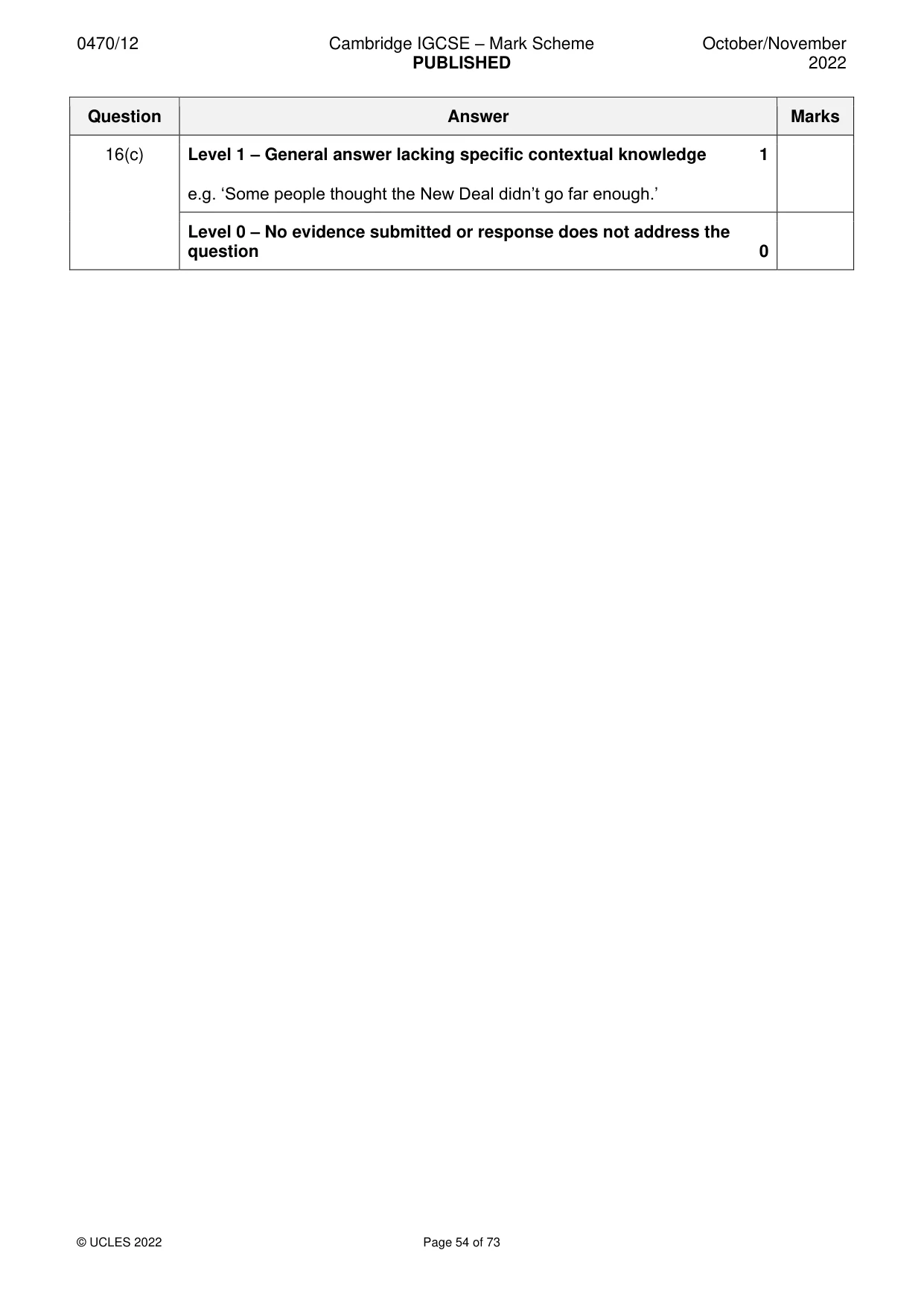
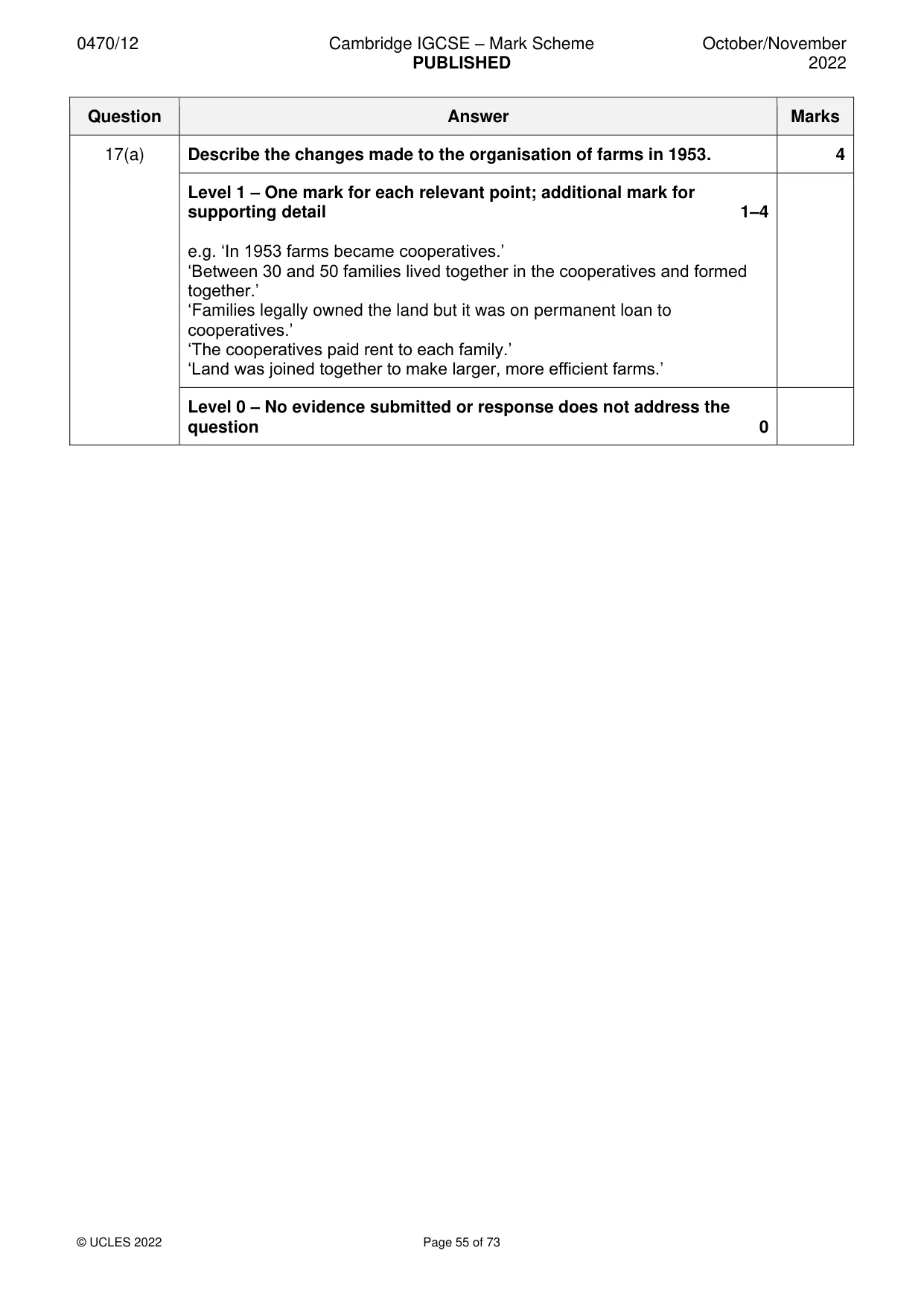
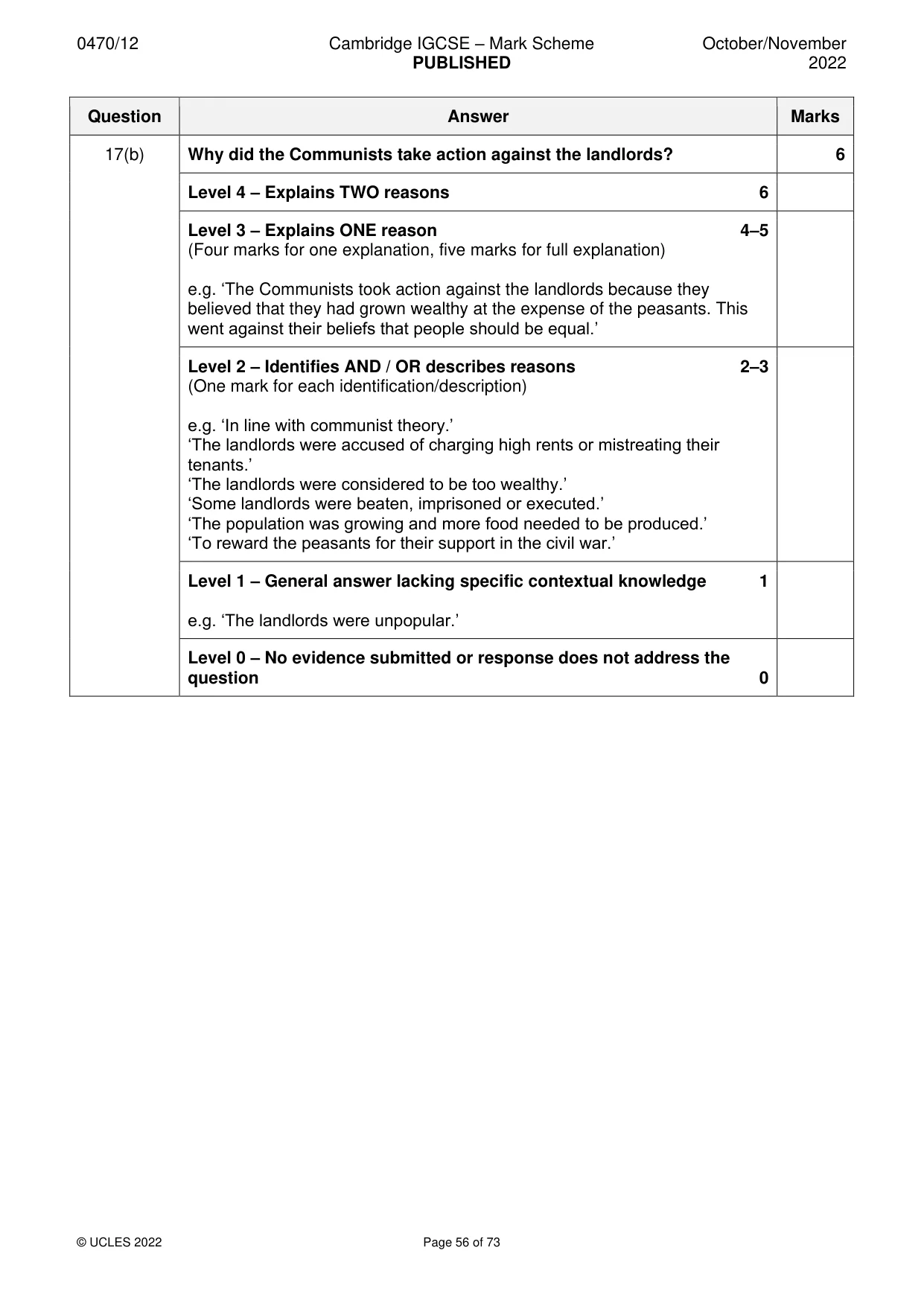
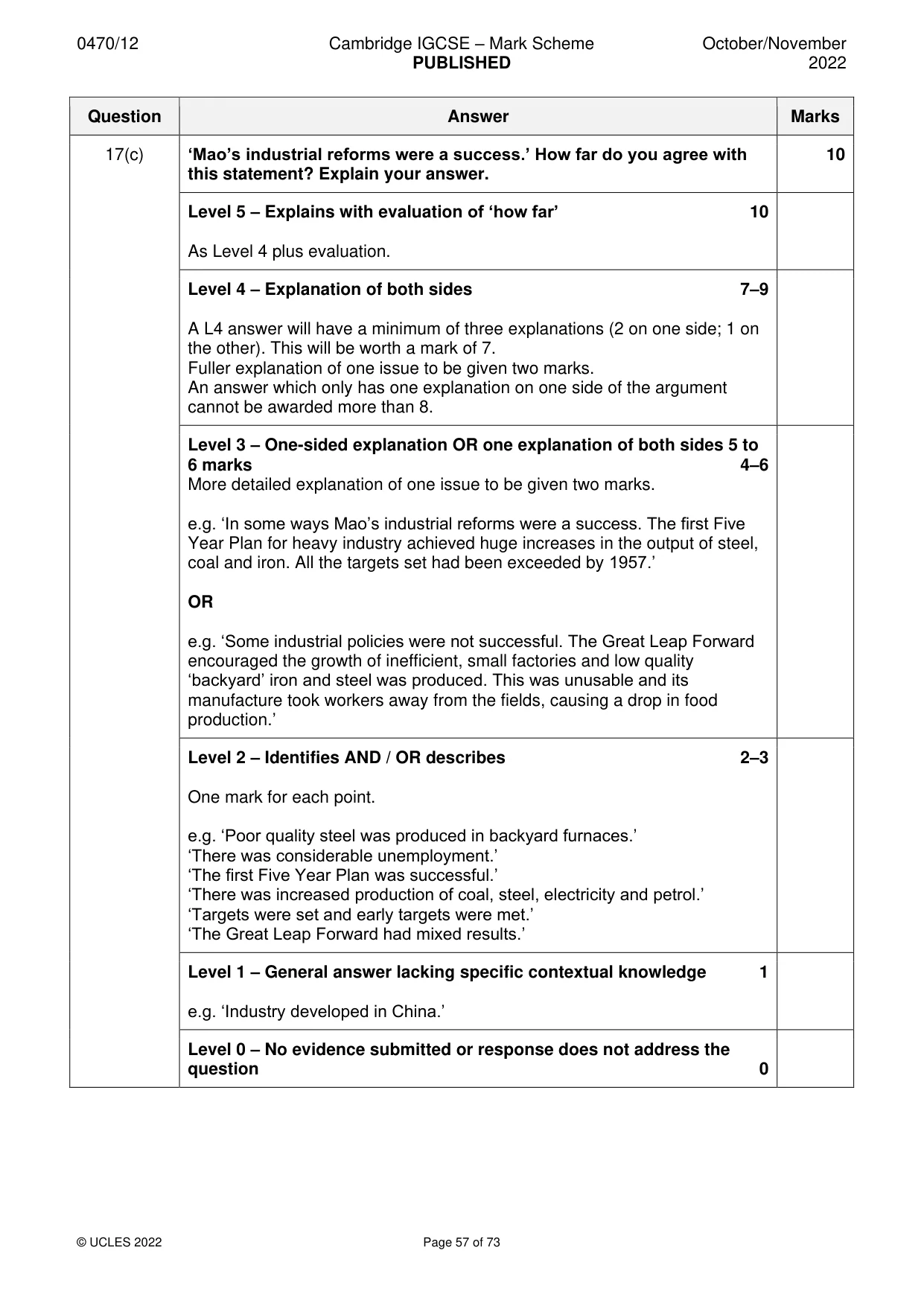
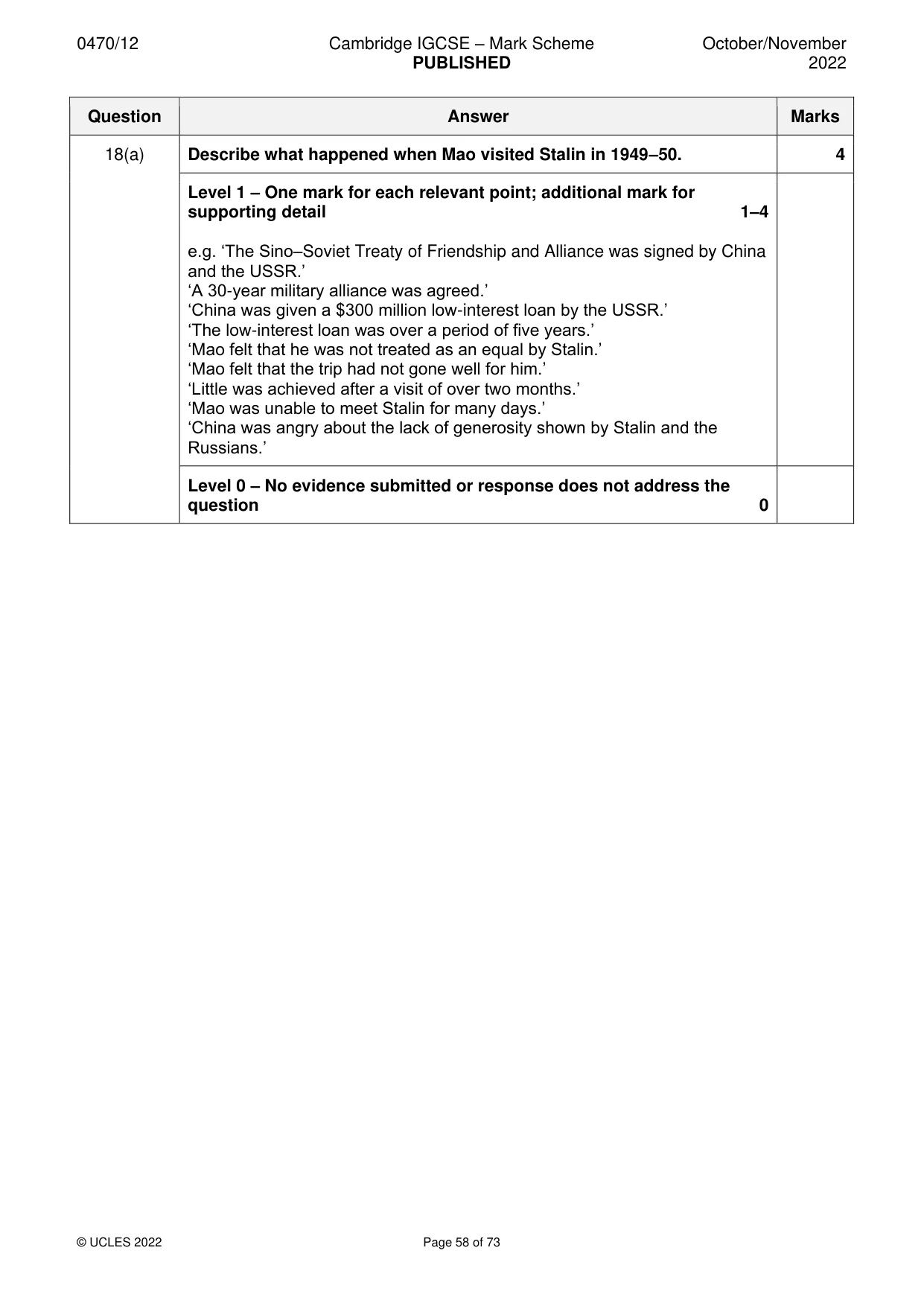
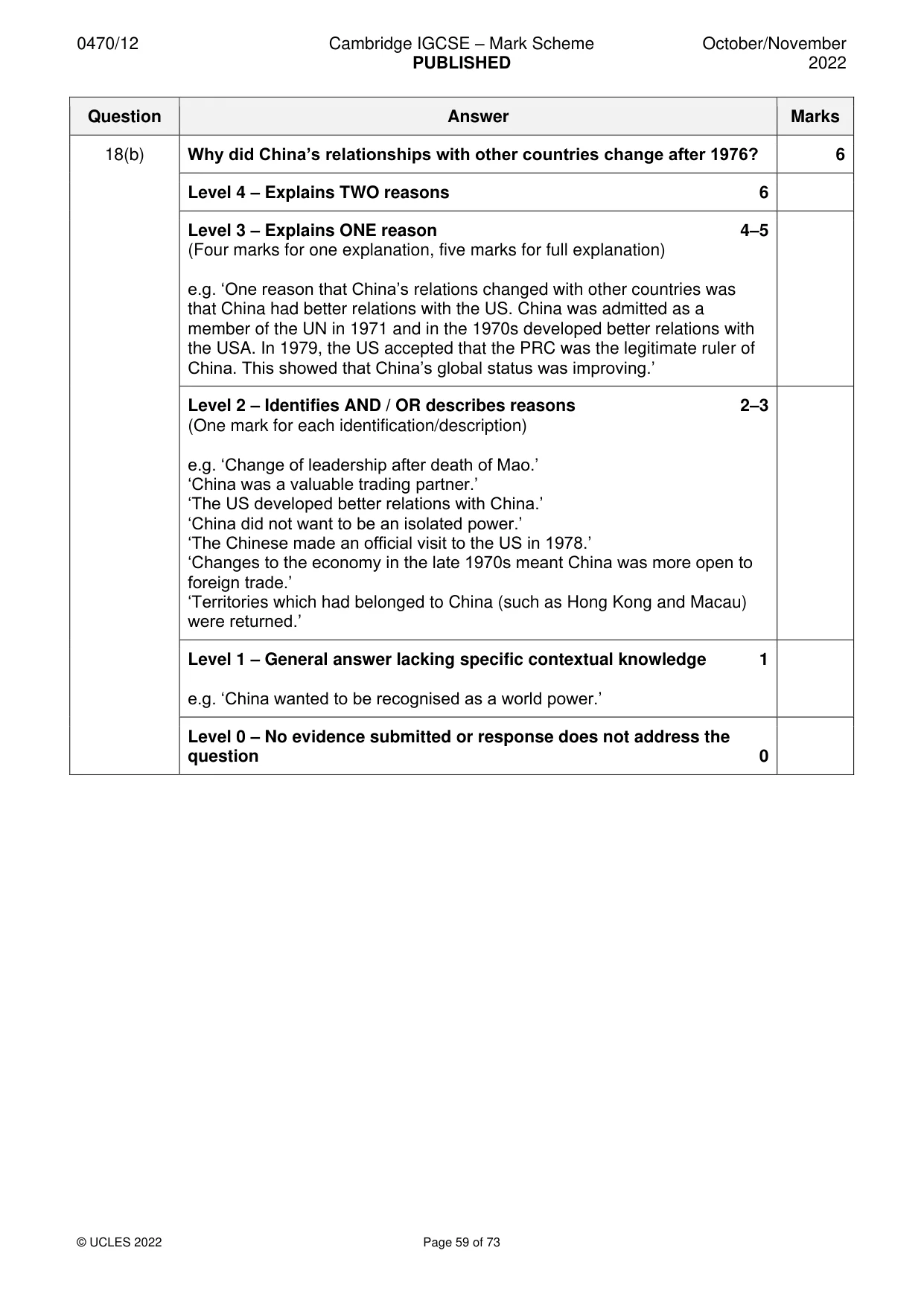
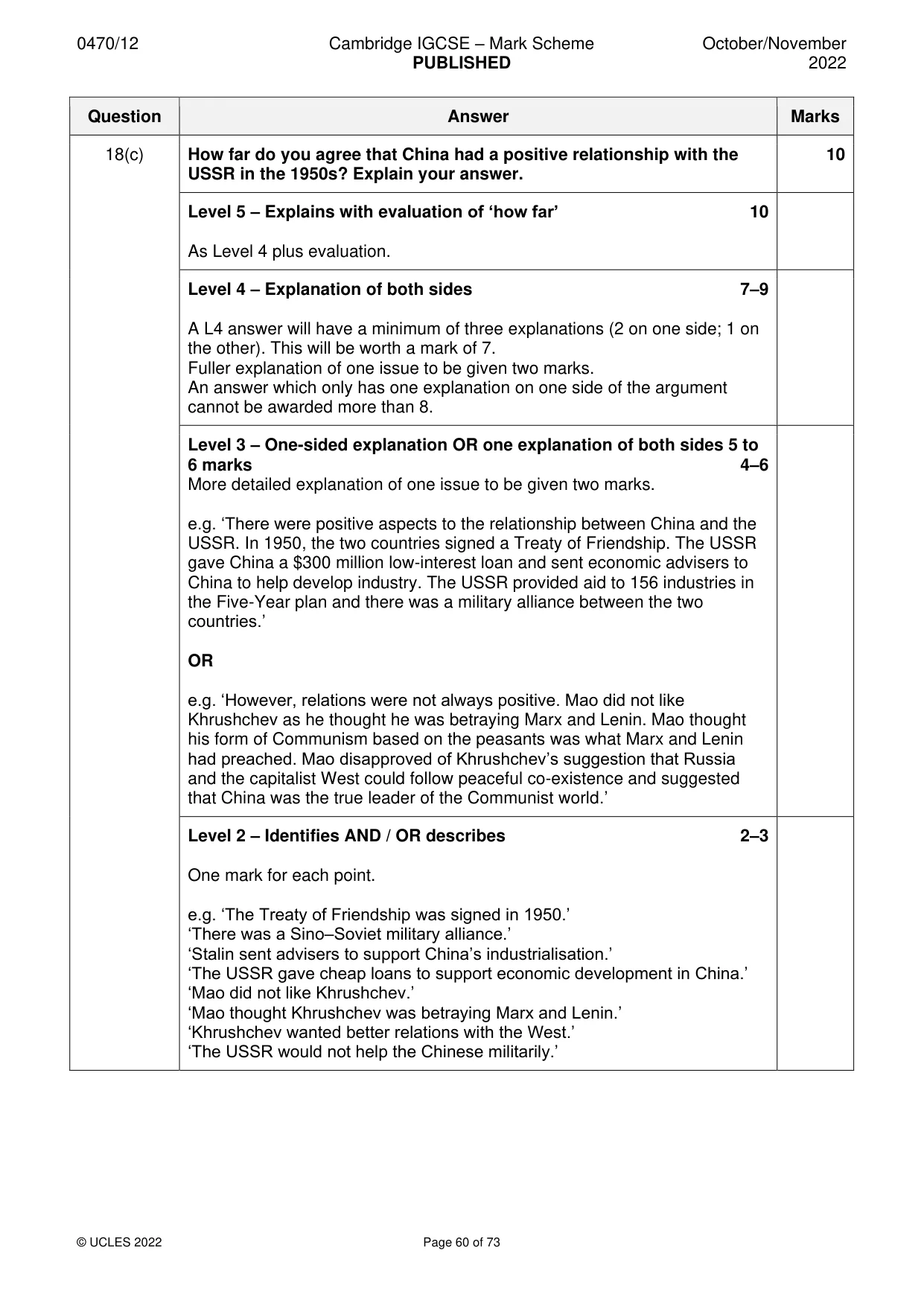
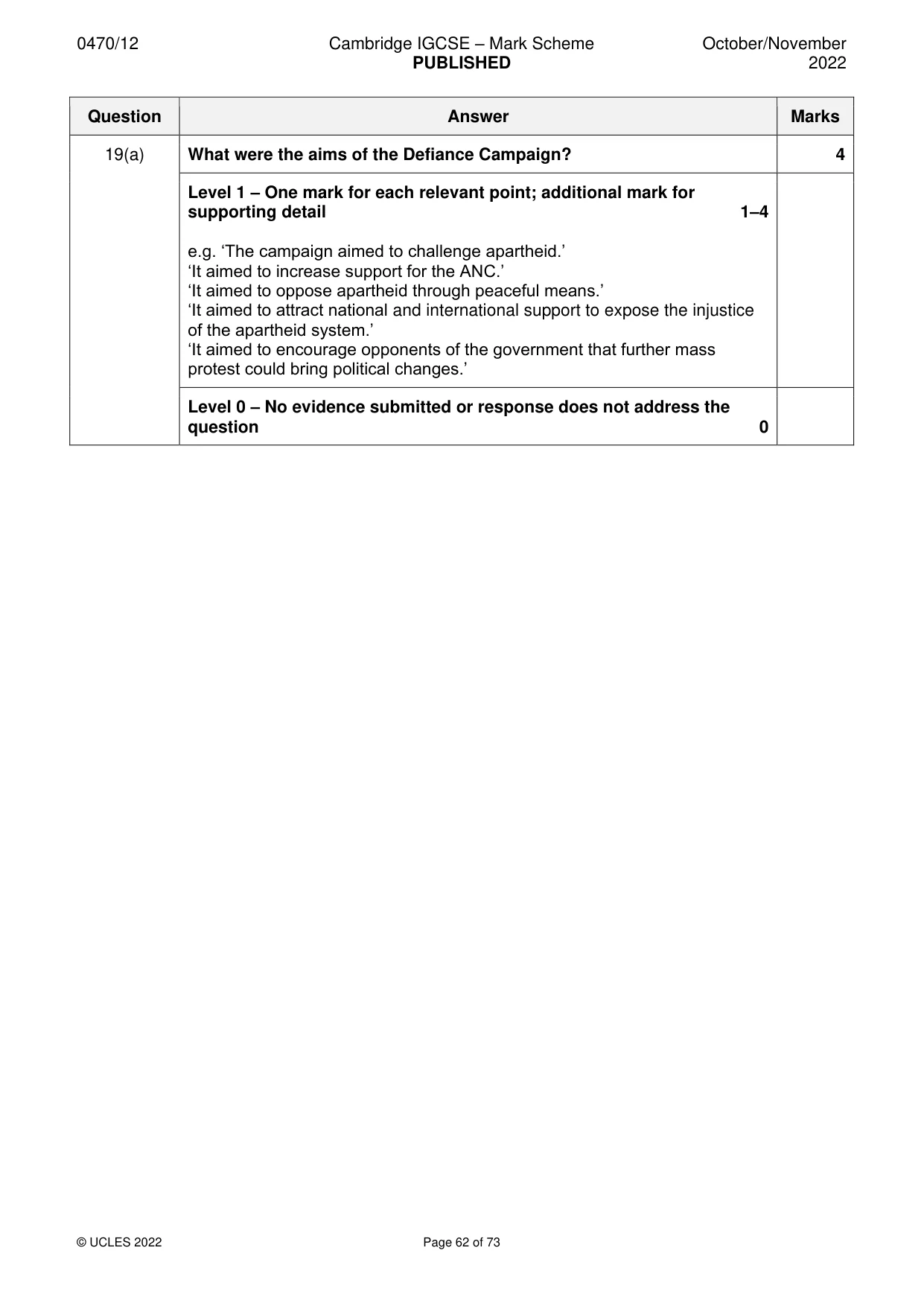
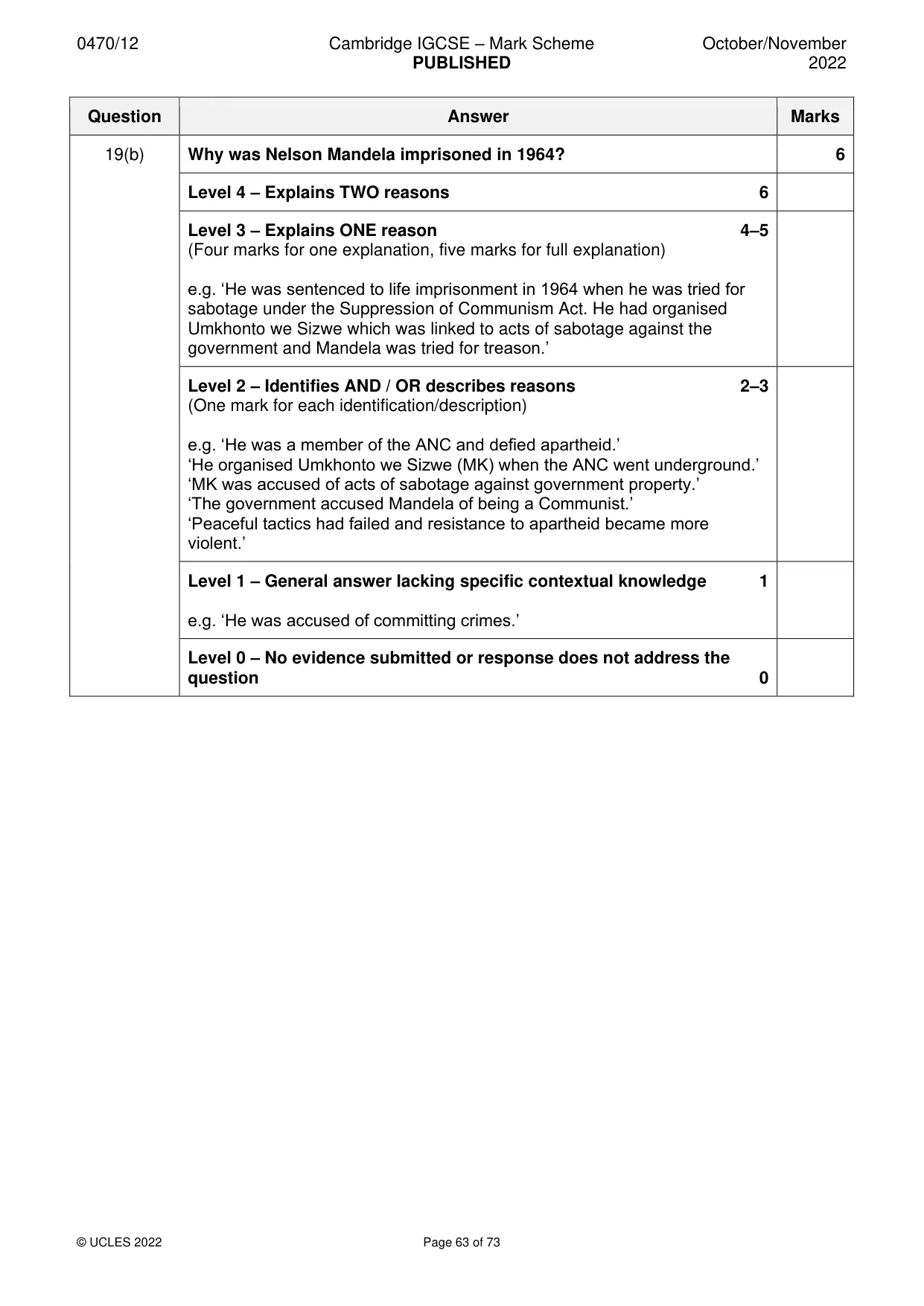
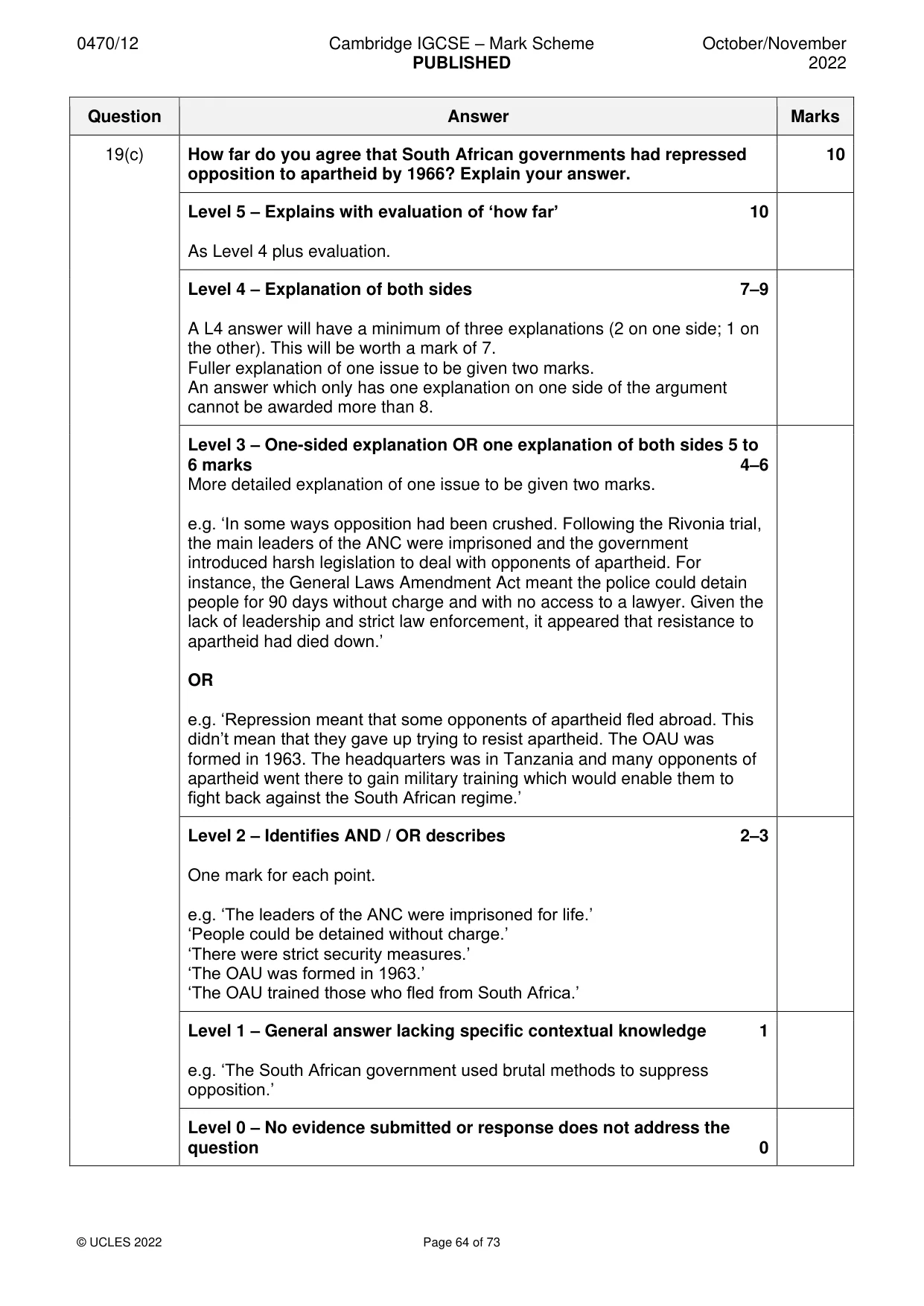
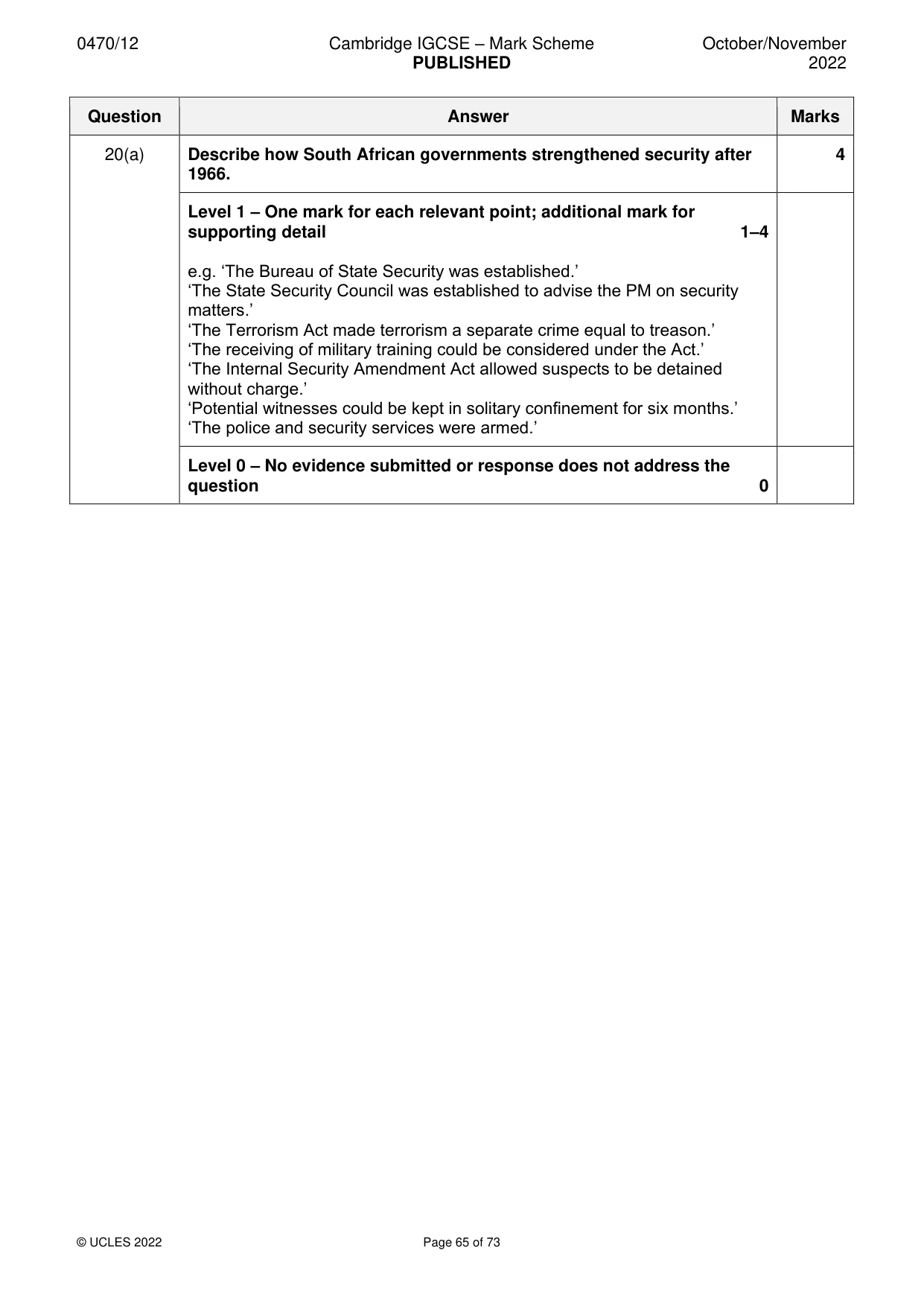
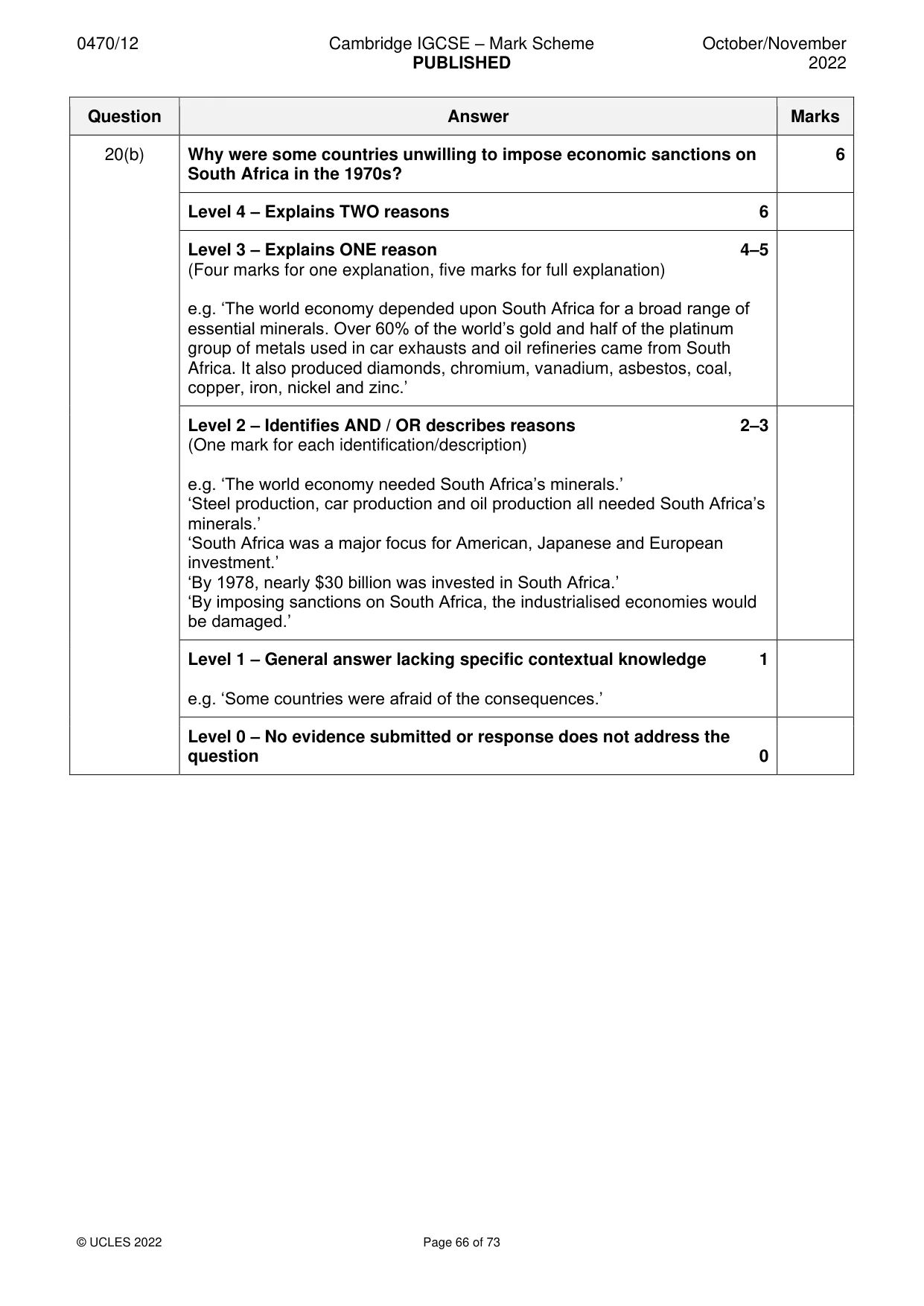
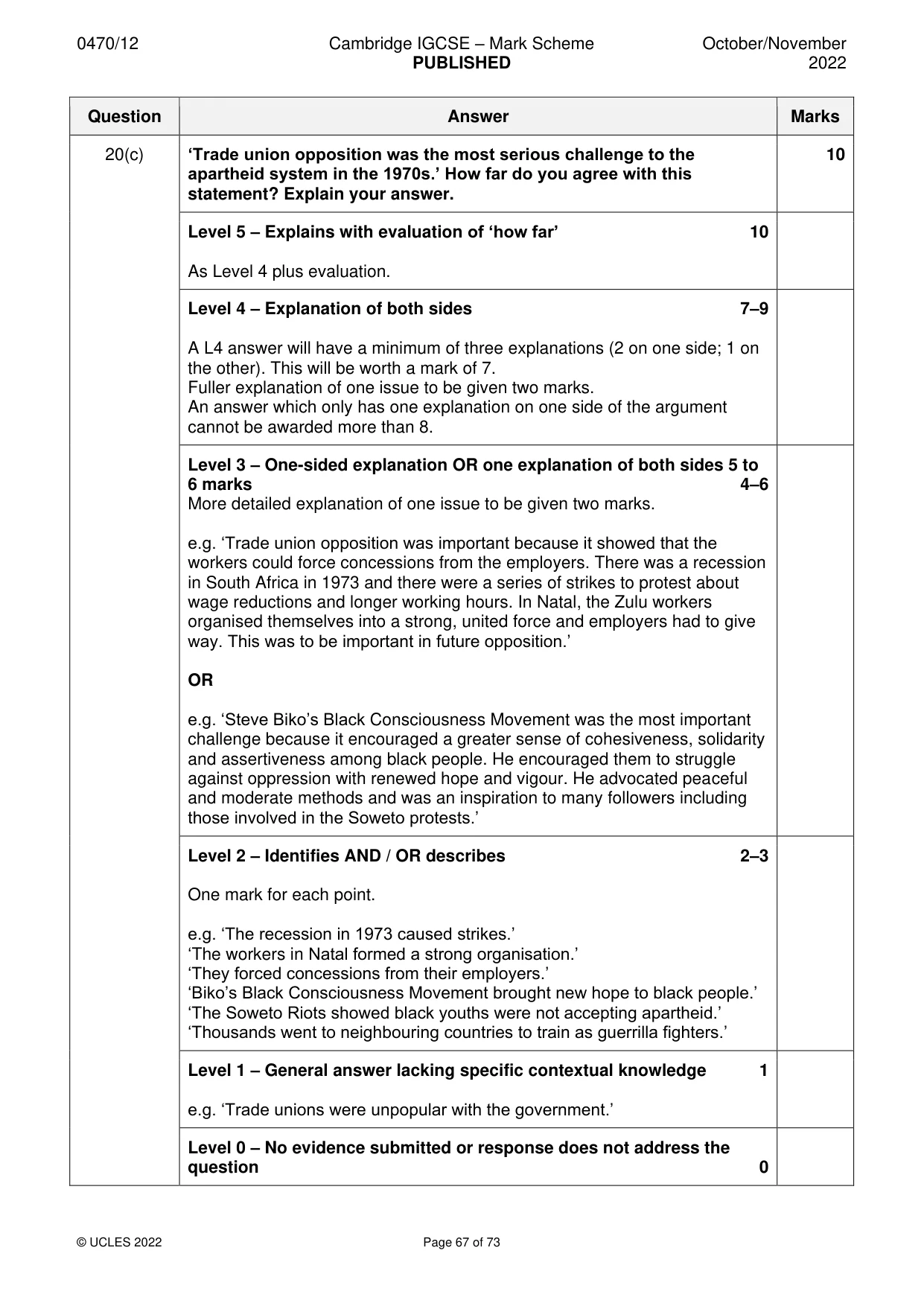
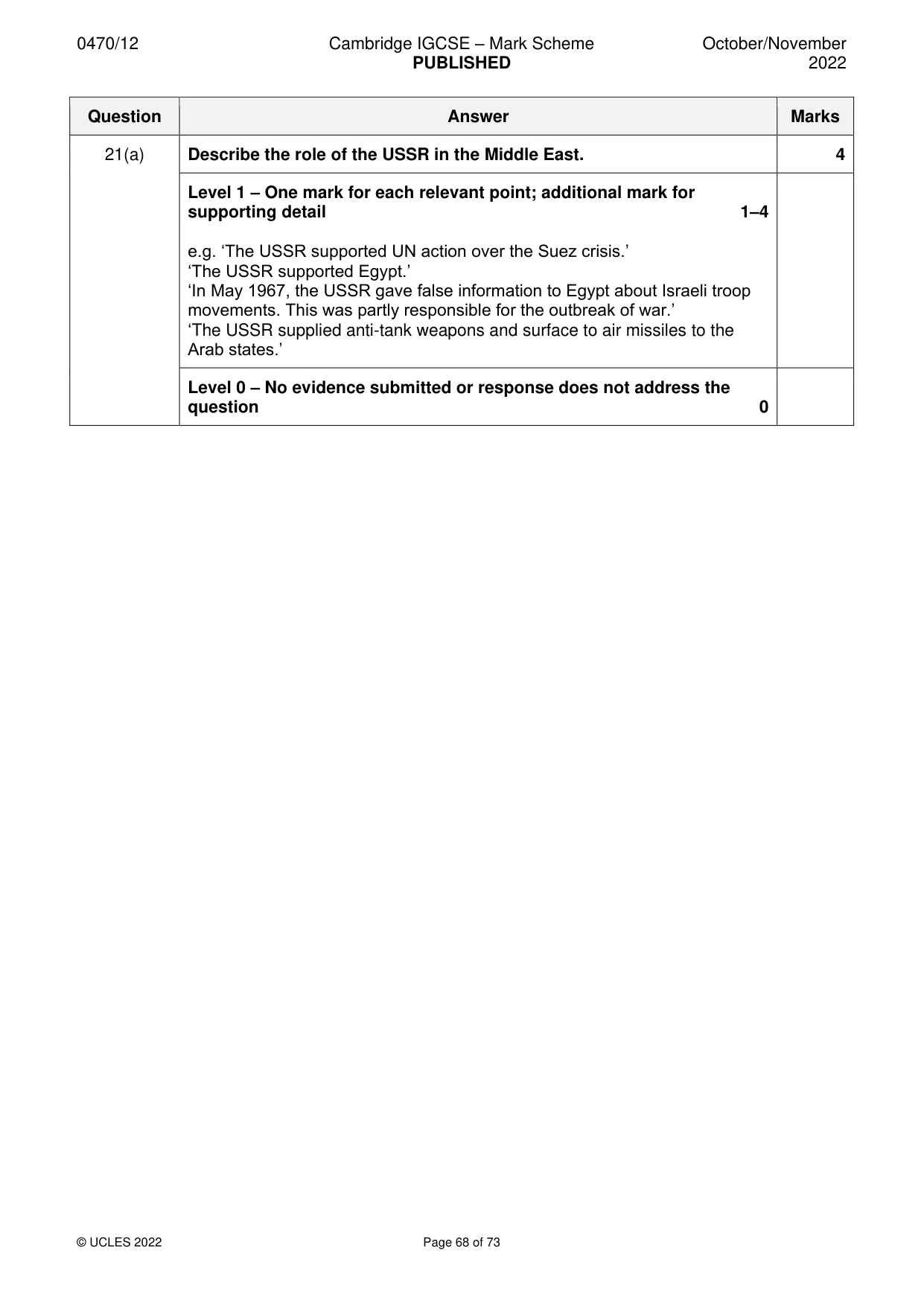
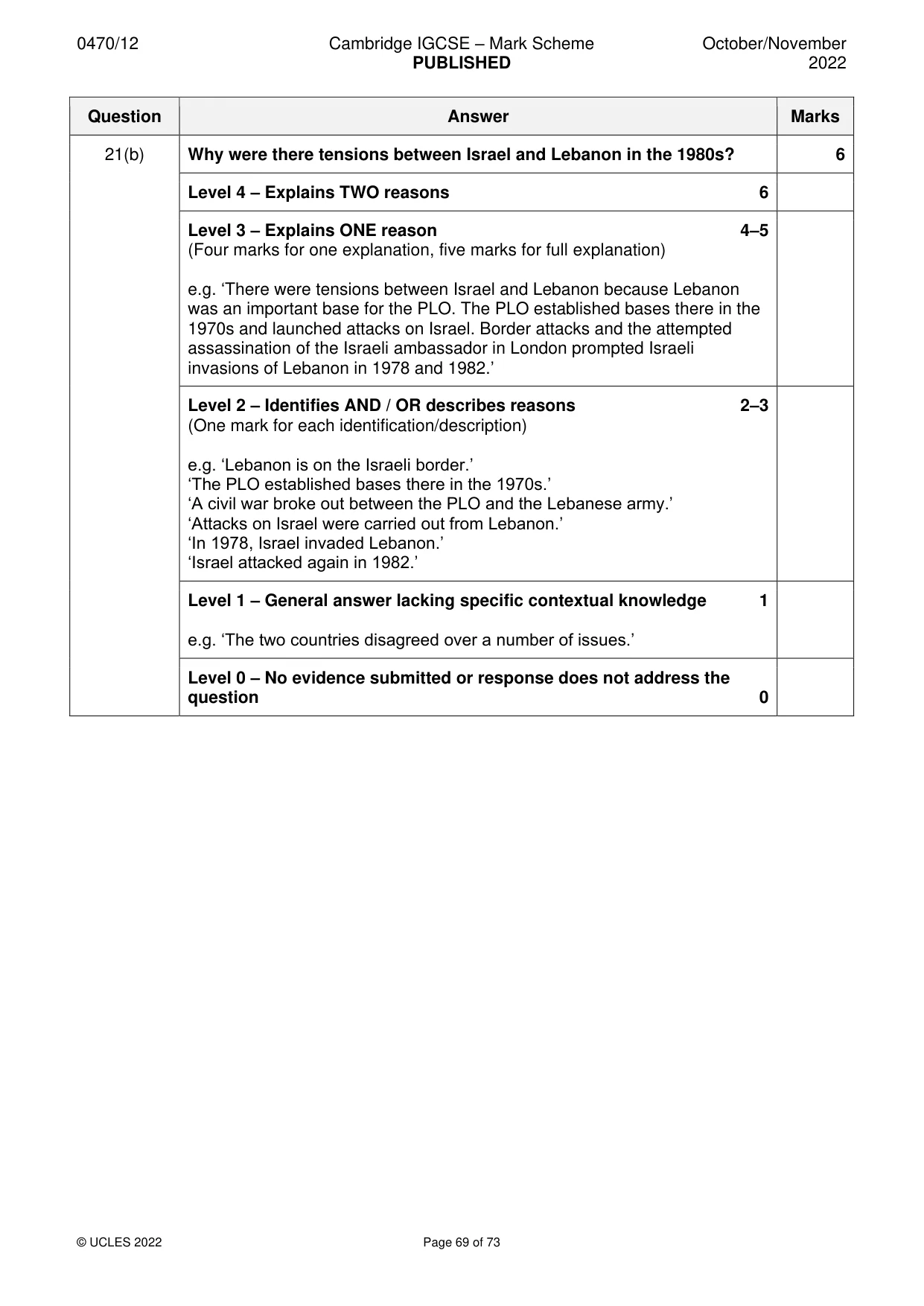
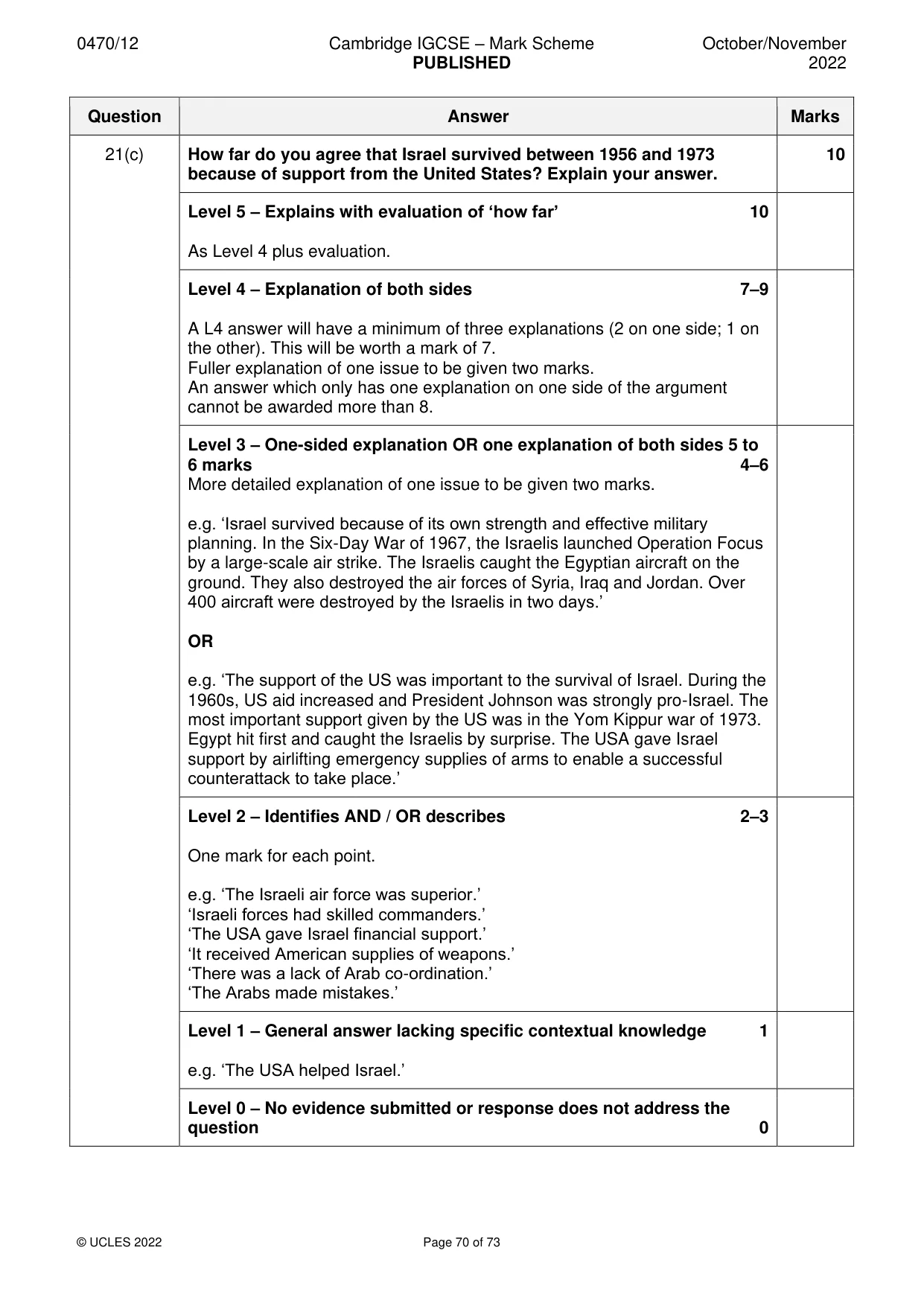
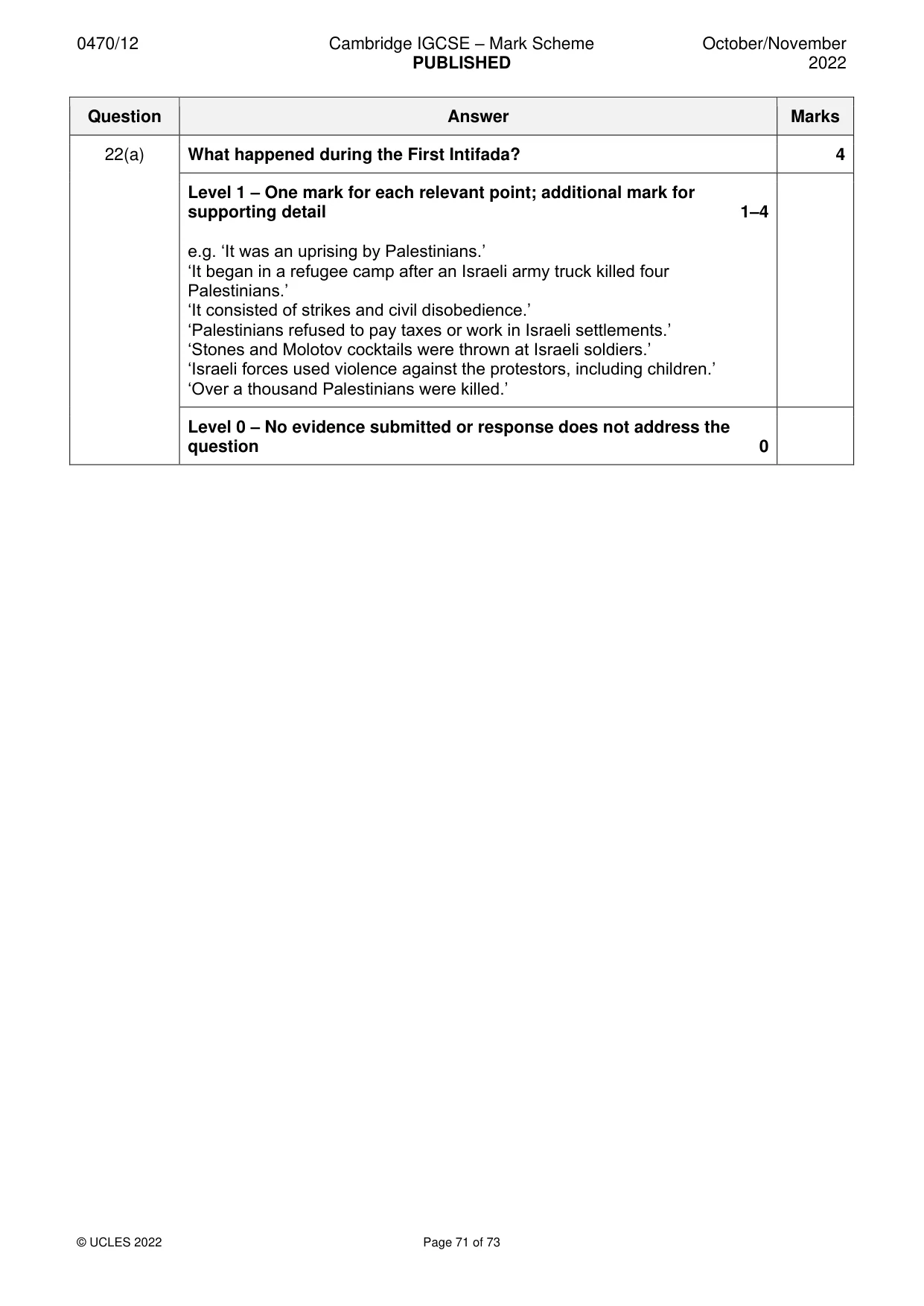
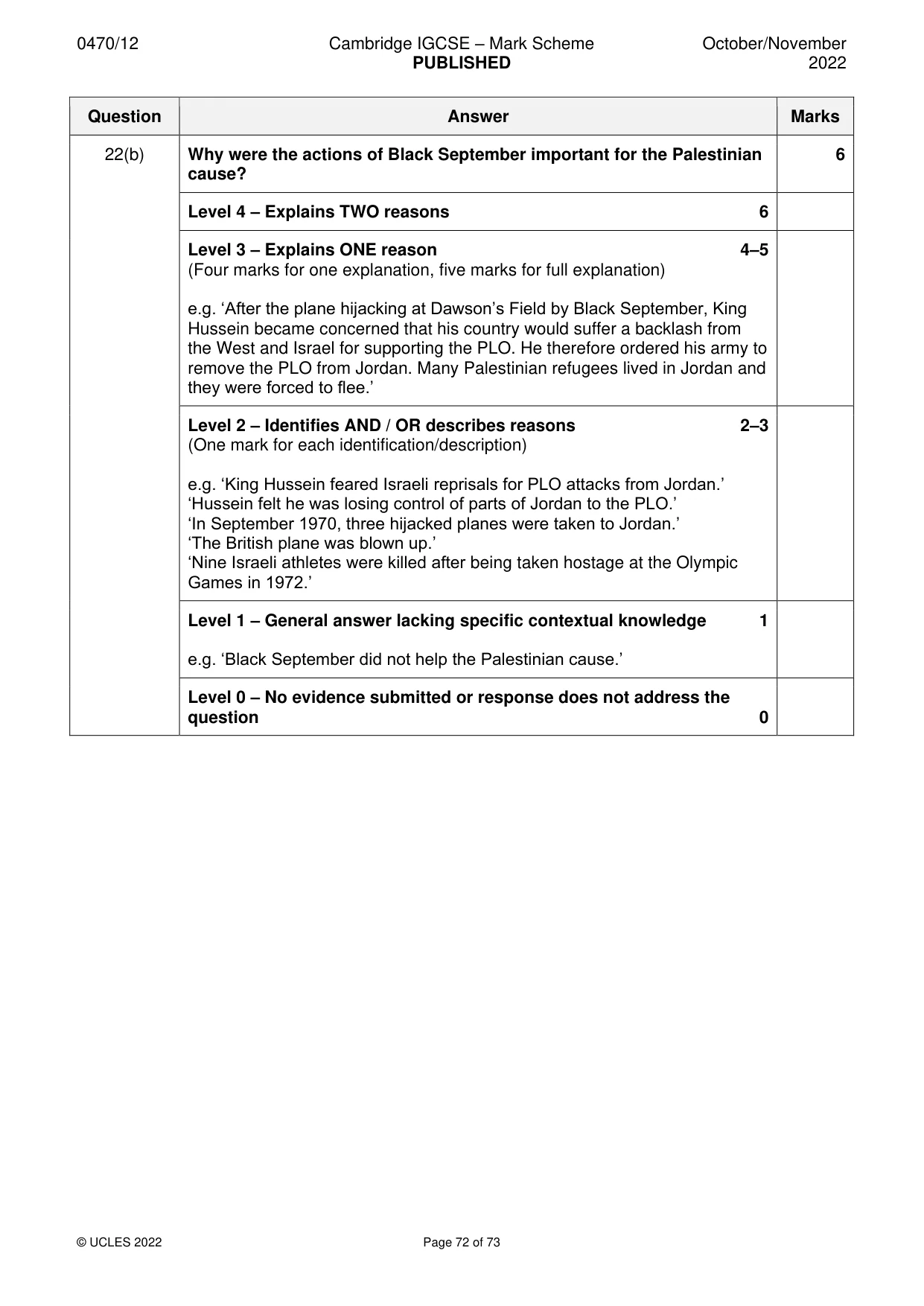
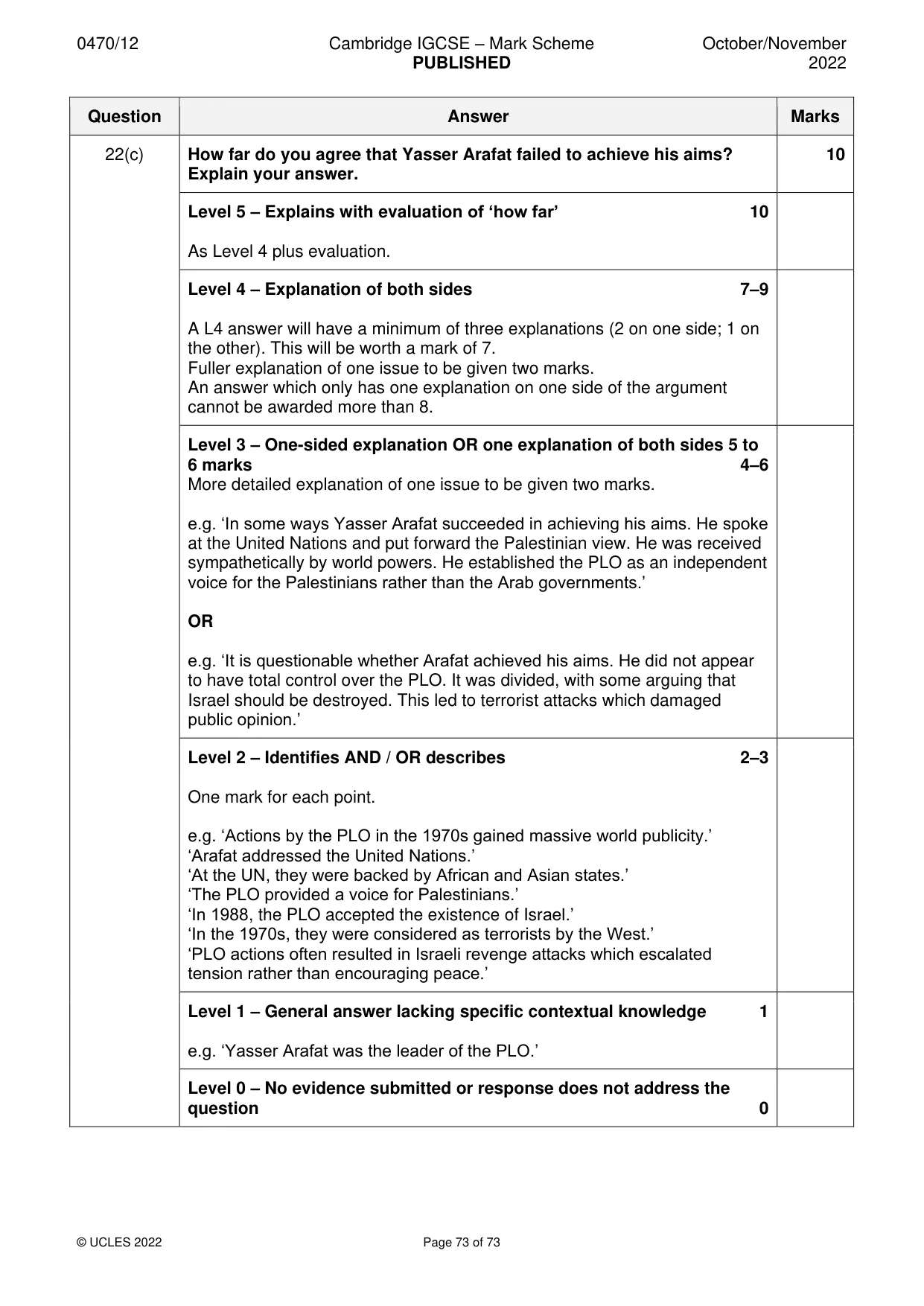
Paper as text
Question paper, page 1
This document has 12 pages. Any blank pages are indicated. [Turn over Cambridge IGCSE™ HISTORY 0470/12 Paper 1 October/November 2022 2 hours You must answer on the enclosed answer booklet. You will need: Answer booklet (enclosed) INSTRUCTIONS ● Answer three questions in total: Section A (Core Content): answer two questions. Section B (Depth Studies): answer one question. ● Follow the instructions on the front cover of the answer booklet. If you need additional answer paper, ask the invigilator for a continuation booklet. INFORMATION ● The total mark for this paper is 60. ● The number of marks for each question or part question is shown in brackets [ ]. DC (LK) 303401/2 © UCLES 2022 * 8 6 4 6 9 2 9 9 4 4 *
Question paper, page 2
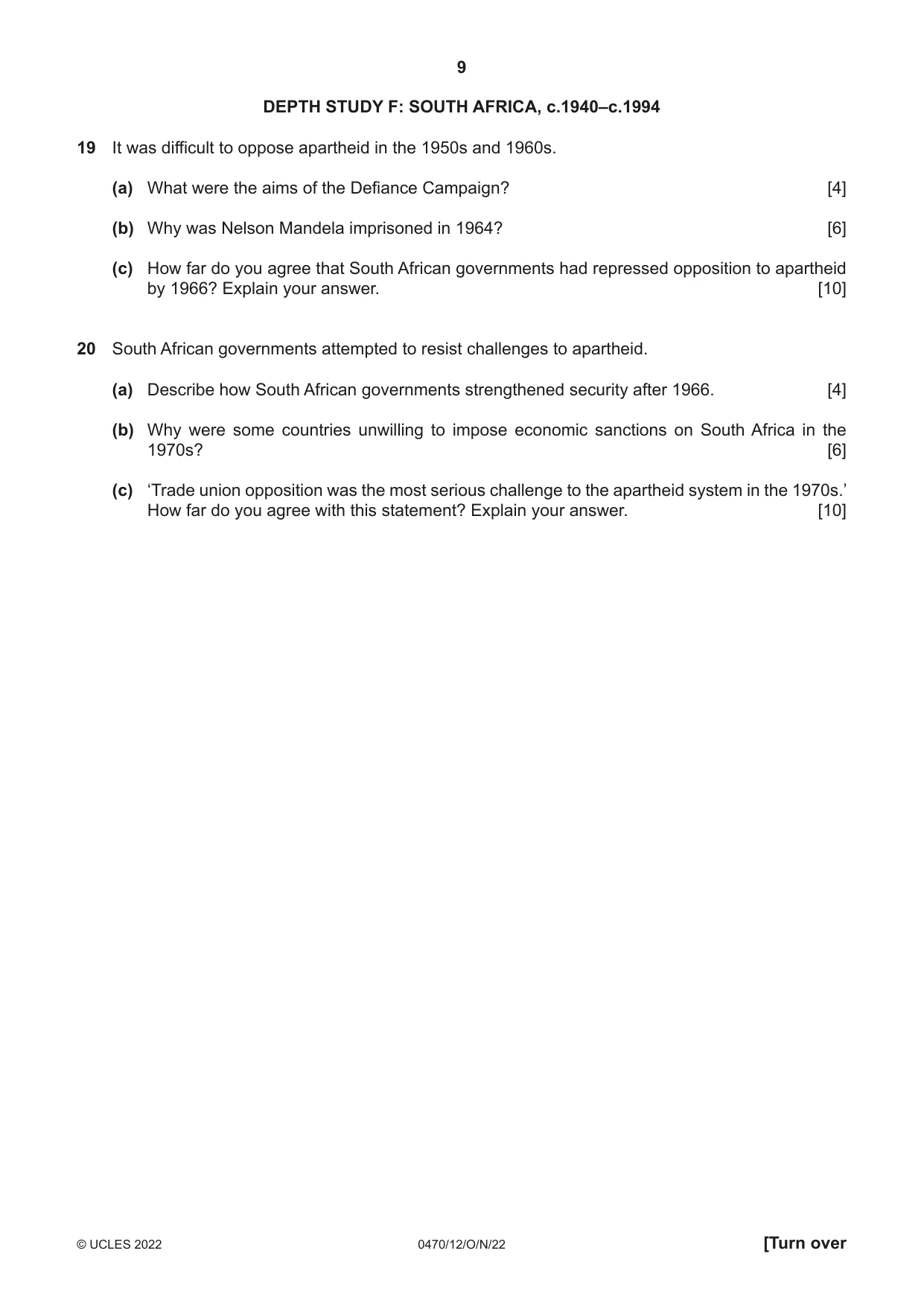
2 0470/12/O/N/22 © UCLES 2022 SECTION A: CORE CONTENT Answer any two questions from this section. 1 Internal and external factors were important in the move towards Italian unification. (a) What did Piedmont gain from its involvement in the Crimean War? [4] (b) Why was the Plombières agreement important to Italian unification? [6] (c) How far was Garibaldi responsible for the unification of Italy? Explain your answer. [10] 2 Demand for change led to revolution breaking out in Germany in 1848. (a) What was the Frankfurt Parliament? [4] (b) Why did the Frankfurt Parliament offer the German crown to Frederick William IV? [6] (c) How far do you agree that the 1848–49 revolutions in Germany achieved little? Explain your answer. [10] 3 The American Civil War had a great impact on the South. (a) What changes were made to the US Constitution as a result of the Civil War? [4] (b) Why was the Ku Klux Klan founded? [6] (c) How far was Reconstruction a failure? Explain your answer. [10] 4 Imperialism had many causes and effects. (a) Describe the involvement of Christian missionaries in the spread of European imperialism. [4] (b) Why was trade important in the expansion of European empires? [6] (c) ‘British imperialism brought little benefit to Africa.’ How far do you agree with this statement? Explain your answer. [10]
Question paper, page 3
3 0470/12/O/N/22 © UCLES 2022 [Turn over 5 The League of Nations faced challenges from the beginning. (a) Describe the dispute over Vilna in 1920. [4] (b) Why was the League often slow to react to aggression? [6] (c) ‘Italy was more to blame than Britain and France for the failure of the League.’ How far do you agree with this statement? Explain your answer. [10] 6 Hitler’s foreign policy created tension in Europe. (a) What was Hitler’s policy of ‘lebensraum’? [4] (b) Why did Stalin agree to the Nazi–Soviet Pact? [6] (c) How far do you agree that Chamberlain’s attempts to appease Hitler were justified? Explain your answer. [10] 7 American involvement in Vietnam was eventually unsuccessful. (a) What was the Vietcong? [4] (b) Why did President Johnson increase American involvement in Vietnam? [6] (c) ‘American public opinion was more important than the tactics of the North Vietnamese forces in causing the United States to withdraw.’ How far do you agree with this statement? Explain your answer. [10] 8 Many measures were taken to maintain Soviet control over Eastern Europe. (a) What was the Brezhnev Doctrine? [4] (b) Why was the Berlin Wall built? [6] (c) How far do you agree that resistance to Soviet domination broke out in Hungary (1956) and Czechoslovakia (1968) for the same reasons? Explain your answer. [10]
Question paper, page 4
4 0470/12/O/N/22 © UCLES 2022 SECTION B: DEPTH STUDIES Answer any one question from this section. DEPTH STUDY A: THE FIRST WORLD WAR, 1914–18 9 Soldiers faced many hardships in the fighting on the Western Front. (a) Describe ‘going over the top’. [4] (b) Why did the Allied bombardment at the start of the Battle of the Somme fail to destroy the German defences? [6] (c) How far do you agree that tanks were used to better effect than aircraft in the First World War? Explain your answer. [10] 10 Germany faced many difficulties in 1918. (a) What challenges to its authority did the German government face by early November 1918? [4] (b) Why were food supplies running out in Germany by 1918? [6] (c) How far was the strength of the Allied forces responsible for the failure of the Ludendorff Offensive? Explain your answer. [10]
Question paper, page 5
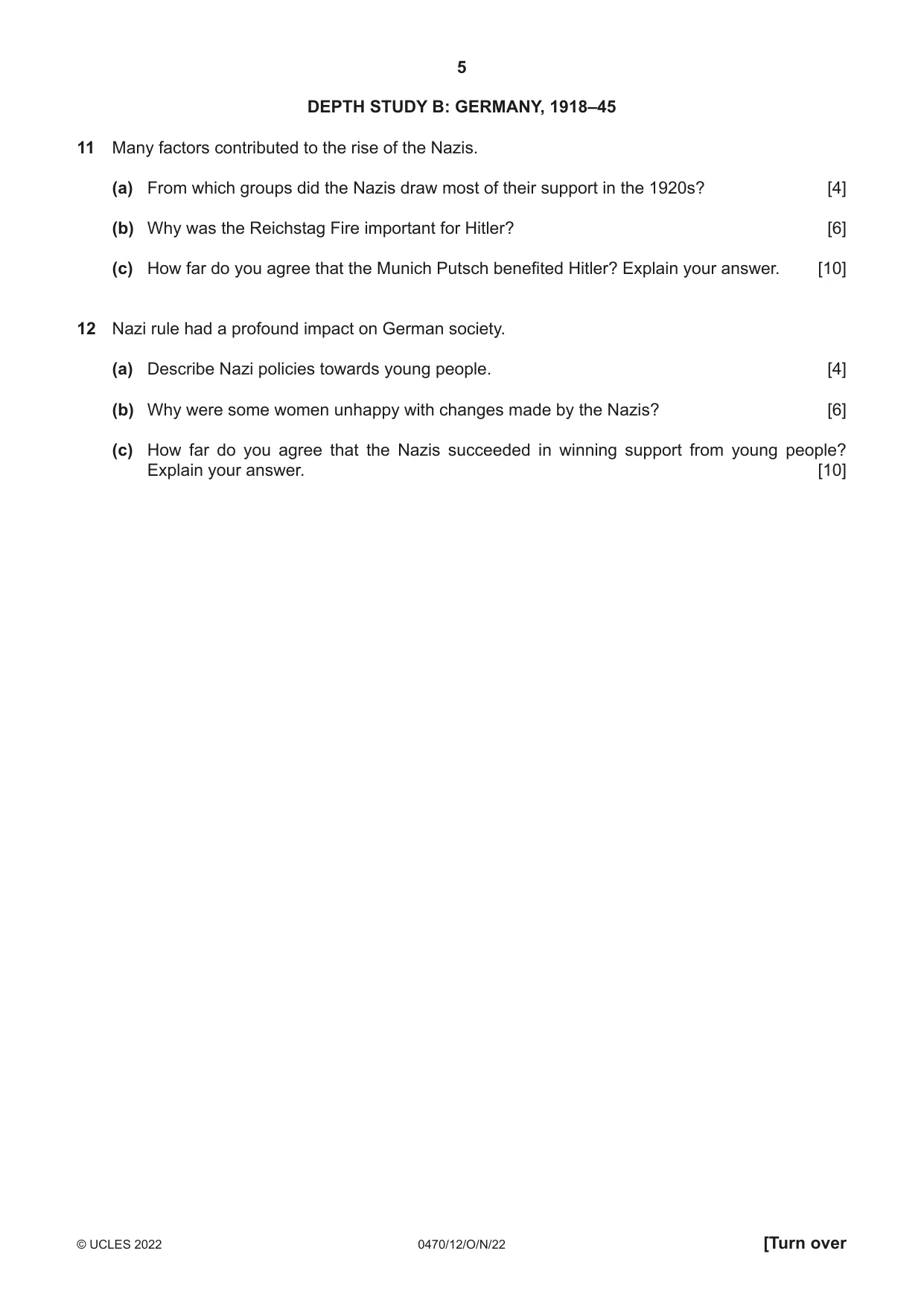
5 0470/12/O/N/22 © UCLES 2022 [Turn over DEPTH STUDY B: GERMANY, 1918–45 11 Many factors contributed to the rise of the Nazis. (a) From which groups did the Nazis draw most of their support in the 1920s? [4] (b) Why was the Reichstag Fire important for Hitler? [6] (c) How far do you agree that the Munich Putsch benefited Hitler? Explain your answer. [10] 12 Nazi rule had a profound impact on German society. (a) Describe Nazi policies towards young people. [4] (b) Why were some women unhappy with changes made by the Nazis? [6] (c) How far do you agree that the Nazis succeeded in winning support from young people? Explain your answer. [10]
Question paper, page 6
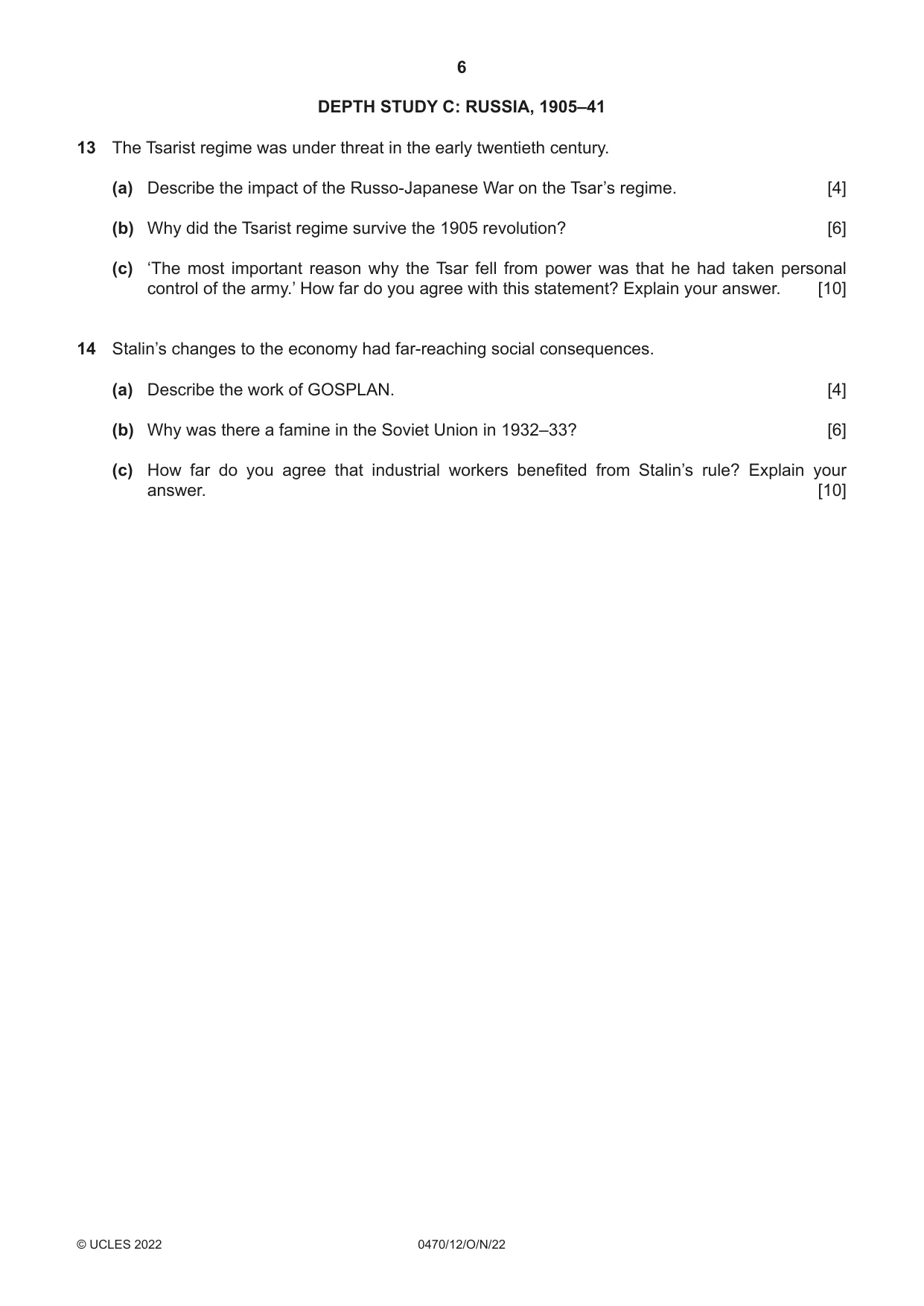
6 0470/12/O/N/22 © UCLES 2022 DEPTH STUDY C: RUSSIA, 1905–41 13 The Tsarist regime was under threat in the early twentieth century. (a) Describe the impact of the Russo-Japanese War on the Tsar’s regime. [4] (b) Why did the Tsarist regime survive the 1905 revolution? [6] (c) ‘The most important reason why the Tsar fell from power was that he had taken personal control of the army.’ How far do you agree with this statement? Explain your answer. [10] 14 Stalin’s changes to the economy had far-reaching social consequences. (a) Describe the work of GOSPLAN. [4] (b) Why was there a famine in the Soviet Union in 1932–33? [6] (c) How far do you agree that industrial workers benefited from Stalin’s rule? Explain your answer. [10]
Question paper, page 7
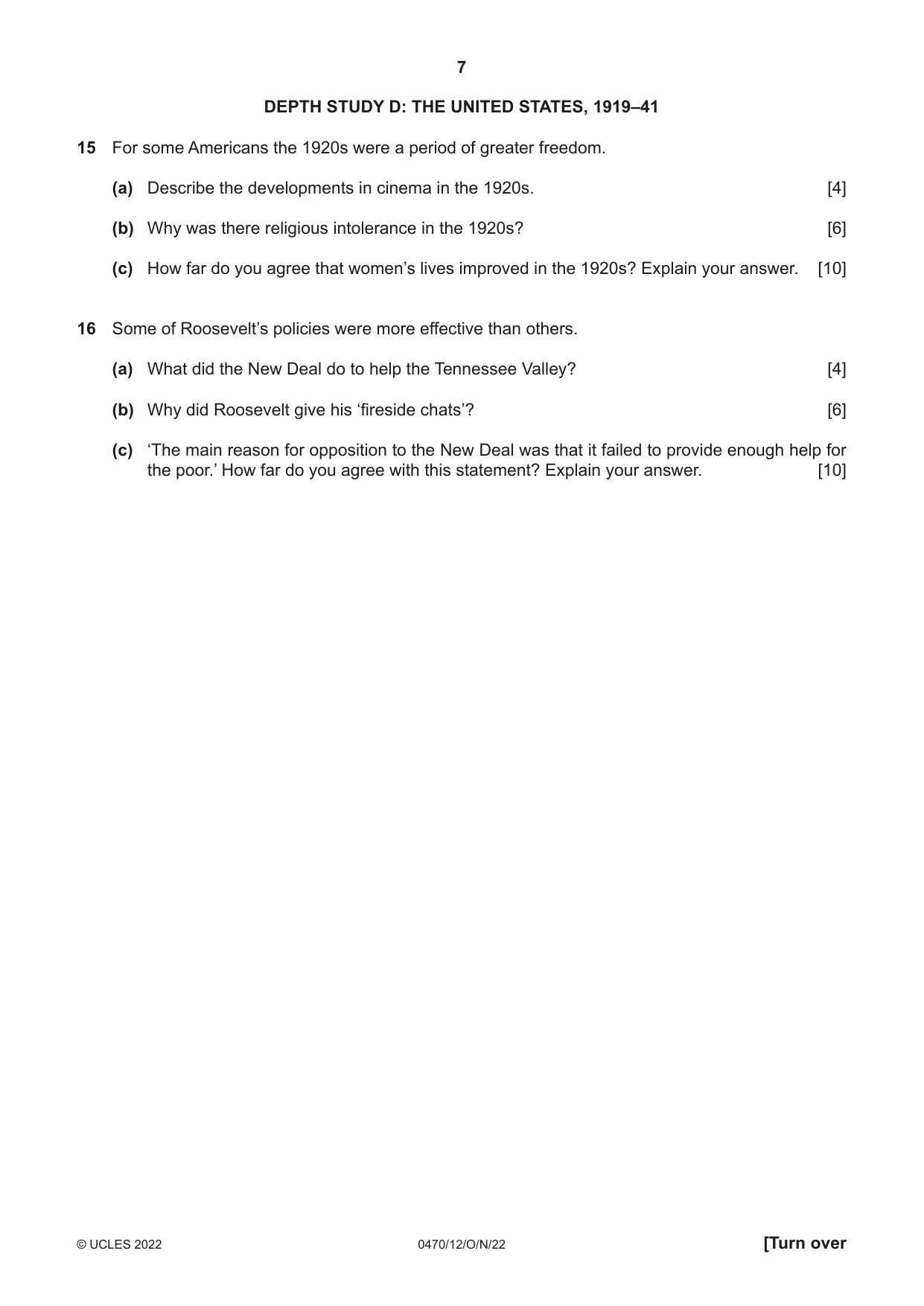
7 0470/12/O/N/22 © UCLES 2022 [Turn over DEPTH STUDY D: THE UNITED STATES, 1919–41 15 For some Americans the 1920s were a period of greater freedom. (a) Describe the developments in cinema in the 1920s. [4] (b) Why was there religious intolerance in the 1920s? [6] (c) How far do you agree that women’s lives improved in the 1920s? Explain your answer. [10] 16 Some of Roosevelt’s policies were more effective than others. (a) What did the New Deal do to help the Tennessee Valley? [4] (b) Why did Roosevelt give his ‘fireside chats’? [6] (c) ‘The main reason for opposition to the New Deal was that it failed to provide enough help for the poor.’ How far do you agree with this statement? Explain your answer. [10]
Question paper, page 8
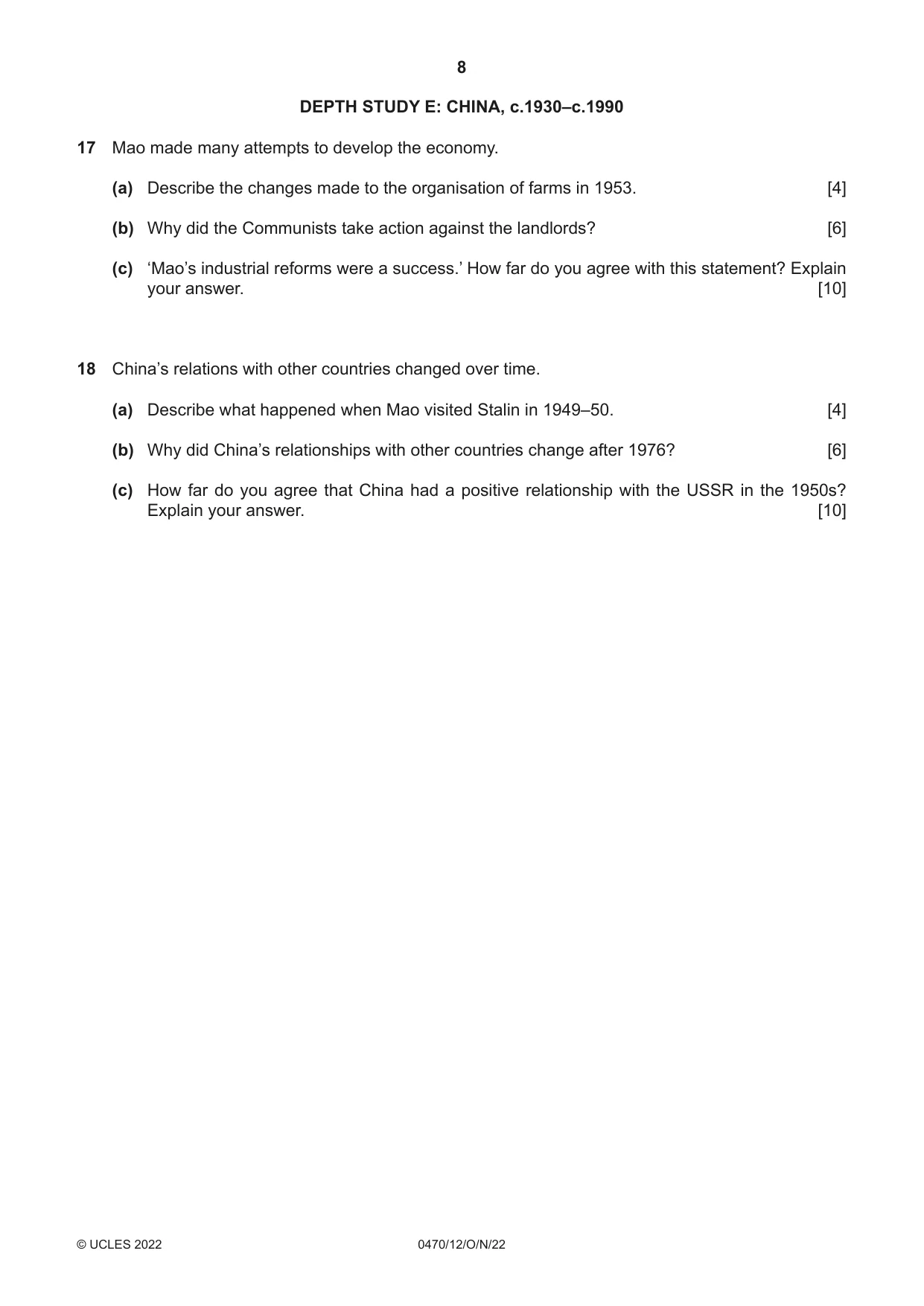
8 0470/12/O/N/22 © UCLES 2022 DEPTH STUDY E: CHINA, c.1930–c.1990 17 Mao made many attempts to develop the economy. (a) Describe the changes made to the organisation of farms in 1953. [4] (b) Why did the Communists take action against the landlords? [6] (c) ‘Mao’s industrial reforms were a success.’ How far do you agree with this statement? Explain your answer. [10] 18 China’s relations with other countries changed over time. (a) Describe what happened when Mao visited Stalin in 1949–50. [4] (b) Why did China’s relationships with other countries change after 1976? [6] (c) How far do you agree that China had a positive relationship with the USSR in the 1950s? Explain your answer. [10]
Question paper, page 9
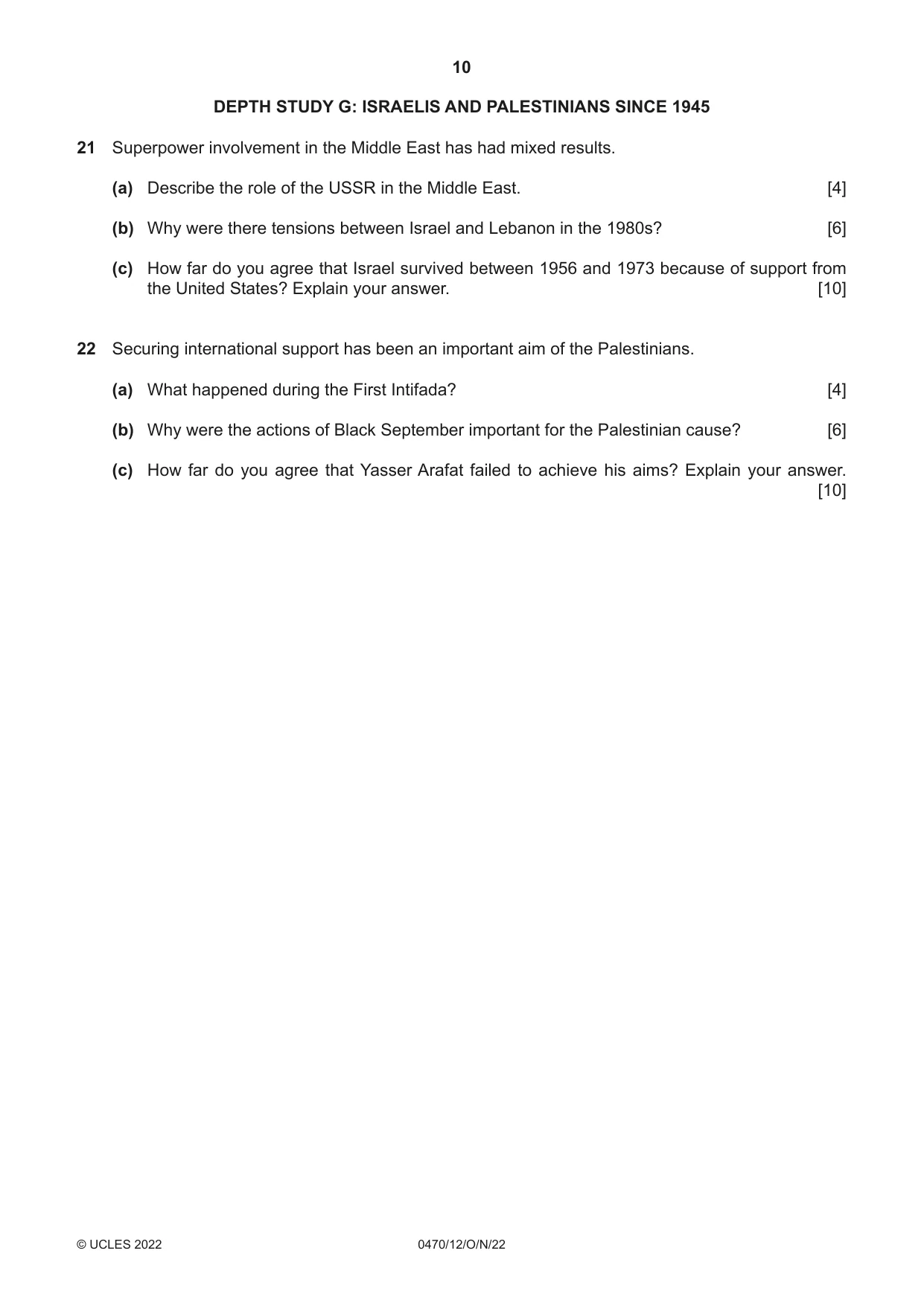
9 0470/12/O/N/22 © UCLES 2022 [Turn over DEPTH STUDY F: SOUTH AFRICA, c.1940–c.1994 19 It was difficult to oppose apartheid in the 1950s and 1960s. (a) What were the aims of the Defiance Campaign? [4] (b) Why was Nelson Mandela imprisoned in 1964? [6] (c) How far do you agree that South African governments had repressed opposition to apartheid by 1966? Explain your answer. [10] 20 South African governments attempted to resist challenges to apartheid. (a) Describe how South African governments strengthened security after 1966. [4] (b) Why were some countries unwilling to impose economic sanctions on South Africa in the 1970s? [6] (c) ‘Trade union opposition was the most serious challenge to the apartheid system in the 1970s.’ How far do you agree with this statement? Explain your answer. [10]
Question paper, page 10
10 0470/12/O/N/22 © UCLES 2022 DEPTH STUDY G: ISRAELIS AND PALESTINIANS SINCE 1945 21 Superpower involvement in the Middle East has had mixed results. (a) Describe the role of the USSR in the Middle East. [4] (b) Why were there tensions between Israel and Lebanon in the 1980s? [6] (c) How far do you agree that Israel survived between 1956 and 1973 because of support from the United States? Explain your answer. [10] 22 Securing international support has been an important aim of the Palestinians. (a) What happened during the First Intifada? [4] (b) Why were the actions of Black September important for the Palestinian cause? [6] (c) How far do you agree that Yasser Arafat failed to achieve his aims? Explain your answer. [10]
Question paper, page 11
11 0470/12/O/N/22 © UCLES 2022 BLANK PAGE
Question paper, page 12
12 0470/12/O/N/22 © UCLES 2022 Permission to reproduce items where third-party owned material protected by copyright is included has been sought and cleared where possible. Every reasonable effort has been made by the publisher (UCLES) to trace copyright holders, but if any items requiring clearance have unwittingly been included, the publisher will be pleased to make amends at the earliest possible opportunity. To avoid the issue of disclosure of answer-related information to candidates, all copyright acknowledgements are reproduced online in the Cambridge Assessment International Education Copyright Acknowledgements Booklet. This is produced for each series of examinations and is freely available to download at www.cambridgeinternational.org after the live examination series. Cambridge Assessment International Education is part of Cambridge Assessment. Cambridge Assessment is the brand name of the University of Cambridge Local Examinations Syndicate (UCLES), which is a department of the University of Cambridge. BLANK PAGE
Mark scheme, page 1
This document consists of 73 printed pages. © UCLES 2022 [Turn over Cambridge IGCSE™ HISTORY 0470/12 Paper 1 October/November 2022 MARK SCHEME Maximum Mark: 60 Published This mark scheme is published as an aid to teachers and candidates, to indicate the requirements of the examination. It shows the basis on which Examiners were instructed to award marks. It does not indicate the details of the discussions that took place at an Examiners’ meeting before marking began, which would have considered the acceptability of alternative answers. Mark schemes should be read in conjunction with the question paper and the Principal Examiner Report for Teachers. Cambridge International will not enter into discussions about these mark schemes. Cambridge International is publishing the mark schemes for the October/November 2022 series for most Cambridge IGCSE™, Cambridge International A and AS Level components and some Cambridge O Level components.
Mark scheme, page 2
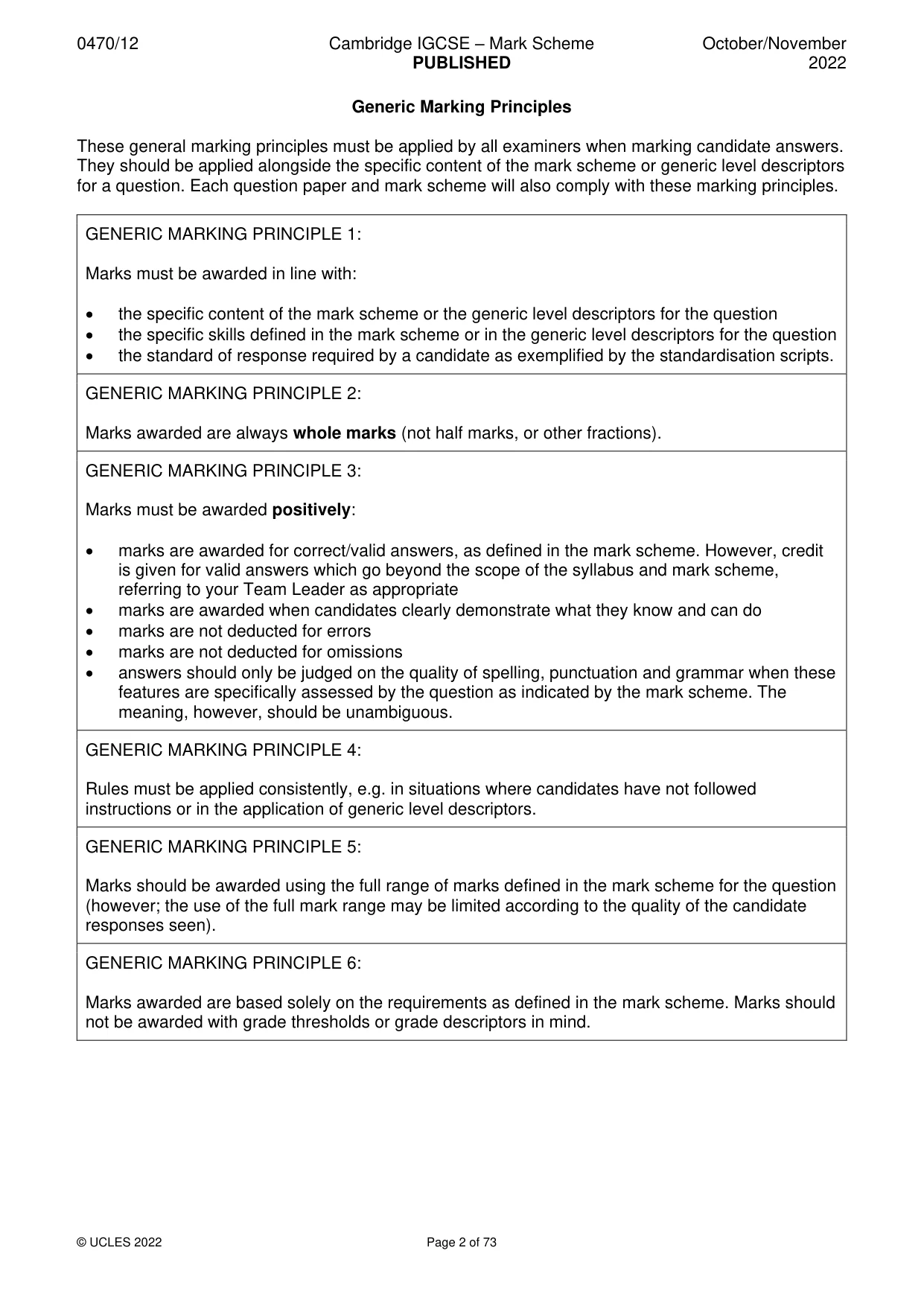
0470/12 Cambridge IGCSE – Mark Scheme PUBLISHED October/November 2022 © UCLES 2022 Page 2 of 73 Generic Marking Principles These general marking principles must be applied by all examiners when marking candidate answers. They should be applied alongside the specific content of the mark scheme or generic level descriptors for a question. Each question paper and mark scheme will also comply with these marking principles. GENERIC MARKING PRINCIPLE 1: Marks must be awarded in line with: • the specific content of the mark scheme or the generic level descriptors for the question • the specific skills defined in the mark scheme or in the generic level descriptors for the question • the standard of response required by a candidate as exemplified by the standardisation scripts. GENERIC MARKING PRINCIPLE 2: Marks awarded are always whole marks (not half marks, or other fractions). GENERIC MARKING PRINCIPLE 3: Marks must be awarded positively: • marks are awarded for correct/valid answers, as defined in the mark scheme. However, credit is given for valid answers which go beyond the scope of the syllabus and mark scheme, referring to your Team Leader as appropriate • marks are awarded when candidates clearly demonstrate what they know and can do • marks are not deducted for errors • marks are not deducted for omissions • answers should only be judged on the quality of spelling, punctuation and grammar when these features are specifically assessed by the question as indicated by the mark scheme. The meaning, however, should be unambiguous. GENERIC MARKING PRINCIPLE 4: Rules must be applied consistently, e.g. in situations where candidates have not followed instructions or in the application of generic level descriptors. GENERIC MARKING PRINCIPLE 5: Marks should be awarded using the full range of marks defined in the mark scheme for the question (however; the use of the full mark range may be limited according to the quality of the candidate responses seen). GENERIC MARKING PRINCIPLE 6: Marks awarded are based solely on the requirements as defined in the mark scheme. Marks should not be awarded with grade thresholds or grade descriptors in mind.
Mark scheme, page 3
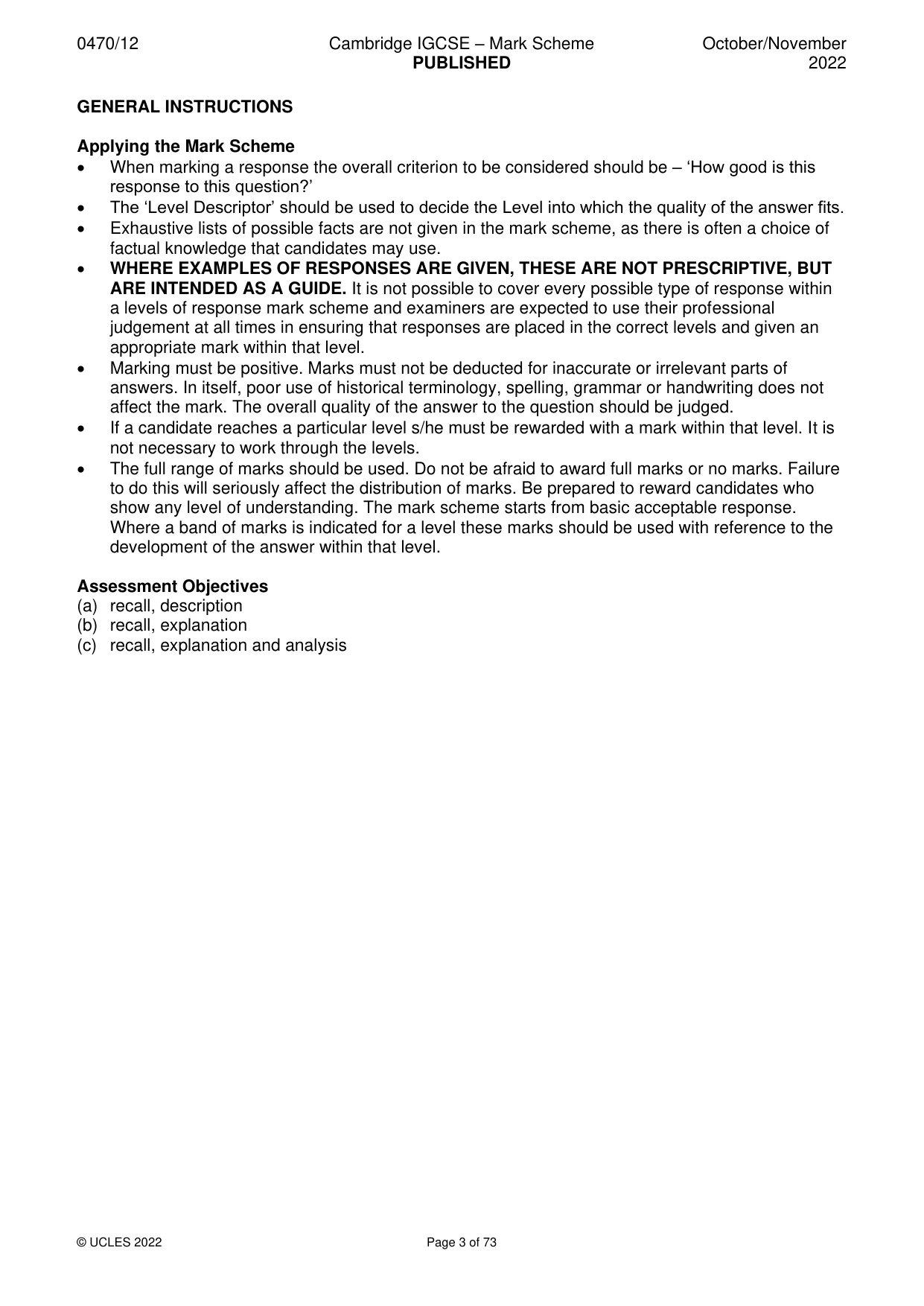
0470/12 Cambridge IGCSE – Mark Scheme PUBLISHED October/November 2022 © UCLES 2022 Page 3 of 73 GENERAL INSTRUCTIONS Applying the Mark Scheme • When marking a response the overall criterion to be considered should be – ‘How good is this response to this question?’ • The ‘Level Descriptor’ should be used to decide the Level into which the quality of the answer fits. • Exhaustive lists of possible facts are not given in the mark scheme, as there is often a choice of factual knowledge that candidates may use. • WHERE EXAMPLES OF RESPONSES ARE GIVEN, THESE ARE NOT PRESCRIPTIVE, BUT ARE INTENDED AS A GUIDE. It is not possible to cover every possible type of response within a levels of response mark scheme and examiners are expected to use their professional judgement at all times in ensuring that responses are placed in the correct levels and given an appropriate mark within that level. • Marking must be positive. Marks must not be deducted for inaccurate or irrelevant parts of answers. In itself, poor use of historical terminology, spelling, grammar or handwriting does not affect the mark. The overall quality of the answer to the question should be judged. • If a candidate reaches a particular level s/he must be rewarded with a mark within that level. It is not necessary to work through the levels. • The full range of marks should be used. Do not be afraid to award full marks or no marks. Failure to do this will seriously affect the distribution of marks. Be prepared to reward candidates who show any level of understanding. The mark scheme starts from basic acceptable response. Where a band of marks is indicated for a level these marks should be used with reference to the development of the answer within that level. Assessment Objectives (a) recall, description (b) recall, explanation (c) recall, explanation and analysis
Mark scheme, page 4
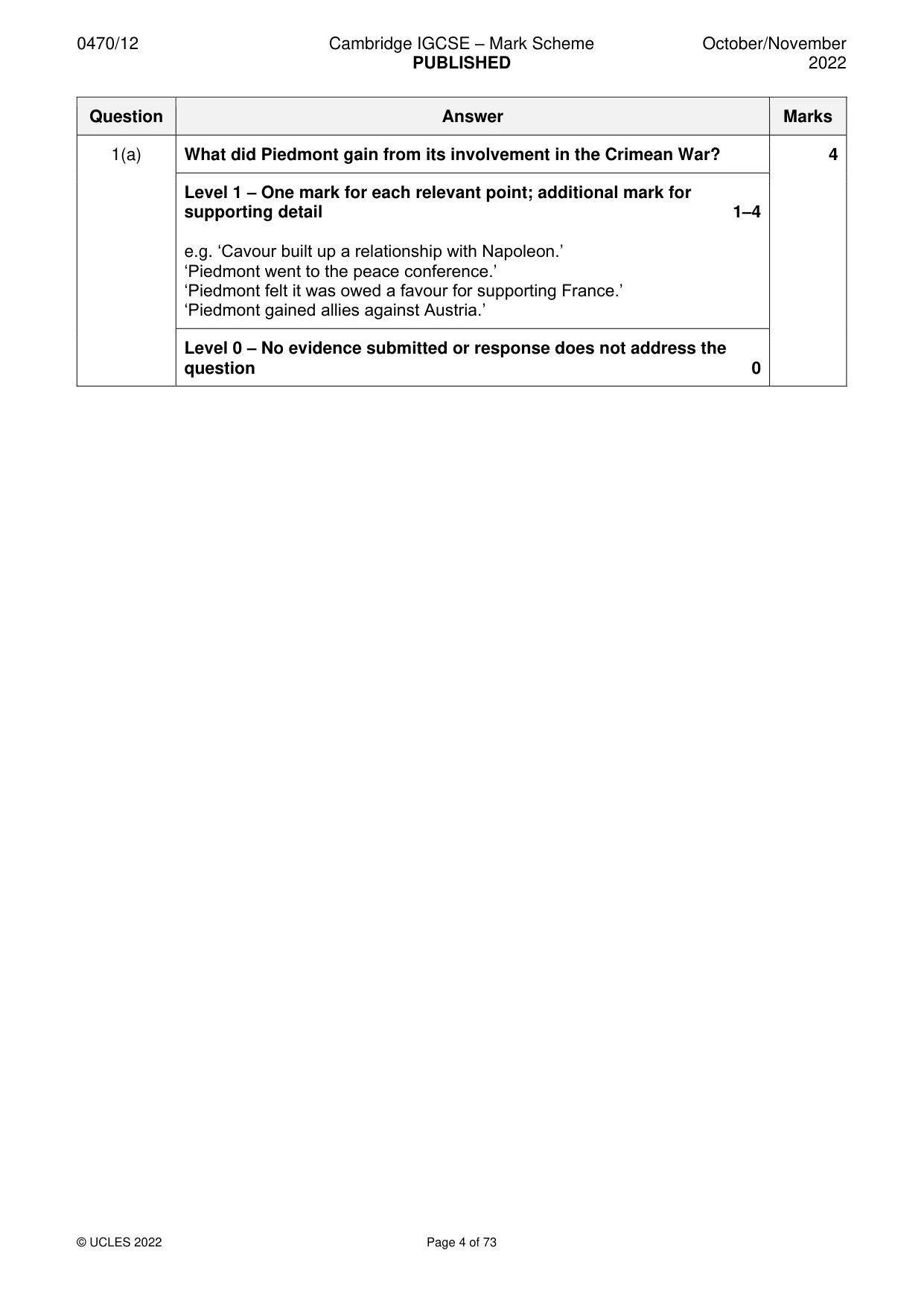
0470/12 Cambridge IGCSE – Mark Scheme PUBLISHED October/November 2022 © UCLES 2022 Page 4 of 73 Question Answer Marks 1(a) What did Piedmont gain from its involvement in the Crimean War? 4 Level 1 – One mark for each relevant point; additional mark for supporting detail 1–4 e.g. ‘Cavour built up a relationship with Napoleon.’ ‘Piedmont went to the peace conference.’ ‘Piedmont felt it was owed a favour for supporting France.’ ‘Piedmont gained allies against Austria.’ Level 0 – No evidence submitted or response does not address the question 0
Mark scheme, page 5
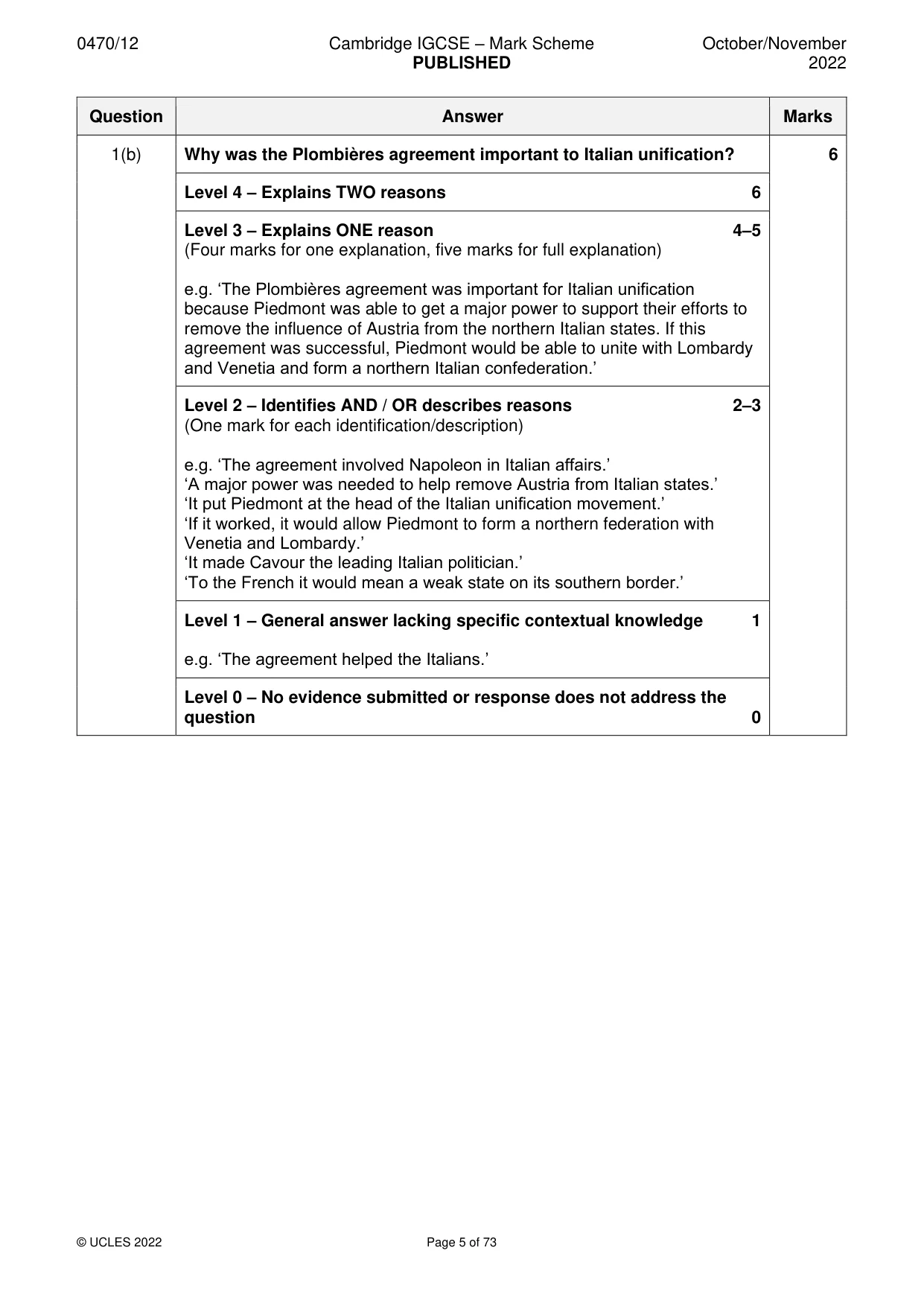
0470/12 Cambridge IGCSE – Mark Scheme PUBLISHED October/November 2022 © UCLES 2022 Page 5 of 73 Question Answer Marks 1(b) Why was the Plombières agreement important to Italian unification? 6 Level 4 – Explains TWO reasons 6 Level 3 – Explains ONE reason 4–5 (Four marks for one explanation, five marks for full explanation) e.g. ‘The Plombières agreement was important for Italian unification because Piedmont was able to get a major power to support their efforts to remove the influence of Austria from the northern Italian states. If this agreement was successful, Piedmont would be able to unite with Lombardy and Venetia and form a northern Italian confederation.’ Level 2 – Identifies AND / OR describes reasons 2–3 (One mark for each identification/description) e.g. ‘The agreement involved Napoleon in Italian affairs.’ ‘A major power was needed to help remove Austria from Italian states.’ ‘It put Piedmont at the head of the Italian unification movement.’ ‘If it worked, it would allow Piedmont to form a northern federation with Venetia and Lombardy.’ ‘It made Cavour the leading Italian politician.’ ‘To the French it would mean a weak state on its southern border.’ Level 1 – General answer lacking specific contextual knowledge 1 e.g. ‘The agreement helped the Italians.’ Level 0 – No evidence submitted or response does not address the question 0
Mark scheme, page 6
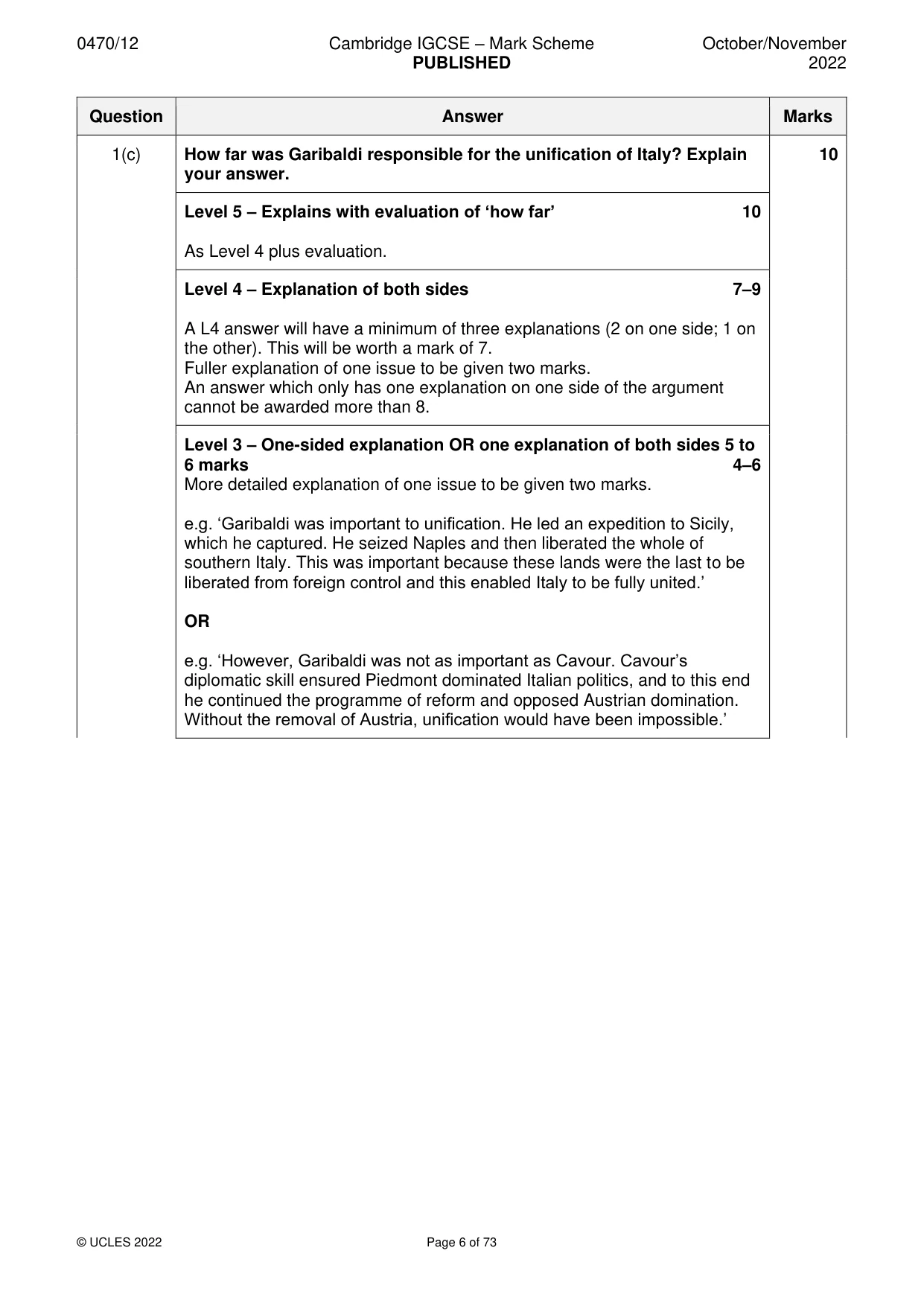
0470/12 Cambridge IGCSE – Mark Scheme PUBLISHED October/November 2022 © UCLES 2022 Page 6 of 73 Question Answer Marks 1(c) How far was Garibaldi responsible for the unification of Italy? Explain your answer. 10 Level 5 – Explains with evaluation of ‘how far’ 10 As Level 4 plus evaluation. Level 4 – Explanation of both sides 7–9 A L4 answer will have a minimum of three explanations (2 on one side; 1 on the other). This will be worth a mark of 7. Fuller explanation of one issue to be given two marks. An answer which only has one explanation on one side of the argument cannot be awarded more than 8. Level 3 – One-sided explanation OR one explanation of both sides 5 to 6 marks 4–6 More detailed explanation of one issue to be given two marks. e.g. ‘Garibaldi was important to unification. He led an expedition to Sicily, which he captured. He seized Naples and then liberated the whole of southern Italy. This was important because these lands were the last to be liberated from foreign control and this enabled Italy to be fully united.’ OR e.g. ‘However, Garibaldi was not as important as Cavour. Cavour’s diplomatic skill ensured Piedmont dominated Italian politics, and to this end he continued the programme of reform and opposed Austrian domination. Without the removal of Austria, unification would have been impossible.’
Mark scheme, page 7
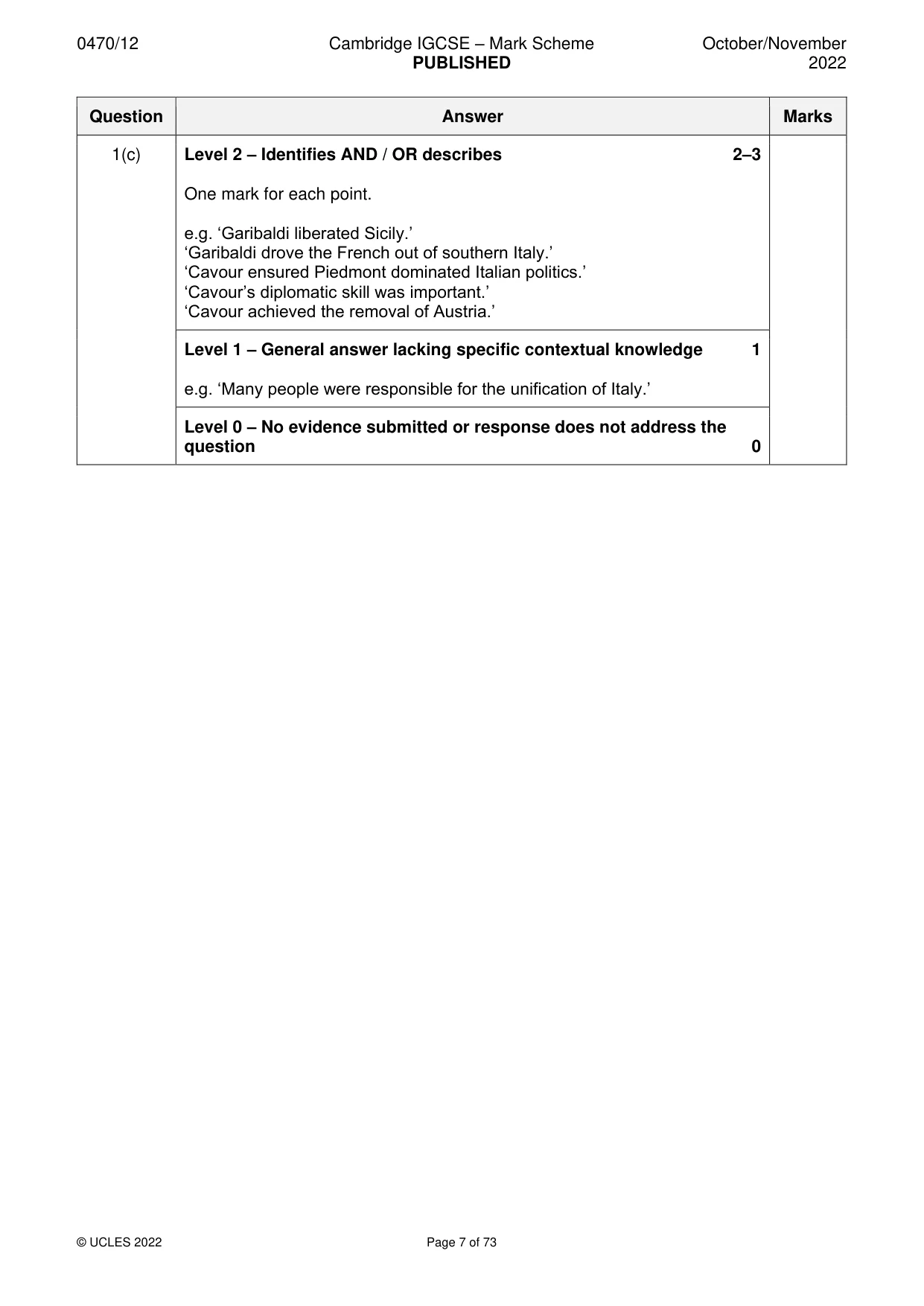
0470/12 Cambridge IGCSE – Mark Scheme PUBLISHED October/November 2022 © UCLES 2022 Page 7 of 73 Question Answer Marks 1(c) Level 2 – Identifies AND / OR describes 2–3 One mark for each point. e.g. ‘Garibaldi liberated Sicily.’ ‘Garibaldi drove the French out of southern Italy.’ ‘Cavour ensured Piedmont dominated Italian politics.’ ‘Cavour’s diplomatic skill was important.’ ‘Cavour achieved the removal of Austria.’ Level 1 – General answer lacking specific contextual knowledge 1 e.g. ‘Many people were responsible for the unification of Italy.’ Level 0 – No evidence submitted or response does not address the question 0
Mark scheme, page 8
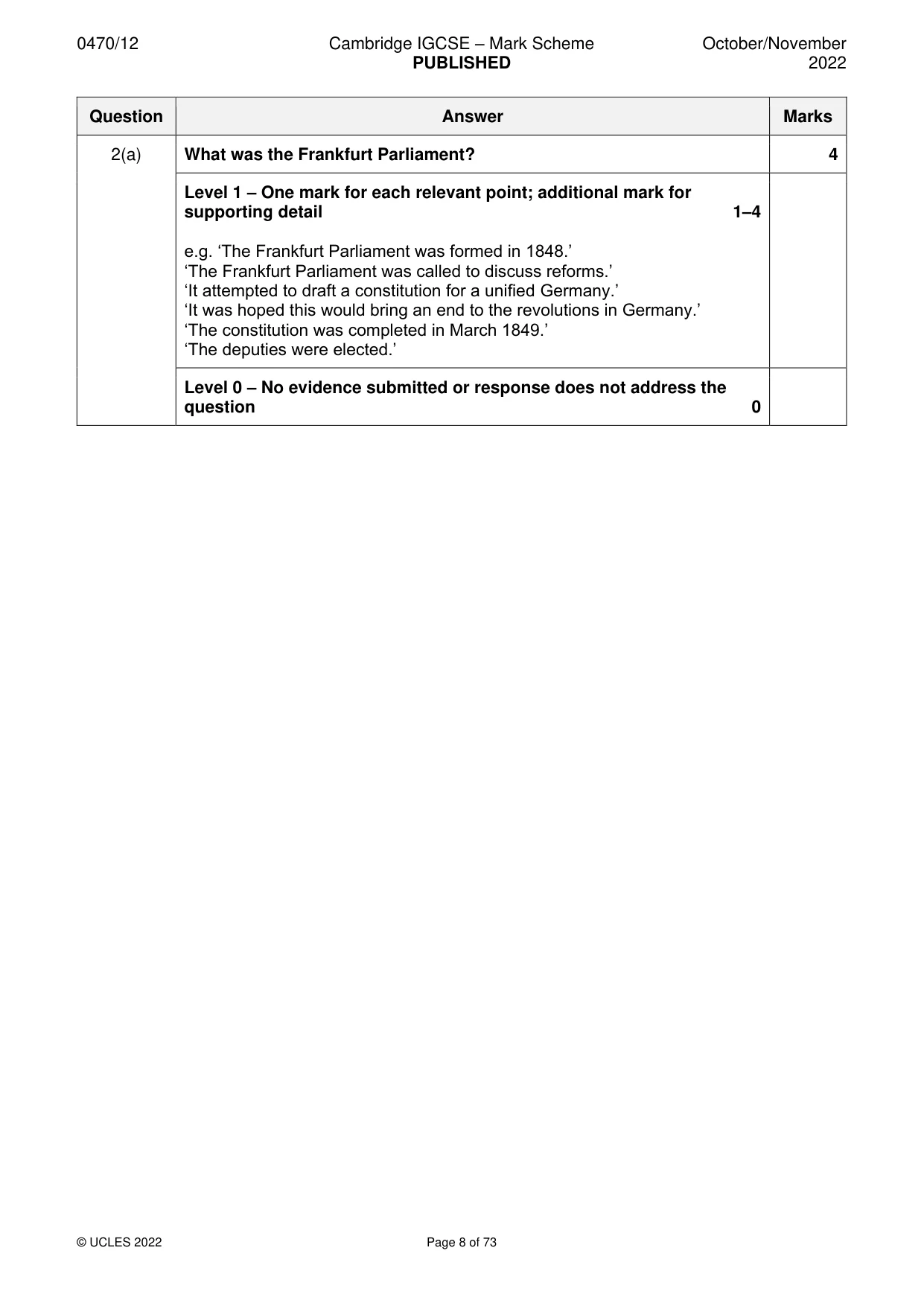
0470/12 Cambridge IGCSE – Mark Scheme PUBLISHED October/November 2022 © UCLES 2022 Page 8 of 73 Question Answer Marks 2(a) What was the Frankfurt Parliament? 4 Level 1 – One mark for each relevant point; additional mark for supporting detail 1–4 e.g. ‘The Frankfurt Parliament was formed in 1848.’ ‘The Frankfurt Parliament was called to discuss reforms.’ ‘It attempted to draft a constitution for a unified Germany.’ ‘It was hoped this would bring an end to the revolutions in Germany.’ ‘The constitution was completed in March 1849.’ ‘The deputies were elected.’ Level 0 – No evidence submitted or response does not address the question 0
Mark scheme, page 9
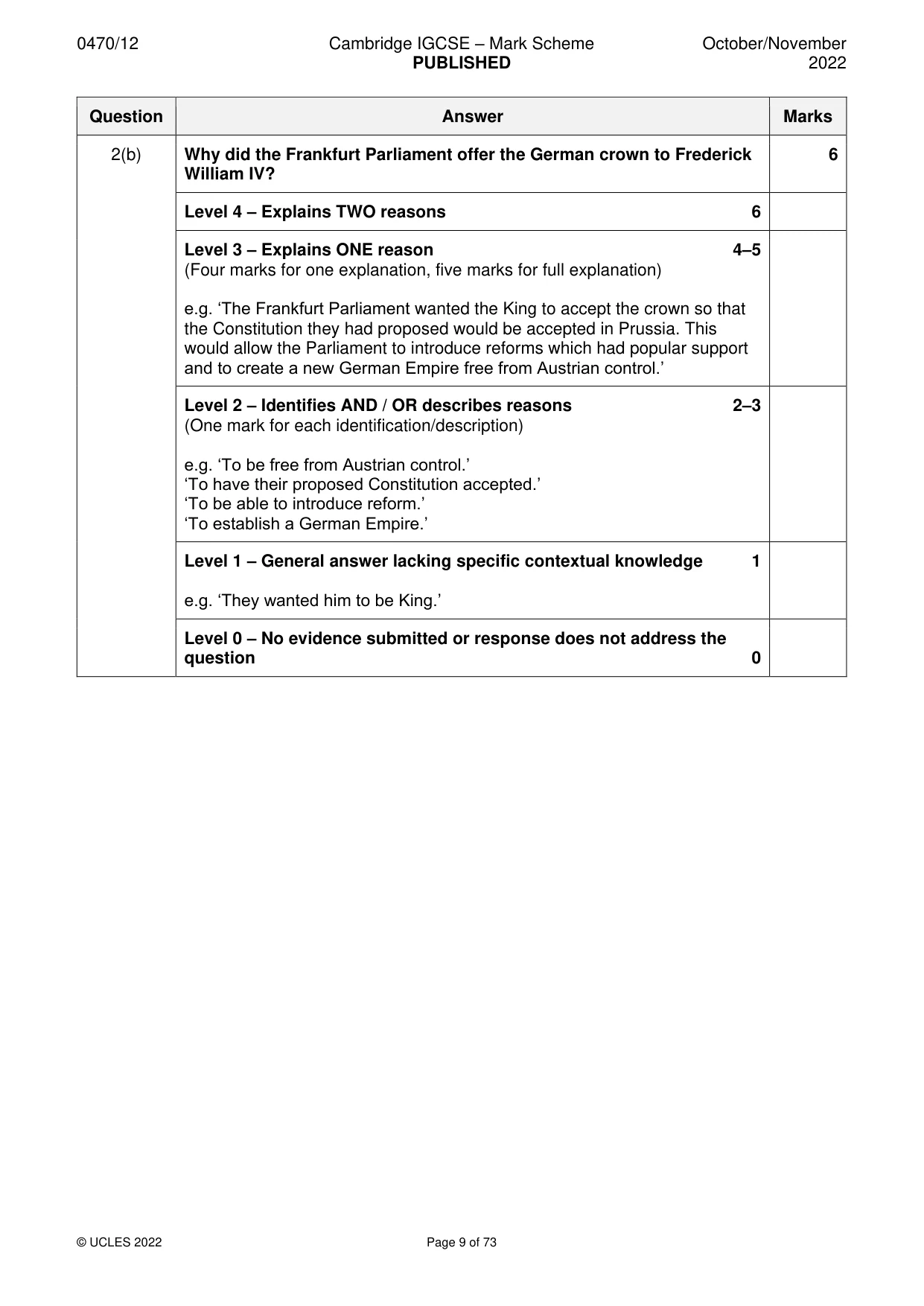
0470/12 Cambridge IGCSE – Mark Scheme PUBLISHED October/November 2022 © UCLES 2022 Page 9 of 73 Question Answer Marks 2(b) Why did the Frankfurt Parliament offer the German crown to Frederick William IV? 6 Level 4 – Explains TWO reasons 6 Level 3 – Explains ONE reason 4–5 (Four marks for one explanation, five marks for full explanation) e.g. ‘The Frankfurt Parliament wanted the King to accept the crown so that the Constitution they had proposed would be accepted in Prussia. This would allow the Parliament to introduce reforms which had popular support and to create a new German Empire free from Austrian control.’ Level 2 – Identifies AND / OR describes reasons 2–3 (One mark for each identification/description) e.g. ‘To be free from Austrian control.’ ‘To have their proposed Constitution accepted.’ ‘To be able to introduce reform.’ ‘To establish a German Empire.’ Level 1 – General answer lacking specific contextual knowledge 1 e.g. ‘They wanted him to be King.’ Level 0 – No evidence submitted or response does not address the question 0
Mark scheme, page 10
0470/12 Cambridge IGCSE – Mark Scheme PUBLISHED October/November 2022 © UCLES 2022 Page 10 of 73 Question Answer Marks 2(c) How far do you agree that the 1848–49 revolutions in Germany achieved little? Explain your answer. 10 Level 5 – Explains with evaluation of ‘how far’ 10 As Level 4 plus evaluation. Level 4 – Explanation of both sides 7–9 A L4 answer will have a minimum of three explanations (2 on one side; 1 on the other). This will be worth a mark of 7. Fuller explanation of one issue to be given two marks. An answer which only has one explanation on one side of the argument cannot be awarded more than 8. Level 3 – One-sided explanation OR one explanation of both sides 5 to 6 marks 4–6 More detailed explanation of one issue to be given two marks. e.g. ‘The revolutions in Germany didn’t achieve their aim to be united and free from Austrian control. Liberals and nationalists met to draft a new constitution but failed. Prussian attempts to become leader of a united Germany were quashed by Austria.’ OR e.g. ‘However, there were some changes because of the 1848 revolutions in Germany. Reforms were introduced in some parts of the country. The German governments agreed to create three constituent assemblies at Berlin, Vienna, and Frankfurt by which democratic constitutions were to be drafted for Prussia, Austria, and Germany. Although the Frankfurt Parliament was closed in 1849, it had begun a series of debates about the way German states were ruled and the rights which should be given to the people.’
Mark scheme, page 11
0470/12 Cambridge IGCSE – Mark Scheme PUBLISHED October/November 2022 © UCLES 2022 Page 11 of 73 Question Answer Marks 2(c) Level 2 – Identifies AND / OR describes 2–3 One mark for each point. e.g. ‘Frederick William IV of Prussia introduced some liberal reforms.’ ‘They were not successful because demands were initially agreed to and then power was regained.’ ‘The Frankfurt Parliament failed.’ ‘There were many divisions in the Frankfurt Parliament.’ ‘The liberals wanted to draft a constitution.’ ‘The radicals wanted a law-making parliament.’ ‘It needed to decide whether Germany should include Austria.’ Level 1 – General answer lacking specific contextual knowledge 1 e.g. ‘The revolution was a failure.’ Level 0 – No evidence submitted or response does not address the question 0
Mark scheme, page 12
0470/12 Cambridge IGCSE – Mark Scheme PUBLISHED October/November 2022 © UCLES 2022 Page 12 of 73 Question Answer Marks 3(a) What changes were made to the US Constitution as a result of the Civil War? 4 Level 1 – One mark for each relevant point; additional mark for supporting detail 1–4 e.g. ‘The 13th Amendment ended slavery.’ ‘The 13th Amendment was added to the Constitution in December 1865.’ ‘The 14th Amendment was passed in April 1866.’ ‘The 14th Amendment was the Civil Rights Act.’ ‘All citizens were given equality before the law.’ ‘The 15th Amendment was introduced in 1869 but not ratified until 1870.’ ‘The 15th Amendment made it illegal to deny the right to vote based on colour or race.’ Level 0 – No evidence submitted or response does not address the question 0
Mark scheme, page 13
0470/12 Cambridge IGCSE – Mark Scheme PUBLISHED October/November 2022 © UCLES 2022 Page 13 of 73 Question Answer Marks 3(b) Why was the Ku Klux Klan founded? 6 Level 4 – Explains TWO reasons 6 Level 3 – Explains ONE reason 4–5 (Four marks for one explanation, five marks for full explanation) e.g. ‘The KKK was formed because the ex-Confederate soldiers saw themselves as vigilantes protecting white communities from the freed slaves. They set out to persecute freed men trying to set up business in white areas or on their own land.’ Level 2 – Identifies AND / OR describes reasons 2–3 (One mark for each identification/description) e.g. ‘To provide a political organisation.’ ‘To fight for white rights.’ ‘To target black Americans.’ ‘To protect the weak from wrongdoing.’ ‘To provide a club for ex-Confederate soldiers.’ Level 1 – General answer lacking specific contextual knowledge 1 e.g. ‘The Klan was formed because there was chaos at the end of the Civil War.’ Level 0 – No evidence submitted or response does not address the question 0
Mark scheme, page 14
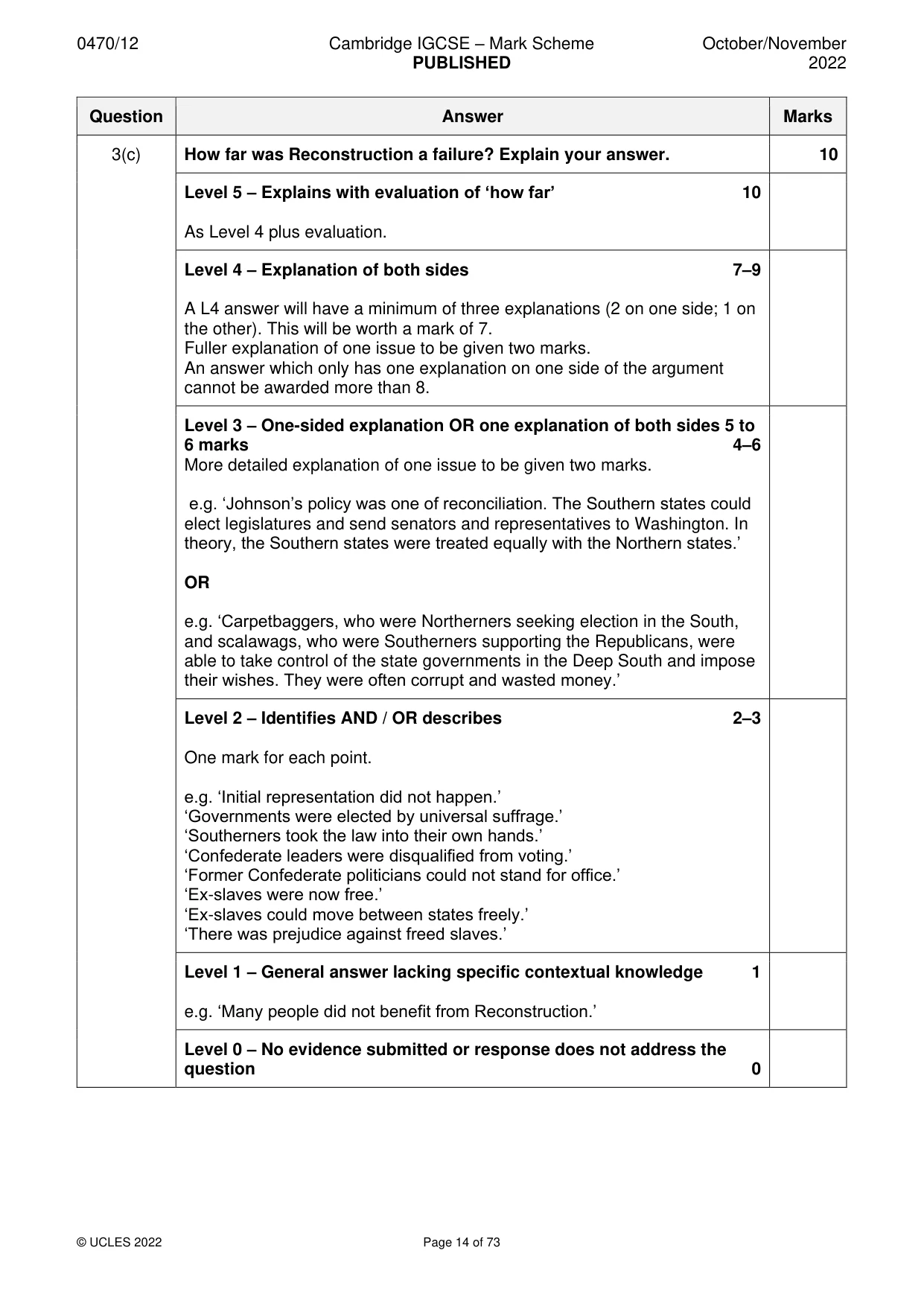
0470/12 Cambridge IGCSE – Mark Scheme PUBLISHED October/November 2022 © UCLES 2022 Page 14 of 73 Question Answer Marks 3(c) How far was Reconstruction a failure? Explain your answer. 10 Level 5 – Explains with evaluation of ‘how far’ 10 As Level 4 plus evaluation. Level 4 – Explanation of both sides 7–9 A L4 answer will have a minimum of three explanations (2 on one side; 1 on the other). This will be worth a mark of 7. Fuller explanation of one issue to be given two marks. An answer which only has one explanation on one side of the argument cannot be awarded more than 8. Level 3 – One-sided explanation OR one explanation of both sides 5 to 6 marks 4–6 More detailed explanation of one issue to be given two marks. e.g. ‘Johnson’s policy was one of reconciliation. The Southern states could elect legislatures and send senators and representatives to Washington. In theory, the Southern states were treated equally with the Northern states.’ OR e.g. ‘Carpetbaggers, who were Northerners seeking election in the South, and scalawags, who were Southerners supporting the Republicans, were able to take control of the state governments in the Deep South and impose their wishes. They were often corrupt and wasted money.’ Level 2 – Identifies AND / OR describes 2–3 One mark for each point. e.g. ‘Initial representation did not happen.’ ‘Governments were elected by universal suffrage.’ ‘Southerners took the law into their own hands.’ ‘Confederate leaders were disqualified from voting.’ ‘Former Confederate politicians could not stand for office.’ ‘Ex-slaves were now free.’ ‘Ex-slaves could move between states freely.’ ‘There was prejudice against freed slaves.’ Level 1 – General answer lacking specific contextual knowledge 1 e.g. ‘Many people did not benefit from Reconstruction.’ Level 0 – No evidence submitted or response does not address the question 0
Mark scheme, page 15
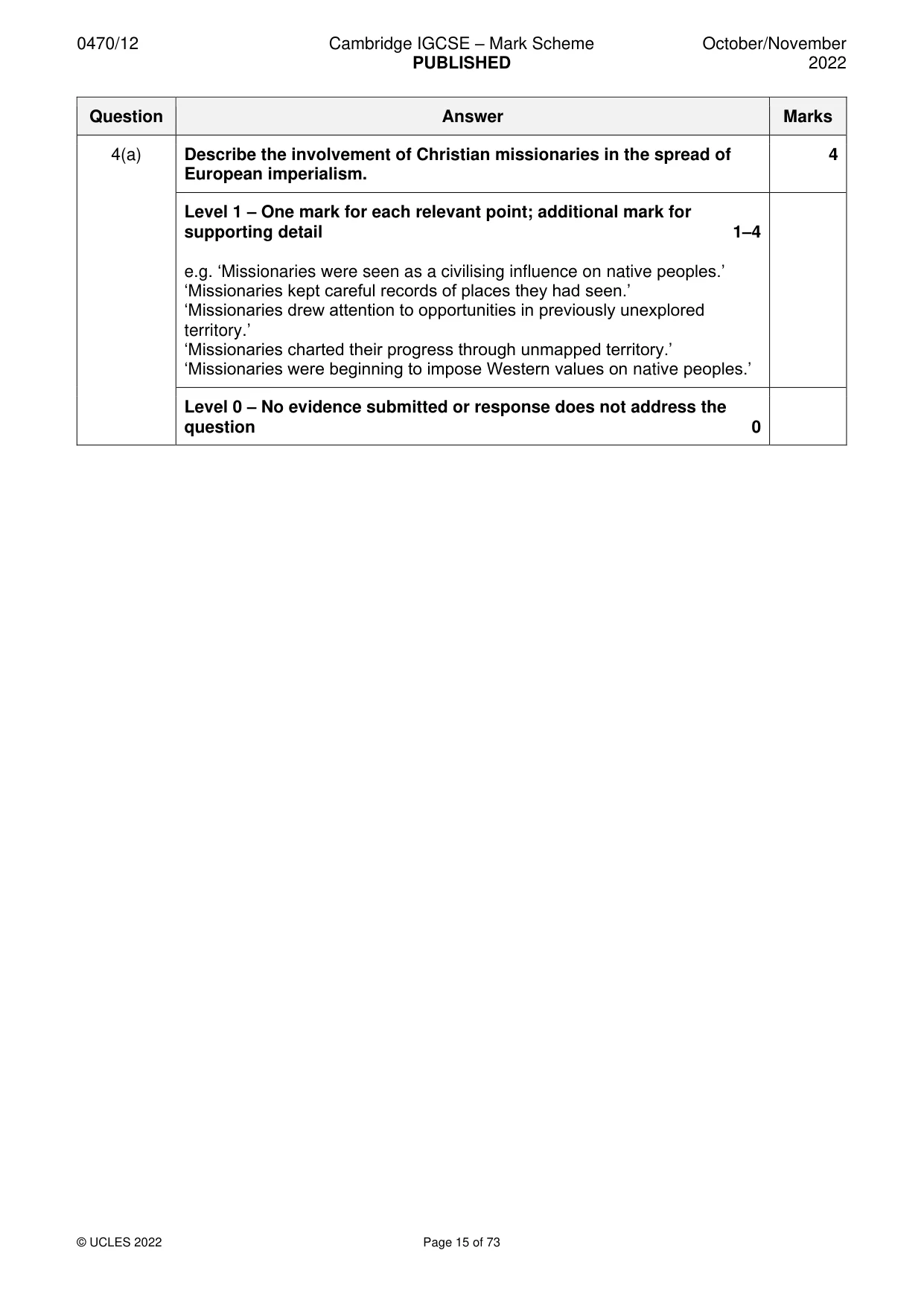
0470/12 Cambridge IGCSE – Mark Scheme PUBLISHED October/November 2022 © UCLES 2022 Page 15 of 73 Question Answer Marks 4(a) Describe the involvement of Christian missionaries in the spread of European imperialism. 4 Level 1 – One mark for each relevant point; additional mark for supporting detail 1–4 e.g. ‘Missionaries were seen as a civilising influence on native peoples.’ ‘Missionaries kept careful records of places they had seen.’ ‘Missionaries drew attention to opportunities in previously unexplored territory.’ ‘Missionaries charted their progress through unmapped territory.’ ‘Missionaries were beginning to impose Western values on native peoples.’ Level 0 – No evidence submitted or response does not address the question 0
Mark scheme, page 16
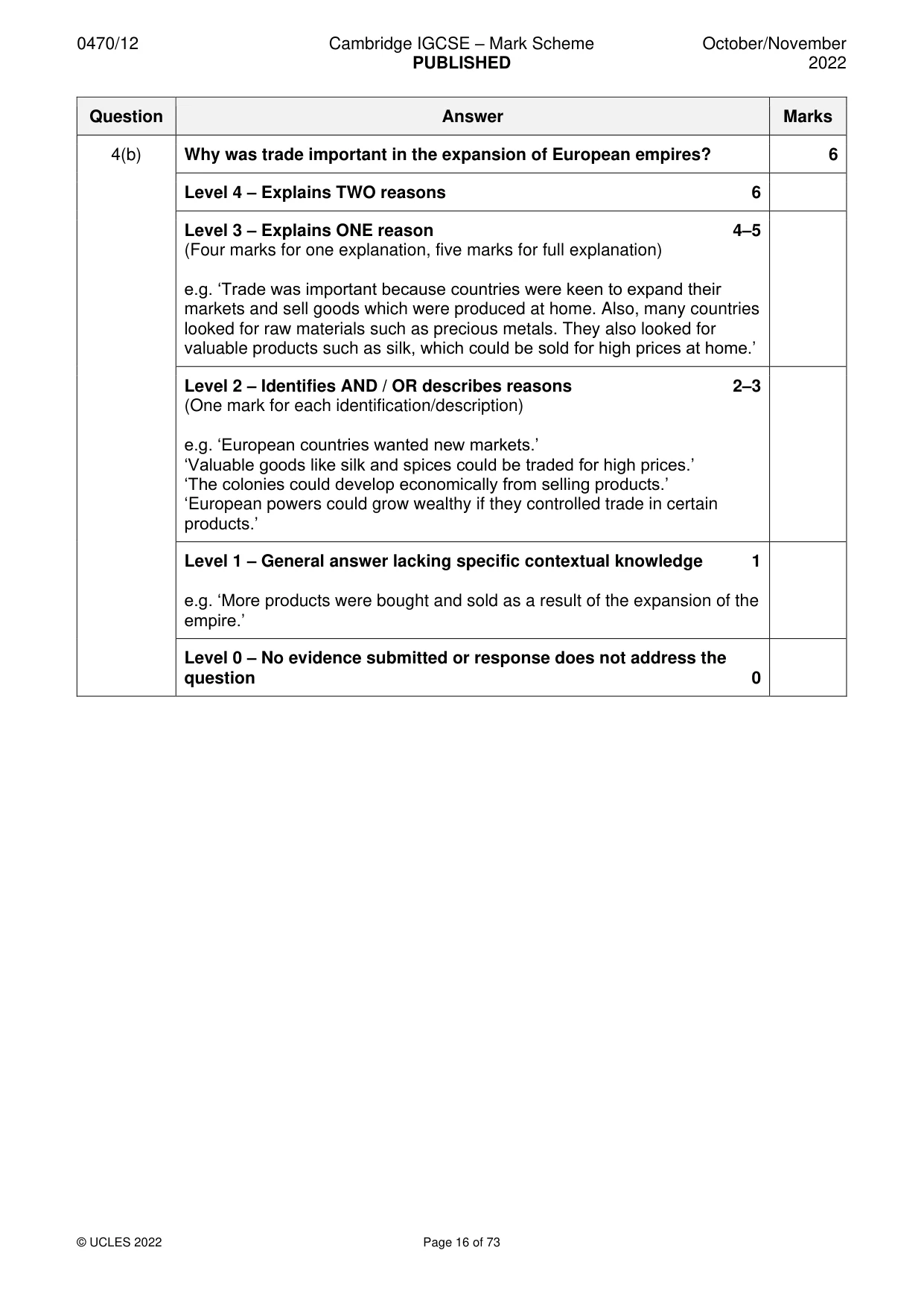
0470/12 Cambridge IGCSE – Mark Scheme PUBLISHED October/November 2022 © UCLES 2022 Page 16 of 73 Question Answer Marks 4(b) Why was trade important in the expansion of European empires? 6 Level 4 – Explains TWO reasons 6 Level 3 – Explains ONE reason 4–5 (Four marks for one explanation, five marks for full explanation) e.g. ‘Trade was important because countries were keen to expand their markets and sell goods which were produced at home. Also, many countries looked for raw materials such as precious metals. They also looked for valuable products such as silk, which could be sold for high prices at home.’ Level 2 – Identifies AND / OR describes reasons 2–3 (One mark for each identification/description) e.g. ‘European countries wanted new markets.’ ‘Valuable goods like silk and spices could be traded for high prices.’ ‘The colonies could develop economically from selling products.’ ‘European powers could grow wealthy if they controlled trade in certain products.’ Level 1 – General answer lacking specific contextual knowledge 1 e.g. ‘More products were bought and sold as a result of the expansion of the empire.’ Level 0 – No evidence submitted or response does not address the question 0
Mark scheme, page 17
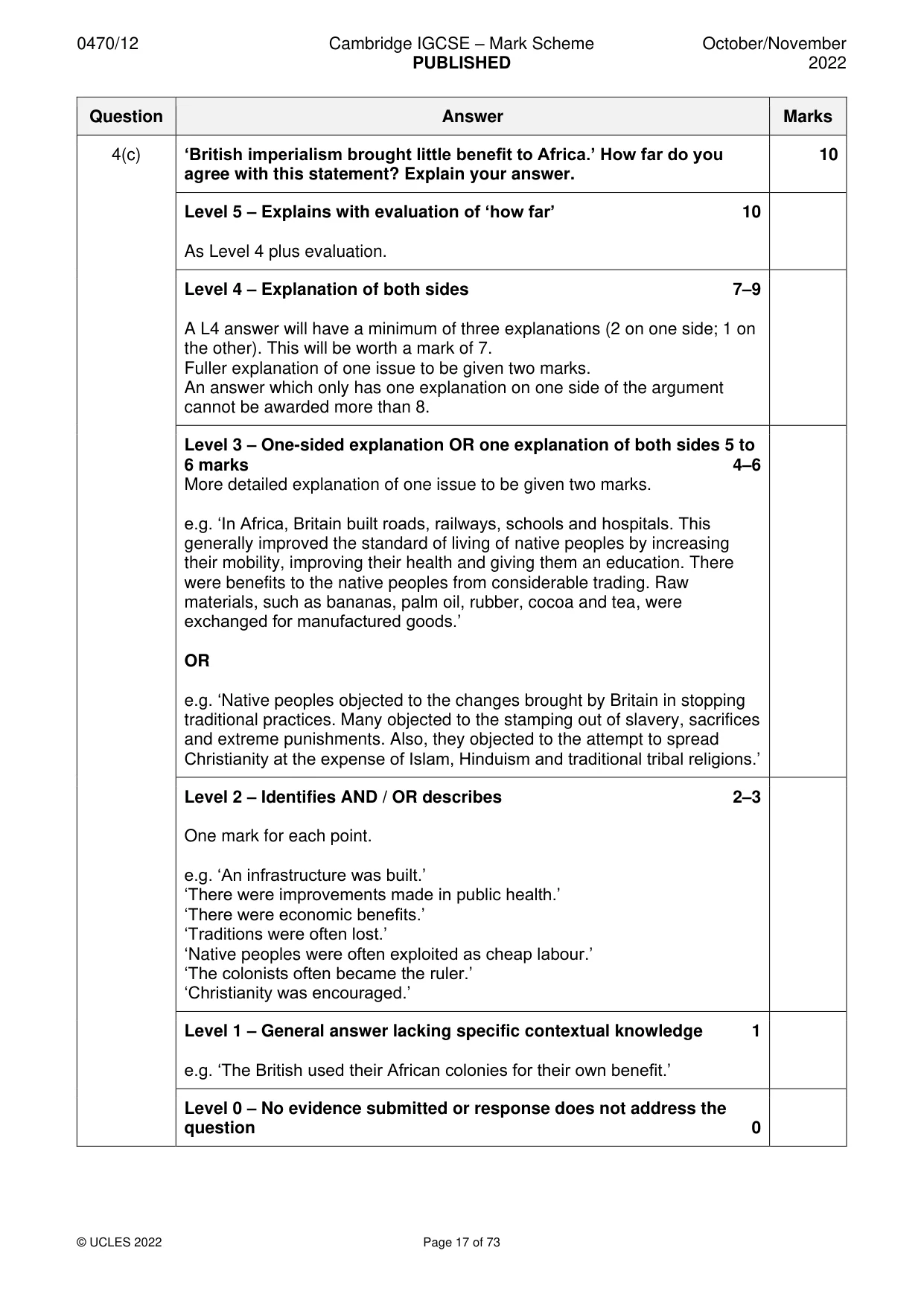
0470/12 Cambridge IGCSE – Mark Scheme PUBLISHED October/November 2022 © UCLES 2022 Page 17 of 73 Question Answer Marks 4(c) ‘British imperialism brought little benefit to Africa.’ How far do you agree with this statement? Explain your answer. 10 Level 5 – Explains with evaluation of ‘how far’ 10 As Level 4 plus evaluation. Level 4 – Explanation of both sides 7–9 A L4 answer will have a minimum of three explanations (2 on one side; 1 on the other). This will be worth a mark of 7. Fuller explanation of one issue to be given two marks. An answer which only has one explanation on one side of the argument cannot be awarded more than 8. Level 3 – One-sided explanation OR one explanation of both sides 5 to 6 marks 4–6 More detailed explanation of one issue to be given two marks. e.g. ‘In Africa, Britain built roads, railways, schools and hospitals. This generally improved the standard of living of native peoples by increasing their mobility, improving their health and giving them an education. There were benefits to the native peoples from considerable trading. Raw materials, such as bananas, palm oil, rubber, cocoa and tea, were exchanged for manufactured goods.’ OR e.g. ‘Native peoples objected to the changes brought by Britain in stopping traditional practices. Many objected to the stamping out of slavery, sacrifices and extreme punishments. Also, they objected to the attempt to spread Christianity at the expense of Islam, Hinduism and traditional tribal religions.’ Level 2 – Identifies AND / OR describes 2–3 One mark for each point. e.g. ‘An infrastructure was built.’ ‘There were improvements made in public health.’ ‘There were economic benefits.’ ‘Traditions were often lost.’ ‘Native peoples were often exploited as cheap labour.’ ‘The colonists often became the ruler.’ ‘Christianity was encouraged.’ Level 1 – General answer lacking specific contextual knowledge 1 e.g. ‘The British used their African colonies for their own benefit.’ Level 0 – No evidence submitted or response does not address the question 0
Mark scheme, page 18
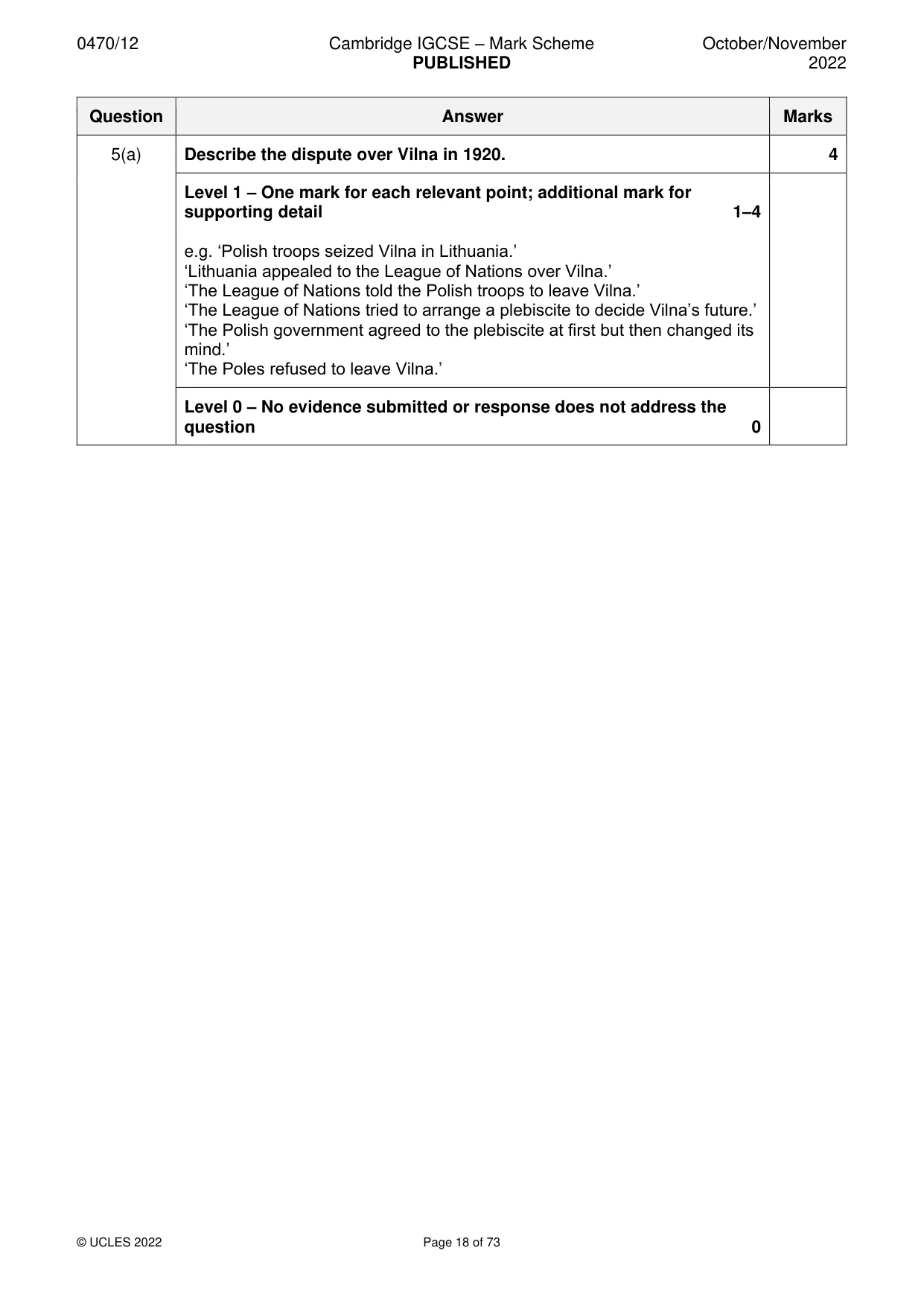
0470/12 Cambridge IGCSE – Mark Scheme PUBLISHED October/November 2022 © UCLES 2022 Page 18 of 73 Question Answer Marks 5(a) Describe the dispute over Vilna in 1920. 4 Level 1 – One mark for each relevant point; additional mark for supporting detail 1–4 e.g. ‘Polish troops seized Vilna in Lithuania.’ ‘Lithuania appealed to the League of Nations over Vilna.’ ‘The League of Nations told the Polish troops to leave Vilna.’ ‘The League of Nations tried to arrange a plebiscite to decide Vilna’s future.’ ‘The Polish government agreed to the plebiscite at first but then changed its mind.’ ‘The Poles refused to leave Vilna.’ Level 0 – No evidence submitted or response does not address the question 0
Mark scheme, page 19
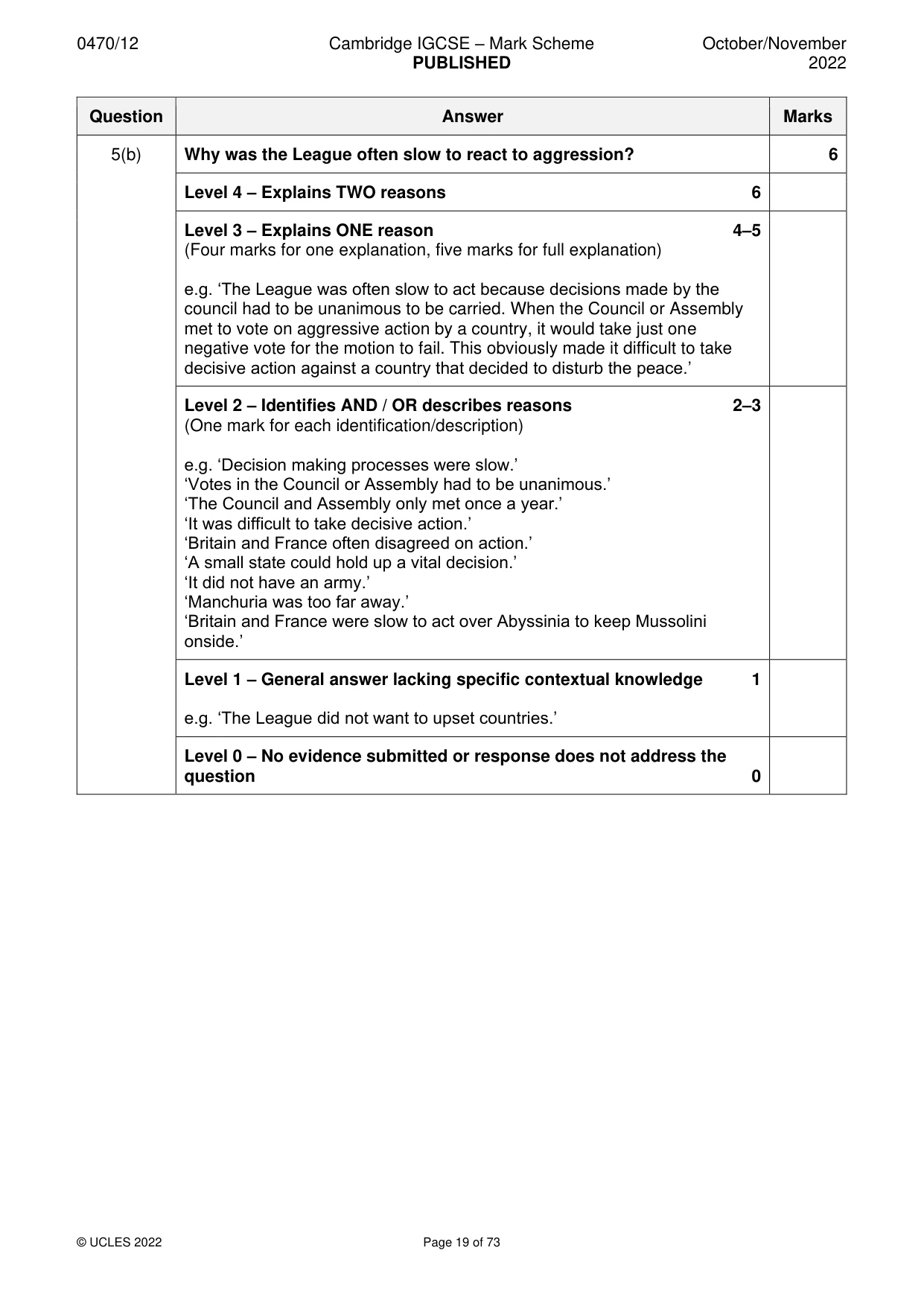
0470/12 Cambridge IGCSE – Mark Scheme PUBLISHED October/November 2022 © UCLES 2022 Page 19 of 73 Question Answer Marks 5(b) Why was the League often slow to react to aggression? 6 Level 4 – Explains TWO reasons 6 Level 3 – Explains ONE reason 4–5 (Four marks for one explanation, five marks for full explanation) e.g. ‘The League was often slow to act because decisions made by the council had to be unanimous to be carried. When the Council or Assembly met to vote on aggressive action by a country, it would take just one negative vote for the motion to fail. This obviously made it difficult to take decisive action against a country that decided to disturb the peace.’ Level 2 – Identifies AND / OR describes reasons 2–3 (One mark for each identification/description) e.g. ‘Decision making processes were slow.’ ‘Votes in the Council or Assembly had to be unanimous.’ ‘The Council and Assembly only met once a year.’ ‘It was difficult to take decisive action.’ ‘Britain and France often disagreed on action.’ ‘A small state could hold up a vital decision.’ ‘It did not have an army.’ ‘Manchuria was too far away.’ ‘Britain and France were slow to act over Abyssinia to keep Mussolini onside.’ Level 1 – General answer lacking specific contextual knowledge 1 e.g. ‘The League did not want to upset countries.’ Level 0 – No evidence submitted or response does not address the question 0
Mark scheme, page 20
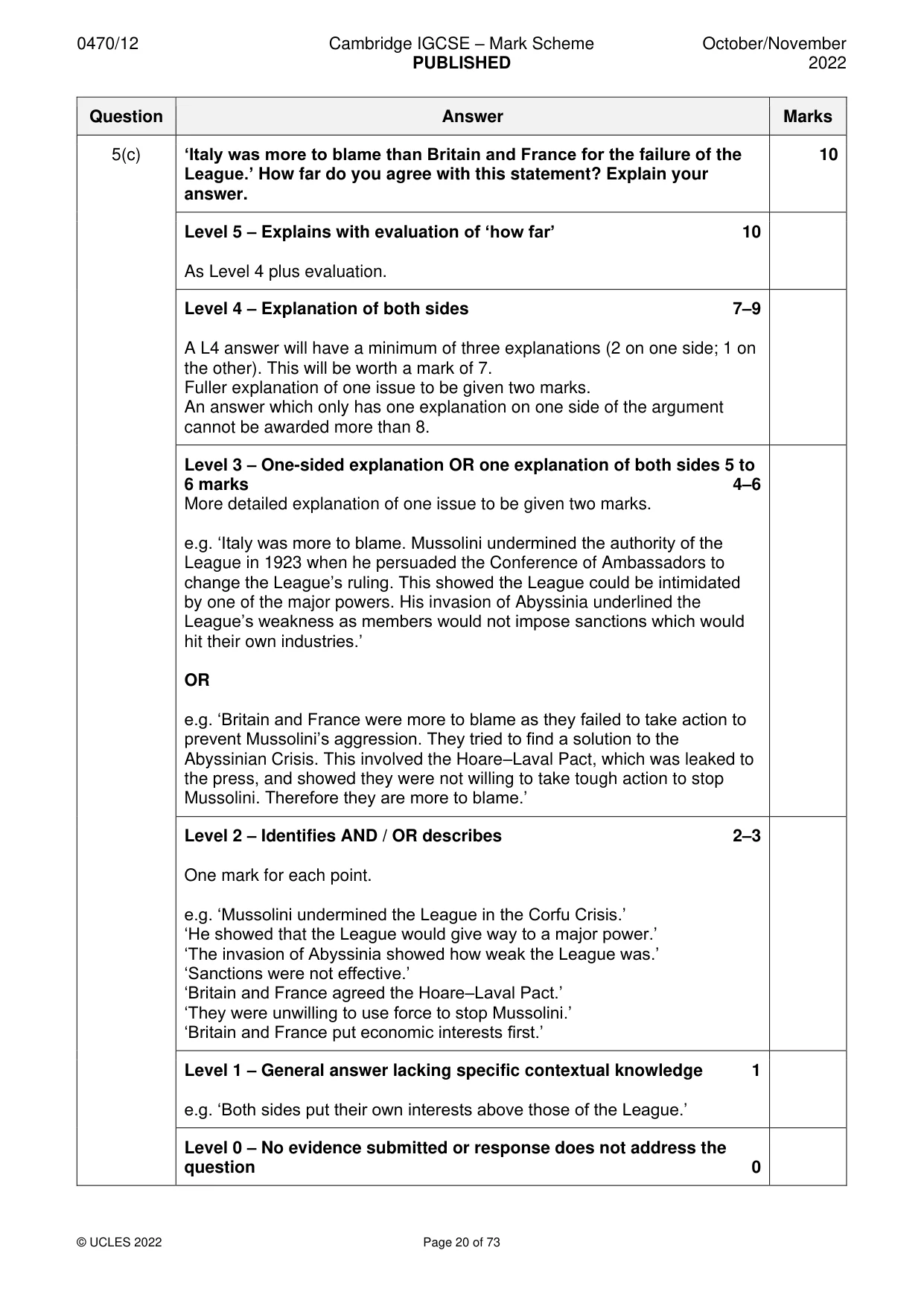
0470/12 Cambridge IGCSE – Mark Scheme PUBLISHED October/November 2022 © UCLES 2022 Page 20 of 73 Question Answer Marks 5(c) ‘Italy was more to blame than Britain and France for the failure of the League.’ How far do you agree with this statement? Explain your answer. 10 Level 5 – Explains with evaluation of ‘how far’ 10 As Level 4 plus evaluation. Level 4 – Explanation of both sides 7–9 A L4 answer will have a minimum of three explanations (2 on one side; 1 on the other). This will be worth a mark of 7. Fuller explanation of one issue to be given two marks. An answer which only has one explanation on one side of the argument cannot be awarded more than 8. Level 3 – One-sided explanation OR one explanation of both sides 5 to 6 marks 4–6 More detailed explanation of one issue to be given two marks. e.g. ‘Italy was more to blame. Mussolini undermined the authority of the League in 1923 when he persuaded the Conference of Ambassadors to change the League’s ruling. This showed the League could be intimidated by one of the major powers. His invasion of Abyssinia underlined the League’s weakness as members would not impose sanctions which would hit their own industries.’ OR e.g. ‘Britain and France were more to blame as they failed to take action to prevent Mussolini’s aggression. They tried to find a solution to the Abyssinian Crisis. This involved the Hoare–Laval Pact, which was leaked to the press, and showed they were not willing to take tough action to stop Mussolini. Therefore they are more to blame.’ Level 2 – Identifies AND / OR describes 2–3 One mark for each point. e.g. ‘Mussolini undermined the League in the Corfu Crisis.’ ‘He showed that the League would give way to a major power.’ ‘The invasion of Abyssinia showed how weak the League was.’ ‘Sanctions were not effective.’ ‘Britain and France agreed the Hoare–Laval Pact.’ ‘They were unwilling to use force to stop Mussolini.’ ‘Britain and France put economic interests first.’ Level 1 – General answer lacking specific contextual knowledge 1 e.g. ‘Both sides put their own interests above those of the League.’ Level 0 – No evidence submitted or response does not address the question 0
Mark scheme, page 21
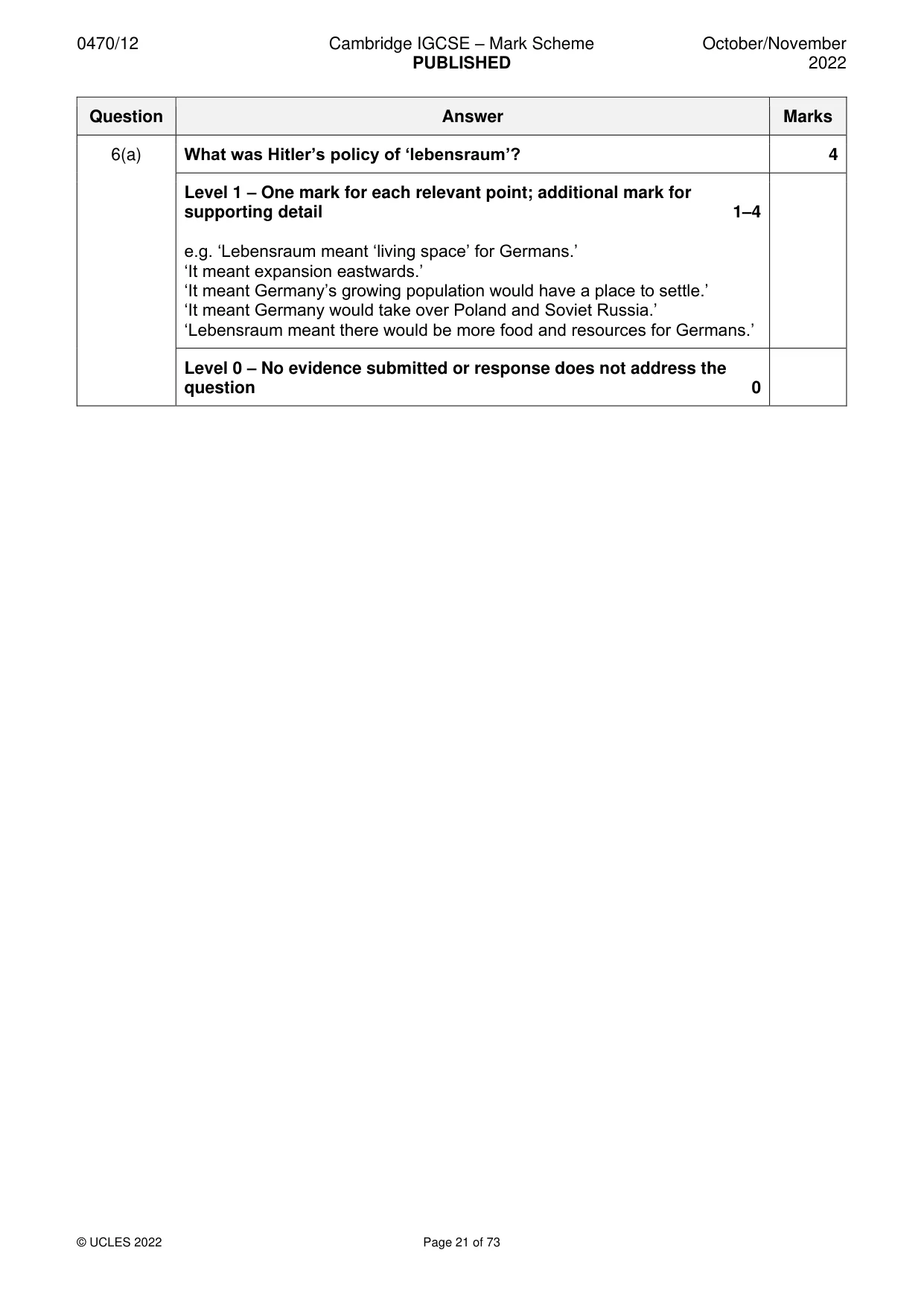
0470/12 Cambridge IGCSE – Mark Scheme PUBLISHED October/November 2022 © UCLES 2022 Page 21 of 73 Question Answer Marks 6(a) What was Hitler’s policy of ‘lebensraum’? 4 Level 1 – One mark for each relevant point; additional mark for supporting detail 1–4 e.g. ‘Lebensraum meant ‘living space’ for Germans.’ ‘It meant expansion eastwards.’ ‘It meant Germany’s growing population would have a place to settle.’ ‘It meant Germany would take over Poland and Soviet Russia.’ ‘Lebensraum meant there would be more food and resources for Germans.’ Level 0 – No evidence submitted or response does not address the question 0
Mark scheme, page 22
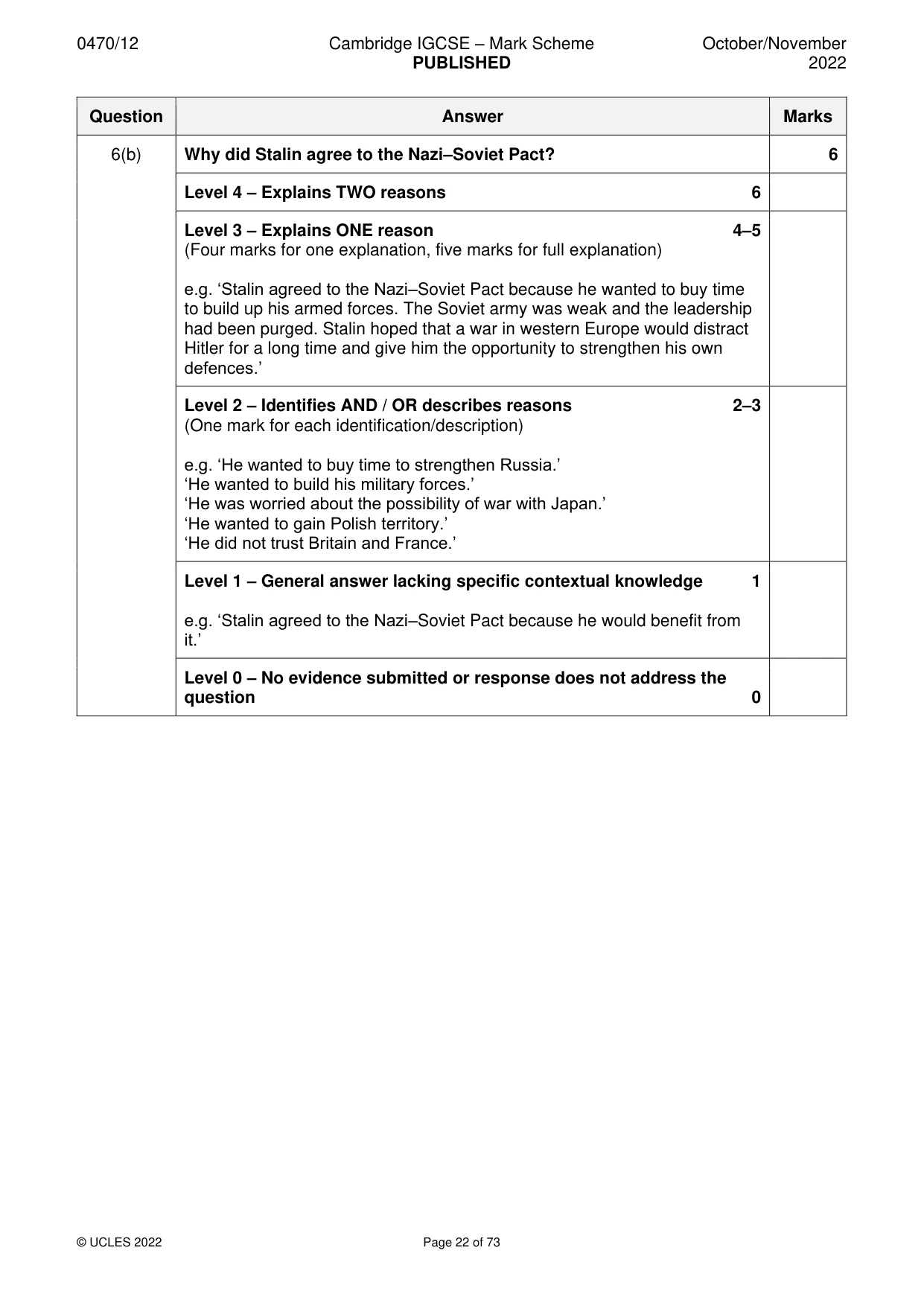
0470/12 Cambridge IGCSE – Mark Scheme PUBLISHED October/November 2022 © UCLES 2022 Page 22 of 73 Question Answer Marks 6(b) Why did Stalin agree to the Nazi–Soviet Pact? 6 Level 4 – Explains TWO reasons 6 Level 3 – Explains ONE reason 4–5 (Four marks for one explanation, five marks for full explanation) e.g. ‘Stalin agreed to the Nazi–Soviet Pact because he wanted to buy time to build up his armed forces. The Soviet army was weak and the leadership had been purged. Stalin hoped that a war in western Europe would distract Hitler for a long time and give him the opportunity to strengthen his own defences.’ Level 2 – Identifies AND / OR describes reasons 2–3 (One mark for each identification/description) e.g. ‘He wanted to buy time to strengthen Russia.’ ‘He wanted to build his military forces.’ ‘He was worried about the possibility of war with Japan.’ ‘He wanted to gain Polish territory.’ ‘He did not trust Britain and France.’ Level 1 – General answer lacking specific contextual knowledge 1 e.g. ‘Stalin agreed to the Nazi–Soviet Pact because he would benefit from it.’ Level 0 – No evidence submitted or response does not address the question 0
Mark scheme, page 23
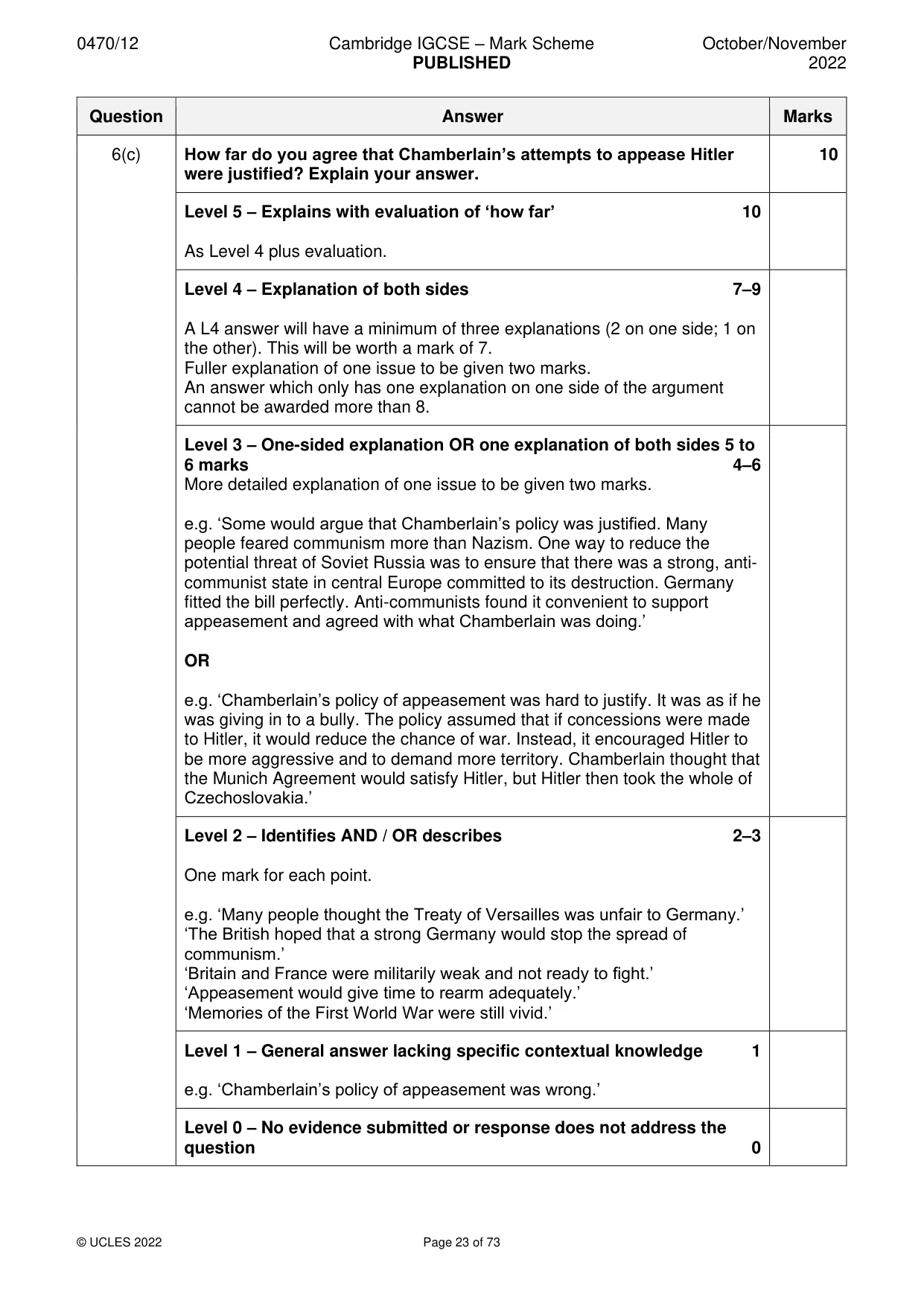
0470/12 Cambridge IGCSE – Mark Scheme PUBLISHED October/November 2022 © UCLES 2022 Page 23 of 73 Question Answer Marks 6(c) How far do you agree that Chamberlain’s attempts to appease Hitler were justified? Explain your answer. 10 Level 5 – Explains with evaluation of ‘how far’ 10 As Level 4 plus evaluation. Level 4 – Explanation of both sides 7–9 A L4 answer will have a minimum of three explanations (2 on one side; 1 on the other). This will be worth a mark of 7. Fuller explanation of one issue to be given two marks. An answer which only has one explanation on one side of the argument cannot be awarded more than 8. Level 3 – One-sided explanation OR one explanation of both sides 5 to 6 marks 4–6 More detailed explanation of one issue to be given two marks. e.g. ‘Some would argue that Chamberlain’s policy was justified. Many people feared communism more than Nazism. One way to reduce the potential threat of Soviet Russia was to ensure that there was a strong, anti- communist state in central Europe committed to its destruction. Germany fitted the bill perfectly. Anti-communists found it convenient to support appeasement and agreed with what Chamberlain was doing.’ OR e.g. ‘Chamberlain’s policy of appeasement was hard to justify. It was as if he was giving in to a bully. The policy assumed that if concessions were made to Hitler, it would reduce the chance of war. Instead, it encouraged Hitler to be more aggressive and to demand more territory. Chamberlain thought that the Munich Agreement would satisfy Hitler, but Hitler then took the whole of Czechoslovakia.’ Level 2 – Identifies AND / OR describes 2–3 One mark for each point. e.g. ‘Many people thought the Treaty of Versailles was unfair to Germany.’ ‘The British hoped that a strong Germany would stop the spread of communism.’ ‘Britain and France were militarily weak and not ready to fight.’ ‘Appeasement would give time to rearm adequately.’ ‘Memories of the First World War were still vivid.’ Level 1 – General answer lacking specific contextual knowledge 1 e.g. ‘Chamberlain’s policy of appeasement was wrong.’ Level 0 – No evidence submitted or response does not address the question 0
Mark scheme, page 24
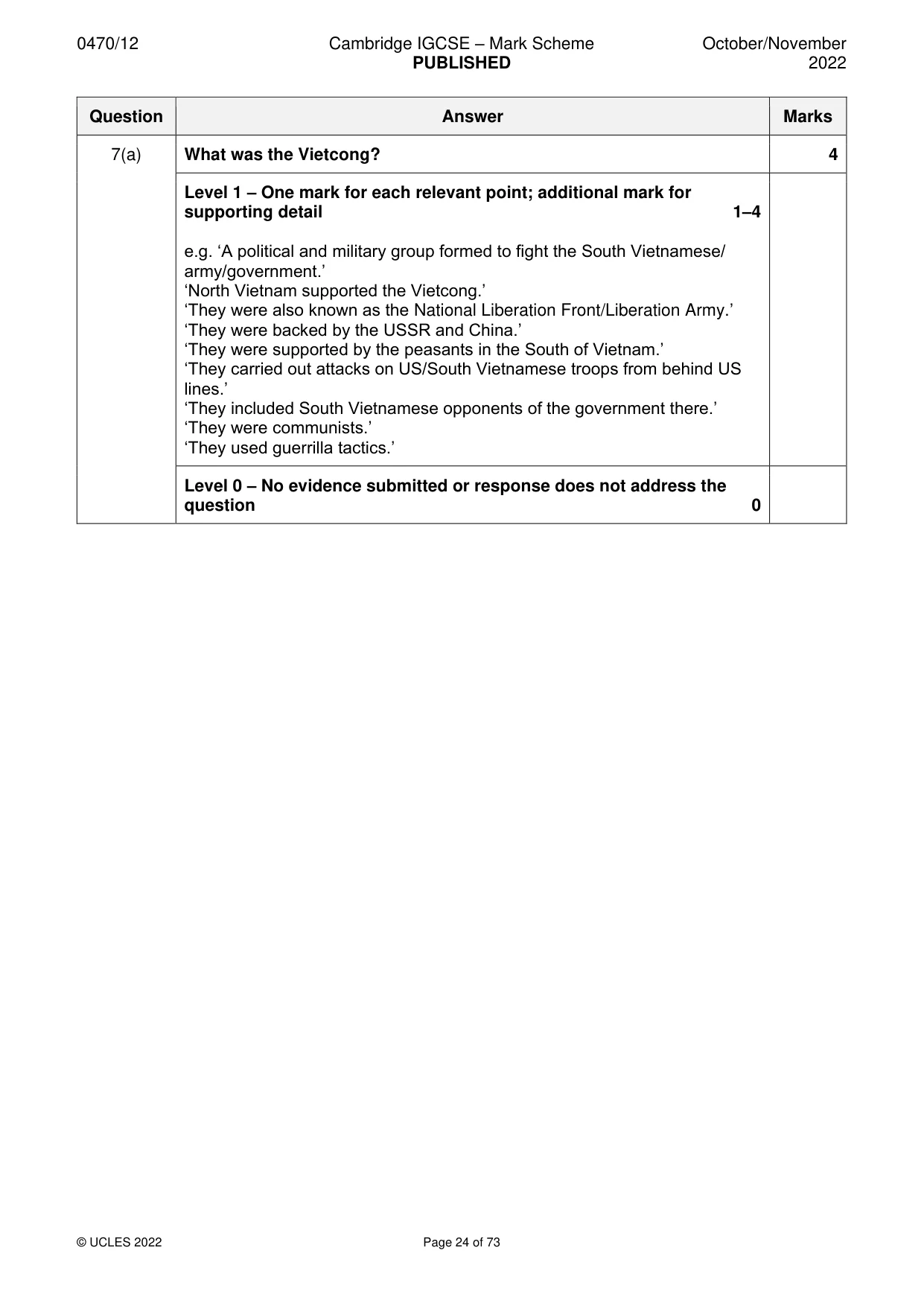
0470/12 Cambridge IGCSE – Mark Scheme PUBLISHED October/November 2022 © UCLES 2022 Page 24 of 73 Question Answer Marks 7(a) What was the Vietcong? 4 Level 1 – One mark for each relevant point; additional mark for supporting detail 1–4 e.g. ‘A political and military group formed to fight the South Vietnamese/ army/government.’ ‘North Vietnam supported the Vietcong.’ ‘They were also known as the National Liberation Front/Liberation Army.’ ‘They were backed by the USSR and China.’ ‘They were supported by the peasants in the South of Vietnam.’ ‘They carried out attacks on US/South Vietnamese troops from behind US lines.’ ‘They included South Vietnamese opponents of the government there.’ ‘They were communists.’ ‘They used guerrilla tactics.’ Level 0 – No evidence submitted or response does not address the question 0
Mark scheme, page 25
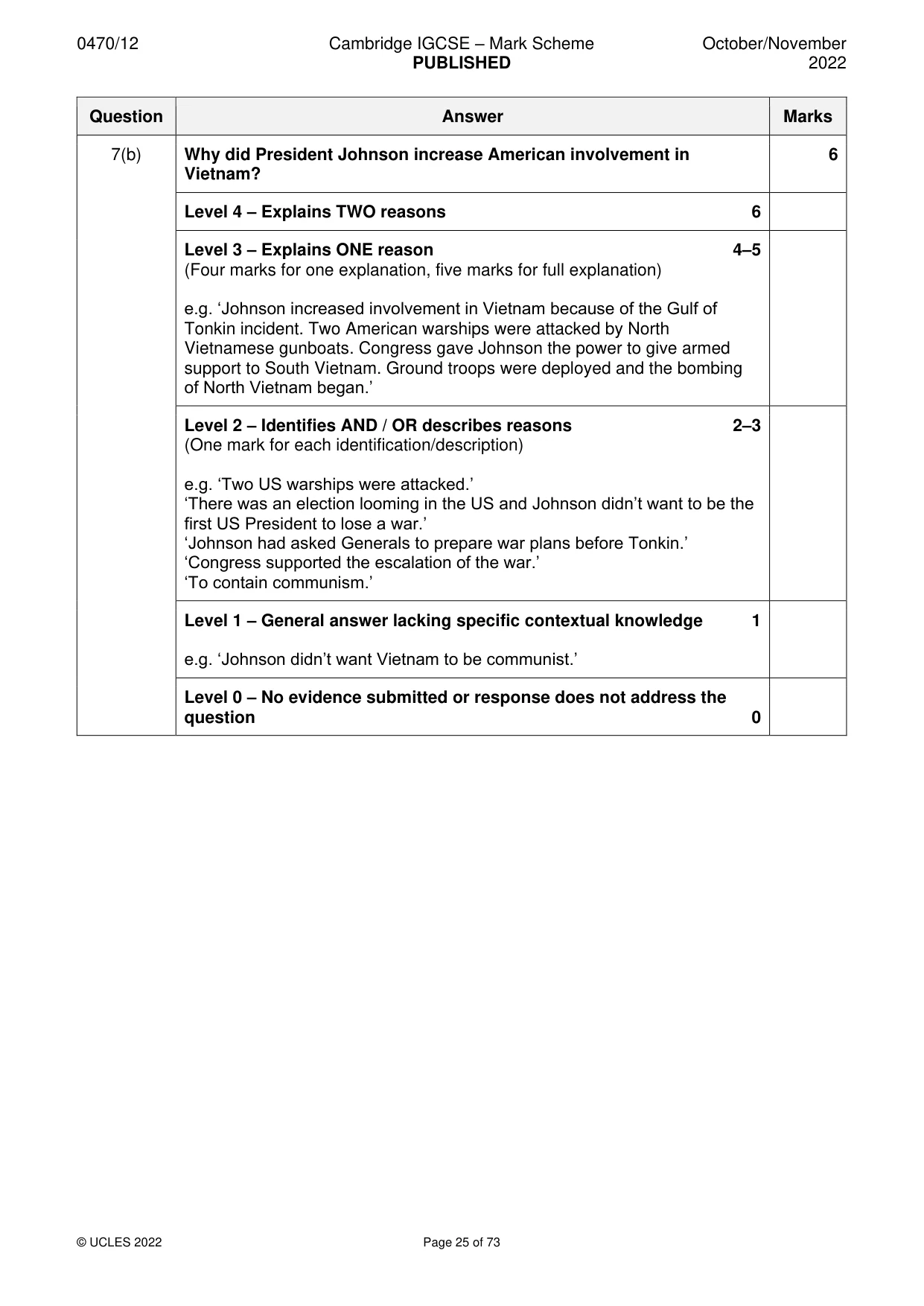
0470/12 Cambridge IGCSE – Mark Scheme PUBLISHED October/November 2022 © UCLES 2022 Page 25 of 73 Question Answer Marks 7(b) Why did President Johnson increase American involvement in Vietnam? 6 Level 4 – Explains TWO reasons 6 Level 3 – Explains ONE reason 4–5 (Four marks for one explanation, five marks for full explanation) e.g. ‘Johnson increased involvement in Vietnam because of the Gulf of Tonkin incident. Two American warships were attacked by North Vietnamese gunboats. Congress gave Johnson the power to give armed support to South Vietnam. Ground troops were deployed and the bombing of North Vietnam began.’ Level 2 – Identifies AND / OR describes reasons 2–3 (One mark for each identification/description) e.g. ‘Two US warships were attacked.’ ‘There was an election looming in the US and Johnson didn’t want to be the first US President to lose a war.’ ‘Johnson had asked Generals to prepare war plans before Tonkin.’ ‘Congress supported the escalation of the war.’ ‘To contain communism.’ Level 1 – General answer lacking specific contextual knowledge 1 e.g. ‘Johnson didn’t want Vietnam to be communist.’ Level 0 – No evidence submitted or response does not address the question 0
Mark scheme, page 26
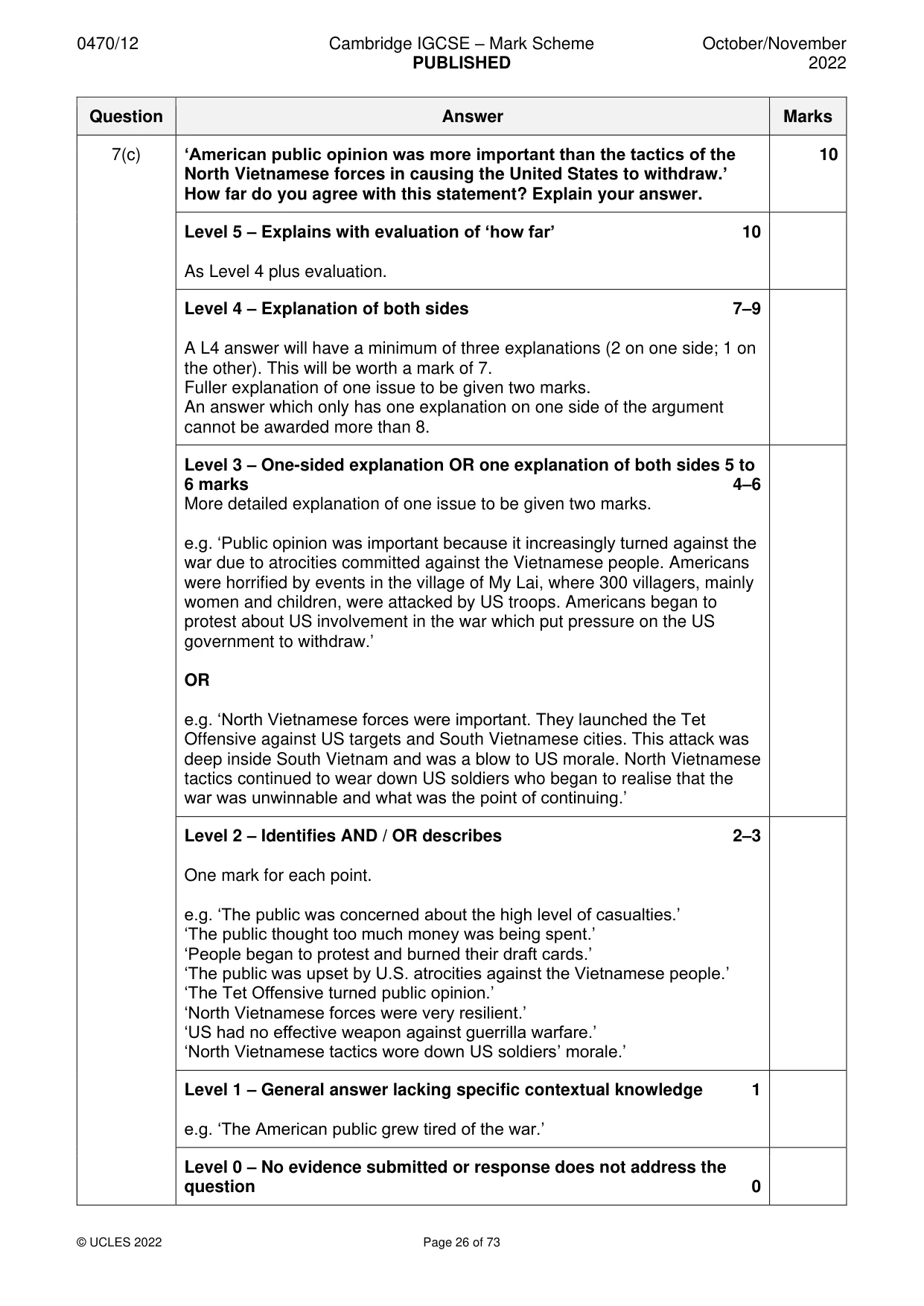
0470/12 Cambridge IGCSE – Mark Scheme PUBLISHED October/November 2022 © UCLES 2022 Page 26 of 73 Question Answer Marks 7(c) ‘American public opinion was more important than the tactics of the North Vietnamese forces in causing the United States to withdraw.’ How far do you agree with this statement? Explain your answer. 10 Level 5 – Explains with evaluation of ‘how far’ 10 As Level 4 plus evaluation. Level 4 – Explanation of both sides 7–9 A L4 answer will have a minimum of three explanations (2 on one side; 1 on the other). This will be worth a mark of 7. Fuller explanation of one issue to be given two marks. An answer which only has one explanation on one side of the argument cannot be awarded more than 8. Level 3 – One-sided explanation OR one explanation of both sides 5 to 6 marks 4–6 More detailed explanation of one issue to be given two marks. e.g. ‘Public opinion was important because it increasingly turned against the war due to atrocities committed against the Vietnamese people. Americans were horrified by events in the village of My Lai, where 300 villagers, mainly women and children, were attacked by US troops. Americans began to protest about US involvement in the war which put pressure on the US government to withdraw.’ OR e.g. ‘North Vietnamese forces were important. They launched the Tet Offensive against US targets and South Vietnamese cities. This attack was deep inside South Vietnam and was a blow to US morale. North Vietnamese tactics continued to wear down US soldiers who began to realise that the war was unwinnable and what was the point of continuing.’ Level 2 – Identifies AND / OR describes 2–3 One mark for each point. e.g. ‘The public was concerned about the high level of casualties.’ ‘The public thought too much money was being spent.’ ‘People began to protest and burned their draft cards.’ ‘The public was upset by U.S. atrocities against the Vietnamese people.’ ‘The Tet Offensive turned public opinion.’ ‘North Vietnamese forces were very resilient.’ ‘US had no effective weapon against guerrilla warfare.’ ‘North Vietnamese tactics wore down US soldiers’ morale.’ Level 1 – General answer lacking specific contextual knowledge 1 e.g. ‘The American public grew tired of the war.’ Level 0 – No evidence submitted or response does not address the question 0
Mark scheme, page 27
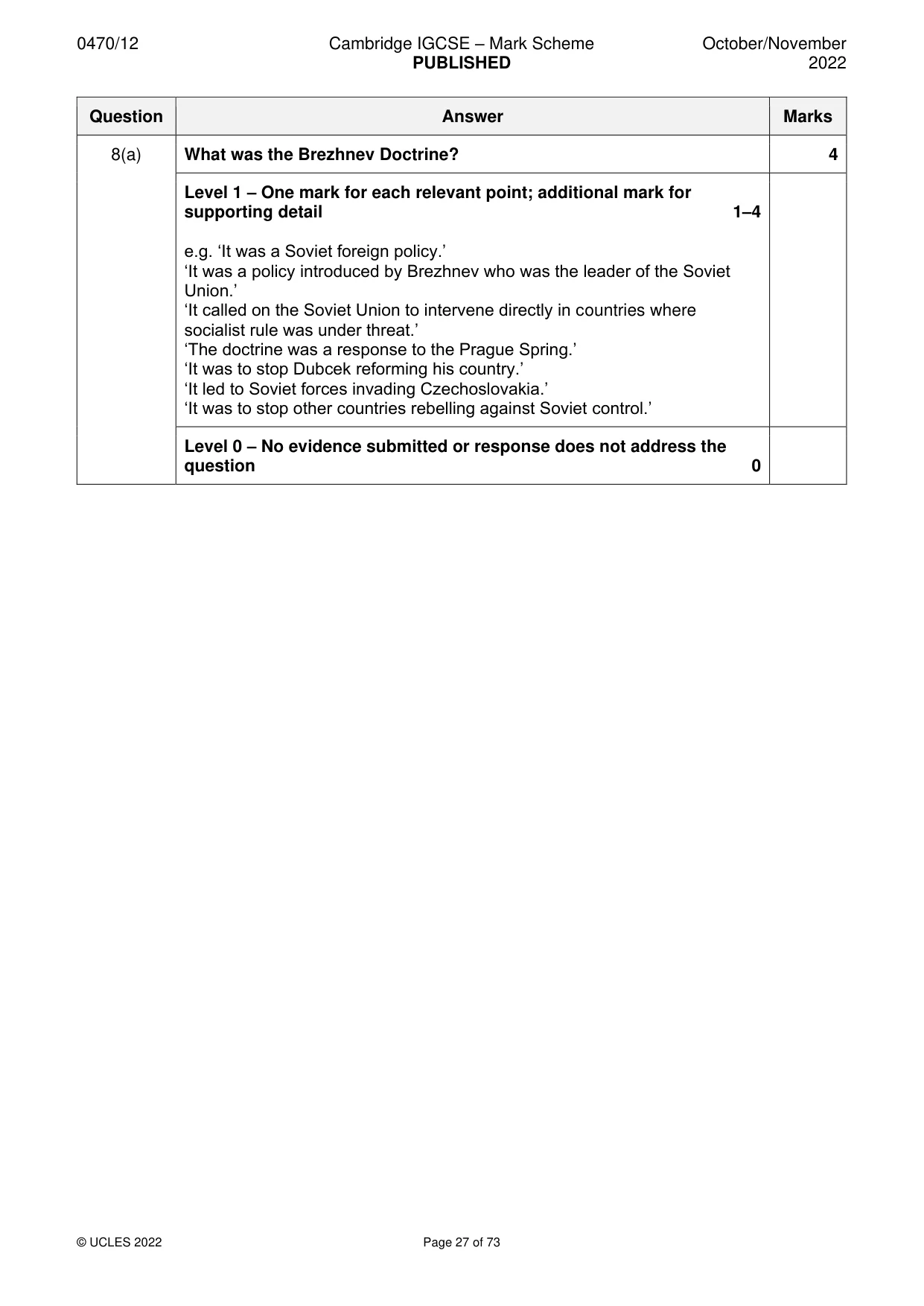
0470/12 Cambridge IGCSE – Mark Scheme PUBLISHED October/November 2022 © UCLES 2022 Page 27 of 73 Question Answer Marks 8(a) What was the Brezhnev Doctrine? 4 Level 1 – One mark for each relevant point; additional mark for supporting detail 1–4 e.g. ‘It was a Soviet foreign policy.’ ‘It was a policy introduced by Brezhnev who was the leader of the Soviet Union.’ ‘It called on the Soviet Union to intervene directly in countries where socialist rule was under threat.’ ‘The doctrine was a response to the Prague Spring.’ ‘It was to stop Dubcek reforming his country.’ ‘It led to Soviet forces invading Czechoslovakia.’ ‘It was to stop other countries rebelling against Soviet control.’ Level 0 – No evidence submitted or response does not address the question 0
Mark scheme, page 28
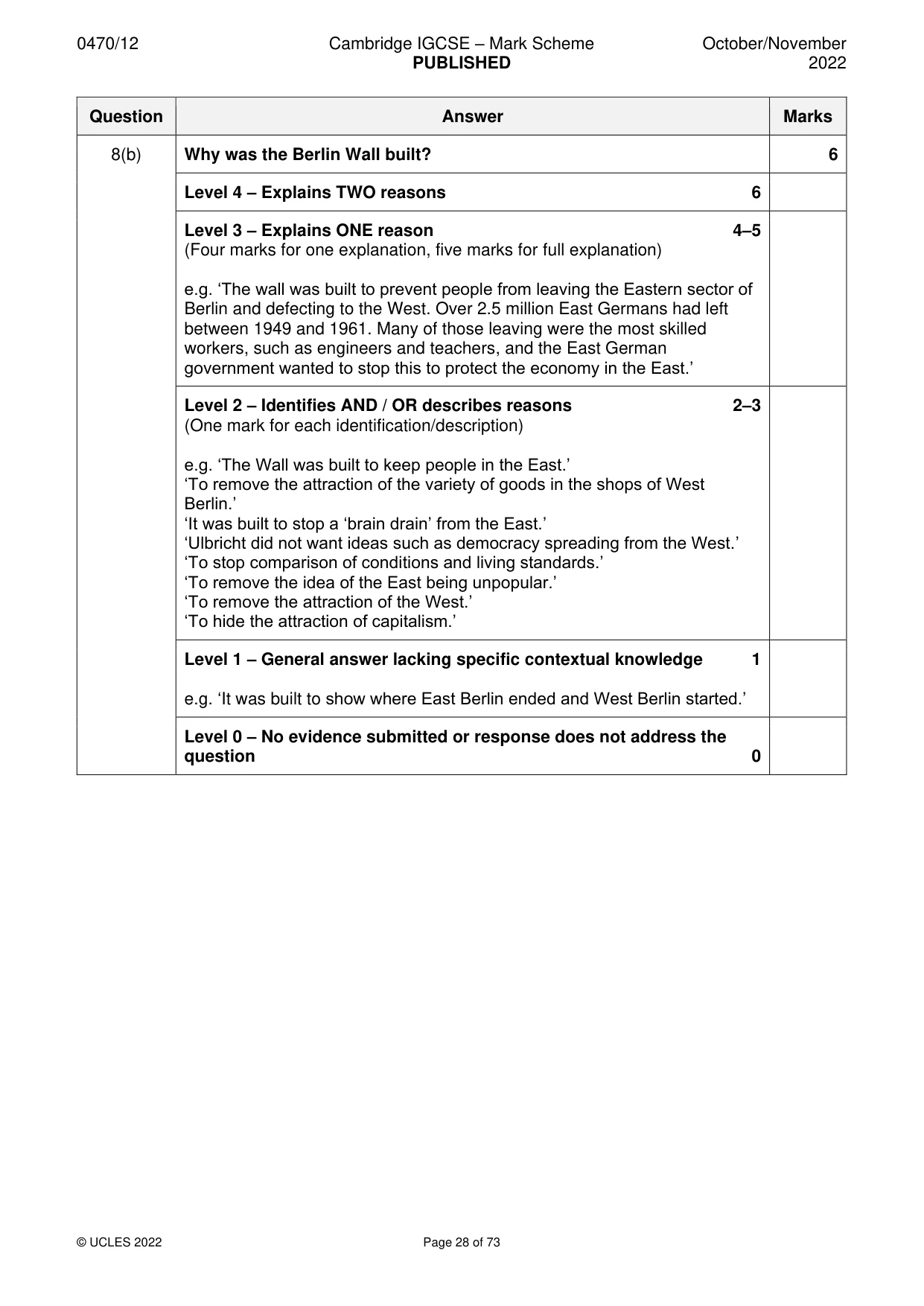
0470/12 Cambridge IGCSE – Mark Scheme PUBLISHED October/November 2022 © UCLES 2022 Page 28 of 73 Question Answer Marks 8(b) Why was the Berlin Wall built? 6 Level 4 – Explains TWO reasons 6 Level 3 – Explains ONE reason 4–5 (Four marks for one explanation, five marks for full explanation) e.g. ‘The wall was built to prevent people from leaving the Eastern sector of Berlin and defecting to the West. Over 2.5 million East Germans had left between 1949 and 1961. Many of those leaving were the most skilled workers, such as engineers and teachers, and the East German government wanted to stop this to protect the economy in the East.’ Level 2 – Identifies AND / OR describes reasons 2–3 (One mark for each identification/description) e.g. ‘The Wall was built to keep people in the East.’ ‘To remove the attraction of the variety of goods in the shops of West Berlin.’ ‘It was built to stop a ‘brain drain’ from the East.’ ‘Ulbricht did not want ideas such as democracy spreading from the West.’ ‘To stop comparison of conditions and living standards.’ ‘To remove the idea of the East being unpopular.’ ‘To remove the attraction of the West.’ ‘To hide the attraction of capitalism.’ Level 1 – General answer lacking specific contextual knowledge 1 e.g. ‘It was built to show where East Berlin ended and West Berlin started.’ Level 0 – No evidence submitted or response does not address the question 0
Mark scheme, page 29
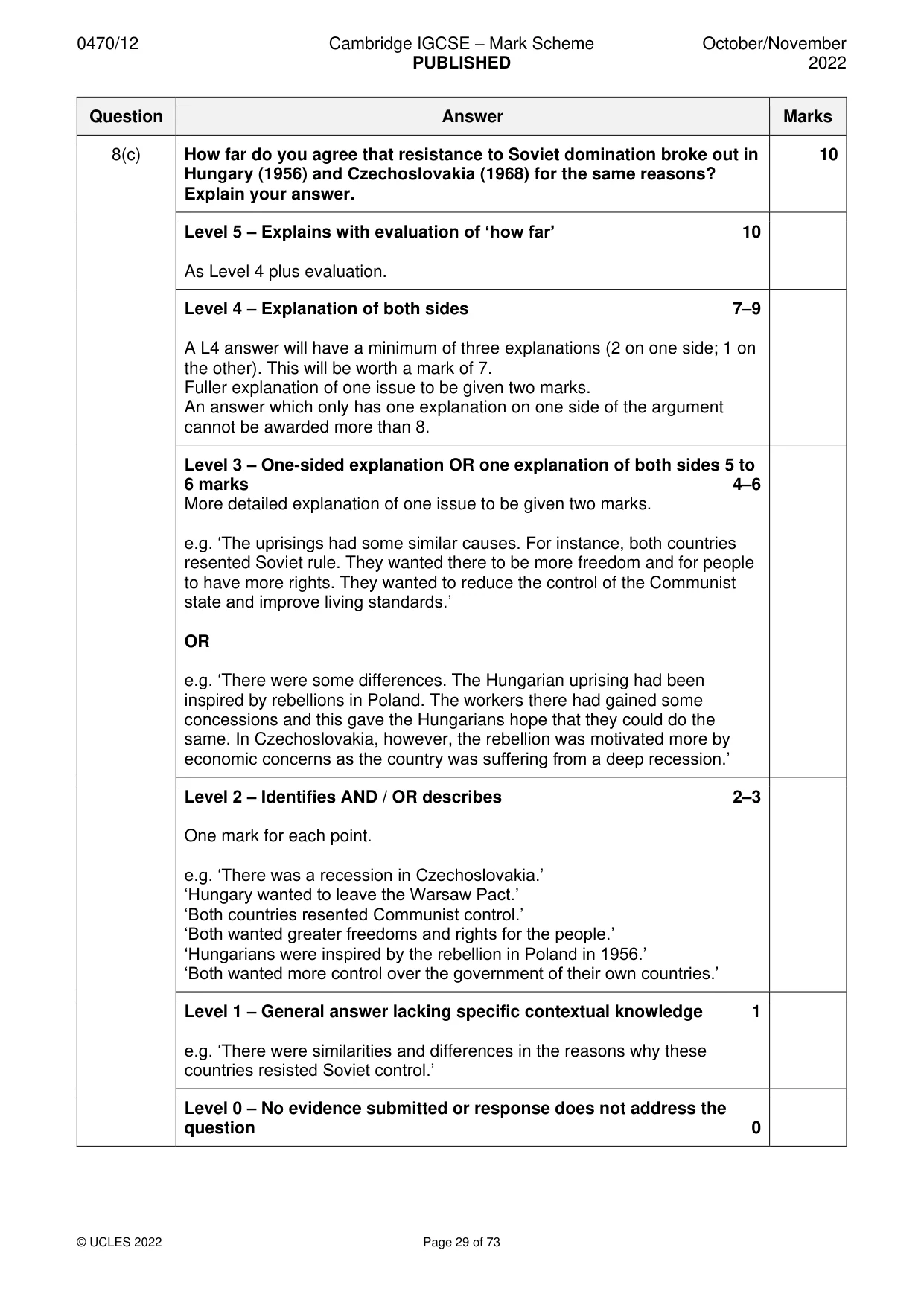
0470/12 Cambridge IGCSE – Mark Scheme PUBLISHED October/November 2022 © UCLES 2022 Page 29 of 73 Question Answer Marks 8(c) How far do you agree that resistance to Soviet domination broke out in Hungary (1956) and Czechoslovakia (1968) for the same reasons? Explain your answer. 10 Level 5 – Explains with evaluation of ‘how far’ 10 As Level 4 plus evaluation. Level 4 – Explanation of both sides 7–9 A L4 answer will have a minimum of three explanations (2 on one side; 1 on the other). This will be worth a mark of 7. Fuller explanation of one issue to be given two marks. An answer which only has one explanation on one side of the argument cannot be awarded more than 8. Level 3 – One-sided explanation OR one explanation of both sides 5 to 6 marks 4–6 More detailed explanation of one issue to be given two marks. e.g. ‘The uprisings had some similar causes. For instance, both countries resented Soviet rule. They wanted there to be more freedom and for people to have more rights. They wanted to reduce the control of the Communist state and improve living standards.’ OR e.g. ‘There were some differences. The Hungarian uprising had been inspired by rebellions in Poland. The workers there had gained some concessions and this gave the Hungarians hope that they could do the same. In Czechoslovakia, however, the rebellion was motivated more by economic concerns as the country was suffering from a deep recession.’ Level 2 – Identifies AND / OR describes 2–3 One mark for each point. e.g. ‘There was a recession in Czechoslovakia.’ ‘Hungary wanted to leave the Warsaw Pact.’ ‘Both countries resented Communist control.’ ‘Both wanted greater freedoms and rights for the people.’ ‘Hungarians were inspired by the rebellion in Poland in 1956.’ ‘Both wanted more control over the government of their own countries.’ Level 1 – General answer lacking specific contextual knowledge 1 e.g. ‘There were similarities and differences in the reasons why these countries resisted Soviet control.’ Level 0 – No evidence submitted or response does not address the question 0
Mark scheme, page 30
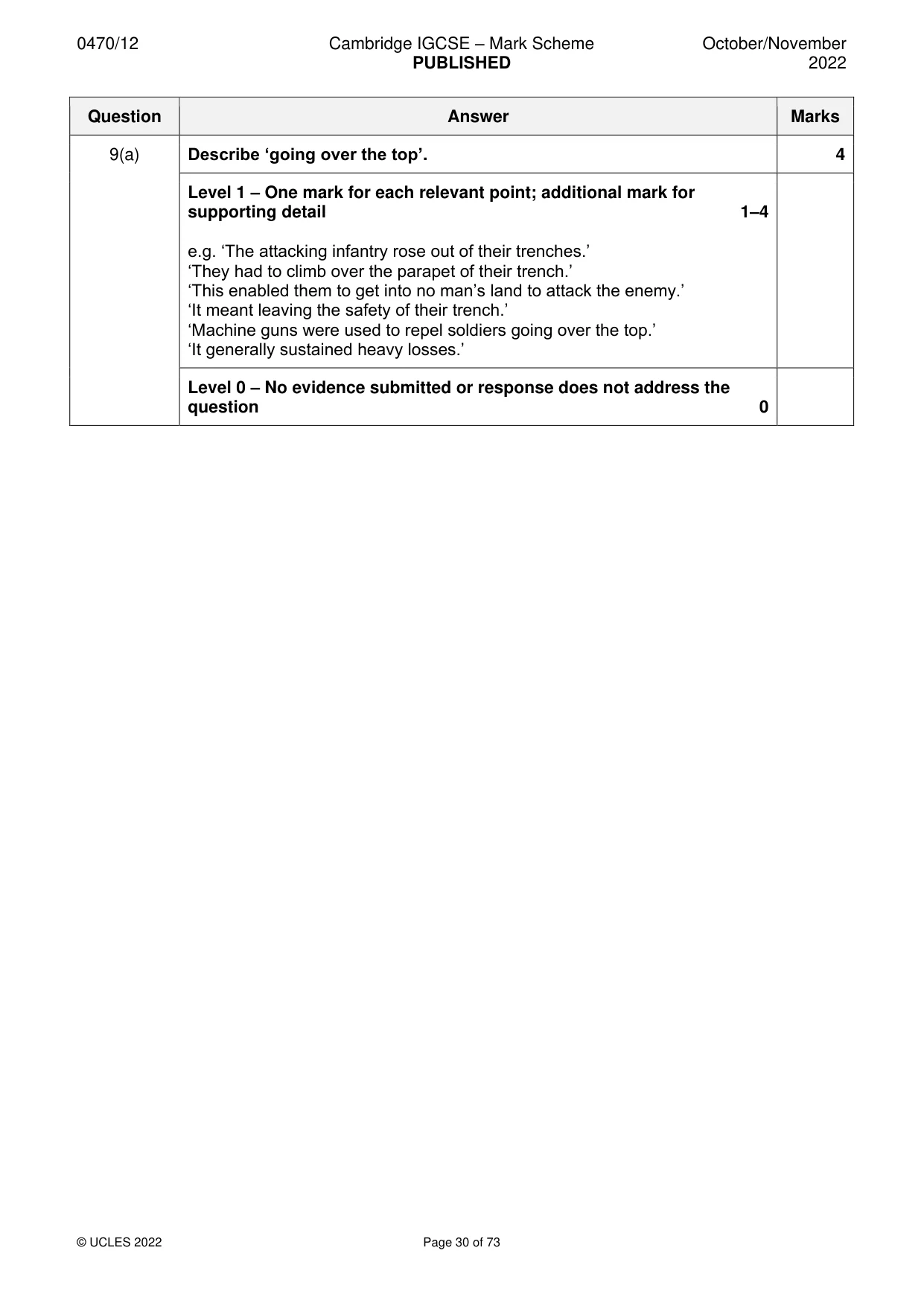
0470/12 Cambridge IGCSE – Mark Scheme PUBLISHED October/November 2022 © UCLES 2022 Page 30 of 73 Question Answer Marks 9(a) Describe ‘going over the top’. 4 Level 1 – One mark for each relevant point; additional mark for supporting detail 1–4 e.g. ‘The attacking infantry rose out of their trenches.’ ‘They had to climb over the parapet of their trench.’ ‘This enabled them to get into no man’s land to attack the enemy.’ ‘It meant leaving the safety of their trench.’ ‘Machine guns were used to repel soldiers going over the top.’ ‘It generally sustained heavy losses.’ Level 0 – No evidence submitted or response does not address the question 0
Mark scheme, page 31
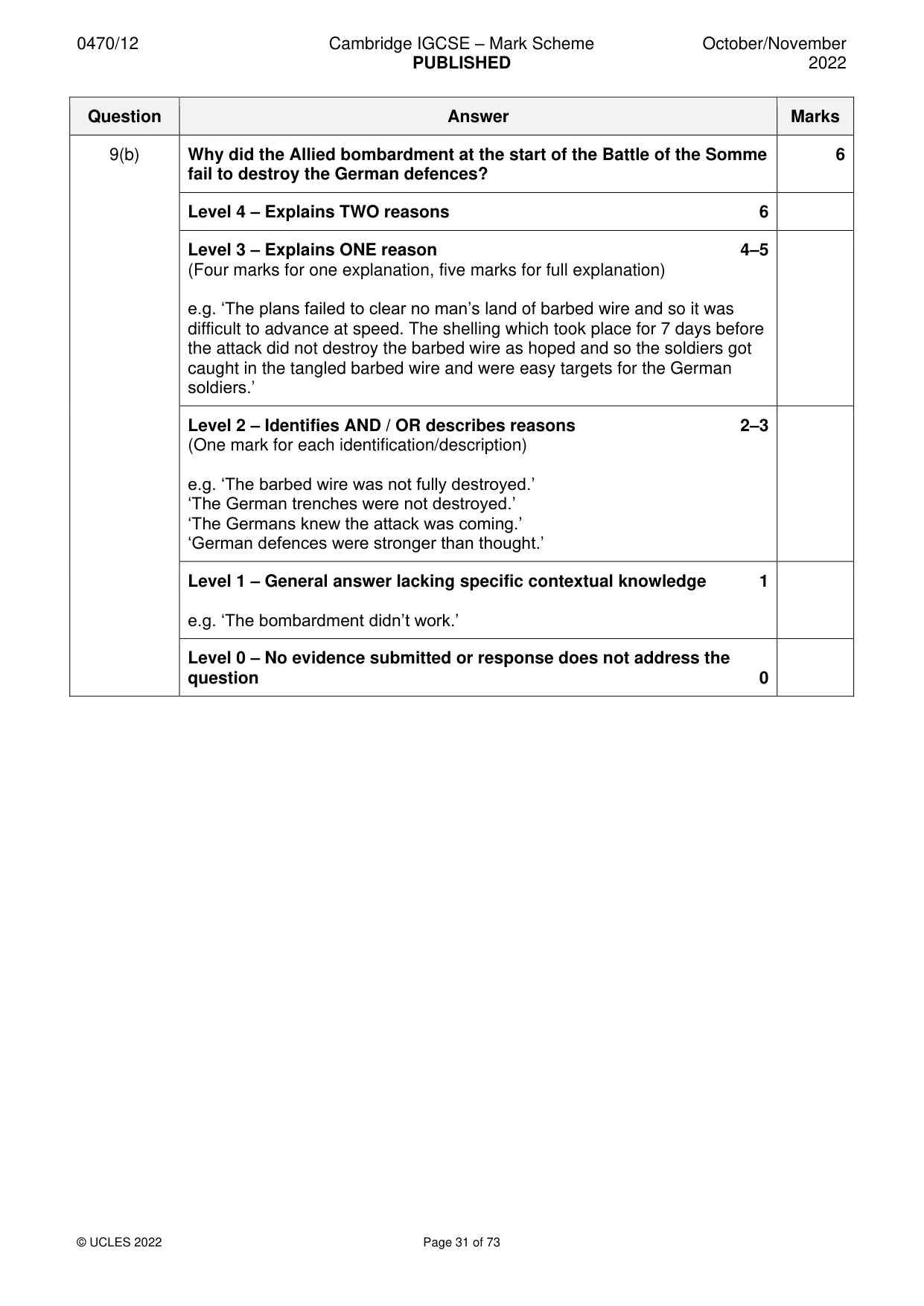
0470/12 Cambridge IGCSE – Mark Scheme PUBLISHED October/November 2022 © UCLES 2022 Page 31 of 73 Question Answer Marks 9(b) Why did the Allied bombardment at the start of the Battle of the Somme fail to destroy the German defences? 6 Level 4 – Explains TWO reasons 6 Level 3 – Explains ONE reason 4–5 (Four marks for one explanation, five marks for full explanation) e.g. ‘The plans failed to clear no man’s land of barbed wire and so it was difficult to advance at speed. The shelling which took place for 7 days before the attack did not destroy the barbed wire as hoped and so the soldiers got caught in the tangled barbed wire and were easy targets for the German soldiers.’ Level 2 – Identifies AND / OR describes reasons 2–3 (One mark for each identification/description) e.g. ‘The barbed wire was not fully destroyed.’ ‘The German trenches were not destroyed.’ ‘The Germans knew the attack was coming.’ ‘German defences were stronger than thought.’ Level 1 – General answer lacking specific contextual knowledge 1 e.g. ‘The bombardment didn’t work.’ Level 0 – No evidence submitted or response does not address the question 0
Mark scheme, page 32
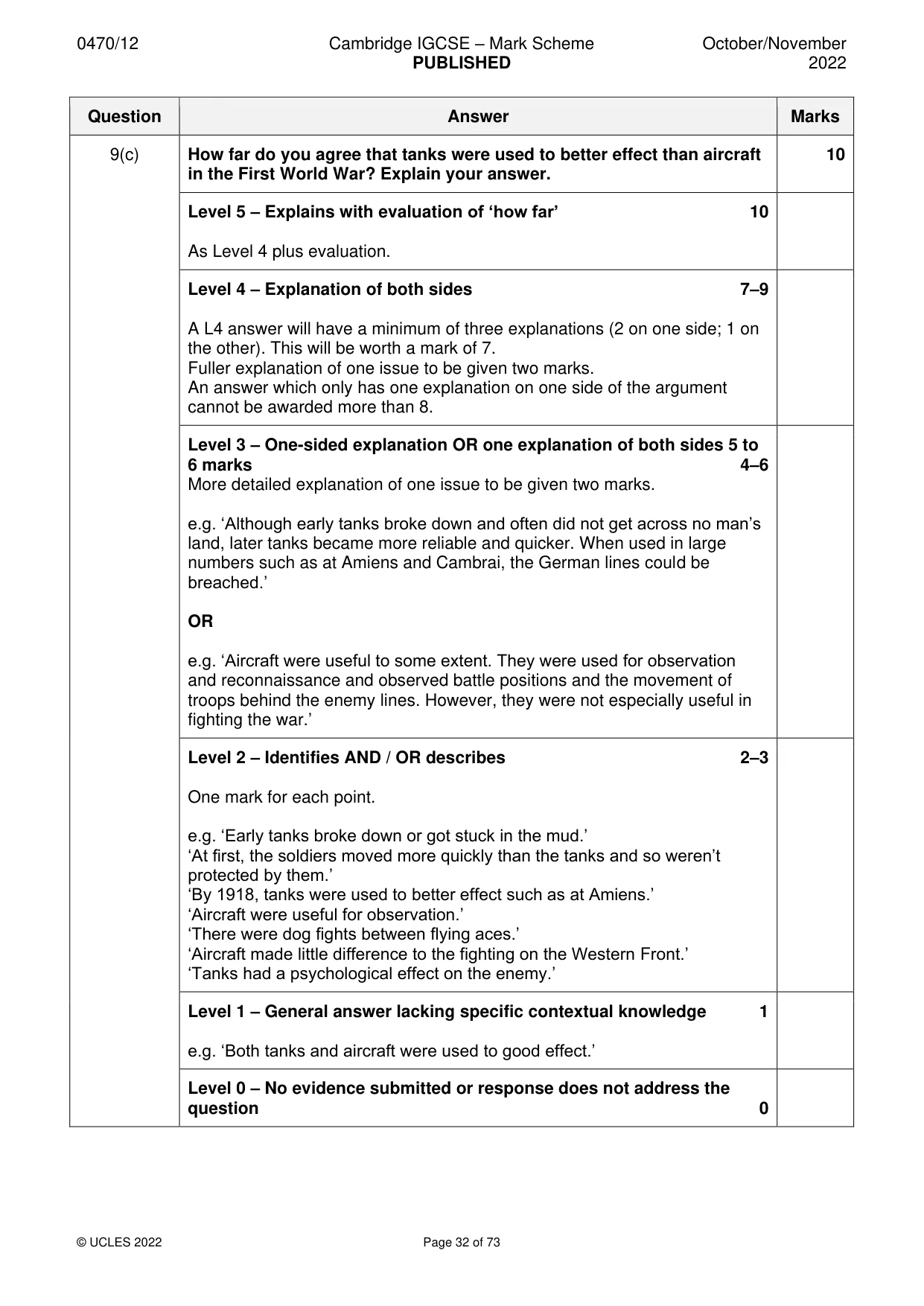
0470/12 Cambridge IGCSE – Mark Scheme PUBLISHED October/November 2022 © UCLES 2022 Page 32 of 73 Question Answer Marks 9(c) How far do you agree that tanks were used to better effect than aircraft in the First World War? Explain your answer. 10 Level 5 – Explains with evaluation of ‘how far’ 10 As Level 4 plus evaluation. Level 4 – Explanation of both sides 7–9 A L4 answer will have a minimum of three explanations (2 on one side; 1 on the other). This will be worth a mark of 7. Fuller explanation of one issue to be given two marks. An answer which only has one explanation on one side of the argument cannot be awarded more than 8. Level 3 – One-sided explanation OR one explanation of both sides 5 to 6 marks 4–6 More detailed explanation of one issue to be given two marks. e.g. ‘Although early tanks broke down and often did not get across no man’s land, later tanks became more reliable and quicker. When used in large numbers such as at Amiens and Cambrai, the German lines could be breached.’ OR e.g. ‘Aircraft were useful to some extent. They were used for observation and reconnaissance and observed battle positions and the movement of troops behind the enemy lines. However, they were not especially useful in fighting the war.’ Level 2 – Identifies AND / OR describes 2–3 One mark for each point. e.g. ‘Early tanks broke down or got stuck in the mud.’ ‘At first, the soldiers moved more quickly than the tanks and so weren’t protected by them.’ ‘By 1918, tanks were used to better effect such as at Amiens.’ ‘Aircraft were useful for observation.’ ‘There were dog fights between flying aces.’ ‘Aircraft made little difference to the fighting on the Western Front.’ ‘Tanks had a psychological effect on the enemy.’ Level 1 – General answer lacking specific contextual knowledge 1 e.g. ‘Both tanks and aircraft were used to good effect.’ Level 0 – No evidence submitted or response does not address the question 0
Mark scheme, page 33
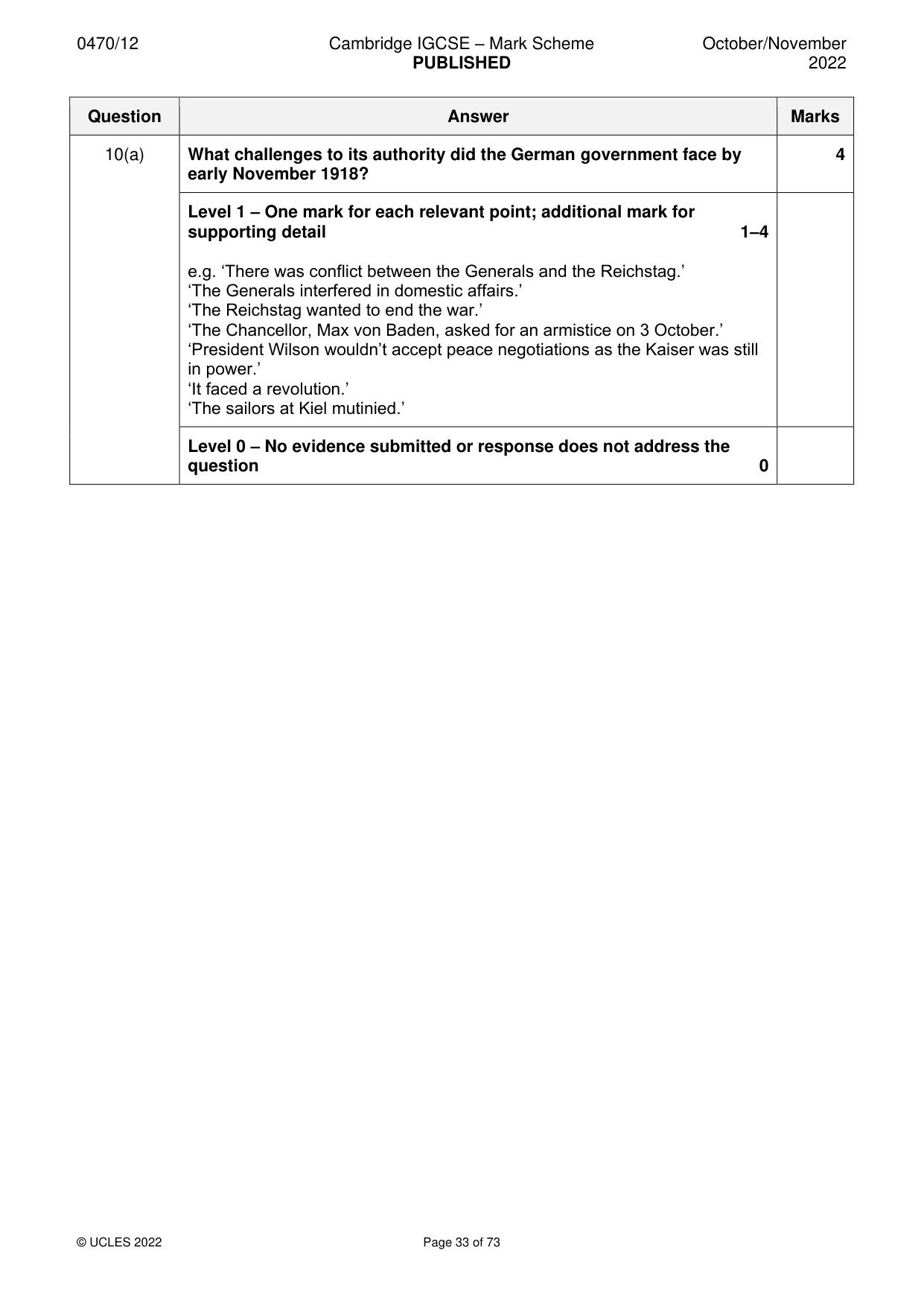
0470/12 Cambridge IGCSE – Mark Scheme PUBLISHED October/November 2022 © UCLES 2022 Page 33 of 73 Question Answer Marks 10(a) What challenges to its authority did the German government face by early November 1918? 4 Level 1 – One mark for each relevant point; additional mark for supporting detail 1–4 e.g. ‘There was conflict between the Generals and the Reichstag.’ ‘The Generals interfered in domestic affairs.’ ‘The Reichstag wanted to end the war.’ ‘The Chancellor, Max von Baden, asked for an armistice on 3 October.’ ‘President Wilson wouldn’t accept peace negotiations as the Kaiser was still in power.’ ‘It faced a revolution.’ ‘The sailors at Kiel mutinied.’ Level 0 – No evidence submitted or response does not address the question 0
Mark scheme, page 34
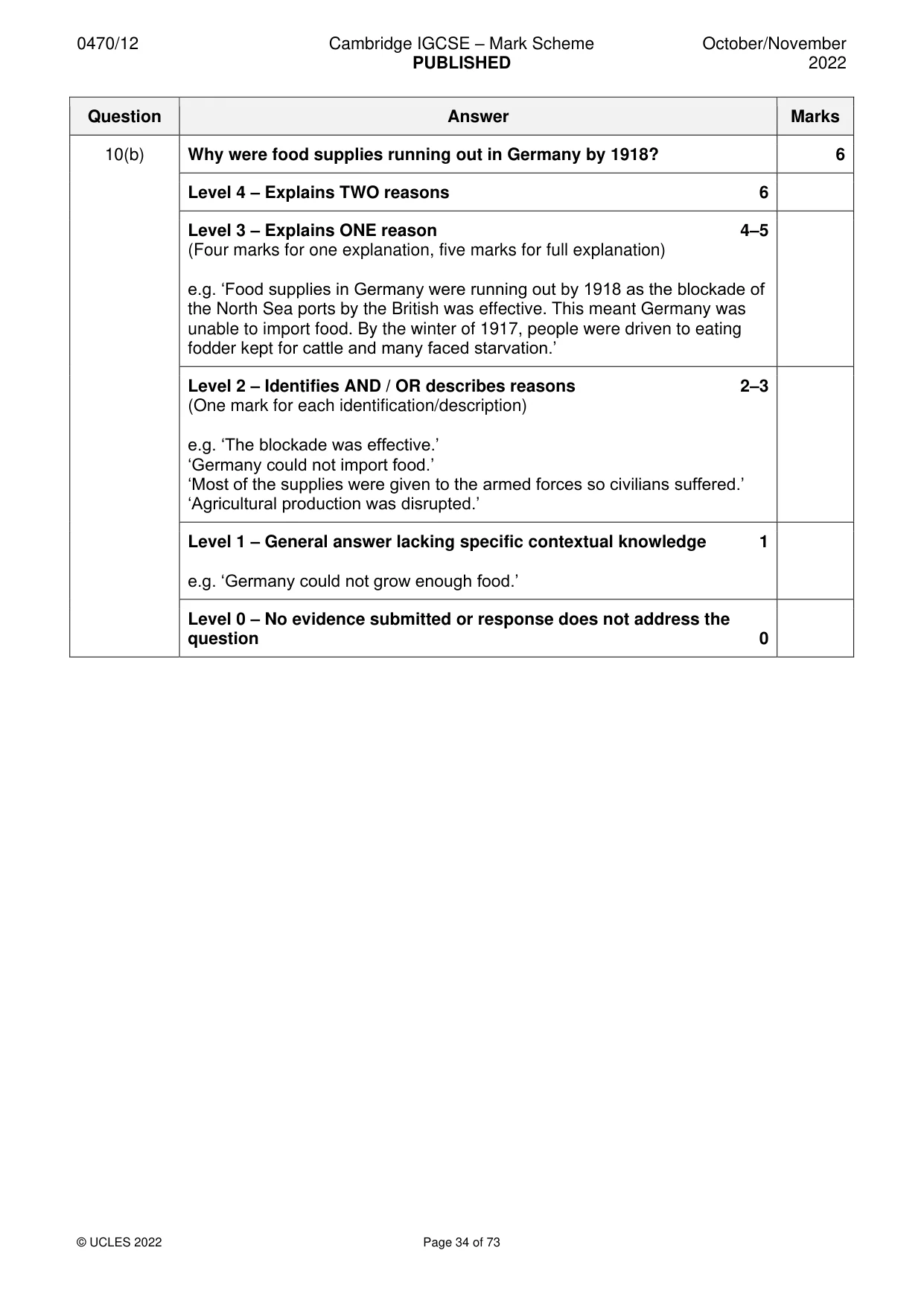
0470/12 Cambridge IGCSE – Mark Scheme PUBLISHED October/November 2022 © UCLES 2022 Page 34 of 73 Question Answer Marks 10(b) Why were food supplies running out in Germany by 1918? 6 Level 4 – Explains TWO reasons 6 Level 3 – Explains ONE reason 4–5 (Four marks for one explanation, five marks for full explanation) e.g. ‘Food supplies in Germany were running out by 1918 as the blockade of the North Sea ports by the British was effective. This meant Germany was unable to import food. By the winter of 1917, people were driven to eating fodder kept for cattle and many faced starvation.’ Level 2 – Identifies AND / OR describes reasons 2–3 (One mark for each identification/description) e.g. ‘The blockade was effective.’ ‘Germany could not import food.’ ‘Most of the supplies were given to the armed forces so civilians suffered.’ ‘Agricultural production was disrupted.’ Level 1 – General answer lacking specific contextual knowledge 1 e.g. ‘Germany could not grow enough food.’ Level 0 – No evidence submitted or response does not address the question 0
Mark scheme, page 35
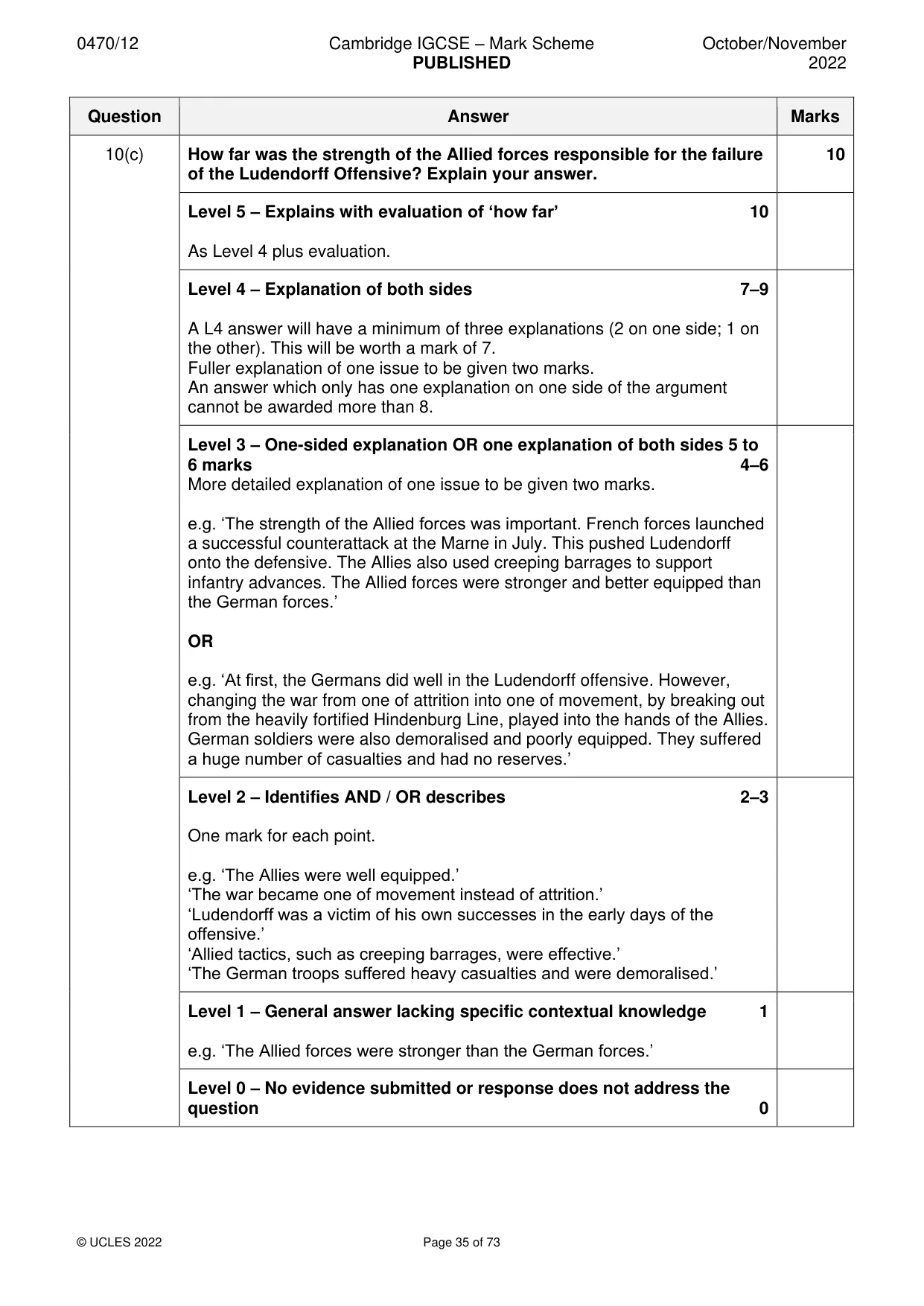
0470/12 Cambridge IGCSE – Mark Scheme PUBLISHED October/November 2022 © UCLES 2022 Page 35 of 73 Question Answer Marks 10(c) How far was the strength of the Allied forces responsible for the failure of the Ludendorff Offensive? Explain your answer. 10 Level 5 – Explains with evaluation of ‘how far’ 10 As Level 4 plus evaluation. Level 4 – Explanation of both sides 7–9 A L4 answer will have a minimum of three explanations (2 on one side; 1 on the other). This will be worth a mark of 7. Fuller explanation of one issue to be given two marks. An answer which only has one explanation on one side of the argument cannot be awarded more than 8. Level 3 – One-sided explanation OR one explanation of both sides 5 to 6 marks 4–6 More detailed explanation of one issue to be given two marks. e.g. ‘The strength of the Allied forces was important. French forces launched a successful counterattack at the Marne in July. This pushed Ludendorff onto the defensive. The Allies also used creeping barrages to support infantry advances. The Allied forces were stronger and better equipped than the German forces.’ OR e.g. ‘At first, the Germans did well in the Ludendorff offensive. However, changing the war from one of attrition into one of movement, by breaking out from the heavily fortified Hindenburg Line, played into the hands of the Allies. German soldiers were also demoralised and poorly equipped. They suffered a huge number of casualties and had no reserves.’ Level 2 – Identifies AND / OR describes 2–3 One mark for each point. e.g. ‘The Allies were well equipped.’ ‘The war became one of movement instead of attrition.’ ‘Ludendorff was a victim of his own successes in the early days of the offensive.’ ‘Allied tactics, such as creeping barrages, were effective.’ ‘The German troops suffered heavy casualties and were demoralised.’ Level 1 – General answer lacking specific contextual knowledge 1 e.g. ‘The Allied forces were stronger than the German forces.’ Level 0 – No evidence submitted or response does not address the question 0
Mark scheme, page 36
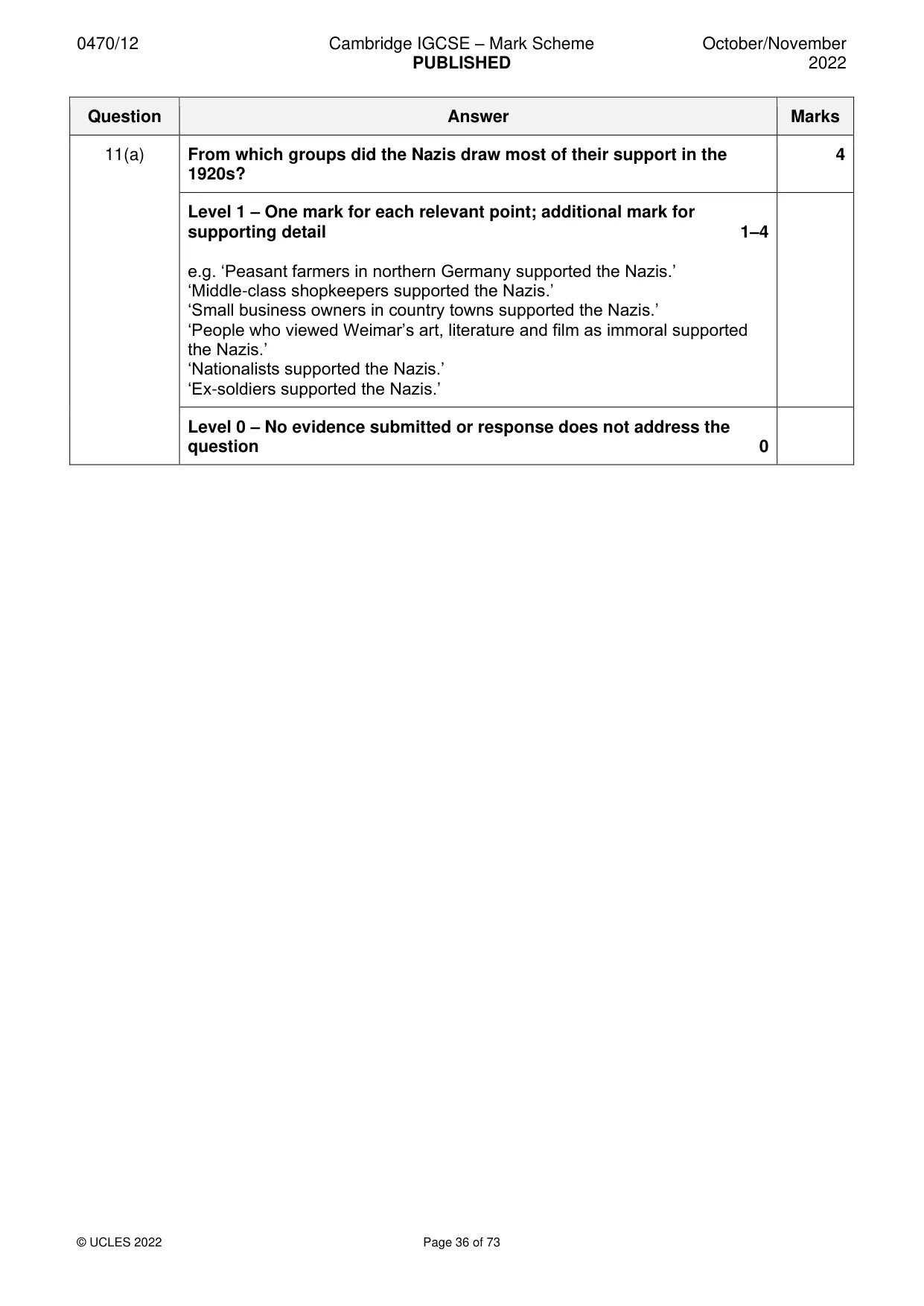
0470/12 Cambridge IGCSE – Mark Scheme PUBLISHED October/November 2022 © UCLES 2022 Page 36 of 73 Question Answer Marks 11(a) From which groups did the Nazis draw most of their support in the 1920s? 4 Level 1 – One mark for each relevant point; additional mark for supporting detail 1–4 e.g. ‘Peasant farmers in northern Germany supported the Nazis.’ ‘Middle-class shopkeepers supported the Nazis.’ ‘Small business owners in country towns supported the Nazis.’ ‘People who viewed Weimar’s art, literature and film as immoral supported the Nazis.’ ‘Nationalists supported the Nazis.’ ‘Ex-soldiers supported the Nazis.’ Level 0 – No evidence submitted or response does not address the question 0
Mark scheme, page 37
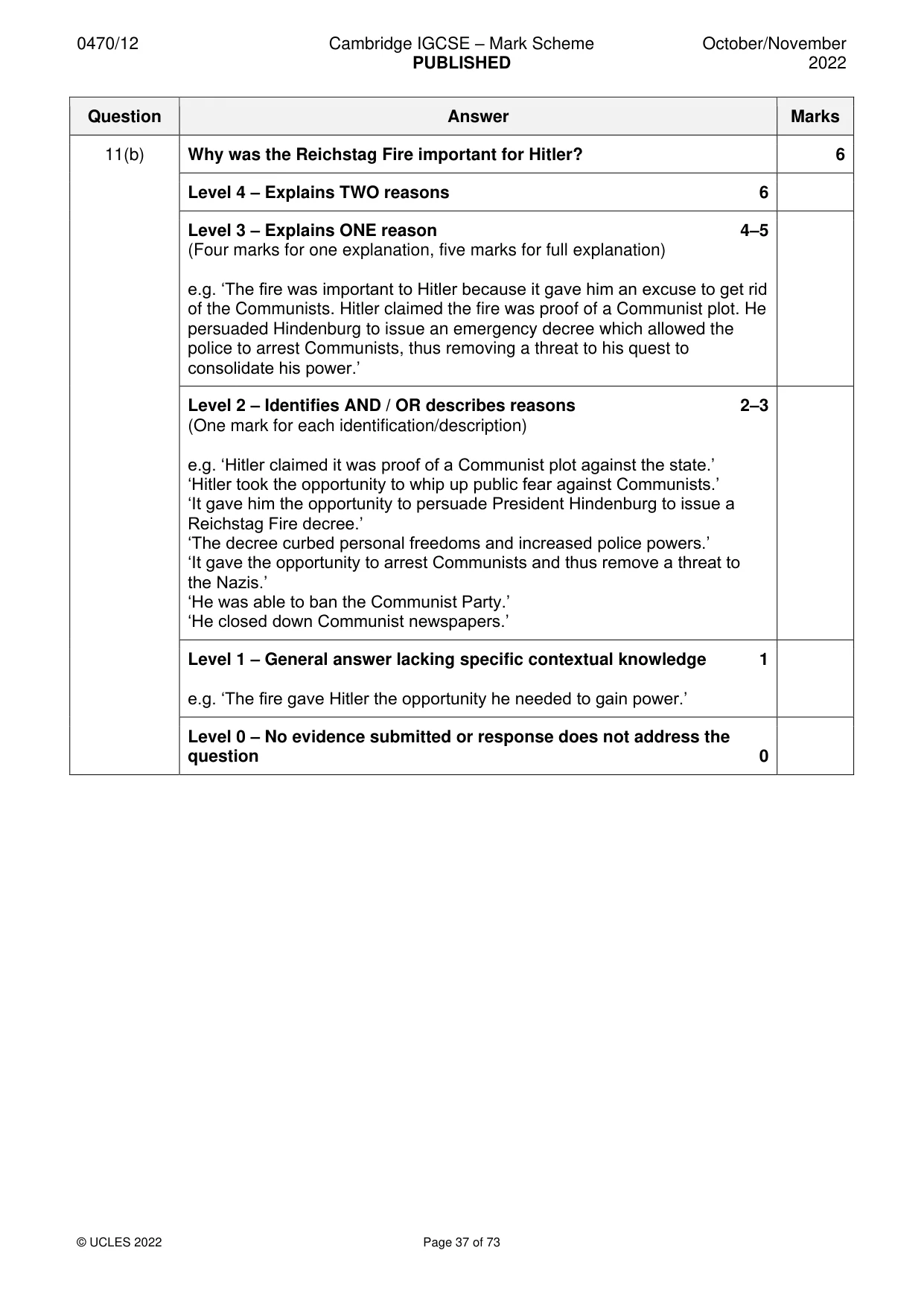
0470/12 Cambridge IGCSE – Mark Scheme PUBLISHED October/November 2022 © UCLES 2022 Page 37 of 73 Question Answer Marks 11(b) Why was the Reichstag Fire important for Hitler? 6 Level 4 – Explains TWO reasons 6 Level 3 – Explains ONE reason 4–5 (Four marks for one explanation, five marks for full explanation) e.g. ‘The fire was important to Hitler because it gave him an excuse to get rid of the Communists. Hitler claimed the fire was proof of a Communist plot. He persuaded Hindenburg to issue an emergency decree which allowed the police to arrest Communists, thus removing a threat to his quest to consolidate his power.’ Level 2 – Identifies AND / OR describes reasons 2–3 (One mark for each identification/description) e.g. ‘Hitler claimed it was proof of a Communist plot against the state.’ ‘Hitler took the opportunity to whip up public fear against Communists.’ ‘It gave him the opportunity to persuade President Hindenburg to issue a Reichstag Fire decree.’ ‘The decree curbed personal freedoms and increased police powers.’ ‘It gave the opportunity to arrest Communists and thus remove a threat to the Nazis.’ ‘He was able to ban the Communist Party.’ ‘He closed down Communist newspapers.’ Level 1 – General answer lacking specific contextual knowledge 1 e.g. ‘The fire gave Hitler the opportunity he needed to gain power.’ Level 0 – No evidence submitted or response does not address the question 0
Mark scheme, page 38
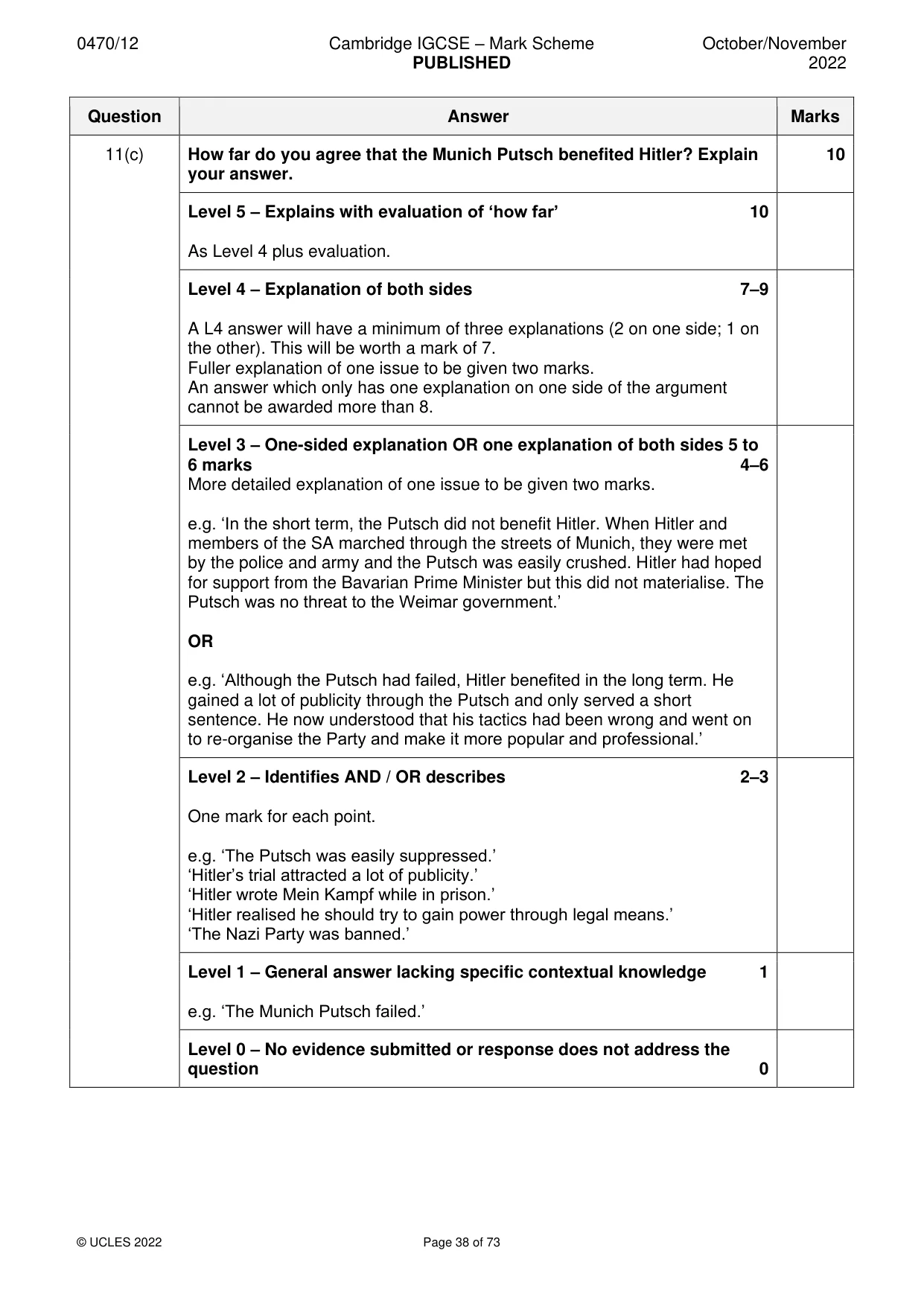
0470/12 Cambridge IGCSE – Mark Scheme PUBLISHED October/November 2022 © UCLES 2022 Page 38 of 73 Question Answer Marks 11(c) How far do you agree that the Munich Putsch benefited Hitler? Explain your answer. 10 Level 5 – Explains with evaluation of ‘how far’ 10 As Level 4 plus evaluation. Level 4 – Explanation of both sides 7–9 A L4 answer will have a minimum of three explanations (2 on one side; 1 on the other). This will be worth a mark of 7. Fuller explanation of one issue to be given two marks. An answer which only has one explanation on one side of the argument cannot be awarded more than 8. Level 3 – One-sided explanation OR one explanation of both sides 5 to 6 marks 4–6 More detailed explanation of one issue to be given two marks. e.g. ‘In the short term, the Putsch did not benefit Hitler. When Hitler and members of the SA marched through the streets of Munich, they were met by the police and army and the Putsch was easily crushed. Hitler had hoped for support from the Bavarian Prime Minister but this did not materialise. The Putsch was no threat to the Weimar government.’ OR e.g. ‘Although the Putsch had failed, Hitler benefited in the long term. He gained a lot of publicity through the Putsch and only served a short sentence. He now understood that his tactics had been wrong and went on to re-organise the Party and make it more popular and professional.’ Level 2 – Identifies AND / OR describes 2–3 One mark for each point. e.g. ‘The Putsch was easily suppressed.’ ‘Hitler’s trial attracted a lot of publicity.’ ‘Hitler wrote Mein Kampf while in prison.’ ‘Hitler realised he should try to gain power through legal means.’ ‘The Nazi Party was banned.’ Level 1 – General answer lacking specific contextual knowledge 1 e.g. ‘The Munich Putsch failed.’ Level 0 – No evidence submitted or response does not address the question 0
Mark scheme, page 39
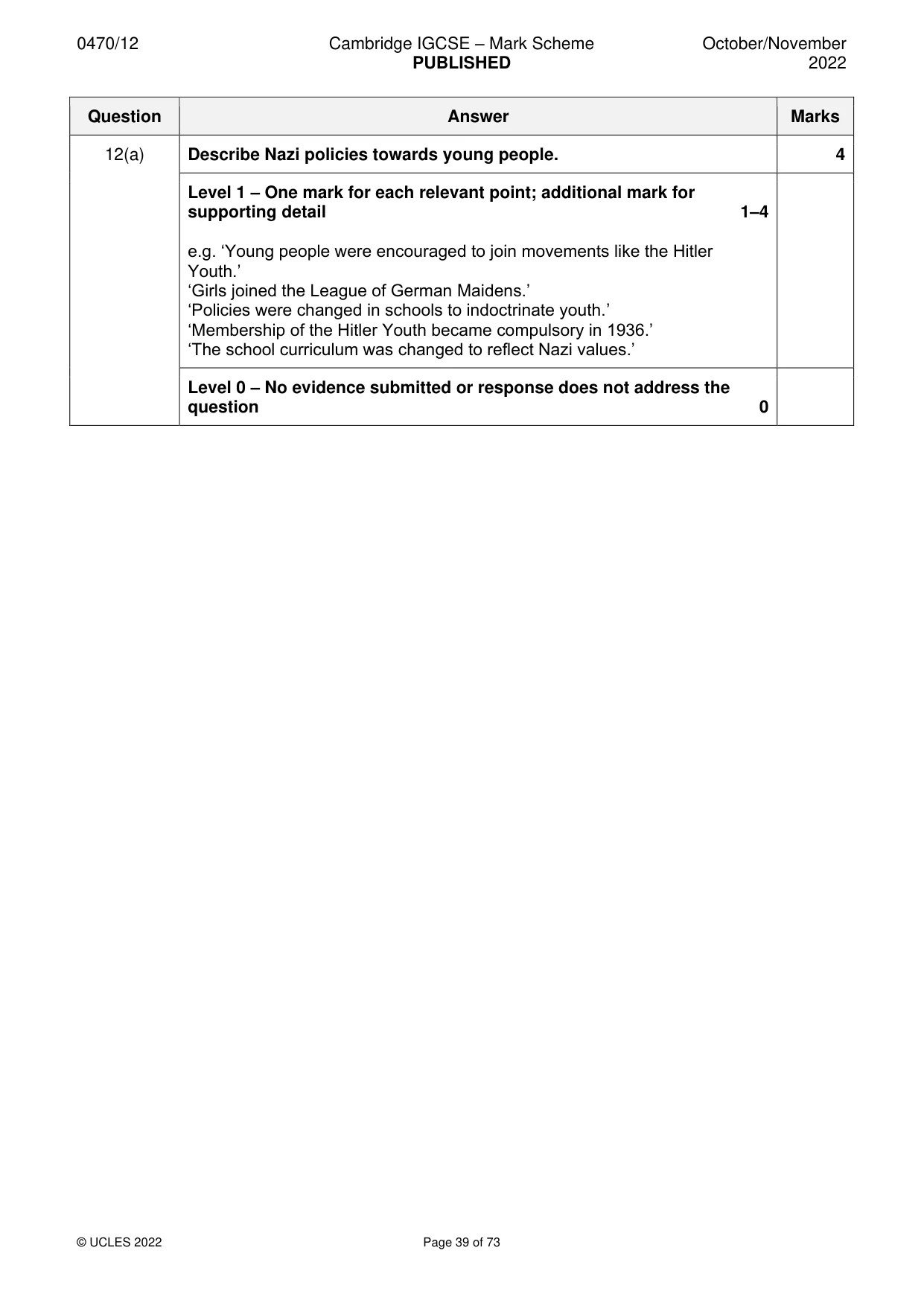
0470/12 Cambridge IGCSE – Mark Scheme PUBLISHED October/November 2022 © UCLES 2022 Page 39 of 73 Question Answer Marks 12(a) Describe Nazi policies towards young people. 4 Level 1 – One mark for each relevant point; additional mark for supporting detail 1–4 e.g. ‘Young people were encouraged to join movements like the Hitler Youth.’ ‘Girls joined the League of German Maidens.’ ‘Policies were changed in schools to indoctrinate youth.’ ‘Membership of the Hitler Youth became compulsory in 1936.’ ‘The school curriculum was changed to reflect Nazi values.’ Level 0 – No evidence submitted or response does not address the question 0
Mark scheme, page 40
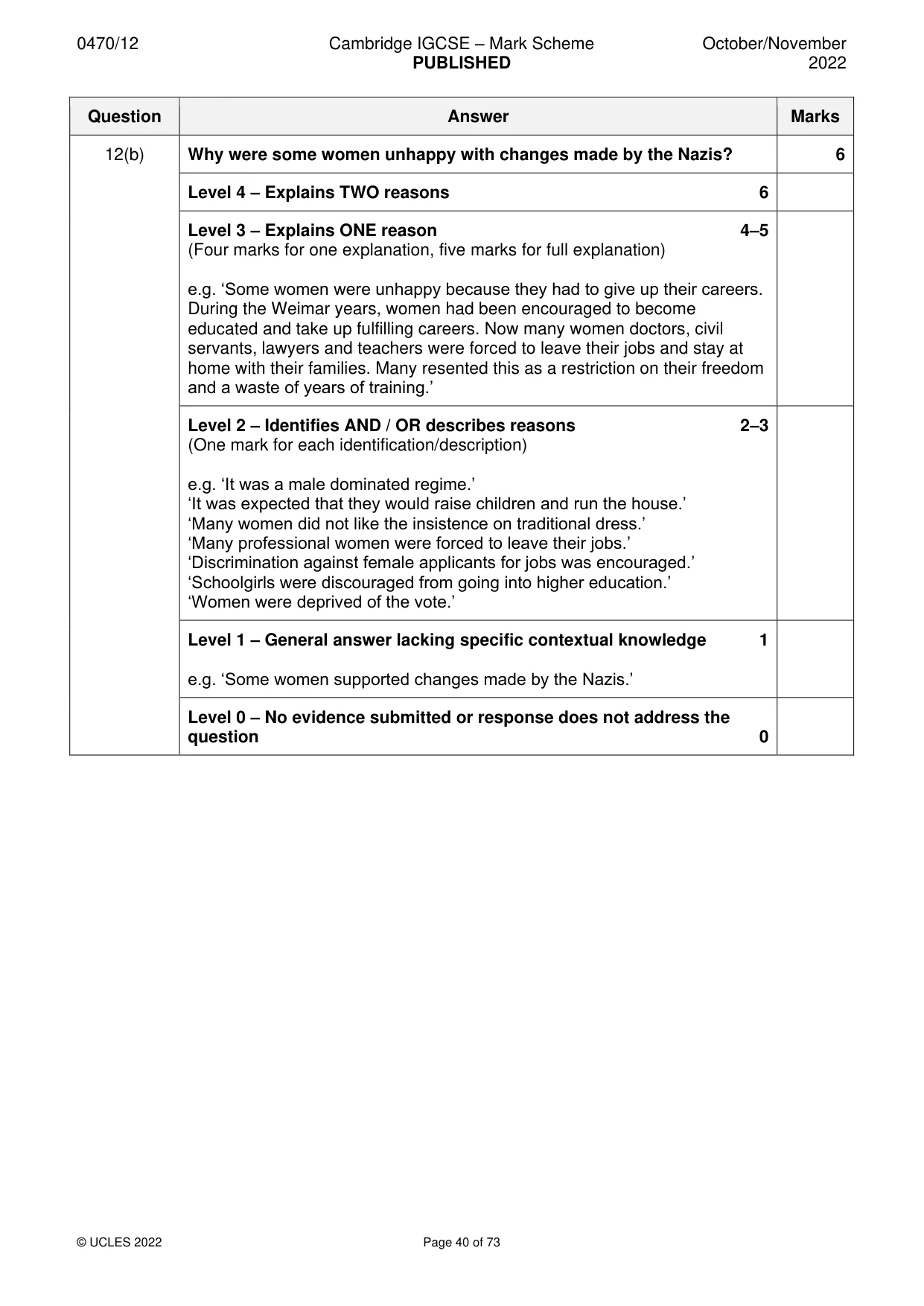
0470/12 Cambridge IGCSE – Mark Scheme PUBLISHED October/November 2022 © UCLES 2022 Page 40 of 73 Question Answer Marks 12(b) Why were some women unhappy with changes made by the Nazis? 6 Level 4 – Explains TWO reasons 6 Level 3 – Explains ONE reason 4–5 (Four marks for one explanation, five marks for full explanation) e.g. ‘Some women were unhappy because they had to give up their careers. During the Weimar years, women had been encouraged to become educated and take up fulfilling careers. Now many women doctors, civil servants, lawyers and teachers were forced to leave their jobs and stay at home with their families. Many resented this as a restriction on their freedom and a waste of years of training.’ Level 2 – Identifies AND / OR describes reasons 2–3 (One mark for each identification/description) e.g. ‘It was a male dominated regime.’ ‘It was expected that they would raise children and run the house.’ ‘Many women did not like the insistence on traditional dress.’ ‘Many professional women were forced to leave their jobs.’ ‘Discrimination against female applicants for jobs was encouraged.’ ‘Schoolgirls were discouraged from going into higher education.’ ‘Women were deprived of the vote.’ Level 1 – General answer lacking specific contextual knowledge 1 e.g. ‘Some women supported changes made by the Nazis.’ Level 0 – No evidence submitted or response does not address the question 0
Mark scheme, page 41
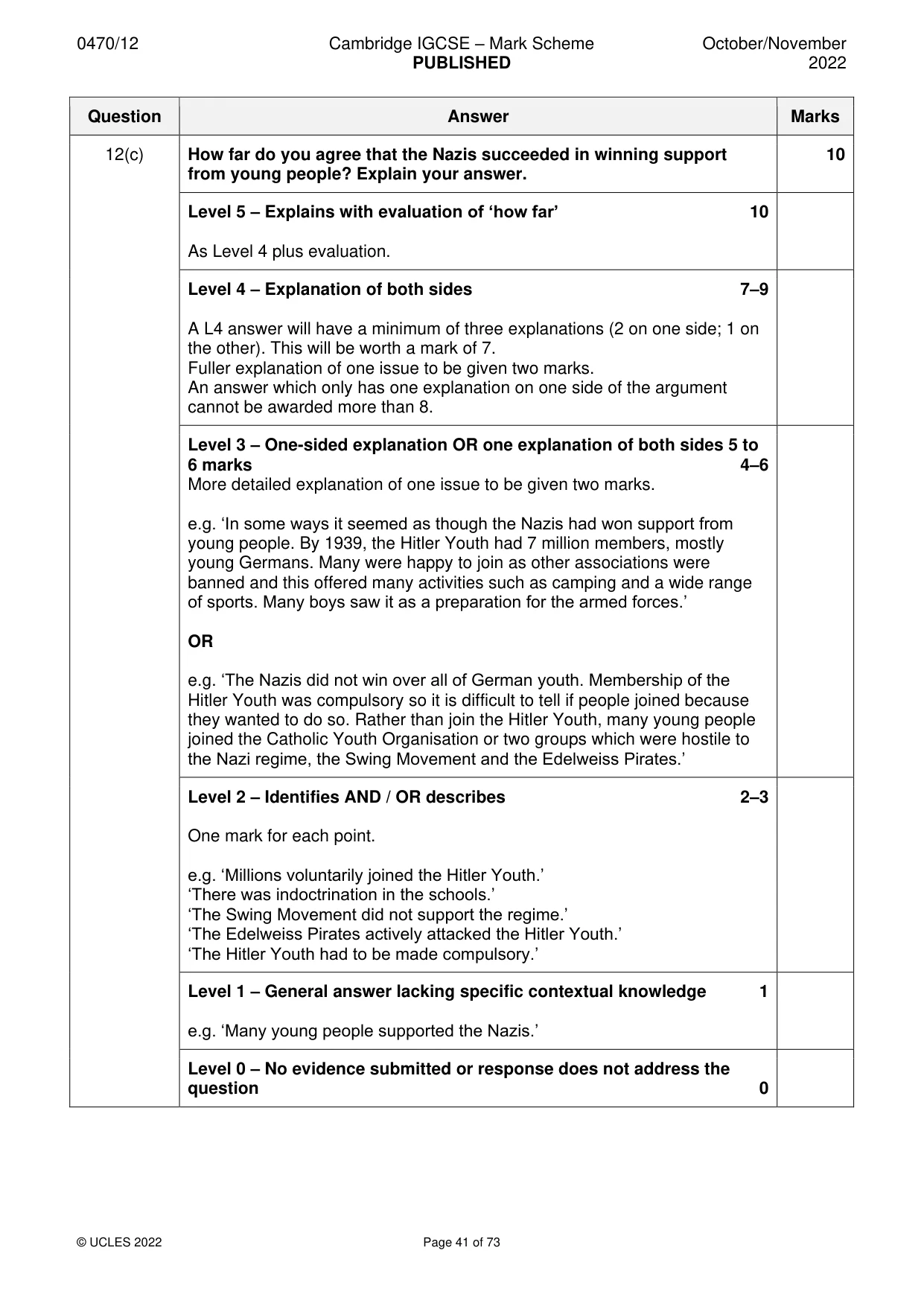
0470/12 Cambridge IGCSE – Mark Scheme PUBLISHED October/November 2022 © UCLES 2022 Page 41 of 73 Question Answer Marks 12(c) How far do you agree that the Nazis succeeded in winning support from young people? Explain your answer. 10 Level 5 – Explains with evaluation of ‘how far’ 10 As Level 4 plus evaluation. Level 4 – Explanation of both sides 7–9 A L4 answer will have a minimum of three explanations (2 on one side; 1 on the other). This will be worth a mark of 7. Fuller explanation of one issue to be given two marks. An answer which only has one explanation on one side of the argument cannot be awarded more than 8. Level 3 – One-sided explanation OR one explanation of both sides 5 to 6 marks 4–6 More detailed explanation of one issue to be given two marks. e.g. ‘In some ways it seemed as though the Nazis had won support from young people. By 1939, the Hitler Youth had 7 million members, mostly young Germans. Many were happy to join as other associations were banned and this offered many activities such as camping and a wide range of sports. Many boys saw it as a preparation for the armed forces.’ OR e.g. ‘The Nazis did not win over all of German youth. Membership of the Hitler Youth was compulsory so it is difficult to tell if people joined because they wanted to do so. Rather than join the Hitler Youth, many young people joined the Catholic Youth Organisation or two groups which were hostile to the Nazi regime, the Swing Movement and the Edelweiss Pirates.’ Level 2 – Identifies AND / OR describes 2–3 One mark for each point. e.g. ‘Millions voluntarily joined the Hitler Youth.’ ‘There was indoctrination in the schools.’ ‘The Swing Movement did not support the regime.’ ‘The Edelweiss Pirates actively attacked the Hitler Youth.’ ‘The Hitler Youth had to be made compulsory.’ Level 1 – General answer lacking specific contextual knowledge 1 e.g. ‘Many young people supported the Nazis.’ Level 0 – No evidence submitted or response does not address the question 0
Mark scheme, page 42
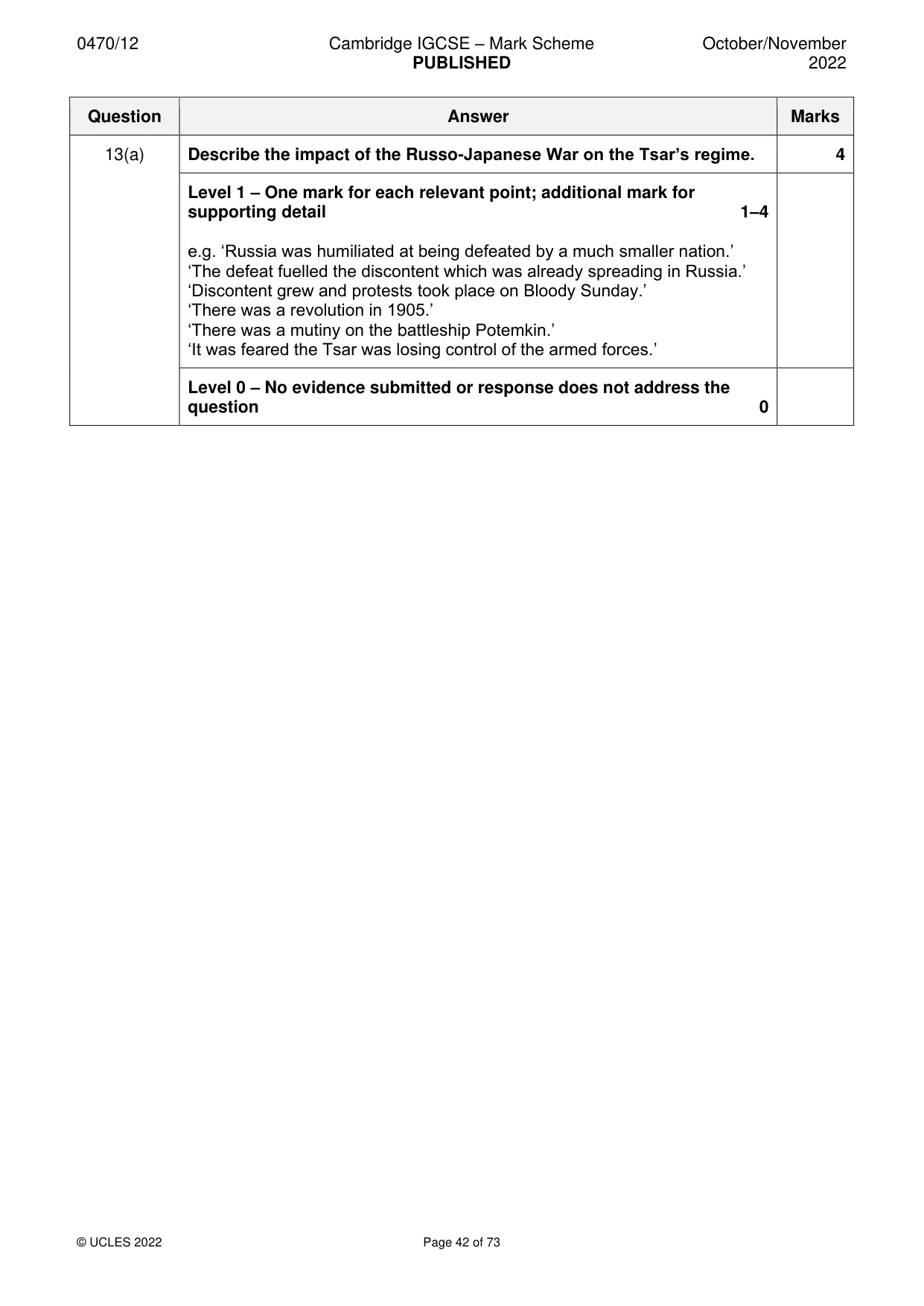
0470/12 Cambridge IGCSE – Mark Scheme PUBLISHED October/November 2022 © UCLES 2022 Page 42 of 73 Question Answer Marks 13(a) Describe the impact of the Russo-Japanese War on the Tsar’s regime. 4 Level 1 – One mark for each relevant point; additional mark for supporting detail 1–4 e.g. ‘Russia was humiliated at being defeated by a much smaller nation.’ ‘The defeat fuelled the discontent which was already spreading in Russia.’ ‘Discontent grew and protests took place on Bloody Sunday.’ ‘There was a revolution in 1905.’ ‘There was a mutiny on the battleship Potemkin.’ ‘It was feared the Tsar was losing control of the armed forces.’ Level 0 – No evidence submitted or response does not address the question 0
Mark scheme, page 43
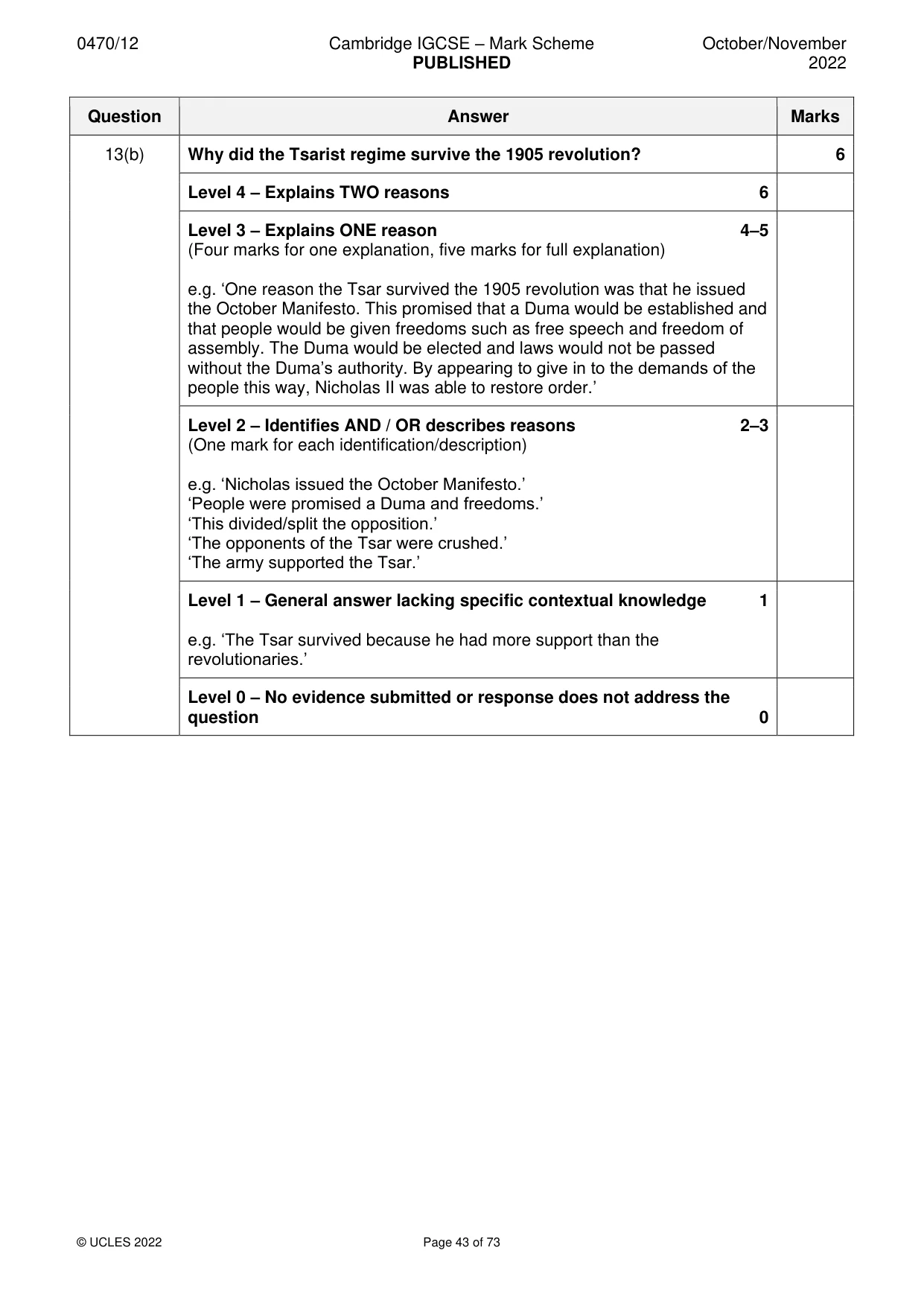
0470/12 Cambridge IGCSE – Mark Scheme PUBLISHED October/November 2022 © UCLES 2022 Page 43 of 73 Question Answer Marks 13(b) Why did the Tsarist regime survive the 1905 revolution? 6 Level 4 – Explains TWO reasons 6 Level 3 – Explains ONE reason 4–5 (Four marks for one explanation, five marks for full explanation) e.g. ‘One reason the Tsar survived the 1905 revolution was that he issued the October Manifesto. This promised that a Duma would be established and that people would be given freedoms such as free speech and freedom of assembly. The Duma would be elected and laws would not be passed without the Duma’s authority. By appearing to give in to the demands of the people this way, Nicholas II was able to restore order.’ Level 2 – Identifies AND / OR describes reasons 2–3 (One mark for each identification/description) e.g. ‘Nicholas issued the October Manifesto.’ ‘People were promised a Duma and freedoms.’ ‘This divided/split the opposition.’ ‘The opponents of the Tsar were crushed.’ ‘The army supported the Tsar.’ Level 1 – General answer lacking specific contextual knowledge 1 e.g. ‘The Tsar survived because he had more support than the revolutionaries.’ Level 0 – No evidence submitted or response does not address the question 0
Mark scheme, page 44
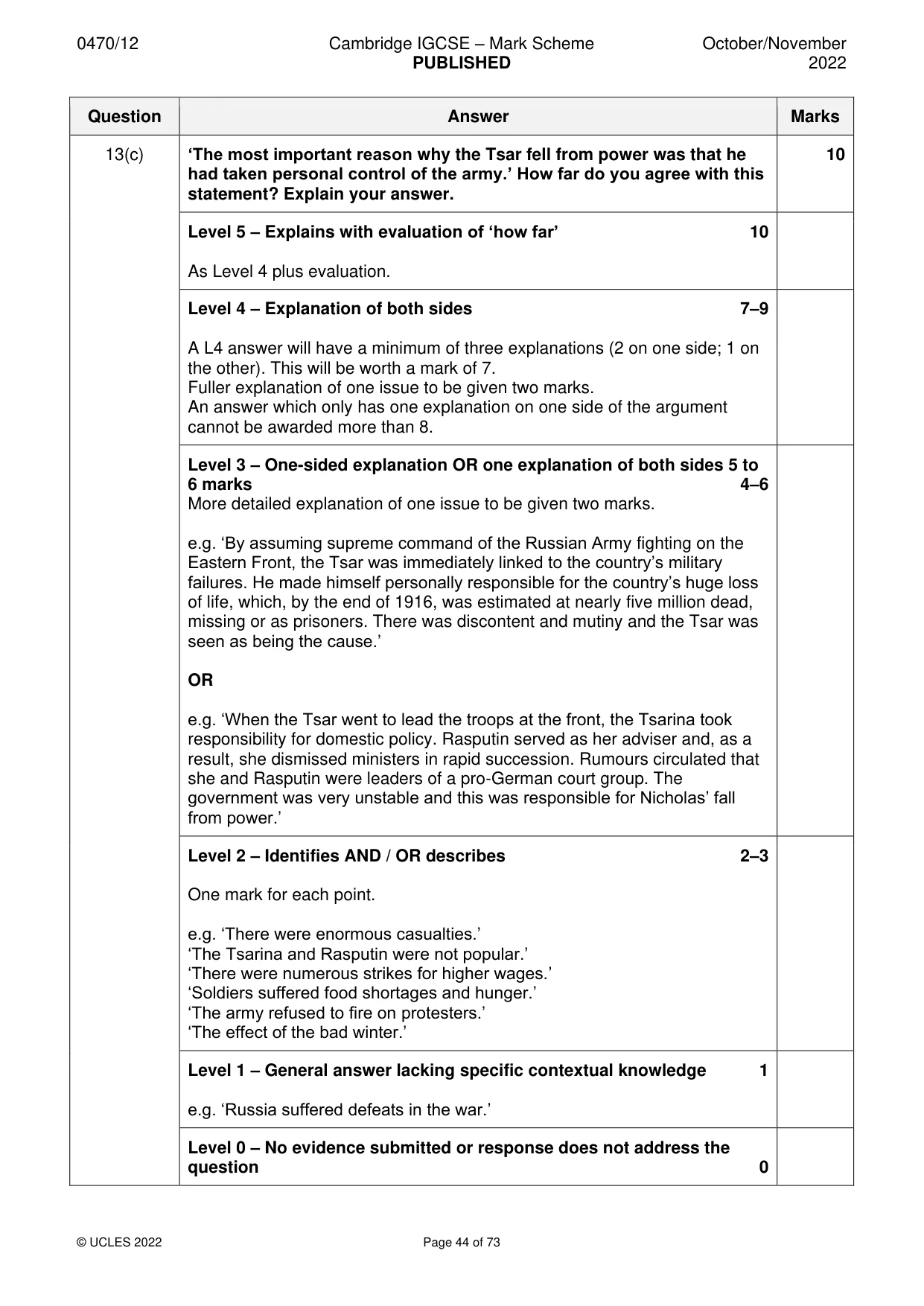
0470/12 Cambridge IGCSE – Mark Scheme PUBLISHED October/November 2022 © UCLES 2022 Page 44 of 73 Question Answer Marks 13(c) ‘The most important reason why the Tsar fell from power was that he had taken personal control of the army.’ How far do you agree with this statement? Explain your answer. 10 Level 5 – Explains with evaluation of ‘how far’ 10 As Level 4 plus evaluation. Level 4 – Explanation of both sides 7–9 A L4 answer will have a minimum of three explanations (2 on one side; 1 on the other). This will be worth a mark of 7. Fuller explanation of one issue to be given two marks. An answer which only has one explanation on one side of the argument cannot be awarded more than 8. Level 3 – One-sided explanation OR one explanation of both sides 5 to 6 marks 4–6 More detailed explanation of one issue to be given two marks. e.g. ‘By assuming supreme command of the Russian Army fighting on the Eastern Front, the Tsar was immediately linked to the country’s military failures. He made himself personally responsible for the country’s huge loss of life, which, by the end of 1916, was estimated at nearly five million dead, missing or as prisoners. There was discontent and mutiny and the Tsar was seen as being the cause.’ OR e.g. ‘When the Tsar went to lead the troops at the front, the Tsarina took responsibility for domestic policy. Rasputin served as her adviser and, as a result, she dismissed ministers in rapid succession. Rumours circulated that she and Rasputin were leaders of a pro-German court group. The government was very unstable and this was responsible for Nicholas’ fall from power.’ Level 2 – Identifies AND / OR describes 2–3 One mark for each point. e.g. ‘There were enormous casualties.’ ‘The Tsarina and Rasputin were not popular.’ ‘There were numerous strikes for higher wages.’ ‘Soldiers suffered food shortages and hunger.’ ‘The army refused to fire on protesters.’ ‘The effect of the bad winter.’ Level 1 – General answer lacking specific contextual knowledge 1 e.g. ‘Russia suffered defeats in the war.’ Level 0 – No evidence submitted or response does not address the question 0
Mark scheme, page 45
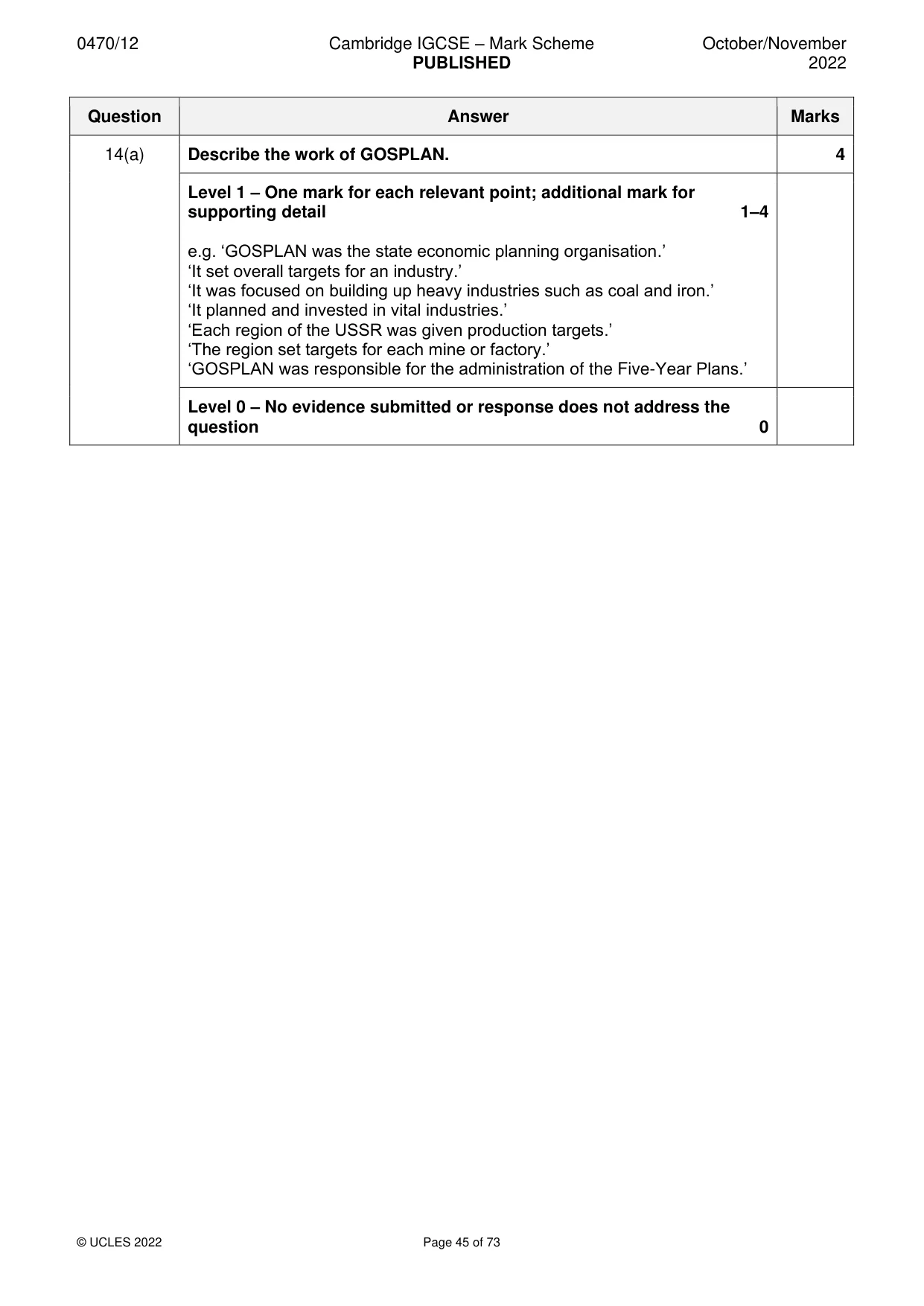
0470/12 Cambridge IGCSE – Mark Scheme PUBLISHED October/November 2022 © UCLES 2022 Page 45 of 73 Question Answer Marks 14(a) Describe the work of GOSPLAN. 4 Level 1 – One mark for each relevant point; additional mark for supporting detail 1–4 e.g. ‘GOSPLAN was the state economic planning organisation.’ ‘It set overall targets for an industry.’ ‘It was focused on building up heavy industries such as coal and iron.’ ‘It planned and invested in vital industries.’ ‘Each region of the USSR was given production targets.’ ‘The region set targets for each mine or factory.’ ‘GOSPLAN was responsible for the administration of the Five-Year Plans.’ Level 0 – No evidence submitted or response does not address the question 0
Mark scheme, page 46
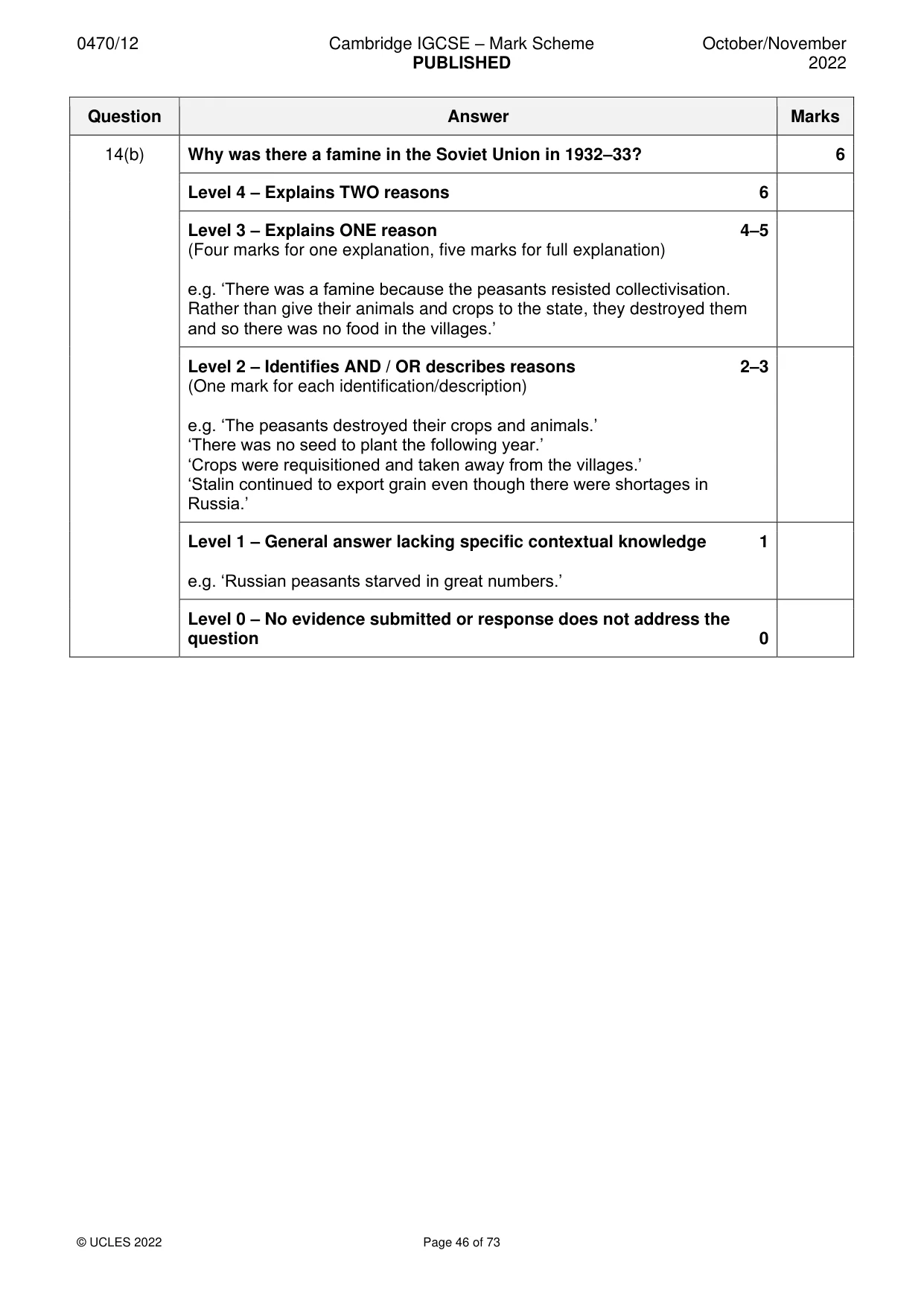
0470/12 Cambridge IGCSE – Mark Scheme PUBLISHED October/November 2022 © UCLES 2022 Page 46 of 73 Question Answer Marks 14(b) Why was there a famine in the Soviet Union in 1932–33? 6 Level 4 – Explains TWO reasons 6 Level 3 – Explains ONE reason 4–5 (Four marks for one explanation, five marks for full explanation) e.g. ‘There was a famine because the peasants resisted collectivisation. Rather than give their animals and crops to the state, they destroyed them and so there was no food in the villages.’ Level 2 – Identifies AND / OR describes reasons 2–3 (One mark for each identification/description) e.g. ‘The peasants destroyed their crops and animals.’ ‘There was no seed to plant the following year.’ ‘Crops were requisitioned and taken away from the villages.’ ‘Stalin continued to export grain even though there were shortages in Russia.’ Level 1 – General answer lacking specific contextual knowledge 1 e.g. ‘Russian peasants starved in great numbers.’ Level 0 – No evidence submitted or response does not address the question 0
Mark scheme, page 47
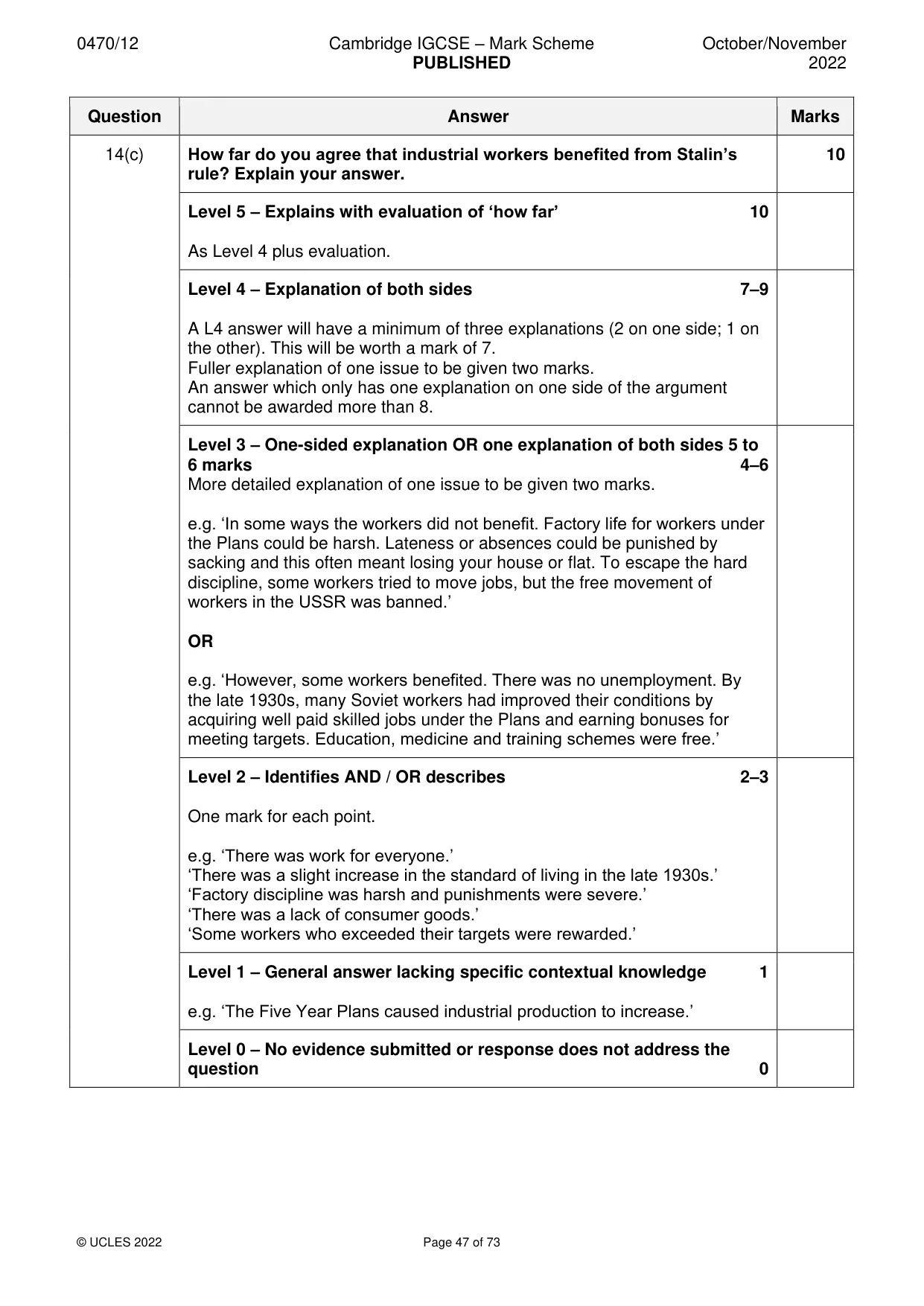
0470/12 Cambridge IGCSE – Mark Scheme PUBLISHED October/November 2022 © UCLES 2022 Page 47 of 73 Question Answer Marks 14(c) How far do you agree that industrial workers benefited from Stalin’s rule? Explain your answer. 10 Level 5 – Explains with evaluation of ‘how far’ 10 As Level 4 plus evaluation. Level 4 – Explanation of both sides 7–9 A L4 answer will have a minimum of three explanations (2 on one side; 1 on the other). This will be worth a mark of 7. Fuller explanation of one issue to be given two marks. An answer which only has one explanation on one side of the argument cannot be awarded more than 8. Level 3 – One-sided explanation OR one explanation of both sides 5 to 6 marks 4–6 More detailed explanation of one issue to be given two marks. e.g. ‘In some ways the workers did not benefit. Factory life for workers under the Plans could be harsh. Lateness or absences could be punished by sacking and this often meant losing your house or flat. To escape the hard discipline, some workers tried to move jobs, but the free movement of workers in the USSR was banned.’ OR e.g. ‘However, some workers benefited. There was no unemployment. By the late 1930s, many Soviet workers had improved their conditions by acquiring well paid skilled jobs under the Plans and earning bonuses for meeting targets. Education, medicine and training schemes were free.’ Level 2 – Identifies AND / OR describes 2–3 One mark for each point. e.g. ‘There was work for everyone.’ ‘There was a slight increase in the standard of living in the late 1930s.’ ‘Factory discipline was harsh and punishments were severe.’ ‘There was a lack of consumer goods.’ ‘Some workers who exceeded their targets were rewarded.’ Level 1 – General answer lacking specific contextual knowledge 1 e.g. ‘The Five Year Plans caused industrial production to increase.’ Level 0 – No evidence submitted or response does not address the question 0
Mark scheme, page 48
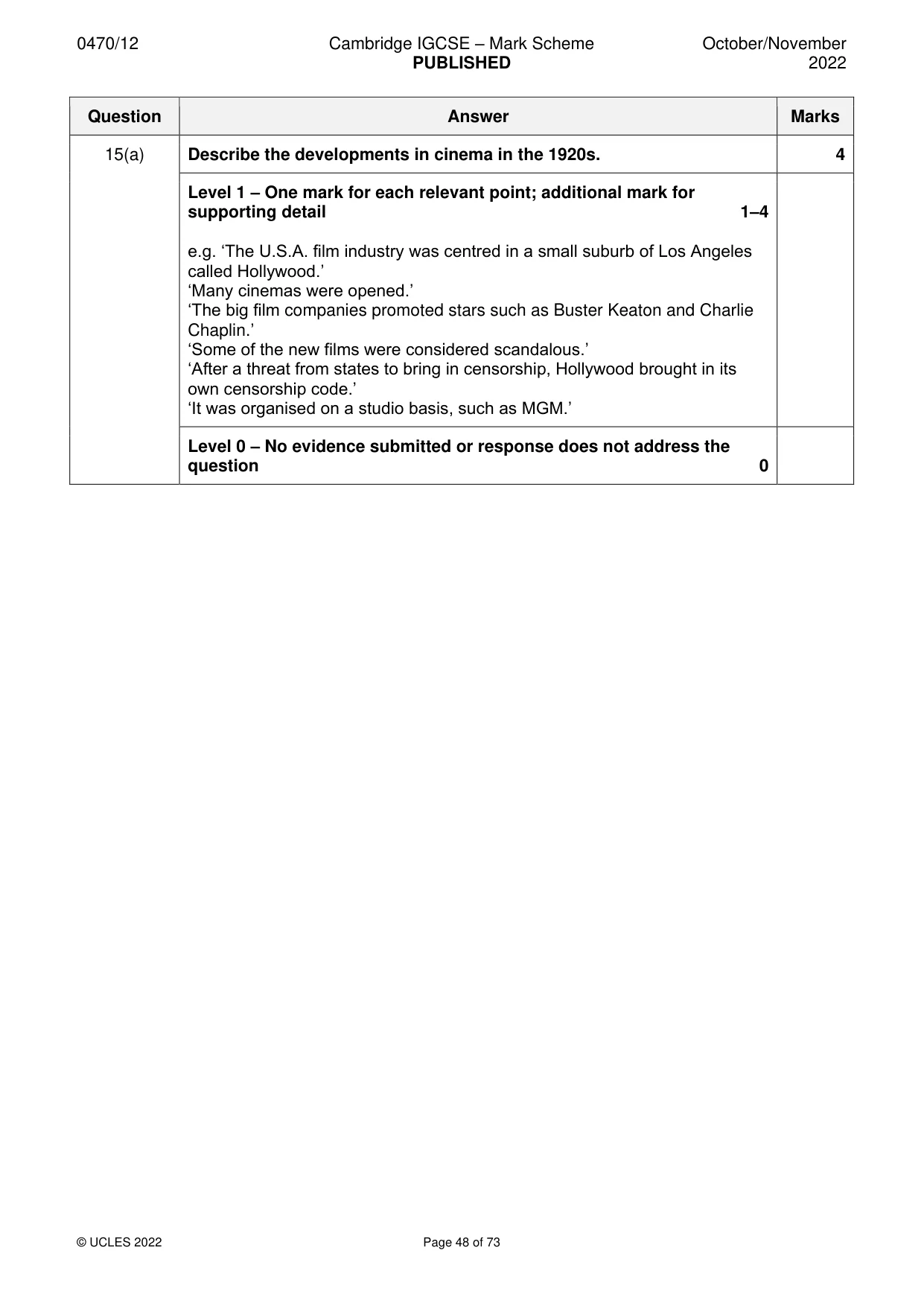
0470/12 Cambridge IGCSE – Mark Scheme PUBLISHED October/November 2022 © UCLES 2022 Page 48 of 73 Question Answer Marks 15(a) Describe the developments in cinema in the 1920s. 4 Level 1 – One mark for each relevant point; additional mark for supporting detail 1–4 e.g. ‘The U.S.A. film industry was centred in a small suburb of Los Angeles called Hollywood.’ ‘Many cinemas were opened.’ ‘The big film companies promoted stars such as Buster Keaton and Charlie Chaplin.’ ‘Some of the new films were considered scandalous.’ ‘After a threat from states to bring in censorship, Hollywood brought in its own censorship code.’ ‘It was organised on a studio basis, such as MGM.’ Level 0 – No evidence submitted or response does not address the question 0
Mark scheme, page 49
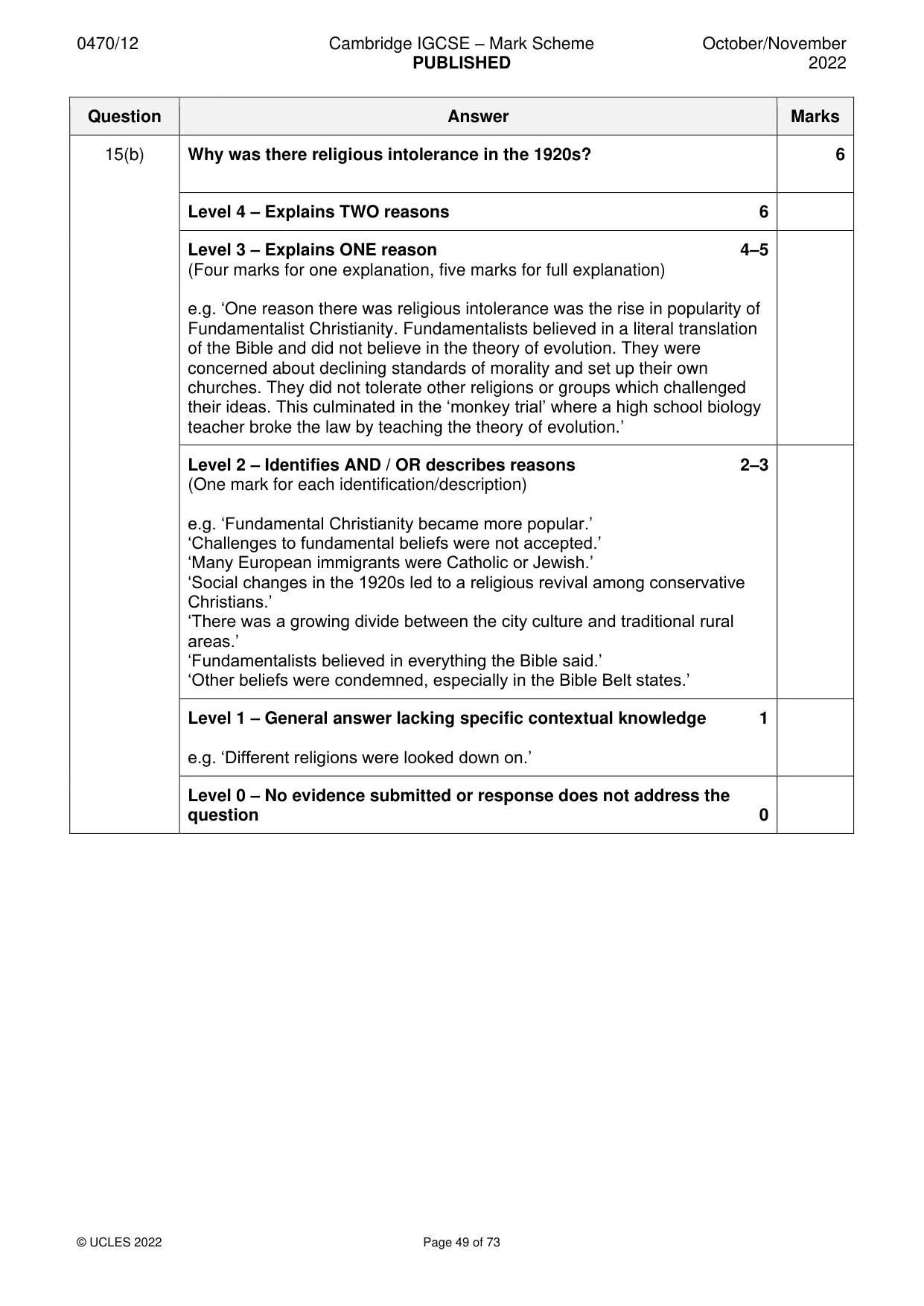
0470/12 Cambridge IGCSE – Mark Scheme PUBLISHED October/November 2022 © UCLES 2022 Page 49 of 73 Question Answer Marks 15(b) Why was there religious intolerance in the 1920s? 6 Level 4 – Explains TWO reasons 6 Level 3 – Explains ONE reason 4–5 (Four marks for one explanation, five marks for full explanation) e.g. ‘One reason there was religious intolerance was the rise in popularity of Fundamentalist Christianity. Fundamentalists believed in a literal translation of the Bible and did not believe in the theory of evolution. They were concerned about declining standards of morality and set up their own churches. They did not tolerate other religions or groups which challenged their ideas. This culminated in the ‘monkey trial’ where a high school biology teacher broke the law by teaching the theory of evolution.’ Level 2 – Identifies AND / OR describes reasons 2–3 (One mark for each identification/description) e.g. ‘Fundamental Christianity became more popular.’ ‘Challenges to fundamental beliefs were not accepted.’ ‘Many European immigrants were Catholic or Jewish.’ ‘Social changes in the 1920s led to a religious revival among conservative Christians.’ ‘There was a growing divide between the city culture and traditional rural areas.’ ‘Fundamentalists believed in everything the Bible said.’ ‘Other beliefs were condemned, especially in the Bible Belt states.’ Level 1 – General answer lacking specific contextual knowledge 1 e.g. ‘Different religions were looked down on.’ Level 0 – No evidence submitted or response does not address the question 0
Mark scheme, page 50
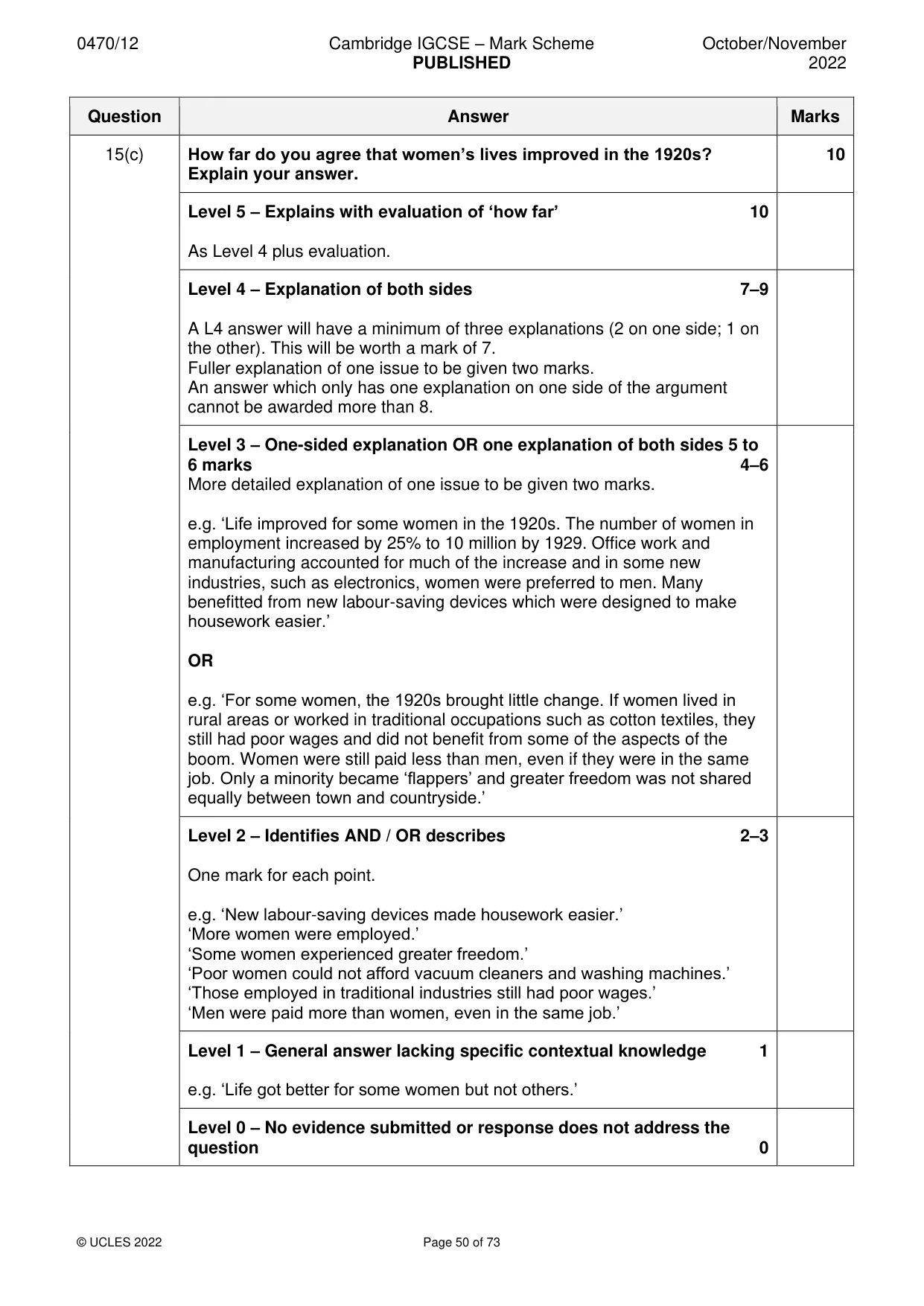
0470/12 Cambridge IGCSE – Mark Scheme PUBLISHED October/November 2022 © UCLES 2022 Page 50 of 73 Question Answer Marks 15(c) How far do you agree that women’s lives improved in the 1920s? Explain your answer. 10 Level 5 – Explains with evaluation of ‘how far’ 10 As Level 4 plus evaluation. Level 4 – Explanation of both sides 7–9 A L4 answer will have a minimum of three explanations (2 on one side; 1 on the other). This will be worth a mark of 7. Fuller explanation of one issue to be given two marks. An answer which only has one explanation on one side of the argument cannot be awarded more than 8. Level 3 – One-sided explanation OR one explanation of both sides 5 to 6 marks 4–6 More detailed explanation of one issue to be given two marks. e.g. ‘Life improved for some women in the 1920s. The number of women in employment increased by 25% to 10 million by 1929. Office work and manufacturing accounted for much of the increase and in some new industries, such as electronics, women were preferred to men. Many benefitted from new labour-saving devices which were designed to make housework easier.’ OR e.g. ‘For some women, the 1920s brought little change. If women lived in rural areas or worked in traditional occupations such as cotton textiles, they still had poor wages and did not benefit from some of the aspects of the boom. Women were still paid less than men, even if they were in the same job. Only a minority became ‘flappers’ and greater freedom was not shared equally between town and countryside.’ Level 2 – Identifies AND / OR describes 2–3 One mark for each point. e.g. ‘New labour-saving devices made housework easier.’ ‘More women were employed.’ ‘Some women experienced greater freedom.’ ‘Poor women could not afford vacuum cleaners and washing machines.’ ‘Those employed in traditional industries still had poor wages.’ ‘Men were paid more than women, even in the same job.’ Level 1 – General answer lacking specific contextual knowledge 1 e.g. ‘Life got better for some women but not others.’ Level 0 – No evidence submitted or response does not address the question 0
Mark scheme, page 51
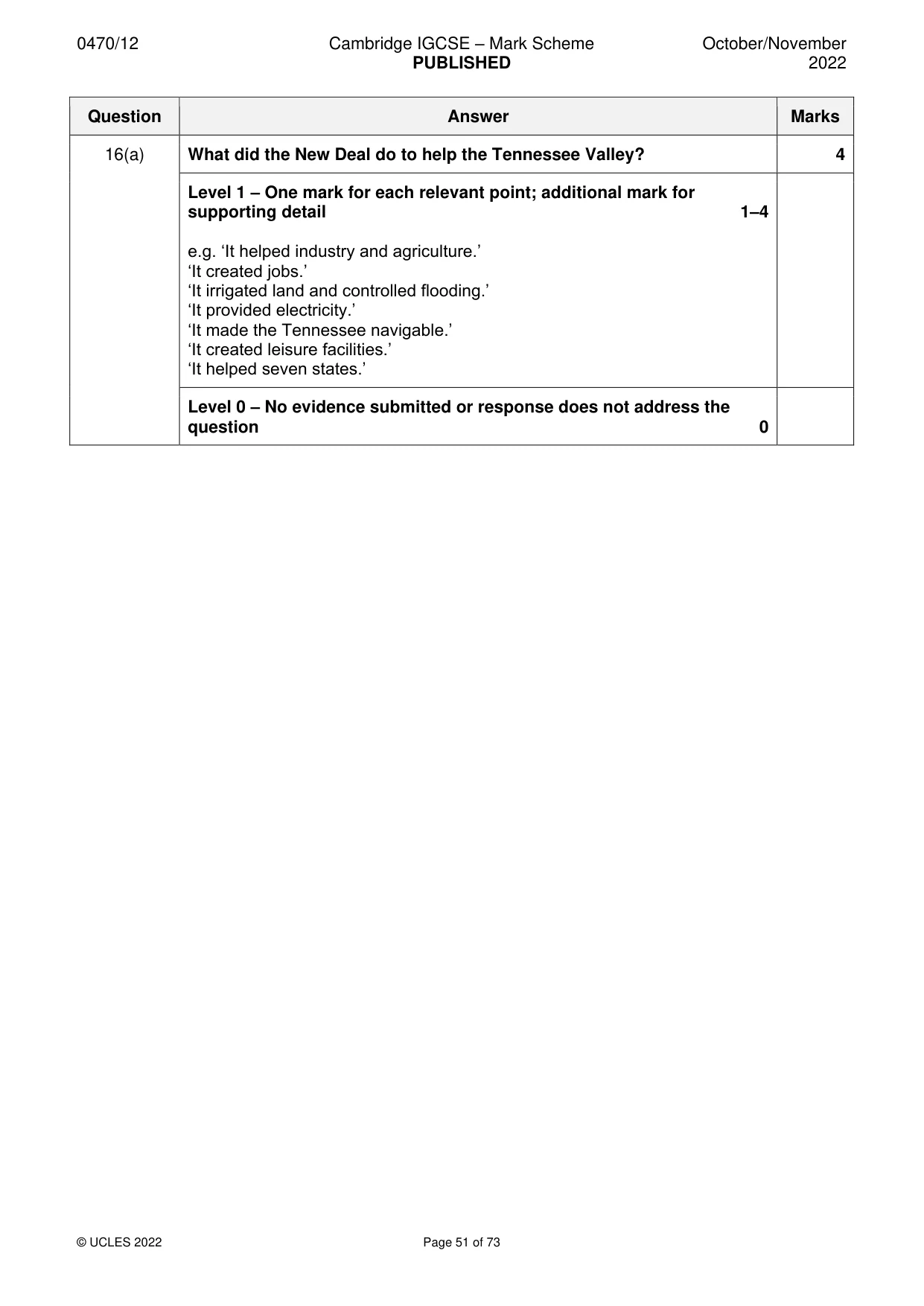
0470/12 Cambridge IGCSE – Mark Scheme PUBLISHED October/November 2022 © UCLES 2022 Page 51 of 73 Question Answer Marks 16(a) What did the New Deal do to help the Tennessee Valley? 4 Level 1 – One mark for each relevant point; additional mark for supporting detail 1–4 e.g. ‘It helped industry and agriculture.’ ‘It created jobs.’ ‘It irrigated land and controlled flooding.’ ‘It provided electricity.’ ‘It made the Tennessee navigable.’ ‘It created leisure facilities.’ ‘It helped seven states.’ Level 0 – No evidence submitted or response does not address the question 0
Mark scheme, page 52
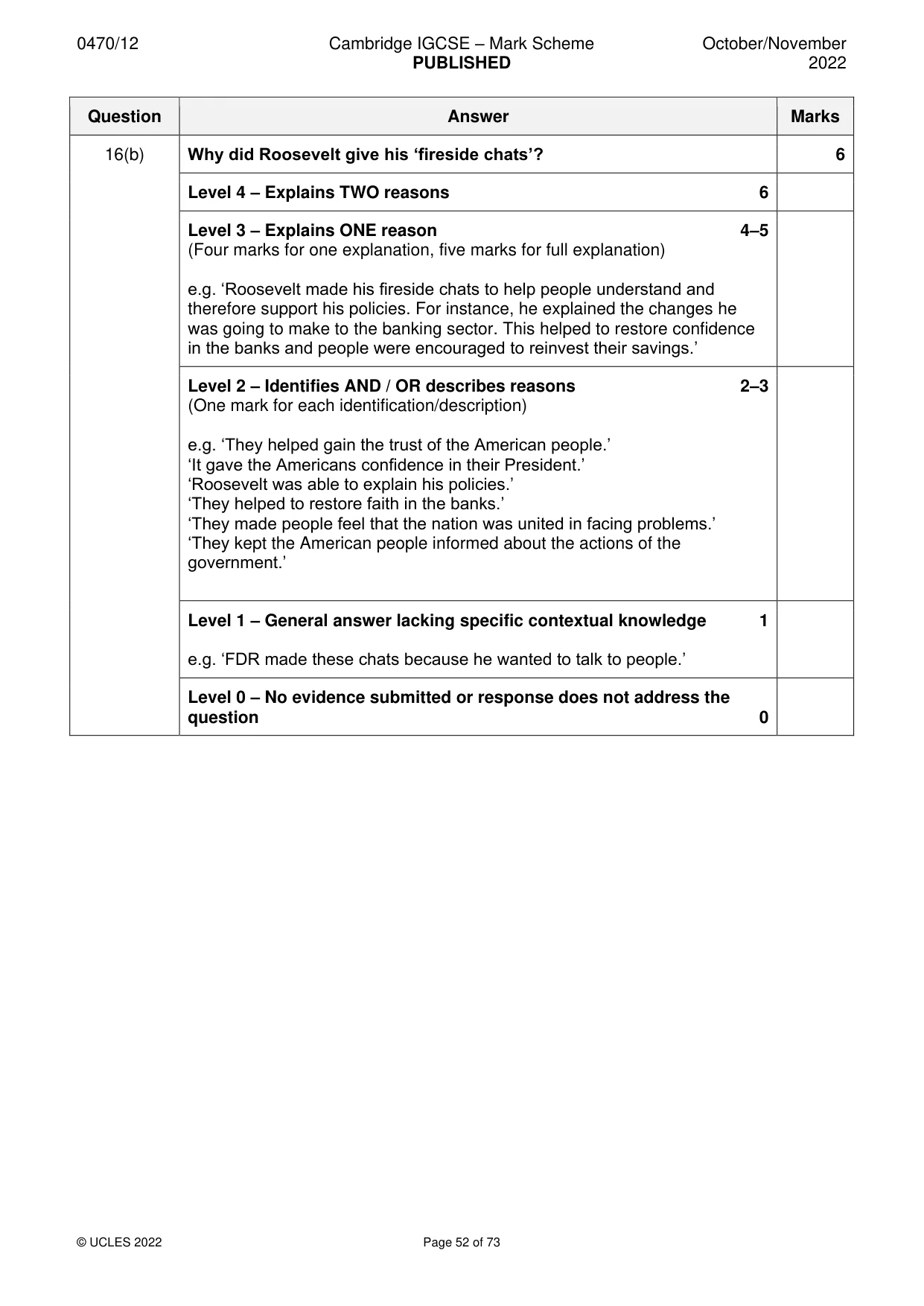
0470/12 Cambridge IGCSE – Mark Scheme PUBLISHED October/November 2022 © UCLES 2022 Page 52 of 73 Question Answer Marks 16(b) Why did Roosevelt give his ‘fireside chats’? 6 Level 4 – Explains TWO reasons 6 Level 3 – Explains ONE reason 4–5 (Four marks for one explanation, five marks for full explanation) e.g. ‘Roosevelt made his fireside chats to help people understand and therefore support his policies. For instance, he explained the changes he was going to make to the banking sector. This helped to restore confidence in the banks and people were encouraged to reinvest their savings.’ Level 2 – Identifies AND / OR describes reasons 2–3 (One mark for each identification/description) e.g. ‘They helped gain the trust of the American people.’ ‘It gave the Americans confidence in their President.’ ‘Roosevelt was able to explain his policies.’ ‘They helped to restore faith in the banks.’ ‘They made people feel that the nation was united in facing problems.’ ‘They kept the American people informed about the actions of the government.’ Level 1 – General answer lacking specific contextual knowledge 1 e.g. ‘FDR made these chats because he wanted to talk to people.’ Level 0 – No evidence submitted or response does not address the question 0
Mark scheme, page 53
0470/12 Cambridge IGCSE – Mark Scheme PUBLISHED October/November 2022 © UCLES 2022 Page 53 of 73 Question Answer Marks 16(c) ‘The main reason for opposition to the New Deal was that it failed to provide enough help for the poor.’ How far do you agree with this statement? Explain your answer. 10 Level 5 – Explains with evaluation of ‘how far’ 10 As Level 4 plus evaluation. Level 4 – Explanation of both sides 7–9 A L4 answer will have a minimum of three explanations (2 on one side; 1 on the other). This will be worth a mark of 7. Fuller explanation of one issue to be given two marks. An answer which only has one explanation on one side of the argument cannot be awarded more than 8. Level 3 – One-sided explanation OR one explanation of both sides 5 to 6 marks 4–6 More detailed explanation of one issue to be given two marks. e.g. ‘There was some opposition to the New Deal because it did not do enough for the poor. For instance, Senator Huey Long did not think the New Deal went far enough. His ‘Share our Wealth’ scheme included confiscation of large fortunes, lump sums for American families, pensions, minimum wages and free education.’ OR e.g. ‘Others thought the President had exceeded his powers through some of the legislation which was introduced. The Supreme Court declared that the AAA and the NRA were unconstitutional. It undermined states’ power to help businesses. It was the Court’s task to decide if measures passed by the President and the Congress were consistent with the American Constitution. Most of the judges were Republican and they had a natural political dislike for the New Deal.’ Level 2 – Identifies AND / OR describes 2–3 One mark for each point. e.g. ‘Huey Long thought the New Deal didn’t do enough for the poor.’ ‘The Supreme Court had to uphold the Constitution.’ ‘Republicans believed in minimal government intervention and low taxation.’ ‘Some Republicans thought Roosevelt was acting like a dictator.’ ‘Some state governors argued that the New Deal laws conflicted with the rights of state governments.’ ‘Business leaders in the Liberty League opposed the New Deal.’ ‘Dr Francis Townsend wanted the New Deal to do more for the elderly.’
Mark scheme, page 54
0470/12 Cambridge IGCSE – Mark Scheme PUBLISHED October/November 2022 © UCLES 2022 Page 54 of 73 Question Answer Marks 16(c) Level 1 – General answer lacking specific contextual knowledge 1 e.g. ‘Some people thought the New Deal didn’t go far enough.’ Level 0 – No evidence submitted or response does not address the question 0
Mark scheme, page 55
0470/12 Cambridge IGCSE – Mark Scheme PUBLISHED October/November 2022 © UCLES 2022 Page 55 of 73 Question Answer Marks 17(a) Describe the changes made to the organisation of farms in 1953. 4 Level 1 – One mark for each relevant point; additional mark for supporting detail 1–4 e.g. ‘In 1953 farms became cooperatives.’ ‘Between 30 and 50 families lived together in the cooperatives and formed together.’ ‘Families legally owned the land but it was on permanent loan to cooperatives.’ ‘The cooperatives paid rent to each family.’ ‘Land was joined together to make larger, more efficient farms.’ Level 0 – No evidence submitted or response does not address the question 0
Mark scheme, page 56
0470/12 Cambridge IGCSE – Mark Scheme PUBLISHED October/November 2022 © UCLES 2022 Page 56 of 73 Question Answer Marks 17(b) Why did the Communists take action against the landlords? 6 Level 4 – Explains TWO reasons 6 Level 3 – Explains ONE reason 4–5 (Four marks for one explanation, five marks for full explanation) e.g. ‘The Communists took action against the landlords because they believed that they had grown wealthy at the expense of the peasants. This went against their beliefs that people should be equal.’ Level 2 – Identifies AND / OR describes reasons 2–3 (One mark for each identification/description) e.g. ‘In line with communist theory.’ ‘The landlords were accused of charging high rents or mistreating their tenants.’ ‘The landlords were considered to be too wealthy.’ ‘Some landlords were beaten, imprisoned or executed.’ ‘The population was growing and more food needed to be produced.’ ‘To reward the peasants for their support in the civil war.’ Level 1 – General answer lacking specific contextual knowledge 1 e.g. ‘The landlords were unpopular.’ Level 0 – No evidence submitted or response does not address the question 0
Mark scheme, page 57
0470/12 Cambridge IGCSE – Mark Scheme PUBLISHED October/November 2022 © UCLES 2022 Page 57 of 73 Question Answer Marks 17(c) ‘Mao’s industrial reforms were a success.’ How far do you agree with this statement? Explain your answer. 10 Level 5 – Explains with evaluation of ‘how far’ 10 As Level 4 plus evaluation. Level 4 – Explanation of both sides 7–9 A L4 answer will have a minimum of three explanations (2 on one side; 1 on the other). This will be worth a mark of 7. Fuller explanation of one issue to be given two marks. An answer which only has one explanation on one side of the argument cannot be awarded more than 8. Level 3 – One-sided explanation OR one explanation of both sides 5 to 6 marks 4–6 More detailed explanation of one issue to be given two marks. e.g. ‘In some ways Mao’s industrial reforms were a success. The first Five Year Plan for heavy industry achieved huge increases in the output of steel, coal and iron. All the targets set had been exceeded by 1957.’ OR e.g. ‘Some industrial policies were not successful. The Great Leap Forward encouraged the growth of inefficient, small factories and low quality ‘backyard’ iron and steel was produced. This was unusable and its manufacture took workers away from the fields, causing a drop in food production.’ Level 2 – Identifies AND / OR describes 2–3 One mark for each point. e.g. ‘Poor quality steel was produced in backyard furnaces.’ ‘There was considerable unemployment.’ ‘The first Five Year Plan was successful.’ ‘There was increased production of coal, steel, electricity and petrol.’ ‘Targets were set and early targets were met.’ ‘The Great Leap Forward had mixed results.’ Level 1 – General answer lacking specific contextual knowledge 1 e.g. ‘Industry developed in China.’ Level 0 – No evidence submitted or response does not address the question 0
Mark scheme, page 58
0470/12 Cambridge IGCSE – Mark Scheme PUBLISHED October/November 2022 © UCLES 2022 Page 58 of 73 Question Answer Marks 18(a) Describe what happened when Mao visited Stalin in 1949–50. 4 Level 1 – One mark for each relevant point; additional mark for supporting detail 1–4 e.g. ‘The Sino–Soviet Treaty of Friendship and Alliance was signed by China and the USSR.’ ‘A 30-year military alliance was agreed.’ ‘China was given a $300 million low-interest loan by the USSR.’ ‘The low-interest loan was over a period of five years.’ ‘Mao felt that he was not treated as an equal by Stalin.’ ‘Mao felt that the trip had not gone well for him.’ ‘Little was achieved after a visit of over two months.’ ‘Mao was unable to meet Stalin for many days.’ ‘China was angry about the lack of generosity shown by Stalin and the Russians.’ Level 0 – No evidence submitted or response does not address the question 0
Mark scheme, page 59
0470/12 Cambridge IGCSE – Mark Scheme PUBLISHED October/November 2022 © UCLES 2022 Page 59 of 73 Question Answer Marks 18(b) Why did China’s relationships with other countries change after 1976? 6 Level 4 – Explains TWO reasons 6 Level 3 – Explains ONE reason 4–5 (Four marks for one explanation, five marks for full explanation) e.g. ‘One reason that China’s relations changed with other countries was that China had better relations with the US. China was admitted as a member of the UN in 1971 and in the 1970s developed better relations with the USA. In 1979, the US accepted that the PRC was the legitimate ruler of China. This showed that China’s global status was improving.’ Level 2 – Identifies AND / OR describes reasons 2–3 (One mark for each identification/description) e.g. ‘Change of leadership after death of Mao.’ ‘China was a valuable trading partner.’ ‘The US developed better relations with China.’ ‘China did not want to be an isolated power.’ ‘The Chinese made an official visit to the US in 1978.’ ‘Changes to the economy in the late 1970s meant China was more open to foreign trade.’ ‘Territories which had belonged to China (such as Hong Kong and Macau) were returned.’ Level 1 – General answer lacking specific contextual knowledge 1 e.g. ‘China wanted to be recognised as a world power.’ Level 0 – No evidence submitted or response does not address the question 0
Mark scheme, page 60
0470/12 Cambridge IGCSE – Mark Scheme PUBLISHED October/November 2022 © UCLES 2022 Page 60 of 73 Question Answer Marks 18(c) How far do you agree that China had a positive relationship with the USSR in the 1950s? Explain your answer. 10 Level 5 – Explains with evaluation of ‘how far’ 10 As Level 4 plus evaluation. Level 4 – Explanation of both sides 7–9 A L4 answer will have a minimum of three explanations (2 on one side; 1 on the other). This will be worth a mark of 7. Fuller explanation of one issue to be given two marks. An answer which only has one explanation on one side of the argument cannot be awarded more than 8. Level 3 – One-sided explanation OR one explanation of both sides 5 to 6 marks 4–6 More detailed explanation of one issue to be given two marks. e.g. ‘There were positive aspects to the relationship between China and the USSR. In 1950, the two countries signed a Treaty of Friendship. The USSR gave China a $300 million low-interest loan and sent economic advisers to China to help develop industry. The USSR provided aid to 156 industries in the Five-Year plan and there was a military alliance between the two countries.’ OR e.g. ‘However, relations were not always positive. Mao did not like Khrushchev as he thought he was betraying Marx and Lenin. Mao thought his form of Communism based on the peasants was what Marx and Lenin had preached. Mao disapproved of Khrushchev’s suggestion that Russia and the capitalist West could follow peaceful co-existence and suggested that China was the true leader of the Communist world.’ Level 2 – Identifies AND / OR describes 2–3 One mark for each point. e.g. ‘The Treaty of Friendship was signed in 1950.’ ‘There was a Sino–Soviet military alliance.’ ‘Stalin sent advisers to support China’s industrialisation.’ ‘The USSR gave cheap loans to support economic development in China.’ ‘Mao did not like Khrushchev.’ ‘Mao thought Khrushchev was betraying Marx and Lenin.’ ‘Khrushchev wanted better relations with the West.’ ‘The USSR would not help the Chinese militarily.’
Mark scheme, page 61
0470/12 Cambridge IGCSE – Mark Scheme PUBLISHED October/November 2022 © UCLES 2022 Page 61 of 73 Question Answer Marks 18(c) Level 1 – General answer lacking specific contextual knowledge 1 e.g. ‘China and the USSR were both Communist powers.’ Level 0 – No evidence submitted or response does not address the question 0
Mark scheme, page 62
0470/12 Cambridge IGCSE – Mark Scheme PUBLISHED October/November 2022 © UCLES 2022 Page 62 of 73 Question Answer Marks 19(a) What were the aims of the Defiance Campaign? 4 Level 1 – One mark for each relevant point; additional mark for supporting detail 1–4 e.g. ‘The campaign aimed to challenge apartheid.’ ‘It aimed to increase support for the ANC.’ ‘It aimed to oppose apartheid through peaceful means.’ ‘It aimed to attract national and international support to expose the injustice of the apartheid system.’ ‘It aimed to encourage opponents of the government that further mass protest could bring political changes.’ Level 0 – No evidence submitted or response does not address the question 0
Mark scheme, page 63
0470/12 Cambridge IGCSE – Mark Scheme PUBLISHED October/November 2022 © UCLES 2022 Page 63 of 73 Question Answer Marks 19(b) Why was Nelson Mandela imprisoned in 1964? 6 Level 4 – Explains TWO reasons 6 Level 3 – Explains ONE reason 4–5 (Four marks for one explanation, five marks for full explanation) e.g. ‘He was sentenced to life imprisonment in 1964 when he was tried for sabotage under the Suppression of Communism Act. He had organised Umkhonto we Sizwe which was linked to acts of sabotage against the government and Mandela was tried for treason.’ Level 2 – Identifies AND / OR describes reasons 2–3 (One mark for each identification/description) e.g. ‘He was a member of the ANC and defied apartheid.’ ‘He organised Umkhonto we Sizwe (MK) when the ANC went underground.’ ‘MK was accused of acts of sabotage against government property.’ ‘The government accused Mandela of being a Communist.’ ‘Peaceful tactics had failed and resistance to apartheid became more violent.’ Level 1 – General answer lacking specific contextual knowledge 1 e.g. ‘He was accused of committing crimes.’ Level 0 – No evidence submitted or response does not address the question 0
Mark scheme, page 64
0470/12 Cambridge IGCSE – Mark Scheme PUBLISHED October/November 2022 © UCLES 2022 Page 64 of 73 Question Answer Marks 19(c) How far do you agree that South African governments had repressed opposition to apartheid by 1966? Explain your answer. 10 Level 5 – Explains with evaluation of ‘how far’ 10 As Level 4 plus evaluation. Level 4 – Explanation of both sides 7–9 A L4 answer will have a minimum of three explanations (2 on one side; 1 on the other). This will be worth a mark of 7. Fuller explanation of one issue to be given two marks. An answer which only has one explanation on one side of the argument cannot be awarded more than 8. Level 3 – One-sided explanation OR one explanation of both sides 5 to 6 marks 4–6 More detailed explanation of one issue to be given two marks. e.g. ‘In some ways opposition had been crushed. Following the Rivonia trial, the main leaders of the ANC were imprisoned and the government introduced harsh legislation to deal with opponents of apartheid. For instance, the General Laws Amendment Act meant the police could detain people for 90 days without charge and with no access to a lawyer. Given the lack of leadership and strict law enforcement, it appeared that resistance to apartheid had died down.’ OR e.g. ‘Repression meant that some opponents of apartheid fled abroad. This didn’t mean that they gave up trying to resist apartheid. The OAU was formed in 1963. The headquarters was in Tanzania and many opponents of apartheid went there to gain military training which would enable them to fight back against the South African regime.’ Level 2 – Identifies AND / OR describes 2–3 One mark for each point. e.g. ‘The leaders of the ANC were imprisoned for life.’ ‘People could be detained without charge.’ ‘There were strict security measures.’ ‘The OAU was formed in 1963.’ ‘The OAU trained those who fled from South Africa.’ Level 1 – General answer lacking specific contextual knowledge 1 e.g. ‘The South African government used brutal methods to suppress opposition.’ Level 0 – No evidence submitted or response does not address the question 0
Mark scheme, page 65
0470/12 Cambridge IGCSE – Mark Scheme PUBLISHED October/November 2022 © UCLES 2022 Page 65 of 73 Question Answer Marks 20(a) Describe how South African governments strengthened security after 1966. 4 Level 1 – One mark for each relevant point; additional mark for supporting detail 1–4 e.g. ‘The Bureau of State Security was established.’ ‘The State Security Council was established to advise the PM on security matters.’ ‘The Terrorism Act made terrorism a separate crime equal to treason.’ ‘The receiving of military training could be considered under the Act.’ ‘The Internal Security Amendment Act allowed suspects to be detained without charge.’ ‘Potential witnesses could be kept in solitary confinement for six months.’ ‘The police and security services were armed.’ Level 0 – No evidence submitted or response does not address the question 0
Mark scheme, page 66
0470/12 Cambridge IGCSE – Mark Scheme PUBLISHED October/November 2022 © UCLES 2022 Page 66 of 73 Question Answer Marks 20(b) Why were some countries unwilling to impose economic sanctions on South Africa in the 1970s? 6 Level 4 – Explains TWO reasons 6 Level 3 – Explains ONE reason 4–5 (Four marks for one explanation, five marks for full explanation) e.g. ‘The world economy depended upon South Africa for a broad range of essential minerals. Over 60% of the world’s gold and half of the platinum group of metals used in car exhausts and oil refineries came from South Africa. It also produced diamonds, chromium, vanadium, asbestos, coal, copper, iron, nickel and zinc.’ Level 2 – Identifies AND / OR describes reasons 2–3 (One mark for each identification/description) e.g. ‘The world economy needed South Africa’s minerals.’ ‘Steel production, car production and oil production all needed South Africa’s minerals.’ ‘South Africa was a major focus for American, Japanese and European investment.’ ‘By 1978, nearly $30 billion was invested in South Africa.’ ‘By imposing sanctions on South Africa, the industrialised economies would be damaged.’ Level 1 – General answer lacking specific contextual knowledge 1 e.g. ‘Some countries were afraid of the consequences.’ Level 0 – No evidence submitted or response does not address the question 0
Mark scheme, page 67
0470/12 Cambridge IGCSE – Mark Scheme PUBLISHED October/November 2022 © UCLES 2022 Page 67 of 73 Question Answer Marks 20(c) ‘Trade union opposition was the most serious challenge to the apartheid system in the 1970s.’ How far do you agree with this statement? Explain your answer. 10 Level 5 – Explains with evaluation of ‘how far’ 10 As Level 4 plus evaluation. Level 4 – Explanation of both sides 7–9 A L4 answer will have a minimum of three explanations (2 on one side; 1 on the other). This will be worth a mark of 7. Fuller explanation of one issue to be given two marks. An answer which only has one explanation on one side of the argument cannot be awarded more than 8. Level 3 – One-sided explanation OR one explanation of both sides 5 to 6 marks 4–6 More detailed explanation of one issue to be given two marks. e.g. ‘Trade union opposition was important because it showed that the workers could force concessions from the employers. There was a recession in South Africa in 1973 and there were a series of strikes to protest about wage reductions and longer working hours. In Natal, the Zulu workers organised themselves into a strong, united force and employers had to give way. This was to be important in future opposition.’ OR e.g. ‘Steve Biko’s Black Consciousness Movement was the most important challenge because it encouraged a greater sense of cohesiveness, solidarity and assertiveness among black people. He encouraged them to struggle against oppression with renewed hope and vigour. He advocated peaceful and moderate methods and was an inspiration to many followers including those involved in the Soweto protests.’ Level 2 – Identifies AND / OR describes 2–3 One mark for each point. e.g. ‘The recession in 1973 caused strikes.’ ‘The workers in Natal formed a strong organisation.’ ‘They forced concessions from their employers.’ ‘Biko’s Black Consciousness Movement brought new hope to black people.’ ‘The Soweto Riots showed black youths were not accepting apartheid.’ ‘Thousands went to neighbouring countries to train as guerrilla fighters.’ Level 1 – General answer lacking specific contextual knowledge 1 e.g. ‘Trade unions were unpopular with the government.’ Level 0 – No evidence submitted or response does not address the question 0
Mark scheme, page 68
0470/12 Cambridge IGCSE – Mark Scheme PUBLISHED October/November 2022 © UCLES 2022 Page 68 of 73 Question Answer Marks 21(a) Describe the role of the USSR in the Middle East. 4 Level 1 – One mark for each relevant point; additional mark for supporting detail 1–4 e.g. ‘The USSR supported UN action over the Suez crisis.’ ‘The USSR supported Egypt.’ ‘In May 1967, the USSR gave false information to Egypt about Israeli troop movements. This was partly responsible for the outbreak of war.’ ‘The USSR supplied anti-tank weapons and surface to air missiles to the Arab states.’ Level 0 – No evidence submitted or response does not address the question 0
Mark scheme, page 69
0470/12 Cambridge IGCSE – Mark Scheme PUBLISHED October/November 2022 © UCLES 2022 Page 69 of 73 Question Answer Marks 21(b) Why were there tensions between Israel and Lebanon in the 1980s? 6 Level 4 – Explains TWO reasons 6 Level 3 – Explains ONE reason 4–5 (Four marks for one explanation, five marks for full explanation) e.g. ‘There were tensions between Israel and Lebanon because Lebanon was an important base for the PLO. The PLO established bases there in the 1970s and launched attacks on Israel. Border attacks and the attempted assassination of the Israeli ambassador in London prompted Israeli invasions of Lebanon in 1978 and 1982.’ Level 2 – Identifies AND / OR describes reasons 2–3 (One mark for each identification/description) e.g. ‘Lebanon is on the Israeli border.’ ‘The PLO established bases there in the 1970s.’ ‘A civil war broke out between the PLO and the Lebanese army.’ ‘Attacks on Israel were carried out from Lebanon.’ ‘In 1978, Israel invaded Lebanon.’ ‘Israel attacked again in 1982.’ Level 1 – General answer lacking specific contextual knowledge 1 e.g. ‘The two countries disagreed over a number of issues.’ Level 0 – No evidence submitted or response does not address the question 0
Mark scheme, page 70
0470/12 Cambridge IGCSE – Mark Scheme PUBLISHED October/November 2022 © UCLES 2022 Page 70 of 73 Question Answer Marks 21(c) How far do you agree that Israel survived between 1956 and 1973 because of support from the United States? Explain your answer. 10 Level 5 – Explains with evaluation of ‘how far’ 10 As Level 4 plus evaluation. Level 4 – Explanation of both sides 7–9 A L4 answer will have a minimum of three explanations (2 on one side; 1 on the other). This will be worth a mark of 7. Fuller explanation of one issue to be given two marks. An answer which only has one explanation on one side of the argument cannot be awarded more than 8. Level 3 – One-sided explanation OR one explanation of both sides 5 to 6 marks 4–6 More detailed explanation of one issue to be given two marks. e.g. ‘Israel survived because of its own strength and effective military planning. In the Six-Day War of 1967, the Israelis launched Operation Focus by a large-scale air strike. The Israelis caught the Egyptian aircraft on the ground. They also destroyed the air forces of Syria, Iraq and Jordan. Over 400 aircraft were destroyed by the Israelis in two days.’ OR e.g. ‘The support of the US was important to the survival of Israel. During the 1960s, US aid increased and President Johnson was strongly pro-Israel. The most important support given by the US was in the Yom Kippur war of 1973. Egypt hit first and caught the Israelis by surprise. The USA gave Israel support by airlifting emergency supplies of arms to enable a successful counterattack to take place.’ Level 2 – Identifies AND / OR describes 2–3 One mark for each point. e.g. ‘The Israeli air force was superior.’ ‘Israeli forces had skilled commanders.’ ‘The USA gave Israel financial support.’ ‘It received American supplies of weapons.’ ‘There was a lack of Arab co-ordination.’ ‘The Arabs made mistakes.’ Level 1 – General answer lacking specific contextual knowledge 1 e.g. ‘The USA helped Israel.’ Level 0 – No evidence submitted or response does not address the question 0
Mark scheme, page 71
0470/12 Cambridge IGCSE – Mark Scheme PUBLISHED October/November 2022 © UCLES 2022 Page 71 of 73 Question Answer Marks 22(a) What happened during the First Intifada? 4 Level 1 – One mark for each relevant point; additional mark for supporting detail 1–4 e.g. ‘It was an uprising by Palestinians.’ ‘It began in a refugee camp after an Israeli army truck killed four Palestinians.’ ‘It consisted of strikes and civil disobedience.’ ‘Palestinians refused to pay taxes or work in Israeli settlements.’ ‘Stones and Molotov cocktails were thrown at Israeli soldiers.’ ‘Israeli forces used violence against the protestors, including children.’ ‘Over a thousand Palestinians were killed.’ Level 0 – No evidence submitted or response does not address the question 0
Mark scheme, page 72
0470/12 Cambridge IGCSE – Mark Scheme PUBLISHED October/November 2022 © UCLES 2022 Page 72 of 73 Question Answer Marks 22(b) Why were the actions of Black September important for the Palestinian cause? 6 Level 4 – Explains TWO reasons 6 Level 3 – Explains ONE reason 4–5 (Four marks for one explanation, five marks for full explanation) e.g. ‘After the plane hijacking at Dawson’s Field by Black September, King Hussein became concerned that his country would suffer a backlash from the West and Israel for supporting the PLO. He therefore ordered his army to remove the PLO from Jordan. Many Palestinian refugees lived in Jordan and they were forced to flee.’ Level 2 – Identifies AND / OR describes reasons 2–3 (One mark for each identification/description) e.g. ‘King Hussein feared Israeli reprisals for PLO attacks from Jordan.’ ‘Hussein felt he was losing control of parts of Jordan to the PLO.’ ‘In September 1970, three hijacked planes were taken to Jordan.’ ‘The British plane was blown up.’ ‘Nine Israeli athletes were killed after being taken hostage at the Olympic Games in 1972.’ Level 1 – General answer lacking specific contextual knowledge 1 e.g. ‘Black September did not help the Palestinian cause.’ Level 0 – No evidence submitted or response does not address the question 0
Mark scheme, page 73
0470/12 Cambridge IGCSE – Mark Scheme PUBLISHED October/November 2022 © UCLES 2022 Page 73 of 73 Question Answer Marks 22(c) How far do you agree that Yasser Arafat failed to achieve his aims? Explain your answer. 10 Level 5 – Explains with evaluation of ‘how far’ 10 As Level 4 plus evaluation. Level 4 – Explanation of both sides 7–9 A L4 answer will have a minimum of three explanations (2 on one side; 1 on the other). This will be worth a mark of 7. Fuller explanation of one issue to be given two marks. An answer which only has one explanation on one side of the argument cannot be awarded more than 8. Level 3 – One-sided explanation OR one explanation of both sides 5 to 6 marks 4–6 More detailed explanation of one issue to be given two marks. e.g. ‘In some ways Yasser Arafat succeeded in achieving his aims. He spoke at the United Nations and put forward the Palestinian view. He was received sympathetically by world powers. He established the PLO as an independent voice for the Palestinians rather than the Arab governments.’ OR e.g. ‘It is questionable whether Arafat achieved his aims. He did not appear to have total control over the PLO. It was divided, with some arguing that Israel should be destroyed. This led to terrorist attacks which damaged public opinion.’ Level 2 – Identifies AND / OR describes 2–3 One mark for each point. e.g. ‘Actions by the PLO in the 1970s gained massive world publicity.’ ‘Arafat addressed the United Nations.’ ‘At the UN, they were backed by African and Asian states.’ ‘The PLO provided a voice for Palestinians.’ ‘In 1988, the PLO accepted the existence of Israel.’ ‘In the 1970s, they were considered as terrorists by the West.’ ‘PLO actions often resulted in Israeli revenge attacks which escalated tension rather than encouraging peace.’ Level 1 – General answer lacking specific contextual knowledge 1 e.g. ‘Yasser Arafat was the leader of the PLO.’ Level 0 – No evidence submitted or response does not address the question 0
What you needed in this session
Cambridge’s own grade thresholds for 2022 Oct/Nov, Paper 1 · Variant 2. A higher threshold means an easier paper — the bar moves with how the cohort did.