Cambridge IGCSE History 0470 — 2022 Feb/March Paper 2 · Variant 2
0470/22/F/M/22 · 50 marks · ≈56 min
The question paper and its mark scheme, free to read here and free to download. This is Cambridge’s own paper, exactly as it was sat.
Question paper12 pages

Mark scheme9 pages
Answers below. Sit the paper first if you are practising.
Paper as text
Question paper, page 1
This document has 12 pages. Any blank pages are indicated. [Turn over Cambridge IGCSE™ HISTORY 0470/22 Paper 2 February/March 2022 2 hours You must answer on the enclosed answer booklet. You will need: Answer booklet (enclosed) INSTRUCTIONS ● Answer all the questions on one option only. Option A: Nineteenth century topic Option B: Twentieth century topic ● Follow the instructions on the front cover of the answer booklet. If you need additional answer paper, ask the invigilator for a continuation booklet. INFORMATION ● The total mark for this paper is 50. ● The number of marks for each question or part question is shown in brackets [ ]. * 2 6 4 9 8 4 1 2 5 0 * DC (LK/CT) 304906/2 © UCLES 2022
Question paper, page 2
2 0470/22/F/M/22 © UCLES 2022 Option A: Nineteenth century topic HOW IMPORTANT WAS VICTOR EMMANUEL II? Study the Background Information and the sources carefully, and then answer all the questions. Background Information Victor Emmanuel II became King of Piedmont-Sardinia in 1849 when his father, Charles Albert, abdicated. By 1861 he had become the first King of a united Italy. How much of this achievement was due to Victor Emmanuel is a matter of debate. Some historians who question his significance argue that he was led by Cavour, his Prime Minister. They say that it was Cavour who involved Piedmont in the Crimean War to help gain the support of France for Italian independence, and that the fall of the Kingdom of the Two Sicilies was mostly due to the actions of Garibaldi. How far was Victor Emmanuel a leading figure in the unification of Italy? SOURCE A It was Victor Emmanuel who was most enthusiastic about Piedmont taking part in the Crimean War. This was not because he hoped it would lead to a future war with Austria and to Italian unification. Instead, he wanted to go to war to gain a glorious reputation as a military power for his country and recognition as a great general for himself. He wanted to lead his forces personally, and even offered his services to the British and French as commander-in-chief of all the forces. They turned him down. So, while Cavour was in careful negotiations with the French and British over territorial gains from Austria, Victor Emmanuel was telling the French that Piedmont would be joining the war. If that meant sacking Cavour it would be even better – this would be the excuse he needed to do it. Cavour was therefore forced to support entry into the war or lose his job. His careful attempts to gain more for Piedmont out of the war had been destroyed by the King’s hasty promises to the French of Piedmont’s participation. From a book published in 2015. SOURCE B Victor Emmanuel, though he sometimes criticised Garibaldi’s military abilities and was jealous of Garibaldi’s huge military success and popularity, had much more idea than Cavour of how to deal with this difficult but indispensable guerrilla general. The King swore on his word of honour that he had nothing to do with the Thousand. Yet on the other hand he let it be known that he had given a large sum of money to help reinforcements reach Garibaldi in Sicily. It is safe to assume that he was ready either to gain from Garibaldi’s success or to disown him if he failed. Unlike Cavour he was ready to keep friendly with revolutionaries in case they should win. Contrary to Cavour’s expectation, Garibaldi turned out to be a loyal monarchist whose chief aim was to make Victor Emmanuel King of a united Italy. The King was thus reinforced in his resistance to Cavour. He established means of communication with Garibaldi which were entirely outside Cavour’s control. Written messages were marked for return to the King only. Garibaldi was told to trust the King and no one else and to let the King know if he planned a new move.
Question paper, page 3
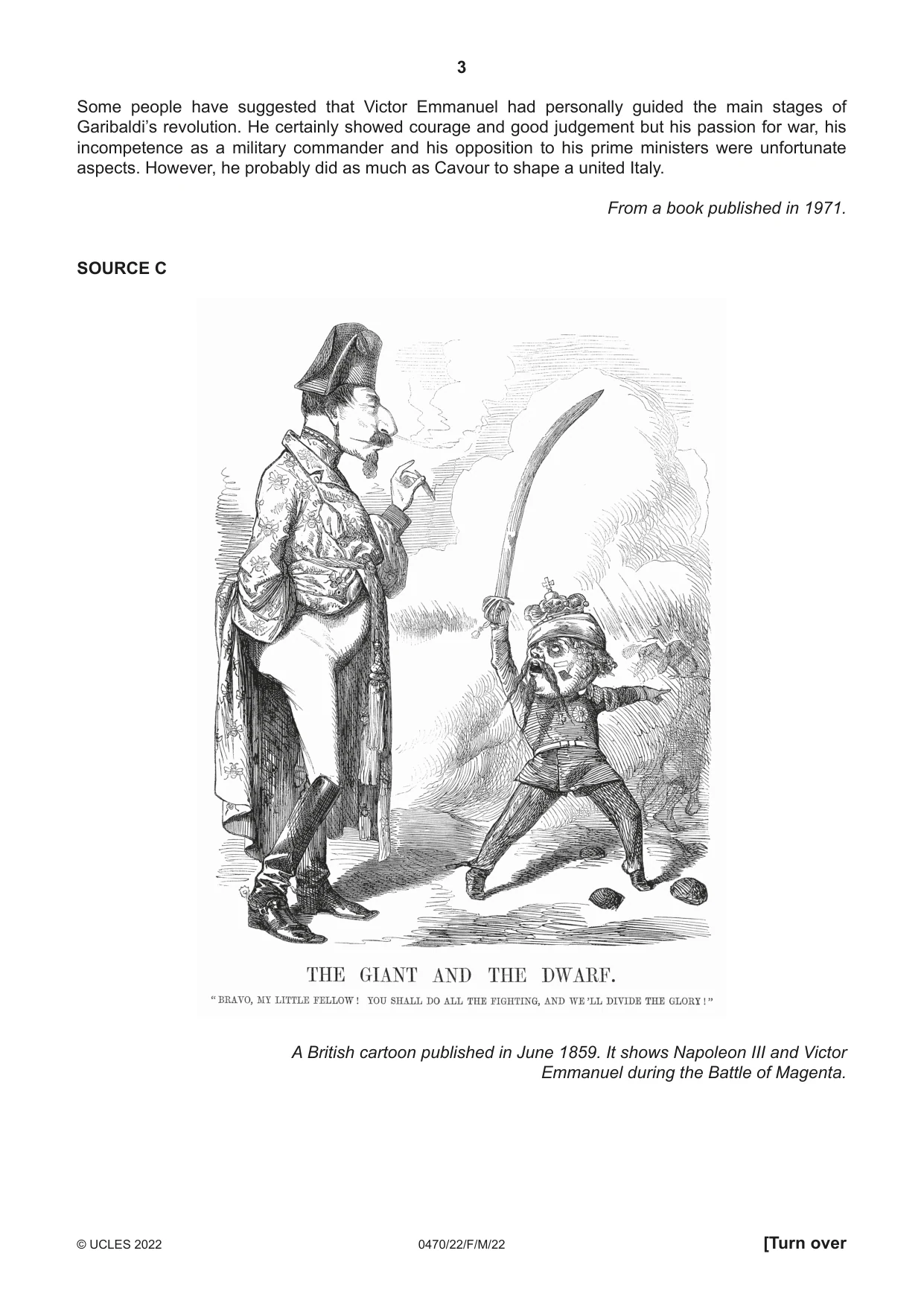
3 0470/22/F/M/22 © UCLES 2022 [Turn over Some people have suggested that Victor Emmanuel had personally guided the main stages of Garibaldi’s revolution. He certainly showed courage and good judgement but his passion for war, his incompetence as a military commander and his opposition to his prime ministers were unfortunate aspects. However, he probably did as much as Cavour to shape a united Italy. From a book published in 1971. SOURCE C A British cartoon published in June 1859. It shows Napoleon III and Victor Emmanuel during the Battle of Magenta.
Question paper, page 4
4 0470/22/F/M/22 © UCLES 2022 SOURCE D Cavour rejected the idea of peace except under the condition of the liberation of northern Italy as agreed with Napoleon III. He said the peace contradicted the principle of Italian unity which guided his whole policy. He said promises were promises and should be kept. Cavour, as a last resort, wanted us to carry on the war alone. As military men we declined. It would have been madness. Victor Emmanuel refused to risk our certain gains of Lombardy and the Duchies. He said they increased the chances of ultimately liberating Venice and uniting Tuscany with parts of the Papal States. But Cavour would not listen and resigned. From an account written at the time by the head of the Piedmontese army about events immediately after Austria and France signed an armistice at Villafranca in July 1859. SOURCE E His Majesty said, ‘The advantage of an armistice was all on our side. Had the fighting gone on we should have had to fight another battle with our diminished forces, while a month’s delay would enable me to strengthen our army.’ His Majesty talked of Count Cavour’s resignation. I think he was much disturbed by it, although he claimed it was of no importance. He said, ‘Cavour is a muddle-head who is always pushing me into trouble. He is mad. But he is finished now.’ To my statement that Count Cavour would be back in office soon, the King gave a serious denial. An Englishman’s account of a conversation he had with Victor Emmanuel shortly after the signing of the armistice of Villafranca. SOURCE F Having already written officially as King to you, I suggest that you reply to me in these terms. Say that you are full of devotion for the King and that you would wish to follow his advice. However, your duties towards Italy will not allow you to refuse to help the people of Naples when they call you to free them from a government which no loyal Italian can trust. Say that you cannot follow the King’s wishes as you want to keep your freedom of action. A secret letter from Victor Emmanuel to Garibaldi, 23 July 1860. It was delivered to Garibaldi at the same time as another letter from the King that asked Garibaldi not to sail from Sicily to the mainland. SOURCE G Garibaldi is planning the wildest schemes. He is putting off the day when Sicily will demand annexation to Piedmont, for he wants to keep his dictatorial powers which will enable him to raise an army to conquer Naples, then Rome, and in the end Venice. The government here has no influence over him. From a letter by Cavour to a leading Piedmontese diplomat, 12 July 1860. SOURCE H The shining helmets had attracted all the peasants of the area, who welcomed Garibaldi with their usual enthusiasm. Garibaldi desperately tried to divert attention from himself to the King. Keeping his horse a few paces behind, he cried, ‘This is Victor Emmanuel, your King, the King of Italy.’ The peasants stared and listened and then not understanding again shouted, ‘Long live Garibaldi!’ A description by one of Garibaldi’s soldiers of the meeting between Garibaldi and Victor Emmanuel on 26 October 1860.
Question paper, page 5
5 0470/22/F/M/22 © UCLES 2022 [Turn over Now answer all the following questions. You may use any of the sources to help you answer the questions, in addition to those sources which you are told to use. In answering the questions you should use your knowledge of the topic to help you interpret and evaluate the sources. 1 Study Sources A and B. How far do these two sources agree about Victor Emmanuel? Explain your answer using details of the sources. [7] 2 Study Source C. What is the cartoonist’s message? Explain your answer using details of the source and your knowledge. [8] 3 Study Sources D and E. How far does Source D prove that what Source E claims about the armistice of Villafranca is wrong? Explain your answer using details of the sources and your knowledge. [7] 4 Study Sources F and G. Why did Victor Emmanuel send the secret letter (Source F)? Explain your answer using details of the sources and your knowledge. [8] 5 Study Source H. How surprised are you by this source? Explain your answer using details of the source and your knowledge. [8] 6 Study all the sources. How far do these sources provide convincing evidence that Victor Emmanuel was the main figure in the achievement of Italian unification? Use the sources to explain your answer. [12]
Question paper, page 6
6 0470/22/F/M/22 © UCLES 2022 Option B: Twentieth century topic DID WILSON FAIL IN THE PARIS PEACE TALKS? Study the Background Information and the sources carefully, and then answer all the questions. Background Information Textbooks often describe President Wilson as an idealist very unlike Clemenceau and Lloyd George. It is often written that they were only interested in benefiting their own countries, while Wilson wanted to achieve something good for the whole of the world. At the Paris Peace Talks, how far was Wilson able to achieve his aims? SOURCE A US President Woodrow Wilson, in a speech in January 1918, explained his vision for the postwar world. His Fourteen Points were the basis of his plan for a comprehensive overhaul of international relations. He called for, amongst other things, an immediate end to the war, the establishment of an international peacekeeping organisation and international disarmament. Wilson’s Fourteen Points were hugely influential in shaping the postwar world and in spreading the language of peace and democracy around the world. He was also responsible for establishing the League of Nations international peacekeeping organisation, tasked with resolving international disputes without resorting to military force. He was also able to fulfil his promise of self-government through the creation of Poland, Yugoslavia and Czechoslovakia. One of the most controversial terms of the Treaty of Versailles was the War Guilt Clause, which blamed Germany for the war. Germany was also forced to disarm, to make territorial concessions, and to pay reparations to the Allied powers. Although US President Woodrow Wilson was opposed to such harsh terms, he was outmanoeuvred by French Prime Minister Georges Clemenceau. Germany was appalled by these terms. Although the treaty reflected Wilson’s vision for the postwar world, isolationists in the US Congress made sure that it was not ratified and that the United States never became a member of the League of Nations. However, Wilson’s vision shaped much of the postwar world, and for his peacemaking efforts he was awarded the 1919 Nobel Peace Prize. From a website about American history. SOURCE B Wilson had called for a ‘peace without victory’ and had set out his Fourteen Points as a basis for a treaty. Unfortunately, these Points were largely forgotten in the peace negotiations. However, a key point was to create a league of nations as the basis for a new international order to prevent future wars. The Treaty did create the League of Nations, but Wilson did not achieve ‘peace without victory’ as many of the Treaty’s terms punished Germany harshly. Aside from the establishment of the League of Nations, a main aim of Wilson’s was to establish a lasting peace but he conceded many controversial points to the other powers present at the conference. Germany was required to pay war reparations and subjected to military occupation in the Rhineland. Additionally, the treaty specifically named Germany as responsible for the war. Germany hated these terms which contributed little to the chance of lasting peace in Europe.
Question paper, page 7
7 0470/22/F/M/22 © UCLES 2022 [Turn over Wilson’s other main aim at the Paris Peace Conference was to use self-determination as the primary basis of international borders. Despite this, he agreed to the creation of mandates in former German and Ottoman territories, allowing the European powers and Japan to establish colonies in the Middle East, Africa, and Asia, undermining his promise of self-government. The conference finished negotiations in May 1919, at which point German leaders viewed the treaty for the first time. They were shocked by its terms and immediately rejected it. From a recent history book. SOURCE C I am leaving Paris, after eight fateful months, with conflicting emotions. Looking at the conference in retrospect, there is much to approve and yet much to regret. It is easy to say what should have been done, but more difficult to have found a way of doing it. To those who are saying that the treaty is bad and should never have been made and that it will involve Europe in difficulties in its enforcement, I feel like admitting it. But I would also say in reply that empires cannot be shattered, and new states raised upon their ruins, without disturbance. To create new boundaries is to create new troubles. The one follows the other. While I should have preferred a different peace, I doubt very much whether it could have been made, for the ingredients required for such a peace were lacking at Paris. From the diary of Edward House, June 1919. House was Wilson’s chief advisor at the peace negotiations. In March 1919 the two men argued, with Wilson unhappy with the compromises House was ready to make in the negotiations. SOURCE D This nation went into this war to see it through to the end, and the end has not yet come. This is the beginning of the processes which are going to make another war like this impossible. The peace treaty is a great treaty; it is a treaty of justice. The USA was formed to give the world liberty and justice. Now we are called upon to deliver that promise. From a speech by Wilson in Missouri, USA, 5 September 1919.
Question paper, page 8
8 0470/22/F/M/22 © UCLES 2022 SOURCE E A cartoon published in a British newspaper, 13 May 1919.
Question paper, page 9
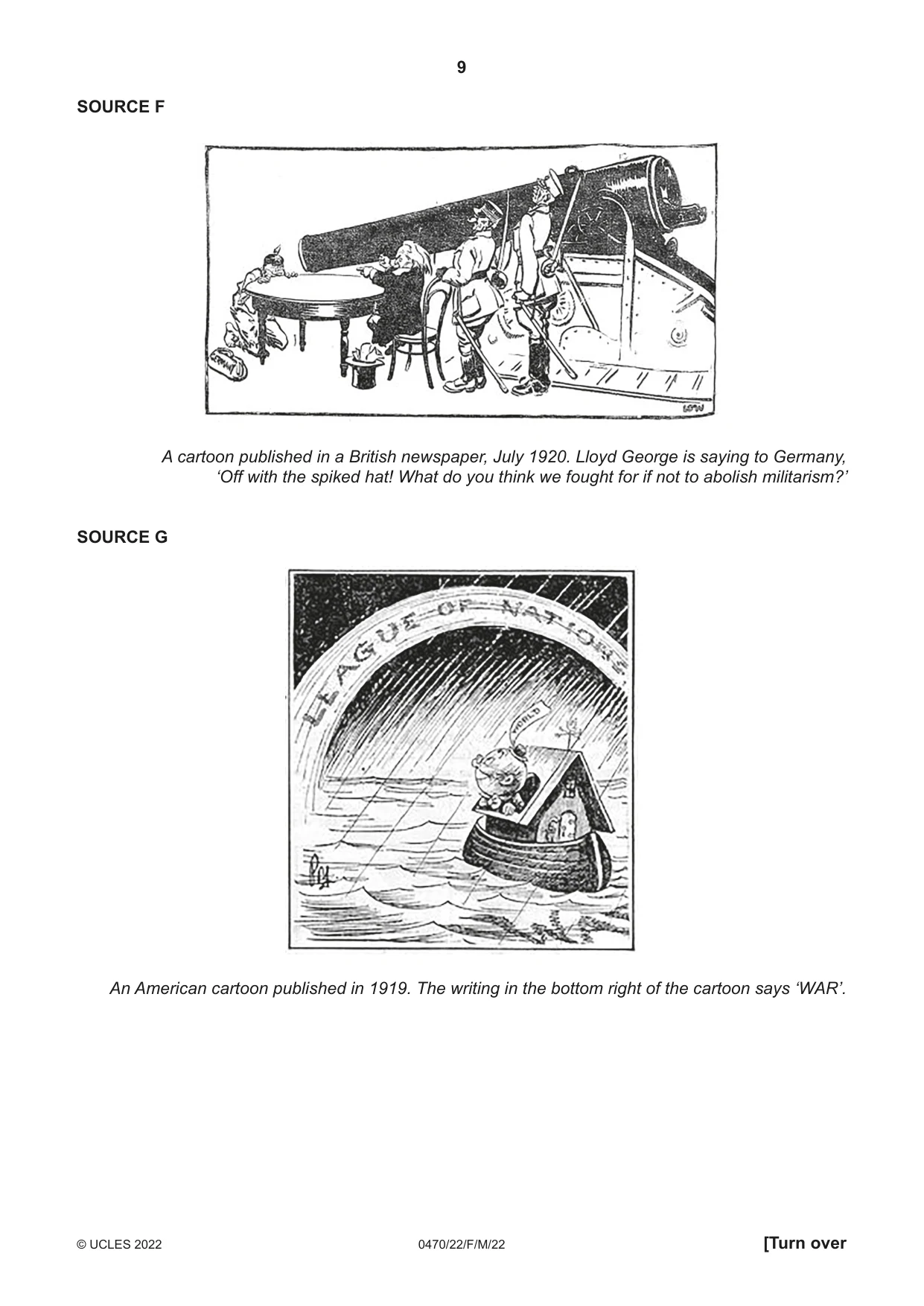
9 0470/22/F/M/22 © UCLES 2022 [Turn over SOURCE F A cartoon published in a British newspaper, July 1920. Lloyd George is saying to Germany, ‘Off with the spiked hat! What do you think we fought for if not to abolish militarism?’ SOURCE G An American cartoon published in 1919. The writing in the bottom right of the cartoon says ‘WAR’.
Question paper, page 10
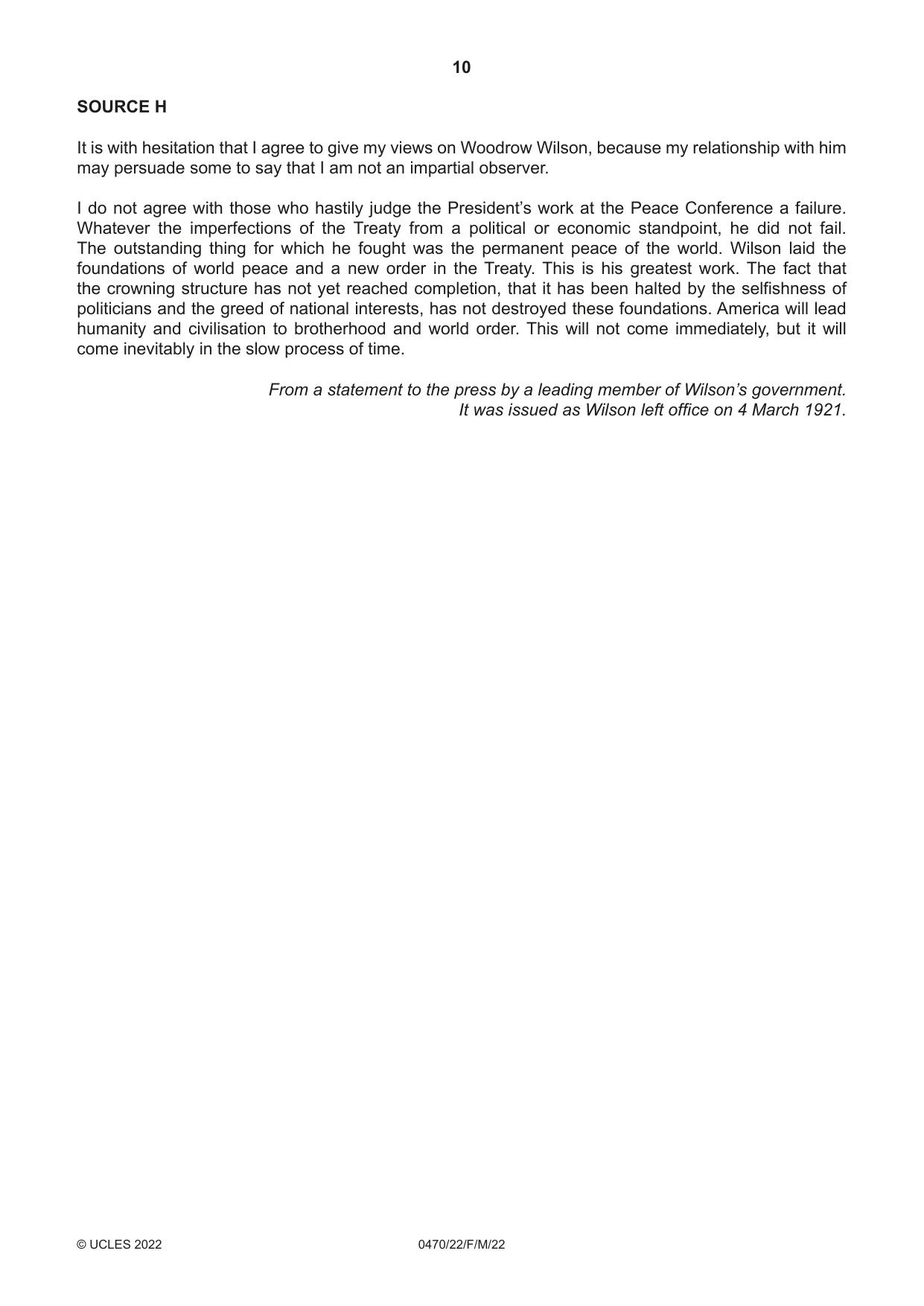
10 0470/22/F/M/22 © UCLES 2022 SOURCE H It is with hesitation that I agree to give my views on Woodrow Wilson, because my relationship with him may persuade some to say that I am not an impartial observer. I do not agree with those who hastily judge the President’s work at the Peace Conference a failure. Whatever the imperfections of the Treaty from a political or economic standpoint, he did not fail. The outstanding thing for which he fought was the permanent peace of the world. Wilson laid the foundations of world peace and a new order in the Treaty. This is his greatest work. The fact that the crowning structure has not yet reached completion, that it has been halted by the selfishness of politicians and the greed of national interests, has not destroyed these foundations. America will lead humanity and civilisation to brotherhood and world order. This will not come immediately, but it will come inevitably in the slow process of time. From a statement to the press by a leading member of Wilson’s government. It was issued as Wilson left office on 4 March 1921.
Question paper, page 11
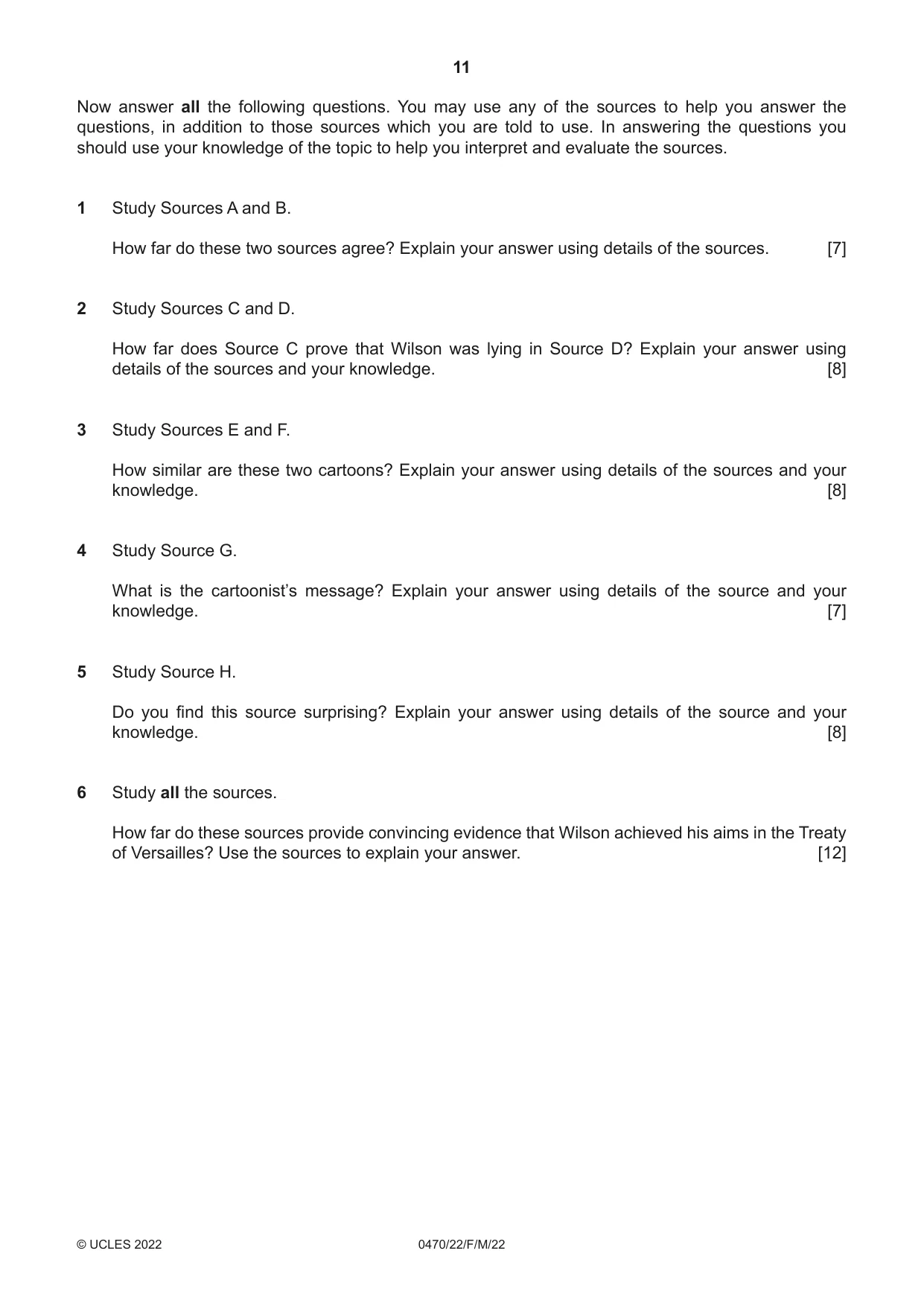
11 0470/22/F/M/22 © UCLES 2022 Now answer all the following questions. You may use any of the sources to help you answer the questions, in addition to those sources which you are told to use. In answering the questions you should use your knowledge of the topic to help you interpret and evaluate the sources. 1 Study Sources A and B. How far do these two sources agree? Explain your answer using details of the sources. [7] 2 Study Sources C and D. How far does Source C prove that Wilson was lying in Source D? Explain your answer using details of the sources and your knowledge. [8] 3 Study Sources E and F. How similar are these two cartoons? Explain your answer using details of the sources and your knowledge. [8] 4 Study Source G. What is the cartoonist’s message? Explain your answer using details of the source and your knowledge. [7] 5 Study Source H. Do you find this source surprising? Explain your answer using details of the source and your knowledge. [8] 6 Study all the sources. How far do these sources provide convincing evidence that Wilson achieved his aims in the Treaty of Versailles? Use the sources to explain your answer. [12]
Question paper, page 12
12 0470/22/F/M/22 © UCLES 2022 Permission to reproduce items where third-party owned material protected by copyright is included has been sought and cleared where possible. Every reasonable effort has been made by the publisher (UCLES) to trace copyright holders, but if any items requiring clearance have unwittingly been included, the publisher will be pleased to make amends at the earliest possible opportunity. To avoid the issue of disclosure of answer-related information to candidates, all copyright acknowledgements are reproduced online in the Cambridge Assessment International Education Copyright Acknowledgements Booklet. This is produced for each series of examinations and is freely available to download at www.cambridgeinternational.org after the live examination series. Cambridge Assessment International Education is part of Cambridge Assessment. Cambridge Assessment is the brand name of the University of Cambridge Local Examinations Syndicate (UCLES), which is a department of the University of Cambridge. BLANK PAGE
Mark scheme, page 1
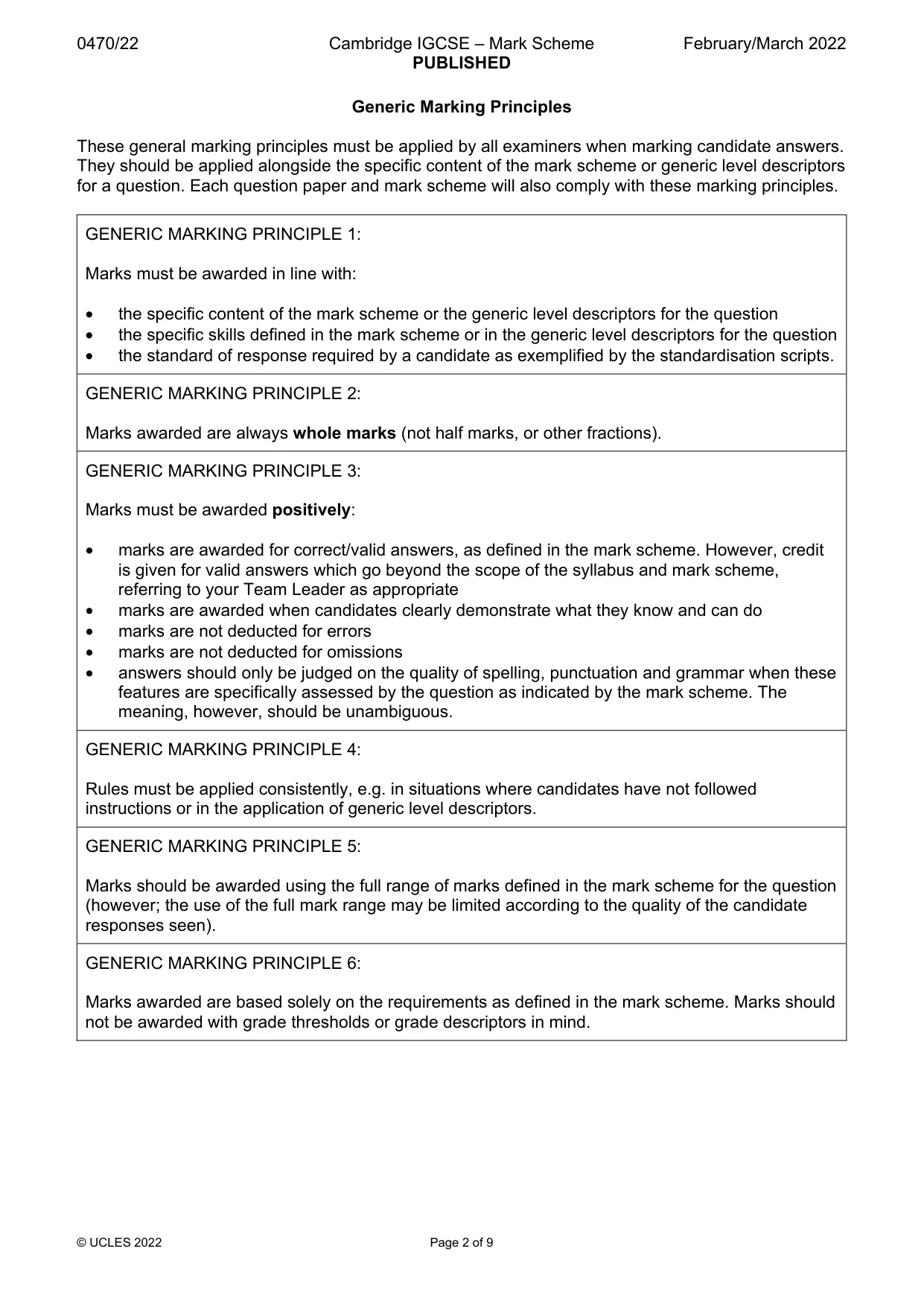
This document consists of 9 printed pages. © UCLES 2022 [Turn over Cambridge IGCSE™ HISTORY 0470/22 Paper 2 February/March 2022 MARK SCHEME Maximum Mark: 50 Published This mark scheme is published as an aid to teachers and candidates, to indicate the requirements of the examination. It shows the basis on which Examiners were instructed to award marks. It does not indicate the details of the discussions that took place at an Examiners’ meeting before marking began, which would have considered the acceptability of alternative answers. Mark schemes should be read in conjunction with the question paper and the Principal Examiner Report for Teachers. Cambridge International will not enter into discussions about these mark schemes. Cambridge International is publishing the mark schemes for the February/March 2022 series for most Cambridge IGCSE™, Cambridge International A and AS Level components and some Cambridge O Level components.
Mark scheme, page 2
0470/22 Cambridge IGCSE – Mark Scheme PUBLISHED February/March 2022 © UCLES 2022 Page 2 of 9 Generic Marking Principles These general marking principles must be applied by all examiners when marking candidate answers. They should be applied alongside the specific content of the mark scheme or generic level descriptors for a question. Each question paper and mark scheme will also comply with these marking principles. GENERIC MARKING PRINCIPLE 1: Marks must be awarded in line with: • the specific content of the mark scheme or the generic level descriptors for the question • the specific skills defined in the mark scheme or in the generic level descriptors for the question • the standard of response required by a candidate as exemplified by the standardisation scripts. GENERIC MARKING PRINCIPLE 2: Marks awarded are always whole marks (not half marks, or other fractions). GENERIC MARKING PRINCIPLE 3: Marks must be awarded positively: • marks are awarded for correct/valid answers, as defined in the mark scheme. However, credit is given for valid answers which go beyond the scope of the syllabus and mark scheme, referring to your Team Leader as appropriate • marks are awarded when candidates clearly demonstrate what they know and can do • marks are not deducted for errors • marks are not deducted for omissions • answers should only be judged on the quality of spelling, punctuation and grammar when these features are specifically assessed by the question as indicated by the mark scheme. The meaning, however, should be unambiguous. GENERIC MARKING PRINCIPLE 4: Rules must be applied consistently, e.g. in situations where candidates have not followed instructions or in the application of generic level descriptors. GENERIC MARKING PRINCIPLE 5: Marks should be awarded using the full range of marks defined in the mark scheme for the question (however; the use of the full mark range may be limited according to the quality of the candidate responses seen). GENERIC MARKING PRINCIPLE 6: Marks awarded are based solely on the requirements as defined in the mark scheme. Marks should not be awarded with grade thresholds or grade descriptors in mind.
Mark scheme, page 3
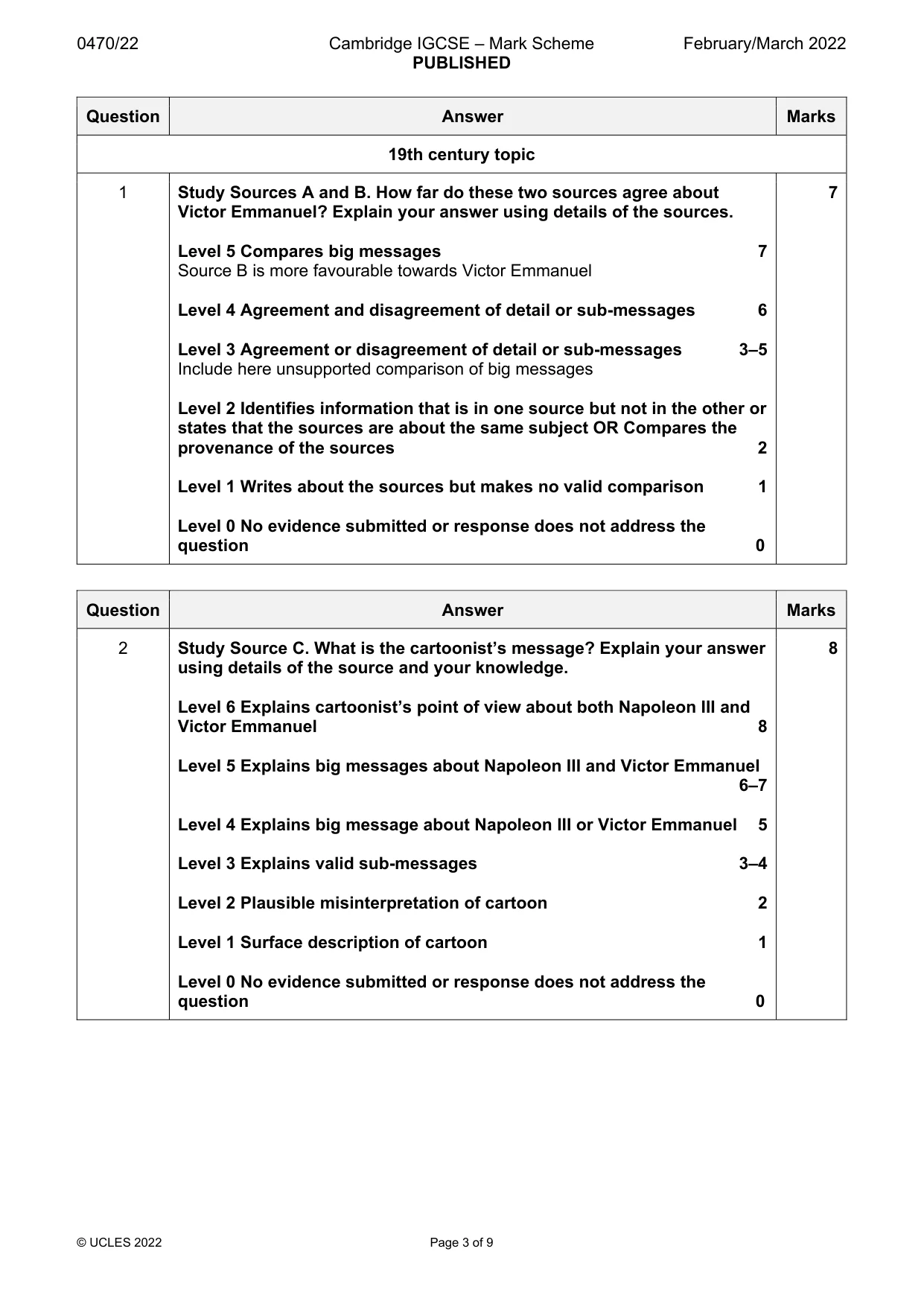
0470/22 Cambridge IGCSE – Mark Scheme PUBLISHED February/March 2022 © UCLES 2022 Page 3 of 9 Question Answer Marks 19th century topic 1 Study Sources A and B. How far do these two sources agree about Victor Emmanuel? Explain your answer using details of the sources. Level 5 Compares big messages 7 Source B is more favourable towards Victor Emmanuel Level 4 Agreement and disagreement of detail or sub-messages 6 Level 3 Agreement or disagreement of detail or sub-messages 3–5 Include here unsupported comparison of big messages Level 2 Identifies information that is in one source but not in the other or states that the sources are about the same subject OR Compares the provenance of the sources 2 Level 1 Writes about the sources but makes no valid comparison 1 Level 0 No evidence submitted or response does not address the question 0 7 Question Answer Marks 2 Study Source C. What is the cartoonist’s message? Explain your answer using details of the source and your knowledge. Level 6 Explains cartoonist’s point of view about both Napoleon III and Victor Emmanuel 8 Level 5 Explains big messages about Napoleon III and Victor Emmanuel 6–7 Level 4 Explains big message about Napoleon III or Victor Emmanuel 5 Level 3 Explains valid sub-messages 3–4 Level 2 Plausible misinterpretation of cartoon 2 Level 1 Surface description of cartoon 1 Level 0 No evidence submitted or response does not address the question 0 8
Mark scheme, page 4
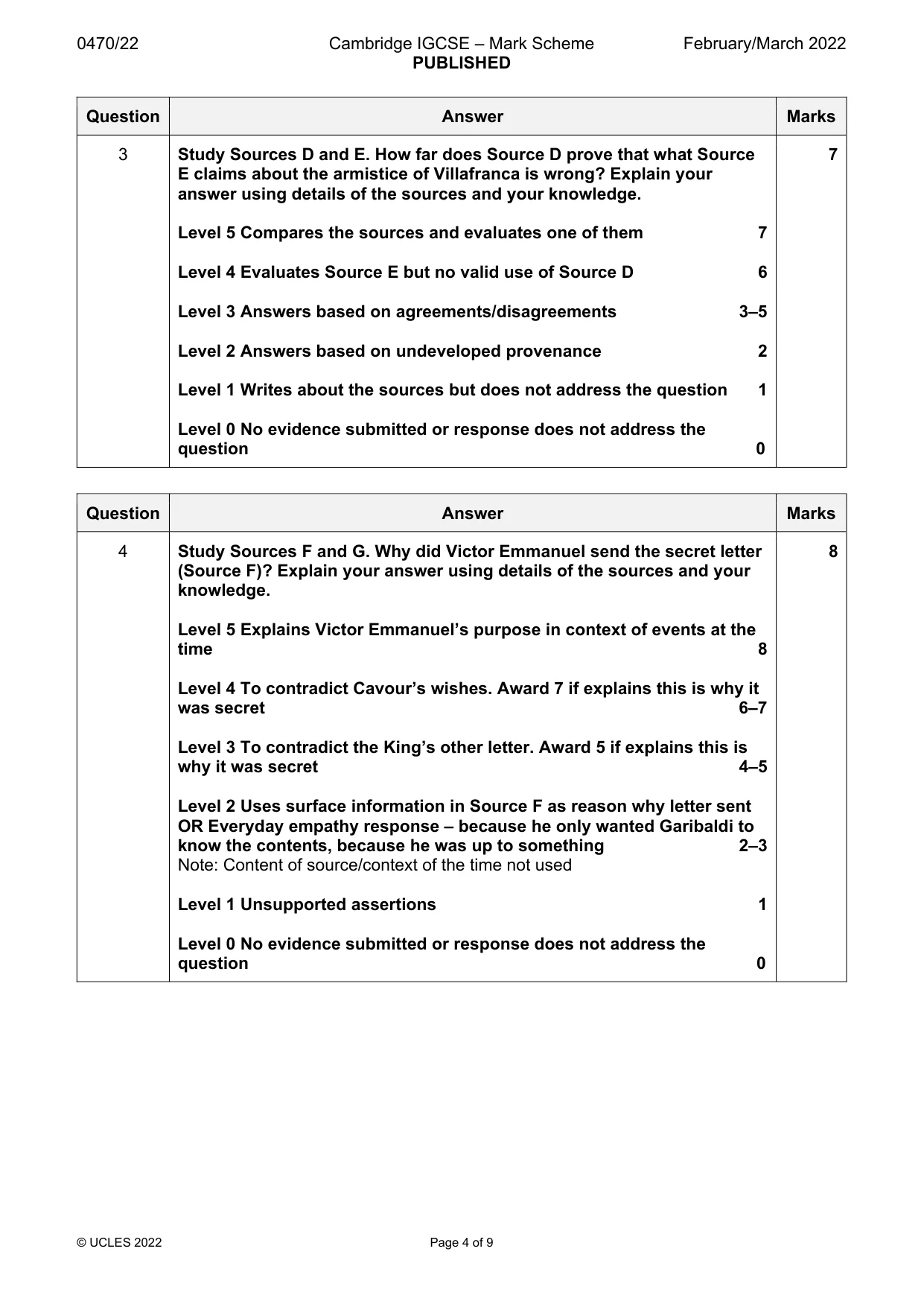
0470/22 Cambridge IGCSE – Mark Scheme PUBLISHED February/March 2022 © UCLES 2022 Page 4 of 9 Question Answer Marks 3 Study Sources D and E. How far does Source D prove that what Source E claims about the armistice of Villafranca is wrong? Explain your answer using details of the sources and your knowledge. Level 5 Compares the sources and evaluates one of them 7 Level 4 Evaluates Source E but no valid use of Source D 6 Level 3 Answers based on agreements/disagreements 3–5 Level 2 Answers based on undeveloped provenance 2 Level 1 Writes about the sources but does not address the question 1 Level 0 No evidence submitted or response does not address the question 0 7 Question Answer Marks 4 Study Sources F and G. Why did Victor Emmanuel send the secret letter (Source F)? Explain your answer using details of the sources and your knowledge. Level 5 Explains Victor Emmanuel’s purpose in context of events at the time 8 Level 4 To contradict Cavour’s wishes. Award 7 if explains this is why it was secret 6–7 Level 3 To contradict the King’s other letter. Award 5 if explains this is why it was secret 4–5 Level 2 Uses surface information in Source F as reason why letter sent OR Everyday empathy response – because he only wanted Garibaldi to know the contents, because he was up to something 2–3 Note: Content of source/context of the time not used Level 1 Unsupported assertions 1 Level 0 No evidence submitted or response does not address the question 0 8
Mark scheme, page 5
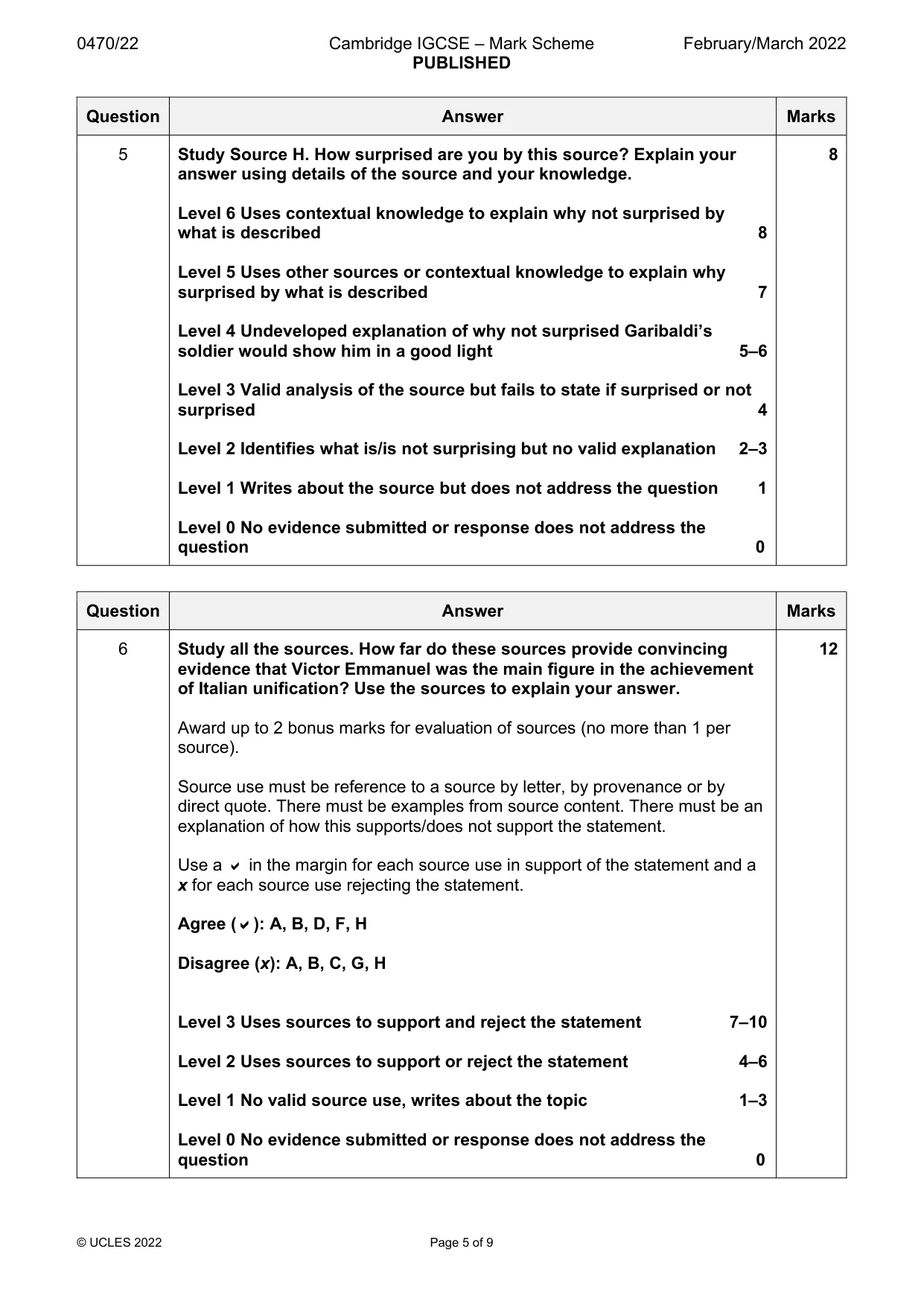
0470/22 Cambridge IGCSE – Mark Scheme PUBLISHED February/March 2022 © UCLES 2022 Page 5 of 9 Question Answer Marks 5 Study Source H. How surprised are you by this source? Explain your answer using details of the source and your knowledge. Level 6 Uses contextual knowledge to explain why not surprised by what is described 8 Level 5 Uses other sources or contextual knowledge to explain why surprised by what is described 7 Level 4 Undeveloped explanation of why not surprised Garibaldi’s soldier would show him in a good light 5–6 Level 3 Valid analysis of the source but fails to state if surprised or not surprised 4 Level 2 Identifies what is/is not surprising but no valid explanation 2–3 Level 1 Writes about the source but does not address the question 1 Level 0 No evidence submitted or response does not address the question 0 8 Question Answer Marks 6 Study all the sources. How far do these sources provide convincing evidence that Victor Emmanuel was the main figure in the achievement of Italian unification? Use the sources to explain your answer. Award up to 2 bonus marks for evaluation of sources (no more than 1 per source). Source use must be reference to a source by letter, by provenance or by direct quote. There must be examples from source content. There must be an explanation of how this supports/does not support the statement. Use a in the margin for each source use in support of the statement and a x for each source use rejecting the statement. Agree (): A, B, D, F, H Disagree (x): A, B, C, G, H Level 3 Uses sources to support and reject the statement 7–10 Level 2 Uses sources to support or reject the statement 4–6 Level 1 No valid source use, writes about the topic 1–3 Level 0 No evidence submitted or response does not address the question 0 12
Mark scheme, page 6
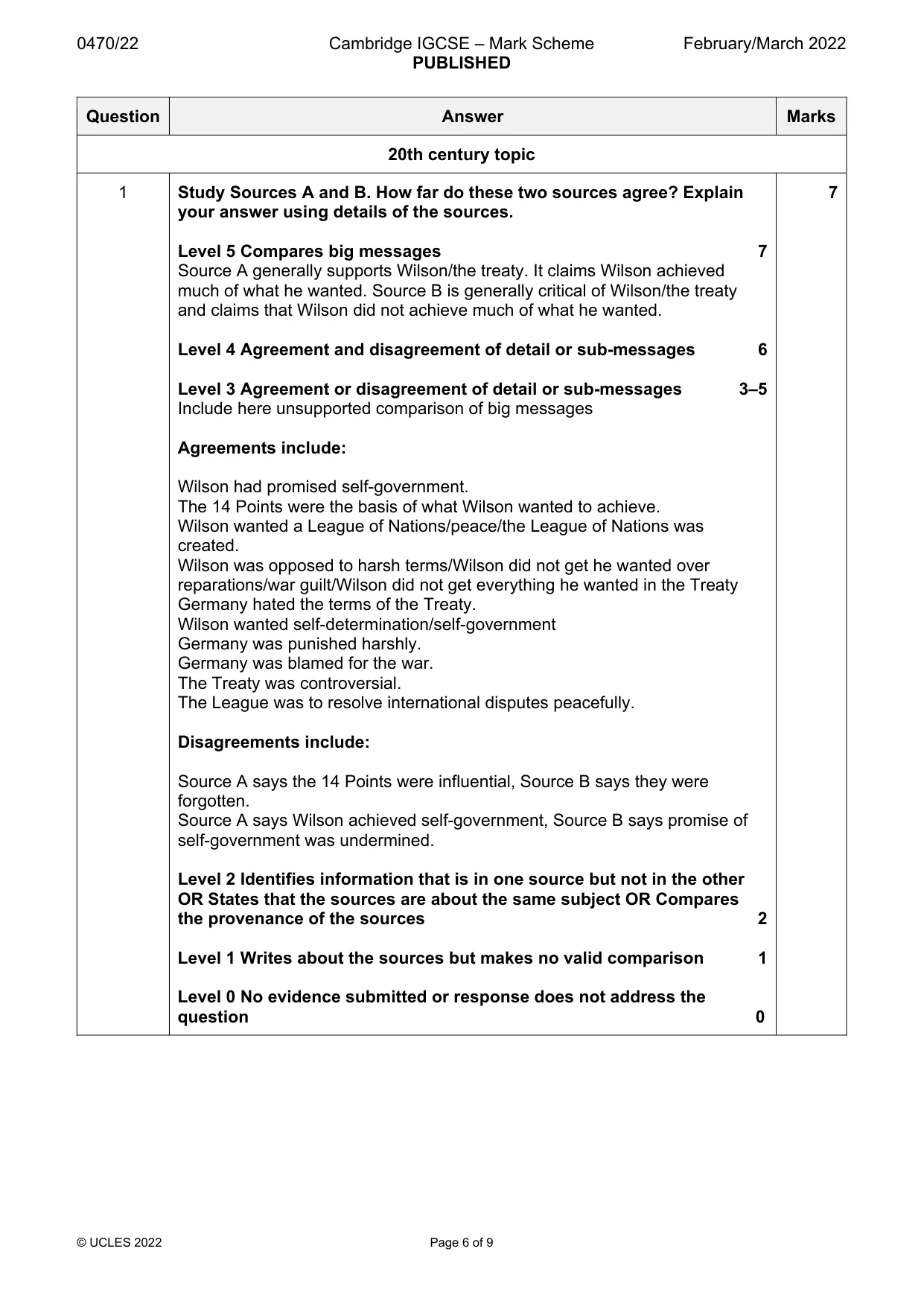
0470/22 Cambridge IGCSE – Mark Scheme PUBLISHED February/March 2022 © UCLES 2022 Page 6 of 9 Question Answer Marks 20th century topic 1 Study Sources A and B. How far do these two sources agree? Explain your answer using details of the sources. Level 5 Compares big messages 7 Source A generally supports Wilson/the treaty. It claims Wilson achieved much of what he wanted. Source B is generally critical of Wilson/the treaty and claims that Wilson did not achieve much of what he wanted. Level 4 Agreement and disagreement of detail or sub-messages 6 Level 3 Agreement or disagreement of detail or sub-messages 3–5 Include here unsupported comparison of big messages Agreements include: Wilson had promised self-government. The 14 Points were the basis of what Wilson wanted to achieve. Wilson wanted a League of Nations/peace/the League of Nations was created. Wilson was opposed to harsh terms/Wilson did not get he wanted over reparations/war guilt/Wilson did not get everything he wanted in the Treaty Germany hated the terms of the Treaty. Wilson wanted self-determination/self-government Germany was punished harshly. Germany was blamed for the war. The Treaty was controversial. The League was to resolve international disputes peacefully. Disagreements include: Source A says the 14 Points were influential, Source B says they were forgotten. Source A says Wilson achieved self-government, Source B says promise of self-government was undermined. Level 2 Identifies information that is in one source but not in the other OR States that the sources are about the same subject OR Compares the provenance of the sources 2 Level 1 Writes about the sources but makes no valid comparison 1 Level 0 No evidence submitted or response does not address the question 0 7
Mark scheme, page 7
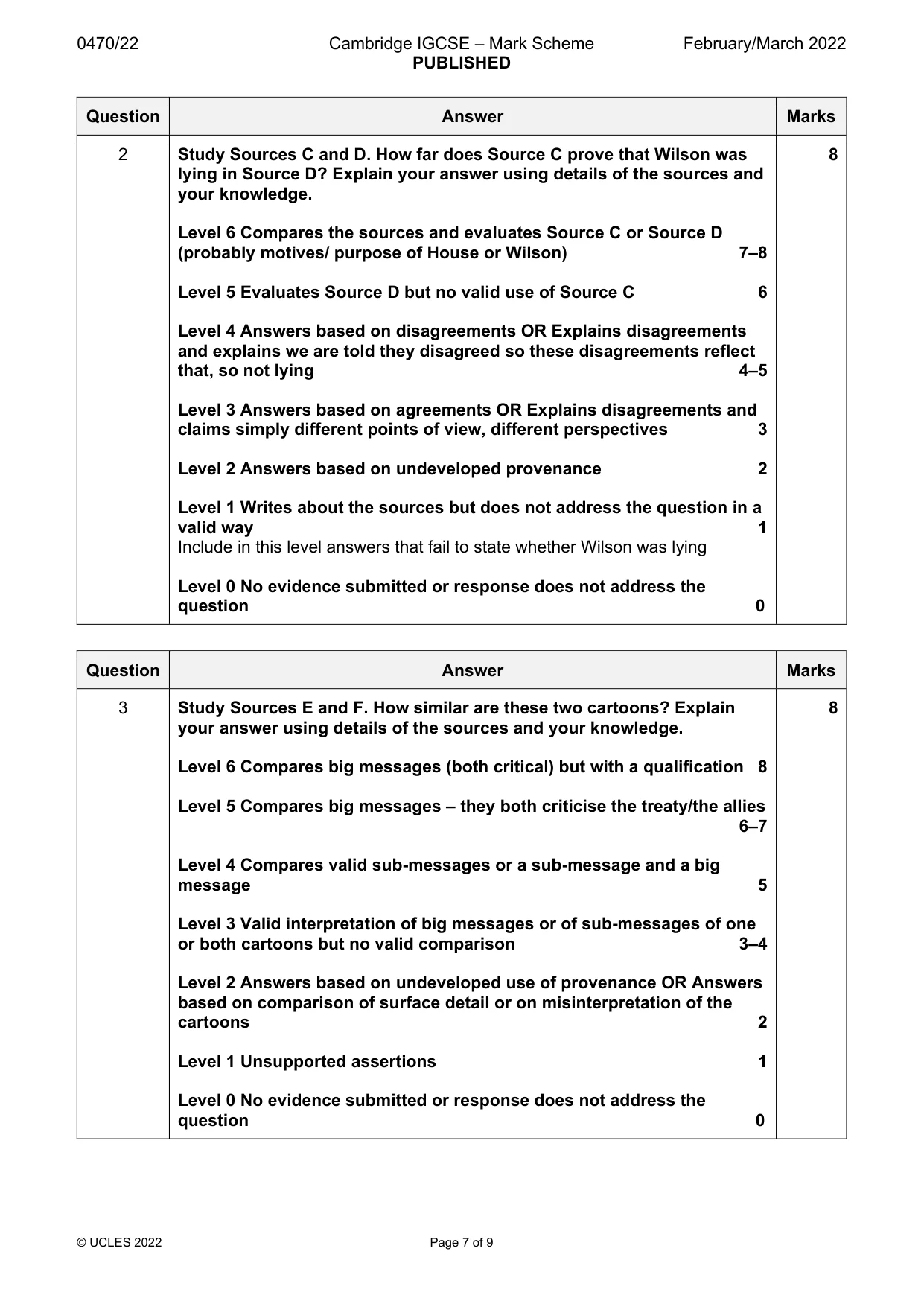
0470/22 Cambridge IGCSE – Mark Scheme PUBLISHED February/March 2022 © UCLES 2022 Page 7 of 9 Question Answer Marks 2 Study Sources C and D. How far does Source C prove that Wilson was lying in Source D? Explain your answer using details of the sources and your knowledge. Level 6 Compares the sources and evaluates Source C or Source D (probably motives/ purpose of House or Wilson) 7–8 Level 5 Evaluates Source D but no valid use of Source C 6 Level 4 Answers based on disagreements OR Explains disagreements and explains we are told they disagreed so these disagreements reflect that, so not lying 4–5 Level 3 Answers based on agreements OR Explains disagreements and claims simply different points of view, different perspectives 3 Level 2 Answers based on undeveloped provenance 2 Level 1 Writes about the sources but does not address the question in a valid way 1 Include in this level answers that fail to state whether Wilson was lying Level 0 No evidence submitted or response does not address the question 0 8 Question Answer Marks 3 Study Sources E and F. How similar are these two cartoons? Explain your answer using details of the sources and your knowledge. Level 6 Compares big messages (both critical) but with a qualification 8 Level 5 Compares big messages – they both criticise the treaty/the allies 6–7 Level 4 Compares valid sub-messages or a sub-message and a big message 5 Level 3 Valid interpretation of big messages or of sub-messages of one or both cartoons but no valid comparison 3–4 Level 2 Answers based on undeveloped use of provenance OR Answers based on comparison of surface detail or on misinterpretation of the cartoons 2 Level 1 Unsupported assertions 1 Level 0 No evidence submitted or response does not address the question 0 8
Mark scheme, page 8
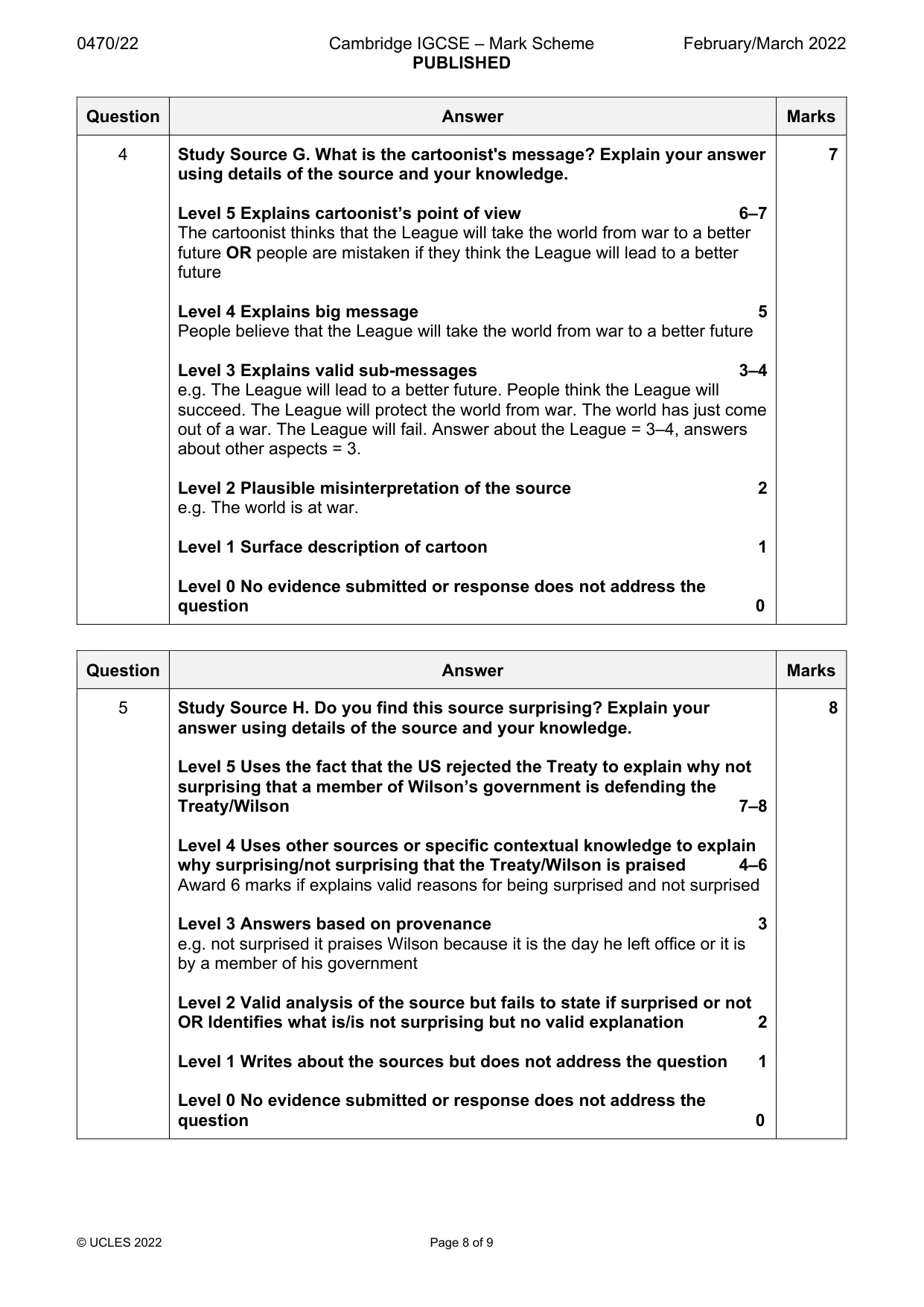
0470/22 Cambridge IGCSE – Mark Scheme PUBLISHED February/March 2022 © UCLES 2022 Page 8 of 9 Question Answer Marks 4 Study Source G. What is the cartoonist's message? Explain your answer using details of the source and your knowledge. Level 5 Explains cartoonist’s point of view 6–7 The cartoonist thinks that the League will take the world from war to a better future OR people are mistaken if they think the League will lead to a better future Level 4 Explains big message 5 People believe that the League will take the world from war to a better future Level 3 Explains valid sub-messages 3–4 e.g. The League will lead to a better future. People think the League will succeed. The League will protect the world from war. The world has just come out of a war. The League will fail. Answer about the League = 3–4, answers about other aspects = 3. Level 2 Plausible misinterpretation of the source 2 e.g. The world is at war. Level 1 Surface description of cartoon 1 Level 0 No evidence submitted or response does not address the question 0 7 Question Answer Marks 5 Study Source H. Do you find this source surprising? Explain your answer using details of the source and your knowledge. Level 5 Uses the fact that the US rejected the Treaty to explain why not surprising that a member of Wilson’s government is defending the Treaty/Wilson 7–8 Level 4 Uses other sources or specific contextual knowledge to explain why surprising/not surprising that the Treaty/Wilson is praised 4–6 Award 6 marks if explains valid reasons for being surprised and not surprised Level 3 Answers based on provenance 3 e.g. not surprised it praises Wilson because it is the day he left office or it is by a member of his government Level 2 Valid analysis of the source but fails to state if surprised or not OR Identifies what is/is not surprising but no valid explanation 2 Level 1 Writes about the sources but does not address the question 1 Level 0 No evidence submitted or response does not address the question 0 8
Mark scheme, page 9
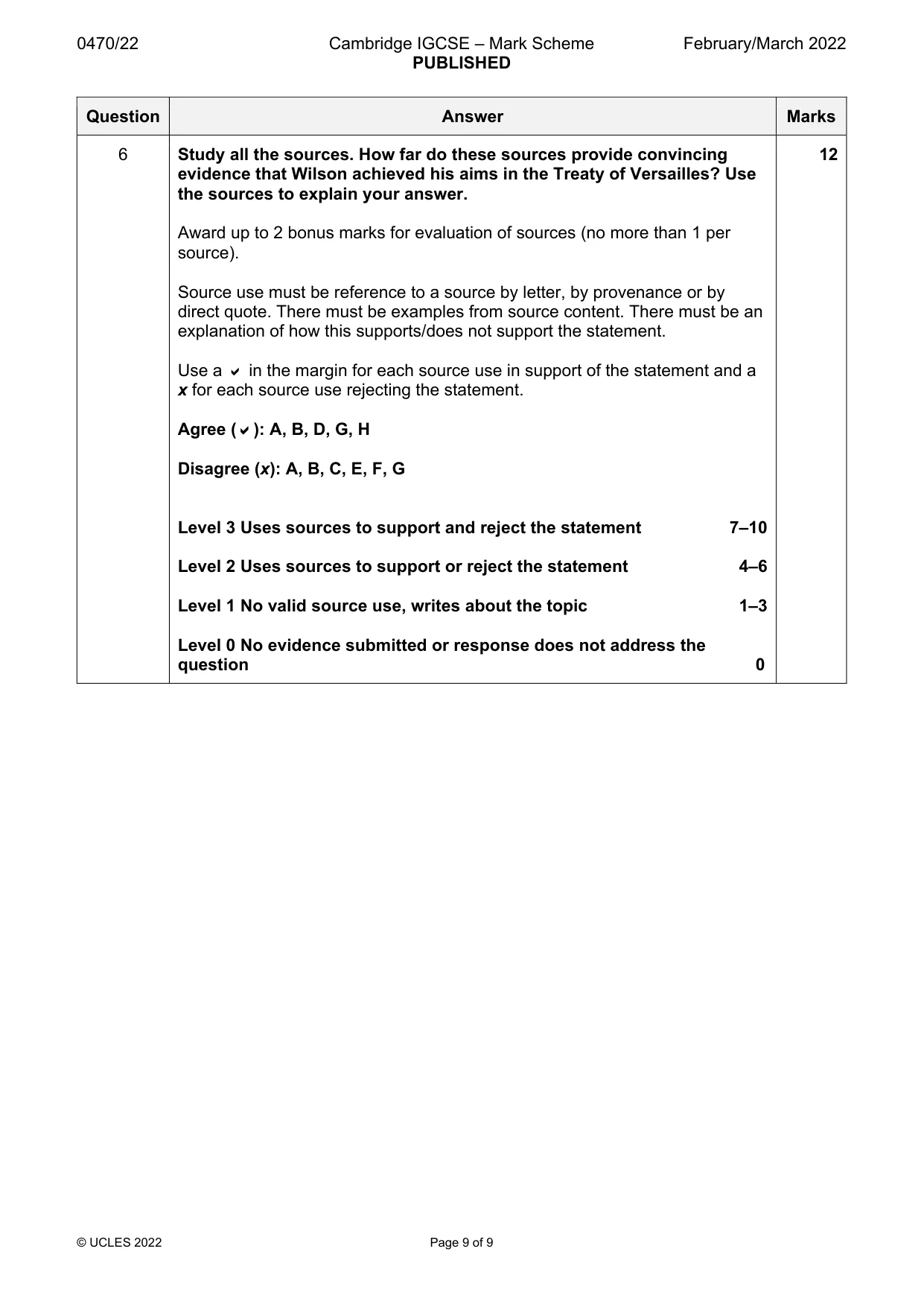
0470/22 Cambridge IGCSE – Mark Scheme PUBLISHED February/March 2022 © UCLES 2022 Page 9 of 9 Question Answer Marks 6 Study all the sources. How far do these sources provide convincing evidence that Wilson achieved his aims in the Treaty of Versailles? Use the sources to explain your answer. Award up to 2 bonus marks for evaluation of sources (no more than 1 per source). Source use must be reference to a source by letter, by provenance or by direct quote. There must be examples from source content. There must be an explanation of how this supports/does not support the statement. Use a in the margin for each source use in support of the statement and a x for each source use rejecting the statement. Agree (): A, B, D, G, H Disagree (x): A, B, C, E, F, G Level 3 Uses sources to support and reject the statement 7–10 Level 2 Uses sources to support or reject the statement 4–6 Level 1 No valid source use, writes about the topic 1–3 Level 0 No evidence submitted or response does not address the question 0 12
What you needed in this session
Cambridge’s own grade thresholds for 2022 Feb/March, Paper 2 · Variant 2. A higher threshold means an easier paper — the bar moves with how the cohort did.