Cambridge IGCSE History 0470 — 2021 Feb/March Paper 2 · Variant 2
0470/22/F/M/21 · 50 marks · ≈56 min
The question paper and its mark scheme, free to read here and free to download. This is Cambridge’s own paper, exactly as it was sat.
Question paper12 pages

Mark scheme14 pages
Answers below. Sit the paper first if you are practising.
Paper as text
Question paper, page 1
This document has 12 pages. Any blank pages are indicated. Cambridge IGCSE™ DC (MB) 200127/2 © UCLES 2021 [Turn over * 0 7 9 6 2 9 4 0 4 8 * HISTORY 0470/22 Paper 2 February/March 2021 2 hours You must answer on the enclosed answer booklet. You will need: Answer booklet (enclosed) INSTRUCTIONS ● Answer all the questions on one option only. Option A: Nineteenth century topic Option B: Twentieth century topic ● Follow the instructions on the front cover of the answer booklet. If you need additional answer paper, ask the invigilator for a continuation booklet. INFORMATION ● The total mark for this paper is 50. ● The number of marks for each question or part question is shown in brackets [ ].
Question paper, page 2
2 0470/22/F/M/21 © UCLES 2021 Option A: Nineteenth century topic HOW FAR WAS PRUSSIA’S DOMINANT POSITION IN GERMANY BY 1867 ACHIEVED THROUGH THE USE OF FORCE? Study the Background Information and the sources carefully, and then answer all the questions. Background Information When Bismarck became chief minister of Prussia in 1862 one of his aims was to make Prussia the leading state in Germany. Two obstacles stood in his way. First, the Austrian empire had a population almost twice the size of Prussia, and a larger army. Second, most German states did not want to be dominated by Prussia. By 1867 Bismarck had achieved his aim, but had he always intended to do this purely by force? SOURCE A When Bismarck took over control of Prussian foreign policy there was no dramatic change of direction. he war of 1866 may appear with hindsight to have been the inevitable and planned result of Bismarck’s policies, but not all the factors which led to the outbreak of hostilities were within Bismarck’s control. From a history book published in 2000. SOURCE B When Bismarck came to power his thoughts were primarily concerned with problems of foreign policy, where his opponent, Austria, was rather active. Hostility between Prussia and Austria was, in fact, unavoidable. Relations between Prussia and Austria were already strained and became worse after Bismarck’s appointment. He rejected Austrian proposals to reform the German Confederation which would have strengthened the influence of Austria and told the Austrian government that relations between the two countries were so bad that they would end in war. The only way to avoid a war, he said, was for Austria to surrender its position in Germany and focus eastwards. Was it Bismarck’s intention from the time of the peace with Denmark in 1864 to make war against Austria? He certainly never had any concerns about a war of this kind. He might have been willing to do without the war if he could have achieved his aims by diplomatic means and was probably not determined on war from the beginning. However, he was engaged on a policy against Austria which made war unavoidable and two important aspects of his actions should be noted: first, in 1865 he rejected every opportunity by which war might be avoided; second, he worked with patience to remove Content removed due to copyright restrictions.
Question paper, page 3
3 0470/22/F/M/21 © UCLES 2021 [Turn over the obstacles to war. The mistake of the Austrian government was that it did not see in time that war was inevitable, and that military preparations were necessary. But they cannot be blamed for having failed to avoid a war that was in no way avoidable. From a history book published in 1918. SOURCE C I shall soon have to lead the Prussian government. My first task will be to organise the Prussian army. As soon as it is in a condition to command respect, then I shall take the first opportunity to declare war on Austria, dissolve the German Confederation, bring the middle and the smaller states under Prussian control and give Germany a national union under the leadership of Prussia. Bismarck’s conversation with a British politician in London in 1862, as reported by Count Eckstadt, Saxony’s ambassador in London. SOURCE D We both owe it to public opinion to carry out our policy completely, to assert our power and influence in Germany, and not to yield to any direct attacks from the Lesser States. The idea of Austria and Prussia together, that they should co-operate in the action against Schleswig-Holstein, must be accepted by the Confederation. The Lesser States must learn that if they attempt to subject the European policy of Austria and Prussia to the control of the majority of the Confederation, they will make the continuance of friendly relations with the Confederation impossible for these two Powers. A letter from Bismarck to the Austrian government, 1863. SOURCE E In a meeting with the king and the army chiefs I declared it to be my belief that peace must be concluded on the Austrian terms. I was alone in my opinion. I set to work to commit to paper the reasons which I thought spoke for the conclusion of peace and begged the king, in the event of his not accepting my advice, to accept my resignation if the war was continued. We had to avoid wounding Austria too severely. We had to avoid leaving behind in Austria any unnecessary bitterness or desire for revenge. We ought to keep the possibility of becoming friends again. If Austria were severely injured, it would become the ally of France and of every other opponent of ours. A description of events in 1866, from Bismarck’s memoirs which were published in 1898. SOURCE F The only justification the Prussian government gives for the seizure of our kingdom, is that which it claims to find in the right of conquest. But there has never been a war between us and the King of Prussia. We protest in the presence of the world against our incorporation into Prussia. We pray for the support of all powers who have recognised our independence. The justification given by Prussia would menace the existence of all monarchies. Let all those who may be interested be warned. A declaration by the King of Hanover, 23 September 1866.
Question paper, page 4
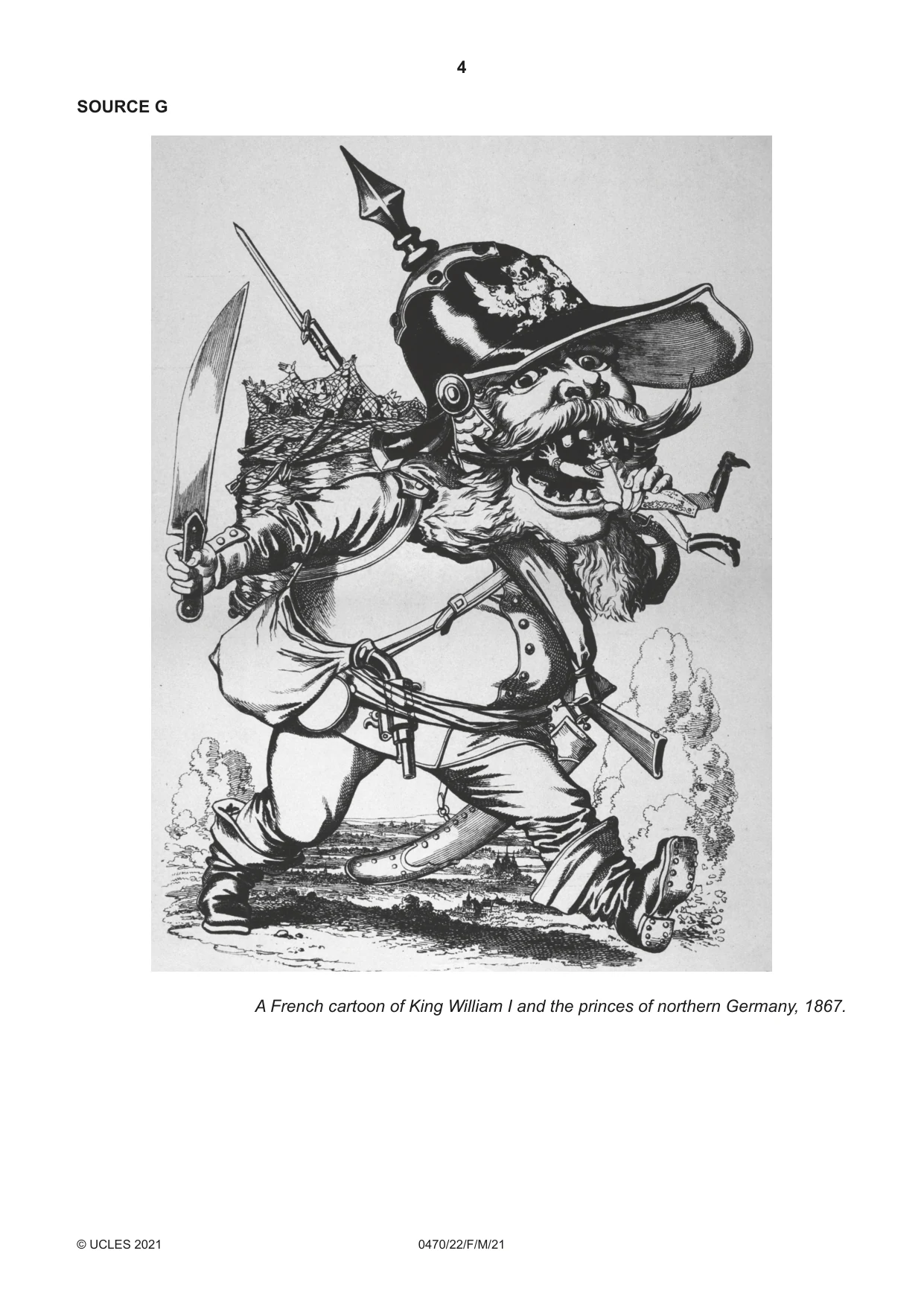
4 0470/22/F/M/21 © UCLES 2021 SOURCE G A French cartoon of King William I and the princes of northern Germany, 1867.
Question paper, page 5
5 0470/22/F/M/21 © UCLES 2021 [Turn over Now answer all the following questions. You may use any of the sources to help you answer the questions, in addition to those sources which you are told to use. In answering the questions you should use your knowledge of the topic to help you interpret and evaluate the sources. 1 Study Sources A and B. How far do these two sources agree? Explain your answer using details of the sources. [7] 2 Study Sources C and D. Does Source C mean that Bismarck was lying in Source D? Explain your answer using details of the sources and your knowledge. [8] 3 Study Source E. Do you find Source E surprising? Explain your answer using details of the source and your knowledge. [7] 4 Study Source F. Why did the King of Hanover issue this declaration at that time? Explain your answer using details of the source and your knowledge. [8] 5 Study Source G. What is the message of the cartoonist? Explain your answer using details of the source and your knowledge. [8] 6 Study all the sources. How far do these sources provide convincing evidence that Bismarck always intended to achieve Prussian dominance over Germany purely by force? Use the sources to explain your answer. [12]
Question paper, page 6
6 0470/22/F/M/21 © UCLES 2021 Option B: Twentieth century topic HOW FAR WAS THE SOVIET UNION RESPONSIBLE FOR THE WORSENING OF RELATIONS WITH THE USA AFTER THE SECOND WORLD WAR? Study the Background Information and the sources carefully, and then answer all the questions. Background Information Despite being allies against Nazi Germany, relations between the USA and the USSR began to deteriorate before the Second World War ended. The differences in ideology between the two countries probably made this inevitable. The Americans were also concerned by increasing Soviet control over Eastern Europe, while the Soviets feared the US atom bomb. Disagreements over Germany, Churchill’s claim about an ‘Iron Curtain’ descending across Europe and the Truman Doctrine of 1947 deepened the divisions between the two sides. Was the USA or the USSR responsible for these worsening relations? SOURCE A The United States and the Soviet Union stepped into the vacuum left in Europe by the decline of the European great powers. The Iron Curtain that divided Europe gave the Soviet Union security and condemned eastern Europe to decades of Soviet domination. From a history book published in 2015. SOURCE B Even if America had accepted the principle of spheres of interest, the contest could only have been delayed rather than indefinitely postponed. The Soviet Union wanted more than security. It was ideologically committed to renew the struggle against ‘Western Imperialism’. Within a year of the end of the war the Soviet Union accused its former allies of fascist and imperialist aggression. On the other hand, many people in the West felt that the police states established in eastern Europe did not represent the liberated Europe they had fought for. For Stalin, the Cold War had begun the moment the Second World War ended. However, it took Truman longer to realise what was happening. On 12 March 1947, President Truman issued his own declaration of Cold War. Presenting the Truman Doctrine to Congress, he used the American fear of Communism to convince Americans they must embark upon a Cold War foreign policy. Three months later the United States announced the Marshall Plan. The Soviets rejected it, thus demonstrating the division of Europe. It became what the Americans Content removed due to copyright restrictions.
Question paper, page 7
7 0470/22/F/M/21 © UCLES 2021 [Turn over had wanted it to be, a revival of the economies of Western Europe under American guidance and a move in the policy of containment. Despite the Cold War being forced on the West, it produced European unity and lasting American involvement in European affairs – developments highly undesirable from the Soviet point of view. From a recent history book. SOURCE C Basic features of the Soviet view of the world: The USSR still lives in antagonistic ‘capitalist encirclement’ with which in the long run there can be no permanent peaceful coexistence. As stated by Stalin in 1927 to a delegation of American workers, ‘In the course of further development of international revolution there will emerge two centres of world significance: a socialist centre, drawing to itself the countries which tend toward socialism, and a capitalist centre. Battle between these two centres for command of the world economy will decide the fate of capitalism and communism in the entire world.’ What deductions do they lead to about Soviet policy? Everything must be done to advance the relative strength of USSR as a factor in international society. No opportunity must be missed to reduce the strength and influence of capitalist powers. Soviet efforts, and those of Russia’s friends abroad, must be directed toward deepening and exploiting differences and conflicts between capitalist powers. If these eventually deepen into an ‘imperialist’ war, this war must be turned into revolutionary upheavals within the various capitalist countries. Where individual governments stand in the path of Soviet purposes, pressure will be brought for their removal. From George Kennan’s ‘Long Telegram’, 22 February 1946. Kennan was an American diplomat based in Moscow. He wrote this analysis of Soviet foreign policy for the American government. SOURCE D US foreign policy has been characterised in the post-war period by a desire for world domination. This is the real meaning of repeated statements by President Truman that the US has a right to world leadership. All the forces of American diplomacy, the Army, Navy, and Air Force, industry, and science have been placed at the service of this policy. The enormous relative importance of the USSR in European affairs, the independence of its foreign policy, and the economic and political aid which it gives neighbouring countries, is leading to a growth in the influence of the Soviet Union in these countries and a continuing strengthening in them of democratic trends. Such a situation in eastern Europe cannot fail to be viewed by the American imperialists as an obstacle in the path of an expansionist American foreign policy. It ought to be fully realised that American preparations for a future war are being conducted with the idea of war against the Soviet Union, which in the eyes of American imperialists is the chief obstacle in the American path to world domination. A telegram to the Soviet leadership from the Soviet Ambassador in the USA, 27 September 1946.
Question paper, page 8
8 0470/22/F/M/21 © UCLES 2021 SOURCE E A cartoon published in the Soviet Union in 1946. The words on the flags held by Churchill read, ‘An Iron Curtain is over Europe’ and ‘Anglo-Saxons must rule the World’. The figures behind Churchill are Hitler and Goebbels. SOURCE F Whatever excuses are used to justify American claims to domination in Greece, they cannot be justified by a defence of the freedom and independence of the Greek people. American arguments for giving assistance to Turkey are based upon a threat to the integrity of Turkish territory, though nothing threatens Turkish integrity. It is all a smokescreen for an American plan of expansion. Justifications that the USA is called upon to ‘save’ Greece and Turkey from expansion by the so-called ‘totalitarian’ states are not new. Hitler also referred to the Communists when he wanted to open the road to conquests. The leading article in the Soviet newspaper ‘Izvestia’, 17 March 1947.
Question paper, page 9
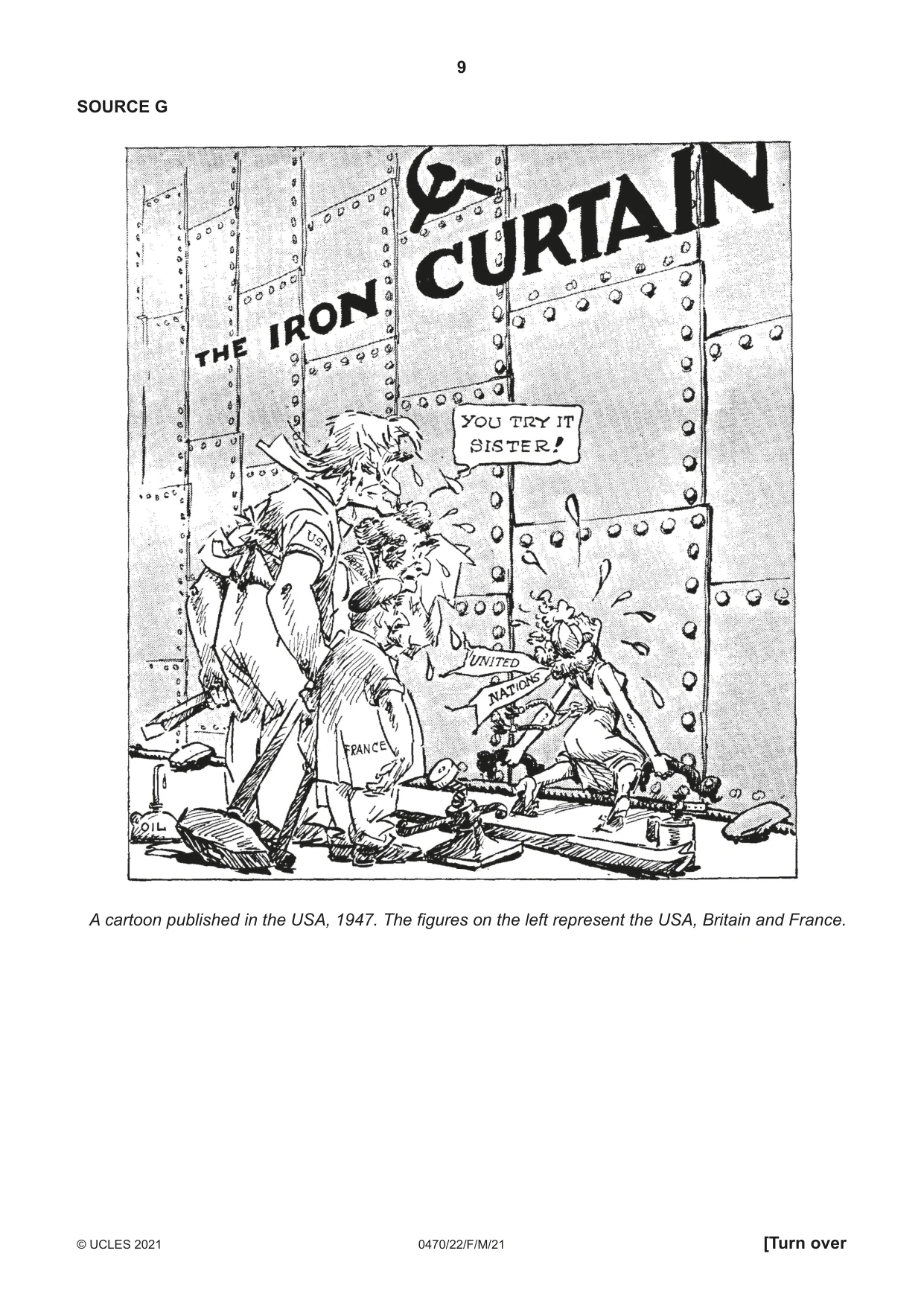
9 0470/22/F/M/21 © UCLES 2021 [Turn over SOURCE G A cartoon published in the USA, 1947. The figures on the left represent the USA, Britain and France.
Question paper, page 10
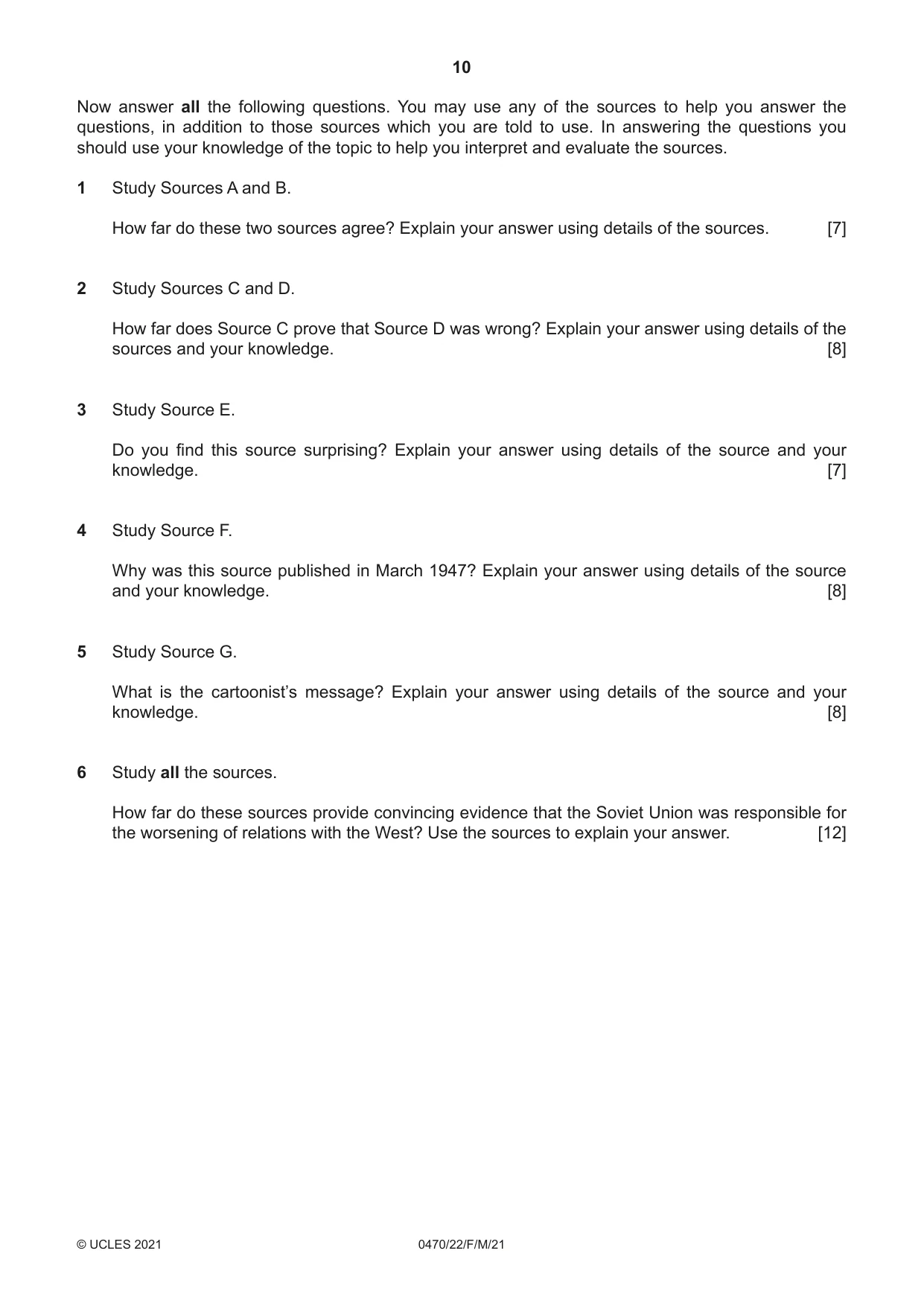
10 0470/22/F/M/21 © UCLES 2021 Now answer all the following questions. You may use any of the sources to help you answer the questions, in addition to those sources which you are told to use. In answering the questions you should use your knowledge of the topic to help you interpret and evaluate the sources. 1 Study Sources A and B. How far do these two sources agree? Explain your answer using details of the sources. [7] 2 Study Sources C and D. How far does Source C prove that Source D was wrong? Explain your answer using details of the sources and your knowledge. [8] 3 Study Source E. Do you find this source surprising? Explain your answer using details of the source and your knowledge. [7] 4 Study Source F. Why was this source published in March 1947? Explain your answer using details of the source and your knowledge. [8] 5 Study Source G. What is the cartoonist’s message? Explain your answer using details of the source and your knowledge. [8] 6 Study all the sources. How far do these sources provide convincing evidence that the Soviet Union was responsible for the worsening of relations with the West? Use the sources to explain your answer. [12]
Question paper, page 11
11 0470/22/F/M/21 © UCLES 2021 BLANK PAGE
Question paper, page 12
12 0470/22/F/M/21 © UCLES 2021 Permission to reproduce items where third-party owned material protected by copyright is included has been sought and cleared where possible. Every reasonable effort has been made by the publisher (UCLES) to trace copyright holders, but if any items requiring clearance have unwittingly been included, the publisher will be pleased to make amends at the earliest possible opportunity. To avoid the issue of disclosure of answer-related information to candidates, all copyright acknowledgements are reproduced online in the Cambridge Assessment International Education Copyright Acknowledgements Booklet. This is produced for each series of examinations and is freely available to download at www.cambridgeinternational.org after the live examination series. Cambridge Assessment International Education is part of the Cambridge Assessment Group. Cambridge Assessment is the brand name of the University of Cambridge Local Examinations Syndicate (UCLES), which itself is a department of the University of Cambridge. BLANK PAGE
Mark scheme, page 1
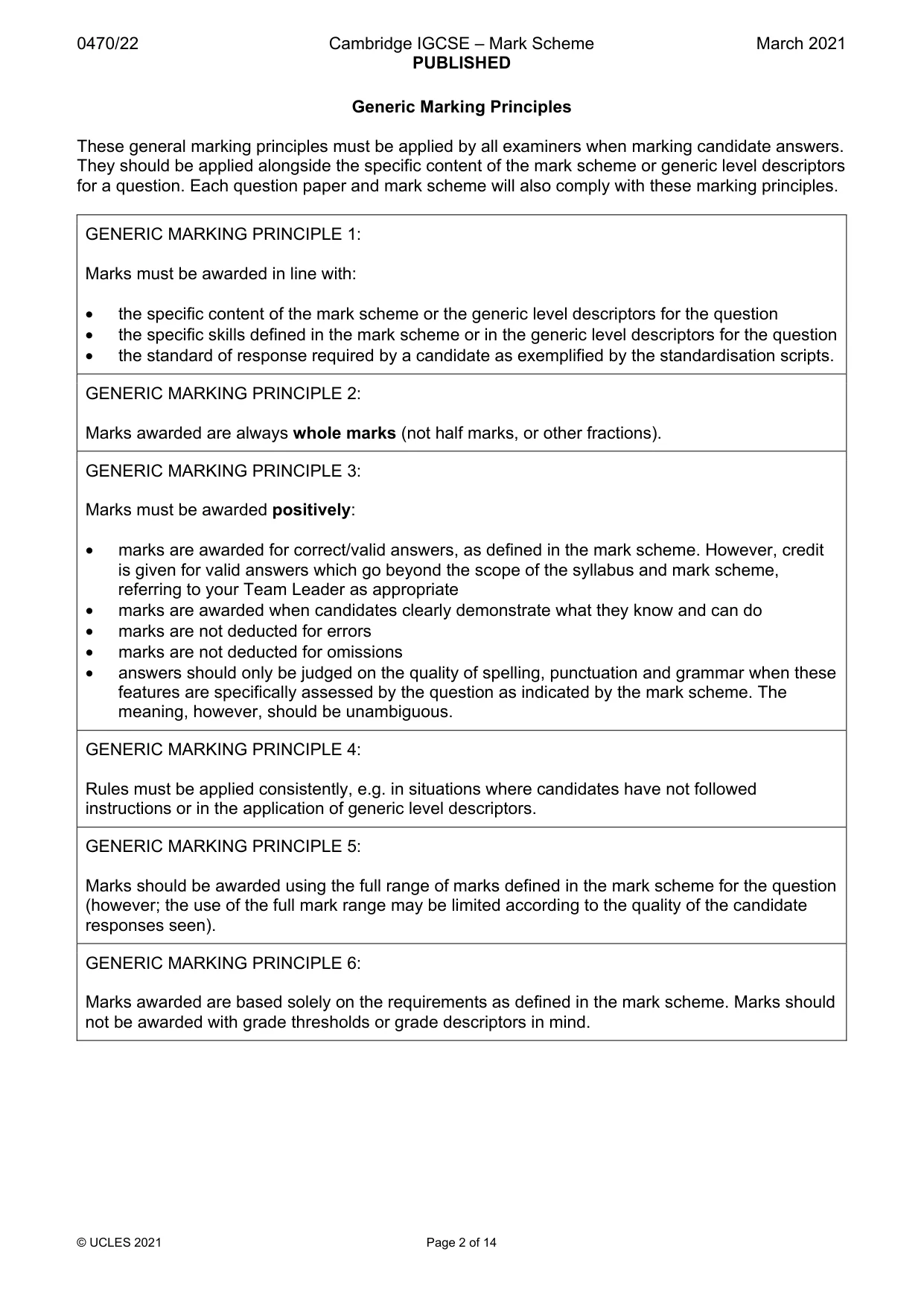
This document consists of 14 printed pages. © UCLES 2021 [Turn over Cambridge IGCSE™ HISTORY 0470/22 Paper 2 March 2021 MARK SCHEME Maximum Mark: 50 Published This mark scheme is published as an aid to teachers and candidates, to indicate the requirements of the examination. It shows the basis on which Examiners were instructed to award marks. It does not indicate the details of the discussions that took place at an Examiners’ meeting before marking began, which would have considered the acceptability of alternative answers. Mark schemes should be read in conjunction with the question paper and the Principal Examiner Report for Teachers. Cambridge International will not enter into discussions about these mark schemes. Cambridge International is publishing the mark schemes for the March 2021 series for most Cambridge IGCSE™, Cambridge International A and AS Level components and some Cambridge O Level components.
Mark scheme, page 2
0470/22 Cambridge IGCSE – Mark Scheme PUBLISHED March 2021 © UCLES 2021 Page 2 of 14 Generic Marking Principles These general marking principles must be applied by all examiners when marking candidate answers. They should be applied alongside the specific content of the mark scheme or generic level descriptors for a question. Each question paper and mark scheme will also comply with these marking principles. GENERIC MARKING PRINCIPLE 1: Marks must be awarded in line with: • the specific content of the mark scheme or the generic level descriptors for the question • the specific skills defined in the mark scheme or in the generic level descriptors for the question • the standard of response required by a candidate as exemplified by the standardisation scripts. GENERIC MARKING PRINCIPLE 2: Marks awarded are always whole marks (not half marks, or other fractions). GENERIC MARKING PRINCIPLE 3: Marks must be awarded positively: • marks are awarded for correct/valid answers, as defined in the mark scheme. However, credit is given for valid answers which go beyond the scope of the syllabus and mark scheme, referring to your Team Leader as appropriate • marks are awarded when candidates clearly demonstrate what they know and can do • marks are not deducted for errors • marks are not deducted for omissions • answers should only be judged on the quality of spelling, punctuation and grammar when these features are specifically assessed by the question as indicated by the mark scheme. The meaning, however, should be unambiguous. GENERIC MARKING PRINCIPLE 4: Rules must be applied consistently, e.g. in situations where candidates have not followed instructions or in the application of generic level descriptors. GENERIC MARKING PRINCIPLE 5: Marks should be awarded using the full range of marks defined in the mark scheme for the question (however; the use of the full mark range may be limited according to the quality of the candidate responses seen). GENERIC MARKING PRINCIPLE 6: Marks awarded are based solely on the requirements as defined in the mark scheme. Marks should not be awarded with grade thresholds or grade descriptors in mind.
Mark scheme, page 3
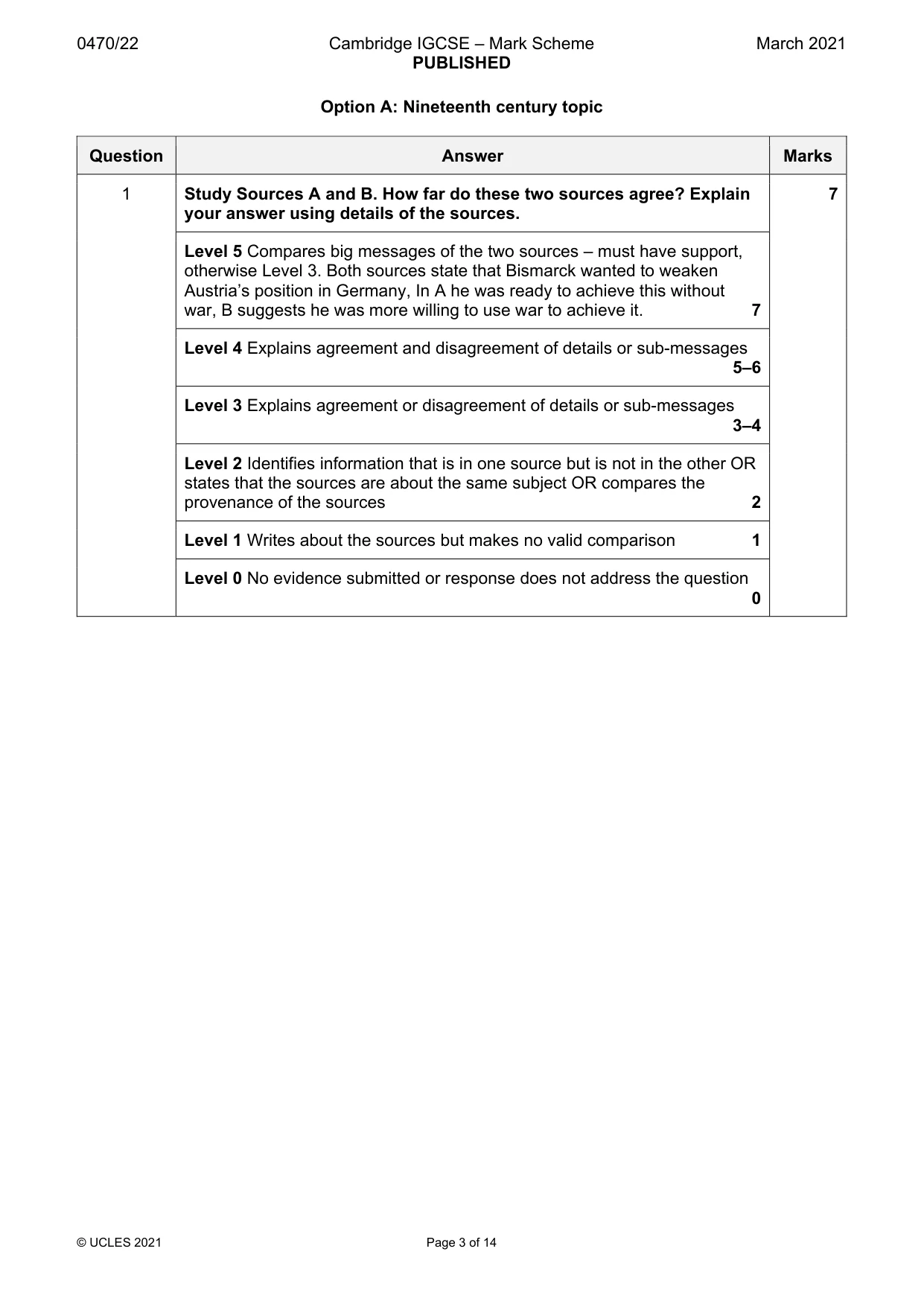
0470/22 Cambridge IGCSE – Mark Scheme PUBLISHED March 2021 © UCLES 2021 Page 3 of 14 Option A: Nineteenth century topic Question Answer Marks 1 Study Sources A and B. How far do these two sources agree? Explain your answer using details of the sources. 7 Level 5 Compares big messages of the two sources – must have support, otherwise Level 3. Both sources state that Bismarck wanted to weaken Austria’s position in Germany, In A he was ready to achieve this without war, B suggests he was more willing to use war to achieve it. 7 Level 4 Explains agreement and disagreement of details or sub-messages 5–6 Level 3 Explains agreement or disagreement of details or sub-messages 3–4 Level 2 Identifies information that is in one source but is not in the other OR states that the sources are about the same subject OR compares the provenance of the sources 2 Level 1 Writes about the sources but makes no valid comparison 1 Level 0 No evidence submitted or response does not address the question 0
Mark scheme, page 4
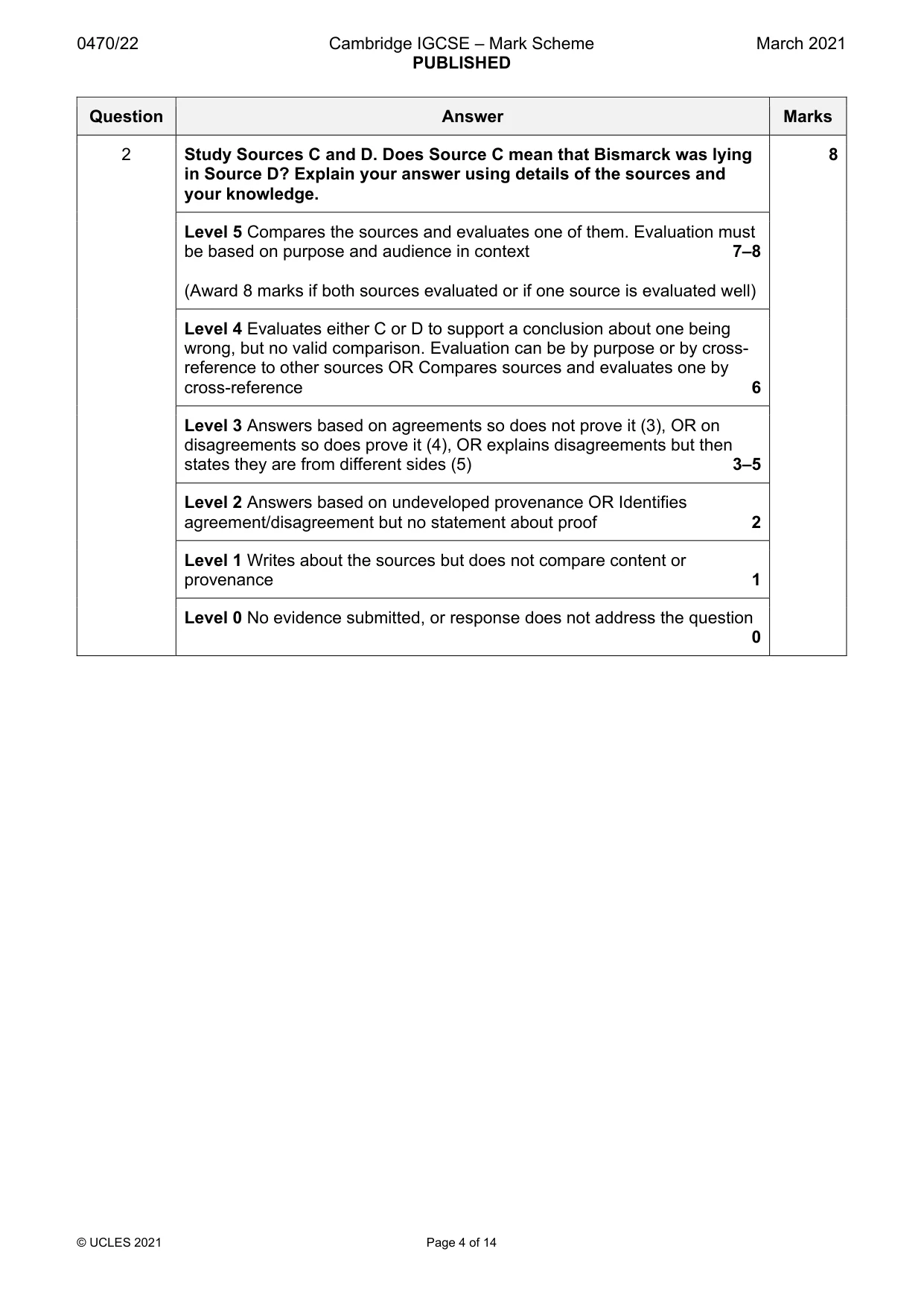
0470/22 Cambridge IGCSE – Mark Scheme PUBLISHED March 2021 © UCLES 2021 Page 4 of 14 Question Answer Marks 2 Study Sources C and D. Does Source C mean that Bismarck was lying in Source D? Explain your answer using details of the sources and your knowledge. 8 Level 5 Compares the sources and evaluates one of them. Evaluation must be based on purpose and audience in context 7–8 (Award 8 marks if both sources evaluated or if one source is evaluated well) Level 4 Evaluates either C or D to support a conclusion about one being wrong, but no valid comparison. Evaluation can be by purpose or by cross- reference to other sources OR Compares sources and evaluates one by cross-reference 6 Level 3 Answers based on agreements so does not prove it (3), OR on disagreements so does prove it (4), OR explains disagreements but then states they are from different sides (5) 3–5 Level 2 Answers based on undeveloped provenance OR Identifies agreement/disagreement but no statement about proof 2 Level 1 Writes about the sources but does not compare content or provenance 1 Level 0 No evidence submitted, or response does not address the question 0
Mark scheme, page 5
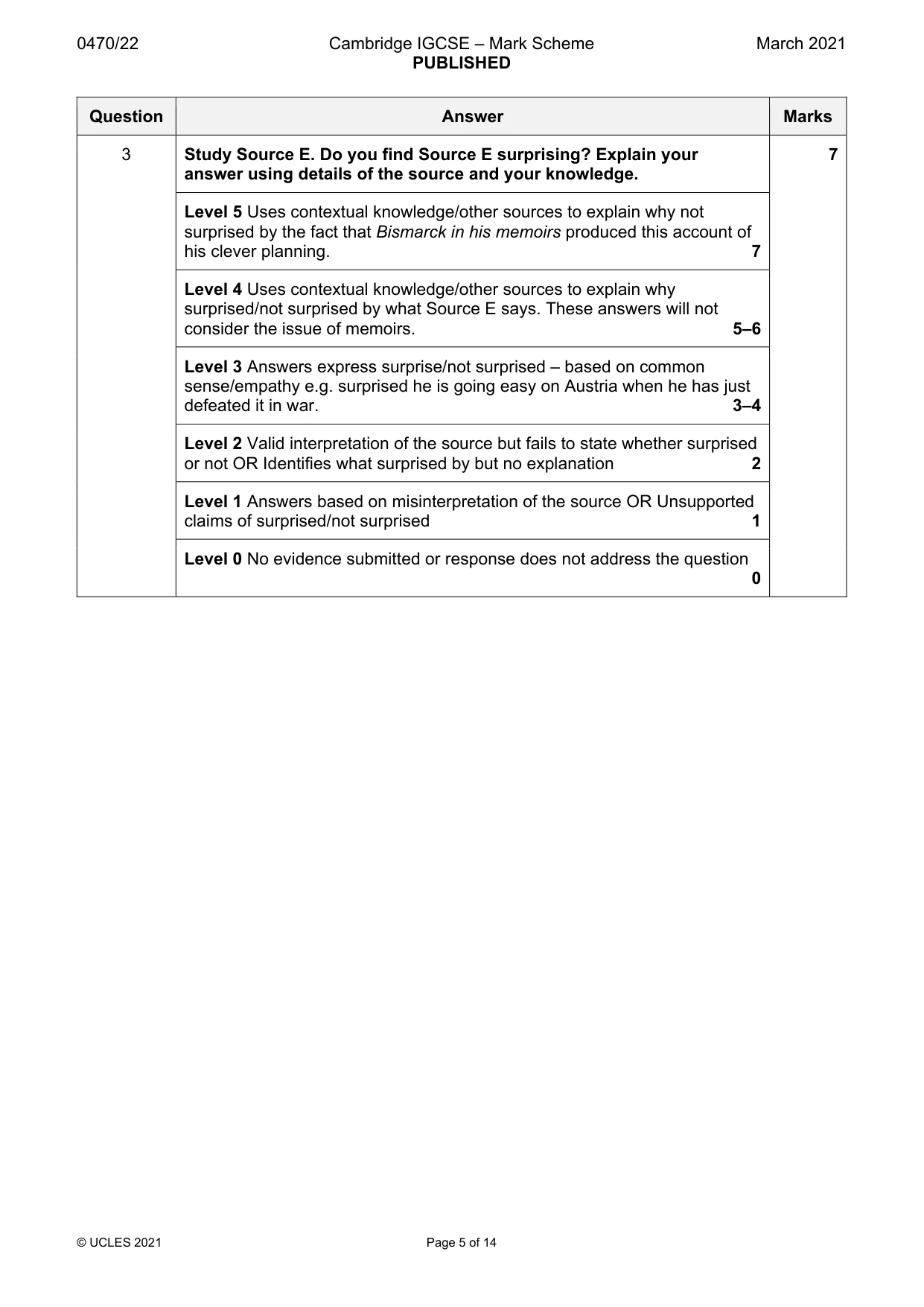
0470/22 Cambridge IGCSE – Mark Scheme PUBLISHED March 2021 © UCLES 2021 Page 5 of 14 Question Answer Marks 3 Study Source E. Do you find Source E surprising? Explain your answer using details of the source and your knowledge. 7 Level 5 Uses contextual knowledge/other sources to explain why not surprised by the fact that Bismarck in his memoirs produced this account of his clever planning. 7 Level 4 Uses contextual knowledge/other sources to explain why surprised/not surprised by what Source E says. These answers will not consider the issue of memoirs. 5–6 Level 3 Answers express surprise/not surprised – based on common sense/empathy e.g. surprised he is going easy on Austria when he has just defeated it in war. 3–4 Level 2 Valid interpretation of the source but fails to state whether surprised or not OR Identifies what surprised by but no explanation 2 Level 1 Answers based on misinterpretation of the source OR Unsupported claims of surprised/not surprised 1 Level 0 No evidence submitted or response does not address the question 0
Mark scheme, page 6
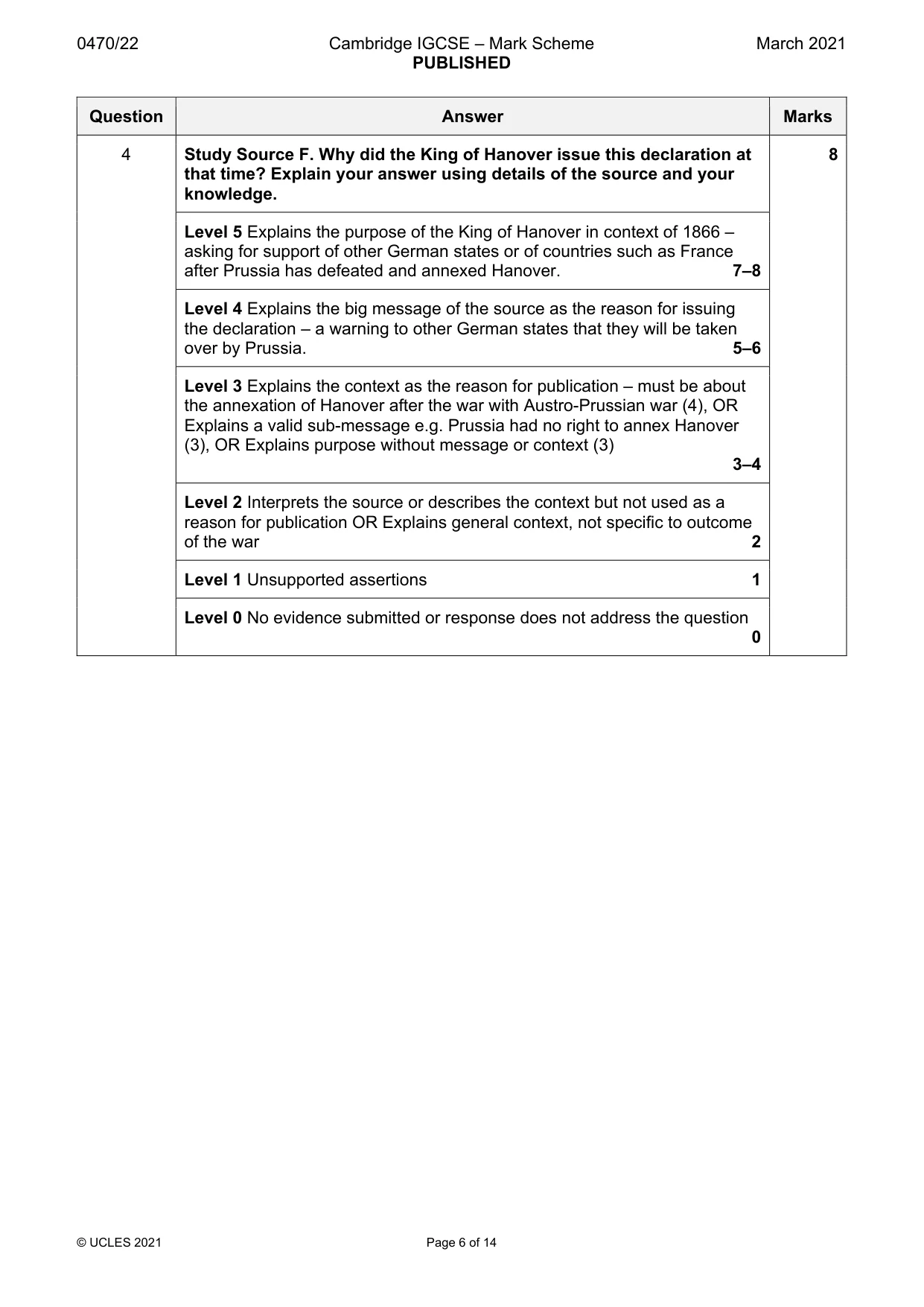
0470/22 Cambridge IGCSE – Mark Scheme PUBLISHED March 2021 © UCLES 2021 Page 6 of 14 Question Answer Marks 4 Study Source F. Why did the King of Hanover issue this declaration at that time? Explain your answer using details of the source and your knowledge. 8 Level 5 Explains the purpose of the King of Hanover in context of 1866 – asking for support of other German states or of countries such as France after Prussia has defeated and annexed Hanover. 7–8 Level 4 Explains the big message of the source as the reason for issuing the declaration – a warning to other German states that they will be taken over by Prussia. 5–6 Level 3 Explains the context as the reason for publication – must be about the annexation of Hanover after the war with Austro-Prussian war (4), OR Explains a valid sub-message e.g. Prussia had no right to annex Hanover (3), OR Explains purpose without message or context (3) 3–4 Level 2 Interprets the source or describes the context but not used as a reason for publication OR Explains general context, not specific to outcome of the war 2 Level 1 Unsupported assertions 1 Level 0 No evidence submitted or response does not address the question 0
Mark scheme, page 7
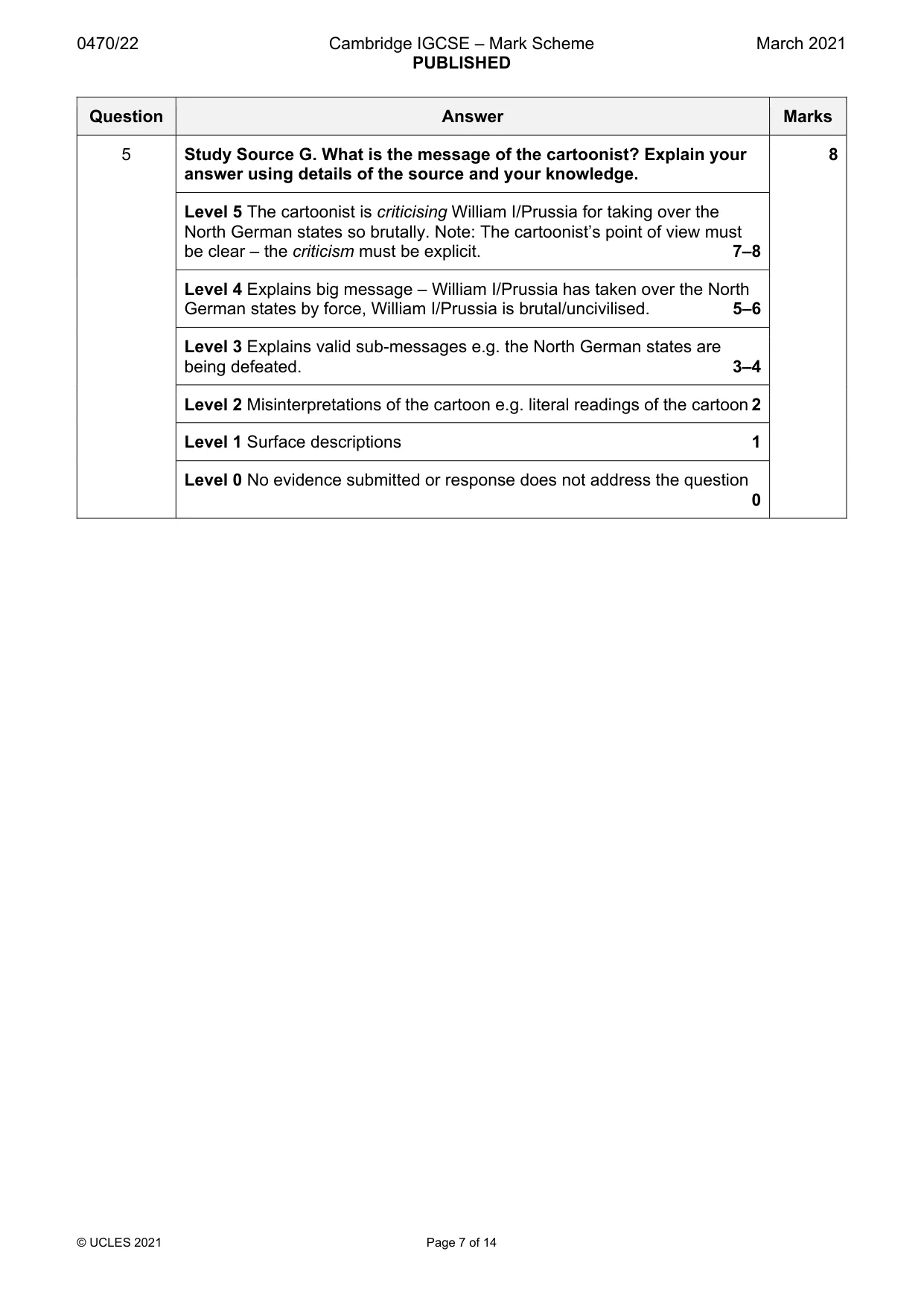
0470/22 Cambridge IGCSE – Mark Scheme PUBLISHED March 2021 © UCLES 2021 Page 7 of 14 Question Answer Marks 5 Study Source G. What is the message of the cartoonist? Explain your answer using details of the source and your knowledge. 8 Level 5 The cartoonist is criticising William I/Prussia for taking over the North German states so brutally. Note: The cartoonist’s point of view must be clear – the criticism must be explicit. 7–8 Level 4 Explains big message – William I/Prussia has taken over the North German states by force, William I/Prussia is brutal/uncivilised. 5–6 Level 3 Explains valid sub-messages e.g. the North German states are being defeated. 3–4 Level 2 Misinterpretations of the cartoon e.g. literal readings of the cartoon 2 Level 1 Surface descriptions 1 Level 0 No evidence submitted or response does not address the question 0
Mark scheme, page 8
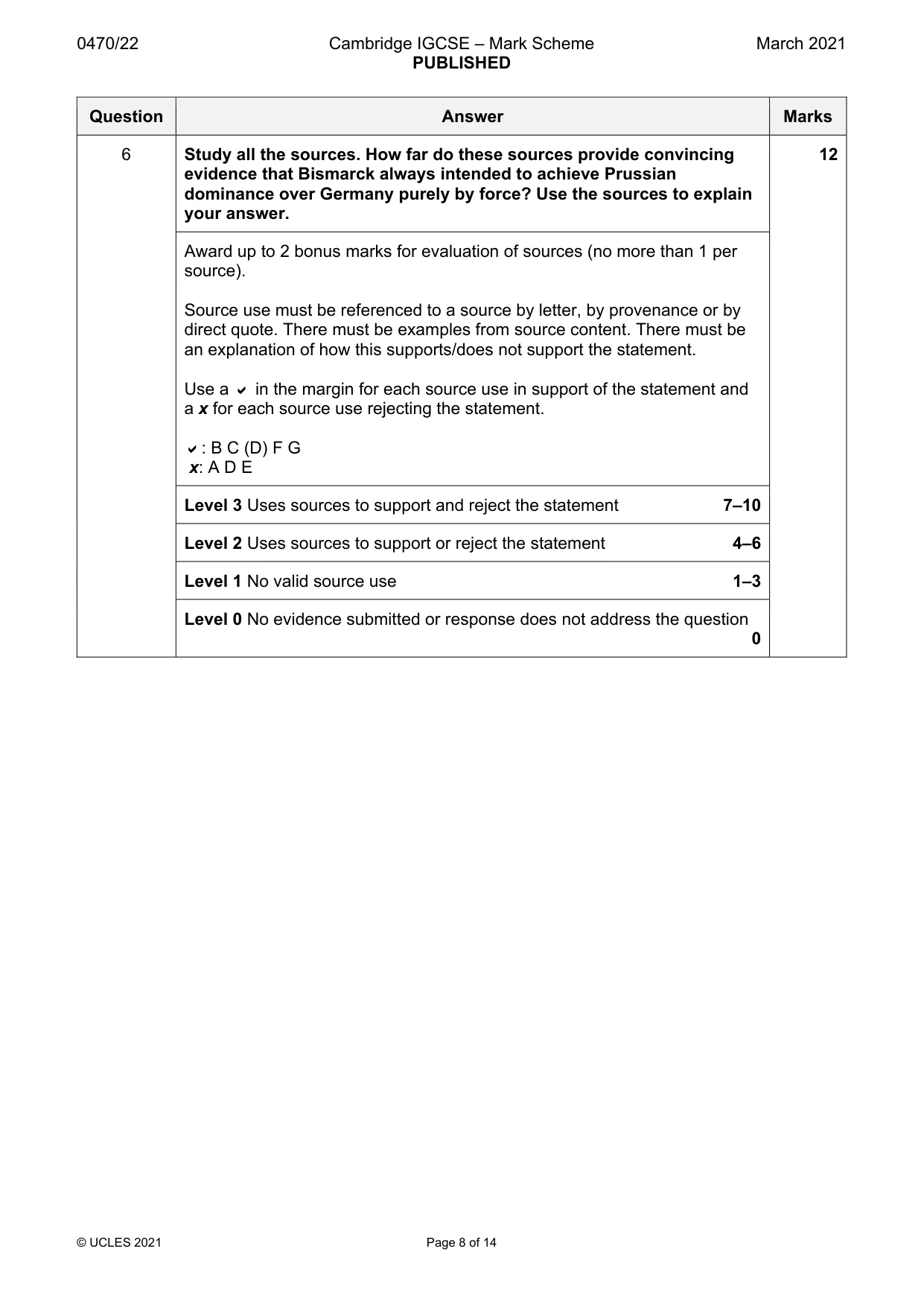
0470/22 Cambridge IGCSE – Mark Scheme PUBLISHED March 2021 © UCLES 2021 Page 8 of 14 Question Answer Marks 6 Study all the sources. How far do these sources provide convincing evidence that Bismarck always intended to achieve Prussian dominance over Germany purely by force? Use the sources to explain your answer. 12 Award up to 2 bonus marks for evaluation of sources (no more than 1 per source). Source use must be referenced to a source by letter, by provenance or by direct quote. There must be examples from source content. There must be an explanation of how this supports/does not support the statement. Use a in the margin for each source use in support of the statement and a x for each source use rejecting the statement. : B C (D) F G x: A D E Level 3 Uses sources to support and reject the statement 7–10 Level 2 Uses sources to support or reject the statement 4–6 Level 1 No valid source use 1–3 Level 0 No evidence submitted or response does not address the question 0
Mark scheme, page 9
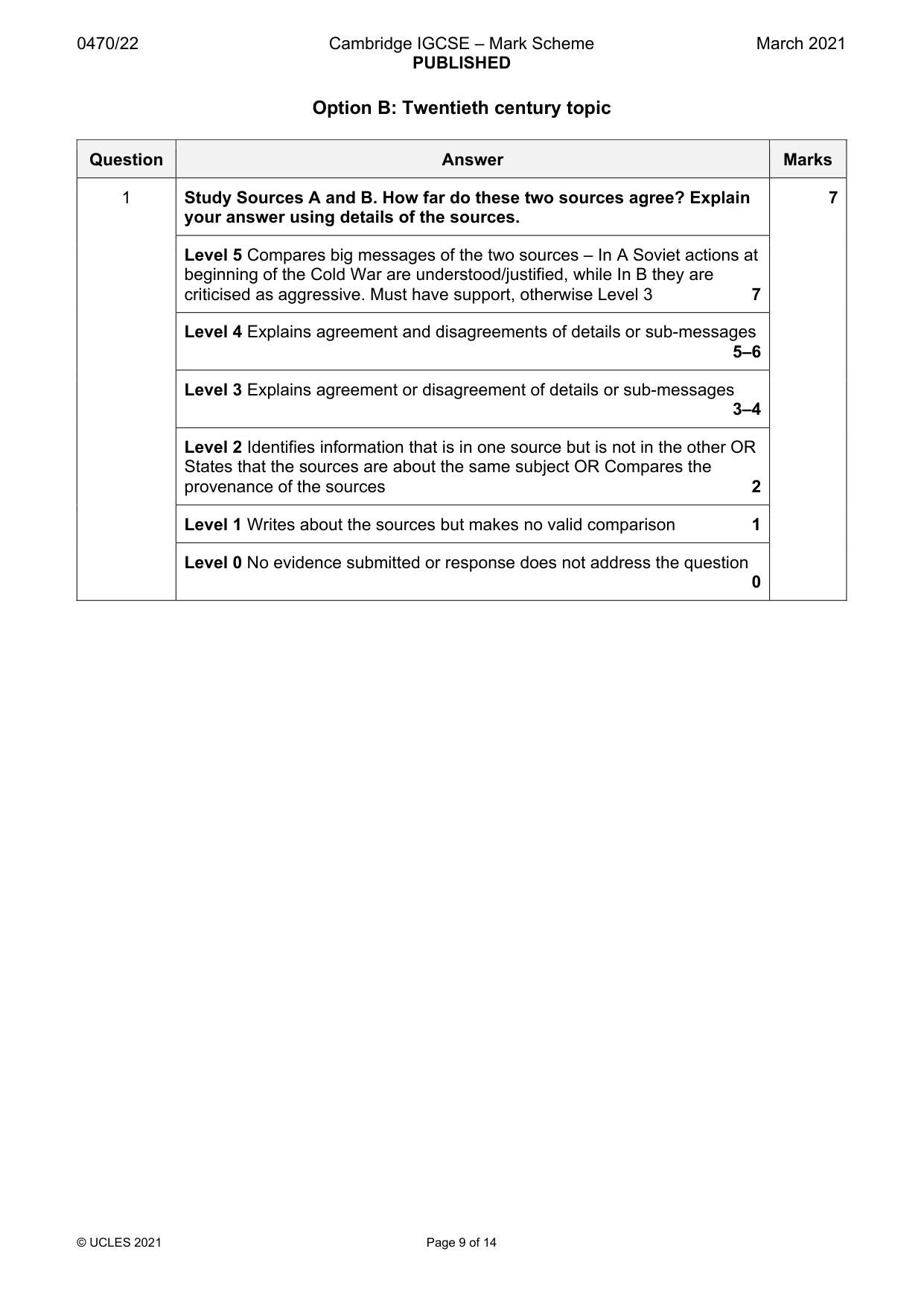
0470/22 Cambridge IGCSE – Mark Scheme PUBLISHED March 2021 © UCLES 2021 Page 9 of 14 Option B: Twentieth century topic Question Answer Marks 1 Study Sources A and B. How far do these two sources agree? Explain your answer using details of the sources. 7 Level 5 Compares big messages of the two sources – In A Soviet actions at beginning of the Cold War are understood/justified, while In B they are criticised as aggressive. Must have support, otherwise Level 3 7 Level 4 Explains agreement and disagreements of details or sub-messages 5–6 Level 3 Explains agreement or disagreement of details or sub-messages 3–4 Level 2 Identifies information that is in one source but is not in the other OR States that the sources are about the same subject OR Compares the provenance of the sources 2 Level 1 Writes about the sources but makes no valid comparison 1 Level 0 No evidence submitted or response does not address the question 0
Mark scheme, page 10
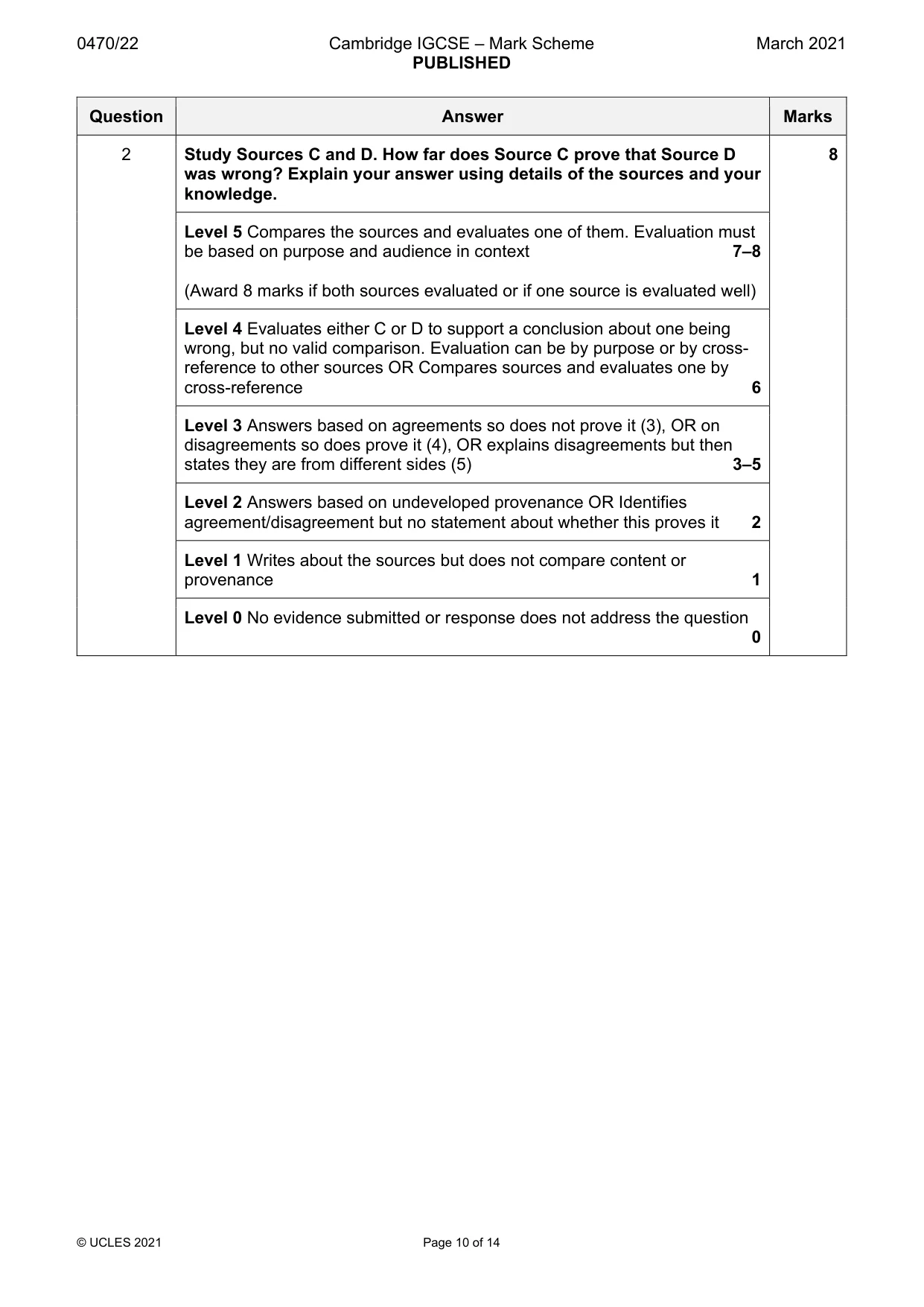
0470/22 Cambridge IGCSE – Mark Scheme PUBLISHED March 2021 © UCLES 2021 Page 10 of 14 Question Answer Marks 2 Study Sources C and D. How far does Source C prove that Source D was wrong? Explain your answer using details of the sources and your knowledge. 8 Level 5 Compares the sources and evaluates one of them. Evaluation must be based on purpose and audience in context 7–8 (Award 8 marks if both sources evaluated or if one source is evaluated well) Level 4 Evaluates either C or D to support a conclusion about one being wrong, but no valid comparison. Evaluation can be by purpose or by cross- reference to other sources OR Compares sources and evaluates one by cross-reference 6 Level 3 Answers based on agreements so does not prove it (3), OR on disagreements so does prove it (4), OR explains disagreements but then states they are from different sides (5) 3–5 Level 2 Answers based on undeveloped provenance OR Identifies agreement/disagreement but no statement about whether this proves it 2 Level 1 Writes about the sources but does not compare content or provenance 1 Level 0 No evidence submitted or response does not address the question 0
Mark scheme, page 11
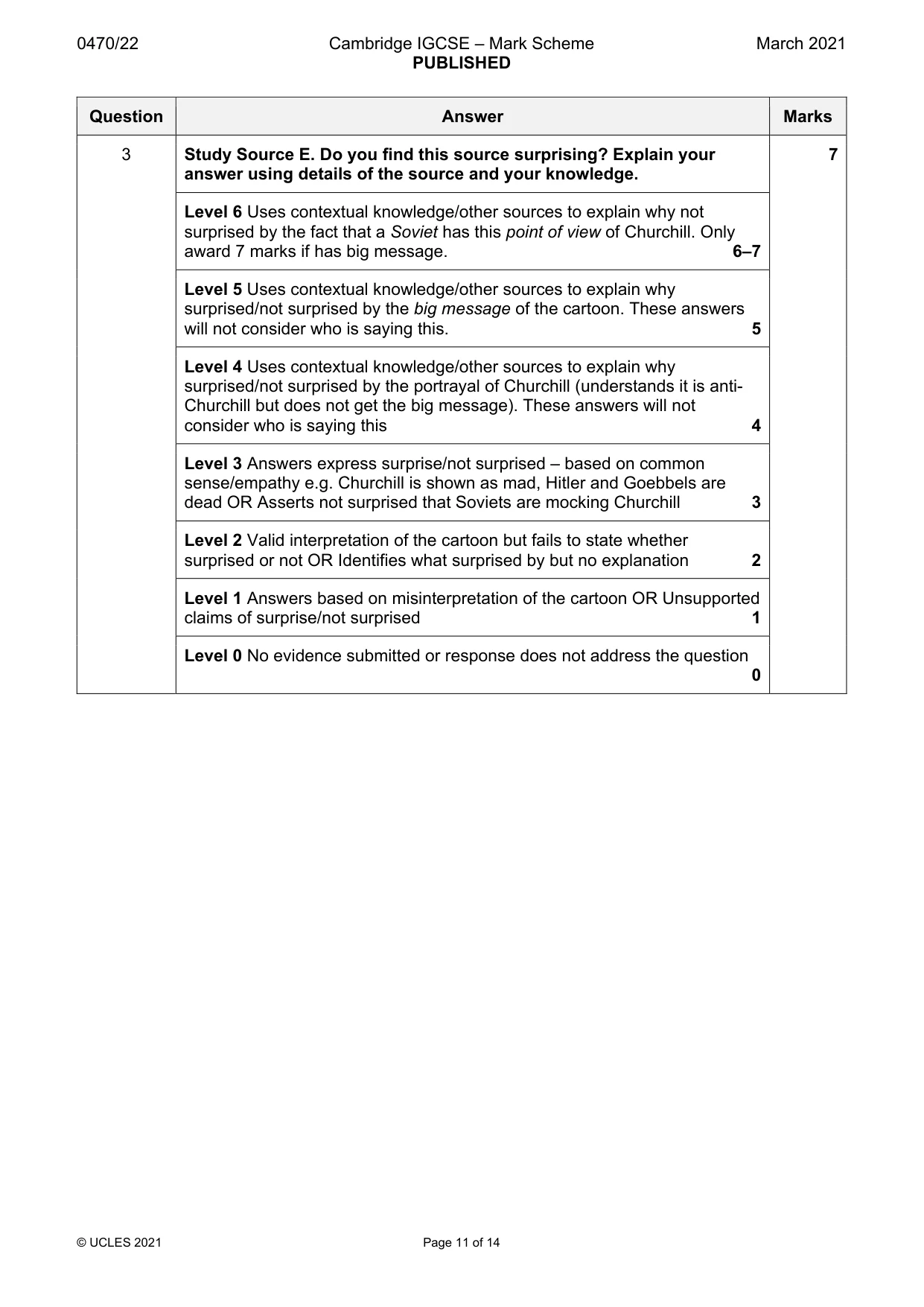
0470/22 Cambridge IGCSE – Mark Scheme PUBLISHED March 2021 © UCLES 2021 Page 11 of 14 Question Answer Marks 3 Study Source E. Do you find this source surprising? Explain your answer using details of the source and your knowledge. 7 Level 6 Uses contextual knowledge/other sources to explain why not surprised by the fact that a Soviet has this point of view of Churchill. Only award 7 marks if has big message. 6–7 Level 5 Uses contextual knowledge/other sources to explain why surprised/not surprised by the big message of the cartoon. These answers will not consider who is saying this. 5 Level 4 Uses contextual knowledge/other sources to explain why surprised/not surprised by the portrayal of Churchill (understands it is anti- Churchill but does not get the big message). These answers will not consider who is saying this 4 Level 3 Answers express surprise/not surprised – based on common sense/empathy e.g. Churchill is shown as mad, Hitler and Goebbels are dead OR Asserts not surprised that Soviets are mocking Churchill 3 Level 2 Valid interpretation of the cartoon but fails to state whether surprised or not OR Identifies what surprised by but no explanation 2 Level 1 Answers based on misinterpretation of the cartoon OR Unsupported claims of surprise/not surprised 1 Level 0 No evidence submitted or response does not address the question 0
Mark scheme, page 12
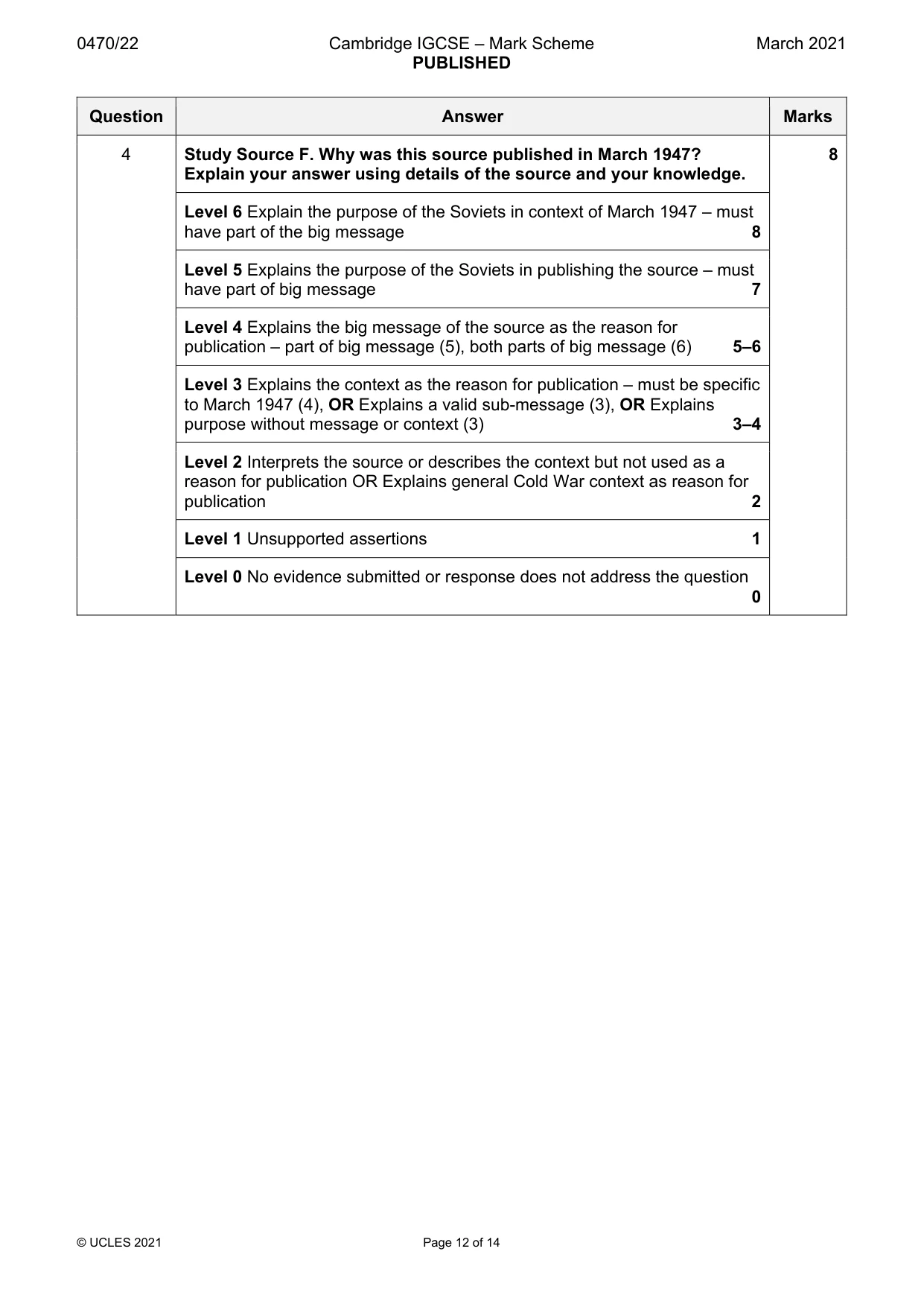
0470/22 Cambridge IGCSE – Mark Scheme PUBLISHED March 2021 © UCLES 2021 Page 12 of 14 Question Answer Marks 4 Study Source F. Why was this source published in March 1947? Explain your answer using details of the source and your knowledge. 8 Level 6 Explain the purpose of the Soviets in context of March 1947 – must have part of the big message 8 Level 5 Explains the purpose of the Soviets in publishing the source – must have part of big message 7 Level 4 Explains the big message of the source as the reason for publication – part of big message (5), both parts of big message (6) 5–6 Level 3 Explains the context as the reason for publication – must be specific to March 1947 (4), OR Explains a valid sub-message (3), OR Explains purpose without message or context (3) 3–4 Level 2 Interprets the source or describes the context but not used as a reason for publication OR Explains general Cold War context as reason for publication 2 Level 1 Unsupported assertions 1 Level 0 No evidence submitted or response does not address the question 0
Mark scheme, page 13
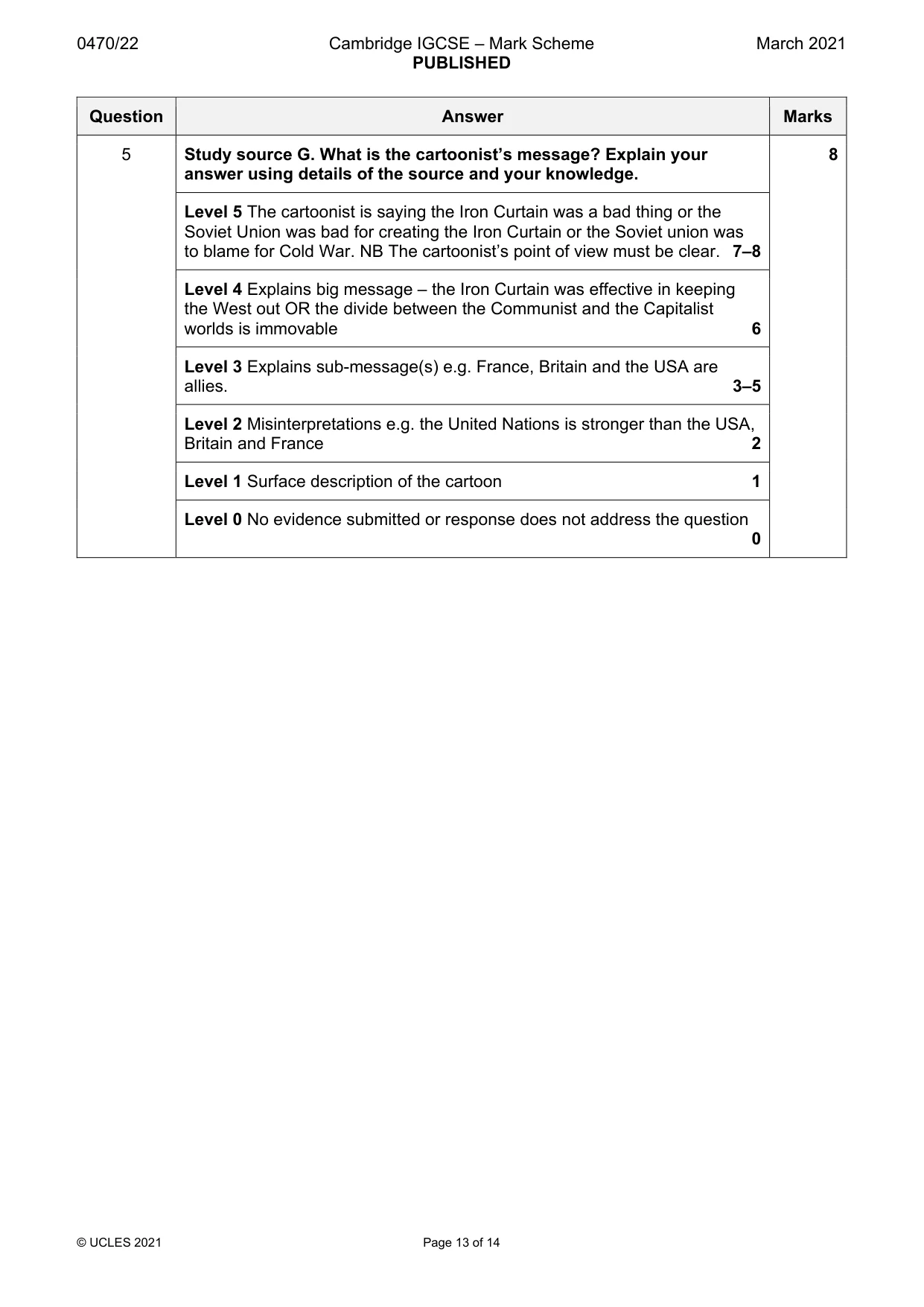
0470/22 Cambridge IGCSE – Mark Scheme PUBLISHED March 2021 © UCLES 2021 Page 13 of 14 Question Answer Marks 5 Study source G. What is the cartoonist’s message? Explain your answer using details of the source and your knowledge. 8 Level 5 The cartoonist is saying the Iron Curtain was a bad thing or the Soviet Union was bad for creating the Iron Curtain or the Soviet union was to blame for Cold War. NB The cartoonist’s point of view must be clear. 7–8 Level 4 Explains big message – the Iron Curtain was effective in keeping the West out OR the divide between the Communist and the Capitalist worlds is immovable 6 Level 3 Explains sub-message(s) e.g. France, Britain and the USA are allies. 3–5 Level 2 Misinterpretations e.g. the United Nations is stronger than the USA, Britain and France 2 Level 1 Surface description of the cartoon 1 Level 0 No evidence submitted or response does not address the question 0
Mark scheme, page 14
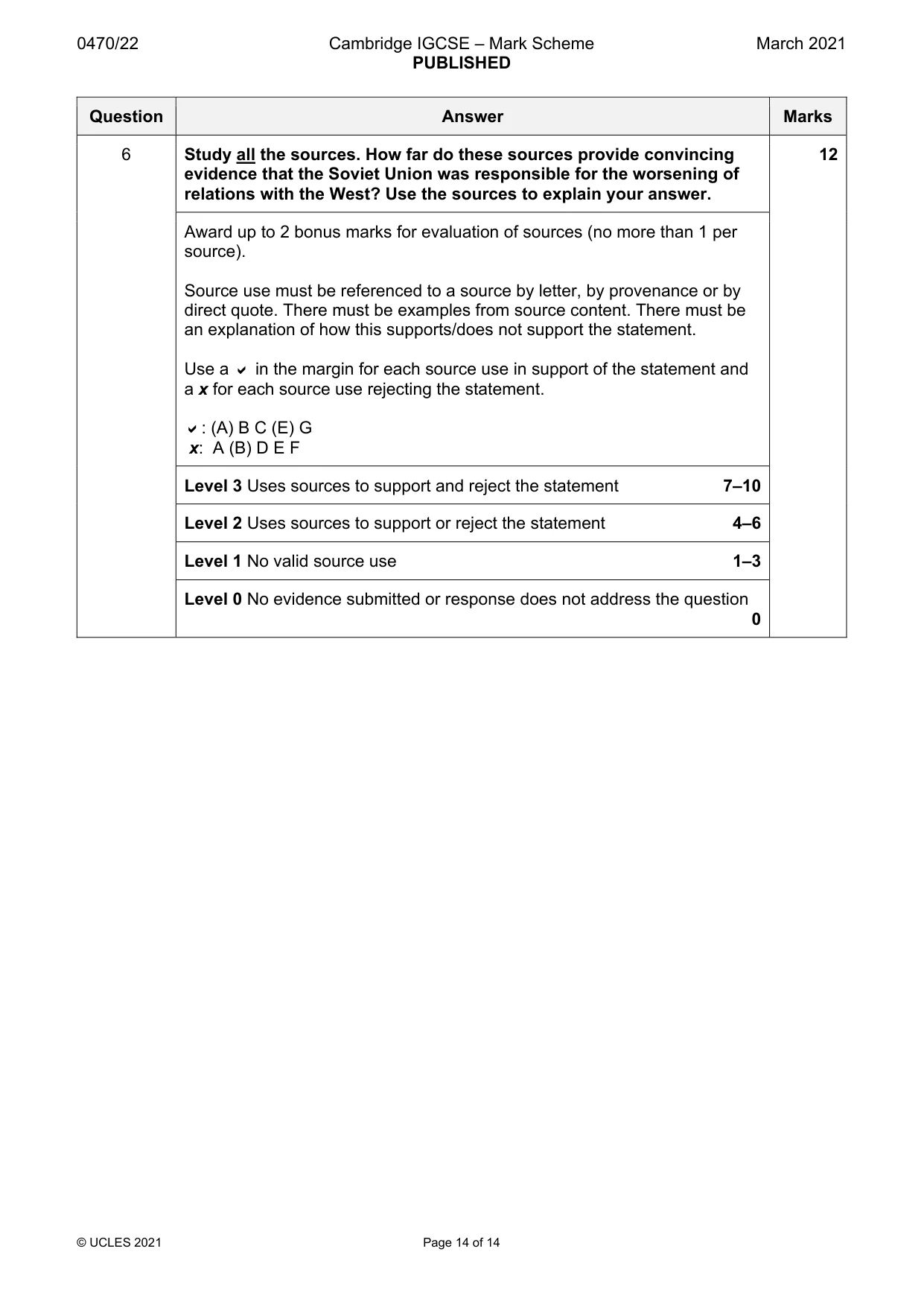
0470/22 Cambridge IGCSE – Mark Scheme PUBLISHED March 2021 © UCLES 2021 Page 14 of 14 Question Answer Marks 6 Study all the sources. How far do these sources provide convincing evidence that the Soviet Union was responsible for the worsening of relations with the West? Use the sources to explain your answer. 12 Award up to 2 bonus marks for evaluation of sources (no more than 1 per source). Source use must be referenced to a source by letter, by provenance or by direct quote. There must be examples from source content. There must be an explanation of how this supports/does not support the statement. Use a in the margin for each source use in support of the statement and a x for each source use rejecting the statement. : (A) B C (E) G x: A (B) D E F Level 3 Uses sources to support and reject the statement 7–10 Level 2 Uses sources to support or reject the statement 4–6 Level 1 No valid source use 1–3 Level 0 No evidence submitted or response does not address the question 0
What you needed in this session
Cambridge’s own grade thresholds for 2021 Feb/March, Paper 2 · Variant 2. A higher threshold means an easier paper — the bar moves with how the cohort did.