Cambridge IGCSE History 0470 — 2020 Oct/Nov Paper 1 · Variant 3
0470/13/O/N/20 · 60 marks · ≈68 min
The question paper and its mark scheme, free to read here and free to download. This is Cambridge’s own paper, exactly as it was sat.
Question paper12 pages

Mark scheme92 pages
Answers below. Sit the paper first if you are practising.
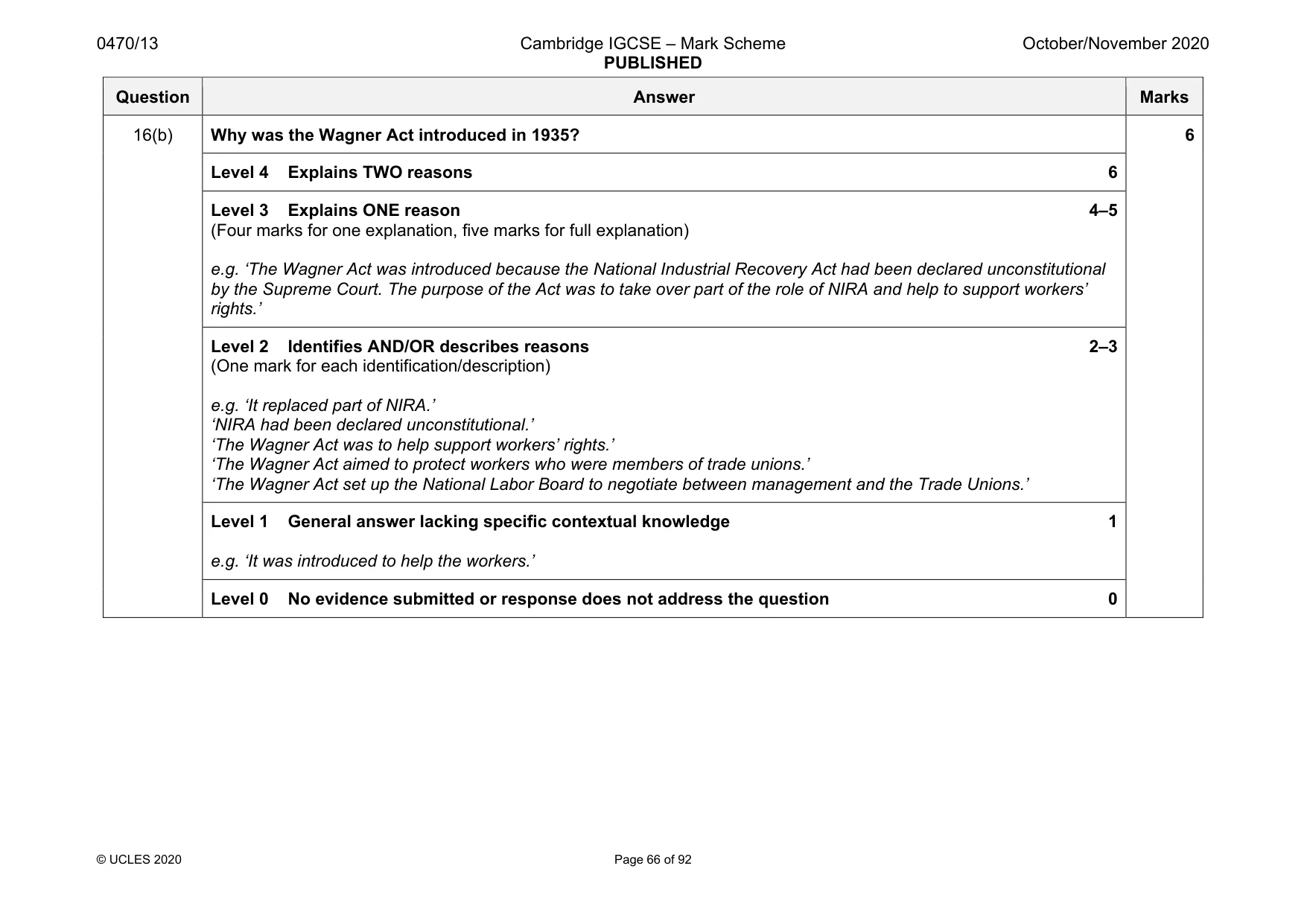
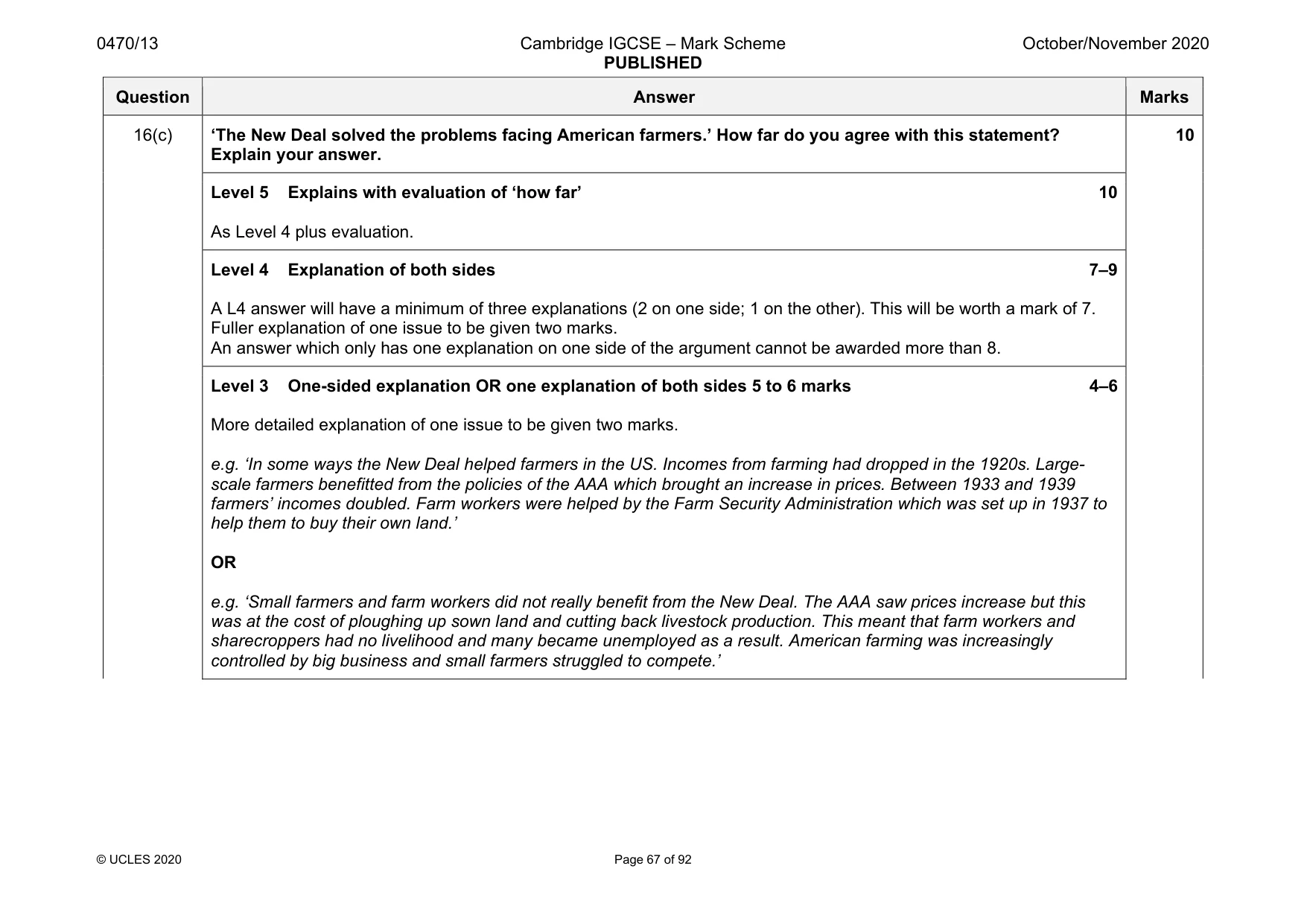
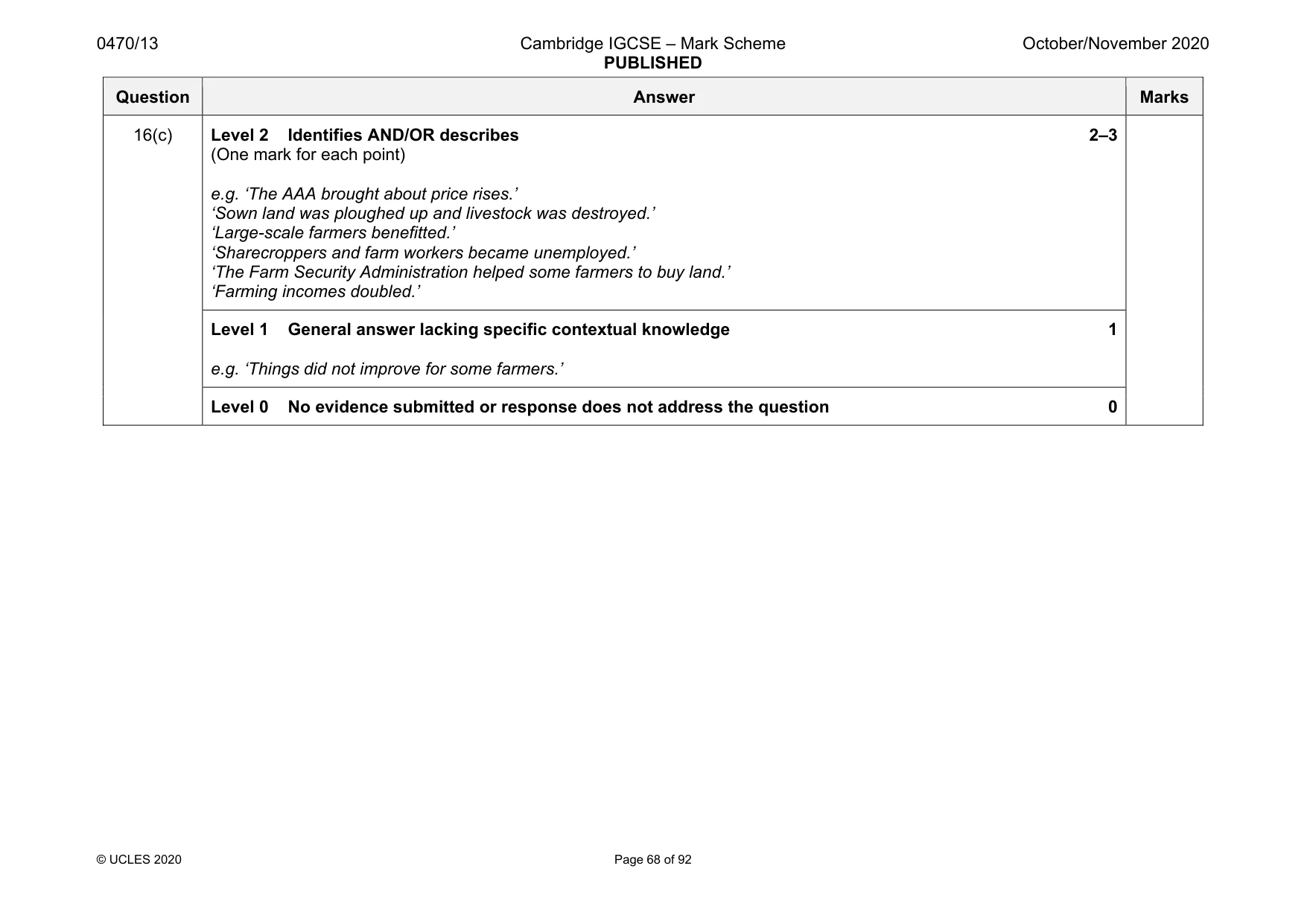
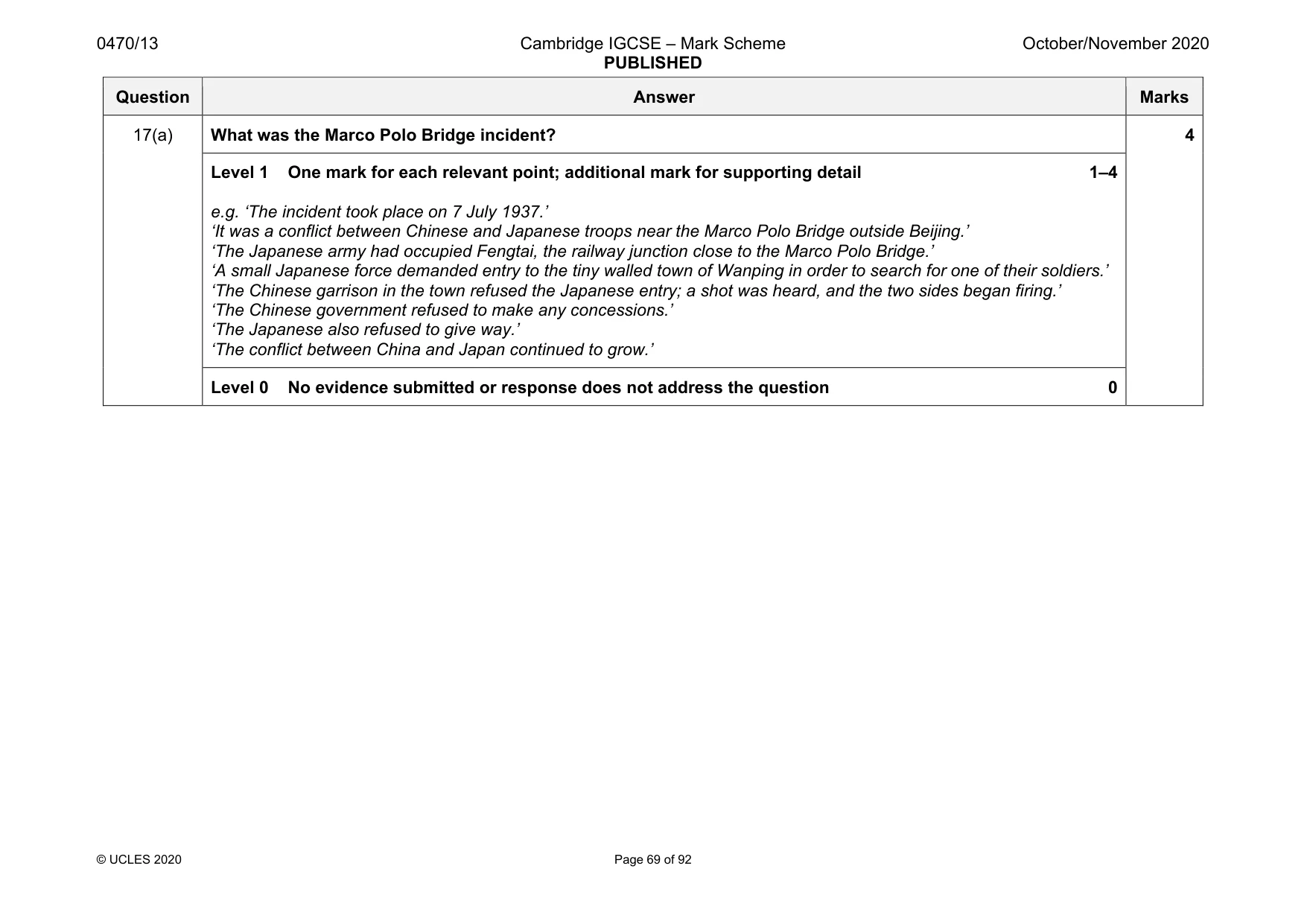
Paper as text
Question paper, page 1
Cambridge IGCSE™ This document has 12 pages. Blank pages are indicated. HISTORY 0470/13 Paper 1 October/November 2020 2 hours You must answer on the enclosed answer booklet. You will need: Answer booklet (enclosed) INSTRUCTIONS ● Answer three questions in total: Section A (Core Content): answer two questions. Section B (Depth Studies): answer one question. ● Follow the instructions on the front cover of the answer booklet. If you need additional answer paper, ask the invigilator for a continuation booklet. INFORMATION ● The total mark for this paper is 60. ● The number of marks for each question or part question is shown in brackets [ ]. * 3 1 9 3 1 5 8 7 9 0 * DC (CJ) 188998/1 © UCLES 2020 [Turn over
Question paper, page 2
2 0470/13/O/N/20 © UCLES 2020 SECTION A: CORE CONTENT Answer any two questions from this Section. 1 1848 was a year of great upheaval in Europe. (a) What did Hungarian revolutionaries hope to achieve in 1848? [4] (b) Why was the Second Republic formed in France in 1848? [6] (c) ‘The 1848 revolutions failed because of a lack of popular support.’ How far do you agree with this statement? Explain your answer. [10] 2 Many individuals were influential in the unification of Italy. (a) Describe Mazzini’s work to unify Italy. [4] (b) Why was the Allocution of Pope Pius IX important? [6] (c) ‘Napoleon III contributed more to Italian unification than any other individual.’ How far do you agree with this statement? Explain your answer. [10] 3 European imperialism met with resistance in some parts of the world. (a) What changes did the Indian Mutiny bring to British rule in India? [4] (b) Why did British intervention in China provoke resistance? [6] (c) ‘French colonial rule brought little benefit to Africans in the nineteenth century.’ How far do you agree with this statement? Explain your answer. [10] 4 Relations between European states grew more strained in the early years of the twentieth century. (a) What was the ‘naval race’? [4] (b) Why did the Kaiser’s foreign policy increase tension in Europe? [6] (c) How far do you agree that the Alliance System caused the First World War? Explain your answer. [10]
Question paper, page 3
3 0470/13/O/N/20 © UCLES 2020 [Turn over 5 Some countries gained more than others from the Versailles settlement. (a) What were the ‘successor states’? [4] (b) Why did the Treaty of Versailles make France more secure? [6] (c) ‘Hungary was treated more harshly than any other nation in the peace settlement.’ How far do you agree with this statement? Explain your answer. [10] 6 The League of Nations found it difficult to achieve its aims. (a) Describe the League’s attempts to bring about disarmament. [4] (b) Why were the Greeks dissatisfied with the outcome of the Corfu Crisis? [6] (c) ‘The need to reach unanimous decisions was the main factor preventing effective action by the League.’ How far do you agree with this statement? Explain your answer. [10] 7 The Soviet Union met with resistance in Eastern Europe after 1945. (a) Describe events in Berlin and East Germany in 1989. [4] (b) Why did the Polish government allow the creation of Solidarity in 1980? [6] (c) How far were the Hungarian uprising (1956) and the Prague Spring (1968) caused by economic factors? Explain your answer. [10] 8 There were significant changes within Iran in the 1970s. (a) Describe events in Tehran in 1978–79. [4] (b) Why was Ayatollah Khomeini opposed to Saddam Hussein? [6] (c) How far do you agree that inequality was the main reason for the revolution in Iran? Explain your answer. [10]
Question paper, page 4
4 0470/13/O/N/20 © UCLES 2020 SECTION B: DEPTH STUDIES Answer any one question from this Section. DEPTH STUDY A: THE FIRST WORLD WAR, 1914–18 9 Fighting on the Western Front caused great loss of life. (a) In what ways did conditions in the trenches affect the health of the soldiers? [4] (b) Why were so many Allied troops killed on the first day of the Battle of the Somme? [6] (c) ‘In the fighting on the Western Front, aircraft were used more effectively than tanks.’ How far do you agree with this statement? Explain your answer. [10] 10 The war was fought on several fronts. (a) What was agreed in the Treaty of Brest-Litovsk? [4] (b) Why did Britain suffer food shortages in the First World War? [6] (c) ‘A lack of planning was the main reason for the failure of the Gallipoli campaign.’ How far do you agree with this statement? Explain your answer. [10]
Question paper, page 5
5 0470/13/O/N/20 © UCLES 2020 [Turn over DEPTH STUDY B: GERMANY, 1918–45 11 There was tension and instability in Germany in the years following the war. (a) What was Ebert’s role in Germany, 1918–1919? [4] (b) Why did Germans dislike the ‘war guilt’ clause? [6] (c) How far do you agree that the Weimar Republic achieved stability in Germany between 1924 and 1929? Explain your answer. [10] 12 German society changed a great deal under the Nazis. (a) What legal restrictions did the Nazis place on the Jews up to 1939? [4] (b) Why did the Nazis want to control culture and the arts? [6] (c) ‘The use of informers was a more effective way than terror for the Nazis to control people.’ How far do you agree with this statement? Explain your answer. [10]
Question paper, page 6
6 0470/13/O/N/20 © UCLES 2020 DEPTH STUDY C: RUSSIA, 1905–41 13 The Tsarist regime was not popular with all Russians at the start of the twentieth century. (a) What was the policy of Russification? [4] (b) Why was defeat in the war against Japan important for Russia in 1905? [6] (c) How secure was the Tsarist regime at the start of 1914? Explain your answer. [10] 14 Stalin was ruthless in enforcing his control. (a) What happened to the national minorities under Stalin? [4] (b) Why was there a new constitution in 1936? [6] (c) ‘The main target of the purges was opposition within the Communist Party.’ How far do you agree with this statement? Explain your answer. [10]
Question paper, page 7
7 0470/13/O/N/20 © UCLES 2020 [Turn over DEPTH STUDY D: THE UNITED STATES, 1919–41 15 Some aspects of American society changed a great deal in the 1920s. (a) Describe developments in popular entertainment in the 1920s. [4] (b) Why was prohibition repealed? [6] (c) How far do you agree that American society was intolerant in the 1920s? Explain your answer. [10] 16 Many Americans benefited from New Deal policies. (a) Describe the ways in which the First New Deal helped the unemployed. [4] (b) Why was the Wagner Act introduced in 1935? [6] (c) ‘The New Deal solved the problems facing American farmers.’ How far do you agree with this statement? Explain your answer. [10]
Question paper, page 8
8 0470/13/O/N/20 © UCLES 2020 DEPTH STUDY E: CHINA, c.1930–c.1990 17 The struggle for power between the Communists and the Nationalists continued up to 1949. (a) What was the Marco Polo Bridge incident? [4] (b) Why did many peasants support the Communists? [6] (c) ‘The Nationalists were defeated because of the mistakes they made during the Second World War.’ How far do you agree with this statement? Explain your answer. [10] 18 Mao’s policies were not always popular. (a) What happened during the Hundred Flowers campaign? [4] (b) Why did Mao face opposition in the early 1960s? [6] (c) How far did life change for the Chinese people after Mao’s death? Explain your answer. [10]
Question paper, page 9
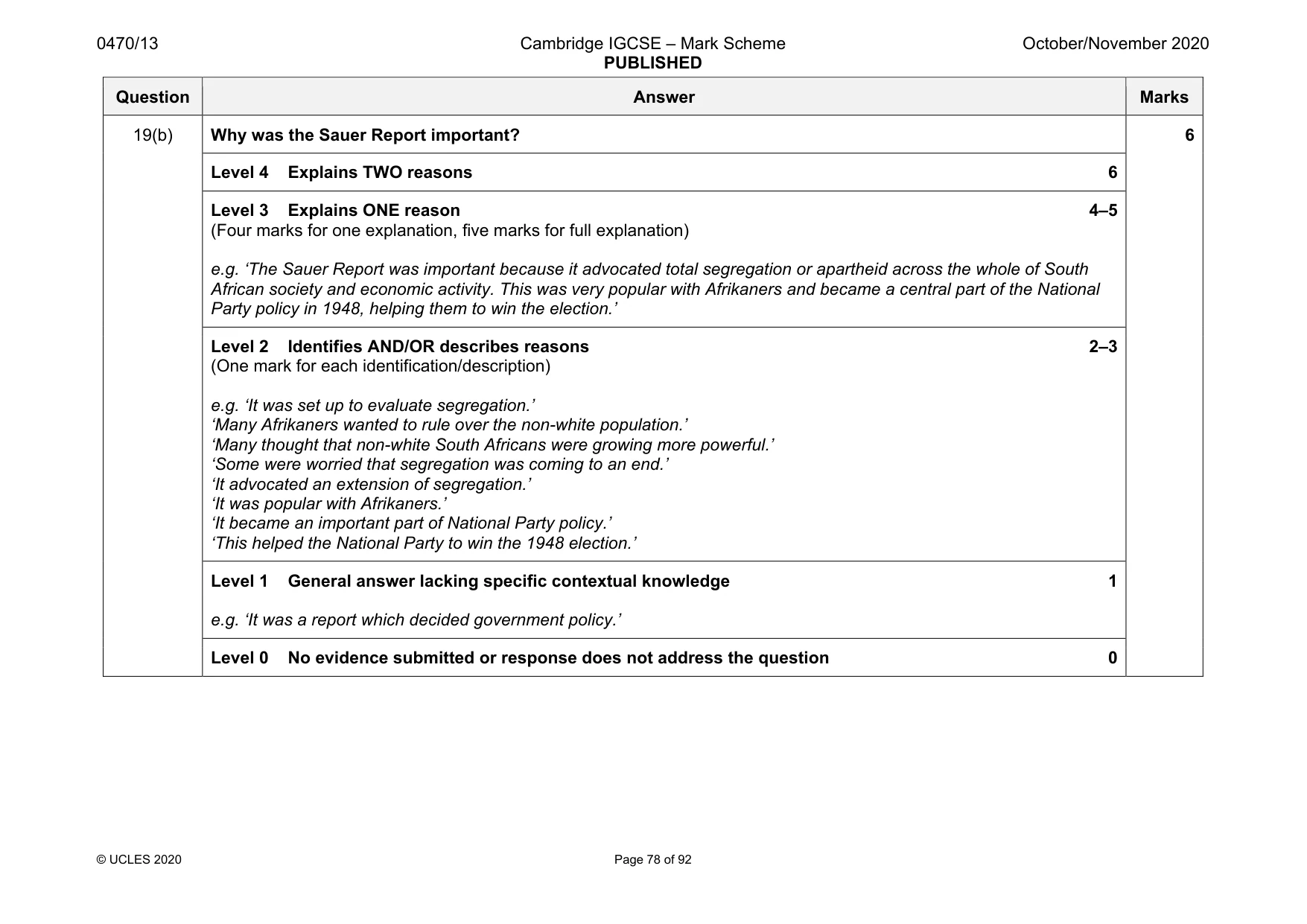
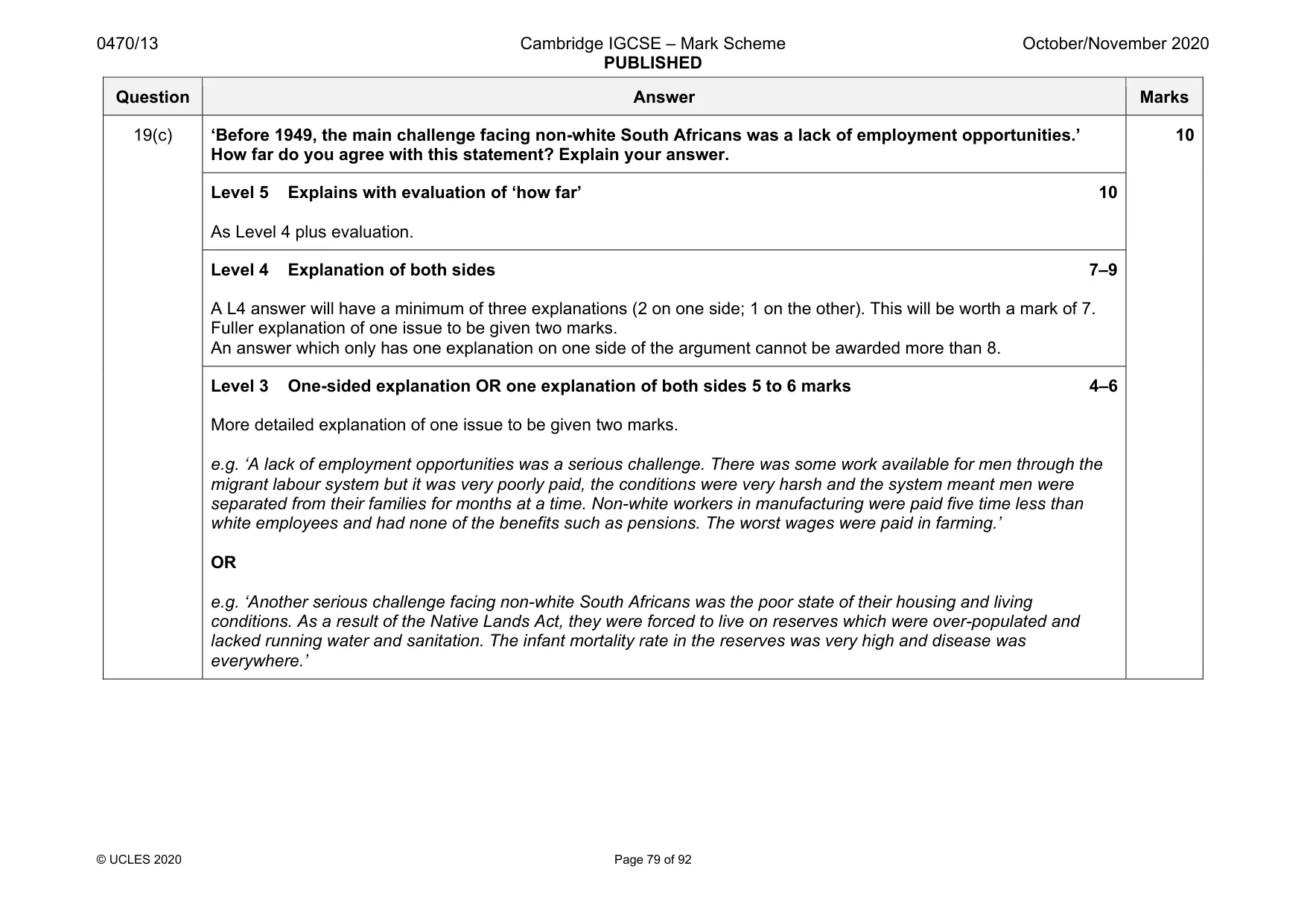
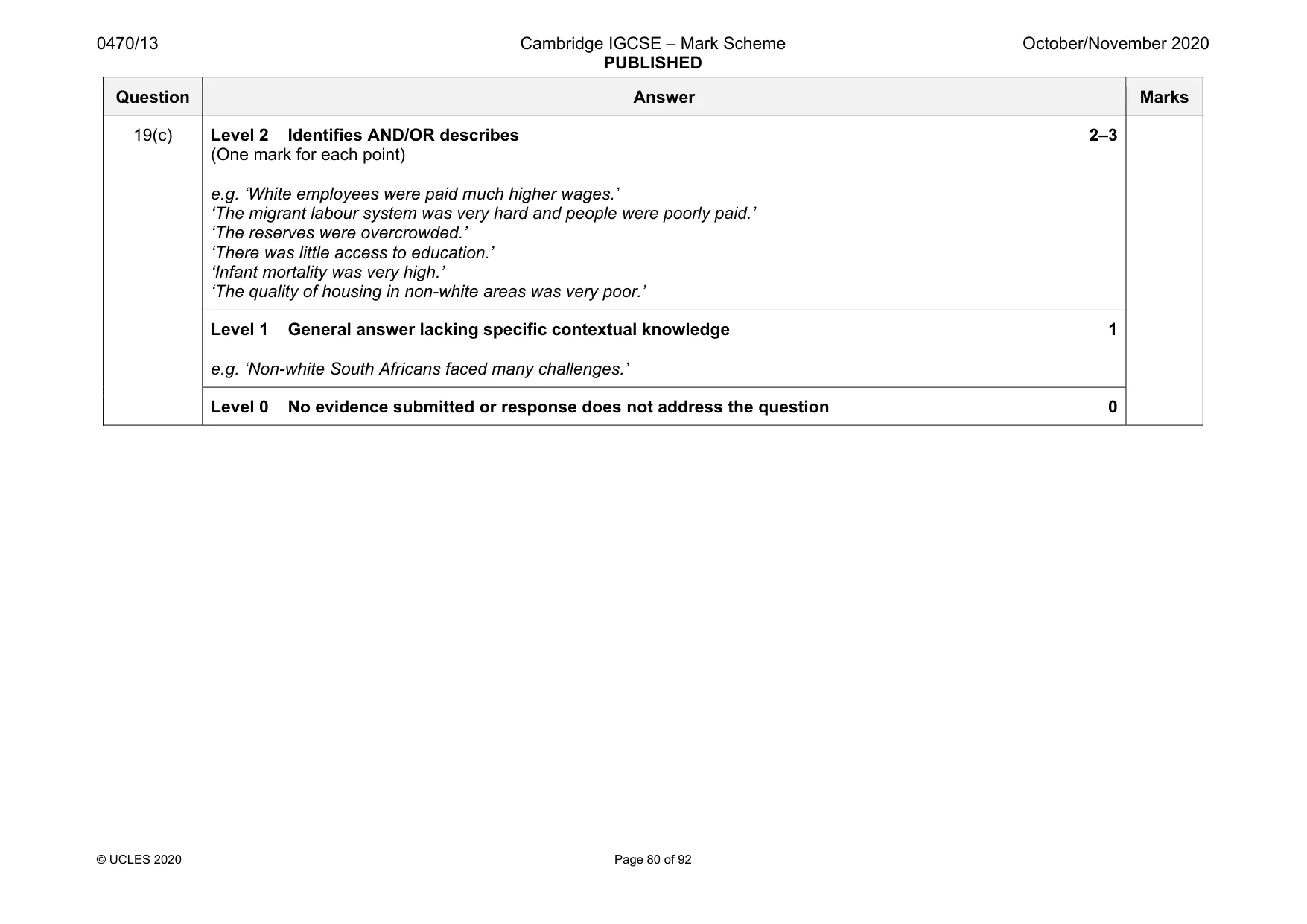
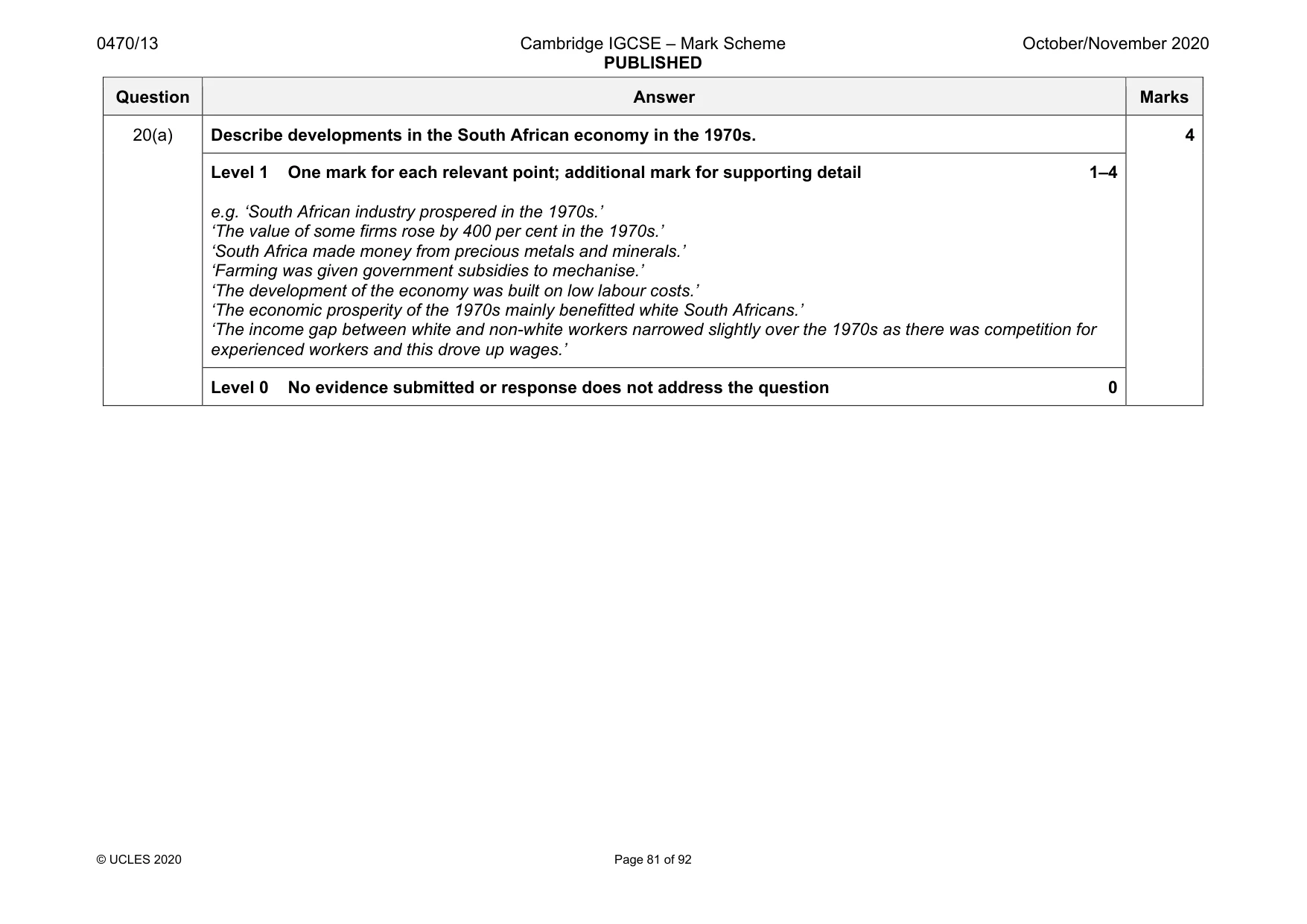
9 0470/13/O/N/20 © UCLES 2020 [Turn over DEPTH STUDY F: SOUTH AFRICA, c.1940–c.1994 19 Segregation became increasingly entrenched in the period up to 1948. (a) In what ways did the government restrict the movement of non-white South Africans? [4] (b) Why was the Sauer Report important? [6] (c) ‘Before 1949, the main challenge facing non-white South Africans was a lack of employment opportunities.’ How far do you agree with this statement? Explain your answer. [10] 20 There were some changes in South Africa in the 1970s. (a) Describe developments in the South African economy in the 1970s. [4] (b) Why did the Organisation for African Unity (OAU) become involved in the struggle against apartheid? [6] (c) How far do you agree that trade union action was the most important internal challenge to apartheid? Explain your answer. [10]
Question paper, page 10
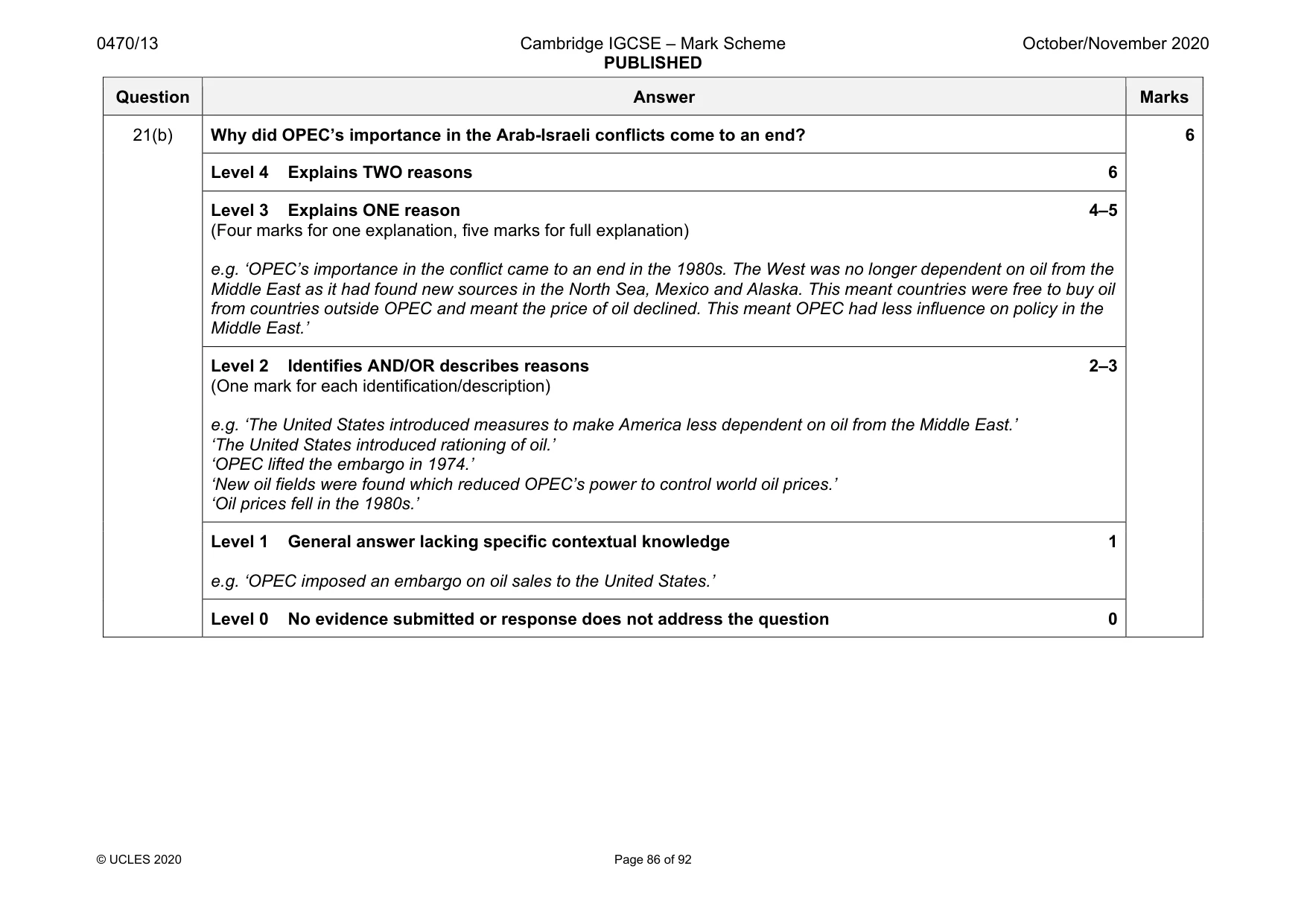
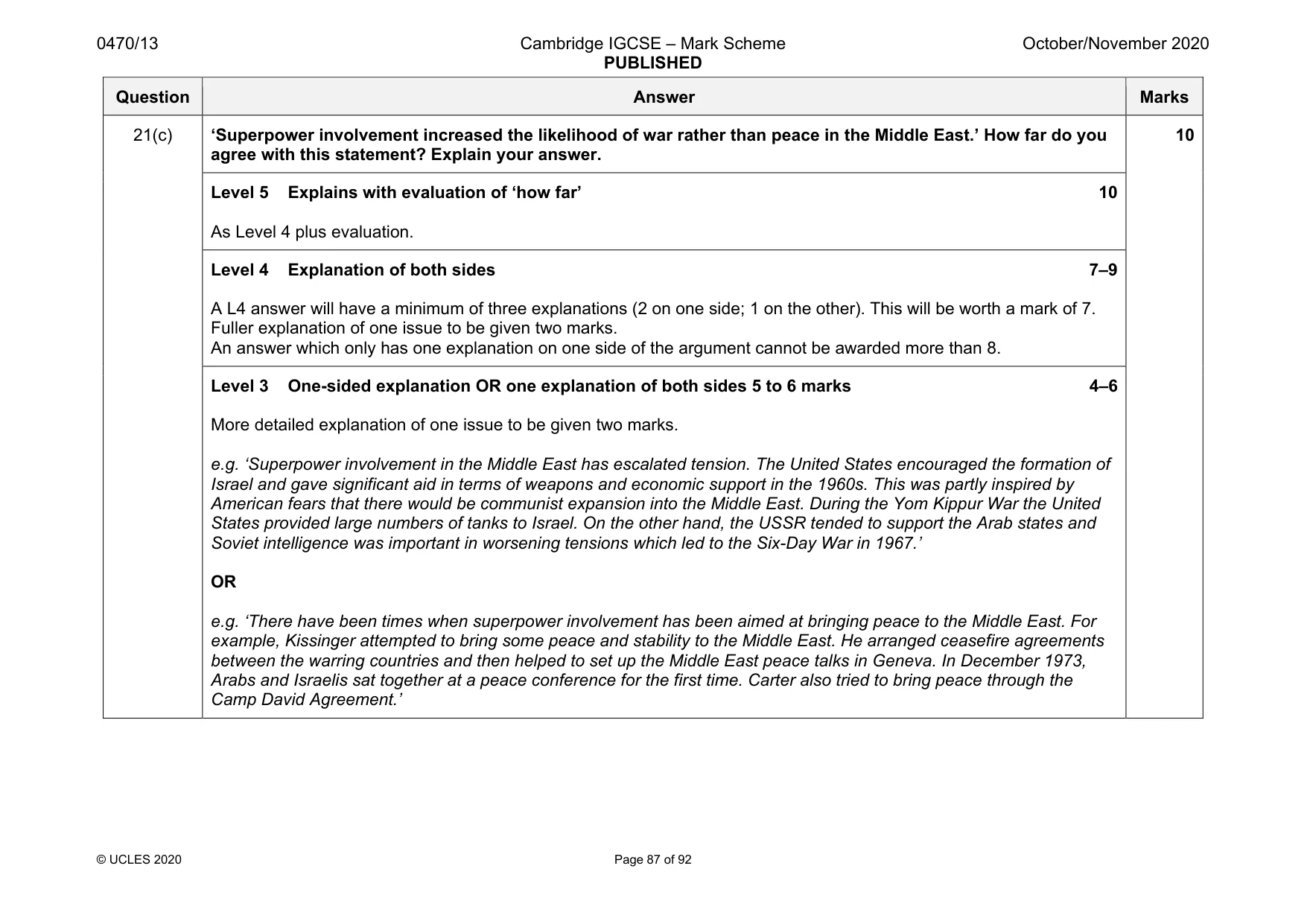
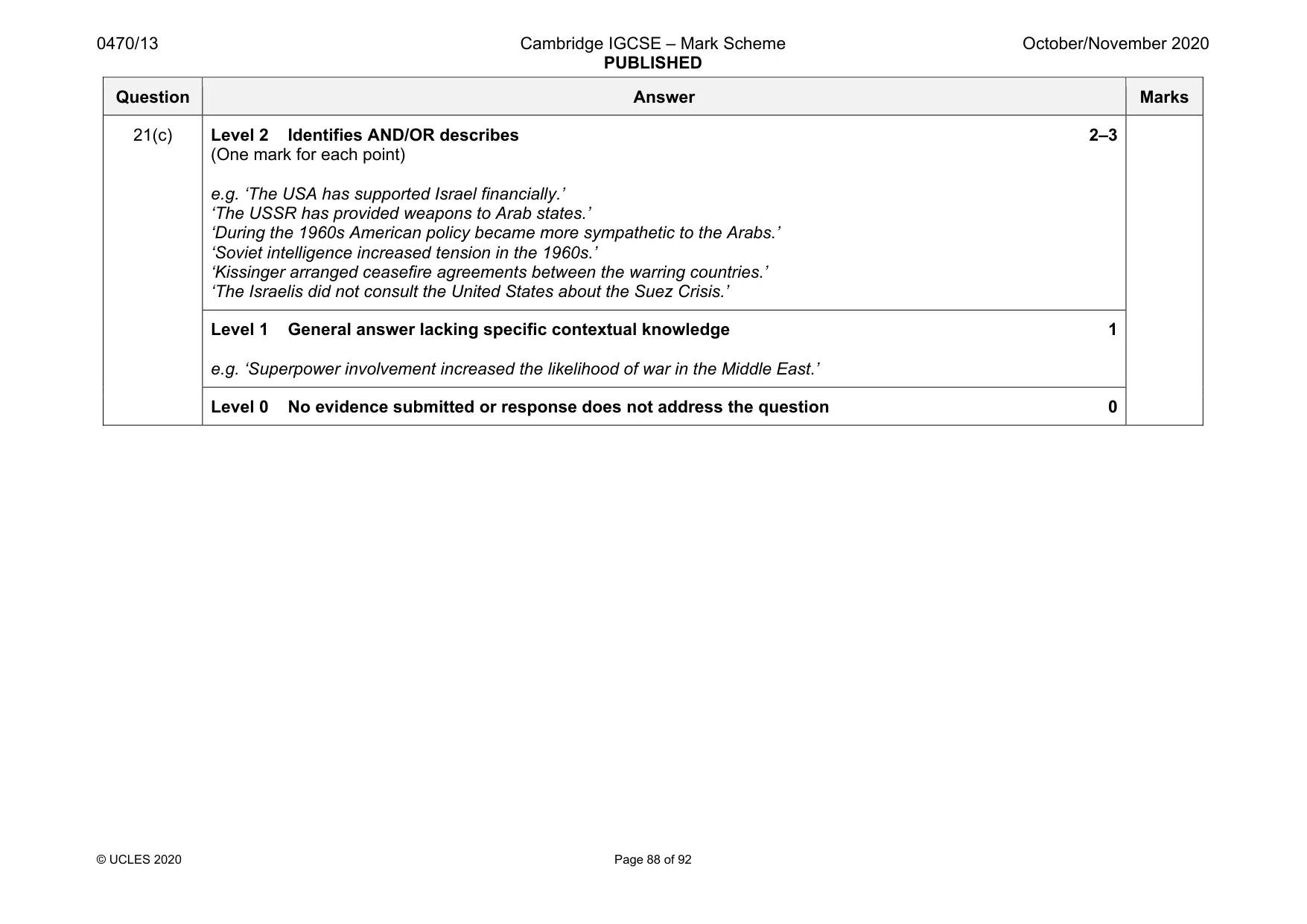
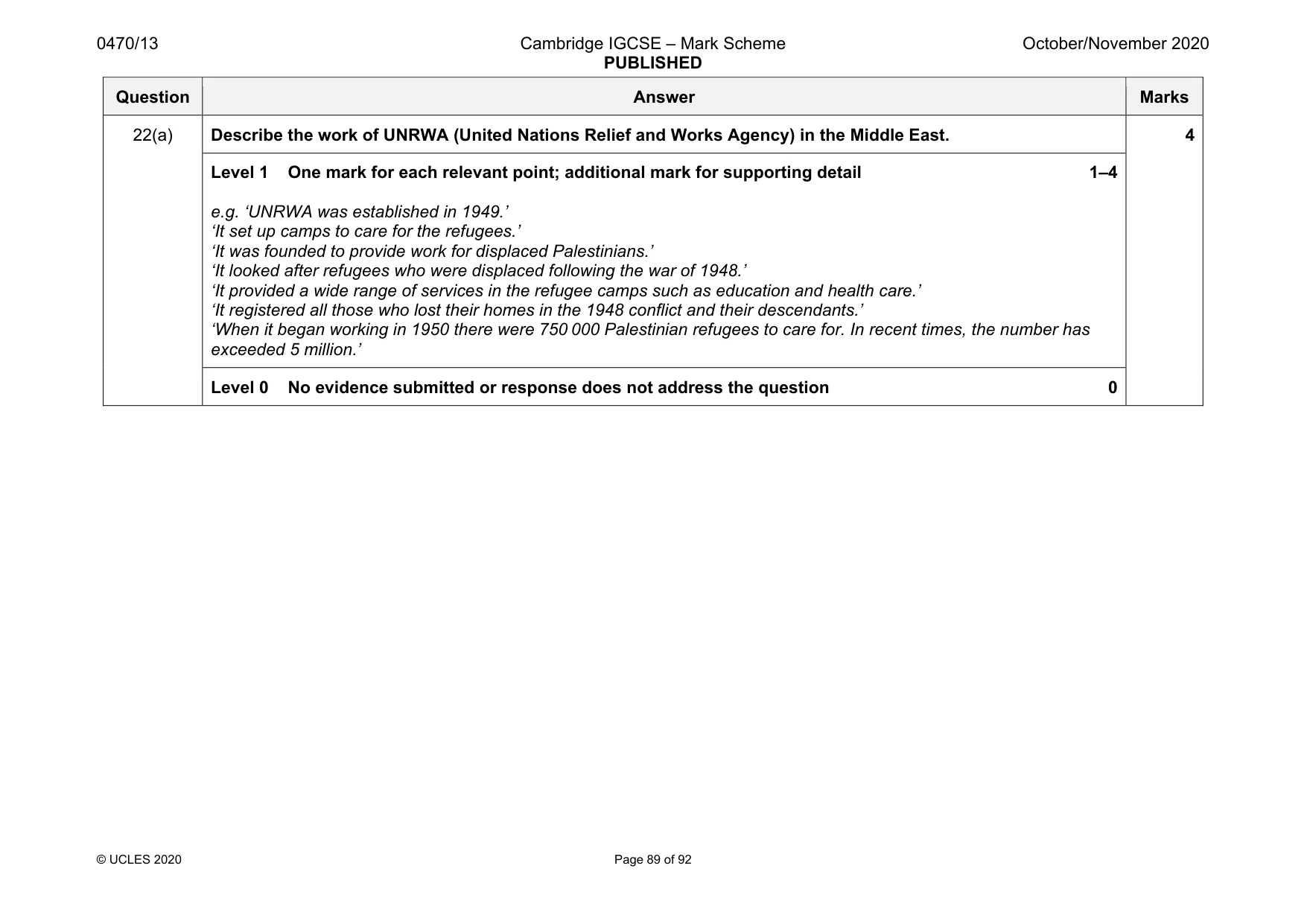
10 0470/13/O/N/20 © UCLES 2020 DEPTH STUDY G: ISRAELIS AND PALESTINIANS SINCE 1945 21 External involvement in the Middle East has had a significant impact. (a) In what ways did the USA support Israel in the 1950s? [4] (b) Why did OPEC’s importance in the Arab-Israeli conflicts come to an end? [6] (c) ‘Superpower involvement increased the likelihood of war rather than peace in the Middle East.’ How far do you agree with this statement? Explain your answer. [10] 22 The Palestinian people have faced many challenges. (a) Describe the work of UNRWA (United Nations Relief and Works Agency) in the Middle East. [4] (b) Why did the refugee crisis become worse after the Six-Day War? [6] (c) How far would you agree that the Palestine Liberation Organisation (PLO) had been successful in winning international support by the early 1990s? Explain your answer. [10]
Question paper, page 11
11 0470/13/O/N/20 © UCLES 2020 BLANK PAGE
Question paper, page 12
12 0470/13/O/N/20 © UCLES 2020 Permission to reproduce items where third-party owned material protected by copyright is included has been sought and cleared where possible. Every reasonable effort has been made by the publisher (UCLES) to trace copyright holders, but if any items requiring clearance have unwittingly been included, the publisher will be pleased to make amends at the earliest possible opportunity. To avoid the issue of disclosure of answer-related information to candidates, all copyright acknowledgements are reproduced online in the Cambridge Assessment International Education Copyright Acknowledgements Booklet. This is produced for each series of examinations and is freely available to download at www.cambridgeinternational.org after the live examination series. Cambridge Assessment International Education is part of the Cambridge Assessment Group. Cambridge Assessment is the brand name of the University of Cambridge Local Examinations Syndicate (UCLES), which itself is a department of the University of Cambridge. BLANK PAGE
Mark scheme, page 1
This document consists of 92 printed pages. © UCLES 2020 [Turn over Cambridge IGCSE™ HISTORY 0470/13 Paper 1 October/November 2020 MARK SCHEME Maximum Mark: 60 Published This mark scheme is published as an aid to teachers and candidates, to indicate the requirements of the examination. It shows the basis on which Examiners were instructed to award marks. It does not indicate the details of the discussions that took place at an Examiners’ meeting before marking began, which would have considered the acceptability of alternative answers. Mark schemes should be read in conjunction with the question paper and the Principal Examiner Report for Teachers. Cambridge International will not enter into discussions about these mark schemes. Cambridge International is publishing the mark schemes for the October/November 2020 series for most Cambridge IGCSE™, Cambridge International A and AS Level and Cambridge Pre-U components, and some Cambridge O Level components.
Mark scheme, page 2
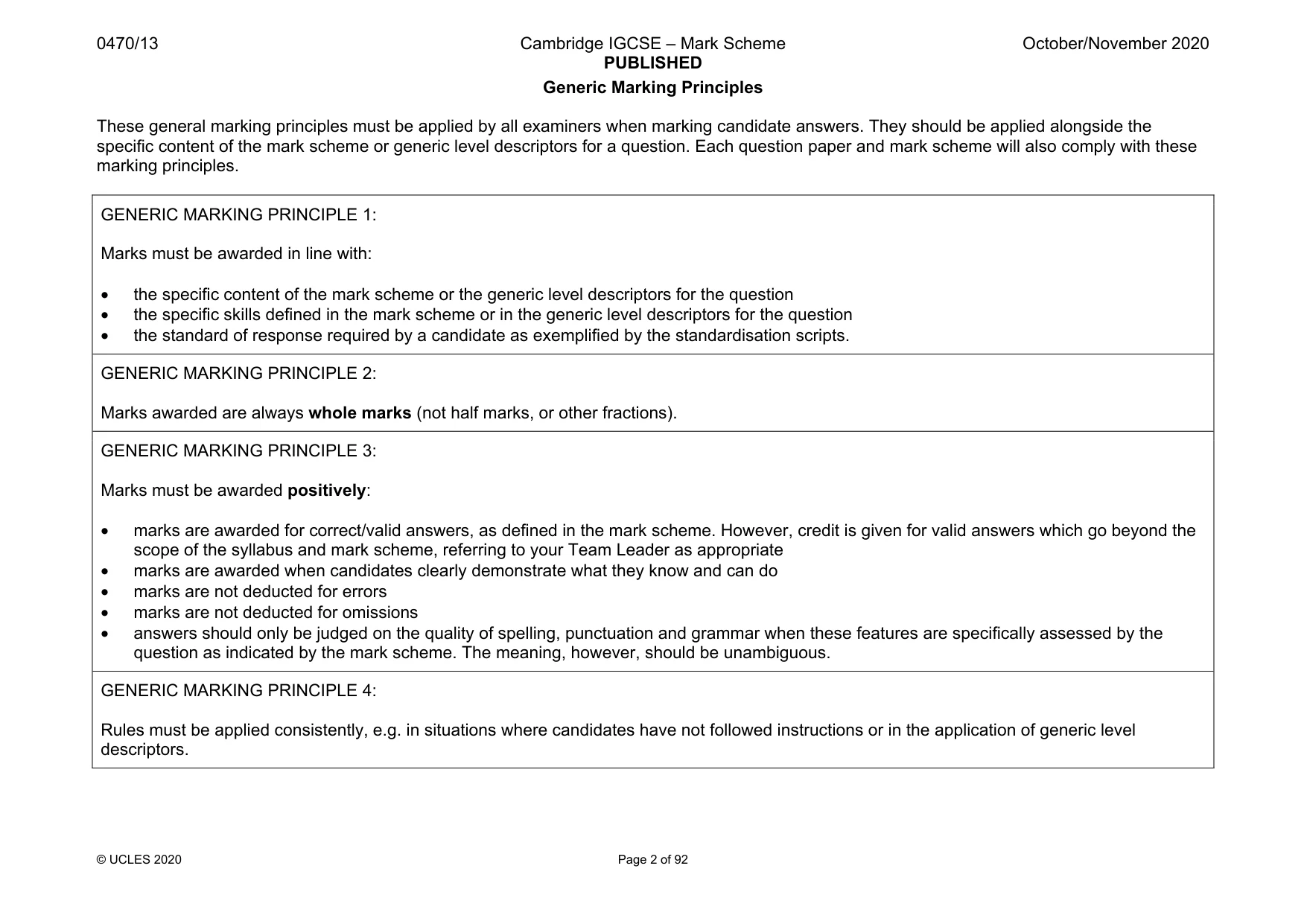
0470/13 Cambridge IGCSE – Mark Scheme PUBLISHED October/November 2020 © UCLES 2020 Page 2 of 92 Generic Marking Principles These general marking principles must be applied by all examiners when marking candidate answers. They should be applied alongside the specific content of the mark scheme or generic level descriptors for a question. Each question paper and mark scheme will also comply with these marking principles. GENERIC MARKING PRINCIPLE 1: Marks must be awarded in line with: • the specific content of the mark scheme or the generic level descriptors for the question • the specific skills defined in the mark scheme or in the generic level descriptors for the question • the standard of response required by a candidate as exemplified by the standardisation scripts. GENERIC MARKING PRINCIPLE 2: Marks awarded are always whole marks (not half marks, or other fractions). GENERIC MARKING PRINCIPLE 3: Marks must be awarded positively: • marks are awarded for correct/valid answers, as defined in the mark scheme. However, credit is given for valid answers which go beyond the scope of the syllabus and mark scheme, referring to your Team Leader as appropriate • marks are awarded when candidates clearly demonstrate what they know and can do • marks are not deducted for errors • marks are not deducted for omissions • answers should only be judged on the quality of spelling, punctuation and grammar when these features are specifically assessed by the question as indicated by the mark scheme. The meaning, however, should be unambiguous. GENERIC MARKING PRINCIPLE 4: Rules must be applied consistently, e.g. in situations where candidates have not followed instructions or in the application of generic level descriptors.
Mark scheme, page 3
0470/13 Cambridge IGCSE – Mark Scheme PUBLISHED October/November 2020 © UCLES 2020 Page 3 of 92 GENERIC MARKING PRINCIPLE 5: Marks should be awarded using the full range of marks defined in the mark scheme for the question (however; the use of the full mark range may be limited according to the quality of the candidate responses seen). GENERIC MARKING PRINCIPLE 6: Marks awarded are based solely on the requirements as defined in the mark scheme. Marks should not be awarded with grade thresholds or grade descriptors in mind.
Mark scheme, page 4
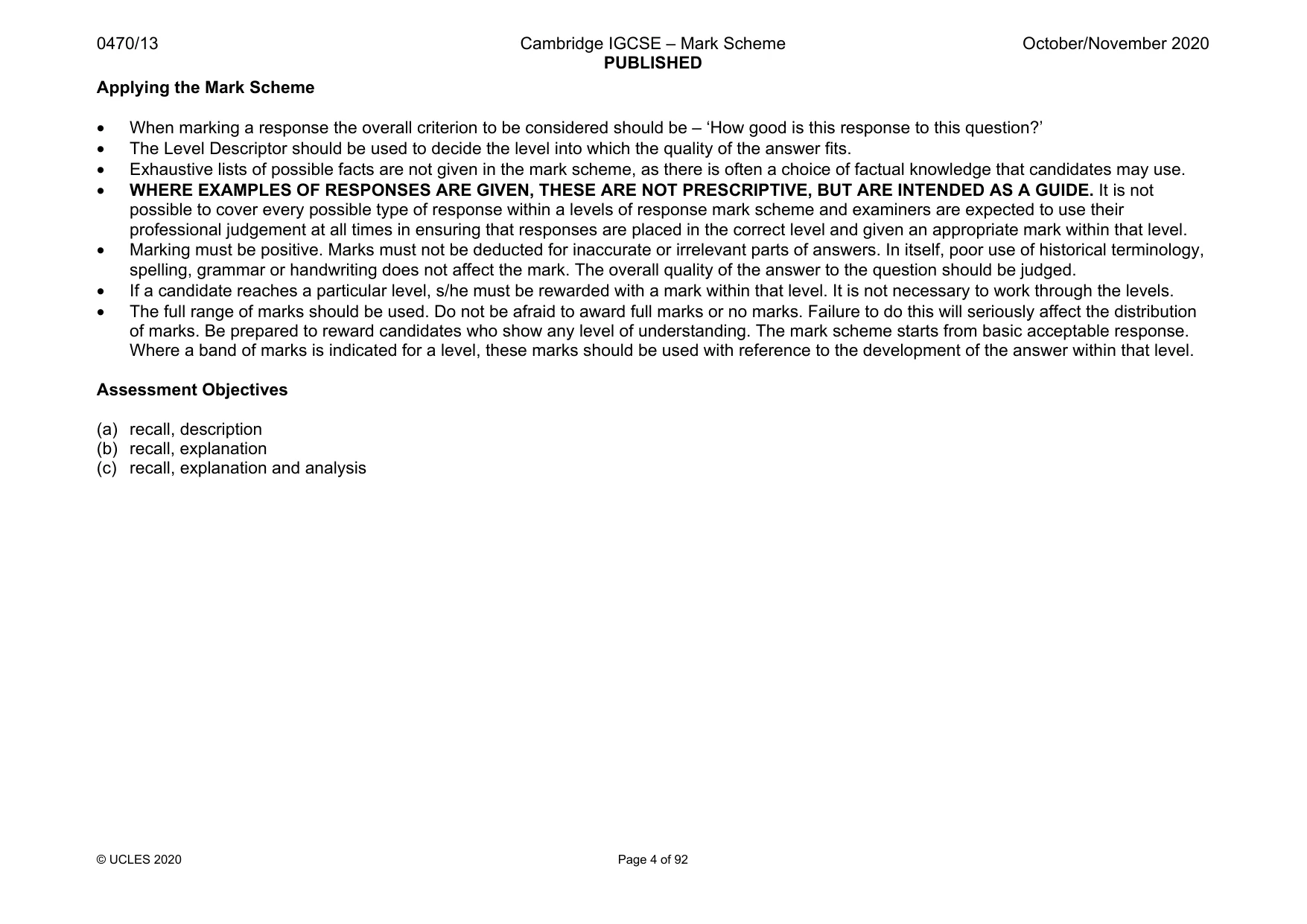
0470/13 Cambridge IGCSE – Mark Scheme PUBLISHED October/November 2020 © UCLES 2020 Page 4 of 92 Applying the Mark Scheme • When marking a response the overall criterion to be considered should be – ‘How good is this response to this question?’ • The Level Descriptor should be used to decide the level into which the quality of the answer fits. • Exhaustive lists of possible facts are not given in the mark scheme, as there is often a choice of factual knowledge that candidates may use. • WHERE EXAMPLES OF RESPONSES ARE GIVEN, THESE ARE NOT PRESCRIPTIVE, BUT ARE INTENDED AS A GUIDE. It is not possible to cover every possible type of response within a levels of response mark scheme and examiners are expected to use their professional judgement at all times in ensuring that responses are placed in the correct level and given an appropriate mark within that level. • Marking must be positive. Marks must not be deducted for inaccurate or irrelevant parts of answers. In itself, poor use of historical terminology, spelling, grammar or handwriting does not affect the mark. The overall quality of the answer to the question should be judged. • If a candidate reaches a particular level, s/he must be rewarded with a mark within that level. It is not necessary to work through the levels. • The full range of marks should be used. Do not be afraid to award full marks or no marks. Failure to do this will seriously affect the distribution of marks. Be prepared to reward candidates who show any level of understanding. The mark scheme starts from basic acceptable response. Where a band of marks is indicated for a level, these marks should be used with reference to the development of the answer within that level. Assessment Objectives (a) recall, description (b) recall, explanation (c) recall, explanation and analysis
Mark scheme, page 5
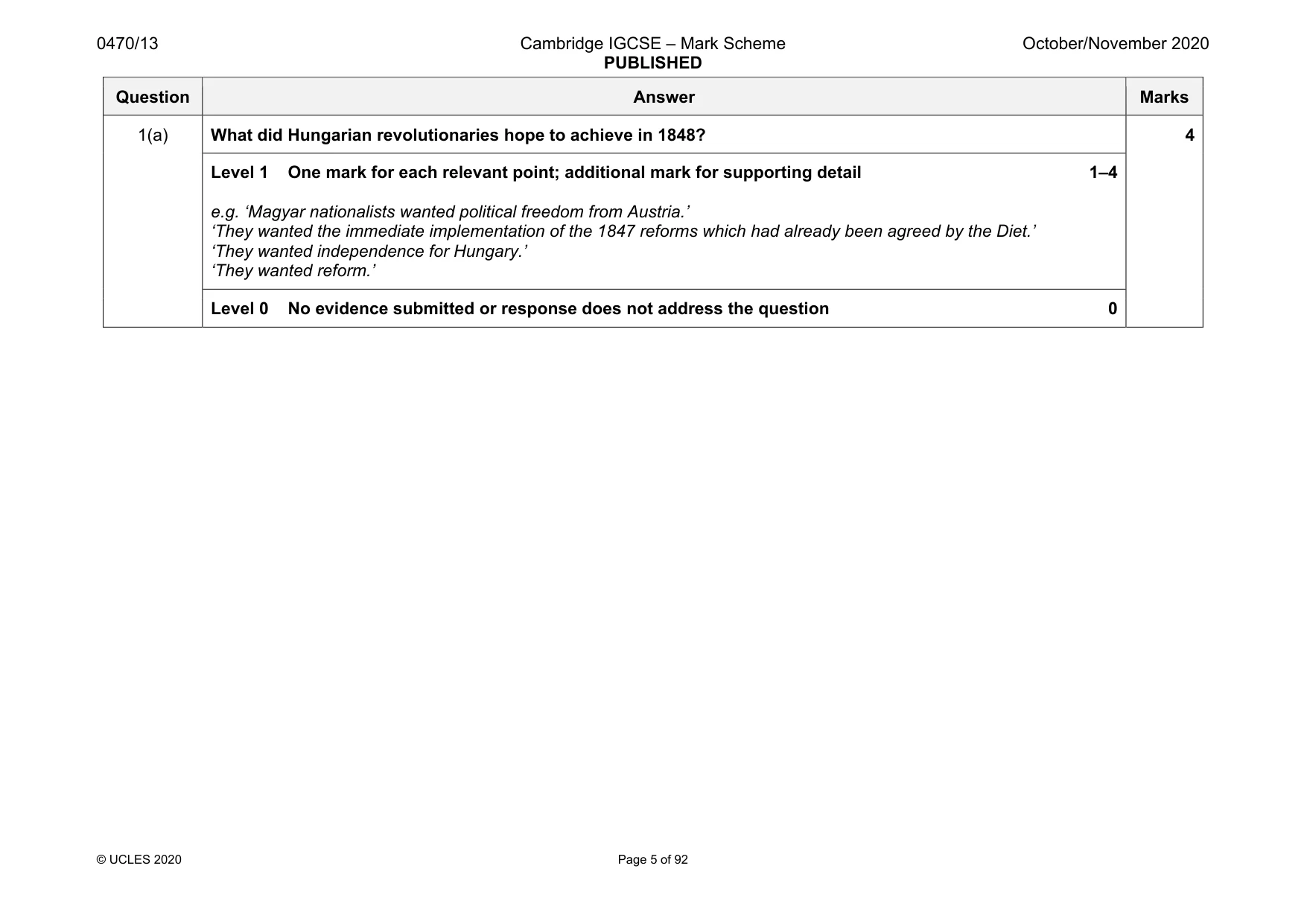
0470/13 Cambridge IGCSE – Mark Scheme PUBLISHED October/November 2020 © UCLES 2020 Page 5 of 92 Question Answer Marks 1(a) What did Hungarian revolutionaries hope to achieve in 1848? 4 Level 1 One mark for each relevant point; additional mark for supporting detail 1–4 e.g. ‘Magyar nationalists wanted political freedom from Austria.’ ‘They wanted the immediate implementation of the 1847 reforms which had already been agreed by the Diet.’ ‘They wanted independence for Hungary.’ ‘They wanted reform.’ Level 0 No evidence submitted or response does not address the question 0
Mark scheme, page 6
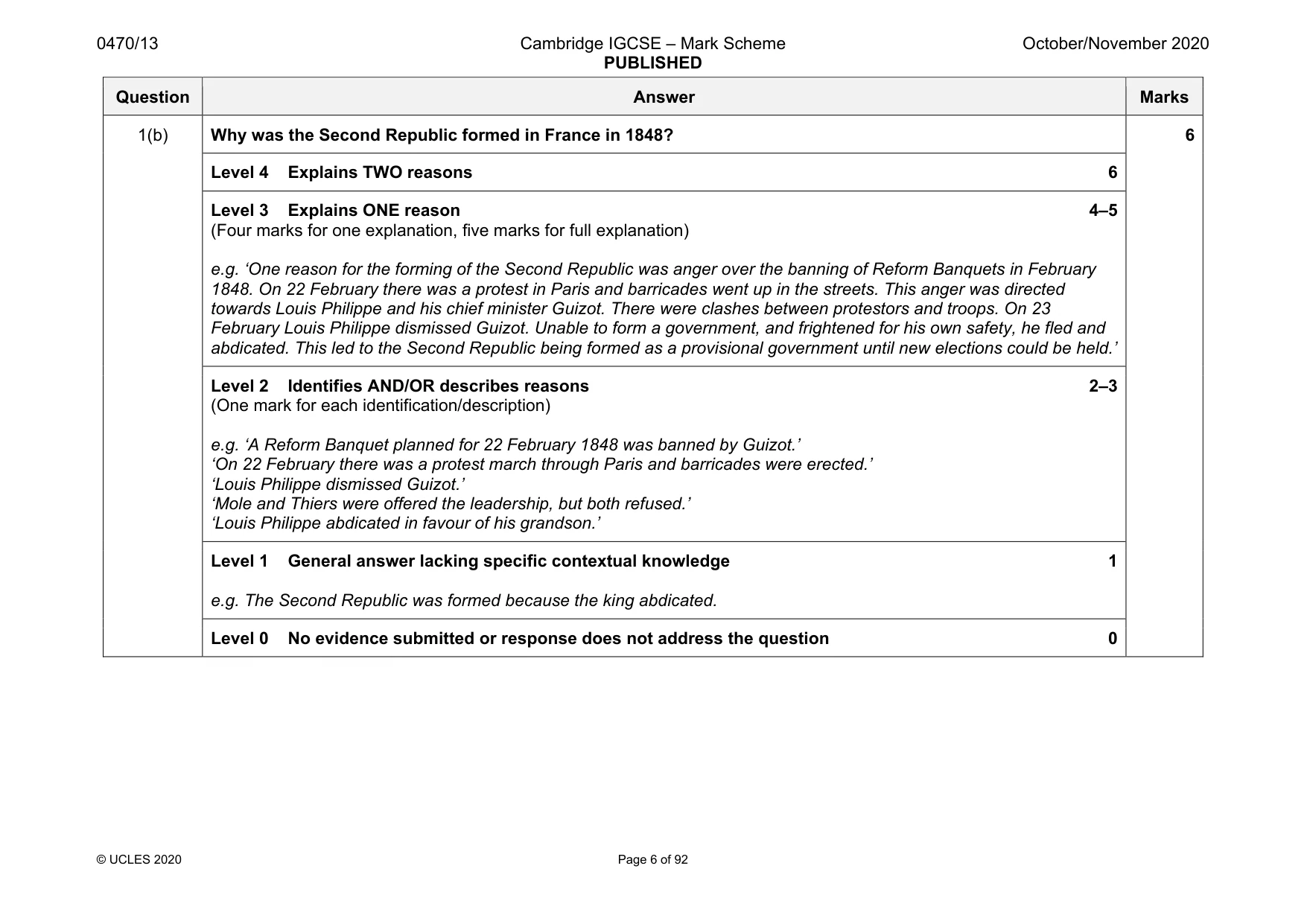
0470/13 Cambridge IGCSE – Mark Scheme PUBLISHED October/November 2020 © UCLES 2020 Page 6 of 92 Question Answer Marks 1(b) Why was the Second Republic formed in France in 1848? 6 Level 4 Explains TWO reasons 6 Level 3 Explains ONE reason 4–5 (Four marks for one explanation, five marks for full explanation) e.g. ‘One reason for the forming of the Second Republic was anger over the banning of Reform Banquets in February 1848. On 22 February there was a protest in Paris and barricades went up in the streets. This anger was directed towards Louis Philippe and his chief minister Guizot. There were clashes between protestors and troops. On 23 February Louis Philippe dismissed Guizot. Unable to form a government, and frightened for his own safety, he fled and abdicated. This led to the Second Republic being formed as a provisional government until new elections could be held.’ Level 2 Identifies AND/OR describes reasons 2–3 (One mark for each identification/description) e.g. ‘A Reform Banquet planned for 22 February 1848 was banned by Guizot.’ ‘On 22 February there was a protest march through Paris and barricades were erected.’ ‘Louis Philippe dismissed Guizot.’ ‘Mole and Thiers were offered the leadership, but both refused.’ ‘Louis Philippe abdicated in favour of his grandson.’ Level 1 General answer lacking specific contextual knowledge 1 e.g. The Second Republic was formed because the king abdicated. Level 0 No evidence submitted or response does not address the question 0
Mark scheme, page 7
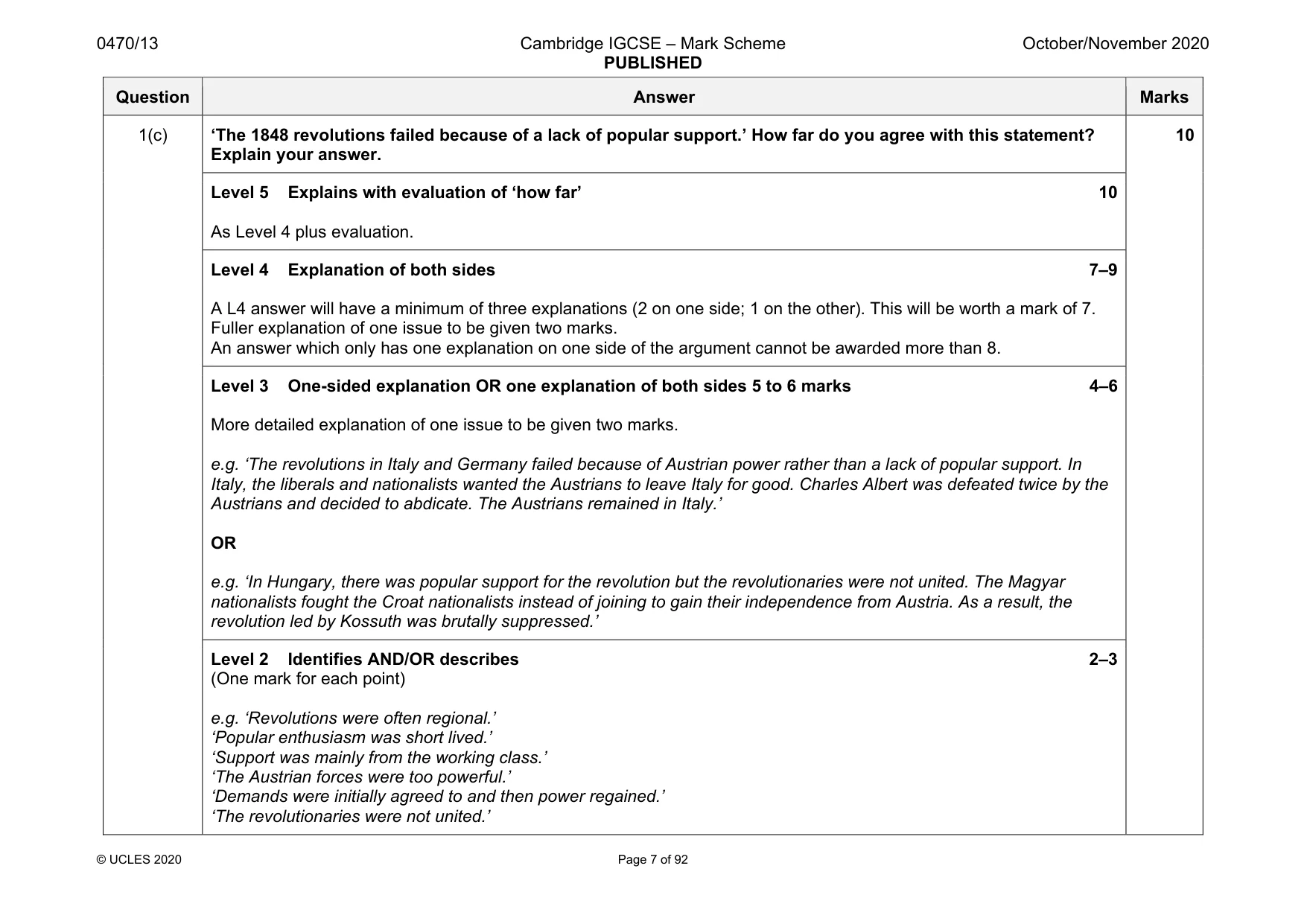
0470/13 Cambridge IGCSE – Mark Scheme PUBLISHED October/November 2020 © UCLES 2020 Page 7 of 92 Question Answer Marks 1(c) ‘The 1848 revolutions failed because of a lack of popular support.’ How far do you agree with this statement? Explain your answer. 10 Level 5 Explains with evaluation of ‘how far’ 10 As Level 4 plus evaluation. Level 4 Explanation of both sides 7–9 A L4 answer will have a minimum of three explanations (2 on one side; 1 on the other). This will be worth a mark of 7. Fuller explanation of one issue to be given two marks. An answer which only has one explanation on one side of the argument cannot be awarded more than 8. Level 3 One-sided explanation OR one explanation of both sides 5 to 6 marks 4–6 More detailed explanation of one issue to be given two marks. e.g. ‘The revolutions in Italy and Germany failed because of Austrian power rather than a lack of popular support. In Italy, the liberals and nationalists wanted the Austrians to leave Italy for good. Charles Albert was defeated twice by the Austrians and decided to abdicate. The Austrians remained in Italy.’ OR e.g. ‘In Hungary, there was popular support for the revolution but the revolutionaries were not united. The Magyar nationalists fought the Croat nationalists instead of joining to gain their independence from Austria. As a result, the revolution led by Kossuth was brutally suppressed.’ Level 2 Identifies AND/OR describes 2–3 (One mark for each point) e.g. ‘Revolutions were often regional.’ ‘Popular enthusiasm was short lived.’ ‘Support was mainly from the working class.’ ‘The Austrian forces were too powerful.’ ‘Demands were initially agreed to and then power regained.’ ‘The revolutionaries were not united.’
Mark scheme, page 8
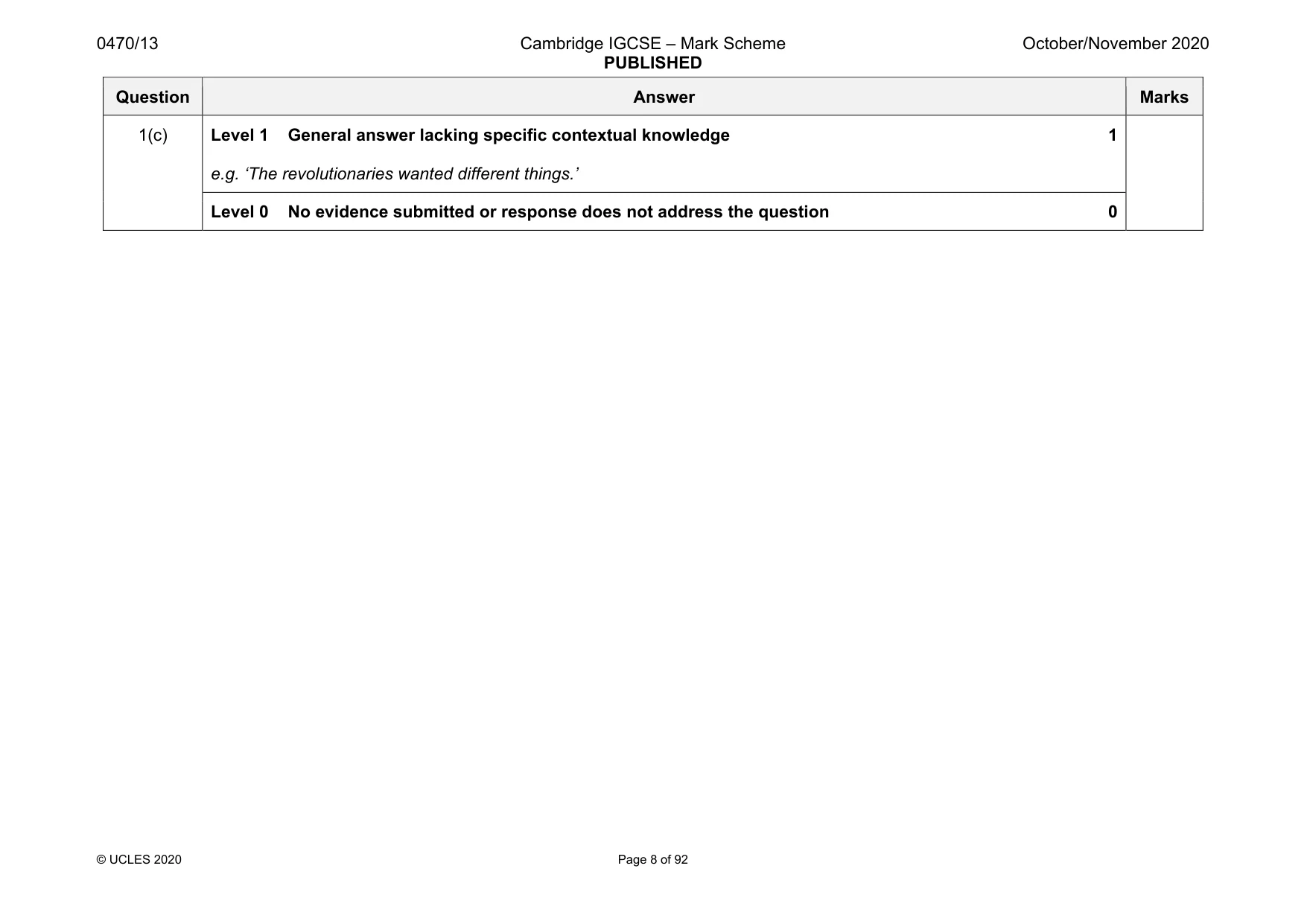
0470/13 Cambridge IGCSE – Mark Scheme PUBLISHED October/November 2020 © UCLES 2020 Page 8 of 92 Question Answer Marks 1(c) Level 1 General answer lacking specific contextual knowledge 1 e.g. ‘The revolutionaries wanted different things.’ Level 0 No evidence submitted or response does not address the question 0
Mark scheme, page 9
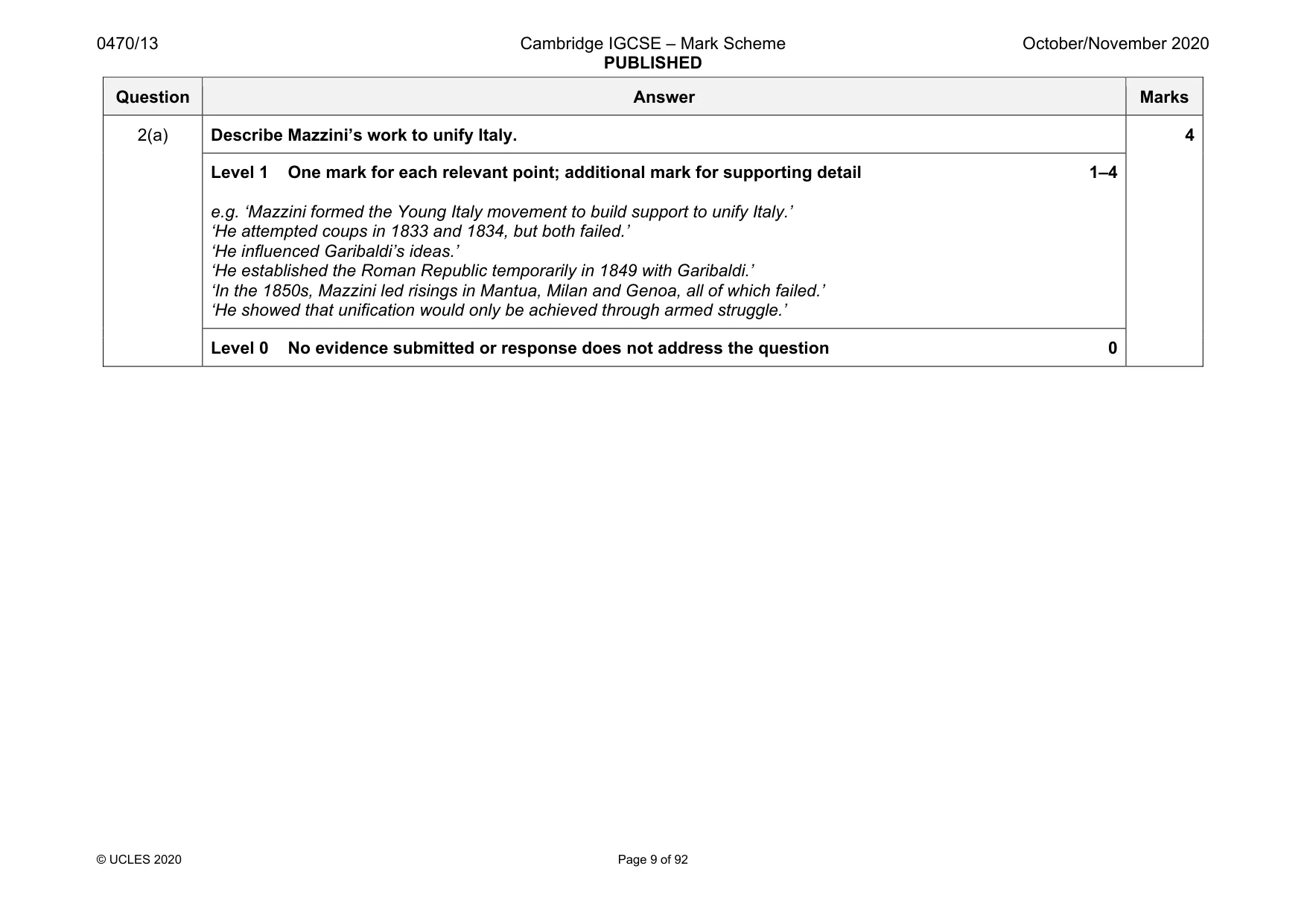
0470/13 Cambridge IGCSE – Mark Scheme PUBLISHED October/November 2020 © UCLES 2020 Page 9 of 92 Question Answer Marks 2(a) Describe Mazzini’s work to unify Italy. 4 Level 1 One mark for each relevant point; additional mark for supporting detail 1–4 e.g. ‘Mazzini formed the Young Italy movement to build support to unify Italy.’ ‘He attempted coups in 1833 and 1834, but both failed.’ ‘He influenced Garibaldi’s ideas.’ ‘He established the Roman Republic temporarily in 1849 with Garibaldi.’ ‘In the 1850s, Mazzini led risings in Mantua, Milan and Genoa, all of which failed.’ ‘He showed that unification would only be achieved through armed struggle.’ Level 0 No evidence submitted or response does not address the question 0
Mark scheme, page 10
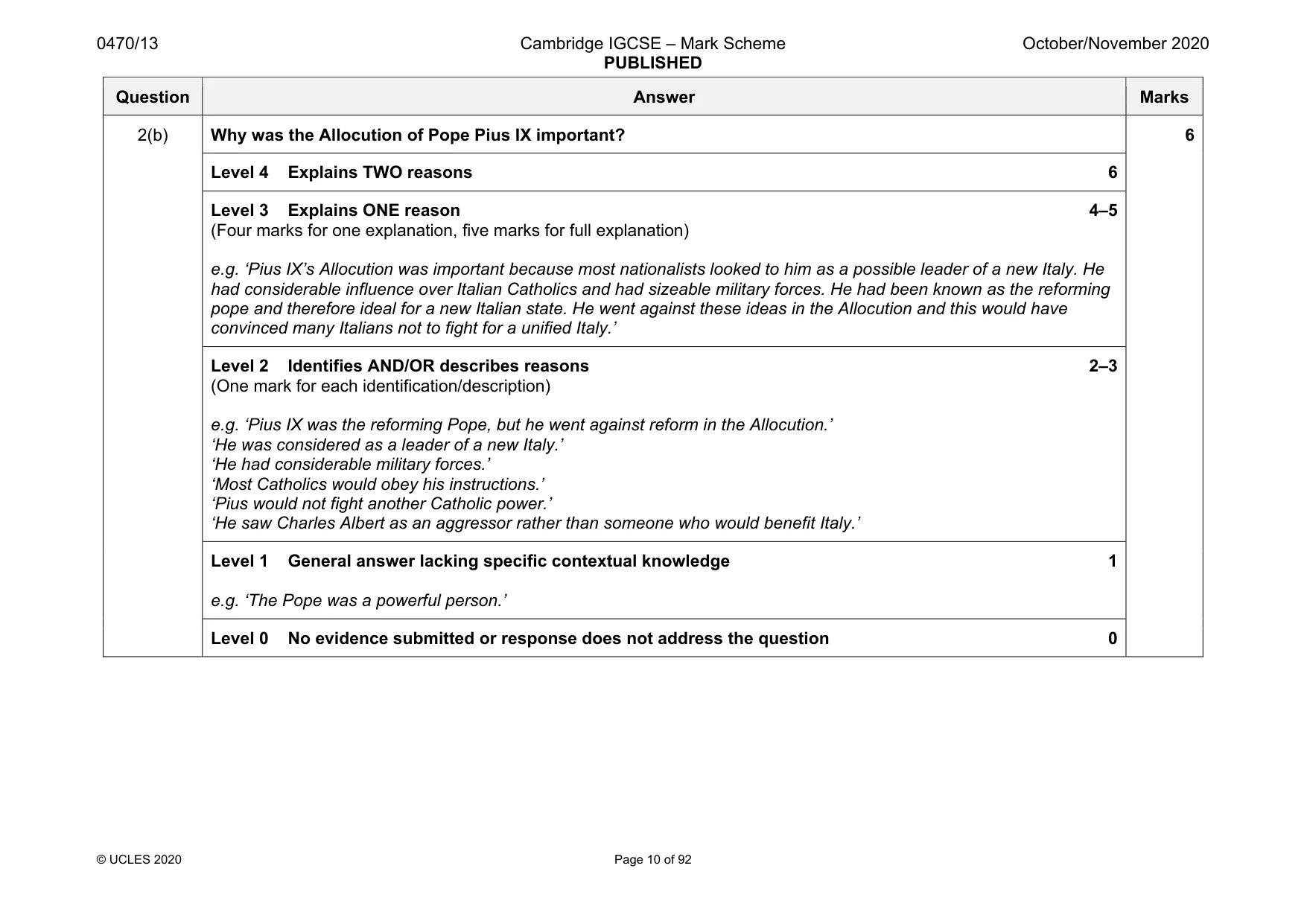
0470/13 Cambridge IGCSE – Mark Scheme PUBLISHED October/November 2020 © UCLES 2020 Page 10 of 92 Question Answer Marks 2(b) Why was the Allocution of Pope Pius IX important? 6 Level 4 Explains TWO reasons 6 Level 3 Explains ONE reason 4–5 (Four marks for one explanation, five marks for full explanation) e.g. ‘Pius IX’s Allocution was important because most nationalists looked to him as a possible leader of a new Italy. He had considerable influence over Italian Catholics and had sizeable military forces. He had been known as the reforming pope and therefore ideal for a new Italian state. He went against these ideas in the Allocution and this would have convinced many Italians not to fight for a unified Italy.’ Level 2 Identifies AND/OR describes reasons 2–3 (One mark for each identification/description) e.g. ‘Pius IX was the reforming Pope, but he went against reform in the Allocution.’ ‘He was considered as a leader of a new Italy.’ ‘He had considerable military forces.’ ‘Most Catholics would obey his instructions.’ ‘Pius would not fight another Catholic power.’ ‘He saw Charles Albert as an aggressor rather than someone who would benefit Italy.’ Level 1 General answer lacking specific contextual knowledge 1 e.g. ‘The Pope was a powerful person.’ Level 0 No evidence submitted or response does not address the question 0
Mark scheme, page 11
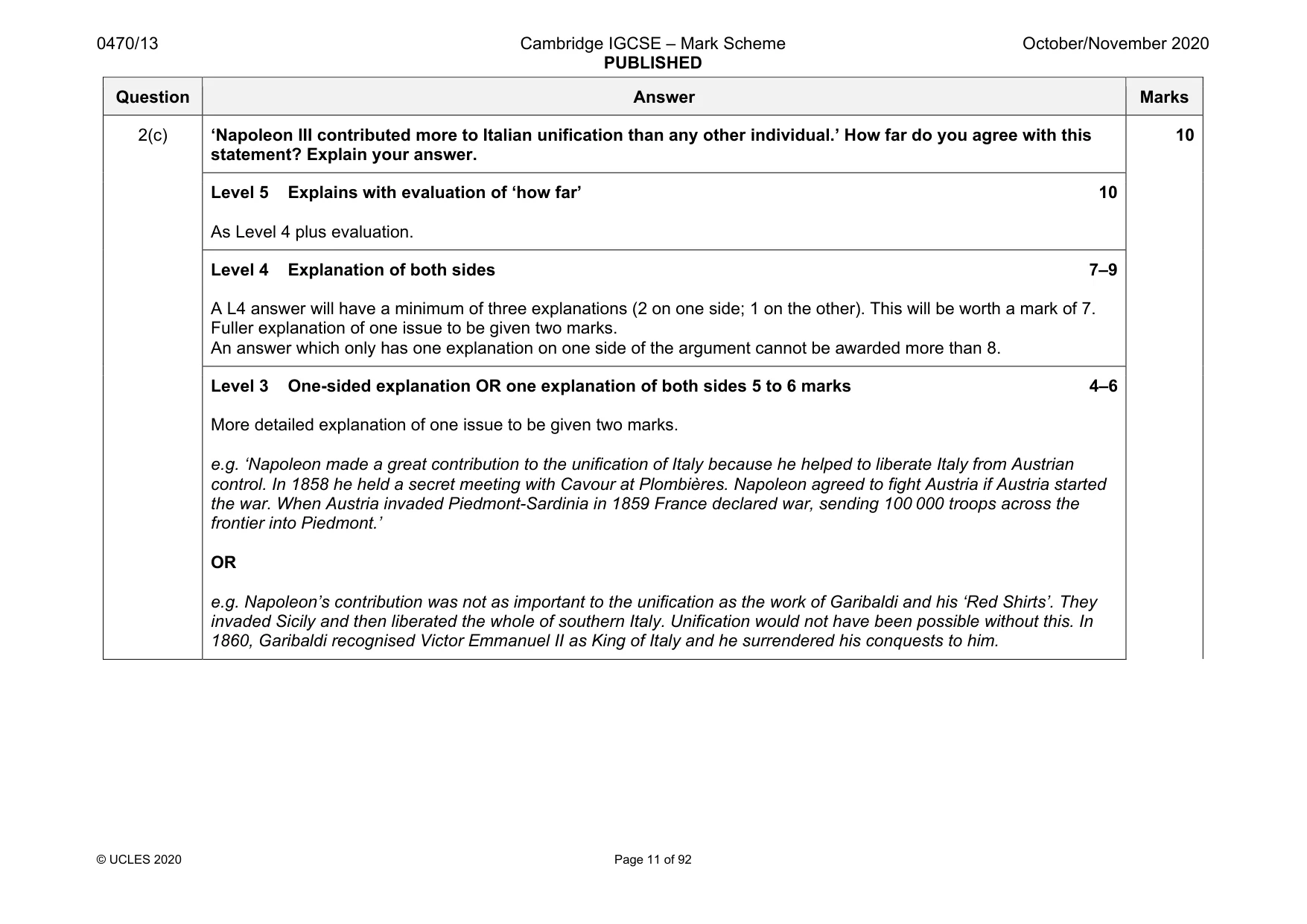
0470/13 Cambridge IGCSE – Mark Scheme PUBLISHED October/November 2020 © UCLES 2020 Page 11 of 92 Question Answer Marks 2(c) ‘Napoleon III contributed more to Italian unification than any other individual.’ How far do you agree with this statement? Explain your answer. 10 Level 5 Explains with evaluation of ‘how far’ 10 As Level 4 plus evaluation. Level 4 Explanation of both sides 7–9 A L4 answer will have a minimum of three explanations (2 on one side; 1 on the other). This will be worth a mark of 7. Fuller explanation of one issue to be given two marks. An answer which only has one explanation on one side of the argument cannot be awarded more than 8. Level 3 One-sided explanation OR one explanation of both sides 5 to 6 marks 4–6 More detailed explanation of one issue to be given two marks. e.g. ‘Napoleon made a great contribution to the unification of Italy because he helped to liberate Italy from Austrian control. In 1858 he held a secret meeting with Cavour at Plombières. Napoleon agreed to fight Austria if Austria started the war. When Austria invaded Piedmont-Sardinia in 1859 France declared war, sending 100 000 troops across the frontier into Piedmont.’ OR e.g. Napoleon’s contribution was not as important to the unification as the work of Garibaldi and his ‘Red Shirts’. They invaded Sicily and then liberated the whole of southern Italy. Unification would not have been possible without this. In 1860, Garibaldi recognised Victor Emmanuel II as King of Italy and he surrendered his conquests to him.
Mark scheme, page 12
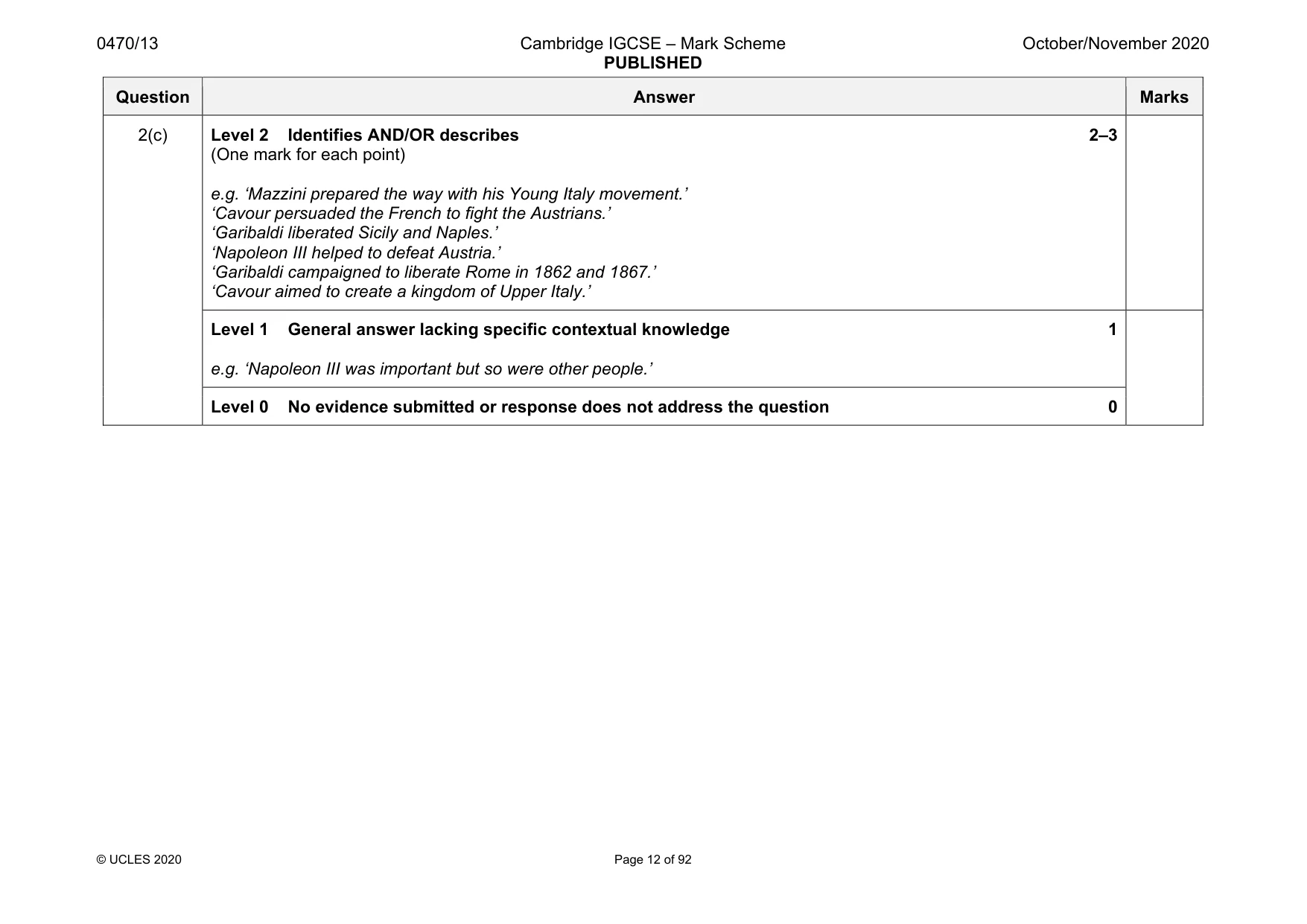
0470/13 Cambridge IGCSE – Mark Scheme PUBLISHED October/November 2020 © UCLES 2020 Page 12 of 92 Question Answer Marks 2(c) Level 2 Identifies AND/OR describes 2–3 (One mark for each point) e.g. ‘Mazzini prepared the way with his Young Italy movement.’ ‘Cavour persuaded the French to fight the Austrians.’ ‘Garibaldi liberated Sicily and Naples.’ ‘Napoleon III helped to defeat Austria.’ ‘Garibaldi campaigned to liberate Rome in 1862 and 1867.’ ‘Cavour aimed to create a kingdom of Upper Italy.’ Level 1 General answer lacking specific contextual knowledge 1 e.g. ‘Napoleon III was important but so were other people.’ Level 0 No evidence submitted or response does not address the question 0
Mark scheme, page 13
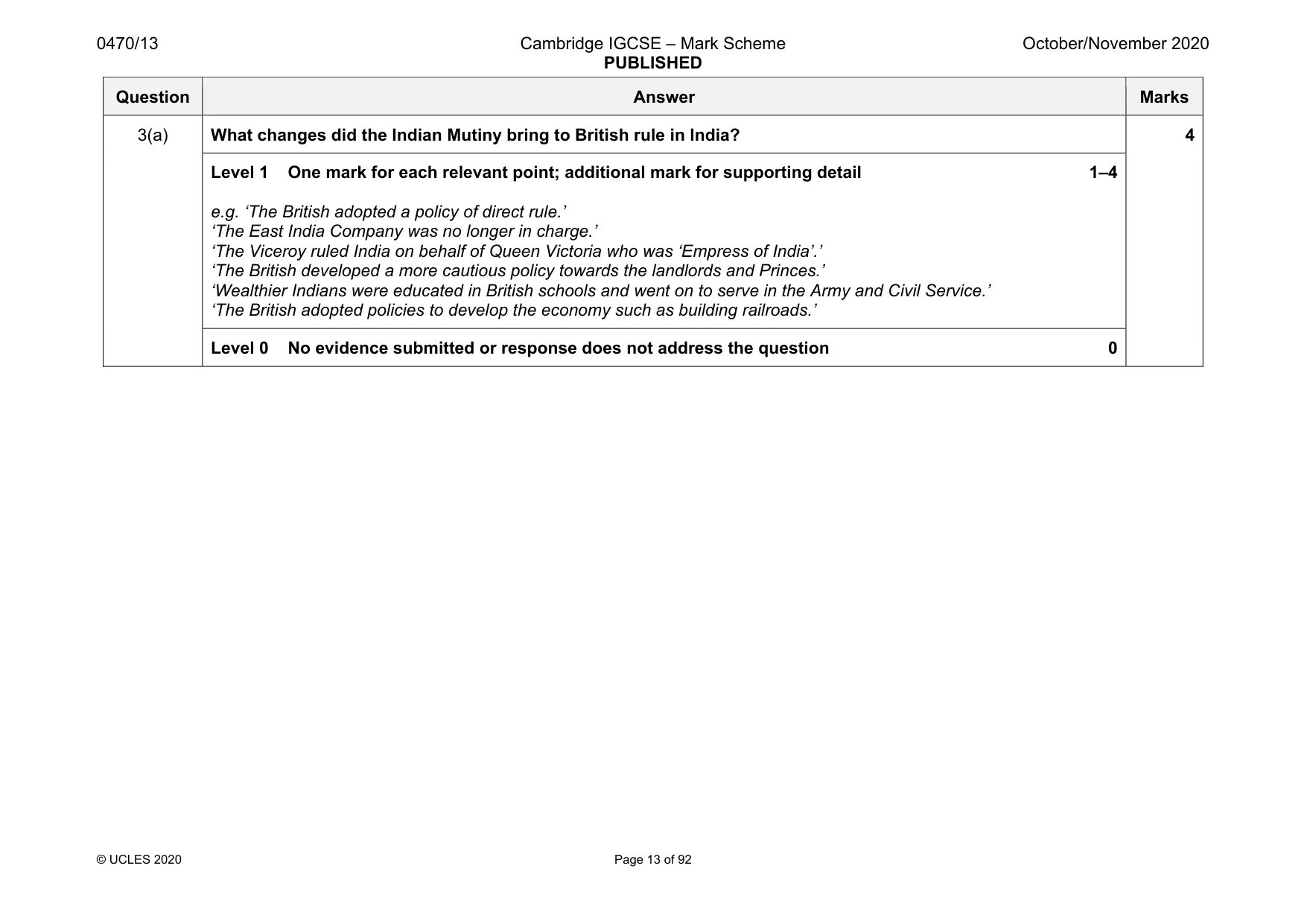
0470/13 Cambridge IGCSE – Mark Scheme PUBLISHED October/November 2020 © UCLES 2020 Page 13 of 92 Question Answer Marks 3(a) What changes did the Indian Mutiny bring to British rule in India? 4 Level 1 One mark for each relevant point; additional mark for supporting detail 1–4 e.g. ‘The British adopted a policy of direct rule.’ ‘The East India Company was no longer in charge.’ ‘The Viceroy ruled India on behalf of Queen Victoria who was ‘Empress of India’.’ ‘The British developed a more cautious policy towards the landlords and Princes.’ ‘Wealthier Indians were educated in British schools and went on to serve in the Army and Civil Service.’ ‘The British adopted policies to develop the economy such as building railroads.’ Level 0 No evidence submitted or response does not address the question 0
Mark scheme, page 14
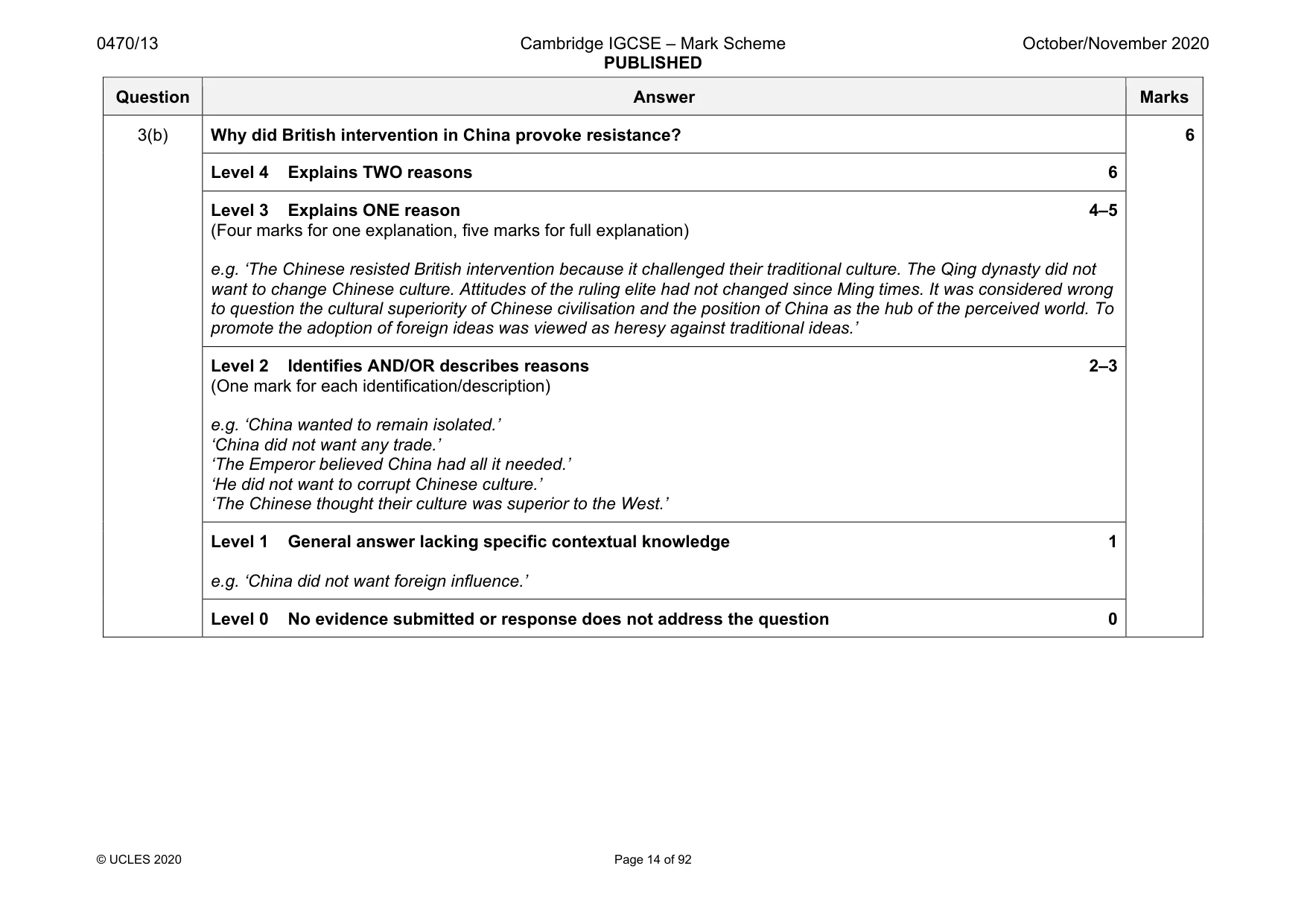
0470/13 Cambridge IGCSE – Mark Scheme PUBLISHED October/November 2020 © UCLES 2020 Page 14 of 92 Question Answer Marks 3(b) Why did British intervention in China provoke resistance? 6 Level 4 Explains TWO reasons 6 Level 3 Explains ONE reason 4–5 (Four marks for one explanation, five marks for full explanation) e.g. ‘The Chinese resisted British intervention because it challenged their traditional culture. The Qing dynasty did not want to change Chinese culture. Attitudes of the ruling elite had not changed since Ming times. It was considered wrong to question the cultural superiority of Chinese civilisation and the position of China as the hub of the perceived world. To promote the adoption of foreign ideas was viewed as heresy against traditional ideas.’ Level 2 Identifies AND/OR describes reasons 2–3 (One mark for each identification/description) e.g. ‘China wanted to remain isolated.’ ‘China did not want any trade.’ ‘The Emperor believed China had all it needed.’ ‘He did not want to corrupt Chinese culture.’ ‘The Chinese thought their culture was superior to the West.’ Level 1 General answer lacking specific contextual knowledge 1 e.g. ‘China did not want foreign influence.’ Level 0 No evidence submitted or response does not address the question 0
Mark scheme, page 15
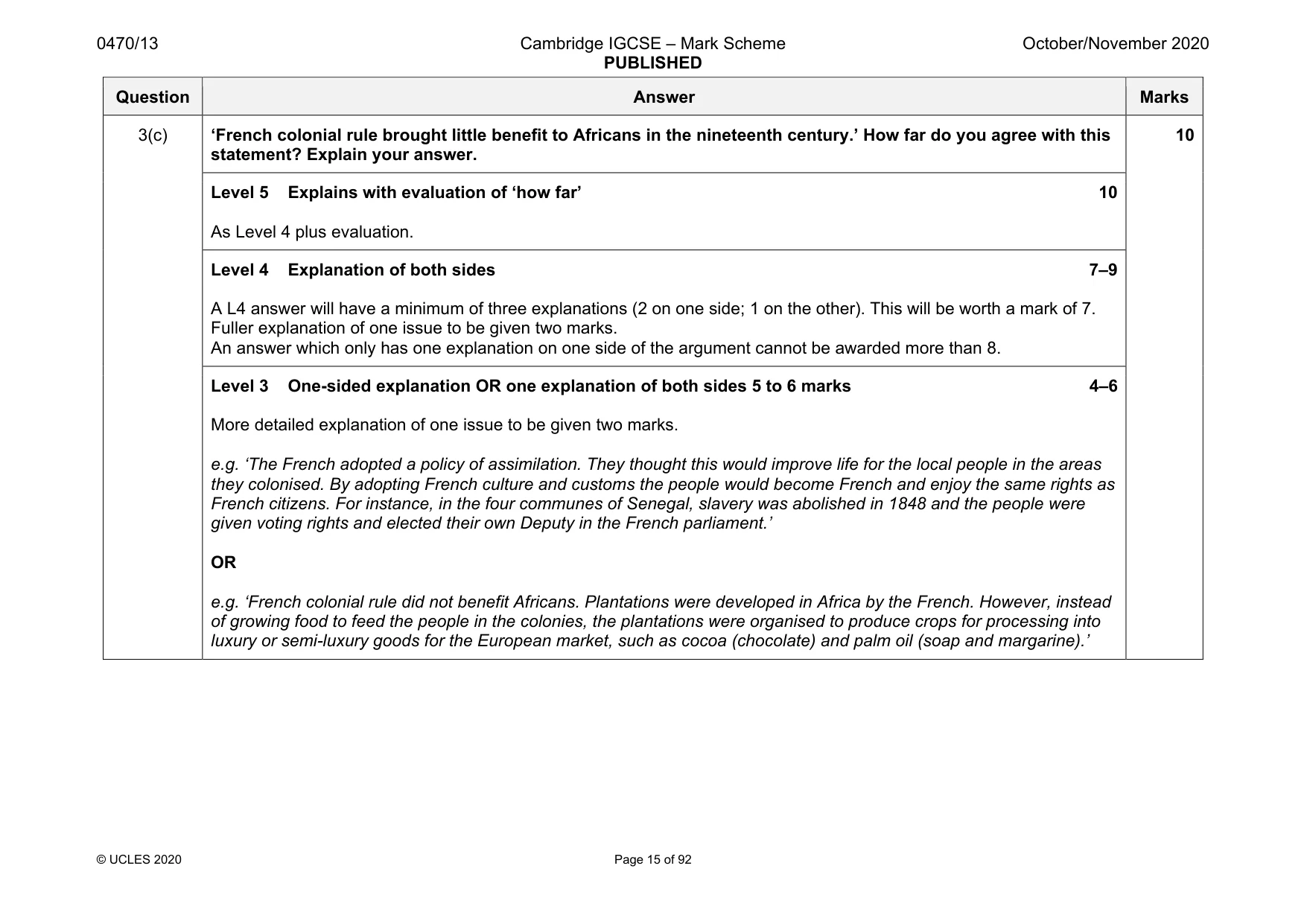
0470/13 Cambridge IGCSE – Mark Scheme PUBLISHED October/November 2020 © UCLES 2020 Page 15 of 92 Question Answer Marks 3(c) ‘French colonial rule brought little benefit to Africans in the nineteenth century.’ How far do you agree with this statement? Explain your answer. 10 Level 5 Explains with evaluation of ‘how far’ 10 As Level 4 plus evaluation. Level 4 Explanation of both sides 7–9 A L4 answer will have a minimum of three explanations (2 on one side; 1 on the other). This will be worth a mark of 7. Fuller explanation of one issue to be given two marks. An answer which only has one explanation on one side of the argument cannot be awarded more than 8. Level 3 One-sided explanation OR one explanation of both sides 5 to 6 marks 4–6 More detailed explanation of one issue to be given two marks. e.g. ‘The French adopted a policy of assimilation. They thought this would improve life for the local people in the areas they colonised. By adopting French culture and customs the people would become French and enjoy the same rights as French citizens. For instance, in the four communes of Senegal, slavery was abolished in 1848 and the people were given voting rights and elected their own Deputy in the French parliament.’ OR e.g. ‘French colonial rule did not benefit Africans. Plantations were developed in Africa by the French. However, instead of growing food to feed the people in the colonies, the plantations were organised to produce crops for processing into luxury or semi-luxury goods for the European market, such as cocoa (chocolate) and palm oil (soap and margarine).’
Mark scheme, page 16
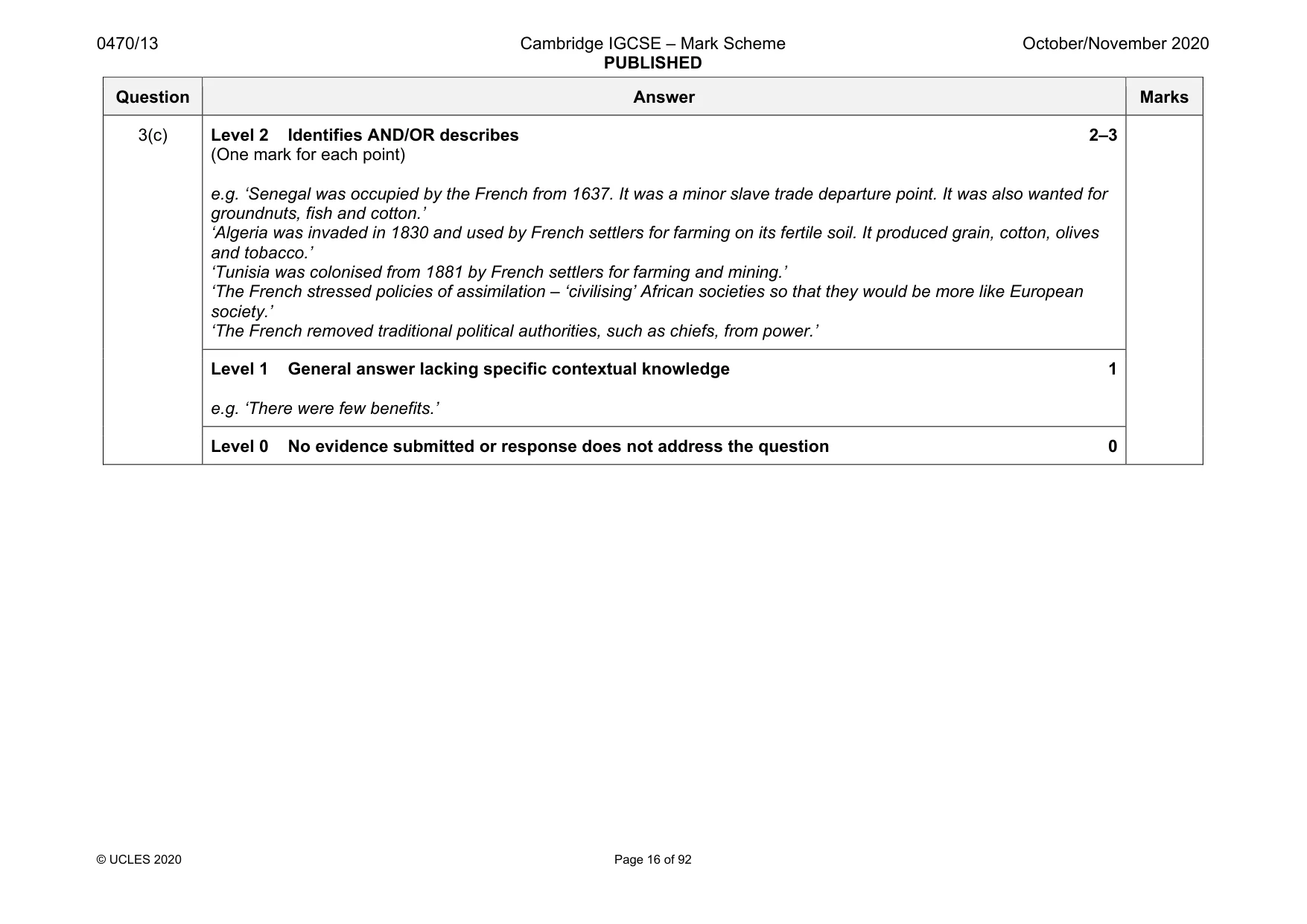
0470/13 Cambridge IGCSE – Mark Scheme PUBLISHED October/November 2020 © UCLES 2020 Page 16 of 92 Question Answer Marks 3(c) Level 2 Identifies AND/OR describes 2–3 (One mark for each point) e.g. ‘Senegal was occupied by the French from 1637. It was a minor slave trade departure point. It was also wanted for groundnuts, fish and cotton.’ ‘Algeria was invaded in 1830 and used by French settlers for farming on its fertile soil. It produced grain, cotton, olives and tobacco.’ ‘Tunisia was colonised from 1881 by French settlers for farming and mining.’ ‘The French stressed policies of assimilation – ‘civilising’ African societies so that they would be more like European society.’ ‘The French removed traditional political authorities, such as chiefs, from power.’ Level 1 General answer lacking specific contextual knowledge 1 e.g. ‘There were few benefits.’ Level 0 No evidence submitted or response does not address the question 0
Mark scheme, page 17
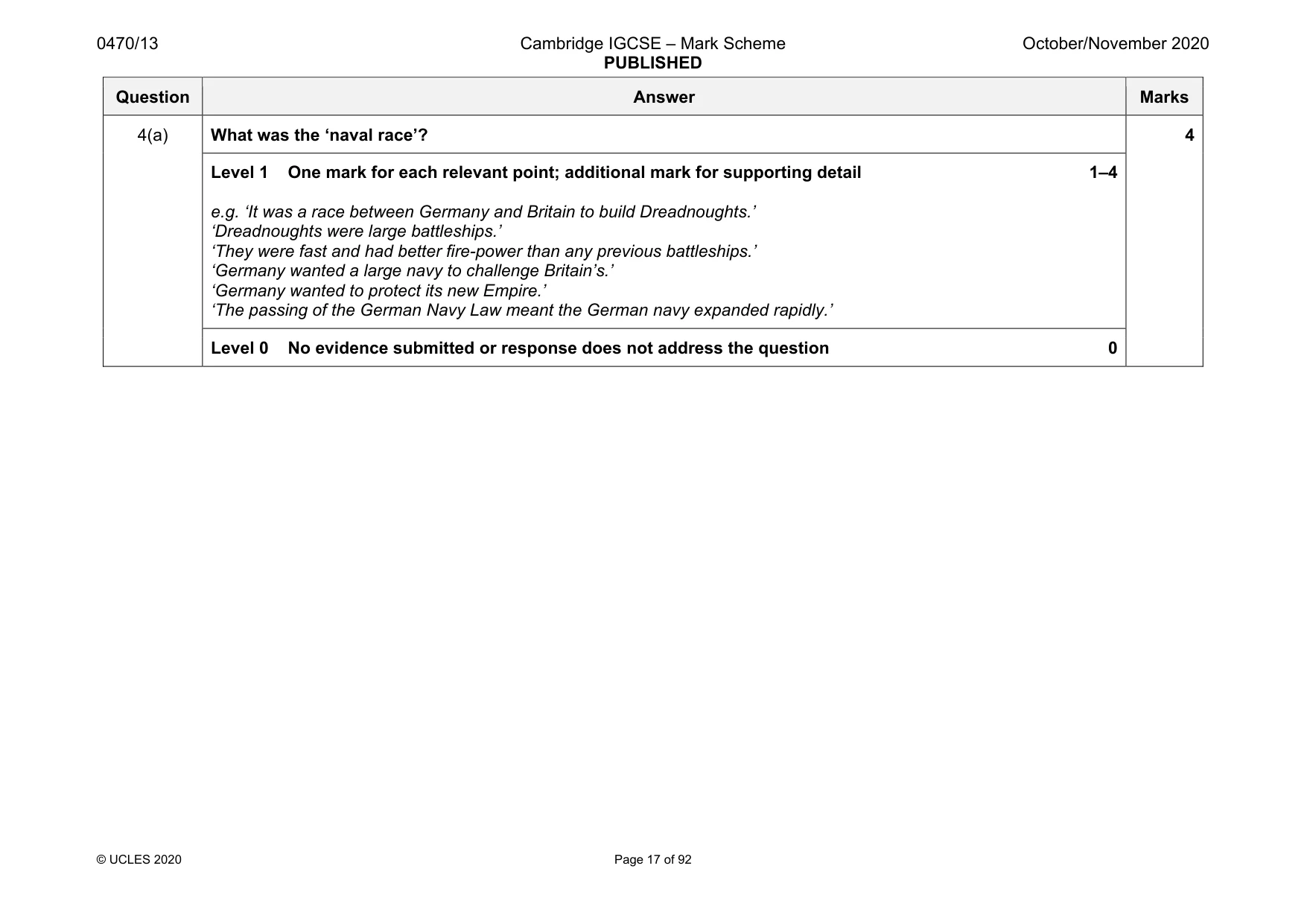
0470/13 Cambridge IGCSE – Mark Scheme PUBLISHED October/November 2020 © UCLES 2020 Page 17 of 92 Question Answer Marks 4(a) What was the ‘naval race’? 4 Level 1 One mark for each relevant point; additional mark for supporting detail 1–4 e.g. ‘It was a race between Germany and Britain to build Dreadnoughts.’ ‘Dreadnoughts were large battleships.’ ‘They were fast and had better fire-power than any previous battleships.’ ‘Germany wanted a large navy to challenge Britain’s.’ ‘Germany wanted to protect its new Empire.’ ‘The passing of the German Navy Law meant the German navy expanded rapidly.’ Level 0 No evidence submitted or response does not address the question 0
Mark scheme, page 18
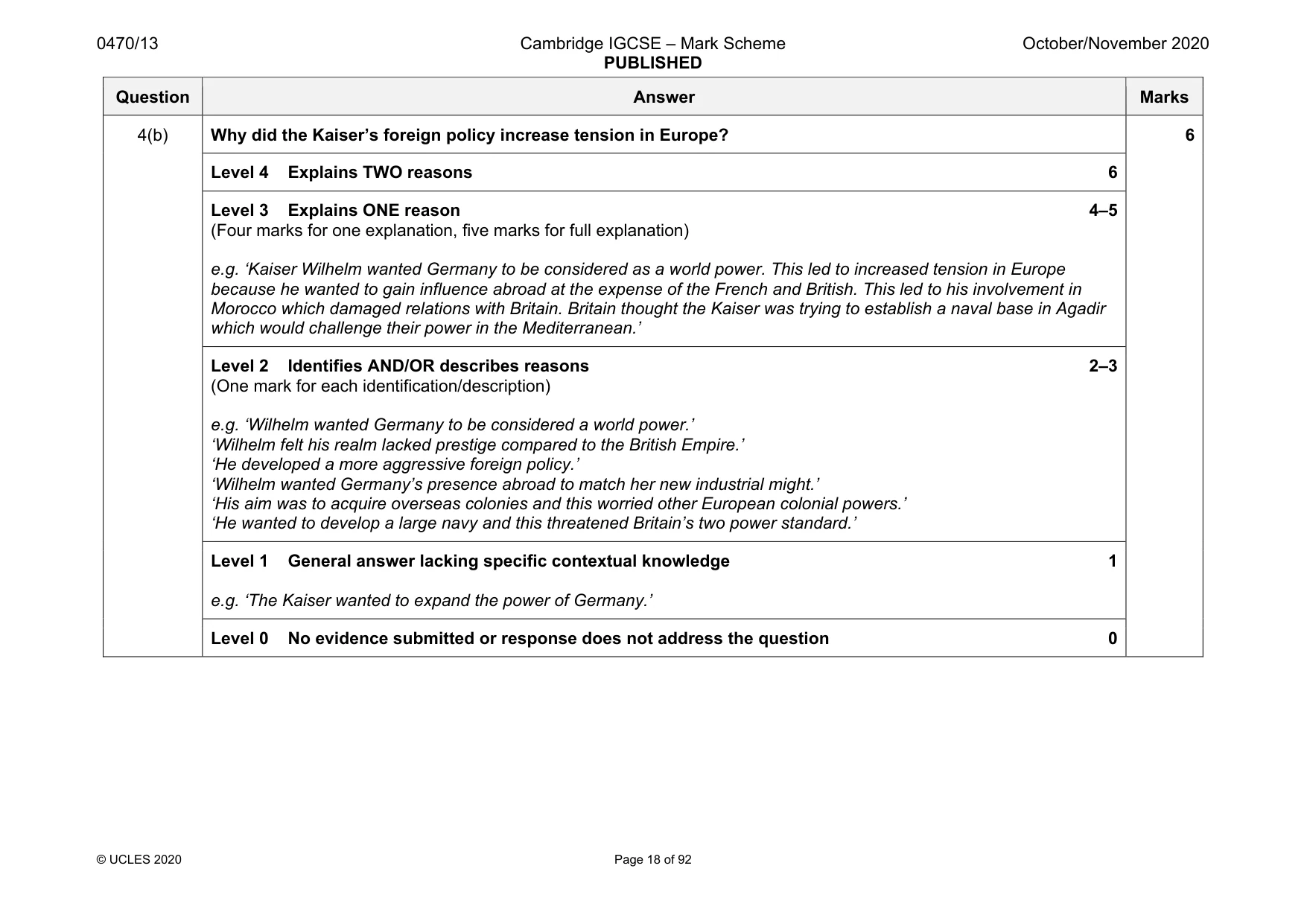
0470/13 Cambridge IGCSE – Mark Scheme PUBLISHED October/November 2020 © UCLES 2020 Page 18 of 92 Question Answer Marks 4(b) Why did the Kaiser’s foreign policy increase tension in Europe? 6 Level 4 Explains TWO reasons 6 Level 3 Explains ONE reason 4–5 (Four marks for one explanation, five marks for full explanation) e.g. ‘Kaiser Wilhelm wanted Germany to be considered as a world power. This led to increased tension in Europe because he wanted to gain influence abroad at the expense of the French and British. This led to his involvement in Morocco which damaged relations with Britain. Britain thought the Kaiser was trying to establish a naval base in Agadir which would challenge their power in the Mediterranean.’ Level 2 Identifies AND/OR describes reasons 2–3 (One mark for each identification/description) e.g. ‘Wilhelm wanted Germany to be considered a world power.’ ‘Wilhelm felt his realm lacked prestige compared to the British Empire.’ ‘He developed a more aggressive foreign policy.’ ‘Wilhelm wanted Germany’s presence abroad to match her new industrial might.’ ‘His aim was to acquire overseas colonies and this worried other European colonial powers.’ ‘He wanted to develop a large navy and this threatened Britain’s two power standard.’ Level 1 General answer lacking specific contextual knowledge 1 e.g. ‘The Kaiser wanted to expand the power of Germany.’ Level 0 No evidence submitted or response does not address the question 0
Mark scheme, page 19
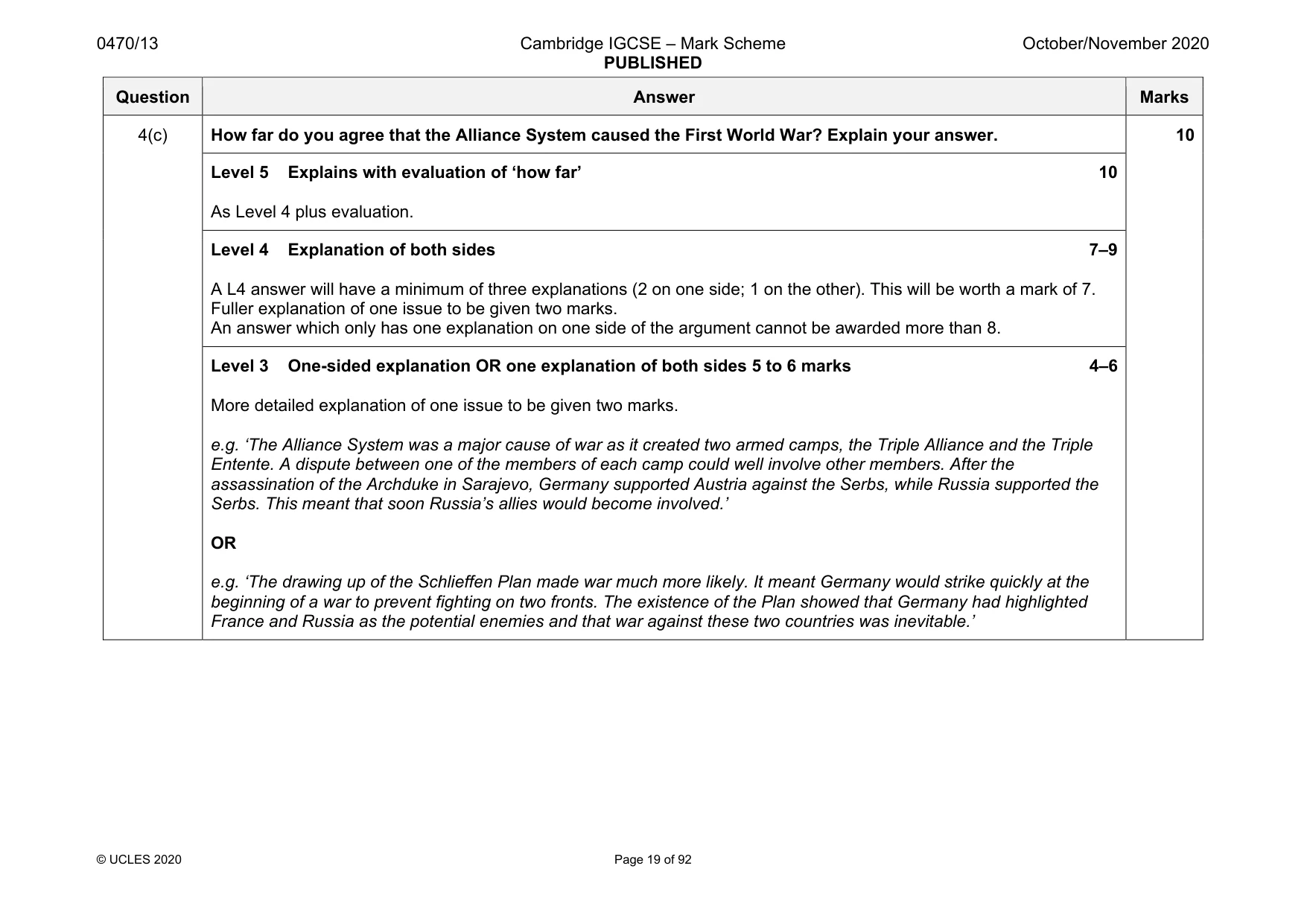
0470/13 Cambridge IGCSE – Mark Scheme PUBLISHED October/November 2020 © UCLES 2020 Page 19 of 92 Question Answer Marks 4(c) How far do you agree that the Alliance System caused the First World War? Explain your answer. 10 Level 5 Explains with evaluation of ‘how far’ 10 As Level 4 plus evaluation. Level 4 Explanation of both sides 7–9 A L4 answer will have a minimum of three explanations (2 on one side; 1 on the other). This will be worth a mark of 7. Fuller explanation of one issue to be given two marks. An answer which only has one explanation on one side of the argument cannot be awarded more than 8. Level 3 One-sided explanation OR one explanation of both sides 5 to 6 marks 4–6 More detailed explanation of one issue to be given two marks. e.g. ‘The Alliance System was a major cause of war as it created two armed camps, the Triple Alliance and the Triple Entente. A dispute between one of the members of each camp could well involve other members. After the assassination of the Archduke in Sarajevo, Germany supported Austria against the Serbs, while Russia supported the Serbs. This meant that soon Russia’s allies would become involved.’ OR e.g. ‘The drawing up of the Schlieffen Plan made war much more likely. It meant Germany would strike quickly at the beginning of a war to prevent fighting on two fronts. The existence of the Plan showed that Germany had highlighted France and Russia as the potential enemies and that war against these two countries was inevitable.’
Mark scheme, page 20
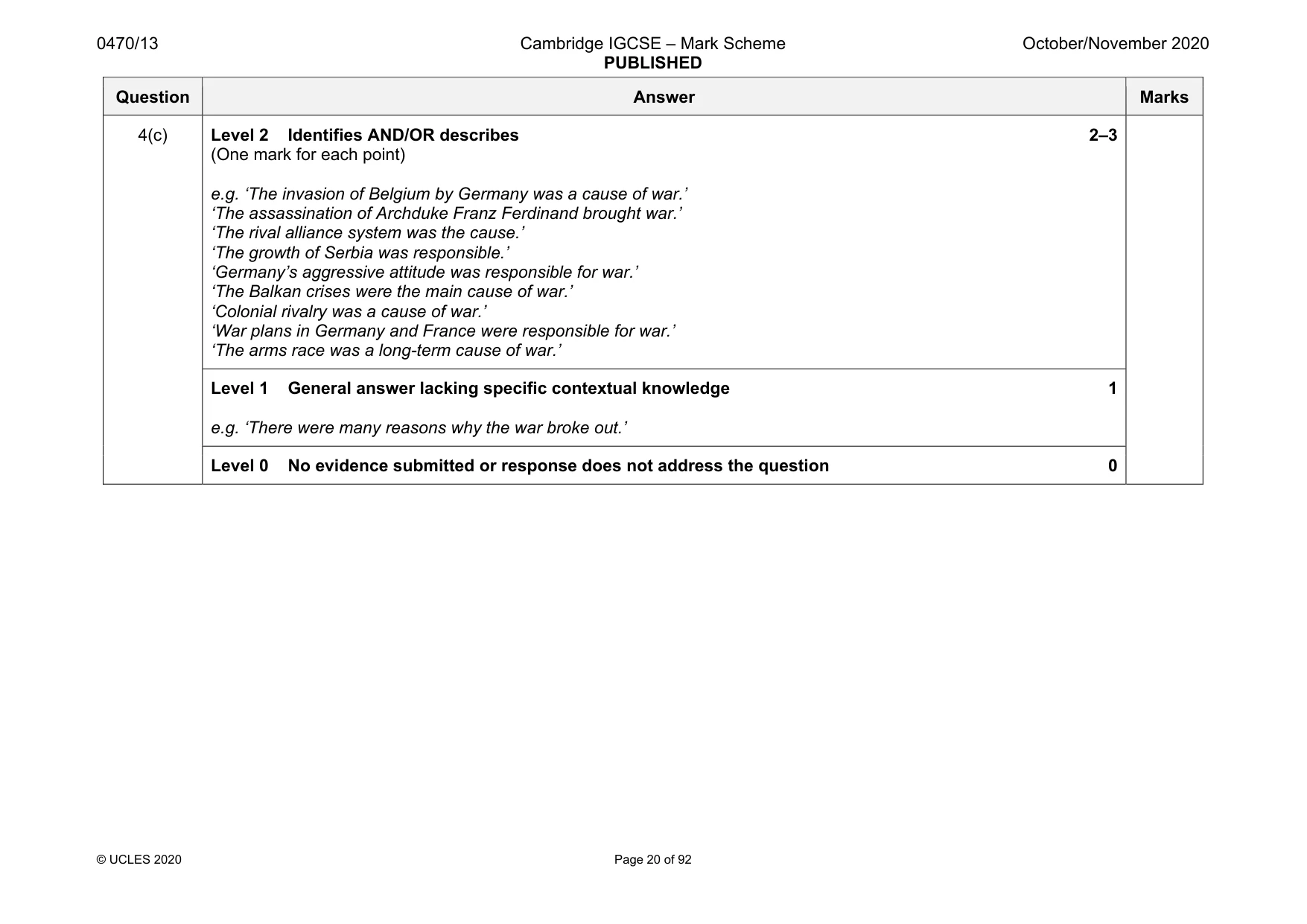
0470/13 Cambridge IGCSE – Mark Scheme PUBLISHED October/November 2020 © UCLES 2020 Page 20 of 92 Question Answer Marks 4(c) Level 2 Identifies AND/OR describes 2–3 (One mark for each point) e.g. ‘The invasion of Belgium by Germany was a cause of war.’ ‘The assassination of Archduke Franz Ferdinand brought war.’ ‘The rival alliance system was the cause.’ ‘The growth of Serbia was responsible.’ ‘Germany’s aggressive attitude was responsible for war.’ ‘The Balkan crises were the main cause of war.’ ‘Colonial rivalry was a cause of war.’ ‘War plans in Germany and France were responsible for war.’ ‘The arms race was a long-term cause of war.’ Level 1 General answer lacking specific contextual knowledge 1 e.g. ‘There were many reasons why the war broke out.’ Level 0 No evidence submitted or response does not address the question 0
Mark scheme, page 21
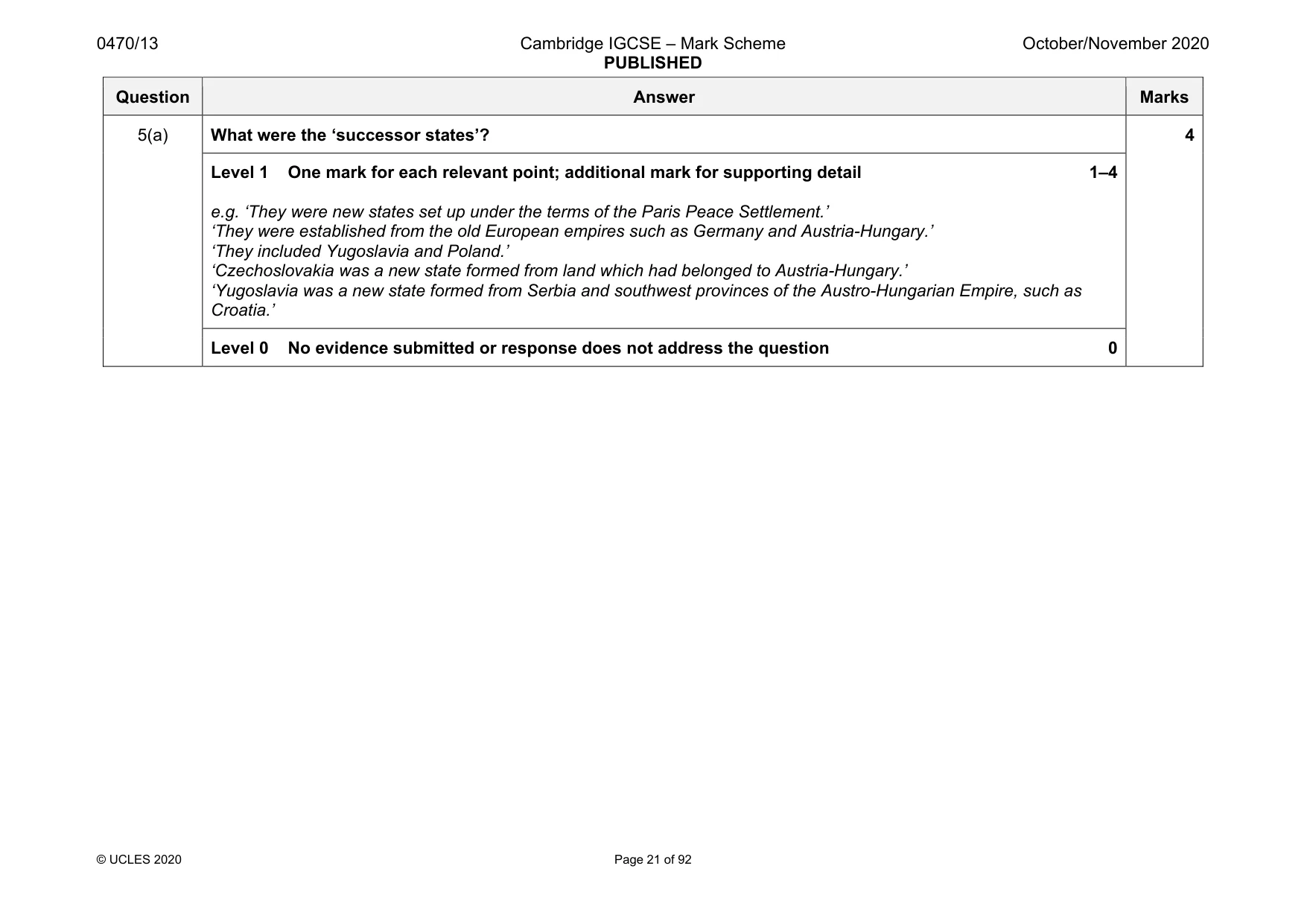
0470/13 Cambridge IGCSE – Mark Scheme PUBLISHED October/November 2020 © UCLES 2020 Page 21 of 92 Question Answer Marks 5(a) What were the ‘successor states’? 4 Level 1 One mark for each relevant point; additional mark for supporting detail 1–4 e.g. ‘They were new states set up under the terms of the Paris Peace Settlement.’ ‘They were established from the old European empires such as Germany and Austria-Hungary.’ ‘They included Yugoslavia and Poland.’ ‘Czechoslovakia was a new state formed from land which had belonged to Austria-Hungary.’ ‘Yugoslavia was a new state formed from Serbia and southwest provinces of the Austro-Hungarian Empire, such as Croatia.’ Level 0 No evidence submitted or response does not address the question 0
Mark scheme, page 22
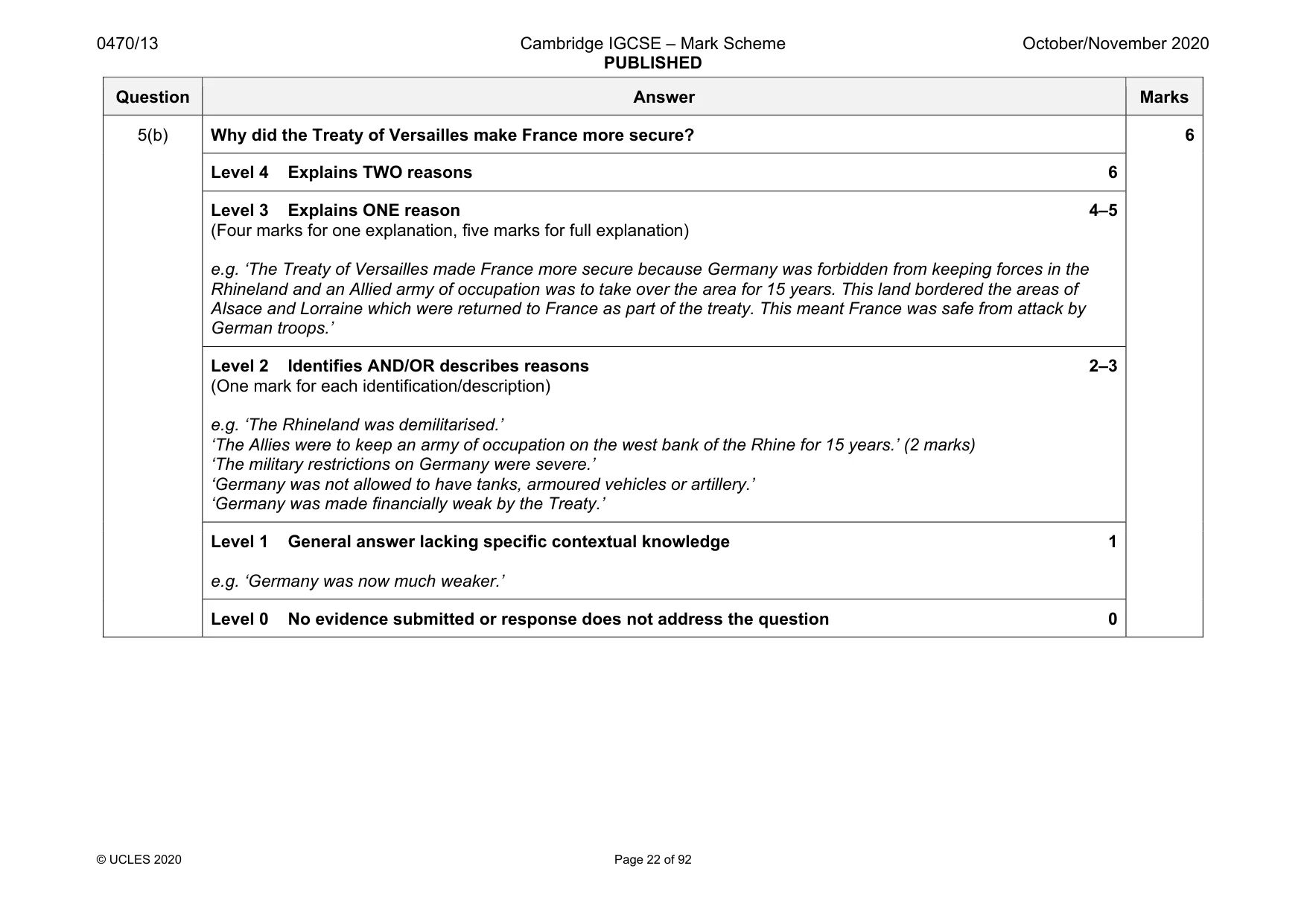
0470/13 Cambridge IGCSE – Mark Scheme PUBLISHED October/November 2020 © UCLES 2020 Page 22 of 92 Question Answer Marks 5(b) Why did the Treaty of Versailles make France more secure? 6 Level 4 Explains TWO reasons 6 Level 3 Explains ONE reason 4–5 (Four marks for one explanation, five marks for full explanation) e.g. ‘The Treaty of Versailles made France more secure because Germany was forbidden from keeping forces in the Rhineland and an Allied army of occupation was to take over the area for 15 years. This land bordered the areas of Alsace and Lorraine which were returned to France as part of the treaty. This meant France was safe from attack by German troops.’ Level 2 Identifies AND/OR describes reasons 2–3 (One mark for each identification/description) e.g. ‘The Rhineland was demilitarised.’ ‘The Allies were to keep an army of occupation on the west bank of the Rhine for 15 years.’ (2 marks) ‘The military restrictions on Germany were severe.’ ‘Germany was not allowed to have tanks, armoured vehicles or artillery.’ ‘Germany was made financially weak by the Treaty.’ Level 1 General answer lacking specific contextual knowledge 1 e.g. ‘Germany was now much weaker.’ Level 0 No evidence submitted or response does not address the question 0
Mark scheme, page 23
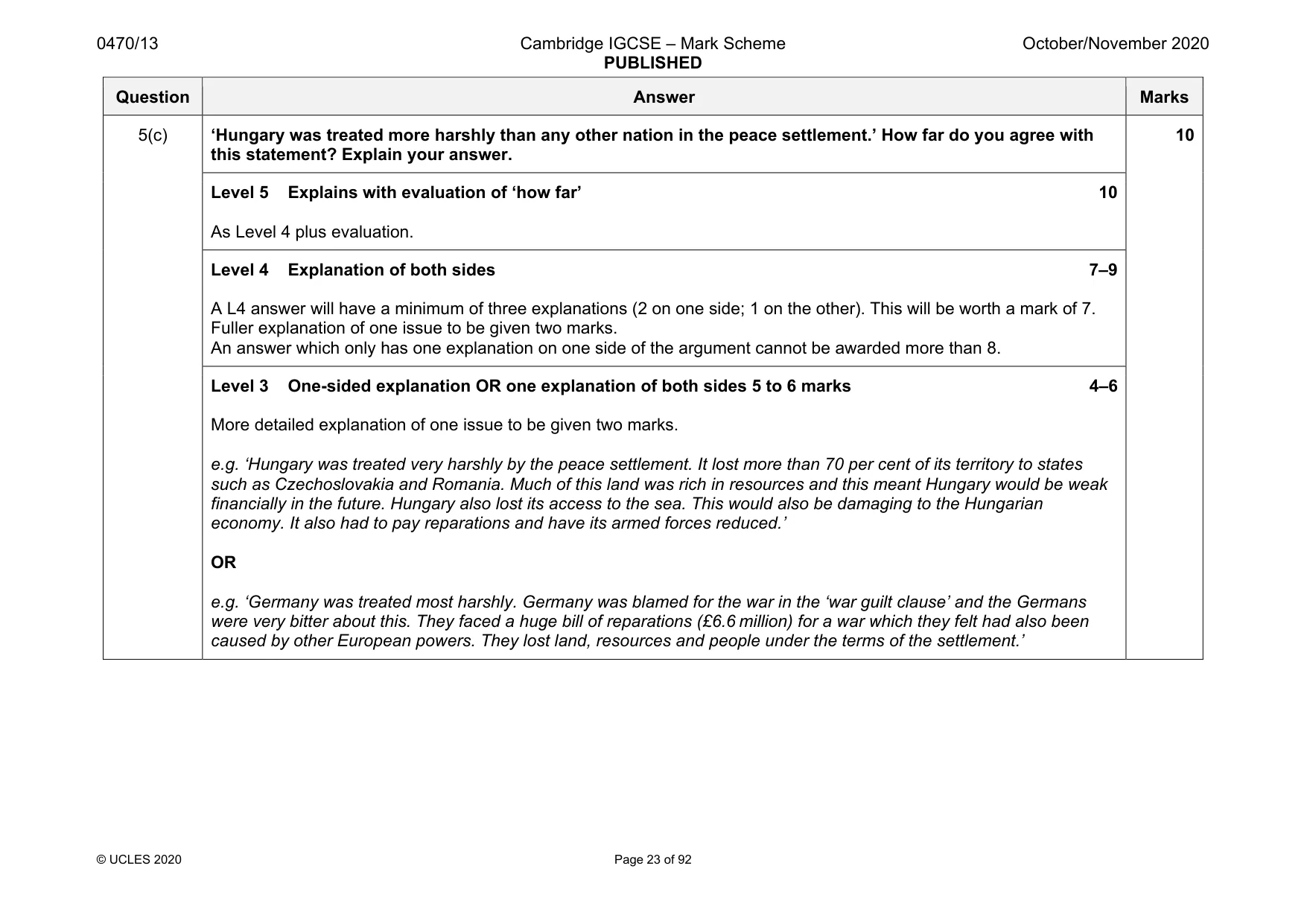
0470/13 Cambridge IGCSE – Mark Scheme PUBLISHED October/November 2020 © UCLES 2020 Page 23 of 92 Question Answer Marks 5(c) ‘Hungary was treated more harshly than any other nation in the peace settlement.’ How far do you agree with this statement? Explain your answer. 10 Level 5 Explains with evaluation of ‘how far’ 10 As Level 4 plus evaluation. Level 4 Explanation of both sides 7–9 A L4 answer will have a minimum of three explanations (2 on one side; 1 on the other). This will be worth a mark of 7. Fuller explanation of one issue to be given two marks. An answer which only has one explanation on one side of the argument cannot be awarded more than 8. Level 3 One-sided explanation OR one explanation of both sides 5 to 6 marks 4–6 More detailed explanation of one issue to be given two marks. e.g. ‘Hungary was treated very harshly by the peace settlement. It lost more than 70 per cent of its territory to states such as Czechoslovakia and Romania. Much of this land was rich in resources and this meant Hungary would be weak financially in the future. Hungary also lost its access to the sea. This would also be damaging to the Hungarian economy. It also had to pay reparations and have its armed forces reduced.’ OR e.g. ‘Germany was treated most harshly. Germany was blamed for the war in the ‘war guilt clause’ and the Germans were very bitter about this. They faced a huge bill of reparations (£6.6 million) for a war which they felt had also been caused by other European powers. They lost land, resources and people under the terms of the settlement.’
Mark scheme, page 24
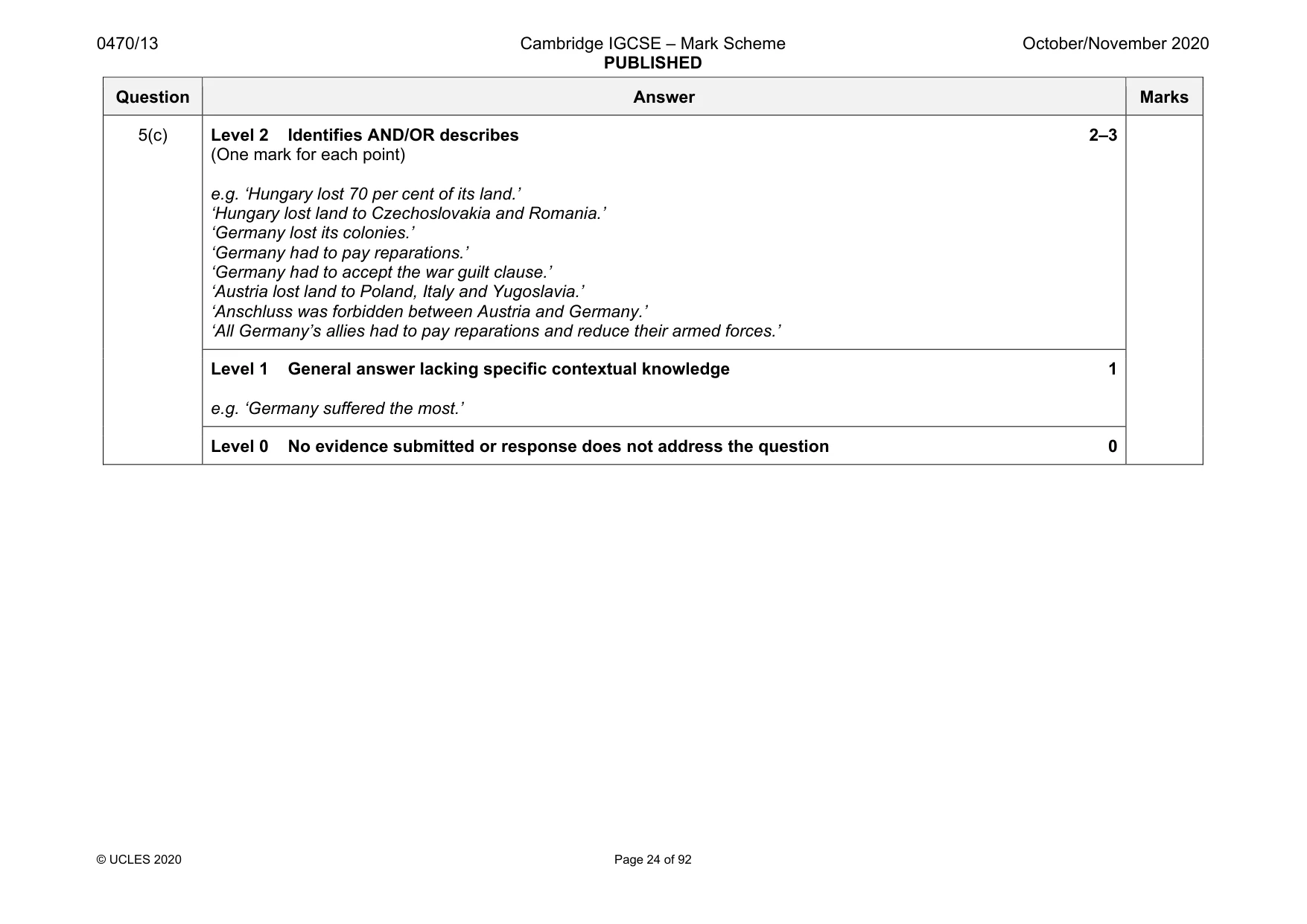
0470/13 Cambridge IGCSE – Mark Scheme PUBLISHED October/November 2020 © UCLES 2020 Page 24 of 92 Question Answer Marks 5(c) Level 2 Identifies AND/OR describes 2–3 (One mark for each point) e.g. ‘Hungary lost 70 per cent of its land.’ ‘Hungary lost land to Czechoslovakia and Romania.’ ‘Germany lost its colonies.’ ‘Germany had to pay reparations.’ ‘Germany had to accept the war guilt clause.’ ‘Austria lost land to Poland, Italy and Yugoslavia.’ ‘Anschluss was forbidden between Austria and Germany.’ ‘All Germany’s allies had to pay reparations and reduce their armed forces.’ Level 1 General answer lacking specific contextual knowledge 1 e.g. ‘Germany suffered the most.’ Level 0 No evidence submitted or response does not address the question 0
Mark scheme, page 25
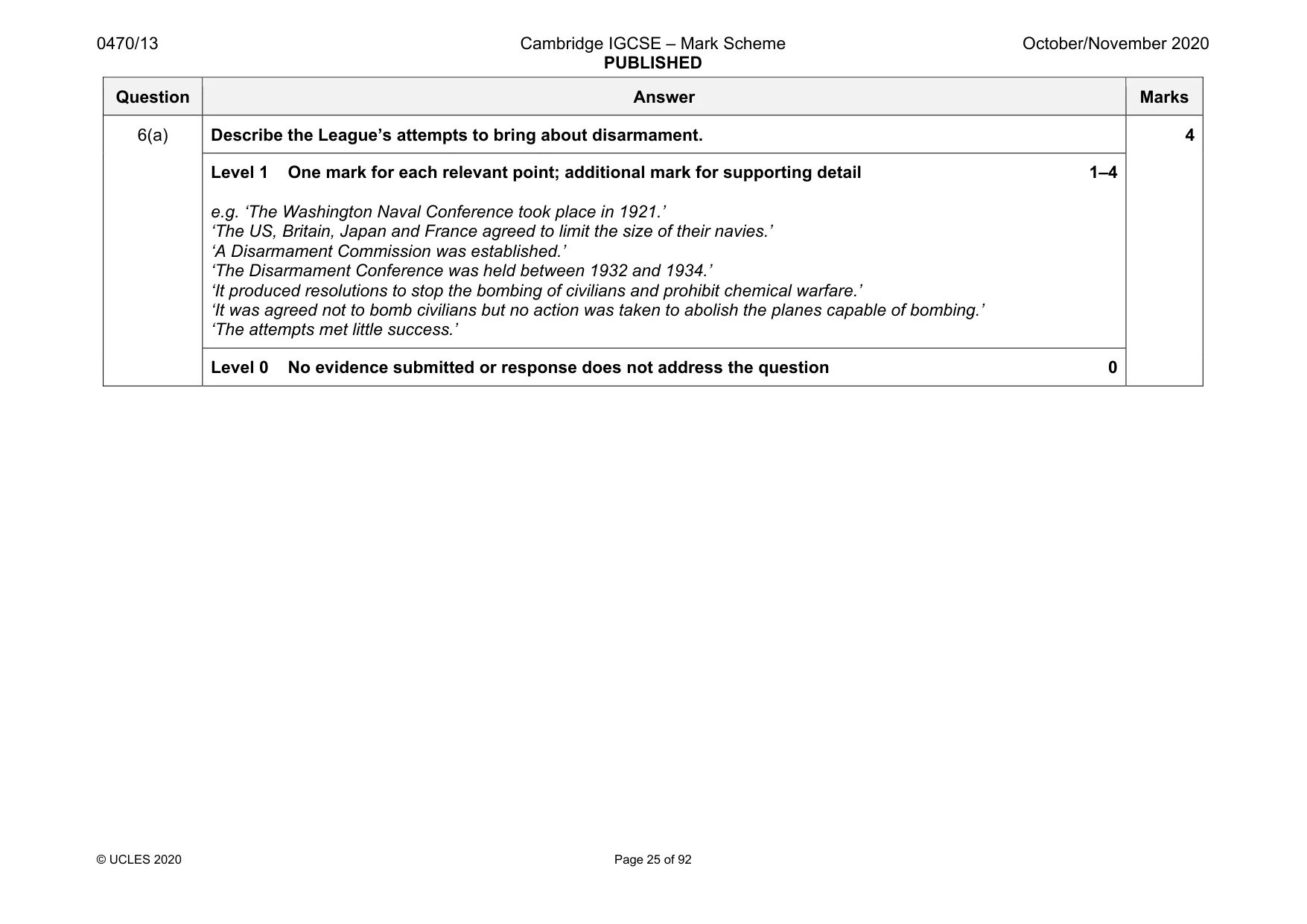
0470/13 Cambridge IGCSE – Mark Scheme PUBLISHED October/November 2020 © UCLES 2020 Page 25 of 92 Question Answer Marks 6(a) Describe the League’s attempts to bring about disarmament. 4 Level 1 One mark for each relevant point; additional mark for supporting detail 1–4 e.g. ‘The Washington Naval Conference took place in 1921.’ ‘The US, Britain, Japan and France agreed to limit the size of their navies.’ ‘A Disarmament Commission was established.’ ‘The Disarmament Conference was held between 1932 and 1934.’ ‘It produced resolutions to stop the bombing of civilians and prohibit chemical warfare.’ ‘It was agreed not to bomb civilians but no action was taken to abolish the planes capable of bombing.’ ‘The attempts met little success.’ Level 0 No evidence submitted or response does not address the question 0
Mark scheme, page 26
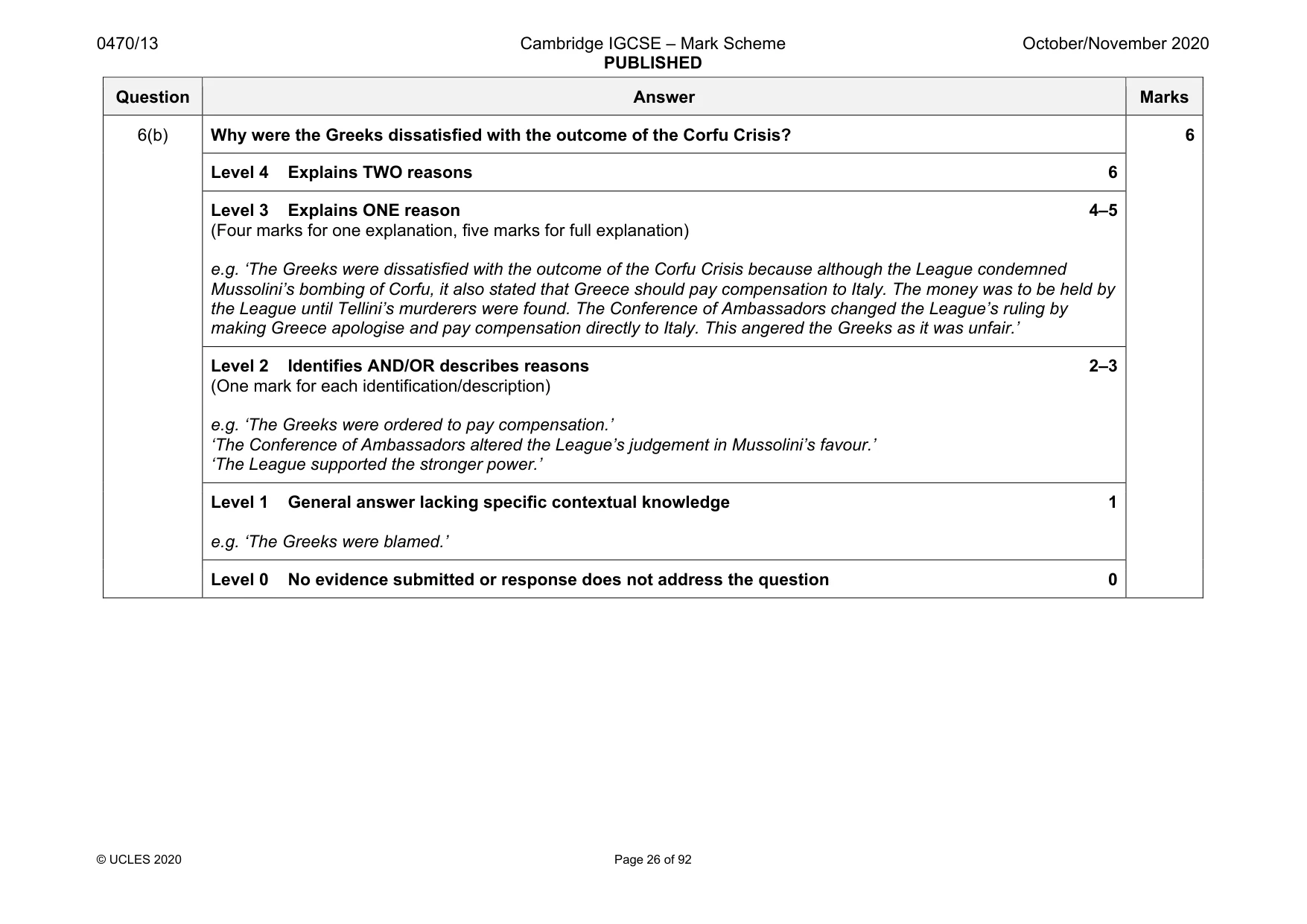
0470/13 Cambridge IGCSE – Mark Scheme PUBLISHED October/November 2020 © UCLES 2020 Page 26 of 92 Question Answer Marks 6(b) Why were the Greeks dissatisfied with the outcome of the Corfu Crisis? 6 Level 4 Explains TWO reasons 6 Level 3 Explains ONE reason 4–5 (Four marks for one explanation, five marks for full explanation) e.g. ‘The Greeks were dissatisfied with the outcome of the Corfu Crisis because although the League condemned Mussolini’s bombing of Corfu, it also stated that Greece should pay compensation to Italy. The money was to be held by the League until Tellini’s murderers were found. The Conference of Ambassadors changed the League’s ruling by making Greece apologise and pay compensation directly to Italy. This angered the Greeks as it was unfair.’ Level 2 Identifies AND/OR describes reasons 2–3 (One mark for each identification/description) e.g. ‘The Greeks were ordered to pay compensation.’ ‘The Conference of Ambassadors altered the League’s judgement in Mussolini’s favour.’ ‘The League supported the stronger power.’ Level 1 General answer lacking specific contextual knowledge 1 e.g. ‘The Greeks were blamed.’ Level 0 No evidence submitted or response does not address the question 0
Mark scheme, page 27
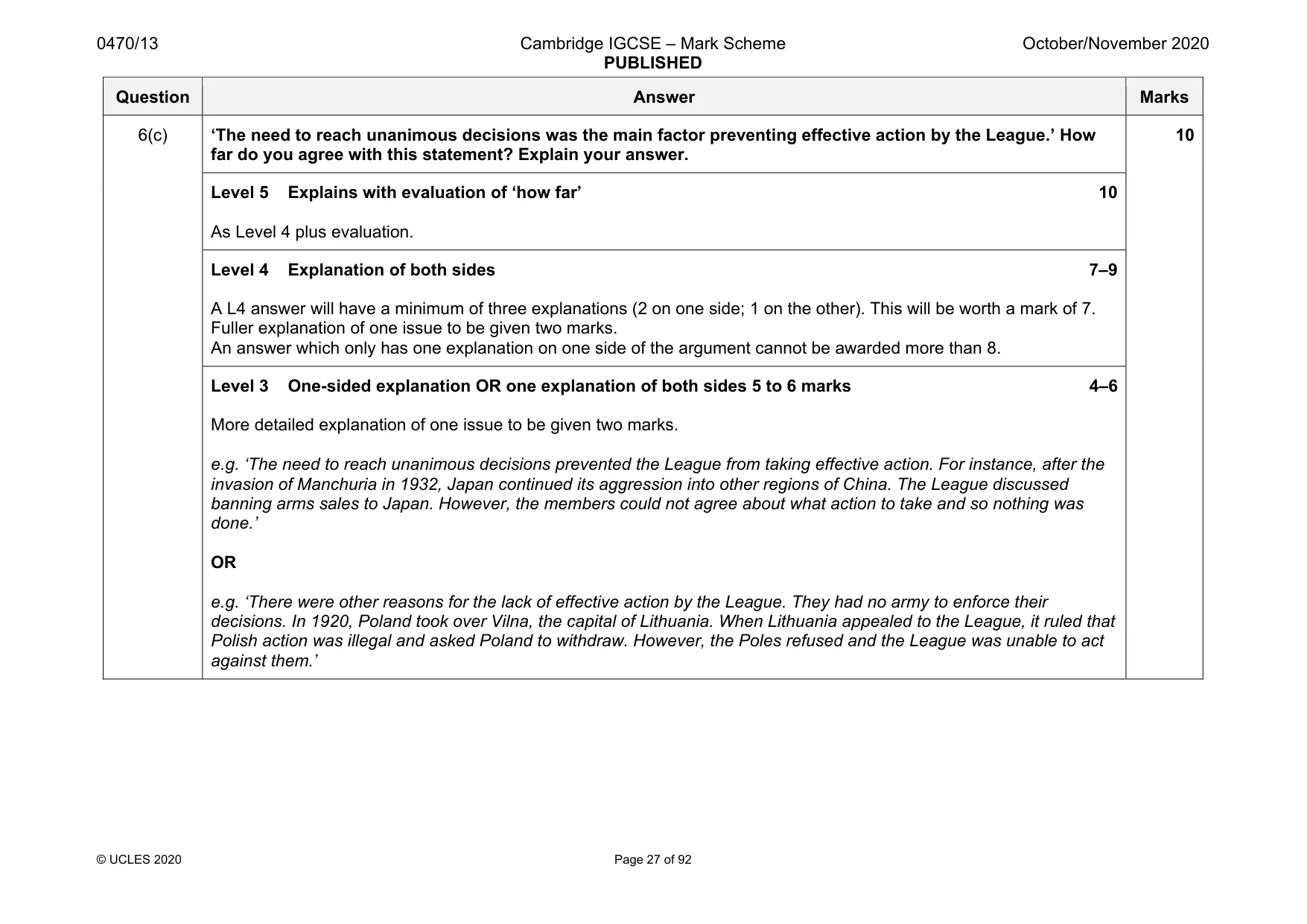
0470/13 Cambridge IGCSE – Mark Scheme PUBLISHED October/November 2020 © UCLES 2020 Page 27 of 92 Question Answer Marks 6(c) ‘The need to reach unanimous decisions was the main factor preventing effective action by the League.’ How far do you agree with this statement? Explain your answer. 10 Level 5 Explains with evaluation of ‘how far’ 10 As Level 4 plus evaluation. Level 4 Explanation of both sides 7–9 A L4 answer will have a minimum of three explanations (2 on one side; 1 on the other). This will be worth a mark of 7. Fuller explanation of one issue to be given two marks. An answer which only has one explanation on one side of the argument cannot be awarded more than 8. Level 3 One-sided explanation OR one explanation of both sides 5 to 6 marks 4–6 More detailed explanation of one issue to be given two marks. e.g. ‘The need to reach unanimous decisions prevented the League from taking effective action. For instance, after the invasion of Manchuria in 1932, Japan continued its aggression into other regions of China. The League discussed banning arms sales to Japan. However, the members could not agree about what action to take and so nothing was done.’ OR e.g. ‘There were other reasons for the lack of effective action by the League. They had no army to enforce their decisions. In 1920, Poland took over Vilna, the capital of Lithuania. When Lithuania appealed to the League, it ruled that Polish action was illegal and asked Poland to withdraw. However, the Poles refused and the League was unable to act against them.’
Mark scheme, page 28
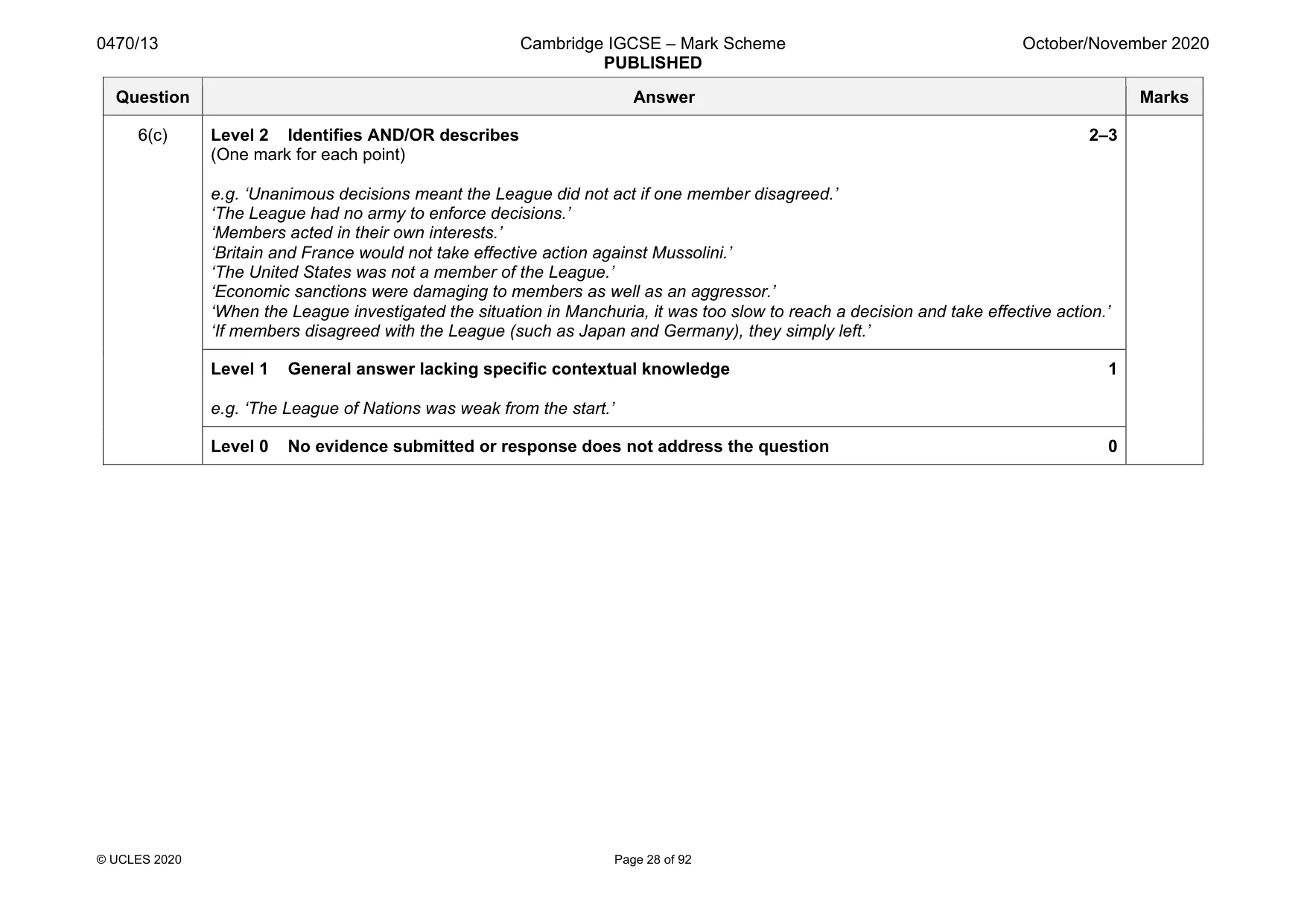
0470/13 Cambridge IGCSE – Mark Scheme PUBLISHED October/November 2020 © UCLES 2020 Page 28 of 92 Question Answer Marks 6(c) Level 2 Identifies AND/OR describes 2–3 (One mark for each point) e.g. ‘Unanimous decisions meant the League did not act if one member disagreed.’ ‘The League had no army to enforce decisions.’ ‘Members acted in their own interests.’ ‘Britain and France would not take effective action against Mussolini.’ ‘The United States was not a member of the League.’ ‘Economic sanctions were damaging to members as well as an aggressor.’ ‘When the League investigated the situation in Manchuria, it was too slow to reach a decision and take effective action.’ ‘If members disagreed with the League (such as Japan and Germany), they simply left.’ Level 1 General answer lacking specific contextual knowledge 1 e.g. ‘The League of Nations was weak from the start.’ Level 0 No evidence submitted or response does not address the question 0
Mark scheme, page 29
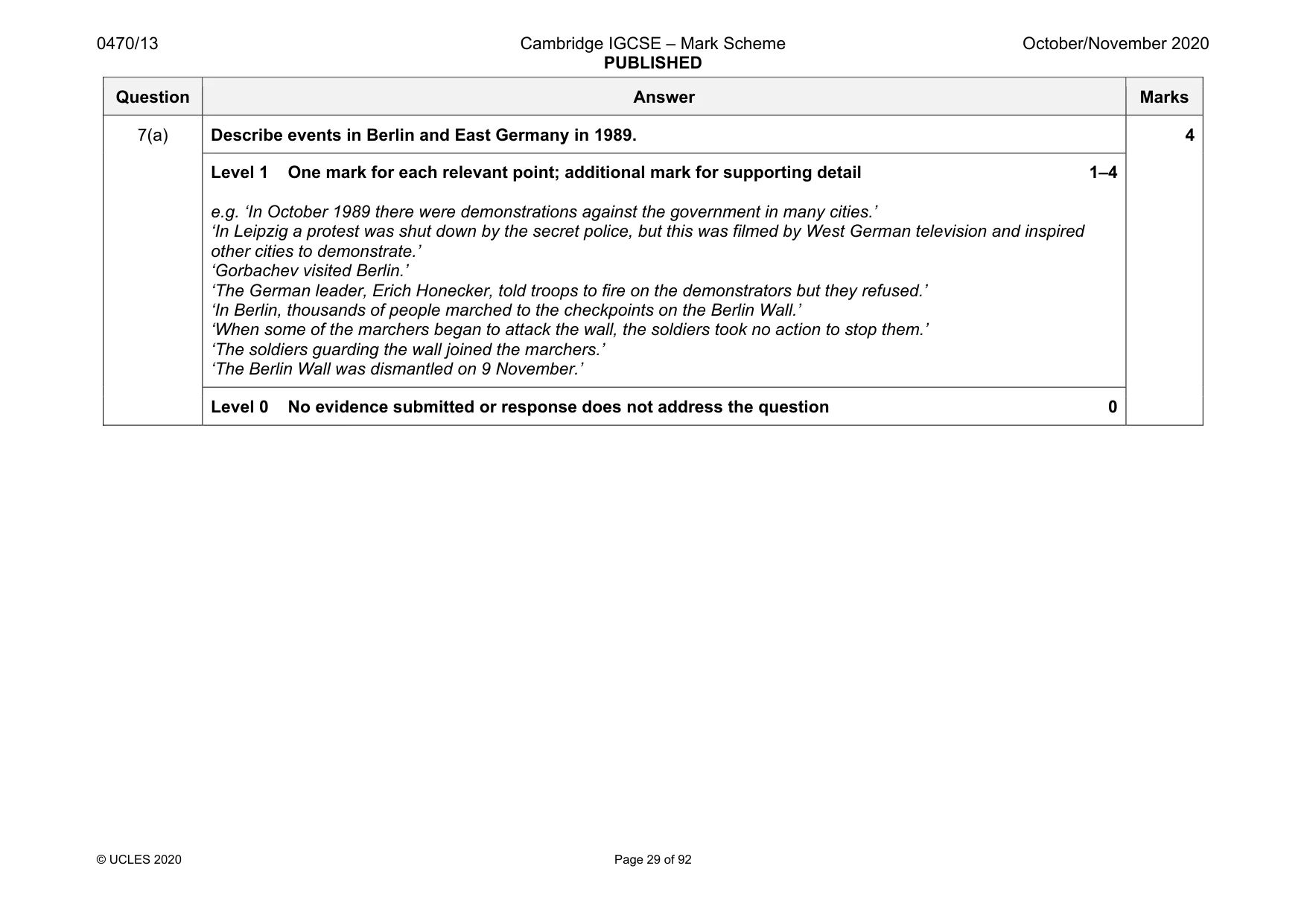
0470/13 Cambridge IGCSE – Mark Scheme PUBLISHED October/November 2020 © UCLES 2020 Page 29 of 92 Question Answer Marks 7(a) Describe events in Berlin and East Germany in 1989. 4 Level 1 One mark for each relevant point; additional mark for supporting detail 1–4 e.g. ‘In October 1989 there were demonstrations against the government in many cities.’ ‘In Leipzig a protest was shut down by the secret police, but this was filmed by West German television and inspired other cities to demonstrate.’ ‘Gorbachev visited Berlin.’ ‘The German leader, Erich Honecker, told troops to fire on the demonstrators but they refused.’ ‘In Berlin, thousands of people marched to the checkpoints on the Berlin Wall.’ ‘When some of the marchers began to attack the wall, the soldiers took no action to stop them.’ ‘The soldiers guarding the wall joined the marchers.’ ‘The Berlin Wall was dismantled on 9 November.’ Level 0 No evidence submitted or response does not address the question 0
Mark scheme, page 30
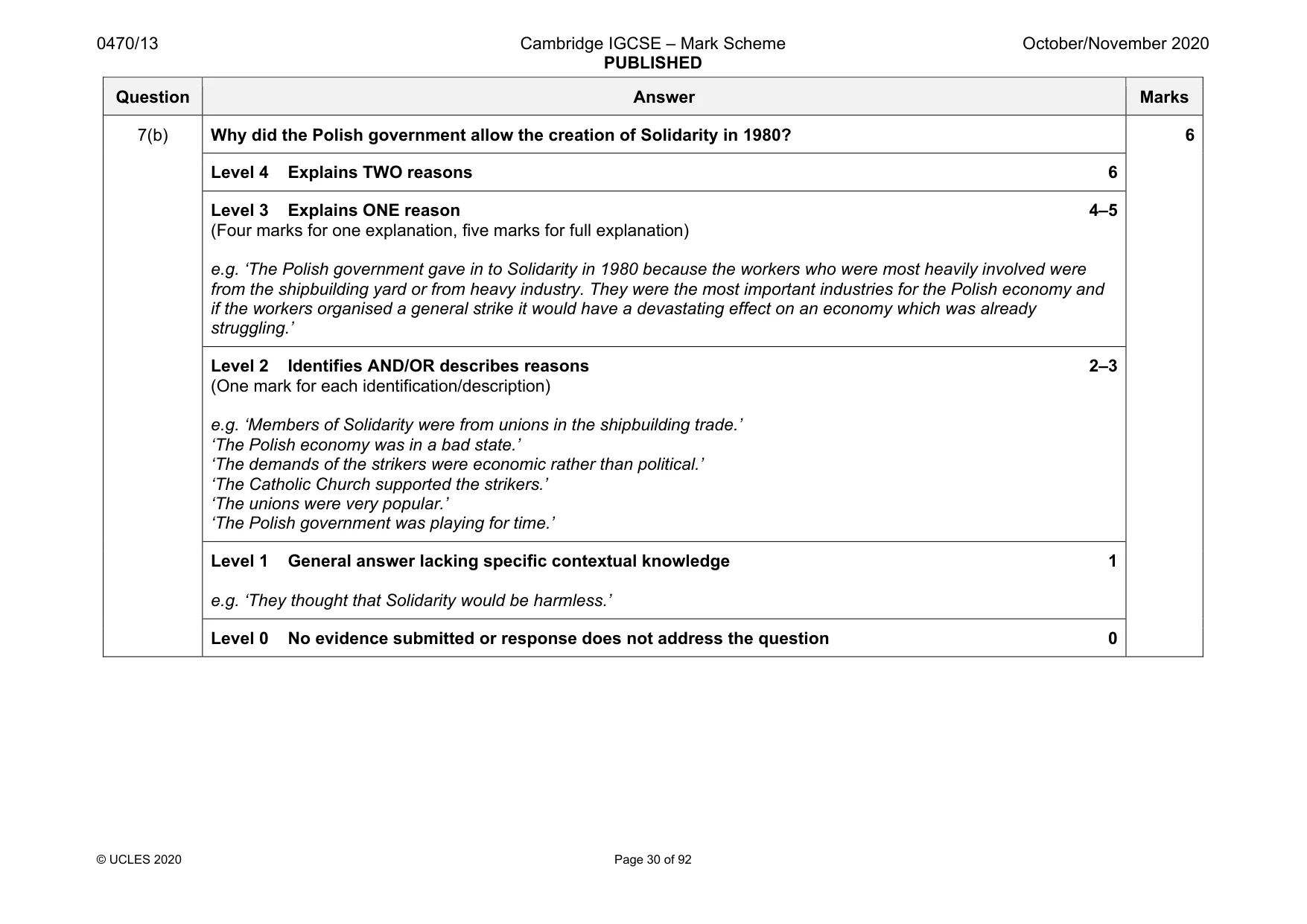
0470/13 Cambridge IGCSE – Mark Scheme PUBLISHED October/November 2020 © UCLES 2020 Page 30 of 92 Question Answer Marks 7(b) Why did the Polish government allow the creation of Solidarity in 1980? 6 Level 4 Explains TWO reasons 6 Level 3 Explains ONE reason 4–5 (Four marks for one explanation, five marks for full explanation) e.g. ‘The Polish government gave in to Solidarity in 1980 because the workers who were most heavily involved were from the shipbuilding yard or from heavy industry. They were the most important industries for the Polish economy and if the workers organised a general strike it would have a devastating effect on an economy which was already struggling.’ Level 2 Identifies AND/OR describes reasons 2–3 (One mark for each identification/description) e.g. ‘Members of Solidarity were from unions in the shipbuilding trade.’ ‘The Polish economy was in a bad state.’ ‘The demands of the strikers were economic rather than political.’ ‘The Catholic Church supported the strikers.’ ‘The unions were very popular.’ ‘The Polish government was playing for time.’ Level 1 General answer lacking specific contextual knowledge 1 e.g. ‘They thought that Solidarity would be harmless.’ Level 0 No evidence submitted or response does not address the question 0
Mark scheme, page 31
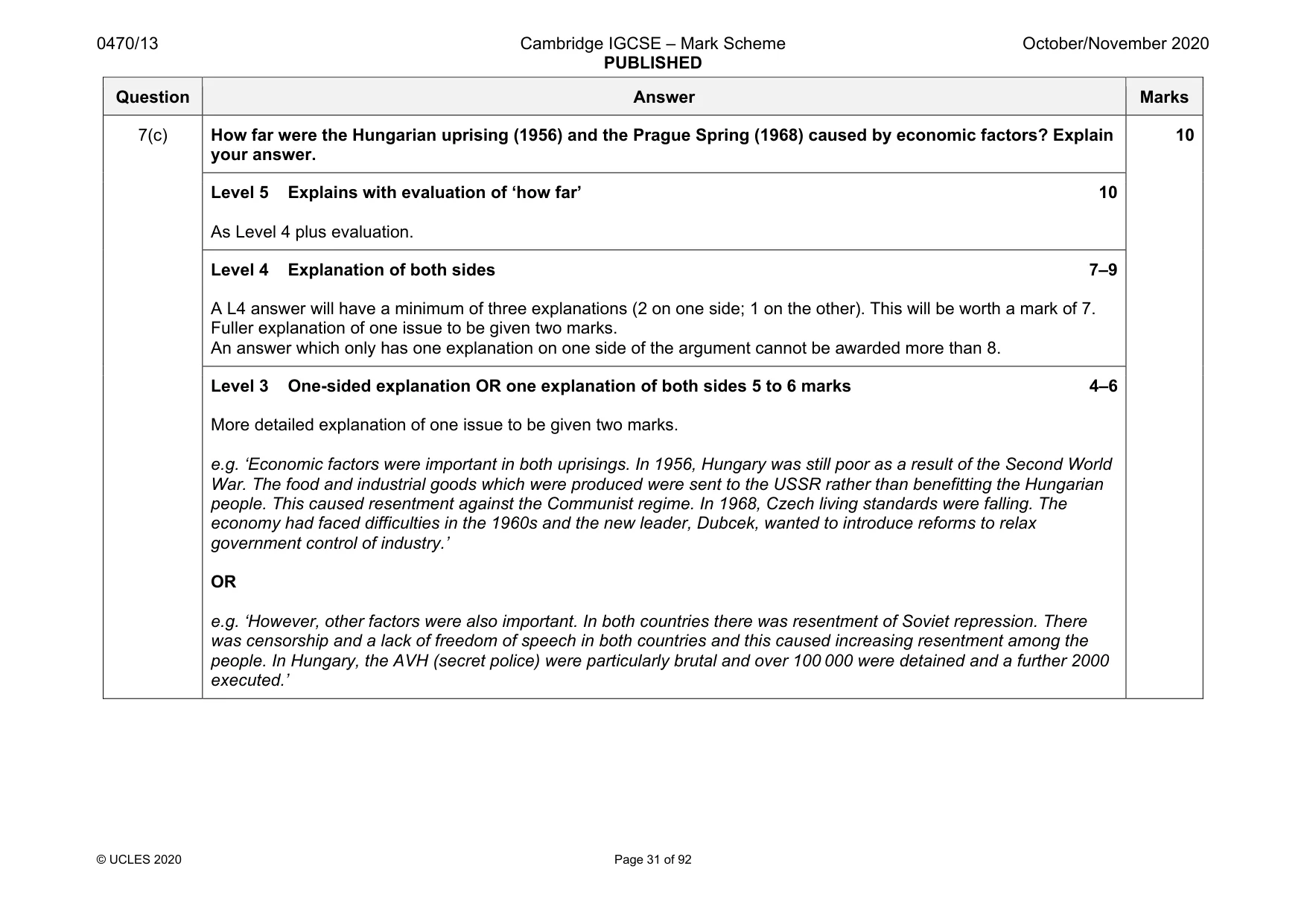
0470/13 Cambridge IGCSE – Mark Scheme PUBLISHED October/November 2020 © UCLES 2020 Page 31 of 92 Question Answer Marks 7(c) How far were the Hungarian uprising (1956) and the Prague Spring (1968) caused by economic factors? Explain your answer. 10 Level 5 Explains with evaluation of ‘how far’ 10 As Level 4 plus evaluation. Level 4 Explanation of both sides 7–9 A L4 answer will have a minimum of three explanations (2 on one side; 1 on the other). This will be worth a mark of 7. Fuller explanation of one issue to be given two marks. An answer which only has one explanation on one side of the argument cannot be awarded more than 8. Level 3 One-sided explanation OR one explanation of both sides 5 to 6 marks 4–6 More detailed explanation of one issue to be given two marks. e.g. ‘Economic factors were important in both uprisings. In 1956, Hungary was still poor as a result of the Second World War. The food and industrial goods which were produced were sent to the USSR rather than benefitting the Hungarian people. This caused resentment against the Communist regime. In 1968, Czech living standards were falling. The economy had faced difficulties in the 1960s and the new leader, Dubcek, wanted to introduce reforms to relax government control of industry.’ OR e.g. ‘However, other factors were also important. In both countries there was resentment of Soviet repression. There was censorship and a lack of freedom of speech in both countries and this caused increasing resentment among the people. In Hungary, the AVH (secret police) were particularly brutal and over 100 000 were detained and a further 2000 executed.’
Mark scheme, page 32
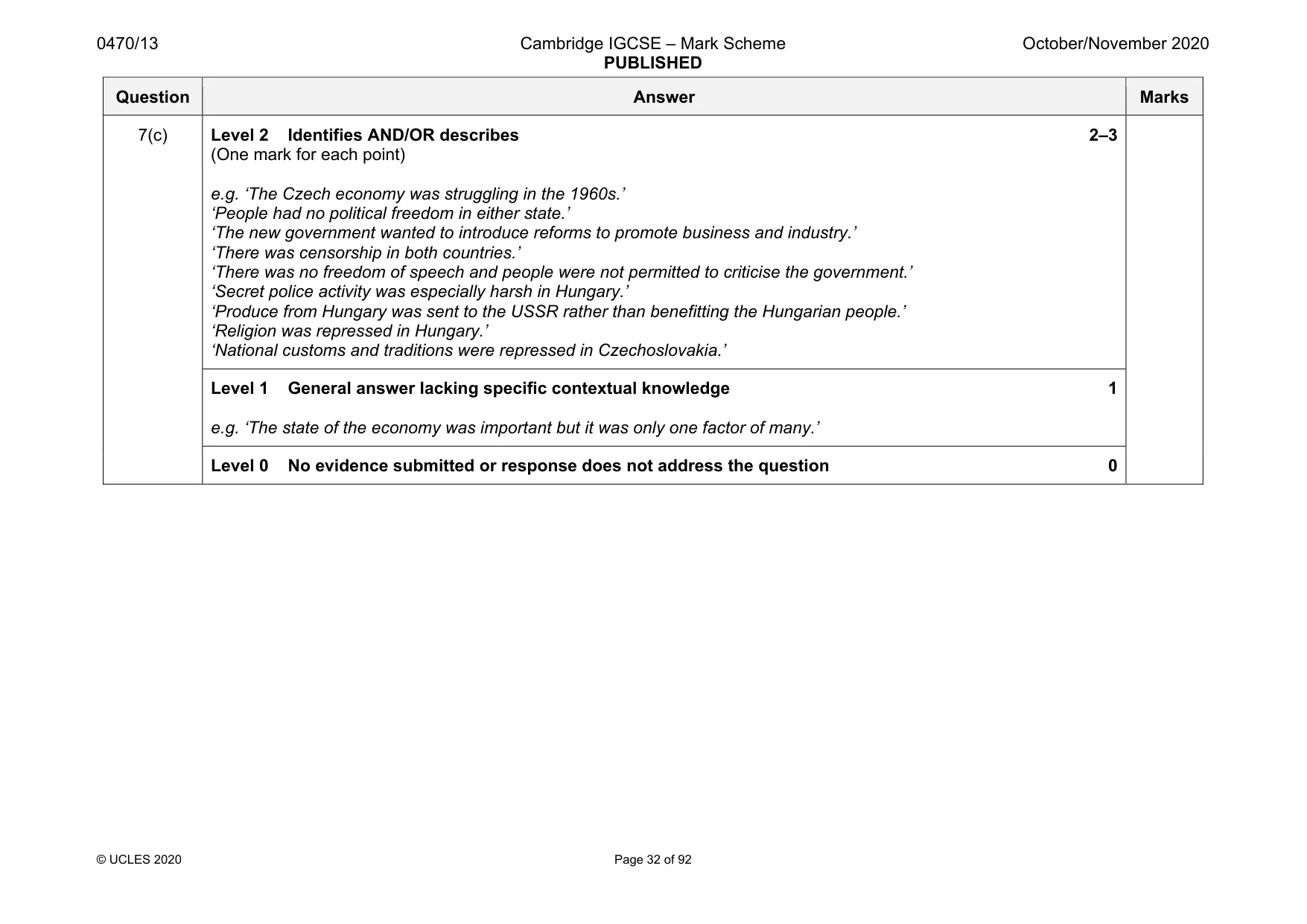
0470/13 Cambridge IGCSE – Mark Scheme PUBLISHED October/November 2020 © UCLES 2020 Page 32 of 92 Question Answer Marks 7(c) Level 2 Identifies AND/OR describes 2–3 (One mark for each point) e.g. ‘The Czech economy was struggling in the 1960s.’ ‘People had no political freedom in either state.’ ‘The new government wanted to introduce reforms to promote business and industry.’ ‘There was censorship in both countries.’ ‘There was no freedom of speech and people were not permitted to criticise the government.’ ‘Secret police activity was especially harsh in Hungary.’ ‘Produce from Hungary was sent to the USSR rather than benefitting the Hungarian people.’ ‘Religion was repressed in Hungary.’ ‘National customs and traditions were repressed in Czechoslovakia.’ Level 1 General answer lacking specific contextual knowledge 1 e.g. ‘The state of the economy was important but it was only one factor of many.’ Level 0 No evidence submitted or response does not address the question 0
Mark scheme, page 33
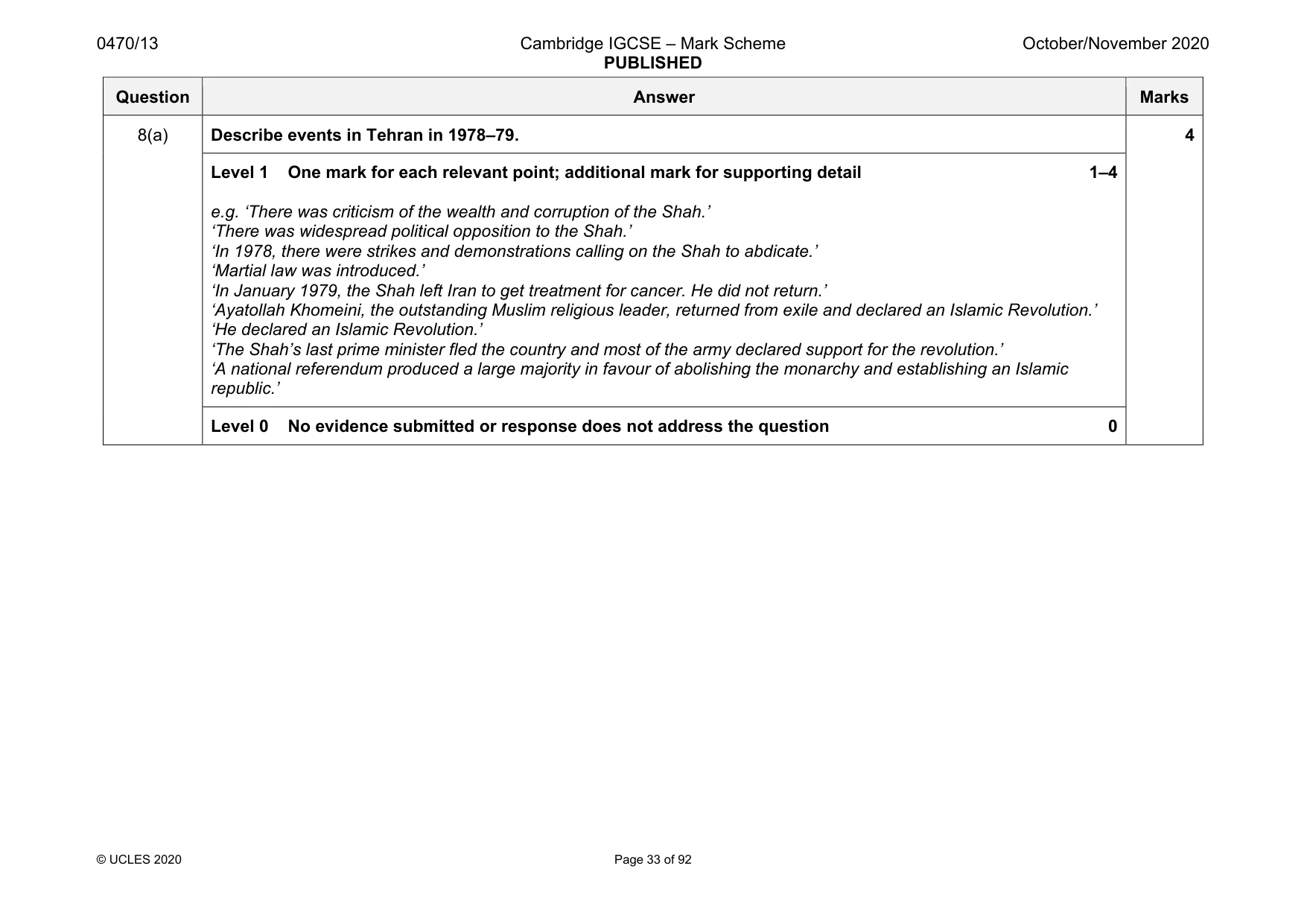
0470/13 Cambridge IGCSE – Mark Scheme PUBLISHED October/November 2020 © UCLES 2020 Page 33 of 92 Question Answer Marks 8(a) Describe events in Tehran in 1978–79. 4 Level 1 One mark for each relevant point; additional mark for supporting detail 1–4 e.g. ‘There was criticism of the wealth and corruption of the Shah.’ ‘There was widespread political opposition to the Shah.’ ‘In 1978, there were strikes and demonstrations calling on the Shah to abdicate.’ ‘Martial law was introduced.’ ‘In January 1979, the Shah left Iran to get treatment for cancer. He did not return.’ ‘Ayatollah Khomeini, the outstanding Muslim religious leader, returned from exile and declared an Islamic Revolution.’ ‘He declared an Islamic Revolution.’ ‘The Shah’s last prime minister fled the country and most of the army declared support for the revolution.’ ‘A national referendum produced a large majority in favour of abolishing the monarchy and establishing an Islamic republic.’ Level 0 No evidence submitted or response does not address the question 0
Mark scheme, page 34
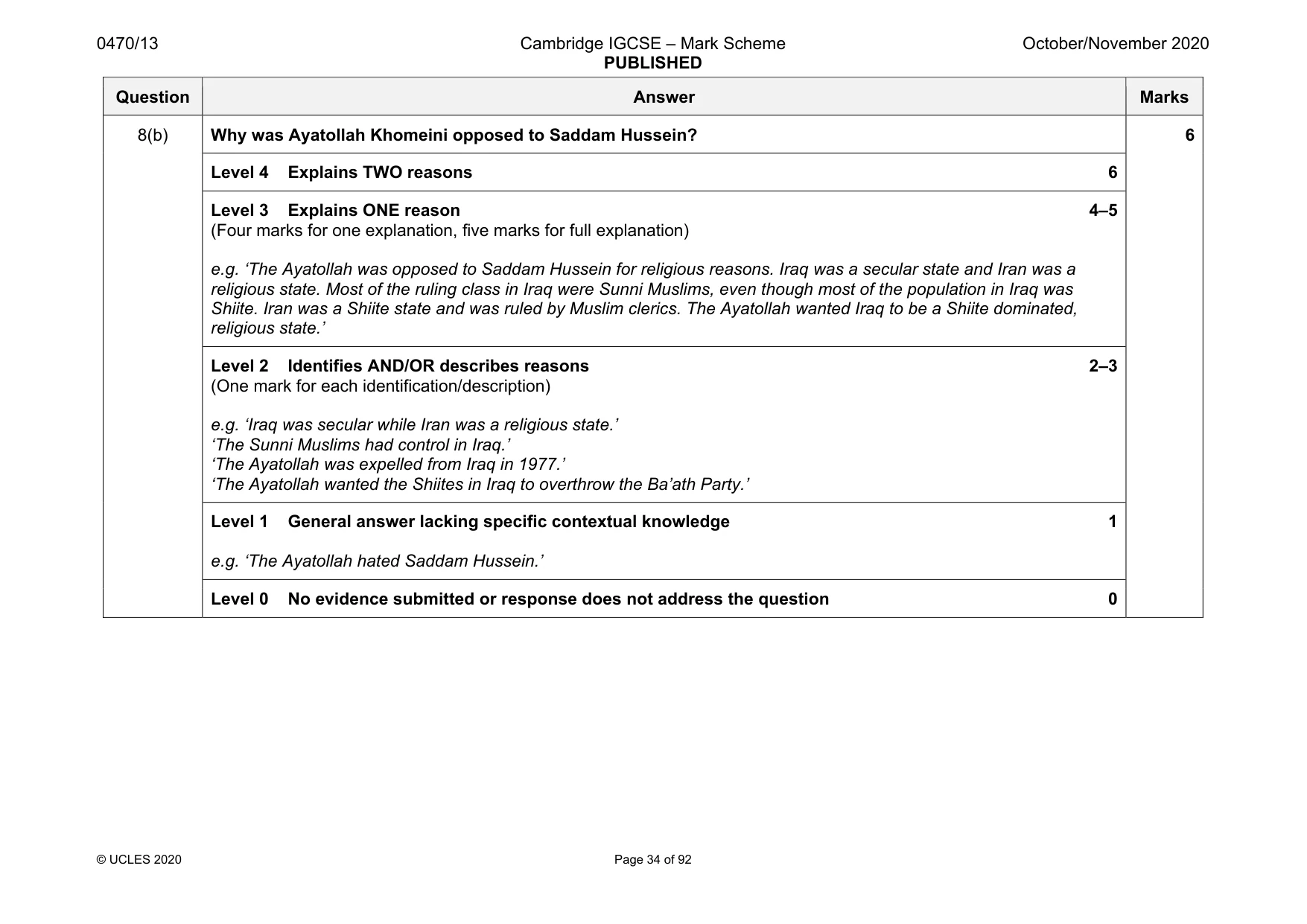
0470/13 Cambridge IGCSE – Mark Scheme PUBLISHED October/November 2020 © UCLES 2020 Page 34 of 92 Question Answer Marks 8(b) Why was Ayatollah Khomeini opposed to Saddam Hussein? 6 Level 4 Explains TWO reasons 6 Level 3 Explains ONE reason 4–5 (Four marks for one explanation, five marks for full explanation) e.g. ‘The Ayatollah was opposed to Saddam Hussein for religious reasons. Iraq was a secular state and Iran was a religious state. Most of the ruling class in Iraq were Sunni Muslims, even though most of the population in Iraq was Shiite. Iran was a Shiite state and was ruled by Muslim clerics. The Ayatollah wanted Iraq to be a Shiite dominated, religious state.’ Level 2 Identifies AND/OR describes reasons 2–3 (One mark for each identification/description) e.g. ‘Iraq was secular while Iran was a religious state.’ ‘The Sunni Muslims had control in Iraq.’ ‘The Ayatollah was expelled from Iraq in 1977.’ ‘The Ayatollah wanted the Shiites in Iraq to overthrow the Ba’ath Party.’ Level 1 General answer lacking specific contextual knowledge 1 e.g. ‘The Ayatollah hated Saddam Hussein.’ Level 0 No evidence submitted or response does not address the question 0
Mark scheme, page 35
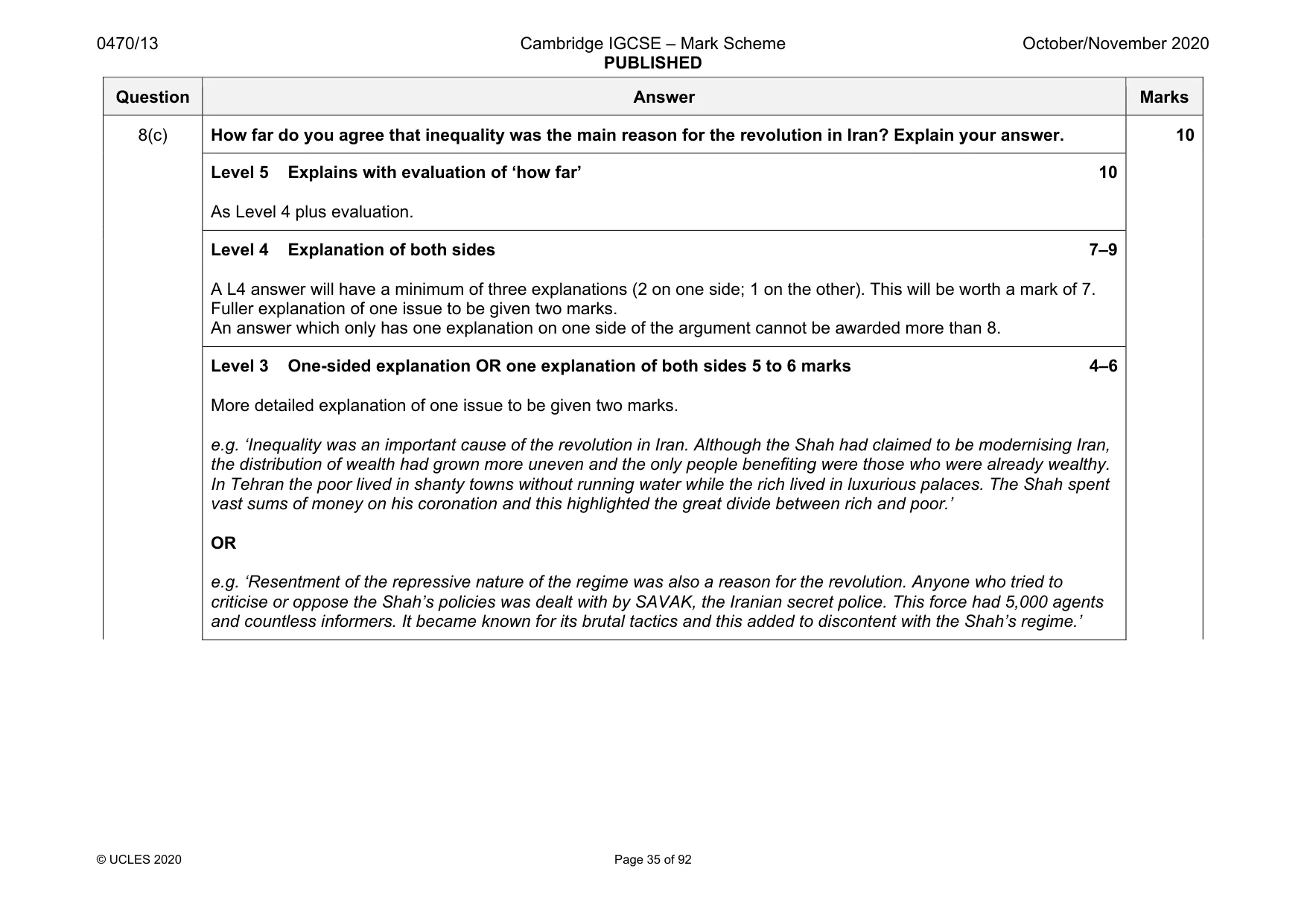
0470/13 Cambridge IGCSE – Mark Scheme PUBLISHED October/November 2020 © UCLES 2020 Page 35 of 92 Question Answer Marks 8(c) How far do you agree that inequality was the main reason for the revolution in Iran? Explain your answer. 10 Level 5 Explains with evaluation of ‘how far’ 10 As Level 4 plus evaluation. Level 4 Explanation of both sides 7–9 A L4 answer will have a minimum of three explanations (2 on one side; 1 on the other). This will be worth a mark of 7. Fuller explanation of one issue to be given two marks. An answer which only has one explanation on one side of the argument cannot be awarded more than 8. Level 3 One-sided explanation OR one explanation of both sides 5 to 6 marks 4–6 More detailed explanation of one issue to be given two marks. e.g. ‘Inequality was an important cause of the revolution in Iran. Although the Shah had claimed to be modernising Iran, the distribution of wealth had grown more uneven and the only people benefiting were those who were already wealthy. In Tehran the poor lived in shanty towns without running water while the rich lived in luxurious palaces. The Shah spent vast sums of money on his coronation and this highlighted the great divide between rich and poor.’ OR e.g. ‘Resentment of the repressive nature of the regime was also a reason for the revolution. Anyone who tried to criticise or oppose the Shah’s policies was dealt with by SAVAK, the Iranian secret police. This force had 5,000 agents and countless informers. It became known for its brutal tactics and this added to discontent with the Shah’s regime.’
Mark scheme, page 36
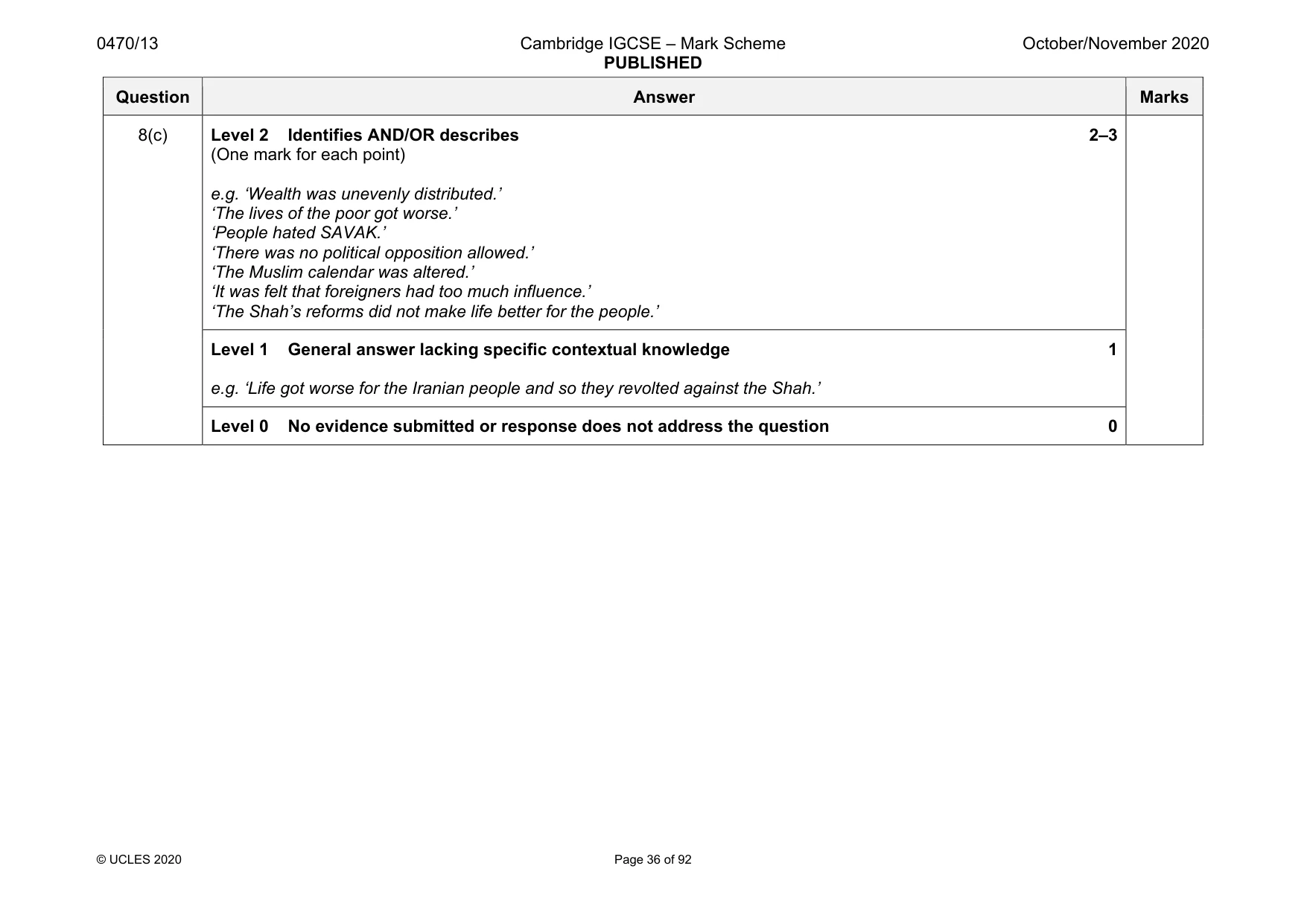
0470/13 Cambridge IGCSE – Mark Scheme PUBLISHED October/November 2020 © UCLES 2020 Page 36 of 92 Question Answer Marks 8(c) Level 2 Identifies AND/OR describes 2–3 (One mark for each point) e.g. ‘Wealth was unevenly distributed.’ ‘The lives of the poor got worse.’ ‘People hated SAVAK.’ ‘There was no political opposition allowed.’ ‘The Muslim calendar was altered.’ ‘It was felt that foreigners had too much influence.’ ‘The Shah’s reforms did not make life better for the people.’ Level 1 General answer lacking specific contextual knowledge 1 e.g. ‘Life got worse for the Iranian people and so they revolted against the Shah.’ Level 0 No evidence submitted or response does not address the question 0
Mark scheme, page 37
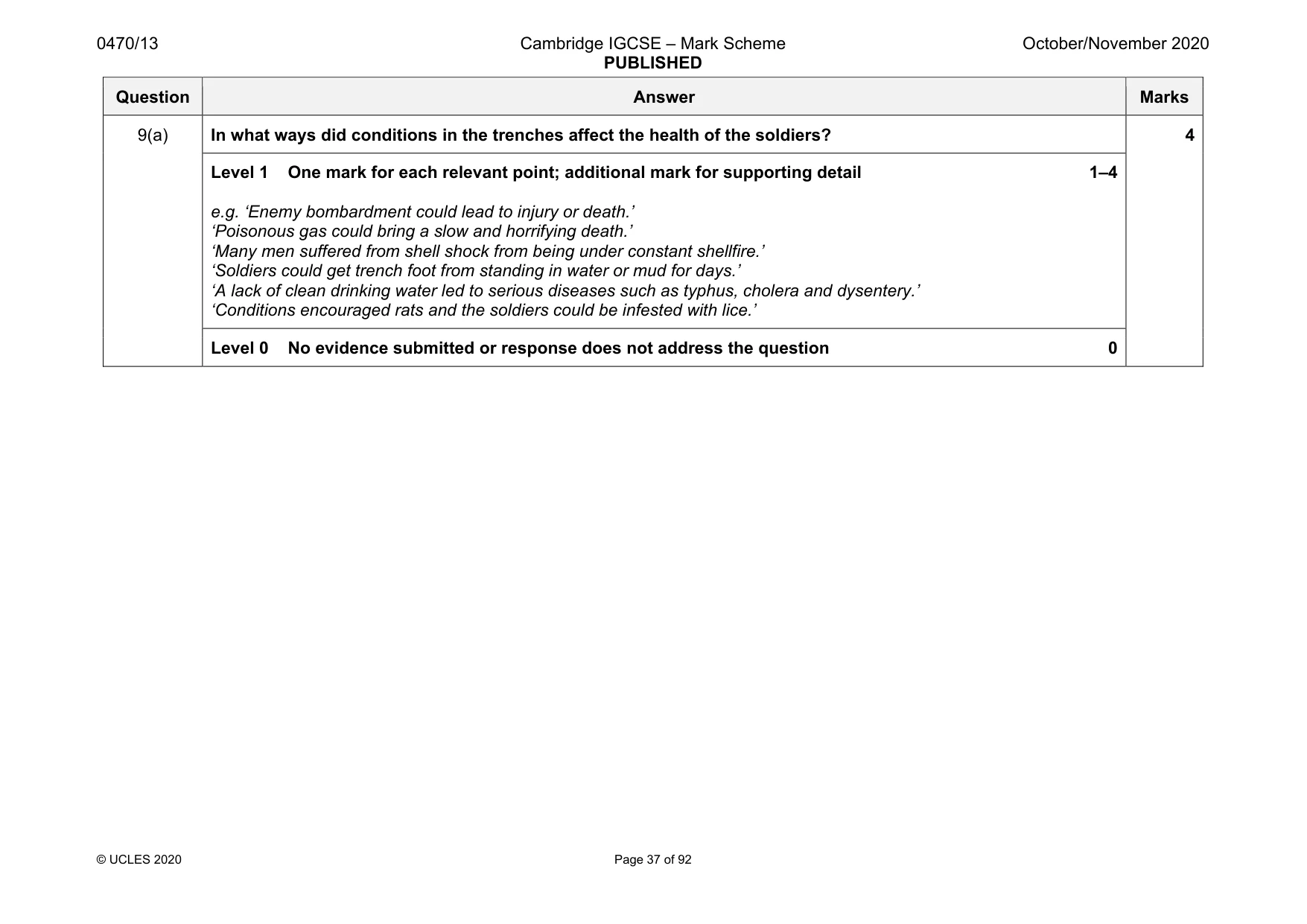
0470/13 Cambridge IGCSE – Mark Scheme PUBLISHED October/November 2020 © UCLES 2020 Page 37 of 92 Question Answer Marks 9(a) In what ways did conditions in the trenches affect the health of the soldiers? 4 Level 1 One mark for each relevant point; additional mark for supporting detail 1–4 e.g. ‘Enemy bombardment could lead to injury or death.’ ‘Poisonous gas could bring a slow and horrifying death.’ ‘Many men suffered from shell shock from being under constant shellfire.’ ‘Soldiers could get trench foot from standing in water or mud for days.’ ‘A lack of clean drinking water led to serious diseases such as typhus, cholera and dysentery.’ ‘Conditions encouraged rats and the soldiers could be infested with lice.’ Level 0 No evidence submitted or response does not address the question 0
Mark scheme, page 38
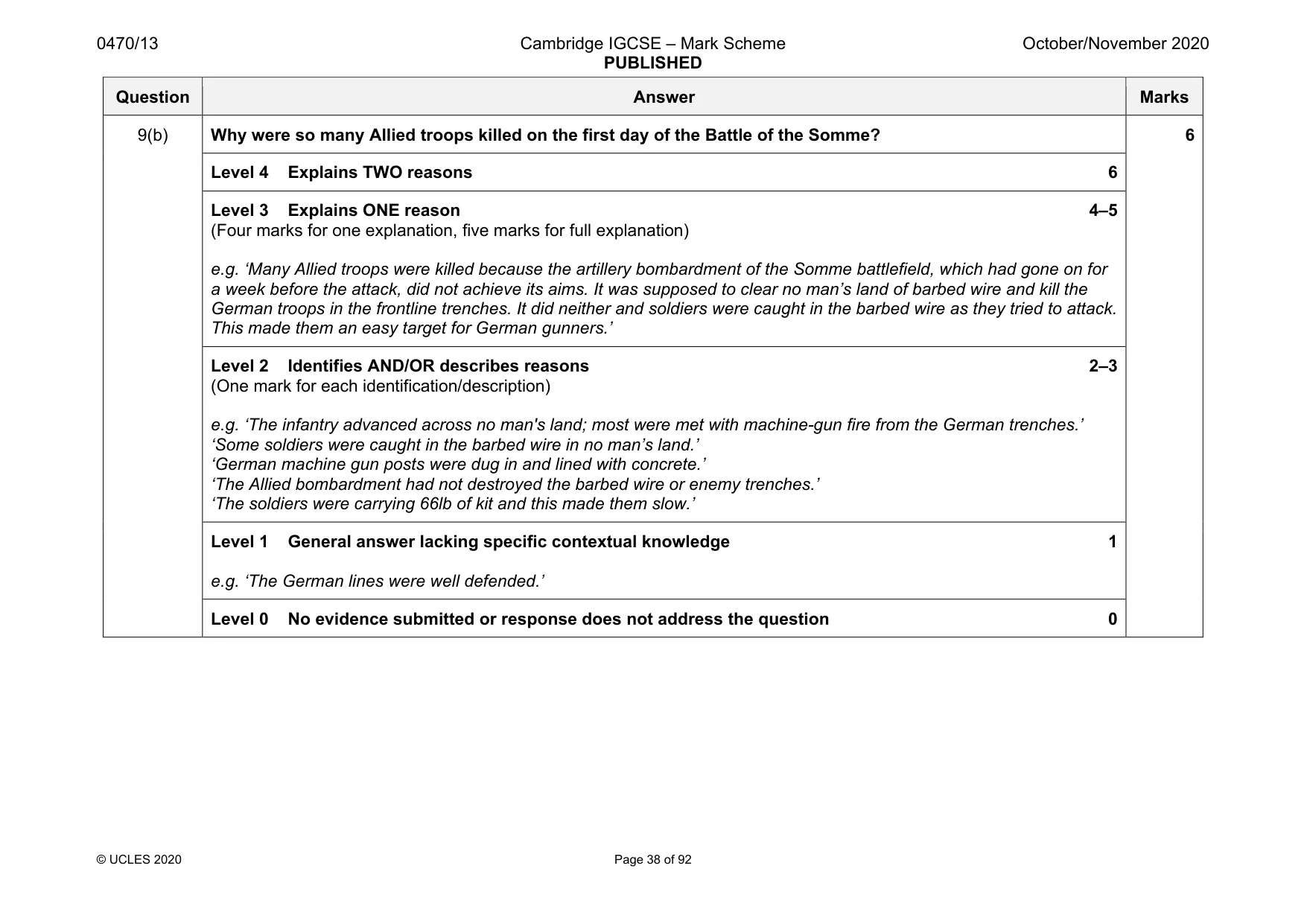
0470/13 Cambridge IGCSE – Mark Scheme PUBLISHED October/November 2020 © UCLES 2020 Page 38 of 92 Question Answer Marks 9(b) Why were so many Allied troops killed on the first day of the Battle of the Somme? 6 Level 4 Explains TWO reasons 6 Level 3 Explains ONE reason 4–5 (Four marks for one explanation, five marks for full explanation) e.g. ‘Many Allied troops were killed because the artillery bombardment of the Somme battlefield, which had gone on for a week before the attack, did not achieve its aims. It was supposed to clear no man’s land of barbed wire and kill the German troops in the frontline trenches. It did neither and soldiers were caught in the barbed wire as they tried to attack. This made them an easy target for German gunners.’ Level 2 Identifies AND/OR describes reasons 2–3 (One mark for each identification/description) e.g. ‘The infantry advanced across no man's land; most were met with machine-gun fire from the German trenches.’ ‘Some soldiers were caught in the barbed wire in no man’s land.’ ‘German machine gun posts were dug in and lined with concrete.’ ‘The Allied bombardment had not destroyed the barbed wire or enemy trenches.’ ‘The soldiers were carrying 66lb of kit and this made them slow.’ Level 1 General answer lacking specific contextual knowledge 1 e.g. ‘The German lines were well defended.’ Level 0 No evidence submitted or response does not address the question 0
Mark scheme, page 39
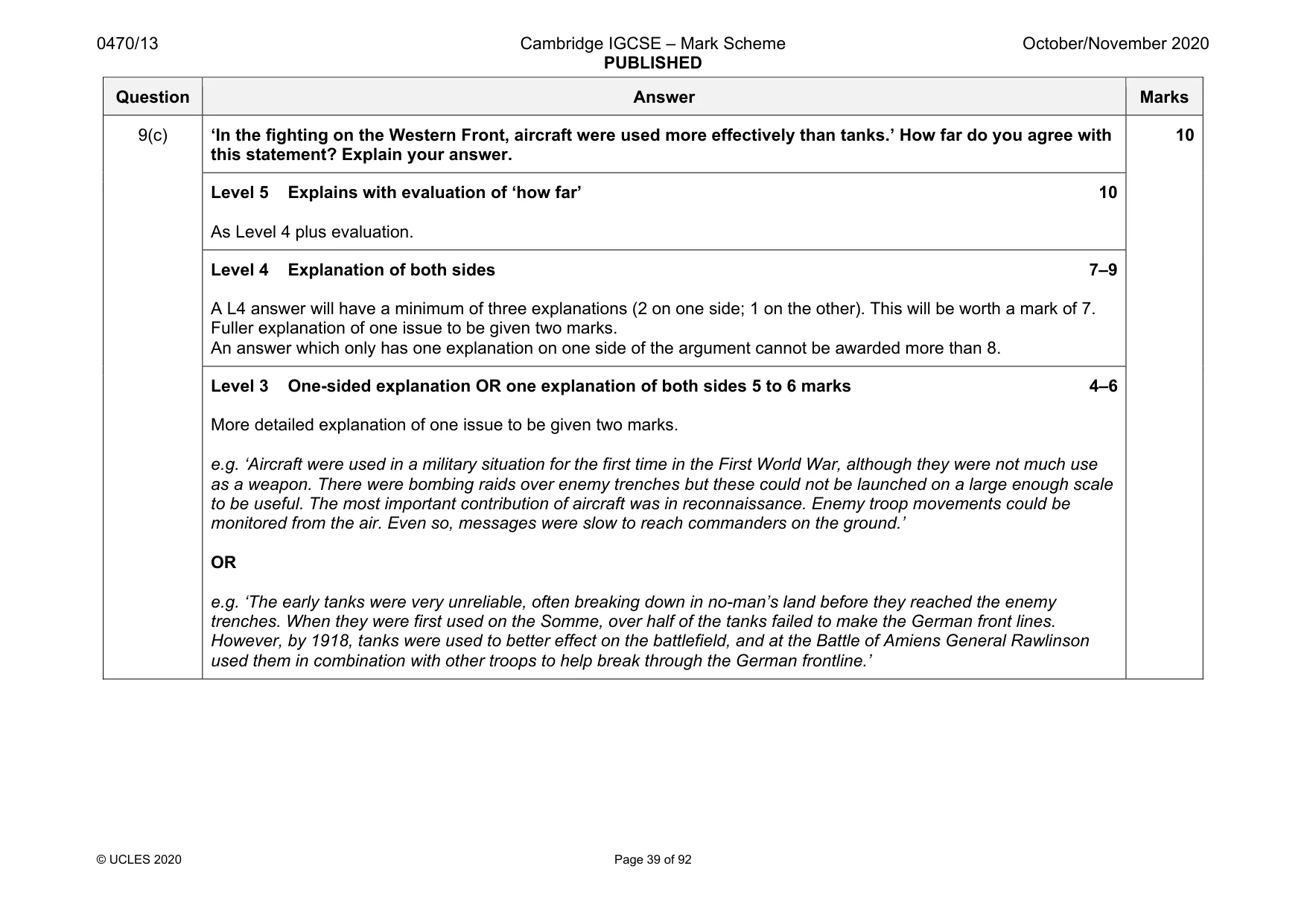
0470/13 Cambridge IGCSE – Mark Scheme PUBLISHED October/November 2020 © UCLES 2020 Page 39 of 92 Question Answer Marks 9(c) ‘In the fighting on the Western Front, aircraft were used more effectively than tanks.’ How far do you agree with this statement? Explain your answer. 10 Level 5 Explains with evaluation of ‘how far’ 10 As Level 4 plus evaluation. Level 4 Explanation of both sides 7–9 A L4 answer will have a minimum of three explanations (2 on one side; 1 on the other). This will be worth a mark of 7. Fuller explanation of one issue to be given two marks. An answer which only has one explanation on one side of the argument cannot be awarded more than 8. Level 3 One-sided explanation OR one explanation of both sides 5 to 6 marks 4–6 More detailed explanation of one issue to be given two marks. e.g. ‘Aircraft were used in a military situation for the first time in the First World War, although they were not much use as a weapon. There were bombing raids over enemy trenches but these could not be launched on a large enough scale to be useful. The most important contribution of aircraft was in reconnaissance. Enemy troop movements could be monitored from the air. Even so, messages were slow to reach commanders on the ground.’ OR e.g. ‘The early tanks were very unreliable, often breaking down in no-man’s land before they reached the enemy trenches. When they were first used on the Somme, over half of the tanks failed to make the German front lines. However, by 1918, tanks were used to better effect on the battlefield, and at the Battle of Amiens General Rawlinson used them in combination with other troops to help break through the German frontline.’
Mark scheme, page 40
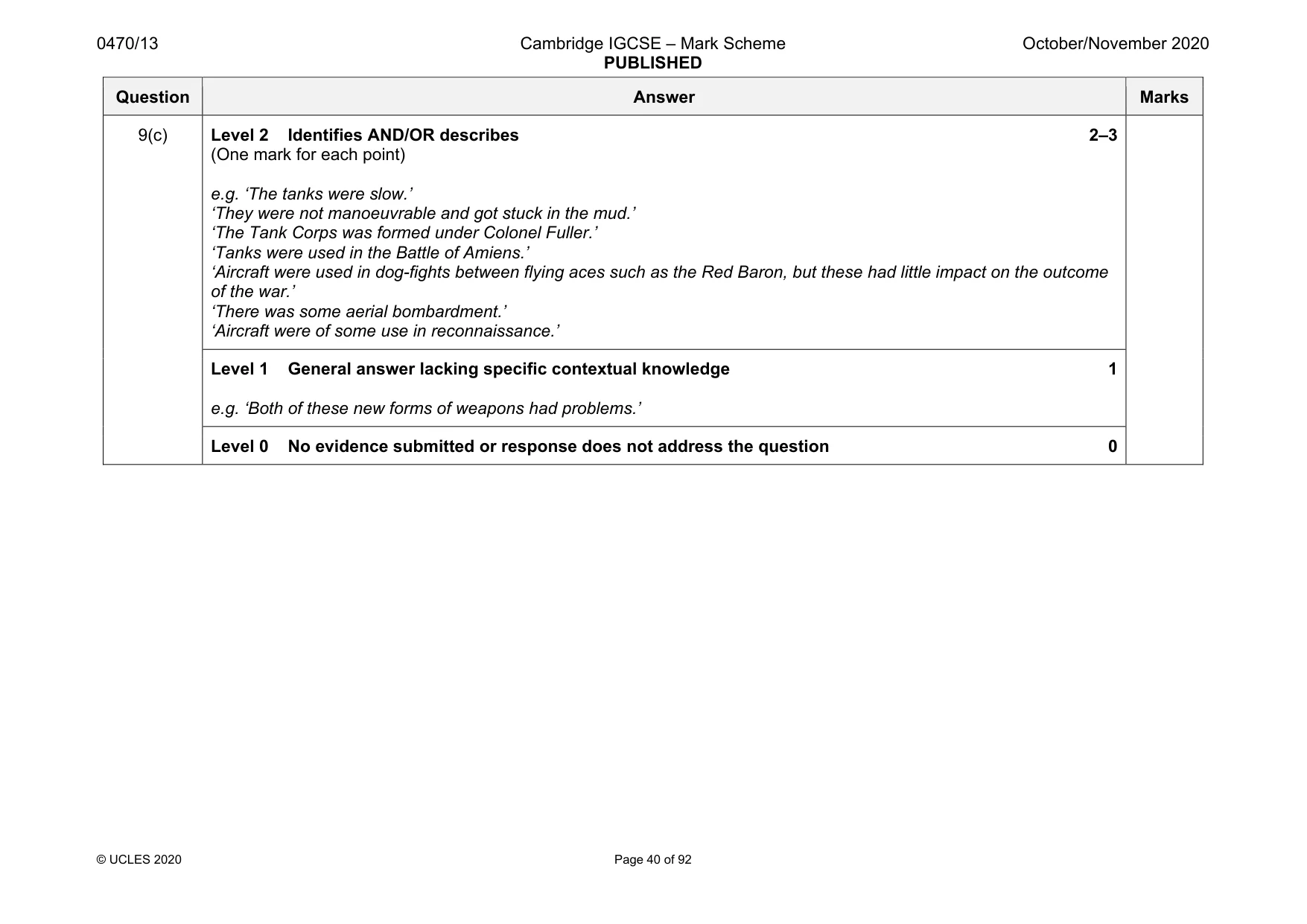
0470/13 Cambridge IGCSE – Mark Scheme PUBLISHED October/November 2020 © UCLES 2020 Page 40 of 92 Question Answer Marks 9(c) Level 2 Identifies AND/OR describes 2–3 (One mark for each point) e.g. ‘The tanks were slow.’ ‘They were not manoeuvrable and got stuck in the mud.’ ‘The Tank Corps was formed under Colonel Fuller.’ ‘Tanks were used in the Battle of Amiens.’ ‘Aircraft were used in dog-fights between flying aces such as the Red Baron, but these had little impact on the outcome of the war.’ ‘There was some aerial bombardment.’ ‘Aircraft were of some use in reconnaissance.’ Level 1 General answer lacking specific contextual knowledge 1 e.g. ‘Both of these new forms of weapons had problems.’ Level 0 No evidence submitted or response does not address the question 0
Mark scheme, page 41
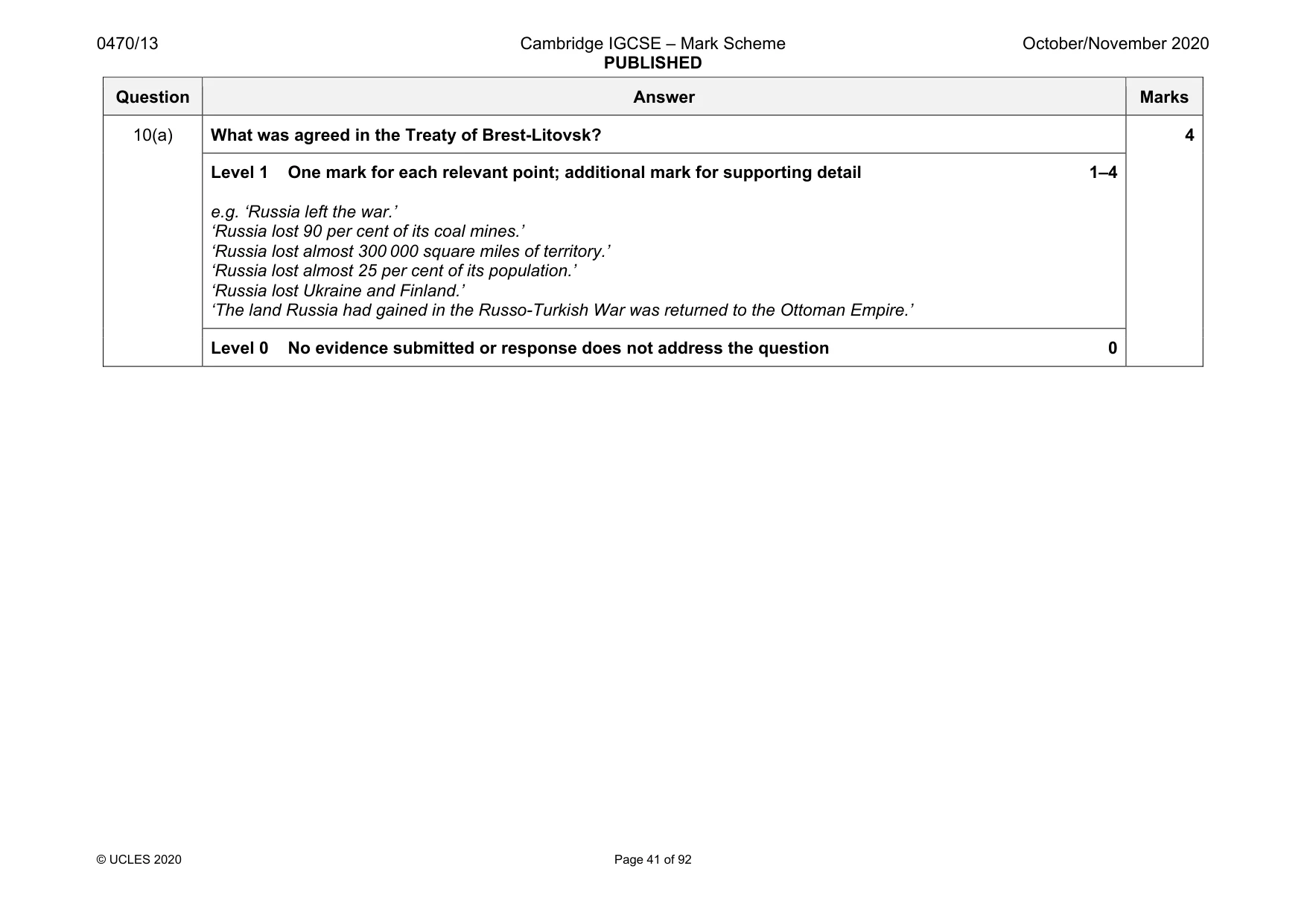
0470/13 Cambridge IGCSE – Mark Scheme PUBLISHED October/November 2020 © UCLES 2020 Page 41 of 92 Question Answer Marks 10(a) What was agreed in the Treaty of Brest-Litovsk? 4 Level 1 One mark for each relevant point; additional mark for supporting detail 1–4 e.g. ‘Russia left the war.’ ‘Russia lost 90 per cent of its coal mines.’ ‘Russia lost almost 300 000 square miles of territory.’ ‘Russia lost almost 25 per cent of its population.’ ‘Russia lost Ukraine and Finland.’ ‘The land Russia had gained in the Russo-Turkish War was returned to the Ottoman Empire.’ Level 0 No evidence submitted or response does not address the question 0
Mark scheme, page 42
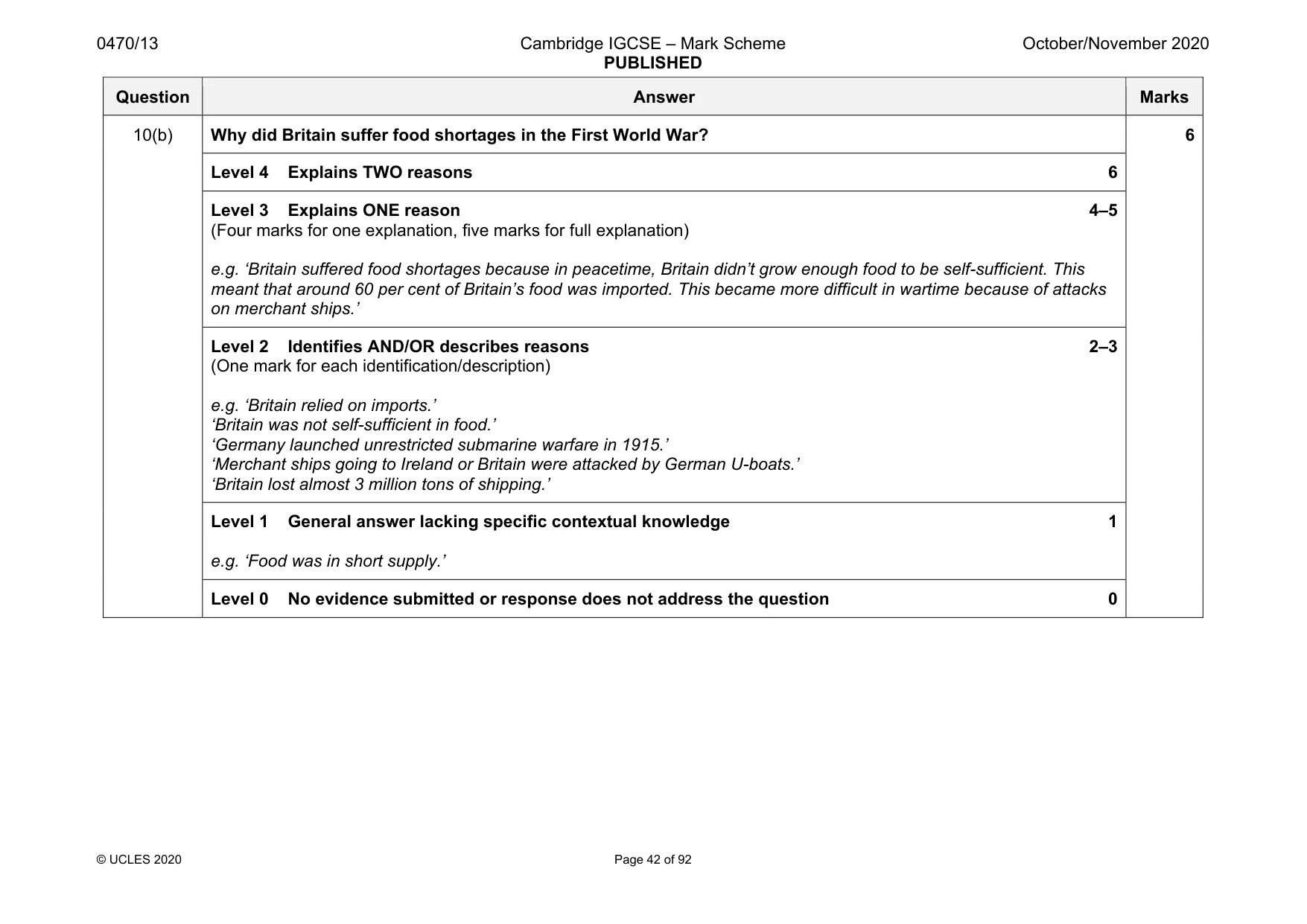
0470/13 Cambridge IGCSE – Mark Scheme PUBLISHED October/November 2020 © UCLES 2020 Page 42 of 92 Question Answer Marks 10(b) Why did Britain suffer food shortages in the First World War? 6 Level 4 Explains TWO reasons 6 Level 3 Explains ONE reason 4–5 (Four marks for one explanation, five marks for full explanation) e.g. ‘Britain suffered food shortages because in peacetime, Britain didn’t grow enough food to be self-sufficient. This meant that around 60 per cent of Britain’s food was imported. This became more difficult in wartime because of attacks on merchant ships.’ Level 2 Identifies AND/OR describes reasons 2–3 (One mark for each identification/description) e.g. ‘Britain relied on imports.’ ‘Britain was not self-sufficient in food.’ ‘Germany launched unrestricted submarine warfare in 1915.’ ‘Merchant ships going to Ireland or Britain were attacked by German U-boats.’ ‘Britain lost almost 3 million tons of shipping.’ Level 1 General answer lacking specific contextual knowledge 1 e.g. ‘Food was in short supply.’ Level 0 No evidence submitted or response does not address the question 0
Mark scheme, page 43
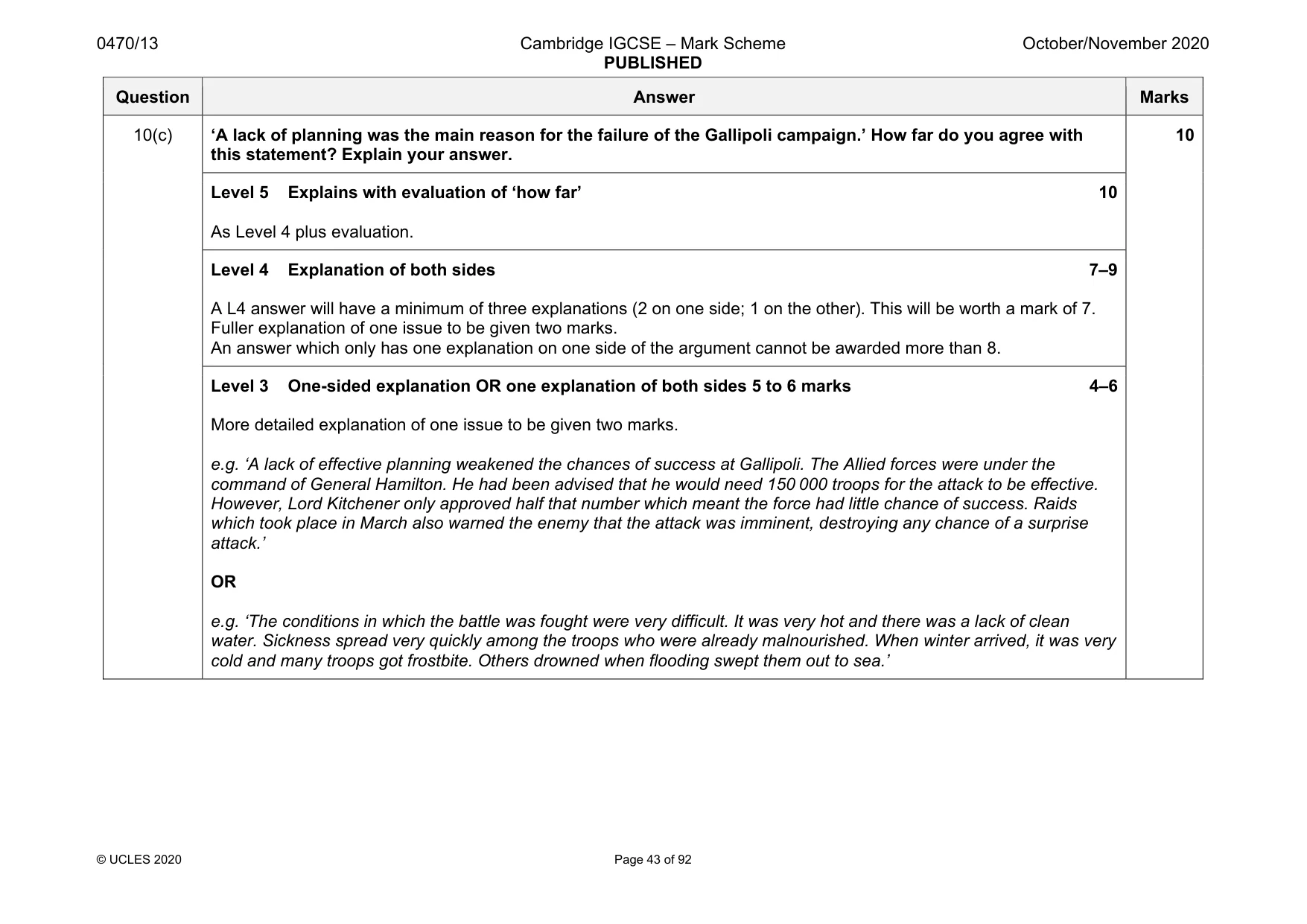
0470/13 Cambridge IGCSE – Mark Scheme PUBLISHED October/November 2020 © UCLES 2020 Page 43 of 92 Question Answer Marks 10(c) ‘A lack of planning was the main reason for the failure of the Gallipoli campaign.’ How far do you agree with this statement? Explain your answer. 10 Level 5 Explains with evaluation of ‘how far’ 10 As Level 4 plus evaluation. Level 4 Explanation of both sides 7–9 A L4 answer will have a minimum of three explanations (2 on one side; 1 on the other). This will be worth a mark of 7. Fuller explanation of one issue to be given two marks. An answer which only has one explanation on one side of the argument cannot be awarded more than 8. Level 3 One-sided explanation OR one explanation of both sides 5 to 6 marks 4–6 More detailed explanation of one issue to be given two marks. e.g. ‘A lack of effective planning weakened the chances of success at Gallipoli. The Allied forces were under the command of General Hamilton. He had been advised that he would need 150 000 troops for the attack to be effective. However, Lord Kitchener only approved half that number which meant the force had little chance of success. Raids which took place in March also warned the enemy that the attack was imminent, destroying any chance of a surprise attack.’ OR e.g. ‘The conditions in which the battle was fought were very difficult. It was very hot and there was a lack of clean water. Sickness spread very quickly among the troops who were already malnourished. When winter arrived, it was very cold and many troops got frostbite. Others drowned when flooding swept them out to sea.’
Mark scheme, page 44
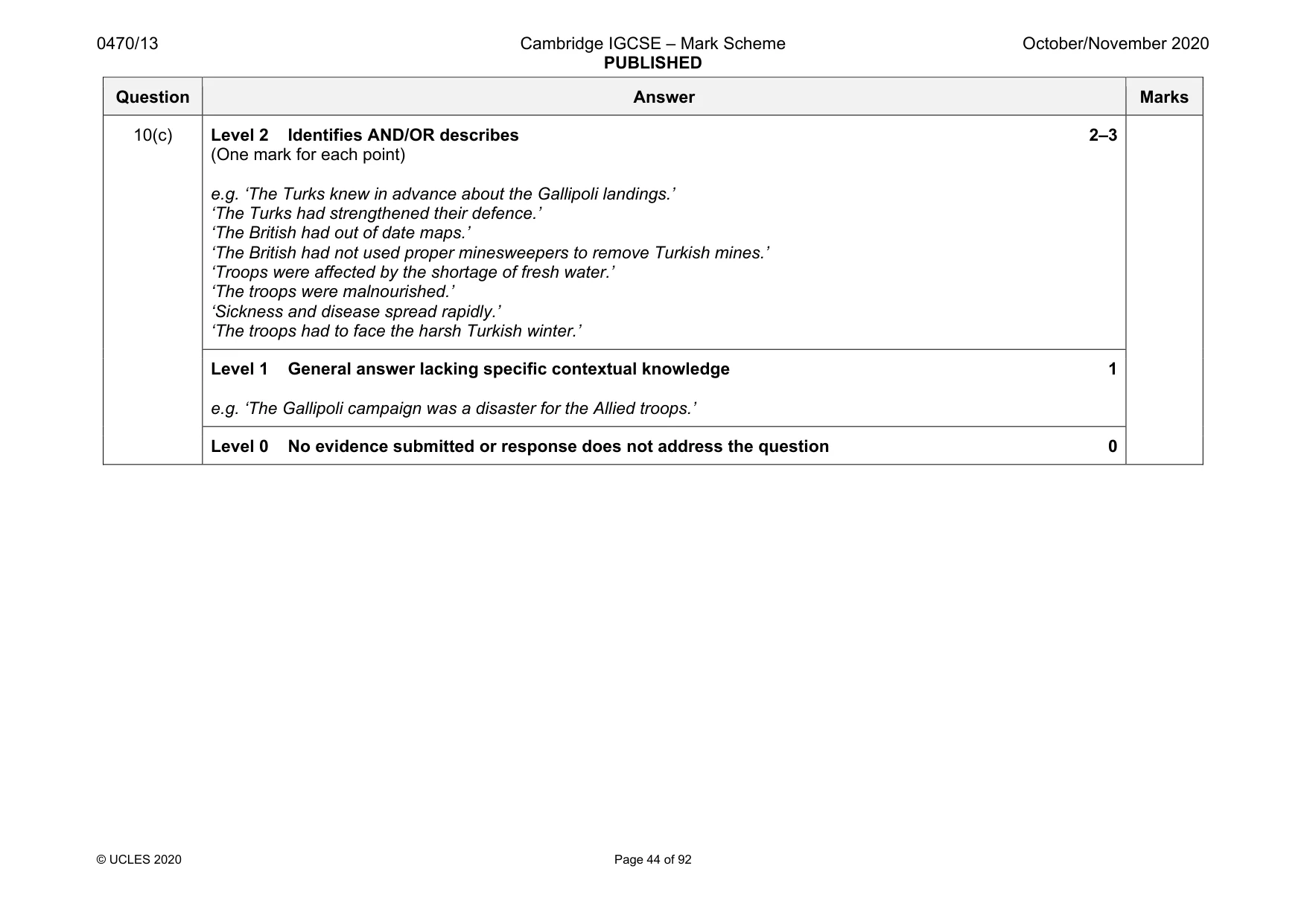
0470/13 Cambridge IGCSE – Mark Scheme PUBLISHED October/November 2020 © UCLES 2020 Page 44 of 92 Question Answer Marks 10(c) Level 2 Identifies AND/OR describes 2–3 (One mark for each point) e.g. ‘The Turks knew in advance about the Gallipoli landings.’ ‘The Turks had strengthened their defence.’ ‘The British had out of date maps.’ ‘The British had not used proper minesweepers to remove Turkish mines.’ ‘Troops were affected by the shortage of fresh water.’ ‘The troops were malnourished.’ ‘Sickness and disease spread rapidly.’ ‘The troops had to face the harsh Turkish winter.’ Level 1 General answer lacking specific contextual knowledge 1 e.g. ‘The Gallipoli campaign was a disaster for the Allied troops.’ Level 0 No evidence submitted or response does not address the question 0
Mark scheme, page 45
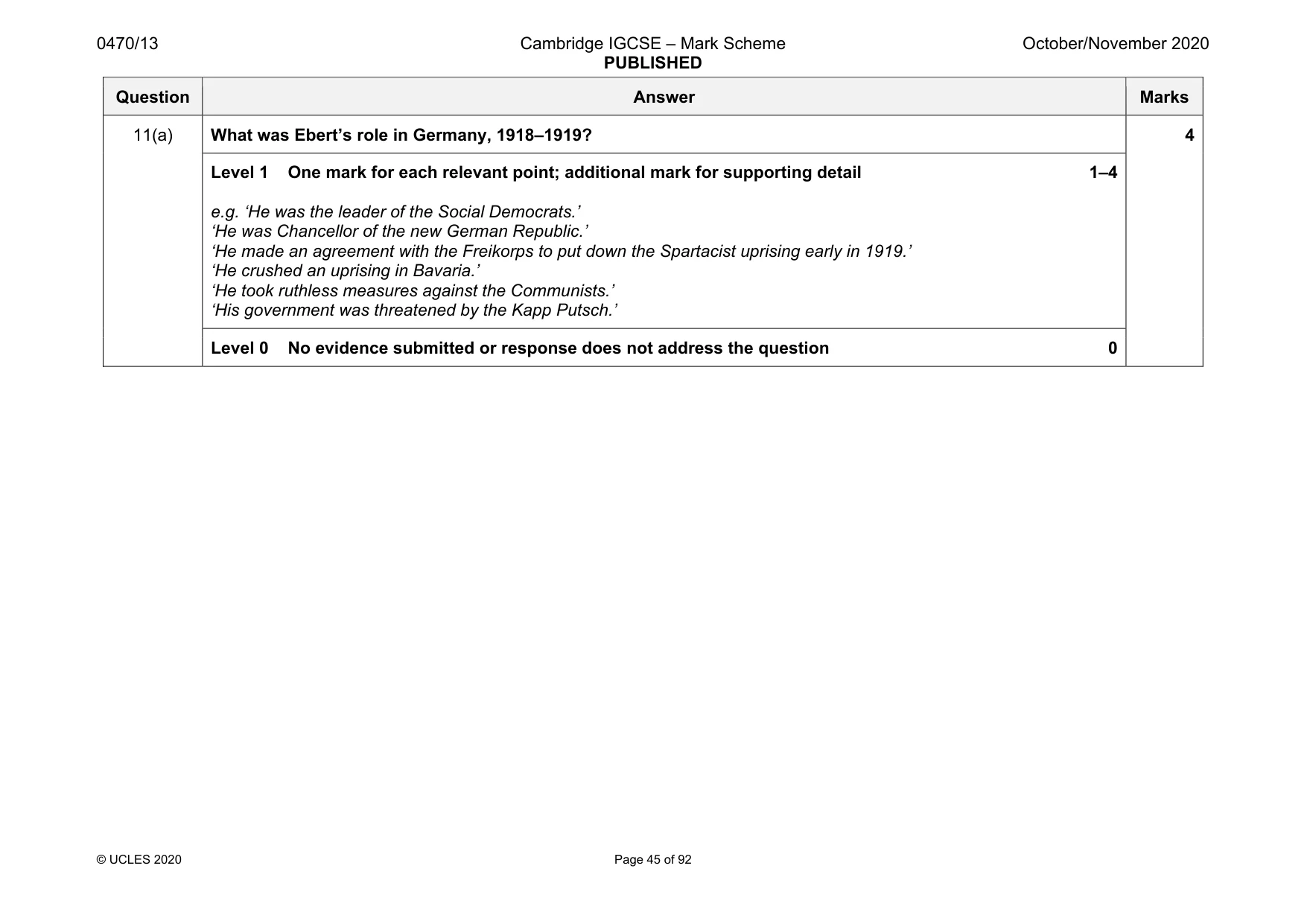
0470/13 Cambridge IGCSE – Mark Scheme PUBLISHED October/November 2020 © UCLES 2020 Page 45 of 92 Question Answer Marks 11(a) What was Ebert’s role in Germany, 1918–1919? 4 Level 1 One mark for each relevant point; additional mark for supporting detail 1–4 e.g. ‘He was the leader of the Social Democrats.’ ‘He was Chancellor of the new German Republic.’ ‘He made an agreement with the Freikorps to put down the Spartacist uprising early in 1919.’ ‘He crushed an uprising in Bavaria.’ ‘He took ruthless measures against the Communists.’ ‘His government was threatened by the Kapp Putsch.’ Level 0 No evidence submitted or response does not address the question 0
Mark scheme, page 46
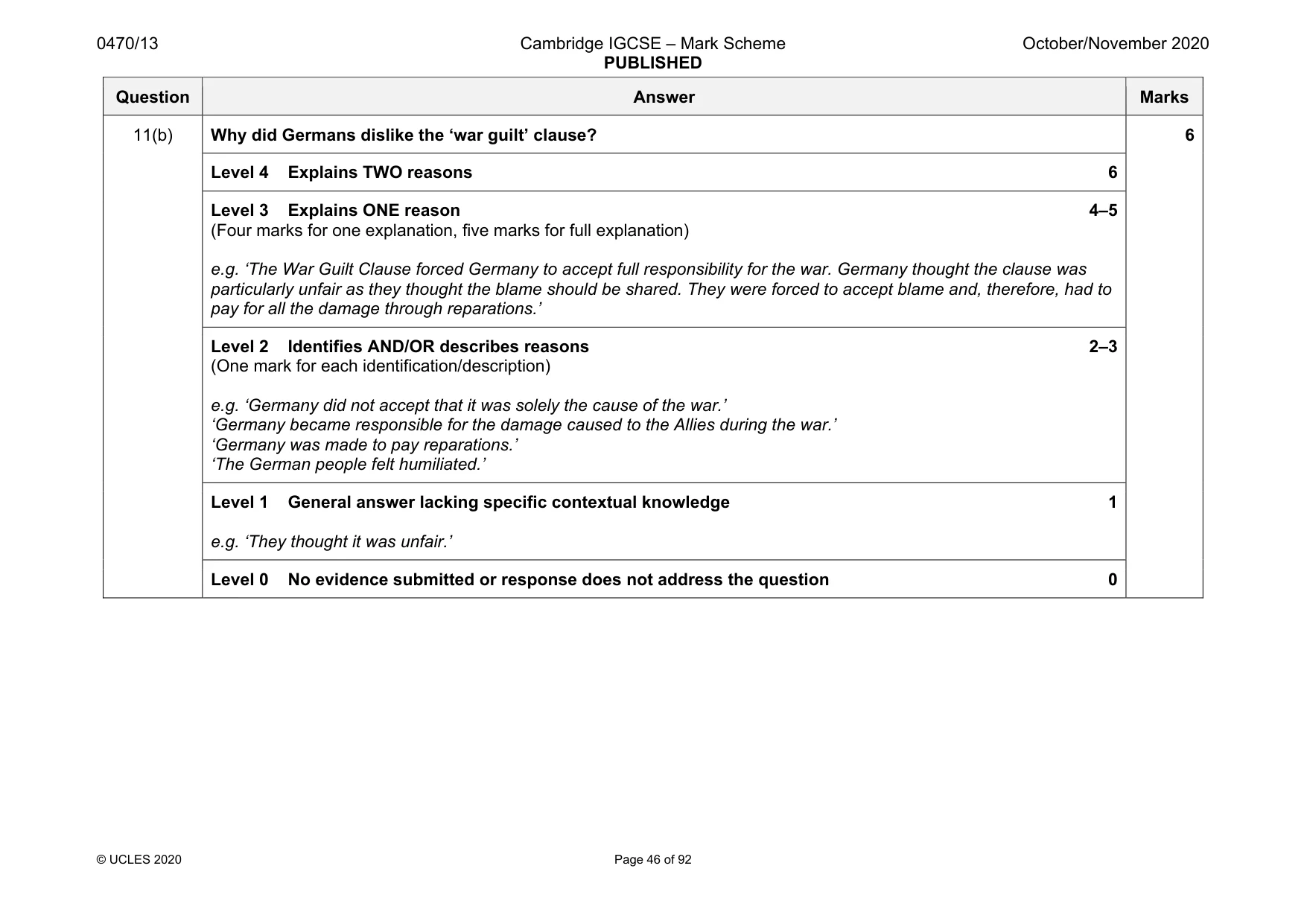
0470/13 Cambridge IGCSE – Mark Scheme PUBLISHED October/November 2020 © UCLES 2020 Page 46 of 92 Question Answer Marks 11(b) Why did Germans dislike the ‘war guilt’ clause? 6 Level 4 Explains TWO reasons 6 Level 3 Explains ONE reason 4–5 (Four marks for one explanation, five marks for full explanation) e.g. ‘The War Guilt Clause forced Germany to accept full responsibility for the war. Germany thought the clause was particularly unfair as they thought the blame should be shared. They were forced to accept blame and, therefore, had to pay for all the damage through reparations.’ Level 2 Identifies AND/OR describes reasons 2–3 (One mark for each identification/description) e.g. ‘Germany did not accept that it was solely the cause of the war.’ ‘Germany became responsible for the damage caused to the Allies during the war.’ ‘Germany was made to pay reparations.’ ‘The German people felt humiliated.’ Level 1 General answer lacking specific contextual knowledge 1 e.g. ‘They thought it was unfair.’ Level 0 No evidence submitted or response does not address the question 0
Mark scheme, page 47
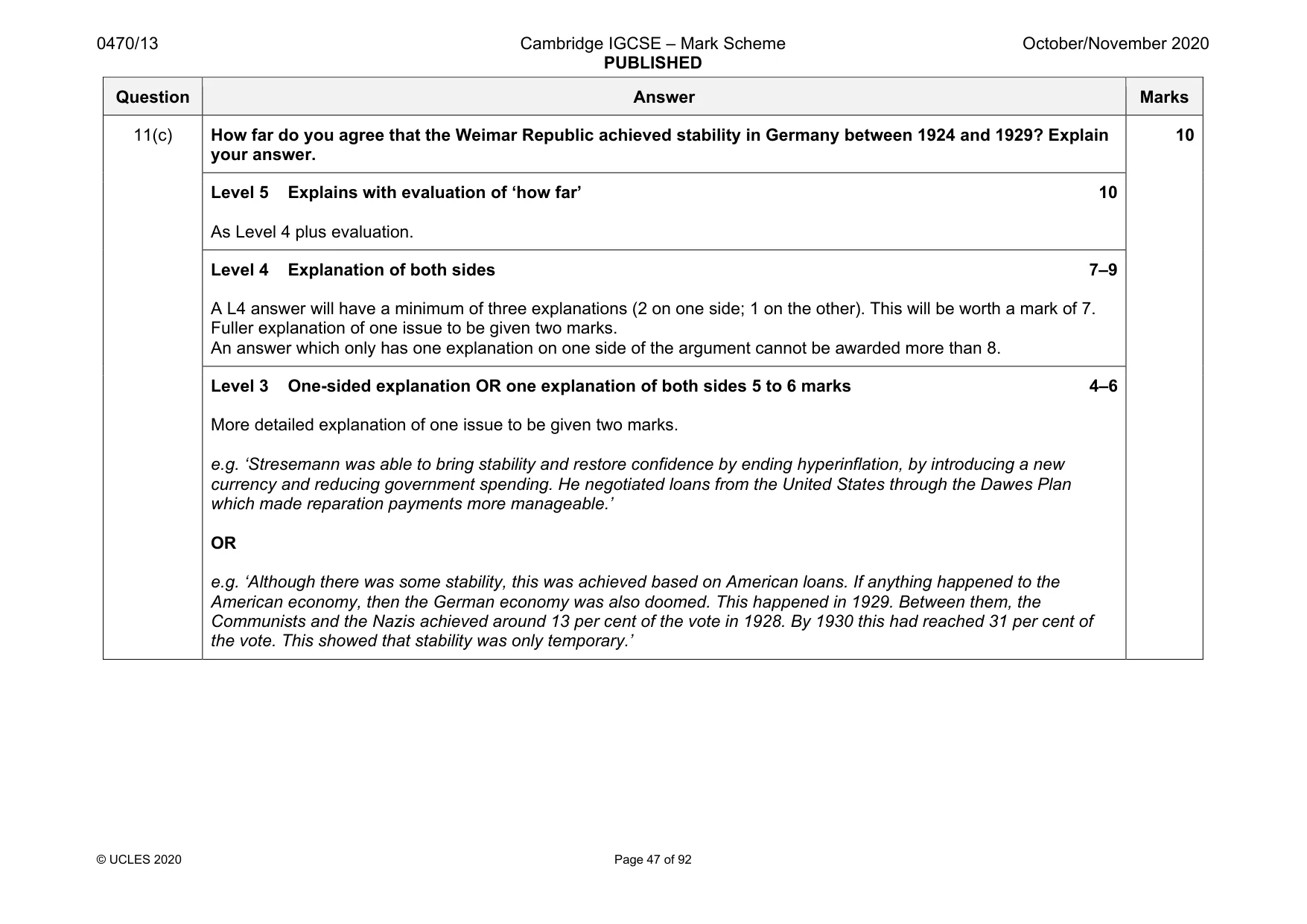
0470/13 Cambridge IGCSE – Mark Scheme PUBLISHED October/November 2020 © UCLES 2020 Page 47 of 92 Question Answer Marks 11(c) How far do you agree that the Weimar Republic achieved stability in Germany between 1924 and 1929? Explain your answer. 10 Level 5 Explains with evaluation of ‘how far’ 10 As Level 4 plus evaluation. Level 4 Explanation of both sides 7–9 A L4 answer will have a minimum of three explanations (2 on one side; 1 on the other). This will be worth a mark of 7. Fuller explanation of one issue to be given two marks. An answer which only has one explanation on one side of the argument cannot be awarded more than 8. Level 3 One-sided explanation OR one explanation of both sides 5 to 6 marks 4–6 More detailed explanation of one issue to be given two marks. e.g. ‘Stresemann was able to bring stability and restore confidence by ending hyperinflation, by introducing a new currency and reducing government spending. He negotiated loans from the United States through the Dawes Plan which made reparation payments more manageable.’ OR e.g. ‘Although there was some stability, this was achieved based on American loans. If anything happened to the American economy, then the German economy was also doomed. This happened in 1929. Between them, the Communists and the Nazis achieved around 13 per cent of the vote in 1928. By 1930 this had reached 31 per cent of the vote. This showed that stability was only temporary.’
Mark scheme, page 48
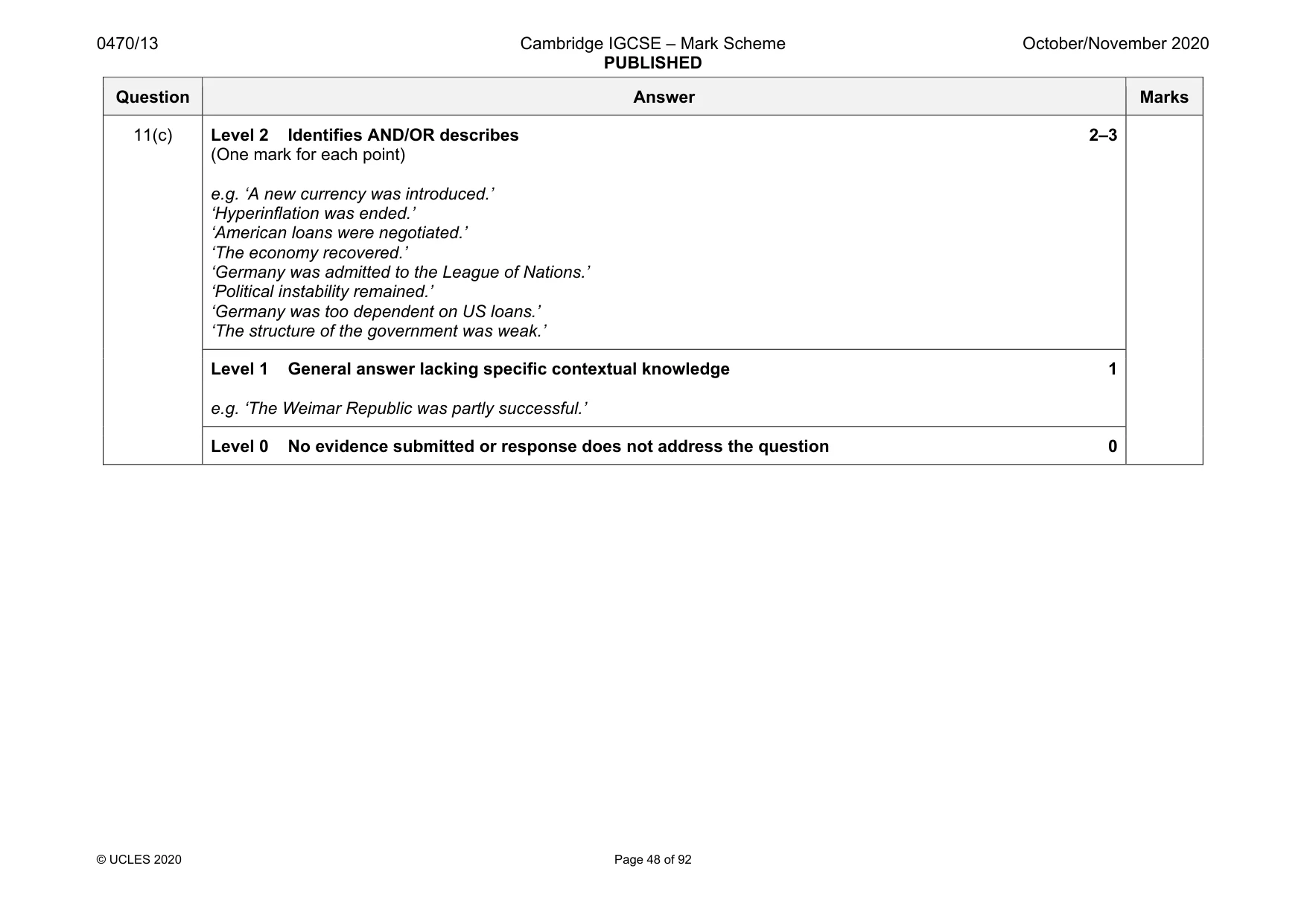
0470/13 Cambridge IGCSE – Mark Scheme PUBLISHED October/November 2020 © UCLES 2020 Page 48 of 92 Question Answer Marks 11(c) Level 2 Identifies AND/OR describes 2–3 (One mark for each point) e.g. ‘A new currency was introduced.’ ‘Hyperinflation was ended.’ ‘American loans were negotiated.’ ‘The economy recovered.’ ‘Germany was admitted to the League of Nations.’ ‘Political instability remained.’ ‘Germany was too dependent on US loans.’ ‘The structure of the government was weak.’ Level 1 General answer lacking specific contextual knowledge 1 e.g. ‘The Weimar Republic was partly successful.’ Level 0 No evidence submitted or response does not address the question 0
Mark scheme, page 49
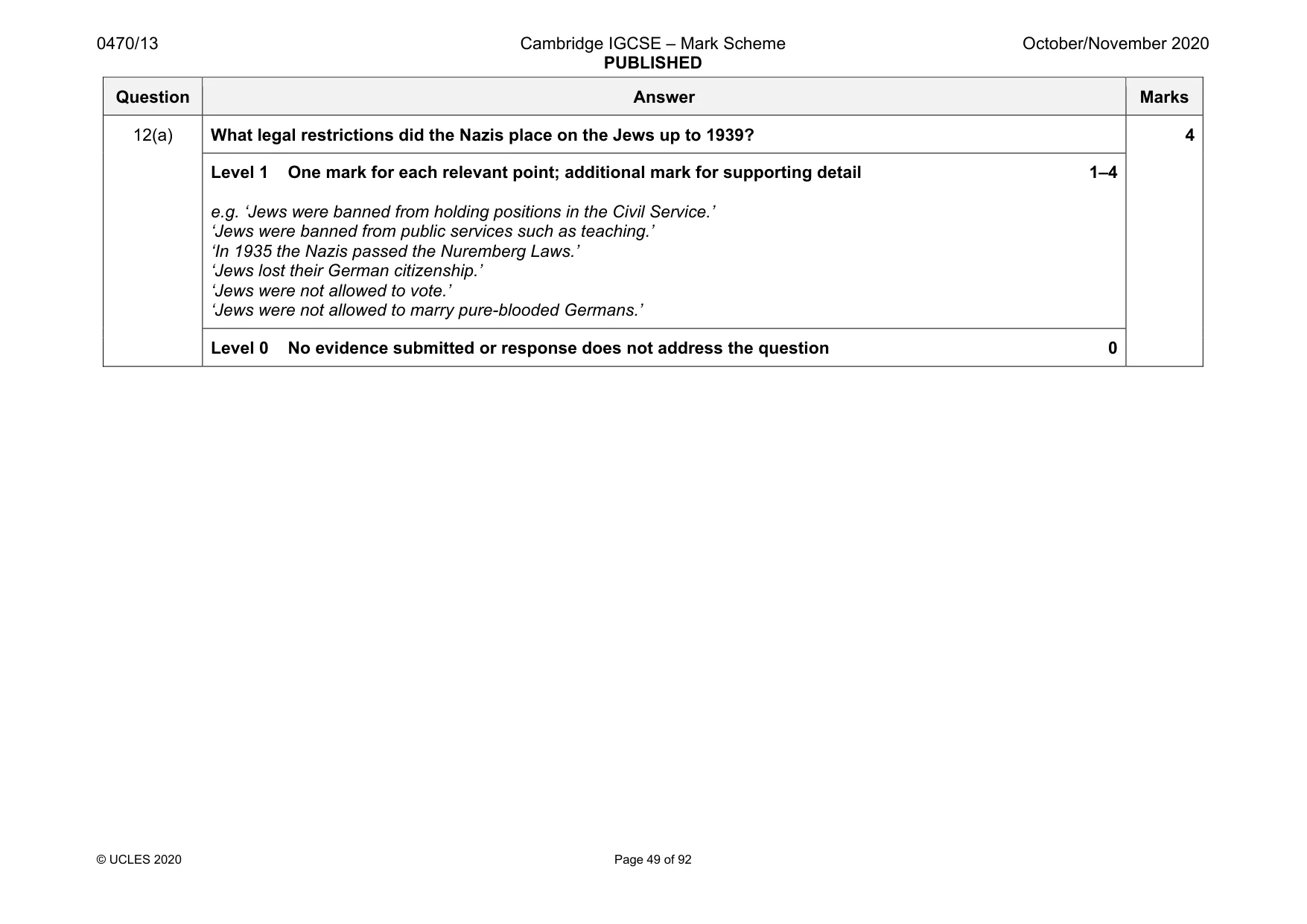
0470/13 Cambridge IGCSE – Mark Scheme PUBLISHED October/November 2020 © UCLES 2020 Page 49 of 92 Question Answer Marks 12(a) What legal restrictions did the Nazis place on the Jews up to 1939? 4 Level 1 One mark for each relevant point; additional mark for supporting detail 1–4 e.g. ‘Jews were banned from holding positions in the Civil Service.’ ‘Jews were banned from public services such as teaching.’ ‘In 1935 the Nazis passed the Nuremberg Laws.’ ‘Jews lost their German citizenship.’ ‘Jews were not allowed to vote.’ ‘Jews were not allowed to marry pure-blooded Germans.’ Level 0 No evidence submitted or response does not address the question 0
Mark scheme, page 50
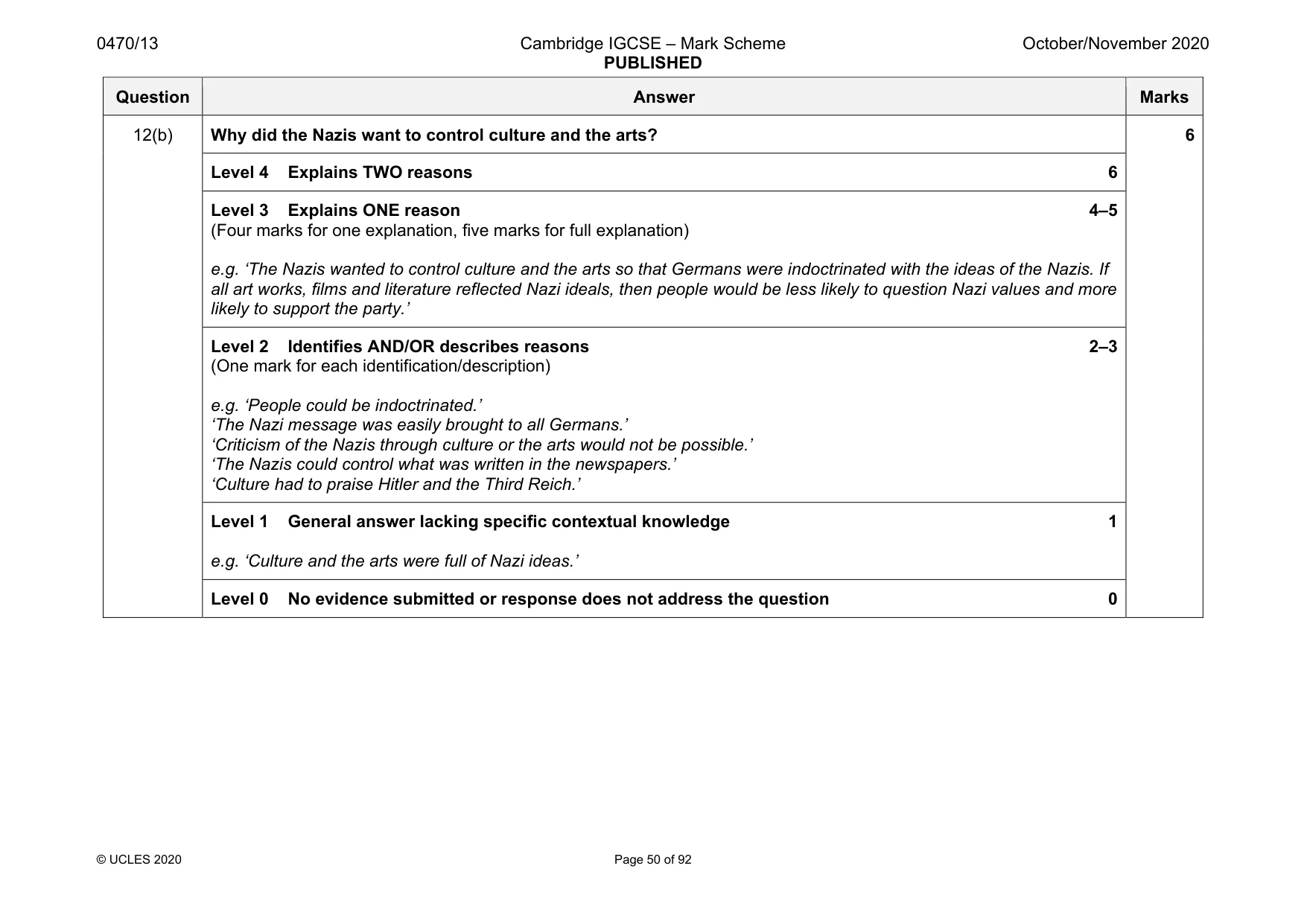
0470/13 Cambridge IGCSE – Mark Scheme PUBLISHED October/November 2020 © UCLES 2020 Page 50 of 92 Question Answer Marks 12(b) Why did the Nazis want to control culture and the arts? 6 Level 4 Explains TWO reasons 6 Level 3 Explains ONE reason 4–5 (Four marks for one explanation, five marks for full explanation) e.g. ‘The Nazis wanted to control culture and the arts so that Germans were indoctrinated with the ideas of the Nazis. If all art works, films and literature reflected Nazi ideals, then people would be less likely to question Nazi values and more likely to support the party.’ Level 2 Identifies AND/OR describes reasons 2–3 (One mark for each identification/description) e.g. ‘People could be indoctrinated.’ ‘The Nazi message was easily brought to all Germans.’ ‘Criticism of the Nazis through culture or the arts would not be possible.’ ‘The Nazis could control what was written in the newspapers.’ ‘Culture had to praise Hitler and the Third Reich.’ Level 1 General answer lacking specific contextual knowledge 1 e.g. ‘Culture and the arts were full of Nazi ideas.’ Level 0 No evidence submitted or response does not address the question 0
Mark scheme, page 51
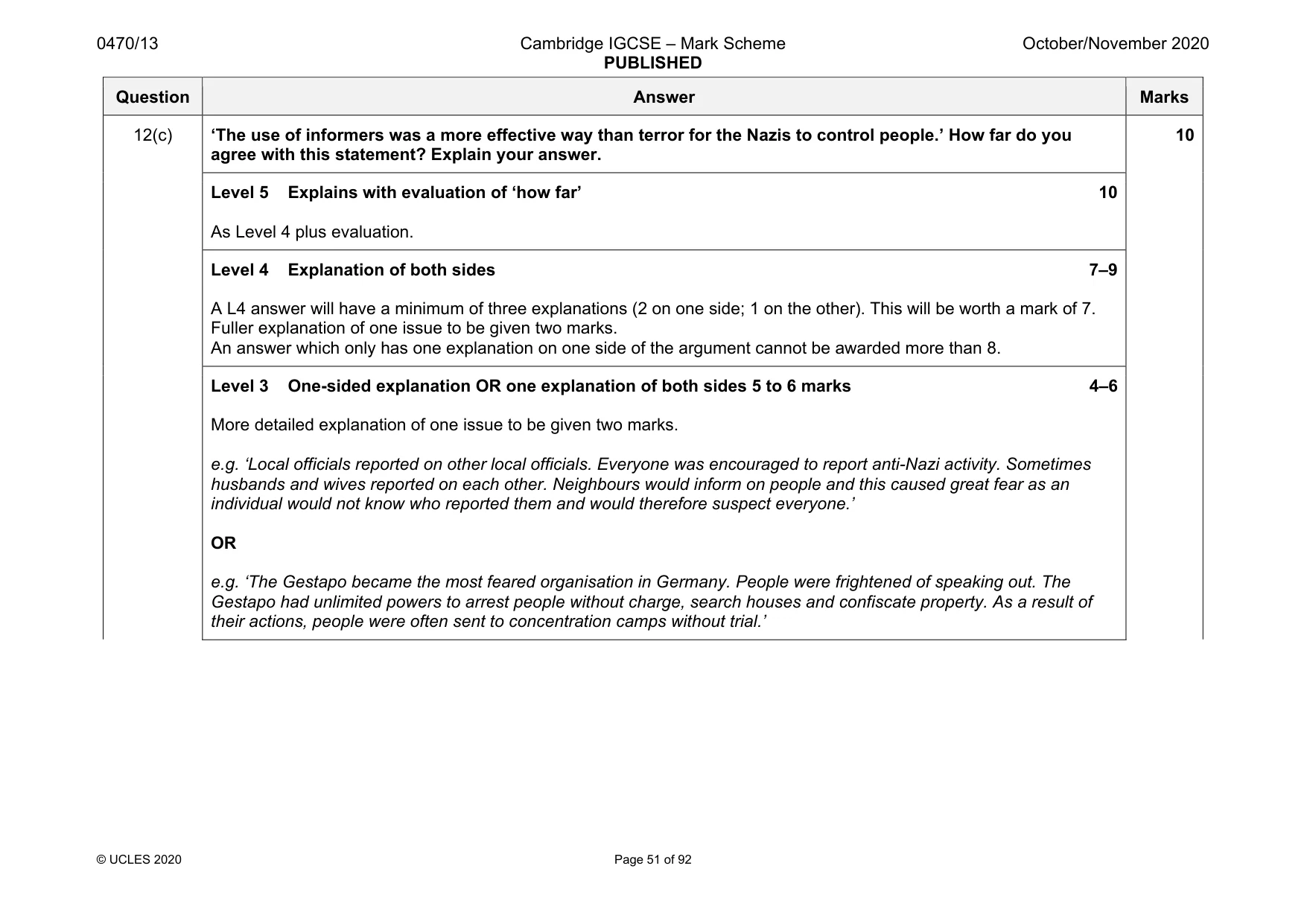
0470/13 Cambridge IGCSE – Mark Scheme PUBLISHED October/November 2020 © UCLES 2020 Page 51 of 92 Question Answer Marks 12(c) ‘The use of informers was a more effective way than terror for the Nazis to control people.’ How far do you agree with this statement? Explain your answer. 10 Level 5 Explains with evaluation of ‘how far’ 10 As Level 4 plus evaluation. Level 4 Explanation of both sides 7–9 A L4 answer will have a minimum of three explanations (2 on one side; 1 on the other). This will be worth a mark of 7. Fuller explanation of one issue to be given two marks. An answer which only has one explanation on one side of the argument cannot be awarded more than 8. Level 3 One-sided explanation OR one explanation of both sides 5 to 6 marks 4–6 More detailed explanation of one issue to be given two marks. e.g. ‘Local officials reported on other local officials. Everyone was encouraged to report anti-Nazi activity. Sometimes husbands and wives reported on each other. Neighbours would inform on people and this caused great fear as an individual would not know who reported them and would therefore suspect everyone.’ OR e.g. ‘The Gestapo became the most feared organisation in Germany. People were frightened of speaking out. The Gestapo had unlimited powers to arrest people without charge, search houses and confiscate property. As a result of their actions, people were often sent to concentration camps without trial.’
Mark scheme, page 52
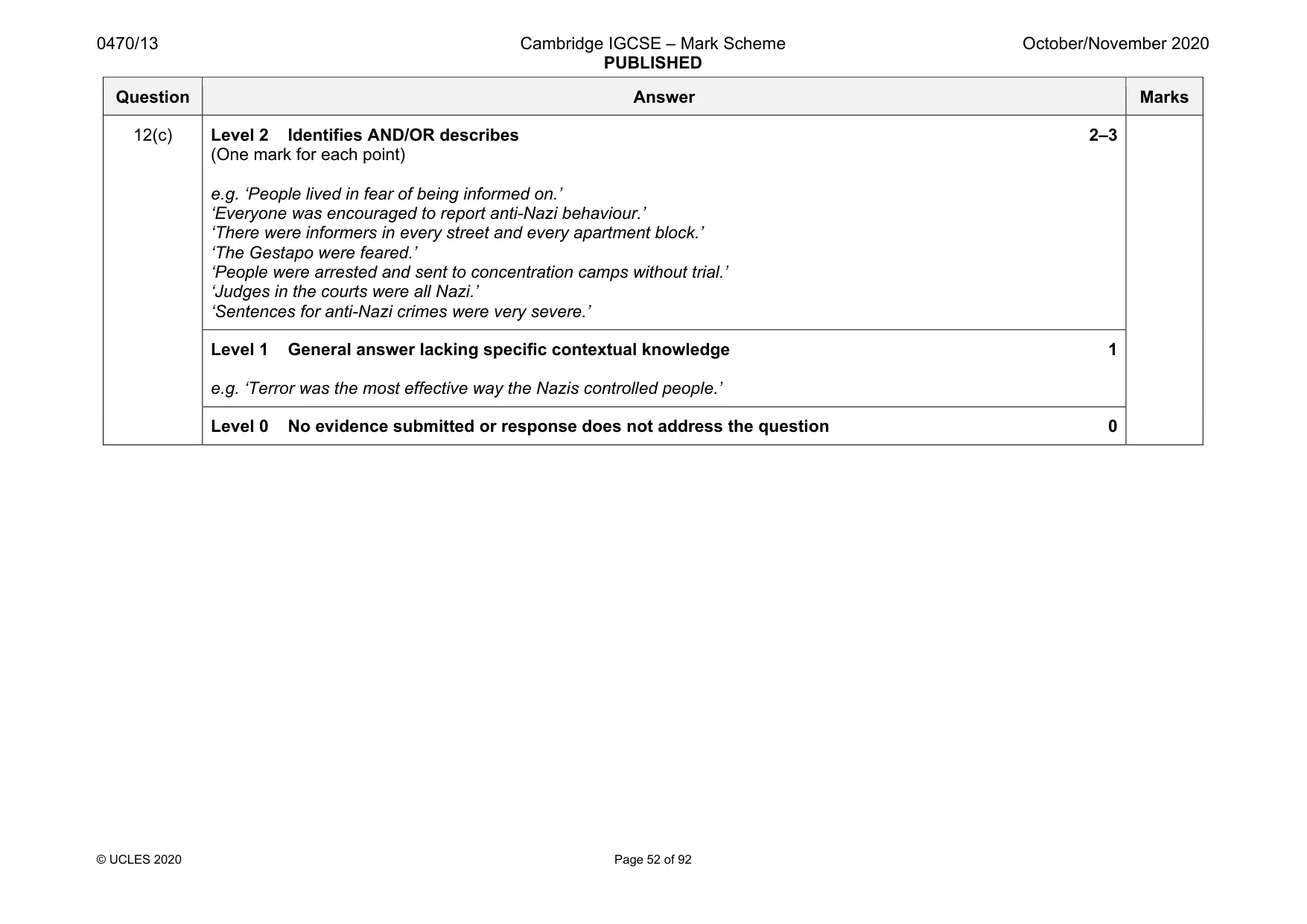
0470/13 Cambridge IGCSE – Mark Scheme PUBLISHED October/November 2020 © UCLES 2020 Page 52 of 92 Question Answer Marks 12(c) Level 2 Identifies AND/OR describes 2–3 (One mark for each point) e.g. ‘People lived in fear of being informed on.’ ‘Everyone was encouraged to report anti-Nazi behaviour.’ ‘There were informers in every street and every apartment block.’ ‘The Gestapo were feared.’ ‘People were arrested and sent to concentration camps without trial.’ ‘Judges in the courts were all Nazi.’ ‘Sentences for anti-Nazi crimes were very severe.’ Level 1 General answer lacking specific contextual knowledge 1 e.g. ‘Terror was the most effective way the Nazis controlled people.’ Level 0 No evidence submitted or response does not address the question 0
Mark scheme, page 53
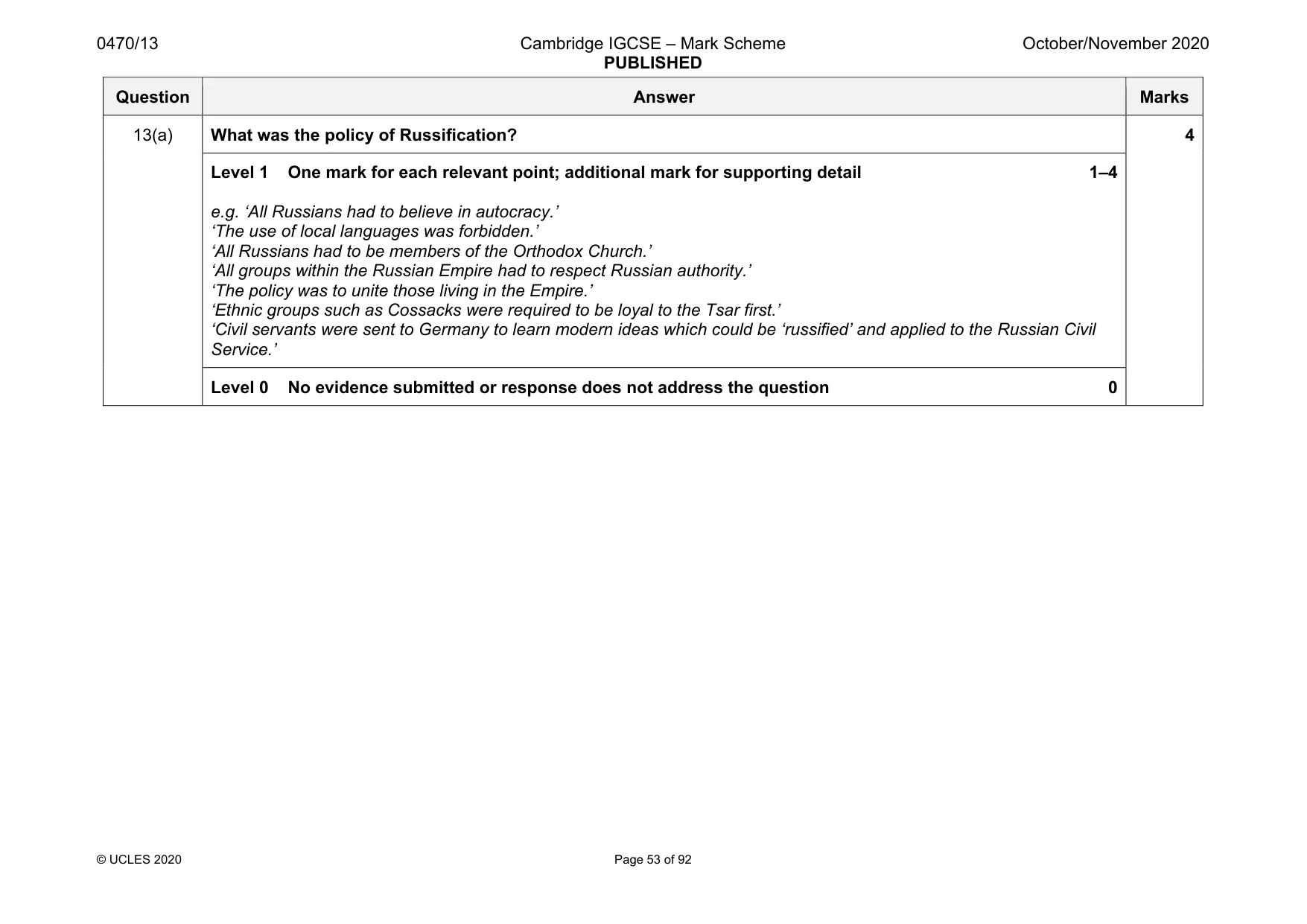
0470/13 Cambridge IGCSE – Mark Scheme PUBLISHED October/November 2020 © UCLES 2020 Page 53 of 92 Question Answer Marks 13(a) What was the policy of Russification? 4 Level 1 One mark for each relevant point; additional mark for supporting detail 1–4 e.g. ‘All Russians had to believe in autocracy.’ ‘The use of local languages was forbidden.’ ‘All Russians had to be members of the Orthodox Church.’ ‘All groups within the Russian Empire had to respect Russian authority.’ ‘The policy was to unite those living in the Empire.’ ‘Ethnic groups such as Cossacks were required to be loyal to the Tsar first.’ ‘Civil servants were sent to Germany to learn modern ideas which could be ‘russified’ and applied to the Russian Civil Service.’ Level 0 No evidence submitted or response does not address the question 0
Mark scheme, page 54
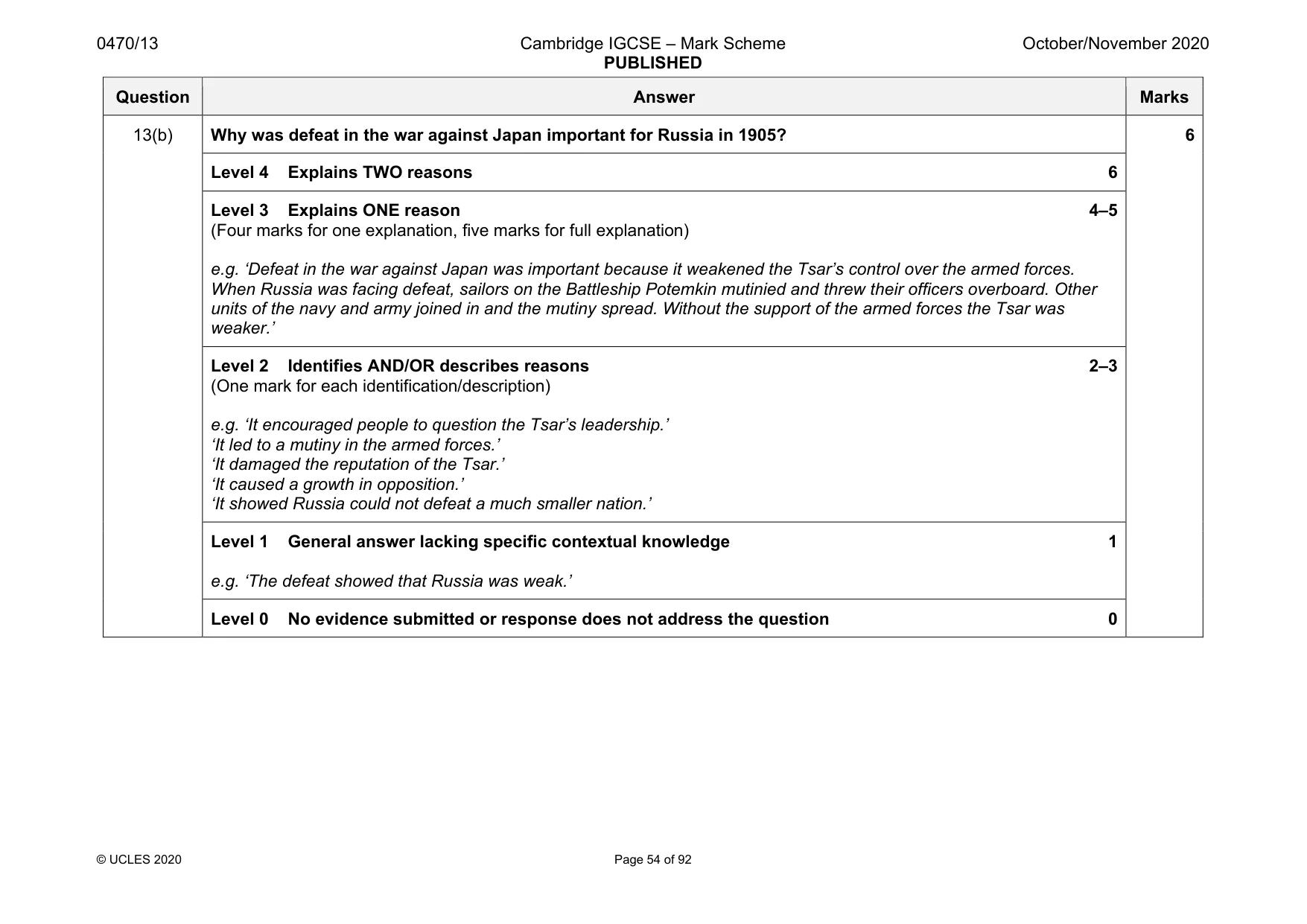
0470/13 Cambridge IGCSE – Mark Scheme PUBLISHED October/November 2020 © UCLES 2020 Page 54 of 92 Question Answer Marks 13(b) Why was defeat in the war against Japan important for Russia in 1905? 6 Level 4 Explains TWO reasons 6 Level 3 Explains ONE reason 4–5 (Four marks for one explanation, five marks for full explanation) e.g. ‘Defeat in the war against Japan was important because it weakened the Tsar’s control over the armed forces. When Russia was facing defeat, sailors on the Battleship Potemkin mutinied and threw their officers overboard. Other units of the navy and army joined in and the mutiny spread. Without the support of the armed forces the Tsar was weaker.’ Level 2 Identifies AND/OR describes reasons 2–3 (One mark for each identification/description) e.g. ‘It encouraged people to question the Tsar’s leadership.’ ‘It led to a mutiny in the armed forces.’ ‘It damaged the reputation of the Tsar.’ ‘It caused a growth in opposition.’ ‘It showed Russia could not defeat a much smaller nation.’ Level 1 General answer lacking specific contextual knowledge 1 e.g. ‘The defeat showed that Russia was weak.’ Level 0 No evidence submitted or response does not address the question 0
Mark scheme, page 55
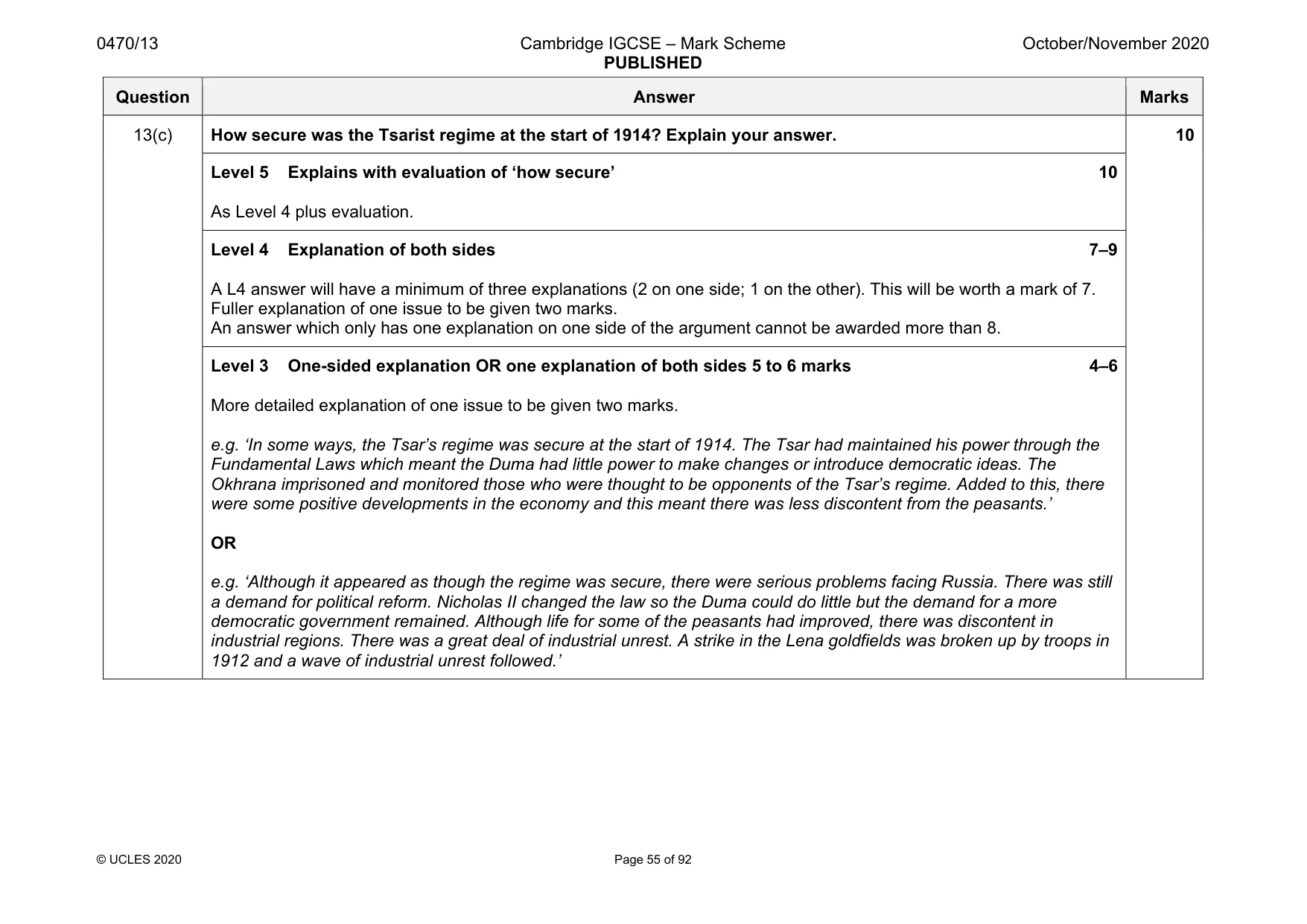
0470/13 Cambridge IGCSE – Mark Scheme PUBLISHED October/November 2020 © UCLES 2020 Page 55 of 92 Question Answer Marks 13(c) How secure was the Tsarist regime at the start of 1914? Explain your answer. 10 Level 5 Explains with evaluation of ‘how secure’ 10 As Level 4 plus evaluation. Level 4 Explanation of both sides 7–9 A L4 answer will have a minimum of three explanations (2 on one side; 1 on the other). This will be worth a mark of 7. Fuller explanation of one issue to be given two marks. An answer which only has one explanation on one side of the argument cannot be awarded more than 8. Level 3 One-sided explanation OR one explanation of both sides 5 to 6 marks 4–6 More detailed explanation of one issue to be given two marks. e.g. ‘In some ways, the Tsar’s regime was secure at the start of 1914. The Tsar had maintained his power through the Fundamental Laws which meant the Duma had little power to make changes or introduce democratic ideas. The Okhrana imprisoned and monitored those who were thought to be opponents of the Tsar’s regime. Added to this, there were some positive developments in the economy and this meant there was less discontent from the peasants.’ OR e.g. ‘Although it appeared as though the regime was secure, there were serious problems facing Russia. There was still a demand for political reform. Nicholas II changed the law so the Duma could do little but the demand for a more democratic government remained. Although life for some of the peasants had improved, there was discontent in industrial regions. There was a great deal of industrial unrest. A strike in the Lena goldfields was broken up by troops in 1912 and a wave of industrial unrest followed.’
Mark scheme, page 56
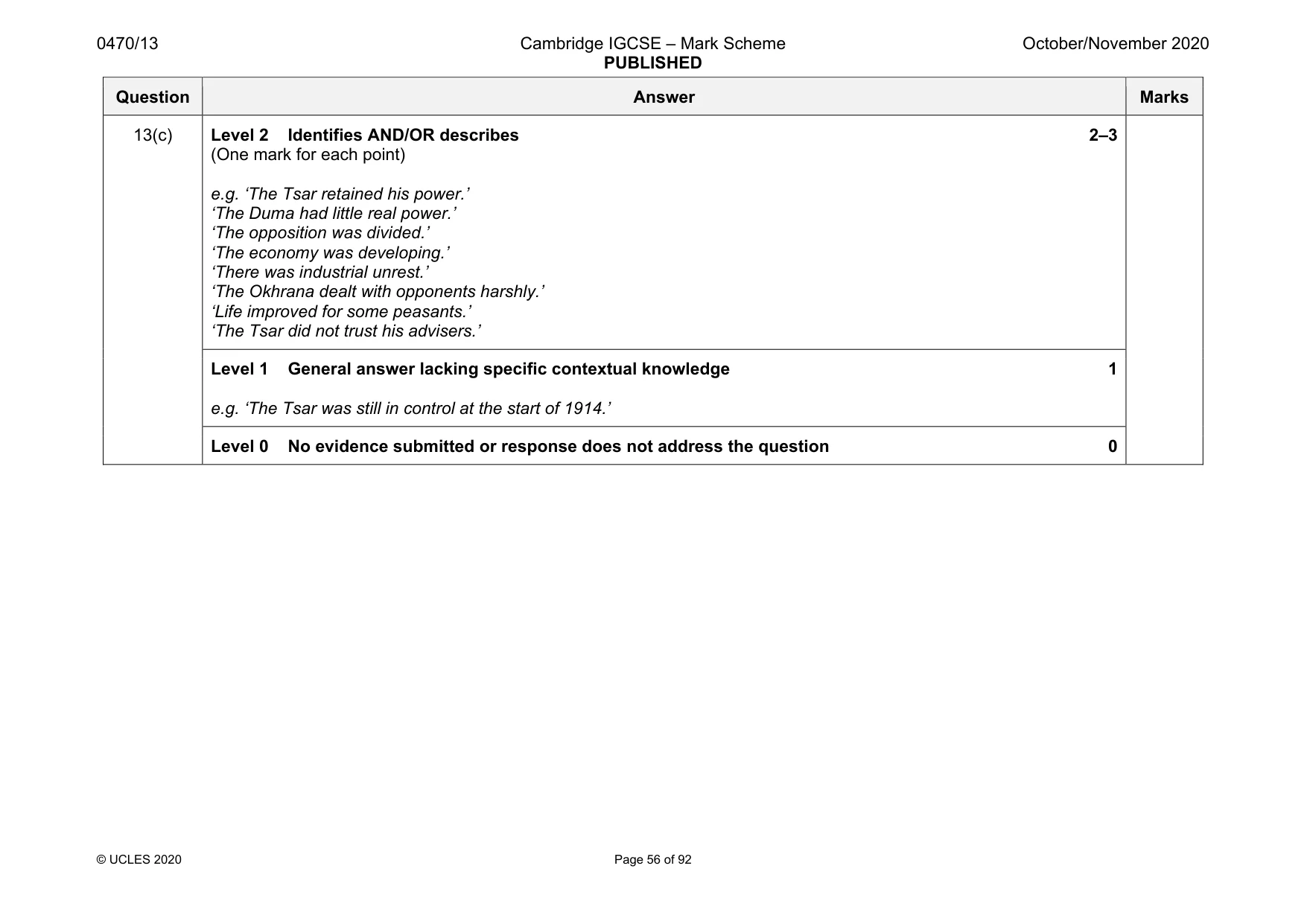
0470/13 Cambridge IGCSE – Mark Scheme PUBLISHED October/November 2020 © UCLES 2020 Page 56 of 92 Question Answer Marks 13(c) Level 2 Identifies AND/OR describes 2–3 (One mark for each point) e.g. ‘The Tsar retained his power.’ ‘The Duma had little real power.’ ‘The opposition was divided.’ ‘The economy was developing.’ ‘There was industrial unrest.’ ‘The Okhrana dealt with opponents harshly.’ ‘Life improved for some peasants.’ ‘The Tsar did not trust his advisers.’ Level 1 General answer lacking specific contextual knowledge 1 e.g. ‘The Tsar was still in control at the start of 1914.’ Level 0 No evidence submitted or response does not address the question 0
Mark scheme, page 57
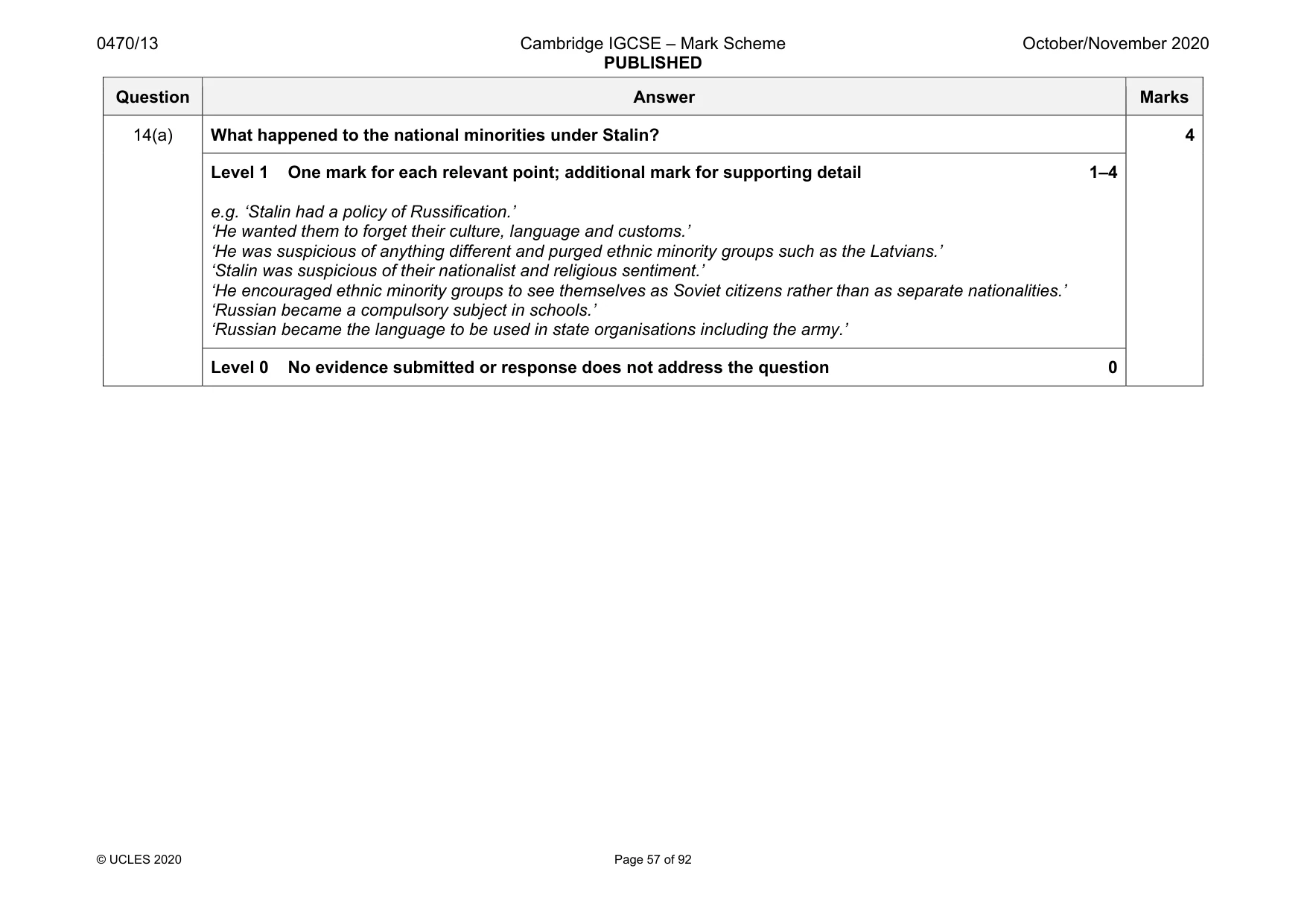
0470/13 Cambridge IGCSE – Mark Scheme PUBLISHED October/November 2020 © UCLES 2020 Page 57 of 92 Question Answer Marks 14(a) What happened to the national minorities under Stalin? 4 Level 1 One mark for each relevant point; additional mark for supporting detail 1–4 e.g. ‘Stalin had a policy of Russification.’ ‘He wanted them to forget their culture, language and customs.’ ‘He was suspicious of anything different and purged ethnic minority groups such as the Latvians.’ ‘Stalin was suspicious of their nationalist and religious sentiment.’ ‘He encouraged ethnic minority groups to see themselves as Soviet citizens rather than as separate nationalities.’ ‘Russian became a compulsory subject in schools.’ ‘Russian became the language to be used in state organisations including the army.’ Level 0 No evidence submitted or response does not address the question 0
Mark scheme, page 58
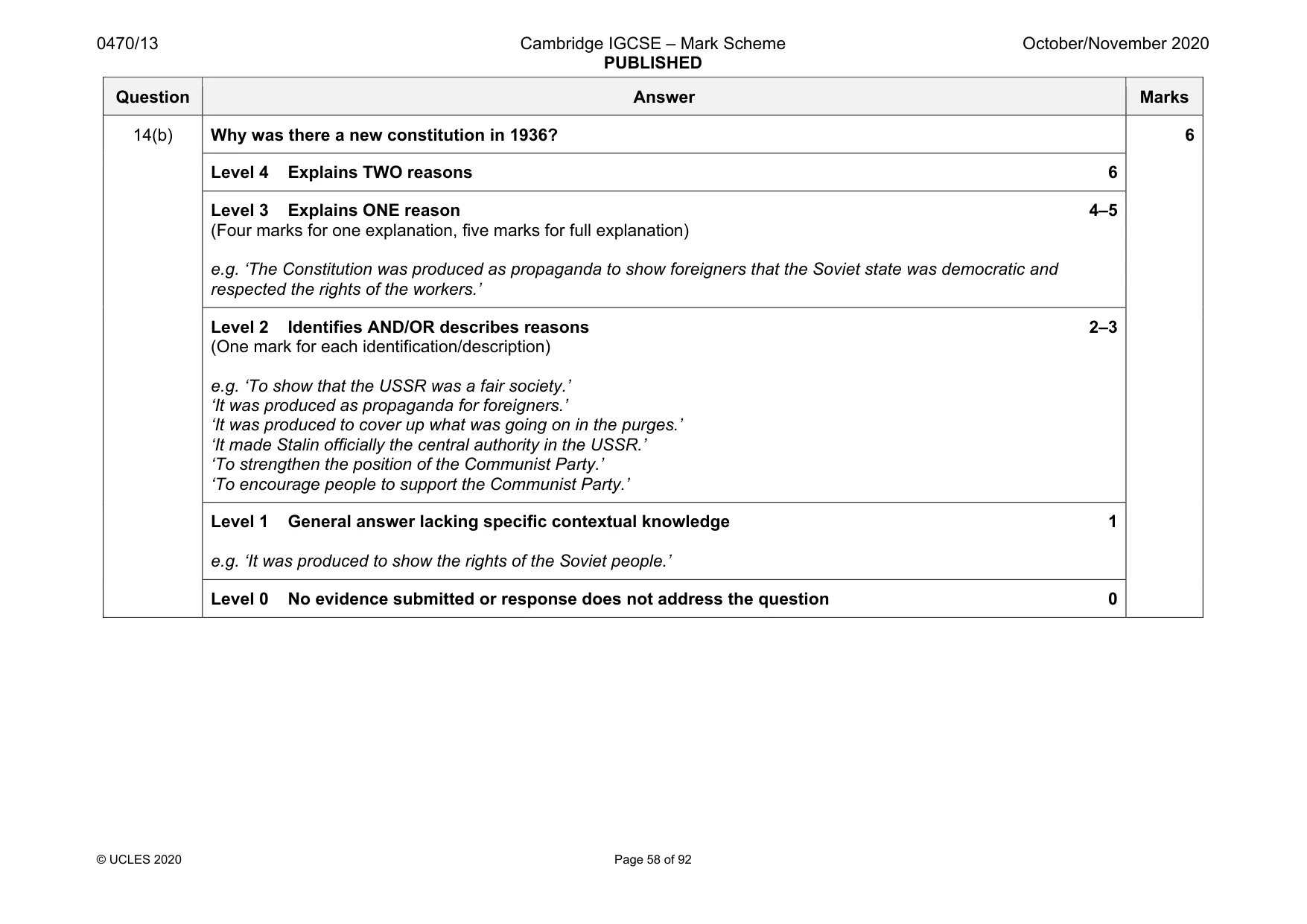
0470/13 Cambridge IGCSE – Mark Scheme PUBLISHED October/November 2020 © UCLES 2020 Page 58 of 92 Question Answer Marks 14(b) Why was there a new constitution in 1936? 6 Level 4 Explains TWO reasons 6 Level 3 Explains ONE reason 4–5 (Four marks for one explanation, five marks for full explanation) e.g. ‘The Constitution was produced as propaganda to show foreigners that the Soviet state was democratic and respected the rights of the workers.’ Level 2 Identifies AND/OR describes reasons 2–3 (One mark for each identification/description) e.g. ‘To show that the USSR was a fair society.’ ‘It was produced as propaganda for foreigners.’ ‘It was produced to cover up what was going on in the purges.’ ‘It made Stalin officially the central authority in the USSR.’ ‘To strengthen the position of the Communist Party.’ ‘To encourage people to support the Communist Party.’ Level 1 General answer lacking specific contextual knowledge 1 e.g. ‘It was produced to show the rights of the Soviet people.’ Level 0 No evidence submitted or response does not address the question 0
Mark scheme, page 59
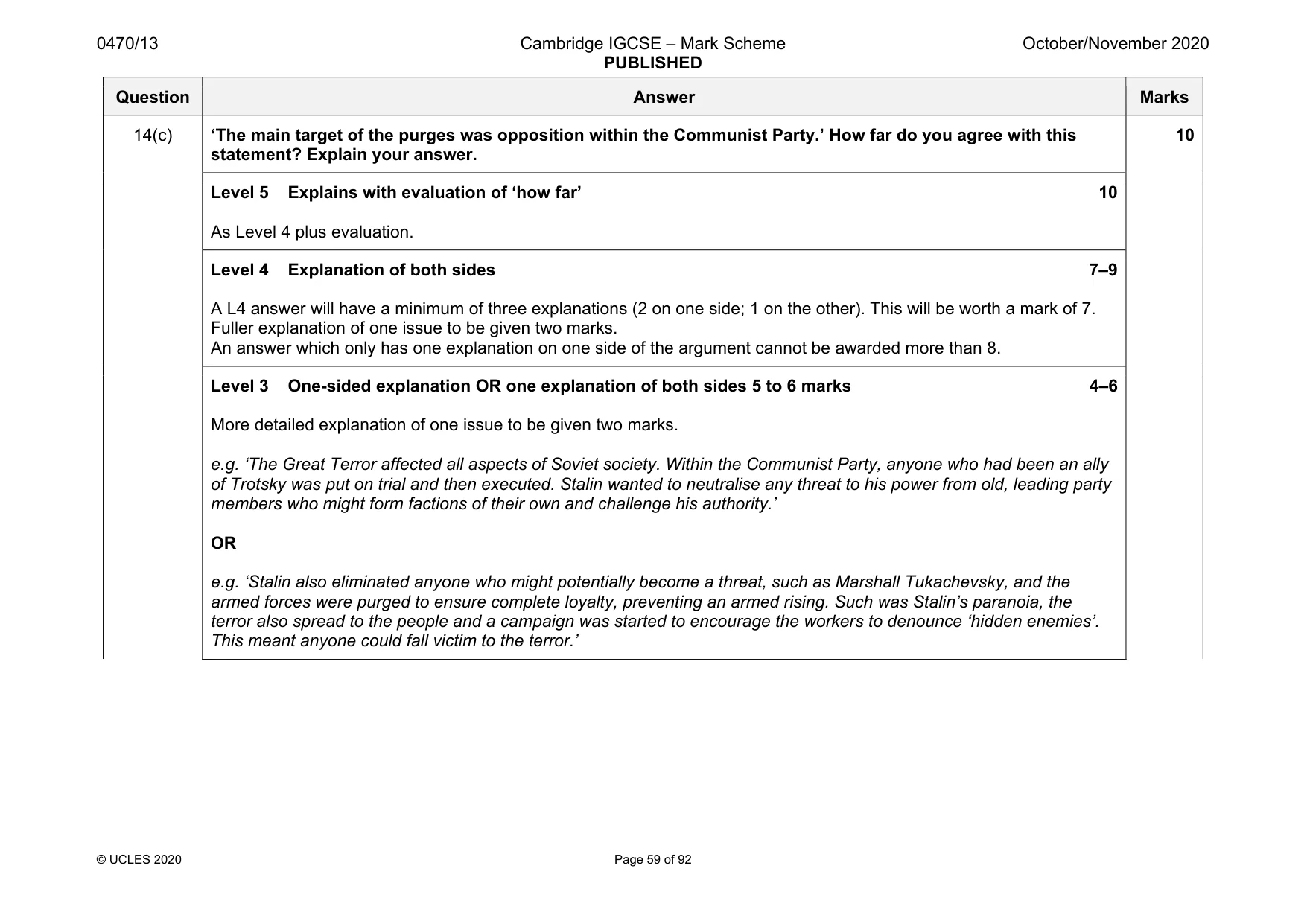
0470/13 Cambridge IGCSE – Mark Scheme PUBLISHED October/November 2020 © UCLES 2020 Page 59 of 92 Question Answer Marks 14(c) ‘The main target of the purges was opposition within the Communist Party.’ How far do you agree with this statement? Explain your answer. 10 Level 5 Explains with evaluation of ‘how far’ 10 As Level 4 plus evaluation. Level 4 Explanation of both sides 7–9 A L4 answer will have a minimum of three explanations (2 on one side; 1 on the other). This will be worth a mark of 7. Fuller explanation of one issue to be given two marks. An answer which only has one explanation on one side of the argument cannot be awarded more than 8. Level 3 One-sided explanation OR one explanation of both sides 5 to 6 marks 4–6 More detailed explanation of one issue to be given two marks. e.g. ‘The Great Terror affected all aspects of Soviet society. Within the Communist Party, anyone who had been an ally of Trotsky was put on trial and then executed. Stalin wanted to neutralise any threat to his power from old, leading party members who might form factions of their own and challenge his authority.’ OR e.g. ‘Stalin also eliminated anyone who might potentially become a threat, such as Marshall Tukachevsky, and the armed forces were purged to ensure complete loyalty, preventing an armed rising. Such was Stalin’s paranoia, the terror also spread to the people and a campaign was started to encourage the workers to denounce ‘hidden enemies’. This meant anyone could fall victim to the terror.’
Mark scheme, page 60
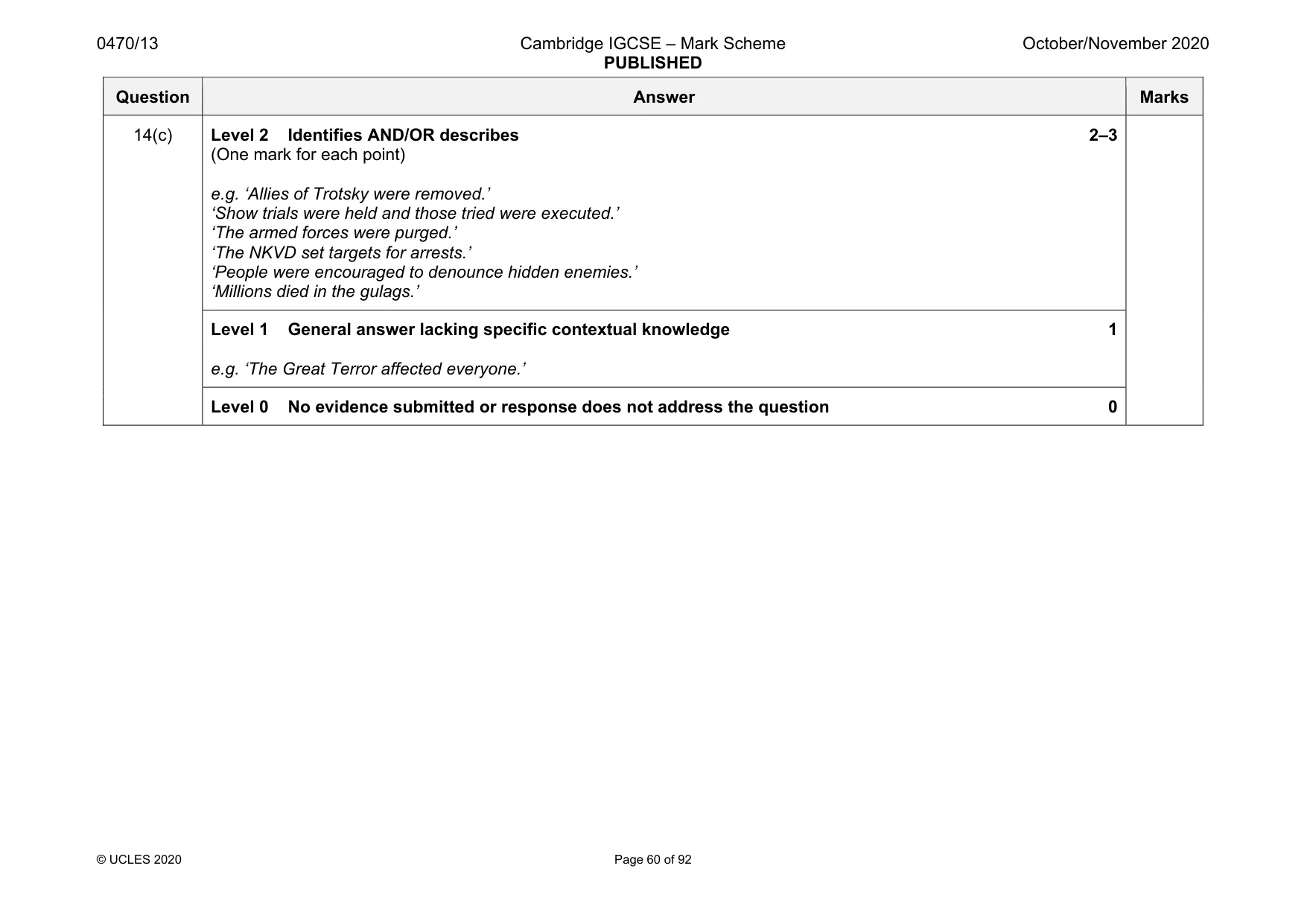
0470/13 Cambridge IGCSE – Mark Scheme PUBLISHED October/November 2020 © UCLES 2020 Page 60 of 92 Question Answer Marks 14(c) Level 2 Identifies AND/OR describes 2–3 (One mark for each point) e.g. ‘Allies of Trotsky were removed.’ ‘Show trials were held and those tried were executed.’ ‘The armed forces were purged.’ ‘The NKVD set targets for arrests.’ ‘People were encouraged to denounce hidden enemies.’ ‘Millions died in the gulags.’ Level 1 General answer lacking specific contextual knowledge 1 e.g. ‘The Great Terror affected everyone.’ Level 0 No evidence submitted or response does not address the question 0
Mark scheme, page 61
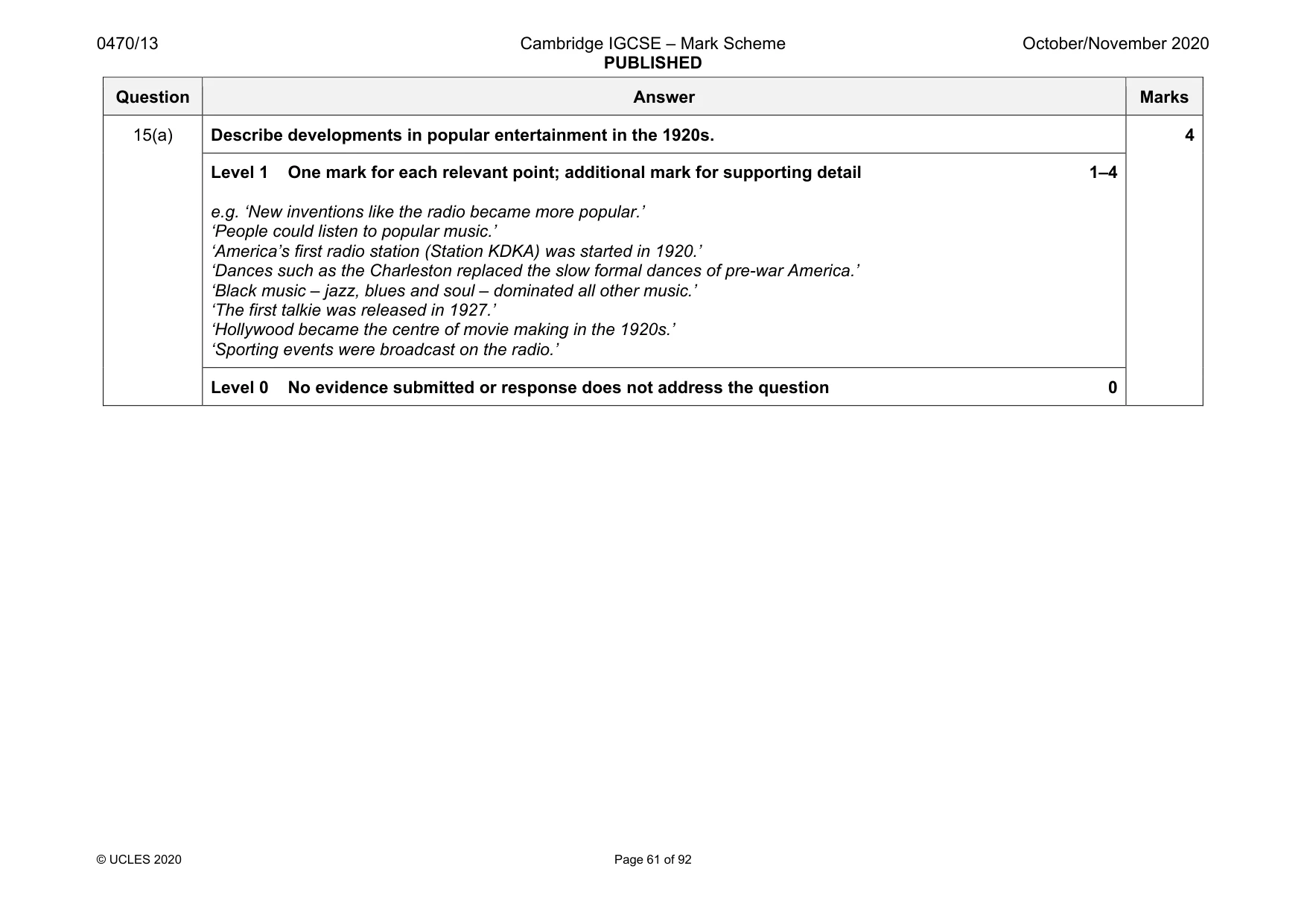
0470/13 Cambridge IGCSE – Mark Scheme PUBLISHED October/November 2020 © UCLES 2020 Page 61 of 92 Question Answer Marks 15(a) Describe developments in popular entertainment in the 1920s. 4 Level 1 One mark for each relevant point; additional mark for supporting detail 1–4 e.g. ‘New inventions like the radio became more popular.’ ‘People could listen to popular music.’ ‘America’s first radio station (Station KDKA) was started in 1920.’ ‘Dances such as the Charleston replaced the slow formal dances of pre-war America.’ ‘Black music – jazz, blues and soul – dominated all other music.’ ‘The first talkie was released in 1927.’ ‘Hollywood became the centre of movie making in the 1920s.’ ‘Sporting events were broadcast on the radio.’ Level 0 No evidence submitted or response does not address the question 0
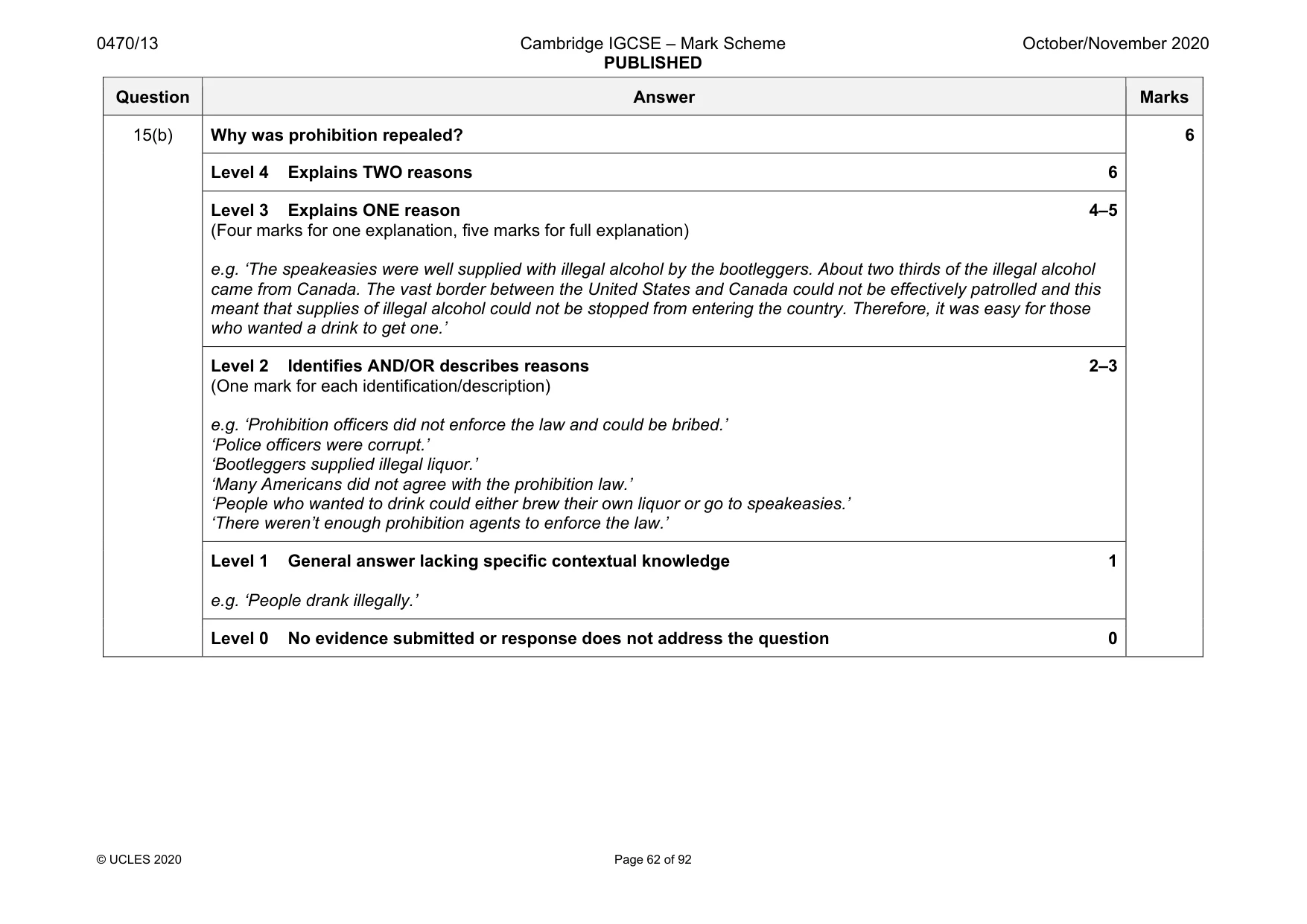
Mark scheme, page 62
0470/13 Cambridge IGCSE – Mark Scheme PUBLISHED October/November 2020 © UCLES 2020 Page 62 of 92 Question Answer Marks 15(b) Why was prohibition repealed? 6 Level 4 Explains TWO reasons 6 Level 3 Explains ONE reason 4–5 (Four marks for one explanation, five marks for full explanation) e.g. ‘The speakeasies were well supplied with illegal alcohol by the bootleggers. About two thirds of the illegal alcohol came from Canada. The vast border between the United States and Canada could not be effectively patrolled and this meant that supplies of illegal alcohol could not be stopped from entering the country. Therefore, it was easy for those who wanted a drink to get one.’ Level 2 Identifies AND/OR describes reasons 2–3 (One mark for each identification/description) e.g. ‘Prohibition officers did not enforce the law and could be bribed.’ ‘Police officers were corrupt.’ ‘Bootleggers supplied illegal liquor.’ ‘Many Americans did not agree with the prohibition law.’ ‘People who wanted to drink could either brew their own liquor or go to speakeasies.’ ‘There weren’t enough prohibition agents to enforce the law.’ Level 1 General answer lacking specific contextual knowledge 1 e.g. ‘People drank illegally.’ Level 0 No evidence submitted or response does not address the question 0
Mark scheme, page 63
0470/13 Cambridge IGCSE – Mark Scheme PUBLISHED October/November 2020 © UCLES 2020 Page 63 of 92 Question Answer Marks 15(c) How far do you agree that American society was intolerant in the 1920s? Explain your answer. 10 Level 5 Explains with evaluation of ‘how far’ 10 As Level 4 plus evaluation. Level 4 Explanation of both sides 7–9 A L4 answer will have a minimum of three explanations (2 on one side; 1 on the other). This will be worth a mark of 7. Fuller explanation of one issue to be given two marks. An answer which only has one explanation on one side of the argument cannot be awarded more than 8. Level 3 One-sided explanation OR one explanation of both sides 5 to 6 marks 4–6 More detailed explanation of one issue to be given two marks. e.g. ‘In some ways the United States was more tolerant in the 1920s. Life changed for many women. Contraception reduced the size of families and labour-saving devices allowed more women to work, making them financially independent. For some women, the traditional restrictive role changed. Women wore more modern clothes. They smoked in public and went out with men without a chaperone.’ OR e.g. ‘The Ku Klux Klan showed how intolerant American society could be. It was an organisation mainly in the South that believed in white supremacy. It attacked Jews and Black Americans because it regarded them as inferior. Klan members often lynched Black Americans. They hated anyone who was not white.’
Mark scheme, page 64
0470/13 Cambridge IGCSE – Mark Scheme PUBLISHED October/November 2020 © UCLES 2020 Page 64 of 92 Question Answer Marks 15(c) Level 2 Identifies AND/OR describes 2–3 (One mark for each point) e.g. ‘There was the Red Scare.’ ‘Attitudes towards immigrants and immigration were harsh.’ ‘The Ku Klux Klan fuelled hatred.’ ‘There was discrimination against Black Americans.’ ‘The Sacco and Vanzetti trial showed suspicion of foreigners.’ ‘Women had greater freedom.’ ‘More women worked and gained financial independence.’ ‘New tastes in entertainment were growing.’ Level 1 General answer lacking specific contextual knowledge 1 e.g. ‘America was intolerant.’ Level 0 No evidence submitted or response does not address the question 0
Mark scheme, page 65
0470/13 Cambridge IGCSE – Mark Scheme PUBLISHED October/November 2020 © UCLES 2020 Page 65 of 92 Question Answer Marks 16(a) Describe the ways in which the First New Deal helped the unemployed. 4 Level 1 One mark for each relevant point; additional mark for supporting detail 1–4 e.g. ‘Roosevelt set up the CCC to provide work for young men on a range of environmental projects in the countryside.’ ‘The CCC planted 200 million trees to reduce soil erosion and provide shelter belts.’ ‘The FERA helped the destitute unemployed by giving them relief.’ ‘The PWA used unemployed, skilled industrial workers on large scale projects, such as building roads, bridges, schools and hospitals.’ ‘Thousands were employed by the TVA.’ ‘Workers constructed dams and regenerated industry and farming across seven states.’ Level 0 No evidence submitted or response does not address the question 0
Mark scheme, page 66
0470/13 Cambridge IGCSE – Mark Scheme PUBLISHED October/November 2020 © UCLES 2020 Page 66 of 92 Question Answer Marks 16(b) Why was the Wagner Act introduced in 1935? 6 Level 4 Explains TWO reasons 6 Level 3 Explains ONE reason 4–5 (Four marks for one explanation, five marks for full explanation) e.g. ‘The Wagner Act was introduced because the National Industrial Recovery Act had been declared unconstitutional by the Supreme Court. The purpose of the Act was to take over part of the role of NIRA and help to support workers’ rights.’ Level 2 Identifies AND/OR describes reasons 2–3 (One mark for each identification/description) e.g. ‘It replaced part of NIRA.’ ‘NIRA had been declared unconstitutional.’ ‘The Wagner Act was to help support workers’ rights.’ ‘The Wagner Act aimed to protect workers who were members of trade unions.’ ‘The Wagner Act set up the National Labor Board to negotiate between management and the Trade Unions.’ Level 1 General answer lacking specific contextual knowledge 1 e.g. ‘It was introduced to help the workers.’ Level 0 No evidence submitted or response does not address the question 0
Mark scheme, page 67
0470/13 Cambridge IGCSE – Mark Scheme PUBLISHED October/November 2020 © UCLES 2020 Page 67 of 92 Question Answer Marks 16(c) ‘The New Deal solved the problems facing American farmers.’ How far do you agree with this statement? Explain your answer. 10 Level 5 Explains with evaluation of ‘how far’ 10 As Level 4 plus evaluation. Level 4 Explanation of both sides 7–9 A L4 answer will have a minimum of three explanations (2 on one side; 1 on the other). This will be worth a mark of 7. Fuller explanation of one issue to be given two marks. An answer which only has one explanation on one side of the argument cannot be awarded more than 8. Level 3 One-sided explanation OR one explanation of both sides 5 to 6 marks 4–6 More detailed explanation of one issue to be given two marks. e.g. ‘In some ways the New Deal helped farmers in the US. Incomes from farming had dropped in the 1920s. Large- scale farmers benefitted from the policies of the AAA which brought an increase in prices. Between 1933 and 1939 farmers’ incomes doubled. Farm workers were helped by the Farm Security Administration which was set up in 1937 to help them to buy their own land.’ OR e.g. ‘Small farmers and farm workers did not really benefit from the New Deal. The AAA saw prices increase but this was at the cost of ploughing up sown land and cutting back livestock production. This meant that farm workers and sharecroppers had no livelihood and many became unemployed as a result. American farming was increasingly controlled by big business and small farmers struggled to compete.’
Mark scheme, page 68
0470/13 Cambridge IGCSE – Mark Scheme PUBLISHED October/November 2020 © UCLES 2020 Page 68 of 92 Question Answer Marks 16(c) Level 2 Identifies AND/OR describes 2–3 (One mark for each point) e.g. ‘The AAA brought about price rises.’ ‘Sown land was ploughed up and livestock was destroyed.’ ‘Large-scale farmers benefitted.’ ‘Sharecroppers and farm workers became unemployed.’ ‘The Farm Security Administration helped some farmers to buy land.’ ‘Farming incomes doubled.’ Level 1 General answer lacking specific contextual knowledge 1 e.g. ‘Things did not improve for some farmers.’ Level 0 No evidence submitted or response does not address the question 0
Mark scheme, page 69
0470/13 Cambridge IGCSE – Mark Scheme PUBLISHED October/November 2020 © UCLES 2020 Page 69 of 92 Question Answer Marks 17(a) What was the Marco Polo Bridge incident? 4 Level 1 One mark for each relevant point; additional mark for supporting detail 1–4 e.g. ‘The incident took place on 7 July 1937.’ ‘It was a conflict between Chinese and Japanese troops near the Marco Polo Bridge outside Beijing.’ ‘The Japanese army had occupied Fengtai, the railway junction close to the Marco Polo Bridge.’ ‘A small Japanese force demanded entry to the tiny walled town of Wanping in order to search for one of their soldiers.’ ‘The Chinese garrison in the town refused the Japanese entry; a shot was heard, and the two sides began firing.’ ‘The Chinese government refused to make any concessions.’ ‘The Japanese also refused to give way.’ ‘The conflict between China and Japan continued to grow.’ Level 0 No evidence submitted or response does not address the question 0
Mark scheme, page 70
0470/13 Cambridge IGCSE – Mark Scheme PUBLISHED October/November 2020 © UCLES 2020 Page 70 of 92 Question Answer Marks 17(b) Why did many peasants support the Communists? 6 Level 4 Explains TWO reasons 6 Level 3 Explains ONE reason 4–5 (Four marks for one explanation, five marks for full explanation) e.g. ‘One reason was the Long March which brought peasants into contact with the CCP for the first time. The peasants found the CCP more approachable than the KMT. The Communists won support by redistributing land to the peasants and giving them KMT weapons when they captured troops.’ Level 2 Identifies AND/OR describes reasons 2–3 (One mark for each identification/description) e.g. ‘The Long March brought the CCP into contact with the peasants.’ ‘The CCP redistributed land to the peasants.’ ‘The KMT alienated the peasants.’ ‘The Communists were prepared to fight against the Japanese.’ ‘The Communists reduced rents for the peasants and increased taxes for the rich.’ Level 1 General answer lacking specific contextual knowledge 1 e.g. ‘The Communists made life better for the peasants.’ Level 0 No evidence submitted or response does not address the question 0
Mark scheme, page 71
0470/13 Cambridge IGCSE – Mark Scheme PUBLISHED October/November 2020 © UCLES 2020 Page 71 of 92 Question Answer Marks 17(c) ‘The Nationalists were defeated because of the mistakes they made during the Second World War.’ How far do you agree with this statement? Explain your answer. 10 Level 5 Explains with evaluation of ‘how far’ 10 As Level 4 plus evaluation. Level 4 Explanation of both sides 7–9 A L4 answer will have a minimum of three explanations (2 on one side; 1 on the other). This will be worth a mark of 7. Fuller explanation of one issue to be given two marks. An answer which only has one explanation on one side of the argument cannot be awarded more than 8. Level 3 One-sided explanation OR one explanation of both sides 5 to 6 marks 4–6 More detailed explanation of one issue to be given two marks. e.g. ‘The Nationalists made mistakes in the Second World War. They were unwilling to fight the Japanese and often took up defensive positions instead. This frustrated the Chinese people who wanted to see the Japanese defeated. It also tried the patience of the American Generals who were advising Chiang-Kai-shek, and the United States withdrew its support.’ OR e.g. ‘The corruption which had hindered their war effort also meant that the KMT struggled to win support during the Civil War. Ordinary people lost faith in the ability of Chiang’s government to solve the economic problems the country faced and turned towards the Communists.’ OR e.g. ‘The Communists used the guerrilla tactics that had served them so well against the Japanese. Aware that their main force was smaller and less well supplied than the KMT, they adopted a policy of not attacking the main Nationalist forces in set-piece battles. Instead, they focused on calculated attacks against smaller targets and caused supply problems for the KMT.’
Mark scheme, page 72
0470/13 Cambridge IGCSE – Mark Scheme PUBLISHED October/November 2020 © UCLES 2020 Page 72 of 92 Question Answer Marks 17(c) Level 2 Identifies AND/OR describes 2–3 (One mark for each point) e.g. ‘The KMT made many mistakes and adopted defensive positions against the Japanese.’ ‘The United States withdrew aid to the KMT and stayed neutral.’ ‘The image of the KMT was one of corruption and relying on foreign support.’ ‘The Communists successfully used guerrilla tactics.’ ‘The Communists had the support of the peasants because of their war efforts against the Japanese.’ ‘The Communists controlled the rural areas with large peasant numbers.’ ‘Many KMT troops deserted the KMT taking weapons and supplies to the Communists.’ ‘The image of the KMT was one of corruption and relying on foreign support.’ ‘The Communist Party was portrayed as the party of the people.’ Level 1 General answer lacking specific contextual knowledge 1 e.g. ‘The Nationalists were weak and unpopular.’ Level 0 No evidence submitted or response does not address the question 0
Mark scheme, page 73
0470/13 Cambridge IGCSE – Mark Scheme PUBLISHED October/November 2020 © UCLES 2020 Page 73 of 92 Question Answer Marks 18(a) What happened during the Hundred Flowers campaign? 4 Level 1 One mark for each relevant point; additional mark for supporting detail 1–4 e.g. ‘People were asked to criticise the government and its work.’ ‘It was mainly addressed to the educated classes.’ ‘It was to assess the work of the Party cadres.’ ‘It hoped to heal the rift between the Party cadres and the technical experts.’ ‘The hostile nature of many comments was a shock to Mao.’ ‘The government had expected constructive criticism, but what happened was counterrevolutionary.’ ‘It was ended abruptly.’ Level 0 No evidence submitted or response does not address the question 0
Mark scheme, page 74
0470/13 Cambridge IGCSE – Mark Scheme PUBLISHED October/November 2020 © UCLES 2020 Page 74 of 92 Question Answer Marks 18(b) Why did Mao face opposition in the early 1960s? 6 Level 4 Explains TWO reasons 6 Level 3 Explains ONE reason 4–5 (Four marks for one explanation, five marks for full explanation) e.g. ‘Mao faced opposition in the early 1960s because of the failure of the Great Leap Forward. The famine which followed cost the lives of between 20 and 40 million people in China. Mao was forced to resign from his position as head of state and his successor, Liu Shaoqi, abandoned the Great Leap Forward and dismantled the communes.’ Level 2 Identifies AND/OR describes reasons 2–3 (One mark for each identification/description) e.g. ‘The Great Leap Forward had been a failure.’ ‘Mao was blamed for this.’ ‘Millions died in a famine.’ ‘Mao lost his position as head of state.’ ‘Liu Shaoqi wanted to introduce economic reforms.’ Level 1 General answer lacking specific contextual knowledge 1 e.g. ‘Mao’s policies were no longer popular.’ Level 0 No evidence submitted or response does not address the question 0
Mark scheme, page 75
0470/13 Cambridge IGCSE – Mark Scheme PUBLISHED October/November 2020 © UCLES 2020 Page 75 of 92 Question Answer Marks 18(c) How far did life change for the Chinese people after Mao’s death? Explain your answer. 10 Level 5 Explains with evaluation of ‘how far’ 10 As Level 4 plus evaluation. Level 4 Explanation of both sides 7–9 A L4 answer will have a minimum of three explanations (2 on one side; 1 on the other). This will be worth a mark of 7. Fuller explanation of one issue to be given two marks. An answer which only has one explanation on one side of the argument cannot be awarded more than 8. Level 3 One-sided explanation OR one explanation of both sides 5 to 6 marks 4–6 More detailed explanation of one issue to be given two marks. e.g. ‘Life did change for people in China after Mao’s death. People were now free to own their own businesses. Record numbers of consumer goods were produced and external investment, even from the United States, was encouraged. This all helped the Chinese economy.’ OR e.g. ‘China did not move closer to democracy after Mao’s death and many aspects of life remained the same. Tight control was still exercised and was not welcomed. Although it was now legal to criticise the government, the party remained in strict control.’ Level 2 Identifies AND/OR describes 2–3 (One mark for each point) e.g. ‘There was less state control in industry and agriculture.’ ‘Political prisoners were set free.’ ‘Education was important again.’ ‘People were free to own their own businesses.’ ‘The cost of living remained high.’ ‘China did not move closer to democracy.’
Mark scheme, page 76
0470/13 Cambridge IGCSE – Mark Scheme PUBLISHED October/November 2020 © UCLES 2020 Page 76 of 92 Question Answer Marks 18(c) Level 1 General answer lacking specific contextual knowledge 1 e.g. ‘Many things changed in China after Mao’s death.’ Level 0 No evidence submitted or response does not address the question 0
Mark scheme, page 77
0470/13 Cambridge IGCSE – Mark Scheme PUBLISHED October/November 2020 © UCLES 2020 Page 77 of 92 Question Answer Marks 19(a) In what ways did the government restrict the movement of non-white South Africans? 4 Level 1 One mark for each relevant point; additional mark for supporting detail 1–4 e.g. ‘Every non-white male over 16 had to carry a pass.’ ‘The pass had to be presented to the police on demand.’ ‘Farmers used the pass system to prevent workers leaving their contracts early.’ ‘Failure to produce a pass could result in prison.’ ‘The pass was used to make sure non-white South Africans moved out of the towns when they had finished their work.’ Level 0 No evidence submitted or response does not address the question 0
Mark scheme, page 78
0470/13 Cambridge IGCSE – Mark Scheme PUBLISHED October/November 2020 © UCLES 2020 Page 78 of 92 Question Answer Marks 19(b) Why was the Sauer Report important? 6 Level 4 Explains TWO reasons 6 Level 3 Explains ONE reason 4–5 (Four marks for one explanation, five marks for full explanation) e.g. ‘The Sauer Report was important because it advocated total segregation or apartheid across the whole of South African society and economic activity. This was very popular with Afrikaners and became a central part of the National Party policy in 1948, helping them to win the election.’ Level 2 Identifies AND/OR describes reasons 2–3 (One mark for each identification/description) e.g. ‘It was set up to evaluate segregation.’ ‘Many Afrikaners wanted to rule over the non-white population.’ ‘Many thought that non-white South Africans were growing more powerful.’ ‘Some were worried that segregation was coming to an end.’ ‘It advocated an extension of segregation.’ ‘It was popular with Afrikaners.’ ‘It became an important part of National Party policy.’ ‘This helped the National Party to win the 1948 election.’ Level 1 General answer lacking specific contextual knowledge 1 e.g. ‘It was a report which decided government policy.’ Level 0 No evidence submitted or response does not address the question 0
Mark scheme, page 79
0470/13 Cambridge IGCSE – Mark Scheme PUBLISHED October/November 2020 © UCLES 2020 Page 79 of 92 Question Answer Marks 19(c) ‘Before 1949, the main challenge facing non-white South Africans was a lack of employment opportunities.’ How far do you agree with this statement? Explain your answer. 10 Level 5 Explains with evaluation of ‘how far’ 10 As Level 4 plus evaluation. Level 4 Explanation of both sides 7–9 A L4 answer will have a minimum of three explanations (2 on one side; 1 on the other). This will be worth a mark of 7. Fuller explanation of one issue to be given two marks. An answer which only has one explanation on one side of the argument cannot be awarded more than 8. Level 3 One-sided explanation OR one explanation of both sides 5 to 6 marks 4–6 More detailed explanation of one issue to be given two marks. e.g. ‘A lack of employment opportunities was a serious challenge. There was some work available for men through the migrant labour system but it was very poorly paid, the conditions were very harsh and the system meant men were separated from their families for months at a time. Non-white workers in manufacturing were paid five time less than white employees and had none of the benefits such as pensions. The worst wages were paid in farming.’ OR e.g. ‘Another serious challenge facing non-white South Africans was the poor state of their housing and living conditions. As a result of the Native Lands Act, they were forced to live on reserves which were over-populated and lacked running water and sanitation. The infant mortality rate in the reserves was very high and disease was everywhere.’
Mark scheme, page 80
0470/13 Cambridge IGCSE – Mark Scheme PUBLISHED October/November 2020 © UCLES 2020 Page 80 of 92 Question Answer Marks 19(c) Level 2 Identifies AND/OR describes 2–3 (One mark for each point) e.g. ‘White employees were paid much higher wages.’ ‘The migrant labour system was very hard and people were poorly paid.’ ‘The reserves were overcrowded.’ ‘There was little access to education.’ ‘Infant mortality was very high.’ ‘The quality of housing in non-white areas was very poor.’ Level 1 General answer lacking specific contextual knowledge 1 e.g. ‘Non-white South Africans faced many challenges.’ Level 0 No evidence submitted or response does not address the question 0
Mark scheme, page 81
0470/13 Cambridge IGCSE – Mark Scheme PUBLISHED October/November 2020 © UCLES 2020 Page 81 of 92 Question Answer Marks 20(a) Describe developments in the South African economy in the 1970s. 4 Level 1 One mark for each relevant point; additional mark for supporting detail 1–4 e.g. ‘South African industry prospered in the 1970s.’ ‘The value of some firms rose by 400 per cent in the 1970s.’ ‘South Africa made money from precious metals and minerals.’ ‘Farming was given government subsidies to mechanise.’ ‘The development of the economy was built on low labour costs.’ ‘The economic prosperity of the 1970s mainly benefitted white South Africans.’ ‘The income gap between white and non-white workers narrowed slightly over the 1970s as there was competition for experienced workers and this drove up wages.’ Level 0 No evidence submitted or response does not address the question 0
Mark scheme, page 82
0470/13 Cambridge IGCSE – Mark Scheme PUBLISHED October/November 2020 © UCLES 2020 Page 82 of 92 Question Answer Marks 20(b) Why did the Organisation for African Unity (OAU) become involved in the struggle against apartheid? 6 Level 4 Explains TWO reasons 6 Level 3 Explains ONE reason 4–5 (Four marks for one explanation, five marks for full explanation) e.g. ‘The OAU became involved in the struggle against apartheid because of the process of decolonisation going on in Africa in the late 1960s and early 1970s. For instance, three countries which neighboured South Africa gained their independence from Britain: Botswana, Lesotho and Swaziland (Eswatini) all gained their independence in the 1960s. This showed that African countries could be run by African leaders rather than white colonisers.’ Level 2 Identifies AND/OR describes reasons 2–3 (One mark for each identification/description) e.g. ‘Decolonisation was taking place in Africa.’ ‘Countries on South Africa’s borders (Lesotho, Swaziland (Eswatini) and Botswana) got their independence from Britain in the 1960s.’ ‘In 1975, Angola and Mozambique gained their independence from Portugal.’ ‘The OAU grew in strength as a result of these changes.’ ‘A Liberation Committee was established in Tanzania where refugees from South Africa could get military training and education.’ Level 1 General answer lacking specific contextual knowledge 1 e.g. ‘It became involved because it opposed apartheid.’ Level 0 No evidence submitted or response does not address the question 0
Mark scheme, page 83
0470/13 Cambridge IGCSE – Mark Scheme PUBLISHED October/November 2020 © UCLES 2020 Page 83 of 92 Question Answer Marks 20(c) How far do you agree that trade union action was the most important internal challenge to apartheid? Explain your answer. 10 Level 5 Explains with evaluation of ‘how far’ 10 As Level 4 plus evaluation. Level 4 Explanation of both sides 7–9 A L4 answer will have a minimum of three explanations (2 on one side; 1 on the other). This will be worth a mark of 7. Fuller explanation of one issue to be given two marks. An answer which only has one explanation on one side of the argument cannot be awarded more than 8. Level 3 One-sided explanation OR one explanation of both sides 5 to 6 marks 4–6 More detailed explanation of one issue to be given two marks. e.g. ‘Resistance to apartheid through trade union action increased dramatically in the 1970s. There was a recession which caused rising prices and unemployment. Workers began a strike to call for an improvement in their pay and conditions. In the 1960s there had been strikes involving around 2,000 workers a year. In 1973 alone this increased to 61,000. The tactics of the strikers changed and this made their action more effective. They staged short, mass walk out strikes and avoided electing leaders who the government could isolate. The government began to worry about the economy as a result.’ OR e.g. ‘The Soweto riots were a more important challenge. In June 1976, inspired by the Black Consciousness Movement, thousands of school children in Soweto demonstrated against the latest ruling that at least half their lessons should be in Afrikaans. The police responded by shooting and killing a 13-year-old boy and by attacking the crowds with tear gas. The protests then became nationwide. News of what happened in Soweto spread around the world and was important in turning international opinion against apartheid.’
Mark scheme, page 84
0470/13 Cambridge IGCSE – Mark Scheme PUBLISHED October/November 2020 © UCLES 2020 Page 84 of 92 Question Answer Marks 20(c) Level 2 Identifies AND/OR describes 2–3 (One mark for each point) e.g. ‘There was an increase in the number of strikes.’ ‘In 1973 alone there were 160 strikes.’ ‘The Black Consciousness Movement was important.’ ‘The riots at Soweto showed the world what the apartheid regime was like.’ ‘There was a demonstration at Soweto in June 1976.’ ‘People objected to school classes being held in Afrikaans.’ ‘The police responded in a brutal way, killing protesters who were children.’ Level 1 General answer lacking specific contextual knowledge 1 e.g. ‘The most effective internal challenge was through demonstrations and strikes.’ Level 0 No evidence submitted or response does not address the question 0
Mark scheme, page 85
0470/13 Cambridge IGCSE – Mark Scheme PUBLISHED October/November 2020 © UCLES 2020 Page 85 of 92 Question Answer Marks 21(a) In what ways did the USA support Israel in the 1950s? 4 Level 1 One mark for each relevant point; additional mark for supporting detail 1–4 e.g. ‘The Treaty of Friendship, Commerce and Navigation was signed between the two countries in 1951.’ ‘The United States gave economic aid to Israel.’ ‘The United States agreed to protect Israeli security should they be attacked.’ ‘President Eisenhower tried to promote peace in the region.’ ‘The Eisenhower Doctrine was established in 1957.’ ‘This was designed to promote economic strength in Israel to help protect Israel’s independence.’ Level 0 No evidence submitted or response does not address the question 0
Mark scheme, page 86
0470/13 Cambridge IGCSE – Mark Scheme PUBLISHED October/November 2020 © UCLES 2020 Page 86 of 92 Question Answer Marks 21(b) Why did OPEC’s importance in the Arab-Israeli conflicts come to an end? 6 Level 4 Explains TWO reasons 6 Level 3 Explains ONE reason 4–5 (Four marks for one explanation, five marks for full explanation) e.g. ‘OPEC’s importance in the conflict came to an end in the 1980s. The West was no longer dependent on oil from the Middle East as it had found new sources in the North Sea, Mexico and Alaska. This meant countries were free to buy oil from countries outside OPEC and meant the price of oil declined. This meant OPEC had less influence on policy in the Middle East.’ Level 2 Identifies AND/OR describes reasons 2–3 (One mark for each identification/description) e.g. ‘The United States introduced measures to make America less dependent on oil from the Middle East.’ ‘The United States introduced rationing of oil.’ ‘OPEC lifted the embargo in 1974.’ ‘New oil fields were found which reduced OPEC’s power to control world oil prices.’ ‘Oil prices fell in the 1980s.’ Level 1 General answer lacking specific contextual knowledge 1 e.g. ‘OPEC imposed an embargo on oil sales to the United States.’ Level 0 No evidence submitted or response does not address the question 0
Mark scheme, page 87
0470/13 Cambridge IGCSE – Mark Scheme PUBLISHED October/November 2020 © UCLES 2020 Page 87 of 92 Question Answer Marks 21(c) ‘Superpower involvement increased the likelihood of war rather than peace in the Middle East.’ How far do you agree with this statement? Explain your answer. 10 Level 5 Explains with evaluation of ‘how far’ 10 As Level 4 plus evaluation. Level 4 Explanation of both sides 7–9 A L4 answer will have a minimum of three explanations (2 on one side; 1 on the other). This will be worth a mark of 7. Fuller explanation of one issue to be given two marks. An answer which only has one explanation on one side of the argument cannot be awarded more than 8. Level 3 One-sided explanation OR one explanation of both sides 5 to 6 marks 4–6 More detailed explanation of one issue to be given two marks. e.g. ‘Superpower involvement in the Middle East has escalated tension. The United States encouraged the formation of Israel and gave significant aid in terms of weapons and economic support in the 1960s. This was partly inspired by American fears that there would be communist expansion into the Middle East. During the Yom Kippur War the United States provided large numbers of tanks to Israel. On the other hand, the USSR tended to support the Arab states and Soviet intelligence was important in worsening tensions which led to the Six-Day War in 1967.’ OR e.g. ‘There have been times when superpower involvement has been aimed at bringing peace to the Middle East. For example, Kissinger attempted to bring some peace and stability to the Middle East. He arranged ceasefire agreements between the warring countries and then helped to set up the Middle East peace talks in Geneva. In December 1973, Arabs and Israelis sat together at a peace conference for the first time. Carter also tried to bring peace through the Camp David Agreement.’
Mark scheme, page 88
0470/13 Cambridge IGCSE – Mark Scheme PUBLISHED October/November 2020 © UCLES 2020 Page 88 of 92 Question Answer Marks 21(c) Level 2 Identifies AND/OR describes 2–3 (One mark for each point) e.g. ‘The USA has supported Israel financially.’ ‘The USSR has provided weapons to Arab states.’ ‘During the 1960s American policy became more sympathetic to the Arabs.’ ‘Soviet intelligence increased tension in the 1960s.’ ‘Kissinger arranged ceasefire agreements between the warring countries.’ ‘The Israelis did not consult the United States about the Suez Crisis.’ Level 1 General answer lacking specific contextual knowledge 1 e.g. ‘Superpower involvement increased the likelihood of war in the Middle East.’ Level 0 No evidence submitted or response does not address the question 0
Mark scheme, page 89
0470/13 Cambridge IGCSE – Mark Scheme PUBLISHED October/November 2020 © UCLES 2020 Page 89 of 92 Question Answer Marks 22(a) Describe the work of UNRWA (United Nations Relief and Works Agency) in the Middle East. 4 Level 1 One mark for each relevant point; additional mark for supporting detail 1–4 e.g. ‘UNRWA was established in 1949.’ ‘It set up camps to care for the refugees.’ ‘It was founded to provide work for displaced Palestinians.’ ‘It looked after refugees who were displaced following the war of 1948.’ ‘It provided a wide range of services in the refugee camps such as education and health care.’ ‘It registered all those who lost their homes in the 1948 conflict and their descendants.’ ‘When it began working in 1950 there were 750 000 Palestinian refugees to care for. In recent times, the number has exceeded 5 million.’ Level 0 No evidence submitted or response does not address the question 0
Mark scheme, page 90
0470/13 Cambridge IGCSE – Mark Scheme PUBLISHED October/November 2020 © UCLES 2020 Page 90 of 92 Question Answer Marks 22(b) Why did the refugee crisis become worse after the Six-Day War? 6 Level 4 Explains TWO reasons 6 Level 3 Explains ONE reason 4–5 (Four marks for one explanation, five marks for full explanation) e.g. ‘The refugee crisis became worse after the Six-Day War because it was a disaster for the Palestinians. They lost men, weapons and land. A million Palestinians, who had been living in the West Bank and the Gaza Strip, suddenly found themselves in ‘Occupied Territories’ under Israeli rule.’ Level 2 Identifies AND/OR describes reasons 2–3 (One mark for each identification/description) e.g. ‘Palestinian pride and prestige were crushed.’ ‘Palestinians fled from Sinai, Gaza, Jerusalem and the West Bank.’ ‘There were restrictions placed on Palestinians.’ ‘The Israelis occupied lands such as the West Bank which had been Palestinian.’ ‘It was impossible to return home after the war due to Israel encouraging settlers into these lands.’ ‘Gaza and the West Bank were declared to be ‘state land’ and were absorbed into Israeli territory.’ Level 1 General answer lacking specific contextual knowledge 1 e.g. ‘The crisis got worse because the Arabs were defeated.’ Level 0 No evidence submitted or response does not address the question 0
Mark scheme, page 91
0470/13 Cambridge IGCSE – Mark Scheme PUBLISHED October/November 2020 © UCLES 2020 Page 91 of 92 Question Answer Marks 22(c) How far would you agree that the Palestine Liberation Organisation (PLO) had been successful in winning international support by the early 1990s? Explain your answer. 10 Level 5 Explains with evaluation of ‘how far’ 10 As Level 4 plus evaluation. Level 4 Explanation of both sides 7–9 A L4 answer will have a minimum of three explanations (2 on one side; 1 on the other). This will be worth a mark of 7. Fuller explanation of one issue to be given two marks. An answer which only has one explanation on one side of the argument cannot be awarded more than 8. Level 3 One-sided explanation OR one explanation of both sides 5 to 6 marks 4–6 More detailed explanation of one issue to be given two marks. e.g. ‘The PLO gained support because of the Intifada, 1987–1993. Pictures of young, unarmed men throwing stones at Israeli soldiers gained considerable support around the world, even in the United States. They showed the plight of the people living in the refugee camps to the international community.’ OR e.g. ‘The violent activities of the PLO from 1969 turned international opinion against the cause. The PFLP hijacked planes, bombed sites and took hostages. As a result, the PLO was expelled from Jordan and later evicted from Lebanon. The murders at the Munich Olympics by Black September brought the most hostile reaction.’ Level 2 Identifies AND/OR describes 2–3 (One mark for each point) e.g. ‘Fatah’s and the PLO’s activities caused hostility.’ ‘The Intifada in the late 1980s showed the world what life in the refugee camps was like.’ ‘Black September’s activities caused the PLO to lose support.’ ‘The Intifada gained universal support except in Israel.’ ‘Hamas has divided international support.’
Mark scheme, page 92
0470/13 Cambridge IGCSE – Mark Scheme PUBLISHED October/November 2020 © UCLES 2020 Page 92 of 92 Question Answer Marks 22(c) Level 1 General answer lacking specific contextual knowledge 1 e.g. ‘The PLO brought attention to the problems facing the Palestinian refugees.’ Level 0 No evidence submitted or response does not address the question 0
What you needed in this session
Cambridge’s own grade thresholds for 2020 Oct/Nov, Paper 1 · Variant 3. A higher threshold means an easier paper — the bar moves with how the cohort did.