Cambridge IGCSE History 0470 — 2020 Oct/Nov Paper 1 · Variant 2
0470/12/O/N/20 · 60 marks · ≈68 min
The question paper and its mark scheme, free to read here and free to download. This is Cambridge’s own paper, exactly as it was sat.
Question paper12 pages

Mark scheme48 pages
Answers below. Sit the paper first if you are practising.
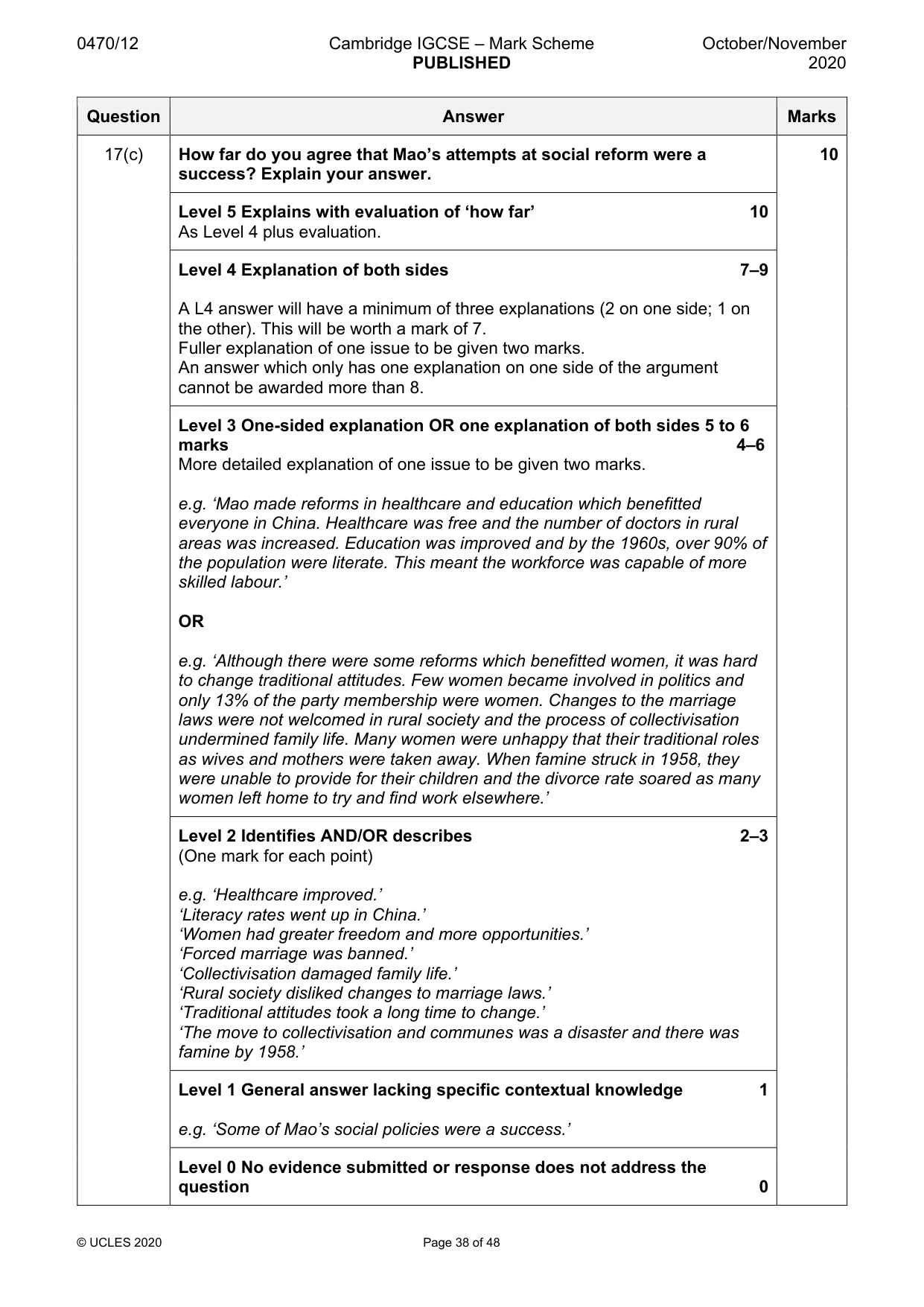
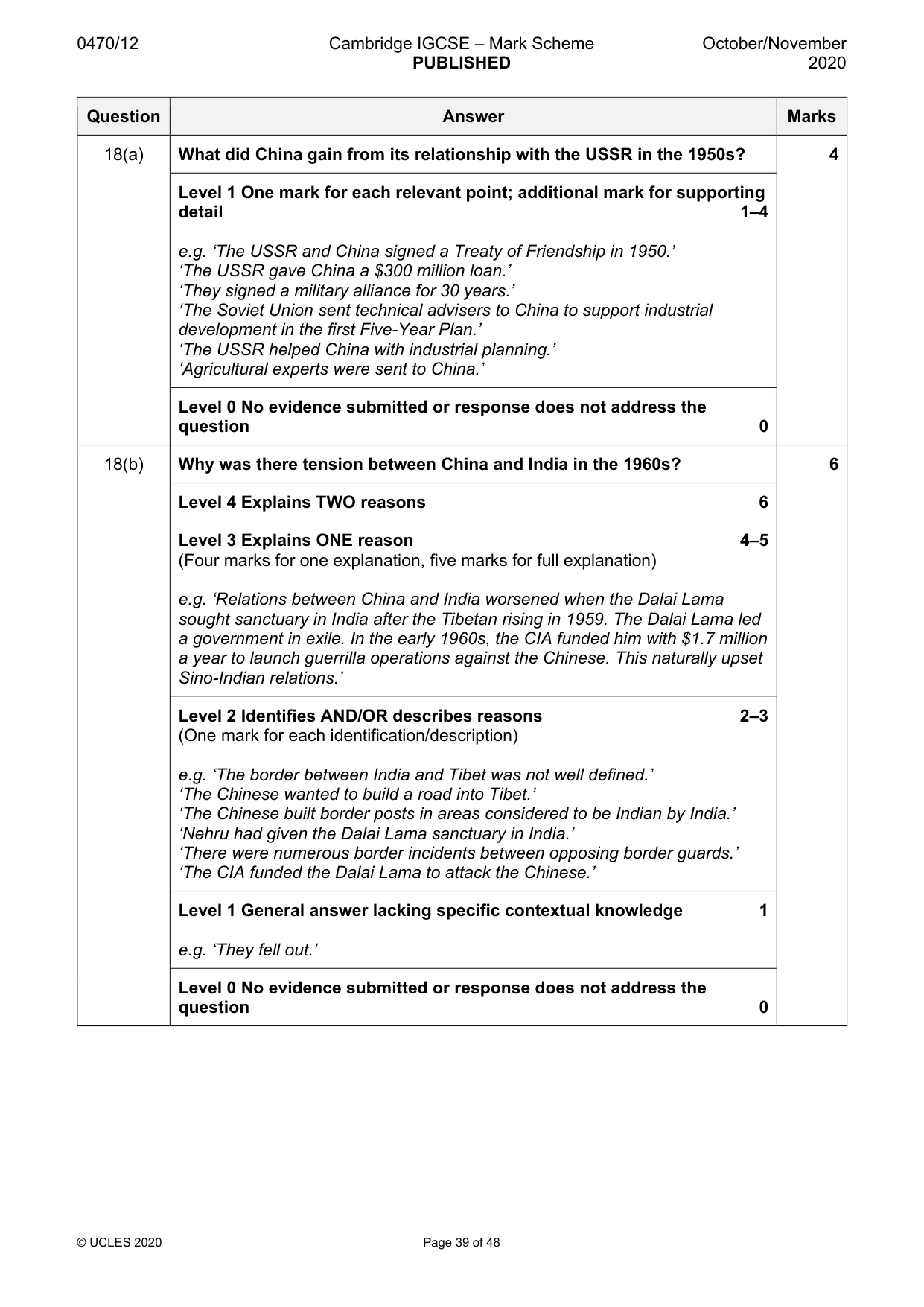
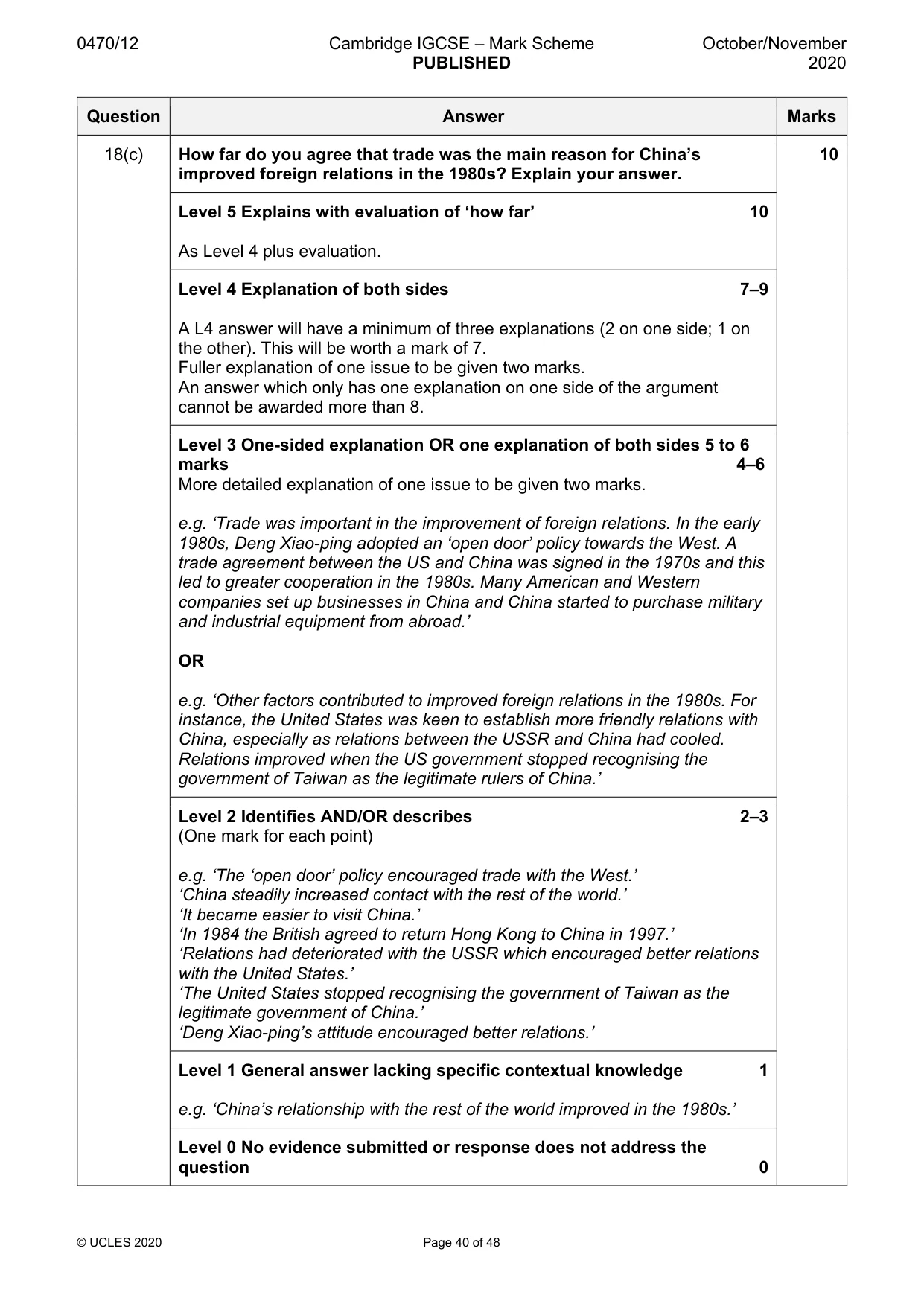
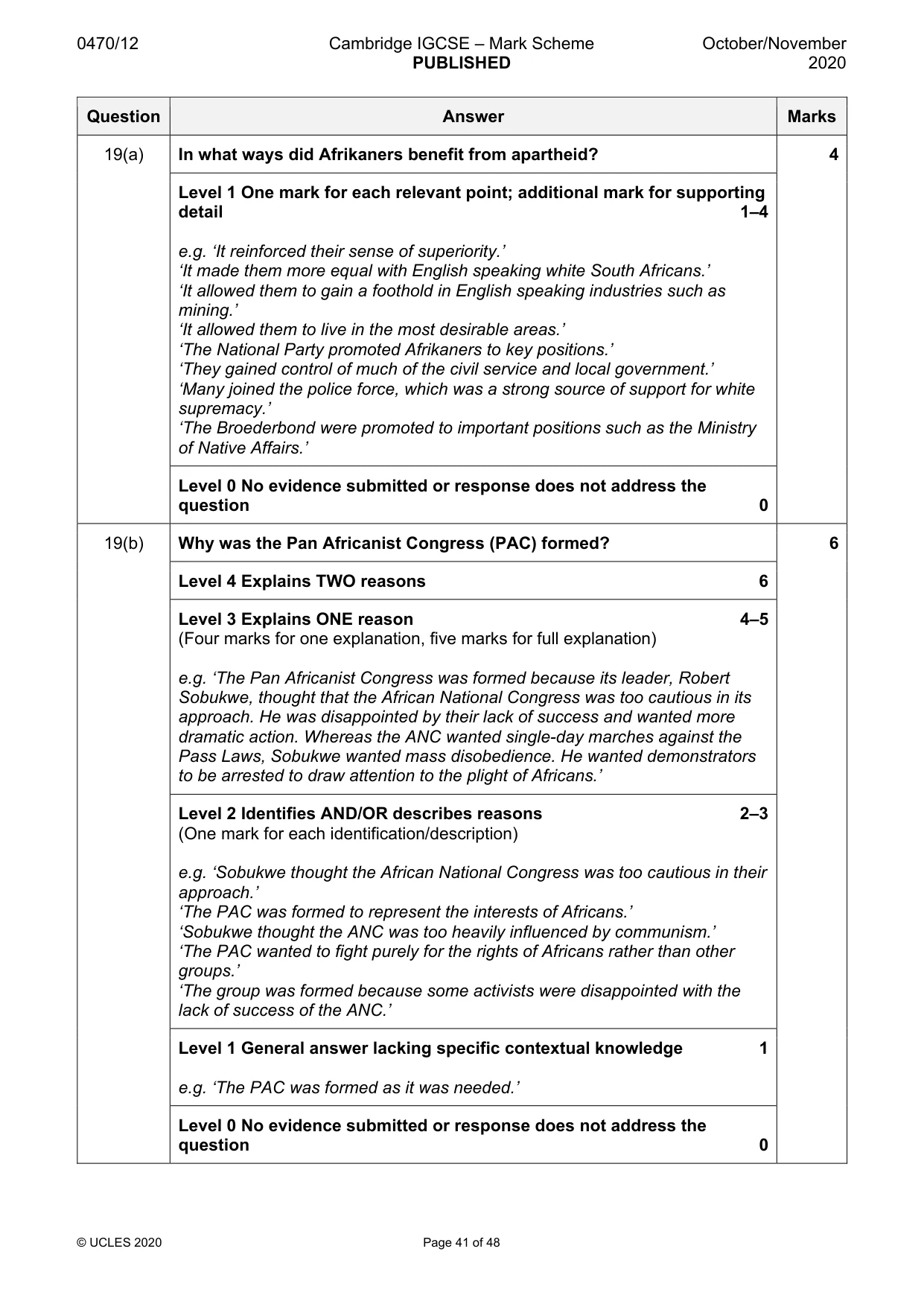
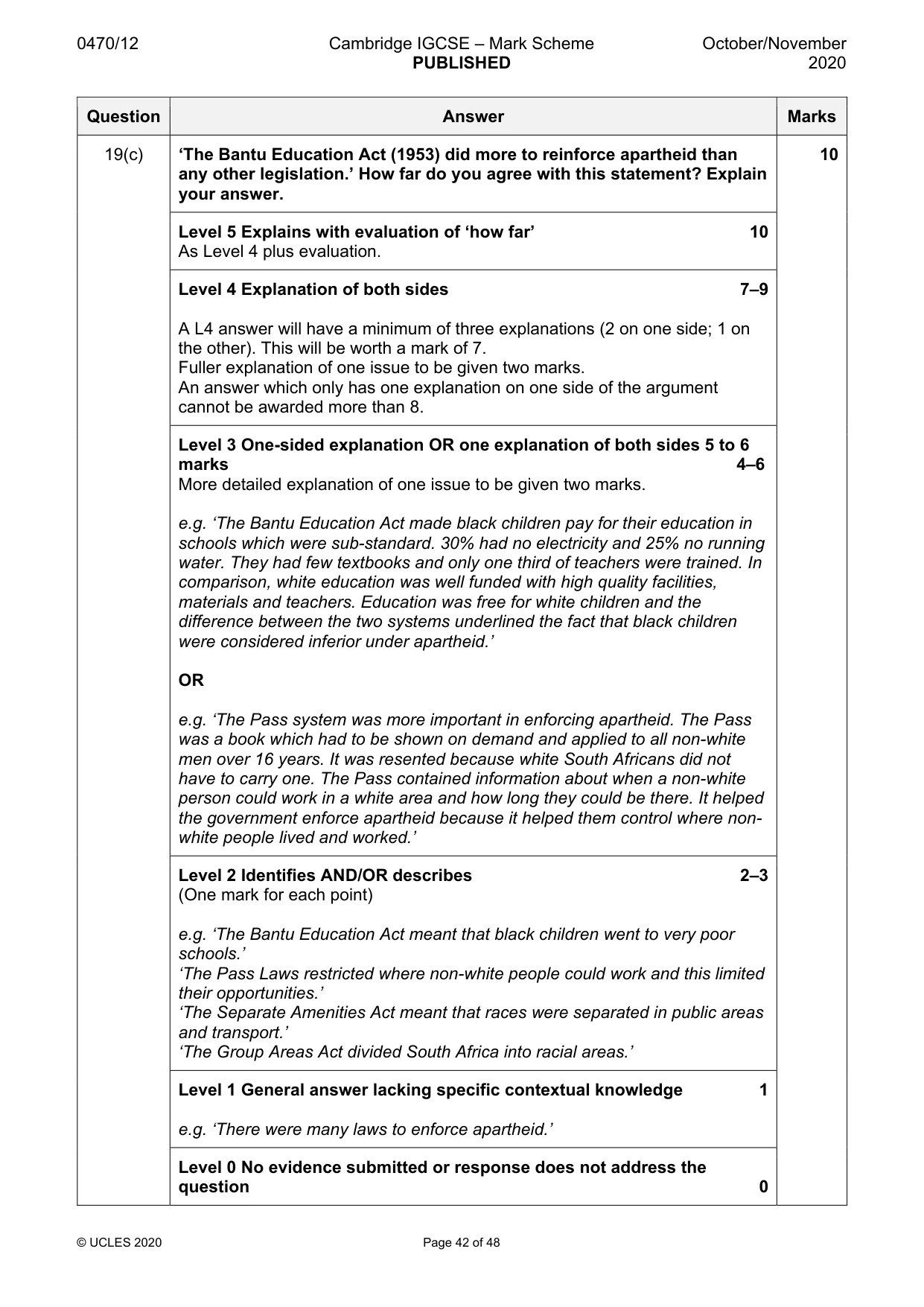
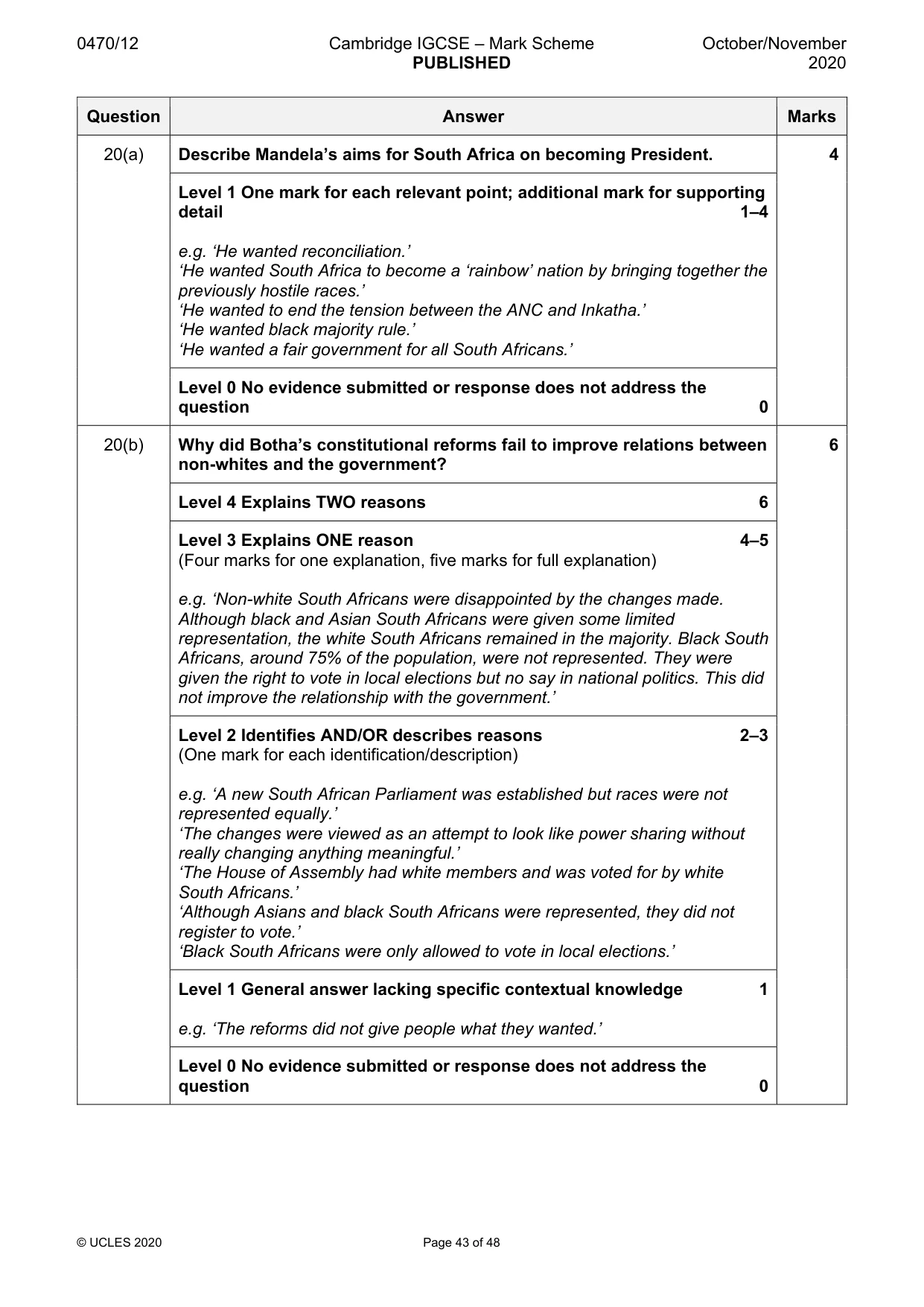
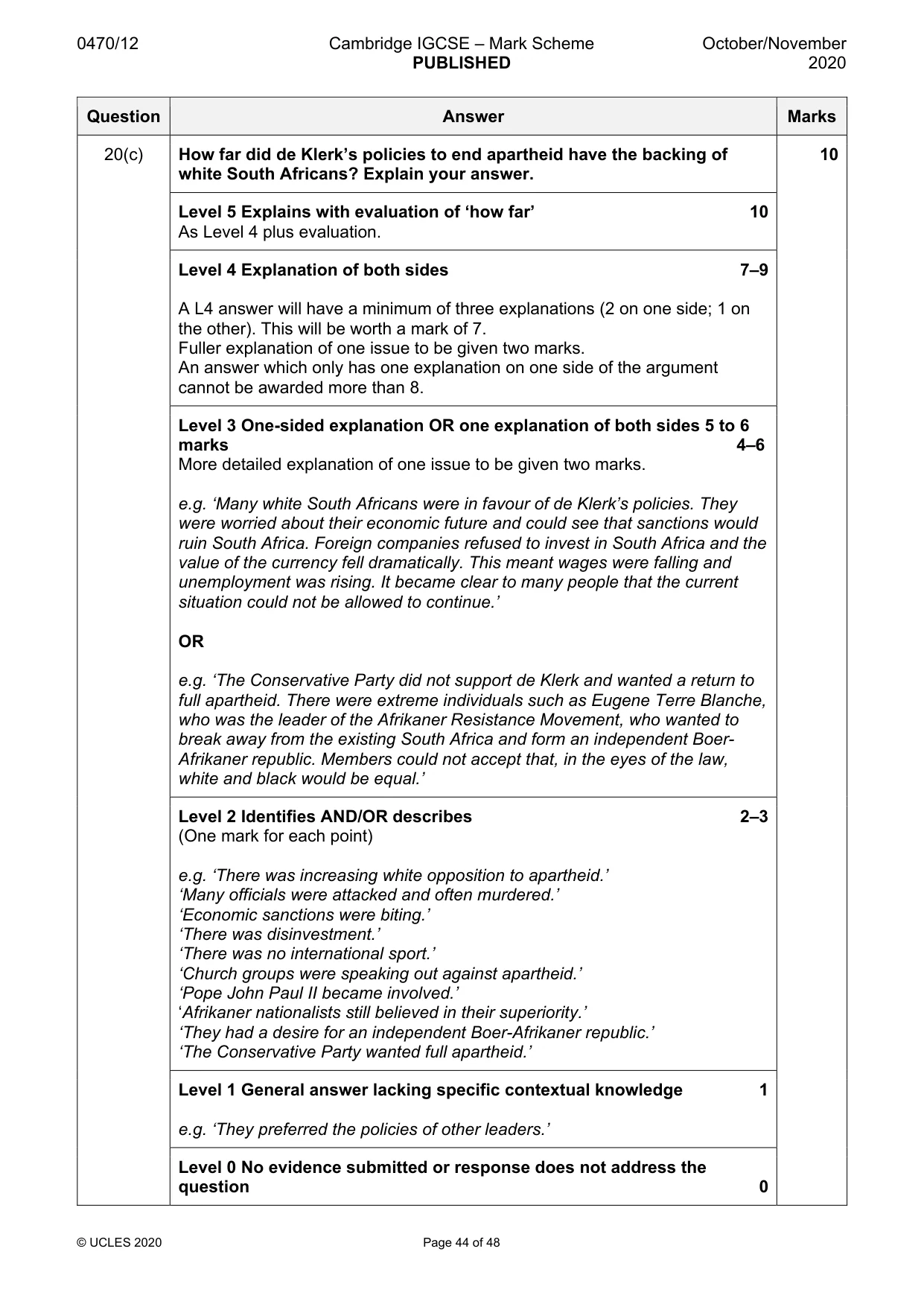
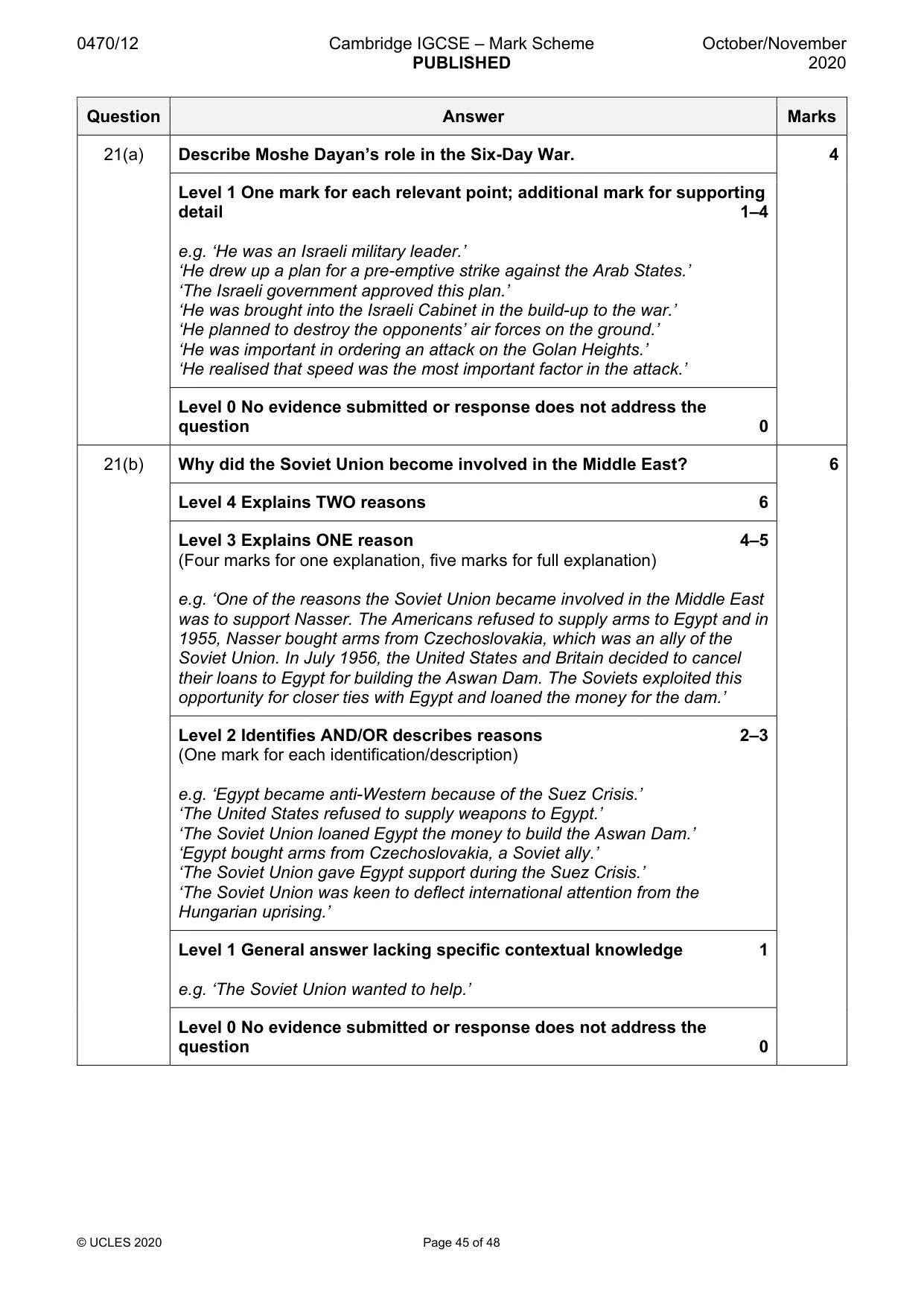
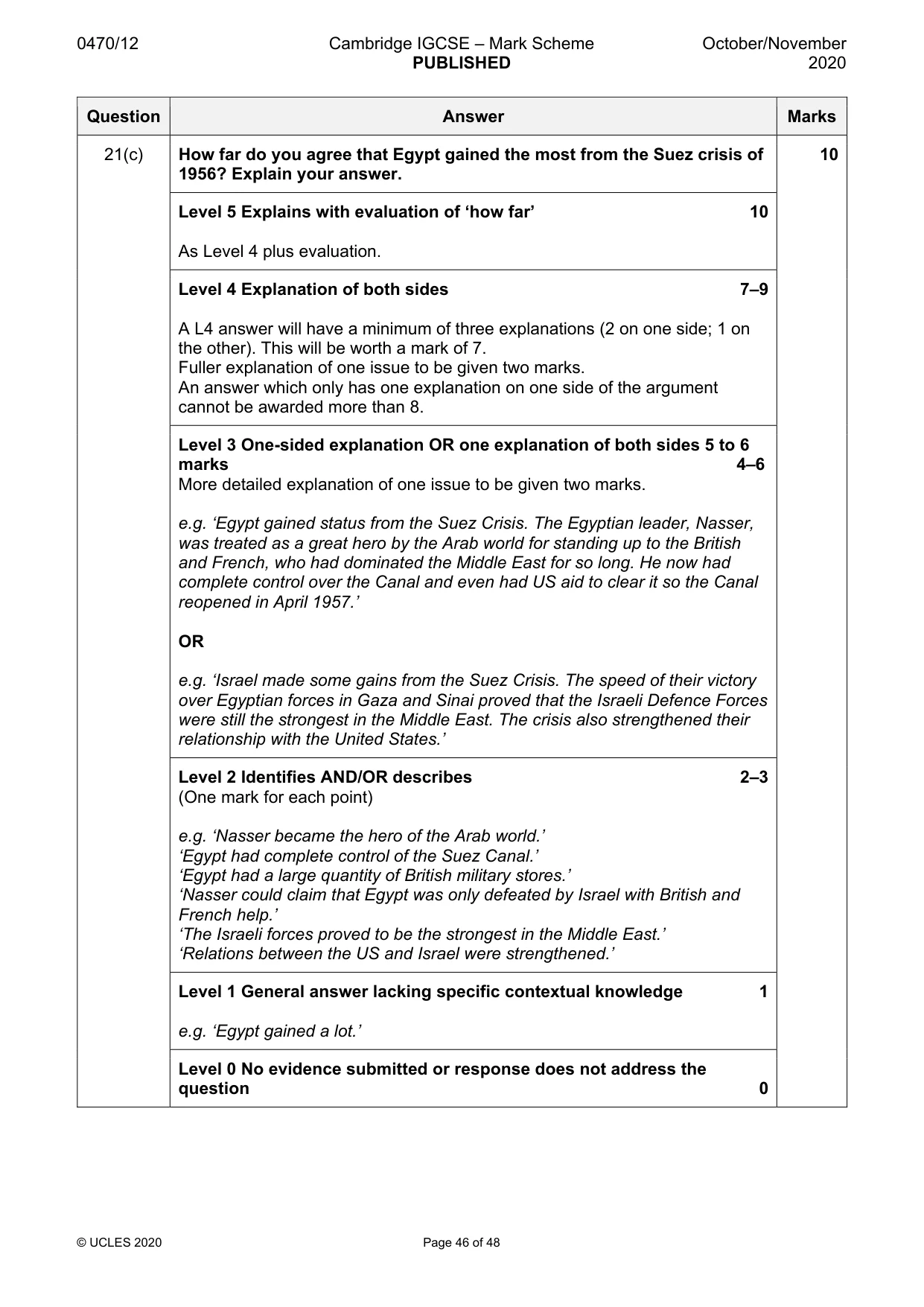
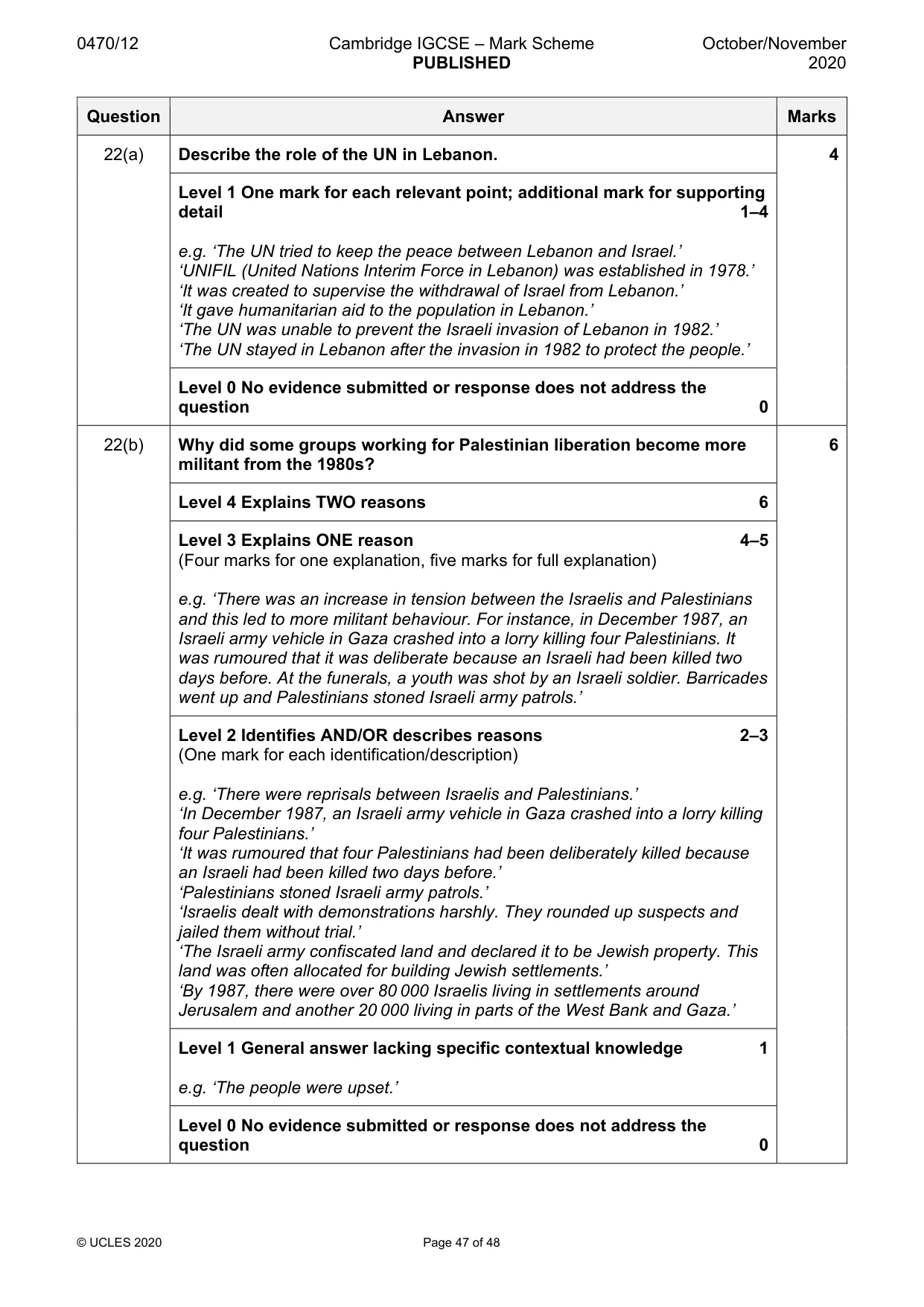
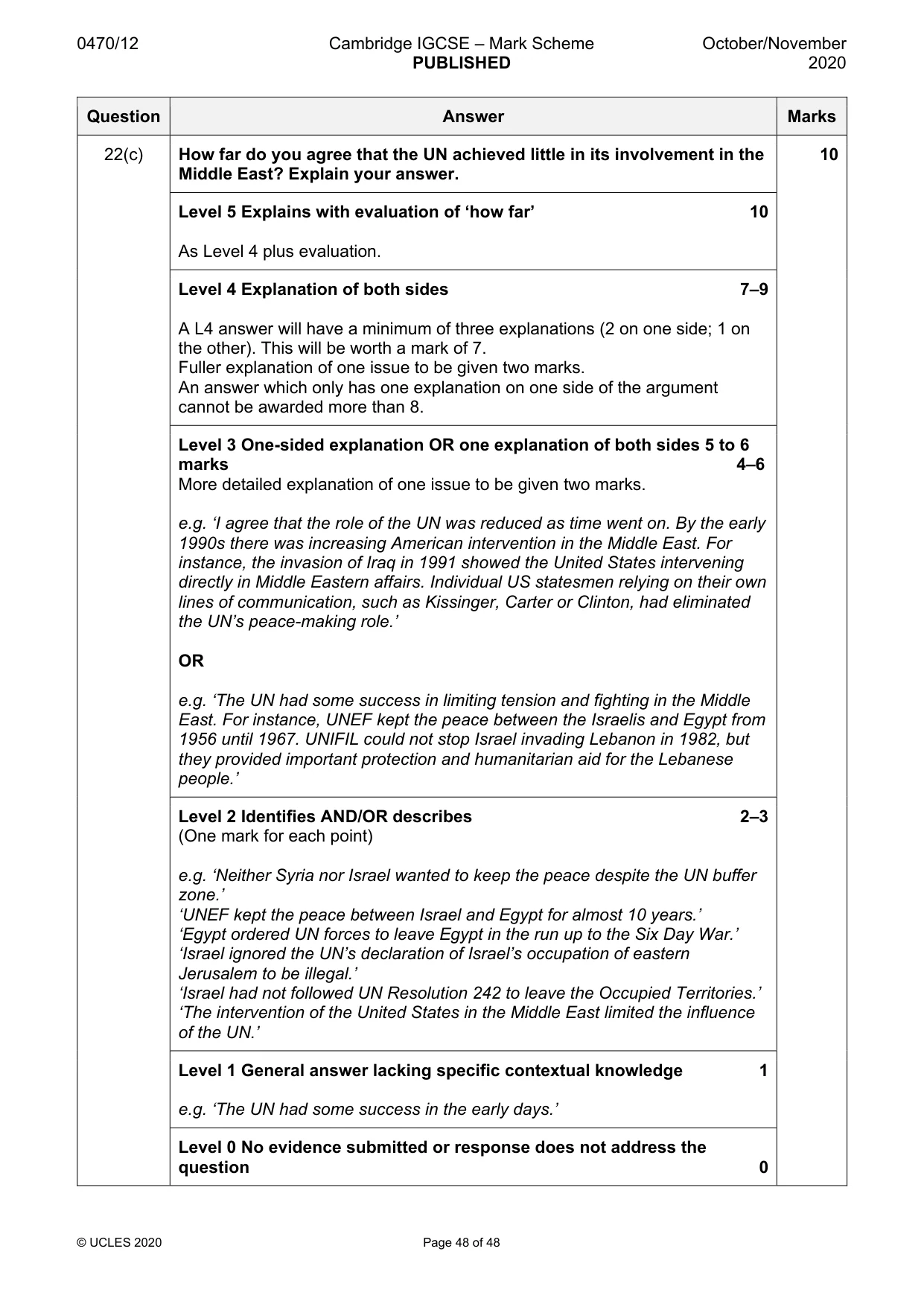
Paper as text
Question paper, page 1
Cambridge IGCSE™ This document has 12 pages. Blank pages are indicated. * 3 5 5 1 8 9 8 6 2 5 * HISTORY 0470/12 Paper 1 October/November 2020 2 hours You must answer on the enclosed answer booklet. You will need: Answer booklet (enclosed) INSTRUCTIONS ● Answer three questions in total: Section A (Core Content): answer two questions. Section B (Depth Studies): answer one question. ● Follow the instructions on the front cover of the answer booklet. If you need additional answer paper, ask the invigilator for a continuation booklet. INFORMATION ● The total mark for this paper is 60. ● The number of marks for each question or part question is shown in brackets [ ]. DC (CJ) 188996/1 © UCLES 2020 [Turn over
Question paper, page 2
2 0470/12/O/N/20 © UCLES 2020 SECTION A: CORE CONTENT Answer any two questions from this Section. 1 1848 was a year of great upheaval in Europe. (a) Describe events in Sicily in January 1848. [4] (b) Why did violence erupt in Paris in June 1848? [6] (c) How far do you agree that the 1848 revolutions were a failure? Explain your answer. [10] 2 The path to Italian unification was not smooth. (a) Describe the role of Pope Pius IX in the 1848–49 revolutions. [4] (b) Why was Italy not unified by 1861? [6] (c) ‘France played a more important role than Austria in events leading to the unification of Italy.’ How far do you agree with this statement? Explain your answer. [10] 3 Britain expanded its empire in the nineteenth century. (a) Describe Lugard’s ideas about how Britain should govern its African colonies. [4] (b) Why was Britain interested in China? [6] (c) ‘Natural disasters were the main reason for the Boxer Rising.’ How far do you agree with this statement? Explain your answer. [10] 4 The years before 1914 were characterised by tension in Europe. (a) Describe Germany’s war preparations by 1914. [4] (b) Why did the Alliance System fail to prevent war? [6] (c) How far do you agree that Morocco was the most important cause of tension before 1914? Explain your answer. [10]
Question paper, page 3
3 0470/12/O/N/20 © UCLES 2020 [Turn over 5 The Versailles settlement had different consequences for different countries. (a) What was the purpose of the ‘war guilt’ clause? [4] (b) Why were plebiscites included in the peace settlement? [6] (c) How far do you agree that Clemenceau achieved his aims at Versailles? Explain your answer. [10] 6 Hitler’s foreign policy involved Germany in developments in Europe. (a) Describe Germany’s involvement in the Spanish Civil War. [4] (b) Why was taking control of Czechoslovakia important to Hitler? [6] (c) How surprising was it that Britain and France pursued a policy of appeasement? Explain your answer. [10] 7 The USA and USSR contributed to increased tensions in Europe after 1945. (a) Describe the Communist takeover of Czechoslovakia in 1948. [4] (b) Why was the Berlin Blockade lifted in May 1949? [6] (c) How far do you agree that Truman was to blame for the Cold War? Explain your answer. [10] 8 Iraq’s involvement in war had many consequences. (a) What was the impact of the Iran-Iraq war on Iraqi civilians? [4] (b) Why did Saddam Hussein’s regime survive the First Gulf War? [6] (c) ‘Oil was the most important cause of the dispute between Iraq and Kuwait.’ How far do you agree with this statement? Explain your answer. [10]
Question paper, page 4
4 0470/12/O/N/20 © UCLES 2020 SECTION B: DEPTH STUDIES Answer any one question from this Section. DEPTH STUDY A: THE FIRST WORLD WAR, 1914–18 9 The stalemate on the Western Front was hard to break. (a) Describe events on the Western Front on 1 July 1916. [4] (b) Why were conditions in the trenches unhealthy for soldiers? [6] (c) How far do you agree that new technology was used effectively in the First World War? Explain your answer. [10] 10 Germany’s fortunes changed in 1918. (a) Describe the situation facing German forces at the start of 1918. [4] (b) Why were the mutinies at Kiel and Wilhelmshaven important? [6] (c) ‘The British naval blockade was the main reason for the defeat of Germany.’ How far do you agree with this statement? Explain your answer. [10]
Question paper, page 5
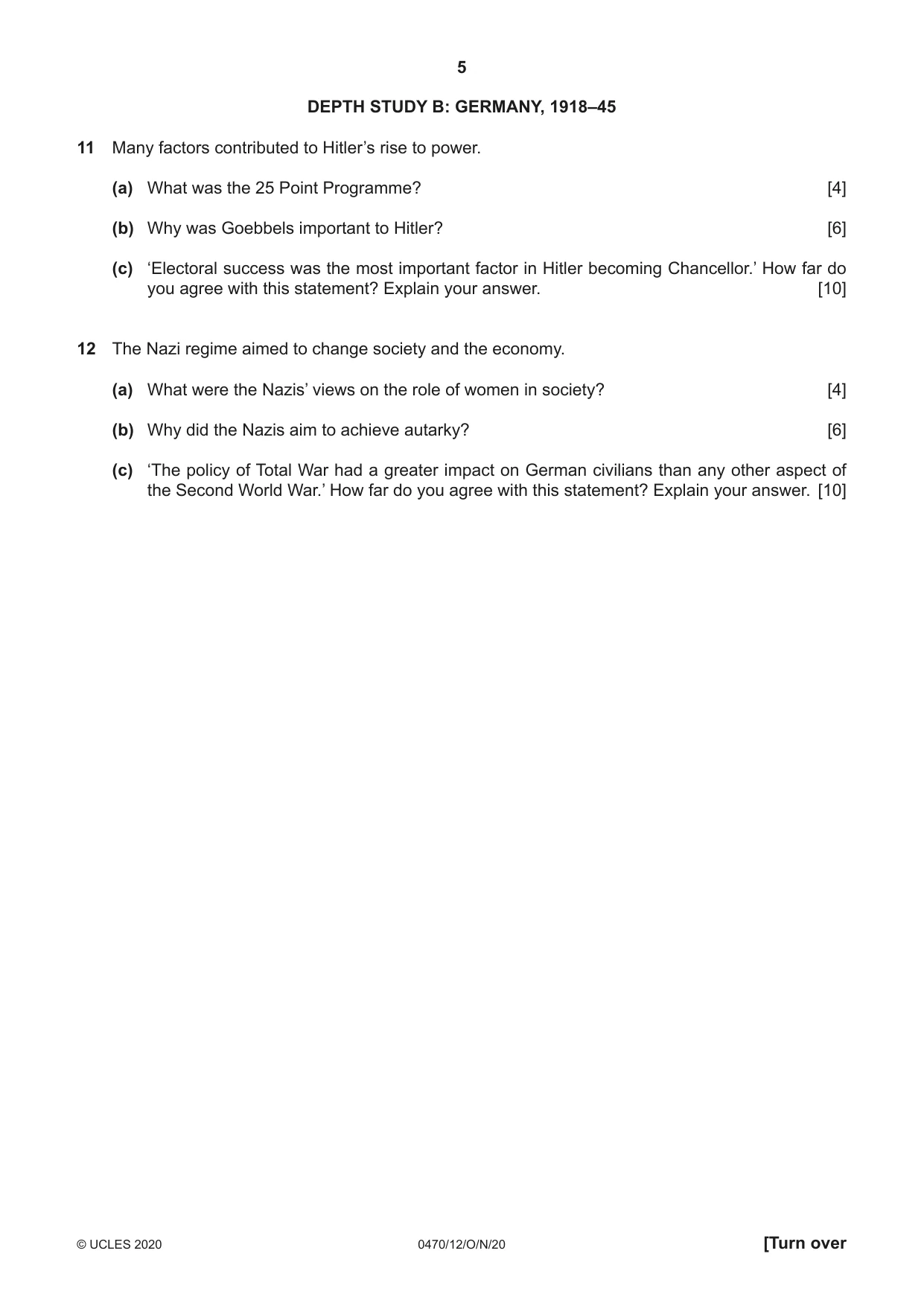
5 0470/12/O/N/20 © UCLES 2020 [Turn over DEPTH STUDY B: GERMANY, 1918–45 11 Many factors contributed to Hitler’s rise to power. (a) What was the 25 Point Programme? [4] (b) Why was Goebbels important to Hitler? [6] (c) ‘Electoral success was the most important factor in Hitler becoming Chancellor.’ How far do you agree with this statement? Explain your answer. [10] 12 The Nazi regime aimed to change society and the economy. (a) What were the Nazis’ views on the role of women in society? [4] (b) Why did the Nazis aim to achieve autarky? [6] (c) ‘The policy of Total War had a greater impact on German civilians than any other aspect of the Second World War.’ How far do you agree with this statement? Explain your answer. [10]
Question paper, page 6
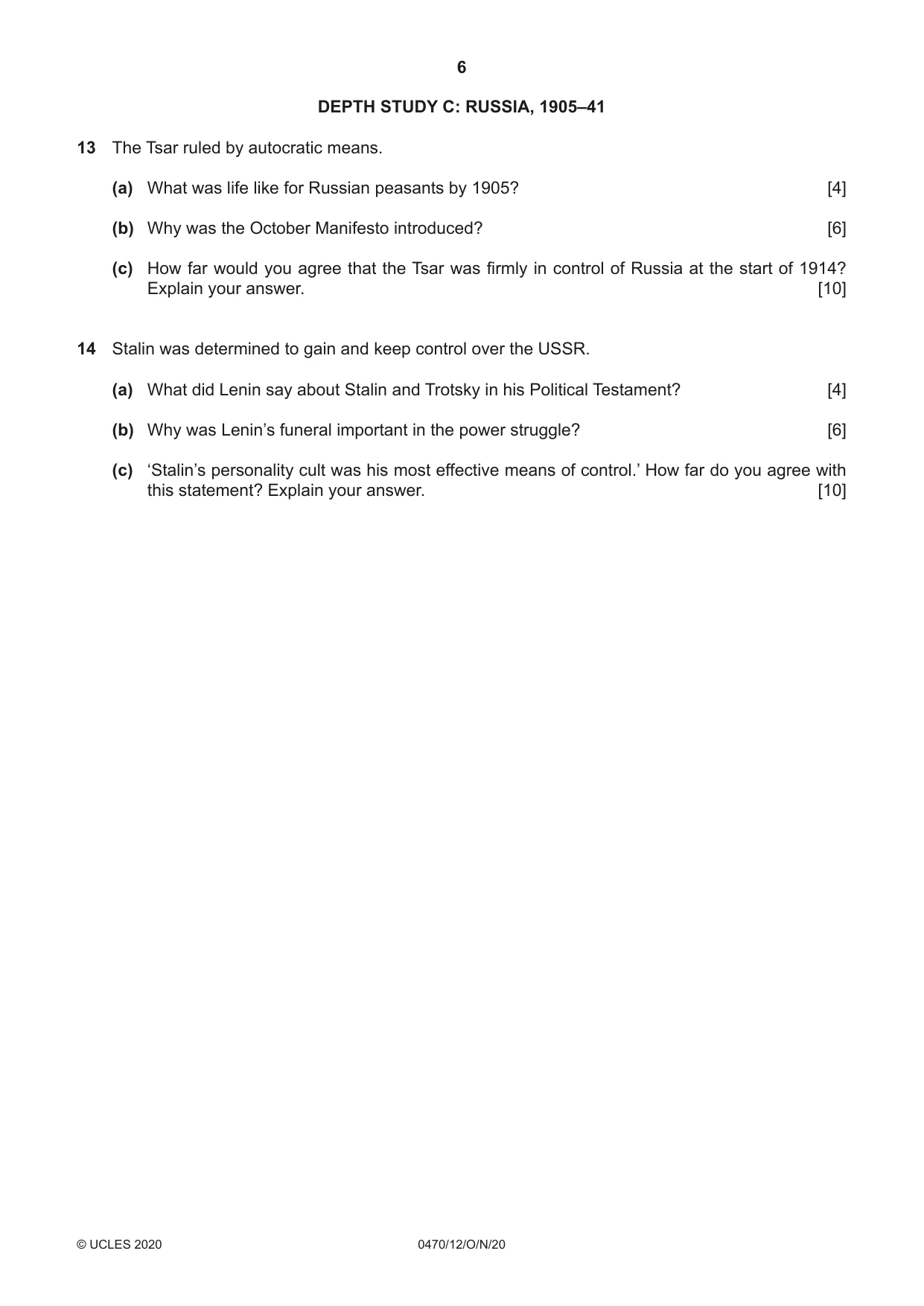
6 0470/12/O/N/20 © UCLES 2020 DEPTH STUDY C: RUSSIA, 1905–41 13 The Tsar ruled by autocratic means. (a) What was life like for Russian peasants by 1905? [4] (b) Why was the October Manifesto introduced? [6] (c) How far would you agree that the Tsar was firmly in control of Russia at the start of 1914? Explain your answer. [10] 14 Stalin was determined to gain and keep control over the USSR. (a) What did Lenin say about Stalin and Trotsky in his Political Testament? [4] (b) Why was Lenin’s funeral important in the power struggle? [6] (c) ‘Stalin’s personality cult was his most effective means of control.’ How far do you agree with this statement? Explain your answer. [10]
Question paper, page 7
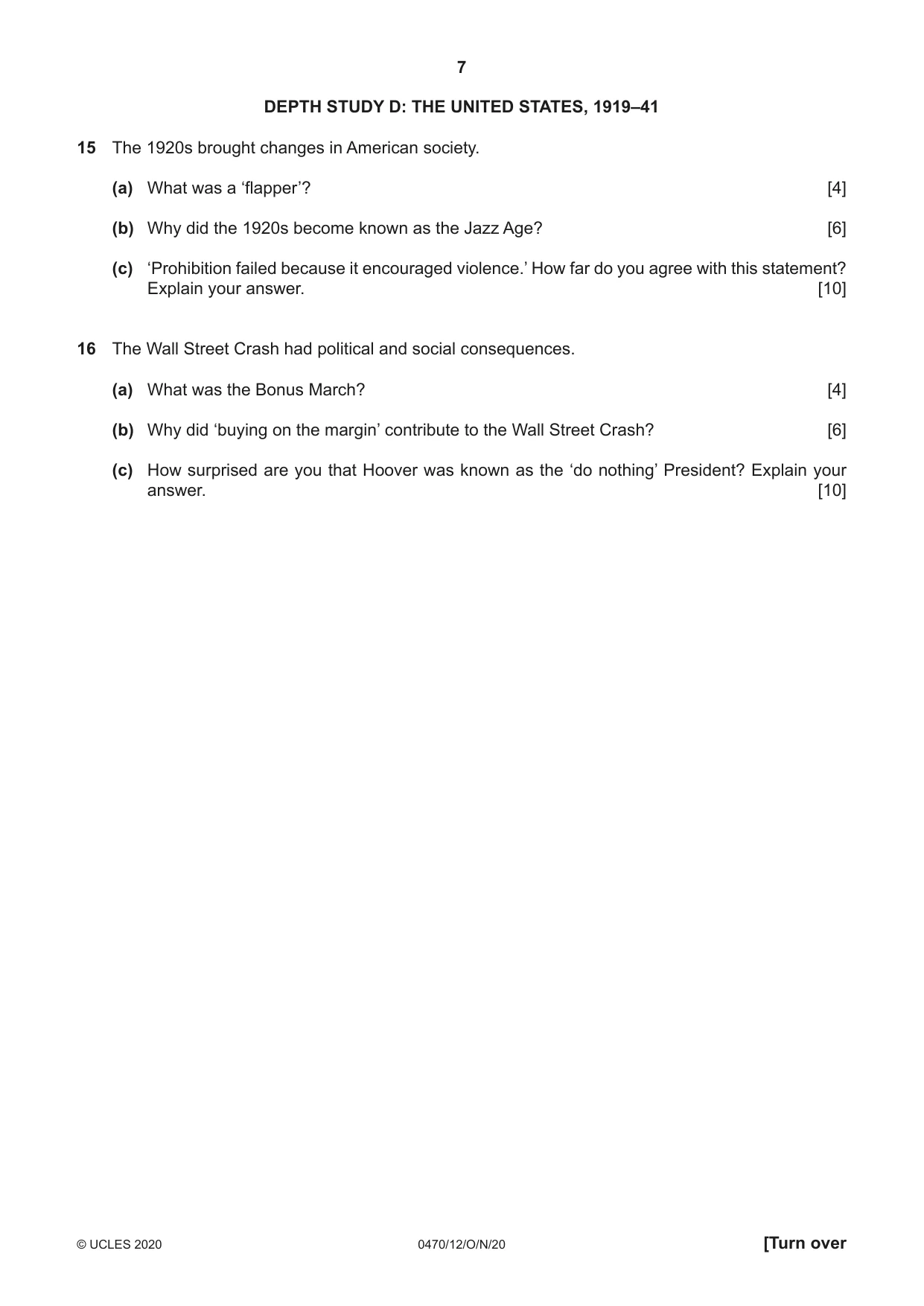
7 0470/12/O/N/20 © UCLES 2020 [Turn over DEPTH STUDY D: THE UNITED STATES, 1919–41 15 The 1920s brought changes in American society. (a) What was a ‘flapper’? [4] (b) Why did the 1920s become known as the Jazz Age? [6] (c) ‘Prohibition failed because it encouraged violence.’ How far do you agree with this statement? Explain your answer. [10] 16 The Wall Street Crash had political and social consequences. (a) What was the Bonus March? [4] (b) Why did ‘buying on the margin’ contribute to the Wall Street Crash? [6] (c) How surprised are you that Hoover was known as the ‘do nothing’ President? Explain your answer. [10]
Question paper, page 8
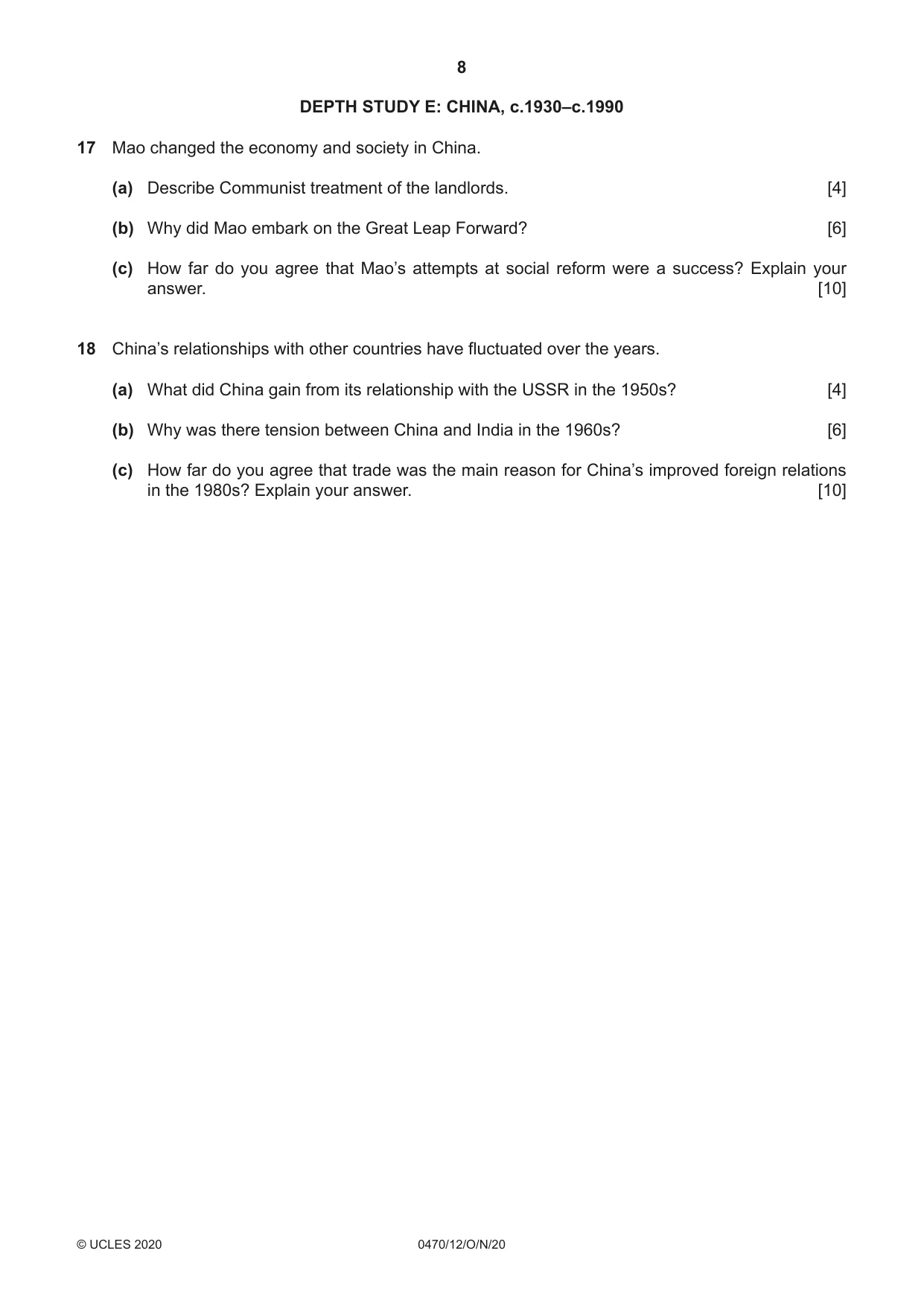
8 0470/12/O/N/20 © UCLES 2020 DEPTH STUDY E: CHINA, c.1930–c.1990 17 Mao changed the economy and society in China. (a) Describe Communist treatment of the landlords. [4] (b) Why did Mao embark on the Great Leap Forward? [6] (c) How far do you agree that Mao’s attempts at social reform were a success? Explain your answer. [10] 18 China’s relationships with other countries have fluctuated over the years. (a) What did China gain from its relationship with the USSR in the 1950s? [4] (b) Why was there tension between China and India in the 1960s? [6] (c) How far do you agree that trade was the main reason for China’s improved foreign relations in the 1980s? Explain your answer. [10]
Question paper, page 9
9 0470/12/O/N/20 © UCLES 2020 [Turn over DEPTH STUDY F: SOUTH AFRICA, c.1940–c.1994 19 In the 1950s and 1960s the apartheid system was strengthened. (a) In what ways did Afrikaners benefit from apartheid? [4] (b) Why was the Pan Africanist Congress (PAC) formed? [6] (c) ‘The Bantu Education Act (1953) did more to reinforce apartheid than any other legislation.’ How far do you agree with this statement? Explain your answer. [10] 20 The 1990s brought the end of apartheid in South Africa. (a) Describe Mandela’s aims for South Africa on becoming President. [4] (b) Why did Botha’s constitutional reforms fail to improve relations between non-whites and the government? [6] (c) How far did de Klerk’s policies to end apartheid have the backing of white South Africans? Explain your answer. [10]
Question paper, page 10
10 0470/12/O/N/20 © UCLES 2020 DEPTH STUDY G: ISRAELIS AND PALESTINIANS SINCE 1945 21 External involvement in the Middle East has had important consequences. (a) Describe Moshe Dayan’s role in the Six-Day War. [4] (b) Why did the Soviet Union become involved in the Middle East? [6] (c) How far do you agree that Egypt gained the most from the Suez crisis of 1956? Explain your answer. [10] 22 The United Nations (UN) faced many challenges in its role in the Middle East. (a) Describe the role of the UN in Lebanon. [4] (b) Why did some groups working for Palestinian liberation become more militant from the 1980s? [6] (c) How far do you agree that the UN achieved little in its involvement in the Middle East? Explain your answer. [10]
Question paper, page 11
11 0470/12/O/N/20 © UCLES 2020 BLANK PAGE
Question paper, page 12
12 0470/12/O/N/20 © UCLES 2020 Permission to reproduce items where third-party owned material protected by copyright is included has been sought and cleared where possible. Every reasonable effort has been made by the publisher (UCLES) to trace copyright holders, but if any items requiring clearance have unwittingly been included, the publisher will be pleased to make amends at the earliest possible opportunity. To avoid the issue of disclosure of answer-related information to candidates, all copyright acknowledgements are reproduced online in the Cambridge Assessment International Education Copyright Acknowledgements Booklet. This is produced for each series of examinations and is freely available to download at www.cambridgeinternational.org after the live examination series. Cambridge Assessment International Education is part of the Cambridge Assessment Group. Cambridge Assessment is the brand name of the University of Cambridge Local Examinations Syndicate (UCLES), which itself is a department of the University of Cambridge. BLANK PAGE
Mark scheme, page 1
This document consists of 48 printed pages. © UCLES 2020 [Turn over Cambridge IGCSE™ HISTORY 0470/12 Paper 1 October/November 2020 MARK SCHEME Maximum Mark: 60 Published This mark scheme is published as an aid to teachers and candidates, to indicate the requirements of the examination. It shows the basis on which Examiners were instructed to award marks. It does not indicate the details of the discussions that took place at an Examiners’ meeting before marking began, which would have considered the acceptability of alternative answers. Mark schemes should be read in conjunction with the question paper and the Principal Examiner Report for Teachers. Cambridge International will not enter into discussions about these mark schemes. Cambridge International is publishing the mark schemes for the October/November 2020 series for most Cambridge IGCSE™, Cambridge International A and AS Level and Cambridge Pre-U components, and some Cambridge O Level components.
Mark scheme, page 2
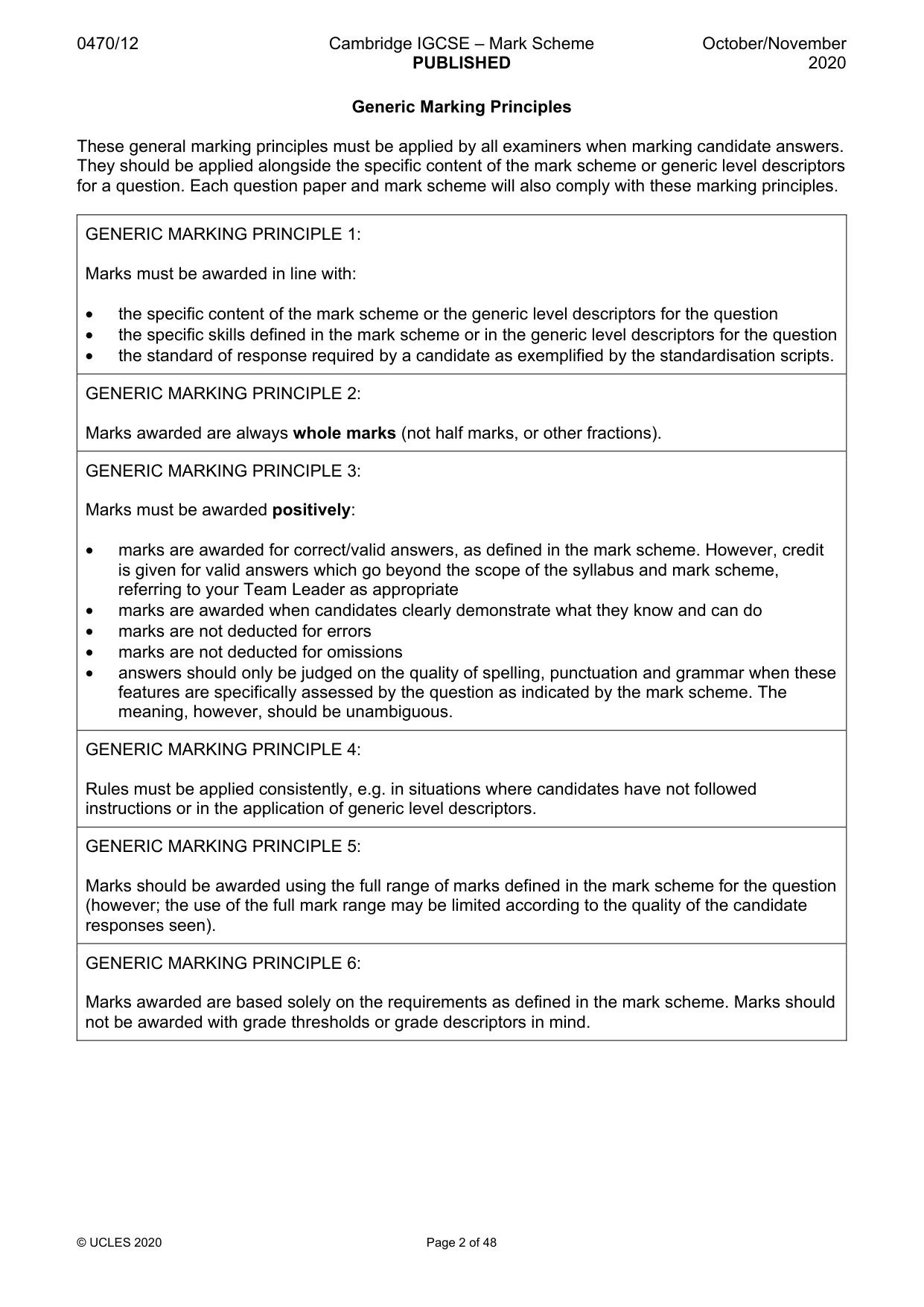
0470/12 Cambridge IGCSE – Mark Scheme PUBLISHED October/November 2020 © UCLES 2020 Page 2 of 48 Generic Marking Principles These general marking principles must be applied by all examiners when marking candidate answers. They should be applied alongside the specific content of the mark scheme or generic level descriptors for a question. Each question paper and mark scheme will also comply with these marking principles. GENERIC MARKING PRINCIPLE 1: Marks must be awarded in line with: • the specific content of the mark scheme or the generic level descriptors for the question • the specific skills defined in the mark scheme or in the generic level descriptors for the question • the standard of response required by a candidate as exemplified by the standardisation scripts. GENERIC MARKING PRINCIPLE 2: Marks awarded are always whole marks (not half marks, or other fractions). GENERIC MARKING PRINCIPLE 3: Marks must be awarded positively: • marks are awarded for correct/valid answers, as defined in the mark scheme. However, credit is given for valid answers which go beyond the scope of the syllabus and mark scheme, referring to your Team Leader as appropriate • marks are awarded when candidates clearly demonstrate what they know and can do • marks are not deducted for errors • marks are not deducted for omissions • answers should only be judged on the quality of spelling, punctuation and grammar when these features are specifically assessed by the question as indicated by the mark scheme. The meaning, however, should be unambiguous. GENERIC MARKING PRINCIPLE 4: Rules must be applied consistently, e.g. in situations where candidates have not followed instructions or in the application of generic level descriptors. GENERIC MARKING PRINCIPLE 5: Marks should be awarded using the full range of marks defined in the mark scheme for the question (however; the use of the full mark range may be limited according to the quality of the candidate responses seen). GENERIC MARKING PRINCIPLE 6: Marks awarded are based solely on the requirements as defined in the mark scheme. Marks should not be awarded with grade thresholds or grade descriptors in mind.
Mark scheme, page 3
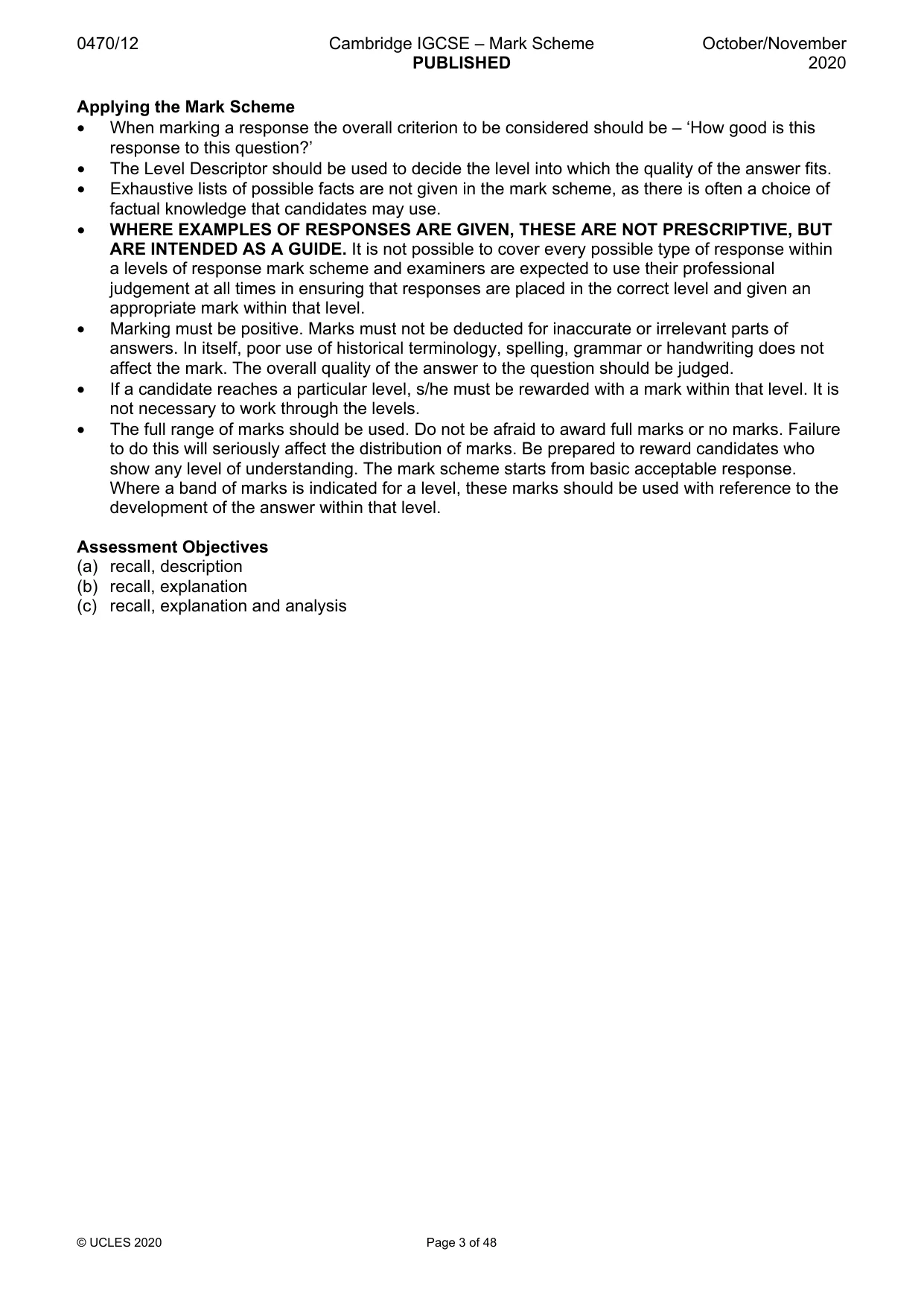
0470/12 Cambridge IGCSE – Mark Scheme PUBLISHED October/November 2020 © UCLES 2020 Page 3 of 48 Applying the Mark Scheme • When marking a response the overall criterion to be considered should be – ‘How good is this response to this question?’ • The Level Descriptor should be used to decide the level into which the quality of the answer fits. • Exhaustive lists of possible facts are not given in the mark scheme, as there is often a choice of factual knowledge that candidates may use. • WHERE EXAMPLES OF RESPONSES ARE GIVEN, THESE ARE NOT PRESCRIPTIVE, BUT ARE INTENDED AS A GUIDE. It is not possible to cover every possible type of response within a levels of response mark scheme and examiners are expected to use their professional judgement at all times in ensuring that responses are placed in the correct level and given an appropriate mark within that level. • Marking must be positive. Marks must not be deducted for inaccurate or irrelevant parts of answers. In itself, poor use of historical terminology, spelling, grammar or handwriting does not affect the mark. The overall quality of the answer to the question should be judged. • If a candidate reaches a particular level, s/he must be rewarded with a mark within that level. It is not necessary to work through the levels. • The full range of marks should be used. Do not be afraid to award full marks or no marks. Failure to do this will seriously affect the distribution of marks. Be prepared to reward candidates who show any level of understanding. The mark scheme starts from basic acceptable response. Where a band of marks is indicated for a level, these marks should be used with reference to the development of the answer within that level. Assessment Objectives (a) recall, description (b) recall, explanation (c) recall, explanation and analysis
Mark scheme, page 4
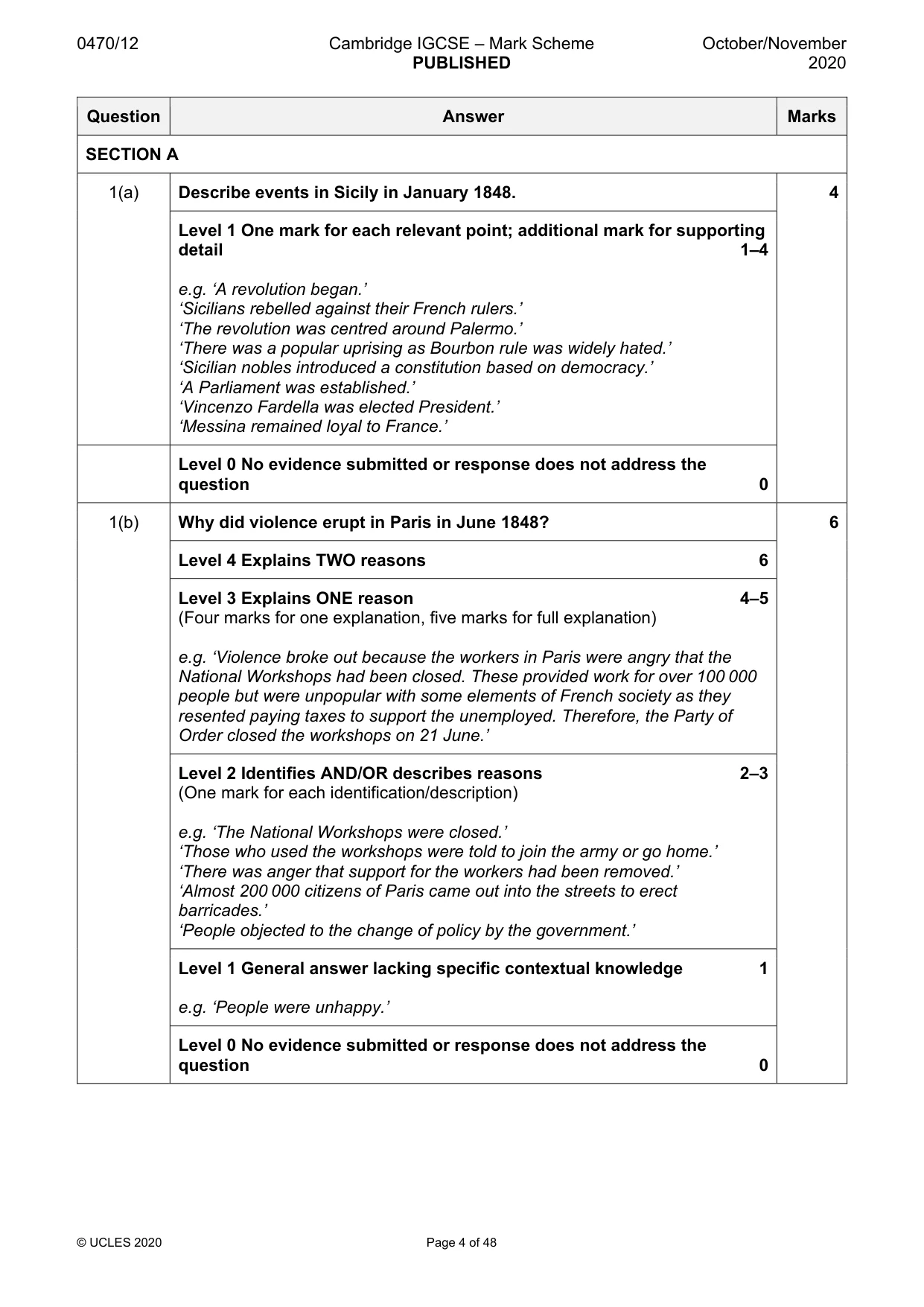
0470/12 Cambridge IGCSE – Mark Scheme PUBLISHED October/November 2020 © UCLES 2020 Page 4 of 48 Question Answer Marks SECTION A 1(a) Describe events in Sicily in January 1848. 4 Level 1 One mark for each relevant point; additional mark for supporting detail 1–4 e.g. ‘A revolution began.’ ‘Sicilians rebelled against their French rulers.’ ‘The revolution was centred around Palermo.’ ‘There was a popular uprising as Bourbon rule was widely hated.’ ‘Sicilian nobles introduced a constitution based on democracy.’ ‘A Parliament was established.’ ‘Vincenzo Fardella was elected President.’ ‘Messina remained loyal to France.’ Level 0 No evidence submitted or response does not address the question 0 1(b) Why did violence erupt in Paris in June 1848? 6 Level 4 Explains TWO reasons 6 Level 3 Explains ONE reason 4–5 (Four marks for one explanation, five marks for full explanation) e.g. ‘Violence broke out because the workers in Paris were angry that the National Workshops had been closed. These provided work for over 100 000 people but were unpopular with some elements of French society as they resented paying taxes to support the unemployed. Therefore, the Party of Order closed the workshops on 21 June.’ Level 2 Identifies AND/OR describes reasons 2–3 (One mark for each identification/description) e.g. ‘The National Workshops were closed.’ ‘Those who used the workshops were told to join the army or go home.’ ‘There was anger that support for the workers had been removed.’ ‘Almost 200 000 citizens of Paris came out into the streets to erect barricades.’ ‘People objected to the change of policy by the government.’ Level 1 General answer lacking specific contextual knowledge 1 e.g. ‘People were unhappy.’ Level 0 No evidence submitted or response does not address the question 0
Mark scheme, page 5
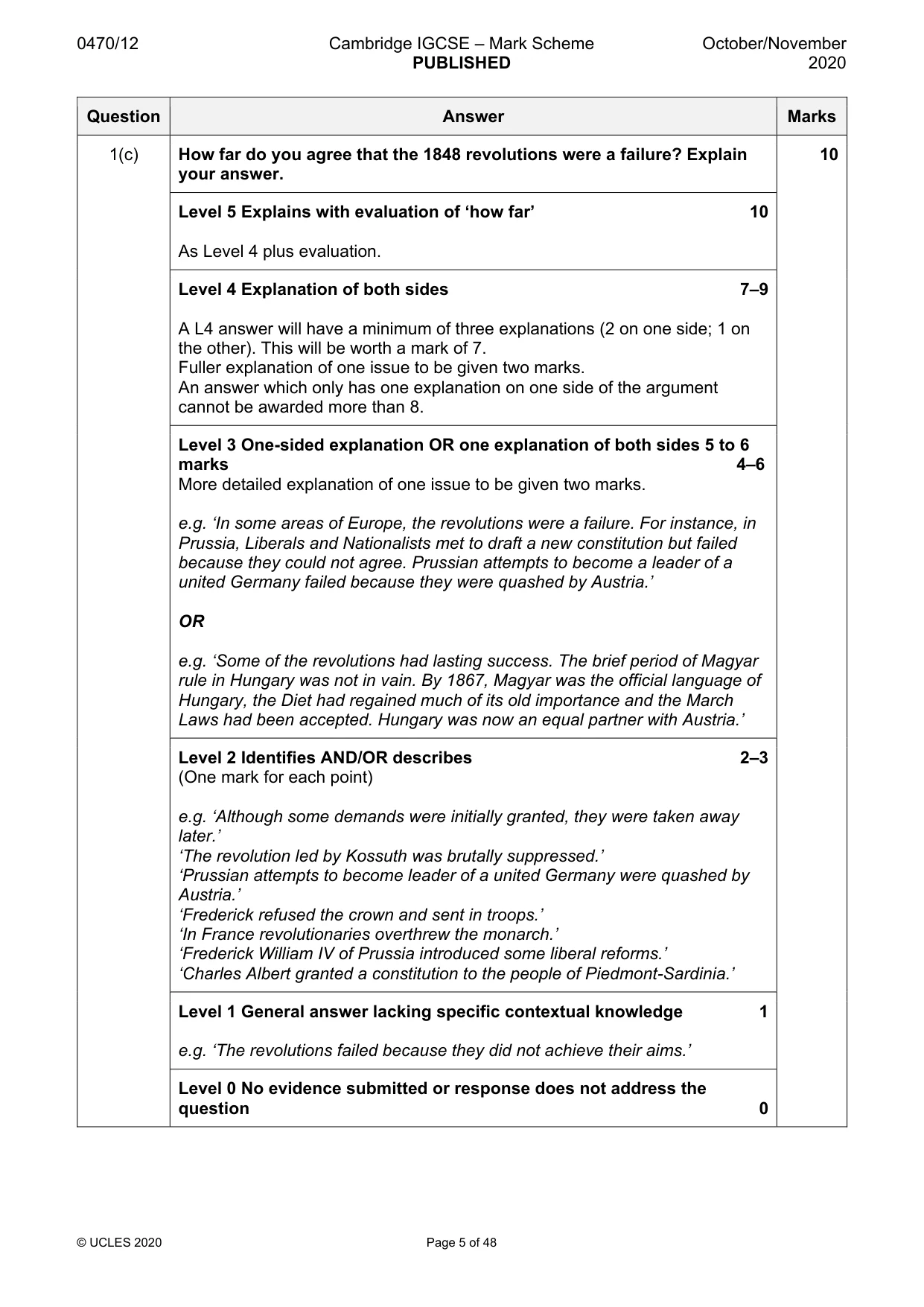
0470/12 Cambridge IGCSE – Mark Scheme PUBLISHED October/November 2020 © UCLES 2020 Page 5 of 48 Question Answer Marks 1(c) How far do you agree that the 1848 revolutions were a failure? Explain your answer. 10 Level 5 Explains with evaluation of ‘how far’ 10 As Level 4 plus evaluation. Level 4 Explanation of both sides 7–9 A L4 answer will have a minimum of three explanations (2 on one side; 1 on the other). This will be worth a mark of 7. Fuller explanation of one issue to be given two marks. An answer which only has one explanation on one side of the argument cannot be awarded more than 8. Level 3 One-sided explanation OR one explanation of both sides 5 to 6 marks 4–6 More detailed explanation of one issue to be given two marks. e.g. ‘In some areas of Europe, the revolutions were a failure. For instance, in Prussia, Liberals and Nationalists met to draft a new constitution but failed because they could not agree. Prussian attempts to become a leader of a united Germany failed because they were quashed by Austria.’ OR e.g. ‘Some of the revolutions had lasting success. The brief period of Magyar rule in Hungary was not in vain. By 1867, Magyar was the official language of Hungary, the Diet had regained much of its old importance and the March Laws had been accepted. Hungary was now an equal partner with Austria.’ Level 2 Identifies AND/OR describes 2–3 (One mark for each point) e.g. ‘Although some demands were initially granted, they were taken away later.’ ‘The revolution led by Kossuth was brutally suppressed.’ ‘Prussian attempts to become leader of a united Germany were quashed by Austria.’ ‘Frederick refused the crown and sent in troops.’ ‘In France revolutionaries overthrew the monarch.’ ‘Frederick William IV of Prussia introduced some liberal reforms.’ ‘Charles Albert granted a constitution to the people of Piedmont-Sardinia.’ Level 1 General answer lacking specific contextual knowledge 1 e.g. ‘The revolutions failed because they did not achieve their aims.’ Level 0 No evidence submitted or response does not address the question 0
Mark scheme, page 6
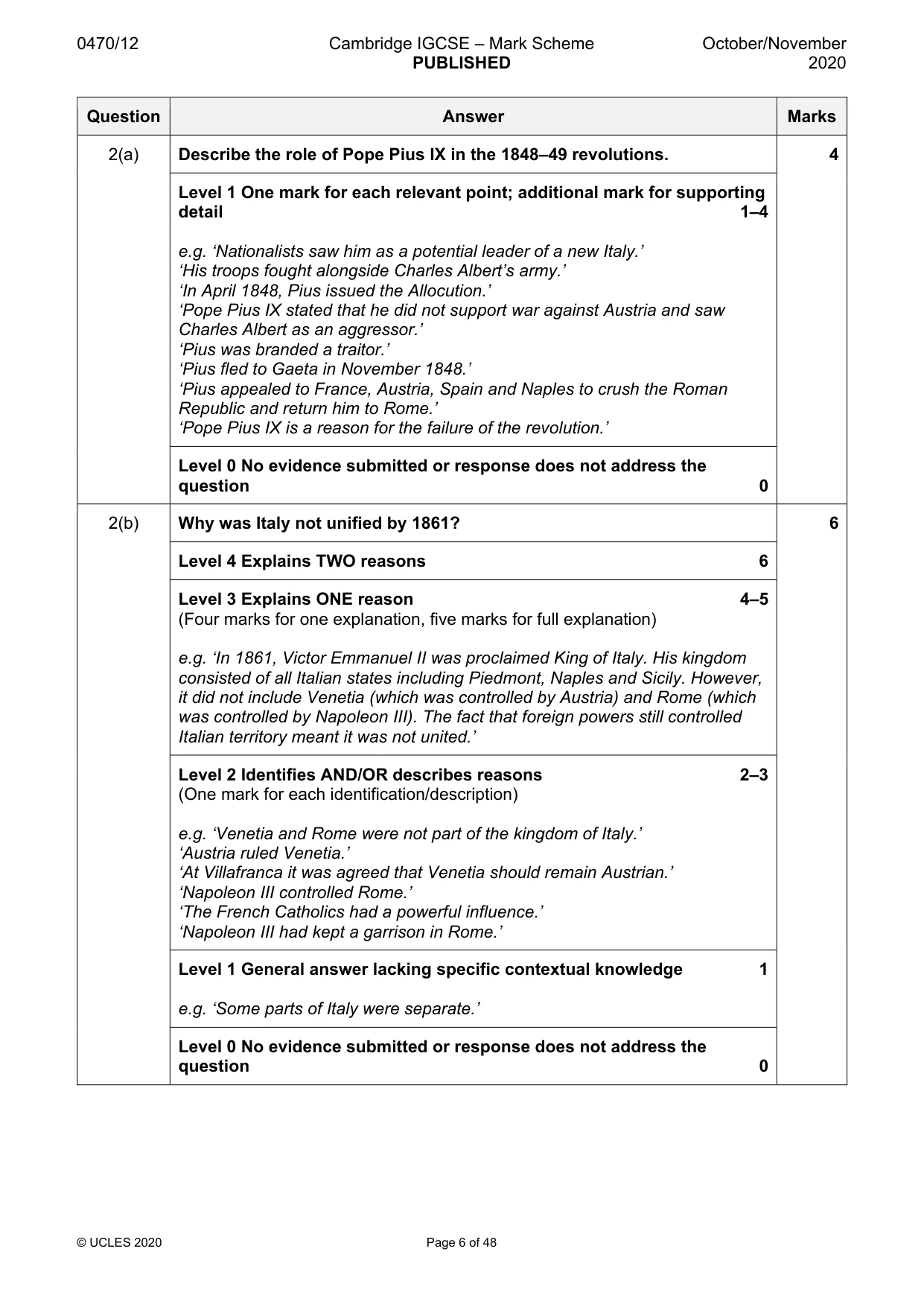
0470/12 Cambridge IGCSE – Mark Scheme PUBLISHED October/November 2020 © UCLES 2020 Page 6 of 48 Question Answer Marks 2(a) Describe the role of Pope Pius IX in the 1848–49 revolutions. 4 Level 1 One mark for each relevant point; additional mark for supporting detail 1–4 e.g. ‘Nationalists saw him as a potential leader of a new Italy.’ ‘His troops fought alongside Charles Albert’s army.’ ‘In April 1848, Pius issued the Allocution.’ ‘Pope Pius IX stated that he did not support war against Austria and saw Charles Albert as an aggressor.’ ‘Pius was branded a traitor.’ ‘Pius fled to Gaeta in November 1848.’ ‘Pius appealed to France, Austria, Spain and Naples to crush the Roman Republic and return him to Rome.’ ‘Pope Pius IX is a reason for the failure of the revolution.’ Level 0 No evidence submitted or response does not address the question 0 2(b) Why was Italy not unified by 1861? 6 Level 4 Explains TWO reasons 6 Level 3 Explains ONE reason 4–5 (Four marks for one explanation, five marks for full explanation) e.g. ‘In 1861, Victor Emmanuel II was proclaimed King of Italy. His kingdom consisted of all Italian states including Piedmont, Naples and Sicily. However, it did not include Venetia (which was controlled by Austria) and Rome (which was controlled by Napoleon III). The fact that foreign powers still controlled Italian territory meant it was not united.’ Level 2 Identifies AND/OR describes reasons 2–3 (One mark for each identification/description) e.g. ‘Venetia and Rome were not part of the kingdom of Italy.’ ‘Austria ruled Venetia.’ ‘At Villafranca it was agreed that Venetia should remain Austrian.’ ‘Napoleon III controlled Rome.’ ‘The French Catholics had a powerful influence.’ ‘Napoleon III had kept a garrison in Rome.’ Level 1 General answer lacking specific contextual knowledge 1 e.g. ‘Some parts of Italy were separate.’ Level 0 No evidence submitted or response does not address the question 0
Mark scheme, page 7
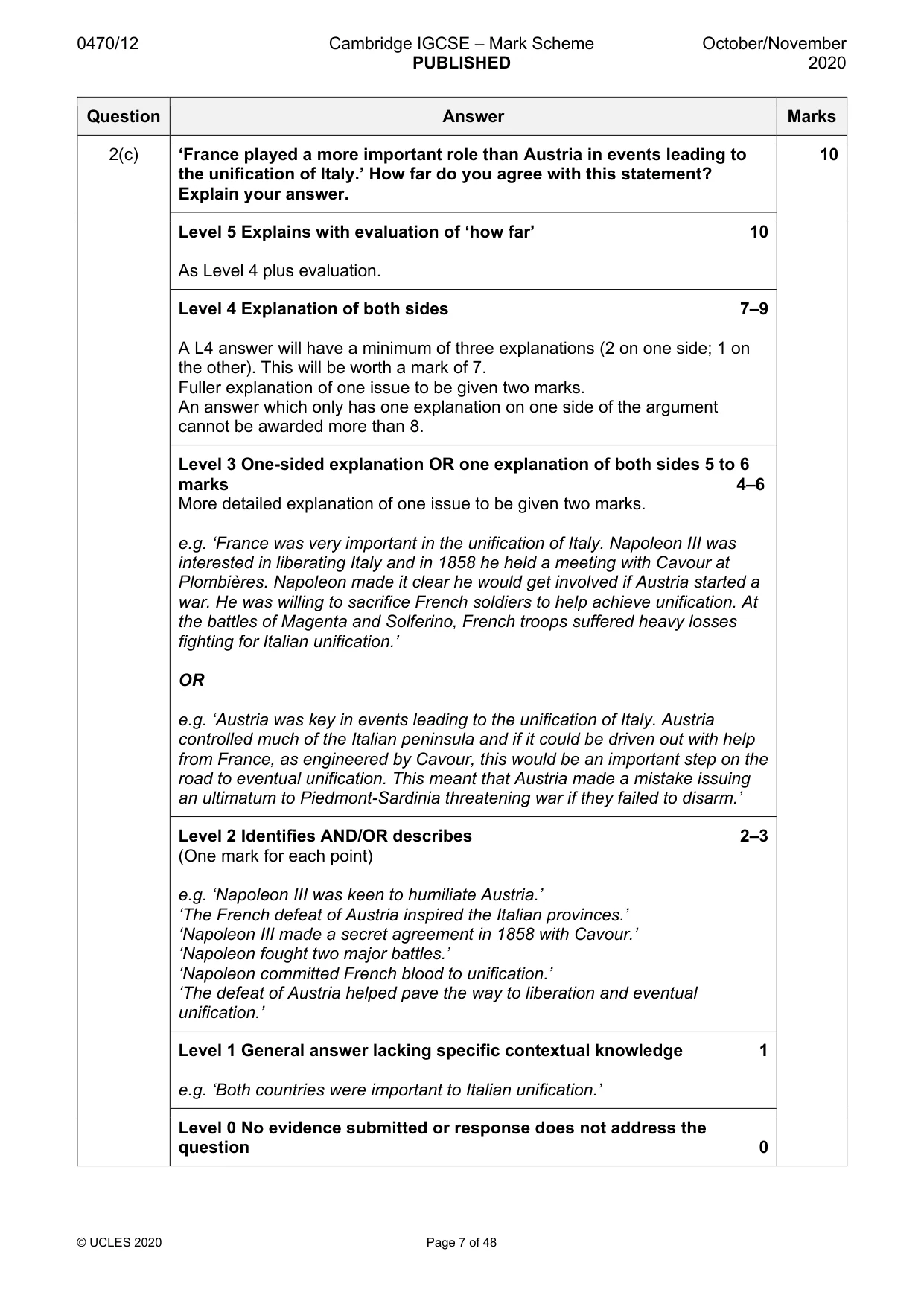
0470/12 Cambridge IGCSE – Mark Scheme PUBLISHED October/November 2020 © UCLES 2020 Page 7 of 48 Question Answer Marks 2(c) ‘France played a more important role than Austria in events leading to the unification of Italy.’ How far do you agree with this statement? Explain your answer. 10 Level 5 Explains with evaluation of ‘how far’ 10 As Level 4 plus evaluation. Level 4 Explanation of both sides 7–9 A L4 answer will have a minimum of three explanations (2 on one side; 1 on the other). This will be worth a mark of 7. Fuller explanation of one issue to be given two marks. An answer which only has one explanation on one side of the argument cannot be awarded more than 8. Level 3 One-sided explanation OR one explanation of both sides 5 to 6 marks 4–6 More detailed explanation of one issue to be given two marks. e.g. ‘France was very important in the unification of Italy. Napoleon III was interested in liberating Italy and in 1858 he held a meeting with Cavour at Plombières. Napoleon made it clear he would get involved if Austria started a war. He was willing to sacrifice French soldiers to help achieve unification. At the battles of Magenta and Solferino, French troops suffered heavy losses fighting for Italian unification.’ OR e.g. ‘Austria was key in events leading to the unification of Italy. Austria controlled much of the Italian peninsula and if it could be driven out with help from France, as engineered by Cavour, this would be an important step on the road to eventual unification. This meant that Austria made a mistake issuing an ultimatum to Piedmont-Sardinia threatening war if they failed to disarm.’ Level 2 Identifies AND/OR describes 2–3 (One mark for each point) e.g. ‘Napoleon III was keen to humiliate Austria.’ ‘The French defeat of Austria inspired the Italian provinces.’ ‘Napoleon III made a secret agreement in 1858 with Cavour.’ ‘Napoleon fought two major battles.’ ‘Napoleon committed French blood to unification.’ ‘The defeat of Austria helped pave the way to liberation and eventual unification.’ Level 1 General answer lacking specific contextual knowledge 1 e.g. ‘Both countries were important to Italian unification.’ Level 0 No evidence submitted or response does not address the question 0
Mark scheme, page 8
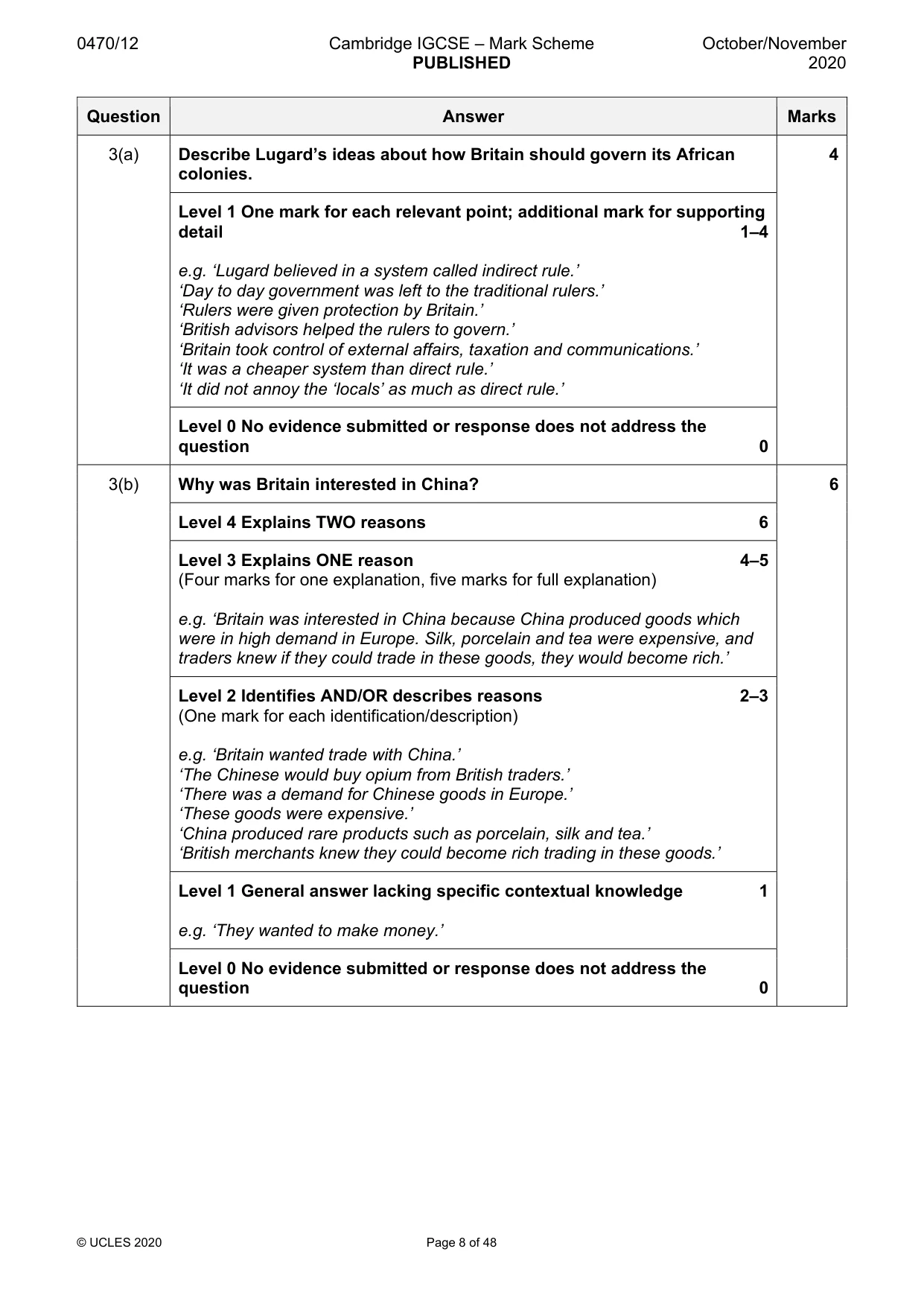
0470/12 Cambridge IGCSE – Mark Scheme PUBLISHED October/November 2020 © UCLES 2020 Page 8 of 48 Question Answer Marks 3(a) Describe Lugard’s ideas about how Britain should govern its African colonies. 4 Level 1 One mark for each relevant point; additional mark for supporting detail 1–4 e.g. ‘Lugard believed in a system called indirect rule.’ ‘Day to day government was left to the traditional rulers.’ ‘Rulers were given protection by Britain.’ ‘British advisors helped the rulers to govern.’ ‘Britain took control of external affairs, taxation and communications.’ ‘It was a cheaper system than direct rule.’ ‘It did not annoy the ‘locals’ as much as direct rule.’ Level 0 No evidence submitted or response does not address the question 0 3(b) Why was Britain interested in China? 6 Level 4 Explains TWO reasons 6 Level 3 Explains ONE reason 4–5 (Four marks for one explanation, five marks for full explanation) e.g. ‘Britain was interested in China because China produced goods which were in high demand in Europe. Silk, porcelain and tea were expensive, and traders knew if they could trade in these goods, they would become rich.’ Level 2 Identifies AND/OR describes reasons 2–3 (One mark for each identification/description) e.g. ‘Britain wanted trade with China.’ ‘The Chinese would buy opium from British traders.’ ‘There was a demand for Chinese goods in Europe.’ ‘These goods were expensive.’ ‘China produced rare products such as porcelain, silk and tea.’ ‘British merchants knew they could become rich trading in these goods.’ Level 1 General answer lacking specific contextual knowledge 1 e.g. ‘They wanted to make money.’ Level 0 No evidence submitted or response does not address the question 0
Mark scheme, page 9
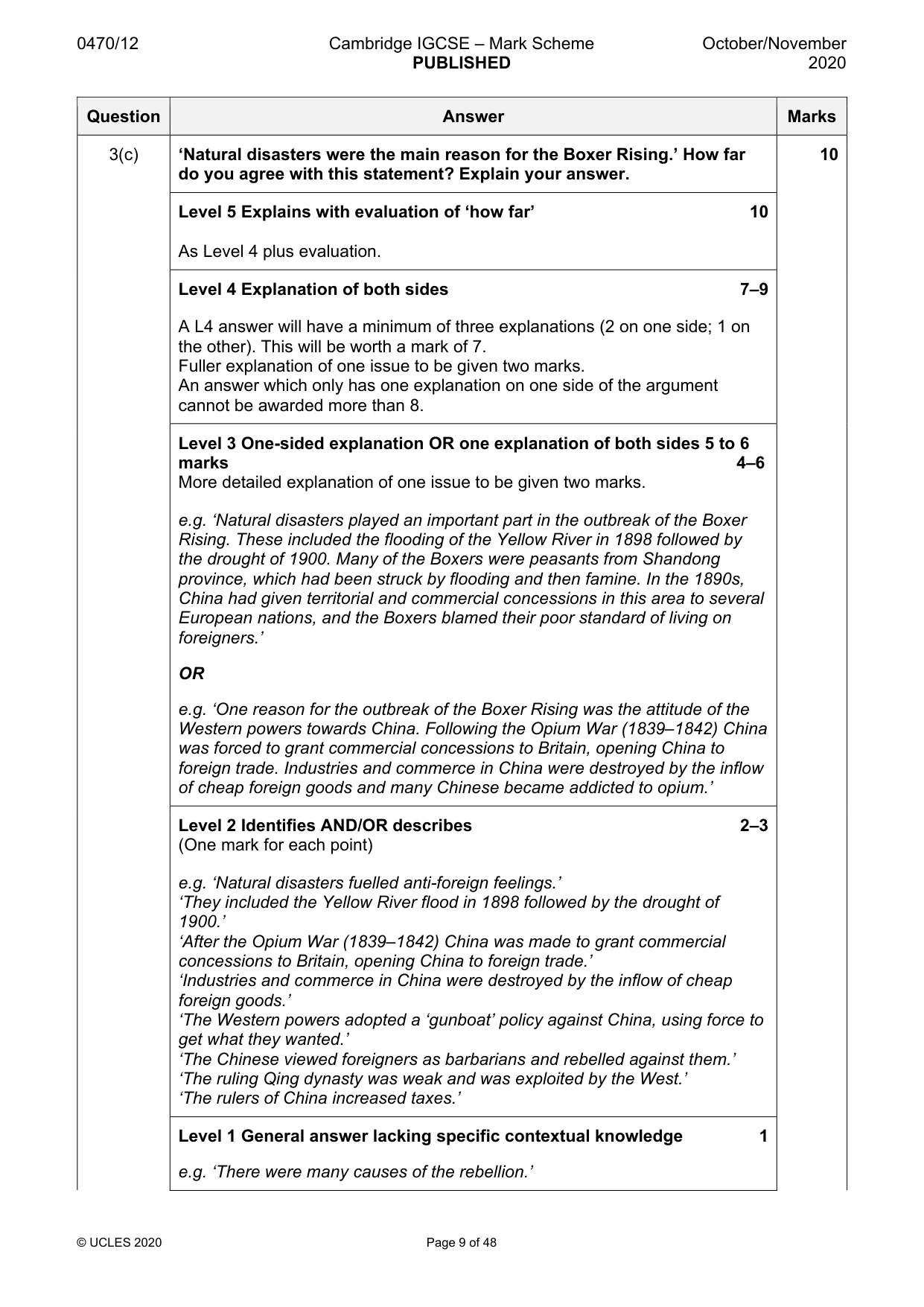
0470/12 Cambridge IGCSE – Mark Scheme PUBLISHED October/November 2020 © UCLES 2020 Page 9 of 48 Question Answer Marks 3(c) ‘Natural disasters were the main reason for the Boxer Rising.’ How far do you agree with this statement? Explain your answer. 10 Level 5 Explains with evaluation of ‘how far’ 10 As Level 4 plus evaluation. Level 4 Explanation of both sides 7–9 A L4 answer will have a minimum of three explanations (2 on one side; 1 on the other). This will be worth a mark of 7. Fuller explanation of one issue to be given two marks. An answer which only has one explanation on one side of the argument cannot be awarded more than 8. Level 3 One-sided explanation OR one explanation of both sides 5 to 6 marks 4–6 More detailed explanation of one issue to be given two marks. e.g. ‘Natural disasters played an important part in the outbreak of the Boxer Rising. These included the flooding of the Yellow River in 1898 followed by the drought of 1900. Many of the Boxers were peasants from Shandong province, which had been struck by flooding and then famine. In the 1890s, China had given territorial and commercial concessions in this area to several European nations, and the Boxers blamed their poor standard of living on foreigners.’ OR e.g. ‘One reason for the outbreak of the Boxer Rising was the attitude of the Western powers towards China. Following the Opium War (1839–1842) China was forced to grant commercial concessions to Britain, opening China to foreign trade. Industries and commerce in China were destroyed by the inflow of cheap foreign goods and many Chinese became addicted to opium.’ Level 2 Identifies AND/OR describes 2–3 (One mark for each point) e.g. ‘Natural disasters fuelled anti-foreign feelings.’ ‘They included the Yellow River flood in 1898 followed by the drought of 1900.’ ‘After the Opium War (1839–1842) China was made to grant commercial concessions to Britain, opening China to foreign trade.’ ‘Industries and commerce in China were destroyed by the inflow of cheap foreign goods.’ ‘The Western powers adopted a ‘gunboat’ policy against China, using force to get what they wanted.’ ‘The Chinese viewed foreigners as barbarians and rebelled against them.’ ‘The ruling Qing dynasty was weak and was exploited by the West.’ ‘The rulers of China increased taxes.’ Level 1 General answer lacking specific contextual knowledge 1 e.g. ‘There were many causes of the rebellion.’
Mark scheme, page 10
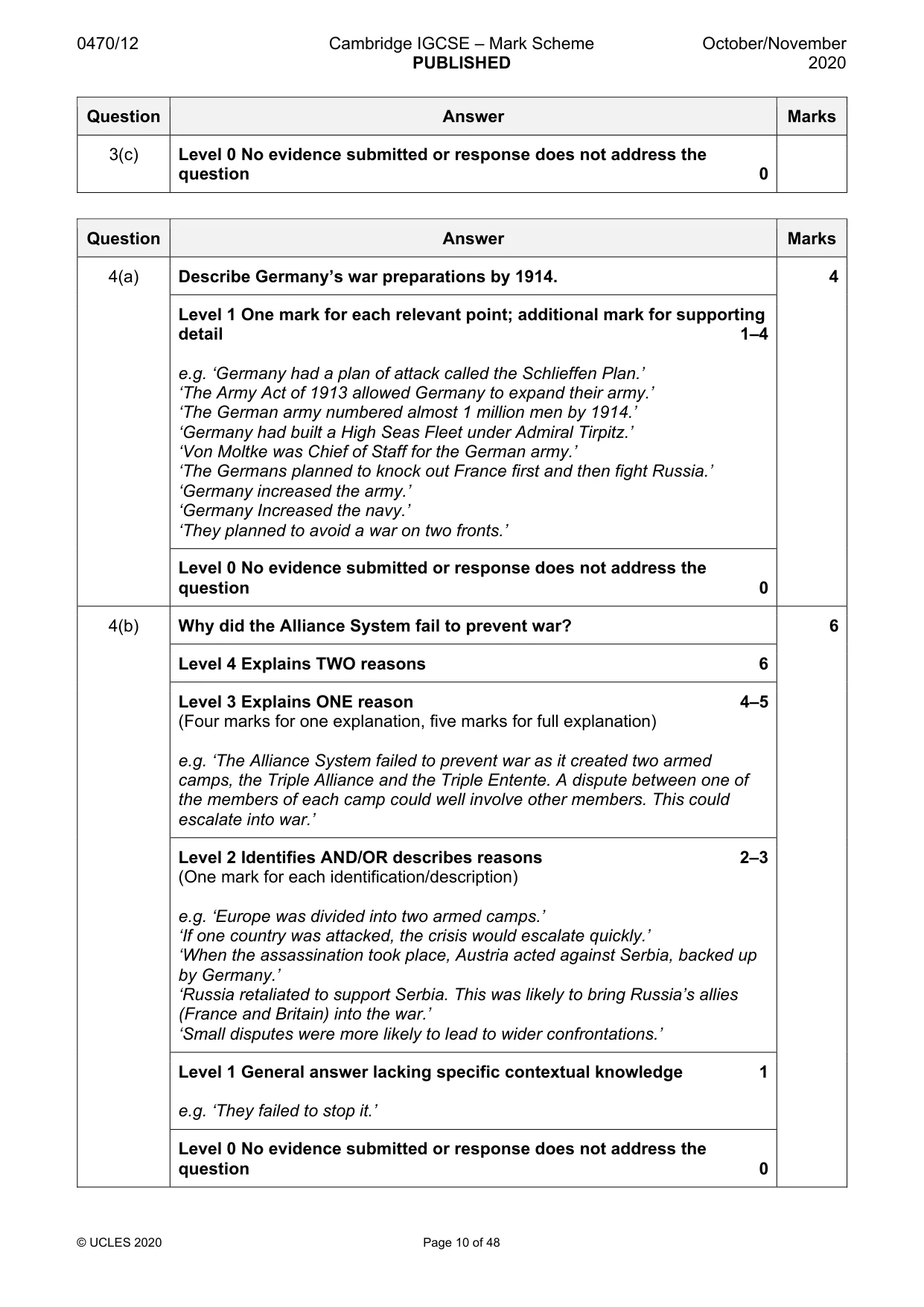
0470/12 Cambridge IGCSE – Mark Scheme PUBLISHED October/November 2020 © UCLES 2020 Page 10 of 48 Question Answer Marks 3(c) Level 0 No evidence submitted or response does not address the question 0 Question Answer Marks 4(a) Describe Germany’s war preparations by 1914. 4 Level 1 One mark for each relevant point; additional mark for supporting detail 1–4 e.g. ‘Germany had a plan of attack called the Schlieffen Plan.’ ‘The Army Act of 1913 allowed Germany to expand their army.’ ‘The German army numbered almost 1 million men by 1914.’ ‘Germany had built a High Seas Fleet under Admiral Tirpitz.’ ‘Von Moltke was Chief of Staff for the German army.’ ‘The Germans planned to knock out France first and then fight Russia.’ ‘Germany increased the army.’ ‘Germany Increased the navy.’ ‘They planned to avoid a war on two fronts.’ Level 0 No evidence submitted or response does not address the question 0 4(b) Why did the Alliance System fail to prevent war? 6 Level 4 Explains TWO reasons 6 Level 3 Explains ONE reason 4–5 (Four marks for one explanation, five marks for full explanation) e.g. ‘The Alliance System failed to prevent war as it created two armed camps, the Triple Alliance and the Triple Entente. A dispute between one of the members of each camp could well involve other members. This could escalate into war.’ Level 2 Identifies AND/OR describes reasons 2–3 (One mark for each identification/description) e.g. ‘Europe was divided into two armed camps.’ ‘If one country was attacked, the crisis would escalate quickly.’ ‘When the assassination took place, Austria acted against Serbia, backed up by Germany.’ ‘Russia retaliated to support Serbia. This was likely to bring Russia’s allies (France and Britain) into the war.’ ‘Small disputes were more likely to lead to wider confrontations.’ Level 1 General answer lacking specific contextual knowledge 1 e.g. ‘They failed to stop it.’ Level 0 No evidence submitted or response does not address the question 0
Mark scheme, page 11
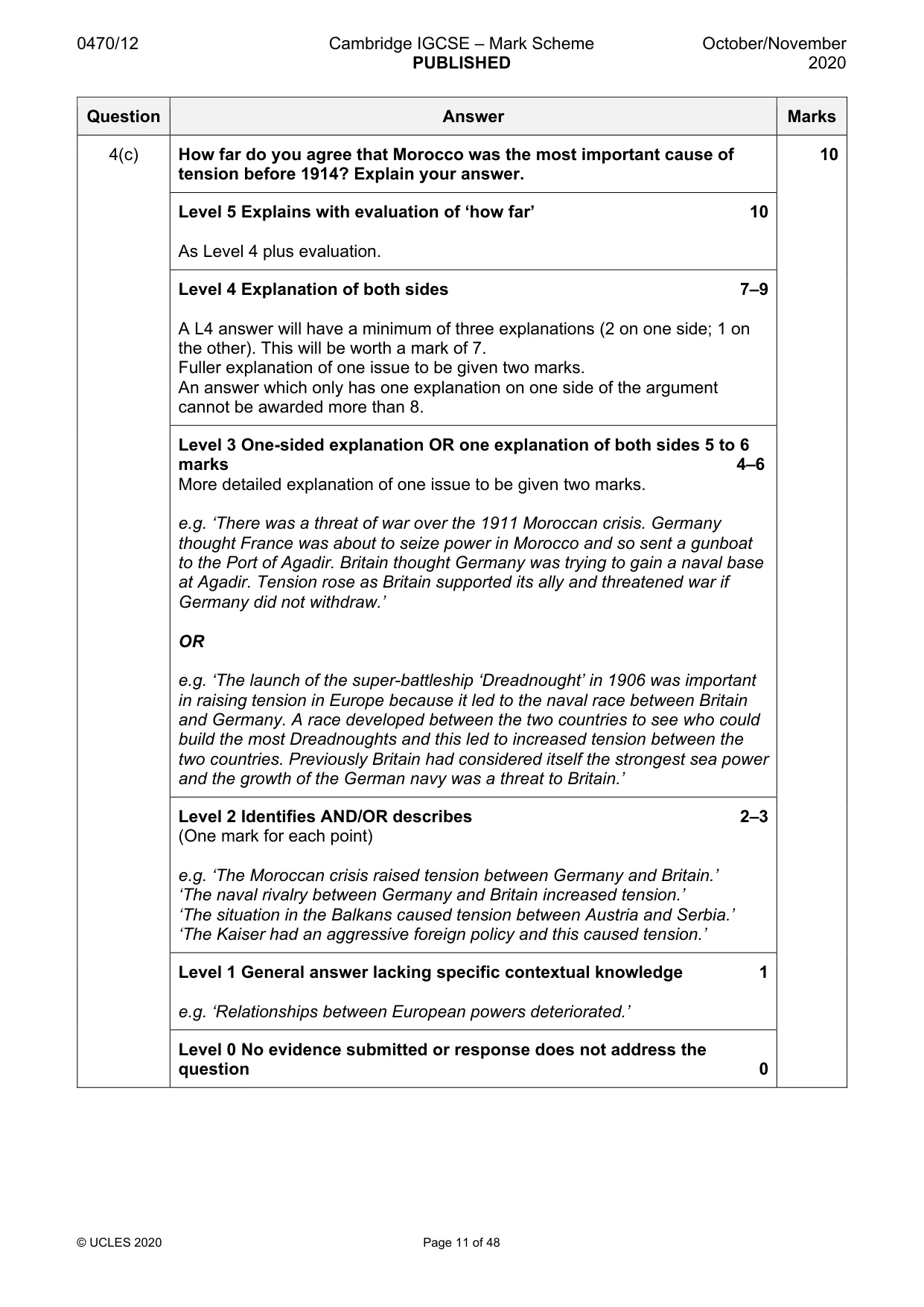
0470/12 Cambridge IGCSE – Mark Scheme PUBLISHED October/November 2020 © UCLES 2020 Page 11 of 48 Question Answer Marks 4(c) How far do you agree that Morocco was the most important cause of tension before 1914? Explain your answer. 10 Level 5 Explains with evaluation of ‘how far’ 10 As Level 4 plus evaluation. Level 4 Explanation of both sides 7–9 A L4 answer will have a minimum of three explanations (2 on one side; 1 on the other). This will be worth a mark of 7. Fuller explanation of one issue to be given two marks. An answer which only has one explanation on one side of the argument cannot be awarded more than 8. Level 3 One-sided explanation OR one explanation of both sides 5 to 6 marks 4–6 More detailed explanation of one issue to be given two marks. e.g. ‘There was a threat of war over the 1911 Moroccan crisis. Germany thought France was about to seize power in Morocco and so sent a gunboat to the Port of Agadir. Britain thought Germany was trying to gain a naval base at Agadir. Tension rose as Britain supported its ally and threatened war if Germany did not withdraw.’ OR e.g. ‘The launch of the super-battleship ‘Dreadnought’ in 1906 was important in raising tension in Europe because it led to the naval race between Britain and Germany. A race developed between the two countries to see who could build the most Dreadnoughts and this led to increased tension between the two countries. Previously Britain had considered itself the strongest sea power and the growth of the German navy was a threat to Britain.’ Level 2 Identifies AND/OR describes 2–3 (One mark for each point) e.g. ‘The Moroccan crisis raised tension between Germany and Britain.’ ‘The naval rivalry between Germany and Britain increased tension.’ ‘The situation in the Balkans caused tension between Austria and Serbia.’ ‘The Kaiser had an aggressive foreign policy and this caused tension.’ Level 1 General answer lacking specific contextual knowledge 1 e.g. ‘Relationships between European powers deteriorated.’ Level 0 No evidence submitted or response does not address the question 0
Mark scheme, page 12
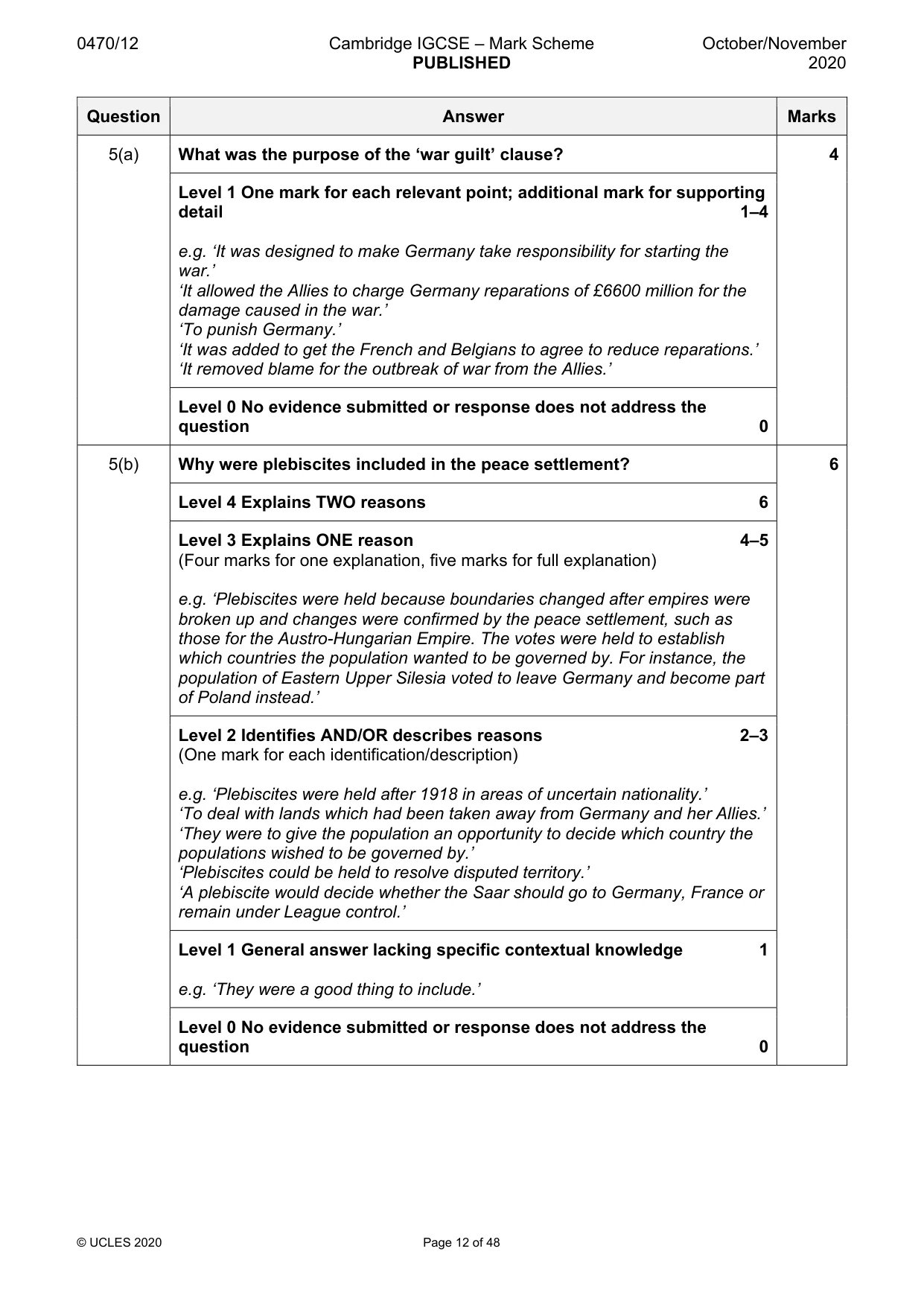
0470/12 Cambridge IGCSE – Mark Scheme PUBLISHED October/November 2020 © UCLES 2020 Page 12 of 48 Question Answer Marks 5(a) What was the purpose of the ‘war guilt’ clause? 4 Level 1 One mark for each relevant point; additional mark for supporting detail 1–4 e.g. ‘It was designed to make Germany take responsibility for starting the war.’ ‘It allowed the Allies to charge Germany reparations of £6600 million for the damage caused in the war.’ ‘To punish Germany.’ ‘It was added to get the French and Belgians to agree to reduce reparations.’ ‘It removed blame for the outbreak of war from the Allies.’ Level 0 No evidence submitted or response does not address the question 0 5(b) Why were plebiscites included in the peace settlement? 6 Level 4 Explains TWO reasons 6 Level 3 Explains ONE reason 4–5 (Four marks for one explanation, five marks for full explanation) e.g. ‘Plebiscites were held because boundaries changed after empires were broken up and changes were confirmed by the peace settlement, such as those for the Austro-Hungarian Empire. The votes were held to establish which countries the population wanted to be governed by. For instance, the population of Eastern Upper Silesia voted to leave Germany and become part of Poland instead.’ Level 2 Identifies AND/OR describes reasons 2–3 (One mark for each identification/description) e.g. ‘Plebiscites were held after 1918 in areas of uncertain nationality.’ ‘To deal with lands which had been taken away from Germany and her Allies.’ ‘They were to give the population an opportunity to decide which country the populations wished to be governed by.’ ‘Plebiscites could be held to resolve disputed territory.’ ‘A plebiscite would decide whether the Saar should go to Germany, France or remain under League control.’ Level 1 General answer lacking specific contextual knowledge 1 e.g. ‘They were a good thing to include.’ Level 0 No evidence submitted or response does not address the question 0
Mark scheme, page 13
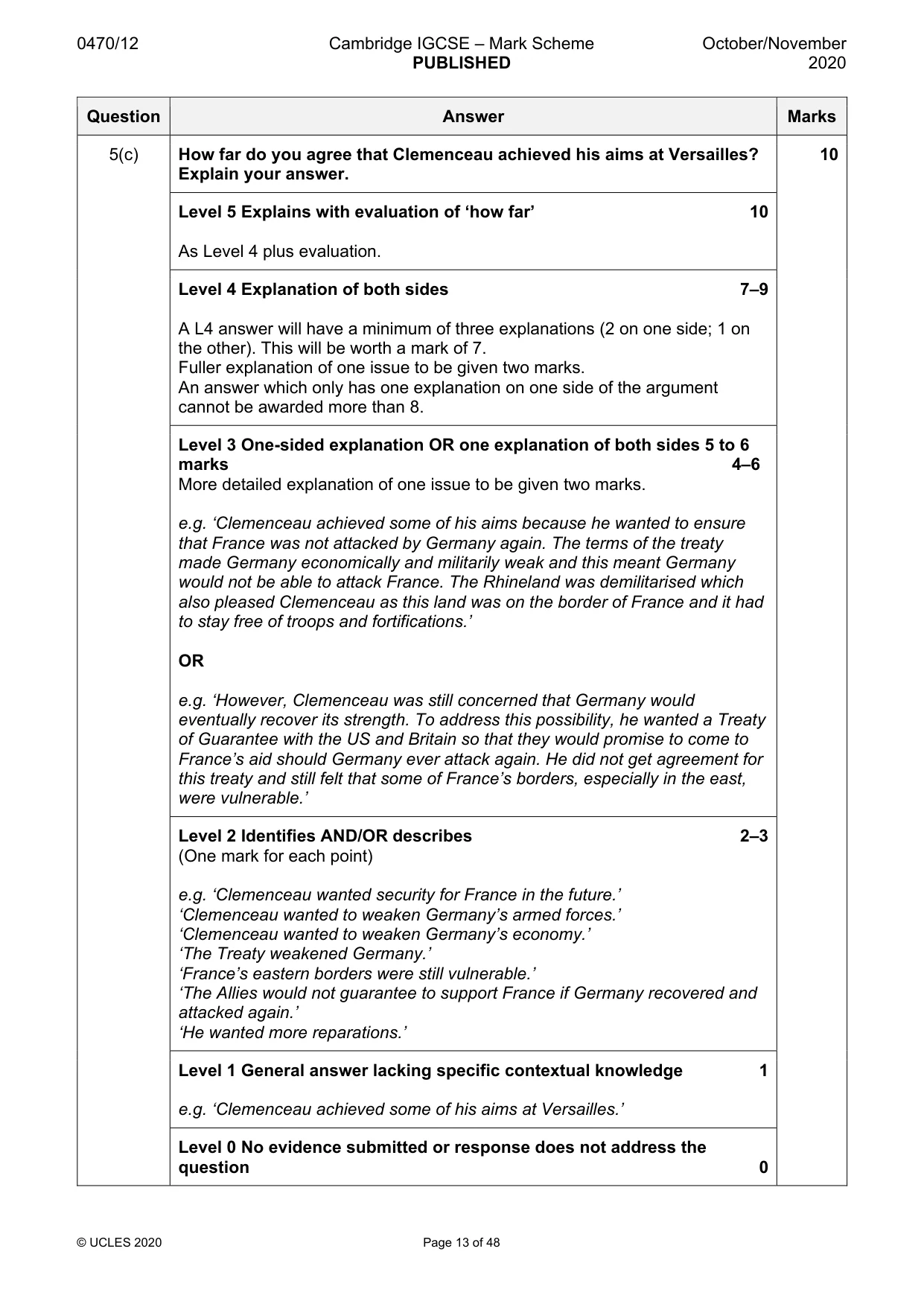
0470/12 Cambridge IGCSE – Mark Scheme PUBLISHED October/November 2020 © UCLES 2020 Page 13 of 48 Question Answer Marks 5(c) How far do you agree that Clemenceau achieved his aims at Versailles? Explain your answer. 10 Level 5 Explains with evaluation of ‘how far’ 10 As Level 4 plus evaluation. Level 4 Explanation of both sides 7–9 A L4 answer will have a minimum of three explanations (2 on one side; 1 on the other). This will be worth a mark of 7. Fuller explanation of one issue to be given two marks. An answer which only has one explanation on one side of the argument cannot be awarded more than 8. Level 3 One-sided explanation OR one explanation of both sides 5 to 6 marks 4–6 More detailed explanation of one issue to be given two marks. e.g. ‘Clemenceau achieved some of his aims because he wanted to ensure that France was not attacked by Germany again. The terms of the treaty made Germany economically and militarily weak and this meant Germany would not be able to attack France. The Rhineland was demilitarised which also pleased Clemenceau as this land was on the border of France and it had to stay free of troops and fortifications.’ OR e.g. ‘However, Clemenceau was still concerned that Germany would eventually recover its strength. To address this possibility, he wanted a Treaty of Guarantee with the US and Britain so that they would promise to come to France’s aid should Germany ever attack again. He did not get agreement for this treaty and still felt that some of France’s borders, especially in the east, were vulnerable.’ Level 2 Identifies AND/OR describes 2–3 (One mark for each point) e.g. ‘Clemenceau wanted security for France in the future.’ ‘Clemenceau wanted to weaken Germany’s armed forces.’ ‘Clemenceau wanted to weaken Germany’s economy.’ ‘The Treaty weakened Germany.’ ‘France’s eastern borders were still vulnerable.’ ‘The Allies would not guarantee to support France if Germany recovered and attacked again.’ ‘He wanted more reparations.’ Level 1 General answer lacking specific contextual knowledge 1 e.g. ‘Clemenceau achieved some of his aims at Versailles.’ Level 0 No evidence submitted or response does not address the question 0
Mark scheme, page 14
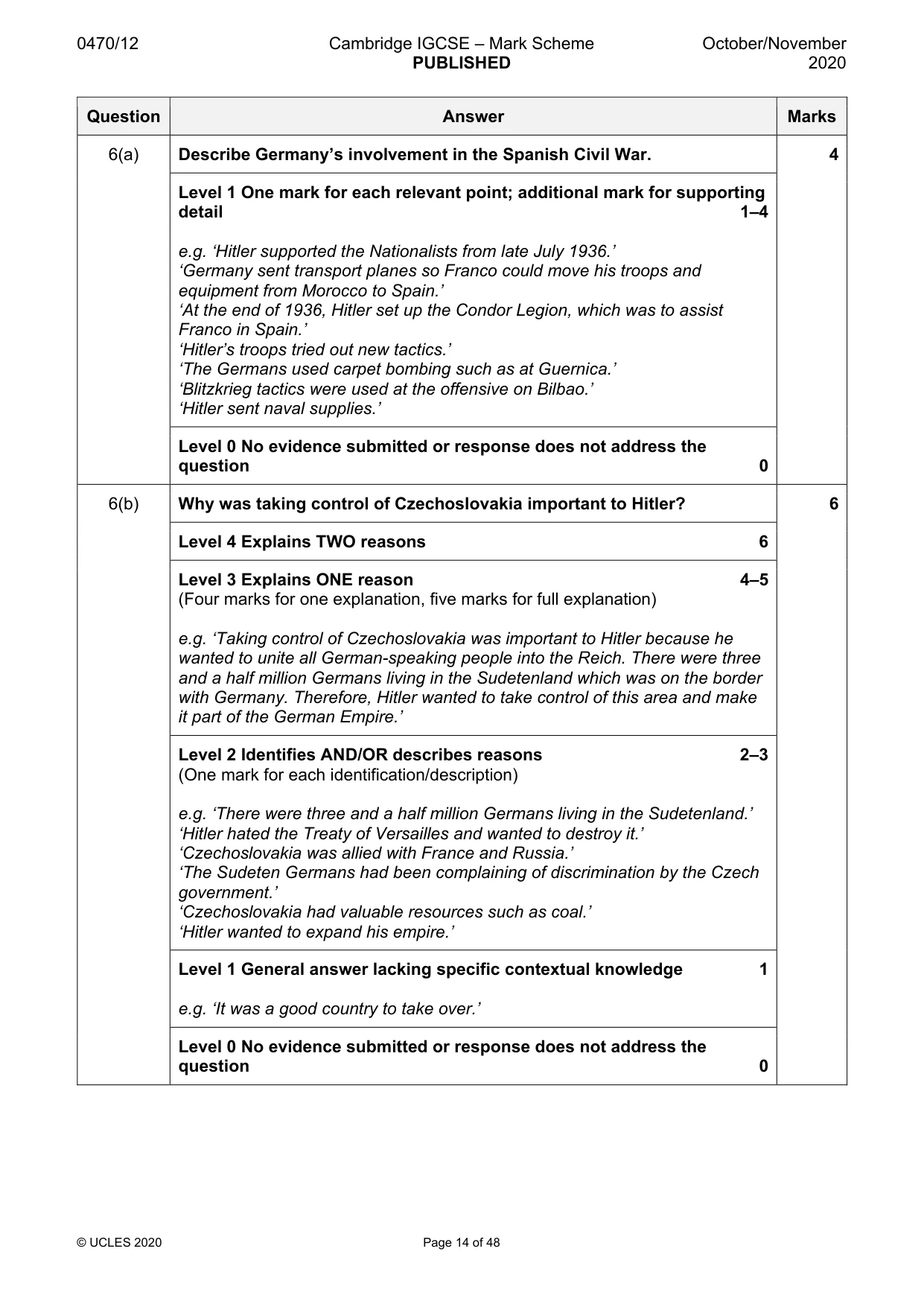
0470/12 Cambridge IGCSE – Mark Scheme PUBLISHED October/November 2020 © UCLES 2020 Page 14 of 48 Question Answer Marks 6(a) Describe Germany’s involvement in the Spanish Civil War. 4 Level 1 One mark for each relevant point; additional mark for supporting detail 1–4 e.g. ‘Hitler supported the Nationalists from late July 1936.’ ‘Germany sent transport planes so Franco could move his troops and equipment from Morocco to Spain.’ ‘At the end of 1936, Hitler set up the Condor Legion, which was to assist Franco in Spain.’ ‘Hitler’s troops tried out new tactics.’ ‘The Germans used carpet bombing such as at Guernica.’ ‘Blitzkrieg tactics were used at the offensive on Bilbao.’ ‘Hitler sent naval supplies.’ Level 0 No evidence submitted or response does not address the question 0 6(b) Why was taking control of Czechoslovakia important to Hitler? 6 Level 4 Explains TWO reasons 6 Level 3 Explains ONE reason 4–5 (Four marks for one explanation, five marks for full explanation) e.g. ‘Taking control of Czechoslovakia was important to Hitler because he wanted to unite all German-speaking people into the Reich. There were three and a half million Germans living in the Sudetenland which was on the border with Germany. Therefore, Hitler wanted to take control of this area and make it part of the German Empire.’ Level 2 Identifies AND/OR describes reasons 2–3 (One mark for each identification/description) e.g. ‘There were three and a half million Germans living in the Sudetenland.’ ‘Hitler hated the Treaty of Versailles and wanted to destroy it.’ ‘Czechoslovakia was allied with France and Russia.’ ‘The Sudeten Germans had been complaining of discrimination by the Czech government.’ ‘Czechoslovakia had valuable resources such as coal.’ ‘Hitler wanted to expand his empire.’ Level 1 General answer lacking specific contextual knowledge 1 e.g. ‘It was a good country to take over.’ Level 0 No evidence submitted or response does not address the question 0
Mark scheme, page 15
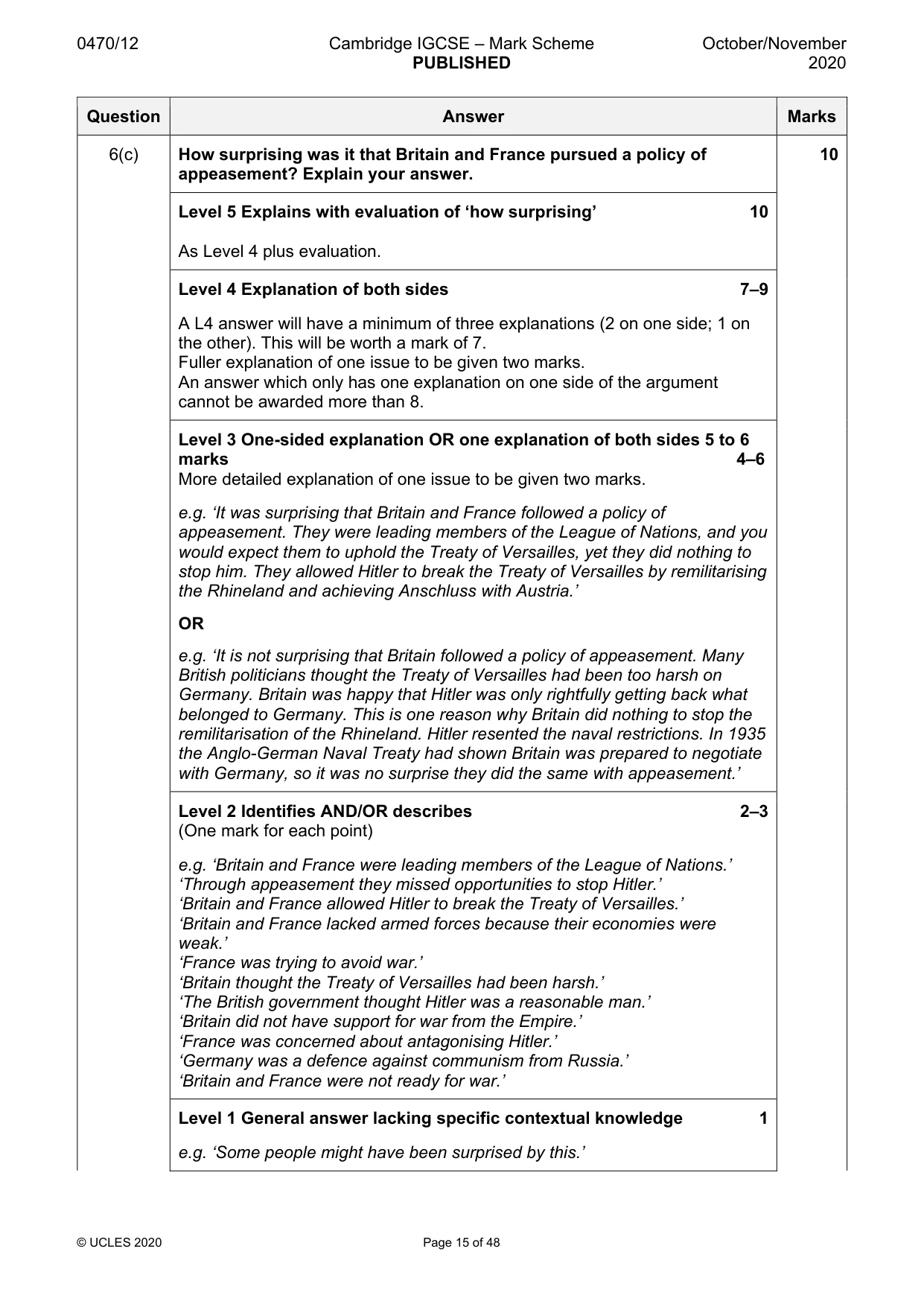
0470/12 Cambridge IGCSE – Mark Scheme PUBLISHED October/November 2020 © UCLES 2020 Page 15 of 48 Question Answer Marks 6(c) How surprising was it that Britain and France pursued a policy of appeasement? Explain your answer. 10 Level 5 Explains with evaluation of ‘how surprising’ 10 As Level 4 plus evaluation. Level 4 Explanation of both sides 7–9 A L4 answer will have a minimum of three explanations (2 on one side; 1 on the other). This will be worth a mark of 7. Fuller explanation of one issue to be given two marks. An answer which only has one explanation on one side of the argument cannot be awarded more than 8. Level 3 One-sided explanation OR one explanation of both sides 5 to 6 marks 4–6 More detailed explanation of one issue to be given two marks. e.g. ‘It was surprising that Britain and France followed a policy of appeasement. They were leading members of the League of Nations, and you would expect them to uphold the Treaty of Versailles, yet they did nothing to stop him. They allowed Hitler to break the Treaty of Versailles by remilitarising the Rhineland and achieving Anschluss with Austria.’ OR e.g. ‘It is not surprising that Britain followed a policy of appeasement. Many British politicians thought the Treaty of Versailles had been too harsh on Germany. Britain was happy that Hitler was only rightfully getting back what belonged to Germany. This is one reason why Britain did nothing to stop the remilitarisation of the Rhineland. Hitler resented the naval restrictions. In 1935 the Anglo-German Naval Treaty had shown Britain was prepared to negotiate with Germany, so it was no surprise they did the same with appeasement.’ Level 2 Identifies AND/OR describes 2–3 (One mark for each point) e.g. ‘Britain and France were leading members of the League of Nations.’ ‘Through appeasement they missed opportunities to stop Hitler.’ ‘Britain and France allowed Hitler to break the Treaty of Versailles.’ ‘Britain and France lacked armed forces because their economies were weak.’ ‘France was trying to avoid war.’ ‘Britain thought the Treaty of Versailles had been harsh.’ ‘The British government thought Hitler was a reasonable man.’ ‘Britain did not have support for war from the Empire.’ ‘France was concerned about antagonising Hitler.’ ‘Germany was a defence against communism from Russia.’ ‘Britain and France were not ready for war.’ Level 1 General answer lacking specific contextual knowledge 1 e.g. ‘Some people might have been surprised by this.’
Mark scheme, page 16
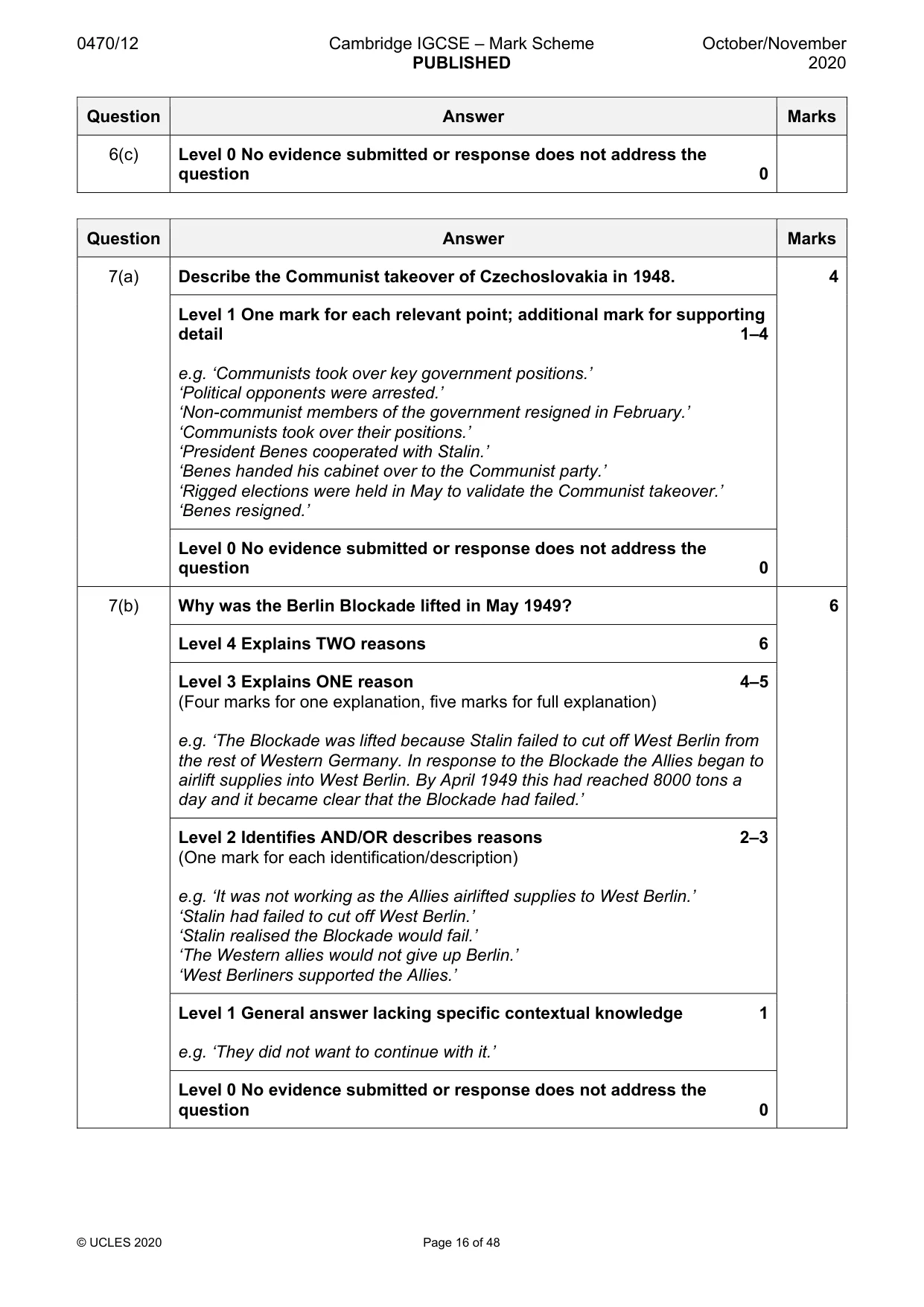
0470/12 Cambridge IGCSE – Mark Scheme PUBLISHED October/November 2020 © UCLES 2020 Page 16 of 48 Question Answer Marks 6(c) Level 0 No evidence submitted or response does not address the question 0 Question Answer Marks 7(a) Describe the Communist takeover of Czechoslovakia in 1948. 4 Level 1 One mark for each relevant point; additional mark for supporting detail 1–4 e.g. ‘Communists took over key government positions.’ ‘Political opponents were arrested.’ ‘Non-communist members of the government resigned in February.’ ‘Communists took over their positions.’ ‘President Benes cooperated with Stalin.’ ‘Benes handed his cabinet over to the Communist party.’ ‘Rigged elections were held in May to validate the Communist takeover.’ ‘Benes resigned.’ Level 0 No evidence submitted or response does not address the question 0 7(b) Why was the Berlin Blockade lifted in May 1949? 6 Level 4 Explains TWO reasons 6 Level 3 Explains ONE reason 4–5 (Four marks for one explanation, five marks for full explanation) e.g. ‘The Blockade was lifted because Stalin failed to cut off West Berlin from the rest of Western Germany. In response to the Blockade the Allies began to airlift supplies into West Berlin. By April 1949 this had reached 8000 tons a day and it became clear that the Blockade had failed.’ Level 2 Identifies AND/OR describes reasons 2–3 (One mark for each identification/description) e.g. ‘It was not working as the Allies airlifted supplies to West Berlin.’ ‘Stalin had failed to cut off West Berlin.’ ‘Stalin realised the Blockade would fail.’ ‘The Western allies would not give up Berlin.’ ‘West Berliners supported the Allies.’ Level 1 General answer lacking specific contextual knowledge 1 e.g. ‘They did not want to continue with it.’ Level 0 No evidence submitted or response does not address the question 0
Mark scheme, page 17
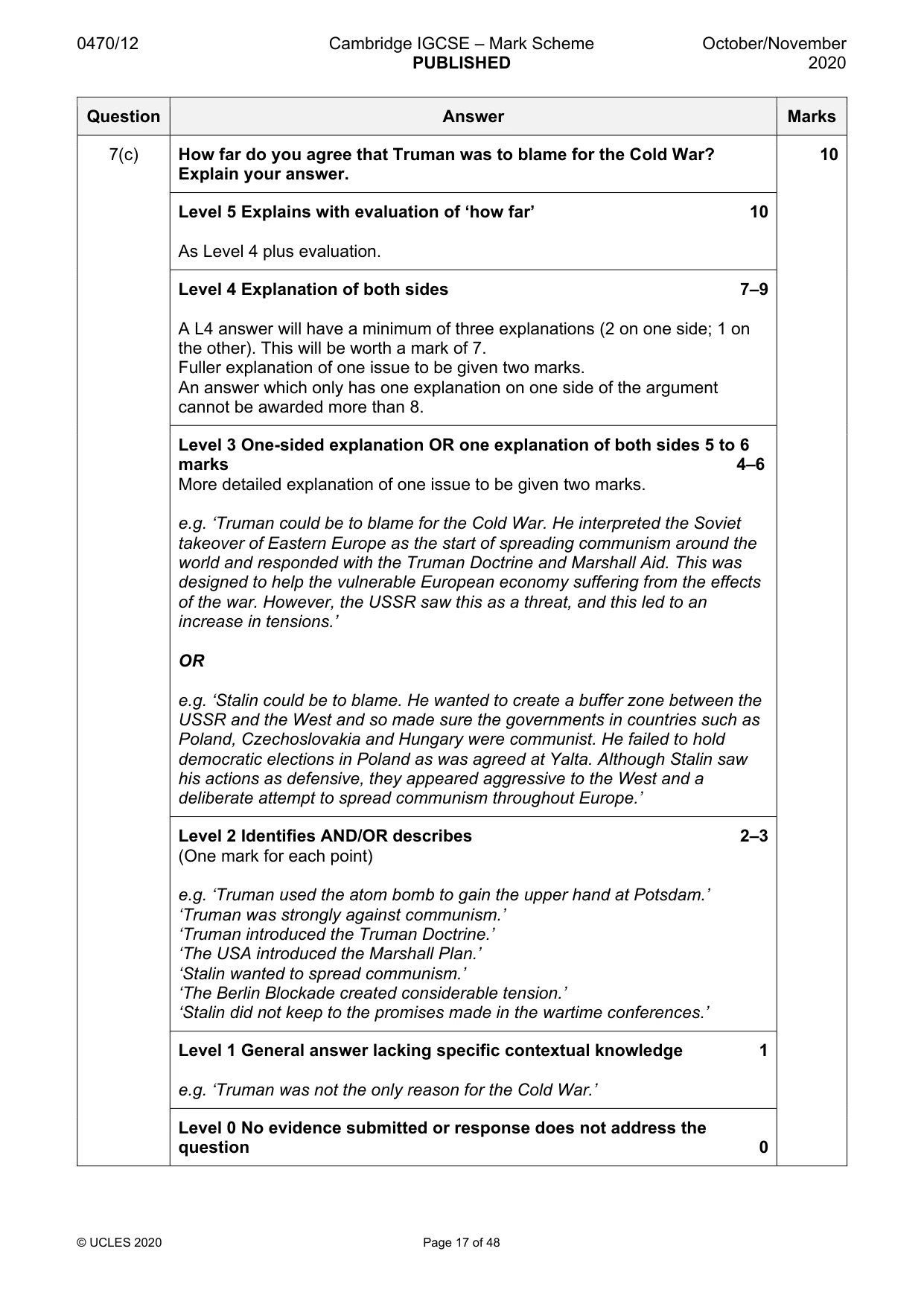
0470/12 Cambridge IGCSE – Mark Scheme PUBLISHED October/November 2020 © UCLES 2020 Page 17 of 48 Question Answer Marks 7(c) How far do you agree that Truman was to blame for the Cold War? Explain your answer. 10 Level 5 Explains with evaluation of ‘how far’ 10 As Level 4 plus evaluation. Level 4 Explanation of both sides 7–9 A L4 answer will have a minimum of three explanations (2 on one side; 1 on the other). This will be worth a mark of 7. Fuller explanation of one issue to be given two marks. An answer which only has one explanation on one side of the argument cannot be awarded more than 8. Level 3 One-sided explanation OR one explanation of both sides 5 to 6 marks 4–6 More detailed explanation of one issue to be given two marks. e.g. ‘Truman could be to blame for the Cold War. He interpreted the Soviet takeover of Eastern Europe as the start of spreading communism around the world and responded with the Truman Doctrine and Marshall Aid. This was designed to help the vulnerable European economy suffering from the effects of the war. However, the USSR saw this as a threat, and this led to an increase in tensions.’ OR e.g. ‘Stalin could be to blame. He wanted to create a buffer zone between the USSR and the West and so made sure the governments in countries such as Poland, Czechoslovakia and Hungary were communist. He failed to hold democratic elections in Poland as was agreed at Yalta. Although Stalin saw his actions as defensive, they appeared aggressive to the West and a deliberate attempt to spread communism throughout Europe.’ Level 2 Identifies AND/OR describes 2–3 (One mark for each point) e.g. ‘Truman used the atom bomb to gain the upper hand at Potsdam.’ ‘Truman was strongly against communism.’ ‘Truman introduced the Truman Doctrine.’ ‘The USA introduced the Marshall Plan.’ ‘Stalin wanted to spread communism.’ ‘The Berlin Blockade created considerable tension.’ ‘Stalin did not keep to the promises made in the wartime conferences.’ Level 1 General answer lacking specific contextual knowledge 1 e.g. ‘Truman was not the only reason for the Cold War.’ Level 0 No evidence submitted or response does not address the question 0
Mark scheme, page 18
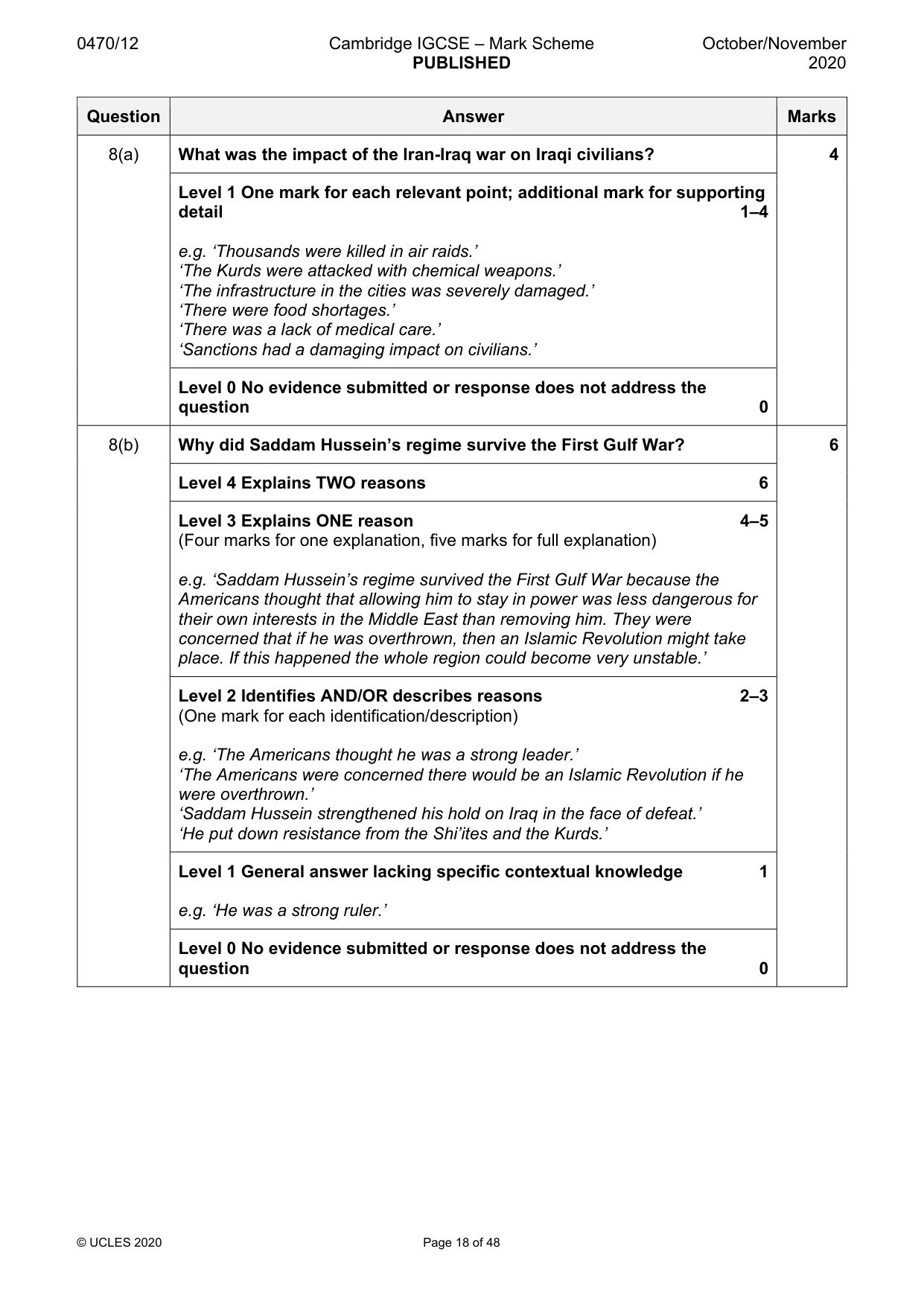
0470/12 Cambridge IGCSE – Mark Scheme PUBLISHED October/November 2020 © UCLES 2020 Page 18 of 48 Question Answer Marks 8(a) What was the impact of the Iran-Iraq war on Iraqi civilians? 4 Level 1 One mark for each relevant point; additional mark for supporting detail 1–4 e.g. ‘Thousands were killed in air raids.’ ‘The Kurds were attacked with chemical weapons.’ ‘The infrastructure in the cities was severely damaged.’ ‘There were food shortages.’ ‘There was a lack of medical care.’ ‘Sanctions had a damaging impact on civilians.’ Level 0 No evidence submitted or response does not address the question 0 8(b) Why did Saddam Hussein’s regime survive the First Gulf War? 6 Level 4 Explains TWO reasons 6 Level 3 Explains ONE reason 4–5 (Four marks for one explanation, five marks for full explanation) e.g. ‘Saddam Hussein’s regime survived the First Gulf War because the Americans thought that allowing him to stay in power was less dangerous for their own interests in the Middle East than removing him. They were concerned that if he was overthrown, then an Islamic Revolution might take place. If this happened the whole region could become very unstable.’ Level 2 Identifies AND/OR describes reasons 2–3 (One mark for each identification/description) e.g. ‘The Americans thought he was a strong leader.’ ‘The Americans were concerned there would be an Islamic Revolution if he were overthrown.’ ‘Saddam Hussein strengthened his hold on Iraq in the face of defeat.’ ‘He put down resistance from the Shi’ites and the Kurds.’ Level 1 General answer lacking specific contextual knowledge 1 e.g. ‘He was a strong ruler.’ Level 0 No evidence submitted or response does not address the question 0
Mark scheme, page 19
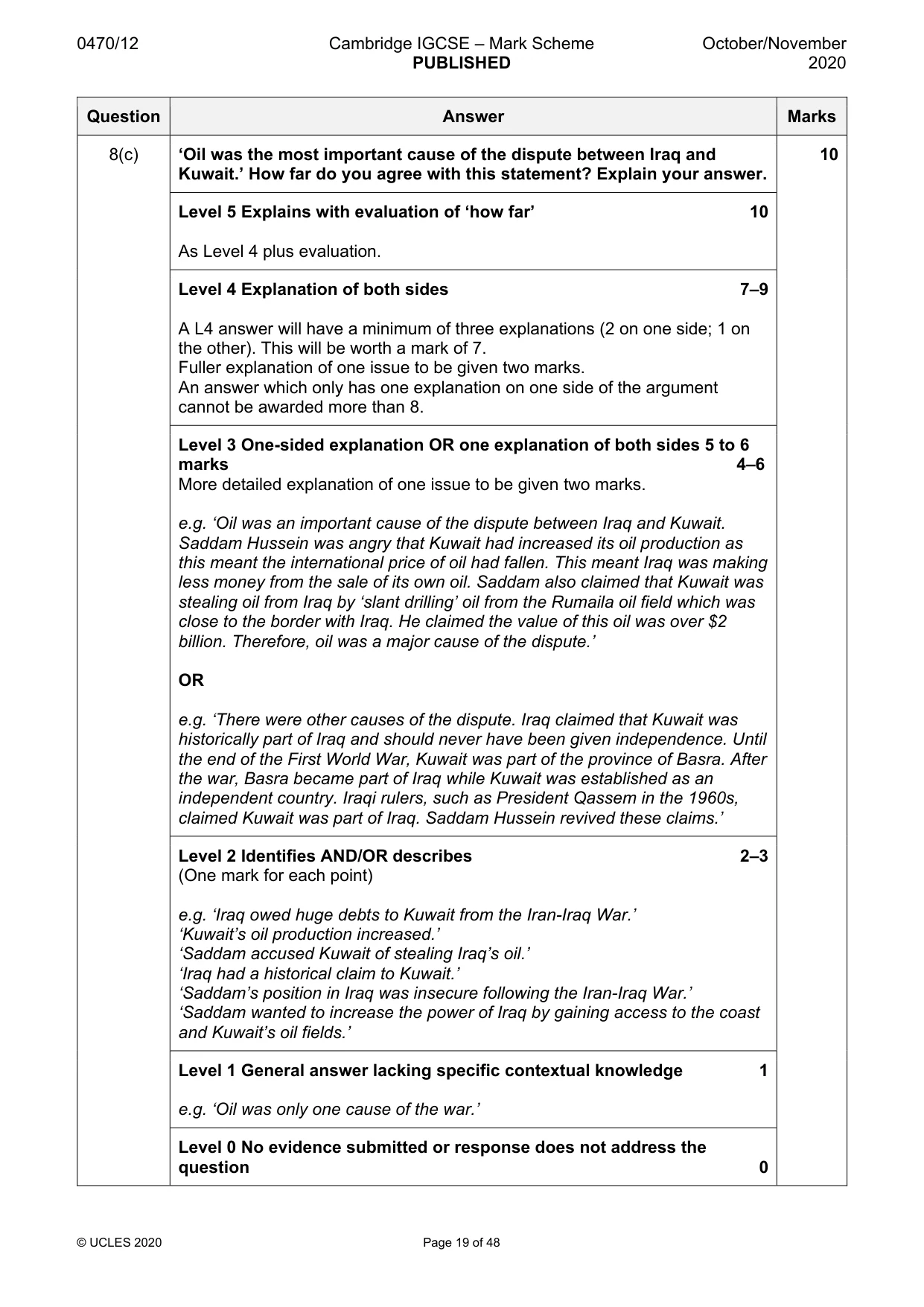
0470/12 Cambridge IGCSE – Mark Scheme PUBLISHED October/November 2020 © UCLES 2020 Page 19 of 48 Question Answer Marks 8(c) ‘Oil was the most important cause of the dispute between Iraq and Kuwait.’ How far do you agree with this statement? Explain your answer. 10 Level 5 Explains with evaluation of ‘how far’ 10 As Level 4 plus evaluation. Level 4 Explanation of both sides 7–9 A L4 answer will have a minimum of three explanations (2 on one side; 1 on the other). This will be worth a mark of 7. Fuller explanation of one issue to be given two marks. An answer which only has one explanation on one side of the argument cannot be awarded more than 8. Level 3 One-sided explanation OR one explanation of both sides 5 to 6 marks 4–6 More detailed explanation of one issue to be given two marks. e.g. ‘Oil was an important cause of the dispute between Iraq and Kuwait. Saddam Hussein was angry that Kuwait had increased its oil production as this meant the international price of oil had fallen. This meant Iraq was making less money from the sale of its own oil. Saddam also claimed that Kuwait was stealing oil from Iraq by ‘slant drilling’ oil from the Rumaila oil field which was close to the border with Iraq. He claimed the value of this oil was over $2 billion. Therefore, oil was a major cause of the dispute.’ OR e.g. ‘There were other causes of the dispute. Iraq claimed that Kuwait was historically part of Iraq and should never have been given independence. Until the end of the First World War, Kuwait was part of the province of Basra. After the war, Basra became part of Iraq while Kuwait was established as an independent country. Iraqi rulers, such as President Qassem in the 1960s, claimed Kuwait was part of Iraq. Saddam Hussein revived these claims.’ Level 2 Identifies AND/OR describes 2–3 (One mark for each point) e.g. ‘Iraq owed huge debts to Kuwait from the Iran-Iraq War.’ ‘Kuwait’s oil production increased.’ ‘Saddam accused Kuwait of stealing Iraq’s oil.’ ‘Iraq had a historical claim to Kuwait.’ ‘Saddam’s position in Iraq was insecure following the Iran-Iraq War.’ ‘Saddam wanted to increase the power of Iraq by gaining access to the coast and Kuwait’s oil fields.’ Level 1 General answer lacking specific contextual knowledge 1 e.g. ‘Oil was only one cause of the war.’ Level 0 No evidence submitted or response does not address the question 0
Mark scheme, page 20
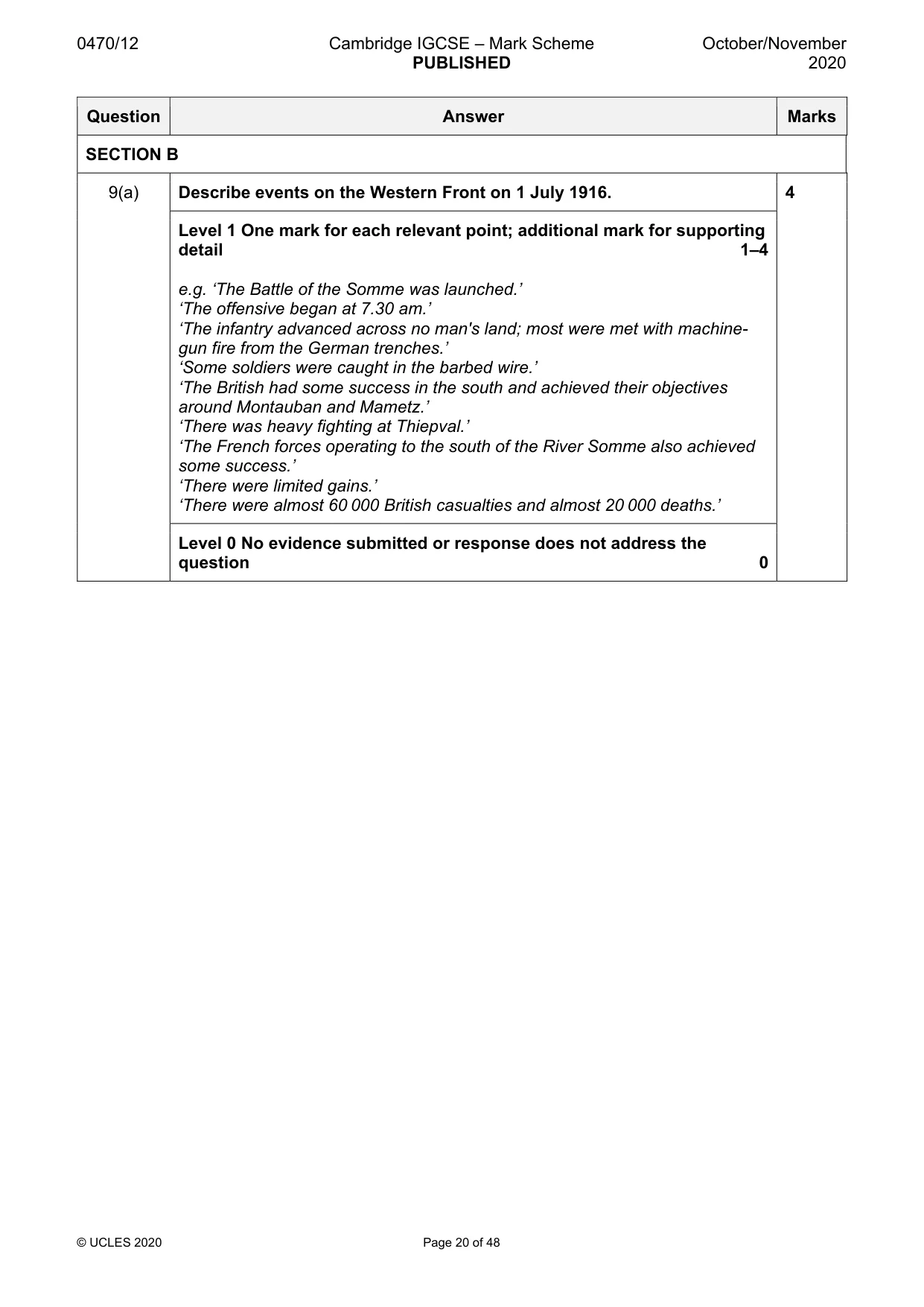
0470/12 Cambridge IGCSE – Mark Scheme PUBLISHED October/November 2020 © UCLES 2020 Page 20 of 48 Question Answer Marks SECTION B 9(a) Describe events on the Western Front on 1 July 1916. 4 Level 1 One mark for each relevant point; additional mark for supporting detail 1–4 e.g. ‘The Battle of the Somme was launched.’ ‘The offensive began at 7.30 am.’ ‘The infantry advanced across no man's land; most were met with machine- gun fire from the German trenches.’ ‘Some soldiers were caught in the barbed wire.’ ‘The British had some success in the south and achieved their objectives around Montauban and Mametz.’ ‘There was heavy fighting at Thiepval.’ ‘The French forces operating to the south of the River Somme also achieved some success.’ ‘There were limited gains.’ ‘There were almost 60 000 British casualties and almost 20 000 deaths.’ Level 0 No evidence submitted or response does not address the question 0
Mark scheme, page 21
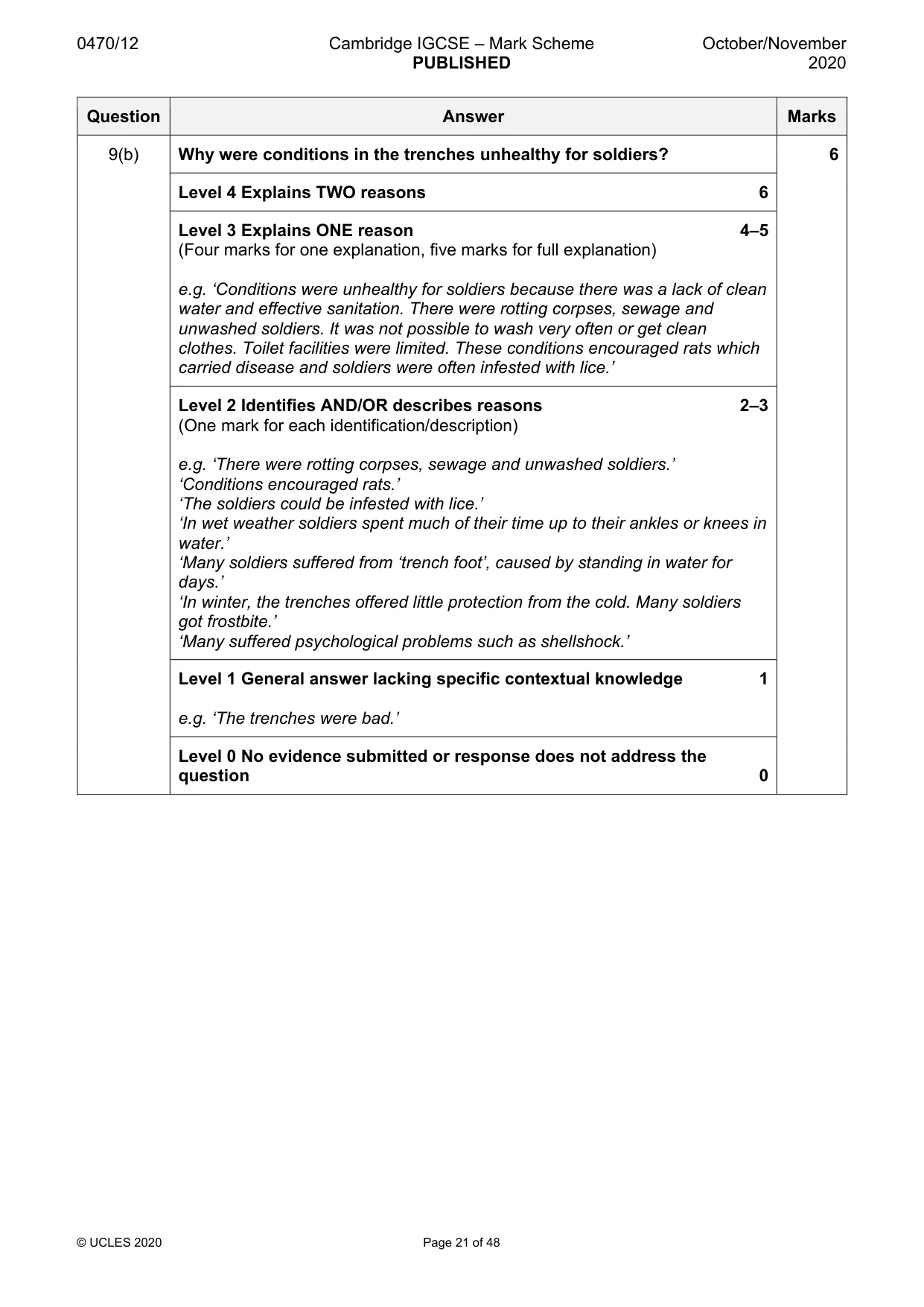
0470/12 Cambridge IGCSE – Mark Scheme PUBLISHED October/November 2020 © UCLES 2020 Page 21 of 48 Question Answer Marks 9(b) Why were conditions in the trenches unhealthy for soldiers? 6 Level 4 Explains TWO reasons 6 Level 3 Explains ONE reason 4–5 (Four marks for one explanation, five marks for full explanation) e.g. ‘Conditions were unhealthy for soldiers because there was a lack of clean water and effective sanitation. There were rotting corpses, sewage and unwashed soldiers. It was not possible to wash very often or get clean clothes. Toilet facilities were limited. These conditions encouraged rats which carried disease and soldiers were often infested with lice.’ Level 2 Identifies AND/OR describes reasons 2–3 (One mark for each identification/description) e.g. ‘There were rotting corpses, sewage and unwashed soldiers.’ ‘Conditions encouraged rats.’ ‘The soldiers could be infested with lice.’ ‘In wet weather soldiers spent much of their time up to their ankles or knees in water.’ ‘Many soldiers suffered from ‘trench foot’, caused by standing in water for days.’ ‘In winter, the trenches offered little protection from the cold. Many soldiers got frostbite.’ ‘Many suffered psychological problems such as shellshock.’ Level 1 General answer lacking specific contextual knowledge 1 e.g. ‘The trenches were bad.’ Level 0 No evidence submitted or response does not address the question 0
Mark scheme, page 22
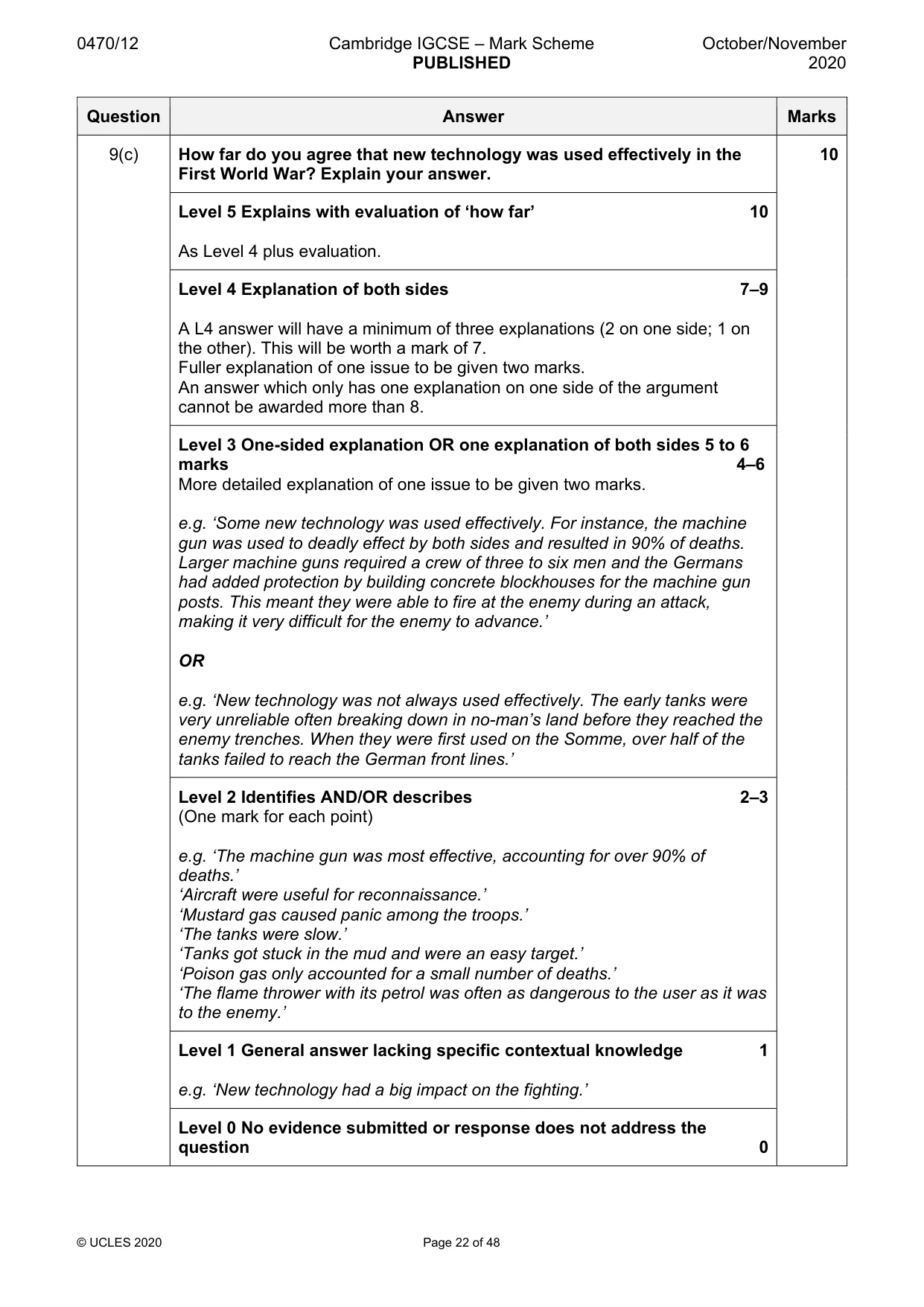
0470/12 Cambridge IGCSE – Mark Scheme PUBLISHED October/November 2020 © UCLES 2020 Page 22 of 48 Question Answer Marks 9(c) How far do you agree that new technology was used effectively in the First World War? Explain your answer. 10 Level 5 Explains with evaluation of ‘how far’ 10 As Level 4 plus evaluation. Level 4 Explanation of both sides 7–9 A L4 answer will have a minimum of three explanations (2 on one side; 1 on the other). This will be worth a mark of 7. Fuller explanation of one issue to be given two marks. An answer which only has one explanation on one side of the argument cannot be awarded more than 8. Level 3 One-sided explanation OR one explanation of both sides 5 to 6 marks 4–6 More detailed explanation of one issue to be given two marks. e.g. ‘Some new technology was used effectively. For instance, the machine gun was used to deadly effect by both sides and resulted in 90% of deaths. Larger machine guns required a crew of three to six men and the Germans had added protection by building concrete blockhouses for the machine gun posts. This meant they were able to fire at the enemy during an attack, making it very difficult for the enemy to advance.’ OR e.g. ‘New technology was not always used effectively. The early tanks were very unreliable often breaking down in no-man’s land before they reached the enemy trenches. When they were first used on the Somme, over half of the tanks failed to reach the German front lines.’ Level 2 Identifies AND/OR describes 2–3 (One mark for each point) e.g. ‘The machine gun was most effective, accounting for over 90% of deaths.’ ‘Aircraft were useful for reconnaissance.’ ‘Mustard gas caused panic among the troops.’ ‘The tanks were slow.’ ‘Tanks got stuck in the mud and were an easy target.’ ‘Poison gas only accounted for a small number of deaths.’ ‘The flame thrower with its petrol was often as dangerous to the user as it was to the enemy.’ Level 1 General answer lacking specific contextual knowledge 1 e.g. ‘New technology had a big impact on the fighting.’ Level 0 No evidence submitted or response does not address the question 0
Mark scheme, page 23
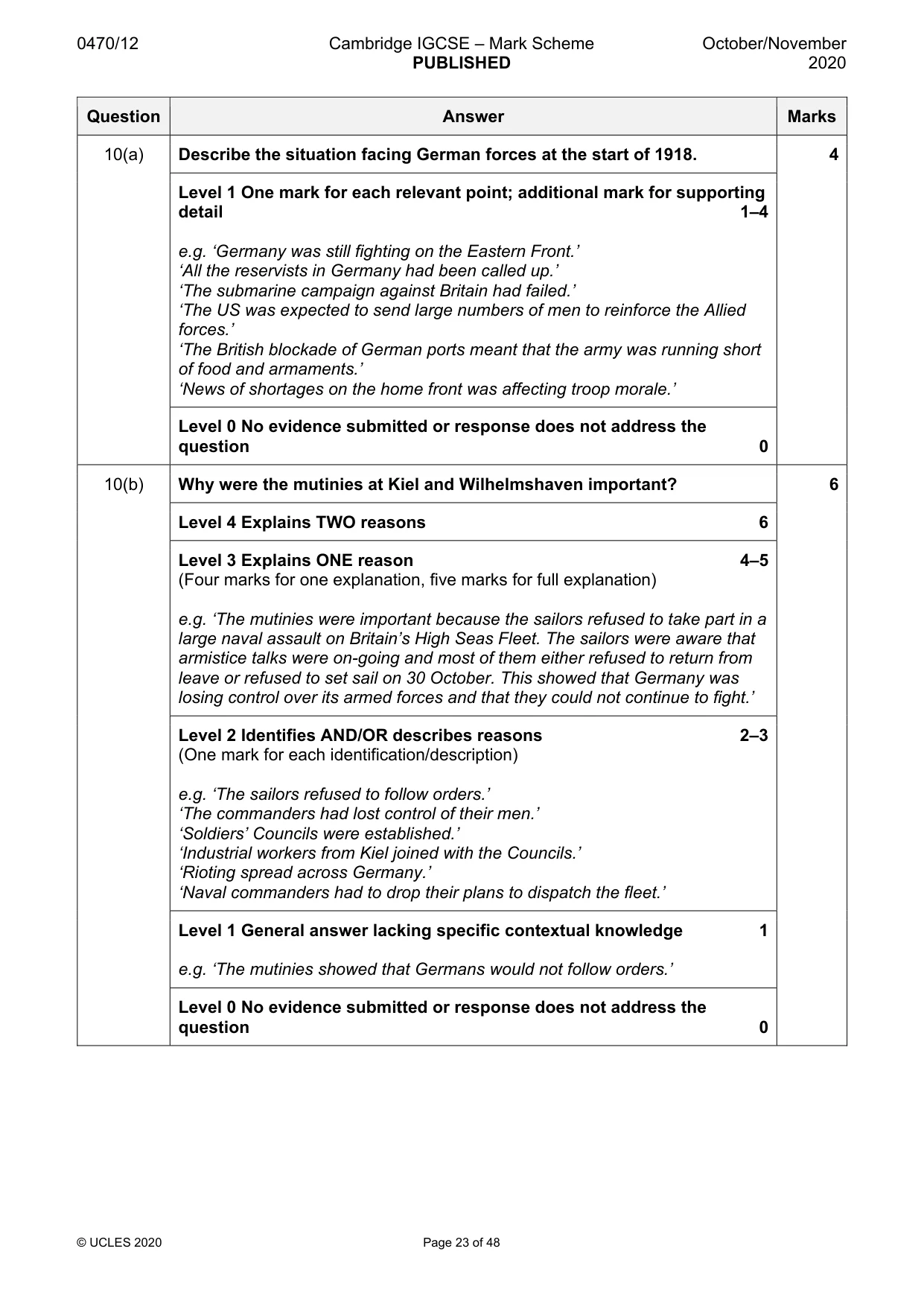
0470/12 Cambridge IGCSE – Mark Scheme PUBLISHED October/November 2020 © UCLES 2020 Page 23 of 48 Question Answer Marks 10(a) Describe the situation facing German forces at the start of 1918. 4 Level 1 One mark for each relevant point; additional mark for supporting detail 1–4 e.g. ‘Germany was still fighting on the Eastern Front.’ ‘All the reservists in Germany had been called up.’ ‘The submarine campaign against Britain had failed.’ ‘The US was expected to send large numbers of men to reinforce the Allied forces.’ ‘The British blockade of German ports meant that the army was running short of food and armaments.’ ‘News of shortages on the home front was affecting troop morale.’ Level 0 No evidence submitted or response does not address the question 0 10(b) Why were the mutinies at Kiel and Wilhelmshaven important? 6 Level 4 Explains TWO reasons 6 Level 3 Explains ONE reason 4–5 (Four marks for one explanation, five marks for full explanation) e.g. ‘The mutinies were important because the sailors refused to take part in a large naval assault on Britain’s High Seas Fleet. The sailors were aware that armistice talks were on-going and most of them either refused to return from leave or refused to set sail on 30 October. This showed that Germany was losing control over its armed forces and that they could not continue to fight.’ Level 2 Identifies AND/OR describes reasons 2–3 (One mark for each identification/description) e.g. ‘The sailors refused to follow orders.’ ‘The commanders had lost control of their men.’ ‘Soldiers’ Councils were established.’ ‘Industrial workers from Kiel joined with the Councils.’ ‘Rioting spread across Germany.’ ‘Naval commanders had to drop their plans to dispatch the fleet.’ Level 1 General answer lacking specific contextual knowledge 1 e.g. ‘The mutinies showed that Germans would not follow orders.’ Level 0 No evidence submitted or response does not address the question 0
Mark scheme, page 24
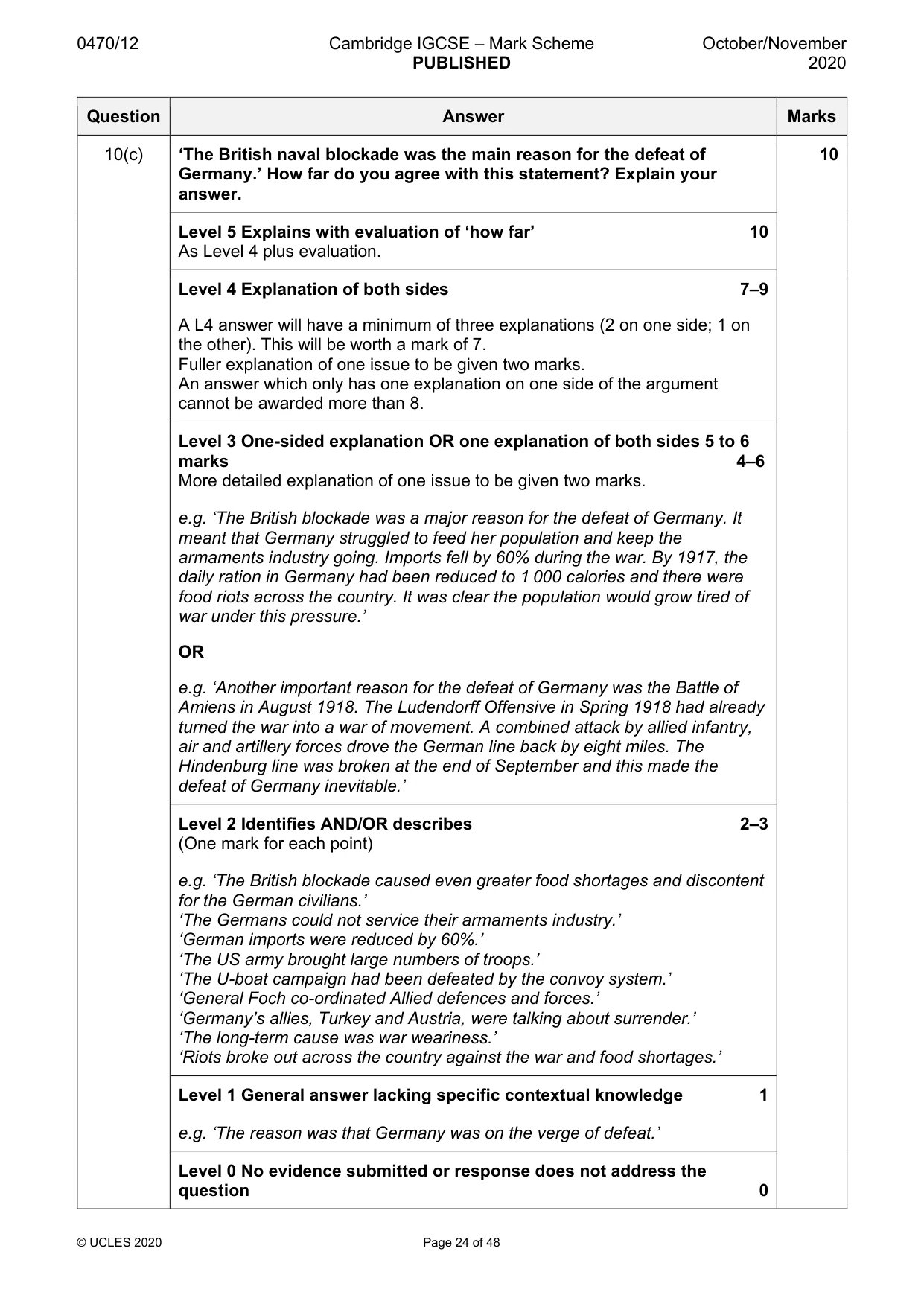
0470/12 Cambridge IGCSE – Mark Scheme PUBLISHED October/November 2020 © UCLES 2020 Page 24 of 48 Question Answer Marks 10(c) ‘The British naval blockade was the main reason for the defeat of Germany.’ How far do you agree with this statement? Explain your answer. 10 Level 5 Explains with evaluation of ‘how far’ 10 As Level 4 plus evaluation. Level 4 Explanation of both sides 7–9 A L4 answer will have a minimum of three explanations (2 on one side; 1 on the other). This will be worth a mark of 7. Fuller explanation of one issue to be given two marks. An answer which only has one explanation on one side of the argument cannot be awarded more than 8. Level 3 One-sided explanation OR one explanation of both sides 5 to 6 marks 4–6 More detailed explanation of one issue to be given two marks. e.g. ‘The British blockade was a major reason for the defeat of Germany. It meant that Germany struggled to feed her population and keep the armaments industry going. Imports fell by 60% during the war. By 1917, the daily ration in Germany had been reduced to 1 000 calories and there were food riots across the country. It was clear the population would grow tired of war under this pressure.’ OR e.g. ‘Another important reason for the defeat of Germany was the Battle of Amiens in August 1918. The Ludendorff Offensive in Spring 1918 had already turned the war into a war of movement. A combined attack by allied infantry, air and artillery forces drove the German line back by eight miles. The Hindenburg line was broken at the end of September and this made the defeat of Germany inevitable.’ Level 2 Identifies AND/OR describes 2–3 (One mark for each point) e.g. ‘The British blockade caused even greater food shortages and discontent for the German civilians.’ ‘The Germans could not service their armaments industry.’ ‘German imports were reduced by 60%.’ ‘The US army brought large numbers of troops.’ ‘The U-boat campaign had been defeated by the convoy system.’ ‘General Foch co-ordinated Allied defences and forces.’ ‘Germany’s allies, Turkey and Austria, were talking about surrender.’ ‘The long-term cause was war weariness.’ ‘Riots broke out across the country against the war and food shortages.’ Level 1 General answer lacking specific contextual knowledge 1 e.g. ‘The reason was that Germany was on the verge of defeat.’ Level 0 No evidence submitted or response does not address the question 0
Mark scheme, page 25
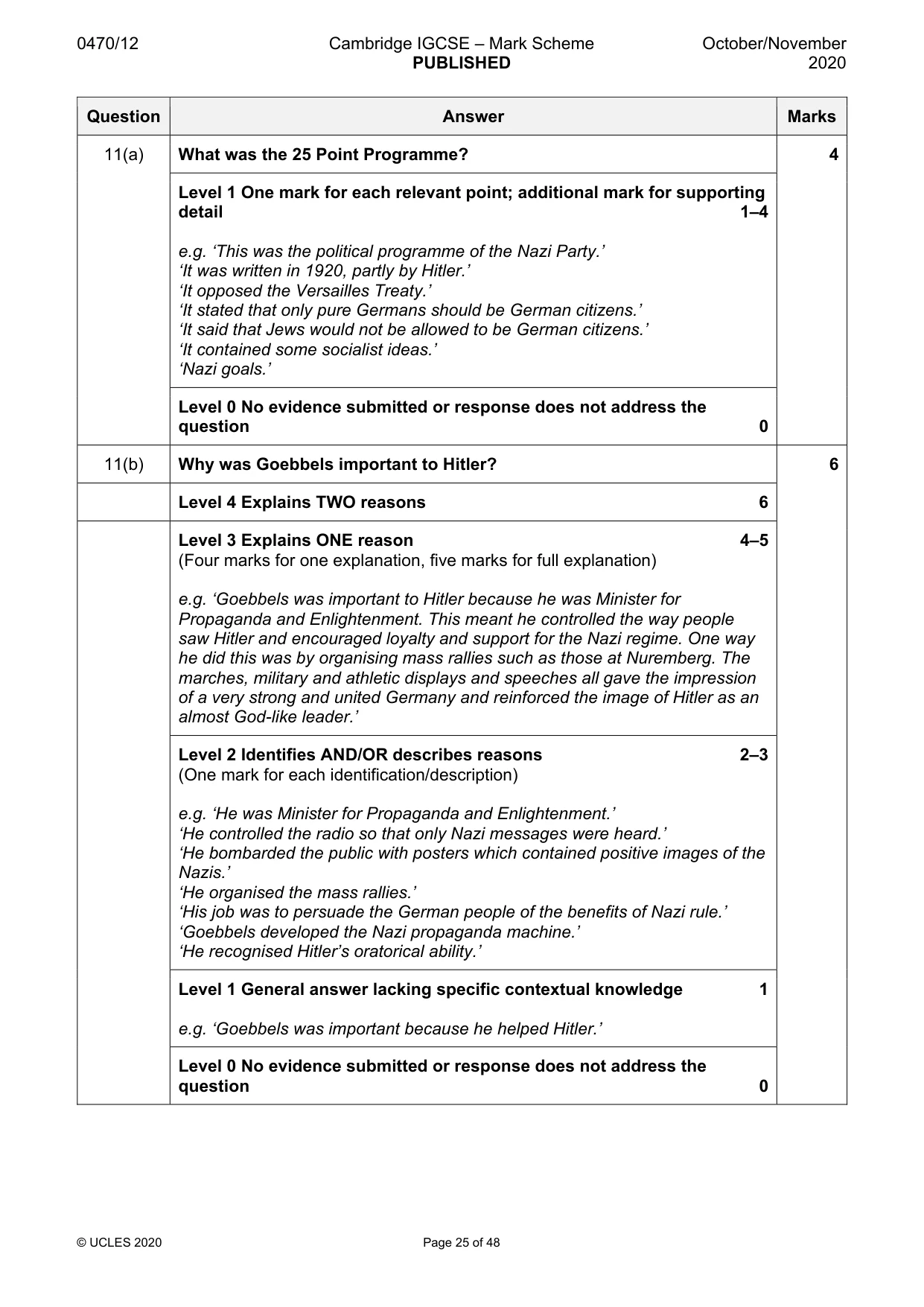
0470/12 Cambridge IGCSE – Mark Scheme PUBLISHED October/November 2020 © UCLES 2020 Page 25 of 48 Question Answer Marks 11(a) What was the 25 Point Programme? 4 Level 1 One mark for each relevant point; additional mark for supporting detail 1–4 e.g. ‘This was the political programme of the Nazi Party.’ ‘It was written in 1920, partly by Hitler.’ ‘It opposed the Versailles Treaty.’ ‘It stated that only pure Germans should be German citizens.’ ‘It said that Jews would not be allowed to be German citizens.’ ‘It contained some socialist ideas.’ ‘Nazi goals.’ Level 0 No evidence submitted or response does not address the question 0 11(b) Why was Goebbels important to Hitler? 6 Level 4 Explains TWO reasons 6 Level 3 Explains ONE reason 4–5 (Four marks for one explanation, five marks for full explanation) e.g. ‘Goebbels was important to Hitler because he was Minister for Propaganda and Enlightenment. This meant he controlled the way people saw Hitler and encouraged loyalty and support for the Nazi regime. One way he did this was by organising mass rallies such as those at Nuremberg. The marches, military and athletic displays and speeches all gave the impression of a very strong and united Germany and reinforced the image of Hitler as an almost God-like leader.’ Level 2 Identifies AND/OR describes reasons 2–3 (One mark for each identification/description) e.g. ‘He was Minister for Propaganda and Enlightenment.’ ‘He controlled the radio so that only Nazi messages were heard.’ ‘He bombarded the public with posters which contained positive images of the Nazis.’ ‘He organised the mass rallies.’ ‘His job was to persuade the German people of the benefits of Nazi rule.’ ‘Goebbels developed the Nazi propaganda machine.’ ‘He recognised Hitler’s oratorical ability.’ Level 1 General answer lacking specific contextual knowledge 1 e.g. ‘Goebbels was important because he helped Hitler.’ Level 0 No evidence submitted or response does not address the question 0
Mark scheme, page 26
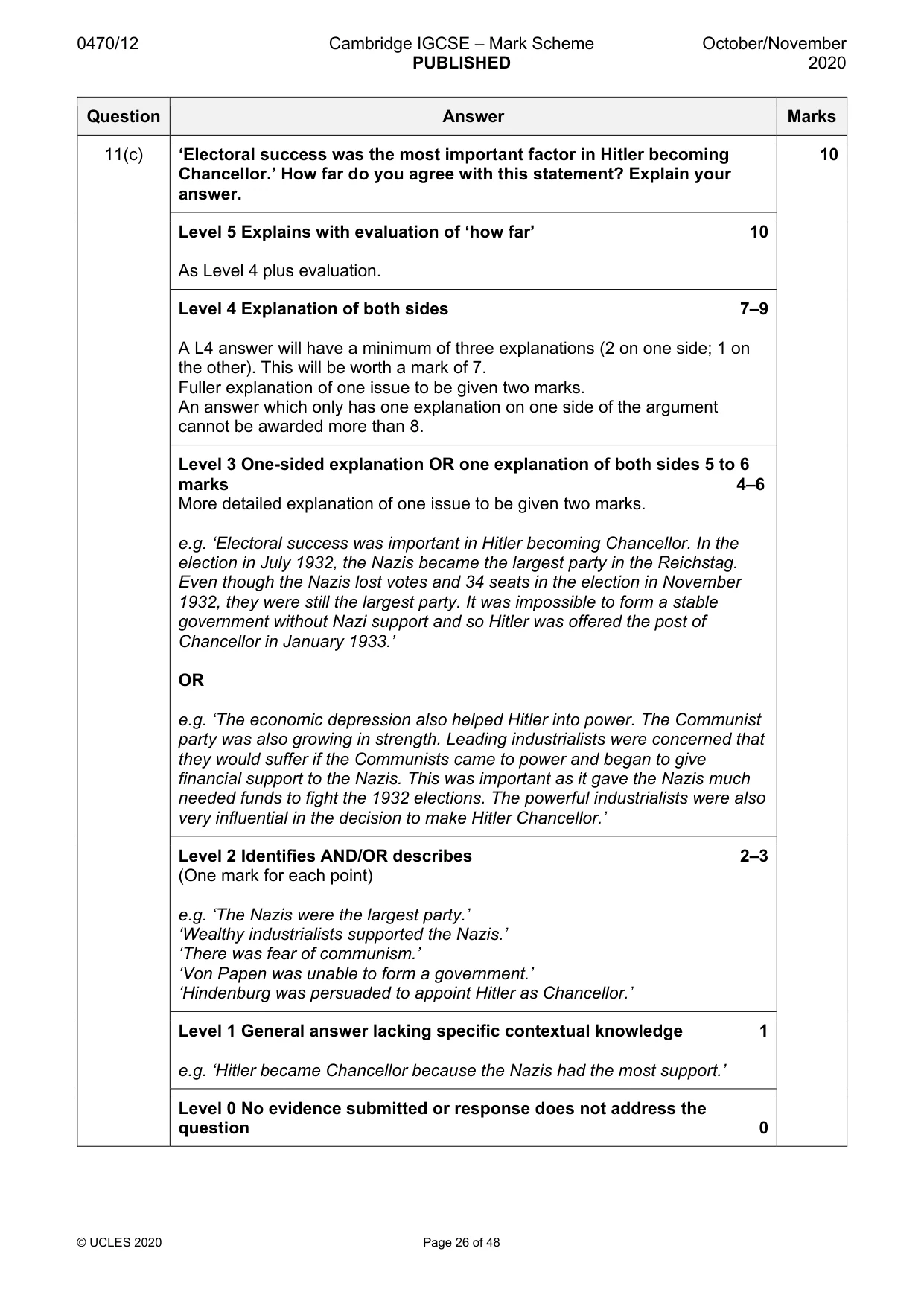
0470/12 Cambridge IGCSE – Mark Scheme PUBLISHED October/November 2020 © UCLES 2020 Page 26 of 48 Question Answer Marks 11(c) ‘Electoral success was the most important factor in Hitler becoming Chancellor.’ How far do you agree with this statement? Explain your answer. 10 Level 5 Explains with evaluation of ‘how far’ 10 As Level 4 plus evaluation. Level 4 Explanation of both sides 7–9 A L4 answer will have a minimum of three explanations (2 on one side; 1 on the other). This will be worth a mark of 7. Fuller explanation of one issue to be given two marks. An answer which only has one explanation on one side of the argument cannot be awarded more than 8. Level 3 One-sided explanation OR one explanation of both sides 5 to 6 marks 4–6 More detailed explanation of one issue to be given two marks. e.g. ‘Electoral success was important in Hitler becoming Chancellor. In the election in July 1932, the Nazis became the largest party in the Reichstag. Even though the Nazis lost votes and 34 seats in the election in November 1932, they were still the largest party. It was impossible to form a stable government without Nazi support and so Hitler was offered the post of Chancellor in January 1933.’ OR e.g. ‘The economic depression also helped Hitler into power. The Communist party was also growing in strength. Leading industrialists were concerned that they would suffer if the Communists came to power and began to give financial support to the Nazis. This was important as it gave the Nazis much needed funds to fight the 1932 elections. The powerful industrialists were also very influential in the decision to make Hitler Chancellor.’ Level 2 Identifies AND/OR describes 2–3 (One mark for each point) e.g. ‘The Nazis were the largest party.’ ‘Wealthy industrialists supported the Nazis.’ ‘There was fear of communism.’ ‘Von Papen was unable to form a government.’ ‘Hindenburg was persuaded to appoint Hitler as Chancellor.’ Level 1 General answer lacking specific contextual knowledge 1 e.g. ‘Hitler became Chancellor because the Nazis had the most support.’ Level 0 No evidence submitted or response does not address the question 0
Mark scheme, page 27
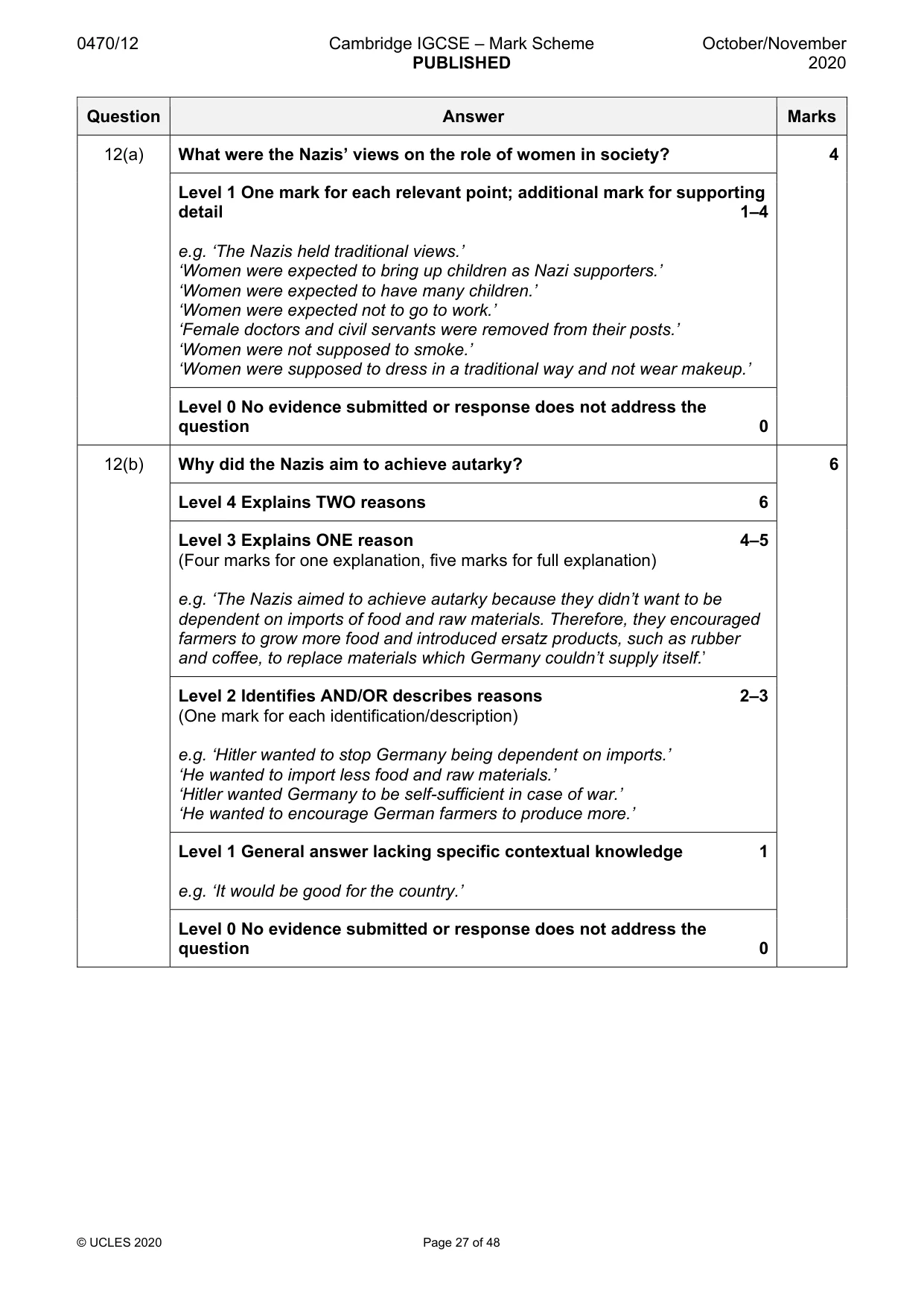
0470/12 Cambridge IGCSE – Mark Scheme PUBLISHED October/November 2020 © UCLES 2020 Page 27 of 48 Question Answer Marks 12(a) What were the Nazis’ views on the role of women in society? 4 Level 1 One mark for each relevant point; additional mark for supporting detail 1–4 e.g. ‘The Nazis held traditional views.’ ‘Women were expected to bring up children as Nazi supporters.’ ‘Women were expected to have many children.’ ‘Women were expected not to go to work.’ ‘Female doctors and civil servants were removed from their posts.’ ‘Women were not supposed to smoke.’ ‘Women were supposed to dress in a traditional way and not wear makeup.’ Level 0 No evidence submitted or response does not address the question 0 12(b) Why did the Nazis aim to achieve autarky? 6 Level 4 Explains TWO reasons 6 Level 3 Explains ONE reason 4–5 (Four marks for one explanation, five marks for full explanation) e.g. ‘The Nazis aimed to achieve autarky because they didn’t want to be dependent on imports of food and raw materials. Therefore, they encouraged farmers to grow more food and introduced ersatz products, such as rubber and coffee, to replace materials which Germany couldn’t supply itself.’ Level 2 Identifies AND/OR describes reasons 2–3 (One mark for each identification/description) e.g. ‘Hitler wanted to stop Germany being dependent on imports.’ ‘He wanted to import less food and raw materials.’ ‘Hitler wanted Germany to be self-sufficient in case of war.’ ‘He wanted to encourage German farmers to produce more.’ Level 1 General answer lacking specific contextual knowledge 1 e.g. ‘It would be good for the country.’ Level 0 No evidence submitted or response does not address the question 0
Mark scheme, page 28
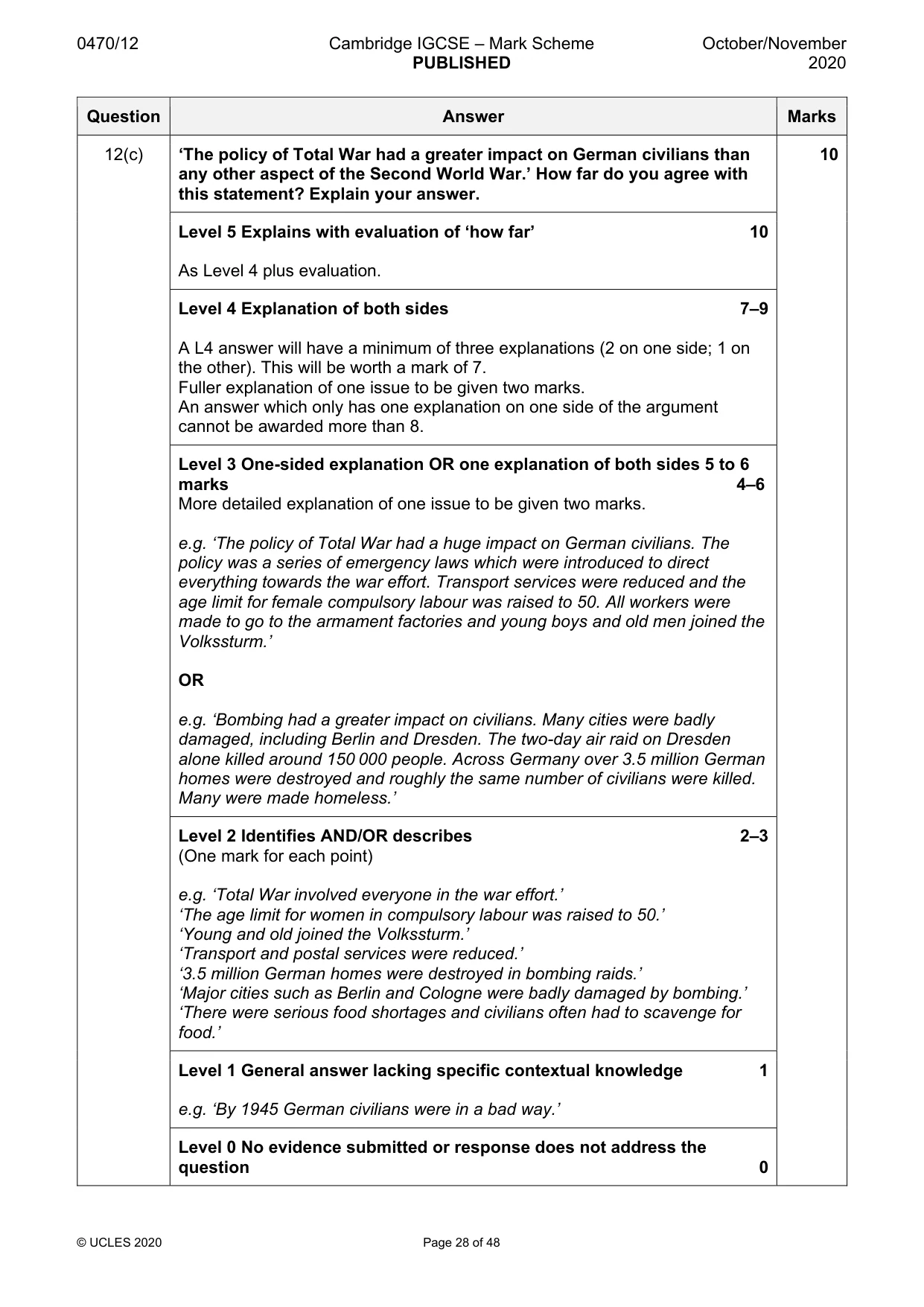
0470/12 Cambridge IGCSE – Mark Scheme PUBLISHED October/November 2020 © UCLES 2020 Page 28 of 48 Question Answer Marks 12(c) ‘The policy of Total War had a greater impact on German civilians than any other aspect of the Second World War.’ How far do you agree with this statement? Explain your answer. 10 Level 5 Explains with evaluation of ‘how far’ 10 As Level 4 plus evaluation. Level 4 Explanation of both sides 7–9 A L4 answer will have a minimum of three explanations (2 on one side; 1 on the other). This will be worth a mark of 7. Fuller explanation of one issue to be given two marks. An answer which only has one explanation on one side of the argument cannot be awarded more than 8. Level 3 One-sided explanation OR one explanation of both sides 5 to 6 marks 4–6 More detailed explanation of one issue to be given two marks. e.g. ‘The policy of Total War had a huge impact on German civilians. The policy was a series of emergency laws which were introduced to direct everything towards the war effort. Transport services were reduced and the age limit for female compulsory labour was raised to 50. All workers were made to go to the armament factories and young boys and old men joined the Volkssturm.’ OR e.g. ‘Bombing had a greater impact on civilians. Many cities were badly damaged, including Berlin and Dresden. The two-day air raid on Dresden alone killed around 150 000 people. Across Germany over 3.5 million German homes were destroyed and roughly the same number of civilians were killed. Many were made homeless.’ Level 2 Identifies AND/OR describes 2–3 (One mark for each point) e.g. ‘Total War involved everyone in the war effort.’ ‘The age limit for women in compulsory labour was raised to 50.’ ‘Young and old joined the Volkssturm.’ ‘Transport and postal services were reduced.’ ‘3.5 million German homes were destroyed in bombing raids.’ ‘Major cities such as Berlin and Cologne were badly damaged by bombing.’ ‘There were serious food shortages and civilians often had to scavenge for food.’ Level 1 General answer lacking specific contextual knowledge 1 e.g. ‘By 1945 German civilians were in a bad way.’ Level 0 No evidence submitted or response does not address the question 0
Mark scheme, page 29
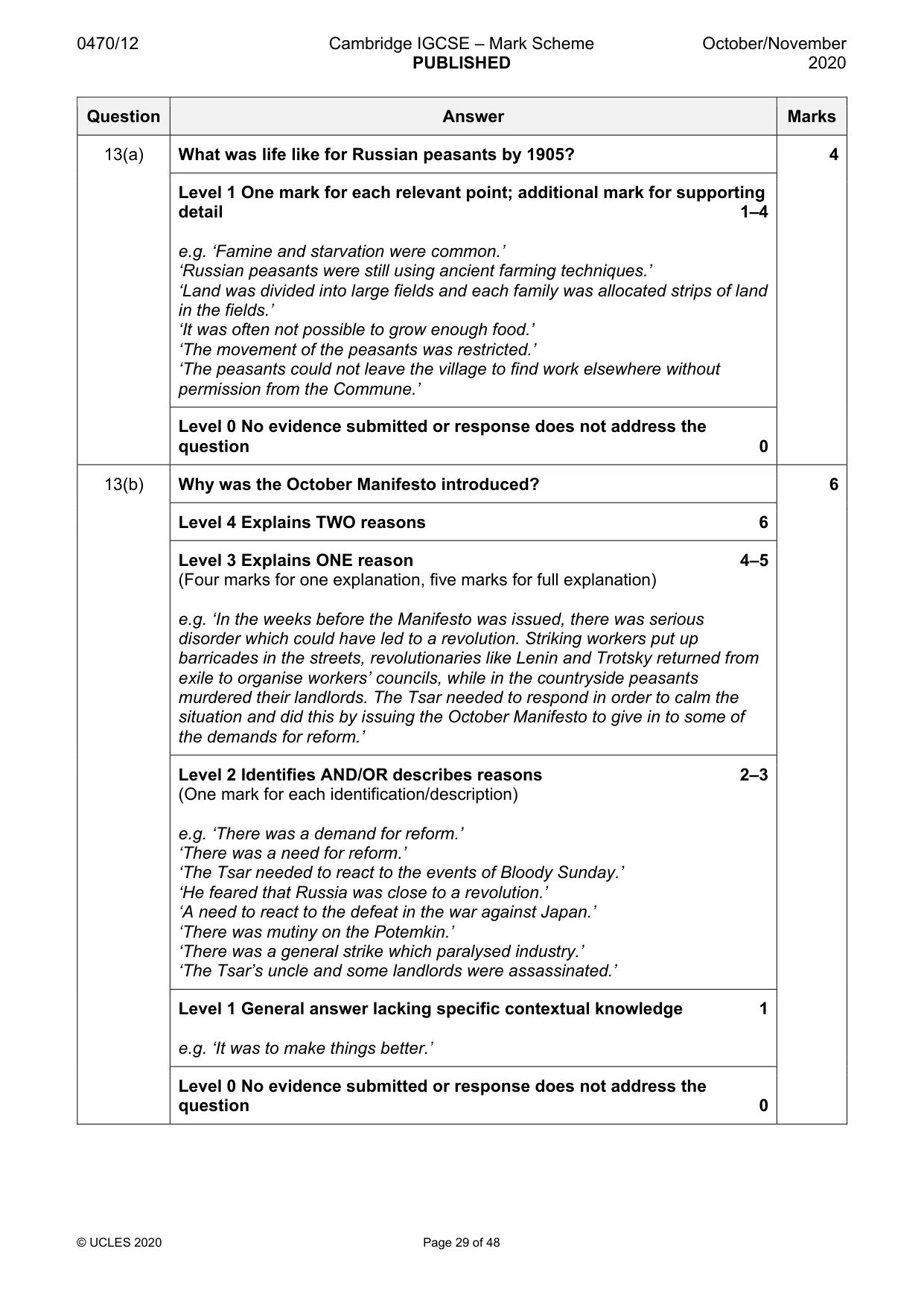
0470/12 Cambridge IGCSE – Mark Scheme PUBLISHED October/November 2020 © UCLES 2020 Page 29 of 48 Question Answer Marks 13(a) What was life like for Russian peasants by 1905? 4 Level 1 One mark for each relevant point; additional mark for supporting detail 1–4 e.g. ‘Famine and starvation were common.’ ‘Russian peasants were still using ancient farming techniques.’ ‘Land was divided into large fields and each family was allocated strips of land in the fields.’ ‘It was often not possible to grow enough food.’ ‘The movement of the peasants was restricted.’ ‘The peasants could not leave the village to find work elsewhere without permission from the Commune.’ Level 0 No evidence submitted or response does not address the question 0 13(b) Why was the October Manifesto introduced? 6 Level 4 Explains TWO reasons 6 Level 3 Explains ONE reason 4–5 (Four marks for one explanation, five marks for full explanation) e.g. ‘In the weeks before the Manifesto was issued, there was serious disorder which could have led to a revolution. Striking workers put up barricades in the streets, revolutionaries like Lenin and Trotsky returned from exile to organise workers’ councils, while in the countryside peasants murdered their landlords. The Tsar needed to respond in order to calm the situation and did this by issuing the October Manifesto to give in to some of the demands for reform.’ Level 2 Identifies AND/OR describes reasons 2–3 (One mark for each identification/description) e.g. ‘There was a demand for reform.’ ‘There was a need for reform.’ ‘The Tsar needed to react to the events of Bloody Sunday.’ ‘He feared that Russia was close to a revolution.’ ‘A need to react to the defeat in the war against Japan.’ ‘There was mutiny on the Potemkin.’ ‘There was a general strike which paralysed industry.’ ‘The Tsar’s uncle and some landlords were assassinated.’ Level 1 General answer lacking specific contextual knowledge 1 e.g. ‘It was to make things better.’ Level 0 No evidence submitted or response does not address the question 0
Mark scheme, page 30
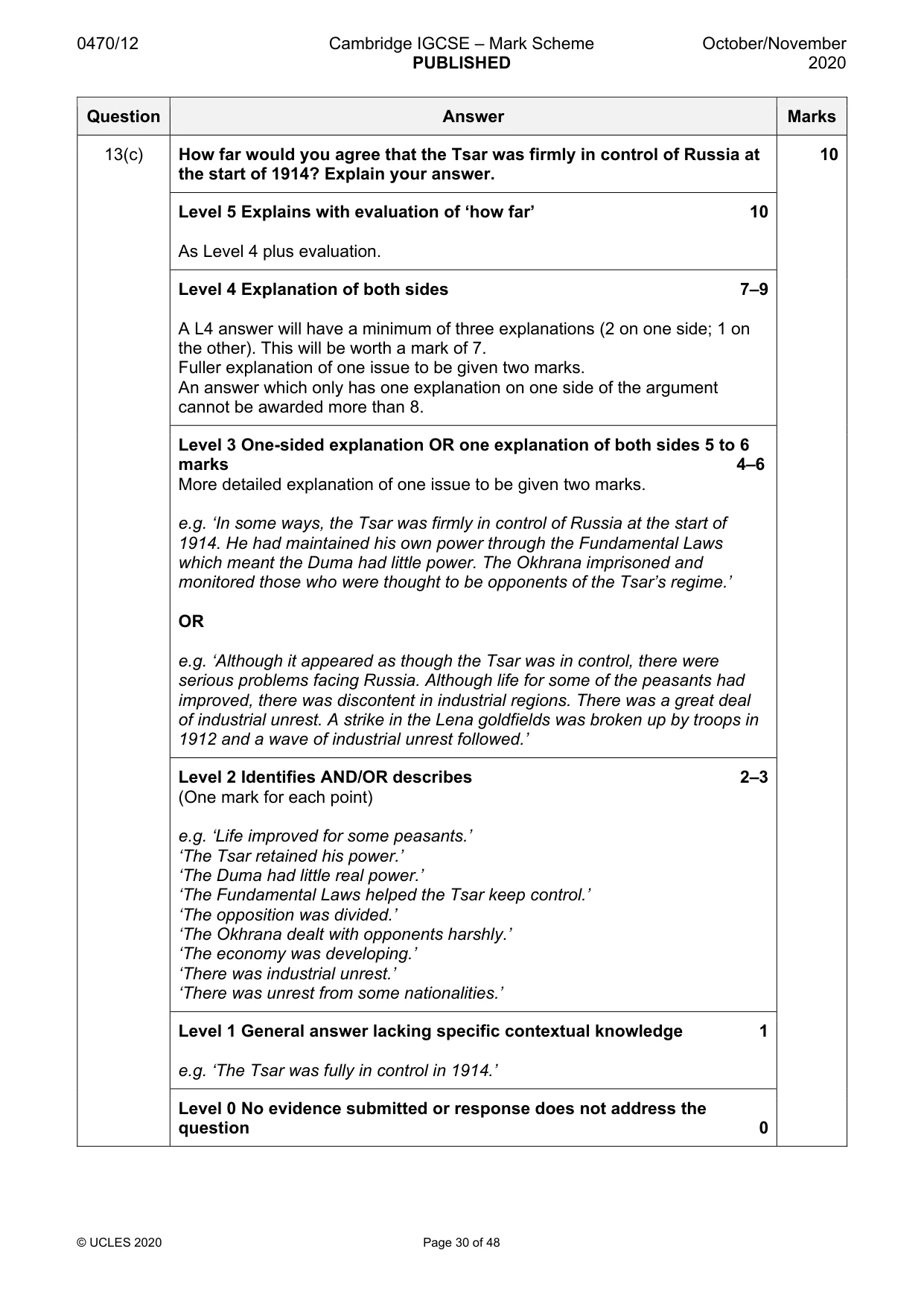
0470/12 Cambridge IGCSE – Mark Scheme PUBLISHED October/November 2020 © UCLES 2020 Page 30 of 48 Question Answer Marks 13(c) How far would you agree that the Tsar was firmly in control of Russia at the start of 1914? Explain your answer. 10 Level 5 Explains with evaluation of ‘how far’ 10 As Level 4 plus evaluation. Level 4 Explanation of both sides 7–9 A L4 answer will have a minimum of three explanations (2 on one side; 1 on the other). This will be worth a mark of 7. Fuller explanation of one issue to be given two marks. An answer which only has one explanation on one side of the argument cannot be awarded more than 8. Level 3 One-sided explanation OR one explanation of both sides 5 to 6 marks 4–6 More detailed explanation of one issue to be given two marks. e.g. ‘In some ways, the Tsar was firmly in control of Russia at the start of 1914. He had maintained his own power through the Fundamental Laws which meant the Duma had little power. The Okhrana imprisoned and monitored those who were thought to be opponents of the Tsar’s regime.’ OR e.g. ‘Although it appeared as though the Tsar was in control, there were serious problems facing Russia. Although life for some of the peasants had improved, there was discontent in industrial regions. There was a great deal of industrial unrest. A strike in the Lena goldfields was broken up by troops in 1912 and a wave of industrial unrest followed.’ Level 2 Identifies AND/OR describes 2–3 (One mark for each point) e.g. ‘Life improved for some peasants.’ ‘The Tsar retained his power.’ ‘The Duma had little real power.’ ‘The Fundamental Laws helped the Tsar keep control.’ ‘The opposition was divided.’ ‘The Okhrana dealt with opponents harshly.’ ‘The economy was developing.’ ‘There was industrial unrest.’ ‘There was unrest from some nationalities.’ Level 1 General answer lacking specific contextual knowledge 1 e.g. ‘The Tsar was fully in control in 1914.’ Level 0 No evidence submitted or response does not address the question 0
Mark scheme, page 31
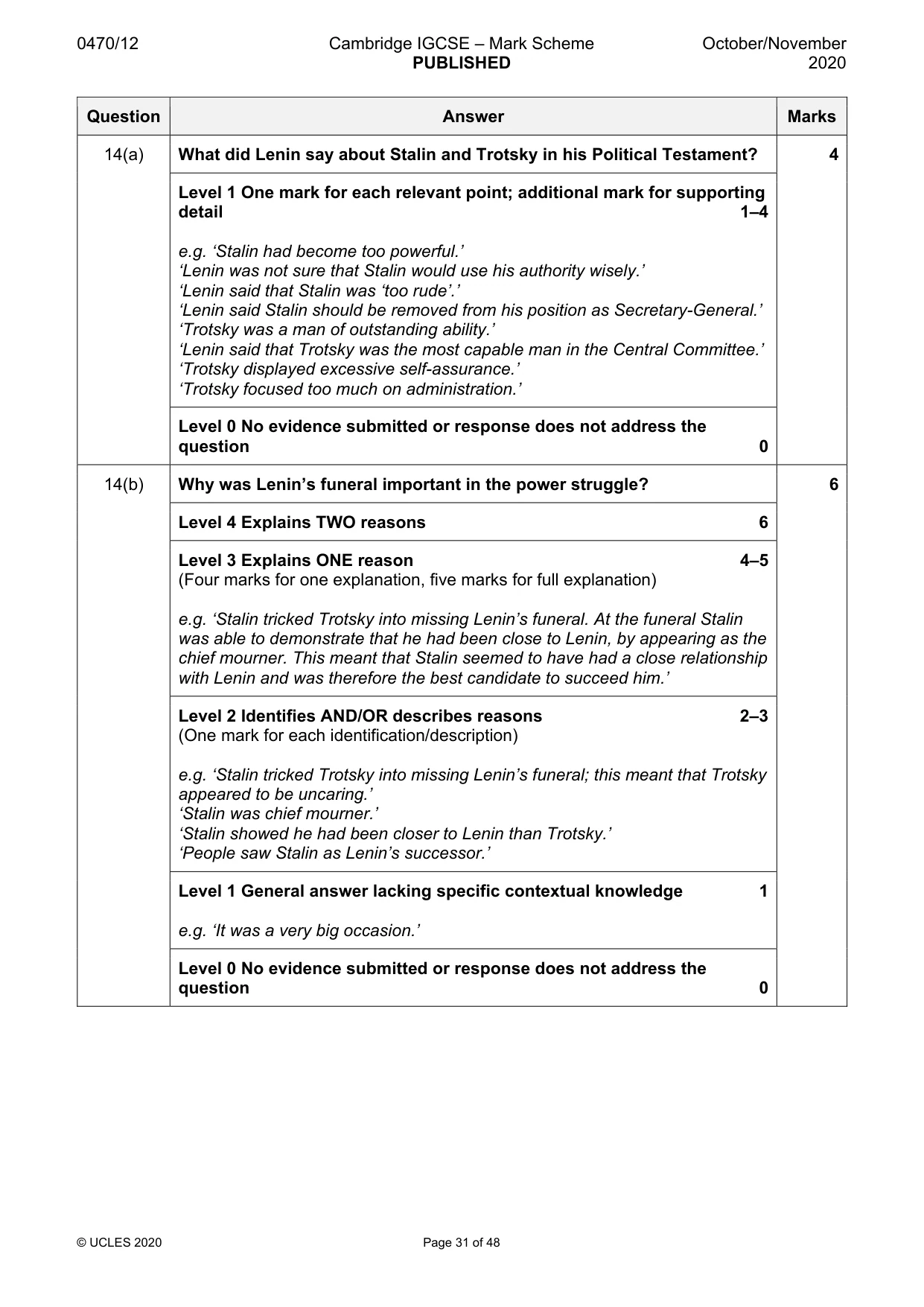
0470/12 Cambridge IGCSE – Mark Scheme PUBLISHED October/November 2020 © UCLES 2020 Page 31 of 48 Question Answer Marks 14(a) What did Lenin say about Stalin and Trotsky in his Political Testament? 4 Level 1 One mark for each relevant point; additional mark for supporting detail 1–4 e.g. ‘Stalin had become too powerful.’ ‘Lenin was not sure that Stalin would use his authority wisely.’ ‘Lenin said that Stalin was ‘too rude’.’ ‘Lenin said Stalin should be removed from his position as Secretary-General.’ ‘Trotsky was a man of outstanding ability.’ ‘Lenin said that Trotsky was the most capable man in the Central Committee.’ ‘Trotsky displayed excessive self-assurance.’ ‘Trotsky focused too much on administration.’ Level 0 No evidence submitted or response does not address the question 0 14(b) Why was Lenin’s funeral important in the power struggle? 6 Level 4 Explains TWO reasons 6 Level 3 Explains ONE reason 4–5 (Four marks for one explanation, five marks for full explanation) e.g. ‘Stalin tricked Trotsky into missing Lenin’s funeral. At the funeral Stalin was able to demonstrate that he had been close to Lenin, by appearing as the chief mourner. This meant that Stalin seemed to have had a close relationship with Lenin and was therefore the best candidate to succeed him.’ Level 2 Identifies AND/OR describes reasons 2–3 (One mark for each identification/description) e.g. ‘Stalin tricked Trotsky into missing Lenin’s funeral; this meant that Trotsky appeared to be uncaring.’ ‘Stalin was chief mourner.’ ‘Stalin showed he had been closer to Lenin than Trotsky.’ ‘People saw Stalin as Lenin’s successor.’ Level 1 General answer lacking specific contextual knowledge 1 e.g. ‘It was a very big occasion.’ Level 0 No evidence submitted or response does not address the question 0
Mark scheme, page 32
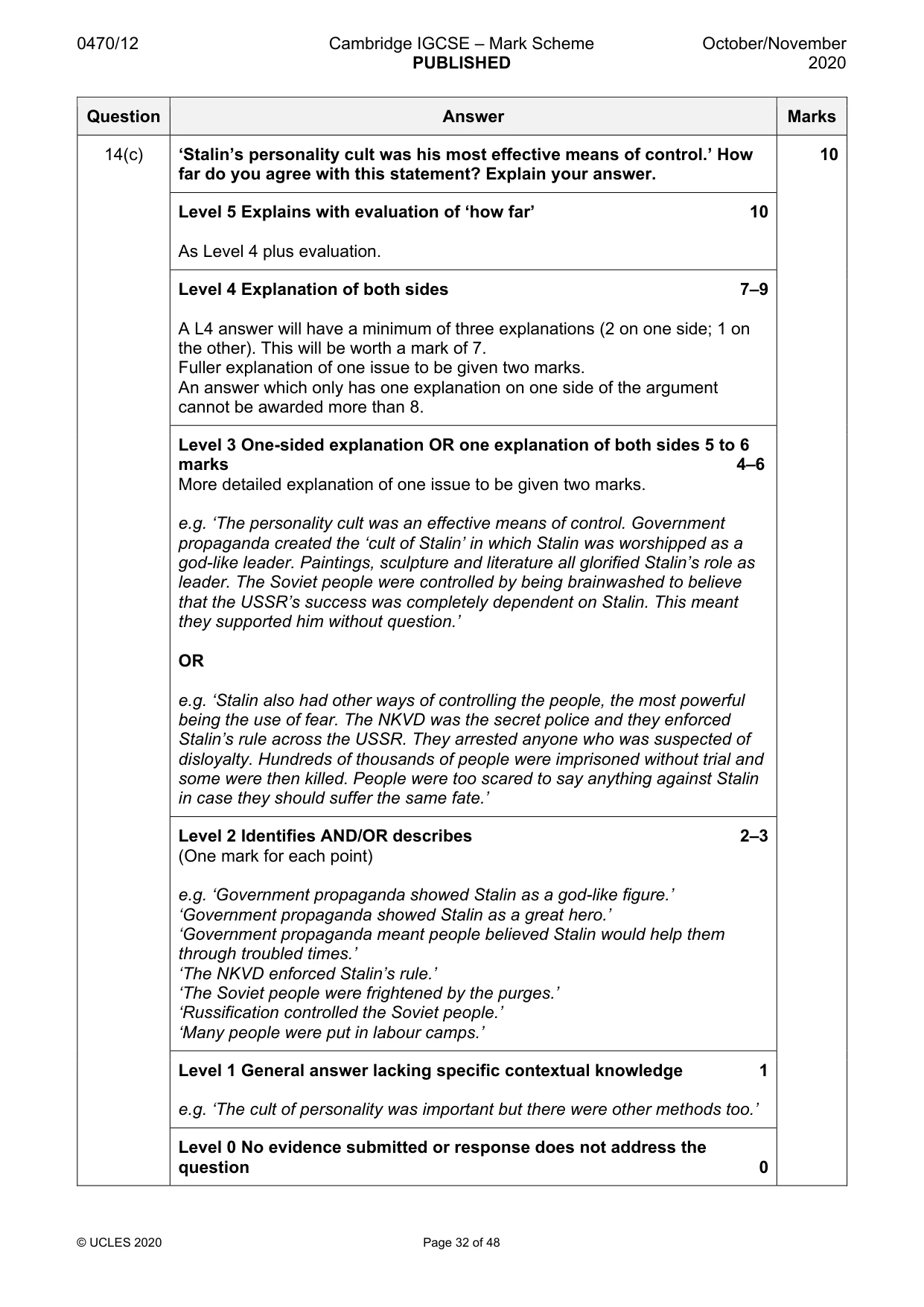
0470/12 Cambridge IGCSE – Mark Scheme PUBLISHED October/November 2020 © UCLES 2020 Page 32 of 48 Question Answer Marks 14(c) ‘Stalin’s personality cult was his most effective means of control.’ How far do you agree with this statement? Explain your answer. 10 Level 5 Explains with evaluation of ‘how far’ 10 As Level 4 plus evaluation. Level 4 Explanation of both sides 7–9 A L4 answer will have a minimum of three explanations (2 on one side; 1 on the other). This will be worth a mark of 7. Fuller explanation of one issue to be given two marks. An answer which only has one explanation on one side of the argument cannot be awarded more than 8. Level 3 One-sided explanation OR one explanation of both sides 5 to 6 marks 4–6 More detailed explanation of one issue to be given two marks. e.g. ‘The personality cult was an effective means of control. Government propaganda created the ‘cult of Stalin’ in which Stalin was worshipped as a god-like leader. Paintings, sculpture and literature all glorified Stalin’s role as leader. The Soviet people were controlled by being brainwashed to believe that the USSR’s success was completely dependent on Stalin. This meant they supported him without question.’ OR e.g. ‘Stalin also had other ways of controlling the people, the most powerful being the use of fear. The NKVD was the secret police and they enforced Stalin’s rule across the USSR. They arrested anyone who was suspected of disloyalty. Hundreds of thousands of people were imprisoned without trial and some were then killed. People were too scared to say anything against Stalin in case they should suffer the same fate.’ Level 2 Identifies AND/OR describes 2–3 (One mark for each point) e.g. ‘Government propaganda showed Stalin as a god-like figure.’ ‘Government propaganda showed Stalin as a great hero.’ ‘Government propaganda meant people believed Stalin would help them through troubled times.’ ‘The NKVD enforced Stalin’s rule.’ ‘The Soviet people were frightened by the purges.’ ‘Russification controlled the Soviet people.’ ‘Many people were put in labour camps.’ Level 1 General answer lacking specific contextual knowledge 1 e.g. ‘The cult of personality was important but there were other methods too.’ Level 0 No evidence submitted or response does not address the question 0
Mark scheme, page 33
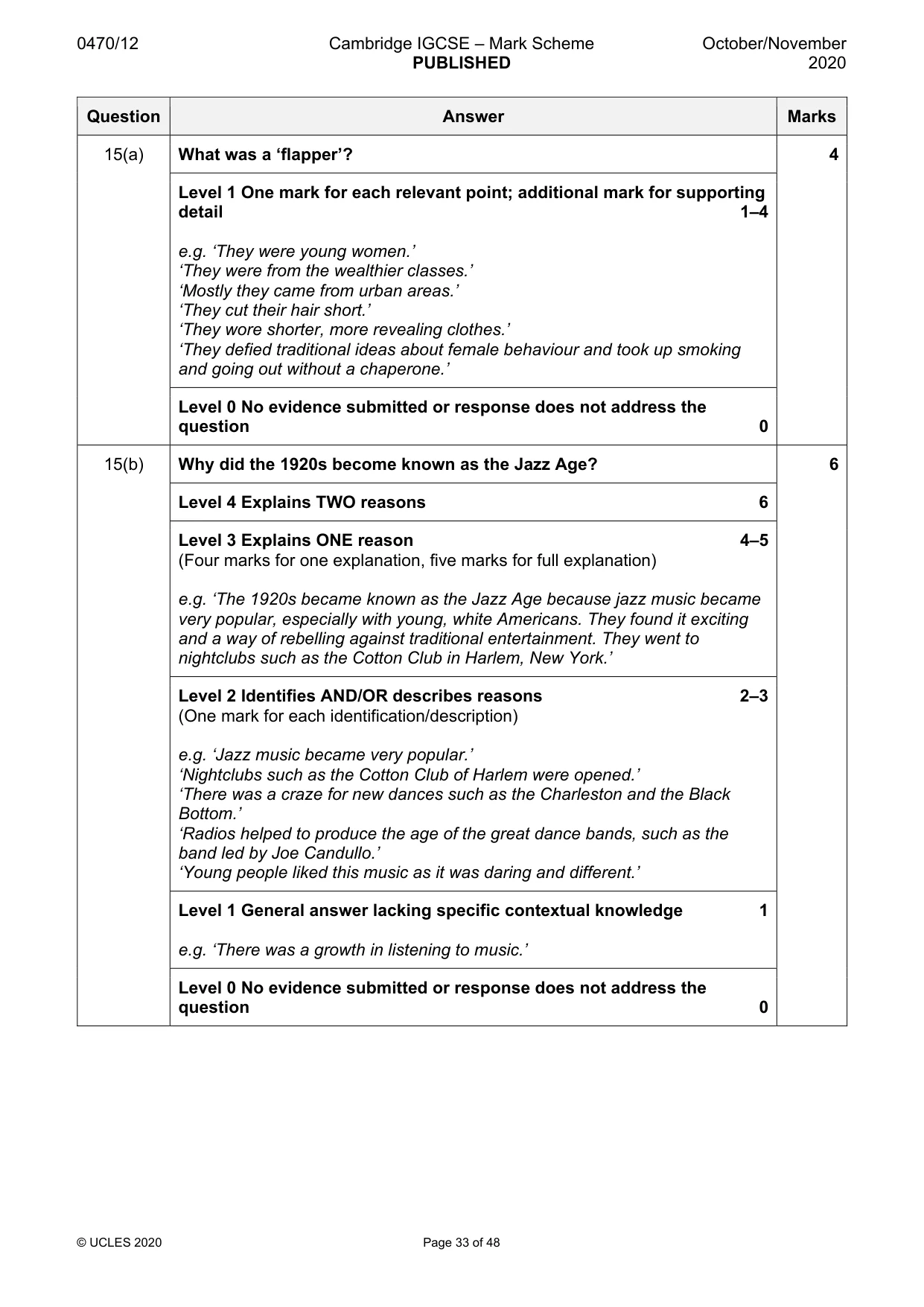
0470/12 Cambridge IGCSE – Mark Scheme PUBLISHED October/November 2020 © UCLES 2020 Page 33 of 48 Question Answer Marks 15(a) What was a ‘flapper’? 4 Level 1 One mark for each relevant point; additional mark for supporting detail 1–4 e.g. ‘They were young women.’ ‘They were from the wealthier classes.’ ‘Mostly they came from urban areas.’ ‘They cut their hair short.’ ‘They wore shorter, more revealing clothes.’ ‘They defied traditional ideas about female behaviour and took up smoking and going out without a chaperone.’ Level 0 No evidence submitted or response does not address the question 0 15(b) Why did the 1920s become known as the Jazz Age? 6 Level 4 Explains TWO reasons 6 Level 3 Explains ONE reason 4–5 (Four marks for one explanation, five marks for full explanation) e.g. ‘The 1920s became known as the Jazz Age because jazz music became very popular, especially with young, white Americans. They found it exciting and a way of rebelling against traditional entertainment. They went to nightclubs such as the Cotton Club in Harlem, New York.’ Level 2 Identifies AND/OR describes reasons 2–3 (One mark for each identification/description) e.g. ‘Jazz music became very popular.’ ‘Nightclubs such as the Cotton Club of Harlem were opened.’ ‘There was a craze for new dances such as the Charleston and the Black Bottom.’ ‘Radios helped to produce the age of the great dance bands, such as the band led by Joe Candullo.’ ‘Young people liked this music as it was daring and different.’ Level 1 General answer lacking specific contextual knowledge 1 e.g. ‘There was a growth in listening to music.’ Level 0 No evidence submitted or response does not address the question 0
Mark scheme, page 34
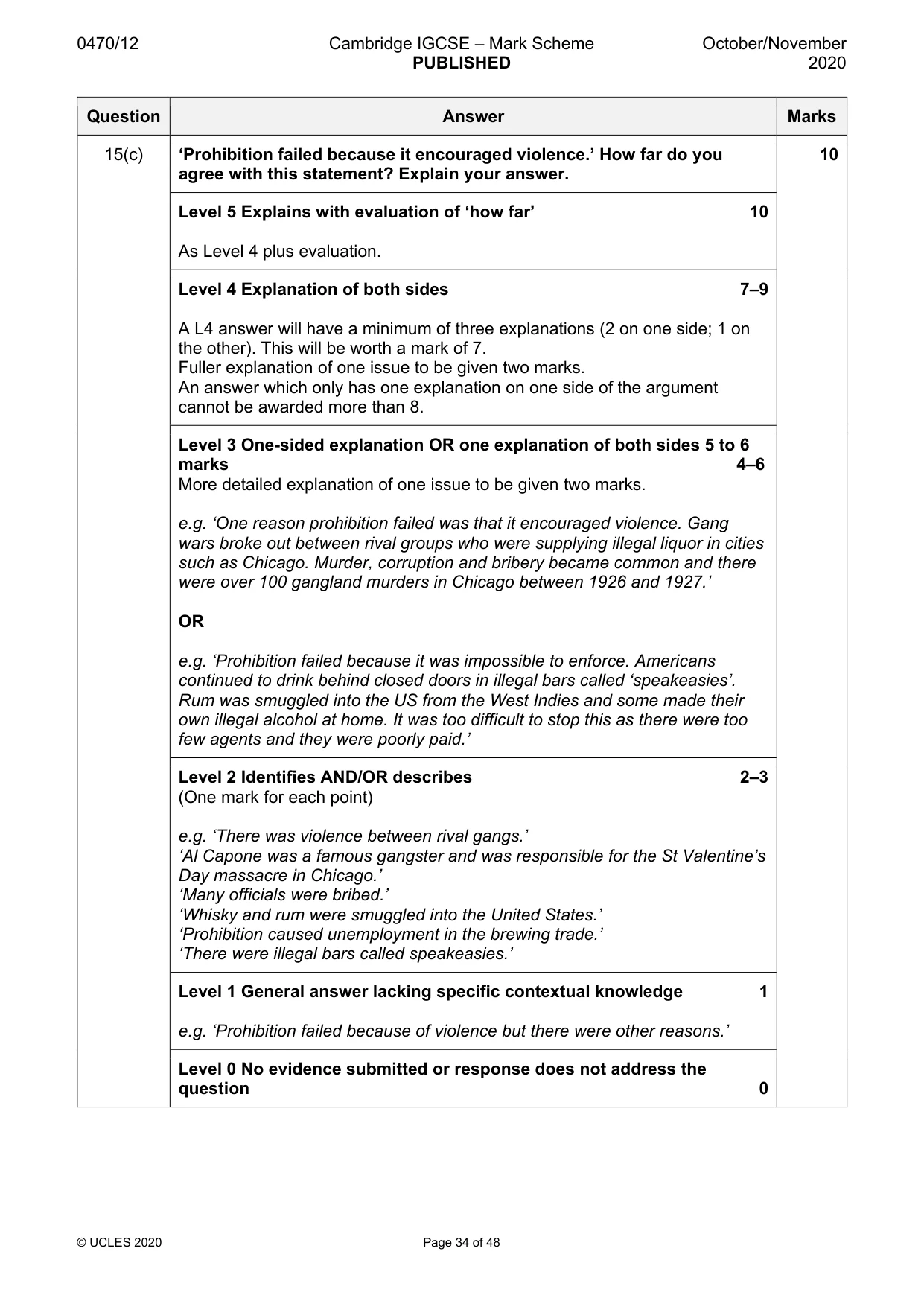
0470/12 Cambridge IGCSE – Mark Scheme PUBLISHED October/November 2020 © UCLES 2020 Page 34 of 48 Question Answer Marks 15(c) ‘Prohibition failed because it encouraged violence.’ How far do you agree with this statement? Explain your answer. 10 Level 5 Explains with evaluation of ‘how far’ 10 As Level 4 plus evaluation. Level 4 Explanation of both sides 7–9 A L4 answer will have a minimum of three explanations (2 on one side; 1 on the other). This will be worth a mark of 7. Fuller explanation of one issue to be given two marks. An answer which only has one explanation on one side of the argument cannot be awarded more than 8. Level 3 One-sided explanation OR one explanation of both sides 5 to 6 marks 4–6 More detailed explanation of one issue to be given two marks. e.g. ‘One reason prohibition failed was that it encouraged violence. Gang wars broke out between rival groups who were supplying illegal liquor in cities such as Chicago. Murder, corruption and bribery became common and there were over 100 gangland murders in Chicago between 1926 and 1927.’ OR e.g. ‘Prohibition failed because it was impossible to enforce. Americans continued to drink behind closed doors in illegal bars called ‘speakeasies’. Rum was smuggled into the US from the West Indies and some made their own illegal alcohol at home. It was too difficult to stop this as there were too few agents and they were poorly paid.’ Level 2 Identifies AND/OR describes 2–3 (One mark for each point) e.g. ‘There was violence between rival gangs.’ ‘Al Capone was a famous gangster and was responsible for the St Valentine’s Day massacre in Chicago.’ ‘Many officials were bribed.’ ‘Whisky and rum were smuggled into the United States.’ ‘Prohibition caused unemployment in the brewing trade.’ ‘There were illegal bars called speakeasies.’ Level 1 General answer lacking specific contextual knowledge 1 e.g. ‘Prohibition failed because of violence but there were other reasons.’ Level 0 No evidence submitted or response does not address the question 0
Mark scheme, page 35
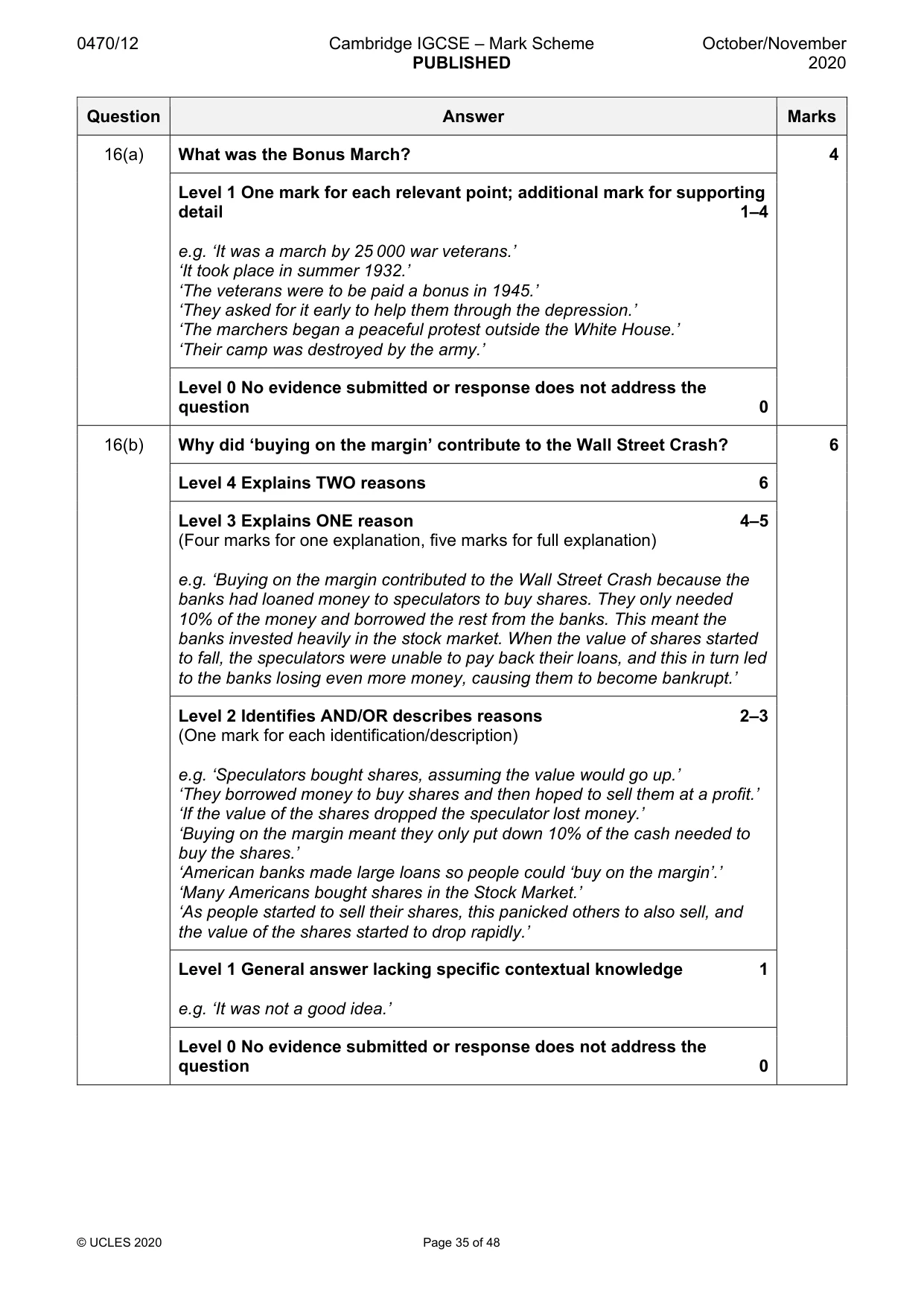
0470/12 Cambridge IGCSE – Mark Scheme PUBLISHED October/November 2020 © UCLES 2020 Page 35 of 48 Question Answer Marks 16(a) What was the Bonus March? 4 Level 1 One mark for each relevant point; additional mark for supporting detail 1–4 e.g. ‘It was a march by 25 000 war veterans.’ ‘It took place in summer 1932.’ ‘The veterans were to be paid a bonus in 1945.’ ‘They asked for it early to help them through the depression.’ ‘The marchers began a peaceful protest outside the White House.’ ‘Their camp was destroyed by the army.’ Level 0 No evidence submitted or response does not address the question 0 16(b) Why did ‘buying on the margin’ contribute to the Wall Street Crash? 6 Level 4 Explains TWO reasons 6 Level 3 Explains ONE reason 4–5 (Four marks for one explanation, five marks for full explanation) e.g. ‘Buying on the margin contributed to the Wall Street Crash because the banks had loaned money to speculators to buy shares. They only needed 10% of the money and borrowed the rest from the banks. This meant the banks invested heavily in the stock market. When the value of shares started to fall, the speculators were unable to pay back their loans, and this in turn led to the banks losing even more money, causing them to become bankrupt.’ Level 2 Identifies AND/OR describes reasons 2–3 (One mark for each identification/description) e.g. ‘Speculators bought shares, assuming the value would go up.’ ‘They borrowed money to buy shares and then hoped to sell them at a profit.’ ‘If the value of the shares dropped the speculator lost money.’ ‘Buying on the margin meant they only put down 10% of the cash needed to buy the shares.’ ‘American banks made large loans so people could ‘buy on the margin’.’ ‘Many Americans bought shares in the Stock Market.’ ‘As people started to sell their shares, this panicked others to also sell, and the value of the shares started to drop rapidly.’ Level 1 General answer lacking specific contextual knowledge 1 e.g. ‘It was not a good idea.’ Level 0 No evidence submitted or response does not address the question 0
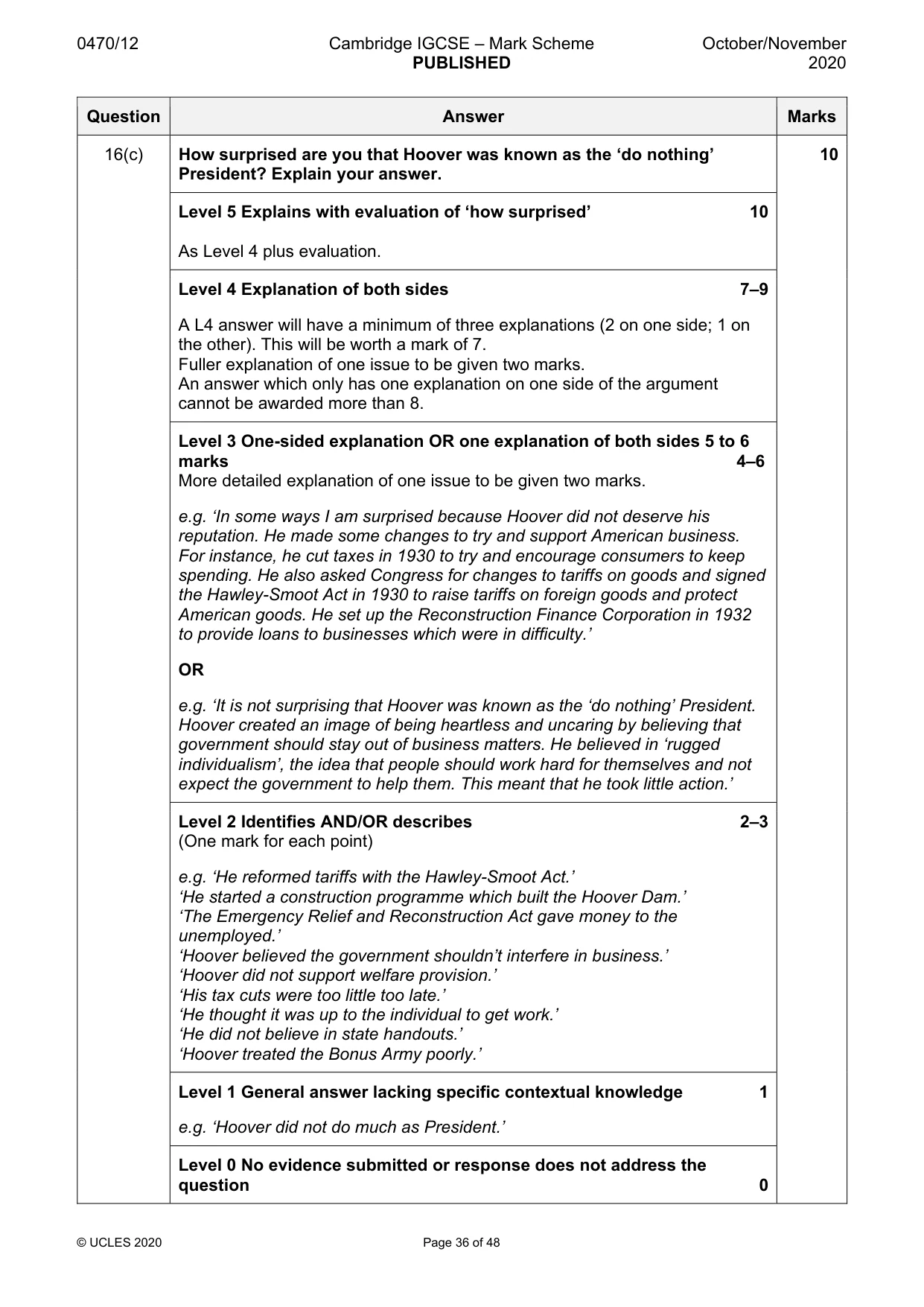
Mark scheme, page 36
0470/12 Cambridge IGCSE – Mark Scheme PUBLISHED October/November 2020 © UCLES 2020 Page 36 of 48 Question Answer Marks 16(c) How surprised are you that Hoover was known as the ‘do nothing’ President? Explain your answer. 10 Level 5 Explains with evaluation of ‘how surprised’ 10 As Level 4 plus evaluation. Level 4 Explanation of both sides 7–9 A L4 answer will have a minimum of three explanations (2 on one side; 1 on the other). This will be worth a mark of 7. Fuller explanation of one issue to be given two marks. An answer which only has one explanation on one side of the argument cannot be awarded more than 8. Level 3 One-sided explanation OR one explanation of both sides 5 to 6 marks 4–6 More detailed explanation of one issue to be given two marks. e.g. ‘In some ways I am surprised because Hoover did not deserve his reputation. He made some changes to try and support American business. For instance, he cut taxes in 1930 to try and encourage consumers to keep spending. He also asked Congress for changes to tariffs on goods and signed the Hawley-Smoot Act in 1930 to raise tariffs on foreign goods and protect American goods. He set up the Reconstruction Finance Corporation in 1932 to provide loans to businesses which were in difficulty.’ OR e.g. ‘It is not surprising that Hoover was known as the ‘do nothing’ President. Hoover created an image of being heartless and uncaring by believing that government should stay out of business matters. He believed in ‘rugged individualism’, the idea that people should work hard for themselves and not expect the government to help them. This meant that he took little action.’ Level 2 Identifies AND/OR describes 2–3 (One mark for each point) e.g. ‘He reformed tariffs with the Hawley-Smoot Act.’ ‘He started a construction programme which built the Hoover Dam.’ ‘The Emergency Relief and Reconstruction Act gave money to the unemployed.’ ‘Hoover believed the government shouldn’t interfere in business.’ ‘Hoover did not support welfare provision.’ ‘His tax cuts were too little too late.’ ‘He thought it was up to the individual to get work.’ ‘He did not believe in state handouts.’ ‘Hoover treated the Bonus Army poorly.’ Level 1 General answer lacking specific contextual knowledge 1 e.g. ‘Hoover did not do much as President.’ Level 0 No evidence submitted or response does not address the question 0
Mark scheme, page 37
0470/12 Cambridge IGCSE – Mark Scheme PUBLISHED October/November 2020 © UCLES 2020 Page 37 of 48 Question Answer Marks 17(a) Describe Communist treatment of the landlords. 4 Level 1 One mark for each relevant point; additional mark for supporting detail 1–4 e.g. ‘They were persecuted.’ ‘The land was taken from the landlords and shared out amongst the peasants.’ ‘Peasants were invited to ‘speak bitterness meetings’ where they showed their anger at the way they were treated by landlords in the past.’ ‘Landlords as a class were wiped out. They were often executed on the orders of a People’s Court.’ ‘As many as 1 million ex-landlords were executed.’ ‘Some ex-landlords were sent to prison camps to be re-educated.’ Level 0 No evidence submitted or response does not address the question 0 17(b) Why did Mao embark on the Great Leap Forward? 6 Level 4 Explains TWO reasons 6 Level 3 Explains ONE reason 4–5 (Four marks for one explanation, five marks for full explanation) e.g. ‘Mao launched the Great Leap Forward because he wanted to create a modern economy. He stated that this would enable China to overtake other developed nations and become the richest, most powerful and most advanced nation.’ Level 2 Identifies AND/OR describes reasons 2–3 (One mark for each identification/description) e.g. ‘Mao wanted to create a modern economy.’ ‘Increase agricultural production.’ ‘It followed the success of the 5 year plans.’ ‘He wanted to use the peasants to develop industry.’ ‘He wanted to increase steel production.’ ‘He wanted to become more powerful than other developed nations.’ ‘He wanted the workers to live in communes.’ ‘He wanted the workers to become more productive.’ ‘Communes would make controlling the people easier.’ Level 1 General answer lacking specific contextual knowledge 1 e.g. ‘He thought it would be a good thing to do.’ Level 0 No evidence submitted or response does not address the question 0
Mark scheme, page 38
0470/12 Cambridge IGCSE – Mark Scheme PUBLISHED October/November 2020 © UCLES 2020 Page 38 of 48 Question Answer Marks 17(c) How far do you agree that Mao’s attempts at social reform were a success? Explain your answer. 10 Level 5 Explains with evaluation of ‘how far’ 10 As Level 4 plus evaluation. Level 4 Explanation of both sides 7–9 A L4 answer will have a minimum of three explanations (2 on one side; 1 on the other). This will be worth a mark of 7. Fuller explanation of one issue to be given two marks. An answer which only has one explanation on one side of the argument cannot be awarded more than 8. Level 3 One-sided explanation OR one explanation of both sides 5 to 6 marks 4–6 More detailed explanation of one issue to be given two marks. e.g. ‘Mao made reforms in healthcare and education which benefitted everyone in China. Healthcare was free and the number of doctors in rural areas was increased. Education was improved and by the 1960s, over 90% of the population were literate. This meant the workforce was capable of more skilled labour.’ OR e.g. ‘Although there were some reforms which benefitted women, it was hard to change traditional attitudes. Few women became involved in politics and only 13% of the party membership were women. Changes to the marriage laws were not welcomed in rural society and the process of collectivisation undermined family life. Many women were unhappy that their traditional roles as wives and mothers were taken away. When famine struck in 1958, they were unable to provide for their children and the divorce rate soared as many women left home to try and find work elsewhere.’ Level 2 Identifies AND/OR describes 2–3 (One mark for each point) e.g. ‘Healthcare improved.’ ‘Literacy rates went up in China.’ ‘Women had greater freedom and more opportunities.’ ‘Forced marriage was banned.’ ‘Collectivisation damaged family life.’ ‘Rural society disliked changes to marriage laws.’ ‘Traditional attitudes took a long time to change.’ ‘The move to collectivisation and communes was a disaster and there was famine by 1958.’ Level 1 General answer lacking specific contextual knowledge 1 e.g. ‘Some of Mao’s social policies were a success.’ Level 0 No evidence submitted or response does not address the question 0
Mark scheme, page 39
0470/12 Cambridge IGCSE – Mark Scheme PUBLISHED October/November 2020 © UCLES 2020 Page 39 of 48 Question Answer Marks 18(a) What did China gain from its relationship with the USSR in the 1950s? 4 Level 1 One mark for each relevant point; additional mark for supporting detail 1–4 e.g. ‘The USSR and China signed a Treaty of Friendship in 1950.’ ‘The USSR gave China a $300 million loan.’ ‘They signed a military alliance for 30 years.’ ‘The Soviet Union sent technical advisers to China to support industrial development in the first Five-Year Plan.’ ‘The USSR helped China with industrial planning.’ ‘Agricultural experts were sent to China.’ Level 0 No evidence submitted or response does not address the question 0 18(b) Why was there tension between China and India in the 1960s? 6 Level 4 Explains TWO reasons 6 Level 3 Explains ONE reason 4–5 (Four marks for one explanation, five marks for full explanation) e.g. ‘Relations between China and India worsened when the Dalai Lama sought sanctuary in India after the Tibetan rising in 1959. The Dalai Lama led a government in exile. In the early 1960s, the CIA funded him with $1.7 million a year to launch guerrilla operations against the Chinese. This naturally upset Sino-Indian relations.’ Level 2 Identifies AND/OR describes reasons 2–3 (One mark for each identification/description) e.g. ‘The border between India and Tibet was not well defined.’ ‘The Chinese wanted to build a road into Tibet.’ ‘The Chinese built border posts in areas considered to be Indian by India.’ ‘Nehru had given the Dalai Lama sanctuary in India.’ ‘There were numerous border incidents between opposing border guards.’ ‘The CIA funded the Dalai Lama to attack the Chinese.’ Level 1 General answer lacking specific contextual knowledge 1 e.g. ‘They fell out.’ Level 0 No evidence submitted or response does not address the question 0
Mark scheme, page 40
0470/12 Cambridge IGCSE – Mark Scheme PUBLISHED October/November 2020 © UCLES 2020 Page 40 of 48 Question Answer Marks 18(c) How far do you agree that trade was the main reason for China’s improved foreign relations in the 1980s? Explain your answer. 10 Level 5 Explains with evaluation of ‘how far’ 10 As Level 4 plus evaluation. Level 4 Explanation of both sides 7–9 A L4 answer will have a minimum of three explanations (2 on one side; 1 on the other). This will be worth a mark of 7. Fuller explanation of one issue to be given two marks. An answer which only has one explanation on one side of the argument cannot be awarded more than 8. Level 3 One-sided explanation OR one explanation of both sides 5 to 6 marks 4–6 More detailed explanation of one issue to be given two marks. e.g. ‘Trade was important in the improvement of foreign relations. In the early 1980s, Deng Xiao-ping adopted an ‘open door’ policy towards the West. A trade agreement between the US and China was signed in the 1970s and this led to greater cooperation in the 1980s. Many American and Western companies set up businesses in China and China started to purchase military and industrial equipment from abroad.’ OR e.g. ‘Other factors contributed to improved foreign relations in the 1980s. For instance, the United States was keen to establish more friendly relations with China, especially as relations between the USSR and China had cooled. Relations improved when the US government stopped recognising the government of Taiwan as the legitimate rulers of China.’ Level 2 Identifies AND/OR describes 2–3 (One mark for each point) e.g. ‘The ‘open door’ policy encouraged trade with the West.’ ‘China steadily increased contact with the rest of the world.’ ‘It became easier to visit China.’ ‘In 1984 the British agreed to return Hong Kong to China in 1997.’ ‘Relations had deteriorated with the USSR which encouraged better relations with the United States.’ ‘The United States stopped recognising the government of Taiwan as the legitimate government of China.’ ‘Deng Xiao-ping’s attitude encouraged better relations.’ Level 1 General answer lacking specific contextual knowledge 1 e.g. ‘China’s relationship with the rest of the world improved in the 1980s.’ Level 0 No evidence submitted or response does not address the question 0
Mark scheme, page 41
0470/12 Cambridge IGCSE – Mark Scheme PUBLISHED October/November 2020 © UCLES 2020 Page 41 of 48 Question Answer Marks 19(a) In what ways did Afrikaners benefit from apartheid? 4 Level 1 One mark for each relevant point; additional mark for supporting detail 1–4 e.g. ‘It reinforced their sense of superiority.’ ‘It made them more equal with English speaking white South Africans.’ ‘It allowed them to gain a foothold in English speaking industries such as mining.’ ‘It allowed them to live in the most desirable areas.’ ‘The National Party promoted Afrikaners to key positions.’ ‘They gained control of much of the civil service and local government.’ ‘Many joined the police force, which was a strong source of support for white supremacy.’ ‘The Broederbond were promoted to important positions such as the Ministry of Native Affairs.’ Level 0 No evidence submitted or response does not address the question 0 19(b) Why was the Pan Africanist Congress (PAC) formed? 6 Level 4 Explains TWO reasons 6 Level 3 Explains ONE reason 4–5 (Four marks for one explanation, five marks for full explanation) e.g. ‘The Pan Africanist Congress was formed because its leader, Robert Sobukwe, thought that the African National Congress was too cautious in its approach. He was disappointed by their lack of success and wanted more dramatic action. Whereas the ANC wanted single-day marches against the Pass Laws, Sobukwe wanted mass disobedience. He wanted demonstrators to be arrested to draw attention to the plight of Africans.’ Level 2 Identifies AND/OR describes reasons 2–3 (One mark for each identification/description) e.g. ‘Sobukwe thought the African National Congress was too cautious in their approach.’ ‘The PAC was formed to represent the interests of Africans.’ ‘Sobukwe thought the ANC was too heavily influenced by communism.’ ‘The PAC wanted to fight purely for the rights of Africans rather than other groups.’ ‘The group was formed because some activists were disappointed with the lack of success of the ANC.’ Level 1 General answer lacking specific contextual knowledge 1 e.g. ‘The PAC was formed as it was needed.’ Level 0 No evidence submitted or response does not address the question 0
Mark scheme, page 42
0470/12 Cambridge IGCSE – Mark Scheme PUBLISHED October/November 2020 © UCLES 2020 Page 42 of 48 Question Answer Marks 19(c) ‘The Bantu Education Act (1953) did more to reinforce apartheid than any other legislation.’ How far do you agree with this statement? Explain your answer. 10 Level 5 Explains with evaluation of ‘how far’ 10 As Level 4 plus evaluation. Level 4 Explanation of both sides 7–9 A L4 answer will have a minimum of three explanations (2 on one side; 1 on the other). This will be worth a mark of 7. Fuller explanation of one issue to be given two marks. An answer which only has one explanation on one side of the argument cannot be awarded more than 8. Level 3 One-sided explanation OR one explanation of both sides 5 to 6 marks 4–6 More detailed explanation of one issue to be given two marks. e.g. ‘The Bantu Education Act made black children pay for their education in schools which were sub-standard. 30% had no electricity and 25% no running water. They had few textbooks and only one third of teachers were trained. In comparison, white education was well funded with high quality facilities, materials and teachers. Education was free for white children and the difference between the two systems underlined the fact that black children were considered inferior under apartheid.’ OR e.g. ‘The Pass system was more important in enforcing apartheid. The Pass was a book which had to be shown on demand and applied to all non-white men over 16 years. It was resented because white South Africans did not have to carry one. The Pass contained information about when a non-white person could work in a white area and how long they could be there. It helped the government enforce apartheid because it helped them control where non- white people lived and worked.’ Level 2 Identifies AND/OR describes 2–3 (One mark for each point) e.g. ‘The Bantu Education Act meant that black children went to very poor schools.’ ‘The Pass Laws restricted where non-white people could work and this limited their opportunities.’ ‘The Separate Amenities Act meant that races were separated in public areas and transport.’ ‘The Group Areas Act divided South Africa into racial areas.’ Level 1 General answer lacking specific contextual knowledge 1 e.g. ‘There were many laws to enforce apartheid.’ Level 0 No evidence submitted or response does not address the question 0
Mark scheme, page 43
0470/12 Cambridge IGCSE – Mark Scheme PUBLISHED October/November 2020 © UCLES 2020 Page 43 of 48 Question Answer Marks 20(a) Describe Mandela’s aims for South Africa on becoming President. 4 Level 1 One mark for each relevant point; additional mark for supporting detail 1–4 e.g. ‘He wanted reconciliation.’ ‘He wanted South Africa to become a ‘rainbow’ nation by bringing together the previously hostile races.’ ‘He wanted to end the tension between the ANC and Inkatha.’ ‘He wanted black majority rule.’ ‘He wanted a fair government for all South Africans.’ Level 0 No evidence submitted or response does not address the question 0 20(b) Why did Botha’s constitutional reforms fail to improve relations between non-whites and the government? 6 Level 4 Explains TWO reasons 6 Level 3 Explains ONE reason 4–5 (Four marks for one explanation, five marks for full explanation) e.g. ‘Non-white South Africans were disappointed by the changes made. Although black and Asian South Africans were given some limited representation, the white South Africans remained in the majority. Black South Africans, around 75% of the population, were not represented. They were given the right to vote in local elections but no say in national politics. This did not improve the relationship with the government.’ Level 2 Identifies AND/OR describes reasons 2–3 (One mark for each identification/description) e.g. ‘A new South African Parliament was established but races were not represented equally.’ ‘The changes were viewed as an attempt to look like power sharing without really changing anything meaningful.’ ‘The House of Assembly had white members and was voted for by white South Africans.’ ‘Although Asians and black South Africans were represented, they did not register to vote.’ ‘Black South Africans were only allowed to vote in local elections.’ Level 1 General answer lacking specific contextual knowledge 1 e.g. ‘The reforms did not give people what they wanted.’ Level 0 No evidence submitted or response does not address the question 0
Mark scheme, page 44
0470/12 Cambridge IGCSE – Mark Scheme PUBLISHED October/November 2020 © UCLES 2020 Page 44 of 48 Question Answer Marks 20(c) How far did de Klerk’s policies to end apartheid have the backing of white South Africans? Explain your answer. 10 Level 5 Explains with evaluation of ‘how far’ 10 As Level 4 plus evaluation. Level 4 Explanation of both sides 7–9 A L4 answer will have a minimum of three explanations (2 on one side; 1 on the other). This will be worth a mark of 7. Fuller explanation of one issue to be given two marks. An answer which only has one explanation on one side of the argument cannot be awarded more than 8. Level 3 One-sided explanation OR one explanation of both sides 5 to 6 marks 4–6 More detailed explanation of one issue to be given two marks. e.g. ‘Many white South Africans were in favour of de Klerk’s policies. They were worried about their economic future and could see that sanctions would ruin South Africa. Foreign companies refused to invest in South Africa and the value of the currency fell dramatically. This meant wages were falling and unemployment was rising. It became clear to many people that the current situation could not be allowed to continue.’ OR e.g. ‘The Conservative Party did not support de Klerk and wanted a return to full apartheid. There were extreme individuals such as Eugene Terre Blanche, who was the leader of the Afrikaner Resistance Movement, who wanted to break away from the existing South Africa and form an independent Boer- Afrikaner republic. Members could not accept that, in the eyes of the law, white and black would be equal.’ Level 2 Identifies AND/OR describes 2–3 (One mark for each point) e.g. ‘There was increasing white opposition to apartheid.’ ‘Many officials were attacked and often murdered.’ ‘Economic sanctions were biting.’ ‘There was disinvestment.’ ‘There was no international sport.’ ‘Church groups were speaking out against apartheid.’ ‘Pope John Paul II became involved.’ ‘Afrikaner nationalists still believed in their superiority.’ ‘They had a desire for an independent Boer-Afrikaner republic.’ ‘The Conservative Party wanted full apartheid.’ Level 1 General answer lacking specific contextual knowledge 1 e.g. ‘They preferred the policies of other leaders.’ Level 0 No evidence submitted or response does not address the question 0
Mark scheme, page 45
0470/12 Cambridge IGCSE – Mark Scheme PUBLISHED October/November 2020 © UCLES 2020 Page 45 of 48 Question Answer Marks 21(a) Describe Moshe Dayan’s role in the Six-Day War. 4 Level 1 One mark for each relevant point; additional mark for supporting detail 1–4 e.g. ‘He was an Israeli military leader.’ ‘He drew up a plan for a pre-emptive strike against the Arab States.’ ‘The Israeli government approved this plan.’ ‘He was brought into the Israeli Cabinet in the build-up to the war.’ ‘He planned to destroy the opponents’ air forces on the ground.’ ‘He was important in ordering an attack on the Golan Heights.’ ‘He realised that speed was the most important factor in the attack.’ Level 0 No evidence submitted or response does not address the question 0 21(b) Why did the Soviet Union become involved in the Middle East? 6 Level 4 Explains TWO reasons 6 Level 3 Explains ONE reason 4–5 (Four marks for one explanation, five marks for full explanation) e.g. ‘One of the reasons the Soviet Union became involved in the Middle East was to support Nasser. The Americans refused to supply arms to Egypt and in 1955, Nasser bought arms from Czechoslovakia, which was an ally of the Soviet Union. In July 1956, the United States and Britain decided to cancel their loans to Egypt for building the Aswan Dam. The Soviets exploited this opportunity for closer ties with Egypt and loaned the money for the dam.’ Level 2 Identifies AND/OR describes reasons 2–3 (One mark for each identification/description) e.g. ‘Egypt became anti-Western because of the Suez Crisis.’ ‘The United States refused to supply weapons to Egypt.’ ‘The Soviet Union loaned Egypt the money to build the Aswan Dam.’ ‘Egypt bought arms from Czechoslovakia, a Soviet ally.’ ‘The Soviet Union gave Egypt support during the Suez Crisis.’ ‘The Soviet Union was keen to deflect international attention from the Hungarian uprising.’ Level 1 General answer lacking specific contextual knowledge 1 e.g. ‘The Soviet Union wanted to help.’ Level 0 No evidence submitted or response does not address the question 0
Mark scheme, page 46
0470/12 Cambridge IGCSE – Mark Scheme PUBLISHED October/November 2020 © UCLES 2020 Page 46 of 48 Question Answer Marks 21(c) How far do you agree that Egypt gained the most from the Suez crisis of 1956? Explain your answer. 10 Level 5 Explains with evaluation of ‘how far’ 10 As Level 4 plus evaluation. Level 4 Explanation of both sides 7–9 A L4 answer will have a minimum of three explanations (2 on one side; 1 on the other). This will be worth a mark of 7. Fuller explanation of one issue to be given two marks. An answer which only has one explanation on one side of the argument cannot be awarded more than 8. Level 3 One-sided explanation OR one explanation of both sides 5 to 6 marks 4–6 More detailed explanation of one issue to be given two marks. e.g. ‘Egypt gained status from the Suez Crisis. The Egyptian leader, Nasser, was treated as a great hero by the Arab world for standing up to the British and French, who had dominated the Middle East for so long. He now had complete control over the Canal and even had US aid to clear it so the Canal reopened in April 1957.’ OR e.g. ‘Israel made some gains from the Suez Crisis. The speed of their victory over Egyptian forces in Gaza and Sinai proved that the Israeli Defence Forces were still the strongest in the Middle East. The crisis also strengthened their relationship with the United States.’ Level 2 Identifies AND/OR describes 2–3 (One mark for each point) e.g. ‘Nasser became the hero of the Arab world.’ ‘Egypt had complete control of the Suez Canal.’ ‘Egypt had a large quantity of British military stores.’ ‘Nasser could claim that Egypt was only defeated by Israel with British and French help.’ ‘The Israeli forces proved to be the strongest in the Middle East.’ ‘Relations between the US and Israel were strengthened.’ Level 1 General answer lacking specific contextual knowledge 1 e.g. ‘Egypt gained a lot.’ Level 0 No evidence submitted or response does not address the question 0
Mark scheme, page 47
0470/12 Cambridge IGCSE – Mark Scheme PUBLISHED October/November 2020 © UCLES 2020 Page 47 of 48 Question Answer Marks 22(a) Describe the role of the UN in Lebanon. 4 Level 1 One mark for each relevant point; additional mark for supporting detail 1–4 e.g. ‘The UN tried to keep the peace between Lebanon and Israel.’ ‘UNIFIL (United Nations Interim Force in Lebanon) was established in 1978.’ ‘It was created to supervise the withdrawal of Israel from Lebanon.’ ‘It gave humanitarian aid to the population in Lebanon.’ ‘The UN was unable to prevent the Israeli invasion of Lebanon in 1982.’ ‘The UN stayed in Lebanon after the invasion in 1982 to protect the people.’ Level 0 No evidence submitted or response does not address the question 0 22(b) Why did some groups working for Palestinian liberation become more militant from the 1980s? 6 Level 4 Explains TWO reasons 6 Level 3 Explains ONE reason 4–5 (Four marks for one explanation, five marks for full explanation) e.g. ‘There was an increase in tension between the Israelis and Palestinians and this led to more militant behaviour. For instance, in December 1987, an Israeli army vehicle in Gaza crashed into a lorry killing four Palestinians. It was rumoured that it was deliberate because an Israeli had been killed two days before. At the funerals, a youth was shot by an Israeli soldier. Barricades went up and Palestinians stoned Israeli army patrols.’ Level 2 Identifies AND/OR describes reasons 2–3 (One mark for each identification/description) e.g. ‘There were reprisals between Israelis and Palestinians.’ ‘In December 1987, an Israeli army vehicle in Gaza crashed into a lorry killing four Palestinians.’ ‘It was rumoured that four Palestinians had been deliberately killed because an Israeli had been killed two days before.’ ‘Palestinians stoned Israeli army patrols.’ ‘Israelis dealt with demonstrations harshly. They rounded up suspects and jailed them without trial.’ ‘The Israeli army confiscated land and declared it to be Jewish property. This land was often allocated for building Jewish settlements.’ ‘By 1987, there were over 80 000 Israelis living in settlements around Jerusalem and another 20 000 living in parts of the West Bank and Gaza.’ Level 1 General answer lacking specific contextual knowledge 1 e.g. ‘The people were upset.’ Level 0 No evidence submitted or response does not address the question 0
Mark scheme, page 48
0470/12 Cambridge IGCSE – Mark Scheme PUBLISHED October/November 2020 © UCLES 2020 Page 48 of 48 Question Answer Marks 22(c) How far do you agree that the UN achieved little in its involvement in the Middle East? Explain your answer. 10 Level 5 Explains with evaluation of ‘how far’ 10 As Level 4 plus evaluation. Level 4 Explanation of both sides 7–9 A L4 answer will have a minimum of three explanations (2 on one side; 1 on the other). This will be worth a mark of 7. Fuller explanation of one issue to be given two marks. An answer which only has one explanation on one side of the argument cannot be awarded more than 8. Level 3 One-sided explanation OR one explanation of both sides 5 to 6 marks 4–6 More detailed explanation of one issue to be given two marks. e.g. ‘I agree that the role of the UN was reduced as time went on. By the early 1990s there was increasing American intervention in the Middle East. For instance, the invasion of Iraq in 1991 showed the United States intervening directly in Middle Eastern affairs. Individual US statesmen relying on their own lines of communication, such as Kissinger, Carter or Clinton, had eliminated the UN’s peace-making role.’ OR e.g. ‘The UN had some success in limiting tension and fighting in the Middle East. For instance, UNEF kept the peace between the Israelis and Egypt from 1956 until 1967. UNIFIL could not stop Israel invading Lebanon in 1982, but they provided important protection and humanitarian aid for the Lebanese people.’ Level 2 Identifies AND/OR describes 2–3 (One mark for each point) e.g. ‘Neither Syria nor Israel wanted to keep the peace despite the UN buffer zone.’ ‘UNEF kept the peace between Israel and Egypt for almost 10 years.’ ‘Egypt ordered UN forces to leave Egypt in the run up to the Six Day War.’ ‘Israel ignored the UN’s declaration of Israel’s occupation of eastern Jerusalem to be illegal.’ ‘Israel had not followed UN Resolution 242 to leave the Occupied Territories.’ ‘The intervention of the United States in the Middle East limited the influence of the UN.’ Level 1 General answer lacking specific contextual knowledge 1 e.g. ‘The UN had some success in the early days.’ Level 0 No evidence submitted or response does not address the question 0
What you needed in this session
Cambridge’s own grade thresholds for 2020 Oct/Nov, Paper 1 · Variant 2. A higher threshold means an easier paper — the bar moves with how the cohort did.